EP4495614A1 - Battery inspection method - Google Patents
Battery inspection method Download PDFInfo
- Publication number
- EP4495614A1 EP4495614A1 EP23904089.2A EP23904089A EP4495614A1 EP 4495614 A1 EP4495614 A1 EP 4495614A1 EP 23904089 A EP23904089 A EP 23904089A EP 4495614 A1 EP4495614 A1 EP 4495614A1
- Authority
- EP
- European Patent Office
- Prior art keywords
- function
- battery
- inspection method
- secondary battery
- impedance
- Prior art date
- Legal status (The legal status is an assumption and is not a legal conclusion. Google has not performed a legal analysis and makes no representation as to the accuracy of the status listed.)
- Granted
Links
Images
Classifications
-
- G—PHYSICS
- G01—MEASURING; TESTING
- G01R—MEASURING ELECTRIC VARIABLES; MEASURING MAGNETIC VARIABLES
- G01R31/00—Arrangements for testing electric properties; Arrangements for locating electric faults; Arrangements for electrical testing characterised by what is being tested not provided for elsewhere
- G01R31/36—Arrangements for testing, measuring or monitoring the electrical condition of accumulators or electric batteries, e.g. capacity or state of charge [SoC]
- G01R31/392—Determining battery ageing or deterioration, e.g. state of health
-
- G—PHYSICS
- G01—MEASURING; TESTING
- G01R—MEASURING ELECTRIC VARIABLES; MEASURING MAGNETIC VARIABLES
- G01R31/00—Arrangements for testing electric properties; Arrangements for locating electric faults; Arrangements for electrical testing characterised by what is being tested not provided for elsewhere
- G01R31/36—Arrangements for testing, measuring or monitoring the electrical condition of accumulators or electric batteries, e.g. capacity or state of charge [SoC]
- G01R31/389—Measuring internal impedance, internal conductance or related variables
-
- G—PHYSICS
- G01—MEASURING; TESTING
- G01R—MEASURING ELECTRIC VARIABLES; MEASURING MAGNETIC VARIABLES
- G01R23/00—Arrangements for measuring frequencies; Arrangements for analysing frequency spectra
- G01R23/16—Spectrum analysis; Fourier analysis
-
- G—PHYSICS
- G01—MEASURING; TESTING
- G01R—MEASURING ELECTRIC VARIABLES; MEASURING MAGNETIC VARIABLES
- G01R31/00—Arrangements for testing electric properties; Arrangements for locating electric faults; Arrangements for electrical testing characterised by what is being tested not provided for elsewhere
- G01R31/36—Arrangements for testing, measuring or monitoring the electrical condition of accumulators or electric batteries, e.g. capacity or state of charge [SoC]
- G01R31/3644—Constructional arrangements
- G01R31/3648—Constructional arrangements comprising digital calculation means, e.g. for performing an algorithm
-
- G—PHYSICS
- G01—MEASURING; TESTING
- G01R—MEASURING ELECTRIC VARIABLES; MEASURING MAGNETIC VARIABLES
- G01R31/00—Arrangements for testing electric properties; Arrangements for locating electric faults; Arrangements for electrical testing characterised by what is being tested not provided for elsewhere
- G01R31/36—Arrangements for testing, measuring or monitoring the electrical condition of accumulators or electric batteries, e.g. capacity or state of charge [SoC]
- G01R31/367—Software therefor, e.g. for battery testing using modelling or look-up tables
-
- G—PHYSICS
- G01—MEASURING; TESTING
- G01R—MEASURING ELECTRIC VARIABLES; MEASURING MAGNETIC VARIABLES
- G01R31/00—Arrangements for testing electric properties; Arrangements for locating electric faults; Arrangements for electrical testing characterised by what is being tested not provided for elsewhere
- G01R31/36—Arrangements for testing, measuring or monitoring the electrical condition of accumulators or electric batteries, e.g. capacity or state of charge [SoC]
- G01R31/385—Arrangements for measuring battery or accumulator variables
-
- Y—GENERAL TAGGING OF NEW TECHNOLOGICAL DEVELOPMENTS; GENERAL TAGGING OF CROSS-SECTIONAL TECHNOLOGIES SPANNING OVER SEVERAL SECTIONS OF THE IPC; TECHNICAL SUBJECTS COVERED BY FORMER USPC CROSS-REFERENCE ART COLLECTIONS [XRACs] AND DIGESTS
- Y02—TECHNOLOGIES OR APPLICATIONS FOR MITIGATION OR ADAPTATION AGAINST CLIMATE CHANGE
- Y02E—REDUCTION OF GREENHOUSE GAS [GHG] EMISSIONS, RELATED TO ENERGY GENERATION, TRANSMISSION OR DISTRIBUTION
- Y02E60/00—Enabling technologies; Technologies with a potential or indirect contribution to GHG emissions mitigation
- Y02E60/10—Energy storage using batteries
Definitions
- the present disclosure relates to a battery inspection method, and relates to a battery inspection method which is capable of identifying cracks in electrodes of a completed secondary battery by non-destructive testing.
- microcracks that occur in the electrodes because they can affect not only the performance and lifespan of the battery, but also its durability and safety.
- the microcracks can be identified in a battery in use, it is possible to predict a maintenance cycle and future performance related to the battery, so analyzing them may serve as powerful data in battery operation.
- the present disclosure relates to a battery inspection method, and an object of the present disclosure is to provide a battery inspection method which is capable of identifying cracks in electrodes of a completed secondary battery by non-destructive testing.
- a battery inspection method of the present disclosure may include:
- the impedance spectral data may be acquired by applying alternating current power to the secondary battery for a band of the measurement frequency including a band of 10 -2 Hz to 10 5 Hz.
- a battery inspection method of the present disclosure it is possible to identify cracks in electrodes of a completed secondary battery by non-destructive testing.
- the battery inspection method of the present disclosure is applicable to a battery in use as non-destructive analysis, and it is possible to monitor the phenomenon of occurrence of cracks in the electrodes of the battery immediately by performing the analysis in a short time.
- the battery inspection method of the present disclosure it is possible to inspect a state of occurrence of microcracks in the electrodes of the battery in about seven (7) minutes without destroying the battery.
- a battery inspection method of the present disclosure may include:
- the impedance spectral data may be acquired by applying alternating current power to the secondary battery for a band of the measurement frequency including a band of 10 -2 Hz to 10 5 Hz.
- the first function may be acquired in the form of the following Equation 1.
- Z abs F 1 log f
- Z abs is the absolute value of the impedance
- F 1 (logf) is the first function
- f is the measurement frequency
- the second function may be acquired in the form of the following Equation 2.
- F 2 log f dZ abs d log f
- the state of the secondary battery may be determined based on the second function in a range where the logf is 0 to 1.
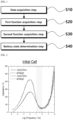
- FIG. 1 is a block diagram illustrating a battery inspection method of the present disclosure.
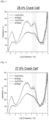
- FIG. 2 is a graph illustrating an imaginary part of impedance and a second function for a secondary battery of Example 1.
- FIG. 3 is a graph illustrating an imaginary part of impedance and a second function for a secondary battery of Example 2.
- FIG. 4 is a graph illustrating an imaginary part of impedance and a second function for a secondary battery of Example 3.
- the battery inspection method of the present disclosure may non-destructively analyze whether cracks occur in electrodes accommodated within a secondary battery case without opening the case.
- a secondary battery to be analyzed by the battery inspection method of the present disclosure may include an electrode manufactured by applying an electrode slurry to a metal substrate (a metal foil, etc.) and then drying it.
- the electrode slurry may be obtained by mixing an electrode active material, a conductive material, a binder, and a solvent and then kneading the mixture.
- the battery inspection method of the present disclosure may be able to determine whether a crack occurs in the dried electrode slurry.
- the battery inspection method of the present disclosure may include:
- the impedance spectral data may be acquired by electrochemical impedance spectroscopy (EIS).
- EIS electrochemical impedance spectroscopy
- the impedance spectral data may be acquired by applying alternating current power to the secondary battery for a band of the measurement frequency including a band of 10 -2 Hz to 10 5 Hz. More preferably, the impedance spectral data may be acquired by applying alternating current power to the secondary battery for a band of the measurement frequency including a band of 10 0 Hz to 10 1 Hz.
- the alternating current power may be applied by connecting negative and positive leads of the secondary battery to negative and positive terminals of a measurement and power supply device, respectively.
- the impedance value corresponding to each of the plurality of measurement frequencies may be acquired.
- the first function may be acquired in the form of the following Equation 1.
- Z abs F 1 log f
- Z abs is an absolute value of the impedance
- F 1 (logf) is the first function
- f is the measurement frequency
- the second function may be acquired in the form of the following Equation 2.
- F 2 log f dZ abs d log f
- the state of the secondary battery may be determined based on the second function in a range where the logf is 0 to 1.
- the battery inspection method of the present disclosure may determine whether cracks occur in the electrodes of the battery.
- the secondary battery in which there is no inflection point in the second function in the range where the logf is 0 to 1 may be determined to be a secondary battery in a normal state with no cracks in the electrodes.
- EIS was performed twice with measurement frequencies in the band of 10 -2 Hz to 10 5 Hz, and two sets of impedance spectral data were acquired.
- the first function was acquired as a fitting function using the log scale of the measurement frequency as the independent variable and the absolute value of impedance as the dependent variable.
- the acquired first function was differentiated by the logarithmic scale of the measurement frequency to acquire the second function.
- EIS was performed twice with measurement frequencies in the band of 10 -2 Hz to 10 5 Hz to acquire two sets of impedance spectral data.
- the first function was acquired as a fitting function using the log scale of the measurement frequency as the independent variable and the absolute value of impedance as the dependent variable.
- the acquired first function was differentiated by the logarithmic scale of the measurement frequency to acquire the second function.
- EIS was performed twice with measurement frequencies in the band of 10 -2 Hz to 10 5 Hz to acquire two sets of impedance spectral data.
- the first function was acquired as a fitting function using the log scale of the measurement frequency as the independent variable and the absolute value of impedance as the dependent variable.
- the acquired first function was differentiated by the logarithmic scale of the measurement frequency to acquire the second function.
- the crack % may be a value calculated by analyzing an image obtained by measuring with an electron microscope after destroying the battery after performing an electrode inspection method.
- the solid line is a graph for an imaginary part of the impedance
- the dashed line is a graph for the second function.
- the secondary battery in the normal state with no cracks has almost no curve in the range where the logf is 0 to 1.
- the graph of the second function in each of FIGS. 3 and 4 includes an inflection point in the range where the logf is 0 to 1, while the graph of the imaginary part shows no significant change.
- the battery inspection method of the present disclosure may determine with high sensitivity whether cracks occur in the electrodes of the battery through the second function.
- cracks since measurement may only be performed in the range where the logf is 0 to 1, cracks may be identified in a short time.
- a battery inspection method of the present disclosure it is possible to identify cracks in electrodes of a completed secondary battery by non-destructive testing.
- the battery inspection method of the present disclosure is applicable to a battery in use as non-destructive analysis, and it is possible to monitor the phenomenon of occurrence of cracks in the electrodes of the battery immediately by performing the analysis in a short time.
- the battery inspection method of the present disclosure it is possible to inspect a state of occurrence of microcracks in the electrodes of the battery in about seven (7) minutes without destroying the battery.
Landscapes
- Physics & Mathematics (AREA)
- General Physics & Mathematics (AREA)
- Mathematical Physics (AREA)
- Secondary Cells (AREA)
- Investigating Or Analyzing Materials By The Use Of Electric Means (AREA)
- Charge And Discharge Circuits For Batteries Or The Like (AREA)
Abstract
Description
- The present application claims the benefit of priority based on
Korean Patent Application No. 10-2022-0175754 filed on December 15, 2022 - The present disclosure relates to a battery inspection method, and relates to a battery inspection method which is capable of identifying cracks in electrodes of a completed secondary battery by non-destructive testing.
- After shipment of an initial cell, one of various phenomena that occur as a secondary battery degenerates due to progress of high-temperature storage, a charge-discharge cycle, and the like, is occurrence of microcracks in electrodes.
- It is important to identify the microcracks that occur in the electrodes because they can affect not only the performance and lifespan of the battery, but also its durability and safety. In addition, if the microcracks can be identified in a battery in use, it is possible to predict a maintenance cycle and future performance related to the battery, so analyzing them may serve as powerful data in battery operation.
- Conventionally, as a technique for identifying cracks in the electrodes, it is possible to quantify the cracks in the electrodes by analyzing an electron microscope image of the electrodes. However, since analysis of the phenomenon of occurrence of cracks in the electrodes through electron microscopy is carried out by completely disassembling the battery and extracting the electrodes from the battery, there is a problem in that the battery in which the analysis has been performed should be discarded. In other words, it was not possible to monitor a state of occurrence of cracks of the electrodes of the battery during use using the electron microscopy method.
- In addition, since a process of preparing an analysis sample was cumbersome and measurement took a long time, the electron microscopy method had problems with its use as immediate feedback data.
- Therefore, there is a need for a technology that can be applied to a battery in use as non-destructive analysis and that can perform analysis in a short period of time to immediately monitor the phenomenon of occurrence of cracks in electrodes of the battery.
- The present disclosure relates to a battery inspection method, and an object of the present disclosure is to provide a battery inspection method which is capable of identifying cracks in electrodes of a completed secondary battery by non-destructive testing.
- Technical objects to be accomplished by the present disclosure are not limited to the technical objects mentioned above, and other technical objects not mentioned may be clearly understood by those skilled in the art to which the present disclosure pertains from the following description.
- A battery inspection method of the present disclosure may include:
- a data acquisition step S10 of acquiring impedance spectral data for a secondary battery;
- a first function acquisition step S20 of acquiring, through function fitting, a first function which uses a logarithmic scale of a measurement frequency as an independent variable and an absolute value of impedance as a dependent variable from the impedance spectral data;
- a second function acquisition step S30 of acquiring a second function by differentiating the first function by the logarithmic scale of the measurement frequency; and
- a battery state determination step S40 of determining a state of the secondary battery based on the second function.
- In the data acquisition step S10 of the battery inspection method of the present disclosure, the impedance spectral data may be acquired by applying alternating current power to the secondary battery for a band of the measurement frequency including a band of 10-2 Hz to 105 Hz.
- According to a battery inspection method of the present disclosure, it is possible to identify cracks in electrodes of a completed secondary battery by non-destructive testing.
- The battery inspection method of the present disclosure is applicable to a battery in use as non-destructive analysis, and it is possible to monitor the phenomenon of occurrence of cracks in the electrodes of the battery immediately by performing the analysis in a short time.
- According to the battery inspection method of the present disclosure, it is possible to inspect a state of occurrence of microcracks in the electrodes of the battery in about seven (7) minutes without destroying the battery.
-
-
FIG. 1 is a block diagram illustrating a battery inspection method of the present disclosure. -
FIG. 2 is a graph illustrating an imaginary part of impedance and a second function for a secondary battery of Example 1. -
FIG. 3 is a graph illustrating an imaginary part of impedance and a second function for a secondary battery of Example 2. -
FIG. 4 is a graph illustrating an imaginary part of impedance and a second function for a secondary battery of Example 3. - A battery inspection method of the present disclosure may include:
- a data acquisition step S10 of acquiring impedance spectral data for a secondary battery;
- a first function acquisition step S20 of acquiring, through function fitting, a first function which uses a logarithmic scale of a measurement frequency as an independent variable and an absolute value of impedance as a dependent variable from the impedance spectral data;
- a second function acquisition step S30 of acquiring a second function by differentiating the first function by the logarithmic scale of the measurement frequency; and
- a battery state determination step S40 of determining a state of the secondary battery based on the second function.
- In the data acquisition step S10 of the battery inspection method of the present disclosure, the impedance spectral data may be acquired by applying alternating current power to the secondary battery for a band of the measurement frequency including a band of 10-2 Hz to 105 Hz.
- In the first function acquisition step S20 of the battery inspection method of the present disclosure, the first function may be acquired in the form of the following
Equation 1.

- Zabs is the absolute value of the impedance, F1(logf) is the first function, and f is the measurement frequency.
- In the battery inspection method of the present disclosure, the second function may be acquired in the form of the following
Equation 2.

- F2(logf) is the second function.
- In the battery state determination step S40 of the battery inspection method of the present disclosure, the state of the secondary battery may be determined based on the second function in a range where the logf is 0 to 1.
- In the battery state determination step S40 of the battery inspection method of the present disclosure, when an inflection point exists in the second function in the range where the logf is 0 to 1, it may be determined that cracks occur in electrodes of the secondary battery.
- In the secondary battery measured by the battery inspection method of the present disclosure, no inflection point exists in the second function in the range where the logf is 0 to 1.
- Hereinafter, embodiments according to the present disclosure will be described in detail with reference to the accompanying drawings. In this process, the size or shape of the components shown in the drawings may be exaggerated for clarity and convenience of explanation. In addition, terms specifically defined in consideration of the configuration and operation of the present disclosure may vary according to the intentions or customs of users and operators. Definitions of these terms should be made based on the content throughout this specification.
-
FIG. 1 is a block diagram illustrating a battery inspection method of the present disclosure.FIG. 2 is a graph illustrating an imaginary part of impedance and a second function for a secondary battery of Example 1.FIG. 3 is a graph illustrating an imaginary part of impedance and a second function for a secondary battery of Example 2.FIG. 4 is a graph illustrating an imaginary part of impedance and a second function for a secondary battery of Example 3. - Hereinafter, with reference to
FIGS. 1 to 4 , a battery inspection method of the present disclosure will be described in detail. - The battery inspection method of the present disclosure may non-destructively analyze whether cracks occur in electrodes accommodated within a secondary battery case without opening the case.
- A secondary battery to be analyzed by the battery inspection method of the present disclosure may include an electrode manufactured by applying an electrode slurry to a metal substrate (a metal foil, etc.) and then drying it. The electrode slurry may be obtained by mixing an electrode active material, a conductive material, a binder, and a solvent and then kneading the mixture. The battery inspection method of the present disclosure may be able to determine whether a crack occurs in the dried electrode slurry.
- As shown in
FIG. 1 , the battery inspection method of the present disclosure may include: - a data acquisition step S10 of acquiring impedance spectral data for a secondary battery;
- a first function acquisition step S20 of acquiring, through function fitting, a first function which uses a logarithmic scale of a measurement frequency as an independent variable and an absolute value of impedance as a dependent variable from the impedance spectral data;
- a second function acquisition step S30 of acquiring a second function by differentiating the first function by the logarithmic scale of the measurement frequency; and
- a battery state determination step S40 of determining a state of the secondary battery based on the second function.
- In the data acquisition step S10, the impedance spectral data may be acquired by electrochemical impedance spectroscopy (EIS). In other words, by applying alternating current power for a plurality of measurement frequencies and performing measurement with a voltmeter and an ammeter, an impedance value may be acquired for each of the plurality of measurement frequencies. In the data acquisition step S10 of the battery inspection method of the present disclosure, the impedance spectral data may be acquired by applying alternating current power to the secondary battery for a band of the measurement frequency including a band of 10-2 Hz to 105 Hz. More preferably, the impedance spectral data may be acquired by applying alternating current power to the secondary battery for a band of the measurement frequency including a band of 100 Hz to 101 Hz.
- The alternating current power may be applied by connecting negative and positive leads of the secondary battery to negative and positive terminals of a measurement and power supply device, respectively.
- In the data acquisition step S10, the impedance value corresponding to each of the plurality of measurement frequencies may be acquired.
- In the first function acquisition step S20, the first function may be acquired in the form of the following
Equation 1.
- Zabs is an absolute value of the impedance, F1(logf) is the first function, and f is the measurement frequency.
- The second function may be acquired in the form of the following
Equation 2.
- F2(logf) is the second function.
- In the battery state determination step S40, the state of the secondary battery may be determined based on the second function in a range where the logf is 0 to 1. In other words, based on the impedance value at low frequency from 1 Hz to 10 Hz, the battery inspection method of the present disclosure may determine whether cracks occur in the electrodes of the battery.
- In the battery state determination step S40, when an inflection point exists in the second function in the range where the logf is 0 to 1, it may be determined that cracks occur in the electrodes of the secondary battery. Therefore, the secondary battery in which there is no inflection point in the second function in the range where the logf is 0 to 1 may be determined to be a secondary battery in a normal state with no cracks in the electrodes.
- For a secondary battery immediately after production, EIS was performed twice with measurement frequencies in the band of 10-2 Hz to 105 Hz, and two sets of impedance spectral data were acquired.
- After calculating the absolute value for the impedance corresponding to each measurement frequency, the first function was acquired as a fitting function using the log scale of the measurement frequency as the independent variable and the absolute value of impedance as the dependent variable.
- The acquired first function was differentiated by the logarithmic scale of the measurement frequency to acquire the second function.
- For a secondary battery with 28.4% cracks formed in its electrodes, EIS was performed twice with measurement frequencies in the band of 10-2 Hz to 105 Hz to acquire two sets of impedance spectral data.
- After calculating the absolute value for the impedance corresponding to each measurement frequency, the first function was acquired as a fitting function using the log scale of the measurement frequency as the independent variable and the absolute value of impedance as the dependent variable.
- The acquired first function was differentiated by the logarithmic scale of the measurement frequency to acquire the second function.
- For a secondary battery with 27.4% cracks formed in its electrodes, EIS was performed twice with measurement frequencies in the band of 10-2 Hz to 105 Hz to acquire two sets of impedance spectral data.
- After calculating the absolute value for the impedance corresponding to each measurement frequency, the first function was acquired as a fitting function using the log scale of the measurement frequency as the independent variable and the absolute value of impedance as the dependent variable.
- The acquired first function was differentiated by the logarithmic scale of the measurement frequency to acquire the second function.
- In each of Examples 2 and 3, the crack % may be a value calculated by analyzing an image obtained by measuring with an electron microscope after destroying the battery after performing an electrode inspection method.
- In each of
FIGS. 2 to 4 , the solid line is a graph for an imaginary part of the impedance, and the dashed line is a graph for the second function. - As shown in
FIG. 2 , the secondary battery in the normal state with no cracks has almost no curve in the range where the logf is 0 to 1. As shown inFIGS. 3 and 4 , it can be seen that the graph of the second function in each ofFIGS. 3 and 4 includes an inflection point in the range where the logf is 0 to 1, while the graph of the imaginary part shows no significant change. - In other words, the battery inspection method of the present disclosure may determine with high sensitivity whether cracks occur in the electrodes of the battery through the second function. In addition, since measurement may only be performed in the range where the logf is 0 to 1, cracks may be identified in a short time.
- Although the embodiments of the present disclosure have been described above, they are merely illustrative, and those skilled in the art will understand that various modifications and embodiments of an equivalent scope are possible therefrom. Accordingly, the true technical scope of protection of the present disclosure should be determined by the appended claims.
- According to a battery inspection method of the present disclosure, it is possible to identify cracks in electrodes of a completed secondary battery by non-destructive testing.
- The battery inspection method of the present disclosure is applicable to a battery in use as non-destructive analysis, and it is possible to monitor the phenomenon of occurrence of cracks in the electrodes of the battery immediately by performing the analysis in a short time.
- According to the battery inspection method of the present disclosure, it is possible to inspect a state of occurrence of microcracks in the electrodes of the battery in about seven (7) minutes without destroying the battery.
Claims (7)
- A battery inspection method comprising:a data acquisition step S10 of acquiring impedance spectral data for a secondary battery;a first function acquisition step S20 of acquiring, through function fitting, a first function which uses a logarithmic scale of a measurement frequency as an independent variable and an absolute value of impedance as a dependent variable from the impedance spectral data;a second function acquisition step S30 of acquiring a second function by differentiating the first function by the logarithmic scale of the measurement frequency; anda battery state determination step S40 of determining a state of the secondary battery based on the second function.
- The battery inspection method of claim 1, wherein, in the data acquisition step S10, the impedance spectral data is acquired by applying alternating current power to the secondary battery for a band of the measurement frequency including a band of 10-2 Hz to 105 Hz.
- The battery inspection method of claim 1, wherein, in the first function acquisition step S20, the first function is acquired in the form of the following Equation 1:

- The battery inspection method of claim 3, wherein the second function is acquired in the form of the following Equation 2:

- The battery inspection method of claim 4, wherein, in the battery state determination step S40, the state of the secondary battery is determined based on the second function in a range where the logf is 0 to 1.
- The battery inspection method of claim 5, wherein, in the battery state determination step S40, when an inflection point exists in the second function in the range where the logf is 0 to 1, it is determined that cracks occur in electrodes of the secondary battery.
- A secondary battery measured by the battery inspection method according to claim 4, wherein no inflection point exists in the second function in a range where the logf is 0 to 1.
Applications Claiming Priority (2)
| Application Number | Priority Date | Filing Date | Title |
|---|---|---|---|
| KR1020220175754A KR102841755B1 (en) | 2022-12-15 | 2022-12-15 | Inspection method for battery |
| PCT/KR2023/095120 WO2024128890A1 (en) | 2022-12-15 | 2023-12-15 | Battery inspection method |
Publications (3)
| Publication Number | Publication Date |
|---|---|
| EP4495614A1 true EP4495614A1 (en) | 2025-01-22 |
| EP4495614A4 EP4495614A4 (en) | 2025-07-02 |
| EP4495614B1 EP4495614B1 (en) | 2026-05-06 |
Family
ID=91486109
Family Applications (1)
| Application Number | Title | Priority Date | Filing Date |
|---|---|---|---|
| EP23904089.2A Active EP4495614B1 (en) | 2022-12-15 | 2023-12-15 | Battery inspection method |
Country Status (6)
| Country | Link |
|---|---|
| US (1) | US20250298084A1 (en) |
| EP (1) | EP4495614B1 (en) |
| JP (1) | JP2025516397A (en) |
| KR (1) | KR102841755B1 (en) |
| CN (1) | CN119013574A (en) |
| WO (1) | WO2024128890A1 (en) |
Family Cites Families (10)
| Publication number | Priority date | Publication date | Assignee | Title |
|---|---|---|---|---|
| DE102009000337A1 (en) * | 2009-01-21 | 2010-07-22 | Robert Bosch Gmbh | Method for determining an aging state of a battery cell by means of impedance spectroscopy |
| US10386422B2 (en) * | 2014-07-25 | 2019-08-20 | Lithium Balance A/S | Electrochemical impedance spectroscopy in battery management systems |
| JP6881156B2 (en) | 2017-08-24 | 2021-06-02 | トヨタ自動車株式会社 | Impedance estimator |
| EP3674731B1 (en) * | 2018-04-10 | 2025-04-02 | LG Energy Solution, Ltd. | Apparatus and method for diagnosing battery |
| KR102824995B1 (en) * | 2019-04-19 | 2025-06-24 | 주식회사 엘지에너지솔루션 | Apparatus and method for managing battery using nondestructive resistance analysis |
| CN112578298B (en) | 2019-09-29 | 2022-03-15 | 比亚迪股份有限公司 | Battery temperature estimation method, device, electronic equipment and storage medium |
| KR102741369B1 (en) | 2020-02-25 | 2024-12-11 | 주식회사 엘지에너지솔루션 | Method for inspecting battery on based big data |
| CN111505512B (en) | 2020-06-03 | 2025-03-18 | 中国工程物理研究院电子工程研究所 | A system and method for measuring electrical performance parameters of a thermal battery in an unactivated state |
| KR102757479B1 (en) * | 2020-11-19 | 2025-01-20 | 주식회사 엘지에너지솔루션 | Apparatus and method for diagnosing battery |
| CN112763545B (en) | 2020-12-30 | 2022-08-26 | 宁德新能源科技有限公司 | Method for processing and reading alternating current impedance data of lithium ion battery EIS and battery testing equipment |
-
2022
- 2022-12-15 KR KR1020220175754A patent/KR102841755B1/en active Active
-
2023
- 2023-12-15 EP EP23904089.2A patent/EP4495614B1/en active Active
- 2023-12-15 WO PCT/KR2023/095120 patent/WO2024128890A1/en not_active Ceased
- 2023-12-15 JP JP2024562343A patent/JP2025516397A/en active Pending
- 2023-12-15 CN CN202380036757.3A patent/CN119013574A/en active Pending
- 2023-12-15 US US18/863,328 patent/US20250298084A1/en active Pending
Also Published As
| Publication number | Publication date |
|---|---|
| JP2025516397A (en) | 2025-05-28 |
| WO2024128890A1 (en) | 2024-06-20 |
| KR102841755B1 (en) | 2025-08-04 |
| CN119013574A (en) | 2024-11-22 |
| EP4495614A4 (en) | 2025-07-02 |
| EP4495614B1 (en) | 2026-05-06 |
| US20250298084A1 (en) | 2025-09-25 |
| KR20240092933A (en) | 2024-06-24 |
Similar Documents
| Publication | Publication Date | Title |
|---|---|---|
| Wang et al. | Lithium-ion battery temperature on-line estimation based on fast impedance calculation | |
| Harting et al. | Identification of lithium plating in lithium-ion batteries using nonlinear frequency response analysis (NFRA) | |
| Harting et al. | Nonlinear frequency response analysis (NFRA) of lithium-ion batteries | |
| Zhu et al. | Operando odd random phase electrochemical impedance spectroscopy as a promising tool for monitoring lithium-ion batteries during fast charging | |
| CN106970266A (en) | A kind of EIS method for fast measuring of lithium ion battery | |
| CN109655760A (en) | A kind of lossless detection method and its application method of lithium ion battery analysis lithium | |
| CN113884923B (en) | A kind of lithium-ion battery internal resistance screening method | |
| Zhang et al. | Lithium plating detection and quantification in Li-ion cells from degradation behaviors | |
| Stevanatto et al. | Parameter identification and analysis of uncertainties in measurements of lead–acid batteries | |
| Fan et al. | Frequency domain non-linear characterization and analysis of lithium-ion battery electrodes | |
| CN112557834A (en) | Aging diagnosis method for oiled paper insulation equipment based on Raman spectrum | |
| CN110455776A (en) | A method for detecting furfural content in transformer oil | |
| Hou et al. | Estimation of remaining capacity of lithium-ion batteries based on X-ray computed tomography | |
| CN114965344A (en) | Quantitative analysis method for SEI (solid electrolyte interphase) film of lithium ion battery cathode | |
| CN107480340A (en) | A kind of multiple dimensioned loading spectrum method for building up based on EMD Time-frequency Analysis | |
| JP2010160055A (en) | Battery inspection method | |
| Dutoit et al. | Second harmonic electron paramagnetic resonance spectroscopy and imaging reveal metallic lithium depositions in Li-ion batteries | |
| EP4495614B1 (en) | Battery inspection method | |
| CN111307870A (en) | A method and device for evaluating uniformity of lithium ion battery slurry | |
| CN109675837B (en) | A battery screening method, device, equipment and storage medium | |
| CN115877240A (en) | An online reconstruction method for full-frequency electrochemical impedance spectroscopy of lithium-ion batteries | |
| CN114778511A (en) | Analysis method for furfural extraction effect in transformer oil | |
| CN118914862B (en) | Method and related device for positioning defective battery position of battery pack based on impedance spectrum | |
| KR20250092665A (en) | Method for detecting cracting cracks in single particles | |
| CN118311463A (en) | Evaluation method for judging whether battery aging path is changed or not through EIS impedance spectrum |
Legal Events
| Date | Code | Title | Description |
|---|---|---|---|
| STAA | Information on the status of an ep patent application or granted ep patent |
Free format text: STATUS: THE INTERNATIONAL PUBLICATION HAS BEEN MADE |
|
| PUAI | Public reference made under article 153(3) epc to a published international application that has entered the european phase |
Free format text: ORIGINAL CODE: 0009012 |
|
| STAA | Information on the status of an ep patent application or granted ep patent |
Free format text: STATUS: REQUEST FOR EXAMINATION WAS MADE |
|
| 17P | Request for examination filed |
Effective date: 20241016 |
|
| AK | Designated contracting states |
Kind code of ref document: A1 Designated state(s): AL AT BE BG CH CY CZ DE DK EE ES FI FR GB GR HR HU IE IS IT LI LT LU LV MC ME MK MT NL NO PL PT RO RS SE SI SK SM TR |
|
| A4 | Supplementary search report drawn up and despatched |
Effective date: 20250604 |
|
| RIC1 | Information provided on ipc code assigned before grant |
Ipc: G01R 31/367 20190101ALI20250528BHEP Ipc: G01R 31/392 20190101ALI20250528BHEP Ipc: G01R 31/389 20190101AFI20250528BHEP |
|
| GRAP | Despatch of communication of intention to grant a patent |
Free format text: ORIGINAL CODE: EPIDOSNIGR1 |
|
| STAA | Information on the status of an ep patent application or granted ep patent |
Free format text: STATUS: GRANT OF PATENT IS INTENDED |
|
| INTG | Intention to grant announced |
Effective date: 20260206 |
|
| DAV | Request for validation of the european patent (deleted) | ||
| DAX | Request for extension of the european patent (deleted) | ||
| GRAS | Grant fee paid |
Free format text: ORIGINAL CODE: EPIDOSNIGR3 |
|
| GRAA | (expected) grant |
Free format text: ORIGINAL CODE: 0009210 |
|
| STAA | Information on the status of an ep patent application or granted ep patent |
Free format text: STATUS: THE PATENT HAS BEEN GRANTED |
|
| AK | Designated contracting states |
Kind code of ref document: B1 Designated state(s): AL AT BE BG CH CY CZ DE DK EE ES FI FR GB GR HR HU IE IS IT LI LT LU LV MC ME MK MT NL NO PL PT RO RS SE SI SK SM TR |
|
| REG | Reference to a national code |
Ref country code: CH Ref legal event code: F10 Free format text: ST27 STATUS EVENT CODE: U-0-0-F10-F00 (AS PROVIDED BY THE NATIONAL OFFICE) Effective date: 20260506 Ref country code: GB Ref legal event code: FG4D |