EP4495411A2 - Turbojet engine for hypersonic vehicle - Google Patents
Turbojet engine for hypersonic vehicle Download PDFInfo
- Publication number
- EP4495411A2 EP4495411A2 EP24217530.5A EP24217530A EP4495411A2 EP 4495411 A2 EP4495411 A2 EP 4495411A2 EP 24217530 A EP24217530 A EP 24217530A EP 4495411 A2 EP4495411 A2 EP 4495411A2
- Authority
- EP
- European Patent Office
- Prior art keywords
- air
- cryogenic fuel
- turbine
- compressed
- turbo
- Prior art date
- Legal status (The legal status is an assumption and is not a legal conclusion. Google has not performed a legal analysis and makes no representation as to the accuracy of the status listed.)
- Pending
Links
Images



Classifications
-
- B—PERFORMING OPERATIONS; TRANSPORTING
- B64—AIRCRAFT; AVIATION; COSMONAUTICS
- B64D—EQUIPMENT FOR FITTING IN OR TO AIRCRAFT; FLIGHT SUITS; PARACHUTES; ARRANGEMENT OR MOUNTING OF POWER PLANTS OR PROPULSION TRANSMISSIONS IN AIRCRAFT
- B64D33/00—Arrangement in aircraft of power plant parts or auxiliaries not otherwise provided for
- B64D33/02—Arrangement in aircraft of power plant parts or auxiliaries not otherwise provided for of combustion air intakes
-
- B—PERFORMING OPERATIONS; TRANSPORTING
- B64—AIRCRAFT; AVIATION; COSMONAUTICS
- B64D—EQUIPMENT FOR FITTING IN OR TO AIRCRAFT; FLIGHT SUITS; PARACHUTES; ARRANGEMENT OR MOUNTING OF POWER PLANTS OR PROPULSION TRANSMISSIONS IN AIRCRAFT
- B64D27/00—Arrangement or mounting of power plants in aircraft; Aircraft characterised by the type or position of power plants
- B64D27/02—Aircraft characterised by the type or position of power plants
- B64D27/16—Aircraft characterised by the type or position of power plants of jet type
-
- F—MECHANICAL ENGINEERING; LIGHTING; HEATING; WEAPONS; BLASTING
- F02—COMBUSTION ENGINES; HOT-GAS OR COMBUSTION-PRODUCT ENGINE PLANTS
- F02C—GAS-TURBINE PLANTS; AIR INTAKES FOR JET-PROPULSION PLANTS; CONTROLLING FUEL SUPPLY IN AIR-BREATHING JET-PROPULSION PLANTS
- F02C3/00—Gas-turbine plants characterised by the use of combustion products as the working fluid
- F02C3/20—Gas-turbine plants characterised by the use of combustion products as the working fluid using a special fuel, oxidant, or dilution fluid to generate the combustion products
-
- F—MECHANICAL ENGINEERING; LIGHTING; HEATING; WEAPONS; BLASTING
- F02—COMBUSTION ENGINES; HOT-GAS OR COMBUSTION-PRODUCT ENGINE PLANTS
- F02C—GAS-TURBINE PLANTS; AIR INTAKES FOR JET-PROPULSION PLANTS; CONTROLLING FUEL SUPPLY IN AIR-BREATHING JET-PROPULSION PLANTS
- F02C3/00—Gas-turbine plants characterised by the use of combustion products as the working fluid
- F02C3/20—Gas-turbine plants characterised by the use of combustion products as the working fluid using a special fuel, oxidant, or dilution fluid to generate the combustion products
- F02C3/22—Gas-turbine plants characterised by the use of combustion products as the working fluid using a special fuel, oxidant, or dilution fluid to generate the combustion products the fuel or oxidant being gaseous at standard temperature and pressure
-
- F—MECHANICAL ENGINEERING; LIGHTING; HEATING; WEAPONS; BLASTING
- F02—COMBUSTION ENGINES; HOT-GAS OR COMBUSTION-PRODUCT ENGINE PLANTS
- F02C—GAS-TURBINE PLANTS; AIR INTAKES FOR JET-PROPULSION PLANTS; CONTROLLING FUEL SUPPLY IN AIR-BREATHING JET-PROPULSION PLANTS
- F02C7/00—Features, components parts, details or accessories, not provided for in, or of interest apart form groups F02C1/00 - F02C6/00; Air intakes for jet-propulsion plants
- F02C7/04—Air intakes for gas-turbine plants or jet-propulsion plants
-
- F—MECHANICAL ENGINEERING; LIGHTING; HEATING; WEAPONS; BLASTING
- F02—COMBUSTION ENGINES; HOT-GAS OR COMBUSTION-PRODUCT ENGINE PLANTS
- F02C—GAS-TURBINE PLANTS; AIR INTAKES FOR JET-PROPULSION PLANTS; CONTROLLING FUEL SUPPLY IN AIR-BREATHING JET-PROPULSION PLANTS
- F02C7/00—Features, components parts, details or accessories, not provided for in, or of interest apart form groups F02C1/00 - F02C6/00; Air intakes for jet-propulsion plants
- F02C7/08—Heating air supply before combustion, e.g. by exhaust gases
-
- F—MECHANICAL ENGINEERING; LIGHTING; HEATING; WEAPONS; BLASTING
- F02—COMBUSTION ENGINES; HOT-GAS OR COMBUSTION-PRODUCT ENGINE PLANTS
- F02C—GAS-TURBINE PLANTS; AIR INTAKES FOR JET-PROPULSION PLANTS; CONTROLLING FUEL SUPPLY IN AIR-BREATHING JET-PROPULSION PLANTS
- F02C7/00—Features, components parts, details or accessories, not provided for in, or of interest apart form groups F02C1/00 - F02C6/00; Air intakes for jet-propulsion plants
- F02C7/12—Cooling of plants
- F02C7/14—Cooling of plants of fluids in the plant, e.g. lubricant or fuel
- F02C7/141—Cooling of plants of fluids in the plant, e.g. lubricant or fuel of working fluid
- F02C7/143—Cooling of plants of fluids in the plant, e.g. lubricant or fuel of working fluid before or between the compressor stages
-
- F—MECHANICAL ENGINEERING; LIGHTING; HEATING; WEAPONS; BLASTING
- F02—COMBUSTION ENGINES; HOT-GAS OR COMBUSTION-PRODUCT ENGINE PLANTS
- F02C—GAS-TURBINE PLANTS; AIR INTAKES FOR JET-PROPULSION PLANTS; CONTROLLING FUEL SUPPLY IN AIR-BREATHING JET-PROPULSION PLANTS
- F02C7/00—Features, components parts, details or accessories, not provided for in, or of interest apart form groups F02C1/00 - F02C6/00; Air intakes for jet-propulsion plants
- F02C7/12—Cooling of plants
- F02C7/16—Cooling of plants characterised by cooling medium
-
- F—MECHANICAL ENGINEERING; LIGHTING; HEATING; WEAPONS; BLASTING
- F02—COMBUSTION ENGINES; HOT-GAS OR COMBUSTION-PRODUCT ENGINE PLANTS
- F02C—GAS-TURBINE PLANTS; AIR INTAKES FOR JET-PROPULSION PLANTS; CONTROLLING FUEL SUPPLY IN AIR-BREATHING JET-PROPULSION PLANTS
- F02C7/00—Features, components parts, details or accessories, not provided for in, or of interest apart form groups F02C1/00 - F02C6/00; Air intakes for jet-propulsion plants
- F02C7/22—Fuel supply systems
- F02C7/224—Heating fuel before feeding to the burner
-
- F—MECHANICAL ENGINEERING; LIGHTING; HEATING; WEAPONS; BLASTING
- F02—COMBUSTION ENGINES; HOT-GAS OR COMBUSTION-PRODUCT ENGINE PLANTS
- F02C—GAS-TURBINE PLANTS; AIR INTAKES FOR JET-PROPULSION PLANTS; CONTROLLING FUEL SUPPLY IN AIR-BREATHING JET-PROPULSION PLANTS
- F02C9/00—Controlling gas-turbine plants; Controlling fuel supply in air- breathing jet-propulsion plants
- F02C9/26—Control of fuel supply
- F02C9/40—Control of fuel supply specially adapted to the use of a special fuel or a plurality of fuels
-
- F—MECHANICAL ENGINEERING; LIGHTING; HEATING; WEAPONS; BLASTING
- F02—COMBUSTION ENGINES; HOT-GAS OR COMBUSTION-PRODUCT ENGINE PLANTS
- F02K—JET-PROPULSION PLANTS
- F02K3/00—Plants including a gas turbine driving a compressor or a ducted fan
- F02K3/08—Plants including a gas turbine driving a compressor or a ducted fan with supplementary heating of the working fluid; Control thereof
- F02K3/10—Plants including a gas turbine driving a compressor or a ducted fan with supplementary heating of the working fluid; Control thereof by after-burners
-
- F—MECHANICAL ENGINEERING; LIGHTING; HEATING; WEAPONS; BLASTING
- F02—COMBUSTION ENGINES; HOT-GAS OR COMBUSTION-PRODUCT ENGINE PLANTS
- F02K—JET-PROPULSION PLANTS
- F02K7/00—Plants in which the working fluid is used in a jet only, i.e. the plants not having a turbine or other engine driving a compressor or a ducted fan; Control thereof
- F02K7/10—Plants in which the working fluid is used in a jet only, i.e. the plants not having a turbine or other engine driving a compressor or a ducted fan; Control thereof characterised by having ram-action compression, i.e. aero-thermo-dynamic-ducts or ram-jet engines
- F02K7/16—Composite ram-jet/turbo-jet engines
-
- B—PERFORMING OPERATIONS; TRANSPORTING
- B64—AIRCRAFT; AVIATION; COSMONAUTICS
- B64D—EQUIPMENT FOR FITTING IN OR TO AIRCRAFT; FLIGHT SUITS; PARACHUTES; ARRANGEMENT OR MOUNTING OF POWER PLANTS OR PROPULSION TRANSMISSIONS IN AIRCRAFT
- B64D33/00—Arrangement in aircraft of power plant parts or auxiliaries not otherwise provided for
- B64D33/02—Arrangement in aircraft of power plant parts or auxiliaries not otherwise provided for of combustion air intakes
- B64D2033/024—Arrangement in aircraft of power plant parts or auxiliaries not otherwise provided for of combustion air intakes comprising cooling means
-
- B—PERFORMING OPERATIONS; TRANSPORTING
- B64—AIRCRAFT; AVIATION; COSMONAUTICS
- B64D—EQUIPMENT FOR FITTING IN OR TO AIRCRAFT; FLIGHT SUITS; PARACHUTES; ARRANGEMENT OR MOUNTING OF POWER PLANTS OR PROPULSION TRANSMISSIONS IN AIRCRAFT
- B64D33/00—Arrangement in aircraft of power plant parts or auxiliaries not otherwise provided for
- B64D33/02—Arrangement in aircraft of power plant parts or auxiliaries not otherwise provided for of combustion air intakes
- B64D2033/0253—Arrangement in aircraft of power plant parts or auxiliaries not otherwise provided for of combustion air intakes specially adapted for particular type of aircraft
- B64D2033/026—Arrangement in aircraft of power plant parts or auxiliaries not otherwise provided for of combustion air intakes specially adapted for particular type of aircraft for supersonic or hypersonic aircraft
-
- B—PERFORMING OPERATIONS; TRANSPORTING
- B64—AIRCRAFT; AVIATION; COSMONAUTICS
- B64D—EQUIPMENT FOR FITTING IN OR TO AIRCRAFT; FLIGHT SUITS; PARACHUTES; ARRANGEMENT OR MOUNTING OF POWER PLANTS OR PROPULSION TRANSMISSIONS IN AIRCRAFT
- B64D33/00—Arrangement in aircraft of power plant parts or auxiliaries not otherwise provided for
- B64D33/02—Arrangement in aircraft of power plant parts or auxiliaries not otherwise provided for of combustion air intakes
- B64D2033/0266—Arrangement in aircraft of power plant parts or auxiliaries not otherwise provided for of combustion air intakes specially adapted for particular type of power plants
- B64D2033/0273—Arrangement in aircraft of power plant parts or auxiliaries not otherwise provided for of combustion air intakes specially adapted for particular type of power plants for jet engines
-
- Y—GENERAL TAGGING OF NEW TECHNOLOGICAL DEVELOPMENTS; GENERAL TAGGING OF CROSS-SECTIONAL TECHNOLOGIES SPANNING OVER SEVERAL SECTIONS OF THE IPC; TECHNICAL SUBJECTS COVERED BY FORMER USPC CROSS-REFERENCE ART COLLECTIONS [XRACs] AND DIGESTS
- Y02—TECHNOLOGIES OR APPLICATIONS FOR MITIGATION OR ADAPTATION AGAINST CLIMATE CHANGE
- Y02T—CLIMATE CHANGE MITIGATION TECHNOLOGIES RELATED TO TRANSPORTATION
- Y02T50/00—Aeronautics or air transport
- Y02T50/60—Efficient propulsion technologies, e.g. for aircraft
Definitions
- This disclosure concerns engines for hypersonic vehicles, in particular air-breathing turbojets for such vehicles.
- the hypersonic regime is commonly defined as velocities above Mach 5.
- the stagnation temperature of the surrounding air exceeds 1300 kelvin.
- the invention is directed to air-breathing turbojet engines for hypersonic vehicles, vehicles incorporating such engines, and methods of operating such engines.
- such an air-breathing turbojet engine comprising:
- a vehicle comprising the aforesaid engine.
- a method of operating an air-breathing turbojet engine for a hypersonic vehicle comprising:
- the compressed air from the turbo-compressor is bypassed around the precooler when the compressed air has a temperature greater than a stagnation temperature at an inlet to the precooler.
- heat is transferred from the inlet air directly to the cryogenic fuel.
- heat is transferred from the inlet air to the cryogenic fuel via an intermediate fluid.
- the intermediate fluid is helium
- the cryogenic fuel is liquid hydrogen.
- the cryogenic fuel is liquid natural gas.
- FIG. 1 An air-breathing turbojet engine suitable for a hypersonic vehicle is shown in Figure 1 , which is included for understanding of the embodiment shown in Figures 3 and 4 .
- the engine 101 comprises, in axial flow series, an intake 102 for receiving an inlet flow of air A, a cooler 103, a turbo-compressor 104, a combustor 105, a first turbine 106, and a second turbine 107.
- the first turbine 106 and second turbine 107 drive the turbo-compressor 104 via a shaft 108.
- An afterburner 109 and a convergent-divergent nozzle 110 are provided axially downstream of the second turbine 107 to develop thrust.
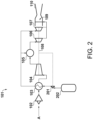
- Figure 2 The components of the engine 101 are shown in schematic form in Figure 2 . Like Figure 1 , Figure 2 is included for understanding of the embodiment shown in Figures 3 and 4 .
- the engine 101 further comprises a pump 201 for pumping a liquid cryogenic fuel from a cryogenic storage tank 202.
- the inlet 102 is configured to compress the inlet air A by way of one or more shocks.
- the inlet 102 is a three-shock intake, which compresses the inlet air A via a series of three oblique shock waves. It will be appreciated that greater or fewer shocks may be used.
- the intake design will likely be highly coupled with the design of the overall vehicle due to the highly non-linear nature of hypersonic aerodynamics.
- the compressed inlet air from the inlet 102 is supplied to a first pass of the cooler 103, where it is cooled by high pressure fuel pumped by pump 201 through a second pass of the cooler 103.
- the liquid cryogenic fuel is liquid hydrogen.
- the liquid cryogenic fuel is liquid natural gas. It will be appreciated that other liquid cryogenic fuels may be used.
- the cooler 103 is configured to transfer heat directly from the compressed inlet air to the fuel.
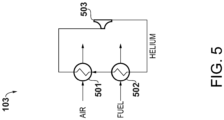
- An alternative configuration will be described with reference to Figure 5 , in which an intermediate fluid is utilised which may avoid issues with hydrogen fuel particularly with embrittlement of and foreign object damage to the cooler in the gas path.
- the fuel is pumped at a pressure of 200 bar during a Mach 5 cruise, however alternative pressures may be used - the exact pressure depends upon the mass flow through the cooler 103 and the velocity of the vehicle.
- the air cooled in the first pass of the cooler 103 is then supplied to the entrance of the turbo-compressor 104, where it is compressed prior to supply to the combustor 105.
- the fuel is supplied to the combustor for ignition and combustion with the compressed air from the turbo-compressor 104.
- the combustion products are then delivered to the first turbine 106 which expand therethrough and drive the turbo-compressor 104 via shaft 108.
- the pump 201 is also driven in this manner, indicated at 203.
- the pump 201 may be in-line with the compressor and turbine, or may be off-axis and drive by a radial driveshaft or similar, for example.
- the amount of fuel that needs to be pumped in order to cool the compressed inlet air in the cooler 103 exceeds that required to be burnt in the combustor 105.
- the excess fuel is delivered to the second turbine 107 for expansion therethrough.
- the second turbine 107 is also connected to the turbo-compressor 104, and thus augments the first turbine 106 reducing fuel consumption.
- the combustion products and excess fuel are delivered to the afterburner 109 for complete combustion of the excess fuel therein.
- This is in contrast to previously proposed designs where excess fuel is simply expanded through a separate nozzle without combustion, which reduces cycle efficiency as the potential energy of the fuel is not released.
- the exhaust gases are expanded through the convergent-divergent nozzle 110 to produce thrust.
- FIG. 3 A second embodiment of an air-breathing turbojet engine suitable for a hypersonic vehicle is shown in Figure 3 .
- the engine 301 is of similar configuration to the engine 101, and thus like features are identified with like numerals incremented by 200.
- the engine 301 differs from the engine 101 in that it includes a precooler 311 between the inlet 302 and the cooler 303.
- engine 301 The components in engine 301 are shown in Figure 4 schematic form, along with pump 401 and cryogenic storage tank 402.
- the precooler 311 is provided to cool the compressed inlet air from the inlet 302 and to prevent overheating of the fuel in the cooler 303. This is achieved in this example by routing the compressed inlet air through a first pass of the precooler 311 and discharge air from the turbo-compressor 304 through a second pass of the precooler 311.
- a temperature sensor 403 at the inlet to the first pass of the precooler 311 is provided, along with a temperature sensor 404 at the outlet of the turbo-compressor 304. These enable control of a bypass valve 404 in a bypass around precooler 311. In this way, should at any point the post-turbo-compressor temperature exceed that prior to the precooler, the precooler may be bypassed and unnecessary heating of the inlet air avoided. This may assist in terms of extending the operational envelope of the engine 301.
- the cooler 103 may directly transfer heat from the air flow to the fuel.
- an intermediate fluid may be used.
- a suitable configuration for this approach is shown in Figure 5 .
- the cooler 103 comprises a first heat exchanger 501 and a second heat exchanger 502, along with a pump 503 for pumping an intermediate fluid therethrough.
- the intermediate fluid is helium, although it will be appreciated that any other suitable fluid may be used.
- compressed inlet air from the inlet 102 enters a first pass of the first heat exchanger 501, whilst the intermediate fluid enters a second pass of the same heat exchanger where it is heated. Cooled air exits and proceeds to the turbo-compressor 104.
- the intermediate fluid is circulated by the pump 503.
- Cryogenic liquid fuel pumped by pump 201 enters a first pass of the second heat exchanger 502, whilst the intermediate fluid enters a second pass of the same heat exchanger where it is cooled.
- Figure 5 presents advantages in terms of avoiding a requirement for fuel to be circulated in the gas path through the cooler 103.
- the inert helium intermediate fluid does not present an explosion risk should failure of the first heat exchanger 501 occur.
Landscapes
- Engineering & Computer Science (AREA)
- Chemical & Material Sciences (AREA)
- Combustion & Propulsion (AREA)
- Mechanical Engineering (AREA)
- General Engineering & Computer Science (AREA)
- Aviation & Aerospace Engineering (AREA)
- Structures Of Non-Positive Displacement Pumps (AREA)
Abstract
Description
- This disclosure concerns engines for hypersonic vehicles, in particular air-breathing turbojets for such vehicles.
- The hypersonic regime is commonly defined as velocities above Mach 5. For vehicles operating at such speeds, typically at altitudes over 80000 feet (24385 metres), the stagnation temperature of the surrounding air exceeds 1300 kelvin.
- Whilst rockets using liquid propellant and oxidisers operate successfully in the hypersonic and high-hypersonic regimes, it is desirable to use air-breathing engines so as to improve specific fuel consumption. Engine cycles of this type have been proposed which utilise liquid hydrogen both due to its increased specific energy when compared to kerosene, but also its cryogenic storage temperatures which enable it to be used as a heatsink.
- In this way, it is possible to implement a precooled turbojet cycle which reduces the inlet air temperature using the heat capacity of the liquid hydrogen fuel. This improves compression efficiency and relaxes material requirements in the gas turbine core of the turbojet.
- It is an object of the present invention to provide an improved cycle compared to those previously proposed.
- The invention is directed to air-breathing turbojet engines for hypersonic vehicles, vehicles incorporating such engines, and methods of operating such engines.
- In an aspect, there is provided such an air-breathing turbojet engine comprising:
- a pump for pumping a cryogenic fuel;
- an inlet configured to compress inlet air by one or more shocks;
- a cooler configured to cool the compressed inlet air using the fuel;
- a turbo-compressor configured to receive cooled air from the cooler and to compress the air further;
- a precooler between the inlet and the cooler, the precooler being configured to cool the compressed inlet air using compressed cooled air from the turbo-compressor prior to combustion;
- a combustor configured to receive compressed air from the turbo-compressor and a portion of the fuel for combustion therein;
- a first turbine configured to expand and be driven by combustion products from the combustor, and a second turbine configured to expand and be driven by excess fuel, the first and second turbines being configured to drive the turbo-compressor via a shaft; and
- an afterburner configured to receive combustion products from the first turbine and the excess fuel from the second turbine for combustion therein.
- In another aspect, there is provided a vehicle comprising the aforesaid engine.
- In another aspect, there is provided a method of operating an air-breathing turbojet engine for a hypersonic vehicle, comprising:
- pumping a cryogenic fuel;
- compressing inlet air by one or more shocks to produce compressed inlet air;
- cooling the compressed inlet air using the cryogenic fuel to produce cooled air;
- compressing the cooled air further in a turbo-compressor to produce compressed cooled air;
- precooling the compressed inlet air in a precooler using compressed air from the turbo-compressor prior to combustion;
- combusting the cooled air from the turbo-compressor and a first portion of the cryogenic fuel in a combustor to produce combustion products;
- driving a first turbine by expanding the combustion products therethrough, and driving a second turbine by expanding a second portion of the cryogenic fuel;
- driving the turbo-compressor by the first turbine and the second turbine via a shaft;
- combusting the combustion products from the first turbine and the second portion of the cryogenic fuel from the second turbine in an afterburner.
- In an embodiment, the compressed air from the turbo-compressor is bypassed around the precooler when the compressed air has a temperature greater than a stagnation temperature at an inlet to the precooler.
- In an embodiment, heat is transferred from the inlet air directly to the cryogenic fuel.
- In an embodiment, heat is transferred from the inlet air to the cryogenic fuel via an intermediate fluid.
- In an embodiment, the intermediate fluid is helium.
- In an embodiment, the cryogenic fuel is liquid hydrogen.
- In an embodiment, the cryogenic fuel is liquid natural gas.
- Embodiments will now be described by way of example only with reference to the accompanying drawings, which are purely schematic and not to scale, and in which:
-
Figure 1 shows a first embodiment of an air-breathing turbojet engine for a hypersonic vehicle; -
Figure 2 shows the cycle of the engine ofFigure 1 in schematic form; -
Figure 3 shows a second embodiment of an air-breathing turbojet engine for a hypersonic vehicle; -
Figure 4 shows the cycle of the engine ofFigure 3 in schematic form; -
Figure 5 shows a helium loop which may be used to segregate fuel and air in the cooler of the engines disclosed herein. - An air-breathing turbojet engine suitable for a hypersonic vehicle is shown in
Figure 1 , which is included for understanding of the embodiment shown inFigures 3 and4 . - The
engine 101 comprises, in axial flow series, anintake 102 for receiving an inlet flow of air A, acooler 103, a turbo-compressor 104, acombustor 105, afirst turbine 106, and asecond turbine 107. Thefirst turbine 106 andsecond turbine 107 drive the turbo-compressor 104 via ashaft 108. Anafterburner 109 and a convergent-divergent nozzle 110 are provided axially downstream of thesecond turbine 107 to develop thrust. - The components of the
engine 101 are shown in schematic form inFigure 2 . LikeFigure 1 ,Figure 2 is included for understanding of the embodiment shown inFigures 3 and4 . - In addition to the components identified in
Figure 1 , theengine 101 further comprises apump 201 for pumping a liquid cryogenic fuel from acryogenic storage tank 202. - In operation, the
inlet 102 is configured to compress the inlet air A by way of one or more shocks. In an embodiment, theinlet 102 is a three-shock intake, which compresses the inlet air A via a series of three oblique shock waves. It will be appreciated that greater or fewer shocks may be used. As will be further appreciated, the intake design will likely be highly coupled with the design of the overall vehicle due to the highly non-linear nature of hypersonic aerodynamics. - The compressed inlet air from the
inlet 102 is supplied to a first pass of thecooler 103, where it is cooled by high pressure fuel pumped bypump 201 through a second pass of thecooler 103. - In the present embodiment, the liquid cryogenic fuel is liquid hydrogen. In an alternative embodiment, the liquid cryogenic fuel is liquid natural gas. It will be appreciated that other liquid cryogenic fuels may be used.
- In an embodiment, the
cooler 103 is configured to transfer heat directly from the compressed inlet air to the fuel. An alternative configuration will be described with reference toFigure 5 , in which an intermediate fluid is utilised which may avoid issues with hydrogen fuel particularly with embrittlement of and foreign object damage to the cooler in the gas path. - In the present embodiment, the fuel is pumped at a pressure of 200 bar during a Mach 5 cruise, however alternative pressures may be used - the exact pressure depends upon the mass flow through the
cooler 103 and the velocity of the vehicle. - The air cooled in the first pass of the
cooler 103 is then supplied to the entrance of the turbo-compressor 104, where it is compressed prior to supply to thecombustor 105. - After being heated in the second pass of the cooler 103, the fuel is supplied to the combustor for ignition and combustion with the compressed air from the turbo-
compressor 104. The combustion products are then delivered to thefirst turbine 106 which expand therethrough and drive the turbo-compressor 104 viashaft 108. In the present embodiment, thepump 201 is also driven in this manner, indicated at 203. Thepump 201 may be in-line with the compressor and turbine, or may be off-axis and drive by a radial driveshaft or similar, for example. - The amount of fuel that needs to be pumped in order to cool the compressed inlet air in the cooler 103 exceeds that required to be burnt in the
combustor 105. Thus, the excess fuel is delivered to thesecond turbine 107 for expansion therethrough. Thesecond turbine 107 is also connected to the turbo-compressor 104, and thus augments thefirst turbine 106 reducing fuel consumption. - Following expansion through the respective turbines, the combustion products and excess fuel are delivered to the
afterburner 109 for complete combustion of the excess fuel therein. This is in contrast to previously proposed designs where excess fuel is simply expanded through a separate nozzle without combustion, which reduces cycle efficiency as the potential energy of the fuel is not released. Following combustion in theafterburner 109, the exhaust gases are expanded through the convergent-divergent nozzle 110 to produce thrust. - A second embodiment of an air-breathing turbojet engine suitable for a hypersonic vehicle is shown in
Figure 3 . - The
engine 301 is of similar configuration to theengine 101, and thus like features are identified with like numerals incremented by 200. Theengine 301 differs from theengine 101 in that it includes aprecooler 311 between theinlet 302 and the cooler 303. - The components in
engine 301 are shown inFigure 4 schematic form, along withpump 401 andcryogenic storage tank 402. - The
precooler 311 is provided to cool the compressed inlet air from theinlet 302 and to prevent overheating of the fuel in the cooler 303. This is achieved in this example by routing the compressed inlet air through a first pass of theprecooler 311 and discharge air from the turbo-compressor 304 through a second pass of theprecooler 311. - This configuration is possible because of the high degree of cooling in the cooler 303, which is such that, despite compression and therefore heating in the turbo-
compressor 304, the compressed discharge air from the turbo-compressor 304 is still lower in temperature than the stagnation temperature at the inlet to the first pass of theprecooler 311. - In an embodiment, a
temperature sensor 403 at the inlet to the first pass of theprecooler 311 is provided, along with atemperature sensor 404 at the outlet of the turbo-compressor 304. These enable control of abypass valve 404 in a bypass aroundprecooler 311. In this way, should at any point the post-turbo-compressor temperature exceed that prior to the precooler, the precooler may be bypassed and unnecessary heating of the inlet air avoided. This may assist in terms of extending the operational envelope of theengine 301. - As described previously, the cooler 103 (and cooler 303) may directly transfer heat from the air flow to the fuel. Alternatively, an intermediate fluid may be used. A suitable configuration for this approach is shown in
Figure 5 . The cooler 103 comprises afirst heat exchanger 501 and asecond heat exchanger 502, along with apump 503 for pumping an intermediate fluid therethrough. In this example, the intermediate fluid is helium, although it will be appreciated that any other suitable fluid may be used. - In operation, compressed inlet air from the
inlet 102 enters a first pass of thefirst heat exchanger 501, whilst the intermediate fluid enters a second pass of the same heat exchanger where it is heated. Cooled air exits and proceeds to the turbo-compressor 104. The intermediate fluid is circulated by thepump 503. Cryogenic liquid fuel pumped bypump 201 enters a first pass of thesecond heat exchanger 502, whilst the intermediate fluid enters a second pass of the same heat exchanger where it is cooled. - The configuration of
Figure 5 presents advantages in terms of avoiding a requirement for fuel to be circulated in the gas path through the cooler 103. In the present example, the inert helium intermediate fluid does not present an explosion risk should failure of thefirst heat exchanger 501 occur. - Various examples have been described, each of which comprise various combinations of features.
Claims (15)
- An air-breathing turbojet engine (301) for a hypersonic vehicle, comprising:a pump (401) for pumping a cryogenic fuel;an inlet (302) configured to compress inlet air by one or more shocks, thereby producing compressed inlet air;a cooler (303) configured to cool the compressed inlet air using the cryogenic fuel, thereby producing cooled air;a turbo-compressor (304) configured to receive cooled air from the cooler and to compress the air further, thereby producing compressed cooled air;a precooler (311) between the inlet (302) and the cooler (303), the precooler being configured to cool the compressed inlet air using compressed air from the turbo-compressor (304) prior to combustion;a combustor (305) configured to receive compressed cooled air from the turbo-compressor and a first portion of the cryogenic fuel for combustion therein, thereby producing combustion products;a first turbine (306) configured to expand and be driven by combustion products from the combustor, and a second turbine (307) configured to expand and be driven by a second portion of the cryogenic fuel, the first turbine and the second turbine being configured to drive the turbo-compressor via a shaft (308); andan afterburner (309) configured to receive combustion products from the first turbine and the second portion of the cryogenic fuel from the second turbine for combustion therein.
- The engine of claim 1, further comprising a bypass around the precooler for the compressed air from the turbo-compressor which bypass is configured to bypass the precooler when compressed air from the turbo-compressor has a temperature greater than a stagnation temperature at an inlet to the precooler.
- The engine of claim 1, in which the cooler (303) comprises a heat exchanger having a first pass for the inlet air and a second pass for the cryogenic fuel, whereby heat is transferred from the inlet air directly to the cryogenic fuel.
- The engine of claim 1, in which the cooler (303) comprises a first heat exchanger (501) having a first pass for the inlet air and a second pass for an intermediate fluid, and a second heat exchanger (502) having a first pass for the intermediate fluid and a second pass for the cryogenic fuel, whereby heat is transferred from the inlet air to the cryogenic fuel via the intermediate fluid.
- The engine of claim 4, in which the intermediate fluid is helium.
- The engine of any preceding claim, in which the cryogenic fuel is liquid hydrogen.
- The engine of any preceding claim, in which the cryogenic fuel is liquid natural gas.
- A vehicle comprising an engine (301) according to any preceding claim.
- A method of operating an air-breathing turbojet engine (301) for a hypersonic vehicle, comprising:pumping a cryogenic fuel;compressing inlet air by one or more shocks to produce compressed inlet air;cooling the compressed inlet air using the cryogenic fuel to produce cooled air;compressing the cooled air further in a turbo-compressor (304) to produce compressed cooled air;further comprising precooling the compressed inlet air in a precooler (311) using compressed air from the turbo-compressor prior to combustion;combusting the cooled air from the turbo-compressor and a first portion of the cryogenic fuel in a combustor (305) to produce combustion products;driving a first turbine (306) by expanding the combustion products therethrough, and driving a second turbine (307) by expanding a second portion of the cryogenic fuel;driving the turbo-compressor by the first turbine and the second turbine via a shaft (308);combusting the combustion products from the first turbine and the second portion of the cryogenic fuel from the second turbine in an afterburner (309).
- The method of claim 9, further comprising bypassing the compressed air from the turbo-compressor around the precooler when the compressed air has a temperature greater than a stagnation temperature at an inlet to the precooler.
- The method of claim 9, comprising transferring heat from the inlet air directly to the cryogenic fuel.
- The method of claim 9, comprising transferring heat from the inlet air to the cryogenic fuel via an intermediate fluid.
- The method of claim 12, in which the intermediate fluid is helium.
- The method of any one of claims 9 to 13, in which the cryogenic fuel is liquid hydrogen.
- The method of any one of claims 9 to 13, in which the cryogenic fuel is liquid natural gas.
Applications Claiming Priority (2)
| Application Number | Priority Date | Filing Date | Title |
|---|---|---|---|
| GB1907077.0A GB2584094B (en) | 2019-05-20 | 2019-05-20 | Engine |
| EP20172364.0A EP3741972B1 (en) | 2019-05-20 | 2020-04-30 | Turbojet engine for hypersonic vehicle |
Related Parent Applications (2)
| Application Number | Title | Priority Date | Filing Date |
|---|---|---|---|
| EP20172364.0A Division-Into EP3741972B1 (en) | 2019-05-20 | 2020-04-30 | Turbojet engine for hypersonic vehicle |
| EP20172364.0A Division EP3741972B1 (en) | 2019-05-20 | 2020-04-30 | Turbojet engine for hypersonic vehicle |
Publications (2)
| Publication Number | Publication Date |
|---|---|
| EP4495411A2 true EP4495411A2 (en) | 2025-01-22 |
| EP4495411A3 EP4495411A3 (en) | 2025-03-26 |
Family
ID=67385127
Family Applications (2)
| Application Number | Title | Priority Date | Filing Date |
|---|---|---|---|
| EP20172364.0A Active EP3741972B1 (en) | 2019-05-20 | 2020-04-30 | Turbojet engine for hypersonic vehicle |
| EP24217530.5A Pending EP4495411A3 (en) | 2019-05-20 | 2020-04-30 | Turbojet engine for hypersonic vehicle |
Family Applications Before (1)
| Application Number | Title | Priority Date | Filing Date |
|---|---|---|---|
| EP20172364.0A Active EP3741972B1 (en) | 2019-05-20 | 2020-04-30 | Turbojet engine for hypersonic vehicle |
Country Status (3)
| Country | Link |
|---|---|
| US (2) | US11383852B2 (en) |
| EP (2) | EP3741972B1 (en) |
| GB (1) | GB2584094B (en) |
Families Citing this family (9)
| Publication number | Priority date | Publication date | Assignee | Title |
|---|---|---|---|---|
| US20200386189A1 (en) * | 2019-04-30 | 2020-12-10 | General Electric Company | High Speed Aircraft Flight Technologies |
| US11434823B2 (en) * | 2020-01-06 | 2022-09-06 | Raytheon Technologies Corporation | Systems and methods for power transfer in cryogenic fuel applications |
| CN111636977B (en) * | 2020-05-18 | 2025-06-06 | 北京航空航天大学 | A high-speed aircraft precooling variable cycle combined propulsion system and operation mode |
| US11773782B2 (en) * | 2020-12-23 | 2023-10-03 | Rtx Corporation | Gas turbine engines having cryogenic fuel systems |
| US11927136B1 (en) * | 2021-06-04 | 2024-03-12 | Rtx Corporation | Turbofan engine with precooler |
| US11994068B2 (en) * | 2021-08-09 | 2024-05-28 | Pratt & Whitney Canada Corp. | Buffer heat exchangers for hydrogen engines |
| KR102705171B1 (en) * | 2022-10-06 | 2024-09-11 | 국방과학연구소 | Liquid Fuel Supply System Comprising Assisted Air Supply System |
| CN116733606B (en) * | 2023-06-15 | 2026-04-14 | 厦门大学 | High power take off, high efficiency cruising aero turbine engine-generator system |
| GB202319154D0 (en) * | 2023-12-14 | 2024-01-31 | Rolls Royce Plc | Gas turbine engine |
Family Cites Families (24)
| Publication number | Priority date | Publication date | Assignee | Title |
|---|---|---|---|---|
| US3237400A (en) * | 1957-04-05 | 1966-03-01 | United Aircraft Corp | Turborocket engine |
| US3237401A (en) * | 1958-01-17 | 1966-03-01 | United Aircraft Corp | Regenerative expander engine |
| US3705496A (en) * | 1963-11-20 | 1972-12-12 | Texaco Experiment Inc | Reaction propulsion engine and method of operation |
| US3721093A (en) * | 1963-11-20 | 1973-03-20 | Texaco Inc | Reaction propulsion engine with vaporized fuel driven turbine |
| US3477505A (en) * | 1967-07-13 | 1969-11-11 | Texaco Inc | Heat exchanger |
| US4224790A (en) * | 1977-10-11 | 1980-09-30 | Christensen Raymond G | Jet engine |
| GB2240815B (en) * | 1983-12-23 | 1991-12-18 | Alan Bond | Improvements in aerospace propulsion |
| DE3617757C1 (en) * | 1986-05-30 | 1987-07-02 | Erno Raumfahrttechnik Gmbh, 2800 Bremen, De | |
| GB2240813B (en) * | 1986-08-28 | 1991-11-27 | Rolls Royce Plc | Improvements in hypersonic and trans atmospheric propulsion |
| DE4012212A1 (en) * | 1990-04-14 | 1991-10-24 | Mtu Muenchen Gmbh | Hypersonic aircraft jet engine |
| DE4131913A1 (en) * | 1991-09-25 | 1993-04-08 | Mtu Muenchen Gmbh | COOLING DEVICE FOR HYPERSONIC AIR JET ENGINES |
| FR2687433B1 (en) * | 1992-02-14 | 1994-05-06 | Onera | INVERTER COMPONENT PROPELLER, WITH MODULATED FEEDING. |
| GB2295858A (en) * | 1994-12-09 | 1996-06-12 | Rolls Royce Plc | Liquid hydrogen fuelled powerplant |
| RU2239080C1 (en) * | 2003-01-20 | 2004-10-27 | Письменный Владимир Леонидович | Gas-turbine engine with turbocooler at inlet |
| DE102004024294B4 (en) * | 2004-05-15 | 2011-11-24 | Deutsches Zentrum für Luft- und Raumfahrt e.V. | Gas turbine plant |
| WO2013188956A1 (en) * | 2012-06-20 | 2013-12-27 | Daniel Pomerleau | Cryogenic fuel combustion engines |
| GB2519152B (en) * | 2013-10-11 | 2016-09-07 | Reaction Engines Ltd | Engine |
| GB2531775B (en) * | 2014-10-30 | 2018-05-09 | Rolls Royce Plc | A gas turbine using cryogenic fuel passed through a fuel turbine |
| WO2017075717A1 (en) * | 2015-11-04 | 2017-05-11 | 1589549 Alberta Ltd. | Precooled air breathing engine |
| CN107630767B (en) * | 2017-08-07 | 2019-07-09 | 南京航空航天大学 | Based on pre- cold mould assembly power hypersonic aircraft aerodynamic arrangement and working method |
| US20190293024A1 (en) * | 2018-02-23 | 2019-09-26 | Global Reach Aerospace LLC | Hydrogen-fueled supersonic turboramjet engine |
| US10989117B2 (en) * | 2018-09-14 | 2021-04-27 | Raytheon Technologies Corporation | Hybrid expander cycle with pre-compression cooling and turbo-generator |
| US11041439B2 (en) * | 2018-09-14 | 2021-06-22 | Raytheon Technologies Corporation | Hybrid expander cycle with turbo-generator and cooled power electronics |
| US20200386189A1 (en) * | 2019-04-30 | 2020-12-10 | General Electric Company | High Speed Aircraft Flight Technologies |
-
2019
- 2019-05-20 GB GB1907077.0A patent/GB2584094B/en active Active
-
2020
- 2020-04-30 EP EP20172364.0A patent/EP3741972B1/en active Active
- 2020-04-30 EP EP24217530.5A patent/EP4495411A3/en active Pending
- 2020-05-05 US US16/866,908 patent/US11383852B2/en active Active
-
2022
- 2022-06-10 US US17/837,100 patent/US11685541B2/en active Active
Also Published As
| Publication number | Publication date |
|---|---|
| US20200369400A1 (en) | 2020-11-26 |
| US20220297847A1 (en) | 2022-09-22 |
| EP3741972A1 (en) | 2020-11-25 |
| GB2584094A (en) | 2020-11-25 |
| EP3741972B1 (en) | 2025-01-08 |
| US11383852B2 (en) | 2022-07-12 |
| GB201907077D0 (en) | 2019-07-03 |
| US11685541B2 (en) | 2023-06-27 |
| EP4495411A3 (en) | 2025-03-26 |
| GB2584094B (en) | 2022-01-26 |
Similar Documents
| Publication | Publication Date | Title |
|---|---|---|
| US11685541B2 (en) | Turbo engine with cooler for cooling inlet air and turbine for expanding cryogenic fuel | |
| EP3885550B1 (en) | Supercritical co2 cycle for gas turbine engines having supplemental cooling | |
| EP4019752B1 (en) | Gas turbine engines having cryogenic fuel systems | |
| US5101622A (en) | Aerospace propulsion | |
| US20190293024A1 (en) | Hydrogen-fueled supersonic turboramjet engine | |
| US10590849B2 (en) | High speed propulsion system with inlet cooling | |
| CA2991449C (en) | Heat exchanger assembly for engine bleed air | |
| Zhao et al. | Performance analysis of a pre-cooled and fuel-rich pre-burned mixed-flow turbofan cycle for high speed vehicles | |
| EP3683421B1 (en) | Work recovery system for a gas turbine engine utilizing a recuperated supercritical co2 cycle driven by cooling air waste heat | |
| US12270341B2 (en) | Gas turbine engine fuel system | |
| EP3922827B1 (en) | Supercritical co2 cycle and integrated auxiliary power for gas turbine engines | |
| US11480103B2 (en) | Supercritical CO2 cycle for gas turbine engines using partial core exhaust flow | |
| US20200224557A1 (en) | Work recovery system for a gas turbine engine utilizing an overexpanded, recuperated supercritical co2 cycle driven by cooled cooling air waste heat | |
| EP3901445B1 (en) | Supercritical co2 cycle for gas turbine engines using powered cooling flow | |
| GB2240813A (en) | Hypersonic and trans atmospheric propulsion | |
| US9995216B1 (en) | Disc turbine engine | |
| US8978387B2 (en) | Hot gas path component cooling for hybrid pulse detonation combustion systems | |
| RU2179255C2 (en) | Hypersonic cryogenic air-jet engine | |
| Kobayashi et al. | Development status of Mach 6 turbojet engine in JAXA | |
| Rodgers et al. | Advances in small turbopropulsion engine technology | |
| US20250264074A1 (en) | Detonation pre-combustors | |
| RU2349775C1 (en) | Nuclear gas-turbine aviation engine | |
| RU2594091C1 (en) | Engine of hypersonic aircraft | |
| Nakanishi et al. | LE-5 Oxygen-Hydrogen Rocket Engine for HI Launch Vehicle | |
| GB2595744A (en) | Reduced velocity ramjet |
Legal Events
| Date | Code | Title | Description |
|---|---|---|---|
| PUAI | Public reference made under article 153(3) epc to a published international application that has entered the european phase |
Free format text: ORIGINAL CODE: 0009012 |
|
| STAA | Information on the status of an ep patent application or granted ep patent |
Free format text: STATUS: THE APPLICATION HAS BEEN PUBLISHED |
|
| AC | Divisional application: reference to earlier application |
Ref document number: 3741972 Country of ref document: EP Kind code of ref document: P |
|
| AK | Designated contracting states |
Kind code of ref document: A2 Designated state(s): AL AT BE BG CH CY CZ DE DK EE ES FI FR GB GR HR HU IE IS IT LI LT LU LV MC MK MT NL NO PL PT RO RS SE SI SK SM TR |
|
| REG | Reference to a national code |
Ref country code: DE Ref legal event code: R079 Free format text: PREVIOUS MAIN CLASS: F02K0007160000 Ipc: F02C0007143000 |
|
| PUAL | Search report despatched |
Free format text: ORIGINAL CODE: 0009013 |
|
| AK | Designated contracting states |
Kind code of ref document: A3 Designated state(s): AL AT BE BG CH CY CZ DE DK EE ES FI FR GB GR HR HU IE IS IT LI LT LU LV MC MK MT NL NO PL PT RO RS SE SI SK SM TR |
|
| RIC1 | Information provided on ipc code assigned before grant |
Ipc: F02K 7/16 20060101ALI20250217BHEP Ipc: F02C 7/224 20060101ALI20250217BHEP Ipc: F02C 7/143 20060101AFI20250217BHEP |
|
| STAA | Information on the status of an ep patent application or granted ep patent |
Free format text: STATUS: REQUEST FOR EXAMINATION WAS MADE |
|
| 17P | Request for examination filed |
Effective date: 20250331 |
|
| GRAP | Despatch of communication of intention to grant a patent |
Free format text: ORIGINAL CODE: EPIDOSNIGR1 |
|
| STAA | Information on the status of an ep patent application or granted ep patent |
Free format text: STATUS: GRANT OF PATENT IS INTENDED |