EP4495123A1 - An improved process for producing d-biotin intermediates - Google Patents
An improved process for producing d-biotin intermediates Download PDFInfo
- Publication number
- EP4495123A1 EP4495123A1 EP23186273.1A EP23186273A EP4495123A1 EP 4495123 A1 EP4495123 A1 EP 4495123A1 EP 23186273 A EP23186273 A EP 23186273A EP 4495123 A1 EP4495123 A1 EP 4495123A1
- Authority
- EP
- European Patent Office
- Prior art keywords
- compound
- formula
- nanofiltration
- membranes
- producing
- Prior art date
- Legal status (The legal status is an assumption and is not a legal conclusion. Google has not performed a legal analysis and makes no representation as to the accuracy of the status listed.)
- Withdrawn
Links
Classifications
-
- C—CHEMISTRY; METALLURGY
- C07—ORGANIC CHEMISTRY
- C07D—HETEROCYCLIC COMPOUNDS
- C07D495/00—Heterocyclic compounds containing in the condensed system at least one hetero ring having sulfur atoms as the only ring hetero atoms
- C07D495/02—Heterocyclic compounds containing in the condensed system at least one hetero ring having sulfur atoms as the only ring hetero atoms in which the condensed system contains two hetero rings
- C07D495/04—Ortho-condensed systems
-
- C—CHEMISTRY; METALLURGY
- C07—ORGANIC CHEMISTRY
- C07B—GENERAL METHODS OF ORGANIC CHEMISTRY; APPARATUS THEREFOR
- C07B2200/00—Indexing scheme relating to specific properties of organic compounds
- C07B2200/07—Optical isomers
Definitions
- the present invention is related to a process for the preparation of D-biotin intermediates.
- the D-Biotin also known as Vitamin H, is mainly applied to the fields of medicine and sanitation, nutrition enhancer, feed additive, cosmetics and drinks, etc.
- the molecular structural formula of the D-Biotin is shown as follows:
- the present invention provides an improved process for producing an intermediate compound of formula (I), comprising catalytic hydrogenation of the compound of formula (II) to obtain the compound of formula (I), wherein the compound of formula (II) is subject to nanofiltration before the hydrogenation.
- R 1 and R 1 ' are independently H, lower alkyl, aryl or acyl group, optionally substituted by one or more substituents; and R 2 is lower alkyl optionally substituted by lower alkoxyl or carboxyl group.
- catalytic poison can be significantly reduced.
- the compound of formula (II) can be hydrogenated into the compound of formula (I) with a high yield while the dosage of the catalyst can be reduced, so the process of the present invention is more cost-efficient compared to prior arts.
- lower alkyl refers to C 1 -C 10 alkyl, i.e., branched or unbranched, cyclic or non-cyclic, saturated hydrocarbon comprising 1-10 carbon atoms.
- the "lower alkyl” is C 1 -C 6 alkyl, including but not limited to methyl, ethyl, propyl, isopropyl, cyclopropyl, butyl, isobutyl, tert-butyl, cyclobutyl, pentyl, iso-pentyl, tert-pentyl, cyclopentyl, hexyl, isohexyl, tert-hexyl and cyclohexyl. More preferably, the "lower alkyl" is methyl or ethyl.
- aryl refers to aromatic hydrocarbon such as substituted and unsubstitued phenyl, benzyl, xylyl and naphthalenyl.
- lower alkoxyl refers to the structure represented by (lower alkyl)-O-, wherein the “lower alkyl” is defined as above.
- halo refers to a group of elements including fluorine (F), chlorine (CI), bromine (Br) and iodine (I).
- substituteduent or “substituents” as used refers to C 1 -C 6 alkyl, C 1 -C 6 alkoxyl, C 1 -C 6 alkylthio, aryl, hydroxyl, halo, halide, -NH 2 , -NO 2 , cyano and/or isocyano.
- the inventor of the present invention surprisingly discovered that, with additional pre-treatment as described herein, the compound of formula (I) can be hydrogenated in a high yield while the catalyst is used in a lower amount.
- the present invention provides a process for producing a compound of formula (I), comprising catalytic hydrogenation of the compound of formula (II) to obtain the compound of formula (I), wherein the compound of formula (II) is subject to nanofiltration before the hydrogenation.
- R 1, R 1 ' and R 2 are independently defined as above.
- R 1 and R 1 ' are independently H, C 1 -C 6 alkyl, aryl or C 1 -C 6 acyl group, optionally substituted by one or more substituents. More preferably, R 1 and R 1 ' are independently H, methyl, ethyl, propyl, butyl, phenyl, benzyl, formyl, acetyl, optionally substituted by one or more substituents. The most preferably, R 1 and R 1 ' are independently H, benzyl or acetyl, optionally substituted by one or more substituents.
- R 2 is C 1 -C 6 alkyl optionally substituted by C 1 -C 6 alkoxyl or carboxyl group. More preferably R 2 is methyl, ethyl, propyl or butyl, optionally substituted by methoxyl or ethoxyl, or carboxyl group. The most preferably, R 2 is ethyl or propyl substituted by methoxyl or carboxyl group.
- R 1 and R 1 ' are independently H, benzyl or acetyl; and R 2 is ethyl or propyl substituted by methoxyl.
- R 1 and R 1 ' are independently H, benzyl or acetyl; and R 2 is ethyl or propyl substituted by carboxyl group.
- the nanofiltration is conducted with nanofiltration membranes which have molecular weight cutoff (MWCO) of from 100 to 1000, preferably from 200 to 800, more preferably from 250 to 600.
- MWCO molecular weight cutoff
- the nanofiltration membranes are selected from polymeric membranes and ceramic membranes. More preferably, the nanofiltration membranes are polymeric. Examples of the commercialized membranes are BORSIG OSN Membranes oNF-1, oNF-2 and oNF-3 (Borsig Membrane Technology GmbH, Germany), and Evonik under the trade name PURAMEM ® .
- the nanofiltration is carried out in an organic solvent.
- the organic solvent may be selected from the group consisting of alcohols such as methanol and ethanol, esters such as ethyl acetate (EtOAc), and aromatic hydrocarbons such as toluene.
- the organic solvent is toluene.
- the nanofiltration in the process of the present invention is performed in a cross-flow mode. It is further preferred that the nanofiltration is performed in a diafiltration mode.
- the nanofiltration may be carried out at the temperature of 0°C to 50°C, preferably from 10°C to 30°C, more preferably at room temperature. It is preferred that the nanofiltration is carried out at an elevated pressure, usually and preferably the pressure applied is from 5 bar to 50 bar, more preferably from 10 bar to 40 bar such as 20 bar.
- the obtained permeate from the nanofiltration can be used into catalytic hydrogenation directly or after removing the solvent.
- the compound of formula (II) is isolated from the permeate before the hydrogenation.
- the obtained retentate from the nanofiltration can be discarded or re-fed into the nanofiltration.
- the retentate is re-fed to the nanofiltration.
- the catalytic hydrogenation of the compound of formula (II) may be carried out according to the disclosure of prior arts such as US 3,740,416 A and US 4,876,350 A .
- the catalyst used in the catalytic hydrogenation is preferably selected from the group consisting of palladium, palladium hydroxide, nickel, nickel-alloy, platinum, ruthenium and/or rhodium on the usual support materials such as carbon, clay, etc.. More preferably, the catalyst is selected from the group consisting of palladium, palladium hydroxide and nickel-alloy (e.g. Raney-nickel) in the presence or absence of a modifier (e.g. formic acid, formaldehyde, carbon monoxid).
- a modifier e.g. formic acid, formaldehyde, carbon monoxid
- the catalyst is used in an amount of from 0.01wt% to 1wt%, preferably from 0.05wt% to 0.8wt%, more preferably from 0.1wt% to 0.5wt% such as 0.1wt%, 0.12wt%,0.15wt%, 0.2wt%, 0.25wt%, 0.3wt%, 0.35wt%, 0.4wt%, 0.45wt%, 0.5wt% and 0.6wt% (calculated by the metal or metal hydroxide contained in the catalyst) based on the weight of the compound of formula (II).
- the compound of formula (II) is preferably produced by Grignard reaction of the compound of formula (III).
- R 1 and R 1 ' are independently defined as above.
- the Grignard reaction of the compound of formula (III) can be carried out according to the process known the art, such as those disclosed in US 3,740,416 A and US 5,847,152 A .
- the compound of formula (II) can be hydrogenated into the compound of formula (I) with a high yield, even in a lower dosage of the catalyst, so the process of the present invention is more cost-efficient compared to prior arts.
- the process of the present invention is also suitable to use a stored material of the compound of formula (II) which contains the impurities.
- process of the present invention can be run in a continuous way.
- the present invention also provides a process for producing (+)-biotin which comprises the process for producing the compound of formula (I) as described herein.
- the raw material (3aS,6aR,E)-1,3-dibenzyl-4-(3-methoxypropylidene)tetrahydro-1H-thieno[3,4-d]imidazol-2(3H)-one (“THE”) was prepared by Grignard addition according to the procedures described in US 3,740,416 A , and the raw material (E)-5-((3aS,6aR)-1,3-dibenzyl-2-oxohexahydro-4H-thieno[3,4-d]imidazol-4-ylidene)pentanoic acid (“DbBTN”) was prepared by Grignard addition according to the procedures described in US 5,847,152 A .
- the raw material (THE or DbBTN) (1 g) dissolved in an organic solvent (15 mL) was subjected to nanofiltration in a cross-flow mode during 65 hours. During the nanofiltration, a particular pressure was applied at 25 °C. After the nanofiltration, the permeate was collected and evaporated and the obtained residue was tested in the catalytic hydrogenation.
- DbBTN was hydrogenated to DhBTN according to the same procedures except that the solvent was EtOH and the reaction temperature was 100°C. The yield was determined by qHPLC.
- Example 1 Catalytic hydrogenation of THE without nanofiltration pre-treatment
- Example 2 Catalytic hydrogenation of THE with nanofiltration pre-treatment
- Example 3 Catalytic hydrogenation of permeate THE and retentate THE from the nanofiltration
- Example 4 Catalytic Hydrogenations of DhBTN.
- DhBTN prepared by Grignard addition was hydrogenated with Pd/C without and with nanofiltration pre-treatment according to the procedures described above.
- the nanofiltration of DhBTN was runed by using Borsig oNF-1 in toluene at room temperature under 10 bar. The results are shown in Table 4.
Landscapes
- Chemical & Material Sciences (AREA)
- Organic Chemistry (AREA)
- Heterocyclic Carbon Compounds Containing A Hetero Ring Having Oxygen Or Sulfur (AREA)
- Low-Molecular Organic Synthesis Reactions Using Catalysts (AREA)
Abstract
The present invention provides a process for producing a compound of formula (I), comprising catalytic hydrogenation of the compound of formula (II) to obtain the compound of formula (I), wherein the compound of formula (II) is subject to nanofiltration before the hydrogenation. According to the process of the present invention, catalytic poison can be significantly reduced.wherein R<sub>1</sub> and R<sub>1</sub>' are independently H, lower alkyl, aryl or acyl group, optionally substituted by one or more substituents; and R<sub>2</sub> is lower alkyl optionally substituted by lower alkoxyl or carboxyl group.
Description
- The present invention is related to a process for the preparation of D-biotin intermediates.
- The D-Biotin, also known as Vitamin H, is mainly applied to the fields of medicine and sanitation, nutrition enhancer, feed additive, cosmetics and drinks, etc. The molecular structural formula of the D-Biotin is shown as follows:

- Since the debut of industrially synthetized D-biotin of a Swiss company Roche in 1949, the synthesis methods have been still undergone many researches in the world. To date, many about total synthesis routes have been reported. Yet, the most industrial process for D-biotin uses thiolactone compounds (a) to produce the intermediate compound (b) which is then converted by catalytic hydrogenation to the compound (c) and finally to the D-biotin. In the step of catalytic hydrogenation, 40 atmosphere of hydrogen pressure and 10wt% of Raney-nickel catalyst were used (see
US 3,740,416 A ).
- An improved process of the catalytic hydrogenation of the compound (b) uses 5wt% palladium on carbon and 50 bar of hydrogen pressure. However, the yield of the compound (c) was lower to 72% (see
US 4,876,350 A ). - In addition, all the above-mentioned processes have the problem of catalytic poison, which limits the efficiency of the reaction and make high pressure and high catalyst dosage necessary in the reaction (see Masahiko Seki et al., Chem. Eur. J., 2004, 10, 6102 - 6110).
- Therefore, there is still demand in an improved process for producing the intermediate compound of biotin in the industry.
- The present invention provides an improved process for producing an intermediate compound of formula (I), comprising catalytic hydrogenation of the compound of formula (II) to obtain the compound of formula (I), wherein the compound of formula (II) is subject to nanofiltration before the hydrogenation.
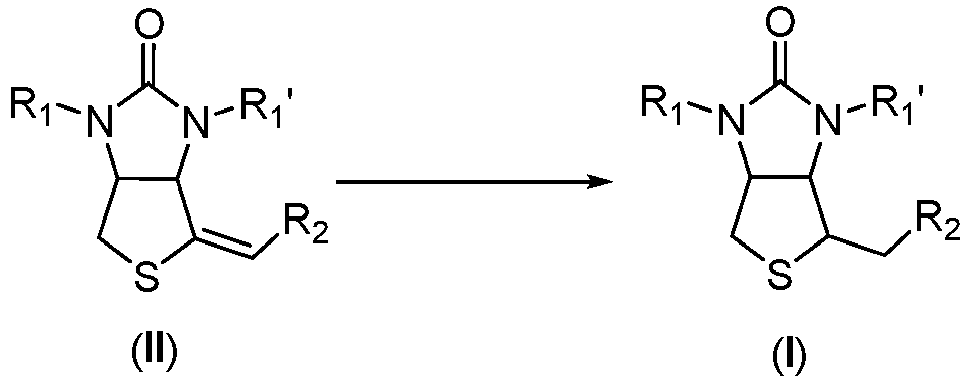
- According to the process of the present invention, catalytic poison can be significantly reduced. As a result, the compound of formula (II) can be hydrogenated into the compound of formula (I) with a high yield while the dosage of the catalyst can be reduced, so the process of the present invention is more cost-efficient compared to prior arts.
- In the present invention, the term "lower alkyl" as used refers to C1-C10 alkyl, i.e., branched or unbranched, cyclic or non-cyclic, saturated hydrocarbon comprising 1-10 carbon atoms. Preferably, the "lower alkyl" is C1-C6 alkyl, including but not limited to methyl, ethyl, propyl, isopropyl, cyclopropyl, butyl, isobutyl, tert-butyl, cyclobutyl, pentyl, iso-pentyl, tert-pentyl, cyclopentyl, hexyl, isohexyl, tert-hexyl and cyclohexyl. More preferably, the "lower alkyl" is methyl or ethyl.
- In the present invention, the term "aryl" as used refers to aromatic hydrocarbon such as substituted and unsubstitued phenyl, benzyl, xylyl and naphthalenyl.
- In the present invention, the term "acyl group" as used refers to the structure R'-C(=O)-, wherein R' is H or lower alkyl.
- In the present invention, the term "lower alkoxyl" as used refers to the structure represented by (lower alkyl)-O-, wherein the "lower alkyl" is defined as above.
- In the present invention, the term "carboxyl group" as used refers to the structure -C(=O)OH.
- In the present invention, the term "halo" or "halogen" refers to a group of elements including fluorine (F), chlorine (CI), bromine (Br) and iodine (I).
- In the present invention, the term "substituent" or "substituents" as used refers to C1-C6 alkyl, C1-C6 alkoxyl, C1-C6 alkylthio, aryl, hydroxyl, halo, halide, -NH2, -NO2, cyano and/or isocyano.
- The inventor of the present invention surprisingly discovered that, with additional pre-treatment as described herein, the compound of formula (I) can be hydrogenated in a high yield while the catalyst is used in a lower amount.
- Particularly, the present invention provides a process for producing a compound of formula (I), comprising catalytic hydrogenation of the compound of formula (II) to obtain the compound of formula (I), wherein the compound of formula (II) is subject to nanofiltration before the hydrogenation.

- Preferably, R1 and R1' are independently H, C1-C6 alkyl, aryl or C1-C6 acyl group, optionally substituted by one or more substituents. More preferably, R1 and R1' are independently H, methyl, ethyl, propyl, butyl, phenyl, benzyl, formyl, acetyl, optionally substituted by one or more substituents. The most preferably, R1 and R1' are independently H, benzyl or acetyl, optionally substituted by one or more substituents.
- Preferably, R2 is C1-C6 alkyl optionally substituted by C1-C6 alkoxyl or carboxyl group. More preferably R2 is methyl, ethyl, propyl or butyl, optionally substituted by methoxyl or ethoxyl, or carboxyl group. The most preferably, R2 is ethyl or propyl substituted by methoxyl or carboxyl group.
- In one embodiment, R1 and R1' are independently H, benzyl or acetyl; and R2 is ethyl or propyl substituted by methoxyl.
- In another embodiment, R1 and R1' are independently H, benzyl or acetyl; and R2 is ethyl or propyl substituted by carboxyl group.
- In the process of the present invention, the nanofiltration is conducted with nanofiltration membranes which have molecular weight cutoff (MWCO) of from 100 to 1000, preferably from 200 to 800, more preferably from 250 to 600. Preferably, the nanofiltration membranes are selected from polymeric membranes and ceramic membranes. More preferably, the nanofiltration membranes are polymeric. Examples of the commercialized membranes are BORSIG OSN Membranes oNF-1, oNF-2 and oNF-3 (Borsig Membrane Technology GmbH, Germany), and Evonik under the trade name PURAMEM®.
- In the process of the present invention, the nanofiltration is carried out in an organic solvent. The organic solvent may be selected from the group consisting of alcohols such as methanol and ethanol, esters such as ethyl acetate (EtOAc), and aromatic hydrocarbons such as toluene. Preferably, the organic solvent is toluene.
- It is preferred that the nanofiltration in the process of the present invention is performed in a cross-flow mode. It is further preferred that the nanofiltration is performed in a diafiltration mode.
- In the process of the present invention, the nanofiltration may be carried out at the temperature of 0°C to 50°C, preferably from 10°C to 30°C, more preferably at room temperature. It is preferred that the nanofiltration is carried out at an elevated pressure, usually and preferably the pressure applied is from 5 bar to 50 bar, more preferably from 10 bar to 40 bar such as 20 bar.
- In the process of the present invention, the obtained permeate from the nanofiltration can be used into catalytic hydrogenation directly or after removing the solvent. Preferably, the compound of formula (II) is isolated from the permeate before the hydrogenation. The obtained retentate from the nanofiltration can be discarded or re-fed into the nanofiltration. Preferably, the retentate is re-fed to the nanofiltration.
- In the process of the present invention, the catalytic hydrogenation of the compound of formula (II) may be carried out according to the disclosure of prior arts such as
US 3,740,416 A andUS 4,876,350 A . - In the process of the present invention, the catalyst used in the catalytic hydrogenation is preferably selected from the group consisting of palladium, palladium hydroxide, nickel, nickel-alloy, platinum, ruthenium and/or rhodium on the usual support materials such as carbon, clay, etc.. More preferably, the catalyst is selected from the group consisting of palladium, palladium hydroxide and nickel-alloy (e.g. Raney-nickel) in the presence or absence of a modifier (e.g. formic acid, formaldehyde, carbon monoxid).
- In the process of the present invention, the catalyst is used in an amount of from 0.01wt% to 1wt%, preferably from 0.05wt% to 0.8wt%, more preferably from 0.1wt% to 0.5wt% such as 0.1wt%, 0.12wt%,0.15wt%, 0.2wt%, 0.25wt%, 0.3wt%, 0.35wt%, 0.4wt%, 0.45wt%, 0.5wt% and 0.6wt% (calculated by the metal or metal hydroxide contained in the catalyst) based on the weight of the compound of formula (II).
- In the process of the present invention, the compound of formula (II) is preferably produced by Grignard reaction of the compound of formula (III).

- The Grignard reaction of the compound of formula (III) can be carried out according to the process known the art, such as those disclosed in
US 3,740,416 A andUS 5,847,152 A . - According to the process of the present invention, the compound of formula (II) can be hydrogenated into the compound of formula (I) with a high yield, even in a lower dosage of the catalyst, so the process of the present invention is more cost-efficient compared to prior arts.
- Based on the good results of the process of the present invention, it is anticipated by a person skilled in the art that the catalytic poison in the hydrogenation should result from impurities contained in the raw material of the compound of the formula (I), instead of the sulfide moiety of the compound of formula (II). Accordingly, the process of the present invention is also suitable to use a stored material of the compound of formula (II) which contains the impurities.
- In addition, the process of the present invention can be run in a continuous way.
- The present invention also provides a process for producing (+)-biotin which comprises the process for producing the compound of formula (I) as described herein.
- The process of the present invention is further illustrated by the following examples.
- In the examples according to the present invention, the raw material (3aS,6aR,E)-1,3-dibenzyl-4-(3-methoxypropylidene)tetrahydro-1H-thieno[3,4-d]imidazol-2(3H)-one ("THE") was prepared by Grignard addition according to the procedures described in
US 3,740,416 A , and the raw material (E)-5-((3aS,6aR)-1,3-dibenzyl-2-oxohexahydro-4H-thieno[3,4-d]imidazol-4-ylidene)pentanoic acid ("DbBTN") was prepared by Grignard addition according to the procedures described inUS 5,847,152 A . - The raw material (THE or DbBTN) (1 g) dissolved in an organic solvent (15 mL) was subjected to nanofiltration in a cross-flow mode during 65 hours. During the nanofiltration, a particular pressure was applied at 25 °C. After the nanofiltration, the permeate was collected and evaporated and the obtained residue was tested in the catalytic hydrogenation.
- Into an autoclave, THE (1 g) was dissolved in a MeOH (5 mL). A specific amount of catalyst Pd/C was added into the rection mixture. After purged with nitrogen, the reaction mixture was stirred at 30 bar hydrogen pressure and at 75°C. After 16 h, the reaction mixture was cooled down to room temperature, hydrogen was released, and the reactor was purged with nitrogen. After all volatiles were evaporated, the yield of THA was determined by GC.

- DbBTN was hydrogenated to DhBTN according to the same procedures except that the solvent was EtOH and the reaction temperature was 100°C. The yield was determined by qHPLC.

- THE obtained from the Grignard addition was hydrogenated according to the process described above and the results are shown in Table 1.
Table 1 Entry Catalyst Pd (mg) THE (area%) THA (area%) 1 1.2 91.7 5.9 2 2.0 81.6 15.8 3 2.8 45.4 51.7 4 3.2 19.2 78.1 5 4.0 0.8 96.4 - With the same THE as Example 1, nanofiltration was carried out and then the obtained THE was hydrogenated with Pd/C (1.2 mg Pd per 1 g THE) according to the process described above. The condition of nanofiltration and the results of hydrogenation are shown in Table 2.
Table 2 Entry Nanofiltration Hydrogenation Membrane (MWCO) Solvent (mL) P (bar) THE (area%) THA (area%) 1 Borsig oNF-1 (600) EtOAc (150) 10 41.0 56.9 2 Borsig oNF-1 (600) Toluene (150) 10 3.6 94.8 3 Borsig oNF-2 (350) EtOAc (150) 10 50 47.5 4 Borsig oNF-2 (350) Toluene (150) 10 26.3 71.8 5 Evonik PuraMen Selective (n.d.) Toluene (150) 10 54.8 42.7 6 Evonik PuraMen 280 (280) Toluene (150) 20 59.8 38.0 n.d.= not defined in product data sheets. - THE obtained from the Grignard addition was subjected to nanofiltration by using a Borsig oNF-1 in toluene at room temperature under 10 bar. Then the permeate THE and the obtained retentate were separately hydrogenated with Pd/C (1.2 mg Pd per 1 g THE) according to the procedure described above. The results of hydrogenation are shown in Table 3.
Table 3 Entry THE THE (area%) THA (area%) 2 Permeate THE 0 98.6 3 Retentate THE 95.7 0 - DhBTN prepared by Grignard addition was hydrogenated with Pd/C without and with nanofiltration pre-treatment according to the procedures described above. The nanofiltration of DhBTN was runed by using Borsig oNF-1 in toluene at room temperature under 10 bar. The results are shown in Table 4.
Table 4 Entry DhBTN Catalyst Pd (mg) DhBTN (%) Yield of DbBTN (%) 1 No nanofiltration 0.4 0 >99 2 No nanofiltration 0.29 53 47 3 No nanofiltration 0.22 78 22 4 After nano-filtration 0.25 0 >99
Claims (11)
- A process for producing a compound of formula (I), comprising catalytic hydrogenation of the compound of formula (II) to obtain the compound of formula (I), wherein the compound of formula (II) is subject to nanofiltration before the hydrogenation.

- The process of claim 1, wherein the nanofiltration is conducted with nanofiltration membranes which have molecular weight cutoff (MWCO) of from 100 to 1000, preferably from 200 to 800, more preferably from 250 to 600.
- The process of claim 1, wherein the nanofiltration membranes are selected from polymeric membranes and ceramic membranes, preferably selected from the group consisting of BORSIG OSN Membranes oNF-1, oNF-2 and oNF-3 (Borsig Membrane Technology GmbH, Germany), and Evonik under the trade name PURAMEM®.
- The process of any one of claims 1 to 3, wherein the nanofiltration is carried out in an organic solvent selected from the group consisting of alcohols such as methanol and ethanol, esters such as ethyl acetate (EtOAc), and aromatic hydrocarbons such as toluene.
- The process of any one of claims 1 to 3, wherein the nanofiltration is performed in a cross-flow mode.
- The process of any one of claims 1 to 5, wherein the nanofiltration is performed in a diafiltration mode.
- The process of any one of claims 1 to 6, wherein the catalyst used in the catalytic hydrogenation is preferably selected from the group consisting of palladium, palladium hydroxide, nickel, nickel-alloy, platinum, ruthenium and/or rhodium on the usual support materials such as carbon, clay, etc..
- The process of any one of claims 1 to 6, wherein the catalyst is used in the catalytic hydrogenation in an amount of from 0.01wt% to 1wt%, preferably from 0.05wt% to 0.8wt%, more preferably from 0.1wt% to 0.5wt% such as 0.1wt%, 0.12wt%,0.15wt%, 0.2wt%, 0.25wt%, 0.3wt%, 0.35wt%, 0.4wt%, 0.45wt%, 0.5wt% and 0.6wt% (calculated by the metal or metal hydroxide contained in the catalyst) based on the weight of the compound of formula (II).
- The process of any one of claims 1 to 8, wherein the compound of formula (II) is preferably produced by Grignard reaction of the compound of formula (III).

- The process of any one of claims 1 to 9, wherein the process is run in a continuous way.
- A process for producing (+)-biotin which comprises the process for producing the compound of formula (I) according to any one of claims 1 to 10.
Priority Applications (2)
| Application Number | Priority Date | Filing Date | Title |
|---|---|---|---|
| EP23186273.1A EP4495123A1 (en) | 2023-07-19 | 2023-07-19 | An improved process for producing d-biotin intermediates |
| CN202410773892.2A CN119330977A (en) | 2023-07-19 | 2024-06-17 | Improved process for producing D-biotin intermediates |
Applications Claiming Priority (1)
| Application Number | Priority Date | Filing Date | Title |
|---|---|---|---|
| EP23186273.1A EP4495123A1 (en) | 2023-07-19 | 2023-07-19 | An improved process for producing d-biotin intermediates |
Publications (1)
| Publication Number | Publication Date |
|---|---|
| EP4495123A1 true EP4495123A1 (en) | 2025-01-22 |
Family
ID=87418674
Family Applications (1)
| Application Number | Title | Priority Date | Filing Date |
|---|---|---|---|
| EP23186273.1A Withdrawn EP4495123A1 (en) | 2023-07-19 | 2023-07-19 | An improved process for producing d-biotin intermediates |
Country Status (2)
| Country | Link |
|---|---|
| EP (1) | EP4495123A1 (en) |
| CN (1) | CN119330977A (en) |
Citations (5)
| Publication number | Priority date | Publication date | Assignee | Title |
|---|---|---|---|---|
| US2487051A (en) * | 1945-12-15 | 1949-11-08 | Merck & Co Inc | Biotin intermediate and hydrogenating thiophenes |
| US3740416A (en) | 1969-11-29 | 1973-06-19 | Hoffmann La Roche | (+)-cis - 1,3-dibenzyl-hexahydro-1h-thieno-(3,4-d)imidazoles - 2,4-dione, and process for tis preparation |
| US4130712A (en) * | 1976-07-12 | 1978-12-19 | Hoffmann-La Roche Inc. | Synthesis of biotin |
| US4876350A (en) | 1986-10-18 | 1989-10-24 | Lonza Ltd. | Process for the production of (+) biotin |
| US5847152A (en) | 1994-03-30 | 1998-12-08 | Merck Patent Gesellschaft Mit Beschrankter Haftung | Preparation of a D-(+)-biotin intermediate |
-
2023
- 2023-07-19 EP EP23186273.1A patent/EP4495123A1/en not_active Withdrawn
-
2024
- 2024-06-17 CN CN202410773892.2A patent/CN119330977A/en active Pending
Patent Citations (5)
| Publication number | Priority date | Publication date | Assignee | Title |
|---|---|---|---|---|
| US2487051A (en) * | 1945-12-15 | 1949-11-08 | Merck & Co Inc | Biotin intermediate and hydrogenating thiophenes |
| US3740416A (en) | 1969-11-29 | 1973-06-19 | Hoffmann La Roche | (+)-cis - 1,3-dibenzyl-hexahydro-1h-thieno-(3,4-d)imidazoles - 2,4-dione, and process for tis preparation |
| US4130712A (en) * | 1976-07-12 | 1978-12-19 | Hoffmann-La Roche Inc. | Synthesis of biotin |
| US4876350A (en) | 1986-10-18 | 1989-10-24 | Lonza Ltd. | Process for the production of (+) biotin |
| US5847152A (en) | 1994-03-30 | 1998-12-08 | Merck Patent Gesellschaft Mit Beschrankter Haftung | Preparation of a D-(+)-biotin intermediate |
Non-Patent Citations (1)
| Title |
|---|
| MASAHIKO SEKI ET AL., CHEM. EUR. J., vol. 10, 2004, pages 6102 - 6110 |
Also Published As
| Publication number | Publication date |
|---|---|
| CN119330977A (en) | 2025-01-21 |
Similar Documents
| Publication | Publication Date | Title |
|---|---|---|
| US10077222B2 (en) | Process for the preparation of ethylene glycol from sugars | |
| TWI353350B (en) | Process | |
| FR2994183A1 (en) | PROCESS FOR PREPARING DIALKYLOXYDIANHYDROHEXITOLS BY ETHERIFYING DIANHYDROHEXITOLS WITH LIGHT ALCOHOL IN THE PRESENCE OF AN ACIDIC CATALYST | |
| FR2925046A1 (en) | PROCESS FOR OBTAINING ALCOHOL FROM ALDEHYDE | |
| US20040176589A1 (en) | Process for producing cyclic compounds | |
| JPH10316699A (en) | New production of azithromycin | |
| EP3056496B1 (en) | Method of making isoidide | |
| WO2015191706A1 (en) | Terpene-derived compounds and methods for preparing and using same | |
| KR20060132860A (en) | Method for preparing 1,3-butylene glycol | |
| US10221148B2 (en) | Compositions of mono-alkyl ethers of monoanhydro-hexitols, production methods thereof and use of same | |
| US11053275B2 (en) | Method for bile acid derivative by using continuous flow reaction | |
| FI127020B (en) | Selective process for the conversion of levulinic acid to gamma valerolactone | |
| JPS63307832A (en) | Manufacture of alkanol from alkynol | |
| CN119330977A (en) | Improved process for producing D-biotin intermediates | |
| CN1107848A (en) | Preparation of imidazopyridir derivative | |
| KR101807904B1 (en) | Preparation process of (6r)-tetrahydrobiopterin hydrochloride | |
| US6313351B1 (en) | Process for producing alicyclic monoketones and process for producing alicyclic diketones | |
| EP2860172A1 (en) | Method for preparing acetamidophenyl | |
| US20030118710A1 (en) | Process for production of aspartyl dipeptide ester derivatives | |
| HK1040248A1 (en) | Process for the preparation of isoindoline | |
| EP2462104B1 (en) | Method for synthesizing aminoalcohols | |
| CN113149920B (en) | Preparation method of triazine antioxidant intermediate | |
| EP4484410A1 (en) | Process for the preparation of n-alkylcarbazoles by metal-free aromatisation | |
| CN112300221B (en) | Synthesis method of gamithromycin | |
| WO2023078722A1 (en) | Synthesis of pantothenic acid butyrate |
Legal Events
| Date | Code | Title | Description |
|---|---|---|---|
| PUAI | Public reference made under article 153(3) epc to a published international application that has entered the european phase |
Free format text: ORIGINAL CODE: 0009012 |
|
| STAA | Information on the status of an ep patent application or granted ep patent |
Free format text: STATUS: THE APPLICATION HAS BEEN PUBLISHED |
|
| AK | Designated contracting states |
Kind code of ref document: A1 Designated state(s): AL AT BE BG CH CY CZ DE DK EE ES FI FR GB GR HR HU IE IS IT LI LT LU LV MC ME MK MT NL NO PL PT RO RS SE SI SK SM TR |
|
| STAA | Information on the status of an ep patent application or granted ep patent |
Free format text: STATUS: THE APPLICATION IS DEEMED TO BE WITHDRAWN |
|
| 18D | Application deemed to be withdrawn |
Effective date: 20250723 |