EP4495114A1 - Azole compound and antifungal agent - Google Patents
Azole compound and antifungal agent Download PDFInfo
- Publication number
- EP4495114A1 EP4495114A1 EP23770910.0A EP23770910A EP4495114A1 EP 4495114 A1 EP4495114 A1 EP 4495114A1 EP 23770910 A EP23770910 A EP 23770910A EP 4495114 A1 EP4495114 A1 EP 4495114A1
- Authority
- EP
- European Patent Office
- Prior art keywords
- group
- alkyl group
- alkyl
- cycloalkyl
- compound
- Prior art date
- Legal status (The legal status is an assumption and is not a legal conclusion. Google has not performed a legal analysis and makes no representation as to the accuracy of the status listed.)
- Pending
Links
Classifications
-
- C—CHEMISTRY; METALLURGY
- C07—ORGANIC CHEMISTRY
- C07D—HETEROCYCLIC COMPOUNDS
- C07D409/00—Heterocyclic compounds containing two or more hetero rings, at least one ring having sulfur atoms as the only ring hetero atoms
- C07D409/14—Heterocyclic compounds containing two or more hetero rings, at least one ring having sulfur atoms as the only ring hetero atoms containing three or more hetero rings
-
- A—HUMAN NECESSITIES
- A61—MEDICAL OR VETERINARY SCIENCE; HYGIENE
- A61K—PREPARATIONS FOR MEDICAL, DENTAL OR TOILETRY PURPOSES
- A61K31/00—Medicinal preparations containing organic active ingredients
- A61K31/33—Heterocyclic compounds
- A61K31/395—Heterocyclic compounds having nitrogen as a ring hetero atom, e.g. guanethidine or rifamycins
- A61K31/435—Heterocyclic compounds having nitrogen as a ring hetero atom, e.g. guanethidine or rifamycins having six-membered rings with one nitrogen as the only ring hetero atom
- A61K31/44—Non condensed pyridines; Hydrogenated derivatives thereof
-
- A—HUMAN NECESSITIES
- A61—MEDICAL OR VETERINARY SCIENCE; HYGIENE
- A61K—PREPARATIONS FOR MEDICAL, DENTAL OR TOILETRY PURPOSES
- A61K31/00—Medicinal preparations containing organic active ingredients
- A61K31/33—Heterocyclic compounds
- A61K31/395—Heterocyclic compounds having nitrogen as a ring hetero atom, e.g. guanethidine or rifamycins
- A61K31/435—Heterocyclic compounds having nitrogen as a ring hetero atom, e.g. guanethidine or rifamycins having six-membered rings with one nitrogen as the only ring hetero atom
- A61K31/44—Non condensed pyridines; Hydrogenated derivatives thereof
- A61K31/4427—Non condensed pyridines; Hydrogenated derivatives thereof containing further heterocyclic ring systems
- A61K31/4439—Non condensed pyridines; Hydrogenated derivatives thereof containing further heterocyclic ring systems containing a five-membered ring with nitrogen as a ring hetero atom, e.g. omeprazole
-
- A—HUMAN NECESSITIES
- A61—MEDICAL OR VETERINARY SCIENCE; HYGIENE
- A61P—SPECIFIC THERAPEUTIC ACTIVITY OF CHEMICAL COMPOUNDS OR MEDICINAL PREPARATIONS
- A61P31/00—Antiinfectives, i.e. antibiotics, antiseptics, chemotherapeutics
- A61P31/10—Antimycotics
-
- C—CHEMISTRY; METALLURGY
- C07—ORGANIC CHEMISTRY
- C07D—HETEROCYCLIC COMPOUNDS
- C07D413/00—Heterocyclic compounds containing two or more hetero rings, at least one ring having nitrogen and oxygen atoms as the only ring hetero atoms
- C07D413/02—Heterocyclic compounds containing two or more hetero rings, at least one ring having nitrogen and oxygen atoms as the only ring hetero atoms containing two hetero rings
- C07D413/12—Heterocyclic compounds containing two or more hetero rings, at least one ring having nitrogen and oxygen atoms as the only ring hetero atoms containing two hetero rings linked by a chain containing hetero atoms as chain links
-
- C—CHEMISTRY; METALLURGY
- C07—ORGANIC CHEMISTRY
- C07D—HETEROCYCLIC COMPOUNDS
- C07D413/00—Heterocyclic compounds containing two or more hetero rings, at least one ring having nitrogen and oxygen atoms as the only ring hetero atoms
- C07D413/14—Heterocyclic compounds containing two or more hetero rings, at least one ring having nitrogen and oxygen atoms as the only ring hetero atoms containing three or more hetero rings
-
- A—HUMAN NECESSITIES
- A61—MEDICAL OR VETERINARY SCIENCE; HYGIENE
- A61K—PREPARATIONS FOR MEDICAL, DENTAL OR TOILETRY PURPOSES
- A61K47/00—Medicinal preparations characterised by the non-active ingredients used, e.g. carriers or inert additives; Targeting or modifying agents chemically bound to the active ingredient
- A61K47/06—Organic compounds, e.g. natural or synthetic hydrocarbons, polyolefins, mineral oil, petrolatum or ozokerite
- A61K47/08—Organic compounds, e.g. natural or synthetic hydrocarbons, polyolefins, mineral oil, petrolatum or ozokerite containing oxygen, e.g. ethers, acetals, ketones, quinones, aldehydes, peroxides
- A61K47/10—Alcohols; Phenols; Salts thereof, e.g. glycerol; Polyethylene glycols [PEG]; Poloxamers; PEG/POE alkyl ethers
-
- A—HUMAN NECESSITIES
- A61—MEDICAL OR VETERINARY SCIENCE; HYGIENE
- A61K—PREPARATIONS FOR MEDICAL, DENTAL OR TOILETRY PURPOSES
- A61K47/00—Medicinal preparations characterised by the non-active ingredients used, e.g. carriers or inert additives; Targeting or modifying agents chemically bound to the active ingredient
- A61K47/06—Organic compounds, e.g. natural or synthetic hydrocarbons, polyolefins, mineral oil, petrolatum or ozokerite
- A61K47/08—Organic compounds, e.g. natural or synthetic hydrocarbons, polyolefins, mineral oil, petrolatum or ozokerite containing oxygen, e.g. ethers, acetals, ketones, quinones, aldehydes, peroxides
- A61K47/14—Esters of carboxylic acids, e.g. fatty acid monoglycerides, medium-chain triglycerides, parabens or PEG fatty acid esters
-
- A—HUMAN NECESSITIES
- A61—MEDICAL OR VETERINARY SCIENCE; HYGIENE
- A61K—PREPARATIONS FOR MEDICAL, DENTAL OR TOILETRY PURPOSES
- A61K47/00—Medicinal preparations characterised by the non-active ingredients used, e.g. carriers or inert additives; Targeting or modifying agents chemically bound to the active ingredient
- A61K47/06—Organic compounds, e.g. natural or synthetic hydrocarbons, polyolefins, mineral oil, petrolatum or ozokerite
- A61K47/26—Carbohydrates, e.g. sugar alcohols, amino sugars, nucleic acids, mono-, di- or oligo-saccharides; Derivatives thereof, e.g. polysorbates, sorbitan fatty acid esters or glycyrrhizin
-
- A—HUMAN NECESSITIES
- A61—MEDICAL OR VETERINARY SCIENCE; HYGIENE
- A61K—PREPARATIONS FOR MEDICAL, DENTAL OR TOILETRY PURPOSES
- A61K47/00—Medicinal preparations characterised by the non-active ingredients used, e.g. carriers or inert additives; Targeting or modifying agents chemically bound to the active ingredient
- A61K47/30—Macromolecular organic or inorganic compounds, e.g. inorganic polyphosphates
- A61K47/36—Polysaccharides; Derivatives thereof, e.g. gums, starch, alginate, dextrin, hyaluronic acid, chitosan, inulin, agar or pectin
- A61K47/38—Cellulose; Derivatives thereof
-
- A—HUMAN NECESSITIES
- A61—MEDICAL OR VETERINARY SCIENCE; HYGIENE
- A61K—PREPARATIONS FOR MEDICAL, DENTAL OR TOILETRY PURPOSES
- A61K47/00—Medicinal preparations characterised by the non-active ingredients used, e.g. carriers or inert additives; Targeting or modifying agents chemically bound to the active ingredient
- A61K47/44—Oils, fats or waxes according to two or more groups of A61K47/02-A61K47/42; Natural or modified natural oils, fats or waxes, e.g. castor oil, polyethoxylated castor oil, montan wax, lignite, shellac, rosin, beeswax or lanolin
-
- A—HUMAN NECESSITIES
- A61—MEDICAL OR VETERINARY SCIENCE; HYGIENE
- A61K—PREPARATIONS FOR MEDICAL, DENTAL OR TOILETRY PURPOSES
- A61K9/00—Medicinal preparations characterised by special physical form
- A61K9/0012—Galenical forms characterised by the site of application
- A61K9/0014—Skin, i.e. galenical aspects of topical compositions
-
- A—HUMAN NECESSITIES
- A61—MEDICAL OR VETERINARY SCIENCE; HYGIENE
- A61K—PREPARATIONS FOR MEDICAL, DENTAL OR TOILETRY PURPOSES
- A61K9/00—Medicinal preparations characterised by special physical form
- A61K9/0012—Galenical forms characterised by the site of application
- A61K9/0019—Injectable compositions; Intramuscular, intravenous, arterial, subcutaneous administration; Compositions to be administered through the skin in an invasive manner
-
- A—HUMAN NECESSITIES
- A61—MEDICAL OR VETERINARY SCIENCE; HYGIENE
- A61K—PREPARATIONS FOR MEDICAL, DENTAL OR TOILETRY PURPOSES
- A61K9/00—Medicinal preparations characterised by special physical form
- A61K9/14—Particulate form, e.g. powders, Processes for size reducing of pure drugs or the resulting products, Pure drug nanoparticles
- A61K9/16—Agglomerates; Granulates; Microbeadlets ; Microspheres; Pellets; Solid products obtained by spray drying, spray freeze drying, spray congealing,(multiple) emulsion solvent evaporation or extraction
- A61K9/1605—Excipients; Inactive ingredients
- A61K9/1629—Organic macromolecular compounds
- A61K9/1652—Polysaccharides, e.g. alginate, cellulose derivatives; Cyclodextrin
Definitions
- the present invention relates to azole compounds having a dithiolane ring and salts thereof, medical antifungal agents containing said compounds as active ingredients, and uses thereof.
- azole compounds having a dithiolane ring exhibit antifungal activity and are useful as agricultural fungicides or wood preservatives (see, for example, Patent Literatures 1, 4 and 5). They are also known to be useful as medical antifungal agents (see, for example, Patent Literatures 2 and 3), and some compounds are commercially available under the generic names Lanoconazole and Luliconazole.
- These prior art documents disclose several compounds in which the dithiolane ring is substituted with a pyridyl group, but do not disclose any compounds having the substituents that the compounds of the present invention have, nor disclose their use as medical antifungal agents at all.
- the present inventors have conducted intensive studies in an attempt to solve the above-mentioned problems and found that the azole compounds in which the dithiolane ring has a pyridine ring with a specific substituent have superior antifungal activity against fungi such as Trichophyton, Candida, Aspergillus and the like, particularly Candida fungi, which resulted in the completion of the present invention.
- the present invention relates to at least the following inventions.
- novel azole compounds having superior antifungal activity can be provided.
- halogen atom is a fluorine atom, a chlorine atom, a bromine atom or an iodine atom.
- the "C 1-6 alkyl group” is a linear or branched alkyl group having 1 to 6 carbon atoms, and examples thereof include a methyl group, an ethyl group, a propyl group, a 2-propyl group, a butyl group, a 2-butyl group, a 2-methylpropyl group, a 1,1-dimethylethyl group, a pentyl group, a 3-pentyl group, a 3-methylbutyl group, a hexylgroup, a 3-hexylgroup, a 4-methylpentyl group and the like.
- the "C 2-6 alkenyl group” is a linear or branched alkenyl group having 2 to 6 carbon atoms, and examples thereof include a vinyl group, a 2-propenyl group, a 2-butenyl group, a 3-butenyl group, a 2-methyl-1-propenyl group, a 1,1-dimethyl-2-propenyl group, a 3-pentenyl group, a 4-pentenyl group, a 3-hexenyl group, a 4,4-dimethyl-2-butenyl group and the like.
- the "C 2-6 alkynyl group” is a linear or branched alkynyl group having 2 to 6 carbon atoms, and examples thereof include an ethynyl group, a 2-propynyl group, a 2-butynyl group, a 3-butynyl group, a 1-methyl-2-propynyl group, a 1,1-dimethyl-2-propynyl group, a 3-pentynyl group, a 4-pentynyl group, a 3-hexynyl group, a 2,2-dimethyl-3-butynyl group and the like.
- the "C 1-6 alkoxy group” is a group in which a linear or branched alkyl group having 1 to 6 carbon atoms is bonded to an oxygen atom, and examples thereof include a methoxy group, an ethoxy group, a propoxy group, a 2-propoxy group, a butoxy group, a 2-butoxy group, a 2-methylpropoxy group, a 1,1-dimethylethoxy group, a pentyloxy group, a 3-pentyloxy group, a 3-methylbutoxy group, a hexyloxy group, a 3-hexyloxy group, a 4-methylpentyloxy group and the like.
- the "C 2-6 alkenyloxy group” is a group in which a linear or branched alkenyl group having 2 to 6 carbon atoms is bonded to an oxygen atom, and examples thereof include a vinyloxy group, a 2-propenyloxy group, a 2-butenyloxy group, a 3-butenyloxy group, a 2-methyl-1-propenyloxy group, a 1,1-dimethyl-2-propenyloxy group, a 3-pentenyloxy group, a 4-pentenyloxy group, a 3-hexenyloxy group, a 4,4-dimethyl-2-butenyloxy group and the like.
- the "C 2-6 alkynyloxy group” is a group in which a linear or branched alkynyl group having 2 to 6 carbon atoms is bonded to an oxygen atom, and examples thereof include a 2-propynyloxy group, a 2-butynyloxy group, a 3-butynyloxy group, a 1-methyl-2-propynyloxy group, a 1,1-dimethyl-2-propynyloxy group, a 3-pentynyloxy group, a 4-pentynyloxy group, a 3-hexynyloxy group, a 2,2-dimethyl-3-butynyloxy group and the like.
- C 1-6 alkylsulfanyl group is a group in which a linear or branched alkyl group having 1 to 6 carbon atoms is bonded to a sulfur atom, and examples thereof include a methylthio group, an ethylthio group, a propylthio group, a 2-propylthio group, a butylthio group, a 2-butylthio group, a 2-methylpropylthio group, a 1,1-dimethylethylthio group, a pentylthio group, a 3-pentylthio group, a 3-methylbutylthio group, a hexylthio group, a 3-hexylthio group, a 4-methylpentylthio group and the like.
- C 1-6 alkylsulfinyl group is a group in which the sulfur atom of a C 1-6 alkylsulfanyl group is oxidized to SO, and examples thereof include a methylsulfinyl group, an ethylsulfinyl group, a propylsulfinyl group, a 2-propylsulfinyl group, a butylsulfinyl group, a 2-butylsulfinyl group, a 2-methylpropylsulfinyl group, a 1,1-dimethylethylsulfinyl group, a pentylsulfinyl group, a 3-pentylsulfinyl group, a 3-methylbutylsulfinyl group, a hexylsulfinyl group, a 3-hexylsulfinyl group, a 4-methylpentylsulfinyl
- C 1-6 alkylsulfonyl group is a group in which the sulfur atom of a C 1-6 alkylsulfanyl group is oxidized to SO 2 , and examples thereof include a methylsulfonyl group, an ethylsulfonyl group, a propylsulfonyl group, a 2-propylsulfonyl group, a butylsulfonyl group, a 2-butylsulfonyl group, a 2-methylpropylsulfonyl group, a 1,1-dimethylethylsulfonyl group, a pentylsulfonyl group, a 3-pentylsulfonyl group, a 3-methylbutylsulfonyl group, a hexylsulfonyl group, a 3-hexylsulfonyl group, a 4-methylpentylsulfon
- C 3-6 cycloalkyl group is a cycloalkyl group having 3 to 6 carbon atoms, and examples thereof include a cyclopropyl group, a 1-methylcyclopropyl group, a 2-methylcyclopropyl group, a cyclobutyl group, a cyclopentyl group, a cyclohexyl group and the like.
- C 3-6 cycloalkoxy group is a cycloalkoxy group having 3 to 6 carbon atoms, and examples thereof include a cyclopropyloxy group, a cyclopentyloxy group, and a cyclohexyloxy group.
- the "cyano C 1-6 alkyl group” is an alkyl group having 1 to 6 carbon atoms and having one cyano group at substitutable position, and examples thereof include a cyanomethyl group, a 1-cyanoethyl group, a 2-cyanoethyl group, a 1-cyanopropyl group, a 3-cyanopropyl group, a 2-cyanopropan-2-yl group, a 1-cyanobutyl group, a 4-cyanobutyl group, a 5-cyanopentyl group, a 6-cyanohexylgroup and the like.
- the "cyano C 3-6 cycloalkyl group” is a cycloalkyl group having 3 to 6 carbon atoms and having one cyano group at substitutable position, and examples thereof include a 1-cyanocyclopropyl group, a 2-cyanocyclopropyl group, a 1-cyanocyclobutyl group, a 3-cyanocyclobutyl group, a 1-cyanocyclopentyl group and the like.
- hydroxy C 1-6 alkyl group is an alkyl group having 1 to 6 carbon atoms and having one hydroxy group at substitutable position, and examples thereof include a hydroxymethyl group, a 1-hydroxyethyl group, a 2-hydroxyethyl group, a 1-hydroxypropyl group, a 2-hydroxypropyl group, a 3-hydroxypropyl group, a 1-hydroxybutyl group, a 4-hydroxybutyl group and the like.
- C 1-6 alkyl-carbonyl group is a group in which an alkyl group having 1 to 6 carbon atoms is bonded to carbonyl (-CO-), and examples thereof include an acetyl group, a propionyl group, a 2-methylpropionyl group, a 2,2-dimethylpropionyl group, a butanoyl group, a 2-methylbutanoyl group, a 3-methylbutanoyl group, a 2-ethylbutanoyl group, a 2,2-dimethylbutanoyl group, a 2,3-dimethylbutanoyl group, a 3,3-dimethylbutanoyl group, a pentanoyl group, a 2-methylpentanoyl group, a 3-methylpentanoyl group, a 4-methylpentanoyl group, a hexanoyl group and the like.
- Examples of the "mono(C 1-6 alkyl-carbonyl) amino group” include a methylcarbonylamino group, an ethylcarbonylamino group, a n-propylcarbonylamino group, or a 2-propylcarbonylamino group, a tertiary-butoxycarbonylamino group and the like.
- C 1-6 alkoxy-carbonyl group is a group in which an alkoxy group having 1 to 6 carbon atoms is bonded to carbonyl (-CO-), and examples thereof include a methoxycarbonyl group, an ethoxycarbonyl group, a propoxycarbonyl group, a 2-propoxycarbonyl group, a butoxycarbonyl group, a 2-butoxycarbonyl group, a 2-methylpropoxycarbonyl group, a pentyloxycarbonyl group, a 3-pentyloxycarbonyl group, a 3-methylbutoxycarbonyl group and the like.
- C 1-6 alkyl group refers to a linear or branched alkyl group having 1 to 6 carbon atoms to which a halogen atom is bonded.
- a "phenyl C 1-6 alkyl group” refers to a group in which a linear or branched alkyl group having 1 to 6 carbon atoms is bonded to a phenyl group, and examples thereof include a benzyl group, a phenethyl group, an ⁇ -methylbenzyl group and the like.
- Examples of the salt of the compound represented by the general formula (I) of the present invention include acid addition salts to the nitrogen atoms of the pyridine ring, the imidazole ring and the triazole ring, each having basicity.
- Examples of the corresponding acid include inorganic acids such as hydrochloric acid, sulfuric acid, nitric acid and the like, and organic acids such as formic acid, acetic acid, trifluoroacetic acid, methanesulfonic acid, trifluoromethanesulfonic acid, p-toluenesulfonic acid and the like.
- the compound represented by the general formula (I) and salts thereof of the present invention may contain one or plural number of asymmetric centers in the structural formula, and in some cases, two or more optical isomers and diastereomers may be present.
- the present invention encompasses any optical isomers and mixtures containing them at any ratio.
- the compound represented by the general formula (I) and salts thereof of the present invention may have two or more geometric isomers derived from a C-C double bond or a C-N double bond in the structural formula.
- the present invention encompasses any geometric isomers and the mixtures containing them at any ratio.
- the compound represented by the general formula (I) of the present invention can be produced by the following Production Methods 1 to 4.
- the compound of the general formula (I) in which X is Xa i.e., a compound represented by the general formula (I-1), can be produced by the method shown below.
- Xa is a halogen atom, a cyano group, a halo C 1-6 alkyl group, a C 2-6 alkenyl group, a C 2-6 alkynyl group, a C 1-6 alkoxy group, a halo C 1-6 alkoxy group, a C 2-6 alkenyloxy group, a C 2-6 alkynyloxy group, a dioxolanyl group, a substituted dioxolanyl group having 1 to 5 substituents each independently selected from substituent group Z (substituent group Z is as defined above), an isoxazolinyl group, or a substituted isoxazolinyl group having 1 to 4 substituents each independently selected from substituent group Z (substitu)
- the target compound represented by the general formula (I-1) can be produced in the same manner as in the production method described in JP-A-61-57565 , by reacting a compound represented by the general formula (II) with carbon disulfide in the presence of a base and an inert solvent to convert the compound into a corresponding dithiolate salt (III), and then reacting the salt, with or without isolation, with a compound represented by general formula (IV).
- the inert solvent that can be used in this reaction is not limited as long as it does not inhibit the progress of this reaction.
- alcohols such as methanol, ethanol, isopropyl alcohol and the like
- polar solvents such as dimethyl sulfoxide, dimethylformamide, 1,3-dimethyl-2-imidazolidinone, acetonitrile and the like, water or a mixture of these solvents can be used.
- the amount of the inert solvent to be used is not limited as long as the reaction proceeds, and may be appropriately selected from the range of 0.5 to 50 L per 1 mol of the compound represented by the general formula (II) or the compound represented by the general formula (IV).
- Examples of the base include sodium carbonate, potassium carbonate, sodium hydroxide, potassium hydroxide and the like. These can be used as a solid or a solution dissolved in an inert solvent.
- the amount of the base to be used may be selected from the range of 2 to 8-fold mol per 1 mol of the compound represented by the general formula (II), preferably in the range of 4 to 6-fold mol.
- the compound represented by the general formula (II), carbon disulfide and the compound represented by the general formula (IV) may be used in equimolar amounts, but any of them may be used in an excess amount.
- the reaction temperature may be selected from the range of 0 to 100°C, and is preferably around room temperature.
- the reaction time varies depending on the reaction scale and reaction temperature, and can be selected from the range of 0.5 to 24 hr.
- the obtained compound may be a mixture of geometric isomers (E) and (Z).
- each isomer can be isolated and purified by a method such as silica gel column chromatography, recrystallization or the like.
- the recrystallization solvent ethanol, ethyl acetate, ether, hexane, acetone or the like, or a mixture of these solvents can be used, but the solvent is not particularly limited.
- the compound of the general formula (I) in which X is a - N(R 1 )CO 2 R 2 group wherein R 1 and R 2 are as defined above, i.e., a compound represented by the general formula (I-2), can be produced by the method shown below. wherein Y, R 1 , R 2 and Q are as defined above, and L 2 is a leaving group such as a halogen atom or the like.
- a compound represented by the general formula (I-2) can be produced by reacting a compound represented by the general formula (V) with a compound represented by the general formula (VI) in the presence of a base and an inert solvent.
- a compound of the general formula (V) in which R 1 is a hydrogen atom is included in the compound represented by the general formula (I).
- Examples of the base that can be used in this reaction include inorganic bases such as sodium carbonate, potassium carbonate, sodium hydroxide, potassium hydroxide and the like, and organic bases such as triethylamine, diisopropylethylamine, pyridine, dimethylaminopyridine and the like. Organic bases can also be used as solvents.
- the amount of the base to be used is may be selected from the range of 0.8 to 8-fold mol per 1 mol of the compound represented by the general formula (V), preferably in the range of 1 to 3-fold mol.
- the inert solvent that can be used in this reaction is not limited as long as it does not inhibit the progress of this reaction.
- alcohols such as methanol, ethanol, isopropyl alcohol and the like
- polar solvents such as dimethyl sulfoxide, dimethylformamide, 1,3-dimethyl-2-imidazolidinone, acetonitrile and the like
- chain or cyclic ethers such as diethyl ether, methyl tertiary-butyl ether, ethyl tertiary-butyl ether, dioxane, tetrahydrofuran, 1,2-dimethoxyethane and the like, or a mixture of these solvents can be used.
- the amount of the inert solvent to be used is not limited as long as the reaction proceeds, and may be appropriately selected from the range of 0.5 to 50 L per 1 mol of the compound represented by the general formula (V)
- the reaction temperature may be appropriately selected from the range of -20°C and the boiling point of the inert solvent, preferably in the range of 0°C to 50°C.
- the reaction time varies depending on the reaction scale and reaction temperature, and can be selected from the range of 0.5 to 24 hr. Since this reaction is an equimolar reaction, the compound represented by the general formula (V) and the compound represented by the general formula (VI) may be used in equimolar amounts, but either of the reactants may be used in excess.
- the target product can be obtained by isolation according to a conventional method, and, if necessary, purification by recrystallization, column chromatography or the like.
- the compound of the general formula (I-3) in which R 3 is R 3a i.e., a compound represented by the general formula (I-3a), can be produced by the method shown below.
- Y, R 4 and Q are as defined above, and R 3a is a hydrogen atom or a C 1-6 alkyl group.
- a compound represented by the general formula (I-3a) can be produced by reacting a compound represented by the general formula (VII) with a compound represented by the general formula (VIII) in an inert solvent.
- a compound represented by the general formula (VII) is included in the compound represented by the general formula (I).
- the inert solvent that can be used in this reaction is not limited as long as it does not inhibit the progress of this reaction.
- alcohols such as methanol, ethanol, isopropyl alcohol and the like
- polar solvents such as dimethyl sulfoxide, dimethylformamide, 1,3-dimethyl-2-imidazolidinone, acetonitrile and the like
- chain or cyclic ethers such as diethyl ether, methyl tertiary-butyl ether, ethyl tertiary-butyl ether, dioxane, tetrahydrofuran, 1,2-dimethoxyethane and the like, or a mixture of these solvents can be used.
- the amount of the inert solvent to be used is not limited as long as the reaction proceeds, and may be appropriately selected from the range of 0.5 to 50 L per 1 mol of the compound represented by the general formula (VII).
- the reaction temperature may be appropriately selected from the range of -20°C and the boiling point of the inert solvent, preferably in the range of 0°C to 50°C.
- the reaction time varies depending on the reaction scale and reaction temperature, and can be selected from the range of 0.5 to 24 hr. Since this reaction is an equimolar reaction, the compound represented by the general formula (VII) and the compound represented by the general formula (VIII) may be used in equimolar amounts, but either of the reactants may be used in excess.
- the compound represented by the general formula (VIII) may be used in the form of an acid salt such as a hydrochloride, a sulfurate or the like.
- the compound of the general formula (I-3) in which R 3 is R 3b i.e., a compound represented by the general formula (I-3b), can be produced by the method shown below. wherein Y, R 4 and Q are as defined above, and R 3b is an amino group.
- a compound represented by the general formula (I-3b) can be produced by reacting a compound represented by the general formula (I-4) with a compound represented by the general formula (VIII) in an inert solvent.
- the production conditions for this step are the same as those for Production Method 3.
- the aforementioned raw material intermediate represented by the general formula (IV) can be produced by the method shown below. wherein Xa, Y and L 1 are as defined above.
- the raw material intermediate represented by the general formula (IV) can be produced from a compound represented by the general formula (IX) by the above Steps 1 to 3.
- a compound represented by the general formula (X) can be produced by subjecting a compound represented by the general formula (IX) to a coupling reaction with a vinylating reagent in the presence of a metal catalyst and a base, in an inert solvent.
- vinylating reagent used in this reaction examples include Grignard reagents such as vinylmagnesium bromide and the like, boron compounds such as vinylboric acid, potassium vinyltrifluoroborate and the like, tin compounds such as tributyl(vinyl)tin and the like, and the like.
- the metal catalyst that can be used in this reaction is preferably a palladium catalyst, and examples thereof include palladium acetate, palladium chloride, tetrakistriphenylphosphine palladium(0), [1,1'-bis(diphenylphosphino)ferrocene]palladium(II) dichloride acetone adduct and the like.
- a ligand such as triphenylphosphine, tri(tertiary-butyl)phosphine, 1,2-bisdiphenylphosphinoethane, 1,3-bisdiphenylphosphinopropane, 1,4-bisdiphenylphosphinobutane and the like may be added.
- the amount of the palladium catalyst to be used may be appropriately selected from the range of 0.0001-fold mol to 0.2-fold mol per 1 mol of the compound represented by the general formula (IX).
- the amount of the ligand to be used may be appropriately selected from the range of 0.5-fold mol to 10-fold mol per 1 mol of the palladium catalyst.
- Examples of the base that can be used in this reaction include inorganic bases such as sodium carbonate, potassium carbonate, sodium hydroxide, potassium hydroxide and the like, and organic bases such as triethylamine, diisopropylethylamine, pyridine, dimethylaminopyridine and the like. Organic bases can also be used as solvents.
- the amount of the base to be used may be selected from the range of 0.8 to 8-fold mol per 1 mol of the compound represented by the general formula (IX), preferably in the range of 1 to 3-fold mol.
- the inert solvent that can be used in this reaction is not limited as long as it does not inhibit the progress of this reaction.
- polar solvents such as dimethyl sulfoxide, dimethylformamide, 1,3-dimethyl-2-imidazolidinone, acetonitrile and the like, chain or cyclic ethers such as diethyl ether, methyl tertiary-butyl ether, ethyl tertiary-butyl ether, dioxane, tetrahydrofuran, 1,2-dimethoxyethane and the like, or a mixture of these solvents can be used.
- the amount of the inert solvent to be used is not limited as long as the reaction proceeds, and may be appropriately selected from the range of 0.5 to 50 L per 1 mol of the compound represented by the general formula (IX).
- the reaction temperature may be appropriately selected from the range of -20°C and the boiling point of the inert solvent, preferably in the range of 0°C to 50°C.
- the reaction time varies depending on the reaction scale and reaction temperature, and can be selected from the range of 0.5 to 24 hr. Since this reaction is an equimolar reaction, the compound represented by the general formula (IX) and the vinylating reagent may be used in equimolar amounts, but either of the reactants may be used in excess.
- the target product can be obtained by isolation according to a conventional method, and, if necessary, purification by recrystallization, column chromatography or the like. Alternatively, the target product can also be used in the next step without isolation.
- a compound represented by the general formula (XI) can be produced by reacting a compound represented by the general formula (X) with an oxidant in an inert solvent.
- oxidant examples include permanganates, chromates, hydrogen peroxide, periodates, osmium tetroxide and the like. Among them, oxidation with 4-methylmorpholine-N-oxide using osmium tetroxide as a catalyst is particularly preferred.
- the amount of the oxidant to be used may be appropriately selected from the range of 0.8-fold mol to 4-fold mol per 1 mol of the compound represented by the general formula (X), preferably in the range of 1-fold mol to 2-fold mol.
- the reaction temperature may be appropriately selected from the range of -20°C and the boiling point of the inert solvent, preferably in the range of 0°C to 50°C.
- the reaction time varies depending on the reaction scale and reaction temperature, and can be selected from the range of 0.5 to 24 hr.
- the target product can be obtained by isolation according to a conventional method, and, if necessary, purification by recrystallization, column chromatography or the like. Alternatively, the target product can also be used in the next step without isolation.
- the raw material intermediate represented by the general formula (IV) can be produced by reacting a compound represented by the general formula (XI) with a halogenating agent or a sulfonylating agent or the like in the presence of a base, in an inert solvent.
- halogenating agent examples include carbonyl halide compounds such as oxalyl chloride, phosgene, diphosgene, triphosgene and the like, sulfur halide compounds such as thionyl chloride, thionyl bromide and the like, phosphorus halide compounds such as phosphorus oxychloride, phosphorus oxybromide, phosphorus trichloride, phosphorus tribromide, phosphorus pentachloride and the like, and the like. These halogenating agents may be used alone or in a mixture of two or more kinds thereof.
- the amount of the halogenating agent to be used may be appropriately selected from the range of 0.5 to 10-fold mol relative to the compound represented by the general formula (XI).
- the sulfonylating agent include methanesulfonyl chloride, trifluoromethanesulfonyl chloride, p-toluenesulfonyl chloride and the like.
- the amount of the sulfonylating agent to be used may be appropriately selected from the range of 0.5 to 10-fold mol relative to the compound represented by the general formula (XI).
- the inert solvent that can be used in this reaction is not limited as long as it does not markedly inhibit the progress of this reaction.
- the inert solvent include aromatic hydrocarbons such as benzene, toluene, xylene and the like, halogenated hydrocarbons such as methylene chloride, chloroform, carbon tetrachloride and the like, halogenated aromatic hydrocarbons such as chlorobenzene, dichlorobenzene and the like, and the like. These inert solvents may be used alone or in a mixture of two or more kinds thereof.
- the amount of the inert solvent to be used is not limited as long as it can dissolve the compound represented by the general formula (XI), and may be appropriately selected from the range of 0.5 to 50 L per 1 mol of the compound represented by the general formula (XI).
- the reaction temperature may be selected from the range of about -20 to 150°C.
- the reaction time varies depending on the reaction scale, the reaction temperature and the like, and may be appropriately selected from the range of several minutes to 48 hr.
- the raw material intermediate represented by the general formula (IV) can be obtained by isolation according to a conventional method, and, if necessary, purification by a recrystallization method, a distillation method, a column chromatography method or the like. Alternatively, the raw material intermediate may be used in the next step without isolation.
- the aforementioned raw material intermediate represented by the general formula (V) can be produced by the method shown below. wherein R 1 , Y, Q and L 1 are the same as above.
- a compound represented by the general formula (IX-1) can be produced by subjecting a commercially available, corresponding 6-chloropyridine-3-carboxylate ester to hydrolysis, followed by a rearrangement reaction.
- the raw material intermediate represented by the general formula (V) can be produced from the compound represented by the general formula (IX-1) by the above Step 1 to 5.
- the production conditions for Steps 1 to 3 are the same as those for Steps 1 to 3 in Production Method 1 of raw material intermediate, and the production conditions for Step 4 are the same as those for Production Method 1.
- the compound represented by the general formula (V) can be produced by subjecting a compound represented by the general formula (I-2a) to hydrolysis in the presence of an acid and in the presence or absence of an inert solvent.
- Examples of the acid that can be used in this reaction include inorganic acids such as hydrochloric acid, sulfuric acid, nitric acid and the like, organic acids such as formic acid, acetic acid, propionic acid, trifluoroacetic acid, benzoic acid and the like, sulfonic acids such as methanesulfonic acid, trifluoromethanesulfonic acid, p-toluenesulfonic acid and the like, phosphoric acid and the like.
- the amount thereof to be used may be appropriately selected from the range of 0.01-fold mol to 10-fold mol relative to the compound represented by the general formula (I-2a). Acids can also be used as a solvent.
- the inert solvent that can be used in this reaction is not limited as long as it does not markedly inhibit the progress of this reaction.
- the inert solvent include alcohols such as methanol, ethanol, isopropyl alcohol and the like, aromatic hydrocarbons such as benzene, toluene, xylene and the like, halogenated hydrocarbons such as methylene chloride, chloroform, carbon tetrachloride and the like, halogenated aromatic hydrocarbons such as chlorobenzene, dichlorobenzene and the like, chain or cyclic ethers such as diethyl ether, methyl tertiary-butyl ether, ethyl tertiary-butyl ether, dioxane, tetrahydrofuran, 1,2-dimethoxyethane and the like, esters such as ethyl acetate and the like, amides such as N,N-dimethylformamide, N,N-di
- inert solvents may be used alone or in a mixture of two or more kinds thereof.
- the amount of the inert solvent to be used is not limited as long as it can dissolve the reaction reagents, and may be appropriately selected from the range of 0.5 L to 100 L per 1 mol of the compound represented by the general formula (I-2a). When an acid is used as a solvent, no solvent may be used.
- the reaction temperature may be in the range of room temperature to the boiling point of the acid or inert solvent to be used.
- the reaction time varies depending on the reaction scale and reaction temperature, and may be appropriately selected from the range of several minutes to 48 hr.
- the target product can be obtained by isolation from the reaction system containing it according to a conventional method, and, if necessary, purification by recrystallization, column chromatography or the like.
- the target product can also be isolated as an acid salt of the acid used. Alternatively, the target product can be used in the next step without purification.
- the aforementioned raw material intermediate represented by the general formula (VII) can be produced by the method shown below.
- the raw material intermediate represented by the general formula (VII) can be produced from a compound represented by the general formula (IX-2), which is produced from a commercially available raw material by a known method, by the above Steps 1 to 6.
- the production conditions for Steps 1 to 3 are the same as those for Steps 1 to 3 in Production Method 1 of raw material intermediate, the production conditions for Step 4 are the same as those for Production Method 1, and the deprotection conditions for Step 5 are the same as those for Step 5 in Production Method 2 of raw material intermediate.
- the compound represented by the general formula (VII) can be produced by reacting a compound represented by the general formula (XIII) with an oxidant in the presence of an inert solvent.
- oxidant examples include permanganates, chromates, hydrogen peroxide, periodates, osmium tetroxide, oxalyl chloride/dimethyl sulfoxide (Swern oxidation), hypervalent iodine compounds (Dess-Martin oxidation) and the like. Among them, Swern oxidation is particularly preferred.
- the amount of the oxidant to be used may be appropriately selected from the range of 0.8-fold mol to 10-fold mol per 1 mol of the compound represented by the general formula (XIII), preferably in the range of 1-fold mol to 4-fold mol.
- a base may be required.
- Examples of the base that can be used include inorganic bases such as sodium carbonate, potassium carbonate, sodium hydroxide, potassium hydroxide and the like, and organic bases such as triethylamine, diisopropylethylamine, pyridine, dimethylaminopyridine and the like. Organic bases can also be used as solvents.
- the amount of the base to be used may be selected from the range of 2 to 8-fold mol per 1 mol of the compound represented by the general formula (XIII), preferably in the range of 3 to 5-fold mol.
- the inert solvent that can be used in this reaction is not limited as long as it does not inhibit the progress of this reaction.
- alcohols such as methanol, ethanol, isopropyl alcohol and the like
- ketones such as acetone, methyl ethyl ketone and the like
- polar solvents such as dimethyl sulfoxide, dimethylformamide, 1,3-dimethyl-2-imidazolidinone, acetonitrile and the like
- aromatic hydrocarbons such as toluene, chlorobenzene, fluorobenzene, dichlorobenzene, difluorobenzene and the like, dichloromethane, chloroform, carbon tetrachloride, dichloroethane, water and the like, or a mixture of these solvents can be used.
- the amount of the inert solvent to be used is not limited as long as the reaction proceeds, and may be appropriately selected from the range of 0.5 to 50 L per 1 mol of the compound represented by the general
- the reaction temperature may be appropriately selected from the range of -20°C and the boiling point of the inert solvent, preferably in the range of 0°C to 50°C.
- the reaction time varies depending on the reaction scale and reaction temperature, and can be selected from the range of 0.5 to 24 hr.
- the target product can be obtained by isolation according to a conventional method, and, if necessary, purification by recrystallization, column chromatography or the like. Alternatively, the target product can also be used in the next step without isolation.
- the compound is an antifungal agent useful for treating fungal infections in humans and animals.
- Fungal infections are classified into localized fungal infections and systemic fungal infections.
- Localized fungal infections include tinea pedis and tinea ungums, mainly caused by Trichophyton fungi, known as tinea fungi, seborrheic dermatitis, mainly caused by Malassezia fungi, and vaginal candidiasis, mainly caused by Candida fungi.
- Systemic fungal infections include candidemia, mainly caused by Candida fungi, and pulmonary aspergillosis, mainly caused by Aspergillus fungi.
- the compound can be used to treat localized fungal infections, systemic fungal infections and the like, caused by fungi such as Cryptococcus, Fusarium, Scedosporium, Pneumocystis, Mucor and the like.
- Trichophyton fungi such as Trichophyton rubrum, Trichophyton mentagrophytes, Trichophyton interdigitale and the like
- Aspergillus fungi Aspergillus fungi (Aspergillus spp.) such as Aspergillus fumigatus, Aspergillus flavus, Aspergillus niger, Aspergillus nidulans, Aspergillus terreus, Aspergillus clavatus, Aspergillus niveus, Aspergillus versicolor, Aspergillus sydowii, Aspergillus ustus and the like, Malassezia fungi (Malassezia spp.) such as Malassezia restricta, Malassezia globosa and the like, and Candida fungi (Candida spp.) such as Candida albicans, Candida tropicalis, Candida parapsilosis, Candida
- fungi include Cryptococcus fungi (Cryptococcus spp.) such as Cryptococcus neoformans, Cryptococcus gatti and the like, Mucor fungi (Mucor spp.) such as Mucor circinelloides, Mucor plumbeus, Mucor racemosus, Mucor ramosissimus, Mucor rouxii and the like, Rhizopus fungi (Rhizopus spp.) such as Rhizopus arrhizus, Rhizopus oryzae, Rhizopus stolonifera, Rhizopus microspores and the like, Rhizomucor fungi (Rhizomucor spp.) such as Rhizomucor pusillus and the like, Lichtheimia fungi (Lichtheimia spp.) such as Lichtheimia corymbifera and the like, Absidia fungi (Absidia spp.) such as Absidia corymbifer
- the compounds and pharmacologically acceptable salts thereof of the present invention are used alone or in the form of a composition containing a pharmaceutically acceptable inert carrier or diluent, prepared into a dosage form suitable for oral, intravenous, transdermal, transpulmonary or transvaginal administration, such as powder, granule, tablet, liquid, suspension, emulsion, ointment, cream, gel, lotion, poultice, injection, drip infusion, suppository and the like.
- a pharmaceutically acceptable inert carrier or diluent prepared into a dosage form suitable for oral, intravenous, transdermal, transpulmonary or transvaginal administration, such as powder, granule, tablet, liquid, suspension, emulsion, ointment, cream, gel, lotion, poultice, injection, drip infusion, suppository and the like.
- a pharmacologically effective amount of the compound and pharmacologically acceptable salts thereof of the present invention can be administered orally, intravenously, transdermally, transpulmonary or transvaginally to treat the above-mentioned localized fungal infections or systemic fungal infections.
- the dosage varies depending on age, body weight, and mode of administration.
- the dosage for an adult is usually 0.05 mg or more, preferably 0.5 to 5.0 mg, per kg of body weight per day, administered once or in several divided doses.
- the concentration of the active ingredient is 0.001% or more, preferably in the range of 0.1 to 10%, and applied to the skin or nails in the range 30 mg to 100 mg per cm 2 .
- the compound of the present invention can also be applied in mixture with other antifungal and antibacterial agents, such as Amphotericin B, Trichomycin, Valitoin, Clotrimazole and the like.
- Potassium hydroxide (powder, 0.29 g, 5.2 mmol) was suspended in dimethyl sulfoxide (4 mL), and then 2-(1H-imidazol-1-yl)acetonitrile (0.28 g, 2.6 mmol) and a dimethyl sulfoxide solution (4 mL) of carbon disulfide (0.20 g, 2.6 mmol) were added thereto, and the mixture was stirred at room temperature for 3 hr.
- reaction solution was added to a dimethyl sulfoxide solution (8 mL) of 1- ⁇ 5-[(tertiary-butoxycarbonyl)amino]-3-chloropyridin-2-yl ⁇ ethane-1,2-diyl dimethanesulfonate, and the mixture was stirred at room temperature for 16 hr. Water was added thereto, and the mixture was extracted threetimes with ethyl acetate. The organic layer was dried over anhydrous sodium sulfate, and concentrated under reduced pressure.
- Potassium hydroxide (powder, 1.2 g, 21 mmol) was suspended in dimethyl sulfoxide (7 mL), and then 2-(1H-imidazol-1-yl)acetonitrile (1.1 g, 10 mmol) and a dimethyl sulfoxide solution (7 mL) of carbon disulfide (0.79 g, 10 mmol) were added thereto, and the mixture was stirred at room temperature for 3.5 hr.
- reaction solution was added to a dimethyl sulfoxide solution (14 mL) of 1-(3-chloro-5- ⁇ [(tetrahydro-2H-pyran-2-yl)oxy]methyl ⁇ pyridin-2-yl)ethane-1,2-diyl dimethanesulfonate, and the mixture was stirred at room temperature for 27 hr. Water was added thereto, and the mixture was extracted threetimes with ethyl acetate. The organic layer was dried over anhydrous sodium sulfate, and concentrated under reduced pressure.
- Oxalyl chloride (0.27 g, 2.1 mmol) was dissolved in dichloromethane (4 mL), and then a dichloromethane solution (1 mL) of dimethyl sulfoxide (0.33 g, 4.3 mmol) was added thereto at - 70°C, and the mixture was stirred at the same temperature for 20 min.
- reaction solution was added to a dimethyl sulfoxide solution (4 mL) of 1-[3-chloro-5-(5-propyl-4,5-dihydroisoxazol-3-yl)pyridin-2-yl]ethane-1,2-diyl dimethanesulfonate, and the mixture was stirred at room temperature for 19 hr. Water was added thereto, and the mixture was extracted threetimes with ethyl acetate. The organic layer was dried over anhydrous sodium sulfate, and concentrated under reduced pressure.
- Potassium hydroxide (powder, 0.11 g, 1.9 mmol) was suspended in dimethyl sulfoxide (2 mL), and then 2-(1H-imidazol-1-yl)acetonitrile (0.10 g, 0.94 mmol) and a dimethyl sulfoxide solution (2 mL) of carbon disulfide (72 mg, 0.94 mmol) were added thereto, and the mixture was stirred at room temperature for 2 hr.
- reaction solution was added to a dimethyl sulfoxide solution (4 mL) of (Z)-1- ⁇ 5-[N'-(benzyloxy)carbamimidoyl]-3-chloropyridin-2-yl ⁇ ethane-1,2-diyl dimethanesulfonate, and the mixture was stirred at room temperature for 18 hr. Water was added thereto, and the mixture was extracted threetimes with ethyl acetate. The organic layer was dried over anhydrous sodium sulfate, and concentrated under reduced pressure.
- reaction solution was added to a dimethyl sulfoxide solution (16 mL) of 1- ⁇ 5-[(tertiary-butoxycarbonyl)amino]-3-fluoropyridin-2-yl ⁇ -2-chloroethyl methanesulfonate, and the mixture was stirred at room temperature for 20 hr. Water was added thereto, and the mixture was extracted threetimes with ethyl acetate. The organic layer was dried over anhydrous sodium sulfate, and concentrated under reduced pressure.
- Formulation Example 1 compound of the present invention 10 parts magnesium stearate 10 parts lactose 80 parts
- compound of the present invention 2 parts polyethylene glycol 400 49 parts polyethylene glycol 4000 49 parts
- One part of the compound of the present invention 5 parts of benzyl alcohol, 30 parts of ethanol, and 47 parts of propylene glycol were mixed and dissolved, and then an aqueous solution consisting of 1 part of Hiviskowa 104 and 15 parts of purified water was added to this solution to give a uniform solution. Then, diisopropanolamine was added thereto under stirring to give a gel.
- One part of the compound of the present invention was dissolved in 5 parts of benzyl alcohol and 5 parts of diethyl sebacate, and 5 parts of ethyl alcohol, 6 parts of stearyl alcohol, 1 part of sorbitan monostearate and 8 parts of polyoxyethylene monostearate were added thereto, and dissolved with warming to 70°C. While maintaining the obtained uniform solution at 70°C, 69 parts of purified water warmed to 70°C was added thereto, and then the mixture was cooled with continued stirring to give a cream.
- Aspergillus fumigatus TIMM0063 was used as the strain.
- the test fungi were cultured on a Potato dextrose agar slant medium at 35°C for 4 days, and then sterilized saline containing 0.1% (v/v) Tween 80 was added to release the conidia.
- This conidial suspension was filtered through sterile gauze, and the number of conidia was counted using a hemocytometer. The same solution was adjusted to a conidial concentration of 1 ⁇ 10 6 conidia/mL, and this was used as an inoculum.
- Each compound was dissolved in dimethyl sulfoxide to a predetermined concentration, and diluted 50-fold with 0.165 M MOPS buffered RPMI 1640 liquid medium, and each diluted solution was dispensed into a 96-well microplate by each 100 ⁇ L.
- the inoculum was diluted 50-fold with 0.165 M MOPS buffered RPMI 1640 liquid medium containing 20% alamar Blue TM , and the diluted solution was inoculated into the 96-well microplate containing the compound by each 100 ⁇ L (final inoculum amount 1.0 ⁇ 10 4 conidia/mL).
- the degree of color development of the alamar Blue TM was measured using a microplate reader (O.D. 570-595 nm), and the minimum concentration showing 80% or more inhibition was defined as the minimum inhibitory concentration (MIC).
- the results are shown in Tables 22 to 25.
- Candida albicans NBRC1270 was used as the strain.
- the test fungi were cultured on a Sabouraud dextrose agar slant medium at 35°C for 24 hr, and then suspended in sterilized saline. The number of cells in this suspension was counted using a hemocytometer, and the same suspension was adjusted to a cell concentration of 1.5 ⁇ 10 5 cells/mL, and this was used as an inoculum.
- Each compound was dissolved in dimethyl sulfoxide to a predetermined concentration, and diluted 50-fold with 0.165 M MOPS buffered RPMI 1640 liquid medium, and each diluted solution was dispensed into a 96-well microplate by each 100 ⁇ L.
- the inoculum was diluted 50-fold with 0.165 M MOPS buffered RPMI 1640 liquid medium containing 20% alamar Blue TM , and the diluted solution was inoculated into the 96-well microplate containing the compound by each 100 ⁇ L (final inoculum amount 1.5 ⁇ 10 3 cells/mL).
- the degree of color development of the alamar Blue TM was measured using a microplate reader (O.D. 570-595 nm), and the minimum concentration showing 80% or more inhibition was defined as the minimum inhibitory concentration (MIC).
- the results are shown in Tables 22 to 25.
- Trichophyton rubrum NBRC6203 and Trichophyton mentagrophytes TIMM2789 were used as the strains.
- the test fungi were cultured on a Sabouraud dextrose agar slant medium at 27°C for 10-13 days, and then suspended in sterilized saline. The number of cells in this suspension was counted using a hemocytometer, and the same suspension was adjusted to a cell concentration of 2 ⁇ 10 6 conidia/mL, and this was used as an inoculum.
- Each compound was dissolved in dimethyl sulfoxide to a predetermined concentration, and diluted 50-fold with 0.165 M MOPS buffered RPMI 1640 liquid medium, and each diluted solution was dispensed into a 96-well microplate by each 100 ⁇ L.
- the inoculum was diluted 50-fold with 0.165 M MOPS buffered RPMI 1640 liquid medium containing 20% alamar Blue TM , and the diluted solution was inoculated into the 96-well microplate containing the compound by each 100 ⁇ L (final inoculum amount 2 ⁇ 10 4 conidia/mL).
- A. fumigatus C. albicans 114 0.01 0.01 115 0.01 0.005 118 0.005 0.00125 128 0.01 0.01 0.01 130 0.005 0.0025 131 0.01 0.01 139 0.0025 0.00125 140 0.0025 0.0025 141 0.0025 0.0025 142 0.01 0.0025 143 0.005 0.0025 144 0.005 0.01 [Table 25] Compound No. A. fumigatus C.
- the compound represented by the general formula (I) of the present invention has superior antifungal activity, and is useful as a therapeutic agent for fungal infections such as localized fungal infections, systemic fungal infections and the like, caused by Trichophyton, Candida, Aspergillus and the like.
- the azole compound represented by the general formula (I) or a salt thereof has superior antifungal activity against fungi such as Trichophyton, Candida, Aspergillus and the like, and therefore can be used as a therapeutic agent for fungal infections such as localized fungal infections, systemic fungal infections and the like, caused by the fungi.
Landscapes
- Chemical & Material Sciences (AREA)
- Organic Chemistry (AREA)
- Health & Medical Sciences (AREA)
- General Health & Medical Sciences (AREA)
- Veterinary Medicine (AREA)
- Pharmacology & Pharmacy (AREA)
- Life Sciences & Earth Sciences (AREA)
- Animal Behavior & Ethology (AREA)
- Medicinal Chemistry (AREA)
- Public Health (AREA)
- Epidemiology (AREA)
- Communicable Diseases (AREA)
- Oncology (AREA)
- Chemical Kinetics & Catalysis (AREA)
- General Chemical & Material Sciences (AREA)
- Nuclear Medicine, Radiotherapy & Molecular Imaging (AREA)
- Plural Heterocyclic Compounds (AREA)
- Pharmaceuticals Containing Other Organic And Inorganic Compounds (AREA)
Abstract

Description
- The present invention relates to azole compounds having a dithiolane ring and salts thereof, medical antifungal agents containing said compounds as active ingredients, and uses thereof.
- It has been known that azole compounds having a dithiolane ring exhibit antifungal activity and are useful as agricultural fungicides or wood preservatives (see, for example, Patent Literatures 1, 4 and 5). They are also known to be useful as medical antifungal agents (see, for example, Patent Literatures 2 and 3), and some compounds are commercially available under the generic names Lanoconazole and Luliconazole. These prior art documents disclose several compounds in which the dithiolane ring is substituted with a pyridyl group, but do not disclose any compounds having the substituents that the compounds of the present invention have, nor disclose their use as medical antifungal agents at all.
-
- [Patent Literature 1]
JP Patent Publication No. S61-57565 - [Patent Literature 2]
JP Patent No. 1540657 - [Patent Literature 3]
JP Patent No. 3278738 - [Patent Literature 4]
JP Patent Publication No. 2000-26214 - [Patent Literature 5]
WO 2016/016118 - These conventional techniques did not have sufficient therapeutic activity against fungal infections such as localized fungal infections and systemic fungal infections and the like, caused by fungi such as Trichophyton, Candida, Aspergillus and the like. In addition, drugs having a dithiolane ring, such as Luliconazole and the like, have a problem that they cannot fully exert therapeutic activity against fungal infections, and are particularly ineffective against Candida. Therefore, there has been a demand for the development of medical antifungal agents that exhibit superior antifungal activity.
- The present inventors have conducted intensive studies in an attempt to solve the above-mentioned problems and found that the azole compounds in which the dithiolane ring has a pyridine ring with a specific substituent have superior antifungal activity against fungi such as Trichophyton, Candida, Aspergillus and the like, particularly Candida fungi, which resulted in the completion of the present invention.
- That is, the present invention relates to at least the following inventions.
- [1] A compound represented by the general formula (I)

- X is a halogen atom, a cyano group, an amino group, a hydroxy group, a formyl group, a cyano C1-6 alkyl group, a hydroxy C1-6 alkyl group, a halo C1-6 alkyl group, a C2-6 alkenyl group, a C2-6 alkynyl group, a C1-6 alkoxy group, a halo C1-6 alkoxy group, a C2-6 alkenyloxy group, a C2-6 alkynyloxy group, a C1-6 alkoxy C1-6 alkoxy group, a cyano C1-6 alkoxy group, a C1-6 alkyl-carbonyl group, a mono (C1-6 alkyl-carbonyl) amino group, a mono (halo C1-6 alkyl-carbonyl) amino group, a mono (phenyl C1-6 alkyl-carbonyl) amino group, a tetrahydro-2H-pyran-2-yloxy group, a tetrahydro-2H-pyran-2-yloxymethyl group, a dioxolanyl group, a substituted dioxolanyl group having 1 to 5 substituents each independently selected from substituent group Z, a 2-oxo-1,3-dioxolan-4-yl group, an isoxazolinyl group, a substituted isoxazolinyl group having 1 to 4 substituents each independently selected from substituent group Z, a -N(R1)CO2R2 group wherein R1 is a hydrogen atom or a C1-6 alkyl group, and R2 is a C1-6 alkyl group, a cyano C1-6 alkyl group, a C3-6 cycloalkyl group, a C1-6 haloalkyl group, a C1-6 alkoxy C1-6 alkyl group, a C3-6 cycloalkyl C1-6 alkyl group, a C1-6 alkoxycarbonylamino C3-6 cycloalkyl C1-6 alkyl group, a C1-6 alkyl C3-6 cycloalkyl C1-6 alkyl group, a C2-6 alkynyl C3-6 cycloalkyl C1-6 alkyl group, a cyano C3-6 cycloalkyl C1-6 alkyl group, an oxo C3-6 cycloalkyl C1-6 alkyl group, an oxotetrahydrofuranyl C1-6 alkyl group, a halo C3-6 cycloalkyl C1-6 alkyl group, an oxetanyl C1-6 alkyl group, a (3-oxabicyclo[3.1.0]hexan-6-yl)methyl group, a pyridyl C1-6 alkyl group, a substituted pyridyl C1-6 alkyl group having, on a ring, 1 to 4 substituents each independently selected from substituent group Z, a pyrazolyl C1-6 alkyl group, a substituted pyrazolyl C1-6 alkyl group having, on a ring, 1 to 3 substituents each independently selected from substituent group Z, a phenyl C3-6 cycloalkyl C1-6 alkyl group, a phenyl C1-6 alkyl group, or a substituted phenyl C1-6 alkyl group having, on a ring, 1 to 5 substituents each independently selected from substituent group Z, or a -C(R3)=NOR4 group wherein R3 is a hydrogen atom, an amino group or a C1-6 alkyl group, and R4 is a hydrogen atom, a C1-6 alkyl group, a C3-6 cycloalkyl C1-6 alkyl group, a halo C3-6 cycloalkyl C1-6 alkyl group, a phenyl C1-6 alkyl group, or a substituted phenyl C1-6 alkyl group having, on a ring, 1 to 5 substituents each independently selected from substituent group Z,
- Y is a hydrogen atom, a halogen atom, a cyano group, or a C1-6 alkyl group,
- Q is CH or a nitrogen atom, and
- substituent group Z comprises a halogen atom, a nitro group, a cyano group, a C1-6 alkyl group, a halo C1-6 alkyl group, a C1-6 alkoxy group, a halo C1-6 alkoxy group, a C1-6 alkylsulfanyl group, a C1-6 alkylsulfinyl group, a C1-6 alkylsulfonyl group, a mono (C1-6 alkyl-carbonyl) amino group, a C1-6 alkoxy-carbonyl group, a C1-6 alkyl-carbonyl group, and a mono(C1-6 alkyl)aminocarbonyl group, or a salt thereof.
- [2] The compound or salt thereof of [1], wherein
X is a -N(R1)CO2R2 group wherein R1 is a hydrogen atom or a C1-6 alkyl group, and R2 is a C1-6 alkyl group, a C3-6 cycloalkyl group, a C3-6 cycloalkyl C1-6 alkyl group, a halo C3-6 cycloalkyl C1-6 alkyl group, a phenyl C1-6 alkyl group, or a substituted phenyl C1-6 alkyl group having, on a ring, 1 to 5 substituents each independently selected from substituent group Z (substituent group Z is as defined in claim 1), or a -C(R3)=NOR4 group wherein R3 is a hydrogen atom, an amino group or a C1-6 alkyl group, and R4 is a C1-6 alkyl group, a C3-6 cycloalkyl C1-6 alkyl group, a halo C3-6 cycloalkyl C1-6 alkyl group, a phenyl C1-6 alkyl group, or a substituted phenyl C1-6 alkyl group having, on a ring, 1 to 5 substituents each independently selected from substituent group Z (substituent group Z is as defined in claim 1), and Y is a halogen atom. - [3] The compound or salt thereof of [1], wherein
- X is a -N(R1)CO2R2 group wherein R1 is a hydrogen atom, and R2 is a C1-6 alkyl group, a C3-6 cycloalkyl C1-6 alkyl group, a halo C3-6 cycloalkyl C1-6 alkyl group, or a phenyl C1-6 alkyl group, or a - C(R3)=NOR4 group wherein R3 is a hydrogen atom, and R4 is a C1-6 alkyl group, a C3-6 cycloalkyl C1-6 alkyl group, a halo C3-6 cycloalkyl C1-6 alkyl group, or a phenyl C1-6 alkyl group,
- Y is a halogen atom, and
- Q is a nitrogen atom.
- [4] A pharmaceutical composition comprising the compound or salt thereof of [1], and a pharmaceutically acceptable inert carrier or diluent.
- [5] An antifungal agent comprising the compound or salt thereof of [1] as an active ingredient.
- [6] A therapeutic agent for a fungal infection, comprising the compound or salt thereof of [1] as an active ingredient.
- [7] A method for inhibiting fungal growth in a mammal, comprising administering to the mammal a pharmacologically effective amount of the compound or salt thereof of [1].
- [8] A method for treating a fungal infection in a mammal, comprising administering to the mammal a pharmacologically effective amount of the compound or salt thereof of [1].
- [9] The compound or salt thereof of [1], for use in inhibiting fungal growth.
- [10] The compound or salt thereof of [1], for use in the treatment of a fungal infection.
- [11] Use of the compound or salt thereof of [1], for the manufacture of an antifungal agent.
- [12] Use of the compound or salt thereof of [1], for the manufacture of a therapeutic agent for a fungal infection.
- According to the present invention, novel azole compounds having superior antifungal activity can be provided.
- In the definition of the compound represented by the general formula (I) of the present invention, various groups are described in detail as follows. Unless otherwise specified, the description of each group also includes the case where it is a part of another group.
- The "halogen atom" is a fluorine atom, a chlorine atom, a bromine atom or an iodine atom.
- The "C1-6 alkyl group" is a linear or branched alkyl group having 1 to 6 carbon atoms, and examples thereof include a methyl group, an ethyl group, a propyl group, a 2-propyl group, a butyl group, a 2-butyl group, a 2-methylpropyl group, a 1,1-dimethylethyl group, a pentyl group, a 3-pentyl group, a 3-methylbutyl group, a hexylgroup, a 3-hexylgroup, a 4-methylpentyl group and the like.
- The "C2-6 alkenyl group" is a linear or branched alkenyl group having 2 to 6 carbon atoms, and examples thereof include a vinyl group, a 2-propenyl group, a 2-butenyl group, a 3-butenyl group, a 2-methyl-1-propenyl group, a 1,1-dimethyl-2-propenyl group, a 3-pentenyl group, a 4-pentenyl group, a 3-hexenyl group, a 4,4-dimethyl-2-butenyl group and the like.
- The "C2-6 alkynyl group" is a linear or branched alkynyl group having 2 to 6 carbon atoms, and examples thereof include an ethynyl group, a 2-propynyl group, a 2-butynyl group, a 3-butynyl group, a 1-methyl-2-propynyl group, a 1,1-dimethyl-2-propynyl group, a 3-pentynyl group, a 4-pentynyl group, a 3-hexynyl group, a 2,2-dimethyl-3-butynyl group and the like.
- The "C1-6 alkoxy group" is a group in which a linear or branched alkyl group having 1 to 6 carbon atoms is bonded to an oxygen atom, and examples thereof include a methoxy group, an ethoxy group, a propoxy group, a 2-propoxy group, a butoxy group, a 2-butoxy group, a 2-methylpropoxy group, a 1,1-dimethylethoxy group, a pentyloxy group, a 3-pentyloxy group, a 3-methylbutoxy group, a hexyloxy group, a 3-hexyloxy group, a 4-methylpentyloxy group and the like.
- The "C2-6 alkenyloxy group" is a group in which a linear or branched alkenyl group having 2 to 6 carbon atoms is bonded to an oxygen atom, and examples thereof include a vinyloxy group, a 2-propenyloxy group, a 2-butenyloxy group, a 3-butenyloxy group, a 2-methyl-1-propenyloxy group, a 1,1-dimethyl-2-propenyloxy group, a 3-pentenyloxy group, a 4-pentenyloxy group, a 3-hexenyloxy group, a 4,4-dimethyl-2-butenyloxy group and the like.
- The "C2-6 alkynyloxy group" is a group in which a linear or branched alkynyl group having 2 to 6 carbon atoms is bonded to an oxygen atom, and examples thereof include a 2-propynyloxy group, a 2-butynyloxy group, a 3-butynyloxy group, a 1-methyl-2-propynyloxy group, a 1,1-dimethyl-2-propynyloxy group, a 3-pentynyloxy group, a 4-pentynyloxy group, a 3-hexynyloxy group, a 2,2-dimethyl-3-butynyloxy group and the like.
- The "C1-6 alkylsulfanyl group" is a group in which a linear or branched alkyl group having 1 to 6 carbon atoms is bonded to a sulfur atom, and examples thereof include a methylthio group, an ethylthio group, a propylthio group, a 2-propylthio group, a butylthio group, a 2-butylthio group, a 2-methylpropylthio group, a 1,1-dimethylethylthio group, a pentylthio group, a 3-pentylthio group, a 3-methylbutylthio group, a hexylthio group, a 3-hexylthio group, a 4-methylpentylthio group and the like.
- The "C1-6 alkylsulfinyl group" is a group in which the sulfur atom of a C1-6 alkylsulfanyl group is oxidized to SO, and examples thereof include a methylsulfinyl group, an ethylsulfinyl group, a propylsulfinyl group, a 2-propylsulfinyl group, a butylsulfinyl group, a 2-butylsulfinyl group, a 2-methylpropylsulfinyl group, a 1,1-dimethylethylsulfinyl group, a pentylsulfinyl group, a 3-pentylsulfinyl group, a 3-methylbutylsulfinyl group, a hexylsulfinyl group, a 3-hexylsulfinyl group, a 4-methylpentylsulfinyl group and the like.
- The "C1-6 alkylsulfonyl group" is a group in which the sulfur atom of a C1-6 alkylsulfanyl group is oxidized to SO2, and examples thereof include a methylsulfonyl group, an ethylsulfonyl group, a propylsulfonyl group, a 2-propylsulfonyl group, a butylsulfonyl group, a 2-butylsulfonyl group, a 2-methylpropylsulfonyl group, a 1,1-dimethylethylsulfonyl group, a pentylsulfonyl group, a 3-pentylsulfonyl group, a 3-methylbutylsulfonyl group, a hexylsulfonyl group, a 3-hexylsulfonyl group, a 4-methylpentylsulfonyl group and the like.
- The "C3-6 cycloalkyl group" is a cycloalkyl group having 3 to 6 carbon atoms, and examples thereof include a cyclopropyl group, a 1-methylcyclopropyl group, a 2-methylcyclopropyl group, a cyclobutyl group, a cyclopentyl group, a cyclohexyl group and the like.
- The "C3-6 cycloalkoxy group is a cycloalkoxy group having 3 to 6 carbon atoms, and examples thereof include a cyclopropyloxy group, a cyclopentyloxy group, and a cyclohexyloxy group.
- The "cyano C1-6 alkyl group" is an alkyl group having 1 to 6 carbon atoms and having one cyano group at substitutable position, and examples thereof include a cyanomethyl group, a 1-cyanoethyl group, a 2-cyanoethyl group, a 1-cyanopropyl group, a 3-cyanopropyl group, a 2-cyanopropan-2-yl group, a 1-cyanobutyl group, a 4-cyanobutyl group, a 5-cyanopentyl group, a 6-cyanohexylgroup and the like.
- The "cyano C3-6 cycloalkyl group" is a cycloalkyl group having 3 to 6 carbon atoms and having one cyano group at substitutable position, and examples thereof include a 1-cyanocyclopropyl group, a 2-cyanocyclopropyl group, a 1-cyanocyclobutyl group, a 3-cyanocyclobutyl group, a 1-cyanocyclopentyl group and the like.
- The "hydroxy C1-6 alkyl group" is an alkyl group having 1 to 6 carbon atoms and having one hydroxy group at substitutable position, and examples thereof include a hydroxymethyl group, a 1-hydroxyethyl group, a 2-hydroxyethyl group, a 1-hydroxypropyl group, a 2-hydroxypropyl group, a 3-hydroxypropyl group, a 1-hydroxybutyl group, a 4-hydroxybutyl group and the like.
- The "C1-6 alkyl-carbonyl group" is a group in which an alkyl group having 1 to 6 carbon atoms is bonded to carbonyl (-CO-), and examples thereof include an acetyl group, a propionyl group, a 2-methylpropionyl group, a 2,2-dimethylpropionyl group, a butanoyl group, a 2-methylbutanoyl group, a 3-methylbutanoyl group, a 2-ethylbutanoyl group, a 2,2-dimethylbutanoyl group, a 2,3-dimethylbutanoyl group, a 3,3-dimethylbutanoyl group, a pentanoyl group, a 2-methylpentanoyl group, a 3-methylpentanoyl group, a 4-methylpentanoyl group, a hexanoyl group and the like.
- Examples of the "mono(C1-6 alkyl-carbonyl) amino group" include a methylcarbonylamino group, an ethylcarbonylamino group, a n-propylcarbonylamino group, or a 2-propylcarbonylamino group, a tertiary-butoxycarbonylamino group and the like.
- The "C1-6 alkoxy-carbonyl group" is a group in which an alkoxy group having 1 to 6 carbon atoms is bonded to carbonyl (-CO-), and examples thereof include a methoxycarbonyl group, an ethoxycarbonyl group, a propoxycarbonyl group, a 2-propoxycarbonyl group, a butoxycarbonyl group, a 2-butoxycarbonyl group, a 2-methylpropoxycarbonyl group, a pentyloxycarbonyl group, a 3-pentyloxycarbonyl group, a 3-methylbutoxycarbonyl group and the like.
- The expressions of "C1-6", "C2-6" and the like indicate the range of carbon numbers of various substituents. Furthermore, the above-mentioned definition can also be applied to the groups to which the above-mentioned substituents are bonded. For example, a "halo C1-6 alkyl group" refers to a linear or branched alkyl group having 1 to 6 carbon atoms to which a halogen atom is bonded. In addition, a "phenyl C1-6 alkyl group" refers to a group in which a linear or branched alkyl group having 1 to 6 carbon atoms is bonded to a phenyl group, and examples thereof include a benzyl group, a phenethyl group, an α-methylbenzyl group and the like.
- Examples of the salt of the compound represented by the general formula (I) of the present invention include acid addition salts to the nitrogen atoms of the pyridine ring, the imidazole ring and the triazole ring, each having basicity. Examples of the corresponding acid include inorganic acids such as hydrochloric acid, sulfuric acid, nitric acid and the like, and organic acids such as formic acid, acetic acid, trifluoroacetic acid, methanesulfonic acid, trifluoromethanesulfonic acid, p-toluenesulfonic acid and the like. The compound represented by the general formula (I) and salts thereof of the present invention may contain one or plural number of asymmetric centers in the structural formula, and in some cases, two or more optical isomers and diastereomers may be present. The present invention encompasses any optical isomers and mixtures containing them at any ratio. In addition, the compound represented by the general formula (I) and salts thereof of the present invention may have two or more geometric isomers derived from a C-C double bond or a C-N double bond in the structural formula. The present invention encompasses any geometric isomers and the mixtures containing them at any ratio.
- The compound represented by the general formula (I) or a salt thereof of the present invention
- is preferably the compound or salt thereof wherein X is a - N(R1)CO2R2 group wherein R1 is a hydrogen atom or a C1-6 alkyl group, and R2 is a C1-6 alkyl group, a C3-6 cycloalkyl group, a C3-6 cycloalkyl C1-6 alkyl group, a halo C3-6 cycloalkyl C1-6 alkyl group, a phenyl C1-6 alkyl group, or a substituted phenyl C1-6 alkyl group having, on a ring, 1 to 5 substituents each independently selected from substituent group Z (substituent group Z is as defined above), or a -C(R3)=NOR4 group wherein R3 is a hydrogen atom, an amino group or a C1-6 alkyl group, and R4 is a C1-6 alkyl group, a C3-6 cycloalkyl C1-6 alkyl group, a halo C3-6 cycloalkyl C1-6 alkyl group, a phenyl C1-6 alkyl group, or a substituted phenyl C1-6 alkyl group having, on a ring, 1 to 5 substituents each independently selected from substituent group Z (substituent group Z is as defined above), Y is a halogen atom, and Q is CH or a nitrogen atom,
- more preferably the compound or salt thereof wherein X is a - N(R1)CO2R2 group wherein R1 is a hydrogen atom, and R2 is a C1-6 alkyl group, a C3-6 cycloalkyl C1-6 alkyl group, a halo C3-6 cycloalkyl C1-6 alkyl group, or a phenyl C1-6 alkyl group, or a - C(R3)=NOR4 group wherein R3 is a hydrogen atom, and R4 is a C1-6 alkyl group, a C3-6 cycloalkyl C1-6 alkyl group, a halo C3-6 cycloalkyl C1-6 alkyl group, or a phenyl C1-6 alkyl group, Y is a halogen atom, and Q is a nitrogen atom.
- The compound represented by the general formula (I) of the present invention can be produced by the following Production Methods 1 to 4.
- The compound of the general formula (I) in which X is Xa, i.e., a compound represented by the general formula (I-1), can be produced by the method shown below.

- That is, the target compound represented by the general formula (I-1) can be produced in the same manner as in the production method described in
JP-A-61-57565 - The inert solvent that can be used in this reaction is not limited as long as it does not inhibit the progress of this reaction. For example, alcohols such as methanol, ethanol, isopropyl alcohol and the like, polar solvents such as dimethyl sulfoxide, dimethylformamide, 1,3-dimethyl-2-imidazolidinone, acetonitrile and the like, water or a mixture of these solvents can be used. The amount of the inert solvent to be used is not limited as long as the reaction proceeds, and may be appropriately selected from the range of 0.5 to 50 L per 1 mol of the compound represented by the general formula (II) or the compound represented by the general formula (IV). Examples of the base include sodium carbonate, potassium carbonate, sodium hydroxide, potassium hydroxide and the like. These can be used as a solid or a solution dissolved in an inert solvent. The amount of the base to be used may be selected from the range of 2 to 8-fold mol per 1 mol of the compound represented by the general formula (II), preferably in the range of 4 to 6-fold mol.
- Since this reaction is an equimolar reaction, the compound represented by the general formula (II), carbon disulfide and the compound represented by the general formula (IV) may be used in equimolar amounts, but any of them may be used in an excess amount. The reaction temperature may be selected from the range of 0 to 100°C, and is preferably around room temperature. The reaction time varies depending on the reaction scale and reaction temperature, and can be selected from the range of 0.5 to 24 hr. The obtained compound may be a mixture of geometric isomers (E) and (Z). In this case, each isomer can be isolated and purified by a method such as silica gel column chromatography, recrystallization or the like. As the recrystallization solvent, ethanol, ethyl acetate, ether, hexane, acetone or the like, or a mixture of these solvents can be used, but the solvent is not particularly limited.
- The compound of the general formula (I) in which X is a - N(R1)CO2R2 group wherein R1 and R2 are as defined above, i.e., a compound represented by the general formula (I-2), can be produced by the method shown below.

- That is, a compound represented by the general formula (I-2) can be produced by reacting a compound represented by the general formula (V) with a compound represented by the general formula (VI) in the presence of a base and an inert solvent.
- A compound of the general formula (V) in which R1 is a hydrogen atom is included in the compound represented by the general formula (I).
- Examples of the base that can be used in this reaction include inorganic bases such as sodium carbonate, potassium carbonate, sodium hydroxide, potassium hydroxide and the like, and organic bases such as triethylamine, diisopropylethylamine, pyridine, dimethylaminopyridine and the like. Organic bases can also be used as solvents. The amount of the base to be used is may be selected from the range of 0.8 to 8-fold mol per 1 mol of the compound represented by the general formula (V), preferably in the range of 1 to 3-fold mol.
- The inert solvent that can be used in this reaction is not limited as long as it does not inhibit the progress of this reaction. For example, alcohols such as methanol, ethanol, isopropyl alcohol and the like, polar solvents such as dimethyl sulfoxide, dimethylformamide, 1,3-dimethyl-2-imidazolidinone, acetonitrile and the like, chain or cyclic ethers such as diethyl ether, methyl tertiary-butyl ether, ethyl tertiary-butyl ether, dioxane, tetrahydrofuran, 1,2-dimethoxyethane and the like, or a mixture of these solvents can be used. The amount of the inert solvent to be used is not limited as long as the reaction proceeds, and may be appropriately selected from the range of 0.5 to 50 L per 1 mol of the compound represented by the general formula (V)
- The reaction temperature may be appropriately selected from the range of -20°C and the boiling point of the inert solvent, preferably in the range of 0°C to 50°C. The reaction time varies depending on the reaction scale and reaction temperature, and can be selected from the range of 0.5 to 24 hr. Since this reaction is an equimolar reaction, the compound represented by the general formula (V) and the compound represented by the general formula (VI) may be used in equimolar amounts, but either of the reactants may be used in excess. After completion of the reaction, the target product can be obtained by isolation according to a conventional method, and, if necessary, purification by recrystallization, column chromatography or the like.
- The compound of the general formula (I) in which X is - C(R3)=NOR4 group wherein R3 and R4 are as defined above, i.e., a compound represented by the general formula (I-3), can be produced by the method described in Production Method 3 or Production Method 4.
- The compound of the general formula (I-3) in which R3 is R3a, i.e., a compound represented by the general formula (I-3a), can be produced by the method shown below.

- That is, a compound represented by the general formula (I-3a) can be produced by reacting a compound represented by the general formula (VII) with a compound represented by the general formula (VIII) in an inert solvent.
- A compound represented by the general formula (VII) is included in the compound represented by the general formula (I).
- The inert solvent that can be used in this reaction is not limited as long as it does not inhibit the progress of this reaction. For example, alcohols such as methanol, ethanol, isopropyl alcohol and the like, polar solvents such as dimethyl sulfoxide, dimethylformamide, 1,3-dimethyl-2-imidazolidinone, acetonitrile and the like, chain or cyclic ethers such as diethyl ether, methyl tertiary-butyl ether, ethyl tertiary-butyl ether, dioxane, tetrahydrofuran, 1,2-dimethoxyethane and the like, or a mixture of these solvents can be used. The amount of the inert solvent to be used is not limited as long as the reaction proceeds, and may be appropriately selected from the range of 0.5 to 50 L per 1 mol of the compound represented by the general formula (VII).
- The reaction temperature may be appropriately selected from the range of -20°C and the boiling point of the inert solvent, preferably in the range of 0°C to 50°C. The reaction time varies depending on the reaction scale and reaction temperature, and can be selected from the range of 0.5 to 24 hr. Since this reaction is an equimolar reaction, the compound represented by the general formula (VII) and the compound represented by the general formula (VIII) may be used in equimolar amounts, but either of the reactants may be used in excess. The compound represented by the general formula (VIII) may be used in the form of an acid salt such as a hydrochloride, a sulfurate or the like. After completion of the reaction, the target product can be obtained by isolation according to a conventional method, and, if necessary, purification by recrystallization, column chromatography or the like.
- The compound of the general formula (I-3) in which R3 is R3b, i.e., a compound represented by the general formula (I-3b), can be produced by the method shown below.

- That is, a compound represented by the general formula (I-3b) can be produced by reacting a compound represented by the general formula (I-4) with a compound represented by the general formula (VIII) in an inert solvent. The production conditions for this step are the same as those for Production Method 3.
- The aforementioned raw material intermediate represented by the general formula (IV) can be produced by the method shown below.

- That is, the raw material intermediate represented by the general formula (IV) can be produced from a compound represented by the general formula (IX) by the above Steps 1 to 3.
- A compound represented by the general formula (X) can be produced by subjecting a compound represented by the general formula (IX) to a coupling reaction with a vinylating reagent in the presence of a metal catalyst and a base, in an inert solvent.
- Examples of the vinylating reagent used in this reaction include Grignard reagents such as vinylmagnesium bromide and the like, boron compounds such as vinylboric acid, potassium vinyltrifluoroborate and the like, tin compounds such as tributyl(vinyl)tin and the like, and the like.
- The metal catalyst that can be used in this reaction is preferably a palladium catalyst, and examples thereof include palladium acetate, palladium chloride, tetrakistriphenylphosphine palladium(0), [1,1'-bis(diphenylphosphino)ferrocene]palladium(II) dichloride acetone adduct and the like. If necessary, a ligand such as triphenylphosphine, tri(tertiary-butyl)phosphine, 1,2-bisdiphenylphosphinoethane, 1,3-bisdiphenylphosphinopropane, 1,4-bisdiphenylphosphinobutane and the like may be added. The amount of the palladium catalyst to be used may be appropriately selected from the range of 0.0001-fold mol to 0.2-fold mol per 1 mol of the compound represented by the general formula (IX). The amount of the ligand to be used may be appropriately selected from the range of 0.5-fold mol to 10-fold mol per 1 mol of the palladium catalyst.
- Examples of the base that can be used in this reaction include inorganic bases such as sodium carbonate, potassium carbonate, sodium hydroxide, potassium hydroxide and the like, and organic bases such as triethylamine, diisopropylethylamine, pyridine, dimethylaminopyridine and the like. Organic bases can also be used as solvents. The amount of the base to be used may be selected from the range of 0.8 to 8-fold mol per 1 mol of the compound represented by the general formula (IX), preferably in the range of 1 to 3-fold mol.
- The inert solvent that can be used in this reaction is not limited as long as it does not inhibit the progress of this reaction. For example, polar solvents such as dimethyl sulfoxide, dimethylformamide, 1,3-dimethyl-2-imidazolidinone, acetonitrile and the like, chain or cyclic ethers such as diethyl ether, methyl tertiary-butyl ether, ethyl tertiary-butyl ether, dioxane, tetrahydrofuran, 1,2-dimethoxyethane and the like, or a mixture of these solvents can be used. The amount of the inert solvent to be used is not limited as long as the reaction proceeds, and may be appropriately selected from the range of 0.5 to 50 L per 1 mol of the compound represented by the general formula (IX).
- The reaction temperature may be appropriately selected from the range of -20°C and the boiling point of the inert solvent, preferably in the range of 0°C to 50°C. The reaction time varies depending on the reaction scale and reaction temperature, and can be selected from the range of 0.5 to 24 hr. Since this reaction is an equimolar reaction, the compound represented by the general formula (IX) and the vinylating reagent may be used in equimolar amounts, but either of the reactants may be used in excess. After completion of the reaction, the target product can be obtained by isolation according to a conventional method, and, if necessary, purification by recrystallization, column chromatography or the like. Alternatively, the target product can also be used in the next step without isolation.
- A compound represented by the general formula (XI) can be produced by reacting a compound represented by the general formula (X) with an oxidant in an inert solvent.
- Examples of the oxidant that can be used in this reaction include permanganates, chromates, hydrogen peroxide, periodates, osmium tetroxide and the like. Among them, oxidation with 4-methylmorpholine-N-oxide using osmium tetroxide as a catalyst is particularly preferred. The amount of the oxidant to be used may be appropriately selected from the range of 0.8-fold mol to 4-fold mol per 1 mol of the compound represented by the general formula (X), preferably in the range of 1-fold mol to 2-fold mol.
- The inert solvent that can be used in this reaction is not limited as long as it does not inhibit the progress of this reaction. For example, alcohols such as methanol, ethanol, isopropyl alcohol and the like, chain or cyclic ethers such as diethyl ether, methyl tertiary-butyl ether, ethyl tertiary-butyl ether, dioxane, tetrahydrofuran, 1,2-dimethoxyethane and the like, ketones such as acetone, methyl ethyl ketone and the like, polar solvents such as dimethyl sulfoxide, dimethylformamide, 1,3-dimethyl-2-imidazolidinone, acetonitrile and the like, aromatic hydrocarbons such as toluene, chlorobenzene, fluorobenzene, dichlorobenzene, difluorobenzene and the like, dichloromethane, chloroform, carbon tetrachloride, dichloroethane, water and the like, or a mixture of these solvents can be used. The amount of the inert solvent to be used is not limited as long as the reaction proceeds, and may be appropriately selected from the range of 0.5 to 50 L per 1 mol of the compound represented by the general formula (X).
- The reaction temperature may be appropriately selected from the range of -20°C and the boiling point of the inert solvent, preferably in the range of 0°C to 50°C. The reaction time varies depending on the reaction scale and reaction temperature, and can be selected from the range of 0.5 to 24 hr. After completion of the reaction, the target product can be obtained by isolation according to a conventional method, and, if necessary, purification by recrystallization, column chromatography or the like. Alternatively, the target product can also be used in the next step without isolation.
- The raw material intermediate represented by the general formula (IV) can be produced by reacting a compound represented by the general formula (XI) with a halogenating agent or a sulfonylating agent or the like in the presence of a base, in an inert solvent.
- Examples of the halogenating agent that can be used in this reaction include carbonyl halide compounds such as oxalyl chloride, phosgene, diphosgene, triphosgene and the like, sulfur halide compounds such as thionyl chloride, thionyl bromide and the like, phosphorus halide compounds such as phosphorus oxychloride, phosphorus oxybromide, phosphorus trichloride, phosphorus tribromide, phosphorus pentachloride and the like, and the like. These halogenating agents may be used alone or in a mixture of two or more kinds thereof. The amount of the halogenating agent to be used, may be appropriately selected from the range of 0.5 to 10-fold mol relative to the compound represented by the general formula (XI). Examples of the sulfonylating agent include methanesulfonyl chloride, trifluoromethanesulfonyl chloride, p-toluenesulfonyl chloride and the like. The amount of the sulfonylating agent to be used may be appropriately selected from the range of 0.5 to 10-fold mol relative to the compound represented by the general formula (XI).
- The inert solvent that can be used in this reaction is not limited as long as it does not markedly inhibit the progress of this reaction. Examples of the inert solvent include aromatic hydrocarbons such as benzene, toluene, xylene and the like, halogenated hydrocarbons such as methylene chloride, chloroform, carbon tetrachloride and the like, halogenated aromatic hydrocarbons such as chlorobenzene, dichlorobenzene and the like, and the like. These inert solvents may be used alone or in a mixture of two or more kinds thereof. The amount of the inert solvent to be used is not limited as long as it can dissolve the compound represented by the general formula (XI), and may be appropriately selected from the range of 0.5 to 50 L per 1 mol of the compound represented by the general formula (XI).
- The reaction temperature may be selected from the range of about -20 to 150°C. The reaction time varies depending on the reaction scale, the reaction temperature and the like, and may be appropriately selected from the range of several minutes to 48 hr. After completion of the reaction, the raw material intermediate represented by the general formula (IV) can be obtained by isolation according to a conventional method, and, if necessary, purification by a recrystallization method, a distillation method, a column chromatography method or the like. Alternatively, the raw material intermediate may be used in the next step without isolation.
- The aforementioned raw material intermediate represented by the general formula (V) can be produced by the method shown below.

- A compound represented by the general formula (IX-1) can be produced by subjecting a commercially available, corresponding 6-chloropyridine-3-carboxylate ester to hydrolysis, followed by a rearrangement reaction. The raw material intermediate represented by the general formula (V) can be produced from the compound represented by the general formula (IX-1) by the above Step 1 to 5. The production conditions for Steps 1 to 3 are the same as those for Steps 1 to 3 in Production Method 1 of raw material intermediate, and the production conditions for Step 4 are the same as those for Production Method 1.
- The compound represented by the general formula (V) can be produced by subjecting a compound represented by the general formula (I-2a) to hydrolysis in the presence of an acid and in the presence or absence of an inert solvent.
- Examples of the acid that can be used in this reaction include inorganic acids such as hydrochloric acid, sulfuric acid, nitric acid and the like, organic acids such as formic acid, acetic acid, propionic acid, trifluoroacetic acid, benzoic acid and the like, sulfonic acids such as methanesulfonic acid, trifluoromethanesulfonic acid, p-toluenesulfonic acid and the like, phosphoric acid and the like. The amount thereof to be used may be appropriately selected from the range of 0.01-fold mol to 10-fold mol relative to the compound represented by the general formula (I-2a). Acids can also be used as a solvent.
- The inert solvent that can be used in this reaction is not limited as long as it does not markedly inhibit the progress of this reaction. Examples of the inert solvent include alcohols such as methanol, ethanol, isopropyl alcohol and the like, aromatic hydrocarbons such as benzene, toluene, xylene and the like, halogenated hydrocarbons such as methylene chloride, chloroform, carbon tetrachloride and the like, halogenated aromatic hydrocarbons such as chlorobenzene, dichlorobenzene and the like, chain or cyclic ethers such as diethyl ether, methyl tertiary-butyl ether, ethyl tertiary-butyl ether, dioxane, tetrahydrofuran, 1,2-dimethoxyethane and the like, esters such as ethyl acetate and the like, amides such as N,N-dimethylformamide, N,N-dimethylacetamide and the like, ketones such as acetone, methyl ethyl ketone and the like, polar solvents such as dimethyl sulfoxide, 1,3-dimethyl-2-imidazolidinone and the like, water and the like. These inert solvents may be used alone or in a mixture of two or more kinds thereof. The amount of the inert solvent to be used is not limited as long as it can dissolve the reaction reagents, and may be appropriately selected from the range of 0.5 L to 100 L per 1 mol of the compound represented by the general formula (I-2a). When an acid is used as a solvent, no solvent may be used.
- The reaction temperature may be in the range of room temperature to the boiling point of the acid or inert solvent to be used. The reaction time varies depending on the reaction scale and reaction temperature, and may be appropriately selected from the range of several minutes to 48 hr. After completion of the reaction, the target product can be obtained by isolation from the reaction system containing it according to a conventional method, and, if necessary, purification by recrystallization, column chromatography or the like. The target product can also be isolated as an acid salt of the acid used. Alternatively, the target product can be used in the next step without purification.
- The aforementioned raw material intermediate represented by the general formula (VII) can be produced by the method shown below.

- The raw material intermediate represented by the general formula (VII) can be produced from a compound represented by the general formula (IX-2), which is produced from a commercially available raw material by a known method, by the above Steps 1 to 6. The production conditions for Steps 1 to 3 are the same as those for Steps 1 to 3 in Production Method 1 of raw material intermediate, the production conditions for Step 4 are the same as those for Production Method 1, and the deprotection conditions for Step 5 are the same as those for Step 5 in Production Method 2 of raw material intermediate.
- The compound represented by the general formula (VII) can be produced by reacting a compound represented by the general formula (XIII) with an oxidant in the presence of an inert solvent.
- Examples of the oxidant that can be used in this reaction include permanganates, chromates, hydrogen peroxide, periodates, osmium tetroxide, oxalyl chloride/dimethyl sulfoxide (Swern oxidation), hypervalent iodine compounds (Dess-Martin oxidation) and the like. Among them, Swern oxidation is particularly preferred. The amount of the oxidant to be used may be appropriately selected from the range of 0.8-fold mol to 10-fold mol per 1 mol of the compound represented by the general formula (XIII), preferably in the range of 1-fold mol to 4-fold mol. Depending on the type of oxidant, a base may be required. Examples of the base that can be used include inorganic bases such as sodium carbonate, potassium carbonate, sodium hydroxide, potassium hydroxide and the like, and organic bases such as triethylamine, diisopropylethylamine, pyridine, dimethylaminopyridine and the like. Organic bases can also be used as solvents. The amount of the base to be used may be selected from the range of 2 to 8-fold mol per 1 mol of the compound represented by the general formula (XIII), preferably in the range of 3 to 5-fold mol.
- The inert solvent that can be used in this reaction is not limited as long as it does not inhibit the progress of this reaction. For example, alcohols such as methanol, ethanol, isopropyl alcohol and the like, ketones such as acetone, methyl ethyl ketone and the like, polar solvents such as dimethyl sulfoxide, dimethylformamide, 1,3-dimethyl-2-imidazolidinone, acetonitrile and the like, aromatic hydrocarbons such as toluene, chlorobenzene, fluorobenzene, dichlorobenzene, difluorobenzene and the like, dichloromethane, chloroform, carbon tetrachloride, dichloroethane, water and the like, or a mixture of these solvents can be used. The amount of the inert solvent to be used is not limited as long as the reaction proceeds, and may be appropriately selected from the range of 0.5 to 50 L per 1 mol of the compound represented by the general formula (XIII).
- The reaction temperature may be appropriately selected from the range of -20°C and the boiling point of the inert solvent, preferably in the range of 0°C to 50°C. The reaction time varies depending on the reaction scale and reaction temperature, and can be selected from the range of 0.5 to 24 hr. After completion of the reaction, the target product can be obtained by isolation according to a conventional method, and, if necessary, purification by recrystallization, column chromatography or the like. Alternatively, the target product can also be used in the next step without isolation.
- Examples of the compounds of the present invention that can be produced in accordance with the above production examples are shown in Tables 1 to 3 and Tables 5 to 17, but the present invention is not limited to these. In the tables, "Me" indicates a methyl group, "Et" indicates an ethyl group, "Pr" indicates a propyl group, "Bu" indicates a butyl group, "Bn" indicates a benzyl group, "n-" indicates normal, "i-" indicates iso, "c-" indicates cyclo, and "t-" indicates tertiary. For those listed as NMR in the physical properties column in the tables, the 1H-MNR data are shown in Table 4 and Tables 18 to Table 21. The "*" or "**" in the "Compound No." column indicates an optically active form on the dithiolane ring, with "*" indicating the R form and "**" indicating the S form, "d" indicates a diastereomer in which the substituent on the cyclopropane ring is a trans form, and ◆ indicates a hydrochloride. "•" indicates a bonding position.
-

[Table 1] Compound No. X Y Q Physical property Melting point (°C) 1 Br Cl CH 164-165 2 NH2 Cl CH 178-179 3 CH2=CH Cl CH 142-143 4 NCCH2O Cl CH 162-163 5 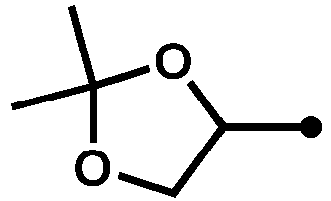
Cl CH 171-172 6 
Cl CH 133-134 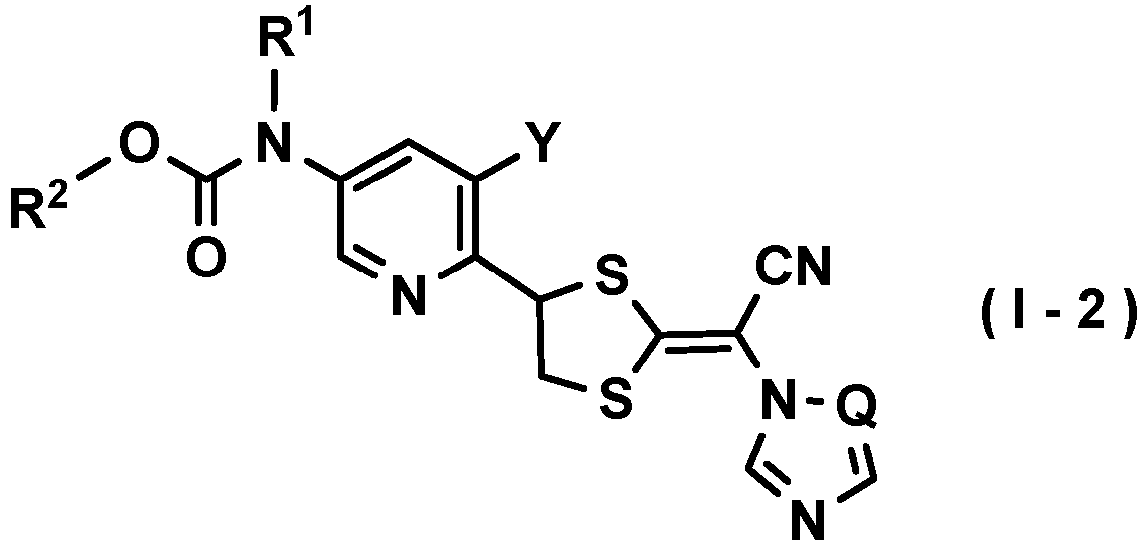
[Table 2] Compound No. Y R1 R2 Q Physical property Melting point (°C) 7 Cl H Me N 214-215 8* F H Et N 177-178 9* Cl H Me N 146-147 10 F H Et N 160-161 11 Cl H Et N 185-186 12 Cl H t-Bu N NMR 13 F H Bn N 168-169 14 Cl H Bn N 168-169 15 Cl H Me CH 215-216 16 Cl H Et CH 220-221 17 Cl H Bn CH 211-212 In the table, * indicates an optically active form (R form). 
[Table 3] Compound No. Y R3 R4 Q Physical property Melting point (°C) 18 F H Me N NMR 19 Cl H Me N 162-163 20 F H Et N 97-98 21 Cl H Et N 150-151 22 F H Bn N 119-120 23 Cl H Bn N 171-172 24 Cl H Me CH 151-152 25 Cl H Et CH 125-126 26 Cl H Bn CH 131-132 27 Cl NH2 Bn CH NMR [Table 4] Compound No. 1H-NMR(CDCl3) δ value (ppm) 12 8.31 (s, 1H), 8.27 (bs, 1H), 8.24 (d, 1H), 8.09 (s, 1H), 6.66 (s, 1H), 5.67 (dd, 1H), 4.15 (dd, 1H), 3.78 (dd, 1H), 1.54 (s, 9H) 18 8.49 (s, 1H), 8.33 (s, 1H), 8.09 (s, 1H), 8.07 (d, 1H), 7.79 (dd, 1H), 5.58 (ddd, 1H), 4.18 (dd, 1H), 4.02 (s, 3H), 3.83 (dd, 1H) 27 8.74 (d, 1H), 8.03 (d, 1H), 7.61 (s, 1H), 7.44-7.30 (m, 5H), 7.17-7.15 (m, 1H), 7.04-7.02 (m, 1H), 5.68 (dd, 1H), 5.15 (s, 2H), 4.84 (bs, 2H), 4.19 (dd, 1H), 3.82 (dd, 1H) 
[Table 5] Compound No. X Y Q Physical property Melting point (°C) 28 
Cl CH NMR 29 CH2OH Cl CH 144-145 30 CHO Cl CH 93-94 31 
Cl CH 136-137 32 
Cl CH 126-127 33 MeO Cl CH 168-169 34 
Cl CH 169-170 35 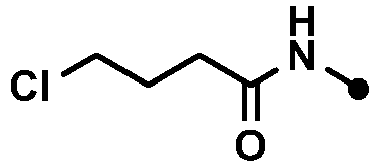
Cl CH 161-162 [Table 6] Compound No. X Y Q Physical property Melting point (°C) 36 NH2HCl Cl CH 186-187 37 
Cl CH 124-126 38 NH2 Cl N 151-152 39 CH2CN Cl CH 103-104 40 OH Cl CH 252-253 41 OCH2OCH3 Cl CH 131-132 42 
Cl N 103-104 43 NH2 F N 188-189 44 CH2OH Cl N 151-152 45 CHO Cl N 147-148 46 
Cl CH NMR 47 
Cl CH NMR 48 NHCOEt Cl CH NMR [Table 7] Compound No. X Y Q Physical property Melting point (°C) 49 NH2 Cl N 192-193 50 
F N NMR 51 CH2OH F N 201-202 52 CHO F N 126-127 53* NH2 Cl N 221-222 54** NH2 Cl N 230-231 55 NH2 CN N 236-237 56 CN F N 189-190 57 NH2 Me N 168-169 58** NH2 F N 215-216 59* NH2 F N 215-216 60 CN Cl CH 179-180 61 CN Cl N 167-168 62 CF3 Cl CH 132-133 63 CF3 Cl N 148-149 64 NHCOMe Cl CH 181-184 
[Table 8] Compound No. Y R1 R2 Q Physical property Melting point (°C) 65 Cl H t-Bu CH 202-203 66 Cl H ClCH2CH2 CH 174-176 67 Cl H ClCH2CH2CH2 CH 167-169 68 Cl H MeOCH2CH2 CH 174-175 69 Me H Et CH 210-213 70 F H t-Bu N 149-150 71 F H Me N 193-194 72 CN H t-Bu N NMR 73 Cl H 
N 169-170 74 Cl H 
N 211-212 75 Cl H 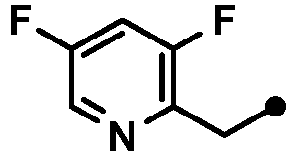
N NMR 76** Cl H Me N 187-188 77 CN H Et N NMR 78 CN H Bn N NMR 79* Cl H Et N 174-175 80** Cl H Et N 174-175 [Table 9] Compound No. Y R1 R2 Q Physical property Melting point (°C) 81 Me H t-Bu N NMR 82 Cl H i-Pr N 171-172 83 Cl H i-Bu N NMR 84 Cl H n-Pr N 134-135 85 Cl H CF3CH2 N 182-183 86 Cl H CHF2CH2 N 119-120 87 Cl H c-PrCH2 N 152-153 88 Cl H c-Pr N 98-99 89 Cl H 4-FBn N 184-185 90 Me H Et N 197-198 91 Me H Bn N 153-154 92* Cl H c-PrCH2 N 156-157 93** Cl H c-PrCH2 N 156-157 94* Cl H n-Pr N 156-157 95** Cl H n-Pr N 161-162 96 Cl H 
N 115-116 97 Cl H c-BuCH2 N NMR 98 Cl H 3-FBn N 189-190 99 Cl H 2-FBn N NMR [Table 10] Compound No. Y R1 R2 Q Physical property Melting point (°C) 100* Cl H Bn N 197-198 101** Cl H Bn N 197-198 102 F H n-Pr N 185-186 103 F H c-PrCH2 N 203-204 104** F H Et N 177-178 105** F H Bn N 178-179 106* F H Bn N 178-179 107 Cl H 
N 167-168 108 Cl H 
N 187-188 109** F H n-Pr N 177-178 110* F H n-Pr N 175-176 111** F H c-PrCH2 N 205-206 112* Cl H c-PrCH2 N 205-206 [Table 11] Compound No. Y R1 R2 Q Physical property Melting point (°C) 113 Cl H 
N 109-110 114 Cl H 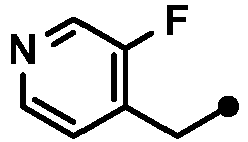
N 182-183 115 Cl H 
N 182-183 116d Cl H 
N NMR 117 Cl H 
N 117-118 118 Cl H 
N NMR 119 Cl H 
N NMR 120 Cl H 
N 165-166 121 Cl H 
N 222-223 122 Cl H 
N 183-184 [Table 12] Compound No. Y R1 R2 Q Physical property Melting point (°C) 123 Cl H 
N NMR 124 Cl H 
N NMR 125 Cl H 
N NMR 126 Cl H 
N NMR 127 Cl H 
N NMR 128 F H 
N 194-195 129 Cl H 
N 218-219 130* Cl H 
N 164-165 131* F H 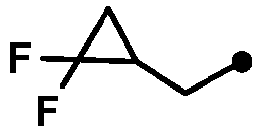
N 191-192 132 Cl H NCCH2CH2 N 203-204 
[Table 13] Compound No. Y R3 R4 Q Physical property Melting point (°C) 133 Cl H H CH 244-245 134 Cl NH2 Et CH 149-150 135 Cl NH2 Et N 204-205 136 Cl NH2 Bn N NMR 137 F NH2 Et N 96-97 138 F NH2 Bn N NMR 139 Cl H c-PrCH2 N 143-144 140 F H c-PrCH2 N 133-134 141 Cl H n-Pr N 117-118 142 Cl H i-Pr N 161-162 143 Cl H i-Bu N 128-129 144 F H n-Pr N 67-68 
[Table 141 Compound No. Y X Q Physical property Melting point (°C) 145 Cl CH (OH) Me N 151-152 146 Cl COMe N 150-151 
[Table 151 Compound No. Y R1 R2 Q Physical property Melting point (°C) 147*d Cl H 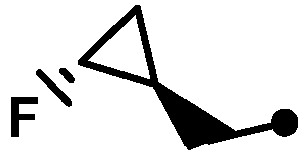
N 174-175 148 Cl H 
N NMR 149*d F H 
N 188-189 150 Cl H 
N NMR 151 Cl H 
N NMR 152* F H 
N 172-173 153* F H 
N 180-181 154* F H 
N NMR 155* Cl H 
N 157-158 156* Cl H 
N 172-173 [Table 16] Compound No. Y R1 R2 Q Physical property Melting point (°C) 157* F H 
N 190-191 158* Cl H 
N 157-158 159* F H 
N 186-187 160 d Cl H 
N NMR 161* Cl H Me N 213-214 
[Table 17] Compound No. Y R3 R4 Q Physical property Melting point (°C) 162 Cl H 
N 121-122 163 F H 
N 122-123 164 Cl Me Et N 165-166 165 Cl Me 
N 150-151 [Table 18] Compound No. 1H-NMR data (CDCl3) δ value (ppm) 28 8.49 (s, 1H), 7.81-7.79 (m, 1H), 7.62-7.60 (m, 1H), 7.17-7.15 (m, 1H), 7.03 (t, 1H), 5.70 (dd, 1H), 4.83 (d, 1H), 4.74 (t, 1H), 4.54 (d, 1H), 4.19 (dd, 1H), 3.91-3.84 (m, 1H), 3.81 (dd, 1H), 3.61-3.55 (m, 1H), 1.92-1.46 (m, 6H) 46 8.53 (d, 1H), 7.84 (dd, 1H), 7.61 (bs, 1H), 7.17 (bs, 1H), 7.03 (bs, 1H), 5.76 (t, 1H), 5.69 (dd, 1H), 4.91 (t, 1H), 4.39 (dd, 1H), 4.20 (dd, 1H), 3.86 (dd, 1H) 47 8.39 (d, 1H), 8.23 (d, 1H), 7.60 (s, 1H), 7.36-7.30 (m, 2H), 7.29-7.22 (m, 3H), 7.17 (bs, 1H), 7.16 (s, 1H), 7.03 (s, 1H), 5.67 (dd, 1H), 4.12 (dd, 1H), 3.77 (dd, 1H), 3.07 (t, 2H), 2.74 (t, 2H) 48 8.48 (d, 1H), 8.39 (d, 1H), 7.61 (s, 1H), 7.37 (bs, 1H), 7.16 (s, 1H), 7.03 (s, 1H), 5.69 (dd, 1H), 4.14 (dd, 1H), 3.78 (dd, 1H), 2.47 (q, 2H), 1.27 (t, 3H) 50 8.40 (bs, 1H), 8.33 (s, 1H), 8.09 (s, 1H), 7.54 (dd, 1H), 5.59 (ddd, 1H), 4.85 (d, 1H), 4.74 (dd, 1H), 4.57 (d, 1H), 4.17 (dd, 1H), 3.87 (ddd, 1H), 3.81 (dd, 1H), 3.61-3.54 (m, 1H), 1.91-1.73 (m, 2H), 1.72-1.50 (m, 4H) 72 8.52 (bs, 1H), 8.51 (d, 1H), 8.34 (d, 1H), 8.09 (s, 1H), 6.78 (bs, 1H), 5.68 (dd, 1H), 4.12 (dd, 1H), 3.85 (dd, 1H), 1.54 (s, 9H) 75 8.37 (d, 1H), 8.32 (s, 1H), 8.31 (d, 1H), 8.26 (bd, 1H), 8.09 (s, 1H), 7.29 (dd, 1H), 7.01 (bs, 1H), 5.66 (dd, 1H), 5.41 (d, 2H), 4.15 (dd, 1H), 3.80 (dd, 1H) 77 8.58 (d, 1H), 8.50 (bs, 1H), 8.34 (s, 1H), 8.10 (s, 1H), 6.88 (bs, 1H), 5.68 (dd, 1H), 4.30 (q, 2H), 4.13 (dd, 1H), 3.86 (dd, 1H), 1.35 (t, 3H) [Table 19] Compound No. 1H-NMR data (CDCl3) δ value (ppm) 78 8.57 (d, 1H), 8.51 (bs, 1H), 8.33 (s, 1H), 8.09 (s, 1H), 7.43-7.36 (m, 5H), 6.97 (bs, 1H), 5.68 (dd, 1H), 5.25 (s, 2H), 4.13 (dd, 1H), 3.86 (dd, 1H) 81 8.31 (s, 1H), 8.21 (d, 1H), 8.09 (s, 1H), 7.96 (bs, 1H), 6.56 (bs, 1H), 5.45 (dd, 1H), 4.32 (dd, 1H), 3.62 (dd, 1H), 2.44 (s, 3H), 1.53 (s, 9H) 83 8.32 (d, 1H), 8.31 (s, 1H), 8.25 (bs, 1H), 8.09 (s, 1H), 6.78 (bs, 1H), 5.67 (dd, 1H), 4.16 (dd, 1H), 4.00 (d, 2H), 3.80 (dd, 1H), 2.00 (sep, 1H), 0.98 (d, 6H) 97 8.31 (s, 1H), 8.31 (d, 1H), 8.25 (bs, 1H), 8.09 (s, 1H), 6.77 (bs, 1H), 5.67 (dd, 1H), 4.19 (d, 2H), 4.16 (dd, 1H), 3.79 (dd, 1H), 2.67 (sep, 1H), 2.15-2.05 (m, 2H), 2.03-1.75 (m, 4H) 99 8.31 (s, 1H), 8.30 (d, 1H), 8.26 (bs, 1H), 8.08 (s, 1H), 7.44 (ddd, 1H), 7.41-7.34 (m, 1H), 7.17 (ddd, 1H), 7.11 (dd, 1H), 6.82 (bs, 1H), 5.66 (dd, 1H), 5.31 (s, 2H), 4.15 (dd, 1H), 3.79 (dd, 1H) 116 8.36-8.33 (m, 1H), 8.32 (s, 1H), 8.25-8.21 (m, 1H), 8.09 (s, 1H), 7.61 (bs, 1H), 5.68 (dd, 1H), 4.76 (bs, 1H), 4.29 (bs, 1H), 4.16 (dd, 1H), 3.84 (bs, 1H), 3.79 (dd, 1H), 2.53 (bs, 1H), 1.44 (s, 9H), 1.40-1.32 (m, 1H), 0.86-0.75 (m, 2H) 118 8.33-8.30 (m, 2H), 8.25 (bs, 1H), 8.09 (s, 1H), 6.83 (bs, 1H), 5.67 (dd, 1H), 4.16 (dd, 1H), 4.10-3.98 (m, 2H), 3.80 (dd, 1H), 1.12 (d, 0.6H), 1.08 (d, 2.4H), 1.04-0.70 (m, 2.2H), 0.53-0.46 (m, 0.8H), 0.40-0.34 (m, 0.8H), 0.10-0.05 (m, 0.2H) [Table 20] Compound No. 1H-NMR data (CDCl3) δ value (ppm) 119 8.33-8.30 (m, 2H), 8.24 (bs, 1H), 8.09 (s, 1H), 7.30-7.24 (m, 2H), 7.21-7.15 (m, 1H), 7.10-7.06 (m, 2H), 6.83 (bs, 1H), 5.67 (dd, 1H), 4.30-4.23 (m, 1H), 4.19-4.11 (m, 2H), 3.80 (dd, 1H), 1.98-1.92 (m, 1H), 1.60-1.49 (m, 1H), 1.09-1.00 (m, 2H) 123 8.32 (d, 1H), 8.32 (s, 1H), 8.25 (bs, 1H), 8.09 (s, 1H), 6.85 (bs, 1H), 5.68 (dd, 1H), 4.16 (dd, 1H), 4.01 (s, 2H), 3.80 (dd, 1H), 1.17 (s, 3H), 0.56-0.52 (m, 2H), 0.45-0.41 (m, 2H) 124 8.33 (d, 1H), 8.32 (s, 1H), 8.24 (d, 1H), 8.09 (s, 1H), 6.99 (bs, 1H), 5.67 (dd, 1H), 4.16 (dd, 1H), 4.13 (s, 2H), 3.80 (dd, 1H), 1.97 (s, 1H), 1.12-1.08 (m, 2H), 0.94-0.90 (m, 2H) 125 8.37 (d, 1H), 8.32 (s, 1H), 8.21 (bs, 1H), 8.09 (s, 1H), 7.00 (bs, 1H), 5.67 (dd, 1H), 4.20 (dd, 1H), 4.22-4.14 (m, 2H), 3.81 (dd, 1H), 1.44-1.40 (m, 2H), 1.17-1.13 (m, 2H) 126 8.35 (d, 1H), 8.32 (s, 1H), 8.23 (bs, 1H), 8.09 (s, 1H), 6.86 (bs, 1H), 5.67 (dd, 1H), 4.39 (d, 2H), 4.16 (dd, 1H), 3.81 (dd, 1H), 3.30-3.20 (m, 2H), 2.99-2.78 (m, 3H) 127 10.23 (bs, 1H), 8.34 (d, 1H), 8.32 (s, 1H), 8.23 (bs, 1H), 8.09 (s, 1H), 6.80 (bs, 1H), 5.67 (dd, 1H), 4.26 (t, 2H), 4.17 (dd, 1H), 3.81 (dd, 1H), 2.73 (t, 2H), 2.05-1.96 (m, 2H) 136 8.73 (d, 1H), 8.32 (s, 1H), 8.09 (s, 1H), 8.04 (d, 1H), 7.44-7.30 (m, 5H), 5.68 (dd, 1H), 5.15 (s, 2H), 4.84 (bs, 2H), 4.21 (dd, 1H), 3.85 (dd, 1H) 138 8.65 (dd, 1H), 8.33 (s, 1H), 8.09 (s, 1H), 7.76 (dd, 1H), 7.44-7.30 (m, 5H), 5.58 (ddd, 1H), 5.15 (s, 2H), 4.84 (bs, 2H), 4.17 (dd, 1H), 3.83 (dd, 1H) [Table 21] Compound No. 1H-NMR data (CDCl3) δ value (ppm) 148 8.36-8.34 (m, 1H), 8.32 (s, 1H), 8.21 (bs, 1H), 8.09 (s, 1H), 6.87 (bs, 1H), 5.67 (dd, 1H), 4.32-4.24 (m, 1H), 4.17 (dd, 1H), 3.98-3.90 (m, 1H), 3.81 (dd, 1H), 1.95-1.86 (m, 1H), 1.50-1.36 (m, 2H), 1.13-1.07 (m, 1H) 150 8.34 (d, 1H), 8.31 (s, 1H), 8.23 (bs, 1H), 8.09 (s, 1H), 6.91 (bs, 1H), 5.67 (dd, 1H), 4.54-4.41 (m, 2H), 4.17 (dd, 1H), 3.80 (dd, 1H), 1.24-1.14 (m, 2H), 0.91-0.79 (m, 2H) 151 8.37-8.34 (m, 1H), 8.32 (s, 1H), 8.24 (bs, 1H), 8.09 (s, 1H), 6.89 (bs, 1H), 5.67 (dd, 1H), 4.57 (dd, 1H), 4.17 (d, 1H), 4.13 (d, 1H), 3.80 (dd, 1H), 2.12-2.02 (m, 1H), 1.76 (dd, 1H), 1.38 (dd, 1H) 154 8.32 (s, 1H), 8.24-8.22 (m, 1H), 8.09 (s, 1H), 8.05 (bd, 1H), 6.98 (bs, 1H), 5.56 (ddd, 1H), 4.57 (dd, 1H), 4.13 (dd, 2H), 3.78 (dd, 1H), 2.11-2.02 (m, 1H), 1.76 (dd, 1H), 1.38 (dd, 1H) 160 8.35-8.33 (m, 1H), 8.32 (s, 1H), 8.25-8.22 (m, 1H), 8.09 (s, 1H), 7.18 (bs, 1H), 5.67 (dd, 1H), 4.87 (bs, 1H), 4.26 (bs, 1H), 4.16 (dd, 1H), 3.93 (bs, 1H), 3.80 (dd, 1H), 3.66 (s, 3H), 2.62-2.57 (m, 1H), 1.43-1.33 (m, 1H), 0.90-0.79 (m, 2H) - The compound is an antifungal agent useful for treating fungal infections in humans and animals. Fungal infections are classified into localized fungal infections and systemic fungal infections. Localized fungal infections include tinea pedis and tinea ungums, mainly caused by Trichophyton fungi, known as tinea fungi, seborrheic dermatitis, mainly caused by Malassezia fungi, and vaginal candidiasis, mainly caused by Candida fungi. Systemic fungal infections include candidemia, mainly caused by Candida fungi, and pulmonary aspergillosis, mainly caused by Aspergillus fungi. In addition, the compound can be used to treat localized fungal infections, systemic fungal infections and the like, caused by fungi such as Cryptococcus, Fusarium, Scedosporium, Pneumocystis, Mucor and the like.
- Fungi against which the present compound is effective include Trichophyton fungi (Trichophyton spp.) such as Trichophyton rubrum, Trichophyton mentagrophytes, Trichophyton interdigitale and the like, Aspergillus fungi (Aspergillus spp.) such as Aspergillus fumigatus, Aspergillus flavus, Aspergillus niger, Aspergillus nidulans, Aspergillus terreus, Aspergillus clavatus, Aspergillus niveus, Aspergillus versicolor, Aspergillus sydowii, Aspergillus ustus and the like, Malassezia fungi (Malassezia spp.) such as Malassezia restricta, Malassezia globosa and the like, and Candida fungi (Candida spp.) such as Candida albicans, Candida tropicalis, Candida parapsilosis, Candida matapsilosis, Candida orthopsilosis, Candida glabrata, Candida auris, Candida nivariensis, Candida bracarensis, Candida krusei, Candida guilliermondii, Candida guilliermondii var.menbranifaciens, Candida lusitanie, Candida inconspicua, Candida famata, Candida rugosa, Candida dubliniensis, Candida norvegensis, Candida lipolytica, Candida sake, Candida pelliculosa, Candida apicola, Candida zeylanoides, Candida kefyr and the like.
- Other fungi include Cryptococcus fungi (Cryptococcus spp.) such as Cryptococcus neoformans, Cryptococcus gatti and the like, Mucor fungi (Mucor spp.) such as Mucor circinelloides, Mucor plumbeus, Mucor racemosus, Mucor ramosissimus, Mucor rouxii and the like, Rhizopus fungi (Rhizopus spp.) such as Rhizopus arrhizus, Rhizopus oryzae, Rhizopus stolonifera, Rhizopus microspores and the like, Rhizomucor fungi (Rhizomucor spp.) such as Rhizomucor pusillus and the like, Lichtheimia fungi (Lichtheimia spp.) such as Lichtheimia corymbifera and the like, Absidia fungi (Absidia spp.) such as Absidia corymbifera, Absidia butleri and the like, Cunnighamella fungi (Cunnighamella spp.) such as Cunnighamella bertholletiae, Cunninghamella echinulate and the like, Conidiobolus fungi (Conidiobolus spp.) such as Conidiobolus brefeldianus, Conidiobolus coronatus, Conidiobolus incongruous, Conidiobolus lamprauges and the like, Trichosporon fungi (Trichosporon spp.) such as Trichosporon asahii, Trichosporon cutaneum, Trichosporon inkin, Trichosporon mucoides and the like, Scedosporium fungi (Scedosporium spp.) such as Scedosporium apiospermum and the like, Fusarium fungi (Fusarium spp.) such as Fusarium oxysporum, Fusarium solani and the like, Pneumocystis fungi (Pneumocystis spp.) such as Pneumocystis jirovecii and the like, and Histoplasma fungi (Histoplasma spp.) such as Histoplasmosis capsulati and the like.
- The compounds and pharmacologically acceptable salts thereof of the present invention are used alone or in the form of a composition containing a pharmaceutically acceptable inert carrier or diluent, prepared into a dosage form suitable for oral, intravenous, transdermal, transpulmonary or transvaginal administration, such as powder, granule, tablet, liquid, suspension, emulsion, ointment, cream, gel, lotion, poultice, injection, drip infusion, suppository and the like. After preparation into such a suitable dosage form, a pharmacologically effective amount of the compound and pharmacologically acceptable salts thereof of the present invention can be administered orally, intravenously, transdermally, transpulmonary or transvaginally to treat the above-mentioned localized fungal infections or systemic fungal infections. The dosage varies depending on age, body weight, and mode of administration. For oral, intravenous, transpulmonary or transvaginal administration, the dosage for an adult is usually 0.05 mg or more, preferably 0.5 to 5.0 mg, per kg of body weight per day, administered once or in several divided doses. For transdermal administration, for example, in the case of preparations for application such as ointment, cream, lotion, poultice and the like, the concentration of the active ingredient is 0.001% or more, preferably in the range of 0.1 to 10%, and applied to the skin or nails in the range 30 mg to 100 mg per cm2. The compound of the present invention can also be applied in mixture with other antifungal and antibacterial agents, such as Amphotericin B, Trichomycin, Valitoin, Clotrimazole and the like.
- Next, production examples, formulation examples and experimental examples are given as specific examples of the present invention, but the present invention is not limited to these. The parts indicate parts by weight.
-

- Tertiary-butyl (5,6-dichloropyridin-3-yl)carbamate (6.1 g, 23 mmol) was dissolved in 1,2-dimethoxyethane (50 mL) and water (25 mL), and then sodium carbonate (9.9 g, 93 mmol), [1,1'-bis(diphenylphosphino)ferrocene]palladium(II) dichloride acetone adduct (0.91 g, 1.2 mmol) and potassium vinyltrifluoroborate (5.6 g, 42 mmol) were added thereto, and the mixture was stirred with heating under reflux for 3.5 hr. Saturated aqueous sodium chloride solution was added thereto, and the mixture was extracted threetimes with ethyl acetate. The organic layer was dried over anhydrous sodium sulfate, and concentrated under reduced pressure. The obtained residue was purified by silica gel column chromatography to give tertiary-butyl (5-chloro-6-vinylpyridin-3-yl)carbamate (5.8 g).
- yield: 98%
- 1H-NMR(CDCl3) δ value (ppm) :
8.21(d,1H),8.16(bs,1H),7.17(dd,1H),6.56(bs,1H),6.33(dd,1H),5.49(dd , 1H) 1. 53 (s, 9H) -

- Tertiary-butyl (5-chloro-6-vinylpyridin-3-yl)carbamate (5.8 g, 23 mmol) was dissolved in acetone (45 mL) and water (4.5 mL), and then 4-methylmorpholine N-oxide (50% aqueous solution, 5.8 g, 25 mmol) and osmium tetroxide (0.1M aqueous solution, 1.1 mL, 0.11 mmol) were added thereto, and the mixture was stirred at room temperature for 26 hr. Sodium dithionite (2.0 g, 12 mmol) and ethyl acetate were added thereto, and then the mixture was filtered through silica gel and Celite, and the filtrate was concentrated under reduced pressure. The obtained residue was purified by silica gel column chromatography to give tertiary-butyl [5-chloro-6-(1,2-dihydroxyethyl)pyridin-3-yl]carbamate (5.2 g).
- yield: 80%
- 1H-NMR(CDCl3) δ value (ppm) :
8.28(bs,1H),8.14(bs,1H),6.56(bs,1H),5.07(bs,1H),4.28(bs,1H),3.96(d d,1H),3.66(dd,1H),2.44(bs,1H),1.53(s,9H) -

- Tertiary-butyl [5-chloro-6-(1,2-dihydroxyethyl)pyridin-3-yl]carbamate (0.50 g, 1.7 mmol) and triethylamine (0.42 g, 4.2 mmol) were dissolved in chloroform (5 mL), and then methanesulfonyl chloride (0.44 g, 3.8 mmol) was added thereto under ice-cooling, and the mixture was stirred at room temperature for 3 hr. The reaction solution was concentrated under reduced pressure, the obtained residue was suspended in ethyl acetate, and the suspension was filtered through silica gel and Celite. The obtained filtrate was concentrated under reduced pressure to give 1-{5-[(tertiary-butoxycarbonyl)amino]-3-chloropyridin-2-yl}ethane-1,2-diyl dimethanesulfonate as a crude product.
- Potassium hydroxide (powder, 0.29 g, 5.2 mmol) was suspended in dimethyl sulfoxide (4 mL), and then 2-(1H-imidazol-1-yl)acetonitrile (0.28 g, 2.6 mmol) and a dimethyl sulfoxide solution (4 mL) of carbon disulfide (0.20 g, 2.6 mmol) were added thereto, and the mixture was stirred at room temperature for 3 hr. The obtained reaction solution was added to a dimethyl sulfoxide solution (8 mL) of 1-{5-[(tertiary-butoxycarbonyl)amino]-3-chloropyridin-2-yl}ethane-1,2-diyl dimethanesulfonate, and the mixture was stirred at room temperature for 16 hr. Water was added thereto, and the mixture was extracted threetimes with ethyl acetate. The organic layer was dried over anhydrous sodium sulfate, and concentrated under reduced pressure. The obtained residue was purified by silica gel column chromatography to give tertiary-butyl (E)-(5-chloro-6-{2-[cyano(1H-imidazol-1-yl)methylene]-1,3-dithiolan-4-yl}pyridin-3-yl)carbamate (0.29 g).
- yield: 39%
- melting point: 202-203°C
-

- Tertiary-butyl (E)-(5-chloro-6-{2-[cyano(1H-imidazol-1-yl)methylene]-1,3-dithiolan-4-yl}pyridin-3-yl)carbamate (50 g, 0.11mol) was dissolved in methanol (500 mL), and then hydrogen chloride methanol solution (250 mL) was added thereto, and the mixture was stirred at 25°C for 12 hr. The resulting solid was filtered, and the filtered solid was dried under reduced pressure to give (E)-2-[4-(5-amino-3-chloropyridin-2-yl)-1,3-dithiolan-2-ylidene]-2-(1H-imidazol-1-yl)acetonitrile hydrochloride (42 g).
- yield: 98%
- melting point: 186-187°C
-

- (E)-2-[4-(5-Amino-3-chloropyridin-2-yl)-1,3-dithiolan-2-ylidene]-2-(1H-imidazol-1-yl)acetonitrile hydrochloride (0.10 g, 0.27 mmol) was dissolved in pyridine (2 mL), and then chloromethyl formate (51 mg, 0.54 mmol) was added thereto under ice-cooling, and the mixture was stirred at room temperature for 51 hr. Saturated aqueous sodium hydrogencarbonate solution was added thereto, and the mixture was extracted threetimes with ethyl acetate. The organic layer was dried over anhydrous sodium sulfate, and concentrated under reduced pressure. The obtained residue was suspended in ethyl acetate, and the solid was filtered. The filtered solid was air-dried to give methyl (E)-(5-chloro-6-{2-[cyano(1H-imidazol-1-yl)methylene]-1,3-dithiolan-4-yl}pyridin-3-yl)carbamate (71 mg).
- yield: 67%
- melting point: 215-216°C
-

- 2,3-Dichloro-5-{[(tetrahydro-2H-pyran-2-yl)oxy]methyl}pyridine (8.0 g, 31 mmol) was dissolved in 1,2-dimethoxyethane (60 mL) and water (30 mL), and then sodium carbonate (16 g, 0.15 mol), tetrakis(triphenylphosphine)palladium(0) (2.8 g, 2.4 mmol) and potassium vinyltrifluoroborate (10 g, 77 mmol) were added thereto, and the mixture was stirred with heating under reflux for 6.5 hr. Saturated aqueous sodium chloride solution was added thereto, and the mixture was extracted threetimes with ethyl acetate. The organic layer was dried over anhydrous sodium sulfate, and concentrated under reduced pressure. The obtained residue was purified by silica gel column chromatography to give 3-chloro-5-{[(tetrahydro-2H-pyran-2-yl)oxy]methyl}-2-vinylpyridine (6.6 g).
- yield: 86%
- 1H-NMR(CDCl3) δ value (ppm) :
8.45(d,1H),7.69(d,1H),7.23(dd,1H),6.46(dd,1H),5.58(dd,1H),4.77(d,1 H),4.71(t,1H),4.50(d,1H),3.92-3.84(m,1H),3.60-3.52(m,1H),1.91-1.49(m,6H) -

- 3-Chloro-5-{[(tetrahydro-2H-pyran-2-yl)oxy]methyl}-2-vinylpyridine (6.6 g, 26 mmol) was dissolved in acetone (55 mL) and water (13 mL), and then 4-methylmorpholine N-oxide (50% aqueous solution, 9.2 g, 39 mmol) and osmium tetroxide (0.1M aqueous solution, 5.2 mL, 0.52 mmol) were added thereto, and the mixture was stirred at room temperature for 52 hr. Sodium dithionite (4.6 g, 26 mmol) and ethyl acetate were added thereto, the mixture was filtered through silica gel and Celite, and the obtained filtrate was concentrated under reduced pressure. The obtained residue was purified by silica gel column chromatography to give 1-(3-chloro-5-{[(tetrahydro-2H-pyran-2-yl)oxy]methyl}pyridin-2-yl)ethane-1,2-diol (6.0 g).
- yield: 80%
- 1H-NMR(CDCl3) δ value (ppm) :
8.45(d,1H),7.75(d,1H),5.14-5.08(m,1H),4.80(d,1H),4.72(t,1H),4.52(d,1H),4.52(d,1H),4.04-3.95(m,1H),3.91-3.83(m,1H),3.73-3.65(m,1H),3.61-3.53(m,1H),2.45(bs,1H),1.92-1.49(m,6H) -

- 1-(3-Chloro-5-{[(tetrahydro-2H-pyran-2-yl)oxy]methyl}pyridin-2-yl)ethane-1,2-diol (2.0 g, 7.0 mmol) and triethylamine (1.7 g, 17 mmol) were dissolved in chloroform (15 mL), and then methanesulfonyl chloride (1.8 g, 15 mmol) was added thereto under ice-cooling, and the mixture was stirred at room temperature for 23 hr. The reaction solution was concentrated under reduced pressure, the obtained residue was suspended in ethyl acetate, and the suspension was filtered through silica gel and Celite. The obtained filtrate was concentrated under reduced pressure to give 1-(3-chloro-5-{[(tetrahydro-2H-pyran-2-yl)oxy]methyl}pyridin-2-yl)ethane-1,2-diyl dimethanesulfonate as a crude product. Potassium hydroxide (powder, 1.2 g, 21 mmol) was suspended in dimethyl sulfoxide (7 mL), and then 2-(1H-imidazol-1-yl)acetonitrile (1.1 g, 10 mmol) and a dimethyl sulfoxide solution (7 mL) of carbon disulfide (0.79 g, 10 mmol) were added thereto, and the mixture was stirred at room temperature for 3.5 hr. The obtained reaction solution was added to a dimethyl sulfoxide solution (14 mL) of 1-(3-chloro-5-{[(tetrahydro-2H-pyran-2-yl)oxy]methyl}pyridin-2-yl)ethane-1,2-diyl dimethanesulfonate, and the mixture was stirred at room temperature for 27 hr. Water was added thereto, and the mixture was extracted threetimes with ethyl acetate. The organic layer was dried over anhydrous sodium sulfate, and concentrated under reduced pressure. The obtained residue was purified by silica gel column chromatography to give (E)-2-[4-(3-chloro-5-{[(tetrahydro-2H-pyran-2-yl)oxy]methyl}pyridin-2-yl)-1,3-dithiolan-2-ylidene]-2-(1H-imidazol-1-yl)acetonitrile (0.60 g).
- yield: 20%
- 1H-NMR(CDCl3) δ value (ppm) :
8.49(s,1H),7.81-7.79(m,1H),7.62-7.60(m,1H),7.17-7.15(m,1H),7.03(t,1H),5.70(dd,1H),4.83(d,1H),4.74(t,1H),4.54(d,1H) ,4.19(dd,1H),3.91-3.84(m,1H),3.81(dd,1H),3.61-3.55(m,1H),1.92-1.46(m,6H) -
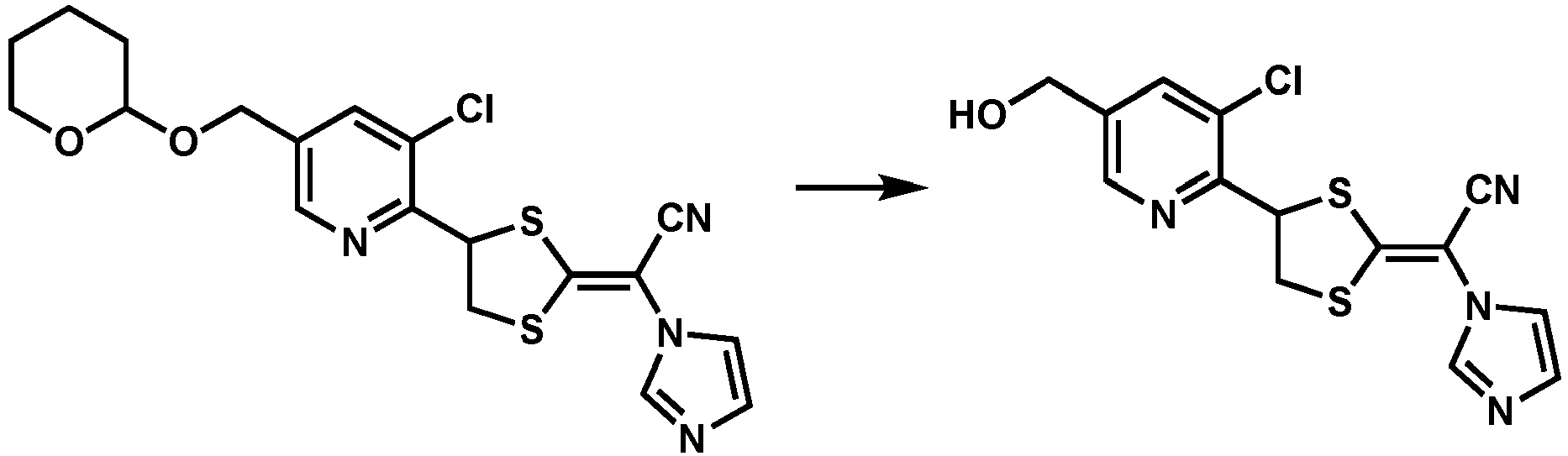
- (E)-2-[4-(3-Chloro-5-{[(tetrahydro-2H-pyran-2-yl)oxy]methyl}pyridin-2-yl)-1,3-dithiolan-2-ylidene]-2-(1H-imidazol-1-yl)acetonitrile (0.56 g, 1.3 mmol) was dissolved in methanol (5 mL), and then p-toluenesulfonic acid monohydrate (0.49 g, 2.6 mmol) was added thereto, and the mixture was stirred at room temperature for 33 hr. Saturated aqueous sodium hydrogencarbonate solution and saturated aqueous sodium chloride solution were added thereto, and the mixture was extracted threetimes with ethyl acetate. The organic layer was dried over anhydrous sodium sulfate, and concentrated under reduced pressure. The obtained residue was purified by silica gel column chromatography to give (E)-2-{4-[3-chloro-5-(hydroxymethyl)pyridin-2-yl]-1,3-dithiolan-2-ylidene}-2-(1H-imidazol-1-yl)acetonitrile (0.32 g).
- yield: 72%
- melting point: 144-145°C
-

- Oxalyl chloride (0.27 g, 2.1 mmol) was dissolved in dichloromethane (4 mL), and then a dichloromethane solution (1 mL) of dimethyl sulfoxide (0.33 g, 4.3 mmol) was added thereto at - 70°C, and the mixture was stirred at the same temperature for 20 min. A solution of (E)-2-{4-[3-chloro-5-(hydroxymethyl)pyridin-2-yl]-1,3-dithiolan-2-ylidene}-2-(1H-imidazol-1-yl)acetonitrile (0.50 g, 1.4 mmol) in dimethyl sulfoxide (2 mL)-dichloromethane (2 mL) was added thereto at -70°C, and the mixture was stirred at the same temperature for 1.5 hr. A dichloromethane solution (1 mL) of triethylamine (0.65 g, 6.4 mmol) was added thereto at -70°C, and the mixture was stirred at the same temperature for 20 min, followed by at room temperature for 2 hr. Water was added thereto, and the mixture was extracted threetimes with ethyl acetate. The organic layer was dried over anhydrous sodium sulfate, and concentrated under reduced pressure. The obtained residue was purified by silica gel column chromatography to give (E)-2-{4-[3-chloro-5-(oxomethyl)pyridin-2-yl]-1,3-dithiolan-2-ylidene}-2-(1H-imidazol-1-yl)acetonitrile (0.46 g).
- yield: 93%
- melting point: 93-94°C
- 2-6) Production of (E)-2-(4-{3-chloro-5-[(E)-(ethoxyimino)methyl]pyridin-2-yl}-1,3-dithiolan-2-ylidene)-2-(1H-imidazol-1-yl)acetonitrile

- (E)-2-{4-[3-Chloro-5-(oxomethyl)pyridin-2-yl]-1,3-dithiolan-2-ylidene}-2-(1H-imidazol-1-yl)acetonitrile (0.10 g, 0.29 mmol) was dissolved in methanol (3 mL) and tetrahydrofuran (3 mL), and then O-ethylhydroxylamine hydrochloride (31 mg, 0.32 mmol) was added thereto, and the mixture was stirred at room temperature for 27 hr. Saturated aqueous sodium hydrogencarbonate solution was added thereto, and the mixture was extracted threetimes with ethyl acetate. The organic layer was dried over anhydrous sodium sulfate, and concentrated under reduced pressure. The obtained residue was suspended in methyl tertiary-butyl ether, and the solid was filtered. The filtered solid was air-dried to give (E)-2-(4-{3-chloro-5-[(E)-(ethoxyimino)methyl]pyridin-2-yl}-1,3-dithiolan-2-ylidene)-2-(1H-imidazol-1-yl)acetonitrile (78 mg).
- yield: 69%
- melting point: 125-126°C
-

- 5,6-Dichloronicotinaldehyde (0.95 g, 5.4 mmol) was dissolved in N,N-dimethylformamide (12 mL), and then hydroxylamine hydrochloride (0.39 g, 5.6 mmol) and triethylamine (0.57 g, 5.6 mmol) were added thereto, and the mixture was stirred at room temperature for 1.5 hr. N-Chlorosuccinimide (0.79 g, 5.9 mmol) was added thereto, and the mixture was stirred at room temperature for 2.5 hr. A N,N-dimethylformamide solution (2 mL) of 1-pentene (0.45 g, 6.4 mmol) and triethylamine (0.65 g, 6.4 mmol) was added thereto, and the mixture was stirred at room temperature for 15 hr. Water was added thereto, and the mixture was extracted threetimes with ethyl acetate. The organic layer was dried over anhydrous sodium sulfate, and concentrated under reduced pressure. The obtained residue was purified by silica gel column chromatography to give 3-(5,6-dichloropyridin-3-yl)-5-propyl-4,5-dihydroisoxazole (0.30 g).
- yield: 21%
- 1H-NMR(CDCl3) δ value (ppm) :
8.46(d,1H),8.15(d,1H),4.87-4.78(m,1H),3.37(dd,1H),2.94(dd,1H),1.85-1.75(m,1H),1.68-1.39(m,3H),0.99(t,3H) -

- 3-(5,6-Dichloropyridin-3-yl)-5-propyl-4,5-dihydroisoxazole (0.29 g, 1.1 mmol) was dissolved in 1,2-dimethoxyethane (4 mL) and water (2 mL), and then sodium carbonate (0.35 g, 3.3 mmol), tetrakis(triphenylphosphine)palladium(0) (64 mg, 55 pmol) and potassium vinyltrifluoroborate (0.22 g, 1.7 mmol) were added thereto, and the mixture was stirred with heating under reflux for 50 min. Saturated aqueous sodium chloride solution was added thereto, and the mixture was extracted threetimes with ethyl acetate. The organic layer was dried over anhydrous sodium sulfate, and concentrated under reduced pressure. The obtained residue was purified by silica gel column chromatography to give 3-(5-chloro-6-vinylpyridin-3-yl)-5-propyl-4,5-dihydroisoxazole (0.23 g).
- yield: 83%
- 1H-NMR(CDCl3) δ value (ppm) :
8.69(d,1H),7.98(d,1H),7.25(dd,1H),6.54(dd,1H),5.65(dd,1H),4.85-4.76(m,1H),3.38(dd,1H),2.94(dd,1H),1.85-1.75(m,1H),1.68-1.37(m,3H),0.99(t,3H) -

- 3-(5-Chloro-6-vinylpyridin-3-yl)-5-propyl-4,5-dihydroisoxazole (0.23 g, 0.91 mmol) was dissolved in acetone (10 mL) and water (1 mL), and then 4-methylmorpholine N-oxide (50% aqueous solution, 0.24 g, 1.0 mmol) and osmium tetroxide (0.1M aqueous solution, 91 µL, 9.1pmol) were added thereto, and the mixture was stirred at room temperature for 28 hr. Sodium dithionite (80 mg, 0.46 mmol) and ethyl acetate were added thereto, and then the mixture was filtered through silica gel and Celite, and the obtained filtrate was concentrated under reduced pressure. The obtained residue was purified by silica gel column chromatography to give 1-[3-chloro-5-(5-propyl-4,5-dihydroisoxazol-3-yl)pyridin-2-yl]ethane-1,2-diol (0.21 g).
- yield: 79%
- 1H-NMR(CDCl3) δ value (ppm) :
8.67(dd,1H),8.06(dd,1H),5.17-5.12(m,1H),4.87-4.78(m,1H),4.44(d,1H),4.05-3.97(m,1H),3.77-3.69(m,1H),3.38(ddd,1H),2.95(ddd,1H),2.38(bs,1H),1.86-1.74(m,1H),1.69-1.38(m,3H),0.99(t,3H) -

- 1-[3-Chloro-5-(5-propyl-4,5-dihydroisoxazol-3-yl)pyridin-2-yl]ethane-1,2-diol (0.19 g, 0.67 mmol) and triethylamine (0.16 g, 1.6 mmol) were dissolved in chloroform (5 mL), and then methanesulfonyl chloride (0.17 g, 1.5 mmol) was added thereto under ice-cooling, and the mixture was stirred at room temperature for 2.5 hr. The reaction solution was concentrated under reduced pressure, the obtained residue was suspended in ethyl acetate, and the suspension was filtered through silica gel and Celite. The obtained filtrate was concentrated under reduced pressure to give 1-[3-chloro-5-(5-propyl-4,5-dihydroisoxazol-3-yl)pyridin-2-yl]ethane-1,2-diyl dimethanesulfonate as a crude product. Potassium hydroxide (powder, 0.11 g, 2.0 mmol) was suspended in dimethyl sulfoxide (2 mL), and then 2-(1H-imidazol-1-yl)acetonitrile (0.11 g, 1.0 mmol) and a dimethyl sulfoxide solution (2 mL) of carbon disulfide (76 mg, 1.0 mmol) were added thereto, and the mixture was stirred at room temperature for 2 hr. The obtained reaction solution was added to a dimethyl sulfoxide solution (4 mL) of 1-[3-chloro-5-(5-propyl-4,5-dihydroisoxazol-3-yl)pyridin-2-yl]ethane-1,2-diyl dimethanesulfonate, and the mixture was stirred at room temperature for 19 hr. Water was added thereto, and the mixture was extracted threetimes with ethyl acetate. The organic layer was dried over anhydrous sodium sulfate, and concentrated under reduced pressure. The obtained residue was purified by silica gel column chromatography to give (E)-2-{4-[3-chloro-5-(5-propyl-4,5-dihydroisoxazol-3-yl)pyridin-2-yl]-1,3-dithiolan-2-ylidene}-2-(1H-imidazol-1-yl)acetonitrile (0.17 g).
- yield: 58%
- melting point: 133-134°C
-
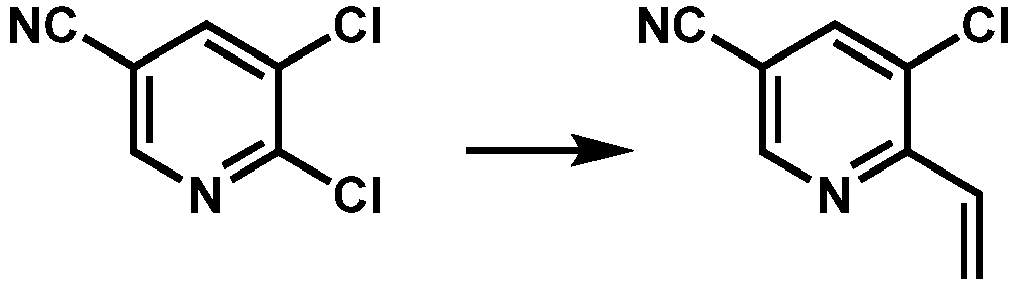
- 5,6-Dichloronicotinonitrile (0.62 g, 3.6 mmol) was dissolved in 1,2-dimethoxyethane (8 mL) and water (4 mL), and then sodium carbonate (1.5 g, 14 mmol), tetrakis(triphenylphosphine)palladium(0) (0.21 g, 0.18 mmol) and potassium vinyltrifluoroborate (0.96 g, 7.2 mmol) were added thereto, and the mixture was stirred with heating under reflux for 2.5 hr. Saturated aqueous sodium chloride solution was added thereto, and the mixture was extracted threetimes with ethyl acetate. The organic layer was dried over anhydrous sodium sulfate, and concentrated under reduced pressure. The obtained residue was purified by silica gel column chromatography to give 5-chloro-6-vinylnicotinonitrile (0.45 g).
- yield: 76%
- 1H-NMR(CDCl3) δ value (ppm) :
8.71(d,1H),7.93(d,1H),7.25(dd,1H),6.67(dd,1H),5.81(dd,1H) -
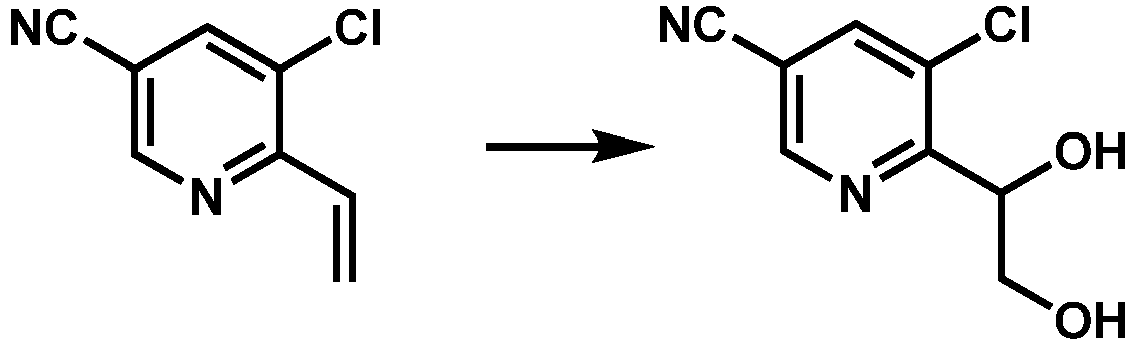
- 5-Chloro-6-vinylnicotinonitrile (2.2 g, 14 mmol) was dissolved in acetone (30 mL) and water (6 mL), and then 4-methylmorpholine N-oxide (50% aqueous solution, 3.5 g, 15 mmol) and osmium tetroxide (0.1M aqueous solution, 0.68 mL, 68 pmol) were added thereto, and the mixture was stirred at room temperature for 24 hr. Sodium dithionite (1.2 g, 6.8 mmol) and ethyl acetate were added thereto, and then the mixture was filtered through silica gel and Celite, and the obtained filtrate was concentrated under reduced pressure. The obtained residue was purified by silica gel column chromatography to give 5-chloro-6-(1,2-dihydroxyethyl)nicotinonitrile (2.2 g).
- yield: 83%
- 1H-NMR(CDCl3) δ value (ppm) :
8.77(d,1H),8.00(d,1H),5.19(ddd,1H),4.24(d,1H),4.02(ddd,1H),3.78(dd d,1H),2.27(dd,1H) -

- 5-Chloro-6-(1,2-dihydroxyethyl)nicotinonitrile (0.50 g, 2.5 mmol) was dissolved in ethanol (10 mL) and water (2.5 mL), and then O-benzyl hydroxylamine hydrochloride (0.80 g, 5.0 mmol), triethylamine (0.89 g, 8.8 mmol) and thioglycol acid (0.23 g, 2.5 mmol) were added thereto, and the mixture was stirred with heating under reflux for 11 hr. Ethyl acetate was added thereto, and then the mixture was filtered through silica gel and Celite, and the obtained filtrate was concentrated under reduced pressure. The obtained residue was suspended in ethyl acetate-hexane (2:1), and the solid was filtered. The filtered solid was air-dried to give (Z)-N'-(benzyloxy)-5-chloro-6-(1,2-dihydroxyethyl)nicotinimidamide (0.54 g).
- yield: 66%
- 1H-NMR(CDCl3) δ value (ppm) :
8.71(d,1H),7.99(d,1H),7.44-7.30(m,5H),5.15(s,2H),5.13(ddd,1H),4.83(bs,2H),4.44(d,1H),3.99(ddd ,1H),3.69(ddd,1H),2.39(dd,1H) -

- (Z)-N'-(Benzyloxy)-5-chloro-6-(1,2-dihydroxyethyl)nicotinimidamide (0.20 g, 0.63 mmol) and triethylamine (0.15 g, 1.5 mmol) were dissolved in chloroform (5 mL), and then methanesulfonyl chloride (0.16 g, 1.4 mmol) was added thereto under ice-cooling, and the mixture was stirred at room temperature for 4 hr. The reaction solution was concentrated under reduced pressure, the obtained residue was suspended in ethyl acetate, and the suspension was filtered through silica gel and Celite. The obtained filtrate was concentrated under reduced pressure to give (Z)-1-{5-[N'-(benzyloxy)carbamimidoyl]-3-chloropyridin-2-yl}ethane-1,2-diyl dimethanesulfonate as a crude product. Potassium hydroxide (powder, 0.11 g, 1.9 mmol) was suspended in dimethyl sulfoxide (2 mL), and then 2-(1H-imidazol-1-yl)acetonitrile (0.10 g, 0.94 mmol) and a dimethyl sulfoxide solution (2 mL) of carbon disulfide (72 mg, 0.94 mmol) were added thereto, and the mixture was stirred at room temperature for 2 hr. The obtained reaction solution was added to a dimethyl sulfoxide solution (4 mL) of (Z)-1-{5-[N'-(benzyloxy)carbamimidoyl]-3-chloropyridin-2-yl}ethane-1,2-diyl dimethanesulfonate, and the mixture was stirred at room temperature for 18 hr. Water was added thereto, and the mixture was extracted threetimes with ethyl acetate. The organic layer was dried over anhydrous sodium sulfate, and concentrated under reduced pressure. The obtained residue was purified by silica gel column chromatography to give (Z)-N'-(benzyloxy)-5-chloro-6-{(E)-2-[cyano(1H-imidazol-1-yl)methylene]-1,3-dithiolan-4-yl}nicotinimidamide (0.16 g).
- yield: 55%
- 1H-NMR(CDCl3) δ value (ppm) :
8.74(d,1H),8.03(d,1H),7.61(s,1H),7.44-7.30(m,H),7.17-7.15(m,1H),7.04-7.02(m,1H),5.68(dd,1H),5.15(s,2H),4.84(bs,2H),4.19(dd,1H),3.82(dd, 1H) -

- Tertiary-butyl (6-chloro-5-fluoropyridin-3-yl)carbamate (11 g, 46 mmol) was dissolved in 1,2-dimethoxyethane (150 mL) and water (100 mL), and then sodium carbonate (58 g,0.55 mol), [1,1'-bis(diphenylphosphino)ferrocene]palladium(II) dichloride dichloromethane adduct (5.6 g, 6.9 mmol) and potassium vinyltrifluoroborate (37 g,0.27mol) were added thereto, and the mixture was stirred with heating under reflux for 4.5 hr. Saturated aqueous sodium chloride solution and ethyl acetate were added thereto, and then the mixture was filtered, and the filtrate was extracted threetimes with ethyl acetate. The organic layer was dried over anhydrous sodium sulfate, and concentrated under reduced pressure. The obtained residue was purified by silica gel column chromatography to give tertiary-butyl (5-fluoro-6-vinylpyridin-3-yl)carbamate (9.9 g).
- yield: 91%
- 1H-NMR(CDCl3) δ value (ppm) :
8.09(d,1H),7.94(bd,1H),6.93(ddd,1H),6.62(bs,1H),6.26(dd,1H),5.48(d d,1H),1.53(s,9H) -

- Tertiary-butyl (5-fluoro-6-vinylpyridin-3-yl)carbamate (9.9 g, 41 mmol) was dissolved in acetone (85 mL) and water (8.5 mL), and then 4-methylmorpholine N-oxide (50% aqueous solution, 19 g, 83 mmol) and osmium tetroxide (0.1M aqueous solution, 12 mL, 1.2 mmol) were added thereto, and the mixture was stirred at room temperature for 46 hr. Sodium dithionite (11 g, 62 mmol) and ethyl acetate were added thereto, and then the mixture was filtered through anhydrous sodium sulfate, silica gel and Celite, and the filtrate was concentrated under reduced pressure. The obtained residue was purified by silica gel column chromatography to give tertiary-butyl [6-(1,2-dihydroxyethyl)-5-fluoropyridin-3-yl]carbamate (7.3 g).
- yield: 64%
- 1H-NMR(CDCl3) δ value (ppm) :
8.14(d,1H),7.94(bd,1H),6.61(bs,1H),5.04-4.98(m,1H),4.20(d,1H),3.94(ddd,1H),3.74(ddd,1H),2.42(dd,1H),1.53(s , 9H) -

- Tertiary-butyl [6-(1,2-dihydroxyethyl)-5-fluoropyridin-3-yl]carbamate (2.0 g, 7.4 mmol) and triethylamine (2.4 g, 24 mmol) were dissolved in chloroform (15 mL), and then methanesulfonyl chloride (2.2 g, 19 mmol) was added thereto under ice-cooling, and the mixture was stirred at room temperature for 4.5 hr. The reaction solution was concentrated under reduced pressure, the obtained residue was suspended in ethyl acetate, and the suspension was filtered through silica gel and Celite. The obtained filtrate was concentrated under reduced pressure to give 1-{5-[(tertiary-butoxycarbonyl)amino]-3-fluoropyridin-2-yl}-2-chloroethyl methanesulfonate as a crude product. Potassium hydroxide (powder, 1.2 g, 22 mmol) was suspended in dimethyl sulfoxide (8 mL), and then 2-(1H-1,2,4-triazol-1-yl)acetonitrile (1.2 g, 11 mmol) and a dimethyl sulfoxide solution (8 mL) of carbon disulfide (0.84 g, 11 mmol) were added thereto, and the mixture was stirred at room temperature for 2 hr. The obtained reaction solution was added to a dimethyl sulfoxide solution (16 mL) of 1-{5-[(tertiary-butoxycarbonyl)amino]-3-fluoropyridin-2-yl}-2-chloroethyl methanesulfonate, and the mixture was stirred at room temperature for 20 hr. Water was added thereto, and the mixture was extracted threetimes with ethyl acetate. The organic layer was dried over anhydrous sodium sulfate, and concentrated under reduced pressure. The obtained residue was purified by silica gel column chromatography to give tertiary-butyl (E)-(6-{2-[cyano(1H-1,2,4-triazol-1-yl)methylene]-1,3-dithiolan-4-yl}-5-fluoropyridin-3-yl)carbamate (0.84 g).
- yield: 27%
- melting point: 149-150°C
-

- Tertiary-butyl (E)-(6-{2-[cyano(1H-1,2,4-triazol-1-yl)methylene]-1,3-dithiolan-4-yl}-5-fluoropyridin-3-yl)carbamate (0.50 g, 1.2 mmol) was dissolved in methanol (10 mL), and then the solution was added to 4M hydrogen chloride ethyl acetate solution (20 mL), and the mixture was stirred at room temperature for 52 hr. Saturated aqueous sodium hydrogencarbonate solution was added thereto, and the mixture was extracted threetimes with ethyl acetate. The organic layer was dried over anhydrous sodium sulfate, and concentrated under reduced pressure to give (E)-2-[4-(5-amino-3-fluoropyridin-2-yl)-1,3-dithiolan-2-ylidene]-2-(1H-1,2,4-triazol-1-yl)acetonitrile quantitatively.
melting point: 188-189°C -

- (E)-2-[4-(5-Amino-3-fluoropyridin-2-yl)-1,3-dithiolan-2-ylidene]-2-(1H-1,2,4-triazol-1-yl)acetonitrile (0.15 g, 0.47 mmol) was dissolved in pyridine (3 mL), and then ethyl chloroformate (61 mg, 0.56 mmol) was added thereto under ice-cooling, and the mixture was stirred at room temperature for 2.5 hr. Saturated aqueous sodium hydrogencarbonate solution was added thereto, and the mixture was extracted threetimes with ethyl acetate. The organic layer was dried over anhydrous sodium sulfate, and concentrated under reduced pressure. The obtained residue was suspended in methyl tertiary-butyl ether, and the solid was filtered. The filtered solid was air-dried to give ethyl (E)-(6-{2-[cyano(1H-1,2,4-triazol-1-yl)methylene]-1,3-dithiolan-4-yl}-5-fluoropyridin-3-yl)carbamate (0.15 g).
- yield: 81%
- melting point: 160-161°C
-

- (E)-2-[4-(5-Amino-3-fluoropyridin-2-yl)-1,3-dithiolan-2-ylidene]-2-(1H-1,2,4-triazol-1-yl)acetonitrile (15 g, 47 mmol) obtained in 5-4) above was purified by supercritical fluid chromatography (column: CHIRALPAK AD manufactured by Daicel (250 mm × 50 mm, 10 µm), mobile phase: 0.1% ammonia methanol solution) to give (R,E)-2-[4-(5-amino-3-fluoropyridin-2-yl)-1,3-dithiolan-2-ylidene]-2-(1H-1,2,4-triazol-1-yl)acetonitrile (5.0 g, yield: 67%, melting point: 215-216°C, [α]D25:+79° (1.1 g/100 mL, methanol)) and (S,E)-2-[4-(5-amino-3-fluoropyridin-2-yl)-1,3-dithiolan-2-ylidene]-2-(1H-1,2,4-triazol-1-yl)acetonitrile (5.0 g, yield: 67%, melting point: 215-216°C, [α]D25:-60° (1.2 g/100 mL, methanol)).
-

- (R,E)-2-[4-(5-Amino-3-fluoropyridin-2-yl)-1,3-dithiolan-2-ylidene]-2-(1H-1,2,4-triazol-1-yl)acetonitrile (0.10 g, 0.31 mmol) was dissolved in pyridine (2 mL), and then ethyl chloroformate (41 mg, 0.38 mmol) was added thereto under ice-cooling, and the mixture was stirred at room temperature for 4 hr. The reaction solution was concentrated under reduced pressure, and the obtained residue was purified by silica gel column chromatography to give ethyl (R,E)-(6-{2-[cyano(1H-1,2,4-triazol-1-yl)methylene]-1,3-dithiolan-4-yl}-5-fluoropyridin-3-yl)carbamate (0.12 g).
- yield: 97%
- melting point: 177-178°C
- Formulation Examples are shown below.
Formulation Example 1. compound of the present invention 10 parts magnesium stearate 10 parts lactose 80 parts - The above components were mixed uniformly to give a powder or fine granules.
-
compound of the present invention 20 parts starch 10 parts lactose 15 parts ethyl cellulose 20 parts polyvinyl alcohol 5 parts water 30 parts - The above components were mixed uniformly, crushed, granulated and sieved to give granules.
-
compound of the present invention 0.5 parts nonionic surfactant 2.5 parts saline 97 parts - The above components were mixed under warming and sterilized to give an injection.
-
compound of the present invention 0.01 parts 0.5% carboxymethyl cellulose 99.99 parts - The above components were suspended to give a suspension.
-
compound of the present invention 1 parts polyethylene glycol 400 99 parts - The above components were mixed and dissolved to give a liquid for application.
-
compound of the present invention 2 parts polyethylene glycol 400 49 parts polyethylene glycol 4000 49 parts - The above components were mixed and dissolved under warming, and cooled to give an ointment.
-
compound of the present invention 3 parts 1,2-propanediol 5 parts glycerol stearate 5 parts whale wax 5 parts isopropyl myristate 10 parts polysorbate 4 parts - The above components were mixed under warming, cooled, and 68 parts of water was added thereto with stirring to give a cream.
- One part of the compound of the present invention, 5 parts of benzyl alcohol, 30 parts of ethanol, and 47 parts of propylene glycol were mixed and dissolved, and then an aqueous solution consisting of 1 part of Hiviskowa 104 and 15 parts of purified water was added to this solution to give a uniform solution. Then, diisopropanolamine was added thereto under stirring to give a gel.
- One part of the compound of the present invention was dissolved in 5 parts of benzyl alcohol and 5 parts of diethyl sebacate, and 5 parts of ethyl alcohol, 6 parts of stearyl alcohol, 1 part of sorbitan monostearate and 8 parts of polyoxyethylene monostearate were added thereto, and dissolved with warming to 70°C. While maintaining the obtained uniform solution at 70°C, 69 parts of purified water warmed to 70°C was added thereto, and then the mixture was cooled with continued stirring to give a cream.
- Next, Experimental Examples are shown below.
- Aspergillus fumigatus TIMM0063 was used as the strain. The test fungi were cultured on a Potato dextrose agar slant medium at 35°C for 4 days, and then sterilized saline containing 0.1% (v/v) Tween 80 was added to release the conidia. This conidial suspension was filtered through sterile gauze, and the number of conidia was counted using a hemocytometer. The same solution was adjusted to a conidial concentration of 1×10⁶ conidia/mL, and this was used as an inoculum. Each compound was dissolved in dimethyl sulfoxide to a predetermined concentration, and diluted 50-fold with 0.165 M MOPS buffered RPMI 1640 liquid medium, and each diluted solution was dispensed into a 96-well microplate by each 100 µL. The inoculum was diluted 50-fold with 0.165 M MOPS buffered RPMI 1640 liquid medium containing 20% alamar Blue™, and the diluted solution was inoculated into the 96-well microplate containing the compound by each 100 µL (final inoculum amount 1.0×10⁴ conidia/mL). After static culture at 35°C for 48 hr, the degree of color development of the alamar Blue™ was measured using a microplate reader (O.D. 570-595 nm), and the minimum concentration showing 80% or more inhibition was defined as the minimum inhibitory concentration (MIC). The results are shown in Tables 22 to 25.
- Candida albicans NBRC1270 was used as the strain. The test fungi were cultured on a Sabouraud dextrose agar slant medium at 35°C for 24 hr, and then suspended in sterilized saline. The number of cells in this suspension was counted using a hemocytometer, and the same suspension was adjusted to a cell concentration of 1.5×10⁵ cells/mL, and this was used as an inoculum. Each compound was dissolved in dimethyl sulfoxide to a predetermined concentration, and diluted 50-fold with 0.165 M MOPS buffered RPMI 1640 liquid medium, and each diluted solution was dispensed into a 96-well microplate by each 100 µL. The inoculum was diluted 50-fold with 0.165 M MOPS buffered RPMI 1640 liquid medium containing 20% alamar Blue™, and the diluted solution was inoculated into the 96-well microplate containing the compound by each 100 µL (final inoculum amount 1.5×10³ cells/mL). After static culture at 35°C for 24 hr, the degree of color development of the alamar Blue™ was measured using a microplate reader (O.D. 570-595 nm), and the minimum concentration showing 80% or more inhibition was defined as the minimum inhibitory concentration (MIC). The results are shown in Tables 22 to 25.
- Trichophyton rubrum NBRC6203 and Trichophyton mentagrophytes TIMM2789 were used as the strains. The test fungi were cultured on a Sabouraud dextrose agar slant medium at 27°C for 10-13 days, and then suspended in sterilized saline. The number of cells in this suspension was counted using a hemocytometer, and the same suspension was adjusted to a cell concentration of 2×10⁶ conidia/mL, and this was used as an inoculum. Each compound was dissolved in dimethyl sulfoxide to a predetermined concentration, and diluted 50-fold with 0.165 M MOPS buffered RPMI 1640 liquid medium, and each diluted solution was dispensed into a 96-well microplate by each 100 µL. The inoculum was diluted 50-fold with 0.165 M MOPS buffered RPMI 1640 liquid medium containing 20% alamar Blue™, and the diluted solution was inoculated into the 96-well microplate containing the compound by each 100 µL (final inoculum amount 2×10⁴ conidia/mL). After static culture at 27°C for 3 days (Trichophyton mentagrophytes) or for 5 days (Trichophyton rubrum), the degree of color development of the alamar Blue™ was measured using a microplate reader (O.D. 570-595 nm), and the minimum concentration showing 80% or more inhibition was defined as the minimum inhibitory concentration (MIC). The results are shown in Table 22.
[Table 22] minimum inhibitory concentration against various fungi (MIC, µg/ml) Compound No. A. fumigatus C. albicans T. rubrum T. mentagrophytes 1 0.0013 0.1 ≦0.001 ≦0.001 2 0.01 1 0.01 0.01 3 0.0025 0.1 ≦0.001 ≦0.001 4 0.005 1 0.01 0.01 5 0.01 0.005 - - 6 0.005 0.01 0.01 0.01 7 0.005 0.01 ≦0.001 0.01 8 0.005 0.025 - - 9 0.005 0.013 - - 10 0.025 0.05 0.01 0.01 11 0.005 0.01 ≦0.001 0.01 12 0.1 0.01 0.01 0.1 13 0.005 0.0025 - - 14 0.005 0.0013 - - 15 0.005 0.0025 0.01 0.01 16 0.005 0.0025 ≦0.001 0.01 17 0.005 0.0013 - - 18 0.01 0.05 - - 19 0.005 0.01 ≦0.001 0.01 20 0.01 0.013 - - 21 0.005 0.005 ≦0.001 0.01 22 0.005 0.0006 - - 23 0.005 0.0006 ≦0.001 0.01 24 0.0025 0.0025 ≦0.001 ≦0.001 25 0.0025 0.0006 ≦0.001 ≦0.001 26 0.005 0.0013 - - 27 0.005 0.0013 ≦0.001 ≦0.001 - In the table, "-" indicates that the test was not performed.
[Table 23] Compound No. A. fumigatus C. albicans 28 0.01 0.01 66 0.01 0.005 67 0.01 0.0025 73 0.01 0.01 74 0.01 0.01 75 0.01 0.01 79 0.005 0.005 83 0.01 0.005 84 0.005 0.005 87 0.005 0.00125 89 0.01 0.0025 92 0.0025 0.00063 94 0.0025 0.0025 96 0.01 0.005 97 0.01 0.0025 98 0.005 0.0025 99 0.005 0.0025 100 0.0025 0.00063 103 0.01 0.005 106 0.005 0.00125 107 0.01 0.005 110 0.005 0.01 112 0.005 0.0025 [Table 24] Compound No. A. fumigatus C. albicans 114 0.01 0.01 115 0.01 0.005 118 0.005 0.00125 128 0.01 0.01 130 0.005 0.0025 131 0.01 0.01 139 0.0025 0.00125 140 0.0025 0.0025 141 0.0025 0.0025 142 0.01 0.0025 143 0.005 0.0025 144 0.005 0.01 [Table 25] Compound No. A. fumigatus C. albicans 147 0.005 0.0025 149 0.01 0.005 150 0.01 0.005 151 0.01 0.0025 152 0.005 0.00125 154 0.01 0.0025 155 0.01 0.0025 156 0.005 0.0025 157 0.005 0.005 158 0.005 0.00125 159 0.005 0.005 162 0.005 0.0025 163 0.0025 0.0025 - From the results in Tables 22 to 25, it is seen that the compound represented by the general formula (I) of the present invention has superior antifungal activity, and is useful as a therapeutic agent for fungal infections such as localized fungal infections, systemic fungal infections and the like, caused by Trichophyton, Candida, Aspergillus and the like.
- According to the present invention, the azole compound represented by the general formula (I) or a salt thereof has superior antifungal activity against fungi such as Trichophyton, Candida, Aspergillus and the like, and therefore can be used as a therapeutic agent for fungal infections such as localized fungal infections, systemic fungal infections and the like, caused by the fungi.
- This application is based on patent applications No.
2022-043359 filed on March 18, 2022 No. 2022-190422 filed on November 29, 2022 in Japan
Claims (12)
- A compound represented by the general formula (I)
 X is a halogen atom, a cyano group, an amino group, a hydroxy group, a formyl group, a cyano C1-6 alkyl group, a hydroxy C1-6 alkyl group, a halo C1-6 alkyl group, a C2-6 alkenyl group, a C2-6 alkynyl group, a C1-6 alkoxy group, a halo C1-6 alkoxy group, a C2-6 alkenyloxy group, a C2-6 alkynyloxy group, a C1-6 alkoxy C1-6 alkoxy group, a cyano C1-6 alkoxy group, a C1-6 alkyl-carbonyl group, a mono (C1-6 alkyl-carbonyl) amino group, a mono (halo C1-6 alkyl-carbonyl) amino group, a mono (phenyl C1-6 alkyl-carbonyl) amino group, a tetrahydro-2H-pyran-2-yloxy group, a tetrahydro-2H-pyran-2-yloxymethyl group, a dioxolanyl group, a substituted dioxolanyl group having 1 to 5 substituents each independently selected from substituent group Z, a 2-oxo-1,3-dioxolan-4-yl group, an isoxazolinyl group, a substituted isoxazolinyl group having 1 to 4 substituents each independently selected from substituent group Z, a -N(R1)CO2R2 group wherein R1 is a hydrogen atom or a C1-6 alkyl group, and R2 is a C1-6 alkyl group, a cyano C1-6 alkyl group, a C3-6 cycloalkyl group, a C1-6 haloalkyl group, a C1-6 alkoxy C1-6 alkyl group, a C3-6 cycloalkyl C1-6 alkyl group, a C1-6 alkoxycarbonylamino C3-6 cycloalkyl C1-6 alkyl group, a C1-6 alkyl C3-6 cycloalkyl C1-6 alkyl group, a C2-6 alkynyl C3-6 cycloalkyl C1-6 alkyl group, a cyano C3-6 cycloalkyl C1-6 alkyl group, an oxo C3-6 cycloalkyl C1-6 alkyl group, an oxotetrahydrofuranyl C1-6 alkyl group, a halo C3-6 cycloalkyl C1-6 alkyl group, an oxetanyl C1-6 alkyl group, a (3-oxabicyclo[3.1.0]hexan-6-yl)methyl group, a pyridyl C1-6 alkyl group, a substituted pyridyl C1-6 alkyl group having, on a ring, 1 to 4 substituents each independently selected from substituent group Z, a pyrazolyl C1-6 alkyl group, a substituted pyrazolyl C1-6 alkyl group having, on a ring, 1 to 3 substituents each independently selected from substituent group Z, a phenyl C3-6 cycloalkyl C1-6 alkyl group, a phenyl C1-6 alkyl group, or a substituted phenyl C1-6 alkyl group having, on a ring, 1 to 5 substituents each independently selected from substituent group Z, or a -C(R3)=NOR4 group wherein R3 is a hydrogen atom, an amino group or a C1-6 alkyl group, and R4 is a hydrogen atom, a C1-6 alkyl group, a C3-6 cycloalkyl C1-6 alkyl group, a halo C3-6 cycloalkyl C1-6 alkyl group, a phenyl C1-6 alkyl group, or a substituted phenyl C1-6 alkyl group having, on a ring, 1 to 5 substituents each independently selected from substituent group Z,Y is a hydrogen atom, a halogen atom, a cyano group, or a C1-6 alkyl group,Q is CH or a nitrogen atom, andsubstituent group Z comprises a halogen atom, a nitro group, a cyano group, a C1-6 alkyl group, a halo C1-6 alkyl group, a C1-6 alkoxy group, a halo C1-6 alkoxy group, a C1-6 alkylsulfanyl group, a C1-6 alkylsulfinyl group, a C1-6 alkylsulfonyl group, a mono (C1-6 alkyl-carbonyl) amino group, a C1-6 alkoxy-carbonyl group, a C1-6 alkyl-carbonyl group, and a mono(C1-6 alkyl)aminocarbonyl group, or a salt thereof.
 - The compound or salt thereof according to claim 1, wherein X is a -N(R1)CO2R2 group wherein R1 is a hydrogen atom or a C1-6 alkyl group, and R2 is a C1-6 alkyl group, a C3-6 cycloalkyl group, a C3-6 cycloalkyl C1-6 alkyl group, a halo C3-6 cycloalkyl C1-6 alkyl group, a phenyl C1-6 alkyl group, or a substituted phenyl C1-6 alkyl group having, on a ring, 1 to 5 substituents each independently selected from substituent group Z (substituent group Z is as defined in claim 1), or a -C(R3)=NOR4 group wherein R3 is a hydrogen atom, an amino group or a C1-6 alkyl group, and R4 is a C1-6 alkyl group, a C3-6 cycloalkyl C1-6 alkyl group, a halo C3-6 cycloalkyl C1-6 alkyl group, a phenyl C1-6 alkyl group, or a substituted phenyl C1-6 alkyl group having, on a ring, 1 to 5 substituents each independently selected from substituent group Z (substituent group Z is as defined in claim 1), and
Y is a halogen atom. - The compound or salt thereof according to claim 1, wherein X is a -N(R1)CO2R2 group wherein R1 is a hydrogen atom, and R2 is a C1-6 alkyl group, a C3-6 cycloalkyl C1-6 alkyl group, a halo C3-6 cycloalkyl C1-6 alkyl group, or a phenyl C1-6 alkyl group, or a - C(R3)=NOR4 group wherein R3 is a hydrogen atom, and R4 is a C1-6 alkyl group, a C3-6 cycloalkyl C1-6 alkyl group, a halo C3-6 cycloalkyl C1-6 alkyl group, or a phenyl C1-6 alkyl group,Y is a halogen atom, andQ is a nitrogen atom.
- A pharmaceutical composition comprising the compound or salt thereof according to claim 1, and a pharmaceutically acceptable inert carrier or diluent.
- An antifungal agent comprising the compound or salt thereof according to claim 1 as an active ingredient.
- A therapeutic agent for a fungal infection, comprising the compound or salt thereof according to claim 1 as an active ingredient.
- A method for inhibiting fungal growth in a mammal, comprising administering to the mammal a pharmacologically effective amount of the compound or salt thereof according to claim 1.
- A method for treating a fungal infection in a mammal, comprising administering to the mammal a pharmacologically effective amount of the compound or salt thereof according to claim 1.
- The compound or salt thereof according to claim 1, for use in inhibiting fungal growth.
- The compound or salt thereof according to claim 1, for use in the treatment of a fungal infection.
- Use of the compound or salt thereof according to claim 1, for the manufacture of an antifungal agent.
- Use of the compound or salt thereof according to claim 1, for the manufacture of a therapeutic agent for a fungal infection.
Applications Claiming Priority (3)
| Application Number | Priority Date | Filing Date | Title |
|---|---|---|---|
| JP2022043359 | 2022-03-18 | ||
| JP2022190422 | 2022-11-29 | ||
| PCT/JP2023/010575 WO2023176957A1 (en) | 2022-03-18 | 2023-03-17 | Azole compound and antifungal agent |
Publications (1)
| Publication Number | Publication Date |
|---|---|
| EP4495114A1 true EP4495114A1 (en) | 2025-01-22 |
Family
ID=88023355
Family Applications (1)
| Application Number | Title | Priority Date | Filing Date |
|---|---|---|---|
| EP23770910.0A Pending EP4495114A1 (en) | 2022-03-18 | 2023-03-17 | Azole compound and antifungal agent |
Country Status (10)
| Country | Link |
|---|---|
| US (1) | US20250197384A1 (en) |
| EP (1) | EP4495114A1 (en) |
| JP (1) | JPWO2023176957A1 (en) |
| KR (1) | KR20240153374A (en) |
| AU (1) | AU2023234220B2 (en) |
| CA (1) | CA3253504A1 (en) |
| IL (1) | IL315377A (en) |
| MX (1) | MX2024011392A (en) |
| WO (1) | WO2023176957A1 (en) |
| ZA (1) | ZA202406917B (en) |
Family Cites Families (8)
| Publication number | Priority date | Publication date | Assignee | Title |
|---|---|---|---|---|
| JPS6157565A (en) | 1984-08-29 | 1986-03-24 | Nippon Nohyaku Co Ltd | Ketene s,s-acetal and its use |
| JPS6293227A (en) * | 1985-10-19 | 1987-04-28 | Nippon Nohyaku Co Ltd | antifungal agent |
| JPS6293204A (en) * | 1985-10-19 | 1987-04-28 | Nippon Nohyaku Co Ltd | Non-medical fungicide and production thereof |
| JP3278738B2 (en) | 1995-07-08 | 2002-04-30 | 日本農薬株式会社 | Antifungal agent |
| JP2000026214A (en) | 1998-07-02 | 2000-01-25 | Nippon Nohyaku Co Ltd | Industrial fungicides |
| WO2016016118A1 (en) * | 2014-07-31 | 2016-02-04 | Syngenta Participations Ag | Microbiocidal imidazole derivatives |
| JP2022043359A (en) | 2018-11-02 | 2022-03-16 | 積水メディカル株式会社 | Immunological detection method of mycoplasma pneumoniae |
| JP7626671B2 (en) | 2021-06-14 | 2025-02-04 | 矢崎総業株式会社 | Tape winding device for wire harnesses |
-
2023
- 2023-03-17 IL IL315377A patent/IL315377A/en unknown
- 2023-03-17 MX MX2024011392A patent/MX2024011392A/en unknown
- 2023-03-17 US US18/847,818 patent/US20250197384A1/en active Pending
- 2023-03-17 EP EP23770910.0A patent/EP4495114A1/en active Pending
- 2023-03-17 WO PCT/JP2023/010575 patent/WO2023176957A1/en not_active Ceased
- 2023-03-17 JP JP2024508273A patent/JPWO2023176957A1/ja active Pending
- 2023-03-17 CA CA3253504A patent/CA3253504A1/en active Pending
- 2023-03-17 AU AU2023234220A patent/AU2023234220B2/en active Active
- 2023-03-17 KR KR1020247031691A patent/KR20240153374A/en active Pending
-
2024
- 2024-09-09 ZA ZA2024/06917A patent/ZA202406917B/en unknown
Also Published As
| Publication number | Publication date |
|---|---|
| WO2023176957A1 (en) | 2023-09-21 |
| AU2023234220A1 (en) | 2024-09-26 |
| CA3253504A1 (en) | 2025-06-16 |
| ZA202406917B (en) | 2025-06-25 |
| KR20240153374A (en) | 2024-10-22 |
| JPWO2023176957A1 (en) | 2023-09-21 |
| US20250197384A1 (en) | 2025-06-19 |
| MX2024011392A (en) | 2024-09-23 |
| AU2023234220B2 (en) | 2026-01-15 |
| IL315377A (en) | 2024-11-01 |
Similar Documents
| Publication | Publication Date | Title |
|---|---|---|
| TWI282335B (en) | A61k 31/437 200601 a i vhtw a61p 31/04 200601 a i vhtw | |
| FI112942B (en) | Process for the preparation of 4 '- (1H-imidazol-1-ylmethyl) -1,1'-biphenyl derivatives useful for treating and preventing high blood pressure | |
| DE69728673T2 (en) | SUBSTITUTED BIPHENYL ISOXAZOLE SULFONAMIDE | |
| Jiang et al. | Design, synthesis and antifungal activity of novel triazole derivatives containing substituted 1, 2, 3-triazole-piperdine side chains | |
| EP2623494B1 (en) | Agent for treatment of eye diseases | |
| EP1022272B1 (en) | Substituted fused heterocyclic compounds | |
| US20080161374A1 (en) | Pyrazole compounds and uses related thereto | |
| US7189858B2 (en) | N-phenyl substituted carbamoyloxyalkyl-azolium derivatives | |
| EP1101759A1 (en) | Phenylazole compounds, process for producing the same and drugs for hyperlipemia | |
| JP2004502760A (en) | Pyrazole derivative | |
| RS53294B (en) | 1,2,3-TRIAZOLE DERIVATIVES FOR USE AS STEAROIL-COA DESATURATION INHIBITORS | |
| US11518766B2 (en) | Tricyclic compound, preparation method therefor and use thereof | |
| JP2019509337A (en) | Iminothiadiazine dimer derivatives as plasmepsin V inhibitors | |
| JP3278738B2 (en) | Antifungal agent | |
| EP3049407A1 (en) | Substituted phenylalanine derivatives as modulators of factor xia | |
| WO2005090328A1 (en) | Heterocyclic compound and use thereof | |
| JP2011513214A (en) | 11β-hydroxysteroid dehydrogenase inhibitor | |
| EP4139294B1 (en) | Isoquiniline nrf2 agonists | |
| RU2847436C2 (en) | Azole compound and antifungal agent | |
| EP0352946A1 (en) | Triazole antifungal agents | |
| EP3060549B1 (en) | Novel antifungal oxodihydropyridinecarbohydrazide derivative | |
| US5023258A (en) | Triazole antifungal agents | |
| AU2023234220B2 (en) | Azole compound and antifungal agent | |
| CA2743537C (en) | Benzimidazole derivatives and their use for modulating the gabaa receptor complex | |
| CN118922417A (en) | Azole compounds and antifungal agents |
Legal Events
| Date | Code | Title | Description |
|---|---|---|---|
| STAA | Information on the status of an ep patent application or granted ep patent |
Free format text: STATUS: THE INTERNATIONAL PUBLICATION HAS BEEN MADE |
|
| PUAI | Public reference made under article 153(3) epc to a published international application that has entered the european phase |
Free format text: ORIGINAL CODE: 0009012 |
|
| STAA | Information on the status of an ep patent application or granted ep patent |
Free format text: STATUS: REQUEST FOR EXAMINATION WAS MADE |
|
| 17P | Request for examination filed |
Effective date: 20241009 |
|
| AK | Designated contracting states |
Kind code of ref document: A1 Designated state(s): AL AT BE BG CH CY CZ DE DK EE ES FI FR GB GR HR HU IE IS IT LI LT LU LV MC ME MK MT NL NO PL PT RO RS SE SI SK SM TR |
|
| DAV | Request for validation of the european patent (deleted) | ||
| DAX | Request for extension of the european patent (deleted) | ||
| RIC1 | Information provided on ipc code assigned before grant |
Ipc: C07D 409/14 20060101AFI20260130BHEP Ipc: A61K 31/4439 20060101ALI20260130BHEP Ipc: A61P 31/10 20060101ALI20260130BHEP Ipc: C07D 413/14 20060101ALI20260130BHEP |