EP4495108A1 - 3-[2-(2-oxo-1,3-dioxolan-4-ylidene)ethoxy]propanoic acid derivatives as precursors of monomers in polymerisations - Google Patents
3-[2-(2-oxo-1,3-dioxolan-4-ylidene)ethoxy]propanoic acid derivatives as precursors of monomers in polymerisations Download PDFInfo
- Publication number
- EP4495108A1 EP4495108A1 EP23185725.1A EP23185725A EP4495108A1 EP 4495108 A1 EP4495108 A1 EP 4495108A1 EP 23185725 A EP23185725 A EP 23185725A EP 4495108 A1 EP4495108 A1 EP 4495108A1
- Authority
- EP
- European Patent Office
- Prior art keywords
- group
- substituted
- unsubstituted
- groups
- formula
- Prior art date
- Legal status (The legal status is an assumption and is not a legal conclusion. Google has not performed a legal analysis and makes no representation as to the accuracy of the status listed.)
- Withdrawn
Links
- 239000000178 monomer Substances 0.000 title claims abstract description 14
- -1 3-[2-(2-oxo-1,3-dioxolan-4-ylidene)ethoxy]propanoic acid derivatives Chemical class 0.000 title claims description 418
- 239000002243 precursor Substances 0.000 title claims description 12
- 150000005676 cyclic carbonates Chemical class 0.000 claims abstract description 74
- 238000000034 method Methods 0.000 claims abstract description 56
- 229910052723 transition metal Inorganic materials 0.000 claims abstract description 46
- 150000003624 transition metals Chemical class 0.000 claims abstract description 46
- 239000003054 catalyst Substances 0.000 claims abstract description 36
- 229920000642 polymer Polymers 0.000 claims abstract description 8
- 125000002573 ethenylidene group Chemical group [*]=C=C([H])[H] 0.000 claims abstract description 5
- 125000003118 aryl group Chemical group 0.000 claims description 77
- 125000004432 carbon atom Chemical group C* 0.000 claims description 57
- 125000000753 cycloalkyl group Chemical group 0.000 claims description 57
- 150000001875 compounds Chemical class 0.000 claims description 55
- 125000005842 heteroatom Chemical group 0.000 claims description 45
- 125000000217 alkyl group Chemical group 0.000 claims description 44
- 229920006395 saturated elastomer Polymers 0.000 claims description 38
- 239000003446 ligand Substances 0.000 claims description 36
- 229910052760 oxygen Inorganic materials 0.000 claims description 33
- 229910052717 sulfur Inorganic materials 0.000 claims description 33
- 101000801040 Homo sapiens Transmembrane channel-like protein 1 Proteins 0.000 claims description 31
- 102100033690 Transmembrane channel-like protein 1 Human genes 0.000 claims description 31
- 125000000623 heterocyclic group Chemical group 0.000 claims description 28
- CURLTUGMZLYLDI-UHFFFAOYSA-N Carbon dioxide Chemical compound O=C=O CURLTUGMZLYLDI-UHFFFAOYSA-N 0.000 claims description 25
- 125000003545 alkoxy group Chemical group 0.000 claims description 23
- 125000002496 methyl group Chemical group [H]C([H])([H])* 0.000 claims description 22
- 125000002950 monocyclic group Chemical group 0.000 claims description 20
- 229910002092 carbon dioxide Inorganic materials 0.000 claims description 18
- 239000000203 mixture Substances 0.000 claims description 17
- RTZKZFJDLAIYFH-UHFFFAOYSA-N ether Substances CCOCC RTZKZFJDLAIYFH-UHFFFAOYSA-N 0.000 claims description 16
- VNWKTOKETHGBQD-UHFFFAOYSA-N methane Chemical compound C VNWKTOKETHGBQD-UHFFFAOYSA-N 0.000 claims description 16
- 125000003367 polycyclic group Chemical group 0.000 claims description 16
- 125000004429 atom Chemical group 0.000 claims description 15
- 238000006243 chemical reaction Methods 0.000 claims description 15
- 125000001033 ether group Chemical group 0.000 claims description 15
- 125000000592 heterocycloalkyl group Chemical group 0.000 claims description 15
- 125000004122 cyclic group Chemical group 0.000 claims description 14
- 125000001072 heteroaryl group Chemical group 0.000 claims description 13
- 239000002253 acid Substances 0.000 claims description 12
- 125000004407 fluoroaryl group Chemical group 0.000 claims description 12
- 125000001931 aliphatic group Chemical group 0.000 claims description 11
- 229910052698 phosphorus Inorganic materials 0.000 claims description 11
- 150000003457 sulfones Chemical class 0.000 claims description 11
- 125000006649 (C2-C20) alkynyl group Chemical group 0.000 claims description 10
- 125000004104 aryloxy group Chemical group 0.000 claims description 10
- 125000000000 cycloalkoxy group Chemical group 0.000 claims description 10
- 125000001997 phenyl group Chemical group [H]C1=C([H])C([H])=C(*)C([H])=C1[H] 0.000 claims description 10
- 125000000999 tert-butyl group Chemical group [H]C([H])([H])C(*)(C([H])([H])[H])C([H])([H])[H] 0.000 claims description 9
- OKTJSMMVPCPJKN-UHFFFAOYSA-N Carbon Chemical compound [C] OKTJSMMVPCPJKN-UHFFFAOYSA-N 0.000 claims description 8
- 125000000304 alkynyl group Chemical group 0.000 claims description 8
- 229910052799 carbon Inorganic materials 0.000 claims description 8
- 238000004821 distillation Methods 0.000 claims description 8
- 125000000468 ketone group Chemical group 0.000 claims description 8
- 229910052757 nitrogen Inorganic materials 0.000 claims description 8
- IMSODMZESSGVBE-UHFFFAOYSA-N 2-Oxazoline Chemical group C1CN=CO1 IMSODMZESSGVBE-UHFFFAOYSA-N 0.000 claims description 7
- 125000003342 alkenyl group Chemical group 0.000 claims description 7
- 239000001569 carbon dioxide Substances 0.000 claims description 7
- 229910052732 germanium Inorganic materials 0.000 claims description 7
- 125000004435 hydrogen atom Chemical class [H]* 0.000 claims description 7
- 229910052710 silicon Inorganic materials 0.000 claims description 7
- 125000004209 (C1-C8) alkyl group Chemical group 0.000 claims description 6
- LKLLNYWECKEQIB-UHFFFAOYSA-N 1,3,5-triazinane Chemical group C1NCNCN1 LKLLNYWECKEQIB-UHFFFAOYSA-N 0.000 claims description 6
- 238000002425 crystallisation Methods 0.000 claims description 6
- 230000008025 crystallization Effects 0.000 claims description 6
- 238000000605 extraction Methods 0.000 claims description 6
- 238000011065 in-situ storage Methods 0.000 claims description 6
- 125000000325 methylidene group Chemical group [H]C([H])=* 0.000 claims description 6
- 150000007513 acids Chemical class 0.000 claims description 5
- 125000005553 heteroaryloxy group Chemical group 0.000 claims description 5
- 238000002360 preparation method Methods 0.000 claims description 5
- CQLFBEKRDQMJLZ-UHFFFAOYSA-M silver acetate Chemical compound [Ag+].CC([O-])=O CQLFBEKRDQMJLZ-UHFFFAOYSA-M 0.000 claims description 5
- 125000004178 (C1-C4) alkyl group Chemical group 0.000 claims description 4
- 229910021608 Silver(I) fluoride Inorganic materials 0.000 claims description 4
- 125000005189 alkyl hydroxy group Chemical group 0.000 claims description 4
- 229910052785 arsenic Inorganic materials 0.000 claims description 4
- WIKQEUJFZPCFNJ-UHFFFAOYSA-N carbonic acid;silver Chemical compound [Ag].[Ag].OC(O)=O WIKQEUJFZPCFNJ-UHFFFAOYSA-N 0.000 claims description 4
- 238000001556 precipitation Methods 0.000 claims description 4
- LKZMBDSASOBTPN-UHFFFAOYSA-L silver carbonate Substances [Ag].[O-]C([O-])=O LKZMBDSASOBTPN-UHFFFAOYSA-L 0.000 claims description 4
- KQTXIZHBFFWWFW-UHFFFAOYSA-L silver(I) carbonate Inorganic materials [Ag]OC(=O)O[Ag] KQTXIZHBFFWWFW-UHFFFAOYSA-L 0.000 claims description 4
- 229910000108 silver(I,III) oxide Inorganic materials 0.000 claims description 4
- 150000003623 transition metal compounds Chemical class 0.000 claims description 4
- 125000000027 (C1-C10) alkoxy group Chemical group 0.000 claims description 3
- 125000004754 (C2-C12) dialkylamino group Chemical group 0.000 claims description 3
- 150000001450 anions Chemical class 0.000 claims description 3
- 229910052787 antimony Inorganic materials 0.000 claims description 3
- 230000001419 dependent effect Effects 0.000 claims description 3
- 229910052739 hydrogen Inorganic materials 0.000 claims description 3
- 239000001257 hydrogen Substances 0.000 claims description 3
- 229940126062 Compound A Drugs 0.000 claims description 2
- NLDMNSXOCDLTTB-UHFFFAOYSA-N Heterophylliin A Natural products O1C2COC(=O)C3=CC(O)=C(O)C(O)=C3C3=C(O)C(O)=C(O)C=C3C(=O)OC2C(OC(=O)C=2C=C(O)C(O)=C(O)C=2)C(O)C1OC(=O)C1=CC(O)=C(O)C(O)=C1 NLDMNSXOCDLTTB-UHFFFAOYSA-N 0.000 claims description 2
- 125000005442 diisocyanate group Chemical group 0.000 claims description 2
- 230000007062 hydrolysis Effects 0.000 claims description 2
- 238000006460 hydrolysis reaction Methods 0.000 claims description 2
- 238000004519 manufacturing process Methods 0.000 abstract description 5
- WEVYAHXRMPXWCK-UHFFFAOYSA-N Acetonitrile Chemical compound CC#N WEVYAHXRMPXWCK-UHFFFAOYSA-N 0.000 description 21
- ATUOYWHBWRKTHZ-UHFFFAOYSA-N Propane Chemical compound CCC ATUOYWHBWRKTHZ-UHFFFAOYSA-N 0.000 description 18
- 150000002148 esters Chemical class 0.000 description 18
- YMWUJEATGCHHMB-UHFFFAOYSA-N Dichloromethane Chemical compound ClCCl YMWUJEATGCHHMB-UHFFFAOYSA-N 0.000 description 17
- 150000001408 amides Chemical class 0.000 description 15
- 239000002904 solvent Substances 0.000 description 14
- 125000002915 carbonyl group Chemical group [*:2]C([*:1])=O 0.000 description 13
- OTMSDBZUPAUEDD-UHFFFAOYSA-N Ethane Chemical compound CC OTMSDBZUPAUEDD-UHFFFAOYSA-N 0.000 description 12
- 125000000524 functional group Chemical group 0.000 description 12
- 238000006116 polymerization reaction Methods 0.000 description 12
- 239000000047 product Substances 0.000 description 12
- XEKOWRVHYACXOJ-UHFFFAOYSA-N Ethyl acetate Chemical compound CCOC(C)=O XEKOWRVHYACXOJ-UHFFFAOYSA-N 0.000 description 11
- ZMXDDKWLCZADIW-UHFFFAOYSA-N N,N-Dimethylformamide Chemical compound CN(C)C=O ZMXDDKWLCZADIW-UHFFFAOYSA-N 0.000 description 9
- CSCPPACGZOOCGX-UHFFFAOYSA-N Acetone Chemical compound CC(C)=O CSCPPACGZOOCGX-UHFFFAOYSA-N 0.000 description 8
- 239000004721 Polyphenylene oxide Substances 0.000 description 8
- 229920000570 polyether Polymers 0.000 description 8
- 125000001544 thienyl group Chemical group 0.000 description 8
- 125000004430 oxygen atom Chemical group O* 0.000 description 7
- 125000003386 piperidinyl group Chemical group 0.000 description 7
- 239000011541 reaction mixture Substances 0.000 description 7
- GQHTUMJGOHRCHB-UHFFFAOYSA-N 2,3,4,6,7,8,9,10-octahydropyrimido[1,2-a]azepine Chemical compound C1CCCCN2CCCN=C21 GQHTUMJGOHRCHB-UHFFFAOYSA-N 0.000 description 6
- CSNNHWWHGAXBCP-UHFFFAOYSA-L Magnesium sulfate Chemical compound [Mg+2].[O-][S+2]([O-])([O-])[O-] CSNNHWWHGAXBCP-UHFFFAOYSA-L 0.000 description 6
- 238000006845 Michael addition reaction Methods 0.000 description 6
- XBDQKXXYIPTUBI-UHFFFAOYSA-M Propionate Chemical compound CCC([O-])=O XBDQKXXYIPTUBI-UHFFFAOYSA-M 0.000 description 6
- WYURNTSHIVDZCO-UHFFFAOYSA-N Tetrahydrofuran Chemical compound C1CCOC1 WYURNTSHIVDZCO-UHFFFAOYSA-N 0.000 description 6
- 150000004649 carbonic acid derivatives Chemical class 0.000 description 6
- 125000002541 furyl group Chemical group 0.000 description 6
- VLKZOEOYAKHREP-UHFFFAOYSA-N n-Hexane Chemical compound CCCCCC VLKZOEOYAKHREP-UHFFFAOYSA-N 0.000 description 6
- TVDSBUOJIPERQY-UHFFFAOYSA-N prop-2-yn-1-ol Chemical compound OCC#C TVDSBUOJIPERQY-UHFFFAOYSA-N 0.000 description 6
- 125000004805 propylene group Chemical group [H]C([H])([H])C([H])([*:1])C([H])([H])[*:2] 0.000 description 6
- VGGSQFUCUMXWEO-UHFFFAOYSA-N Ethene Chemical compound C=C VGGSQFUCUMXWEO-UHFFFAOYSA-N 0.000 description 5
- 239000005977 Ethylene Substances 0.000 description 5
- OKKJLVBELUTLKV-UHFFFAOYSA-N Methanol Chemical compound OC OKKJLVBELUTLKV-UHFFFAOYSA-N 0.000 description 5
- IYABWNGZIDDRAK-UHFFFAOYSA-N allene Chemical compound C=C=C IYABWNGZIDDRAK-UHFFFAOYSA-N 0.000 description 5
- 150000001721 carbon Chemical group 0.000 description 5
- 125000001449 isopropyl group Chemical group [H]C([H])([H])C([H])(*)C([H])([H])[H] 0.000 description 5
- 125000004123 n-propyl group Chemical group [H]C([H])([H])C([H])([H])C([H])([H])* 0.000 description 5
- 150000002825 nitriles Chemical class 0.000 description 5
- 239000012074 organic phase Substances 0.000 description 5
- 125000001820 oxy group Chemical group [*:1]O[*:2] 0.000 description 5
- 239000012041 precatalyst Substances 0.000 description 5
- 125000004076 pyridyl group Chemical group 0.000 description 5
- 125000003718 tetrahydrofuranyl group Chemical group 0.000 description 5
- XLYOFNOQVPJJNP-UHFFFAOYSA-N water Substances O XLYOFNOQVPJJNP-UHFFFAOYSA-N 0.000 description 5
- DTGKSKDOIYIVQL-WEDXCCLWSA-N (+)-borneol Chemical group C1C[C@@]2(C)[C@@H](O)C[C@@H]1C2(C)C DTGKSKDOIYIVQL-WEDXCCLWSA-N 0.000 description 4
- 125000000008 (C1-C10) alkyl group Chemical group 0.000 description 4
- VAYTZRYEBVHVLE-UHFFFAOYSA-N 1,3-dioxol-2-one Chemical class O=C1OC=CO1 VAYTZRYEBVHVLE-UHFFFAOYSA-N 0.000 description 4
- RYHBNJHYFVUHQT-UHFFFAOYSA-N 1,4-Dioxane Chemical compound C1COCCO1 RYHBNJHYFVUHQT-UHFFFAOYSA-N 0.000 description 4
- IBDVWXAVKPRHCU-UHFFFAOYSA-N 2-(2-methylprop-2-enoyloxy)ethyl 3-oxobutanoate Chemical compound CC(=O)CC(=O)OCCOC(=O)C(C)=C IBDVWXAVKPRHCU-UHFFFAOYSA-N 0.000 description 4
- JOOXCMJARBKPKM-UHFFFAOYSA-N 4-oxopentanoic acid Chemical compound CC(=O)CCC(O)=O JOOXCMJARBKPKM-UHFFFAOYSA-N 0.000 description 4
- LFQSCWFLJHTTHZ-UHFFFAOYSA-N Ethanol Chemical compound CCO LFQSCWFLJHTTHZ-UHFFFAOYSA-N 0.000 description 4
- BAPJBEWLBFYGME-UHFFFAOYSA-N Methyl acrylate Chemical compound COC(=O)C=C BAPJBEWLBFYGME-UHFFFAOYSA-N 0.000 description 4
- VYPSYNLAJGMNEJ-UHFFFAOYSA-N Silicium dioxide Chemical compound O=[Si]=O VYPSYNLAJGMNEJ-UHFFFAOYSA-N 0.000 description 4
- 125000003368 amide group Chemical group 0.000 description 4
- 125000005605 benzo group Chemical group 0.000 description 4
- DLDJFQGPPSQZKI-UHFFFAOYSA-N but-2-yne-1,4-diol Chemical compound OCC#CCO DLDJFQGPPSQZKI-UHFFFAOYSA-N 0.000 description 4
- FUSUHKVFWTUUBE-UHFFFAOYSA-N buten-2-one Chemical compound CC(=O)C=C FUSUHKVFWTUUBE-UHFFFAOYSA-N 0.000 description 4
- 239000012043 crude product Substances 0.000 description 4
- 125000002704 decyl group Chemical group [H]C([H])([H])C([H])([H])C([H])([H])C([H])([H])C([H])([H])C([H])([H])C([H])([H])C([H])([H])C([H])([H])C([H])([H])* 0.000 description 4
- 150000002170 ethers Chemical class 0.000 description 4
- 235000019439 ethyl acetate Nutrition 0.000 description 4
- 125000001495 ethyl group Chemical group [H]C([H])([H])C([H])([H])* 0.000 description 4
- KDOWHHULNTXTNS-UHFFFAOYSA-N hex-3-yne-2,5-diol Chemical compound CC(O)C#CC(C)O KDOWHHULNTXTNS-UHFFFAOYSA-N 0.000 description 4
- 125000002887 hydroxy group Chemical group [H]O* 0.000 description 4
- 239000007788 liquid Substances 0.000 description 4
- OMNKZBIFPJNNIO-UHFFFAOYSA-N n-(2-methyl-4-oxopentan-2-yl)prop-2-enamide Chemical compound CC(=O)CC(C)(C)NC(=O)C=C OMNKZBIFPJNNIO-UHFFFAOYSA-N 0.000 description 4
- 125000004108 n-butyl group Chemical group [H]C([H])([H])C([H])([H])C([H])([H])C([H])([H])* 0.000 description 4
- 125000001971 neopentyl group Chemical group [H]C([*])([H])C(C([H])([H])[H])(C([H])([H])[H])C([H])([H])[H] 0.000 description 4
- WCPAKWJPBJAGKN-UHFFFAOYSA-N oxadiazole Chemical compound C1=CON=N1 WCPAKWJPBJAGKN-UHFFFAOYSA-N 0.000 description 4
- 125000000719 pyrrolidinyl group Chemical group 0.000 description 4
- 239000012429 reaction media Substances 0.000 description 4
- 125000002914 sec-butyl group Chemical group [H]C([H])([H])C([H])([H])C([H])(*)C([H])([H])[H] 0.000 description 4
- 238000003786 synthesis reaction Methods 0.000 description 4
- YLQBMQCUIZJEEH-UHFFFAOYSA-N tetrahydrofuran Natural products C=1C=COC=1 YLQBMQCUIZJEEH-UHFFFAOYSA-N 0.000 description 4
- 125000001412 tetrahydropyranyl group Chemical group 0.000 description 4
- 125000000391 vinyl group Chemical group [H]C([*])=C([H])[H] 0.000 description 4
- 125000005913 (C3-C6) cycloalkyl group Chemical group 0.000 description 3
- IGERFAHWSHDDHX-UHFFFAOYSA-N 1,3-dioxanyl Chemical group [CH]1OCCCO1 IGERFAHWSHDDHX-UHFFFAOYSA-N 0.000 description 3
- JPRPJUMQRZTTED-UHFFFAOYSA-N 1,3-dioxolanyl Chemical group [CH]1OCCO1 JPRPJUMQRZTTED-UHFFFAOYSA-N 0.000 description 3
- ZEMZPXWZVTUONV-UHFFFAOYSA-N 2-(2-dicyclohexylphosphanylphenyl)-n,n-dimethylaniline Chemical compound CN(C)C1=CC=CC=C1C1=CC=CC=C1P(C1CCCCC1)C1CCCCC1 ZEMZPXWZVTUONV-UHFFFAOYSA-N 0.000 description 3
- 125000004493 2-methylbut-1-yl group Chemical group CC(C*)CC 0.000 description 3
- UHOVQNZJYSORNB-UHFFFAOYSA-N Benzene Chemical compound C1=CC=CC=C1 UHOVQNZJYSORNB-UHFFFAOYSA-N 0.000 description 3
- KMTRUDSVKNLOMY-UHFFFAOYSA-N Ethylene carbonate Chemical compound O=C1OCCO1 KMTRUDSVKNLOMY-UHFFFAOYSA-N 0.000 description 3
- IMNFDUFMRHMDMM-UHFFFAOYSA-N N-Heptane Chemical compound CCCCCCC IMNFDUFMRHMDMM-UHFFFAOYSA-N 0.000 description 3
- KAESVJOAVNADME-UHFFFAOYSA-N Pyrrole Chemical compound C=1C=CNC=1 KAESVJOAVNADME-UHFFFAOYSA-N 0.000 description 3
- RWRDLPDLKQPQOW-UHFFFAOYSA-N Pyrrolidine Chemical compound C1CCNC1 RWRDLPDLKQPQOW-UHFFFAOYSA-N 0.000 description 3
- YXFVVABEGXRONW-UHFFFAOYSA-N Toluene Chemical compound CC1=CC=CC=C1 YXFVVABEGXRONW-UHFFFAOYSA-N 0.000 description 3
- 150000001298 alcohols Chemical class 0.000 description 3
- 150000001338 aliphatic hydrocarbons Chemical class 0.000 description 3
- 150000004945 aromatic hydrocarbons Chemical class 0.000 description 3
- 230000015572 biosynthetic process Effects 0.000 description 3
- IISBACLAFKSPIT-UHFFFAOYSA-N bisphenol A Chemical compound C=1C=C(O)C=CC=1C(C)(C)C1=CC=C(O)C=C1 IISBACLAFKSPIT-UHFFFAOYSA-N 0.000 description 3
- JSPXPZKDILSYNN-UHFFFAOYSA-N but-1-yne-1,4-diol Chemical compound OCCC#CO JSPXPZKDILSYNN-UHFFFAOYSA-N 0.000 description 3
- 235000013877 carbamide Nutrition 0.000 description 3
- 125000002433 cyclopentenyl group Chemical group C1(=CCCC1)* 0.000 description 3
- 125000001301 ethoxy group Chemical group [H]C([H])([H])C([H])([H])O* 0.000 description 3
- 150000008282 halocarbons Chemical class 0.000 description 3
- 150000002430 hydrocarbons Chemical class 0.000 description 3
- 125000000904 isoindolyl group Chemical group C=1(NC=C2C=CC=CC12)* 0.000 description 3
- 229910052943 magnesium sulfate Inorganic materials 0.000 description 3
- 125000003566 oxetanyl group Chemical group 0.000 description 3
- 125000000466 oxiranyl group Chemical group 0.000 description 3
- 125000005475 oxolanyl group Chemical group 0.000 description 3
- RUOJZAUFBMNUDX-UHFFFAOYSA-N propylene carbonate Chemical compound CC1COC(=O)O1 RUOJZAUFBMNUDX-UHFFFAOYSA-N 0.000 description 3
- 229910052709 silver Inorganic materials 0.000 description 3
- SQGYOTSLMSWVJD-UHFFFAOYSA-N silver(1+) nitrate Chemical compound [Ag+].[O-]N(=O)=O SQGYOTSLMSWVJD-UHFFFAOYSA-N 0.000 description 3
- 125000000547 substituted alkyl group Chemical group 0.000 description 3
- 150000003462 sulfoxides Chemical class 0.000 description 3
- 238000005809 transesterification reaction Methods 0.000 description 3
- 150000003672 ureas Chemical class 0.000 description 3
- 125000006527 (C1-C5) alkyl group Chemical group 0.000 description 2
- 125000004169 (C1-C6) alkyl group Chemical group 0.000 description 2
- 125000001607 1,2,3-triazol-1-yl group Chemical group [*]N1N=NC([H])=C1[H] 0.000 description 2
- 125000001305 1,2,4-triazol-3-yl group Chemical group [H]N1N=C([*])N=C1[H] 0.000 description 2
- DYEQHQNRKZJUCT-UHFFFAOYSA-N 1,2-dimethylidenecyclohexane Chemical compound C=C1CCCCC1=C DYEQHQNRKZJUCT-UHFFFAOYSA-N 0.000 description 2
- CTDOPUVVTOMREJ-UHFFFAOYSA-N 1,3-dimethylidenecyclohexane Chemical compound C=C1CCCC(=C)C1 CTDOPUVVTOMREJ-UHFFFAOYSA-N 0.000 description 2
- JPBHXVRMWGWSMX-UHFFFAOYSA-N 1,4-dimethylidenecyclohexane Chemical compound C=C1CCC(=C)CC1 JPBHXVRMWGWSMX-UHFFFAOYSA-N 0.000 description 2
- LOZWAPSEEHRYPG-UHFFFAOYSA-N 1,4-dithiane Chemical compound C1CSCCS1 LOZWAPSEEHRYPG-UHFFFAOYSA-N 0.000 description 2
- VXNZUUAINFGPBY-UHFFFAOYSA-N 1-Butene Chemical group CCC=C VXNZUUAINFGPBY-UHFFFAOYSA-N 0.000 description 2
- 125000004173 1-benzimidazolyl group Chemical group [H]C1=NC2=C([H])C([H])=C([H])C([H])=C2N1* 0.000 description 2
- MWJKTBKHZUABFV-UHFFFAOYSA-N 1-cyclopentyl-2-methylidenecyclopentane Chemical compound C=C1CCCC1C1CCCC1 MWJKTBKHZUABFV-UHFFFAOYSA-N 0.000 description 2
- 125000006017 1-propenyl group Chemical group 0.000 description 2
- 125000004214 1-pyrrolidinyl group Chemical group [H]C1([H])N(*)C([H])([H])C([H])([H])C1([H])[H] 0.000 description 2
- BAXOFTOLAUCFNW-UHFFFAOYSA-N 1H-indazole Chemical compound C1=CC=C2C=NNC2=C1 BAXOFTOLAUCFNW-UHFFFAOYSA-N 0.000 description 2
- ZTFYRZFWGRCCCK-UHFFFAOYSA-N 2,5-dimethylidenefuran Chemical compound C=C1C=CC(=C)O1 ZTFYRZFWGRCCCK-UHFFFAOYSA-N 0.000 description 2
- RNQRAVLHSVDJNL-UHFFFAOYSA-N 2,5-dimethylideneoxolane Chemical compound C=C1CCC(=C)O1 RNQRAVLHSVDJNL-UHFFFAOYSA-N 0.000 description 2
- 125000004174 2-benzimidazolyl group Chemical group [H]N1C(*)=NC2=C([H])C([H])=C([H])C([H])=C12 0.000 description 2
- 125000002941 2-furyl group Chemical group O1C([*])=C([H])C([H])=C1[H] 0.000 description 2
- 125000005916 2-methylpentyl group Chemical group 0.000 description 2
- SDTMFDGELKWGFT-UHFFFAOYSA-N 2-methylpropan-2-olate Chemical compound CC(C)(C)[O-] SDTMFDGELKWGFT-UHFFFAOYSA-N 0.000 description 2
- 125000003903 2-propenyl group Chemical group [H]C([*])([H])C([H])=C([H])[H] 0.000 description 2
- 125000004105 2-pyridyl group Chemical group N1=C([*])C([H])=C([H])C([H])=C1[H] 0.000 description 2
- 125000004485 2-pyrrolidinyl group Chemical group [H]N1C([H])([H])C([H])([H])C([H])([H])C1([H])* 0.000 description 2
- 125000003682 3-furyl group Chemical group O1C([H])=C([*])C([H])=C1[H] 0.000 description 2
- 125000005917 3-methylpentyl group Chemical group 0.000 description 2
- 125000003349 3-pyridyl group Chemical group N1=C([H])C([*])=C([H])C([H])=C1[H] 0.000 description 2
- 125000004575 3-pyrrolidinyl group Chemical group [H]N1C([H])([H])C([H])([H])C([H])(*)C1([H])[H] 0.000 description 2
- FSWCCQWDVGZMRD-UHFFFAOYSA-N 4-methylcyclohexene Chemical compound CC1CCC=CC1 FSWCCQWDVGZMRD-UHFFFAOYSA-N 0.000 description 2
- UMEHTUCYIDSLRJ-UHFFFAOYSA-N 4-methylidene-1,3-dioxolane Chemical compound C=C1COCO1 UMEHTUCYIDSLRJ-UHFFFAOYSA-N 0.000 description 2
- 125000005986 4-piperidonyl group Chemical group 0.000 description 2
- 125000000339 4-pyridyl group Chemical group N1=C([H])C([H])=C([*])C([H])=C1[H] 0.000 description 2
- KDDQRKBRJSGMQE-UHFFFAOYSA-N 4-thiazolyl Chemical group [C]1=CSC=N1 KDDQRKBRJSGMQE-UHFFFAOYSA-N 0.000 description 2
- 125000004539 5-benzimidazolyl group Chemical group N1=CNC2=C1C=CC(=C2)* 0.000 description 2
- 125000004938 5-pyridyl group Chemical group N1=CC=CC(=C1)* 0.000 description 2
- CWDWFSXUQODZGW-UHFFFAOYSA-N 5-thiazolyl Chemical group [C]1=CN=CS1 CWDWFSXUQODZGW-UHFFFAOYSA-N 0.000 description 2
- QGZKDVFQNNGYKY-UHFFFAOYSA-N Ammonia Chemical compound N QGZKDVFQNNGYKY-UHFFFAOYSA-N 0.000 description 2
- XKRFYHLGVUSROY-UHFFFAOYSA-N Argon Chemical compound [Ar] XKRFYHLGVUSROY-UHFFFAOYSA-N 0.000 description 2
- IJGRMHOSHXDMSA-UHFFFAOYSA-N Atomic nitrogen Chemical compound N#N IJGRMHOSHXDMSA-UHFFFAOYSA-N 0.000 description 2
- 125000000041 C6-C10 aryl group Chemical group 0.000 description 2
- IAZDPXIOMUYVGZ-UHFFFAOYSA-N Dimethylsulphoxide Chemical compound CS(C)=O IAZDPXIOMUYVGZ-UHFFFAOYSA-N 0.000 description 2
- YNQLUTRBYVCPMQ-UHFFFAOYSA-N Ethylbenzene Chemical compound CCC1=CC=CC=C1 YNQLUTRBYVCPMQ-UHFFFAOYSA-N 0.000 description 2
- 238000000023 Kugelrohr distillation Methods 0.000 description 2
- NTIZESTWPVYFNL-UHFFFAOYSA-N Methyl isobutyl ketone Chemical compound CC(C)CC(C)=O NTIZESTWPVYFNL-UHFFFAOYSA-N 0.000 description 2
- MZRVEZGGRBJDDB-UHFFFAOYSA-N N-Butyllithium Chemical compound [Li]CCCC MZRVEZGGRBJDDB-UHFFFAOYSA-N 0.000 description 2
- OFBQJSOFQDEBGM-UHFFFAOYSA-N Pentane Chemical compound CCCCC OFBQJSOFQDEBGM-UHFFFAOYSA-N 0.000 description 2
- JUJWROOIHBZHMG-UHFFFAOYSA-N Pyridine Chemical compound C1=CC=NC=C1 JUJWROOIHBZHMG-UHFFFAOYSA-N 0.000 description 2
- 229910000831 Steel Inorganic materials 0.000 description 2
- HSFWRNGVRCDJHI-UHFFFAOYSA-N alpha-acetylene Natural products C#C HSFWRNGVRCDJHI-UHFFFAOYSA-N 0.000 description 2
- 125000006615 aromatic heterocyclic group Chemical group 0.000 description 2
- 125000002393 azetidinyl group Chemical group 0.000 description 2
- 125000004069 aziridinyl group Chemical group 0.000 description 2
- 125000003785 benzimidazolyl group Chemical group N1=C(NC2=C1C=CC=C2)* 0.000 description 2
- 125000001164 benzothiazolyl group Chemical group S1C(=NC2=C1C=CC=C2)* 0.000 description 2
- 125000004541 benzoxazolyl group Chemical group O1C(=NC2=C1C=CC=C2)* 0.000 description 2
- 125000001797 benzyl group Chemical group [H]C1=C([H])C([H])=C(C([H])=C1[H])C([H])([H])* 0.000 description 2
- 125000000609 carbazolyl group Chemical group C1(=CC=CC=2C3=CC=CC=C3NC12)* 0.000 description 2
- 125000005507 decahydroisoquinolyl group Chemical group 0.000 description 2
- 230000005595 deprotonation Effects 0.000 description 2
- 238000010537 deprotonation reaction Methods 0.000 description 2
- 150000005690 diesters Chemical class 0.000 description 2
- XBDQKXXYIPTUBI-UHFFFAOYSA-N dimethylselenoniopropionate Natural products CCC(O)=O XBDQKXXYIPTUBI-UHFFFAOYSA-N 0.000 description 2
- 125000005879 dioxolanyl group Chemical group 0.000 description 2
- ZUOUZKKEUPVFJK-UHFFFAOYSA-N diphenyl Chemical compound C1=CC=CC=C1C1=CC=CC=C1 ZUOUZKKEUPVFJK-UHFFFAOYSA-N 0.000 description 2
- 150000002118 epoxides Chemical class 0.000 description 2
- 125000002534 ethynyl group Chemical group [H]C#C* 0.000 description 2
- 239000011521 glass Substances 0.000 description 2
- 229930195733 hydrocarbon Natural products 0.000 description 2
- 125000002632 imidazolidinyl group Chemical group 0.000 description 2
- 125000002636 imidazolinyl group Chemical group 0.000 description 2
- 125000002883 imidazolyl group Chemical group 0.000 description 2
- 125000003453 indazolyl group Chemical group N1N=C(C2=C1C=CC=C2)* 0.000 description 2
- 125000001041 indolyl group Chemical group 0.000 description 2
- ZXEKIIBDNHEJCQ-UHFFFAOYSA-N isobutanol Chemical compound CC(C)CO ZXEKIIBDNHEJCQ-UHFFFAOYSA-N 0.000 description 2
- 125000005956 isoquinolyl group Chemical group 0.000 description 2
- 125000004628 isothiazolidinyl group Chemical group S1N(CCC1)* 0.000 description 2
- 125000003965 isoxazolidinyl group Chemical group 0.000 description 2
- 125000000842 isoxazolyl group Chemical group 0.000 description 2
- 229940040102 levulinic acid Drugs 0.000 description 2
- AWPJXZZZMCWJGN-UHFFFAOYSA-N methyl 3-(3-methoxy-3-oxopropoxy)propanoate Chemical compound COC(=O)CCOCCC(=O)OC AWPJXZZZMCWJGN-UHFFFAOYSA-N 0.000 description 2
- 125000001570 methylene group Chemical group [H]C([H])([*:1])[*:2] 0.000 description 2
- YULMNMJFAZWLLN-UHFFFAOYSA-N methylenecyclohexane Chemical compound C=C1CCCCC1 YULMNMJFAZWLLN-UHFFFAOYSA-N 0.000 description 2
- NFJPEKRRHIYYES-UHFFFAOYSA-N methylidenecyclopentane Chemical compound C=C1CCCC1 NFJPEKRRHIYYES-UHFFFAOYSA-N 0.000 description 2
- 125000002757 morpholinyl group Chemical group 0.000 description 2
- DUWWHGPELOTTOE-UHFFFAOYSA-N n-(5-chloro-2,4-dimethoxyphenyl)-3-oxobutanamide Chemical compound COC1=CC(OC)=C(NC(=O)CC(C)=O)C=C1Cl DUWWHGPELOTTOE-UHFFFAOYSA-N 0.000 description 2
- 125000001280 n-hexyl group Chemical group C(CCCCC)* 0.000 description 2
- 125000000740 n-pentyl group Chemical group [H]C([H])([H])C([H])([H])C([H])([H])C([H])([H])C([H])([H])* 0.000 description 2
- 125000001624 naphthyl group Chemical group 0.000 description 2
- KPSSIOMAKSHJJG-UHFFFAOYSA-N neopentyl alcohol Chemical compound CC(C)(C)CO KPSSIOMAKSHJJG-UHFFFAOYSA-N 0.000 description 2
- 125000003518 norbornenyl group Chemical group C12(C=CC(CC1)C2)* 0.000 description 2
- 125000005060 octahydroindolyl group Chemical group N1(CCC2CCCCC12)* 0.000 description 2
- 125000005061 octahydroisoindolyl group Chemical group C1(NCC2CCCCC12)* 0.000 description 2
- 239000003960 organic solvent Substances 0.000 description 2
- 125000000160 oxazolidinyl group Chemical group 0.000 description 2
- 125000002971 oxazolyl group Chemical group 0.000 description 2
- FDPIMTJIUBPUKL-UHFFFAOYSA-N pentan-3-one Chemical compound CCC(=O)CC FDPIMTJIUBPUKL-UHFFFAOYSA-N 0.000 description 2
- 125000004193 piperazinyl group Chemical group 0.000 description 2
- 125000004483 piperidin-3-yl group Chemical group N1CC(CCC1)* 0.000 description 2
- 125000004482 piperidin-4-yl group Chemical group N1CCC(CC1)* 0.000 description 2
- 125000005575 polycyclic aromatic hydrocarbon group Chemical group 0.000 description 2
- 229920000647 polyepoxide Polymers 0.000 description 2
- IUBQJLUDMLPAGT-UHFFFAOYSA-N potassium bis(trimethylsilyl)amide Chemical compound C[Si](C)(C)N([K])[Si](C)(C)C IUBQJLUDMLPAGT-UHFFFAOYSA-N 0.000 description 2
- 235000019260 propionic acid Nutrition 0.000 description 2
- 125000002568 propynyl group Chemical group [*]C#CC([H])([H])[H] 0.000 description 2
- 238000000746 purification Methods 0.000 description 2
- 125000003373 pyrazinyl group Chemical group 0.000 description 2
- 125000002206 pyridazin-3-yl group Chemical group [H]C1=C([H])C([H])=C(*)N=N1 0.000 description 2
- 125000004940 pyridazin-4-yl group Chemical group N1=NC=C(C=C1)* 0.000 description 2
- 125000004941 pyridazin-5-yl group Chemical group N1=NC=CC(=C1)* 0.000 description 2
- 125000002098 pyridazinyl group Chemical group 0.000 description 2
- 125000000246 pyrimidin-2-yl group Chemical group [H]C1=NC(*)=NC([H])=C1[H] 0.000 description 2
- 125000004527 pyrimidin-4-yl group Chemical group N1=CN=C(C=C1)* 0.000 description 2
- 125000004528 pyrimidin-5-yl group Chemical group N1=CN=CC(=C1)* 0.000 description 2
- 125000004943 pyrimidin-6-yl group Chemical group N1=CN=CC=C1* 0.000 description 2
- 125000000714 pyrimidinyl group Chemical group 0.000 description 2
- 125000005493 quinolyl group Chemical group 0.000 description 2
- 229930195734 saturated hydrocarbon Natural products 0.000 description 2
- 239000000377 silicon dioxide Substances 0.000 description 2
- 229940100890 silver compound Drugs 0.000 description 2
- 150000003379 silver compounds Chemical class 0.000 description 2
- RNVYQYLELCKWAN-UHFFFAOYSA-N solketal Chemical compound CC1(C)OCC(CO)O1 RNVYQYLELCKWAN-UHFFFAOYSA-N 0.000 description 2
- 239000010959 steel Substances 0.000 description 2
- 125000003107 substituted aryl group Chemical group 0.000 description 2
- 125000000335 thiazolyl group Chemical group 0.000 description 2
- 125000004568 thiomorpholinyl group Chemical group 0.000 description 2
- 125000001425 triazolyl group Chemical group 0.000 description 2
- 150000003673 urethanes Chemical class 0.000 description 2
- 229920002554 vinyl polymer Polymers 0.000 description 2
- 238000010626 work up procedure Methods 0.000 description 2
- UNMJLQGKEDTEKJ-UHFFFAOYSA-N (3-ethyloxetan-3-yl)methanol Chemical compound CCC1(CO)COC1 UNMJLQGKEDTEKJ-UHFFFAOYSA-N 0.000 description 1
- 125000004642 (C1-C12) alkoxy group Chemical group 0.000 description 1
- 125000006376 (C3-C10) cycloalkyl group Chemical group 0.000 description 1
- GETTZEONDQJALK-UHFFFAOYSA-N (trifluoromethyl)benzene Chemical compound FC(F)(F)C1=CC=CC=C1 GETTZEONDQJALK-UHFFFAOYSA-N 0.000 description 1
- AVQQQNCBBIEMEU-UHFFFAOYSA-N 1,1,3,3-tetramethylurea Chemical compound CN(C)C(=O)N(C)C AVQQQNCBBIEMEU-UHFFFAOYSA-N 0.000 description 1
- 125000005988 1,1-dioxo-thiomorpholinyl group Chemical group 0.000 description 1
- DPUPESLAFGZQOY-UHFFFAOYSA-N 1,3-dimethylidenecyclopentane Chemical compound C=C1CCC(=C)C1 DPUPESLAFGZQOY-UHFFFAOYSA-N 0.000 description 1
- VCKSNYNNVSOWEE-UHFFFAOYSA-N 1,3-dioxan-5-ol Chemical compound OC1COCOC1 VCKSNYNNVSOWEE-UHFFFAOYSA-N 0.000 description 1
- WNXJIVFYUVYPPR-UHFFFAOYSA-N 1,3-dioxolane Chemical compound C1COCO1 WNXJIVFYUVYPPR-UHFFFAOYSA-N 0.000 description 1
- ILWJAOPQHOZXAN-UHFFFAOYSA-N 1,3-dithianyl Chemical group [CH]1SCCCS1 ILWJAOPQHOZXAN-UHFFFAOYSA-N 0.000 description 1
- FLOJNXXFMHCMMR-UHFFFAOYSA-N 1,3-dithiolanyl Chemical group [CH]1SCCS1 FLOJNXXFMHCMMR-UHFFFAOYSA-N 0.000 description 1
- KFHQOZXAFUKFNB-UHFFFAOYSA-N 1,3-oxathiolanyl Chemical group [CH]1OCCS1 KFHQOZXAFUKFNB-UHFFFAOYSA-N 0.000 description 1
- NLMDJJTUQPXZFG-UHFFFAOYSA-N 1,4,10,13-tetraoxa-7,16-diazacyclooctadecane Chemical compound C1COCCOCCNCCOCCOCCN1 NLMDJJTUQPXZFG-UHFFFAOYSA-N 0.000 description 1
- XKEHLMZHBXCJGZ-UHFFFAOYSA-N 1,4,7,10,13,16,19-heptaoxacyclohenicosane Chemical compound C1COCCOCCOCCOCCOCCOCCO1 XKEHLMZHBXCJGZ-UHFFFAOYSA-N 0.000 description 1
- JBCHLRJXUSEBMN-UHFFFAOYSA-N 1,4,7,10,13,16-hexaoxa-19-azacyclohenicosane Chemical compound C1COCCOCCOCCOCCOCCOCCN1 JBCHLRJXUSEBMN-UHFFFAOYSA-N 0.000 description 1
- NBXKUSNBCPPKRA-UHFFFAOYSA-N 1,4,7,10,13-pentaoxa-16-azacyclooctadecane Chemical compound C1COCCOCCOCCOCCOCCN1 NBXKUSNBCPPKRA-UHFFFAOYSA-N 0.000 description 1
- 125000005940 1,4-dioxanyl group Chemical group 0.000 description 1
- HKDFRDIIELOLTJ-UHFFFAOYSA-N 1,4-dithianyl Chemical group [CH]1CSCCS1 HKDFRDIIELOLTJ-UHFFFAOYSA-N 0.000 description 1
- ZFPGARUNNKGOBB-UHFFFAOYSA-N 1-Ethyl-2-pyrrolidinone Chemical compound CCN1CCCC1=O ZFPGARUNNKGOBB-UHFFFAOYSA-N 0.000 description 1
- DURPTKYDGMDSBL-UHFFFAOYSA-N 1-butoxybutane Chemical compound CCCCOCCCC DURPTKYDGMDSBL-UHFFFAOYSA-N 0.000 description 1
- YWYJPPBWPJMSFM-UHFFFAOYSA-N 1-cyclohexyl-2-methylidenecyclohexane Chemical compound C=C1CCCCC1C1CCCCC1 YWYJPPBWPJMSFM-UHFFFAOYSA-N 0.000 description 1
- 125000005987 1-oxo-thiomorpholinyl group Chemical group 0.000 description 1
- XQQZRZQVBFHBHL-UHFFFAOYSA-N 12-crown-4 Chemical compound C1COCCOCCOCCO1 XQQZRZQVBFHBHL-UHFFFAOYSA-N 0.000 description 1
- VFTFKUDGYRBSAL-UHFFFAOYSA-N 15-crown-5 Chemical compound C1COCCOCCOCCOCCO1 VFTFKUDGYRBSAL-UHFFFAOYSA-N 0.000 description 1
- XEZNGIUYQVAUSS-UHFFFAOYSA-N 18-crown-6 Chemical compound C1COCCOCCOCCOCCOCCO1 XEZNGIUYQVAUSS-UHFFFAOYSA-N 0.000 description 1
- YBYIRNPNPLQARY-UHFFFAOYSA-N 1H-indene Natural products C1=CC=C2CC=CC2=C1 YBYIRNPNPLQARY-UHFFFAOYSA-N 0.000 description 1
- 125000004338 2,2,3-trimethylbutyl group Chemical group [H]C([H])([H])C([H])(C([H])([H])[H])C(C([H])([H])[H])(C([H])([H])[H])C([H])([H])* 0.000 description 1
- 125000003562 2,2-dimethylpentyl group Chemical group [H]C([H])([H])C([H])([H])C([H])([H])C(C([H])([H])[H])(C([H])([H])[H])C([H])([H])* 0.000 description 1
- 125000003660 2,3-dimethylpentyl group Chemical group [H]C([H])([H])C([H])([H])C([H])(C([H])([H])[H])C([H])(C([H])([H])[H])C([H])([H])* 0.000 description 1
- 125000003764 2,4-dimethylpentyl group Chemical group [H]C([H])([H])C([H])(C([H])([H])[H])C([H])([H])C([H])(C([H])([H])[H])C([H])([H])* 0.000 description 1
- 150000003923 2,5-pyrrolediones Chemical class 0.000 description 1
- OAYXUHPQHDHDDZ-UHFFFAOYSA-N 2-(2-butoxyethoxy)ethanol Chemical compound CCCCOCCOCCO OAYXUHPQHDHDDZ-UHFFFAOYSA-N 0.000 description 1
- MJBXPPHYBBTMDB-UHFFFAOYSA-N 2-methyl-3-propan-2-yloxyprop-1-ene Chemical compound CC(C)OCC(C)=C MJBXPPHYBBTMDB-UHFFFAOYSA-N 0.000 description 1
- WZZGWPLYYJIOLW-UHFFFAOYSA-N 2-methyl-3-propoxyprop-1-ene Chemical compound CCCOCC(C)=C WZZGWPLYYJIOLW-UHFFFAOYSA-N 0.000 description 1
- 125000003229 2-methylhexyl group Chemical group [H]C([H])([H])C([H])([H])C([H])([H])C([H])([H])C([H])(C([H])([H])[H])C([H])([H])* 0.000 description 1
- IRGVRURTPPUEDB-UHFFFAOYSA-N 2-methylidene-3h-furan Chemical compound C=C1CC=CO1 IRGVRURTPPUEDB-UHFFFAOYSA-N 0.000 description 1
- GCQZRSVHYPEACN-UHFFFAOYSA-N 2-methylideneoxolane Chemical compound C=C1CCCO1 GCQZRSVHYPEACN-UHFFFAOYSA-N 0.000 description 1
- 125000004135 2-norbornyl group Chemical group [H]C1([H])C([H])([H])C2([H])C([H])([H])C1([H])C([H])([H])C2([H])* 0.000 description 1
- 125000004638 2-oxopiperazinyl group Chemical group O=C1N(CCNC1)* 0.000 description 1
- 125000004637 2-oxopiperidinyl group Chemical group O=C1N(CCCC1)* 0.000 description 1
- 125000001494 2-propynyl group Chemical group [H]C#CC([H])([H])* 0.000 description 1
- 125000004336 3,3-dimethylpentyl group Chemical group [H]C([H])([H])C([H])([H])C(C([H])([H])[H])(C([H])([H])[H])C([H])([H])C([H])([H])* 0.000 description 1
- QLFNPKAJJIFXJC-UHFFFAOYSA-N 3-cyclopentylpropylcyclopentane Chemical compound C1CCCC1CCCC1CCCC1 QLFNPKAJJIFXJC-UHFFFAOYSA-N 0.000 description 1
- CVEARUDSOVGFAJ-UHFFFAOYSA-N 3-ethoxy-2-methylprop-1-ene Chemical compound CCOCC(C)=C CVEARUDSOVGFAJ-UHFFFAOYSA-N 0.000 description 1
- 125000004337 3-ethylpentyl group Chemical group [H]C([H])([H])C([H])([H])C([H])(C([H])([H])C([H])([H])[H])C([H])([H])C([H])([H])* 0.000 description 1
- IFUHHVOEHBXDPB-UHFFFAOYSA-N 3-methoxy-2-methylprop-1-ene Chemical compound COCC(C)=C IFUHHVOEHBXDPB-UHFFFAOYSA-N 0.000 description 1
- 125000003469 3-methylhexyl group Chemical group [H]C([H])([H])C([H])([H])C([H])([H])C([H])(C([H])([H])[H])C([H])([H])C([H])([H])* 0.000 description 1
- AJQVASAUQUTVJK-UHFFFAOYSA-N 3-methylidenebicyclo[2.2.1]heptane Chemical compound C1CC2C(=C)CC1C2 AJQVASAUQUTVJK-UHFFFAOYSA-N 0.000 description 1
- FONJUXZYNZCFSE-UHFFFAOYSA-N 3-methylideneoxetane Chemical compound C=C1COC1 FONJUXZYNZCFSE-UHFFFAOYSA-N 0.000 description 1
- IHGGONYHFJKLLC-UHFFFAOYSA-N 4,8-dimethylidenetricyclo[5.2.1.02,6]decane Chemical compound C=C1CC2CC1C1C2CC(=C)C1 IHGGONYHFJKLLC-UHFFFAOYSA-N 0.000 description 1
- HCFAJYNVAYBARA-UHFFFAOYSA-N 4-heptanone Chemical compound CCCC(=O)CCC HCFAJYNVAYBARA-UHFFFAOYSA-N 0.000 description 1
- 125000004199 4-trifluoromethylphenyl group Chemical group [H]C1=C([H])C(=C([H])C([H])=C1*)C(F)(F)F 0.000 description 1
- ADLVDYMTBOSDFE-UHFFFAOYSA-N 5-chloro-6-nitroisoindole-1,3-dione Chemical compound C1=C(Cl)C([N+](=O)[O-])=CC2=C1C(=O)NC2=O ADLVDYMTBOSDFE-UHFFFAOYSA-N 0.000 description 1
- BGFBWRWYROQISE-UHFFFAOYSA-N 5-ethyl-1,3-dioxane-5-methanol Chemical compound CCC1(CO)COCOC1 BGFBWRWYROQISE-UHFFFAOYSA-N 0.000 description 1
- ZPQAKYPOZRXKFA-UHFFFAOYSA-N 6-Undecanone Chemical compound CCCCCC(=O)CCCCC ZPQAKYPOZRXKFA-UHFFFAOYSA-N 0.000 description 1
- NMFOOIYPNIYAID-UHFFFAOYSA-N 6-methylidene-1-phenylcyclohexa-1,3-diene Chemical group C=C1CC=CC=C1C1=CC=CC=C1 NMFOOIYPNIYAID-UHFFFAOYSA-N 0.000 description 1
- NLHHRLWOUZZQLW-UHFFFAOYSA-N Acrylonitrile Chemical compound C=CC#N NLHHRLWOUZZQLW-UHFFFAOYSA-N 0.000 description 1
- 241000349731 Afzelia bipindensis Species 0.000 description 1
- 229930185605 Bisphenol Natural products 0.000 description 1
- 125000000882 C2-C6 alkenyl group Chemical group 0.000 description 1
- 125000003601 C2-C6 alkynyl group Chemical group 0.000 description 1
- 125000005915 C6-C14 aryl group Chemical group 0.000 description 1
- BVKZGUZCCUSVTD-UHFFFAOYSA-L Carbonate Chemical compound [O-]C([O-])=O BVKZGUZCCUSVTD-UHFFFAOYSA-L 0.000 description 1
- XDTMQSROBMDMFD-UHFFFAOYSA-N Cyclohexane Chemical compound C1CCCCC1 XDTMQSROBMDMFD-UHFFFAOYSA-N 0.000 description 1
- OIFBSDVPJOWBCH-UHFFFAOYSA-N Diethyl carbonate Chemical compound CCOC(=O)OCC OIFBSDVPJOWBCH-UHFFFAOYSA-N 0.000 description 1
- ZAFNJMIOTHYJRJ-UHFFFAOYSA-N Diisopropyl ether Chemical compound CC(C)OC(C)C ZAFNJMIOTHYJRJ-UHFFFAOYSA-N 0.000 description 1
- JIGUQPWFLRLWPJ-UHFFFAOYSA-N Ethyl acrylate Chemical compound CCOC(=O)C=C JIGUQPWFLRLWPJ-UHFFFAOYSA-N 0.000 description 1
- 239000005057 Hexamethylene diisocyanate Substances 0.000 description 1
- 229930194542 Keto Natural products 0.000 description 1
- MPCRDALPQLDDFX-UHFFFAOYSA-L Magnesium perchlorate Chemical compound [Mg+2].[O-]Cl(=O)(=O)=O.[O-]Cl(=O)(=O)=O MPCRDALPQLDDFX-UHFFFAOYSA-L 0.000 description 1
- PEEHTFAAVSWFBL-UHFFFAOYSA-N Maleimide Chemical compound O=C1NC(=O)C=C1 PEEHTFAAVSWFBL-UHFFFAOYSA-N 0.000 description 1
- BZLVMXJERCGZMT-UHFFFAOYSA-N Methyl tert-butyl ether Chemical compound COC(C)(C)C BZLVMXJERCGZMT-UHFFFAOYSA-N 0.000 description 1
- YNAVUWVOSKDBBP-UHFFFAOYSA-N Morpholine Chemical compound C1COCCN1 YNAVUWVOSKDBBP-UHFFFAOYSA-N 0.000 description 1
- FXHOOIRPVKKKFG-UHFFFAOYSA-N N,N-Dimethylacetamide Chemical compound CN(C)C(C)=O FXHOOIRPVKKKFG-UHFFFAOYSA-N 0.000 description 1
- SUAKHGWARZSWIH-UHFFFAOYSA-N N,N‐diethylformamide Chemical compound CCN(CC)C=O SUAKHGWARZSWIH-UHFFFAOYSA-N 0.000 description 1
- SECXISVLQFMRJM-UHFFFAOYSA-N N-Methylpyrrolidone Chemical compound CN1CCCC1=O SECXISVLQFMRJM-UHFFFAOYSA-N 0.000 description 1
- OAICVXFJPJFONN-UHFFFAOYSA-N Phosphorus Chemical compound [P] OAICVXFJPJFONN-UHFFFAOYSA-N 0.000 description 1
- NQRYJNQNLNOLGT-UHFFFAOYSA-N Piperidine Chemical compound C1CCNCC1 NQRYJNQNLNOLGT-UHFFFAOYSA-N 0.000 description 1
- ZLMJMSJWJFRBEC-UHFFFAOYSA-N Potassium Chemical compound [K] ZLMJMSJWJFRBEC-UHFFFAOYSA-N 0.000 description 1
- KEAYESYHFKHZAL-UHFFFAOYSA-N Sodium Chemical compound [Na] KEAYESYHFKHZAL-UHFFFAOYSA-N 0.000 description 1
- PMZURENOXWZQFD-UHFFFAOYSA-L Sodium Sulfate Chemical compound [Na+].[Na+].[O-]S([O-])(=O)=O PMZURENOXWZQFD-UHFFFAOYSA-L 0.000 description 1
- DHXVGJBLRPWPCS-UHFFFAOYSA-N Tetrahydropyran Chemical compound C1CCOCC1 DHXVGJBLRPWPCS-UHFFFAOYSA-N 0.000 description 1
- YPWFISCTZQNZAU-UHFFFAOYSA-N Thiane Chemical compound C1CCSCC1 YPWFISCTZQNZAU-UHFFFAOYSA-N 0.000 description 1
- YTPLMLYBLZKORZ-UHFFFAOYSA-N Thiophene Chemical compound C=1C=CSC=1 YTPLMLYBLZKORZ-UHFFFAOYSA-N 0.000 description 1
- KXKVLQRXCPHEJC-UHFFFAOYSA-N acetic acid trimethyl ester Natural products COC(C)=O KXKVLQRXCPHEJC-UHFFFAOYSA-N 0.000 description 1
- 125000005396 acrylic acid ester group Chemical group 0.000 description 1
- 150000001336 alkenes Chemical class 0.000 description 1
- 125000003282 alkyl amino group Chemical group 0.000 description 1
- 229910021529 ammonia Inorganic materials 0.000 description 1
- 125000002178 anthracenyl group Chemical group C1(=CC=CC2=CC3=CC=CC=C3C=C12)* 0.000 description 1
- 239000008346 aqueous phase Substances 0.000 description 1
- 229910052786 argon Inorganic materials 0.000 description 1
- 125000002908 as-indacenyl group Chemical group C1(=CC=C2C=CC3=CC=CC3=C12)* 0.000 description 1
- 125000003725 azepanyl group Chemical group 0.000 description 1
- 125000002511 behenyl group Chemical group [H]C([*])([H])C([H])([H])C([H])([H])C([H])([H])C([H])([H])C([H])([H])C([H])([H])C([H])([H])C([H])([H])C([H])([H])C([H])([H])C([H])([H])C([H])([H])C([H])([H])C([H])([H])C([H])([H])C([H])([H])C([H])([H])C([H])([H])C([H])([H])C([H])([H])C([H])([H])[H] 0.000 description 1
- 125000003354 benzotriazolyl group Chemical group N1N=NC2=C1C=CC=C2* 0.000 description 1
- 235000010290 biphenyl Nutrition 0.000 description 1
- 239000004305 biphenyl Substances 0.000 description 1
- 239000006227 byproduct Substances 0.000 description 1
- 230000003197 catalytic effect Effects 0.000 description 1
- 239000003795 chemical substances by application Substances 0.000 description 1
- 238000004587 chromatography analysis Methods 0.000 description 1
- 125000000259 cinnolinyl group Chemical group N1=NC(=CC2=CC=CC=C12)* 0.000 description 1
- 229910052681 coesite Inorganic materials 0.000 description 1
- 238000010924 continuous production Methods 0.000 description 1
- 150000004696 coordination complex Chemical class 0.000 description 1
- 229910052906 cristobalite Inorganic materials 0.000 description 1
- 230000001955 cumulated effect Effects 0.000 description 1
- 125000000596 cyclohexenyl group Chemical group C1(=CCCCC1)* 0.000 description 1
- 125000000113 cyclohexyl group Chemical group [H]C1([H])C([H])([H])C([H])([H])C([H])(*)C([H])([H])C1([H])[H] 0.000 description 1
- 125000000522 cyclooctenyl group Chemical group C1(=CCCCCCC1)* 0.000 description 1
- 125000004855 decalinyl group Chemical group C1(CCCC2CCCCC12)* 0.000 description 1
- 238000010908 decantation Methods 0.000 description 1
- 125000004386 diacrylate group Chemical group 0.000 description 1
- 125000002720 diazolyl group Chemical group 0.000 description 1
- XXJWXESWEXIICW-UHFFFAOYSA-N diethylene glycol monoethyl ether Chemical compound CCOCCOCCO XXJWXESWEXIICW-UHFFFAOYSA-N 0.000 description 1
- SBZXBUIDTXKZTM-UHFFFAOYSA-N diglyme Chemical compound COCCOCCOC SBZXBUIDTXKZTM-UHFFFAOYSA-N 0.000 description 1
- 239000003085 diluting agent Substances 0.000 description 1
- 239000012153 distilled water Substances 0.000 description 1
- GUVUOGQBMYCBQP-UHFFFAOYSA-N dmpu Chemical compound CN1CCCN(C)C1=O GUVUOGQBMYCBQP-UHFFFAOYSA-N 0.000 description 1
- NOPFSRXAKWQILS-UHFFFAOYSA-N docosan-1-ol Chemical compound CCCCCCCCCCCCCCCCCCCCCCO NOPFSRXAKWQILS-UHFFFAOYSA-N 0.000 description 1
- LQZZUXJYWNFBMV-UHFFFAOYSA-N dodecan-1-ol Chemical compound CCCCCCCCCCCCO LQZZUXJYWNFBMV-UHFFFAOYSA-N 0.000 description 1
- 125000003438 dodecyl group Chemical group [H]C([H])([H])C([H])([H])C([H])([H])C([H])([H])C([H])([H])C([H])([H])C([H])([H])C([H])([H])C([H])([H])C([H])([H])C([H])([H])C([H])([H])* 0.000 description 1
- 239000003822 epoxy resin Substances 0.000 description 1
- 125000004185 ester group Chemical group 0.000 description 1
- NHOGGUYTANYCGQ-UHFFFAOYSA-N ethenoxybenzene Chemical compound C=COC1=CC=CC=C1 NHOGGUYTANYCGQ-UHFFFAOYSA-N 0.000 description 1
- FJKIXWOMBXYWOQ-UHFFFAOYSA-N ethenoxyethane Chemical compound CCOC=C FJKIXWOMBXYWOQ-UHFFFAOYSA-N 0.000 description 1
- 125000000816 ethylene group Chemical group [H]C([H])([*:1])C([H])([H])[*:2] 0.000 description 1
- 238000001914 filtration Methods 0.000 description 1
- 125000003983 fluorenyl group Chemical group C1(=CC=CC=2C3=CC=CC=C3CC12)* 0.000 description 1
- 125000001153 fluoro group Chemical group F* 0.000 description 1
- 238000009472 formulation Methods 0.000 description 1
- 150000002366 halogen compounds Chemical class 0.000 description 1
- RRAMGCGOFNQTLD-UHFFFAOYSA-N hexamethylene diisocyanate Chemical compound O=C=NCCCCCCN=C=O RRAMGCGOFNQTLD-UHFFFAOYSA-N 0.000 description 1
- 125000004051 hexyl group Chemical group [H]C([H])([H])C([H])([H])C([H])([H])C([H])([H])C([H])([H])C([H])([H])* 0.000 description 1
- ZCQWOFVYLHDMMC-UHFFFAOYSA-O hydron;1,3-oxazole Chemical compound C1=COC=[NH+]1 ZCQWOFVYLHDMMC-UHFFFAOYSA-O 0.000 description 1
- CZPWVGJYEJSRLH-UHFFFAOYSA-O hydron;pyrimidine Chemical compound C1=CN=C[NH+]=C1 CZPWVGJYEJSRLH-UHFFFAOYSA-O 0.000 description 1
- 125000003454 indenyl group Chemical group C1(C=CC2=CC=CC=C12)* 0.000 description 1
- 239000011261 inert gas Substances 0.000 description 1
- 238000002955 isolation Methods 0.000 description 1
- 125000002183 isoquinolinyl group Chemical group C1(=NC=CC2=CC=CC=C12)* 0.000 description 1
- 125000001786 isothiazolyl group Chemical group 0.000 description 1
- 239000012280 lithium aluminium hydride Substances 0.000 description 1
- UBJFKNSINUCEAL-UHFFFAOYSA-N lithium;2-methylpropane Chemical compound [Li+].C[C-](C)C UBJFKNSINUCEAL-UHFFFAOYSA-N 0.000 description 1
- IHLVCKWPAMTVTG-UHFFFAOYSA-N lithium;carbanide Chemical compound [Li+].[CH3-] IHLVCKWPAMTVTG-UHFFFAOYSA-N 0.000 description 1
- 125000005439 maleimidyl group Chemical group C1(C=CC(N1*)=O)=O 0.000 description 1
- AUHZEENZYGFFBQ-UHFFFAOYSA-N mesitylene Substances CC1=CC(C)=CC(C)=C1 AUHZEENZYGFFBQ-UHFFFAOYSA-N 0.000 description 1
- 125000001827 mesitylenyl group Chemical group [H]C1=C(C(*)=C(C([H])=C1C([H])([H])[H])C([H])([H])[H])C([H])([H])[H] 0.000 description 1
- 229910052751 metal Inorganic materials 0.000 description 1
- 239000002184 metal Substances 0.000 description 1
- XJRBAMWJDBPFIM-UHFFFAOYSA-N methyl vinyl ether Chemical compound COC=C XJRBAMWJDBPFIM-UHFFFAOYSA-N 0.000 description 1
- XSGHLZBESSREDT-UHFFFAOYSA-N methylenecyclopropane Chemical compound C=C1CC1 XSGHLZBESSREDT-UHFFFAOYSA-N 0.000 description 1
- QIRVGKYPAOQVNP-UHFFFAOYSA-N methylidenecyclobutane Chemical compound C=C1CCC1 QIRVGKYPAOQVNP-UHFFFAOYSA-N 0.000 description 1
- VGGNVBNNVSIGKG-UHFFFAOYSA-N n,n,2-trimethylaziridine-1-carboxamide Chemical compound CC1CN1C(=O)N(C)C VGGNVBNNVSIGKG-UHFFFAOYSA-N 0.000 description 1
- 230000007935 neutral effect Effects 0.000 description 1
- WSGCRAOTEDLMFQ-UHFFFAOYSA-N nonan-5-one Chemical compound CCCCC(=O)CCCC WSGCRAOTEDLMFQ-UHFFFAOYSA-N 0.000 description 1
- GLDOVTGHNKAZLK-UHFFFAOYSA-N octadecan-1-ol Chemical compound CCCCCCCCCCCCCCCCCCO GLDOVTGHNKAZLK-UHFFFAOYSA-N 0.000 description 1
- TVMXDCGIABBOFY-UHFFFAOYSA-N octane Chemical compound CCCCCCCC TVMXDCGIABBOFY-UHFFFAOYSA-N 0.000 description 1
- 238000006384 oligomerization reaction Methods 0.000 description 1
- 125000001190 organyl group Chemical group 0.000 description 1
- 125000003551 oxepanyl group Chemical group 0.000 description 1
- 125000005476 oxopyrrolidinyl group Chemical group 0.000 description 1
- 125000000913 palmityl group Chemical group [H]C([*])([H])C([H])([H])C([H])([H])C([H])([H])C([H])([H])C([H])([H])C([H])([H])C([H])([H])C([H])([H])C([H])([H])C([H])([H])C([H])([H])C([H])([H])C([H])([H])C([H])([H])C([H])([H])[H] 0.000 description 1
- 125000000538 pentafluorophenyl group Chemical group FC1=C(F)C(F)=C(*)C(F)=C1F 0.000 description 1
- PNJWIWWMYCMZRO-UHFFFAOYSA-N pent‐4‐en‐2‐one Natural products CC(=O)CC=C PNJWIWWMYCMZRO-UHFFFAOYSA-N 0.000 description 1
- 125000001792 phenanthrenyl group Chemical group C1(=CC=CC=2C3=CC=CC=C3C=CC12)* 0.000 description 1
- 125000004592 phthalazinyl group Chemical group C1(=NN=CC2=CC=CC=C12)* 0.000 description 1
- 239000011591 potassium Substances 0.000 description 1
- 229910000105 potassium hydride Inorganic materials 0.000 description 1
- 125000002924 primary amino group Chemical group [H]N([H])* 0.000 description 1
- BDERNNFJNOPAEC-UHFFFAOYSA-N propan-1-ol Chemical compound CCCO BDERNNFJNOPAEC-UHFFFAOYSA-N 0.000 description 1
- QLNJFJADRCOGBJ-UHFFFAOYSA-N propionamide Chemical compound CCC(N)=O QLNJFJADRCOGBJ-UHFFFAOYSA-N 0.000 description 1
- FVSKHRXBFJPNKK-UHFFFAOYSA-N propionitrile Chemical compound CCC#N FVSKHRXBFJPNKK-UHFFFAOYSA-N 0.000 description 1
- 125000001436 propyl group Chemical group [H]C([*])([H])C([H])([H])C([H])([H])[H] 0.000 description 1
- 239000003586 protic polar solvent Substances 0.000 description 1
- 125000000561 purinyl group Chemical group N1=C(N=C2N=CNC2=C1)* 0.000 description 1
- 125000003072 pyrazolidinyl group Chemical group 0.000 description 1
- UMJSCPRVCHMLSP-UHFFFAOYSA-N pyridine Natural products COC1=CC=CN=C1 UMJSCPRVCHMLSP-UHFFFAOYSA-N 0.000 description 1
- 125000002294 quinazolinyl group Chemical group N1=C(N=CC2=CC=CC=C12)* 0.000 description 1
- 125000002943 quinolinyl group Chemical group N1=C(C=CC2=CC=CC=C12)* 0.000 description 1
- 125000001567 quinoxalinyl group Chemical group N1=C(C=NC2=CC=CC=C12)* 0.000 description 1
- 125000004621 quinuclidinyl group Chemical group N12C(CC(CC1)CC2)* 0.000 description 1
- 238000012552 review Methods 0.000 description 1
- 238000006798 ring closing metathesis reaction Methods 0.000 description 1
- 238000007363 ring formation reaction Methods 0.000 description 1
- 150000003839 salts Chemical class 0.000 description 1
- 125000005920 sec-butoxy group Chemical group 0.000 description 1
- 125000000467 secondary amino group Chemical group [H]N([*:1])[*:2] 0.000 description 1
- 238000010898 silica gel chromatography Methods 0.000 description 1
- 229910052814 silicon oxide Inorganic materials 0.000 description 1
- REYHXKZHIMGNSE-UHFFFAOYSA-M silver monofluoride Chemical compound [F-].[Ag+] REYHXKZHIMGNSE-UHFFFAOYSA-M 0.000 description 1
- KZJPVUDYAMEDRM-UHFFFAOYSA-M silver;2,2,2-trifluoroacetate Chemical compound [Ag+].[O-]C(=O)C(F)(F)F KZJPVUDYAMEDRM-UHFFFAOYSA-M 0.000 description 1
- 229910000104 sodium hydride Inorganic materials 0.000 description 1
- 239000012312 sodium hydride Substances 0.000 description 1
- 229910052938 sodium sulfate Inorganic materials 0.000 description 1
- 235000011152 sodium sulphate Nutrition 0.000 description 1
- 125000004079 stearyl group Chemical group [H]C([*])([H])C([H])([H])C([H])([H])C([H])([H])C([H])([H])C([H])([H])C([H])([H])C([H])([H])C([H])([H])C([H])([H])C([H])([H])C([H])([H])C([H])([H])C([H])([H])C([H])([H])C([H])([H])C([H])([H])C([H])([H])[H] 0.000 description 1
- 229910052682 stishovite Inorganic materials 0.000 description 1
- 125000001424 substituent group Chemical group 0.000 description 1
- 125000005346 substituted cycloalkyl group Chemical group 0.000 description 1
- 238000006467 substitution reaction Methods 0.000 description 1
- HXJUTPCZVOIRIF-UHFFFAOYSA-N sulfolane Chemical compound O=S1(=O)CCCC1 HXJUTPCZVOIRIF-UHFFFAOYSA-N 0.000 description 1
- 125000004213 tert-butoxy group Chemical group [H]C([H])([H])C(O*)(C([H])([H])[H])C([H])([H])[H] 0.000 description 1
- WMOVHXAZOJBABW-UHFFFAOYSA-N tert-butyl acetate Chemical compound CC(=O)OC(C)(C)C WMOVHXAZOJBABW-UHFFFAOYSA-N 0.000 description 1
- ISXSCDLOGDJUNJ-UHFFFAOYSA-N tert-butyl prop-2-enoate Chemical compound CC(C)(C)OC(=O)C=C ISXSCDLOGDJUNJ-UHFFFAOYSA-N 0.000 description 1
- BSYVTEYKTMYBMK-UHFFFAOYSA-N tetrahydrofurfuryl alcohol Chemical compound OCC1CCCO1 BSYVTEYKTMYBMK-UHFFFAOYSA-N 0.000 description 1
- 125000003507 tetrahydrothiofenyl group Chemical group 0.000 description 1
- RAOIDOHSFRTOEL-UHFFFAOYSA-N tetrahydrothiophene Chemical compound C1CCSC1 RAOIDOHSFRTOEL-UHFFFAOYSA-N 0.000 description 1
- 125000004632 tetrahydrothiopyranyl group Chemical group S1C(CCCC1)* 0.000 description 1
- 125000000383 tetramethylene group Chemical group [H]C([H])([*:1])C([H])([H])C([H])([H])C([H])([H])[*:2] 0.000 description 1
- 125000003831 tetrazolyl group Chemical group 0.000 description 1
- 125000005458 thianyl group Chemical group 0.000 description 1
- 125000001984 thiazolidinyl group Chemical group 0.000 description 1
- 125000005985 thienyl[1,3]dithianyl group Chemical group 0.000 description 1
- 125000001583 thiepanyl group Chemical group 0.000 description 1
- 125000002053 thietanyl group Chemical group 0.000 description 1
- 125000001730 thiiranyl group Chemical group 0.000 description 1
- 125000001166 thiolanyl group Chemical group 0.000 description 1
- 229910052905 tridymite Inorganic materials 0.000 description 1
- 125000002023 trifluoromethyl group Chemical group FC(F)(F)* 0.000 description 1
- 125000005455 trithianyl group Chemical group 0.000 description 1
- 239000008096 xylene Substances 0.000 description 1
- 150000003738 xylenes Chemical class 0.000 description 1
- 229910052727 yttrium Inorganic materials 0.000 description 1
Classifications
-
- C—CHEMISTRY; METALLURGY
- C07—ORGANIC CHEMISTRY
- C07D—HETEROCYCLIC COMPOUNDS
- C07D317/00—Heterocyclic compounds containing five-membered rings having two oxygen atoms as the only ring hetero atoms
- C07D317/08—Heterocyclic compounds containing five-membered rings having two oxygen atoms as the only ring hetero atoms having the hetero atoms in positions 1 and 3
- C07D317/10—Heterocyclic compounds containing five-membered rings having two oxygen atoms as the only ring hetero atoms having the hetero atoms in positions 1 and 3 not condensed with other rings
- C07D317/32—Heterocyclic compounds containing five-membered rings having two oxygen atoms as the only ring hetero atoms having the hetero atoms in positions 1 and 3 not condensed with other rings with hetero atoms or with carbon atoms having three bonds to hetero atoms with at the most one bond to halogen, e.g. ester or nitrile radicals, directly attached to ring carbon atoms
- C07D317/34—Oxygen atoms
Definitions
- the present invention relates to functionalized cyclic carbonates with an exocyclic vinylidene group of formula (I) a process for the production of these functionalized cyclic carbonates of formula (I) in the present of a transition metal catalyst and the use of the functionalized cyclic carbonates as monomers in polymer applications.
- Exo-vinylene carbonates are valuable compounds, especially as monomers in polymer applications as described in WO 2011/157671 A1 .
- exo-vinylene carbonates mentioned in WO 2011/157671 were used as reactive diluent in epoxide resins and are all based on propargyl derivates. During the curing process of the epoxide the exo-vinylene carbonate reacts with the epoxide /amin formulation and does not leave the epoxide resin. Thus, these special exo-vinylene carbonates based on propargyl alcohol described in WO 2011/157671 react as chain termination agents.
- exo-vinylene carbonates which act as active monomers or as precursors in polymerization reactions.
- the exo-vinylene carbonates need at least one further functional group beside the exo-vinylene group, exo-vinylene carbonates based on propargyl alcohols don't have a further functional group which can be used for the polymerization. Therefore, the precursor compounds of the exo-vinylene carbonates need at least two functional groups, one to form the exo-vinylene group and another one for enabling the polymerization reaction or at least two exo-vinylene functional groups.
- dialcohols like 1 ,4-butyndiole or 2,5-hexyndiol might be better starting products for the precursor compounds of the exo-vinylene carbonates. But there are different risks mentioned in the prior art which seems to teach away from using dialcohols like 1,4-butyndiole or 2,5-hexyndiol.
- WO 2019/034648 A1 and WO 2021/144162 A1 describe the production of exo vinylene carbonates by using propargylic alcohols with CO 2 in the presence of special transition metal catalyst, preferable Ag, with at least one bulky ligand, particular a phosphor ligand.
- the definition of "propargylic alcohols" mentioned in WO 2019/034648 is not restricted to prop-2-yn-1-ol. It also means all compounds that comprises the prop-2-yn-1-ol group. Examples where 1,4-butynediol is reacted with a halogen compound via a substitution reaction to the corresponding alkynyl ether compound are disclosed in WO 2019/034648 .
- WO 2019/219469 describes the production process of exo vinylene carbonates starting form a 4-oxy-but-2-yn-1-ol derivative in the presence of CO 2 and a transition metal catalyst comprising Ag as central atom and a bulky ligand.
- WO 2019/219469 describes that theses exo vinylene carbonates can be used as monomers in polymerization reactions or in oligomerization reactions.
- the 4-oxy-but-2-yn-1-ol derivates described in WO 2019/219469 as well as the resulting exo vinylene carbonates are such that carry preferably no or only one methylene group as Z group between the 4-oxy group and the following carbonyl group (-C(O)-) of the 4-oxy-but-2yn-1-ol derivate so that urethanes, carbonates and ester compounds result. It was now found that these urethanes, carbonates and ester compounds will decompose during polymerization reactions and CO 2 will be split off.
- WO 2019/219469 does not describe that at least an ethylene group has to be located between the 4-oxy- and the carbonyl (-C(O)-) group of the 4-oxy-but-2-yn-1-ol derivate in order to receive functional exocyclic carbonates that are able to be used as valuable precursor of monomers in polymerization reactions.
- n is selected from the group of 1 and 2 and Q is selected from the group of phenyl, substituted or unsubstituted divalently bonded C 6 -C 40 aryl groups, divalently bonded substituted or unsubstituted C 13 -C 40 arylalkylenaryl groups, divalently bonded substituted or unsubstituted C 8 -C 40 alkylenarylalkylen groups.
- n is selected from the group of 1 and 2 and Q is selected from the group of phenyl, 1,4-phenylen, 1,3-phenylen, 4-Methyl-1,3-phenylen, 2,2,4-trimethyl-1,6-hexylen, 1,3-Benzenedimethylene (meta -CH 2 -Ph-CH 2 -), bis(1,4-phenylen)methane (para-CH 2 -Ph-CH 2 -) and 3,3'-Diethyl-5,5'-dimethyl-4,4'-diphenylenmethane.
- a further embodiment of the invention is a process for the preparation of the inventive functionalized cyclic carbonates of formula (I) comprising the steps of:
- R 10 of formula (III) and R 13 of formula (IV) is selected from the group of substituted or unsubstituted C 6 -C 40 aryl group and a C 2 -C 40 substituted or unsubstituted heteroaromatic group and R 15 , R 16 R 17 , R 18 , R 19 and R 20 in formula (IV) are H.
- the transition metal compound is selected from the group of AgOAc, AgF, Ag 2 O and Ag 2 CO 3 .
- the bulky ligand is a compound selected from the group of a compound A' to P and mixtures thereof
- the inventive process will be advantageous, wherein the molar ratio of the bulky ligand to Ag of transition metal catalyst TMC1 is in the range of 0.4 to 1.2.
- the inventive process will be advantageous, wherein the amount of transition metal catalyst TMC1 used in step a) based on the amount of alkynyl ether compound of formula (II) is in the range from 0.005 to 5 mol%.
- step a) is in the range from 1 to 50 bar.
- step a) is in the range from 0°C to 100°C.
- the inventive process will be advantageous, wherein the transition metal catalyst TMC1 is recycled to step a) after step b).
- a further embodiment of the invention is the use of the cyclic carbonates of formula (I) as precursors of monomers in polymer reactions or as active monomers in polymerization reaction if the compound of formula (I) carries a further hydroxy group.
- alkyl group as used in the present application comprises linear or singly or multiply branched saturated hydrocarbons.
- Preferably are linear, singly or multiply branched saturated C 1 -C 22 -alkyl groups, more preferably are linear, singly or multiply branched saturated C 1 -C 10 alkyl, much more preferably are linear, singly or multiply branched C 1 -C 8 alkyl groups selected from the group of methyl, ethyl, n-propyl, isopropyl, n-butyl, sec-butyl, tert.-butyl, 1,1-dimethylethyl n-pentyl, 2-methylbutyl, 2,2-dimethylpropyl, n-hexyl, 2-methylpentyl, 3-methylpentyl, 2,2,-dimethylbutyl, 2,3-dimethylbutyl, n-heptan, 2-methylhexyl, 3-methylhexyl, 2,2-dimethylp
- C 1 -C 5 alkyl groups are selected from the group of methyl, ethyl, n-propyl, isopropyl, n-butyl, sec-butyl, tert.-butyl, 1,1-dimethylethyl, n-pentyl, 2-methylbutyl, 2,2-dimethylpropyl.
- C 1 -C 5 alkyl groups selected from the group of methyl, ethyl, n-propyl, isopropyl, n-butyl, sec-butyl, tert-butyl, 1,1-dimethylethyl and 2,2-dimethylpropyl.
- terminal alkoxy group as used in the present application comprises the alkyl group that is bonded via an O atom to the rest of the molecule in question and which is exclusively used as group in the bulky ligands of the transition metal catalyst TMC1 compounds of formula (III), (IV) and/or (V).
- C 1 -C 4 terminal alkyloxy groups are selected from the group of methoxy, ethoxy, n-propoxy, isopropoxy, n-butoxy, sec-butoxy, tert.-butoxy. Much more preferably are C 1 -C 4 terminal alkyloxy groups selected from the group of methoxy ethoxy and tert-butoxy.
- alkylen as used in the present application does not mean alkenes having double bonds but comprises a C 1 -C 20 , preferably C 1 - C 10 , more preferably C 1 -C 6 divalent bonded linear or with C 1 -C 4 alkyl groups substituted saturated hydrocarbons having free valencies on adjacent or terminal carbon atoms.
- the alkylen group is selected from the group of methylene (-CH 2 -), ethylene (-CH 2 -CH 2 -), n-propylene (-CH 2 -CH 2 -CH 2 -), isopropylene (-CH(CH 3 )-CH 2 -), 2,2,-dimethylpropylene (-CH 2 -C(CH 3 ) 2 -CH 2 -), n-butylene (-CH 2 -CH 2 -CH 2 -CH 2 -) n-pentylene (-CH 2 -CH 2 -CH 2 -CH 2 -CH 2 ) and n-hexylene (-CH 2 -CH 2 -CH 2 -CH 2 -CH 2 -CH 2 -CH 2 -).
- alkylhydroxide group as used in the present application comprises C 1 -C 22 alkyl groups where at least one H atom of the alkyl chain is substituted by one or more OH groups.
- the alkylhydroxide is selected from the group of methyl hydroxide, ethylhydroxide, n-propylhydroxide, 2-methylpropylhydroxid, 2,2-dimethylpropylhydroxide, 2-hydroxypropyl, 1-dodecanylhydroxid (lauryl), 1-hexandecanylhydroxid (cetyl), 1-octadecanylhydroxid (stearyl) and 1-docosanylhydroxid (behenyl). More preferably are methylhydroxide, ethylhydroxide, 2-methylpropylhydroxid, 2,2-dimethylpropylhydroxide, and 2-hydroxypropyl.
- cycloalkyl group as used in the present application comprises C 3 -C 40 containing monocyclic or polycyclic aliphatic hydrocarbon groups wherein the term “polycyclic” comprises two or more cycloalkyl rings which are independently to each other connected by normal C-C bond, by a spiro-bond (two cycloaliphatic rings share one sp 3 hybridized C-atom), by sharing at least one C-C bond, which is part of two cycloaliphatic ring systems (condensed ring system) or by sharing at least two C-atoms in at least two cycloaliphatic ring systems where a C 1 -C 3 -alkylen group is in between (bridged ring systems).
- the monocyclic aliphatic groups are selected from the group of cyclopropanyl, cyclobutanyl, cyclopentanyl, cyclohexanyl, cycloheptanyl and cyclooctanyl. More preferred monocyclic aliphatic groups are selected from the group of cyclobutanyl, cyclopentenyl and cyclohexanyl.
- the preferred polycyclic aliphatic groups are selected from the group of bicyclopentanyl, bicyclohexanyl, spiropentanyl, spiroheptanyl, spiroundecanyl, spiro [4.5] decanyl, dispiro-[4.2.2.5.2]pentadecanyl, decalinyl, bicyclo[2.2.1]heptyl, bicyclo[3.1.1]heptyl, tricyclo[5.2.1.0]decanyl, Trimethylbicyclo[2.2.1]hept-2-yl., Tricyclo[5.2.1.0]decanyl. More preferred polycyclic aliphatic groups are selected from the group of bicyclopentanyl, bicyclo[2.2.1]heptyl and tricyclo[5.2.1.0]decanyl.
- cycloalkoxy group as used in the present application comprises the cycloalkyl group that is bonded via an O atom to the rest of the molecule in question.
- the monocyclic aliphatic alkoxy groups comprising 3 to 40 carbon atoms and are selected from the group of cyclopropanoxy, cyclobutanoxy, cyclopentanoxy, cyclohexanoxy, cycloheptanoxy and cyclooctanoxy.
- the preferred polycyclic aliphatic alkyloxy groups comprising 4 to 40 carbon atoms and are selected from the group of bicyclobutanoxy, bicyclopentanoxy, bicyclohexanoxy, spiropen-tanoxy, spiroheptanoxy, spiroundecanoxy, spiro [4.5] decanoxy, dispiro-[4.2.2.5.2]pentadecanoxy, decalinoxy, norbornanoxy.
- alkylencycloalkyl group used in the present application comprises a C 1 - C 15 containing alkylen group wherein at least one H is substituted by a mono- or polycyclic C 3 - C 39 containing cycloalkyl group wherein the sum of the carbon atoms in the alkylencycloalkyl group is not higher than 40.
- the alkylencycloalky groups wherein the alkylen group is selected from the group of methylen, ethylen, n-propylen, isopropylen, n-butylen, sec-butylen and tert.-butylen group and the cycloalkyl group is selected from C 3 - C 12 cycloalkyl groups.
- the alkylencylcoalkyl group is selected from the group of methylencyclopropan, methylencyclobutan, methylencyclopentan, methylencyclohexan, methylenbicyclopentan, methylenbicyclohexan, methylennorbornan, ethylencyclopentan, ethylencyclohexan, ethylenbicyclopentan, ethylenbicyclohexan, ethylennorbornan, n-propylencyclopropan, isopropylencyclohexan, isopropylencyclopentan, isopropylenbicyclohexan, isopropylennorbornan, n-butylencyclopentan, n-butylencyclohexan, n-butylenbicyclopentan, n-butylenbicyclohexan, n-butylennor
- alkylencycloalkylalkylen used in the present application comprises a C 5 -C 40 containing group which is divalent and comprises a cycloalkyl group in the center and two identical or different alkylen groups at each side.
- the alkylencycloalkylalkylen group is a bridging group wherein the alkylen groups at each side are bonded either to two different or identical groups or which are bonded to the same or to different atoms of one group.
- the alkylen groups are independently selected from the group of methylen, ethylen, propylene and isopropylen.
- the cycloalkyl group is selected from the group of 1,2-cyclopropan, 1,2-, 1,3-, 1,4-cyclobutan, 1,2-, 1,3-clyopentan, 1,2-, 1,3-, 1,4-cyclohexan.
- the numbers in front of the cycloalkyl groups symbolize the C-atoms of the cycloalkylring which are bonded to the alkylen groups.
- alkylencycloalkylalkylen groups are selected from the group of 1,3-dimethylencyclopentan, 1,3 dimethylencyclohexan, 1,2-dimethylencyclohexan, 1,4-dimethylencyclohexan, 1,3-diethylencyclopentan, 1,4-diethylencyclohexan, 1,3-dipropylencyclopentan, 1,4-dipropylencyclohexan, 4,8-bis(methylene)tricyclo[5.2.1.0 2,6 ]decan. More preferably the alkylencycloalkylen groups are selected from the group of 1,3 dimethylencyclohexan, 1,2-dimethylencyclohexan and 1,4-dimethylencyclohexan.
- cycloalkylalkylencycloalkyl group used in the present application comprising a C 7 -C 40 atoms containing group which is divalent and comprises an alkylen chain in the center, wherein the alkylen chain is selected from the group of methylene, ethylene, propylene, isopropylene and at least two mono-, two poly- or one mono- and one polycycloalkylring are bonded at each side of the alkylen chain.
- the cycloalkyl groups at each side of the alkylen chain are the same or different.
- the mono- and/or polycyclic rings at each side of the alkylen chain will be the connection to a further group at each side of the mono- and/or polycyclic group which is either identical or different.
- monocycloalkylrings are independently from each other selected from the group of cyclopropanyl, 1,2- and 1,3-cyclobutanyl, 1,2- and 1,3-cyclopentanyl and 1,2-, 1,3- and 1,4-cylohexanyl. More preferably monocycloalkyrings are independently from each other selected from the group of 1,3-cyclobutanyl, 1,3-cyclopentanyl, 1,2- and 1,4-cylohexanyl.
- polycycloalkylrings are independently from each other selected from the group of tricyclo[5.2.1.0 2,6 ]decanyl, 2-norbornyl, bornyl, isobornyl, 2-decahydronaphthyl, tetracyclo-[4.4.0.1 2,5 .1 7,10 ]docecyl.
- cycloalkylalkylencycloalkyl groups are selected from the group of dicyclopropanylmethan, 1,2- and 1,3-dicyclobutanylmethan, 1,2- and 1,3-dicyclopentanylmethan, 1,2-, 1,3- and 1,4-dicyclohexanylmethan, dicyclopropanylethan, 1,2-and 1,3-dicyclobutanylethan, 1,2- and 1,3-dicyclopentanylethan, 1,2-, 1,3- and 1,4-dicyclohexanylethan, dicyclopropanylpropan, 1,2- and 1,3-dicyclobutanylpropan, 1,2- and 1,3-dicyclopentanylpropan, 1,2-, 1,3- and 1,4-dicyclohexanylpropan, 1,2- and 1,3-dicyclobutanylisopropan, 1,2- and 1,3-dicyclopentanylisopropan, 1,2-, 1,3- and 1,4-dicyclohexanylisopropan,
- cycloalkylalkylencycloalkyl groups are selected from the group of 1,4-dicyclohexanylmethan, 1,3-dicyclopentanylethan and 1,4-dicyclohexanylisopropan.
- cycloalkyl, alkylencycloalkyl, alkylencycloalkylalkylen, cycloalkylalkylencycloalkyl or alkylenheterocyclicalkylen group used in the present application comprises C 3 -C 40 cycloalkyl, a C 4 -C 40 alkylencycloalkyl, a C 5 -C 40 alkylencycloalkylalkylen, a C 7 -C 40 cycloalkylalkylencycloalkyl or a C 4 -C 40 alkylenheterocyclicalkylen groups that include at least one C-C double bond inside of one or more of the rings, wherein no double bond is located at the bridge head of a bridged bi- or multicycloalkyl ring system.
- unsaturated monocyclic cycloalkyl groups are selected from the group of cyclopentenyl, cyclohexenyl, cyclooctenyl and cyclododecenyl.
- unsaturated polycyclic cycloalkyl group are selected from the group of dihydrodicyclopentadienyl and norbornenyl.
- unsaturated monocyclic alkylencycloalkyl groups are selected from the group of (cyclohex-3-en-1-yl)methylene and (4-methyl-1-cyclohexene)isopropylene.
- unsaturated polycyclic alkylencycloalkyl groups are selected from the group of Bicyclo [2.2.1]hept-5-ene-2-methylene, 2-Methyl-bicyclo [2.2.1]hept-5-ene-2-methylene, 3a,4,5,6,7,7a-Hexahydro-4,7-methano-1 H -indene-5-methylene and 3a,4,5,6,7,7a-Hexahydro-4,7-methano-1 H -indene-6-methylene.
- unsaturated monocyclic alkylencyloalkylalkylen groups are selected from the group of 4-Cyclopentene-1,3-dimethylene and 2-Cyclohexene-1,4-dimethylene.
- unsaturated monocyclic alkylenheterocyclicalkylen groups is 2,5 furandimethylene.
- aryl group used in the present application comprises C 6 -C 40 containing mono- or polycyclic aromatic hydrocarbon groups wherein the term “polycyclic aromatic” comprises two or more rings wherein the whole ring system is aromatic and in which the rings are connected by a normal C-C-bond or by sharing at least one C-C bond, which is part of two rings (condensed ring systems).
- mono- or polycyclic aromatic hydrocarbon groups are selected from the group of phenyl, biphenyl, naphthyl, anthracenyl, phenanthrenyl, indenyl, as-indacenyl, fluorenyl. Most preferred are phenyl and naphthyl.
- aryloxy group as used in the present application comprises a C 6 to C 40 aryl group that is bonded via an O atom to the rest of the molecule in question.
- mono- or polycyclic aromatic hydrocarbonoxy groups are selected from the group of phenyloxy, biphenyloxy, naphthalenoxy, anthracenoxy, phenanthrenoxy, indenoxy, as-indacenoxy, fluorenoxy)
- alkylenaryl group used in the present application comprises a C 7 to C 40 containing group that is build up by an alkylen chain that is bonded to a mono- or polycyclic aryl group.
- the alkylenaryl groups wherein the alkylen chain is selected from the group of methylene, ethylene, n-propylene, iso-propylene, n- butylene, sec-butylene and tert.-butylene group and the aryl group is selected from C 6 to C 12 aryl groups.
- the alkylenaryl group is selected from the group of benzyl, methylenbiphenyl, methylennaphthalenyl, methylenanthracenyl, methylenphenanthrenyl, methylenindenyl,methylene-as-indacenyl, methylenfluorenyl, ethylenphenyl, ethylenbicyclophenyl, ethylennaphthalenyl, ethylenanthracenyl, ethylenphenanthrenyl, ethylenindenyl, ethylene-as-indacenyl, ethylenfluorenyl, n-propylenphenyl, n-propylenbiphenyl, n-propylenanthracenyl, n-propylenphenanthrenyl, n-propylenindenyl, n-propylene
- arylalkylenaryl used in the present application comprising a C 13 -C 40 atoms containing group which is divalent and comprises at least two aryl groups which are connected via an C 1 -C 10 containing alkylen chain.
- the connection to the arylalkylenaryl group will be built to each of the two aryl groups.
- the alkylen chain, which is in the center of the two aryl groups is selected from the group of methylene, ethylene, propylene and isopropylene.
- an aryl group is connected.
- each aryl group is further connect to a further group, which also can be the same or different, at each side of the arylalkylenaryl group, each aryl group has two connection carbon atoms which are identified here by the number of the carbon atom of the aryl group that build up the connection to the center alkylen group as well as the number of the carbon atom that build up the connection to the further group on the other side of the aryl group.
- the aryl groups are independently selected from the group of 1,2-, 1,3- and 1,4-phenyl, 1,2-, 1,3-, 1,4-, 1,5-,1,6-, 1,7-, 1,8-, 2,3-, 2,4-, 2,5-, 2,7- 2,8-, 3,4-, 3,5-, 3,6-, 3,7- and 3,8-naphthyl, 1,2-, 1,3-, 1,4-, 1,5-, 1,6-, 1,7-, 1,8-, 1,9-, 1,10-, 2,3- 2,4-, 2,5-, 2,6-, 2,7-, 2,8-, 2,9-, 2,10-, 3,4-, 3,5-, 3,6-, 2,7- 3,8-, 3,9- and 3,10-anthracenyl.
- arylalkylenaryl groups are selected from the group of bis(1,4-phenyl)methane, bis(2,5-naphthyl)methan, bis(2,7-anthracenyl)methan, 1,1-bis(1,4-phenyl)ethane, 1,1-bis(2,5-naphthyl)ethan, 1,1-bis(2,7-anthracenyl)ethan, 1,2-bis(1,4-phenyl)ethane, 1,2-bis(2,5-naphthyl)ethan, 1,2-bis(2,7-anthracenyl)ethan, 1,3-bis(1,4-phenyl)propan, 1,3-bis(2,5-naphthyl)propan, 1,3-bis(2,7-anthracenyl)propan, 1,2-bis(1,4-phenyl)propan, 1,2-bis(2,5-naphthyl)propan, 1,2-bis(2,5-
- alkylenarylalkylen group used in the present application comprising C 8 -C 40 atoms containing group which is divalent and comprises at least two alkylen groups which are connected via one aryl group.
- the aryl group is in the center of the alkylenarylalkylen group and has two different carbon atoms in the ring to which each alkylen group is bonded.
- the two carbon atoms of the center aryl group are identified by the numbers of the two carbon atoms in front of the aryl group to which the same or different alkylen groups are bonded.
- the alkylen groups are independently of each other selected from the group of methylene, ethylene, propylene, and iso-propylene.
- the center aryl group is selected from the group of 1,2-phenyl, 1,3-phenyl, 1,4-phenyl.
- Preferred alkylenarylalkylen group is selected from the group of 1,2- dimethylenphenyl (-CH 2 -1,2-phenyl-CH 2 -) and 1,4-dimethylenphenyl (-CH 2 -1,4-phenyl-CH 2 -) group.
- heterocyclic group used in the present application comprises saturated or unsaturated heterocyclic groups that contains 2 to 20 carbon atoms and one or more heteroatoms selected from the group of Si, Ge, P, N, O and S as ring members. These heterocyclic groups can be divided in heterocycloalkyl groups and unsaturated heterocyclic groups.
- unsaturated heterocyclic group used in the present application comprises partially unsaturated heterocyclic groups as well as heteroaromatic groups. All of these heterocyclic groups can be a monoheterocyclic as well as a polyheterocyclic groups wherein at least in one cyclus at least one heteroatom is included.
- heterocyclic groups used in inventive functionalized cyclic carbonates of formula (I) as well as in the alkynyl ether compounds of formula (II) only comprise heteroatoms selected from the group of N, O and S.
- Preferred heterocycloalkyl groups for the inventive functionalized cyclic carbonates of formula (I) as well as in the alkynyl ether compounds of formula (II) are selected from the group of ethylenoxidyl (oxiranyl), ethylensulfidyl (thiiranyl), ethyleniminyl (aziridinyl), trimethylenoxidyle (oxetanyl), trimethylensulfidyl (thietanyl), 1,3-propyleniminyl (azetidinyl), tetrahydrofuranyl (oxolanyl), tetrahydrothiophenyl (thiolanyl), pyrrolidyl (azolidinyl),
- heterocycloalkyl groups are selected from the group of ethylenoxidyl (oxiranyl), trimethylenoxidyle (oxetanyl), tetrahydrofuranyl (oxolanyl), piperidinyl (azinanyl), 1,3-dioxolanyl, 1,3-oxaazolidnyl, 1,3-dioxanyl, 1,3,5-trioxanyl, 1,3,5-triazinanyl (hexyhydro-1,3,5-triazinyl) and hexahydro-furo[3,2-b]furanyl.
- heterocycloalkyl groups are selected from the group of ethylenoxidyl (oxiranyl), trimethylenoxidyle (oxetanyl), tetrahydrofuranyl (oxolanyl), piperidinyl (azinanyl), 1,3-dioxolanyl, 1,3-oxaazolidnyl, 1,3-dioxanyl, 1,3,5-trioxanyl, 1,3,5-triazinanyl (hexyhydro-1,3,5-triazinyl) and hexahydro-furo[3,2-b]furanyl.
- Preferred heteroaromatic or heteroaryl groups which means the same, for the inventive functionalized cyclic carbonates of formula (I) as well as in the alkynyl ether compounds of formula (II) are selected from the group of pyrrolyl (2-pyrrolyl), pyrazolyl (3-pyrazolyl), pyrrolium, imidazolyl (1-imi_dazolyl, 2-imidazolyl, 4-imidazolyl, 5-imidazolyl), oxazolium, isothiazolyl, triazolyl (1,2,3-triazol-1-yl, 1,2,3-triazol-2-yl 1,2,3-triazol-4-yl, 1,2,4- triazol-3-yl), diazolyl (1-oxa-2,3-diazolyl, 1-oxa-2,4-diazolyl groups, 1-oxa-2,5-diazolyl, 1-oxa-3,4-diazolyl, 1-thia-2,3
- heterocycloalkoxy group as used in the present application comprises the heterocycloalkyl group that is bonded via an O atom to the rest of the molecule in question.
- the heterocycloalkoxy group is selected from the group of aziridinyl, azetidinyl, dioxolanyl, thienyl[1,3]dithianyl, decahydroisoquinolyl, imidazolinyl, imidazolidinyl, isothiazolidinyl, isoxazolidinyl, morpholinyl, octahydroindolyl, octahydroisoindolyl, 2-oxopiperazinyl, 2-oxopiperidinyl, 2-oxopyrrolidinyl, oxazolidinyl, piperidinyl, piperazinyl, 4-piperidonyl, pyrrolidinyl, pyrazolidinyl, qui
- heteroaryloxy group as used in the present application comprises the heteroaryl group that is bonded via an O atom to the rest of the molecule in question.
- the heteroaryloxy group is selected from the group of heteroaryl groups selected from the group of pyrrolyl (2-pyrrolyl), pyrazolyl (3-pyrazolyl), imidazolyl (1-imidazolyl, 2-imidazolyl, 4-imidazolyl, 5-imidazolyl), triazolyl (1,2,3-triazol-1-yl, 1,2,3-triazol-2-yl 1,2,3-triazol-4-yl, 1,2,4- triazol-3-yl), oxazolyl (2-oxazolyl, 4-oxazolyl, 5-oxazolyl), isoxazolyl (3-isoxazolyl, 4-isoxazolyl, 5-isoxazolyl), thiazolyl (2-thiazolyl, 4-thiazolyl,
- alkylenheterocyclic used in the present application comprises a C 1 -C 40 atoms containing group that comprises a C 1 -C 20 alkylen chain wherein one H- atom is substituted by an hetereocyclic group.
- the alkylen chain is preferably selected from the group of methylene, ethylene, n-propylene, isopropylen, n-butylen, sec-butylen and tert.- butylene.
- the hetereocyclic group is preferably selected from C 4 -C 39 heterocycloalkyl groups and aromatic heterocyclic groups.
- alkylenheterocyclic group is selected from the group of 4-Methylen-1,3-dioxolan, 3-methylen-oxetan, 2-methylene furan, 2-methylene tetrahydrofuran.
- alkylenheterocyclicalkylen used in the present application comprises either an aromatic heterocyclic or a saturated heterocycloalkyl group in the center which comprises two directly at the C 2 -C 38 containing hetereocyclic group bonded C 1 -C 10 containing substituted or unsubstituted alkylen groups.
- These two C 1 -C 10 alkylen groups are independently selected from the group of methylene, ethylene, n-propylene, iso-propylen, n-butylene, sec-butylene and tert.butylene groups which can be substituted or unsubstituted.
- Both C 1 -C 10 containing alkylen groups are the divalent bondages to further groups which can be identical or different.
- heterocyclic groups are selected from the group of tetrahydrofuran, tetrahydrothiophene, pyrrolidine, tetrahydropyran, tetrahydrothiopyran, piperidin, 1,3- or 1,4 -dioxolan, 1,3- or 1,4-dithian,1,3- or 1,4-piperazin, furan, thiophen, pyrrol, pyridine.
- alkylenheterocyclicalkylen groups are selected from the group of 2,5-dimethylentetrahydrofuran, 2,5-dimethylenfuran.
- fluoroaryl group used in the present application comprises with C 1 -C 4 alkyl groups substituted or unsubstituted C 6 -C 10 aryl groups where at least one hydrogen atom of the alkyl group or the aryl group, preferably more than one of the alkyl groups and/or the aryl group and at most preferred all hydrogen atoms of the alkyl groups and/or the aryl group are replaced by fluorine atoms.
- fluorine atoms Preferably unsubstituted C 6 -C 10 aryl groups as fluoroaryl groups are selected from the group of pentafluorophenyl, 4-trifluoromethylphenyl, 4-perfluoro-tert-butylphenyl.
- alkenyl group used in the present application comprises C 2 -C 40 linear hydrocarbons having one or more C-C double bonds can be cumulated, alternating or statistic.
- alkenyl groups are selected from the group of ethenyl (vinyl), allyl, 1-propenyl, buten-1-yl, buten-2-yl, buta-1,3- dienyl, buta-1,2-dienyl, butatrienyl, penten-1-yl, penten-2-yl, penta-1,2-dienyl, penta-1,3-dienyl and penta-1,4-dienyl. More preferred alkenyl groups are selected from the group of ethenyl (vinyl), allyl and 1-propenyl.
- alkynyl group used in the present application comprises C 2 to C 40 linear hydrocarbons having one or more C-C triple bonds can be alternating or statistic.
- alkynyl groups are selected from the group of ethynyl, propynyl, butyn-1-yl, butyn-2-yl, buta-1,3-diynyl, pentyn-1-yl, pentyn-2-yl, hexyn-3-yl. More preferably alkynyl groups are selected from the group of ethynyl, propynyl, butyn-2-yl and hexyn-3-yl.
- (poly)ether group used in the present application comprises mono- and polyether groups.
- Monoether groups are those groups where only one -O- atom is connected to two C atoms of different or identical organyl groups (C-groups) at each side.
- the C-groups at each side of these monoether groups are independently selected from the group of C 1 -C 39 containing substituted or unsubstituted alkylen, substituted or unsubstituted alkyl, substituted or unsubstituted mono- or divalent aryl, substituted or unsubstituted mono- or divalent cycloalkyl, substituted or unsubstituted unsaturated mono- or divalent cycloalkyl and substituted or unsubstituted mono- or divalent heterocyclic groups.
- Polyether groups are those groups where at least three C-groups or more are interrupted after each C-group by one -O- atom.
- (Poly)ether groups are bonded with one C-atom of one C-group to a further group, which is either the -O- or -N- atom of the -O-Y-group or of the -NR 2 -Y group or the (poly)ether group is the bridging group Z between X 1 and X 2 of the -X 1 -Z-X 2 - group, where two C-groups of the (poly)ether group are bonded each with one C-atom to the -O- and/or N- atom of the X 1 and X 2 group.
- the C-groups for the polyether groups are the same as those for the monoether groups.
- (poly)ether groups are those with 2 to 40 C- atoms overall included C-groups.
- symmetric monoether groups are selected from the group of methoxymethylen, methoxyoligo(methylol) (CH 3 -[O-CH 2 ] w -), ethoxyethylen, n-propoxy-n-propylen, n-butoxy-n-butylen and phenoxy-ethylen.
- symmetric polyether groups are selected from the group of (-CH 2 -CH 2 -O-) w -CH 2 -CH 2 -, (-CH 2 -CH 2 -CH 2 -O-) w -CH 2 -CH 2 -, (-C(CH 3 )H-CH 2 -O-) w -C(CH 3 )H-CH 2 -, (-CH 2 -C(CH 3 )H-O-) w -CH 2 -C(CH 3 )H-, (-C(CH 3 ) 2 -CH 2 -O-) w -C(CH 3 ) 2 -CH 2 -, (-CH 2 -CH(CH 3 )-O-) w -CH(CH 3 )-CH 2 -, (-CH 2 -CH(CH 3 )-O-) w -CH(CH 3 )-CH 2 -, (-CH 2 -CH(CH 3 )-O-) w
- unsymmetric monoether groups are selected from the group of methoxyethylen, methoxy-n-propylen, methyoxy-isoproylen, methoxy-n-butylen, methoxy-isobutylen, methoxytert.-butylen, ethoxymethylen, ethoxy-n-propylen, ethoxy-isopropylen, ethoxybutylen, ethoxyisobutylen, ethoxy-tert.-butylen, n-propoxymethylen, n-propoxyethylen, n-propoxy-isoproylen, n-propoxy-n-butylen, n-propoxy-isobutylen, n-propoxy-tert.-butylen, isopropoxymethylen, isopropoxyethylen, isopropoxy-n-propylen, isopropoxy-n-propyl
- More preferred unsymmetric monoether groups are selected from the group of methoxyethylen, ethoxybutylen, cyclopentaoxyethylen, cyclohexanoxyethylen, phenoxyethylen, dicyclopentanyloxyethylen and dicyclopentenyloxyethylen.
- unsymmetric (poly)ether groups are selected from the group of C 1 -C 39 -alkylen-O-C 1 -C 39 -alkylen, C 1 -C 39 -alkylen-O-C 3 -C 39 -cycloalkyl, C 1 -C 37 -alkylen-O-C 3 -C 39 -unsaturated cycloalkyl, C 1 -C 34 -alkylen-O-C 6 -C 39 -aryl, C 1 -C 38 -alkylen-O-C 2 -C 20 -heterocyclic group, C 3 -C 37 -cycloalkyl-O-C 3 -C 37 -cycloalkyl, C 3 -C 37 -cycloalkyl-O-C 3 -C 37 -unsaturated cycloalkyl, C 3 -C 344 -cycloalkyl-O-C 6 -C 37 -ary
- More preferably unsymmetric (poly)ether groups are selected from the group of, C 1 -C 39 -alkylen-O-C 1 -C 39 -alkylen, C 1 -C 37 -alkylen-O-C 3 -C 39 -cycloalkyl, C 1 -C 39 -alkylen-O-C 1 -C 39 -alkylen and C 1 -C 37 -alkylen-O-C 3 -C 39 -cycloalkyl, wherein the number of C-atoms in both C-containing groups of each side of the -O-group are different, if the C-containing groups belong to the same kind of C-containing groups.
- alkyloxy group used in the present application is a special kind of mono- or polyether group and means an alkylen group that ends with an -O-atom.
- This -O-atom is, in contrast to the (poly)ether groups, bonded to a further group, which is the C-atom of the carbonyl group (-C(O)-) of E in formula (I).
- the alkyloxy group is bonded either to the -O-atom of a further (same or different) alkyloxy group, to a divalent bonded -O-atom or to a C-atom of the hydrocarbon chain that is substituted by the alkyloxy group.
- alkyloxy groups are C 1 -C 20 - alkyloxy groups. More preferably are those alkyloxy groups that are selected from the group of oxymethylen (-CH 2 -O-), oxyethylen (-CH 2 -CH 2 -O-), oxy-n-propylen (-CH 2 -CH 2 -CH 2 -O-), oxy-iso-propylen (CH 2 -CH(CH 3 )-O-), oxy-n-butylen (-CH 2 -CH 2 -CH 2 -CH 2 -O-), oxy-n-pentylen (-CH 2 -CH 2 -CH 2 -CH 2 -O-), 2-(2-ethoxyethoxy)ethanol (ethyldiglycerol) (CH 3 -CH 2 -O-[CH 2 -CH 2 -O-] 2 -), 2-(2-butoxyethoxy)ethanol (butyldiglycerol) (CH 3 -
- keto groups are selected from the group of methylketon (CH 3 -C(O)-C-), ethylketon (CH 3 -CH 2 -C(O)-C-), propylketon (CH 3 -CH 2 -CH 2 -C(O)-C-), butylketon (CH 3 -CH 2 -CH 2 -CH 2 -CH 2 -C(O)-C), pentylketon (CH 3 -CH 2 -CH 2 -CH 2 -CH 2 -C(O)-C-), acetoacetoxy (CH 3 -C(O)-CH 2 -C(O)-), (CH 3 -C(O)-CH 2 -C(O)-O-CH 2 -CH 2 -) to be derived from acetoacetoxyethylmethacrylate (AAEM) , (CH 3 -C(O)-CH 2 -C(CH 3 ) 2 -) to be derived from
- keto groups are selected from the group of methylketon (CH 3 -C(O)-C-), ethylketon (CH 3 -CH 2 -C(O)-C-), (CH 3 -C(O)-CH 2 -C(O)-), (CH 3 -C(O)-CH 2 -C(O)-O-CH 2 -CH 2 -) to be derived from acetoacetoxyethylmethacrylate (AAEM), (CH 3 -C(O)-CH 2 -C(CH 3 ) 2 -) to be derived from diacetone acrylamide (DAAM), (H 3 C-C(O)-CH 2 -CH 2 -C(O)-) to be derived from levulinic acid and CH 3 -C(O)-CH 2 -CH 2 - to be derived from methylvinyl ketone.
- AAEM acetoacetoxyethylmethacrylate
- DAAM diacetone
- carbonyl group can be an aldehyde carbonyl group, an keto carbonyl group, an acid carbonyl group, ester carbonyl, an imide carbonyl group or an amide carbonyl group.
- substituted or unsubstituted used in present application means that the described group can carry instead of one or more than one H-atoms, no, one or more substituents which are independently selected from the group of -OH, -CN, -C(O)N, -F, C 1 -C 6 alkyl groups, C 1 -C 6 -alkylhydroxide groups, C 3 -C 6 cycloalkyl groups, C 4 -C 10 alkylencycloalkyl groups, C 3 -C 6 unsaturated cycloalkyl groups, C 5 -C 6 aryl groups, C 7 - C 10 alkylenaryl groups, heterocyclic groups con-taining 3 to 5 carbon atoms and one or more heteroatoms selected from the group of N, O and S as ring members, (poly)ether groups containing C 2 -C 20 carbon atoms, C 1 -C 18 alkyloxy group, keto groups containing C 2 -C 5 carbon
- divalent used in the present application comprising the ability of a group to be bonded to two different or same groups. These divalent groups were used as bridging groups which connect two parts of the molecule which are different or the same. These connections will be built at both ends of the bridging group and result to a longer chain or connect two other parts of the molecule via ring closure.
- the atoms of the divalent group that will be used for the connection to the other parts of the molecule are preferably independently selected from -CH 2 -, two >CH-groups of a C 3 -C 6 cycloalkyl group, two >CH-groups of a C 3 -C 6 heterocycloalkyl group, a-CH 2 -group of each alkyl group of a C 8 -C 40 alkylenarylalkylen group, a -CH- group of each aryl group of a C 13 -C 40 arylalkylenaryl groups.
- OH substituted heterocyloalkyl group is 5-Hydroxy-1,3-dioxan.
- alkylhydroxid substituted heterocycloalkyl groups are selected from the group of (2-Methyloltetrahydrofuran (tetrahydrofurfuryl) and 4-Methyol-1,3-dioxolan.
- Preferabyl alky and alkyloxy substituted heterocycloalkyl groups are selected from the group of 5-Ethyl-5-methylol- 1,3-dioxan, 3-Ethyl-3-methyloloxetan and 2,2-Dimethyl-4-methylol-1,3-dioxolan (solketal).
- alky substituted heterocycloalkyl groups are selected from the group of 1,2,2,6,6,-Pentamethylpiperid-3-yl and 1,2,2,6,6,-Pentamethylpiperid-4-yl.
- alkyl and alkenyl substituted unsaturated cycloalkyl groups is 4-(isoprop-2-yl)-1-methylcyclohexene.
- alkyl substituted cycloalkyl groups are selected from the group of 3,3,5-Trimethylcyclohexanyl, 4-tert.-Butylcyclohexanyl and 1,1,3,3-Tetramethylcyclobutan-2,4-diyl.
- Preferabyl NR 8 R 9 substituted aryl group is dimethylaminopropyl.
- -NCO substituted alkyl group is 2-isocyanatoethyl.
- -CN substituted alkyl group is cyanatoethyl.
- -F substituted alkyl groups are selected from the group of pentadecyfluorooctyl and trifluormethyl.
- unsaturated cycloalkyl substituted alkylen groups is 2[4-Methylcylcohex-3-en-1-yl]propance-2-yl
- -NR 8 R 9 substituted aryl groups for the R 10 group substituted with R 10a group are selected from the group of 2'-(Di-C 1 -C 8 alkylamino)biphen-2-yl and 2-Di-C 1 -C 8 alkylaminophen-1-yl, more preferably selected from the group of 2'-(N,N-dimethylamino)biphen-2-yl and 2-N,N-dimethylaminophen-1-yl groups.
- aryl substituted heteroaromatic groups for the R 10 group substituted with R 10a group are selected from the group of 1-phenylpyroll-2-yl and 1-phenylindol-2-yl.
- R 1 is either H or CH 3 and n is a natural number from 1 to 10
- the E-group is selected from the group of -CH 2 -CH 2 -, -CH 2 -CH 2 -C(O)- and with R' which is selected from the group of H and a C 1 -C 8 alkyl group, wherein the carbon atom of the terminal -CH 2 - or the -CH- group next to the -CHR'- group of E is bonded to the -O- of formula (I), Q dependents on E and n and divides the inventive functionalized cyclic carbonates of formula (I) into inventive functionalized cyclic carbonates with special functional groups selected from the group of monovalent nitrile, monovalent oxazoline, divalent sulfone, divalent benzobisoxazole, monovalent acids, mono-, di- or multivalent esters and mono-, di or trivalent amides wherein the mono- or diester
- the amide group is a bisphenol A- compound and the mono- or divalent amides as special embodiment of the amide group is a mono- or divalent maleimides.
- inventive functionalized cyclic carbonates of formula (I) wherein E is - CH 2 -CH 2 -C(O)- and n is 1 or 2 so that the inventive alkynyl ether compounds of formula (I) carry special functional groups selected from the group of mono- and divalent esters and mono- or divalent amides.
- Q is selected from the group of a divalent sulfones, substituted or unsubstituted group and a divalent substituted or unsubstituted (benzobisoxazol-2,6-diyl) group.
- More preferred Q is selected from the group of (4Z,4'Z)-4,4'-(((benzo[1,2-d:5,4-d]bis(oxazole)-2,6-diylbis(ethane-2,1-diyl))bis(oxy))bis(ethan-2-yl-1-ylidene))bis(1,3-dioxolan-2-one), (4 Z ,4' Z )-4,4'-(((benzo[1,2- d :4,5- d' ]bis(oxazole)-2,6-diylbis(ethane-2,1-diyl))bis(oxy))bis(ethan-2-yl-1-ylidene))bis(1,3-dioxolan-2-one), (5Z,5'Z)-5,5'-(((benzo[1,2-d:4,5-d]bis(oxazole)-2,6-diylbis(ethane-2,1-diy
- Q is selected from the group of divalently bonded substituted or unsubstituted C 13 -C 40 arylalkylenaryl groups and divalently bonded substituted or unsubstituted C 8 -C 40 alkylenarylalkylen groups.
- Q is selected from the group of -O-Y, -NR 2 -Y, as a special variation of NR 2 -Y the (4-(2-hydroxyethyl)piperazin-1-yl group, -O-Z-O-, -NR 2 -Z-NR 2 -, NR 2 -Z-O- and
- inventive functionalized cyclic carbonates carry either an acid, an ester or an amide functional group.
- the inventive functionalized cyclic carbonates carry as special functional group an amide group. If Q is the -O-Y group and Y is H the functionalized cyclic carbonates carry as special functional group an acid group.
- the resulting acids are selected from the group of (E/Z)-3-(2-(2-oxo-1,3-dioxolan-4-ylidene)ethoxy)propanoic acid and (E/Z)-3((1-(5-methyl-2-oxo-1,3-dioxolan-4-ylidene)porpan-2-yl)oxy)propanoic acid.
- esters as for the amides Y is selected from the group of substituted or unsubstituted C 1 -C 40 alkyl groups, substituted or unsubstituted saturated or unsaturated C 3 -C 40 cycloalkyl groups, substituted or unsubstituted C 2 -C 40 (poly)ether groups, substituted or unsubstituted saturated or unsaturated heterocyclic groups containing 2 to 20 carbon atoms and one or more heteroatoms selected from the group of N, O, and S as ring members, substituted or unsubstituted saturated or unsaturated alkylenheterocyclic groups containing 3 to 20 carbon atoms and one or more heteroatoms selected from the group of N, O, and S as ring members, substituted or unsubstituted C 6 -C 40 aryl groups, substituted or unsubstituted C 2 -C 40 alkenyl groups, substituted or unsubstituted C 2 -C 40 alkyn
- esters as for the amides Z is selected from the group of substituted or unsubstituted C 1 -C 40 alkylen groups, divalently substituted or unsubstituted C 2 -C 40 (poly)ether groups, divalently bonded substituted or unsubstituted C 3 -C 40 cycloalkyl groups, divalently bonded substituted or unsubstituted heterocyclic groups containing 2 to 20 carbon atoms and one or more heteroatoms selected from the group of N, O, and S as ring members, divalently bonded substituted or unsubstituted alkylenheterocyclicalkylen groups containing 4 to 20 carbon atoms and one or more heteroatoms selected from the group of N, O, and S as ring members, divalently bonded substituted or unsubstituted C 6 -C 40 aryl groups, divalently bonded substituted or unsubstituted C 7 -C 40 cycloalkylalky
- R 3 and R 4 are independently selected from the group of H and substituted or unsubstituted C 1 -C 40 alkyl groups, while m is a natural number selected from the group of 1, 2 or 3 and M is selected from the group of substituted or unsubstituted C 1 -C 3 alkylen groups, divalently bonded -NR 5 -CR 3 R 4 - groups, divalently bonded -NR 5 -NR 6 - groups, divalently bonded -NR 5 -CR 3 R 4 -CR 3 R 4 - groups, divalently bonded -O-CR 3 R 4 -CR 3 R 4 - groups, divalently bonded -S-CR 3 R 4 -CR 3 R 4 - groups, divalently bonded CR 3 R 4 -O-CR 3 R 4 groups, divalently bonded bonded -CR 3 R 4 -S-CR 3 R 4 - groups and divalently bonded -CR 3 R 4 -NR 5 -CR 3 R 4
- Y in the -O-Y group for the inventive functionalized cyclic carbonates with an ester functional group for n 1 selected from the group of substituted or unsubstituted C 1 -C 10 alkyl groups, substituted or unsubstituted saturated or unsaturated C 4 -C 11 cycloalkyl groups, substituted or unsubstituted saturated alkylenheterocyclic groups containing 3 to 10 carbon atoms and one or more O-atoms as heteroatom and as ring members, unsubstituted, saturated C 8 -C 12 alkylencycloalkyl groups.
- Y in the -O-Y group for the inventive functionalized cyclic carbonates with an ester functional group for n 1 selected from the group of tert.-butyl, n-propyl, 2,2-dimethylpropan-3-yl-1-ol, 2-hydroxylpropyl, isobornyl, bornyl, menthyl, ter-pinyl, dihydrodicyclopentadienyl, cyclopentenyl, cyclohexanyl, norbornenyl, 3,3,5-Trimethylcyclohexanyl, 4-tert.-Butylcyclohexyl, 4-methylen-1,3-dioxolan, 4-methylen-2,2,dimethyl-1,3-dioxolan and 3-methylen-3-ethyl-1-oxetan.
- Z in the -O-Z-O- group for the inventive functionalized cyclic carbonates with an ester functional group for n 2 selected from the group of substituted C 3 -C 40 alkylen groups, divalently bonded substituted C 3 -C 10 cycloalkyl groups, divalently bonded unsubstituted heterocyclic groups containing 3 to 10 carbon atoms and one or more -O-atoms as heteroatoms and as ring members, divalently bonded saturated unsubstituted C 5 -C 14 alkylencycloalkylalkylen groups and divalently bonded unsubstituted C 17 -C 25 alkylen-bisphenol A-alkylen groups.
- Z in the -O-Z-O- group for the inventive functionalized cyclic carbonates with an ester functional group for n 2 selected from the group of 2,2-dimethyl-propan-1,3-diyl, 2,2,4,4-Tetramethylcyclobutan-1,3-diyl, Tricyclo[5.2.1.0 26 ]decan-4,8-dimethylen, hexahydro-furo[3,2-b]furan-3,6-yl and Bisphenol A -bis(2-hydroxypropy-3-diyl)ether.
- Y in the -NR 2 -Y group for the inventive functionalized cyclic carbonates with an amide functional group for n 1 selected from the group of OH-substituted C 2 -C 5 alkyl group, keto- and alkyl-substituted C 3 -C 10 alkyl group, OH-substituted C 6 -C 40 aryl groups.
- Z in the -NR 2 -Z-NR 2 - and -NR 2 -Z-O- group for the inventive functionalized cyclic carbonates with an amide functional group for n 2 selected from the group of unsubstituted C 1 -C 40 alkylen groups, divalently bonded substituted or unsubstituted C 6 -C 40 aryl groups and divalently bonded unsubstituted alkylenheterocyclicalkylen groups containing 4 to 20 carbon atoms and one or more heteroatoms selected from the group of N, O, and S as ring members.
- Preferred inventive functionalized cyclic carbonates of formula (I) with multivalent ester or amide groups as special functional groups carry an -CH 2 -CH 2 -C(O)- group as E, n is selected from the group of 3 and ⁇ 4 and Q is selected from the group of a substituted or unsubstituted (1,3,5-triazinan) group, a group, a group, a group, group and group, wherein
- n 4 or 6
- Q is preferably selected from the group of
- the alkynyl ether compounds of formula (II) are reacted with carbon dioxide in the presence of at least one transition metal catalyst TMC1 which comprises Ag as transition metal and at least one bulky ligand selected from the group of compounds of formula (III) and compound of formula (IV)
- the transition metal catalyst TMC1 of the process of the invention can be employed in the form of a preformed metal complex which comprises Ag and at least one bulky ligand selected from the group of ligands consisting of compounds of formula (III) or compounds of formula (IV), preferably compounds of formula (III), as shown above.
- the transition metal catalyst TMC1 is formed in situ in the reaction medium by combining an Ag compound, herein also termed pre-catalyst, which does not comprise any bulky ligand, with one or more suitable bulky ligand to form a catalytically active Ag complex, the transition metal catalyst TMC1, in the reaction medium.
- the bulky ligand is a N-heterocyclic carbene ligand (NHC-ligand) of formula (IV)
- the transition metal catalyst TMC1 is formed in situ in the reaction medium by combining a pre-catalyst with one or more NHC-precursor, in particular the protonated form of a NHC-ligand, which is in situ converted to the corresponding NHC-ligand of formula (IV), to form a catalytically active Ag complex in the reaction medium.
- the inventive process is characterized in that the transition metal catalyst TMC1 is prepared in situ by using an Ag compound, which does not comprise any bulky ligand, the compound of formula (III) or formula (IV) as bulky ligand or the protonated form of the compound of formula (IV) represented by formula (V), wherein R 13 , R 14 and W are defined as described above and X - is an anion equivalent, together with a base.
- Suitable bases for deprotonating the protonated form of different NHC ligands according to formula (V) are described by de Frémont et al., Coordination Chemistry Reviews 253 (2009) 876 to 881 .
- the deprotonation of the protonated forms of NHC ligands can be carried out in ammonia or in non-protic solvents such as THF or ethers.
- the deprotonation requires anhydrous conditions and the use of strong bases, with pK a values above 14.
- potassium or sodium hydride with a catalytic amount of tert-butoxide is employed, but tert-butoxide itself, lithium aluminum hydride, n-butyllithium, MeLi, t-BuLi, potassium hexamethyldisilazide (KHMDS) and 1,8-diazabicyclo[5.4.0]undec-7-ene (DBU) are also efficient alternatives.
- tert-butoxide lithium aluminum hydride, n-butyllithium, MeLi, t-BuLi, potassium hexamethyldisilazide (KHMDS) and 1,8-diazabicyclo[5.4.0]undec-7-ene (DBU) are also efficient alternatives.
- Suitable pre-catalysts are selected from neutral metal complexes, oxides and salts of Ag. More preferred silver compounds that are useful as pre-catalyst are selected from the group of Ag(OAc), AgF, AgNO 3 , silver trifluoroacetate, Ag 2 O and Ag 2 CO 3 . Most preferred silver compounds, also called pre-catalyst, are selected from the group of AgOAc, AgF, Ag 2 O and Ag 2 CO 3 .
- the transition metal catalyst TMC1 comprises at least one bulky ligand selected from the group of ligands of compounds of formula (III) and compounds of formula (IV), preferably compounds of formula (III).
- the inventive process is characterized in that the bulky ligand is selected from a compound of formulas A' to P and mixtures thereof, preferably a compound of formulas A' to D and mixtures thereof.
- the inventive process is characterized in that the transition metal catalyst TMC1 is selected from a compound of the following formulas.
- the molar ratio of the bulky ligand to the transition metal of transition metal catalyst TMC1 can be varied in wide range.
- the molar ratio of the bulky ligand to the transition metal is below 2. More preferably the ratio of the bulky ligand to the transition metal is in the range from 0.2 to 1.8, even more preferably in the range from 0.3 to 1.5, in particular in the range from 0.4 to 1.2.
- the inventive process is characterized in that the molar ratio of the bulky ligand to the transition metal of transition metal catalyst TMC1 is in the range from 0.4 to 1.2.
- the amount of transition metal catalyst TMC1 used in process step a) based on the amount of alkynyl ether compound of (II) can be varied in a wide range.
- the transition metal catalyst TMC1 is used in a sub-stoichiometric amount relative to the alkynyl ether compound of formula (II).
- the amount of transition metal catalyst TMC1 is not more than 50 mol%, frequently not more than 20 mol% and in particular not more than 10 mol% or not more than 5 mol%, based on the amount of alkynyl ether compound of formula (II).
- An amount of transition metal catalyst TMC1 of from 0.001 to 50 mol%, frequently from 0.001 mol% to 20 mol% and in particular from 0.005 to 5 mol%, based on the amount the alkynyl ether compound of formula (II) is preferably used in the process of the invention. Preference is given to using an amount of transition metal catalyst TMC1 of from 0.01 to 5 mol%. All amounts of transition metal complex catalyst indicated are calculated as transition metal and based on the amount of alkynyl ether compound of formula (II).
- the inventive process is characterized in that the amount of transition metal catalyst TMC1 used in process step a) based on the amount of alkynyl ether compound of formula (II) is in the range from 0.005 to 5 mol%.
- the CO 2 used for the carboxylation-cyclisation reaction can be used in pure form or, if desired, also in the form of mixtures with other, preferably inert gases, such as nitrogen or argon. Preference is given to using CO 2 in undiluted form.
- the reaction is typically carried at a CO 2 pressure in the range from 0.1 to 200 bar, preferably in the range from 1 to 50 bar, more preferably in the range from 1 to 40 bar.
- the inventive process is characterized in that the process step a) is performed at a pressure in the range from 1 to 50 bar, more preferably in the range from 1 to 40 bar.
- the reaction can principally be performed continuously, semi-continuously or discontinuously. Preference is given to a continuous process.
- the reaction can principally be performed in all reactors known by a person in the art for this type of reaction and therefore, will select the reactors accordingly. Suitable reactors are described and reviewed in the relevant prior art, e.g. appropriate monographs and reference works such as mentioned in US 6639114 B2 , column 16, line 45-49.
- an autoclave is employed which may have an internal stirrer and an internal lining.
- composition obtained in the carboxylation-cyclisation reaction of the present invention comprises an unsubstituted exo-vinylene carbonate, that is a cyclic carbonate of formula (I).
- Process step a) of the inventive process can be performed in a wide temperature range.
- process step a) is performed at a temperature in the range preferably in the range from 0 °C to 150 °C and particularly preferably in the range from 10°C to 80 °C. Temperatures below 100 °C have surprisingly been found to be particularly advantageous.
- the inventive process is characterized in that the process step a) is performed at a temperature in the range from 0 °C to 100 °C, preferably in the range from 10°C to 80 °C.
- Suitable solvents are selected from aliphatic hydrocarbons, aromatic hydrocarbons, halogenated hydrocarbons, amides, ureas, nitriles, sulfoxides, sulfones, esters, carbonates, ethers, alcohols and mixtures thereof.
- Preferred solvents are
- mixtures of two or more of the afore-mentioned solvents can also be used.
- the inventive process is characterized in that the reaction is carried out in the presence of a solvent selected from aliphatic hydrocarbons, aromatic hydrocarbons, halogenated hydrocarbons, amides, ureas, nitriles, sulfoxides, sulfones, esters, carbonates, ethers, alcohols and mixtures thereof, preferably selected from dichloromethane, acetone, dimethylformamide or acetonitrile.
- a solvent selected from aliphatic hydrocarbons, aromatic hydrocarbons, halogenated hydrocarbons, amides, ureas, nitriles, sulfoxides, sulfones, esters, carbonates, ethers, alcohols and mixtures thereof, preferably selected from dichloromethane, acetone, dimethylformamide or acetonitrile.
- the process of the invention can be carried out in the absence of any of the above-mentioned organic solvent, so-called neat conditions, preferably in the presence of liquid or supercritical carbon dioxide, in particular in the presence of supercritical carbon dioxide.
- the process of the invention can be carried out in the presence of liquid or supercritical carbon dioxide, in particular in the presence of supercritical carbon dioxide, which is mixed with one of the above-mentioned organic solvent, so-called CO 2 -expanded solvents.
- composition obtained in the carboxylation-cyclization of the invention comprises an unsubstituted exo-vinylene carbonate, the cyclic carbonate of formula (I).
- the work-up of the reaction mixture of the inventive process and the isolation of the cyclic carbonate of formula (I) is effected in a customary manner, for example by filtration, an aqueous extractive work-up or by a distillation, for example under reduced pressure.
- the cyclic carbonate of formula (I) may be obtained in sufficient purity by applying such measures or a combination thereof, obviating additional purification steps. Alternatively, further purification can be accomplished by methods commonly used in the art, such as chromatography.
- the inventive process is characterized in that the cyclic carbonates of formula (I) are separated from the transition metal catalyst TMC1 after process step a) via distillation, extraction, precipitation and/or crystallization.
- the distillation residue usually still comprises the transition metal catalyst TMC1 in an active form, that can be reused in a new carboxylation-cyclisation reaction step, that is a new process step a.
- the transition metal catalyst TMC1 remains active.
- the inventive process is characterized in that the transition metal catalyst TMC1 is recycled to the reaction step a) after the cyclic carbonate of formula (I) was removed via distillation, extraction, precipitation and/or crystallization.
- cyclic carbonates of formula (I), which are prepared according to the inventive process show a high purity and are advantageously used in applications such as monomer in polymerization reactions
- a further aspect of the invention is the use of the cyclic carbonates of formula (I) prepared according to the above described inventive process as precursors in polymerization reactions with compounds comprising OH-group, primary amino and/or secondary amino groups.
- 2-Butyne-1,4-diol (537 g, 6.24 mol, 10.0 eq.) was placed in a 2 L three-neck flask and dissolved in 600 mL 1,4-dioxane. The mixture was heated to 60 °C. When 2-butyne-1,4-diol was completely dissolved, DBU (19.0 g, 125 mmol, 18.6 mL, 0.20 eq.) was added. tert -Butyl acrylate (80.0 g, 624 mmol, 91.0 mL, 1.00 eq.) was mixed with 100 mL 1,4-dioxane and was added via dropping funnel over a period of 1 h.
- nPrA-BYD Propyl-3-(3-hydroxyprop-2-ynoxy)propanoate
- DavePhos (0.56 g, 1.4 mmol
- AgOAc (0.23 g, 1.4 mmol)
- DCM 120 ml
Landscapes
- Chemical & Material Sciences (AREA)
- Organic Chemistry (AREA)
- Organic Low-Molecular-Weight Compounds And Preparation Thereof (AREA)
- Heterocyclic Carbon Compounds Containing A Hetero Ring Having Nitrogen And Oxygen As The Only Ring Hetero Atoms (AREA)
Abstract
The present invention relates to functionalized cyclic carbonates with an exocyclic vinylidene group of formula (I)a process for the production of these functionalized cyclic carbonates of formula (I) in the present of a transition metal catalyst and the use of the functionalized cyclic carbonates as monomers in polymer applications.
Description
- The present invention relates to functionalized cyclic carbonates with an exocyclic vinylidene group of formula (I)

- Exo-vinylene carbonates are valuable compounds, especially as monomers in polymer applications as described in
WO 2011/157671 A1 . - The exo-vinylene carbonates mentioned in
WO 2011/157671 were used as reactive diluent in epoxide resins and are all based on propargyl derivates. During the curing process of the epoxide the exo-vinylene carbonate reacts with the epoxide /amin formulation and does not leave the epoxide resin. Thus, these special exo-vinylene carbonates based on propargyl alcohol described inWO 2011/157671 react as chain termination agents. - There is a high demand of exo-vinylene carbonates which act as active monomers or as precursors in polymerization reactions. In order to be an active part in a polymerization reaction the exo-vinylene carbonates need at least one further functional group beside the exo-vinylene group, exo-vinylene carbonates based on propargyl alcohols don't have a further functional group which can be used for the polymerization.
Therefore, the precursor compounds of the exo-vinylene carbonates need at least two functional groups, one to form the exo-vinylene group and another one for enabling the polymerization reaction or at least two exo-vinylene functional groups. - Instead of propargyl alcohol dialcohols like 1 ,4-butyndiole or 2,5-hexyndiol might be better starting products for the precursor compounds of the exo-vinylene carbonates. But there are different risks mentioned in the prior art which seems to teach away from using dialcohols like 1,4-butyndiole or 2,5-hexyndiol.
-
US 4,487,781 ,WO 2020/113233 ,WO 2017/76998 A1 - T.A. Favorskaya and S.A. Poroshina et al. describe in Zhurnal Organicbeskoi Khimii, Vol.6, No. 7, p 1416-1419, July 1970 the oxa-Michael-Addition of 1,4-butyndiol with methyl acrylate or acrylonitrile. They describe that they use two mols of methyl acrylate with one mol of 1,4-butyndiol and isolate 24% of 2-(methoxycarbonyl) ethyl ether of butyn1,4-diol (the mono ester) via distillation and also receive 40% of the bis[2-(methoxycarbonyl)ethyl] ether of butyn-1,4-diol (the diester). The use of such mono esters for the preparation of exo-cyclic carbonates are not mentioned here.
- Daniel Hennen et al. in ChemPhotoChem 2020, 4, 476 - 480 describe the oxa-Michael addition reaction between butandiacrylate and propargyl alcohol. The received main product is BBP, but there are further by-products which are caused by transesterification which is a big challenge during the oxa-Michael addition of alcohols to a diacrylate derivate. The selective oxa-Michael addition to receive most of the main product without or limited amount of transesterification products is not disclosed.
- Karin Ratzenböck et al. describes in Poly. Chem 11, 7476 also the problem of transesterification during polymerisation of dialcohols with ethylacrylate.
-
WO 2019/034648 A1 andWO 2021/144162 A1 describe the production of exo vinylene carbonates by using propargylic alcohols with CO2 in the presence of special transition metal catalyst, preferable Ag, with at least one bulky ligand, particular a phosphor ligand. The definition of "propargylic alcohols" mentioned inWO 2019/034648 is not restricted to prop-2-yn-1-ol. It also means all compounds that comprises the prop-2-yn-1-ol group. Examples where 1,4-butynediol is reacted with a halogen compound via a substitution reaction to the corresponding alkynyl ether compound are disclosed inWO 2019/034648 . The reaction of the Michael oxo addition products of 1,4-butynediol and/or 2,5-hexyndiol with an α,β -functional groups according to formula (II) and the reaction of these alkynyl ether compounds to an exocyclic carbonate as mentioned in formula (I) are not disclosed either inWO 2019/034648 nor inWO 2021/144162 . -
WO 2019/219469 describes the production process of exo vinylene carbonates starting form a 4-oxy-but-2-yn-1-ol derivative in the presence of CO2 and a transition metal catalyst comprising Ag as central atom and a bulky ligand.WO 2019/219469 describes that theses exo vinylene carbonates can be used as monomers in polymerization reactions or in oligomerization reactions. The 4-oxy-but-2-yn-1-ol derivates described inWO 2019/219469 as well as the resulting exo vinylene carbonates are such that carry preferably no or only one methylene group as Z group between the 4-oxy group and the following carbonyl group (-C(O)-) of the 4-oxy-but-2yn-1-ol derivate so that urethanes, carbonates and ester compounds result. It was now found that these urethanes, carbonates and ester compounds will decompose during polymerization reactions and CO2 will be split off.WO 2019/219469 does not describe that at least an ethylene group has to be located between the 4-oxy- and the carbonyl (-C(O)-) group of the 4-oxy-but-2-yn-1-ol derivate in order to receive functional exocyclic carbonates that are able to be used as valuable precursor of monomers in polymerization reactions. - Therefore, it is an object to the present invention to provide new functionalized cyclic carbonates with an exocyclic vinylidene group which are able to be used as precursor of monomers or active monomers in polymerization reactions and which open a new field of polymers where such cyclic carbonates form a new group of polymers and influences the properties of the polymers.
- This problem will be solved with functionalized cyclic carbonates with an exocyclic vinylidene group of formula (I)

- n
- is a natural number selected from the 1 to 10,
- R1
- is selected from the group of H and methyl,
- E
- is selected from the group of -CH2-CH2-, -CH2-CH2-C(O)-, and

- Q
- is dependent on n and E
- for n=1 and E= -CH2-CH2-
Q is selected from the group of -CN and substituted or unsubstituted
- for n=1 and E= -CH2-CH2-C(O)-
Q is selected from the group of -O-Y, -NR2-Y and
- for n=1 and E=

- for n=2 and E= -CH2-CH2-
Q is selected from the group of a divalent bonded sulfone (-S(O)2-) group, a divalent substituted or unsubstituted

- for n=2 and E= -CH2-CH2-C(O)-
Q is a divalent -A- group, - for n=2 and E=

- for n=3 and E= -CH2-CH2-C(O)-
Q is selected from the group of a substituted or unsubstituted


g is a natural number selected from 1 to 33,
k is a natural number selected from 1 to 12,
h is a natural number selected from 1 to 15,
p is a natural number selected from 1 to 3 and
q is a natural number selected from 1 to 5, - for n≥4 and E= -CH2-CH2-C(O)-
Q is selected from the group of

with R2 selected from the group of H, substituted or unsubstituted C1-C40 alkyl groups, substituted or unsubstituted C3-C40 cycloalkyl groups, substituted or unsubstituted saturated or unsaturated heterocyclic groups containing 2 to 20 carbon atoms and one or more heteroatoms selected from the group of N, O, and S as ring members, substituted or unsubstituted C6-C40 aryl groups, substituted or unsubstituted C2-C40-alkenyl groups, C2-C40 alkynyl groups, substituted or unsubstituted C4-C40 alkylencycloalkyl groups and substituted or unsubstituted C1-C4- alkylen groups to be a part of a substituted or unsubstituted saturated or unsaturated heterocyclic group that is built up between R2 of the -NR2- group and Y which is not H, to form

-X1-Z-X2-
or
Z is selected from the group of substituted or unsubstituted C1-C40 alkylen groups, divalently substituted or unsubstituted C2-C40 (poly)ether groups, divalently bonded substituted or unsubstituted C3-C40 cycloalkyl groups, divalently bonded substituted or unsubstituted heterocyclic groups containing 2 to 20 carbon atoms and one or more heteroatoms selected from the group of N, O, and S as ring members, divalently bonded substituted or unsubstituted alkylenheterocyclicalkylen groups containing 4 to 20 carbon atoms and one or more heteroatoms selected from the group of N, O, and S as ring members, divalently bonded substituted or unsubstituted C6-C40 aryl groups, divalently bonded substituted or unsubstituted C7-C40 cycloalkylalkylencycloalkyl groups, divalently bonded substituted or unsubstituted saturated or unsaturated C5-C-40 alkylencycloalkylalkylen groups, divalently bonded substituted or unsubstituted C13-C40 arylalkylenaryl groups, divalently bonded substituted or unsubstituted C8-C40 alkylenarylalkylen groups and divalently bonded substituted or unsubstituted C17-C30 alkylen-bisphenol A -alkylen groups and
R3 and R4 are independently selected from the group of H and substituted or unsubstituted C1-C40 alkyl groups,
m is a natural number selected from the group of 1, 2 or 3 and
M is selected from the group of substituted or unsubstituted C1-C3 alkylen groups, divalently bonded -NR5-CR3R4- groups, divalently bonded -NR5-NR6- groups, divalently bonded-NR5-CR3R4-CR3R4- groups, divalently bonded -O-CR3R4-CR3R4- groups, divalently bonded -S-CR3R4-CR3R4- groups, divalently bonded CR3R4-O-CR3R4 groups, divalently bonded -CR3R4-S-CR3R4- groups and divalently bonded -CR3R4-NR5-CR3R4- groups
with R5 and R6 are independently selected from the group of H, substituted or unsubstituted C1-C40 alkyl groups, C6-C40 aryl groups, C3-C40 cycloalkyl groups and -C(O)CH=CH2 group.
- for n=1 and E= -CH2-CH2-
- The inventive functionalized cyclic carbonates will be advantageous, wherein E = -CH2-CH2- , n is selected from the group of 1 and 2 and Q is selected from the group of -CN, with C1-C4 alkylgroups or C1-C4 alkylhydroxy groups substituted


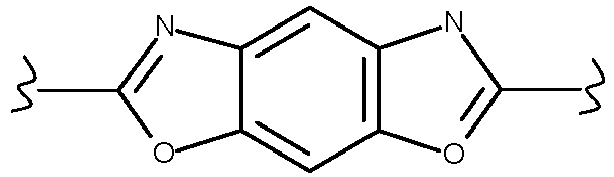
- The inventive functionalized cyclic carbonates will be advantageous, wherein E =

- The inventive functionalized cyclic carbonates will be advantageous, wherein E =

- The inventive functionalized cyclic carbonates will be advantageous, wherein E = -CH2-CH2-C(O)-, n is selected from the group of 1 and 2 and Q is selected from the group of -O-Y and -O-Z-O-.
- The inventive functionalized cyclic carbonates will be advantageous, wherein E = -CH2-CH2-C(O)-, n is 1, R1 is selected from H and methyl and Q is -OH.
- The inventive functionalized cyclic carbonates will be advantageous, wherein E = -CH2-CH2-C(O)-, n is selected from the group of 1 and 2 and Q is selected from the group of -O-Y and -O-Z-O-, wherein Y is selected from the group of H, substituted or unsubstituted C1-C40 alkyl groups, substituted or unsubstituted saturated or unsaturated C3-C40 cycloalkyl groups, substituted or unsubstituted saturated alkylenheterocyclic groups containing 3 to 20 carbon atoms and one or more heteroatoms selected from the group of N, O, and S as ring members, substituted C3-C40 unsaturated alkylencycloalkyl groups and
Z which is selected from the group of substituted or unsubstituted C1-C40 alkylen groups, divalently bonded substituted or unsubstituted C3-C40 cycloalkyl groups, divalently bonded substituted or unsubstituted heterocyclic groups containing 2 to 20 carbon atoms and one or more heteroatoms selected from the group of N, O, and S as ring members, divalently bonded saturated substituted or unsubstituted C5-C40 alkylencycloalkylalkylen groups and divalently bonded substituted or unsubstituted C17-C30 alkylen-bisphenol A -alkylen groups. - The inventive functionalized cyclic carbonates will be advantageous, wherein E = -CH2-CH2-C(O)-, n =1 or 2 and Q is selected from the group of -NR2-Y,


- The inventive functionalized cyclic carbonates will be advantageous, wherein E = -CH2-CH2-C(O)-, n =1 or 2 and Q is selected from the group of -NR2-Y,


- R2
- is selected from the group of H and substituted or unsubstituted C1-C40 alkyl groups,
- Y
- is selected from the group of substituted or unsubstituted C1-C40 alkyl groups and substituted or unsubstituted C6-C40 aryl groups,
- Z
- is selected from the group of substituted or unsubstituted C1-C40 alkylen groups, divalently bonded substituted or unsubstituted C6-C40 aryl groups and divalently bonded substituted or unsubstituted alkylenheterocyclicalkylen groups containing 4 to 20 carbon atoms and one or more heteroatoms selected from the group of N, O, and S as ring members,
- M
- is -CH2-CH2-,
- R3 and R4
- are H and
- m
- is 2.
- The inventive functionalized cyclic carbonates will be advantageous, wherein E = -CH2-CH2-C(O)-, n is 3 and Q is selected from the group of unsubstituted


- g
- is a natural number selected from 1 to 33,
- k
- is a 1,
- h
- is a natural number selected from 1 to 15,
- p
- is a 1 and
- q
- is a natural number selected from 1 to 5.
- The inventive functionalized cyclic carbonates will be advantageous, wherein E = -CH2-CH2-C(O)-, n ≥ 4 and Q is selected from the group of
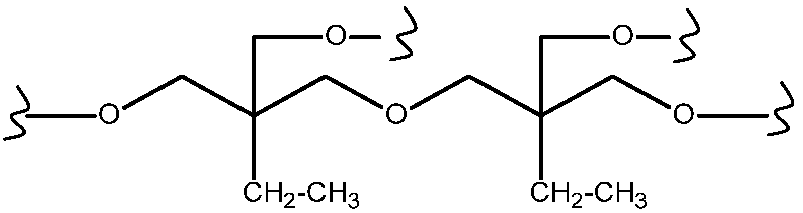

- A further embodiment of the invention is a process for the preparation of the inventive functionalized cyclic carbonates of formula (I)
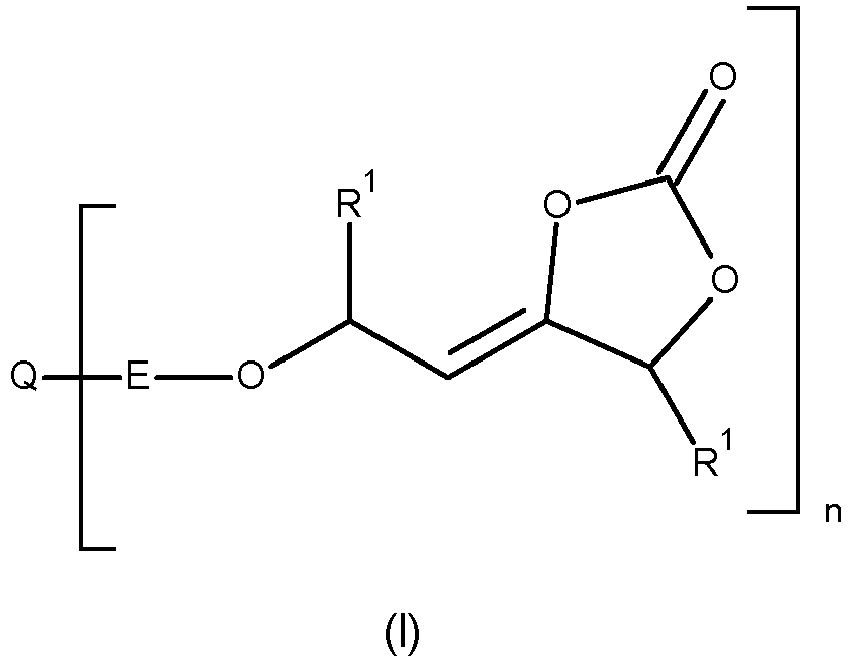
- a) reacting an alkynyl ether compound of formula (II)

with carbon dioxide in the presence of at least one transition metal catalyst TMC1, which comprises Ag as transition metal and at least one bulky ligand selected from the group of compounds of formula (III) and compound of formula (IV)
- D
- is P, As or Sb;
- R10
- is selected from the group of a substituted or unsubstituted C3-C40 cycloalkyl group, a substituted or unsubstituted C2-C40 heterocycloalkyl group, a substituted or unsubstituted C6-C40 aryl group, a substituted or unsubstituted C2-C40 heteroaromatic group, a substituted or unsubstituted C3-C40 cycloalkoxy group, a substituted or unsubstituted C2-C40 heterocycloalkoxy group, a substituted or unsubstituted C6-C40 aryloxy group and a C2-C40 heteroaryloxy group,
- R11 and R12
- are independently of each other selected from the group of substituted or unsubstituted C1-C40 alkyl groups, substituted or unsubstituted C3-C40 cycloalkyl group, substituted or unsubstituted C1-C12 terminal alkoxy groups, substituted or unsubstituted C3-C20 heterocycloalkyl groups, substituted or unsubstituted C6-C40 aryl groups, substituted or unsubstituted C2-C40- heteroaromatic groups, substituted or unsubstituted C6-C10 fluoroaryl groups, substituted or unsubstituted C2-C20 alkynyl groups and substituted or unsubstituted C7-C40- alkylenaryl groups,
- R13 and R14
- are independently of each other selected from the group of substituted or unsubstituted C1-C40 alkyl groups, substituted or unsubstituted C3-C40 cycloalkyl group, substituted or unsubstituted C1-C12 terminal alkoxy groups, substituted or unsubstituted C3-C40 cycloalkoxy group, substituted or unsubstituted C3-C20 heterocycloalkyl groups, a substituted or unsubstituted C2-C40 heterocycloalkoxy group, substituted or unsubstituted C6-C40 aryl groups, substituted or unsubstituted C6-C40 aryloxy group, substituted or unsubstituted C2-C40- heteroaromatic groups, substituted or unsubstituted C6-C10 fluoroaryl groups, substituted or unsubstituted C2-C20 alkynyl groups and substituted or unsubstituted C7-C40- alkylenaryl groups, and
- W
- is a divalent bridging group selected from the group of -CR15=CR16-, -CR15=N-, -CR15R17-CR16R18- and -CR15R17-CR16R18-CR19R20-,
wherein
R15, R16 R17, R18, R19 and R20 are independently of each other selected from the group of hydrogen, substituted or unsubstituted C1-C40 alkyl groups, substituted or unsubstituted C3-C40 cycloalkyl group, substituted or unsubstituted C1-C12 terminal alkoxy groups, substituted or unsubstituted C3-C40 cycloalkoxy group, substituted or unsubstituted C3-C20 heterocycloalkyl groups, substituted or unsubstituted C2-C40 heterocycloalkoxy group, substituted or unsubstituted C6-C40 aryl groups, substituted or unsubstituted C6-C40 aryloxy group, substituted or unsubstituted C2-C40- heteroaromatic groups, substituted or unsubstituted C6-C10 fluoroaryl groups, substituted or unsubstituted C2-C20 alkynyl groups, substituted or unsubstituted C7-C40- alkylenaryl groups and two adjacent groups R15 and R16 and/or R18 and R19 together with the rest of the group W build up a monocyclic or polycyclic, substituted or unsubstituted, aliphatic or aromatic carbon or heteroatom comprising ring system containing 4 to 40 carbon atoms and wherein the heteroatom comprising ring system comprises one or more heteroatoms selected from the group of Si, Ge, N, P, O and S as ring members
- b) separating the functionalized cyclic carbonates of formula (I) via distillation, extraction, precipitation and/or crystallization
- The inventive process will be advantageous, when R10 of formula (III) and R13 of formula (IV) is selected from the group of substituted or unsubstituted C6-C40 aryl group and a C2-C40 substituted or unsubstituted heteroaromatic group and R15, R16 R17, R18, R19 and R20 in formula (IV) are H.
- The inventive process will be advantageous, when R10 is substituted in at least one of the two ortho position of the ring cyclus relative to D with a group R10a,
- wherein R10a
- is selected form the group of substituted or unsubstituted C6-C34 aryl group, substituted or unsubstituted C1-C10 alkoxy group, substituted or unsubstituted C2-C12 dialkylamino group and where R10a forms with an adjacent group substituting R10 in the meta position of the ring cyclus together with the atoms connecting them a monocyclic or polycyclic, substituted or unsubstituted aliphatic, aromatic or heteroatom comprising ring system comprising 4 to 40 carbon atoms wherein the heteroatoms are selected from the group of Si, Ge, N, P, O and S.
- The inventive process will be advantageous, wherein the transition metal catalyst TMC1 is prepared in situ by using a transition metal compound comprising Ag, which does not comprise any bulky ligand, the compound of formula (III) or (IV) as bulky ligand or the protonated form of the compound of formula IV represented by formula (V)

- The inventive process will be advantageous, wherein the transition metal compound is selected from the group of AgOAc, AgF, Ag2O and Ag2CO3.
- The inventive process will be advantageous, wherein the bulky ligand is a compound of formula (III).
- The inventive process will be advantageous, wherein the bulky ligand is a compound selected from the group of a compound A' to P and mixtures thereof


- The inventive process will be advantageous, wherein the molar ratio of the bulky ligand to Ag of transition metal catalyst TMC1 is in the range of 0.4 to 1.2.
- The inventive process will be advantageous, wherein the amount of transition metal catalyst TMC1 used in step a) based on the amount of alkynyl ether compound of formula (II) is in the range from 0.005 to 5 mol%.
- The inventive process will be advantageous, wherein the pressure during step a) is in the range from 1 to 50 bar.
- The inventive process will be advantageous, wherein the pressure during step a) is in the range from 0°C to 100°C.
- The inventive process will be advantageous, wherein the transition metal catalyst TMC1 is recycled to step a) after step b).
- A further embodiment of the invention is the use of the cyclic carbonates of formula (I) as precursors of monomers in polymer reactions or as active monomers in polymerization reaction if the compound of formula (I) carries a further hydroxy group.
- The term "alkyl" group as used in the present application comprises linear or singly or multiply branched saturated hydrocarbons. Preferably are linear, singly or multiply branched saturated C1-C22-alkyl groups, more preferably are linear, singly or multiply branched saturated C1-C10 alkyl, much more preferably are linear, singly or multiply branched C1-C8 alkyl groups selected from the group of methyl, ethyl, n-propyl, isopropyl, n-butyl, sec-butyl, tert.-butyl, 1,1-dimethylethyl n-pentyl, 2-methylbutyl, 2,2-dimethylpropyl, n-hexyl, 2-methylpentyl, 3-methylpentyl, 2,2,-dimethylbutyl, 2,3-dimethylbutyl, n-heptan, 2-methylhexyl, 3-methylhexyl, 2,2-dimethylpentyl, 2,3-dimethylpentyl, 3,3-dimethylpentyl, 2,4-dimethylpentyl, 3-ethylpentyl, 2,2,3 trimethylbutyl, n-octyl, 2-methylheptyl, 3-methylheptyl, 4-methylheptyl, 2,2-dimethylhexyl, 2,3-dimethylhexyl, 2,4-dimethylhexyl, 2,5-dimethylhexyl, 3,3,-dimethylhexyl, 3,4-dimethylhexyl, 3-ethylhexyl, 2,2,3-trimethylpentyl, 2,2,4-trimethylpentyl, 2,3,3-trimethylpentyl, 2,3,4-trimethylpentyl, 3-ethyl-2-methylpentyl, 3-ethyl-3-methylbutyl, 2,2,3,3-tetramethylbutyl, most preferred are methyl, ethyl, n-propyl, isopropyl, n-butyl, sec-butyl, tert.-butyl, n-pentyl, 2-methylbutyl, 2,2-dimethyl propyl, n-hexyl, 2-methylpentyl, 3-methylpentyl, 2,2,-dimethylbutyl, 2,3-dimethylbutyl. Most preferred C1-C5 alkyl groups are selected from the group of methyl, ethyl, n-propyl, isopropyl, n-butyl, sec-butyl, tert.-butyl, 1,1-dimethylethyl, n-pentyl, 2-methylbutyl, 2,2-dimethylpropyl. Much more preferably are C1-C5 alkyl groups selected from the group of methyl, ethyl, n-propyl, isopropyl, n-butyl, sec-butyl, tert-butyl, 1,1-dimethylethyl and 2,2-dimethylpropyl.
- The term "terminal alkoxy" group as used in the present application comprises the alkyl group that is bonded via an O atom to the rest of the molecule in question and which is exclusively used as group in the bulky ligands of the transition metal catalyst TMC1 compounds of formula (III), (IV) and/or (V). Preferably are linear, singly or multiply branched saturated C1-C12 terminal alkoxy groups, more preferably are linear, singly or multiply branched saturated C1-10 terminal alkoxy groups, much more preferably are linear, singly or multiply branched saturated C1-C8 terminal alkoxy groups selected from the group of methoxy, ethoxy, n-propoxy, isopropoxy, n-butoxy, sec-butoxy, tert.-butoxy, n-pentoxy, 2-methylbutoxy, 2,2,-dimethylpropoxy, n-hexoxy, 2-methylpentoxy, 3-methylpentoxy, 2,2,-dimethylbutoxy, 2,3-dimethylbutoxy, n-heptoxy, 2-methylhexoxy, 3-methylhexoxy, 2,2-dimethylpentoxy, 2,3-dimethylpentoxy, 3,3-dimethylpentoxy, 2,4-dimethylpentoxy, 3-ethylpentoxy, 2,2,3 trimethylbutoxy, n-octoxy, 2-methylheptoxy, 3-methylheptoxy, 4-methylheptoxy, 2,2-dimethylhexoxy, 2,3-dimethylhexoxy, 2,4-dimethylhexoxy, 2,5-dimethylhexoxy, 3,3,-dimethylhexoxy, 3,4-dimethylhexoxy, 3-ethylhexoxy, 2,2,3-trimethylpentoxy, 2,2,4-trimethylpentoxy, 2,3,3-trimethylpentoxy, 2,3,4-trimethylpentoxy, 3 ethyl-2-methylpentoxy, 3-ethyl-3-methylbutoxy, 2,2,3,3-tetramethylbutoxy, most preferred are methoxy, ethoxy, n-propoxy, isopropoxy, n-butox, sec-butoxy, tert.-butoxy, n-pentoxy, 2-methylbutoxy, 2,2-dimethyl propoxy, n-hexoxy, 2-methylpentoxy, 3-methylpentoxy, 2,2,-dimethylbutoxy, 2,3-dimethylbutoxy. Most preferred C1-C4 terminal alkyloxy groups are selected from the group of methoxy, ethoxy, n-propoxy, isopropoxy, n-butoxy, sec-butoxy, tert.-butoxy. Much more preferably are C1-C4 terminal alkyloxy groups selected from the group of methoxy ethoxy and tert-butoxy.
- The term "alkylen" group as used in the present application does not mean alkenes having double bonds but comprises a C1-C20, preferably C1- C10, more preferably C1-C6 divalent bonded linear or with C1-C4 alkyl groups substituted saturated hydrocarbons having free valencies on adjacent or terminal carbon atoms. Preferably the alkylen group is selected from the group of methylene (-CH2-), ethylene (-CH2-CH2-), n-propylene (-CH2-CH2-CH2-), isopropylene (-CH(CH3)-CH2-), 2,2,-dimethylpropylene (-CH2-C(CH3)2-CH2-), n-butylene (-CH2-CH2-CH2-CH2-) n-pentylene (-CH2-CH2-CH2-CH2-CH2) and n-hexylene (-CH2-CH2-CH2-CH2-CH2-CH2-).
- The term "alkylhydroxide" group as used in the present application comprises C1-C22 alkyl groups where at least one H atom of the alkyl chain is substituted by one or more OH groups. Preferably the alkylhydroxide is selected from the group of methyl hydroxide, ethylhydroxide, n-propylhydroxide, 2-methylpropylhydroxid, 2,2-dimethylpropylhydroxide, 2-hydroxypropyl, 1-dodecanylhydroxid (lauryl), 1-hexandecanylhydroxid (cetyl), 1-octadecanylhydroxid (stearyl) and 1-docosanylhydroxid (behenyl). More preferably are methylhydroxide, ethylhydroxide, 2-methylpropylhydroxid, 2,2-dimethylpropylhydroxide, and 2-hydroxypropyl.
- The term "cycloalkyl" group as used in the present application comprises C3-C40 containing monocyclic or polycyclic aliphatic hydrocarbon groups wherein the term "polycyclic" comprises two or more cycloalkyl rings which are independently to each other connected by normal C-C bond, by a spiro-bond (two cycloaliphatic rings share one sp3 hybridized C-atom), by sharing at least one C-C bond, which is part of two cycloaliphatic ring systems (condensed ring system) or by sharing at least two C-atoms in at least two cycloaliphatic ring systems where a C1-C3-alkylen group is in between (bridged ring systems). Preferably the monocyclic aliphatic groups are selected from the group of cyclopropanyl, cyclobutanyl, cyclopentanyl, cyclohexanyl, cycloheptanyl and cyclooctanyl. More preferred monocyclic aliphatic groups are selected from the group of cyclobutanyl, cyclopentenyl and cyclohexanyl. The preferred polycyclic aliphatic groups are selected from the group of bicyclopentanyl, bicyclohexanyl, spiropentanyl, spiroheptanyl, spiroundecanyl, spiro [4.5] decanyl, dispiro-[4.2.2.5.2]pentadecanyl, decalinyl, bicyclo[2.2.1]heptyl, bicyclo[3.1.1]heptyl, tricyclo[5.2.1.0]decanyl, Trimethylbicyclo[2.2.1]hept-2-yl., Tricyclo[5.2.1.0]decanyl. More preferred polycyclic aliphatic groups are selected from the group of bicyclopentanyl, bicyclo[2.2.1]heptyl and tricyclo[5.2.1.0]decanyl.
- The term "cycloalkoxy" group as used in the present application comprises the cycloalkyl group that is bonded via an O atom to the rest of the molecule in question. Preferably the monocyclic aliphatic alkoxy groups comprising 3 to 40 carbon atoms and are selected from the group of cyclopropanoxy, cyclobutanoxy, cyclopentanoxy, cyclohexanoxy, cycloheptanoxy and cyclooctanoxy. The preferred polycyclic aliphatic alkyloxy groups comprising 4 to 40 carbon atoms and are selected from the group of bicyclobutanoxy, bicyclopentanoxy, bicyclohexanoxy, spiropen-tanoxy, spiroheptanoxy, spiroundecanoxy, spiro [4.5] decanoxy, dispiro-[4.2.2.5.2]pentadecanoxy, decalinoxy, norbornanoxy.
- The term "alkylencycloalkyl" group used in the present application comprises a C1 - C15 containing alkylen group wherein at least one H is substituted by a mono- or polycyclic C3 - C39 containing cycloalkyl group wherein the sum of the carbon atoms in the alkylencycloalkyl group is not higher than 40. Preferably are the alkylencycloalky groups wherein the alkylen group is selected from the group of methylen, ethylen, n-propylen, isopropylen, n-butylen, sec-butylen and tert.-butylen group and the cycloalkyl group is selected from C3- C12 cycloalkyl groups. More preferably the alkylencylcoalkyl group is selected from the group of methylencyclopropan, methylencyclobutan, methylencyclopentan, methylencyclohexan, methylenbicyclopentan, methylenbicyclohexan, methylennorbornan, ethylencyclopentan, ethylencyclohexan, ethylenbicyclopentan, ethylenbicyclohexan, ethylennorbornan, n-propylencyclopropan, isopropylencyclohexan, isopropylencyclopentan, isopropylenbicyclohexan, isopropylennorbornan, n-butylencyclopentan, n-butylencyclohexan, n-butylenbicyclopentan, n-butylenbicyclohexan, n-butylennorbornan, secbutylenbicyclopentan, sec-butylenbicyclohexan, sec-butylenspiropentan, sec-butylennorbornan, tert-butylencyclopentan, tert-butylencyclohexan, tert-butylenbicyclopentan, tertbutylenbicyclohexan, tert-butylennorbornan. Most preferably the alkylencycloalkyl group is selected from the group of methylencyclopentan, methylencyclohexan, methylenbicyclopentan and isopropylencyclohexan.
- The term "alkylencycloalkylalkylen" group used in the present application comprises a C5-C40 containing group which is divalent and comprises a cycloalkyl group in the center and two identical or different alkylen groups at each side. The alkylencycloalkylalkylen group is a bridging group wherein the alkylen groups at each side are bonded either to two different or identical groups or which are bonded to the same or to different atoms of one group. The alkylen groups are independently selected from the group of methylen, ethylen, propylene and isopropylen. The cycloalkyl group is selected from the group of 1,2-cyclopropan, 1,2-, 1,3-, 1,4-cyclobutan, 1,2-, 1,3-clyopentan, 1,2-, 1,3-, 1,4-cyclohexan. The numbers in front of the cycloalkyl groups symbolize the C-atoms of the cycloalkylring which are bonded to the alkylen groups. Preferably alkylencycloalkylalkylen groups are selected from the group of 1,3-dimethylencyclopentan, 1,3 dimethylencyclohexan, 1,2-dimethylencyclohexan, 1,4-dimethylencyclohexan, 1,3-diethylencyclopentan, 1,4-diethylencyclohexan, 1,3-dipropylencyclopentan, 1,4-dipropylencyclohexan, 4,8-bis(methylene)tricyclo[5.2.1.02,6]decan. More preferably the alkylencycloalkylen groups are selected from the group of 1,3 dimethylencyclohexan, 1,2-dimethylencyclohexan and 1,4-dimethylencyclohexan.
- The term "cycloalkylalkylencycloalkyl" group used in the present application comprising a C7-C40 atoms containing group which is divalent and comprises an alkylen chain in the center, wherein the alkylen chain is selected from the group of methylene, ethylene, propylene, isopropylene and at least two mono-, two poly- or one mono- and one polycycloalkylring are bonded at each side of the alkylen chain. The cycloalkyl groups at each side of the alkylen chain are the same or different. The mono- and/or polycyclic rings at each side of the alkylen chain will be the connection to a further group at each side of the mono- and/or polycyclic group which is either identical or different. Preferably monocycloalkylrings are independently from each other selected from the group of cyclopropanyl, 1,2- and 1,3-cyclobutanyl, 1,2- and 1,3-cyclopentanyl and 1,2-, 1,3- and 1,4-cylohexanyl. More preferably monocycloalkyrings are independently from each other selected from the group of 1,3-cyclobutanyl, 1,3-cyclopentanyl, 1,2- and 1,4-cylohexanyl. The numbers in front of the cycloalkyl groups symbolize the C-atoms of the cycloalkylring which are bonded on the one side to the alkylen group and on the other side to the further group. Preferably polycycloalkylrings are independently from each other selected from the group of tricyclo[5.2.1.02,6]decanyl, 2-norbornyl, bornyl, isobornyl, 2-decahydronaphthyl, tetracyclo-[4.4.0.12,5.17,10]docecyl. Preferably cycloalkylalkylencycloalkyl groups are selected from the group of dicyclopropanylmethan, 1,2- and 1,3-dicyclobutanylmethan, 1,2- and 1,3-dicyclopentanylmethan, 1,2-, 1,3- and 1,4-dicyclohexanylmethan, dicyclopropanylethan, 1,2-and 1,3-dicyclobutanylethan, 1,2- and 1,3-dicyclopentanylethan, 1,2-, 1,3- and 1,4-dicyclohexanylethan, dicyclopropanylpropan, 1,2- and 1,3-dicyclobutanylpropan, 1,2- and 1,3-dicyclopentanylpropan, 1,2-, 1,3- and 1,4-dicyclohexanylpropan, 1,2- and 1,3-dicyclobutanylisopropan, 1,2- and 1,3-dicyclopentanylisopropan, 1,2-, 1,3- and 1,4-dicyclohexanylisopropan, cyclopropanyl-1,2- or 1,3-cyclobutanylmethan, cyclopropanyl-1,2- or 1,3-cyclopentanylmethan, cyclopropanyl-1,2- or 1,3- or 1,4-cyclohexanylmethan, 1,2- or 1,3-cyclobutanyl-1,2- or 1,3-cyclopentaylmethan, 1,2- or 1,3-cyclobutanyl-1,2 or 1,3 or 1,4-cyclohexanylmethan, 1,2- or 1,3-cyclopentanyl1,2 or, 1,3 or 1,4-cyclohexanylmethan, cyclopropanyl-1,2 or 1,3-cyclobutanylethan, cyclopropanyl-1,2 or, 1,3-cyclopentanylethan, cyclopropanyl1,2 or 1,3 or 1,4-cyclohexanylethan, 1,2 or 1,3-cyclobutanyl-1,2 or 1,3-cyclopentaylethan, 1,2 or 1,3-cyclobutanyl-1,2 or 1,3 or 1,4-cyclohexanylethan, 1,2- or 1,3-cyclopentanyl-1,2 or 1,3- or 1,4-cyclohexanylethan, cyclopropanyl-1,2- or 1,3-cyclobutanylpropan, cyclopropanyl-1,2- or 1,3-cyclopentanylpropan, cyclopropanyl-1,2- or 1,3- or 1,4-cyclohexanylpropan, 1,2- or 1,3-cyclobutanyl-1,2 or 1,2-cyclopentaylpropan, 1,2- or 1,3-cyclobutanyl-1,2 or 1,3 or 1,4-cyclohexanylpropan, 1,2 or 1,3-cyclopentanyl-1,2 or 1,3 or 1,4-cyclohexanylpropan. More preferably cycloalkylalkylencycloalkyl groups are selected from the group of 1,4-dicyclohexanylmethan, 1,3-dicyclopentanylethan and 1,4-dicyclohexanylisopropan.
- The term "unsaturated" cycloalkyl, alkylencycloalkyl, alkylencycloalkylalkylen, cycloalkylalkylencycloalkyl or alkylenheterocyclicalkylen group used in the present application comprises C3-C40 cycloalkyl, a C4-C40 alkylencycloalkyl, a C5-C40 alkylencycloalkylalkylen, a C7-C40 cycloalkylalkylencycloalkyl or a C4-C40 alkylenheterocyclicalkylen groups that include at least one C-C double bond inside of one or more of the rings, wherein no double bond is located at the bridge head of a bridged bi- or multicycloalkyl ring system. Preferably unsaturated monocyclic cycloalkyl groups are selected from the group of cyclopentenyl, cyclohexenyl, cyclooctenyl and cyclododecenyl. Preferably unsaturated polycyclic cycloalkyl group are selected from the group of dihydrodicyclopentadienyl and norbornenyl. Preferably unsaturated monocyclic alkylencycloalkyl groups are selected from the group of (cyclohex-3-en-1-yl)methylene and (4-methyl-1-cyclohexene)isopropylene. Preferably unsaturated polycyclic alkylencycloalkyl groups are selected from the group of Bicyclo [2.2.1]hept-5-ene-2-methylene, 2-Methyl-bicyclo [2.2.1]hept-5-ene-2-methylene, 3a,4,5,6,7,7a-Hexahydro-4,7-methano-1H-indene-5-methylene and 3a,4,5,6,7,7a-Hexahydro-4,7-methano-1H-indene-6-methylene. Preferably unsaturated monocyclic alkylencyloalkylalkylen groups are selected from the group of 4-Cyclopentene-1,3-dimethylene and 2-Cyclohexene-1,4-dimethylene. Preferably unsaturated monocyclic alkylenheterocyclicalkylen groups is 2,5 furandimethylene.
- The term "aryl" group used in the present application comprises C6-C40 containing mono- or polycyclic aromatic hydrocarbon groups wherein the term "polycyclic aromatic" comprises two or more rings wherein the whole ring system is aromatic and in which the rings are connected by a normal C-C-bond or by sharing at least one C-C bond, which is part of two rings (condensed ring systems). Preferably mono- or polycyclic aromatic hydrocarbon groups are selected from the group of phenyl, biphenyl, naphthyl, anthracenyl, phenanthrenyl, indenyl, as-indacenyl, fluorenyl. Most preferred are phenyl and naphthyl.
- The term "aryloxy" group as used in the present application comprises a C6 to C40 aryl group that is bonded via an O atom to the rest of the molecule in question. Preferably mono- or polycyclic aromatic hydrocarbonoxy groups are selected from the group of phenyloxy, biphenyloxy, naphthalenoxy, anthracenoxy, phenanthrenoxy, indenoxy, as-indacenoxy, fluorenoxy)
- The term "alkylenaryl" group used in the present application comprises a C7 to C40 containing group that is build up by an alkylen chain that is bonded to a mono- or polycyclic aryl group. Preferably are the alkylenaryl groups wherein the alkylen chain is selected from the group of methylene, ethylene, n-propylene, iso-propylene, n- butylene, sec-butylene and tert.-butylene group and the aryl group is selected from C6 to C12 aryl groups. More preferably the alkylenaryl group is selected from the group of benzyl, methylenbiphenyl, methylennaphthalenyl, methylenanthracenyl, methylenphenanthrenyl, methylenindenyl,methylene-as-indacenyl, methylenfluorenyl, ethylenphenyl, ethylenbicyclophenyl, ethylennaphthalenyl, ethylenanthracenyl, ethylenphenanthrenyl, ethylenindenyl, ethylene-as-indacenyl, ethylenfluorenyl, n-propylenphenyl, n-propylenbiphenyl, n-propylenanthracenyl, n-propylenphenanthrenyl, n-propylenindenyl, n-propylene-as-indacenyl, n-propylenfluorenyl, iso-propylenphenyl, iso-propylenbiphenyl, isopropylenantracenyl, isopropylenphenantrenyl, iso-propylenindenyl, iso-propylene-as-indacenyl, iso-propylenfluorenyl, n-butylenphenyl, n-butylenbicyclophenyl, n-butylennaphthalenyl, n-butylenanthracenyl, n-butylenphenanthrenyl, n-butylenindenyl, n-butylene-as-indacenyl, n-butylenfluorenyl, sec-butylenphenyl, sec-butylenbicyclophenyl, sec-butylennaphthalenyl, secbutylenanthracenyl, sec-butylenphenanthrenyl, sec-butylenindenyl, sec-butylene-as-indacenyl, sec-butylenfluorenyl, tert.-butylenphenyl, tert.-butylenbicyclophenyl, tert.-butylennaphthalenyl, tert.-butylenanthracenyl, tert.-butylenphenanthrenyl, tert.-butylenindenyl, tert.-butylene-as-indacenyl, tert.-butylenfluorenyl. Most preferred alkylenaryl groups are selected from benzyl, ethylenphenyl, iso-propylenphenyl and tert.-butylenphenyl.
- The term "arylalkylenaryl" group used in the present application comprising a C13-C40 atoms containing group which is divalent and comprises at least two aryl groups which are connected via an C1-C10 containing alkylen chain. The connection to the arylalkylenaryl group will be built to each of the two aryl groups. Preferably the alkylen chain, which is in the center of the two aryl groups, is selected from the group of methylene, ethylene, propylene and isopropylene. At each side of the center alkylen chain an aryl group is connected. These aryl groups can be identical or different. As each aryl group is further connect to a further group, which also can be the same or different, at each side of the arylalkylenaryl group, each aryl group has two connection carbon atoms which are identified here by the number of the carbon atom of the aryl group that build up the connection to the center alkylen group as well as the number of the carbon atom that build up the connection to the further group on the other side of the aryl group. Preferably the aryl groups are independently selected from the group of 1,2-, 1,3- and 1,4-phenyl, 1,2-, 1,3-, 1,4-, 1,5-,1,6-, 1,7-, 1,8-, 2,3-, 2,4-, 2,5-, 2,7- 2,8-, 3,4-, 3,5-, 3,6-, 3,7- and 3,8-naphthyl, 1,2-, 1,3-, 1,4-, 1,5-, 1,6-, 1,7-, 1,8-, 1,9-, 1,10-, 2,3- 2,4-, 2,5-, 2,6-, 2,7-, 2,8-, 2,9-, 2,10-, 3,4-, 3,5-, 3,6-, 2,7- 3,8-, 3,9- and 3,10-anthracenyl. Preferably arylalkylenaryl groups are selected from the group of bis(1,4-phenyl)methane, bis(2,5-naphthyl)methan, bis(2,7-anthracenyl)methan, 1,1-bis(1,4-phenyl)ethane, 1,1-bis(2,5-naphthyl)ethan, 1,1-bis(2,7-anthracenyl)ethan, 1,2-bis(1,4-phenyl)ethane, 1,2-bis(2,5-naphthyl)ethan, 1,2-bis(2,7-anthracenyl)ethan, 1,3-bis(1,4-phenyl)propan, 1,3-bis(2,5-naphthyl)propan, 1,3-bis(2,7-anthracenyl)propan, 1,2-bis(1,4-phenyl)propan, 1,2-bis(2,5-naphthyl)propan, 1,2-bis(2,7-anthracenyl)propan, 1,1-bis(1,4-phenyl)propan, 1,1-bis(2,5-naphthyl)propan, 1,1-bis(2,7-anthracenyl)propan bis(1,4-phenyl)isopropan, bis(2,5-naphthyl)isopropan, bis(2,7-anthracenyl)isopropan, (1,4-phenyl),(2,5-naphthyl)methane, (1,4-phenyl),(2,7-anthracenyl)methan, (2,5-napthyl),(2,7-antracenyl)methan, 1-(1,4phenyl),2-(2,5-naphthyl)ethane, 1-(1,4-phenyl),2-(2,7anthracenyl)ethan, 1-(2,5-napthyl),2-(2,7-antracenyl)ethan, 1-(1,4phenyl),1-(2,5-naphthyl)ethane, 1-(1,4-phenyl),1-(2,7-anthracenyl)ethan, 1-(2,5-napthyl),1-(2,7-antracenyl)ethan, 1-(1,4-phenyl),3-(2,5-naphthyl)propan, 1-(1,4-phenyl),3-(2,7-anthracenyl)propan, 1-(2,5-napthyl),3-(2,7-antracenyl)propan, 1-(1,4-phenyl),2-(2,5-naphthyl)propan, 1-(1,4-phenyl),2-(2,7-anthracenyl)propan, 1-(2,5-napthyl),2-(2,7-antracenyl)propan, 1-(1,4-phenyl),1-(2,5-naphthyl)propan, 1-(1,4-phenyl),1-(2,7-anthracenyl)propan, 1-(2,5-napthyl),1-(2,7-antracenyl)propan, (1,4-phenyl)-(2,5-naphthyl)isopropan, (1,4-phenyl)-(2,7-anthracenyl)isopropan, (2,5-napthyl)-(2,7-antracenyl)isopropan, Most preferred arylalkyenaryl groups are selected from the group of bis(1,4-phenyl)isopropan.
- The term "alkylenarylalkylen group" used in the present application comprising C8-C40 atoms containing group which is divalent and comprises at least two alkylen groups which are connected via one aryl group. The aryl group is in the center of the alkylenarylalkylen group and has two different carbon atoms in the ring to which each alkylen group is bonded. The two carbon atoms of the center aryl group are identified by the numbers of the two carbon atoms in front of the aryl group to which the same or different alkylen groups are bonded. The alkylen groups are independently of each other selected from the group of methylene, ethylene, propylene, and iso-propylene. The center aryl group is selected from the group of 1,2-phenyl, 1,3-phenyl, 1,4-phenyl. Preferred alkylenarylalkylen group is selected from the group of 1,2- dimethylenphenyl (-CH2-1,2-phenyl-CH2-) and 1,4-dimethylenphenyl (-CH2-1,4-phenyl-CH2-) group.
- The term "heterocyclic group" used in the present application comprises saturated or unsaturated heterocyclic groups that contains 2 to 20 carbon atoms and one or more heteroatoms selected from the group of Si, Ge, P, N, O and S as ring members. These heterocyclic groups can be divided in heterocycloalkyl groups and unsaturated heterocyclic groups. The term "unsaturated heterocyclic group" used in the present application comprises partially unsaturated heterocyclic groups as well as heteroaromatic groups. All of these heterocyclic groups can be a monoheterocyclic as well as a polyheterocyclic groups wherein at least in one cyclus at least one heteroatom is included. The heterocyclic groups used in inventive functionalized cyclic carbonates of formula (I) as well as in the alkynyl ether compounds of formula (II) only comprise heteroatoms selected from the group of N, O and S. Preferred heterocycloalkyl groups for the inventive functionalized cyclic carbonates of formula (I) as well as in the alkynyl ether compounds of formula (II) are selected from the group of ethylenoxidyl (oxiranyl), ethylensulfidyl (thiiranyl), ethyleniminyl (aziridinyl), trimethylenoxidyle (oxetanyl), trimethylensulfidyl (thietanyl), 1,3-propyleniminyl (azetidinyl), tetrahydrofuranyl (oxolanyl), tetrahydrothiophenyl (thiolanyl), pyrrolidyl (azolidinyl), tetrahydropyranyl (oxanyl), tetrahydrothiopyranyl (thianyl), piperidinyl (azinanyl), hexamethylenoxidyl (oxepanyl), hexamethylensulfidyl (thiepanyl), tetrahydro-1,4,-oxazinyl (morpholin), tetrahydro-1,3,-oxazinyl, tetrahydro-1,2,-oxazinyl hexamethyleniminyl (azepanyl), 1,3-dioxolanyl, 1,3-dithiolanyl, 1,3-oxathiolanyl, 1,3-oxaazolidnyl, 1,3-azathiolanyl, 1,3-dioxanyl, 1,4-dioxanyl, 1,3,5-trioxanyl, 1,3-dithianyl, 1,4-dithianyl, 1,3,5-trithianyl, 1,3-diazinanyl, 1,4-diazinanyl, 1,2,3-trianzinanyl, 1,2,4-triazinanyl, 1,3,5-triazinanyl (hexahydro-1,3,5-triazinyl), 1,2-oxazinanyl, 1,3-oxazinanyl, 1,4-oxazinanyl, octahydro-1-benzofuranyl, octahydro-2-benzofuranyl, hexahydro-furo[3,2-b]furanyl. More preferred heterocycloalkyl groups are selected from the group of ethylenoxidyl (oxiranyl), trimethylenoxidyle (oxetanyl), tetrahydrofuranyl (oxolanyl), piperidinyl (azinanyl), 1,3-dioxolanyl, 1,3-oxaazolidnyl, 1,3-dioxanyl, 1,3,5-trioxanyl, 1,3,5-triazinanyl (hexyhydro-1,3,5-triazinyl) and hexahydro-furo[3,2-b]furanyl. More preferred heterocycloalkyl groups are selected from the group of ethylenoxidyl (oxiranyl), trimethylenoxidyle (oxetanyl), tetrahydrofuranyl (oxolanyl), piperidinyl (azinanyl), 1,3-dioxolanyl, 1,3-oxaazolidnyl, 1,3-dioxanyl, 1,3,5-trioxanyl, 1,3,5-triazinanyl (hexyhydro-1,3,5-triazinyl) and hexahydro-furo[3,2-b]furanyl. Preferred heteroaromatic or heteroaryl groups, which means the same, for the inventive functionalized cyclic carbonates of formula (I) as well as in the alkynyl ether compounds of formula (II) are selected from the group of pyrrolyl (2-pyrrolyl), pyrazolyl (3-pyrazolyl), pyrrolium, imidazolyl (1-imi_dazolyl, 2-imidazolyl, 4-imidazolyl, 5-imidazolyl), oxazolium, isothiazolyl, triazolyl (1,2,3-triazol-1-yl, 1,2,3-triazol-2-yl 1,2,3-triazol-4-yl, 1,2,4- triazol-3-yl), diazolyl (1-oxa-2,3-diazolyl, 1-oxa-2,4-diazolyl groups, 1-oxa-2,5-diazolyl, 1-oxa-3,4-diazolyl, 1-thia-2,3-diazolyl, 1-thia-2,4-diazolyl, 1-thia-2,5-diazolyl, 1-thia-3,4-diazolyl), tetrazolyl, pyridinyl, oxazolyl (2-oxazolyl, 4-oxazolyl, 5-oxazolyl), isoxazolyl (3-isoxazolyl, 4-isoxazolyl, 5-isoxazolyl), thiazolyl (2-thiazolyl, 4-thiazolyl, 5-thiazolyl), thiophenyl (2-thiophenyl, 3-thiophenyl, 4-thiophenyl, 5-thiophenyl), furanyl (2-furanyl, 3-furanyl, 4-furanyl, 5-furanyl), pyradizinyl, pyridiniumyl, pyrimidinium, pyridyl (2-pyridyl, 3-pyridyl, 4-pyridyl, 5-pyridyl), 5-tetrazolyl, pyrimidinyl (2-pyrimidinyl, 4-pyrimidinyl, 5-pyrimidinyl, 6-pyrimidinyl), pyrazinyl, pyridazinyl (3-pyridazinyl, 4-pyridazinyl, 5-pyridazinyl), indazolyl, quinolyl (2- quinolyl, 3-quinolyl, 4-quinolyl, 5-quinolyl, 6-quinolyl, 7-quinolyl, 8-quinolyl), isoquinolyl (1-isoquinolyl, 3-isoquinolyl, 4- isoquinolyl, 5-isoquinolyl, 6-isoquinolyl, 7-isoquinolyl, 8-isoquinolyl), benzo[b]furanyl (2-benzo[b]furanyl, 3-benzo[b]furanyl, 4-benzo[b]furanyl, 5-benzo[b]furanyl, 6-benzo[b]furanyl, 7-benzo[b]furanyl), 2,3-dihydro-benzo[b]furanyl (2-(2,3-di_hydro-benzo[b]furanyl), 3-(2,3-dihydro-benzo[b]furanyl), 4-(2,3-dihydro-benzo[b]furanyl), 5-(2,3-dihydrobenzo-[b]fura_nyl), 6-(2,3-dihydro-benzo-[b]furanyl), 7-(2,3-dihydro-benzo[b]furanyl)), benzo[b]thiophenyl (2-benzo[b]thiophenyl, 3- benzo[b]thiophenyl, 4-benzo[b]thiophenyl, 5-benzo[b]thiophenyl, 6-benzo[b]thiophenyl, 7-benzo[b]thiophenyl), 2,3-di_hydro-benzo[b]thiophenyl (2-(2,3-dihydro-benzo[b]thiophenyl), 3-(2,3-dihydro-benzo[b]thiophenyl), 4-(2,3-dihydroben_zo[b]thiophenyl), 5-(2,3-dihydrobenzo[b]thiophenyl), 6-(2,3-dihydro-benzo[b]thiophenyl), 7-(2,3-dihydro-benzo[b]thi_ophenyl)), 4,5,6,7-tetrahydro-benzo[b]thiophenyl (2-(4,5,6,7-tetrahydro-benzo[b]thiophenyl), 3-(4,5,6,7-tetrahydro-ben_zo[b]thiophenyl), 4-(4,5,6,7-tetrahydro-benzo[b]thiophenyl), 5-(4,5,6,7-tetrahydro-benzo[b]thiophenyl), 6-(4,5,6,7-tetrahydro-benzo[b]thiophenyl), 7-(4,5,6,7-tetrahydrobenzo[b]thiophenyl)), thieno[2,3-b]thiophenyl, 4,5,6,7-tetrahydrothieno[2,3-c]pyridyl (4-(4,5,6,7-tetrahydro-thieno[2,3-c]pyridyl), 5-4,5,6,7-tetrahydro-thieno[2,3-c]pyridyl), 6-(4,5,6,7-tetrahydrothieno[2,3-c]pyridyl), 7-(4,5,6,7-tetrahydro-thieno[2,3-c]pyridyl)), indolyl (1-indolyl, 2-indolyl, 3-indolyl, 4-indolyl, 5-indolyl, 6-indolyl, 7-indolyl), isoindolyl (1-isoindolyl, 2-isoindolyl, 3-isoindolyl, 4-isoindolyl, 5-isoindolyl, 6-isoindolyl, 7- isoindolyl), 1,3-dihydro-isoindolyl (1-(1,3-dihydro-isoindolyl), 2-(1,3-dihydroisoindolyl), 3-(1,3-dihydro-isoindolyl), 4-(1,3- dihydro-isoindolyl), 5-(1,3-dihydro-isoindolyl), 6-(1,3-dihydro-isoindolyl), 7-(1,3-dihydro-isoindolyl)), indazole (1-indazolyl, 3-indazolyl, 4-indazolyl, 5-indazolyl, 6-indazolyl, 7-indazolyl), benzimidazolyl (1-benzimidazolyl, 2-benzimidazolyl, 4-benzimidazolyl, 5-benzimidazolyl, 6-benzimidazolyl, 7-benzimidazolyl, 8-benzimidazolyl), benzoxazolyl (1-benz-oxazolyl, 2-benzoxazolyl), benzothiazolyl (1-benzothiazolyl, 2-benzothiazolyl, 4-benzothiazolyl, 5-benzothiazolyl, 6-benzothiazolyl, 7-benzothiazolyl), benzo-[1,2,5]oxadiazolyl, (4-benzo[1,2,5]oxadiazole, 5-benzo[1,2,5]oxadiazole), carbazolyl (1-carbazolyl, 2-carbazolyl, 3-carbazolyl, 4-carbazolyl), piperidinyl (2-piperidinyl, 3-piperidinyl, 4-piperidinyl), pyrrolidinyl (1-pyrrolidinyl, 2-pyrrolidinyl, 3- pyrrolidinyl), benzotriazolyl, pyrrolo[2,3-b]pyridinyl, pyrrolo[2,3-c]pyridinyl, pyrrolo[3,2-c]pyridinyl, pyrrolo[3,2-b]pyridinyl, imidazo[4,5-b]pyridinyl, imidazo[4,5-c]pyridinyl, pyrazolo[4,3-d]pyridinyl, pyrazolo[4,3-c]pyridinyl, pyrazolo[3,4-c]pyridinyl, pyrazolo[3,4-b]pyridinyl, isoindolyl, indazolyl, purinyl, indolininyl, imidazo[1,2-a]pyridinyl, imidazo[1,5-a]pyridinyl, pyrazolo[1,5-a]pyridinyl, pyrrolo[1,2-b]pyridazinyl, imidazo[1,2-c]pyrimidinyl, quinolinyl, isoquinolinyl, cinnolinyl, quinazolinyl, quinoxalinyl, phthalazinyl, pyrido[3,2-d]pyrimidinyl, pyrido[4,3-d]pyrimidinyl , pyrido[3,4-d]pyrimidinyl, pyrido[2,3-d]pyrimidinyl, pyrido[2,3-b]pyrazinyl, pyrido[3,4-b]pyrazinyl, pyrimido[5,4-d]pyrimidinyl, pyrazino[2,3-b]pyrazinyl and pyrimido[4,5-d]pyrimidinyl.
- The term "heterocycloalkoxy" group as used in the present application comprises the heterocycloalkyl group that is bonded via an O atom to the rest of the molecule in question. Preferably the heterocycloalkoxy group is selected from the group of aziridinyl, azetidinyl, dioxolanyl, thienyl[1,3]dithianyl, decahydroisoquinolyl, imidazolinyl, imidazolidinyl, isothiazolidinyl, isoxazolidinyl, morpholinyl, octahydroindolyl, octahydroisoindolyl, 2-oxopiperazinyl, 2-oxopiperidinyl, 2-oxopyrrolidinyl, oxazolidinyl, piperidinyl, piperazinyl, 4-piperidonyl, pyrrolidinyl, pyrazolidinyl, quinuclidinyl, thiazolidinyl, tetrahydrofuryl, trithianyl, tetrahydropyranyl, thiomorpholinyl, thiamorpholinyl, 1-oxo-thiomorpholinyl, 1,1-dioxo-thiomorpholinyl, 12-crown-4, 15-crown-5, 18-crown-6, 21-crown-7, aza-18-crown-6, diaza-18-crown-6, aza-21-crown-7, and diaza-21-crown-7, preferably dioxolanyl, decahydroisoquinolyl, imidazolinyl, imidazolidinyl, isothiazolidinyl, isoxazolidinyl, morpholinyl, octahydroindolyl, octahydroisoindolyl, oxazolidinyl, piperidinyl, piperazinyl, 4-piperidonyl, pyrrolidinyl, tetrahydrofuryl, tetrahydropyranyl.
- The term "heteroaryloxy" group as used in the present application comprises the heteroaryl group that is bonded via an O atom to the rest of the molecule in question. Preferabyl the heteroaryloxy group is selected from the group of heteroaryl groups selected from the group of pyrrolyl (2-pyrrolyl), pyrazolyl (3-pyrazolyl), imidazolyl (1-imidazolyl, 2-imidazolyl, 4-imidazolyl, 5-imidazolyl), triazolyl (1,2,3-triazol-1-yl, 1,2,3-triazol-2-yl 1,2,3-triazol-4-yl, 1,2,4- triazol-3-yl), oxazolyl (2-oxazolyl, 4-oxazolyl, 5-oxazolyl), isoxazolyl (3-isoxazolyl, 4-isoxazolyl, 5-isoxazolyl), thiazolyl (2-thiazolyl, 4-thiazolyl, 5-thiazolyl), thiophenyl (2-thiophenyl, 3-thiophenyl, 4-thiophenyl, 5-thiophenyl), furanyl (2-furanyl, 3-furanyl, 4-furanyl, 5-furanyl), pyridyl (2-pyridyl, 3-pyridyl, 4-pyridyl, 5-pyridyl), 5-tetrazolyl, pyrimidinyl (2-pyrimidinyl, 4-pyrimidinyl, 5-pyrimidinyl, 6-pyrimidinyl), pyrazinyl, pyridazinyl (3-pyridazinyl, 4-pyridazinyl, 5-pyridazinyl), quinolyl (2-quinolyl, 3-quinolyl, 4-quinolyl, 5-quinolyl, 6-quinolyl, 7-quinolyl, 8-quinolyl), isoquinolyl (1-isoquinolyl, 3-isoquinolyl, 4- isoquinolyl, 5-isoquinolyl, 6-isoquinolyl, 7-isoquinolyl, 8-isoquinolyl), benzo[b]furanyl (2-benzo[b]furanyl, 3-benzo[b]fura- nyl, 4-benzo[b]furanyl, 5-benzo[b]furanyl, 6-benzo[b]furanyl, 7-benzo[b]furanyl), 2,3-dihydro-benzo[b]furanyl (2-(2,3-di_hydrobenzo[b]furanyl), 3-(2,3-dihydro-benzo[b]furanyl), 4-(2,3-dihydro-benzo[b]furanyl), 5-(2,3-dihydrobenzo-[b]furanyl), 6-(2,3-dihydro-benzo-[b]furanyl), 7-(2,3-dihydro-benzo[b]furanyl)), benzo[b]thiophenyl (2-benzo[b]thiophenyl, 3- benzo[b]thiophenyl, 4-benzo[b]thiophenyl, 5-benzo[b]thiophenyl, 6-benzo[b]thiophenyl, 7-benzo[b]thiophenyl), 2,3-di_hydrobenzo[b]thiophenyl (2-(2,3-dihydro-benzo[b]thiophenyl), 3-(2,3-dihydro-benzo[b]thiophenyl), 4-(2,3-dihydrobenzo[b]thiophenyl), 5-(2,3-dihydro-benzo[b]thiophenyl), 6-(2,3-dihydrobenzo[b]thiophenyl), 7-(2,3-dihydro-benzo[b]thi_ophenyl)), 4,5,6,7-tetrahydrobenzo[b]thiophenyl (2-(4,5,6,7-tetrahydro-benzo[b]thiophenyl), 3-(4,5,6,7-tetrahydrobenzo[b]thiophenyl), 4-(4,5,6,7-tetrahydro-benzo[b]thiophenyl), 5-(4,5,6,7-tetrahydrobenzo[b]thiophenyl), 6-(4,5,6,7-tetrahydro-benzo[b]thiophenyl), 7-(4,5,6,7-tetrahydrobenzo[b]thiophenyl)), thieno[2,3-b]thiophenyl, 4,5,6,7-tetrahydro_thieno[2,3-c]pyridyl (4-(4,5,6,7-tetrahydro-thieno[2,3-c]pyridyl), 5-4,5,6,7-tetrahydro-thieno[2,3-c]pyridyl), 6-(4,5,6,7-tet_rahydro-thieno[2,3-c]pyridyl), 7-(4,5,6,7-tetrahydro-thieno[2,3-c]pyridyl)), indolyl (1-indolyl, 2-indolyl, 3-ihdolyl, 4-indolyl, 5-indolyl, 6-indolyl, 7-indolyl), isoindolyl (1-isoindolyl, 2-isoindolyl, 3-isoindolyl, 4-isoindolyl, 5-isoindolyl, 6-isoindolyl, 7- isoindolyl), 1,3-dihydro-isoindolyl (1-(1,3-dihydro-isoindolyl), 2-(1,3-dihydroisoindolyl), 3-(1,3-dihydro-isoindolyl), 4-(1,3- dihydro-isoindolyl), 5-(1,3-dihydro-isoindolyl), 6-(1,3-dihydro-isoindolyl), 7-(1,3-dihydro-isoindolyl)), indazole (1-inda_zolyl, 3-indazolyl, 4-indazolyl, 5-indazolyl, 6-indazolyl, 7-indazolyl), benzimidazolyl (1-benzimidazolyl, 2-benzimidazolyl, 4-benzimidazolyl, 5-benzimidazolyl, 6-benzimidazolyl, 7-benzimidazolyl, 8-benzimidazolyl), benzoxazolyl (1-benz-oxa_zolyl, 2-benzoxazolyl), benzothiazolyl (1-benzothiazolyl, 2-benzothiazolyl, 4-benzothiazolyl, 5-benzothiazolyl, 6-benzothiazolyl, 7-benzothiazolyl), benzo-[1,2,5]oxadiazolyl, (4-benzo[1,2,5]oxadiazole, 5-benzo[1,2,5]oxadiazole), carbazolyl (1-carbazolyl, 2-carbazolyl, 3-carbazolyl, 4-carbazolyl), piperidinyl (2-piperidinyl, 3-piperidinyl, 4-piperidinyl), pyrrolidinyl (1-pyrrolidinyl, 2-pyrrolidinyl, 3-pyrrolidinyl) that are bonded via an O atom to the rest of the molecule in question.
- The term "alkylenheterocyclic" group used in the present application comprises a C1-C40 atoms containing group that comprises a C1-C20 alkylen chain wherein one H- atom is substituted by an hetereocyclic group. The alkylen chain is preferably selected from the group of methylene, ethylene, n-propylene, isopropylen, n-butylen, sec-butylen and tert.- butylene. The hetereocyclic group is preferably selected from C4-C39 heterocycloalkyl groups and aromatic heterocyclic groups. Preferably the alkylenheterocyclic group is selected from the group of 4-Methylen-1,3-dioxolan, 3-methylen-oxetan, 2-methylene furan, 2-methylene tetrahydrofuran.
- The term "alkylenheterocyclicalkylen" group used in the present application comprises either an aromatic heterocyclic or a saturated heterocycloalkyl group in the center which comprises two directly at the C2-C38 containing hetereocyclic group bonded C1-C10 containing substituted or unsubstituted alkylen groups. These two C1-C10 alkylen groups are independently selected from the group of methylene, ethylene, n-propylene, iso-propylen, n-butylene, sec-butylene and tert.butylene groups which can be substituted or unsubstituted. Both C1-C10 containing alkylen groups are the divalent bondages to further groups which can be identical or different. Preferably heterocyclic groups are selected from the group of tetrahydrofuran, tetrahydrothiophene, pyrrolidine, tetrahydropyran, tetrahydrothiopyran, piperidin, 1,3- or 1,4 -dioxolan, 1,3- or 1,4-dithian,1,3- or 1,4-piperazin, furan, thiophen, pyrrol, pyridine. Most preferably alkylenheterocyclicalkylen groups are selected from the group of 2,5-dimethylentetrahydrofuran, 2,5-dimethylenfuran.
- The term "fluoroaryl" group used in the present application comprises with C1-C4 alkyl groups substituted or unsubstituted C6-C10 aryl groups where at least one hydrogen atom of the alkyl group or the aryl group, preferably more than one of the alkyl groups and/or the aryl group and at most preferred all hydrogen atoms of the alkyl groups and/or the aryl group are replaced by fluorine atoms. Preferably unsubstituted C6-C10 aryl groups as fluoroaryl groups are selected from the group of pentafluorophenyl, 4-trifluoromethylphenyl, 4-perfluoro-tert-butylphenyl.
- The term "alkenyl" group used in the present application comprises C2-C40 linear hydrocarbons having one or more C-C double bonds can be cumulated, alternating or statistic. Preferably alkenyl groups are selected from the group of ethenyl (vinyl), allyl, 1-propenyl, buten-1-yl, buten-2-yl, buta-1,3- dienyl, buta-1,2-dienyl, butatrienyl, penten-1-yl, penten-2-yl, penta-1,2-dienyl, penta-1,3-dienyl and penta-1,4-dienyl. More preferred alkenyl groups are selected from the group of ethenyl (vinyl), allyl and 1-propenyl.
- The term "alkynyl" group used in the present application comprises C2 to C40 linear hydrocarbons having one or more C-C triple bonds can be alternating or statistic. Preferably alkynyl groups are selected from the group of ethynyl, propynyl, butyn-1-yl, butyn-2-yl, buta-1,3-diynyl, pentyn-1-yl, pentyn-2-yl, hexyn-3-yl. More preferably alkynyl groups are selected from the group of ethynyl, propynyl, butyn-2-yl and hexyn-3-yl.
- The term "(poly)ether" group used in the present application comprises mono- and polyether groups. Monoether groups are those groups where only one -O- atom is connected to two C atoms of different or identical organyl groups (C-groups) at each side. The C-groups at each side of these monoether groups are independently selected from the group of C1-C39 containing substituted or unsubstituted alkylen, substituted or unsubstituted alkyl, substituted or unsubstituted mono- or divalent aryl, substituted or unsubstituted mono- or divalent cycloalkyl, substituted or unsubstituted unsaturated mono- or divalent cycloalkyl and substituted or unsubstituted mono- or divalent heterocyclic groups. Polyether groups are those groups where at least three C-groups or more are interrupted after each C-group by one -O- atom. If all the C-groups in the mono- or polyether groups are identical, these groups are symmetric mono- or polyether groups. If the C-groups are different, than these are unsymmetric mono- or polyether groups. (Poly)ether groups are bonded with one C-atom of one C-group to a further group, which is either the -O- or -N- atom of the -O-Y-group or of the -NR2-Y group or the (poly)ether group is the bridging group Z between X1 and X2 of the -X1-Z-X2- group, where two C-groups of the (poly)ether group are bonded each with one C-atom to the -O- and/or N- atom of the X1 and X2 group. The C-groups for the polyether groups are the same as those for the monoether groups.
- Preferably (poly)ether groups are those with 2 to 40 C- atoms overall included C-groups. Preferably symmetric monoether groups are selected from the group of methoxymethylen, methoxyoligo(methylol) (CH3-[O-CH2]w-), ethoxyethylen, n-propoxy-n-propylen, n-butoxy-n-butylen and phenoxy-ethylen. Preferably symmetric polyether groups are selected from the group of (-CH2-CH2-O-)w-CH2-CH2-, (-CH2-CH2-CH2-O-)w-CH2-CH2-CH2-, (-C(CH3)H-CH2-O-)w-C(CH3)H-CH2-, (-CH2-C(CH3)H-O-)w-CH2-C(CH3)H-, (-C(CH3)2-CH2-O-)w-C(CH3)2-CH2-, (-CH2-CH(CH3)-O-)w-CH(CH3)-CH2-, (-CH2-CH2-CH2-CH2-O-)w-CH2-CH2-CH2-CH2-, (-C(CH3)H-CH2-CH2-O-)w-C(CH3)H-CH2-CH2-, (-CH2-C(CH3)H-CH2-O-)w-CH2-C(CH3)H-CH2-, (-CH2-CH2-C(CH3)H-O-)w-CH2-CH2-C(CH3)H-CH2-, (-C(CH3)2-CH2-O-)w-C(CH3)2-CH2-, (-C(CH3)H-C(CH3)H-O-)w-C(CH3)H-C(CH3)H- and (-CH2-C(CH3)2-O-)w-CH2-C(CH3)2- with w which can be any natural number from 2 to 38.
Preferably unsymmetric monoether groups are selected from the group of methoxyethylen, methoxy-n-propylen, methyoxy-isoproylen, methoxy-n-butylen, methoxy-isobutylen, methoxytert.-butylen, ethoxymethylen, ethoxy-n-propylen, ethoxy-isopropylen, ethoxybutylen, ethoxyisobutylen, ethoxy-tert.-butylen, n-propoxymethylen, n-propoxyethylen, n-propoxy-isoproylen, n-propoxy-n-butylen, n-propoxy-isobutylen, n-propoxy-tert.-butylen, isopropoxymethylen, isopropoxyethylen, isopropoxy-n-propylen, isopropoxy-n-butylen, isopropoxy-isobutylen, isoproxytert.-butylen, cyclopentanoxyethylen cyclohexanoxyethylen, phenoxyethylen, dicyclopentanyloxyethylen and dicyclopentenyloxyethylen. More preferred unsymmetric monoether groups are selected from the group of methoxyethylen, ethoxybutylen, cyclopentaoxyethylen, cyclohexanoxyethylen, phenoxyethylen, dicyclopentanyloxyethylen and dicyclopentenyloxyethylen. Preferably unsymmetric (poly)ether groups are selected from the group of C1-C39-alkylen-O-C1-C39-alkylen, C1-C39-alkylen-O-C3-C39-cycloalkyl, C1-C37-alkylen-O-C3-C39-unsaturated cycloalkyl, C1-C34-alkylen-O-C6-C39-aryl, C1-C38-alkylen-O-C2-C20-heterocyclic group, C3-C37-cycloalkyl-O-C3-C37-cycloalkyl, C3-C37-cycloalkyl-O-C3-C37-unsaturated cycloalkyl, C3-C344-cycloalkyl-O-C6-C37-aryl, C3-C38-cycloalkyl-O-C2-C20-heterocyclic group, C3-C37-unsaturated cycloalkyl-O-C3-C37-unsaturated cycloalkyl, C3-C34-unsaturated cycloalkyl-O-C6-C34 aryl, C3-C38-unsaturated cycloalkyl-O-C2-C20-heterocyclic group, C6-C43-aryl-O-C6-C34-aryl, C6-C38-aryl-O-C2-C20-heterocyclic group, C2-C20-heterocyclic group-O-C2-C20-heterocyclic group, wherein the number of C-atoms in both C-containing groups of each side of the -O- group are different, if the C-containing groups belong to the same kind of C-containing groups. More preferably unsymmetric (poly)ether groups are selected from the group of, C1-C39-alkylen-O-C1-C39-alkylen, C1-C37-alkylen-O-C3-C39-cycloalkyl, C1-C39-alkylen-O-C1-C39-alkylen and C1-C37-alkylen-O-C3-C39-cycloalkyl, wherein the number of C-atoms in both C-containing groups of each side of the -O-group are different, if the C-containing groups belong to the same kind of C-containing groups. The term "alkyloxy" group used in the present application is a special kind of mono- or polyether group and means an alkylen group that ends with an -O-atom. This -O-atom is, in contrast to the (poly)ether groups, bonded to a further group, which is the C-atom of the carbonyl group (-C(O)-) of E in formula (I). With the -C-atom of its alkylen group the alkyloxy group is bonded either to the -O-atom of a further (same or different) alkyloxy group, to a divalent bonded -O-atom or to a C-atom of the hydrocarbon chain that is substituted by the alkyloxy group. Preferably alkyloxy groups are C1-C20- alkyloxy groups. More preferably are those alkyloxy groups that are selected from the group of oxymethylen (-CH2-O-), oxyethylen (-CH2-CH2-O-), oxy-n-propylen (-CH2-CH2-CH2-O-), oxy-iso-propylen (CH2-CH(CH3)-O-), oxy-n-butylen (-CH2-CH2-CH2-CH2-O-), oxy-n-pentylen (-CH2-CH2-CH2-CH2-CH2-O-), 2-(2-ethoxyethoxy)ethanol (ethyldiglycerol) (CH3-CH2-O-[CH2-CH2-O-]2-), 2-(2-butoxyethoxy)ethanol (butyldiglycerol) (CH3-CH2-CH2-CH2-O-[CH2-CH2-O-]2-) and 2-(2-Methoxyoligoethoxy)ethanol (methoxyoligoethylenglycol) (CH3-O-[CH2-CH2-O-]y-) with y= a natural number starting from 3 to 10). Most preferably are oxymethylen (-CH2-O-), oxyethylen (-CH2-CH2-O-), oxy-n-propylen (-CH2-CH2-CH2-O-), oxy-isopropylen (CH2-CH(CH3)-O-), ethyldiglycerol (CH3-CH2-O-[CH2-CH2-O-]2-), butyldiglycerol (CH3-CH2-CH2-CH2-O-[CH2-CH2-O-]2-) and methoxyoligoalkyleneglycol (CH3-O-[CH2-CH2-O-]y-) with y= a natural number selected from the group of 3, 4, 5 and 6 . - The term "keto" group used in the present application comprises at least a C3-C19 comprising carbon chain that is interrupted by at least one or more >C=O (carbonyl) groups that are not terminal (-C-C(O)-C-) wherein the carbon chains on both sides of the carbonyl group are independently selected from the group of substituted or unsubstituted C1-C8 alkyl, substituted or unsubstituted C6-C10 cycloalkyl and substituted or unsubstituted C6- C8 aryl groups. Preferably keto groups are selected from the group of methylketon (CH3-C(O)-C-), ethylketon (CH3-CH2-C(O)-C-), propylketon (CH3-CH2-CH2-C(O)-C-), butylketon (CH3-CH2-CH2-CH2-CH2-C(O)-C), pentylketon (CH3-CH2-CH2-CH2-CH2-C(O)-C-), acetoacetoxy (CH3-C(O)-CH2-C(O)-), (CH3-C(O)-CH2-C(O)-O-CH2-CH2-) to be derived from acetoacetoxyethylmethacrylate (AAEM) , (CH3-C(O)-CH2-C(CH3)2-) to be derived from diacetone acrylamide (DAAM), (H3C-C(O)-CH2-CH2-C(O)-) to be derived from levulinic acid and CH3-C(O)-CH2-CH2- to derived from methylvinyl ketone. More preferably keto groups are selected from the group of methylketon (CH3-C(O)-C-), ethylketon (CH3-CH2-C(O)-C-), (CH3-C(O)-CH2-C(O)-), (CH3-C(O)-CH2-C(O)-O-CH2-CH2-) to be derived from acetoacetoxyethylmethacrylate (AAEM), (CH3-C(O)-CH2-C(CH3)2-) to be derived from diacetone acrylamide (DAAM), (H3C-C(O)-CH2-CH2-C(O)-) to be derived from levulinic acid and CH3-C(O)-CH2-CH2- to be derived from methylvinyl ketone.
- The term "α,β- unsaturated carbonyl" groups used in the present application comprises C3-C40 atoms and at least one C-C double bond in directly neighborhood to a >C=O (carbonyl group) which can be an aldehyde carbonyl group, an keto carbonyl group, an acid carbonyl group, ester carbonyl, an imide carbonyl group or an amide carbonyl group. Preferably α,β- unsaturated carbonyl group are selected from the group of α,β- unsaturated ester carbonyl (H2C=CH-C(O)-O~), (H2C=C(CH3)-C(O)-O~), (H3C-HC=CH2-C(O)-O~), HOOC-HC=CH2-C(O)-O~, HOOC-C(CH3)=CH-C(O)-O~, HOOC-CH=C(CH3)-C(O)-O~, HOOC-CH2-C(=CH2)-C(O)-O~, α,β- unsaturated imide carbonyl group (maleimide or H2C=CH-C(O)-NR-C(O)-C~) and α,β- unsaturated amid carbonyl groups (HzC=CH-C(O)-N<, H2C=C(CH3)-C(O)-N<). More preferably is the α,β-unsaturated carbonyl group selected from the group of (H2C=CH-C(O)-O~), (H2C=C(CH3)-C(O)-O~), (H3C-HC=CH2-C(O)-O~), HOOC-HC=CH2-C(O)-O~, HOOC-C(CH3)=CH-C(O)-O~, HOOC-CH=C(CH3)-C(O)-O~, HOOC-CH=C(CH3)-C(O)-O~, HOOC-CH2-C(=CH2)-C(O)-O~ and H2C=CH-C(O)-N<.
- The term "substituted or unsubstituted" used in present application means that the described group can carry instead of one or more than one H-atoms, no, one or more substituents which are independently selected from the group of -OH, -CN, -C(O)N, -F, C1-C6 alkyl groups, C1-C6-alkylhydroxide groups, C3-C6 cycloalkyl groups, C4-C10 alkylencycloalkyl groups, C3-C6 unsaturated cycloalkyl groups, C5-C6 aryl groups, C7- C10 alkylenaryl groups, heterocyclic groups con-taining 3 to 5 carbon atoms and one or more heteroatoms selected from the group of N, O and S as ring members, (poly)ether groups containing C2-C20 carbon atoms, C1-C18 alkyloxy group, keto groups containing C2-C5 carbon atoms, α,β-unsaturated carbonyl groups containing C3-C30 carbon atoms, C2-C6 alkenyl groups, C2-C6 alkynyl groups and -NR8R9 groups, wherein R8 and R9 are independently selected from the group of H, C1-C6 alkyl groups, C3-C6- cycloalkyl groups, and C5 -C6 aryl groups.
- The term "divalent" used in the present application comprising the ability of a group to be bonded to two different or same groups. These divalent groups were used as bridging groups which connect two parts of the molecule which are different or the same. These connections will be built at both ends of the bridging group and result to a longer chain or connect two other parts of the molecule via ring closure. The atoms of the divalent group that will be used for the connection to the other parts of the molecule are preferably independently selected from -CH2-, two >CH-groups of a C3-C6 cycloalkyl group, two >CH-groups of a C3-C6 heterocycloalkyl group, a-CH2-group of each alkyl group of a C8-C40 alkylenarylalkylen group, a -CH- group of each aryl group of a C13-C40 arylalkylenaryl groups.
- Preferably OH substituted heterocyloalkyl group is 5-Hydroxy-1,3-dioxan.
Preferably alkylhydroxid substituted heterocycloalkyl groups are selected from the group of (2-Methyloltetrahydrofuran (tetrahydrofurfuryl) and 4-Methyol-1,3-dioxolan. - Preferabyl alky and alkyloxy substituted heterocycloalkyl groups are selected from the group of 5-Ethyl-5-methylol- 1,3-dioxan, 3-Ethyl-3-methyloloxetan and 2,2-Dimethyl-4-methylol-1,3-dioxolan (solketal).
Preferably alky substituted heterocycloalkyl groups are selected from the group of 1,2,2,6,6,-Pentamethylpiperid-3-yl and 1,2,2,6,6,-Pentamethylpiperid-4-yl.
Preferably alkyl and alkenyl substituted unsaturated cycloalkyl groups is 4-(isoprop-2-yl)-1-methylcyclohexene.
Preferably alkyl substituted cycloalkyl groups are selected from the group of 3,3,5-Trimethylcyclohexanyl, 4-tert.-Butylcyclohexanyl and 1,1,3,3-Tetramethylcyclobutan-2,4-diyl. Preferabyl NR8R9 substituted aryl group is dimethylaminopropyl.
Preferably -NCO substituted alkyl group is 2-isocyanatoethyl.
Preferably -CN substituted alkyl group is cyanatoethyl.
Preferably -F substituted alkyl groups are selected from the group of pentadecyfluorooctyl and trifluormethyl.
Preferably unsaturated cycloalkyl substituted alkylen groups is 2[4-Methylcylcohex-3-en-1-yl]propance-2-yl
Preferably -NR8R9 substituted aryl groups for the R10 group substituted with R10a group are selected from the group of 2'-(Di-C1-C8 alkylamino)biphen-2-yl and 2-Di-C1-C8 alkylaminophen-1-yl, more preferably selected from the group of 2'-(N,N-dimethylamino)biphen-2-yl and 2-N,N-dimethylaminophen-1-yl groups.
Preferably aryl substituted heteroaromatic groups for the R10 group substituted with R10a group are selected from the group of 1-phenylpyroll-2-yl and 1-phenylindol-2-yl. - In the inventive functionalized cyclic carbonates of formula (I) R1 is either H or CH3 and n is a natural number from 1 to 10, the E-group is selected from the group of -CH2-CH2-, -CH2-CH2-C(O)- and

- group is a bisphenol A- compound and the mono- or divalent amides as special embodiment of the amide group is a mono- or divalent maleimides.
- Preferred are the functionalized cyclic carbonates of formula (I) wherein E is selected from the group of -CH2-CH2- and -CH2-CH2-C(O)-, so that the inventive functionalized cyclic carbonates of formula (I) carry special functional groups selected from the group of monovalent nitrile, monovalent acids, mono-, di- or multivalent esters, mono-, di- or trivalent amides, monovalent oxazoline, divalent sulfones and divalent benzobisoxazole wherein n is preferably selected from the group of 1, 2, 3, 4 and 6.
More preferred are the inventive functionalized cyclic carbonates of formula (I) wherein E is - CH2-CH2-C(O)- and n is 1 or 2 so that the inventive alkynyl ether compounds of formula (I) carry special functional groups selected from the group of mono- and divalent esters and mono- or divalent amides. - If n =1 or 2 the mono and divalent inventive functionalized cyclic carbonates of formula (I) are received.
If n=1 and the E-group is ethylene (-CH2-CH2-), Q is selected from the group of -CN, and substituted or unsubstituted 2-oxazolin
- If n=2 and the E-group is ethylene (-CH2-CH2-), Q is selected from the group of a divalent sulfones, substituted or unsubstituted
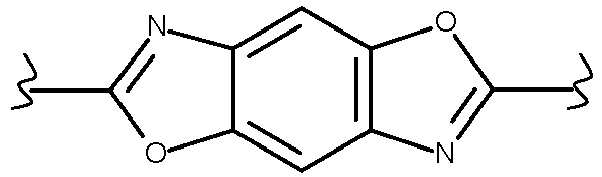


- If n=1 or 2 and the E-group is


- If n=1 or 2 and the E-group is -CH2-CH2-C(O)-, Q is selected from the group of -O-Y, -NR2-Y, as a special variation of NR2-Y the


If Q is the -O-Y or the -O-Z-O- group for n=1 or 2 and E = -CH2-CH2-C(O)- the inventive functionalized cyclic carbonates carry as special functional group an ester group. - If Q is selected from the group of -NR2-Y group, the


If Q is the -O-Y group and Y is H the functionalized cyclic carbonates carry as special functional group an acid group. The resulting acids are selected from the group of (E/Z)-3-(2-(2-oxo-1,3-dioxolan-4-ylidene)ethoxy)propanoic acid and (E/Z)-3((1-(5-methyl-2-oxo-1,3-dioxolan-4-ylidene)porpan-2-yl)oxy)propanoic acid.
As well for the esters as for the amides Y is selected from the group of substituted or unsubstituted C1-C40 alkyl groups, substituted or unsubstituted saturated or unsaturated C3-C40 cycloalkyl groups, substituted or unsubstituted C2-C40 (poly)ether groups, substituted or unsubstituted saturated or unsaturated heterocyclic groups containing 2 to 20 carbon atoms and one or more heteroatoms selected from the group of N, O, and S as ring members, substituted or unsubstituted saturated or unsaturated alkylenheterocyclic groups containing 3 to 20 carbon atoms and one or more heteroatoms selected from the group of N, O, and S as ring members, substituted or unsubstituted C6-C40 aryl groups, substituted or unsubstituted C2-C40 alkenyl groups, substituted or unsubstituted C2-C40 alkynyl groups, substituted or unsubstituted saturated or unsaturated C3-C40 alkylencycloalkyl groups, substituted or unsubstituted C7-C40 alkylenaryl groups, substituted or unsubstituted α,β- unsaturated carbonyl groups containing C3-C40 atoms, substituted or unsubstituted C2-C5 keto groups and substituted or unsubstituted C1-C4 alkylen group which is part of a substituted or unsubstituted saturated heterocyclic group that is build up between R2 of the -NR2- group and Y to form
- As well for the esters as for the amides Z is selected from the group of substituted or unsubstituted C1-C40 alkylen groups, divalently substituted or unsubstituted C2-C40 (poly)ether groups, divalently bonded substituted or unsubstituted C3-C40 cycloalkyl groups, divalently bonded substituted or unsubstituted heterocyclic groups containing 2 to 20 carbon atoms and one or more heteroatoms selected from the group of N, O, and S as ring members, divalently bonded substituted or unsubstituted alkylenheterocyclicalkylen groups containing 4 to 20 carbon atoms and one or more heteroatoms selected from the group of N, O, and S as ring members, divalently bonded substituted or unsubstituted C6-C40 aryl groups, divalently bonded substituted or unsubstituted C7-C40 cycloalkylalkylencycloalkyl groups, divalently bonded substituted or unsubstituted saturated or unsaturated C5-C-40 alkylencycloalkylalkylen groups, divalently bonded substituted or unsubstituted C13-C40 arylalkylenaryl groups, divalently bonded substituted or unsubstituted C8-C40 alkylenarylalkylen groups and divalently bonded substituted or unsubstituted C17-C30 alkylen-bisphenol A -alkylen groups.
- In

- Preferred inventive functionalized cyclic carbonates with an ester functional group are selected from the group where n=1 or 2 and E = -CH2-CH2-C(O)- and wherein Y in the -O-Y group is selected from the group of substituted or unsubstituted C1-C40 alkyl groups, substituted or unsubstituted saturated or unsaturated C3-C40 cycloalkyl groups, substituted or unsubstituted saturated alkylenheterocyclic groups containing 3 to 20 carbon atoms and one or more heteroatoms selected from the group of N, O, and S as ring members, unsubstituted, saturated C3-C40 alkylencycloalkyl groups and
Z which is selected from the group of substituted or unsubstituted C1-C40 alkylen groups, divalently bonded substituted or unsubstituted C3-C40 cycloalkyl groups, divalently bonded substituted or unsubstituted heterocyclic groups containing 2 to 20 carbon atoms and one or more heteroatoms selected from the group of N, O, and S as ring members, divalently bonded saturated or unsaturated substituted or unsubstituted C5-C40 alkylencycloalkylalkylen groups and divalently bonded substituted or unsubstituted C17-C30 alkylen-bisphenol A- alkylen groups.
More preferred is Y in the -O-Y group for the inventive functionalized cyclic carbonates with an ester functional group for n=1 selected from the group of substituted or unsubstituted C1-C10 alkyl groups, substituted or unsubstituted saturated or unsaturated C4-C11 cycloalkyl groups, substituted or unsubstituted saturated alkylenheterocyclic groups containing 3 to 10 carbon atoms and one or more O-atoms as heteroatom and as ring members, unsubstituted, saturated C8-C12 alkylencycloalkyl groups. Most preferred is Y in the -O-Y group for the inventive functionalized cyclic carbonates with an ester functional group for n=1 selected from the group of tert.-butyl, n-propyl, 2,2-dimethylpropan-3-yl-1-ol, 2-hydroxylpropyl, isobornyl, bornyl, menthyl, ter-pinyl, dihydrodicyclopentadienyl, cyclopentenyl, cyclohexanyl, norbornenyl, 3,3,5-Trimethylcyclohexanyl, 4-tert.-Butylcyclohexyl, 4-methylen-1,3-dioxolan, 4-methylen-2,2,dimethyl-1,3-dioxolan and 3-methylen-3-ethyl-1-oxetan.
More preferred is Z in the -O-Z-O- group for the inventive functionalized cyclic carbonates with an ester functional group for n=2 selected from the group of substituted C3-C40 alkylen groups, divalently bonded substituted C3-C10 cycloalkyl groups, divalently bonded unsubstituted heterocyclic groups containing 3 to 10 carbon atoms and one or more -O-atoms as heteroatoms and as ring members, divalently bonded saturated unsubstituted C5-C14 alkylencycloalkylalkylen groups and divalently bonded unsubstituted C17-C25 alkylen-bisphenol A-alkylen groups. Most preferred is Z in the -O-Z-O- group for the inventive functionalized cyclic carbonates with an ester functional group for n=2 selected from the group of 2,2-dimethyl-propan-1,3-diyl, 2,2,4,4-Tetramethylcyclobutan-1,3-diyl, Tricyclo[5.2.1.026]decan-4,8-dimethylen, hexahydro-furo[3,2-b]furan-3,6-yl and Bisphenol A -bis(2-hydroxypropy-3-diyl)ether. - Preferred inventive functionalized cyclic carbonates with an amide functional group are selected from the group where n=1 or 2 and E = -CH2-CH2-C(O)- and wherein Y in the -NR2-Y group is selected from the group of substituted or unsubstituted C1-C40 alkyl groups,

and wherein in the
More preferred is Y in the -NR2-Y group for the inventive functionalized cyclic carbonates with an amide functional group for n=1 selected from the group of OH-substituted C2-C5 alkyl group, keto- and alkyl-substituted C3-C10 alkyl group, OH-substituted C6-C40 aryl groups. Most preferred is Y in the -NR2-Y group for the inventive functionalized cyclic carbonates with an amide functional group for n=1 selected from the group of methylhydroxid, eth-2yl-hydroxid, 2-Methylpropan-2yl-3- ol, 2-Hydroxypropyl, 2-methoxy-1,1-dimethylethyl and p-Hydroxyphenyl, with R2 selected from the group of H and 2-Hydroxypropyl.
More preferred is Z in the -NR2-Z-NR2- and -NR2-Z-O- group for the inventive functionalized cyclic carbonates with an amide functional group for n=2 selected from the group of unsubstituted C1-C40 alkylen groups, divalently bonded substituted or unsubstituted C6-C40 aryl groups and divalently bonded unsubstituted alkylenheterocyclicalkylen groups containing 4 to 20 carbon atoms and one or more heteroatoms selected from the group of N, O, and S as ring members. Most preferred is Z in the -NR2-Z-NR2- and -NR2-Z-O- group for the inventive functionalized cyclic carbonates with an amide functional group for n=2 selected from the group of methylen, ethylene, 1,3-phenyl, 2,5-Dihydroxy-1,4-phenyl, 2,5-dimethylentetrahydrofuran and 2,5-dimethylenfuran with R2= H. - More preferred is M = -CH2-CH2- and R3 and R4= H with m= 2 in the

- Preferred inventive functionalized cyclic carbonates of formula (I) with multivalent ester or amide groups as special functional groups carry an -CH2-CH2-C(O)- group as E, n is selected from the group of 3 and ≥ 4 and Q is selected from the group of a substituted or unsubstituted


- g
- is a natural number selected from 1 to 33,
- k
- is a natural number selected from 1 to 12,
- h
- is a natural number selected from 1 to 15,
- p
- is a natural number selected from 1 to 3 and
- q
- is a natural number selected from 1 to 5, wherein the sum of C-atoms in the groups with g, k, h, p and q is not higher than 40.
- For n=3, Q is preferably selected from the group of with three -C(O)-CH2-CH2-O-CHR1-C≡C-CHR1-OH groups substituted 1,3,5-triazinan, the group where g= 1-4 and k = 1-3, the group where h =1-15 and k =1-3 and the group where g = 1-4, p = 1-3 and q =1-3. More preferably for n=3 Q is selected from the group of with three -C(O)-CH2-CH2-O-CHR1-C≡C-CHR1-OH groups substituted 1,3,5-triazinan, the group where g=1 and k=1, the group where h= 1, k=1, the group where g=1, p=1 and q=3.
For n≥ 4, preferably n = 4 or 6, Q is preferably selected from the group of
- In order to produce the inventive cyclic carbonates of formula (I) the alkynyl ether compounds of formula (II) are reacted with carbon dioxide in the presence of at least one transition metal catalyst TMC1 which comprises Ag as transition metal and at least one bulky ligand selected from the group of compounds of formula (III) and compound of formula (IV)
- The transition metal catalyst TMC1 of the process of the invention can be employed in the form of a preformed metal complex which comprises Ag and at least one bulky ligand selected from the group of ligands consisting of compounds of formula (III) or compounds of formula (IV), preferably compounds of formula (III), as shown above. Alternatively, the transition metal catalyst TMC1 is formed in situ in the reaction medium by combining an Ag compound, herein also termed pre-catalyst, which does not comprise any bulky ligand, with one or more suitable bulky ligand to form a catalytically active Ag complex, the transition metal catalyst TMC1, in the reaction medium. In case the bulky ligand is a N-heterocyclic carbene ligand (NHC-ligand) of formula (IV), it is also possible that the transition metal catalyst TMC1 is formed in situ in the reaction medium by combining a pre-catalyst with one or more NHC-precursor, in particular the protonated form of a NHC-ligand, which is in situ converted to the corresponding NHC-ligand of formula (IV), to form a catalytically active Ag complex in the reaction medium.
- In one embodiment of the present invention, the inventive process is characterized in that the transition metal catalyst TMC1 is prepared in situ by using an Ag compound, which does not comprise any bulky ligand, the compound of formula (III) or formula (IV) as bulky ligand or the protonated form of the compound of formula (IV) represented by formula (V),

- Suitable bases for deprotonating the protonated form of different NHC ligands according to formula (V) are described by de Frémont et al., Coordination Chemistry Reviews 253 (2009) 876 to 881. The deprotonation of the protonated forms of NHC ligands can be carried out in ammonia or in non-protic solvents such as THF or ethers. The deprotonation requires anhydrous conditions and the use of strong bases, with pKa values above 14. Usually, potassium or sodium hydride with a catalytic amount of tert-butoxide is employed, but tert-butoxide itself, lithium aluminum hydride, n-butyllithium, MeLi, t-BuLi, potassium hexamethyldisilazide (KHMDS) and 1,8-diazabicyclo[5.4.0]undec-7-ene (DBU) are also efficient alternatives.
- Suitable pre-catalysts are selected from neutral metal complexes, oxides and salts of Ag. More preferred silver compounds that are useful as pre-catalyst are selected from the group of Ag(OAc), AgF, AgNO3, silver trifluoroacetate, Ag2O and Ag2CO3. Most preferred silver compounds, also called pre-catalyst, are selected from the group of AgOAc, AgF, Ag2O and Ag2CO3.
- In addition to the transition metal, the transition metal catalyst TMC1 comprises at least one bulky ligand selected from the group of ligands of compounds of formula (III) and compounds of formula (IV), preferably compounds of formula (III).

- In case the bulky ligand is a compound of formula (III),

- D
- is selected from the group of P, As or Sb, preferably P or As, in particular P,
- R10
- is selected from the group of a substituted or unsubstituted C3-C40 cycloalkyl group, a substituted or unsubstituted C2-C40 heterocycloalkyl group, a substituted or unsubstituted C6-C40 aryl group, a substituted or unsubstituted C2-C40 heteroaromatic group, a substituted or unsubstituted C3-C40 cycloalkoxy group, a substituted or unsubstituted C2-C40 heterocycloalkoxy group, a substituted or unsubstituted C6-C40 aryloxy group and a substituted or unsubstituted C2-C40 heteroaryloxy group, in particular R10 is a substituted or unsubstituted C3-C40 cycloalkyl group, a substituted or unsubstituted C2-C40 heterocycloalkyl group, a substituted or unsubstituted C6-C40 aryl group or a substituted or unsubstituted C2-C40 heteroaromatic group, even more preferably R10 is a substituted or unsubstituted C6 to C40 aryl group or a substituted or unsubstituted C2 to C40 heteroaromatic group, if R10 is a substituted ring cyclus of the one mentioned above, R10 is preferably substituted in at least one of the two ortho position of the ring cyclus relative to D with a group R10a,
wherein R10a is selected form the group of substituted or unsubstituted C6-C34 aryl group, substituted or unsubstituted C1-C10 alkoxy group, substituted or unsubstituted C2-C12 dialkylamino group and where R10a forms with an adjacent group substituting R10 in the meta position of the ring cyclus together with the atoms connecting them a monocyclic or polycyclic, substituted or unsubstituted aliphatic, aromatic or heteroatom comprising ring system comprising 4 to 40 carbon atoms wherein the heteroatoms are selected from the group of Si, Ge, N, P, O and S, more preferably R10a is selected from the group of methoxy, ethoxy, isopropoxy or cyclohexyloxy, dimethyl amino, diethyl amino, di-isopropyl amino, N-morpholinyl and N-piperidyl, and
R11, R12 are independently of each other selected from the group of substituted or unsubstituted C1-C40 alkyl groups, substituted or unsubstituted C3-C40 cycloalkyl group, substituted or unsubstituted C1-C12 terminal alkoxy groups, substituted or unsubstituted C3-C20 heterocycloalkyl groups, substituted or unsubstituted C6-C40 aryl groups, substituted or unsubstituted C2-C40- heteroaromatic groups, substituted or unsubstituted C6-C10 fluoroaryl groups, substituted or unsubstituted C2-C20 alkynyl groups and substituted or unsubstituted C7-C40- alkylenaryl groups, preferably R11 and R12 are independently of each other selected from the group of a substituted or unsubstited C3-C20 cycloalkyl, a substituted or unsubstituted C2-C20 heterocycloalkyl, a substituted or unsubstituted C3-C20 alkyl and substituted or unsubstituted C6-C14 aryl groups, more particular R11 and R12 are independently of each other selected from the group of tert.-butyl, adamantly, cyclohexyl and phenyl, much more particular R11 and R12 are identical. - In case the bulky ligand is a compound of formula (IV),

- R13 and R14
- are independently of each other selected from the group of substituted or unsubstituted C1-C40 alkyl groups, substituted or unsubstituted C3-C40 cycloalkyl group, substituted or unsubstituted C1-C12 terminal alkoxy groups, substituted or unsubstituted C3-C40 cycloalkoxy group, substituted or unsubstituted C3-C20 heterocycloalkyl groups, a substituted or unsubstituted C2-C40 heterocycloalkoxy group, substituted or unsubstituted C6-C40 aryl groups, substituted or unsubstituted C6-C40 aryloxy group, substituted or unsubstituted C2-C40- heteroaromatic groups, substituted or unsubstituted C6-C10 fluoroaryl groups, substituted or unsubstituted C2-C20 alkynyl groups and substituted or unsubstituted C7-C40- alkylenaryl groups, preferably R13 and R14 are independently of each other selected from the group of substituted or unsubstituted C1-C40 alkyl groups, substituted or unsubstituted C1-C12 alkoxy groups, substituted or unsubstituted C3-C20 heterocycloalkyl groups, substituted or unsubstituted C6-C40 aryl groups, substituted or unsubstituted C2-C40- heteroaromatic groups, substituted or unsubstituted C6-C10 fluoroaryl groups, substituted or unsubstituted C2-C20 alkynyl groups and substituted or unsubstituted C7-C40- alkylenaryl groups wherein R13 and/or R14 is substituted in at least one of the two ortho positions relative to N with R13a or R14a, wherein R13a and R14a are independently of each other are a substituted or unsubstituted C1-C10 alkyl group more preferably an isopropyl group.
- W
- is a divalent bridging group selected from -CR15=CR16-, -CR15=N-, -CR15R17-CR16R18- and -CR15R17-CR16R18-CR19R20-, wherein
R15, R16 R17, R18, R19 and R20 are independently from each other hydrogen, substituted or unsubstituted C1-C40 alkyl groups, substituted or unsubstituted C3-C40 cycloalkyl group, substituted or unsubstituted C1-C12 terminal alkoxy groups, substituted or unsubstituted C3-C40 cycloalkoxy group, substituted or unsubstituted C3-C20 heterocycloalkyl groups, substituted or unsubstituted C2-C40 heterocycloalkoxy group, substituted or unsubstituted C6-C40 aryl groups, substituted or unsubstituted C6-C40 aryloxy group, substituted or unsubstituted C2-C40- heteroaromatic groups, substituted or unsubstituted C6-C10 fluoroaryl groups, substituted or unsubstituted C2-C20 alkynyl groups, substituted or unsubstituted C7-C40- alkylenaryl groups and two adjacent groups R15 and R16 and/or R18 and R19 together with the atoms connecting them of the group W build up a monocyclic or polycyclic, substituted or unsubstituted, aliphatic, aromatic or heteroatom comprising carbon ring system containing 4 to 40 carbon atoms and wherein the heteroatom comprising carbon ring system comprises one or more heteroatoms selected from the group of Si, Ge, N, P, O and S as ring members, preferably R15, R16 R17, R18, R19 and R20 are identical, more preferably R15, R16 R17, R18, R19 and R20 are H. - In one embodiment of the present invention, the inventive process is characterized in that the bulky ligand is selected from a compound of formulas A' to P and mixtures thereof, preferably a compound of formulas A' to D and mixtures thereof.


- In one embodiment of the present invention, the inventive process is characterized in that the transition metal catalyst TMC1 is selected from a compound of the following formulas.
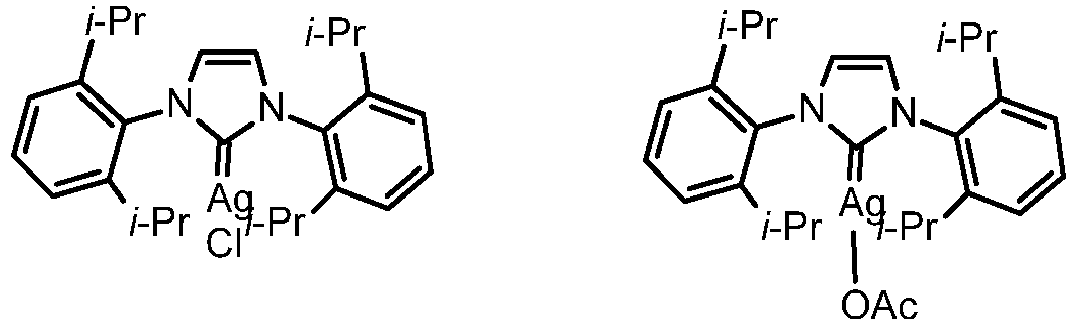
- In one embodiment of the present invention, the inventive process is characterized in that the molar ratio of the bulky ligand to the transition metal of transition metal catalyst TMC1 is in the range from 0.4 to 1.2.
- In the inventive process the amount of transition metal catalyst TMC1 used in process step a) based on the amount of alkynyl ether compound of (II) can be varied in a wide range. Usually, the transition metal catalyst TMC1 is used in a sub-stoichiometric amount relative to the alkynyl ether compound of formula (II). Typically, the amount of transition metal catalyst TMC1 is not more than 50 mol%, frequently not more than 20 mol% and in particular not more than 10 mol% or not more than 5 mol%, based on the amount of alkynyl ether compound of formula (II). An amount of transition metal catalyst TMC1 of from 0.001 to 50 mol%, frequently from 0.001 mol% to 20 mol% and in particular from 0.005 to 5 mol%, based on the amount the alkynyl ether compound of formula (II) is preferably used in the process of the invention. Preference is given to using an amount of transition metal catalyst TMC1 of from 0.01 to 5 mol%. All amounts of transition metal complex catalyst indicated are calculated as transition metal and based on the amount of alkynyl ether compound of formula (II).
- In one embodiment of the present invention, the inventive process is characterized in that the amount of transition metal catalyst TMC1 used in process step a) based on the amount of alkynyl ether compound of formula (II) is in the range from 0.005 to 5 mol%.
- The CO2 used for the carboxylation-cyclisation reaction can be used in pure form or, if desired, also in the form of mixtures with other, preferably inert gases, such as nitrogen or argon. Preference is given to using CO2 in undiluted form.
- The reaction is typically carried at a CO2 pressure in the range from 0.1 to 200 bar, preferably in the range from 1 to 50 bar, more preferably in the range from 1 to 40 bar.
- In one embodiment of the present invention, the inventive process is characterized in that the process step a) is performed at a pressure in the range from 1 to 50 bar, more preferably in the range from 1 to 40 bar.
- The reaction can principally be performed continuously, semi-continuously or discontinuously. Preference is given to a continuous process.
- The reaction can principally be performed in all reactors known by a person in the art for this type of reaction and therefore, will select the reactors accordingly. Suitable reactors are described and reviewed in the relevant prior art, e.g. appropriate monographs and reference works such as mentioned in
US 6639114 B2 , column 16, line 45-49. Preferably, for the reaction an autoclave is employed which may have an internal stirrer and an internal lining. - The composition obtained in the carboxylation-cyclisation reaction of the present invention comprises an unsubstituted exo-vinylene carbonate, that is a cyclic carbonate of formula (I).
- Process step a) of the inventive process can be performed in a wide temperature range. Preferably process step a) is performed at a temperature in the range preferably in the range from 0 °C to 150 °C and particularly preferably in the range from 10°C to 80 °C. Temperatures below 100 °C have surprisingly been found to be particularly advantageous.
- In one embodiment of the present invention, the inventive process is characterized in that the process step a) is performed at a temperature in the range from 0 °C to 100 °C, preferably in the range from 10°C to 80 °C.
- The process of the invention can be carried out in the presence of a solvent. Suitable solvents are selected from aliphatic hydrocarbons, aromatic hydrocarbons, halogenated hydrocarbons, amides, ureas, nitriles, sulfoxides, sulfones, esters, carbonates, ethers, alcohols and mixtures thereof. Preferred solvents are
- aliphatic hydrocarbons such as pentane, hexane, heptane, octane or cyclohexane;
- aromatic hydrocarbons such as benzene, toluene, xylenes, ethylbenzene, mesitylene or benzotrifluoride;
- halogenated hydrocarbons such as dichloromethane,
- amides such as dimethylformamide, diethylformamide, N-methylpyrrolidone, N-ethylpyrrolidone or dimethylacetamide;
- ureas such as tetramethylurea, N,N-dimethylimidazolinone (DMI) and N,N-dimethylpropyleneurea (DMPU);
- nitriles such as acetonitrile or propionitrile;
- sulfoxides such as dimethyl sulfoxide;
- sulfones such as sulfolane;
- esters such as methyl acetate, ethyl acetate, t-butyl acetate;
- carbonates such as diethyl carbonate, ethylene carbonate and propylene carbonate; and
- ethers such as dioxane, tetrahydrofuran, diethyl ether, dibutyl ether, methyl t-butyl ether, diisopropyl ether or diethylene glycol dimethyl ether;
- If desired, mixtures of two or more of the afore-mentioned solvents can also be used.
- Preference is given to using dichloromethane, acetone, dimethylformamide or acetonitrile as solvents.
- In one embodiment of the present invention, the inventive process is characterized in that the reaction is carried out in the presence of a solvent selected from aliphatic hydrocarbons, aromatic hydrocarbons, halogenated hydrocarbons, amides, ureas, nitriles, sulfoxides, sulfones, esters, carbonates, ethers, alcohols and mixtures thereof, preferably selected from dichloromethane, acetone, dimethylformamide or acetonitrile.
- Alternatively, the process of the invention can be carried out in the absence of any of the above-mentioned organic solvent, so-called neat conditions, preferably in the presence of liquid or supercritical carbon dioxide, in particular in the presence of supercritical carbon dioxide.
- Alternatively, the process of the invention can be carried out in the presence of liquid or supercritical carbon dioxide, in particular in the presence of supercritical carbon dioxide, which is mixed with one of the above-mentioned organic solvent, so-called CO2-expanded solvents.
- The composition obtained in the carboxylation-cyclization of the invention comprises an unsubstituted exo-vinylene carbonate, the cyclic carbonate of formula (I).
- The work-up of the reaction mixture of the inventive process and the isolation of the cyclic carbonate of formula (I) is effected in a customary manner, for example by filtration, an aqueous extractive work-up or by a distillation, for example under reduced pressure. The cyclic carbonate of formula (I) may be obtained in sufficient purity by applying such measures or a combination thereof, obviating additional purification steps. Alternatively, further purification can be accomplished by methods commonly used in the art, such as chromatography.
- In one embodiment of the present invention, the inventive process is characterized in that the cyclic carbonates of formula (I) are separated from the transition metal catalyst TMC1 after process step a) via distillation, extraction, precipitation and/or crystallization.
- The distillation residue usually still comprises the transition metal catalyst TMC1 in an active form, that can be reused in a new carboxylation-cyclisation reaction step, that is a new process step a. As long as the distillation conditions, in particular the temperature treatment, are not too harsh, the transition metal catalyst TMC1 remains active.
- In one embodiment of the present invention, the inventive process is characterized in that the transition metal catalyst TMC1 is recycled to the reaction step a) after the cyclic carbonate of formula (I) was removed via distillation, extraction, precipitation and/or crystallization.
- The cyclic carbonates of formula (I), which are prepared according to the inventive process show a high purity and are advantageously used in applications such as monomer in polymerization reactions
- A further aspect of the invention is the use of the cyclic carbonates of formula (I) prepared according to the above described inventive process as precursors in polymerization reactions with compounds comprising OH-group, primary amino and/or secondary amino groups.
- The inventive process for preparing cyclic carbonates of formula (I) allows not only the preparation of known compounds (e.g. R2 = H) but also the preparation of new compounds, which can be used as precursor of monomers in polymerization reactions or as building blocks in the synthesis of active compounds for pharmaceutical or agricultural applications.
-

- 2-Butyne-1,4-diol (537 g, 6.24 mol, 10.0 eq.) was placed in a 2 L three-neck flask and dissolved in 600 mL 1,4-dioxane. The mixture was heated to 60 °C. When 2-butyne-1,4-diol was completely dissolved, DBU (19.0 g, 125 mmol, 18.6 mL, 0.20 eq.) was added. tert-Butyl acrylate (80.0 g, 624 mmol, 91.0 mL, 1.00 eq.) was mixed with 100 mL 1,4-dioxane and was added via dropping funnel over a period of 1 h. The reaction mixture was then stirred at 60 °C for 24 h. The solvent was removed under reduced pressure. The residue was dissolved in a mixture of water and ethyl acetate (1:1 v/v, 600 mL). The aqueous phase was separated and extracted twice with ethyl acetate (2 * 200 mL). The combined organic phases were then washed with distilled water (4 * 500 mL). The organic phase was dried over sodium sulfate and the solvent was removed under reduced pressure. The product tBuA-BYD (tert.-Butyl-3-(4-hydroxybut-2-nyoxy)propanoate) was obtained as yellow-brown liquid. It was redissolved in 200 mL acetonitrile, treated with activated carbon, filtered over a silica plug and isolated as a yellow liquid (108 g, 625 mmol, 81%).
-

- To a solution of tBuA-BYD (tert.-Butyl-3-(4-hydroxybut-2-nyoxy)propanoate) (20.5 g, 27.6 mmol), DavePhos (2-Dicyclohexylphospino- 2'-(N,N-dimethylamino)-biphenyl) (1.94 g, 4.78 mmol) and AgOAc (0.81 g, 4.8 mmol) in DCM (130 ml) was charged to a steel autoclave under atmospheric conditions. The equipment was sealed, and the reaction mixture was pressurized with CO2 (20 bar) and stirred at room temperature. After 24 hours, CO2 overpressure was carefully released, and SiOz (30 g) was added. The mixture was filtrated by glass filter and washed with EtOAc. The reaction mixture was washed with water, and the organic phase was dried over anhydrous MgSO4. The solvent was removed under reduced pressure, and the crude product (tert.-Butyl-3-[2-(2-oxo-1,3-dioxolan-4-ylidene)ethoxy]propanoate) was purified by Kugelrohr distillation (0.001 mbar, 130-145 °C) to give the product (15.1 g, 61%).
-

- To a solution of tBuA-exoVC (tert.-Butyl-3-[2-(2-oxo-1,3-dioxolan-4-ylidene)ethoxy]propanoate) (14.6 g, 53.7 mmol) in acetonitrile (1400 ml) was added 4 M HCl in Dioxane (134 g, 537 mmol) at room temperature, and the mixture was stirred for 1 hour. The solvent was removed under reduced pressure. The crude product was dissolved by MIBK (Methylisobutylketon) (25 ml), and hexane (40 ml) was added to precipitate as oil. The solvent was removed by decantation, and the product (3-[2-(2-oxo-1,3-dioxolan-4-ylidene)ethoxy]propanoic acid) was dried under reduced pressure to give the product (10.7 g, 98%).
-

- To a solution of COOH-exoVC (3-[2-(2-oxo-1,3-dioxolan-4-ylidene)ethoxy]propanoic acid) (7.60 g, 35.7 mmol) and Magnesium perchlorate (0.19 g, 0.85 mmol) in acetonitrile (20 ml) was added hexamethylene diisocyanate (2.86 g, 17.0 mmol) at room temperature. The reaction mixture was stirred for 22 hours at room temperature. The reaction was quenched by water, and the mixture was extracted with DCM and the organic phase was dried over anhydrous MgSO4. The solvent was removed under reduced pressure, and the crude product (3-[2-(2-oxo-1,3-dioxolan-4-ylidene)ethoxy]-N-[6-[3-[2-(2-oxo-1,3-dioxolan-4-ylidene)ethoxy]propanoylamino]hexyl]propanamide) was purified by silica gel chromatography to give the product (3.0 g, 31%).
-

- To a solution of nPrA-BYD (Propyl-3-(3-hydroxyprop-2-ynoxy)propanoate) (5.52 g, 27.6 mmol), DavePhos (0.56 g, 1.4 mmol) and AgOAc (0.23 g, 1.4 mmol) in DCM (120 ml) was charged to a steel autoclave under atmospheric conditions. The equipment was sealed, and the reaction mixture was pressurized with CO2 (20 bar) and stirred at room temperature. After 48 hours, CO2 overpressure was carefully released, and SiO2 (30 g) was added. The mixture was filtrated by glass filter and washed with DCM and acetonitrile. The reaction mixture was washed with water, and the organic phase was dried over anhydrous MgSO4. The solvent was removed under reduced pressure, and the crude product (propyl 3-[2-(2-oxo-1,3-dioxolan-4-ylidene)ethoxy]propanoate) was purified by Kugelrohr distillation (0.001 mbar, 124-140 °C) to give the product (1.1 g, 16%).
for compounds of formula (I) with n = 1, E = -CH2-CH2-C(O)- and Q = -OH and compounds of formula (I) with n = 2, E= -CH2-CH2-C(O)- and Q= -NH-C2-C8-alkyl-NH-, the compounds of formula (I) with n=1, E= -CH2-CH2-C(O)- and Q = tert-butyl which are received after step a) and b) wherein an alkynylether compound of formula (II) with n =1, E = -CH2-CH2-C(O)- and Q = tert-butyl is used in step a) the resulting compound of formula (I) with n =1, E = -CH2-CH2-C(O)- and Q = tert-butyl after step b) will be hydrolysis with an acid selected from the group of anorganic acids and heterogene acid compounds to receive the compound of formula (I) with n = 1, E = -CH2-CH2-C(O)- and Q = -OH which will be purified by extraction and crystallization and the resulting product will react with an diisocyanate containing 2 to 13 C- atoms to receive the compound of formula (I) with n = 2, E=-CH2-CH2-C(O)- and Q= -NH-C2-C8-alkyl-NH-.
Claims (24)
- Functionalized cyclic carbonates with an exocyclic vinylidene group of formula (I)
 n is a natural number selected from the 1 to 10,R1 is selected from the group of H and methyl,E is selected from the group of -CH2-CH2-, -CH2-CH2-C(O)-, and
 Q is dependent on n and Efor n=1 and E= -CH2-CH2-Q is selected from the group of -CN and substituted or unsubstituted
 for n=1 and E= -CH2-CH2-C(O)-Q is selected from the group of -O-Y, -NR2-Y and
 for n=1 and E=
 Q is selected from the group of substituted or unsubstituted C6-C40 aryl groups,for n=2 and E= -CH2-CH2-Q is selected from the group of a divalent bonded sulfone (-S(O)2-) group, a divalent substituted or unsubstituted
 for n=2 and E= -CH2-CH2-C(O)-Q is a divalent -A- group,for n=2 and E=
 Q is selected from the group of divalently bonded substituted or unsubstituted C4-C10 alkylen groups, divalently bonded substituted or unsubstituted phenyl divalently bonded substituted or unsubstituted C13-C40 arylalkylenaryl groups and divalently bonded substituted or unsubstituted C8-C40 alkylenarylalkylen groups,for n=3 and E= -CH2-CH2-C(O)-Q is selected from the group of a substituted or unsubstituted


whereing is a natural number selected from 1 to 33,k is a natural number selected from 1 to 12,h is a natural number selected from 1 to 15,p is a natural number selected from 1 to 3 andq is a natural number selected from 1 to 5,for n≥4 and E= -CH2-CH2-C(O)-Q is selected from the group of
 with R2 selected from the group of H, substituted or unsubstituted C1-C40 alkyl groups, substituted or unsubstituted C3-C40 cycloalkyl groups, substituted or unsubstituted saturated or unsaturated heterocyclic groups containing 2 to 20 carbon atoms and one or more heteroatoms selected from the group of N, O, and S as ring members, substituted or unsubstituted C6-C40 aryl groups, substituted or unsubstituted C2-C40-alkenyl groups, C2-C40 alkynyl groups, substituted or unsubstituted C4-C40 alkylencycloalkyl groups and substituted or unsubstituted C1-C4- alkylen groups to be a part of a substituted or unsubstituted saturated or unsaturated heterocyclic group that is built up between R2 of the -NR2- group and Y which is not H to form
 with Y is selected from the group of H, substituted or unsubstituted C1-C40 alkyl groups, substituted or unsubstituted saturated or unsaturated C3-C40 cycloalkyl groups, substituted or unsubstituted C2-C40 (poly)ether groups, substituted or unsubstituted saturated or unsaturated heterocyclic groups containing 2 to 20 carbon atoms and one or more heteroatoms selected from the group of N, O, and S as ring members, substituted or unsubstituted saturated or unsaturated alkylenheterocyclic groups containing 3 to 20 carbon atoms and one or more heteroatoms selected from the group of N, O, and S as ring members, substituted or unsubstituted C6-C40 aryl groups, substituted or unsubstituted C2-C40 alkenyl groups, substituted or unsubstituted C2-C40 alkynyl groups, substituted or unsubstituted saturated or unsaturated C3-C40 alkylencycloalkyl groups, substituted or unsubstituted C7-C40 alkylenaryl groups, substituted or unsubstituted α,β- unsaturated carbonyl groups containing C3-C40 atoms, substituted or unsubstituted C2-C5 keto groups, and substituted or unsubstituted C1-C4 alkylen group which is part of a substituted or unsubstituted saturated heterocyclic group that is built up between R2 of the -NR2- group and Y which is not H to form
 with -A- is one of the following bridging groups:
-X1-Z-X2-
or wherein X1, X2 are independently selected from -O-, and -NR2- andZ is selected from the group of substituted or unsubstituted C1-C40 alkylen groups, divalently substituted or unsubstituted C2-C40 (poly)ether groups, divalently bonded substituted or unsubstituted C3-C40 cycloalkyl groups, divalently bonded substituted or unsubstituted heterocyclic groups containing 2 to 20 carbon atoms and one or more heteroatoms selected from the group of N, O, and S as ring members, divalently bonded substituted or unsubstituted alkylenheterocyclicalkylen groups containing 4 to 20 carbon atoms and one or more heteroatoms selected from the group of N, O, and S as ring members, divalently bonded substituted or unsubstituted C6-C40 aryl groups, divalently bonded substituted or unsubstituted C7-C40 cycloalkylalkylencycloalkyl groups, divalently bonded substituted or unsubstituted saturated or unsaturated C5-C-40 alkylencycloalkylalkylen groups, divalently bonded substituted or unsubstituted C13-C40 arylalkylenaryl groups, divalently bonded substituted or unsubstituted C8-C40 alkylenarylalkylen groups and divalently bonded substituted or unsubstituted C17-C30 alkylen-bisphenol A -alkylen groups andR3 and R4 are independently selected from the group of H and substituted or unsubstituted C1-C40 alkyl groups,m is a natural number selected from the group of 1, 2 or 3 andM is selected from the group of substituted or unsubstituted C1-C3 alkylen groups, divalently bonded -NR5-CR3R4- groups, divalently bonded -NR5-NR6- groups, divalently bonded-NR5-CR3R4-CR3R4- groups, divalently bonded -O-CR3R4-CR3R4- groups, divalently bonded -S-CR3R4-CR3R4- groups, divalently bonded CR3R4-O-CR3R4 groups, divalently bonded -CR3R4-S-CR3R4- groups and divalently bonded -CR3R4-NR5-CR3R4- groupswith R5 and R6 are independently selected from the group of H, substituted or unsubstituted C1-C40 alkyl groups, C6-C40 aryl groups, C3-C40 cycloalkyl groups and -C(O)CH=CH2 group.
 - The functionalized cyclic carbonates according to claim 1 wherein E = -CH2-CH2- , n is selected from the group of 1 and 2 and Q is selected from the group of -CN, with C1-C4 alkylgroups or C1-C4 alkylhydroxy groups substituted


- The functionalized cyclic carbonates according to claim 1, wherein E =

- The functionalized cyclic carbonates according to claim 3 wherein Q is selected from the group of phenyl, 1,4-phenylen, 1,3-phenylen, 4-Methyl-1,3-phenylen, 2,2,4-trimethyl-1,6-hexylen, 1,3-Benzenedimethylene (meta-CH2-Ph-CH2-), bis(1,4-phenylen)methane (para-CH2-Ph-CH2-) and 3,3'-Diethyl-5,5'-dimethyl-4,4'-diphenylenmethane.
- The functionalized cyclic carbonates according to claim 1, wherein E = -CH2-CH2-C(O)-, n is selected from the group of 1 and 2 and Q is selected from the group of -O-Y and -O-Z-O-.
- The functionalized cyclic carbonates according to claim 1, wherein E = -CH2-CH2-C(O)-, n is 1, R1 is selected from H and methyl and Q is -OH.
- The functionalized cyclic carbonates according to claim 5, wherein Y is selected from the group of substituted or unsubstituted C1-C40 alkyl groups, substituted or unsubstituted saturated or unsaturated C3-C40 cycloalkyl groups, substituted or unsubstituted saturated alkylenheterocyclic groups containing 3 to 20 carbon atoms and one or more heteroatoms selected from the group of N, O, and S as ring members, substituted C3-C40 unsaturated alkylencycloalkyl groups and Z which is selected from the group of substituted or unsubstituted C1-C40 alkylen groups, divalently bonded substituted or unsubstituted C3-C40 cycloalkyl groups, divalently bonded substituted or unsubstituted heterocyclic groups containing 2 to 20 carbon atoms and one or more heteroatoms selected from the group of N, O, and S as ring members, divalently bonded saturated substituted or unsubstituted C5-C40 alkylencycloalkylalkylen groups and divalently bonded substituted or unsubstituted C17-C30 alkylen-bisphenol A - alkylen groups.
- The functionalized cyclic carbonates according to claim 1, wherein E = -CH2-CH2-C(O)-, n =1 or 2 and Q is selected from the group of -NR2-Y, the


- The functionalized cyclic carbonates according to claim 8, whereinR2 is selected from the group of H and substituted or unsubstituted C1-C40 alkyl groups,Y is selected from the group of substituted or unsubstituted C1-C40 alkyl groups and substituted or unsubstituted C6-C40 aryl groups,Z is selected from the group of substituted or unsubstituted C1-C40 alkylen groups, divalently bonded substituted or unsubstituted C6-C40 aryl groups and divalently bonded substituted or unsubstituted alkylenheterocyclicalkylen groups containing 4 to 20 carbon atoms and one or more heteroatoms selected from the group of N, O, and S as ring members,M is -CH2-CH2-,R3 and R4 are H andm is 2.
- The functionalized cyclic carbonates according to claim 1, wherein E = -CH2-CH2-C(O)-, n is 3 and Q is selected from the group of unsubstituted


 g is a natural number selected from 1 to 33,k is a 1,h is a natural number selected from 1 to 15,p is a 1 andq is a natural number selected from 1 to 5.
 - The functionalized cyclic carbonates according to claim 1, wherein E = -CH2-CH2-C(O)-, n ≥ 4 and Q is selected from the group of


- A process for the preparation the functionalized cyclic carbonates of formula (I)
 a) reacting an alkynyl ether compound of formula (II)
with carbon dioxide in the presence of at least one transition metal catalyst TMC1, which comprises Ag as transition metal and at least one bulky ligand selected from the group of compounds of formula (III) and compound of formula (IV) D is P, As or Sb;R10 is selected from the group of a substituted or unsubstituted C3-C40 cycloalkyl group, a substituted or unsubstituted C2-C40 heterocycloalkyl group, a substituted or unsubstituted C6-C40 aryl group, a substituted or unsubstituted C2-C40 heteroaromatic group, a substituted or unsubstituted C3-C40 cycloalkoxy group, a substituted or unsubstituted C2-C40 heterocycloalkoxy group, a substituted or unsubstituted C6-C40 aryloxy group and a C2-C40 heteroaryloxy group,R11 and R12 are independently of each other selected from the group of substituted or unsubstituted C1-C40 alkyl groups, substituted or unsubstituted C3-C40 cycloalkyl group, substituted or unsubstituted C1-C12 terminal alkoxy groups, substituted or unsubstituted C3-C20 heterocycloalkyl groups, substituted or unsubstituted C6-C40 aryl groups, substituted or unsubstituted C2-C40- heteroaromatic groups, substituted or unsubstituted C6-C10 fluoroaryl groups, substituted or unsubstituted C2-C20 alkynyl groups and substituted or unsubstituted C7-C40- alkylenaryl groups,R13 and R14 are independently of each other selected from the group of substituted or unsubstituted C1-C40 alkyl groups, substituted or unsubstituted C3-C40 cycloalkyl group, substituted or unsubstituted C1-C12 terminal alkoxy groups, substituted or unsubstituted C3-C40 cycloalkoxy group, substituted or unsubstituted C3-C20 heterocycloalkyl groups, a substituted or unsubstituted C2-C40 heterocycloalkoxy group, substituted or unsubstituted C6-C40 aryl groups, substituted or unsubstituted C6-C40 aryloxy group, substituted or unsubstituted C2-C40- heteroaromatic groups, substituted or unsubstituted C6-C10 fluoroaryl groups, substituted or unsubstituted C2-C20 alkynyl groups and substituted or unsubstituted C7-C40- alkylenaryl groups, andW is a divalent bridging group selected from the group of -CR15=CR16-, -CR15=N-, -CR15R17-CR16R18- and -CR15R17-CR16R18-CR19R20-, whereinR15, R16 R17, R18, R19 and R20 are independently of each other selected from the group of hydrogen, substituted or unsubstituted C1-C40 alkyl groups, substituted or unsubstituted C3-C40 cycloalkyl group, substituted or unsubstituted C1-C12 terminal alkoxy groups, substituted or unsubstituted C3-C40 cycloalkoxy group, substituted or unsubstituted C3-C20 heterocycloalkyl groups, substituted or unsubstituted C2-C40 heterocycloalkoxy group, substituted or unsubstituted C6-C40 aryl groups, substituted or unsubstituted C6-C40 aryloxy group, substituted or unsubstituted C2-C40- heteroaromatic groups, substituted or unsubstituted C6-C10 fluoroaryl groups, substituted or unsubstituted C2-C20 alkynyl groups, substituted or unsubstituted C7-C40- alkylenaryl groups and two adjacent groups R15 and R16 and/or R18 and R19 together with the rest of the group W build up a monocyclic or polycyclic, substituted or unsubstituted, aliphatic or aromatic carbon or heteroatom comprising ring system containing 4 to 40 carbon atoms and wherein the heteroatom comprising ring system comprises one or more heteroatoms selected from the group of Si, Ge, N, P, O and S as ring members.b) separating the functionalized cyclic carbonates of formula (I) via distillation, extraction, precipitation and/or crystallizationor
for compounds of formula (I) with n = 1, E = -CH2-CH2-C(O)- and Q = -OH and compounds of formula (I) with n = 2, E= -CH2-CH2-C(O)- and Q= -NH-C2-C8-alkyl-NH-, the compounds of formula (I) with n=1, E= -CH2-CH2-C(O)- and Q = tert-butyl which are received after step a) and b) wherein an alkynylether compound of formula (II) with n =1, E = -CH2-CH2-C(O)- and Q = tert-butyl is used in step a) the resulting compound of formula (I) with n =1, E = -CH2-CH2-C(O)- and Q = tert-butyl after step b) will be hydrolysis with an acid selected from the group of anorganic acids and heterogene acid compounds to receive the compound of formula (I) with n = 1, E = -CH2-CH2-C(O)- and Q = -OH which will be purified by extraction and crystallization and the resulting product will react with an diisocyanate containing 2 to 13 C- atoms to receive the compound of formula (I) with n = 2, E= -CH2-CH2-C(O)- and Q= -NH-C2-C8-alkyl-NH-. - The process according to claim 12, wherein R10 of formula (III) and R13 of formula (IV) is selected from the group of substituted or unsubstituted C6-C40 aryl group and a C2-C40 substituted or unsubstituted heteroaromatic group and R15, R16 R17, R18, R19 and R20 in formula (IV) are H.
- The process according to any of claim 12 to 13, wherein R10 is substituted in at least one of the two ortho position of the ring cyclus relative to D with a group R10a,wherein R10a is selected form the group of substituted or unsubstituted C6-C34 aryl group, substituted or unsubstituted C1-C10 alkoxy group, substituted or unsubstituted C2-C12 dialkylamino group and where R10a forms with an adjacent group substituting R10 in the meta position of the ring cyclus together with the atoms connecting them a monocyclic or polycyclic, substituted or unsubstituted aliphatic, aromatic or heteroatom comprising ring system comprising 4 to 40 carbon atoms wherein the heteroatoms are selected from the group of Si, Ge, N, P, O and S.
- The process according to any of claim 12 to 14, wherein the transition metal catalyst TMC1 is prepared in situ by using a transition metal compound, which does not comprise any bulky ligand, the compound of formula (III) or (IV) as bulky ligand or the protonated form of the compound of formula IV represented by formula (V)

- The process according to any of claim 12 to 15, wherein the transition metal compound is selected from AgOAc, AgF, Ag2O and Ag2CO3.
- The process according to any of claim 12 to 16, wherein the bulky ligand is a compound of formula (III).
- The process according to any of claim 12 to 17, wherein the bulky ligand is a compound is selected from a compound A' to P and mixtures thereof


- The process according to any of claim 12 to 18, wherein the molar ratio of the bulky ligand to the transition metal of transition metal catalyst TMC1 is in the range of 0.4 to 1.2.
- The process according to any of claim 12 to 19, wherein the amount of transition metal catalyst TMC1 used in step a) based on the amount of alkynyl ether compound of formula (II) is in the range from 0.005 to 5 mol%
- The process according to any of claim 12 to 20, wherein the pressure during step a) is in the range from 1 to 50 bar.
- The process according to any of claim 12 to 21, wherein the pressure during step a) is in the range from 0°C to 100°C.
- The process according to any of claim 12 to 22, wherein the transition metal catalyst TMC1 is recycled to step a) after step b).
- Use of the cyclic carbonates of any of claim 1 to 10 as precursors of monomers in polymer reactions.
Priority Applications (2)
| Application Number | Priority Date | Filing Date | Title |
|---|---|---|---|
| EP23185725.1A EP4495108A1 (en) | 2023-07-17 | 2023-07-17 | 3-[2-(2-oxo-1,3-dioxolan-4-ylidene)ethoxy]propanoic acid derivatives as precursors of monomers in polymerisations |
| PCT/EP2024/069297 WO2025016798A1 (en) | 2023-07-17 | 2024-07-09 | 3-[2-(2-oxo-1,3-dioxolan-4-ylidene)ethoxy]propanoic acid derivatives as precursors of monomers in polymerisations |
Applications Claiming Priority (1)
| Application Number | Priority Date | Filing Date | Title |
|---|---|---|---|
| EP23185725.1A EP4495108A1 (en) | 2023-07-17 | 2023-07-17 | 3-[2-(2-oxo-1,3-dioxolan-4-ylidene)ethoxy]propanoic acid derivatives as precursors of monomers in polymerisations |
Publications (1)
| Publication Number | Publication Date |
|---|---|
| EP4495108A1 true EP4495108A1 (en) | 2025-01-22 |
Family
ID=87377974
Family Applications (1)
| Application Number | Title | Priority Date | Filing Date |
|---|---|---|---|
| EP23185725.1A Withdrawn EP4495108A1 (en) | 2023-07-17 | 2023-07-17 | 3-[2-(2-oxo-1,3-dioxolan-4-ylidene)ethoxy]propanoic acid derivatives as precursors of monomers in polymerisations |
Country Status (2)
| Country | Link |
|---|---|
| EP (1) | EP4495108A1 (en) |
| WO (1) | WO2025016798A1 (en) |
Citations (8)
| Publication number | Priority date | Publication date | Assignee | Title |
|---|---|---|---|---|
| US4487781A (en) | 1979-07-13 | 1984-12-11 | Sankyo Company Limited | Trihaloallyl derivatives having anti-fungal activities |
| US6639114B2 (en) | 2001-02-13 | 2003-10-28 | Basf Aktiengesellschaft | Hydroformylation catalyst comprising a complex with ligands having a structure derived from bisphenol A |
| WO2011157671A1 (en) | 2010-06-15 | 2011-12-22 | Basf Se | Use of cyclic carbonates in epoxy resin compositions |
| WO2017076998A1 (en) | 2015-11-05 | 2017-05-11 | Sanofi | Novel cryptophycin compounds and conjugates, their preparation and their therapeutic use |
| WO2019034648A1 (en) | 2017-08-14 | 2019-02-21 | Basf Se | Process for preparing cyclic carbonates |
| WO2019219469A1 (en) | 2018-05-18 | 2019-11-21 | Basf Se | Monomers comprising at least one 4-(2-oxyethylidene)-1,3-dioxolan-2-one unit and use thereof |
| WO2020113233A1 (en) | 2018-11-30 | 2020-06-04 | Kymera Therapeutics, Inc. | Irak degraders and uses thereof |
| WO2021144162A1 (en) | 2020-01-15 | 2021-07-22 | Basf Se | Process for preparing cyclic carbonates with an exocyclic vinylidene group |
-
2023
- 2023-07-17 EP EP23185725.1A patent/EP4495108A1/en not_active Withdrawn
-
2024
- 2024-07-09 WO PCT/EP2024/069297 patent/WO2025016798A1/en not_active Ceased
Patent Citations (8)
| Publication number | Priority date | Publication date | Assignee | Title |
|---|---|---|---|---|
| US4487781A (en) | 1979-07-13 | 1984-12-11 | Sankyo Company Limited | Trihaloallyl derivatives having anti-fungal activities |
| US6639114B2 (en) | 2001-02-13 | 2003-10-28 | Basf Aktiengesellschaft | Hydroformylation catalyst comprising a complex with ligands having a structure derived from bisphenol A |
| WO2011157671A1 (en) | 2010-06-15 | 2011-12-22 | Basf Se | Use of cyclic carbonates in epoxy resin compositions |
| WO2017076998A1 (en) | 2015-11-05 | 2017-05-11 | Sanofi | Novel cryptophycin compounds and conjugates, their preparation and their therapeutic use |
| WO2019034648A1 (en) | 2017-08-14 | 2019-02-21 | Basf Se | Process for preparing cyclic carbonates |
| WO2019219469A1 (en) | 2018-05-18 | 2019-11-21 | Basf Se | Monomers comprising at least one 4-(2-oxyethylidene)-1,3-dioxolan-2-one unit and use thereof |
| WO2020113233A1 (en) | 2018-11-30 | 2020-06-04 | Kymera Therapeutics, Inc. | Irak degraders and uses thereof |
| WO2021144162A1 (en) | 2020-01-15 | 2021-07-22 | Basf Se | Process for preparing cyclic carbonates with an exocyclic vinylidene group |
Non-Patent Citations (5)
| Title |
|---|
| DANIEL HENNEN ET AL., CHEMPHOTOCHEM, vol. 4, 2020, pages 476 - 480 |
| DE FREMONT ET AL., COORDINATION CHEMISTRY REVIEWS, vol. 253, 2009, pages 876 - 881 |
| KARIN RATZENBOCK ET AL., POLY. CHEM, vol. 11, pages 7476 |
| T.A. FAVORSKAYAS.A. POROSHINA ET AL., ZHURNAL ORGANICBESKOI KHIMII, vol. 6, no. 7, July 1970 (1970-07-01), pages 1416 - 1419 |
| TV. GOLOBOKOVA ET AL., ZH. ORG. KHIM, vol. 49, no. 1, 2013, pages 135 - 141 |
Also Published As
| Publication number | Publication date |
|---|---|
| WO2025016798A1 (en) | 2025-01-23 |
Similar Documents
| Publication | Publication Date | Title |
|---|---|---|
| ES2581600T3 (en) | C-fms kinase inhibitors | |
| AU2010281503B2 (en) | Novel azaheterocyclic compounds | |
| KR102605180B1 (en) | How to make cyclic carbonate | |
| TW408111B (en) | Pyrrolidinyl hydroxamic acid compounds, their production process and use | |
| CN112041296B (en) | Aminoacetamide compounds containing benzooxyaliphatic ring structure and their uses | |
| KR20180128907A (en) | TRICYCLIC COMPOUND SERVING AS IMMUNOMODULATOR, acting as an immunomodulator, | |
| EP3154537A1 (en) | Alpha-7 nicotinic acetylcholine receptor modulators and uses thereof | |
| JP5159630B2 (en) | Fused heterocyclic derivatives | |
| WO2025016798A1 (en) | 3-[2-(2-oxo-1,3-dioxolan-4-ylidene)ethoxy]propanoic acid derivatives as precursors of monomers in polymerisations | |
| TWI854147B (en) | Novel compounds having inhibitory activity on prostaglandin e2 receptor and uses thereof | |
| HUT54162A (en) | Process for producing new substituted thienopyran derivatives and pharmaceutical compositions comprising such compounds | |
| EP4495105A1 (en) | 3-(4-hydroxybut-2-ynoxy)propanoic acid ester, amide and nitrile derivatives as corrosion protection agents | |
| CN110669046B (en) | Polysubstituted Tetrahydro-γ-Carboline Derivatives with Multiple Chiral Centers and Preparation Methods of Stereo Diversity | |
| CN121850944A (en) | Method for preparing five-membered azo compound through smile gas mediation | |
| CN118026957B (en) | Three-component coupling method for aromatic trifluoroalkyl compound, conjugated olefin and nucleophilic reagent | |
| CN113527155A (en) | Preparation method of gliclazide | |
| CN117447356B (en) | A cyclopentenone derivative, its synthesis method and application | |
| CN111675690A (en) | A kind of benzothiophene compound and its preparation and application method | |
| US3932457A (en) | Pyrolysis of N-substituted-1-cyclohexene-1,2-dicarboximides | |
| JPS6366131A (en) | Production of aromatic compound substituted with fluorine-containing aliphatic group | |
| CN119285426A (en) | A kind of synthetic method of diarylacetylene | |
| JP2024046451A (en) | Method for producing ketone derivatives | |
| EA049865B1 (en) | COMPOUNDS WITH INHIBITORY ACTIVITY AGAINST PROSTAGLANDIN E2 RECEPTOR AND THEIR USE | |
| KR20170080190A (en) | Method for preparing eight-membered heterocycles using catalytic cycloaddition of 1,5-dipole and eight-membered heterocycles prepared thereby | |
| TW201534607A (en) | Methods for the preparation of substituted [1,2,4]triazolo[1,5-a]pyridines |
Legal Events
| Date | Code | Title | Description |
|---|---|---|---|
| PUAI | Public reference made under article 153(3) epc to a published international application that has entered the european phase |
Free format text: ORIGINAL CODE: 0009012 |
|
| STAA | Information on the status of an ep patent application or granted ep patent |
Free format text: STATUS: THE APPLICATION HAS BEEN PUBLISHED |
|
| AK | Designated contracting states |
Kind code of ref document: A1 Designated state(s): AL AT BE BG CH CY CZ DE DK EE ES FI FR GB GR HR HU IE IS IT LI LT LU LV MC ME MK MT NL NO PL PT RO RS SE SI SK SM TR |
|
| STAA | Information on the status of an ep patent application or granted ep patent |
Free format text: STATUS: THE APPLICATION HAS BEEN WITHDRAWN |
|
| 18W | Application withdrawn |
Effective date: 20250127 |