EP4492731A1 - Communication method for quantum security and communication device supporting the same - Google Patents
Communication method for quantum security and communication device supporting the same Download PDFInfo
- Publication number
- EP4492731A1 EP4492731A1 EP24183649.3A EP24183649A EP4492731A1 EP 4492731 A1 EP4492731 A1 EP 4492731A1 EP 24183649 A EP24183649 A EP 24183649A EP 4492731 A1 EP4492731 A1 EP 4492731A1
- Authority
- EP
- European Patent Office
- Prior art keywords
- communication device
- communication
- channel
- protocol
- tls
- Prior art date
- Legal status (The legal status is an assumption and is not a legal conclusion. Google has not performed a legal analysis and makes no representation as to the accuracy of the status listed.)
- Granted
Links
Images




Classifications
-
- H—ELECTRICITY
- H04—ELECTRIC COMMUNICATION TECHNIQUE
- H04L—TRANSMISSION OF DIGITAL INFORMATION, e.g. TELEGRAPHIC COMMUNICATION
- H04L63/00—Network architectures or network communication protocols for network security
- H04L63/16—Implementing security features at a particular protocol layer
- H04L63/168—Implementing security features at a particular protocol layer above the transport layer
-
- H—ELECTRICITY
- H04—ELECTRIC COMMUNICATION TECHNIQUE
- H04L—TRANSMISSION OF DIGITAL INFORMATION, e.g. TELEGRAPHIC COMMUNICATION
- H04L63/00—Network architectures or network communication protocols for network security
- H04L63/16—Implementing security features at a particular protocol layer
- H04L63/166—Implementing security features at a particular protocol layer at the transport layer
-
- H—ELECTRICITY
- H04—ELECTRIC COMMUNICATION TECHNIQUE
- H04L—TRANSMISSION OF DIGITAL INFORMATION, e.g. TELEGRAPHIC COMMUNICATION
- H04L63/00—Network architectures or network communication protocols for network security
- H04L63/04—Network architectures or network communication protocols for network security for providing a confidential data exchange among entities communicating through data packet networks
- H04L63/0428—Network architectures or network communication protocols for network security for providing a confidential data exchange among entities communicating through data packet networks wherein the data content is protected, e.g. by encrypting or encapsulating the payload
-
- H—ELECTRICITY
- H04—ELECTRIC COMMUNICATION TECHNIQUE
- H04L—TRANSMISSION OF DIGITAL INFORMATION, e.g. TELEGRAPHIC COMMUNICATION
- H04L63/00—Network architectures or network communication protocols for network security
- H04L63/04—Network architectures or network communication protocols for network security for providing a confidential data exchange among entities communicating through data packet networks
- H04L63/0428—Network architectures or network communication protocols for network security for providing a confidential data exchange among entities communicating through data packet networks wherein the data content is protected, e.g. by encrypting or encapsulating the payload
- H04L63/0435—Network architectures or network communication protocols for network security for providing a confidential data exchange among entities communicating through data packet networks wherein the data content is protected, e.g. by encrypting or encapsulating the payload wherein the sending and receiving network entities apply symmetric encryption, i.e. same key used for encryption and decryption
-
- H—ELECTRICITY
- H04—ELECTRIC COMMUNICATION TECHNIQUE
- H04L—TRANSMISSION OF DIGITAL INFORMATION, e.g. TELEGRAPHIC COMMUNICATION
- H04L63/00—Network architectures or network communication protocols for network security
- H04L63/18—Network architectures or network communication protocols for network security using different networks or channels, e.g. using out of band channels
-
- H—ELECTRICITY
- H04—ELECTRIC COMMUNICATION TECHNIQUE
- H04L—TRANSMISSION OF DIGITAL INFORMATION, e.g. TELEGRAPHIC COMMUNICATION
- H04L9/00—Cryptographic mechanisms or cryptographic arrangements for secret or secure communications; Network security protocols
- H04L9/08—Key distribution or management, e.g. generation, sharing or updating, of cryptographic keys or passwords
- H04L9/0816—Key establishment, i.e. cryptographic processes or cryptographic protocols whereby a shared secret becomes available to two or more parties, for subsequent use
- H04L9/0852—Quantum cryptography
-
- H—ELECTRICITY
- H04—ELECTRIC COMMUNICATION TECHNIQUE
- H04L—TRANSMISSION OF DIGITAL INFORMATION, e.g. TELEGRAPHIC COMMUNICATION
- H04L9/00—Cryptographic mechanisms or cryptographic arrangements for secret or secure communications; Network security protocols
- H04L9/40—Network security protocols
Definitions
- the present disclosure relates to a communication method for quantum security and a communication device supporting the same.
- the public key encryption algorithm is a foundation technology of transport layer security (TLS), which is a major security protocol in the network (Internet) environment. Therefore, if the public key encryption algorithms do not quickly migrate to the post-quantum cryptography algorithms, many network (Internet) users are inevitably exposed to quantum threats such as harvest now decrypt later (HNDL) (i.e., security threats caused by quantum computers).
- TLS transport layer security
- PQC-TLS protocol the so-called "PQC-TLS protocol”
- PQC-TLS protocol adds the post-quantum cryptography (PQC) algorithm to the existing TLS protocol (e.g., TLS 1.3).
- PQC post-quantum cryptography
- aspects of the present disclosure provide a communication method for quantum security and a communication device supporting the same. More specifically, aspects of the present disclosure provide a method capable of performing quantum security communication between communication devices that support a post-quantum cryptography (PQC)-transport layer security (TLS) protocol, regardless of whether or not intermediate communication devices that do not support the PQC-TLS protocol (i.e., a TLS protocol that supports post-quantum cryptography algorithm) exist in a network section.
- PQC post-quantum cryptography
- TLS transport layer security
- a communication method for quantum security performed by a communication device may comprise forming a general security channel according to a first transport layer security (TLS) protocol that does not support a post-quantum cryptography algorithm with another communication device; forming a communication channel of an application layer L7 with another communication device through the general security channel; forming a quantum security channel by performing a handshake procedure according to a second TLS protocol that supports the post-quantum cryptography algorithm with another communication device through the communication channel; and communicating with another communication device through the quantum security channel.
- TLS transport layer security
- an intermediate communication device that supports only the first TLS protocol among the first TLS protocol and the second TLS protocol exists in a network section between the communication device and another communication device, and the intermediate communication device is a device belonging to a layer L5 or higher.
- the forming of the communication channel may include forming the communication channel by performing a handshake procedure according to a web socket protocol.
- the communication device may be a client device that uses a web service through a web browser, another communication device is a server device that provides the web service, and at least some of data exchanged between the web browser and another communication device is exchanged through the quantum security channel.
- a module supporting the second TLS protocol is implemented as a web assembly or a plug-in for the web browser and is installed in the communication device.
- the communication device is a client device that uses a service through an app
- another communication device is a server device that provides the service
- at least some of data exchanged between the app and another communication device is exchanged through the quantum security channel.
- the forming of the communication channel may include determining whether or not an intermediate communication device that supports only the first TLS protocol among the first TLS protocol and the second TLS protocol exists in a network section between the communication device and another communication device; and initiating a handshake procedure for forming the communication channel based on determining that the intermediate communication device exists.
- the determining of whether the intermediate communication device exists may include determining that the intermediate communication device exists, when the general security channel according to the first TLS protocol is formed as a result of performing a handshake procedure according to the second TLS protocol with another communication device.
- the communicating with another communication device may include transmitting target data to another communication device through the quantum security channel based on a determination that the target data corresponds to predefined important data.
- a communication device may comprise one or more processors; a communication interface; and a memory that stores a computer program executed by the one or more processors, wherein the computer program includes instructions for operations of: forming a general security channel according to a first transport layer security (TLS) protocol that does not support a post-quantum cryptography algorithm with another communication device; forming a communication channel of an application layer (L7) with another communication device through the general security channel; forming a quantum security channel by performing a handshake procedure according to a second TLS protocol that supports the post-quantum cryptography algorithm with another communication device through the communication channel; and communicating with another communication device through the quantum security channel.
- TLS transport layer security
- an intermediate communication device that supports only the first TLS protocol among the first TLS protocol and the second TLS protocol exists in a network section between the communication device and another communication device, and the intermediate communication device is a device belonging to a layer L5 or higher.
- the operation of forming of the communication channel may include an operation of forming the communication channel by performing a handshake procedure according to a web socket protocol.
- the communication device is a client device that uses a web service through a web browser
- another communication device is a server device that provides the web service
- at least some of data exchanged between the web browser and another communication device is exchanged through the quantum security channel.
- a module supporting the second TLS protocol is implemented as a web assembly or a plug-in for the web browser and is installed in the communication device.
- the communication device is a client device that uses a service through an app
- another communication device is a server device that provides the service
- at least some of data exchanged between the app and another communication device is exchanged through the quantum security channel.
- the operation of forming of the communication channel may include an operation of determining whether or not an intermediate communication device that supports only the first TLS protocol among the first TLS protocol and the second TLS protocol exists in a network section between the communication device and another communication device; and an operation of initiating a handshake procedure for forming the communication channel based on determining that the intermediate communication device exists.
- the operation of determining of whether the intermediate communication device exists may include an operation of determining that the intermediate communication device exists, when the general security channel according to the first TLS protocol is formed as a result of performing a handshake procedure according to the second TLS protocol with another communication device.
- the operation of communicating with another communication device may include an operation of transmitting target data to another communication device through the quantum security channel based on a determination that the target data corresponds to predefined important data.
- a computer program coupled to a communication device and stored in a computer-readable record medium to execute operations of: forming a general security channel through a first transport layer security (TLS) protocol that does not support a post-quantum cryptography algorithm with another communication device; forming an application communication channel by performing a handshake procedure according to a communication protocol of a layer 7 with another communication device through the general security channel; forming a quantum security channel by performing a handshake procedure according to a second TLS protocol that supports the post-quantum cryptography algorithm with another communication device through the application communication channel; and communicating with another communication device through the quantum security channel.
- TLS transport layer security
- a communication channel of an application layer between communication devices on both sides equipped with the post-quantum cryptography (PQC)-transport layer security (TLS) module i.e., a TLS module supporting the post-quantum cryptography algorithm
- PQC-TLS transport layer security
- a quantum security channel i.e., PQC-TLS channel
- the quantum security communication may be supported between the two communication devices.
- the PQC-TLS module (or protocol) does not need to be installed on other devices (e.g., intermediate communication devices) other than the communication devices on both sides performing communication, there is an advantage that it takes almost no time or cost to implement (support) quantum security communication.
- first, second, A, B, (a), (b) can be used. These terms are only for distinguishing the components from other components, and the nature or order of the components is not limited by the terms. If a component is described as being “connected,” “coupled” or “contacted” to another component, that component may be directly connected to or contacted with that other component, but it should be understood that another component also may be “connected,” “coupled” or “contacted” between each component.
- a transport layer security (TLS) protocol e.g., an existing TLS protocol such as TLS 1.3
- PQC post-quantum cryptography
- general/existing TLS module or just TLS Module
- general/existing TLS protocol or just TLS protocol
- TLS protocol e.g., a TLS protocol that supports only the post-quantum cryptography algorithm, a TLS protocol that supports both existing cryptography algorithm and post-quantum cryptography algorithm, etc.
- PQC-TLS module e.g., a TLS protocol that supports only the post-quantum cryptography algorithm, a TLS protocol that supports both existing cryptography algorithm and post-quantum cryptography algorithm, etc.
- the PQC-TLS module refers to a module that supports the PQC-TLS protocol (or a module that implements the PQC-TLS protocol).
- the general/existing TLS protocol and PQC-TLS protocol may be named "first TLS protocol” and "second TLS protocol", respectively.
- OSI 7 layer An open system interconnection (OSI) 7 layer is illustrated on the left in FIG. 1 . Since those skilled in the art will already be familiar with the OSI 7 layer, a description thereof will be omitted.
- a client device 11 and a server device 12 perform communication, and a load balancer 13 (e.g., L7 load balancer/switch) exists in a network section (or communication path) between the client device 11 and the server device 12.
- a load balancer 13 e.g., L7 load balancer/switch
- the client device 11 and the server device 12 are each equipped with a PQC-TLS module 15 and 17, and the load balancer 13 is equipped with a general TLS module 19.
- the load balancer 13 is an "L7 load balancer", but as long as the load balancer 13 is a load balancer belonging to "L5" or higher layers (i.e., a load balancer equipped with the general TLS module 19), a problem described later may be equally applied.
- an application 14 of the client device 11 refers to a program that communicates with the server device 12, such as a web browser
- an application 16 of the server device 12 refers to a server program for providing a service to the client device 11
- an application 18 of the load balancer 13 refers to a program that performs load balancing at an application layer (i.e., L7). Since these points are obvious to those skilled in the art, a further description thereof will be omitted.
- the two communication devices 11 and 12 may not perform quantum security communication according to the PQC-TLS protocol even if both communication devices 11 and 12 are equipped with the PQC-TLS modules 15 and 17.
- the reason is that a handshake procedure according to the PQC-TLS protocol between the two communication devices 11 and 12 may not be successfully completed due to the load balancer 13 (this means that since a communication encryption algorithm was not determined to be a post-quantum cryptography algorithm through the handshake procedure, an original purpose of the handshake procedure was not achieved).
- the handshake procedure between the two communication devices 11 and 12 internally involves a first handshake procedure between the client device 11 (precisely the application 14 thereof) and the load balancer 13 (precisely the application 18 thereof) and a second handshake procedure between the load balancer 13 (precisely the application 18 thereof) and the server device 12 (precisely the application 16 thereof). Since the load balancer 13 does not support the PQC-TLS protocol (or post-quantum cryptography algorithm), both the first handshake procedure and the second handshake procedure may not be successfully completed (that is, the communication encryption algorithm may not be determined to be the post-quantum cryptography algorithm through the handshake procedure).
- a security channel i.e., general security channel
- the general TLS protocol is formed between the client device 11 and the server device 12 (e.g., since the client device 11 is not aware of an existence of the intermediate communication device 13, the client device 11 recognizes that the other device 12 does not support the PQC-TLS protocol).
- the communication devices e.g., 11, 12
- HNDL harvest now decrypt later
- TLS handshake procedure a handshake procedure according to a general TLS protocol
- PQC-TLS handshake procedure a handshake procedure according to a PQC-TLS protocol
- the communication method for quantum security may be applied when the communication devices 21 and 22 on both sides are equipped with PQC-TLS modules 25 and 27, and may be effectively utilized when an intermediate communication device 23 that does not support the PQC-TLS protocol exists in a network section (or communication path) between the communication devices 21 and 22.
- the scope of the present disclosure is not limited thereto, and the communication method for quantum security, which will be described later, may be applied as is even when the communication devices 21 and 22 on both sides are equipped with a different type of PQC module (e.g., a PQC module for a protocol other than TLS) than illustrated.
- the intermediate communication device 23 is a device equipped with a general TLS module 28.
- the intermediate communication device 23 may be a device (e.g., a network equipment such as a load balancer, etc.) belonging to a layer L5 or higher among the OSI 7 layers.
- the intermediate communication device 23 is a communication device belonging to L5, L6, or L7, and may be understood as a device that supports the general TLS protocol but does not support the PQC-TLS protocol.
- the intermediate communication device 23 may refer to any communication device located in the network section (or communication path) between the first communication device 21 and the second communication device 22, or may collectively refer to a plurality of communication devices.
- the first communication device 21 and the second communication device 22 are devices equipped with a communication function and are devices equipped with the PQC-TLS modules 25 and 27.
- the first communication device 21 and the second communication device 22 may further include applications 24 and 26 for exchanging data with each other.
- the second communication device 22, which is another device that communicates with the first communication device 21, may be a server device or a client device.
- the second communication device 22 may be a device that performs peer-to-peer communication with the first communication device 21.
- FIG. 2 only the components related to the exemplary embodiments of the present disclosure are illustrated in FIG. 2 . Therefore, those skilled in the art to which the present disclosure belongs may know that other general-purpose components (e.g., a processor, a memory, etc.) may be further included in addition to the components illustrated in FIG. 2 .
- other general-purpose components e.g., a processor, a memory, etc.
- the communication devices 21 and 22 may perform quantum security communication according to the PQC-TLS protocol.
- the first communication device 21 may form a security channel 31 (i.e., a general security channel) according to the general TLS protocol with the second communication device 22, and form a quantum security channel 32 according to the PQC-TLS protocol in an application layer (i.e., L7 and a layer higher than a layer to which an original PQC-TLS protocol belongs) through the corresponding channel 31.
- an application layer i.e., L7 and a layer higher than a layer to which an original PQC-TLS protocol belongs
- the quantum security communication may be supported between the two communication devices 21 and 22 even when the intermediate communication device 23 that does not support the PQC-TLS protocol exists. This is because the PQC-TLS handshake procedure in the application layer is unrelated to the intermediate communication device 23.
- a specific process of forming the quantum security channel 32 will be described in more detail with reference to FIG. 5 later.
- Each of the communication devices 21 and 22 may be implemented as any computing device equipped with a computing function and a communication function. An example of such a computing device will be described with reference to FIG. 7 .
- the computing device is an aggregate in which various components (e.g., a memory, a processor, etc.) interact
- the computing device may also be named a "computing system” in some cases.
- the term computing system may also include the concept of an aggregate in which a plurality of computing devices interact.
- the communication device e.g., 21
- communication systems may also be named “communication systems” in some cases.
- the communication devices 21 to 23 illustrated in FIG. 3 may communicate via a network.
- the network may be implemented as all types of wired/wireless networks such as a Local Area Network (LAN), a Wide Area Network (WAN), a mobile radio communication network, and Wireless Broadband Internet (Wibro).
- LAN Local Area Network
- WAN Wide Area Network
- Wibro Wireless Broadband Internet
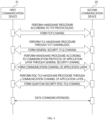
- FIG. 4 is an exemplary flowchart illustrating detailed processes of the communication method for quantum security according to some exemplary embodiments of the present disclosure. However, this is only a preferred exemplary embodiment for achieving the object of the present disclosure, and some steps may also be added or deleted as needed. In the drawings of FIG. 4 and below, the intermediate communication device 23 is omitted for convenience of understanding.
- the communication method for quantum security may begin at step S41 in which the communication devices 21 and 22 on both sides perform a handshake procedure (hereinafter abbreviated as "TCP handshake procedure") according to the transmission control protocol (TCP) protocol.
- TCP handshake procedure a handshake procedure
- the first communication device 21 may perform the TCP handshake procedure with the second communication device 22. If the procedure is successfully completed, a TCP channel may be formed between the two communication devices 21 and 22.
- the first communication device 21 may perform a handshake procedure with the second communication device 22 according to the general TLS protocol.
- the two communication devices 21 and 22 may perform the TLS handshake procedure through the TCP channel. If the procedure is successfully completed, a general security channel (i.e., TLS channel) may be formed between the two communication devices 21 and 22.
- TLS channel i.e., TLS channel
- the first communication device 21 may form a communication channel (i.e., application communication channel) by performing a handshake procedure according to a communication protocol of an application layer (i.e., L7) with the second communication device 22 through the general security channel
- the first communication device 21 may form a communication channel of an application layer by performing a handshake procedure according to a web socket protocol with the second communication device 22. Since the web socket protocol corresponds to a standard protocol, excellent portability and scalability may be guaranteed by using the web socket protocol.
- the scope of the present disclosure is not limited thereto, and the two communication devices 21 and 22 may also form the communication channel of the application layer using different communication protocols.
- the first communication device 21 may determine whether an intermediate communication device 23 that does not support the PQC-TLS protocol exists in a network section (or communication path) between the first communication device 21 and the second communication device 22. In addition, the first communication device 21 may initiate a handshake procedure for forming the communication channel of the application layer based on the determination that such an intermediate communication device 23 exists. If the intermediate communication device 23 does not exist, the first communication device 21 may perform the handshake procedure according to the PQC-TLS protocol in the layer to which the original PQC-TLS protocol belongs without forming the communication channel of the application layer with the second communication device 22.
- the first communication device 21 may determine that the intermediate communication device 23 that does not support the PQC-TLS protocol exists within the network section (or communication path).
- step S42 related to the TLS handshake procedure described above may also mean a case in which the general security channel is formed as a result of performing the PQC-TLS handshake procedure.
- the first communication device 21 may perform the handshake procedure according to the PQC-TLS protocol with the second communication device 22 through the communication channel of the application layer. That is, the PQC-TLS handshake procedure may be performed in the application layer. If the procedure is successfully completed, a quantum security channel (i.e., PQC-TLS channel) may be formed between the two communication devices 21 and 22.
- PQC-TLS channel a quantum security channel
- the first communication device 21 may perform data communication (exchange) with the second communication device 22.
- the first communication device 21 may exchange at least some data with the second communication device 22 through the quantum security channel.
- first communication device 21 and the second communication device 22 perform data communication (exchange) may vary depending on the exemplary embodiment.
- the first communication device 21 may transmit the target data to the second communication device 22 through the quantum security channel based on the determination that the target data corresponds to the important data. That is, the first communication device 21 may transmit only selected important data through the quantum security channel.
- the first communication device 21 may further form an additional communication channel (e.g., a general security channel of the application layer) in addition to the quantum security channel already formed with the second communication device 22.
- the first communication device 21 may transmit the important data to the second communication device 22 through the quantum security channel and transmit non-important data to the second communication device 22 through the additional communication channel.
- the first communication device 21 may divide the target data (e.g., important data) into a plurality of data pieces, transmit some of the plurality of data pieces to the second communication device 22 through the quantum security channel, and transmit other pieces of data through the additional communication channel described above.
- the total quantity of data pieces, the quantity and number of data pieces (hereinafter referred to as "quantum data pieces") transmitted through the quantum security channel, etc. may be negotiated in advance between the first communication device 21 and the second communication device 22 (e.g., negotiated through a separate handshake procedure, etc.), and the second communication device 22 may reassemble the received data pieces based on the negotiated information.
- the total quantity of data pieces, the quantity and number of quantum data pieces, etc. may be determined based on the importance, size, transmission time, etc. of the data (the higher the importance, the greater the total quantity of data pieces or the quantity of quantum data pieces, etc., a random number string is generated using the transmission time as a seed and data pieces with numbers corresponding to the random number string are transmitted through the quantum security channel, a random value generated using the transmission time as the seed is used as the total quantity of data pieces or the quantity of quantum data pieces, a first random value generated using the transmission time as the seed is used as the total quantity of data pieces and a second random value generated using the sum of the transmission time and the first random value as the seed is used as the quantity of quantum data pieces, etc.).
- data exchange may also be performed based on various combinations of the above-described exemplary embodiments.
- the quantum security channel (e.g., 32, i.e., PQC-TLS channel) may be formed between the two communication devices 25 and 27 by forming the communication channel of the application layer between the communication devices 21 and 22 on both sides equipped with the PQC-TLS modules 25 and 27, and performing the handshake procedure according to the PQC-TLS protocol through the corresponding communication channel. Accordingly, even when the intermediate communication device 23 that does not support the PQC-TLS protocol exists in the network section (or communication path) between the two communication devices 25 and 27, the quantum security communication may be supported between the two communication devices 21 and 22.
- the PQC-TLS module (or protocol) does not need to be installed on other devices (e.g., intermediate communication device 23) other than the communication devices 21 and 22 on both sides performing communication, there is an advantage that it takes almost no time or cost to implement (support) the quantum security communication.
- the communication channel of the application layer is formed using the web socket protocol, which is a standard protocol, excellent portability and scalability may also be guaranteed.
- FIGS. 5 and 6 illustrate a case where the communication method for quantum security described above is used for communication between client devices 51 and 61 and server devices 52 and 53. It may be understood that the illustrated client devices 51 and 61 correspond, for example, to the above-described first communication device 21 (or second communication device 22), and the server devices 52 and 53 correspond, for example, to the above-described second communication device 22 (or second communication device 21).
- the client device 51 is a device that uses a web service through a web browser (that is, the application (e.g., 24) is a web browser), and the server device 52 is a device that provides the web service.
- the client device 51 may transmit at least some of API application programming interface (API) data to the server device 52 through the quantum security channel according to the PQT-TLS protocol.
- API application programming interface
- the client device 51 may be installed with a PQC-TLS module (e.g., 25) implemented as a web assembly or a plug-in for the web browser.
- a PQC-TLS module e.g., 25
- the scope of the present disclosure is not limited thereto, and the PQC-TLS module (e.g., 25) may also be implemented in other ways.
- a client device 61 is a device that uses a service through an app (i.e., the application (e.g., 24) is an app implemented in a general programming language such as Java, C, etc.), and a server device 62 is a device that provides the service.
- the client device 61 may be a terminal on which a mobile app is installed.
- the scope of the present disclosure is not limited thereto.
- At least some of the data exchanged between the app on the client device 61 and the server device 62 may also be exchanged through the quantum security channel. In this way, users of the two communication devices 61 and 62 may be free from quantum threats.
- FIG. 7 is an exemplary hardware configuration diagram illustrating the computing device 70.
- a computing device 70 may include one or more processors 71, a bus 73, a communication interface 74, a memory 72 for loading a computer program 76 executed by the processor 71, and a storage 75 for storing the computer program 76.
- processors 71 a bus 73
- communication interface 74 a communication interface 74
- memory 72 for loading a computer program 76 executed by the processor 71
- storage 75 for storing the computer program 76.
- FIG. 7 only the components related to the exemplary embodiments of the present disclosure are illustrated in FIG. 7 . Therefore, those skilled in the art to which the present disclosure belongs may know that other general-purpose components may be further included in addition to the components illustrated in FIG. 7 . That is, the computing device 70 may further include various components other than the components illustrated in FIG. 7 . In addition, in some cases, the computing device 70 may also be configured in a form in which some of the components illustrated in FIG. 7 are omitted. Hereinafter, each component of the computing device 70 will be described.
- the processor 71 may control an overall operation of each component of the computing device 70.
- the processor 71 may include at least one of a central processing unit (CPU), a micro processor unit (MPU), a micro controller unit (MCU), a graphic processing unit (GPU), a neural processing unit (NPU), or any type of processor well known in the art of the present disclosure.
- the processor 71 may perform a calculation on at least one application or program for executing the operations/methods according to the exemplary embodiments of the present disclosure.
- the computing device 70 may include one or more processors.
- the memory 72 stores various data, commands, and/or information.
- the memory 72 may load the computer program 76 from the storage 75 to execute the operations/methods according to the exemplary embodiments of the present disclosure.
- the memory 72 may be implemented as a volatile memory such as RAM, but the technical scope of the present disclosure is not limited thereto.
- the bus 73 may provide a communications function between the components of the computing device 70.
- the bus 73 may be implemented as various types of buses, such as an address bus, a data bus, and a control bus.
- the communication interface 74 supports wired/wireless Internet communications of the computing device 70.
- the communication interface 74 may also support various communication methods other than Internet communications.
- the communication interface 74 may include a communication module well known in the art of the present disclosure.
- the storage 75 may non-temporarily store one or more computer programs 76.
- the storage 75 may include a non-volatile memory such as a read only memory (ROM), an erasable programmable ROM (EPROM), an electrically erasable programmable ROM (EEPROM), a flash memory, or the like, a hard disk, a removable disk, or any form of computer-readable recording medium well known in the art to which the present disclosure pertains.
- the computer program 76 may include one or more instructions that when loaded into memory 72, cause the processor 71 to perform the operations/methods according to various exemplary embodiments of the present disclosure. That is, the processor 71 may perform the operations/methods according to various exemplary embodiments of the present disclosure by executing the one or more instructions.
- the computer program 76 may include instructions that perform an operation of forming a general security channel (e.g., 31) according to a first TLS protocol (i.e., a general TLS protocol) that does not support a post-quantum cryptography algorithm with another communication device (e.g., 22), an operation of forming a communication channel of an application layer (L7) with another communication device (e.g., 22) through the corresponding general security channel (e.g., 31), an operation of forming a quantum security channel (e.g., 32) by performing a handshake procedure according to a second TLS protocol (i.e., PQC-TLS protocol) that supports the post-quantum cryptography algorithm with another communication device (e.g., 22) through the corresponding communication channel, and an operation of communicating with another communication device (e.g., 22) through the corresponding quantum security channel (e.g., 32).
- a first TLS protocol i.e., a general TLS protocol
- L7 application layer
- the computer program 76 may include instructions that perform at least some of the steps/operations described with reference to FIGS. 2 to 6 .
- the first communication device 21 or the second communication device 22 may be implemented via the computing device 70.
- the exemplary computing device 70 capable of implementing the communication devices 21 and 22 according to some exemplary embodiments of the present disclosure has been described with reference to FIG. 7 .
- the technical features of the present disclosure described so far may be embodied as computer readable codes on a computer readable medium.
- the computer readable medium may be, for example, a removable recording medium (CD, DVD, Blu-ray disc, USB storage device, removable hard disk) or a fixed recording medium (ROM, RAM, computer equipped hard disk).
- the computer program recorded on the computer readable medium may be transmitted to other computing device via a network such as internet and installed in the other computing device, thereby being used in the other computing device.
Landscapes
- Engineering & Computer Science (AREA)
- Computer Security & Cryptography (AREA)
- Computer Networks & Wireless Communication (AREA)
- Signal Processing (AREA)
- Computer Hardware Design (AREA)
- Computing Systems (AREA)
- General Engineering & Computer Science (AREA)
- Physics & Mathematics (AREA)
- Electromagnetism (AREA)
- Theoretical Computer Science (AREA)
- Communication Control (AREA)
- Computer And Data Communications (AREA)
Abstract
Description
- The present disclosure relates to a communication method for quantum security and a communication device supporting the same.
- As quantum computing technology develops, various works are in progress to migrate existing public key encryption algorithms (e.g., RSA, ECC, etc.) to post-quantum cryptography (PQC) algorithms.
- Meanwhile, the public key encryption algorithm is a foundation technology of transport layer security (TLS), which is a major security protocol in the network (Internet) environment. Therefore, if the public key encryption algorithms do not quickly migrate to the post-quantum cryptography algorithms, many network (Internet) users are inevitably exposed to quantum threats such as harvest now decrypt later (HNDL) (i.e., security threats caused by quantum computers).
- Recently, in consideration of such quantum threats, a TLS protocol (the so-called "PQC-TLS protocol") has been proposed that adds the post-quantum cryptography (PQC) algorithm to the existing TLS protocol (e.g., TLS 1.3). However, due to various limitations (e.g., cost, impact on a system, etc.), it will inevitably take a considerable amount of time for the proposed PQC-TLS protocol to be fully spread throughout the network environment, and until then, many network (Internet) users may not be free from the quantum threats.
- Aspects of the present disclosure provide a communication method for quantum security and a communication device supporting the same. More specifically, aspects of the present disclosure provide a method capable of performing quantum security communication between communication devices that support a post-quantum cryptography (PQC)-transport layer security (TLS) protocol, regardless of whether or not intermediate communication devices that do not support the PQC-TLS protocol (i.e., a TLS protocol that supports post-quantum cryptography algorithm) exist in a network section.
- However, aspects of the present disclosure are not restricted to those set forth herein. The above and other aspects of the present disclosure will become more apparent to one of ordinary skill in the art to which the present disclosure pertains by referencing the detailed description of the present disclosure given below.
- According to an aspect of the present disclosure, there is provided a communication method for quantum security performed by a communication device. The communication method may comprise forming a general security channel according to a first transport layer security (TLS) protocol that does not support a post-quantum cryptography algorithm with another communication device; forming a communication channel of an application layer L7 with another communication device through the general security channel; forming a quantum security channel by performing a handshake procedure according to a second TLS protocol that supports the post-quantum cryptography algorithm with another communication device through the communication channel; and communicating with another communication device through the quantum security channel.
- In some embodiments, an intermediate communication device that supports only the first TLS protocol among the first TLS protocol and the second TLS protocol exists in a network section between the communication device and another communication device, and the intermediate communication device is a device belonging to a layer L5 or higher.
- In some embodiments, the forming of the communication channel may include forming the communication channel by performing a handshake procedure according to a web socket protocol.
- In some embodiments, the communication device may be a client device that uses a web service through a web browser, another communication device is a server device that provides the web service, and at least some of data exchanged between the web browser and another communication device is exchanged through the quantum security channel.
- In some embodiments, a module supporting the second TLS protocol is implemented as a web assembly or a plug-in for the web browser and is installed in the communication device.
- In some embodiments, the communication device is a client device that uses a service through an app, another communication device is a server device that provides the service, and at least some of data exchanged between the app and another communication device is exchanged through the quantum security channel.
- In some embodiments, the forming of the communication channel may include determining whether or not an intermediate communication device that supports only the first TLS protocol among the first TLS protocol and the second TLS protocol exists in a network section between the communication device and another communication device; and initiating a handshake procedure for forming the communication channel based on determining that the intermediate communication device exists.
- In some embodiments, the determining of whether the intermediate communication device exists may include determining that the intermediate communication device exists, when the general security channel according to the first TLS protocol is formed as a result of performing a handshake procedure according to the second TLS protocol with another communication device.
- In some embodiments, the communicating with another communication device may include transmitting target data to another communication device through the quantum security channel based on a determination that the target data corresponds to predefined important data.
- According to an aspect of the present disclosure, there is provided a communication device. The communication device may comprise one or more processors; a communication interface; and a memory that stores a computer program executed by the one or more processors, wherein the computer program includes instructions for operations of: forming a general security channel according to a first transport layer security (TLS) protocol that does not support a post-quantum cryptography algorithm with another communication device; forming a communication channel of an application layer (L7) with another communication device through the general security channel; forming a quantum security channel by performing a handshake procedure according to a second TLS protocol that supports the post-quantum cryptography algorithm with another communication device through the communication channel; and communicating with another communication device through the quantum security channel.
- In some embodiments, an intermediate communication device that supports only the first TLS protocol among the first TLS protocol and the second TLS protocol exists in a network section between the communication device and another communication device, and the intermediate communication device is a device belonging to a layer L5 or higher.
- In some embodiments, the operation of forming of the communication channel may include an operation of forming the communication channel by performing a handshake procedure according to a web socket protocol.
- In some embodiments, the communication device is a client device that uses a web service through a web browser, another communication device is a server device that provides the web service, and at least some of data exchanged between the web browser and another communication device is exchanged through the quantum security channel.
- In some embodiments, a module supporting the second TLS protocol is implemented as a web assembly or a plug-in for the web browser and is installed in the communication device.
- In some embodiments, the communication device is a client device that uses a service through an app, another communication device is a server device that provides the service, and at least some of data exchanged between the app and another communication device is exchanged through the quantum security channel.
- In some embodiments, the operation of forming of the communication channel may include an operation of determining whether or not an intermediate communication device that supports only the first TLS protocol among the first TLS protocol and the second TLS protocol exists in a network section between the communication device and another communication device; and an operation of initiating a handshake procedure for forming the communication channel based on determining that the intermediate communication device exists.
- In some embodiments, the operation of determining of whether the intermediate communication device exists may include an operation of determining that the intermediate communication device exists, when the general security channel according to the first TLS protocol is formed as a result of performing a handshake procedure according to the second TLS protocol with another communication device.
- In some embodiments, the operation of communicating with another communication device may include an operation of transmitting target data to another communication device through the quantum security channel based on a determination that the target data corresponds to predefined important data.
- According to still another aspect of the present closure, there is provided a computer program coupled to a communication device and stored in a computer-readable record medium to execute operations of: forming a general security channel through a first transport layer security (TLS) protocol that does not support a post-quantum cryptography algorithm with another communication device; forming an application communication channel by performing a handshake procedure according to a communication protocol of a layer 7 with another communication device through the general security channel; forming a quantum security channel by performing a handshake procedure according to a second TLS protocol that supports the post-quantum cryptography algorithm with another communication device through the application communication channel; and communicating with another communication device through the quantum security channel.
- According to some exemplary embodiments of the present disclosure, by forming a communication channel of an application layer between communication devices on both sides equipped with the post-quantum cryptography (PQC)-transport layer security (TLS) module (i.e., a TLS module supporting the post-quantum cryptography algorithm), and performing a handshake procedure according to the PQC-TLS protocol (i.e., the TLS protocol supporting the post-quantum cryptography algorithm) through the corresponding communication channel, a quantum security channel (i.e., PQC-TLS channel) may be formed between the two communication devices. Accordingly, even when an intermediate communication device that does not support the PQC-TLS protocol exists in the network section (or communication path) between the two communication devices, the quantum security communication may be supported between the two communication devices.
- In addition, since the PQC-TLS module (or protocol) does not need to be installed on other devices (e.g., intermediate communication devices) other than the communication devices on both sides performing communication, there is an advantage that it takes almost no time or cost to implement (support) quantum security communication.
- In addition, by forming the communication channel of the application layer using a web socket protocol, which is a standard protocol, excellent portability and scalability may also be guaranteed.
- Effects according to the technical idea of the present disclosure are not limited to the effects mentioned above, and other effects that are not mentioned may be obviously understood by those skilled in the art from the following description.
- The above and other aspects and features of the present disclosure will become more apparent by describing in detail exemplary embodiments thereof with reference to the attached drawings, in which:
-
FIG. 1 is an exemplary diagram for describing a problem of a case in which an intermediate communication device that does not support a post-quantum cryptography (PQC)-transport layer security (TLS) protocol (i.e., a TLS protocol that does not support a post-quantum cryptography algorithm) exists in a network section; -
FIG. 2 is an exemplary diagram illustrating a network (communication) environment to which a communication method for quantum security according to some exemplary embodiments of the present disclosure may be applied; -
FIG. 3 is an exemplary diagram for describing a technical principle of the communication method for quantum security according to some exemplary embodiments of the present disclosure; -
FIG. 4 is an exemplary flowchart illustrating detailed processes of the communication method for quantum security according to some exemplary embodiments of the present disclosure; -
FIGS. 5 and 6 illustrate some usage examples of the communication method for quantum security according to some exemplary embodiments of the present disclosure; and -
FIG. 7 illustrates an exemplary computing device capable of implementing communication devices according to some exemplary embodiments of the present disclosure. - Hereinafter, preferred embodiments of the present disclosure will be described with reference to the attached drawings. Advantages and features of the present disclosure and methods of accomplishing the same may be understood more readily by reference to the following detailed description of preferred embodiments and the accompanying drawings. The present disclosure may, however, be embodied in many different forms and should not be construed as being limited to the embodiments set forth herein. Rather, these embodiments are provided so that this disclosure will be thorough and complete and will fully convey the concept of the disclosure to those skilled in the art, and the present disclosure will only be defined by the appended claims.
- In adding reference numerals to the components of each drawing, it should be noted that the same reference numerals are assigned to the same components as much as possible even though they are shown in different drawings. In addition, in describing the present disclosure, when it is determined that the detailed description of the related well-known configuration or function may obscure the gist of the present disclosure, the detailed description thereof will be omitted.
- Unless otherwise defined, all terms used in the present specification (including technical and scientific terms) may be used in a sense that can be commonly understood by those skilled in the art. In addition, the terms defined in the commonly used dictionaries are not ideally or excessively interpreted unless they are specifically defined clearly. The terminology used herein is for the purpose of describing particular embodiments only and is not intended to be limiting of the disclosure. In this specification, the singular also includes the plural unless specifically stated otherwise in the phrase.
- In addition, in describing the component of this disclosure, terms, such as first, second, A, B, (a), (b), can be used. These terms are only for distinguishing the components from other components, and the nature or order of the components is not limited by the terms. If a component is described as being "connected," "coupled" or "contacted" to another component, that component may be directly connected to or contacted with that other component, but it should be understood that another component also may be "connected," "coupled" or "contacted" between each component.
- Hereinafter, embodiments of the present disclosure will be described with reference to the attached drawings.
- Hereinafter, for clarity of the present disclosure, a transport layer security (TLS) protocol (e.g., an existing TLS protocol such as TLS 1.3) and module that do not support a post-quantum cryptography (PQC) algorithm are named "general/existing TLS module (or just TLS Module)" and "general/existing TLS protocol (or just TLS protocol)", respectively, and a TLS protocol (e.g., a TLS protocol that supports only the post-quantum cryptography algorithm, a TLS protocol that supports both existing cryptography algorithm and post-quantum cryptography algorithm, etc.) and module that support the post-quantum cryptography algorithm are named "PQC-TLS module" and "PQC-TLS protocol", respectively. For reference, the PQC-TLS module refers to a module that supports the PQC-TLS protocol (or a module that implements the PQC-TLS protocol). In some cases, the general/existing TLS protocol and PQC-TLS protocol may be named "first TLS protocol" and "second TLS protocol", respectively.
- First, a problem that occurs when an
intermediate communication device 13 that does not support the PQC-TLS protocol exists in a network section will be described with reference toFIG. 1 . - An open system interconnection (OSI) 7 layer is illustrated on the left in
FIG. 1 . Since those skilled in the art will already be familiar with the OSI 7 layer, a description thereof will be omitted. - As illustrated in
FIG. 1 , it is assumed that aclient device 11 and aserver device 12 perform communication, and a load balancer 13 (e.g., L7 load balancer/switch) exists in a network section (or communication path) between theclient device 11 and theserver device 12. In addition, it is assumed that theclient device 11 and theserver device 12 are each equipped with a PQC-TLS module load balancer 13 is equipped with ageneral TLS module 19.FIG. 1 illustrates a case in which theload balancer 13 is an "L7 load balancer", but as long as theload balancer 13 is a load balancer belonging to "L5" or higher layers (i.e., a load balancer equipped with the general TLS module 19), a problem described later may be equally applied. - For reference, an
application 14 of theclient device 11 refers to a program that communicates with theserver device 12, such as a web browser, anapplication 16 of theserver device 12 refers to a server program for providing a service to theclient device 11, and anapplication 18 of theload balancer 13 refers to a program that performs load balancing at an application layer (i.e., L7). Since these points are obvious to those skilled in the art, a further description thereof will be omitted. - As above, when an
intermediate communication device 13 that does not support the PQC-TLS protocol exists in the network section (or communication path) between theclient device 11 and theserver device 12, the twocommunication devices communication devices TLS modules communication devices - To further describe, the handshake procedure between the two
communication devices application 14 thereof) and the load balancer 13 (precisely theapplication 18 thereof) and a second handshake procedure between the load balancer 13 (precisely theapplication 18 thereof) and the server device 12 (precisely theapplication 16 thereof). Since theload balancer 13 does not support the PQC-TLS protocol (or post-quantum cryptography algorithm), both the first handshake procedure and the second handshake procedure may not be successfully completed (that is, the communication encryption algorithm may not be determined to be the post-quantum cryptography algorithm through the handshake procedure). As a result, while the handshake procedure is in progress, the communication encryption algorithm is changed to the existing encryption algorithm due to theload balancer 13, and a security channel (i.e., general security channel) according to the general TLS protocol is formed between theclient device 11 and the server device 12 (e.g., since theclient device 11 is not aware of an existence of theintermediate communication device 13, theclient device 11 recognizes that theother device 12 does not support the PQC-TLS protocol). - In summary, if even one intermediate communication device (e.g., 13) that does not support the PQC-TLS protocol exists in the network section (or communication path), the communication devices (e.g., 11, 12) on both sides that support the PQC-TLS protocol will not be able to perform the quantum security communication, and as a result, a problem of being exposed to quantum threats such as harvest now decrypt later (HNDL) (i.e., security threats caused by quantum computers) occurs.
- Hereinafter, a communication method for quantum security according to some exemplary embodiments of the present disclosure designed to solve such a problem will be described in detail.
- First, in order to provide convenience of understanding, a network (communication) environment to which some exemplary embodiments of the present disclosure may be applied will be briefly described with reference to
FIG. 2 . In the following description, a handshake procedure according to a general TLS protocol may be abbreviated as "TLS handshake procedure", and a handshake procedure according to a PQC-TLS protocol may be abbreviated as "PQC-TLS handshake procedure". - As illustrated in
FIG. 2 , the communication method for quantum security according to exemplary embodiments may be applied when thecommunication devices TLS modules intermediate communication device 23 that does not support the PQC-TLS protocol exists in a network section (or communication path) between thecommunication devices communication devices - As illustrated, the
intermediate communication device 23 is a device equipped with ageneral TLS module 28. For example, theintermediate communication device 23 may be a device (e.g., a network equipment such as a load balancer, etc.) belonging to a layer L5 or higher among the OSI 7 layers. In detail, theintermediate communication device 23 is a communication device belonging to L5, L6, or L7, and may be understood as a device that supports the general TLS protocol but does not support the PQC-TLS protocol. Theintermediate communication device 23 may refer to any communication device located in the network section (or communication path) between thefirst communication device 21 and thesecond communication device 22, or may collectively refer to a plurality of communication devices. - Next, the
first communication device 21 and thesecond communication device 22 are devices equipped with a communication function and are devices equipped with the PQC-TLS modules first communication device 21 and thesecond communication device 22 may further includeapplications second communication device 22, which is another device that communicates with thefirst communication device 21, may be a server device or a client device. Alternatively, thesecond communication device 22 may be a device that performs peer-to-peer communication with thefirst communication device 21. - For reference, only the components related to the exemplary embodiments of the present disclosure are illustrated in
FIG. 2 . Therefore, those skilled in the art to which the present disclosure belongs may know that other general-purpose components (e.g., a processor, a memory, etc.) may be further included in addition to the components illustrated inFIG. 2 . - The
communication devices 21 and 22 (orapplications FIG. 3 , thefirst communication device 21 may form a security channel 31 (i.e., a general security channel) according to the general TLS protocol with thesecond communication device 22, and form aquantum security channel 32 according to the PQC-TLS protocol in an application layer (i.e., L7 and a layer higher than a layer to which an original PQC-TLS protocol belongs) through the correspondingchannel 31. In this way, the quantum security communication may be supported between the twocommunication devices intermediate communication device 23 that does not support the PQC-TLS protocol exists. This is because the PQC-TLS handshake procedure in the application layer is unrelated to theintermediate communication device 23. A specific process of forming thequantum security channel 32 will be described in more detail with reference toFIG. 5 later. - Each of the
communication devices FIG. 7 . - For reference, since the computing device is an aggregate in which various components (e.g., a memory, a processor, etc.) interact, the computing device may also be named a "computing system" in some cases. In addition, the term computing system may also include the concept of an aggregate in which a plurality of computing devices interact. The communication device (e.g., 21) may also be named "communication systems" in some cases.
- The
communication devices 21 to 23 illustrated inFIG. 3 may communicate via a network. Here, the network may be implemented as all types of wired/wireless networks such as a Local Area Network (LAN), a Wide Area Network (WAN), a mobile radio communication network, and Wireless Broadband Internet (Wibro). - Hereinabove, the network (communication) environment in which the communication method for quantum security according to some exemplary embodiments of the present disclosure may be applied and the technical principles of the method have been briefly described with reference to
FIGS. 2 and3 . - Hereinafter, the communication method for quantum security according to some exemplary embodiments of the present disclosure will be described with reference to
FIG. 4 . -
FIG. 4 is an exemplary flowchart illustrating detailed processes of the communication method for quantum security according to some exemplary embodiments of the present disclosure. However, this is only a preferred exemplary embodiment for achieving the object of the present disclosure, and some steps may also be added or deleted as needed. In the drawings ofFIG. 4 and below, theintermediate communication device 23 is omitted for convenience of understanding. - As illustrated in
FIG. 4 , the communication method for quantum security according to some exemplary embodiments may begin at step S41 in which thecommunication devices first communication device 21 may perform the TCP handshake procedure with thesecond communication device 22. If the procedure is successfully completed, a TCP channel may be formed between the twocommunication devices - In step S42, the
first communication device 21 may perform a handshake procedure with thesecond communication device 22 according to the general TLS protocol. The twocommunication devices communication devices - In step S43, the
first communication device 21 may form a communication channel (i.e., application communication channel) by performing a handshake procedure according to a communication protocol of an application layer (i.e., L7) with thesecond communication device 22 through the general security channel For example, thefirst communication device 21 may form a communication channel of an application layer by performing a handshake procedure according to a web socket protocol with thesecond communication device 22. Since the web socket protocol corresponds to a standard protocol, excellent portability and scalability may be guaranteed by using the web socket protocol. However, the scope of the present disclosure is not limited thereto, and the twocommunication devices - Meanwhile, in some exemplary embodiments, the
first communication device 21 may determine whether anintermediate communication device 23 that does not support the PQC-TLS protocol exists in a network section (or communication path) between thefirst communication device 21 and thesecond communication device 22. In addition, thefirst communication device 21 may initiate a handshake procedure for forming the communication channel of the application layer based on the determination that such anintermediate communication device 23 exists. If theintermediate communication device 23 does not exist, thefirst communication device 21 may perform the handshake procedure according to the PQC-TLS protocol in the layer to which the original PQC-TLS protocol belongs without forming the communication channel of the application layer with thesecond communication device 22. - In the previous exemplary embodiments, when a security channel (i.e., a general security channel) according to the general TLS protocol is formed or the handshake procedure is terminated in failure, etc. as a result of performing the handshake procedure according to the PQC-TLS protocol with the
second communication device 22, thefirst communication device 21 may determine that theintermediate communication device 23 that does not support the PQC-TLS protocol exists within the network section (or communication path). For reference, in some cases, step S42 related to the TLS handshake procedure described above may also mean a case in which the general security channel is formed as a result of performing the PQC-TLS handshake procedure. - In step S44, the
first communication device 21 may perform the handshake procedure according to the PQC-TLS protocol with thesecond communication device 22 through the communication channel of the application layer. That is, the PQC-TLS handshake procedure may be performed in the application layer. If the procedure is successfully completed, a quantum security channel (i.e., PQC-TLS channel) may be formed between the twocommunication devices - In step S45, the
first communication device 21 may perform data communication (exchange) with thesecond communication device 22. For example, thefirst communication device 21 may exchange at least some data with thesecond communication device 22 through the quantum security channel. - Meanwhile, a specific method in which the
first communication device 21 and thesecond communication device 22 perform data communication (exchange) may vary depending on the exemplary embodiment. - In some exemplary embodiments, it may be determined whether target data to be transmitted from the
first communication device 21 to thesecond communication device 22 corresponds to predefined important data. Any method may be used to determine whether or not the target data is the important data. In addition, thefirst communication device 21 may transmit the target data to thesecond communication device 22 through the quantum security channel based on the determination that the target data corresponds to the important data. That is, thefirst communication device 21 may transmit only selected important data through the quantum security channel. - In some other exemplary embodiments, the
first communication device 21 may further form an additional communication channel (e.g., a general security channel of the application layer) in addition to the quantum security channel already formed with thesecond communication device 22. In addition, thefirst communication device 21 may transmit the important data to thesecond communication device 22 through the quantum security channel and transmit non-important data to thesecond communication device 22 through the additional communication channel. - In some still other exemplary embodiments, the
first communication device 21 may divide the target data (e.g., important data) into a plurality of data pieces, transmit some of the plurality of data pieces to thesecond communication device 22 through the quantum security channel, and transmit other pieces of data through the additional communication channel described above. In this case, the total quantity of data pieces, the quantity and number of data pieces (hereinafter referred to as "quantum data pieces") transmitted through the quantum security channel, etc. may be negotiated in advance between thefirst communication device 21 and the second communication device 22 (e.g., negotiated through a separate handshake procedure, etc.), and thesecond communication device 22 may reassemble the received data pieces based on the negotiated information. In some cases, the total quantity of data pieces, the quantity and number of quantum data pieces, etc. may be determined based on the importance, size, transmission time, etc. of the data (the higher the importance, the greater the total quantity of data pieces or the quantity of quantum data pieces, etc., a random number string is generated using the transmission time as a seed and data pieces with numbers corresponding to the random number string are transmitted through the quantum security channel, a random value generated using the transmission time as the seed is used as the total quantity of data pieces or the quantity of quantum data pieces, a first random value generated using the transmission time as the seed is used as the total quantity of data pieces and a second random value generated using the sum of the transmission time and the first random value as the seed is used as the quantity of quantum data pieces, etc.). - In some still other exemplary embodiments, data exchange (communication) may also be performed based on various combinations of the above-described exemplary embodiments.
- Hereinabove, the communication method for quantum security according to some exemplary embodiments of the present disclosure has been described with reference to
FIG. 4 . As described above, the quantum security channel (e.g., 32, i.e., PQC-TLS channel) may be formed between the twocommunication devices communication devices TLS modules intermediate communication device 23 that does not support the PQC-TLS protocol exists in the network section (or communication path) between the twocommunication devices communication devices - In addition, since the PQC-TLS module (or protocol) does not need to be installed on other devices (e.g., intermediate communication device 23) other than the
communication devices - In addition, when the communication channel of the application layer is formed using the web socket protocol, which is a standard protocol, excellent portability and scalability may also be guaranteed.
- Hereinafter, in order to further provide convenience of understanding, some examples of utilization of the communication method for quantum security described above will be briefly described with reference to
FIGS. 5 and 6 . -
FIGS. 5 and 6 illustrate a case where the communication method for quantum security described above is used for communication betweenclient devices server devices 52 and 53. It may be understood that the illustratedclient devices server devices 52 and 53 correspond, for example, to the above-described second communication device 22 (or second communication device 21). - As illustrated in
FIG. 5 , theclient device 51 is a device that uses a web service through a web browser (that is, the application (e.g., 24) is a web browser), and theserver device 52 is a device that provides the web service. In this case, at least some of the data exchanged between the web browser of theclient device 51 and theserver device 52 may be exchanged through the quantum security channel. In this way, users of the twocommunication devices client device 51 may transmit at least some of API application programming interface (API) data to theserver device 52 through the quantum security channel according to the PQT-TLS protocol. - In
FIG. 5 , theclient device 51 may be installed with a PQC-TLS module (e.g., 25) implemented as a web assembly or a plug-in for the web browser. However, the scope of the present disclosure is not limited thereto, and the PQC-TLS module (e.g., 25) may also be implemented in other ways. - Next, in
FIG. 6 , aclient device 61 is a device that uses a service through an app (i.e., the application (e.g., 24) is an app implemented in a general programming language such as Java, C, etc.), and aserver device 62 is a device that provides the service. For example, theclient device 61 may be a terminal on which a mobile app is installed. However, the scope of the present disclosure is not limited thereto. - Similar to what was described above, at least some of the data exchanged between the app on the
client device 61 and theserver device 62 may also be exchanged through the quantum security channel. In this way, users of the twocommunication devices - Hereinabove, several examples of utilization of the communication method for quantum security described above have been described with reference to
FIGS. 5 and 6 . Hereinafter, anexemplary computing device 70 capable of implementing thecommunication devices -
FIG. 7 is an exemplary hardware configuration diagram illustrating thecomputing device 70. - As illustrated in
FIG. 7 , acomputing device 70 may include one ormore processors 71, abus 73, acommunication interface 74, amemory 72 for loading acomputer program 76 executed by theprocessor 71, and astorage 75 for storing thecomputer program 76. However, only the components related to the exemplary embodiments of the present disclosure are illustrated inFIG. 7 . Therefore, those skilled in the art to which the present disclosure belongs may know that other general-purpose components may be further included in addition to the components illustrated inFIG. 7 . That is, thecomputing device 70 may further include various components other than the components illustrated inFIG. 7 . In addition, in some cases, thecomputing device 70 may also be configured in a form in which some of the components illustrated inFIG. 7 are omitted. Hereinafter, each component of thecomputing device 70 will be described. - The
processor 71 may control an overall operation of each component of thecomputing device 70. Theprocessor 71 may include at least one of a central processing unit (CPU), a micro processor unit (MPU), a micro controller unit (MCU), a graphic processing unit (GPU), a neural processing unit (NPU), or any type of processor well known in the art of the present disclosure. In addition, theprocessor 71 may perform a calculation on at least one application or program for executing the operations/methods according to the exemplary embodiments of the present disclosure. Thecomputing device 70 may include one or more processors. - Next, the
memory 72 stores various data, commands, and/or information. Thememory 72 may load thecomputer program 76 from thestorage 75 to execute the operations/methods according to the exemplary embodiments of the present disclosure. Thememory 72 may be implemented as a volatile memory such as RAM, but the technical scope of the present disclosure is not limited thereto. - Next, the
bus 73 may provide a communications function between the components of thecomputing device 70. Thebus 73 may be implemented as various types of buses, such as an address bus, a data bus, and a control bus. - Next, the
communication interface 74 supports wired/wireless Internet communications of thecomputing device 70. In addition, thecommunication interface 74 may also support various communication methods other than Internet communications. To this end, thecommunication interface 74 may include a communication module well known in the art of the present disclosure. - Next, the
storage 75 may non-temporarily store one ormore computer programs 76. Thestorage 75 may include a non-volatile memory such as a read only memory (ROM), an erasable programmable ROM (EPROM), an electrically erasable programmable ROM (EEPROM), a flash memory, or the like, a hard disk, a removable disk, or any form of computer-readable recording medium well known in the art to which the present disclosure pertains. - Next, the
computer program 76 may include one or more instructions that when loaded intomemory 72, cause theprocessor 71 to perform the operations/methods according to various exemplary embodiments of the present disclosure. That is, theprocessor 71 may perform the operations/methods according to various exemplary embodiments of the present disclosure by executing the one or more instructions. - For example, the
computer program 76 may include instructions that perform an operation of forming a general security channel (e.g., 31) according to a first TLS protocol (i.e., a general TLS protocol) that does not support a post-quantum cryptography algorithm with another communication device (e.g., 22), an operation of forming a communication channel of an application layer (L7) with another communication device (e.g., 22) through the corresponding general security channel (e.g., 31), an operation of forming a quantum security channel (e.g., 32) by performing a handshake procedure according to a second TLS protocol (i.e., PQC-TLS protocol) that supports the post-quantum cryptography algorithm with another communication device (e.g., 22) through the corresponding communication channel, and an operation of communicating with another communication device (e.g., 22) through the corresponding quantum security channel (e.g., 32). - As another example, the
computer program 76 may include instructions that perform at least some of the steps/operations described with reference toFIGS. 2 to 6 . - In the case as illustrated, the
first communication device 21 or thesecond communication device 22 according to some exemplary embodiments of the present disclosure may be implemented via thecomputing device 70. - Hereinabove, the
exemplary computing device 70 capable of implementing thecommunication devices FIG. 7 . - So far, a variety of embodiments of the present disclosure and the effects according to embodiments thereof have been mentioned with reference to
FIGS. 1 to 14. The effects according to the technical idea of the present disclosure are not limited to the forementioned effects, and other unmentioned effects may be clearly understood by those skilled in the art from the description of the specification. - The technical features of the present disclosure described so far may be embodied as computer readable codes on a computer readable medium. The computer readable medium may be, for example, a removable recording medium (CD, DVD, Blu-ray disc, USB storage device, removable hard disk) or a fixed recording medium (ROM, RAM, computer equipped hard disk). The computer program recorded on the computer readable medium may be transmitted to other computing device via a network such as internet and installed in the other computing device, thereby being used in the other computing device.
- Although operations are shown in a specific order in the drawings, it should not be understood that desired results can be obtained when the operations must be performed in the specific order or sequential order or when all of the operations must be performed. In certain situations, multitasking and parallel processing may be advantageous. According to the above-described embodiments, it should not be understood that the separation of various configurations is necessarily required, and it should be understood that the described program components and systems may generally be integrated together into a single software product or be packaged into multiple software products.
- In concluding the detailed description, those skilled in the art will appreciate that many variations and modifications can be made to the preferred embodiments without substantially departing from the principles of the present disclosure. Therefore, the disclosed preferred embodiments of the disclosure are used in a generic and descriptive sense only and not for purposes of limitation.
Claims (15)
- A communication method for quantum security performed by a communication device, the communication method comprising:forming a general security channel according to a first transport layer security (TLS) protocol that does not support a post-quantum cryptography algorithm with another communication device;forming a communication channel of an application layer L7 with another communication device through the general security channel;forming a quantum security channel by performing a handshake procedure according to a second TLS protocol that supports the post-quantum cryptography algorithm with another communication device through the communication channel; andcommunicating with another communication device through the quantum security channel.
- The communication method of claim 1, wherein an intermediate communication device that supports only the first TLS protocol among the first TLS protocol and the second TLS protocol exists in a network section between the communication device and another communication device, and
the intermediate communication device is a device belonging to a layer L5 or higher. - The communication method of claim 1, wherein the forming of the communication channel includes forming the communication channel by performing a handshake procedure according to a web socket protocol.
- The communication method of claim 1, wherein the communication device is a client device that uses a web service through a web browser,another communication device is a server device that provides the web service, andat least some of data exchanged between the web browser and another communication device is exchanged through the quantum security channel.
- The communication method of claim 4, wherein a module supporting the second TLS protocol is implemented as a web assembly or a plug-in for the web browser and is installed in the communication device.
- The communication method of claim 1, wherein the communication device is a client device that uses a service through an app,another communication device is a server device that provides the service, andat least some of data exchanged between the app and another communication device is exchanged through the quantum security channel.
- The communication method of claim 1, wherein the forming of the communication channel includes:determining whether or not an intermediate communication device that supports only the first TLS protocol among the first TLS protocol and the second TLS protocol exists in a network section between the communication device and another communication device; andinitiating a handshake procedure for forming the communication channel based on determining that the intermediate communication device exists.
- The communication method of claim 7, wherein the determining of whether the intermediate communication device exists includes determining that the intermediate communication device exists, when the general security channel according to the first TLS protocol is formed as a result of performing a handshake procedure according to the second TLS protocol with another communication device.
- The communication method of claim 1, wherein the communicating with another communication device includes transmitting target data to another communication device through the quantum security channel based on a determination that the target data corresponds to predefined important data.
- A communication device comprising:one or more processors;a communication interface; anda memory that stores a computer program executed by the one or more processors,wherein the computer program includes instructions for operations offorming a general security channel according to a first transport layer security (TLS) protocol that does not support a post-quantum cryptography algorithm with another communication device;forming a communication channel of an application layer (L7) with another communication device through the general security channel;forming a quantum security channel by performing a handshake procedure according to a second TLS protocol that supports the post-quantum cryptography algorithm with another communication device through the communication channel; andcommunicating with another communication device through the quantum security channel.
- The communication device of claim 10, wherein an intermediate communication device that supports only the first TLS protocol among the first TLS protocol and the second TLS protocol exists in a network section between the communication device and another communication device, and
the intermediate communication device is a device belonging to a layer L5 or higher. - The communication device of claim 10, wherein the operation of forming of the communication channel includes an operation of forming the communication channel by performing a handshake procedure according to a web socket protocol.
- The communication device of claim 10, wherein the operation of forming of the communication channel includes:an operation of determining whether or not an intermediate communication device that supports only the first TLS protocol among the first TLS protocol and the second TLS protocol exists in a network section between the communication device and another communication device; andan operation of initiating a handshake procedure for forming the communication channel based on determining that the intermediate communication device exists.
- The communication device of claim 13, wherein the operation of determining of whether the intermediate communication device exists includes an operation of determining that the intermediate communication device exists, when the general security channel according to the first TLS protocol is formed as a result of performing a handshake procedure according to the second TLS protocol with another communication device.
- A computer program coupled to a communication device and stored in a computer-readable record medium to execute operations of:forming a general security channel through a first transport layer security (TLS) protocol that does not support a post-quantum cryptography algorithm with another communication device;forming an application communication channel by performing a handshake procedure according to a communication protocol of a layer 7 with another communication device through the general security channel;forming a quantum security channel by performing a handshake procedure according to a second TLS protocol that supports the post-quantum cryptography algorithm with another communication device through the application communication channel; andcommunicating with another communication device through the quantum security channel.
Applications Claiming Priority (1)
| Application Number | Priority Date | Filing Date | Title |
|---|---|---|---|
| KR1020230091504A KR20250011293A (en) | 2023-07-14 | 2023-07-14 | Communication method for quantum security and communication apparatus supporting the same |
Publications (2)
| Publication Number | Publication Date |
|---|---|
| EP4492731A1 true EP4492731A1 (en) | 2025-01-15 |
| EP4492731B1 EP4492731B1 (en) | 2025-11-26 |
Family
ID=91663871
Family Applications (1)
| Application Number | Title | Priority Date | Filing Date |
|---|---|---|---|
| EP24183649.3A Active EP4492731B1 (en) | 2023-07-14 | 2024-06-21 | Communication method for quantum security and communication device supporting the same |
Country Status (3)
| Country | Link |
|---|---|
| US (1) | US12513193B2 (en) |
| EP (1) | EP4492731B1 (en) |
| KR (1) | KR20250011293A (en) |
Citations (1)
| Publication number | Priority date | Publication date | Assignee | Title |
|---|---|---|---|---|
| US11218301B1 (en) * | 2019-09-10 | 2022-01-04 | Wells Fargo Bank, N.A. | Systems and methods for post-quantum cryptography communications channels |
Family Cites Families (14)
| Publication number | Priority date | Publication date | Assignee | Title |
|---|---|---|---|---|
| EP1524815B1 (en) * | 2000-08-25 | 2009-09-23 | Research In Motion Limited | System and method for implementing an enhanced transport layer security protocol |
| US9344405B1 (en) * | 2012-06-15 | 2016-05-17 | Massachusetts Institute Of Technology | Optimized transport layer security |
| EP2846509B1 (en) * | 2013-09-09 | 2019-08-28 | Alcatel Lucent | Tls protocol extension |
| US9781081B1 (en) * | 2015-10-02 | 2017-10-03 | Amazon Technologies, Inc. | Leveraging transport-layer cryptographic material |
| US10158991B2 (en) * | 2016-03-17 | 2018-12-18 | M2MD Technologies, Inc. | Method and system for managing security keys for user and M2M devices in a wireless communication network environment |
| US10172000B2 (en) * | 2016-03-17 | 2019-01-01 | M2MD Technologies, Inc. | Method and system for managing security keys for user and M2M devices in a wireless communication network environment |
| KR101925357B1 (en) | 2017-12-12 | 2019-02-26 | (주)위세아이텍 | System and method for visualizing equipment health status and forecast maintenance requirements |
| US11177946B2 (en) * | 2019-06-21 | 2021-11-16 | Verizon Patent And Licensing Inc. | Quantum entropy distributed via software defined perimeter connections |
| CN113468543B (en) | 2020-03-30 | 2025-04-22 | 阿里巴巴集团控股有限公司 | Data processing method, device, system, storage medium and processor |
| US11601519B2 (en) | 2020-06-09 | 2023-03-07 | Twilio Inc. | Edge communication locations |
| US11374975B2 (en) | 2020-07-02 | 2022-06-28 | International Business Machines Corporation | TLS integration of post quantum cryptographic algorithms |
| WO2022187951A1 (en) * | 2021-03-09 | 2022-09-15 | ISARA Corporation | Protocol key negotiation |
| US12267421B2 (en) | 2021-10-18 | 2025-04-01 | International Business Machines Corporation | Post quantum secure ingress/egress network communication |
| CN115314189B (en) | 2022-06-21 | 2026-05-08 | 阿里巴巴(中国)有限公司 | Communication methods and systems |
-
2023
- 2023-07-14 KR KR1020230091504A patent/KR20250011293A/en active Pending
-
2024
- 2024-05-30 US US18/678,988 patent/US12513193B2/en active Active
- 2024-06-21 EP EP24183649.3A patent/EP4492731B1/en active Active
Patent Citations (1)
| Publication number | Priority date | Publication date | Assignee | Title |
|---|---|---|---|---|
| US11218301B1 (en) * | 2019-09-10 | 2022-01-04 | Wells Fargo Bank, N.A. | Systems and methods for post-quantum cryptography communications channels |
Non-Patent Citations (2)
| Title |
|---|
| HYUNWOO LEE ET AL: "maTLS: How to Make TLS middlebox-aware?", PROCEEDINGS 2019 NETWORK AND DISTRIBUTED SYSTEM SECURITY SYMPOSIUM, 27 February 2019 (2019-02-27), Reston, VA, XP055607728, ISBN: 978-1-891562-55-6, DOI: 10.14722/ndss.2019.23547 * |
| RAY MARSH ET AL: "Renegotiating TLS", 4 November 2009 (2009-11-04), pages 1 - 8, XP093197271, Retrieved from the Internet <URL:https://svn.dd-wrt.com/export/25639/src/router/matrixssl/doc/Renegotiating_TLS.pdf> [retrieved on 20240821] * |
Also Published As
| Publication number | Publication date |
|---|---|
| KR20250011293A (en) | 2025-01-21 |
| US20250023916A1 (en) | 2025-01-16 |
| EP4492731B1 (en) | 2025-11-26 |
| US12513193B2 (en) | 2025-12-30 |
Similar Documents
| Publication | Publication Date | Title |
|---|---|---|
| EP3937051B1 (en) | Methods and apparatuses for processing transactions based on blockchain integrated station | |
| EP3179701B1 (en) | File upload and download methods and associated server | |
| US8447898B2 (en) | Task offload to a peripheral device | |
| US7200641B1 (en) | Method and system for encoding SCSI requests for transmission using TCP/IP | |
| WO2021083083A1 (en) | Upgrading method and system, server, and terminal device | |
| US10341367B1 (en) | System and method for inquiring IOC information by P2P protocol | |
| EP3159803B1 (en) | Data storage method and network interface card | |
| CN115086306A (en) | Data transmission method and device, electronic equipment and storage medium | |
| CN108900324B (en) | Method and device for checking communication performance of virtual machine | |
| JP6319369B2 (en) | PROCESS CONTROL DEVICE, PROCESS CONTROL METHOD, AND PROCESS CONTROL PROGRAM | |
| EP3995961B1 (en) | Storage system and operating method thereof | |
| US20070101023A1 (en) | Multiple task offload to a peripheral device | |
| US10664418B2 (en) | Peripheral device controlling device, operation method thereof, and operation method of peripheral device controlling device driver | |
| CN103425486A (en) | Remote card content management method and system using synchronous server-side scripting | |
| US9307005B2 (en) | Communication control system, method, and apparatus | |
| EP4492731B1 (en) | Communication method for quantum security and communication device supporting the same | |
| CN116346309A (en) | Homomorphic computing system, method, homomorphic computing acceleration device and server | |
| US9288116B2 (en) | System and method for NAS server test load generation | |
| US20160261719A1 (en) | Information processing system, control program, and control method | |
| KR20220053386A (en) | Data communication method and apparatus for efficient file transmission | |
| CN114003342A (en) | Distributed storage method and device, electronic equipment and storage medium | |
| US20090199187A1 (en) | Concurrent execution of multiple primitive commands in command line interface | |
| KR102128832B1 (en) | Network interface apparatus and data processing method for network interface apparauts thereof | |
| US10482059B2 (en) | Method for migrating a workload, computer arrangement and non-volatile storage medium | |
| CN111210505A (en) | 3D model loading method, server, storage medium and processor |
Legal Events
| Date | Code | Title | Description |
|---|---|---|---|
| PUAI | Public reference made under article 153(3) epc to a published international application that has entered the european phase |
Free format text: ORIGINAL CODE: 0009012 |
|
| STAA | Information on the status of an ep patent application or granted ep patent |
Free format text: STATUS: EXAMINATION IS IN PROGRESS |
|
| 17P | Request for examination filed |
Effective date: 20240621 |
|
| AK | Designated contracting states |
Kind code of ref document: A1 Designated state(s): AL AT BE BG CH CY CZ DE DK EE ES FI FR GB GR HR HU IE IS IT LI LT LU LV MC ME MK MT NL NO PL PT RO RS SE SI SK SM TR |
|
| GRAP | Despatch of communication of intention to grant a patent |
Free format text: ORIGINAL CODE: EPIDOSNIGR1 |
|
| STAA | Information on the status of an ep patent application or granted ep patent |
Free format text: STATUS: GRANT OF PATENT IS INTENDED |
|
| RIC1 | Information provided on ipc code assigned before grant |
Ipc: H04L 9/40 20220101AFI20250827BHEP Ipc: H04L 9/08 20060101ALI20250827BHEP |
|
| INTG | Intention to grant announced |
Effective date: 20250904 |
|
| GRAS | Grant fee paid |
Free format text: ORIGINAL CODE: EPIDOSNIGR3 |
|
| GRAA | (expected) grant |
Free format text: ORIGINAL CODE: 0009210 |
|
| STAA | Information on the status of an ep patent application or granted ep patent |
Free format text: STATUS: THE PATENT HAS BEEN GRANTED |
|
| AK | Designated contracting states |
Kind code of ref document: B1 Designated state(s): AL AT BE BG CH CY CZ DE DK EE ES FI FR GB GR HR HU IE IS IT LI LT LU LV MC ME MK MT NL NO PL PT RO RS SE SI SK SM TR |
|
| REG | Reference to a national code |
Ref country code: CH Ref legal event code: F10 Free format text: ST27 STATUS EVENT CODE: U-0-0-F10-F00 (AS PROVIDED BY THE NATIONAL OFFICE) Effective date: 20251126 Ref country code: GB Ref legal event code: FG4D |
|
| REG | Reference to a national code |
Ref country code: IE Ref legal event code: FG4D |
|
| REG | Reference to a national code |
Ref country code: DE Ref legal event code: R096 Ref document number: 602024001406 Country of ref document: DE |
|
| REG | Reference to a national code |
Ref country code: NL Ref legal event code: MP Effective date: 20251126 |
|
| PG25 | Lapsed in a contracting state [announced via postgrant information from national office to epo] |
Ref country code: ES Free format text: LAPSE BECAUSE OF FAILURE TO SUBMIT A TRANSLATION OF THE DESCRIPTION OR TO PAY THE FEE WITHIN THE PRESCRIBED TIME-LIMIT Effective date: 20251126 |
|
| REG | Reference to a national code |
Ref country code: LT Ref legal event code: MG9D |
|
| PG25 | Lapsed in a contracting state [announced via postgrant information from national office to epo] |
Ref country code: NO Free format text: LAPSE BECAUSE OF FAILURE TO SUBMIT A TRANSLATION OF THE DESCRIPTION OR TO PAY THE FEE WITHIN THE PRESCRIBED TIME-LIMIT Effective date: 20260226 |
|
| PG25 | Lapsed in a contracting state [announced via postgrant information from national office to epo] |
Ref country code: FI Free format text: LAPSE BECAUSE OF FAILURE TO SUBMIT A TRANSLATION OF THE DESCRIPTION OR TO PAY THE FEE WITHIN THE PRESCRIBED TIME-LIMIT Effective date: 20251126 Ref country code: AT Free format text: LAPSE BECAUSE OF FAILURE TO SUBMIT A TRANSLATION OF THE DESCRIPTION OR TO PAY THE FEE WITHIN THE PRESCRIBED TIME-LIMIT Effective date: 20251126 Ref country code: HR Free format text: LAPSE BECAUSE OF FAILURE TO SUBMIT A TRANSLATION OF THE DESCRIPTION OR TO PAY THE FEE WITHIN THE PRESCRIBED TIME-LIMIT Effective date: 20251126 |
|
| REG | Reference to a national code |
Ref country code: AT Ref legal event code: MK05 Ref document number: 1862256 Country of ref document: AT Kind code of ref document: T Effective date: 20251126 |
|
| PG25 | Lapsed in a contracting state [announced via postgrant information from national office to epo] |
Ref country code: NL Free format text: LAPSE BECAUSE OF FAILURE TO SUBMIT A TRANSLATION OF THE DESCRIPTION OR TO PAY THE FEE WITHIN THE PRESCRIBED TIME-LIMIT Effective date: 20251126 |
|
| PG25 | Lapsed in a contracting state [announced via postgrant information from national office to epo] |
Ref country code: RS Free format text: LAPSE BECAUSE OF FAILURE TO SUBMIT A TRANSLATION OF THE DESCRIPTION OR TO PAY THE FEE WITHIN THE PRESCRIBED TIME-LIMIT Effective date: 20260226 |
|
| PG25 | Lapsed in a contracting state [announced via postgrant information from national office to epo] |
Ref country code: IS Free format text: LAPSE BECAUSE OF FAILURE TO SUBMIT A TRANSLATION OF THE DESCRIPTION OR TO PAY THE FEE WITHIN THE PRESCRIBED TIME-LIMIT Effective date: 20260326 |
|
| PG25 | Lapsed in a contracting state [announced via postgrant information from national office to epo] |
Ref country code: PT Free format text: LAPSE BECAUSE OF FAILURE TO SUBMIT A TRANSLATION OF THE DESCRIPTION OR TO PAY THE FEE WITHIN THE PRESCRIBED TIME-LIMIT Effective date: 20260326 |
|
| PG25 | Lapsed in a contracting state [announced via postgrant information from national office to epo] |
Ref country code: PL Free format text: LAPSE BECAUSE OF FAILURE TO SUBMIT A TRANSLATION OF THE DESCRIPTION OR TO PAY THE FEE WITHIN THE PRESCRIBED TIME-LIMIT Effective date: 20251126 |
|
| PG25 | Lapsed in a contracting state [announced via postgrant information from national office to epo] |
Ref country code: LV Free format text: LAPSE BECAUSE OF FAILURE TO SUBMIT A TRANSLATION OF THE DESCRIPTION OR TO PAY THE FEE WITHIN THE PRESCRIBED TIME-LIMIT Effective date: 20251126 |
|
| PG25 | Lapsed in a contracting state [announced via postgrant information from national office to epo] |
Ref country code: BG Free format text: LAPSE BECAUSE OF FAILURE TO SUBMIT A TRANSLATION OF THE DESCRIPTION OR TO PAY THE FEE WITHIN THE PRESCRIBED TIME-LIMIT Effective date: 20251126 |