EP4492726A1 - Method, apparatus, system and computer program for identifying and responding to quantum vulnerability using dynamic analysis for application - Google Patents
Method, apparatus, system and computer program for identifying and responding to quantum vulnerability using dynamic analysis for application Download PDFInfo
- Publication number
- EP4492726A1 EP4492726A1 EP24181670.1A EP24181670A EP4492726A1 EP 4492726 A1 EP4492726 A1 EP 4492726A1 EP 24181670 A EP24181670 A EP 24181670A EP 4492726 A1 EP4492726 A1 EP 4492726A1
- Authority
- EP
- European Patent Office
- Prior art keywords
- application
- quantum
- vulnerability
- dynamic analysis
- respect
- Prior art date
- Legal status (The legal status is an assumption and is not a legal conclusion. Google has not performed a legal analysis and makes no representation as to the accuracy of the status listed.)
- Granted
Links
Images





Classifications
-
- H—ELECTRICITY
- H04—ELECTRIC COMMUNICATION TECHNIQUE
- H04L—TRANSMISSION OF DIGITAL INFORMATION, e.g. TELEGRAPHIC COMMUNICATION
- H04L9/00—Cryptographic mechanisms or cryptographic arrangements for secret or secure communications; Network security protocols
- H04L9/002—Countermeasures against attacks on cryptographic mechanisms
-
- G—PHYSICS
- G06—COMPUTING OR CALCULATING; COUNTING
- G06F—ELECTRIC DIGITAL DATA PROCESSING
- G06F21/00—Security arrangements for protecting computers, components thereof, programs or data against unauthorised activity
- G06F21/50—Monitoring users, programs or devices to maintain the integrity of platforms, e.g. of processors, firmware or operating systems
- G06F21/57—Certifying or maintaining trusted computer platforms, e.g. secure boots or power-downs, version controls, system software checks, secure updates or assessing vulnerabilities
- G06F21/577—Assessing vulnerabilities and evaluating computer system security
-
- G—PHYSICS
- G06—COMPUTING OR CALCULATING; COUNTING
- G06F—ELECTRIC DIGITAL DATA PROCESSING
- G06F21/00—Security arrangements for protecting computers, components thereof, programs or data against unauthorised activity
- G06F21/50—Monitoring users, programs or devices to maintain the integrity of platforms, e.g. of processors, firmware or operating systems
- G06F21/55—Detecting local intrusion or implementing counter-measures
- G06F21/56—Computer malware detection or handling, e.g. anti-virus arrangements
- G06F21/566—Dynamic detection, i.e. detection performed at run-time, e.g. emulation, suspicious activities
-
- G—PHYSICS
- G06—COMPUTING OR CALCULATING; COUNTING
- G06F—ELECTRIC DIGITAL DATA PROCESSING
- G06F2221/00—Indexing scheme relating to security arrangements for protecting computers, components thereof, programs or data against unauthorised activity
- G06F2221/03—Indexing scheme relating to G06F21/50, monitoring users, programs or devices to maintain the integrity of platforms
- G06F2221/034—Test or assess a computer or a system
-
- H—ELECTRICITY
- H04—ELECTRIC COMMUNICATION TECHNIQUE
- H04L—TRANSMISSION OF DIGITAL INFORMATION, e.g. TELEGRAPHIC COMMUNICATION
- H04L9/00—Cryptographic mechanisms or cryptographic arrangements for secret or secure communications; Network security protocols
- H04L9/08—Key distribution or management, e.g. generation, sharing or updating, of cryptographic keys or passwords
- H04L9/0816—Key establishment, i.e. cryptographic processes or cryptographic protocols whereby a shared secret becomes available to two or more parties, for subsequent use
- H04L9/0852—Quantum cryptography
Definitions
- the present disclosure relates to a method, apparatus, system, and computer program for identifying and responding to quantum vulnerability with respect to an application by using a dynamic analysis agent and, more particularly, the present disclosure relates to a method, apparatus, system, and computer program for identifying and responding to quantum vulnerability with respect to an application by using a dynamic analysis agent, which effectively identify and respond to quantum vulnerability in real time, while operating the application and the dynamic analysis agent via interoperation.
- a large amount of resource such as labor force, time, and the like may be required to identify quantum vulnerability with respect to various applications which are already established and operated, and to respond to the same by applying the PQC scheme to an application of which quantum vulnerability is identified. Therefore, a manager may have hard time efficiently identifying quantum vulnerability with respect to various applications, and effectively responding to the same by applying the PQC scheme to an application of which vulnerability is identified.
- the present disclosure has been made in order to solve the above-mentioned problems in the prior art and an aspect of the present disclosure is to provide a method, apparatus, system, and computer program for identifying and responding to quantum vulnerability with respect to an application by using a dynamic analysis agent, which efficiently identify and respond to quantum vulnerability with respect to various applications.
- an aspect of the present disclosure is to provide a method, apparatus, system, and computer program for identifying and responding to quantum vulnerability with respect to an application by using a dynamic analysis agent, which identify and supplement quantum vulnerability in real time with respect to even an application that currently operates.
- the method may further include an operation of correcting, by using the operation analysis agent, a code area corresponding to the quantum vulnerability identified in the application that is in the operating state.
- the dynamic analysis agent may identify quantum vulnerability with respect to the application by using a rule set configured based on a predetermined configuration file for the application.
- the application and the dynamic analysis agent may be configured to interoperate with each other in one same process.
- the dynamic analysis agent may identify quantum vulnerability with respect to the application that is in the operating state by using intercepting for the application.
- corrected code area may be applied to the application, and configuration may be performed not to recall the dynamic analysis agent when the application is recalled.
- the dynamic analysis agent may calculate a cryptography algorithm list used for the application while calling and executing an API of the one or more cryptographic associated functions.
- a server including a processor and a memory, and configured to identify quantum vulnerability with respect to an application
- the memory may include instructions configured to cause, when executed by the processor, the server to perform a predetermined operation which includes an operation of identifying one or more cryptographic associated functions executed in the application based on analysis of a code, executed while the application is in an operating state, by using a dynamic analysis agent corresponding to the application, an operation of calculating, based on the one or more cryptographic associated functions, a cryptography algorithm list used in the application, and an operation of identifying, based on the cryptography algorithm list, the quantum vulnerability with respect to the application.
- the server may further include an operation of correcting, by using the dynamic analysis agent, a code area corresponding to the quantum vulnerability identified in the application that is in the operating state.
- a degree of effect on the application may be verified using a code to which the corrected code area is applied.
- the dynamic analysis agent may calculate a cryptography algorithm list used for the application while calling and executing an API of the one or more cryptographic associated functions.
- a computer-readable storing medium that stores instructions configured to, when executed by a processor, cause a server to implement a predetermined operation, wherein the server includes the processor and identifies quantum vulnerability with respect to an application, and the predetermined operation includes an operation of identifying one or more cryptographic associated functions executed in the application based on analysis of a code, executed when the application is in an operating state, by using a dynamic analysis agent corresponding to the application, an operation of calculating, based on the one or more cryptographic associated functions, a cryptography algorithm list used in the application, and an operation of identifying, based on the cryptography algorithm list, quantum vulnerability with respect to the application.
- a method, apparatus, system, and computer program for identifying and responding to quantum vulnerability with respect to an application by using a dynamic analysis agent may efficiently identify and respond to quantum vulnerability with respect to various applications.
- a method, apparatus, system, and computer program for identifying and responding to quantum vulnerability with respect to an application by using a dynamic analysis agent may efficiently identify and supplement quantum vulnerability in real time with respect to even an application that currently operates.
- a method, apparatus, system, and computer program for identifying and responding to quantum vulnerability with respect to an application by using a dynamic analysis agent may efficiently identify and supplement quantum vulnerability in real time with respect to even an application that currently operates.
- the application server 120 may be embodied by using a single physical server device or two or more physical server devices.
- the present disclosure is not necessarily limited thereto, and may be configured by using a personal computational processing device, such as a desktop computer, a notebook computer, a tablet, a smartphone, or the like, may be configured based on a cloud system, or may be embodied in various forms such as a dedicated device or the like.
- a wired network, a wireless network, or the like may be used as a network 140 that connects the one or more devices 110, the application server 120, and the quantum vulnerability identifying server 130 in FIG. 1 , and, specifically, the network 140 may include various communication networks such as a local area network (LAN), a metropolitan area network (MAN), a wide area network (WAN), and the like.
- the network 140 may include world wide web (WWW) which is publicly known.
- WWW world wide web
- the network 140 may be embodied using a data bus or the like which is configured to transmit or receive data or the like.
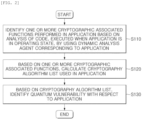
- FIG. 2 is a flowchart illustrating a quantum vulnerability identifying method according to an embodiment of the present disclosure.
- the method illustrated in FIG. 2 may be performed by, for example, the quantum vulnerability identifying server 130 or the application server 120.
- the quantum vulnerability identifying server 130 or the application server 120 may be embodied by including a computing apparatus 50 which is to be described with reference to FIG. 10 and a description provided with reference to FIG. 10 .
- the quantum vulnerability identifying the server 130 or the application server 120 may include a processor 10, and the processor 10 may execute an instruction configured to implement an operation of identifying quantum vulnerability with respect to an application.
- the method may further include an operation (not illustrated) of correcting, by using the dynamic analysis agent 220, a code area corresponding to the quantum vulnerability identified in the application 210 that is in the operating state.
- the dynamic analysis agent 220 may identify quantum vulnerability with respect to the application 210 by using a rule set configured based on a predetermined configuration file for the application 210.
- application 210 and the dynamic analysis agent 220 may be configured to interoperate with each other in one same process.
- the dynamic analysis agent 220 may identify quantum vulnerability with respect to the application 210 that is in the operating state.
- corrected code area may be applied to the application 210, and configuration may be performed not to recall the dynamic analysis agent 220 when the application 210 is recalled.
- the degree of effect on the application 210 may be verified by using a code to which the corrected code area is applied.
- the dynamic analysis agent 220 may calculate a cryptography algorithm list used in the application 210 while calling and executing an API of the one or more cryptographic associated functions.
- FIG. 3 illustrates a configuration and operations of the quantum vulnerability identifying system 100 according to an embodiment of the present disclosure.
- the computing apparatus 50 may identify one or more cryptographic associated functions executed in the application 210 based on analysis of the code 211, executed when the application 210 is in an operating state, by using the dynamic analysis agent 220 corresponding to the application 210.
- FIG. 3 it may be embodied via a Java virtual machine (JVM) by using the Java application 210 operated in the JVM and the Java agent 220 that interoperates with the Java application.
- JVM Java virtual machine
- the present disclosure is an example and is not limited thereto, and the application 210 and the dynamic analysis agent 220 according to the present disclosure may be embodied based on various flatforms.
- a Java agent may be operated based on the Java virtual machine (JVM).
- the Java agent is capable of receiving an event of the JVM or obtaining information via an inquiry, and is capable of removing a byte code that is loaded and operates in the JVM, and thus, may utilize the same for identifying and responding to quantum vulnerability with respect to the application 210 operating based on the JVM.
- the dynamic analysis agent 220 based on the Java agent receives a dynamic analysis agent configuration file 320, configures a rule set 221 to be applied to analysis of the application 210. Based thereon, the dynamic analysis agent 220 may directly identify quantum vulnerability with respect to the application 210, and may produce a result thereof as a log file 330 or the like.
- the present disclosure is not necessarily limited thereto, but may be embodied in various manners, such as the case in which the dynamic analysis agent 220 transmits collected information to the quantum vulnerability identifying server 130 and the quantum vulnerability identifying server 130 analyzes quantum vulnerability with respect to the application 210 based on the transmitted information.
- the degree of effect of a changed code on the performance of the application 210, on the amount of resources consumed, or the like may be verified by correcting, in real time, a code area corresponding to the identified quantum vulnerability with respect to the application 210 being in an operating state by using the dynamic analysis agent 220 (diagrams 211a and 211b of FIG. 3 ) .
- one or more cryptographic associated functions executed in the application 210 may be identified based on analysis of the code 211, executed when the application 210 is in an operating state, by using the dynamic analysis agent 220.
- the cryptographic associated function may include a cryptography function that performs algorithm for encryption or decryption and a function affected by security vulnerability of a cryptography function, such as a function that uses the encryption function, or the like.
- the cryptographic associated function may be identified using a predetermined rule set or the like.
- the present disclosure is not necessarily limited thereto, and the cryptographic associated function may be selected using various static or dynamic analysis schemes.
- a cryptography algorithm list used in the application 210 may be calculated based on the one or more cryptographic associated functions.
- the dynamic analysis agent 220 may calculate a cryptography algorithm list used in the application 210 by calling and executing an application programing interface (API) of the one or more cryptographic associated functions.
- API application programing interface
- the dynamic analysis agent 220 may calculate the cryptography algorithm list used in the application 210 with reference to a separate configuration file or the like used for executing the cryptographic associated function, in addition to the source code 310 of the application 210.
- quantum vulnerability with respect to the application 210 may be identified.
- quantum vulnerability with respect to the application 210 may be identifiable using a predetermined rule set or the like in operation S130, the present disclosure is not necessarily limited thereto, and quantum vulnerability with respect to the cryptography application 210 may be identifiable using various static or dynamic analysis schemes.
- the present disclosure may further include an operation (not illustrated) of correcting a code area corresponding to the quantum vulnerability identified in the application 210 that is in the operating state, by using the dynamic analysis agent 220.
- FIG. 4 is a flowchart illustrating a quantum vulnerability identifying method according to an embodiment of the present disclosure.
- the method may execute the application 210 with reference to the dynamic analysis agent 220 in operation S210.
- the method may receive and apply the dynamic analysis agent configuration file 320 associated with the application 210 in operation S220.
- the method may execute the application 210 in operation S230, and may detect quantum vulnerability with respect to the application 210 in operation S240.
- the method may produce a log file 330 associated with the detected quantum vulnerability in operation S260, may determine whether an action for the quantum vulnerability is needed based on the log file 330 in operation S270, and may change and apply, in real time when required, a code area corresponding to the quantum vulnerability of the execution code 211 that is being executed in operation S280.
- the method may determine whether to terminate detection of quantum vulnerability with respect to the application 210 in operation S290, and may repeatedly perform or terminate detection of quantum vulnerability with respect to the application 210.
- FIG. 5 is a detailed flowchart illustrating a method of detecting and responding to quantum vulnerability with respect to the application 210.
- the method loads the execution code 211 associated with the application 210, and may operate the dynamic analysis agent 220 in operation S310.
- the method may identify quantum vulnerability with respect to each cryptography algorithm usable in the application 210 by using the cryptography algorithm list in operation S330.
- the method may produce the content associated therewith as a log file 330 in operation S340.
- a log file associated with a cryptography algorithm (e.g., RSA/2048 or the like) which has quantum vulnerability and is used for a predetermined parameter of a Java security related package or the like may be produced.
- a cryptography algorithm e.g., RSA/2048 or the like
- the method may change algorithm having the identified quantum vulnerability to a post-quantum cryptography (PQC) algorithm (e.g., KYBER/512 or the like) having quantum security in operation S350.
- PQC post-quantum cryptography
- the changed execution code 211 may be applied to the application 210 so that the changed execution code 211 is recalled, and configuration may be performed not to recall the dynamic analysis agent 220 when the application 210 is recalled in operation S360.
- the method recognizes the execution code 211 associated with the application 210 that is being executed.
- code 210 for which recognition is to be performed in the application 210 may be given as below.
- the method may recognize the subject code of recognition by using the recognition item.
- the method may compare the recognized code item with a predetermined quantum vulnerability detection configuration item.
- FIG. 7 illustrates the configuration file 320 to configure quantum vulnerability detection.
- the quantum vulnerability determination and code changing may be performed based on a given security guideline or the like, and, furthermore, configuration or the like may be changed by a user according to the characteristic of the application 210 and may be applied.
- the method may configure a sentence including a plurality of method calls as a subject of recognition.
- the method may take action by applying a counter plan to the detected quantum vulnerability.
- FIG. 8 illustrates the configuration file 320 for changing a code in association with the detected quantum vulnerability.
- the method may produce information associated therewith as the log file 330, and may change the execution code 211 associated with the currently executed application 210 (e.g., may change parameter RSA/2048 to KYBER/512) in real time.
- the method may identify a method parameter value, a method return value, or the like, and may perform a defined counter plan.
- FIG. 9A illustrates the execution code 211 in the case in which RSA that is a cryptography algorithm having quantum vulnerability is used (diagram 910 of FIG. 9A ).
- the dynamic analysis agent 220 may identify quantum vulnerability of a cryptography algorithm used in the application 210 while calling an API of a cryptography function of a configured module. In this instance, based on a predetermined subject code of recognition, quantum vulnerability with respect to the application 210 may be detected.
- the method may produce the log file 330 based on a detection result, may change the execution code 211 of the application 210 in real time, and may change "RSA" to "KYBER” or the like having quantum security and apply the same.
- FIG. 9B illustrates the execution code 211 in the case in which KYBER that is a cryptography algorithm having quantum security is used (diagram 920 of FIG. 9B ).
- the dynamic analysis agent 220 may identify quantum vulnerability of a cryptography algorithm used in the application 210 while calling an API of a cryptography function of a configured module. In this instance, based on a predetermined subject code of recognition, quantum vulnerability with respect to the application 210 may be detected.
- the computer is not limited to a personal computer (PC), a notebook computer, and the like, and may include all information processing devices including a central processing unit (CPU) and capable of executing a computer program, such as a server, a smartphone, a tablet PC, a PDA, a mobile phone, and the like.
- PC personal computer
- notebook computer and the like
- computer program such as a server, a smartphone, a tablet PC, a PDA, a mobile phone, and the like.
- the computer-readable medium may continuously store a computer-executable program, or may temporarily store the same for execution or downloading.
- the medium may be one of the various types of recording devices or storage devices provided in a single entity or in a form in which a plurality of pieces of hardware are combined, and the medium is not limited to a medium that directly accesses a predetermined computer system, and may be distributed in a network. Therefore, the detailed description should not be construed restrictively in all aspects, and may be considered as an example. The scope of the present disclosure should be determined by rational interpretation of attached claims, and all modifications made in the scope equivalent to that of the present disclosure should be included in the scope of the present disclosure.
- FIG. 10 is a diagram illustrating the apparatus 50 to which a method suggested in the present disclosure is applicable.
- the apparatus 50 may be configured to embody a process of identifying quantum vulnerability with respect to the application 210 in the quantum vulnerability identifying system 100 according to the proposed method of the present disclosure.
- the apparatus 50 may be the application server 120 or the quantum vulnerability identifying server 130.
- the apparatus 50 to which the method suggested in the present disclosure is applicable may include a network device such as a repeater, a hub, a bridge, a switch, a router, a gateway, and the like, a computer device such as a desktop computer, a workstation, and the like, a mobile terminal such as a smartphone and the like, a portable device such as a laptop computer and the like, electronic appliance such a digital TV and the like, and means of transportation such as a vehicle and the like.
- the apparatus 50 to which the present disclosure is applicable may be included as a part of an application specific integrated circuit (ASIC) embodied in the form of a system on chip (SoC).
- ASIC application specific integrated circuit
- a memory 20 may be operatively connected to the processor 10, may store programs and/or instructions for processing and controlling the processor 10, and may store data and information used in the present disclosure, control information required for processing data and information according to the present disclosure, and temporary data occurring in a data and information processing process, and the like.
- the memory 20 may be embodied as a storage device such as a read only memory (ROM), a random access memory (RAM), an erasable programmable read only memory (EPROM), an electrically erasable programmable read-only memory (EEPROM), a flash memory, a static RAM (SRAM), a hard disk drive (HDD), a solid state drive (SSD), and the like.
- the processor 10 may be operatively connected to the memory 20 and/or a network interface 30, and may control the operation of each module in the apparatus 50. Particularly, the processor 10 may perform various control functions for implementing the method suggested in the present disclosure.
- the processor 10 may be also referred to as a controller, a microcontroller, a microprocessor, a microcomputer, and the like.
- the method suggested in the present disclosure may be embodied by hardware, firmware, software, or a combination thereof.
- an application specific integrated circuit or a digital signal processor (DSP), a digital signal processing device (DSPD), a programmable logic device (PLD), a field programmable gate array (FPGA), and the like configured to implement the present disclosure may be included in the processor 10.
- ASIC application specific integrated circuit
- DSP digital signal processor
- DSPD digital signal processing device
- PLD programmable logic device
- FPGA field programmable gate array
- the firmware or software may include instructions related to a module that performs functions or operations needed for embodying the method suggested in the present disclosure, a procedure, a function, or the like, and the instructions may be stored in the memory 20 or may be stored in a computer-readable recording medium (not illustrated) separately from the memory 20, and may be configured to enable the apparatus 50 to embody the method suggested in the present disclosure when the instructions are executed by the processor 10.
- the apparatus 50 may include the network interface device 30.
- the network interface device 30 may be operatively connected to the processor 10, and the processor 10 may control the network interface device 30 so as to transmit or receive a wired/wireless signal that carries information and/or data, a signal, a message, or the like via a wired/wireless network.
- the network interface device 30 may support various communication standards, for example, IEEE 802 series, 3GPP LTE (-A), 3GPP 5G, and the like, and may transmit or receive control information and/or data signals according to a corresponding communication standard.
- the network interface device 30 may be embodied outside the apparatus 50 when needed.
- a method, apparatus, system, and computer program for identifying and responding to quantum vulnerability with respect to an application by using a dynamic analysis agent may efficiently identify and respond to quantum vulnerability with respect to various applications 210, may identify and supplement quantum vulnerability in real time with respect to even the application 210 that currently operates, and may efficiently identify and verify quantum vulnerability with respect to the application 210 in a process of developing the application 210 or a post-development verification process.
- connection of lines between components or connected members illustrated in the drawing may be examples of functional connections and/or physical or circuit connections, and may be embodied as various replaceable or additional functional connections, physical connections, or circuit connections in a real device. Unless there is no word specifically mentioned such as “essential”, “importantly”, or the like, a corresponding component may not be essential component for applying the present disclosure.
- the term "the” and demonstrative terms which are similar thereto may correspond to both singularity and plurality.
- the present disclosure specifies a range
- the present disclosure includes an invention to which individual values falling within the range are applied (unless otherwise noted), and it is construed that the detailed description of the present disclosure specifies individual values included in the range.
- the present disclosure may not intend to necessarily restrict the order of operations provided in the method of the present disclosure, and the order may be changed appropriately unless one operation needs to be performed necessarily preferentially according to the essence of each process.
Landscapes
- Engineering & Computer Science (AREA)
- Computer Security & Cryptography (AREA)
- Computer Hardware Design (AREA)
- General Engineering & Computer Science (AREA)
- Theoretical Computer Science (AREA)
- Software Systems (AREA)
- Physics & Mathematics (AREA)
- General Physics & Mathematics (AREA)
- Computing Systems (AREA)
- Health & Medical Sciences (AREA)
- General Health & Medical Sciences (AREA)
- Virology (AREA)
- Computer Networks & Wireless Communication (AREA)
- Signal Processing (AREA)
- Stored Programmes (AREA)
Abstract
Description
- This application is based on and claims priority under 35 U.S.C. 119 to
Korean Patent Application No. 10-2023-0090528, filed on July 12, 2023 Korean Patent Application No. 10-2023-0147941, filed on October 31, 2023 - The present disclosure relates to a method, apparatus, system, and computer program for identifying and responding to quantum vulnerability with respect to an application by using a dynamic analysis agent and, more particularly, the present disclosure relates to a method, apparatus, system, and computer program for identifying and responding to quantum vulnerability with respect to an application by using a dynamic analysis agent, which effectively identify and respond to quantum vulnerability in real time, while operating the application and the dynamic analysis agent via interoperation.
- Recently, various services have been provided based on wired or wireless communication networks and thus, the importance of security has been continuously grown. Accordingly, various security algorithms have been developed and applied.
- However, labor force and resources utilizable when a manager or the like manages security of an application to provide a service or the like may be limited, inevitably. Therefore, there is a need to effectively resolve various security risks associated with multiple applications with a limited amount of resource, which is a constraint.
- In addition, as quantum computing technology has developed, the risk of paralyzing an existing cryptosystem has been realized based on the development of quantum computing. Accordingly, there is provided a scheme of responding to a security risk by applying post-quantum cryptography (PQC) technology.
- However, a large amount of resource such as labor force, time, and the like may be required to identify quantum vulnerability with respect to various applications which are already established and operated, and to respond to the same by applying the PQC scheme to an application of which quantum vulnerability is identified. Therefore, a manager may have hard time efficiently identifying quantum vulnerability with respect to various applications, and effectively responding to the same by applying the PQC scheme to an application of which vulnerability is identified.
- Accordingly, there is a need for a scheme capable of efficiently identifying and responding to quantum vulnerability with respect to various applications, but an appropriate resolution thereto has not been provided yet.
- The present disclosure has been made in order to solve the above-mentioned problems in the prior art and an aspect of the present disclosure is to provide a method, apparatus, system, and computer program for identifying and responding to quantum vulnerability with respect to an application by using a dynamic analysis agent, which efficiently identify and respond to quantum vulnerability with respect to various applications.
- In addition, an aspect of the present disclosure is to provide a method, apparatus, system, and computer program for identifying and responding to quantum vulnerability with respect to an application by using a dynamic analysis agent, which identify and supplement quantum vulnerability in real time with respect to even an application that currently operates.
- In addition, an aspect of the present disclosure is to provide a method, apparatus, system, and computer program for identifying and responding to quantum vulnerability with respect to an application by using a dynamic analysis agent, which efficiently identify and verify quantum vulnerability with respect an application in an application development process or in a post-development verification process.
- The technical subject matter of the present disclosure is not limited to the above-mentioned technical subject matters, and other technical subject matters which are not mentioned may be understood by those skilled in the art based on the following description.
- As a first aspect of the disclosure, there is provided a method of identifying quantum vulnerability with respect to an application by using a computing apparatus, and the method includes an operation of identifying one or more cryptographic associated functions performed in an application based on analysis of a code, executed while the application is in an operating state, by using a dynamic analysis agent corresponding to the application, an operation of calculating, based on the one or more cryptographic associated functions, a cryptography algorithm list used in the application, and an operation of identifying, based on the cryptography algorithm list, quantum vulnerability with respect to the application.
- Here, the method may further include an operation of correcting, by using the operation analysis agent, a code area corresponding to the quantum vulnerability identified in the application that is in the operating state.
- In addition, the dynamic analysis agent may identify quantum vulnerability with respect to the application by using a rule set configured based on a predetermined configuration file for the application.
- In addition, the application and the dynamic analysis agent may be configured to interoperate with each other in one same process.
- In this instance, the dynamic analysis agent may identify quantum vulnerability with respect to the application that is in the operating state by using intercepting for the application.
- In addition, the corrected code area may be applied to the application, and configuration may be performed not to recall the dynamic analysis agent when the application is recalled.
- In addition, a degree of effect on the application may be verified by using a code to which the corrected code area is applied.
- In addition, in the calculating operation, the dynamic analysis agent may calculate a cryptography algorithm list used for the application while calling and executing an API of the one or more cryptographic associated functions.
- As a second aspect of the disclosure, there is provided a server including a processor and a memory, and configured to identify quantum vulnerability with respect to an application, wherein the memory may include instructions configured to cause, when executed by the processor, the server to perform a predetermined operation which includes an operation of identifying one or more cryptographic associated functions executed in the application based on analysis of a code, executed while the application is in an operating state, by using a dynamic analysis agent corresponding to the application, an operation of calculating, based on the one or more cryptographic associated functions, a cryptography algorithm list used in the application, and an operation of identifying, based on the cryptography algorithm list, the quantum vulnerability with respect to the application.
- Here, the server may further include an operation of correcting, by using the dynamic analysis agent, a code area corresponding to the quantum vulnerability identified in the application that is in the operating state.
- In addition, the dynamic analysis agent may identify the quantum vulnerability with respect to the application by using a rule set configured based on a predetermined configuration file for the application.
- In addition, the application and the dynamic analysis agent may be configured to interoperate with each other in one same process.
- In this instance, the dynamic analysis agent may identify the quantum vulnerability with respect to the application that is in the operating state, by using intercepting for the application.
- In addition, the corrected code area may be applied to the application, and configuration may be performed so as not to recall the dynamic analysis agent when the application is recalled.
- In addition, a degree of effect on the application may be verified using a code to which the corrected code area is applied.
- In addition, in the calculating operation, the dynamic analysis agent may calculate a cryptography algorithm list used for the application while calling and executing an API of the one or more cryptographic associated functions.
- As a third aspect of the disclosure, there is provided a computer-readable storing medium that stores instructions configured to, when executed by a processor, cause a server to implement a predetermined operation, wherein the server includes the processor and identifies quantum vulnerability with respect to an application, and the predetermined operation includes an operation of identifying one or more cryptographic associated functions executed in the application based on analysis of a code, executed when the application is in an operating state, by using a dynamic analysis agent corresponding to the application, an operation of calculating, based on the one or more cryptographic associated functions, a cryptography algorithm list used in the application, and an operation of identifying, based on the cryptography algorithm list, quantum vulnerability with respect to the application.
- Accordingly, a method, apparatus, system, and computer program for identifying and responding to quantum vulnerability with respect to an application by using a dynamic analysis agent according to an embodiment of the present disclosure may efficiently identify and respond to quantum vulnerability with respect to various applications.
- In addition, a method, apparatus, system, and computer program for identifying and responding to quantum vulnerability with respect to an application by using a dynamic analysis agent according to an embodiment of the present disclosure may efficiently identify and supplement quantum vulnerability in real time with respect to even an application that currently operates.
- In addition, a method, apparatus, system, and computer program for identifying and responding to quantum vulnerability with respect to an application by using a dynamic analysis agent according to an embodiment of the present disclosure may efficiently identify and supplement quantum vulnerability in real time with respect to even an application that currently operates.
- Effects that could be obtained based on the present disclosure are not limited to the above-described effects, and based on the descriptions provided below, those skilled in the art would clearly understand other effects which are not mentioned.
- The above and other aspects, features, and advantages of the present disclosure will be more apparent from the following detailed description taken in conjunction with the accompanying drawings, in which:
-
FIG. 1 is a diagram illustrating a configuration of a quantum vulnerability identifying system according to an embodiment of the present disclosure; -
FIG. 2 is a flowchart illustrating a quantum vulnerability identifying method according to an embodiment of the present disclosure; -
FIG. 3 is a diagram illustrating configurations and operations of an application and a dynamic analysis agent according to an embodiment of the present disclosure; -
FIG. 4 andFIG. 5 are flowcharts illustrating quantum vulnerability identifying methods according to an embodiment of the present disclosure; -
FIGS. 6 to 9 are diagrams illustrating detailed examples of a quantum vulnerability identifying method according to an embodiment of the present disclosure; and -
FIG. 10 is a diagram illustrating a configuration of a computing apparatus that identifies quantum vulnerability according to an embodiment of the present disclosure. - Hereinafter, various embodiments will be described in detail with reference to the accompanying drawings. The purposes, specific advantages, and new features of the present disclosure may be clearly understood from detailed descriptions and preferable embodiments associated with the attached drawings.
- Terms or words used in the present specification and claims, which are concepts appropriately defined by an inventor in order to describe the present disclosure best, should be construed as the meanings and concepts that agree with the technical idea of the present disclosure. The terms and words are merely to describe embodiments and should not be understood as limiting the present disclosure.
- When assigning reference numerals to components, like reference numerals may refer to like or similar components, and duplicate description thereof will be omitted. Ending words used for a component, such as "module" and "unit", are assigned or interchangeably used for ease of drafting the specifications, may not have distinguishing meanings or roles, and may be software or hardware components.
- When describing components of the present disclosure, a component expressed in the singular form is intended to include components expressed in the plural forms as well, unless otherwise described. In addition, the terms "first", "second", and the like are used for distinguishing one component from another component, and components are not limited to the above-mentioned terms. In addition, in the case in which a component is connected to another component, yet another component may be connected between the component and the other component.
- In addition, when detailed descriptions related to a well-known technical art is identified as making the subject matter of the embodiments disclosed in the present specification ambiguous, the detailed descriptions thereof will be omitted herein. In addition, the attached drawings are merely to help understanding of embodiments disclosed in the present specification, and it should be understood, however, that there is no intention to limit technical idea disclosed in the present specification but all modifications, equivalents, and alternatives falling within the scope of the ideas and technology of the present disclosure are included.
- Hereinafter, embodiments of a method, apparatus, system, and computer program for identifying and responding to quantum vulnerability with respect to an application by using a dynamic analysis agent according to the present disclosure will be described in detail with reference to enclosed drawings.
-
FIG. 1 illustrates a configuration and operations of a quantumvulnerability identifying system 100 according to an embodiment of the present disclosure. As illustrated inFIG. 1 , the quantumvulnerability identifying system 100 according to an embodiment of the present disclosure may be configured with anapplication server 120 that operates an application for providing a service to one or more devices 110, and a quantumvulnerability identifying server 130 for identifying and responding to quantum vulnerability with respect to theapplication server 120. - In this instance, as the device 110, various terminals for providing a service to a user, such as a personal computer (PC), a notebook PC, a tablet PC, a smartphone, a PDA, or the like, may be used. However, the device is not necessarily limited thereto and various devices, such as a server that receives and uses data or the like provided from the
application server 120, may be used as the device 110. - In addition, the
application server 120 may be embodied by using a single physical server device or two or more physical server devices. However, the present disclosure is not necessarily limited thereto, and may be configured by using a personal computational processing device, such as a desktop computer, a notebook computer, a tablet, a smartphone, or the like, may be configured based on a cloud system, or may be embodied in various forms such as a dedicated device or the like. - In addition, the quantum
vulnerability identifying server 130 may also be embodied by using a single physical server device, or two or more physical server devices. The quantumvulnerability identifying server 130 may also be embodied by using a cloud system or a dedicated device, and may be embodied in the form of a single server that combines theapplication server 120 and the quantumvulnerability identifying sever 130. - In addition, a wired network, a wireless network, or the like may be used as a
network 140 that connects the one or more devices 110, theapplication server 120, and the quantumvulnerability identifying server 130 inFIG. 1 , and, specifically, thenetwork 140 may include various communication networks such as a local area network (LAN), a metropolitan area network (MAN), a wide area network (WAN), and the like. In addition, thenetwork 140 may include world wide web (WWW) which is publicly known. Furthermore, thenetwork 140 may be embodied using a data bus or the like which is configured to transmit or receive data or the like. - In addition,
FIG. 2 is a flowchart illustrating a quantum vulnerability identifying method according to an embodiment of the present disclosure. - Here, the method illustrated in
FIG. 2 may be performed by, for example, the quantumvulnerability identifying server 130 or theapplication server 120. Furthermore, the quantumvulnerability identifying server 130 or theapplication server 120 may be embodied by including acomputing apparatus 50 which is to be described with reference toFIG. 10 and a description provided with reference toFIG. 10 . For example, the quantum vulnerability identifying theserver 130 or theapplication server 120 may include aprocessor 10, and theprocessor 10 may execute an instruction configured to implement an operation of identifying quantum vulnerability with respect to an application. - More specifically, as illustrated in
FIG. 2 , a quantum vulnerability identifying method according to an embodiment of the present disclosure is to identify quantum vulnerability with respect to anapplication 210 by using thecomputing apparatus 50, and may include an operation S110 of identifying one or more cryptographic associated functions executed in theapplication 210 based on analysis of acode 211, executed while theapplication 210 is in an operating state, by using adynamic analysis agent 220 corresponding to theapplication 210, an operation S120 of calculating a cryptography algorithm list used in theapplication 210 based on the one or more cryptographic associated functions, and an operation S130 of identifying quantum vulnerability with respect to theapplication 210 based on the cryptography algorithm list. - Here, the method may further include an operation (not illustrated) of correcting, by using the
dynamic analysis agent 220, a code area corresponding to the quantum vulnerability identified in theapplication 210 that is in the operating state. - In addition, the
dynamic analysis agent 220 may identify quantum vulnerability with respect to theapplication 210 by using a rule set configured based on a predetermined configuration file for theapplication 210. - In addition, the
application 210 and thedynamic analysis agent 220 may be configured to interoperate with each other in one same process. - In this instance, by using intercepting for the
application 210, thedynamic analysis agent 220 may identify quantum vulnerability with respect to theapplication 210 that is in the operating state. - In addition, the corrected code area may be applied to the
application 210, and configuration may be performed not to recall thedynamic analysis agent 220 when theapplication 210 is recalled. - In addition, the degree of effect on the
application 210 may be verified by using a code to which the corrected code area is applied. - In addition, in the calculation operation S120, the
dynamic analysis agent 220 may calculate a cryptography algorithm list used in theapplication 210 while calling and executing an API of the one or more cryptographic associated functions. - Accordingly, a method, apparatus, system, and computer program for identifying and responding to quantum vulnerability with respect to an application by using a dynamic analysis agent according to an embodiment of the present disclosure may efficiently identify and respond to quantum vulnerability with respect to
various applications 210, may identify and supplement quantum vulnerability in real time with respect to even theapplication 210 that currently operates, and may efficiently identify and verify quantum vulnerability with respect to theapplication 210 in a process of developing theapplication 210 or a post-development verification process. - In addition,
FIG. 3 illustrates a configuration and operations of the quantumvulnerability identifying system 100 according to an embodiment of the present disclosure. - Hereinafter, the configuration and operations of the quantum
vulnerability identifying system 100 according to an embodiment will be described in detail with reference toFIG. 2 andFIG. 3 . - In operation S110, the
computing apparatus 50 may identify one or more cryptographic associated functions executed in theapplication 210 based on analysis of thecode 211, executed when theapplication 210 is in an operating state, by using thedynamic analysis agent 220 corresponding to theapplication 210. - In this instance, the
computing apparatus 50 may be the quantumvulnerability identifying server 130, the present disclosure is not necessarily limited thereto, and may be embodied in various forms such as a single server that combines the quantumvulnerability identifying server 130 and theapplication server 120. - Specifically, for example, as illustrated in
FIG. 3 , it may be embodied via a Java virtual machine (JVM) by using theJava application 210 operated in the JVM and theJava agent 220 that interoperates with the Java application. However, the present disclosure is an example and is not limited thereto, and theapplication 210 and thedynamic analysis agent 220 according to the present disclosure may be embodied based on various flatforms. - In this instance, as illustrated in
FIG. 3 , in the case in which aJava source code 310 is given, a compiling and executing process associated with theJava source code 310 is performed and thebyte code 211 associated with theJava source code 310 may be executed in the JVM operated in theapplication server 200. - Here, in the present disclosure, as the
dynamic analysis agent 220 corresponding to theapplication 210, a Java agent may be operated based on the Java virtual machine (JVM). In this instance, the Java agent is capable of receiving an event of the JVM or obtaining information via an inquiry, and is capable of removing a byte code that is loaded and operates in the JVM, and thus, may utilize the same for identifying and responding to quantum vulnerability with respect to theapplication 210 operating based on the JVM. - In this instance, in the present disclosure, the
dynamic analysis agent 220 based on the Java agent receives a dynamic analysisagent configuration file 320, configures a rule set 221 to be applied to analysis of theapplication 210. Based thereon, thedynamic analysis agent 220 may directly identify quantum vulnerability with respect to theapplication 210, and may produce a result thereof as alog file 330 or the like. However, the present disclosure is not necessarily limited thereto, but may be embodied in various manners, such as the case in which thedynamic analysis agent 220 transmits collected information to the quantumvulnerability identifying server 130 and the quantumvulnerability identifying server 130 analyzes quantum vulnerability with respect to theapplication 210 based on the transmitted information. - In addition, in the present disclosure, in association with the quantum vulnerability identified with respect to the
application 210, the degree of effect of a changed code on the performance of theapplication 210, on the amount of resources consumed, or the like may be verified by correcting, in real time, a code area corresponding to the identified quantum vulnerability with respect to theapplication 210 being in an operating state by using the dynamic analysis agent 220 (diagrams 211a and 211b ofFIG. 3 ) . - Accordingly, in operation S110, one or more cryptographic associated functions executed in the
application 210 may be identified based on analysis of thecode 211, executed when theapplication 210 is in an operating state, by using thedynamic analysis agent 220. - In this instance, the cryptographic associated function may include a cryptography function that performs algorithm for encryption or decryption and a function affected by security vulnerability of a cryptography function, such as a function that uses the encryption function, or the like.
- In association with the same, in operation S110, the cryptographic associated function may be identified using a predetermined rule set or the like. However, the present disclosure is not necessarily limited thereto, and the cryptographic associated function may be selected using various static or dynamic analysis schemes.
- Subsequently, in operation S120, a cryptography algorithm list used in the
application 210 may be calculated based on the one or more cryptographic associated functions. - More specifically, in operation S120, the
dynamic analysis agent 220 may calculate a cryptography algorithm list used in theapplication 210 by calling and executing an application programing interface (API) of the one or more cryptographic associated functions. - Accordingly, in operation S120, while executing the cryptography associated function, the
dynamic analysis agent 220 may calculate the cryptography algorithm list used in theapplication 210 with reference to a separate configuration file or the like used for executing the cryptographic associated function, in addition to thesource code 310 of theapplication 210. - Accordingly, in operation S130, based on the cryptography algorithm list, quantum vulnerability with respect to the
application 210 may be identified. - In this regard, although quantum vulnerability with respect to the
application 210 may be identifiable using a predetermined rule set or the like in operation S130, the present disclosure is not necessarily limited thereto, and quantum vulnerability with respect to thecryptography application 210 may be identifiable using various static or dynamic analysis schemes. - Furthermore, the present disclosure may further include an operation (not illustrated) of correcting a code area corresponding to the quantum vulnerability identified in the
application 210 that is in the operating state, by using thedynamic analysis agent 220. - Specifically,
FIG. 4 is a flowchart illustrating a quantum vulnerability identifying method according to an embodiment of the present disclosure. - As illustrated in
FIG. 4 , after performing preparation for executing the application (APP) 210, the method may execute theapplication 210 with reference to thedynamic analysis agent 220 in operation S210. - In addition, the method may receive and apply the dynamic analysis
agent configuration file 320 associated with theapplication 210 in operation S220. - Subsequently, the method may execute the
application 210 in operation S230, and may detect quantum vulnerability with respect to theapplication 210 in operation S240. - In this instance, upon detection of quantum vulnerability with respect to the
application 210 in operation S250, the method may produce alog file 330 associated with the detected quantum vulnerability in operation S260, may determine whether an action for the quantum vulnerability is needed based on thelog file 330 in operation S270, and may change and apply, in real time when required, a code area corresponding to the quantum vulnerability of theexecution code 211 that is being executed in operation S280. - Conversely, in the case in which the quantum vulnerability with respect to the
application 210 is not detected in operation S250, the method may determine whether to terminate detection of quantum vulnerability with respect to theapplication 210 in operation S290, and may repeatedly perform or terminate detection of quantum vulnerability with respect to theapplication 210. - In this regard,
FIG. 5 is a detailed flowchart illustrating a method of detecting and responding to quantum vulnerability with respect to theapplication 210. - Referring to
FIG. 5 , the method loads theexecution code 211 associated with theapplication 210, and may operate thedynamic analysis agent 220 in operation S310. - Subsequently, the method may produce a cryptography algorithm list used in the
application 210 while calling and executing an API of a predetermined cryptographic associated function by using thedynamic analysis agent 220 in operation S320. - Subsequently, the method may identify quantum vulnerability with respect to each cryptography algorithm usable in the
application 210 by using the cryptography algorithm list in operation S330. - In this instance, in the case in which it is determined that a cryptography algorithm that has quantum vulnerability is used for the
application 210, the method may produce the content associated therewith as alog file 330 in operation S340. - For example, a log file associated with a cryptography algorithm (e.g., RSA/2048 or the like) which has quantum vulnerability and is used for a predetermined parameter of a Java security related package or the like may be produced.
- Subsequently, with respect to the
execution code 211 for theapplication 210, the method may change algorithm having the identified quantum vulnerability to a post-quantum cryptography (PQC) algorithm (e.g., KYBER/512 or the like) having quantum security in operation S350. - In addition, the changed
execution code 211 may be applied to theapplication 210 so that the changedexecution code 211 is recalled, and configuration may be performed not to recall thedynamic analysis agent 220 when theapplication 210 is recalled in operation S360. - Specifically, detailed embodiments associated with to a quantum vulnerability identifying method of the present disclosure will be described with reference to
FIGS. 6 to 9 . - As described in
FIG. 6 , in operation S410, the method recognizes theexecution code 211 associated with theapplication 210 that is being executed. - Specifically, for example, as a recognition item associated with the Java virtual machine (JVM)-based
application 210 in the example ofFIG. 3 , a module name (e.g., module), a method name (e.g., methods), a method parameter value (e.g., paramC, paramD), a method return value (e.g., valueE), or the like may be included. - In this instance, the
code 210 for which recognition is to be performed in theapplication 210 may be given as below. - Accordingly, in operation S410, the method may recognize the subject code of recognition by using the recognition item.
- Subsequently, in operation S420, the method may compare the recognized code item with a predetermined quantum vulnerability detection configuration item.
- In this instance,
FIG. 7 illustrates theconfiguration file 320 to configure quantum vulnerability detection. - Accordingly, as illustrated in
FIG. 7 , the (example subject code of recognition) may be identified as a quantum vulnerability code according to case A ofFIG. 7 . The method may produce information associated therewith as thelog file 330, and may change, in real time, theexecution code 211 associated with theapplication 210 that is being executed. - In this instance, the quantum vulnerability determination and code changing may be performed based on a given security guideline or the like, and, furthermore, configuration or the like may be changed by a user according to the characteristic of the
application 210 and may be applied. - In addition, in the present disclosure, the method may configure a sentence including a plurality of method calls as a subject of recognition.
- Subsequently, in operation S430, the method may take action by applying a counter plan to the detected quantum vulnerability.
- Specifically, for example,
FIG. 8 illustrates theconfiguration file 320 for changing a code in association with the detected quantum vulnerability. - In this instance, the code of which quantum vulnerability is identified may be changed to a post-quantum cryptography (PQC) algorithm having quantum security.
- For example, as shown in case A of
FIG. 8 , when a code with quantum vulnerability is identified, the method may produce information associated therewith as thelog file 330, and may change theexecution code 211 associated with the currently executed application 210 (e.g., may change parameter RSA/2048 to KYBER/512) in real time. - Conversely, as shown in case B of
FIG. 8 , when quantum vulnerability is not identified in a subject code of recognition, the method may produce information associated therewith as thelog file 330, and may not apply changing of the execution code 211 (e.g., KYBER/512 that already has quantum security is changed). - Accordingly, at the point in time of execution of the execution code 2110, the method may identify a method parameter value, a method return value, or the like, and may perform a defined counter plan.
- Specifically, for example,
FIGS. 9A and9B illustrate the case of detecting, by using thedynamic analysis agent 220, quantum vulnerability with respect to a byte code of theapplication 210 that is executed based on a Java virtual machine (JVM) (in this instance,FIGS. 9A and9B illustrate a byte code, which is an execution code, in a decompiled form. - In this instance,
FIG. 9A illustrates theexecution code 211 in the case in which RSA that is a cryptography algorithm having quantum vulnerability is used (diagram 910 ofFIG. 9A ). - Here, the
dynamic analysis agent 220 may identify quantum vulnerability of a cryptography algorithm used in theapplication 210 while calling an API of a cryptography function of a configured module. In this instance, based on a predetermined subject code of recognition, quantum vulnerability with respect to theapplication 210 may be detected. - In this instance, in the example of
FIG. 9A , "RSA" which is a parameter of Cipher.getInstance in a module is identified and thus, the method may produce thelog file 330 based on a detection result, may change theexecution code 211 of theapplication 210 in real time, and may change "RSA" to "KYBER" or the like having quantum security and apply the same. - Conversely,
FIG. 9B illustrates theexecution code 211 in the case in which KYBER that is a cryptography algorithm having quantum security is used (diagram 920 ofFIG. 9B ). - Here, the
dynamic analysis agent 220 may identify quantum vulnerability of a cryptography algorithm used in theapplication 210 while calling an API of a cryptography function of a configured module. In this instance, based on a predetermined subject code of recognition, quantum vulnerability with respect to theapplication 210 may be detected. - In this instance, in the example of
FIG. 9B , "KYBER" which is a parameter of Cipher.getInstance in a module is identified and thus, the method may produce information associated therewith as thelog file 330, and may not apply changing of theexecution code 211. - In addition, a computer program according to another aspect of the present disclosure may be a computer program that is stored in a computer-readable medium in order to implement, in the computer, a series of operations of the above-described method of identifying quantum vulnerability with respect to the
application 210 in the quantumvulnerability identifying system 100. The computer program may be a computer program including machine code made by a complier and may also be a computer program including a high-level language code executable in a computer by using an interpreter or the like. In this instance, the computer is not limited to a personal computer (PC), a notebook computer, and the like, and may include all information processing devices including a central processing unit (CPU) and capable of executing a computer program, such as a server, a smartphone, a tablet PC, a PDA, a mobile phone, and the like. - In addition, the computer-readable medium may continuously store a computer-executable program, or may temporarily store the same for execution or downloading. In addition, the medium may be one of the various types of recording devices or storage devices provided in a single entity or in a form in which a plurality of pieces of hardware are combined, and the medium is not limited to a medium that directly accesses a predetermined computer system, and may be distributed in a network. Therefore, the detailed description should not be construed restrictively in all aspects, and may be considered as an example. The scope of the present disclosure should be determined by rational interpretation of attached claims, and all modifications made in the scope equivalent to that of the present disclosure should be included in the scope of the present disclosure.
-
FIG. 10 is a diagram illustrating theapparatus 50 to which a method suggested in the present disclosure is applicable. - Referring to
FIG. 10 , theapparatus 50 may be configured to embody a process of identifying quantum vulnerability with respect to theapplication 210 in the quantumvulnerability identifying system 100 according to the proposed method of the present disclosure. For example, theapparatus 50 may be theapplication server 120 or the quantumvulnerability identifying server 130. - For example, the
apparatus 50 to which the method suggested in the present disclosure is applicable may include a network device such as a repeater, a hub, a bridge, a switch, a router, a gateway, and the like, a computer device such as a desktop computer, a workstation, and the like, a mobile terminal such as a smartphone and the like, a portable device such as a laptop computer and the like, electronic appliance such a digital TV and the like, and means of transportation such as a vehicle and the like. As another example, theapparatus 50 to which the present disclosure is applicable may be included as a part of an application specific integrated circuit (ASIC) embodied in the form of a system on chip (SoC). - A
memory 20 may be operatively connected to theprocessor 10, may store programs and/or instructions for processing and controlling theprocessor 10, and may store data and information used in the present disclosure, control information required for processing data and information according to the present disclosure, and temporary data occurring in a data and information processing process, and the like. Thememory 20 may be embodied as a storage device such as a read only memory (ROM), a random access memory (RAM), an erasable programmable read only memory (EPROM), an electrically erasable programmable read-only memory (EEPROM), a flash memory, a static RAM (SRAM), a hard disk drive (HDD), a solid state drive (SSD), and the like. - The
processor 10 may be operatively connected to thememory 20 and/or anetwork interface 30, and may control the operation of each module in theapparatus 50. Particularly, theprocessor 10 may perform various control functions for implementing the method suggested in the present disclosure. Theprocessor 10 may be also referred to as a controller, a microcontroller, a microprocessor, a microcomputer, and the like. The method suggested in the present disclosure may be embodied by hardware, firmware, software, or a combination thereof. In the case of embodying the present disclosure using hardware, an application specific integrated circuit (ASIC) or a digital signal processor (DSP), a digital signal processing device (DSPD), a programmable logic device (PLD), a field programmable gate array (FPGA), and the like configured to implement the present disclosure may be included in theprocessor 10. In the case of embodying the method suggested in the present disclosure using firmware or software, the firmware or software may include instructions related to a module that performs functions or operations needed for embodying the method suggested in the present disclosure, a procedure, a function, or the like, and the instructions may be stored in thememory 20 or may be stored in a computer-readable recording medium (not illustrated) separately from thememory 20, and may be configured to enable theapparatus 50 to embody the method suggested in the present disclosure when the instructions are executed by theprocessor 10. - In addition, the
apparatus 50 may include thenetwork interface device 30. Thenetwork interface device 30 may be operatively connected to theprocessor 10, and theprocessor 10 may control thenetwork interface device 30 so as to transmit or receive a wired/wireless signal that carries information and/or data, a signal, a message, or the like via a wired/wireless network. Thenetwork interface device 30 may support various communication standards, for example, IEEE 802 series, 3GPP LTE (-A), 3GPP 5G, and the like, and may transmit or receive control information and/or data signals according to a corresponding communication standard. Thenetwork interface device 30 may be embodied outside theapparatus 50 when needed. - Accordingly, a method, apparatus, system, and computer program for identifying and responding to quantum vulnerability with respect to an application by using a dynamic analysis agent according to an embodiment of the present disclosure may efficiently identify and respond to quantum vulnerability with respect to
various applications 210, may identify and supplement quantum vulnerability in real time with respect to even theapplication 210 that currently operates, and may efficiently identify and verify quantum vulnerability with respect to theapplication 210 in a process of developing theapplication 210 or a post-development verification process. - The above-described embodiments and drawings in the specification are merely examples, and do not limit the scope of the present disclosure in any way. In addition, connection of lines between components or connected members illustrated in the drawing may be examples of functional connections and/or physical or circuit connections, and may be embodied as various replaceable or additional functional connections, physical connections, or circuit connections in a real device. Unless there is no word specifically mentioned such as "essential", "importantly", or the like, a corresponding component may not be essential component for applying the present disclosure.
- In the specification (particularly, claims) of the present disclosure, the term "the" and demonstrative terms which are similar thereto may correspond to both singularity and plurality. In addition, if the present disclosure specifies a range, the present disclosure includes an invention to which individual values falling within the range are applied (unless otherwise noted), and it is construed that the detailed description of the present disclosure specifies individual values included in the range. In addition, the present disclosure may not intend to necessarily restrict the order of operations provided in the method of the present disclosure, and the order may be changed appropriately unless one operation needs to be performed necessarily preferentially according to the essence of each process. The use of all examples or terms (e.g., or the like) in the present disclosure is merely to describe the present disclosure in detail, and the scope of the present disclosure is only limited by claims but not limited to the examples or terms. In addition, those skilled in the art will understand that the various modifications, combinations, and changes may be made based on design conditions and factors within the scope of claims or equivalents thereof.
Claims (15)
- A method of identifying quantum vulnerability with respect to an application by using a computing apparatus, the method comprising:identifying one or more cryptographic associated functions performed in an application based on analysis of a code, executed while the application is in an operating state, by using a dynamic analysis agent corresponding to the application;based on the one or more cryptographic associated functions, calculating a cryptography algorithm list used in the application; andbased on the cryptography algorithm list, identifying quantum vulnerability with respect to the application.
- The method of claim 1, further comprising correcting, by using the operation analysis agent, a code area corresponding to the quantum vulnerability identified in the application that is in the operating state.
- The method of claim 1, wherein the dynamic analysis agent is configured to identify quantum vulnerability with respect to the application by using a rule set configured based on a predetermined configuration file for the application.
- The method of claim 1, wherein the application and the dynamic analysis agent are configured to interoperate with each other in one same process, and
wherein the dynamic analysis agent is configured to identify quantum vulnerability with respect to the application that is in the operating state by using intercepting for the application. - The method of claim 2, wherein the corrected code area is applied to the application, and
wherein configuration is made not to recall the dynamic analysis agent when the application is recalled. - The method of claim 2, wherein a degree of effect on the application is verified by using a code to which the corrected code area is applied.
- The method of claim 1, wherein, in the calculating, the dynamic analysis agent calculates a cryptography algorithm list used for the application while calling and executing an API of the one or more cryptographic associated functions.
- A server comprising a processor and a memory, and configured to identify quantum vulnerability with respect to an application,
wherein the memory comprises instructions configured to cause, when executed by the processor, the server to perform a predetermined operation comprising:identifying one or more cryptographic associated functions executed in the application based on analysis of a code, executed while the application is in an operating state, by using a dynamic analysis agent corresponding to the application;calculating, based on the one or more cryptographic associated functions, a cryptography algorithm list used in the application; andidentifying, based on the cryptography algorithm list, the quantum vulnerability with respect to the application. - The server of claim 8, wherein the predetermined operation further comprises correcting, by using the dynamic analysis agent, a code area corresponding to the quantum vulnerability identified in the application that is in the operating state.
- The server of claim 8, wherein the dynamic analysis agent is configured to identify the quantum vulnerability with respect to the application by using a rule set configured based on a predetermined configuration file for the application.
- The server of claim 8, wherein the application and the dynamic analysis agent are configured to interoperate with each other in one same process, and
wherein the dynamic analysis agent is configured to identify the quantum vulnerability with respect to the application that is in the operating state, by using intercepting for the application. - The server of claim 9, wherein the corrected code area is applied to the application, and
wherein configuration is made so as not to recall the dynamic analysis agent when the application is recalled. - The server of claim 9, wherein a degree of effect on the application is verified using a code to which the corrected code area is applied.
- The server of claim 8, wherein, in the calculating, the dynamic analysis agent is configured to calculate a cryptography algorithm list used for the application while calling and executing an API of the one or more cryptographic associated functions.
- A computer-readable storing medium that stores instructions configured to, when executed by a processor, cause a server to implement a predetermined operation, the server including the processor and identifying quantum vulnerability with respect to an application, and the predetermined operation comprising:identifying one or more cryptographic associated functions executed in the application based on analysis of a code, executed when the application is in an operating state, by using a dynamic analysis agent corresponding to the application;based on the one or more cryptographic associated functions, calculating a cryptography algorithm list used in the application; andbased on the cryptography algorithm list, identifying quantum vulnerability with respect to the application.
Applications Claiming Priority (2)
| Application Number | Priority Date | Filing Date | Title |
|---|---|---|---|
| KR20230090528 | 2023-07-12 | ||
| KR1020230147941A KR20250010487A (en) | 2023-07-12 | 2023-10-31 | Method, apparatus, system and computer program for identifying and responding quantum vulnerability using dynamic analysis for application |
Publications (2)
| Publication Number | Publication Date |
|---|---|
| EP4492726A1 true EP4492726A1 (en) | 2025-01-15 |
| EP4492726B1 EP4492726B1 (en) | 2025-08-13 |
Family
ID=91530065
Family Applications (1)
| Application Number | Title | Priority Date | Filing Date |
|---|---|---|---|
| EP24181670.1A Active EP4492726B1 (en) | 2023-07-12 | 2024-06-12 | Method, apparatus, system and computer program for identifying and responding to quantum vulnerability using dynamic analysis for application |
Country Status (2)
| Country | Link |
|---|---|
| US (1) | US20250021661A1 (en) |
| EP (1) | EP4492726B1 (en) |
Citations (3)
| Publication number | Priority date | Publication date | Assignee | Title |
|---|---|---|---|---|
| US8397300B2 (en) * | 2009-09-22 | 2013-03-12 | International Business Machines Corporation | Detecting security vulnerabilities relating to cryptographically-sensitive information carriers when testing computer software |
| US20170187743A1 (en) * | 2014-05-20 | 2017-06-29 | Hewlett Packard Enterprise Development Lp | Point-wise protection of application using runtime agent and dynamic security analysis |
| EP4439353A1 (en) * | 2023-03-29 | 2024-10-02 | Samsung SDS Co., Ltd. | Method for analyzing quantum vulnerability and system therefor |
Family Cites Families (7)
| Publication number | Priority date | Publication date | Assignee | Title |
|---|---|---|---|---|
| US11308218B2 (en) * | 2018-12-20 | 2022-04-19 | Visa International Service Association | Open source vulnerability remediation tool |
| US11550903B1 (en) * | 2019-04-26 | 2023-01-10 | Joseph Alan Epstein | System and method for trustworthiness, reputation, provenance, and measurement of software |
| US11934538B2 (en) * | 2019-10-23 | 2024-03-19 | Sri International | Augmenting executables having cryptographic primitives |
| US11838410B1 (en) * | 2020-01-30 | 2023-12-05 | Wells Fargo Bank, N.A. | Systems and methods for post-quantum cryptography optimization |
| US20230109647A1 (en) * | 2021-10-04 | 2023-04-06 | Vmware, Inc. | Context aware cipher solutions in secure communications |
| US20250103720A1 (en) * | 2021-11-16 | 2025-03-27 | Wells Fargo Bank, N.A. | Post-quantum cryptography risk modeling |
| US12524283B2 (en) * | 2022-08-16 | 2026-01-13 | VMware LLC | Cryptographic agility through link layer abstraction |
-
2024
- 2024-05-14 US US18/664,129 patent/US20250021661A1/en active Pending
- 2024-06-12 EP EP24181670.1A patent/EP4492726B1/en active Active
Patent Citations (3)
| Publication number | Priority date | Publication date | Assignee | Title |
|---|---|---|---|---|
| US8397300B2 (en) * | 2009-09-22 | 2013-03-12 | International Business Machines Corporation | Detecting security vulnerabilities relating to cryptographically-sensitive information carriers when testing computer software |
| US20170187743A1 (en) * | 2014-05-20 | 2017-06-29 | Hewlett Packard Enterprise Development Lp | Point-wise protection of application using runtime agent and dynamic security analysis |
| EP4439353A1 (en) * | 2023-03-29 | 2024-10-02 | Samsung SDS Co., Ltd. | Method for analyzing quantum vulnerability and system therefor |
Also Published As
| Publication number | Publication date |
|---|---|
| US20250021661A1 (en) | 2025-01-16 |
| EP4492726B1 (en) | 2025-08-13 |
Similar Documents
| Publication | Publication Date | Title |
|---|---|---|
| EP4246896B1 (en) | Technologies for distributed detection of security anomalies | |
| US10032030B2 (en) | Trusted kernel starting method and apparatus | |
| EP2994848B1 (en) | Optimized resource allocation for virtual machines within a malware content detection system | |
| US9721101B2 (en) | System wide root of trust chaining via signed applications | |
| CN110334297B (en) | Terminal page loading method, terminal, server and storage medium | |
| WO2021062303A1 (en) | Methods and apparatus to identify and report cloud-based security vulnerabilities | |
| US10474826B2 (en) | Methods and apparatuses for improved app security testing | |
| CN111596920B (en) | File compiling method, device, compiling equipment and storage medium | |
| US9270467B1 (en) | Systems and methods for trust propagation of signed files across devices | |
| WO2023043598A1 (en) | Context-aware security policies and incident identification via automated cloud graph building with security overlays | |
| US8646074B1 (en) | Systems and methods for enabling otherwise unprotected computing devices to assess the reputations of wireless access points | |
| CN110086811B (en) | Malicious script detection method and related device | |
| US20200074122A1 (en) | Cryptographic operation processing method, apparatus, and system, and method for building measurement for trust chain | |
| CN104683409A (en) | Application sharing method and terminal between terminals | |
| CN108075934A (en) | A kind of network quality monitoring method, apparatus and system | |
| WO2018103405A1 (en) | Method for identifying access point and hotspot, and related product | |
| JP6793667B2 (en) | Application download method and equipment | |
| CN111258613B (en) | Firmware upgrade method, device, electronic equipment and storage medium | |
| WO2017096060A1 (en) | Device with multiple roots of trust | |
| WO2018136087A1 (en) | Multiple remote attestation service for cloud-based systems | |
| CN112214270B (en) | A page redrawing method, device, equipment and storage medium | |
| CN116070240B (en) | Data encryption processing method and device of multi-chip calling mechanism | |
| US12314401B1 (en) | Predictive scan engine runtime durations | |
| EP4492726B1 (en) | Method, apparatus, system and computer program for identifying and responding to quantum vulnerability using dynamic analysis for application | |
| US9548893B2 (en) | Dynamic agent replacement within a cloud network |
Legal Events
| Date | Code | Title | Description |
|---|---|---|---|
| PUAI | Public reference made under article 153(3) epc to a published international application that has entered the european phase |
Free format text: ORIGINAL CODE: 0009012 |
|
| STAA | Information on the status of an ep patent application or granted ep patent |
Free format text: STATUS: EXAMINATION IS IN PROGRESS |
|
| 17P | Request for examination filed |
Effective date: 20240612 |
|
| AK | Designated contracting states |
Kind code of ref document: A1 Designated state(s): AL AT BE BG CH CY CZ DE DK EE ES FI FR GB GR HR HU IE IS IT LI LT LU LV MC ME MK MT NL NO PL PT RO RS SE SI SK SM TR |
|
| GRAP | Despatch of communication of intention to grant a patent |
Free format text: ORIGINAL CODE: EPIDOSNIGR1 |
|
| STAA | Information on the status of an ep patent application or granted ep patent |
Free format text: STATUS: GRANT OF PATENT IS INTENDED |
|
| INTG | Intention to grant announced |
Effective date: 20250415 |
|
| P01 | Opt-out of the competence of the unified patent court (upc) registered |
Free format text: CASE NUMBER: APP_20527/2025 Effective date: 20250430 |
|
| GRAS | Grant fee paid |
Free format text: ORIGINAL CODE: EPIDOSNIGR3 |
|
| GRAA | (expected) grant |
Free format text: ORIGINAL CODE: 0009210 |
|
| STAA | Information on the status of an ep patent application or granted ep patent |
Free format text: STATUS: THE PATENT HAS BEEN GRANTED |
|
| AK | Designated contracting states |
Kind code of ref document: B1 Designated state(s): AL AT BE BG CH CY CZ DE DK EE ES FI FR GB GR HR HU IE IS IT LI LT LU LV MC ME MK MT NL NO PL PT RO RS SE SI SK SM TR |
|
| REG | Reference to a national code |
Ref country code: GB Ref legal event code: FG4D |
|
| REG | Reference to a national code |
Ref country code: CH Ref legal event code: EP |
|
| REG | Reference to a national code |
Ref country code: DE Ref legal event code: R096 Ref document number: 602024000451 Country of ref document: DE |
|
| REG | Reference to a national code |
Ref country code: IE Ref legal event code: FG4D |
|
| REG | Reference to a national code |
Ref country code: NL Ref legal event code: MP Effective date: 20250813 |
|
| PG25 | Lapsed in a contracting state [announced via postgrant information from national office to epo] |
Ref country code: IS Free format text: LAPSE BECAUSE OF FAILURE TO SUBMIT A TRANSLATION OF THE DESCRIPTION OR TO PAY THE FEE WITHIN THE PRESCRIBED TIME-LIMIT Effective date: 20251213 |
|
| PG25 | Lapsed in a contracting state [announced via postgrant information from national office to epo] |
Ref country code: NO Free format text: LAPSE BECAUSE OF FAILURE TO SUBMIT A TRANSLATION OF THE DESCRIPTION OR TO PAY THE FEE WITHIN THE PRESCRIBED TIME-LIMIT Effective date: 20251113 |
|
| REG | Reference to a national code |
Ref country code: LT Ref legal event code: MG9D |
|
| PG25 | Lapsed in a contracting state [announced via postgrant information from national office to epo] |
Ref country code: PT Free format text: LAPSE BECAUSE OF FAILURE TO SUBMIT A TRANSLATION OF THE DESCRIPTION OR TO PAY THE FEE WITHIN THE PRESCRIBED TIME-LIMIT Effective date: 20251215 |
|
| PG25 | Lapsed in a contracting state [announced via postgrant information from national office to epo] |
Ref country code: FI Free format text: LAPSE BECAUSE OF FAILURE TO SUBMIT A TRANSLATION OF THE DESCRIPTION OR TO PAY THE FEE WITHIN THE PRESCRIBED TIME-LIMIT Effective date: 20250813 |
|
| PG25 | Lapsed in a contracting state [announced via postgrant information from national office to epo] |
Ref country code: HR Free format text: LAPSE BECAUSE OF FAILURE TO SUBMIT A TRANSLATION OF THE DESCRIPTION OR TO PAY THE FEE WITHIN THE PRESCRIBED TIME-LIMIT Effective date: 20250813 Ref country code: NL Free format text: LAPSE BECAUSE OF FAILURE TO SUBMIT A TRANSLATION OF THE DESCRIPTION OR TO PAY THE FEE WITHIN THE PRESCRIBED TIME-LIMIT Effective date: 20250813 |
|
| PG25 | Lapsed in a contracting state [announced via postgrant information from national office to epo] |
Ref country code: GR Free format text: LAPSE BECAUSE OF FAILURE TO SUBMIT A TRANSLATION OF THE DESCRIPTION OR TO PAY THE FEE WITHIN THE PRESCRIBED TIME-LIMIT Effective date: 20251114 |
|
| PG25 | Lapsed in a contracting state [announced via postgrant information from national office to epo] |
Ref country code: SE Free format text: LAPSE BECAUSE OF FAILURE TO SUBMIT A TRANSLATION OF THE DESCRIPTION OR TO PAY THE FEE WITHIN THE PRESCRIBED TIME-LIMIT Effective date: 20250813 |
|
| PG25 | Lapsed in a contracting state [announced via postgrant information from national office to epo] |
Ref country code: LV Free format text: LAPSE BECAUSE OF FAILURE TO SUBMIT A TRANSLATION OF THE DESCRIPTION OR TO PAY THE FEE WITHIN THE PRESCRIBED TIME-LIMIT Effective date: 20250813 |
|
| PG25 | Lapsed in a contracting state [announced via postgrant information from national office to epo] |
Ref country code: PL Free format text: LAPSE BECAUSE OF FAILURE TO SUBMIT A TRANSLATION OF THE DESCRIPTION OR TO PAY THE FEE WITHIN THE PRESCRIBED TIME-LIMIT Effective date: 20250813 Ref country code: BG Free format text: LAPSE BECAUSE OF FAILURE TO SUBMIT A TRANSLATION OF THE DESCRIPTION OR TO PAY THE FEE WITHIN THE PRESCRIBED TIME-LIMIT Effective date: 20250813 |
|
| PG25 | Lapsed in a contracting state [announced via postgrant information from national office to epo] |
Ref country code: RS Free format text: LAPSE BECAUSE OF FAILURE TO SUBMIT A TRANSLATION OF THE DESCRIPTION OR TO PAY THE FEE WITHIN THE PRESCRIBED TIME-LIMIT Effective date: 20251113 |
|
| PG25 | Lapsed in a contracting state [announced via postgrant information from national office to epo] |
Ref country code: ES Free format text: LAPSE BECAUSE OF FAILURE TO SUBMIT A TRANSLATION OF THE DESCRIPTION OR TO PAY THE FEE WITHIN THE PRESCRIBED TIME-LIMIT Effective date: 20250813 |
|
| REG | Reference to a national code |
Ref country code: AT Ref legal event code: MK05 Ref document number: 1825919 Country of ref document: AT Kind code of ref document: T Effective date: 20250813 |
|
| PG25 | Lapsed in a contracting state [announced via postgrant information from national office to epo] |
Ref country code: SM Free format text: LAPSE BECAUSE OF FAILURE TO SUBMIT A TRANSLATION OF THE DESCRIPTION OR TO PAY THE FEE WITHIN THE PRESCRIBED TIME-LIMIT Effective date: 20250813 |
|
| PG25 | Lapsed in a contracting state [announced via postgrant information from national office to epo] |
Ref country code: DK Free format text: LAPSE BECAUSE OF FAILURE TO SUBMIT A TRANSLATION OF THE DESCRIPTION OR TO PAY THE FEE WITHIN THE PRESCRIBED TIME-LIMIT Effective date: 20250813 |
|
| PG25 | Lapsed in a contracting state [announced via postgrant information from national office to epo] |
Ref country code: AT Free format text: LAPSE BECAUSE OF FAILURE TO SUBMIT A TRANSLATION OF THE DESCRIPTION OR TO PAY THE FEE WITHIN THE PRESCRIBED TIME-LIMIT Effective date: 20250813 |
|
| PG25 | Lapsed in a contracting state [announced via postgrant information from national office to epo] |
Ref country code: IT Free format text: LAPSE BECAUSE OF FAILURE TO SUBMIT A TRANSLATION OF THE DESCRIPTION OR TO PAY THE FEE WITHIN THE PRESCRIBED TIME-LIMIT Effective date: 20250813 |
|
| PG25 | Lapsed in a contracting state [announced via postgrant information from national office to epo] |
Ref country code: CZ Free format text: LAPSE BECAUSE OF FAILURE TO SUBMIT A TRANSLATION OF THE DESCRIPTION OR TO PAY THE FEE WITHIN THE PRESCRIBED TIME-LIMIT Effective date: 20250813 |
|
| PG25 | Lapsed in a contracting state [announced via postgrant information from national office to epo] |
Ref country code: SK Free format text: LAPSE BECAUSE OF FAILURE TO SUBMIT A TRANSLATION OF THE DESCRIPTION OR TO PAY THE FEE WITHIN THE PRESCRIBED TIME-LIMIT Effective date: 20250813 Ref country code: EE Free format text: LAPSE BECAUSE OF FAILURE TO SUBMIT A TRANSLATION OF THE DESCRIPTION OR TO PAY THE FEE WITHIN THE PRESCRIBED TIME-LIMIT Effective date: 20250813 |