EP4492545A1 - Electrode column and battery cover plate - Google Patents
Electrode column and battery cover plate Download PDFInfo
- Publication number
- EP4492545A1 EP4492545A1 EP23766044.4A EP23766044A EP4492545A1 EP 4492545 A1 EP4492545 A1 EP 4492545A1 EP 23766044 A EP23766044 A EP 23766044A EP 4492545 A1 EP4492545 A1 EP 4492545A1
- Authority
- EP
- European Patent Office
- Prior art keywords
- cover plate
- electrode post
- battery cover
- top cover
- substrate
- Prior art date
- Legal status (The legal status is an assumption and is not a legal conclusion. Google has not performed a legal analysis and makes no representation as to the accuracy of the status listed.)
- Pending
Links
Images




Classifications
-
- H—ELECTRICITY
- H01—ELECTRIC ELEMENTS
- H01M—PROCESSES OR MEANS, e.g. BATTERIES, FOR THE DIRECT CONVERSION OF CHEMICAL ENERGY INTO ELECTRICAL ENERGY
- H01M50/00—Constructional details or processes of manufacture of the non-active parts of electrochemical cells other than fuel cells, e.g. hybrid cells
- H01M50/10—Primary casings; Jackets or wrappings
- H01M50/147—Lids or covers
-
- H—ELECTRICITY
- H01—ELECTRIC ELEMENTS
- H01M—PROCESSES OR MEANS, e.g. BATTERIES, FOR THE DIRECT CONVERSION OF CHEMICAL ENERGY INTO ELECTRICAL ENERGY
- H01M50/00—Constructional details or processes of manufacture of the non-active parts of electrochemical cells other than fuel cells, e.g. hybrid cells
- H01M50/10—Primary casings; Jackets or wrappings
- H01M50/147—Lids or covers
- H01M50/148—Lids or covers characterised by their shape
-
- H—ELECTRICITY
- H01—ELECTRIC ELEMENTS
- H01M—PROCESSES OR MEANS, e.g. BATTERIES, FOR THE DIRECT CONVERSION OF CHEMICAL ENERGY INTO ELECTRICAL ENERGY
- H01M50/00—Constructional details or processes of manufacture of the non-active parts of electrochemical cells other than fuel cells, e.g. hybrid cells
- H01M50/10—Primary casings; Jackets or wrappings
- H01M50/147—Lids or covers
- H01M50/148—Lids or covers characterised by their shape
- H01M50/15—Lids or covers characterised by their shape for prismatic or rectangular cells
-
- H—ELECTRICITY
- H01—ELECTRIC ELEMENTS
- H01M—PROCESSES OR MEANS, e.g. BATTERIES, FOR THE DIRECT CONVERSION OF CHEMICAL ENERGY INTO ELECTRICAL ENERGY
- H01M50/00—Constructional details or processes of manufacture of the non-active parts of electrochemical cells other than fuel cells, e.g. hybrid cells
- H01M50/10—Primary casings; Jackets or wrappings
- H01M50/147—Lids or covers
- H01M50/155—Lids or covers characterised by the material
- H01M50/157—Inorganic material
- H01M50/159—Metals
-
- H—ELECTRICITY
- H01—ELECTRIC ELEMENTS
- H01M—PROCESSES OR MEANS, e.g. BATTERIES, FOR THE DIRECT CONVERSION OF CHEMICAL ENERGY INTO ELECTRICAL ENERGY
- H01M50/00—Constructional details or processes of manufacture of the non-active parts of electrochemical cells other than fuel cells, e.g. hybrid cells
- H01M50/10—Primary casings; Jackets or wrappings
- H01M50/172—Arrangements of electric connectors penetrating the casing
- H01M50/174—Arrangements of electric connectors penetrating the casing adapted for the shape of the cells
- H01M50/176—Arrangements of electric connectors penetrating the casing adapted for the shape of the cells for prismatic or rectangular cells
-
- H—ELECTRICITY
- H01—ELECTRIC ELEMENTS
- H01M—PROCESSES OR MEANS, e.g. BATTERIES, FOR THE DIRECT CONVERSION OF CHEMICAL ENERGY INTO ELECTRICAL ENERGY
- H01M50/00—Constructional details or processes of manufacture of the non-active parts of electrochemical cells other than fuel cells, e.g. hybrid cells
- H01M50/10—Primary casings; Jackets or wrappings
- H01M50/183—Sealing members
- H01M50/184—Sealing members characterised by their shape or structure
-
- H—ELECTRICITY
- H01—ELECTRIC ELEMENTS
- H01M—PROCESSES OR MEANS, e.g. BATTERIES, FOR THE DIRECT CONVERSION OF CHEMICAL ENERGY INTO ELECTRICAL ENERGY
- H01M50/00—Constructional details or processes of manufacture of the non-active parts of electrochemical cells other than fuel cells, e.g. hybrid cells
- H01M50/10—Primary casings; Jackets or wrappings
- H01M50/183—Sealing members
- H01M50/186—Sealing members characterised by the disposition of the sealing members
- H01M50/188—Sealing members characterised by the disposition of the sealing members the sealing members being arranged between the lid and terminal
-
- H—ELECTRICITY
- H01—ELECTRIC ELEMENTS
- H01M—PROCESSES OR MEANS, e.g. BATTERIES, FOR THE DIRECT CONVERSION OF CHEMICAL ENERGY INTO ELECTRICAL ENERGY
- H01M50/00—Constructional details or processes of manufacture of the non-active parts of electrochemical cells other than fuel cells, e.g. hybrid cells
- H01M50/10—Primary casings; Jackets or wrappings
- H01M50/183—Sealing members
- H01M50/19—Sealing members characterised by the material
- H01M50/193—Organic material
-
- H—ELECTRICITY
- H01—ELECTRIC ELEMENTS
- H01M—PROCESSES OR MEANS, e.g. BATTERIES, FOR THE DIRECT CONVERSION OF CHEMICAL ENERGY INTO ELECTRICAL ENERGY
- H01M50/00—Constructional details or processes of manufacture of the non-active parts of electrochemical cells other than fuel cells, e.g. hybrid cells
- H01M50/50—Current conducting connections for cells or batteries
- H01M50/543—Terminals
-
- H—ELECTRICITY
- H01—ELECTRIC ELEMENTS
- H01M—PROCESSES OR MEANS, e.g. BATTERIES, FOR THE DIRECT CONVERSION OF CHEMICAL ENERGY INTO ELECTRICAL ENERGY
- H01M50/00—Constructional details or processes of manufacture of the non-active parts of electrochemical cells other than fuel cells, e.g. hybrid cells
- H01M50/50—Current conducting connections for cells or batteries
- H01M50/543—Terminals
- H01M50/547—Terminals characterised by the disposition of the terminals on the cells
- H01M50/55—Terminals characterised by the disposition of the terminals on the cells on the same side of the cell
-
- H—ELECTRICITY
- H01—ELECTRIC ELEMENTS
- H01M—PROCESSES OR MEANS, e.g. BATTERIES, FOR THE DIRECT CONVERSION OF CHEMICAL ENERGY INTO ELECTRICAL ENERGY
- H01M50/00—Constructional details or processes of manufacture of the non-active parts of electrochemical cells other than fuel cells, e.g. hybrid cells
- H01M50/50—Current conducting connections for cells or batteries
- H01M50/543—Terminals
- H01M50/552—Terminals characterised by their shape
- H01M50/553—Terminals adapted for prismatic, pouch or rectangular cells
-
- H—ELECTRICITY
- H01—ELECTRIC ELEMENTS
- H01M—PROCESSES OR MEANS, e.g. BATTERIES, FOR THE DIRECT CONVERSION OF CHEMICAL ENERGY INTO ELECTRICAL ENERGY
- H01M50/00—Constructional details or processes of manufacture of the non-active parts of electrochemical cells other than fuel cells, e.g. hybrid cells
- H01M50/50—Current conducting connections for cells or batteries
- H01M50/543—Terminals
- H01M50/564—Terminals characterised by their manufacturing process
- H01M50/567—Terminals characterised by their manufacturing process by fixing means, e.g. screws, rivets or bolts
-
- Y—GENERAL TAGGING OF NEW TECHNOLOGICAL DEVELOPMENTS; GENERAL TAGGING OF CROSS-SECTIONAL TECHNOLOGIES SPANNING OVER SEVERAL SECTIONS OF THE IPC; TECHNICAL SUBJECTS COVERED BY FORMER USPC CROSS-REFERENCE ART COLLECTIONS [XRACs] AND DIGESTS
- Y02—TECHNOLOGIES OR APPLICATIONS FOR MITIGATION OR ADAPTATION AGAINST CLIMATE CHANGE
- Y02E—REDUCTION OF GREENHOUSE GAS [GHG] EMISSIONS, RELATED TO ENERGY GENERATION, TRANSMISSION OR DISTRIBUTION
- Y02E60/00—Enabling technologies; Technologies with a potential or indirect contribution to GHG emissions mitigation
- Y02E60/10—Energy storage using batteries
Definitions
- a first transition surface 17 may be arranged on a sharp portion of the groove 16.
- the first transition surface 17 may be a slope or a round surface.
- the groove 16 comprises two or more discontinuous sections which are uniformly formed in the side wall of the extension board 13 to obtain good fastening performance and reduce the influence on the current.
- the groove 16 is continuously formed in the side wall of the entire extension board 13 to obtain good fastening performance.
- the cross-section of the groove 16 is arc-shaped, U-shaped, square or V-shaped.
- the bottom of the groove 16 is in smooth transition to avoid charge accumulation to eliminate the influence on the current.
- a depth D of the groove 16 ranges from 0.02 mm to 10 mm
- a height H of the groove 16 ranges from 0.02 mm to 10 mm
- a minimum distance W between the groove 16 and the bottom of the lower substrate 14 ranges from 0.02 mm to 5 mm.
- the depth D ranges from 0.5 mm to 2 mm
- the height H ranges from 0.2 mm to 10 mm.
- the upper substrate 10, the upper connection surface 11, the extension board 13, the lower substrate 14 and the lower connection surface 15 are formed by aluminum through integrated stamping and machining, and are mainly used for being connected to a positive electrode.
- the upper substrate 10, the upper connection surface 11 and the extension board 13 are made from aluminum, the lower substrate 14 and the lower connection surface 15 are made from copper, and the upper substrate 10, the upper connection surface 11, the extension board 13, the lower substrate 14 and the lower connection surface 15 are formed by integrated stamping and machining, and are mainly used for being connected to a negative electrode.
- a first sign 12 may be arranged on the upper connection surface 11.
- the first sign 12 is used for indicating the positive electrode and the negative electrode.
- the first sign 12 may be a convex surface or a concave surface integrally formed when the electrode post 1 is formed, or an attached element attached to the upper connection surface 11 after the electrode post is formed.
- electrode posts are mounted on battery covers mainly by fixed riveting and welding, and sealing rings are arranged between the battery covers and the electrode posts to realize sealing.
- all these methods have some stubborn defects such as a large number of parts, relatively complex assembly and low quality stability.
- the sealing elements will be aged and parts will become loose, causing sealing problems and leading to potential safety hazards.
- the large number of parts and the relatively complex assembly process result in a large size of a battery, which is severely opposite to use requirements.
- a battery cover with good sealing performance comprises a top cover plate 18, an electrode post 22 and a sealing element 24 formed by nano molding technology.
- a substrate 19 which is concaved inwards is arranged on the top cover plate 18.
- a third through-hole 20 with an undercut region is formed in the substrate 19.
- the sealing element 24 comprises an upper sealing layer 25, a side sealing layer 26, a lower sealing layer 27 and a dovetail-shaped column 30.
- the upper sealing layer 25, the side sealing layer 26 and the lower sealing layer 27 are connected sequentially and wrap around an upper surface, a side surface and one part of a lower surface of the substrate 19 respectively.
- the dovetail-shaped column 30 extends from the upper sealing layer 25 to fill in the third through-hole 20 with an undercut region. An edge of the dovetail-shaped column 30 partially extends out of the third through-hole 20 and is connected to the lower sealing layer 27 to form a third transition surface 29. The third transition surface 29 contracts gradually towards the electrode post 22.
- the electrode post 22 is arranged in the side sealing layer 26.
- a first flange 23 is arranged around the electrode post 22 and extends into the sealing element 24.
- the dovetail-shaped column 30 is engaged in the third through-hole 20 with an undercut region, thus providing a long-term, stable and high-strength connection force for the sealing element 24.
- the dovetail-shaped column 30 is bonded to the lower sealing layer 27 to be prevented from disengaging from the third through-hole 20, thus further improving the connection strength.
- the sealing element 24 wraps around three surfaces of the substrate 19 and a side surface of the electrode post 22, such that the connection strength is high, omnidirectional sealing is realized, and the sealing effect is good, durable and reliable.
- the third transition surface 29 contracts, at the bottom of the top cover plate 18 (i.e., the inside of the battery), towards the electrode post 22, such that the connection strength and sealing performance are guaranteed, and little space in the battery is occupied.
- the first flange 23 which extends around to be inserted into the sealing element 24 enlarges the contact area between the sealing element 24 and the electrode post 22, thus further improving the sealing performance and connection strength.
- the battery cover in this embodiment saves a large number of parts, occupies less space, has a low manufacturing cost, improves the sealing performance and connection strength, and is good in consistency.
- the top cover plate 18 is in the shape of a circular thin sheet, has a thickness ranging from 0.1 mm to 3.5 mm, and is made from aluminum or stainless steel.
- a rectangular hole is defined in the centre of the top cover plate 18.
- a sheet-like plate extends inwardly and slightly from a side wall of the rectangular hole to form the substrate 19. The distance between an upper surface of the substrate 19 and an upper surface of the top cover plate 18 ranges from 0.02 mm to 1.9 mm.
- the thickness of the substrate 19 is less than the thickness of the top cover plate 18.
- the electrode post 22 is cylindrical.
- the central axis of the electrode post 22 is coaxial with the central axis of the hole.
- the electrode post 22 is not in contact with the top cover plate 18.
- the electrode post 22 is made from aluminum or a copper-aluminum composite. Nano-pores are formed at least in surfaces, in contact with the sealing element 24, of the top cover plate 18 and the electrode post 22 by surface chemical treatment, and the surfaces, in contact with the sealing element 24, of the top cover plate 18 and the electrode post 22 at least comprise the upper surfaces, side surface and lower surfaces of the substrate 19, the inner wall of the third through-hole 20, and the side wall of the electrode post 22.
- the sealing element 24 is made from PPS plastic, LCP plastic, PEEK plastic, PBT plastic or PI plastic.
- the upper sealing layer 25, the side sealing layer 26, the lower sealing layer 27 and the dovetail-shaped column 30 are integrally formed by nano injection molding.
- the dovetail-shaped column 30 and the third through-hole 20 are engaged in the form of interlocking specifically as follows: the third through-hole 20 is formed in the substrate 19, the inner diameter of the third through-hole 20 increases gradually at the bottom of the substrate 19 to form an inverted first flared opening 21, the dovetail-shaped column 30 comprises an extension column 31 and a divergent column 32, the extension column 31 extends into the third through-hole 20 from the upper sealing layer 25, the divergent column 32 diverges in the first flared opening 21, and the extension column 31 and the divergent column 32 fill in the third through-hole 20 and the first flared opening 21 respectively.
- the divergent column 32 only exists in the first flared opening 21 and does not extend out of the first flared opening 21, that is, the bottom surface of the divergent column 32 does not extend beyond the bottom surface of the substrate 19 where the first flared opening 21 is located.
- the substrate 19 is also rectangular.
- the third through-hole 20 may be defined in four corners of the rectangular substrate 19. If the substrate 19 and the electrode post 22 are both circular when viewed from the top side, the diameter of the substrate 19 need be greater than that of the electrode post 22 at least by the diameter of the third through-holes 20.
- the third through-hole 20 can be formed in the corners of the rectangular substrate 19 as long as the four corners of the rectangular substrate 19 extend out of the electrode post 22. In this way, the volume of the sealing element 24 is greatly reduced under the condition of guaranteeing the sealing performance and connection strength.
- the upper sealing layer 25 extends out of the substrate 19.
- a second transition surface 28 is formed by a side surface of a portion of the upper sealing layer 25 extending out of the substrate 19.
- An angle formed between the second transition surface 28 and the upper surface of the top cover plate 18 is 80°-179°, such that the electrode post 22 exposed to the outside can be protected.
- An angle between the third transition surface 29 and the lower surface of the top cover plate 18 is 80°-179°.
- the third transition surface 29 may be connected to the internal structure of the battery product in the form of interlocking, thus reducing extra fixation.
- the third transition surface 29 may be received in a groove in the battery product. In both ways, the space is saved to different extents.
- an explosion-proof piece 33 may be arranged on the top cover plate 18.
- An explosion-proof groove 34 is formed around the explosion-proof piece 33.
- a cover is often used to cover the battery, and an electrode post is arranged on the cover to connect the inside and outside of the battery.
- the cover is generally made from metal, and in this case, the electrode post should not be in contact with the cover, which may otherwise result in electric leakage.
- plastic is often filled between the electrode post and the cover to realize a fixing and sealing effect.
- one embodiment of the invention discloses a battery cover with high connection strength, comprising a top cover plate 18.
- the top cover plate 18 is provided with a connecting region 37 and a mounting hole 41.
- the mounting hole 41 is located in the centre of the connecting region 37 and passes through the top cover plate 18.
- At least one through-hole is formed in the connecting region 37, and the through-holes are uniformly distributed in the connecting region 37 and pass through the connecting region 37.
- an electrode post pass through the mounting hole 41. When the electrode post is fixed, the electrode post is firmly fixed to the central area of the mounting hole 41 by nano injection molding.
- plastic penetrates through the through-holes to cover front and back sides of the connecting region 37 to be firmly fixed to the connecting region 37, thus effectively increasing the connections strength of a final battery cover assembly, effectively avoiding cracks and sealing failures of a final battery product, and improving the sealing performance and other performance of the product.
- the top cover plate 18 is in the shape of a rectangular sheet. Four corners of the top cover plate 18 are round corners. In a case where the top cover plate 18 covers one electrode of a battery, the top cover plate 18 is provided with one set of connecting region 37 and one mounting hole 41, and two top cover plates 18 are needed to assemble the battery. In a case where the top cover plate 18 covers two electrodes of the battery, the top cover plate 18 is provided with two sets of connecting regions 37 and mounting holes 41, which correspond to the positive electrode and negative electrode of the battery respectively, and only one top cover plate 18 is needed to assemble the battery. In the presence of two sets of connecting regions 37 and mounting holes 41, the two sets of connecting regions 37 and mounting holes 41 are located at opposite ends of the top cover plate 18 respectively.
- the top cover plate 18 only covers one electrode of a battery.
- a fool-proof opening 42 may be formed in the connecting region 37, and the fool-proof opening 42 is in communication with the mounting hole 41.
- the connecting region 37 and the mounting hole 41 are both square.
- the central axis of the connecting region 37 is coaxial with the central axis of the mounting hole 41, and the diagonal of the connecting region 37 overlaps with the diagonal of the mounting hole 41. Corners of the connecting region 37 and the mounting hole 41 are all round corners.
- the connecting region 37 uniformly encircles the mounting hole 41 to provide a uniform adhesive force around the mounting hole 41, thus improving the stability of the entire battery cover.
- the connecting region 37 may be concaved in the top cover plate 18.
- plastic is uniformly filled in the connecting region 37 and is parallel to the surface of the top cover plate 18, such that the plastic can be received in the connecting region 37.
- nano-pores are formed in the surface of at least the connecting region 37 of the top cover plate 18 by nano-chemical treatment.
- the plastic can be well adhered into the nano-pores during nano injection molding.
- the through-holes comprise first through-holes 38 and second through-holes 39.
- the inner diameter of the second through-holes 39 is less than the inner diameter of the first through-holes 38.
- the first through-holes 38 are uniformly distributed in the connecting region 37, and each of the second through-holes 39 is located between two adjacent first through-holes 38.
- the first through-holes 38 and the second through-holes 39 work together so that a large and uniform connection force can be generated between the connecting region 37 and the plastic filled in the connecting region and the influence on structural strength of the connecting region 37 is reduced.
- the number of the first through-holes 38 is four, and the four first through-holes 38 are located in four corners of the connecting region 37 respectively.
- second flared openings 40 may be formed in ends of the through-holes in the connecting region 37.
- the inner diameter of the second flared openings 40 decreases gradually from outside to inside until it reaches the inner diameter of the through-holes.
- chambers 36 are arranged on ridges at the bottom of the top cover plate 18.
- the chambers 36 can facilitate installation.
- the top cover plate 18 and the connecting region 37 are formed by aluminum through integrated stamping or machining.
- Liquid batteries which are used mostly widely at present have three important performance indicators: the sealing performance of electrode posts, the connection strength of the electrode posts, and the internal resistance of the electrode posts.
- Existing batteries often adopt sealing rings to realize sealing; and in order to obtain high connection strength, the electrode posts are connected to battery bodies generally by fixed riveting or welding.
- the internal resistance of the electrode posts will be increased after fixed riveting and welding, the temperature of the electrode posts will rise with the increase of the internal resistance, and the temperature of the batteries will be increased accordingly.
- such a connection method can obtain good connection strength, a large number of parts need to be used, the assembly process is relatively complex, and the sealing performance is reduced, thus compromising the quality reliability of products.
- one embodiment of the invention discloses a battery cover with good sealing performance, comprising a top cover plate 18, electrode posts and connecting members 51. Attached parts 48 are arranged on the top cover plate 18. Middle of the attached parts 48 are hollowed out. Reinforcing holes 50 are formed in the attached parts 48 and wrapped with the connecting members 51.
- Each connecting member 51 comprises an upper connecting layer 52, a reinforcing rod 53 and a lower connecting layer 54, wherein the upper connecting layer 5 and the lower connecting layer 54 are located on front and back side of the corresponding attached parts 48 respectively, and the reinforcing rod 53 penetrates through the corresponding reinforcing hole 50 and connects the upper connecting layer 52 and the lower connecting layer 54.
- a second flange 56 is arranged on an inner wall of each connecting member 51.
- the electrode posts are located in the hollowed-out portions of the attached parts 48. Grooves 16 are formed in side walls of the electrode posts.
- the connecting members 51 wrap around the side walls of the electrode posts, and the second flanges 56 are located in the grooves 16.
- the grooves 16 may be formed in a side wall of an extension board.
Landscapes
- Chemical & Material Sciences (AREA)
- Chemical Kinetics & Catalysis (AREA)
- Electrochemistry (AREA)
- General Chemical & Material Sciences (AREA)
- Engineering & Computer Science (AREA)
- Manufacturing & Machinery (AREA)
- Inorganic Chemistry (AREA)
- Connection Of Batteries Or Terminals (AREA)
- Sealing Battery Cases Or Jackets (AREA)
Abstract
Description
- The application claims priority to
Chinese Patent Application No. 202220522902.1, filed on March 11, 2022 Chinese Patent Application No. 202220522903.6, filed on March 11, 2022 Chinese Patent Application No. 202220522900.2, filed on March 11, 2022 Chinese Patent Application No. 202220824705.5, filed on April 11, 2022 - The invention relates to the field of electrode posts, in particular to an electrode post and a battery cover.
- At present, batteries have been widely applied to the electronic field, the automative field, the aviation field, the medical field and many other fields, and the performance of the batteries has become the key factor affecting the development of all industries. Liquid battery covers which are used mostly widely at present have three important performance indicators: the sealing performance of electrode posts, the connection strength of the electrode posts, and the internal resistance of the electrode posts. Existing batteries often adopt sealing rings to realize sealing, and the electrode posts are connected to battery bodies by fixed riveting, welding, or injection molding. However, the internal resistance of the electrode posts will be increased after fixed riveting and welding, the temperature of the electrode posts will rise with the increase of the internal resistance, and the temperature of the batteries will be increased accordingly. The traditional method for connecting electrode posts to a cover by injection molding has an unsatisfying connection effect due to small connection surfaces between the electrode posts and plastic, the assembly process is relatively complex, and the quality reliability is low; in addition, after long-term use, sealing problems easy occur to lead to electrolyte leaking, thus causing potential safety hazards.
- To solve at least one technical problem mentioned in the background, the embodiments of the invention provide an electrode post for a battery cover to improve the connection strength of the electrode post and the battery cover and the structural strength, sealing performance and large-current tolerance of a final battery product, thus improving the reliability of the final battery product and prolonging the service life of the final battery product.
- In order to solve at least one technical problem mentioned above, an electrode post for a battery cover according to an embodiment of the present invention is provided. The electrode post comprises an upper substrate, an upper connection surface for contacting with an outside component to realize electrical connection being arranged on one side of the upper substrate; an extension board arranged on the other side of the upper substrate, a groove for receiving a fastener being formed in a side wall of the extension board; and a lower substrate arranged at a tail end of the extension board, a lower connection surface for contacting with an inside component of a battery to realize electrical connection being arranged on a side, opposite to the extension board, of the lower substrate. Nano-pores are formed at least in side walls of the upper substrate, the extension board and the lower substrate.
- In one embodiment, the groove comprises two or more discontinuous sections which are uniformly formed in the side wall of the extension board; or the groove is continuously formed in the side wall of the entire extension board.
- In one embodiment, the groove is used for receiving a sealing element.
- In one embodiment, the sealing element is a rubber ring.
- In one embodiment, the fastener is provided with a plastic cover formed by nano molding technology.
- In one embodiment, a first transition surface is arranged on a sharp portion of the groove, and the first transition surface is a slope or a round surface.
- In one embodiment, the upper substrate, the upper connection surface, the extension board, the lower substrate and the lower connection surface are formed by aluminum through integrated stamping or machining.
- In one embodiment, wherein the upper substrate, the upper connection surface and the extension board are made from aluminum, the lower substrate and the lower connection surface are made from copper, and the upper substrate, the upper connection surface, the extension board, the lower substrate and the lower connection surface are formed through integrated stamping or machining.
- A battery cover with good sealing performance according to an embodiment of the present invention, comprises a top cover plate, an electrode post and a sealing element formed by nano molding technology, wherein a substrate which is concaved inwards is arranged on the top cover plate, a third through-hole with an undercut is formed in the substrate, the sealing element comprises an upper sealing layer, a side sealing layer, a lower sealing layer and an dovetail-shaped column which are connected in sequence, the upper sealing layer, the side sealing layer and the lower sealing layer wrap around an upper surface, a side surface and one part of a lower surface of the substrate respectively, the dovetail-shaped column extends from the upper sealing layer to fill in the third through-hole, an edge of the dovetail-shaped column extends out of the third through-hole and is connected to the lower sealing layer to form a third transition surface, the third transition surface contracts gradually towards the electrode post, the electrode post is disposed in the side sealing layer, and a first flange is arranged around the electrode post and extends into the sealing element.
- In one embodiment, an inner diameter of the third through-hole increases gradually at a bottom of the substrate to form an inverted first flared opening, the dovetail-shaped column comprises an extension column and a divergent column, the extension column extends from the upper sealing layer into the third through-hole, the divergent column diverges in the first flared opening, and the extension column and the divergent column fill in the third through-hole and the first flared opening respectively.
- In one embodiment, a bottom surface of the divergent column does not exceed a bottom surface of the substrate where the first flared opening is located.
- In one embodiment, the sealing element is integrally formed by PPS plastic, LCP plastic, PEEK plastic, PBT plastic or PI plastic through nano injection molding.
- In one embodiment, the top cover plate is provided with a connecting region and a mounting hole, the mounting hole is located in a centre of the connecting region and passes through the top cover plate, at least one through-hole is formed in the connecting region, the through-holes are uniformly distributed in the connecting region and pass through the connecting region, and nano-pores are formed at least in the connecting region of the top cover plate.
- In one embodiment, the through-holes comprise first through-holes and second through-holes, inner diameters of the second through-holes are less than inner dimeters of the first through-holes, the first through-holes are uniformly distributed in the connecting region, and each of the second through-holes is located between two adjacent the first through-holes.
- In one embodiment, the connecting region and the mounting hole are both square, a central axis of the connecting region is coaxial with a central axis of the mounting hole, a diagonal of the connecting region overlaps with a diagonal of the mounting hole, corners of the connecting region and the mounting hole are round corners, and the connecting region uniformly encircles of the mounting hole.
- In one embodiment, a second flared opening is formed in the end of each of the through-holes in the connecting region, and the inner diameter of the second flared opening decreases gradually from outside to inside until it reaches the inner diameter of the through-hole.
- In one embodiment, the connecting region is concaved in the top cover plate.
- In one embodiment, in a case where the top cover plate covers one electrode of a battery, the top cover plate is provided with one said connecting region and one said mounting hole; in a case where the top cover plate covers two electrode of the battery, the top cover plate is provided with two said connecting regions and two said mounting holes, and the two connecting regions and the two said mounting holes are located at two ends of the top cover plate respectively and correspond to a positive electrode and a negative electrode of the battery respectively.
- A battery cover with good sealing performance according to an embodiment of the present invention, comprises a top cover plate, an electrode post and a connecting member, wherein an attached part is arranged on the top cover plate, a middle portion of the attached part is hollowed out, a reinforcing hole is formed in the attached part, the attached part is wrapped with a connecting member, the connecting member comprises an upper connecting layer, a reinforcing rod and a lower connecting layer, the upper connecting layer and the lower connecting layer are located on front and back sides of the attached part respectively, the reinforcing rod penetrates through the reinforcing hole and connects the upper connecting layer and the lower connecting layer, a second flange is arranged on an inner wall of the connecting member, the electrode post is located in the hollowed-out portion of the attached part, a groove is formed in a side wall of the electrode post, the connecting member wraps around the side wall of the electrode post, and the second flange is located in the groove.
- In one embodiment, the electrode post protrudes out of the top cover plate, and a fourth transition surface is arranged on the connecting member and the fourth transition surface is a slope extending from the upper connecting layer to a top of the side wall of the electrode post.
- In one embodiment, a receiving portion is formed in a surface of the attached part, the receiving portion is lower than an upper surface of the top cover plate, the upper connecting layer is received in the receiving portion, and an upper surface of the upper connecting layer is not higher than the upper surface of the top cover plate.
- In one embodiment, the connecting member, the upper connecting layer, the reinforcing rod, the lower connecting layer, the fourth transition surface and the second flange are integrally formed by PPS plastic through nano injection molding.
- In one embodiment, a plurality of said reinforcing holes are uniformly distributed in the attached part, and the reinforcing holes are shaped like an inverted funnel.
- In one embodiment, the groove is continuously formed around the electrode post; or the groove comprises multiple discontinuous sections which are uniformly distributed around the electrode post.
- In one embodiment, nano-pores are formed in a surface of the side wall of the electrode post, a surface of the groove and a surface of at least the attached part of the top cover plate.
- Compared with the prior art, the embodiments of the invention have the following beneficial effects:
- When the electrode post in embodiments of the invention is mounted on a battery cover, a sealing element received in the groove can be clamped in the battery cover by means of a fastener, and the connection strength of the electrode post and a plastic material during nano injection molding is effectively increased, thus increasing the structural strength of the final battery cover, effectively solving the problems of frequent falling and sealing failures of the electrode post of final battery products, improving the reliability of the final battery products and prolonging the service life of the final battery products.
-
-
FIG. 1 is a schematic top view of an electrode post for a battery cover according to one of the embodiments of the invention. -
FIG. 2 is a schematic cross-sectional view along line A-A of the electrode post for a battery cover according to one of the embodiments of the invention. -
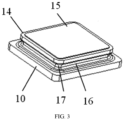
FIG. 3 is a schematic structural view of the electrode post for a battery cover according to one of the embodiments of the invention. -
FIG. 4 is a schematic top view of a battery cover with good sealing performance according to one of the embodiments of the invention. -
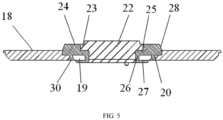
FIG. 5 is a schematic cross-sectional view along a diagonal line of a sealing element inFIG. 4 . -
FIG. 6 is a schematic partial enlarged view of a third through-hole inFIG. 5 . -
FIG. 7 is a schematic top view of a battery cover with high connection strength according to one of the embodiments of the invention. -
FIG. 8 is a schematic cross-sectional view along line D-D of the battery cover with high connection strength according to one of the embodiments of the invention. -
FIG. 9 is a schematic top view of a battery cover with good sealing performance according to one of the embodiments of the invention. -
FIG. 10 is a schematic cross-sectional view along line B-B of the battery cover with good sealing performance according to one of the embodiments of the invention. -
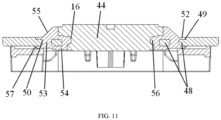
FIG. 11 is a schematic cross-sectional view along line C-C of the battery cover with good sealing performance according to one of the embodiments of the invention. - Wherein, 10, upper substrate; 11, upper connection surface; 12, first sign; 13, extension board; 14, lower substrate; 15, lower connection surface; 16, groove; 17, first transition surface; 18, top cover plate; 19, substrate; 20, third through-hole; 21, first flared opening; 22, electrode post; 23, first flange; 24, sealing element; 25, upper sealing layer; 26, side sealing layer; 27, lower sealing layer; 28, second transition surface; 29, third transition surface; 30, dovetail-shaped column; 31, extension column; 32, divergent column; 33, explosion-proof piece; 34, explosion-proof groove; 36, chamber; 37, connecting region; 38, first through-hole; 39, second through-hole; 40, second flared opening; 41, mounting hole; 42, fool-proof opening; 44, positive electrode post; 45, negative electrode post; 47, second sign; 48, attached part; 49, receiving portion; 50, reinforcing hole; 51, connecting member; 52, upper connecting layer; 53, reinforcing rod; 54, lower connecting layer; 55, fourth transition surface; 56, second flange; 57, slope.
- The technical solutions of the embodiments of the invention will be clearly and completely described below in conjunction with the accompanying drawings of the embodiments of the invention. Obviously, the embodiments described below are merely illustrative ones, and are not all possible ones of the invention. All other embodiments obtained by those ordinarily skilled in the art based on the following ones without creative labor should fall within the protection scope of the invention.
- Referring to
FIG. 1-FIG. 3 , an electrode post for a battery cover according to an embodiment of the present invention, comprises anupper substrate 10, anextension board 13 and alower substrate 14. Anupper connection surface 11 is arranged on one side of theupper substrate 10 and is configured for contacting with an external component to realize electrical connection therewith. Theextension board 13 is arranged on the other side of theupper substrate 10. One side of thelower substrate 14 is arranged at a tail end of theextension board 13. Alower connection surface 15 is arranged on the other side of thelower substrate 14 and is configured for contacting with an internal component inside of a battery to realize electrical connection therewith. Agroove 16 is formed in a side wall of theextension board 13 and used for receiving a sealing element and/or a fastener. Nano-pores are formed in surfaces of at least side walls of theupper substrate 10, theextension board 13 and thelower substrate 14 by nano-chemical treatment. In this embodiment, when the electrode post is mounted on the battery cover, the sealing element received in thegroove 16 can be tightly clamped in the battery cover by means of a fastener, and the nano-pores increase the adhesive force at the interface and effectively increase the connection strength between the electrode post and a plastic material during nano injection molding, thus improving the structural strength of the final battery cover, effectively solving the problems of frequent falling and sealing failures of the electrode post of final battery products, improving the reliability of the final battery products and prolonging the service life of the final battery products. - Specifically, the cross-section of the
upper substrate 10, the cross-section of theextension board 13 and the cross-section of thelower substrate 14 are rectangular, circular, rhombic or oval. Thegroove 16 is formed at least in a protrusive portion of the side wall of theextension board 13, such that the sealing element can be stably clamped in thegroove 16 under the condition of a minimum influence on the current. The sealing element may be a rubber ring. The fastener may be provided with a layer of plastic cover formed by nano molding technology, and the plastic cover may be made from PPS plastic, LCP plastic, PEEK plastic, PBT plastic or PI plastic. - To further prolong the service life of the sealing element and reduce charge accumulation of the protrusive portion, a
first transition surface 17 may be arranged on a sharp portion of thegroove 16. Thefirst transition surface 17 may be a slope or a round surface. - In one embodiment of the invention, the
groove 16 comprises two or more discontinuous sections which are uniformly formed in the side wall of theextension board 13 to obtain good fastening performance and reduce the influence on the current. Alternatively, thegroove 16 is continuously formed in the side wall of theentire extension board 13 to obtain good fastening performance. - The cross-section of the
groove 16 is arc-shaped, U-shaped, square or V-shaped. The bottom of thegroove 16 is in smooth transition to avoid charge accumulation to eliminate the influence on the current. - In one embodiment of the invention, a depth D of the
groove 16 ranges from 0.02 mm to 10 mm, a height H of thegroove 16 ranges from 0.02 mm to 10 mm, and a minimum distance W between thegroove 16 and the bottom of thelower substrate 14 ranges from 0.02 mm to 5 mm. - In one embodiment, the depth D ranges from 0.5 mm to 2 mm, and the height H ranges from 0.2 mm to 10 mm.
- In one embodiment of the invention, the
upper substrate 10, theupper connection surface 11, theextension board 13, thelower substrate 14 and thelower connection surface 15 are formed by aluminum through integrated stamping and machining, and are mainly used for being connected to a positive electrode. - In another embodiment of the invention, the
upper substrate 10, theupper connection surface 11 and theextension board 13 are made from aluminum, thelower substrate 14 and thelower connection surface 15 are made from copper, and theupper substrate 10, theupper connection surface 11, theextension board 13, thelower substrate 14 and thelower connection surface 15 are formed by integrated stamping and machining, and are mainly used for being connected to a negative electrode. - To distinguish a positive electrode from a negative electrode, a
first sign 12 may be arranged on theupper connection surface 11. Thefirst sign 12 is used for indicating the positive electrode and the negative electrode. Thefirst sign 12 may be a convex surface or a concave surface integrally formed when the electrode post 1 is formed, or an attached element attached to theupper connection surface 11 after the electrode post is formed. - In related arts of the battery industry, electrode posts are mounted on battery covers mainly by fixed riveting and welding, and sealing rings are arranged between the battery covers and the electrode posts to realize sealing. However, all these methods have some stubborn defects such as a large number of parts, relatively complex assembly and low quality stability. Moreover, during long-term use, because the sealing elements will be aged and parts will become loose, causing sealing problems and leading to potential safety hazards. In addition, the large number of parts and the relatively complex assembly process result in a large size of a battery, which is severely opposite to use requirements.
- To solve at least one technical problem in the related arts, referring to
FIG. 4-FIG. 6 , a battery cover with good sealing performance according to an embodiment of the invention, comprises atop cover plate 18, anelectrode post 22 and a sealingelement 24 formed by nano molding technology. Asubstrate 19 which is concaved inwards is arranged on thetop cover plate 18. A third through-hole 20 with an undercut region is formed in thesubstrate 19. The sealingelement 24 comprises anupper sealing layer 25, aside sealing layer 26, alower sealing layer 27 and a dovetail-shapedcolumn 30. Theupper sealing layer 25, theside sealing layer 26 and thelower sealing layer 27 are connected sequentially and wrap around an upper surface, a side surface and one part of a lower surface of thesubstrate 19 respectively. The dovetail-shapedcolumn 30 extends from theupper sealing layer 25 to fill in the third through-hole 20 with an undercut region. An edge of the dovetail-shapedcolumn 30 partially extends out of the third through-hole 20 and is connected to thelower sealing layer 27 to form athird transition surface 29. Thethird transition surface 29 contracts gradually towards theelectrode post 22. Theelectrode post 22 is arranged in theside sealing layer 26. Afirst flange 23 is arranged around theelectrode post 22 and extends into the sealingelement 24. In this embodiment, the dovetail-shapedcolumn 30 is engaged in the third through-hole 20 with an undercut region, thus providing a long-term, stable and high-strength connection force for the sealingelement 24. Moreover, the dovetail-shapedcolumn 30 is bonded to thelower sealing layer 27 to be prevented from disengaging from the third through-hole 20, thus further improving the connection strength. The sealingelement 24 wraps around three surfaces of thesubstrate 19 and a side surface of theelectrode post 22, such that the connection strength is high, omnidirectional sealing is realized, and the sealing effect is good, durable and reliable. In addition, according to such a sealing method, thethird transition surface 29 contracts, at the bottom of the top cover plate 18 (i.e., the inside of the battery), towards theelectrode post 22, such that the connection strength and sealing performance are guaranteed, and little space in the battery is occupied. Thefirst flange 23 which extends around to be inserted into the sealingelement 24 enlarges the contact area between the sealingelement 24 and theelectrode post 22, thus further improving the sealing performance and connection strength. To sum up, the battery cover in this embodiment saves a large number of parts, occupies less space, has a low manufacturing cost, improves the sealing performance and connection strength, and is good in consistency. - Specifically, the
top cover plate 18 is in the shape of a circular thin sheet, has a thickness ranging from 0.1 mm to 3.5 mm, and is made from aluminum or stainless steel. A rectangular hole is defined in the centre of thetop cover plate 18. A sheet-like plate extends inwardly and slightly from a side wall of the rectangular hole to form thesubstrate 19. The distance between an upper surface of thesubstrate 19 and an upper surface of thetop cover plate 18 ranges from 0.02 mm to 1.9 mm. The thickness of thesubstrate 19 is less than the thickness of thetop cover plate 18. Theelectrode post 22 is cylindrical. The central axis of theelectrode post 22 is coaxial with the central axis of the hole. Theelectrode post 22 is not in contact with thetop cover plate 18. Theelectrode post 22 is made from aluminum or a copper-aluminum composite. Nano-pores are formed at least in surfaces, in contact with the sealingelement 24, of thetop cover plate 18 and theelectrode post 22 by surface chemical treatment, and the surfaces, in contact with the sealingelement 24, of thetop cover plate 18 and theelectrode post 22 at least comprise the upper surfaces, side surface and lower surfaces of thesubstrate 19, the inner wall of the third through-hole 20, and the side wall of theelectrode post 22. The sealingelement 24 is made from PPS plastic, LCP plastic, PEEK plastic, PBT plastic or PI plastic. Theupper sealing layer 25, theside sealing layer 26, thelower sealing layer 27 and the dovetail-shapedcolumn 30 are integrally formed by nano injection molding. - In one embodiment of the invention, the dovetail-shaped
column 30 and the third through-hole 20 are engaged in the form of interlocking specifically as follows: the third through-hole 20 is formed in thesubstrate 19, the inner diameter of the third through-hole 20 increases gradually at the bottom of thesubstrate 19 to form an inverted first flaredopening 21, the dovetail-shapedcolumn 30 comprises anextension column 31 and adivergent column 32, theextension column 31 extends into the third through-hole 20 from theupper sealing layer 25, thedivergent column 32 diverges in the first flaredopening 21, and theextension column 31 and thedivergent column 32 fill in the third through-hole 20 and the first flared opening 21 respectively. It should be noted that in order to save the internal space of a battery product, thedivergent column 32 only exists in the first flaredopening 21 and does not extend out of the first flaredopening 21, that is, the bottom surface of thedivergent column 32 does not extend beyond the bottom surface of thesubstrate 19 where the first flaredopening 21 is located. - Due to the hole in the
top cover plate 18 is rectangular, thesubstrate 19 is also rectangular. When thesubstrate 19 is joined with thecylindrical electrode post 22, in order to further reduce the volume of the sealingelement 24, the third through-hole 20 may be defined in four corners of therectangular substrate 19. If thesubstrate 19 and theelectrode post 22 are both circular when viewed from the top side, the diameter of thesubstrate 19 need be greater than that of theelectrode post 22 at least by the diameter of the third through-holes 20. When thesubstrate 19 is rectangular, the third through-hole 20 can be formed in the corners of therectangular substrate 19 as long as the four corners of therectangular substrate 19 extend out of theelectrode post 22. In this way, the volume of the sealingelement 24 is greatly reduced under the condition of guaranteeing the sealing performance and connection strength. - The
upper sealing layer 25 extends out of thesubstrate 19. Asecond transition surface 28 is formed by a side surface of a portion of theupper sealing layer 25 extending out of thesubstrate 19. An angle formed between thesecond transition surface 28 and the upper surface of thetop cover plate 18 is 80°-179°, such that theelectrode post 22 exposed to the outside can be protected. - An angle between the
third transition surface 29 and the lower surface of thetop cover plate 18 is 80°-179°. In a case where the angle between thethird transition surface 29 and the lower surface of thetop cover plate 18 is an internal angle, thethird transition surface 29 may be connected to the internal structure of the battery product in the form of interlocking, thus reducing extra fixation. In a case where the angle between thethird transition surface 29 and the lower surface of thetop cover plate 18 is an external angle, thethird transition surface 29 may be received in a groove in the battery product. In both ways, the space is saved to different extents. - In one embodiment of the invention, in order to improve the safety, an explosion-
proof piece 33 may be arranged on thetop cover plate 18. An explosion-proof groove 34 is formed around the explosion-proof piece 33. When the pressure in the battery product is too high due to spontaneous ignition, the internal pressure can burst the explosion-proof piece 33 open along the explosion-proof groove 34 to be released, thus avoiding an explosion of the battery product. - In related arts, when a battery is assembled, a cover is often used to cover the battery, and an electrode post is arranged on the cover to connect the inside and outside of the battery. In order to improve the structural strength of the battery, the cover is generally made from metal, and in this case, the electrode post should not be in contact with the cover, which may otherwise result in electric leakage. In order to fix the electrode post to the cover without contact, plastic is often filled between the electrode post and the cover to realize a fixing and sealing effect. However, when such a fixing method is adopted, because different materials have different coefficients of thermal expansion, cracks happen frequently to final battery products, the connection strength is low, and with the degradation of the sealing performance, the final battery products will not be used anymore finally.
- To solve at least one technical problem in the related arts, referring to
FIG. 7 andFIG. 8 , one embodiment of the invention discloses a battery cover with high connection strength, comprising atop cover plate 18. Thetop cover plate 18 is provided with a connectingregion 37 and a mountinghole 41. The mountinghole 41 is located in the centre of the connectingregion 37 and passes through thetop cover plate 18. At least one through-hole is formed in the connectingregion 37, and the through-holes are uniformly distributed in the connectingregion 37 and pass through the connectingregion 37. In this embodiment, an electrode post pass through the mountinghole 41. When the electrode post is fixed, the electrode post is firmly fixed to the central area of the mountinghole 41 by nano injection molding. During nano injection molding, plastic penetrates through the through-holes to cover front and back sides of the connectingregion 37 to be firmly fixed to the connectingregion 37, thus effectively increasing the connections strength of a final battery cover assembly, effectively avoiding cracks and sealing failures of a final battery product, and improving the sealing performance and other performance of the product. - Specifically, the
top cover plate 18 is in the shape of a rectangular sheet. Four corners of thetop cover plate 18 are round corners. In a case where thetop cover plate 18 covers one electrode of a battery, thetop cover plate 18 is provided with one set of connectingregion 37 and one mountinghole 41, and twotop cover plates 18 are needed to assemble the battery. In a case where thetop cover plate 18 covers two electrodes of the battery, thetop cover plate 18 is provided with two sets of connectingregions 37 and mountingholes 41, which correspond to the positive electrode and negative electrode of the battery respectively, and only onetop cover plate 18 is needed to assemble the battery. In the presence of two sets of connectingregions 37 and mountingholes 41, the two sets of connectingregions 37 and mountingholes 41 are located at opposite ends of thetop cover plate 18 respectively. - In one embodiment, the
top cover plate 18 only covers one electrode of a battery. - To distinguish a positive electrode from a negative electrode to prevent installation errors, a fool-
proof opening 42 may be formed in the connectingregion 37, and the fool-proof opening 42 is in communication with the mountinghole 41. - The connecting
region 37 and the mountinghole 41 are both square. The central axis of the connectingregion 37 is coaxial with the central axis of the mountinghole 41, and the diagonal of the connectingregion 37 overlaps with the diagonal of the mountinghole 41. Corners of the connectingregion 37 and the mountinghole 41 are all round corners. The connectingregion 37 uniformly encircles the mountinghole 41 to provide a uniform adhesive force around the mountinghole 41, thus improving the stability of the entire battery cover. - To improve the integrity and reliability of the battery cover and prolong the service life of the battery cover, the connecting
region 37 may be concaved in thetop cover plate 18. During injection molding, plastic is uniformly filled in the connectingregion 37 and is parallel to the surface of thetop cover plate 18, such that the plastic can be received in the connectingregion 37. - To improve the connection strength of the battery cover, nano-pores are formed in the surface of at least the connecting
region 37 of thetop cover plate 18 by nano-chemical treatment. The plastic can be well adhered into the nano-pores during nano injection molding. - In one embodiment of the invention, the through-holes comprise first through-
holes 38 and second through-holes 39. The inner diameter of the second through-holes 39 is less than the inner diameter of the first through-holes 38. The first through-holes 38 are uniformly distributed in the connectingregion 37, and each of the second through-holes 39 is located between two adjacent first through-holes 38. The first through-holes 38 and the second through-holes 39 work together so that a large and uniform connection force can be generated between the connectingregion 37 and the plastic filled in the connecting region and the influence on structural strength of the connectingregion 37 is reduced. - Specifically, the number of the first through-
holes 38 is four, and the four first through-holes 38 are located in four corners of the connectingregion 37 respectively. Four groups of second through-holes 39, the total number of which is 12, are arranged, and each group of second through-holes 39 are located between two adjacent first through-holes 38. - To improve the efficiency of the plastic passing through the through holes and improve the adhesive force of the plastic in the connecting
region 37, second flaredopenings 40 may be formed in ends of the through-holes in the connectingregion 37. The inner diameter of the second flaredopenings 40 decreases gradually from outside to inside until it reaches the inner diameter of the through-holes. - In one embodiment of the invention,
chambers 36 are arranged on ridges at the bottom of thetop cover plate 18. Thechambers 36 can facilitate installation. - The
top cover plate 18 and the connectingregion 37 are formed by aluminum through integrated stamping or machining. - At present, batteries have been widely applied to the electronic field, the automative field, the aviation field, the medical field and many other fields, and the performance of the batteries has become a key factor affecting the development of all industries. Liquid batteries which are used mostly widely at present have three important performance indicators: the sealing performance of electrode posts, the connection strength of the electrode posts, and the internal resistance of the electrode posts. Existing batteries often adopt sealing rings to realize sealing; and in order to obtain high connection strength, the electrode posts are connected to battery bodies generally by fixed riveting or welding. However, the internal resistance of the electrode posts will be increased after fixed riveting and welding, the temperature of the electrode posts will rise with the increase of the internal resistance, and the temperature of the batteries will be increased accordingly. In addition, such a connection method can obtain good connection strength, a large number of parts need to be used, the assembly process is relatively complex, and the sealing performance is reduced, thus compromising the quality reliability of products.
- To solve at least one technical problem in the related arts, referring to
FIG. 9-FIG. 11 , one embodiment of the invention discloses a battery cover with good sealing performance, comprising atop cover plate 18, electrode posts and connectingmembers 51. Attachedparts 48 are arranged on thetop cover plate 18. Middle of the attachedparts 48 are hollowed out. Reinforcingholes 50 are formed in the attachedparts 48 and wrapped with the connectingmembers 51. Each connectingmember 51 comprises an upper connectinglayer 52, a reinforcingrod 53 and a lower connectinglayer 54, wherein the upper connecting layer 5 and the lower connectinglayer 54 are located on front and back side of the corresponding attachedparts 48 respectively, and the reinforcingrod 53 penetrates through the corresponding reinforcinghole 50 and connects the upper connectinglayer 52 and the lower connectinglayer 54. Asecond flange 56 is arranged on an inner wall of each connectingmember 51. The electrode posts are located in the hollowed-out portions of the attachedparts 48.Grooves 16 are formed in side walls of the electrode posts. The connectingmembers 51 wrap around the side walls of the electrode posts, and thesecond flanges 56 are located in thegrooves 16. In this embodiment, the connectingmembers 51 wrap around the front and back sides of the attachedparts 48, and the upper connectinglayer 52 and the lower connectinglayer 54 of each connectingmember 51 are connected by means of the reinforcingrod 53, such that the connection strength between the connectingmembers 51 and thetop cover plate 18 can be increased, and cracks are avoided in use. The connectingmembers 51 also wraps around the side walls of the electrode posts and thesecond flanges 56 of the connectingmembers 51 extends into thegrooves 16, such that the electrode posts can be fixed firmly. In addition, such a fully wrapping method fulfils a good sealing effect. The connection strength, sealing performance and large-current tolerance of the battery cover are improved with a simple structure and a low manufacturing cost, thus improving the reliability of the battery cover and prolonging the service life of the battery cover. - In one embodiment, the
grooves 16 may be formed in a side wall of an extension board. - Specifically, the
top cover plate 18 is a sheet-like rectangular plate and may be made from aluminum. Opposite two ends of thetop cover plate 18 are symmetrically hollowed out to form two square holes. Sheet-like plates extend inwardly from inner walls of the holes to form the attachedparts 48. Thetop cover plate 18, the holes and the attachedparts 48 may be formed by integrated stamping or machining. - A plurality of reinforcing
holes 50 are uniformly distributed in the attachedparts 48. The reinforcingholes 50 are shaped like an inverted funnel to provide a large adhesive force. - The electrode posts comprise a
positive electrode post 44 and anegative electrode post 45. Thepositive electrode post 44 and thenegative electrode post 45 are both square columns. Thepositive electrode post 44 and thenegative electrode post 45 are located in the two holes respectively and are not in contact with thetop cover plate 18 and the attachedparts 48. Thepositive electrode post 44 and the correspondinggroove 16 are formed by aluminum through integrated stamping or machining. Thenegative electrode post 45 and the correspondinggroove 16 are formed by aluminum or copper through integrated stamping or machining. - The
grooves 16 are formed in side walls of thepositive electrode post 44 and thenegative electrode post 45. Thegroove 16 is continuously formed around thepositive electrode post 44 or the negative electrode post. Alternatively, thegroove 16 comprises multiple discontinuous sections which are uniformly distributed around thepositive electrode post 44 or thenegative electrode post 45. - To improve the adhesive force between the electrode posts and the connecting
members 51, nano-pores may be formed in surfaces of the side walls of the electrode posts, surfaces of thegrooves 16 and surfaces of at least the attached parts of thetop cover plate 18 by chemical treatment. Nano-pores make connection between the electrode posts and the connectingmembers 51 more tightly, thus improving the connection strength and sealing performance. -
Second signs 47 for indicating positive and negative electrodes are arranged on thepositive electrode post 44 and thenegative electrode post 45. - In one embodiment of the invention, the electrode posts protrude out of the
top cover plate 18, which facilitates the electrode posts to electrically connect the electrical components inside and outside of a battery. However, the position and direction of the electrode posts protruding out of thetop cover plate 18 may be changed due to touch in use, leading to poor contact. To avoid such a situation, fourth transition surfaces 55 may be arranged on the connectingmembers 51. The fourth transition surfaces 55 are slopes which extend from the upper connectinglayers 52 to the tops of the side walls of the electrode posts 20. On one hand, the fourth transition surfaces 55 can upward release an external force or transfer the external force to the root; and on the other hand, such a wrapping around the electrode post from bottom to top can stabilize and seal the electrode posts. - In one embodiment, an angle between the fourth transition surfaces 55 and the upper connecting
layers 52 is 80º-179º. - Similarly, slopes 57 are arranged on edges of the lower connecting layers 54. The angle between the
slopes 57 and the bottom surface of thetop cover plate 18 is 80º-179º. Theslope 57 can protect the internal structure of a battery. - To improve the surface integrity and smoothness of the
top cover plate 18, receivingportions 49 may be formed in surfaces of the attachedparts 48. The receivingportions 49 are lower than an upper surface of thetop cover plate 18. The upper connectinglayers 52 are received in the receivingportions 49, and upper surfaces of the upper connectinglayers 52 are not higher than the upper surface of thetop cover plate 18. In this way, a lateral external force on the surface of thetop cover plate 18 will not be applied to the upper connectinglayers 52 and will be smoothly transferred to the fourth transition surfaces 55 and released by the fourth transition surfaces 55, thus guaranteeing the structural integrity of the connectingmembers 51. - In one embodiment, the upper surfaces of the upper connecting
layers 52 are coplanar to the upper surface of thetop cover plate 18. - In one embodiment of the invention, the thickness of the upper connecting
layers 52 ranges from 0.1 mm to 3.8 mm. - The connecting
member 51, the upper connectinglayer 52, the reinforcingrod 53, the lower connectingmember 54, thefourth transition surface 55 and thesecond flange 56 are integrally formed by PPS plastic through nano injection molding. - It should be noted that the connecting member in the fourth embodiment is equivalent to the sealing element or fastener in the first embodiment.
- Those skilled in the art can implement or use the invention with reference to the above description of the embodiments disclosed. Various amendments to these embodiments will be obvious for those skilled in the art, and the general principle defined in the specification can be implemented in other embodiments without departing from the spirit or scope of the invention. Therefore, the invention should not be limited to the embodiments illustrated in the specification and has the broadest scope complying with the principle and novelty of disclosed in the specification.
Claims (25)
- An electrode post for a battery cover, comprising:an upper substrate, an upper connection surface for contacting with an outside component to realize electrical connection being arranged on one side of the upper substrate;an extension board arranged on the other side of the upper substrate, a groove for receiving a fastener being formed in a side wall of the extension board; anda lower substrate arranged at a tail end of the extension board, a lower connection surface for contacting with an inside component of a battery to realize electrical connection being arranged on a side, opposite to the extension board, of the lower substrate;wherein nano-pores are formed at least in side walls of the upper substrate, the extension board and the lower substrate.
- The electrode post for a battery cover according to Claim 1, wherein the groove comprises two or more discontinuous sections which are uniformly formed in the side wall of the extension board; or
the groove is continuously formed in the side wall of the entire extension board. - The electrode post for a battery cover according to Claim 1, wherein the groove is used for receiving a sealing element.
- The electrode post for a battery cover according to Claim 3, wherein the sealing element is a rubber ring.
- The electrode post for a battery cover according to Claim 1, wherein the fastener is provided with a plastic cover formed by nano molding technology.
- The electrode post for a battery cover according to Claim 1, wherein a first transition surface is arranged on a sharp portion of the groove, and the first transition surface is a slope or a round surface.
- The electrode post for a battery cover according to any one of Claims 1-6, wherein the upper substrate, the upper connection surface, the extension board, the lower substrate and the lower connection surface are formed by aluminum through integrated stamping or machining.
- The electrode post for a battery cover according to any one of Claims 1-6, wherein the upper substrate, the upper connection surface and the extension board are made from aluminum, the lower substrate and the lower connection surface are made from copper, and the upper substrate, the upper connection surface, the extension board, the lower substrate and the lower connection surface are formed through integrated stamping or machining.
- A battery cover with good sealing performance, comprising a top cover plate, an electrode post and a sealing element formed by nano molding technology, wherein a substrate which is concaved inwards is arranged on the top cover plate, a third through-hole with an undercut is formed in the substrate, the sealing element comprises an upper sealing layer, a side sealing layer, a lower sealing layer and an dovetail-shaped column which are connected in sequence, the upper sealing layer, the side sealing layer and the lower sealing layer wrap around an upper surface, a side surface and one part of a lower surface of the substrate respectively, the dovetail-shaped column extends from the upper sealing layer to fill in the third through-hole, an edge of the dovetail-shaped column extends out of the third through-hole and is connected to the lower sealing layer to form a third transition surface, the third transition surface contracts gradually towards the electrode post, the electrode post is disposed in the side sealing layer, and a first flange is arranged around the electrode post and extends into the sealing element.
- The battery cover with good sealing performance according to Claim 9, wherein an inner diameter of the third through-hole increases gradually at a bottom of the substrate to form an inverted first flared opening, the dovetail-shaped column comprises an extension column and a divergent column, the extension column extends from the upper sealing layer into the third through-hole, the divergent column diverges in the first flared opening, and the extension column and the divergent column fill in the third through-hole and the first flared opening respectively.
- The battery cover with good sealing performance according to Claim 10, wherein a bottom surface of the divergent column does not exceed a bottom surface of the substrate where the first flared opening is located.
- The battery cover with good sealing performance according to Claim 10, wherein the sealing element is integrally formed by PPS plastic, LCP plastic, PEEK plastic, PBT plastic or PI plastic through nano injection molding.
- A battery cover with high connection strength, comprising a top cover plate, wherein the top cover plate is provided with a connecting region and a mounting hole, the mounting hole is located in a centre of the connecting region and passes through the top cover plate, at least one through-hole is formed in the connecting region, the through-holes are uniformly distributed in the connecting region and pass through the connecting region, and nano-pores are formed at least in the connecting region of the top cover plate.
- The battery cover with high connection strength according to Claim 13, wherein the through-holes comprise first through-holes and second through-holes, inner diameters of the second through-holes are less than inner dimeters of the first through-holes, the first through-holes are uniformly distributed in the connecting region, and each of the second through-holes is located between two adjacent the first through-holes.
- The battery cover with high connection strength according to Claim 13, wherein the connecting region and the mounting hole are both square, a central axis of the connecting region is coaxial with a central axis of the mounting hole, a diagonal of the connecting region overlaps with a diagonal of the mounting hole, corners of the connecting region and the mounting hole are round corners, and the connecting region uniformly encircles of the mounting hole.
- The battery cover with high connection strength according to Claim 13, wherein a second flared opening is formed in the end of each of the through-holes in the connecting region, and the inner diameter of the second flared opening decreases gradually from outside to inside until it reaches the inner diameter of the through-hole.
- The battery cover with high connection strength according to Claim 13, wherein the connecting region is concaved in the top cover plate.
- The battery cover with high connection strength according to Claim 13, wherein in a case where the top cover plate covers one electrode of a battery, the top cover plate is provided with one said connecting region and one said mounting hole; in a case where the top cover plate covers two electrode of the battery, the top cover plate is provided with two said connecting regions and two said mounting holes, and the two connecting regions and the two said mounting holes are located at two ends of the top cover plate respectively and correspond to a positive electrode and a negative electrode of the battery respectively.
- A battery cover with good sealing performance, comprising a top cover plate, an electrode post and a connecting member, wherein an attached part is arranged on the top cover plate, a middle portion of the attached part is hollowed out, a reinforcing hole is formed in the attached part, the attached part is wrapped with a connecting member, the connecting member comprises an upper connecting layer, a reinforcing rod and a lower connecting layer, the upper connecting layer and the lower connecting layer are located on front and back sides of the attached part respectively, the reinforcing rod penetrates through the reinforcing hole and connects the upper connecting layer and the lower connecting layer, a second flange is arranged on an inner wall of the connecting member, the electrode post is located in the hollowed-out portion of the attached part, a groove is formed in a side wall of the electrode post, the connecting member wraps around the side wall of the electrode post, and the second flange is located in the groove.
- The battery cover with good sealing performance according to Claim 19, wherein the electrode post protrudes out of the top cover plate, and a fourth transition surface is arranged on the connecting member and the fourth transition surface is a slope extending from the upper connecting layer to a top of the side wall of the electrode post.
- The battery cover with good sealing performance according to Claim 20, wherein a receiving portion is formed in a surface of the attached part, the receiving portion is lower than an upper surface of the top cover plate, the upper connecting layer is received in the receiving portion, and an upper surface of the upper connecting layer is not higher than the upper surface of the top cover plate.
- The battery cover with good sealing performance according to Claim 21, wherein the connecting member, the upper connecting layer, the reinforcing rod, the lower connecting layer, the fourth transition surface and the second flange are integrally formed by PPS plastic through nano injection molding.
- The battery cover with good sealing performance according to Claim 19, wherein a plurality of said reinforcing holes are uniformly distributed in the attached part, and the reinforcing holes are shaped like an inverted funnel.
- The battery cover with good sealing performance according to Claim 19,wherein the groove is continuously formed around the electrode post; orthe groove comprises multiple discontinuous sections which are uniformly distributed around the electrode post.
- The battery cover with good sealing performance according to Claim 24, wherein nano-pores are formed in a surface of the side wall of the electrode post, a surface of the groove and a surface of at least the attached part of the top cover plate.
Applications Claiming Priority (5)
| Application Number | Priority Date | Filing Date | Title |
|---|---|---|---|
| CN202220522900.2U CN216928738U (en) | 2022-03-11 | 2022-03-11 | High leakproofness battery apron |
| CN202220522903.6U CN216928739U (en) | 2022-03-11 | 2022-03-11 | A battery cover plate electrode column |
| CN202220522902.1U CN216928741U (en) | 2022-03-11 | 2022-03-11 | A high connection strength battery cover |
| CN202220824705.5U CN217114593U (en) | 2022-04-11 | 2022-04-11 | High leakproofness battery apron |
| PCT/CN2023/080297 WO2023169467A1 (en) | 2022-03-11 | 2023-03-08 | Electrode column and battery cover plate |
Publications (2)
| Publication Number | Publication Date |
|---|---|
| EP4492545A1 true EP4492545A1 (en) | 2025-01-15 |
| EP4492545A4 EP4492545A4 (en) | 2026-02-18 |
Family
ID=87936045
Family Applications (1)
| Application Number | Title | Priority Date | Filing Date |
|---|---|---|---|
| EP23766044.4A Pending EP4492545A4 (en) | 2022-03-11 | 2023-03-08 | ELECTRODE COLUMN AND BATTERY COVER PLATE |
Country Status (4)
| Country | Link |
|---|---|
| US (1) | US12278400B2 (en) |
| EP (1) | EP4492545A4 (en) |
| KR (1) | KR20240091255A (en) |
| WO (1) | WO2023169467A1 (en) |
Families Citing this family (4)
| Publication number | Priority date | Publication date | Assignee | Title |
|---|---|---|---|---|
| CN221176413U (en) * | 2023-09-28 | 2024-06-18 | 比亚迪股份有限公司 | Battery shell structure, battery and electric equipment |
| CN117080638B (en) * | 2023-10-12 | 2023-12-26 | 厦门海辰储能科技股份有限公司 | End cover assembly, energy storage device and electric equipment |
| DE102024109273A1 (en) * | 2024-04-03 | 2025-10-09 | Carl Freudenberg Kg | Cover assembly of a battery cell |
| CN119319166B (en) * | 2024-12-18 | 2025-03-04 | 宁波震裕汽车部件有限公司 | Pole forming process based on T-shaped copper-aluminum composite material belt |
Family Cites Families (12)
| Publication number | Priority date | Publication date | Assignee | Title |
|---|---|---|---|---|
| CN205657096U (en) * | 2016-05-16 | 2016-10-19 | 宁德时代新能源科技股份有限公司 | Secondary cell top cap |
| CN110212124A (en) * | 2019-07-17 | 2019-09-06 | 池州市骏智机电科技有限公司 | A kind of battery cap and preparation method thereof based on blocky pole |
| KR102789539B1 (en) * | 2019-10-15 | 2025-03-31 | 주식회사 엘지에너지솔루션 | Battery Module Having Module Bus-bar |
| CN212750997U (en) * | 2020-09-03 | 2021-03-19 | 苏州美阅新能源有限公司 | Battery cover plate assembly with embossing structure |
| JP7214692B2 (en) * | 2020-09-17 | 2023-01-30 | プライムプラネットエナジー&ソリューションズ株式会社 | Terminal, secondary battery with the same, and manufacturing method thereof |
| CN213401339U (en) * | 2020-11-25 | 2021-06-08 | 长沙成事科技有限公司 | Battery cover plate with wedge-shaped structure |
| CN112751114B (en) * | 2021-01-28 | 2025-06-10 | 武汉富航精密工业有限公司 | Top cover assembly of secondary battery |
| CN215184246U (en) * | 2021-06-02 | 2021-12-14 | 湖北亿纬动力有限公司 | Battery cover and battery |
| CN217114593U (en) * | 2022-04-11 | 2022-08-02 | 苏州美阅新能源有限公司 | High leakproofness battery apron |
| CN216928739U (en) * | 2022-03-11 | 2022-07-08 | 苏州美阅新能源有限公司 | A battery cover plate electrode column |
| CN216928741U (en) * | 2022-03-11 | 2022-07-08 | 苏州美阅新能源有限公司 | A high connection strength battery cover |
| CN216928738U (en) * | 2022-03-11 | 2022-07-08 | 苏州美阅新能源有限公司 | High leakproofness battery apron |
-
2023
- 2023-03-08 WO PCT/CN2023/080297 patent/WO2023169467A1/en not_active Ceased
- 2023-03-08 EP EP23766044.4A patent/EP4492545A4/en active Pending
- 2023-03-08 KR KR1020247018193A patent/KR20240091255A/en active Pending
-
2024
- 2024-05-13 US US18/661,730 patent/US12278400B2/en active Active
Also Published As
| Publication number | Publication date |
|---|---|
| EP4492545A4 (en) | 2026-02-18 |
| KR20240091255A (en) | 2024-06-21 |
| US20240297423A1 (en) | 2024-09-05 |
| US12278400B2 (en) | 2025-04-15 |
| WO2023169467A1 (en) | 2023-09-14 |
Similar Documents
| Publication | Publication Date | Title |
|---|---|---|
| EP4492545A1 (en) | Electrode column and battery cover plate | |
| US12334570B2 (en) | Top cover assembly of secondary battery and secondary battery | |
| US9379372B2 (en) | Battery and method of manufacturing the same | |
| US10644272B2 (en) | Cap assembly and secondary battery | |
| US20220006145A1 (en) | Cap assembly and secondary battery | |
| CN113097657A (en) | Battery with a battery cell | |
| EP2166594A2 (en) | Secondary Battery | |
| KR20240152908A (en) | Batteries, battery packs and vehicles | |
| US9627710B2 (en) | Battery | |
| KR20240155911A (en) | Batteries, battery packs and vehicles | |
| JP2025511568A (en) | Batteries, battery packs, and vehicles | |
| CN220856854U (en) | Pole, cover assembly, battery cell and battery module | |
| US12482905B2 (en) | Layer-built tab, electrode plate, battery core, and battery using same | |
| CN108539063A (en) | A kind of battery cover board electrode assembly and battery | |
| CN217768551U (en) | Cover assembly and battery | |
| CN217468497U (en) | Metal bipolar plate and fuel cell having the same | |
| CN218939955U (en) | Tab sealing structure | |
| CN216928741U (en) | A high connection strength battery cover | |
| CN217788750U (en) | Battery cover plate assembly and battery with same | |
| CN116742228A (en) | Secondary battery cover plate and assembly method thereof | |
| US20260074397A1 (en) | Conductive module, cover plate assembly, and battery cell | |
| CN224005999U (en) | Battery and battery pack | |
| CN218005087U (en) | Battery, battery pack and vehicle | |
| CN120341527A (en) | A battery | |
| CN119069906A (en) | Battery housing, battery and electrical equipment |
Legal Events
| Date | Code | Title | Description |
|---|---|---|---|
| STAA | Information on the status of an ep patent application or granted ep patent |
Free format text: STATUS: THE INTERNATIONAL PUBLICATION HAS BEEN MADE |
|
| PUAI | Public reference made under article 153(3) epc to a published international application that has entered the european phase |
Free format text: ORIGINAL CODE: 0009012 |
|
| STAA | Information on the status of an ep patent application or granted ep patent |
Free format text: STATUS: REQUEST FOR EXAMINATION WAS MADE |
|
| 17P | Request for examination filed |
Effective date: 20240328 |
|
| AK | Designated contracting states |
Kind code of ref document: A1 Designated state(s): AL AT BE BG CH CY CZ DE DK EE ES FI FR GB GR HR HU IE IS IT LI LT LU LV MC ME MK MT NL NO PL PT RO RS SE SI SK SM TR |
|
| DAV | Request for validation of the european patent (deleted) | ||
| DAX | Request for extension of the european patent (deleted) | ||
| A4 | Supplementary search report drawn up and despatched |
Effective date: 20260120 |
|
| RIC1 | Information provided on ipc code assigned before grant |
Ipc: H01M 50/148 20210101AFI20260114BHEP Ipc: H01M 50/188 20210101ALI20260114BHEP Ipc: H01M 50/543 20210101ALI20260114BHEP Ipc: H01M 50/147 20210101ALI20260114BHEP Ipc: H01M 50/15 20210101ALI20260114BHEP Ipc: H01M 50/176 20210101ALI20260114BHEP Ipc: H01M 50/184 20210101ALI20260114BHEP Ipc: H01M 50/193 20210101ALI20260114BHEP Ipc: H01M 50/55 20210101ALI20260114BHEP Ipc: H01M 50/567 20210101ALI20260114BHEP Ipc: H01M 50/553 20210101ALI20260114BHEP Ipc: H01M 50/159 20210101ALI20260114BHEP |