EP4492496A1 - Rechargeable lithium battery - Google Patents
Rechargeable lithium battery Download PDFInfo
- Publication number
- EP4492496A1 EP4492496A1 EP24186706.8A EP24186706A EP4492496A1 EP 4492496 A1 EP4492496 A1 EP 4492496A1 EP 24186706 A EP24186706 A EP 24186706A EP 4492496 A1 EP4492496 A1 EP 4492496A1
- Authority
- EP
- European Patent Office
- Prior art keywords
- group
- substituted
- unsubstituted
- chemical formula
- lithium battery
- Prior art date
- Legal status (The legal status is an assumption and is not a legal conclusion. Google has not performed a legal analysis and makes no representation as to the accuracy of the status listed.)
- Granted
Links
Images


Classifications
-
- H—ELECTRICITY
- H01—ELECTRIC ELEMENTS
- H01M—PROCESSES OR MEANS, e.g. BATTERIES, FOR THE DIRECT CONVERSION OF CHEMICAL ENERGY INTO ELECTRICAL ENERGY
- H01M10/00—Secondary cells; Manufacture thereof
- H01M10/05—Accumulators with non-aqueous electrolyte
- H01M10/056—Accumulators with non-aqueous electrolyte characterised by the materials used as electrolytes, e.g. mixed inorganic/organic electrolytes
- H01M10/0564—Accumulators with non-aqueous electrolyte characterised by the materials used as electrolytes, e.g. mixed inorganic/organic electrolytes the electrolyte being constituted of organic materials only
- H01M10/0566—Liquid materials
- H01M10/0567—Liquid materials characterised by the additives
-
- H—ELECTRICITY
- H01—ELECTRIC ELEMENTS
- H01M—PROCESSES OR MEANS, e.g. BATTERIES, FOR THE DIRECT CONVERSION OF CHEMICAL ENERGY INTO ELECTRICAL ENERGY
- H01M10/00—Secondary cells; Manufacture thereof
- H01M10/05—Accumulators with non-aqueous electrolyte
- H01M10/052—Li-accumulators
-
- H—ELECTRICITY
- H01—ELECTRIC ELEMENTS
- H01M—PROCESSES OR MEANS, e.g. BATTERIES, FOR THE DIRECT CONVERSION OF CHEMICAL ENERGY INTO ELECTRICAL ENERGY
- H01M10/00—Secondary cells; Manufacture thereof
- H01M10/05—Accumulators with non-aqueous electrolyte
- H01M10/052—Li-accumulators
- H01M10/0525—Rocking-chair batteries, i.e. batteries with lithium insertion or intercalation in both electrodes; Lithium-ion batteries
-
- H—ELECTRICITY
- H01—ELECTRIC ELEMENTS
- H01M—PROCESSES OR MEANS, e.g. BATTERIES, FOR THE DIRECT CONVERSION OF CHEMICAL ENERGY INTO ELECTRICAL ENERGY
- H01M10/00—Secondary cells; Manufacture thereof
- H01M10/05—Accumulators with non-aqueous electrolyte
- H01M10/058—Construction or manufacture
-
- H—ELECTRICITY
- H01—ELECTRIC ELEMENTS
- H01M—PROCESSES OR MEANS, e.g. BATTERIES, FOR THE DIRECT CONVERSION OF CHEMICAL ENERGY INTO ELECTRICAL ENERGY
- H01M10/00—Secondary cells; Manufacture thereof
- H01M10/42—Methods or arrangements for servicing or maintenance of secondary cells or secondary half-cells
- H01M10/4235—Safety or regulating additives or arrangements in electrodes, separators or electrolyte
-
- H—ELECTRICITY
- H01—ELECTRIC ELEMENTS
- H01M—PROCESSES OR MEANS, e.g. BATTERIES, FOR THE DIRECT CONVERSION OF CHEMICAL ENERGY INTO ELECTRICAL ENERGY
- H01M4/00—Electrodes
- H01M4/02—Electrodes composed of, or comprising, active material
- H01M4/13—Electrodes for accumulators with non-aqueous electrolyte, e.g. for lithium-accumulators; Processes of manufacture thereof
- H01M4/131—Electrodes based on mixed oxides or hydroxides, or on mixtures of oxides or hydroxides, e.g. LiCoOx
-
- H—ELECTRICITY
- H01—ELECTRIC ELEMENTS
- H01M—PROCESSES OR MEANS, e.g. BATTERIES, FOR THE DIRECT CONVERSION OF CHEMICAL ENERGY INTO ELECTRICAL ENERGY
- H01M4/00—Electrodes
- H01M4/02—Electrodes composed of, or comprising, active material
- H01M4/36—Selection of substances as active materials, active masses, active liquids
- H01M4/48—Selection of substances as active materials, active masses, active liquids of inorganic oxides or hydroxides
- H01M4/485—Selection of substances as active materials, active masses, active liquids of inorganic oxides or hydroxides of mixed oxides or hydroxides for inserting or intercalating light metals, e.g. LiTi2O4 or LiTi2OxFy
-
- H—ELECTRICITY
- H01—ELECTRIC ELEMENTS
- H01M—PROCESSES OR MEANS, e.g. BATTERIES, FOR THE DIRECT CONVERSION OF CHEMICAL ENERGY INTO ELECTRICAL ENERGY
- H01M4/00—Electrodes
- H01M4/02—Electrodes composed of, or comprising, active material
- H01M4/36—Selection of substances as active materials, active masses, active liquids
- H01M4/48—Selection of substances as active materials, active masses, active liquids of inorganic oxides or hydroxides
- H01M4/50—Selection of substances as active materials, active masses, active liquids of inorganic oxides or hydroxides of manganese
- H01M4/505—Selection of substances as active materials, active masses, active liquids of inorganic oxides or hydroxides of manganese of mixed oxides or hydroxides containing manganese for inserting or intercalating light metals, e.g. LiMn2O4 or LiMn2OxFy
-
- H—ELECTRICITY
- H01—ELECTRIC ELEMENTS
- H01M—PROCESSES OR MEANS, e.g. BATTERIES, FOR THE DIRECT CONVERSION OF CHEMICAL ENERGY INTO ELECTRICAL ENERGY
- H01M4/00—Electrodes
- H01M4/02—Electrodes composed of, or comprising, active material
- H01M4/36—Selection of substances as active materials, active masses, active liquids
- H01M4/48—Selection of substances as active materials, active masses, active liquids of inorganic oxides or hydroxides
- H01M4/52—Selection of substances as active materials, active masses, active liquids of inorganic oxides or hydroxides of nickel, cobalt or iron
- H01M4/525—Selection of substances as active materials, active masses, active liquids of inorganic oxides or hydroxides of nickel, cobalt or iron of mixed oxides or hydroxides containing iron, cobalt or nickel for inserting or intercalating light metals, e.g. LiNiO2, LiCoO2 or LiCoOxFy
-
- H—ELECTRICITY
- H01—ELECTRIC ELEMENTS
- H01M—PROCESSES OR MEANS, e.g. BATTERIES, FOR THE DIRECT CONVERSION OF CHEMICAL ENERGY INTO ELECTRICAL ENERGY
- H01M4/00—Electrodes
- H01M4/02—Electrodes composed of, or comprising, active material
- H01M2004/026—Electrodes composed of, or comprising, active material characterised by the polarity
- H01M2004/028—Positive electrodes
-
- H—ELECTRICITY
- H01—ELECTRIC ELEMENTS
- H01M—PROCESSES OR MEANS, e.g. BATTERIES, FOR THE DIRECT CONVERSION OF CHEMICAL ENERGY INTO ELECTRICAL ENERGY
- H01M2300/00—Electrolytes
- H01M2300/0017—Non-aqueous electrolytes
- H01M2300/0025—Organic electrolyte
-
- H—ELECTRICITY
- H01—ELECTRIC ELEMENTS
- H01M—PROCESSES OR MEANS, e.g. BATTERIES, FOR THE DIRECT CONVERSION OF CHEMICAL ENERGY INTO ELECTRICAL ENERGY
- H01M2300/00—Electrolytes
- H01M2300/0017—Non-aqueous electrolytes
- H01M2300/0025—Organic electrolyte
- H01M2300/0028—Organic electrolyte characterised by the solvent
- H01M2300/0037—Mixture of solvents
- H01M2300/004—Three solvents
-
- Y—GENERAL TAGGING OF NEW TECHNOLOGICAL DEVELOPMENTS; GENERAL TAGGING OF CROSS-SECTIONAL TECHNOLOGIES SPANNING OVER SEVERAL SECTIONS OF THE IPC; TECHNICAL SUBJECTS COVERED BY FORMER USPC CROSS-REFERENCE ART COLLECTIONS [XRACs] AND DIGESTS
- Y02—TECHNOLOGIES OR APPLICATIONS FOR MITIGATION OR ADAPTATION AGAINST CLIMATE CHANGE
- Y02E—REDUCTION OF GREENHOUSE GAS [GHG] EMISSIONS, RELATED TO ENERGY GENERATION, TRANSMISSION OR DISTRIBUTION
- Y02E60/00—Enabling technologies; Technologies with a potential or indirect contribution to GHG emissions mitigation
- Y02E60/10—Energy storage using batteries
Definitions
- the average particle diameter can be measured using a laser diffraction method.
- the particles to be measured may be dispersed in a dispersion medium, and then introduced into a commercially available laser diffraction particle diameter measuring device (e.g., Microtrac MT 3000), and ultrasonic waves of 28 kHz at an output of 60 W are irradiated to calculate an average particle diameter (D50) on the basis of 50% of the particle diameter distribution in the measuring device.
- a laser diffraction particle diameter measuring device e.g., Microtrac MT 3000
- substituted refers to replacement of at least one hydrogen of a substituent or a compound by any one of deuterium, a halogen, a hydroxyl group, an amino group, a C1 to C30 amine group, a nitro group, a C1 to C40 silyl group, a C1 to C30 alkyl group, a C1 to C10 alkylsilyl group, a C6 to C30 arylsilyl group, a C3 to C30 cycloalkyl group, a C3 to C30 heterocycloalkyl group, a C6 to C30 aryl group, a C2 to C30 heteroaryl group, a C1 to C20 alkoxy group, a C1 to C10 fluoroalkyl group, or a cyano group.
- substituted may refer to replacement of at least one hydrogen of a substituent or a compound by deuterium, a halogen, a C1 to C20 alkyl group, a C6 to C30 aryl group, a C1 to C10 fluoroalkyl group, or a cyano group.
- substitution may refer to replacement of at least one hydrogen of a substituent or a compound by deuterium, a halogen group, a C1 to C5 alkyl group, a C6 to C18 aryl group, a C1 to C5 fluoroalkyl group, or a cyano group.
- a rechargeable lithium battery includes a positive electrode including a positive electrode active material; a negative electrode including a negative electrode active material; an electrolyte solution for a rechargeable lithium battery including a non-aqueous organic solvent, a lithium salt, and an additive, wherein the additive includes a first compound represented by Chemical Formula 1 and a second compound represented by Chemical Formula 2, and the positive electrode active material includes lithium nickel composite oxide represented by Chemical Formula 3.
- the additive includes a first compound and a second compound.
- the first compound is an isocyanurate-based compound, which may undergo a radical reaction with other compounds having double bonds in the electrolyte solution to form a solid and low-resistance CEI (Cathode Electrolyte Interphase) film on the positive electrode, and may improve the charge/discharge characteristics of the battery and cycle characteristics at room temperature and high temperature when stored at high temperatures.
- CEI Cathode Electrolyte Interphase
- the first compound is represented by Chemical Formula 1.
- R 1 to R 3 are each independently hydrogen, a cyano group, a halogen, a substituted or unsubstituted C1 to C20 alkyl group, a substituted or unsubstituted C2 to C20 alkenyl group, a substituted or unsubstituted C2 to C20 alkynyl group, a substituted or unsubstituted C3 to C20 cycloalkyl group, a substituted or unsubstituted C2 to C20 heterocycloalkyl group, a substituted or unsubstituted C3 to C20 cycloalkenyl group, a substituted or unsubstituted C6 to C20 aryl group, or a substituted or unsubstituted C2 to C20 heteroaryl group.
- R 1 to R 3 may each independently be a substituted or unsubstituted C1 to C20 alkyl group, or a substituted or unsubstituted C2 to C20 alkenyl group.
- R 1 to R 3 may each independently be a substituted or unsubstituted C2 to C20 alkenyl group.
- the compound represented by Chemical Formula 1 may be any one or more selected from the compounds listed in Group 1.
- the first compound may be triallyl isocyanurate, trimethyl isocyanurate, trimethallyl isocyanurate, or a combination thereof, but is not limited to thereto.
- the first compound may be included in an amount of 0.05 wt% to 3 wt%, for example 0.1 wt% to 2 wt%, or 0.5 wt% to 1 wt%, based on a total weight of the electrolyte solution.
- a rechargeable lithium battery having improved high-temperature storage characteristics and cycle-life characteristics can be implemented.
- the second compound forms a SEI (solid electrolyte interface) film having high temperature stability and excellent ionic conductivity on the surface of the negative electrode and suppresses or reduces side reactions of LiPF 6 due to the -PO 2 F functional group, thereby reducing gas generation due to the decomposition reaction of the electrolyte solution during high temperature storage.
- SEI solid electrolyte interface
- the second compound can form a composite by coordinating with the anion dissociated from the thermal decomposition product of lithium salt and/or lithium salt, such as LiPF 6 , and the formation of these composites stabilizes the anion dissociated from the thermal decomposition product of lithium salt and/or lithium salt to suppress reduce occurrence unwanted side reactions between these composites and the electrolyte solution, improves cycle-life characteristics of the rechargeable lithium battery, and significantly reduces an occurrence of defects by preventing or reducing gas generation inside the rechargeable lithium battery.
- the anion dissociated from the thermal decomposition product of lithium salt and/or lithium salt such as LiPF 6
- the second compound may be represented by Chemical Formula 2.
- Chemical Formula 2 may include a compound represented by Chemical Formula 2A or Chemical Formula 2B.
- R 6 and R 7 may each be hydrogen and at least one selected from R 8 and R 9 may be a substituted or unsubstituted C1 to C10 alkyl group, a substituted or unsubstituted C1 to C10 alkoxy group, a substituted or unsubstituted C2 to C10 alkenyl group, or a substituted or unsubstituted C2 to C10 alkynyl group.
- R 6 and R 7 may each be hydrogen and at least one selected from R 4 , R 5 , R 8 , and R 9 may be a substituted or unsubstituted C1 to C10 alkyl group, a substituted or unsubstituted C1 to C10 alkoxy group, a substituted or unsubstituted C2 to C10 alkenyl group, or a substituted or unsubstituted C2 to C10 alkynyl group.
- R 6 and R 7 may each be hydrogen and at least one selected from R 8 and R 9 may be a substituted or unsubstituted C1 to C10 alkyl group.
- the compound represented by Chemical Formula 2 may be selected from the compounds listed in Group 2.
- the compound represented by Chemical Formula 2 may include 2-fluoro-1,3,2-dioxaphospholane, 2-fluoro-4-methyl-1,3,2-dioxaphospholane, or a combination thereof.
- the second compound may be included in an amount of 0.05 wt% to 3 wt%, for example 0.1 wt% to 2 wt%, or 0.5 wt% to 1 wt%, based on a total weight of the electrolyte solution.
- 0.05 wt% to 3 wt% for example 0.1 wt% to 2 wt%, or 0.5 wt% to 1 wt%, based on a total weight of the electrolyte solution.
- the additive may further include other additives in addition to the compounds described above.
- the other additives may include vinylene carbonate (VC), fluoroethylene carbonate (FEC), difluoroethylene carbonate, chloroethylene carbonate, dichloroethylene carbonate, bromoethylene carbonate, dibromoethylene carbonate, nitroethylene carbonate, cyanoethylene carbonate, vinylethylene carbonate (VEC), adiponitrile (AN), succinonitrile (SN), 1 ,3,6-hexane tricyanide (HTCN), propenesultone (PST), propanesultone (PS), lithium tetrafluoroborate (LiBF 4 ), lithium difluorophosphate (LiPO 2 F 2 ), 2-fluoro biphenyl (2-FBP), or a combination thereof.
- VC vinylene carbonate
- FEC fluoroethylene carbonate
- difluoroethylene carbonate difluoroethylene carbonate
- chloroethylene carbonate chloroethylene carbonate
- dichloroethylene carbonate bromoethylene carbonate
- dibromoethylene carbonate
- cycle-life may be further improved and/or gases generated from the positive electrode and negative electrode can be effectively controlled when stored at high temperatures.
- the non-aqueous organic solvent serves as a medium for transmitting ions taking part in the electrochemical reaction of a battery.
- the non-aqueous organic solvent may be a carbonate-based, ester-based, ether-based, ketone-based, and/or alcohol-based solvent, an aprotic solvent, or a combination thereof.
- the carbonate-based solvent may include dimethyl carbonate (DMC), diethyl carbonate (DEC), dipropyl carbonate (DPC), methylpropyl carbonate (MPC), ethylpropyl carbonate (EPC), methylethyl carbonate (MEC), ethylene carbonate (EC), propylene carbonate (PC), butylene carbonate (BC), and/or the like.
- the ester-based solvent may include methyl acetate, ethyl acetate, n-propyl acetate, dimethyl acetate, methyl propionate, ethyl propionate, decanolide, mevalonolactone, valerolactone, caprolactone, and/or the like
- the ether-based solvent may include dibutyl ether, tetraglyme, diglyme, dimethoxyethane, 2-methyltetrahydrofuran, 2,5-dimethyltetrahydrofuran, tetrahydrofuran, and/or the like.
- the ketone-based solvent may include cyclohexanone, and/or the like.
- the alcohol-based solvent may include ethanol, isopropyl alcohol, and/or the like and/or the aprotic solvent may include nitriles such as R-CN (wherein R is a C2 to C20 linear, branched, or cyclic hydrocarbon group, a double bond, an aromatic ring, and/or an ether bond, and/or the like; amides such as dimethylformamide; dioxolanes such as 1,3-dioxolane, 1 ,4-dioxolane, and/or the like; sulfolanes, and/or the like.
- R-CN wherein R is a C2 to C20 linear, branched, or cyclic hydrocarbon group, a double bond, an aromatic ring, and/or an ether bond, and/or the like
- amides such as dimethylformamide
- dioxolanes such as 1,3-dioxolane, 1 ,4-dioxolane, and/or the like
- the positive electrode active material may include a compound (lithiated intercalation compound) being capable of intercalating and deintercalating lithium.
- a compound lithiumated intercalation compound
- at least one of a composite oxide of lithium and a metal selected from manganese, nickel, and combinations thereof may be used.
- the composite oxide may be a lithium transition metal composite oxide, and an example includes a cobalt-free lithium nickel-manganese-based oxide, which is a lithium nickel composite oxide represented by Chemical Formula 3.
- Chemical Formula 3 Li w Ni x Mn y M 1 1-x-y O 2
- the lithium nickel composite oxide represented by Chemical Formula 3 is a so-called cobalt-free positive electrode active material, and in Chemical Formula 3, 0.5 ⁇ w ⁇ 1.8, 0.6 ⁇ w ⁇ 1.8, 0.7 ⁇ w ⁇ 1.8, 0.8 ⁇ w ⁇ 1.8, 0.9 ⁇ w ⁇ 1.8, 0.9 ⁇ w ⁇ 1.7, 0.9 ⁇ w ⁇ 1.6, 0.9 ⁇ w ⁇ 1.5, 0.9 ⁇ w ⁇ 1.4, 0.9 ⁇ w ⁇ 1.3, 0.9 ⁇ w ⁇ 1.2, or 0.9 ⁇ w ⁇ 1.1; 0.05 ⁇ x ⁇ 1, 0.3 ⁇ x ⁇ 1, 0.4 ⁇ x ⁇ 1, 0.5 ⁇ x ⁇ 1, 0.6 ⁇ x ⁇ 1, 0.7 ⁇ x ⁇ 1, 0.8 ⁇ x ⁇ 1, or 0.9 ⁇ x ⁇ 1; 0 ⁇ y ⁇ 0.7, 0 ⁇ y ⁇ 0.6, 0 ⁇ y ⁇ 0.5, 0 ⁇ y ⁇ 0.4, 0 ⁇ y ⁇ 0.3, 0 ⁇ y ⁇ 0.2 or 0 ⁇ y ⁇ 0.1.
- M 1 in Chemical Formula 3 may further include at least one selected from B, Ce, Cr, F, Mg, Mo, Nb, P, S, Si, Sr, Ti, V, W and Zr.
- the additional element is a dopant and can improve reversible intercalation and deintercalation of lithium by partially modifying the lattice structure of each positive electrode active material.
- the lithium nickel composite oxide represented by Chemical Formula 3 has a problem in that decomposition of an electrolyte solution is promoted due to increased Ni activity under high voltage driving conditions, and the surface of the negative electrode is reduced after a large amount of Ni is eluted, thereby accelerating its cycle-life deterioration.
- decomposition of the electrolyte solution can be suppressed or reduced, thereby reducing the amount of gas generated and improving the charge/discharge characteristics and cycle-life characteristics of the battery.
- the lithium nickel composite oxide represented by Chemical Formula 3 can achieve relatively stable performance at a driving voltage of 4.2 V or less, but when the driving voltage is 4.3 V or more, or, for example, 4.35 V or more, side reactions with the electrolyte solution become severe, and transition metal Ions are eluted, causing a rapid decline in battery performance, and the decline in battery performance may become more severe at high temperatures.
- the lithium nickel composite oxide represented by Chemical Formula 3 is combined with an electrolyte solution including the first and second compounds described above, stable battery performance can be achieved under high voltage/high temperature conditions.
- the positive electrode active material may further include lithium nickel-based oxide, lithium manganese-based oxide, a lithium iron phosphate-based compound, or a combination thereof.
- the positive electrode active material may further include a compound represented by one selected from the following chemical formulas.
- A is Ni, Mn, or a combination thereof;
- X is Al, Ni, Mn, Cr, Fe, Mg, Sr, V, a rare earth element, or a combination thereof;
- D is O, F, S, P, or a combination thereof;
- G is Al, Cr, Mn, Fe, Mg, La, Ce, Sr, V, or a combination thereof; and
- L 1 is Mn, Al, or a combination thereof.
- the positive electrode active material may be may be a high nickel-based positive electrode active material having a nickel content of greater than or equal to 80 mol%, greater than or equal to 85 mol%, greater than or equal to 90 mol%, greater than or equal to 91 mol%, or greater than or equal to 94 mol% and less than or equal to 99 mol% based on 100 mol% of the metal excluding lithium in the lithium transition metal composite oxide.
- the high-nickel-based positive electrode active material can realize high capacity and can be applied to a high-capacity, high-density rechargeable lithium battery.
- a positive electrode for a rechargeable lithium battery may include a current collector and a positive electrode active material layer on the current collector.
- the positive electrode active material layer may include a positive electrode active material and may further include a binder and/or a conductive material (e.g., an electrically conductive material).
- the positive electrode may further include an additive that can serve as a sacrificial positive electrode.
- An amount of the positive electrode active material may be 90 wt% to 99.5 wt% based on 100% by weight of the positive electrode active material layer, and amounts of the binder and the conductive material may be 0.5 wt% to 5 wt%, respectively, based on 100 wt% of the positive electrode active material layer.
- the binder serves to well attach the positive electrode active material particles to each other and also to well attach the positive electrode active material to the current collector.
- the binder may include polyvinyl alcohol, carboxymethylcellulose, hydroxypropylcellulose, diacetylcellulose, polyvinylchloride, carboxylated polyvinylchloride, polyvinylfluoride, a polymer including ethylene oxide, polyvinylpyrrolidone, polyurethane, polytetrafluoroethylene, polyvinylidene fluoride, polyethylene, polypropylene, a styrene-butadiene rubber, a (meth)acrylated styrene-butadiene rubber, an epoxy resin, a (meth)acrylic resin, a polyester resin, nylon, and the like, but are not limited thereto.
- the conductive material is used to impart conductivity (e.g., electrical conductivity) to the electrode, and any suitable material that does not cause chemical change (e.g., does not cause an undesirable chemical change in the rechargeable lithium battery) and conducts electrons can be used in the battery.
- conductivity e.g., electrical conductivity
- any suitable material that does not cause chemical change e.g., does not cause an undesirable chemical change in the rechargeable lithium battery
- conducts electrons can be used in the battery.
- the conductive material may include a carbon-based material such as natural graphite, artificial graphite, carbon black, acetylene black, ketjen black, a carbon fiber, a carbon nanofiber, and carbon nanotube; a metal-based material containing copper, nickel, aluminum, silver, etc., in a form of a metal powder and/or a metal fiber; a conductive polymer (e.g., an electrically conductive polymer) such as a polyphenylene derivative; or a mixture thereof.
- a carbon-based material such as natural graphite, artificial graphite, carbon black, acetylene black, ketjen black, a carbon fiber, a carbon nanofiber, and carbon nanotube
- a metal-based material containing copper, nickel, aluminum, silver, etc., in a form of a metal powder and/or a metal fiber a conductive polymer (e.g., an electrically conductive polymer) such as a polyphenylene derivative; or a mixture thereof.
- Al may be used as the current collector, but is not limited thereto.
- the negative electrode active material may include a material that reversibly intercalates/deintercalates lithium ions, a lithium metal, a lithium metal alloy, a material capable of doping/dedoping lithium, and/or a transition metal oxide.
- the material that reversibly intercalates/deintercalates lithium ions may include a carbon-based negative electrode active material, for example crystalline carbon, amorphous carbon or a combination thereof.
- the crystalline carbon may be graphite such as irregular, sheet-shaped, flake-shaped, sphere-shaped, and/or fiber-shaped natural graphite and/or artificial graphite, and the amorphous carbon may be a soft carbon, a hard carbon, a mesophase pitch carbonization product, calcined coke, and/or the like.
- the lithium metal alloy includes an alloy of lithium and a metal selected from Na, K, Rb, Cs, Fr, Be, Mg, Ca, Sr, Si, Sb, Pb, In, Zn, Ba, Ra, Ge, Al, and Sn.
- the material capable of doping/dedoping lithium may be a Si-based negative electrode active material and/or a Sn-based negative electrode active material.
- the Si-based negative electrode active material may include silicon, a silicon-carbon composite, SiO x (0 ⁇ x ⁇ 2), a Si-Q alloy (wherein Q is selected from an alkali metal, an alkaline-earth metal, a Group 13 element, a Group 14 element (excluding Si), a Group 15 element, a Group 16 element, a transition metal, a rare earth element, and a combination thereof).
- the Sn-based negative electrode active material may include Sn, SnO 2 , a Sn-based alloy, or a combination thereof.
- the silicon-carbon composite may be a composite of silicon and amorphous carbon.
- the silicon-carbon composite may be in a form of silicon particles and amorphous carbon coated on a surface of the silicon particles.
- it may include a secondary particle (core) in which primary silicon particles are assembled, and an amorphous carbon coating layer (shell) on the surface of the secondary particle.
- the amorphous carbon may also be between the primary silicon particles, and, for example, the primary silicon particles may be coated with the amorphous carbon.
- the secondary particle may exist dispersed in an amorphous carbon matrix.
- the silicon-carbon composite may further include crystalline carbon.
- the silicon-carbon composite may include a core including crystalline carbon and silicon particles and an amorphous carbon coating layer on a surface of the core.
- the Si-based negative electrode active material and/or the Sn-based negative electrode active material may be used in combination with a carbon-based negative electrode active material.
- the negative electrode for a rechargeable lithium battery includes a current collector and a negative electrode active material layer on the current collector.
- the negative electrode active material layer may include a negative electrode active material, and may further include a binder and/or a conductive material (e.g., an electrically conductive material).
- the negative electrode active material layer may include 90 wt% to 99 wt% of the negative electrode active material, 0.5 wt% to 5 wt% of the binder, and 0 wt% to 5 wt% of the conductive material.
- the binder serves to well attach the negative electrode active material particles to each other and also to well attach the negative electrode active material to the current collector.
- the binder may include a non-aqueous binder, an aqueous binder, a dry binder, or a combination thereof.
- the non-aqueous binder may include polyvinyl chloride, carboxylated polyvinyl chloride, polyvinyl fluoride, an ethylene propylene copolymer, polystyrene, polyurethane, polytetrafluoroethylene, polyvinylidene fluoride, polyethylene, polypropylene, poly amideimide, polyimide, or a combination thereof.
- the aqueous binder may be selected from a styrene-butadiene rubber, a (meth)acrylated styrene-butadiene rubber, a (meth)acrylonitrile-butadiene rubber, (meth)acrylic rubber, a butyl rubber, a fluoro rubber, polyethylene oxide, polyvinylpyrrolidone, polyepichlorohydrin, polyphosphazene, poly(meth)acrylonitrile, an ethylene propylene diene copolymer, polyvinylpyridine, chlorosulfonated polyethylene, latex, a polyester resin, a (meth)acrylic resin, a phenol resin, an epoxy resin, polyvinyl alcohol, and a combination thereof.
- a cellulose-based compound capable of imparting or increasing viscosity may be further included.
- the cellulose-based compound may include at least one of carboxymethyl cellulose, hydroxypropylmethyl cellulose, methyl cellulose, or an alkali metal salt thereof.
- the alkali metal may include Na, K, and/or Li.
- the dry binder may be a polymer material capable of being fibrous (e.g., capable of being fibrillized or fiberized), and may be, for example, polytetrafluoroethylene, polyvinylidene fluoride, a polyvinylidene fluoride-hexafluoropropylene copolymer, polyethylene oxide, or a combination thereof.
- the conductive material is used to impart conductivity (e.g., electrical conductivity) to the electrode, and any suitable material that does not cause chemical change (e.g., does not cause an undesirable chemical change) and conducts electrons can be used in the battery.
- suitable material e.g., electrical conductivity
- Examples thereof may include a carbon-based material such as natural graphite, artificial graphite, carbon black, acetylene black, ketjen black, a carbon fiber, a carbon nanofiber, and a carbon nanotube; a metal-based material including copper, nickel, aluminum, silver, etc. in a form of a metal powder and/or a metal fiber; a conductive polymer (e.g., an electrically conductive polymer) such as a polyphenylene derivative; or a mixture thereof.
- a carbon-based material such as natural graphite, artificial graphite, carbon black, acetylene black, ketjen black, a carbon fiber, a carbon nanofiber, and a carbon nanotube
- the negative current collector may include a copper foil, a nickel foil, a stainless steel foil, a titanium foil, a nickel foam, a copper foam, a polymer substrate coated with a conductive metal (e.g., an electrically conductive metal), and/or a combination thereof.
- a conductive metal e.g., an electrically conductive metal
- a separator may be present between the positive electrode and the negative electrode.
- the separator may include polyethylene, polypropylene, polyvinylidene fluoride, or a multilayer film of two or more layers thereof, and a mixed multilayer film such as a polyethylene/polypropylene two-layer separator, polyethylene/polypropylene/polyethylene three-layer separator, polypropylene/polyethylene/polypropylene three-layer separator, and/or the like.
- the separator may include a porous substrate and a coating layer including an organic material, an inorganic material, or a combination thereof on one or both surfaces (e.g., two opposing surfaces) of the porous substrate.
- the porous substrate may be a polymer film formed of any one polymer selected from polyolefin such as polyethylene and polypropylene, polyester such as polyethylene terephthalate and polybutylene terephthalate, polyacetal, polyamide, polyimide, polycarbonate, polyether ketone, polyarylether ketone, polyether ketone, polyetherimide, polyamideimide, polybenzimidazole, polyethersulfone, polyphenylene oxide, a cyclic olefin copolymer, polyphenylene sulfide, polyethylene naphthalate, a glass fiber, TEFLON, and polytetrafluoroethylene, or a copolymer or mixture of two or more thereof.
- polyolefin such as polyethylene and polypropylene
- polyester such as polyethylene terephthalate and polybutylene terephthalate
- polyacetal polyamide, polyimide, polycarbonate, polyether ketone, polyarylether ket
- the organic material may include a polyvinylidene fluoride-based polymer and/or a (meth)acrylic polymer.
- the inorganic material may include inorganic particles selected from Al 2 O 3 , SiO 2 , TiO 2 , SnO 2 , CeO 2 , MgO, NiO, CaO, GaO, ZnO, ZrO 2 , Y 2 O 3 , SrTiO 3 , BaTiO 3 , Mg(OH) 2 , boehmite, and a combination thereof, but is not limited thereto.
- the organic material and the inorganic material may be mixed together in one coating layer, or a coating layer including an organic material and a coating layer including an inorganic material may be stacked.
- the rechargeable lithium battery may be classified into cylindrical, prismatic, pouch, coin, and/or the like depending on their shape.
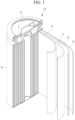
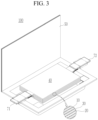
- FIGS. 1-4 are schematic views illustrating a rechargeable lithium battery according to some embodiments.
- FIG. 1 shows a cylindrical battery
- FIG. 2 shows a prismatic battery
- FIGS. 3-4 show pouch-type batteries.
- the rechargeable lithium battery 100 includes an electrode assembly 40 including a separator 30 between a positive electrode 10 and a negative electrode 20, and a case in which the electrode assembly 40 is included.
- the positive electrode 10, the negative electrode 20, and the separator 30 may be impregnated with an electrolyte solution.
- the rechargeable lithium battery 100 may include a sealing member 60 that seals the case 50 as shown in FIG. 1 .
- the rechargeable lithium battery 100 may include a positive lead tab 11, a positive terminal 12, a negative lead tab 21, and a negative terminal 22.
- the rechargeable lithium battery 100 includes an electrode tab 70 ( FIG. 4 ), for example, a positive electrode tab 71 and a negative electrode tab 72 ( FIG. 3 ) that serve as an electrical path for inducing the current formed in the electrode assembly 40 to the outside.
- an electrode tab 70 FIG. 4
- a positive electrode tab 71 and a negative electrode tab 72 FIG. 3
- a driving voltage of the rechargeable lithium battery may be 4.3 V or higher, or 4.35 V or higher. Even in a high voltage operating environment as described above, when the lithium nickel composite oxide represented by Chemical Formula 3 is used together with an electrolyte solution including the first and second compounds described above, stable battery performance can be achieved under high voltage/high temperature conditions.
- the rechargeable lithium battery according to some embodiments may be applied to automobiles, mobile phones, and/or various suitable types (or kinds)of electrical devices, but the present disclosure is not limited thereto.
- a basic electrolyte solution is prepared by mixing together ethylene carbonate (EC), methylethyl carbonate (MEC), and dimethyl carbonate (DMC) sequentially in a volume ratio of 20:40:40 to prepare a non-aqueous organic solvent and dissolving 1.15 M of LiPF 6 lithium salt therein.
- EC ethylene carbonate
- MEC methylethyl carbonate
- DMC dimethyl carbonate
- triallyl isocyanurate as a first compound and 2-fluoro-4-methyl-1,3,2-dioxaphospholane as a second compound are added to prepare an electrolyte solution.
- 0.5 wt% of the first compound and 0.5 wt% of the second compound are added to a total amount of the electrolyte solution.
- NMX LiNi 0.75 Mn 0.23 Al 0.02 O 2
- polyvinylidene fluoride as a binder
- ketjen black as a conductive material
- the positive electrode active material slurry is coated on a 14 ⁇ m-thick Al foil current collector, dried at 110 °C, and compressed, thereby manufacturing a positive electrode.
- a negative electrode active material slurry is prepared by mixing together artificial graphite as a negative electrode active material, styrene-butadiene rubber as a binder, and carboxylmethyl cellulose as a thickener in a weight ratio of 97:1:2 and dispersing the mixture in distilled water.
- the negative electrode active material slurry is coated on a 10 ⁇ m-thick Cu foil current collector, dried at 100 °C, and compressed, manufacturing a negative electrode.
- a 25 ⁇ m-thick separator having a polyethylene-polypropylene multi-layer structure is interposed to manufacture an electrode assembly, and a 4.45 V-class rechargeable lithium battery cell according to Example 1 is manufactured by inserting the electrode assembly into a cylindrical-type battery case and injecting the prepared electrolyte solution thereinto.
- a rechargeable lithium battery cell is manufactured in the same manner as in Example 1 except that the electrolyte solution is prepared by not adding the first compound and the second compound.
- a rechargeable lithium battery cell is manufactured in the same manner as in Example 1 except that the electrolyte solution is prepared by not adding the second compound.
- a rechargeable lithium battery cell is manufactured in the same manner as in Example 1 except that the electrolyte solution is prepared by not adding the first compound.
- a rechargeable lithium battery cell is manufactured in the same manner as in Example 1 except that the electrolyte solution is prepared by adding triallyl cyanurate represented by Chemical Formula a, instead of the triallyl isocyanurate as the first compound.
- a rechargeable lithium battery cell is manufactured in the same manner as in Example 1 except that the positive electrode is manufactured by using NCA (LiNi 0.5 Co 0.2 Al 0.3 O 2 ) as the positive electrode active material.
- NCA LiNi 0.5 Co 0.2 Al 0.3 O 2
- the rechargeable lithium battery cells of Example 1 and Comparative Examples 1 to 5 are measured with respect to ⁇ V/ ⁇ I (voltage change/current change) to evaluate initial DC resistance (DCIR). Subsequently, after making an internal maximum energy state of each of the battery cells into a full-charge state (SOC 100%), the cell is allowed to stay at a high temperature of 60 °C for 30 days and then, measured again with respect to DC resistance (DCIR).
- DCIR DC resistance
- a DCIR increase rate (%) is calculated according to Equation 1, and the results are shown in Table 1.
- DCIR increase rate % DCIR after 30 days ⁇ initial DCIR / initial DCR Table 1
- Initial DCIR (m ⁇ ) DCIR (m ⁇ ) after high temperature (60 °C, 30 days) storage DCIR increase rate (%)
- Example 1 41.3 43.2 104.6 Comparative Example 1 43.4 46.8 107.8 Comparative Example 2 42.5 45.1 106.1 Comparative Example 3 43.2 45.9 106.3 Comparative Example 4 42.3 46.2 109.2 Comparative Example 5 41.2 44.2 107.3
- Example 1 compared to Comparative Examples 1 to 5, exhibits a low DCIR increase rate at a high temperature, and thus, has excellent storage characteristics at a high temperature.
- the rechargeable lithium battery cells of Example 1 and Comparative Examples 1 to 5 are once charged and discharged at 0.2 C to measure charge and discharge capacity.
- the rechargeable lithium battery cells of Example 1 and Comparative Examples 1 to 5 are charged to an upper limit charge voltage of 4.4 V and discharged to 2.5 V at 0.2 C under a constant current condition to measure initial discharge capacity.
- the cells are 200 cycles charged at 0.33 C (CC/CV, 4.4 V, 0.025 C cut-off)/ discharged at 1.0 C (CC, 2.5 V cut-off) at 25 °C to measure discharge capacity.
- a ratio of discharge capacity to the initial discharge capacity is shown as a capacity recovery rate (%, recovery) in Table 2.
- the rechargeable lithium battery cells of Example 1 and Comparative Examples 1 to 5 are allowed to stand at 60 °C for 7 days and then, measured with respect to each gas generation amount on the 1 st day and the 7 th day through refinery gas analysis (RGA), and the results are shown in Table 2.
- RAA refinery gas analysis
- a gas increase rate (%) is calculated according to Equation 2, and the results are shown in Table 2.
- Gas increase rate (%) ⁇ (gas generation amount on the 7th day)/(gas generation amount on the 1st day) ⁇ Table 2
- Capacity recovery rate (25 °C, 200 cy, %) Amount of gas generated after storage at high temperature (60 °C) 1 st day (mL) 7 th day (mL) Gas increase rate (%)
- Example 1 exhibits a high capacity recovery rate at room temperature, compared to Comparative Examples 1 to 5 and thus excellent room-temperature cycle-life characteristics.
- Example 1 exhibits a significantly reduced gas increase rate after stored at a high temperature, compared to Comparative Examples 1 to 5.
Landscapes
- Chemical & Material Sciences (AREA)
- Chemical Kinetics & Catalysis (AREA)
- Electrochemistry (AREA)
- General Chemical & Material Sciences (AREA)
- Engineering & Computer Science (AREA)
- Manufacturing & Machinery (AREA)
- Inorganic Chemistry (AREA)
- Physics & Mathematics (AREA)
- Condensed Matter Physics & Semiconductors (AREA)
- General Physics & Mathematics (AREA)
- Materials Engineering (AREA)
- Secondary Cells (AREA)
- Battery Electrode And Active Subsutance (AREA)
Abstract
Description
- A rechargeable lithium battery is disclosed.
- Recently, with the rapid spread of electronic devices using batteries such as mobile phones, notebook computers, and electric vehicles, interest in rechargeable batteries having high energy density and high capacity is rapidly increasing. Accordingly, research and development for improving the performance of rechargeable lithium batteries is actively progressing.
- A rechargeable lithium battery includes a positive electrode and a negative electrode including an active material capable of intercalating and deintercalating lithium ions, and an electrolyte solution, and electrical energy is produced by oxidation and reduction reactions when lithium ions are intercalated/deintercalated at the positive and negative electrodes.
- For example, because the characteristics of a rechargeable lithium battery are determined by a complicated reaction between the positive electrode, electrolyte, negative electrode, and electrolyte, the use of a suitable or appropriate electrolyte is one of the variables for improving the performance of a rechargeable lithium battery.
- The invention is defined by the appended claims. The description that follows is subjected to this limitation. Any disclosure lying outside the scope of said claims is only intended for illustrative as well as comparative purposes. Some embodiments of the present disclosure provide a rechargeable lithium battery that can improve charge/discharge characteristics when stored at high temperatures and cycle-life characteristics at room temperature and high temperature, while reducing gas generation at high temperatures.
- A rechargeable lithium battery according to the invention includes a positive electrode including a positive electrode active material; a negative electrode including a negative electrode active material; an electrolyte solution for a rechargeable lithium battery including a non-aqueous organic solvent, a lithium salt, and an additive, wherein the additive includes a first compound represented by Chemical Formula 1 and a second compound represented by Chemical Formula 2, and the positive electrode active material includes a lithium nickel composite oxide represented by Chemical Formula 3.

- In Chemical Formula 1,
R1 to R3 are each independently hydrogen, a cyano group, a halogen, a substituted or unsubstituted C1 to C20 alkyl group, a substituted or unsubstituted C2 to C20 alkenyl group, a substituted or unsubstituted C2 to C20 alkynyl group, a substituted or unsubstituted C3 to C20 cycloalkyl group, a substituted or unsubstituted C2 to C20 heterocycloalkyl group, a substituted or unsubstituted C3 to C20 cycloalkenyl group, a substituted or unsubstituted C6 to C20 aryl group, or a substituted or unsubstituted C2 to C20 heteroaryl group;

- X1 is a fluoro group (e.g., a fluorine atom), a chloro group (e.g., a chlorine atom), a bromo group (e.g., a bromine atom), or an iodo group (e.g., an iodine atom),
- R4 to R9 are each independently hydrogen, a cyano group, a substituted or unsubstituted C1 to C20 alkyl group, a substituted or unsubstituted C1 to C20 alkoxy group, a substituted or unsubstituted C2 to C20 alkenyl group, a substituted or unsubstituted C2 to C20 alkynyl group, a substituted or unsubstituted C3 to C20 cycloalkyl group, a substituted or unsubstituted C6 to C20 aryl group, or a substituted or unsubstituted C2 to C20 heteroaryl group, and
- n is an integer of 0 or 1;
Chemical Formula 3 LiwNixMnyM1 1-x-yO2
wherein, in Chemical Formula 3,- 0.5≤w≤1.8, 0.05≤x<1, 0<y≤0.7, and
- M1 is Al, Fe, B, Ce, Cr, F, Mg, Mn, Mo, Nb, P, S, Si, Sr, Ti, V, W, Zr, or a combination thereof.
- A rechargeable lithium battery according to some embodiments can improve charge/discharge characteristics when stored at high temperatures and cycle-life characteristics at room temperature and high temperature, while reducing the amount of gas generated at high temperatures.
- The accompanying drawings, together with the specification, illustrate embodiments of the subject matter of the present disclosure, and, together with the description, serve to explain principles of embodiments of the subject matter of the present disclosure.
-
FIG. 1 is a schematic perspective view of a rechargeable lithium battery according to an embodiment. -
FIG. 2 is a schematic cross-sectional view of a rechargeable lithium battery according to an embodiment. -
FIGS. 3-4 are schematic perspective views of rechargeable lithium batteries according to embodiments. - Hereinafter, embodiments of the present disclosure will be described in more detail. However, these embodiments are presented as examples, and the present disclosure is not limited thereto, and the present disclosure is defined by the scope of the appended claims, and equivalents thereof.
- As used herein, when specific definition is not otherwise provided, it will be understood that when an element such as a layer, film, region, or substrate is referred to as being "on" another element, it can be directly on the other element or intervening elements may also be present.
- As used herein, "combination thereof" means a mixture, laminate, composite, copolymer, alloy, blend, reaction product, and/or the like of the constituents.
- As used herein, when a definition is not otherwise provided, a particle diameter may be an average particle diameter. In some embodiments, the particle diameter means the average particle diameter (D50), which means the diameter of particles having a cumulative volume of 50 volume% in the particle size distribution. The average particle size (D50) may be measured by any suitable method generally used in the art, for example, by a particle size analyzer, and/or by a transmission electron microscopic image, and/or a scanning electron microscopic image. In some embodiments, a dynamic light-scattering measurement device is used to perform a data analysis, and the number of particles is counted for each particle size range. From this, the average particle diameter (D50) value may be easily obtained through a calculation. In some embodiments, the average particle diameter can be measured using a laser diffraction method. When measuring by the laser diffraction method, for example, the particles to be measured may be dispersed in a dispersion medium, and then introduced into a commercially available laser diffraction particle diameter measuring device (e.g., Microtrac MT 3000), and ultrasonic waves of 28 kHz at an output of 60 W are irradiated to calculate an average particle diameter (D50) on the basis of 50% of the particle diameter distribution in the measuring device.
- As used herein, when a definition is not otherwise provided, "substituted" refers to replacement of at least one hydrogen of a substituent or a compound by any one of deuterium, a halogen, a hydroxyl group, an amino group, a C1 to C30 amine group, a nitro group, a C1 to C40 silyl group, a C1 to C30 alkyl group, a C1 to C10 alkylsilyl group, a C6 to C30 arylsilyl group, a C3 to C30 cycloalkyl group, a C3 to C30 heterocycloalkyl group, a C6 to C30 aryl group, a C2 to C30 heteroaryl group, a C1 to C20 alkoxy group, a C1 to C10 fluoroalkyl group, or a cyano group.
- In some embodiments, "substituted" may refer to replacement of at least one hydrogen of a substituent or a compound by deuterium, a halogen, a C1 to C30 alkyl group, a C1 to C10 alkylsilyl group, a C6 to C30 arylsilyl group, a C3 to C30 cycloalkyl group, a C3 to C30 heterocycloalkyl group, a C6 to C30 aryl group, a C2 to C30 heteroaryl group, a C1 to C10 fluoroalkyl group, or a cyano group. For example, "substituted" may refer to replacement of at least one hydrogen of a substituent or a compound by deuterium, a halogen, a C1 to C20 alkyl group, a C6 to C30 aryl group, a C1 to C10 fluoroalkyl group, or a cyano group. In some embodiments, "substitution" may refer to replacement of at least one hydrogen of a substituent or a compound by deuterium, a halogen group, a C1 to C5 alkyl group, a C6 to C18 aryl group, a C1 to C5 fluoroalkyl group, or a cyano group. For example, "substituted" may refer to replacement of at least one hydrogen of a substituent or a compound by deuterium, a cyano group, a halogen, a methyl group, an ethyl group, a propyl group, a butyl group, a phenyl group, a biphenyl group, a terphenyl group, a trifluoromethyl group, or a naphthyl group.
- A rechargeable lithium battery includes a positive electrode including a positive electrode active material; a negative electrode including a negative electrode active material; an electrolyte solution for a rechargeable lithium battery including a non-aqueous organic solvent, a lithium salt, and an additive, wherein the additive includes a first compound represented by Chemical Formula 1 and a second compound represented by Chemical Formula 2, and the positive electrode active material includes lithium nickel composite oxide represented by Chemical Formula 3.

- In Chemical Formula 1,
R1 to R3 are each independently hydrogen, a cyano group, a halogen, a substituted or unsubstituted C1 to C20 alkyl group, a substituted or unsubstituted C2 to C20 alkenyl group, a substituted or unsubstituted C2 to C20 alkynyl group, a substituted or unsubstituted C3 to C20 cycloalkyl group, a substituted or unsubstituted C2 to C20 heterocycloalkyl group, a substituted or unsubstituted C3 to C20 cycloalkenyl group, a substituted or unsubstituted C6 to C20 aryl group, or a substituted or unsubstituted C2 to C20 heteroaryl group;

- X1 is a fluoro group (e.g., a fluorine atom), a chloro group (e.g., a chlorine atom), a bromo group (e.g., a bromine atom), or an iodo group (e.g., an iodine atom),
- R4 to R9 are each independently hydrogen, a cyano group, a substituted or unsubstituted C1 to C20 alkyl group, a substituted or unsubstituted C1 to C20 alkoxy group, a substituted or unsubstituted C2 to C20 alkenyl group, a substituted or unsubstituted C2 to C20 alkynyl group, a substituted or unsubstituted C3 to C20 cycloalkyl group, a substituted or unsubstituted C6 to C20 aryl group, or a substituted or unsubstituted C2 to C20 heteroaryl group, and
- n is an integer of 0 or 1;
Chemical Formula 3 LiwNixMnyM1 1-x-yO2
wherein, in Chemical Formula 3,- 0.5≤w≤1.8, 0.05≤x<1, 0<y≤0.7, and
- M1 is Al, Fe, B, Ce, Cr, F, Mg, Mn, Mo, Nb, P, S, Si, Sr, Ti, V, W, Zr, or a combination thereof.
- The electrolyte solution includes a non-aqueous organic solvent, a lithium salt, and an additive.
- The additive includes a first compound and a second compound.
- The first compound is an isocyanurate-based compound, which may undergo a radical reaction with other compounds having double bonds in the electrolyte solution to form a solid and low-resistance CEI (Cathode Electrolyte Interphase) film on the positive electrode, and may improve the charge/discharge characteristics of the battery and cycle characteristics at room temperature and high temperature when stored at high temperatures.
- The first compound is represented by Chemical Formula 1.

- In Chemical Formula 1, R1 to R3 are each independently hydrogen, a cyano group, a halogen, a substituted or unsubstituted C1 to C20 alkyl group, a substituted or unsubstituted C2 to C20 alkenyl group, a substituted or unsubstituted C2 to C20 alkynyl group, a substituted or unsubstituted C3 to C20 cycloalkyl group, a substituted or unsubstituted C2 to C20 heterocycloalkyl group, a substituted or unsubstituted C3 to C20 cycloalkenyl group, a substituted or unsubstituted C6 to C20 aryl group, or a substituted or unsubstituted C2 to C20 heteroaryl group.
- For example, R1 to R3 may each independently be a substituted or unsubstituted C1 to C20 alkyl group, or a substituted or unsubstituted C2 to C20 alkenyl group.
- As an example, R1 to R3 may each independently be a substituted or unsubstituted C2 to C20 alkenyl group.
- As an example, the compound represented by Chemical Formula 1 may be any one or more selected from the compounds listed in Group 1.

- As an example, the first compound may be triallyl isocyanurate, trimethyl isocyanurate, trimethallyl isocyanurate, or a combination thereof, but is not limited to thereto.
- The first compound may be included in an amount of 0.05 wt% to 3 wt%, for example 0.1 wt% to 2 wt%, or 0.5 wt% to 1 wt%, based on a total weight of the electrolyte solution. In the above ranges, a rechargeable lithium battery having improved high-temperature storage characteristics and cycle-life characteristics can be implemented.
- The second compound forms a SEI (solid electrolyte interface) film having high temperature stability and excellent ionic conductivity on the surface of the negative electrode and suppresses or reduces side reactions of LiPF6 due to the -PO2F functional group, thereby reducing gas generation due to the decomposition reaction of the electrolyte solution during high temperature storage.
- In some embodiments, the second compound can form a composite by coordinating with the anion dissociated from the thermal decomposition product of lithium salt and/or lithium salt, such as LiPF6, and the formation of these composites stabilizes the anion dissociated from the thermal decomposition product of lithium salt and/or lithium salt to suppress reduce occurrence unwanted side reactions between these composites and the electrolyte solution, improves cycle-life characteristics of the rechargeable lithium battery, and significantly reduces an occurrence of defects by preventing or reducing gas generation inside the rechargeable lithium battery.
- The second compound may be represented by Chemical Formula 2.

- In Chemical Formula 2,
- X1 is a fluoro group (e.g., a fluorine atom), a chloro group (e.g., a chlorine atom), a bromo group (e.g., a bromine atom), or an iodo group (e.g., an iodine atom),
- R4 to R9 are each independently hydrogen, a cyano group, a substituted or unsubstituted C1 to C20 alkyl group, a substituted or unsubstituted C1 to C20 alkoxy group, a substituted or unsubstituted C2 to C20 alkenyl group, a substituted or unsubstituted C2 to C20 alkynyl group, a substituted or unsubstituted C3 to C20 cycloalkyl group, a substituted or unsubstituted C6 to C20 aryl group, or a substituted or unsubstituted C2 to C20 heteroaryl group, and
- n is an integer of 0 or 1.
- Chemical Formula 2 may include a compound represented by Chemical Formula 2A or Chemical Formula 2B.


- In Chemical Formulas 2A and 2B,
- X1 is a fluoro group (e.g., a fluorine atom), a chloro group (e.g., a chlorine atom), a bromo group (e.g., a bromine atom), or an iodo group (e.g., an iodine atom), and
- R4 to R9 are each independently hydrogen, a substituted or unsubstituted C1 to C10 alkyl group, a substituted or unsubstituted C1 to C10 alkoxy group, a substituted or unsubstituted C2 to C10 alkenyl group, or a substituted or unsubstituted C2 to C10 alkynyl group.
- In Chemical Formula 2A, R6 and R7 may each be hydrogen and at least one selected from R8 and R9 may be a substituted or unsubstituted C1 to C10 alkyl group, a substituted or unsubstituted C1 to C10 alkoxy group, a substituted or unsubstituted C2 to C10 alkenyl group, or a substituted or unsubstituted C2 to C10 alkynyl group.
- In Chemical Formula 2B, R6 and R7 may each be hydrogen and at least one selected from R4, R5, R8, and R9 may be a substituted or unsubstituted C1 to C10 alkyl group, a substituted or unsubstituted C1 to C10 alkoxy group, a substituted or unsubstituted C2 to C10 alkenyl group, or a substituted or unsubstituted C2 to C10 alkynyl group.
- For example, in Chemical Formula 2A, R6 and R7 may each be hydrogen and at least one selected from R8 and R9 may be a substituted or unsubstituted C1 to C10 alkyl group.
- As an example, the compound represented by Chemical Formula 2 may be selected from the compounds listed in Group 2.

- As an example, the compound represented by Chemical Formula 2 may include 2-fluoro-1,3,2-dioxaphospholane, 2-fluoro-4-methyl-1,3,2-dioxaphospholane, or a combination thereof.
- The second compound may be included in an amount of 0.05 wt% to 3 wt%, for example 0.1 wt% to 2 wt%, or 0.5 wt% to 1 wt%, based on a total weight of the electrolyte solution. Within the above ranges, it is possible to implement a rechargeable lithium battery in which gas generation is reduced when stored at high temperature.
- In some embodiments, the additive may further include other additives in addition to the compounds described above.
- The other additives may include vinylene carbonate (VC), fluoroethylene carbonate (FEC), difluoroethylene carbonate, chloroethylene carbonate, dichloroethylene carbonate, bromoethylene carbonate, dibromoethylene carbonate, nitroethylene carbonate, cyanoethylene carbonate, vinylethylene carbonate (VEC), adiponitrile (AN), succinonitrile (SN), 1 ,3,6-hexane tricyanide (HTCN), propenesultone (PST), propanesultone (PS), lithium tetrafluoroborate (LiBF4), lithium difluorophosphate (LiPO2F2), 2-fluoro biphenyl (2-FBP), or a combination thereof.
- By further including the other additives described above, cycle-life may be further improved and/or gases generated from the positive electrode and negative electrode can be effectively controlled when stored at high temperatures.
- The non-aqueous organic solvent serves as a medium for transmitting ions taking part in the electrochemical reaction of a battery.
- The non-aqueous organic solvent may be a carbonate-based, ester-based, ether-based, ketone-based, and/or alcohol-based solvent, an aprotic solvent, or a combination thereof.
- The carbonate-based solvent may include dimethyl carbonate (DMC), diethyl carbonate (DEC), dipropyl carbonate (DPC), methylpropyl carbonate (MPC), ethylpropyl carbonate (EPC), methylethyl carbonate (MEC), ethylene carbonate (EC), propylene carbonate (PC), butylene carbonate (BC), and/or the like. The ester-based solvent may include methyl acetate, ethyl acetate, n-propyl acetate, dimethyl acetate, methyl propionate, ethyl propionate, decanolide, mevalonolactone, valerolactone, caprolactone, and/or the like
- The ether-based solvent may include dibutyl ether, tetraglyme, diglyme, dimethoxyethane, 2-methyltetrahydrofuran, 2,5-dimethyltetrahydrofuran, tetrahydrofuran, and/or the like. In some embodiments, the ketone-based solvent may include cyclohexanone, and/or the like. The alcohol-based solvent may include ethanol, isopropyl alcohol, and/or the like and/or the aprotic solvent may include nitriles such as R-CN (wherein R is a C2 to C20 linear, branched, or cyclic hydrocarbon group, a double bond, an aromatic ring, and/or an ether bond, and/or the like; amides such as dimethylformamide; dioxolanes such as 1,3-dioxolane, 1 ,4-dioxolane, and/or the like; sulfolanes, and/or the like.
- The non-aqueous organic solvents may be used alone or in combination of two or more.
- In some embodiments, when using a carbonate-based solvent, a cyclic carbonate and a chain carbonate may be mixed together and used, and the cyclic carbonate and the chain carbonate may be mixed together in a volume ratio of 1:1 to 1:9.
- The lithium salt dissolved in the organic solvent supplies lithium ions in a battery, enables a basic operation of a rechargeable lithium battery, and improves transportation of the lithium ions between positive and negative electrodes. Examples of the lithium salt include at least one selected from LiPF6, LiBF4, LiSbF6, LiAsF6, LiClO4, LiAlO2, LiAlCl4, LiPO2F2, LiCl, Lil, LiN(SO3C2F5)2, Li(FSO2)2N (lithium bis(fluorosulfonyl)imide, LiFSI), LiCaFsSOs, LiN(CxF2x+1SO2)(CyF2y+1SO2) (wherein x and y are integers of 1 to 20), lithium trifluoromethane sulfonate, lithium tetrafluoroethanesulfonate, lithium difluorobis(oxalato)phosphate (LiDFOB), and lithium bis(oxalato) borate (LiBOB).
- The positive electrode active material may include a compound (lithiated intercalation compound) being capable of intercalating and deintercalating lithium. In some embodiments, at least one of a composite oxide of lithium and a metal selected from manganese, nickel, and combinations thereof may be used.
- The composite oxide may be a lithium transition metal composite oxide, and an example includes a cobalt-free lithium nickel-manganese-based oxide, which is a lithium nickel composite oxide represented by Chemical Formula 3.
Chemical Formula 3 LiwNixMnyM1 1-x-yO2
- In Chemical Formula 3,
- 0.5≤w≤1.8, 0.05≤x<1, 0<y≤0.7, and
- M1 is Al, Fe, B, Ce, Cr, F, Mg, Mn, Mo, Nb, P, S, Si, Sr, Ti, V, W, Zr, or a combination thereof.
- The lithium nickel composite oxide represented by Chemical Formula 3 is a so-called cobalt-free positive electrode active material, and in Chemical Formula 3, 0.5≤w≤1.8, 0.6≤w≤1.8, 0.7≤w≤1.8, 0.8≤w≤1.8, 0.9≤w≤1.8, 0.9≤w≤1.7, 0.9≤w≤1.6, 0.9≤w≤1.5, 0.9≤w≤1.4, 0.9≤w≤1.3, 0.9≤w≤1.2, or 0.9≤w≤1.1; 0.05≤x<1, 0.3≤x<1, 0.4≤x<1, 0.5≤x<1, 0.6≤x<1, 0.7≤x<1, 0.8≤x<1, or 0.9≤x<1; 0<y≤0.7, 0<y≤0.6, 0<y≤0.5, 0<y≤0.4, 0<y≤0.3, 0<y≤0.2 or 0<y≤0.1.
- In the lithium nickel composite oxide represented by Chemical Formula 3, M1 in Chemical Formula 3 may further include at least one selected from B, Ce, Cr, F, Mg, Mo, Nb, P, S, Si, Sr, Ti, V, W and Zr. The additional element is a dopant and can improve reversible intercalation and deintercalation of lithium by partially modifying the lattice structure of each positive electrode active material.
- The lithium nickel composite oxide represented by Chemical Formula 3 has a problem in that decomposition of an electrolyte solution is promoted due to increased Ni activity under high voltage driving conditions, and the surface of the negative electrode is reduced after a large amount of Ni is eluted, thereby accelerating its cycle-life deterioration. However, when used together with an electrolyte solution including the first and second compounds described above, decomposition of the electrolyte solution can be suppressed or reduced, thereby reducing the amount of gas generated and improving the charge/discharge characteristics and cycle-life characteristics of the battery.
- In some embodiments, the lithium nickel composite oxide represented by Chemical Formula 3 can achieve relatively stable performance at a driving voltage of 4.2 V or less, but when the driving voltage is 4.3 V or more, or, for example, 4.35 V or more, side reactions with the electrolyte solution become severe, and transition metal Ions are eluted, causing a rapid decline in battery performance, and the decline in battery performance may become more severe at high temperatures. However, when the lithium nickel composite oxide represented by Chemical Formula 3 is combined with an electrolyte solution including the first and second compounds described above, stable battery performance can be achieved under high voltage/high temperature conditions.
- In some embodiments to the cobalt-free lithium nickel-manganese-based oxide, the positive electrode active material may further include lithium nickel-based oxide, lithium manganese-based oxide, a lithium iron phosphate-based compound, or a combination thereof.
- As an example, the positive electrode active material may further include a compound represented by one selected from the following chemical formulas.
- LiaA1-bXbO2-cDc (0.90≤a≤1.8, 0≤b≤0.5, 0≤c≤0.05); LiaMn2-bXbO4-cDc (0.90≤a≤1.8, 0≤b≤0.5, 0≤c≤0.05); LiaNi1-b-cMnbXcO2-aOa (0.90≤a≤1.8, 0≤b≤0.5, 0≤c≤0.5, 0<α<2); LiaNiGbO2 (0.90≤a≤1.8, 0.001≤b≤0.1); LiaMn1-bGbO2 (0.90≤a≤1.8, 0.001≤b≤0.1); LiaMn2GbO4 (0.90≤a≤1.8, 0.001≤b≤0.1); LiaMn1-gGgPO4 (0.90≤a≤1.8, 0≤g≤0.5); Li(3-f)Fe2(PO4)3 (0≤f≤2); or LiaFePO4(0.90≤a≤1.8).
- In the above chemical formulas, A is Ni, Mn, or a combination thereof; X is Al, Ni, Mn, Cr, Fe, Mg, Sr, V, a rare earth element, or a combination thereof; D is O, F, S, P, or a combination thereof; G is Al, Cr, Mn, Fe, Mg, La, Ce, Sr, V, or a combination thereof; and L1 is Mn, Al, or a combination thereof.
- For example, the positive electrode active material may be may be a high nickel-based positive electrode active material having a nickel content of greater than or equal to 80 mol%, greater than or equal to 85 mol%, greater than or equal to 90 mol%, greater than or equal to 91 mol%, or greater than or equal to 94 mol% and less than or equal to 99 mol% based on 100 mol% of the metal excluding lithium in the lithium transition metal composite oxide. The high-nickel-based positive electrode active material can realize high capacity and can be applied to a high-capacity, high-density rechargeable lithium battery.
- A positive electrode for a rechargeable lithium battery may include a current collector and a positive electrode active material layer on the current collector. The positive electrode active material layer may include a positive electrode active material and may further include a binder and/or a conductive material (e.g., an electrically conductive material).
- For example, the positive electrode may further include an additive that can serve as a sacrificial positive electrode.
- An amount of the positive electrode active material may be 90 wt% to 99.5 wt% based on 100% by weight of the positive electrode active material layer, and amounts of the binder and the conductive material may be 0.5 wt% to 5 wt%, respectively, based on 100 wt% of the positive electrode active material layer.
- The binder serves to well attach the positive electrode active material particles to each other and also to well attach the positive electrode active material to the current collector. Examples of the binder may include polyvinyl alcohol, carboxymethylcellulose, hydroxypropylcellulose, diacetylcellulose, polyvinylchloride, carboxylated polyvinylchloride, polyvinylfluoride, a polymer including ethylene oxide, polyvinylpyrrolidone, polyurethane, polytetrafluoroethylene, polyvinylidene fluoride, polyethylene, polypropylene, a styrene-butadiene rubber, a (meth)acrylated styrene-butadiene rubber, an epoxy resin, a (meth)acrylic resin, a polyester resin, nylon, and the like, but are not limited thereto.
- The conductive material is used to impart conductivity (e.g., electrical conductivity) to the electrode, and any suitable material that does not cause chemical change (e.g., does not cause an undesirable chemical change in the rechargeable lithium battery) and conducts electrons can be used in the battery. Examples of the conductive material may include a carbon-based material such as natural graphite, artificial graphite, carbon black, acetylene black, ketjen black, a carbon fiber, a carbon nanofiber, and carbon nanotube; a metal-based material containing copper, nickel, aluminum, silver, etc., in a form of a metal powder and/or a metal fiber; a conductive polymer (e.g., an electrically conductive polymer) such as a polyphenylene derivative; or a mixture thereof.
- Al may be used as the current collector, but is not limited thereto.
- The negative electrode active material may include a material that reversibly intercalates/deintercalates lithium ions, a lithium metal, a lithium metal alloy, a material capable of doping/dedoping lithium, and/or a transition metal oxide.
- The material that reversibly intercalates/deintercalates lithium ions may include a carbon-based negative electrode active material, for example crystalline carbon, amorphous carbon or a combination thereof. The crystalline carbon may be graphite such as irregular, sheet-shaped, flake-shaped, sphere-shaped, and/or fiber-shaped natural graphite and/or artificial graphite, and the amorphous carbon may be a soft carbon, a hard carbon, a mesophase pitch carbonization product, calcined coke, and/or the like.
- The lithium metal alloy includes an alloy of lithium and a metal selected from Na, K, Rb, Cs, Fr, Be, Mg, Ca, Sr, Si, Sb, Pb, In, Zn, Ba, Ra, Ge, Al, and Sn.
- The material capable of doping/dedoping lithium may be a Si-based negative electrode active material and/or a Sn-based negative electrode active material. The Si-based negative electrode active material may include silicon, a silicon-carbon composite, SiOx (0 < x < 2), a Si-Q alloy (wherein Q is selected from an alkali metal, an alkaline-earth metal, a Group 13 element, a Group 14 element (excluding Si), a Group 15 element, a Group 16 element, a transition metal, a rare earth element, and a combination thereof). The Sn-based negative electrode active material may include Sn, SnO2, a Sn-based alloy, or a combination thereof.
- The silicon-carbon composite may be a composite of silicon and amorphous carbon. According to some embodiments, the silicon-carbon composite may be in a form of silicon particles and amorphous carbon coated on a surface of the silicon particles. For example, it may include a secondary particle (core) in which primary silicon particles are assembled, and an amorphous carbon coating layer (shell) on the surface of the secondary particle. The amorphous carbon may also be between the primary silicon particles, and, for example, the primary silicon particles may be coated with the amorphous carbon. The secondary particle may exist dispersed in an amorphous carbon matrix.
- The silicon-carbon composite may further include crystalline carbon. For example, the silicon-carbon composite may include a core including crystalline carbon and silicon particles and an amorphous carbon coating layer on a surface of the core.
- The Si-based negative electrode active material and/or the Sn-based negative electrode active material may be used in combination with a carbon-based negative electrode active material.
- The negative electrode for a rechargeable lithium battery includes a current collector and a negative electrode active material layer on the current collector. The negative electrode active material layer may include a negative electrode active material, and may further include a binder and/or a conductive material (e.g., an electrically conductive material).
- For example, the negative electrode active material layer may include 90 wt% to 99 wt% of the negative electrode active material, 0.5 wt% to 5 wt% of the binder, and 0 wt% to 5 wt% of the conductive material.
- The binder serves to well attach the negative electrode active material particles to each other and also to well attach the negative electrode active material to the current collector. The binder may include a non-aqueous binder, an aqueous binder, a dry binder, or a combination thereof.
- The non-aqueous binder may include polyvinyl chloride, carboxylated polyvinyl chloride, polyvinyl fluoride, an ethylene propylene copolymer, polystyrene, polyurethane, polytetrafluoroethylene, polyvinylidene fluoride, polyethylene, polypropylene, poly amideimide, polyimide, or a combination thereof.
- The aqueous binder may be selected from a styrene-butadiene rubber, a (meth)acrylated styrene-butadiene rubber, a (meth)acrylonitrile-butadiene rubber, (meth)acrylic rubber, a butyl rubber, a fluoro rubber, polyethylene oxide, polyvinylpyrrolidone, polyepichlorohydrin, polyphosphazene, poly(meth)acrylonitrile, an ethylene propylene diene copolymer, polyvinylpyridine, chlorosulfonated polyethylene, latex, a polyester resin, a (meth)acrylic resin, a phenol resin, an epoxy resin, polyvinyl alcohol, and a combination thereof.
- When an aqueous binder is used as the negative electrode binder, a cellulose-based compound capable of imparting or increasing viscosity may be further included. The cellulose-based compound may include at least one of carboxymethyl cellulose, hydroxypropylmethyl cellulose, methyl cellulose, or an alkali metal salt thereof. The alkali metal may include Na, K, and/or Li.
- The dry binder may be a polymer material capable of being fibrous (e.g., capable of being fibrillized or fiberized), and may be, for example, polytetrafluoroethylene, polyvinylidene fluoride, a polyvinylidene fluoride-hexafluoropropylene copolymer, polyethylene oxide, or a combination thereof.
- The conductive material is used to impart conductivity (e.g., electrical conductivity) to the electrode, and any suitable material that does not cause chemical change (e.g., does not cause an undesirable chemical change) and conducts electrons can be used in the battery. Examples thereof may include a carbon-based material such as natural graphite, artificial graphite, carbon black, acetylene black, ketjen black, a carbon fiber, a carbon nanofiber, and a carbon nanotube; a metal-based material including copper, nickel, aluminum, silver, etc. in a form of a metal powder and/or a metal fiber; a conductive polymer (e.g., an electrically conductive polymer) such as a polyphenylene derivative; or a mixture thereof.
- The negative current collector may include a copper foil, a nickel foil, a stainless steel foil, a titanium foil, a nickel foam, a copper foam, a polymer substrate coated with a conductive metal (e.g., an electrically conductive metal), and/or a combination thereof.
- Depending on the type (or kind) of the rechargeable lithium battery, a separator may be present between the positive electrode and the negative electrode. The separator may include polyethylene, polypropylene, polyvinylidene fluoride, or a multilayer film of two or more layers thereof, and a mixed multilayer film such as a polyethylene/polypropylene two-layer separator, polyethylene/polypropylene/polyethylene three-layer separator, polypropylene/polyethylene/polypropylene three-layer separator, and/or the like.
- The separator may include a porous substrate and a coating layer including an organic material, an inorganic material, or a combination thereof on one or both surfaces (e.g., two opposing surfaces) of the porous substrate.
- The porous substrate may be a polymer film formed of any one polymer selected from polyolefin such as polyethylene and polypropylene, polyester such as polyethylene terephthalate and polybutylene terephthalate, polyacetal, polyamide, polyimide, polycarbonate, polyether ketone, polyarylether ketone, polyether ketone, polyetherimide, polyamideimide, polybenzimidazole, polyethersulfone, polyphenylene oxide, a cyclic olefin copolymer, polyphenylene sulfide, polyethylene naphthalate, a glass fiber, TEFLON, and polytetrafluoroethylene, or a copolymer or mixture of two or more thereof.
- The organic material may include a polyvinylidene fluoride-based polymer and/or a (meth)acrylic polymer.
- The inorganic material may include inorganic particles selected from Al2O3, SiO2, TiO2, SnO2, CeO2, MgO, NiO, CaO, GaO, ZnO, ZrO2, Y2O3, SrTiO3, BaTiO3, Mg(OH)2, boehmite, and a combination thereof, but is not limited thereto.
- The organic material and the inorganic material may be mixed together in one coating layer, or a coating layer including an organic material and a coating layer including an inorganic material may be stacked.
- The rechargeable lithium battery may be classified into cylindrical, prismatic, pouch, coin, and/or the like depending on their shape.
-
FIGS. 1-4 are schematic views illustrating a rechargeable lithium battery according to some embodiments.FIG. 1 shows a cylindrical battery,FIG. 2 shows a prismatic battery, andFIGS. 3-4 show pouch-type batteries. - Referring to
FIGS. 1-4 , therechargeable lithium battery 100 includes anelectrode assembly 40 including aseparator 30 between apositive electrode 10 and anegative electrode 20, and a case in which theelectrode assembly 40 is included. Thepositive electrode 10, thenegative electrode 20, and theseparator 30 may be impregnated with an electrolyte solution. - The
rechargeable lithium battery 100 may include a sealingmember 60 that seals thecase 50 as shown inFIG. 1 . - In
FIG. 2 , therechargeable lithium battery 100 may include apositive lead tab 11, apositive terminal 12, anegative lead tab 21, and anegative terminal 22. - As shown in
FIGS. 3-4 , therechargeable lithium battery 100 includes an electrode tab 70 (FIG. 4 ), for example, apositive electrode tab 71 and a negative electrode tab 72 (FIG. 3 ) that serve as an electrical path for inducing the current formed in theelectrode assembly 40 to the outside. - As an example, a driving voltage of the rechargeable lithium battery may be 4.3 V or higher, or 4.35 V or higher. Even in a high voltage operating environment as described above, when the lithium nickel composite oxide represented by Chemical Formula 3 is used together with an electrolyte solution including the first and second compounds described above, stable battery performance can be achieved under high voltage/high temperature conditions.
- The rechargeable lithium battery according to some embodiments may be applied to automobiles, mobile phones, and/or various suitable types (or kinds)of electrical devices, but the present disclosure is not limited thereto.
- Examples and comparative examples of the present disclosure are described below. However, the following examples are only examples of the present disclosure, and the present disclosure is not limited to the following examples.
- A basic electrolyte solution is prepared by mixing together ethylene carbonate (EC), methylethyl carbonate (MEC), and dimethyl carbonate (DMC) sequentially in a volume ratio of 20:40:40 to prepare a non-aqueous organic solvent and dissolving 1.15 M of LiPF6 lithium salt therein.
- To the basic electrolyte solution, triallyl isocyanurate as a first compound and 2-fluoro-4-methyl-1,3,2-dioxaphospholane as a second compound are added to prepare an electrolyte solution.
- Herein, 0.5 wt% of the first compound and 0.5 wt% of the second compound are added to a total amount of the electrolyte solution.
- NMX (LiNi0.75Mn0.23Al0.02O2) as a positive electrode active material, polyvinylidene fluoride as a binder, and ketjen black as a conductive material are mixed together in a weight ratio of 97:2:1 and then, dispersed in N-methyl pyrrolidone, thereby preparing a positive electrode active material slurry. The positive electrode active material slurry is coated on a 14 µm-thick Al foil current collector, dried at 110 °C, and compressed, thereby manufacturing a positive electrode.
- In addition, a negative electrode active material slurry is prepared by mixing together artificial graphite as a negative electrode active material, styrene-butadiene rubber as a binder, and carboxylmethyl cellulose as a thickener in a weight ratio of 97:1:2 and dispersing the mixture in distilled water. The negative electrode active material slurry is coated on a 10 µm-thick Cu foil current collector, dried at 100 °C, and compressed, manufacturing a negative electrode.
- Between the positive electrode and the negative electrode, a 25 µm-thick separator having a polyethylene-polypropylene multi-layer structure is interposed to manufacture an electrode assembly, and a 4.45 V-class rechargeable lithium battery cell according to Example 1 is manufactured by inserting the electrode assembly into a cylindrical-type battery case and injecting the prepared electrolyte solution thereinto.
- A rechargeable lithium battery cell is manufactured in the same manner as in Example 1 except that the electrolyte solution is prepared by not adding the first compound and the second compound.
- A rechargeable lithium battery cell is manufactured in the same manner as in Example 1 except that the electrolyte solution is prepared by not adding the second compound.
- A rechargeable lithium battery cell is manufactured in the same manner as in Example 1 except that the electrolyte solution is prepared by not adding the first compound.
- A rechargeable lithium battery cell is manufactured in the same manner as in Example 1 except that the electrolyte solution is prepared by adding triallyl cyanurate represented by Chemical Formula a, instead of the triallyl isocyanurate as the first compound.

- A rechargeable lithium battery cell is manufactured in the same manner as in Example 1 except that the positive electrode is manufactured by using NCA (LiNi0.5Co0.2Al0.3O2) as the positive electrode active material.
- The rechargeable lithium battery cells of Example 1 and Comparative Examples 1 to 5 are measured with respect to △V/△I (voltage change/current change) to evaluate initial DC resistance (DCIR). Subsequently, after making an internal maximum energy state of each of the battery cells into a full-charge state (
SOC 100%), the cell is allowed to stay at a high temperature of 60 °C for 30 days and then, measured again with respect to DC resistance (DCIR). - A DCIR increase rate (%) is calculated according to Equation 1, and the results are shown in Table 1.

Table 1 Initial DCIR (mΩ) DCIR (mΩ) after high temperature (60 °C, 30 days) storage DCIR increase rate (%) Example 1 41.3 43.2 104.6 Comparative Example 1 43.4 46.8 107.8 Comparative Example 2 42.5 45.1 106.1 Comparative Example 3 43.2 45.9 106.3 Comparative Example 4 42.3 46.2 109.2 Comparative Example 5 41.2 44.2 107.3 - Referring to Table 1, Example 1, compared to Comparative Examples 1 to 5, exhibits a low DCIR increase rate at a high temperature, and thus, has excellent storage characteristics at a high temperature.
- The rechargeable lithium battery cells of Example 1 and Comparative Examples 1 to 5 are once charged and discharged at 0.2 C to measure charge and discharge capacity.
- In addition, the rechargeable lithium battery cells of Example 1 and Comparative Examples 1 to 5 are charged to an upper limit charge voltage of 4.4 V and discharged to 2.5 V at 0.2 C under a constant current condition to measure initial discharge capacity.
- The cells are 200 cycles charged at 0.33 C (CC/CV, 4.4 V, 0.025 C cut-off)/ discharged at 1.0 C (CC, 2.5 V cut-off) at 25 °C to measure discharge capacity.
- A ratio of discharge capacity to the initial discharge capacity is shown as a capacity recovery rate (%, recovery) in Table 2.
- The rechargeable lithium battery cells of Example 1 and Comparative Examples 1 to 5 are allowed to stand at 60 °C for 7 days and then, measured with respect to each gas generation amount on the 1st day and the 7th day through refinery gas analysis (RGA), and the results are shown in Table 2.
- A gas increase rate (%) is calculated according to Equation 2, and the results are shown in Table 2.
Gas increase rate (%) = {(gas generation amount on the 7th day)/(gas generation amount on the 1st day)} Table 2 Capacity recovery rate (25 °C, 200 cy, %) Amount of gas generated after storage at high temperature (60 °C) 1st day (mL) 7th day (mL) Gas increase rate (%) Example 1 97.4 1.5 1.9 127 Comparative Example 1 94.4 1.7 2.6 153 Comparative Example 2 95.9 1.6 2.1 131 Comparative Example 3 96.2 1.6 2.3 144 Comparative Example 4 95.4 1.7 2.5 147 Comparative Example 5 96.5 1.4 2.1 150 - Referring to Table 2, Example 1 exhibits a high capacity recovery rate at room temperature, compared to Comparative Examples 1 to 5 and thus excellent room-temperature cycle-life characteristics.
- In addition, referring to Table 2, Example 1 exhibits a significantly reduced gas increase rate after stored at a high temperature, compared to Comparative Examples 1 to 5.
-
100: rechargeable lithium battery 10: positive electrode 11: positive electrode lead tab 12: positive terminal 20: negative electrode 21: negative electrode lead tab 22: negative terminal 30: separator 40: electrode assembly 50: case 60: sealing member 70: electrode tab 71: positive electrode tab 72: negative electrode tab
Claims (11)
- A rechargeable lithium battery (100), comprising:a positive electrode (10) comprising a positive electrode active material;a negative electrode (20) comprising a negative electrode active material;an electrolyte solution comprising a non-aqueous organic solvent, a lithium salt, and an additive,wherein the additive comprises a first compound represented by Chemical Formula 1 and a second compound represented by Chemical Formula 2, andthe positive electrode active material comprises lithium nickel composite oxide represented by Chemical Formula 3:
 R1 to R3 are each independently hydrogen, a cyano group, a halogen, a substituted or unsubstituted C1 to C20 alkyl group, a substituted or unsubstituted C2 to C20 alkenyl group, a substituted or unsubstituted C2 to C20 alkynyl group, a substituted or unsubstituted C3 to C20 cycloalkyl group, a substituted or unsubstituted C2 to C20 heterocycloalkyl group, a substituted or unsubstituted C3 to C20 cycloalkenyl group, a substituted or unsubstituted C6 to C20 aryl group, or a substituted or unsubstituted C2 to C20 heteroaryl group,wherein the term "substituted" refers to replacement of at least one hydrogen by any one of deuterium, a halogen, a hydroxyl group, an amino group, a C1 to C30 amine group, a nitro group, a C1 to C40 silyl group, a C1 to C30 alkyl group, a C1 to C10 alkylsilyl group, a C6 to C30 arylsilyl group, a C3 to C30 cycloalkyl group, a C3 to C30 heterocycloalkyl group, a C6 to C30 aryl group, a C2 to C30 heteroaryl group, a C1 to C20 alkoxy group, a C1 to C10 fluoroalkyl group, or a cyano group;
 X1 is a fluoro group, a chloro group, a bromo group, or an iodo group, andR4 to R9 are each independently hydrogen, a cyano group, a substituted or unsubstituted C1 to C20 alkyl group, a substituted or unsubstituted C1 to C20 alkoxy group, a substituted or unsubstituted C2 to C20 alkenyl group, a substituted or unsubstituted C2 to C20 alkynyl group, a substituted or unsubstituted C3 to C20 cycloalkyl group, a substituted or unsubstituted C6 to C20 aryl group, or a substituted or unsubstituted C2 to C20 heteroaryl group,wherein the term "substituted" refers to replacement of at least one hydrogen by any one of deuterium, a halogen, a hydroxyl group, an amino group, a C1 to C30 amine group, a nitro group, a C1 to C40 silyl group, a C1 to C30 alkyl group, a C1 to C10 alkylsilyl group, a C6 to C30 arylsilyl group, a C3 to C30 cycloalkyl group, a C3 to C30 heterocycloalkyl group, a C6 to C30 aryl group, a C2 to C30 heteroaryl group, a C1 to C20 alkoxy group, a C1 to C10 fluoroalkyl group, or a cyano group; andn is an integer of 0 or 1;
Chemical Formula 3 LiwNixMnyM1 1-x-yO2
wherein, in Chemical Formula 3,0.5≤w≤1.8, 0.05≤x<1, 0<y≤0.7, andM1 is Al, Fe, B, Ce, Cr, F, Mg, Mn, Mo, Nb, P, S, Si, Sr, Ti, V, W, Zr, or a combination thereof. - The rechargeable lithium battery (100) as claimed in claim 1, wherein:
in Chemical Formula 1, R1 to R3 are each independently a substituted or unsubstituted C1 to C20 alkyl group, or a substituted or unsubstituted C2 to C20 alkenyl group. - The rechargeable lithium battery (100) as claimed in claim 2, wherein:
the compound represented by Chemical Formula 1 is any one or more selected from the compounds listed in Group 1:

- The rechargeable lithium battery (100) as claimed in any one of the preceding claims, wherein:
The compound represented by Chemical Formula 2 comprises a compound represented by Chemical Formula 2A or Chemical Formula 2B:

 X1 is a fluoro group, a chloro group, a bromo group, or an iodo group,R4 and R5 are the same as in Chemical Formula 2, andR6 to R9 are each independently hydrogen, a substituted or unsubstituted C1 to C10 alkyl group, a substituted or unsubstituted C1 to C10 alkoxy group, a substituted or unsubstituted C2 to C10 alkenyl group, or a substituted or unsubstituted C2 to C10 alkynyl group.
 - The rechargeable lithium battery (100) as claimed in claim 4, wherein:
in Chemical Formula 2A, R6 and R7 are each hydrogen and at least one selected from R8 and R9 is a substituted or unsubstituted C1 to C10 alkyl group, a substituted or unsubstituted C1 to C10 alkoxy group, a substituted or unsubstituted C2 to C10 alkenyl group, or a substituted or unsubstituted C2 to C10 alkynyl group. - The rechargeable lithium battery (100) as claimed in claim 4, wherein:
the compound represented by Chemical Formula 2 is selected from the compounds listed in Group 2:
- The rechargeable lithium battery (100) as claimed in any one of the preceding claims, wherein:
the first compound is included in an amount of 0.05 wt% to 3 wt% based on a total weight of the electrolyte solution. - The rechargeable lithium battery (100) as claimed in any one of the preceding claims, wherein:
the second compound is included in an amount of 0.05 wt% to 3 wt% based on a total weight of the electrolyte solution. - The rechargeable lithium battery (100) as claimed in any one of the preceding claims, wherein:
the additive further comprises another additive comprising vinylene carbonate (VC), fluoroethylene carbonate (FEC), difluoroethylene carbonate, chloroethylene carbonate, dichloroethylene carbonate, bromoethylene carbonate, dibromoethylene carbonate, nitroethylene carbonate, cyanoethylene carbonate, vinylethylene carbonate (VEC), adiponitrile (AN), succinonitrile (SN), 1,3,6-hexane tricyanide (HTCN), propenesultone (PST), propanesultone (PS), lithium tetrafluoroborate (LiBF4), lithium difluorophosphate (LiPO2F2), 2-fluoro biphenyl (2-FBP), or a combination thereof. - The rechargeable lithium battery (100) as claimed in any one of the preceding claims, wherein:
in Chemical Formula 3, 0.9≤w≤1.1, 0.6≤x<1, and 0<y≤0.4. - The rechargeable lithium battery (100) as claimed in any one of the preceding claims, wherein:
a driving voltage of the rechargeable lithium battery is 4.3 V or higher.
Applications Claiming Priority (1)
| Application Number | Priority Date | Filing Date | Title |
|---|---|---|---|
| KR1020230090556A KR20250010385A (en) | 2023-07-12 | 2023-07-12 | Rechargeable lithium battery |
Publications (2)
| Publication Number | Publication Date |
|---|---|
| EP4492496A1 true EP4492496A1 (en) | 2025-01-15 |
| EP4492496B1 EP4492496B1 (en) | 2025-10-15 |
Family
ID=91853829
Family Applications (1)
| Application Number | Title | Priority Date | Filing Date |
|---|---|---|---|
| EP24186706.8A Active EP4492496B1 (en) | 2023-07-12 | 2024-07-05 | Rechargeable lithium battery |
Country Status (5)
| Country | Link |
|---|---|
| US (1) | US20250038262A1 (en) |
| EP (1) | EP4492496B1 (en) |
| JP (1) | JP7763903B2 (en) |
| KR (1) | KR20250010385A (en) |
| CN (1) | CN119315111A (en) |
Families Citing this family (1)
| Publication number | Priority date | Publication date | Assignee | Title |
|---|---|---|---|---|
| CN119905586A (en) * | 2025-03-31 | 2025-04-29 | 宁德新能源科技有限公司 | Secondary battery and electronic device including the same |
Citations (6)
| Publication number | Priority date | Publication date | Assignee | Title |
|---|---|---|---|---|
| US20170162906A1 (en) * | 2014-08-22 | 2017-06-08 | Mitsubishi Chemical Corporation | Non-aqueous electrolytic solution and non-aqueous electrolyte secondary battery using the same |
| US20210020990A1 (en) * | 2018-02-26 | 2021-01-21 | Panasonic Intellectual Property Management Co., Ltd. | Non-aqueous electrolyte secondary battery |
| EP4142005A1 (en) * | 2021-08-26 | 2023-03-01 | Samsung SDI Co., Ltd. | Rechargeable lithium battery |
| US20230093801A1 (en) * | 2021-08-26 | 2023-03-30 | Samsung Sdi Co., Ltd. | Rechargeable lithium battery |
| US20230098836A1 (en) * | 2021-08-26 | 2023-03-30 | Samsung Sdi Co., Ltd. | Rechargeable lithium battery |
| US20230187693A1 (en) * | 2020-05-22 | 2023-06-15 | Panasonic Intellectual Property Management Co., Ltd. | Non-aqueous electrolyte secondary battery |
Family Cites Families (1)
| Publication number | Priority date | Publication date | Assignee | Title |
|---|---|---|---|---|
| JPH07192757A (en) * | 1993-12-24 | 1995-07-28 | Sanyo Electric Co Ltd | Nonaqueous system electrolyte battery |
-
2023
- 2023-07-12 KR KR1020230090556A patent/KR20250010385A/en active Pending
-
2024
- 2024-05-21 US US18/670,386 patent/US20250038262A1/en active Pending
- 2024-07-02 JP JP2024106710A patent/JP7763903B2/en active Active
- 2024-07-05 EP EP24186706.8A patent/EP4492496B1/en active Active
- 2024-07-09 CN CN202410915056.3A patent/CN119315111A/en active Pending
Patent Citations (6)
| Publication number | Priority date | Publication date | Assignee | Title |
|---|---|---|---|---|
| US20170162906A1 (en) * | 2014-08-22 | 2017-06-08 | Mitsubishi Chemical Corporation | Non-aqueous electrolytic solution and non-aqueous electrolyte secondary battery using the same |
| US20210020990A1 (en) * | 2018-02-26 | 2021-01-21 | Panasonic Intellectual Property Management Co., Ltd. | Non-aqueous electrolyte secondary battery |
| US20230187693A1 (en) * | 2020-05-22 | 2023-06-15 | Panasonic Intellectual Property Management Co., Ltd. | Non-aqueous electrolyte secondary battery |
| EP4142005A1 (en) * | 2021-08-26 | 2023-03-01 | Samsung SDI Co., Ltd. | Rechargeable lithium battery |
| US20230093801A1 (en) * | 2021-08-26 | 2023-03-30 | Samsung Sdi Co., Ltd. | Rechargeable lithium battery |
| US20230098836A1 (en) * | 2021-08-26 | 2023-03-30 | Samsung Sdi Co., Ltd. | Rechargeable lithium battery |
Also Published As
| Publication number | Publication date |
|---|---|
| US20250038262A1 (en) | 2025-01-30 |
| KR20250010385A (en) | 2025-01-21 |
| JP2025013225A (en) | 2025-01-24 |
| EP4492496B1 (en) | 2025-10-15 |
| JP7763903B2 (en) | 2025-11-04 |
| CN119315111A (en) | 2025-01-14 |
Similar Documents
| Publication | Publication Date | Title |
|---|---|---|
| EP4492496B1 (en) | Rechargeable lithium battery | |
| EP4651250A2 (en) | Electrolyte for rechargeable lithium battery and rechargeable lithium battery including the same | |
| EP4614654B1 (en) | Electrolyte for rechargeable lithium battery and rechargeable lithium battery including the same | |
| EP4693498A1 (en) | Electrolyte for rechargeable lithium battery and rechargeable lithium battery including the same | |
| EP4629387A1 (en) | Compound, electrolyte for rechargeable lithium battery including the same, and rechargeable lithium battery including said electrolyte | |
| US20260038875A1 (en) | Electrolyte for rechargeable lithium battery and rechargeable lithium battery including the same | |
| US20250286128A1 (en) | Electrolyte for rechargeable lithium battery and rechargeable lithium battery including the same | |
| EP4475259B1 (en) | Electrolyte solution for rechargeable lithium battery and rechargeable lithium battery including the same | |
| EP4657587A1 (en) | Electrolyte solution for rechargeable lithium battery and rechargeable lithium battery including the same | |
| EP4557402B1 (en) | Electrolyte solution for rechargeable lithium battery and rechargeable lithium battery including the same | |
| EP4557426A1 (en) | Electrolyte solution for rechargeable lithium battery and rechargeable lithium battery including the same | |
| US20250337014A1 (en) | Electrolyte solution for rechargeable lithium battery and rechargeable lithium battery including the same | |
| US20250364598A1 (en) | Electrolyte for rechargeable lithium battery and rechargeable lithium battery including the same | |
| US20250316759A1 (en) | Compound, electrolyte including the same for rechargeable lithium battery, and rechargeable lithium battery including the same | |
| EP4708430A1 (en) | Electrolyte for rechargeable lithium battery and rechargeable lithium battery including the same | |
| EP4700896A1 (en) | Electrolyte for rechargeable lithium battery and rechargeable lithium battery including the same | |
| US20250337013A1 (en) | Electrolyte solution for rechargeable lithium battery and rechargeable lithium battery including the same | |
| EP4557424A1 (en) | Electrolyte solution for rechargeable lithium battery and rechargeable lithium battery including the same | |
| US20260011780A1 (en) | Electrolyte solution for rechargeable lithium battery and rechargeable lithium battery including the same | |
| EP4700865A1 (en) | Electrolyte for rechargeable lithium battery and rechargeable lithium battery including the same | |
| EP4557425A1 (en) | Electrolyte solution for rechargeable lithium battery and rechargeable lithium battery including the same | |
| EP4557400A1 (en) | Electrolyte for rechargeable lithium battery and rechargeable lithium battery including the same | |
| US20250364595A1 (en) | Electrolyte solution for rechargeable lithium battery and rechargeable lithium battery including the same | |
| EP4693552A1 (en) | Electrolyte for rechargeable lithium battery and rechargeable lithium battery including the same | |
| US20250309345A1 (en) | Electrolyte for rechargeable lithium battery and rechargeable lithium battery including the same |
Legal Events
| Date | Code | Title | Description |
|---|---|---|---|
| PUAI | Public reference made under article 153(3) epc to a published international application that has entered the european phase |
Free format text: ORIGINAL CODE: 0009012 |
|
| STAA | Information on the status of an ep patent application or granted ep patent |
Free format text: STATUS: REQUEST FOR EXAMINATION WAS MADE |
|
| 17P | Request for examination filed |
Effective date: 20240705 |
|
| AK | Designated contracting states |
Kind code of ref document: A1 Designated state(s): AL AT BE BG CH CY CZ DE DK EE ES FI FR GB GR HR HU IE IS IT LI LT LU LV MC ME MK MT NL NO PL PT RO RS SE SI SK SM TR |
|
| GRAP | Despatch of communication of intention to grant a patent |
Free format text: ORIGINAL CODE: EPIDOSNIGR1 |
|
| STAA | Information on the status of an ep patent application or granted ep patent |
Free format text: STATUS: GRANT OF PATENT IS INTENDED |
|
| GRAS | Grant fee paid |
Free format text: ORIGINAL CODE: EPIDOSNIGR3 |
|
| INTG | Intention to grant announced |
Effective date: 20250808 |
|
| GRAA | (expected) grant |
Free format text: ORIGINAL CODE: 0009210 |
|
| STAA | Information on the status of an ep patent application or granted ep patent |
Free format text: STATUS: THE PATENT HAS BEEN GRANTED |
|
| AK | Designated contracting states |
Kind code of ref document: B1 Designated state(s): AL AT BE BG CH CY CZ DE DK EE ES FI FR GB GR HR HU IE IS IT LI LT LU LV MC ME MK MT NL NO PL PT RO RS SE SI SK SM TR |
|
| REG | Reference to a national code |
Ref country code: GB Ref legal event code: FG4D Ref country code: CH Ref legal event code: F10 Free format text: ST27 STATUS EVENT CODE: U-0-0-F10-F00 (AS PROVIDED BY THE NATIONAL OFFICE) Effective date: 20251015 |
|
| REG | Reference to a national code |
Ref country code: IE Ref legal event code: FG4D |
|
| REG | Reference to a national code |
Ref country code: DE Ref legal event code: R096 Ref document number: 602024000941 Country of ref document: DE |
|
| REG | Reference to a national code |
Ref country code: NL Ref legal event code: MP Effective date: 20251015 |
|
| REG | Reference to a national code |
Ref country code: AT Ref legal event code: MK05 Ref document number: 1847830 Country of ref document: AT Kind code of ref document: T Effective date: 20251015 |
|
| PG25 | Lapsed in a contracting state [announced via postgrant information from national office to epo] |
Ref country code: NL Free format text: LAPSE BECAUSE OF FAILURE TO SUBMIT A TRANSLATION OF THE DESCRIPTION OR TO PAY THE FEE WITHIN THE PRESCRIBED TIME-LIMIT Effective date: 20251015 |
|
| PG25 | Lapsed in a contracting state [announced via postgrant information from national office to epo] |
Ref country code: ES Free format text: LAPSE BECAUSE OF FAILURE TO SUBMIT A TRANSLATION OF THE DESCRIPTION OR TO PAY THE FEE WITHIN THE PRESCRIBED TIME-LIMIT Effective date: 20251015 |
|
| REG | Reference to a national code |
Ref country code: LT Ref legal event code: MG9D |
|
| PG25 | Lapsed in a contracting state [announced via postgrant information from national office to epo] |
Ref country code: NO Free format text: LAPSE BECAUSE OF FAILURE TO SUBMIT A TRANSLATION OF THE DESCRIPTION OR TO PAY THE FEE WITHIN THE PRESCRIBED TIME-LIMIT Effective date: 20260115 |
|
| PG25 | Lapsed in a contracting state [announced via postgrant information from national office to epo] |
Ref country code: AT Free format text: LAPSE BECAUSE OF FAILURE TO SUBMIT A TRANSLATION OF THE DESCRIPTION OR TO PAY THE FEE WITHIN THE PRESCRIBED TIME-LIMIT Effective date: 20251015 Ref country code: FI Free format text: LAPSE BECAUSE OF FAILURE TO SUBMIT A TRANSLATION OF THE DESCRIPTION OR TO PAY THE FEE WITHIN THE PRESCRIBED TIME-LIMIT Effective date: 20251015 Ref country code: HR Free format text: LAPSE BECAUSE OF FAILURE TO SUBMIT A TRANSLATION OF THE DESCRIPTION OR TO PAY THE FEE WITHIN THE PRESCRIBED TIME-LIMIT Effective date: 20251015 |
|
| PG25 | Lapsed in a contracting state [announced via postgrant information from national office to epo] |
Ref country code: RS Free format text: LAPSE BECAUSE OF FAILURE TO SUBMIT A TRANSLATION OF THE DESCRIPTION OR TO PAY THE FEE WITHIN THE PRESCRIBED TIME-LIMIT Effective date: 20260115 |
|
| PG25 | Lapsed in a contracting state [announced via postgrant information from national office to epo] |
Ref country code: IS Free format text: LAPSE BECAUSE OF FAILURE TO SUBMIT A TRANSLATION OF THE DESCRIPTION OR TO PAY THE FEE WITHIN THE PRESCRIBED TIME-LIMIT Effective date: 20260215 |
|
| PG25 | Lapsed in a contracting state [announced via postgrant information from national office to epo] |
Ref country code: PT Free format text: LAPSE BECAUSE OF FAILURE TO SUBMIT A TRANSLATION OF THE DESCRIPTION OR TO PAY THE FEE WITHIN THE PRESCRIBED TIME-LIMIT Effective date: 20260216 |
|
| PG25 | Lapsed in a contracting state [announced via postgrant information from national office to epo] |
Ref country code: PL Free format text: LAPSE BECAUSE OF FAILURE TO SUBMIT A TRANSLATION OF THE DESCRIPTION OR TO PAY THE FEE WITHIN THE PRESCRIBED TIME-LIMIT Effective date: 20251015 |
|
| PG25 | Lapsed in a contracting state [announced via postgrant information from national office to epo] |
Ref country code: LV Free format text: LAPSE BECAUSE OF FAILURE TO SUBMIT A TRANSLATION OF THE DESCRIPTION OR TO PAY THE FEE WITHIN THE PRESCRIBED TIME-LIMIT Effective date: 20251015 |
|
| PG25 | Lapsed in a contracting state [announced via postgrant information from national office to epo] |
Ref country code: BG Free format text: LAPSE BECAUSE OF FAILURE TO SUBMIT A TRANSLATION OF THE DESCRIPTION OR TO PAY THE FEE WITHIN THE PRESCRIBED TIME-LIMIT Effective date: 20251015 |