EP4492351A1 - Transaction processing method and transaction processing system - Google Patents
Transaction processing method and transaction processing system Download PDFInfo
- Publication number
- EP4492351A1 EP4492351A1 EP23184908.4A EP23184908A EP4492351A1 EP 4492351 A1 EP4492351 A1 EP 4492351A1 EP 23184908 A EP23184908 A EP 23184908A EP 4492351 A1 EP4492351 A1 EP 4492351A1
- Authority
- EP
- European Patent Office
- Prior art keywords
- cash
- objects
- processing apparatus
- counterfeit
- data
- Prior art date
- Legal status (The legal status is an assumption and is not a legal conclusion. Google has not performed a legal analysis and makes no representation as to the accuracy of the status listed.)
- Pending
Links
Images

Classifications
-
- G—PHYSICS
- G07—CHECKING-DEVICES
- G07F—COIN-FREED OR LIKE APPARATUS
- G07F19/00—Complete banking systems; Coded card-freed arrangements adapted for dispensing or receiving monies or the like and posting such transactions to existing accounts, e.g. automatic teller machines
- G07F19/20—Automatic teller machines [ATMs]
- G07F19/202—Depositing operations within ATMs
-
- G—PHYSICS
- G07—CHECKING-DEVICES
- G07D—HANDLING OF COINS OR VALUABLE PAPERS, e.g. TESTING, SORTING BY DENOMINATIONS, COUNTING, DISPENSING, CHANGING OR DEPOSITING
- G07D11/00—Devices accepting coins; Devices accepting, dispensing, sorting or counting valuable papers
- G07D11/20—Controlling or monitoring the operation of devices; Data handling
-
- G—PHYSICS
- G07—CHECKING-DEVICES
- G07D—HANDLING OF COINS OR VALUABLE PAPERS, e.g. TESTING, SORTING BY DENOMINATIONS, COUNTING, DISPENSING, CHANGING OR DEPOSITING
- G07D11/00—Devices accepting coins; Devices accepting, dispensing, sorting or counting valuable papers
- G07D11/20—Controlling or monitoring the operation of devices; Data handling
- G07D11/30—Tracking or tracing valuable papers or cassettes
-
- G—PHYSICS
- G07—CHECKING-DEVICES
- G07D—HANDLING OF COINS OR VALUABLE PAPERS, e.g. TESTING, SORTING BY DENOMINATIONS, COUNTING, DISPENSING, CHANGING OR DEPOSITING
- G07D7/00—Testing specially adapted to determine the identity or genuineness of valuable papers or for segregating those which are unacceptable, e.g. banknotes that are alien to a currency
- G07D7/20—Testing patterns thereon
- G07D7/202—Testing patterns thereon using pattern matching
- G07D7/2033—Matching unique patterns, i.e. patterns that are unique to each individual paper
Definitions
- the present invention relates to a transaction processing method and a transaction processing system.
- JP 6720667 B2 discloses a system comprising a plurality of automatic teller machines (ATMs) and a management apparatus (or server) that manages transaction processing at the automatic teller machines.
- the management apparatus that manages the counterfeit bill blacklist sends the counterfeit bill blacklist to the automatic teller machines.
- Each of the automatic teller machines determines, based on the counterfeit bill blacklist and the serial number of the medium being processed, whether the medium being processed is counterfeit or not. If it determines that a medium is a counterfeit bill or a suspect bill (i.e. a bill that cannot be identified as normal cash), the automatic teller machine notifies the information identifying the medium is to the management apparatus.
- the subject that transmits the information on banknotes identified as "suspect counterfeit euro banknotes” or "euro banknotes not clearly authenticated” to the management apparatus is the automatic teller machines.
- the management apparatus just receives transaction information.
- banknotes identified as "suspect counterfeit euro banknotes” or "euro banknotes not clearly authenticated” is found.
- the present invention has the object of providing a way of acquiring the counterfeit cash objects data more reliably from the cash processing apparatus by the server apparatus, in the transaction processing system.
- the invention reaches the aforementioned object by providing, in a first aspect, a transaction processing method for being performed by a transaction processing system including a cash processing apparatus and a server apparatus connected to the cash processing apparatus via a network.
- the cash processing apparatus is an apparatus which receives cash objects (with respect to the meaning of "cash objects” see section “Definitions” below).
- the cash processing apparatus may be called an automatic teller machine (ATM) or an automatic transaction apparatus.
- the server apparatus is an apparatus that provides functions or services to the cash processing apparatus via a network, for example, the Internet.
- the server apparatus may be connected to a plurality of cash processing apparatuses via the network.
- the transaction processing system may be called a client-server system which includes the cash processing apparatus as a client and the server apparatus as a server.
- the cash processing apparatus may be for example configured as a thin client.
- the server apparatus may be called a management apparatus or a control apparatus.
- the server apparatus includes a computer (with respect to the meaning of "computer” see section “Definitions” below) and is for example used by a financial institution for handling an account of the user.
- the financial institution is for example a bank or credit institute.
- the financial institution accepts deposits from a user on an account of the user by means of the computer included in the server apparatus.
- the computer included in the server apparatus is constituted to increase or decrease the account balance of the account of the user.
- the transaction processing method is a method for being performed by a transaction processing system including a cash processing apparatus and a server apparatus connected to the cash processing apparatus via a network.
- the transaction processing method is for example a computer implemented method.
- all the steps or merely some of the steps (i.e., less than the total number of steps) of the transaction processing method can be executed by a computer (for example, at least one computer).
- a computer may be included in a server apparatus.
- Such a computer or a server apparatus may be in a cloud or local.
- Such a computer or a server apparatus is preferable operatively linked (e.g., directly, by LAN (local area network), WAN (wide area network), WLAN (Wi-Fi) or by the Internet) to the cash processing apparatus.
- the cash processing apparatus is, for example, configured to be able to receive cash objects such as banknotes and/or coins, from a user (such as a customer).
- the cash processing apparatus may be, for example, configured to be able to dispense (or feed out) cash objects to the user.
- Cash objects are received, by the cash processing apparatus, from a user for performing a cash depositing transaction.
- the "cash depositing transaction” is a transaction or process to deposit the cash objects received from the user in the cash processing apparatus.
- the cash depositing transaction may be started by the user selecting an option indicating the cash depositing transaction on a screen for transactions.
- a screen may be provided as a Web page by the server apparatus and may be displayed on a display of a user interface of the cash processing apparatus by the cash processing apparatus accessing the Web page provided by the server apparatus (with respect to meaning of "user interface” see section “Definitions” below).
- the cash processing apparatus recognizes authenticity of cash objects received from a user. That is, the cash processing apparatus preferably determines, preferably for each of the cash objects, whether the cash object is a genuine cash object or a potential counterfeit cash object (in the following also referred to as "suspected cash object” or “suspect counterfeit”). Furthermore, the cash processing apparatus preferably respectively determines the denomination value represented by the respective received cash objects, in particular by measuring physical properties of the cash objects (for further details see section “Definition” below and in particular "measurement of cash objects” and "determining a denomination value of cash objects”).
- the cash processing apparatus determines a sum of the denomination values of the suspected cash objects received for the transaction process from the user based on the determination whether a cash object is a counterfeit cash object or not and based on the denomination value of the cash object.
- the sum of the denomination values of the suspected cash objects is referred to as "suspected sum”.
- Measurement of cash objects is a technical analysis of the cash objects (for further details see “Definitions” below).
- the cash processing apparatus comprises a recognition unit configured to recognize the authenticity of the cash objects received from the user, for example, by optical and/or magnetic measurements of the cash object. That is, the cash processing apparatus is, for example, configured to determine, regarding each of the received cash objects, the cash object to be a potential counterfeit cash object or a genuine cash object, by comparing the result of the measurements with predetermined criteria.
- the "potential counterfeit cash object” is a cash object being potentially of counterfeit.
- the "potential counterfeit” can cover levels of counterfeit, for example determined to be low risk up to certainly counterfeit or high probability of counterfeit. Assignment to levels of counterfeit risks (suspiciousness levels) can be based on the results of a plurality of comparisons with reference data.
- the transaction processing method comprises steps described below.
- the sequence in which the steps are described in the following does not represent an obligatory sequence for performing those steps. However, if a particular step uses data provided by another step, then the particular step is performed before the another step.
- the steps describe in particular steps of operating the above-described transaction processing system.
- the server apparatus is in particular used for data exchange with, in particular control of the cash processing apparatus.
- the transaction processing method comprises the step of, by the cash processing, apparatus, recognizing authenticity of cash objects received from a user (with respect to meaning of "cash objects” see section “Definitions” below).
- the "recognizing authenticity of cash objects” is for example performed by the measurement of cash objects by a recognition unit of the cash processing apparatus (with respect to meaning of "measurement of cash objects” see section “Definitions” below).
- each of the cash objects is recognized for example as a genuine cash object or a potential counterfeit cash object (i.e. "suspect counterfeit").
- the transaction processing method comprises the step of, by the cash processing apparatus, transmitting to the server apparatus counterfeit cash objects data relating to cash objects recognized as suspect counterfeit based on the result of the recognition.
- the counterfeit cash objects data are data describing (or represents, in particular indicates) information on the cash objects recognized as suspect counterfeit.
- information may include a serial number of the cash objects recognized as suspect counterfeit and may include image data of the cash objects recognized as suspect counterfeit.
- the counterfeit cash objects data may include data describing the result of the measurement of cash objects recognized as suspect counterfeit.
- the counterfeit cash objects data may include data identifying the cash depositing transaction (for example, transaction ID).
- the counterfeit cash objects data are transmitted (or sent out) by the cash processing apparatus to the server apparatus.
- the network for example, network trouble
- the transaction processing method comprises the step of, by the server apparatus, transmitting to the cash processing apparatus a request for requesting the counterfeit cash objects data. That is, the server apparatus instructs the cash processing apparatus to transmit the counterfeit cash objects data to the server apparatus.
- the step of transmitting the request for requesting the counterfeit cash objects data is performed by the server apparatus after receiving deposit amount data from the cash processing apparatus and before the end of the cash depositing transaction.
- the transaction processing method comprises the step of, by the cash processing apparatus, transmitting the counterfeit cash objects data to the server apparatus in response to the request. That is, when receiving from the server apparatus the request for requesting the counterfeit cash objects data, the cash processing apparatus transmitting the counterfeit cash objects data to the server apparatus according to the request.
- a request for requesting the counterfeit cash objects data is transmitted by the server apparatus to the cash processing apparatus, and in response to the request the counterfeit cash objects data are transmitted by the cash processing apparatus to the server apparatus.
- the server apparatus can acquire (or obtain) the counterfeit cash objects data transmitted by the cash processing apparatus in response to the request transmitted by the server apparatus during the depositing transaction.
- the counterfeit cash objects data can be acquired more reliably from the cash processing apparatus by the server apparatus.
- criteria for recognizing authenticity of cash objects can be updated by the server apparatus, and the updated criteria can be transmitted from the server apparatus to other cash processing apparatuses.
- deposit instruction data are transmitted by the server apparatus to the cash processing apparatus to instruct to perform a cash depositing transaction.
- the deposit instruction data are data describing instructions to perform a cash depositing transaction for a user.
- the deposit instruction data may include data describing an amount to be deposited from the user and/or data identifying the cash depositing transaction (for example, transaction ID).
- the cash processing apparatus receives the deposit instruction data transmitted from the server apparatus. For example, when receiving the deposit instruction data, the cash processing apparatus performs processes for the cash depositing transaction for the user according to the deposit instruction data, such as processes of receiving cash objects from a user, calculating a deposit amount of the received cash objects.
- the cash processing apparatus recognizes authenticity and denomination of cash objects received from the user for performing the cash depositing transaction. That is, the cash processing apparatus determines, for each of the cash objects received from the user, whether the cash object is a genuine cash object or a potential counterfeit cash object (i.e. "suspect counterfeit"). Furthermore, the cash processing apparatus respectively determines the denomination value represented by the respective received cash objects, in particular by measuring physical properties of the cash objects (for further details see section “Definition” below and in particular "measurement of cash objects” and "determining a denomination value of cash objects”).
- the cash processing apparatus calculates a deposit amount for the received cash objects, based on the result of the recognition (with respect to the meaning of "deposit amount”, see section “Definition” below and in particular "cash depositing transaction”).
- the cash processing apparatus transmits deposit amount data describing the calculated deposit amount to the server apparatus.
- the server apparatus receives the deposit amount data from the cash processing apparatus
- the server apparatus performs a process of increasing the account balance of a user in accordance with the deposit amount data received from the cash processing apparatus (optionally minus amount to be subtracted for the service of performing the cash depositing transaction).
- the cash processing apparatus transmits the counterfeit cash objects data to the server apparatus if at least one of the received cash objects is recognized as the suspect counterfeit. That is, when suspect counterfeit is detected by the cash processing apparatus, the counterfeit cash objects data are transmitted (or sent out) by the cash processing apparatus to the server apparatus.
- the counterfeit cash objects data are transmitted (or sent out) by the cash processing apparatus to the server apparatus.
- the server apparatus receives the counterfeit cash objects data transmitted from the cash processing apparatus in response to the request, and then transmits an end-of-transaction command data to the cash processing apparatus to command to end the cash depositing transaction. That is, when receiving from the cash processing apparatus the counterfeit cash objects data as a response to the request, the server apparatus transmits an end-of-transaction command data to the cash processing apparatus to command (or instruct) to end the cash depositing transaction.
- the cash processing apparatus receives the end-of-transaction command data transmitted from the server apparatus, and then transmits a reply-data in reply to the received end-of-transaction command data to the server apparatus. That is, when receiving the end-of-transaction command data transmitted from the server apparatus, the cash processing apparatus transmits a reply-data in reply to the received end-of-transaction command data to the server apparatus.
- the server apparatus receives the reply-data transmitted from the cash processing apparatus. For example, when receiving the reply-data from the cash processing apparatus, the server apparatus ends the cash depositing transaction.
- the counterfeit cash objects data are transmitted to the server apparatus before the end of the cash depositing transaction (in other words, after the server apparatus receives the counterfeit cash objects data transmitted from the cash processing apparatus in response to the request, the cash depositing transaction is ended).
- the server apparatus may transition a screen for transactions of an application running on the server apparatus to a standby state, when receiving the reply-data transmitted from the cash processing apparatus.
- the server apparatus ends the cash depositing transaction and transitions the screen for transactions of the application to a standby state indicating that a (new) cash depositing transaction is available for a user.
- the application running on the server apparatus may be a Web application.
- the counterfeit cash objects data includes data relating to the cash objects recognized as not clearly authenticated in the step of recognizing authenticity of the cash objects.
- the cash object recognized as "not clearly authenticated” in the step of recognizing authenticity of the cash objects is a cash object for which it could not be determined whether the cash object is a genuine cash object or a potential counterfeit cash object (i.e. "suspect counterfeit") or for which it could not be clearly determined that the cash object is a genuine cash object, by the recognition of the authenticity by the cash processing apparatus.
- the data relating to the cash objects recognized as not clearly authenticated may include a serial number and/or image data of the cash object recognized as "not clearly authenticated”.
- the counterfeit cash objects data includes a serial number of the cash objects recognized as suspect counterfeit.
- the serial number is a combination of numbers and/or alphabets and is printed on each of the cash objects for distinguishing the cash objects each other.
- the counterfeit cash objects data may additionally include a denomination of the cash objects recognized as suspect counterfeit.
- the counterfeit cash objects data includes image data of the cash objects recognized as suspect counterfeit.
- the image data of cash objects are data relating the image of the surface of the cash object, which can be obtained by the measurement of cash object in the step of recognizing authenticity of cash objects received from a user (with respect to the meaning of "measurement of cash object” see section “Definitions” below).
- the transaction processing system includes another cash processing apparatus connected to the server apparatus via the network, the method further comprising a step of transmitting, by the server apparatus, updated criteria of recognizing authenticity of the cash objects, based on the counterfeit cash objects data, to the another cash processing apparatus. That is, the server apparatus transmits updated criteria of recognizing authenticity of the cash objects, based on the counterfeit cash objects data, to the another cash processing apparatus.
- the criteria of recognizing authenticity of the cash objects may include a list of serial numbers of the cash objects to be recognized as suspect counterfeit and may be updated by adding in such a list the serial number included in the counterfeit cash objects data.
- the invention is directed to a transaction processing system including a cash processing apparatus and a server apparatus connected to the cash processing apparatus via a network.
- the cash processing apparatus comprises a recognition unit configured to recognize authenticity of cash objects received from a user, and a control unit configured to transmit to the server apparatus counterfeit cash objects data relating to the cash objects recognized as suspect counterfeit based on the result of the recognition.
- the server apparatus comprises a request unit to transmit to the cash processing apparatus a request for requesting the counterfeit cash objects data.
- the control unit of the cash processing apparatus is configured to transmit the counterfeit cash objects data to the server apparatus in response to the request.
- a printer can be provided to the server apparatus and/or the cash processing apparatus and is preferably configured to print a report on which information is printed. For example, when cash objects determined, in particular recognized as “suspect counterfeit” and/or “not clearly authenticated” are detected by the cash processing apparatus (in particular, the recognition unit), information about such cash objects is preferably printed on the report.
- the counterfeit cash objects data can be acquired more reliably from the cash processing apparatus by the server apparatus.
- criteria for recognizing authenticity of cash objects can be updated by the server apparatus, and the updated criteria can be transmitted from the server apparatus to other cash processing apparatuses.
- the accuracy of recognizing authenticity of cash objects by the other cash processing apparatuses it is possible to improve the accuracy of recognizing authenticity of cash objects by the other cash processing apparatuses.
- cash objects covers genuine cash objects which are legal tender and counterfeit cash objects which represent counterfeit money and have an outer appearance similar to legal tender.
- the cash objects are for example banknotes (bills) and/or coins.
- the cash objects are physical, in particular tangible objects having a particular geometry (size and/or shape).
- the genuine cash objects are constituted to be used as means for payment and the counterfeit cash objects are constituted to appear to be usable as means for payment.
- Counterfeit cash objects have in particular the same geometry as their genuine counterpart.
- each cash object respectively represents a specific denomination value.
- "cash objects” are in particular the cash objects received from a user by the cash processing apparatus during the cash depositing transaction process.
- the measurement of cash objects can in particular comprise at least one of the following, capturing the image of the surface of the cash object, measuring of color values (e.g., Lab, or RGB or grey values) of parts of the surface of the cash object, recognizing patterns in the captured image, detecting the geometry (size and/or shape) of the cash objects, detecting infrared properties of the cash objects, or detecting magnetic properties of the cash objects.
- color values e.g., Lab, or RGB or grey values
- the measurement is preferably performed by analytical devices, in particular sensors and/or signal (e.g. electromagnetic) emission devices, like light emission devices (e.g. lasers, lamps,..) and electromagnets, radio sources, and covers, for example, measurements of physical properties of the cash objects, optical and/or electrical and/or magnetical and/or mechanical measurements of the cash objects and comparison of the acquired measurement values with reference data, based on the comparison, the cash objects are determined to be potential counterfeit cash objects (i.e., the cash objects are recognized as "suspect counterfeit").
- signal e.g. electromagnetic
- light emission devices e.g. lasers, lamps,..
- electromagnets e.g. electromagnetic
- radio sources e.g. electromagnetic
- covers for example, measurements of physical properties of the cash objects, optical and/or electrical and/or magnetical and/or mechanical measurements of the cash objects and comparison of the acquired measurement values with reference data, based on the comparison, the cash objects are determined to be potential counterfeit cash objects (i.e., the cash objects are
- the cash objects have characteristic physical properties which are particular for a specific denomination value and/or for being a genuine or a counterfeit cash object.
- the identification of one or more characteristic physical properties by means of the aforementioned measurement allows to identify the denomination value and/or whether the cash object is a genuine or counterfeit cash object.
- the cash processing apparatus comprises a recognition unit configured to recognize the authenticity and/or denomination of the cash objects received from the user, for example, by measuring physical properties of the cash objects as mentioned above, that is for example by means of optical and/or magnetic measurements of the cash object.
- the step of determining the denomination value of cash objects comprises in particular a step of measurement of the cash objects as described above.
- the cash objects have characteristic physical properties which are particular for a specific denomination value.
- the identification of one or more characteristic physical properties by means of the aforementioned measurement allows to identify the denomination value.
- a computer for example comprises at least one processor and for example at least one memory in order to (technically) process the data, for example electronically and/or optically.
- the processor being for example made of a substance or composition which is a semiconductor, for example at least partly n- and/or p-doped semiconductor, for example at least one of II-, III-, IV-, V-, VI-semiconductor material, for example (doped) silicon and/or gallium arsenide.
- the calculating or determining steps described are for example performed by a computer. Determining steps or calculating steps are for example steps of determining data within the framework of the technical method, for example within the framework of a program.
- a computer is for example any kind of data processing device, for example electronic data processing device.
- a computer can be a device which is generally thought of as such, for example desktop PCs, notebooks, netbooks, smart phones etc., but can also be any programmable apparatus, such as for example a mobile phone or an embedded processor.
- a computer can for example comprise a system (network) of "sub-computers", wherein each sub-computer represents a computer in its own right.
- the term "computer” includes a cloud computer, for example a cloud server.
- the term computer includes a server resource.
- the term "cloud computer” includes a cloud computer system which for example comprises a system of at least one cloud computer and for example a plurality of operatively interconnected cloud computers such as a server farm.
- Such a cloud computer is preferably connected to a wide area network such as the world wide web (WWW) and located in a so-called cloud of computers which are all connected to the world wide web.
- WWW world wide web
- Such an infrastructure is used for "cloud computing", which describes computation, software, data access and storage services which do not require the end user to know the physical location and/or configuration of the computer delivering a specific service.
- the term "cloud” is used in this respect as a metaphor for the Internet (world wide web).
- the cloud provides computing infrastructure as a service (IaaS).
- the cloud computer can function as a virtual host for an operating system and/or data processing application which is used to execute the method of the invention.
- a computer for example comprises interfaces in order to receive or output data and/or perform an analogue-to-digital conversion.
- the data are for example data which represent physical properties and/or which are generated from technical signals.
- the technical signals are for example generated by means of (technical) detection devices (such as for example devices for detecting marker devices) and/or (technical) analytical devices (such as for example devices for performing (medical) imaging methods), wherein the technical signals are for example electrical or optical signals.
- the technical signals for example represent the data received or outputted by the computer.
- the computer is preferably operatively coupled to a display device which allows information outputted by the computer to be displayed, for example to a user.
- a display device is a virtual reality device or an augmented reality device (also referred to as virtual reality glasses or augmented reality glasses) which can be used as "goggles" for navigating.
- An augmented reality device or a virtual reality device can be used both to input information into the computer by user interaction and to display information outputted by the computer.
- Another example of a display device would be a standard computer monitor comprising for example a liquid crystal display operatively coupled to the computer for receiving display control data from the computer for generating signals used to display image information content on the display device.
- the monitor may also be the monitor of a portable, for example handheld, device such as a smart phone or personal digital assistant or digital media player.
- a cash depositing transaction is a process which covers receiving of cash objects, calculating a deposit amount for the received cash objects by calculating the sum of denomination values of the received cash objects, and transmitting data describing the calculated deposit amount to the server apparatus by the cash processing apparatus.
- the cash depositing transaction also comprises the step of storing the received cash objects by the cash processing apparatus and the step of registering the deposit amount, in particular in association with user identifying data by the server apparatus.
- the cash depositing transaction also comprises the step of, by the server apparatus, increasing the account balance of a user in accordance with the deposit amount received from the cash processing apparatus (optionally minus amount to be subtracted for the service of performing the cash depositing transaction).
- the "trustworthy cash objects” are those of the received cash objects determined to be genuine cash objects by the cash processing apparatus.
- the “trustworthy sum” is the sum of denomination values of the trustworthy cash objects.
- the sum of denomination values of the trustworthy cash objects is zero if no trustworthy cash objects have been received.
- a user interface is preferably constituted to generate and/or receive audio and/or video and/or haptic signals for receiving data from giving information to the user and/or for receiving data (in particular the user identifying data) from the user.
- a user can in particular be prompted to input data by the user interface.
- a user interface can be for example a scanner, screen, touch-screen, keyboard, mouse etc., microphone with speech recognition, etc.
- Fig. 1 is a schematic diagram of a transaction processing system 1 according to an embodiment.
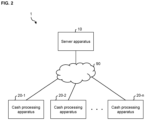
- Fig. 2 is a schematic diagram showing overall structure of the transaction processing system 1.
- the transaction processing system 1 includes a plurality of cash processing apparatuses 20 (20-1, 20-2, ..., 20-n; n: natural number) and a server apparatus 10 connected to the cash processing apparatus via a network 90 (for example, the Internet).
- the transaction processing system 1 is constituted as a client-server system which includes the cash processing apparatuses 20 as clients and the server apparatus 10 as a server.
- the cash processing apparatus 20 is configured to process banknotes and coins and comprises a depositing unit 210 for feeding banknotes and coins and a dispensing unit 220 for discharging banknotes and coins.
- the banknotes and coins are examples of the "cash objects" in the present invention.
- the cash processing apparatus 20 and the server apparatus 10 are communicably connected with each other.
- the server apparatus 10 is configured to provide functions or services to the cash processing apparatus 20 via the network 90.
- the server apparatus 10 includes a computer on which a Web application is running, and is configured to provide functions or services to the cash processing apparatus 20 by the Web application.
- the server apparatus 10 comprises a communication unit 120 configured to transmit/receive data to/from an external device, a display unit 130 comprising a liquid crystal display for displaying various information and an operation unit 140 for inputting various information. Moreover, the server apparatus 10 comprises a control unit 110 configured to control these structural components and the cash processing apparatus 20.
- the cash processing apparatus 20 comprises the depositing unit 210, the dispensing unit 220, a transport unit 230, a recognition unit 240, a suspected cash storing unit 260, a storing unit 270 and a collecting cassette 271.
- the cash processing apparatus 2 comprises a control unit 290 configured to control these structural components, a memory 280 configured to store therein various computer programs and data, and a communication unit 295 configured to transmit/receive data to/from an external device.
- the control unit 290 is configured to communicate with the cash processing apparatus 20 via the communication unit 295 by using a VPN (Virtual Private Network) and to control the above structural components based on instructions/control data from the server apparatus.
- VPN Virtual Private Network
- the cash processing apparatus 20 comprises a user information input unit 250 configured to function as an input unit for inputting information indicating the identity of the user (customer), such as a driver's license number, a social security number, and a user number (customer number) used to manage users (customers) in the bank.
- the user information input unit 250 comprises a user interface (see "Definitions"), for example a touch screen-type liquid crystal display installed facing the user.
- the user information input unit 250 functions also as an operation unit for selecting a transaction to be processed (for example, depositing transaction) and for example for selecting approval or non-approval when requesting approval to the user.
- the user information input unit 250 may be configured as a tablet computer or a terminal communicably connectable with the server apparatus.
- the user information input unit 250 is configured to communicate with the server apparatus 10 via the network 90 (for example, the Internet).
- the user information input unit 250 is configured to access a Web page provided by the Web application running on the server apparatus 10 and to display on the display thereof a screen provided as a Web page by the server apparatus 10.
- the dispensing unit 220 discharges the cash objects, which were fed from the storing unit 270, to the outside of the apparatus.
- the transport unit 230 transports the cash objects on a transport path in the apparatus.
- the storing unit 270 stores the deposited cash objects therein by denomination.
- the storing unit 270 feeds out the stored cash objects one by one to the transport path.
- the collecting cassette 271 stores therein the cash objects that could not be stored in the storing unit 270, and the like.
- the depositing unit 210 feeds the cash objects, which are received by the cash processing apparatus for the cash depositing transaction, one by one to the transport path inside the apparatus.
- the transport unit 230 transports the cash objects fed to the transport path.
- the recognition unit 240 is configured to recognize the denomination, the authenticity, the fitness, the version, the amount, or the like of the cash objects being transported.
- the recognition unit 240 is preferably configured to perform measurements of physical properties of the cash objects, like optical and/or magnetic measurements of (each of) the cash objects and preferably to determine, regarding each of the received cash objects, the cash object to be a potential counterfeit cash object (i.e. "suspect counterfeit") or a genuine cash object, for example by comparing the result of the measurements with predetermined criteria.
- the recognition unit 240 is configured to recognize the cash object as "not clearly authenticated", for example when it could not be determined whether the cash object is a genuine cash object or a potential counterfeit cash object (i.e.
- a cash object that is determined, in particular recognized by the recognition unit 240 as genuine is described as a "trustworthy cash object”
- a cash object that is determined, in particular recognized by the recognition unit 240 as potential counterfeit is described as a "suspected cash object”.
- the suspected cash object is evaluated by a certain institution, such as the central bank, on a later date. In this evaluation, the suspected cash object may be evaluated as genuine or counterfeit.
- the control unit 290 is configured to calculate a deposit amount for the received cash objects, based on the result of the recognition.
- the transport unit 230 transports the cash object to one of the dispensing unit 220, the suspected cash storing unit 260, the storing unit 270 and the collecting cassette 271.
- the recognition unit 240 considers a cash object as a reject cash object when the denomination and the like of the cash object cannot be recognized.
- the reject cash object is discharged from the dispensing unit 220 and the reject cash object is returned to the user.
- a reject cash object is considered to belong not to the received cash objects.
- those of the trustworthy cash objects which can be reused for the cash dispensing process are transported to the storing unit 270 and stored therein by denomination.
- the control unit 290 is configured to transmit to the server apparatus counterfeit cash objects data relating to the cash objects recognized as suspect counterfeit based on the result of the recognition by the recognition unit 240.
- the counterfeit cash objects data includes a serial number of the cash objects recognized as suspect counterfeit.
- the counterfeit cash objects data may additionally include image data of the cash objects recognized as "suspect counterfeit”.
- the counterfeit cash objects data may include data relating to the cash objects recognized as "not clearly authenticated” in the recognition by the recognition unit 240. That is, the counterfeit cash objects data may include a serial number of the cash objects recognized as "not clearly authenticated”, and the counterfeit cash objects data may additionally include image data of the cash objects recognized as "not clearly authenticated”.
- control unit 110 of the server apparatus 10 is configured to transmit to the cash processing apparatus 20 a request for requesting the counterfeit cash objects data.
- the control unit 110 is an example of the "request unit" of the present invention.
- control unit 290 of the cash processing apparatus 20 is configured to transmit the counterfeit cash objects data to the server apparatus in response to the request, when receiving the request from the server apparatus 10 via the communication unit 295.
- control unit 110 of the server apparatus 10 is configured to transmit updated criteria of recognizing authenticity of the cash objects, based on the counterfeit cash objects data, to the other cash processing apparatuses 20.
- a printer 30 can be provided to the server apparatus 10 and is preferably configured to print a report on which information is printed.
- information about such cash objects is preferably printed on the report.
- a printer can be provided to the cash processing apparatus 2 so that the above-mentioned information can be printed on the report.
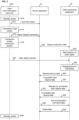
- FIG. 3 is a sequence diagram showing the flow of processes (in particular, processes regarding a cash depositing transaction) performed by the cash processing apparatus according to the first embodiment.
- a standby screen is displayed on the display of the user information input unit 250 (step S10).
- the standby screen is provided by the Web application running on the server apparatus 10 to the user information input unit 250.
- the user information input unit 250 send a corresponding signal to inform the touch to the server apparatus 10 (step S12).
- the user information input unit 250 send a corresponding signal to inform that the cash depositing transaction is selected, to the server apparatus 10 (step S 16).
- the server apparatus 10 transitions (or changes) a screen for transactions from the transaction type screen to a transaction screen (or an instruction screen) showing instructions for the selected transaction (i.e. the cash depositing transaction), and thereby the transaction screen (or the instruction screen) is displayed on the display of the user information input unit 250 (step S18).
- the cash processing apparatus 20 receives the deposit instruction data transmitted from the server apparatus 10 (step S20).
- the cash processing apparatus starts to perform the cash depositing transaction for the user according to the deposit instruction data, and becomes in a state of waiting for insertion of cash objects from the user (step S22).
- the cash processing apparatus 20 When cash objects are inserted by the user into the depositing unit 210 of the cash processing apparatus 20 which is in the state of waiting for insertion of cash objects from the user (step S24), the cash processing apparatus 20 performs the recognition of authenticity of the inserted cash objects (i.e. the cash objects received from the user) and the calculation of deposit amount (step S26). That is, the cash processing apparatus 20 recognizes, by the recognition unit 240, the denomination, the authenticity, the fitness, the version, the amount, or the like of the cash objects received from the user, and calculates, by the control unit 290, a deposit amount for the received cash objects, based on the result of the recognition (step S26).
- the cash processing apparatus 20 transmits deposit amount data describing the calculated deposit amount to the server apparatus 10 (step S28).
- the cash processing apparatus 20 transmits the counterfeit cash objects data to the server apparatus 10 if at least one of the received cash objects is recognized as "suspect counterfeit” or “not clearly authenticated” (step S30). That is, when cash objects recognized as “suspect counterfeit” or “not clearly authenticated” are detected by the cash processing apparatus 20, the cash processing apparatus 20 transmits the counterfeit cash objects data relating to the cash objects recognized as “suspect counterfeit” and/or "not clearly authenticated” to the server apparatus 10 (step S30).
- step 30 there is a possibility of a problem in communication between the cash processing apparatus 20 and the server apparatus 10 via the network 90 and that due the problem the counterfeit cash objects data cannot reach the server apparatus 10 or cannot be received by the server apparatus 10.
- the server apparatus 10 after receiving the deposit amount from the cash processing apparatus 20 (step S28), the server apparatus 10 transmits to the cash processing apparatus 20 a request for requesting the counterfeit cash objects data (step S32).
- the cash processing apparatus 20 When receiving from the server apparatus 10 the request for requesting the counterfeit cash objects data (step S32), the cash processing apparatus 20 transmits the counterfeit cash objects data to the server apparatus 10 in response to the request (step S34).
- the server apparatus 10 When receiving from the cash processing apparatus 20 the counterfeit cash objects data as a response to the request (step S34), the server apparatus 10 transmits an end-of-transaction command data to the cash processing apparatus 20 to command (or instruct) to end processes for the cash depositing transaction (step S36).
- the cash processing apparatus 20 When receiving the end-of-transaction command data transmitted from the server apparatus 10 (step S36), the cash processing apparatus 20 transmits a reply-data in reply to the received end-of-transaction command data to the server apparatus 10 (step S38).
- the server apparatus 10 When receiving the reply-data from the cash processing apparatus 20, the server apparatus 10 ends the cash depositing transaction.
- the counterfeit cash objects data are transmitted to the server apparatus 10 before the end of the cash depositing transaction.
- the server apparatus 10 receives the counterfeit cash objects data transmitted from the cash processing apparatus 20 in response to the request (step S34), the cash depositing transaction is ended.
- the server apparatus 10 transitions the screen for transactions of the Web application running on the server apparatus 10 to a standby state indicating that a (new) cash depositing transaction is available for a user. That is, at the time of ending the cash depositing transaction, the server apparatus 10 transitions (or changes) a screen for transactions from the transaction screen, to the standby screen which indicates that a (new) cash depositing transaction is available for a user, and thereby the standby screen is displayed on the display of the user information input unit 250 (step S40).
- a request for requesting the counterfeit cash objects data is transmitted by the server apparatus 10 to the cash processing apparatus 20 (step S32), and in response to the request the counterfeit cash objects data are transmitted by the cash processing apparatus 20 to the server apparatus 10 (step S34).
- the server apparatus 10 can acquire the counterfeit cash objects data transmitted by the cash processing apparatus 20 in response to the request transmitted by the server apparatus 10 (step S32) during the cash depositing transaction (step S34).
- the counterfeit cash objects data can be acquired more reliably from the cash processing apparatus 20 by the server apparatus 10.
- criteria for recognizing authenticity of cash objects can be updated by the server apparatus 10, and the updated criteria can be transmitted from the server apparatus 10 to other cash processing apparatuses 20.
- the accuracy of recognizing authenticity of cash objects by the other cash processing apparatuses 20.
Landscapes
- Physics & Mathematics (AREA)
- General Physics & Mathematics (AREA)
- Engineering & Computer Science (AREA)
- Computer Vision & Pattern Recognition (AREA)
- Business, Economics & Management (AREA)
- Accounting & Taxation (AREA)
- Finance (AREA)
- Financial Or Insurance-Related Operations Such As Payment And Settlement (AREA)
Abstract
Description
- The present invention relates to a transaction processing method and a transaction processing system.
-
JP 6720667 B2 patent document 1") discloses a system comprising a plurality of automatic teller machines (ATMs) and a management apparatus (or server) that manages transaction processing at the automatic teller machines. According to this system, the management apparatus that manages the counterfeit bill blacklist sends the counterfeit bill blacklist to the automatic teller machines. Each of the automatic teller machines determines, based on the counterfeit bill blacklist and the serial number of the medium being processed, whether the medium being processed is counterfeit or not. If it determines that a medium is a counterfeit bill or a suspect bill (i.e. a bill that cannot be identified as normal cash), the automatic teller machine notifies the information identifying the medium is to the management apparatus. - In the European financial market, according to the regulations of the European Central Bank (ECB), when banknotes inserted into a cash processing apparatus (also called a "money handling apparatus") such as an automatic teller machine are identified as "suspect counterfeit euro banknotes" or "euro banknotes not clearly authenticated", the banknotes shall be taken into the cash processing apparatus so as not to be recirculated, and the information on the banknotes must be reported to the central bank or the like.
- However, according to the conventional system as disclosed in the
patent document 1, the subject that transmits the information on banknotes identified as "suspect counterfeit euro banknotes" or "euro banknotes not clearly authenticated" to the management apparatus is the automatic teller machines. The management apparatus just receives transaction information. In such a system, if for some reasons information cannot be delivered from the automatic teller machine to the management apparatus, there is a possibility that incorrect information is reported to the central bank or the like, because the management apparatus does not receive the information from the automatic teller machine even though, at the automatic teller machine, banknotes identified as "suspect counterfeit euro banknotes" or "euro banknotes not clearly authenticated" is found. - The present invention has the object of providing a way of acquiring the counterfeit cash objects data more reliably from the cash processing apparatus by the server apparatus, in the transaction processing system.
- The present invention is defined by the independent claims. Further embodiments of the present invention are described in the dependent claims.
- Aspects of the present invention, examples and exemplary steps and their embodiments are disclosed in the following. Different exemplary features of the invention can be combined in accordance with the invention wherever technically expedient and feasible.
- In this section, a description of the general features of the present invention is given for example by referring to possible embodiments of the invention.
- In general, the invention reaches the aforementioned object by providing, in a first aspect, a transaction processing method for being performed by a transaction processing system including a cash processing apparatus and a server apparatus connected to the cash processing apparatus via a network. The cash processing apparatus is an apparatus which receives cash objects (with respect to the meaning of "cash objects" see section "Definitions" below). The cash processing apparatus may be called an automatic teller machine (ATM) or an automatic transaction apparatus.
- The server apparatus is an apparatus that provides functions or services to the cash processing apparatus via a network, for example, the Internet. The server apparatus may be connected to a plurality of cash processing apparatuses via the network. The transaction processing system may be called a client-server system which includes the cash processing apparatus as a client and the server apparatus as a server. The cash processing apparatus may be for example configured as a thin client. The server apparatus may be called a management apparatus or a control apparatus.
- The server apparatus includes a computer (with respect to the meaning of "computer" see section "Definitions" below) and is for example used by a financial institution for handling an account of the user. The financial institution is for example a bank or credit institute. The financial institution accepts deposits from a user on an account of the user by means of the computer included in the server apparatus. For example, the computer included in the server apparatus is constituted to increase or decrease the account balance of the account of the user.
- The transaction processing method according to the first aspect is a method for being performed by a transaction processing system including a cash processing apparatus and a server apparatus connected to the cash processing apparatus via a network. The transaction processing method is for example a computer implemented method. For example, all the steps or merely some of the steps (i.e., less than the total number of steps) of the transaction processing method can be executed by a computer (for example, at least one computer). Such a computer may be included in a server apparatus. Such a computer or a server apparatus may be in a cloud or local. Such a computer or a server apparatus is preferable operatively linked (e.g., directly, by LAN (local area network), WAN (wide area network), WLAN (Wi-Fi) or by the Internet) to the cash processing apparatus.
- The cash processing apparatus is, for example, configured to be able to receive cash objects such as banknotes and/or coins, from a user (such as a customer). In addition, the cash processing apparatus may be, for example, configured to be able to dispense (or feed out) cash objects to the user.
- Cash objects are received, by the cash processing apparatus, from a user for performing a cash depositing transaction. The "cash depositing transaction" is a transaction or process to deposit the cash objects received from the user in the cash processing apparatus. For example, the cash depositing transaction may be started by the user selecting an option indicating the cash depositing transaction on a screen for transactions. For example, such a screen may be provided as a Web page by the server apparatus and may be displayed on a display of a user interface of the cash processing apparatus by the cash processing apparatus accessing the Web page provided by the server apparatus (with respect to meaning of "user interface" see section "Definitions" below).
- The cash processing apparatus recognizes authenticity of cash objects received from a user. That is, the cash processing apparatus preferably determines, preferably for each of the cash objects, whether the cash object is a genuine cash object or a potential counterfeit cash object (in the following also referred to as "suspected cash object" or "suspect counterfeit"). Furthermore, the cash processing apparatus preferably respectively determines the denomination value represented by the respective received cash objects, in particular by measuring physical properties of the cash objects (for further details see section "Definition" below and in particular "measurement of cash objects" and "determining a denomination value of cash objects"). For example, the cash processing apparatus then determines a sum of the denomination values of the suspected cash objects received for the transaction process from the user based on the determination whether a cash object is a counterfeit cash object or not and based on the denomination value of the cash object. The sum of the denomination values of the suspected cash objects is referred to as "suspected sum".
- Measurement of cash objects is a technical analysis of the cash objects (for further details see "Definitions" below).
- For example, the cash processing apparatus comprises a recognition unit configured to recognize the authenticity of the cash objects received from the user, for example, by optical and/or magnetic measurements of the cash object. That is, the cash processing apparatus is, for example, configured to determine, regarding each of the received cash objects, the cash object to be a potential counterfeit cash object or a genuine cash object, by comparing the result of the measurements with predetermined criteria. The "potential counterfeit cash object" is a cash object being potentially of counterfeit. The "potential counterfeit" can cover levels of counterfeit, for example determined to be low risk up to certainly counterfeit or high probability of counterfeit. Assignment to levels of counterfeit risks (suspiciousness levels) can be based on the results of a plurality of comparisons with reference data.
- In view of the above, the transaction processing method comprises steps described below. The sequence in which the steps are described in the following does not represent an obligatory sequence for performing those steps. However, if a particular step uses data provided by another step, then the particular step is performed before the another step. The steps describe in particular steps of operating the above-described transaction processing system. The server apparatus is in particular used for data exchange with, in particular control of the cash processing apparatus.
- The transaction processing method comprises the step of, by the cash processing, apparatus, recognizing authenticity of cash objects received from a user (with respect to meaning of "cash objects" see section "Definitions" below). The "recognizing authenticity of cash objects" is for example performed by the measurement of cash objects by a recognition unit of the cash processing apparatus (with respect to meaning of "measurement of cash objects" see section "Definitions" below). For example, by the recognizing authenticity of cash objects, each of the cash objects is recognized for example as a genuine cash object or a potential counterfeit cash object (i.e. "suspect counterfeit").
- Moreover, the transaction processing method comprises the step of, by the cash processing apparatus, transmitting to the server apparatus counterfeit cash objects data relating to cash objects recognized as suspect counterfeit based on the result of the recognition.
- The counterfeit cash objects data are data describing (or represents, in particular indicates) information on the cash objects recognized as suspect counterfeit. For example, such information may include a serial number of the cash objects recognized as suspect counterfeit and may include image data of the cash objects recognized as suspect counterfeit. For example, the counterfeit cash objects data may include data describing the result of the measurement of cash objects recognized as suspect counterfeit. Optionally, the counterfeit cash objects data may include data identifying the cash depositing transaction (for example, transaction ID).
- For example, when suspect counterfeit is detected by the cash processing apparatus, the counterfeit cash objects data are transmitted (or sent out) by the cash processing apparatus to the server apparatus. In this regard, there is a possibility of a problem in communication between the cash processing apparatus and the server apparatus via the network (for example, network trouble) and that due the problem the counterfeit cash objects data cannot reach the server apparatus or cannot be received by the server apparatus.
- Further, the transaction processing method comprises the step of, by the server apparatus, transmitting to the cash processing apparatus a request for requesting the counterfeit cash objects data. That is, the server apparatus instructs the cash processing apparatus to transmit the counterfeit cash objects data to the server apparatus. For example, the step of transmitting the request for requesting the counterfeit cash objects data is performed by the server apparatus after receiving deposit amount data from the cash processing apparatus and before the end of the cash depositing transaction.
- Furthermore, the transaction processing method comprises the step of, by the cash processing apparatus, transmitting the counterfeit cash objects data to the server apparatus in response to the request. That is, when receiving from the server apparatus the request for requesting the counterfeit cash objects data, the cash processing apparatus transmitting the counterfeit cash objects data to the server apparatus according to the request.
- It should be noted that according to the transaction processing method of the first aspect, in addition to the transmitting by the cash processing apparatus to the server apparatus the counterfeit cash objects data when suspect counterfeit is detected by the cash processing apparatus for example, a request for requesting the counterfeit cash objects data is transmitted by the server apparatus to the cash processing apparatus, and in response to the request the counterfeit cash objects data are transmitted by the cash processing apparatus to the server apparatus.
- Thus, for example, even if for some reasons the counterfeit cash objects data transmitted by the cash processing apparatus when suspect counterfeit is detected cannot be received by the server apparatus, the server apparatus can acquire (or obtain) the counterfeit cash objects data transmitted by the cash processing apparatus in response to the request transmitted by the server apparatus during the depositing transaction.
- Therefore, according to the transaction processing method of the first aspect, the counterfeit cash objects data can be acquired more reliably from the cash processing apparatus by the server apparatus. Thus, based on the acquired counterfeit cash objects data, criteria for recognizing authenticity of cash objects can be updated by the server apparatus, and the updated criteria can be transmitted from the server apparatus to other cash processing apparatuses. As a result, it is possible to improve the accuracy of recognizing authenticity of cash objects by the other cash processing apparatuses.
- In an example of the method according to the first aspect, deposit instruction data are transmitted by the server apparatus to the cash processing apparatus to instruct to perform a cash depositing transaction. The deposit instruction data are data describing instructions to perform a cash depositing transaction for a user. For example, the deposit instruction data may include data describing an amount to be deposited from the user and/or data identifying the cash depositing transaction (for example, transaction ID).
- In this example, the cash processing apparatus receives the deposit instruction data transmitted from the server apparatus. For example, when receiving the deposit instruction data, the cash processing apparatus performs processes for the cash depositing transaction for the user according to the deposit instruction data, such as processes of receiving cash objects from a user, calculating a deposit amount of the received cash objects.
- In this example, the cash processing apparatus recognizes authenticity and denomination of cash objects received from the user for performing the cash depositing transaction. That is, the cash processing apparatus determines, for each of the cash objects received from the user, whether the cash object is a genuine cash object or a potential counterfeit cash object (i.e. "suspect counterfeit"). Furthermore, the cash processing apparatus respectively determines the denomination value represented by the respective received cash objects, in particular by measuring physical properties of the cash objects (for further details see section "Definition" below and in particular "measurement of cash objects" and "determining a denomination value of cash objects").
- In this example, the cash processing apparatus calculates a deposit amount for the received cash objects, based on the result of the recognition (with respect to the meaning of "deposit amount", see section "Definition" below and in particular "cash depositing transaction").
- In this example, the cash processing apparatus transmits deposit amount data describing the calculated deposit amount to the server apparatus. For example, when the server apparatus receives the deposit amount data from the cash processing apparatus, the server apparatus performs a process of increasing the account balance of a user in accordance with the deposit amount data received from the cash processing apparatus (optionally minus amount to be subtracted for the service of performing the cash depositing transaction).
- In this example, the cash processing apparatus transmits the counterfeit cash objects data to the server apparatus if at least one of the received cash objects is recognized as the suspect counterfeit. That is, when suspect counterfeit is detected by the cash processing apparatus, the counterfeit cash objects data are transmitted (or sent out) by the cash processing apparatus to the server apparatus. In this regard, there is a possibility of a problem in communication between the cash processing apparatus and the server apparatus via the network and that due the problem the counterfeit cash objects data cannot reach the server apparatus or cannot be received by the server apparatus.
- In an example of the method according to the first aspect, the server apparatus receives the counterfeit cash objects data transmitted from the cash processing apparatus in response to the request, and then transmits an end-of-transaction command data to the cash processing apparatus to command to end the cash depositing transaction. That is, when receiving from the cash processing apparatus the counterfeit cash objects data as a response to the request, the server apparatus transmits an end-of-transaction command data to the cash processing apparatus to command (or instruct) to end the cash depositing transaction.
- In this example, the cash processing apparatus receives the end-of-transaction command data transmitted from the server apparatus, and then transmits a reply-data in reply to the received end-of-transaction command data to the server apparatus. That is, when receiving the end-of-transaction command data transmitted from the server apparatus, the cash processing apparatus transmits a reply-data in reply to the received end-of-transaction command data to the server apparatus.
- In this example, the server apparatus receives the reply-data transmitted from the cash processing apparatus. For example, when receiving the reply-data from the cash processing apparatus, the server apparatus ends the cash depositing transaction.
- It should be noted that according to this example, the counterfeit cash objects data are transmitted to the server apparatus before the end of the cash depositing transaction (in other words, after the server apparatus receives the counterfeit cash objects data transmitted from the cash processing apparatus in response to the request, the cash depositing transaction is ended).
- In the above example, the server apparatus may transition a screen for transactions of an application running on the server apparatus to a standby state, when receiving the reply-data transmitted from the cash processing apparatus. For example, when receiving the reply-data transmitted from the cash processing apparatus, the server apparatus ends the cash depositing transaction and transitions the screen for transactions of the application to a standby state indicating that a (new) cash depositing transaction is available for a user. For example, the application running on the server apparatus may be a Web application.
- In an example of the method according to the first aspect, the counterfeit cash objects data includes data relating to the cash objects recognized as not clearly authenticated in the step of recognizing authenticity of the cash objects. For example, the cash object recognized as "not clearly authenticated" in the step of recognizing authenticity of the cash objects is a cash object for which it could not be determined whether the cash object is a genuine cash object or a potential counterfeit cash object (i.e. "suspect counterfeit") or for which it could not be clearly determined that the cash object is a genuine cash object, by the recognition of the authenticity by the cash processing apparatus. The data relating to the cash objects recognized as not clearly authenticated may include a serial number and/or image data of the cash object recognized as "not clearly authenticated".
- In an example of the method according to the first aspect, the counterfeit cash objects data includes a serial number of the cash objects recognized as suspect counterfeit. For example, the serial number is a combination of numbers and/or alphabets and is printed on each of the cash objects for distinguishing the cash objects each other. The counterfeit cash objects data may additionally include a denomination of the cash objects recognized as suspect counterfeit.
- In an example of the method according to the first aspect, the counterfeit cash objects data includes image data of the cash objects recognized as suspect counterfeit. For example, the image data of cash objects are data relating the image of the surface of the cash object, which can be obtained by the measurement of cash object in the step of recognizing authenticity of cash objects received from a user (with respect to the meaning of "measurement of cash object" see section "Definitions" below).
- In an example of the method according to the first aspect, the transaction processing system includes another cash processing apparatus connected to the server apparatus via the network, the method further comprising a step of transmitting, by the server apparatus, updated criteria of recognizing authenticity of the cash objects, based on the counterfeit cash objects data, to the another cash processing apparatus. That is, the server apparatus transmits updated criteria of recognizing authenticity of the cash objects, based on the counterfeit cash objects data, to the another cash processing apparatus. For example, the criteria of recognizing authenticity of the cash objects may include a list of serial numbers of the cash objects to be recognized as suspect counterfeit and may be updated by adding in such a list the serial number included in the counterfeit cash objects data.
- In a second aspect, the invention is directed to a transaction processing system including a cash processing apparatus and a server apparatus connected to the cash processing apparatus via a network.
- The cash processing apparatus comprises a recognition unit configured to recognize authenticity of cash objects received from a user, and a control unit configured to transmit to the server apparatus counterfeit cash objects data relating to the cash objects recognized as suspect counterfeit based on the result of the recognition.
- The server apparatus comprises a request unit to transmit to the cash processing apparatus a request for requesting the counterfeit cash objects data.
- The control unit of the cash processing apparatus is configured to transmit the counterfeit cash objects data to the server apparatus in response to the request.
- Optionally, a printer can be provided to the server apparatus and/or the cash processing apparatus and is preferably configured to print a report on which information is printed. For example, when cash objects determined, in particular recognized as "suspect counterfeit" and/or "not clearly authenticated" are detected by the cash processing apparatus (in particular, the recognition unit), information about such cash objects is preferably printed on the report.
- According to the transaction processing system of the second aspect, the counterfeit cash objects data can be acquired more reliably from the cash processing apparatus by the server apparatus. Thus, based on the acquired counterfeit cash objects data, criteria for recognizing authenticity of cash objects can be updated by the server apparatus, and the updated criteria can be transmitted from the server apparatus to other cash processing apparatuses. As a result, it is possible to improve the accuracy of recognizing authenticity of cash objects by the other cash processing apparatuses.
- The term "cash objects" covers genuine cash objects which are legal tender and counterfeit cash objects which represent counterfeit money and have an outer appearance similar to legal tender. The cash objects are for example banknotes (bills) and/or coins. In particular, the cash objects are physical, in particular tangible objects having a particular geometry (size and/or shape). In particular, the genuine cash objects are constituted to be used as means for payment and the counterfeit cash objects are constituted to appear to be usable as means for payment. Counterfeit cash objects have in particular the same geometry as their genuine counterpart. In particular each cash object respectively represents a specific denomination value. In the present application, "cash objects" are in particular the cash objects received from a user by the cash processing apparatus during the cash depositing transaction process.
- The measurement of cash objects can in particular comprise at least one of the following, capturing the image of the surface of the cash object, measuring of color values (e.g., Lab, or RGB or grey values) of parts of the surface of the cash object, recognizing patterns in the captured image, detecting the geometry (size and/or shape) of the cash objects, detecting infrared properties of the cash objects, or detecting magnetic properties of the cash objects.
- The measurement is preferably performed by analytical devices, in particular sensors and/or signal (e.g. electromagnetic) emission devices, like light emission devices (e.g. lasers, lamps,..) and electromagnets, radio sources, and covers, for example, measurements of physical properties of the cash objects, optical and/or electrical and/or magnetical and/or mechanical measurements of the cash objects and comparison of the acquired measurement values with reference data, based on the comparison, the cash objects are determined to be potential counterfeit cash objects (i.e., the cash objects are recognized as "suspect counterfeit").
- The cash objects have characteristic physical properties which are particular for a specific denomination value and/or for being a genuine or a counterfeit cash object. The identification of one or more characteristic physical properties by means of the aforementioned measurement allows to identify the denomination value and/or whether the cash object is a genuine or counterfeit cash object.
- For example, the cash processing apparatus comprises a recognition unit configured to recognize the authenticity and/or denomination of the cash objects received from the user, for example, by measuring physical properties of the cash objects as mentioned above, that is for example by means of optical and/or magnetic measurements of the cash object.
- The step of determining the denomination value of cash objects comprises in particular a step of measurement of the cash objects as described above. The cash objects have characteristic physical properties which are particular for a specific denomination value. The identification of one or more characteristic physical properties by means of the aforementioned measurement allows to identify the denomination value.
- A computer for example comprises at least one processor and for example at least one memory in order to (technically) process the data, for example electronically and/or optically. The processor being for example made of a substance or composition which is a semiconductor, for example at least partly n- and/or p-doped semiconductor, for example at least one of II-, III-, IV-, V-, VI-semiconductor material, for example (doped) silicon and/or gallium arsenide. The calculating or determining steps described are for example performed by a computer. Determining steps or calculating steps are for example steps of determining data within the framework of the technical method, for example within the framework of a program. A computer is for example any kind of data processing device, for example electronic data processing device. A computer can be a device which is generally thought of as such, for example desktop PCs, notebooks, netbooks, smart phones etc., but can also be any programmable apparatus, such as for example a mobile phone or an embedded processor. A computer can for example comprise a system (network) of "sub-computers", wherein each sub-computer represents a computer in its own right. The term "computer" includes a cloud computer, for example a cloud server. The term computer includes a server resource. The term "cloud computer" includes a cloud computer system which for example comprises a system of at least one cloud computer and for example a plurality of operatively interconnected cloud computers such as a server farm. Such a cloud computer is preferably connected to a wide area network such as the world wide web (WWW) and located in a so-called cloud of computers which are all connected to the world wide web. Such an infrastructure is used for "cloud computing", which describes computation, software, data access and storage services which do not require the end user to know the physical location and/or configuration of the computer delivering a specific service. For example, the term "cloud" is used in this respect as a metaphor for the Internet (world wide web). For example, the cloud provides computing infrastructure as a service (IaaS). The cloud computer can function as a virtual host for an operating system and/or data processing application which is used to execute the method of the invention. A computer for example comprises interfaces in order to receive or output data and/or perform an analogue-to-digital conversion. The data are for example data which represent physical properties and/or which are generated from technical signals. The technical signals are for example generated by means of (technical) detection devices (such as for example devices for detecting marker devices) and/or (technical) analytical devices (such as for example devices for performing (medical) imaging methods), wherein the technical signals are for example electrical or optical signals. The technical signals for example represent the data received or outputted by the computer. The computer is preferably operatively coupled to a display device which allows information outputted by the computer to be displayed, for example to a user. One example of a display device is a virtual reality device or an augmented reality device (also referred to as virtual reality glasses or augmented reality glasses) which can be used as "goggles" for navigating. An augmented reality device or a virtual reality device can be used both to input information into the computer by user interaction and to display information outputted by the computer. Another example of a display device would be a standard computer monitor comprising for example a liquid crystal display operatively coupled to the computer for receiving display control data from the computer for generating signals used to display image information content on the display device. The monitor may also be the monitor of a portable, for example handheld, device such as a smart phone or personal digital assistant or digital media player.
- A cash depositing transaction is a process which covers receiving of cash objects, calculating a deposit amount for the received cash objects by calculating the sum of denomination values of the received cash objects, and transmitting data describing the calculated deposit amount to the server apparatus by the cash processing apparatus. Preferably, there is a separate calculating of the received suspected sum and the trustworthy sum, and the trustworthy sum is calculated as the deposit amount. Preferably, the cash depositing transaction also comprises the step of storing the received cash objects by the cash processing apparatus and the step of registering the deposit amount, in particular in association with user identifying data by the server apparatus. Preferably, the cash depositing transaction also comprises the step of, by the server apparatus, increasing the account balance of a user in accordance with the deposit amount received from the cash processing apparatus (optionally minus amount to be subtracted for the service of performing the cash depositing transaction).
- The "trustworthy cash objects" are those of the received cash objects determined to be genuine cash objects by the cash processing apparatus. The "trustworthy sum" is the sum of denomination values of the trustworthy cash objects. The sum of denomination values of the trustworthy cash objects is zero if no trustworthy cash objects have been received.
- A user interface is preferably constituted to generate and/or receive audio and/or video and/or haptic signals for receiving data from giving information to the user and/or for receiving data (in particular the user identifying data) from the user. A user can in particular be prompted to input data by the user interface. A user interface can be for example a scanner, screen, touch-screen, keyboard, mouse etc., microphone with speech recognition, etc.
- In the following, the invention is described with reference to the appended figures which give background explanations and represent specific embodiments of the invention. The scope of the invention is however not limited to the specific features disclosed in the context of the figures.
-
Fig. 1 is a schematic diagram of the transaction processing system according to an embodiment. -
Fig. 2 is a schematic diagram showing overall structure of the transaction processing system according to the embodiment. -
Fig. 3 is a sequence diagram showing the flow of processes performed by the cash processing apparatus according to the embodiment. -
Fig. 1 is a schematic diagram of atransaction processing system 1 according to an embodiment.Fig. 2 is a schematic diagram showing overall structure of thetransaction processing system 1. - As shown in
Figs. 1 and2 , thetransaction processing system 1 includes a plurality of cash processing apparatuses 20 (20-1, 20-2, ..., 20-n; n: natural number) and aserver apparatus 10 connected to the cash processing apparatus via a network 90 (for example, the Internet). Thetransaction processing system 1 is constituted as a client-server system which includes thecash processing apparatuses 20 as clients and theserver apparatus 10 as a server. - As shown in
Fig. 1 , thecash processing apparatus 20 is configured to process banknotes and coins and comprises adepositing unit 210 for feeding banknotes and coins and adispensing unit 220 for discharging banknotes and coins. The banknotes and coins are examples of the "cash objects" in the present invention. - In
Fig. 1 , thecash processing apparatus 20 and theserver apparatus 10 are communicably connected with each other. - The
server apparatus 10 is configured to provide functions or services to thecash processing apparatus 20 via thenetwork 90. - The
server apparatus 10 includes a computer on which a Web application is running, and is configured to provide functions or services to thecash processing apparatus 20 by the Web application. - The
server apparatus 10 is used by a bank for handling an account of the user. The bank accepts deposits from a user on an account of the user by means of the computer included in theserver apparatus 10. For example, the computer included in the server apparatus is constituted to increase or decrease the account balance of the account of the user. - The
server apparatus 10 comprises acommunication unit 120 configured to transmit/receive data to/from an external device, adisplay unit 130 comprising a liquid crystal display for displaying various information and anoperation unit 140 for inputting various information. Moreover, theserver apparatus 10 comprises acontrol unit 110 configured to control these structural components and thecash processing apparatus 20. - In
Fig. 1 , thecash processing apparatus 20 comprises thedepositing unit 210, the dispensingunit 220, atransport unit 230, arecognition unit 240, a suspectedcash storing unit 260, a storing unit 270 and a collectingcassette 271. Moreover, the cash processing apparatus 2 comprises acontrol unit 290 configured to control these structural components, amemory 280 configured to store therein various computer programs and data, and acommunication unit 295 configured to transmit/receive data to/from an external device. - The
control unit 290 is configured to communicate with thecash processing apparatus 20 via thecommunication unit 295 by using a VPN (Virtual Private Network) and to control the above structural components based on instructions/control data from the server apparatus. - Furthermore, the
cash processing apparatus 20 comprises a userinformation input unit 250 configured to function as an input unit for inputting information indicating the identity of the user (customer), such as a driver's license number, a social security number, and a user number (customer number) used to manage users (customers) in the bank. The userinformation input unit 250 comprises a user interface (see "Definitions"), for example a touch screen-type liquid crystal display installed facing the user. The userinformation input unit 250 functions also as an operation unit for selecting a transaction to be processed (for example, depositing transaction) and for example for selecting approval or non-approval when requesting approval to the user. For example, the userinformation input unit 250 may be configured as a tablet computer or a terminal communicably connectable with the server apparatus. - The user
information input unit 250 is configured to communicate with theserver apparatus 10 via the network 90 (for example, the Internet). For example, the userinformation input unit 250 is configured to access a Web page provided by the Web application running on theserver apparatus 10 and to display on the display thereof a screen provided as a Web page by theserver apparatus 10. - The dispensing
unit 220 discharges the cash objects, which were fed from the storing unit 270, to the outside of the apparatus. Thetransport unit 230 transports the cash objects on a transport path in the apparatus. When performing the cash deposit process, the storing unit 270 stores the deposited cash objects therein by denomination. Preferably, only cash objects determined as genuine by arecognition unit 240 are stored in the storing unit 270. When performing the cash dispensing process, the storing unit 270 feeds out the stored cash objects one by one to the transport path. The collectingcassette 271 stores therein the cash objects that could not be stored in the storing unit 270, and the like. When performing the cash dispensing process to dispense the cash objects, the storing unit 270 feeds the cash objects to the transport path, thetransport unit 230 transports the fed cash objects to thedispensing unit 220, and thedispensing unit 220 discharges the cash objects to the outside of the apparatus. - The
depositing unit 210 feeds the cash objects, which are received by the cash processing apparatus for the cash depositing transaction, one by one to the transport path inside the apparatus. Thetransport unit 230 transports the cash objects fed to the transport path. - During processes for the cash depositing transaction, the received cash objects fed by the
depositing unit 210 to the transport path inside the apparatus are transported to therecognition unit 240. - The
recognition unit 240 is configured to recognize the denomination, the authenticity, the fitness, the version, the amount, or the like of the cash objects being transported. Therecognition unit 240 is preferably configured to perform measurements of physical properties of the cash objects, like optical and/or magnetic measurements of (each of) the cash objects and preferably to determine, regarding each of the received cash objects, the cash object to be a potential counterfeit cash object (i.e. "suspect counterfeit") or a genuine cash object, for example by comparing the result of the measurements with predetermined criteria. Therecognition unit 240 is configured to recognize the cash object as "not clearly authenticated", for example when it could not be determined whether the cash object is a genuine cash object or a potential counterfeit cash object (i.e. "suspect counterfeit") or for which it could not be clearly determined that the cash object is a genuine cash object. That is, for example, therecognition unit 240 is configured to classify, based on the comparison between the result of the measurements and the predetermined criteria, the received cash objects, into categories, for example, a genuine cash object category "genuine", a potential counterfeit cash object category "suspect counterfeit" and a cash object not clearly authenticated category "not clearly authenticated". - In the following explanation, a cash object that is determined, in particular recognized by the
recognition unit 240 as genuine is described as a "trustworthy cash object", a cash object that is determined, in particular recognized by therecognition unit 240 as potential counterfeit (i.e. suspect counterfeit) is described as a "suspected cash object". The suspected cash object is evaluated by a certain institution, such as the central bank, on a later date. In this evaluation, the suspected cash object may be evaluated as genuine or counterfeit. - The
control unit 290 is configured to calculate a deposit amount for the received cash objects, based on the result of the recognition. - Based on the recognition result obtained by the
recognition unit 240, thetransport unit 230 transports the cash object to one of thedispensing unit 220, the suspectedcash storing unit 260, the storing unit 270 and the collectingcassette 271. Specifically, therecognition unit 240 considers a cash object as a reject cash object when the denomination and the like of the cash object cannot be recognized. The reject cash object is discharged from the dispensingunit 220 and the reject cash object is returned to the user. Preferably, a reject cash object is considered to belong not to the received cash objects. Among the cash objects whose denomination and the like could be recognized by therecognition unit 240, those of the trustworthy cash objects which can be reused for the cash dispensing process are transported to the storing unit 270 and stored therein by denomination. Those of the trustworthy cash objects which could not be stored in the storing unit 270 because the storing unit 270 is full (full state) are stored in the collectingcassette 271. Those (unfit cash objects) of the trustworthy cash objects which is not suitable for the dispensing process because it is damaged or dirty, are also stored in the collectingcassette 271. Among the cash objects whose denomination and the like could be recognized by therecognition unit 240, the suspected cash objects are transported to the suspectedcash storing unit 260. - The suspected
cash storing unit 260 is configured to store therein the suspected cash objects (i.e. the cash objects recognized by therecognition unit 240 as "suspect counterfeit") and the cash objects recognized by therecognition unit 240 as "not clearly authenticated". - The
control unit 290 is configured to transmit to the server apparatus counterfeit cash objects data relating to the cash objects recognized as suspect counterfeit based on the result of the recognition by therecognition unit 240. - The counterfeit cash objects data includes a serial number of the cash objects recognized as suspect counterfeit. The counterfeit cash objects data may additionally include image data of the cash objects recognized as "suspect counterfeit". Furthermore, the counterfeit cash objects data may include data relating to the cash objects recognized as "not clearly authenticated" in the recognition by the
recognition unit 240. That is, the counterfeit cash objects data may include a serial number of the cash objects recognized as "not clearly authenticated", and the counterfeit cash objects data may additionally include image data of the cash objects recognized as "not clearly authenticated". - In the present embodiment, the
control unit 110 of theserver apparatus 10 is configured to transmit to the cash processing apparatus 20 a request for requesting the counterfeit cash objects data. Thecontrol unit 110 is an example of the "request unit" of the present invention. Moreover, thecontrol unit 290 of thecash processing apparatus 20 is configured to transmit the counterfeit cash objects data to the server apparatus in response to the request, when receiving the request from theserver apparatus 10 via thecommunication unit 295. - Moreover, the
control unit 110 of theserver apparatus 10 is configured to transmit updated criteria of recognizing authenticity of the cash objects, based on the counterfeit cash objects data, to the othercash processing apparatuses 20. - A
printer 30 can be provided to theserver apparatus 10 and is preferably configured to print a report on which information is printed. When cash objects determined, in particular recognized as "suspect counterfeit" and/or "not clearly authenticated" are detected by the cash processing apparatus 2, information about such cash objects is preferably printed on the report. - Instead of or in addition to the
printer 30, a printer can be provided to the cash processing apparatus 2 so that the above-mentioned information can be printed on the report. - With reference to
Fig. 3 , the transaction processing method according to the first embodiment is explained.Fig. 3 is a sequence diagram showing the flow of processes (in particular, processes regarding a cash depositing transaction) performed by the cash processing apparatus according to the first embodiment. - In
Fig. 3 , when thecash processing apparatus 20 is in a standby state, a standby screen is displayed on the display of the user information input unit 250 (step S10). The standby screen is provided by the Web application running on theserver apparatus 10 to the userinformation input unit 250. - When a user touches the standby screen displayed on the display of the user
information input unit 250, the userinformation input unit 250 send a corresponding signal to inform the touch to the server apparatus 10 (step S12). - When the
server apparatus 10 is informed of the touch, theserver apparatus 10 transitions (or changes) a screen for transactions from the standby screen to a transaction type screen (or a transaction menu screen) showing available transactions, for example, a cash depositing transaction, a cash dispensing transaction and the like, and thereby the transaction type screen is displayed on the display of the user information input unit 250 (step S14). - When the user selects a cash depositing transaction by touching a portion of the transaction type screen, which corresponds to the cash depositing transaction, the user
information input unit 250 send a corresponding signal to inform that the cash depositing transaction is selected, to the server apparatus 10 (step S 16). - When the
server apparatus 10 is informed that the cash depositing transaction is selected (step S16), theserver apparatus 10 transitions (or changes) a screen for transactions from the transaction type screen to a transaction screen (or an instruction screen) showing instructions for the selected transaction (i.e. the cash depositing transaction), and thereby the transaction screen (or the instruction screen) is displayed on the display of the user information input unit 250 (step S18). - In addition, when the
server apparatus 10 is informed that the cash depositing transaction is selected (step S16), theserver apparatus 10 transmits deposit instruction data to thecash processing apparatus 20 to instruct to perform a cash depositing transaction (step S20). The deposit instruction data are data describing instructions to perform a cash depositing transaction for a user. For example, the deposit instruction data may include data identifying the cash depositing transaction (for example, transaction ID). - The
cash processing apparatus 20 receives the deposit instruction data transmitted from the server apparatus 10 (step S20). When receiving the deposit instruction data, the cash processing apparatus starts to perform the cash depositing transaction for the user according to the deposit instruction data, and becomes in a state of waiting for insertion of cash objects from the user (step S22). - When cash objects are inserted by the user into the
depositing unit 210 of thecash processing apparatus 20 which is in the state of waiting for insertion of cash objects from the user (step S24), thecash processing apparatus 20 performs the recognition of authenticity of the inserted cash objects (i.e. the cash objects received from the user) and the calculation of deposit amount (step S26). That is, thecash processing apparatus 20 recognizes, by therecognition unit 240, the denomination, the authenticity, the fitness, the version, the amount, or the like of the cash objects received from the user, and calculates, by thecontrol unit 290, a deposit amount for the received cash objects, based on the result of the recognition (step S26). - Then, the
cash processing apparatus 20 transmits deposit amount data describing the calculated deposit amount to the server apparatus 10 (step S28). - Together with or separately from transmitting the deposit amount data, the
cash processing apparatus 20 transmits the counterfeit cash objects data to theserver apparatus 10 if at least one of the received cash objects is recognized as "suspect counterfeit" or "not clearly authenticated" (step S30). That is, when cash objects recognized as "suspect counterfeit" or "not clearly authenticated" are detected by thecash processing apparatus 20, thecash processing apparatus 20 transmits the counterfeit cash objects data relating to the cash objects recognized as "suspect counterfeit" and/or "not clearly authenticated" to the server apparatus 10 (step S30). - Regarding the step of transmitting the counterfeit cash objects data (step 30), there is a possibility of a problem in communication between the
cash processing apparatus 20 and theserver apparatus 10 via thenetwork 90 and that due the problem the counterfeit cash objects data cannot reach theserver apparatus 10 or cannot be received by theserver apparatus 10. - In the present embodiment, after receiving the deposit amount from the cash processing apparatus 20 (step S28), the
server apparatus 10 transmits to the cash processing apparatus 20 a request for requesting the counterfeit cash objects data (step S32). - When receiving from the
server apparatus 10 the request for requesting the counterfeit cash objects data (step S32), thecash processing apparatus 20 transmits the counterfeit cash objects data to theserver apparatus 10 in response to the request (step S34). - When receiving from the
cash processing apparatus 20 the counterfeit cash objects data as a response to the request (step S34), theserver apparatus 10 transmits an end-of-transaction command data to thecash processing apparatus 20 to command (or instruct) to end processes for the cash depositing transaction (step S36). - When receiving the end-of-transaction command data transmitted from the server apparatus 10 (step S36), the
cash processing apparatus 20 transmits a reply-data in reply to the received end-of-transaction command data to the server apparatus 10 (step S38). - When receiving the reply-data from the
cash processing apparatus 20, theserver apparatus 10 ends the cash depositing transaction. - It should be noted that according to the present embodiment, the counterfeit cash objects data are transmitted to the
server apparatus 10 before the end of the cash depositing transaction. In other words, after theserver apparatus 10 receives the counterfeit cash objects data transmitted from thecash processing apparatus 20 in response to the request (step S34), the cash depositing transaction is ended. - When ending the cash depositing transaction, the
server apparatus 10 transitions the screen for transactions of the Web application running on theserver apparatus 10 to a standby state indicating that a (new) cash depositing transaction is available for a user. That is, at the time of ending the cash depositing transaction, theserver apparatus 10 transitions (or changes) a screen for transactions from the transaction screen, to the standby screen which indicates that a (new) cash depositing transaction is available for a user, and thereby the standby screen is displayed on the display of the user information input unit 250 (step S40). - It should be noted that according to the present embodiment, in addition to the transmitting by the
cash processing apparatus 20 to theserver apparatus 10 the counterfeit cash objects data (step S30), a request for requesting the counterfeit cash objects data is transmitted by theserver apparatus 10 to the cash processing apparatus 20 (step S32), and in response to the request the counterfeit cash objects data are transmitted by thecash processing apparatus 20 to the server apparatus 10 (step S34). - Thus, for example, even if for some reasons the counterfeit cash objects data transmitted by the cash processing apparatus 20 (step S30) cannot be received by the
server apparatus 10, theserver apparatus 10 can acquire the counterfeit cash objects data transmitted by thecash processing apparatus 20 in response to the request transmitted by the server apparatus 10 (step S32) during the cash depositing transaction (step S34). - Therefore, according to the present embodiment, the counterfeit cash objects data can be acquired more reliably from the
cash processing apparatus 20 by theserver apparatus 10. Thus, based on the acquired counterfeit cash objects data, criteria for recognizing authenticity of cash objects can be updated by theserver apparatus 10, and the updated criteria can be transmitted from theserver apparatus 10 to othercash processing apparatuses 20. As a result, it is possible to improve the accuracy of recognizing authenticity of cash objects by the othercash processing apparatuses 20.
Claims (9)
- A transaction processing method for being performed by a transaction processing system (1) including a cash processing apparatus (20) and a server apparatus (10) connected to the cash processing apparatus (20) via a network, comprising steps of:by the cash processing apparatus (20), recognizing authenticity of cash objects received from a user;by the cash processing apparatus (20), transmitting to the server apparatus (10) counterfeit cash objects data relating to cash objects recognized as suspect counterfeit based on the result of the recognition;by the server apparatus (10), transmitting to the cash processing apparatus (20) a request for requesting the counterfeit cash objects data; andby the cash processing apparatus (20), transmitting the counterfeit cash objects data to the server apparatus (10) in response to the request.
- The method according to claim 1, further comprising steps of:by the server apparatus (10), transmitting deposit instruction data to the cash processing apparatus (20) to instruct to perform a cash depositing transaction;by the cash processing apparatus (20), receiving the deposit instruction data transmitted from the server apparatus (10);by the cash processing apparatus (20), recognizing authenticity and denomination of cash objects received from the user for performing the cash depositing transaction;by the cash processing apparatus (20), calculating a deposit amount for the received cash objects, based on the result of the recognition;by the cash processing apparatus (20), transmitting deposit amount data describing the calculated deposit amount to the server apparatus (10);by the cash processing apparatus (20), transmitting the counterfeit cash objects data to the server apparatus (10) if at least one of the received cash objects is recognized as the suspect counterfeit.
- The method according to claim 2, further comprising steps of:by the server apparatus (10), receiving the counterfeit cash objects data transmitted from the cash processing apparatus (20) in response to the request, and then transmitting an end-of-transaction command data to the cash processing apparatus (20) to command to end the cash depositing transaction;by the cash processing apparatus (20), receiving the end-of-transaction command data transmitted from the server apparatus (10), and then transmitting a reply-data in reply to the received end-of-transaction command data to the server apparatus (10); andby the server apparatus (10), receiving the reply-data transmitted from the cash processing apparatus (20).
- The method according to claim 3, further comprising steps of:
by the server apparatus (10), transitioning a screen for transactions of an application running on the server apparatus (10) to a standby state, when receiving the reply-data transmitted from the cash processing apparatus (20). - The method according to any one of the preceding claims, wherein
the counterfeit cash objects data includes data relating to the cash objects recognized as not clearly authenticated in the step of recognizing authenticity of the cash objects. - The method according to any one of the preceding claims, wherein
the counterfeit cash objects data includes a serial number of the cash objects recognized as suspect counterfeit. - The method according to any one of the preceding claims, wherein
the counterfeit cash objects data includes image data of the cash objects recognized as suspect counterfeit. - The method according to any one of the preceding claims, wherein
the transaction processing system includes another cash processing apparatus connected to the server apparatus (10) via the network, the method further comprising a step of transmitting, by the server apparatus (10), updated criteria of recognizing authenticity of the cash objects, based on the counterfeit cash objects data, to the another cash processing apparatus. - A transaction processing system including a cash processing apparatus (20) and a server apparatus (10) connected to the cash processing apparatus (20) via a network, whereinthe cash processing apparatus (20) comprises:a recognition unit (240) configured to recognize authenticity of cash objects received from a user; anda control unit (290) configured to transmit to the server apparatus (10) counterfeit cash objects data relating to the cash objects recognized as suspect counterfeit based on the result of the recognition,the server apparatus (10) comprises a request unit to transmit to the cash processing apparatus (20) a request for requesting the counterfeit cash objects data, andthe control unit (290) is configured to transmit the counterfeit cash objects data to the server apparatus (10) in response to the request.
Priority Applications (1)
| Application Number | Priority Date | Filing Date | Title |
|---|---|---|---|
| EP23184908.4A EP4492351A1 (en) | 2023-07-12 | 2023-07-12 | Transaction processing method and transaction processing system |
Applications Claiming Priority (1)
| Application Number | Priority Date | Filing Date | Title |
|---|---|---|---|
| EP23184908.4A EP4492351A1 (en) | 2023-07-12 | 2023-07-12 | Transaction processing method and transaction processing system |
Publications (1)
| Publication Number | Publication Date |
|---|---|
| EP4492351A1 true EP4492351A1 (en) | 2025-01-15 |
Family
ID=87280663
Family Applications (1)
| Application Number | Title | Priority Date | Filing Date |
|---|---|---|---|
| EP23184908.4A Pending EP4492351A1 (en) | 2023-07-12 | 2023-07-12 | Transaction processing method and transaction processing system |
Country Status (1)
| Country | Link |
|---|---|
| EP (1) | EP4492351A1 (en) |
Citations (3)
| Publication number | Priority date | Publication date | Assignee | Title |
|---|---|---|---|---|
| JPH0420667B2 (en) | 1984-01-11 | 1992-04-06 | Iseki Agricult Mach | |
| US8138916B1 (en) * | 2009-06-04 | 2012-03-20 | Carlos Andres Gonzalez | Counterfeit detection system and method of utilizing same |
| WO2022130962A1 (en) * | 2020-12-18 | 2022-06-23 | グローリー株式会社 | Valuable-medium monitoring system, valuable-medium monitoring method, server, and terminal device |
-
2023
- 2023-07-12 EP EP23184908.4A patent/EP4492351A1/en active Pending
Patent Citations (4)
| Publication number | Priority date | Publication date | Assignee | Title |
|---|---|---|---|---|
| JPH0420667B2 (en) | 1984-01-11 | 1992-04-06 | Iseki Agricult Mach | |
| US8138916B1 (en) * | 2009-06-04 | 2012-03-20 | Carlos Andres Gonzalez | Counterfeit detection system and method of utilizing same |
| WO2022130962A1 (en) * | 2020-12-18 | 2022-06-23 | グローリー株式会社 | Valuable-medium monitoring system, valuable-medium monitoring method, server, and terminal device |
| US20230326281A1 (en) * | 2020-12-18 | 2023-10-12 | Glory Ltd. | Valuable-medium monitoring system, valuable-medium monitoring method, server, and terminal device |
Similar Documents
| Publication | Publication Date | Title |
|---|---|---|
| US9626666B2 (en) | Dual validator self-service kiosk | |
| US8249989B2 (en) | Check cashing at automated teller machine | |
| US12380494B2 (en) | System and method for real-time cheque processing and return at an automated teller machine | |
| US9934497B2 (en) | Automated teller machine (“ATM”) currency stamper | |
| US9865114B2 (en) | Cash management method and a cash management system | |
| US11804110B2 (en) | System and method for detecting ATM fraud using a force sensor | |
| US20200342428A1 (en) | Techniques for virtual deposit of paper currency | |
| US9640007B2 (en) | Medium transaction device | |
| US10475296B1 (en) | Hybrid cash recycler | |
| US9163978B2 (en) | Purge-bin weighing scale | |
| US20140332341A1 (en) | Self-service kiosk validator bridge | |
| CN108053580B (en) | Method and system for carrying out deposit and sales by using self-service equipment | |
| JP5156590B2 (en) | Automated trading system | |
| EP4152283B1 (en) | Controlling a cash processing apparatus | |
| US20170193757A1 (en) | Method And System For Changing An Amount Of A First Denomination At An Automated Teller Machine | |
| WO2018037673A1 (en) | Automated transaction device and monitoring device, and automated transaction system including same | |
| US20120158588A1 (en) | Reception process system and method | |
| US20120158587A1 (en) | Teller terminal and reception process method | |
| JP2025012203A (en) | Automated Trading System | |
| US20120158592A1 (en) | Teller terminal and check cashing method |
Legal Events
| Date | Code | Title | Description |
|---|---|---|---|
| PUAI | Public reference made under article 153(3) epc to a published international application that has entered the european phase |
Free format text: ORIGINAL CODE: 0009012 |
|
| STAA | Information on the status of an ep patent application or granted ep patent |
Free format text: STATUS: THE APPLICATION HAS BEEN PUBLISHED |
|
| AK | Designated contracting states |
Kind code of ref document: A1 Designated state(s): AL AT BE BG CH CY CZ DE DK EE ES FI FR GB GR HR HU IE IS IT LI LT LU LV MC ME MK MT NL NO PL PT RO RS SE SI SK SM TR |
|
| STAA | Information on the status of an ep patent application or granted ep patent |
Free format text: STATUS: REQUEST FOR EXAMINATION WAS MADE |
|
| P01 | Opt-out of the competence of the unified patent court (upc) registered |
Free format text: CASE NUMBER: APP_25538/2025 Effective date: 20250528 |
|
| 17P | Request for examination filed |
Effective date: 20250602 |