EP4492332A1 - Method and system for domain aware semi-supervised learning - Google Patents
Method and system for domain aware semi-supervised learning Download PDFInfo
- Publication number
- EP4492332A1 EP4492332A1 EP24183580.0A EP24183580A EP4492332A1 EP 4492332 A1 EP4492332 A1 EP 4492332A1 EP 24183580 A EP24183580 A EP 24183580A EP 4492332 A1 EP4492332 A1 EP 4492332A1
- Authority
- EP
- European Patent Office
- Prior art keywords
- feature vector
- pixels
- spatial
- pixel
- spectral
- Prior art date
- Legal status (The legal status is an assumption and is not a legal conclusion. Google has not performed a legal analysis and makes no representation as to the accuracy of the status listed.)
- Pending
Links
Images

Classifications
-
- G—PHYSICS
- G06—COMPUTING OR CALCULATING; COUNTING
- G06V—IMAGE OR VIDEO RECOGNITION OR UNDERSTANDING
- G06V10/00—Arrangements for image or video recognition or understanding
- G06V10/40—Extraction of image or video features
- G06V10/44—Local feature extraction by analysis of parts of the pattern, e.g. by detecting edges, contours, loops, corners, strokes or intersections; Connectivity analysis, e.g. of connected components
- G06V10/443—Local feature extraction by analysis of parts of the pattern, e.g. by detecting edges, contours, loops, corners, strokes or intersections; Connectivity analysis, e.g. of connected components by matching or filtering
- G06V10/449—Biologically inspired filters, e.g. difference of Gaussians [DoG] or Gabor filters
- G06V10/451—Biologically inspired filters, e.g. difference of Gaussians [DoG] or Gabor filters with interaction between the filter responses, e.g. cortical complex cells
- G06V10/454—Integrating the filters into a hierarchical structure, e.g. convolutional neural networks [CNN]
-
- G—PHYSICS
- G06—COMPUTING OR CALCULATING; COUNTING
- G06V—IMAGE OR VIDEO RECOGNITION OR UNDERSTANDING
- G06V10/00—Arrangements for image or video recognition or understanding
- G06V10/70—Arrangements for image or video recognition or understanding using pattern recognition or machine learning
- G06V10/82—Arrangements for image or video recognition or understanding using pattern recognition or machine learning using neural networks
-
- G—PHYSICS
- G06—COMPUTING OR CALCULATING; COUNTING
- G06V—IMAGE OR VIDEO RECOGNITION OR UNDERSTANDING
- G06V10/00—Arrangements for image or video recognition or understanding
- G06V10/40—Extraction of image or video features
- G06V10/58—Extraction of image or video features relating to hyperspectral data
-
- G—PHYSICS
- G06—COMPUTING OR CALCULATING; COUNTING
- G06V—IMAGE OR VIDEO RECOGNITION OR UNDERSTANDING
- G06V10/00—Arrangements for image or video recognition or understanding
- G06V10/70—Arrangements for image or video recognition or understanding using pattern recognition or machine learning
- G06V10/764—Arrangements for image or video recognition or understanding using pattern recognition or machine learning using classification, e.g. of video objects
-
- G—PHYSICS
- G06—COMPUTING OR CALCULATING; COUNTING
- G06V—IMAGE OR VIDEO RECOGNITION OR UNDERSTANDING
- G06V10/00—Arrangements for image or video recognition or understanding
- G06V10/70—Arrangements for image or video recognition or understanding using pattern recognition or machine learning
- G06V10/77—Processing image or video features in feature spaces; using data integration or data reduction, e.g. principal component analysis [PCA] or independent component analysis [ICA] or self-organising maps [SOM]; Blind source separation
- G06V10/7715—Feature extraction, e.g. by transforming the feature space, e.g. multi-dimensional scaling [MDS]; Mappings, e.g. subspace methods
-
- G—PHYSICS
- G06—COMPUTING OR CALCULATING; COUNTING
- G06V—IMAGE OR VIDEO RECOGNITION OR UNDERSTANDING
- G06V10/00—Arrangements for image or video recognition or understanding
- G06V10/70—Arrangements for image or video recognition or understanding using pattern recognition or machine learning
- G06V10/77—Processing image or video features in feature spaces; using data integration or data reduction, e.g. principal component analysis [PCA] or independent component analysis [ICA] or self-organising maps [SOM]; Blind source separation
- G06V10/774—Generating sets of training patterns; Bootstrap methods, e.g. bagging or boosting
- G06V10/7753—Incorporation of unlabelled data, e.g. multiple instance learning [MIL]
-
- G—PHYSICS
- G06—COMPUTING OR CALCULATING; COUNTING
- G06V—IMAGE OR VIDEO RECOGNITION OR UNDERSTANDING
- G06V10/00—Arrangements for image or video recognition or understanding
- G06V10/70—Arrangements for image or video recognition or understanding using pattern recognition or machine learning
- G06V10/77—Processing image or video features in feature spaces; using data integration or data reduction, e.g. principal component analysis [PCA] or independent component analysis [ICA] or self-organising maps [SOM]; Blind source separation
- G06V10/80—Fusion, i.e. combining data from various sources at the sensor level, preprocessing level, feature extraction level or classification level
- G06V10/806—Fusion, i.e. combining data from various sources at the sensor level, preprocessing level, feature extraction level or classification level of extracted features
-
- G—PHYSICS
- G06—COMPUTING OR CALCULATING; COUNTING
- G06V—IMAGE OR VIDEO RECOGNITION OR UNDERSTANDING
- G06V20/00—Scenes; Scene-specific elements
- G06V20/10—Terrestrial scenes
- G06V20/188—Vegetation
-
- G—PHYSICS
- G06—COMPUTING OR CALCULATING; COUNTING
- G06V—IMAGE OR VIDEO RECOGNITION OR UNDERSTANDING
- G06V20/00—Scenes; Scene-specific elements
- G06V20/10—Terrestrial scenes
- G06V20/194—Terrestrial scenes using hyperspectral data, i.e. more or other wavelengths than RGB
-
- G—PHYSICS
- G06—COMPUTING OR CALCULATING; COUNTING
- G06V—IMAGE OR VIDEO RECOGNITION OR UNDERSTANDING
- G06V10/00—Arrangements for image or video recognition or understanding
- G06V10/10—Image acquisition
- G06V10/12—Details of acquisition arrangements; Constructional details thereof
- G06V10/14—Optical characteristics of the device performing the acquisition or on the illumination arrangements
- G06V10/143—Sensing or illuminating at different wavelengths
Definitions
- the disclosure herein generally relates to the field of Machine Learning (ML) and, more particularly, to a method and system for domain aware semi-supervised learning.
- ML Machine Learning
- Classification of images is inherently a transductive semi-supervised problem.
- the learned model must label all the pixels in the image, given a few annotated pixels in the same image. Generally, the classification of a single image is sufficient. However, in case of multi-date or multi-location data is to be processed, it is preferred to mark the training area in each image separately. This is because of the variations in the feature distribution of the classes across the different dates.
- Semi-supervised learning is a well-researched area in hyperspectral image processing. Especially, the various strategies for pseudo-labeling have been exploited recently. For example, Multi-nominal Logistic Regression (MLR), Soft-MI,R (SMI,R) for pseudo-labeling and unmixing for pseudo-labeling are used recently.
- MLR Multi-nominal Logistic Regression
- SI,R Soft-MI,R
- unmixing for pseudo-labeling
- Some of the conventional approaches for semi-supervised learning performs self-learning iterations. Each self-training iteration begins with building a model using the initial set of training pixels and labeling all the unlabeled pixels using that model. Next, the pixels with high-confidence class assignments from the first iteration are added to the initial training data and then the new model is built. Multiple such iterations are performed till accuracy converges.
- the problem in this approach is that the remote sensing images (hyperspectral images) often cover large area and hence the labeled pixels and the unlabeled pixels may follow different distribution. The problem of the distribution variations is called as a data shift or domain shift problem. Thus, the learner needs to consider the possible differences in the distribution of labeled and unlabeled pixels for better classification of unlabeled pixels. This is not attended so far in the past research.
- a method for domain aware semi-supervised learning includes receiving, by one or more hardware processors, a plurality of pixels associated with a spectral image, wherein the plurality of pixels are one of a) a labeled pixel and b) an unlabeled pixel. Further, the method includes extracting via the one or more hardware processors, a spectral feature vector corresponding to each of the plurality of pixels using a spectral Deep Neural Network (DNN).
- DNN spectral Deep Neural Network
- the method includes extracting via the one or more hardware processors, a spatial feature corresponding to each of the plurality of pixels using the spatial DNN, wherein the spatial feature comprises a local neighborhood information associated with a corresponding pixel. Furthermore, the method includes generating via one or more hardware processors, a size reduced spatial feature based on the extracted spatial feature using a dimensionality reduction technique. Furthermore, the method includes computing via one or more hardware processors, a spatial feature vector based on the size reduced spatial feature using the spatial DNN. Furthermore, the method includes generating via one or more hardware processors, a combined feature vector by concatenating the spectral feature vector and the spatial feature vector.
- the method includes generating via one or more hardware processors, a domain aware semi-supervised learning model by performing a two way optimization based on the spectral feature vector, the spatial feature vector and the combined feature vector, wherein the two way optimization is performed by (i) predicting an optimal class label corresponding to each of the plurality of pixels using a trained fully connected layer, wherein the fully connected layer is trained until a predefined minimum class label error is obtained and (ii) predicting a domain label corresponding to each of the plurality of pixels using a trained Gradient Reversal Layer (GRL) based fully connected layer, wherein the GRL based fully connected layer is trained until a predefined maximum domain label error is obtained, wherein the gradient of the feature vector is reversed before inputting to the fully connected layer.
- GRL Gradient Reversal Layer
- a system for domain aware semi-supervised learning includes at least one memory storing programmed instructions, one or more Input /Output (I/O) interfaces, and one or more hardware processors operatively coupled to the at least one memory, wherein the one or more hardware processors are configured by the programmed instructions to receive a plurality of pixels associated with a spectral image, wherein the plurality of pixels are one of a) a labeled pixel and b) an unlabeled pixel. Further, the one or more hardware processors are configured by the programmed instructions to extract a spectral feature vector corresponding to each of the plurality of pixels using a spectral Deep Neural Network (DNN).
- DNN spectral Deep Neural Network
- the one or more hardware processors are configured by the programmed instructions to extract a spatial feature corresponding to each of the plurality of pixels using the spatial DNN, wherein the spatial feature comprises a local neighborhood information associated with a corresponding pixel. Furthermore, the one or more hardware processors are configured by the programmed instructions to generate a size reduced spatial feature based on the extracted spatial feature using a dimensionality reduction technique. Furthermore, the one or more hardware processors are configured by the programmed instructions to compute a spatial feature vector based on the size reduced spatial feature using the spatial DNN. Furthermore, the one or more hardware processors are configured by the programmed instructions to generate a combined feature vector by concatenating the spectral feature vector and the spatial feature vector.
- the one or more hardware processors are configured by the programmed instructions to generate a domain aware semi-supervised learning model by performing a two way optimization based on the spectral feature vector, the spatial feature vector and the combined feature vector, wherein the two way optimization is performed by (i) predicting an optimal class label corresponding to each of the plurality of pixels using a trained fully connected layer, wherein the fully connected layer is trained until a predefined minimum class label error is obtained and (ii) predicting a domain label corresponding to each of the plurality of pixels using a trained Gradient Reversal Layer (GRL) based fully connected layer, wherein the GRL based fully connected layer is trained until a predefined maximum domain label error is obtained, wherein the gradient of the feature vector is reversed before inputting to the fully connected layer.
- GRL Gradient Reversal Layer
- a computer program product including a non-transitory computer-readable medium having embodied therein a computer program for domain aware semi-supervised learning.
- the computer readable program when executed on a computing device, causes the computing device to receive a plurality of pixels associated with a spectral image, wherein the plurality of pixels are one of a) a labeled pixel and b) an unlabeled pixel.
- the computer readable program when executed on a computing device, causes the computing device to extract a spectral feature vector corresponding to each of the plurality of pixels using a spectral Deep Neural Network (DNN).
- DNN spectral Deep Neural Network
- the computer readable program when executed on a computing device, causes the computing device to extract a spatial feature corresponding to each of the plurality of pixels using the spatial DNN, wherein the spatial feature comprises a local neighborhood information associated with a corresponding pixel. Furthermore, the computer readable program, when executed on a computing device, causes the computing device to generate a size reduced spatial feature based on the extracted spatial feature using a dimensionality reduction technique. Furthermore, the computer readable program, when executed on a computing device, causes the computing device to compute a spatial feature vector based on the size reduced spatial feature using the spatial DNN. Furthermore, the computer readable program, when executed on a computing device, causes the computing device to generate a combined feature vector by concatenating the spectral feature vector and the spatial feature vector.
- computer readable program when executed on a computing device, causes the computing device to generate a domain aware semi-supervised learning model by performing a two way optimization based on the spectral feature vector, the spatial feature vector and the combined feature vector, wherein the two way optimization is performed by (i) predicting an optimal class label corresponding to each of the plurality of pixels using a trained fully connected layer, wherein the fully connected layer is trained until a predefined minimum class label error is obtained and (ii) predicting a domain label corresponding to each of the plurality of pixels using a trained Gradient Reversal Layer (GRL) based fully connected layer, wherein the GRL based fully connected layer is trained until a predefined maximum domain label error is obtained, wherein the gradient of the feature vector is reversed before inputting to the fully connected layer.
- GRL Gradient Reversal Layer
- Classification of remotely sensed data is inherently a transductive semi-supervised problem.
- the learned model must label all the pixels in the image given a few annotated pixels in the same image.
- Semi-supervised learning is a well-researched area in hyperspectral image processing.
- various strategies for pseudo-labeling have been exploited recently. For example, Multi-nominal Logistic Regression (MLR), Soft-MLR (SMLR) for pseudo-labeling and unmixing for pseudo-labeling are used recently.
- MLR Multi-nominal Logistic Regression
- SMLR Soft-MLR
- Some of the conventional approaches for semi-supervised learning performs self-learning iterations. Each self-training iteration begins with building a model using the initial set of training pixels and labeling all the unlabeled pixels using that model. Next, the pixels with high-confidence class assignments from the first iteration are added to the initial training data and then the new model is built. Multiple such iterations are performed till accuracy converges.
- the problem in this approach is that the remote sensing images often cover large area and hence the labeled pixels and the unlabeled pixels may follow different distribution. The problem of the distribution variations is called as a data shift or domain shift problem. Thus, the learner needs to consider the possible differences in the distribution of labeled and unlabeled pixels for better classification of unlabeled pixels. This is not attended so far in the past research.
- the present disclosure provides a two way optimization solution for pixel labeling using deep learning models.
- the present disclosure includes a learner that considers the distribution differences in labeled and unlabeled pixels. That is, the distribution shift between the labeled pixels and unlabeled pixels within the image is considered.
- the self-training iteration of the conventional approaches were replaced with a single iteration which is enabled with domain adaptation.
- the model is trained in such a way that it is not only trained on the correct class of pixel but also on the source category of the pixel, for example, labeled pixel or unlabeled pixel.
- the error in the pixel class is minimized, whereas the error in the source category is encouraged simultaneously.
- This two way optimization leads to a model which is invariant of the input pixel source category and thus adapts to the domains well.
- the present disclosure processes spectral and spatial inputs.
- the spatial features are processed by Visual Geometry Group (VGG) based Deep Neural Network (DNN) and the spectral inputs are processed by a multi-layer perceptron neural network (MLP).
- VCG Visual Geometry Group
- DNN Deep Neural Network
- MLP multi-layer perceptron neural network
- the extracted spectral and spatial features are combined to form a common feature vector.
- This feature vector is used for land cover classification and for the pixel source category (labeled and unlabeled) classification.
- the weights of the DNNs are learned in such a manner that it classifies the pixel correctly irrespective of any source.
- the main contribution of the present disclosure is to devise a new semi-supervised approach which considers the difference of distributions in labeled and unlabeled data to improve the accuracy.
- the proposed method is higher level umbrella framework for semi-supervised learning where unlabeled and labeled data may have distribution shifts.
- FIGS. 1 through 3 where similar reference characters denote corresponding features consistently throughout the figures, there are shown preferred embodiments and these embodiments are described in the context of the following exemplary system and/or method.
- FIG. 1 is a functional block diagram of a system 100 for domain aware semi-supervised learning, in accordance with some embodiments of the present disclosure.
- the system 100 includes or is otherwise in communication with hardware processors 102, at least one memory such as a memory 104, an I/O interface 112.
- the hardware processors 102, memory 104, and the Input /Output (I/O) interface 112 may be coupled by a system bus such as a system bus 108 or a similar mechanism.
- the hardware processors 102 can be one or more hardware processors.
- the I/O interface 112 may include a variety of software and hardware interfaces, for example, a web interface, a graphical user interface, and the like.
- the I/O interface 112 may include a variety of software and hardware interfaces, for example, interfaces for peripheral device(s), such as a keyboard, a mouse, an external memory, a printer and the like. Further, the I/O interface 112 may enable the system 100 to communicate with other devices, such as web servers, and external databases.
- the I/O interface 112 can facilitate multiple communications within a wide variety of networks and protocol types, including wired networks, for example, local area network (LAN), cable, etc., and wireless networks, such as Wireless LAN (WLAN), cellular, or satellite.
- the I/O interface 112 may include one or more ports for connecting several computing systems with one another or to another server computer.
- the I/O interface 112 may include one or more ports for connecting several devices to one another or to another server.
- the one or more hardware processors 102 may be implemented as one or more microprocessors, microcomputers, microcontrollers, digital signal processors, central processing units, node machines, logic circuitries, and/or any devices that manipulate signals based on operational instructions.
- the one or more hardware processors 102 is configured to fetch and execute computer-readable instructions stored in the memory 104.
- the memory 104 may include any computer-readable medium known in the art including, for example, volatile memory, such as static random access memory (SRAM) and dynamic random access memory (DRAM), and/or non-volatile memory, such as read only memory (ROM), erasable programmable ROM, flash memories, hard disks, optical disks, and magnetic tapes.
- volatile memory such as static random access memory (SRAM) and dynamic random access memory (DRAM)
- non-volatile memory such as read only memory (ROM), erasable programmable ROM, flash memories, hard disks, optical disks, and magnetic tapes.
- the memory 104 includes a plurality of modules 106.
- the memory 104 also includes a data repository (or repository) 110 for storing data processed, received, and generated by the plurality of modules 106.
- the plurality of modules 106 include programs or coded instructions that supplement applications or functions performed by the system 100 for domain aware semi-supervised learning.
- the plurality of modules 106 can include routines, programs, objects, components, and data structures, which performs particular tasks or implement particular abstract data types.
- the plurality of modules 106 may also be used as, signal processor(s), node machine(s), logic circuitries, and/or any other device or component that manipulates signals based on operational instructions.
- the plurality of modules 106 can be used by hardware, by computer-readable instructions executed by the one or more hardware processors 102, or by a combination thereof.
- the plurality of modules 106 can include various sub-modules (not shown).
- the plurality of modules 106 may include computer-readable instructions that supplement applications or functions performed by the system 100 for domain aware semi-supervised learning.
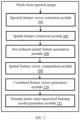
- the modules 106 include a spectral feature vector extraction module 202 (shown in FIG. 2 ), a spatial feature extraction module 204 (shown in FIG. 2 ), a size reduced spatial feature generation module 206 (shown in FIG. 2 ), a spatial feature vector computation module 208 (shown in FIG. 2 ), a combined feature vector generation module 210 (shown in FIG. 2 ) and a domain aware semi-supervised learning model generation module 212 (shown in FIG. 2 ).
- FIG. 2 illustrates a functional architecture of the system of FIG. 1 , for domain aware semi-supervised learning, in accordance with some embodiments of the present disclosure.
- the data repository (or repository) 110 may include a plurality of abstracted piece of code for refinement and data that is processed, received, or generated as a result of the execution of the plurality of modules in the module(s) 106.
- the data repository 110 is shown internal to the system 100, it will be noted that, in alternate embodiments, the data repository 110 can also be implemented external to the system 100, where the data repository 110 may be stored within a database (repository 110) communicatively coupled to the system 100.
- the data contained within such an external database may be periodically updated. For example, new data may be added into the database (not shown in FIG. 1 ) and/or existing data may be modified and/or non-useful data may be deleted from the database.
- the data may be stored in an external system, such as a Lightweight Directory Access Protocol (LDAP) directory and a Relational Database Management System (RDBMS).
- LDAP Lightweight Directory Access Protocol
- RDBMS Relational Database Management System
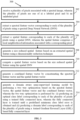
- FIG. 3 is an exemplary flow diagram illustrating a method 300 for domain aware semi-supervised learning implemented by the system of FIG. 1 according to some embodiments of the present disclosure.
- the system 100 includes one or more data storage devices or the memory 104 operatively coupled to the one or more hardware processor(s) 102 and is configured to store instructions for execution of steps of the method 300 by the one or more hardware processors 102.
- the steps of the method 300 of the present disclosure will now be explained with reference to the components or blocks of the system 100 as depicted in FIG. 1 and the steps of flow diagram as depicted in FIG. 3 .
- the method 300 may be described in the general context of computer executable instructions.
- computer executable instructions can include routines, programs, objects, components, data structures, procedures, modules, functions, etc., that perform particular functions or implement particular abstract data types.
- the method 300 may also be practiced in a distributed computing environment where functions are performed by remote processing devices that are linked through a communication network.
- the order in which the method 300 is described is not intended to be construed as a limitation, and any number of the described method blocks can be combined in any order to implement the method 300, or an alternative method.
- the method 300 can be implemented in any suitable hardware, software, firmware, or combination thereof.
- the one or more hardware processors 102 are configured by the programmed instructions to receive a plurality of pixels associated with a spectral image, wherein the plurality of pixels are one of a) a labeled pixel and b) an unlabeled pixel.
- the spectral image is of n-dimensions, wherein 'n' indicates number of bands.
- the one or more hardware processors 102 are configured by the programmed instructions to receive and process a plurality of pixels associated with a non-spectral color image.
- the spectral feature vector extraction module 202 executed by one or more hardware processors 102 is configured by the programmed instructions to extract a spectral feature vector corresponding to each of the plurality of pixels using a spectral Deep Neural Network (DNN).
- DNN spectral Deep Neural Network
- the architecture of the spectral DNN includes several layers.
- the spectral DNN network includes a layer with 512 neurons in the first layer, followed by a layer with 1024 neurons, dropout layers, two layers with 2048 neurons, another dropout layer, and finally, two dense layers with 4096 hidden neurons, and a layer with 1000 neurons.
- the spatial feature extraction module 204 executed by the one or more hardware processors 102 is configured by the programmed instructions to extract a spatial feature corresponding to each of the plurality of pixels using a spatial DNN, wherein the spatial feature comprises a local neighborhood information associated with a corresponding pixel.
- the local neighborhood information is one of a) an image patch and b) a configurable window.
- the size reduced spatial feature generation module 206 executed by the one or more hardware processors 102 is configured by the programmed instructions to generating a size reduced spatial feature based on an extracted spatial feature using a dimensionality reduction technique.
- the dimensionality is reduced by applying Principal Component Analysis (PCA) on the three dimensional image patch (or patch cube) centered around the pixel.
- PCA Principal Component Analysis
- the spatial feature vector computation module 208 executed by the one or more hardware processors 102 is configured by the programmed instructions to computing a spatial feature vector based on the size reduced spatial feature using the spatial DNN.
- the spatial input is processed using the VGG16 architecture, resulting in a feature vector of 1000 values.
- the combined feature vector generation module 210 executed by the one or more hardware processors 102 is configured by the programmed instructions to generating a combined feature vector by concatenating the spectral feature vector and the spatial feature vector. For example, to combine the spatial and spectral feature vectors, the outputs of both architecture features are concatenated, which is then processed with two dense layers of 1000 neurons.
- the domain aware semi-supervised learning model generation module 212 executed by the one or more hardware processors 102 is configured by the programmed instructions to generate a domain aware semi-supervised learning model by performing a two way optimization based on the spectral feature vector, the spatial feature vector and the combined feature vector for making whole system unaware of domain labels and for predicting correct class labels.
- the two way optimization is performed by (i) predicting an optimal class label corresponding to each of the plurality of pixels using a trained fully connected layer, wherein the fully connected layer is trained until a predefined minimum class label error is obtained, (for example, to classify pixel source) and (ii) predicting a domain label corresponding to each of the plurality of pixels using a trained Gradient Reversal Layer (GRL) based fully connected layer (for example, to distinguish between samples from labeled and unlabeled domains), wherein the GRL based fully connected layer is trained until a predefined maximum domain label error is obtained with a, wherein the gradient of the feature vector is reversed before inputting to the fully connected layer.
- the domain label indicates one of a) labeled pixel and b) an unlabeled pixel.
- the present disclosure is experimented as follows: The present disclosure has been trained and tested using publicly available Pavia University dataset. Pavia data is collected using a airborne optical sensor, ROSIS-3 over the Pavia University in Italy. The spatial resolution of the image was 1.3 m and has spectral coverage from 430 to 860 nm with 103 spectral bands. The image has 610 ⁇ 340 pixels and ground truth have 9 classes including the asphalt, meadows, gravel, trees, metal sheet, bare soil, bitumen, brick, and shadow.
- the embodiments of present disclosure herein address the unresolved problem of generating the domain aware semi-supervised learning.
- the present disclosure includes a learner that considers the distribution differences in labeled and unlabeled pixels. That is, the distribution shift between the labeled pixels and unlabeled pixels within the image is considered.
- the self-training iteration of the conventional approaches were replaced with a single iteration which is enabled with domain adaptation.
- the model is trained in such a way that it is not only trained on the correct class of pixel but also on the source category of the pixel, for example, labeled pixel or unlabeled pixel.
- the error in the pixel class is minimized, whereas the error in the source category is encouraged simultaneously. This two way optimization leads to a model which is invariant of the input pixel source category and thus adapts to the domains well.
- the hardware device can be any kind of device which can be programmed including e.g. any kind of computer like a server or a personal computer, or the like, or any combination thereof.
- the device may also include means which could be e.g. hardware means like e.g. an application-specific integrated circuit (ASIC), a field-programmable gate array (FPGA), or a combination of hardware and software means, e.g.
- ASIC application-specific integrated circuit
- FPGA field-programmable gate array
- the means can include both hardware means and software means.
- the method embodiments described herein could be implemented in hardware and software.
- the device may also include software means.
- the embodiments may be implemented on different hardware devices, e.g. using a plurality of CPUs, GPUs and edge computing devices.
- the embodiments herein can comprise hardware and software elements.
- the embodiments that are implemented in software include but are not limited to, firmware, resident software, microcode, etc.
- the functions performed by various modules described herein may be implemented in other modules or combinations of other modules.
- a computer-usable or computer readable medium can be any apparatus that can comprise, store, communicate, propagate, or transport the program for use by or in connection with the instruction execution system, apparatus, or device.
- the illustrated steps are set out to explain the exemplary embodiments shown, and it should be anticipated that ongoing technological development will change the manner in which particular functions are performed. These examples are presented herein for purposes of illustration, and not limitation. Further, the boundaries of the functional building blocks have been arbitrarily defined herein for the convenience of the description.
- a computer-readable storage medium refers to any type of physical memory on which information or data readable by a processor may be stored.
- a computer-readable storage medium may store instructions for execution by one or more processors, including instructions for causing the processor(s) to perform steps or stages consistent with the embodiments described herein.
- the term "computer-readable medium” should be understood to include tangible items and exclude carrier waves and transient signals, i.e. non-transitory.
- RAM random access memory
- ROM read-only memory
- volatile memory nonvolatile memory
- hard drives CD ROMs, DVDs, flash drives, disks, and any other known physical storage media.
Landscapes
- Engineering & Computer Science (AREA)
- Theoretical Computer Science (AREA)
- Physics & Mathematics (AREA)
- General Physics & Mathematics (AREA)
- Multimedia (AREA)
- Computer Vision & Pattern Recognition (AREA)
- Evolutionary Computation (AREA)
- General Health & Medical Sciences (AREA)
- Health & Medical Sciences (AREA)
- Databases & Information Systems (AREA)
- Artificial Intelligence (AREA)
- Computing Systems (AREA)
- Medical Informatics (AREA)
- Software Systems (AREA)
- Spectroscopy & Molecular Physics (AREA)
- Remote Sensing (AREA)
- Life Sciences & Earth Sciences (AREA)
- Biodiversity & Conservation Biology (AREA)
- Biomedical Technology (AREA)
- Molecular Biology (AREA)
- Image Analysis (AREA)
Abstract
Description
- The present application claims priority from
Indian patent application no. 202321047615 filed on July 14, 2023 - The disclosure herein generally relates to the field of Machine Learning (ML) and, more particularly, to a method and system for domain aware semi-supervised learning.
- Classification of images is inherently a transductive semi-supervised problem. The learned model must label all the pixels in the image, given a few annotated pixels in the same image. Generally, the classification of a single image is sufficient. However, in case of multi-date or multi-location data is to be processed, it is preferred to mark the training area in each image separately. This is because of the variations in the feature distribution of the classes across the different dates. Semi-supervised learning is a well-researched area in hyperspectral image processing. Especially, the various strategies for pseudo-labeling have been exploited recently. For example, Multi-nominal Logistic Regression (MLR), Soft-MI,R (SMI,R) for pseudo-labeling and unmixing for pseudo-labeling are used recently.
- Some of the conventional approaches for semi-supervised learning performs self-learning iterations. Each self-training iteration begins with building a model using the initial set of training pixels and labeling all the unlabeled pixels using that model. Next, the pixels with high-confidence class assignments from the first iteration are added to the initial training data and then the new model is built. Multiple such iterations are performed till accuracy converges. However, the problem in this approach is that the remote sensing images (hyperspectral images) often cover large area and hence the labeled pixels and the unlabeled pixels may follow different distribution. The problem of the distribution variations is called as a data shift or domain shift problem. Thus, the learner needs to consider the possible differences in the distribution of labeled and unlabeled pixels for better classification of unlabeled pixels. This is not attended so far in the past research.
- Embodiments of the present disclosure present technological improvements as solutions to one or more of the above-mentioned technical problems recognized by the inventors in conventional systems. For example, in one embodiment, a method for domain aware semi-supervised learning is provided. The method includes receiving, by one or more hardware processors, a plurality of pixels associated with a spectral image, wherein the plurality of pixels are one of a) a labeled pixel and b) an unlabeled pixel. Further, the method includes extracting via the one or more hardware processors, a spectral feature vector corresponding to each of the plurality of pixels using a spectral Deep Neural Network (DNN). Furthermore, the method includes extracting via the one or more hardware processors, a spatial feature corresponding to each of the plurality of pixels using the spatial DNN, wherein the spatial feature comprises a local neighborhood information associated with a corresponding pixel. Furthermore, the method includes generating via one or more hardware processors, a size reduced spatial feature based on the extracted spatial feature using a dimensionality reduction technique. Furthermore, the method includes computing via one or more hardware processors, a spatial feature vector based on the size reduced spatial feature using the spatial DNN. Furthermore, the method includes generating via one or more hardware processors, a combined feature vector by concatenating the spectral feature vector and the spatial feature vector. Finally, the method includes generating via one or more hardware processors, a domain aware semi-supervised learning model by performing a two way optimization based on the spectral feature vector, the spatial feature vector and the combined feature vector, wherein the two way optimization is performed by (i) predicting an optimal class label corresponding to each of the plurality of pixels using a trained fully connected layer, wherein the fully connected layer is trained until a predefined minimum class label error is obtained and (ii) predicting a domain label corresponding to each of the plurality of pixels using a trained Gradient Reversal Layer (GRL) based fully connected layer, wherein the GRL based fully connected layer is trained until a predefined maximum domain label error is obtained, wherein the gradient of the feature vector is reversed before inputting to the fully connected layer.
- In another aspect, a system for domain aware semi-supervised learning is provided. The system includes at least one memory storing programmed instructions, one or more Input /Output (I/O) interfaces, and one or more hardware processors operatively coupled to the at least one memory, wherein the one or more hardware processors are configured by the programmed instructions to receive a plurality of pixels associated with a spectral image, wherein the plurality of pixels are one of a) a labeled pixel and b) an unlabeled pixel. Further, the one or more hardware processors are configured by the programmed instructions to extract a spectral feature vector corresponding to each of the plurality of pixels using a spectral Deep Neural Network (DNN). Furthermore, the one or more hardware processors are configured by the programmed instructions to extract a spatial feature corresponding to each of the plurality of pixels using the spatial DNN, wherein the spatial feature comprises a local neighborhood information associated with a corresponding pixel. Furthermore, the one or more hardware processors are configured by the programmed instructions to generate a size reduced spatial feature based on the extracted spatial feature using a dimensionality reduction technique. Furthermore, the one or more hardware processors are configured by the programmed instructions to compute a spatial feature vector based on the size reduced spatial feature using the spatial DNN. Furthermore, the one or more hardware processors are configured by the programmed instructions to generate a combined feature vector by concatenating the spectral feature vector and the spatial feature vector. Finally, the one or more hardware processors are configured by the programmed instructions to generate a domain aware semi-supervised learning model by performing a two way optimization based on the spectral feature vector, the spatial feature vector and the combined feature vector, wherein the two way optimization is performed by (i) predicting an optimal class label corresponding to each of the plurality of pixels using a trained fully connected layer, wherein the fully connected layer is trained until a predefined minimum class label error is obtained and (ii) predicting a domain label corresponding to each of the plurality of pixels using a trained Gradient Reversal Layer (GRL) based fully connected layer, wherein the GRL based fully connected layer is trained until a predefined maximum domain label error is obtained, wherein the gradient of the feature vector is reversed before inputting to the fully connected layer.
- In yet another aspect, a computer program product including a non-transitory computer-readable medium having embodied therein a computer program for domain aware semi-supervised learning is provided. The computer readable program, when executed on a computing device, causes the computing device to receive a plurality of pixels associated with a spectral image, wherein the plurality of pixels are one of a) a labeled pixel and b) an unlabeled pixel. Further, the computer readable program, when executed on a computing device, causes the computing device to extract a spectral feature vector corresponding to each of the plurality of pixels using a spectral Deep Neural Network (DNN). Furthermore, the computer readable program, when executed on a computing device, causes the computing device to extract a spatial feature corresponding to each of the plurality of pixels using the spatial DNN, wherein the spatial feature comprises a local neighborhood information associated with a corresponding pixel. Furthermore, the computer readable program, when executed on a computing device, causes the computing device to generate a size reduced spatial feature based on the extracted spatial feature using a dimensionality reduction technique. Furthermore, the computer readable program, when executed on a computing device, causes the computing device to compute a spatial feature vector based on the size reduced spatial feature using the spatial DNN. Furthermore, the computer readable program, when executed on a computing device, causes the computing device to generate a combined feature vector by concatenating the spectral feature vector and the spatial feature vector. Finally, computer readable program, when executed on a computing device, causes the computing device to generate a domain aware semi-supervised learning model by performing a two way optimization based on the spectral feature vector, the spatial feature vector and the combined feature vector, wherein the two way optimization is performed by (i) predicting an optimal class label corresponding to each of the plurality of pixels using a trained fully connected layer, wherein the fully connected layer is trained until a predefined minimum class label error is obtained and (ii) predicting a domain label corresponding to each of the plurality of pixels using a trained Gradient Reversal Layer (GRL) based fully connected layer, wherein the GRL based fully connected layer is trained until a predefined maximum domain label error is obtained, wherein the gradient of the feature vector is reversed before inputting to the fully connected layer.
- It is to be understood that both the foregoing general description and the following detailed description are exemplary and explanatory only and are not restrictive of the invention, as claimed.
- The accompanying drawings, which are incorporated in and constitute a part of this disclosure, illustrate exemplary embodiments and, together with the description, serve to explain the disclosed principles:
-
FIG. 1 is a functional block diagram of a system for domain aware semi-supervised learning, in accordance with some embodiments of the present disclosure. -
FIG. 2 illustrates a functional architecture of the system ofFIG. 1 , for domain aware semi-supervised learning, in accordance with some embodiments of the present disclosure. -
FIG. 3 is an exemplary flow diagram illustrating a processor implemented method for domain aware semi-supervised learning implemented by the system ofFIG. 1 according to some embodiments of the present disclosure. - Exemplary embodiments are described with reference to the accompanying drawings. In the figures, the left-most digit(s) of a reference number identifies the figure in which the reference number first appears. Wherever convenient, the same reference numbers are used throughout the drawings to refer to the same or like parts. While examples and features of disclosed principles are described herein, modifications, adaptations, and other implementations are possible without departing from the scope of the disclosed embodiments.
- Classification of remotely sensed data is inherently a transductive semi-supervised problem. The learned model must label all the pixels in the image given a few annotated pixels in the same image. Semi-supervised learning is a well-researched area in hyperspectral image processing. Especially the various strategies for pseudo-labeling have been exploited recently. For example, Multi-nominal Logistic Regression (MLR), Soft-MLR (SMLR) for pseudo-labeling and unmixing for pseudo-labeling are used recently.
- Some of the conventional approaches for semi-supervised learning performs self-learning iterations. Each self-training iteration begins with building a model using the initial set of training pixels and labeling all the unlabeled pixels using that model. Next, the pixels with high-confidence class assignments from the first iteration are added to the initial training data and then the new model is built. Multiple such iterations are performed till accuracy converges. However, the problem in this approach is that the remote sensing images often cover large area and hence the labeled pixels and the unlabeled pixels may follow different distribution. The problem of the distribution variations is called as a data shift or domain shift problem. Thus, the learner needs to consider the possible differences in the distribution of labeled and unlabeled pixels for better classification of unlabeled pixels. This is not attended so far in the past research.
- To overcome the challenges of the conventional approaches, embodiments herein provide a method and system for domain aware semi-supervised learning. The present disclosure provides a two way optimization solution for pixel labeling using deep learning models. The present disclosure includes a learner that considers the distribution differences in labeled and unlabeled pixels. That is, the distribution shift between the labeled pixels and unlabeled pixels within the image is considered. Thus, the self-training iteration of the conventional approaches were replaced with a single iteration which is enabled with domain adaptation. The model is trained in such a way that it is not only trained on the correct class of pixel but also on the source category of the pixel, for example, labeled pixel or unlabeled pixel. The error in the pixel class is minimized, whereas the error in the source category is encouraged simultaneously. This two way optimization leads to a model which is invariant of the input pixel source category and thus adapts to the domains well.
- The present disclosure processes spectral and spatial inputs. The spatial features are processed by Visual Geometry Group (VGG) based Deep Neural Network (DNN) and the spectral inputs are processed by a multi-layer perceptron neural network (MLP). The extracted spectral and spatial features are combined to form a common feature vector. This feature vector is used for land cover classification and for the pixel source category (labeled and unlabeled) classification. For example, for obtaining the domain adaptation, the weights of the DNNs are learned in such a manner that it classifies the pixel correctly irrespective of any source. The main contribution of the present disclosure is to devise a new semi-supervised approach which considers the difference of distributions in labeled and unlabeled data to improve the accuracy. Thus, the proposed method is higher level umbrella framework for semi-supervised learning where unlabeled and labeled data may have distribution shifts.
- Referring now to the drawings, and more particularly to
FIGS. 1 through 3 , where similar reference characters denote corresponding features consistently throughout the figures, there are shown preferred embodiments and these embodiments are described in the context of the following exemplary system and/or method. -
FIG. 1 is a functional block diagram of asystem 100 for domain aware semi-supervised learning, in accordance with some embodiments of the present disclosure. Thesystem 100 includes or is otherwise in communication withhardware processors 102, at least one memory such as amemory 104, an I/O interface 112. Thehardware processors 102,memory 104, and the Input /Output (I/O)interface 112 may be coupled by a system bus such as asystem bus 108 or a similar mechanism. In an embodiment, thehardware processors 102 can be one or more hardware processors. - The I/
O interface 112 may include a variety of software and hardware interfaces, for example, a web interface, a graphical user interface, and the like. The I/O interface 112 may include a variety of software and hardware interfaces, for example, interfaces for peripheral device(s), such as a keyboard, a mouse, an external memory, a printer and the like. Further, the I/O interface 112 may enable thesystem 100 to communicate with other devices, such as web servers, and external databases. - The I/
O interface 112 can facilitate multiple communications within a wide variety of networks and protocol types, including wired networks, for example, local area network (LAN), cable, etc., and wireless networks, such as Wireless LAN (WLAN), cellular, or satellite. For the purpose, the I/O interface 112 may include one or more ports for connecting several computing systems with one another or to another server computer. The I/O interface 112 may include one or more ports for connecting several devices to one another or to another server. - The one or
more hardware processors 102 may be implemented as one or more microprocessors, microcomputers, microcontrollers, digital signal processors, central processing units, node machines, logic circuitries, and/or any devices that manipulate signals based on operational instructions. Among other capabilities, the one ormore hardware processors 102 is configured to fetch and execute computer-readable instructions stored in thememory 104. - The
memory 104 may include any computer-readable medium known in the art including, for example, volatile memory, such as static random access memory (SRAM) and dynamic random access memory (DRAM), and/or non-volatile memory, such as read only memory (ROM), erasable programmable ROM, flash memories, hard disks, optical disks, and magnetic tapes. In an embodiment, thememory 104 includes a plurality ofmodules 106. Thememory 104 also includes a data repository (or repository) 110 for storing data processed, received, and generated by the plurality ofmodules 106. - The plurality of
modules 106 include programs or coded instructions that supplement applications or functions performed by thesystem 100 for domain aware semi-supervised learning. The plurality ofmodules 106, amongst other things, can include routines, programs, objects, components, and data structures, which performs particular tasks or implement particular abstract data types. The plurality ofmodules 106 may also be used as, signal processor(s), node machine(s), logic circuitries, and/or any other device or component that manipulates signals based on operational instructions. Further, the plurality ofmodules 106 can be used by hardware, by computer-readable instructions executed by the one ormore hardware processors 102, or by a combination thereof. The plurality ofmodules 106 can include various sub-modules (not shown). The plurality ofmodules 106 may include computer-readable instructions that supplement applications or functions performed by thesystem 100 for domain aware semi-supervised learning. In an embodiment, themodules 106 include a spectral feature vector extraction module 202 (shown inFIG. 2 ), a spatial feature extraction module 204 (shown inFIG. 2 ), a size reduced spatial feature generation module 206 (shown inFIG. 2 ), a spatial feature vector computation module 208 (shown inFIG. 2 ), a combined feature vector generation module 210 (shown inFIG. 2 ) and a domain aware semi-supervised learning model generation module 212 (shown inFIG. 2 ). In an embodiment,FIG. 2 illustrates a functional architecture of the system ofFIG. 1 , for domain aware semi-supervised learning, in accordance with some embodiments of the present disclosure. - The data repository (or repository) 110 may include a plurality of abstracted piece of code for refinement and data that is processed, received, or generated as a result of the execution of the plurality of modules in the module(s) 106.
- Although the
data repository 110 is shown internal to thesystem 100, it will be noted that, in alternate embodiments, thedata repository 110 can also be implemented external to thesystem 100, where thedata repository 110 may be stored within a database (repository 110) communicatively coupled to thesystem 100. The data contained within such an external database may be periodically updated. For example, new data may be added into the database (not shown inFIG. 1 ) and/or existing data may be modified and/or non-useful data may be deleted from the database. In one example, the data may be stored in an external system, such as a Lightweight Directory Access Protocol (LDAP) directory and a Relational Database Management System (RDBMS). -
FIG. 3 is an exemplary flow diagram illustrating amethod 300 for domain aware semi-supervised learning implemented by the system ofFIG. 1 according to some embodiments of the present disclosure. In an embodiment, thesystem 100 includes one or more data storage devices or thememory 104 operatively coupled to the one or more hardware processor(s) 102 and is configured to store instructions for execution of steps of themethod 300 by the one ormore hardware processors 102. The steps of themethod 300 of the present disclosure will now be explained with reference to the components or blocks of thesystem 100 as depicted inFIG. 1 and the steps of flow diagram as depicted inFIG. 3 . Themethod 300 may be described in the general context of computer executable instructions. Generally, computer executable instructions can include routines, programs, objects, components, data structures, procedures, modules, functions, etc., that perform particular functions or implement particular abstract data types. Themethod 300 may also be practiced in a distributed computing environment where functions are performed by remote processing devices that are linked through a communication network. The order in which themethod 300 is described is not intended to be construed as a limitation, and any number of the described method blocks can be combined in any order to implement themethod 300, or an alternative method. Furthermore, themethod 300 can be implemented in any suitable hardware, software, firmware, or combination thereof. - At
step 302 of themethod 300, the one ormore hardware processors 102 are configured by the programmed instructions to receive a plurality of pixels associated with a spectral image, wherein the plurality of pixels are one of a) a labeled pixel and b) an unlabeled pixel. The spectral image is of n-dimensions, wherein 'n' indicates number of bands. In another embodiment, the one ormore hardware processors 102 are configured by the programmed instructions to receive and process a plurality of pixels associated with a non-spectral color image. - At
step 304 of themethod 300, the spectral featurevector extraction module 202 executed by one ormore hardware processors 102 is configured by the programmed instructions to extract a spectral feature vector corresponding to each of the plurality of pixels using a spectral Deep Neural Network (DNN). - For example, the architecture of the spectral DNN includes several layers. Specifically, the spectral DNN network includes a layer with 512 neurons in the first layer, followed by a layer with 1024 neurons, dropout layers, two layers with 2048 neurons, another dropout layer, and finally, two dense layers with 4096 hidden neurons, and a layer with 1000 neurons.
- At
step 306 of themethod 300, the spatialfeature extraction module 204 executed by the one ormore hardware processors 102 is configured by the programmed instructions to extract a spatial feature corresponding to each of the plurality of pixels using a spatial DNN, wherein the spatial feature comprises a local neighborhood information associated with a corresponding pixel. The local neighborhood information is one of a) an image patch and b) a configurable window. - At
step 308 of themethod 300, the size reduced spatialfeature generation module 206 executed by the one ormore hardware processors 102 is configured by the programmed instructions to generating a size reduced spatial feature based on an extracted spatial feature using a dimensionality reduction technique. For example, the dimensionality is reduced by applying Principal Component Analysis (PCA) on the three dimensional image patch (or patch cube) centered around the pixel. - At
step 310 of themethod 300, the spatial featurevector computation module 208 executed by the one ormore hardware processors 102 is configured by the programmed instructions to computing a spatial feature vector based on the size reduced spatial feature using the spatial DNN. For example, the spatial input is processed using the VGG16 architecture, resulting in a feature vector of 1000 values. - At
step 312 of themethod 300, the combined featurevector generation module 210 executed by the one ormore hardware processors 102 is configured by the programmed instructions to generating a combined feature vector by concatenating the spectral feature vector and the spatial feature vector. For example, to combine the spatial and spectral feature vectors, the outputs of both architecture features are concatenated, which is then processed with two dense layers of 1000 neurons. - At
step 314 of themethod 300, the domain aware semi-supervised learningmodel generation module 212 executed by the one ormore hardware processors 102 is configured by the programmed instructions to generate a domain aware semi-supervised learning model by performing a two way optimization based on the spectral feature vector, the spatial feature vector and the combined feature vector for making whole system ignorant of domain labels and for predicting correct class labels. The two way optimization is performed by (i) predicting an optimal class label corresponding to each of the plurality of pixels using a trained fully connected layer, wherein the fully connected layer is trained until a predefined minimum class label error is obtained, (for example, to classify pixel source) and (ii) predicting a domain label corresponding to each of the plurality of pixels using a trained Gradient Reversal Layer (GRL) based fully connected layer (for example, to distinguish between samples from labeled and unlabeled domains), wherein the GRL based fully connected layer is trained until a predefined maximum domain label error is obtained with a, wherein the gradient of the feature vector is reversed before inputting to the fully connected layer. The domain label indicates one of a) labeled pixel and b) an unlabeled pixel. - The present disclosure is experimented as follows: The present disclosure has been trained and tested using publicly available Pavia University dataset. Pavia data is collected using a airborne optical sensor, ROSIS-3 over the Pavia University in Italy. The spatial resolution of the image was 1.3 m and has spectral coverage from 430 to 860 nm with 103 spectral bands. The image has 610×340 pixels and ground truth have 9 classes including the asphalt, meadows, gravel, trees, metal sheet, bare soil, bitumen, brick, and shadow.
- Multiple experiments were conducted on the Pavia data to compare the performance between the present disclosure and self-learning iterations by SVM and VGG-16 based neural network (called CNN). The pixels in the image were split into two sets, training, and testing (called L1 and L2 respectively). L2 is assumed to be the unlabeled pixels and their land cover labels were not used, only source labels were used. Spectral, spatial, and spectral-spatial features were considered for classification using all three models. Spectral features are band values of a target pixel, spatial features are the features extracted from the local neighborhood around the pixel including the pixel, and spectral-spatial are fused features. The extent of local neighborhood considered during convolution determines the spatial features extracted for the target pixel. Hence to study the effect of local neighborhood on the classification accuracy in spatial, and spectral-spatial experiments Different window sizes starting from 11 and ending at 40 were considered for experimentation. The window sizes considered were 5, 7, 9, 11, 15, 20, 25, 30, 40. The training and testing experiments were repeated for each window size.
- The intuition in conducting these experiments was: if the hypothesis of domain shift between labeled and unlabeled pixels is true, then for a given model the proposed method should provide better accuracy as compared to the first self-training iteration. The advantages would be reflected in higher levels of iterations as well. However, at a particular nth iteration the accuracy levels may match the proposed method, that is, domain aware approach.
- It has been observed that the present disclosure improved the accuracy on L2 by 1% 5% 3% for spectral, spatial (5x5), and spectral-spatial (5x5) features respectively, as compared to the first iteration of self-training. Best accuracy by our approach with spatial features was 91.77% for window size of 11x11 and was improvement by ~2% over self-training iterations by SVM. The best spectral spatial accuracy by our approach was 95.88% which was more by ~3%, for same window size 30x30. Results by our approach were better than the first iteration results by CNN self-learning by -1% 4% 4% for spectral, spatial, and spectral-spatial features respectively. Best accuracies for spatial, and spectral-spatial features were better than SVM results achieved after complete iterations for the same window size (91.77% vs. 89.19%; 95.88% vs. 89.08%).
- Further, when the results of spectral and spatial features for CNN are compared, then the improvements in the accuracies because of the proposed method are more pronounced for spatial features. This indicates the distribution shifts for spatial features is more pronounced than its spectral counterpart. This is intuitive as the urban materials within the scene are likely to have less variety. On the other hand, spatial arrangement of the land covers would vary more according to the location. Though this observation may hold true in most of the cases, further investigation is required to evaluate how generic the observation is. The spatial resolution of the data set used for experiments is high. Experiments with moderate resolution image not having dominant spatial features would be helpful in this investigation.
- Overall, the present disclosure has shown improvement over standard semi-supervised learning. Spatial or spectral-spatial results by all methods produced better results than spectral features. The results also suggest that domain adaptation is more relevant to spatial features. This is intuitive in the sense that the data shifts are more pronounced in spatial distribution than spectral. However, this needs to be further investigated for moderate resolution (30 m) imagery as well. Though the present disclosure was evaluated performance on the hyperspectral data, the method is generic and is applicable to multispectral or RGB images as well.
- The written description describes the subject matter herein to enable any person skilled in the art to make and use the embodiments. The scope of the subject matter embodiments is defined by the claims and may include other modifications that occur to those skilled in the art. Such other modifications are intended to be within the scope of the claims if they have similar elements that do not differ from the literal language of the claims or if they include equivalent elements with insubstantial differences from the literal language of the claims.
- The embodiments of present disclosure herein address the unresolved problem of generating the domain aware semi-supervised learning. The present disclosure includes a learner that considers the distribution differences in labeled and unlabeled pixels. That is, the distribution shift between the labeled pixels and unlabeled pixels within the image is considered. Thus, the self-training iteration of the conventional approaches were replaced with a single iteration which is enabled with domain adaptation. The model is trained in such a way that it is not only trained on the correct class of pixel but also on the source category of the pixel, for example, labeled pixel or unlabeled pixel. The error in the pixel class is minimized, whereas the error in the source category is encouraged simultaneously. This two way optimization leads to a model which is invariant of the input pixel source category and thus adapts to the domains well.
- It is to be understood that the scope of the protection is extended to such a program and in addition to a computer-readable means having a message therein such computer-readable storage means contain program-code means for implementation of one or more steps of the method when the program runs on a server or mobile device or any suitable programmable device. The hardware device can be any kind of device which can be programmed including e.g. any kind of computer like a server or a personal computer, or the like, or any combination thereof. The device may also include means which could be e.g. hardware means like e.g. an application-specific integrated circuit (ASIC), a field-programmable gate array (FPGA), or a combination of hardware and software means, e.g. an ASIC and an FPGA, or at least one microprocessor and at least one memory with software modules located therein. Thus, the means can include both hardware means and software means. The method embodiments described herein could be implemented in hardware and software. The device may also include software means. Alternatively, the embodiments may be implemented on different hardware devices, e.g. using a plurality of CPUs, GPUs and edge computing devices.
- The embodiments herein can comprise hardware and software elements. The embodiments that are implemented in software include but are not limited to, firmware, resident software, microcode, etc. The functions performed by various modules described herein may be implemented in other modules or combinations of other modules. For the purposes of this description, a computer-usable or computer readable medium can be any apparatus that can comprise, store, communicate, propagate, or transport the program for use by or in connection with the instruction execution system, apparatus, or device. The illustrated steps are set out to explain the exemplary embodiments shown, and it should be anticipated that ongoing technological development will change the manner in which particular functions are performed. These examples are presented herein for purposes of illustration, and not limitation. Further, the boundaries of the functional building blocks have been arbitrarily defined herein for the convenience of the description. Alternative boundaries can be defined so long as the specified functions and relationships thereof are appropriately performed. Alternatives (including equivalents, extensions, variations, deviations, etc., of those described herein) will be apparent to persons skilled in the relevant art(s) based on the teachings contained herein. Such alternatives fall within the scope of the disclosed embodiments. Also, the words "comprising," "having," "containing," and "including," and other similar forms are intended to be equivalent in meaning and be open ended in that an item or items following any one of these words is not meant to be an exhaustive listing of such item or items, or meant to be limited to only the listed item or items. It must also be noted that as used herein and in the appended claims, the singular forms "a," "an," and "the" include plural references unless the context clearly dictates otherwise. Furthermore, one or more computer-readable storage media may be utilized in implementing embodiments consistent with the present disclosure. A computer-readable storage medium refers to any type of physical memory on which information or data readable by a processor may be stored. Thus, a computer-readable storage medium may store instructions for execution by one or more processors, including instructions for causing the processor(s) to perform steps or stages consistent with the embodiments described herein. The term "computer-readable medium" should be understood to include tangible items and exclude carrier waves and transient signals, i.e. non-transitory. Examples include random access memory (RAM), read-only memory (ROM), volatile memory, nonvolatile memory, hard drives, CD ROMs, DVDs, flash drives, disks, and any other known physical storage media. It is intended that the disclosure and examples be considered as exemplary only, with a true scope of disclosed embodiments being indicated by the following claims.
Claims (9)
- A processor implemented method (300), the method comprising:receiving (302), via one or more hardware processors, a plurality of pixels associated with a spectral image, wherein the plurality of pixels are one of a) a labeled pixel and b) an unlabeled pixel;extracting (304), via the one or more hardware processors, a spectral feature vector corresponding to each of the plurality of pixels using a spectral Deep Neural Network (DNN);extracting (306), via the one or more hardware processors, a spatial feature corresponding to each of the plurality of pixels using the spatial DNN, wherein the spatial feature comprises a local neighborhood information associated with a corresponding pixel;generating (308), via the one or more hardware processors, a size reduced spatial feature based on the extracted spatial feature using a dimensionality reduction technique;computing (310), via the one or more hardware processors, a spatial feature vector based on the size reduced spatial feature using the spatial DNN;generating (312), via one or more hardware processors, a combined feature vector by concatenating the spectral feature vector and the spatial feature vector; andgenerating (314), via the one or more hardware processors, a domain aware semi-supervised learning model by performing a two way optimization based on the spectral feature vector, the spatial feature vector and the combined feature vector, wherein the two way optimization is performed by:predicting an optimal class label corresponding to each of the plurality of pixels using a trained fully connected layer, wherein the fully connected layer is trained until a predefined minimum class label error is obtained; andpredicting a domain label corresponding to each of the plurality of pixels using a trained Gradient Reversal Layer (GRL) based fully connected layer, wherein the GRL based fully connected layer is trained until a predefined maximum domain label error is obtained, wherein the gradient of the feature vector is reversed before inputting to the fully connected layer.
- The method as claimed in claim 1, wherein the local neighbourhood information is one of a) an image patch and b) a configurable window.
- The method as claimed in claim 1, wherein the domain label indicates one of a) labelled pixel and b) an unlabelled pixel.
- A system (100) comprising:at least one memory (104) storing programmed instructions; one or more Input /Output (I/O) interfaces (112); and one or more hardware processors (102) operatively coupled to the at least one memory (104), wherein the one or more hardware processors (102) are configured by the programmed instructions to:receive a plurality of pixels associated with a spectral image, wherein the plurality of pixels are one of a) a labeled pixel and b) an unlabeled pixel;extract a spectral feature vector corresponding to each of the plurality of pixels using a spectral Deep Neural Network (DNN);extract a spatial feature corresponding to each of the plurality of pixels using the spatial DNN, wherein the spatial feature comprises a local neighborhood information associated with a corresponding pixel;generate a size reduced spatial feature based on the extracted spatial feature using a dimensionality reduction technique;compute a spatial feature vector based on the size reduced spatial feature using the spatial DNN;generate a combined feature vector by concatenating the spectral feature vector and the spatial feature vector; andgenerate a domain aware semi-supervised learning model by performing a two way optimization based on the spectral feature vector, the spatial feature vector and the combined feature vector, wherein the two way optimization is performed by:predicting an optimal class label corresponding to each of the plurality of pixels using a trained fully connected layer, wherein the fully connected layer is trained until a predefined minimum class label error is obtained; andpredicting a domain label corresponding to each of the plurality of pixels using a trained Gradient Reversal Layer (GRL) based fully connected layer, wherein the GRL based fully connected layer is trained until a predefined maximum domain label error is obtained, wherein the gradient of the feature vector is reversed before inputting to the fully connected layer.
- The system of claim 4, wherein the local neighbourhood information is one of a) an image patch and b) a configurable window.
- The system of claim 4, wherein the domain label indicates one of a) labelled pixel and b) an unlabelled pixel.
- One or more non-transitory machine-readable information storage mediums comprising one or more instructions which when executed by one or more hardware processors cause:receiving a plurality of pixels associated with a spectral image, wherein the plurality of pixels are one of a) a labeled pixel and b) an unlabeled pixel;extracting a spectral feature vector corresponding to each of the plurality of pixels using a spectral Deep Neural Network (DNN);extracting a spatial feature corresponding to each of the plurality of pixels using the spatial DNN, wherein the spatial feature comprises a local neighborhood information associated with a corresponding pixel;generating a size reduced spatial feature based on the extracted spatial feature using a dimensionality reduction technique;computing a spatial feature vector based on the size reduced spatial feature using the spatial DNN;generating a combined feature vector by concatenating the spectral feature vector and the spatial feature vector; andgenerating a domain aware semi-supervised learning model by performing a two way optimization based on the spectral feature vector, the spatial feature vector and the combined feature vector, wherein the two way optimization is performed by:predicting an optimal class label corresponding to each of the plurality of pixels using a trained fully connected layer, wherein the fully connected layer is trained until a predefined minimum class label error is obtained; andpredicting a domain label corresponding to each of the plurality of pixels using a trained Gradient Reversal Layer (GRL) based fully connected layer, wherein the GRL based fully connected layer is trained until a predefined maximum domain label error is obtained, wherein the gradient of the feature vector is reversed before inputting to the fully connected layer.
- The one or more non-transitory machine-readable information storage mediums as claimed in claim 7, wherein the local neighbourhood information is one of a) an image patch and b) a configurable window.
- The one or more non-transitory machine-readable information storage mediums as claimed in claim 7, wherein the domain label indicates one of a) labelled pixel and b) an unlabelled pixel.
Applications Claiming Priority (1)
| Application Number | Priority Date | Filing Date | Title |
|---|---|---|---|
| IN202321047615 | 2023-07-14 |
Publications (1)
| Publication Number | Publication Date |
|---|---|
| EP4492332A1 true EP4492332A1 (en) | 2025-01-15 |
Family
ID=91663895
Family Applications (1)
| Application Number | Title | Priority Date | Filing Date |
|---|---|---|---|
| EP24183580.0A Pending EP4492332A1 (en) | 2023-07-14 | 2024-06-21 | Method and system for domain aware semi-supervised learning |
Country Status (1)
| Country | Link |
|---|---|
| EP (1) | EP4492332A1 (en) |
-
2024
- 2024-06-21 EP EP24183580.0A patent/EP4492332A1/en active Pending
Non-Patent Citations (2)
| Title |
|---|
| MUHAMMAD AHMAD ET AL: "Hyperspectral Image Classification -- Traditional to Deep Models: A Survey for Future Prospects", ARXIV.ORG, CORNELL UNIVERSITY LIBRARY, 201 OLIN LIBRARY CORNELL UNIVERSITY ITHACA, NY 14853, 15 October 2021 (2021-10-15), XP091064904 * |
| ZHAO XUDONG ET AL: "Multisource Cross-Scene Classification Using Fractional Fusion and Spatial-Spectral Domain Adaptation", IGARSS 2022 - 2022 IEEE INTERNATIONAL GEOSCIENCE AND REMOTE SENSING SYMPOSIUM, IEEE, 17 July 2022 (2022-07-17), pages 699 - 702, XP034194705, DOI: 10.1109/IGARSS46834.2022.9884659 * |
Also Published As
| Publication number | Publication date |
|---|---|
| US20250022266A1 (en) | 2025-01-16 |
Similar Documents
| Publication | Publication Date | Title |
|---|---|---|
| AU2019264603B2 (en) | Method and system for information extraction from document images using conversational interface and database querying | |
| Shabbir et al. | Satellite and scene image classification based on transfer learning and fine tuning of ResNet50 | |
| Maggiori et al. | Convolutional neural networks for large-scale remote-sensing image classification | |
| Han et al. | Methods for small, weak object detection in optical high-resolution remote sensing images: A survey of advances and challenges | |
| Li et al. | Dual attention deep fusion semantic segmentation networks of large-scale satellite remote-sensing images | |
| Yang et al. | Hyperspectral image classification using two-channel deep convolutional neural network | |
| Maggiori et al. | Recurrent neural networks to correct satellite image classification maps | |
| EP4032016B1 (en) | Deep learning based table detection and associated data extraction from scanned image documents | |
| US20220122368A1 (en) | Systems and methods for document image analysis with cardinal graph convolutional networks | |
| US20220138481A1 (en) | Method and system for learning spectral features of hyperspectral data using dcnn | |
| Liu et al. | Review of CNN in aerial image processing | |
| US20220019734A1 (en) | Method and system for visio-linguistic understanding using contextual language model reasoners | |
| CN111160273A (en) | Hyperspectral image space spectrum combined classification method and device | |
| CN117456232A (en) | A semi-supervised few-shot image classification method based on multi-scale features | |
| Morales et al. | Cloud detection in high-resolution multispectral satellite imagery using deep learning | |
| US20250232575A1 (en) | Detecting digital objects and generating object masks on device | |
| Li et al. | Combining semi-supervised and active learning for hyperspectral image classification | |
| US12633108B2 (en) | Method and system for domain aware semi-supervised learning | |
| Borna et al. | An intelligent geospatial processing unit for image classification based on geographic vector agents (GVAs) | |
| US20250022266A1 (en) | Method and system for domain aware semi-supervised learning | |
| US20220365963A1 (en) | Method and system for feature based image retrieval | |
| Fang et al. | A novel unsupervised multiple change detection method for VHR remote sensing imagery using CNN with hierarchical sampling | |
| Nizamani et al. | Latest trends in land use and land cover monitoring using deep learning | |
| Shahtahmassebi et al. | Reconstructing historical urban landscapes from KH-9 HEXAGON mapping camera system imagery: an example of Hangzhou City | |
| US20250166375A1 (en) | Processing techniques for generating, tracking, and visualizing environmental insights |
Legal Events
| Date | Code | Title | Description |
|---|---|---|---|
| PUAI | Public reference made under article 153(3) epc to a published international application that has entered the european phase |
Free format text: ORIGINAL CODE: 0009012 |
|
| STAA | Information on the status of an ep patent application or granted ep patent |
Free format text: STATUS: THE APPLICATION HAS BEEN PUBLISHED |
|
| AK | Designated contracting states |
Kind code of ref document: A1 Designated state(s): AL AT BE BG CH CY CZ DE DK EE ES FI FR GB GR HR HU IE IS IT LI LT LU LV MC ME MK MT NL NO PL PT RO RS SE SI SK SM TR |
|
| STAA | Information on the status of an ep patent application or granted ep patent |
Free format text: STATUS: REQUEST FOR EXAMINATION WAS MADE |
|
| 17P | Request for examination filed |
Effective date: 20250520 |
|
| STAA | Information on the status of an ep patent application or granted ep patent |
Free format text: STATUS: EXAMINATION IS IN PROGRESS |
|
| 17Q | First examination report despatched |
Effective date: 20260331 |