EP4492301A1 - Quantum variables implementation - Google Patents

Quantum variables implementation Download PDF

Info

Publication number
EP4492301A1
EP4492301A1 EP24187665.5A EP24187665A EP4492301A1 EP 4492301 A1 EP4492301 A1 EP 4492301A1 EP 24187665 A EP24187665 A EP 24187665A EP 4492301 A1 EP4492301 A1 EP 4492301A1
Authority
EP
European Patent Office
Prior art keywords
quantum
index
qubits
domain
weights
Prior art date
Legal status (The legal status is an assumption and is not a legal conclusion. Google has not performed a legal analysis and makes no representation as to the accuracy of the status listed.)
Pending
Application number
EP24187665.5A
Other languages
German (de)
French (fr)
Inventor
Gabriele AGLIARDI
Enrico PRATI
Current Assignee (The listed assignees may be inaccurate. Google has not performed a legal analysis and makes no representation or warranty as to the accuracy of the list.)
Consiglio Nazionale delle Richerche CNR
International Business Machines Corp
Original Assignee
Consiglio Nazionale delle Richerche CNR
International Business Machines Corp
Priority date (The priority date is an assumption and is not a legal conclusion. Google has not performed a legal analysis and makes no representation as to the accuracy of the date listed.)
Filing date
Publication date
Priority claimed from IT102023000014703A external-priority patent/IT202300014703A1/en
Application filed by Consiglio Nazionale delle Richerche CNR, International Business Machines Corp filed Critical Consiglio Nazionale delle Richerche CNR
Publication of EP4492301A1 publication Critical patent/EP4492301A1/en
Pending legal-status Critical Current

Links

Images

Classifications

    • GPHYSICS
    • G06COMPUTING OR CALCULATING; COUNTING
    • G06NCOMPUTING ARRANGEMENTS BASED ON SPECIFIC COMPUTATIONAL MODELS
    • G06N10/00Quantum computing, i.e. information processing based on quantum-mechanical phenomena
    • G06N10/60Quantum algorithms, e.g. based on quantum optimisation, quantum Fourier or Hadamard transforms
    • GPHYSICS
    • G06COMPUTING OR CALCULATING; COUNTING
    • G06NCOMPUTING ARRANGEMENTS BASED ON SPECIFIC COMPUTATIONAL MODELS
    • G06N10/00Quantum computing, i.e. information processing based on quantum-mechanical phenomena
    • G06N10/80Quantum programming, e.g. interfaces, languages or software-development kits for creating or handling programs capable of running on quantum computers; Platforms for simulating or accessing quantum computers, e.g. cloud-based quantum computing

Definitions

  • the present invention relates to the field of digital computer systems, and more specifically, to a method for determining quantum variables.
  • An aspect of the present invention relates to a method for operating a computer system.
  • the method comprises providing in the computer system a quantum register storing a set of qubits defining a quantum system having a computational basis comprising a set of base states, a generic state of the quantum system being a linear combination of said set of base states, a coefficient of each base state in the linear combination corresponding to the square root of a probability of measuring the base state.
  • the method comprises providing an ordered set of consecutive nonnegative integer indexes, each index being associated to a different respective one of the base states.
  • the method comprises providing a random variable having a probability distribution in a corresponding domain.
  • the method comprises mapping each one of a finite set of domain values within said domain to a different respective one of the indexes of the set through a bijective affine transformation, said affine transformation providing for expressing each domain value of the set in function of the respective index through a scaling of said respective index and a offset applied to the scaled index.
  • the method comprises representing said random variable in the computer system through said quantum system, said representing said random variable comprising generating a quantum variable identifying a state of the quantum system, said generating the quantum variable comprising setting each coefficient of each base state to the square root of the value of the probability distribution at the domain value mapped to the index associated to said base state.
  • said mapping comprises defining a tolerance range around each of the domain values of the set.
  • said mapping comprises approximating values of the random variable within the tolerance range around a corresponding domain value by the corresponding domain value, thereby values of the random variable within the tolerance range around a domain value of the set are mapped to the index to which said domain value of the set is mapped.
  • said quantum register comprises a first quantum register storing a first set of qubits defining a first quantum system having a first computational basis comprising a set of first base states, a generic state of the first quantum system being a linear combination of said set of first base states, a coefficient of each first base state in the linear combination corresponding to the square root of a probability of measuring the first base state;
  • said quantum register comprises a second quantum register storing a second set of qubits defining a second quantum system having a second computational basis comprising a set of second base states, a generic state of the second quantum system being a linear combination of said set of second base states, a coefficient of each second base state in the linear combination corresponding to the square root of a probability of measuring the second base state.
  • said providing an ordered set of consecutive nonnegative integer indexes comprises providing a first ordered set of consecutive nonnegative integer first indexes, each first index being associated to a different respective one of the first base states.
  • said providing an ordered set of consecutive nonnegative integer indexes comprises providing a second ordered set of consecutive nonnegative integer second indexes, each second index being associated to a different respective one of the second base states.
  • said providing a random variable comprises providing a first and second independent random variables, said first random variable having a first probability distribution in a corresponding first domain, said second random variable having a second probability distribution in a corresponding second domain.
  • said mapping comprises mapping each one of a finite set of first domain values within said first domain to a different respective one of the first indexes of the set through a bijective first affine transformation, said first affine transformation providing for expressing each first domain value of the set in function of the respective first index through a first scaling of said respective first index and a first offset applied to the scaled first index.
  • said mapping comprises mapping each one of a finite set of second domain values within said second domain to a different respective one of the second indexes of the set through a bijective second affine transformation, said second affine transformation providing for expressing each second domain value of the set in function of the respective second index through a second scaling of said respective second index and a second offset applied to the scaled second index.
  • said representing said random variable in the computer system through said quantum system comprises representing said first random variable in the computer system through said first quantum system, said representing said first random variable comprising generating a first quantum variable identifying a first state of the first quantum system, said generating the first quantum variable comprising setting each coefficient of each first base state to the square root of the value of the first probability distribution at the first domain value mapped to the first index associated to said first base state.
  • said representing said random variable in the computer system through said quantum system comprises representing said second random variable in the computer system through said second quantum system, said representing said second random variable comprising generating a second quantum variable identifying a second state of the second quantum system, said generating the second quantum variable comprising setting each coefficient of each second base state to the square root of the value of the second probability distribution at the second domain value mapped to the second index associated to said second base state.
  • said random variable comprises a first and second dependent random variables.
  • said probability distribution comprises a joint probability distribution in a first domain for the first random variable and in a second domain for the second random variable.
  • said quantum register comprises a first quantum register storing a first set of qubits defining a first quantum system having a first computational basis comprising a set of first base states, a generic state of the first quantum system being a linear combination of said set of first base states, a coefficient of each first base state in the linear combination corresponding to the square root of a probability of measuring the first base state;
  • said quantum variable comprises a second quantum register storing a second set of qubits defining a second quantum system having a second computational basis comprising a set of second base states, a generic state of the second quantum system being a linear combination of said set of second base states, a coefficient of each second base state in the linear combination corresponding to the square root of a probability of measuring the second base state.
  • said providing an ordered set of consecutive nonnegative integer indexes comprises providing a first ordered set of consecutive nonnegative integer first indexes, each first index being associated to a different respective one of the first base states.
  • said providing an ordered set of consecutive nonnegative integer indexes comprises providing a second ordered set of consecutive nonnegative integer second indexes, each second index being associated to a different respective one of the second base states.
  • said mapping comprises mapping each one of a finite set of first domain values within said first domain to a different respective one of the first indexes of the set through a bijective first affine transformation, said first affine transformation providing for expressing each first domain value of the set in function of the respective first index through a first scaling of said respective first index and a first offset applied to the scaled first index.
  • said mapping comprises mapping each one of a finite set of second domain values within said second domain to a different respective one of the second indexes of the set through a bijective second affine transformation, said second affine transformation providing for expressing each second domain value of the set in function of the respective second index through a second scaling of said respective second index and a second offset applied to the scaled second index.
  • said representing said random variable comprises representing said first and second dependent random variables in the computer system through a joint quantum system being the interconnection of said first quantum system with said second quantum system, and generating a joint quantum variable identifying a state of the joint quantum system, a probability of measuring a state of the joint quantum system being set to a value of said joint probability distribution corresponding to a domain pair including a first domain value and a second domain value.
  • the method further comprises determining a sum of the first and second random variables.
  • said determining of the sum comprises providing an output quantum register storing a third set of qubits, thereby defining a third quantum system having a computational basis comprising a set of base states.
  • said sum of the first and second random variables is determined as a third random variable represented in the computer system through said third quantum system.
  • the state of the third quantum system in the computational basis represents a value of the third random variable based on a mapping, through a third affine relationship, of third domain values within a third domain of the third random variable to third indexes of third ordered set of consecutive nonnegative integer third indexes.
  • each third index is associated to a different respective one of the third base states.
  • said third affine relationship provides for expressing each third domain value in function of a respective third index through a third scaling of said respective third index and a third offset applied to the scaled third index.
  • said determining of the sum comprises receiving a target scaling parameter identifying a target value for such third scaling.
  • said determining of the sum comprises generating a first set of first weights associated to the first base states and a second set of second weights associated to the second base states by performing the following sequence of operations:
  • said determining of the sum comprises associating first unknowns to each first base state of the first quantum system.
  • said determining of the sum comprises associating second unknowns to each second base state of the second quantum system.
  • said determining of the sum comprises providing a monomial for each unknown, the monomial comprising the unknown multiplied by the weight associated to the respective base state.
  • said determining of the sum comprises defining a polynomial as the sum of the monomials.
  • said determining of the sum comprises providing a quantum circuit having an input coupled to the first quantum register and to the second quantum register, and an output coupled to the output quantum register.
  • said determining of the sum comprises the quantum circuit is configured to apply a quantum transformation for evaluating the polynomial into the output register by setting the first unknowns based on the first set of qubits of the first quantum system and by setting the second unknowns based on the second set of qubits of the second quantum system.
  • said determining of the sum comprises applying the quantum transformation on the first quantum register and second quantum register to evaluate the polynomial into the output quantum register.
  • the method further comprises setting said third offset to the first offset plus the second offset.
  • the method further comprises setting said third scaling to the value of the target scaling parameter multiplied by 2 to minus M.
  • said integer M depends on:
  • said generating the first set of first weights and the second set of second weights further comprises lowering the number of qubits in the third set of qubits to a closest number of the sum that is a power of two.
  • the method further comprises determining a multiplication of the first and second random variables.
  • the determining of the multiplication comprises providing an output quantum register storing a third set of qubits, thereby defining a third quantum system having a computational basis comprising a set of base states.
  • said multiplication of the first and second random variables is determined as a third random variable represented in the computer system through said third quantum system,
  • the state of the third quantum system in the computational basis represents a value of the third random variable based on a mapping, through a third affine relationship, of third domain values within a third domain of the third random variable to third indexes of third ordered set of consecutive nonnegative integer third indexes.
  • each third index is associated to a different respective one of the third base states.
  • said third affine relationship provides for expressing each third domain value in function of a respective third index through a third scaling of said respective third index and a third offset applied to the scaled third index.
  • the determining of the multiplication comprises receiving a target scaling parameter identifying a target value for such third scaling.
  • the determining of the multiplication comprises generating a first set of first weights associated to the first base states, a second set of second weights associated to the second base states, and a third set of third weights associated to base state pairs each including a first base state and a second base state by performing the following sequence of operations:
  • the determining of the multiplication comprises associating first unknowns to each first base state of the first quantum system.
  • the determining of the multiplication comprises associating second unknowns to each second base state of the second quantum system.
  • the determining of the multiplication comprises providing a first monomial for each first unknown, each first monomial comprising a first unknown multiplied by the first weight associated to the respective first base state.
  • the determining of the multiplication comprises providing a second monomial for each second unknown, each second monomial comprising a second unknown multiplied by the second weight associated to the respective second base state.
  • the determining of the multiplication comprises providing a third monomial for each of unknown pair including a pair of first and second unknowns, each third monomial comprising the product between:
  • the determining of the multiplication comprises defining a polynomial as the sum of the first, second and third monomials.
  • the determining of the multiplication comprises providing a quantum circuit having an input coupled to the first quantum register and to the second quantum register, and an output coupled to the output quantum register, the quantum circuit being configured to apply a quantum transformation for evaluating the polynomial into the output register by setting the first unknowns based on the first set of qubits of the first quantum system and by setting the second unknowns based on the second set of qubits of the second quantum system.
  • the determining of the multiplication comprises applying the quantum transformation on the first quantum register and second quantum register to evaluate the polynomial into the output quantum register.
  • the method further comprises setting said third offset to the first offset multiplied by the second offset.
  • the method further comprises setting said third scaling to the value of the target scaling parameter.
  • said integer M depends on:
  • said generating the first set of first weights, the second set of second weights and the third set of third weights further comprises lowering the number of qubits in the third set of qubits to a closest number of the sum that is a power of two.
  • said target scaling parameter has a value corresponding to one of said first scaling and said second scaling.
  • Another aspect of the present invention relates to a computer system comprising a quantum register storing a set of qubits defining a quantum system having a computational basis comprising a set of base states, a generic state of the quantum system being a linear combination of said set of base states, a coefficient of each base state in the linear combination corresponding to the square root of a probability of measuring the base state.
  • the computer system is configured to provide an ordered set of consecutive nonnegative integer indexes, each index being associated to a different respective one of the base states.
  • the computer system is configured to provide a random variable having a probability distribution in a corresponding domain.
  • the computer system is configured to map each one of a finite set of domain values within said domain to a different respective one of the indexes of the set through a bijective affine transformation.
  • said affine transformation provides for expressing each domain value of the set in function of the respective index through a scaling of said respective index and a offset applied to the scaled index.
  • the computer system is configured to represent said random variable in the computer system through said quantum system.
  • said representing said random variable comprises generating a quantum variable identifying a state of the quantum system.
  • said generating the quantum variable comprises setting each coefficient of each base state to the square root of the value of the probability distribution at the domain value mapped to the index associated to said base state.
  • Another aspect of the present invention relates to a computer program configured for causing a computer system to perform the method according to the above when the computer program is executed on the computer system.
  • Another aspect of the present invention relates to a computer program product comprising one or more computer readable storage media having program instructions collectively stored on the readable storage media, the program instructions being readable by a computer system to cause the computer system to perform the method according to the above.
  • the quantum system may refer to a system that is subject to the principles of quantum mechanics.
  • a quantum system may be one or more qubits.
  • the qubits of the quantum system may be part of one or more quantum registers. Quantum calculations may be performed by manipulating the qubits within the register(s).
  • a property of the quantum systems may be the superposition which allows quantum particles to exist in multiple states (also referred to as base states) of a given basis, simultaneously.
  • an orthonormal basis for the quantum states of a quantum system may be referred to as the computational basis.
  • a qubit can be in a superposition of both the 10) base state and 11) base state at the same time.
  • the base state of the quantum system may be referred to herein as
  • the base state 15) is a compact representation of base state
  • the state of a quantum system may be represented by an integer z referred to herein as index or by a binary string [ z ] 2 which encode the integer z in the binary format e.g., the state
  • All possible base states of the quantum system may be represented by an ordered set of consecutive indexes.
  • the 3-qubit system has 8 possible base states which may be represented by the set of 8 indexes 0, 1, 2, 3, 4, 5, 6 and 7.
  • the present subject matter may enable to represent the real numbers or integer numbers using quantum computing means.
  • the real numbers may, for example, be floating point numbers.
  • This representation may be performed by providing the random variable in a predefined format, herein referred to as classical-quantum format.
  • the random variable in the classical-quantum format may be a quantum variable.
  • the quantum variable may be defined by the quantum register of a given size which is equipped with the domain, and by an encoding function representing the affine relationship.
  • the quantum variable may potentially further be defined by some additional classical properties.
  • the quantum variable may, for example, be a structure that can contain one random variable at a time, as much as a classical variable is a cell containing one number at a time.
  • the random variable of the classical-quantum format may, for example, represent floating point numbers but it is not limited to.
  • the random variable of the classical-quantum format may thus be referred to as classically enriched quantum floating-point variable (CEFV).
  • CEFV variable the random variable of the classical-quantum format defined according to the present subject matter
  • Providing the CEFV variable in accordance with the present subject matter may mean that the quantum register (after encoding of its qubits) represents the CEFV variable.
  • the definition of the CEFV variable according to the present subject matter may comprise multiple steps.
  • the quantum register comprising the set of qubits may be provided (in step S 1).
  • the set of qubits may, for example, comprise a number n of qubits.
  • the number n of qubits may, for example, be a predefined number.
  • the number n of qubits may be defined based on the CEFV variable to be defined e.g., the maximum value of the CEFV variable may be used to define the number n of qubits.
  • the size of the CEFV variable may dictate the size of the provided quantum register or the size of the quantum register dictate the size of the CEFV variable.
  • the set of qubits may define a quantum system.
  • the base states of the quantum system may, for example, be the base states of the quantum system in a computational basis.
  • a single qubit may be in the base states 10> and 11> representing the number 0 and 1 respectively.
  • the computational basis may be defined as the tensor product space of the individual qubit states.
  • the generic, global, state of the quantum system is a superposition of its base states.
  • the generic state of the quantum system is a linear combination of the base states, in which each base state is weighted by a coefficient corresponding to the square root of the probability of measuring the corresponding base state.
  • the base states of the computational basis of the quantum system (in step S2) may be represented by an ordered set of consecutive nonnegative integer numbers.
  • the ordered set of consecutive nonnegative integer numbers may start from zero but it is not limited to this starting point as the skilled person may start from other values.
  • the ordered set of consecutive nonnegative integer numbers may be referred to as the set of indexes respectively.
  • the base states of the computational basis of the quantum system may, for example, be represented by the integer variable z .
  • the integer variable z may have one number of the set of nonnegative integer numbers ⁇ 0, ... , 2 n - 1 ⁇ that corresponds to said base state S, z ⁇ ⁇ 0, ... , 2 n - 1 ⁇ .
  • the CEFV variable may have a probability distribution in a corresponding domain.
  • the variable is valued (in step S3) in a finite set of domain values (of the corresponding domain) whose size is equal to the number N of base states of the computational basis of the quantum system.
  • the domain may comprise a set of N values, where each value of the domain may be obtained by the affine relationship.
  • the affine relationship may be an affine equation.
  • the affine relationship may be defined by the scaling factor and the offset factor.
  • the affine relationship may, for example, be defined as a + bz, where a is the offset factor and b is the scaling factor. This may provide a classical contribution as well as quantum contribution to the CEFV variable.
  • the scaling factor may, for example, be a nonzero real number.
  • the offset factor may, for example, be a real number.
  • the quantum contribution may be provided by the integer variable z that represents one of the quantum base states of the computational basis of the quantum system.
  • the classical contribution may be provided by the offset factor and the scaling factor.
  • the definition of the CEFV variable may further involve an encoding step (S4).
  • the set of qubits may be encoded such that the probability of measuring a state of the quantum system in the computational basis is the probability of observing the domain value associated with the index z representing said measured state when sampling the CEFV variable. That is, the set of qubits may be encoded such that the probability of measuring a state of the quantum system in the computational basis is the probability of obtaining the domain value associated with the index z representing said measured state, wherein the domain value is obtained by sampling the CEFV variable.
  • the encoding may, for example, be an amplitude encoding or other types of encoding.
  • the random variable is therefore represented in the computing system through the quantum system by generating a quantum variable identifying a state of the quantum system.
  • the generation of the quantum variable is carried out by setting each coefficient of each base state to the square root of the value of the probability distribution of the variable at the domain value mapped through the affine relationship to the index associated to said base state.
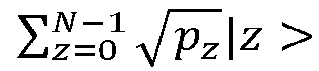
  • a CEFV variable X which is supported in the domain ⁇ a + b 0, ... , a + b ( N - 1) ⁇ may be encoded with the global quantum state
  • ⁇ >, where P X a + bz is the probability of obtaining a + bz after sampling the variable X.
  • the individual base state of the quantum system is referred to as
  • each qubit of the set of qubits may be associated with a respective position in the binary string.
  • the present subject matter may provide a quantum-classical hybrid representation of numbers, which may include a classical register storing global information such as data ranges, the sign and the approximation bounds.
  • the currently defined CEFV variables may reduce the circuit depth e.g., by up to 89%, against previous techniques for circuits that calculate the sum.
  • the provided CEFV variables may be used to evaluate one or more functions, thus allowing quantum computers to tackle data transformations of arbitrary complexity, as long as the circuit depth and width are sustained by the hardware.
  • the CEFV variable may be used to build functions, and then integrate these functions in full quantum workloads that solve end-to-end problems. For example, in the domain of finance, in option pricing, the CEFV variables may be used to represent payoffs resulting from elaborate calculations.
  • the value of the CEFV variable may provide an approximation of a respective classical domain value e.g., the CEFV variable value may be equal to exactly the classical domain value or equal to, within an error, the domain value.
  • the present subject matter may control the level of these errors by determining the CEFV variables using tolerance ranges.
  • the definition of the CEFV variable may further comprise: determining a tolerance range.
  • the set of qubits may be encoded such that an approximate value of each domain value of the domain ⁇ a + b 0,..., a + b ( N - 1) ⁇ may be represented with the same quantum base state as the domain value in case the difference between the domain value and the approximate value is within the tolerance range.
  • the tolerance range may be defined as the range [- ⁇ - , ⁇ + ], where ⁇ - and ⁇ + may be below and above errors, ⁇ - ⁇ [0, + ⁇ ) and ⁇ + ⁇ [0, + ⁇ ).
  • Providing the errors ⁇ - and ⁇ + may further be advantageous as it may enable to keep track of the error propagation, in particular, as the computation of the sum and the product may be done up to a rounding error.
  • the definition of the CEFV variable may involve a tuple of three entries namely the quantum register, the domain of values of the CEFV variable and the affine relationship.
  • This tuple of three entries may be referred to as CEFV 3-tuple.
  • the tuple may contain two additional entries representing the two limits of the tolerance range respectively.
  • This tuple of five entries may be referred to as CEFV 5-tuple.
  • the CEFV variable may, for example, be used to perform statistical analysis (e.g., for option pricing) whose results may be used to control the operations of technical systems.
  • the present subject matter may enable access to more than one random variable by repeating the above definition method. This may enable to store higher amount of data.
  • a first CEFV variable and a second CEFV variable may be defined using the above definition. That is, steps S1 through S4 may be performed twice in order to define the first CEFV variable and a second CEFV variable.
  • a first quantum register comprising a first set of qubits.
  • the first set of qubits may, for example, comprise a number n 1 of qubits.
  • the number n 1 of qubits may, for example, be a predefined number.
  • the number n 1 of qubits may be defined based on the first CEFV variable to be defined e.g., the maximum value of the first CEFV variable may be used to define the number n 1 of qubits.
  • the size of the first CEFV variable may define the size of the provided first quantum register or the size of the first quantum register defines the size of the first CEFV variable.
  • the base states of the computational basis of the first quantum system may be represented by an ordered set of consecutive first indexes.
  • the ordered set of consecutive first indexes may start from zero but it is not limited to this starting point as the skilled person may start from other values.
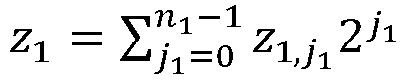
  • the states of the computational basis of the first quantum system may, for example, be represented by the integer variable z 1 , where for each state base St1 of the first quantum system, the integer variable z 1 may have one number of the set of first indexes ⁇ 0, ...
  • the first CEFV variable may be valued in a finite first domain whose size is equal to the number N 1 of base states of the computational basis of the first quantum system.
  • the first domain may comprise a set of N 1 values, where each value of the first domain may be obtained by a first affine relationship.
  • the first affine relationship may be defined by a first scaling factor and a first offset factor.
  • the first affine relationship may, for example, be defined as a 1 + b 1 z 1 , where a 1 is the first offset factor and b 1 is the first scaling factor.
  • the quantum contribution may be provided by the integer variable z 1 that represents one of the quantum base states of the computational basis of the first quantum system.
  • the first set of qubits may be encoded in order to represent the first CEFV variable.
  • the first scaling factor may, for example, be a nonzero real number.
  • the first offset factor may, for example, be a real number.
  • the definition of the first CEFV variable may involve a first CEFV 3-tuple of three entries namely comprising the first quantum register, the first domain of values of the first CEFV variable and the first affine relationship.
  • a second quantum register comprising a second set of qubits may be provided.
  • the second set of qubits may, for example, comprise a number n 2 of qubits.
  • the number n 2 of qubits may, for example, be a predefined number.
  • the number n 2 of qubits may be defined based on the second CEFV variable to be defined e.g., the maximum value of the second CEFV variable may be used to define the number n 2 of qubits.
  • the size of the second CEFV variable may define the size of the provided second quantum register or the size of the second quantum register may define the size of the second CEFV variable.
  • the base states of the computational basis of the second quantum system may be represented by an ordered set of consecutive second indexes.
  • the ordered set of consecutive second indexes may start from zero but it is not limited to this starting point as the skilled person may start from other values.
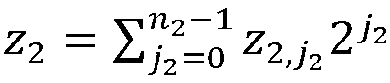
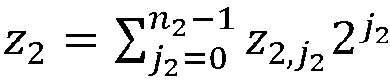
  • the base states of the computational basis of the second quantum system may, for example, be represented by the integer variable z 2 , where for each base state St2, the integer variable z 2 may have one number of the set of second indexes ⁇ 0, ..., 2 n 2 - 1 ⁇ that corresponds to said base state St2, z 2 ⁇ ⁇ 0, ... , 2 n 2 - 1 ⁇ .
  • the second CEFV variable may be valued in a finite second domain whose size is equal to the number N 2 of base states of the computational basis of the second quantum system.
  • the second domain may comprise a set of N 2 values, where each value of the second domain may be obtained by a second affine relationship.
  • the second affine relationship may be defined by a second scaling factor and a second offset factor.
  • the second affine relationship may, for example, be defined as a 2 + b 2 z 2 , where a 2 is the second offset factor and b 2 is the second scaling factor.
  • This may provide a classical contribution as well as quantum contribution to the second CEFV variable.
  • the quantum contribution may be provided by the integer variable z 2 that represents one of the quantum base states of the computational basis of the first quantum system.
  • the second set of qubits may be encoded in order to represent the second CEFV variable.
  • the second scaling factor may, for example, be a nonzero real number.
  • the second offset factor may, for example, be a real number.
  • the definition of the second CEFV variable may involve a second CEFV 3-tuple of three entries namely comprising the second quantum register, the second domain of values of the second CEFV variable and the second affine relationship.
  • the first set of qubits and the second set of qubits may be encoded such that the state of the overall system formed by the two sets of qubits may not be separable as two states, as an effect of the quantum property of entanglement.
  • the probability of measuring a state of a joint quantum system of the first and second quantum systems in the computational basis is the probability of jointly observing the first domain value associated with the first index representing said measured state when sampling the first random variable and the second domain value associated with the second index representing said measured state when sampling the second random variable.
  • the first set of qubits may be encoded such that the state of the overall system formed by the two sets of qubits is separable as the tensor product of two states, each representing one set of qubits.
  • ⁇ > may be decomposed as
  • ⁇ >
  • the probability of measuring a state of the first quantum system in the computational basis is the probability of observing the first domain value associated with the first index representing said measured state when sampling the first random variable.
  • the second set of qubits may be encoded such that the probability of measuring a state of the second quantum system in the computational basis is the probability of observing the second domain value associated with the second index representing said measured state when sampling the second random variable.
  • the present subject matter may further be advantageous as it may equipe the CEFV variables with basic operations such as addition and multiplication operations that may be performed without overflow.
  • the present subject matter may make use of the hybrid format of the CEFV variables to perform the sum efficiently. For example, to sum two CEFVs variables, the offset factors may be summed together with a classical computer, while quantum states may be processed by a quantum circuit that keeps into account the two scaling factors.
  • adding the first CEFV variable and the second CEFV variable comprises: providing an output quantum register comprising a third set of qubits, thereby defining a third quantum system.
  • the first quantum system, second quantum system and third quantum system may form a joint or composite quantum system.
  • a first set of weights may be determined for the first set of qubits respectively.
  • a second set of weights may be determined for the second set of qubits respectively.
  • the first set of weights and the second set of weights are determined such that the output quantum register after applying the sum algorithm represents a third random variable of the classical-quantum format, so that the third random variable is a (possibly approximate) representation of the sum of the first and second random variables.
  • the third CEFV variable may be defined by a CEFV 3-tuple or by a CEFV 5-tuple.
  • a polynomial may be defined. The polynomial may be the sum of monomials, wherein each monomial is associated with respective qubit of the first set of qubits and second set of qubits, wherein each monomial is defined as the product of an unknown and a weight associated with the respective qubit.
  • a unitary quantum transformation that is configured to act on the first quantum register and the second quantum register, on the output quantum register, and on an auxiliary register may be generated in order to evaluate the polynomial into the output quantum register. The unitary transformation may be applied on the first and second quantum registers.
  • the auxiliary register may, for example, comprise a set of qubits used for internal calculations for the evaluation of the unitary transformation, e.g., the auxiliary register may be used as a temporary memory, by the unitary transformation and then restored to the original 10> base state (namely, freed for other usages).
  • the unknown may, for example, be a variable.
  • This example may be advantageous as it may enable to perform the sum using classical and quantum computing.
  • the resulting sum also represents a random variable according to the classical-quantum format of the present subject matter.
  • the output quantum register may comprise a number n out of qubits.
  • the number n out of qubits may, for example, be a predefined number.
  • the number n out of qubits may be iteratively defined as described below.
  • Any pair of a base state of the computational basis of the first set of qubits and a base state of the computational basis of the second set of qubits may be represented respectively by the pair ( z 1 , z 2 ) of first index z 1 and second index z 2 , where z 1 ⁇ ⁇ 0, ..., 2 n 1 - 1 ⁇ and z 2 ⁇ ⁇ 0, ..., 2 n 2 - 1 ⁇ .
  • each qubit of the first set of qubits may be associated with a respective position in the binary string [ z 1 ] 2 .
  • each qubit of the second set of qubits may be associated with a respective position in the binary string [ z 2 ] 2 .
  • Each individual product of the products z 1, j 1 w 1, j 1 in the polynomial defines a monomial of the polynomial
  • each individual product of the products z 2, j 2 w 2, j 2 is a monomial of the polynomial
  • each of the unknowns z 1, j 1 represents a binary coefficient and is associated with a respective qubit of the first set of qubits
  • each of the unknowns z 2, j 2 represents a binary coefficient and is associated with a respective qubit of the second set of qubits.
  • the unitary transformation may be generated for the defined polynomial p ( z 1 , z 2 ).
  • the unitary transformation may be implemented using a quantum circuit.
  • the unitary transformation may, for example, be generated using the method described in the paper: R. Seidel, N. Tcholtchev, S. Bock, C. K.-U. Becker, and M. Hauswirth, "Efficient Floating Point Arithmetic for Quantum Computers," IEEE Access, vol. 10, pp. 72400-72415, 2022 .
  • the states of the third quantum system represent values of the third random variable of the classical-quantum format through a third affine relationship defined by a third scaling factor and a third offset factor, wherein the third offset factor is the classical sum of the first offset factor and second offset factor and the third scaling factor is the product of an alignment scale and a predefined target scale, wherein the alignment scale is the inverse of a power of two such that the sum can be performed without overflow.
  • the target scale may, for example, be a user-defined scale e.g., the target scale may be received as input from the user.
  • the alignment scale may, for example, be automatically determined.
  • the third offset factor may be referred to as a out .
  • the third scaling factor may be referred to as b out .
  • the base states of the computational basis of the third quantum system may, for example, be represented by the integer variable z out , where for each base state St3 of the third quantum system, the integer variable z out may have one number of the set of indexes ⁇ 0, ... , 2 n out - 1 ⁇ that corresponds to the base state St3, z out ⁇ ⁇ 0, ... , 2 n out - 1 ⁇ .
  • This example may be advantageous because, without executing the CEFV variable definition method, the sum algorithm enables to obtain this classical-quantum format variable.
  • This example implementation may be automatically executed, and thus the third scaling factor and the third offset factor for the output of the sum may automatically be determined. As a consequence, the no-overflow can be guaranteed automatically.
  • the first set of weights and the second set of weights may be determined such that the output quantum register, after performing the sum of the first CEFV variable and the second CEFV variable, represents a third CEFV variable which encodes an approximation of the sum of the two input variables without overflow.
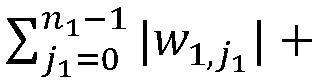
  • the first set of weights and the second set of weights may be chosen such that the sum of the absolute value of the weights in the first set of weights and in the second set of weights is smaller than or equal to the maximal index 2 n out - 1 of the output quantum register.
  • Each weight of the first set of weights and second set of weights may be an integer number. A rounding may be applied to the weight to make sure that the resulting weight is an integer number.
  • the maximal index 2 n out - 1 is provided with the minus one term because the indexes are nonnegative integers, meaning that the indexing of the output quantum register starts from zero and ends with the maximal index of 2 n out - 1.
  • the first set of weights and the second set of weights may be determined such that the output quantum register, after performing the sum of the first CEFV variable and the second CEFV variable would represent a third CEFV variable which encodes an approximation of the sum of the two input variables without overflow.
  • the first set of weights w 1, j 1 may be up to some factor and rounding equal to 2 j 1 / b out and the second set of weights w 2, j 2 may be up to some factor and rounding equal to 2 j 2 / b out .
  • each weight of the first set of weights and second set of weights before rounding may be proportional to the inverse of the third scaling factor, w 1, j 1 ⁇ 1/ b out and w 2, j 2 ⁇ 1/ b out .
  • each weight of the first set of weights before rounding may include (2 j 1 ) two to the power of the position ( j 1 ) of the associated qubit of the weight.
  • Each weight of the second set of weights before rounding may include (2 j 2 ) two to the power of the position ( j 2 ) of the associated qubit of the weight.
  • the third scaling factor b out may be changed one or more times until the sum of the absolute value of the weights becomes smaller than or equal to the maximal index 2 n out - 1 of the output quantum register.
  • the value of the third CEFV variable may be equal to, within an error, the corresponding classical sum of the first and second domain values of the first and second CEFV variables.
  • the present subject matter may control the level of these errors.
  • the first set of weights and the second set of weights may be determined such that the output quantum register, after performing the sum of the first CEFV variable and the second CEFV variable, represents a third CEFV variable which is defined by a CEFV 5-tuple. That is, the third CEFV variable is associated with a tolerance range so that the same state of the output quantum register is associated with variables that are within the range. This may enable to approximate the sum within (controlled) tolerances specified for the output.
  • the first set of weights and the second set of weights may be determined such that the output quantum register, after performing the sum of the first CEFV variable and the second CEFV variable, represents a third CEFV variable, wherein the first set of weights may be provided as follows: w 1, j 1 is the closest-integer rounding of 2 j 1 b 1 / b out and the second set of weights may be provided as follows: w 2, j 2 is the closest-integer rounding of 2 j 2 b 2 / b out .
  • the first set of weights and the second set of weights may be defined using an iterative method.
  • aa1 a current value of the first and second sets of weights may be provided.
  • the first and second sets of weights may be randomly set, making sure that each of the first and second sets of weights is an integer.
  • step bb1) the sum of the absolute value of the weights in the first and second sets of weights may be performed.
  • step cc1) it may be determined whether the sum is smaller than or equal to the maximal index 2 n out - 1 of the output quantum register.
  • step dd1) in case the sum is higher than the maximal index 2 n out - 1, steps aa1) to bb1) may be repeated (e.g., trying other values for the first and second sets of weights).
  • step ee1) the last determined first and second sets of weights may be provided.
  • the number of qubits of the output quantum register may be lowered to the power of the closest number of the sum, wherein the closest number is a power of two.
  • step cc1 it is determined that the sum is smaller than or equal to the maximal index 2 n out - 1 of the output quantum register, the number of qubits of the output quantum register may be repeatedly lowered (e.g., by one), wherein for each lowering: steps aa1) to cc1) may be performed, wherein the repetition is performed as long as the sum is smaller than or equal to the maximal index 2 n out - 1 of the output quantum register associated with the lowered number.
  • the first quantum register contains base state
  • z1 ⁇ 11), as a representation of the floating point number 1, and the second quantum register contains base state
  • z2 ⁇
  • the sum may be expected to be an approximation of 4/3.
  • n out 4
  • M 4
  • rnd denotes the rounding.
  • Square brackets are kept to emphasize that in the more general case of many input qubits, w 1 and w 2 would be vectors. Such weights do not respect the exit inequality condition si-e 16 + 5 > 2 4 - 1.
  • the same names and variables which are used to describe the sum of two variables are used to describe the multiplication of two variables.
  • the size of the output quantum register is n out
  • the third scaling factor is b out
  • the third offset factor is a out are similarly noted but they are clearly different taking into account their application context namely the sum or multiplication.
  • the multiplication of the first random variable and second random variable comprises: providing an output quantum register comprising a third set of qubits, thereby defining a third quantum system, the first, second and third quantum systems forming a joint quantum system.
  • a determination of a first set of weights for the first set of qubits respectively, a second set of weights for the second set of qubits respectively and a third set of qubits for the pairs of qubits of the first set and second set of qubits respectively may be performed.
  • the determining of the three sets of weights may be performed such that the output quantum register after performing the multiplication represents a third random variable of the classical-quantum format.
  • a polynomial may be defined.
  • the polynomial may be defined as a sum of first degree monomials and second degree monomials.
  • Each first degree monomial is associated with respective qubit of the first set of qubits and the second set of qubits.
  • Each first degree monomial is defined as the product of an unknown and a weight associated with the respective qubit.
  • Each second degree monomial is associated with a respective pair of qubits of the first and second sets of qubits, wherein each second degree monomial is defined as the product of a weight associated with the pair of qubits, and two unknowns, respectively associated with a qubit of the first set and a qubit of the second set of qubits.
  • a unitary quantum transformation that is configured to act on the first quantum register and second quantum register, on the output quantum register, and on an auxiliary register may be generated in order to evaluate the polynomial into the output quantum register.
  • the unitary transformation may be applied on the first and second quantum registers, thereby encoding the third set of qubits such that the base state of the computational basis of the third quantum system represents values of a third random variable of the classical-quantum format.
  • This example may be advantageous as it may enable to perform the multiplication using classical and quantum computing.
  • the resulting product also represents a random variable according to the classical-quantum format of the present subject matter.
  • the first multiplication example may, for example, be described using the following notations.
  • the output quantum register may comprise a number n out of qubits.
  • the number n out of qubits may, for example, be a predefined number.
  • the number n out of qubits may be iteratively defined as described below.
  • Any pair of a base state of the first set of qubits and a base state of the second set of qubits may be represented respectively by the pair ( z 1 ,z 2 ) of first index z 1 and second index z 2 , where z 1 ⁇ ⁇ 0, ... , 2 n 1 - 1 ⁇ and z 2 ⁇ ⁇ 0,..., 2 n 2 - 1 ⁇ .
  • each qubit of the first set of qubits may be associated with a respective position in the binary string [ z 1 ] 2 .
  • each qubit of the second set of qubits may be associated with a respective position in the binary string [ z 2 ] 2 .
  • each product of the products z 1, j 1 w 1, j 1 in the polynomial defines a first degree monomial of the polynomial
  • each product of the products z 2, j 2 w 2, j 2 is a first degree monomial of the polynomial
  • each of the unknowns z 1, j 1 represents a binary coefficient and is associated with a respective qubit of the first set of qubits
  • each of the unknowns z 2, j 2 represents a binary coefficient and is associated with a respective qubit of the second set of qubits.
  • Each product of the products z 1, j 1 z 2, j 2 w prod,j 1 + j 2 is a second degree monomial of the polynomial, where each of the z 1, j 1 z 2, j 2 is the product of two unknowns, respectively associated with a qubit of the first set of qubits and a qubit of the second set of qubits.
  • the unitary transformation may be generated for the defined polynomial p ( z 1 , z 2 ).
  • the unitary transformation may be implemented using a quantum circuit.
  • the unitary transformation may, for example, be generated using the method described in the paper: R. Seidel, N. Tcholtchev, S. Bock, C. K.-U. Becker, and M. Hauswirth, "Efficient Floating Point Arithmetic for Quantum Computers," IEEE Access, vol. 10, pp. 72400-72415, 2022 .
  • the base states of the computational basis of the third quantum system may, for example, be represented by the integer variable z out , where for each base state St4, the integer variable z out may have one number of the set of indexes ⁇ 0, ..., 2 n out - 1 ⁇ that corresponds to the each base state St4, z out ⁇ ⁇ 0, ..., 2 n out - 1 ⁇ .
  • the base states of the computational basis of the third quantum system may represent values of the third random variable of the classical-quantum format through a third affine relationship defined by a third scaling factor and a third offset factor, wherein the third offset factor is the classical product of the first and second offsets and the third scaling factor is a predefined target scale.
  • This example implementation may be automatically executed, and thus the third scaling factor and the third offset factor for the output of the product may automatically be determined. As a consequence, the no-overflow can be guaranteed automatically.
  • This example may be advantageous because without executing the CEFV variable definition method, the way the product is performed enables to "preserve" this classical-quantum format variable.
  • the first set of weights and the second set of weights and the third set of weights may be defined using an iterative method.
  • a current value of the first, second and third sets of weights may be provided.
  • the first, second and third sets of weights may be randomly set to, making sure that each of the first, second and third sets of weights is an integer.
  • step bb2) the sum of the first, second and third sets of weights may be performed.
  • step cc2) it may be determined whether the sum is smaller than or equal to the maximal index 2 n out - 1 of the output quantum register.
  • step dd2) in case the sum is higher than the maximal index, steps aa2) to bb2) may be repeated (e.g., trying other values for the first, second and third sets of weights).
  • step ee2) the last determined first, second and third sets of weights may be provided.
  • the number of qubits of the output quantum register may be lowered to a power of a closest number of the sum that is a power of two.
  • step cc2 in case (in step cc2) is determined that the sum is smaller than or equal to the maximal index 2 n out - 1, the number of qubits of the output quantum register may be repeatedly lowered (e.g., by one), wherein for each lowering: performing steps aa2) to cc2), wherein the repetition is performed as long as the sum is smaller than or equal to the maximal index 2 n out - 1 of the output quantum register associated with the lowered number.
  • the first set of weights and the second set of weights and the third set of weights may be defined as follows: a first rescaling factor c 1 may be defined for the first set of weights.
  • a second rescaling factor c 2 may be defined for the second set of weights and a third rescaling factor c prod may be defined for the third set of weights.
  • FIG 1 is a diagram illustrating a computer system in accordance with an example of the present subject matter.
  • the computer system 100 comprises a classical computer 101 and a quantum computer 102.
  • An example implementation of the classical computer 101 is described with reference to Figure 10 .
  • the quantum computer 102 may comprise qubits.
  • qubits may be part of quantum registers 105.1 through 105.L.
  • the classical computer 101 may be configured to control operation of the quantum computer 102.
  • the classical computer 101 may use an interface 103 with the quantum computer 102 to control operation of the quantum computer 102 in accordance with an example of the present subject matter.
  • Figure 2 is a flowchart of a method for providing access to a random variable in accordance with an example of the present subject matter.
  • the method described in Figure 2 may be implemented in the system illustrated in Figure 1 , but is not limited to this implementation.
  • the method of Figure 2 may be performed by the computer system 100 using one of the quantum registers 105.1 through 105.L.
  • the set of qubits in the quantum register may define a quantum system.
  • the base states of the computational basis of the quantum system may be represented in step 201 by an ordered set of consecutive nonnegative integer numbers, referred to as a set of indexes
  • a random variable may be determined in step 203 in accordance with a predefined classical-quantum format.
  • the random variable is valued in a finite domain of classical values such that each value of the domain is derived from a respective index of the set of indexes through an affine relationship.
  • the affine relationship is defined by a scaling factor and an offset factor.
  • the set of qubits may be encoded in step 205 such that the probability of measuring a base state of the quantum system in the computational basis is the probability of observing the domain value associated with the index representing said measured base state when sampling the random variable.
  • the set of qubits may be encoded such that the probability of measuring a base state of the quantum system in the computational basis is the probability of obtaining the domain value associated with the index representing said measured base state, wherein the domain value is obtained by sampling the CEFV variable.
  • the alternative method may be performed for a set of ordered pairs instead of the random variable, where a first element of each ordered pair is a complex number, such that the sum of all the squared absolute values of the complex numbers across the set equals one, and a second element of each pair is a real number in a finite domain of classical values, the real number being derived from a respective index of the set of indexes through an affine relationship, the affine relationship being defined by a scaling factor and an offset factor.
  • the ordered pairs may be provided as a generalization of the random variable.
  • the second element may play the role of the value taken by the random variable, while the squared absolute value of the first element represents the sampling probability associated with value.
  • the alternative method may comprise steps 201.
  • the alternative method may comprise the steps of determining a set of ordered pairs, where a first element of each ordered pair is a complex number, such that the sum of all the squared absolute values of the complex numbers across the set equals one, and a second element of each pair is a real number in a finite domain of classical values, the real number being derived from a respective index of the set of indexes through an affine relationship, the affine relationship being defined by a scaling factor and an offset factor; and a step of encoding the set of qubits to represent the set of ordered pairs, wherein the encoding is performed such that the quantum state is the complex linear combination of base states of the computational basis, where the coefficients of the linear combination are the first elements in the ordered pairs, and the base states of the computational basis are represented by the respective indexes, each index being the index in the set of indexes associated to the respective second element of the ordered pair.
  • Using the ordered pairs may be beneficial as it may allow to exploit the invention as
  • Figure 3 is a flowchart of a method for adding two random variables in accordance with an example of the present subject matter.
  • the method described in Figure 3 may be implemented in the system illustrated in Figure 1 , but is not limited to this implementation.
  • the method of Figure 3 may be performed by the computer system 100.
  • the method of Figure 3 may be performed by the computer system 100 using three quantum registers 105.1 through 105.L.
  • the first and second quantum registers may be used to represent respectively first and second CEFV variables using the method of Figure 2 .
  • the method of Figure 2 may be executed for each of the first and second quantum registers in order to provide the first and second CEFV variables.
  • the third quantum register may be provided as an output quantum register for the method of Figure 3 .
  • a first set of weights may be determined for the first set of qubits respectively and a second set of weights may be determined for the second set of qubits respectively.
  • the first set of weights and the second set of weights are determined such that the output quantum register after performing the sum represents a third random variable of the classical-quantum format.
  • the first set of weights and the second set of weights are determined so that the output quantum register represents a third CEFV variable.
  • the resulting third CEFV variable may be defined by a CEFV 3-tuple or a CEFV 5-tuple.
  • a polynomial may be defined in step 303.
  • the polynomial may be the sum of monomials, wherein each monomial is associated with respective qubit of the first and second set of qubits, wherein each monomial is defined as the product of an unknown and a weight associated with the respective qubit.
  • a unitary quantum transformation may be generated.
  • the unitary quantum transformation is configured to act on the first and second quantum registers, on the output quantum register, and on an auxiliary register may be generated in order to evaluate the polynomial into the output quantum register.
  • the unitary transformation may be applied in step 307 on the first and second quantum registers, thereby encoding in the third set of qubits such that the base states of the computational basis of the third quantum system represent values of a third random variable of the classical-quantum format.
  • the scaling factor, offset factor and possibly the tolerances may be defined for the third CEFV.
  • Figure 4 is a flowchart of a method for determining the set of weights for the addition of two random variables in accordance with an example of the present subject matter.
  • the method described in Figure 4 may be implemented in the system illustrated in Figure 1 , but is not limited to this implementation.
  • the method of Figure 4 may be performed by the computer system 100.
  • a current value of the first and second sets of weights may be provided.
  • the first and second sets of weights may be randomly set, making sure that each of the first and second sets of weights is an integer.
  • the sum of the absolute value of the weights in the first and second sets of weights may be performed.
  • the last determined first and second sets of weights may be provided.
  • Figure 5 is a flowchart of a method for determining the set of weights for the addition of two random variables in accordance with an example of the present subject matter.
  • the method described in Figure 5 may be implemented in the system illustrated in Figure 1 , but is not limited to this implementation.
  • the method of Figure 5 may be performed by the computer system 100.
  • a current value of the first and second sets of weights may be provided.
  • the first and second sets of weights may be randomly set, making sure that each of the first and second sets of weights is an integer.
  • the sum of the absolute value of the weights in the first and second sets of weights may be performed.
  • step 509 it may be determined in step 509 whether the number of times the condition of step 505 was not fulfilled is higher than a predefined threshold. If so, the last determined first and second sets of weights may be provided in step 511; otherwise, the method goes back to step 501 (e.g., trying other values for the weights).
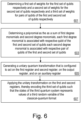
  • Figure 6 is a flowchart of a method for multiplication of two random variables in accordance with an example of the present subject matter.
  • the method described in Figure 6 may be implemented in the system illustrated in Figure 1 , but is not limited to this implementation.
  • the method of Figure 6 may be performed by the computer system 100.
  • the method of Figure 6 may be performed by the computer system 100 using three quantum registers 105.1 through 105.L.
  • the first and second quantum registers may be used to represent respectively first and second CEFV variables using the method of Figure 2 .
  • the method of Figure 2 may be executed for each of the first and second quantum registers in order to provide the first and second CEFV variables.
  • the third quantum register may be provided as an output quantum register for the method of Figure 6 .
  • a determination of a first set of weights for the first set of qubits respectively, a second set of weights for the second set of qubits respectively and a third set of weights for the pairs of qubits of the first set and second set of qubits respectively may be performed.
  • the determining of the three sets of weights may be performed such that the output quantum register after performing the multiplication represents a third random variable of the classical-quantum format.
  • a polynomial may be defined in step 603.
  • the polynomial may be defined as a sum of first degree monomials and second degree monomials. Each first degree monomial is associated with respective qubit of the first and second set of qubits.
  • Each first degree monomial is defined as the product of an unknown and a weight associated with the respective qubit.
  • Each second degree monomial is associated with respective pair of qubits of the first and second set of qubits, wherein each second degree monomial is defined as the product of a weight associated with the respective pair of qubits and two unknowns, respectively associated with the qubit in the first set of qubits and the qubit in the second set of qubits.
  • a unitary quantum transformation that is configured to act on the first quantum register and second quantum register, on the output quantum register, and on an auxiliary register may be generated in order to evaluate the polynomial into the output quantum register.
  • the unitary transformation may be applied in step 607 on the first and second quantum registers, thereby encoding the third set of qubits such that the base states of the computational basis of the third quantum system represent values of a third random variable of the classical-quantum format.
  • the scaling factor, offset factor and possibly the tolerances may be defined for the third CEFV.
  • Figure 7 is a flowchart of a method for determining the weights for the multiplication of two random variables in accordance with an example of the present subject matter.
  • the method described in Figure 7 may be implemented in the system illustrated in Figure 1 , but is not limited to this implementation.
  • the method of Figure 7 may be performed by the computer system 100.
  • a current value of the first, second and third sets of weights may be provided.
  • the first, second and third sets of weights may be randomly set, making sure that each of the first and second sets of weights is an integer.
  • the sum of the absolute value of the weights in the first and second and third sets of weights may be performed.
  • the last determined first, second and third sets of weights may be provided.
  • Figure 8 is a flowchart of a method for determining the weights for the multiplication of two random variables in accordance with an example of the present subject matter.
  • the method described in Figure 8 may be implemented in the system illustrated in Figure 1 , but is not limited to this implementation.
  • the method of Figure 8 may be performed by the computer system 100.
  • a current value of the first, second and third sets of weights may be provided.
  • the first, second and third set of weights may be randomly set, making sure that each of the first and second sets of weights is an integer.
  • the sum of the absolute value of the weights in the first and second and third sets of weights may be performed.
  • step 809 it may be determined in step 809 whether the number of times the condition of step 805 was not fulfilled is higher than a predefined threshold. If so, the last determined first, second and third sets of weights may be provided in step 811; otherwise, the method goes back to step 801 (e.g., trying other values for the weights).
  • Figure 9 is a flowchart of a method for determining weights for the addition of two random variables in accordance with an example of the present subject matter.
  • the method described in Figure 9 may be implemented in the system illustrated in Figure 1 , but is not limited to this implementation.
  • the method of Figure 9 may be performed by the computer system 100.
  • the determined weights for the qubits of the registers may include the integer number M as described above.
  • the iterative method to find the weights may be executed as follows.
  • a current value of the first and second sets of weights may be determined using the integer M .
  • the first and second sets of weights may be randomly set in step 903, making sure that each of the first and second sets of weights is an integer.
  • the sum of the absolute value of the weights in the first and second sets of weights may be performed.
  • the last determined first and second sets of weights may be provided.
  • the mathematical modelling may describe the creation of the CEFV variable, the addition of two CEFV variables and the product of two CEFV variables.
  • the CEFV variable may be defined as follows.
  • the CEFV variable is of length n.
  • a quantum algorithm seen as a tool operating on quantum variables, may make calculations both by (re)defining CEFV variables, and by manipulating input states through quantum circuits.
  • the CEFV variables may be equipped with errors ⁇ - and ⁇ + in order to keep track of the error propagation, as the computation of the sum and the product may be performed only up to a rounding error.
  • Y be a random variable valued in any domain
  • F . >
  • D a , b fp g a , b fp ⁇ ⁇ ⁇ + be a CEFV variable of length n , and
  • X be the random variable g a , b fp -encoded by
  • the random variable Y is said -compatible with the state
  • ⁇ > means that
  • the following one is a first pseudocode of a function for adding two random variables in accordance with an example of the present subject matter.
  • the first pseudocode represents an algorithm named "Algorithm 1".
  • the algorithm is defined in a sequence of steps for performing the sum of two CEFV variables.
  • the steps comprise a step 2 of initializing the number of qubits in the output quantum register, a step 3 of initializing the integer M in accordance with the definition shown in the first pseudocode, a step 4 of determining the weights using the integer M, a step 5 of checking the inequality shown in the first pseudocode, a step 6 to lower the number of qubits in the output quantum register, a step 7 of defining the polynomial, a step 8 of applying the unitary transformation by the function SBPEval(.) and a step 9 for providing the characteristics of the resulting CEFV variable e.g., the offset and scaling factors and the tolerance range.
  • the mathematical modelling of this sum may be provided as follows.
  • the statements of items (i), (ii), (iii) and (iv) may hold for any [ w k, j k ] k , j k however defined, as long as the no-overflow condition is guaranteed, namely the sum of the absolute value of the weights in the first set of weights and in the second set of weights is smaller than or equal to the maximal index 2 n out - 1 of the output quantum register.
  • the choice in step 4 of the first pseudocode may be optimal in the sense that (a) the integer M is calculated in such a way to fully exploit the precision achievable in n max qubits, (b) the definition of the weights minimizes and balances ⁇ approx + and ⁇ approx ⁇ .
  • both registers may be aligned to the same scaling factor, b lead as described with the algorithm of the first pseudocode.
  • the rescaling factor for may be b lead / b 2 , and may be rounded to a binary fraction in order to fit into the representation possibilities of the target register. Said binary fraction is classically known, so that the sum of the two states in their respective scales, gets translated into a weighted sum between integers.
  • the algorithm of the first pseudocode formalizes this approach in which an arbitrary b lead is taken in input, and is further processed to output a b out such that b out / b lead is a power of 2, with integer exponent, and b out is optimized to exploit the available output binary digits for as many significant digits as possible.
  • the target scale b lead may be used as follow. Indeed, the choice of the target scale b lead may both affect the approximation degree and the circuit complexity of the sum.
  • the target scale may be equal to the first scaling factor b 1 or equal to the second scaling factor b 2 . In this way, the weights of the corresponding register become powers of 2, and the circuit may simplify significantly.
  • the choice of b lead may not only impact the performance of individual sum where it is introduced, but also defines the output variable, thus conditioning the cost of all subsequent interactions of the output itself.
  • the algorithm described in the first pseudocode may be improved as follow.
  • step 4 of the first pseudocode may be modified to map a 0.5 decimal into 0 instead 1. This may not affect the error, but reduce weights.
  • step 5 of first pseudocode is equivalent to rounding all weights to a power of 2. At the last iteration, a more refined technique may be to round only some weights; sufficiently many to satisfy the exit condition in step 5, but as little as possible to limit approximation.
  • any given positive integer L in the attempt to increase the result precision, it may be possible to calculate L additional binary digits by resorting to L ancilla qubits, and then uncompute these additional qubits by means of a subtraction modulo 2 L , before returning the result.
  • the following one is a second pseudocode of a function for multiplying two random variables in accordance with an example of the present subject matter.
  • the second pseudocode represents an algorithm named "Algorithm 2".
  • the algorithm is defined in a sequence of steps for performing the product of two CEFV variables.
  • the steps comprise a step 2 of initializing rescaling factors c 1 , c 2 and c prod , a step 3 of initializing the number of qubits in the output quantum register, a step 4 of initializing the integer M in accordance with the definition shown in the second pseudocode, a step 5 of determining the weights using the integer M and the rescaling factors, a step 6 of checking the inequality shown in the second pseudocode, a step 7 to lower the number of qubits in the output quantum register, a step 8 of defining the polynomial, a step 9 of applying the unitary transformation by the function SBPEval(.) and a step 10 for providing the characteristics of the resulting CEFV variable e.g., the offset and scaling factors and the tolerance range.
  • the mathematical modelling of this multiplication may be provided as follows.
  • Algorithm 2 shows an implementation recurring to a single polynomial, which is more accurate than making the product Z 1 Z 2 at first, and the sum afterwards.
  • a method for providing a quantum variable comprising: providing a quantum register comprising a set of qubits defining a quantum system; representing states of the quantum system in a computational basis by an ordered set of consecutive nonnegative integer numbers, referred to as a set of indexes; determining a random variable in accordance with a predefined classical-quantum format, wherein the random variable is valued in a finite domain of classical values such that each value of the domain is derived from a respective index of the set of indexes through an affine relationship, the affine relationship being defined by a scaling factor and an offset factor; encoding the set of qubits to represent the random variable, wherein the encoding is performed such that the probability of measuring a state of the quantum system in the computational basis is the probability of observing the domain value associated with the index representing said measured state when sampling the random variable.
  • determining the random variable in accordance with the classical-quantum format further comprises: determining a tolerance range; performing the encoding such that an approximate of the domain value and the domain value are represented with the same quantum state in case the difference between the domain value and the approximate is within the tolerance range.
  • a method for providing quantum variables comprising: providing a first quantum register comprising a first set of qubits defining a first quantum system and a second quantum register comprising a second set of qubits defining a second quantum system; representing states of the first quantum system in a computational basis by an ordered set of consecutive first indexes; representing states of the second quantum system in a computational basis by an ordered set of consecutive second indexes; determining a first random variable and a second random variable of a classical-quantum format, the first random variable being valued in a finite first domain of classical values such that each value of the first domain is derived from a respective first index of the set of first indexes through a first affine relationship, the first affine relationship being defined by a first scaling factor and a first offset factor, the second random variable being valued in a finite second domain of classical values such that each value of the second domain is derived from a respective second index of the set of second indexes through a second affine relationship, the second affine relationship
  • Clause 4 The method of clause 3, the first and second random variables being independent, wherein the encoding comprises: encoding the first set of qubits such that the probability of measuring a state of the first quantum system in the computational basis is the probability of observing the first domain value associated with the first index representing said measured state when sampling the first random variable; and encoding the second set of qubits such that the probability of measuring a state of the second quantum system in the computational basis is the probability of observing the second domain value associated with the second index representing said measured state when sampling the second random variable.
  • Clause 5 The method of clause 3, the first and second random variables being dependent, wherein the encoding of the first and second sets of qubits is performed such that the probability of measuring a state of a joint quantum system of the first and second quantum systems in the computational basis is the probability of jointly observing the first domain value associated with the first index representing said measured state when sampling the first random variable and the second domain value associated with the second index representing said measured state when sampling the second random variable.
  • Clause 6 The method of any of the preceding clauses 3 to 5, further comprising determining a sum of the first and second random variables, the performing of the sum comprising: providing an output quantum register comprising a third set of qubits, thereby defining a third quantum system, the first, second and third quantum systems forming a joint quantum system; determining a first set of weights for the first set of qubits respectively and a second set of weights for the second set of qubits respectively, the determining is performed such that the output quantum register after performing the sum represents a third random variable of the classical-quantum format; defining an unknown for each qubit of the first and second quantum registers; defining a monomial for each unknown, the monomial being the unknown multiplied by the weight associated to the respective qubit; defining a polynomial as the sum of the monomials; generating a unitary quantum transformation that is configured to act on the first quantum register and second quantum register, on the output quantum register, and on an auxiliary register, in order to evaluate the
  • Clause 7 The method of clause 6, wherein the states of the computational basis of the third quantum system represent values of the third random variable of the classical-quantum format through a third affine relationship defined by a third scaling factor and a third offset factor, wherein the third offset factor is the classical sum of the first and second offsets and the third scaling factor is the product of an alignment scale and a predefined target scale, wherein the alignment scale is the inverse of a power of two such that the sum can be performed without overflow, the alignment scale being provided
  • Clause 10 The method of clause 9 or 8, wherein the determining of the first and second set of weights is iteratively performed by at least: a)initializing M to an upper bound b) determining current first and second sets of weights; c) computing the sum of the absolute value of the weights in the first and in the second sets of weights; d) determining whether the sum is smaller than or equal to the maximal index 2 n out - 1 of the output quantum register; e) in case the sum is higher than the maximal index, decreasing M by 1 and repeating b) to d); providing the last determined first and second sets of weights.
  • Clause 11 The method of clause 10, the providing of the first set and second set of weights further comprising lowering the number of qubits in the output quantum register to a closest number of the sum that is a power of two.
  • Clause 13 The method of any of the preceding clauses 3 to 12, further comprising performing a multiplication of the first and second random variables, the performing of the multiplication comprising: providing an output quantum register comprising a third set of qubits, thereby defining a third quantum system, the first, second and third quantum systems forming a joint quantum system; determining a first set of weights for the first set of qubits respectively and a second set of weights for the second set of qubits respectively and a third set of qubits for the pairs of qubits of the first set and second set of qubits respectively, the determining being performed such that the output quantum register after performing the multiplication represents a third random variable of the classical-quantum format; defining the polynomial as a sum of first degree monomials and second degree monomials, wherein each first degree monomial is associated with respective qubit of the first and second set of qubits, wherein each first degree monomial is defined as the product of an unknown and a weight associated with the respective qubit
  • Clause 14 The method of clause 13, wherein the states of the computational basis of the third quantum system represent values of the third random variable of the classical-quantum format through a third affine relationship defined by a third scaling factor and a third offset factor, wherein the third offset factor is the classical product of the first and second offsets and the third scaling factor is a given target scale.
  • each weight comprising an alignment scale, wherein the alignment scale is equal to the inverse of two to the power of an integer M , where M is the highest integer so that the sum of the absolute value of the weights in the first set of weights and in the second set of weights and in the third set of weights is smaller than or equal to the maximal index of the output quantum register, wherein the alignment scale is provided such that the product can be performed without overflow.
  • Clause 16 The method of clause 14 or 15, the target scale being one of the first and second scaling factors.
  • Clause 17 The method of any of the preceding clauses 13 to 16, wherein the determining the first and second set of weights is iteratively performed by at least: a) determining current first, second and third sets of weights; b) computing the sum of the first, second and third sets of weights; c) determining whether the sum is smaller than or equal to the maximal index 2 n out - 1 of the output quantum register; d) in case the sum is higher than the maximal index, repeating a) to c); e) providing the last determined first, second and third sets of weights.
  • Clause 18 The method of clause 17, the providing of the first set, second set and third set of weights further comprising lowering the number of qubits in the output quantum register to a power of two number which is closest to the sum.
  • Clause 19 The method of any of the preceding clauses 1 to 18, further comprising performing a statistical analysis using the method of any of the preceding claims.
  • each scaling factor of the scaling factors is a nonzero real number and/or each offset factor of the offset factors is a real number.
  • Computing environment 1800 contains an example of an environment for the execution of at least some of the computer code involved in performing the inventive methods, such as a code 1900 for providing access to a quantum random variable e.g., performing the classical part of the computations involved in the definition of the quantum variable.
  • computing environment 1800 includes, for example, computer 1801, wide area network (WAN) 1802, end user device (EUD) 1803, remote server 1804, public cloud 1805, and private cloud 1806.
  • computer 1801 includes processor set 1810 (including processing circuitry 1820 and cache 1821), communication fabric 1811, volatile memory 1812, persistent storage 1813 (including operating system 1822 and block 1900, as identified above), peripheral device set 1814 (including user interface (UI) device set 1823, storage 1824, and Internet of Things (IoT) sensor set 1825), and network module 1815.
  • Remote server 1804 includes remote database 1830.
  • Public cloud 1805 includes gateway 1840, cloud orchestration module 1841, host physical machine set 1842, virtual machine set 1843, and container set 1844.
  • COMPUTER 1801 may take the form of a desktop computer, laptop computer, tablet computer, smart phone, smart watch or other wearable computer, mainframe computer, quantum computer or any other form of computer or mobile device now known or to be developed in the future that is capable of running a program, accessing a network or querying a database, such as remote database 1830.
  • performance of a computer-implemented method may be distributed among multiple computers and/or between multiple locations.
  • this presentation of computing environment 1800 detailed discussion is focused on a single computer, specifically computer 1801, to keep the presentation as simple as possible.
  • Computer 1801 may be located in a cloud, even though it is not shown in a cloud in Figure 10 .
  • computer 1801 is not required to be in a cloud except to any extent as may be affirmatively indicated.
  • PROCESSOR SET 1810 includes one, or more, computer processors of any type now known or to be developed in the future.
  • Processing circuitry 1820 may be distributed over multiple packages, for example, multiple, coordinated integrated circuit chips.
  • Processing circuitry 1820 may implement multiple processor threads and/or multiple processor cores.
  • Cache 1821 is memory that is located in the processor chip package(s) and is typically used for data or code that should be available for rapid access by the threads or cores running on processor set 1810.
  • Cache memories are typically organized into multiple levels depending upon relative proximity to the processing circuitry. Alternatively, some, or all, of the cache for the processor set may be located "off chip.”
  • processor set 1810 may be designed for working with qubits and performing quantum computing.
  • Computer readable program instructions are typically loaded onto computer 1801 to cause a series of operational steps to be performed by processor set 1810 of computer 1801 and thereby effect a computer-implemented method, such that the instructions thus executed will instantiate the methods specified in flowcharts and/or narrative descriptions of computer-implemented methods included in this document (collectively referred to as "the inventive methods").
  • These computer readable program instructions are stored in various types of computer readable storage media, such as cache 1821 and the other storage media discussed below.
  • the program instructions, and associated data are accessed by processor set 1810 to control and direct performance of the inventive methods.
  • at least some of the instructions for performing the inventive methods may be stored in block 1900 in persistent storage 1813.
  • COMMUNICATION FABRIC 1811 is the signal conduction path that allows the various components of computer 1801 to communicate with each other.
  • this fabric is made of switches and electrically conductive paths, such as the switches and electrically conductive paths that make up busses, bridges, physical input / output ports and the like.
  • Other types of signal communication paths may be used, such as fiber optic communication paths and/or wireless communication paths.
  • VOLATILE MEMORY 1812 is any type of volatile memory now known or to be developed in the future. Examples include dynamic type random access memory (RAM) or static type RAM. Typically, volatile memory 1812 is characterized by random access, but this is not required unless affirmatively indicated. In computer 1801, the volatile memory 1812 is located in a single package and is internal to computer 1801, but, alternatively or additionally, the volatile memory may be distributed over multiple packages and/or located externally with respect to computer 1801.
  • RAM dynamic type random access memory
  • static type RAM static type RAM.
  • volatile memory 1812 is characterized by random access, but this is not required unless affirmatively indicated.
  • the volatile memory 1812 is located in a single package and is internal to computer 1801, but, alternatively or additionally, the volatile memory may be distributed over multiple packages and/or located externally with respect to computer 1801.
  • PERSISTENT STORAGE 1813 is any form of non-volatile storage for computers that is now known or to be developed in the future.
  • the non-volatility of this storage means that the stored data is maintained regardless of whether power is being supplied to computer 1801 and/or directly to persistent storage 1813.
  • Persistent storage 1813 may be a read only memory (ROM), but typically at least a portion of the persistent storage allows writing of data, deletion of data and re-writing of data. Some familiar forms of persistent storage include magnetic disks and solid state storage devices.
  • Operating system 1822 may take several forms, such as various known proprietary operating systems or open source Portable Operating System Interface-type operating systems that employ a kernel.
  • the code included in block 1900 typically includes at least some of the computer code involved in performing the inventive methods.
  • PERIPHERAL DEVICE SET 1814 includes the set of peripheral devices of computer 1801.
  • Data communication connections between the peripheral devices and the other components of computer 1801 may be implemented in various ways, such as Bluetooth connections, Near-Field Communication (NFC) connections, connections made by cables (such as universal serial bus (USB) type cables), insertion-type connections (for example, secure digital (SD) card), connections made through local area communication networks and even connections made through wide area networks such as the internet.
  • UI device set 1823 may include components such as a display screen, speaker, microphone, wearable devices (such as goggles and smart watches), keyboard, mouse, printer, touchpad, game controllers, and haptic devices.
  • Storage 1824 is external storage, such as an external hard drive, or insertable storage, such as an SD card. Storage 1824 may be persistent and/or volatile. In some embodiments, storage 1824 may take the form of a quantum computing storage device for storing data in the form of qubits. In embodiments where computer 1801 is required to have a large amount of storage (for example, where computer 1801 locally stores and manages a large database) then this storage may be provided by peripheral storage devices designed for storing very large amounts of data, such as a storage area network (SAN) that is shared by multiple, geographically distributed computers.
  • IoT sensor set 1825 is made up of sensors that can be used in Internet of Things applications. For example, one sensor may be a thermometer and another sensor may be a motion detector.
  • NETWORK MODULE 1815 is the collection of computer software, hardware, and firmware that allows computer 1801 to communicate with other computers through WAN 1802.
  • Network module 1815 may include hardware, such as modems or Wi-Fi signal transceivers, software for packetizing and/or de-packetizing data for communication network transmission, and/or web browser software for communicating data over the internet.
  • network control functions and network forwarding functions of network module 1815 are performed on the same physical hardware device. In other embodiments (for example, embodiments that utilize software-defined networking (SDN)), the control functions and the forwarding functions of network module 1815 are performed on physically separate devices, such that the control functions manage several different network hardware devices.
  • Computer readable program instructions for performing the inventive methods can typically be downloaded to computer 1801 from an external computer or external storage device through a network adapter card or network interface included in network module 1815.
  • WAN 1802 is any wide area network (for example, the internet) capable of communicating computer data over non-local distances by any technology for communicating computer data, now known or to be developed in the future.
  • the WAN 1802 may be replaced and/or supplemented by local area networks (LANs) designed to communicate data between devices located in a local area, such as a Wi-Fi network.
  • LANs local area networks
  • the WAN and/or LANs typically include computer hardware such as copper transmission cables, optical transmission fibers, wireless transmission, routers, firewalls, switches, gateway computers and edge servers.
  • EUD 1803 is any computer system that is used and controlled by an end user (for example, a customer of an enterprise that operates computer 1801), and may take any of the forms discussed above in connection with computer 1801. EUD 1803 typically receives helpful and useful data from the operations of computer 1801. For example, in a hypothetical case where computer 1801 is designed to provide a recommendation to an end user, this recommendation would typically be communicated from network module 1815 of computer 1801 through WAN 1802 to EUD 1803. In this way, EUD 1803 can display, or otherwise present, the recommendation to an end user.
  • EUD 1803 may be a client device, such as thin client, heavy client, mainframe computer, desktop computer and so on.
  • REMOTE SERVER 1804 is any computer system that serves at least some data and/or functionality to computer 1801. Remote server 1804 may be controlled and used by the same entity that operates computer 1801. Remote server 1804 represents the machine(s) that collect and store helpful and useful data for use by other computers, such as computer 1801. For example, in a hypothetical case where computer 1801 is designed and programmed to provide a recommendation based on historical data, then this historical data may be provided to computer 1801 from remote database 1830 of remote server 1804.
  • PUBLIC CLOUD 1805 is any computer system available for use by multiple entities that provides on-demand availability of computer system resources and/or other computer capabilities, especially data storage (cloud storage) and computing power, without direct active management by the user.
  • Cloud computing typically leverages sharing of resources to achieve coherence and economies of scale.
  • the direct and active management of the computing resources of public cloud 1805 is performed by the computer hardware and/or software of cloud orchestration module 1841.
  • the computing resources provided by public cloud 1805 are typically implemented by virtual computing environments that run on various computers making up the computers of host physical machine set 1842, which is the universe of physical computers in and/or available to public cloud 1805.
  • the virtual computing environments (VCEs) typically take the form of virtual machines from virtual machine set 1843 and/or containers from container set 1844.
  • VCEs may be stored as images and may be transferred among and between the various physical machine hosts, either as images or after instantiation of the VCE.
  • Cloud orchestration module 1841 manages the transfer and storage of images, deploys new instantiations of VCEs and manages active instantiations of VCE deployments.
  • Gateway 1840 is the collection of computer software, hardware, and firmware that allows public cloud 1805 to communicate through WAN 1802.
  • VCEs can be stored as "images.” A new active instance of the VCE can be instantiated from the image.
  • Two familiar types of VCEs are virtual machines and containers.
  • a container is a VCE that uses operating-system-level virtualization. This refers to an operating system feature in which the kernel allows the existence of multiple isolated user-space instances, called containers. These isolated user-space instances typically behave as real computers from the point of view of programs running in them.
  • a computer program running on an ordinary operating system can utilize all resources of that computer, such as connected devices, files and folders, network shares, CPU power, and quantifiable hardware capabilities.
  • programs running inside a container can only use the contents of the container and devices assigned to the container, a feature which is known as containerization.
  • PRIVATE CLOUD 1806 is similar to public cloud 1805, except that the computing resources are only available for use by a single enterprise. While private cloud 1806 is depicted as being in communication with WAN 1802, in other embodiments a private cloud may be disconnected from the internet entirely and only accessible through a local/private network.
  • a hybrid cloud is a composition of multiple clouds of different types (for example, private, community or public cloud types), often respectively implemented by different vendors. Each of the multiple clouds remains a separate and discrete entity, but the larger hybrid cloud architecture is bound together by standardized or proprietary technology that enables orchestration, management, and/or data/application portability between the multiple constituent clouds.
  • public cloud 1805 and private cloud 1806 are both part of a larger hybrid cloud.
  • CPP embodiment is a term used in the present disclosure to describe any set of one, or more, storage media (also called “mediums”) collectively included in a set of one, or more, storage devices that collectively include machine readable code corresponding to instructions and/or data for performing computer operations specified in a given CPP claim.
  • storage device is any tangible device that can retain and store instructions for use by a computer processor.
  • the computer readable storage medium may be an electronic storage medium, a magnetic storage medium, an optical storage medium, an electromagnetic storage medium, a semiconductor storage medium, a mechanical storage medium, or any suitable combination of the foregoing.
  • Some known types of storage devices that include these mediums include: diskette, hard disk, random access memory (RAM), read-only memory (ROM), erasable programmable read-only memory (EPROM or Flash memory), static random access memory (SRAM), compact disc read-only memory (CD-ROM), digital versatile disk (DVD), memory stick, floppy disk, mechanically encoded device (such as punch cards or pits / lands formed in a major surface of a disc) or any suitable combination of the foregoing.
  • RAM random access memory
  • ROM read-only memory
  • EPROM or Flash memory erasable programmable read-only memory
  • SRAM static random access memory
  • CD-ROM compact disc read-only memory
  • DVD digital versatile disk
  • memory stick floppy disk
  • mechanically encoded device such as punch cards or pits / lands formed in a major surface of a disc
  • a computer readable storage medium is not to be construed as storage in the form of transitory signals per se, such as radio waves or other freely propagating electromagnetic waves, electromagnetic waves propagating through a waveguide, light pulses passing through a fiber optic cable, electrical signals communicated through a wire, and/or other transmission media.
  • transitory signals such as radio waves or other freely propagating electromagnetic waves, electromagnetic waves propagating through a waveguide, light pulses passing through a fiber optic cable, electrical signals communicated through a wire, and/or other transmission media.
  • data is typically moved at some occasional points in time during normal operations of a storage device, such as during access, de-fragmentation or garbage collection, but this does not render the storage device as transitory because the data is not transitory while it is stored.

Landscapes

  • Engineering & Computer Science (AREA)
  • General Physics & Mathematics (AREA)
  • Physics & Mathematics (AREA)
  • Theoretical Computer Science (AREA)
  • Software Systems (AREA)
  • Computational Mathematics (AREA)
  • Data Mining & Analysis (AREA)
  • Evolutionary Computation (AREA)
  • Condensed Matter Physics & Semiconductors (AREA)
  • Mathematical Analysis (AREA)
  • Mathematical Optimization (AREA)
  • Pure & Applied Mathematics (AREA)
  • Computing Systems (AREA)
  • General Engineering & Computer Science (AREA)
  • Mathematical Physics (AREA)
  • Artificial Intelligence (AREA)
  • Complex Calculations (AREA)

Abstract

The present disclosure relates to a method comprising: providing a quantum register comprising a set of qubits defining a quantum system. The states of a computational basis of the quantum system may be represented by an ordered set of consecutive nonnegative integer numbers, referred to as a set of indexes. A random variable may be determined in accordance with a predefined classical-quantum format, wherein the random variable is valued in a finite domain of classical values such that each value of the domain is derived from a respective index of the set of indexes through an affine relationship, the affine relationship being defined by a scaling factor and an offset factor. The set of qubits may be encoded such that the probability of measuring a state of the quantum system in the computational basis is the probability of observing the domain value associated with the index representing said measured state when sampling the random variable.

Description

    BACKGROUND
  • The present invention relates to the field of digital computer systems, and more specifically, to a method for determining quantum variables.
  • The relevance of quantum floating-point arithmetic is paramount across multiple application fields. However, the precision of a floating-point variable degrades significantly as an effect of repeated arithmetic manipulations, when the register size is fixed and a no-overflow requirement is guaranteed on all data points.
  • SUMMARY
  • Various embodiments provide a method for determining quantum variables, computer program product and computer system as described by the subject matter of the independent claims. Advantageous embodiments are described in the dependent claims. Embodiments of the present invention can be freely combined with each other if they are not mutually exclusive.
  • An aspect of the present invention relates to a method for operating a computer system.
  • The method comprises providing in the computer system a quantum register storing a set of qubits defining a quantum system having a computational basis comprising a set of base states, a generic state of the quantum system being a linear combination of said set of base states, a coefficient of each base state in the linear combination corresponding to the square root of a probability of measuring the base state.
  • The method comprises providing an ordered set of consecutive nonnegative integer indexes, each index being associated to a different respective one of the base states.
  • The method comprises providing a random variable having a probability distribution in a corresponding domain.
  • The method comprises mapping each one of a finite set of domain values within said domain to a different respective one of the indexes of the set through a bijective affine transformation, said affine transformation providing for expressing each domain value of the set in function of the respective index through a scaling of said respective index and a offset applied to the scaled index.
  • The method comprises representing said random variable in the computer system through said quantum system, said representing said random variable comprising generating a quantum variable identifying a state of the quantum system, said generating the quantum variable comprising setting each coefficient of each base state to the square root of the value of the probability distribution at the domain value mapped to the index associated to said base state.
  • According to an embodiment of the present invention, said mapping comprises defining a tolerance range around each of the domain values of the set.
  • According to an embodiment of the present invention, said mapping comprises approximating values of the random variable within the tolerance range around a corresponding domain value by the corresponding domain value, thereby values of the random variable within the tolerance range around a domain value of the set are mapped to the index to which said domain value of the set is mapped.
  • According to an embodiment of the present invention, said quantum register comprises a first quantum register storing a first set of qubits defining a first quantum system having a first computational basis comprising a set of first base states, a generic state of the first quantum system being a linear combination of said set of first base states, a coefficient of each first base state in the linear combination corresponding to the square root of a probability of measuring the first base state;
    According to an embodiment of the present invention, said quantum register comprises a second quantum register storing a second set of qubits defining a second quantum system having a second computational basis comprising a set of second base states, a generic state of the second quantum system being a linear combination of said set of second base states, a coefficient of each second base state in the linear combination corresponding to the square root of a probability of measuring the second base state.
  • According to an embodiment of the present invention, said providing an ordered set of consecutive nonnegative integer indexes comprises providing a first ordered set of consecutive nonnegative integer first indexes, each first index being associated to a different respective one of the first base states.
  • According to an embodiment of the present invention, said providing an ordered set of consecutive nonnegative integer indexes comprises providing a second ordered set of consecutive nonnegative integer second indexes, each second index being associated to a different respective one of the second base states.
  • According to an embodiment of the present invention, said providing a random variable comprises providing a first and second independent random variables, said first random variable having a first probability distribution in a corresponding first domain, said second random variable having a second probability distribution in a corresponding second domain.
  • According to an embodiment of the present invention, said mapping comprises mapping each one of a finite set of first domain values within said first domain to a different respective one of the first indexes of the set through a bijective first affine transformation, said first affine transformation providing for expressing each first domain value of the set in function of the respective first index through a first scaling of said respective first index and a first offset applied to the scaled first index.
  • According to an embodiment of the present invention, said mapping comprises mapping each one of a finite set of second domain values within said second domain to a different respective one of the second indexes of the set through a bijective second affine transformation, said second affine transformation providing for expressing each second domain value of the set in function of the respective second index through a second scaling of said respective second index and a second offset applied to the scaled second index.
  • According to an embodiment of the present invention, said representing said random variable in the computer system through said quantum system comprises representing said first random variable in the computer system through said first quantum system, said representing said first random variable comprising generating a first quantum variable identifying a first state of the first quantum system, said generating the first quantum variable comprising setting each coefficient of each first base state to the square root of the value of the first probability distribution at the first domain value mapped to the first index associated to said first base state.
  • According to an embodiment of the present invention, said representing said random variable in the computer system through said quantum system comprises representing said second random variable in the computer system through said second quantum system, said representing said second random variable comprising generating a second quantum variable identifying a second state of the second quantum system, said generating the second quantum variable comprising setting each coefficient of each second base state to the square root of the value of the second probability distribution at the second domain value mapped to the second index associated to said second base state.
  • According to an embodiment of the present invention, said random variable comprises a first and second dependent random variables.
  • According to an embodiment of the present invention, said probability distribution comprises a joint probability distribution in a first domain for the first random variable and in a second domain for the second random variable.
  • According to an embodiment of the present invention, said quantum register comprises a first quantum register storing a first set of qubits defining a first quantum system having a first computational basis comprising a set of first base states, a generic state of the first quantum system being a linear combination of said set of first base states, a coefficient of each first base state in the linear combination corresponding to the square root of a probability of measuring the first base state;
    According to an embodiment of the present invention, said quantum variable comprises a second quantum register storing a second set of qubits defining a second quantum system having a second computational basis comprising a set of second base states, a generic state of the second quantum system being a linear combination of said set of second base states, a coefficient of each second base state in the linear combination corresponding to the square root of a probability of measuring the second base state.
  • According to an embodiment of the present invention, said providing an ordered set of consecutive nonnegative integer indexes comprises providing a first ordered set of consecutive nonnegative integer first indexes, each first index being associated to a different respective one of the first base states.
  • According to an embodiment of the present invention, said providing an ordered set of consecutive nonnegative integer indexes comprises providing a second ordered set of consecutive nonnegative integer second indexes, each second index being associated to a different respective one of the second base states.
  • According to an embodiment of the present invention, said mapping comprises mapping each one of a finite set of first domain values within said first domain to a different respective one of the first indexes of the set through a bijective first affine transformation, said first affine transformation providing for expressing each first domain value of the set in function of the respective first index through a first scaling of said respective first index and a first offset applied to the scaled first index.
  • According to an embodiment of the present invention, said mapping comprises mapping each one of a finite set of second domain values within said second domain to a different respective one of the second indexes of the set through a bijective second affine transformation, said second affine transformation providing for expressing each second domain value of the set in function of the respective second index through a second scaling of said respective second index and a second offset applied to the scaled second index.
  • According to an embodiment of the present invention, said representing said random variable comprises representing said first and second dependent random variables in the computer system through a joint quantum system being the interconnection of said first quantum system with said second quantum system, and generating a joint quantum variable identifying a state of the joint quantum system, a probability of measuring a state of the joint quantum system being set to a value of said joint probability distribution corresponding to a domain pair including a first domain value and a second domain value.
  • According to an embodiment of the present invention, the method further comprises determining a sum of the first and second random variables.
  • According to an embodiment of the present invention, said determining of the sum comprises providing an output quantum register storing a third set of qubits, thereby defining a third quantum system having a computational basis comprising a set of base states.
  • According to an embodiment of the present invention, said sum of the first and second random variables is determined as a third random variable represented in the computer system through said third quantum system.
  • According to an embodiment of the present invention, the state of the third quantum system in the computational basis represents a value of the third random variable based on a mapping, through a third affine relationship, of third domain values within a third domain of the third random variable to third indexes of third ordered set of consecutive nonnegative integer third indexes.
  • According to an embodiment of the present invention, each third index is associated to a different respective one of the third base states.
  • According to an embodiment of the present invention, said third affine relationship provides for expressing each third domain value in function of a respective third index through a third scaling of said respective third index and a third offset applied to the scaled third index.
  • According to an embodiment of the present invention, said determining of the sum comprises receiving a target scaling parameter identifying a target value for such third scaling.
  • According to an embodiment of the present invention, said determining of the sum comprises generating a first set of first weights associated to the first base states and a second set of second weights associated to the second base states by performing the following sequence of operations:
    1. a) providing an integer M;
    2. b) setting current values for the first weights, each first weight being set to the closest integer rounding of a number in direct proportion to 2 to the first index of the first base associated to the first weight, in direct proportion to 2 to M, in direct proportion to the first scaling of the first index, and in inverse proportion to said target scaling parameter;
    3. c) setting current values for the second weights, each second weight being set to the closest integer rounding of a number in direct proportion to 2 to the second index of the second base associated to the second weight, in direct proportion to 2 to M, in direct proportion to the second scaling of the second index, and in inverse proportion to said target scaling parameter;
    4. d) computing the sum of the absolute value of the current first and second weights;
    5. e) determining whether the sum is smaller than or equal to a maximum third index;
    6. f) in case the sum is higher than the maximum third index, decreasing M by 1 and repeating b) to e);
  • According to an embodiment of the present invention, said determining of the sum comprises associating first unknowns to each first base state of the first quantum system.
  • According to an embodiment of the present invention, said determining of the sum comprises associating second unknowns to each second base state of the second quantum system.
  • According to an embodiment of the present invention, said determining of the sum comprises providing a monomial for each unknown, the monomial comprising the unknown multiplied by the weight associated to the respective base state.
  • According to an embodiment of the present invention, said determining of the sum comprises defining a polynomial as the sum of the monomials.
  • According to an embodiment of the present invention, said determining of the sum comprises providing a quantum circuit having an input coupled to the first quantum register and to the second quantum register, and an output coupled to the output quantum register.
  • According to an embodiment of the present invention, said determining of the sum comprises the quantum circuit is configured to apply a quantum transformation for evaluating the polynomial into the output register by setting the first unknowns based on the first set of qubits of the first quantum system and by setting the second unknowns based on the second set of qubits of the second quantum system.
  • According to an embodiment of the present invention, said determining of the sum comprises applying the quantum transformation on the first quantum register and second quantum register to evaluate the polynomial into the output quantum register.
  • According to an embodiment of the present invention, the method further comprises setting said third offset to the first offset plus the second offset.
  • According to an embodiment of the present invention, the method further comprises setting said third scaling to the value of the target scaling parameter multiplied by 2 to minus M.
  • According to an embodiment of the present invention, said integer M depends on:
    • the first scaling;
    • the second scaling;
    • the value of the target scaling parameter;
    • the number of qubits of the first set of qubits;
    • the number of qubits of the second set of qubits;
    • the number of qubits of the third set of qubits.
  • According to an embodiment of the present invention, said generating the first set of first weights and the second set of second weights further comprises lowering the number of qubits in the third set of qubits to a closest number of the sum that is a power of two.
  • According to an embodiment of the present invention, the method further comprises determining a multiplication of the first and second random variables.
  • According to an embodiment of the present invention, the determining of the multiplication comprises providing an output quantum register storing a third set of qubits, thereby defining a third quantum system having a computational basis comprising a set of base states.
  • According to an embodiment of the present invention, said multiplication of the first and second random variables is determined as a third random variable represented in the computer system through said third quantum system,
  • According to an embodiment of the present invention, the state of the third quantum system in the computational basis represents a value of the third random variable based on a mapping, through a third affine relationship, of third domain values within a third domain of the third random variable to third indexes of third ordered set of consecutive nonnegative integer third indexes.
  • According to an embodiment of the present invention, each third index is associated to a different respective one of the third base states.
  • According to an embodiment of the present invention, said third affine relationship provides for expressing each third domain value in function of a respective third index through a third scaling of said respective third index and a third offset applied to the scaled third index.
  • According to an embodiment of the present invention, the determining of the multiplication comprises receiving a target scaling parameter identifying a target value for such third scaling.
  • According to an embodiment of the present invention, the determining of the multiplication comprises generating a first set of first weights associated to the first base states, a second set of second weights associated to the second base states, and a third set of third weights associated to base state pairs each including a first base state and a second base state by performing the following sequence of operations:
    • g) providing an integer M;
    • h) setting current values for the first weights, each first weight being set to the closest integer rounding of a number in direct proportion to 2 to the first index of the first base associated to the first weight, in direct proportion to 2 to M, in direct proportion to a number equal to the first scaling of the first index multiplied by the second offset, and in inverse proportion to said target scaling parameter;
    • i)setting current values for the second weights, each second weight being set to the closest integer rounding of a number in direct proportion to 2 to the second index of the second base associated to the second weight, in direct proportion to 2 to M, in direct proportion to a number equal to the second scaling of the second index multiplied by the first offset, and in inverse proportion to said target scaling parameter;
    • j)setting current values for the third weights, each third weight being set to the closest integer rounding of a number in direct proportion to 2 to an exponent value equal to the sum of the first and second indexes of the first and second base states of the base state pair associated to the third weight, in direct proportion to 2 to M, in direct proportion to a number equal to the first scaling of the first index multiplied by the second scaling of the second index, and in inverse proportion to said target scaling parameter;
    • k) computing the sum of the absolute value of the current first, second and third weights;
    • l) determining whether the sum is smaller than or equal to a maximum third index;
    • m) in case the sum is higher than the maximum third index, decreasing M by 1 and repeating h) to l).
  • According to an embodiment of the present invention, the determining of the multiplication comprises associating first unknowns to each first base state of the first quantum system.
  • According to an embodiment of the present invention, the determining of the multiplication comprises associating second unknowns to each second base state of the second quantum system.
  • According to an embodiment of the present invention, the determining of the multiplication comprises providing a first monomial for each first unknown, each first monomial comprising a first unknown multiplied by the first weight associated to the respective first base state.
  • According to an embodiment of the present invention, the determining of the multiplication comprises providing a second monomial for each second unknown, each second monomial comprising a second unknown multiplied by the second weight associated to the respective second base state.
  • According to an embodiment of the present invention, the determining of the multiplication comprises providing a third monomial for each of unknown pair including a pair of first and second unknowns, each third monomial comprising the product between:
    • the first unknown of the pair;
    • the second unknown of the pair;
    • the third weight associated to the base state pair including the first base state associated to the first unknown of the unknown pair and the second base state associated to the second unknown of the unknown pair.
  • According to an embodiment of the present invention, the determining of the multiplication comprises defining a polynomial as the sum of the first, second and third monomials.
  • According to an embodiment of the present invention, the determining of the multiplication comprises providing a quantum circuit having an input coupled to the first quantum register and to the second quantum register, and an output coupled to the output quantum register, the quantum circuit being configured to apply a quantum transformation for evaluating the polynomial into the output register by setting the first unknowns based on the first set of qubits of the first quantum system and by setting the second unknowns based on the second set of qubits of the second quantum system.
  • According to an embodiment of the present invention, the determining of the multiplication comprises applying the quantum transformation on the first quantum register and second quantum register to evaluate the polynomial into the output quantum register.
  • According to an embodiment of the present invention, the method further comprises setting said third offset to the first offset multiplied by the second offset.
  • According to an embodiment of the present invention, the method further comprises setting said third scaling to the value of the target scaling parameter.
  • According to an embodiment of the present invention, said integer M depends on:
    • the first scaling;
    • the second scaling;
    • the value of the target scaling parameter;
    • the number of qubits of the first set of qubits;
    • the number of qubits of the second set of qubits;
    • the number of qubits of the third set of qubits.
  • According to an embodiment of the present invention, said generating the first set of first weights, the second set of second weights and the third set of third weights further comprises lowering the number of qubits in the third set of qubits to a closest number of the sum that is a power of two.
  • According to an embodiment of the present invention, said target scaling parameter has a value corresponding to one of said first scaling and said second scaling.
  • Another aspect of the present invention relates to a computer system comprising a quantum register storing a set of qubits defining a quantum system having a computational basis comprising a set of base states, a generic state of the quantum system being a linear combination of said set of base states, a coefficient of each base state in the linear combination corresponding to the square root of a probability of measuring the base state.
  • According to an embodiment of the present invention, the computer system is configured to provide an ordered set of consecutive nonnegative integer indexes, each index being associated to a different respective one of the base states.
  • According to an embodiment of the present invention, the computer system is configured to provide a random variable having a probability distribution in a corresponding domain.
  • According to an embodiment of the present invention, the computer system is configured to map each one of a finite set of domain values within said domain to a different respective one of the indexes of the set through a bijective affine transformation.
  • According to an embodiment of the present invention, said affine transformation provides for expressing each domain value of the set in function of the respective index through a scaling of said respective index and a offset applied to the scaled index.
  • According to an embodiment of the present invention, the computer system is configured to represent said random variable in the computer system through said quantum system.
  • According to an embodiment of the present invention, said representing said random variable comprises generating a quantum variable identifying a state of the quantum system.
  • According to an embodiment of the present invention, said generating the quantum variable comprises setting each coefficient of each base state to the square root of the value of the probability distribution at the domain value mapped to the index associated to said base state.
  • Another aspect of the present invention relates to a computer program configured for causing a computer system to perform the method according to the above when the computer program is executed on the computer system.
  • Another aspect of the present invention relates to a computer program product comprising one or more computer readable storage media having program instructions collectively stored on the readable storage media, the program instructions being readable by a computer system to cause the computer system to perform the method according to the above.
  • BRIEF DESCRIPTION OF THE DRAWINGS
  • In the following embodiments of the invention are explained in greater detail, by way of example only, making reference to the drawings in which:
    • Fig. 1 is a block diagram of a computer system in accordance with an example of the present subject matter.
    • Fig. 2 is a flowchart of a method for determining a quantum variable in accordance with an example of the present subject matter.
    • Fig. 3 is a flowchart of a method for adding two quantum variables in accordance with an example of the present subject matter.
    • Fig. 4 is a flowchart of a method for determining weights for the addition of two random variables in accordance with an example of the present subject matter.
    • Fig. 5 is a flowchart of a method for determining weights for the addition of two random variables in accordance with an example of the present subject matter.
    • Fig. 6 is a flowchart of a method for multiplying two quantum variables in accordance with an example of the present subject matter.
    • Fig. 7 is a flowchart of a method for determining weights for the multiplication of two random variables in accordance with an example of the present subject matter.
    • Fig. 8 is a flowchart of a method for determining weights for the multiplication of two random variables in accordance with an example of the present subject matter.
    • Fig. 9 is a flowchart of a method for determining weights for the addition of two random variables in accordance with an example of the present subject matter.
    • Fig. 10 is a computing environment in accordance with an example of the present subject matter.
    DETAILED DESCRIPTION
  • The descriptions of the various embodiments of the present invention will be presented for purposes of illustration but are not intended to be exhaustive or limited to the embodiments disclosed. Many modifications and variations will be apparent to those of ordinary skill in the art without departing from the scope and spirit of the described embodiments. The terminology used herein was chosen to best explain the principles of the embodiments, the practical application or technical improvement over technologies found in the marketplace, or to enable others of ordinary skill in the art to understand the embodiments disclosed herein.
  • The quantum system may refer to a system that is subject to the principles of quantum mechanics. A quantum system may be one or more qubits. The qubits of the quantum system may be part of one or more quantum registers. Quantum calculations may be performed by manipulating the qubits within the register(s). A property of the quantum systems may be the superposition which allows quantum particles to exist in multiple states (also referred to as base states) of a given basis, simultaneously. In the following, an orthonormal basis for the quantum states of a quantum system may be referred to as the computational basis. For example, a qubit can be in a superposition of both the 10) base state and 11) base state at the same time. The base state of the quantum system may be referred to herein as |z > where z is an integer represented by a binary string [z]2 of length n, to mean the state |[z]2 > represents an n-qubit register, that is, the quantum system is defined by n qubits. For instance, the base state 15) is a compact representation of base state |101〉 on a 3-qubit register. Thus, the state of a quantum system may be represented by an integer z referred to herein as index or by a binary string [z]2 which encode the integer z in the binary format e.g., the state |101〉 of the 3-qubit register may be represented by the index 5 or by the binary string 101, where the index 5 is related to the binary string as follows: 5 = 1 × 22 + 0 × 21 + 1 × 2°, where the coefficients (or binary coefficients) (z ,0 = 1, z ,1 = 0 and z ,2 = 1) of the powers of two are the elements of the binary string. All possible base states of the quantum system may be represented by an ordered set of consecutive indexes. For example, the 3-qubit system has 8 possible base states which may be represented by the set of 8 indexes 0, 1, 2, 3, 4, 5, 6 and 7.
  • The present subject matter may enable to represent the real numbers or integer numbers using quantum computing means. The real numbers may, for example, be floating point numbers. This representation may be performed by providing the random variable in a predefined format, herein referred to as classical-quantum format. The random variable in the classical-quantum format may be a quantum variable. The quantum variable may be defined by the quantum register of a given size which is equipped with the domain, and by an encoding function representing the affine relationship. The quantum variable may potentially further be defined by some additional classical properties. The quantum variable may, for example, be a structure that can contain one random variable at a time, as much as a classical variable is a cell containing one number at a time.
  • The random variable of the classical-quantum format may, for example, represent floating point numbers but it is not limited to. The random variable of the classical-quantum format may thus be referred to as classically enriched quantum floating-point variable (CEFV). In the following, and for simplification of the description, the random variable of the classical-quantum format defined according to the present subject matter may be referred to as CEFV variable, but it is not limited to as types other than floating point numbers may be represented by the random variable. Providing the CEFV variable in accordance with the present subject matter may mean that the quantum register (after encoding of its qubits) represents the CEFV variable.
  • The definition of the CEFV variable according to the present subject matter may comprise multiple steps. In particular, the quantum register comprising the set of qubits may be provided (in step S 1). The set of qubits may, for example, comprise a number n of qubits. The number n of qubits may, for example, be a predefined number. Alternatively, the number n of qubits may be defined based on the CEFV variable to be defined e.g., the maximum value of the CEFV variable may be used to define the number n of qubits. In other words, the size of the CEFV variable may dictate the size of the provided quantum register or the size of the quantum register dictate the size of the CEFV variable. The set of qubits may define a quantum system. The total number N of base states in the computational basis of the quantum system may be two to the power of n, i.e., N = 2 n. The base states of the quantum system may, for example, be the base states of the quantum system in a computational basis. For example, a single qubit may be in the base states 10> and 11> representing the number 0 and 1 respectively. For the set of n qubits, the computational basis may be defined as the tensor product space of the individual qubit states. The generic, global, state of the quantum system is a superposition of its base states. Particularly, the generic state of the quantum system is a linear combination of the base states, in which each base state is weighted by a coefficient corresponding to the square root of the probability of measuring the corresponding base state. The base states of the computational basis of the quantum system (in step S2) may be represented by an ordered set of consecutive nonnegative integer numbers. For example, the ordered set of consecutive nonnegative integer numbers may start from zero but it is not limited to this starting point as the skilled person may start from other values. The ordered set of consecutive nonnegative integer numbers may be referred to as the set of indexes respectively. The base states of the computational basis of the quantum system may, for example, be represented by the integer variable z. For example, for each base state S of the computational basis states of the quantum system, the integer variable z may have one number of the set of nonnegative integer numbers {0, ... , 2 n - 1} that corresponds to said base state S, z ∈ {0, ... , 2 n - 1}. The CEFV variable may have a probability distribution in a corresponding domain. The variable is valued (in step S3) in a finite set of domain values (of the corresponding domain) whose size is equal to the number N of base states of the computational basis of the quantum system. The domain may comprise a set of N values, where each value of the domain may be obtained by the affine relationship. The affine relationship may be an affine equation. The affine relationship may be defined by the scaling factor and the offset factor. The affine relationship may, for example, be defined as a + bz, where a is the offset factor and b is the scaling factor. This may provide a classical contribution as well as quantum contribution to the CEFV variable. The scaling factor may, for example, be a nonzero real number. The offset factor may, for example, be a real number. The quantum contribution may be provided by the integer variable z that represents one of the quantum base states of the computational basis of the quantum system. The classical contribution may be provided by the offset factor and the scaling factor. The definition of the CEFV variable may further involve an encoding step (S4). In the encoding step, the set of qubits may be encoded such that the probability of measuring a state of the quantum system in the computational basis is the probability of observing the domain value associated with the index z representing said measured state when sampling the CEFV variable. That is, the set of qubits may be encoded such that the probability of measuring a state of the quantum system in the computational basis is the probability of obtaining the domain value associated with the index z representing said measured state, wherein the domain value is obtained by sampling the CEFV variable. The encoding may, for example, be an amplitude encoding or other types of encoding. The random variable is therefore represented in the computing system through the quantum system by generating a quantum variable identifying a state of the quantum system. The generation of the quantum variable is carried out by setting each coefficient of each base state to the square root of the value of the probability distribution of the variable at the domain value mapped through the affine relationship to the index associated to said base state.
  • For example, a CEFV variable X which is supported in the domain {a + b0, ... , a + b(N - 1)} may be encoded with the global quantum state |ψ >:= z = 0 N 1 p z z >
    Figure imgb0001
    which is a superposition of individual base states |z > of the computational basis, where p z = X = a + bz
    Figure imgb0002
    , where pz is the probability of obtaining individual base state |z > after measuring the state |ψ >, where X = a + bz
    Figure imgb0003
    is the probability of obtaining a + bz after sampling the variable X. The individual base state of the quantum system is referred to as |z > where z is an index that can be represented by a binary string [z]2 of length n, to mean that the base state |z > can be represented (in binary format) as |[z]2 >. For example, each qubit of the set of qubits may be associated with a respective position in the binary string.
  • Thus, the present subject matter may provide a quantum-classical hybrid representation of numbers, which may include a classical register storing global information such as data ranges, the sign and the approximation bounds. The currently defined CEFV variables may reduce the circuit depth e.g., by up to 89%, against previous techniques for circuits that calculate the sum. Indeed, the provided CEFV variables may be used to evaluate one or more functions, thus allowing quantum computers to tackle data transformations of arbitrary complexity, as long as the circuit depth and width are sustained by the hardware. The CEFV variable may be used to build functions, and then integrate these functions in full quantum workloads that solve end-to-end problems. For example, in the domain of finance, in option pricing, the CEFV variables may be used to represent payoffs resulting from elaborate calculations.
  • The value of the CEFV variable may provide an approximation of a respective classical domain value e.g., the CEFV variable value may be equal to exactly the classical domain value or equal to, within an error, the domain value. The present subject matter may control the level of these errors by determining the CEFV variables using tolerance ranges. For that and according to one example, the definition of the CEFV variable may further comprise: determining a tolerance range. The set of qubits may be encoded such that an approximate value of each domain value of the domain {a + b0,..., a + b(N - 1)} may be represented with the same quantum base state as the domain value in case the difference between the domain value and the approximate value is within the tolerance range. For example, the tolerance range may be defined as the range [-ε -, ε +], where ε -and ε + may be below and above errors, ε - ∈ [0, +∞) and ε + ∈ [0, +∞). Providing the errors ε - and ε + may further be advantageous as it may enable to keep track of the error propagation, in particular, as the computation of the sum and the product may be done up to a rounding error.
  • Hence, the definition of the CEFV variable may involve a tuple of three entries namely the quantum register, the domain of values of the CEFV variable and the affine relationship. This tuple of three entries may be referred to as CEFV 3-tuple. Optionally, the tuple may contain two additional entries representing the two limits of the tolerance range respectively. This tuple of five entries may be referred to as CEFV 5-tuple. The CEFV variable may, for example, be used to perform statistical analysis (e.g., for option pricing) whose results may be used to control the operations of technical systems.
  • The present subject matter may enable access to more than one random variable by repeating the above definition method. This may enable to store higher amount of data. According to one example, a first CEFV variable and a second CEFV variable may be defined using the above definition. That is, steps S1 through S4 may be performed twice in order to define the first CEFV variable and a second CEFV variable.
  • For that, a first quantum register comprising a first set of qubits may be provided. The first set of qubits may, for example, comprise a number n 1 of qubits. The number n 1 of qubits may, for example, be a predefined number. Alternatively, the number n 1 of qubits may be defined based on the first CEFV variable to be defined e.g., the maximum value of the first CEFV variable may be used to define the number n 1 of qubits. In other word, the size of the first CEFV variable may define the size of the provided first quantum register or the size of the first quantum register defines the size of the first CEFV variable. The total number N 1 of base states of the computational basis of the first quantum system may thus be two to the power of n 1, i.e., N 1 = 2 n 1 . The base states of the computational basis of the first quantum system may be represented by an ordered set of consecutive first indexes. For example, the ordered set of consecutive first indexes may start from zero but it is not limited to this starting point as the skilled person may start from other values. The states of the computational basis of the first quantum system may, for example, be represented by the integer variable z 1, where for each state base St1 of the first quantum system, the integer variable z 1 may have one number of the set of first indexes {0, ... , 2 n 1 - 1} that corresponds to said base state St1, z 1 ∈ {0, ... , 2 n 1 - 1}. The first CEFV variable may be valued in a finite first domain whose size is equal to the number N 1 of base states of the computational basis of the first quantum system. The first domain may comprise a set of N 1 values, where each value of the first domain may be obtained by a first affine relationship. The first affine relationship may be defined by a first scaling factor and a first offset factor. The first affine relationship may, for example, be defined as a 1 + b 1 z 1, where a 1 is the first offset factor and b 1 is the first scaling factor. This may provide a classical contribution as well as quantum contribution to the first CEFV variable. The quantum contribution may be provided by the integer variable z 1 that represents one of the quantum base states of the computational basis of the first quantum system. The first set of qubits may be encoded in order to represent the first CEFV variable. The first scaling factor may, for example, be a nonzero real number. The first offset factor may, for example, be a real number.
  • Thus, the definition of the first CEFV variable may involve a first CEFV 3-tuple of three entries namely comprising the first quantum register, the first domain of values of the first CEFV variable and the first affine relationship.
  • A second quantum register comprising a second set of qubits may be provided. The second set of qubits may, for example, comprise a number n 2 of qubits. The number n 2 of qubits may, for example, be a predefined number. Alternatively, the number n 2 of qubits may be defined based on the second CEFV variable to be defined e.g., the maximum value of the second CEFV variable may be used to define the number n 2 of qubits. In other word, the size of the second CEFV variable may define the size of the provided second quantum register or the size of the second quantum register may define the size of the second CEFV variable. The total number N 2 of base states of the computational basis of the second quantum system may thus be two to the power of n 2, i.e., N 2 = 2 n 2 . The base states of the computational basis of the second quantum system may be represented by an ordered set of consecutive second indexes. For example, the ordered set of consecutive second indexes may start from zero but it is not limited to this starting point as the skilled person may start from other values. The base states of the computational basis of the second quantum system may, for example, be represented by the integer variable z 2, where for each base state St2, the integer variable z 2 may have one number of the set of second indexes {0, ..., 2 n 2 - 1} that corresponds to said base state St2, z 2 ∈ {0, ... , 2 n 2 - 1}. The second CEFV variable may be valued in a finite second domain whose size is equal to the number N 2 of base states of the computational basis of the second quantum system. The second domain may comprise a set of N 2 values, where each value of the second domain may be obtained by a second affine relationship. The second affine relationship may be defined by a second scaling factor and a second offset factor. The second affine relationship may, for example, be defined as a 2 + b 2 z 2, where a 2 is the second offset factor and b 2 is the second scaling factor. This may provide a classical contribution as well as quantum contribution to the second CEFV variable. The quantum contribution may be provided by the integer variable z 2 that represents one of the quantum base states of the computational basis of the first quantum system. The second set of qubits may be encoded in order to represent the second CEFV variable. The second scaling factor may, for example, be a nonzero real number. The second offset factor may, for example, be a real number.
  • Thus, the definition of the second CEFV variable may involve a second CEFV 3-tuple of three entries namely comprising the second quantum register, the second domain of values of the second CEFV variable and the second affine relationship.
  • In one encoding example, the first set of qubits and the second set of qubits may be encoded such that the state of the overall system formed by the two sets of qubits may not be separable as two states, as an effect of the quantum property of entanglement. In this case, the probability of measuring a state of a joint quantum system of the first and second quantum systems in the computational basis is the probability of jointly observing the first domain value associated with the first index representing said measured state when sampling the first random variable and the second domain value associated with the second index representing said measured state when sampling the second random variable. In formulas, the overall state |ψ > may be decomposed as ψ : = z 1 = 0 N 1 1 p z 1 , z 2 z 1 z 2
    Figure imgb0004
    where p z 1 , z 2 = X 1 = a 1 + b 1 z 1 , X 2 = a 2 + b 2 z 2
    Figure imgb0005
    . This may enable to provide the first CEFV variable and second CEFV variable as dependent variables.
  • In one encoding example, the first set of qubits may be encoded such that the state of the overall system formed by the two sets of qubits is separable as the tensor product of two states, each representing one set of qubits. In formulas, the overall state |ψ > may be decomposed as |ψ > = |ψ 1 > |ψ 2 > . In this case, the probability of measuring a state of the first quantum system in the computational basis is the probability of observing the first domain value associated with the first index representing said measured state when sampling the first random variable. The second set of qubits may be encoded such that the probability of measuring a state of the second quantum system in the computational basis is the probability of observing the second domain value associated with the second index representing said measured state when sampling the second random variable. In formulas, ψ 1 > : = z 1 = 0 N 1 1 p z 1 z 1 >
    Figure imgb0006
    where p z 1 = X 1 = a 1 + b 1 z 1
    Figure imgb0007
    and |ψ 2 >:= z 2 = 0 N 2 1 p z 2 z 2
    Figure imgb0008
    , where p z 2 = X 2 = a 2 + b 2 z 2
    Figure imgb0009
    . This may enable to provide the first CEFV variable and second CEFV variable as independent variables.
  • Addition of CEFV variables
  • The present subject matter may further be advantageous as it may equipe the CEFV variables with basic operations such as addition and multiplication operations that may be performed without overflow. The present subject matter may make use of the hybrid format of the CEFV variables to perform the sum efficiently. For example, to sum two CEFVs variables, the offset factors may be summed together with a classical computer, while quantum states may be processed by a quantum circuit that keeps into account the two scaling factors.
  • According to one first addition example, adding the first CEFV variable and the second CEFV variable comprises: providing an output quantum register comprising a third set of qubits, thereby defining a third quantum system. The first quantum system, second quantum system and third quantum system may form a joint or composite quantum system. A first set of weights may be determined for the first set of qubits respectively. A second set of weights may be determined for the second set of qubits respectively. The first set of weights and the second set of weights are determined such that the output quantum register after applying the sum algorithm represents a third random variable of the classical-quantum format, so that the third random variable is a (possibly approximate) representation of the sum of the first and second random variables. The third CEFV variable may be defined by a CEFV 3-tuple or by a CEFV 5-tuple. A polynomial may be defined. The polynomial may be the sum of monomials, wherein each monomial is associated with respective qubit of the first set of qubits and second set of qubits, wherein each monomial is defined as the product of an unknown and a weight associated with the respective qubit. A unitary quantum transformation that is configured to act on the first quantum register and the second quantum register, on the output quantum register, and on an auxiliary register may be generated in order to evaluate the polynomial into the output quantum register. The unitary transformation may be applied on the first and second quantum registers. This may result in encoding the third set of qubits such that the base states of the computational basis of the third quantum system represent values of the third random variable of the classical-quantum format. The auxiliary register may, for example, comprise a set of qubits used for internal calculations for the evaluation of the unitary transformation, e.g., the auxiliary register may be used as a temporary memory, by the unitary transformation and then restored to the original 10> base state (namely, freed for other usages). The unknown may, for example, be a variable.
  • This example may be advantageous as it may enable to perform the sum using classical and quantum computing. In addition, the resulting sum also represents a random variable according to the classical-quantum format of the present subject matter.
  • The first addition example may, for example, be described using the following notations. The output quantum register may comprise a number nout of qubits. The number nout of qubits may, for example, be a predefined number. Alternatively, the number nout of qubits may be iteratively defined as described below. The total number Nout of base states of the computational basis of the third quantum system may thus be two to the power of nout , i.e., Nout = 2 nout . Any pair of a base state of the computational basis of the first set of qubits and a base state of the computational basis of the second set of qubits may be represented respectively by the pair (z 1, z 2) of first index z 1 and second index z 2, where z 1 ∈ {0, ..., 2 n 1 - 1} and z 2 ∈ {0, ..., 2 n 2 - 1}. The first index z 1 may be represented in a binary format as follows: z 1 = j 1 = 0 n 1 1 z 1 , j 1 2 j 1
    Figure imgb0010
    , where z 1,j1 ∈ {0,1} may represent one respective qubit of the first set of qubits. For example, each qubit of the first set of qubits may be associated with a respective position in the binary string [z 1]2. The second index z 2 may be represented in a binary format as follows: z 2 = j 2 = 0 n 2 1 z 2 , j 2 2 j 2
    Figure imgb0011
    , where z 2,j 2 E {0,1} may represent one respective qubit of the second set of qubits. For example, each qubit of the second set of qubits may be associated with a respective position in the binary string [z 2]2. The first set of weights may be referred to as w 1 , j 1 j 1 = 0 n 1 1
    Figure imgb0012
    , where each weight is associated with a respective qubit of the first set of qubits. The second set of weights may be referred to as w 2 , j 2 j 2 = 0 n 2 1
    Figure imgb0013
    , where each weight is associated with a respective qubit of the second set of qubits. The polynomial p(z 1,z 2) may, for example, be obtained by the following sum in binary format: p z 1 z 2 = j 1 = 0 n 1 1 z 1 , j 1 w 1 , j 1 + j 2 = 0 n 2 1 z 2 , j 2 w 2 , j 2
    Figure imgb0014
    . This may provide an equation that represents every pair of qubits of the first set of qubits and the second set of qubits. Each individual product of the products z 1,j 1 w 1,j 1 in the polynomial defines a monomial of the polynomial, and each individual product of the products z 2,j 2 w 2,j 2 is a monomial of the polynomial, where each of the unknowns z 1,j1 represents a binary coefficient and is associated with a respective qubit of the first set of qubits and each of the unknowns z 2,j 2 represents a binary coefficient and is associated with a respective qubit of the second set of qubits. The unitary transformation may be generated for the defined polynomial p(z 1,z 2). The unitary transformation may be implemented using a quantum circuit. The unitary transformation may, for example, be generated using the method described in the paper: R. Seidel, N. Tcholtchev, S. Bock, C. K.-U. Becker, and M. Hauswirth, "Efficient Floating Point Arithmetic for Quantum Computers," IEEE Access, vol. 10, pp. 72400-72415, 2022.
  • According to one example implementation of the first addition example, the states of the third quantum system represent values of the third random variable of the classical-quantum format through a third affine relationship defined by a third scaling factor and a third offset factor, wherein the third offset factor is the classical sum of the first offset factor and second offset factor and the third scaling factor is the product of an alignment scale and a predefined target scale, wherein the alignment scale is the inverse of a power of two such that the sum can be performed without overflow. The target scale may, for example, be a user-defined scale e.g., the target scale may be received as input from the user. The alignment scale may, for example, be automatically determined. For example, the third offset factor may be referred to as aout. The third scaling factor may be referred to as bout. This example may enable to obtain the third offset factor as the sum of the first offset factor and the second offset factor, that is aout = a 1 + a 2 and the third scaling factor may be provided as the product of the target scale blead and the alignment scale bscale , that is bout = bscaleblead. The base states of the computational basis of the third quantum system may, for example, be represented by the integer variable zout , where for each base state St3 of the third quantum system, the integer variable zout may have one number of the set of indexes {0, ... , 2 nout - 1} that corresponds to the base state St3, zout ∈ {0, ... , 2 nout - 1}.
  • This example may be advantageous because, without executing the CEFV variable definition method, the sum algorithm enables to obtain this classical-quantum format variable. This example implementation may be automatically executed, and thus the third scaling factor and the third offset factor for the output of the sum may automatically be determined. As a consequence, the no-overflow can be guaranteed automatically.
  • In one example implementation of the first addition example, the first set of weights and the second set of weights may be determined such that the output quantum register, after performing the sum of the first CEFV variable and the second CEFV variable, represents a third CEFV variable which encodes an approximation of the sum of the two input variables without overflow. For that, the first set of weights and the second set of weights may be chosen such that the sum of the absolute value of the weights in the first set of weights and in the second set of weights is smaller than or equal to the maximal index 2 nout - 1 of the output quantum register. Each weight of the first set of weights and second set of weights may be an integer number. A rounding may be applied to the weight to make sure that the resulting weight is an integer number. The maximal index 2 nout - 1 is provided with the minus one term because the indexes are nonnegative integers, meaning that the indexing of the output quantum register starts from zero and ends with the maximal index of 2 nout - 1.
  • In one example implementation of the first addition example, the first set of weights and the second set of weights may be determined such that the output quantum register, after performing the sum of the first CEFV variable and the second CEFV variable would represent a third CEFV variable which encodes an approximation of the sum of the two input variables without overflow. For that, the first set of weights w 1,j 1 may be up to some factor and rounding equal to 2 j 1 /bout and the second set of weights w 2,j 2 may be up to some factor and rounding equal to 2 j 2 /bout. That is, each weight of the first set of weights and second set of weights before rounding may be proportional to the inverse of the third scaling factor, w 1,j 1 ∝ 1/bout and w 2,j 2 ∝ 1/bout. In addition, each weight of the first set of weights before rounding may include (2 j 1 ) two to the power of the position (j 1) of the associated qubit of the weight. Each weight of the second set of weights before rounding may include (2 j 2 ) two to the power of the position (j 2) of the associated qubit of the weight. In this example, the third scaling factor bout may be changed one or more times until the sum of the absolute value of the weights becomes smaller than or equal to the maximal index 2 nout - 1 of the output quantum register.
  • The value of the third CEFV variable may be equal to, within an error, the corresponding classical sum of the first and second domain values of the first and second CEFV variables. In addition to controlling the overflow, the present subject matter may control the level of these errors. For that, in one example implementation of the first addition example, the first set of weights and the second set of weights may be determined such that the output quantum register, after performing the sum of the first CEFV variable and the second CEFV variable, represents a third CEFV variable which is defined by a CEFV 5-tuple. That is, the third CEFV variable is associated with a tolerance range so that the same state of the output quantum register is associated with variables that are within the range. This may enable to approximate the sum within (controlled) tolerances specified for the output.
  • In one example implementation of the first addition example, the first set of weights and the second set of weights may be determined such that the output quantum register, after performing the sum of the first CEFV variable and the second CEFV variable, represents a third CEFV variable, wherein the first set of weights may be provided as follows: w 1,j 1 is the closest-integer rounding of 2 j 1 b 1/bout and the second set of weights may be provided as follows: w 2,j 2 is the closest-integer rounding of 2 j 2 b 2/bout .
  • According to one example implementation of the first addition example, the alignment scale is equal to the inverse of two to the power of an integer M (bscave = 2-M ), where M may, for example, be the highest integer so that the sum (i.e., j 1 = 0 n 1 1 w 1 , j 1 +
    Figure imgb0015
    j 2 = 0 n 2 1 w 2 , j 2
    Figure imgb0016
    ) of the absolute value of the weights in the first set of weights and in the second set of weights is smaller than or equal to the maximal index 2 nout - 1 of the output quantum register. This may, for example, enable to obtain the third scaling factor as follows: bout = 2- Mblead , where bscale = 2 -M. The integer number M is the highest integer number whose associated weights w 1,j 1 and w 2,j 2 fulfil the condition: j 1 = 0 n 1 1 w 1 , j 1 + j 2 = 0 n 2 1 w 2 , j 2 2 n out 1 .
    Figure imgb0017
  • In one example implementation of the first addition example, the integer number M may be initialized as follows: M log 2 2 n out 1 log 2 2 n 1 1 b 1 b lead + 2 n 2 1 b 2 b lead
    Figure imgb0018
    and then changed one or more times to obtain the highest integer number such that the associated weights fulfil the condition: j 1 = 0 n 1 1 w 1 , j 1 + j 2 = 0 n 2 1 w 2 , j 2 2 n out 1
    Figure imgb0019
    . Alternatively, the integer number M may be initialized with any other integer such as an integer that is obtained from a previous execution of the first addition example and then changed one or more times to obtain the highest integer such that the associated weights fulfil the condition: j 1 = 0 n 1 1 w 1 , j 1 + j 2 = 0 n 2 1 w 2 , j 2 2 n out 1
    Figure imgb0020
    .
  • According to one example implementation of the first addition example, the first set of weights and the second set of weights may be defined using an iterative method. In step aa1) a current value of the first and second sets of weights may be provided. The first and second sets of weights may be randomly set, making sure that each of the first and second sets of weights is an integer. In step bb1) the sum of the absolute value of the weights in the first and second sets of weights may be performed. In step cc1) it may be determined whether the sum is smaller than or equal to the maximal index 2 nout - 1 of the output quantum register. In step dd1) in case the sum is higher than the maximal index 2 nout - 1, steps aa1) to bb1) may be repeated (e.g., trying other values for the first and second sets of weights). In step ee1) the last determined first and second sets of weights may be provided.
  • In one example, after providing the first set and second set of weights in step ee1), the number of qubits of the output quantum register may be lowered to the power of the closest number of the sum, wherein the closest number is a power of two. For example, the last provided weights may fulfill the inequality: j 1 = 0 n 1 1 w 1 , j 1 + j 2 = 0 n 2 1 w 2 , j 2
    Figure imgb0021
    2 nout - 1. This means that there may be a gap of values between the sum j 1 = 0 n 1 1 w 1 , j 1 +
    Figure imgb0022
    j 2 = 0 n 2 1 w 2 , j 2
    Figure imgb0023
    and the maximal index 2 nout - 1. The smallest value in this gap which is a power of two (2 s ) may be selected and the number of qubits nout may be replaced by the power s of the selected number. Alternatively, in case (in step cc1) it is determined that the sum is smaller than or equal to the maximal index 2 nout - 1 of the output quantum register, the number of qubits of the output quantum register may be repeatedly lowered (e.g., by one), wherein for each lowering: steps aa1) to cc1) may be performed, wherein the repetition is performed as long as the sum is smaller than or equal to the maximal index 2 nout - 1 of the output quantum register associated with the lowered number.
  • An example implementation of the sum may be described as follows. For example, the first quantum register comprises one qubit and the second quantum register comprises one qubit, e.g., n 1 = 1 and n 2 = 1. The first offset factor and the second offset factor are equal to zero, a 1 = 0 and a 2 = 0. The first scaling factor is the target scale, b 1 = blead and the second scaling factor is equal to 1/3, b 2 = 1/3. The output quantum register may comprise four qubits, nout = 4. The first quantum register contains base state |z1〉 = 11), as a representation of the floating point number 1, and the second quantum register contains base state |z2〉 = |1), as a representation of 1/3. The sum may be expected to be an approximation of 4/3. The number of qubits in the output quantum register is nout = 4, as one may need as many digits as possible to accurately represent a repeating binary fraction, constrained by nout nmax. The iterative method may start with M = 4, in which case w 1 = [24] = [16], w 2 = rnd 2 4 3 = rnd 16 3 = 5
    Figure imgb0024
    , where rnd denotes the rounding. Square brackets are kept to emphasize that in the more general case of many input qubits, w 1 and w 2 would be vectors. Such weights do not respect the exit inequality condition si-e 16 + 5 > 24 - 1. Therefore, M is decreased to 3, and w 1 = [23] = [8], w 2 = rnd 2 3 3 = rnd 8 3 = 3 = 1 + 2
    Figure imgb0025
    . w 2 = [1 + 2] means that the (only) digit in the second quantum register affects both the last and second-to-last result qubit in the output quantum register, namely the third and fourth result digit respectively. The calculation outcome then writes 2 M b lead w 1,0 z 1,0 + w 2,0 z 2,0 = 1 + 1 + 2 8
    Figure imgb0026
    , so that 1/3 has been converted into 1 + 2 8
    Figure imgb0027
    , that is its best representing fraction given the number of available qubits.
  • Multiplication of CEFV variables
  • For simplification of the description, the same names and variables which are used to describe the sum of two variables are used to describe the multiplication of two variables. For example, the size of the output quantum register is nout , the third scaling factor is bout and the third offset factor is aout are similarly noted but they are clearly different taking into account their application context namely the sum or multiplication.
  • According to one first multiplication example, the multiplication of the first random variable and second random variable comprises: providing an output quantum register comprising a third set of qubits, thereby defining a third quantum system, the first, second and third quantum systems forming a joint quantum system. A determination of a first set of weights for the first set of qubits respectively, a second set of weights for the second set of qubits respectively and a third set of qubits for the pairs of qubits of the first set and second set of qubits respectively may be performed. The determining of the three sets of weights may be performed such that the output quantum register after performing the multiplication represents a third random variable of the classical-quantum format. A polynomial may be defined. The polynomial may be defined as a sum of first degree monomials and second degree monomials. Each first degree monomial is associated with respective qubit of the first set of qubits and the second set of qubits. Each first degree monomial is defined as the product of an unknown and a weight associated with the respective qubit. Each second degree monomial is associated with a respective pair of qubits of the first and second sets of qubits, wherein each second degree monomial is defined as the product of a weight associated with the pair of qubits, and two unknowns, respectively associated with a qubit of the first set and a qubit of the second set of qubits. A unitary quantum transformation that is configured to act on the first quantum register and second quantum register, on the output quantum register, and on an auxiliary register may be generated in order to evaluate the polynomial into the output quantum register. The unitary transformation may be applied on the first and second quantum registers, thereby encoding the third set of qubits such that the base state of the computational basis of the third quantum system represents values of a third random variable of the classical-quantum format.
  • This example may be advantageous as it may enable to perform the multiplication using classical and quantum computing. In addition, the resulting product also represents a random variable according to the classical-quantum format of the present subject matter.
  • The first multiplication example may, for example, be described using the following notations. The output quantum register may comprise a number nout of qubits. The number nout of qubits may, for example, be a predefined number. Alternatively, the number nout of qubits may be iteratively defined as described below. The total number Nout of base states of the computational basis of the third quantum system may thus be two to the power of nout , i.e., Nout = 2 nout . Any pair of a base state of the first set of qubits and a base state of the second set of qubits may be represented respectively by the pair (z 1,z2) of first index z 1 and second index z 2, where z 1 ∈ {0, ... , 2 n 1 - 1} and z 2 ∈ {0,..., 2 n 2 - 1}. The first index z 1 may be represented in a binary format as follows: z 1 = j 1 = 0 n 1 1 z 1 , j 1 2 j 1
    Figure imgb0028
    , where z 1,j1 ∈ {0,1} may represent one respective qubit of the first set of qubits. For example, each qubit of the first set of qubits may be associated with a respective position in the binary string [z 1]2. The second index z 2 may be represented in a binary format as follows: z 2 = j 2 = 0 n 2 1 z 2 , j 2 2 j 2
    Figure imgb0029
    , where z 2,j 2 ∈ {0,1} may represent one respective qubit of the second set of qubits. For example, each qubit of the second set of qubits may be associated with a respective position in the binary string [z 2]2. The first set of weights may be referred to as w 1 , j 1 j 1 = 0 n 1 1
    Figure imgb0030
    , where each weight is associated with a respective qubit of the first set of qubits. The second set of weights may be referred to as w 2 , j 2 j 2 = 0 n 2 1
    Figure imgb0031
    , where each weight is associated with a respective qubit of the second set of qubits. The third set of weights may be referred to as w prod , j 1 + j 2 j 1 = 0 , j 2 = 0 n 1 1 , n 2 1
    Figure imgb0032
    , where each weight is associated with a respective pair of qubits (j 1, j 2) of the first set of qubits and the second set of qubits. The polynomial p(z 1, z 2) may, for example, be obtained by the following sum in binary format: p z 1 z 2 = j 1 = 0 n 1 1 z 1 , j 1 w 1 , j 1 + j 2 = 0 n 2 1 z 2 , j 2 w 2 , j 2 +
    Figure imgb0033
    j 1 = 0 n 1 1 j 2 = 0 n 2 1 z 1 , j 1 z 2 , j 2 w prod , j 1 + j 2
    Figure imgb0034
    . This may provide an equation that represents every pair of qubits of the first set of qubits and the second set of qubits. Each product of the products z 1,j1 w 1,j 1 in the polynomial defines a first degree monomial of the polynomial, and each product of the products z 2,j 2 w 2,j 2 is a first degree monomial of the polynomial, where each of the unknowns z 1,j1 represents a binary coefficient and is associated with a respective qubit of the first set of qubits and each of the unknowns z 2,j 2 represents a binary coefficient and is associated with a respective qubit of the second set of qubits. Each product of the products z 1,j 1 z 2,j2 w prod,j 1+j 2 is a second degree monomial of the polynomial, where each of the z 1,j 1 z 2,j 2 is the product of two unknowns, respectively associated with a qubit of the first set of qubits and a qubit of the second set of qubits. The unitary transformation may be generated for the defined polynomial p(z 1, z 2). The unitary transformation may be implemented using a quantum circuit. The unitary transformation may, for example, be generated using the method described in the paper: R. Seidel, N. Tcholtchev, S. Bock, C. K.-U. Becker, and M. Hauswirth, "Efficient Floating Point Arithmetic for Quantum Computers," IEEE Access, vol. 10, pp. 72400-72415, 2022.
  • This example may enable to obtain the third offset factor as the product of the first offset factor and the second offset factor, that is aout = a 1 a 2 and the third scaling factor may be the target scale. The base states of the computational basis of the third quantum system may, for example, be represented by the integer variable zout , where for each base state St4, the integer variable zout may have one number of the set of indexes {0, ..., 2 nout - 1} that corresponds to the each base state St4, zout ∈ {0, ..., 2 nout - 1}.
  • According to one example implementation of the first multiplication example, the base states of the computational basis of the third quantum system may represent values of the third random variable of the classical-quantum format through a third affine relationship defined by a third scaling factor and a third offset factor, wherein the third offset factor is the classical product of the first and second offsets and the third scaling factor is a predefined target scale. This example implementation may be automatically executed, and thus the third scaling factor and the third offset factor for the output of the product may automatically be determined. As a consequence, the no-overflow can be guaranteed automatically.
  • According to one example, each weight comprises an alignment scale, wherein the alignment scale is equal to the inverse of two to the power of an integer M, where M is the highest integer so that the sum (i.e., j 1 = 0 n 1 1 w 1 , j 1 + j 2 = 0 n 2 1 w 2 , j 2 +
    Figure imgb0035
    j 1 = 0 n 1 1 j 2 = 0 n 2 1 w prod , j 1 + j 2
    Figure imgb0036
    ) of the absolute value of the weights in the first set of weights and in the second set of weights and in the third set of weights is smaller than or equal to the maximal index 2 nout - 1 of the output quantum register, wherein the alignment scale is provided such that the product can be performed without overflow.
  • This example may be advantageous because without executing the CEFV variable definition method, the way the product is performed enables to "preserve" this classical-quantum format variable.
  • According to one example implementation of the first multiplication example, the integer number M may, for example, be defined as follows: M log 2 2 n out 1 log 2 k = 1,2 , prod 2 n k 1 c k b lead
    Figure imgb0037
    where c 1 = b 1 a 2, c 2 = b 2 a 1, cprod = b 1 b 2 and blead is the target scale.
  • According to one example implementation of the first multiplication example, the first set of weights and the second set of weights and the third set of weights may be defined using an iterative method. In step aa2) a current value of the first, second and third sets of weights may be provided. The first, second and third sets of weights may be randomly set to, making sure that each of the first, second and third sets of weights is an integer. In step bb2) the sum of the first, second and third sets of weights may be performed. In step cc2) it may be determined whether the sum is smaller than or equal to the maximal index 2 nout - 1 of the output quantum register. In step dd2) in case the sum is higher than the maximal index, steps aa2) to bb2) may be repeated (e.g., trying other values for the first, second and third sets of weights). In step ee2) the last determined first, second and third sets of weights may be provided.
  • In one example, after providing the first set, second set and third set of weights in step ee2), the number of qubits of the output quantum register may be lowered to a power of a closest number of the sum that is a power of two. For example, the last provided weights may fulfill the inequality: j 1 = 0 n 1 1 w 1 , j 1 + j 2 = 0 n 2 1 w 2 , j 2 +
    Figure imgb0038
    j 1 = 0 n 1 1 j 2 = 0 n 2 1 w prod , j 1 + j 2 2 n out 1
    Figure imgb0039
    . This means that there may be a gap of values between the sum j 1 = 0 n 1 1 w 1 , j 1 + j 2 = 0 n 2 1 w 2 , j 2 + j 1 = 0 n 1 1 j 2 = 0 n 2 1 w prod , j 1 + j 2
    Figure imgb0040
    and the maximal index 2 nout - 1. The smallest value of this gap which is a power of two (2 s ) may be selected and the number of qubits nout may be replaced by the power s of the selected number. Alternatively, in case (in step cc2) is determined that the sum is smaller than or equal to the maximal index 2 nout - 1, the number of qubits of the output quantum register may be repeatedly lowered (e.g., by one), wherein for each lowering: performing steps aa2) to cc2), wherein the repetition is performed as long as the sum is smaller than or equal to the maximal index 2 nout - 1 of the output quantum register associated with the lowered number.
  • According to one example implementation of the first multiplication example, the first set of weights and the second set of weights and the third set of weights may be defined as follows: a first rescaling factor c 1 may be defined for the first set of weights. A second rescaling factor c 2 may be defined for the second set of weights and a third rescaling factor cprod may be defined for the third set of weights. The rescaling factors may be defined as function of the offset and scaling factors as follows: c 1 = b 1 a 2, c 1 = b 2 a 1 and cprod = b 1 b 2. In this case, the first set of weights may be defined as w 1,j 1 = 2 j 1 2 Mc 1 lblead , the second set of weights may be defined as w 2,j 2 = 2 j 2 2 Mc 2/blead and the third set of weights may be defined as w prod,j1+j 2 = 2 j 1+j 2 2 Mcprod /blead , where blead is the target scale.
  • Figure 1 is a diagram illustrating a computer system in accordance with an example of the present subject matter. The computer system 100 comprises a classical computer 101 and a quantum computer 102. An example implementation of the classical computer 101 is described with reference to Figure 10. The quantum computer 102 may comprise qubits. For example, qubits may be part of quantum registers 105.1 through 105.L. The classical computer 101 may be configured to control operation of the quantum computer 102. The classical computer 101 may use an interface 103 with the quantum computer 102 to control operation of the quantum computer 102 in accordance with an example of the present subject matter.
  • Figure 2 is a flowchart of a method for providing access to a random variable in accordance with an example of the present subject matter. For the purpose of explanation, the method described in Figure 2 may be implemented in the system illustrated in Figure 1, but is not limited to this implementation. For example, the method of Figure 2 may be performed by the computer system 100 using one of the quantum registers 105.1 through 105.L. The set of qubits in the quantum register may define a quantum system.
  • The base states of the computational basis of the quantum system may be represented in step 201 by an ordered set of consecutive nonnegative integer numbers, referred to as a set of indexes
  • A random variable may be determined in step 203 in accordance with a predefined classical-quantum format. The random variable is valued in a finite domain of classical values such that each value of the domain is derived from a respective index of the set of indexes through an affine relationship. The affine relationship is defined by a scaling factor and an offset factor.
  • The set of qubits may be encoded in step 205 such that the probability of measuring a base state of the quantum system in the computational basis is the probability of observing the domain value associated with the index representing said measured base state when sampling the random variable. In other words, in step 205, the set of qubits may be encoded such that the probability of measuring a base state of the quantum system in the computational basis is the probability of obtaining the domain value associated with the index representing said measured base state, wherein the domain value is obtained by sampling the CEFV variable.
  • In one alternative implementation of the method of Figure 2, the alternative method may be performed for a set of ordered pairs instead of the random variable, where a first element of each ordered pair is a complex number, such that the sum of all the squared absolute values of the complex numbers across the set equals one, and a second element of each pair is a real number in a finite domain of classical values, the real number being derived from a respective index of the set of indexes through an affine relationship, the affine relationship being defined by a scaling factor and an offset factor. Indeed, the ordered pairs may be provided as a generalization of the random variable. In each ordered pair, the second element may play the role of the value taken by the random variable, while the squared absolute value of the first element represents the sampling probability associated with value. The alternative method may comprise steps 201. In addition, the alternative method may comprise the steps of determining a set of ordered pairs, where a first element of each ordered pair is a complex number, such that the sum of all the squared absolute values of the complex numbers across the set equals one, and a second element of each pair is a real number in a finite domain of classical values, the real number being derived from a respective index of the set of indexes through an affine relationship, the affine relationship being defined by a scaling factor and an offset factor; and a step of encoding the set of qubits to represent the set of ordered pairs, wherein the encoding is performed such that the quantum state is the complex linear combination of base states of the computational basis, where the coefficients of the linear combination are the first elements in the ordered pairs, and the base states of the computational basis are represented by the respective indexes, each index being the index in the set of indexes associated to the respective second element of the ordered pair. Using the ordered pairs may be beneficial as it may allow to exploit the invention as a subroutine in quantum algorithms designed to work on complex linear combination of base states of the computational basis.
  • Figure 3 is a flowchart of a method for adding two random variables in accordance with an example of the present subject matter. For the purpose of explanation, the method described in Figure 3 may be implemented in the system illustrated in Figure 1, but is not limited to this implementation. For example, the method of Figure 3 may be performed by the computer system 100.
  • For example, the method of Figure 3 may be performed by the computer system 100 using three quantum registers 105.1 through 105.L. The first and second quantum registers may be used to represent respectively first and second CEFV variables using the method of Figure 2. For example, the method of Figure 2 may be executed for each of the first and second quantum registers in order to provide the first and second CEFV variables. The third quantum register may be provided as an output quantum register for the method of Figure 3.
  • In step 301, a first set of weights may be determined for the first set of qubits respectively and a second set of weights may be determined for the second set of qubits respectively. The first set of weights and the second set of weights are determined such that the output quantum register after performing the sum represents a third random variable of the classical-quantum format. The first set of weights and the second set of weights are determined so that the output quantum register represents a third CEFV variable. The resulting third CEFV variable may be defined by a CEFV 3-tuple or a CEFV 5-tuple. A polynomial may be defined in step 303. The polynomial may be the sum of monomials, wherein each monomial is associated with respective qubit of the first and second set of qubits, wherein each monomial is defined as the product of an unknown and a weight associated with the respective qubit. In step 305, a unitary quantum transformation may be generated. The unitary quantum transformation is configured to act on the first and second quantum registers, on the output quantum register, and on an auxiliary register may be generated in order to evaluate the polynomial into the output quantum register. The unitary transformation may be applied in step 307 on the first and second quantum registers, thereby encoding in the third set of qubits such that the base states of the computational basis of the third quantum system represent values of a third random variable of the classical-quantum format.
  • In one example, the scaling factor, offset factor and possibly the tolerances may be defined for the third CEFV.
  • Figure 4 is a flowchart of a method for determining the set of weights for the addition of two random variables in accordance with an example of the present subject matter. For the purpose of explanation, the method described in Figure 4 may be implemented in the system illustrated in Figure 1, but is not limited to this implementation. For example, the method of Figure 4 may be performed by the computer system 100.
  • In step 401) a current value of the first and second sets of weights may be provided. The first and second sets of weights may be randomly set, making sure that each of the first and second sets of weights is an integer. In step 403) the sum of the absolute value of the weights in the first and second sets of weights may be performed. In step 405) it may be determined whether the sum is smaller than or equal to the maximal index 2 nout - 1 of the output quantum register. In case the sum is higher than the maximal index, steps 401) to 405) may be repeated (e.g., trying other values for the first and second sets of weights). In step 407) the last determined first and second sets of weights may be provided.
  • Figure 5 is a flowchart of a method for determining the set of weights for the addition of two random variables in accordance with an example of the present subject matter. For the purpose of explanation, the method described in Figure 5 may be implemented in the system illustrated in Figure 1, but is not limited to this implementation. For example, the method of Figure 5 may be performed by the computer system 100.
  • In step 501 a current value of the first and second sets of weights may be provided. The first and second sets of weights may be randomly set, making sure that each of the first and second sets of weights is an integer. In step 503, the sum of the absolute value of the weights in the first and second sets of weights may be performed. In step 505, it may be determined whether the sum is smaller than or equal to the maximal index 2 nout - 1 of the output quantum register. In case the sum is smaller than or equal to the maximal index, the size of the output quantum register may be lowered in step 507 and the method goes back to step 501. For example, the number of qubits of the output quantum register may be reduced in step 507 by a value such as one. In case the sum is higher than the maximal index, it may be determined in step 509 whether the number of times the condition of step 505 was not fulfilled is higher than a predefined threshold. If so, the last determined first and second sets of weights may be provided in step 511; otherwise, the method goes back to step 501 (e.g., trying other values for the weights).
  • Figure 6 is a flowchart of a method for multiplication of two random variables in accordance with an example of the present subject matter. For the purpose of explanation, the method described in Figure 6 may be implemented in the system illustrated in Figure 1, but is not limited to this implementation. For example, the method of Figure 6 may be performed by the computer system 100.
  • For example, the method of Figure 6 may be performed by the computer system 100 using three quantum registers 105.1 through 105.L. The first and second quantum registers may be used to represent respectively first and second CEFV variables using the method of Figure 2. For example, the method of Figure 2 may be executed for each of the first and second quantum registers in order to provide the first and second CEFV variables. The third quantum register may be provided as an output quantum register for the method of Figure 6.
  • In step 601, a determination of a first set of weights for the first set of qubits respectively, a second set of weights for the second set of qubits respectively and a third set of weights for the pairs of qubits of the first set and second set of qubits respectively may be performed. The determining of the three sets of weights may be performed such that the output quantum register after performing the multiplication represents a third random variable of the classical-quantum format. A polynomial may be defined in step 603. The polynomial may be defined as a sum of first degree monomials and second degree monomials. Each first degree monomial is associated with respective qubit of the first and second set of qubits. Each first degree monomial is defined as the product of an unknown and a weight associated with the respective qubit. Each second degree monomial is associated with respective pair of qubits of the first and second set of qubits, wherein each second degree monomial is defined as the product of a weight associated with the respective pair of qubits and two unknowns, respectively associated with the qubit in the first set of qubits and the qubit in the second set of qubits. In step 605, a unitary quantum transformation that is configured to act on the first quantum register and second quantum register, on the output quantum register, and on an auxiliary register may be generated in order to evaluate the polynomial into the output quantum register. The unitary transformation may be applied in step 607 on the first and second quantum registers, thereby encoding the third set of qubits such that the base states of the computational basis of the third quantum system represent values of a third random variable of the classical-quantum format.
  • In one example, the scaling factor, offset factor and possibly the tolerances may be defined for the third CEFV.
  • Figure 7 is a flowchart of a method for determining the weights for the multiplication of two random variables in accordance with an example of the present subject matter. For the purpose of explanation, the method described in Figure 7 may be implemented in the system illustrated in Figure 1, but is not limited to this implementation. For example, the method of Figure 7 may be performed by the computer system 100.
  • In step 701) a current value of the first, second and third sets of weights may be provided. The first, second and third sets of weights may be randomly set, making sure that each of the first and second sets of weights is an integer. In step 703) the sum of the absolute value of the weights in the first and second and third sets of weights may be performed. In step 705) it may be determined whether the sum is smaller than or equal to the maximal index 2 nout - 1 of the output quantum register. In case the sum is higher than the maximal index, steps 701) to 705) may be repeated (e.g., trying other values for the first and second sets of weights). In step 707) the last determined first, second and third sets of weights may be provided.
  • Figure 8 is a flowchart of a method for determining the weights for the multiplication of two random variables in accordance with an example of the present subject matter. For the purpose of explanation, the method described in Figure 8 may be implemented in the system illustrated in Figure 1, but is not limited to this implementation. For example, the method of Figure 8 may be performed by the computer system 100.
  • In step 801 a current value of the first, second and third sets of weights may be provided. The first, second and third set of weights may be randomly set, making sure that each of the first and second sets of weights is an integer. In step 803, the sum of the absolute value of the weights in the first and second and third sets of weights may be performed. In step 805, it may be determined whether the sum is smaller than or equal to the maximal index 2 nout - 1 of the output quantum register. In case the sum is smaller than or equal to the maximal index, the size of the output quantum register may be lowered in step 807 and the method goes back to step 801. For example, the number of qubits of the output quantum register may be reduced in step 507 by a value such as one. In case the sum is higher than the maximal index, it may be determined in step 809 whether the number of times the condition of step 805 was not fulfilled is higher than a predefined threshold. If so, the last determined first, second and third sets of weights may be provided in step 811; otherwise, the method goes back to step 801 (e.g., trying other values for the weights).
  • Figure 9 is a flowchart of a method for determining weights for the addition of two random variables in accordance with an example of the present subject matter. For the purpose of explanation, the method described in Figure 9 may be implemented in the system illustrated in Figure 1, but is not limited to this implementation. For example, the method of Figure 9 may be performed by the computer system 100.
  • In this example, the determined weights for the qubits of the registers may include the integer number M as described above. In this case, the iterative method to find the weights may be executed as follows.
  • In step 901) a current value of the first and second sets of weights may be determined using the integer M. The first and second sets of weights may be randomly set in step 903, making sure that each of the first and second sets of weights is an integer. In step 905) the sum of the absolute value of the weights in the first and second sets of weights may be performed. In step 907) it may be determined whether the sum is smaller than or equal to the maximal index 2 nout - 1 of the output quantum register. In case the sum is higher than the maximal index, steps 901) to 907) may be repeated (e.g., by decreasing the integer M by one). In step 909) the last determined first and second sets of weights may be provided.
  • In the following, an example mathematical modelling may be described. The mathematical modelling may describe the creation of the CEFV variable, the addition of two CEFV variables and the product of two CEFV variables.
  • The CEFV variable may be defined as follows. The CEFV variable is of length n. The CEFV variable is a tuple F = . > , D a , b fp g a , b fp ε ε +
    Figure imgb0041
    where a
    Figure imgb0042
    a is the offset, b \ 0
    Figure imgb0043
    is the scaling factor, ε -, ε + ∈ [0, +∞) are the below and above errors respectively. The domain is the uniformly spaced grid D a , b fp = a + bz z 0 , I , 2 n
    Figure imgb0044
    1}}, while the encoding is g a , b fp x : = x a b
    Figure imgb0045
    . Allowing a negative scaling factor, b < 0, may appear redundant. Nevertheless, it is encompassed as it may enable sign swap by simply adjusting the classical parameters, without any quantum state manipulation. In addition, two CEFV variables may insist on the same register |. >. This may be useful in algorithms to economize on the number of qubits. For instance, for adding a fixed number c
    Figure imgb0046
    to a floating-point variable, it may be enough to create a new variable with a modified a out = a in + c, without need to instantiate a new register. It may also be useful to interpret the same register both as an integer and as a floating point, by giving rise to two variables. More broadly, the quantum registers of two variables may share some of the qubits. A quantum algorithm, seen as a tool operating on quantum variables, may make calculations both by (re)defining CEFV variables, and by manipulating input states through quantum circuits.
  • In one example, the CEFV variables may be equipped with errors ε- and ε+ in order to keep track of the error propagation, as the computation of the sum and the product may be performed only up to a rounding error. This leads to the definition of compatibility between random variables and states as follows. Let Y be a random variable valued in any domain
    Figure imgb0047
    , and let F = . > , D a , b fp g a , b fp ε ε +
    Figure imgb0048
    be a CEFV variable of length n, and |ψ > an n-qubit state. Let X be the random variable g a , b fp
    Figure imgb0049
    -encoded by |ψ >. The random variable Y is said
    Figure imgb0050
    -compatible with the state |ψ > if -ε -Y - Xε +. For example, Y
    Figure imgb0051
    |ψ > means that |ψ > represents an approximation of Y under the encoding and the tolerances specified by
    Figure imgb0052
    .
  • The following one is a first pseudocode of a function for adding two random variables in accordance with an example of the present subject matter.
    Figure imgb0053
  • The first pseudocode represents an algorithm named "Algorithm 1". The algorithm is defined in a sequence of steps for performing the sum of two CEFV variables. The steps comprise a step 2 of initializing the number of qubits in the output quantum register, a step 3 of initializing the integer M in accordance with the definition shown in the first pseudocode, a step 4 of determining the weights using the integer M, a step 5 of checking the inequality shown in the first pseudocode, a step 6 to lower the number of qubits in the output quantum register, a step 7 of defining the polynomial, a step 8 of applying the unitary transformation by the function SBPEval(.) and a step 9 for providing the characteristics of the resulting CEFV variable e.g., the offset and scaling factors and the tolerance range. The mathematical modelling of this sum may be provided as follows.
    Figure imgb0054
  • The statement of items (i), (ii) and (iii) may be easily proved mathematically using, for example, the results of the underlying SBPEval routine, as described for instance in R. Seidel, N. Tcholtchev, S. Bock, C. K.-U. Becker, and M. Hauswirth, "Efficient Floating Point Arithmetic for Quantum Computers," IEEE Access, vol. 10, pp. 72400-72415, 2022. Conversely (iv) can be proved as it follows: y out x out = y 1 x 1 + y 2 x 2 + x 1 + x 2 x out ε 1 + + ε 2 + + x 1 + x 2 x out ,
    Figure imgb0055
  • The choice of nout , guarantees no overflow in the polynomial evaluation, so that z out = j 1 = 0 n 1 1 w 1 , j 1 z 1 , j 1 + j 2 = 0 n 2 1 w 2 , j 2 z 2 , j 2
    Figure imgb0056
    . Then x 1 + x 2 x out = a 1 + b 1 z 1 + a 2 + b 2 z 2 a 1 + a 2 + b out z out = b 1 z 1 + b 2 z 2 2 M b lead z out = k = 1 2 b k z k 2 M b lead j k = 0 n k 1 w k , j k z k , j k = 2 M b lead k = 1 2 2 M b k b lead z k j k = 0 n k 1 w k , j k z k , j k = 2 M b lead k = 1 2 j k = 0 n k 1 2 M b k b lead 2 j k w k , j k z k , j k 2 M b lead k = 1 2 j k = 0 n k 1 max 2 M b k b lead 2 j k w k , j k sgn b lead , 0 .
    Figure imgb0057
  • The proof for ε out
    Figure imgb0058
    is similar. □
  • The statements of items (i), (ii), (iii) and (iv) may hold for any [w k,j k ] k,j k however defined, as long as the no-overflow condition is guaranteed, namely the sum of the absolute value of the weights in the first set of weights and in the second set of weights is smaller than or equal to the maximal index 2 nout - 1 of the output quantum register. The choice in step 4 of the first pseudocode may be optimal in the sense that (a) the integer M is calculated in such a way to fully exploit the precision achievable in nmax qubits, (b) the definition of the weights minimizes and balances ε approx +
    Figure imgb0059
    and ε approx
    Figure imgb0060
    . Regarding (a), the initialization in step 3 of the first pseudocode guarantees that j 1 = 0 n 1 1 w 1 , j 1 + j 2 = 0 n 2 1 w 2 , j 2 2 n out 1
    Figure imgb0061
    . And at the same time guarantees that step 5 of the first pseudocode requires few iterations
  • Hence, in order to sum two CEFVs, the offsets may be simply summed together, while states may be processed by a quantum circuit that keeps into account the scaling factors. More precisely, before applying a quantum addition algorithm, both registers may be aligned to the same scaling factor, blead as described with the algorithm of the first pseudocode. The rescaling factor for
    Figure imgb0062
    may be blead /b 2, and may be rounded to a binary fraction in order to fit into the representation possibilities of the target register. Said binary fraction is classically known, so that the sum of the two states in their respective scales, gets translated into a weighted sum between integers. The algorithm of the first pseudocode formalizes this approach in which an arbitrary blead is taken in input, and is further processed to output a bout such that bout /blead is a power of 2, with integer exponent, and bout is optimized to exploit the available output binary digits for as many significant digits as possible.
  • In one example implementation of the algorithm of the first pseudocode, the target scale blead may be used as follow. Indeed, the choice of the target scale blead may both affect the approximation degree and the circuit complexity of the sum. For example, the target scale may be equal to the first scaling factor b 1 or equal to the second scaling factor b 2. In this way, the weights of the corresponding register become powers of 2, and the circuit may simplify significantly. The two choices blead = b 1 and blead = b 2 may be equally performant. The choice of blead may not only impact the performance of individual sum where it is introduced, but also defines the output variable, thus conditioning the cost of all subsequent interactions of the output itself.
  • In one example, the algorithm described in the first pseudocode may be improved as follow. (a) If all weights in both w 1 and w 2 share a common factor of 2, they can be divided by such factor that can be accounted classically, thus reducing the complexity of the circuit. (b) If once applying (a), the terms in the CEFV variable
    Figure imgb0063
    are all multiple of 2 l , for some positive integer l, and at the same time w 1,j 1 = 2 j 1 for all j 1 = 0, ..., l - 1, then the l least significant qubits of the sum may not be impacted by
    Figure imgb0064
    , and may be copied directly from the corresponding digits in
    Figure imgb0065
    via CNOT gates. The condition on the weights w 1,j 1 may be likely verified in practice, because it is implied by the choice of blead = b 1 . (c) The previous improvement (b) may be rewritten in a more general form as follows: if only one input qubit of one input variable affects the least significant output variable, then it can be copied to the output variable via a CNOT gate, and then improvement (a) may be invoked again, recursively. (d) The rounding in step 4 of the first pseudocode may be modified to map a 0.5 decimal into 0 instead 1. This may not affect the error, but reduce weights. (e) An iteration of step 5 of first pseudocode is equivalent to rounding all weights to a power of 2. At the last iteration, a more refined technique may be to round only some weights; sufficiently many to satisfy the exit condition in step 5, but as little as possible to limit approximation.
  • In one example, for any given positive integer L, in the attempt to increase the result precision, it may be possible to calculate L additional binary digits by resorting to L ancilla qubits, and then uncompute these additional qubits by means of a subtraction modulo 2 L, before returning the result.
  • The following one is a second pseudocode of a function for multiplying two random variables in accordance with an example of the present subject matter.
    Figure imgb0066
  • The second pseudocode represents an algorithm named "Algorithm 2". As shown in the second pseudocode, the algorithm is defined in a sequence of steps for performing the product of two CEFV variables. The steps comprise a step 2 of initializing rescaling factors c 1, c 2 and cprod , a step 3 of initializing the number of qubits in the output quantum register, a step 4 of initializing the integer M in accordance with the definition shown in the second pseudocode, a step 5 of determining the weights using the integer M and the rescaling factors, a step 6 of checking the inequality shown in the second pseudocode, a step 7 to lower the number of qubits in the output quantum register, a step 8 of defining the polynomial, a step 9 of applying the unitary transformation by the function SBPEval(.) and a step 10 for providing the characteristics of the resulting CEFV variable e.g., the offset and scaling factors and the tolerance range. The mathematical modelling of this multiplication may be provided as follows.
    Figure imgb0067
  • Hence, given two inputs X 1 = a 1 + b 1 Z 1 and X 2 = a 2 + b 2 Z 2, their product is X 1 X 2 = a 1 a 2 + a 1 b 2 Z 2 + a 2 b 1 Z 1 + b 1 b 2 Z 1 Z 2, so that there is a way to compute the integer product Z 1 Z 2. Algorithm 2 shows an implementation recurring to a single polynomial, which is more accurate than making the product Z 1 Z 2 at first, and the sum afterwards.
  • The present subject matter comprises the following clauses.
  • Clause 1. A method for providing a quantum variable, comprising: providing a quantum register comprising a set of qubits defining a quantum system; representing states of the quantum system in a computational basis by an ordered set of consecutive nonnegative integer numbers, referred to as a set of indexes; determining a random variable in accordance with a predefined classical-quantum format, wherein the random variable is valued in a finite domain of classical values such that each value of the domain is derived from a respective index of the set of indexes through an affine relationship, the affine relationship being defined by a scaling factor and an offset factor; encoding the set of qubits to represent the random variable, wherein the encoding is performed such that the probability of measuring a state of the quantum system in the computational basis is the probability of observing the domain value associated with the index representing said measured state when sampling the random variable.
  • Clause 2. The method of clause 1, wherein determining the random variable in accordance with the classical-quantum format further comprises: determining a tolerance range; performing the encoding such that an approximate of the domain value and the domain value are represented with the same quantum state in case the difference between the domain value and the approximate is within the tolerance range.
  • Clause 3. A method for providing quantum variables, comprising: providing a first quantum register comprising a first set of qubits defining a first quantum system and a second quantum register comprising a second set of qubits defining a second quantum system; representing states of the first quantum system in a computational basis by an ordered set of consecutive first indexes; representing states of the second quantum system in a computational basis by an ordered set of consecutive second indexes; determining a first random variable and a second random variable of a classical-quantum format, the first random variable being valued in a finite first domain of classical values such that each value of the first domain is derived from a respective first index of the set of first indexes through a first affine relationship, the first affine relationship being defined by a first scaling factor and a first offset factor, the second random variable being valued in a finite second domain of classical values such that each value of the second domain is derived from a respective second index of the set of second indexes through a second affine relationship, the second affine relationship being defined by a second scaling factor and a second offset factor; encoding the first set of qubits and the second set of qubits for representing the first and second random variables.
  • Clause 4. The method of clause 3, the first and second random variables being independent, wherein the encoding comprises: encoding the first set of qubits such that the probability of measuring a state of the first quantum system in the computational basis is the probability of observing the first domain value associated with the first index representing said measured state when sampling the first random variable; and encoding the second set of qubits such that the probability of measuring a state of the second quantum system in the computational basis is the probability of observing the second domain value associated with the second index representing said measured state when sampling the second random variable.
  • Clause 5. The method of clause 3, the first and second random variables being dependent, wherein the encoding of the first and second sets of qubits is performed such that the probability of measuring a state of a joint quantum system of the first and second quantum systems in the computational basis is the probability of jointly observing the first domain value associated with the first index representing said measured state when sampling the first random variable and the second domain value associated with the second index representing said measured state when sampling the second random variable.
  • Clause 6. The method of any of the preceding clauses 3 to 5, further comprising determining a sum of the first and second random variables, the performing of the sum comprising: providing an output quantum register comprising a third set of qubits, thereby defining a third quantum system, the first, second and third quantum systems forming a joint quantum system; determining a first set of weights for the first set of qubits respectively and a second set of weights for the second set of qubits respectively, the determining is performed such that the output quantum register after performing the sum represents a third random variable of the classical-quantum format; defining an unknown for each qubit of the first and second quantum registers; defining a monomial for each unknown, the monomial being the unknown multiplied by the weight associated to the respective qubit; defining a polynomial as the sum of the monomials; generating a unitary quantum transformation that is configured to act on the first quantum register and second quantum register, on the output quantum register, and on an auxiliary register, in order to evaluate the polynomial into the output quantum register; applying the unitary transformation on the first quantum register and second quantum register, thereby encoding the third set of qubits such that the states of the computational basis of the third quantum system represent values of a third random variable of the classical-quantum format.
  • Clause 7. The method of clause 6, wherein the states of the computational basis of the third quantum system represent values of the third random variable of the classical-quantum format through a third affine relationship defined by a third scaling factor and a third offset factor, wherein the third offset factor is the classical sum of the first and second offsets and the third scaling factor is the product of an alignment scale and a predefined target scale, wherein the alignment scale is the inverse of a power of two such that the sum can be performed without overflow, the alignment scale being provided
  • Clause 8. The method of clause 7, wherein the alignment scale is equal to the inverse of two to the power of an integer M, where M is the highest integer so that the sum of the absolute value of the weights in the first set of weights and in the second set of weights is smaller than or equal to the maximal index of the output quantum register.
  • Clause 9. The method of clause 7 or 8, the target scale being one of the first and second scaling factors.
  • Clause 10. The method of clause 9 or 8, wherein the determining of the first and second set of weights is iteratively performed by at least: a)initializing M to an upper bound b) determining current first and second sets of weights; c) computing the sum of the absolute value of the weights in the first and in the second sets of weights; d) determining whether the sum is smaller than or equal to the maximal index 2 nout - 1 of the output quantum register; e) in case the sum is higher than the maximal index, decreasing M by 1 and repeating b) to d); providing the last determined first and second sets of weights.
  • Clause 11. The method of clause 10, the providing of the first set and second set of weights further comprising lowering the number of qubits in the output quantum register to a closest number of the sum that is a power of two.
  • Clause 12. The method of any of the preceding clauses 6 to 11, the sum being determined in place, wherein the output quantum register is one of the first and second quantum registers.
  • Clause 13. The method of any of the preceding clauses 3 to 12, further comprising performing a multiplication of the first and second random variables, the performing of the multiplication comprising: providing an output quantum register comprising a third set of qubits, thereby defining a third quantum system, the first, second and third quantum systems forming a joint quantum system; determining a first set of weights for the first set of qubits respectively and a second set of weights for the second set of qubits respectively and a third set of qubits for the pairs of qubits of the first set and second set of qubits respectively, the determining being performed such that the output quantum register after performing the multiplication represents a third random variable of the classical-quantum format; defining the polynomial as a sum of first degree monomials and second degree monomials, wherein each first degree monomial is associated with respective qubit of the first and second set of qubits, wherein each first degree monomial is defined as the product of an unknown and a weight associated with the respective qubit, wherein each second degree monomial is associated with respective pair of qubits of the first and second set of qubits, wherein each second degree monomial is defined as the product of an unknown and a weight associated with the respective pair of qubits; generating a unitary quantum transformation that is configured to act on the first quantum register and second quantum register, on the output quantum register, and on an auxiliary register, in order to evaluate the polynomials into the output quantum register; applying the unitary transformation on the first and second quantum registers, thereby encoding the third set of qubits such that the states of the computational basis of the third quantum system represent values of a third random variable of the classical-quantum format.
  • Clause 14. The method of clause 13, wherein the states of the computational basis of the third quantum system represent values of the third random variable of the classical-quantum format through a third affine relationship defined by a third scaling factor and a third offset factor, wherein the third offset factor is the classical product of the first and second offsets and the third scaling factor is a given target scale.
  • Clause 15. The method of any of the preceding clauses 13 to 14, each weight comprising an alignment scale, wherein the alignment scale is equal to the inverse of two to the power of an integer M, where M is the highest integer so that the sum of the absolute value of the weights in the first set of weights and in the second set of weights and in the third set of weights is smaller than or equal to the maximal index of the output quantum register, wherein the alignment scale is provided such that the product can be performed without overflow.
  • Clause 16. The method of clause 14 or 15, the target scale being one of the first and second scaling factors.
  • Clause 17. The method of any of the preceding clauses 13 to 16, wherein the determining the first and second set of weights is iteratively performed by at least: a) determining current first, second and third sets of weights; b) computing the sum of the first, second and third sets of weights; c) determining whether the sum is smaller than or equal to the maximal index 2 nout - 1 of the output quantum register; d) in case the sum is higher than the maximal index, repeating a) to c); e) providing the last determined first, second and third sets of weights.
  • Clause 18. The method of clause 17, the providing of the first set, second set and third set of weights further comprising lowering the number of qubits in the output quantum register to a power of two number which is closest to the sum.
  • Clause 19. The method of any of the preceding clauses 1 to 18, further comprising performing a statistical analysis using the method of any of the preceding claims.
  • Clause 20. The method of any of the preceding clauses 1 to 19, being automatically performed.
  • Clause 21. The method of any of the preceding clauses 1 to 20, wherein each scaling factor of the scaling factors is a nonzero real number and/or each offset factor of the offset factors is a real number.
  • Computing environment 1800 contains an example of an environment for the execution of at least some of the computer code involved in performing the inventive methods, such as a code 1900 for providing access to a quantum random variable e.g., performing the classical part of the computations involved in the definition of the quantum variable. In addition to block 1900, computing environment 1800 includes, for example, computer 1801, wide area network (WAN) 1802, end user device (EUD) 1803, remote server 1804, public cloud 1805, and private cloud 1806. In this embodiment, computer 1801 includes processor set 1810 (including processing circuitry 1820 and cache 1821), communication fabric 1811, volatile memory 1812, persistent storage 1813 (including operating system 1822 and block 1900, as identified above), peripheral device set 1814 (including user interface (UI) device set 1823, storage 1824, and Internet of Things (IoT) sensor set 1825), and network module 1815. Remote server 1804 includes remote database 1830. Public cloud 1805 includes gateway 1840, cloud orchestration module 1841, host physical machine set 1842, virtual machine set 1843, and container set 1844.
  • COMPUTER 1801 may take the form of a desktop computer, laptop computer, tablet computer, smart phone, smart watch or other wearable computer, mainframe computer, quantum computer or any other form of computer or mobile device now known or to be developed in the future that is capable of running a program, accessing a network or querying a database, such as remote database 1830. As is well understood in the art of computer technology, and depending upon the technology, performance of a computer-implemented method may be distributed among multiple computers and/or between multiple locations. On the other hand, in this presentation of computing environment 1800, detailed discussion is focused on a single computer, specifically computer 1801, to keep the presentation as simple as possible. Computer 1801 may be located in a cloud, even though it is not shown in a cloud in Figure 10. On the other hand, computer 1801 is not required to be in a cloud except to any extent as may be affirmatively indicated.
  • PROCESSOR SET 1810 includes one, or more, computer processors of any type now known or to be developed in the future. Processing circuitry 1820 may be distributed over multiple packages, for example, multiple, coordinated integrated circuit chips. Processing circuitry 1820 may implement multiple processor threads and/or multiple processor cores. Cache 1821 is memory that is located in the processor chip package(s) and is typically used for data or code that should be available for rapid access by the threads or cores running on processor set 1810. Cache memories are typically organized into multiple levels depending upon relative proximity to the processing circuitry. Alternatively, some, or all, of the cache for the processor set may be located "off chip." In some computing environments, processor set 1810 may be designed for working with qubits and performing quantum computing.
  • Computer readable program instructions are typically loaded onto computer 1801 to cause a series of operational steps to be performed by processor set 1810 of computer 1801 and thereby effect a computer-implemented method, such that the instructions thus executed will instantiate the methods specified in flowcharts and/or narrative descriptions of computer-implemented methods included in this document (collectively referred to as "the inventive methods"). These computer readable program instructions are stored in various types of computer readable storage media, such as cache 1821 and the other storage media discussed below. The program instructions, and associated data, are accessed by processor set 1810 to control and direct performance of the inventive methods. In computing environment 1800, at least some of the instructions for performing the inventive methods may be stored in block 1900 in persistent storage 1813.
  • COMMUNICATION FABRIC 1811 is the signal conduction path that allows the various components of computer 1801 to communicate with each other. Typically, this fabric is made of switches and electrically conductive paths, such as the switches and electrically conductive paths that make up busses, bridges, physical input / output ports and the like. Other types of signal communication paths may be used, such as fiber optic communication paths and/or wireless communication paths.
  • VOLATILE MEMORY 1812 is any type of volatile memory now known or to be developed in the future. Examples include dynamic type random access memory (RAM) or static type RAM. Typically, volatile memory 1812 is characterized by random access, but this is not required unless affirmatively indicated. In computer 1801, the volatile memory 1812 is located in a single package and is internal to computer 1801, but, alternatively or additionally, the volatile memory may be distributed over multiple packages and/or located externally with respect to computer 1801.
  • PERSISTENT STORAGE 1813 is any form of non-volatile storage for computers that is now known or to be developed in the future. The non-volatility of this storage means that the stored data is maintained regardless of whether power is being supplied to computer 1801 and/or directly to persistent storage 1813. Persistent storage 1813 may be a read only memory (ROM), but typically at least a portion of the persistent storage allows writing of data, deletion of data and re-writing of data. Some familiar forms of persistent storage include magnetic disks and solid state storage devices. Operating system 1822 may take several forms, such as various known proprietary operating systems or open source Portable Operating System Interface-type operating systems that employ a kernel. The code included in block 1900 typically includes at least some of the computer code involved in performing the inventive methods.
  • PERIPHERAL DEVICE SET 1814 includes the set of peripheral devices of computer 1801. Data communication connections between the peripheral devices and the other components of computer 1801 may be implemented in various ways, such as Bluetooth connections, Near-Field Communication (NFC) connections, connections made by cables (such as universal serial bus (USB) type cables), insertion-type connections (for example, secure digital (SD) card), connections made through local area communication networks and even connections made through wide area networks such as the internet. In various embodiments, UI device set 1823 may include components such as a display screen, speaker, microphone, wearable devices (such as goggles and smart watches), keyboard, mouse, printer, touchpad, game controllers, and haptic devices. Storage 1824 is external storage, such as an external hard drive, or insertable storage, such as an SD card. Storage 1824 may be persistent and/or volatile. In some embodiments, storage 1824 may take the form of a quantum computing storage device for storing data in the form of qubits. In embodiments where computer 1801 is required to have a large amount of storage (for example, where computer 1801 locally stores and manages a large database) then this storage may be provided by peripheral storage devices designed for storing very large amounts of data, such as a storage area network (SAN) that is shared by multiple, geographically distributed computers. IoT sensor set 1825 is made up of sensors that can be used in Internet of Things applications. For example, one sensor may be a thermometer and another sensor may be a motion detector.
  • NETWORK MODULE 1815 is the collection of computer software, hardware, and firmware that allows computer 1801 to communicate with other computers through WAN 1802. Network module 1815 may include hardware, such as modems or Wi-Fi signal transceivers, software for packetizing and/or de-packetizing data for communication network transmission, and/or web browser software for communicating data over the internet. In some embodiments, network control functions and network forwarding functions of network module 1815 are performed on the same physical hardware device. In other embodiments (for example, embodiments that utilize software-defined networking (SDN)), the control functions and the forwarding functions of network module 1815 are performed on physically separate devices, such that the control functions manage several different network hardware devices. Computer readable program instructions for performing the inventive methods can typically be downloaded to computer 1801 from an external computer or external storage device through a network adapter card or network interface included in network module 1815.
  • WAN 1802 is any wide area network (for example, the internet) capable of communicating computer data over non-local distances by any technology for communicating computer data, now known or to be developed in the future. In some embodiments, the WAN 1802 may be replaced and/or supplemented by local area networks (LANs) designed to communicate data between devices located in a local area, such as a Wi-Fi network. The WAN and/or LANs typically include computer hardware such as copper transmission cables, optical transmission fibers, wireless transmission, routers, firewalls, switches, gateway computers and edge servers.
  • END USER DEVICE (EUD) 1803 is any computer system that is used and controlled by an end user (for example, a customer of an enterprise that operates computer 1801), and may take any of the forms discussed above in connection with computer 1801. EUD 1803 typically receives helpful and useful data from the operations of computer 1801. For example, in a hypothetical case where computer 1801 is designed to provide a recommendation to an end user, this recommendation would typically be communicated from network module 1815 of computer 1801 through WAN 1802 to EUD 1803. In this way, EUD 1803 can display, or otherwise present, the recommendation to an end user. In some embodiments, EUD 1803 may be a client device, such as thin client, heavy client, mainframe computer, desktop computer and so on.
  • REMOTE SERVER 1804 is any computer system that serves at least some data and/or functionality to computer 1801. Remote server 1804 may be controlled and used by the same entity that operates computer 1801. Remote server 1804 represents the machine(s) that collect and store helpful and useful data for use by other computers, such as computer 1801. For example, in a hypothetical case where computer 1801 is designed and programmed to provide a recommendation based on historical data, then this historical data may be provided to computer 1801 from remote database 1830 of remote server 1804.
  • PUBLIC CLOUD 1805 is any computer system available for use by multiple entities that provides on-demand availability of computer system resources and/or other computer capabilities, especially data storage (cloud storage) and computing power, without direct active management by the user. Cloud computing typically leverages sharing of resources to achieve coherence and economies of scale. The direct and active management of the computing resources of public cloud 1805 is performed by the computer hardware and/or software of cloud orchestration module 1841. The computing resources provided by public cloud 1805 are typically implemented by virtual computing environments that run on various computers making up the computers of host physical machine set 1842, which is the universe of physical computers in and/or available to public cloud 1805. The virtual computing environments (VCEs) typically take the form of virtual machines from virtual machine set 1843 and/or containers from container set 1844. It is understood that these VCEs may be stored as images and may be transferred among and between the various physical machine hosts, either as images or after instantiation of the VCE. Cloud orchestration module 1841 manages the transfer and storage of images, deploys new instantiations of VCEs and manages active instantiations of VCE deployments. Gateway 1840 is the collection of computer software, hardware, and firmware that allows public cloud 1805 to communicate through WAN 1802.
  • Some further explanation of virtualized computing environments (VCEs) will now be provided. VCEs can be stored as "images." A new active instance of the VCE can be instantiated from the image. Two familiar types of VCEs are virtual machines and containers. A container is a VCE that uses operating-system-level virtualization. This refers to an operating system feature in which the kernel allows the existence of multiple isolated user-space instances, called containers. These isolated user-space instances typically behave as real computers from the point of view of programs running in them. A computer program running on an ordinary operating system can utilize all resources of that computer, such as connected devices, files and folders, network shares, CPU power, and quantifiable hardware capabilities. However, programs running inside a container can only use the contents of the container and devices assigned to the container, a feature which is known as containerization.
  • PRIVATE CLOUD 1806 is similar to public cloud 1805, except that the computing resources are only available for use by a single enterprise. While private cloud 1806 is depicted as being in communication with WAN 1802, in other embodiments a private cloud may be disconnected from the internet entirely and only accessible through a local/private network. A hybrid cloud is a composition of multiple clouds of different types (for example, private, community or public cloud types), often respectively implemented by different vendors. Each of the multiple clouds remains a separate and discrete entity, but the larger hybrid cloud architecture is bound together by standardized or proprietary technology that enables orchestration, management, and/or data/application portability between the multiple constituent clouds. In this embodiment, public cloud 1805 and private cloud 1806 are both part of a larger hybrid cloud.
  • Various aspects of the present disclosure are described by narrative text, flowcharts, block diagrams of computer systems and/or block diagrams of the machine logic included in computer program product (CPP) embodiments. With respect to any flowcharts, depending upon the technology involved, the operations can be performed in a different order than what is shown in a given flowchart. For example, again depending upon the technology involved, two operations shown in successive flowchart blocks may be performed in reverse order, as a single integrated step, concurrently, or in a manner at least partially overlapping in time.
  • A computer program product embodiment ("CPP embodiment" or "CPP") is a term used in the present disclosure to describe any set of one, or more, storage media (also called "mediums") collectively included in a set of one, or more, storage devices that collectively include machine readable code corresponding to instructions and/or data for performing computer operations specified in a given CPP claim. A "storage device" is any tangible device that can retain and store instructions for use by a computer processor. Without limitation, the computer readable storage medium may be an electronic storage medium, a magnetic storage medium, an optical storage medium, an electromagnetic storage medium, a semiconductor storage medium, a mechanical storage medium, or any suitable combination of the foregoing. Some known types of storage devices that include these mediums include: diskette, hard disk, random access memory (RAM), read-only memory (ROM), erasable programmable read-only memory (EPROM or Flash memory), static random access memory (SRAM), compact disc read-only memory (CD-ROM), digital versatile disk (DVD), memory stick, floppy disk, mechanically encoded device (such as punch cards or pits / lands formed in a major surface of a disc) or any suitable combination of the foregoing. A computer readable storage medium, as that term is used in the present disclosure, is not to be construed as storage in the form of transitory signals per se, such as radio waves or other freely propagating electromagnetic waves, electromagnetic waves propagating through a waveguide, light pulses passing through a fiber optic cable, electrical signals communicated through a wire, and/or other transmission media. As will be understood by those of skill in the art, data is typically moved at some occasional points in time during normal operations of a storage device, such as during access, de-fragmentation or garbage collection, but this does not render the storage device as transitory because the data is not transitory while it is stored.
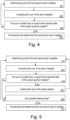
Claims (15)

  1. A method for operating a computer system (100), comprising:
    - providing in the computer system a quantum register (105) storing a set of qubits defining a quantum system having a computational basis comprising a set of base states, a generic state of the quantum system being a linear combination of said set of base states, a coefficient of each base state in the linear combination corresponding to the square root of a probability of measuring the base state;
    - providing (201) an ordered set of consecutive nonnegative integer indexes, each index being associated to a different respective one of the base states;
    - providing a random variable having a probability distribution in a corresponding domain;
    - mapping (203) each one of a finite set of domain values within said domain to a different respective one of the indexes of the set through a bijective affine transformation, said affine transformation providing for expressing each domain value of the set in function of the respective index through a scaling of said respective index and a offset applied to the scaled index;
    - representing (205) said random variable in the computer system through said quantum system, said representing said random variable comprising generating a quantum variable identifying a state of the quantum system, said generating the quantum variable comprising setting each coefficient of each base state to the square root of the value of the probability distribution at the domain value mapped to the index associated to said base state.
  2. The method of claim 1, wherein said mapping (203) comprises:
    - defining a tolerance range around each of the domain values of the set,
    - approximating values of the random variable within the tolerance range around a corresponding domain value by the corresponding domain value, thereby values of the random variable within the tolerance range around a domain value of the set are mapped to the index to which said domain value of the set is mapped.
  3. The method of claim 1 or 2, wherein:
    - said quantum register (105) comprises:
    - a first quantum register storing a first set of qubits defining a first quantum system having a first computational basis comprising a set of first base states, a generic state of the first quantum system being a linear combination of said set of first base states, a coefficient of each first base state in the linear combination corresponding to the square root of a probability of measuring the first base state;
    - a second quantum register storing a second set of qubits defining a second quantum system having a second computational basis comprising a set of second base states, a generic state of the second quantum system being a linear combination of said set of second base states, a coefficient of each second base state in the linear combination corresponding to the square root of a probability of measuring the second base state
    - said providing (201) an ordered set of consecutive nonnegative integer indexes comprises:
    - providing a first ordered set of consecutive nonnegative integer first indexes, each first index being associated to a different respective one of the first base states;
    - providing a second ordered set of consecutive nonnegative integer second indexes, each second index being associated to a different respective one of the second base states;
    - said providing a random variable comprises providing a first and second independent random variables, said first random variable having a first probability distribution in a corresponding first domain, said second random variable having a second probability distribution in a corresponding second domain,
    - said mapping (203) comprises:
    - mapping each one of a finite set of first domain values within said first domain to a different respective one of the first indexes of the set through a bijective first affine transformation, said first affine transformation providing for expressing each first domain value of the set in function of the respective first index through a first scaling of said respective first index and a first offset applied to the scaled first index, and
    - mapping each one of a finite set of second domain values within said second domain to a different respective one of the second indexes of the set through a bijective second affine transformation, said second affine transformation providing for expressing each second domain value of the set in function of the respective second index through a second scaling of said respective second index and a second offset applied to the scaled second index;
    - said representing (205) said random variable in the computer system through said quantum system comprises:
    - representing said first random variable in the computer system through said first quantum system, said representing said first random variable comprising generating a first quantum variable identifying a first state of the first quantum system, said generating the first quantum variable comprising setting each coefficient of each first base state to the square root of the value of the first probability distribution at the first domain value mapped to the first index associated to said first base state,
    - representing said second random variable in the computer system through said second quantum system, said representing said second random variable comprising generating a second quantum variable identifying a second state of the second quantum system, said generating the second quantum variable comprising setting each coefficient of each second base state to the square root of the value of the second probability distribution at the second domain value mapped to the second index associated to said second base state;
  4. The method of claim 1 or 2, wherein
    - said random variable comprises a first and second dependent random variables;
    - said probability distribution comprises a joint probability distribution in a first domain for the first random variable and in a second domain for the second random variable;
    - said quantum register (105) comprises:
    - a first quantum register storing a first set of qubits defining a first quantum system having a first computational basis comprising a set of first base states, a generic state of the first quantum system being a linear combination of said set of first base states, a coefficient of each first base state in the linear combination corresponding to the square root of a probability of measuring the first base state;
    - a second quantum register storing a second set of qubits defining a second quantum system having a second computational basis comprising a set of second base states, a generic state of the second quantum system being a linear combination of said set of second base states, a coefficient of each second base state in the linear combination corresponding to the square root of a probability of measuring the second base state
    - said providing (201) an ordered set of consecutive nonnegative integer indexes comprises:
    - providing a first ordered set of consecutive nonnegative integer first indexes, each first index being associated to a different respective one of the first base states;
    - providing a second ordered set of consecutive nonnegative integer second indexes, each second index being associated to a different respective one of the second base states;
    - said mapping (203) comprises:
    - mapping each one of a finite set of first domain values within said first domain to a different respective one of the first indexes of the set through a bijective first affine transformation, said first affine transformation providing for expressing each first domain value of the set in function of the respective first index through a first scaling of said respective first index and a first offset applied to the scaled first index, and
    - mapping each one of a finite set of second domain values within said second domain to a different respective one of the second indexes of the set through a bijective second affine transformation, said second affine transformation providing for expressing each second domain value of the set in function of the respective second index through a second scaling of said respective second index and a second offset applied to the scaled second index;
    - said representing (205) said random variable comprises representing said first and second dependent random variables in the computer system through a joint quantum system being the interconnection of said first quantum system with said second quantum system, and generating a joint quantum variable identifying a state of the joint quantum system, a probability of measuring a state of the joint quantum system being set to a value of said joint probability distribution corresponding to a domain pair including a first domain value and a second domain value
  5. The method of claim 3 or 4, further comprising determining a sum of the first and second random variables, the determining of the sum comprising:
    - providing an output quantum register (105) storing a third set of qubits, thereby defining a third quantum system having a computational basis comprising a set of base states, said sum of the first and second random variables being determined as a third random variable represented in the computer system through said third quantum system, the state of the third quantum system in the computational basis representing a value of the third random variable based on a mapping, through a third affine relationship, of third domain values within a third domain of the third random variable to third indexes of third ordered set of consecutive nonnegative integer third indexes, each third index being associated to a different respective one of the third base states, said third affine relationship providing for expressing each third domain value in function of a respective third index through a third scaling of said respective third index and a third offset applied to the scaled third index,
    - receiving a target scaling parameter identifying a target value for such third scaling;
    - generating a first set of first weights associated to the first base states and a second set of second weights associated to the second base states by performing the following sequence of operations:
    a) providing an integer M;
    b) setting (401) current values for the first weights, each first weight being set to the closest integer rounding of a number in direct proportion to 2 to the first index of the first base associated to the first weight, in direct proportion to 2 to M, in direct proportion to the first scaling of the first index, and in inverse proportion to said target scaling parameter;
    c) setting (401) current values for the second weights, each second weight being set to the closest integer rounding of a number in direct proportion to 2 to the second index of the second base associated to the second weight, in direct proportion to 2 to M, in direct proportion to the second scaling of the second index, and in inverse proportion to said target scaling parameter;
    d) computing (403) the sum of the absolute value of the current first and second weights;
    e) determining (405) whether the sum is smaller than or equal to a maximum third index;
    f) in case the sum is higher than the maximum third index, decreasing M by 1 and repeating b) to e);
    - associating first unknowns to each first base state of the first quantum system;
    - associating second unknowns to each second base state of the second quantum system;
    - providing a monomial for each unknown, the monomial comprising the unknown multiplied by the weight associated to the respective base state;
    - defining (303) a polynomial as the sum of the monomials;
    - providing (305) a quantum circuit having an input coupled to the first quantum register and to the second quantum register, and an output coupled to the output quantum register, the quantum circuit being configured to apply a quantum transformation for evaluating the polynomial into the output register by setting the first unknowns based on the first set of qubits of the first quantum system and by setting the second unknowns based on the second set of qubits of the second quantum system,
    - applying (307) the quantum transformation on the first quantum register and second quantum register to evaluate the polynomial into the output quantum register.
  6. The method of claim 5, further comprising:
    - setting said third offset to the first offset plus the second offset;
    - setting said third scaling to the value of the target scaling parameter multiplied by 2 to minus M.
  7. The method of claim 5 or 6, wherein said integer M depends on:
    - the first scaling;
    - the second scaling;
    - the value of the target scaling parameter;
    - the number of qubits of the first set of qubits;
    - the number of qubits of the second set of qubits;
    - the number of qubits of the third set of qubits.
  8. The method of any of claims 5 to 7, wherein said generating the first set of first weights and the second set of second weights further comprises lowering (507) the number of qubits in the third set of qubits to a closest number of the sum that is a power of two.
  9. The method of claim 3 or 4, further comprising determining a multiplication of the first and second random variables, the determining of the multiplication comprising:
    - providing an output quantum register (105) storing a third set of qubits, thereby defining a third quantum system having a computational basis comprising a set of base states, said multiplication of the first and second random variables being determined as a third random variable represented in the computer system through said third quantum system, the state of the third quantum system in the computational basis representing a value of the third random variable based on a mapping, through a third affine relationship, of third domain values within a third domain of the third random variable to third indexes of third ordered set of consecutive nonnegative integer third indexes, each third index being associated to a different respective one of the third base states, said third affine relationship providing for expressing each third domain value in function of a respective third index through a third scaling of said respective third index and a third offset applied to the scaled third index,
    - receiving a target scaling parameter identifying a target value for such third scaling;
    - generating a first set of first weights associated to the first base states, a second set of second weights associated to the second base states, and a third set of third weights associated to base state pairs each including a first base state and a second base state by performing the following sequence of operations:
    g) providing an integer M;
    h) setting (701) current values for the first weights, each first weight being set to the closest integer rounding of a number in direct proportion to 2 to the first index of the first base associated to the first weight, in direct proportion to 2 to M, in direct proportion to a number equal to the first scaling of the first index multiplied by the second offset, and in inverse proportion to said target scaling parameter;
    i) setting (701) current values for the second weights, each second weight being set to the closest integer rounding of a number in direct proportion to 2 to the second index of the second base associated to the second weight, in direct proportion to 2 to M, in direct proportion to a number equal to the second scaling of the second index multiplied by the first offset, and in inverse proportion to said target scaling parameter;
    j) setting (701) current values for the third weights, each third weight being set to the closest integer rounding of a number in direct proportion to 2 to an exponent value equal to the sum of the first and second indexes of the first and second base states of the base state pair associated to the third weight, in direct proportion to 2 to M, in direct proportion to a number equal to the first scaling of the first index multiplied by the second scaling of the second index, and in inverse proportion to said target scaling parameter;
    k) computing (703) the sum of the absolute value of the current first, second and third weights;
    l) determining (705) whether the sum is smaller than or equal to a maximum third index;
    m) in case the sum is higher than the maximum third index, decreasing M by 1 and repeating h) to 1);
    - associating first unknowns to each first base state of the first quantum system;
    - associating second unknowns to each second base state of the second quantum system;
    - providing a first monomial for each first unknown, each first monomial comprising a first unknown multiplied by the first weight associated to the respective first base state;
    - providing a second monomial for each second unknown, each second monomial comprising a second unknown multiplied by the second weight associated to the respective second base state;
    - providing a third monomial for each of unknown pair including a pair of first and second unknowns, each third monomial comprising the product between:
    - the first unknown of the pair;
    - the second unknown of the pair;
    - the third weight associated to the base state pair including the first base state associated to the first unknown of the unknown pair and the second base state associated to the second unknown of the unknown pair;
    - defining (603) a polynomial as the sum of the first, second and third monomials;
    - providing (605) a quantum circuit having an input coupled to the first quantum register and to the second quantum register, and an output coupled to the output quantum register, the quantum circuit being configured to apply a quantum transformation for evaluating the polynomial into the output register by setting the first unknowns based on the first set of qubits of the first quantum system and by setting the second unknowns based on the second set of qubits of the second quantum system,
    - applying (607) the quantum transformation on the first quantum register and second quantum register to evaluate the polynomial into the output quantum register.
  10. The method of claim 9, further comprising:
    - setting said third offset to the first offset multiplied by the second offset;
    - setting said third scaling to the value of the target scaling parameter.
  11. The method of claim 9 or 10, wherein said integer M depends on:
    - the first scaling;
    - the second scaling;
    - the value of the target scaling parameter;
    - the number of qubits of the first set of qubits;
    - the number of qubits of the second set of qubits;
    - the number of qubits of the third set of qubits.
  12. The method of any of claims 9 to 11, wherein said generating the first set of first weights, the second set of second weights and the third set of third weights further comprises lowering (807) the number of qubits in the third set of qubits to a closest number of the sum that is a power of two.
  13. The method of any of claims 4 to 12, wherein said target scaling parameter has a value corresponding to one of said first scaling and said second scaling.
  14. A computer system (100), comprising a quantum register (105) storing a set of qubits defining a quantum system having a computational basis comprising a set of base states, a generic state of the quantum system being a linear combination of said set of base states, a coefficient of each base state in the linear combination corresponding to the square root of a probability of measuring the base state, the computer system being configured to:
    - provide an ordered set of consecutive nonnegative integer indexes, each index being associated to a different respective one of the base states;
    - provide a random variable having a probability distribution in a corresponding domain;
    - map each one of a finite set of domain values within said domain to a different respective one of the indexes of the set through a bijective affine transformation, said affine transformation providing for expressing each domain value of the set in function of the respective index through a scaling of said respective index and a offset applied to the scaled index;
    - represent said random variable in the computer system through said quantum system, said representing said random variable comprising generating a quantum variable identifying a state of the quantum system, said generating the quantum variable comprising setting each coefficient of each base state to the square root of the value of the probability distribution at the domain value mapped to the index associated to said base state.
  15. A computer program configured for causing a computer system (100) to perform the method according to any of claims 1 to 13 when the computer program is executed on the computer system.
EP24187665.5A 2023-07-13 2024-07-10 Quantum variables implementation Pending EP4492301A1 (en)

Applications Claiming Priority (2)

Application Number Priority Date Filing Date Title
IT102023000014703A IT202300014703A1 (en) 2023-07-13 2023-07-13 IMPLEMENTATION OF QUANTUM VARIABLES
US18/414,507 US20250036997A1 (en) 2023-07-13 2024-01-17 Quantum variables implementation

Publications (1)

Publication Number Publication Date
EP4492301A1 true EP4492301A1 (en) 2025-01-15

Family

ID=93843223

Family Applications (1)

Application Number Title Priority Date Filing Date
EP24187665.5A Pending EP4492301A1 (en) 2023-07-13 2024-07-10 Quantum variables implementation

Country Status (1)

Country Link
EP (1) EP4492301A1 (en)

Citations (3)

* Cited by examiner, † Cited by third party
Publication number Priority date Publication date Assignee Title
US20190361675A1 (en) * 2018-05-25 2019-11-28 Microsoft Technology Licensing, Llc Evaluating quantum computing circuits in view of the resource costs of a quantum algorithm
US20220188679A1 (en) * 2020-12-03 2022-06-16 International Business Machines Corporation Quantum resource estimation using a re-parameterization method
EP4071615A1 (en) * 2021-02-07 2022-10-12 Tencent Technology (Shenzhen) Company Limited Quantum error correction decoding system and method, fault-tolerant quantum error correction system, and chip

Patent Citations (3)

* Cited by examiner, † Cited by third party
Publication number Priority date Publication date Assignee Title
US20190361675A1 (en) * 2018-05-25 2019-11-28 Microsoft Technology Licensing, Llc Evaluating quantum computing circuits in view of the resource costs of a quantum algorithm
US20220188679A1 (en) * 2020-12-03 2022-06-16 International Business Machines Corporation Quantum resource estimation using a re-parameterization method
EP4071615A1 (en) * 2021-02-07 2022-10-12 Tencent Technology (Shenzhen) Company Limited Quantum error correction decoding system and method, fault-tolerant quantum error correction system, and chip

Non-Patent Citations (3)

* Cited by examiner, † Cited by third party
Title
MARKUS NAGEL ET AL: "A White Paper on Neural Network Quantization", ARXIV.ORG, CORNELL UNIVERSITY LIBRARY, 201 OLIN LIBRARY CORNELL UNIVERSITY ITHACA, NY 14853, 15 June 2021 (2021-06-15), XP081990169 *
R. SEIDELN. TCHOLTCHEVS. BOCKC. K.-U. BECKERM. HAUSWIRTH: "Efficient Floating Point Arithmetic for Quantum Computers", vol. 10, 2022, IEEE ACCESS, pages: 72400 - 72415
RAPHAEL SEIDEL ET AL: "Efficient Floating Point Arithmetic for Quantum Computers", ARXIV.ORG, CORNELL UNIVERSITY LIBRARY, 201 OLIN LIBRARY CORNELL UNIVERSITY ITHACA, NY 14853, 20 December 2021 (2021-12-20), XP091118022 *

Similar Documents

Publication Publication Date Title
US12483381B2 (en) Non-linear approximation robust to input range of homomorphic encryption analytics
US20250190755A1 (en) Routing acceleration in mixture of experts ensembles
US20240070401A1 (en) Detecting out-of-domain text data in dialog systems using artificial intelligence
EP4492301A1 (en) Quantum variables implementation
US20250036997A1 (en) Quantum variables implementation
US12547913B2 (en) Decision tree training and inference with mixed precision
US20250117683A1 (en) Contextually calibrating quantum hardware by minimizing contextual cost function
US20250028991A1 (en) Generating optimal samples in quantum optimization algorithms
US20240419762A1 (en) Lightweight sensor proxy discovery in power-aware devices
US20240176846A1 (en) Stochastic computing with generated deterministic sequences
US20250005431A1 (en) Conductance range optimization
US12505367B2 (en) Visually depicting a topology of a quantum device that conveys quantum operational characteristics
US20240176784A1 (en) Adaptively generating outlier scores using histograms
US12289393B2 (en) Tournament type selection operations on encrypted data
US20240039691A1 (en) Management of accurate scales in fully-homomorphic encryption schemes
US20240169614A1 (en) Visual represntation using post modeling feature evaluation
US20240259178A1 (en) Performing comparison operations under homomorphic encryption
US20240143982A1 (en) Fused Convolutions for Fast Deep Neural Network
US20240313966A1 (en) Training neural networks with non-polynomial elements for homomorphic encryption computations using sub-networks and multi-loss
US20240361797A1 (en) Special-Purpose Compute Hardware for Efficient Implementation of Programmable Look-Up-Tables
US20250086250A1 (en) Bundling hypervectors using element-wise selections
US20240176843A1 (en) Solving systems of linear equations using mixed precision
US20250086251A1 (en) Modular hypervector factorization
US20250190602A1 (en) Privacy-preserving graph analytics on hybrid cloud environments
US12476788B2 (en) Tournament-league mechanisms for comparison based computer operations

Legal Events

Date Code Title Description
PUAI Public reference made under article 153(3) epc to a published international application that has entered the european phase

Free format text: ORIGINAL CODE: 0009012

STAA Information on the status of an ep patent application or granted ep patent

Free format text: STATUS: THE APPLICATION HAS BEEN PUBLISHED

AK Designated contracting states

Kind code of ref document: A1

Designated state(s): AL AT BE BG CH CY CZ DE DK EE ES FI FR GB GR HR HU IE IS IT LI LT LU LV MC ME MK MT NL NO PL PT RO RS SE SI SK SM TR

STAA Information on the status of an ep patent application or granted ep patent

Free format text: STATUS: REQUEST FOR EXAMINATION WAS MADE

17P Request for examination filed

Effective date: 20250711

STAA Information on the status of an ep patent application or granted ep patent

Free format text: STATUS: EXAMINATION IS IN PROGRESS

17Q First examination report despatched

Effective date: 20251030