EP4491737A1 - Microbial medium composition for producing retinol comprising surfactant and use thereof - Google Patents
Microbial medium composition for producing retinol comprising surfactant and use thereof Download PDFInfo
- Publication number
- EP4491737A1 EP4491737A1 EP22933756.3A EP22933756A EP4491737A1 EP 4491737 A1 EP4491737 A1 EP 4491737A1 EP 22933756 A EP22933756 A EP 22933756A EP 4491737 A1 EP4491737 A1 EP 4491737A1
- Authority
- EP
- European Patent Office
- Prior art keywords
- retinol
- microorganism
- seq
- producing
- medium
- Prior art date
- Legal status (The legal status is an assumption and is not a legal conclusion. Google has not performed a legal analysis and makes no representation as to the accuracy of the status listed.)
- Pending
Links
Images


Classifications
-
- C—CHEMISTRY; METALLURGY
- C12—BIOCHEMISTRY; BEER; SPIRITS; WINE; VINEGAR; MICROBIOLOGY; ENZYMOLOGY; MUTATION OR GENETIC ENGINEERING
- C12P—FERMENTATION OR ENZYME-USING PROCESSES TO SYNTHESISE A DESIRED CHEMICAL COMPOUND OR COMPOSITION OR TO SEPARATE OPTICAL ISOMERS FROM A RACEMIC MIXTURE
- C12P23/00—Preparation of compounds containing a cyclohexene ring having an unsaturated side chain containing at least ten carbon atoms bound by conjugated double bonds, e.g. carotenes
-
- C—CHEMISTRY; METALLURGY
- C12—BIOCHEMISTRY; BEER; SPIRITS; WINE; VINEGAR; MICROBIOLOGY; ENZYMOLOGY; MUTATION OR GENETIC ENGINEERING
- C12N—MICROORGANISMS OR ENZYMES; COMPOSITIONS THEREOF; PROPAGATING, PRESERVING, OR MAINTAINING MICROORGANISMS; MUTATION OR GENETIC ENGINEERING; CULTURE MEDIA
- C12N1/00—Microorganisms; Compositions thereof; Processes of propagating, maintaining or preserving microorganisms or compositions thereof; Processes of preparing or isolating a composition containing a microorganism; Culture media therefor
- C12N1/14—Fungi; Culture media therefor
- C12N1/16—Yeasts; Culture media therefor
-
- C—CHEMISTRY; METALLURGY
- C12—BIOCHEMISTRY; BEER; SPIRITS; WINE; VINEGAR; MICROBIOLOGY; ENZYMOLOGY; MUTATION OR GENETIC ENGINEERING
- C12N—MICROORGANISMS OR ENZYMES; COMPOSITIONS THEREOF; PROPAGATING, PRESERVING, OR MAINTAINING MICROORGANISMS; MUTATION OR GENETIC ENGINEERING; CULTURE MEDIA
- C12N1/00—Microorganisms; Compositions thereof; Processes of propagating, maintaining or preserving microorganisms or compositions thereof; Processes of preparing or isolating a composition containing a microorganism; Culture media therefor
- C12N1/14—Fungi; Culture media therefor
- C12N1/16—Yeasts; Culture media therefor
- C12N1/165—Yeast isolates
-
- C—CHEMISTRY; METALLURGY
- C12—BIOCHEMISTRY; BEER; SPIRITS; WINE; VINEGAR; MICROBIOLOGY; ENZYMOLOGY; MUTATION OR GENETIC ENGINEERING
- C12N—MICROORGANISMS OR ENZYMES; COMPOSITIONS THEREOF; PROPAGATING, PRESERVING, OR MAINTAINING MICROORGANISMS; MUTATION OR GENETIC ENGINEERING; CULTURE MEDIA
- C12N1/00—Microorganisms; Compositions thereof; Processes of propagating, maintaining or preserving microorganisms or compositions thereof; Processes of preparing or isolating a composition containing a microorganism; Culture media therefor
- C12N1/38—Chemical stimulation of growth or activity by addition of chemical compounds which are not essential growth factors; Stimulation of growth by removal of a chemical compound
-
- C—CHEMISTRY; METALLURGY
- C12—BIOCHEMISTRY; BEER; SPIRITS; WINE; VINEGAR; MICROBIOLOGY; ENZYMOLOGY; MUTATION OR GENETIC ENGINEERING
- C12N—MICROORGANISMS OR ENZYMES; COMPOSITIONS THEREOF; PROPAGATING, PRESERVING, OR MAINTAINING MICROORGANISMS; MUTATION OR GENETIC ENGINEERING; CULTURE MEDIA
- C12N15/00—Mutation or genetic engineering; DNA or RNA concerning genetic engineering, vectors, e.g. plasmids, or their isolation, preparation or purification; Use of hosts therefor
- C12N15/09—Recombinant DNA-technology
- C12N15/63—Introduction of foreign genetic material using vectors; Vectors; Use of hosts therefor; Regulation of expression
- C12N15/79—Vectors or expression systems specially adapted for eukaryotic hosts
- C12N15/80—Vectors or expression systems specially adapted for eukaryotic hosts for fungi
- C12N15/81—Vectors or expression systems specially adapted for eukaryotic hosts for fungi for yeasts
- C12N15/815—Vectors or expression systems specially adapted for eukaryotic hosts for fungi for yeasts for yeasts other than Saccharomyces
-
- C—CHEMISTRY; METALLURGY
- C12—BIOCHEMISTRY; BEER; SPIRITS; WINE; VINEGAR; MICROBIOLOGY; ENZYMOLOGY; MUTATION OR GENETIC ENGINEERING
- C12R—INDEXING SCHEME ASSOCIATED WITH SUBCLASSES C12C - C12Q, RELATING TO MICROORGANISMS
- C12R2001/00—Microorganisms ; Processes using microorganisms
- C12R2001/645—Fungi ; Processes using fungi
Definitions
- the present disclosure relates to a method of producing retinol, the method comprising the step of culturing a microorganism of the genus Yarrowia in a medium comprising a non-ionic surfactant; a method of increasing retinol production; a method of producing retinoids; a medium composition for a microorganism of the genus Yarrowia for producing retinol, the composition comprising a non-ionic surfactant; a composition for producing retinol, the composition comprising the microorganism or a culture thereof and a non-ionic surfactant; and use thereof in producing retinoids.
- Retinol which is a fat-soluble vitamin, is an essential vitamin involved in eye health of improving nyctalopia, immune enhancement, skin health, etc.
- retinol is very unstable to heat, light, temperature, moisture, oxygen, and progress of time, it is easily oxidized when exposed to the air or in aqueous solutions. This causes the lower potency of raw materials, major stability issues such as discoloration, off-smell, etc., and also a negative impact on retinol production.
- the problem to be solved in the present disclosure is to provide a microorganism medium composition for producing retinol, the composition comprising a surfactant, a method of producing retinoids using the same, and use thereof.
- An object of the present disclosure is to provide a method of producing retinol using a non-ionic surfactant.
- Another object of the present disclosure is to provide a method of increasing retinol production using a non-ionic surfactant.
- Still another object of the present disclosure is to provide a method of producing retinoids other than retinol using a non-ionic surfactant.
- Still another object of the present disclosure is to provide a microorganism medium composition for producing retinol using a non-ionic surfactant.
- Still another object of the present disclosure is to provide a composition for producing retinol using a non-ionic surfactant.
- Still another object of the present disclosure is to provide use of a non-ionic surfactant in producing retinoids.
- a medium of the present disclosure may efficiently increase production of retinoids such as retinol by comprising a non-ionic surfactant.
- An aspect of the present disclosure provides a method of producing retinol, the method comprising the step of culturing a microorganism of the genus Yarrowia in a medium comprising a non-ionic surfactant.
- surfactant refers to a compound that has both a hydrophilic part and a hydrophobic part.
- the surfactant may be classified into anionic, cationic, non-ionic (polar), amphoteric, and special surfactants depending on the charge of the hydrophilic part when dissociated in water.
- the surfactant of the present disclosure is a non-ionic surfactant, and according to its chemical structure, it may be classified into sorbitan fatty acid salt series (e.g., span), poly:oxyethyl sorbitan fatty acid salt series (e.g., Tween), and polyethyl ether fatty acid salt series (e.g., Triton), etc.
- the surfactant may be any one or more selected from the group consisting of Tween and Triton, but is not limited thereto.
- the Tween may be any one or more selected from the group consisting of Tween 20, Tween 40, Tween 60, and Tween 80, but is not limited thereto.
- the Triton may be Triton X-100, but is not limited thereto.
- the non-ionic surfactant may be included at a concentration of 0.001%(w/v) or more, 0.001%(w/v) to 30%(w/v), 0.01%(w/v) or more, 0.01%(w/v) to 30%(w/v), 0.01%(w/v) to 25%(w/v), 0.01%(w/v) to 20%(w/v), 0.01%(w/v) to 15%(w/v), 0.01%(w/v) to 10%(w/v), 0.01%(w/v) to 5%(w/v), 0.01%(w/v) to 2%(w/v), 0.01%(w/v) to 1%(w/v), 0.05%(w/v) to 30%(w/v), 0.05%(w/v) to 25%(w/v), 0.05%(w/v) to 20%(w/v), 0.05%(w/v) to 15%(w/v), 0.05%(w/v), 0.05%(w/v) to 20%
- the non-ionic surfactant may increase extracellular excretion of retinol, but is not limited thereto.
- retinol may be stably produced while minimizing the consumption of time and labor resources by comprising the step of culturing the microorganism of the genus Yarrowia in the medium comprising the non-ionic surfactant.
- the term the "medium" refers to a mixture containing, as main ingredients, nutrient materials required for culturing the microorganism of the genus Yarrowia of the present disclosure, wherein the medium supplies nutrient materials comprising water essential for survival and growth, growth factors, etc.
- the medium of the present disclosure may be a medium for producing retinol, and may further comprise substances required for retinol production, but is not limited thereto.
- any common medium already containing a non-ionic surfactant or any medium used for usual culture of microorganisms while further comprising the non-ionic surfactant may be used without particular limitation.
- the medium of the present disclosure may be a common medium comprising appropriate carbon sources, nitrogen sources, phosphorus sources, inorganic compounds, amino acids, and/or vitamins, while controlling the temperature, pH, etc., but is not limited thereto.
- the carbon sources may comprise carbohydrates, such as glucose, saccharose, lactose, fructose, sucrose, maltose, etc.; sugar alcohols, such as mannitol, sorbitol, etc.; organic acids, such as pyruvic acid, lactic acid, citric acid, etc.; and amino acids, such as glutamic acid, methionine, lysine, etc.
- carbohydrates such as glucose, saccharose, lactose, fructose, sucrose, maltose, etc.
- sugar alcohols such as mannitol, sorbitol, etc.
- organic acids such as pyruvic acid, lactic acid, citric acid, etc.
- amino acids such as glutamic acid, methionine, lysine, etc.
- natural organic nutrient sources may be used, such as starch hydrolysates, molasses, blackstrap molasses, rice bran, cassava, bagasse, and corn steep liquor, and specifically, carbohydrates, such as glucose and sterile pretreated molasses (i.e., molasses converted to reduced sugars) may be used, and appropriate amounts of other carbon sources may be variously used without limitation. These carbon sources may be used alone or in a combination of two or more thereof, but are not limited thereto.
- inorganic nitrogen sources such as ammonia, ammonium sulfate, ammonium chloride, ammonium acetate, ammonium phosphate, ammonium carbonate, ammonium nitrate, etc.
- amino acids such as glutamic acid, methionine, glutamine, etc.
- organic nitrogen sources such as peptone, NZ-amine, meat extracts, yeast extracts, malt extracts, corn steep liquor, casein hydrolysates, fishes or decomposition products thereof, defatted soybean cake or degradation products thereof, etc.
- nitrogen sources may be used alone or in a combination of two or more thereof, but are not limited thereto.
- the phosphate sources may comprise potassium phosphate monobasic, potassium phosphate dibasic, and sodium-containing salts corresponding thereto.
- sodium chloride, calcium chloride, iron chloride, magnesium sulfate, iron sulfate, manganese sulfate, calcium carbonate, etc. may be used, and in addition, amino acids, vitamins, and/or suitable precursors may be included. These constituent ingredients or precursors may be added to the medium in a batch or continuous manner. However, the present disclosure is not limited thereto.
- the pH of the medium may be adjusted by adding compounds, such as ammonium hydroxide, potassium hydroxide, ammonia, phosphoric acid, sulfuric acid, etc., to the medium in an appropriate manner during the culture of the microorganism of the genus Yarrowia of the present disclosure.
- an anti-foaming agent such as fatty acid polyglycol ester, may be used to suppress bubble formation during the culture.
- oxygen or oxygen-containing gas may be injected into the medium to maintain the aerobic state of the medium, or no gas may be injected or nitrogen, hydrogen or carbon dioxide gas may be injected to maintain the anaerobic or non-aerobic state, but is not limited thereto.
- microorganism of the genus Yarrowia or “strain of the genus Yarrowia” comprises all of wild-type microorganisms of the genus Yarrowia or naturally or artificially genetically modified microorganisms of the genus Yarrowia , and it may also comprise a microorganism of the genus Yarrowia including genetic modification for retinol production, which is a microorganism in which a specific mechanism is weakened or strengthened due to insertion of a foreign gene or an activity enhancement or inactivation of an endogenous gene.
- the microorganism of the genus Yarrowia of the present disclosure may be Yarrowia lipolytica , but is not limited thereto.
- the microorganism of the genus Yarrowia of the present disclosure may be a microorganism for producing retinol.
- the microorganism or strain for producing retinol may be a microorganism naturally having a retinol producing ability, or a microorganism in which the retinol producing ability is enhanced or provided due to natural or artificial genetical modification in a parent strain having no retinol producing ability, but is not limited thereto.
- the microorganism of the genus Yarrowia for producing retinol of the present disclosure may be a microorganism which is modified to comprise polynucleotides encoding lycopene cyclase/phytoene synthase (crtYB), phytoene desaturase (crtl), and beta-carotene 15, 15'-oxygenase (BLH) proteins.
- the microorganism of the present disclosure may be a microorganism which is modified to further comprise polynucleotides encoding lycopene cyclase/phytoene synthase (crtYB) and phytoene desaturase (crtl) proteins, thereby exhibiting activities of the proteins, or a microorganism in which the activities of the proteins are enhanced.
- the lycopene cyclase/phytoene synthase, or phytoene desaturase may be a protein derived from Xanthophyllomyces dendrorhous , but is not limited thereto.
- the polynucleotide encoding the lycopene cyclase/phytoene synthase or phytoene desaturase may have or comprise a nucleotide sequence based on GenBank: AY177204.1 or GenBank: AY177424.1 which is registered in National Center for Biotechnology Information Search database (NCBI), respectively.
- the polynucleotide encoding the lycopene cyclase/phytoene synthase or phytoene desaturase may have or comprise SEQ ID NO: 1 or 2, respectively.
- the polynucleotide may undergo various modifications in the coding region within the scope that does not change the amino acid sequence in consideration of codon degeneracy or codons preferred in microorganisms that are intended to express the protein.
- the polynucleotide may have or comprise a nucleotide sequence having 80% or more, 85% or more, 90% or more, 95% or more, 96% or more, 97% or more, 98% or more, and less than 100% homology or identity to the sequence of SEQ ID NO: 1 or SEQ ID NO: 2, or may consist of or essentially consist of a nucleotide sequence having 80% or more, 85% or more, 90% or more, 95% or more, 96% or more, 97% or more, 98% or more, and less than 100% homology or identity to the sequence of SEQ ID NO: 1 or SEQ ID NO: 2, but is not limited thereto.
- the microorganism of the present disclosure may be a microorganism which is modified to further comprise a polynucleotide encoding geranylgeranyl pyrophosphate synthase (GGPPS) protein, thereby exhibiting activity of the protein, or a microorganism in which the activity of the protein is enhanced, but is not limited thereto.
- GGPPS geranylgeranyl pyrophosphate synthase
- the geranylgeranyl pyrophosphate synthase may be a protein derived from Haematococcus pluvialis , but is not limited thereto.
- the polynucleotide encoding the geranylgeranyl pyrophosphate synthase may have or comprise a nucleotide sequence based on GenBank: APX64485.1 which is registered in National Center for Biotechnology Information Search database (NCBI).
- the polynucleotide encoding the geranylgeranyl pyrophosphate synthase may have or comprise a sequence of SEQ ID NO: 33.
- the polynucleotide may undergo various modifications in the coding region within the scope that does not change the amino acid sequence in consideration of codon degeneracy or codons preferred in microorganisms that are intended to express the protein.
- the polynucleotide may have or comprise a nucleotide sequence having 80% or more, 85% or more, 90% or more, 95% or more, 96% or more, 97% or more, 98% or more, and less than 100% homology or identity to the sequence of SEQ ID NO: 33, or may consist of or essentially consist of a nucleotide sequence having 80% or more, 85% or more, 90% or more, 95% or more, 96% or more, 97% or more, 98% or more, and less than 100% homology or identity to the sequence of SEQ ID NO: 33, but is not limited thereto.
- the microorganism of the present disclosure may be a microorganism which is modified to further comprise a polynucleotide encoding beta-carotene 15, 15'-oxygenase (BLH) protein, thereby exhibiting activity of the protein, or a microorganism in which the activity of the protein is enhanced, but is not limited thereto.
- the beta-carotene 15, 15'-oxygenase may be a protein derived from Uncultured marine bacterium 66A03, but is not limited thereto.
- the beta-carotene 15, 15'-oxygenase polypeptide and a polynucleotide encoding the same may have or comprise an amino acid sequence based on Q4PNI0 which is registered in UniProt Knowledgebase (UniProtKB).
- the beta-carotene 15, 15'-oxygenase polypeptide may have or comprise a sequence of SEQ ID NO: 57.
- the polynucleotide encoding the polypeptide may undergo various modifications in the coding region within the scope that does not change the amino acid sequence in consideration of codon degeneracy or codons preferred in microorganisms that are intended to express the protein.
- the polypeptide may have or comprise a nucleotide sequence having 80% or more, 85% or more, 90% or more, 95% or more, 96% or more, 97% or more, 98% or more, and less than 100% homology or identity to the sequence of SEQ ID NO: 57, or may consist of or essentially consist of a nucleotide sequence having 80% or more, 85% or more, 90% or more, 95% or more, 96% or more, 97% or more, 98% or more, and less than 100% homology or identity to the sequence of SEQ ID NO: 57, but is not limited thereto.
- the term "culture” refers to growing the microorganism of the genus Yarrowia of the present disclosure in appropriately adjusted environment conditions.
- the culture procedure may be performed according to appropriate media or culture conditions known in the art. Such a culture procedure may be easily adjusted according to the selected strain by a person skilled in the art.
- the culture may be in a batch type, a continuous type, and/or a fed-batch type, but is not limited thereto.
- the microorganism of the genus Yarrowia of the present disclosure may be cultured under aerobic conditions in a common medium comprising appropriate carbon sources, nitrogen sources, phosphorus sources, inorganic compounds, amino acids and/or vitamins, etc. while controlling temperature, pH, etc.
- the culture temperature may be maintained at 20°C to 35°C, specifically, at 25°C to 35°C, and the culture may be performed for about 10 hours to 160 hours, about 20 hours to 130 hours, about 24 hours to 120 hours, about 36 hours to 120 hours, about 48 hours to 120 hours, about 48 hours or more, or about 48 hours, about 72 hours, or about 120 hours, but is not limited thereto.
- retinol is a substance known as vitamin A and is a kind of retinoids.
- the retinol may be used as it is, but may be converted to other retinoids (e.g., retinal, retinoic acid, and retinyl esters, etc.) or carotenoid compounds by methods known in the art.
- the non-ionic surfactant may be added to the microorganism medium for producing retinol to remarkably increase the retinol-producing ability.
- the non-ionic surfactant may increase extracellular excretion of retinol, but is not limited thereto.
- the microorganism when the microorganism is cultured in a medium to which the non-ionic surfactant is added, it may have about 1% or more, specifically, about 3%, about 5% or more, about 10% or more, about 50% or more, about 100% or more, about 150% or more, about 200% or more, about 250% or more, about 300% or more, about 350% or more, about 380% or more, about 400% or more, about 450% or more, about 500% or more, about 550% or more, about 600% or more, about 650% or more, about 680% or more increased retinol-producing ability, as compared to that of the microorganism cultured in a medium to which the non-ionic surfactant is not added.
- the microorganism has an increased ability of + value, as compared to that before addition of the non-ionic surfactant, it is not
- the term "about” refers to a range which includes all of ⁇ 0.5, ⁇ 0.4, ⁇ 0.3, ⁇ 0.2, ⁇ 0.1, etc., and includes all of the values that are equivalent or similar to those following the term “about”, but the range is not limited thereto.
- the method of producing retinol of the present disclosure may further comprise the steps of preparing the microorganism of the genus Yarrowia of the present disclosure, preparing a medium for culturing the microorganism, or a combination of these steps (regardless of the order, in any order), for example, before or after the culturing step.
- the medium may be a medium to which the non-ionic surfactant is added to increase retinol production.
- the method of producing retinol of the present disclosure may further comprise the step of recovering retinol from the medium resulting from the culture (a medium in which culture has been performed) or from the microorganism of the present disclosure.
- the recovering step may be further included after the culturing step.
- the recovering may be collecting the desired retinol by using an appropriate method known in the art according to the method of culturing the microorganism of the present disclosure, for example, a batch, continuous, or fed-batch type culture.
- an appropriate method known in the art for example, a batch, continuous, or fed-batch type culture.
- centrifugation, filtration, treatment with a crystallized protein precipitating agent (salting-out), extraction, cell disruption, sonication, ultrafiltration, dialysis, various types of chromatography, such as molecular sieve chromatography (gel filtration), adsorption chromatography, ion exchange chromatography, and affinity chromatography, etc., HPLC, and a combination of these methods may be used, and retinol may be recovered from the medium or microorganism by using an appropriate method known in the art.
- the method of producing retinol of the present disclosure may further comprise a purification step.
- the purification may be performed by using an appropriate method known in the art.
- the recovering step and the purification step may be performed discontinuously (or continuously) regardless of the order, or may be performed simultaneously or integrated into one step, but is not limited thereto.
- Another aspect of the present disclosure provides a method of producing retinoids, the method comprising the steps of culturing the microorganism of the genus Yarrowia in the medium comprising the non-ionic surfactant; and converting retinol which is produced by the microorganism, into retinoids other than retinol.
- non-ionic surfactant medium, microorganism, culture, retinol, and retinoids are as described in other aspects, and the above-described retinol recovery and purification may also be equally applied to retinoid recovery and purification.
- the method of producing retinoids of the present disclosure may further comprise the step of converting retinol which is expressed by the microorganism of the present disclosure, into retinoids other than retinol.
- the converting step may be further included after the culturing step or the recovering step.
- the converting step may be performed using a suitable method known in the art.
- the converting may be performed using retinol acyltransferase, but is not limited thereto.
- the retinoid may be any one selected from the group consisting of retinol, retinal, retinoic acid, and retinyl ester, but is not limited thereto, as long as it is included in the retinoids.
- Still another aspect of the present disclosure provides a method of increasing retinol production, the method comprising the step of culturing the microorganism of the genus Yarrowia in the medium comprising the non-ionic surfactant.
- non-ionic surfactant medium, microorganism, culture, and retinol are as described in other aspects.
- Still another aspect of the present disclosure provides a medium composition for the microorganism of the genus Yarrowia for producing retinol, the composition comprising the non-ionic surfactant.
- the medium composition may increase retinol production of the microorganism of the genus Yarrowia , but is not limited thereto.
- the medium composition may increase growth of the microorganism, but is not limited thereto.
- non-ionic surfactant retinol, microorganism, and medium are as described in other aspects.
- Still another aspect of the present disclosure provides a composition for producing retinol, the composition comprising the microorganism of the genus Yarrowia or the culture thereof, and the non-ionic surfactant.
- composition of the present disclosure may further comprise any appropriate excipient that is usually used in the composition for producing retinol, and examples of the excipient may comprise a preserving agent, a wetting agent, a dispersing agent, a suspending agent, a buffering agent, a stabilizing agent, an isotonic agent, etc., but are not limited thereto.
- microorganism non-ionic surfactant, and retinol are as described in other aspects.
- Still another aspect of the present disclosure provides use of the non-ionic surfactant in producing retinol; use of the medium composition for the microorganism of the genus Yarrowia , the composition comprising the non-ionic surfactant, in producing retinol; and use of the composition comprising the microorganism of the genus Yarrowia or the culture thereof and the non-ionic surfactant, in producing retinoids.
- the retinoids may be retinol or retinoids other than retinol.
- the non-ionic surfactant, microorganism, medium, retinoids, and retinol are as described in other aspects.
- Example 1-1 Preparation of X . dendrorhous-derived crtYB-crtI inserted strain
- lycopene cyclase/phytoene synthase (crtYB) and phytoene desaturase (crtl) genes derived from Xanthophyllomyces dendrorhous were inserted into the genome of the Yarrowia liplytica KCCM12972P strain.
- a polynucleotide of SEQ ID NO: 1 of crtYB was obtained, based on a nucleotide sequence (GenBank: AY177204.1) registered in the National Center for Biotechnology Information Search database (NCBI), and a polynucleotide of SEQ ID NO: 2 of crtl was obtained, based on a nucleotide sequence (GenBank: AY177424.1) registered in the NCBI.
- the polynucleotide sequences of crtYB and crtl were synthesized by Macrogen in the form of TEFINtp-crtYB-CYC1t (SEQ ID NO: 3), and TEFINtp-crtI-CYC1t (SEQ ID NO: 4), respectively.
- a cassette to be inserted into the MHY1 (YALI0B21582g) gene site was designed using a URA3 gene (SEQ ID NO: 5) of Y. lipolytica as a selection marker.
- PCR was performed using the synthesized crtYB and crtl genes and KCCM12972P genomic DNA as templates, and primers of SEQ ID NO: 6 and SEQ ID NO: 7, SEQ ID NO: 8 and SEQ ID NO: 9, SEQ ID NO: 10 and SEQ ID NO: 11, SEQ ID NO: 12 and SEQ ID NO: 13, SEQ ID NO: 14 and SEQ ID NO: 15, and SEQ ID NO: 16 and SEQ ID NO: 17, as shown in Table 1.
- PCR was performed by 35 cycles consisting of denaturation at 95°C for 1 min; annealing at 55°C for 1 min; and polymerization reaction at 72°C for 3 min. The resulting DNA fragments were prepared as a single cassette through overlap extension PCR.
- the cassette thus prepared was introduced into KCCM12972P strain by a heat shock method ( D.-C. Chen et al., Appl Microbiol Biotechnol, 1997 ), and then colonies were obtained, which were formed on a solid medium (YLMM1) without uracil. Colonies in which cassette insertion into the genome was confirmed using primers of SEQ ID NO: 18 and SEQ ID NO: 19 were plated on a 5-FOA solid medium and cultured at 30°C for 3 days, and colonies grown on the 5-FOA solid medium were obtained to remove the URA3 marker. [Table 1] SEQ ID NO.
- compositions of the solid medium (YLMM1) without uracil and 5-FOA medium are as follows.
- a cassette for replacement of a native promoter (SEQ ID NO: 20) region of 3-hydroxy-3-methylglutaryl-CoA reductase (HMGR) gene of the strain which was prepared through Example 1-1 with a TEFINt promoter was designed, and each PCR was performed using genomic DNA of KCCM12972P as a template, and primers of SEQ ID NO: 21 and SEQ ID NO: 22, SEQ ID NO: 23 and SEQ ID NO: 24, SEQ ID NO: 25 and SEQ ID NO: 26, SEQ ID NO: 27 and SEQ ID NO: 28, and SEQ ID NO: 29 and SEQ ID NO: 30, as shown in Table 2.
- PCR was performed by 35 cycles consisting of denaturation at 95°C for 1 min; annealing at 55°C for 1 min; and polymerization reaction at 72°C for 1 min and 30 sec.
- the resulting DNA fragments were prepared as a single cassette through overlap extension PCR.
- the cassette thus prepared was introduced into the strain prepared in Example 1-1 by a heat shock method, and then colonies were obtained, which were formed on a solid medium (YLMM1) without uracil. Colonies in which cassette insertion was confirmed using primers of SEQ ID NO: 31 and SEQ ID NO: 32 were plated on a 5-FOA solid medium and cultured at 30°C for 3 days, and colonies formed on the 5-FOA solid medium were obtained to remove the URA3 marker. [Table 2] SEQ ID NO.
- Haematococcus pluvialis -derived geranylgeranyl pyrophosphate synthase (GGPPS) gene was inserted into the genome of the strain which was prepared through Example 1-2.
- a polynucleotide of SEQ ID NO: 33 of GGPPS was obtained, based on a nucleotide sequence (GenBank: APX64485.1) registered in the National Center for Biotechnology Information Search database (NCBI). Codon optimization of the polynucleotide sequence of GGPPS was performed to be suitable for Y. lipolytica through http://atgme.org, and the gene was synthesized by Macrogen in the form of TEFINtp-GGPPS-CYC1t (SEQ ID NO: 34).
- a cassette to be inserted into the LIG4(YALI0D21384g) gene site was designed using the URA3 gene (SEQ ID NO: 5) of Y. lipolytica as a selection marker.
- PCR was performed using the synthesized GGPPS gene and genomic DNA of KCCM12972P as a template, and primers of SEQ ID NO: 35 and SEQ ID NO: 36, SEQ ID NO: 37 and SEQ ID NO: 38, SEQ ID NO: 39 and SEQ ID NO: 40, SEQ ID NO: 41 and SEQ ID NO: 42, and SEQ ID NO: 43 and SEQ ID NO: 44, as shown in Table 3.
- PCR was performed by 35 cycles consisting of denaturation at 95°C for 1 min; annealing at 55°C for 1 min; and polymerization reaction at 72°C for 2 min. The resulting DNA fragments were prepared as a single cassette through overlap extension PCR.
- the cassette thus prepared was introduced into the strain prepared in Example 1-2 by a heat shock method, and then colonies were obtained, which were formed on a solid medium (YLMM1) without uracil. Colonies in which cassette insertion into the genome was confirmed using primers of SEQ ID NO: 45 and SEQ ID NO: 46 were plated on a 5-FOA solid medium and cultured at 30°C for 3 days, and colonies grown on the 5-FOA solid medium were obtained to remove the URA3 marker. [Table 3] SEQ ID NO.
- KU80 YALI0E02068g gene of the strain prepared in Example 1-3 was deleted.
- a KU80 gene deletion cassette was designed using the URA3 gene (SEQ ID NO: 5) of Y. lipolytica as a selection marker.
- Each PCR was performed using genomic DNA of KCCM12972P as a template, and primers of SEQ ID NO: 47 and SEQ ID NO: 48, SEQ ID NO: 49 and SEQ ID NO: 50, SEQ ID NO: 51 and SEQ ID NO: 52, and SEQ ID NO: 53 and SEQ ID NO: 54.
- PCR was performed by 35 cycles consisting of denaturation at 95°C for 1 min; annealing at 55°C for 1 min; and polymerization reaction at 72°C for 1 min and 30 sec.
- the resulting DNA fragments were prepared as a single cassette through overlap extension PCR.
- the cassette thus prepared was introduced into the strain prepared in Example 1-3 by a heat shock method, and then colonies were obtained, which were formed on a solid medium (YLMM1) without uracil. Colonies in which cassette insertion into the genome was confirmed using primers of SEQ ID NO: 55 and SEQ ID NO: 56 were plated on a 5-FOA solid medium and cultured at 30°C for 3 days, and colonies formed on the 5-FOA solid medium were obtained to remove the URA3 marker. The corresponding strain was named CC08-1043. [Table 4] SEQ ID NO.
- Uncultured marine bacterium 66A03-derived beta-carotene 15,15'-oxygenase (BLH) gene was inserted into the genome of the strain which was prepared through Example 1-4.
- a polypeptide sequence of SEQ ID NO: 57 of BLH gene was obtained, based on an amino acid sequence (Q4PNI0) registered in the UniProtKB (UniProt Knowledgebase). Codon optimization thereof was performed to be suitable for Y. lipolytica through http://atgme.org, and the gene was synthesized by Macrogen in the form of TEFINtp-BLH-CYC1t (SEQ ID NO: 58).
- a cassette to be inserted into the KU70(YALI0C08701g) gene site was designed using the URA3 gene (SEQ ID NO: 5) of Y. lipolytica as a selection marker.
- Each PCR was performed using the synthesized BLH gene and genomic DNA of KCCM12972P as a template, and primers of SEQ ID NO: 59 and SEQ ID NO: 60, SEQ ID NO: 61 and SEQ ID NO: 62, SEQ ID NO: 63 and SEQ ID NO: 64, SEQ ID NO: 65 and SEQ ID NO: 66, SEQ ID NO: 67 and SEQ ID NO: 68, as shown in Table 5.
- PCR was performed by 35 cycles consisting of denaturation at 95°C for 1 min; annealing at 55°C for 1 min; and polymerization reaction at 72°C for 2 min.
- the resulting DNA fragments were prepared as a single cassette through overlap extension PCR.
- the cassette thus prepared was introduced into the strain prepared in Example 1-4 by a heat shock method, and then colonies were obtained, which were formed on a solid medium (YLMM1) without uracil. Colonies in which cassette insertion into the genome was confirmed using primers of SEQ ID NO: 69 and SEQ ID NO: 70 were plated on a 5-FOA solid medium and cultured at 30°C for 3 days, and colonies formed on the 5-FOA solid medium were obtained to remove the URA3 marker. The corresponding strain was named CC08-2163. [Table 5] SEQ ID NO.
- Example 2-2 Assessment of microorganism growth
- OD values at a wavelength of 600 nm were measured using a spectrophotometer.
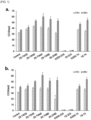
- the OD values of the two strains are shown in Table 6, and the OD values of the beta-carotene-producing strain (CC08-1043) and the retinol-producing strain (CC08-2163) are shown in FIGS. 1A and 1B , respectively.
- Example 2-3 Assessment of beta-carotene, retinal, and retinol concentrations
- the methods of measuring intracellular and extracellular beta-carotene, retinol, and retinal concentrations are as follows.
- DMSO dimethyl sulfoxide
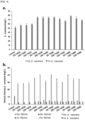
- the beta-carotene, retinol, and retinal concentrations (mg/L) in the two strains are shown in Table 7, and with regard to the analysis results, the beta-carotene concentrations measured when culturing the beta-carotene-producing strain (CC08-1043) are shown in FIG. 2A , and the beta-carotene, retinol, and retinal concentrations measured when culturing the retinol-producing strain (CC08-2163) are shown in FIG. 2B .
- Table 7 Strain Surfactant Intracellular Extracellular Retinol Retinal ⁇ -car. Retinol Retinal ⁇ -car.
- the groups with the addition of Tween series surfactants (Tween 20, Tween 40, Tween 60, and Tween 80), known as non-ionic surfactants, showed up to 1.4 times increase in the beta-carotene concentration, as compared to the group without addition, whereas the groups with the addition of Span80 or 0.05% Triton X-100 showed 10% or more decrease in the beta-carotene concentration ( FIG. 2A ).
- Tween series TW20, 40, 60, and 80
- Triton series Triton X-100
- Tween series surfactants which are non-ionic surfactants
- a flask test was performed on CC08-1043 and CC08-2163 strains.
- Culturing was carried out under conditions of 30°C and 200 rpm. Since the sugar consumption rate may vary depending on the concentrations of the surfactants, the culturing was continued until 48 hours when all sugar was consumed.
- the microorganism growth was assessed in the same manner as in Example 2-2.
- the OD values of the two strains are shown in Table 8 below, and the analyzed OD values of the beta-carotene-producing strain (CC08-1043) and the retinol-producing strain (CC08-2163) are shown in FIGS. 3A and 3B , respectively.
- biomass (OD) tended to be overall high in all groups with addition of the Tween series surfactants, as compared to the group without the addition, and the biomass (OD) tended to be higher in the Tween40, Tween60, or Tween80-added group.
- biomass (OD) tended to be higher in the Tween40, Tween60, or Tween80-added group.
- Example 3-3 Assessment of beta-carotene, retinal, and retinol concentrations
- beta-carotene, retinal, and retinol concentrations were assessed in the same manner as in Example 2-3.
- the beta-carotene, retinol, and retinal concentrations (mg/L) in the two strains are shown in Table 9, and with regard to the analysis results, the beta-carotene concentrations measured when culturing the beta-carotene-producing strain (CC08-1043) are shown in FIG. 4A , and the beta-carotene, retinol, and retinal concentrations measured when culturing the retinol-producing strain (CC08-2163) are shown in FIG. 4B .
- Table 9 Strain Surfactant Intracellular Extracellular Retinol Retinal ⁇ -car. Retinol Retinal ⁇ -car.
- the intracellular beta-carotene production concentration tended to be overall high in all groups with addition of the Tween series surfactants at all concentrations, as compared to the group without addition ( FIG. 4A ). Consequently, the groups with addition of the Tween series surfactants showed up to 1.5 times increase in the beta-carotene concentration, as compared to the group without addition.
- extracellular retinol was measured only in the groups with the addition of Tween series surfactants ( FIG. 4B ). Unlike, a relatively small amount of intracellular retinol was measured in the group without addition of the surfactants.
- optimal concentrations varied for each type of Tween. For example, there was no difference in the production amount of retinol according to the concentrations of Tween20, but the highest extracellular retinol concentrations were measured under the conditions of adding 10% of Tween40 and 5% of Tween60 and Tween80.
- the concentration of the produced retinol increased up to 3.8 times or more under specific Tween addition conditions, as compared to the group without the addition ( FIG. 4B ).
- SEQ ID NO. Name Sequence Type 1 crtYB DNA 2 crtl DNA 3 TEFINtp-crtYB-CYC1t DNA 4 TEFINtp-crtI-CYC1t DNA 5 URA3 DNA 6 primer gtgcgcttct ctcgtctcgg taaccctgtc DNA 7 primer atgcgccgcc aacccggtct ctggggtgtg gtggatgggggg tgtg DNA 8 primer cacaccccat ccaccacacc ccagagaccg ggttggcggc gcat DNA 9 primer cgccgccaac ccggtctct gaagacgaaa gggcctcg DNA 10 primer gacgagtcag acaggaggca tcagacagat actcgtc
Landscapes
- Life Sciences & Earth Sciences (AREA)
- Chemical & Material Sciences (AREA)
- Engineering & Computer Science (AREA)
- Health & Medical Sciences (AREA)
- Organic Chemistry (AREA)
- Zoology (AREA)
- Wood Science & Technology (AREA)
- Genetics & Genomics (AREA)
- Bioinformatics & Cheminformatics (AREA)
- Biotechnology (AREA)
- General Engineering & Computer Science (AREA)
- General Health & Medical Sciences (AREA)
- Biochemistry (AREA)
- Microbiology (AREA)
- Biomedical Technology (AREA)
- Mycology (AREA)
- Medicinal Chemistry (AREA)
- Virology (AREA)
- Tropical Medicine & Parasitology (AREA)
- General Chemical & Material Sciences (AREA)
- Botany (AREA)
- Chemical Kinetics & Catalysis (AREA)
- Physics & Mathematics (AREA)
- Biophysics (AREA)
- Molecular Biology (AREA)
- Plant Pathology (AREA)
- Preparation Of Compounds By Using Micro-Organisms (AREA)
- Micro-Organisms Or Cultivation Processes Thereof (AREA)
Abstract
Description
- The present disclosure relates to a method of producing retinol, the method comprising the step of culturing a microorganism of the genus Yarrowia in a medium comprising a non-ionic surfactant; a method of increasing retinol production; a method of producing retinoids; a medium composition for a microorganism of the genus Yarrowia for producing retinol, the composition comprising a non-ionic surfactant; a composition for producing retinol, the composition comprising the microorganism or a culture thereof and a non-ionic surfactant; and use thereof in producing retinoids.
- Retinol, which is a fat-soluble vitamin, is an essential vitamin involved in eye health of improving nyctalopia, immune enhancement, skin health, etc. However, since retinol is very unstable to heat, light, temperature, moisture, oxygen, and progress of time, it is easily oxidized when exposed to the air or in aqueous solutions. This causes the lower potency of raw materials, major stability issues such as discoloration, off-smell, etc., and also a negative impact on retinol production.
- Accordingly, many technologies have been developed to stabilize the retinol compound itself in compositions or products containing retinol (
US Patent No. 6858217 ). However, the development of methods of stably increasing retinol production remains insignificant. - The problem to be solved in the present disclosure is to provide a microorganism medium composition for producing retinol, the composition comprising a surfactant, a method of producing retinoids using the same, and use thereof.
- An object of the present disclosure is to provide a method of producing retinol using a non-ionic surfactant.
- Another object of the present disclosure is to provide a method of increasing retinol production using a non-ionic surfactant.
- Still another object of the present disclosure is to provide a method of producing retinoids other than retinol using a non-ionic surfactant.
- Still another object of the present disclosure is to provide a microorganism medium composition for producing retinol using a non-ionic surfactant.
- Still another object of the present disclosure is to provide a composition for producing retinol using a non-ionic surfactant.
- Still another object of the present disclosure is to provide use of a non-ionic surfactant in producing retinoids.
- A medium of the present disclosure may efficiently increase production of retinoids such as retinol by comprising a non-ionic surfactant.
-
-
FIG. 1A shows OD values as a result of a flask culture test of a beta-carotene-producing strain according to the presence or absence of surfactants and concentrations thereof; -
FIG. 1B shows OD values as a result of a flask culture test of a retinol-producing strain according to the presence or absence of surfactants and concentrations thereof; -
FIG. 2A shows beta-carotene concentrations as a result of a flask culture test of a beta-carotene-producing strain according to the presence or absence of surfactants and concentrations thereof; -
FIG. 2B shows beta-carotene, retinal, and retinol concentrations as a result of a flask culture test of a retinol-producing strain according to the presence or absence of surfactants and concentrations thereof; -
FIG. 3A shows OD values as a result of a flask culture test of a beta-carotene-producing strain according to the presence or absence and type of Tween series surfactants and concentrations thereof; -
FIG. 3B shows OD values as a result of a flask culture test of a retinol-producing strain according to the presence or absence and type of Tween series surfactants and concentrations thereof; -
FIG. 4A shows beta-carotene concentrations as a result of a flask culture test of a beta-carotene-producing strain according to the presence or absence and type of Tween series surfactants and concentrations thereof; and -
FIG. 4B shows beta-carotene, retinal, and retinol concentrations as a result of a flask culture test of a retinol-producing strain according to the presence or absence and type of Tween series surfactants and concentrations thereof. - Hereinafter, the present disclosure will be described in detail as follows. Meanwhile, each description and embodiment disclosed in this disclosure may also be applied to other descriptions and embodiments. Further, all combinations of various elements disclosed in this disclosure fall within the scope of the present disclosure. Furthermore, literatures described in the present disclosure are incorporated herein by reference. Further, the scope of the present disclosure is not limited by the specific description described below.
- An aspect of the present disclosure provides a method of producing retinol, the method comprising the step of culturing a microorganism of the genus Yarrowia in a medium comprising a non-ionic surfactant.
- As used herein, the term "surfactant" refers to a compound that has both a hydrophilic part and a hydrophobic part. The surfactant may be classified into anionic, cationic, non-ionic (polar), amphoteric, and special surfactants depending on the charge of the hydrophilic part when dissociated in water. The surfactant of the present disclosure is a non-ionic surfactant, and according to its chemical structure, it may be classified into sorbitan fatty acid salt series (e.g., span), poly:oxyethyl sorbitan fatty acid salt series (e.g., Tween), and polyethyl ether fatty acid salt series (e.g., Triton), etc.
- In one embodiment, the surfactant may be any one or more selected from the group consisting of Tween and Triton, but is not limited thereto.
- In one embodiment, the Tween may be any one or more selected from the group consisting of Tween 20, Tween 40, Tween 60, and Tween 80, but is not limited thereto.
- In one embodiment, the Triton may be Triton X-100, but is not limited thereto.
- The non-ionic surfactant may be included at a concentration of 0.001%(w/v) or more, 0.001%(w/v) to 30%(w/v), 0.01%(w/v) or more, 0.01%(w/v) to 30%(w/v), 0.01%(w/v) to 25%(w/v), 0.01%(w/v) to 20%(w/v), 0.01%(w/v) to 15%(w/v), 0.01%(w/v) to 10%(w/v), 0.01%(w/v) to 5%(w/v), 0.01%(w/v) to 2%(w/v), 0.01%(w/v) to 1%(w/v), 0.05%(w/v) to 30%(w/v), 0.05%(w/v) to 25%(w/v), 0.05%(w/v) to 20%(w/v), 0.05%(w/v) to 15%(w/v), 0.05%(w/v) to 10%(w/v), 0.05%(w/v) to 5%(w/v), 0.01%(w/v) to 2%(w/v), 0.01%(w/v) to 1%(w/v), 0.1%(w/v) to 30%(w/v), 0.1%(w/v) to 25%(w/v), 0.1%(w/v) to 20%(w/v), 0.1%(w/v) to 15%(w/v), 0.1%(w/v) to 10%(w/v), 0.1%(w/v) to 5%(w/v), 0.1%(w/v) to 2%(w/v), 0.1%(w/v) to 1%(w/v), 0.5%(w/v) to 30%(w/v), 0.5%(w/v) to 25%(w/v), 0.5%(w/v) to 20%(w/v), 0.5%(w/v) to 15%(w/v), 0.5%(w/v) to 10%(w/v), 0.5%(w/v) to 5%(w/v), 0.5%(w/v) to 2%(w/v), 0.5%(w/v) to 1%(w/v), 1%(w/v) to 30%(w/v), 1%(w/v) to 25%(w/v), 1%(w/v) to 20%(w/v), 1%(w/v) to 15%(w/v), 1%(w/v) to 10%(w/v), 1%(w/v) to 5%(w/v), 1%(w/v) to 2%(w/v), 2%(w/v) to 30%(w/v), 2%(w/v) to 25%(w/v), 2%(w/v) to 20%(w/v), 2%(w/v) to 15%(w/v), 2%(w/v) to 10%(w/v), 2%(w/v) to 5%(w/v), 5%(w/v) to 30%(w/v), 5%(w/v) to 25%(w/v), 5%(w/v) to 20%(w/v), 5%(w/v) to 15%(w/v), 5%(w/v) to 10%(w/v), 10%(w/v) to 30%(w/v), 10%(w/v) to 25%(w/v), 10%(w/v) to 20%(w/v), 10%(w/v) to 15%(w/v) with respect to the total medium composition, but is not limited thereto.
- In one embodiment, the non-ionic surfactant may increase extracellular excretion of retinol, but is not limited thereto.
- In one embodiment, retinol may be stably produced while minimizing the consumption of time and labor resources by comprising the step of culturing the microorganism of the genus Yarrowia in the medium comprising the non-ionic surfactant.
- As used herein, the term the "medium" refers to a mixture containing, as main ingredients, nutrient materials required for culturing the microorganism of the genus Yarrowia of the present disclosure, wherein the medium supplies nutrient materials comprising water essential for survival and growth, growth factors, etc.
- In one embodiment, the medium of the present disclosure may be a medium for producing retinol, and may further comprise substances required for retinol production, but is not limited thereto.
- As for the media and other culture conditions used for culturing the microorganism of the genus Yarrowia of the present disclosure, any common medium already containing a non-ionic surfactant or any medium used for usual culture of microorganisms while further comprising the non-ionic surfactant may be used without particular limitation.
- The medium of the present disclosure may be a common medium comprising appropriate carbon sources, nitrogen sources, phosphorus sources, inorganic compounds, amino acids, and/or vitamins, while controlling the temperature, pH, etc., but is not limited thereto.
- In the present disclosure, the carbon sources may comprise carbohydrates, such as glucose, saccharose, lactose, fructose, sucrose, maltose, etc.; sugar alcohols, such as mannitol, sorbitol, etc.; organic acids, such as pyruvic acid, lactic acid, citric acid, etc.; and amino acids, such as glutamic acid, methionine, lysine, etc. In addition, natural organic nutrient sources may be used, such as starch hydrolysates, molasses, blackstrap molasses, rice bran, cassava, bagasse, and corn steep liquor, and specifically, carbohydrates, such as glucose and sterile pretreated molasses (i.e., molasses converted to reduced sugars) may be used, and appropriate amounts of other carbon sources may be variously used without limitation. These carbon sources may be used alone or in a combination of two or more thereof, but are not limited thereto.
- As for the nitrogen sources, inorganic nitrogen sources, such as ammonia, ammonium sulfate, ammonium chloride, ammonium acetate, ammonium phosphate, ammonium carbonate, ammonium nitrate, etc.; amino acids, such as glutamic acid, methionine, glutamine, etc.; and organic nitrogen sources, such as peptone, NZ-amine, meat extracts, yeast extracts, malt extracts, corn steep liquor, casein hydrolysates, fishes or decomposition products thereof, defatted soybean cake or degradation products thereof, etc. may be used. These nitrogen sources may be used alone or in a combination of two or more thereof, but are not limited thereto.
- The phosphate sources may comprise potassium phosphate monobasic, potassium phosphate dibasic, and sodium-containing salts corresponding thereto. As for inorganic compounds, sodium chloride, calcium chloride, iron chloride, magnesium sulfate, iron sulfate, manganese sulfate, calcium carbonate, etc. may be used, and in addition, amino acids, vitamins, and/or suitable precursors may be included. These constituent ingredients or precursors may be added to the medium in a batch or continuous manner. However, the present disclosure is not limited thereto.
- Further, the pH of the medium may be adjusted by adding compounds, such as ammonium hydroxide, potassium hydroxide, ammonia, phosphoric acid, sulfuric acid, etc., to the medium in an appropriate manner during the culture of the microorganism of the genus Yarrowia of the present disclosure. In addition, an anti-foaming agent, such as fatty acid polyglycol ester, may be used to suppress bubble formation during the culture. In addition, oxygen or oxygen-containing gas may be injected into the medium to maintain the aerobic state of the medium, or no gas may be injected or nitrogen, hydrogen or carbon dioxide gas may be injected to maintain the anaerobic or non-aerobic state, but is not limited thereto.
- As used herein, the term "microorganism of the genus Yarrowia" or "strain of the genus Yarrowia" comprises all of wild-type microorganisms of the genus Yarrowia or naturally or artificially genetically modified microorganisms of the genus Yarrowia, and it may also comprise a microorganism of the genus Yarrowia including genetic modification for retinol production, which is a microorganism in which a specific mechanism is weakened or strengthened due to insertion of a foreign gene or an activity enhancement or inactivation of an endogenous gene.
- In one embodiment, the microorganism of the genus Yarrowia of the present disclosure may be Yarrowia lipolytica, but is not limited thereto.
- In one embodiment, the microorganism of the genus Yarrowia of the present disclosure may be a microorganism for producing retinol. The microorganism or strain for producing retinol may be a microorganism naturally having a retinol producing ability, or a microorganism in which the retinol producing ability is enhanced or provided due to natural or artificial genetical modification in a parent strain having no retinol producing ability, but is not limited thereto. Specifically, the microorganism of the genus Yarrowia for producing retinol of the present disclosure may be a microorganism which is modified to comprise polynucleotides encoding lycopene cyclase/phytoene synthase (crtYB), phytoene desaturase (crtl), and beta-
carotene 15, 15'-oxygenase (BLH) proteins. - The microorganism of the present disclosure may be a microorganism which is modified to further comprise polynucleotides encoding lycopene cyclase/phytoene synthase (crtYB) and phytoene desaturase (crtl) proteins, thereby exhibiting activities of the proteins, or a microorganism in which the activities of the proteins are enhanced. The lycopene cyclase/phytoene synthase, or phytoene desaturase may be a protein derived from Xanthophyllomyces dendrorhous, but is not limited thereto. In one embodiment, the polynucleotide encoding the lycopene cyclase/phytoene synthase or phytoene desaturase may have or comprise a nucleotide sequence based on GenBank: AY177204.1 or GenBank: AY177424.1 which is registered in National Center for Biotechnology Information Search database (NCBI), respectively. In one embodiment, the polynucleotide encoding the lycopene cyclase/phytoene synthase or phytoene desaturase may have or comprise SEQ ID NO: 1 or 2, respectively. The polynucleotide may undergo various modifications in the coding region within the scope that does not change the amino acid sequence in consideration of codon degeneracy or codons preferred in microorganisms that are intended to express the protein. Specifically, the polynucleotide may have or comprise a nucleotide sequence having 80% or more, 85% or more, 90% or more, 95% or more, 96% or more, 97% or more, 98% or more, and less than 100% homology or identity to the sequence of SEQ ID NO: 1 or SEQ ID NO: 2, or may consist of or essentially consist of a nucleotide sequence having 80% or more, 85% or more, 90% or more, 95% or more, 96% or more, 97% or more, 98% or more, and less than 100% homology or identity to the sequence of SEQ ID NO: 1 or SEQ ID NO: 2, but is not limited thereto.
- The microorganism of the present disclosure may be a microorganism which is modified to further comprise a polynucleotide encoding geranylgeranyl pyrophosphate synthase (GGPPS) protein, thereby exhibiting activity of the protein, or a microorganism in which the activity of the protein is enhanced, but is not limited thereto. The geranylgeranyl pyrophosphate synthase may be a protein derived from Haematococcus pluvialis, but is not limited thereto. In one embodiment, the polynucleotide encoding the geranylgeranyl pyrophosphate synthase may have or comprise a nucleotide sequence based on GenBank: APX64485.1 which is registered in National Center for Biotechnology Information Search database (NCBI). In one embodiment, the polynucleotide encoding the geranylgeranyl pyrophosphate synthase may have or comprise a sequence of SEQ ID NO: 33. The polynucleotide may undergo various modifications in the coding region within the scope that does not change the amino acid sequence in consideration of codon degeneracy or codons preferred in microorganisms that are intended to express the protein. Specifically, the polynucleotide may have or comprise a nucleotide sequence having 80% or more, 85% or more, 90% or more, 95% or more, 96% or more, 97% or more, 98% or more, and less than 100% homology or identity to the sequence of SEQ ID NO: 33, or may consist of or essentially consist of a nucleotide sequence having 80% or more, 85% or more, 90% or more, 95% or more, 96% or more, 97% or more, 98% or more, and less than 100% homology or identity to the sequence of SEQ ID NO: 33, but is not limited thereto.
- The microorganism of the present disclosure may be a microorganism which is modified to further comprise a polynucleotide encoding beta-
carotene 15, 15'-oxygenase (BLH) protein, thereby exhibiting activity of the protein, or a microorganism in which the activity of the protein is enhanced, but is not limited thereto. The beta-carotene 15, 15'-oxygenase may be a protein derived from Uncultured marine bacterium 66A03, but is not limited thereto. In one embodiment, the beta-carotene 15, 15'-oxygenase polypeptide and a polynucleotide encoding the same may have or comprise an amino acid sequence based on Q4PNI0 which is registered in UniProt Knowledgebase (UniProtKB). In one embodiment, the beta-carotene 15, 15'-oxygenase polypeptide may have or comprise a sequence of SEQ ID NO: 57. The polynucleotide encoding the polypeptide may undergo various modifications in the coding region within the scope that does not change the amino acid sequence in consideration of codon degeneracy or codons preferred in microorganisms that are intended to express the protein. Specifically, the polypeptide may have or comprise a nucleotide sequence having 80% or more, 85% or more, 90% or more, 95% or more, 96% or more, 97% or more, 98% or more, and less than 100% homology or identity to the sequence of SEQ ID NO: 57, or may consist of or essentially consist of a nucleotide sequence having 80% or more, 85% or more, 90% or more, 95% or more, 96% or more, 97% or more, 98% or more, and less than 100% homology or identity to the sequence of SEQ ID NO: 57, but is not limited thereto. - As used herein, the term "culture" refers to growing the microorganism of the genus Yarrowia of the present disclosure in appropriately adjusted environment conditions. In the present disclosure, as long as the medium comprising the non-ionic surfactant is used, the culture procedure may be performed according to appropriate media or culture conditions known in the art. Such a culture procedure may be easily adjusted according to the selected strain by a person skilled in the art. Specifically, the culture may be in a batch type, a continuous type, and/or a fed-batch type, but is not limited thereto.
- The microorganism of the genus Yarrowia of the present disclosure may be cultured under aerobic conditions in a common medium comprising appropriate carbon sources, nitrogen sources, phosphorus sources, inorganic compounds, amino acids and/or vitamins, etc. while controlling temperature, pH, etc.
- In the culture of the present disclosure, the culture temperature may be maintained at 20°C to 35°C, specifically, at 25°C to 35°C, and the culture may be performed for about 10 hours to 160 hours, about 20 hours to 130 hours, about 24 hours to 120 hours, about 36 hours to 120 hours, about 48 hours to 120 hours, about 48 hours or more, or about 48 hours, about 72 hours, or about 120 hours, but is not limited thereto.
- The retinol which is produced by the culture of the present disclosure may be released into the medium or may remain within the microorganism.
- As used herein, the term "retinol" is a substance known as vitamin A and is a kind of retinoids. The retinol may be used as it is, but may be converted to other retinoids (e.g., retinal, retinoic acid, and retinyl esters, etc.) or carotenoid compounds by methods known in the art.
- In the present disclosure, the non-ionic surfactant may be added to the microorganism medium for producing retinol to remarkably increase the retinol-producing ability.
- In one embodiment, the non-ionic surfactant may increase extracellular excretion of retinol, but is not limited thereto. In one embodiment, when the microorganism is cultured in a medium to which the non-ionic surfactant is added, it may have about 1% or more, specifically, about 3%, about 5% or more, about 10% or more, about 50% or more, about 100% or more, about 150% or more, about 200% or more, about 250% or more, about 300% or more, about 350% or more, about 380% or more, about 400% or more, about 450% or more, about 500% or more, about 550% or more, about 600% or more, about 650% or more, about 680% or more increased retinol-producing ability, as compared to that of the microorganism cultured in a medium to which the non-ionic surfactant is not added. However, as long as the microorganism has an increased ability of + value, as compared to that before addition of the non-ionic surfactant, it is not limited thereto.
- As used herein, the term "about" refers to a range which includes all of ±0.5, ±0.4, ±0.3, ±0.2, ±0.1, etc., and includes all of the values that are equivalent or similar to those following the term "about", but the range is not limited thereto.
- The method of producing retinol of the present disclosure may further comprise the steps of preparing the microorganism of the genus Yarrowia of the present disclosure, preparing a medium for culturing the microorganism, or a combination of these steps (regardless of the order, in any order), for example, before or after the culturing step.
- The medium may be a medium to which the non-ionic surfactant is added to increase retinol production.
- The method of producing retinol of the present disclosure may further comprise the step of recovering retinol from the medium resulting from the culture (a medium in which culture has been performed) or from the microorganism of the present disclosure. The recovering step may be further included after the culturing step.
- The recovering may be collecting the desired retinol by using an appropriate method known in the art according to the method of culturing the microorganism of the present disclosure, for example, a batch, continuous, or fed-batch type culture. For example, centrifugation, filtration, treatment with a crystallized protein precipitating agent (salting-out), extraction, cell disruption, sonication, ultrafiltration, dialysis, various types of chromatography, such as molecular sieve chromatography (gel filtration), adsorption chromatography, ion exchange chromatography, and affinity chromatography, etc., HPLC, and a combination of these methods may be used, and retinol may be recovered from the medium or microorganism by using an appropriate method known in the art.
- In addition, the method of producing retinol of the present disclosure may further comprise a purification step. The purification may be performed by using an appropriate method known in the art. In an exemplary embodiment, when the method of producing retinol of the present disclosure comprises both the recovering step and the purification step, the recovering step and the purification step may be performed discontinuously (or continuously) regardless of the order, or may be performed simultaneously or integrated into one step, but is not limited thereto.
- Another aspect of the present disclosure provides a method of producing retinoids, the method comprising the steps of culturing the microorganism of the genus Yarrowia in the medium comprising the non-ionic surfactant; and converting retinol which is produced by the microorganism, into retinoids other than retinol.
- The non-ionic surfactant, medium, microorganism, culture, retinol, and retinoids are as described in other aspects, and the above-described retinol recovery and purification may also be equally applied to retinoid recovery and purification.
- The method of producing retinoids of the present disclosure may further comprise the step of converting retinol which is expressed by the microorganism of the present disclosure, into retinoids other than retinol. In the method of producing retinoids of the present disclosure, the converting step may be further included after the culturing step or the recovering step. The converting step may be performed using a suitable method known in the art. For example, the converting may be performed using retinol acyltransferase, but is not limited thereto.
- In one embodiment, the retinoid may be any one selected from the group consisting of retinol, retinal, retinoic acid, and retinyl ester, but is not limited thereto, as long as it is included in the retinoids.
- Still another aspect of the present disclosure provides a method of increasing retinol production, the method comprising the step of culturing the microorganism of the genus Yarrowia in the medium comprising the non-ionic surfactant.
- The non-ionic surfactant, medium, microorganism, culture, and retinol are as described in other aspects.
- Still another aspect of the present disclosure provides a medium composition for the microorganism of the genus Yarrowia for producing retinol, the composition comprising the non-ionic surfactant.
- In one embodiment, the medium composition may increase retinol production of the microorganism of the genus Yarrowia, but is not limited thereto.
- In one embodiment, the medium composition may increase growth of the microorganism, but is not limited thereto.
- The non-ionic surfactant, retinol, microorganism, and medium are as described in other aspects.
- Still another aspect of the present disclosure provides a composition for producing retinol, the composition comprising the microorganism of the genus Yarrowia or the culture thereof, and the non-ionic surfactant.
- The composition of the present disclosure may further comprise any appropriate excipient that is usually used in the composition for producing retinol, and examples of the excipient may comprise a preserving agent, a wetting agent, a dispersing agent, a suspending agent, a buffering agent, a stabilizing agent, an isotonic agent, etc., but are not limited thereto.
- The microorganism, non-ionic surfactant, and retinol are as described in other aspects.
- Still another aspect of the present disclosure provides use of the non-ionic surfactant in producing retinol; use of the medium composition for the microorganism of the genus Yarrowia, the composition comprising the non-ionic surfactant, in producing retinol; and use of the composition comprising the microorganism of the genus Yarrowia or the culture thereof and the non-ionic surfactant, in producing retinoids.
- With regard to the use in producing retinoids, the retinoids may be retinol or retinoids other than retinol. The non-ionic surfactant, microorganism, medium, retinoids, and retinol are as described in other aspects.
- Hereinafter, the present disclosure will be described in more detail by way of exemplary embodiments. However, the following exemplary embodiments are only preferred embodiments for illustrating the present disclosure, and thus are not intended to limit the scope of the present disclosure thereto. Meanwhile, technical matters not described in the present specification may be sufficiently understood and easily implemented by those skilled in the technical field of the present disclosure or similar technical fields.
- To prepare Yarrowia platform strains for retinol production, lycopene cyclase/phytoene synthase (crtYB) and phytoene desaturase (crtl) genes derived from Xanthophyllomyces dendrorhous were inserted into the genome of the Yarrowia liplytica KCCM12972P strain.
- A polynucleotide of SEQ ID NO: 1 of crtYB was obtained, based on a nucleotide sequence (GenBank: AY177204.1) registered in the National Center for Biotechnology Information Search database (NCBI), and a polynucleotide of SEQ ID NO: 2 of crtl was obtained, based on a nucleotide sequence (GenBank: AY177424.1) registered in the NCBI. The polynucleotide sequences of crtYB and crtl were synthesized by Macrogen in the form of TEFINtp-crtYB-CYC1t (SEQ ID NO: 3), and TEFINtp-crtI-CYC1t (SEQ ID NO: 4), respectively. A cassette to be inserted into the MHY1 (YALI0B21582g) gene site was designed using a URA3 gene (SEQ ID NO: 5) of Y. lipolytica as a selection marker.
- Each PCR was performed using the synthesized crtYB and crtl genes and KCCM12972P genomic DNA as templates, and primers of SEQ ID NO: 6 and SEQ ID NO: 7, SEQ ID NO: 8 and SEQ ID NO: 9, SEQ ID NO: 10 and SEQ ID NO: 11, SEQ ID NO: 12 and SEQ ID NO: 13, SEQ ID NO: 14 and SEQ ID NO: 15, and SEQ ID NO: 16 and SEQ ID NO: 17, as shown in Table 1. PCR was performed by 35 cycles consisting of denaturation at 95°C for 1 min; annealing at 55°C for 1 min; and polymerization reaction at 72°C for 3 min. The resulting DNA fragments were prepared as a single cassette through overlap extension PCR.
- The cassette thus prepared was introduced into KCCM12972P strain by a heat shock method ( D.-C. Chen et al., Appl Microbiol Biotechnol, 1997), and then colonies were obtained, which were formed on a solid medium (YLMM1) without uracil. Colonies in which cassette insertion into the genome was confirmed using primers of SEQ ID NO: 18 and SEQ ID NO: 19 were plated on a 5-FOA solid medium and cultured at 30°C for 3 days, and colonies grown on the 5-FOA solid medium were obtained to remove the URA3 marker.
[Table 1] SEQ ID NO. Sequence (5'-3') PCR product 6 GTGCGCTTCTCTCGTCTCGGTAACCCTGTC Homology left arm 7 ATGCGCCGCCAACCCGGTCTCTGGGGTGTGGTGGATGGGGTGTG 8 CACACCCCATCCACCACACCCCAGAGACCGGGTTGGCGGCGCAT TEFINtp-crtYB-CYC1t 9 CGCCGCCAACCCGGTCTCTTGAAGACGAAAGGGCCTCCG TEFINtp-crtYB- CYC1t 10 CGGAGGCCCTTTCGTCTTCAAGAGACCGGGTTGGCGGCG TEFINtp-crtI-CYC1t 11 GACGAGTCAGACAGGAGGCATCAGACAGATACTCGTCGCG TEFINtp-crtI-CYC1t 12 CGCGACGAGTATCTGTCTGATGCCTCCTGTCTGACTCGTC URA3 13 ATGACGAGTCAGACAGGAGGCATGGTGGTATTGTGACTGGGGAT 14 ATCCCCAGTCACAATACCACCATGCCTCCTGTCTGACTCGTCAT Repeat region 15 CGGCGTCCTTCTCGTAGTCCGCTTTTGGTGGTGAAGAGGAGACT 16 AGTCTCCTCTTCACCACCAAAAGCGGACTACGAGAAGGACGCCG Homology right arm 17 CCACTCGTCACCAACAGTGCCGTGTGTTGC 18 TCGTACGTCTATACCAACAGATGG Forward 19 CGCATACACACACACTGCCGGGGG Reverse - Further, the compositions of the solid medium (YLMM1) without uracil and 5-FOA medium are as follows.
- 20 g/L of glucose, 6.7 g/L of yeast nitrogen base without amino acids, 2 g/L of yeast synthetic drop-out medium supplements without uracil, 15 g/L of agar
- 20 g/L of glucose, 6.7 g/L of yeast nitrogen base without amino acids, 2 g/L of yeast synthetic drop-out medium supplements without uracil, 50 µg/mL of uracil, 1 g/L of 5-fluoroorotic acid (5-FOA), 15 g/L of agar
- A cassette for replacement of a native promoter (SEQ ID NO: 20) region of 3-hydroxy-3-methylglutaryl-CoA reductase (HMGR) gene of the strain which was prepared through Example 1-1 with a TEFINt promoter was designed, and each PCR was performed using genomic DNA of KCCM12972P as a template, and primers of SEQ ID NO: 21 and SEQ ID NO: 22, SEQ ID NO: 23 and SEQ ID NO: 24, SEQ ID NO: 25 and SEQ ID NO: 26, SEQ ID NO: 27 and SEQ ID NO: 28, and SEQ ID NO: 29 and SEQ ID NO: 30, as shown in Table 2. PCR was performed by 35 cycles consisting of denaturation at 95°C for 1 min; annealing at 55°C for 1 min; and polymerization reaction at 72°C for 1 min and 30 sec. The resulting DNA fragments were prepared as a single cassette through overlap extension PCR.
- The cassette thus prepared was introduced into the strain prepared in Example 1-1 by a heat shock method, and then colonies were obtained, which were formed on a solid medium (YLMM1) without uracil. Colonies in which cassette insertion was confirmed using primers of SEQ ID NO: 31 and SEQ ID NO: 32 were plated on a 5-FOA solid medium and cultured at 30°C for 3 days, and colonies formed on the 5-FOA solid medium were obtained to remove the URA3 marker.
[Table 2] SEQ ID NO. Sequence (5'-3') PCR product 21 GACAATGCCTCGAGGAGGTTTAAAAGTAACT Homology left arm 22 GCGCCGCCAACCCGGTCTCTCTGTGTTAGTCGGATGATAGG 23 CCTATCATCCGACTAACACAGAGAGACCGGGTTGGCGGCGC TEFINt promoter 24 GACGAGTCAGACAGGAGGCACTGCGGTTAGTACTGCAAAAAG TEFINt promoter 25 CTTTTTGCAGTACTAACCGCAGTGCCTCCTGTCTGACTCGTC URA3 26 ATGCGCCGCCAACCCGGTCTCTTGGTGGTATTGTGACTGGGGAT 27 ATCCCCAGTCACAATACCACCAAGAGACCGGGTTGGCGGCGCAT Repeat region 28 CTTTCCAATAGCTGCTTGTAGCTGCGGTTAGTACTGCAAAA 29 TTTTGCAGTACTAACCGCAGCTACAAGCAGCTATTGGAAAG Homology right arm 30 GCTTAATGTGATTGATCTCAAACTTGATAG 31 GCTGTCTCTGCGAGAGCACGTCGA Forward 32 GGTTCGCACAACTTCTCGGGTGGC Reverse - Haematococcus pluvialis-derived geranylgeranyl pyrophosphate synthase (GGPPS) gene was inserted into the genome of the strain which was prepared through Example 1-2.
- A polynucleotide of SEQ ID NO: 33 of GGPPS was obtained, based on a nucleotide sequence (GenBank: APX64485.1) registered in the National Center for Biotechnology Information Search database (NCBI). Codon optimization of the polynucleotide sequence of GGPPS was performed to be suitable for Y. lipolytica through http://atgme.org, and the gene was synthesized by Macrogen in the form of TEFINtp-GGPPS-CYC1t (SEQ ID NO: 34). A cassette to be inserted into the LIG4(YALI0D21384g) gene site was designed using the URA3 gene (SEQ ID NO: 5) of Y. lipolytica as a selection marker. Each PCR was performed using the synthesized GGPPS gene and genomic DNA of KCCM12972P as a template, and primers of SEQ ID NO: 35 and SEQ ID NO: 36, SEQ ID NO: 37 and SEQ ID NO: 38, SEQ ID NO: 39 and SEQ ID NO: 40, SEQ ID NO: 41 and SEQ ID NO: 42, and SEQ ID NO: 43 and SEQ ID NO: 44, as shown in Table 3. PCR was performed by 35 cycles consisting of denaturation at 95°C for 1 min; annealing at 55°C for 1 min; and polymerization reaction at 72°C for 2 min. The resulting DNA fragments were prepared as a single cassette through overlap extension PCR.
- The cassette thus prepared was introduced into the strain prepared in Example 1-2 by a heat shock method, and then colonies were obtained, which were formed on a solid medium (YLMM1) without uracil. Colonies in which cassette insertion into the genome was confirmed using primers of SEQ ID NO: 45 and SEQ ID NO: 46 were plated on a 5-FOA solid medium and cultured at 30°C for 3 days, and colonies grown on the 5-FOA solid medium were obtained to remove the URA3 marker.
[Table 3] SEQ ID NO. Sequence (5'-3') PCR product 35 AAGACAAGGCTTCGGAAGCGAGAACCGCAA Homology left arm 36 ATGCGCCGCCAACCCGGTCTCTGTGTTTGGCGGTGTGAGTTGTC 37 GACAACTCACACCGCCAAACACAGAGACCGGGTTGGCGGCGCAT Repeat region 38 ATGACGAGTCAGACAGGAGGCACTGCGGTTAGTACTGCAAAAAG 39 CTTTTTGCAGTACTAACCGCAGTGCCTCCTGTCTGACTCGTCAT URA3 40 ATGCGCCGCCAACCCGGTCTCTTGGTGGTATTGTGACTGGGGAT 41 ATCCCCAGTCACAATACCACCAAGAGACCGGGTTGGCGGCGCAT TEFINtp-GGPPS-CYC1t 42 ATATGGAGTGTTATTTGAAGGGGCAAATTAAAGCCTTCGAGCGT 43 ACGCTCGAAGGCTTTAATTTGCCCCTTCAAATAACACTCCATAT Homology right arm 44 GTGTCCAAGTACGAACGCCAATGCAAGATT 45 CCAGTTATTTGTACCATGCGGTGG Forward 46 CCATCTTGTGTCGCGACGACGAAA Reverse - To facilitate future strain preparation, KU80 (YALI0E02068g) gene of the strain prepared in Example 1-3 was deleted. For this purpose, a KU80 gene deletion cassette was designed using the URA3 gene (SEQ ID NO: 5) of Y. lipolytica as a selection marker. Each PCR was performed using genomic DNA of KCCM12972P as a template, and primers of SEQ ID NO: 47 and SEQ ID NO: 48, SEQ ID NO: 49 and SEQ ID NO: 50, SEQ ID NO: 51 and SEQ ID NO: 52, and SEQ ID NO: 53 and SEQ ID NO: 54. PCR was performed by 35 cycles consisting of denaturation at 95°C for 1 min; annealing at 55°C for 1 min; and polymerization reaction at 72°C for 1 min and 30 sec. The resulting DNA fragments were prepared as a single cassette through overlap extension PCR.
- The cassette thus prepared was introduced into the strain prepared in Example 1-3 by a heat shock method, and then colonies were obtained, which were formed on a solid medium (YLMM1) without uracil. Colonies in which cassette insertion into the genome was confirmed using primers of SEQ ID NO: 55 and SEQ ID NO: 56 were plated on a 5-FOA solid medium and cultured at 30°C for 3 days, and colonies formed on the 5-FOA solid medium were obtained to remove the URA3 marker. The corresponding strain was named CC08-1043.
[Table 4] SEQ ID NO. Sequence (5'-3') PCR product 47 CCCACCTCCTCCTCCTGCTCCCCCGGCAGCCCCTGCCGCCCCTG Homology left arm 48 ATGACGAGTCAGACAGGAGGCACCTAGTTAGTCAGAATTTTTGT 49 ACAAAAATTCTGACTAACTAGGTGCCTCCTGTCTGACTCGTCAT URA3 50 TACCGGTCGGTAGCTACAATACTGGTGGTATTGTGACTGGGGAT 51 ATCCCCAGTCACAATACCACCAGTATTGTAGCTACCGACCGGTA Repeat region 52 CGTGTAGATCCACCACATACACCCTAGTTAGTCAGAATTTTTGT 53 ACAAAAATTCTGACTAACTAGGGTGTATGTGGTGGATCTACACG Homology right arm 54 AAGTAGGAAACATGATGGCCTCTTCTTCCTCTTTTGTAATGTAC 55 CCCAACTCTCGAGGAAATGGCCAT Forward 56 CTGGGGATCTTTTCCATCCTTGTT Reverse - Uncultured marine bacterium 66A03-derived beta-
carotene 15,15'-oxygenase (BLH) gene was inserted into the genome of the strain which was prepared through Example 1-4. A polypeptide sequence of SEQ ID NO: 57 of BLH gene was obtained, based on an amino acid sequence (Q4PNI0) registered in the UniProtKB (UniProt Knowledgebase). Codon optimization thereof was performed to be suitable for Y. lipolytica through http://atgme.org, and the gene was synthesized by Macrogen in the form of TEFINtp-BLH-CYC1t (SEQ ID NO: 58). A cassette to be inserted into the KU70(YALI0C08701g) gene site was designed using the URA3 gene (SEQ ID NO: 5) of Y. lipolytica as a selection marker. Each PCR was performed using the synthesized BLH gene and genomic DNA of KCCM12972P as a template, and primers of SEQ ID NO: 59 and SEQ ID NO: 60, SEQ ID NO: 61 and SEQ ID NO: 62, SEQ ID NO: 63 and SEQ ID NO: 64, SEQ ID NO: 65 and SEQ ID NO: 66, SEQ ID NO: 67 and SEQ ID NO: 68, as shown in Table 5. PCR was performed by 35 cycles consisting of denaturation at 95°C for 1 min; annealing at 55°C for 1 min; and polymerization reaction at 72°C for 2 min. The resulting DNA fragments were prepared as a single cassette through overlap extension PCR. - The cassette thus prepared was introduced into the strain prepared in Example 1-4 by a heat shock method, and then colonies were obtained, which were formed on a solid medium (YLMM1) without uracil. Colonies in which cassette insertion into the genome was confirmed using primers of SEQ ID NO: 69 and SEQ ID NO: 70 were plated on a 5-FOA solid medium and cultured at 30°C for 3 days, and colonies formed on the 5-FOA solid medium were obtained to remove the URA3 marker. The corresponding strain was named CC08-2163.
[Table 5] SEQ ID NO. Sequence (5'-3') PCR product 59 GTACCCGGGGATCCTCTAGAGGCGTTTCAGGTGGTTGCGTGAGTG Homolog y left arm 60 
61 
TEFINtp-BLH- 62 
CYC1t 63 
URA3 64 
65 
CYC1 terminato r 66 GCAGCAGTCATACATGTTCTGAGGCAAATTAAAGCCTTCGAGCGTCCC 67 GGGACGCTCGAAGGCTTTAATTTGCCTCAGAACATGTATGACTGCTGC Homolog y right arm 68 GCCTGCAGGTCGACTCTAGACTACTTTGTGCAGATTGAGGCCAAG 69 CTTGACCTTGTAGAGCTGACCGGC Forward 70 CACTACTTTCGCCACCAAGATGGG Reverse - To compare beta-carotene and retinol productions according to the type of surfactants and the addition thereof, a flask test was performed on CC08-1043 and CC08-2163 strains. CC08-1043 or CC08-2163 strain was inoculated into a 250 ml corner-baffled flask containing 20 ml of Yarrowia lipolytica minimal media2 (YLMM2) at an initial OD = 2, and 5 types of surfactants, Tween 20 (TW20, Sigma, CAS Number 9005-64-5), Tween 40 (TW40, Sigma, CAS Number 9005-66-7), Tween 60 (TW60, Sigma, CAS Number 9005-67-8), Tween 80 (TW80, Sigma, CAS Number 9005-65-6), and Span 80 (SP80, Sigma, CAS Number 1338-43-8) were added at a concentration of 2%, respectively and 2 types of surfactants, sodium dodecyl sulfate (SDS, Sigma, CAS Number 151-21-3) and Triton X-100 (TX, Sigma, CAS Number 9036-19-5) were added to the medium at a concentration of 0.05% or 1%, respectively. Culturing was carried out under conditions of 30°C and 200 rpm. Since the sugar consumption rate may vary depending on the type of the added surfactants, the culturing was continued until 48 hours when all residual sugar was consumed.
- To examine the growth according to the culture time, OD values at a wavelength of 600 nm were measured using a spectrophotometer.
- The OD values of the two strains are shown in Table 6, and the OD values of the beta-carotene-producing strain (CC08-1043) and the retinol-producing strain (CC08-2163) are shown in
FIGS. 1A and 1B , respectively.[Table 6] Strain Surfactant OD (A600) 24hr 48hr CC08-1043 Control 32.2±0.6 37.0±1.2 2% TW20 37.8±1.7 42.0±3.3 2% TW40 43.3±1.1 53.2±2.1 2% TW60 41.1±2.5 60.1±5.5 2% TW80 39.3±2.2 55.8±4.3 2% SP80 31.2±1.8 53.1±3.5 0.05% SDS 1.1±0.0 1.4±0.0 1% SDS 2.0±0.0 2.2±0.0 0.05% TX 37.0±1.5 47.4±3.0 1% TX 34.8±2.0 54.3±4.0 CC08-2163 Control 31.7±0.5 41.0±1.5 2% TW20 36.1±1.4 43.0±3.1 2% TW40 39.2±1.2 50.6±2.4 2% TW60 37.6±2.4 61.6±4.9 2% TW80 37.3±2.2 51.7±4.0 2% SP80 19.5±7.0 52.8±5.1 0.05% SDS 1.4±0.0 1.5±0.0 1% SDS 2.1±0.0 2.1±0.0 0.05% TX 36.3±1.0 42.6±3.2 1% TX 36.2±1.8 54.1±3.8 - As a result, when SDS, which is an anionic surfactant among the surfactants used in this experiment, was added, no growth was observed at all concentration conditions. Under conditions in which each of the surfactants, excluding SDS, was added, biomass (OD) tended to be overall high, as compared to no addition condition.
- Extraction and concentration analysis of retinal, retinol, and beta-carotene were performed on the surfactant-added groups (
Tween 20,Tween 40,Tween 60,Tween 80,Span 80, and Triton X-100-added groups) in which all sugar was consumed by 48-hr culture. - The methods of measuring intracellular and extracellular beta-carotene, retinol, and retinal concentrations are as follows.
- To measure intracellular (Int.) beta-carotene, retinol, and retinal, 0.05 ml of the culture medium of which culture was completed was centrifuged to remove the supernatant, and then 0.5 ml of dimethyl sulfoxide (DMSO, Sigma, Cas Number 67-68-5) was added and the cells were disrupted by agitation (2,000 rpm) at 55°C for 10 minutes. Then, 0.5 ml of acetone (Sigma, Cas Number 67-64-1) containing 4% BHT (Sigma, Cas Number 128-37-0) was added and shaken (2,000 rpm) at 45°C for 15 minutes, and beta-carotene, retinol, and retinal extracted in this manner were each quantitatively analyzed using HPLC equipment.
- To measure extracellular (Ext.) beta-carotene, retinol, and retinal, 0.95 ml of acetone (Sigma) containing 4% BHT was added to 0.05 ml of the supernatant which was prepared by removing cells after completing the culture, and then shaken (2,000 rpm) at 45°C for 15 minutes, and beta-carotene, retinal, and retinol extracted in this manner were each quantitatively analyzed using HPLC equipment.
- The beta-carotene, retinol, and retinal concentrations (mg/L) in the two strains are shown in Table 7, and with regard to the analysis results, the beta-carotene concentrations measured when culturing the beta-carotene-producing strain (CC08-1043) are shown in
FIG. 2A , and the beta-carotene, retinol, and retinal concentrations measured when culturing the retinol-producing strain (CC08-2163) are shown inFIG. 2B .[Table 7] Strain Surfactant Intracellular Extracellular Retinol Retinal β-car. Retinol Retinal β-car. CC08-1043 Control - - 53.8±3.1 - - ND 2% TW20 - - 57.4±4.3 - - ND 2% TW40 - - 70.8±2.8 - - ND 2% TW60 - - 76.5±3.0 - - ND 2% TW80 - - 76.1±4.7 - - ND 2% SP80 - - 46.4±8.2 - - ND 0.05% SDS - - ND - - ND 1% SDS - - ND - - ND 0.05% TX - - 45.9±2.8 - - ND 1% TX - - 64.1±3.7 - - ND CC08-2163 Control 7.9±2.1 ND 2.3±0.7 ND ND ND 2% TW20 7.8±1.3 ND ND 20.2±2.1 ND ND 2% TW40 5.9±1.5 ND 1.7±0.4 32.7±1.3 ND ND 2% TW60 ND ND 2.8±1.0 30.4±3.4 ND ND 2% TW80 ND ND 2.6±1.2 33.8±1.5 ND ND 2% SP80 ND ND 2.7±1.5 ND ND ND 0.05% SDS ND ND ND ND ND ND 1% SDS ND ND ND ND ND ND 0.05% TX 16.5±2.2 ND 1.4±0.9 ND ND ND 1% TX 12.1±0.8 ND 1.7±2.1 42.0±2.7 2.8±1.8 ND - As a result, in the assessment of the beta-carotene-producing CC08-1043 strain, the groups with the addition of Tween series surfactants (
Tween 20,Tween 40,Tween 60, and Tween 80), known as non-ionic surfactants, showed up to 1.4 times increase in the beta-carotene concentration, as compared to the group without addition, whereas the groups with the addition of Span80 or 0.05% Triton X-100 showed 10% or more decrease in the beta-carotene concentration (FIG. 2A ). - Unlike the above results, Tween series (TW20, 40, 60, and 80) and Triton series (Triton X-100) surfactants all increased retinol production. In the group without the surfactant (control), no extracellular retinol was observed and only intracellular retinol was measured.
- These results confirmed that when the non-ionic surfactant was added, the retinol production concentration increased up to 6.8 times or more, as compared to the condition without addition.
- To compare beta-carotene and retinol productions according to the addition concentrations of Tween series surfactants which are non-ionic surfactants, a flask test was performed on CC08-1043 and CC08-2163 strains. CC08-1043 and CC08-2163 strains were each inoculated into a 250 ml corner-baffled flask containing 20 ml of Yarrowia lipolytica minimal media2 (YLMM2) at an initial OD = 2, and 4 types of surfactants, Tween 20 (TW20), Tween 40 (TW40), Tween 60 (TW60), and Tween 80 (TW80) were added to the medium at a concentration of 5%, 10%, or 15%, respectively. Culturing was carried out under conditions of 30°C and 200 rpm. Since the sugar consumption rate may vary depending on the concentrations of the surfactants, the culturing was continued until 48 hours when all sugar was consumed.
- The microorganism growth was assessed in the same manner as in Example 2-2. The OD values of the two strains are shown in Table 8 below, and the analyzed OD values of the beta-carotene-producing strain (CC08-1043) and the retinol-producing strain (CC08-2163) are shown in
FIGS. 3A and 3B , respectively.[Table 8] Strain Surfactant OD (A600) 24hr 48hr CC08-1043 Control 32.6±1.4 34.5±1.2 5% TW20 34.4±1.8 44.3±3.4 10% TW20 40.7±0.8 47.7±2.1 15% TW20 34.1±2.2 50.8±5.4 5% TW40 42.4±1.9 61.2±4.3 10% TW40 43.3±1.7 63.9±3.7 15% TW40 45.9±0.7 68.5±2.1 5% TW60 40.3±2.4 62.2±1.3 10% TW60 40.7±1.6 63.7±2.8 15% TW60 37.9±2.1 62.2±2.2 5% TW80 31.2±1.0 56.1±2.4 10% TW80 26.7±1.7 54.6±2.1 15% TW80 24.4±2.8 56.1±1.7 CC08-2163 Control 29.2±0.7 39.0±1.1 5% TW20 37.4±1.8 50.7±3.0 10% TW20 35.7±1.0 52.0±1.8 15% TW20 32.9±2.1 51.3±2.7 5% TW40 40.0±2.4 66.4±2.2 10% TW40 41.1±1.8 63.9±1.4 15% TW40 41.4±2.7 66.4±2.5 5% TW60 40.6±1.5 67.6±3.1 10% TW60 41.1±2.4 62.7±3.1 15% TW60 45.5±2.2 64.8±4.4 5% TW80 33.9±1.3 61.1±2.2 10% TW80 25.6±1.4 56.1±2.5 15% TW80 22.4±2.1 56.2±3.2 - As a result, regardless of the surfactant concentration, biomass (OD) tended to be overall high in all groups with addition of the Tween series surfactants, as compared to the group without the addition, and the biomass (OD) tended to be higher in the Tween40, Tween60, or Tween80-added group. However, it was confirmed that there was no significant difference in the biomass (OD) according to concentrations between the groups with addition of the same type of Tween (
FIG. 3 ). - The beta-carotene, retinal, and retinol concentrations were assessed in the same manner as in Example 2-3.
- The beta-carotene, retinol, and retinal concentrations (mg/L) in the two strains are shown in Table 9, and with regard to the analysis results, the beta-carotene concentrations measured when culturing the beta-carotene-producing strain (CC08-1043) are shown in
FIG. 4A , and the beta-carotene, retinol, and retinal concentrations measured when culturing the retinol-producing strain (CC08-2163) are shown inFIG. 4B .[Table 9] Strain Surfactant Intracellular Extracellular Retinol Retinal β-car. Retinol Retinal β-car. CC08-1043 Control - - 51.0±3.2 - - ND 5% TW20 - - 56.7±3.5 - - ND 10% TW20 - - 57.2±4.1 - - ND 15% TW20 - - 59.2±2.0 - - ND 5% TW40 - - 75.2±3.1 - - ND 10% TW40 - - 74.7±3.4 - - ND 15% TW40 - - 74.5±2.7 - - ND 5% TW60 - - 75.2±2.2 - - ND 10% TW60 - - 71.5±3.0 - - ND 15% TW60 - - 66.6±2.1 - - ND 5% TW80 - - 78.3±2.3 - - ND 10% TW80 - - 73.1±5.5 - - ND 15% TW80 - - 68.5±1.9 - - ND CC08-2163 Control 10.5±1.2 ND ND ND ND ND 5% TW20 ND ND ND 27.2±1.8 2.1±0.3 ND 10% TW20 ND ND ND 27.9±1.2 2.1±0.2 ND 15% TW20 ND ND ND 28.1±2.1 2.1±0.3 ND 5% TW40 ND ND 3.4±0.7 35.4±1.3 2.7±1.1 ND 10% TW40 ND ND 4.7±1.1 39.6±1.0 2.7±0.4 ND 15% TW40 ND ND 4.7±0.4 30.6±1.8 2.6±0.2 ND 5% TW60 ND ND 3.6±0.2 40.0±0.8 2.9±0.7 ND 10% TW60 ND ND 3.4±0.3 34.1±1.4 2.8±1.2 ND 15% TW60 ND ND 3.0±0.3 29.7±0.9 2.5±0.4 ND 5% TW80 ND ND 3.6±0.3 39.8±1.1 3.46±0.2 ND 10% TW80 ND ND 4.4±0.5 33.1±2.7 2.79±0.4 ND 15% TW80 ND ND 3.2±0.3 34.0±1.4 2.7±0.6 ND - As a result, in the assessment of the beta-carotene-producing CC08-1043 strain, regardless of the concentration and type of the surfactants, the intracellular beta-carotene production concentration tended to be overall high in all groups with addition of the Tween series surfactants at all concentrations, as compared to the group without addition (
FIG. 4A ). Consequently, the groups with addition of the Tween series surfactants showed up to 1.5 times increase in the beta-carotene concentration, as compared to the group without addition. - In the assessment of the retinol-producing CC08-2163 strain, extracellular retinol was measured only in the groups with the addition of Tween series surfactants (
FIG. 4B ). Unlike, a relatively small amount of intracellular retinol was measured in the group without addition of the surfactants. With regard to the extracellular excretion ability, optimal concentrations varied for each type of Tween. For example, there was no difference in the production amount of retinol according to the concentrations of Tween20, but the highest extracellular retinol concentrations were measured under the conditions of adding 10% of Tween40 and 5% of Tween60 and Tween80. - Taken together, although the retinol production and extracellular excretion vary depending on the type of Tween, the concentration of the produced retinol increased up to 3.8 times or more under specific Tween addition conditions, as compared to the group without the addition (
FIG. 4B ). - The above results confirmed that when the non-ionic surfactants are added to the medium, the growth of the retinol-producing strains may be promoted, and the retinol production concentration may also be improved.
- Based on the above description, it will be understood by those skilled in the art that the present disclosure may be implemented in a different specific form without changing the technical spirit or essential characteristics thereof. In this regard, it should be understood that the above embodiment is not limitative, but illustrative in all aspects. The scope of the disclosure is defined by the appended claims rather than by the description preceding them, and therefore all changes and modifications that fall within metes and bounds of the claims, or equivalents of such metes and bounds are therefore intended to be embraced by the claims.
- Each sequence according to SEQ ID NO. of the present disclosure is shown in Table 10 below.
[Table 10] SEQ ID NO. Name Sequence Type 1 crtYB 
DNA 


2 crtl 
DNA 

3 TEFINtp-crtYB-CYC1t 
DNA 


4 TEFINtp-crtI-CYC1t 
DNA 


5 URA3 
DNA 

6 primer gtgcgcttct ctcgtctcgg taaccctgtc DNA 7 primer atgcgccgcc aacccggtct ctggggtgtg gtggatgggg tgtg DNA 8 primer cacaccccat ccaccacacc ccagagaccg ggttggcggc gcat DNA 9 primer cgccgccaac ccggtctctt gaagacgaaa gggcctccg DNA 10 primer gacgagtcag acaggaggca tcagacagat actcgtcgcg DNA 11 primer gacgagtcag acaggaggca tcagacagat actcgtcgcg DNA 12 primer cgcgacgagt atctgtctga tgcctcctgt ctgactcgtc DNA 13 primer atgacgagtc agacaggagg catggtggta ttgtgactgg ggat DNA 14 primer atccccagtc acaataccac catgcctcct gtctgactcg tcat DNA 15 primer cggcgtcctt ctcgtagtcc gettttggtg gtgaagagga gact DNA 16 primer agtctcctct tcaccaccaa aagcggacta cgagaaggac gccg DNA 17 primer ccactcgtca ccaacagtgc cgtgtgttge DNA 18 primer tcgtacgtct ataccaacag atgg DNA 19 primer cgcatacaca cacactgccg gggg DNA 20 HMGR native promoter 
DNA 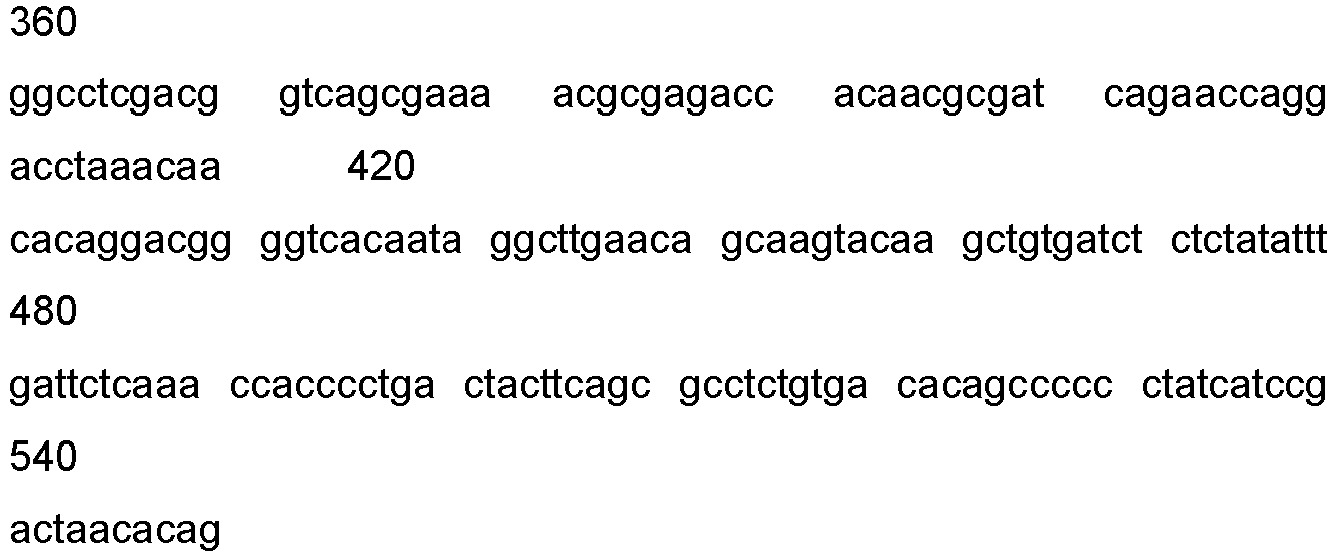
21 primer gacaatgcct cgaggaggtt taaaagtaac t DNA 22 primer gcgccgccaa cccggtctct ctgtgttagt cggatgatag g DNA 23 primer cctatcatcc gactaacaca gagagaccgg gttggcggcg c DNA 24 primer gacgagtcag acaggaggca ctgcggttag tactgcaaaa ag DNA 25 primer ctttttgcag tactaaccgc agtgcctcct gtctgactcg tc DNA 26 primer atgcgccgcc aacccggtct cttggtggta ttgtgactgg ggat DNA 27 primer atccccagtc acaataccac caagagaccg ggttggcggc gcat DNA 28 primer ctttccaata gctgcttgta gctgcggtta gtactgcaaa a DNA 29 primer ttttgcagta ctaaccgcag ctacaagcag ctattggaaa g DNA 30 primer gcttaatgtg attgatctca aacttgatag DNA 31 primer gctgtctctg cgagagcacg tcga DNA 32 primer ggttcgcaca acttctcggg tggc DNA 33 ggpps 
DNA 
34 TEFINtp-GGPPS-CYC1t 
DNA 


35 primer aagacaaggc ttcggaagcg agaaccgcaa DNA 36 primer atgcgccgcc aacccggtct ctgtgtttgg cggtgtgagt tgtc DNA 37 primer gacaactcac accgccaaac acagagaccg ggttggcggc gcat DNA 38 primer atgacgagtc agacaggagg cactgcggtt agtactgcaa aaag DNA 39 primer ctttttgcag tactaaccgc agtgcctcct gtctgactcg tcat DNA 40 primer atgcgccgcc aacccggtct cttggtggta ttgtgactgg ggat DNA 41 primer atccccagtc acaataccac caagagaccg ggttggcggc gcat DNA 42 primer atatggagtg ttatttgaag gggcaaatta aagccttcga gcgt DNA 43 primer acgctcgaag gctttaattt gccccttcaa ataacactcc atat DNA 44 primer gtgtccaagt acgaacgcca atgcaagatt DNA 45 primer ccagttattt gtaccatgcg gtgg DNA 46 primer ccatcttgtg tcgcgacgac gaaa DNA 47 primer cccacctcct cctcctgctc ccccggcagc ccctgccgcc cctg DNA 48 primer atgacgagtc agacaggagg cacctagtta gtcagaattt ttgt DNA 49 primer acaaaaattc tgactaacta ggtgcctcct gtctgactcg tcat DNA 50 primer taccggtcgg tagctacaat actggtggta ttgtgactgg ggat DNA 51 primer atccccagtc acaataccac cagtattgta gctaccgacc ggta DNA 52 primer cgtgtagatc caccacatac accctagtta gtcagaattt ttgt DNA 53 primer acaaaaattc tgactaacta gggtgtatgt ggtggatcta cacg DNA 54 primer aagtaggaaa catgatggcc tcttcttcct cttttgtaat gtac DNA 55 primer cccaactctc gaggaaatgg ccat DNA 56 primer ctggggatct tttccatcct tgtt DNA 57 BLH 
Protei n 
58 TEFINtp-BLH-CYC1t 
DNA 
59 primer gtacccgggg atcctctaga ggcgtttcag gtggttgcgt gagtg DNA 60 primer gacacaaatg cgccgccaac ccggtctctg cggcggttcg tggttcgtgt ttc DNA 61 primer gaaacacgaa ccacgaaccg ccgcagagac cgggttggcg gcgcatttgt gtc DNA 62 primer gacgagtcag acagatactc gtcggcaaat taaagccttc gagcgtccc DNA 63 primer gggacgctcg aaggctttaa tttgccgacg agtatctgtc tgactcgtc DNA 64 primer caggaagaag tagatgccgc cgccgcaaag gcctgtttct cggtgtacag DNA 65 primer ctgtacaccg agaaacaggc ctttgcggcg gcggcatcta cttcttcctg DNA 66 primer gcagcagtca tacatgttct gaggcaaatt aaagccttcg agcgtccc DNA 67 primer gggacgctcg aaggctttaa tttgcctcag aacatgtatg actgctgc DNA 68 primer gcctgcaggt cgactctaga ctactttgtg cagattgagg ccaag DNA 69 primer cttgaccttg tagagctgac cggc DNA 70 primer cactactttc gccaccaaga tggg DNA 
Claims (16)
- A method of producing retinol, the method comprising the step of culturing a microorganism of the genus Yarrowia in a medium comprising a non-ionic surfactant.
- The method of claim 1, wherein the non-ionic surfactant is any one or more selected from the group consisting of Tween and Triton.
- The method of claim 2, wherein the Tween is any one or more selected from the group consisting of Tween 20, Tween 40, Tween 60, and Tween 80.
- The method of claim 1, wherein the non-ionic surfactant increases extracellular excretion of retinol.
- The method of claim 1, wherein the microorganism is for producing retinol.
- The method of claim 1, wherein the non-ionic surfactant is included at a concentration of 0.01%(w/v) or more with respect to the total medium composition.
- The method of claim 1, further comprising the step of recovering retinol from the medium or microorganism.
- A method of increasing retinol production, the method comprising the step of culturing a microorganism of the genus Yarrowia in a medium comprising a non-ionic surfactant.
- A method of producing retinoids, the method comprising the steps of:culturing a microorganism of the genus Yarrowia in a medium comprising a non-ionic surfactant; andconverting retinol, which is expressed by the microorganism, into retinoids other than retinol.
- A medium composition for a microorganism of the genus Yarrowia for producing retinol, the composition comprising a non-ionic surfactant.
- The medium composition of claim 10, wherein the non-ionic surfactant is any one or more selected from the group consisting of Tween and Triton.
- The medium composition of claim 10, wherein the non-ionic surfactant is included at a concentration of 0.01%(w/v) or more with respect to the total medium composition.
- The medium composition of claim 10, wherein the medium composition increases the retinol production of the microorganism.
- A composition for producing retinol, the composition comprising a microorganism of the genus Yarrowia or a culture thereof and a non-ionic surfactant.
- The composition of claim 14, wherein the microorganism is for producing retinol.
- Use of a non-ionic surfactant; a medium composition for a microorganism of the genus Yarrowia comprising the non-ionic surfactant; or a composition comprising the microorganism of the genus Yarrowia or a culture thereof and the non-ionic surfactant, in producing retinoids.
Applications Claiming Priority (2)
| Application Number | Priority Date | Filing Date | Title |
|---|---|---|---|
| KR1020220036259A KR102854659B1 (en) | 2022-03-23 | 2022-03-23 | A microorganism culture medium composition for retinol production comprising surfactant |
| PCT/KR2022/011050 WO2023182584A1 (en) | 2022-03-23 | 2022-07-27 | Microbial medium composition for producing retinol comprising surfactant and use thereof |
Publications (2)
| Publication Number | Publication Date |
|---|---|
| EP4491737A1 true EP4491737A1 (en) | 2025-01-15 |
| EP4491737A4 EP4491737A4 (en) | 2025-11-26 |
Family
ID=88101180
Family Applications (1)
| Application Number | Title | Priority Date | Filing Date |
|---|---|---|---|
| EP22933756.3A Pending EP4491737A4 (en) | 2022-03-23 | 2022-07-27 | Microbial medium composition for the manufacture of retinol with surfactant and use thereof |
Country Status (6)
| Country | Link |
|---|---|
| US (1) | US20250188508A1 (en) |
| EP (1) | EP4491737A4 (en) |
| JP (1) | JP7819351B2 (en) |
| KR (1) | KR102854659B1 (en) |
| CN (1) | CN119487202A (en) |
| WO (1) | WO2023182584A1 (en) |
Families Citing this family (1)
| Publication number | Priority date | Publication date | Assignee | Title |
|---|---|---|---|---|
| CN121537325A (en) * | 2026-01-21 | 2026-02-17 | 杭州馨海酶源生物科技有限公司 | A method for separating and purifying retinol from fermentation broth and its application. |
Family Cites Families (5)
| Publication number | Priority date | Publication date | Assignee | Title |
|---|---|---|---|---|
| US6858217B2 (en) | 2002-03-22 | 2005-02-22 | Unilever Home & Personal Care Usa Division Of Conopco, Inc. | Stabilization of terpenoids in cosmetic compositions |
| US8691555B2 (en) | 2006-09-28 | 2014-04-08 | Dsm Ip Assests B.V. | Production of carotenoids in oleaginous yeast and fungi |
| US20120149886A1 (en) * | 2008-04-10 | 2012-06-14 | Microbia, Inc. | Production of carotenoids in oleaginous yeast and fungi |
| KR102202606B1 (en) * | 2018-11-30 | 2021-01-15 | (주)바이오스플래시 | A microorganism for producing a bio-retinol and a method for preparing a bio-retinol using the same |
| CN114555816A (en) * | 2019-10-22 | 2022-05-27 | 佰欧菲洛公司 | Improved process for the production, recovery and secretion of hydrophobic compounds in fermentation |
-
2022
- 2022-03-23 KR KR1020220036259A patent/KR102854659B1/en active Active
- 2022-07-27 US US18/849,460 patent/US20250188508A1/en active Pending
- 2022-07-27 JP JP2024556592A patent/JP7819351B2/en active Active
- 2022-07-27 WO PCT/KR2022/011050 patent/WO2023182584A1/en not_active Ceased
- 2022-07-27 CN CN202280096403.3A patent/CN119487202A/en active Pending
- 2022-07-27 EP EP22933756.3A patent/EP4491737A4/en active Pending
Also Published As
| Publication number | Publication date |
|---|---|
| JP7819351B2 (en) | 2026-02-24 |
| US20250188508A1 (en) | 2025-06-12 |
| JP2025510208A (en) | 2025-04-14 |
| CN119487202A (en) | 2025-02-18 |
| KR20230138334A (en) | 2023-10-05 |
| WO2023182584A1 (en) | 2023-09-28 |
| EP4491737A4 (en) | 2025-11-26 |
| KR102854659B1 (en) | 2025-09-03 |
Similar Documents
| Publication | Publication Date | Title |
|---|---|---|
| US8883969B2 (en) | Method for production of carotenoid-synthesizing microorganism and method for production of carotenoid | |
| US20190136269A1 (en) | Genetically Engineered Strain | |
| JP6342326B2 (en) | D-glucaric acid-producing bacterium and method for producing D-glucaric acid | |
| US20070202579A1 (en) | Production Of Isoprenoids | |
| CN105308172A (en) | Microorganism comprising gene encoding enzyme involved in retinoid production and method for producing retinoid using same | |
| US8962287B2 (en) | Scyllo-inositol-producing cell and scyllo-inositol production method using said cells | |
| KR102473375B1 (en) | Recombinant microorganisms, their preparation methods and their use in the production of coenzyme Q10 | |
| KR102856009B1 (en) | Method for producing sulfated polysaccharides and method for producing PAPS | |
| AU2021249958B2 (en) | Method for producing sulfated polysaccharide and method for producing PAPS | |
| US20190309340A1 (en) | Method of continuously producing glutathione using photosynthetic membrane vesicles | |
| US20250188508A1 (en) | Microbial medium composition for producing retinol comprising surfactant and use thereof | |
| JP2013046610A (en) | Modified peroxidase enzyme gene which exhibits improved expression property, and method for producing peroxidase using the same | |
| EP4361259A1 (en) | Novel beta-carotene 15,15-oxygenase variant and retinoid production method using same | |
| EP4491736A1 (en) | Microbial medium composition for producing retinol, comprising anti-oxidant, and use thereof | |
| JP2024503213A (en) | Amycolatopsis strains for vanillin production with suppressed vanillic acid formation | |
| JP5277482B2 (en) | Method for producing flavin adenine dinucleotide-linked glucose dehydrogenase | |
| CN108823258B (en) | An Oxidation Method Using Whole Cells as Catalysts | |
| US20060141557A1 (en) | Production of canthaxanthin by phaffia | |
| WO2015019674A1 (en) | Method for producing flavin adenine dinucleotide-binding glucose dehydrogenase originated from genus mucor | |
| US9567576B2 (en) | Strain expressing FRSA and method for producing ethanol using same | |
| JP7495083B2 (en) | Recombinant production of peroxidase | |
| JP5023474B2 (en) | Method for producing carotenoid-synthesizing microorganism and method for producing carotenoid | |
| DE102022119514A1 (en) | Genetically modified cells of Methylorubrum for fermentative production of glycolic acid and lactic acid from Cx compounds | |
| US20200087688A1 (en) | Enzymatic reduction of cystine | |
| JP2017063666A (en) | Method for producing nuclease s1 |
Legal Events
| Date | Code | Title | Description |
|---|---|---|---|
| STAA | Information on the status of an ep patent application or granted ep patent |
Free format text: STATUS: THE INTERNATIONAL PUBLICATION HAS BEEN MADE |
|
| PUAI | Public reference made under article 153(3) epc to a published international application that has entered the european phase |
Free format text: ORIGINAL CODE: 0009012 |
|
| STAA | Information on the status of an ep patent application or granted ep patent |
Free format text: STATUS: REQUEST FOR EXAMINATION WAS MADE |
|
| 17P | Request for examination filed |
Effective date: 20241011 |
|
| AK | Designated contracting states |
Kind code of ref document: A1 Designated state(s): AL AT BE BG CH CY CZ DE DK EE ES FI FR GB GR HR HU IE IS IT LI LT LU LV MC MK MT NL NO PL PT RO RS SE SI SK SM TR |
|
| DAV | Request for validation of the european patent (deleted) | ||
| DAX | Request for extension of the european patent (deleted) | ||
| REG | Reference to a national code |
Ref country code: DE Ref legal event code: R079 Free format text: PREVIOUS MAIN CLASS: C12P0023000000 Ipc: C12N0001160000 |
|
| A4 | Supplementary search report drawn up and despatched |
Effective date: 20251024 |
|
| RIC1 | Information provided on ipc code assigned before grant |
Ipc: C12N 1/16 20060101AFI20251020BHEP Ipc: C12N 9/10 20060101ALI20251020BHEP Ipc: C12N 15/81 20060101ALI20251020BHEP Ipc: C12P 23/00 20060101ALI20251020BHEP Ipc: C12R 1/645 20060101ALI20251020BHEP Ipc: C12N 1/38 20060101ALI20251020BHEP |