EP4491479A1 - Vehicle early warning method and apparatus, electronic device, and storage medium - Google Patents
Vehicle early warning method and apparatus, electronic device, and storage medium Download PDFInfo
- Publication number
- EP4491479A1 EP4491479A1 EP23765903.2A EP23765903A EP4491479A1 EP 4491479 A1 EP4491479 A1 EP 4491479A1 EP 23765903 A EP23765903 A EP 23765903A EP 4491479 A1 EP4491479 A1 EP 4491479A1
- Authority
- EP
- European Patent Office
- Prior art keywords
- vehicle
- travel data
- early
- fault code
- warning
- Prior art date
- Legal status (The legal status is an assumption and is not a legal conclusion. Google has not performed a legal analysis and makes no representation as to the accuracy of the status listed.)
- Granted
Links
Images


Classifications
-
- B—PERFORMING OPERATIONS; TRANSPORTING
- B60—VEHICLES IN GENERAL
- B60W—CONJOINT CONTROL OF VEHICLE SUB-UNITS OF DIFFERENT TYPE OR DIFFERENT FUNCTION; CONTROL SYSTEMS SPECIALLY ADAPTED FOR HYBRID VEHICLES; ROAD VEHICLE DRIVE CONTROL SYSTEMS FOR PURPOSES NOT RELATED TO THE CONTROL OF A PARTICULAR SUB-UNIT
- B60W50/00—Details of control systems for road vehicle drive control not related to the control of a particular sub-unit, e.g. process diagnostic or vehicle driver interfaces
- B60W50/0098—Details of control systems ensuring comfort, safety or stability not otherwise provided for
-
- B—PERFORMING OPERATIONS; TRANSPORTING
- B60—VEHICLES IN GENERAL
- B60L—PROPULSION OF ELECTRICALLY-PROPELLED VEHICLES; SUPPLYING ELECTRIC POWER FOR AUXILIARY EQUIPMENT OF ELECTRICALLY-PROPELLED VEHICLES; ELECTRODYNAMIC BRAKE SYSTEMS FOR VEHICLES IN GENERAL; MAGNETIC SUSPENSION OR LEVITATION FOR VEHICLES; MONITORING OPERATING VARIABLES OF ELECTRICALLY-PROPELLED VEHICLES; ELECTRIC SAFETY DEVICES FOR ELECTRICALLY-PROPELLED VEHICLES
- B60L3/00—Electric devices on electrically-propelled vehicles for safety purposes; Monitoring operating variables, e.g. speed, deceleration or energy consumption
- B60L3/0023—Detecting, eliminating, remedying or compensating for drive train abnormalities, e.g. failures within the drive train
-
- B—PERFORMING OPERATIONS; TRANSPORTING
- B60—VEHICLES IN GENERAL
- B60L—PROPULSION OF ELECTRICALLY-PROPELLED VEHICLES; SUPPLYING ELECTRIC POWER FOR AUXILIARY EQUIPMENT OF ELECTRICALLY-PROPELLED VEHICLES; ELECTRODYNAMIC BRAKE SYSTEMS FOR VEHICLES IN GENERAL; MAGNETIC SUSPENSION OR LEVITATION FOR VEHICLES; MONITORING OPERATING VARIABLES OF ELECTRICALLY-PROPELLED VEHICLES; ELECTRIC SAFETY DEVICES FOR ELECTRICALLY-PROPELLED VEHICLES
- B60L3/00—Electric devices on electrically-propelled vehicles for safety purposes; Monitoring operating variables, e.g. speed, deceleration or energy consumption
- B60L3/0023—Detecting, eliminating, remedying or compensating for drive train abnormalities, e.g. failures within the drive train
- B60L3/0046—Detecting, eliminating, remedying or compensating for drive train abnormalities, e.g. failures within the drive train relating to electric energy storage systems, e.g. batteries or capacitors
-
- B—PERFORMING OPERATIONS; TRANSPORTING
- B60—VEHICLES IN GENERAL
- B60W—CONJOINT CONTROL OF VEHICLE SUB-UNITS OF DIFFERENT TYPE OR DIFFERENT FUNCTION; CONTROL SYSTEMS SPECIALLY ADAPTED FOR HYBRID VEHICLES; ROAD VEHICLE DRIVE CONTROL SYSTEMS FOR PURPOSES NOT RELATED TO THE CONTROL OF A PARTICULAR SUB-UNIT
- B60W50/00—Details of control systems for road vehicle drive control not related to the control of a particular sub-unit, e.g. process diagnostic or vehicle driver interfaces
- B60W50/02—Ensuring safety in case of control system failures, e.g. by diagnosing, circumventing or fixing failures
- B60W50/0205—Diagnosing or detecting failures; Failure detection models
-
- G—PHYSICS
- G06—COMPUTING OR CALCULATING; COUNTING
- G06F—ELECTRIC DIGITAL DATA PROCESSING
- G06F11/00—Error detection; Error correction; Monitoring
- G06F11/30—Monitoring
- G06F11/3003—Monitoring arrangements specially adapted to the computing system or computing system component being monitored
- G06F11/3013—Monitoring arrangements specially adapted to the computing system or computing system component being monitored where the computing system is an embedded system, i.e. a combination of hardware and software dedicated to perform a certain function in mobile devices, printers, automotive or aircraft systems
-
- G—PHYSICS
- G06—COMPUTING OR CALCULATING; COUNTING
- G06F—ELECTRIC DIGITAL DATA PROCESSING
- G06F11/00—Error detection; Error correction; Monitoring
- G06F11/30—Monitoring
- G06F11/34—Recording or statistical evaluation of computer activity, e.g. of down time, of input/output operation ; Recording or statistical evaluation of user activity, e.g. usability assessment
- G06F11/3466—Performance evaluation by tracing or monitoring
- G06F11/3476—Data logging
-
- B—PERFORMING OPERATIONS; TRANSPORTING
- B60—VEHICLES IN GENERAL
- B60W—CONJOINT CONTROL OF VEHICLE SUB-UNITS OF DIFFERENT TYPE OR DIFFERENT FUNCTION; CONTROL SYSTEMS SPECIALLY ADAPTED FOR HYBRID VEHICLES; ROAD VEHICLE DRIVE CONTROL SYSTEMS FOR PURPOSES NOT RELATED TO THE CONTROL OF A PARTICULAR SUB-UNIT
- B60W50/00—Details of control systems for road vehicle drive control not related to the control of a particular sub-unit, e.g. process diagnostic or vehicle driver interfaces
- B60W50/02—Ensuring safety in case of control system failures, e.g. by diagnosing, circumventing or fixing failures
- B60W50/0205—Diagnosing or detecting failures; Failure detection models
- B60W2050/021—Means for detecting failure or malfunction
Definitions
- the embodiments of the present application relate to the technical field of vehicles, and particularly relate to a vehicle early-warning method and apparatus, an electronic device and a storage medium.
- the vehicle has a CPLD (Complex Programmable Logic Device) chip, wherein the CPLD chip is a diagnosing chip serving for diagnosing faults in the voltage, the current and the driving.
- the CPLD chip in the vehicle has a driving fault or a state fault, the vehicle loses the propulsion power, and can merely slide forwardly through the inertia of the vehicle, which easily results in traffic accidents.
- the present application provides a vehicle early-warning method and apparatus, an electronic device and a storage medium, which aims at performing early warning in advance to the component fault in the vehicle, to reduce the probability of traffic accidents.
- the first aspect of the present application provides a vehicle early-warning method, wherein the method comprises:
- the step of dividing the vehicle-relevant datum into the plurality of travel data comprises:
- the step of determining the abnormal value in the plurality of MCU fault codes comprises:
- the step of, among the plurality of travel data, by means of concurrent processing, simultaneously determining the target travel data in which the MCU fault code appears as the first preset fault code comprises:
- the step of, if the number of times with which the first preset fault code appears in the target travel data is greater than the preset number of times, outputting the early-warning signal comprises:
- the early-warning model is obtained by training by: based on vehicle-relevant data of a plurality of vehicles and a plurality of travel data corresponding thereto, training a model, to obtain the early-warning model.
- the step of, based on the vehicle-relevant data of the plurality of vehicles and the plurality of travel data corresponding thereto, training the model comprises:
- the second aspect of the present application provides a vehicle early-warning apparatus, wherein the apparatus comprises:
- the third aspect of the embodiments of the present application provides an electronic device, wherein the electronic device comprises:
- the fourth aspect of the embodiments of the present application provides one or more machine-readable storage media, wherein the machine-readable storage media store an instruction, and the instruction, when executed by one or more processors, causes the processor to implement the vehicle early-warning method according to the first aspect of the embodiments of the present application.
- the fifth aspect of the embodiments of the present application provides a computer program product, wherein the computer program product contains a computer-readable code, and the computer-readable code, when executing in an electronic device, causes the electronic device to implement the vehicle early-warning method according to the first aspect of the embodiments of the present application.
- the vehicle early-warning method can, if the number of times with which the first preset fault code appears in the target travel data is greater than the preset number of times, determine that a component of the current vehicle has a fault, and accordingly output the early-warning signal, thereby informing the user in advance that the component of the current vehicle has a fault.
- the user when knowing the early-warning signal, can repair the current vehicle, thereby reducing traffic accidents. For example, when the CPLD chip in the vehicle has a fault, the early-warning signal is outputted, to inform the user that the CPLD has a driving fault, and the vehicle has the risk in losing the propulsion power. The user, when knowing that the vehicle has the risk in losing the propulsion power, can repair the vehicle timely.
- the present application can, when it is detected that the number of times with which the first preset fault code appears in the target travel data is greater than the preset number of times, automatically determine the component fault of the current vehicle and perform early warning, without early warning performed by artificial monitoring, which greatly reduces the labor cost.
- the present application can perform travel division to the vehicle-relevant data of the current vehicle, to divide it into a plurality of travel data, and subsequently concurrently process each of the travel data, to simultaneously determine the target travel data from each of the travel data, so as to determine whether the components of the current vehicle have a fault, and finally perform the early warning.
- Such a mode of concurrently processing each of the travel data can quickly output the early-warning signal, thereby increasing the early-warning speed.
- the present application provides a vehicle early-warning method.
- the method may be applied in an early-warning model, and may perform early warning for the components of a vehicle. For example, it may perform early warning in advance for driving faults of the CPLD chip of the vehicle, and may also perform early warning in advance for under-voltage of the storage battery of the vehicle.
- the method particularly comprises the following steps: Step 101: acquiring a vehicle-relevant datum of a current vehicle, wherein the vehicle-relevant datum contains an MCU fault code of the current vehicle.
- the vehicle-relevant datum is established by associating a vehicle-relevant-datum table and a vehicle-information table.
- the vehicle-relevant-datum table shows the vehicle data relevant to the state of the current vehicle that are uploaded via CAN signals.
- the vehicle information is for indicating the type of the vehicle, for example, whether the vehicle is the Shanghai driving type or the Honeycomb driving type, wherein the Shanghai driving refers to the fuel-cell electrically driven vehicles, the purely electrically driven sedans, and so on, that are produced by the Shanghai Electric Drive company, and the Honeycomb driving refers to the fuel-cell electrically driven vehicles, the purely electrically driven sedans, and so on, that are produced by the Honeycomb electric driving company.
- the integrated vehicle-relevant datum does not only contain the vehicle data relevant to the current vehicle, but also contains the vehicle type of the vehicle.
- Table 1 Id Signal name English name Note 1 vin Chassis number 2 tid Time 3 TM Failcode MCU fault signal 4 dt Date 5 source Type of the data source The values are 2 and 10 6 engine_no Electric-motor number For matching with the corresponding electric driving 7 sale status sale status 6 represents "truly sold"
- the chassis number, the real-time date of registration of the datum, the standard date of registration of the datum, MCU (Microcontroller Unit) fault code, and type of data source related to the current vehicle are acquired from the vehicle-relevant-datum table.
- the electric-motor number and sales status related to the current vehicle are acquired from the vehicle-information table.
- they are integrated to form the vehicle-relevant datum shown in Table 1.
- Table 2 Signal value Meaning of fault 35 State fault code of the CPLD 39
- CPLD driving fault Overcurrent fault 41
- Each vehicle corresponds to its unique chassis number, wherein the chassis number is used to uniquely identify one current vehicle.
- the standard date of registration of the datum refers to the accurate date of registration when the data source is registered and enters the vehicle-relevant-datum table.
- the real-time date of registration of the datum refers to the date of registration when the data source is registered and enters the vehicle-relevant-datum table currently. Referring to Table 2, if the MCU fault code is 35, that indicates a state fault of the CPLD. If the MCU fault code is 39, that indicates a driving fault of the CPLD. If the MCU fault code is 40, that indicates that the MCU has an overcurrent fault. If the MCU fault code is 41, that indicates that the MCU has an overvoltage fault.
- the MCU fault code is 45 or 127, that indicates a fault of under-voltage of the storage battery of the MCU.
- the type of data source refers to that the data in the vehicle-relevant-datum table are the data when the current vehicle is in different travelling states, for example, the data when the vehicle is in the stages such as a registration state (the state when the starting-up has just begun), a heartbeat state (the state of stable travelling) and a shutting-down state.
- the electric-motor number is used to identify the vehicle type of the vehicle, for example, to identify whether the vehicle is the Shanghai driving type or the Honeycomb driving type.
- the sale status is used to indicate the actual quantity of sale of the current vehicle.
- Step 102 dividing the vehicle-relevant datum into a plurality of travel data.
- each of the data in the vehicle-relevant datum is a datum that varies in a curve.
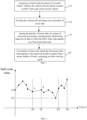
- the plurality of black dots are used to identify multiple MCU fault codes, and the multiple MCU fault codes in the vehicle-relevant datum vary in a curve and are consecutive.
- Each of the travel data is the data that are generated when the current vehicle travels within different time periods, and the intervals between the travel data are the intervals that are generated when the vehicle is shut down within different time periods.
- a consecutive MCU-fault-signal curve in the vehicle-relevant datum is divided into a plurality of travel data, wherein the interval durations between the travel data are not less than a preset duration.
- the preset duration may be 15min, and may also be 20min, which is set according to particular practical situations, and is not limited in the present application.
- the black dots in the MCU-fault-signal curve represent different signal values, and, if the signal value is 35 or 39, that indicates that the CPLD has a driving fault.
- the interval duration between the tail MCU fault code A of the first travel datum and the initial MCU fault code B of the second travel datum is 15min, and 15min is exactly equal to the preset duration, and thus is not less than the preset duration. Therefore, at the stage of 20min to 35min the current vehicle is in the shutting-down state, in which case the curve before the shutting-down stage may be divided to be one travel datum, and the curve after the shutting-down stage may be divided to be one travel datum. All of the subsequent travel data are judged by following that logic, and finally the one consecutive MCU-fault-signal curve is divided into a plurality of travel data.
- the vehicle might be used frequently by the user within one day (or within week or within one month), and the vehicle generates a large data volume each time it is used, if all of the data of the vehicle undergo data processing one by one, or, in other words, the number of times with which the MCU fault code is the first preset fault code is counted up one by one, undoubtedly finally the early-warning signal has a low speed.
- the present application performs travel division to the datum generated by the current vehicle within one day, to divide it into a plurality of travel data, and subsequently concurrently process each of the travel data.
- the travel data are synchronously processed by using the steps 103 and 104, and it is not required to, by serial processing, process the MCU fault codes generated by the current vehicle one by one. Therefore, it can be quickly determined whether the components of the current vehicle have a fault, to quickly perform early warning.
- Step 103 among the plurality of travel data, by means of concurrent processing, simultaneously determining target travel data in which the MCU fault code appears as a first preset fault code.
- the first preset fault code may be a fault code for characterizing that the CPLD chip of the vehicle has a fault, and may also be used to characterize a fault of under-voltage of the storage battery of the vehicle, and so on.
- the first preset fault code according to the present application is decided according to practical situations.
- the first preset fault code may be 35 or 39, and the first preset fault code is used to characterize that the CPLD of the current vehicle has a driving fault or a state fault.
- a plurality of travel data in which the MCU fault code appears as 35 or 39 may be used as a plurality of target travel data.
- the first preset fault code 35 appears, and therefore the second travel datum may be used as the target travel data.
- the rest may be done in the same manner, and finally the plurality of target travel data in which 35 or 39 appears in the one complete MCU-fault-signal curve are counted up.
- Step 104 if a number of times with which the first preset fault code appears in the target travel data is greater than a preset number of times, outputting an early-warning signal.
- the early-warning signal may be outputted, to perform early warning in advance.
- the early-warning signal is outputted, to notify the user that the vehicle might lose the propulsion power, to perform early warning in advance.
- the early-warning signal is outputted, to notify the user that the capacity of electric-power supplying of the vehicle is insufficient, so as to charge in advance.
- the process may comprise simultaneously counting up the number of times with which the first preset fault code appears in each of the plurality of target travel data, subsequently comparing the time quantities with which the first preset fault code appears in each of the target travel data with each other, and comparing the number of times of the highest numerical value with the preset number of times. If the number of times of the highest numerical value is less than or equal to the preset number of times, that indicates that the determination on the component fault of the current vehicle might have erroneous determination, and in this case the early-warning signal may not be outputted.
- the early-warning signal may be outputted, to perform early warning in advance for the fault situation of the components of the current vehicle.
- the preset number of times may be 2, and may also be 3, which is set according to particular situations of the vehicle, and is not limited in the present application.
- the steps 101 to 104 will be illustrated by using the following example, wherein the preset number of times is 2 times.
- the user uses the current vehicle at the stage of 8:00-8:30 in the morning, uses the current vehicle at 12:00-13:00 at noon, and uses the current vehicle at 6:00-6:50 in the evening.
- the current vehicle generates a consecutive vehicle-relevant datum within the duration of one day, and, via the travel division, the vehicle-relevant datum is divided into three sections of travel data of morning, noon and evening.
- the time quantities with which the first preset fault code appears in the three sections of travel data of morning, noon and evening are 1, 2 and 3 respectively.
- 3, which is the highest numerical value is compared with the preset number of times. Because 3 is greater than the preset number of times 2, it is determined that a component of the current vehicle has a fault, and in this case the early-warning signal may be outputted, to perform early warning in advance for the fault of the components of the current vehicle.
- the component is the CPLD chip
- the fault code of 35 or 39 appears in all of the three sections of travel data of morning, noon and evening. Therefore, all of the three sections of travel data of morning, noon and evening are determined to be the target travel data. Subsequently, it is determined that the time quantities with which 35 or 39 appears in the three sections of travel data of morning, noon and evening are 1, 2 and 3 respectively. Subsequently, 3, which is the highest numerical value, is compared with the preset number of times.
- the early-warning signal may be outputted, to notify the user that the vehicle might have the risk in losing the propulsion power.
- the user when knowing the risk, can repair the vehicle timely.
- the component is the storage battery
- the fault code of 45 or 127 appears in all of the three sections of travel data of morning, noon and evening. Therefore, all of the three sections of travel data of morning, noon and evening are determined to be the target travel data. Subsequently, it is determined that the time quantities with which 45 or 127 appears in the three sections of travel data of morning, noon and evening are 1, 2 and 3 respectively. Subsequently, 3, which is the highest numerical value, is compared with the preset number of times.
- the early-warning signal may be outputted, to notify the user that the electric quantity of the storage battery of the vehicle is insufficient.
- the user when knowing the risk, can charge the vehicle timely.
- the vehicle early-warning method can, if the number of times with which the first preset fault code appears in the target travel data is greater than the preset number of times, determine that a component of the current vehicle has a fault, and accordingly output the early-warning signal, thereby informing the user in advance that the component of the current vehicle has a fault.
- the user when knowing the early-warning signal, can repair the current vehicle, thereby reducing traffic accidents.
- the present application can, when it is detected that the number of times with which the first preset fault code appears in the target travel data is greater than the preset number of times, automatically determine the component fault of the current vehicle and perform early warning, without early warning performed by artificial monitoring, which greatly reduces the labor cost.
- the present application can perform travel division to the vehicle-relevant data of the current vehicle, to divide it into a plurality of travel data, and subsequently concurrently process each of the travel data, to simultaneously determine the target travel data from each of the travel data, so as to determine whether the components of the current vehicle have a fault, and finally perform the early warning.
- Such a mode of concurrently processing each of the travel data can quickly output the early-warning signal, thereby increasing the early-warning speed.
- the step 102 may further comprise the following steps: Step 201: by using an early-warning model that is trained, identifying a plurality of driving-fault signal values in the vehicle-relevant datum.
- This step may comprise, based on vehicle-relevant data of a plurality of vehicles and a plurality of travel data corresponding thereto, training a model, to obtain the early-warning model.
- the model may be trained by using the consecutive vehicle-relevant datum as the input of the model and using the plurality of travel data as the output of the model, so as to obtain the early-warning model.
- the obtained early-warning model has the capacity of performing travel division to one consecutive vehicle-relevant datum.
- the process may comprise cleaning abnormal data among the vehicle-relevant data of the plurality of vehicles, to obtain the vehicle-relevant data that are cleaned; and based on the vehicle-relevant data that are cleaned and a plurality of travel data corresponding thereto, training the model, to obtain the early-warning model.
- the abnormal data include a real-time date of registration of a datum (tid) that is inconsistent with the standard date of registration of the datum (dt), and an inaccurate invalid datum uploaded to the vehicle data.
- the invalid datum refers to that, if, when the datum of a current moment is to be uploaded, the datum of the preceding moment is erroneously uploaded into the vehicle-relevant datum, then the datum of the preceding moment is an invalid datum.
- That part of abnormal data may be screened out, whereby all of the data inputted into the model are accurate and valid.
- the uploading frequencies of the data of the fields might be unequal. For example, a field A is uploaded one time every 1s, while a field B is uploaded one time every 10s. However, when the vehicle-relevant datum is being uploaded, at each moment it is required to correspondingly upload both of the field A and the field B. Because the field B has a lower uploading frequency, it is required to compensate for the datum missing from the field B, and upload the field B that is compensated for. That ensures that the data have correspondence therebetween, so that at each moment the data of different fields are uploaded, whereby finally each of the vehicle-relevant data that are outputted, at the same moment, has its respective corresponding data.
- Step 202 determining an abnormal value in the plurality of MCU fault codes.
- the division when travel division is performed to one consecutive MCU-fault-signal curve, the division may be based on an abnormal value among the plurality of MCU fault codes, wherein the plurality of MCU fault codes before the abnormal value are used as one section of travel data, and the plurality of MCU fault codes after the abnormal value are used as another one section of travel data.
- the rest may be done in the same manner, whereby the one consecutive MCU-fault-signal curve can be divided into a plurality of travel data.
- this step may comprise the following sub-steps: Sub-step A1: calculating an interval duration between each two successive MCU fault codes in the vehicle-relevant datum.
- the interval duration between two successive MCU fault codes may be obtained by subtracting the time stamp of the preceding one MCU fault code from the time stamp of the subsequent one MCU fault code.
- Sub-step A2 if the interval duration is not less than a preset duration, using the MCU fault code that has a later time stamp among the two successive MCU fault codes as the abnormal value.
- the interval duration between the tail MCU fault code A of the first section of travel data and the initial MCU fault code B of the second section of travel data is 15min, which is exactly not less than the preset duration 15min. Therefore, the initial MCU fault code B is used as an abnormal value.
- Step 203 by using the abnormal value as a division point, dividing the vehicle-relevant datum into the plurality of travel data.
- the plurality of MCU fault codes before the abnormal value are used as one section of travel data, and the abnormal value and the plurality of MCU fault codes after the abnormal value are used as another one section of travel data.
- the rest may be done in the same manner, whereby the one consecutive MCU-fault-signal curve can be divided into a plurality of travel data.
- the plurality of MCU fault codes before the initial MCU fault code B are used as the first section of travel data
- the initial MCU fault code B and the plurality of MCU fault codes after the initial MCU fault code B are used as the second section of travel data.
- such a method may apply, to divide the one consecutive MCU-fault-signal curve into a plurality of travel data.
- the vehicle component that is early-warned is the CPLD chip
- the vehicle when it is detected that the plurality of travel data have the fault of under-voltage of the storage battery, the vehicle also outputs the early-warning signal.
- the fault of under-voltage of the storage battery does not cause the vehicle to lose the propulsion power, and if the early-warning signal is outputted at this point, the user is misled to think that the vehicle has lost the propulsion power, which affects the effect of early warning.
- the step 103 further comprises the following steps: Step 301: determining, among the plurality of travel data, the invalid travel data in which the MCU fault code appears as the second preset fault code.
- the second preset fault code is used to characterize a fault of under-voltage of the storage battery. For example, when the second preset fault code of 45 or 127 appears in the travel data, it is determined that the current travel datum is an invalid travel datum.
- the invalid travel data are travel data in which the fault of under-voltage of the storage battery appears.
- Step 302 removing the invalid travel data from the plurality of travel data, to obtain valid travel data.
- the invalid travel data may be removed from the plurality of travel data, to obtain the valid travel data.
- the valid travel data refer to the travel data in which the first preset fault code appears, or the travel data in which the overcurrent fault appears, or the travel data in which the overvoltage fault appears.
- the invalid travel data may be removed from the plurality of the travel data, so as to ensure that the remaining valid travel data do not include invalid travel data that affect the effect of early warning, to ensure that what is early-warned in the present application is the CPLD faults, thereby preventing erroneous early warning.
- Step 303 from a plurality of valid travel data, determining the target travel data in which the MCU fault code appears as the first preset fault code.
- the target travel data may be determined among the remaining valid travel data.
- the remaining valid travel data do not include invalid travel data that affect the effect of early warning, it is ensured that what is early-warned in the present application is the CPLD faults, thereby preventing erroneous early warning.
- the target travel data are being determined from the plurality of valid travel data, because the valid travel data are screened, the data volume of the valid travel data is highly reduced, and, when the target travel data are determined from the valid travel data of a lower data volume, the quantity of the processed data is highly reduced, which alleviates the computation load.
- a developer when a developer has acquired the early-warning signal, as he knows merely the CPLD fault of the vehicle, but does not know the other type of the state information of the vehicle, he cannot, according to merely the CPLD fault of the vehicle, improve the current vehicle or notify the vehicle owner of the CPLD fault of the current vehicle.
- the step 104 further comprises the following steps: Step 401: if the number of times with which the first preset fault code appears in the target travel data is greater than the preset number of times, recording state information of the current vehicle, wherein the state information contains the chassis number, the number of times with which the first preset fault code appears, the electric-motor number, and the driving type.
- the state information of the current vehicle is acquired from the vehicle-relevant datum, and the state information is recorded.
- the time quantities with which the first preset fault code appears in the three sections of travel data of morning, noon and evening are 1, 2 and 3 respectively. Because the highest number of times 3 is greater than the preset number of times 2, in this case the state information of the current vehicle can be acquired from the vehicle-relevant datum.
- the chassis number of the vehicle is used to uniquely identify one current vehicle, and is used to facilitate the developer to uniquely identify one current vehicle from a plurality of vehicles.
- the number of times with which the first preset fault code appears is used to facilitate the developer to determine the degree of the fault of the component of the current vehicle, wherein if the number of times with which the first preset fault code appears is higher, the component of the current vehicle has a higher degree of the fault.
- the electric-motor number and the driving type are used to determine whether the current vehicle is the Shanghai driving type or the Honeycomb driving type, to facilitate the developer to reduce the range for searching for the current vehicle.
- Step 402 if the state information is the same as a predetermined state information, outputting the early-warning signal.
- the platform where the developer is located stores the predetermined state information of each of the vehicles.
- the state information of the current vehicle is sent to the platform where the developer is located, and subsequently the platform verifies the state information of the current vehicle, and, if the verified state information is consistent with the predetermined state information, generates the early-warning signal for the current vehicle to push to the developer.
- the developer may, according to the state information of the current vehicle, determine which vehicle has a component that has a fault, and determine the degree of the severity of the component fault.
- the early-warning signal of the current vehicle is outputted in the platform.
- the developer when knowing the early-warning signal, may, according to the early-warning signal, notify the vehicle owner to repair or check the vehicle.
- an embodiment of the present application further provides a vehicle early-warning apparatus, wherein the apparatus comprises:
- the dividing module comprises:
- the abnormal-value determining module comprises:
- the target-travel-datum determining module comprises:
- the early-warning module comprises:
- the apparatus further comprises: a training module configured for, based on vehicle-relevant data of a plurality of vehicles and a plurality of travel data corresponding thereto, training a model, to obtain the early-warning model.
- a training module configured for, based on vehicle-relevant data of a plurality of vehicles and a plurality of travel data corresponding thereto, training a model, to obtain the early-warning model.
- the training module comprises:
- the present application further provides an electronic device.
- the electronic device comprises:
- the present application further provides one or more machine-readable storage media, wherein the machine-readable storage media store an instruction, and the instruction, when executed by one or more processors, causes the processor to implement the vehicle early-warning method according to the above embodiments of the present application.
- the present application further provides a computer program product.
- the computer program product contains a computer-readable code, and the computer-readable code, when executing in an electronic device, causes the electronic device to implement the vehicle early-warning method according to the above embodiments of the present application.
- the embodiments of the present application may be provided as a method, a device, or a computer program product. Therefore, the embodiments of the present application may take the form of a complete hardware embodiment, a complete software embodiment, or an embodiment combining software and hardware. Furthermore, the embodiments of the present application may take the form of a computer program product implemented on one or more computer-usable storage media (including but not limited to a disk storage, a CD-ROM, an optical memory and so on) containing a computer-usable program code therein.
- a computer-usable storage media including but not limited to a disk storage, a CD-ROM, an optical memory and so on
- the computer program instructions may be provided to a processor of a general-purpose computer, a special-purpose computer, an embedded processor, or another programmable data processing terminal device to generate a machine, so that a device for implementing the functions specified in one or more flows of the flow charts and/or one or more blocks of the block diagrams can be generated by instructions executed by the processor of the computers or the other programmable data processing terminal device.
- the computer program instructions may also be stored in a computer-readable memory that can instruct the computers or the other programmable data processing terminal device to operate in a specific mode, so that the instructions stored in the computer-readable memory generate an article comprising an instruction device, and the instruction device implements the functions specified in one or more flows of the flow charts and/or one or more blocks of the block diagrams.
- the computer program instructions may also be loaded to the computers or the other programmable data processing terminal device, so that the computers or the other programmable data processing terminal device implement a series of operation steps to generate the computer-implemented processes, whereby the instructions executed in the computers or the other programmable data processing terminal device provide the steps for implementing the functions specified in one or more flows of the flow charts and/or one or more blocks of the block diagrams.
- FIG. 4 shows an electronic device that can implement the method according to the present application.
- the electronic device traditionally comprises a processor 1010 and a computer program product or computer-readable medium in the form of a memory 1020.
- the memory 1020 may be electronic memories such as flash memory, EEPROM (Electrically Erasable Programmable Read Only Memory), EPROM, hard disk or ROM.
- the memory 1020 has the storage space 1030 of the program code 1031 for implementing any steps of the above method.
- the storage space 1030 for program code may contain program codes 1031 for individually implementing each of the steps of the above method. Those program codes may be read from one or more computer program products or be written into the one or more computer program products.
- Those computer program products include program code carriers such as a hard disk, a compact disk (CD), a memory card or a floppy disk. Such computer program products are usually portable or fixed storage units as shown in FIG. 5 .
- the storage unit may have storage segments or storage spaces with similar arrangement to the memory 1020 of the electronic device in FIG. 4 .
- the program codes may, for example, be compressed in a suitable form.
- the storage unit contains a computer-readable code 1031', which can be read by a processor like 1010. When those codes are executed by the electronic device, the codes cause the electronic device to implement each of the steps of the method described above.
Landscapes
- Engineering & Computer Science (AREA)
- Automation & Control Theory (AREA)
- Transportation (AREA)
- Mechanical Engineering (AREA)
- Power Engineering (AREA)
- Sustainable Energy (AREA)
- Life Sciences & Earth Sciences (AREA)
- Sustainable Development (AREA)
- Human Computer Interaction (AREA)
- Theoretical Computer Science (AREA)
- General Engineering & Computer Science (AREA)
- Physics & Mathematics (AREA)
- Quality & Reliability (AREA)
- General Physics & Mathematics (AREA)
- Computing Systems (AREA)
- Computer Hardware Design (AREA)
- Mathematical Physics (AREA)
- Electric Propulsion And Braking For Vehicles (AREA)
Abstract
Description
- The present application claims the priority of the Chinese patent application filed on
March 07th, 2022 before the Chinese Patent Office with the application number of 202210225355.5 - The embodiments of the present application relate to the technical field of vehicles, and particularly relate to a vehicle early-warning method and apparatus, an electronic device and a storage medium.
- Because of the strong government support on the development of new-energy vehicles, and the excellent performances of the new-energy vehicles themselves such as environment protection and energy saving, the market share of the new-energy vehicles is gradually increasing. However, because the techniques of the new-energy vehicles are not mature yet, there is a large problem in the battery safety.
- When some of the components of the vehicle have a problem, that causes that some of the functions of the vehicle fail, which results in traffic accidents.
- For example, the vehicle has a CPLD (Complex Programmable Logic Device) chip, wherein the CPLD chip is a diagnosing chip serving for diagnosing faults in the voltage, the current and the driving. When the CPLD chip in the vehicle has a driving fault or a state fault, the vehicle loses the propulsion power, and can merely slide forwardly through the inertia of the vehicle, which easily results in traffic accidents.
- The present application provides a vehicle early-warning method and apparatus, an electronic device and a storage medium, which aims at performing early warning in advance to the component fault in the vehicle, to reduce the probability of traffic accidents.
- The first aspect of the present application provides a vehicle early-warning method, wherein the method comprises:
- acquiring a vehicle-relevant datum of a current vehicle, wherein the vehicle-relevant datum contains an MCU fault code of the current vehicle;
- dividing the vehicle-relevant datum into a plurality of travel data;
- among the plurality of travel data, by means of concurrent processing, simultaneously determining target travel data in which the MCU fault code appears as a first preset fault code; and
- if a number of times with which the first preset fault code appears in the target travel data is greater than a preset number of times, outputting an early-warning signal.
- Optionally, the step of dividing the vehicle-relevant datum into the plurality of travel data comprises:
- by using an early-warning model that is trained, identifying a plurality of MCU fault codes in the vehicle-relevant datum;
- determining an abnormal value in the plurality of MCU fault codes; and
- by using the abnormal value as a division point, dividing the vehicle-relevant datum into the plurality of travel data.
- Optionally, the step of determining the abnormal value in the plurality of MCU fault codes comprises:
- calculating an interval duration between each two successive MCU fault codes in the vehicle-relevant datum; and
- if the interval duration is not less than a preset duration, using the MCU fault code that has a later time stamp among the two successive MCU fault codes as the abnormal value.
- Optionally, the step of, among the plurality of travel data, by means of concurrent processing, simultaneously determining the target travel data in which the MCU fault code appears as the first preset fault code comprises:
- among the plurality of travel data, by means of concurrent processing, simultaneously determining invalid travel data in which the MCU fault code appears as a second preset fault code;
- removing the invalid travel data from the plurality of travel data, to obtain valid travel data; and
- from a plurality of valid travel data, determining the target travel data in which the MCU fault code appears as the first preset fault code.
- Optionally, the step of, if the number of times with which the first preset fault code appears in the target travel data is greater than the preset number of times, outputting the early-warning signal comprises:
- if the number of times with which the first preset fault code appears in the target travel data is greater than the preset number of times, recording state information of the current vehicle, wherein the state information contains a chassis number, a number of times with which a driving-fault signal value appears, an electric-motor number, and a driving type; and
- if the state information is the same as a predetermined state information, outputting the early-warning signal.
- Optionally, the early-warning model is obtained by training by:
based on vehicle-relevant data of a plurality of vehicles and a plurality of travel data corresponding thereto, training a model, to obtain the early-warning model. - Optionally, the step of, based on the vehicle-relevant data of the plurality of vehicles and the plurality of travel data corresponding thereto, training the model comprises:
- cleaning abnormal data among the vehicle-relevant data of the plurality of vehicles, to obtain the vehicle-relevant data that are cleaned; and
- based on the vehicle-relevant data that are cleaned and a plurality of travel data corresponding thereto, training the model, to obtain the early-warning model.
- The second aspect of the present application provides a vehicle early-warning apparatus, wherein the apparatus comprises:
- an acquiring module configured for acquiring a vehicle-relevant datum of a current vehicle, wherein the vehicle-relevant datum contains an MCU fault code of the current vehicle;
- a dividing module configured for dividing the vehicle-relevant datum into a plurality of travel data;
- a target-travel-datum determining module configured for determining, among the plurality of travel data, the target travel data in which the MCU fault code appears as the first preset fault code, wherein the first preset fault code is for characterizing a CPLD fault; and
- an early-warning module configured for, among the plurality of travel data, by means of concurrent processing, simultaneously determining target travel data in which the MCU fault code appears as a first preset fault code.
- The third aspect of the embodiments of the present application provides an electronic device, wherein the electronic device comprises:
- one or more processors; and
- one or more machine-readable media storing an instruction therein, wherein the instruction, when executed by the one or more processors, causes the electronic device to implement the vehicle early-warning method according to the first aspect of the embodiments of the present application.
- The fourth aspect of the embodiments of the present application provides one or more machine-readable storage media, wherein the machine-readable storage media store an instruction, and the instruction, when executed by one or more processors, causes the processor to implement the vehicle early-warning method according to the first aspect of the embodiments of the present application.
- The fifth aspect of the embodiments of the present application provides a computer program product, wherein the computer program product contains a computer-readable code, and the computer-readable code, when executing in an electronic device, causes the electronic device to implement the vehicle early-warning method according to the first aspect of the embodiments of the present application.
- The vehicle early-warning method according to the present application can, if the number of times with which the first preset fault code appears in the target travel data is greater than the preset number of times, determine that a component of the current vehicle has a fault, and accordingly output the early-warning signal, thereby informing the user in advance that the component of the current vehicle has a fault. The user, when knowing the early-warning signal, can repair the current vehicle, thereby reducing traffic accidents. For example, when the CPLD chip in the vehicle has a fault, the early-warning signal is outputted, to inform the user that the CPLD has a driving fault, and the vehicle has the risk in losing the propulsion power. The user, when knowing that the vehicle has the risk in losing the propulsion power, can repair the vehicle timely.
- Furthermore, because the vehicles in the market that have the components such as a chip have a high quantity, if the early warning is performed by artificial monitoring on chip faults, undoubtedly that increases the labor cost. The present application can, when it is detected that the number of times with which the first preset fault code appears in the target travel data is greater than the preset number of times, automatically determine the component fault of the current vehicle and perform early warning, without early warning performed by artificial monitoring, which greatly reduces the labor cost.
- In addition, the present application can perform travel division to the vehicle-relevant data of the current vehicle, to divide it into a plurality of travel data, and subsequently concurrently process each of the travel data, to simultaneously determine the target travel data from each of the travel data, so as to determine whether the components of the current vehicle have a fault, and finally perform the early warning. Such a mode of concurrently processing each of the travel data can quickly output the early-warning signal, thereby increasing the early-warning speed.
- The above description is merely a summary of the technical solutions of the present application. In order to more clearly know the elements of the present application to enable the implementation according to the contents of the description, and in order to make the above and other purposes, features and advantages of the present application more apparent and understandable, the particular embodiments of the present application are provided below.
- In order to more clearly illustrate the technical solutions of the embodiments of the present application, the figures that are required to describe the embodiments of the present application will be briefly described below. Apparently, the figures that are described below are embodiments of the present application, and a person skilled in the art can obtain other figures according to these figures without paying creative work.
-
FIG. 1 is a flow chart of the steps of a vehicle early-warning method according to an embodiment of the present application; -
FIG. 2 is a schematic diagram of an MCU-fault-signal curve according to an embodiment of the present application; -
FIG. 3 is a structural block diagram of a vehicle early-warning apparatus according to an embodiment of the present application; -
FIG. 4 schematically shows a block diagram of an electronic device for implementing the method according to the present application; and -
FIG. 5 schematically shows a storage unit for maintaining or carrying a program code for implementing the method according to the present application. - The technical solutions of the embodiments of the present application will be clearly and completely described below with reference to the drawings of the embodiments of the present application. Apparently, the described embodiments are merely certain embodiments of the present application, rather than all of the embodiments. All of the other embodiments that a person skilled in the art obtains on the basis of the embodiments of the present application without paying creative work fall within the protection scope of the present application.
- Referring to
FIG. 1 , the present application provides a vehicle early-warning method. The method may be applied in an early-warning model, and may perform early warning for the components of a vehicle. For example, it may perform early warning in advance for driving faults of the CPLD chip of the vehicle, and may also perform early warning in advance for under-voltage of the storage battery of the vehicle. The method particularly comprises the following steps:
Step 101: acquiring a vehicle-relevant datum of a current vehicle, wherein the vehicle-relevant datum contains an MCU fault code of the current vehicle. - In the present application, the vehicle-relevant datum is established by associating a vehicle-relevant-datum table and a vehicle-information table. The vehicle-relevant-datum table shows the vehicle data relevant to the state of the current vehicle that are uploaded via CAN signals. The vehicle information is for indicating the type of the vehicle, for example, whether the vehicle is the Shanghai driving type or the Honeycomb driving type, wherein the Shanghai driving refers to the fuel-cell electrically driven vehicles, the purely electrically driven sedans, and so on, that are produced by the Shanghai Electric Drive company, and the Honeycomb driving refers to the fuel-cell electrically driven vehicles, the purely electrically driven sedans, and so on, that are produced by the Honeycomb electric driving company. Accordingly, the integrated vehicle-relevant datum does not only contain the vehicle data relevant to the current vehicle, but also contains the vehicle type of the vehicle.
Table 1 Id Signal name English name Note 1 vin Chassis number 2 tid Time 3 TM Failcode MCU fault signal 4 dt Date 5 source Type of the data source The values are 2 and 10 6 engine_no Electric-motor number For matching with the corresponding electric driving 7 sale status sale status 6 represents "truly sold" - Specifically, in the present application, the chassis number, the real-time date of registration of the datum, the standard date of registration of the datum, MCU (Microcontroller Unit) fault code, and type of data source related to the current vehicle are acquired from the vehicle-relevant-datum table. The electric-motor number and sales status related to the current vehicle are acquired from the vehicle-information table. And finally, they are integrated to form the vehicle-relevant datum shown in Table 1.
Table 2 Signal value Meaning of fault 35 State fault code of the CPLD 39 CPLD driving fault 40 Overcurrent fault 41 Overvoltage fault 45 and 127 Fault of under-voltage of the storage battery - Each vehicle corresponds to its unique chassis number, wherein the chassis number is used to uniquely identify one current vehicle. The standard date of registration of the datum refers to the accurate date of registration when the data source is registered and enters the vehicle-relevant-datum table. The real-time date of registration of the datum refers to the date of registration when the data source is registered and enters the vehicle-relevant-datum table currently. Referring to Table 2, if the MCU fault code is 35, that indicates a state fault of the CPLD. If the MCU fault code is 39, that indicates a driving fault of the CPLD. If the MCU fault code is 40, that indicates that the MCU has an overcurrent fault. If the MCU fault code is 41, that indicates that the MCU has an overvoltage fault. If the MCU fault code is 45 or 127, that indicates a fault of under-voltage of the storage battery of the MCU. The type of data source refers to that the data in the vehicle-relevant-datum table are the data when the current vehicle is in different travelling states, for example, the data when the vehicle is in the stages such as a registration state (the state when the starting-up has just begun), a heartbeat state (the state of stable travelling) and a shutting-down state.
- The electric-motor number is used to identify the vehicle type of the vehicle, for example, to identify whether the vehicle is the Shanghai driving type or the Honeycomb driving type. The sale status is used to indicate the actual quantity of sale of the current vehicle.
- Step 102: dividing the vehicle-relevant datum into a plurality of travel data.
- In the present application, during the travelling of the current vehicle, each of the data in the vehicle-relevant datum is a datum that varies in a curve. For example, referring to
FIG. 2 , the plurality of black dots are used to identify multiple MCU fault codes, and the multiple MCU fault codes in the vehicle-relevant datum vary in a curve and are consecutive. Moreover, because, within one day of the usage of the current vehicle, there are long durations of travelling and long durations of shutting-down, it is required to perform travel division to the vehicle-relevant datum, to divide the vehicle-relevant datum into a plurality of travel data. - Each of the travel data is the data that are generated when the current vehicle travels within different time periods, and the intervals between the travel data are the intervals that are generated when the vehicle is shut down within different time periods.
- Particularly, a consecutive MCU-fault-signal curve in the vehicle-relevant datum is divided into a plurality of travel data, wherein the interval durations between the travel data are not less than a preset duration. The preset duration may be 15min, and may also be 20min, which is set according to particular practical situations, and is not limited in the present application. The black dots in the MCU-fault-signal curve represent different signal values, and, if the signal value is 35 or 39, that indicates that the CPLD has a driving fault.
- For example, referring to
FIG. 2 , the interval duration between the tail MCU fault code A of the first travel datum and the initial MCU fault code B of the second travel datum is 15min, and 15min is exactly equal to the preset duration, and thus is not less than the preset duration. Therefore, at the stage of 20min to 35min the current vehicle is in the shutting-down state, in which case the curve before the shutting-down stage may be divided to be one travel datum, and the curve after the shutting-down stage may be divided to be one travel datum. All of the subsequent travel data are judged by following that logic, and finally the one consecutive MCU-fault-signal curve is divided into a plurality of travel data. - Because the vehicle might be used frequently by the user within one day (or within week or within one month), and the vehicle generates a large data volume each time it is used, if all of the data of the vehicle undergo data processing one by one, or, in other words, the number of times with which the MCU fault code is the first preset fault code is counted up one by one, undoubtedly finally the early-warning signal has a low speed.
- In order to increase the early-warning speed, the present application performs travel division to the datum generated by the current vehicle within one day, to divide it into a plurality of travel data, and subsequently concurrently process each of the travel data. In other words, by concurrent processing, the travel data are synchronously processed by using the
steps - Step 103: among the plurality of travel data, by means of concurrent processing, simultaneously determining target travel data in which the MCU fault code appears as a first preset fault code.
- In the present application, the first preset fault code may be a fault code for characterizing that the CPLD chip of the vehicle has a fault, and may also be used to characterize a fault of under-voltage of the storage battery of the vehicle, and so on. The first preset fault code according to the present application is decided according to practical situations.
- For example, the first preset fault code may be 35 or 39, and the first preset fault code is used to characterize that the CPLD of the current vehicle has a driving fault or a state fault. Among the plurality of travel data that are obtained by the division, a plurality of travel data in which the MCU fault code appears as 35 or 39 may be used as a plurality of target travel data.
- Referring to the two travel data shown in
FIG. 2 (the curve before the point A is the first travel datum, and the curve after the point B is the second travel datum), in the second travel datum the firstpreset fault code 35 appears, and therefore the second travel datum may be used as the target travel data. The rest may be done in the same manner, and finally the plurality of target travel data in which 35 or 39 appears in the one complete MCU-fault-signal curve are counted up. - Step 104: if a number of times with which the first preset fault code appears in the target travel data is greater than a preset number of times, outputting an early-warning signal.
- In the present application, if the number of times with which the first preset fault code appears in the target travel data is greater than the preset number of times, that characterizes that a component of the current vehicle has a fault, and, therefore, the early-warning signal may be outputted, to perform early warning in advance.
- For example, if the number of times with which 35 or 39 appears in the plurality of target travel data is greater than the preset number of times, that indicates that the vehicle has a condition such as a CPLD driving fault or a CPLD state fault. Therefore, the early-warning signal is outputted, to notify the user that the vehicle might lose the propulsion power, to perform early warning in advance.
- As another example, if the number of times with which 48 and 127 appear in the plurality of target travel data is greater than the preset number of times, that indicates that the storage battery of the vehicle has under-voltage. Therefore, the early-warning signal is outputted, to notify the user that the capacity of electric-power supplying of the vehicle is insufficient, so as to charge in advance.
- Particularly, after the plurality of target travel data are determined, the process may comprise simultaneously counting up the number of times with which the first preset fault code appears in each of the plurality of target travel data, subsequently comparing the time quantities with which the first preset fault code appears in each of the target travel data with each other, and comparing the number of times of the highest numerical value with the preset number of times. If the number of times of the highest numerical value is less than or equal to the preset number of times, that indicates that the determination on the component fault of the current vehicle might have erroneous determination, and in this case the early-warning signal may not be outputted. If the number of times of the highest numerical value is greater than the preset number of times, it can be accurately determined that a component of the vehicle has a driving fault, and in this case the early-warning signal may be outputted, to perform early warning in advance for the fault situation of the components of the current vehicle.
- The preset number of times may be 2, and may also be 3, which is set according to particular situations of the vehicle, and is not limited in the present application.
- The
steps 101 to 104 will be illustrated by using the following example, wherein the preset number of times is 2 times. The user uses the current vehicle at the stage of 8:00-8:30 in the morning, uses the current vehicle at 12:00-13:00 at noon, and uses the current vehicle at 6:00-6:50 in the evening. The current vehicle generates a consecutive vehicle-relevant datum within the duration of one day, and, via the travel division, the vehicle-relevant datum is divided into three sections of travel data of morning, noon and evening. - By monitoring, it is determined that the first preset fault code appears in all of the three sections of travel data of morning, noon and evening. Therefore, all of the three sections of travel data of morning, noon and evening are determined to be the target travel data.
- Subsequently, it is determined that the time quantities with which the first preset fault code appears in the three sections of travel data of morning, noon and evening are 1, 2 and 3 respectively. Subsequently, 3, which is the highest numerical value, is compared with the preset number of times. Because 3 is greater than the preset number of times 2, it is determined that a component of the current vehicle has a fault, and in this case the early-warning signal may be outputted, to perform early warning in advance for the fault of the components of the current vehicle.
- For example, taking the case as an example in which the component is the CPLD chip, by monitoring, it is determined that the fault code of 35 or 39 appears in all of the three sections of travel data of morning, noon and evening. Therefore, all of the three sections of travel data of morning, noon and evening are determined to be the target travel data. Subsequently, it is determined that the time quantities with which 35 or 39 appears in the three sections of travel data of morning, noon and evening are 1, 2 and 3 respectively. Subsequently, 3, which is the highest numerical value, is compared with the preset number of times. Because 3 is greater than the preset number of times 2, it is determined that the CPLD of the current vehicle has a fault, and in this case the early-warning signal may be outputted, to notify the user that the vehicle might have the risk in losing the propulsion power. The user, when knowing the risk, can repair the vehicle timely.
- For example, taking the case as an example in which the component is the storage battery, by monitoring, it is determined that the fault code of 45 or 127 appears in all of the three sections of travel data of morning, noon and evening. Therefore, all of the three sections of travel data of morning, noon and evening are determined to be the target travel data. Subsequently, it is determined that the time quantities with which 45 or 127 appears in the three sections of travel data of morning, noon and evening are 1, 2 and 3 respectively. Subsequently, 3, which is the highest numerical value, is compared with the preset number of times. Because 3 is greater than the preset number of times 2, it is determined that the storage battery of the current vehicle has under-voltage, and in this case the early-warning signal may be outputted, to notify the user that the electric quantity of the storage battery of the vehicle is insufficient. The user, when knowing the risk, can charge the vehicle timely.
- The vehicle early-warning method according to the present application can, if the number of times with which the first preset fault code appears in the target travel data is greater than the preset number of times, determine that a component of the current vehicle has a fault, and accordingly output the early-warning signal, thereby informing the user in advance that the component of the current vehicle has a fault. The user, when knowing the early-warning signal, can repair the current vehicle, thereby reducing traffic accidents.
- Furthermore, because the vehicles in the market that have the components such as a chip have a high quantity, if the early warning is performed by artificial monitoring on chip faults, undoubtedly that increases the labor cost. The present application can, when it is detected that the number of times with which the first preset fault code appears in the target travel data is greater than the preset number of times, automatically determine the component fault of the current vehicle and perform early warning, without early warning performed by artificial monitoring, which greatly reduces the labor cost.
- In addition, the present application can perform travel division to the vehicle-relevant data of the current vehicle, to divide it into a plurality of travel data, and subsequently concurrently process each of the travel data, to simultaneously determine the target travel data from each of the travel data, so as to determine whether the components of the current vehicle have a fault, and finally perform the early warning. Such a mode of concurrently processing each of the travel data can quickly output the early-warning signal, thereby increasing the early-warning speed.
- Optionally, the
step 102 may further comprise the following steps:
Step 201: by using an early-warning model that is trained, identifying a plurality of driving-fault signal values in the vehicle-relevant datum. - This step may comprise, based on vehicle-relevant data of a plurality of vehicles and a plurality of travel data corresponding thereto, training a model, to obtain the early-warning model.
- Particularly, the model may be trained by using the consecutive vehicle-relevant datum as the input of the model and using the plurality of travel data as the output of the model, so as to obtain the early-warning model. The obtained early-warning model has the capacity of performing travel division to one consecutive vehicle-relevant datum.
- Before the training of the model, it is further required to perform cleaning of abnormal data to the vehicle-relevant datum inputted into the model, whereby all of the data inputted into the model are accurate valid data that the model can identify.
- Particularly, the process may comprise cleaning abnormal data among the vehicle-relevant data of the plurality of vehicles, to obtain the vehicle-relevant data that are cleaned; and based on the vehicle-relevant data that are cleaned and a plurality of travel data corresponding thereto, training the model, to obtain the early-warning model.
- Referring to Table 1, the abnormal data include a real-time date of registration of a datum (tid) that is inconsistent with the standard date of registration of the datum (dt), and an inaccurate invalid datum uploaded to the vehicle data. The invalid datum refers to that, if, when the datum of a current moment is to be uploaded, the datum of the preceding moment is erroneously uploaded into the vehicle-relevant datum, then the datum of the preceding moment is an invalid datum.
- Before the vehicle-relevant datum is inputted into the model, that part of abnormal data may be screened out, whereby all of the data inputted into the model are accurate and valid.
- In addition, when the vehicle-relevant datum is being inputted into the model, the uploading frequencies of the data of the fields might be unequal. For example, a field A is uploaded one time every 1s, while a field B is uploaded one time every 10s. However, when the vehicle-relevant datum is being uploaded, at each moment it is required to correspondingly upload both of the field A and the field B. Because the field B has a lower uploading frequency, it is required to compensate for the datum missing from the field B, and upload the field B that is compensated for. That ensures that the data have correspondence therebetween, so that at each moment the data of different fields are uploaded, whereby finally each of the vehicle-relevant data that are outputted, at the same moment, has its respective corresponding data.
- Step 202: determining an abnormal value in the plurality of MCU fault codes.
- In this step, when travel division is performed to one consecutive MCU-fault-signal curve, the division may be based on an abnormal value among the plurality of MCU fault codes, wherein the plurality of MCU fault codes before the abnormal value are used as one section of travel data, and the plurality of MCU fault codes after the abnormal value are used as another one section of travel data. The rest may be done in the same manner, whereby the one consecutive MCU-fault-signal curve can be divided into a plurality of travel data.
- Particularly, this step may comprise the following sub-steps:
Sub-step A1: calculating an interval duration between each two successive MCU fault codes in the vehicle-relevant datum. - Referring to the MCU-fault-signal curve formed by a plurality of MCU fault codes shown in
FIG. 2 , in this step, all of the interval durations between each two successive MCU fault codes are calculated. Accordingly, it can be determined which two MCU fault codes have an interval duration therebetween that exceeds the preset duration. - Particularly, the interval duration between two successive MCU fault codes may be obtained by subtracting the time stamp of the preceding one MCU fault code from the time stamp of the subsequent one MCU fault code.
- Sub-step A2: if the interval duration is not less than a preset duration, using the MCU fault code that has a later time stamp among the two successive MCU fault codes as the abnormal value.
- Referring to
FIG. 2 , among the plurality of MCU fault codes of the first section of travel data and the second section of travel data, all of the interval durations between each two successive MCU fault codes are less than 15min. Moreover, the interval duration between the tail MCU fault code A of the first section of travel data and the initial MCU fault code B of the second section of travel data is 15min, which is exactly not less than the preset duration 15min. Therefore, the initial MCU fault code B is used as an abnormal value. - Step 203: by using the abnormal value as a division point, dividing the vehicle-relevant datum into the plurality of travel data.
- After the initial MCU fault code is determined as the abnormal value, the plurality of MCU fault codes before the abnormal value are used as one section of travel data, and the abnormal value and the plurality of MCU fault codes after the abnormal value are used as another one section of travel data. The rest may be done in the same manner, whereby the one consecutive MCU-fault-signal curve can be divided into a plurality of travel data.
- For example, taking the case as an example in which the initial MCU fault code of the second section of travel data is used as the abnormal value, the plurality of MCU fault codes before the initial MCU fault code B are used as the first section of travel data, and the initial MCU fault code B and the plurality of MCU fault codes after the initial MCU fault code B are used as the second section of travel data. For the subsequent data whose time stamps are greater than that of the second section of travel data, such a method may apply, to divide the one consecutive MCU-fault-signal curve into a plurality of travel data.
- Optionally, if the vehicle component that is early-warned is the CPLD chip, when it is detected that the plurality of travel data have the fault of under-voltage of the storage battery, the vehicle also outputs the early-warning signal. However, the fault of under-voltage of the storage battery does not cause the vehicle to lose the propulsion power, and if the early-warning signal is outputted at this point, the user is misled to think that the vehicle has lost the propulsion power, which affects the effect of early warning.
- Therefore, in the early warning of the faults of the CPLD chip, the fault of under-voltage of the storage battery results in misreporting of a CPLD fault. In order to screen out the fault of under-voltage of the storage battery, the
step 103 further comprises the following steps:
Step 301: determining, among the plurality of travel data, the invalid travel data in which the MCU fault code appears as the second preset fault code. - In this step, the second preset fault code is used to characterize a fault of under-voltage of the storage battery. For example, when the second preset fault code of 45 or 127 appears in the travel data, it is determined that the current travel datum is an invalid travel datum.
- The invalid travel data are travel data in which the fault of under-voltage of the storage battery appears.
- Step 302: removing the invalid travel data from the plurality of travel data, to obtain valid travel data.
- In this step, the invalid travel data may be removed from the plurality of travel data, to obtain the valid travel data. The valid travel data refer to the travel data in which the first preset fault code appears, or the travel data in which the overcurrent fault appears, or the travel data in which the overvoltage fault appears.
- Because the invalid travel data affect the effect of early warning, the invalid travel data may be removed from the plurality of the travel data, so as to ensure that the remaining valid travel data do not include invalid travel data that affect the effect of early warning, to ensure that what is early-warned in the present application is the CPLD faults, thereby preventing erroneous early warning.
- Step 303: from a plurality of valid travel data, determining the target travel data in which the MCU fault code appears as the first preset fault code.
- By using the vehicle early-warning method according to the present application, the target travel data may be determined among the remaining valid travel data. In an aspect, because the remaining valid travel data do not include invalid travel data that affect the effect of early warning, it is ensured that what is early-warned in the present application is the CPLD faults, thereby preventing erroneous early warning. In another aspect, when the target travel data are being determined from the plurality of valid travel data, because the valid travel data are screened, the data volume of the valid travel data is highly reduced, and, when the target travel data are determined from the valid travel data of a lower data volume, the quantity of the processed data is highly reduced, which alleviates the computation load.
- Optionally, when a developer has acquired the early-warning signal, as he knows merely the CPLD fault of the vehicle, but does not know the other type of the state information of the vehicle, he cannot, according to merely the CPLD fault of the vehicle, improve the current vehicle or notify the vehicle owner of the CPLD fault of the current vehicle. In order to facilitate the developer to be enable to accurately locate the current vehicle, and acquire the information of the current vehicle, the
step 104 further comprises the following steps:
Step 401: if the number of times with which the first preset fault code appears in the target travel data is greater than the preset number of times, recording state information of the current vehicle, wherein the state information contains the chassis number, the number of times with which the first preset fault code appears, the electric-motor number, and the driving type. - In this step, if, among the plurality of target travel data, the highest number of times with which the first preset fault code appears is greater than the preset number of times, the state information of the current vehicle is acquired from the vehicle-relevant datum, and the state information is recorded.
- For example, the time quantities with which the first preset fault code appears in the three sections of travel data of morning, noon and evening are 1, 2 and 3 respectively. Because the highest number of times 3 is greater than the preset number of times 2, in this case the state information of the current vehicle can be acquired from the vehicle-relevant datum.
- The chassis number of the vehicle is used to uniquely identify one current vehicle, and is used to facilitate the developer to uniquely identify one current vehicle from a plurality of vehicles. The number of times with which the first preset fault code appears is used to facilitate the developer to determine the degree of the fault of the component of the current vehicle, wherein if the number of times with which the first preset fault code appears is higher, the component of the current vehicle has a higher degree of the fault. The electric-motor number and the driving type are used to determine whether the current vehicle is the Shanghai driving type or the Honeycomb driving type, to facilitate the developer to reduce the range for searching for the current vehicle.
- Step 402: if the state information is the same as a predetermined state information, outputting the early-warning signal.
- The platform where the developer is located stores the predetermined state information of each of the vehicles. When a component of the current vehicle has a fault, the state information of the current vehicle is sent to the platform where the developer is located, and subsequently the platform verifies the state information of the current vehicle, and, if the verified state information is consistent with the predetermined state information, generates the early-warning signal for the current vehicle to push to the developer. Because the early-warning signal carries the state information of the current vehicle, the developer may, according to the state information of the current vehicle, determine which vehicle has a component that has a fault, and determine the degree of the severity of the component fault.
- For example, if the electric-motor number, the chassis number and the driving type of the current vehicle correspond to the electric-motor number, the chassis number and the driving type of a certain vehicle in the platform one to one, then the early-warning signal of the current vehicle is outputted in the platform. The developer, when knowing the early-warning signal, may, according to the early-warning signal, notify the vehicle owner to repair or check the vehicle.
- On the basis of the same inventive concept, an embodiment of the present application further provides a vehicle early-warning apparatus, wherein the apparatus comprises:
- an acquiring module configured for acquiring a vehicle-relevant datum of a current vehicle, wherein the vehicle-relevant datum contains an MCU fault code of the current vehicle;
- a dividing module configured for dividing the vehicle-relevant datum into a plurality of travel data;
- a target-travel-datum determining module configured for, among the plurality of travel data, by means of concurrent processing, simultaneously determining target travel data in which the MCU fault code appears as a first preset fault code; and
- an early-warning module configured for, if a number of times with which the first preset fault code appears in the target travel data is greater than a preset number of times, outputting an early-warning signal, wherein the early-warning signal is for indicating that the current vehicle has a driving fault.
- Optionally, the dividing module comprises:
- an acquiring submodule configured for, by using an early-warning model that is trained, identifying a plurality of MCU fault codes in the vehicle-relevant datum;
- an abnormal-value determining module configured for determining an abnormal value in the plurality of MCU fault codes; and
- a dividing submodule configured for, by using the abnormal value as a division point, dividing the vehicle-relevant datum into the plurality of travel data.
- Optionally, the abnormal-value determining module comprises:
- an interval-duration calculating module configured for calculating an interval duration between each two successive MCU fault codes in the vehicle-relevant datum; and
- an abnormal-value determining submodule configured for, if the interval duration is not less than a preset duration, using the MCU fault code that has a later time stamp among the two successive MCU fault codes as the abnormal value.
- Optionally, the target-travel-datum determining module comprises:
- an invalid-travel-datum determining module configured for, among the plurality of travel data, by means of concurrent processing, simultaneously determining invalid travel data in which the MCU fault code appears as a second preset fault code;
- a valid-travel-datum determining module configured for removing the invalid travel data from the plurality of travel data, to obtain valid travel data; and
- a target-travel-datum determining submodule configured for, from a plurality of valid travel data, determining the target travel data in which the MCU fault code appears as the first preset fault code.
- Optionally, the early-warning module comprises:
- a recording module configured for, if the number of times with which the first preset fault code appears in the target travel data is greater than the preset number of times, recording state information of the current vehicle, wherein the state information contains a chassis number, a number of times with which a driving-fault signal value appears, an electric-motor number, and a driving type; and
- an early-warning submodule configured for, if the state information is the same as a predetermined state information, outputting the early-warning signal.
- Optionally, the apparatus further comprises:
a training module configured for, based on vehicle-relevant data of a plurality of vehicles and a plurality of travel data corresponding thereto, training a model, to obtain the early-warning model. - Optionally, the training module comprises:
- a cleaning module configured for cleaning abnormal data among the vehicle-relevant data of the plurality of vehicles, to obtain the vehicle-relevant data that are cleaned; and
- a training submodule configured for, based on the vehicle-relevant data that are cleaned and a plurality of travel data corresponding thereto, training the model, to obtain the early-warning model.
- On the basis of the same inventive concept, the present application further provides an electronic device. As shown in
FIG. 4 , the electronic device comprises: - one or more processors; and
- one or more machine-readable media storing an instruction therein, wherein the instruction, when executed by the one or more processors, causes the electronic device to implement the vehicle early-warning method according to the above embodiments of the present application.
- On the basis of the same inventive concept, the present application further provides one or more machine-readable storage media, wherein the machine-readable storage media store an instruction, and the instruction, when executed by one or more processors, causes the processor to implement the vehicle early-warning method according to the above embodiments of the present application.
- On the basis of the same inventive concept, the present application further provides a computer program product. As shown in
FIG. 5 , the computer program product contains a computer-readable code, and the computer-readable code, when executing in an electronic device, causes the electronic device to implement the vehicle early-warning method according to the above embodiments of the present application. - Regarding the device embodiments, because they are substantially similar to the process embodiments, they are described simply, and the related parts may refer to the description on the process embodiments.
- The embodiments of the description are described in the mode of progression, each of the embodiments emphatically describes the differences from the other embodiments, and the same or similar parts of the embodiments may refer to each other.
- A person skilled in the art should understand that the embodiments of the present application may be provided as a method, a device, or a computer program product. Therefore, the embodiments of the present application may take the form of a complete hardware embodiment, a complete software embodiment, or an embodiment combining software and hardware. Furthermore, the embodiments of the present application may take the form of a computer program product implemented on one or more computer-usable storage media (including but not limited to a disk storage, a CD-ROM, an optical memory and so on) containing a computer-usable program code therein.
- The embodiments of the present application are described with reference to the flow charts and/or block diagrams of the method, the terminal device (system), and the computer program product according to the embodiments of the present application. It should be understood that each flow and/or block in the flow charts and/or block diagrams, and combinations of the flows and/or blocks in the flow charts and/or block diagrams, may be implemented by a computer program instruction. The computer program instructions may be provided to a processor of a general-purpose computer, a special-purpose computer, an embedded processor, or another programmable data processing terminal device to generate a machine, so that a device for implementing the functions specified in one or more flows of the flow charts and/or one or more blocks of the block diagrams can be generated by instructions executed by the processor of the computers or the other programmable data processing terminal device.
- The computer program instructions may also be stored in a computer-readable memory that can instruct the computers or the other programmable data processing terminal device to operate in a specific mode, so that the instructions stored in the computer-readable memory generate an article comprising an instruction device, and the instruction device implements the functions specified in one or more flows of the flow charts and/or one or more blocks of the block diagrams.
- The computer program instructions may also be loaded to the computers or the other programmable data processing terminal device, so that the computers or the other programmable data processing terminal device implement a series of operation steps to generate the computer-implemented processes, whereby the instructions executed in the computers or the other programmable data processing terminal device provide the steps for implementing the functions specified in one or more flows of the flow charts and/or one or more blocks of the block diagrams.
- For example,
FIG. 4 shows an electronic device that can implement the method according to the present application. The electronic device traditionally comprises aprocessor 1010 and a computer program product or computer-readable medium in the form of amemory 1020. Thememory 1020 may be electronic memories such as flash memory, EEPROM (Electrically Erasable Programmable Read Only Memory), EPROM, hard disk or ROM. Thememory 1020 has thestorage space 1030 of theprogram code 1031 for implementing any steps of the above method. For example, thestorage space 1030 for program code may containprogram codes 1031 for individually implementing each of the steps of the above method. Those program codes may be read from one or more computer program products or be written into the one or more computer program products. Those computer program products include program code carriers such as a hard disk, a compact disk (CD), a memory card or a floppy disk. Such computer program products are usually portable or fixed storage units as shown inFIG. 5 . The storage unit may have storage segments or storage spaces with similar arrangement to thememory 1020 of the electronic device inFIG. 4 . The program codes may, for example, be compressed in a suitable form. Generally, the storage unit contains a computer-readable code 1031', which can be read by a processor like 1010. When those codes are executed by the electronic device, the codes cause the electronic device to implement each of the steps of the method described above. - Although preferable embodiments of the embodiments of the present application are described, once a person skilled in the art has known the essential inventive concept, he may make further variations and modifications on those embodiments. Therefore, the appended claims are intended to be interpreted as including the preferable embodiments and all of the variations and modifications that fall within the scope of the embodiments of the present application.
- Finally, it should also be noted that, in the present text, relation terms such as first and second are merely intended to distinguish one entity or operation from another entity or operation, and that does not necessarily require or imply that those entities or operations have therebetween any such actual relation or order. Furthermore, the terms "include", "comprise" or any variants thereof are intended to cover non-exclusive inclusions, so that processes, methods, articles or terminal devices that include a series of elements do not only include those elements, but also include other elements that are not explicitly listed, or include the elements that are inherent to such processes, methods, articles or terminal devices. Unless further limitation is set forth, an element defined by the wording "comprising a ..." does not exclude additional same element in the process, method, article or terminal device comprising the element.
- The vehicle early-warning method and apparatus, the electronic device and the storage medium according to the present application are described in detail above. The principle and the embodiments of the present application are described herein with reference to the particular examples, and the description of the above embodiments is merely intended to facilitate to comprehend the method according to the present application and its core concept. Moreover, for a person skilled in the art, according to the concept of the present application, the particular embodiments and the range of application may be varied. In conclusion, the contents of the description should not be understood as limiting the present application.
Claims (11)
- A vehicle early-warning method, characterized in that the method comprises:acquiring a vehicle-relevant datum of a current vehicle, wherein the vehicle-relevant datum contains an MCU fault code of the current vehicle;dividing the vehicle-relevant datum into a plurality of travel data;among the plurality of travel data, by means of concurrent processing, simultaneously determining target travel data in which the MCU fault code appears as a first preset fault code; andif a number of times with which the first preset fault code appears in the target travel data is greater than a preset number of times, outputting an early-warning signal.
- The method according to claim 1, characterized in that the step of dividing the vehicle-relevant datum into the plurality of travel data comprises:by using an early-warning model that is trained, identifying a plurality of MCU fault codes in the vehicle-relevant datum;determining an abnormal value in the plurality of MCU fault codes; andby using the abnormal value as a division point, dividing the vehicle-relevant datum into the plurality of travel data.
- The method according to claim 2, characterized in that the step of determining the abnormal value in the plurality of MCU fault codes comprises:calculating an interval duration between each two successive MCU fault codes in the vehicle-relevant datum; andif the interval duration is not less than a preset duration, using the MCU fault code that has a later time stamp among the two successive MCU fault codes as the abnormal value.
- The method according to claim 1, characterized in that the step of, among the plurality of travel data, by means of concurrent processing, simultaneously determining the target travel data in which the MCU fault code appears as the first preset fault code comprises:among the plurality of travel data, by means of concurrent processing, simultaneously determining invalid travel data in which the MCU fault code appears as a second preset fault code;removing the invalid travel data from the plurality of travel data, to obtain valid travel data; andfrom a plurality of valid travel data, determining the target travel data in which the MCU fault code appears as the first preset fault code.
- The method according to claim 1, characterized in that the step of, if the number of times with which the first preset fault code appears in the target travel data is greater than the preset number of times, outputting the early-warning signal comprises:if the number of times with which the first preset fault code appears in the target travel data is greater than the preset number of times, recording state information of the current vehicle, wherein the state information contains a chassis number, a number of times with which a driving-fault signal value appears, an electric-motor number, and a driving type; andif the state information is the same as a predetermined state information, outputting the early-warning signal.
- The method according to claim 2, characterized in that the early-warning model is obtained by training by:
based on vehicle-relevant data of a plurality of vehicles and a plurality of travel data corresponding thereto, training a model, to obtain the early-warning model. - The method according to claim 6, characterized in that the step of, based on the vehicle-relevant data of the plurality of vehicles and the plurality of travel data corresponding thereto, training the model comprises:cleaning abnormal data among the vehicle-relevant data of the plurality of vehicles, to obtain the vehicle-relevant data that are cleaned; andbased on the vehicle-relevant data that are cleaned and a plurality of travel data corresponding thereto, training the model, to obtain the early-warning model.
- A vehicle early-warning apparatus, characterized in that the apparatus comprises:an acquiring module configured for acquiring a vehicle-relevant datum of a current vehicle, wherein the vehicle-relevant datum contains an MCU fault code of the current vehicle;a dividing module configured for dividing the vehicle-relevant datum into a plurality of travel data;a target-travel-datum determining module configured for, among the plurality of travel data, by means of concurrent processing, simultaneously determining target travel data in which the MCU fault code appears as a first preset fault code; andan early-warning module configured for, if a number of times with which the first preset fault code appears in the target travel data is greater than a preset number of times, outputting an early-warning signal, wherein the early-warning signal is for indicating that the current vehicle has a driving fault.
- An electronic device, characterized in that the electronic device comprises:one or more processors; andone or more machine-readable media storing an instruction therein, wherein the instruction, when executed by the one or more processors, causes the electronic device to implement the vehicle early-warning method according to any one of claims 1-7.
- One or more machine-readable storage media, characterized in that the machine-readable storage media store an instruction, and the instruction, when executed by one or more processors, causes the processor to implement the vehicle early-warning method according to any one of claims 1-7.
- A computer program product, characterized in that the computer program product contains a computer-readable code, and the computer-readable code, when executing in an electronic device, causes the electronic device to implement the vehicle early-warning method according to any one of claims 1-7.
Applications Claiming Priority (2)
| Application Number | Priority Date | Filing Date | Title |
|---|---|---|---|
| CN202210225355.5A CN115230723B (en) | 2022-03-07 | 2022-03-07 | Vehicle early warning method, device, electronic device and storage medium |
| PCT/CN2023/079541 WO2023169325A1 (en) | 2022-03-07 | 2023-03-03 | Vehicle early warning method and apparatus, electronic device, and storage medium |
Publications (3)
| Publication Number | Publication Date |
|---|---|
| EP4491479A1 true EP4491479A1 (en) | 2025-01-15 |
| EP4491479A4 EP4491479A4 (en) | 2025-06-18 |
| EP4491479B1 EP4491479B1 (en) | 2026-04-29 |
Family
ID=83667931
Family Applications (1)
| Application Number | Title | Priority Date | Filing Date |
|---|---|---|---|
| EP23765903.2A Active EP4491479B1 (en) | 2022-03-07 | 2023-03-03 | Vehicle early warning method and apparatus, electronic device, and storage medium |
Country Status (3)
| Country | Link |
|---|---|
| EP (1) | EP4491479B1 (en) |
| CN (1) | CN115230723B (en) |
| WO (1) | WO2023169325A1 (en) |
Families Citing this family (5)
| Publication number | Priority date | Publication date | Assignee | Title |
|---|---|---|---|---|
| CN115230723B (en) * | 2022-03-07 | 2025-09-02 | 长城汽车股份有限公司 | Vehicle early warning method, device, electronic device and storage medium |
| CN116893662B (en) * | 2023-09-07 | 2023-12-05 | 北京斯年智驾科技有限公司 | Fault code processing system and method applied to unmanned vehicle |
| CN117690202A (en) * | 2023-12-01 | 2024-03-12 | 中国重汽集团济南动力有限公司 | Data processing methods, devices and electronic equipment, storage media |
| CN117995032A (en) * | 2024-03-19 | 2024-05-07 | 广州车拉夫汽车科技有限公司 | Diagnostic teaching system based on vehicle fault diagnosis and maintenance |
| CN119288673B (en) * | 2024-11-14 | 2026-03-17 | 浙江吉利控股集团有限公司 | Engine warning methods, devices, electronic equipment and vehicles |
Family Cites Families (11)
| Publication number | Priority date | Publication date | Assignee | Title |
|---|---|---|---|---|
| JP4720770B2 (en) * | 2007-04-02 | 2011-07-13 | トヨタ自動車株式会社 | Information recording system for vehicles |
| US9405795B2 (en) * | 2011-07-20 | 2016-08-02 | Hitachi, Ltd. | Stream data processing server and a non-transitory computer-readable storage medium storing a stream data processing program |
| KR20140128090A (en) * | 2013-04-26 | 2014-11-05 | 주식회사 만도 | Fault sensing system of electric control device for vehicle and fault sensing method thereof |
| CN103645435B (en) * | 2013-12-13 | 2016-03-23 | 电子科技大学 | The software module design for Measurability method of multi-signal model programmable logic device (PLD) |
| DE102016201674A1 (en) * | 2015-02-09 | 2016-08-11 | Denso Corporation | Vehicle diagnostic device and system |
| CN108693868B (en) * | 2018-05-25 | 2021-06-11 | 深圳市轱辘车联数据技术有限公司 | Method for training fault prediction model, and method and device for predicting vehicle fault |
| CN108983758B (en) * | 2018-08-23 | 2020-03-24 | 深圳市鹏巨术信息技术有限公司 | Software protection method and device of automobile diagnosis equipment and terminal |
| SE1851450A1 (en) * | 2018-11-23 | 2020-05-24 | Scania Cv Ab | Method, Computer Program, Control Unit for Detecting Faults in a Driver-Assistance System and Vehicle |
| CN110213258B (en) * | 2019-05-28 | 2022-05-13 | 阿波罗智联(北京)科技有限公司 | Abnormity monitoring method and device for vehicle CAN bus and computer equipment |
| CN112734980B (en) * | 2021-01-18 | 2022-12-02 | 国汽智控(北京)科技有限公司 | Method, device, equipment and storage medium for determining fault root cause information of vehicle |
| CN115230723B (en) * | 2022-03-07 | 2025-09-02 | 长城汽车股份有限公司 | Vehicle early warning method, device, electronic device and storage medium |
-
2022
- 2022-03-07 CN CN202210225355.5A patent/CN115230723B/en active Active
-
2023
- 2023-03-03 EP EP23765903.2A patent/EP4491479B1/en active Active
- 2023-03-03 WO PCT/CN2023/079541 patent/WO2023169325A1/en not_active Ceased
Also Published As
| Publication number | Publication date |
|---|---|
| CN115230723A (en) | 2022-10-25 |
| EP4491479B1 (en) | 2026-04-29 |
| WO2023169325A1 (en) | 2023-09-14 |
| EP4491479A4 (en) | 2025-06-18 |
| CN115230723B (en) | 2025-09-02 |
Similar Documents
| Publication | Publication Date | Title |
|---|---|---|
| EP4491479B1 (en) | Vehicle early warning method and apparatus, electronic device, and storage medium | |
| CN114442587B (en) | Engine abnormal power failure monitoring method, system and storage medium | |
| CN115480171A (en) | Battery voltage acquisition fault warning method and system | |
| CN116620030A (en) | Abnormal detection method, device, terminal equipment and storage medium of vehicle power supply system | |
| CN116930767A (en) | Early warning method and device for thermal runaway of power battery | |
| CN113740732B (en) | Battery cell outlier detection method and device and electronic equipment | |
| CN116648630A (en) | Method and device for determining and displaying state of charge and battery management chip | |
| CN114300763B (en) | Battery internal resistance abnormality monitoring method, device and storage medium based on vehicle cloud coordination | |
| WO2014029563A1 (en) | Method of use for electric energy stores, arrangement for carrying out such a method of use, battery and motor vehicle having such a battery | |
| CN115185724A (en) | Fault processing method, device, electronic equipment and storage medium | |
| CN117706402B (en) | Method, device and system for evaluating health state of engineering machinery storage battery | |
| CN116653610B (en) | SOC display method, device, vehicle and storage medium | |
| CN111688697A (en) | Vehicle control method, device, equipment and storage medium | |
| CN117124856A (en) | Circulation overvoltage identification method and device, readable storage medium and electric automobile | |
| CN118082515A (en) | Vehicle battery abnormality identification method, device, vehicle and storage medium | |
| CN118294834A (en) | Vehicle battery detection method, device, equipment and medium based on pressure change | |
| CN115128485B (en) | Battery state monitoring method, device, equipment and vehicle | |
| CN116628331A (en) | Method, device, equipment, and storage medium for recommending vehicle-mounted electronic manuals | |
| CN117250393A (en) | Current detection circuit, current detection method, electronic device, storage medium, and electric vehicle | |
| CN115951658A (en) | Vehicle remote diagnosis method, device, server and storage medium | |
| CN110286328B (en) | Battery pack simulation power input control method and equipment | |
| CN118928037B (en) | Battery safety early warning method and device and vehicle | |
| CN116476855B (en) | Method and device for periodically alarming vehicle signal, electronic equipment and storage medium | |
| CN114089119A (en) | High-voltage circuit fault location method, device, electric vehicle and storage medium | |
| CN115754825B (en) | Capacitance detection method and device and data board |
Legal Events
| Date | Code | Title | Description |
|---|---|---|---|
| STAA | Information on the status of an ep patent application or granted ep patent |
Free format text: STATUS: THE INTERNATIONAL PUBLICATION HAS BEEN MADE |
|
| PUAI | Public reference made under article 153(3) epc to a published international application that has entered the european phase |
Free format text: ORIGINAL CODE: 0009012 |
|
| STAA | Information on the status of an ep patent application or granted ep patent |
Free format text: STATUS: REQUEST FOR EXAMINATION WAS MADE |
|
| 17P | Request for examination filed |
Effective date: 20241002 |
|
| AK | Designated contracting states |
Kind code of ref document: A1 Designated state(s): AL AT BE BG CH CY CZ DE DK EE ES FI FR GB GR HR HU IE IS IT LI LT LU LV MC ME MK MT NL NO PL PT RO RS SE SI SK SM TR |
|
| DAV | Request for validation of the european patent (deleted) | ||
| DAX | Request for extension of the european patent (deleted) | ||
| A4 | Supplementary search report drawn up and despatched |
Effective date: 20250520 |
|
| RIC1 | Information provided on ipc code assigned before grant |
Ipc: G06F 11/34 20060101ALI20250515BHEP Ipc: G06F 11/30 20060101ALI20250515BHEP Ipc: B60L 3/00 20190101ALI20250515BHEP Ipc: B60W 50/00 20060101ALI20250515BHEP Ipc: B60W 50/02 20120101AFI20250515BHEP |
|
| GRAP | Despatch of communication of intention to grant a patent |
Free format text: ORIGINAL CODE: EPIDOSNIGR1 |
|
| STAA | Information on the status of an ep patent application or granted ep patent |
Free format text: STATUS: GRANT OF PATENT IS INTENDED |
|
| RIC1 | Information provided on ipc code assigned before grant |
Ipc: B60W 50/02 20120101AFI20260122BHEP Ipc: B60W 50/00 20060101ALI20260122BHEP Ipc: B60L 3/00 20190101ALI20260122BHEP Ipc: G06F 11/30 20060101ALI20260122BHEP Ipc: G06F 11/34 20060101ALI20260122BHEP |
|
| INTG | Intention to grant announced |
Effective date: 20260206 |
|
| GRAS | Grant fee paid |
Free format text: ORIGINAL CODE: EPIDOSNIGR3 |
|
| GRAA | (expected) grant |
Free format text: ORIGINAL CODE: 0009210 |
|
| STAA | Information on the status of an ep patent application or granted ep patent |
Free format text: STATUS: THE PATENT HAS BEEN GRANTED |
|
| AK | Designated contracting states |
Kind code of ref document: B1 Designated state(s): AL AT BE BG CH CY CZ DE DK EE ES FI FR GB GR HR HU IE IS IT LI LT LU LV MC ME MK MT NL NO PL PT RO RS SE SI SK SM TR |
|
| REG | Reference to a national code |
Ref country code: CH Ref legal event code: F10 Free format text: ST27 STATUS EVENT CODE: U-0-0-F10-F00 (AS PROVIDED BY THE NATIONAL OFFICE) Effective date: 20260429 Ref country code: GB Ref legal event code: FG4D |
|
| P01 | Opt-out of the competence of the unified patent court (upc) registered |
Free format text: CASE NUMBER: UPC_APP_0010999_4491479/2026 Effective date: 20260326 |