EP4489406A1 - Video architecture over ethernet - Google Patents
Video architecture over ethernet Download PDFInfo
- Publication number
- EP4489406A1 EP4489406A1 EP23183082.9A EP23183082A EP4489406A1 EP 4489406 A1 EP4489406 A1 EP 4489406A1 EP 23183082 A EP23183082 A EP 23183082A EP 4489406 A1 EP4489406 A1 EP 4489406A1
- Authority
- EP
- European Patent Office
- Prior art keywords
- display
- content data
- host
- frame buffer
- display content
- Prior art date
- Legal status (The legal status is an assumption and is not a legal conclusion. Google has not performed a legal analysis and makes no representation as to the accuracy of the status listed.)
- Pending
Links
- 230000005540 biological transmission Effects 0.000 claims description 16
- 238000000034 method Methods 0.000 claims description 15
- 230000006835 compression Effects 0.000 claims description 7
- 238000007906 compression Methods 0.000 claims description 7
- 238000004519 manufacturing process Methods 0.000 abstract description 2
- 230000007812 deficiency Effects 0.000 description 2
- 239000011521 glass Substances 0.000 description 2
- 239000013307 optical fiber Substances 0.000 description 2
- 238000004806 packaging method and process Methods 0.000 description 2
- 238000012795 verification Methods 0.000 description 2
Images


Classifications
-
- H—ELECTRICITY
- H04—ELECTRIC COMMUNICATION TECHNIQUE
- H04N—PICTORIAL COMMUNICATION, e.g. TELEVISION
- H04N21/00—Selective content distribution, e.g. interactive television or video on demand [VOD]
- H04N21/40—Client devices specifically adapted for the reception of or interaction with content, e.g. set-top-box [STB]; Operations thereof
- H04N21/41—Structure of client; Structure of client peripherals
- H04N21/414—Specialised client platforms, e.g. receiver in car or embedded in a mobile appliance
- H04N21/41422—Specialised client platforms, e.g. receiver in car or embedded in a mobile appliance located in transportation means, e.g. personal vehicle
-
- G—PHYSICS
- G09—EDUCATION; CRYPTOGRAPHY; DISPLAY; ADVERTISING; SEALS
- G09G—ARRANGEMENTS OR CIRCUITS FOR CONTROL OF INDICATING DEVICES USING STATIC MEANS TO PRESENT VARIABLE INFORMATION
- G09G5/00—Control arrangements or circuits for visual indicators common to cathode-ray tube indicators and other visual indicators
- G09G5/003—Details of a display terminal, the details relating to the control arrangement of the display terminal and to the interfaces thereto
- G09G5/006—Details of the interface to the display terminal
-
- H—ELECTRICITY
- H04—ELECTRIC COMMUNICATION TECHNIQUE
- H04N—PICTORIAL COMMUNICATION, e.g. TELEVISION
- H04N21/00—Selective content distribution, e.g. interactive television or video on demand [VOD]
- H04N21/40—Client devices specifically adapted for the reception of or interaction with content, e.g. set-top-box [STB]; Operations thereof
- H04N21/43—Processing of content or additional data, e.g. demultiplexing additional data from a digital video stream; Elementary client operations, e.g. monitoring of home network or synchronising decoder's clock; Client middleware
- H04N21/4302—Content synchronisation processes, e.g. decoder synchronisation
- H04N21/4305—Synchronising client clock from received content stream, e.g. locking decoder clock with encoder clock, extraction of the PCR packets
-
- H—ELECTRICITY
- H04—ELECTRIC COMMUNICATION TECHNIQUE
- H04N—PICTORIAL COMMUNICATION, e.g. TELEVISION
- H04N21/00—Selective content distribution, e.g. interactive television or video on demand [VOD]
- H04N21/40—Client devices specifically adapted for the reception of or interaction with content, e.g. set-top-box [STB]; Operations thereof
- H04N21/43—Processing of content or additional data, e.g. demultiplexing additional data from a digital video stream; Elementary client operations, e.g. monitoring of home network or synchronising decoder's clock; Client middleware
- H04N21/436—Interfacing a local distribution network, e.g. communicating with another STB or one or more peripheral devices inside the home
- H04N21/4363—Adapting the video stream to a specific local network, e.g. a Bluetooth® network
- H04N21/43632—Adapting the video stream to a specific local network, e.g. a Bluetooth® network involving a wired protocol, e.g. IEEE 1394
-
- G—PHYSICS
- G09—EDUCATION; CRYPTOGRAPHY; DISPLAY; ADVERTISING; SEALS
- G09G—ARRANGEMENTS OR CIRCUITS FOR CONTROL OF INDICATING DEVICES USING STATIC MEANS TO PRESENT VARIABLE INFORMATION
- G09G2340/00—Aspects of display data processing
- G09G2340/02—Handling of images in compressed format, e.g. JPEG, MPEG
-
- G—PHYSICS
- G09—EDUCATION; CRYPTOGRAPHY; DISPLAY; ADVERTISING; SEALS
- G09G—ARRANGEMENTS OR CIRCUITS FOR CONTROL OF INDICATING DEVICES USING STATIC MEANS TO PRESENT VARIABLE INFORMATION
- G09G2370/00—Aspects of data communication
- G09G2370/02—Networking aspects
- G09G2370/022—Centralised management of display operation, e.g. in a server instead of locally
-
- G—PHYSICS
- G09—EDUCATION; CRYPTOGRAPHY; DISPLAY; ADVERTISING; SEALS
- G09G—ARRANGEMENTS OR CIRCUITS FOR CONTROL OF INDICATING DEVICES USING STATIC MEANS TO PRESENT VARIABLE INFORMATION
- G09G2380/00—Specific applications
- G09G2380/10—Automotive applications
Definitions
- the invention relates to a video transmission architecture over a vehicle local network and a method for the same.
- Video transmission from host device to display device in a vehicle suffers drawbacks.
- the frame buffer generated by the GPU in the host is traditionally first converted to e.g. HDMI signal, transmitted via bridges over cable, such as Coax, STP or QSTP, to the display, where the frame buffer is reconstructed.
- Traditional means involves high overhead, since video timings and blanking are transmitted between the host and display.
- Video transmission using traditional means between a host device and a display device therefore has high overhead and requires several bridges, adding to production costs. Ethernet bandwidth in vehicles is increasing allowing the video chain to be re-analyzed.
- Ethernet Standard IEEE 1722 supports raw and compressed audio/video as OSI layer 2 protocol, but this is only suitable between a camera source and a host device.
- a video transmission architecture for a vehicle comprising: a host device; a display device; and a network, in particular an Ethernet network, connecting the host device and the display device; the host device comprising a graphics processing unit (GPU), and a host frame buffer; the display device comprising a display frame buffer and a display panel; wherein the host device is configured to generate, by the GPU, display content data for displaying on the panel, and storing the generated display content data in the host frame buffer, each pixel of the display panel mapped to a unique integer in the host frame buffer; characterized by the host device further configured to send the display content data stored in the host frame buffer over the Ethernet network to the display device; and wherein the display device is configured to receive the display content data from the Ethernet network, arrange the display content data in the display frame buffer, and display the display content data on the panel.
- the host device comprising a graphics processing unit (GPU), and a host frame buffer
- the display device comprising a display frame buffer and a display panel
- the host device is configured to generate
- Advantages include lower bandwidth overhead and lower components costs and lower power consumption.
- the host device is configured to send the display content data as raw display content data.
- the host device further comprises a Display Stream Compression, DSC encoder or comparable configured to compress the display content data before transmission; and wherein the display device comprises a DSC decoder or comparable configured to decompress the received display content data into raw display content data.
- blanking and/or video timings are not generated by the host device.
- the host device nor the display device may comprise a bridge device.
- the host device is further configured to calculate a host checksum over the whole display content data in the host frame buffer; wherein the display device is further configured to calculate a display checksum over the whole display content data in the display frame buffer, and send the display checksum, over the Ethernet network, to the host device; and wherein the host device is further configured to compare the received display checksum with the host checksum, and resend the whole display content data if the comparison do not match.
- the display device is further configured to send sync events, over the Ethernet network, to the host device, and wherein the host device is further configured to adjust the sending of the display content data according to the timing of the received sync events.
- the display device further comprises a second display frame buffer; and wherein the display device is further configured, during readout of data from the display frame buffer to the panel, the second display frame buffer is filled with received display content data, and vice versa.
- the display content data in the host frame buffer is sliced into segments, each segment corresponding to a continuous area of display on the panel; and wherein the host device is further configured to determine if a segment data has been altered vis-à-vis a last transmission to the display device, and send the segment as display content data, only if the segment data has been altered.
- the host device and/or the display device further comprises a High-bandwidth Digital Content Protection, HDCP, Cipher.
- HDCP High-bandwidth Digital Content Protection
- Cipher Cipher
- the deficiency is solved by a method for video transmission in a vehicle, such as a car, over a vehicle local network, such as an Ethernet network, the method comprising: generate, by a GPU of a host device, display content data for displaying on a display panel of a display device; storing, by the host device, the generated display content data in a host frame buffer of the host device, each pixel of the display panel mapped to a unique integer in the host frame buffer; sending, by the host device, the display content data stored in the host frame buffer over the network to the display device; receiving, by the display device, the display content data from the network; arranging, by the display device, the display content data in a display frame buffer of the display device; and displaying, by the display device, the display content data on the panel.
- the method further comprises: sending, by the host device, the display content data as raw display content data.
- the method further comprises: compressing, by a Display Stream Compression, DSC encoder or comparable of the host device, the display content data before sending; and decompressing, by a DSC decoder or comparable of the display device, the received display content data into raw display content data.
- the method further comprises: calculating, by the host device, a host checksum over a whole display content data in the host frame buffer; calculating, by the display device, a display checksum over a whole display content data in the display frame buffer; sending, by the display device, the display checksum, over the network, to the host device; comparing, by the host device, the received display checksum with the calculated host checksum; and resending, by the host device, the whole display content data if the comparison do not match.
- the method further comprises: sending, by the display device, sync events, over the network, to the host device; and adjusting, by the host device, the timing of the sending of the display content data according to the timing of the received sync events.
- the method further comprises: storing, by the display device, received display content data in a second display frame buffer of the display device, during readout of data from the display frame buffer to the panel; and storing, by the display device, received display content data in a display frame buffer, during readout of data from the second display frame buffer to the panel.
- Fig. 1 depicts a traditional video transmission architecture comprising a host device 105 and a display device 115.
- the video generated by the System on Chip (SoC) 110 of the host device 105 is sent to the display device over STP, QSTP or Coax (125) via a first bridge 130.
- a second bridge (130) is configured in the display device (115) to receive the video content and transform it for display on the panel 150, by the Graphics Display Controller (GDC).
- GDC Graphics Display Controller
- Fig. 2 depicts a video transmission architecture according to the invention comprising a host device 205, further comprising a SoC 210 (including RGB to Ethernet packaging) and an Ethernet IEEE Physical Layer Device (PHY) 220.
- the architecture further comprises a Ethernet transmission means, such as STP/GOF (Shielded twisted pair/Glass optical fiber) 225.
- STP/GOF shielded twisted pair/Glass optical fiber
- the architecture further comprises a display device 215 comprising Ethernet IEEE PHY unit 230 for receiving video content over Ethernet 225 and GDC 240 for displaying received RGB data on a panel 250.
- a display device 215 comprising Ethernet IEEE PHY unit 230 for receiving video content over Ethernet 225 and GDC 240 for displaying received RGB data on a panel 250.
- the invention proposes an architecture for transmitting video data from host device to display device over Ethernet as OSI layer 2 data.
- OSI layer 2 data When raw framebuffer data is sent, video signal processing on host and display device is not needed, saving resources.
- the frame buffer data may be sent as raw, i.e. unaltered and uncompressed bit stream.
- Fig. 3 depicts 502 a host device according to the invention, further comprising Graphics processing unit, GPU 310, Host frame buffer 320 and means for packaging RGB/Video as Ethernet layer 2 package 330.
- the host device 205 may optionally also comprise means for Variable Refresh Rate control 340, for Checksum generation, verification, and reaction 350, for Optional Display Stream Compression, DSC encoder or comparable 360, and for High-bandwidth Digital Content Protection (HDCP) Cipher 370.
- HDMI High-bandwidth Digital Content Protection
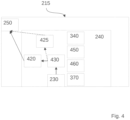
- Fig. 4 depicts a display device 215 according to the invention further comprising a display frame buffer 420 and means for unpacking Ethernet layer 2 data into RGB/Video content data 430.
- the display device 215 may further comprise a Second display frame buffer 425.
- the display device 215 may optionally also comprise means for Variable Refresh Rate control 340, for checksum generation and sending 450, for DSC decoding or comparable 430, and for HDCP Cipher 370.
Landscapes
- Engineering & Computer Science (AREA)
- Multimedia (AREA)
- Signal Processing (AREA)
- Physics & Mathematics (AREA)
- Computer Hardware Design (AREA)
- General Physics & Mathematics (AREA)
- Theoretical Computer Science (AREA)
- Computer Networks & Wireless Communication (AREA)
- Controls And Circuits For Display Device (AREA)
Abstract
Given an architecture for transmitting video content within a vehicle, it is an objective of the present invention to reduce overhead and reduce production costs and reduce power consumption. The objective is solved by a host device (205) configured to package stored display content data in a frame buffer each pixel of a display panel mapped to a unique integer in the frame buffer, and send the data over Ethernet network (225) to a display device (215); and the display device is configured to arrange the display content data in a display frame buffer (420), and display the display content data on a panel (250).
Description
- The invention relates to a video transmission architecture over a vehicle local network and a method for the same.
- Video transmission from host device to display device in a vehicle suffers drawbacks. The frame buffer generated by the GPU in the host, is traditionally first converted to e.g. HDMI signal, transmitted via bridges over cable, such as Coax, STP or QSTP, to the display, where the frame buffer is reconstructed. Traditional means involves high overhead, since video timings and blanking are transmitted between the host and display. Video transmission using traditional means between a host device and a display device therefore has high overhead and requires several bridges, adding to production costs. Ethernet bandwidth in vehicles is increasing allowing the video chain to be re-analyzed.
- Ethernet Standard IEEE 1722 supports raw and compressed audio/video as OSI layer 2 protocol, but this is only suitable between a camera source and a host device.
- The deficiency is solved by a video transmission architecture for a vehicle, such as a car, comprising: a host device; a display device; and a network, in particular an Ethernet network, connecting the host device and the display device; the host device comprising a graphics processing unit (GPU), and a host frame buffer; the display device comprising a display frame buffer and a display panel; wherein the host device is configured to generate, by the GPU, display content data for displaying on the panel, and storing the generated display content data in the host frame buffer, each pixel of the display panel mapped to a unique integer in the host frame buffer; characterized by the host device further configured to send the display content data stored in the host frame buffer over the Ethernet network to the display device; and wherein the display device is configured to receive the display content data from the Ethernet network, arrange the display content data in the display frame buffer, and display the display content data on the panel.
- Advantages include lower bandwidth overhead and lower components costs and lower power consumption.
- In one example, the host device is configured to send the display content data as raw display content data.
- In one example, the host device further comprises a Display Stream Compression, DSC encoder or comparable configured to compress the display content data before transmission; and wherein the display device comprises a DSC decoder or comparable configured to decompress the received display content data into raw display content data.
- In one example, blanking and/or video timings are not generated by the host device. Neither the host device nor the display device may comprise a bridge device.
- In one example, the host device is further configured to calculate a host checksum over the whole display content data in the host frame buffer; wherein the display device is further configured to calculate a display checksum over the whole display content data in the display frame buffer, and send the display checksum, over the Ethernet network, to the host device; and wherein the host device is further configured to compare the received display checksum with the host checksum, and resend the whole display content data if the comparison do not match.
- In one example, the display device is further configured to send sync events, over the Ethernet network, to the host device, and wherein the host device is further configured to adjust the sending of the display content data according to the timing of the received sync events.
- In one example, the display device further comprises a second display frame buffer; and wherein the display device is further configured, during readout of data from the display frame buffer to the panel, the second display frame buffer is filled with received display content data, and vice versa.
- In one example, the display content data in the host frame buffer is sliced into segments, each segment corresponding to a continuous area of display on the panel; and wherein the host device is further configured to determine if a segment data has been altered vis-à-vis a last transmission to the display device, and send the segment as display content data, only if the segment data has been altered.
- In one example, the host device and/or the display device further comprises a High-bandwidth Digital Content Protection, HDCP, Cipher.
- The deficiency is solved by a method for video transmission in a vehicle, such as a car, over a vehicle local network, such as an Ethernet network, the method comprising: generate, by a GPU of a host device, display content data for displaying on a display panel of a display device; storing, by the host device, the generated display content data in a host frame buffer of the host device, each pixel of the display panel mapped to a unique integer in the host frame buffer; sending, by the host device, the display content data stored in the host frame buffer over the network to the display device; receiving, by the display device, the display content data from the network; arranging, by the display device, the display content data in a display frame buffer of the display device; and displaying, by the display device, the display content data on the panel.
- In one example, the method, further comprises: sending, by the host device, the display content data as raw display content data.
- In one example, the method, further comprises: compressing, by a Display Stream Compression, DSC encoder or comparable of the host device, the display content data before sending; and decompressing, by a DSC decoder or comparable of the display device, the received display content data into raw display content data.
- In one example, the method, further comprises: calculating, by the host device, a host checksum over a whole display content data in the host frame buffer; calculating, by the display device, a display checksum over a whole display content data in the display frame buffer; sending, by the display device, the display checksum, over the network, to the host device; comparing, by the host device, the received display checksum with the calculated host checksum; and resending, by the host device, the whole display content data if the comparison do not match.
- In one example, the method, further comprises: sending, by the display device, sync events, over the network, to the host device; and adjusting, by the host device, the timing of the sending of the display content data according to the timing of the received sync events.
- In one example, the method, further comprises: storing, by the display device, received display content data in a second display frame buffer of the display device, during readout of data from the display frame buffer to the panel; and storing, by the display device, received display content data in a display frame buffer, during readout of data from the second display frame buffer to the panel.
-
-
Fig. 1 depicts a traditional video transmission architecture. -
Fig. 2 depicts a video transmission architecture according to the invention -
Fig. 3 depicts a host device according to the invention -
Fig. 4 depicts a display device according to the invention -
Fig. 1 depicts a traditional video transmission architecture comprising ahost device 105 and adisplay device 115. The video generated by the System on Chip (SoC) 110 of thehost device 105 is sent to the display device over STP, QSTP or Coax (125) via afirst bridge 130. A second bridge (130) is configured in the display device (115) to receive the video content and transform it for display on thepanel 150, by the Graphics Display Controller (GDC). -
Fig. 2 depicts a video transmission architecture according to the invention comprising ahost device 205, further comprising a SoC 210 (including RGB to Ethernet packaging) and an Ethernet IEEE Physical Layer Device (PHY) 220. The architecture further comprises a Ethernet transmission means, such as STP/GOF (Shielded twisted pair/Glass optical fiber) 225. - The architecture further comprises a
display device 215 comprising Ethernet IEEE PHYunit 230 for receiving video content over Ethernet 225 and GDC 240 for displaying received RGB data on apanel 250. - The invention proposes an architecture for transmitting video data from host device to display device over Ethernet as OSI layer 2 data. When raw framebuffer data is sent, video signal processing on host and display device is not needed, saving resources. The frame buffer data may be sent as raw, i.e. unaltered and uncompressed bit stream.
-
Fig. 3 depicts 502 a host device according to the invention, further comprising Graphics processing unit,GPU 310,Host frame buffer 320 and means for packaging RGB/Video as Ethernet layer 2package 330. Thehost device 205 may optionally also comprise means for VariableRefresh Rate control 340, for Checksum generation, verification, andreaction 350, for Optional Display Stream Compression, DSC encoder or comparable 360, and for High-bandwidth Digital Content Protection (HDCP)Cipher 370. -
Fig. 4 depicts adisplay device 215 according to the invention further comprising adisplay frame buffer 420 and means for unpacking Ethernet layer 2 data into RGB/Video content data 430. Thedisplay device 215 may further comprise a Seconddisplay frame buffer 425. Thedisplay device 215 may optionally also comprise means for VariableRefresh Rate control 340, for checksum generation and sending 450, for DSC decoding or comparable 430, and forHDCP Cipher 370. - Reference numerals
- 105
- Traditional host
- 110
- System on Chip (SoC)
- 115
- Traditional display
- 120
- Bridge
- 125
- STP/QSTP/Coax
- 130
- Bridge
- 140
- Graphics Display Controller, GDC
- 150
- Panel
- 205
- Host (Head) unit
- 210
- SoC (including RGB to Ethernet)
- 215
- Display
- 220
- Ethernet IEEE Physical Layer Device (PHY)
- 225
- STP/GOF (Shielded twisted pair/Glass optical fiber)
- 230
- Ethernet IEEE PHY
- 240
- GDC (including Ethernet to RGB)
- 250
- Panel
- 305
- Central processing unit, CPU
- 310
- Graphics processing unit, GPU
- 320
- Host frame buffer
- 330
- RGB/Video to Ethernet layer 2 package
- 340
- Optional Variable Refresh Rate control
- 350
- Optional Checksum generation, verification, and reaction
- 360
- Optional Display Stream Compression, DSC encoder or comparable
- 370
- Optional High-bandwidth Digital Content Protection (HDCP) Cipher
- 420
- Display frame buffer
- 425
- Second display frame buffer
- 430
- Ethernet layer 2 package to RGB/Video
- 450
- Optional Checksum generation and sending
- 460
- Optional Display Stream Compression, DSC decoder or comparable
Claims (15)
- A video transmission architecture for a vehicle, such as a car, comprising:a host device (205);a display device (215); anda network, in particular an Ethernet network (225), connecting the host device (205) and the display device (215);the host device (205) comprising a graphics processing unit (310), namely a GPU, and a host frame buffer (320);the display device (215) comprising a display frame buffer (420) and a display panel (250);wherein the host device (205) is configured to generate, by the GPU (310), display content data for displaying on the panel (250), and storing the generated display content data in the host frame buffer (320), each pixel of the display panel mapped to a unique integer in the host frame buffer;characterized by
the host device (205) further configured to send the display content data stored in the host frame buffer over the network (225) to the display device (215); andwherein the display device (215) is configured to receive the display content data from the network (225), arrange the display content data in the display frame buffer (420), and display the display content data on the panel (250). - The architecture of claim 1,
wherein the host device is configured to send the display content data as raw display content data. - The architecture of claim 1,wherein the host device further comprises a Display Stream Compression, DSC encoder or comparable (360) configured to compress the display content data before transmission; andwherein the display device comprises a DSC decoder or comparable (460) configured to decompress the received display content data into raw display content data.
- The architecture of any of the previous claims,wherein blanking and/or video timings are not generated by the host device
and/orwherein neither the host device nor the display device comprise a bridge device. - The architecture of any of the previous claims,wherein the host device is further configured to calculate a host checksum over the whole display content data in the host frame buffer (320);wherein the display device is further configured to calculate a display checksum over the whole display content data in the display frame buffer (420), and send the display checksum, over the network, to the host device;and wherein the host device is further configured to compare the received display checksum with the host checksum, and resend the whole display content data if the comparison do not match.
- The architecture of any of the previous claims,wherein the display device is further configured to send sync events, over the network, to the host device, andwherein the host device is further configured to adjust the timing of the sending of the display content data according to the timing of the received sync events.
- The architecture of claim 6,
wherein the display device further comprises a second display frame buffer (425); and wherein the display device is further configured, during readout of data from the display frame buffer (420) to the panel (250), the second display frame buffer (425) is filled with received display content data, and vice versa. - The architecture of any of the previous claims,wherein the display content data in the host frame buffer (320) is sliced into segments, each segment corresponding to a continuous area of display on the panel; andwherein the host device is further configured to determine if a segment data has been altered vis-à-vis a last transmission to the display device, and send the segment as display content data, only if the segment data has been altered.
- The architecture of any of the previous claims,
wherein the host device and/or the display device further comprises a High-bandwidth Digital Content Protection, HDCP, Cipher (370). - A method for video transmission in a vehicle, such as a car, over a vehicle local network, such as an Ethernet network (225),
the method comprising:generate, by a GPU (310) of a host device (205), display content data for displaying on a display panel (250) of a display device (215); andstoring, by the host device (205), the generated display content data in a host frame buffer (320) of the host device (205), each pixel of the display panel (250) mapped to a unique integer in the host frame buffer (320);characterized bysending, by the host device (205), the display content data stored in the host frame buffer over the network (225) to the display device (215);receiving, by the display device (215), the display content data from the network (225);arranging, by the display device (215), the display content data in a display frame buffer (420) of the display device (215); anddisplaying, by the display device (215), the display content data on the panel (250). - The method of claim 10, further comprising:
sending, by the host device, the display content data as raw display content data. - The method of claim 10, further comprising
compressing, by a Display Stream Compression, DSC encoder or comparable (360) of the host device, the display content data before sending; and decompressing, by a DSC decoder or comparable (460) of the display device, the received display content data into raw display content data. - The method of any of the claims 10 to 12, further comprising:calculating, by the host device, a host checksum over a whole display content data in the host frame buffer (320);calculating, by the display device, a display checksum over a whole display content data in the display frame buffer (420);sending, by the display device, the display checksum, over the network, to the host device;comparing, by the host device, the received display checksum with the calculated host checksum; andresending, by the host device, the whole display content data if the comparison do not match.
- The method of any of the claims 10 to 13, further comprising:sending, by the display device, sync events, over the network, to the host device; andadjusting, by the host device, the timing of the sending of the display content data according to the timing of the received sync events.
- The method of claim 14, further comprising:storing, by the display device, received display content data in a second display frame buffer (425) of the display device, during readout of data from the display frame buffer (420) to the panel (250); andstoring, by the display device, received display content data in a display frame buffer (420), during readout of data from the second display frame buffer (425) to the panel (250).
Priority Applications (1)
| Application Number | Priority Date | Filing Date | Title |
|---|---|---|---|
| EP23183082.9A EP4489406A1 (en) | 2023-07-03 | 2023-07-03 | Video architecture over ethernet |
Applications Claiming Priority (1)
| Application Number | Priority Date | Filing Date | Title |
|---|---|---|---|
| EP23183082.9A EP4489406A1 (en) | 2023-07-03 | 2023-07-03 | Video architecture over ethernet |
Publications (1)
| Publication Number | Publication Date |
|---|---|
| EP4489406A1 true EP4489406A1 (en) | 2025-01-08 |
Family
ID=87136477
Family Applications (1)
| Application Number | Title | Priority Date | Filing Date |
|---|---|---|---|
| EP23183082.9A Pending EP4489406A1 (en) | 2023-07-03 | 2023-07-03 | Video architecture over ethernet |
Country Status (1)
| Country | Link |
|---|---|
| EP (1) | EP4489406A1 (en) |
Citations (4)
| Publication number | Priority date | Publication date | Assignee | Title |
|---|---|---|---|---|
| US20130070860A1 (en) * | 2010-05-17 | 2013-03-21 | Bayerische Motoren Werke Aktiengesellschaft | Method and Apparatus for Synchronizing Data in a Vehicle |
| US20180333646A1 (en) * | 2017-05-22 | 2018-11-22 | Microsoft Technology Licensing, Llc | File transfer via a video port |
| WO2022096261A1 (en) * | 2020-11-03 | 2022-05-12 | Connaught Electronics Ltd. | Transfer of file content as part of a video stream |
| WO2022179681A1 (en) * | 2021-02-24 | 2022-09-01 | Cariad Se | Method for operating a display device of a vehicle for displaying video frames of a video stream at a predefined frame rate and corresponding display device and vehicle |
-
2023
- 2023-07-03 EP EP23183082.9A patent/EP4489406A1/en active Pending
Patent Citations (4)
| Publication number | Priority date | Publication date | Assignee | Title |
|---|---|---|---|---|
| US20130070860A1 (en) * | 2010-05-17 | 2013-03-21 | Bayerische Motoren Werke Aktiengesellschaft | Method and Apparatus for Synchronizing Data in a Vehicle |
| US20180333646A1 (en) * | 2017-05-22 | 2018-11-22 | Microsoft Technology Licensing, Llc | File transfer via a video port |
| WO2022096261A1 (en) * | 2020-11-03 | 2022-05-12 | Connaught Electronics Ltd. | Transfer of file content as part of a video stream |
| WO2022179681A1 (en) * | 2021-02-24 | 2022-09-01 | Cariad Se | Method for operating a display device of a vehicle for displaying video frames of a video stream at a predefined frame rate and corresponding display device and vehicle |
Similar Documents
| Publication | Publication Date | Title |
|---|---|---|
| US9485514B2 (en) | System and method for compressing video and reformatting the compressed video to simulate uncompressed video with a lower bandwidth | |
| CN106375820B (en) | The method and apparatus synchronized to audio and video frequency signal | |
| US7394406B2 (en) | Method and system for generating high definition multimedia interface (HDMI) codewords using a TMDS encoder/decoder | |
| US8767820B2 (en) | Adaptive display compression for wireless transmission of rendered pixel data | |
| US8755431B2 (en) | Transmission and detection of multi-channel signals in reduced channel format | |
| US20110103472A1 (en) | Methods, systems and devices for compression of data and transmission thereof using video transmission standards | |
| KR20090076915A (en) | Transmission method, transmission system, transmitter and receiver | |
| TW201501074A (en) | Image display system and image processing method | |
| CN111147828A (en) | Low-delay video optical fiber transmission device | |
| CN210670381U (en) | Audio and video data sending device, receiving device and transmission system | |
| CN202068513U (en) | Host for standard-definition and high-definition audio-video coder/decoder | |
| US20220246085A1 (en) | Image processing system, image processing integrated circuit, and image processing method | |
| WO2013018248A1 (en) | Image transmission device, image transmission method, image receiving device, and image receiving method | |
| CN101094358A (en) | Video transmission system and method based on 1394 collection and HDMI / DVI | |
| EP4679839A1 (en) | Electronic device, display device, and control method therefor | |
| KR100987387B1 (en) | Wireless High Definition Multimedia Interface Apparatus and Method Using Wireless Local Area Communication | |
| CN104079859A (en) | Video transmission rate self-adaption system based on feedback mechanism | |
| CN102638726A (en) | Multimedia stream transmission method and system based on terahertz wireless communication | |
| CN102685449A (en) | Implementation method of multichannel video data transmission | |
| US20040136456A1 (en) | Encoding digital video for transmission over standard data cabling | |
| US20080101409A1 (en) | Packetization | |
| CN101617357B (en) | A method of processing a video signal and a system for performing response time compensation | |
| JP5739262B2 (en) | Image transmission device, image transmission method, image reception device, and image reception method | |
| CN110618802B (en) | Display adaptation method and display adaptation device without frame buffer | |
| CN118869840A (en) | Data transmission method, display system, device, display screen and storage medium |
Legal Events
| Date | Code | Title | Description |
|---|---|---|---|
| PUAI | Public reference made under article 153(3) epc to a published international application that has entered the european phase |
Free format text: ORIGINAL CODE: 0009012 |
|
| STAA | Information on the status of an ep patent application or granted ep patent |
Free format text: STATUS: THE APPLICATION HAS BEEN PUBLISHED |
|
| AK | Designated contracting states |
Kind code of ref document: A1 Designated state(s): AL AT BE BG CH CY CZ DE DK EE ES FI FR GB GR HR HU IE IS IT LI LT LU LV MC ME MK MT NL NO PL PT RO RS SE SI SK SM TR |
|
| STAA | Information on the status of an ep patent application or granted ep patent |
Free format text: STATUS: REQUEST FOR EXAMINATION WAS MADE |
|
| 17P | Request for examination filed |
Effective date: 20250304 |