EP4489114A1 - High-nickel ternary positive electrode material having high thermal safety, preparation method therefor, and use thereof - Google Patents
High-nickel ternary positive electrode material having high thermal safety, preparation method therefor, and use thereof Download PDFInfo
- Publication number
- EP4489114A1 EP4489114A1 EP23841722.4A EP23841722A EP4489114A1 EP 4489114 A1 EP4489114 A1 EP 4489114A1 EP 23841722 A EP23841722 A EP 23841722A EP 4489114 A1 EP4489114 A1 EP 4489114A1
- Authority
- EP
- European Patent Office
- Prior art keywords
- positive electrode
- electrode material
- ternary positive
- nickel ternary
- thermal conductivity
- Prior art date
- Legal status (The legal status is an assumption and is not a legal conclusion. Google has not performed a legal analysis and makes no representation as to the accuracy of the status listed.)
- Pending
Links
Images



Classifications
-
- C—CHEMISTRY; METALLURGY
- C01—INORGANIC CHEMISTRY
- C01G—COMPOUNDS CONTAINING METALS NOT COVERED BY SUBCLASSES C01D OR C01F
- C01G53/00—Compounds of nickel
- C01G53/40—Complex oxides containing nickel and at least one other metal element
- C01G53/42—Complex oxides containing nickel and at least one other metal element containing alkali metals, e.g. LiNiO2
- C01G53/44—Complex oxides containing nickel and at least one other metal element containing alkali metals, e.g. LiNiO2 containing manganese
- C01G53/50—Complex oxides containing nickel and at least one other metal element containing alkali metals, e.g. LiNiO2 containing manganese of the type (MnO2)n-, e.g. Li(NixMn1-x)O2 or Li(MyNixMn1-x-y)O2
- C01G53/502—Complex oxides containing nickel and at least one other metal element containing alkali metals, e.g. LiNiO2 containing manganese of the type (MnO2)n-, e.g. Li(NixMn1-x)O2 or Li(MyNixMn1-x-y)O2 containing lithium and cobalt
- C01G53/504—Complex oxides containing nickel and at least one other metal element containing alkali metals, e.g. LiNiO2 containing manganese of the type (MnO2)n-, e.g. Li(NixMn1-x)O2 or Li(MyNixMn1-x-y)O2 containing lithium and cobalt with the molar ratio of nickel with respect to all the metals other than alkali metals higher than or equal to 0.5, e.g. Li(MzNixCoyMn1-x-y-z)O2 with x ≥ 0.5
- C01G53/506—Complex oxides containing nickel and at least one other metal element containing alkali metals, e.g. LiNiO2 containing manganese of the type (MnO2)n-, e.g. Li(NixMn1-x)O2 or Li(MyNixMn1-x-y)O2 containing lithium and cobalt with the molar ratio of nickel with respect to all the metals other than alkali metals higher than or equal to 0.5, e.g. Li(MzNixCoyMn1-x-y-z)O2 with x ≥ 0.5 with the molar ratio of nickel with respect to all the metals other than alkali metals higher than or equal to 0.8, e.g. Li(MzNixCoyMn1-x-y-z)O2 with x ≥ 0.8
-
- C—CHEMISTRY; METALLURGY
- C01—INORGANIC CHEMISTRY
- C01G—COMPOUNDS CONTAINING METALS NOT COVERED BY SUBCLASSES C01D OR C01F
- C01G53/00—Compounds of nickel
- C01G53/40—Complex oxides containing nickel and at least one other metal element
- C01G53/42—Complex oxides containing nickel and at least one other metal element containing alkali metals, e.g. LiNiO2
- C01G53/44—Complex oxides containing nickel and at least one other metal element containing alkali metals, e.g. LiNiO2 containing manganese
- C01G53/50—Complex oxides containing nickel and at least one other metal element containing alkali metals, e.g. LiNiO2 containing manganese of the type (MnO2)n-, e.g. Li(NixMn1-x)O2 or Li(MyNixMn1-x-y)O2
-
- H—ELECTRICITY
- H01—ELECTRIC ELEMENTS
- H01M—PROCESSES OR MEANS, e.g. BATTERIES, FOR THE DIRECT CONVERSION OF CHEMICAL ENERGY INTO ELECTRICAL ENERGY
- H01M10/00—Secondary cells; Manufacture thereof
- H01M10/05—Accumulators with non-aqueous electrolyte
- H01M10/052—Li-accumulators
- H01M10/0525—Rocking-chair batteries, i.e. batteries with lithium insertion or intercalation in both electrodes; Lithium-ion batteries
-
- H—ELECTRICITY
- H01—ELECTRIC ELEMENTS
- H01M—PROCESSES OR MEANS, e.g. BATTERIES, FOR THE DIRECT CONVERSION OF CHEMICAL ENERGY INTO ELECTRICAL ENERGY
- H01M10/00—Secondary cells; Manufacture thereof
- H01M10/42—Methods or arrangements for servicing or maintenance of secondary cells or secondary half-cells
- H01M10/4235—Safety or regulating additives or arrangements in electrodes, separators or electrolyte
-
- H—ELECTRICITY
- H01—ELECTRIC ELEMENTS
- H01M—PROCESSES OR MEANS, e.g. BATTERIES, FOR THE DIRECT CONVERSION OF CHEMICAL ENERGY INTO ELECTRICAL ENERGY
- H01M4/00—Electrodes
- H01M4/02—Electrodes composed of, or comprising, active material
- H01M4/04—Processes of manufacture in general
- H01M4/0471—Processes of manufacture in general involving thermal treatment, e.g. firing, sintering, backing particulate active material, thermal decomposition, pyrolysis
-
- H—ELECTRICITY
- H01—ELECTRIC ELEMENTS
- H01M—PROCESSES OR MEANS, e.g. BATTERIES, FOR THE DIRECT CONVERSION OF CHEMICAL ENERGY INTO ELECTRICAL ENERGY
- H01M4/00—Electrodes
- H01M4/02—Electrodes composed of, or comprising, active material
- H01M4/36—Selection of substances as active materials, active masses, active liquids
- H01M4/362—Composites
- H01M4/366—Composites as layered products
-
- H—ELECTRICITY
- H01—ELECTRIC ELEMENTS
- H01M—PROCESSES OR MEANS, e.g. BATTERIES, FOR THE DIRECT CONVERSION OF CHEMICAL ENERGY INTO ELECTRICAL ENERGY
- H01M4/00—Electrodes
- H01M4/02—Electrodes composed of, or comprising, active material
- H01M4/36—Selection of substances as active materials, active masses, active liquids
- H01M4/48—Selection of substances as active materials, active masses, active liquids of inorganic oxides or hydroxides
- H01M4/485—Selection of substances as active materials, active masses, active liquids of inorganic oxides or hydroxides of mixed oxides or hydroxides for inserting or intercalating light metals, e.g. LiTi2O4 or LiTi2OxFy
-
- H—ELECTRICITY
- H01—ELECTRIC ELEMENTS
- H01M—PROCESSES OR MEANS, e.g. BATTERIES, FOR THE DIRECT CONVERSION OF CHEMICAL ENERGY INTO ELECTRICAL ENERGY
- H01M4/00—Electrodes
- H01M4/02—Electrodes composed of, or comprising, active material
- H01M4/36—Selection of substances as active materials, active masses, active liquids
- H01M4/48—Selection of substances as active materials, active masses, active liquids of inorganic oxides or hydroxides
- H01M4/50—Selection of substances as active materials, active masses, active liquids of inorganic oxides or hydroxides of manganese
- H01M4/505—Selection of substances as active materials, active masses, active liquids of inorganic oxides or hydroxides of manganese of mixed oxides or hydroxides containing manganese for inserting or intercalating light metals, e.g. LiMn2O4 or LiMn2OxFy
-
- H—ELECTRICITY
- H01—ELECTRIC ELEMENTS
- H01M—PROCESSES OR MEANS, e.g. BATTERIES, FOR THE DIRECT CONVERSION OF CHEMICAL ENERGY INTO ELECTRICAL ENERGY
- H01M4/00—Electrodes
- H01M4/02—Electrodes composed of, or comprising, active material
- H01M4/36—Selection of substances as active materials, active masses, active liquids
- H01M4/48—Selection of substances as active materials, active masses, active liquids of inorganic oxides or hydroxides
- H01M4/52—Selection of substances as active materials, active masses, active liquids of inorganic oxides or hydroxides of nickel, cobalt or iron
- H01M4/525—Selection of substances as active materials, active masses, active liquids of inorganic oxides or hydroxides of nickel, cobalt or iron of mixed oxides or hydroxides containing iron, cobalt or nickel for inserting or intercalating light metals, e.g. LiNiO2, LiCoO2 or LiCoOxFy
-
- H—ELECTRICITY
- H01—ELECTRIC ELEMENTS
- H01M—PROCESSES OR MEANS, e.g. BATTERIES, FOR THE DIRECT CONVERSION OF CHEMICAL ENERGY INTO ELECTRICAL ENERGY
- H01M4/00—Electrodes
- H01M4/02—Electrodes composed of, or comprising, active material
- H01M4/62—Selection of inactive substances as ingredients for active masses, e.g. binders, fillers
-
- C—CHEMISTRY; METALLURGY
- C01—INORGANIC CHEMISTRY
- C01P—INDEXING SCHEME RELATING TO STRUCTURAL AND PHYSICAL ASPECTS OF SOLID INORGANIC COMPOUNDS
- C01P2002/00—Crystal-structural characteristics
- C01P2002/70—Crystal-structural characteristics defined by measured X-ray, neutron or electron diffraction data
- C01P2002/77—Crystal-structural characteristics defined by measured X-ray, neutron or electron diffraction data by unit-cell parameters, atom positions or structure diagrams
-
- C—CHEMISTRY; METALLURGY
- C01—INORGANIC CHEMISTRY
- C01P—INDEXING SCHEME RELATING TO STRUCTURAL AND PHYSICAL ASPECTS OF SOLID INORGANIC COMPOUNDS
- C01P2002/00—Crystal-structural characteristics
- C01P2002/80—Crystal-structural characteristics defined by measured data other than those specified in group C01P2002/70
- C01P2002/88—Crystal-structural characteristics defined by measured data other than those specified in group C01P2002/70 by thermal analysis data, e.g. TGA, DTA, DSC
-
- C—CHEMISTRY; METALLURGY
- C01—INORGANIC CHEMISTRY
- C01P—INDEXING SCHEME RELATING TO STRUCTURAL AND PHYSICAL ASPECTS OF SOLID INORGANIC COMPOUNDS
- C01P2004/00—Particle morphology
- C01P2004/01—Particle morphology depicted by an image
- C01P2004/03—Particle morphology depicted by an image obtained by SEM
-
- C—CHEMISTRY; METALLURGY
- C01—INORGANIC CHEMISTRY
- C01P—INDEXING SCHEME RELATING TO STRUCTURAL AND PHYSICAL ASPECTS OF SOLID INORGANIC COMPOUNDS
- C01P2006/00—Physical properties of inorganic compounds
- C01P2006/32—Thermal properties
-
- C—CHEMISTRY; METALLURGY
- C01—INORGANIC CHEMISTRY
- C01P—INDEXING SCHEME RELATING TO STRUCTURAL AND PHYSICAL ASPECTS OF SOLID INORGANIC COMPOUNDS
- C01P2006/00—Physical properties of inorganic compounds
- C01P2006/40—Electric properties
-
- H—ELECTRICITY
- H01—ELECTRIC ELEMENTS
- H01M—PROCESSES OR MEANS, e.g. BATTERIES, FOR THE DIRECT CONVERSION OF CHEMICAL ENERGY INTO ELECTRICAL ENERGY
- H01M4/00—Electrodes
- H01M4/02—Electrodes composed of, or comprising, active material
- H01M2004/021—Physical characteristics, e.g. porosity, surface area
-
- H—ELECTRICITY
- H01—ELECTRIC ELEMENTS
- H01M—PROCESSES OR MEANS, e.g. BATTERIES, FOR THE DIRECT CONVERSION OF CHEMICAL ENERGY INTO ELECTRICAL ENERGY
- H01M4/00—Electrodes
- H01M4/02—Electrodes composed of, or comprising, active material
- H01M2004/026—Electrodes composed of, or comprising, active material characterised by the polarity
- H01M2004/028—Positive electrodes
-
- Y—GENERAL TAGGING OF NEW TECHNOLOGICAL DEVELOPMENTS; GENERAL TAGGING OF CROSS-SECTIONAL TECHNOLOGIES SPANNING OVER SEVERAL SECTIONS OF THE IPC; TECHNICAL SUBJECTS COVERED BY FORMER USPC CROSS-REFERENCE ART COLLECTIONS [XRACs] AND DIGESTS
- Y02—TECHNOLOGIES OR APPLICATIONS FOR MITIGATION OR ADAPTATION AGAINST CLIMATE CHANGE
- Y02E—REDUCTION OF GREENHOUSE GAS [GHG] EMISSIONS, RELATED TO ENERGY GENERATION, TRANSMISSION OR DISTRIBUTION
- Y02E60/00—Enabling technologies; Technologies with a potential or indirect contribution to GHG emissions mitigation
- Y02E60/10—Energy storage using batteries
Definitions
- the present invention relates to the technical field of lithium ion batteries, and in particular to a high-nickel ternary positive electrode material having high thermal safety, a preparation method therefor, and use thereof.
- positive electrode materials as one of the main raw materials for batteries, have also received attention, of which the most prominent is ternary positive electrode materials.
- the most important application of these materials is power energy batteries.
- the spontaneous combustion phenomenon of new energy vehicles has occurred frequently, thus the safety of new energy vehicles has been pushed to the forefront.
- how to ensure the thermal safety of batteries has become an urgent problem for various manufacturers and research institutions, there have been some new breakthroughs from the battery level, but there are few results in positive electrode ternary materials.
- the volume change of the material is reduced by doping a small amount of Y 3+ ions and replacing some Ni 3+ sites with La 3+ ions to utilize electrochemical inertness of Y 3+ /La 3+ ions during charging and discharging, thereby increasing the stability of the structure, and improving the thermal safety.
- the stability of the crystal structure of the material is enhanced by Mg/Ti co-doping, and in combination with the coating of Li 3 PO 4 , layered distribution of doping and coating is achieved.
- the Li 3 PO 4 coating layer enhances the surface stability, helps to reduce the electrochemical impedance and side reactions of the electrolyte solution, thereby improving the thermal stability of the high-nickel ternary positive electrode material.
- the stability of the structure of a material is enhanced by doping electrochemically inert substances, and coating substances with stabilizing properties to isolate the contact between the ternary positive electrode material and HF, inhibiting the heat release due to the decomposition of material and the precipitation of metals.
- doping this kind of electrochemical inert substances has a great influence on the electronic conductivity and reaction activity of material itself, which is disadvantageous to the electrochemical performance of the material, and at the same time, this kind of multielement doping and multistep coating process increases the cost and the complexity of the manufacturing process.
- the technical problem to be solved by the invention is to provide a high-nickel ternary positive electrode material having high thermal safety, a preparation method therefor, and a use thereof.
- the high-nickel ternary positive electrode material provided by the present invention has an overall lower thermal conductivity, better thermal safety, and good electrical properties.
- the present invention provides a high-nickel ternary positive electrode material having high thermal safety, and the high-nickel ternary positive electrode material has a chemical formula of LiNi a Co b Mn c M d Q e O 2 ,
- ⁇ is a thermal safety coefficient of the high-nickel ternary positive electrode material
- ⁇ is a cross-sectional porosity of the high-nickel ternary positive electrode material
- D104 is a parameter of the high-nickel ternary positive electrode material in a XRD test
- K is a thermal conductivity of the high-nickel ternary positive electrode material.
- a core as well as a coating layer is included, and the coating layer has a thermal conductivity coefficient of ⁇ 0.2 W/(m•K).
- the present invention also provides a method for preparing the above-described high-nickel ternary positive electrode material, including the following steps:
- the lithium source is selected from LiOH;
- step A) the sintering is performed at a temperature of 740°C - 820°C for a time of 10 - 15 hours.
- step B) the sintering is performed at a temperature of 350 - 500°C for a time of 8 - 12 hours.
- the invention also provides a lithium ion battery including the high-nickel ternary positive electrode material described as above.
- the present invention provides a high-nickel ternary positive electrode material having high thermal safety
- M is a doping element, selected from one or more of Sr, Ti, Al, Zr, Y, Ba, Mg, or Mo
- Q is a coating element, selected from one or both of Sr or Ti
- the high-nickel ternary positive electrode material provided in the present invention, significant factors affecting the thermal safety of the ternary positive electrode material are identified by measuring the thermal conductivity K, the D104 value in XRD, and the porosity ⁇ of the material.
- corresponding materials are prepared by means of controlling these parameters and satisfying the relationship shown in Formula I for verification.
- the high-nickel ternary positive electrode material is improved by coating with a coating material having a low thermal conductivity. The thermal conductivity of the coated material is tested, and the results indicate that with an increase in the coating amount of the coating material, the thermal conductivity of the ternary positive electrode material is in overall decrease, and the ternary positive electrode material has a better thermal safety.
- the present invention provides a high-nickel ternary positive electrode material having high thermal safety, and the chemical formula of the high-nickel ternary positive electrode material is: LiNi a Co b Mn c M d Q e O 2 ,
- ⁇ is a thermal safety coefficient of the high-nickel ternary positive electrode material
- ⁇ is a cross-sectional porosity of the high-nickel ternary positive electrode material
- D104 is a parameter of the high-nickel ternary positive electrode material in a XRD test
- K is a thermal conductivity of the high-nickel ternary positive electrode material.
- b, c, and d are not zero.
- M is a doping element, selected from one or more of Sr, Ti, Al, Zr, Y, Ba, Mg, or Mo, preferably Al, Mo, Sr, and Zr.
- Q is a coating element, selected from one or both of Sr or Ti, preferably both Sr and Ti.
- the high-nickel ternary positive electrode material includes a core and a coating layer, where the chemical formula of the core is LiNi a Co b Mn c M d O 2 .
- the coating layer is an oxide containing the element Q, and the coating layer has a thermal conductivity coefficient of ⁇ 0.2 W/(m•K).
- the thermal conductivity of the ternary material can be reduced by coating a material having a low thermal conductivity.
- ⁇ is a thermal safety coefficient of the high-nickel ternary positive electrode material; in the present invention, the ⁇ value is controlled between 0.73 and 14.00.
- ⁇ is lower than 0.73, a DSC peak temperature will be lower than 213°C, and the high nickel ternary positive electrode material has a poor thermal safety.
- the ⁇ value is between 0.73 and 14.00, the high nickel ternary positive electrode material has a high thermal safety; preferably, the ⁇ value is controlled between 1.07 and 14.00, the high nickel ternary positive electrode material has a higher thermal safety; further preferably, the ⁇ value is controlled between 1.45 and 13.13; more preferably, the ⁇ value is controlled between 7.74 and 13.13.
- ⁇ is a cross-sectional porosity of the high-nickel ternary positive electrode material.
- High porosity can reduce the overall thermal conductivity of the high-nickel ternary positive electrode material, and play a role in slowing down the inward transfer of heat generated by side reactions on the surface of the material, thereby effectively improving the stability of the internal structure of the material and inhibiting the occurrence of internal side reactions to improve the thermal safety of the material.
- 1% ⁇ 5% preferably, ⁇ is 1%, 2%, 3%, 4%, 5%, or any numerical value between 1% - 5%.
- D104 is a parameter of the high-nickel ternary positive electrode material in a XRD test.
- the increase of the unit cell parameter D104 for unit cells decreases the phonon thermal conductivity of the material.
- 45 ⁇ D104 ⁇ 70 preferably, D104 is 45, 50, 55, 60, 65, 70, or any numerical value between 45 - 70.
- K is a thermal conductivity of the high-nickel ternary positive electrode material, 0.1W/(m•K) ⁇ K ⁇ 0.6 W/(m•K).
- K is 0.1, 0.2, 0.3, 0.4, 0.5, 0.6, or any numerical value between 0.1-0.6 W/(m•K).
- the high-nickel ternary positive electrode material provided by the present invention has a low thermal conductivity, so that when the material reacts with an electrolyte solution, the heat release will be delayed accordingly, thus slowing down the occurrence of side reactions.
- the present invention also provides a method for preparing the above-described high-nickel ternary positive electrode material, including the following steps:
- a ternary hydroxide precursor Ni a Co b Mn c (OH) 2 , a lithium source, and a compound containing the element M are mixed to obtain a mixture.
- lithium source is selected from LiOH
- the present invention has no special limitation on the mixing method herein, and mixing methods known to persons of ordinary skill in the art are sufficient.
- the mixture is sintered under an oxygen atmosphere to obtain a sintered product.
- the sintering is performed at a temperature of 740°C-820°C, preferably 740, 760, 780, 800, 820, or any numerical value between 740°C-820°C, for a time of 10-15 hours, preferably 10, 11, 12, 13, 14, 15, or any numerical value between 10-15 hours.
- the sintered product is cooled, crushed and sieved, then washed and dried, then mixed with a compound containing the element Q, and then sintered under the oxygen atmosphere to obtain a high-nickel ternary positive electrode material.
- the compound containing the element Q is selected from TiO 2 , SrO, or SrTiO 3 .
- the sintering is performed at a temperature of 350-500 °C, preferably 350, 400, 450, 500, or any numerical value between 350-500 °C, for a time of 8-12 hours, preferably 8, 9, 10, 11, 12, or any numerical value between 8-12 hours.
- the invention also provides a lithium ion battery including the high-nickel ternary positive electrode material described as above.
- the high-nickel ternary positive electrode material provided by the present invention has a high DSC peak temperature, and thus has a high thermal safety.
- the thermal safety performance in the present invention is characterized based on the peak value in the DSC test.
- the high-nickel ternary positive electrode material provided in the present invention, significant factors affecting the thermal safety of the ternary positive electrode material are identified by measuring the thermal conductivity K, the D104 value in XRD, and the porosity ⁇ of the material.
- corresponding materials are prepared by means of controlling these parameters and satisfying the relationship shown in Formula I for verification.
- the high-nickel ternary positive electrode material is improved by coating with a coating material having a low thermal conductivity. The thermal conductivity of the coated material is tested, and the results indicate that with an increase in the coating amount of the coating material, the thermal conductivity of the ternary positive electrode material is in overall decrease, and the ternary positive electrode material has a better thermal safety.
- the high-nickel ternary positive electrode material having high thermal safety provided by the present invention and the preparation method therefor and use thereof are described below in combination with embodiments, and the protection scope of the present invention is not limited by the following embodiments.
- Sample B was LiNi 0.908 Co 0.048 Mn 0.029 M 0.015 O 2 , M was Sr, where ⁇ , D104, K, and ⁇ were 2%, 60, 0.41, and 2.93, respectively.
- Sample C was LiNi 0.908 Co 0.048 Mn 0.029 M 0.015 O 2 , M was Zr, where ⁇ , D104, K, and ⁇ were 3%, 70, 0.16, and 13.13, respectively.
- Sample D was LiNi 0.908 Co 0.048 Mn 0.029 M 0.015 O 2 , M was Y, where ⁇ , D104, K, and ⁇ were 4%, 60, 0.31, and 7.74, respectively.
- Sample E was LiNi 0.908 Co 0.048 Mn 0.029 M 0.015 O 2 , M was Mo, where ⁇ , D104, K, and ⁇ were 3%, 70, 0.25, and 8.4, respectively.
- Sample F was obtained by coating sample A with 1000 ppm of coating agent Q.
- Sample F was LiNi 0.9075 Co 0.048 Mn 0.029 M 0.015 Q 0.0005 O 2 , M was Al, Q was Sr, where ⁇ , D104, K, and ⁇ were 1%, 45, 0.53, and 0.85, respectively.
- Sample A was washed with water in a water-to-material ratio of 1:1 and then centrifuged and dried at 140°C for 12 h, then homogeneously mixed with 1000 ppm SrO, and then sintered at 500°C for 12 h under an oxygen atmosphere to obtain sample F.
- Sample G was obtained by coating sample A with 3000 ppm of coating agent Q.
- Sample G was LiNi 0.9065 Co 0.048 Mn 0.029 M 0.015 Q 0.0015 O 2 , M was Al, Q was Ti, where ⁇ , D104, K, and ⁇ were 1%, 45, 0.42, and 1.07, respectively.
- Sample A was washed with water in a water-to-material ratio of 1:1 and then centrifuged and dried at 140°C for 12 h, then homogeneously mixed with 3000 ppm TiO 2 , and then sintered at 500°C for 12 h under an oxygen atmosphere to obtain sample G.
- Sample H was obtained by coating sample A with 5000 ppm of coating agent Q.
- Sample H was LiNi 0.9055 Co 0.048 Mn 0.029 M 0.015 Q 0.0025 O 2 , M was Al, Q was Sr and Ti, where ⁇ , D104, K, and ⁇ were 1%, 45, 0.31, and 1.45, respectively.
- Sample A was washed with water in a water-to-material ratio of 1:1 and then centrifuged and dried at 140°C for 12 h, then homogeneously mixed with 5000 ppm SrTiO 3 , and then sintered at 500°C for 12 h under an oxygen atmosphere to obtain sample G.
- Samples A, B, C, D, and E are different in porosity ⁇ , unit cell parameter D104, and thermal conductivity K.
- the increase of D104 makes the layer spacing of transition metal layers of the material increase, and at the same time, the space of the Li layer is compressed to result in restricted Li ion transport and reduced ionic thermal conductivity.
- the increase of the crystal lattice spacing makes the phonon thermal conductivity decrease, thereby leading to the overall reduction of the thermal conductivity.
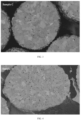
- FIGs. 1 ⁇ 5 show the cross-sectional pore distribution of samples A-E, respectively.
- Samples F-H are a material formed by coating the sample A with 1000ppm, 3000ppm, or 5000ppm of a Q coating agent respectively, and the overall thermal conductivity of the material is decreased by coating the Q coating material having low thermal conductivity and changing the coating amount of the Q coating material. Therefore, the thermal conductivity of the material decrease, and thus the influence of external thermal reaction on the inside of secondary particles is reduced.
- the coating layer has a certain insulating effect on the material and the electrolyte solution, this can effectively inhibit side reactions on the surface of the material to reduce the heat release and the collapse of the structure of the material, thus improving the thermal safety of the material.
- FIGs. 6-9 show the SEM diagrams of the surfaces of sample F-I, and FIGs.
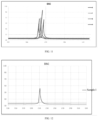
- FIG. 10-12 show a comparison of DSC data of different materials.
- the samples are A, B, D, E and C in order of peak positions from left to right; in FIG. 11 , the samples are A, F, G and H in order of peak positions from left to right, and FIG. 12 shows DSC data of Sample 1.
- Table 1 shows ⁇ , D104, K, ⁇ , and DSC peaks corresponding to materials A ⁇ I.
- Table 1 Sample ⁇ D104 K ⁇ DSC Peak temperature (°C) A 0.01 45 0.62 0.73 213 B 0.02 60 0.41 2.93 227 C 0.03 70 0.16 13.13 240 D 0.04 60 0.31 7.74 233 E 0.03 70 0.25 8.40 235 F 0.01 45 0.53 0.85 216 G 0.01 45 0.42 1.07 221 H 0.01 45 0.31 1.45 225 I 0.01 40 0.86 0.47 211
- the DSC peak temperature When ⁇ is lower than 0.73, the DSC peak temperature will be lower than 213°C, the thermal safety of high-nickel ternary positive electrode material is poor.
- ⁇ value ⁇ 1.07, the DSC peak temperature ⁇ 221°C, the thermal safety performance is more excellent, when ⁇ value ⁇ 7.74, the DSC peak temperature ⁇ 233°C, the thermal safety performance is very excellent, and when ⁇ value 13.13, the DSC peak temperature is as high as 240°C.
Landscapes
- Chemical & Material Sciences (AREA)
- Chemical Kinetics & Catalysis (AREA)
- Electrochemistry (AREA)
- General Chemical & Material Sciences (AREA)
- Inorganic Chemistry (AREA)
- Engineering & Computer Science (AREA)
- Organic Chemistry (AREA)
- Manufacturing & Machinery (AREA)
- Composite Materials (AREA)
- Materials Engineering (AREA)
- Battery Electrode And Active Subsutance (AREA)
Abstract
Description
- This application claims priority to
Chinese Patent Application No. 202210841386.3, filed with the China National Intellectual Property Administration on July 18, 2022 - The present invention relates to the technical field of lithium ion batteries, and in particular to a high-nickel ternary positive electrode material having high thermal safety, a preparation method therefor, and use thereof.
- With the popularization of new energy electric vehicles and the strong support of the country for the new energy industry, positive electrode materials, as one of the main raw materials for batteries, have also received attention, of which the most prominent is ternary positive electrode materials. The most important application of these materials is power energy batteries. However, in recent years, the spontaneous combustion phenomenon of new energy vehicles has occurred frequently, thus the safety of new energy vehicles has been pushed to the forefront. In the face of such a situation, how to ensure the thermal safety of batteries has become an urgent problem for various manufacturers and research institutions, there have been some new breakthroughs from the battery level, but there are few results in positive electrode ternary materials. In the existing patent
CN108550802A , the volume change of the material is reduced by doping a small amount of Y3+ ions and replacing some Ni3+ sites with La3+ ions to utilize electrochemical inertness of Y3+/La3+ ions during charging and discharging, thereby increasing the stability of the structure, and improving the thermal safety. In the patentCN112811403A , the stability of the crystal structure of the material is enhanced by Mg/Ti co-doping, and in combination with the coating of Li3PO4, layered distribution of doping and coating is achieved. The Li3PO4 coating layer enhances the surface stability, helps to reduce the electrochemical impedance and side reactions of the electrolyte solution, thereby improving the thermal stability of the high-nickel ternary positive electrode material. - In most of the existing technologies, the stability of the structure of a material is enhanced by doping electrochemically inert substances, and coating substances with stabilizing properties to isolate the contact between the ternary positive electrode material and HF, inhibiting the heat release due to the decomposition of material and the precipitation of metals. However, doping this kind of electrochemical inert substances has a great influence on the electronic conductivity and reaction activity of material itself, which is disadvantageous to the electrochemical performance of the material, and at the same time, this kind of multielement doping and multistep coating process increases the cost and the complexity of the manufacturing process.
- In view of this, the technical problem to be solved by the invention is to provide a high-nickel ternary positive electrode material having high thermal safety, a preparation method therefor, and a use thereof. The high-nickel ternary positive electrode material provided by the present invention has an overall lower thermal conductivity, better thermal safety, and good electrical properties.
- The present invention provides a high-nickel ternary positive electrode material having high thermal safety, and the high-nickel ternary positive electrode material has a chemical formula of
LiNiaCobMncMdQeO2, - where 0.8 < a < 0.95, b < 0.2, c < 0.2, d < 0.1, a+b+c+d+e=1,
- M is a doping element, selected from one or more of Sr, Ti, Al, Zr, Y, Ba, Mg, or Mo,
- Q is a coating element, selected from one or both of Sr or Ti,
- the high-nickel ternary positive electrode material satisfies a relationship shown in Formula I:

- In Formula I, 0.73 ≤ γ ≤ 14.00, γ is a thermal safety coefficient of the high-nickel ternary positive electrode material, α is a cross-sectional porosity of the high-nickel ternary positive electrode material, D104 is a parameter of the high-nickel ternary positive electrode material in a XRD test, and K is a thermal conductivity of the high-nickel ternary positive electrode material.
- Preferably,

- Preferably,

- Preferably,

- Preferably, a core as well as a coating layer is included, and the coating layer has a thermal conductivity coefficient of ≤ 0.2 W/(m•K).
- The present invention also provides a method for preparing the above-described high-nickel ternary positive electrode material, including the following steps:
- A) mixing a ternary hydroxide precursor NiaCobMnc(OH)2, a lithium source, and a compound containing the element M, and then sintering under an oxygen atmosphere to obtain a sintered product;
- B) washing and drying the sintered product, mixing the sintered product with a compound containing the element Q, and then sintering under the oxygen atmosphere to obtain the high-nickel ternary positive electrode material.
- Preferably, the lithium source is selected from LiOH;
- the compound containing the element M is selected from one or more of Al(OH)3, Al2O3, SrO, TiO2, ZrO2, Zr(OH)4, Y2O3, BaCO3, MgO, or MoO3;
- the compound containing the element Q is selected from TiO2, SrO, or SrTiO3.
- Preferably, in step A), the sintering is performed at a temperature of 740°C - 820°C for a time of 10 - 15 hours.
- Preferably, in step B), the sintering is performed at a temperature of 350 - 500°C for a time of 8 - 12 hours.
- The invention also provides a lithium ion battery including the high-nickel ternary positive electrode material described as above.
- Compared with the prior art, the present invention provides a high-nickel ternary positive electrode material having high thermal safety, the chemical formula of the high-nickel ternary positive electrode material is: LiNiaCobMncMdQeO2, where 0.8 < a < 0.95, b < 0.2, c < 0.2, d < 0.1, a+b+c+d+e=1; M is a doping element, selected from one or more of Sr, Ti, Al, Zr, Y, Ba, Mg, or Mo; Q is a coating element, selected from one or both of Sr or Ti; the high-nickel ternary positive electrode material satisfies the relationship shown in Formula I: γ=α*D104/K; in Formula I, 0.73 ≤ γ ≤ 14.00, γ is a thermal safety coefficient of the high-nickel ternary positive electrode material, α is a cross-sectional porosity of the high-nickel ternary positive electrode material, D104 is a parameter in a XRD test for the high-nickel ternary positive electrode material, and K is a thermal conductivity of the high-nickel ternary positive electrode material. According to the high-nickel ternary positive electrode material provided in the present invention, significant factors affecting the thermal safety of the ternary positive electrode material are identified by measuring the thermal conductivity K, the D104 value in XRD, and the porosity α of the material. In addition, corresponding materials are prepared by means of controlling these parameters and satisfying the relationship shown in Formula I for verification. Furthermore, the high-nickel ternary positive electrode material is improved by coating with a coating material having a low thermal conductivity. The thermal conductivity of the coated material is tested, and the results indicate that with an increase in the coating amount of the coating material, the thermal conductivity of the ternary positive electrode material is in overall decrease, and the ternary positive electrode material has a better thermal safety.
-
-
FIG. 1 shows a cross-sectional pore distribution diagram of sample A. -
FIG. 2 shows a cross-sectional pore distribution diagram of sample B. -
FIG. 3 shows a cross-sectional pore distribution diagram of sample C. -
FIG. 4 shows a cross-sectional pore distribution diagram of sample D. -
FIG. 5 shows a cross-sectional pore distribution diagram of sample E. -
FIG. 6 shows a SEM diagram of a surface of Sample F. -
FIG. 7 shows a SEM diagram of a surface of Sample G. -
FIG. 8 shows a SEM diagram of a surface of Sample H. -
FIG. 9 shows a SEM diagram of a surface of Sample I. -
FIG. 10 shows a comparison of DSC data of samples A - E. -
FIG. 11 shows a comparison of DSC data of samples A, F, G and H -
FIG. 12 shows DSC data of sample I. - The present invention provides a high-nickel ternary positive electrode material having high thermal safety, and the chemical formula of the high-nickel ternary positive electrode material is:
LiNiaCobMncMdQeO2,
- where 0.8 < a < 0.95, b < 0.2, c < 0.2, d < 0.1, a+b+c+d+e=1,
- M is a doping element, selected from one or more of Sr, Ti, Al, Zr, Y, Ba, Mg, or Mo,
- Q is a coating element, selected from one or both of Sr or Ti,
- the high-nickel ternary positive electrode material satisfies a relationship shown in Formula I:

- In Formula I, 0.73 ≤ γ ≤ 14.00, γ is a thermal safety coefficient of the high-nickel ternary positive electrode material, α is a cross-sectional porosity of the high-nickel ternary positive electrode material, D104 is a parameter of the high-nickel ternary positive electrode material in a XRD test, and K is a thermal conductivity of the high-nickel ternary positive electrode material.
- In the present invention, the chemical formula of the high-nickel ternary positive electrode material is:
LiNiaCobMncMdQeO2,
where 0.8 < a < 0.95, b < 0.2, c < 0.2, d < 0.1, a+b+c+d+e=1. In addition, b, c, and d are not zero. - M is a doping element, selected from one or more of Sr, Ti, Al, Zr, Y, Ba, Mg, or Mo, preferably Al, Mo, Sr, and Zr.
- Q is a coating element, selected from one or both of Sr or Ti, preferably both Sr and Ti.
- In the present invention, the high-nickel ternary positive electrode material includes a core and a coating layer,
where the chemical formula of the core is LiNiaCobMncMdO2. - The coating layer is an oxide containing the element Q, and the coating layer has a thermal conductivity coefficient of ≤ 0.2 W/(m•K). In the present invention, the thermal conductivity of the ternary material can be reduced by coating a material having a low thermal conductivity.
- In the present invention, the high-nickel ternary positive electrode material satisfies the relationship shown in Formula I:

- In Formula I, γ is a thermal safety coefficient of the high-nickel ternary positive electrode material; in the present invention, the γ value is controlled between 0.73 and 14.00. When γ is lower than 0.73, a DSC peak temperature will be lower than 213°C, and the high nickel ternary positive electrode material has a poor thermal safety. When the γ value is between 0.73 and 14.00, the high nickel ternary positive electrode material has a high thermal safety; preferably, the γ value is controlled between 1.07 and 14.00, the high nickel ternary positive electrode material has a higher thermal safety; further preferably, the γ value is controlled between 1.45 and 13.13; more preferably, the γ value is controlled between 7.74 and 13.13.
- α is a cross-sectional porosity of the high-nickel ternary positive electrode material. High porosity can reduce the overall thermal conductivity of the high-nickel ternary positive electrode material, and play a role in slowing down the inward transfer of heat generated by side reactions on the surface of the material, thereby effectively improving the stability of the internal structure of the material and inhibiting the occurrence of internal side reactions to improve the thermal safety of the material. In the present invention, 1%≤α≤ 5%, preferably, α is 1%, 2%, 3%, 4%, 5%, or any numerical value between 1% - 5%.
- D104 is a parameter of the high-nickel ternary positive electrode material in a XRD test. The increase of the unit cell parameter D104 for unit cells decreases the phonon thermal conductivity of the material. In the present invention, 45≤D104≤70, preferably, D104 is 45, 50, 55, 60, 65, 70, or any numerical value between 45 - 70.
- K is a thermal conductivity of the high-nickel ternary positive electrode material, 0.1W/(m•K) ≤ K ≤ 0.6 W/(m•K). Preferably, K is 0.1, 0.2, 0.3, 0.4, 0.5, 0.6, or any numerical value between 0.1-0.6 W/(m•K).
- The high-nickel ternary positive electrode material provided by the present invention has a low thermal conductivity, so that when the material reacts with an electrolyte solution, the heat release will be delayed accordingly, thus slowing down the occurrence of side reactions.
- The present invention also provides a method for preparing the above-described high-nickel ternary positive electrode material, including the following steps:
- A) mixing a ternary hydroxide precursor NiaCobMnc(OH)2, a lithium source, and a compound containing the element M, and then sintering under an oxygen atmosphere to obtain a sintered product;
- B) washing and drying the sintered product, and mixing the sintered product with a compound containing the element Q, and then sintering under the oxygen atmosphere to obtain the high-nickel ternary positive electrode material.
- In the present invention, firstly, a ternary hydroxide precursor NiaCobMnc(OH)2, a lithium source, and a compound containing the element M are mixed to obtain a mixture.
- Where the lithium source is selected from LiOH;
- the compound containing the element M is selected from one or more of Al(OH)3, Al2O3, SrO, TiO2, ZrO2, Zr(OH)4, Y2O3, BaCO3, MgO, or MoO3;
- the molar ratio of the ternary hydroxide precursor NiaCobMnc(OH)2 to the lithium source is 1:1.04;
- the molar ratio of the ternary hydroxide precursor NiaCobMnc(OH)2 to the compound containing the element M is 1:d, where d < 0.1, preferably 0.01-0.04.
- The present invention has no special limitation on the mixing method herein, and mixing methods known to persons of ordinary skill in the art are sufficient.
- Then, the mixture is sintered under an oxygen atmosphere to obtain a sintered product.
- Where, the sintering is performed at a temperature of 740°C-820°C, preferably 740, 760, 780, 800, 820, or any numerical value between 740°C-820°C, for a time of 10-15 hours, preferably 10, 11, 12, 13, 14, 15, or any numerical value between 10-15 hours.
- Next, the sintered product is cooled, crushed and sieved, then washed and dried, then mixed with a compound containing the element Q, and then sintered under the oxygen atmosphere to obtain a high-nickel ternary positive electrode material.
- Where the compound containing the element Q is selected from TiO2, SrO, or SrTiO3.
- The sintering is performed at a temperature of 350-500 °C, preferably 350, 400, 450, 500, or any numerical value between 350-500 °C, for a time of 8-12 hours, preferably 8, 9, 10, 11, 12, or any numerical value between 8-12 hours.
- The invention also provides a lithium ion battery including the high-nickel ternary positive electrode material described as above.
- The high-nickel ternary positive electrode material provided by the present invention has a high DSC peak temperature, and thus has a high thermal safety. The thermal safety performance in the present invention is characterized based on the peak value in the DSC test.
- According to the high-nickel ternary positive electrode material provided in the present invention, significant factors affecting the thermal safety of the ternary positive electrode material are identified by measuring the thermal conductivity K, the D104 value in XRD, and the porosity α of the material. In addition, corresponding materials are prepared by means of controlling these parameters and satisfying the relationship shown in Formula I for verification. Furthermore, the high-nickel ternary positive electrode material is improved by coating with a coating material having a low thermal conductivity. The thermal conductivity of the coated material is tested, and the results indicate that with an increase in the coating amount of the coating material, the thermal conductivity of the ternary positive electrode material is in overall decrease, and the ternary positive electrode material has a better thermal safety.
- In order to further understand the present invention, the high-nickel ternary positive electrode material having high thermal safety provided by the present invention and the preparation method therefor and use thereof are described below in combination with embodiments, and the protection scope of the present invention is not limited by the following embodiments.
-
- 1) Sample A was LiNi0.908Co0.048Mn0.029M0.015O2, M was Al, where α, D104, K, and γ were 1%, 45, 0.62, and 0.73, respectively.
-
- (1) the hydroxide Ni0.92Co0.05Mn0.03(OH)2, LiOH, and the additive Al(OH)3 were mixed, where the molar ratio of Ni0.92Co0.05Mn0.03(OH)2 to LiOH was 1:1.04, and the molar proportion of Al(OH)3 was 0.015;
- (2) the homogeneously mixed material was sintered under an oxygen atmosphere at 740°C for 15h, cooled, crushed and sieved.
- 2) Sample B was LiNi0.908Co0.048Mn0.029M0.015O2, M was Sr, where α, D104, K, and γ were 2%, 60, 0.41, and 2.93, respectively.
-
- (1) the hydroxide Ni0.92Co0.05Mn0.03(OH)2, LiOH, and the additive SrO were mixed, where the molar ratio of Ni0.92Co0.05Mn0.03(OH)2 to LiOH was 1:1.04, and the molar proportion of SrO was 0.015;
- (2) the homogeneously mixed material was sintered under an oxygen atmosphere at 780°C for 15h, cooled, crushed and sieved.
- 3) Sample C was LiNi0.908Co0.048Mn0.029M0.015O2, M was Zr, where α, D104, K, and γ were 3%, 70, 0.16, and 13.13, respectively.
-
- (1) the hydroxide Ni0.92Co0.05Mn0.03(OH)2, LiOH, and the additive ZrO2 were mixed, where the molar ratio of Ni0.92Co0.05Mn0.03(OH)2 to LiOH was 1: 1.04, and the molar proportion of ZrO2 was 0.015;
- (2) the homogeneously mixed material was sintered under an oxygen atmosphere at 820°C for 15h, cooled, crushed and sieved.
- 4) Sample D was LiNi0.908Co0.048Mn0.029M0.015O2, M was Y, where α, D104, K, and γ were 4%, 60, 0.31, and 7.74, respectively.
-
- (1) the hydroxide Ni0.92Co0.05Mn0.03(OH)2, LiOH, and the additive Y2O3 were mixed, where the molar ratio of Ni0.92Co0.05Mn0.03(OH)2 to LiOH was 1: 1.04, and the molar proportion of Y2O3 was 0.015;
- (2) the homogeneously mixed material was sintered under an oxygen atmosphere at 780°C for 15h, cooled, crushed and sieved.
- 5) Sample E was LiNi0.908Co0.048Mn0.029M0.015O2, M was Mo, where α, D104, K, and γ were 3%, 70, 0.25, and 8.4, respectively.
-
- (1) the hydroxide Ni0.92Co0.05Mn0.03(OH)2, LiOH, and the additive MoO3 were mixed, where the molar ratio of Ni0.92Co0.05Mn0.03(OH)2 to LiOH was 1: 1.04, and the molar proportion of MoO3 was 0.015;
- (2) the homogeneously mixed material was sintered under an oxygen atmosphere at 800°C for 15h, cooled, crushed and sieved.
- 6) Sample F was obtained by coating sample A with 1000 ppm of coating agent Q. Sample F was LiNi0.9075Co0.048Mn0.029M0.015Q0.0005O2, M was Al, Q was Sr, where α, D104, K, and γ were 1%, 45, 0.53, and 0.85, respectively.
- Preparation method: Sample A was washed with water in a water-to-material ratio of 1:1 and then centrifuged and dried at 140°C for 12 h, then homogeneously mixed with 1000 ppm SrO, and then sintered at 500°C for 12 h under an oxygen atmosphere to obtain sample F.
- 7) Sample G was obtained by coating sample A with 3000 ppm of coating agent Q. Sample G was LiNi0.9065Co0.048Mn0.029M0.015Q0.0015O2, M was Al, Q was Ti, where α, D104, K, and γ were 1%, 45, 0.42, and 1.07, respectively.
- Preparation method: Sample A was washed with water in a water-to-material ratio of 1:1 and then centrifuged and dried at 140°C for 12 h, then homogeneously mixed with 3000 ppm TiO2, and then sintered at 500°C for 12 h under an oxygen atmosphere to obtain sample G.
- 8) Sample H was obtained by coating sample A with 5000 ppm of coating agent Q. Sample H was LiNi0.9055Co0.048Mn0.029M0.015Q0.0025O2, M was Al, Q was Sr and Ti, where α, D104, K, and γ were 1%, 45, 0.31, and 1.45, respectively.
- Preparation method: Sample A was washed with water in a water-to-material ratio of 1:1 and then centrifuged and dried at 140°C for 12 h, then homogeneously mixed with 5000 ppm SrTiO3, and then sintered at 500°C for 12 h under an oxygen atmosphere to obtain sample G.
-
- 1) Sample I was LiNi0.92Co0.05Mn0.03O2, where α, D104, K, and γ were 1%, 40, 0.86, and 0.47, respectively.
-
- (1) the hydroxide Ni0.92Co0.05Mn0.03(OH)2 and LiOH were mixed according to the molar ratio of 1: 1.04;
- (2) the homogeneously mixed material was sintered under an oxygen atmosphere at 740°C for 15h, cooled, crushed and sieved.
- The performances of the above obtained samples A~I were tested as follows:
- 1. DSC test
- (1) A positive electrode material and acetylene black according to the mass ratio of 98:2 were disperse in a NMP solution, in which PVDF having a concentration of 5% is dissolved, and stirred for 20min, where the concentration of the positive electrode material is 60%.
- (2) The obtained slurry was uniformly coated in an aluminum foil and dried at 110°C for 4 hours in a vacuum drying oven.
- (3) The dried electrode sheet was cut into circular sheets having a diameter of 15mm, and a positive electrode shell, electrode sheet, an electrolyte solution (EC/DMC/EMC with a volume ratio of 1:1, LiPF6 having a concentration of 1 mol/L is included), a separator (CelgardPP/PE/PP, a three-layer composite membrane), a lithium sheet, the electrolyte solution, nickel foam, and a negative electrode shell were assembled and sealed to obtain a battery in a glove box,
- (4) The obtained battery was stood for 24 hours and then charged using a current of 0.1C.
- (5) The charged battery was disassembled in the glove box, and the obtained electrode sheet was subjected to NMP cleaning and drying for DSC test. In the glove box, 2~3mg of the positive electrode sheet was taken and placed at the bottom of a crucible, into which 1.7mg of 1mol/L of a LiPF6 solution (in which solvents include EC and DMC with a volume ratio of 1:1) was dropped, so that the LiPF6 solution is uniformly distributed on the surface of the electrode sheet, and then the crucible was sealed in a special mold, and the sealed crucible was put into a differential scanning calorimeter with nitrogen gas introduced. The test was performed at a temperature rise rate of 10°C/min, the maximum temperature was set to 350°C.
- 2. Thermal conductivity test: laser thermal conductivity analyzer LFA was used (NETZSCH, Germany).
- 3. Porosity test: a sample was subjected to an ion milling instrument to obtain the cross section having a flat surface, which was subjected to SEM test and then software processing to obtain the porosity.
- Samples A, B, C, D, and E are different in porosity α, unit cell parameter D104, and thermal conductivity K. The increase of D104 makes the layer spacing of transition metal layers of the material increase, and at the same time, the space of the Li layer is compressed to result in restricted Li ion transport and reduced ionic thermal conductivity. In addition, the increase of the crystal lattice spacing makes the phonon thermal conductivity decrease, thereby leading to the overall reduction of the thermal conductivity. When the porosity between primary particles in secondary particles is higher, the diffusion of heat from the surface to the interior of the material is impeded, resulting in a reduction of the overall thermal conductivity and inhibiting the spread of heat from the exterior to the interior of the material.
FIGs. 1~5 show the cross-sectional pore distribution of samples A-E, respectively. - Samples F-H are a material formed by coating the sample A with 1000ppm, 3000ppm, or 5000ppm of a Q coating agent respectively, and the overall thermal conductivity of the material is decreased by coating the Q coating material having low thermal conductivity and changing the coating amount of the Q coating material. Therefore, the thermal conductivity of the material decrease, and thus the influence of external thermal reaction on the inside of secondary particles is reduced. In addition, the coating layer has a certain insulating effect on the material and the electrolyte solution, this can effectively inhibit side reactions on the surface of the material to reduce the heat release and the collapse of the structure of the material, thus improving the thermal safety of the material.
FIGs. 6-9 show the SEM diagrams of the surfaces of sample F-I, andFIGs. 10-12 show a comparison of DSC data of different materials. InFIG. 10 , the samples are A, B, D, E and C in order of peak positions from left to right; inFIG. 11 , the samples are A, F, G and H in order of peak positions from left to right, andFIG. 12 shows DSC data of Sample 1. - Table 1 shows α, D104, K, γ, and DSC peaks corresponding to materials A~I.
Table 1 Sample α D104 K γ DSC Peak temperature (°C) A 0.01 45 0.62 0.73 213 B 0.02 60 0.41 2.93 227 C 0.03 70 0.16 13.13 240 D 0.04 60 0.31 7.74 233 E 0.03 70 0.25 8.40 235 F 0.01 45 0.53 0.85 216 G 0.01 45 0.42 1.07 221 H 0.01 45 0.31 1.45 225 I 0.01 40 0.86 0.47 211 - When γ is lower than 0.73, the DSC peak temperature will be lower than 213°C, the thermal safety of high-nickel ternary positive electrode material is poor. When γ value ≥ 1.07, the DSC peak temperature≥221°C, the thermal safety performance is more excellent, when γ value ≥ 7.74, the DSC peak temperature ≥ 233°C, the thermal safety performance is very excellent, and when γ value=13.13, the DSC peak temperature is as high as 240°C.
- The above are only preferred embodiments of the present invention, it should be noted that, for persons of ordinary skill in the art, several improvements and modifications can be made without deviating from the principle of the invention, and these improvements and modifications shall also be considered as the protection scope of the present invention.
Claims (10)
- A high-nickel ternary positive electrode material having high thermal safety, therein the high-nickel ternary positive electrode material has a chemical formula of:
LiNiaCobMncMdQeO2,
wherein 0.8 < a < 0.95, b < 0.2, c < 0.2, d < 0.1, a+b+c+d+e=1,M is a doping element, selected from one or more of Sr, Ti, Al, Zr, Y, Ba, Mg, or Mo,Q is a coating element, selected from one or both of Sr or Ti,the high-nickel ternary positive electrode material satisfies a relationship shown in Formula I:in Formula I, 0.73 ≤ γ ≤ 14.00, γ is a thermal safety coefficient of the high-nickel ternary positive electrode material, α is a cross-sectional porosity of the high-nickel ternary positive electrode material, D104 is a parameter of the high-nickel ternary positive electrode material in a XRD test, and K is a thermal conductivity of the high-nickel ternary positive electrode material.
- The high-nickel ternary positive electrode material according to claim 1, wherein 45 ≤ D104 ≤ 70.
- The high-nickel ternary positive electrode material according to claim 1, wherein 1% ≤ α ≤ 5%.
- The high-nickel ternary positive electrode material according to claim 1, wherein 0.1W/(m•K) ≤ K ≤ 0.6 W/(m•K).
- The high-nickel ternary positive electrode material according to claim 1, comprising a core, and a coating layer, and the coating layer has a thermal conductivity coefficient of ≤ 0.2 W/(m•K).
- A method for preparing the high-nickel ternary positive electrode material according to any one of claim 1 to 5, comprising the following steps:A) mixing a ternary hydroxide precursor NiaCobMnc(OH)2, a lithium source, and a compound containing the element M, and then sintering under an oxygen atmosphere to obtain a sintered product;B) washing and drying the sintered product, mixing the sintered product with a compound containing the element Q, and then sintering under the oxygen atmosphere to obtain the high-nickel ternary positive electrode material.
- The method according to claim 6, wherein the lithium source is selected from LiOH;the compound containing the element M is selected from one or more of Al(OH)3, Al2O3, SrO, TiO2, ZrO2, Zr(OH)4, Y2O3, BaCO3, MgO, or MoO3;the compound containing the element Q is selected from TiO2, SrO, or SrTiO3.
- The method according to claim 6, wherein in step A), the sintering is performed at a temperature of 740°C - 820°C for a time of 10 - 15 hours.
- The method according to claim 6, wherein in step B), the sintering is performed at a temperature of 350 - 500°C for a time of 8 - 12 hours.
- A lithium ion battery comprising the high-nickel ternary positive electrode material according to any one of claims 1 to 5, or the high-nickel ternary positive electrode material prepared by the method according to any one of claims 6 to 9.
Applications Claiming Priority (2)
| Application Number | Priority Date | Filing Date | Title |
|---|---|---|---|
| CN202210841386.3A CN115172697B (en) | 2022-07-18 | 2022-07-18 | A high-nickel ternary cathode material with high thermal safety, preparation method thereof, and application thereof |
| PCT/CN2023/076050 WO2024016644A1 (en) | 2022-07-18 | 2023-02-15 | High-nickel ternary positive electrode material having high thermal safety, preparation method therefor, and use thereof |
Publications (2)
| Publication Number | Publication Date |
|---|---|
| EP4489114A1 true EP4489114A1 (en) | 2025-01-08 |
| EP4489114A4 EP4489114A4 (en) | 2025-11-26 |
Family
ID=83494808
Family Applications (1)
| Application Number | Title | Priority Date | Filing Date |
|---|---|---|---|
| EP23841722.4A Pending EP4489114A4 (en) | 2022-07-18 | 2023-02-15 | Ternary positive electrode material with high nickel content and high thermal safety, manufacturing process therefor and use thereof |
Country Status (5)
| Country | Link |
|---|---|
| US (1) | US20250019260A1 (en) |
| EP (1) | EP4489114A4 (en) |
| KR (1) | KR20240161134A (en) |
| CN (1) | CN115172697B (en) |
| WO (1) | WO2024016644A1 (en) |
Families Citing this family (6)
| Publication number | Priority date | Publication date | Assignee | Title |
|---|---|---|---|---|
| CN115172697B (en) * | 2022-07-18 | 2025-09-30 | 宁波容百新能源科技股份有限公司 | A high-nickel ternary cathode material with high thermal safety, preparation method thereof, and application thereof |
| CN115472817B (en) * | 2022-08-26 | 2025-10-31 | 天津巴莫科技有限责任公司 | Ternary positive electrode material, preparation method thereof, positive electrode plate, secondary battery and electronic equipment |
| CN115520911B (en) * | 2022-10-21 | 2024-04-19 | 巴斯夫杉杉电池材料有限公司 | A lithium nickel composite oxide positive electrode material and preparation method thereof |
| CN117747839A (en) * | 2024-02-19 | 2024-03-22 | 深圳澳睿新能源科技有限公司 | High-nickel ternary positive electrode active material, preparation method thereof and lithium ion battery |
| CN118239535B (en) * | 2024-05-20 | 2024-08-06 | 天津国安盟固利新材料科技股份有限公司 | High-nickel polycrystalline positive electrode material and preparation method and application thereof |
| CN118782762B (en) * | 2024-06-12 | 2025-09-19 | 合肥国轩高科动力能源有限公司 | Ternary material, preparation method and application |
Family Cites Families (18)
| Publication number | Priority date | Publication date | Assignee | Title |
|---|---|---|---|---|
| KR102402388B1 (en) * | 2017-04-28 | 2022-05-26 | 삼성에스디아이 주식회사 | Positive active material, lithium secondary battery containing the material, and method of manufacturing the material |
| CN108550802B (en) | 2018-03-05 | 2020-09-08 | 格林美(无锡)能源材料有限公司 | Y/La-doped Co/B Co-coated nickel-cobalt-manganese ternary positive electrode material and preparation method thereof |
| CN111244397A (en) * | 2018-11-28 | 2020-06-05 | 天津国安盟固利新材料科技股份有限公司 | High-nickel ternary cathode material and preparation method thereof |
| KR102543571B1 (en) * | 2018-12-10 | 2023-06-15 | 주식회사 엘지에너지솔루션 | Positive electrode material, producing method thereof, positive electrode and lithium secondary battery comprising the same |
| CN111384372B (en) * | 2018-12-29 | 2021-03-23 | 宁德时代新能源科技股份有限公司 | High-compaction-density positive electrode material and electrochemical energy storage device |
| CN111463411A (en) * | 2019-01-18 | 2020-07-28 | 天津国安盟固利新材料科技股份有限公司 | High-nickel ternary cathode material with single crystal morphology and preparation method thereof |
| CN110176583A (en) * | 2019-05-10 | 2019-08-27 | 湖南金富力新能源股份有限公司 | It is coated with anode material for lithium-ion batteries and its preparation method and the application of zr element |
| CN112018337B (en) * | 2019-05-31 | 2021-12-03 | 欧赛新能源科技股份有限公司 | High-nickel ternary material, preparation method thereof and lithium ion battery |
| JP7522109B2 (en) * | 2019-06-27 | 2024-07-24 | パナソニックホールディングス株式会社 | Positive electrode active material for non-aqueous electrolyte secondary battery, and non-aqueous electrolyte secondary battery |
| CN111430700B (en) * | 2019-10-10 | 2022-07-22 | 蜂巢能源科技有限公司 | Quaternary cathode material for lithium ion battery, preparation method of quaternary cathode material and lithium ion battery |
| CN110854370A (en) * | 2019-11-22 | 2020-02-28 | 四川新锂想能源科技有限责任公司 | Preparation method of high nickel cobalt lithium manganate positive electrode material |
| KR20220159404A (en) * | 2020-03-27 | 2022-12-02 | 더 보드 오브 리젠츠 오브 더 유니버시티 오브 텍사스 시스템 | Low-cobalt and cobalt-free, high-energy cathode materials for lithium batteries |
| CN112103496B (en) * | 2020-11-10 | 2021-01-29 | 湖南长远锂科股份有限公司 | High-nickel ternary cathode material and preparation method thereof |
| KR102580744B1 (en) * | 2020-12-21 | 2023-09-19 | 포스코홀딩스 주식회사 | Cathode active material, and lithium ion battery including the same |
| CN112811403B (en) | 2020-12-31 | 2022-08-05 | 南通瑞翔新材料有限公司 | Mg/Ti co-doped Li 3 PO 4 Coated high-nickel ternary cathode material and preparation method thereof |
| CN114243014B (en) * | 2021-10-29 | 2025-03-25 | 广东邦普循环科技有限公司 | A single crystal ternary positive electrode material and its preparation method and application |
| CN114400316B (en) * | 2022-02-28 | 2024-11-08 | 宁波容百新能源科技股份有限公司 | A high nickel lithium ion battery positive electrode material with thermal safety and preparation method thereof |
| CN115172697B (en) * | 2022-07-18 | 2025-09-30 | 宁波容百新能源科技股份有限公司 | A high-nickel ternary cathode material with high thermal safety, preparation method thereof, and application thereof |
-
2022
- 2022-07-18 CN CN202210841386.3A patent/CN115172697B/en active Active
-
2023
- 2023-02-15 KR KR1020247032820A patent/KR20240161134A/en active Pending
- 2023-02-15 EP EP23841722.4A patent/EP4489114A4/en active Pending
- 2023-02-15 WO PCT/CN2023/076050 patent/WO2024016644A1/en not_active Ceased
-
2024
- 2024-09-30 US US18/902,111 patent/US20250019260A1/en active Pending
Also Published As
| Publication number | Publication date |
|---|---|
| CN115172697A (en) | 2022-10-11 |
| WO2024016644A1 (en) | 2024-01-25 |
| EP4489114A4 (en) | 2025-11-26 |
| KR20240161134A (en) | 2024-11-12 |
| CN115172697B (en) | 2025-09-30 |
| US20250019260A1 (en) | 2025-01-16 |
Similar Documents
| Publication | Publication Date | Title |
|---|---|---|
| US20250019260A1 (en) | High-nickel ternary positive electrode material having high thermal safety, preparation method therefor, and use thereof | |
| EP4458774A1 (en) | Ternary positive electrode material precursor and preparation method therefor, positive electrode material, positive electrode slurry, lithium ion battery, positive electrode, and electric device | |
| EP3333129B1 (en) | Nickel-based active material for lithium secondary battery, preparing method thereof, and lithium secondary battery including positive electrode including the same | |
| US8741483B2 (en) | Positive electrode active material for non-aqueous electrolyte secondary battery having rare earth hydroxide and/or oxyhydroxide | |
| EP3467915B1 (en) | High-rate lithium cobaltate positive electrode material and method for preparation thereof | |
| EP3550641A1 (en) | Nickel active material precursor for lithium secondary battery, method for producing nickel active material precursor, nickel active material for lithium secondary battery produced by method, and lithium secondary battery having cathode containing nickel active material | |
| KR20190065963A (en) | Positive active material for lithium secondary battery, preparing method thereof, and lithium secondary battery comprising positive electrode including positive active material | |
| EP4535460A1 (en) | Positive electrode material, and positive electrode sheet and battery comprising same | |
| JP4637592B2 (en) | Cathode active material for lithium secondary battery and lithium secondary battery using the same | |
| CN113363476B (en) | Ternary cathode material of lithium ion battery and preparation method thereof | |
| EP4531135A1 (en) | Agglomeration-like multi-element positive electrode material, preparation method therefor, use thereof, and lithium-ion battery | |
| KR20180066724A (en) | Nonaqueous liquid electrolyte and lithium secondary battery including the same | |
| CN117855400A (en) | A low-gas-production long-cycle single-crystal ternary cathode material and a preparation method thereof | |
| US20250042767A1 (en) | Modified Monocrystal High-Nickel Ternary Material, Preparation Method Therefor and Use Thereof | |
| EP4249437A1 (en) | Precursor, positive electrode active material for lithium secondary battery, positive electrode for lithium secondary battery, and lithium secondary battery | |
| CN112299495A (en) | Lithium-containing oxide precursor and preparation method thereof | |
| KR20230159139A (en) | Positive electrode active material for lithium secondary battery and method for manufacturing the same | |
| EP4696656A1 (en) | Positive electrode active material, secondary battery, and electric device | |
| CN116632200A (en) | Lithium supplement additive, preparation method thereof, and positive electrode sheet | |
| CN116014118A (en) | High volume resistivity positive electrode material and preparation method thereof, lithium ion battery | |
| EP4645454A1 (en) | Positive electrode material and preparation method therefor and use thereof | |
| CN119517962A (en) | A low-cobalt high-voltage ternary positive electrode material and its preparation method and application | |
| WO2021006125A1 (en) | Positive electrode active material for lithium-ion secondary cell, and lithium-ion secondary cell | |
| KR101275260B1 (en) | Cathode Active Material for Secondary Battery | |
| CN118380561A (en) | Lithium composite metal oxide and preparation method thereof, and lithium ion battery |
Legal Events
| Date | Code | Title | Description |
|---|---|---|---|
| STAA | Information on the status of an ep patent application or granted ep patent |
Free format text: STATUS: THE INTERNATIONAL PUBLICATION HAS BEEN MADE |
|
| PUAI | Public reference made under article 153(3) epc to a published international application that has entered the european phase |
Free format text: ORIGINAL CODE: 0009012 |
|
| STAA | Information on the status of an ep patent application or granted ep patent |
Free format text: STATUS: REQUEST FOR EXAMINATION WAS MADE |
|
| 17P | Request for examination filed |
Effective date: 20240930 |
|
| AK | Designated contracting states |
Kind code of ref document: A1 Designated state(s): AL AT BE BG CH CY CZ DE DK EE ES FI FR GB GR HR HU IE IS IT LI LT LU LV MC ME MK MT NL NO PL PT RO RS SE SI SK SM TR |
|
| REG | Reference to a national code |
Ref country code: DE Ref legal event code: R079 Free format text: PREVIOUS MAIN CLASS: H01M0004360000 Ipc: C01G0053506000 |
|
| DAV | Request for validation of the european patent (deleted) | ||
| DAX | Request for extension of the european patent (deleted) | ||
| A4 | Supplementary search report drawn up and despatched |
Effective date: 20251023 |
|
| RIC1 | Information provided on ipc code assigned before grant |
Ipc: C01G 53/506 20250101AFI20251017BHEP Ipc: H01M 4/525 20100101ALI20251017BHEP Ipc: H01M 4/36 20060101ALI20251017BHEP Ipc: H01M 4/485 20100101ALI20251017BHEP Ipc: H01M 4/505 20100101ALI20251017BHEP Ipc: H01M 4/62 20060101ALI20251017BHEP |