EP4488977A1 - Work machine parameter selection device and parameter recommendation system - Google Patents
Work machine parameter selection device and parameter recommendation system Download PDFInfo
- Publication number
- EP4488977A1 EP4488977A1 EP23759804.0A EP23759804A EP4488977A1 EP 4488977 A1 EP4488977 A1 EP 4488977A1 EP 23759804 A EP23759804 A EP 23759804A EP 4488977 A1 EP4488977 A1 EP 4488977A1
- Authority
- EP
- European Patent Office
- Prior art keywords
- travel
- slope
- work machine
- parameter
- parameter selection
- Prior art date
- Legal status (The legal status is an assumption and is not a legal conclusion. Google has not performed a legal analysis and makes no representation as to the accuracy of the status listed.)
- Pending
Links
Images





Classifications
-
- F—MECHANICAL ENGINEERING; LIGHTING; HEATING; WEAPONS; BLASTING
- F02—COMBUSTION ENGINES; HOT-GAS OR COMBUSTION-PRODUCT ENGINE PLANTS
- F02D—CONTROLLING COMBUSTION ENGINES
- F02D29/00—Controlling engines, such controlling being peculiar to the devices driven thereby, the devices being other than parts or accessories essential to engine operation, e.g. controlling of engines by signals external thereto
- F02D29/02—Controlling engines, such controlling being peculiar to the devices driven thereby, the devices being other than parts or accessories essential to engine operation, e.g. controlling of engines by signals external thereto peculiar to engines driving vehicles; peculiar to engines driving variable pitch propellers
-
- B—PERFORMING OPERATIONS; TRANSPORTING
- B60—VEHICLES IN GENERAL
- B60W—CONJOINT CONTROL OF VEHICLE SUB-UNITS OF DIFFERENT TYPE OR DIFFERENT FUNCTION; CONTROL SYSTEMS SPECIALLY ADAPTED FOR HYBRID VEHICLES; ROAD VEHICLE DRIVE CONTROL SYSTEMS FOR PURPOSES NOT RELATED TO THE CONTROL OF A PARTICULAR SUB-UNIT
- B60W10/00—Conjoint control of vehicle sub-units of different type or different function
- B60W10/04—Conjoint control of vehicle sub-units of different type or different function including control of propulsion units
- B60W10/06—Conjoint control of vehicle sub-units of different type or different function including control of propulsion units including control of combustion engines
-
- B—PERFORMING OPERATIONS; TRANSPORTING
- B60—VEHICLES IN GENERAL
- B60P—VEHICLES ADAPTED FOR LOAD TRANSPORTATION OR TO TRANSPORT, TO CARRY, OR TO COMPRISE SPECIAL LOADS OR OBJECTS
- B60P1/00—Vehicles predominantly for transporting loads and modified to facilitate loading, consolidating the load, or unloading
- B60P1/003—Vehicles predominantly for transporting loads and modified to facilitate loading, consolidating the load, or unloading vehicles with loading gates
-
- B—PERFORMING OPERATIONS; TRANSPORTING
- B60—VEHICLES IN GENERAL
- B60W—CONJOINT CONTROL OF VEHICLE SUB-UNITS OF DIFFERENT TYPE OR DIFFERENT FUNCTION; CONTROL SYSTEMS SPECIALLY ADAPTED FOR HYBRID VEHICLES; ROAD VEHICLE DRIVE CONTROL SYSTEMS FOR PURPOSES NOT RELATED TO THE CONTROL OF A PARTICULAR SUB-UNIT
- B60W50/00—Details of control systems for road vehicle drive control not related to the control of a particular sub-unit, e.g. process diagnostic or vehicle driver interfaces
- B60W50/0097—Predicting future conditions
-
- F—MECHANICAL ENGINEERING; LIGHTING; HEATING; WEAPONS; BLASTING
- F02—COMBUSTION ENGINES; HOT-GAS OR COMBUSTION-PRODUCT ENGINE PLANTS
- F02D—CONTROLLING COMBUSTION ENGINES
- F02D41/00—Electrical control of supply of combustible mixture or its constituents
- F02D41/02—Circuit arrangements for generating control signals
- F02D41/021—Introducing corrections for particular conditions exterior to the engine
-
- F—MECHANICAL ENGINEERING; LIGHTING; HEATING; WEAPONS; BLASTING
- F02—COMBUSTION ENGINES; HOT-GAS OR COMBUSTION-PRODUCT ENGINE PLANTS
- F02D—CONTROLLING COMBUSTION ENGINES
- F02D41/00—Electrical control of supply of combustible mixture or its constituents
- F02D41/02—Circuit arrangements for generating control signals
- F02D41/14—Introducing closed-loop corrections
- F02D41/1401—Introducing closed-loop corrections characterised by the control or regulation method
-
- F—MECHANICAL ENGINEERING; LIGHTING; HEATING; WEAPONS; BLASTING
- F02—COMBUSTION ENGINES; HOT-GAS OR COMBUSTION-PRODUCT ENGINE PLANTS
- F02D—CONTROLLING COMBUSTION ENGINES
- F02D41/00—Electrical control of supply of combustible mixture or its constituents
- F02D41/24—Electrical control of supply of combustible mixture or its constituents characterised by the use of digital means
- F02D41/2406—Electrical control of supply of combustible mixture or its constituents characterised by the use of digital means using essentially read only memories
- F02D41/2409—Addressing techniques specially adapted therefor
- F02D41/2422—Selective use of one or more tables
-
- G—PHYSICS
- G05—CONTROLLING; REGULATING
- G05D—SYSTEMS FOR CONTROLLING OR REGULATING NON-ELECTRIC VARIABLES
- G05D1/00—Control of position, course, altitude or attitude of land, water, air or space vehicles, e.g. using automatic pilots
- G05D1/20—Control system inputs
- G05D1/22—Command input arrangements
- G05D1/221—Remote-control arrangements
- G05D1/222—Remote-control arrangements operated by humans
-
- G—PHYSICS
- G06—COMPUTING OR CALCULATING; COUNTING
- G06Q—INFORMATION AND COMMUNICATION TECHNOLOGY [ICT] SPECIALLY ADAPTED FOR ADMINISTRATIVE, COMMERCIAL, FINANCIAL, MANAGERIAL OR SUPERVISORY PURPOSES; SYSTEMS OR METHODS SPECIALLY ADAPTED FOR ADMINISTRATIVE, COMMERCIAL, FINANCIAL, MANAGERIAL OR SUPERVISORY PURPOSES, NOT OTHERWISE PROVIDED FOR
- G06Q10/00—Administration; Management
- G06Q10/04—Forecasting or optimisation specially adapted for administrative or management purposes, e.g. linear programming or "cutting stock problem"
-
- G—PHYSICS
- G06—COMPUTING OR CALCULATING; COUNTING
- G06Q—INFORMATION AND COMMUNICATION TECHNOLOGY [ICT] SPECIALLY ADAPTED FOR ADMINISTRATIVE, COMMERCIAL, FINANCIAL, MANAGERIAL OR SUPERVISORY PURPOSES; SYSTEMS OR METHODS SPECIALLY ADAPTED FOR ADMINISTRATIVE, COMMERCIAL, FINANCIAL, MANAGERIAL OR SUPERVISORY PURPOSES, NOT OTHERWISE PROVIDED FOR
- G06Q10/00—Administration; Management
- G06Q10/06—Resources, workflows, human or project management; Enterprise or organisation planning; Enterprise or organisation modelling
- G06Q10/063—Operations research, analysis or management
- G06Q10/0639—Performance analysis of employees; Performance analysis of enterprise or organisation operations
- G06Q10/06398—Performance of employee with respect to a job function
-
- G—PHYSICS
- G06—COMPUTING OR CALCULATING; COUNTING
- G06Q—INFORMATION AND COMMUNICATION TECHNOLOGY [ICT] SPECIALLY ADAPTED FOR ADMINISTRATIVE, COMMERCIAL, FINANCIAL, MANAGERIAL OR SUPERVISORY PURPOSES; SYSTEMS OR METHODS SPECIALLY ADAPTED FOR ADMINISTRATIVE, COMMERCIAL, FINANCIAL, MANAGERIAL OR SUPERVISORY PURPOSES, NOT OTHERWISE PROVIDED FOR
- G06Q50/00—Information and communication technology [ICT] specially adapted for implementation of business processes of specific business sectors, e.g. utilities or tourism
- G06Q50/06—Energy or water supply
-
- G—PHYSICS
- G06—COMPUTING OR CALCULATING; COUNTING
- G06Q—INFORMATION AND COMMUNICATION TECHNOLOGY [ICT] SPECIALLY ADAPTED FOR ADMINISTRATIVE, COMMERCIAL, FINANCIAL, MANAGERIAL OR SUPERVISORY PURPOSES; SYSTEMS OR METHODS SPECIALLY ADAPTED FOR ADMINISTRATIVE, COMMERCIAL, FINANCIAL, MANAGERIAL OR SUPERVISORY PURPOSES, NOT OTHERWISE PROVIDED FOR
- G06Q50/00—Information and communication technology [ICT] specially adapted for implementation of business processes of specific business sectors, e.g. utilities or tourism
- G06Q50/10—Services
-
- G—PHYSICS
- G06—COMPUTING OR CALCULATING; COUNTING
- G06Q—INFORMATION AND COMMUNICATION TECHNOLOGY [ICT] SPECIALLY ADAPTED FOR ADMINISTRATIVE, COMMERCIAL, FINANCIAL, MANAGERIAL OR SUPERVISORY PURPOSES; SYSTEMS OR METHODS SPECIALLY ADAPTED FOR ADMINISTRATIVE, COMMERCIAL, FINANCIAL, MANAGERIAL OR SUPERVISORY PURPOSES, NOT OTHERWISE PROVIDED FOR
- G06Q50/00—Information and communication technology [ICT] specially adapted for implementation of business processes of specific business sectors, e.g. utilities or tourism
- G06Q50/40—Business processes related to the transportation industry
-
- B—PERFORMING OPERATIONS; TRANSPORTING
- B60—VEHICLES IN GENERAL
- B60W—CONJOINT CONTROL OF VEHICLE SUB-UNITS OF DIFFERENT TYPE OR DIFFERENT FUNCTION; CONTROL SYSTEMS SPECIALLY ADAPTED FOR HYBRID VEHICLES; ROAD VEHICLE DRIVE CONTROL SYSTEMS FOR PURPOSES NOT RELATED TO THE CONTROL OF A PARTICULAR SUB-UNIT
- B60W2300/00—Indexing codes relating to the type of vehicle
- B60W2300/12—Trucks; Load vehicles
-
- B—PERFORMING OPERATIONS; TRANSPORTING
- B60—VEHICLES IN GENERAL
- B60W—CONJOINT CONTROL OF VEHICLE SUB-UNITS OF DIFFERENT TYPE OR DIFFERENT FUNCTION; CONTROL SYSTEMS SPECIALLY ADAPTED FOR HYBRID VEHICLES; ROAD VEHICLE DRIVE CONTROL SYSTEMS FOR PURPOSES NOT RELATED TO THE CONTROL OF A PARTICULAR SUB-UNIT
- B60W2300/00—Indexing codes relating to the type of vehicle
- B60W2300/17—Construction vehicles, e.g. graders, excavators
-
- B—PERFORMING OPERATIONS; TRANSPORTING
- B60—VEHICLES IN GENERAL
- B60W—CONJOINT CONTROL OF VEHICLE SUB-UNITS OF DIFFERENT TYPE OR DIFFERENT FUNCTION; CONTROL SYSTEMS SPECIALLY ADAPTED FOR HYBRID VEHICLES; ROAD VEHICLE DRIVE CONTROL SYSTEMS FOR PURPOSES NOT RELATED TO THE CONTROL OF A PARTICULAR SUB-UNIT
- B60W2520/00—Input parameters relating to overall vehicle dynamics
- B60W2520/10—Longitudinal speed
-
- B—PERFORMING OPERATIONS; TRANSPORTING
- B60—VEHICLES IN GENERAL
- B60W—CONJOINT CONTROL OF VEHICLE SUB-UNITS OF DIFFERENT TYPE OR DIFFERENT FUNCTION; CONTROL SYSTEMS SPECIALLY ADAPTED FOR HYBRID VEHICLES; ROAD VEHICLE DRIVE CONTROL SYSTEMS FOR PURPOSES NOT RELATED TO THE CONTROL OF A PARTICULAR SUB-UNIT
- B60W2530/00—Input parameters relating to vehicle conditions or values, not covered by groups B60W2510/00 or B60W2520/00
- B60W2530/10—Weight
-
- B—PERFORMING OPERATIONS; TRANSPORTING
- B60—VEHICLES IN GENERAL
- B60W—CONJOINT CONTROL OF VEHICLE SUB-UNITS OF DIFFERENT TYPE OR DIFFERENT FUNCTION; CONTROL SYSTEMS SPECIALLY ADAPTED FOR HYBRID VEHICLES; ROAD VEHICLE DRIVE CONTROL SYSTEMS FOR PURPOSES NOT RELATED TO THE CONTROL OF A PARTICULAR SUB-UNIT
- B60W2530/00—Input parameters relating to vehicle conditions or values, not covered by groups B60W2510/00 or B60W2520/00
- B60W2530/13—Mileage
-
- B—PERFORMING OPERATIONS; TRANSPORTING
- B60—VEHICLES IN GENERAL
- B60W—CONJOINT CONTROL OF VEHICLE SUB-UNITS OF DIFFERENT TYPE OR DIFFERENT FUNCTION; CONTROL SYSTEMS SPECIALLY ADAPTED FOR HYBRID VEHICLES; ROAD VEHICLE DRIVE CONTROL SYSTEMS FOR PURPOSES NOT RELATED TO THE CONTROL OF A PARTICULAR SUB-UNIT
- B60W2530/00—Input parameters relating to vehicle conditions or values, not covered by groups B60W2510/00 or B60W2520/00
- B60W2530/209—Fuel quantity remaining in tank
-
- B—PERFORMING OPERATIONS; TRANSPORTING
- B60—VEHICLES IN GENERAL
- B60W—CONJOINT CONTROL OF VEHICLE SUB-UNITS OF DIFFERENT TYPE OR DIFFERENT FUNCTION; CONTROL SYSTEMS SPECIALLY ADAPTED FOR HYBRID VEHICLES; ROAD VEHICLE DRIVE CONTROL SYSTEMS FOR PURPOSES NOT RELATED TO THE CONTROL OF A PARTICULAR SUB-UNIT
- B60W2552/00—Input parameters relating to infrastructure
- B60W2552/15—Road slope, i.e. the inclination of a road segment in the longitudinal direction
-
- B—PERFORMING OPERATIONS; TRANSPORTING
- B60—VEHICLES IN GENERAL
- B60W—CONJOINT CONTROL OF VEHICLE SUB-UNITS OF DIFFERENT TYPE OR DIFFERENT FUNCTION; CONTROL SYSTEMS SPECIALLY ADAPTED FOR HYBRID VEHICLES; ROAD VEHICLE DRIVE CONTROL SYSTEMS FOR PURPOSES NOT RELATED TO THE CONTROL OF A PARTICULAR SUB-UNIT
- B60W2556/00—Input parameters relating to data
- B60W2556/10—Historical data
-
- B—PERFORMING OPERATIONS; TRANSPORTING
- B60—VEHICLES IN GENERAL
- B60W—CONJOINT CONTROL OF VEHICLE SUB-UNITS OF DIFFERENT TYPE OR DIFFERENT FUNCTION; CONTROL SYSTEMS SPECIALLY ADAPTED FOR HYBRID VEHICLES; ROAD VEHICLE DRIVE CONTROL SYSTEMS FOR PURPOSES NOT RELATED TO THE CONTROL OF A PARTICULAR SUB-UNIT
- B60W2556/00—Input parameters relating to data
- B60W2556/45—External transmission of data to or from the vehicle
-
- B—PERFORMING OPERATIONS; TRANSPORTING
- B60—VEHICLES IN GENERAL
- B60W—CONJOINT CONTROL OF VEHICLE SUB-UNITS OF DIFFERENT TYPE OR DIFFERENT FUNCTION; CONTROL SYSTEMS SPECIALLY ADAPTED FOR HYBRID VEHICLES; ROAD VEHICLE DRIVE CONTROL SYSTEMS FOR PURPOSES NOT RELATED TO THE CONTROL OF A PARTICULAR SUB-UNIT
- B60W2556/00—Input parameters relating to data
- B60W2556/45—External transmission of data to or from the vehicle
- B60W2556/50—External transmission of data to or from the vehicle of positioning data, e.g. GPS [Global Positioning System] data
-
- B—PERFORMING OPERATIONS; TRANSPORTING
- B60—VEHICLES IN GENERAL
- B60W—CONJOINT CONTROL OF VEHICLE SUB-UNITS OF DIFFERENT TYPE OR DIFFERENT FUNCTION; CONTROL SYSTEMS SPECIALLY ADAPTED FOR HYBRID VEHICLES; ROAD VEHICLE DRIVE CONTROL SYSTEMS FOR PURPOSES NOT RELATED TO THE CONTROL OF A PARTICULAR SUB-UNIT
- B60W2710/00—Output or target parameters relating to a particular sub-units
- B60W2710/06—Combustion engines, Gas turbines
-
- B—PERFORMING OPERATIONS; TRANSPORTING
- B60—VEHICLES IN GENERAL
- B60W—CONJOINT CONTROL OF VEHICLE SUB-UNITS OF DIFFERENT TYPE OR DIFFERENT FUNCTION; CONTROL SYSTEMS SPECIALLY ADAPTED FOR HYBRID VEHICLES; ROAD VEHICLE DRIVE CONTROL SYSTEMS FOR PURPOSES NOT RELATED TO THE CONTROL OF A PARTICULAR SUB-UNIT
- B60W30/00—Purposes of road vehicle drive control systems not related to the control of a particular sub-unit, e.g. of systems using conjoint control of vehicle sub-units
- B60W30/18—Propelling the vehicle
- B60W30/18009—Propelling the vehicle related to particular drive situations
-
- B—PERFORMING OPERATIONS; TRANSPORTING
- B60—VEHICLES IN GENERAL
- B60W—CONJOINT CONTROL OF VEHICLE SUB-UNITS OF DIFFERENT TYPE OR DIFFERENT FUNCTION; CONTROL SYSTEMS SPECIALLY ADAPTED FOR HYBRID VEHICLES; ROAD VEHICLE DRIVE CONTROL SYSTEMS FOR PURPOSES NOT RELATED TO THE CONTROL OF A PARTICULAR SUB-UNIT
- B60W30/00—Purposes of road vehicle drive control systems not related to the control of a particular sub-unit, e.g. of systems using conjoint control of vehicle sub-units
- B60W30/18—Propelling the vehicle
- B60W30/188—Controlling power parameters of the driveline, e.g. determining the required power
- B60W30/1882—Controlling power parameters of the driveline, e.g. determining the required power characterised by the working point of the engine, e.g. by using engine output chart
-
- F—MECHANICAL ENGINEERING; LIGHTING; HEATING; WEAPONS; BLASTING
- F02—COMBUSTION ENGINES; HOT-GAS OR COMBUSTION-PRODUCT ENGINE PLANTS
- F02D—CONTROLLING COMBUSTION ENGINES
- F02D2200/00—Input parameters for engine control
- F02D2200/02—Input parameters for engine control the parameters being related to the engine
- F02D2200/06—Fuel or fuel supply system parameters
- F02D2200/0625—Fuel consumption, e.g. measured in fuel liters per 100 kms or miles per gallon
-
- F—MECHANICAL ENGINEERING; LIGHTING; HEATING; WEAPONS; BLASTING
- F02—COMBUSTION ENGINES; HOT-GAS OR COMBUSTION-PRODUCT ENGINE PLANTS
- F02D—CONTROLLING COMBUSTION ENGINES
- F02D2200/00—Input parameters for engine control
- F02D2200/60—Input parameters for engine control said parameters being related to the driver demands or status
- F02D2200/604—Engine control mode selected by driver, e.g. to manually start particle filter regeneration or to select driving style
-
- F—MECHANICAL ENGINEERING; LIGHTING; HEATING; WEAPONS; BLASTING
- F02—COMBUSTION ENGINES; HOT-GAS OR COMBUSTION-PRODUCT ENGINE PLANTS
- F02D—CONTROLLING COMBUSTION ENGINES
- F02D2200/00—Input parameters for engine control
- F02D2200/70—Input parameters for engine control said parameters being related to the vehicle exterior
- F02D2200/701—Information about vehicle position, e.g. from navigation system or GPS signal
-
- G—PHYSICS
- G05—CONTROLLING; REGULATING
- G05D—SYSTEMS FOR CONTROLLING OR REGULATING NON-ELECTRIC VARIABLES
- G05D2105/00—Specific applications of the controlled vehicles
- G05D2105/05—Specific applications of the controlled vehicles for soil shifting, building, civil engineering or mining, e.g. excavators
-
- G—PHYSICS
- G05—CONTROLLING; REGULATING
- G05D—SYSTEMS FOR CONTROLLING OR REGULATING NON-ELECTRIC VARIABLES
- G05D2107/00—Specific environments of the controlled vehicles
- G05D2107/70—Industrial sites, e.g. warehouses or factories
- G05D2107/73—Mining
-
- G—PHYSICS
- G05—CONTROLLING; REGULATING
- G05D—SYSTEMS FOR CONTROLLING OR REGULATING NON-ELECTRIC VARIABLES
- G05D2109/00—Types of controlled vehicles
- G05D2109/10—Land vehicles
Definitions
- the present invention relates to a parameter selection device and a parameter recommendation system for a work machine.
- Patent Literature 1 A conventional device described in Patent Literature 1 includes a fuel-converted gradient data storing means and a consumption amount calculation means.
- the fuel-converted gradient data storing means stores fuel-converted gradient data for links created by a road gradient data creation device in association with road map data.
- the consumption amount calculation means calculates an energy consumption amount of a vehicle that is predicted in traveling the travel route, using the fuel-converted gradient data for each link stored in the fuel-converted gradient data storing means (Patent Literature 1, paragraph 0019 and claim 7).
- the road gradient data creation device described in Patent Literature 1 creates data indicating the gradient degree of each link in the road map data representing a road using a combination of nodes and links.
- the device includes a link data input means, an altitude data input means, and a gradient data creation means (Patent Literature 1, paragraph 0008 and claim 1).
- the link data input means inputs link data including positions of a start point and an end point of each link and a road type from a map database that records the road map data.
- the altitude data input means inputs altitude data from an altitude database that records altitude of each position obtained by sectioning a topographical map by a mesh with a predetermined interval.
- the gradient data creation means creates, based on the link data and the altitude data, gradient data as an indicator showing the degree of a gradient of each link between the start point and the end point, as fuel-converted gradient data, by converting the gradient data into an energy consumption amount when a vehicle travels the link and evaluating it.
- a conventional device described in Patent Literature 2 is a driving analysis device for a transport vehicle that repeatedly travels the same route (paragraph 0007 and claim 1 of Patent Literature 2).
- the conventional device includes a data accumulation section, a data extraction section, a section extraction section, and a driving information output section.
- the data accumulation section acquires and stores in a storage device positional information during the travel of the transport vehicle and driving information including information on a fuel consumption amount and a load amount by setting data on one round travel on the route as data of one cycle.
- the data extraction section extracts reference cycle data and analysis target cycle data from data of a plurality of cycles accumulated in the storage device.
- the section extraction section extracts an analysis target section from a plurality of sections set by dividing the route using the positional information.
- the driving information output section outputs the reference cycle data for the analysis target section and the driving information of the analysis target cycle data.
- Patent Literature 1 creates the fuel-converted gradient data based on the link data recorded in the map database and the altitude data recorded in the altitude database. Therefore, in the conventional device, it is difficult to constantly update the map database and the altitude database to the latest state for such a work site where the travel route or the gradient changes from moment to moment.
- Patent Literature 2 has a transport vehicle that repeatedly travels the same route as the analysis target. Therefore, it is difficult to perform driving analysis of the transport vehicle for the work site where the travel route or the gradient changes from moment to moment.
- the present disclosure provides a parameter selection device and a parameter recommendation system for a work machine that enable the work machine to efficiently travel at a work site where a travel route or a slope changes from moment to moment.
- One aspect of the present disclosure is a parameter selection device that selects a recommended parameter set for an engine based on travel history data including travel date and time, slopes of a travel route, a travel speed, a weight of a load, parameter sets for control of the engine, and a fuel consumption amount per unit time of a work machine
- the parameter selection device including a parameter selection section, the parameter selection section being configured to: calculate an average loaded travel distance per one cycle based on the travel history data, the one cycle being set as a cycle in which the work machine is loaded with a load, performs loaded travel after being loaded with the load, unloads the load after the loaded travel, travels with no load after unloading the load, and is then reloaded with the load; calculate, based on the travel history data, a travel ratio for each slope as a ratio of an accumulated travel distance for each of the slopes relative to a total travel distance of the work machine in the loaded travel; calculate a virtual travel distance for each slope per the one cycle by multiplying the average loaded travel distance by the travel ratio
- a parameter recommendation system including the parameter selection device and a control device mounted on the work machine, in which the control device includes: an engine control section that controls the engine based on the parameter sets; a travel record acquiring section that acquires the travel history data based on detection results from a sensor mounted on the work machine; and a travel record transmitting section that transmits the travel history data input from the travel record acquiring section to the parameter selection device via a communication device mounted on the work machine.
- Fig. 1 is a block diagram showing the embodiment of the parameter selection device and the parameter recommendation system according to the present disclosure.
- a parameter selection device 100 of the present embodiment is, for example, a computer connected to a network NW such as the Internet.
- the parameter selection device 100 includes, for example, a central processing device (CPU), a memory, a timer, and an input/output section.
- the parameter selection device 100 is a device that selects a recommended parameter set for an engine 201 of a work machine 200 based on travel history data RD of the work machine 200.
- the travel history data RD of the work machine 200 includes, for example, travel date and time DAT, a slope ⁇ [°] of a travel route, a travel speed V[km/h], a weight PLD[t] of a load, a parameter set PS for the engine 201, and a fuel consumption amount FCH[l/h] per unit time of the work machine 200 (see Fig. 2 ).
- the parameter selection device 100 includes, for example, a data input/output section 101, a travel history recording section 102, a travel history database 103, a parameter selection section 104, and an analysis database 105.
- the sections of the parameter selection device 100 shown in Fig. 1 represent, for example, functions of the parameter selection device 100 that are implemented by the CPU of the parameter selection device 100 executing programs stored in the memory of the parameter selection device 100.
- a parameter recommendation system 500 of the present embodiment includes, for example, the parameter selection device 100 and a control device 220 mounted on the work machine 200.
- Fig. 1 shows one work machine 200 and one control device 220 mounted on the work machine 200, but the parameter recommendation system 500 may include a plurality of control devices 220 mounted on a plurality of work machines 200.
- the parameter recommendation system 500 may include, for example, a wireless base station 300 connected to the network NW, and a user terminal 400 installed at an operation office of a user or the like and connected to the network NW.
- the work machine 200 is, for example, a dump truck that conveys loads such as soil and sand and crushed stones. Further, the work machine 200 is, for example, a supersized rigid dump truck that conveys loads such as minerals at mines. Note that the work machine 200 is not limited to a dump truck, and may be, for example, another machine that can convey an object to be conveyed, such as a wheel loader and a hydraulic shovel.
- the work machine 200 includes, for example, the engine 201, a power generator 202, a motor 203, a communication device 204, a sensor 210, and the control device 220.
- the engine 201 is, for example, an internal combustion engine fueled by gas oil or the like.
- An output shaft of the engine 201 is, for example, connected to a shaft of the power generator 202 and rotates the shaft of the power generator 202.
- the power generator 202 generates power such that for example, the shaft is rotated due to the rotation of the output shaft of the engine 201.
- the engine speed of the engine 201 is controlled by an accelerator (not shown), and in a case of a vehicle of attended operation, the engine speed is controlled to increase and decrease by the operation of an acceleration pedal.
- the motor 203 is, for example, rotated by the electric power supplied from the power generator 202 so as to generate power to cause the work machine 200 to travel. More specifically, when the work machine 200 is a dump truck, the motor 203 is a travel motor to rotate the wheels of the dump truck. Note that the motor 203 may be rotated by the electric power supplied from a battery of the work machine 200 (illustration omitted). Further, the motor 203 may supply regenerated power generated by a regenerative brake to the battery, for example.
- the communication device 204 is, for example, wireless communication equipment mounted on the work machine 200.
- the communication device 204 is, for example, connected to the wireless base station 300 through wireless communication, and connected to the network NW via the wireless base station 300. Further, the communication device 204 may be connected to the network NW through satellite communication via an antenna, a communication satellite, and a gateway, for example.
- the sensor 210 is, for example, mounted on the work machine 200 and detects the physical amount on the work machine 200.
- the sensor 210 includes, for example, a position sensor 211, a speed sensor 212, a slope sensor 213, a load amount sensor 214, a fuel sensor 215, and an engine sensor 216.
- the position sensor 211 includes, for example, a receiver of the Global Navigation Satellite System (GNSS) and detects positional information such as latitude and longitude of the work machine 200.
- the speed sensor 212 includes, for example, a wheel speed sensor and detects the speed of the work machine 200.
- the slope sensor 213 includes, for example, an inclination sensor, an inertial sensor, or an acceleration sensor and detects an inclination angle relative to a horizontal surface of the work machine 200.
- the load amount sensor 214 detects, for example, the load amount of the work machine 200 based on the load exerted on a suspension that supports the wheels of the work machine 200.
- the fuel sensor 215 detects, for example, a remaining amount of fuel in a fuel tank based on a position of a float in the fuel tank.
- the engine sensor 216 detects, for example, an engine speed and a response speed (ratio of change in the engine speed to a depression amount of an acceleration pedal) of the engine 201 of the work machine 200.
- the control device 220 is, for example, an electronic control unit (ECU) mounted on the work machine 200.
- the control device 220 can be configured with a micro controller including one or more of a CPU, a memory, a timer, and an input/output section, for example.
- the control device 220 includes, for example, a travel record acquiring section 221, a travel record transmitting section 222, and an engine control section 223. These sections of the control device 220 represent, for example, functions of the control device 220 that are implemented by the CPU executing programs stored in the memory.
- the travel record acquiring section 221 acquires the travel history data RD based on detection results from the sensor 210 mounted on the work machine 200. More specifically, the travel record acquiring section 221 acquires, for example, detection results from the position sensor 211, the speed sensor 212, the slope sensor 213, the load amount sensor 214, and the fuel sensor 215. In this manner, the travel record acquiring section 221 acquires, for example, travel date and time DAT, a slope ⁇ of a travel route, a travel speed V[km/h], a weight PLD[t] of a load, and a fuel consumption amount FCH[l/h] per unit time of the work machine 200. Further, the travel record acquiring section 221 acquires, for example, the parameter set for the engine 201 from the engine control section 223.
- the travel record transmitting section 222 transmits the travel history data RD input from the travel record acquiring section 221 to the parameter selection device 100 via the communication device 204 mounted on the work machine 200.
- the engine control section 223 controls, for example, the engine 201 of the work machine 200 in response to an input from an acceleration pedal (not shown), based on the parameter set PS for control of the engine 201 described later and the detection results from the engine sensor 216.
- the parameter selection device 100 receives, for example, by means of the data input/output section 101 connected to the network NW, the travel history data RD of the work machine 200 transmitted from the travel record transmitting section 222 of the control device 220 mounted on the work machine 200 via the communication device 204.
- the travel history recording section 102 records, in the travel history database 103, the travel history data RD received by means of the data input/output section 101.
- Fig. 2 is a table showing an example of the travel history data RD recorded in the travel history database 103 of the parameter selection device 100 of Fig. 1 .
- the travel history data RD of the work machine 200 includes, for example, travel date and time DAT, a slope ⁇ [°] of a travel route, a travel speed V[km/h], a weight PLD[t] of a load, a parameter set PS for the engine 201, and a fuel consumption amount FCH[l/h] per unit time of the work machine 200.
- the travel history data RD may include positional information on the work machine 200.
- the travel history recording section 102 of the parameter selection device 100 for example, records, in the travel history database 103, the travel history data RD received from a plurality of work machines 200 together with the identification information of the individual work machine 200.
- the travel date and time DAT of the work machine 200 is, for example, date and time when the speed sensor 212 detects the speed of the work machine 200.
- the slope ⁇ is, for example, an inclination angle relative to the horizontal surface of the work machine 200 detected by the slope sensor 213.
- the travel speed V[km/h] is, for example, the speed of the work machine 200 detected by the speed sensor 212.
- the weight PLD[t] of a load is, for example, a load amount of the work machine 200 detected by the load amount sensor 214.
- the fuel consumption amount FCH[l/h] is, for example, a consumption amount of fuel per unit time calculated based on the remaining amount of fuel detected by the fuel sensor 215.
- the positional information is, for example, information on the latitude and longitude of the work machine 200 detected by the position sensor 211 or the like.
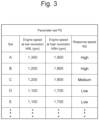
- Fig. 3 is a table showing examples of the parameter set PS for the engine 201 included in the travel history data RD of Fig. 2 .
- the parameter set PS for the engine 201 is, for example, a combination of control parameters for the engine 201 preset at the engine control section 223 of the work machine 200.
- the control parameters include each data on an engine speed at low revolution NRL[rpm], an engine speed at high revolution NRH[rpm], and a response speed RS, and include a plurality of different sets in accordance with the combinations.
- the engine speed at low revolution NRL is an idling engine speed when an acceleration pedal is not depressed
- the engine speed at high revolution NRH is the maximum engine speed when the acceleration pedal is fully depressed (so-called full operation).
- the engine speed at low revolution NRL[rpm] of the engine 201 is set at 1300[rpm]
- the engine speed at high revolution NRH[rpm] is set at 1900[rpm]
- the response speed RS is set at "high.”
- the engine speed at low revolution NRL[rpm] of the engine 201 is set at 1200[rpm]
- the engine speed at high revolution NRH[rpm] is set at 1800[rpm]
- the response speed RS is set at "medium.”
- one of a plurality of parameter sets PS as shown in Fig. 3 is selected and defined in advance.
- the wireless base station 300 shown in Fig. 1 is communicatably connected to the communication device 204 of the work machine 200 via a wireless communication line and is communicatably connected to the parameter selection device 100 via the network NW.
- the user terminal 400 shown in Fig. 1 is installed at an operation office of a user, for example, and is communicatably connected to the parameter selection device 100 via the network NW.
- the user terminal 400 includes, for example, a display section 401 configured with a liquid crystal display device, an organic EL display device, and the like.
- Fig. 4 is a flowchart showing an example of the operation of the parameter selection device 100 of Fig. 1 .
- a user of the work machine 200 who requires selection of a recommended parameter set for the engine 201 of a specific work machine 200 inputs identification information of the targeted work machine 200 into the user terminal 400.
- the identification information of the work machine 200 input into the user terminal 400 is, for example, transmitted from the user terminal 400 to the parameter selection device 100 via the network NW.
- the parameter selection device 100 Upon receipt, by means of the data input/output section 101, of the identification information of the specific work machine 200 transmitted from the user terminal 400, for example, the parameter selection device 100 starts a processing flow shown in Fig. 4 .
- the parameter selection device 100 first executes processing P1 of calculating an average loaded travel distance per cycle, based on the travel history data RD of the specific work machine 200 as an analysis target.
- one cycle is a cycle in which the work machine 200 is loaded with a load, performs loaded travel after being loaded with the load, unloads the load after the loaded travel, travels with no load after unloading the load, and is then reloaded with the load.
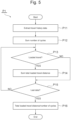
- Fig. 5 is a flowchart detailing the processing P1 of calculating the average loaded travel distance per cycle of Fig. 4 .
- the parameter selection device 100 first executes processing P11 of extracting the travel history data RD of the specific work machine 200 as the analysis target from the travel history database 103. More specifically, in the processing P11, the parameter selection section 104, for example, acquires the identification information of the specific work machine 200 as the analysis target from the data input/output section 101. Further, the parameter selection section 104, for example, extracts, from the travel history database 103, the travel history data RD of the work machine 200 including identification information matching the identification information acquired from the data input/output section 101.
- the parameter selection device 100 executes processing P12 of summing the number of cycles based on the extracted travel history data RD.
- the parameter selection section 104 determines the presence or absence of the load on a time series in the travel history data RD by comparing a threshold value for the weight PLD[t] of the load for determining the presence or absence of the load on the work machine 200 and the weight PLD[t] of the load included in the travel history data RD.
- the parameter selection section 104 sums the number of cycles of the work machine 200 from the travel history data RD, based on the determination result of the presence or absence of the load on the work machine 200 and the positional information on the work machine 200.
- the number of cycles of the work machine 200 is, for example, the number of cycles, by setting, as one cycle, a cycle in which the work machine 200 is loaded with a load, performs loaded travel after being loaded with the load, unloads the load after the loaded travel, travels with no load after unloading the load, and is then reloaded with the load, as described above.
- the parameter selection device 100 executes processing P13, P14, P15 of summing a loaded travel distance at which the work machine 200 travels with a load. More specifically, in the processing P13, the parameter selection section 104, for example, extracts data of the oldest date and time from the travel history data RD on the time series. Further, the parameter selection section 104 determines whether the work machine 200 is performing loaded travel, based on the comparison between the weight PLD[t] of the load of the extracted data and the threshold value.
- the parameter selection section 104 executes the processing P14 of summing a total loaded travel distance.
- the parameter selection section 104 sums the total loaded travel distance by multiplying the travel speed V[km/h] of the work machine 200 by a travel time to calculate the loaded travel distance and adding the calculated loaded travel distance to the total loaded travel distance calculated in the previous processing P14. Note that in the processing P14 first executed after starting the processing P1, for example, the calculated loaded travel distance is added to zero as an initial value of the total loaded travel distance.
- the parameter selection section 104 executes the processing P15 of determining whether the data extracted from the travel history data RD is the last data.
- the parameter selection section 104 returns to the processing P13 to extract the next data in the travel history data RD and determines whether the work machine 200 is performing loaded travel.
- the parameter selection section 104 executes the processing P15 without executing the processing P14. Further, when it is determined in the aforementioned processing P15 that the data extracted from the travel history data RD is the last data (YES), the parameter selection section 104 executes the subsequent processing P16.
- the parameter selection section 104 calculates the average loaded travel distance per cycle by dividing the total loaded travel distance summed in the processing P14 by the number of cycles summed in the processing P12. In the aforementioned manner, the processing P1 shown in Fig. 5 ends. Thereafter, the parameter selection device 100 executes processing P2 shown in Fig. 4 and calculates, based on the travel history data RD, a travel ratio for each slope as a ratio of an accumulated travel distance for each slope ⁇ to the total travel distance of the work machine 200 in the loaded travel.
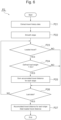
- Fig. 6 is a flowchart detaining the processing P2 of calculating the travel ratio for each slope of Fig. 4 .
- the parameter selection device 100 executes processing P21 of extracting the travel history data RD of the work machine 200 as the analysis target from the travel history database 103. More specifically, in the processing P21, in the same manner as in the aforementioned processing P11, the parameter selection section 104 extracts, from the travel history database 103, the travel history data RD including the identification information matching the identification information of the work machine 200 acquired from the data input/output section 101.
- the parameter selection section 104 executes processing P22 of smoothing the slope ⁇ included in the extracted travel history data RD on the time series to remove noise included in the detection results from the slope sensor 213.
- the parameter selection section 104 executes processing P23 of determining whether the work machine 200 is performing loaded travel in the data extracted from the travel history data RD.
- the parameter selection section 104 executes processing P24 of determining whether the weight PLD[t] of the load is within ⁇ 5% of a defined load weight. Note that when the work machine 200 is a rigid dump truck, the defined load weight of the work machine 200 is, for example, around 300[t].
- the parameter selection section 104 executes processing P25 of summing an accumulated travel distance for each slope. In the processing P25, the parameter selection section 104 calculates the travel distance for the specific slope ⁇ , based on the specific slope ⁇ , the travel speed V[km/h], and the travel time that are included in the travel history data RD.
- the parameter selection section 104 adds the calculated travel distance for the specific slope ⁇ to the accumulated travel distance for each slope for the specific slope ⁇ calculated in the previous processing P25. Note that in the processing P25, when the travel distance is first calculated for the specific slope ⁇ , the travel distance for the specific slope ⁇ is added to zero as an initial value for the accumulated travel distance for each slope for the specific slope ⁇ .
- the parameter selection section 104 executes processing P26, and in the same manner as in the aforementioned processing P15, when it is determined that the data extracted from the travel history data RD is not the last data (NO), the parameter selection section 104 returns to the processing 23 to extract the next data in the travel history data RD and determines whether the work machine 200 is performing loaded travel.
- the parameter selection section 104 executes the processing P26 without executing the processing P24 and the processing P25. Further, also when it is determined in the aforementioned processing P24 that the weight of the load PLD[t] is out of the range of ⁇ 5% of the defined load weight (NO), the parameter selection section 104 executes the processing P26 without executing the processing P24 and the processing P25.
- the parameter selection section 104 calculates a travel ratio for each slope in the loaded travel by dividing the accumulated travel distance for each slope summed in the processing P25 by the total loaded travel distance summed in the processing P14. By performing the processing P27, the ratio of the accumulated travel distance for each slope ⁇ to the total loaded travel distance of the work machine 200 can be obtained. In the aforementioned manner, the processing P2 shown in Fig. 6 ends.
- the parameter selection device 100 executes processing P3 shown in Fig. 4 .
- the parameter selection section 104 calculates a virtual travel distance for each slope per cycle by multiplying the average loaded travel distance calculated in the processing P1 by the travel ratio for each slope calculated in the processing P2. Further, the parameter selection section 104 records the calculated virtual travel distance for each slope per cycle in the analysis database 105 shown in Fig. 1 .
- Fig. 7 is a table showing an example of a virtual route table recorded in the analysis database 105 as a result of performing the processing P3 of calculating the virtual travel distance for each slope per cycle of Fig. 4 .
- the virtual route table includes, for example, the accumulated travel distance, the travel ratio to the total loaded travel distance, and the virtual travel distance per cycle, i.e., the virtual travel distance for each slope, for each slope ⁇ regarding the work machine 200 with the specific identification information as the analysis target.
- the travel ratio for each slope ⁇ is represented, for example, on a percentage basis having the total loaded travel distance as 100.
- the parameter selection device 100 executes processing P4 shown in Fig. 4 .
- the parameter selection section 104 extracts the data on the loaded travel from the travel history data RD to calculate an average fuel consumption amount for each slope and an average speed for each slope.
- the average fuel consumption amount for each slope is the average value of the fuel consumption amount[l/h] for each slope ⁇ in the loaded travel of the work machine 200.
- the average speed for each slope is the average value of the travel speed V[km/h] for each slope ⁇ in the loaded travel of the work machine 200.
- the numerical values calculated in the processing P4 to P8 shown below are calculated for each set of the parameter sets PS.
- the parameter selection section 104 performs smoothing of the calculated average fuel consumption amount for each slope and average speed for each slope. By performing this, the average fuel consumption amount for each slope and the average speed for each slope that are smoothed can be obtained for each parameter set PS.
- the parameter sets PS included in the travel history data RD include a plurality of sets as stated above. Therefore, the average fuel consumption amount for each slope and the average speed for each slope are calculated for each set of the parameter sets PS.
- the parameter selection device 100 executes processing P5 shown in Fig. 4 .
- the parameter selection section 104 calculates an average fuel efficiency[l/km] for each slope obtained by dividing the average fuel consumption amount[l/h] for each slope obtained in the previous processing P4 by the average speed[km/h] for each slope similarly obtained in the previous processing P4. Further, the parameter selection section 104 calculates a predicted fuel consumption amount[l] for each slope per cycle by multiplying the calculated average fuel efficiency[l/km] for each slope by the virtual travel distance[km] for each slope calculated in the processing P3. The predicted fuel consumption amount[l] for each slope is calculated for each set included in the parameter sets PS.
- the parameter selection device 100 executes processing P6 shown in Fig. 4 .
- the parameter selection section 104 calculates a travel time[h] for each slope per cycle by dividing the virtual travel distance[km] for each slope calculated in the processing P3 by the average speed[km/h] for each slope calculated in the processing P4.
- the travel time[h] for each slope is calculated for each set included in the parameter sets PS.
- the parameter selection device 100 executes processing P7 shown in Fig. 4 .
- the parameter selection section 104 calculates a predicted fuel consumption amount[l/t] per unit load weight per cycle by dividing the predicted fuel consumption amount[l] per cycle as a total of the predicted fuel consumption amount[l] for each slope per cycle by the defined load weight[t] of the work machine 200, based on the travel history data RD, for each parameter set PS.
- the predicted fuel consumption amount[l/t] is calculated for each set included in the parameter sets PS.
- the parameter selection device 100 executes processing P8 shown in Fig. 4 .
- the parameter selection section 104 calculates a predicted production amount[t/h] per cycle by dividing the defined load weight[t] of the work machine 200 by a virtual travel time "h" per cycle as a total of the travel time for each slope, based on the travel history data RD for each parameter set PS.
- the predicted production amount[t/h] is calculated for each set included in the parameter sets PS.
- the parameter selection device 100 executes processing P9 shown in Fig. 4 .
- the parameter selection section 104 selects a recommended parameter set based on the predicted fuel consumption amount[l/t] and the predicted production amount[t/h] per cycle for each parameter set PS that are calculated in the processing P7 and the processing P8.
- Fig. 8 is an image chart showing an example of output results of the recommended parameter set selected in the processing P9 of Fig. 4 .
- the current parameter set PS for the engine 201 of the work machine 200 as the analysis target is a set B.
- the engine speed at low revolution of the engine 201 is 1200[rpm]
- the engine speed at high revolution is 1800[rpm]
- the response speed is high.
- the predicted fuel consumption amount is 0.234[l/t]
- the predicted production amount is 633[t/h].
- the parameter selection device 100 selects the set C with the fewest predicted fuel consumption amount as the recommended parameter set, from the sets A, B, C as the parameter sets PS with the highest predicted production amount.
- the method for selecting the recommended parameter set based on the predicted fuel consumption amount and the predicted production amount is not particularly limited, and the recommended parameter set can be appropriately set by the user considering the balance between the fuel efficiency and the production amount.
- the parameter selection device 100 executes the processing P10 of recording and outputting the recommended parameter set.
- the parameter selection section 104 records the recommended parameter set for the specific work machine 200 as the analysis target in the analysis database 105. Further, the parameter selection section 104, for example, outputs the recommended parameter set for the specific work machine 200 as the analysis target to at least one of the work machine 200 and the user terminal 400 via the data input/output section 101.
- the parameter selection device 100 transmits the recommended parameter set selected by the parameter selection section 104 in the processing P9 to the user terminal 400 via the data input/output section 101.
- the user terminal 400 can display the recommended parameter set received from the data input/output section 101 on the display section 401 as shown in Fig. 8 .
- the parameter selection device 100 transmits the recommended parameter set selected by the parameter selection section 104 in the processing P9 to the communication device 204 of the work machine 200 via the data input/output section 101.
- the engine control section 223 controls the engine 201 based on the recommended parameter set received from the data input/output section 101 via the communication device 204.
- the parameter selection device 100 ends the processing flow shown in Fig. 4 .
- the parameter selection device 100 of the present embodiment is a device that selects the recommended parameter set for the engine 201 of the work machine 200 based on the travel history data RD of the work machine 200, and includes the parameter selection section 104.
- the travel history data RD includes travel date and time DAT, a slope ⁇ of a travel route, a travel speed V[km/h], a weight PLD[t] of a load, parameter sets PS for the engine 201, and a fuel consumption amount FCH[l/h] per unit time of the work machine 200.
- the parameter selection section 104 calculates (processing P1) the average loaded travel distance per cycle based on the travel history data RD.
- one cycle is a cycle in which the work machine 200 is loaded with a load, performs loaded travel after being loaded with the load, unloads the load after the loaded travel, travels with no load after unloading the load, and is then reloaded with the load.
- the parameter selection section 104 calculates (processing P2) the travel ratio for each slope that is the ratio of the accumulated travel distance for each slope ⁇ relative to the total travel distance of the work machine 200 in the loaded travel, based on the travel history data RD.
- the parameter selection section 104 calculates (processing P3) the virtual travel distance for each slope per cycle by multiplying the average loaded travel distance by the travel ratio for each slope.
- the parameter selection section 104 calculates (processing P4) the average fuel consumption amount for each slope as the average value of the fuel consumption amount FCH[l/h] and the average speed for each slope as the average value of the travel speed V[km/h] for each slope ⁇ in the loaded travel of the work machine 200, based on the travel history data RD. Further, the parameter selection section 104 calculates (processing P5) the predicted fuel consumption amount for each slope per cycle by multiplying the average fuel efficiency for each slope, which is obtained by dividing the average fuel consumption amount for each slope by the average speed for each slope, by the virtual travel distance for each slope.
- the parameter selection section 104 calculates (processing P6) the travel time for each slope per cycle by dividing the virtual travel distance for each slope by the average speed for each slope.
- the parameter selection section 104 calculates (processing P7) the predicted fuel consumption amount per unit load weight by dividing the predicted fuel consumption amount per cycle as a total of the predicted fuel consumption amount for each slope by the defined load weight of the work machine 200 for each parameter set PS based on the travel history data RD.
- the parameter selection section 104 calculates (processing P8) the predicted production amount per cycle by dividing the defined load weight by the virtual travel time per cycle as a total of the travel time for each slope for each parameter set PS based on the travel history data RD. Then, as shown in Fig. 8 , the parameter selection section 104 selects (processing P9) the recommended parameter set based on the predicted fuel consumption amount and the predicted production amount per cycle for each parameter set PS.
- the parameter selection device 100 of the present embodiment it is possible to calculate the virtual travel distance for each slope on the virtual travel route where the work machine 200 performs loaded travel per cycle, by summing the travel history data RD of the work machine 200. Further, using the virtual travel distance for each slope, it is possible to calculate the predicted fuel consumption amount per unit load weight and the predicted production amount per cycle of the work machine 200 for each parameter set PS for the engine 201.
- the recommended parameter set from a plurality of parameter sets PS, considering the balance between the predicted fuel consumption amount and the predicted production amount, under uniform conditions, at a work site such as a mining site where the route that the work machine 200 can travel or the gradient of the route where the work machine 200 travels changes from moment to moment as work progresses. Therefore, according to the present embodiment, it is possible to provide the parameter selection device 100 that enables the work machine 200 to efficiently travel at a work site where the travel route or the slope ⁇ changes from moment to moment.
- the parameter recommendation system 500 of the present embodiment includes the aforementioned parameter selection device 100 and the control device 220 mounted on the work machine 200.
- the control device 220 includes the engine control section 223, the travel record acquiring section 221, and the travel record transmitting section 222.
- the engine control section 223 controls the engine 201 based on the parameter set PS.
- the travel record acquiring section 221 acquires the travel history data RD based on the detection results from the sensor 210 mounted on the work machine 200.
- the travel record transmitting section 222 transmits the travel history data RD input from the travel record acquiring section 221 to the parameter selection device 100 via the communication device 204 mounted on the work machine 200.
- the parameter recommendation system 500 of the present embodiment it is possible to acquire the travel history data RD of the work machine 200 by means of the control device 220 mounted on the work machine 200 to transmit the travel history data RD to the parameter selection device 100 via the communication device 204 of the work machine 200.
- the parameter recommendation system 500 of the present embodiment further includes the user terminal 400 that is communicatably connected to the parameter selection device 100. Furthermore, the parameter selection device 100 transmits the recommended parameter set for the engine 201 of the work machine 200 to the user terminal 400. In addition, the user terminal 400 includes the display section 401 that displays the recommended parameter set received from the parameter selection device 100.
- the user of the work machine 200 can change the setting for the work machine 200, by referring to the recommended parameter set for the engine 201 that is displayed on the display section 401 of the user terminal 400.
- the parameter selection device 100 transmits the recommended parameter set for the engine 201 to the work machine 200. Further, the engine control section 223 of the control device 220 mounted on the work machine 200 controls the engine 201 based on the recommended parameter set received from the data input/output section 101 via the communication device 204.
- the parameter recommendation system 500 that enables the work machine 200 to efficiently travel at a work site where the travel route or the slope ⁇ changes from moment to moment.
Landscapes
- Engineering & Computer Science (AREA)
- Business, Economics & Management (AREA)
- Chemical & Material Sciences (AREA)
- Combustion & Propulsion (AREA)
- Mechanical Engineering (AREA)
- Human Resources & Organizations (AREA)
- Economics (AREA)
- Strategic Management (AREA)
- General Physics & Mathematics (AREA)
- Physics & Mathematics (AREA)
- Tourism & Hospitality (AREA)
- Transportation (AREA)
- General Engineering & Computer Science (AREA)
- Marketing (AREA)
- Theoretical Computer Science (AREA)
- General Business, Economics & Management (AREA)
- Health & Medical Sciences (AREA)
- Automation & Control Theory (AREA)
- Primary Health Care (AREA)
- General Health & Medical Sciences (AREA)
- Development Economics (AREA)
- Entrepreneurship & Innovation (AREA)
- Operations Research (AREA)
- Educational Administration (AREA)
- Game Theory and Decision Science (AREA)
- Quality & Reliability (AREA)
- Radar, Positioning & Navigation (AREA)
- Aviation & Aerospace Engineering (AREA)
- Remote Sensing (AREA)
- Public Health (AREA)
- Water Supply & Treatment (AREA)
- Human Computer Interaction (AREA)
- Traffic Control Systems (AREA)
- Control Of Vehicle Engines Or Engines For Specific Uses (AREA)
Abstract
Description
- The present invention relates to a parameter selection device and a parameter recommendation system for a work machine.
- Conventionally, there has been known an invention related to an energy consumption amount prediction device for a vehicle that predicts the energy consumption amount of the vehicle traveling a predetermined travel route. A conventional device described in
Patent Literature 1 includes a fuel-converted gradient data storing means and a consumption amount calculation means. The fuel-converted gradient data storing means stores fuel-converted gradient data for links created by a road gradient data creation device in association with road map data. The consumption amount calculation means calculates an energy consumption amount of a vehicle that is predicted in traveling the travel route, using the fuel-converted gradient data for each link stored in the fuel-converted gradient data storing means (Patent Literature 1, paragraph 0019 and claim 7). - The road gradient data creation device described in
Patent Literature 1 creates data indicating the gradient degree of each link in the road map data representing a road using a combination of nodes and links. The device includes a link data input means, an altitude data input means, and a gradient data creation means (Patent Literature 1, paragraph 0008 and claim 1). The link data input means inputs link data including positions of a start point and an end point of each link and a road type from a map database that records the road map data. - The altitude data input means inputs altitude data from an altitude database that records altitude of each position obtained by sectioning a topographical map by a mesh with a predetermined interval. The gradient data creation means creates, based on the link data and the altitude data, gradient data as an indicator showing the degree of a gradient of each link between the start point and the end point, as fuel-converted gradient data, by converting the gradient data into an energy consumption amount when a vehicle travels the link and evaluating it.
- Further, conventionally, there has been known an invention related to a driving analysis device for a transport vehicle. A conventional device described in Patent Literature 2 is a driving analysis device for a transport vehicle that repeatedly travels the same route (paragraph 0007 and
claim 1 of Patent Literature 2). The conventional device includes a data accumulation section, a data extraction section, a section extraction section, and a driving information output section. The data accumulation section acquires and stores in a storage device positional information during the travel of the transport vehicle and driving information including information on a fuel consumption amount and a load amount by setting data on one round travel on the route as data of one cycle. - The data extraction section extracts reference cycle data and analysis target cycle data from data of a plurality of cycles accumulated in the storage device. The section extraction section extracts an analysis target section from a plurality of sections set by dividing the route using the positional information. The driving information output section outputs the reference cycle data for the analysis target section and the driving information of the analysis target cycle data.
-
- Patent Literature 1:
JP 2012-242110 A - Patent Literature 2:
WO 2015/136647A1 - For example, at a work site such as a mining site, a route where a work machine such as a dump truck can travel or a gradient of the route where the work machine travels change from moment to moment as work progresses. As described above, the conventional device described in
Patent Literature 1 creates the fuel-converted gradient data based on the link data recorded in the map database and the altitude data recorded in the altitude database. Therefore, in the conventional device, it is difficult to constantly update the map database and the altitude database to the latest state for such a work site where the travel route or the gradient changes from moment to moment. - Further, the conventional device described in Patent Literature 2 has a transport vehicle that repeatedly travels the same route as the analysis target. Therefore, it is difficult to perform driving analysis of the transport vehicle for the work site where the travel route or the gradient changes from moment to moment.
- The present disclosure provides a parameter selection device and a parameter recommendation system for a work machine that enable the work machine to efficiently travel at a work site where a travel route or a slope changes from moment to moment.
- One aspect of the present disclosure is a parameter selection device that selects a recommended parameter set for an engine based on travel history data including travel date and time, slopes of a travel route, a travel speed, a weight of a load, parameter sets for control of the engine, and a fuel consumption amount per unit time of a work machine, the parameter selection device including a parameter selection section, the parameter selection section being configured to: calculate an average loaded travel distance per one cycle based on the travel history data, the one cycle being set as a cycle in which the work machine is loaded with a load, performs loaded travel after being loaded with the load, unloads the load after the loaded travel, travels with no load after unloading the load, and is then reloaded with the load; calculate, based on the travel history data, a travel ratio for each slope as a ratio of an accumulated travel distance for each of the slopes relative to a total travel distance of the work machine in the loaded travel; calculate a virtual travel distance for each slope per the one cycle by multiplying the average loaded travel distance by the travel ratio for each slope; calculate, based on the travel history data, an average fuel consumption amount for each slope as an average value of the fuel consumption amount and an average speed for each slope as an average value of the travel speed, for each of the slopes in the loaded travel of the work machine; calculate a predicted fuel consumption amount for each slope per the one cycle by multiplying an average fuel efficiency for each slope, which is obtained by dividing the average fuel consumption amount for each slope by the average speed for each slope, by the virtual travel distance for each slope; calculate a travel time for each slope per the one cycle by dividing the virtual travel distance for each slope by the average speed for each slope; calculate, based on the travel history data, a predicted fuel consumption amount per unit load weight by dividing a predicted fuel consumption amount per the one cycle as a total of the predicted fuel consumption amount for each slope by a defined load weight of the work machine, for each of the parameter sets; calculate, based on the travel history data, a predicted production amount per the one cycle by dividing the defined load weight by a virtual travel time per the one cycle as a total of the travel time for each slope, for each of the parameter sets; and select the recommended parameter set, based on the predicted fuel consumption amount and the predicted production amount per the one cycle for each of the parameter sets.
- Further, another aspect of the present disclosure is a parameter recommendation system including the parameter selection device and a control device mounted on the work machine, in which the control device includes: an engine control section that controls the engine based on the parameter sets; a travel record acquiring section that acquires the travel history data based on detection results from a sensor mounted on the work machine; and a travel record transmitting section that transmits the travel history data input from the travel record acquiring section to the parameter selection device via a communication device mounted on the work machine.
- According to the aforementioned aspect of the present disclosure, it is possible to provide a parameter selection device and a parameter recommendation system for a work machine that enable the work machine to efficiently travel at a work site where a travel route or a slope changes from moment to moment.
-
-
Fig. 1 is a block diagram showing an embodiment of a parameter selection device and a parameter recommendation system according to the present disclosure. -
Fig. 2 is a table showing an example of travel history data recorded in the parameter selection device ofFig. 1 . -
Fig. 3 is a table showing examples of a parameter set ofFig. 2 . -
Fig. 4 is a flowchart showing operation of the parameter selection device ofFig. 1 . -
Fig. 5 is a flowchart detailing processing of calculating an average loaded travel distance ofFig. 4 . -
Fig. 6 is a flowchart detailing processing of calculating a travel ratio for each slope ofFig. 4 . -
Fig. 7 is a table showing an example of results of processing of calculating a virtual travel distance for each slope ofFig. 4 . -
Fig. 8 is an image chart showing an example of output results of a recommended parameter set ofFig. 4 . - Hereinafter, with reference to the drawings, an embodiment of a parameter selection device and a parameter recommendation system according to the present disclosure will be described.
- In the present disclosure, as a work machine, a dump truck as a transport machine used at mines or the like is expected, and control parameters (variables) of an engine as a power source will be explained as examples of parameters.
Fig. 1 is a block diagram showing the embodiment of the parameter selection device and the parameter recommendation system according to the present disclosure. Aparameter selection device 100 of the present embodiment is, for example, a computer connected to a network NW such as the Internet. Theparameter selection device 100 includes, for example, a central processing device (CPU), a memory, a timer, and an input/output section. - The
parameter selection device 100 is a device that selects a recommended parameter set for anengine 201 of awork machine 200 based on travel history data RD of thework machine 200. Although the details will be described later, the travel history data RD of thework machine 200 includes, for example, travel date and time DAT, a slope θ[°] of a travel route, a travel speed V[km/h], a weight PLD[t] of a load, a parameter set PS for theengine 201, and a fuel consumption amount FCH[l/h] per unit time of the work machine 200 (seeFig. 2 ). - The
parameter selection device 100 includes, for example, a data input/output section 101, a travelhistory recording section 102, atravel history database 103, aparameter selection section 104, and ananalysis database 105. The sections of theparameter selection device 100 shown inFig. 1 represent, for example, functions of theparameter selection device 100 that are implemented by the CPU of theparameter selection device 100 executing programs stored in the memory of theparameter selection device 100. - A
parameter recommendation system 500 of the present embodiment includes, for example, theparameter selection device 100 and acontrol device 220 mounted on thework machine 200. Note thatFig. 1 shows onework machine 200 and onecontrol device 220 mounted on thework machine 200, but theparameter recommendation system 500 may include a plurality ofcontrol devices 220 mounted on a plurality ofwork machines 200. Further, theparameter recommendation system 500 may include, for example, awireless base station 300 connected to the network NW, and auser terminal 400 installed at an operation office of a user or the like and connected to the network NW. - The
work machine 200 is, for example, a dump truck that conveys loads such as soil and sand and crushed stones. Further, thework machine 200 is, for example, a supersized rigid dump truck that conveys loads such as minerals at mines. Note that thework machine 200 is not limited to a dump truck, and may be, for example, another machine that can convey an object to be conveyed, such as a wheel loader and a hydraulic shovel. - The
work machine 200 includes, for example, theengine 201, apower generator 202, amotor 203, acommunication device 204, asensor 210, and thecontrol device 220. Theengine 201 is, for example, an internal combustion engine fueled by gas oil or the like. An output shaft of theengine 201 is, for example, connected to a shaft of thepower generator 202 and rotates the shaft of thepower generator 202. Thepower generator 202 generates power such that for example, the shaft is rotated due to the rotation of the output shaft of theengine 201. The engine speed of theengine 201 is controlled by an accelerator (not shown), and in a case of a vehicle of attended operation, the engine speed is controlled to increase and decrease by the operation of an acceleration pedal. - The
motor 203 is, for example, rotated by the electric power supplied from thepower generator 202 so as to generate power to cause thework machine 200 to travel. More specifically, when thework machine 200 is a dump truck, themotor 203 is a travel motor to rotate the wheels of the dump truck. Note that themotor 203 may be rotated by the electric power supplied from a battery of the work machine 200 (illustration omitted). Further, themotor 203 may supply regenerated power generated by a regenerative brake to the battery, for example. - The
communication device 204 is, for example, wireless communication equipment mounted on thework machine 200. Thecommunication device 204 is, for example, connected to thewireless base station 300 through wireless communication, and connected to the network NW via thewireless base station 300. Further, thecommunication device 204 may be connected to the network NW through satellite communication via an antenna, a communication satellite, and a gateway, for example. - The
sensor 210 is, for example, mounted on thework machine 200 and detects the physical amount on thework machine 200. Thesensor 210 includes, for example, aposition sensor 211, aspeed sensor 212, aslope sensor 213, aload amount sensor 214, afuel sensor 215, and anengine sensor 216. - The
position sensor 211 includes, for example, a receiver of the Global Navigation Satellite System (GNSS) and detects positional information such as latitude and longitude of thework machine 200. Thespeed sensor 212 includes, for example, a wheel speed sensor and detects the speed of thework machine 200. Theslope sensor 213 includes, for example, an inclination sensor, an inertial sensor, or an acceleration sensor and detects an inclination angle relative to a horizontal surface of thework machine 200. - The
load amount sensor 214 detects, for example, the load amount of thework machine 200 based on the load exerted on a suspension that supports the wheels of thework machine 200. Thefuel sensor 215 detects, for example, a remaining amount of fuel in a fuel tank based on a position of a float in the fuel tank. Theengine sensor 216 detects, for example, an engine speed and a response speed (ratio of change in the engine speed to a depression amount of an acceleration pedal) of theengine 201 of thework machine 200. - The
control device 220 is, for example, an electronic control unit (ECU) mounted on thework machine 200. Thecontrol device 220 can be configured with a micro controller including one or more of a CPU, a memory, a timer, and an input/output section, for example. Thecontrol device 220 includes, for example, a travelrecord acquiring section 221, a travelrecord transmitting section 222, and anengine control section 223. These sections of thecontrol device 220 represent, for example, functions of thecontrol device 220 that are implemented by the CPU executing programs stored in the memory. - The travel
record acquiring section 221 acquires the travel history data RD based on detection results from thesensor 210 mounted on thework machine 200. More specifically, the travelrecord acquiring section 221 acquires, for example, detection results from theposition sensor 211, thespeed sensor 212, theslope sensor 213, theload amount sensor 214, and thefuel sensor 215. In this manner, the travelrecord acquiring section 221 acquires, for example, travel date and time DAT, a slope θ of a travel route, a travel speed V[km/h], a weight PLD[t] of a load, and a fuel consumption amount FCH[l/h] per unit time of thework machine 200. Further, the travelrecord acquiring section 221 acquires, for example, the parameter set for theengine 201 from theengine control section 223. - The travel
record transmitting section 222 transmits the travel history data RD input from the travelrecord acquiring section 221 to theparameter selection device 100 via thecommunication device 204 mounted on thework machine 200. Theengine control section 223 controls, for example, theengine 201 of thework machine 200 in response to an input from an acceleration pedal (not shown), based on the parameter set PS for control of theengine 201 described later and the detection results from theengine sensor 216. - The
parameter selection device 100 receives, for example, by means of the data input/output section 101 connected to the network NW, the travel history data RD of thework machine 200 transmitted from the travelrecord transmitting section 222 of thecontrol device 220 mounted on thework machine 200 via thecommunication device 204. The travelhistory recording section 102 records, in thetravel history database 103, the travel history data RD received by means of the data input/output section 101. -
Fig. 2 is a table showing an example of the travel history data RD recorded in thetravel history database 103 of theparameter selection device 100 ofFig. 1 . The travel history data RD of thework machine 200 includes, for example, travel date and time DAT, a slope θ[°] of a travel route, a travel speed V[km/h], a weight PLD[t] of a load, a parameter set PS for theengine 201, and a fuel consumption amount FCH[l/h] per unit time of thework machine 200. Further, the travel history data RD may include positional information on thework machine 200. The travelhistory recording section 102 of theparameter selection device 100, for example, records, in thetravel history database 103, the travel history data RD received from a plurality ofwork machines 200 together with the identification information of theindividual work machine 200. - The travel date and time DAT of the
work machine 200 is, for example, date and time when thespeed sensor 212 detects the speed of thework machine 200. The slope θ is, for example, an inclination angle relative to the horizontal surface of thework machine 200 detected by theslope sensor 213. The travel speed V[km/h] is, for example, the speed of thework machine 200 detected by thespeed sensor 212. The weight PLD[t] of a load is, for example, a load amount of thework machine 200 detected by theload amount sensor 214. The fuel consumption amount FCH[l/h] is, for example, a consumption amount of fuel per unit time calculated based on the remaining amount of fuel detected by thefuel sensor 215. The positional information is, for example, information on the latitude and longitude of thework machine 200 detected by theposition sensor 211 or the like. -
Fig. 3 is a table showing examples of the parameter set PS for theengine 201 included in the travel history data RD ofFig. 2 . The parameter set PS for theengine 201 is, for example, a combination of control parameters for theengine 201 preset at theengine control section 223 of thework machine 200. As shown in the table, the control parameters include each data on an engine speed at low revolution NRL[rpm], an engine speed at high revolution NRH[rpm], and a response speed RS, and include a plurality of different sets in accordance with the combinations. Herein, the engine speed at low revolution NRL is an idling engine speed when an acceleration pedal is not depressed, while the engine speed at high revolution NRH is the maximum engine speed when the acceleration pedal is fully depressed (so-called full operation). - In the example shown in
Fig. 3 , for a set A of the parameter sets PS, the engine speed at low revolution NRL[rpm] of theengine 201 is set at 1300[rpm], the engine speed at high revolution NRH[rpm] is set at 1900[rpm], and the response speed RS is set at "high." Further, for a set C of the parameter sets PS, the engine speed at low revolution NRL[rpm] of theengine 201 is set at 1200[rpm], the engine speed at high revolution NRH[rpm] is set at 1800[rpm], and the response speed RS is set at "medium." - In the
engine control section 223 of thecontrol device 220 mounted on thework machine 200, for example, one of a plurality of parameter sets PS as shown inFig. 3 is selected and defined in advance. Theengine control section 223, for example, controls theengine 201 based on the defined parameter set PS and the detection results from theengine sensor 216. - The
wireless base station 300 shown inFig. 1 is communicatably connected to thecommunication device 204 of thework machine 200 via a wireless communication line and is communicatably connected to theparameter selection device 100 via the network NW. Further, theuser terminal 400 shown inFig. 1 is installed at an operation office of a user, for example, and is communicatably connected to theparameter selection device 100 via the network NW. Furthermore, theuser terminal 400 includes, for example, adisplay section 401 configured with a liquid crystal display device, an organic EL display device, and the like. - Hereinafter, with reference to
Fig. 4 , operation of theparameter selection device 100 of the present embodiment will be described.Fig. 4 is a flowchart showing an example of the operation of theparameter selection device 100 ofFig. 1 . - In the
parameter recommendation system 500 of the present embodiment, for example, a user of thework machine 200 who requires selection of a recommended parameter set for theengine 201 of aspecific work machine 200 inputs identification information of the targetedwork machine 200 into theuser terminal 400. The identification information of thework machine 200 input into theuser terminal 400 is, for example, transmitted from theuser terminal 400 to theparameter selection device 100 via the network NW. - Upon receipt, by means of the data input/
output section 101, of the identification information of thespecific work machine 200 transmitted from theuser terminal 400, for example, theparameter selection device 100 starts a processing flow shown inFig. 4 . Upon start of the processing flow shown inFig. 4 , theparameter selection device 100 first executes processing P1 of calculating an average loaded travel distance per cycle, based on the travel history data RD of thespecific work machine 200 as an analysis target. Herein, one cycle is a cycle in which thework machine 200 is loaded with a load, performs loaded travel after being loaded with the load, unloads the load after the loaded travel, travels with no load after unloading the load, and is then reloaded with the load. -
Fig. 5 is a flowchart detailing the processing P1 of calculating the average loaded travel distance per cycle ofFig. 4 . Upon start of the processing P1 shown inFig. 5 , theparameter selection device 100 first executes processing P11 of extracting the travel history data RD of thespecific work machine 200 as the analysis target from thetravel history database 103. More specifically, in the processing P11, theparameter selection section 104, for example, acquires the identification information of thespecific work machine 200 as the analysis target from the data input/output section 101. Further, theparameter selection section 104, for example, extracts, from thetravel history database 103, the travel history data RD of thework machine 200 including identification information matching the identification information acquired from the data input/output section 101. - Next, the
parameter selection device 100 executes processing P12 of summing the number of cycles based on the extracted travel history data RD. In the processing P12, for example, theparameter selection section 104 determines the presence or absence of the load on a time series in the travel history data RD by comparing a threshold value for the weight PLD[t] of the load for determining the presence or absence of the load on thework machine 200 and the weight PLD[t] of the load included in the travel history data RD. - The
parameter selection section 104, for example, sums the number of cycles of thework machine 200 from the travel history data RD, based on the determination result of the presence or absence of the load on thework machine 200 and the positional information on thework machine 200. Herein, the number of cycles of thework machine 200 is, for example, the number of cycles, by setting, as one cycle, a cycle in which thework machine 200 is loaded with a load, performs loaded travel after being loaded with the load, unloads the load after the loaded travel, travels with no load after unloading the load, and is then reloaded with the load, as described above. - Next, the
parameter selection device 100 executes processing P13, P14, P15 of summing a loaded travel distance at which thework machine 200 travels with a load. More specifically, in the processing P13, theparameter selection section 104, for example, extracts data of the oldest date and time from the travel history data RD on the time series. Further, theparameter selection section 104 determines whether thework machine 200 is performing loaded travel, based on the comparison between the weight PLD[t] of the load of the extracted data and the threshold value. - When it is determined in the processing P13 that the
work machine 200 is performing loaded travel (YES), theparameter selection section 104 executes the processing P14 of summing a total loaded travel distance. In the processing P14, theparameter selection section 104 sums the total loaded travel distance by multiplying the travel speed V[km/h] of thework machine 200 by a travel time to calculate the loaded travel distance and adding the calculated loaded travel distance to the total loaded travel distance calculated in the previous processing P14. Note that in the processing P14 first executed after starting the processing P1, for example, the calculated loaded travel distance is added to zero as an initial value of the total loaded travel distance. - Thereafter, the
parameter selection section 104 executes the processing P15 of determining whether the data extracted from the travel history data RD is the last data. When it is determined in the processing P15 that the data extracted from the travel history data RD is not the last data (NO), theparameter selection section 104 returns to the processing P13 to extract the next data in the travel history data RD and determines whether thework machine 200 is performing loaded travel. - Meanwhile, when it is determined in the aforementioned processing P13 that the
work machine 200 is traveling without a load, that is, thework machine 200 is not performing loaded travel (NO), theparameter selection section 104 executes the processing P15 without executing the processing P14. Further, when it is determined in the aforementioned processing P15 that the data extracted from the travel history data RD is the last data (YES), theparameter selection section 104 executes the subsequent processing P16. - In the processing P16, the
parameter selection section 104 calculates the average loaded travel distance per cycle by dividing the total loaded travel distance summed in the processing P14 by the number of cycles summed in the processing P12. In the aforementioned manner, the processing P1 shown inFig. 5 ends. Thereafter, theparameter selection device 100 executes processing P2 shown inFig. 4 and calculates, based on the travel history data RD, a travel ratio for each slope as a ratio of an accumulated travel distance for each slope θ to the total travel distance of thework machine 200 in the loaded travel. -
Fig. 6 is a flowchart detaining the processing P2 of calculating the travel ratio for each slope ofFig. 4 . Upon start of the processing P2 shown inFig. 6 , theparameter selection device 100 executes processing P21 of extracting the travel history data RD of thework machine 200 as the analysis target from thetravel history database 103. More specifically, in the processing P21, in the same manner as in the aforementioned processing P11, theparameter selection section 104 extracts, from thetravel history database 103, the travel history data RD including the identification information matching the identification information of thework machine 200 acquired from the data input/output section 101. - Next, the
parameter selection section 104, for example, executes processing P22 of smoothing the slope θ included in the extracted travel history data RD on the time series to remove noise included in the detection results from theslope sensor 213. Next, in the same manner as in the aforementioned processing P13, theparameter selection section 104, for example, executes processing P23 of determining whether thework machine 200 is performing loaded travel in the data extracted from the travel history data RD. - When it is determined in the processing P23 that the
work machine 200 is performing loaded travel (YES), theparameter selection section 104 executes processing P24 of determining whether the weight PLD[t] of the load is within ±5% of a defined load weight. Note that when thework machine 200 is a rigid dump truck, the defined load weight of thework machine 200 is, for example, around 300[t]. - When it is determined in the processing P24 that the weight PLD[t] of the load is within the range of ±5% of the defined load weight (YES), the
parameter selection section 104 executes processing P25 of summing an accumulated travel distance for each slope. In the processing P25, theparameter selection section 104 calculates the travel distance for the specific slope θ, based on the specific slope θ, the travel speed V[km/h], and the travel time that are included in the travel history data RD. - Further, the
parameter selection section 104 adds the calculated travel distance for the specific slope θ to the accumulated travel distance for each slope for the specific slope θ calculated in the previous processing P25. Note that in the processing P25, when the travel distance is first calculated for the specific slope θ, the travel distance for the specific slope θ is added to zero as an initial value for the accumulated travel distance for each slope for the specific slope θ. - Thereafter, the
parameter selection section 104 executes processing P26, and in the same manner as in the aforementioned processing P15, when it is determined that the data extracted from the travel history data RD is not the last data (NO), theparameter selection section 104 returns to the processing 23 to extract the next data in the travel history data RD and determines whether thework machine 200 is performing loaded travel. - Meanwhile, when it is determined in the aforementioned processing P23 that the
work machine 200 is traveling without a load, that is, thework machine 200 is not performing loaded travel (NO), theparameter selection section 104 executes the processing P26 without executing the processing P24 and the processing P25. Further, also when it is determined in the aforementioned processing P24 that the weight of the load PLD[t] is out of the range of ±5% of the defined load weight (NO), theparameter selection section 104 executes the processing P26 without executing the processing P24 and the processing P25. - In this manner, by executing the processing P25 after the aforementioned processing P23 and processing P24, it is possible to sum the accumulated travel distance for each slope by extracting data with the equivalent weight PLD[t] of the load from the travel history data RD. Further, when it is determined in the previous processing P26 that the data extracted from the travel history data RD is the last data (YES), the
parameter selection section 104 executes the subsequent processing P27. - In the processing P27, the
parameter selection section 104 calculates a travel ratio for each slope in the loaded travel by dividing the accumulated travel distance for each slope summed in the processing P25 by the total loaded travel distance summed in the processing P14. By performing the processing P27, the ratio of the accumulated travel distance for each slope θ to the total loaded travel distance of thework machine 200 can be obtained. In the aforementioned manner, the processing P2 shown inFig. 6 ends. - Thereafter, the
parameter selection device 100 executes processing P3 shown inFig. 4 . In the processing P3, theparameter selection section 104, for example, calculates a virtual travel distance for each slope per cycle by multiplying the average loaded travel distance calculated in the processing P1 by the travel ratio for each slope calculated in the processing P2. Further, theparameter selection section 104 records the calculated virtual travel distance for each slope per cycle in theanalysis database 105 shown inFig. 1 . -
Fig. 7 is a table showing an example of a virtual route table recorded in theanalysis database 105 as a result of performing the processing P3 of calculating the virtual travel distance for each slope per cycle ofFig. 4 . The virtual route table includes, for example, the accumulated travel distance, the travel ratio to the total loaded travel distance, and the virtual travel distance per cycle, i.e., the virtual travel distance for each slope, for each slope θ regarding thework machine 200 with the specific identification information as the analysis target. The travel ratio for each slope θ is represented, for example, on a percentage basis having the total loaded travel distance as 100. - Next, the
parameter selection device 100 executes processing P4 shown inFig. 4 . In the processing P4, for example, in the same manner as in the aforementioned processing P21 to processing P24, theparameter selection section 104 extracts the data on the loaded travel from the travel history data RD to calculate an average fuel consumption amount for each slope and an average speed for each slope. Herein, the average fuel consumption amount for each slope is the average value of the fuel consumption amount[l/h] for each slope θ in the loaded travel of thework machine 200. Further, the average speed for each slope is the average value of the travel speed V[km/h] for each slope θ in the loaded travel of thework machine 200. Note that the numerical values calculated in the processing P4 to P8 shown below are calculated for each set of the parameter sets PS. - Further, in the processing P4, the
parameter selection section 104, for example, performs smoothing of the calculated average fuel consumption amount for each slope and average speed for each slope. By performing this, the average fuel consumption amount for each slope and the average speed for each slope that are smoothed can be obtained for each parameter set PS. Herein, the parameter sets PS included in the travel history data RD include a plurality of sets as stated above. Therefore, the average fuel consumption amount for each slope and the average speed for each slope are calculated for each set of the parameter sets PS. - Next, the
parameter selection device 100 executes processing P5 shown inFig. 4 . In the processing P5, theparameter selection section 104, for example, calculates an average fuel efficiency[l/km] for each slope obtained by dividing the average fuel consumption amount[l/h] for each slope obtained in the previous processing P4 by the average speed[km/h] for each slope similarly obtained in the previous processing P4. Further, theparameter selection section 104 calculates a predicted fuel consumption amount[l] for each slope per cycle by multiplying the calculated average fuel efficiency[l/km] for each slope by the virtual travel distance[km] for each slope calculated in the processing P3. The predicted fuel consumption amount[l] for each slope is calculated for each set included in the parameter sets PS. - Next, the
parameter selection device 100 executes processing P6 shown inFig. 4 . In the processing P6, theparameter selection section 104, for example, calculates a travel time[h] for each slope per cycle by dividing the virtual travel distance[km] for each slope calculated in the processing P3 by the average speed[km/h] for each slope calculated in the processing P4. The travel time[h] for each slope is calculated for each set included in the parameter sets PS. - Next, the
parameter selection device 100 executes processing P7 shown inFig. 4 . In the processing P7, theparameter selection section 104, for example, calculates a predicted fuel consumption amount[l/t] per unit load weight per cycle by dividing the predicted fuel consumption amount[l] per cycle as a total of the predicted fuel consumption amount[l] for each slope per cycle by the defined load weight[t] of thework machine 200, based on the travel history data RD, for each parameter set PS. The predicted fuel consumption amount[l/t] is calculated for each set included in the parameter sets PS. - Next, the
parameter selection device 100 executes processing P8 shown inFig. 4 . In the processing P8, theparameter selection section 104, for example, calculates a predicted production amount[t/h] per cycle by dividing the defined load weight[t] of thework machine 200 by a virtual travel time "h" per cycle as a total of the travel time for each slope, based on the travel history data RD for each parameter set PS. The predicted production amount[t/h] is calculated for each set included in the parameter sets PS. - Next, the
parameter selection device 100 executes processing P9 shown inFig. 4 . In the processing P9, theparameter selection section 104, for example, selects a recommended parameter set based on the predicted fuel consumption amount[l/t] and the predicted production amount[t/h] per cycle for each parameter set PS that are calculated in the processing P7 and the processing P8. -
Fig. 8 is an image chart showing an example of output results of the recommended parameter set selected in the processing P9 ofFig. 4 . In the example shown inFig. 8 , the current parameter set PS for theengine 201 of thework machine 200 as the analysis target is a set B. In the set B, the engine speed at low revolution of theengine 201 is 1200[rpm], the engine speed at high revolution is 1800[rpm], and the response speed is high. In the set B of the parameter sets PS, the predicted fuel consumption amount is 0.234[l/t], and the predicted production amount is 633[t/h]. - By contrast, when the parameter set PS for the
engine 201 of thework machine 200 is changed from the current set B to a set C, the response speed of theengine 201 is changed from high to medium. As a result, it is possible to reduce the predicted fuel consumption amount from 0.234[l/t] to 0.233[l/t] without reducing the predicted production amount per cycle. Therefore, in the aforementioned processing P9, theparameter selection device 100, for example, selects the set C with the fewest predicted fuel consumption amount as the recommended parameter set, from the sets A, B, C as the parameter sets PS with the highest predicted production amount. Note that in the processing P9, the method for selecting the recommended parameter set based on the predicted fuel consumption amount and the predicted production amount is not particularly limited, and the recommended parameter set can be appropriately set by the user considering the balance between the fuel efficiency and the production amount. - Finally, the
parameter selection device 100, for example, executes the processing P10 of recording and outputting the recommended parameter set. In the processing P10, theparameter selection section 104, for example, records the recommended parameter set for thespecific work machine 200 as the analysis target in theanalysis database 105. Further, theparameter selection section 104, for example, outputs the recommended parameter set for thespecific work machine 200 as the analysis target to at least one of thework machine 200 and theuser terminal 400 via the data input/output section 101. - That is, the
parameter selection device 100, for example, transmits the recommended parameter set selected by theparameter selection section 104 in the processing P9 to theuser terminal 400 via the data input/output section 101. In this case, theuser terminal 400 can display the recommended parameter set received from the data input/output section 101 on thedisplay section 401 as shown inFig. 8 . - Further, the
parameter selection device 100, for example, transmits the recommended parameter set selected by theparameter selection section 104 in the processing P9 to thecommunication device 204 of thework machine 200 via the data input/output section 101. In this case, theengine control section 223 controls theengine 201 based on the recommended parameter set received from the data input/output section 101 via thecommunication device 204. After the processing P10 of recording and outputting the recommended parameter set ends, theparameter selection device 100 ends the processing flow shown inFig. 4 . - As described above, the
parameter selection device 100 of the present embodiment is a device that selects the recommended parameter set for theengine 201 of thework machine 200 based on the travel history data RD of thework machine 200, and includes theparameter selection section 104. As shown inFig. 2 , the travel history data RD includes travel date and time DAT, a slope θ of a travel route, a travel speed V[km/h], a weight PLD[t] of a load, parameter sets PS for theengine 201, and a fuel consumption amount FCH[l/h] per unit time of thework machine 200. As shown inFig. 4 , theparameter selection section 104 calculates (processing P1) the average loaded travel distance per cycle based on the travel history data RD. Herein, one cycle is a cycle in which thework machine 200 is loaded with a load, performs loaded travel after being loaded with the load, unloads the load after the loaded travel, travels with no load after unloading the load, and is then reloaded with the load. Further, theparameter selection section 104 calculates (processing P2) the travel ratio for each slope that is the ratio of the accumulated travel distance for each slope θ relative to the total travel distance of thework machine 200 in the loaded travel, based on the travel history data RD. Furthermore, theparameter selection section 104 calculates (processing P3) the virtual travel distance for each slope per cycle by multiplying the average loaded travel distance by the travel ratio for each slope. In addition, theparameter selection section 104 calculates (processing P4) the average fuel consumption amount for each slope as the average value of the fuel consumption amount FCH[l/h] and the average speed for each slope as the average value of the travel speed V[km/h] for each slope θ in the loaded travel of thework machine 200, based on the travel history data RD. Further, theparameter selection section 104 calculates (processing P5) the predicted fuel consumption amount for each slope per cycle by multiplying the average fuel efficiency for each slope, which is obtained by dividing the average fuel consumption amount for each slope by the average speed for each slope, by the virtual travel distance for each slope. Furthermore, theparameter selection section 104 calculates (processing P6) the travel time for each slope per cycle by dividing the virtual travel distance for each slope by the average speed for each slope. In addition, theparameter selection section 104 calculates (processing P7) the predicted fuel consumption amount per unit load weight by dividing the predicted fuel consumption amount per cycle as a total of the predicted fuel consumption amount for each slope by the defined load weight of thework machine 200 for each parameter set PS based on the travel history data RD. Further, theparameter selection section 104 calculates (processing P8) the predicted production amount per cycle by dividing the defined load weight by the virtual travel time per cycle as a total of the travel time for each slope for each parameter set PS based on the travel history data RD. Then, as shown inFig. 8 , theparameter selection section 104 selects (processing P9) the recommended parameter set based on the predicted fuel consumption amount and the predicted production amount per cycle for each parameter set PS. - With such configurations, according to the
parameter selection device 100 of the present embodiment, it is possible to calculate the virtual travel distance for each slope on the virtual travel route where thework machine 200 performs loaded travel per cycle, by summing the travel history data RD of thework machine 200. Further, using the virtual travel distance for each slope, it is possible to calculate the predicted fuel consumption amount per unit load weight and the predicted production amount per cycle of thework machine 200 for each parameter set PS for theengine 201. Thus, it is possible to select the recommended parameter set from a plurality of parameter sets PS, considering the balance between the predicted fuel consumption amount and the predicted production amount, under uniform conditions, at a work site such as a mining site where the route that thework machine 200 can travel or the gradient of the route where thework machine 200 travels changes from moment to moment as work progresses. Therefore, according to the present embodiment, it is possible to provide theparameter selection device 100 that enables thework machine 200 to efficiently travel at a work site where the travel route or the slope θ changes from moment to moment. - Further, the
parameter recommendation system 500 of the present embodiment includes the aforementionedparameter selection device 100 and thecontrol device 220 mounted on thework machine 200. Thecontrol device 220 includes theengine control section 223, the travelrecord acquiring section 221, and the travelrecord transmitting section 222. Theengine control section 223 controls theengine 201 based on the parameter set PS. The travelrecord acquiring section 221 acquires the travel history data RD based on the detection results from thesensor 210 mounted on thework machine 200. The travelrecord transmitting section 222 transmits the travel history data RD input from the travelrecord acquiring section 221 to theparameter selection device 100 via thecommunication device 204 mounted on thework machine 200. - With such configurations, according to the
parameter recommendation system 500 of the present embodiment, it is possible to acquire the travel history data RD of thework machine 200 by means of thecontrol device 220 mounted on thework machine 200 to transmit the travel history data RD to theparameter selection device 100 via thecommunication device 204 of thework machine 200. - Further, the
parameter recommendation system 500 of the present embodiment further includes theuser terminal 400 that is communicatably connected to theparameter selection device 100. Furthermore, theparameter selection device 100 transmits the recommended parameter set for theengine 201 of thework machine 200 to theuser terminal 400. In addition, theuser terminal 400 includes thedisplay section 401 that displays the recommended parameter set received from theparameter selection device 100. - With such configurations, according to the
parameter recommendation system 500 of the present embodiment, the user of thework machine 200 can change the setting for thework machine 200, by referring to the recommended parameter set for theengine 201 that is displayed on thedisplay section 401 of theuser terminal 400. - Further, in the
parameter recommendation system 500 of the present embodiment, theparameter selection device 100 transmits the recommended parameter set for theengine 201 to thework machine 200. Further, theengine control section 223 of thecontrol device 220 mounted on thework machine 200 controls theengine 201 based on the recommended parameter set received from the data input/output section 101 via thecommunication device 204. - With such configurations, according to the present embodiment, it is possible to provide the
parameter recommendation system 500 that enables thework machine 200 to efficiently travel at a work site where the travel route or the slope θ changes from moment to moment. - The embodiment of the parameter selection device and the parameter recommendation system according to the present disclosure has been described in detail above with reference to the drawings, but the specific configuration is not limited to that of the embodiment, and any design change and the like within the range without departing from the gist of the present disclosure are included in the present disclosure.
-
- 100
- Parameter selection device
- 104
- Parameter selection section
- 200
- Work machine
- 201
- Engine
- 204
- Communication device
- 210
- Sensor
- 220
- Control device
- 221
- Travel record acquiring section
- 222
- Travel record transmitting section
- 223
- Engine control section
- 400
- User terminal
- 401
- Display section
- DAT
- Travel date and time
- FCH
- Fuel consumption amount per unit time
- PLD
- Weight of load
- PS
- Parameter set
- RD
- Travel history data
- V
- Travel speed
- θ
- Slope
Claims (4)
- A parameter selection device that selects a recommended parameter set for an engine based on travel history data including travel date and time, slopes of a travel route, a travel speed, a weight of a load, parameter sets for control of the engine, and a fuel consumption amount per unit time of a work machine, the parameter selection device comprising a parameter selection section, the parameter selection section being configured to:calculate an average loaded travel distance per one cycle based on the travel history data, the one cycle being set as a cycle in which the work machine is loaded with a load, performs loaded travel after being loaded with the load, unloads the load after the loaded travel, travels with no load after unloading the load, and is then reloaded with the load;calculate, based on the travel history data, a travel ratio for each slope as a ratio of an accumulated travel distance for each of the slopes relative to a total travel distance of the work machine in the loaded travel;calculate a virtual travel distance for each slope per the one cycle by multiplying the average loaded travel distance by the travel ratio for each slope;calculate, based on the travel history data, an average fuel consumption amount for each slope as an average value of the fuel consumption amount and an average speed for each slope as an average value of the travel speed, for each of the slopes in the loaded travel of the work machine;calculate a predicted fuel consumption amount for each slope per the one cycle by multiplying an average fuel efficiency for each slope, which is obtained by dividing the average fuel consumption amount for each slope by the average speed for each slope, by the virtual travel distance for each slope;calculate a travel time for each slope per the one cycle by dividing the virtual travel distance for each slope by the average speed for each slope;calculate, based on the travel history data, a predicted fuel consumption amount per unit load weight by dividing a predicted fuel consumption amount per the one cycle as a total of the predicted fuel consumption amount for each slope by a defined load weight of the work machine, for each of the parameter sets;calculate, based on the travel history data, a predicted production amount per the one cycle by dividing the defined load weight by a virtual travel time per the one cycle as a total of the travel time for each slope, for each of the parameter sets; andselect the recommended parameter set, based on the predicted fuel consumption amount and the predicted production amount per the one cycle for each of the parameter sets.
- A parameter recommendation system comprising the parameter selection device according to claim 1 and a control device mounted on the work machine,
wherein
the control device comprises:an engine control section that controls the engine based on the parameter sets;a travel record acquiring section that acquires the travel history data based on detection results from a sensor mounted on the work machine; anda travel record transmitting section that transmits the travel history data input from the travel record acquiring section to the parameter selection device via a communication device mounted on the work machine. - The parameter recommendation system according to claim 2, further comprising a user terminal communicatably connected to the parameter selection device, whereinthe parameter selection device transmits the recommended parameter set to the user terminal, andthe user terminal includes a display section that displays the recommended parameter set received from the parameter selection device.
- The parameter recommendation system according to claim 2, whereinthe parameter selection device transmits the recommended parameter set to the work machine, andthe engine control section controls the engine based on the recommended parameter set received from the parameter selection device via the communication device.
Applications Claiming Priority (2)
| Application Number | Priority Date | Filing Date | Title |
|---|---|---|---|
| JP2022029092 | 2022-02-28 | ||
| PCT/JP2023/005125 WO2023162803A1 (en) | 2022-02-28 | 2023-02-15 | Work machine parameter selection device and parameter recommendation system |
Publications (2)
| Publication Number | Publication Date |
|---|---|
| EP4488977A1 true EP4488977A1 (en) | 2025-01-08 |
| EP4488977A4 EP4488977A4 (en) | 2026-03-11 |
Family
ID=87765887
Family Applications (1)
| Application Number | Title | Priority Date | Filing Date |
|---|---|---|---|
| EP23759804.0A Pending EP4488977A4 (en) | 2022-02-28 | 2023-02-15 | DEVICE FOR SELECTING WORK MACHINE PARAMETERS AND PARAMETER RECOMMENDATION SYSTEM |
Country Status (6)
| Country | Link |
|---|---|
| US (1) | US12384351B2 (en) |
| EP (1) | EP4488977A4 (en) |
| JP (1) | JP7710088B2 (en) |
| KR (1) | KR102929279B1 (en) |
| CN (1) | CN118786277A (en) |
| WO (1) | WO2023162803A1 (en) |
Family Cites Families (12)
| Publication number | Priority date | Publication date | Assignee | Title |
|---|---|---|---|---|
| US8712650B2 (en) * | 2005-11-17 | 2014-04-29 | Invent.Ly, Llc | Power management systems and designs |
| US20080319618A1 (en) * | 2006-02-20 | 2008-12-25 | Volvo Construction Equipment Ab | Method for Optimizing Operation of a Work Vehicle |
| US8793055B2 (en) * | 2007-07-13 | 2014-07-29 | Volvo Construction Equipment Ab | Method for providing an operator of a work machine with operation instructions and a computer program for implementing the method |
| JP5810621B2 (en) | 2011-05-16 | 2015-11-11 | 株式会社デンソー | Road gradient data creation device, storage medium, and vehicle energy consumption prediction device |
| JP5596661B2 (en) * | 2011-11-11 | 2014-09-24 | 株式会社小松製作所 | Mining machine management system and mining machine management system management method |
| WO2014122984A1 (en) * | 2013-02-08 | 2014-08-14 | 日立建機株式会社 | Dump truck |
| US20150322873A1 (en) * | 2013-02-20 | 2015-11-12 | Xiamen King Long United Automotive Industry Co., Ltd. | Fuel-saving self-adjusting system for a vehicle engine |
| JP6329904B2 (en) | 2014-03-12 | 2018-05-23 | 株式会社小松製作所 | Transportation vehicle driving analysis device and driving analysis method |
| US9695760B2 (en) * | 2014-03-31 | 2017-07-04 | Toyota Motor Engineering & Manufacturing North America, Inc. | System and method for improving energy efficiency of a vehicle based on known route segments |
| US12392623B2 (en) * | 2014-10-22 | 2025-08-19 | Transportation Ip Holdings, Llc | Vehicle consumption monitoring system and method |
| JP6454632B2 (en) | 2015-11-11 | 2019-01-16 | 日立建機株式会社 | Transport vehicle |
| US12434697B2 (en) * | 2022-02-01 | 2025-10-07 | BorgWarner US Technologies LLC | System and method for controlling vehicle energy consumption using segmented route optimization |
-
2023
- 2023-02-15 EP EP23759804.0A patent/EP4488977A4/en active Pending
- 2023-02-15 CN CN202380023733.4A patent/CN118786277A/en active Pending
- 2023-02-15 WO PCT/JP2023/005125 patent/WO2023162803A1/en not_active Ceased
- 2023-02-15 JP JP2024503065A patent/JP7710088B2/en active Active
- 2023-02-15 KR KR1020247028462A patent/KR102929279B1/en active Active
- 2023-02-15 US US18/841,745 patent/US12384351B2/en active Active
Also Published As
| Publication number | Publication date |
|---|---|
| JP7710088B2 (en) | 2025-07-17 |
| KR102929279B1 (en) | 2026-02-24 |
| US12384351B2 (en) | 2025-08-12 |
| CN118786277A (en) | 2024-10-15 |
| KR20240141290A (en) | 2024-09-26 |
| WO2023162803A1 (en) | 2023-08-31 |
| EP4488977A4 (en) | 2026-03-11 |
| JPWO2023162803A1 (en) | 2023-08-31 |
| US20250162566A1 (en) | 2025-05-22 |
Similar Documents
| Publication | Publication Date | Title |
|---|---|---|
| JP6235599B2 (en) | Tire abnormality management system and tire abnormality management method | |
| US9704304B2 (en) | System for managing mining machinery, method for managing mining machinery, and dump truck | |
| US9697654B2 (en) | System for managing mining machine and method for managing mining machine | |
| JP6329904B2 (en) | Transportation vehicle driving analysis device and driving analysis method | |
| JP5662597B1 (en) | Mining machine management system and mining machine management system management method | |
| JP5695217B1 (en) | Mining machine management system and mining machine management system management method | |
| US9105137B2 (en) | Mining machine information collection system | |
| WO2013125538A1 (en) | Vehicle operation management system | |
| US20190232943A1 (en) | Vehicle control system, vehicle control method, and storage medium | |
| JP5662596B1 (en) | Mining machine management system and mining machine management system management method | |
| CN104641393A (en) | Management system for mining machinery and management method for mining machinery | |
| AU2022429764A1 (en) | Mining vehicle control | |
| EP4488977A1 (en) | Work machine parameter selection device and parameter recommendation system | |
| CA2923677C (en) | Tire management system and tire management method | |
| AU2014354005B8 (en) | System for managing mining machinery, method for managing mining machinery, and dump truck |
Legal Events
| Date | Code | Title | Description |
|---|---|---|---|
| STAA | Information on the status of an ep patent application or granted ep patent |
Free format text: STATUS: THE INTERNATIONAL PUBLICATION HAS BEEN MADE |
|
| PUAI | Public reference made under article 153(3) epc to a published international application that has entered the european phase |
Free format text: ORIGINAL CODE: 0009012 |
|
| STAA | Information on the status of an ep patent application or granted ep patent |
Free format text: STATUS: REQUEST FOR EXAMINATION WAS MADE |
|
| 17P | Request for examination filed |
Effective date: 20240930 |
|
| AK | Designated contracting states |
Kind code of ref document: A1 Designated state(s): AL AT BE BG CH CY CZ DE DK EE ES FI FR GB GR HR HU IE IS IT LI LT LU LV MC ME MK MT NL NO PL PT RO RS SE SI SK SM TR |
|
| DAV | Request for validation of the european patent (deleted) | ||
| DAX | Request for extension of the european patent (deleted) | ||
| A4 | Supplementary search report drawn up and despatched |
Effective date: 20260209 |
|
| RIC1 | Information provided on ipc code assigned before grant |
Ipc: G08G 1/00 20060101AFI20260203BHEP Ipc: F02D 29/00 20060101ALI20260203BHEP Ipc: F02D 29/02 20060101ALI20260203BHEP Ipc: G06Q 50/10 20120101ALI20260203BHEP Ipc: F02D 41/02 20060101ALI20260203BHEP Ipc: F02D 41/24 20060101ALI20260203BHEP |