EP4488843A1 - Database-based data processing method, device, medium and apparatus - Google Patents
Database-based data processing method, device, medium and apparatus Download PDFInfo
- Publication number
- EP4488843A1 EP4488843A1 EP24185149.2A EP24185149A EP4488843A1 EP 4488843 A1 EP4488843 A1 EP 4488843A1 EP 24185149 A EP24185149 A EP 24185149A EP 4488843 A1 EP4488843 A1 EP 4488843A1
- Authority
- EP
- European Patent Office
- Prior art keywords
- query
- target
- type
- materialized view
- query statement
- Prior art date
- Legal status (The legal status is an assumption and is not a legal conclusion. Google has not performed a legal analysis and makes no representation as to the accuracy of the status listed.)
- Pending
Links
Images
Classifications
-
- G—PHYSICS
- G06—COMPUTING OR CALCULATING; COUNTING
- G06F—ELECTRIC DIGITAL DATA PROCESSING
- G06F16/00—Information retrieval; Database structures therefor; File system structures therefor
- G06F16/90—Details of database functions independent of the retrieved data types
- G06F16/903—Querying
- G06F16/9032—Query formulation
-
- G—PHYSICS
- G06—COMPUTING OR CALCULATING; COUNTING
- G06F—ELECTRIC DIGITAL DATA PROCESSING
- G06F16/00—Information retrieval; Database structures therefor; File system structures therefor
- G06F16/20—Information retrieval; Database structures therefor; File system structures therefor of structured data, e.g. relational data
- G06F16/24—Querying
- G06F16/245—Query processing
- G06F16/2453—Query optimisation
- G06F16/24534—Query rewriting; Transformation
- G06F16/24535—Query rewriting; Transformation of sub-queries or views
-
- G—PHYSICS
- G06—COMPUTING OR CALCULATING; COUNTING
- G06F—ELECTRIC DIGITAL DATA PROCESSING
- G06F16/00—Information retrieval; Database structures therefor; File system structures therefor
- G06F16/20—Information retrieval; Database structures therefor; File system structures therefor of structured data, e.g. relational data
- G06F16/24—Querying
- G06F16/242—Query formulation
-
- G—PHYSICS
- G06—COMPUTING OR CALCULATING; COUNTING
- G06F—ELECTRIC DIGITAL DATA PROCESSING
- G06F16/00—Information retrieval; Database structures therefor; File system structures therefor
- G06F16/20—Information retrieval; Database structures therefor; File system structures therefor of structured data, e.g. relational data
- G06F16/24—Querying
- G06F16/245—Query processing
- G06F16/2455—Query execution
- G06F16/24553—Query execution of query operations
- G06F16/24554—Unary operations; Data partitioning operations
- G06F16/24556—Aggregation; Duplicate elimination
-
- G—PHYSICS
- G06—COMPUTING OR CALCULATING; COUNTING
- G06F—ELECTRIC DIGITAL DATA PROCESSING
- G06F16/00—Information retrieval; Database structures therefor; File system structures therefor
- G06F16/20—Information retrieval; Database structures therefor; File system structures therefor of structured data, e.g. relational data
- G06F16/24—Querying
- G06F16/245—Query processing
- G06F16/2458—Special types of queries, e.g. statistical queries, fuzzy queries or distributed queries
- G06F16/2474—Sequence data queries, e.g. querying versioned data
-
- G—PHYSICS
- G06—COMPUTING OR CALCULATING; COUNTING
- G06F—ELECTRIC DIGITAL DATA PROCESSING
- G06F16/00—Information retrieval; Database structures therefor; File system structures therefor
- G06F16/90—Details of database functions independent of the retrieved data types
- G06F16/903—Querying
- G06F16/90335—Query processing
- G06F16/90348—Query processing by searching ordered data, e.g. alpha-numerically ordered data
-
- Y—GENERAL TAGGING OF NEW TECHNOLOGICAL DEVELOPMENTS; GENERAL TAGGING OF CROSS-SECTIONAL TECHNOLOGIES SPANNING OVER SEVERAL SECTIONS OF THE IPC; TECHNICAL SUBJECTS COVERED BY FORMER USPC CROSS-REFERENCE ART COLLECTIONS [XRACs] AND DIGESTS
- Y02—TECHNOLOGIES OR APPLICATIONS FOR MITIGATION OR ADAPTATION AGAINST CLIMATE CHANGE
- Y02D—CLIMATE CHANGE MITIGATION TECHNOLOGIES IN INFORMATION AND COMMUNICATION TECHNOLOGIES [ICT], I.E. INFORMATION AND COMMUNICATION TECHNOLOGIES AIMING AT THE REDUCTION OF THEIR OWN ENERGY USE
- Y02D10/00—Energy efficient computing, e.g. low power processors, power management or thermal management
Definitions
- t is a column representing time
- the time range queried by the target query statement spans 9 days of data in total, so that the data size is large, the processing is slow, and the requirement on query timeliness in a query scene difficult to meet.
- the target query statement may be split and rewritten based on the target materialized view at different time granularities such that at least a portion of the target query statement may be queried based on the target materialized view.
- At least one of the sub-query statements t1, t2 ..., tn is applied to the pre-aggregated result in the materialized view, and execution efficiency of performing data query according to the query statement obtained by merging is significantly higher than that of performing query based on the target query statement.
- the target query statement can be rewritten based on the materialized view in the database, so that data query can be realized based on the existing materialized view in the database, and efficiency of data query can be effectively improved based on the result aggregated in advance in the materialized view.
- the target query statement is split into a plurality of sub-query statements to be rewritten, so that on one hand, the query statement can be automatically rewritten, and rewriting accuracy and uniformity of query statement are ensured, and on the other hand, the materialized view constructed in advance in the database can be adapted for data queries generated by different business requirements.
- the query statement can be a statement provided by a database related person based on actual application needs and used for constructing the materialized view, and a corresponding materialized view is constructed in the database in advance, so that support is provided for subsequently improving the data query efficiency.
- a type of a table model of the materialized view is determined.
- the materialized view is constructed according to the query statement and the type of the table model.
- the type of the optimal table model corresponding to the materialized view can be automatically determined based on the query statement for constructing the materialized view, and effective support is provided for data query based on the constructed materialized view.
- the determining the type of the table model of the materialized view according to the query statement may include: determining whether an aggregation function is included in the query statement.
- the aggregation function may be a function containing an Aggregate operation, such as a sum() function, a mean() function, or the like.
- the query statement contains an aggregation function, determining a type of the table model according to a type of a query data table in the query statement and a type of the aggregation function.
- the type of the query data table may include Aggregate table, Duplicate table, and Unique table.
- the type of aggregation function is configured to indicate whether the aggregation function is a splitable type or an un-splitable type.
- the splitable aggregation function of the splitable type is a function that can support calculation of an overall aggregation result according to a plurality of partial aggregation results, for example sum, min, max, and the like
- the un-splitable aggregation function of the un-splitable type is a function that cannot calculate an overall aggregation result from partial aggregation results, such as median, percentile, and the like.
- the determining the type of the table model according to the type of the query data table in the query statement and the type of the aggregation function includes:
- the type of base_table is Duplicate table
- the type of aggregation function sum() is a splitable type
- the query statement does not contain an aggregation function and the type of the query data table in the query statement is a detail type, determining that the type of the table model is a detail type.
- the type of table model may be determined based on the correspondence as shown in Table 1 below based on the query statement: Table 1 Does it contain an aggregate function? Query the type of data table Type of aggregate function Type of table model Not containing an aggregate function Duplicate Duplicate Aggregate Not supported Unique Not supported Containing an aggregate function Duplicate splitable Aggregate Un-splitable Duplicate Aggregate splitable Aggregate Un-splitable Duplicate Unique splitable Not supported Un-splitable Not supported
- the type of the table model of the materialized view can be automatically and accurately determined, usability of the constructed materialized view is improved, the type is automatically determined in condition that a user does not specify the type of the table model of the materialized view, efficiency of data query based on the materialized view is guaranteed. Meanwhile, errors caused by user specification can be reduced to a determined degree, and at the same time, manual workload is saved.
- the constructing the materialized view further includes: obtaining a specified type of the constructed materialized view.
- database related personnel may explicitly specify various attributes of a materialized view when creating the materialized view.
- Various physical attributes of the materialized view such as the type of the table model, are specified in the creation statement of the materialized view, for example, in Oracle. Determining whether the specified type is consistent with a type of the table model.
- the selected table model is not necessarily optimal.
- the specified type is Duplicate table
- the determined type of the table model is Aggregate table, that is, the two are inconsistent, and here, prompt information may be output to prompt the user that the currently specified type is not the optimal type, and the determined type of the table model may also be output to provide a more accurate and appropriate type of the table model for the user, so as to improve the efficiency of performing data query based on the materialized view, and meanwhile, the problem of incorrect query result caused by incorrect type of the table model of the materialized view may also be avoided, and the accuracy of data query is ensured.
- the select statement and the group by statement in the query statement include the time granularity corresponding to the materialized view.
- materialized views at equal time granularity in days and in hours may be defined, and data may be aggregated according to time dimensions of days and hours, respectively, wherein the query statement corresponding to the materialized view at the time granularity of day is expressed as follows:
- to_day(t) may represent the time granularity of the materialized view in days.
- the query statement corresponding to a materialized view with the time granularity of hour is represented as follows:
- to_hour(t) may represent the time granularity of the materialized view of hour.
- the select statement includes the time granularity of the materialized view
- the time granularity can be stored in the corresponding materialized view as a result of the time field, so that a value of the time field is matched with a time window in the target query statement
- the group by statement includes the time granularity of the materialized view
- data can be collected according to the time granularity, and a data query scene related to the time window can be further adapted to.
- the rewriting the target query statement according to the time granularity of the target materialized view to obtain an exemplary implementation of a plurality of target sub-query statements may include: sequentially splitting a data query time of the target query statement according to a sequence of time durations from large to small of the time granularity of the target materialized view to obtain a split time window corresponding to the target materialized view at each time granularity.
- the data query time of the target query statement may be split firstly based on the target materialized view with the time granularity of day.
- the target query statement is as follows:
- boundaries of the time windows of the target materialized view with the time granularity of day are all whole days, and boundaries of the time windows of the materialized view with the time granularity of hour are all whole hours.
- the target materialized view with the time granularity of day can be split to obtain the time range of 2022-05-02 00:00:00 ⁇ 2022-05-09 00:00:00, and then, the target materialized view with the time granularity of hour is split to obtain the time range of 2022-05-01 14:00:00 ⁇ 2022-05-02 00:00:00.
- the residue time range is 2022-05-09 00:00:00 ⁇ 2022-05-09 00:12:15.
- the data query time of the target query may then be split into the following portions:
- one column of fields e.g., to_day(t) and to_hour(t)
- day_mv and hour_mv are difficult to directly match with the target query statement.
- the target query statement can be rewritten so that the portion matching the target materialized view can be queried based on the target materialized view.
- rewriting is carried out by adding a group by column and adding a sub query, namely rewriting the from statement based on the definition of the target materialized view so as to query from the target materialized view, and further obtaining:
- the target sub-query statement can be automatically rewritten, so that at least part of query is queried from the materialized view in the database. Query efficiency is effectively improved, while ensuring accuracy of the data query result.
- the database-based data processing method can be adapted for query of any time window so as to return a data query result in real time and expand the application scene of the database-based data processing method.
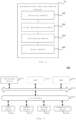
- the present disclosure also provides a database-based data processing device, as shown in Fig. 2 , the device 10 including:
- constructing a materialized view is determined by a constructing device, the constructing device including:
- the second determining module includes:
- the second determining sub-module is further configured to:
- the constructing device further includes:
- the select statement and the group by statement in the query statement include time granularities corresponding to the materialized view.
- the processing module includes:
- the electronic apparatus 600 may include a processing device (e.g., central processor, graphics processor, etc.) 601 that may perform various appropriate actions and processes in accordance with a program stored in a Read Only Memory (ROM) 602 or a program loaded from a storage device 608 into a Random Access Memory (RAM) 603. In the RAM 603, various programs and data necessary for operation of the electronic apparatus 600 are also stored.
- the processing device 601, the ROM 602, and the RAM 603 are connected to each other via a bus 604.
- An input/output (I/O) interface 605 is also connected to bus 604.
- the following devices may be connected to the I/O interface 605: input devices 606 including, for example, a touch screen, touch pad, keyboard, mouse, camera, microphone, accelerometer, gyroscope, or the like; output devices 607 including, for example, a Liquid Crystal Display (LCD), a speaker, a vibrator, and the like; a storage device 608 including, for example, magnetic tape, hard disk, or the like; and a communication device 609.
- the communication device 609 may allow the electronic apparatus 600 to communicate with other devices wirelessly or by wire to exchange data. While Fig. 3 illustrates an electronic apparatus 600 having various devices, it is to be understood that not all illustrated devices are required to be implemented or provided. More or fewer devices may be alternatively implemented or provided.
- an embodiment of the present disclosure includes a computer program product including a computer program carried on a non-transitory computer readable medium, the computer program containing program code for performing a method illustrated by the flow chart.
- the computer program may be downloaded and installed from a network via the communication device 609, or installed from the storage device 608, or installed from the ROM 602.
- the computer program when executed by the processing device 601, performs the above-described function defined in the method of the embodiment of the present disclosure.
- the computer readable medium of the present disclosure may be a computer readable signal medium or a computer readable storage medium or any combination of the two.
- a computer readable storage medium may be, for example, but not limited to, an electronic, magnetic, optical, electromagnetic, infrared, or semiconductor system, device, or apparatus, or any combination of the foregoing.
- the computer readable storage medium may include, but are not limited to: an electrical connection having one or more wires, a portable computer diskette, a hard disk, a Random Access Memory (RAM), a read-only memory (ROM), an erasable programmable read-only memory (EPROM or flash memory), an optical fiber, a portable compact disc read-only memory (CD-ROM), an optical storage device, a magnetic storage device, or any suitable combination of the foregoing.
- a computer readable storage medium may be any tangible medium that can contain, or store a program for use by or in connection with an instruction execution system, device, or apparatus.
- a computer readable signal medium may include a propagated data signal with computer readable program code embodied therein, for example, in baseband or as part of a carrier wave. Such a propagated data signal may take any of a variety of forms, including, but not limited to, electro-magnetic, optical, or any suitable combination thereof.
- a computer readable signal medium may be any computer readable medium that is not a computer readable storage medium and that can communicate, propagate, or transport a program for use by or in connection with an instruction execution system, device, or apparatus.
- Program code embodied on a computer readable medium may be transmitted using any appropriate medium, including but not limited to: an electrical wire, an optical cable, RF (radio frequency), etc., or any suitable combination of the foregoing.
- the clients, servers may communicate using any currently known or future developed network Protocol, such as HTTP (HyperText Transfer Protocol), and may be interconnected with any form or medium of digital data communication (e.g., a communication network).
- HTTP HyperText Transfer Protocol
- Examples of communication networks include a local area network ("LAN”), a wide area network (“WAN”), the internet (e.g., the Internet), and peer-to-peer networks (e.g., ad hoc peer-to-peer networks), as well as any currently known or future developed networks.
- LAN local area network
- WAN wide area network
- the internet e.g., the Internet
- peer-to-peer networks e.g., ad hoc peer-to-peer networks
- the computer readable medium may be contained in the electronic apparatus; or may be separate and not incorporated into the electronic apparatus.
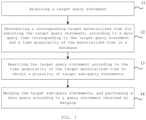
- the computer readable medium carries one or more programs which, when executed by the electronic apparatus, cause the electronic apparatus to: receive a target query statement; determine a corresponding target materialized view for execution of the target query statement according to a data query time corresponding to the target query statement and a time granularity of the materialized view in a database, wherein the database is constructed with the materialized view at different time granularities; rewrite the target query statement according to the time granularity of the target materialized view to obtain a plurality of target sub-query statements, wherein the target sub-query statements include sub-query statements queried based on the target materialized view; and merging the target sub-query statements, and performing data query according to a query statement obtained by merging.
- Computer program code for carrying out operations for aspects of the present disclosure may be written in any combination of one or more programming languages, including but not limited to an object-oriented programming language such as Java, Smalltalk, C + +, and further including conventional procedural programming languages, such as the "C" programming language or similar programming languages.
- the program code may execute entirely on a user's computer, partly on a user's computer, as a stand-alone software package, partly on a user's computer and partly on a remote computer or entirely on a remote computer or server.
- the remote computer may be connected to the user' s computer through any type of network, including a Local Area Network (LAN) or a Wide Area Network (WAN), or the connection may be made to an external computer (for example, through the Internet using an Internet service provider).
- LAN Local Area Network
- WAN Wide Area Network
- each block in the flowchart or block diagram may represent a module, segment, or portion of code, which includes one or more executable instructions for implementing specified logical function(s).
- the functions noted in the block may occur out of the order noted in the figures. For example, two blocks shown in succession may, in fact, be executed substantially concurrently, or the blocks may sometimes be executed in the reverse order, depending upon the functionality involved.
- each block of the block diagram and/or flowchart, and combinations of blocks in the block diagram and/or flowchart can be implemented by special purpose hardware-based systems that perform specified functions or acts, or combinations of special purpose hardware and computer instructions.
- modules described in the embodiments of the present disclosure may be implemented by software or hardware. Where the name of a module does not in some cases constitute a limitation on the module itself, for example, a receiving module may also be described as a "module that receives a target query statement".
- exemplary types of hardware logic components include: field Programmable Gate Arrays (FPGAs), Application Specific Integrated Circuits (ASICs), Application Specific Standard Products (ASSPs), system on a chip (SOCs), Complex Programmable Logic Devices (CPLDs), and the like.
- FPGAs field Programmable Gate Arrays
- ASICs Application Specific Integrated Circuits
- ASSPs Application Specific Standard Products
- SOCs system on a chip
- CPLDs Complex Programmable Logic Devices
- a machine-readable medium may be a tangible medium that can contain, or store a program for use by or in connection with an instruction execution system, device, or apparatus .
- the machine-readable medium may be a machine-readable signal medium or a machine-readable storage medium.
- a machine-readable medium may include, but is not limited to, an electronic, magnetic, optical, electromagnetic, infrared, or semiconductor system, device, or apparatus, or any suitable combination of the foregoing.
- a machine-readable storage medium would include an electrical connection based on one or more wires, a portable computer diskette, a hard disk, a Random Access Memory (RAM), a read-only memory (ROM), an erasable programmable read-only memory (EPROM or flash memory), an optical fiber, a portable compact disc read-only memory (CD-ROM), an optical storage device, a magnetic storage device, or any suitable combination of the foregoing.
- RAM Random Access Memory
- ROM read-only memory
- EPROM or flash memory erasable programmable read-only memory
- CD-ROM portable compact disc read-only memory
- CD-ROM compact disc read-only memory
- magnetic storage device or any suitable combination of the foregoing.
- Example 1 provides a database-based data processing method, wherein the method includes:
- Example 2 provides the method of example 1, wherein constructing of the materialized view includes:
- Example 3 provides the method of example 2, wherein the determining the type of the table model of the materialized view according to the query statement includes:
- Example 4 provides the method of example 3, wherein the determining the type of the table model according to the type of the query data table in the query statement and the type of the aggregation function includes:
- Example 5 provides the method of example 2, wherein the constructing of the materialized view further includes:
- Example 6 provides the method of example 2, wherein a select statement and a group by statement in the query statement include a time granularity corresponding to the materialized view.
- Example 7 provides the method of example 1, wherein the rewriting the target query statement according to the time granularity of the target materialized view to obtain a plurality of target sub-query statements includes:
- Example 8 provides a database-based data processing device, wherein the device includes:
- Example 9 provides, a computer-readable medium having a computer program stored thereon, wherein the program, when executed by a processing device, implements steps of the method of any of examples 1-7.
- Example 10 provides, an electronic apparatus, including:
Landscapes
- Engineering & Computer Science (AREA)
- Theoretical Computer Science (AREA)
- Physics & Mathematics (AREA)
- Databases & Information Systems (AREA)
- General Physics & Mathematics (AREA)
- General Engineering & Computer Science (AREA)
- Data Mining & Analysis (AREA)
- Computational Linguistics (AREA)
- Mathematical Physics (AREA)
- Fuzzy Systems (AREA)
- Probability & Statistics with Applications (AREA)
- Software Systems (AREA)
- Information Retrieval, Db Structures And Fs Structures Therefor (AREA)
Abstract
Description
- The present disclosure relates to the field of computer technology, and in particular, to a database-based data processing method, device, medium, and apparatus.
- Real-time database often has a stringent requirement on the timeliness of calculations. Therefore, common real-time database improves calculation performance through various pre-aggregation technologies and reduces query delay. Many real-time databases involve analysis of data over a window of time. The time window boundary can be any time point, usually changes continuously according to specific service requirements, and cannot be predicted in advance, and data query of a longer time window, which contains a large amount of data.
- This summary is provided to introduce a selection of concepts in a simplified form that are further described below in the detailed description. This summary is not intended to identify key features or essential features of the claimed subject matter, nor is it intended to be used to limit the scope of the claimed subject matter.
- In one aspect, the present disclosure provides a database-based data processing method, including:
- receiving a target query statement;
- determining a target materialized view for executing the target query statement according to a data query time corresponding to the target query statement and a time granularity of the materialized view in a database, wherein the database is constructed with the materialized view at different time granularities;
- rewriting the target query statement according to the time granularity of the target materialized view to obtain a plurality of target sub-query statement, wherein the target sub-query statements include sub-query statements queried based on the target materialized view; and
- merging the target sub-query statements, and performing a data query according to a query statement obtained by merging.
- In another aspect, the present disclosure provides a database-based data processing device, the device including:
- a receiving module, configured to receive a target query statement;
- a first determining module, configured to determine a corresponding target materialized view for executing the target query statement according to a data query time corresponding to the target query statement and a time granularity of the materialized view in a database, wherein the database is constructed with the materialized view at different time granularities;
- a processing module, configured to rewrite the target query statement according to the time granularity of the target materialized view to obtain a plurality of target sub-query statements, wherein the target sub-query statements include sub-query statements queried based on the target materialized view; and
- a query module configured to merge the target sub-query statements and perform a data query according to a query statement obtained by merging.
- In another aspect, the present disclosure provides a computer readable medium having stored thereon a computer program which, when executed by a processing device, performs steps of the method of the first aspect.
- In another aspect, the present disclosure provides an electronic apparatus, including:
- a storage device having a computer program stored thereon;
- a processing device configured to execute the computer program in the storage device to implement steps of the method of the first aspect.
- Additional features and advantages of the present disclosure will be set forth in the detailed description which follows.
- The above and other features, advantages, and aspects of embodiments of the present disclosure will become more apparent by referring to the following detailed description when taken in conjunction with the accompanying drawings. Throughout the drawings, the same or similar reference numbers refer to the same or similar elements. It should be understood that the drawings are schematic and that elements and components are not necessarily drawn to scale. In the drawings:
-
FIG. 1 is a flowchart of a database-based data processing method provided in accordance with one embodiment of the present disclosure; -
FIG. 2 is a block diagram of a database-based data processing device provided in accordance with one embodiment of the present disclosure; -
FIG. 3 shows a structural schematic diagram of an electronic apparatus adapted for use in implementing embodiments of the present disclosure. - Embodiments of the present disclosure will be described in more detail below with reference to the accompanying drawings. While certain embodiments of the present disclosure are shown in the drawings, it should be understood that the present disclosure may be embodied in various forms and should not be construed as limited to the embodiments set forth herein, but rather are provided for a more complete and thorough understanding of the present disclosure. It should be understood that the drawings and the embodiments of the disclosure are for illustration purposes only and are not intended to limit the scope of the disclosure.
- It should be understood that the various steps recited in method embodiments of the present disclosure may be performed in a different order, and/or performed in parallel. Moreover, method embodiments may include additional steps and/or omit performing the illustrated steps. The scope of the present disclosure is not limited in this respect.
- The term "including" and variations thereof as used herein is intended to be open-ended, i.e., "including but not limited to". The term "based on" is "based at least in part on". The term "one embodiment" means "at least one embodiment"; the term "another embodiment" means "at least one additional embodiment"; the term "some embodiments" means "at least some embodiments". Relevant definitions for other terms will be given in the following description.
- It should be noted that the terms "first", "second", and the like in the present disclosure are only used for distinguishing different devices, modules or units, and are not used for limiting the order or interdependence of the functions performed by the devices, modules or units.
- It is noted that references to "a" or "an" in this disclosure are intended to be illustrative rather than limiting, and that those skilled in the art will appreciate that references to "one or more" are intended to be exemplary and not limiting unless the context clearly indicates otherwise.
- The names of messages or information exchanged between devices in the embodiments of the present disclosure are for illustrative purposes only, and are not intended to limit the scope of the messages or information.
- It is understood that, before the technical solutions disclosed in the embodiments of the present disclosure are used, the user should be informed of the type, the use range, the use scene, etc. of the personal information related to the present disclosure in a proper manner according to the relevant laws and regulations and obtain the authorization of the user.
- For example, in response to receiving a user's active request, prompt information is sent to the user to explicitly prompt the user that the requested operation to be performed would require acquisition and use of personal information to the user. Thus, the user can autonomously select whether to provide personal information to software or hardware such as an electronic apparatus, an application program, a server, or a storage medium that performs the operations of the technical solution of the present disclosure, according to the prompt information.
- As an alternative but non-limiting implementation manner, in response to receiving an active request from the user, the manner of sending the prompt information to the user may be, for example, a pop-up window manner, and the prompt information may be presented in a text manner in the pop-up window. In addition, a selection control for providing personal information to the electronic device by the user's selection of "agreeing" or "disagreeing" can be carried in the popup.
- It is understood that the above notification and user authorization process is only illustrative and is not intended to limit the implementation of the present disclosure, and other ways of satisfying the relevant laws and regulations may be applied to the implementation of the present disclosure.
- At the same time, it is understood that the data involved in the present disclosure (including but not limited to the data itself, the acquisition or use of the data) should comply with the requirements of the relevant laws and regulations and related regulations.
-
Fig. 1 is a flowchart of a database-based data processing method according to an embodiment of the present disclosure, the method including, as shown inFig. 1 :
instep 11, a target query statement is received. - Wherein, the target query statement may be a query statement input by a user through a visual interface or a configuration interface, such as an SQL (Structured Query Language) statement. For example, the target query statement is as follows:
 select a, sum(b)
 from tbl
 where t between '2022-05-01 14: 00:00' and '2022-05-09 00: 12:15'
 group by a;
 /*+ temporal (hour = hour_mv, day = day_mv)*/
 select a, sum(s)
 from (
 select * from t1
 union all t2
 ...
 union all tn)
 group by a;
receiving a query statement for constructing the materialized view.
- Aggregate Table: aggregation type configured to indicate that the table data is aggregated in advance in a storage layer, and then a calculation layer directly processes the aggregated data;
- Duplicate table: detail type configured to indicate that the table data is not pre-aggregated in the query process, and all detail data are reserved;
- Unique table: unique type configured to indicate that the table data is subjected to deduplication in a storage layer during query, and historical data is replaced by the latest data;
- Different operations may exist in the materialized view, and types of materialized view that the query statement can construct are limited. Selection of the type of the table model of the materialized view is critical to performance of the query with respect to the materialized view. For example, a query statement used to construct a materialized view is represented as follows:
- created formatted view test_mv as
- select a, sum (b) from base_table group by a;
- wherein, in the related art, the type of the table model of the materialized view and other related physical attributes are usually implemented based on an inherited base table. As the definition of the materialized view requires another base table, the various attributes of the materialized view are also inherited from the base table. For example, the materialized view of Apache Doris is implemented as a schema for the base table, and thus the various attributes (including the table model) of the materialized view are the same as the base table.
determining whether an aggregation function is included in the query statement. Wherein, the aggregation function may be a function containing an Aggregate operation, such as a sum() function, a mean() function, or the like.
- if the type of the query data table is an aggregation type or a detail type and the type of the aggregation function is a splitable type, determining that the type of the table model is an aggregation type; and
- if the type of the query data table is an aggregation type or a detail type and the type of the aggregation function is an un-splitable type, determining that the type of the table model is a detail type.
| Does it contain an aggregate function? | Query the type of data table | Type of aggregate function | Type of table model |
| Not containing an aggregate function | Duplicate | Duplicate | |
| Aggregate | Not supported | ||
| Unique | Not supported | ||
| Containing an aggregate function | Duplicate | splitable | Aggregate |
| Un-splitable | Duplicate | ||
| Aggregate | splitable | Aggregate | |
| Un-splitable | Duplicate | ||
| Unique | splitable | Not supported | |
| Un-splitable | Not supported |
obtaining a specified type of the constructed materialized view.
- created formatted view day_mv as
- select a, to_day(t), sum(b)
- from tbl
- group by a, to_day(t);
- created materialized view day_mv as
- select a, to_day(t), sum(b)
- from tbl
- group by a, to_hour(t);
sequentially splitting a data query time of the target query statement according to a sequence of time durations from large to small of the time granularity of the target materialized view to obtain a split time window corresponding to the target materialized view at each time granularity.
- select a, sum(b)
- from tbl
- where t between '2022-05-01 14: 00:00' and '2022-05-09 00: 12:15' group by a;
- 1. 2022-05-01 14:00:00 ~ 2022-05-02 00:00:00, data analysis in this time range can be supported by a materialized view hour_mv, with time granularity of hour;
- 2. 2022-05-02 00:00:00 ~ 2022-05-09 00:00:00, data in the time range can be supported by a materialized view day_mv with time granularity of day;
- 3. 2022-05-09 00:00:00 ~ 2022-05-09 00:12:15, if the time range does not correspond to the time granularity of the target materialized view, the corresponding data is supported by tbl.
- select a, sum (b)
- from tbl
- where t between '2022-05-02 00:00:00' and '2022-05-09 00:00:00' group by a.
- select a, sum(b)
- from tbl
- where to_day (t) between to_day ('2022-05-02 00:00:00') and to_day ('2022-05-09 00:00:00')
- group by a.
- select a, sum(s)
- from (
- select a, to_day(t) as d, sum(b) as s
- from tbl
- group by a, to_day(t)
- ) where d between to_day ('2022-05-02 00:00:00') and to_day ('2022-05-09 00:00:00').
- select a, sum(s) as s
- from day_mv
- where d between to_day ('2022-05-02 00:00:00') and to_day ('2022-05-09 00:00:00');
- select a, sum(b)
- from tbl
- where t between '2022-05-09 00:00:00' and '2022-05-09 00:12:15' group by a;
- to directly query the data in the time range from the data query table tbl based on the target sub-query statement.
- a
receiving module 100, configured to receive a target query statement; - a first determining
module 200, configured to determine a corresponding target materialized view for executing the target query statement according to a data query time corresponding to the target query statement and a time granularity of the materialized view in a database, wherein the database is constructed with the materialized view at different time granularities; - a
processing module 300, configured to rewrite the target query statement according to the time granularity of the target materialized view to obtain a plurality of target sub-query statements, wherein the target sub-query statements include sub-query statements queried based on the target materialized view; and - a
query module 400 configured to merge the target sub-query statements, and perform a data query according to a query statement obtained by merging.
- a statement receiving module configured to receive a query statement for constructing the materialized view;
- a second determining module configured to determine a type of a table model of the materialized view according to the query statement; and
- a constructing module configured to construct the materialized view according to the query statement and the type of the table model.
- a first determining sub-module, configured to determine whether the query statement contains an aggregation function;
- a second determining sub-module, configured to determine, if the query statement includes an aggregation function, a type of the table model according to a type of a query data table in the query statement and a type of the aggregation function; and
- a third determining sub-module configured to determine that the type of the table model is a detail type if the query statement does not contain an aggregation function and the type of the query data table in the query statement is a detail type.
- determine that the type of the table model is an aggregation type, if the type of the query data table is an aggregation type or a detail type and the type of the aggregation function is a splitable type;
- determine that the type of the table model is a detail type, if the type of the query data table is an aggregation type or a detail type and the type of the aggregation function is an un-splitable type.
- an obtaining module configured to obtain a specified type of the constructed materialized view;
- a third determining module configured to determine whether the specified type is consistent with the type of the table model; and
- an output module configured to output prompt information and/or the type of the table model if the specified type is inconsistent with the type of the table model.
- a splitting sub-module configured to sequentially split a data query time of the target query statement according to a sequence of time durations from large to small of the time granularity of the target materialized view to obtain a split time window corresponding to the target materialized view at each time granularity;
- a first processing sub-module configured to rewrite the target query statement according to the target materialized view and the split time window, and taking the obtained sub-query statement which is queried based on the target materialized view as a target sub-query; and
- a second processing sub-module configured to rewrite the target query statement based on a residual time window which does not correspond to the time granularity of the target materialized view in the target query statement, and taking the rewritten sub-query statement as the target sub-query statement.
- receiving a target query statement;
- determining a corresponding target materialized view for executing the target query statement according to a data query time corresponding to the target query statement and a time granularity of the materialized view in a database, wherein the database is constructed with the materialized view at different time granularities;
- rewriting the target query statement according to the time granularity of the target materialized view to obtain a plurality of target sub-query statements, wherein the target sub-query statements include sub-query statements queried based on the target materialized view; and
- merging the target sub-query statements, and performing a data query according to a query statement obtained by merging.
- receiving a query statement for constructing the materialized view;
- determining a type of a table model of the materialized view according to the query statement; and
- constructing the materialized view according to the query statement and the type of the table model.
- determining whether the query statement contains an aggregation function;
- if the query statement contains an aggregation function, determining the type of the table model according to the type of the query data table in the query statement and the type of the aggregation function; and
- if the query statement does not contain an aggregation function and the type of the query data table in the query statement is a detail type, determining that the type of the table model is a detail type.
- if the type of the query data table is an aggregation type or a detail type and the type of the aggregation function is a splitable type, determining that the type of the table model is an aggregation type; and
- if the type of the query data table is an aggregation type or a detail type and the type of the aggregation function is an un-splitable type, determining that the type of the table model is a detail type.
- obtaining a specified type of a constructed materialized view;
- determining whether the specified type is consistent with a type of the table model; and
- if the specified type is inconsistent with the type of the table model, outputting prompt information and/or the type of the table model.
- sequentially splitting a data query time of the target query statement according to a sequence of time durations from large to small of the time granularity of the target materialized view to obtain a split time window corresponding to the target materialized view at each time granularity;
- rewriting the target query statement according to the target materialized view and the split time window, and taking an obtained sub-query statement which is queried based on the target materialized view as the target sub-query statement; and
- with respect to a residual time window which does not correspond to the time granularity of the target materialized view in the target query statement, rewriting the target query statement based on the residual time window, and taking the rewritten sub-query statement as the target sub-query statement.
- a receiving module configured to receive a target query statement;
- a first determining module, configured to determine a target materialized view for executing the target query statement according to a data query time corresponding to the target query statement and a time granularity of the materialized view in a database, where the database is constructed with the materialized view at different time granularities;
- a processing module, configured to rewrite the target query statement according to the time granularity of the target materialized view to obtain a plurality of target sub-query statements, wherein the target sub-query statements include sub-query statements that are queried based on the target materialized view; and
- a query module configured to merge the target sub-query statements and perform a data query according to a query statement obtained by merging.
- a storage device having a computer program stored thereon;
- a processing device configured to execute the computer program in the storage device to carry out steps of the method of any of examples 1-7.
Claims (10)
- A database-based data processing method, characterized in that the method comprises:receiving a target query statement;determining a corresponding target materialized view for executing the target query statement, according to a data query time corresponding to the target query statement and a time granularity of the materialized view in a database, wherein the database is constructed with the materialized view at different time granularities;rewriting the target query statement according to the time granularity of the target materialized view to obtain a plurality of target sub-query statements, wherein the target sub-query statements comprise sub-query statements queried based on the target materialized view; andmerging the target sub-query statements, and performing a data query according to a query statement obtained by merging.
- The method of claim 1, characterized in that constructing the materialized view comprises:receiving a query statement for constructing the materialized view;determining a type of a table model of the materialized view according to the query statement; andconstructing the materialized view according to the query statement and the type of the table model.
- The method of claim 2, characterized in that the determining the type of the table model of the materialized view according to the query statement comprises:determining whether the query statement contains an aggregation function;in response to that the query statement contains an aggregation function, determining a type of a table model according to a type of a query data table in the query statement and a type of the aggregation function; andin response to that the query does not contain an aggregation function and the type of the query data table in the query statement is a detail type, determining that the type of the table model is a detail type.
- The method of claim 3, characterized in that the determining the type of the table model according to the type of the query data table in the query statement and the type of the aggregation function comprises:in response to that the type of the query data table is an aggregation type or a detail type and the type of the aggregation function is a splitable type, determining that the type of the table model is an aggregation type; andin response to that the type of the query data table is an aggregation type or a detail type and the type of the aggregation function is an un-splitable type, determining that the type of the table model is a detail type.
- The method of claim 2, characterized in that constructing the materialized view further comprises:obtaining a specified type of the constructed materialized view;determining whether the specified type is consistent with a type of the table model; andin response to that the specified type is inconsistent with the type of the table model, outputting prompt information and/or the type of the table model.
- The method of claim 2, characterized in that a select statement and a group by statement in the query statement comprises a time granularity corresponding to the materialized view.
- The method of claim 1, characterized in that the rewriting the target query statement to obtain a plurality of target sub-query statements according to the time granularity of the target materialized view comprises :sequentially splitting a data query time of the target query statement according to a sequence of time durations from large to small of the time granularities of the target materialized view to obtain a split time window corresponding to the target materialized view at each time granularity;rewriting the target query statement according to the target materialized view and the split time window, and taking an obtained sub-query which is queried based on the target materialized view as the target sub-query; andwith respect to a residual time window which does not correspond to the time granularity of the target materialized view in the target query statement, rewriting the target query statement based on the residual time window, and taking the rewritten sub-query as the target sub-query.
- A database-based data processing apparatus (10), characterized in that the apparatus comprises:a receiving module (100), configured to receive a target query statement;a first determining module (200), configured to determine a target materialized view for executing the target query statement according to a data query time corresponding to the target query statement and a time granularity of the materialized view in a database, where the database is constructed with the materialized view at different time granularities;a processing module (300), configured to rewrite the target query statement according to the time granularity of the target materialized view to obtain a plurality of target sub-query statements, where the target sub-query statements comprises sub-query statements that are queried based on the target materialized view; anda query module (400), configured to merge the target sub-query statements and performing a data query according to a query statement obtained by merging.
- A computer-readable medium, on which a computer program is stored, characterized in that the computer program, when executed by a processing device, implements steps of the method of any one of claims 1 to 7.
- An electronic apparatus (600), characterized by comprising:a storage device (608) having a computer program stored thereon;a processing device (601) for executing the computer program in the storage device to carry out steps of the method according to any one of claims 1 to 7.
Applications Claiming Priority (1)
| Application Number | Priority Date | Filing Date | Title |
|---|---|---|---|
| CN202310816542.5A CN116821438A (en) | 2023-07-04 | 2023-07-04 | Database-based data processing method, device, medium and equipment |
Publications (1)
| Publication Number | Publication Date |
|---|---|
| EP4488843A1 true EP4488843A1 (en) | 2025-01-08 |
Family
ID=88139001
Family Applications (1)
| Application Number | Title | Priority Date | Filing Date |
|---|---|---|---|
| EP24185149.2A Pending EP4488843A1 (en) | 2023-07-04 | 2024-06-27 | Database-based data processing method, device, medium and apparatus |
Country Status (3)
| Country | Link |
|---|---|
| US (1) | US20250013638A1 (en) |
| EP (1) | EP4488843A1 (en) |
| CN (1) | CN116821438A (en) |
Families Citing this family (2)
| Publication number | Priority date | Publication date | Assignee | Title |
|---|---|---|---|---|
| CN116881285A (en) * | 2023-07-20 | 2023-10-13 | 北京火山引擎科技有限公司 | Database data processing method and device, medium and electronic equipment |
| CN119066090B (en) * | 2024-08-23 | 2025-06-03 | 北京火山引擎科技有限公司 | Materialized view construction method, device, equipment and medium in database system |
Citations (2)
| Publication number | Priority date | Publication date | Assignee | Title |
|---|---|---|---|---|
| US20220309063A1 (en) * | 2021-03-26 | 2022-09-29 | Oracle International Corporation | Query rewrite using materialized views with logical partition change tracking |
| US20230177049A1 (en) * | 2021-12-07 | 2023-06-08 | International Business Machines Corporation | Data warehouse framework for high performance reporting |
Family Cites Families (13)
| Publication number | Priority date | Publication date | Assignee | Title |
|---|---|---|---|---|
| US6594653B2 (en) * | 1998-03-27 | 2003-07-15 | International Business Machines Corporation | Server integrated system and methods for processing precomputed views |
| US6334128B1 (en) * | 1998-12-28 | 2001-12-25 | Oracle Corporation | Method and apparatus for efficiently refreshing sets of summary tables and materialized views in a database management system |
| US6345272B1 (en) * | 1999-07-27 | 2002-02-05 | Oracle Corporation | Rewriting queries to access materialized views that group along an ordered dimension |
| US20160378734A1 (en) * | 2015-06-29 | 2016-12-29 | Microsoft Technology Licensing, Llc | Visualizing document revisions |
| CN112740199A (en) * | 2018-09-21 | 2021-04-30 | 华为技术有限公司 | Materialized views for database query optimization |
| US11354373B2 (en) * | 2018-12-14 | 2022-06-07 | Sisense Ltd. | System and method for efficiently querying data using temporal granularities |
| US11113278B2 (en) * | 2019-05-31 | 2021-09-07 | Snowflake Inc. | Data sharing and materialized views in multiple tenant database systems |
| US11514041B2 (en) * | 2020-09-14 | 2022-11-29 | Oracle International Corporation | Estimating materialized view refresh duration |
| CN112286953B (en) * | 2020-09-25 | 2023-02-24 | 北京邮电大学 | Multidimensional data query method, device and electronic equipment |
| US11514030B2 (en) * | 2020-11-11 | 2022-11-29 | Yahoo Assets Llc | Automated materialized view table generation and maintenance |
| CN113468208B (en) * | 2021-07-19 | 2024-08-23 | 网易(杭州)网络有限公司 | Method and device for generating data query statement, server and storage medium |
| CN116069800B (en) * | 2023-01-13 | 2026-07-21 | 北京有竹居网络技术有限公司 | Data processing method, device, electronic equipment and storage medium |
| CN116049191B (en) * | 2023-02-13 | 2026-01-06 | 中国建设银行股份有限公司 | A data table processing method, apparatus, device, and storage medium |
-
2023
- 2023-07-04 CN CN202310816542.5A patent/CN116821438A/en active Pending
-
2024
- 2024-05-31 US US18/731,041 patent/US20250013638A1/en active Pending
- 2024-06-27 EP EP24185149.2A patent/EP4488843A1/en active Pending
Patent Citations (2)
| Publication number | Priority date | Publication date | Assignee | Title |
|---|---|---|---|---|
| US20220309063A1 (en) * | 2021-03-26 | 2022-09-29 | Oracle International Corporation | Query rewrite using materialized views with logical partition change tracking |
| US20230177049A1 (en) * | 2021-12-07 | 2023-06-08 | International Business Machines Corporation | Data warehouse framework for high performance reporting |
Non-Patent Citations (1)
| Title |
|---|
| IBRAGIMOV DILSHOD ET AL: "Optimizing Aggregate SPARQL Queries Using Materialized RDF Views", 23 September 2016, 20160923, PAGE(S) 341 - 359, XP047610771 * |
Also Published As
| Publication number | Publication date |
|---|---|
| US20250013638A1 (en) | 2025-01-09 |
| CN116821438A (en) | 2023-09-29 |
Similar Documents
| Publication | Publication Date | Title |
|---|---|---|
| US20250013638A1 (en) | Database-based data processing method, device, medium and apparatus | |
| CN113986933A (en) | Materialized view creating method and device, storage medium and electronic equipment | |
| US12475307B2 (en) | Method and apparatus for tabular data processing, terminal, and storage medium | |
| CN114817409B (en) | A label generation method, device, equipment and medium | |
| CN113468342A (en) | Data model construction method, device, equipment and medium based on knowledge graph | |
| CN118295827A (en) | Model calling method, device, medium, equipment and computer program product | |
| CN114116480A (en) | Method, device, medium and equipment for determining application program test coverage rate | |
| CN116955413A (en) | Data query method, device, medium and equipment based on online analysis processing | |
| CN111241137A (en) | Data processing method and device, electronic equipment and storage medium | |
| CN111143355B (en) | Data processing method and device | |
| US20230147521A1 (en) | High-precision-map data collection methods, device and storage medium | |
| CN120470100B (en) | A method, apparatus, and medium for intelligent agent knowledge retrieval based on multi-knowledge hybrid recall. | |
| CN112115154A (en) | Data processing and data query method, device, equipment and computer readable medium | |
| CN114973109B (en) | Work efficiency display method, device and equipment based on digital twin | |
| CN110852720A (en) | Document processing method, device, equipment and storage medium | |
| CN110619093B (en) | Method, apparatus, electronic device, and computer-readable storage medium for determining an order of search items | |
| US12204674B2 (en) | Permission setting method and apparatus, device, and medium | |
| CN111597439A (en) | Information processing method and device and electronic equipment | |
| CN117251639A (en) | Content recommendation methods, recommendation model training methods, devices, media and equipment | |
| US11100119B2 (en) | Determining data structures for spatial data based on spatial data statistics | |
| WO2025020670A1 (en) | Data query method and apparatus, and medium and electronic device | |
| CN116243926A (en) | Business processing method, device, medium and electronic equipment | |
| CN121031550B (en) | Data processing methods, apparatus, media, electronic equipment and software products | |
| CN111382556A (en) | Data conversion method, device, equipment and storage medium | |
| CN114792258B (en) | Information generation method and device, electronic equipment and computer readable medium |
Legal Events
| Date | Code | Title | Description |
|---|---|---|---|
| PUAI | Public reference made under article 153(3) epc to a published international application that has entered the european phase |
Free format text: ORIGINAL CODE: 0009012 |
|
| STAA | Information on the status of an ep patent application or granted ep patent |
Free format text: STATUS: THE APPLICATION HAS BEEN PUBLISHED |
|
| AK | Designated contracting states |
Kind code of ref document: A1 Designated state(s): AL AT BE BG CH CY CZ DE DK EE ES FI FR GB GR HR HU IE IS IT LI LT LU LV MC ME MK MT NL NO PL PT RO RS SE SI SK SM TR |
|
| STAA | Information on the status of an ep patent application or granted ep patent |
Free format text: STATUS: REQUEST FOR EXAMINATION WAS MADE |
|
| STAA | Information on the status of an ep patent application or granted ep patent |
Free format text: STATUS: EXAMINATION IS IN PROGRESS |
|
| 17P | Request for examination filed |
Effective date: 20250708 |
|
| 17Q | First examination report despatched |
Effective date: 20250808 |
|
| GRAP | Despatch of communication of intention to grant a patent |
Free format text: ORIGINAL CODE: EPIDOSNIGR1 |
|
| STAA | Information on the status of an ep patent application or granted ep patent |
Free format text: STATUS: GRANT OF PATENT IS INTENDED |
|
| INTG | Intention to grant announced |
Effective date: 20260706 |