EP4488333A1 - Polylactic acid resin vaporization promoter and composition containing same - Google Patents
Polylactic acid resin vaporization promoter and composition containing same Download PDFInfo
- Publication number
- EP4488333A1 EP4488333A1 EP23763745.9A EP23763745A EP4488333A1 EP 4488333 A1 EP4488333 A1 EP 4488333A1 EP 23763745 A EP23763745 A EP 23763745A EP 4488333 A1 EP4488333 A1 EP 4488333A1
- Authority
- EP
- European Patent Office
- Prior art keywords
- resin
- vaporization
- pla
- polylactic acid
- weight
- Prior art date
- Legal status (The legal status is an assumption and is not a legal conclusion. Google has not performed a legal analysis and makes no representation as to the accuracy of the status listed.)
- Pending
Links
Images
Classifications
-
- C—CHEMISTRY; METALLURGY
- C08—ORGANIC MACROMOLECULAR COMPOUNDS; THEIR PREPARATION OR CHEMICAL WORKING-UP; COMPOSITIONS BASED THEREON
- C08L—COMPOSITIONS OF MACROMOLECULAR COMPOUNDS
- C08L67/00—Compositions of polyesters obtained by reactions forming a carboxylic ester link in the main chain; Compositions of derivatives of such polymers
- C08L67/04—Polyesters derived from hydroxycarboxylic acids, e.g. lactones
-
- C—CHEMISTRY; METALLURGY
- C08—ORGANIC MACROMOLECULAR COMPOUNDS; THEIR PREPARATION OR CHEMICAL WORKING-UP; COMPOSITIONS BASED THEREON
- C08G—MACROMOLECULAR COMPOUNDS OBTAINED OTHERWISE THAN BY REACTIONS ONLY INVOLVING UNSATURATED CARBON-TO-CARBON BONDS
- C08G63/00—Macromolecular compounds obtained by reactions forming a carboxylic ester link in the main chain of the macromolecule
- C08G63/02—Polyesters derived from hydroxycarboxylic acids or from polycarboxylic acids and polyhydroxy compounds
- C08G63/06—Polyesters derived from hydroxycarboxylic acids or from polycarboxylic acids and polyhydroxy compounds derived from hydroxycarboxylic acids
-
- C—CHEMISTRY; METALLURGY
- C08—ORGANIC MACROMOLECULAR COMPOUNDS; THEIR PREPARATION OR CHEMICAL WORKING-UP; COMPOSITIONS BASED THEREON
- C08G—MACROMOLECULAR COMPOUNDS OBTAINED OTHERWISE THAN BY REACTIONS ONLY INVOLVING UNSATURATED CARBON-TO-CARBON BONDS
- C08G63/00—Macromolecular compounds obtained by reactions forming a carboxylic ester link in the main chain of the macromolecule
- C08G63/02—Polyesters derived from hydroxycarboxylic acids or from polycarboxylic acids and polyhydroxy compounds
- C08G63/06—Polyesters derived from hydroxycarboxylic acids or from polycarboxylic acids and polyhydroxy compounds derived from hydroxycarboxylic acids
- C08G63/08—Lactones or lactides
-
- C—CHEMISTRY; METALLURGY
- C08—ORGANIC MACROMOLECULAR COMPOUNDS; THEIR PREPARATION OR CHEMICAL WORKING-UP; COMPOSITIONS BASED THEREON
- C08L—COMPOSITIONS OF MACROMOLECULAR COMPOUNDS
- C08L2201/00—Properties
- C08L2201/06—Biodegradable
-
- C—CHEMISTRY; METALLURGY
- C08—ORGANIC MACROMOLECULAR COMPOUNDS; THEIR PREPARATION OR CHEMICAL WORKING-UP; COMPOSITIONS BASED THEREON
- C08L—COMPOSITIONS OF MACROMOLECULAR COMPOUNDS
- C08L2205/00—Polymer mixtures characterised by other features
- C08L2205/02—Polymer mixtures characterised by other features containing two or more polymers of the same C08L -group
- C08L2205/025—Polymer mixtures characterised by other features containing two or more polymers of the same C08L -group containing two or more polymers of the same hierarchy C08L, and differing only in parameters such as density, comonomer content, molecular weight, structure
Definitions
- the present disclosure relates to a vaporization promotor that promotes the vaporization of a polylactic acid resin and to a composition comprising the same.
- Biodegradable plastic refers to a material that is decomposed into low-molecular-weight substances by microorganisms existing in nature and ultimately decomposed into water and carbon dioxide, or water and methane gas.
- a polylactic acid resin which is typically used as such biodegradable plastic, is a biodegradable thermoplastic polyester that has great potential to replace traditional petrochemical polymers. It is a recyclable polymer material that has been studied the most to date, and whose uses are being actively developed.
- a polylactic acid resin has the characteristic of being able to rapidly decompose and reproduce carbon dioxide (CO 2 ) under specific composting conditions, the specific composting conditions required for the polylactic acid resin to decompose and generate carbon dioxide are very strict.
- a polylactic acid resin naturally decomposes in soil at a high temperature of 50°C or higher and a high humidity of about 40% in soil with many microorganisms to ultimately generate carbon dioxide.
- a problem in that it is hardly biodegraded at room temperature, and it takes a long period of time to decompose in natural conditions such as the ocean or soil.
- Patent Document 1 Korean Laid-open Patent Publication No. 2014-0112200
- the present disclosure is devised to solve the problems of the prior art discussed above.
- the present disclosure aims to provide a vaporization promotor for a polylactic acid (PLA) resin to enhance the degree of vaporization of the polylactic acid resin (PLA), which has a low degree of vaporization at room temperature of 30°C, thereby accelerating the biodegradation effect (rate) of the polylactic acid resin (PLA) even at room temperature, and a composition comprising the same.
- PVA polylactic acid
- Equation 2 Cw is the mass (g) of organic carbon contained in the sample.
- the composition may further comprise a vaporization promotor for a polylactic acid (PLA) resin.
- PLA polylactic acid
- the weight ratio of the polylactic acid (PLA) resin and the vaporization promotor for a polylactic acid (PLA) resin may be 10:90 to 90:10.
- Equation 4 x is the weight percent of the polylactic acid (PLA) resin contained in the composition based on the total weight of the composition.
- the vaporization promotor for a polylactic acid (PLA) resin may satisfy at least one of the following characteristics: a glass transition temperature (Tg) of -45°C to 80°C, a crystallization temperature (Tc) of 60°C to 120°C, and a melting temperature (Tm) of 100°C to 170°C.
- Tg glass transition temperature
- Tc crystallization temperature
- Tm melting temperature
- the vaporization promotor for a polylactic acid (PLA) resin may comprise a resin comprising a repeat unit derived from a 3-hydroxybutyrate (3-HB) monomer; and a repeat unit derived from a 4-hydroxybutyrate (4-HB) monomer.
- the vaporization promotor for a polylactic acid (PLA) resin may comprise the repeat unit derived from a 4-hydroxybutyrate (4-HB) monomer in an amount ranging from 1% by mole to 80% by mole based on the total moles of the repeat unit derived from a 3-hydroxybutyrate (3-HB) monomer and the repeat unit derived from a 4-hydroxybutyrate (4-HB) monomer.
- a vaporization promotor for a polylactic acid (PLA) resin which comprises a resin comprising a repeat unit derived from a 3-hydroxybutyrate (3-HB) monomer; and a repeat unit derived from a 4-hydroxybutyrate (4-HB) monomer.
- the molar ratio of the repeat unit derived from a 3-hydroxybutyrate (3-HB) monomer to the repeat unit derived from a 4-hydroxybutyrate (4-HB) monomer may be 40:60 to 99:1.
- composition according to an embodiment of the present disclosure comprises a polylactic acid (PLA) resin with a low degree of vaporization at room temperature of 30°C, wherein when the cumulative amount of carbon dioxide (CO 2 ) generated over 10 weeks is measured, the degree of vaporization is high at a specific level or more, thereby achieving an excellent biodegradation effect at room temperature.
- PVA polylactic acid
- the vaporization promotor for a polylactic acid (PLA) resin can significantly accelerate the vaporization of a polylactic acid (PLA) resin, which has a low degree of vaporization at room temperature of 30°C.
- composition and the vaporization promotor for a polylactic acid (PLA) resin can be used in various fields to effectively preserve the environment, along with excellent physical properties.
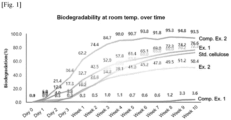
- Fig. 1 is a graph showing the degree of vaporization (V 10w ) of the compositions of Examples 1 and 2 and Comparative Examples 1 and 2 of the present disclosure over time at room temperature of 30°C.
- the present disclosure relates to a composition (vaporizable composition or biodegradable composition), in which the degree of vaporization (V 10w ) calculated by applying the cumulative amount of carbon dioxide (CO 2 ) generated under aerobic composting conditions is controlled to a specific range or more, so that it can be easily biodegraded at room temperature (e.g., 25 ⁇ 5°C) even if it comprises a polylactic acid (PLA) resin, which is difficult to biodegrade at room temperature (e.g., 25 ⁇ 5°C), and to a vaporization promotor for a polylactic acid resin contained in the composition, which will be described in detail, as follows.
- V 10w degree of vaporization calculated by applying the cumulative amount of carbon dioxide (CO 2 ) generated under aerobic composting conditions
- (CO 2 ) S is the cumulative amount (g) of carbon dioxide (CO 2 ) generated in a test container containing compost and a sample (composition sample) in an amount of 14.3% by weight based on the total dry weight of the sample and the compost
- (CO 2 ) B is the cumulative amount (g) of carbon dioxide (CO 2 ) generated in an inoculum container containing compost alone
- Cw is the mass (g) of organic carbon (carbon element) contained in the sample (sample in an amount of 14.3% by weight of the total weight (x + y) of the dry weight of the sample (x) and the dry weight of the compost (y)).
- Cw refers to the content (g) of carbon elements measured when elemental analysis of the sample is carried out.
- the degree of vaporization (V 10w ) is a value obtained by measuring the cumulative amount of carbon dioxide (CO 2 ) generated, which is the final decomposition product of the composition, according to the ISO 14855 notification regulations (specifically, the aerobic biodegradability evaluation method of ISO 14855-1), and applying the cumulative amount of carbon dioxide (CO 2 ) measured to Equations 1 and 2, which may be an indicator of the degree of biodegradation of the composition at room temperature of 30°C.
- composition according to an embodiment of the present disclosure may further comprise a vaporization promotor for a polylactic acid (PLA) resin.
- the composition further comprising the vaporization promotor for a polylactic acid (PLA) resin may have a degree of vaporization (V 10w ) represented by Equation 1 of 50% or more. More specifically, the degree of vaporization (V 10w ) may be an indicator of the degree of biodegradation of the composition comprising the polylactic acid (PLA) resin and the vaporization promotor for a polylactic acid (PLA) resin.
- the degree of vaporization (V 10w ) may be a value obtained by the following procedure: as an evaluation group, a composition sample comprising the polylactic acid (PLA) resin and the vaporization promotor for a polylactic acid (PLA) resin at a specific content ratio is mixed with compost and placed in a test container, and the cumulative amount (g) ((CO 2 ) S ) of carbon dioxide (CO 2 ) generated from the composition sample is then measured at 30°C under aerobic compost conditions over 10 weeks using a measurement and evaluation device (Respirometer equipment of ECHO); as a control group, the cumulative amount (g) ((CO 2 ) B ) of carbon dioxide (CO 2 ) generated in an inoculum container containing compost alone without the composition sample is obtained under the same conditions as the evaluation group; the difference between (CO 2 ) S and (CO 2 ) B is measured, which are the cumulative amounts (g) of carbon dioxide (CO 2 ) generated in the evaluation group and the control group, respectively; and this is divided by the theoretical cumulative amount (
- the composition according to an embodiment of the present disclosure comprises a polylactic acid (PLA) resin and has a degree of vaporization (V 10w ) at a specific level or more when the cumulative amount of carbon dioxide (CO 2 ) generated over 10 weeks is measured; thus, it can produce an excellent biodegradation effect at room temperature of 30°C under aerobic compost conditions even if it comprises a polylactic acid (PLA) resin with a low degree of vaporization.
- the pressure condition in the aerobic compost conditions may be normal pressure.
- the degree of vaporization (V 10w ) of the composition according to an embodiment of the present disclosure may be, for example, 50.1% or more, 50.2% or more, 50.4% or more, 55% or more, 60% or more, 63% or more, 65% or more, 70% or more, 72% or more, or 75% or more.
- (CO 2 ) S in Equation 1 may be, for example, 35 g or more, 40 g or more, 45 g or more, 50 g or more, 55 g or more, or 60 g or more.
- the difference between (CO 2 ) S and (CO 2 ) B in Equation 1 refers to the actual cumulative amount of carbon dioxide (CO 2 ) generated by the sample (composition sample) itself and may be, for example, 5 g or more, 10 g or more, 10 g to 60 g, 15 g to 50 g, or 15 g to 40 g.
- (CO 2 ) THV in Equation 1 refers to the theoretical maximum cumulative amount (g) of carbon dioxide (CO 2 ) generated when the sample (composition sample) is completely oxidized (when the organic carbon contained in the sample is 100% converted to carbon dioxide (CO 2 )) in a test container containing compost and the sample, which may be represented by Equation 2. That is, (CO 2 ) THV may be the product of the mass (Cw) of organic carbon (carbon atoms) contained in the sample and the ratio (44/12) of the molecular weight of carbon dioxide (44) and the atomic weight of a carbon atom (12). (CO 2 ) THV may be, for example, 10 g or more, 15 g or more, 20 g or more, 20 g to 60 g, 25 g to 50 g, or 30 g to 45 g.
- Equation 4 x is the weight percent of the polylactic acid (PLA) resin contained in the composition based on the total weight of the composition.
- Equation 4 3.6% refers to the degree of vaporization (V 10w ) calculated by Equation 1 when the cumulative amount of carbon dioxide (CO 2 ) generated over 10 weeks at 30°C in accordance with ISO 14855 for a composition composed of 100% by weight of a polylactic acid (PLA) resin (composition with a PLA resin alone), and 9.5% refers to the degree of vaporization (V 10w ) calculated by Equation 1 when the cumulative amount of carbon dioxide (CO 2 ) generated over 10 weeks at 30°C in accordance with ISO 14855 for a composition composed of 100% by weight of a vaporization promotor for a polylactic acid (PLA) resin (composition with a vaporization promotor for a polylactic acid (PLA) resin alone).
- the degree of improvement in vaporization promotion is a value (V 10w - V THV10w ) obtained by subtracting the theoretical degree of vaporization (V THV10w ) of the composition from the degree of vaporization of the composition actually measured (V 10w ), which may be an indicator of the degree to which the vaporization of the polylactic acid (PLA) resin is promoted by the vaporization promotor for a polylactic acid (PLA) resin.
- the degree of improvement in vaporization promotion may be, for example, 2% or more, 3% or more, 5% or more, 10% or more, 15% or more, 20% or more, 22% or more, 23% or more, 24% or more, 25% or more, 26% or more, 28% or more, or 30% or more.
- This degree of improvement in vaporization promotion may vary depending on the content or physical properties of the polylactic acid (PLA) resin contained in the composition, or it may vary depending on the content, components, or physical properties of the vaporization promotor for a polylactic acid (PLA) resin contained in the composition.
- the degree of improvement in vaporization promotion may be, for example, 25% or more, 26% or more, 27% or more, or 28% or more.
- the degree of improvement in vaporization promotion may be, for example, 20% or more, 22% or more, 23% or more, or 24% or more.
- the theoretical degree of vaporization (V THV10w ) of the composition may vary depending on the content (weight) of the polylactic acid (PLA) resin and the vaporization promotor for a polylactic acid (PLA) resin contained in the composition.
- the degree of vaporization (V THV10w ) may be, for example, 10% or more, 15% or more, 20% or more, 20% to 60%, 25% to 55%, or 25% to 50%.
- the degree of vaporization (V THV10w ) of the theoretical composition may be, for example, 20% or more, 30% or more, 40% or more, 20% to 60%, 30% to 55%, or 35% to 55%.
- the composition according to an embodiment of the present disclosure comprises a polylactic acid (PLA) resin with a low degree of vaporization at room temperature of 30°C, wherein when the cumulative amount of carbon dioxide (CO 2 ) generated over 10 weeks is measured, the degree of vaporization (V 10w ) is high at a specific level or more (e.g., 50% or more), thereby producing an excellent biodegradation effect at room temperature.
- PLA polylactic acid
- composition according to an embodiment of the present disclosure can be used in various fields to effectively preserve the environment, along with excellent physical properties.
- composition according to an embodiment of the present disclosure may comprise a polylactic acid (PLA) resin in an amount of 10% by weight to less than 100% by weight based on the total weight of the composition.
- PVA polylactic acid
- a polylactic acid (PLA) resin unlike a petroleum-based resin, is based on biomass, it can be used as a recyclable resource and has environmentally friendly characteristics as it is biodegraded by moisture and microorganisms when landfilled.
- the polylactic acid (PLA) resin may be obtained through L-lactic acid, D-lactic acid, D,L-lactic acid, or a combination thereof.
- the polylactic acid (PLA) resin may be a random copolymer of L-lactic acid and D-lactic acid.
- the polylactic acid (PLA) resin may have a weight average molecular weight (Mw) of 10,000 to 1,000,000 g/mole, 30,000 to 500,000 g/mole, 100,000 to 300,000 g/mole, or 100,000 to 200,000 g/mole.
- Mw weight average molecular weight
- the weight average molecular weight (Mw) may be measured by gel permeation chromatography (GPC).
- the polylactic acid (PLA) resin may have a melting temperature (Tm) of 100°C to 300°C, 110°C to 280°C, 120°C to 250°C, or 120°C to 200°C.
- the polylactic acid (PLA) resin may have a glass transition temperature (Tg) of 30°C to 100°C, 30°C to 80°C, 40°C to 80°C, or 45°C to 70°C.
- Tg glass transition temperature
- the composition according to an embodiment of the present disclosure may comprise the polylactic acid (PLA) resin in an amount of 10% by weight to less than 100% by weight based on the total weight of the composition.
- the composition may comprise the polylactic acid (PLA) resin in an amount of 10% by weight or more, 20% by weight or more, 30% by weight or more, 50% by weight or more, or 70% by weight or more, and less than 100% by weight, 98% by weight or less, 95% by weight or less, 90% by weight or less, 85% by weight or less, or 80% by weight or less, based on the total weight of the composition.
- the composition may comprise the polylactic acid (PLA) resin in an amount of 10% by weight to less than 100% by weight, 10% by weight to 95% by weight, 30% by weight to 95% by weight, 40% by weight to 90% by weight, or 50% by weight to 80% by weight, based on the total weight of the composition.
- PVA polylactic acid
- the degree of vaporization at room temperature of 30°C is very low; thus, it may be difficult to achieve the desired biodegradation effect.
- the degree of vaporization (V 10w ) calculated by Equation 1 may be, for example, 5% or less, 4.5% or less, 4.0% or less, 3.6% or less, 3.0% or less, or 2.7% or less, thereby producing a significantly minimal biodegradation effect at room temperature.
- composition according to an embodiment of the present disclosure further comprises a vaporization promotor for a polylactic acid (PLA) resin described below, thereby accelerating the vaporization of a polylactic acid (PLA) resin, which has a low degree of vaporization at room temperature, resulting in a further enhanced biodegradation effect.
- PVA polylactic acid
- composition according to an embodiment of the present disclosure may further comprise a vaporization promotor for a polylactic acid (PLA) resin.
- PLA polylactic acid
- the vaporization promotor for a polylactic acid (PLA) resin can serve as a promotor that can accelerate the vaporization of a polylactic acid (PLA) resin with a low degree of vaporization at room temperature of 30°C.
- composition according to an embodiment of the present disclosure may comprise the vaporization promotor for a polylactic acid (PLA) resin in an amount of greater than 0% by weight, 5% by weight or more, 10% by weight or more, 15% by weight or more, 20% by weight or more, 30% by weight or more, or 40% by weight or more, and less than 100% by weight, 90% by weight or less, 80% by weight or less, 70% by weight or less, 60% by weight or less, or 50% by weight or less, based on the total weight of the composition.
- PLA polylactic acid
- the composition may comprise the vaporization promotor for a polylactic acid (PLA) resin in an amount of greater than 0% by weight to less than 100% by weight, greater than 0% by weight to 90% by weight, greater than 0% by weight to 70% by weight, 5% by weight to 90% by weight, 5% by weight to 80% by weight, 10% by weight to 70% by weight, 20% by weight to 60% by weight, 25% by weight to 60% by weight, or 30% by weight to 50% by weight, based on the total weight of the composition.
- PLA polylactic acid
- the vaporization of the polylactic acid (PLA) resin is efficiently accelerated, so that the composition according to an embodiment of the present disclosure can produce an excellent biodegradation effect at room temperature of 30°C even if it comprises the polylactic acid (PLA) resin in an amount of 10% by weight or more, 30% by weight or more, 50% by weight or more, or 70% by weight or more.
- the vaporization promotor for a polylactic acid (PLA) resin may comprise a polyhydroxyalkanoate (hereinafter, referred to as "PHA") resin. Since the PHA resin has specific physical properties (e.g., specific crystal structure, components derived from specific monomers, and the like), it can efficiently promote the vaporization of the polylactic acid (PLA) resin.
- PHA polyhydroxyalkanoate
- the PHA resin has physical properties similar to those of petroleum-based synthetic resins such as polybutylene adipate terephthalate (PBAT), polybutylene succinate (PBS), polybutylene succinate terephthalate (PBST), and polybutylene succinate adipate (PBSA), exhibit complete biodegradability, and are excellent in biocompatibility.
- PBAT polybutylene adipate terephthalate
- PBS polybutylene succinate
- PBST polybutylene succinate terephthalate
- PBSA polybutylene succinate adipate
- the PHA resin is a natural thermoplastic polyester polymer that accumulates in microbial cells. Since it has biodegradability, it can be composted and finally decomposed into carbon dioxide, water, and organic waste without generating toxic waste.
- the PHA resin is biodegradable in soil and sea.
- the composition according to an embodiment of the present disclosure comprises the PHA resin, it is biodegradable under any environmental conditions, such as soil and sea, and is environmentally friendly.
- the degree of vaporization (V 10w ) calculated by Equation 1 may be, for example, 90% or more, 91% or more, 91.5% or more, or 92% or more, thereby producing a significantly excellent biodegradation effect at room temperature.
- the PHA resin may be formed by an enzyme-catalyzed polymerization of one or more monomers in living cells.
- the PHA resin may be a copolymeric polyhydroxyalkanoate resin (hereinafter, referred to as a "PHA copolymer”), more specifically, a copolymer in which repeat units derived from two or more different monomers are randomly distributed in the polymer chain.
- PHA copolymer a copolymeric polyhydroxyalkanoate resin
- the PHA resin may comprise isomers.
- the PHA resin may comprise structural isomers, enantiomers, or geometric isomers.
- the PHA resin may comprise structural isomers.
- Examples of monomers that may be used in the preparation of the PHA include, specifically, 2-hydroxybutyrate, lactic acid, glycolic acid, 3-hydroxybutyrate (hereinafter, referred to as "3-HB”), 3-hydroxypropionate (hereinafter, referred to as "3-HP”), 3-hydroxyvalerate (hereinafter, referred to as "3-HV”), 3-hydroxyhexanoate (hereinafter, referred to as "3-HH”), 3-hydroxyheptanoate (hereinafter, referred to as “3-HHep”), 3-hydroxyoctanoate (hereinafter, referred to as "3-HO”), 3-hydroxynonanoate (hereinafter, referred to as "3-HN”), 3-hydroxydecanoate (hereinafter, referred to as "3-HD”), 3-hydroxydodecanoate (hereinafter, referred to as "3-HDd”), 4-hydroxybutyrate (hereinafter, referred to as "4-HB”), 4-hydroxybut
- the PHA resin may comprise a repeat unit (at least one repeat unit) derived from one or more monomers selected from the group consisting of 3-HB, 4-HB, 3-HP, 3-HV, 3-HH, 4-HV, 5-HV, and 6-HH.
- the PHA resin may comprise a repeat unit derived from a 4-HB monomer. That is, the PHA resin may be a PHA copolymer comprising a repeat unit derived from a 4-HB monomer.
- the PHA resin may be a PHA copolymer that comprises a repeat unit derived from a 4-HB monomer and further comprises a repeat unit derived from a monomer different from the 4-HB monomer, or further comprises repeat units (2 or more repeat units different from each other) derived from two, three, four, five, six, or more monomers different from each other.
- the vaporization promotor for a polylactic acid (PLA) resin may comprise a resin (PHA copolymer) that comprises a repeat unit derived from a 4-HB monomer, while comprising a repeat unit (at least one repeat unit) derived from at least one monomer selected from the group consisting of 3-HB monomer, 3-HP monomer, 3-HV monomer, 3-HH monomer, 4-HV monomer, 5-HV monomer, and 6-HH monomer.
- PHA copolymer that comprises a repeat unit derived from a 4-HB monomer, while comprising a repeat unit (at least one repeat unit) derived from at least one monomer selected from the group consisting of 3-HB monomer, 3-HP monomer, 3-HV monomer, 3-HH monomer, 4-HV monomer, 5-HV monomer, and 6-HH monomer.
- the vaporization promotor for a polylactic acid (PLA) resin may comprise a resin (PHA copolymer) comprising a repeat unit derived from a 3-HB monomer (hereinafter, referred to as "3-HB repeat unit”) and a repeat unit derived from a 4-HB monomer (hereinafter, referred to as "4-HB repeat unit”).
- PHA copolymer a resin comprising a repeat unit derived from a 3-HB monomer (hereinafter, referred to as "3-HB repeat unit”) and a repeat unit derived from a 4-HB monomer (hereinafter, referred to as "4-HB repeat unit”).
- P3-HB-co-4-HB poly-3-hydroxybutyrate-co-4-hydroxybutyrate
- PHA polylactic acid
- the molar ratio of the 3-HB repeat unit and the 4-HB repeat unit may be 20:80 to 99:1, 30:70 to 99:1, 40:60 to 99:1, 50:50 to 95:5, 50:50 to 94:6, 50:50 to 92:8, 55:45 to 92:8, or 55:45 to 90:10.
- the molar ratio of the 3-HB repeat unit and the 4-HB repeat unit satisfies the above range, it may be more advantageous for achieving the biodegradation effect desired in the present disclosure.
- the content of the 4-HB repeat unit may be 1% by mole to 80% by mole, 2% by mole to 70% by mole, 3% by mole to 60% by mole, 5% by mole to 50% by mole, 8% by mole to 45% by mole, or 10% by mole to 45% by mole, based on the total moles (number of moles) of the 3-HB repeat unit and the 4-HB repeat unit.
- the crystallinity of the PHA resin may be adjusted depending on the content of the 4-HB repeat unit. That is, the PHA resin may be a PHA copolymer with controlled crystallinity. Specifically, the PHA resin can be classified into a semi-crystalline PHA (scPHA) copolymer or an amorphous PHA (aPHA) copolymer depending on the content of the 4-HB repeat unit.
- scPHA semi-crystalline PHA
- aPHA amorphous PHA
- the PHA resin whose crystallinity is adjusted may be one in which its crystallinity and amorphousness are adjusted as the irregularities are increased in its molecular structure.
- the crystallinity and amorphousness may be determined by the types of the monomers, the ratio of repeat units derived from the monomers, or the types and/or contents of isomers.
- the PHA resin may be an amorphous PHA (aPHA) copolymer comprising the 4-HB repeat unit.
- aPHA amorphous PHA copolymer
- the vaporization of the polylactic acid (PLA) resin can be promoted more efficiently.
- the PHA resin may have a glass transition temperature (Tg) of, for example, -45°C to 80°C, -35°C to 80°C, -30°C to 80°C, -25°C to 75°C, -20°C to 70°C, -35°C to 5°C, -25°C to 5°C, -35°C to 0°C, -25°C to 0°C, -30°C to -10°C, -35°C to -15°C, -35°C to -20°C, -20°C to 0°C, -15°C to 0°C, or -15°C to -5°C.
- Tg glass transition temperature
- the crystallization temperature (Tc) of the PHA resin may not be measured or may be, for example, 60°C to 120°C, 70°C to 120°C, 75°C to 120°C, 75°C to 115°C, 75°C to 110°C, or 90°C to 110°C.
- the melting temperature (Tm) of the PHA resin may not be measured or may be, for example, 100°C to 170°C, 105°C to 160°C, 110°C to 150°C, 115°C to 155°C, or 120°C to 140°C.
- the PHA resin may have a weight average molecular weight (Mw) of, for example, 10,000 g/mole to 1,200,000 g/mole.
- Mw weight average molecular weight
- the weight average molecular weight of the PHA resin may be 50,000 g/mole to 1,200,000 g/mole, 100,000 g/mole to 1,200,000 g/mole, 50,000 g/mole to 1,000,000 g/mole, 100,000 g/mole to 1,000,000 g/mole, 200,000 g/mole to 1,200,000 g/mole, 250,000 g/mole to 1,150,000 g/mole, 300,000 g/mole to 1,100,000 g/mole, 350,000 g/mole to 1,000,000 g/mole, 350,000 g/mole to 950,000 g/mole, 100,000 g/mole to 900,000 g/mole, 200,000 g/mole to 800,000 g/mole, 200,000 g/mole to 700,
- the composition according to an embodiment of the present disclosure may comprise the polylactic acid (PLA) resin and the vaporization promotor for a polylactic acid (PLA) resin at a specific content ratio.
- the content ratio (weight ratio) of the polylactic acid (PLA) resin and the vaporization promotor for a polylactic acid (PLA) resin may be, for example, 10:90 to 90:10, 15:85 to 90:10, 20:80 to 90:10, 25:75 to 90:10, 30:70 to 90:10, 40:60 to 90:10, 45:55 to 85:15, 50:50 to 85:15, 50:50 to 80:20, 50:50 to 75:25, or 50:50 to 70:30.
- the content ratio (weight ratio) of the polylactic acid (PLA) resin and the vaporization promotor for a polylactic acid (PLA) resin satisfies the above range, the vaporization of the polylactic acid (PLA) resin can be significantly accelerated.
- composition according to an embodiment of the present disclosure may further comprise at least one additive selected from the group consisting of antioxidants, compatibilizers, weight agents, nucleating agents, melt strength enhancers, and slip agents.
- the content of the additive may be adjusted depending on the desired effect and use of the composition.
- the content of the additive may be 0.1% by weight or more, 0.5% by weight or more, 1% by weight or more, 1.5% by weight or more, or 2% by weight or more, and 30% by weight or less, 28% by weight or less, 25% by weight or less, 20% by weight or less, 15% by weight or less, 10% by weight or less, 8% by weight or less, or 5% by weight or less, based on the total weight of the composition.
- the additive may be a commonly known additive depending on the desired effect and use.
- a polylactic acid (PLA) resin (NatureWorks, 4032D) and a polyhydroxyalkanoate (PHA) resin (P3-HB-co-4-HB, aPHA) (CJCheilJedang, Korea) as a vaporization promotor for a polylactic acid (PLA) resin were mixed at a weight ratio of 50:50 to prepare a composition.
- PVA polylactic acid
- P3-HB-co-4-HB, aPHA CJCheilJedang, Korea
- a polylactic acid (PLA) resin (NatureWorks, 4032D) and a polyhydroxyalkanoate (PHA) resin (P3-HB-co-4-HB, aPHA) (CJCheilJedang, Korea) as a vaporization promotor for a polylactic acid (PLA) resin were mixed at a weight ratio of 75:25 to prepare a composition.
- PVA polylactic acid
- P3-HB-co-4-HB, aPHA CJCheilJedang, Korea
- a polylactic acid (PLA) resin (NatureWorks, 2003D) and a polyhydroxyalkanoate (PHA) resin (P3-HB-co-4-HB, aPHA) (CJCheilJedang, Korea) as a vaporization promotor for a polylactic acid (PLA) resin were mixed at a weight ratio of 50:50 to prepare a composition.
- PVA polylactic acid
- P3-HB-co-4-HB, aPHA CJCheilJedang, Korea
- a polylactic acid (PLA) resin (NatureWorks, 2003D) and a polyhydroxyalkanoate (PHA) resin (P3-HB-co-4-HB, aPHA) (CJCheilJedang, Korea) as a vaporization promotor for a polylactic acid (PLA) resin were mixed at a weight ratio of 70:30 to prepare a composition.
- PVA polylactic acid
- P3-HB-co-4-HB, aPHA CJCheilJedang, Korea
- a polylactic acid (PLA) resin (NatureWorks, 2003D) and a polyhydroxyalkanoate (PHA) resin (P3-HB-co-4-HB, aPHA) (CJCheilJedang, Korea) to be used as a vaporization promotor for a polylactic acid (PLA) resin were mixed at a weight ratio of 60:40 to prepare a composition.
- PVA polylactic acid
- P3-HB-co-4-HB, aPHA CJCheilJedang, Korea
- a composition composed of 100 wt% of a polyhydroxyalkanoate (PHA) resin (P3-HB-co-4-HB, scPHA) (CJCheilJedang, Korea) as a vaporization promotor for a polylactic acid (PLA) resin was prepared.
- PHA polyhydroxyalkanoate
- P3-HB-co-4-HB, scPHA CJCheilJedang, Korea
- a polylactic acid (PLA) resin (NatureWorks, 4032D) and a poly(3-hydroxybutyrate-co-3-hydroxyvalerate) (PHBV) (Tianan, China) as a vaporization promotor for a polylactic acid (PLA) resin were mixed at a weight ratio of 50:50 to prepare a composition.
- PVA polylactic acid
- PHBV poly(3-hydroxybutyrate-co-3-hydroxyvalerate)
- Cellulose a standard biodegradable material, was used.
- Tg and Tm of Comparative Example 1 are values of Tg and Tm measured for the PLA resin used in Comparative Example 1.
- Table 1 Weight ratio of PLA resin:PLA resin vaporization promotor Brand name of PLA resin Composition and physical properties of vaporization promotor for a PLA resin (PHA resin) 3-HB repeat unit (% by weight) 4-HB repeat unit (% by weight) Tg (°C) Tm (°C) Tc (°C) Ex. 1 50:50 4032D 55 45 -30 - - Ex. 2 75:25 55 45 -30 - - Ex.
- V 10w The cumulative amount of carbon dioxide generated under aerobic composting conditions in accordance with ISO 14855 was measured to calculate the degree of vaporization (V 10w ).
- each of the composition samples of the Examples and Comparative Examples was taken at 14.3% by weight based on the total dry weight of the composition sample and compost, and a test container containing the mixture obtained by mixing it with compost (Abnexo Co., Ltd.) was prepared.
- the initial moisture content of the compost was measured through LOD moisture measurement using HMA or a drying oven. Additional moisture was added to adjust the final moisture content to 50% to adjust the dry weight.
- the mixture was prepared by uniformly mixing 20 g of the dry composition sample (0% moisture content) with 240 g of compost (dry weight: 120 g) with a moisture content of 50% to adjust the 1:6 ratio of sample to compost in accordance with the ISO 14855 notification regulations.
- Equation 2 Cw is the mass (g) of organic carbon contained in the sample. Specifically, Cw is the content (g) of carbon elements contained in the sample.
- Equation 4 x is the weight percent of the polylactic acid (PLA) resin contained in the composition based on the total weight of the composition.
- Example 1 in which a composition comprising a polylactic acid (PLA) resin and a vaporization promotor for a polylactic acid (PLA) resin was used, the degree of improvement in vaporization promotion ( ⁇ VID 10W ) was significantly enhanced to 5% or more, specifically 20% or more, relative to the degree of vaporization (V 10w ) of Comparative Example 1 in which a composition composed of 100% by weight of a polylactic acid (PLA) resin was used.
- ⁇ VID 10W degree of improvement in vaporization promotion
- Example 1 in which a polylactic acid (PLA) resin and a vaporization promotor for a polylactic acid (PLA) resin were employed at a weight ratio of 50:50, the theoretical cumulative amount ((CO 2 ) THV ) of carbon dioxide (CO 2 ) generated would be 38.8g when completely oxidated (100% conversion).
- the cumulative amount of carbon dioxide (CO 2 ) generated from the polylactic acid (PLA) resin was predicted to be 19.4 g, which is half of the value of (CO 2 ) THV above.
- the excess amount of about 10 g which is the difference between the amount of carbon dioxide (CO 2 ) actually generated ((CO 2 ) S - (CO 2 ) B ) and half of the predicted value of (CO 2 ) THV , is predicted to be the amount of carbon dioxide (CO 2 ) generated from the polylactic acid (PLA) resin whose vaporization was promoted by the vaporization promotor for a polylactic acid (PLA) resin.
- the vaporization promotor for a polylactic acid (PLA) resin not only has a high degree of vaporization, but also can significantly accelerate the vaporization of a polylactic acid (PLA) resin.
Landscapes
- Chemical & Material Sciences (AREA)
- Health & Medical Sciences (AREA)
- Chemical Kinetics & Catalysis (AREA)
- Medicinal Chemistry (AREA)
- Polymers & Plastics (AREA)
- Organic Chemistry (AREA)
- Biological Depolymerization Polymers (AREA)
- Compositions Of Macromolecular Compounds (AREA)
Abstract
Description
- The present disclosure relates to a vaporization promotor that promotes the vaporization of a polylactic acid resin and to a composition comprising the same.
- General-purpose plastics currently commercialized have excellent physical properties, and demand is increasing due to stable supply and price. However, the problem of disposing of waste plastic is emerging throughout life. Since they do not decompose in natural conditions such as the ocean and soil, they are becoming a factor causing serious environmental pollution problems.
- In order to solve these environmental pollution problems, studies on biodegradable plastics have been actively conducted in recent years.
- Biodegradable plastic refers to a material that is decomposed into low-molecular-weight substances by microorganisms existing in nature and ultimately decomposed into water and carbon dioxide, or water and methane gas.
- A polylactic acid resin, which is typically used as such biodegradable plastic, is a biodegradable thermoplastic polyester that has great potential to replace traditional petrochemical polymers. It is a recyclable polymer material that has been studied the most to date, and whose uses are being actively developed.
- Although a polylactic acid resin has the characteristic of being able to rapidly decompose and reproduce carbon dioxide (CO2) under specific composting conditions, the specific composting conditions required for the polylactic acid resin to decompose and generate carbon dioxide are very strict.
- Specifically, a polylactic acid resin naturally decomposes in soil at a high temperature of 50°C or higher and a high humidity of about 40% in soil with many microorganisms to ultimately generate carbon dioxide. There is a problem in that it is hardly biodegraded at room temperature, and it takes a long period of time to decompose in natural conditions such as the ocean or soil.
- To solve this problem, an artificial biodegradation environment may be created; however, maintaining the specific composting (biodegradation) conditions requires high costs and sufficient oxygen supply. Thus, there are still significant limitations in enhancing the decomposition rate of a polylactic acid resin.
- (Patent Document 1)
Korean Laid-open Patent Publication No. 2014-0112200 - The present disclosure is devised to solve the problems of the prior art discussed above.
- The present disclosure aims to provide a vaporization promotor for a polylactic acid (PLA) resin to enhance the degree of vaporization of the polylactic acid resin (PLA), which has a low degree of vaporization at room temperature of 30°C, thereby accelerating the biodegradation effect (rate) of the polylactic acid resin (PLA) even at room temperature, and a composition comprising the same.
- According to an aspect of the present disclosure, there is provided a composition that comprises a polylactic acid (PLA) resin in an amount ranging from 10% by weight to less than 100% by weight based on the total weight of the composition, wherein when the cumulative amount of carbon dioxide (CO2) generated over 10 weeks at 30°C is measured in accordance with ISO 14855, the degree of vaporization (V10w) represented by the following
Equation 1 is 50% or more:
- In
Equation 1, (CO2)S is the cumulative amount (g) of carbon dioxide (CO2) generated in a test container containing compost and a sample in an amount of 14.3% by weight based on the total dry weight of the sample and the compost, (CO2)B is the cumulative amount (g) of carbon dioxide (CO2) generated in an inoculum container containing compost alone, and (CO2)THV is the theoretical cumulative amount of carbon dioxide (CO2) generated in the test container and represented by the followingEquation 2,
- In
Equation 2, Cw is the mass (g) of organic carbon contained in the sample. - In an embodiment, the composition may further comprise a vaporization promotor for a polylactic acid (PLA) resin.
- In another embodiment, the weight ratio of the polylactic acid (PLA) resin and the vaporization promotor for a polylactic acid (PLA) resin may be 10:90 to 90:10.
- In another embodiment, the composition may have a degree of improvement in vaporization promotion (ΔVID10W) of 1% or more as represented by the following Equation 3:

- In
Equation 3, V10w is as defined above, and VTHV10w is represented by the followingEquation 4,
- In
Equation 4, x is the weight percent of the polylactic acid (PLA) resin contained in the composition based on the total weight of the composition. - In another embodiment, the vaporization promotor for a polylactic acid (PLA) resin may satisfy at least one of the following characteristics: a glass transition temperature (Tg) of -45°C to 80°C, a crystallization temperature (Tc) of 60°C to 120°C, and a melting temperature (Tm) of 100°C to 170°C.
- In another embodiment, the vaporization promotor for a polylactic acid (PLA) resin may comprise a resin comprising a repeat unit derived from a 3-hydroxybutyrate (3-HB) monomer; and a repeat unit derived from a 4-hydroxybutyrate (4-HB) monomer.
- In another embodiment, the vaporization promotor for a polylactic acid (PLA) resin may comprise the repeat unit derived from a 4-hydroxybutyrate (4-HB) monomer in an amount ranging from 1% by mole to 80% by mole based on the total moles of the repeat unit derived from a 3-hydroxybutyrate (3-HB) monomer and the repeat unit derived from a 4-hydroxybutyrate (4-HB) monomer.
- According to another aspect of the present disclosure, there is provided a vaporization promotor for a polylactic acid (PLA) resin, which comprises a resin comprising a repeat unit derived from a 3-hydroxybutyrate (3-HB) monomer; and a repeat unit derived from a 4-hydroxybutyrate (4-HB) monomer.
- In an embodiment, the molar ratio of the repeat unit derived from a 3-hydroxybutyrate (3-HB) monomer to the repeat unit derived from a 4-hydroxybutyrate (4-HB) monomer may be 40:60 to 99:1.
- The composition according to an embodiment of the present disclosure comprises a polylactic acid (PLA) resin with a low degree of vaporization at room temperature of 30°C, wherein when the cumulative amount of carbon dioxide (CO2) generated over 10 weeks is measured, the degree of vaporization is high at a specific level or more, thereby achieving an excellent biodegradation effect at room temperature.
- In addition, the vaporization promotor for a polylactic acid (PLA) resin can significantly accelerate the vaporization of a polylactic acid (PLA) resin, which has a low degree of vaporization at room temperature of 30°C.
- Accordingly, the composition and the vaporization promotor for a polylactic acid (PLA) resin can be used in various fields to effectively preserve the environment, along with excellent physical properties.
-
Fig. 1 is a graph showing the degree of vaporization (V10w) of the compositions of Examples 1 and 2 and Comparative Examples 1 and 2 of the present disclosure over time at room temperature of 30°C. - Hereinafter, the present disclosure will be described in detail with reference to the embodiments. Here, the embodiments are not limited to those described below. Rather, they can be modified into various forms as long as the gist of the invention is not altered.
- Throughout the present specification, when a part is referred to as "comprising" an element, it is understood that other elements may be comprised, rather than other elements are excluded, unless specifically stated otherwise.
- In addition, all numbers expressing the physical properties, dimensions, and the like of elements used herein are to be understood as being modified by the term "about" unless otherwise indicated.
- The present disclosure relates to a composition (vaporizable composition or biodegradable composition), in which the degree of vaporization (V10w) calculated by applying the cumulative amount of carbon dioxide (CO2) generated under aerobic composting conditions is controlled to a specific range or more, so that it can be easily biodegraded at room temperature (e.g., 25 ± 5°C) even if it comprises a polylactic acid (PLA) resin, which is difficult to biodegrade at room temperature (e.g., 25 ± 5°C), and to a vaporization promotor for a polylactic acid resin contained in the composition, which will be described in detail, as follows.
- The composition according to an embodiment of the present disclosure comprises a polylactic acid resin (PLA) in an amount ranging from 10% by weight to less than 100% by weight based on the total weight of the composition, wherein when the cumulative amount of carbon dioxide (CO2) generated over 10 weeks at 30°C is measured in accordance with ISO 14855, the degree of vaporization (V10w) represented by the following
Equation 1 is 50% or more:
- In
Equation 1, (CO2)S is the cumulative amount (g) of carbon dioxide (CO2) generated in a test container containing compost and a sample (composition sample) in an amount of 14.3% by weight based on the total dry weight of the sample and the compost, (CO2)B is the cumulative amount (g) of carbon dioxide (CO2) generated in an inoculum container containing compost alone, and (CO2)THV is the theoretical cumulative amount (g) of carbon dioxide (CO2) generated in the test container (test container (a + b) containing compost (a) and the sample (b) in an amount of 14.3% by weight of the total dry weight of the sample and the compost) and represented by the followingEquation 2,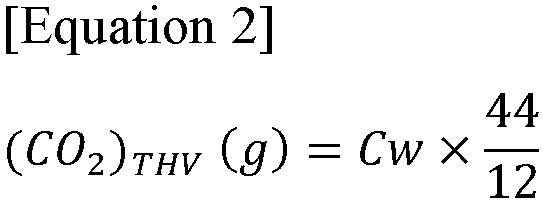
- In
Equation 2, Cw is the mass (g) of organic carbon (carbon element) contained in the sample (sample in an amount of 14.3% by weight of the total weight (x + y) of the dry weight of the sample (x) and the dry weight of the compost (y)). Specifically, Cw refers to the content (g) of carbon elements measured when elemental analysis of the sample is carried out. - The weights of compost used for measuring (CO2)S and (CO2)B may be the same. In addition, the dry weight of compost may be calculated through loss on drying (LOD), which is a thermogravimetric measurement principle of moisture. That is, the difference in weight loss is measured when compost is dried, and the dry weight may be calculated through moisture analysis using a drying oven or a halogen moisture analyzer (HMA).
- The degree of vaporization (V10w) is a value measured when the composition is decomposed into low-molecular-weight substances and ultimately completely decomposed into carbon dioxide and vaporized, rather than the degree of biodisintegration (biodisintegration effect) in which the composition decomposes into small pieces or molecules.
- Specifically, the degree of vaporization (V10w) is a value obtained by measuring the cumulative amount of carbon dioxide (CO2) generated, which is the final decomposition product of the composition, according to the ISO 14855 notification regulations (specifically, the aerobic biodegradability evaluation method of ISO 14855-1), and applying the cumulative amount of carbon dioxide (CO2) measured to
Equations - The composition according to an embodiment of the present disclosure may further comprise a vaporization promotor for a polylactic acid (PLA) resin. Specifically, the composition further comprising the vaporization promotor for a polylactic acid (PLA) resin may have a degree of vaporization (V10w) represented by
Equation 1 of 50% or more. More specifically, the degree of vaporization (V10w) may be an indicator of the degree of biodegradation of the composition comprising the polylactic acid (PLA) resin and the vaporization promotor for a polylactic acid (PLA) resin. - That is, the degree of vaporization (V10w) may be a value obtained by the following procedure: as an evaluation group, a composition sample comprising the polylactic acid (PLA) resin and the vaporization promotor for a polylactic acid (PLA) resin at a specific content ratio is mixed with compost and placed in a test container, and the cumulative amount (g) ((CO2)S) of carbon dioxide (CO2) generated from the composition sample is then measured at 30°C under aerobic compost conditions over 10 weeks using a measurement and evaluation device (Respirometer equipment of ECHO); as a control group, the cumulative amount (g) ((CO2)B) of carbon dioxide (CO2) generated in an inoculum container containing compost alone without the composition sample is obtained under the same conditions as the evaluation group; the difference between (CO2)S and (CO2)B is measured, which are the cumulative amounts (g) of carbon dioxide (CO2) generated in the evaluation group and the control group, respectively; and this is divided by the theoretical cumulative amount (g) ((CO2)THV) of carbon dioxide (CO2) generated as represented by
Equation 2 and converted into a percentage. - The composition according to an embodiment of the present disclosure comprises a polylactic acid (PLA) resin and has a degree of vaporization (V10w) at a specific level or more when the cumulative amount of carbon dioxide (CO2) generated over 10 weeks is measured; thus, it can produce an excellent biodegradation effect at room temperature of 30°C under aerobic compost conditions even if it comprises a polylactic acid (PLA) resin with a low degree of vaporization. The pressure condition in the aerobic compost conditions may be normal pressure.
- Specifically, the degree of vaporization (V10w) of the composition according to an embodiment of the present disclosure may be, for example, 50.1% or more, 50.2% or more, 50.4% or more, 55% or more, 60% or more, 63% or more, 65% or more, 70% or more, 72% or more, or 75% or more.
- Meanwhile, (CO2)S in
Equation 1 may be, for example, 35 g or more, 40 g or more, 45 g or more, 50 g or more, 55 g or more, or 60 g or more. - The difference between (CO2)S and (CO2)B in
Equation 1 refers to the actual cumulative amount of carbon dioxide (CO2) generated by the sample (composition sample) itself and may be, for example, 5 g or more, 10 g or more, 10 g to 60 g, 15 g to 50 g, or 15 g to 40 g. - (CO2)THV in
Equation 1 refers to the theoretical maximum cumulative amount (g) of carbon dioxide (CO2) generated when the sample (composition sample) is completely oxidized (when the organic carbon contained in the sample is 100% converted to carbon dioxide (CO2)) in a test container containing compost and the sample, which may be represented byEquation 2. That is, (CO2)THV may be the product of the mass (Cw) of organic carbon (carbon atoms) contained in the sample and the ratio (44/12) of the molecular weight of carbon dioxide (44) and the atomic weight of a carbon atom (12). (CO2)THV may be, for example, 10 g or more, 15 g or more, 20 g or more, 20 g to 60 g, 25 g to 50 g, or 30 g to 45 g. - Meanwhile, the composition according to an embodiment of the present disclosure may have a degree of improvement in vaporization promotion (ΔVID10W) of 1% or more as represented by the following Equation 3:

- In
Equation 3, V10w is as defined above, and VTHV10w is represented by the followingEquation 4,
- In
Equation 4, x is the weight percent of the polylactic acid (PLA) resin contained in the composition based on the total weight of the composition. - In
Equation 4, 3.6% refers to the degree of vaporization (V10w) calculated byEquation 1 when the cumulative amount of carbon dioxide (CO2) generated over 10 weeks at 30°C in accordance with ISO 14855 for a composition composed of 100% by weight of a polylactic acid (PLA) resin (composition with a PLA resin alone), and 9.5% refers to the degree of vaporization (V10w) calculated byEquation 1 when the cumulative amount of carbon dioxide (CO2) generated over 10 weeks at 30°C in accordance with ISO 14855 for a composition composed of 100% by weight of a vaporization promotor for a polylactic acid (PLA) resin (composition with a vaporization promotor for a polylactic acid (PLA) resin alone). - The degree of improvement in vaporization promotion (ΔVID10W) is a value (V10w - VTHV10w) obtained by subtracting the theoretical degree of vaporization (VTHV10w) of the composition from the degree of vaporization of the composition actually measured (V10w), which may be an indicator of the degree to which the vaporization of the polylactic acid (PLA) resin is promoted by the vaporization promotor for a polylactic acid (PLA) resin.
- The degree of improvement in vaporization promotion (ΔVID10W) may be, for example, 2% or more, 3% or more, 5% or more, 10% or more, 15% or more, 20% or more, 22% or more, 23% or more, 24% or more, 25% or more, 26% or more, 28% or more, or 30% or more.
- This degree of improvement in vaporization promotion (ΔVID10W) may vary depending on the content or physical properties of the polylactic acid (PLA) resin contained in the composition, or it may vary depending on the content, components, or physical properties of the vaporization promotor for a polylactic acid (PLA) resin contained in the composition.
- Specifically, when the content ratio (weight ratio) of the polylactic acid (PLA) resin and the vaporization promotor for a polylactic acid resin (PLA) resin contained in the composition according to an embodiment of the present disclosure is 50:50, the degree of improvement in vaporization promotion (ΔVID10W) may be, for example, 25% or more, 26% or more, 27% or more, or 28% or more.
- In addition, when the content ratio (weight ratio) of the polylactic acid (PLA) resin and the vaporization promotor for a polylactic acid resin (PLA) resin is 75:25, the degree of improvement in vaporization promotion (ΔVID10W) may be, for example, 20% or more, 22% or more, 23% or more, or 24% or more.
- Meanwhile, in
Equation 3, the theoretical degree of vaporization (VTHV10w) of the composition may vary depending on the content (weight) of the polylactic acid (PLA) resin and the vaporization promotor for a polylactic acid (PLA) resin contained in the composition. Specifically, the degree of vaporization (VTHV10w) may be, for example, 10% or more, 15% or more, 20% or more, 20% to 60%, 25% to 55%, or 25% to 50%. - More specifically, when the content ratio (weight ratio) of the polylactic acid (PLA) resin and the vaporization promotor for a polylactic acid resin (PLA) resin contained in the composition according to an embodiment of the present disclosure is 50:50, the degree of vaporization (VTHV10w) of the theoretical composition may be, for example, 20% or more, 30% or more, 40% or more, 20% to 60%, 30% to 55%, or 35% to 55%.
- In addition, when the content ratio (weight ratio) of the polylactic acid (PLA) resin and the vaporization promotor for a polylactic acid resin (PLA) resin is 75:25, the degree of vaporization (VTHV10w) of the theoretical composition may be, for example, 10% or more, 15% or more, 20% or more, 20% to 60%, 20% to 50%, or 20% to 40%.
- When the composition according to an embodiment of the present disclosure is compared with cellulose, a representative standard biodegradable material, in terms of the degree of vaporization, it may have a degree of vaporization (V10w) equivalent to, or higher than, the degree of vaporization of cellulose.
- Specifically, the composition according to an embodiment of the present disclosure comprises a polylactic acid (PLA) resin with a low degree of vaporization at room temperature of 30°C, wherein when the cumulative amount of carbon dioxide (CO2) generated over 10 weeks is measured, the degree of vaporization (V10w) is high at a specific level or more (e.g., 50% or more), thereby producing an excellent biodegradation effect at room temperature.
- Accordingly, the composition according to an embodiment of the present disclosure can be used in various fields to effectively preserve the environment, along with excellent physical properties.
- Hereinafter, each component of the composition according to an embodiment of the present disclosure will be described in detail.
- The composition according to an embodiment of the present disclosure may comprise a polylactic acid (PLA) resin in an amount of 10% by weight to less than 100% by weight based on the total weight of the composition.
- Since a polylactic acid (PLA) resin, unlike a petroleum-based resin, is based on biomass, it can be used as a recyclable resource and has environmentally friendly characteristics as it is biodegraded by moisture and microorganisms when landfilled.
- The polylactic acid (PLA) resin may be obtained through L-lactic acid, D-lactic acid, D,L-lactic acid, or a combination thereof. Specifically, the polylactic acid (PLA) resin may be a random copolymer of L-lactic acid and D-lactic acid.
- The polylactic acid (PLA) resin may have a weight average molecular weight (Mw) of 10,000 to 1,000,000 g/mole, 30,000 to 500,000 g/mole, 100,000 to 300,000 g/mole, or 100,000 to 200,000 g/mole. The weight average molecular weight (Mw) may be measured by gel permeation chromatography (GPC).
- The polylactic acid (PLA) resin may have a melting temperature (Tm) of 100°C to 300°C, 110°C to 280°C, 120°C to 250°C, or 120°C to 200°C.
- The polylactic acid (PLA) resin may have a glass transition temperature (Tg) of 30°C to 100°C, 30°C to 80°C, 40°C to 80°C, or 45°C to 70°C.
- The composition according to an embodiment of the present disclosure may comprise the polylactic acid (PLA) resin in an amount of 10% by weight to less than 100% by weight based on the total weight of the composition. Specifically, the composition may comprise the polylactic acid (PLA) resin in an amount of 10% by weight or more, 20% by weight or more, 30% by weight or more, 50% by weight or more, or 70% by weight or more, and less than 100% by weight, 98% by weight or less, 95% by weight or less, 90% by weight or less, 85% by weight or less, or 80% by weight or less, based on the total weight of the composition. For example, the composition may comprise the polylactic acid (PLA) resin in an amount of 10% by weight to less than 100% by weight, 10% by weight to 95% by weight, 30% by weight to 95% by weight, 40% by weight to 90% by weight, or 50% by weight to 80% by weight, based on the total weight of the composition.
- If the content of the polylactic acid (PLA) resin contained in the composition according to an embodiment of the present disclosure is 100% by weight, the degree of vaporization at room temperature of 30°C is very low; thus, it may be difficult to achieve the desired biodegradation effect. Specifically, when the cumulative amount of carbon dioxide (CO2) generated over 10 weeks at 30°C is measured in accordance with ISO 14855 for a composition composed of 100% by weight of the polylactic acid (PLA) resin, the degree of vaporization (V10w) calculated by
Equation 1 may be, for example, 5% or less, 4.5% or less, 4.0% or less, 3.6% or less, 3.0% or less, or 2.7% or less, thereby producing a significantly minimal biodegradation effect at room temperature. - Accordingly, the composition according to an embodiment of the present disclosure further comprises a vaporization promotor for a polylactic acid (PLA) resin described below, thereby accelerating the vaporization of a polylactic acid (PLA) resin, which has a low degree of vaporization at room temperature, resulting in a further enhanced biodegradation effect.
- The composition according to an embodiment of the present disclosure may further comprise a vaporization promotor for a polylactic acid (PLA) resin.
- The vaporization promotor for a polylactic acid (PLA) resin can serve as a promotor that can accelerate the vaporization of a polylactic acid (PLA) resin with a low degree of vaporization at room temperature of 30°C.
- The composition according to an embodiment of the present disclosure may comprise the vaporization promotor for a polylactic acid (PLA) resin in an amount of greater than 0% by weight, 5% by weight or more, 10% by weight or more, 15% by weight or more, 20% by weight or more, 30% by weight or more, or 40% by weight or more, and less than 100% by weight, 90% by weight or less, 80% by weight or less, 70% by weight or less, 60% by weight or less, or 50% by weight or less, based on the total weight of the composition. For example, the composition may comprise the vaporization promotor for a polylactic acid (PLA) resin in an amount of greater than 0% by weight to less than 100% by weight, greater than 0% by weight to 90% by weight, greater than 0% by weight to 70% by weight, 5% by weight to 90% by weight, 5% by weight to 80% by weight, 10% by weight to 70% by weight, 20% by weight to 60% by weight, 25% by weight to 60% by weight, or 30% by weight to 50% by weight, based on the total weight of the composition.
- When the content of the vaporization promotor for a polylactic acid (PLA) resin satisfies the above range, the vaporization of the polylactic acid (PLA) resin is efficiently accelerated, so that the composition according to an embodiment of the present disclosure can produce an excellent biodegradation effect at room temperature of 30°C even if it comprises the polylactic acid (PLA) resin in an amount of 10% by weight or more, 30% by weight or more, 50% by weight or more, or 70% by weight or more.
- The vaporization promotor for a polylactic acid (PLA) resin may comprise a polyhydroxyalkanoate (hereinafter, referred to as "PHA") resin. Since the PHA resin has specific physical properties (e.g., specific crystal structure, components derived from specific monomers, and the like), it can efficiently promote the vaporization of the polylactic acid (PLA) resin.
- The PHA resin has physical properties similar to those of petroleum-based synthetic resins such as polybutylene adipate terephthalate (PBAT), polybutylene succinate (PBS), polybutylene succinate terephthalate (PBST), and polybutylene succinate adipate (PBSA), exhibit complete biodegradability, and are excellent in biocompatibility.
- Specifically, the PHA resin is a natural thermoplastic polyester polymer that accumulates in microbial cells. Since it has biodegradability, it can be composted and finally decomposed into carbon dioxide, water, and organic waste without generating toxic waste. In particular, the PHA resin is biodegradable in soil and sea. Thus, when the composition according to an embodiment of the present disclosure comprises the PHA resin, it is biodegradable under any environmental conditions, such as soil and sea, and is environmentally friendly. For example, when the cumulative amount of carbon dioxide (CO2) generated over 10 weeks at 30°C is measured in accordance with ISO 14855 for a composition composed of 100% by weight of the PHA resin, the degree of vaporization (V10w) calculated by
Equation 1 may be, for example, 90% or more, 91% or more, 91.5% or more, or 92% or more, thereby producing a significantly excellent biodegradation effect at room temperature. - The PHA resin may be formed by an enzyme-catalyzed polymerization of one or more monomers in living cells.
- Specifically, the PHA resin may be a copolymeric polyhydroxyalkanoate resin (hereinafter, referred to as a "PHA copolymer"), more specifically, a copolymer in which repeat units derived from two or more different monomers are randomly distributed in the polymer chain. In addition, the PHA resin may comprise isomers. For example, the PHA resin may comprise structural isomers, enantiomers, or geometric isomers. Specifically, the PHA resin may comprise structural isomers.
- Examples of monomers that may be used in the preparation of the PHA include, specifically, 2-hydroxybutyrate, lactic acid, glycolic acid, 3-hydroxybutyrate (hereinafter, referred to as "3-HB"), 3-hydroxypropionate (hereinafter, referred to as "3-HP"), 3-hydroxyvalerate (hereinafter, referred to as "3-HV"), 3-hydroxyhexanoate (hereinafter, referred to as "3-HH"), 3-hydroxyheptanoate (hereinafter, referred to as "3-HHep"), 3-hydroxyoctanoate (hereinafter, referred to as "3-HO"), 3-hydroxynonanoate (hereinafter, referred to as "3-HN"), 3-hydroxydecanoate (hereinafter, referred to as "3-HD"), 3-hydroxydodecanoate (hereinafter, referred to as "3-HDd"), 4-hydroxybutyrate (hereinafter, referred to as "4-HB"), 4-hydroxyvalerate (hereinafter, referred to as "4-HV"), 5-hydroxyvalerate (hereinafter, referred to as "5-HV"), and 6-hydroxyhexanoate (hereinafter, referred to as "6-HH"). The PHA resin may contain a repeat unit derived from one or more monomers selected from the above.
- Specifically, the PHA resin may comprise a repeat unit (at least one repeat unit) derived from one or more monomers selected from the group consisting of 3-HB, 4-HB, 3-HP, 3-HV, 3-HH, 4-HV, 5-HV, and 6-HH.
- More specifically, the PHA resin may comprise a repeat unit derived from a 4-HB monomer. That is, the PHA resin may be a PHA copolymer comprising a repeat unit derived from a 4-HB monomer. The PHA resin may be a PHA copolymer that comprises a repeat unit derived from a 4-HB monomer and further comprises a repeat unit derived from a monomer different from the 4-HB monomer, or further comprises repeat units (2 or more repeat units different from each other) derived from two, three, four, five, six, or more monomers different from each other.
- The vaporization promotor for a polylactic acid (PLA) resin according to an embodiment of the present disclosure may comprise a resin (PHA copolymer) that comprises a repeat unit derived from a 4-HB monomer, while comprising a repeat unit (at least one repeat unit) derived from at least one monomer selected from the group consisting of 3-HB monomer, 3-HP monomer, 3-HV monomer, 3-HH monomer, 4-HV monomer, 5-HV monomer, and 6-HH monomer. More specifically, the vaporization promotor for a polylactic acid (PLA) resin may comprise a resin (PHA copolymer) comprising a repeat unit derived from a 3-HB monomer (hereinafter, referred to as "3-HB repeat unit") and a repeat unit derived from a 4-HB monomer (hereinafter, referred to as "4-HB repeat unit"). For example, it may comprise a poly-3-hydroxybutyrate-co-4-hydroxybutyrate (hereinafter, referred to as "P3-HB-co-4-HB") copolymer.
- According to an embodiment of the present disclosure, in order to promote the vaporization of a polylactic acid (PLA) resin while increasing the biodegradability of the composition in soil and sea, it may be important to control the content ratio of the 3-HB repeat unit and the 4-HB repeat unit contained in the PHA resin.
- For example, in the PHA resin comprising the 3-HB repeat unit and the 4-HB repeat unit, the molar ratio of the 3-HB repeat unit and the 4-HB repeat unit may be 20:80 to 99:1, 30:70 to 99:1, 40:60 to 99:1, 50:50 to 95:5, 50:50 to 94:6, 50:50 to 92:8, 55:45 to 92:8, or 55:45 to 90:10. When the molar ratio of the 3-HB repeat unit and the 4-HB repeat unit satisfies the above range, it may be more advantageous for achieving the biodegradation effect desired in the present disclosure.
- Specifically, the content of the 4-HB repeat unit may be 1% by mole to 80% by mole, 2% by mole to 70% by mole, 3% by mole to 60% by mole, 5% by mole to 50% by mole, 8% by mole to 45% by mole, or 10% by mole to 45% by mole, based on the total moles (number of moles) of the 3-HB repeat unit and the 4-HB repeat unit.
- In addition, in a PHA resin comprising at least one 4-HB repeat unit, the crystallinity of the PHA resin may be adjusted depending on the content of the 4-HB repeat unit. That is, the PHA resin may be a PHA copolymer with controlled crystallinity. Specifically, the PHA resin can be classified into a semi-crystalline PHA (scPHA) copolymer or an amorphous PHA (aPHA) copolymer depending on the content of the 4-HB repeat unit.
- The PHA resin whose crystallinity is adjusted may be one in which its crystallinity and amorphousness are adjusted as the irregularities are increased in its molecular structure. Specifically, the crystallinity and amorphousness may be determined by the types of the monomers, the ratio of repeat units derived from the monomers, or the types and/or contents of isomers.
- Specifically, the PHA resin may be an amorphous PHA (aPHA) copolymer comprising the 4-HB repeat unit. As the vaporization promotor for a polylactic acid (PLA) resin comprises such an amorphous PHA (aPHA) copolymer, the vaporization of the polylactic acid (PLA) resin can be promoted more efficiently.
- Meanwhile, the PHA resin may have a glass transition temperature (Tg) of, for example, -45°C to 80°C, -35°C to 80°C, -30°C to 80°C, -25°C to 75°C, -20°C to 70°C, -35°C to 5°C, -25°C to 5°C, -35°C to 0°C, -25°C to 0°C, -30°C to -10°C, -35°C to -15°C, -35°C to -20°C, -20°C to 0°C, -15°C to 0°C, or -15°C to -5°C.
- The crystallization temperature (Tc) of the PHA resin, for example, may not be measured or may be, for example, 60°C to 120°C, 70°C to 120°C, 75°C to 120°C, 75°C to 115°C, 75°C to 110°C, or 90°C to 110°C.
- The melting temperature (Tm) of the PHA resin, for example, may not be measured or may be, for example, 100°C to 170°C, 105°C to 160°C, 110°C to 150°C, 115°C to 155°C, or 120°C to 140°C.
- The PHA resin may have a weight average molecular weight (Mw) of, for example, 10,000 g/mole to 1,200,000 g/mole. Specifically, the weight average molecular weight of the PHA resin may be 50,000 g/mole to 1,200,000 g/mole, 100,000 g/mole to 1,200,000 g/mole, 50,000 g/mole to 1,000,000 g/mole, 100,000 g/mole to 1,000,000 g/mole, 200,000 g/mole to 1,200,000 g/mole, 250,000 g/mole to 1,150,000 g/mole, 300,000 g/mole to 1,100,000 g/mole, 350,000 g/mole to 1,000,000 g/mole, 350,000 g/mole to 950,000 g/mole, 100,000 g/mole to 900,000 g/mole, 200,000 g/mole to 800,000 g/mole, 200,000 g/mole to 700,000 g/mole, 250,000 g/mole to 650,000 g/mole, 200,000 g/mole to 400,000 g/mole, 300,000 g/mole to 800,000 g/mole, 300,000 g/mole to 600,000 g/mole, 500,000 g/mole to 1,200,000 g/mole, 500,000 g/mole to 1,000,000 g/mole 550,000 g/mole to 1,050,000 g/mole, 550,000 g/mole to 900,000 g/mole, or 600,000 g/mole to 900,000 g/mole.
- Meanwhile, the composition according to an embodiment of the present disclosure may comprise the polylactic acid (PLA) resin and the vaporization promotor for a polylactic acid (PLA) resin at a specific content ratio. Specifically, the content ratio (weight ratio) of the polylactic acid (PLA) resin and the vaporization promotor for a polylactic acid (PLA) resin may be, for example, 10:90 to 90:10, 15:85 to 90:10, 20:80 to 90:10, 25:75 to 90:10, 30:70 to 90:10, 40:60 to 90:10, 45:55 to 85:15, 50:50 to 85:15, 50:50 to 80:20, 50:50 to 75:25, or 50:50 to 70:30. When the content ratio (weight ratio) of the polylactic acid (PLA) resin and the vaporization promotor for a polylactic acid (PLA) resin satisfies the above range, the vaporization of the polylactic acid (PLA) resin can be significantly accelerated.
- The composition according to an embodiment of the present disclosure may further comprise at least one additive selected from the group consisting of antioxidants, compatibilizers, weight agents, nucleating agents, melt strength enhancers, and slip agents.
- The content of the additive may be adjusted depending on the desired effect and use of the composition. The content of the additive may be 0.1% by weight or more, 0.5% by weight or more, 1% by weight or more, 1.5% by weight or more, or 2% by weight or more, and 30% by weight or less, 28% by weight or less, 25% by weight or less, 20% by weight or less, 15% by weight or less, 10% by weight or less, 8% by weight or less, or 5% by weight or less, based on the total weight of the composition.
- The additive may be a commonly known additive depending on the desired effect and use.
- Hereinafter, the present disclosure will be described in more detail with reference to the following examples. But the following Examples are intended to illustrate the present disclosure, and the scope of the examples of the present disclosure is not limited thereto only.
- As shown in Table 1 below, a polylactic acid (PLA) resin (NatureWorks, 4032D) and a polyhydroxyalkanoate (PHA) resin (P3-HB-co-4-HB, aPHA) (CJCheilJedang, Korea) as a vaporization promotor for a polylactic acid (PLA) resin were mixed at a weight ratio of 50:50 to prepare a composition.
- As shown in Table 1 below, a polylactic acid (PLA) resin (NatureWorks, 4032D) and a polyhydroxyalkanoate (PHA) resin (P3-HB-co-4-HB, aPHA) (CJCheilJedang, Korea) as a vaporization promotor for a polylactic acid (PLA) resin were mixed at a weight ratio of 75:25 to prepare a composition.
- As shown in Table 1 below, a polylactic acid (PLA) resin (NatureWorks, 2003D) and a polyhydroxyalkanoate (PHA) resin (P3-HB-co-4-HB, aPHA) (CJCheilJedang, Korea) as a vaporization promotor for a polylactic acid (PLA) resin were mixed at a weight ratio of 50:50 to prepare a composition.
- As shown in Table 1 below, a polylactic acid (PLA) resin (NatureWorks, 2003D) and a polyhydroxyalkanoate (PHA) resin (P3-HB-co-4-HB, aPHA) (CJCheilJedang, Korea) as a vaporization promotor for a polylactic acid (PLA) resin were mixed at a weight ratio of 70:30 to prepare a composition.
- As shown in Table 1 below, a polylactic acid (PLA) resin (NatureWorks, 2003D) and a polyhydroxyalkanoate (PHA) resin (P3-HB-co-4-HB, aPHA) (CJCheilJedang, Korea) to be used as a vaporization promotor for a polylactic acid (PLA) resin were mixed at a weight ratio of 60:40 to prepare a composition.
- As shown in Table 1 below, a composition composed of 100 wt% of a polylactic acid (PLA) resin (NatureWorks, 4032D) was prepared.
- As shown in Table 1 below, a composition composed of 100 wt% of a polyhydroxyalkanoate (PHA) resin (P3-HB-co-4-HB, scPHA) (CJCheilJedang, Korea) as a vaporization promotor for a polylactic acid (PLA) resin was prepared.
- As shown in Table 1 below, a polylactic acid (PLA) resin (NatureWorks, 4032D) and a poly(3-hydroxybutyrate-co-3-hydroxyvalerate) (PHBV) (Tianan, China) as a vaporization promotor for a polylactic acid (PLA) resin were mixed at a weight ratio of 50:50 to prepare a composition.
- Cellulose, a standard biodegradable material, was used.
- The content and physical properties of the compositions obtained each in the Examples and Comparative Examples are summarized in Table 1 below. Here, in Table 1 below, Tg and Tm of Comparative Example 1 are values of Tg and Tm measured for the PLA resin used in Comparative Example 1.
[Table 1] Weight ratio of PLA resin:PLA resin vaporization promotor Brand name of PLA resin Composition and physical properties of vaporization promotor for a PLA resin (PHA resin) 3-HB repeat unit (% by weight) 4-HB repeat unit (% by weight) Tg (°C) Tm (°C) Tc (°C) Ex. 1 50:50 4032D 55 45 -30 - - Ex. 2 75:25 55 45 -30 - - Ex. 3 50:50 2003D 91.4 8.6 -17 99.55 - Ex. 4 70:30 69 31 -16 and 57 151 - Ex. 5 60:40 69 31 -16 and 58 152 - C. Ex. 1 100:0 4032D - - 57.25 167.43 - C. Ex. 2 0:100 - 90 10 -5 145 101 C. Ex. 3 50:50 4032D PHBV used as a vaporization promotor for a PLA resin - The cumulative amount of carbon dioxide generated under aerobic composting conditions in accordance with ISO 14855 was measured to calculate the degree of vaporization (V10w).
- Specifically, as an evaluation group, each of the composition samples of the Examples and Comparative Examples was taken at 14.3% by weight based on the total dry weight of the composition sample and compost, and a test container containing the mixture obtained by mixing it with compost (Abnexo Co., Ltd.) was prepared. In such an event, the initial moisture content of the compost was measured through LOD moisture measurement using HMA or a drying oven. Additional moisture was added to adjust the final moisture content to 50% to adjust the dry weight. In addition, the mixture was prepared by uniformly mixing 20 g of the dry composition sample (0% moisture content) with 240 g of compost (dry weight: 120 g) with a moisture content of 50% to adjust the 1:6 ratio of sample to compost in accordance with the ISO 14855 notification regulations.
- In addition, as a control group, an inoculum container containing compost alone without the composition sample was prepared.
- Thereafter, after 10 weeks at a temperature of 30°C under normal pressure and aerobic conditions, carbon dioxide generated in each container was collected using Respirometer equipment of ECHO and titrated with NIR (near infrared sensor) through a system within the equipment to measure the cumulative amount of carbon dioxide generated from each container.
- The degree of vaporization (V10w) represented by the following
Equation 1 was calculated using the measured cumulative amount of carbon dioxide generated:
- In
Equation 1, (CO2)S is the cumulative amount (g) of carbon dioxide (CO2) generated in a test container containing compost and a sample in an amount of 14.3% by weight based on the total dry weight of the sample and the compost, (CO2)B is the cumulative amount (g) of carbon dioxide (CO2) generated in an inoculum container containing compost alone, and (CO2)THV is the theoretical cumulative amount of carbon dioxide (CO2) generated in the test container and represented by the followingEquation 2,
- In
Equation 2, Cw is the mass (g) of organic carbon contained in the sample. Specifically, Cw is the content (g) of carbon elements contained in the sample. - To measure the extent to which the vaporization of the polylactic acid (PLA) resin was promoted by the vaporization promotor for a polylactic acid (PLA) resin, the degree of improvement in vaporization promotion (ΔVID10W) was evaluated.
- Specifically, the degree of improvement in vaporization promotion (ΔVID10W) was calculated using the degree of vaporization (V10w) in Evaluation Example 1 and the theoretical degree of vaporization (VTHV10w). The theoretical degree of vaporization (VTHV10w) was calculated by the following Equation 4:

- In
Equation 4, x is the weight percent of the polylactic acid (PLA) resin contained in the composition based on the total weight of the composition. - The results obtained in Evaluation Examples 1 and 2 are summarized in Tables 2 and 3 below, and
Fig. 1 .[Table 2] Total mass of the sample (g) Mass of organic carbon contained in the sample (Cw, g) CO2 conversion constant (44/12) Control Ex. 1 (cellulose) 20.0 8.72 3.67 Ex. 1 20.0 10.58 3.67 Ex. 2 20.0 10.28 3.67 Ex. 3 20.0 10.57 3.67 Ex. 4 20.0 10.32 3.67 Ex. 5 20.0 10.44 3.67 C. Ex. 1 20.0 10 3.67 C. Ex. 2 20.0 11.14 3.67 C. Ex. 3 20.0 10.57 3.67 [Table 3] (CO2)S (g) (CO2)B (g) (CO2)S - (CO2)B (g) Theoretical cumulative amount of CO2 generated at 100% conversion ((CO2)THV, g) Actual degree of vaporization after 10 weeks (V10w in Eq. 1, %) Theoretical degree of vaporization after 10 weeks (VTHV10w in Eq. 4, %) Degree of improvement in vaporization promotion (ΔVID10W in Eq. 3, %) Cont'1 Ex. 1 (cellulose) 54.552 31.426 23.1 32.0 72.3 - - Ex. 1 61.116 31.426 29.7 38.8 76.6 48.6 28.1 Ex. 2 50.438 31.426 19.0 37.7 50.4 26.1 24.3 Ex. 3 66.637 36.878 29.8 38.8 76.8 48.6 28.2 Ex. 4 61.830 37.850 23.98 37.9 63.2 30.57 32.63 Ex. 5 65.500 37.850 27.65 38.3 72.1 39.56 32.54 C. Ex. 1 32.762 31.426 1.3 36.7 3.6 3.6 0 C. Ex. 2 69.630 31.426 38.2 40.8 93.5 93.5 0 C. Ex. 3 54.791 36.878 17.9 38.8 46.2 48.6 -2.4 - As can be seen from Table 3 above and
Fig. 1 , when the cumulative amount of carbon dioxide (CO2) generated over 10 weeks at 30°C was measured, the degree of vaporization (V10w) of the compositions of Examples 1 to 5 actually evaluated was all 50% or more, indicating that all of them achieved the level of vaporization of cellulose, a representative standard biodegradable material. Specifically, the compositions of Examples 1 to 5 had a degree of vaporization (V10w) significantly enhanced relative to 3.6% of the degree of vaporization (V10w) of Comparative Example 1 in which a composition composed of 100% by weight of a polylactic acid (PLA) resin was used. - In particular, in Examples 1 to 5 in which a composition comprising a polylactic acid (PLA) resin and a vaporization promotor for a polylactic acid (PLA) resin was used, the degree of improvement in vaporization promotion (ΔVID10W) was significantly enhanced to 5% or more, specifically 20% or more, relative to the degree of vaporization (V10w) of Comparative Example 1 in which a composition composed of 100% by weight of a polylactic acid (PLA) resin was used.
- In particular, in the composition of Example 1, in which a polylactic acid (PLA) resin and a vaporization promotor for a polylactic acid (PLA) resin were employed at a weight ratio of 50:50, the theoretical cumulative amount ((CO2)THV) of carbon dioxide (CO2) generated would be 38.8g when completely oxidated (100% conversion). When it is assumed that a polylactic acid (PLA) resin would not be vaporized at room temperature, the cumulative amount of carbon dioxide (CO2) generated from the polylactic acid (PLA) resin was predicted to be 19.4 g, which is half of the value of (CO2)THV above. However, after 10 weeks, the actual amount ((CO2)S - (CO2)B) of carbon dioxide (CO2) generated was 29.7 g, indicating that the vaporization of the polylactic acid (PLA) resin was promoted by the vaporization promotor for a polylactic acid (PLA) resin, i.e., a vaporization promoting effect was produced. That is, the excess amount of about 10 g, which is the difference between the amount of carbon dioxide (CO2) actually generated ((CO2)S - (CO2)B) and half of the predicted value of (CO2)THV, is predicted to be the amount of carbon dioxide (CO2) generated from the polylactic acid (PLA) resin whose vaporization was promoted by the vaporization promotor for a polylactic acid (PLA) resin.
- It is confirmed from the above results that the vaporization promotor for a polylactic acid (PLA) resin not only has a high degree of vaporization, but also can significantly accelerate the vaporization of a polylactic acid (PLA) resin.
- Meanwhile, in the composition of Comparative Example 3, in which a PHBV as a vaporization promotor for a polylactic acid (PLA) resin was mixed with a polylactic acid (PLA) resin at a weight ratio of 50:50, no vaporization promoting effect was produced. Thus, it was confirmed that the PHA resin of the present disclosure, which has specific physical properties, can specifically promote the vaporization of a polylactic acid (PLA) resin.
Claims (10)
- A composition, which comprises a polylactic acid (PLA) resin in an amount ranging from 10% by weight to less than 100% by weight based on the total weight of the composition, wherein when the cumulative amount of carbon dioxide (CO2) generated over 10 weeks at 30°C is measured in accordance with ISO 14855, the degree of vaporization (V10w) represented by the following Equation 1 is 50% or more:
 in Equation 1, (CO2)S is the cumulative amount (g) of carbon dioxide (CO2) generated in a test container containing compost and a sample in an amount of 14.3% by weight based on the total dry weight of the sample and the compost,(CO2)B is the cumulative amount (g) of carbon dioxide (CO2) generated in an inoculum container containing compost alone, and(CO2)THV is the theoretical cumulative amount of carbon dioxide (CO2) generated in the test container and represented by the following Equation 2,
 in Equation 2, Cw is the mass (g) of organic carbon contained in the sample.
 - The composition of claim 1, which further comprises a vaporization promotor for a polylactic acid (PLA) resin.
- The composition of claim 2, wherein the weight ratio of the polylactic acid (PLA) resin and the vaporization promotor for a polylactic acid (PLA) resin is 10:90 to 90:10.
- The composition of claim 2, wherein the degree of improvement in vaporization promotion (ΔVID10W) is 1% or more as represented by the following Equation 3:
 in Equation 3, V10w is as defined in claim 1, and VTHV10w is represented by the following Equation 4,
 in Equation 4, x is the weight percent of the polylactic acid (PLA) resin contained in the composition based on the total weight of the composition.
 - The composition of claim 2, wherein the vaporization promotor for a polylactic acid (PLA) resin satisfies at least one of the following characteristics:a glass transition temperature (Tg) of -45°C to 80°C,a crystallization temperature (Tc) of 60°C to 120°C, anda melting temperature (Tm) of 100°C to 170°C.
- The composition of claim 2, wherein the vaporization promotor for a polylactic acid (PLA) resin comprises a resin comprising a repeat unit derived from 4-hydroxybutyrate (4-HB) monomer; and a repeat unit derived from at least one monomer selected from the group consisting of 3-hydroxybutyrate (3-HB), 3-hydroxypropionate (3-HP), 3-hydroxyvalerate (3-HV), 3-hydroxyhexanoate (3-HH), 4-hydroxyvalerate (4-HV), 5-hydroxyvalerate (5-HV), and 6-hydroxyhexanoate (6-HH).
- The composition of claim 6, wherein the vaporization promotor for a polylactic acid (PLA) resin comprises a resin comprising the repeat unit derived from a 3-hydroxybutyrate (3-HB) monomer; and the repeat unit derived from a 4-hydroxybutyrate (4-HB) monomer.
- The composition of claim 7, wherein the vaporization promotor for a polylactic acid (PLA) resin comprises the repeat unit derived from a 4-hydroxybutyrate (4-HB) monomer in an amount ranging from 1% by mole to 80% by mole based on the total moles of the repeat unit derived from a 3-hydroxybutyrate (3-HB) monomer and the repeat unit derived from a 4-hydroxybutyrate (4-HB) monomer.
- A vaporization promotor for a polylactic acid (PLA) resin, which comprises a resin comprising a repeat unit derived from a 3-hydroxybutyrate (3-HB) monomer; and a repeat unit derived from a 4-hydroxybutyrate (4-HB) monomer.
- The vaporization promotor for a polylactic acid (PLA) resin of claim 9, wherein the molar ratio of the repeat unit derived from a 3-hydroxybutyrate (3-HB) monomer to the repeat unit derived from a 4-hydroxybutyrate (4-HB) monomer is 40:60 to 99:1.
Applications Claiming Priority (2)
| Application Number | Priority Date | Filing Date | Title |
|---|---|---|---|
| KR20220028381 | 2022-03-04 | ||
| PCT/KR2023/002951 WO2023167547A1 (en) | 2022-03-04 | 2023-03-03 | Polylactic acid resin vaporization promoter and composition containing same |
Publications (2)
| Publication Number | Publication Date |
|---|---|
| EP4488333A1 true EP4488333A1 (en) | 2025-01-08 |
| EP4488333A4 EP4488333A4 (en) | 2026-01-07 |
Family
ID=87884064
Family Applications (1)
| Application Number | Title | Priority Date | Filing Date |
|---|---|---|---|
| EP23763745.9A Pending EP4488333A4 (en) | 2022-03-04 | 2023-03-03 | POLYLTIC ACID RESIN EVAPORATION PROMOTER AND COMPOSITION WITH IT |
Country Status (6)
| Country | Link |
|---|---|
| US (1) | US20250179294A1 (en) |
| EP (1) | EP4488333A4 (en) |
| JP (1) | JP2025509987A (en) |
| KR (1) | KR20230131143A (en) |
| CN (1) | CN119137211A (en) |
| WO (1) | WO2023167547A1 (en) |
Family Cites Families (12)
| Publication number | Priority date | Publication date | Assignee | Title |
|---|---|---|---|---|
| WO2007148471A1 (en) * | 2006-06-23 | 2007-12-27 | Kabushiki Kaisha Toyota Jidoshokki | Pdc-lactic acid copolyester and molded article thereof |
| CN101205356A (en) * | 2006-12-22 | 2008-06-25 | 深圳市奥贝尔科技有限公司 | Polyhydroxylkanoates as well as blending modification for copolymer thereof and polylactic acid |
| JP5656001B2 (en) * | 2010-03-31 | 2015-01-21 | 東洋製罐株式会社 | Biodegradable multilayer container |
| CN107652640A (en) * | 2010-04-14 | 2018-02-02 | 美亚无纺布工业有限公司 | Recycled material |
| BR112012029305B1 (en) * | 2010-05-17 | 2020-04-07 | Cj Cheiljedang Corp | polymeric mixture composition of polylactic acid with polyhydroxyalkanoate, method of preparing said composition, multilayer laminate, articles and film comprising |
| WO2014124562A1 (en) * | 2013-02-18 | 2014-08-21 | 美亚无纺布工业有限公司 | Degradable recycling material |
| AU2013378663B2 (en) * | 2013-02-18 | 2017-12-07 | U.S. Pacific Nonwovens Industry Limited | Biodegradable film and laminate |
| KR101563397B1 (en) | 2013-03-13 | 2015-10-26 | 최면천 | A Reforming Method of Poly Lactic Acid, A Bio Degradable Compounds for Foam Using therof and A Foam for Shoes Using therof |
| JP6365811B2 (en) * | 2013-09-10 | 2018-08-01 | 東洋製罐株式会社 | Biodegradable resin composition having porous structure and surface treatment method thereof |
| JP7638969B2 (en) * | 2019-05-24 | 2025-03-04 | ダニマー・アイピーシーオー・エルエルシー | PLA/PHA BIODEGRADABLE COATINGS FOR SEEDS, FERTILIZERS AND PEST CONTROLS |
| KR20210111186A (en) * | 2021-07-30 | 2021-09-10 | 씨제이제일제당 (주) | Biodegradable resin composition, biodegradable film and biodegradable articles using same |
| KR20210116363A (en) * | 2021-08-31 | 2021-09-27 | 씨제이제일제당 (주) | Biodegradable container and manufacturing method thereof |
-
2023
- 2023-03-03 US US18/841,182 patent/US20250179294A1/en active Pending
- 2023-03-03 EP EP23763745.9A patent/EP4488333A4/en active Pending
- 2023-03-03 KR KR1020230028364A patent/KR20230131143A/en not_active Withdrawn
- 2023-03-03 CN CN202380037679.9A patent/CN119137211A/en active Pending
- 2023-03-03 JP JP2024556186A patent/JP2025509987A/en active Pending
- 2023-03-03 WO PCT/KR2023/002951 patent/WO2023167547A1/en not_active Ceased
Also Published As
| Publication number | Publication date |
|---|---|
| KR20230131143A (en) | 2023-09-12 |
| CN119137211A (en) | 2024-12-13 |
| US20250179294A1 (en) | 2025-06-05 |
| EP4488333A4 (en) | 2026-01-07 |
| JP2025509987A (en) | 2025-04-11 |
| WO2023167547A1 (en) | 2023-09-07 |
Similar Documents
| Publication | Publication Date | Title |
|---|---|---|
| Muniyasamy et al. | Mineralization of poly (lactic acid)(PLA), poly (3-hydroxybutyrate-co-valerate)(PHBV) and PLA/PHBV blend in compost and soil environments | |
| Salomez et al. | A comparative study of degradation mechanisms of PHBV and PBSA under laboratory-scale composting conditions | |
| Musioł et al. | (Bio) degradable polymeric materials for a sustainable future–part 1. Organic recycling of PLA/PBAT blends in the form of prototype packages with long shelf-life | |
| Corre et al. | Morphology and functional properties of commercial polyhydroxyalkanoates: A comprehensive and comparative study | |
| Witzke | Introduction to properties, engineering, and prospects of polylactide polymers | |
| EP1725614B1 (en) | Biodegradable compositions comprising polylactic polymers, adipat copolymers and magnesium silicate | |
| Rychter et al. | Study of aliphatic-aromatic copolyester degradation in sandy soil and its ecotoxicological impact | |
| Wilfred et al. | Biodegradation of polyactic acid and starch composites in compost and soil | |
| Musioł et al. | (Bio) degradable polymers as a potential material for food packaging: studies on the (bio) degradation process of PLA/(R, S)-PHB rigid foils under industrial composting conditions | |
| Ding et al. | Bio-based poly (butylene furandicarboxylate-co-glycolate) copolyesters: synthesis, properties, and hydrolysis in different aquatic environments for water degradation application | |
| Seok et al. | Effects of molecular weight on the marine biodegradability of poly (l-lactic acid) | |
| van der Zee et al. | The effect of biodegradable polymer blending on the disintegration rate of PHBV, PBS and PLA in soil | |
| Moura et al. | Biodegradability assessment of aliphatic polyesters‐based blends using standard methods | |
| Ray et al. | Sustainable polylactide-based blends | |
| Quynh et al. | Stereocomplexation of low molecular weight poly (L-lactic acid) and high molecular weight poly (D-lactic acid), radiation crosslinking PLLA/PDLA stereocomplexes and their characterization | |
| Liu et al. | Improvement of thermodynamic properties of poly (butanediol sebacate-butanediol terephthalate)(PBSeT) composites based on the dispersion of PCaCO3@ tannic acid formed by complexation of tannic acid and Ti | |
| D'Amario et al. | Impact of hydrolysis pretreatment on the compostability of biodegradable poly (caprolactone) and poly (lactic acid) films | |
| Malberg et al. | Macromolecular design of aliphatic polyesters with maintained mechanical properties and a rapid, customized degradation profile | |
| Jin et al. | Biodegradation behaviors of poly (p-dioxanone) in different environment media | |
| US20250179294A1 (en) | Polylactic acid resin vaporization promoter and composition containing same | |
| Muranaka et al. | Degradation behavior of polybutylene succinate with fillers | |
| EP4502062A1 (en) | Polybutylene succinate (pbs)-based resin vaporization promoter and composition comprising same | |
| Li et al. | Screening and Scale-Up Modifications of PBAT Copolymer with Enhanced Barrier Properties by Incorporation of DMC | |
| Iozzino et al. | Effect of an acid filler on hydrolysis and biodegradation of poly-lactic acid (PLA) | |
| WO2003050178A1 (en) | Additive composition for promoting polymer degradation |
Legal Events
| Date | Code | Title | Description |
|---|---|---|---|
| STAA | Information on the status of an ep patent application or granted ep patent |
Free format text: STATUS: THE INTERNATIONAL PUBLICATION HAS BEEN MADE |
|
| PUAI | Public reference made under article 153(3) epc to a published international application that has entered the european phase |
Free format text: ORIGINAL CODE: 0009012 |
|
| STAA | Information on the status of an ep patent application or granted ep patent |
Free format text: STATUS: REQUEST FOR EXAMINATION WAS MADE |
|
| 17P | Request for examination filed |
Effective date: 20241003 |
|
| AK | Designated contracting states |
Kind code of ref document: A1 Designated state(s): AL AT BE BG CH CY CZ DE DK EE ES FI FR GB GR HR HU IE IS IT LI LT LU LV MC ME MK MT NL NO PL PT RO RS SE SI SK SM TR |
|
| DAV | Request for validation of the european patent (deleted) | ||
| DAX | Request for extension of the european patent (deleted) | ||
| A4 | Supplementary search report drawn up and despatched |
Effective date: 20251209 |
|
| RIC1 | Information provided on ipc code assigned before grant |
Ipc: C08L 67/04 20060101AFI20251203BHEP Ipc: C08G 63/06 20060101ALI20251203BHEP Ipc: C08G 63/08 20060101ALI20251203BHEP |