EP4487929A1 - Apparatus and method - Google Patents
Apparatus and method Download PDFInfo
- Publication number
- EP4487929A1 EP4487929A1 EP24180510.0A EP24180510A EP4487929A1 EP 4487929 A1 EP4487929 A1 EP 4487929A1 EP 24180510 A EP24180510 A EP 24180510A EP 4487929 A1 EP4487929 A1 EP 4487929A1
- Authority
- EP
- European Patent Office
- Prior art keywords
- user
- video material
- replay
- confirmation
- data processing
- Prior art date
- Legal status (The legal status is an assumption and is not a legal conclusion. Google has not performed a legal analysis and makes no representation as to the accuracy of the status listed.)
- Pending
Links
- 238000000034 method Methods 0.000 title claims abstract description 30
- 238000012545 processing Methods 0.000 claims abstract description 47
- 238000012790 confirmation Methods 0.000 claims abstract description 35
- 230000004044 response Effects 0.000 claims abstract description 19
- 230000008859 change Effects 0.000 description 9
- 238000001514 detection method Methods 0.000 description 7
- 238000004891 communication Methods 0.000 description 5
- 230000000007 visual effect Effects 0.000 description 3
- 238000003556 assay Methods 0.000 description 2
- 230000036541 health Effects 0.000 description 2
- 230000003287 optical effect Effects 0.000 description 2
- 239000007787 solid Substances 0.000 description 2
- 239000000126 substance Substances 0.000 description 2
- 238000010998 test method Methods 0.000 description 2
- 238000004458 analytical method Methods 0.000 description 1
- 238000013459 approach Methods 0.000 description 1
- 238000013461 design Methods 0.000 description 1
- 238000010586 diagram Methods 0.000 description 1
- 230000000694 effects Effects 0.000 description 1
- 238000005516 engineering process Methods 0.000 description 1
- 230000000977 initiatory effect Effects 0.000 description 1
- 230000003993 interaction Effects 0.000 description 1
- 238000012986 modification Methods 0.000 description 1
- 230000004048 modification Effects 0.000 description 1
- 238000003825 pressing Methods 0.000 description 1
- 230000008569 process Effects 0.000 description 1
- 230000002250 progressing effect Effects 0.000 description 1
- 230000035484 reaction time Effects 0.000 description 1
- 238000009877 rendering Methods 0.000 description 1
- 239000004065 semiconductor Substances 0.000 description 1
- 238000000926 separation method Methods 0.000 description 1
- 238000012360 testing method Methods 0.000 description 1
Images




Classifications
-
- A—HUMAN NECESSITIES
- A63—SPORTS; GAMES; AMUSEMENTS
- A63F—CARD, BOARD, OR ROULETTE GAMES; INDOOR GAMES USING SMALL MOVING PLAYING BODIES; VIDEO GAMES; GAMES NOT OTHERWISE PROVIDED FOR
- A63F13/00—Video games, i.e. games using an electronically generated display having two or more dimensions
- A63F13/60—Generating or modifying game content before or while executing the game program, e.g. authoring tools specially adapted for game development or game-integrated level editor
- A63F13/67—Generating or modifying game content before or while executing the game program, e.g. authoring tools specially adapted for game development or game-integrated level editor adaptively or by learning from player actions, e.g. skill level adjustment or by storing successful combat sequences for re-use
-
- A—HUMAN NECESSITIES
- A63—SPORTS; GAMES; AMUSEMENTS
- A63F—CARD, BOARD, OR ROULETTE GAMES; INDOOR GAMES USING SMALL MOVING PLAYING BODIES; VIDEO GAMES; GAMES NOT OTHERWISE PROVIDED FOR
- A63F13/00—Video games, i.e. games using an electronically generated display having two or more dimensions
- A63F13/50—Controlling the output signals based on the game progress
- A63F13/53—Controlling the output signals based on the game progress involving additional visual information provided to the game scene, e.g. by overlay to simulate a head-up display [HUD] or displaying a laser sight in a shooting game
- A63F13/537—Controlling the output signals based on the game progress involving additional visual information provided to the game scene, e.g. by overlay to simulate a head-up display [HUD] or displaying a laser sight in a shooting game using indicators, e.g. showing the condition of a game character on screen
- A63F13/5375—Controlling the output signals based on the game progress involving additional visual information provided to the game scene, e.g. by overlay to simulate a head-up display [HUD] or displaying a laser sight in a shooting game using indicators, e.g. showing the condition of a game character on screen for graphically or textually suggesting an action, e.g. by displaying an arrow indicating a turn in a driving game
-
- A—HUMAN NECESSITIES
- A63—SPORTS; GAMES; AMUSEMENTS
- A63F—CARD, BOARD, OR ROULETTE GAMES; INDOOR GAMES USING SMALL MOVING PLAYING BODIES; VIDEO GAMES; GAMES NOT OTHERWISE PROVIDED FOR
- A63F13/00—Video games, i.e. games using an electronically generated display having two or more dimensions
- A63F13/45—Controlling the progress of the video game
- A63F13/49—Saving the game status; Pausing or ending the game
- A63F13/497—Partially or entirely replaying previous game actions
-
- A—HUMAN NECESSITIES
- A63—SPORTS; GAMES; AMUSEMENTS
- A63F—CARD, BOARD, OR ROULETTE GAMES; INDOOR GAMES USING SMALL MOVING PLAYING BODIES; VIDEO GAMES; GAMES NOT OTHERWISE PROVIDED FOR
- A63F13/00—Video games, i.e. games using an electronically generated display having two or more dimensions
- A63F13/50—Controlling the output signals based on the game progress
- A63F13/53—Controlling the output signals based on the game progress involving additional visual information provided to the game scene, e.g. by overlay to simulate a head-up display [HUD] or displaying a laser sight in a shooting game
- A63F13/533—Controlling the output signals based on the game progress involving additional visual information provided to the game scene, e.g. by overlay to simulate a head-up display [HUD] or displaying a laser sight in a shooting game for prompting the player, e.g. by displaying a game menu
-
- H—ELECTRICITY
- H04—ELECTRIC COMMUNICATION TECHNIQUE
- H04N—PICTORIAL COMMUNICATION, e.g. TELEVISION
- H04N21/00—Selective content distribution, e.g. interactive television or video on demand [VOD]
- H04N21/40—Client devices specifically adapted for the reception of or interaction with content, e.g. set-top-box [STB]; Operations thereof
- H04N21/47—End-user applications
- H04N21/472—End-user interface for requesting content, additional data or services; End-user interface for interacting with content, e.g. for content reservation or setting reminders, for requesting event notification, for manipulating displayed content
- H04N21/47217—End-user interface for requesting content, additional data or services; End-user interface for interacting with content, e.g. for content reservation or setting reminders, for requesting event notification, for manipulating displayed content for controlling playback functions for recorded or on-demand content, e.g. using progress bars, mode or play-point indicators or bookmarks
-
- H—ELECTRICITY
- H04—ELECTRIC COMMUNICATION TECHNIQUE
- H04N—PICTORIAL COMMUNICATION, e.g. TELEVISION
- H04N21/00—Selective content distribution, e.g. interactive television or video on demand [VOD]
- H04N21/40—Client devices specifically adapted for the reception of or interaction with content, e.g. set-top-box [STB]; Operations thereof
- H04N21/47—End-user applications
- H04N21/478—Supplemental services, e.g. displaying phone caller identification, shopping application
- H04N21/4781—Games
-
- A—HUMAN NECESSITIES
- A63—SPORTS; GAMES; AMUSEMENTS
- A63F—CARD, BOARD, OR ROULETTE GAMES; INDOOR GAMES USING SMALL MOVING PLAYING BODIES; VIDEO GAMES; GAMES NOT OTHERWISE PROVIDED FOR
- A63F13/00—Video games, i.e. games using an electronically generated display having two or more dimensions
- A63F13/45—Controlling the progress of the video game
- A63F13/49—Saving the game status; Pausing or ending the game
- A63F13/493—Resuming a game, e.g. after pausing, malfunction or power failure
Definitions
- This disclosure relates to apparatus and methods.
- Data processing apparatus such as computer games machines can be controlled by user-operable control devices configured to provide user input to control or at least influence the execution of data processing operations such as computer game play and/or the execution of a computer game program.
- Computer games programs can be difficult for the user to execute. Indeed, this is an aim of many such systems, so that the user or purchaser of such a program is provided with a series of challenges so as to stretch the user's abilities, understanding and/or appreciation of how to resolve such challenges. Often a computer games program may aim to steer the user to follow a sequence or storyboard such that only when the user has completed a given challenge can the user progress to the next challenge, and so on.
- the present disclosure provides a method comprising:
- the present disclosure also provides computer software which, when executed by one or more computers, causes the one or more computers to perform such a method.
- the present disclosure also provides a non-tangible machine-readable storage medium which stores such computer software.
- circuitry comprising:
- an example of an entertainment system 10 is a computer or console such as the Sony ® PlayStation 5 ® (PS5) system.
- PS5 Sony ® PlayStation 5 ®
- the entertainment system 10 comprises a central processor 20. This may be a single or multi core processor, for example comprising eight cores as in the PS5.
- the entertainment system also comprises a graphical processing unit or GPU 30.
- the GPU can be physically separate to the CPU, or integrated with the CPU as a system on a chip (SoC) as in the PS5.
- the entertainment device also comprises RAM 40, and may either have separate RAM for each of the CPU and GPU, or shared RAM as in the PS5.
- the or each RAM can be physically separate, or integrated as part of an SoC as in the PS5.
- Further storage is provided by a disk 50, either as an external or internal hard drive, or as an external solid state drive, or an internal solid state drive as in the PS5.
- the entertainment device may transmit or receive data via one or more data ports 60, such as a USB port, Ethernet ® port, Wi-Fi ® port, Bluetooth ® port or similar, as appropriate. It may also optionally receive data via an optical drive 70.
- data ports 60 such as a USB port, Ethernet ® port, Wi-Fi ® port, Bluetooth ® port or similar, as appropriate. It may also optionally receive data via an optical drive 70.
- Audio/visual outputs from the entertainment device are typically provided through one or more A/V ports 90, or through one or more of the wired or wireless data ports 60.
- An example of a device for displaying images output by the entertainment system is a head mounted display ⁇ HMD' 120, such as the PlayStation VR 2 'PSVR2', worn by a user 1.
- Interaction with the system is typically provided using one or more handheld controllers (130, 130A), such as the DualSense ® controller (130) in the case of the PS5, and/or one or more VR controllers (130A-L, R) in the case of the HMD.
- handheld controllers 130, 130A
- the DualSense ® controller 130
- VR controllers 130A-L, R
- FIG 1b schematically illustrates an entertainment system 10 of the form described with respect to Figure 1a in data communication (for example via an Internet connection 150) with one or more servers 160.
- the server(s) 160 can be in data communication with multiple entertainment systems 10, though only one such entertainment system is illustrated in Figure 1b for clarity of the diagram. In this way, the server(s) 160 can aggregate information from multiple entertainment systems 10, with example usage of such information being discussed below.
- Figure 1c schematically illustrate an entertainment system 10 of the type described with respect to Figure 1a in data communication with one or more other entertainment systems 170, for example via an Internet connection 180.
- Such a "peer-to-peer" interconnection arrangement can allow the sharing of information (examples being discussed below) between entertainment systems.
- a computer games program may aim to steer the user to follow a sequence or storyboard such that only when the user has completed a given challenge can the user progress to the next challenge, and so on.
- the computer games program may be arranged as a succession of "levels", each level containing or involving one or more challenges or objectives (referred to in parts of this description as data processing tasks to be performed by processing circuitry in response to user operation of controls) which have to be met by the user, firstly in order to move on to a next such objective within that level and secondly to allow progression, once all of the objectives of a level have been met, to a next level and so on through to completion of the entire computer games program by the user.
- levels each level containing or involving one or more challenges or objectives (referred to in parts of this description as data processing tasks to be performed by processing circuitry in response to user operation of controls) which have to be met by the user, firstly in order to move on to a next such objective within that level and secondly to allow progression, once all of the objectives of a level have
- Examples of such objectives may include matters such as any one or more of (i) destroying or at least disabling a game adversary such as a non-playable character (NPC), (ii) constructing, navigating through or at least partially destroying a given item of game environment infrastructure (for example crossing a bridge within the game environment infrastructure), (iii) finding a given item within the computer game environment, or the like.
- a game adversary such as a non-playable character (NPC)
- NPC non-playable character
- constructing, navigating through or at least partially destroying a given item of game environment infrastructure for example crossing a bridge within the game environment infrastructure
- finding a given item within the computer game environment or the like.
- Figure 2 provides a schematic flowchart relating to a computer game arrangement having multiple levels as discussed above.
- the flowchart indicates steps performed by a user or player of the computer game software (drawn to the left of a schematic divider 200) and technical steps performed by the apparatus or circuitry such as the entertainment system of Figure 1a , shown to the right of the schematic divider 200.
- a step 210 the gameplay by the user enters a given level of the computer game software, and at this stage the entertainment system initiates handling of that level at a step 220, for example by loading into memory various assets such as textures, videos, characters or the like required to represent that level to the user of the computer game software.
- the user performs activities within the computer game environment provided by the current level, with the apparatus rendering that environment at a step 240.
- the apparatus under control of the computer game software defines one or more objectives, challenges or tasks to be performed by the user in order to achieve completion of the prevailing level.
- objectives may be defined as a succession or sequence of objectives such that completion of a given objective is required, either before gameplay can proceed to the next objective in the sequence or before completion of the next objective in the sequence is counted towards completion of the level.
- the user may be constrained so that objective B cannot even be attempted until objective A has been completed, while in other examples, if the user completes objective B before having completed objective A, this will not be counted towards progression through the sequence and objective B will remain to be completed after objective A has been performed.
- a set of two or more objectives could be provided with no constraints upon the order of completion of the objectives. Accordingly, at step 260 the user completes the objectives associated with the current level, if required in the order defined by the sequence.
- the apparatus under the control of the computer game software detects completion of the set or sequence of objectives and allows and/or controls the progression at step 280 to a next level.
- the current level represented a final level of the computer game software then the step 280 would refer to completion of the entire computer game.
- Figure 3 provides a schematic flowchart illustrating various options for initiating the provision of such helpful tips information to a user.
- the computer game software defines a given objective. This step corresponds generally to at least a part of the step 250 of Figure 2 .
- help information can be provided at step 320 before control returns to step 330 at which an attempt at given objective is detected.
- control may then return to the step 300 in connection with a next objective.
- the computer game software can increment a count of the number of attempts at that objective, at a step 360.
- the count may be compared with a threshold value (for example, three attempts) and if the count is no higher than the threshold value control can simply return to the step 310. On the other hand, if the count exceeds the threshold then control passes to step 380.
- the step 380 refers to offering help to the user.
- an indication such as a visual indication can be provided to the user to say "press the ⁇ button for help”.
- This arrangement allows the user to decide whether or not to accept the help which has been offered (and which might, depending upon the computer game design, have an associated financial cost, game cost or penalty associated with its acceptance) or simply to continue attempting the objective.
- the step 380 could be implemented as the proactive provision of help whether or not the user accepts an offer of such help.
- a second threshold could be used (not shown in Figure 3 ) such that exceeding the first threshold count of attempts triggers an offer of help or tips information, whereas exceeding the second, higher, threshold count of attempts triggers the proactive provision of such help whether or not the user requests it. As before, control passes back to the step 310.
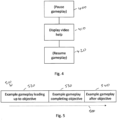
- help or tips information may be provided to the user in the form of a video clip, and an example of such a technique will be described with reference to Figures 4 and 5 .
- Figure 4 is a schematic flowchart relating to the provision of a help video by the apparatus operating under the control of the computer game software.
- a step 400 in response to a determination to provide a help video (for example at the step 320 or at a variant of the step 380 as discussed above) the gameplay by the user is paused or at least the execution of certain operations may be inhibited or disabled for the period in which the video help is to be displayed.
- the video help is displayed at step 410 and, once the user has finished with the video help gameplay is resumed at a step 420.
- Figure 5 schematically represents one example of such a help video, in which time within the video material is shown progressing from left to right by a schematic arrow 500.
- the video content 510 may comprise video content 520 representing example or typical gameplay leading up to the user encountering the objective, video content 530 representing an example or expected form of gameplay actually completing the objective and video content 540 representing typical or example gameplay following completion of the objective.
- the video content 520, 540 simply represents typical gameplay, given that in actual gameplay the user may behave differently before or after encountering the objective.
- the video content 530 represents an expected form of gameplay required to complete the objective but from the user's point of view, this is again an example given that the user could make at least minor variations with respect to the expected gameplay and still manage to complete the objective.
- help videos can be very useful, it might be the case that users do not enjoy watching a video representation of gameplay ahead of the user's current gameplay position. This can be viewed as a so-called spoiler, giving away potentially surprising or unexpected gameplay features which the user has yet to encounter. For this reason, it has been noted within the present disclosure that some users stop or "quit" a help video before it is finished, in an effort to avoid being presented with spoilers.
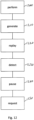
- the entertainment device starts playing a help video at a step 600.
- a detection is made as to whether the user has ended playback early, that is to say stopped or quit the playback. If the answer is yes, then control passes to a step 620 at which video playback is ended. Otherwise, if the answer is no then control passes to a step 630 at which the video continues playing.
- a test is performed at a step 640 as to whether the video material has finished. If the answer is yes, then control goes to the step 620 and otherwise if the answer is no control returns to the step 610.
- the point within the video at which the user ended playback (the positive output of the step 610) is referred to here is a quit point.
- a quit point may represent a position within the video material at which the user has acquired enough guidance to at least increase the user's chances of successfully completing the current objective. But the decision to end playback early rather than continue to the end could either be based upon the user reaching a level of discomfort that the user is about to see a spoiler, or that there is no point watching any further because all useful information has been acquired, or both.
- Figure 7 is a schematic flowchart illustrating an analysis which can be applied to quit points.
- the entertainment system 10 detects a user quit point for a given help video and similarly other instances 170 of entertainment systems detect user quit points for the same help video.
- the quit points are compared across users and/or entertainment systems. This can be performed for example by the server 160 of Figure 1b or on a collective basis by the peer to peer network of entertainment systems 170, 10 of Figure 1c .
- a common quit point is identified, for example using techniques to be described below.
- Such a common quit point may be referred to as a confirmation point.
- This provides an example of detecting, amongst a plurality of instances of replay of the video material, respective positions within the video material at which the respective user stopped replay, and an example of assigning the detected position as a confirmation point.
- a distribution 800 of quit points with reference to location within the health video 510 and in particular within the portion 530 is generated.
- the step 720 can then involve one or both of the following.
- a most common quit .810 can be identified as the video position at which the distribution of user quit points is the highest (that is to say, of the users and instances sampled, the highest number of users quit at the point 810).
- a first threshold quit point 820 can be identified as the first occasion within playback of the portion 530 that the distribution 800 of quit points exceeded a threshold level 830.
- Other common quit points can be identified, such as (in a multiple peaked distribution) the second, third or other highest distribution separated from another quit point by a threshold period of time such as 2 seconds, and so on. In this way one or multiple could points can be identified by the step 720.
- This provides an example of detecting amongst the plurality of instances of replay of the video material, a position within the video material at which the respective user stopped replay which meets a first predetermined criterion.
- the first predetermined criterion may be that the detected position is a most common position amongst the plurality of instances of the video material at which the user stopped replay, and/or the first predetermined criterion may be that the detected position is a first position amongst the plurality of instances of the video material at which at least a threshold proportion of users stopped replay.
- Figure 9 is a schematic flowchart illustrating a replay technique for the health video making use of the one or more quit points detected by the step 720.
- the entertainment system 10 starts to play a given help video.
- a detection is made as to whether a quit point (of the one or more detected by the step 720 for that help video) has been reached. If the answer is no, then control returns to the step 900. If, however, the answer is yes then control passes to a step 920.
- the entertainment system pauses the help video and asks the user, for example by a screen or visual notification, to indicate whether or not the user wishes to continue replay.
- the user may respond by pressing an appropriately identified command button on the controller 130 for example.
- control returns to the step 900 and which replays continued until the video ends or the next quit point is reached. Otherwise, if the user indicates not continue then control passes to a step 940 at which the help video playback is ended.
- the quit point which has been actually detected can be modified before being used in the flowchart of Figure 9 .
- the reason why this might be useful is that in the case of a quit point detected from user behaviour, the users may well have quit because they had already seen (though perhaps only just) a spoiler, so the detected quit point might be too late to avoid the spoiler by a typical user reaction time.
- the quit points as detected can be modified so as to bring them earlier in the video replay by a margin such as 0.2 seconds, before the quit points are applied to the flowchart of Figure 9 . This provides an example of assigning a position which is a predetermined period before the detected position as a confirmation point.
- the video material itself is analysed, for example to detect positions indicative of a scene change, which may be represented by a local maximum in absolute image differences between successive frames.
- such a potential scene change or other significant image occurrence could be used as a quit point itself.
- a possible scene change just before a detected quit point that is to say, a quit point detected according to the flowchart of Figure 7
- the flowchart of Figure 7 is used to detect when people quit out of the help video, but rather than simply applying and offsets to bring the quit point earlier as described above, a detection is attempted to see whether some scene change or other significant image occurrence happens just before the detected quit point, with the quit point itself being moved back to that scene change or other significant image occurrence.
- the techniques to be described does not need to definitively attempt to detect a scene change; instead, the detection is of a local maximum in image-to-image absolute difference, which may (or may not) represent a scene change.
- step 1000 absolute frame to frame differences, representing the sum of absolute values of pixel differences between corresponding pixel positions in at least a portion of two successive frames, is detected for at least a search period of the help video.
- the search period represents a period of time 1100 ( Figure 11 ) preceding a detected quit point 1110.
- the step 1000 could be implemented in respect of the whole help video, or in respect of the whole of the portion 530, instead of just the search period.
- the search period may have a duration of, for example, 1 second.
- a possible scene change is detected within the search period. As discussed above, it does not matter whether this is a scene change or not, but in fact a local maximum absolute frame difference is detected. Optionally a constraint can be applied so that such a local maximum can be no closer than a threshold separation such as 0.1 seconds from the quit point 1110.
- a local maximum 1120 in the detected absolute frame difference values 1130 has been detected within the search period 1100 and a time point 1140 associated with the local maximum 1120.
- the quit point 1110 is modified at a step 1020 so as to be replaced by the time point 1140 detected as a local maximum absolute frame difference within the search period leading up to the quit point 1110.
- the search does not need to be based upon a detected quit point obtained by the flowchart of Figure 7 , but instead one or more local maxima, for example constrained to be at least 0.1 seconds apart, can be detected within the video portion 530.
- This arrangement provides an example of detecting inter-image differences in the video material; in which detecting one or more replay confirmation points comprises assigning as a confirmation point a position before the detected position for which the detected inter-image differences meet a second predetermined criterion as a confirmation point.
- the second predetermined criterion may be that the detected inter-image difference exhibits a local maximum within a search period before the detected position.
- Figure 12 is a schematic flowchart illustrating a method comprising:
- circuitry of Figure 1a provides one or more user controls 130, 130A-L, 130A-R; and processing circuitry 20, 30 to perform a data processing task in response to operation of the one or more user controls; the processing circuitry being configured to perform the above method under software control.
- the technical features of the entertainment system 10 of Figure 1b could be provided as a general purpose data processing apparatus or circuitry configured to execute such software, and the skilled person will appreciate that the user controls such as devices 130, 130A-L and 130A-R could be embodied to control such apparatus either in that form or in other forms of user operable controls.
- a non-transitory machine-readable medium carrying such software such as an optical disk, a magnetic disk, semiconductor memory or the like, is also considered to represent an embodiment of the present disclosure.
- a data signal comprising coded data generated according to the methods discussed above (whether or not embodied on a non-transitory machine-readable medium) is also considered to represent an embodiment of the present disclosure.
Landscapes
- Engineering & Computer Science (AREA)
- Multimedia (AREA)
- Physics & Mathematics (AREA)
- Optics & Photonics (AREA)
- Signal Processing (AREA)
- Databases & Information Systems (AREA)
- Human Computer Interaction (AREA)
- User Interface Of Digital Computer (AREA)
Abstract
A method comprises performing, using processing circuitry, a data processing task in response to operation of one or more user controls; generating video material for display to provide guidance to a user in the operation of the user controls to control performance of the data processing task; replaying the video material in response to operation of the one or more user controls; detecting one or more replay confirmation points with respect to the video material; and pausing replay of the video material at a given confirmation point and requesting user confirmation to continue replay of the video material beyond the given confirmation point.
Description
- This disclosure relates to apparatus and methods.
- Data processing apparatus such as computer games machines can be controlled by user-operable control devices configured to provide user input to control or at least influence the execution of data processing operations such as computer game play and/or the execution of a computer game program.
- Computer games programs can be difficult for the user to execute. Indeed, this is an aim of many such systems, so that the user or purchaser of such a program is provided with a series of challenges so as to stretch the user's abilities, understanding and/or appreciation of how to resolve such challenges. Often a computer games program may aim to steer the user to follow a sequence or storyboard such that only when the user has completed a given challenge can the user progress to the next challenge, and so on.
- While this type of arrangement can provide an engaging period of game play for many users, if a situation arises where a user is unable to complete a challenge, the user can become stuck at that stage in the computer games program. This is undesirable not only from the point of view of the user but also of the game designer, because it would soon become boring and unrewarding for the user to remain stuck at a particular stage in the game.
- To address this situation, some computer games provide optional help or tips to assist the user in understanding how best to approach a given challenge.
- While this introduction has referred to computer game software, the present disclosure is more widely applicable and can be relevant to other types of software involving challenges presented to a user, such as software to operate industrial robots or unmanned vehicles, software to control test procedures such as chemical assays, computer aided design software and the like.
- It is in this context that the present disclosure arises.
- The present disclosure provides a method comprising:
- performing, using processing circuitry, a data processing task in response to operation of one or more user controls;
- generating video material for display to provide guidance to a user in the operation of the user controls to control performance of the data processing task;
- replaying the video material in response to operation of the one or more user controls;
- detecting one or more replay confirmation points with respect to the video material; and
- pausing replay of the video material at a given confirmation point and requesting user confirmation to continue replay of the video material beyond the given confirmation point.
- The present disclosure also provides computer software which, when executed by one or more computers, causes the one or more computers to perform such a method.
- The present disclosure also provides a non-tangible machine-readable storage medium which stores such computer software.
- The present disclosure also provides circuitry comprising:
- one or more user controls; and
- processing circuitry to perform a data processing task in response to operation of one or more user controls;
- the processing circuitry being configured to:
- generate video material for display to provide guidance to a user in the operation of the user controls to control performance of the data processing task;
- replay the video material in response to operation of the one or more user controls;
- detect one or more replay confirmation points with respect to the video material; and
- pause replay of the video material at a given confirmation point and request user confirmation to continue replay of the video material beyond the given confirmation point.
- Various further aspects and features of the present disclosure are defined in the appended claims and within the text of the accompanying description.
- Embodiments of the disclosure will now be described, by way of example only, with reference to the accompanying drawings, in which:
-
Figure 1a schematically illustrates an entertainment system; -
Figure 1b schematically illustrates an entertainment system in communication with one or more servers; -
Figure 1c schematically illustrates an entertainment system in communication with one or more other entertainment systems; -
Figures 2 to 4 are schematic flowcharts illustrating respective aspects of execution of computer game software; -
Figure 5 schematically illustrates a help video; -
Figures 6 and7 are schematic flowcharts illustrating respective methods; -
Figure 8 schematically illustrates the detection of user quit points; -
Figures 9 and10 are schematic flowcharts illustrating respective methods; -
Figure 11 schematically illustrates the detection of user quit points; and -
Figure 12 is a schematic flowchart illustrating a method. - Referring to
Figure 1a , an example of anentertainment system 10 is a computer or console such as the Sony® PlayStation 5® (PS5) system. - The
entertainment system 10 comprises acentral processor 20. This may be a single or multi core processor, for example comprising eight cores as in the PS5. The entertainment system also comprises a graphical processing unit orGPU 30. The GPU can be physically separate to the CPU, or integrated with the CPU as a system on a chip (SoC) as in the PS5. The entertainment device also comprisesRAM 40, and may either have separate RAM for each of the CPU and GPU, or shared RAM as in the PS5. The or each RAM can be physically separate, or integrated as part of an SoC as in the PS5. Further storage is provided by adisk 50, either as an external or internal hard drive, or as an external solid state drive, or an internal solid state drive as in the PS5. - The entertainment device may transmit or receive data via one or
more data ports 60, such as a USB port, Ethernet® port, Wi-Fi® port, Bluetooth® port or similar, as appropriate. It may also optionally receive data via anoptical drive 70. - Audio/visual outputs from the entertainment device are typically provided through one or more A/
V ports 90, or through one or more of the wired orwireless data ports 60. - An example of a device for displaying images output by the entertainment system is a head mounted display `HMD' 120, such as the PlayStation VR 2 'PSVR2', worn by a user 1.
- Where components are not integrated, they may be connected as appropriate either by a dedicated data link or via a
bus 100. - Interaction with the system is typically provided using one or more handheld controllers (130, 130A), such as the DualSense® controller (130) in the case of the PS5, and/or one or more VR controllers (130A-L, R) in the case of the HMD.
-
Figure 1b schematically illustrates anentertainment system 10 of the form described with respect toFigure 1a in data communication (for example via an Internet connection 150) with one ormore servers 160. The server(s) 160 can be in data communication withmultiple entertainment systems 10, though only one such entertainment system is illustrated inFigure 1b for clarity of the diagram. In this way, the server(s) 160 can aggregate information frommultiple entertainment systems 10, with example usage of such information being discussed below. -
Figure 1c schematically illustrate anentertainment system 10 of the type described with respect toFigure 1a in data communication with one or moreother entertainment systems 170, for example via anInternet connection 180. Such a "peer-to-peer" interconnection arrangement can allow the sharing of information (examples being discussed below) between entertainment systems. - As mentioned above, often a computer games program may aim to steer the user to follow a sequence or storyboard such that only when the user has completed a given challenge can the user progress to the next challenge, and so on. In some examples, the computer games program may be arranged as a succession of "levels", each level containing or involving one or more challenges or objectives (referred to in parts of this description as data processing tasks to be performed by processing circuitry in response to user operation of controls) which have to be met by the user, firstly in order to move on to a next such objective within that level and secondly to allow progression, once all of the objectives of a level have been met, to a next level and so on through to completion of the entire computer games program by the user. Examples of such objectives may include matters such as any one or more of (i) destroying or at least disabling a game adversary such as a non-playable character (NPC), (ii) constructing, navigating through or at least partially destroying a given item of game environment infrastructure (for example crossing a bridge within the game environment infrastructure), (iii) finding a given item within the computer game environment, or the like.
-
Figure 2 provides a schematic flowchart relating to a computer game arrangement having multiple levels as discussed above. The flowchart indicates steps performed by a user or player of the computer game software (drawn to the left of a schematic divider 200) and technical steps performed by the apparatus or circuitry such as the entertainment system ofFigure 1a , shown to the right of the schematic divider 200. - At a step 210 the gameplay by the user enters a given level of the computer game software, and at this stage the entertainment system initiates handling of that level at a step 220, for example by loading into memory various assets such as textures, videos, characters or the like required to represent that level to the user of the computer game software.
- At the
step 230 the user performs activities within the computer game environment provided by the current level, with the apparatus rendering that environment at astep 240. At astep 250 the apparatus under control of the computer game software defines one or more objectives, challenges or tasks to be performed by the user in order to achieve completion of the prevailing level. These objectives may be defined as a succession or sequence of objectives such that completion of a given objective is required, either before gameplay can proceed to the next objective in the sequence or before completion of the next objective in the sequence is counted towards completion of the level. In other words, if the sequence of objectives comprises objectives A, B and then C, in some examples the user may be constrained so that objective B cannot even be attempted until objective A has been completed, while in other examples, if the user completes objective B before having completed objective A, this will not be counted towards progression through the sequence and objective B will remain to be completed after objective A has been performed. In other examples, of course, a set of two or more objectives could be provided with no constraints upon the order of completion of the objectives. Accordingly, atstep 260 the user completes the objectives associated with the current level, if required in the order defined by the sequence. - At the
step 270 the apparatus under the control of the computer game software detects completion of the set or sequence of objectives and allows and/or controls the progression atstep 280 to a next level. Of course, if the current level represented a final level of the computer game software then thestep 280 would refer to completion of the entire computer game. - It is possible that the user engaged in a computer game of the type described above may struggle to complete a given objective. In the short-term this can be subjectively frustrating for the user but a more serious commercial impact may be that the user simply loses interest in the game and/or that the game develops a reputation for being too difficult for the average user. Therefore, it is known for computer games to provide "help" or "tips" information (the terms being used generally interchangeably here) to a user struggling with a given objective.
- The nature of the help or tips information used in the present examples will be discussed in detail further below. However, first,
Figure 3 provides a schematic flowchart illustrating various options for initiating the provision of such helpful tips information to a user. - Referring to
Figure 3 , at astep 300, the computer game software defines a given objective. This step corresponds generally to at least a part of thestep 250 ofFigure 2 . - One option for the provision of help or tips information is that the user asks for such information and this may be detected at a
step 310. If the user does ask for help, then help information can be provided atstep 320 before control returns to step 330 at which an attempt at given objective is detected. - At the
step 340, if the attempt is successful then completion of the objective is noted at thestep 350. Depending on the nature of the computer game software and/or the structure of a current level, control may then return to thestep 300 in connection with a next objective. - If, however, success is not detected at the
step 340, then the computer game software can increment a count of the number of attempts at that objective, at astep 360. At astep 370 the count may be compared with a threshold value (for example, three attempts) and if the count is no higher than the threshold value control can simply return to thestep 310. On the other hand, if the count exceeds the threshold then control passes to step 380. - As drawn, the
step 380 refers to offering help to the user. For example, an indication such as a visual indication can be provided to the user to say "press the ▲ button for help". This arrangement allows the user to decide whether or not to accept the help which has been offered (and which might, depending upon the computer game design, have an associated financial cost, game cost or penalty associated with its acceptance) or simply to continue attempting the objective. Alternatively, thestep 380 could be implemented as the proactive provision of help whether or not the user accepts an offer of such help. Alternatively, a second threshold could be used (not shown inFigure 3 ) such that exceeding the first threshold count of attempts triggers an offer of help or tips information, whereas exceeding the second, higher, threshold count of attempts triggers the proactive provision of such help whether or not the user requests it. As before, control passes back to thestep 310. - In some examples, help or tips information may be provided to the user in the form of a video clip, and an example of such a technique will be described with reference to
Figures 4 and 5 . -
Figure 4 is a schematic flowchart relating to the provision of a help video by the apparatus operating under the control of the computer game software. In this example, at astep 400, in response to a determination to provide a help video (for example at thestep 320 or at a variant of thestep 380 as discussed above) the gameplay by the user is paused or at least the execution of certain operations may be inhibited or disabled for the period in which the video help is to be displayed. The video help is displayed atstep 410 and, once the user has finished with the video help gameplay is resumed at astep 420. -
Figure 5 schematically represents one example of such a help video, in which time within the video material is shown progressing from left to right by aschematic arrow 500. Thevideo content 510 may comprisevideo content 520 representing example or typical gameplay leading up to the user encountering the objective,video content 530 representing an example or expected form of gameplay actually completing the objective andvideo content 540 representing typical or example gameplay following completion of the objective. - It is noted that the
video content video content 530 represents an expected form of gameplay required to complete the objective but from the user's point of view, this is again an example given that the user could make at least minor variations with respect to the expected gameplay and still manage to complete the objective. - Although help videos can be very useful, it might be the case that users do not enjoy watching a video representation of gameplay ahead of the user's current gameplay position. This can be viewed as a so-called spoiler, giving away potentially surprising or unexpected gameplay features which the user has yet to encounter. For this reason, it has been noted within the present disclosure that some users stop or "quit" a help video before it is finished, in an effort to avoid being presented with spoilers.
- In an example process shown schematically by a flowchart of
Figure 6 , the entertainment device starts playing a help video at a step 600. At a step 610 a detection is made as to whether the user has ended playback early, that is to say stopped or quit the playback. If the answer is yes, then control passes to astep 620 at which video playback is ended. Otherwise, if the answer is no then control passes to astep 630 at which the video continues playing. A test is performed at astep 640 as to whether the video material has finished. If the answer is yes, then control goes to thestep 620 and otherwise if the answer is no control returns to thestep 610. - The point within the video at which the user ended playback (the positive output of the step 610) is referred to here is a quit point.
- Typically, a quit point may represent a position within the video material at which the user has acquired enough guidance to at least increase the user's chances of successfully completing the current objective. But the decision to end playback early rather than continue to the end could either be based upon the user reaching a level of discomfort that the user is about to see a spoiler, or that there is no point watching any further because all useful information has been acquired, or both.
-
Figure 7 is a schematic flowchart illustrating an analysis which can be applied to quit points. - At the
step 700 theentertainment system 10 detects a user quit point for a given help video and similarlyother instances 170 of entertainment systems detect user quit points for the same help video. - At a
step 710, the quit points are compared across users and/or entertainment systems. This can be performed for example by theserver 160 ofFigure 1b or on a collective basis by the peer to peer network ofentertainment systems Figure 1c . - At a
step 720, a common quit point is identified, for example using techniques to be described below. Such a common quit point may be referred to as a confirmation point. This provides an example of detecting, amongst a plurality of instances of replay of the video material, respective positions within the video material at which the respective user stopped replay, and an example of assigning the detected position as a confirmation point. - Referring to
Figure 8 , at thestep 710, adistribution 800 of quit points with reference to location within thehealth video 510 and in particular within theportion 530 is generated. Thestep 720 can then involve one or both of the following. A most common quit .810 can be identified as the video position at which the distribution of user quit points is the highest (that is to say, of the users and instances sampled, the highest number of users quit at the point 810). A first threshold quitpoint 820 can be identified as the first occasion within playback of theportion 530 that thedistribution 800 of quit points exceeded athreshold level 830. Other common quit points can be identified, such as (in a multiple peaked distribution) the second, third or other highest distribution separated from another quit point by a threshold period of time such as 2 seconds, and so on. In this way one or multiple could points can be identified by thestep 720. - This provides an example of detecting amongst the plurality of instances of replay of the video material, a position within the video material at which the respective user stopped replay which meets a first predetermined criterion. For example, the first predetermined criterion may be that the detected position is a most common position amongst the plurality of instances of the video material at which the user stopped replay, and/or the first predetermined criterion may be that the detected position is a first position amongst the plurality of instances of the video material at which at least a threshold proportion of users stopped replay.
-
Figure 9 is a schematic flowchart illustrating a replay technique for the health video making use of the one or more quit points detected by thestep 720. - At a
step 900 theentertainment system 10 starts to play a given help video. - At a
step 910, a detection is made as to whether a quit point (of the one or more detected by thestep 720 for that help video) has been reached. If the answer is no, then control returns to thestep 900. If, however, the answer is yes then control passes to astep 920. - At the
step 920, the entertainment system pauses the help video and asks the user, for example by a screen or visual notification, to indicate whether or not the user wishes to continue replay. The user may respond by pressing an appropriately identified command button on thecontroller 130 for example. - At the
step 930, if the user replies to indicate that the user wishes to continue replay then control returns to thestep 900 and which replays continued until the video ends or the next quit point is reached. Otherwise, if the user indicates not continue then control passes to astep 940 at which the help video playback is ended. - In the above examples, the quit point which has been actually detected can be modified before being used in the flowchart of
Figure 9 . The reason why this might be useful is that in the case of a quit point detected from user behaviour, the users may well have quit because they had already seen (though perhaps only just) a spoiler, so the detected quit point might be too late to avoid the spoiler by a typical user reaction time.
To address this, the quit points as detected can be modified so as to bring them earlier in the video replay by a margin such as 0.2 seconds, before the quit points are applied to the flowchart ofFigure 9 . This provides an example of assigning a position which is a predetermined period before the detected position as a confirmation point. - Another technique for generating and/or varying could points will now be described with reference to
Figures 10 and 11 . - In this arrangement, the video material itself is analysed, for example to detect positions indicative of a scene change, which may be represented by a local maximum in absolute image differences between successive frames.
- In some examples, such a potential scene change or other significant image occurrence could be used as a quit point itself. But in other examples such as that to be described with reference to
Figures 10 and 11 , a possible scene change just before a detected quit point (that is to say, a quit point detected according to the flowchart ofFigure 7 ) is used to replace that detected quit point. In other words, the flowchart ofFigure 7 is used to detect when people quit out of the help video, but rather than simply applying and offsets to bring the quit point earlier as described above, a detection is attempted to see whether some scene change or other significant image occurrence happens just before the detected quit point, with the quit point itself being moved back to that scene change or other significant image occurrence. - Note that the techniques to be described does not need to definitively attempt to detect a scene change; instead, the detection is of a local maximum in image-to-image absolute difference, which may (or may not) represent a scene change.
- Referring to
Figure 10 , at astep 1000, absolute frame to frame differences, representing the sum of absolute values of pixel differences between corresponding pixel positions in at least a portion of two successive frames, is detected for at least a search period of the help video. Here, the search period represents a period of time 1100 (Figure 11 ) preceding a detected quit point 1110. Of course, thestep 1000 could be implemented in respect of the whole help video, or in respect of the whole of theportion 530, instead of just the search period. The search period may have a duration of, for example, 1 second. - At a step 1010 a possible scene change is detected within the search period. As discussed above, it does not matter whether this is a scene change or not, but in fact a local maximum absolute frame difference is detected. Optionally a constraint can be applied so that such a local maximum can be no closer than a threshold separation such as 0.1 seconds from the quit point 1110. in
Figure 11 , a local maximum 1120 in the detected absolute frame difference values 1130 has been detected within thesearch period 1100 and atime point 1140 associated with thelocal maximum 1120. The quit point 1110 is modified at astep 1020 so as to be replaced by thetime point 1140 detected as a local maximum absolute frame difference within the search period leading up to the quit point 1110. - In other examples, the search does not need to be based upon a detected quit point obtained by the flowchart of
Figure 7 , but instead one or more local maxima, for example constrained to be at least 0.1 seconds apart, can be detected within thevideo portion 530. - This arrangement provides an example of detecting inter-image differences in the video material; in which detecting one or more replay confirmation points comprises assigning as a confirmation point a position before the detected position for which the detected inter-image differences meet a second predetermined criterion as a confirmation point. For example, the second predetermined criterion may be that the detected inter-image difference exhibits a local maximum within a search period before the detected position.
-
Figure 12 is a schematic flowchart illustrating a method comprising: - performing (at a step 1200), using processing circuitry, a data processing task in response to operation of one or more user controls;
- generating (at a step 1210) video material for display to provide guidance to a user in the operation of the user controls to control performance of the data processing task;
- replaying (at a step 1220) the video material in response to operation of the one or more user controls;
- detecting (at a step 1230) one or more replay confirmation points with respect to the video material; and
- pausing (at a step 1240) replay of the video material at a given confirmation point and requesting (at a step 1250) user confirmation to continue replay of the video material beyond the given confirmation point.
- It is noted that the circuitry of
Figure 1a provides one ormore user controls processing circuitry - While this description has referred primarily to computer game software, with the processing circuitry comprising computer game processing circuitry and the data processing task comprises a computer game operation, the computer game processing circuitry allowing progression to a next data processing task to be performed by the computer game processing circuitry in response to operation of the one or more user controls in response to successful completion of a current data processing task, the present disclosure is more widely applicable and can be relevant to other types of software involving challenges, tasks or objectives presented to a user, such as software to operate industrial robots or unmanned vehicles, software to control test procedures such as chemical assays, computer aided design software and the like. The technical features of the
entertainment system 10 ofFigure 1b could be provided as a general purpose data processing apparatus or circuitry configured to execute such software, and the skilled person will appreciate that the user controls such asdevices - In so far as embodiments of the disclosure have been described as being implemented, at least in part, by software-controlled data processing apparatus, it will be appreciated that a non-transitory machine-readable medium carrying such software, such as an optical disk, a magnetic disk, semiconductor memory or the like, is also considered to represent an embodiment of the present disclosure. Similarly, a data signal comprising coded data generated according to the methods discussed above (whether or not embodied on a non-transitory machine-readable medium) is also considered to represent an embodiment of the present disclosure.
- It will be apparent that numerous modifications and variations of the present disclosure are possible in light of the above teachings. It is therefore to be understood that within the scope of the appended clauses, the technology may be practised otherwise than as specifically described herein.
Claims (15)
- A method comprising:performing, using processing circuitry, a data processing task in response to operation of one or more user controls;generating video material for display to provide guidance to a user in the operation of the user controls to control performance of the data processing task;replaying the video material in response to operation of the one or more user controls;detecting one or more replay confirmation points with respect to the video material; andpausing replay of the video material at a given confirmation point and requesting user confirmation to continue replay of the video material beyond the given confirmation point.
- The method of claim 1, in which the detecting step comprises detecting, amongst a plurality of instances of replay of the video material, respective positions within the video material at which the respective user stopped replay.
- The method of claim 2, in which the detecting step comprises detecting amongst the plurality of instances of replay of the video material, a position within the video material at which the respective user stopped replay which meets a first predetermined criterion.
- The method of claim 3, in which the detecting step comprises assigning the detected position as a confirmation point.
- The method of claim 3, in which the detecting step comprises assigning a position which is a predetermined period before the detected position as a confirmation point.
- The method of claim 3, comprising the step of detecting inter-image differences in the video material;
in which the step of detecting one or more replay confirmation points comprises assigning as a confirmation point a position before the detected position for which the detected inter-image differences meet a second predetermined criterion as a confirmation point. - The method of claim 6, in which the second predetermined criterion is that the detected inter-image difference exhibits a local maximum within a search period before the detected position.
- The method of any one of claims 3 to 7, in which the first predetermined criterion is that the detected position is a most common position amongst the plurality of instances of the video material at which the user stopped replay.
- The method of any one of claims 3 to 7, in which the first predetermined criterion is that the detected position is a first position amongst the plurality of instances of the video material at which at least a threshold proportion of users stopped replay.
- The method of any one of the preceding claims, in which the processing circuitry comprises computer game processing circuitry and the data processing task comprises a computer game operation.
- The method of claim 10, comprising the step of the computer game processing circuitry allowing progression to a next data processing task to be performed by the computer game processing circuitry in response to operation of the one or more user controls in response to successful completion of a current data processing task.
- Computer software which, when executed by one or more computers, causes the one or more computers to perform the method of any one of the preceding claims.
- A non-tangible machine-readable storage medium which stores the computer software of claim 12.
- Apparatus comprising:one or more user controls; andprocessing circuitry to perform a data processing task in response to operation of one or more user controls;the processing circuitry being configured to:generate video material for display to provide guidance to a user in the operation of the user controls to control performance of the data processing task;replay the video material in response to operation of the one or more user controls;detect one or more replay confirmation points with respect to the video material; andpause replay of the video material at a given confirmation point and request user confirmation to continue replay of the video material beyond the given confirmation point.
- The apparatus of claim 14, in which the processing circuitry comprises computer game processing circuitry and the data processing task comprises a computer game operation.
Applications Claiming Priority (1)
| Application Number | Priority Date | Filing Date | Title |
|---|---|---|---|
| GB2310357.5A GB2631529A (en) | 2023-07-06 | 2023-07-06 | Apparatus and method |
Publications (1)
| Publication Number | Publication Date |
|---|---|
| EP4487929A1 true EP4487929A1 (en) | 2025-01-08 |
Family
ID=91432562
Family Applications (1)
| Application Number | Title | Priority Date | Filing Date |
|---|---|---|---|
| EP24180510.0A Pending EP4487929A1 (en) | 2023-07-06 | 2024-06-06 | Apparatus and method |
Country Status (3)
| Country | Link |
|---|---|
| US (1) | US20250010189A1 (en) |
| EP (1) | EP4487929A1 (en) |
| GB (1) | GB2631529A (en) |
Citations (5)
| Publication number | Priority date | Publication date | Assignee | Title |
|---|---|---|---|---|
| US20160295260A1 (en) * | 2015-03-31 | 2016-10-06 | The Hong Kong University Of Science And Technology | Method and system for analyzing user activities related to a video |
| US20160381419A1 (en) * | 2013-08-26 | 2016-12-29 | Google Inc. | Segmentation of a video based on user engagement in respective segments of the video |
| US20210233570A1 (en) * | 2019-06-24 | 2021-07-29 | Sage Learning Inc | Methods and systems for annotation and truncation of media assets |
| US20210402301A1 (en) * | 2019-11-18 | 2021-12-30 | Sony Interactive Entertainment Inc. | Server-Based Mechanics Help Determination from Aggregated User Data |
| WO2023283155A1 (en) * | 2021-07-08 | 2023-01-12 | Meta Platforms, Inc. | Dynamic and intelligent video editor |
Family Cites Families (4)
| Publication number | Priority date | Publication date | Assignee | Title |
|---|---|---|---|---|
| US20040087363A1 (en) * | 2002-11-05 | 2004-05-06 | Bogenn Timothy F. | Digital video game strategy guide |
| US8628423B2 (en) * | 2011-06-28 | 2014-01-14 | United Video Properties, Inc. | Systems and methods for generating video hints for segments within an interactive video gaming environment |
| US10610783B2 (en) * | 2018-01-31 | 2020-04-07 | Sony Interactive Entertainment LLC | Assignment of contextual game play assistance to player reaction |
| EP3870320A4 (en) * | 2018-10-22 | 2022-06-22 | Sony Interactive Entertainment LLC | REMOTE NETWORK SERVICES TO PROVIDE CONTEXTUAL GAME GUIDANCE |
-
2023
- 2023-07-06 GB GB2310357.5A patent/GB2631529A/en active Pending
-
2024
- 2024-06-06 EP EP24180510.0A patent/EP4487929A1/en active Pending
- 2024-06-11 US US18/739,861 patent/US20250010189A1/en active Pending
Patent Citations (5)
| Publication number | Priority date | Publication date | Assignee | Title |
|---|---|---|---|---|
| US20160381419A1 (en) * | 2013-08-26 | 2016-12-29 | Google Inc. | Segmentation of a video based on user engagement in respective segments of the video |
| US20160295260A1 (en) * | 2015-03-31 | 2016-10-06 | The Hong Kong University Of Science And Technology | Method and system for analyzing user activities related to a video |
| US20210233570A1 (en) * | 2019-06-24 | 2021-07-29 | Sage Learning Inc | Methods and systems for annotation and truncation of media assets |
| US20210402301A1 (en) * | 2019-11-18 | 2021-12-30 | Sony Interactive Entertainment Inc. | Server-Based Mechanics Help Determination from Aggregated User Data |
| WO2023283155A1 (en) * | 2021-07-08 | 2023-01-12 | Meta Platforms, Inc. | Dynamic and intelligent video editor |
Also Published As
| Publication number | Publication date |
|---|---|
| GB2631529A (en) | 2025-01-08 |
| US20250010189A1 (en) | 2025-01-09 |
Similar Documents
| Publication | Publication Date | Title |
|---|---|---|
| JP7572403B2 (en) | Method and system for accessing previously stored gameplay via video recordings implemented in a game cloud system | |
| JP7759999B2 (en) | Method and system for saving snapshots of gameplay executed on a game cloud system and used to later initiate gameplay execution by any user | |
| EP2257911B1 (en) | Methods for capturing depth data of a scene and applying computer actions | |
| US12533586B2 (en) | Server-based mechanics help determination from aggregated user data | |
| US8298059B2 (en) | Method, system and computer program product for creating custom tutorials based on interactive gameplay | |
| US20140057714A1 (en) | Modifiable gaming experience based on user position and/or orientation | |
| US20230041552A1 (en) | Relevancy-based video help in a video game | |
| EP3117882B1 (en) | Apparatus and method of user interaction | |
| US10325628B2 (en) | Audio-visual project generator | |
| US10369462B2 (en) | Client side processing of game controller input | |
| JP2009279038A (en) | Game program and recording medium | |
| US20250010189A1 (en) | Apparatus and method | |
| CN109939439B (en) | Stuck detection method for virtual character, model training method, device and equipment | |
| JP4148868B2 (en) | GAME PROGRAM AND GAME DEVICE | |
| GB2632704A (en) | Apparatus and methods | |
| JP6612090B2 (en) | Information processing apparatus, operation control method, and operation control program | |
| CN113769370B (en) | Game operation mode switching method and device, storage medium and electronic device | |
| JP2008018160A (en) | Game program |
Legal Events
| Date | Code | Title | Description |
|---|---|---|---|
| PUAI | Public reference made under article 153(3) epc to a published international application that has entered the european phase |
Free format text: ORIGINAL CODE: 0009012 |
|
| STAA | Information on the status of an ep patent application or granted ep patent |
Free format text: STATUS: REQUEST FOR EXAMINATION WAS MADE |
|
| 17P | Request for examination filed |
Effective date: 20240622 |
|
| AK | Designated contracting states |
Kind code of ref document: A1 Designated state(s): AL AT BE BG CH CY CZ DE DK EE ES FI FR GB GR HR HU IE IS IT LI LT LU LV MC ME MK MT NL NO PL PT RO RS SE SI SK SM TR |