EP4485873A2 - Openfec error marking - Google Patents
Openfec error marking Download PDFInfo
- Publication number
- EP4485873A2 EP4485873A2 EP24207777.4A EP24207777A EP4485873A2 EP 4485873 A2 EP4485873 A2 EP 4485873A2 EP 24207777 A EP24207777 A EP 24207777A EP 4485873 A2 EP4485873 A2 EP 4485873A2
- Authority
- EP
- European Patent Office
- Prior art keywords
- flexo
- data
- ofec
- padding
- checksums
- Prior art date
- Legal status (The legal status is an assumption and is not a legal conclusion. Google has not performed a legal analysis and makes no representation as to the accuracy of the status listed.)
- Withdrawn
Links
- 238000000034 method Methods 0.000 claims abstract description 48
- 230000006978 adaptation Effects 0.000 claims abstract description 47
- 238000012937 correction Methods 0.000 claims abstract description 8
- 238000012545 processing Methods 0.000 claims description 6
- 125000004122 cyclic group Chemical group 0.000 claims description 5
- 238000013459 approach Methods 0.000 description 11
- 230000006870 function Effects 0.000 description 10
- 206010009944 Colon cancer Diseases 0.000 description 6
- 230000001427 coherent effect Effects 0.000 description 6
- 238000010586 diagram Methods 0.000 description 5
- 238000013507 mapping Methods 0.000 description 5
- 230000010363 phase shift Effects 0.000 description 4
- 230000003321 amplification Effects 0.000 description 3
- 238000003199 nucleic acid amplification method Methods 0.000 description 3
- 238000004422 calculation algorithm Methods 0.000 description 2
- 238000003491 array Methods 0.000 description 1
- 230000003139 buffering effect Effects 0.000 description 1
- 238000009432 framing Methods 0.000 description 1
- 238000003780 insertion Methods 0.000 description 1
- 230000037431 insertion Effects 0.000 description 1
- 238000012804 iterative process Methods 0.000 description 1
- 230000004807 localization Effects 0.000 description 1
- 230000003287 optical effect Effects 0.000 description 1
- 230000004044 response Effects 0.000 description 1
- 230000001960 triggered effect Effects 0.000 description 1
- 238000012795 verification Methods 0.000 description 1
Images



Classifications
-
- H—ELECTRICITY
- H04—ELECTRIC COMMUNICATION TECHNIQUE
- H04L—TRANSMISSION OF DIGITAL INFORMATION, e.g. TELEGRAPHIC COMMUNICATION
- H04L1/00—Arrangements for detecting or preventing errors in the information received
- H04L1/004—Arrangements for detecting or preventing errors in the information received by using forward error control
- H04L1/0056—Systems characterized by the type of code used
- H04L1/0071—Use of interleaving
-
- H—ELECTRICITY
- H04—ELECTRIC COMMUNICATION TECHNIQUE
- H04L—TRANSMISSION OF DIGITAL INFORMATION, e.g. TELEGRAPHIC COMMUNICATION
- H04L1/00—Arrangements for detecting or preventing errors in the information received
- H04L1/0001—Systems modifying transmission characteristics according to link quality, e.g. power backoff
- H04L1/0006—Systems modifying transmission characteristics according to link quality, e.g. power backoff by adapting the transmission format
- H04L1/0007—Systems modifying transmission characteristics according to link quality, e.g. power backoff by adapting the transmission format by modifying the frame length
- H04L1/0008—Systems modifying transmission characteristics according to link quality, e.g. power backoff by adapting the transmission format by modifying the frame length by supplementing frame payload, e.g. with padding bits
-
- H—ELECTRICITY
- H04—ELECTRIC COMMUNICATION TECHNIQUE
- H04L—TRANSMISSION OF DIGITAL INFORMATION, e.g. TELEGRAPHIC COMMUNICATION
- H04L1/00—Arrangements for detecting or preventing errors in the information received
- H04L1/004—Arrangements for detecting or preventing errors in the information received by using forward error control
- H04L1/0041—Arrangements at the transmitter end
-
- H—ELECTRICITY
- H04—ELECTRIC COMMUNICATION TECHNIQUE
- H04L—TRANSMISSION OF DIGITAL INFORMATION, e.g. TELEGRAPHIC COMMUNICATION
- H04L1/00—Arrangements for detecting or preventing errors in the information received
- H04L1/004—Arrangements for detecting or preventing errors in the information received by using forward error control
- H04L1/0045—Arrangements at the receiver end
-
- H—ELECTRICITY
- H04—ELECTRIC COMMUNICATION TECHNIQUE
- H04L—TRANSMISSION OF DIGITAL INFORMATION, e.g. TELEGRAPHIC COMMUNICATION
- H04L1/00—Arrangements for detecting or preventing errors in the information received
- H04L1/004—Arrangements for detecting or preventing errors in the information received by using forward error control
- H04L1/0045—Arrangements at the receiver end
- H04L1/0047—Decoding adapted to other signal detection operation
- H04L1/005—Iterative decoding, including iteration between signal detection and decoding operation
-
- H—ELECTRICITY
- H04—ELECTRIC COMMUNICATION TECHNIQUE
- H04L—TRANSMISSION OF DIGITAL INFORMATION, e.g. TELEGRAPHIC COMMUNICATION
- H04L1/00—Arrangements for detecting or preventing errors in the information received
- H04L1/004—Arrangements for detecting or preventing errors in the information received by using forward error control
- H04L1/0056—Systems characterized by the type of code used
- H04L1/0057—Block codes
- H04L1/0058—Block-coded modulation
-
- H—ELECTRICITY
- H04—ELECTRIC COMMUNICATION TECHNIQUE
- H04L—TRANSMISSION OF DIGITAL INFORMATION, e.g. TELEGRAPHIC COMMUNICATION
- H04L1/00—Arrangements for detecting or preventing errors in the information received
- H04L1/004—Arrangements for detecting or preventing errors in the information received by using forward error control
- H04L1/0056—Systems characterized by the type of code used
- H04L1/0061—Error detection codes
-
- H—ELECTRICITY
- H04—ELECTRIC COMMUNICATION TECHNIQUE
- H04L—TRANSMISSION OF DIGITAL INFORMATION, e.g. TELEGRAPHIC COMMUNICATION
- H04L27/00—Modulated-carrier systems
- H04L27/32—Carrier systems characterised by combinations of two or more of the types covered by groups H04L27/02, H04L27/10, H04L27/18 or H04L27/26
- H04L27/34—Amplitude- and phase-modulated carrier systems, e.g. quadrature-amplitude modulated carrier systems
- H04L27/36—Modulator circuits; Transmitter circuits
- H04L27/362—Modulation using more than one carrier, e.g. with quadrature carriers, separately amplitude modulated
-
- H—ELECTRICITY
- H04—ELECTRIC COMMUNICATION TECHNIQUE
- H04L—TRANSMISSION OF DIGITAL INFORMATION, e.g. TELEGRAPHIC COMMUNICATION
- H04L1/00—Arrangements for detecting or preventing errors in the information received
- H04L1/004—Arrangements for detecting or preventing errors in the information received by using forward error control
- H04L1/0056—Systems characterized by the type of code used
- H04L1/0064—Concatenated codes
-
- H—ELECTRICITY
- H04—ELECTRIC COMMUNICATION TECHNIQUE
- H04L—TRANSMISSION OF DIGITAL INFORMATION, e.g. TELEGRAPHIC COMMUNICATION
- H04L1/00—Arrangements for detecting or preventing errors in the information received
- H04L1/0078—Avoidance of errors by organising the transmitted data in a format specifically designed to deal with errors, e.g. location
- H04L1/0079—Formats for control data
- H04L1/0082—Formats for control data fields explicitly indicating existence of error in data being transmitted, e.g. so that downstream stations can avoid decoding erroneous packet; relays
Definitions
- the present disclosure generally relates to Forward Error Correction (FEC). More particularly, the present disclosure relates to systems and methods for OpenFEC error marking.
- FEC Forward Error Correction
- Ethernet interfaces have a Mean Time to False Packet Acceptance (MTTFPA) requirement of End of Life (EOL). Also, new Ethernet interfaces operate at a higher Bit Error Rate (BER) and make use of Forward Error Correction (FEC) decoding capabilities to mark appropriate datapath errors to guarantee and meet MTTFPA requirements.
- MTTFPA Mean Time to False Packet Acceptance
- FEC Forward Error Correction
- New Ethernet coherent interfaces use Soft Decision (SD) FEC decoders, and marking specific uncorrected errors is complicated and problematic.
- SD Soft Decision
- CFEC concatenated FEC
- Error marking has been addressed with 400ZR.
- OpenZR+ available at www.openzrplus.org
- OpenZR+ Specifications, v. 1.0, 4 September 2020; the contents are incorporated by reference.
- OpenFEC is described in the Open ROADM MSA 3.01 W-Port Digital Specification (200G-400G) (available at www.openroadm.org ), June 25, 2019; the contents are incorporated by reference, and it is referred to herein as the Open ROADM Specification.
- OpenZR+ utilizes OpenFEC (OFEC) for higher performance applications.
- the mappings utilize the Ethernet 257b Physical Coding Sublayer (PCS) encodings.
- PCS Physical Coding Sublayer
- FlexO Flexible OTN
- ITU-T Recommendation G.709.1/Y.1331.1 Flexible OTN short-reach interface
- ITU-T Recommendation G.709.3/Y.1331.3 Flexible OTN long-reach interfaces
- FlexO includes a specific frame structure, which is the same as the 400ZR frame as defined in OIF-400ZR-1.0, March 10, 2020, the contents of which are incorporated by reference.
- OpenROADM also includes a similar frame structure and OpenROADM is defined in the OpenROADM MSA ver.
- ZR is used to include the 400ZR, ZR+, OpenROADM, etc. specifications. That is, there are various coherent interface specifications being issued and worked on and all of them are contemplated herein.
- the present disclosure relates to systems and methods for OpenFEC error marking. That is, the present disclosure enables error marking for OFEC that is used in ZR+, FlexO, etc.
- the present disclosure can be implemented in a coherent Digital Signal Processor (DSP), Application Specific Integrated Circuit (ASIC), etc.
- DSP coherent Digital Signal Processor
- ASIC Application Specific Integrated Circuit
- the present disclosure provides a process for error marking to meet MTTFPA requirements for ZR+ and FlexO interfaces. It also can apply to any OFEC applications, such as described in the Open ROADM MSA 3.01. Further, this approach can be extended to any FEC scheme that utilizes padding data where the padding data is then spread out with CRC data included therein for error marking.
- the present disclosure can include a circuit that implements steps and a method that includes steps.
- the steps include receiving blocks of data that has been Forward Error Correction (FEC) encoded via Open Forward Error Correction (OFEC) adaptation; decoding the blocks of data; processing Cyclic Redundancy Check (CRC) data that is included in padding data required in the OFEC adaptation, wherein the padding data is distributed across N rows of payload data; and determining a location of any errors in the payload data based on the processed CRC data.
- the steps can include performing the OFEC adaptation and distributing the CRC data across the FlexO/ZR frame N rows with the padding data.
- the steps can further include marking Ethernet frames with an error code based on the detected FEC error location.
- the steps can further include utilizing the CRC data to assist in FEC convergence.
- the padding data can include M bits that are spread across the N FlexO/ZR frame rows thereby having M/N padding bits for each distributed location, and wherein the M/N padding bits include X CRC bits and Y pad bits.
- M 992
- M 744
- the N rows can include any of 29 rows, 14.5 rows, and 7.25 rows. For 14.5 rows and 7.25 rows, this means the distributed padding data is included in the middle of a row (for 14.5 rows) and at a quarter of the row (for 7.25 rows).
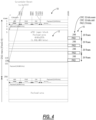
- the CRC data can be utilized in an interleaved manner, such as illustrated in FIG. 4 .
- the OFEC adaptation can be for mapping the blocks of data into any of a FlexO frame structure, a ZR frame structure, and variants thereof.
- the OFEC adaptation can include a plurality of modes includes a 16-Quadrature Amplitude Modulation (16-QAM) mode, an 8-QAM mode, and a Quadrature Phase Shift Keying (QPSK) mode using 116, 87, and 58 rows, respectively, in the payload data. Of course, this can include additional modes such as 32-QAM, 64-QAM, etc.
- the padding data can be distributed across 29 rows for each of the plurality of modes.
- the present disclosure relates to systems and methods for OpenFEC error marking. That is, the present disclosure enables error marking for OFEC that is used in ZR+, FlexO, etc.
- the present disclosure can be implemented in a coherent Digital Signal Processor (DSP), Application Specific Integrated Circuit (ASIC), etc.
- DSP coherent Digital Signal Processor
- ASIC Application Specific Integrated Circuit
- the present disclosure provides a process for error marking to meet MTTFPA requirements for ZR+ and FlexO interfaces. It also can apply to any OFEC applications, such as described in the Open ROADM MSA 3.01. Further, this approach can be extended to any FEC scheme that utilizes padding data where the padding data is then spread out with CRC data included therein for error marking.
- OpenROADM MSA OpenROADM MSA
- OpenFEC openFEC
- SD Soft Decision
- the Net Coding Gain is 11.1 dB @ 10-15 (DP-QPSK) and 11.6 dB @ 10-15 (DP-16QAM), with pre-FEC BER threshold of 2.0 ⁇ 10-2.
- FlexO-x-oFEC signal instance Refers to an individual Flexo-x-oFEC instance that is part of a FlexO-x-oFEC-m interface group
- FlexO-x-oFEC-m signal group Refers to the group of m FlexO-x-oFEC signals
- FlexO-x-DO Information structure consisting of a FlexO-x that is carried in the payload of a FlexO-x-D ⁇ fec> (DSP) frame with Open FEC parity and overhead.
- FlexO-x-DO interface Refers to an individual member interface that is part of a FlexO-x-DO-m interface group.
- FlexO-x-DO-m interface group Refers to the group of m ⁇ FlexO-x-DO interfaces, m ⁇ 1 NOTE - The text may use "FlexO group" as short-hand for FlexO-x-DO-m interface group.
- FlexO is meant to refer to any implementation with OpenFEC including OpenROADM, G.709.3, etc.
- ZR is meant to refer to any implementation with OpenFEC from the OIF, e.g., 400ZR, 800ZR, etc.
- OIF e.g. 400ZR, 800ZR, etc.
- the approach described herein can be used with any implementation using OpenFEC.
- OFEC includes a block-code-based encoder and iterative soft-decision-based decoder, such as with an overhead of 15.3% and a Net Coding Gain (NCG) of 11.1 dB for Quadrature Phase Shift Keying (QSPK) and 11.6dB for 16-Quadrature Amplitude Modulation (16QAM) after three soft-decision iterations, with pre-FEC BER threshold of ⁇ 2.0 ⁇ 10 -2 .
- NCG Net Coding Gain
- QSPK Quadrature Phase Shift Keying
- 16QAM 16-Quadrature Amplitude Modulation
- the present disclosure includes taking padding bits that are associated with OFEC adaptation and distributing them across the payload and incorporating Cyclic Redundancy Check (CRC) data for integrity. That is, the present disclosure modifies the current standard documented OFEC adaptation procedures to provide support for error marking.
- the distributed Cyclic Redundancy Check (CRC) data is used to detect error locations during decoding process.
- the distributed padding bits are not simply dummy data but CRC data. Having the padding bits distributed reduces buffering and latency for computing CRC since the block size is reduced. Further, the distributed padding enables more specific error marking, so only packets in-between CRC checks are required to be marked as errored, reducing error amplification. For example, a single CRC at the end in the OFEC adaptation could be used to detect and mark, but this would require marking all packets in the datapath, i.e., it is not localized.
- the distributed padding approach enables greater localization of error marking.
- this disclosure presents a process of tweaking/modifying OFEC adaptation in a way to accommodate the insertion of CRC (checksums) for the purpose of error marking.
- CRC checksums
- the CRCs are checked in the FEC adaptation function (post-FEC decoding). It conveniently could also be used for FEC convergence and improve the FEC decoders.
- the process of FEC convergence is a check in a decoder that verifies the integrity of the data, and if errors are detected, the FEC decoder can continue with additional iterations.
- the process can be used for ZR+ interfaces as well as FlexO-xe (e.g., underclocked Ethernet optimized) interfaces that make use of OFEC for higher performance applications and direct Ethernet mapping.
- the process may not be backward compatible with existing, standardized OFEC interfaces, but can be implemented for future 400G, 600G and 800G OFEC interfaces (e.g., 800ZR+ and FlexO-8e-DO). Also, the process may be used with existing OFEC interfaces in a proprietary implementation.
- FIG. 1 is a block diagram of the functional flow of modified OFEC adaptation for error marking.
- Data is shown flowing from left-to-right, starting at a Digital Signal Processor (DSP), then FEC decoding, then adaptation, then FlexO/ZR, demapping, and Ethernet PCS coding.
- DSP Digital Signal Processor
- the modified OFEC adaptation detects a post-FEC error (CRC) and marks the data as bad. Then the Ethernet PCS will replace such bad data with /E/ error control blocks. This guarantees that any malformed packets (also matching packet CRC) will not be falsely accepted.
- CRC post-FEC error
- FlexO and ZR+ signals mapped to 16QAM (Quadrature Amplitude Modulation), 8QAM, and QPSK (Quadrature Phase Shift Keying) modes are using 116, 87 and 58 rows, respectively, when mapping FlexO/ZR (payload) data into the OFEC adaptation.
- the common divisor is 29 (29x2, 29x3, 29x4).
- the scheme in this disclosure distributes the OFEC adaptation padding across 29 FlexO/ZR frame rows evenly. This differs from the original OFEC adaptation procedures.
- FIGS. 2 - 4 are block diagrams of FlexO-4 interfaces for describing OFEC adaptation.
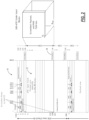
- FIG. 2 illustrates conventional OFEC adaptation with padding at the end.
- the conventional OFEC adaptation is from Figure 14 of the OpenROADM Specification.
- FIG. 3 illustrates the modified OFEC adaptation, where the padding is distributed every 29 rows.
- FIG. 4 illustrates the modified OFEC adaptation, where the padding is distributed every 29 rows in an interleaved manner.
- FIGS. 2-4 are diagrams of a frame 10 prior to OFEC adaptation.
- Table 2 in the OpenROADM Specification illustrates the OFEC adaptation rates as follows: FlexO-x Rows PAD (bits) oFEC-x coder payload (bits) oFEC Blocks FlexO-x-oFEC (bits) Modulation Format FlexO-4-oFEC 116 rows, (4640 ⁇ 257 bits) 992 1,193,472 168 1,376,256 DP-16QAM FlexO-3-oFEC 87 rows, (3480 ⁇ 257 bits) 744 895,104 126 1,032,192 DP-8QAM FlexO-2-oFEC 58 rows, (2320 ⁇ 257 bits) 496 596,736 84 688,128 DP-QPSK
- PAD bits 14 there are enough PAD bits 14 to use CRC and to distribute the PAD bits 14 with CRC included therein for error marking in the payload area 12.
- the following descriptions describe this approach with reference to FlexO-4, but those skilled in the art will recognize this is only for illustration purposes.
- FIGS. 2 - 4 are the FlexO-4 FlexO frame structure from the OpenROADM Specification.
- FIGS. 2-4 there is an OFEC input block with the payload area 12 (1,192,480 bits for FlexO-4).
- This data is processed in the OFEC adaptation, such as described in the OpenROADM Specification.
- Note, other sections are also adapted with OFEC, but there is no need to modify the padding in the non-payload area since the present disclosure is concerned with error marking in the payload area 12.
- the conventional OFEC adaptation includes adding 992 PAD bits 14 for padding at the end of the payload area 12 for the FlexO-4.
- the PAD bits 14 are for aligning and synchronizing the FlexO/ZR frame 10 to an OFEC structure (e.g., see Section 11.1 in the Open ROADM Specification).
- the PAD bits 12 are appended to the Flex-O data to enable this alignment. Alignment is not necessarily associated with row boundaries as conveniently drawn.
- the PAD bits 12 are removed after the decoder on the receive interface. In a conventional embodiment, the PAD bits 12 are an all-zero field that gets scrambled prior to encoding and removed after decoding and descrambling.
- the OFEC adaptation uses some padding to make it work with FlexO/ZR multiples. But there is no ability for any error marking in current standards. Placing the CRC there as is defined today, as in FIG. 2 , the CRC would cover a large number of bits and require memory to store and delay the data so it can be marked (this can be cumbersome and adds latency and keeping link latency low is critical in many applications).
- the PAD bits 14 are distributed in FIG. 2 , only a single set of PAD bits 14 are used for all of the payload area 12. This does not provide fine enough granularity for error marking. At best, it could determine an error is in the payload area 12, but this would require marking all data as errored.
- the present disclosure distributes the padding across rows in the payload area 12, making the CRC cover a smaller number of bits, requiring less memory and less latency, making it suitable for an error marking scheme. That is, instead of one set of PAD bits 14 for the entire payload area 12, the present disclosure distributes this across different rows - resulting in the same amount of PAD bits, but distributed.
- the modified OFEC adaptation distributes these 992 PAD bits 12 as distributed PAD bits 16 into four sections of 248 bits, every 29 rows.
- the amount of padding is the same but distributed as the distributed PAD bits 16.
- the 248 bits can include 32-bits of CRC data and 216-bits of padding data.
- the 32-bits of CRC data every 29 rows can be used to localize and mark errors. That is, the present disclosure does not use all-zeros for the PAD bits, but rather some CRC bits 18 and some PAD bits 20, e.g., 32-bits for the CRC bits 18 and 216-bits for the PAD bits 20.
- CRC32 is just presented as an example, other values can be used. Also, other error checking schemes are also contemplated instead of CRC.
- an alternative approach could be to map two interleaved (even/odd) CRC32 per padding opportunity.
- the CRCs would protect their respective even/odd payload bits.
- OFEC is described as using two parallel decoders, again using even/odd bit interleaving.
- the two CRCs can feedback back to the two parallel decoders to assist in FEC convergence functions.
- FEC convergence relates to iterations in SD FEC. With knowledge there are no errors, based on the CRC, the convergence can be improved and iterations reduced (resulting in a lower power FEC).
- FIG. 5 is a flowchart of a process 50 for error marking using modified OFEC adaptation.
- the modified OFEC adaptation process contemplates implementation in a circuit, electrical circuitry, e.g., a DSP, FPGA, ASIC, etc.
- the process 50 is described with reference to a receiver that receives transmitted data and is performing FEC decoding.
- the modified OFEC adaptation allows error marking in the process 50.
- the process 50 includes receiving blocks of data that has been Forward Error Correction (FEC) encoded via Open Forward Error Correction (OFEC) adaptation (step 51); decoding the blocks of data (step 52); processing Cyclic Redundancy Check (CRC) data that is included in padding data required in the OFEC adaptation, wherein the padding data is distributed across N rows of payload data (step 53); and determining a location of any errors in the payload data based on the processed CRC data (step 54).
- FEC Forward Error Correction
- OFEC Open Forward Error Correction
- CRC Cyclic Redundancy Check
- the process 50 can include performing the OFEC adaptation and distributing the CRC data across the N rows with the padding data.
- the process 50 can further include marking Ethernet blocks with an error code based on the location (step 55).
- the process 50 can further include utilizing the CRC data to assist in FEC convergence (step 56).
- Typical SD FEC schemes are based on iterative processes to correct errors. When payload data is clean and errors are no longer present, further iterations are not needed and dissipate power unnecessarily.
- a CRC can be used to check the integrity of the payload and stop the further iterations, which means the FEC has converged.
- the CRC proposed herein can be used for such purpose as well as error marking.
- the padding data can include M bits that are spread across the N FlexO/ZR frame rows thereby having M/N padding bits for each distributed location, and wherein the M/N padding bits include X CRC bits and Y pad bits.
- M 992
- M 744
- the N rows can include any of 29 rows, 14.5 rows, and 7.25 rows. For 14.5 rows and 7.25 rows, this means the distributed padding data is included in the middle of a row (for 14.5 rows) and at a quarter of the row (for 7.25 rows).
- the CRC data can be utilized in an interleaved manner, such as illustrated in FIG. 4 .
- there are two CRC codes - one covering even bits and the other odd bits in an interleaved manner.
- the two CRCs can be placed in the padding. Since OFEC uses two decoders, again in an even/odd bit interleaved scheme, the interleaved CRCs can be used for FEC convergence, as described above.
- the OFEC adaptation can be for mapping the blocks of data into any of a FlexO frame structure, a ZR frame structure, and variants thereof.
- the OFEC adaptation can include a plurality of modes includes a 16-Quadrature Amplitude Modulation (16-QAM) mode, an 8-QAM mode, and a Quadrature Phase Shift Keying (QPSK) mode using 116, 87, and 58 rows, respectively, in the payload data.
- QPSK Quadrature Phase Shift Keying
- the padding data can be distributed across 29 rows for each of the plurality of modes.
- the frame 10 in FIGS. 2 - 4 is the FlexO-x-oFEC from the OpenROADM MSA.
- the CRC or checksum can be distributed in the PAD data in the frame from G.709.3.
- CRC data is useful for error marking, FEC convergence, uncorrectable error verification.
- the logical place is to put this CRC in adaptation padding and the padding could be distributed (instead of lumped) to minimize error marking window.
- 800ZR 32-bit CRC at the end of every 4 rows, 800G that would result in 29 CRC values, Error mark blocks of 41,120 bits.
- processors such as microprocessors; Central Processing Units (CPUs); Digital Signal Processors (DSPs): customized processors such as Network Processors (NPs) or Network Processing Units (NPUs), Graphics Processing Units (GPUs), or the like; Field-Programmable Gate Arrays (FPGAs); and the like along with unique stored program instructions (including both software and firmware) for control thereof to implement, in conjunction with certain non-processor circuits, some, most, or all of the functions of the methods and/or systems described herein.
- processors such as microprocessors; Central Processing Units (CPUs); Digital Signal Processors (DSPs): customized processors such as Network Processors (NPs) or Network Processing Units (NPUs), Graphics Processing Units (GPUs), or the like; Field-Programmable Gate Arrays (FPGAs); and the like along with unique stored program instructions (including both software and firmware) for control thereof to implement, in conjunction with certain non-processor circuits, some, most, or all
- circuitry configured to
- logic configured to
- some embodiments may include a non-transitory computer-readable medium having instructions stored thereon for programming a computer, server, appliance, device, one or more processors, circuit, etc. to perform functions as described and claimed herein.
- Examples of such non-transitory computer-readable medium include, but are not limited to, a hard disk, an optical storage device, a magnetic storage device, a Read-Only Memory (ROM), a Programmable ROM (PROM), an Erasable PROM (EPROM), an Electrically EPROM (EEPROM), Flash memory, and the like.
- software can include instructions executable by one or more processors (e.g., any type of programmable circuitry or logic) that, in response to such execution, cause the one or more processors to perform a set of operations, steps, methods, processes, algorithms, functions, techniques, etc. as described herein for the various embodiments.
- processors e.g., any type of programmable circuitry or logic
Landscapes
- Engineering & Computer Science (AREA)
- Computer Networks & Wireless Communication (AREA)
- Signal Processing (AREA)
- Quality & Reliability (AREA)
- Detection And Prevention Of Errors In Transmission (AREA)
- Error Detection And Correction (AREA)
- Detection And Correction Of Errors (AREA)
Abstract
Description
- The present disclosure claims priority to
U.S. Provisional Patent Application No. 63/113,829, filed November 14, 2020 - The present disclosure generally relates to Forward Error Correction (FEC). More particularly, the present disclosure relates to systems and methods for OpenFEC error marking.
- Ethernet interfaces have a Mean Time to False Packet Acceptance (MTTFPA) requirement of End of Life (EOL). Also, new Ethernet interfaces operate at a higher Bit Error Rate (BER) and make use of Forward Error Correction (FEC) decoding capabilities to mark appropriate datapath errors to guarantee and meet MTTFPA requirements. This is a known practice for Ethernet interfaces, and these interfaces (until now) have been using Hard Decision (HD) FEC decoders, so the approach is fairly straightforward. That is, HD FEC easily identifies error locations, simplifying error marking.
- New Ethernet coherent interfaces use Soft Decision (SD) FEC decoders, and marking specific uncorrected errors is complicated and problematic. Currently, the only standard coherent Ethernet interface is 400ZR driven by the OIF. It uses a concatenated FEC (CFEC) approach, which provides moderate performance FEC. Error marking has been addressed with 400ZR. There is another coherent Ethernet interface referred to as OpenZR+ (available at www.openzrplus.org) and described in the OpenZR+ Specifications, v. 1.0, 4 September 2020; the contents are incorporated by reference. OpenFEC is described in the Open ROADM MSA 3.01 W-Port Digital Specification (200G-400G) (available at www.openroadm.org), June 25, 2019; the contents are incorporated by reference, and it is referred to herein as the Open ROADM Specification. OpenZR+ utilizes OpenFEC (OFEC) for higher performance applications. The mappings utilize the Ethernet 257b Physical Coding Sublayer (PCS) encodings. Of note, there are no published schemes on OpenZR+ interfaces to meet MTTFPA requirements, i.e., to support error marking.
- Flexible OTN (hereinafter referred to as FlexO) is defined, e.g., in ITU-T Recommendation G.709.1/Y.1331.1, "Flexible OTN short-reach interface," (06/18), ITU-T Recommendation G.709.3/Y.1331.3, "Flexible OTN long-reach interfaces," (12/20), the contents of each are incorporated by reference. FlexO includes a specific frame structure, which is the same as the 400ZR frame as defined in OIF-400ZR-1.0, March 10, 2020, the contents of which are incorporated by reference. OpenROADM also includes a similar frame structure and OpenROADM is defined in the OpenROADM MSA ver. 4.0, December 7, 2020, the contents of which are incorporated by reference. As described herein, ZR is used to include the 400ZR, ZR+, OpenROADM, etc. specifications. That is, there are various coherent interface specifications being issued and worked on and all of them are contemplated herein.
- The present disclosure relates to systems and methods for OpenFEC error marking. That is, the present disclosure enables error marking for OFEC that is used in ZR+, FlexO, etc. The present disclosure can be implemented in a coherent Digital Signal Processor (DSP), Application Specific Integrated Circuit (ASIC), etc. The present disclosure provides a process for error marking to meet MTTFPA requirements for ZR+ and FlexO interfaces. It also can apply to any OFEC applications, such as described in the Open ROADM MSA 3.01. Further, this approach can be extended to any FEC scheme that utilizes padding data where the padding data is then spread out with CRC data included therein for error marking.
- In various embodiments, the present disclosure can include a circuit that implements steps and a method that includes steps. The steps include receiving blocks of data that has been Forward Error Correction (FEC) encoded via Open Forward Error Correction (OFEC) adaptation; decoding the blocks of data; processing Cyclic Redundancy Check (CRC) data that is included in padding data required in the OFEC adaptation, wherein the padding data is distributed across N rows of payload data; and determining a location of any errors in the payload data based on the processed CRC data. At the other end, prior to the receiving, the steps can include performing the OFEC adaptation and distributing the CRC data across the FlexO/ZR frame N rows with the padding data.
- The steps can further include marking Ethernet frames with an error code based on the detected FEC error location. The steps can further include utilizing the CRC data to assist in FEC convergence.
- The padding data can include M bits that are spread across the N FlexO/ZR frame rows thereby having M/N padding bits for each distributed location, and wherein the M/N padding bits include X CRC bits and Y pad bits. For example, for FlexO-4, M = 992, for FlexO-3, M = 744, and for FlexO-2, M = 496.
- The N rows can include any of 29 rows, 14.5 rows, and 7.25 rows. For 14.5 rows and 7.25 rows, this means the distributed padding data is included in the middle of a row (for 14.5 rows) and at a quarter of the row (for 7.25 rows). The CRC data can be utilized in an interleaved manner, such as illustrated in
FIG. 4 . - The OFEC adaptation can be for mapping the blocks of data into any of a FlexO frame structure, a ZR frame structure, and variants thereof. The OFEC adaptation can include a plurality of modes includes a 16-Quadrature Amplitude Modulation (16-QAM) mode, an 8-QAM mode, and a Quadrature Phase Shift Keying (QPSK) mode using 116, 87, and 58 rows, respectively, in the payload data. Of course, this can include additional modes such as 32-QAM, 64-QAM, etc. The padding data can be distributed across 29 rows for each of the plurality of modes.
- The present disclosure is illustrated and described herein with reference to the various drawings, in which like reference numbers are used to denote like system components/method steps, as appropriate, and in which:
-
FIG. 1 is a block diagram of the functional flow of modified OFEC adaptation for error marking. -
FIGS. 2 - 4 are block diagrams of FlexO-4 interfaces from the OpenROADM MSA for describing OFEC adaptation. Specifically,FIG. 2 illustrates conventional OFEC adaptation with padding at the end.FIG. 3 illustrates the modified OFEC adaptation, where the padding is distributed 29 rows.FIG. 4 illustrates the modified OFEC adaptation, where the padding is distributed 29 rows in an interleaved manner. -
FIG. 5 is a flowchart of a process for error marking using modified OFEC adaptation. - In various embodiments, the present disclosure relates to systems and methods for OpenFEC error marking. That is, the present disclosure enables error marking for OFEC that is used in ZR+, FlexO, etc. The present disclosure can be implemented in a coherent Digital Signal Processor (DSP), Application Specific Integrated Circuit (ASIC), etc. The present disclosure provides a process for error marking to meet MTTFPA requirements for ZR+ and FlexO interfaces. It also can apply to any OFEC applications, such as described in the Open ROADM MSA 3.01. Further, this approach can be extended to any FEC scheme that utilizes padding data where the padding data is then spread out with CRC data included therein for error marking.
- The following definitions are used herein from the OpenROADM MSA:
openFEC (OFEC) a block-based encoder and iterative Soft Decision (SD) decoder. With 3 SD iterations the Net Coding Gain is 11.1 dB @ 10-15 (DP-QPSK) and 11.6 dB @ 10-15 (DP-16QAM), with pre-FEC BER threshold of 2.0×10⁻². FlexO-x-oFEC an information structure consisting of a G.709.1 FlexO-x (x=2,3,4) frame structure protected with oFEC. FlexO-x-oFEC signal instance Refers to an individual Flexo-x-oFEC instance that is part of a FlexO-x-oFEC-m interface group FlexO-x-oFEC-m signal group Refers to the group of m FlexO-x-oFEC signals - The following definitions are used herein from G.709.3:
FlexO-x-DO Information structure consisting of a FlexO-x that is carried in the payload of a FlexO-x-D<fec> (DSP) frame with Open FEC parity and overhead. FlexO-x-DO interface Refers to an individual member interface that is part of a FlexO-x-DO-m interface group. FlexO-x-DO-m interface group Refers to the group of m × FlexO-x-DO interfaces, m ≥ 1 NOTE - The text may use "FlexO group" as short-hand for FlexO-x-DO-m interface group. - Of note, as described herein "FlexO" is meant to refer to any implementation with OpenFEC including OpenROADM, G.709.3, etc. Also, "ZR" is meant to refer to any implementation with OpenFEC from the OIF, e.g., 400ZR, 800ZR, etc. Of course, the approach described herein can be used with any implementation using OpenFEC.
- OFEC includes a block-code-based encoder and iterative soft-decision-based decoder, such as with an overhead of 15.3% and a Net Coding Gain (NCG) of 11.1 dB for Quadrature Phase Shift Keying (QSPK) and 11.6dB for 16-Quadrature Amplitude Modulation (16QAM) after three soft-decision iterations, with pre-FEC BER threshold of ~2.0×10⁻².
- Generally, the present disclosure includes taking padding bits that are associated with OFEC adaptation and distributing them across the payload and incorporating Cyclic Redundancy Check (CRC) data for integrity. That is, the present disclosure modifies the current standard documented OFEC adaptation procedures to provide support for error marking. The distributed Cyclic Redundancy Check (CRC) data is used to detect error locations during decoding process. Further, the distributed padding bits are not simply dummy data but CRC data. Having the padding bits distributed reduces buffering and latency for computing CRC since the block size is reduced. Further, the distributed padding enables more specific error marking, so only packets in-between CRC checks are required to be marked as errored, reducing error amplification. For example, a single CRC at the end in the OFEC adaptation could be used to detect and mark, but this would require marking all packets in the datapath, i.e., it is not localized. The distributed padding approach enables greater localization of error marking.
- Thus, this disclosure presents a process of tweaking/modifying OFEC adaptation in a way to accommodate the insertion of CRC (checksums) for the purpose of error marking. The CRCs are checked in the FEC adaptation function (post-FEC decoding). It conveniently could also be used for FEC convergence and improve the FEC decoders. The process of FEC convergence is a check in a decoder that verifies the integrity of the data, and if errors are detected, the FEC decoder can continue with additional iterations. The process can be used for ZR+ interfaces as well as FlexO-xe (e.g., underclocked Ethernet optimized) interfaces that make use of OFEC for higher performance applications and direct Ethernet mapping.
- The process may not be backward compatible with existing, standardized OFEC interfaces, but can be implemented for future 400G, 600G and 800G OFEC interfaces (e.g., 800ZR+ and FlexO-8e-DO). Also, the process may be used with existing OFEC interfaces in a proprietary implementation.
-
FIG. 1 is a block diagram of the functional flow of modified OFEC adaptation for error marking. Data is shown flowing from left-to-right, starting at a Digital Signal Processor (DSP), then FEC decoding, then adaptation, then FlexO/ZR, demapping, and Ethernet PCS coding. The modified OFEC adaptation detects a post-FEC error (CRC) and marks the data as bad. Then the Ethernet PCS will replace such bad data with /E/ error control blocks. This guarantees that any malformed packets (also matching packet CRC) will not be falsely accepted. - FlexO and ZR+ signals mapped to 16QAM (Quadrature Amplitude Modulation), 8QAM, and QPSK (Quadrature Phase Shift Keying) modes are using 116, 87 and 58 rows, respectively, when mapping FlexO/ZR (payload) data into the OFEC adaptation. The common divisor is 29 (29x2, 29x3, 29x4). In an embodiment, the scheme in this disclosure distributes the OFEC adaptation padding across 29 FlexO/ZR frame rows evenly. This differs from the original OFEC adaptation procedures.
-
FIGS. 2 - 4 are block diagrams of FlexO-4 interfaces for describing OFEC adaptation. Specifically,FIG. 2 illustrates conventional OFEC adaptation with padding at the end. Specifically, the conventional OFEC adaptation is from Figure 14 of the OpenROADM Specification.FIG. 3 illustrates the modified OFEC adaptation, where the padding is distributed every 29 rows.FIG. 4 illustrates the modified OFEC adaptation, where the padding is distributed every 29 rows in an interleaved manner.FIGS. 2-4 are diagrams of aframe 10 prior to OFEC adaptation. - Those skilled in the art will recognize the
frame 10 for the FlexO-4 interfaces inFIGS. 3-4 are presented for illustration purposes, and the modified OFEC adaptation is applicable to other interfaces, such as 100G, 200G, and 300G (and beyond such as 800G) interfaces as well. For example, in an embodiment, this proposed scheme could keep the ratios of 248 padding bits per 29 columns consistent across all data rates. That is, the present disclosure can apply to other framing schemes including FlexO-2, FlexO-3, etc. as well as future schemes, e.g., FlexO-5, FlexO-6, etc. - For example, Table 2 in the OpenROADM Specification illustrates the OFEC adaptation rates as follows:
FlexO-x Rows PAD (bits) oFEC-x coder payload (bits) oFEC Blocks FlexO-x-oFEC (bits) Modulation Format FlexO-4- oFEC 116 rows, (4640×257 bits) 992 1,193,472 168 1,376,256 DP-16QAM FlexO-3-oFEC 87 rows, (3480×257 bits) 744 895,104 126 1,032,192 DP-8QAM FlexO-2-oFEC 58 rows, (2320×257 bits) 496 596,736 84 688,128 DP-QPSK - Of note, there are
enough PAD bits 14 to use CRC and to distribute thePAD bits 14 with CRC included therein for error marking in thepayload area 12. The following descriptions describe this approach with reference to FlexO-4, but those skilled in the art will recognize this is only for illustration purposes. - Again,
FIGS. 2 - 4 are the FlexO-4 FlexO frame structure from the OpenROADM Specification. In each ofFIGS. 2-4 , there is an OFEC input block with the payload area 12 (1,192,480 bits for FlexO-4). This data is processed in the OFEC adaptation, such as described in the OpenROADM Specification. Note, other sections are also adapted with OFEC, but there is no need to modify the padding in the non-payload area since the present disclosure is concerned with error marking in thepayload area 12. InFIG. 2 , the conventional OFEC adaptation includes adding 992PAD bits 14 for padding at the end of thepayload area 12 for the FlexO-4. - The
PAD bits 14 are for aligning and synchronizing the FlexO/ZR frame 10 to an OFEC structure (e.g., see Section 11.1 in the Open ROADM Specification). ThePAD bits 12 are appended to the Flex-O data to enable this alignment. Alignment is not necessarily associated with row boundaries as conveniently drawn. ThePAD bits 12 are removed after the decoder on the receive interface. In a conventional embodiment, thePAD bits 12 are an all-zero field that gets scrambled prior to encoding and removed after decoding and descrambling. - That is, the OFEC adaptation uses some padding to make it work with FlexO/ZR multiples. But there is no ability for any error marking in current standards. Placing the CRC there as is defined today, as in
FIG. 2 , the CRC would cover a large number of bits and require memory to store and delay the data so it can be marked (this can be cumbersome and adds latency and keeping link latency low is critical in many applications). Of note, while it looks like thePAD bits 14 are distributed inFIG. 2 , only a single set ofPAD bits 14 are used for all of thepayload area 12. This does not provide fine enough granularity for error marking. At best, it could determine an error is in thepayload area 12, but this would require marking all data as errored. - The present disclosure distributes the padding across rows in the
payload area 12, making the CRC cover a smaller number of bits, requiring less memory and less latency, making it suitable for an error marking scheme. That is, instead of one set ofPAD bits 14 for theentire payload area 12, the present disclosure distributes this across different rows - resulting in the same amount of PAD bits, but distributed. - In
FIG. 3 , the modified OFEC adaptation distributes these 992PAD bits 12 as distributedPAD bits 16 into four sections of 248 bits, every 29 rows. Thus, the amount of padding is the same but distributed as the distributedPAD bits 16. Also, the 248 bits can include 32-bits of CRC data and 216-bits of padding data. Thus, the 32-bits of CRC data every 29 rows can be used to localize and mark errors. That is, the present disclosure does not use all-zeros for the PAD bits, but rather someCRC bits 18 and somePAD bits 20, e.g., 32-bits for theCRC bits 18 and 216-bits for thePAD bits 20. Note, CRC32 is just presented as an example, other values can be used. Also, other error checking schemes are also contemplated instead of CRC. - In
FIGS. 3-4 , it is convenient to draw 29 rows, but the process could also alternatively use 14.5 or 7.25 rows to reduce the block size and error amplification introduced with error marking (there are enough padding bits). Again, error amplification means having a lot of Ethernet frames marked as errored, triggered by a small number of post-FEC errors. With distributed padding and CRC, it is possible to mark significantly fewer frames. A CRC (e.g 32-bit CRCs are common but other values can be considered) is inserted in the padding bits and protects 296960 bits (post-FEC) for marking purposes. - In
FIG. 4 , an alternative approach could be to map two interleaved (even/odd) CRC32 per padding opportunity. The CRCs would protect their respective even/odd payload bits. OFEC is described as using two parallel decoders, again using even/odd bit interleaving. In this alternative approach, the two CRCs can feedback back to the two parallel decoders to assist in FEC convergence functions. As described herein, FEC convergence relates to iterations in SD FEC. With knowledge there are no errors, based on the CRC, the convergence can be improved and iterations reduced (resulting in a lower power FEC). -
FIG. 5 is a flowchart of aprocess 50 for error marking using modified OFEC adaptation. The modified OFEC adaptation process contemplates implementation in a circuit, electrical circuitry, e.g., a DSP, FPGA, ASIC, etc. Theprocess 50 is described with reference to a receiver that receives transmitted data and is performing FEC decoding. The modified OFEC adaptation allows error marking in theprocess 50. - The
process 50 includes receiving blocks of data that has been Forward Error Correction (FEC) encoded via Open Forward Error Correction (OFEC) adaptation (step 51); decoding the blocks of data (step 52); processing Cyclic Redundancy Check (CRC) data that is included in padding data required in the OFEC adaptation, wherein the padding data is distributed across N rows of payload data (step 53); and determining a location of any errors in the payload data based on the processed CRC data (step 54). - At the other end, prior to the receiving, the
process 50 can include performing the OFEC adaptation and distributing the CRC data across the N rows with the padding data. - The
process 50 can further include marking Ethernet blocks with an error code based on the location (step 55). Theprocess 50 can further include utilizing the CRC data to assist in FEC convergence (step 56). Typical SD FEC schemes are based on iterative processes to correct errors. When payload data is clean and errors are no longer present, further iterations are not needed and dissipate power unnecessarily. A CRC can be used to check the integrity of the payload and stop the further iterations, which means the FEC has converged. The CRC proposed herein can be used for such purpose as well as error marking. - The padding data can include M bits that are spread across the N FlexO/ZR frame rows thereby having M/N padding bits for each distributed location, and wherein the M/N padding bits include X CRC bits and Y pad bits. For example, for FlexO-4, M = 992, for FlexO-3, M = 744, and for FlexO-2, M = 496.
- The N rows can include any of 29 rows, 14.5 rows, and 7.25 rows. For 14.5 rows and 7.25 rows, this means the distributed padding data is included in the middle of a row (for 14.5 rows) and at a quarter of the row (for 7.25 rows). The CRC data can be utilized in an interleaved manner, such as illustrated in
FIG. 4 . Here, there are two CRC codes - one covering even bits and the other odd bits in an interleaved manner. The two CRCs can be placed in the padding. Since OFEC uses two decoders, again in an even/odd bit interleaved scheme, the interleaved CRCs can be used for FEC convergence, as described above. - The OFEC adaptation can be for mapping the blocks of data into any of a FlexO frame structure, a ZR frame structure, and variants thereof. The OFEC adaptation can include a plurality of modes includes a 16-Quadrature Amplitude Modulation (16-QAM) mode, an 8-QAM mode, and a Quadrature Phase Shift Keying (QPSK) mode using 116, 87, and 58 rows, respectively, in the payload data. The padding data can be distributed across 29 rows for each of the plurality of modes.
- The
frame 10 inFIGS. 2 - 4 is the FlexO-x-oFEC from the OpenROADM MSA. The same approach described herein with the frame from G.709.3. That is, the present disclosure can utilize any frame structure utilizing OpenFEC, including FlexO-x-oFEC, FlexO-x-DO, and any other frame structure including 800ZR. With the frame 100, the CRC or checksum can be distributed in the PAD data in the frame from G.709.3. - The distribution of CRC data is useful for error marking, FEC convergence, uncorrectable error verification. The logical place is to put this CRC in adaptation padding and the padding could be distributed (instead of lumped) to minimize error marking window. For example, with 800ZR, 32-bit CRC at the end of every 4 rows, 800G that would result in 29 CRC values, Error mark blocks of 41,120 bits.
- It will be appreciated that some embodiments described herein may include or utilize one or more generic or specialized processors ("one or more processors") such as microprocessors; Central Processing Units (CPUs); Digital Signal Processors (DSPs): customized processors such as Network Processors (NPs) or Network Processing Units (NPUs), Graphics Processing Units (GPUs), or the like; Field-Programmable Gate Arrays (FPGAs); and the like along with unique stored program instructions (including both software and firmware) for control thereof to implement, in conjunction with certain non-processor circuits, some, most, or all of the functions of the methods and/or systems described herein. Alternatively, some or all functions may be implemented by a state machine that has no stored program instructions, or in one or more Application-Specific Integrated Circuits (ASICs), in which each function or some combinations of certain of the functions are implemented as custom logic or circuitry. Of course, a combination of the aforementioned approaches may be used. For some of the embodiments described herein, a corresponding device in hardware and optionally with software, firmware, and a combination thereof can be referred to as "circuitry configured to," "logic configured to," etc. perform a set of operations, steps, methods, processes, algorithms, functions, techniques, etc. on digital and/or analog signals as described herein for the various embodiments.
- Moreover, some embodiments may include a non-transitory computer-readable medium having instructions stored thereon for programming a computer, server, appliance, device, one or more processors, circuit, etc. to perform functions as described and claimed herein. Examples of such non-transitory computer-readable medium include, but are not limited to, a hard disk, an optical storage device, a magnetic storage device, a Read-Only Memory (ROM), a Programmable ROM (PROM), an Erasable PROM (EPROM), an Electrically EPROM (EEPROM), Flash memory, and the like. When stored in the non-transitory computer-readable medium, software can include instructions executable by one or more processors (e.g., any type of programmable circuitry or logic) that, in response to such execution, cause the one or more processors to perform a set of operations, steps, methods, processes, algorithms, functions, techniques, etc. as described herein for the various embodiments.
- Although the present disclosure has been illustrated and described herein with reference to preferred embodiments and specific examples thereof, it will be readily apparent to those of ordinary skill in the art that other embodiments and examples may perform similar functions and/or achieve like results. All such equivalent embodiments and examples are within the spirit and scope of the present disclosure, are contemplated thereby, and are intended to be covered by the following claims.
Claims (15)
- A method of adapting FlexO/ZR data to Open Forward Error Correction, OFEC, blocks, the method comprising steps of:receiving the FlexO/ZR data for adaptation to the OFEC blocks (10); andinserting the FlexO/ZR data with a plurality of checksums (18) and padding (20) in the OFEC blocks prior to OFEC encoding, wherein the plurality of checksums (18) and the padding (20) are used for the adaptation of the FlexO/ZR data to the OFEC blocks (10).
- The method as claimed in claim 1, wherein the steps further include transmitting the OFEC blocks (10) containing the adapted FlexO/ZR data.
- The method as claimed in any one of claims 1 to 2, wherein the plurality of checksums (18) are each Cyclic Redundancy Check, CRC, data.
- The method as claimed in any one of claims 1 to 3, wherein each of the plurality of checksums (18) is distributed at a different location in the FlexO/ZR data.
- The method as claimed in claim 4, wherein a respective checksum of the plurality of checksums (18) is associated with a subset of the FlexO/ZR data.
- The method as claimed in any one of claims 1 to 5, wherein the plurality of checksums and the padding are used to preserve alignment of the FlexO/ZR data within the OFEC blocks (10).
- The method as claimed in any one of claims 1 to 6, wherein each of the plurality of checksums (18) is added at one of (1) within a row in the FlexO/ZR data and (2) an end of a row in the FlexO/ZR data.
- The method as claimed in any one of claims 1 to 7, wherein the steps further includereceiving the OFEC blocks (10) having the FlexO/ZR data, the plurality of checksums (18), and the padding (20) therein; andproviding the FlexO/ZR data with the plurality of checksums (18) and the padding (20) removed.
- The method as claimed in claim 8, wherein the steps further include
processing the plurality of checksums (18) that are each distributed at a different location in the FlexO/ZR data. - The method as claimed in claim 9, wherein the steps further include
responsive to an error in a checksum of the plurality of checksums (18), marking data in the FlexO/ZR data as errored where the data is associated with the checksum. - The method as claimed in any one of claims 8 to 10, wherein the FlexO/ZR data is provided with one or more errors marked therein.
- An apparatus comprising circuitry configured to implement the method as claimed in any one of claims 1 to 7.
- The apparatus of claim 12, wherein the circuitry is in a transmitter.
- An apparatus comprising circuitry configured to implement the method as claimed in any one of claims 8 to 11.
- The apparatus of claim 14, wherein the circuitry is in a receiver.
Applications Claiming Priority (4)
| Application Number | Priority Date | Filing Date | Title |
|---|---|---|---|
| US202063113829P | 2020-11-14 | 2020-11-14 | |
| US17/147,596 US11184112B1 (en) | 2020-11-14 | 2021-01-13 | OpenFEC error marking |
| PCT/US2021/057728 WO2022103624A1 (en) | 2020-11-14 | 2021-11-02 | Openfec error marking |
| EP21810853.8A EP4042613B1 (en) | 2020-11-14 | 2021-11-02 | Openfec error marking |
Related Parent Applications (2)
| Application Number | Title | Priority Date | Filing Date |
|---|---|---|---|
| EP21810853.8A Division-Into EP4042613B1 (en) | 2020-11-14 | 2021-11-02 | Openfec error marking |
| EP21810853.8A Division EP4042613B1 (en) | 2020-11-14 | 2021-11-02 | Openfec error marking |
Publications (1)
| Publication Number | Publication Date |
|---|---|
| EP4485873A2 true EP4485873A2 (en) | 2025-01-01 |
Family
ID=78703678
Family Applications (3)
| Application Number | Title | Priority Date | Filing Date |
|---|---|---|---|
| EP24214331.1A Pending EP4496278A3 (en) | 2020-11-14 | 2021-11-02 | Openfec error marking |
| EP21810853.8A Active EP4042613B1 (en) | 2020-11-14 | 2021-11-02 | Openfec error marking |
| EP24207777.4A Withdrawn EP4485873A2 (en) | 2020-11-14 | 2021-11-02 | Openfec error marking |
Family Applications Before (2)
| Application Number | Title | Priority Date | Filing Date |
|---|---|---|---|
| EP24214331.1A Pending EP4496278A3 (en) | 2020-11-14 | 2021-11-02 | Openfec error marking |
| EP21810853.8A Active EP4042613B1 (en) | 2020-11-14 | 2021-11-02 | Openfec error marking |
Country Status (4)
| Country | Link |
|---|---|
| US (3) | US11184112B1 (en) |
| EP (3) | EP4496278A3 (en) |
| CN (1) | CN116636165A (en) |
| WO (1) | WO2022103624A1 (en) |
Families Citing this family (3)
| Publication number | Priority date | Publication date | Assignee | Title |
|---|---|---|---|---|
| US11184112B1 (en) * | 2020-11-14 | 2021-11-23 | Ciena Corporation | OpenFEC error marking |
| TW202406316A (en) * | 2022-06-21 | 2024-02-01 | 美商瑞泰姆公司 | System and methods for least reliable bit (lrb) identification |
| US12556376B2 (en) * | 2023-01-30 | 2026-02-17 | 1Finity Inc. | L1 encryption of openZR+ framed optical transport |
Family Cites Families (48)
| Publication number | Priority date | Publication date | Assignee | Title |
|---|---|---|---|---|
| US7039854B1 (en) | 2002-02-21 | 2006-05-02 | Ciena Corporation | Method and apparatus for performing syndrome computation in a decoder of a forward error correction (FEC) system |
| US6986097B1 (en) | 2002-02-21 | 2006-01-10 | Ciena Corporation | Method and apparatus for generating parity bits in a forward error correction (FEC) system |
| US7073117B1 (en) | 2002-02-21 | 2006-07-04 | Ciena Corporation | Method and apparatus for generating bit errors in a forward error correction (FEC) system to estimate power dissipation characteristics of the system |
| US7096408B1 (en) | 2002-02-21 | 2006-08-22 | Ciena Corporation | Method and apparatus for computing the error locator polynomial in a decoder of a forward error correction (FEC) system |
| US7058876B1 (en) | 2002-02-21 | 2006-06-06 | Ciena Corporation | Method and apparatus for use in a decoder of a forward error correction (FEC) system for locating bit errors in a error locator polynomial |
| US7003708B1 (en) | 2002-02-21 | 2006-02-21 | Ciena Corporation | Method and apparatus for generating bit errors with a poisson error distribution |
| US7383484B2 (en) * | 2004-03-12 | 2008-06-03 | Seagate Technology Llc | Cyclic redundancy check based message passing in turbo product code decoding |
| FR2911741A1 (en) * | 2007-01-23 | 2008-07-25 | Udcast Sa | METHOD AND DEVICE AGAINST LOSS OF SALVES IN A DVB-H TRANSMISSION SYSTEM |
| US8560921B2 (en) * | 2007-04-05 | 2013-10-15 | Digital Fountain, Inc. | Protocol extensions to support varying FEC types |
| FR2921529B1 (en) * | 2007-09-21 | 2009-11-13 | Alcatel Lucent | METHOD OF TRANSMITTING DATA FROM AN INFRASTRUCTURE OF A RADIO COMMUNICATION NETWORK TO USER EQUIPMENT, AND EQUIPMENT FOR IMPLEMENTING THE METHOD |
| FR2924878A1 (en) * | 2007-12-05 | 2009-06-12 | Alcatel Lucent Sas | METHOD OF TRANSMITTING DATA FROM AN INFRASTRUCTURE OF A RADIO COMMUNICATION NETWORK TO USER EQUIPMENT, AND EQUIPMENT FOR IMPLEMENTING THE METHOD |
| US8458560B2 (en) | 2008-01-22 | 2013-06-04 | Ciena Corporation | Systems and methods for efficient parallel implementation of burst error correction codes |
| CN101686104B (en) * | 2008-09-22 | 2013-11-06 | 华为技术有限公司 | Coding and decoding method for forward error correction, device and system thereof |
| US8306420B2 (en) | 2010-01-08 | 2012-11-06 | Ciena Corporation | Optical network real time latency measurement systems and methods |
| US8356233B2 (en) | 2010-05-19 | 2013-01-15 | Ciena Corporation | Pseudo-noise insertion on unacceptable input data sequence in optical networks |
| US8830993B1 (en) | 2010-05-27 | 2014-09-09 | Ciena Corporation | Extensible time space switch systems and methods for high capacity multi-service applications |
| US9825883B2 (en) | 2010-05-27 | 2017-11-21 | Ciena Corporation | Extensible time space switch systems and methods |
| US8578250B2 (en) * | 2010-09-10 | 2013-11-05 | Qualcomm Incorporated | Data classification in a wireless communication system |
| IN2012DE01073A (en) | 2012-04-09 | 2015-07-31 | Ciena Corp | |
| US8867913B2 (en) | 2012-10-02 | 2014-10-21 | Ciena Corporation | Optical transport network high order mapping systems and methods |
| US9264139B2 (en) | 2012-05-21 | 2016-02-16 | Ciena Corporation | Optical transport network clock transient suppression systems and methods |
| US8732358B2 (en) | 2012-09-28 | 2014-05-20 | Ciena Corporation | Circuit systems and methods using prime number interleave optimization for byte lane to time slice conversion |
| US9538264B2 (en) | 2014-08-07 | 2017-01-03 | Ciena Corporation | ODUflex resizing systems and methods |
| US10116403B2 (en) | 2014-08-25 | 2018-10-30 | Ciena Corporation | OTN adaptation for support of subrate granularity and flexibility and for distribution across multiple modem engines |
| US10225037B2 (en) | 2014-10-24 | 2019-03-05 | Ciena Corporation | Channelized ODUflex systems and methods |
| US9800361B2 (en) | 2015-06-30 | 2017-10-24 | Ciena Corporation | Flexible ethernet switching systems and methods |
| US10193688B2 (en) | 2015-12-11 | 2019-01-29 | Ciena Corporation | Flexible Ethernet encryption systems and methods |
| US9838290B2 (en) | 2015-06-30 | 2017-12-05 | Ciena Corporation | Flexible ethernet operations, administration, and maintenance systems and methods |
| US10218823B2 (en) | 2015-06-30 | 2019-02-26 | Ciena Corporation | Flexible ethernet client multi-service and timing transparency systems and methods |
| US10135760B2 (en) | 2015-06-30 | 2018-11-20 | Ciena Corporation | Flexible Ethernet chip-to-chip inteface systems and methods |
| US10097480B2 (en) | 2015-09-29 | 2018-10-09 | Ciena Corporation | Time transfer systems and methods over flexible ethernet |
| US9980021B2 (en) | 2015-10-07 | 2018-05-22 | Ciena Corporation | Scalable switch fabric using optical interconnects |
| US10567352B2 (en) | 2015-12-11 | 2020-02-18 | Ciena Corporation | Flexible ethernet encryption systems and methods |
| US10333614B2 (en) | 2016-10-11 | 2019-06-25 | Ciena Corporation | Partial survivability for multi-carrier and multi-module optical interfaces |
| US10382167B2 (en) | 2016-12-13 | 2019-08-13 | Ciena Corporation | Flexible ethernet enhanced forward error correction |
| US10721723B2 (en) * | 2017-06-23 | 2020-07-21 | Qualcomm Incorporated | Dynamic padding field to match downlink and uplink downlink control information length |
| US10256909B2 (en) | 2017-08-30 | 2019-04-09 | Ciena Corporation | Systems and methods for relative phase measurement and alignment of 66B encoded signals |
| US10063336B1 (en) | 2017-10-24 | 2018-08-28 | Ciena Corporation | Protected transponded services integrated with control plane switched services |
| US10313103B1 (en) | 2018-01-24 | 2019-06-04 | Ciena Corporation | Systems and methods for precise time synchronization with optical modules |
| US10396972B1 (en) | 2018-02-22 | 2019-08-27 | Ciena Corporation | Precise time synchronization across optical modules for group alignment |
| US11476949B2 (en) * | 2018-03-29 | 2022-10-18 | Cable Television Laboratories, Inc. | Systems and methods for coherent optics in an access network |
| US10594395B2 (en) | 2018-07-23 | 2020-03-17 | Ciena Corporation | Systems and methods for compensating coherent optics delay asymmetry in a packet optical network |
| US10979209B1 (en) * | 2018-10-08 | 2021-04-13 | Acacia Communications, Inc. | System, method, and apparatus for mapping synchronous and asynchronous data |
| US10868662B2 (en) | 2018-11-30 | 2020-12-15 | Ciena Corporation | Virtualized synchronous Ethernet interfaces |
| US11082367B2 (en) | 2019-05-10 | 2021-08-03 | Ciena Corporation | FlexE frame format using 256b/257b block encoding |
| US10750260B1 (en) | 2019-07-29 | 2020-08-18 | Ciena Corporation | Subrating and multiplexing non-standard rates in ZR and ZR+ optical interfaces |
| US11239944B1 (en) * | 2020-08-14 | 2022-02-01 | Huawei Technologies Co., Ltd. | Methods and devices for rate adaptive forward error correction using a flexible irregular error correcting code |
| US11184112B1 (en) * | 2020-11-14 | 2021-11-23 | Ciena Corporation | OpenFEC error marking |
-
2021
- 2021-01-13 US US17/147,596 patent/US11184112B1/en active Active
- 2021-11-02 US US18/036,636 patent/US12149352B2/en active Active
- 2021-11-02 CN CN202180087019.2A patent/CN116636165A/en active Pending
- 2021-11-02 WO PCT/US2021/057728 patent/WO2022103624A1/en not_active Ceased
- 2021-11-02 EP EP24214331.1A patent/EP4496278A3/en active Pending
- 2021-11-02 EP EP21810853.8A patent/EP4042613B1/en active Active
- 2021-11-02 EP EP24207777.4A patent/EP4485873A2/en not_active Withdrawn
-
2024
- 2024-10-16 US US18/916,809 patent/US20250038888A1/en active Pending
Also Published As
| Publication number | Publication date |
|---|---|
| US11184112B1 (en) | 2021-11-23 |
| EP4496278A2 (en) | 2025-01-22 |
| EP4042613A1 (en) | 2022-08-17 |
| EP4042613B1 (en) | 2025-01-01 |
| CN116636165A (en) | 2023-08-22 |
| US12149352B2 (en) | 2024-11-19 |
| EP4496278A3 (en) | 2025-03-12 |
| CA3201776A1 (en) | 2022-05-19 |
| US20240007225A1 (en) | 2024-01-04 |
| WO2022103624A1 (en) | 2022-05-19 |
| US20250038888A1 (en) | 2025-01-30 |
Similar Documents
| Publication | Publication Date | Title |
|---|---|---|
| US20250038888A1 (en) | OpenFEC error marking | |
| US20230033774A1 (en) | Systems and methods for dual coding concatenation in probabilistic amplitude shaping | |
| US8386894B2 (en) | Parallel forward error correction with syndrome recalculation | |
| JP3634800B2 (en) | System and method for implementing hybrid automatic repeat request using parity check combination | |
| KR100683179B1 (en) | Robust Error Correction Coding / Decoding Apparatus and Method thereof for Dual Stream Digital Broadcast Transceiver | |
| US7246294B2 (en) | Method for iterative hard-decision forward error correction decoding | |
| US20230370193A1 (en) | Data transmission method, apparatus, device, and system, and computer-readable storage medium | |
| JP4386587B2 (en) | Encoding or decoding method and encoding or decoding apparatus | |
| JP2000115107A (en) | Forward direction error correction for high-speed optical transmission system | |
| US12401449B2 (en) | Data transmission method, apparatus, device, system, and readable storage medium | |
| US20150082132A1 (en) | Transmitter and puncturing method thereof | |
| KR20050114162A (en) | Method and apparatus for decoding inner code and outer code in a mobile communication system using reed-solomon code | |
| CA3201776C (en) | Openfec error marking | |
| US7257759B2 (en) | Accounting for error carryover in error correction on M-bit encoded links | |
| EP1655870A2 (en) | Method and device of processing generic framing procedure (GFP) frames | |
| US20130254603A1 (en) | Decoding method and decoding device | |
| US8255757B2 (en) | Apparatus and method for error correction in mobile wireless applications incorporating erasure table data | |
| CN118509117B (en) | Method, device, equipment, system and readable storage medium for data transmission | |
| TW202429847A (en) | Data transmission method, apparatus,device,system, and storage medium | |
| BRPI0708994A2 (en) | lattice encoder and lattice coding device having the same | |
| US7770096B1 (en) | Method of operating a matrix checksum | |
| US11695494B2 (en) | FlexO/ZR asynchronous adaptation using a variable length frame | |
| US20260074824A1 (en) | Error correction code protected transceiver systems and methods | |
| CN110011756B (en) | Passive optical network coding processing method and device | |
| CN119728010A (en) | A data processing method and related device |
Legal Events
| Date | Code | Title | Description |
|---|---|---|---|
| PUAI | Public reference made under article 153(3) epc to a published international application that has entered the european phase |
Free format text: ORIGINAL CODE: 0009012 |
|
| STAA | Information on the status of an ep patent application or granted ep patent |
Free format text: STATUS: THE APPLICATION HAS BEEN PUBLISHED |
|
| STAA | Information on the status of an ep patent application or granted ep patent |
Free format text: STATUS: THE APPLICATION HAS BEEN WITHDRAWN |
|
| AC | Divisional application: reference to earlier application |
Ref document number: 4042613 Country of ref document: EP Kind code of ref document: P |
|
| AK | Designated contracting states |
Kind code of ref document: A2 Designated state(s): AL AT BE BG CH CY CZ DE DK EE ES FI FR GB GR HR HU IE IS IT LI LT LU LV MC MK MT NL NO PL PT RO RS SE SI SK SM TR |
|
| 18W | Application withdrawn |
Effective date: 20241129 |