EP4485392A1 - Estimation of pose and physical state of a person based on eye tracking in image streams - Google Patents
Estimation of pose and physical state of a person based on eye tracking in image streams Download PDFInfo
- Publication number
- EP4485392A1 EP4485392A1 EP24182291.5A EP24182291A EP4485392A1 EP 4485392 A1 EP4485392 A1 EP 4485392A1 EP 24182291 A EP24182291 A EP 24182291A EP 4485392 A1 EP4485392 A1 EP 4485392A1
- Authority
- EP
- European Patent Office
- Prior art keywords
- geometric shapes
- processor
- basic geometric
- eye tracking
- eye
- Prior art date
- Legal status (The legal status is an assumption and is not a legal conclusion. Google has not performed a legal analysis and makes no representation as to the accuracy of the status listed.)
- Pending
Links
Images


Classifications
-
- G—PHYSICS
- G06—COMPUTING OR CALCULATING; COUNTING
- G06T—IMAGE DATA PROCESSING OR GENERATION, IN GENERAL
- G06T7/00—Image analysis
- G06T7/70—Determining position or orientation of objects or cameras
- G06T7/73—Determining position or orientation of objects or cameras using feature-based methods
-
- G—PHYSICS
- G06—COMPUTING OR CALCULATING; COUNTING
- G06V—IMAGE OR VIDEO RECOGNITION OR UNDERSTANDING
- G06V40/00—Recognition of biometric, human-related or animal-related patterns in image or video data
- G06V40/10—Human or animal bodies, e.g. vehicle occupants or pedestrians; Body parts, e.g. hands
- G06V40/16—Human faces, e.g. facial parts, sketches or expressions
- G06V40/161—Detection; Localisation; Normalisation
- G06V40/165—Detection; Localisation; Normalisation using facial parts and geometric relationships
-
- A—HUMAN NECESSITIES
- A61—MEDICAL OR VETERINARY SCIENCE; HYGIENE
- A61B—DIAGNOSIS; SURGERY; IDENTIFICATION
- A61B3/00—Apparatus for testing the eyes; Instruments for examining the eyes
- A61B3/10—Objective types, i.e. instruments for examining the eyes independent of the patients' perceptions or reactions
- A61B3/113—Objective types, i.e. instruments for examining the eyes independent of the patients' perceptions or reactions for determining or recording eye movement
-
- A—HUMAN NECESSITIES
- A61—MEDICAL OR VETERINARY SCIENCE; HYGIENE
- A61B—DIAGNOSIS; SURGERY; IDENTIFICATION
- A61B5/00—Measuring for diagnostic purposes; Identification of persons
- A61B5/16—Devices for psychotechnics; Testing reaction times ; Devices for evaluating the psychological state
- A61B5/163—Devices for psychotechnics; Testing reaction times ; Devices for evaluating the psychological state by tracking eye movement, gaze, or pupil change
-
- A—HUMAN NECESSITIES
- A61—MEDICAL OR VETERINARY SCIENCE; HYGIENE
- A61B—DIAGNOSIS; SURGERY; IDENTIFICATION
- A61B5/00—Measuring for diagnostic purposes; Identification of persons
- A61B5/16—Devices for psychotechnics; Testing reaction times ; Devices for evaluating the psychological state
- A61B5/165—Evaluating the state of mind, e.g. depression, anxiety
-
- A—HUMAN NECESSITIES
- A61—MEDICAL OR VETERINARY SCIENCE; HYGIENE
- A61B—DIAGNOSIS; SURGERY; IDENTIFICATION
- A61B5/00—Measuring for diagnostic purposes; Identification of persons
- A61B5/16—Devices for psychotechnics; Testing reaction times ; Devices for evaluating the psychological state
- A61B5/18—Devices for psychotechnics; Testing reaction times ; Devices for evaluating the psychological state for vehicle drivers or machine operators
-
- A—HUMAN NECESSITIES
- A61—MEDICAL OR VETERINARY SCIENCE; HYGIENE
- A61B—DIAGNOSIS; SURGERY; IDENTIFICATION
- A61B5/00—Measuring for diagnostic purposes; Identification of persons
- A61B5/72—Signal processing specially adapted for physiological signals or for diagnostic purposes
- A61B5/7235—Details of waveform analysis
- A61B5/7264—Classification of physiological signals or data, e.g. using neural networks, statistical classifiers, expert systems or fuzzy systems
- A61B5/7267—Classification of physiological signals or data, e.g. using neural networks, statistical classifiers, expert systems or fuzzy systems involving training the classification device
-
- B—PERFORMING OPERATIONS; TRANSPORTING
- B64—AIRCRAFT; AVIATION; COSMONAUTICS
- B64D—EQUIPMENT FOR FITTING IN OR TO AIRCRAFT; FLIGHT SUITS; PARACHUTES; ARRANGEMENT OR MOUNTING OF POWER PLANTS OR PROPULSION TRANSMISSIONS IN AIRCRAFT
- B64D45/00—Aircraft indicators or protectors not otherwise provided for
-
- G—PHYSICS
- G02—OPTICS
- G02B—OPTICAL ELEMENTS, SYSTEMS OR APPARATUS
- G02B27/00—Optical systems or apparatus not provided for by any of the groups G02B1/00 - G02B26/00, G02B30/00
- G02B27/0093—Optical systems or apparatus not provided for by any of the groups G02B1/00 - G02B26/00, G02B30/00 with means for monitoring data relating to the user, e.g. head-tracking, eye-tracking
-
- G—PHYSICS
- G06—COMPUTING OR CALCULATING; COUNTING
- G06F—ELECTRIC DIGITAL DATA PROCESSING
- G06F3/00—Input arrangements for transferring data to be processed into a form capable of being handled by the computer; Output arrangements for transferring data from processing unit to output unit, e.g. interface arrangements
- G06F3/01—Input arrangements or combined input and output arrangements for interaction between user and computer
- G06F3/011—Arrangements for interaction with the human body, e.g. for user immersion in virtual reality
- G06F3/013—Eye tracking input arrangements
-
- G—PHYSICS
- G06—COMPUTING OR CALCULATING; COUNTING
- G06T—IMAGE DATA PROCESSING OR GENERATION, IN GENERAL
- G06T7/00—Image analysis
- G06T7/20—Analysis of motion
- G06T7/246—Analysis of motion using feature-based methods, e.g. the tracking of corners or segments
-
- G—PHYSICS
- G06—COMPUTING OR CALCULATING; COUNTING
- G06V—IMAGE OR VIDEO RECOGNITION OR UNDERSTANDING
- G06V20/00—Scenes; Scene-specific elements
- G06V20/50—Context or environment of the image
- G06V20/59—Context or environment of the image inside of a vehicle, e.g. relating to seat occupancy, driver state or inner lighting conditions
- G06V20/597—Recognising the driver's state or behaviour, e.g. attention or drowsiness
-
- G—PHYSICS
- G06—COMPUTING OR CALCULATING; COUNTING
- G06V—IMAGE OR VIDEO RECOGNITION OR UNDERSTANDING
- G06V40/00—Recognition of biometric, human-related or animal-related patterns in image or video data
- G06V40/10—Human or animal bodies, e.g. vehicle occupants or pedestrians; Body parts, e.g. hands
- G06V40/16—Human faces, e.g. facial parts, sketches or expressions
- G06V40/168—Feature extraction; Face representation
- G06V40/171—Local features and components; Facial parts ; Occluding parts, e.g. glasses; Geometrical relationships
-
- G—PHYSICS
- G06—COMPUTING OR CALCULATING; COUNTING
- G06V—IMAGE OR VIDEO RECOGNITION OR UNDERSTANDING
- G06V40/00—Recognition of biometric, human-related or animal-related patterns in image or video data
- G06V40/10—Human or animal bodies, e.g. vehicle occupants or pedestrians; Body parts, e.g. hands
- G06V40/18—Eye characteristics, e.g. of the iris
- G06V40/193—Preprocessing; Feature extraction
-
- G—PHYSICS
- G06—COMPUTING OR CALCULATING; COUNTING
- G06T—IMAGE DATA PROCESSING OR GENERATION, IN GENERAL
- G06T2207/00—Indexing scheme for image analysis or image enhancement
- G06T2207/20—Special algorithmic details
- G06T2207/20081—Training; Learning
-
- G—PHYSICS
- G06—COMPUTING OR CALCULATING; COUNTING
- G06T—IMAGE DATA PROCESSING OR GENERATION, IN GENERAL
- G06T2207/00—Indexing scheme for image analysis or image enhancement
- G06T2207/20—Special algorithmic details
- G06T2207/20084—Artificial neural networks [ANN]
-
- G—PHYSICS
- G06—COMPUTING OR CALCULATING; COUNTING
- G06T—IMAGE DATA PROCESSING OR GENERATION, IN GENERAL
- G06T2207/00—Indexing scheme for image analysis or image enhancement
- G06T2207/30—Subject of image; Context of image processing
- G06T2207/30196—Human being; Person
- G06T2207/30201—Face
-
- G—PHYSICS
- G06—COMPUTING OR CALCULATING; COUNTING
- G06T—IMAGE DATA PROCESSING OR GENERATION, IN GENERAL
- G06T2207/00—Indexing scheme for image analysis or image enhancement
- G06T2207/30—Subject of image; Context of image processing
- G06T2207/30232—Surveillance
-
- H—ELECTRICITY
- H04—ELECTRIC COMMUNICATION TECHNIQUE
- H04N—PICTORIAL COMMUNICATION, e.g. TELEVISION
- H04N25/00—Circuitry of solid-state image sensors [SSIS]; Control thereof
- H04N25/47—Image sensors with pixel address output; Event-driven image sensors; Selection of pixels to be read out based on image data
Definitions
- Fatigue estimation offers insights into a pilot's mental state and can facilitate safe aircraft operation. By extracting eye features that can then be mapped to a fatigue estimate, a pilot monitoring system can implement fatigue monitoring. However, such mapping is based on good models of eye features. Consequently, it would be advantageous if an improved apparatus existed that is suitable for creating and implementing geometric models of eye features for eye tracking and pilot fatigue monitoring.
- embodiments of the inventive concepts disclosed herein are directed to a computer system that records eye tracking data.
- the system identifies movements in the eye tracking data to create and iteratively refine associations between eye features and basic geometric shapes.
- the associations are used to rapidly identify eye features for eye tracking.
- the system derives performance metrics and fatigue estimations from the identified basic geometric shapes, including changes in such shapes over time.
- system continuously adjusts and / or weights the associations in real-time based on eye tracking data.
- inventive concepts are not limited in their application to the details of construction and the arrangement of the components or steps or methodologies set forth in the following description or illustrated in the drawings.
- inventive concepts disclosed herein may be practiced without these specific details.
- well-known features may not be described in detail to avoid unnecessarily complicating the instant disclosure.
- inventive concepts disclosed herein are capable of other embodiments or of being practiced or carried out in various ways. Also, it is to be understood that the phraseology and terminology employed herein is for the purpose of description and should not be regarded as limiting.
- a letter following a reference numeral is intended to reference an embodiment of the feature or element that may be similar, but not necessarily identical, to a previously described element or feature bearing the same reference numeral (e.g., 1, 1a, 1b).
- reference numeral e.g. 1, 1a, 1b
- Such shorthand notations are used for purposes of convenience only, and should not be construed to limit the inventive concepts disclosed herein in any way unless expressly stated to the contrary.
- any reference to "one embodiment,” or “some embodiments” means that a particular element, feature, structure, or characteristic described in connection with the embodiment is included in at least one embodiment of the inventive concepts disclosed herein.
- the appearances of the phrase “in some embodiments” in various places in the specification are not necessarily all referring to the same embodiment, and embodiments of the inventive concepts disclosed may include one or more of the features expressly described or inherently present herein, or any combination of sub-combination of two or more such features, along with any other features which may not necessarily be expressly described or inherently present in the instant disclosure.
- embodiments of the inventive concepts disclosed herein are directed to a computer system that records eye tracking data.
- the system identifies movements in the eye tracking data to create and iteratively refine associations between eye features and basic geometric shapes.
- the associations are used to rapidly identify eye features for eye tracking.
- the system derives performance metrics and fatigue estimations from the identified basic geometric shapes, including changes in such shapes over time.
- the system continuously adjusts and / or weights the associations in real-time based on eye tracking data.
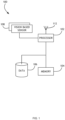
- the system 100 includes a processor 102, memory 104 in data communication with the processor 102 for storing processor executable code, and one or more eye tracking sensors / cameras 108 for receiving eye tracking data stream.
- the processor executable code configures the processor 102 to continuously receives images from the one or more eye tracking sensors / cameras 108 and performs eye tracking processes, pupil dynamics recognition, eyelid position recognition, and other pose estimations specific to eye tracking.
- the processor 102 identifies geometric relationships to eye features for accurate feature extraction. By classifying different eye features according to basic geometric relationships, machine learning algorithms may be employed for rapid pose estimation. Geometric features that may be associated with eye features may include, for example, ellipses associated with the pupil, ellipses or arcs associated with the iris, abstract lines and shapes generally defined by blood vessels, or the like.
- the relationships between eye features and fundamental geometries may be defined and stored in a data storage device.
- the definitions of such relationships may be created or refined via training of a machine learning algorithm based on data received from the one or more eye tracking sensors / cameras 108.
- the processor 102 may identify shifting geometry over time. For example, relative changes between an ellipse defined by the pupil and arcs defined by the iris may be associated with changing pose estimation.
- basic geometric relationships may be applied to support contrast enhancement, image cropping, understanding of distortion on the image appearance and characterization of eye features, and determination of baseline feature appearance for a given subject.
- the one or more eye tracking sensors / cameras 108 may comprise neuromorphic (event) cameras.
- the processor 102 may utilize basic geometric relationships to identify eye features from shifts in the event camera data stream. For example, shifts in the position of a user's pupil may be represented as a shifting boundary between the pupil and iris as seem from the event camera; the shifting boundary may be modeled as a change to basic geometric shape in a plane.
- the processor 108 may log the eye tracking data in a data storage element 106.
- the processor 102 analyzes the eye tracking data to generate / identify basic geometric shapes and model eye movement and pupil dynamics. Identifying relationships between eye features and basic geometric shapes may support pre-processing, filtering, and ultimately classification of different eye features for more accurate feature extraction and fatigue monitoring. Such processes may also support adaptations for different subjects based on observed relationships between different eye features which provides insight as features change over time or in response to increasing fatigue.
- Fatigue estimation offers insights into pilot state to support safe aircraft operation. By extracting eye features that can then be mapped to a fatigue estimate, fatigue monitoring is faster and more accurate.
- the processor 102 may correlate eye tracking data with discrete portions of a training scenario / task that may be defined by a set of steps stored in the data storage element 106.
- the processor 102 may define metrics for each step that can be characterized via the eye tracking data with respect to the basic geometric shapes.
- the processor 102 transfers the stored eye tracking data and other correlated system and task data to an offline storage device for later analysis and correlation to historic data and other outside factors such as crew rest, crew sleep rhythms, flight schedules, etc. Such transfer may be in real time via the wireless communication device 112.
- a computer system implementing embodiments of the inventive concepts disclosed herein receives 200 an image stream from one or more vision-based sensors disposed to capture a user's eye.
- Basic geometric shapes are identified 202 in the image stream, and the basic geometric shapes are associated 204 with eye features. Such association may be a defined algorithm or some trained machine learning algorithm. It may be appreciated that basic geometric shapes may be generally defined (generally applicable to all users, such as ellipses associated with a user's pupil) and / or specific to the user (such as shapes defined by a specific user's blood vessels).
- basic geometric shapes may be identified from events in an event camera stream. Changes in eye features may be generally represented by edges and surfaces that can be closely correlated to such basic geometric shapes.
- the computer system uses the basic geometric shapes to generate 206 a pose estimate of the user's eye.
- Basic geometric shapes may allow for quicker, more accurate pose estimates.
- the computer system may utilize the pose estimate for fatigue monitoring 210.
- the computer system may also receive 208 certain task specific data that can be correlated to the eye tracking data for fatigue monitoring such as through a trained machine learning algorithm.
- the neural network 300 comprises an input layer 302 that receives external inputs (including eye tracking data, avionics data, and potentially user or task specific profiles), an output layer 304, and a plurality of internal layers 306, 308. Each layer comprises a plurality of neurons or nodes 310, 336, 338, 340.
- each node 310 receives one or more inputs 318, 320, 322, 324 corresponding to a digital signal and produces an output 312 based on an activation function unique to each node 310 in the input layer 302.
- An activation function may be a Hyperbolic tangent function, a linear output function, and / or a logistic function, or some combination thereof, and different nodes 310, 336, 338, 340 may utilize different types of activation functions.
- such activation function comprises the sum of each input multiplied by a synaptic weight.
- the output 312 may comprise a real value with a defined range or a Boolean value if the activation function surpasses a defined threshold. Such ranges and thresholds may be defined during a training process. Furthermore, the synaptic weights are determined during the training process.
- synaptic weights are determined, at least in part, from training data derived from actual eye tracking data recorded during a training scenario or task.
- the eye tracking data is correlated to the task, and potentially to deviations from predefined expected movements.
- synaptic weights are iteratively computed and tested against separate data sets.
Landscapes
- Engineering & Computer Science (AREA)
- Health & Medical Sciences (AREA)
- Physics & Mathematics (AREA)
- Life Sciences & Earth Sciences (AREA)
- General Health & Medical Sciences (AREA)
- Theoretical Computer Science (AREA)
- General Physics & Mathematics (AREA)
- Computer Vision & Pattern Recognition (AREA)
- Oral & Maxillofacial Surgery (AREA)
- Biophysics (AREA)
- Multimedia (AREA)
- Veterinary Medicine (AREA)
- Public Health (AREA)
- Psychiatry (AREA)
- Animal Behavior & Ethology (AREA)
- Human Computer Interaction (AREA)
- Surgery (AREA)
- Biomedical Technology (AREA)
- Heart & Thoracic Surgery (AREA)
- Medical Informatics (AREA)
- Molecular Biology (AREA)
- Pathology (AREA)
- Educational Technology (AREA)
- Developmental Disabilities (AREA)
- Psychology (AREA)
- Hospice & Palliative Care (AREA)
- Artificial Intelligence (AREA)
- Child & Adolescent Psychology (AREA)
- Social Psychology (AREA)
- General Engineering & Computer Science (AREA)
- Ophthalmology & Optometry (AREA)
- Aviation & Aerospace Engineering (AREA)
- Signal Processing (AREA)
- Physiology (AREA)
- Mathematical Physics (AREA)
- Optics & Photonics (AREA)
- Fuzzy Systems (AREA)
- Evolutionary Computation (AREA)
- Geometry (AREA)
- Image Analysis (AREA)
Abstract
A computer system records eye tracking data and identifies movements in the eye tracking data to create and iteratively refine associations between eye features and basic geometric shapes. The associations are used to rapidly identify eye features for eye tracking. The system derives performance metrics and fatigue estimations from the identified basic geometric shapes, including changes in such shapes over time. The system continuously adjusts and / or weights the associations in real-time based on eye tracking data.
Description
- Fatigue estimation offers insights into a pilot's mental state and can facilitate safe aircraft operation. By extracting eye features that can then be mapped to a fatigue estimate, a pilot monitoring system can implement fatigue monitoring. However, such mapping is based on good models of eye features. Consequently, it would be advantageous if an improved apparatus existed that is suitable for creating and implementing geometric models of eye features for eye tracking and pilot fatigue monitoring.
- In one aspect, embodiments of the inventive concepts disclosed herein are directed to a computer system that records eye tracking data. The system identifies movements in the eye tracking data to create and iteratively refine associations between eye features and basic geometric shapes. The associations are used to rapidly identify eye features for eye tracking.
- In a further aspect, the system derives performance metrics and fatigue estimations from the identified basic geometric shapes, including changes in such shapes over time.
- In a further aspect, the system continuously adjusts and / or weights the associations in real-time based on eye tracking data.
- It is to be understood that both the foregoing general description and the following detailed description are exemplary and explanatory only and should not restrict the scope of the claims. The accompanying drawings, which are incorporated in and constitute a part of the specification, illustrate exemplary embodiments of the inventive concepts disclosed herein and together with the general description, serve to explain the principles.
- The numerous advantages of the embodiments of the inventive concepts disclosed herein may be better understood by those skilled in the art by reference to the accompanying figures in which:
- FIG. 1
- shows a block diagram of a system suitable for implementing embodiments of the incentive concepts disclosed herein;
- FIG. 2
- shows a flowchart of an exemplary embodiment of the inventive concepts disclosed herein; and
- FIG. 3
- shows a block diagram of a neural network according an exemplary embodiment of the inventive concepts disclosed herein.
- Before explaining at least one embodiment of the inventive concepts disclosed herein in detail, it is to be understood that the inventive concepts are not limited in their application to the details of construction and the arrangement of the components or steps or methodologies set forth in the following description or illustrated in the drawings. In the following detailed description of embodiments of the instant inventive concepts, numerous specific details are set forth in order to provide a more thorough understanding of the inventive concepts. However, it will be apparent to one of ordinary skill in the art having the benefit of the instant disclosure that the inventive concepts disclosed herein may be practiced without these specific details. In other instances, well-known features may not be described in detail to avoid unnecessarily complicating the instant disclosure. The inventive concepts disclosed herein are capable of other embodiments or of being practiced or carried out in various ways. Also, it is to be understood that the phraseology and terminology employed herein is for the purpose of description and should not be regarded as limiting.
- As used herein a letter following a reference numeral is intended to reference an embodiment of the feature or element that may be similar, but not necessarily identical, to a previously described element or feature bearing the same reference numeral (e.g., 1, 1a, 1b). Such shorthand notations are used for purposes of convenience only, and should not be construed to limit the inventive concepts disclosed herein in any way unless expressly stated to the contrary.
- Further, unless expressly stated to the contrary, "or" refers to an inclusive or and not to an exclusive or. For example, a condition A or B is satisfied by anyone of the following: A is true (or present) and B is false (or not present), A is false (or not present) and B is true (or present), and both A and B are true (or present).
- In addition, use of the "a" or "an" are employed to describe elements and components of embodiments of the instant inventive concepts. This is done merely for convenience and to give a general sense of the inventive concepts, and "a' and "an" are intended to include one or at least one and the singular also includes the plural unless it is obvious that it is meant otherwise.
- Finally, as used herein any reference to "one embodiment," or "some embodiments" means that a particular element, feature, structure, or characteristic described in connection with the embodiment is included in at least one embodiment of the inventive concepts disclosed herein. The appearances of the phrase "in some embodiments" in various places in the specification are not necessarily all referring to the same embodiment, and embodiments of the inventive concepts disclosed may include one or more of the features expressly described or inherently present herein, or any combination of sub-combination of two or more such features, along with any other features which may not necessarily be expressly described or inherently present in the instant disclosure.
- Broadly, embodiments of the inventive concepts disclosed herein are directed to a computer system that records eye tracking data. The system identifies movements in the eye tracking data to create and iteratively refine associations between eye features and basic geometric shapes. The associations are used to rapidly identify eye features for eye tracking. The system derives performance metrics and fatigue estimations from the identified basic geometric shapes, including changes in such shapes over time. The system continuously adjusts and / or weights the associations in real-time based on eye tracking data.
- Referring to
FIG. 1 , a block diagram of asystem 100 suitable for implementing embodiments of the inventive concepts disclosed herein is shown. Thesystem 100 includes aprocessor 102,memory 104 in data communication with theprocessor 102 for storing processor executable code, and one or more eye tracking sensors /cameras 108 for receiving eye tracking data stream. The processor executable code configures theprocessor 102 to continuously receives images from the one or more eye tracking sensors /cameras 108 and performs eye tracking processes, pupil dynamics recognition, eyelid position recognition, and other pose estimations specific to eye tracking. - In at least one embodiment, the
processor 102 identifies geometric relationships to eye features for accurate feature extraction. By classifying different eye features according to basic geometric relationships, machine learning algorithms may be employed for rapid pose estimation. Geometric features that may be associated with eye features may include, for example, ellipses associated with the pupil, ellipses or arcs associated with the iris, abstract lines and shapes generally defined by blood vessels, or the like. - In at least one embodiment, the relationships between eye features and fundamental geometries may be defined and stored in a data storage device. The definitions of such relationships may be created or refined via training of a machine learning algorithm based on data received from the one or more eye tracking sensors /
cameras 108. - In at least one embodiment, where the relationship between basic geometry and eye features is well defined, the
processor 102 may identify shifting geometry over time. For example, relative changes between an ellipse defined by the pupil and arcs defined by the iris may be associated with changing pose estimation. - In at least one embodiment, basic geometric relationships may be applied to support contrast enhancement, image cropping, understanding of distortion on the image appearance and characterization of eye features, and determination of baseline feature appearance for a given subject.
- In at least one embodiment, the one or more eye tracking sensors /
cameras 108 may comprise neuromorphic (event) cameras. Theprocessor 102 may utilize basic geometric relationships to identify eye features from shifts in the event camera data stream. For example, shifts in the position of a user's pupil may be represented as a shifting boundary between the pupil and iris as seem from the event camera; the shifting boundary may be modeled as a change to basic geometric shape in a plane. - The
processor 108 may log the eye tracking data in adata storage element 106. Theprocessor 102 analyzes the eye tracking data to generate / identify basic geometric shapes and model eye movement and pupil dynamics. Identifying relationships between eye features and basic geometric shapes may support pre-processing, filtering, and ultimately classification of different eye features for more accurate feature extraction and fatigue monitoring. Such processes may also support adaptations for different subjects based on observed relationships between different eye features which provides insight as features change over time or in response to increasing fatigue. - Fatigue estimation offers insights into pilot state to support safe aircraft operation. By extracting eye features that can then be mapped to a fatigue estimate, fatigue monitoring is faster and more accurate.
- In at least one embodiment, the
processor 102 may correlate eye tracking data with discrete portions of a training scenario / task that may be defined by a set of steps stored in thedata storage element 106. Theprocessor 102 may define metrics for each step that can be characterized via the eye tracking data with respect to the basic geometric shapes. - In at least one embodiment, the
processor 102 transfers the stored eye tracking data and other correlated system and task data to an offline storage device for later analysis and correlation to historic data and other outside factors such as crew rest, crew sleep rhythms, flight schedules, etc. Such transfer may be in real time via thewireless communication device 112. - Referring to
FIG. 2 , a flowchart of an exemplary embodiment of the inventive concepts disclosed herein is shown. A computer system implementing embodiments of the inventive concepts disclosed herein receives 200 an image stream from one or more vision-based sensors disposed to capture a user's eye. Basic geometric shapes are identified 202 in the image stream, and the basic geometric shapes are associated 204 with eye features. Such association may be a defined algorithm or some trained machine learning algorithm. It may be appreciated that basic geometric shapes may be generally defined (generally applicable to all users, such as ellipses associated with a user's pupil) and / or specific to the user (such as shapes defined by a specific user's blood vessels). - In at least one embodiment, basic geometric shapes may be identified from events in an event camera stream. Changes in eye features may be generally represented by edges and surfaces that can be closely correlated to such basic geometric shapes.
- The computer system uses the basic geometric shapes to generate 206 a pose estimate of the user's eye. Basic geometric shapes may allow for quicker, more accurate pose estimates. The computer system may utilize the pose estimate for
fatigue monitoring 210. In at least one embodiment, the computer system may also receive 208 certain task specific data that can be correlated to the eye tracking data for fatigue monitoring such as through a trained machine learning algorithm. - Referring to
FIG. 3 , a block diagram of aneural network 300 embodying a pre-processing algorithm associating eye features to basic geometric shapes according an exemplary embodiment of the inventive concepts disclosed herein is shown. Theneural network 300 comprises aninput layer 302 that receives external inputs (including eye tracking data, avionics data, and potentially user or task specific profiles), anoutput layer 304, and a plurality ofinternal layers nodes input layer 302, eachnode 310 receives one ormore inputs output 312 based on an activation function unique to eachnode 310 in theinput layer 302. An activation function may be a Hyperbolic tangent function, a linear output function, and / or a logistic function, or some combination thereof, anddifferent nodes output 312 may comprise a real value with a defined range or a Boolean value if the activation function surpasses a defined threshold. Such ranges and thresholds may be defined during a training process. Furthermore, the synaptic weights are determined during the training process. - Within the context of the present application, synaptic weights are determined, at least in part, from training data derived from actual eye tracking data recorded during a training scenario or task. The eye tracking data is correlated to the task, and potentially to deviations from predefined expected movements. During training, synaptic weights are iteratively computed and tested against separate data sets.
- It is believed that the inventive concepts disclosed herein and many of their attendant advantages will be understood by the foregoing description of embodiments of the inventive concepts disclosed, and it will be apparent that various changes may be made in the form, construction, and arrangement of the components thereof without departing from the broad scope of the inventive concepts disclosed herein or without sacrificing all of their material advantages; and individual features from various embodiments may be combined to arrive at other embodiments. The form herein before described being merely an explanatory embodiment thereof, it is the intention of the following claims to encompass and include such changes. Furthermore, any of the features disclosed in relation to any of the individual embodiments may be incorporated into any other embodiment.
Claims (15)
- A computer apparatus comprising:at least one eye tracking camera (108); andat least one processor (102) in data communication with a memory storing processor executable code,wherein the processor executable code configures the at least one processor (102) to:receive an image stream from the at least one eye tracking camera;identify a plurality of basic geometric shapes in the image stream; andgenerate a pose estimate from the plurality of basic geometric shapes.
- The computer apparatus of Claim 1, wherein the processor executable code further configures the at least one processor (102) to generate a fatigue estimate based on the pose estimate.
- The computer apparatus of Claim 2, wherein:the processor executable code further configures the at least one processor (102) to receive task specific data; andgenerating the fatigue estimate is based on the task specific data.
- The computer apparatus of Claim 3, wherein the at least one processor (102) is configured as a trained neural network configured to receive the basic geometric shapes and task specific data as inputs.
- The computer apparatus of any preceding Claim, wherein the at least one eye tracking camera comprises a neuromorphic event camera, and optionally wherein the basic geometric shapes are defined by at least an interface between eye features.
- The computer apparatus of any preceding Claim, wherein the processor executable code further configures the at least one processor (102) to record the image stream and basic geometric shapes in a training set of data for a machine learning algorithm.
- A method comprising:receiving an image stream from at least one eye tracking camera;identifying a plurality of basic geometric shapes in the image stream; andgenerating a pose estimate from the plurality of basic geometric shapes.
- The method of Claim 7, further comprising generating a fatigue estimate based on the pose estimate.
- The method of Claim 8, further comprising receiving task specific data, wherein generating the fatigue estimate is based on the task specific data, and optionally further comprising instantiating a trained neural network configured to receive the basic geometric shapes and task specific data as inputs.
- The method of Claim 7, wherein the at least one eye tracking camera comprises a neuromorphic event camera, and optionally wherein the basic geometric shapes are defined by at least an interface between eye features.
- The method of Claim 7, further comprising recording the image stream and basic geometric shapes in a training set of data for a machine learning algorithm.
- A pilot fatigue monitoring system comprising:at least one eye tracking camera; andat least one processor (102) in data communication with a memory storing processor executable code,wherein the processor executable code configures the at least one processor (102) to:receive an image stream from the at least one eye tracking camera;identify a plurality of basic geometric shapes in the image stream;generate a pose estimate from the plurality of basic geometric shapes; andgenerate a fatigue estimate based on the pose estimate.
- The pilot fatigue monitoring system of Claim 12, wherein:the processor executable code further configures the at least one processor (102) to receive task specific data; andgenerating the fatigue estimate is based on the task specific data, and optionally wherein the at least one processor (102) is configured as a trained neural network configured to receive the basic geometric shapes and task specific data as inputs.
- The pilot fatigue monitoring system of Claim 12, wherein the at least one eye tracking camera comprises a neuromorphic event camera, and optionally wherein the basic geometric shapes are defined by at least an interface between eye features.
- The pilot fatigue monitoring system of Claim 12, wherein the processor executable code further configures the at least one processor (102) to record the image stream and basic geometric shapes in a training set of data for a machine learning algorithm.
Applications Claiming Priority (1)
| Application Number | Priority Date | Filing Date | Title |
|---|---|---|---|
| US18/216,968 US12573081B2 (en) | 2023-06-30 | 2023-06-30 | Online correction for context-aware image analysis for object classification |
Publications (1)
| Publication Number | Publication Date |
|---|---|
| EP4485392A1 true EP4485392A1 (en) | 2025-01-01 |
Family
ID=91581022
Family Applications (1)
| Application Number | Title | Priority Date | Filing Date |
|---|---|---|---|
| EP24182291.5A Pending EP4485392A1 (en) | 2023-06-30 | 2024-06-14 | Estimation of pose and physical state of a person based on eye tracking in image streams |
Country Status (2)
| Country | Link |
|---|---|
| US (1) | US12573081B2 (en) |
| EP (1) | EP4485392A1 (en) |
Citations (2)
| Publication number | Priority date | Publication date | Assignee | Title |
|---|---|---|---|---|
| US20170119298A1 (en) * | 2014-09-02 | 2017-05-04 | Hong Kong Baptist University | Method and Apparatus for Eye Gaze Tracking and Detection of Fatigue |
| US20220366874A1 (en) * | 2019-10-17 | 2022-11-17 | Microsoft Technology Licensing, Llc | Eye gaze control of magnification user interface |
Family Cites Families (13)
| Publication number | Priority date | Publication date | Assignee | Title |
|---|---|---|---|---|
| US20050137586A1 (en) | 2003-12-23 | 2005-06-23 | Gray Gary P. | Hybrid eye tracking system and associated methods |
| US20100292545A1 (en) * | 2009-05-14 | 2010-11-18 | Advanced Brain Monitoring, Inc. | Interactive psychophysiological profiler method and system |
| AU2015255652B2 (en) * | 2014-05-09 | 2018-03-29 | Google Llc | Systems and methods for using eye signals with secure mobile communications |
| IL312096A (en) * | 2016-09-13 | 2024-06-01 | Magic Leap Inc | Sensory glasses |
| US11249544B2 (en) * | 2016-11-21 | 2022-02-15 | TeleLingo | Methods and systems for using artificial intelligence to evaluate, correct, and monitor user attentiveness |
| US10467488B2 (en) * | 2016-11-21 | 2019-11-05 | TeleLingo | Method to analyze attention margin and to prevent inattentive and unsafe driving |
| CN110419018B (en) * | 2016-12-29 | 2023-08-04 | 奇跃公司 | Automatic control of wearable display devices based on external conditions |
| GB201709199D0 (en) | 2017-06-09 | 2017-07-26 | Delamont Dean Lindsay | IR mixed reality and augmented reality gaming system |
| WO2019104413A1 (en) * | 2017-12-03 | 2019-06-06 | Frank Jones | Enhancing the performance of near-to-eye vision systems |
| CN112106066A (en) * | 2018-03-16 | 2020-12-18 | 奇跃公司 | Facial expression from eye tracking camera |
| WO2020044180A2 (en) * | 2018-08-31 | 2020-03-05 | Eyeware Tech Sa | Method and system for gaze estimation |
| JP7542563B2 (en) * | 2019-07-05 | 2024-08-30 | マジック リープ, インコーポレイテッド | Eye tracking latency improvement |
| US20220108788A1 (en) * | 2020-10-02 | 2022-04-07 | Ethicon Llc | Reconfiguration of display sharing |
-
2023
- 2023-06-30 US US18/216,968 patent/US12573081B2/en active Active
-
2024
- 2024-06-14 EP EP24182291.5A patent/EP4485392A1/en active Pending
Patent Citations (2)
| Publication number | Priority date | Publication date | Assignee | Title |
|---|---|---|---|---|
| US20170119298A1 (en) * | 2014-09-02 | 2017-05-04 | Hong Kong Baptist University | Method and Apparatus for Eye Gaze Tracking and Detection of Fatigue |
| US20220366874A1 (en) * | 2019-10-17 | 2022-11-17 | Microsoft Technology Licensing, Llc | Eye gaze control of magnification user interface |
Also Published As
| Publication number | Publication date |
|---|---|
| US12573081B2 (en) | 2026-03-10 |
| US20250005785A1 (en) | 2025-01-02 |
Similar Documents
| Publication | Publication Date | Title |
|---|---|---|
| Mukhopadhyay et al. | Facial emotion detection to assess learner's state of mind in an online learning system | |
| Yang et al. | An emotion recognition model based on facial recognition in virtual learning environment | |
| US11769056B2 (en) | Synthetic data for neural network training using vectors | |
| Lu et al. | Blob analysis of the head and hands: A method for deception detection | |
| Kollias et al. | On line emotion detection using retrainable deep neural networks | |
| Gunawan | Face expression detection on Kinect using active appearance model and fuzzy logic | |
| KR101697476B1 (en) | Method for recognizing continuous emotion for robot by analyzing facial expressions, recording medium and device for performing the method | |
| Juang et al. | An interval type-2 neural fuzzy classifier learned through soft margin minimization and its human posture classification application | |
| Valstar et al. | Biologically vs. logic inspired encoding of facial actions and emotions in video | |
| CN107633207A (en) | AU characteristic recognition methods, device and storage medium | |
| US20240144151A1 (en) | Intuitive ai-powered worker productivity and safety | |
| CN114254758A (en) | Domain adaptation | |
| AU2021279033A1 (en) | Method, non-transitory computer-readable storage medium, and apparatus for searching an image database | |
| CN110110631A (en) | It is a kind of to identify the method and apparatus made a phone call | |
| Krithika et al. | MAFONN-EP: a minimal angular feature oriented neural network based emotion prediction system in image processing | |
| EP4485146A1 (en) | Physiology based bio-kinematics modeling for segmentation model unsupervised feedback | |
| US12573081B2 (en) | Online correction for context-aware image analysis for object classification | |
| US20200175710A1 (en) | Body modeling using mobile device | |
| KR20190023749A (en) | Apparatus and method for emotion recognition of user | |
| Bhakt et al. | A novel framework for real and fake smile detection from videos | |
| US20220409128A1 (en) | Body fat prediction and body modeling using mobile device | |
| Nudin et al. | Multi task classification using deep learning approaches for Big Five personality traits prediction: a review | |
| Morshed et al. | Customer’s spontaneous facial expression recognition | |
| Kulkarni et al. | Can you all look here? Towards determining gaze uniformity in group images | |
| Rajasekaran et al. | Content restricting age predictor system using artificial intelligence |
Legal Events
| Date | Code | Title | Description |
|---|---|---|---|
| PUAI | Public reference made under article 153(3) epc to a published international application that has entered the european phase |
Free format text: ORIGINAL CODE: 0009012 |
|
| STAA | Information on the status of an ep patent application or granted ep patent |
Free format text: STATUS: THE APPLICATION HAS BEEN PUBLISHED |
|
| AK | Designated contracting states |
Kind code of ref document: A1 Designated state(s): AL AT BE BG CH CY CZ DE DK EE ES FI FR GB GR HR HU IE IS IT LI LT LU LV MC ME MK MT NL NO PL PT RO RS SE SI SK SM TR |
|
| STAA | Information on the status of an ep patent application or granted ep patent |
Free format text: STATUS: REQUEST FOR EXAMINATION WAS MADE |
|
| 17P | Request for examination filed |
Effective date: 20250701 |