EP4485388A1 - Image processing apparatus, image processing method, and program - Google Patents
Image processing apparatus, image processing method, and program Download PDFInfo
- Publication number
- EP4485388A1 EP4485388A1 EP24184452.1A EP24184452A EP4485388A1 EP 4485388 A1 EP4485388 A1 EP 4485388A1 EP 24184452 A EP24184452 A EP 24184452A EP 4485388 A1 EP4485388 A1 EP 4485388A1
- Authority
- EP
- European Patent Office
- Prior art keywords
- person
- action
- correction
- information
- likelihood
- Prior art date
- Legal status (The legal status is an assumption and is not a legal conclusion. Google has not performed a legal analysis and makes no representation as to the accuracy of the status listed.)
- Pending
Links
Images






Classifications
-
- G—PHYSICS
- G06—COMPUTING OR CALCULATING; COUNTING
- G06V—IMAGE OR VIDEO RECOGNITION OR UNDERSTANDING
- G06V20/00—Scenes; Scene-specific elements
- G06V20/50—Context or environment of the image
- G06V20/52—Surveillance or monitoring of activities, e.g. for recognising suspicious objects
-
- G—PHYSICS
- G06—COMPUTING OR CALCULATING; COUNTING
- G06T—IMAGE DATA PROCESSING OR GENERATION, IN GENERAL
- G06T7/00—Image analysis
- G06T7/70—Determining position or orientation of objects or cameras
-
- G—PHYSICS
- G06—COMPUTING OR CALCULATING; COUNTING
- G06V—IMAGE OR VIDEO RECOGNITION OR UNDERSTANDING
- G06V40/00—Recognition of biometric, human-related or animal-related patterns in image or video data
- G06V40/20—Movements or behaviour, e.g. gesture recognition
-
- G—PHYSICS
- G06—COMPUTING OR CALCULATING; COUNTING
- G06T—IMAGE DATA PROCESSING OR GENERATION, IN GENERAL
- G06T7/00—Image analysis
- G06T7/20—Analysis of motion
- G06T7/246—Analysis of motion using feature-based methods, e.g. the tracking of corners or segments
-
- G—PHYSICS
- G06—COMPUTING OR CALCULATING; COUNTING
- G06V—IMAGE OR VIDEO RECOGNITION OR UNDERSTANDING
- G06V10/00—Arrangements for image or video recognition or understanding
- G06V10/20—Image preprocessing
- G06V10/26—Segmentation of patterns in the image field; Cutting or merging of image elements to establish the pattern region, e.g. clustering-based techniques; Detection of occlusion
-
- G—PHYSICS
- G06—COMPUTING OR CALCULATING; COUNTING
- G06V—IMAGE OR VIDEO RECOGNITION OR UNDERSTANDING
- G06V10/00—Arrangements for image or video recognition or understanding
- G06V10/70—Arrangements for image or video recognition or understanding using pattern recognition or machine learning
- G06V10/762—Arrangements for image or video recognition or understanding using pattern recognition or machine learning using clustering, e.g. of similar faces in social networks
- G06V10/763—Non-hierarchical techniques, e.g. based on statistics of modelling distributions
-
- G—PHYSICS
- G06—COMPUTING OR CALCULATING; COUNTING
- G06V—IMAGE OR VIDEO RECOGNITION OR UNDERSTANDING
- G06V10/00—Arrangements for image or video recognition or understanding
- G06V10/70—Arrangements for image or video recognition or understanding using pattern recognition or machine learning
- G06V10/82—Arrangements for image or video recognition or understanding using pattern recognition or machine learning using neural networks
-
- G—PHYSICS
- G06—COMPUTING OR CALCULATING; COUNTING
- G06V—IMAGE OR VIDEO RECOGNITION OR UNDERSTANDING
- G06V40/00—Recognition of biometric, human-related or animal-related patterns in image or video data
- G06V40/10—Human or animal bodies, e.g. vehicle occupants or pedestrians; Body parts, e.g. hands
-
- G—PHYSICS
- G06—COMPUTING OR CALCULATING; COUNTING
- G06V—IMAGE OR VIDEO RECOGNITION OR UNDERSTANDING
- G06V40/00—Recognition of biometric, human-related or animal-related patterns in image or video data
- G06V40/20—Movements or behaviour, e.g. gesture recognition
- G06V40/23—Recognition of whole body movements, e.g. for sport training
-
- G—PHYSICS
- G06—COMPUTING OR CALCULATING; COUNTING
- G06T—IMAGE DATA PROCESSING OR GENERATION, IN GENERAL
- G06T2207/00—Indexing scheme for image analysis or image enhancement
- G06T2207/30—Subject of image; Context of image processing
- G06T2207/30196—Human being; Person
Definitions
- the present disclosure relates to a technique for action recognition.
- a posture estimation technique and an action recognition technique have been developed.
- positions of organs, such as joint points, eyes, and ears, of a person in an image can be detected by using a convolutional neural network (CNN) using the image as an input.
- actions can be classified by using the CNN using, as inputs, positions of the organs detected with the posture estimation technique.
- the action recognition technique is used for, for example, purchase analysis in a store and detection of a fallen person in a hospital and the like.
- an organ is occluded by an object, such as a shelf, image features of the organ cannot be acquired. Thus, accuracy of posture estimation may be degraded.
- the present disclosure is made in consideration of the above-described issues.
- the present disclosure is directed to a technique for preventing an output of an incorrect action recognition as a result of action recognition using posture estimation.
- an image processing apparatus as specified in claim 1.
- Optional features of the first aspect are presented in claims 2 to 10.
- an image processing method as specified in claim 11.
- a program as specified in claim 12.
- Optional features of the second aspect and the third aspect are presented in or derivable from claims 2 to 10.
- an image processing apparatus that estimates a posture of a person in an image acquired by an installed imaging apparatus (camera) and estimates an action of the person based on a result of the posture estimation as an example of action recognition.
- the image processing apparatus determines a state of the person based on the result of the posture estimation, and changes (corrects) information indicating an estimated action of the person based on a determination result.
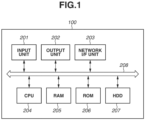
- Fig. 1 is a diagram illustrating a hardware configuration of an image processing apparatus 100 according to the present embodiment.
- the image processing apparatus 100 includes an input unit 201, an output unit 202, a network interface (I/F) unit 203, a central processing unit (CPU) 204, a random access memory (RAM) 205, a read only memory (ROM) 206, a hard disk drive (HDD) 207, and a data bus 208.
- I/F network interface
- CPU central processing unit
- RAM random access memory
- ROM read only memory
- HDD hard disk drive
- the CPU 204 reads out control computer programs stored in the ROM 206 and/or the HDD 207 and loads the programs to the RAM 205 to perform various types of processing.
- the RAM 205 is used as a storage area temporarily storing programs to be executed by the CPU 204, a work memory, and the like.
- the network I/F unit 203 transmits/receives various types of information between the image processing apparatus 100 and another apparatus through the Internet or other network. Data received from an external apparatus through the network I/F unit 203 is transmitted to or received from the CPU 204, the RAM 205, and the ROM 206 through the data bus 208.
- the HDD 207 stores image data, setting parameters, various types of programs, and the like. The HDD 207 can receive data from an external apparatus through the network I/F unit 203.
- the input unit 201 is an input device, such as a keyboard, a mouse, and/or a touch panel.
- the output unit 202 is a device that outputs information. Examples of the output unit 202 include a display device, such as a liquid crystal display, and an audio output device, such as a speaker.
- the input unit 201 and the output unit 202 are also connected to the data bus 208.
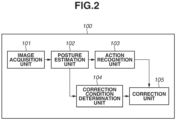
- Fig. 2 is a diagram illustrating a functional configuration of the image processing apparatus 100 according to the present embodiment.
- the image processing apparatus 100 includes an image acquisition unit 101, a posture estimation unit 102, an action recognition unit 103, a correction condition determination unit 104, and a correction unit 105.
- the image acquisition unit 101 acquires an image.
- the image acquired by the image acquisition unit 101 may be an image acquired through imaging by a network camera or the like, or an image recorded in a storage device, such as a hard disk.
- the image acquired by the image acquisition unit 101 may be received through a network such as the Internet.
- the image acquired by the image acquisition unit 101 is transmitted to the posture estimation unit 102.
- the posture estimation unit 102 detects organs of a person in the image, and specifies positions of the detected organs.
- the organs are, for example, parts (joint points) such as eyes, a nose, ears, shoulders, elbows, wrists, hips, knees, and ankles of the person.
- the organs may be considered as parts of the body.
- the parts of the body may include sense organs, such as eyes, nose, ears, or joint points, such as shoulders, elbows, wrists, hips, knees or ankles.
- the posture estimation unit 102 acquires posture estimation information based on the specified positions of the organs.
- the posture estimation information includes organ position coordinates that are positional information indicating positions of the organs, and an organ detection likelihood indicating a likelihood for the position of each of the organs.
- the organ detection likelihood is likelihood information indicating a likelihood for the position of each of the organs detected by the posture estimation unit 102.
- the organ detection likelihood can be restated as information indicating reliability, accuracy, or certainty
- the posture estimation information includes at least one of a person rectangle enclosing an area of a person in the image and a detection likelihood for the person rectangle.
- the posture estimation information includes a full-body rectangle enclosing a full body of a person including a portion invisible in the image and a full-body detection likelihood.
- the person rectangle and the full-body rectangle are information enabling identification of the areas including the full-body of the person, and the shapes thereof are not limited to the rectangles.
- the person rectangle may be considered a person bounding box which bounds the person in any shape.
- the full-body rectangle may be considered a full-body bounding box which bounds the full-body of the person in any shape.
- the posture estimation information includes an identifier of the person.
- the identifier of the person may be a scalar value indicating the same person among frames. For example, in a case where an identifier 1 is assigned to a person A in one of image frames continuously captured by the imaging apparatus, the identifier 1 is assigned to the person A in a next frame, to indicate the same person.
- the information included in the posture estimation information is not limited to the above-described information, and the posture estimation information may include information other than the above-described information, or may include optional information out of the above-described information.
- the posture estimation information according to the present embodiment at least includes the organ posture coordinates.
- the posture estimation unit 102 determines coordinates of a center, a width, a height, and the detection likelihood for the person rectangle by using a convolutional neural network (CNN) with an image as an input, as discussed in J. Redmon, "You Only Look Once: Unified, Real-Time Object Detection", CVPR2015.
- CNN convolutional neural network
- Coordinates of a center, a width, and a height of the full-body rectangle, and the full-body detection likelihood are also determined by a method discussed in J. Redmon, "You Only Look Once: Unified, Real-Time Object Detection", CVPR2015., by replacing training data in the CNN with the full-body rectangle.
- the posture estimation unit 102 determines the organ position coordinates and the organ detection likelihood for the person rectangle by using the CNN with, as an input, an image extracted from the image based on information about the person rectangle, as discussed in K. Sun, "Deep High-Resolution Representation Learning for Human Pose Estimation", CVPR2019 .
- the posture estimation unit 102 determines a feature amount for re-collating a person among the frames, by using the CNN with, as an input, an image extracted from an image based on the information about the person rectangle, as discussed in Y. Zhang, "FairMOT: On the Fairness of Detection and Re-Identification in Multiple Object Tracking", IJCV2021 .
- the posture estimation unit 102 assigns the identifier to the person by re-collating the person among the frames.
- Fig. 3 illustrates an example of the posture estimation information for the image. Posture estimation processing is applied to the image, thus obtaining a person rectangle 301, organ position coordinates 302, and a person identifier 303. In the example illustrated in Fig. 3 , the person identifier is "1".
- the posture estimation unit 102 transmits the posture estimation information to the action recognition unit 103 and the correction condition determination unit 104.
- the action recognition unit 103 estimates an action of a person with the posture estimation information as an input, and generates information indicating the estimated action.
- the action recognition unit 103 determines an action based on the information indicating the estimated action, to be a result of action recognition of the person in the image.
- the information indicating an action includes an action label indicating an action of the person, and an action likelihood for the action label.
- One or more action labels are previously defined in correspondence, i.e. in relation, to actions to be recognized.
- the action labels may be predefined, i.e. specified, for a particular action.
- the image processing apparatus 100 recognizes a falling action of a person. Thus, in the present embodiment, an action label "falling" is defined.
- the action likelihood is likelihood information indicating a likelihood (reliability) of the estimated action of the person.
- the action likelihood is represented by a value from 0 to 1, and indicates higher possibility of the action as the value is closer to 1.
- the action label is illustrative, and another action may be defined as the action label. Two or more actions may be defined as action labels.
- the action recognition unit 103 recognizes an action based on time-series change in organ position determined from the organ position coordinates of the person in a plurality of image frames, as discussed in F. Yang, "Make Skeleton-based Action Recognition Model Smaller, Faster and Better", CVPR2019.
- action recognition processing is applied to the image illustrated in Fig. 3 to generate, as a value of 0.98 or the like, the action likelihood corresponding to the action label "falling".
- the action recognition unit 103 recognizes that the action of the person is "falling" based on the generated information.
- the action recognition unit 103 recognizes an action indicated by the action label corresponding to the action likelihood greater than a predetermined threshold, as the action of the person.
- the action recognition unit 103 transmits the information indicating the action to the correction unit 105.
- the correction condition determination unit 104 determines the state of the person having been subjected to the posture estimation by the posture estimation unit 102 with the posture estimation unit providing an input, thus generating a determination result. At this time, the correction condition determination unit 104 determines whether the person is in a predetermined state. In the following, a condition that the person is in the predetermined state is referred to as a correction condition, and the correction condition determination unit 104 generates a result of determination as to whether the person satisfies the correction condition, as the determination result.
- Correction means that the correction unit 105 described below changes the information indicating the action generated by the action recognition unit 103.
- the determination result generated by the correction condition determination unit 104 includes a correction label indicating the correction condition, and a correction likelihood indicating a degree of the correction to be made.
- the correction label is a label indicating the correction condition, in other words, a label indicating a possible predetermined state of the person.
- the correction labels "lower-half body occlusion” indicating a state where a lower-half body of a person is occluded, "cutoff” indicating a state where part of a person protrudes from the image, and "background erroneous detection” indicating a state where a background is erroneously detected as a person are defined.
- the correction label "movement" indicating a state where a person is moving is defined.
- the correction likelihood is represented by a value from 0 to 1, and indicates a higher degree of the correction to be made as the value is closer to 1.
- the correction likelihood is likelihood information indicating a likelihood (reliability) for the state of the person determined by the correction condition determination unit 104.
- the image processing apparatus 100 recognizes a falling action of a person, and outputs a recognition result to use the recognition result for, for example, notification to a user.
- the organ positions of the person are erroneously detected in some cases due to occlusion of the person by an object, part of the person is cut off in (protrude from) the image, or erroneous detection of a background as the person. In this case, there is an issue that the person is erroneously recognized as being fallen.
- the correction condition determination unit 104 determines the correction condition that a state of a person is in a state where the person is erroneously recognized as being fallen, and determines the correction likelihood corresponding to the correction condition, thus enabling correction of the result of the action recognition.
- the correction conditions for determining the correction likelihood corresponding to the respective correction labels are described below.
- the correction likelihood is calculated based on the posture estimation information acquired from the posture estimation unit 102.
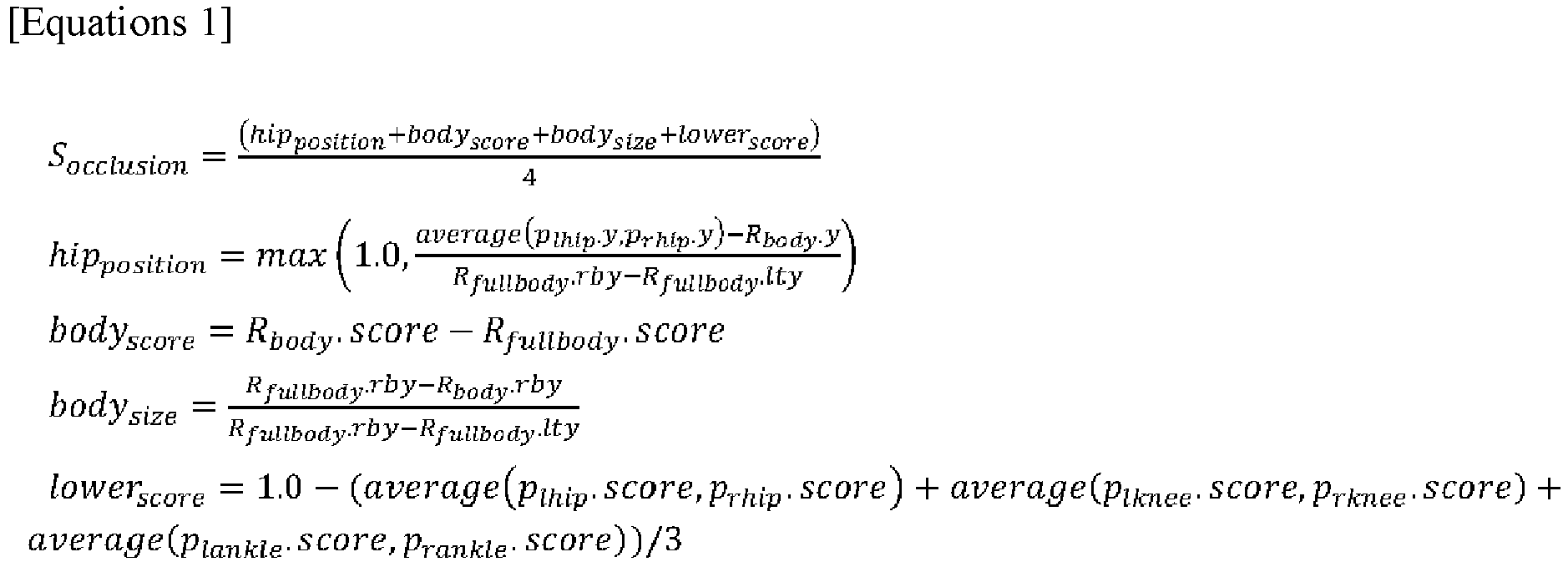
- the correction likelihood for "lower-half body occlusion" is calculated so as to become higher as more conditions among the following conditions are satisfied.
- the correction likelihood for "cutoff" is calculated so as to become higher as more conditions among the following conditions are satisfied.
- calculation expressions are as follows.
- a numerical value of 0.95 in the expressions is a parameter changed depending on an imaging condition and the like, and the parameter is not limited to a specific value.
- the correction likelihood for "background erroneous detection" is calculated so as to become higher as more conditions among the following conditions are satisfied.
- calculation expressions are as follows.
- a numerical value of 0.2 in the expressions is a parameter to be changed depending on the imaging condition and the like, and the parameter is not limited to a specific value.
- S background keypoint score + Rect score 2
- keypoint score ⁇ i all _ parts if p i . score ⁇ 0.2 1.0 num of keypoints else 0.0
- Rect score if R body . score ⁇ 0.2 and R fullbody . score ⁇ 0.2 1.0 else 0.0
- the correction likelihood for "movement” is calculated so as to become higher as more conditions among the following conditions are satisfied.
- S occlusion , S cutoff , S background , and S move respectively indicate the correction likelihood for lower-half body occlusion, the correction likelihood for cutoff, the correction likelihood for background erroneous detection, and the correction likelihood for movement.
- hip position , body score , body size , and lower score indicate the likelihoods relating to lower-half body occlusion based on a hip position, the detection likelihood for the person rectangle, a size of the person rectangle, and the organ detection likelihood, respectively.
- shoulder edge , hip edge , body edge , and fullbody edge indicate likelihoods relating to cutoff based on the shoulder position, the hip position, the lower end position of the person rectangle, and the lower end position of the full-body rectangle, respectively.
- "p” is information indicating the coordinate of the organ position
- a subscript character string indicates a part.
- Character strings “lshoulder”, “rshoulder”, “lhip”, “rhip”, “lknee”, “rknee”, “lankle”, and “rankle” respectively indicate a left shoulder, a right shoulder, a left hip, a right hip, a left knee, a right knee, a left ankle, and a right ankle.
- "y” indicates a y-coordinate of a joint point
- “score” indicates the organ detection likelihood.
- "R” is rectangle information
- a subscript character string “body” indicates the person rectangle
- a subscript character string “fullbody” indicates the full-body rectangle.
- x indicates a center x-coordinate of the rectangle
- y indicates a center y-coordinate of the rectangle
- lty indicates an upper-end y-coordinate
- rby indicates a lower-end y-coordinate
- score indicates the detection likelihood for the rectangle.
- a superscript indicates the number of frames of the image
- t indicates information about a current frame
- t-1 indicates information about a previous frame
- image indicates image information
- height indicates an image height.
- correction labels and the method of determining the correction likelihood described in the present embodiment are illustrative and are not limitative.
- another correction condition may be defined as a correction label.
- the correction likelihood may be determined through another calculation method, or the optional number of calculation expressions among the above-described calculation expressions may be used.
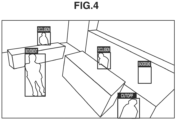
- Fig. 4 illustrates an example of a result of determination of the correction conditions.
- the correction condition determination unit 104 performs correction condition determination on the posture estimation information acquired from the image, thus determining the correction likelihoods for lower-half body occlusion, cutoff, background erroneous detection, and movement.
- the correction labels corresponding to the correction likelihoods greater than preset predetermined thresholds are in association with rectangles detected as persons in the image.
- "occlusion” indicates a correction label for lower-half occlusion
- background indicates a correction label for background erroneous detection.
- the correction condition determination unit 104 transmits the determination result of the correction conditions to the correction unit 105.
- the correction unit 105 corrects the information indicating the action acquired from the action recognition unit 103, based on the information indicating the action and the determination result made by the correction condition determination unit 104. More specifically, in a case where the action likelihood corresponding to the action label "falling" is greater than the predetermined threshold and the correction likelihood corresponding to any of the correction labels is greater than the corresponding predetermined threshold, the correction unit 105 changes the action likelihood corresponding to the action label "falling" of the person. At this time, the correction unit 105 corrects the action likelihood corresponding to the action label "falling" to a sufficiently small value, for example, 0.0 or 0.1.
- Correcting the action likelihood in such a manner prevents the action from not being erroneously recognized as "falling” as a result of the action recognition recognized by the action recognition unit 103.
- the correction unit 105 corrects the action likelihood to a value less than the predetermined threshold at which the action is recognized as "falling".
- Fig. 5 illustrates an example of the action recognition result to be corrected.
- a lower-half body of a person in the image is occluded by a shelf, and an area of the occluded lower-half body is illustrated by a broken line in the drawing.
- the threshold of the action likelihood for "falling" is assumed to be 0.8
- the threshold of the correction likelihood is assumed to be 0.8.
- the values of the thresholds are illustrative and are not limited to 0.8.
- the action likelihood corresponding to the action label "falling” is calculated to be 0.98 because the posture is resembled to a falling posture with bent legs.
- the action likelihood is greater than 0.8 as the threshold.
- the correction likelihood for the correction label "lower-half body occlusion" is calculated to be 0.96 because the y-coordinate of the hip is greater than the lower-end y-coordinate of the person rectangle, and the distance between the y-coordinate of the lower end of the person rectangle 501 and the y-coordinate of the lower end of the full-body rectangle 502 is large.
- the correction unit 105 controls output of the information from the output unit 202 depending on the result of the action recognition based on the corrected action likelihood.
- the image processing apparatus 100 recognizes that the person is fallen, and notifies the user that a fallen person is present, by display, sound, or the like. At this time, for example, when the person, the lower-half body of which is occluded, is recognized as the fallen person, incorrect information is notified to the user. However, the correction unit 105 corrects the action likelihood corresponding to the action label "falling", which makes it possible to prevent the incorrect recognition result from being output. In a case where the action likelihood has been corrected, the correction unit 105 may notify the user that the action likelihood has been corrected, or may omit to perform notification to the user because the fallen person is not recognized.
- the posture estimation information acquired by the posture estimation unit 102 at least includes the organ position coordinates.
- the correction likelihood is calculated based on only the organ position coordinates.
- the organ positions may be detected using algorithm for directly determining the organ position coordinates from an image, as discussed in Z. Cao, "OpenPose: Realtime Multi-Person 2D Pose Estimation using Part Affinity Fields", CVPR2018.
- any method through which information for performing the person action recognition and the correction condition determination is acquirable is applicable as a method of acquiring the posture estimation information, and is not limited to a specific method.
- the action recognition unit 103 may store action labels for standing, walking, running, sitting, and the like in addition to falling.
- the correction unit 105 may manage the action likelihood for the corresponding action label to be corrected, for each correction label when the correction likelihood is greater than the preset threshold.
- the correction condition determination unit 104 calculates the correction likelihood every time the posture estimation information is acquired; however, the configuration is not limited thereto.
- the correction condition determination unit 104 may calculate the correction likelihood only in a case where a value of the action likelihood corresponding the predetermined action (falling) acquired based on the posture estimation information is greater than a predetermined value.
- the processing performed by the image processing apparatus 100 according to the present embodiment is described with reference to the flowchart illustrated in Fig. 6 .
- the CPU 204 of the image processing apparatus 100 reads out the control computer programs stored in the ROM 206 and the HDD 207, loads the control computer programs to the RAM 205, and executes the control computer programs, the processing illustrated in Fig. 6 is performed.
- step S601 the image acquisition unit 101 acquires an image from the imaging apparatus or an internal or external storage device.
- the image may be acquired through the Internet, other network, or the like.
- step S607 the processing ends.
- step S603. the posture estimation unit 102 performs the posture estimation processing on a person in the image based on the acquired image, to specify organ positions of the person, and acquires the posture estimation information.
- the posture estimation unit 102 performs the posture estimation processing on each of the persons.
- the action recognition unit 103 performs the action recognition processing based on the posture estimation information, thus acquiring the action likelihood and the action likelihood corresponding thereto, as the information indicating the action.
- step S605 the correction condition determination unit 104 determines the correction conditions based on the posture estimation information.
- the correction unit 105 acquires the information indicating the action and a result of determination regarding the correction conditions.
- the correction unit 105 changes the action likelihood that is the information indicating the action in step S606.
- the correction unit 105 outputs a result of the action recognition based on the corrected action likelihood, by using the output unit 202.
- the image processing apparatus 100 repeatedly performs the above-described processing while the image is acquired.
- the image processing apparatus 100 can prevent an incorrect action recognition result from being output.
- a second embodiment of the present invention will be described.
- a description will be provided of a configuration example in which correction candidate areas in an image are generated based on the posture estimation information, and the correction candidate areas are output to the user.
- Descriptions of the matters similar to those in the first embodiment are omitted, and only differences will be described. That is to say that the second embodiment may comprises some or all of the same or similar features as the first embodiment and therefore detailed description of the same or similar features will be omitted. Reference numerals will be maintained for the same or similar features.
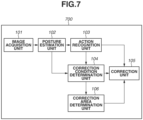
- Fig. 7 is a block diagram illustrating a configuration of an image processing apparatus 700 according to the present embodiment.
- the image processing apparatus 700 includes a correction area determination unit 106 in addition to the configuration of the image processing apparatus 100 according to the first embodiment.
- the correction condition determination unit 104 transmits the posture estimation information and the determination result of the correction conditions to the correction area determination unit 106.
- the correction area determination unit 106 performs area acquisition processing of acquiring correction area information based on the posture estimation information and the result of determination regarding the correction conditions.
- the correction area information includes information indicating an area where an action of a person is to be changed (corrected) in the image, and a correction objective label.
- the information indicating the correction area indicates an area in the image, and enables determination whether coordinates in the image is included in the area.
- the information indicating the correction area may be rectangle information including center coordinates and a width/height, or polygon information including three or more vertices.
- the correction objective label is at least one correction label for which correction condition determination is performed on a person in the correction area.
- the correction area determination unit 106 stores the posture estimation information and the result of the determination regarding the correction conditions for a certain period. When data for the certain period is collected, the correction area determination unit 106 generates the correction area information. The correction area determination unit 106 transmits the correction area information to the correction unit 105.
- the correction unit 105 corrects the information indicating the action based on the correction area information generated by the correction area determination unit 106, the information indicating the action, and the result of the determination regarding the correction conditions.
- the correction unit 105 calculates the correction likelihood corresponding to the correction objective label for a person with the center coordinates of the person rectangle thereof included in the correction area. In a case where the correction likelihood is greater than the preset threshold, the correction unit 105 corrects the action likelihood for the action label of the person to a sufficiently small value (e.g., 0.0).
- step S1001 the correction area determination unit 106 selects one of the plurality of correction labels as the correction objective label.
- step S1002 the correction area determination unit 106 calculates the correction likelihood corresponding to the correction objective label for each of the plurality of persons in the image, and collects and stores the posture estimation information about a person corresponding to the correction likelihood greater than the preset threshold.
- step S1003 the correction area determination unit 106 clusters the center coordinates of the person rectangles included in the stored posture estimation information.
- step S1004 the correction area determination unit 106 generates a correction area including each cluster.
- step S1005 the correction area determination unit 106 generates the correction area information by combining the selected correction objective label and the generated information indicating the correction areas.
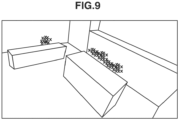
- Fig. 9 illustrates an example of center coordinate information about the person rectangles included in the posture estimation information stored when the correction label for lower-half body occlusion is selected as the correction objective label.
- a plotted mark " ⁇ " indicates the center coordinate of each of the person rectangles in the image.
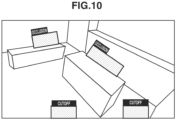
- the correction area determination unit 106 performs clustering of the plurality of marks " ⁇ " illustrated in Fig. 9 by using an existing method or the like, thus specifying areas corresponding to the correction objective label "occlusion" illustrated in Fig. 10 , as the correction areas.
- step S1006 In a case where a correction label unselected as the correction objective label is present (YES in step S1006), the processing returns to step S1001. In a case where an unselected correction label is absent (NO in step S1006), the processing proceeds to step S1007.
- the correction area determination unit 106 further selects, for example, the correction label "cutoff" as the correction objective label, and the processing in and after step S1001 is performed to specify correction areas corresponding to the correction objective label "cutoff" in Fig. 10 .
- step S1007 the correction area determination unit 106 outputs the generated correction area information by using the output unit 202.
- the correction area information is output to the display device as a display illustrated in Fig. 10 .
- step S1008 the user designates the correction area information corresponding to an area where the correction is to be performed, by using the input unit 201 while viewing the information displayed on the output unit 202.
- the correction unit 105 calculates the correction likelihood based on the correction objective label corresponding to the correction area designated to be corrected by the user, and corrects the action likelihood based on the value of the correction likelihood.
- step S1007 optional information among the plurality of pieces of posture estimation information stored in the correction area determination unit 106 may be output as an example of a person for which action is to be corrected.
- a third embodiment of the present invention will be described.
- a description will be provided as an example of condition setting in the correction condition determination, a configuration example in which the correction conditions used for correction are automatically created based on distribution of matching rates between the information indicating an action and previously set correction conditions. Descriptions of the matters similar to those in the first embodiment are omitted, and only differences are described. That is to say that the third embodiment may comprises some or all of the same or similar features as the first embodiment and therefore detailed description of the same or similar features will be omitted. Reference numerals will be maintained for the same or similar features.
- the third embodiment may comprise one or more of the features of the second embodiment.
- Fig. 11 is a block diagram illustrating a configuration of an image processing apparatus 1100 according to the present embodiment.
- the image processing apparatus 1100 includes a condition generation unit 107 in addition to the configuration of the image processing apparatus 100 according to the first embodiment.
- the action recognition unit 103 transmits, as the information indicating the action, the action label and the action likelihood to the condition generation unit 107.
- the condition generation unit 107 generates the correction conditions to be applied to the correction condition determination unit 104, based on distribution of the action likelihoods and the correction likelihoods determined based on previously prepared correction conditions.
- the condition generation unit 107 performs action recognition estimation on a person for a certain period (a certain number of image frames) and stores the action likelihoods. When the action likelihoods for the certain period are collected, the condition generation unit 107 creates a distribution map based on the action likelihoods and the correction likelihoods for the previously prepared correction conditions, and performs clustering on the distribution map.
- the condition generation unit 107 further performs cluster separation determination by using cluster centers, and generates correction conditions each enabling separation of the clusters, as the correction conditions to be applied in the correction condition determination unit 104.
- the condition generation unit 107 transmits the generated correction conditions to the correction condition determination unit 104.
- step S1201 the condition generation unit 107 acquires the information indicating the action collected for the certain period.
- step S1202 the condition generation unit 107 selects one of the previously prepared correction conditions.
- step S1203 the condition generation unit 107 creates the distribution map based on the correction likelihoods of the selected correction condition and the action likelihoods, and performs clustering on the distribution map.
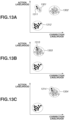
- Figs. 13A to 13C illustrate examples obtained by performing clustering using the plurality of correction conditions.
- the data is plotted and clustered with a lateral axis of a graph set to the correction likelihood corresponding to the selected correction condition and a vertical axis set to the action likelihood corresponding to the action label "falling". While the embodiments shown and discusses certain action labels it will be apparent that other action likelihoods corresponding to other action labels are contemplated.
- the clustering is performed with two types of data, namely, a ground truth (GT) cluster and an actual scene cluster.
- GT ground truth
- the GT cluster is a result obtained by clustering the distribution of the action likelihoods based on the posture estimation information with a ground truth action label previously prepared and the correction likelihoods corresponding to the selected correction condition.
- the GT cluster is determined in units of action labels.
- the GT cluster in the present embodiment is a cluster generated for the action label "falling".
- Data on the GT cluster is generated by, for example, previously determining the action likelihoods and the correction likelihoods by using an image group including an image in which a fallen person is present.
- the actual scene cluster is a result obtained by clustering the distribution of the action likelihoods and the correction likelihoods corresponding to an image group different from the image group for the GT cluster.
- No ground truth action label is provided to the actual scene clusters, and the results of the plurality of action labels are included.
- the actual scene clusters are clustered to a plurality of clusters.
- k-means can be used as a clustering method.
- the action label of each of the actual scene clusters may be predicted from predicted occurrence frequencies of the action labels and the number of pieces of data in each of the actual scene clusters.
- Figs. 13A to 13C are distribution maps of the action likelihoods and the correction likelihoods created with correction conditions A, B, and C applied.
- a cluster of open white circles is the actual scene cluster
- a cluster of solid black circles is the GT cluster.
- an actual scene cluster group 1302 that is high in correction likelihood and high in frequency are present. It is predicted that, in the actual scene, the number of persons taking a "falling" action is small. Therefore, the action label "falling" is assigned to the actual scene cluster group 1301.
- the action likelihood for "falling" is high and the frequency is also high; however, considering the prediction that the number of persons taking a falling action is small, the actual scene cluster group 1302 is considered to be the posture estimation information with erroneous "falling" estimation.
- the GT clusters illustrated in Fig. 13A include a GT cluster group 1311 that is low in correction likelihood and small in frequency, and a GT cluster group 1312 that is low in correction likelihood and low in frequency.
- the GT clusters are clusters acquired for "falling".
- the GT cluster group 1311 is the posture estimation information about a person estimated to "fall” based on high action likelihood
- the GT cluster group 1312 is the posture estimation information about the person estimated to take an action other than "falling”.
- the condition generation unit 107 determines the correction condition enabling separation of the actual scene clusters for the posture estimation information with erroneous action estimation, such as the actual scene cluster group 1302, and the GT clusters for the posture estimation information with "falling" estimation, such as the GT cluster group 1311.
- step S1204 the condition generation unit 107 determines whether the GT clusters and the actual scene clusters are separable, from the result of the clustering.
- the condition generation unit 107 uses, for example, the values of the action likelihoods and the correction likelihoods as coordinate values, and determines a distance between center coordinates of the clusters. If the distance is greater than or equal to a certain value, i.e. a predetermined value, the condition generation unit 107 determines that the clusters have been separated. It is found from the example illustrated in Fig. 13A that, under the condition A, the actual scene cluster group 1302 high in action likelihood and correction likelihood is separated from the GT cluster group 1311 based on the correction likelihoods.
- a combination of clusters having the same action label may be excluded from separation objects.
- a threshold for correction likelihoods that is used in the correction unit 105 may be determined. In a case where it is determined that the clusters are separable (YES in step S 1205), the processing proceeds to step S1206. In step S1206, the condition generation unit 107 adds the used correction condition to the correction conditions to be applied in the correction condition determination unit 104. In a case where it is determined that the clusters are not separable (NO in step S1205), the processing proceeds to step S1207.
- step S1207 In a case where an unprocessed condition is present (YES in step S1207), the processing returns to step S1202. In a case where an unprocessed condition is absent (NO in step S1207), the processing proceeds to step S1208. In step S1208, the condition generation unit 107 determines the correction conditions to be applied in the correction condition determination unit 104 from the result of the processing.
- the image processing apparatus 1100 can correct the information indicating the action (action likelihood) by using the appropriate correction conditions.
- each embodiment described above and shown in the figures can be implemented solely or as a combination of a plurality of elements or features or components thereof where necessary or where the elements or features or components from individual embodiments in a single embodiment is beneficial. According to the embodiments described, it is possible to prevent an output of an incorrect action recognition as a result of the action recognition using the posture estimation.
- Embodiment(s) of the present invention can also be realized by a computer of a system or apparatus that reads out and executes computer executable instructions (e.g., one or more programs) recorded on a storage medium (which may also be referred to more fully as a 'non-transitory computer-readable storage medium') to perform the functions of one or more of the above-described embodiment(s) and/or that includes one or more circuits (e.g., application specific integrated circuit (ASIC)) for performing the functions of one or more of the above-described embodiment(s), and by a method performed by the computer of the system or apparatus by, for example, reading out and executing the computer executable instructions from the storage medium to perform the functions of one or more of the above-described embodiment(s) and/or controlling the one or more circuits to perform the functions of one or more of the above-described embodiment(s).
- computer executable instructions e.g., one or more programs
- a storage medium which may also be referred to more fully as
- the computer may comprise one or more processors (e.g., central processing unit (CPU), micro processing unit (MPU)) and may include a network of separate computers or separate processors to read out and execute the computer executable instructions.
- the computer executable instructions may be provided to the computer, for example, from a network or the storage medium.
- the storage medium may include, for example, one or more of a hard disk, a random-access memory (RAM), a read only memory (ROM), a storage of distributed computing systems, an optical disk (such as a compact disc (CD), digital versatile disc (DVD), or Blu-ray Disc (BD) TM ), a flash memory device, a memory card, and the like.
Landscapes
- Engineering & Computer Science (AREA)
- Theoretical Computer Science (AREA)
- Physics & Mathematics (AREA)
- General Physics & Mathematics (AREA)
- Multimedia (AREA)
- Computer Vision & Pattern Recognition (AREA)
- Health & Medical Sciences (AREA)
- General Health & Medical Sciences (AREA)
- Human Computer Interaction (AREA)
- Psychiatry (AREA)
- Social Psychology (AREA)
- Software Systems (AREA)
- Evolutionary Computation (AREA)
- Computing Systems (AREA)
- Artificial Intelligence (AREA)
- Databases & Information Systems (AREA)
- Medical Informatics (AREA)
- Probability & Statistics with Applications (AREA)
- Image Analysis (AREA)
Abstract
An image processing apparatus 100 includes one or more memories storing instructions, and one or more processors that, upon execution of the stored instructions, are configured to specify, through a posture estimation unit 102, a position of an organ of a person in an image, acquire posture estimation information, through the posture estimation unit 102, about a posture of the person based on the specified position of the organ, estimate, through a action recognition unit 103, an action of the person based on the acquired posture estimation information, determine, through a correction condition determination unit 104, a state of the person based on the acquired posture estimation information, and change information, through a correction unit 105, indicating the estimated action of the person in a case where the estimated action of the person is a predetermined action and it is determined that the person is in a predetermined state.
Description
- The present disclosure relates to a technique for action recognition.
- To detect an action and a situation of a person, a posture estimation technique and an action recognition technique have been developed. In the posture estimation technique, positions of organs, such as joint points, eyes, and ears, of a person in an image can be detected by using a convolutional neural network (CNN) using the image as an input. In the action recognition technique, actions can be classified by using the CNN using, as inputs, positions of the organs detected with the posture estimation technique. The action recognition technique is used for, for example, purchase analysis in a store and detection of a fallen person in a hospital and the like. In the posture estimation technique, however, when an organ is occluded by an object, such as a shelf, image features of the organ cannot be acquired. Thus, accuracy of posture estimation may be degraded.
- In the posture estimation technique, as means for addressing occlusion of an organ of an objective person, a method in which an image including an occluded organ is created through image combination or the like, and training data is enhanced using data extension of occlusion, to improve performance is generally used. Z. Zhong, "Random Erasing Data Augmentation", CVPR2017. discusses a method in which pseudo-occlusion is generated by combining a mask at a random position in an image of training data, to improve organ detection accuracy for occlusion.
- With the method discussed in Z. Zhong, "Random Erasing Data Augmentation", CVPR2017, it is possible to improve accuracy of posture estimation in a state where a part of an organ of the person is occluded and a position of the organ is not acquired. However, for example, in a case where a pattern resembled to an organ of the person is present in an area of a lower-half body in a state where the lower-half body is occluded by a shelf or a desk, the pattern is erroneously detected as an organ, such as a knee or an ankle, in some cases. As a result, posture estimation accuracy may be degraded, and an incorrect action may be output as a recognition result in action recognition using a result of the posture estimation.
- The present disclosure is made in consideration of the above-described issues. The present disclosure is directed to a technique for preventing an output of an incorrect action recognition as a result of action recognition using posture estimation.
- According to a first aspect of the present invention, there is provided an image processing apparatus as specified in
claim 1. Optional features of the first aspect are presented in claims 2 to 10. According to a second aspect of the present invention, there is provided an image processing method as specified in claim 11. According to a third aspect of the present invention, there is provided a program as specified in claim 12. Optional features of the second aspect and the third aspect are presented in or derivable from claims 2 to 10. - Further features of the present invention will become apparent from the following description of embodiments with reference to the attached drawings.
-
-
Fig. 1 is a diagram illustrating a hardware configuration of an image processing apparatus. -
Fig. 2 is a diagram illustrating a configuration of an image processing apparatus according to a first embodiment. -
Fig. 3 is a diagram illustrating an example of posture estimation and action recognition. -
Fig. 4 is a diagram illustrating an example of a determination result of correction conditions. -
Fig. 5 is a diagram illustrating an example of an action recognition result to be corrected. -
Fig. 6 is a flowchart illustrating processing to be performed by the image processing apparatus according to the first embodiment. -
Fig. 7 is a diagram illustrating a configuration of an image processing apparatus according to a second embodiment. -
Fig. 8 is a flowchart illustrating processing to be performed by the image processing apparatus according to the second embodiment. -
Fig. 9 is a diagram illustrating generation of correction area information. -
Fig. 10 is a diagram illustrating generation of the correction area information. -
Fig. 11 is a diagram illustrating a configuration of an image processing apparatus according to a third embodiment. -
Fig. 12 is a flowchart illustrating processing to be performed by the image processing apparatus according to the third embodiment. -
Figs. 13A to 13C are diagrams illustrating examples of actual scene clusters and ground truth (GT) clusters corresponding to the correction conditions. - Some embodiments of the present disclosure are described below with reference to the accompanying drawings. Components, elements or features described in the following embodiments are example of components, elements or features which are used to carry the present invention into effect, and are not intended to limit the present invention thereto. That is to say that the invention does not require all such components, elements or features described in relation to one or more of the embodiments.
- In a first embodiment, a description will be provided of an image processing apparatus that estimates a posture of a person in an image acquired by an installed imaging apparatus (camera) and estimates an action of the person based on a result of the posture estimation as an example of action recognition. The image processing apparatus determines a state of the person based on the result of the posture estimation, and changes (corrects) information indicating an estimated action of the person based on a determination result.
-
Fig. 1 is a diagram illustrating a hardware configuration of animage processing apparatus 100 according to the present embodiment. Theimage processing apparatus 100 includes aninput unit 201, anoutput unit 202, a network interface (I/F)unit 203, a central processing unit (CPU) 204, a random access memory (RAM) 205, a read only memory (ROM) 206, a hard disk drive (HDD) 207, and adata bus 208. - The
CPU 204 reads out control computer programs stored in theROM 206 and/or theHDD 207 and loads the programs to theRAM 205 to perform various types of processing. TheRAM 205 is used as a storage area temporarily storing programs to be executed by theCPU 204, a work memory, and the like. The network I/F unit 203 transmits/receives various types of information between theimage processing apparatus 100 and another apparatus through the Internet or other network. Data received from an external apparatus through the network I/F unit 203 is transmitted to or received from theCPU 204, theRAM 205, and theROM 206 through thedata bus 208. The HDD 207 stores image data, setting parameters, various types of programs, and the like. TheHDD 207 can receive data from an external apparatus through the network I/F unit 203. - The
input unit 201 is an input device, such as a keyboard, a mouse, and/or a touch panel. Theoutput unit 202 is a device that outputs information. Examples of theoutput unit 202 include a display device, such as a liquid crystal display, and an audio output device, such as a speaker. Theinput unit 201 and theoutput unit 202 are also connected to thedata bus 208. -
Fig. 2 is a diagram illustrating a functional configuration of theimage processing apparatus 100 according to the present embodiment. - The
image processing apparatus 100 includes animage acquisition unit 101, aposture estimation unit 102, anaction recognition unit 103, a correctioncondition determination unit 104, and acorrection unit 105. - The
image acquisition unit 101 acquires an image. The image acquired by theimage acquisition unit 101 may be an image acquired through imaging by a network camera or the like, or an image recorded in a storage device, such as a hard disk. The image acquired by theimage acquisition unit 101 may be received through a network such as the Internet. The image acquired by theimage acquisition unit 101 is transmitted to theposture estimation unit 102. - The
posture estimation unit 102 detects organs of a person in the image, and specifies positions of the detected organs. The organs are, for example, parts (joint points) such as eyes, a nose, ears, shoulders, elbows, wrists, hips, knees, and ankles of the person. The organs may be considered as parts of the body. The parts of the body may include sense organs, such as eyes, nose, ears, or joint points, such as shoulders, elbows, wrists, hips, knees or ankles. Theposture estimation unit 102 acquires posture estimation information based on the specified positions of the organs. The posture estimation information includes organ position coordinates that are positional information indicating positions of the organs, and an organ detection likelihood indicating a likelihood for the position of each of the organs. The organ detection likelihood is likelihood information indicating a likelihood for the position of each of the organs detected by theposture estimation unit 102. The organ detection likelihood can be restated as information indicating reliability, accuracy, or certainty of the position of each of the organs. - The posture estimation information includes at least one of a person rectangle enclosing an area of a person in the image and a detection likelihood for the person rectangle. The posture estimation information includes a full-body rectangle enclosing a full body of a person including a portion invisible in the image and a full-body detection likelihood. The person rectangle and the full-body rectangle are information enabling identification of the areas including the full-body of the person, and the shapes thereof are not limited to the rectangles. The person rectangle may be considered a person bounding box which bounds the person in any shape. The full-body rectangle may be considered a full-body bounding box which bounds the full-body of the person in any shape. The posture estimation information includes an identifier of the person. The identifier of the person may be a scalar value indicating the same person among frames. For example, in a case where an
identifier 1 is assigned to a person A in one of image frames continuously captured by the imaging apparatus, theidentifier 1 is assigned to the person A in a next frame, to indicate the same person. The information included in the posture estimation information is not limited to the above-described information, and the posture estimation information may include information other than the above-described information, or may include optional information out of the above-described information. The posture estimation information according to the present embodiment at least includes the organ posture coordinates. - As an example of the posture estimation, in a case where a body below the hips of the person in the image is occluded by, for example, a shield, a lower end of the person rectangle is positioned at the hips, and a lower end of the full-body rectangle is positioned at the feet. The position of the feet is estimated from an upper-half body. The
posture estimation unit 102 determines coordinates of a center, a width, a height, and the detection likelihood for the person rectangle by using a convolutional neural network (CNN) with an image as an input, as discussed in J. Redmon, "You Only Look Once: Unified, Real-Time Object Detection", CVPR2015. Coordinates of a center, a width, and a height of the full-body rectangle, and the full-body detection likelihood are also determined by a method discussed in J. Redmon, "You Only Look Once: Unified, Real-Time Object Detection", CVPR2015., by replacing training data in the CNN with the full-body rectangle. Theposture estimation unit 102 determines the organ position coordinates and the organ detection likelihood for the person rectangle by using the CNN with, as an input, an image extracted from the image based on information about the person rectangle, as discussed in K. Sun, "Deep High-Resolution Representation Learning for Human Pose Estimation", CVPR2019. Further, theposture estimation unit 102 determines a feature amount for re-collating a person among the frames, by using the CNN with, as an input, an image extracted from an image based on the information about the person rectangle, as discussed in Y. Zhang, "FairMOT: On the Fairness of Detection and Re-Identification in Multiple Object Tracking", IJCV2021. Theposture estimation unit 102 assigns the identifier to the person by re-collating the person among the frames. -
Fig. 3 illustrates an example of the posture estimation information for the image. Posture estimation processing is applied to the image, thus obtaining aperson rectangle 301, organ position coordinates 302, and aperson identifier 303. In the example illustrated inFig. 3 , the person identifier is "1". Theposture estimation unit 102 transmits the posture estimation information to theaction recognition unit 103 and the correctioncondition determination unit 104. - The
action recognition unit 103 estimates an action of a person with the posture estimation information as an input, and generates information indicating the estimated action. Theaction recognition unit 103 determines an action based on the information indicating the estimated action, to be a result of action recognition of the person in the image. The information indicating an action includes an action label indicating an action of the person, and an action likelihood for the action label. One or more action labels are previously defined in correspondence, i.e. in relation, to actions to be recognized. The action labels may be predefined, i.e. specified, for a particular action. Theimage processing apparatus 100 according to the present embodiment recognizes a falling action of a person. Thus, in the present embodiment, an action label "falling" is defined. The action likelihood is likelihood information indicating a likelihood (reliability) of the estimated action of the person. The action likelihood is represented by a value from 0 to 1, and indicates higher possibility of the action as the value is closer to 1. The action label is illustrative, and another action may be defined as the action label. Two or more actions may be defined as action labels. - The
action recognition unit 103 recognizes an action based on time-series change in organ position determined from the organ position coordinates of the person in a plurality of image frames, as discussed in F. Yang, "Make Skeleton-based Action Recognition Model Smaller, Faster and Better", CVPR2019. As an example, action recognition processing is applied to the image illustrated inFig. 3 to generate, as a value of 0.98 or the like, the action likelihood corresponding to the action label "falling". Theaction recognition unit 103 recognizes that the action of the person is "falling" based on the generated information. Theaction recognition unit 103 recognizes an action indicated by the action label corresponding to the action likelihood greater than a predetermined threshold, as the action of the person. Theaction recognition unit 103 transmits the information indicating the action to thecorrection unit 105. - The correction
condition determination unit 104 determines the state of the person having been subjected to the posture estimation by theposture estimation unit 102 with the posture estimation unit providing an input, thus generating a determination result. At this time, the correctioncondition determination unit 104 determines whether the person is in a predetermined state. In the following, a condition that the person is in the predetermined state is referred to as a correction condition, and the correctioncondition determination unit 104 generates a result of determination as to whether the person satisfies the correction condition, as the determination result. Correction means that thecorrection unit 105 described below changes the information indicating the action generated by theaction recognition unit 103. - The determination result generated by the correction
condition determination unit 104 includes a correction label indicating the correction condition, and a correction likelihood indicating a degree of the correction to be made. The correction label is a label indicating the correction condition, in other words, a label indicating a possible predetermined state of the person. In the present embodiment, as the correction labels, "lower-half body occlusion" indicating a state where a lower-half body of a person is occluded, "cutoff" indicating a state where part of a person protrudes from the image, and "background erroneous detection" indicating a state where a background is erroneously detected as a person are defined. Further, in the present embodiment, as the correction label, "movement" indicating a state where a person is moving is defined. The correction likelihood is represented by a value from 0 to 1, and indicates a higher degree of the correction to be made as the value is closer to 1. In other words, the correction likelihood is likelihood information indicating a likelihood (reliability) for the state of the person determined by the correctioncondition determination unit 104. - Issues targeted to be solved in the present embodiment and other embodiments of the invention are now described. The
image processing apparatus 100 according to the present embodiment recognizes a falling action of a person, and outputs a recognition result to use the recognition result for, for example, notification to a user. However, the organ positions of the person are erroneously detected in some cases due to occlusion of the person by an object, part of the person is cut off in (protrude from) the image, or erroneous detection of a background as the person. In this case, there is an issue that the person is erroneously recognized as being fallen. The correctioncondition determination unit 104 determines the correction condition that a state of a person is in a state where the person is erroneously recognized as being fallen, and determines the correction likelihood corresponding to the correction condition, thus enabling correction of the result of the action recognition. - The correction conditions for determining the correction likelihood corresponding to the respective correction labels are described below. The correction likelihood is calculated based on the posture estimation information acquired from the
posture estimation unit 102. The correction likelihood for "lower-half body occlusion" is calculated so as to become higher as more conditions among the following conditions are satisfied. - Average of y-coordinates of right and left hip joint points is greater than y-coordinate of lower end of person rectangle
- Full-body detection likelihood is less than detection likelihood for person rectangle
- Distance between y-coordinate of lower end of person rectangle and y-coordinate of lower end of full-body rectangle is large
- Organ detection likelihoods for hips, knees, and ankles are low
- At this time, calculation expressions are as follows.
- The correction likelihood for "cutoff" is calculated so as to become higher as more conditions among the following conditions are satisfied.
- Average of y-coordinates of right and left shoulder joint points or right and left hip joint points is close to lower end of image
- Y-coordinate of lower end of person rectangle is close to lower end of image
- Y-coordinate of lower end of full-body rectangle is greater than image height
- At this time, calculation expressions are as follows. A numerical value of 0.95 in the expressions is a parameter changed depending on an imaging condition and the like, and the parameter is not limited to a specific value.

- The correction likelihood for "background erroneous detection" is calculated so as to become higher as more conditions among the following conditions are satisfied.
- All organ detection likelihoods are low
- Detection likelihood for person rectangle and full-body detection likelihood are low
- At this time, calculation expressions are as follows. A numerical value of 0.2 in the expressions is a parameter to be changed depending on the imaging condition and the like, and the parameter is not limited to a specific value.

- The correction likelihood for "movement" is calculated so as to become higher as more conditions among the following conditions are satisfied.
- Moving distance of center coordinates of person rectangle between image frames is large
- At this time, a calculation expression is as follows.

- In the above-described
Equations 1 to 4, Socclusion, Scutoff, Sbackground, and Smove respectively indicate the correction likelihood for lower-half body occlusion, the correction likelihood for cutoff, the correction likelihood for background erroneous detection, and the correction likelihood for movement. Further, hipposition, bodyscore, bodysize, and lowerscore indicate the likelihoods relating to lower-half body occlusion based on a hip position, the detection likelihood for the person rectangle, a size of the person rectangle, and the organ detection likelihood, respectively. Further, shoulderedge, hipedge, bodyedge, and fullbodyedge indicate likelihoods relating to cutoff based on the shoulder position, the hip position, the lower end position of the person rectangle, and the lower end position of the full-body rectangle, respectively. - Further, "p" is information indicating the coordinate of the organ position, and a subscript character string indicates a part. Character strings "lshoulder", "rshoulder", "lhip", "rhip", "lknee", "rknee", "lankle", and "rankle" respectively indicate a left shoulder, a right shoulder, a left hip, a right hip, a left knee, a right knee, a left ankle, and a right ankle. Further, "y" indicates a y-coordinate of a joint point, and "score" indicates the organ detection likelihood. "R" is rectangle information, a subscript character string "body" indicates the person rectangle, and a subscript character string "fullbody" indicates the full-body rectangle. Further, "x" indicates a center x-coordinate of the rectangle, "y" indicates a center y-coordinate of the rectangle, "lty" indicates an upper-end y-coordinate, "rby" indicates a lower-end y-coordinate, and "score" indicates the detection likelihood for the rectangle. A superscript indicates the number of frames of the image, "t" indicates information about a current frame, and "t-1" indicates information about a previous frame. Further, "image" indicates image information, and "height" indicates an image height.
- The types of the correction labels and the method of determining the correction likelihood described in the present embodiment are illustrative and are not limitative. For example, another correction condition may be defined as a correction label. The correction likelihood may be determined through another calculation method, or the optional number of calculation expressions among the above-described calculation expressions may be used.
-
Fig. 4 illustrates an example of a result of determination of the correction conditions. The correctioncondition determination unit 104 performs correction condition determination on the posture estimation information acquired from the image, thus determining the correction likelihoods for lower-half body occlusion, cutoff, background erroneous detection, and movement. In the example illustrated inFig. 4 , as a result of the determination, the correction labels corresponding to the correction likelihoods greater than preset predetermined thresholds are in association with rectangles detected as persons in the image. InFig. 4 , "occlusion" indicates a correction label for lower-half occlusion, and "background" indicates a correction label for background erroneous detection. The correctioncondition determination unit 104 transmits the determination result of the correction conditions to thecorrection unit 105. - The
correction unit 105 corrects the information indicating the action acquired from theaction recognition unit 103, based on the information indicating the action and the determination result made by the correctioncondition determination unit 104. More specifically, in a case where the action likelihood corresponding to the action label "falling" is greater than the predetermined threshold and the correction likelihood corresponding to any of the correction labels is greater than the corresponding predetermined threshold, thecorrection unit 105 changes the action likelihood corresponding to the action label "falling" of the person. At this time, thecorrection unit 105 corrects the action likelihood corresponding to the action label "falling" to a sufficiently small value, for example, 0.0 or 0.1. Correcting the action likelihood in such a manner prevents the action from not being erroneously recognized as "falling" as a result of the action recognition recognized by theaction recognition unit 103. When thecorrection unit 105 corrects the action likelihood, thecorrection unit 105 corrects the action likelihood to a value less than the predetermined threshold at which the action is recognized as "falling". -
Fig. 5 illustrates an example of the action recognition result to be corrected. A lower-half body of a person in the image is occluded by a shelf, and an area of the occluded lower-half body is illustrated by a broken line in the drawing. In this example, the threshold of the action likelihood for "falling" is assumed to be 0.8, and the threshold of the correction likelihood is assumed to be 0.8. The values of the thresholds are illustrative and are not limited to 0.8. When the posture estimation processing is applied to the image illustrated inFig. 5 , positions of organs of an upper-half body are correctly detected, but positions of organs of the lower-half body are detected at positions different from actual positions. When the action recognition is performed based on the result of the organ detection, the action likelihood corresponding to the action label "falling" is calculated to be 0.98 because the posture is resembled to a falling posture with bent legs. The action likelihood is greater than 0.8 as the threshold. Thus, when the action recognition is performed based on the action likelihood, it is recognized that the person is fallen. Further, in the determination of the correction conditions, the correction likelihood for the correction label "lower-half body occlusion" is calculated to be 0.96 because the y-coordinate of the hip is greater than the lower-end y-coordinate of the person rectangle, and the distance between the y-coordinate of the lower end of theperson rectangle 501 and the y-coordinate of the lower end of the full-body rectangle 502 is large. Since the correction likelihood is greater than 0.8 serving as the threshold, the action likelihood is changed to a sufficiently small value, such as 0.0 or 0.1. Thecorrection unit 105 controls output of the information from theoutput unit 202 depending on the result of the action recognition based on the corrected action likelihood. - The
image processing apparatus 100 according to the present embodiment recognizes that the person is fallen, and notifies the user that a fallen person is present, by display, sound, or the like. At this time, for example, when the person, the lower-half body of which is occluded, is recognized as the fallen person, incorrect information is notified to the user. However, thecorrection unit 105 corrects the action likelihood corresponding to the action label "falling", which makes it possible to prevent the incorrect recognition result from being output. In a case where the action likelihood has been corrected, thecorrection unit 105 may notify the user that the action likelihood has been corrected, or may omit to perform notification to the user because the fallen person is not recognized. - The configuration of the
image processing apparatus 100 according to the present embodiment has been described above. The posture estimation information acquired by theposture estimation unit 102 at least includes the organ position coordinates. In this case, the correction likelihood is calculated based on only the organ position coordinates. The organ positions may be detected using algorithm for directly determining the organ position coordinates from an image, as discussed in Z. Cao, "OpenPose: Realtime Multi-Person 2D Pose Estimation using Part Affinity Fields", CVPR2018. In other words, any method through which information for performing the person action recognition and the correction condition determination is acquirable is applicable as a method of acquiring the posture estimation information, and is not limited to a specific method. - The
action recognition unit 103 may store action labels for standing, walking, running, sitting, and the like in addition to falling. In a case where the plurality of action labels is defined, thecorrection unit 105 may manage the action likelihood for the corresponding action label to be corrected, for each correction label when the correction likelihood is greater than the preset threshold. - In the correction of the action likelihood for the
correction unit 105, the highest correction likelihood may be determined among correction likelihoods for the correction labels for lower-half body occlusion, cutoff, background erroneous detection, and movement, and the action likelihood may be weighted with a weight = 1 - correction likelihood. Further, thecorrection unit 105 may apply the correction only in a case where a period (number of image frames) when the correction likelihood for any of the correction labels for lower-half body occlusion, cutoff, background erroneous detection, and movement is greater than the preset threshold is longer than a preset period. - The correction
condition determination unit 104 according to the present embodiment calculates the correction likelihood every time the posture estimation information is acquired; however, the configuration is not limited thereto. For example, the correctioncondition determination unit 104 may calculate the correction likelihood only in a case where a value of the action likelihood corresponding the predetermined action (falling) acquired based on the posture estimation information is greater than a predetermined value. - The processing performed by the
image processing apparatus 100 according to the present embodiment is described with reference to the flowchart illustrated inFig. 6 . When theCPU 204 of theimage processing apparatus 100 reads out the control computer programs stored in theROM 206 and theHDD 207, loads the control computer programs to theRAM 205, and executes the control computer programs, the processing illustrated inFig. 6 is performed. - In step S601, the
image acquisition unit 101 acquires an image from the imaging apparatus or an internal or external storage device. The image may be acquired through the Internet, other network, or the like. In a case where no image has been acquired (NO in step S602), the processing proceeds to step S607. In step S607, the processing ends. In a case where an image has been acquired (YES in step S602), the processing proceeds to step S603. In step S603, theposture estimation unit 102 performs the posture estimation processing on a person in the image based on the acquired image, to specify organ positions of the person, and acquires the posture estimation information. In a case where a plurality of persons is included in the image, theposture estimation unit 102 performs the posture estimation processing on each of the persons. In step S604, theaction recognition unit 103 performs the action recognition processing based on the posture estimation information, thus acquiring the action likelihood and the action likelihood corresponding thereto, as the information indicating the action. - In step S605, the correction
condition determination unit 104 determines the correction conditions based on the posture estimation information. Thecorrection unit 105 acquires the information indicating the action and a result of determination regarding the correction conditions. In a case where it is determined that an action of the person is a predetermined action ("falling" in present embodiment) and the person is in a predetermined state indicated by the correction label, thecorrection unit 105 changes the action likelihood that is the information indicating the action in step S606. Thecorrection unit 105 outputs a result of the action recognition based on the corrected action likelihood, by using theoutput unit 202. Theimage processing apparatus 100 repeatedly performs the above-described processing while the image is acquired. - Through the above-described processing, the
image processing apparatus 100 can prevent an incorrect action recognition result from being output. - A second embodiment of the present invention will be described. In the second embodiment, a description will be provided of a configuration example in which correction candidate areas in an image are generated based on the posture estimation information, and the correction candidate areas are output to the user. Descriptions of the matters similar to those in the first embodiment are omitted, and only differences will be described. That is to say that the second embodiment may comprises some or all of the same or similar features as the first embodiment and therefore detailed description of the same or similar features will be omitted. Reference numerals will be maintained for the same or similar features.
-
Fig. 7 is a block diagram illustrating a configuration of animage processing apparatus 700 according to the present embodiment. Theimage processing apparatus 700 includes a correctionarea determination unit 106 in addition to the configuration of theimage processing apparatus 100 according to the first embodiment. The correctioncondition determination unit 104 transmits the posture estimation information and the determination result of the correction conditions to the correctionarea determination unit 106. - The correction
area determination unit 106 performs area acquisition processing of acquiring correction area information based on the posture estimation information and the result of determination regarding the correction conditions. The correction area information includes information indicating an area where an action of a person is to be changed (corrected) in the image, and a correction objective label. The information indicating the correction area indicates an area in the image, and enables determination whether coordinates in the image is included in the area. For example, the information indicating the correction area may be rectangle information including center coordinates and a width/height, or polygon information including three or more vertices. The correction objective label is at least one correction label for which correction condition determination is performed on a person in the correction area. The correctionarea determination unit 106 stores the posture estimation information and the result of the determination regarding the correction conditions for a certain period. When data for the certain period is collected, the correctionarea determination unit 106 generates the correction area information. The correctionarea determination unit 106 transmits the correction area information to thecorrection unit 105. - The
correction unit 105 corrects the information indicating the action based on the correction area information generated by the correctionarea determination unit 106, the information indicating the action, and the result of the determination regarding the correction conditions. Thecorrection unit 105 calculates the correction likelihood corresponding to the correction objective label for a person with the center coordinates of the person rectangle thereof included in the correction area. In a case where the correction likelihood is greater than the preset threshold, thecorrection unit 105 corrects the action likelihood for the action label of the person to a sufficiently small value (e.g., 0.0). - A procedure for generating the correction area information is described with reference to the flowchart illustrated in
Fig. 8 . In step S1001, the correctionarea determination unit 106 selects one of the plurality of correction labels as the correction objective label. In step S1002, the correctionarea determination unit 106 calculates the correction likelihood corresponding to the correction objective label for each of the plurality of persons in the image, and collects and stores the posture estimation information about a person corresponding to the correction likelihood greater than the preset threshold. - In step S1003, the correction
area determination unit 106 clusters the center coordinates of the person rectangles included in the stored posture estimation information. In step S1004, the correctionarea determination unit 106 generates a correction area including each cluster. In step S1005, the correctionarea determination unit 106 generates the correction area information by combining the selected correction objective label and the generated information indicating the correction areas.Fig. 9 illustrates an example of center coordinate information about the person rectangles included in the posture estimation information stored when the correction label for lower-half body occlusion is selected as the correction objective label. InFig. 9 , a plotted mark "×" indicates the center coordinate of each of the person rectangles in the image. - A shelf and a desk are included in the image, so that the posture estimation information about persons behind the shelf and the desk can be determined to be lower-half body occlusion. The correction
area determination unit 106 performs clustering of the plurality of marks "×" illustrated inFig. 9 by using an existing method or the like, thus specifying areas corresponding to the correction objective label "occlusion" illustrated inFig. 10 , as the correction areas. - In a case where a correction label unselected as the correction objective label is present (YES in step S1006), the processing returns to step S1001. In a case where an unselected correction label is absent (NO in step S1006), the processing proceeds to step S1007. The correction
area determination unit 106 further selects, for example, the correction label "cutoff" as the correction objective label, and the processing in and after step S1001 is performed to specify correction areas corresponding to the correction objective label "cutoff" inFig. 10 . - In step S1007, the correction
area determination unit 106 outputs the generated correction area information by using theoutput unit 202. In the present embodiment, the correction area information is output to the display device as a display illustrated inFig. 10 . In step S1008, the user designates the correction area information corresponding to an area where the correction is to be performed, by using theinput unit 201 while viewing the information displayed on theoutput unit 202. Thecorrection unit 105 calculates the correction likelihood based on the correction objective label corresponding to the correction area designated to be corrected by the user, and corrects the action likelihood based on the value of the correction likelihood. - With the above-described configuration, the user can instruct whether to execute the correction while visually checking the area where the action is to be corrected. As the information output in step S1007, optional information among the plurality of pieces of posture estimation information stored in the correction
area determination unit 106 may be output as an example of a person for which action is to be corrected. - A third embodiment of the present invention will be described. In the third embodiment, a description will be provided as an example of condition setting in the correction condition determination, a configuration example in which the correction conditions used for correction are automatically created based on distribution of matching rates between the information indicating an action and previously set correction conditions. Descriptions of the matters similar to those in the first embodiment are omitted, and only differences are described. That is to say that the third embodiment may comprises some or all of the same or similar features as the first embodiment and therefore detailed description of the same or similar features will be omitted. Reference numerals will be maintained for the same or similar features. The third embodiment may comprise one or more of the features of the second embodiment.
-
Fig. 11 is a block diagram illustrating a configuration of animage processing apparatus 1100 according to the present embodiment. Theimage processing apparatus 1100 includes acondition generation unit 107 in addition to the configuration of theimage processing apparatus 100 according to the first embodiment. - The
action recognition unit 103 transmits, as the information indicating the action, the action label and the action likelihood to thecondition generation unit 107. Thecondition generation unit 107 generates the correction conditions to be applied to the correctioncondition determination unit 104, based on distribution of the action likelihoods and the correction likelihoods determined based on previously prepared correction conditions. Thecondition generation unit 107 performs action recognition estimation on a person for a certain period (a certain number of image frames) and stores the action likelihoods. When the action likelihoods for the certain period are collected, thecondition generation unit 107 creates a distribution map based on the action likelihoods and the correction likelihoods for the previously prepared correction conditions, and performs clustering on the distribution map. Thecondition generation unit 107 further performs cluster separation determination by using cluster centers, and generates correction conditions each enabling separation of the clusters, as the correction conditions to be applied in the correctioncondition determination unit 104. Thecondition generation unit 107 transmits the generated correction conditions to the correctioncondition determination unit 104. - A procedure for generating the correction conditions is described with reference to the flowchart illustrated in
Fig. 12 . In step S1201, thecondition generation unit 107 acquires the information indicating the action collected for the certain period. In step S1202, thecondition generation unit 107 selects one of the previously prepared correction conditions. In step S1203, thecondition generation unit 107 creates the distribution map based on the correction likelihoods of the selected correction condition and the action likelihoods, and performs clustering on the distribution map.Figs. 13A to 13C illustrate examples obtained by performing clustering using the plurality of correction conditions. The data is plotted and clustered with a lateral axis of a graph set to the correction likelihood corresponding to the selected correction condition and a vertical axis set to the action likelihood corresponding to the action label "falling". While the embodiments shown and discusses certain action labels it will be apparent that other action likelihoods corresponding to other action labels are contemplated. - The clustering is performed with two types of data, namely, a ground truth (GT) cluster and an actual scene cluster.
- The GT cluster is a result obtained by clustering the distribution of the action likelihoods based on the posture estimation information with a ground truth action label previously prepared and the correction likelihoods corresponding to the selected correction condition. The GT cluster is determined in units of action labels. The GT cluster in the present embodiment is a cluster generated for the action label "falling". Data on the GT cluster is generated by, for example, previously determining the action likelihoods and the correction likelihoods by using an image group including an image in which a fallen person is present.
- The actual scene cluster is a result obtained by clustering the distribution of the action likelihoods and the correction likelihoods corresponding to an image group different from the image group for the GT cluster. No ground truth action label is provided to the actual scene clusters, and the results of the plurality of action labels are included. Thus, the actual scene clusters are clustered to a plurality of clusters. As a clustering method, for example, k-means can be used. At this time, the action label of each of the actual scene clusters may be predicted from predicted occurrence frequencies of the action labels and the number of pieces of data in each of the actual scene clusters.
-
Figs. 13A to 13C are distribution maps of the action likelihoods and the correction likelihoods created with correction conditions A, B, and C applied. A cluster of open white circles is the actual scene cluster, and a cluster of solid black circles is the GT cluster. For example, in a clustering result of the actual scene with the correction condition A illustrated inFig. 13A , an actualscene cluster group 1301 that is low in correction likelihood and small in frequency (number of plots), and an actualscene cluster group 1302 that is high in correction likelihood and high in frequency are present. It is predicted that, in the actual scene, the number of persons taking a "falling" action is small. Therefore, the action label "falling" is assigned to the actualscene cluster group 1301. - In contrast, for the actual
scene cluster group 1302, the action likelihood for "falling" is high and the frequency is also high; however, considering the prediction that the number of persons taking a falling action is small, the actualscene cluster group 1302 is considered to be the posture estimation information with erroneous "falling" estimation. The GT clusters illustrated inFig. 13A include aGT cluster group 1311 that is low in correction likelihood and small in frequency, and aGT cluster group 1312 that is low in correction likelihood and low in frequency. The GT clusters are clusters acquired for "falling". Thus, theGT cluster group 1311 is the posture estimation information about a person estimated to "fall" based on high action likelihood, and theGT cluster group 1312 is the posture estimation information about the person estimated to take an action other than "falling". Thecondition generation unit 107 determines the correction condition enabling separation of the actual scene clusters for the posture estimation information with erroneous action estimation, such as the actualscene cluster group 1302, and the GT clusters for the posture estimation information with "falling" estimation, such as theGT cluster group 1311. - In step S1204, the
condition generation unit 107 determines whether the GT clusters and the actual scene clusters are separable, from the result of the clustering. Thecondition generation unit 107 uses, for example, the values of the action likelihoods and the correction likelihoods as coordinate values, and determines a distance between center coordinates of the clusters. If the distance is greater than or equal to a certain value, i.e. a predetermined value, thecondition generation unit 107 determines that the clusters have been separated. It is found from the example illustrated inFig. 13A that, under the condition A, the actualscene cluster group 1302 high in action likelihood and correction likelihood is separated from theGT cluster group 1311 based on the correction likelihoods. - It is found that, under the correction condition B illustrated in
Fig. 13B , aGT cluster group 1313 high in action likelihood is close to an actualscene cluster group 1303 high in frequency, and the clusters are not separated. Similarly, it is found that, under the correction condition C illustrated inFig. 13C , aGT cluster group 1313 high in action likelihood is close to an actualscene cluster group 1304 high in frequency, and the clusters are not separated. From these results, it is determined that the correction condition A can separate the actual scene clusters and the GT clusters, but the correction conditions B and C cannot separate the actual scene clusters and the GT clusters. - At this time, in a case where an action label is previously predicted and assigned to the actual scene clusters, a combination of clusters having the same action label may be excluded from separation objects. Further, based on the distribution of the correction likelihoods of the clusters determined to be separable, a threshold for correction likelihoods that is used in the
correction unit 105 may be determined. In a case where it is determined that the clusters are separable (YES in step S 1205), the processing proceeds to step S1206. In step S1206, thecondition generation unit 107 adds the used correction condition to the correction conditions to be applied in the correctioncondition determination unit 104. In a case where it is determined that the clusters are not separable (NO in step S1205), the processing proceeds to step S1207. In a case where an unprocessed condition is present (YES in step S1207), the processing returns to step S1202. In a case where an unprocessed condition is absent (NO in step S1207), the processing proceeds to step S1208. In step S1208, thecondition generation unit 107 determines the correction conditions to be applied in the correctioncondition determination unit 104 from the result of the processing. - With the above-described configuration, the
image processing apparatus 1100 can correct the information indicating the action (action likelihood) by using the appropriate correction conditions. - The above-described embodiments may be freely combined and implemented. Put another way, each embodiment described above and shown in the figures can be implemented solely or as a combination of a plurality of elements or features or components thereof where necessary or where the elements or features or components from individual embodiments in a single embodiment is beneficial. According to the embodiments described, it is possible to prevent an output of an incorrect action recognition as a result of the action recognition using the posture estimation.
- Embodiment(s) of the present invention can also be realized by a computer of a system or apparatus that reads out and executes computer executable instructions (e.g., one or more programs) recorded on a storage medium (which may also be referred to more fully as a 'non-transitory computer-readable storage medium') to perform the functions of one or more of the above-described embodiment(s) and/or that includes one or more circuits (e.g., application specific integrated circuit (ASIC)) for performing the functions of one or more of the above-described embodiment(s), and by a method performed by the computer of the system or apparatus by, for example, reading out and executing the computer executable instructions from the storage medium to perform the functions of one or more of the above-described embodiment(s) and/or controlling the one or more circuits to perform the functions of one or more of the above-described embodiment(s). The computer may comprise one or more processors (e.g., central processing unit (CPU), micro processing unit (MPU)) and may include a network of separate computers or separate processors to read out and execute the computer executable instructions. The computer executable instructions may be provided to the computer, for example, from a network or the storage medium. The storage medium may include, for example, one or more of a hard disk, a random-access memory (RAM), a read only memory (ROM), a storage of distributed computing systems, an optical disk (such as a compact disc (CD), digital versatile disc (DVD), or Blu-ray Disc (BD)™), a flash memory device, a memory card, and the like.
- While the present invention has been described with reference to embodiments, it is to be understood that the invention is not limited to the disclosed embodiments. The scope of the following claims is to be accorded the broadest interpretation so as to encompass all such modifications and equivalent structures and functions.
Claims (14)
- An image processing apparatus (100, 1100) comprising:a specification means (102) configured to specify a position of an organ of a person in an image;an acquisition means (102) configured to acquire posture estimation information about a posture of the person based on the position of the organ specified by specification means;an estimation means (103) configured to estimate an action of the person based on the posture estimation information acquired by the acquisition means;a first determination means (104) configured to determine a state of the person based on the posture estimation information acquired by the acquisition means; anda change means (105) configured to change information indicating the action of the person estimated by the estimation means in a case where the action of the person estimated by the estimation means is a predetermined action and the first determination means determines that the person is in a predetermined state.
- The image processing apparatus (100, 1100) according to claim 1,wherein the estimation means (103) is configured to generate first likelihood information indicating a likelihood for the estimated action of the person as the information indicating the action of the person,wherein the first determination means (104) is configured to generate second likelihood information indicating a likelihood for the determined state of the person, andwherein the change means (105) is configured to change the first likelihood information in a case where the likelihood indicated by the first likelihood information is greater than a predetermined threshold and the likelihood indicated by the second likelihood information is greater than a predetermined threshold.
- The image processing apparatus (100, 1100) according to claim 1 or claim 2, wherein the predetermined action includes a falling action of a person.
- The image processing apparatus (100, 1100) according to any preceding claim, wherein the predetermined state includes at least any of a state in which a lower-half body of a person is occluded, a state in which a person is cut off in an image, a state where a background is erroneously detected as a person, and a state where a person is moving.
- The image processing apparatus (100, 1100) according to any preceding claim, wherein the posture estimation information includes positional information indicating the position of the organ specified by the specification means (102).
- The image processing apparatus (100, 1100) according to claim 5, wherein the posture estimation information includes likelihood information indicating a likelihood for the position of the organ specified by the specification means (102).
- The image processing apparatus (100, 1100) according to claim 5 or claim 6, wherein the posture estimation information includes information indicating an area including a full body of a person.
- The image processing apparatus (100, 1100) according to any preceding claim, further comprising an output means (202) configured to output information, wherein the change means (105) is configured to set, in a case where the information indicating the action of the person is changed, an action of a person specified based on the changed information, to a recognition result of the action of the person, and is configured to control output of information performed by the output means based on the recognition result.
- The image processing apparatus (100, 1100) according to any preceding claim, further comprising an area acquisition means (106) configured to acquire area information indicating an area in which an action of a person is to be changed in an image, based on a plurality of pieces of the posture estimation information acquired by the acquisition means (102).
- The image processing apparatus (100, 1100) according to claim 2 or any of claims 3 to 9 when dependent upon claim 2, further comprising a second determination means (107) configured to determine the predetermined state, based on the first likelihood information and the second likelihood information acquired based on a first image group including a person estimated to take the predetermined action, and based on the first likelihood information and the second likelihood information acquired based on a second image group different from the first image group, wherein the first determination means (104) is configured to change the information indicating the action of the person estimated by the estimation means in a case where the action of the person estimated by the estimation means (103) is a predetermined action and the first determination means determines that the person is in the predetermined state determined by the second determination means.
- An image processing method comprising:specifying (S603) a position of an organ of a person in an image;acquiring posture estimation information (S603) about a posture of the person based on the specified position of the organ;estimating an action of the person (S604) based on the acquired posture estimation information;determining a state of the person (S605) based on the acquired posture estimation information; andchanging information (S606) indicating the estimated action of the person in a case where the estimated action of the person is a predetermined action and it is determined that the person is in a predetermined state.
- A computer program, which when run by a computer, causes the computer to:specify a position of an organ of a person in an image;acquire posture estimation information about a posture of the person based on the specified position of the organ;estimate an action of the person based on the acquired posture estimation information;determine a state of the person based on the acquired posture estimation information; andchange information indicating the estimated action of the person in a case where the estimated action of the person is a predetermined action and it is determined that the person is in a predetermined state.
- A computer program comprising instructions, which when run on one or more processing units, causes the one or more processing units to perform the image processing method of claim 11.
- A computer-readable storage medium comprising the computer program of claim 13.
Applications Claiming Priority (1)
| Application Number | Priority Date | Filing Date | Title |
|---|---|---|---|
| JP2023105108A JP2025005095A (en) | 2023-06-27 | 2023-06-27 | Image processing device, image processing method, and program |
Publications (1)
| Publication Number | Publication Date |
|---|---|
| EP4485388A1 true EP4485388A1 (en) | 2025-01-01 |
Family
ID=91670299
Family Applications (1)
| Application Number | Title | Priority Date | Filing Date |
|---|---|---|---|
| EP24184452.1A Pending EP4485388A1 (en) | 2023-06-27 | 2024-06-25 | Image processing apparatus, image processing method, and program |
Country Status (4)
| Country | Link |
|---|---|
| US (1) | US20250005782A1 (en) |
| EP (1) | EP4485388A1 (en) |
| JP (1) | JP2025005095A (en) |
| CN (1) | CN119206852A (en) |
Citations (2)
| Publication number | Priority date | Publication date | Assignee | Title |
|---|---|---|---|---|
| US20170344832A1 (en) * | 2012-11-28 | 2017-11-30 | Innovative Alert Systems Inc. | System and method for event monitoring and detection |
| CN114596533A (en) * | 2022-01-20 | 2022-06-07 | 北方工业大学 | Fall posture detection method and device, electronic equipment and readable storage medium |
Family Cites Families (3)
| Publication number | Priority date | Publication date | Assignee | Title |
|---|---|---|---|---|
| US11179064B2 (en) * | 2018-12-30 | 2021-11-23 | Altum View Systems Inc. | Method and system for privacy-preserving fall detection |
| JP2023552105A (en) * | 2020-12-11 | 2023-12-14 | ヒューマニシング オートノミー リミテッド | Occlusion response prediction of human behavior |
| CN115331776A (en) * | 2022-08-09 | 2022-11-11 | 康键信息技术(深圳)有限公司 | Static motion data statistical method, device, equipment and medium |
-
2023
- 2023-06-27 JP JP2023105108A patent/JP2025005095A/en active Pending
-
2024
- 2024-06-24 CN CN202410821063.7A patent/CN119206852A/en active Pending
- 2024-06-24 US US18/751,880 patent/US20250005782A1/en active Pending
- 2024-06-25 EP EP24184452.1A patent/EP4485388A1/en active Pending
Patent Citations (2)
| Publication number | Priority date | Publication date | Assignee | Title |
|---|---|---|---|---|
| US20170344832A1 (en) * | 2012-11-28 | 2017-11-30 | Innovative Alert Systems Inc. | System and method for event monitoring and detection |
| CN114596533A (en) * | 2022-01-20 | 2022-06-07 | 北方工业大学 | Fall posture detection method and device, electronic equipment and readable storage medium |
Non-Patent Citations (2)
| Title |
|---|
| GREWE LYNNE ET AL: "Occlusion, optimization, emergency response and partial falls in a senior collapse detection system", 20150521, vol. 9474, 21 May 2015 (2015-05-21), pages 947417 - 947417, XP060054335, DOI: 10.1117/12.2176318 * |
| NATER FABIAN: "Abnormal Behavior Detection in Surveillance Videos", 31 December 2012 (2012-12-31), XP093224516, Retrieved from the Internet <URL:https://www.research-collection.ethz.ch/bitstream/handle/20.500.11850/153476/eth-5638-01.pdf?sequence=1&isAllowed=y> [retrieved on 20241114] * |
Also Published As
| Publication number | Publication date |
|---|---|
| JP2025005095A (en) | 2025-01-16 |
| US20250005782A1 (en) | 2025-01-02 |
| CN119206852A (en) | 2024-12-27 |
Similar Documents
| Publication | Publication Date | Title |
|---|---|---|
| CN107358149B (en) | Human body posture detection method and device | |
| JP4216668B2 (en) | Face detection / tracking system and method for detecting and tracking multiple faces in real time by combining video visual information | |
| US8837773B2 (en) | Apparatus which detects moving object from image and method thereof | |
| US10841501B2 (en) | Photographing control apparatus and photographing control method | |
| EP2639743A2 (en) | Image processing device, image processing program, and image processing method | |
| US9256945B2 (en) | System for tracking a moving object, and a method and a non-transitory computer readable medium thereof | |
| JP2014093023A (en) | Object detection device, object detection method and program | |
| JP7409390B2 (en) | Movement recognition method, movement recognition program and information processing device | |
| CN106203423A (en) | A kind of weak structure perception visual target tracking method of integrating context detection | |
| JP2012221162A (en) | Object detection device and program | |
| US10417487B2 (en) | Pattern recognition apparatus, pattern recognition method, and storage medium | |
| JP7521704B2 (en) | Posture estimation device, learning model generation device, posture estimation method, learning model generation method, and program | |
| JP5829155B2 (en) | Pedestrian detection device and program | |
| US20240119087A1 (en) | Image processing apparatus, image processing method, and non-transitory storage medium | |
| US20250005782A1 (en) | Image processing apparatus, image processing method, and storage medium | |
| US20250005073A1 (en) | Image processing apparatus, and image processing method | |
| JP2009289210A (en) | Device and method for recognizing important object and program thereof | |
| JP2024109683A (en) | Information processing device, information processing method, and program | |
| US20250157077A1 (en) | Image processing system, image processing method, and non-transitory computer-readable medium | |
| US20250111699A1 (en) | Image processing system, image processing method, and computer-readable medium | |
| KR20240019030A (en) | Learning method and learning device, and testing method and testing device for gaze detection model based on deep learning | |
| Viitaniemi et al. | Detecting hand-head occlusions in sign language video | |
| US12608821B2 (en) | Image processing apparatus, training apparatus, image processing method, training method, and non-transitory computer-readable medium | |
| JP7708225B2 (en) | Image processing device, image processing method, and program | |
| JP7658200B2 (en) | Information provision method, information provision program, and scoring support system |
Legal Events
| Date | Code | Title | Description |
|---|---|---|---|
| PUAI | Public reference made under article 153(3) epc to a published international application that has entered the european phase |
Free format text: ORIGINAL CODE: 0009012 |
|
| STAA | Information on the status of an ep patent application or granted ep patent |
Free format text: STATUS: THE APPLICATION HAS BEEN PUBLISHED |
|
| AK | Designated contracting states |
Kind code of ref document: A1 Designated state(s): AL AT BE BG CH CY CZ DE DK EE ES FI FR GB GR HR HU IE IS IT LI LT LU LV MC ME MK MT NL NO PL PT RO RS SE SI SK SM TR |
|
| STAA | Information on the status of an ep patent application or granted ep patent |
Free format text: STATUS: REQUEST FOR EXAMINATION WAS MADE |
|
| 17P | Request for examination filed |
Effective date: 20250701 |