EP4485289A1 - Computer-readable recording medium storing information processing program, information processing method, and information processing apparatus - Google Patents
Computer-readable recording medium storing information processing program, information processing method, and information processing apparatus Download PDFInfo
- Publication number
- EP4485289A1 EP4485289A1 EP24176218.6A EP24176218A EP4485289A1 EP 4485289 A1 EP4485289 A1 EP 4485289A1 EP 24176218 A EP24176218 A EP 24176218A EP 4485289 A1 EP4485289 A1 EP 4485289A1
- Authority
- EP
- European Patent Office
- Prior art keywords
- information
- reliability
- credibility
- determination
- recipient
- Prior art date
- Legal status (The legal status is an assumption and is not a legal conclusion. Google has not performed a legal analysis and makes no representation as to the accuracy of the status listed.)
- Pending
Links
Images




Classifications
-
- G—PHYSICS
- G06—COMPUTING OR CALCULATING; COUNTING
- G06N—COMPUTING ARRANGEMENTS BASED ON SPECIFIC COMPUTATIONAL MODELS
- G06N5/00—Computing arrangements using knowledge-based models
- G06N5/04—Inference or reasoning models
- G06N5/045—Explanation of inference; Explainable artificial intelligence [XAI]; Interpretable artificial intelligence
-
- G—PHYSICS
- G06—COMPUTING OR CALCULATING; COUNTING
- G06N—COMPUTING ARRANGEMENTS BASED ON SPECIFIC COMPUTATIONAL MODELS
- G06N20/00—Machine learning
-
- G—PHYSICS
- G06—COMPUTING OR CALCULATING; COUNTING
- G06N—COMPUTING ARRANGEMENTS BASED ON SPECIFIC COMPUTATIONAL MODELS
- G06N3/00—Computing arrangements based on biological models
- G06N3/02—Neural networks
- G06N3/04—Architecture, e.g. interconnection topology
- G06N3/042—Knowledge-based neural networks; Logical representations of neural networks
-
- G—PHYSICS
- G06—COMPUTING OR CALCULATING; COUNTING
- G06N—COMPUTING ARRANGEMENTS BASED ON SPECIFIC COMPUTATIONAL MODELS
- G06N5/00—Computing arrangements using knowledge-based models
- G06N5/02—Knowledge representation; Symbolic representation
- G06N5/022—Knowledge engineering; Knowledge acquisition
-
- G—PHYSICS
- G06—COMPUTING OR CALCULATING; COUNTING
- G06N—COMPUTING ARRANGEMENTS BASED ON SPECIFIC COMPUTATIONAL MODELS
- G06N3/00—Computing arrangements based on biological models
- G06N3/02—Neural networks
- G06N3/08—Learning methods
- G06N3/09—Supervised learning
Definitions
- the embodiment discussed herein is related to an information processing program, an information processing method, and an information processing apparatus.
- data over the Internet is assigned property information representing evaluation related to confirmation or evaluation by a third party other than a sender and a recipient of the data.
- the property information and the information on a provider who is the third party that provides the property information are disclosed to the recipient as a graph. This may allow the recipient to determine credibility of the data that is assigned the property information, and may increase reliability of the data.
- information on the sender of the data and information on the provider of the property information are each represented as a node that is an element related to the data.
- a machine learning model is trained by using training data including data for which true or false is known and property information. Unknown data for which true or false is not known and property information for the unknown data may be input to the trained machine learning model, and true or false of the data may be output.
- a technology for training a machine learning model by using evaluation reliabilities and evaluation tendencies of a plurality of evaluators and determining credibility of news evaluated by an evaluator has been proposed.
- Another technology for training a machine learning model by using a post history of a poster and determining a questionable product review post by using the trained machine learning model has been proposed.
- Still another technology for receiving a report, specifying a category of the report, and evaluating reliability of the report by using a machine learning model corresponding to the specified category has been proposed.
- determination is performed in a state where it is not clear how reliable the provider of each property information is. How reliable the provider of the property information depends on a recipient and a determination target.
- the recipient of the explanatory text is a beginner of the economics
- the recipient regards the explanatory text as false by relying on an opinion of the person who has started to study the economics rather than an expert.
- the reliability of the provider of the property information changes depending on an attribute of the recipient.
- the reliability of the provider of the property information is not taken into consideration, and it is difficult to obtain a determination result of credibility appropriate for the recipient. Accordingly, it is difficult to appropriately determine the credibility of the received information.
- evaluation of the credibility is based on the information of the general evaluators, and it is difficult to obtain the credibility of the acquired data for the recipient who has acquired the data.
- the credibility of the acquired data for the recipient who has acquired the data is not taken into consideration. Thus, it is difficult to appropriately determine the credibility for the received information by using any of the technologies.
- the disclosed technology has been made in view of the foregoing, and an object thereof is to provide an information processing program, an information processing method, and an information processing apparatus that allow determination of credibility for received information to be appropriately performed.
- An information processing program causes a computer to execute a process.
- the computer includes a trained first machine learning model that receives, as an input, property information which indicates a probability of data and is assigned reliability information which indicates reliability of the property information, and outputs credibility of the data.
- the process includes: acquiring first property information that indicates a probability of predetermined data received by a recipient; generating first reliability information that indicates reliability of the first property information, based on a reliability list in which a generator reliable for the recipient among generators of the first property information is registered; and inputting, to the first machine learning model, the first property information that is assigned the first reliability information, determining credibility of the predetermined data, and presenting a result.
- the present disclosure allows determination of credibility for received information to be appropriately performed.
- FIG. 1 is a system configuration diagram of an information processing system according to an embodiment.
- FIG. 2 is a block diagram of an information processing apparatus according to the embodiment. Although illustration of Internet 4 is omitted in FIG. 2 such that a flow of communication is easily understood, each apparatus actually performs communication via the Internet 4 as illustrated in FIG. 1 .
- An information processing system 100 includes an information processing apparatus 1, a recipient terminal apparatus 2, and a server group 3.
- the information processing apparatus 1, the recipient terminal apparatus 2, and the server group 3 are each coupled to the Internet 4, and may transmit and receive data to and from each other.
- the server group 3 includes a reliability determination model management server 31, a credibility determination tendency model management server 32, a reliability list management server 33, a graph information management server 34, and an SNS server 35.
- the SNS server 35 is an apparatus that provides information that serves as a true/false determination target.
- a recipient determines how credible the information provided from the SNS server 35 is. For this determination, the recipient uses credibility determination processing by the information processing apparatus 1 described later.
- a server that provides information serving as a credibility determination target may be a server other than the SNS server 35.
- the graph information management server 34 receives, from the information processing apparatus 1, input of information set by the recipient as a target for which credibility is to be determined.
- the information set by the recipient as a target for which credibility is to be determined is referred to as "determination target information”.
- the graph information management server 34 creates graph information 111, about the determination target information, having the determination target information as a root, by acquiring various kinds of information over the Internet 4 including the information provided from the SNS server 35.
- a graph hierarchized by repeated branching from one starting point is registered in the graph information 111, and the starting point of the hierarchy in the graph is referred to as the root.
- the graph information 111 has a hierarchical structure or a tree structure having the root as the starting point.
- the graph information management server 34 transmits the created graph information 111 about the determination target information to the information processing apparatus 1.
- the reliability determination model management server 31, the credibility determination tendency model management server 32, and the reliability list management server 33 are servers that manage pieces of information owned by the recipient.
- the reliability determination model management server 31, the credibility determination tendency model management server 32, and the reliability list management server 33 are illustrated to be coupled to the Internet 4, these servers may be disposed in, for example, a local environment of the recipient.
- the reliability determination model management server 31, the credibility determination tendency model management server 32, and the reliability list management server 33 provide various kinds of information regarding the recipient to the information processing apparatus 1 via the Internet 4.
- the recipient terminal apparatus 2 is a terminal apparatus operated by the recipient who determines the credibility for the information provided from the SNS server 35.
- the recipient terminal apparatus 2 notifies the information processing apparatus 1 of designation of the determination target information.
- the recipient terminal apparatus 2 Upon receiving the designation from the recipient, notifies the information processing apparatus 1 of designation of a reliability list 112, a reliability determination model 113, and a credibility determination tendency model 114 corresponding to the recipient. Details of the reliability list 112, the reliability determination model 113, and the credibility determination tendency model 114 will be described later.
- the recipient terminal apparatus 2 receives, from the information processing apparatus 1, a determination result of the credibility of the determination target information and the graph information 111 serving as a determination material of the credibility therefor.
- the recipient terminal apparatus 2 provides these pieces of information to the recipient by displaying these pieces of information on a monitor or the like.
- the recipient terminal apparatus 2 transmits designated feedback information 20 to the information processing apparatus 1. Details of the feedback information 20 will be described later.
- the information processing apparatus 1 executes the credibility determination processing, corresponding to the recipient and the determination target information, on the determination target information by using the pieces of information acquired from the reliability determination model management server 31, the credibility determination tendency model management server 32, the reliability list management server 33, and the graph information management server 34.
- the information processing apparatus 1 generates peculiar graph information, peculiar to the recipient, to which the information serving as the determination material of the credibility for the determination target information is added.
- the information processing apparatus 1 transmits, to the recipient terminal apparatus 2, the determination result of the credibility of the determination target information and the peculiar graph information.
- the information processing apparatus 1 includes a data retention unit 11, a peculiar graph information generation unit 12, a credibility determination unit 13, an output unit 14, and a machine learning model update unit 15.
- the data retention unit 11 receives, from the recipient terminal apparatus 2, notification of designation of the determination target information and notification of designation of the reliability list 112, the reliability determination model 113, and the credibility determination tendency model 114 corresponding to the recipient.
- the determination target information is input to the data retention unit 11 by a drag operation using a mouse or the like on a portion set as a credibility determination target in a sentence of an SNS post displayed on the monitor of the recipient terminal apparatus 2.
- Information indicating to which topic, among topics determined in advance, the determination target information belongs is added to the determination target information.
- Information on property information for the determination target information may be added to the determination target information.
- the data retention unit 11 gives, the graph information management server 34 of the server group 3, an instruction to create the graph information 111 about the determination target information. Thereafter, the data retention unit 11 receives, from the graph information management server 34, the graph information 111 of the determination target information in which a graph having a hierarchical structure having the determination target information designated by the recipient as the root is registered. The data retention unit 11 stores the received graph information 111 about the determination target information.
- FIG. 3 is a diagram illustrating an example of the graph information.
- the graph information 111 is information having a graph structure constituted by determination target information 120, a plurality of pieces of property information 121, and a plurality of entities 122 indicating respective generators of the pieces of property information 121.
- the property information 121 is data in which a property that is information on an attribute or a function of data, an individual, a corporation, a device, or the like is recorded in a tempering impossible format with a digital signature.
- the property information 121 may include information indicating the generator thereof.
- information represented by a hierarchical structure having, as the root, the determination target information 120 designated by the recipient is registered in the graph information 111.
- the three pieces of property information 121 are associated with the determination target information 120 designated by the recipient.
- the three pieces of property information 121 are associated with the respective entities 122.
- the entity 122 indicating staff of the rivers department is associated with the property information 121 of "River A: no disaster warning". In a case where there is property information 121 for each entity 122, they are associated with each other.
- An entity 122 is further associated with the property information 121 for each entity 122.
- property information 121 "staff ID card: rivers department” is associated with the entity 122 representing the staff of the rivers department.
- An entity 122 representing "city B” is associated as a generator of the property information 121.
- the graph information 111 has a hierarchical structure in which each property information 121 and the entity 122 that is the generator of the property information 121 are linked to each other with the determination target information 120 being set as the root that is the starting point of the hierarchical structure.
- the graph information 111 By viewing the graph information 111, a user may confirm which kind of evaluation is performed on the determination target information 120 by which generator.
- the graph information 111 in this state represents generic information that is the same for everyone, and the user may simply confirm a content of the property information 121 related to the determination target information 120 and the generator thereof, but it is difficult to grasp how much each generator is reliable for the user.
- the data retention unit 11 receives the reliability list 112 designated by the recipient from the reliability list management server 33 of the server group 3.
- the data retention unit 11 stores the received reliability list 112.
- FIG. 4 is a diagram illustrating an example of the reliability list.
- the reliability list 112 is created for every recipient and for every topic as a determination target.
- the reliability list 112 is a list of generators for which property information for a specific topic is regarded to be reliable by the recipient.
- a topic of the determination target information and a unique identifier of the generator regarded to be reliable by the recipient are written in the reliability list 112.
- a decentralized identifier may be used as the unique identifier.
- information indicating who the generator is is added to the property information by using the same type of identifier as the identifier handled in the reliability list 112.
- the reliability list 112 in FIG. 4 is a list for a topic of a disaster.
- city B that is a municipality where the recipient lives and a Global Positioning System (GPS) that issues positional information of a water level sensor or the like are designated as the reliable generators by the recipient.
- GPS Global Positioning System
- a syntax 130 is an example of a document of the reliability list 112 using the DID.
- the data retention unit 11 receives the reliability determination model 113 designated by the recipient from the reliability determination model management server 31 of the server group 3.
- the data retention unit 11 stores the received reliability determination model 113.
- the reliability determination model 113 is a machine learning model that determines reliability of the property information registered in the graph information 111 by using a part of the graph information 111 including a path traced from the determination target information which is the root to the property information.
- the part of the graph information 111 traced from the determination target information for which reliability is to be determined is referred to as "sub-graph information".
- sub-graph information information including up to an entity 122 indicating the GPS traced from the determination target information 120 via an entity 122 indicating a water level sensor is an example of the sub-graph information.
- the reliability determination model 113 is used when, in the graph information 111, reliability of property information from a specific generator that is not explicitly indicated in the reliability list 112 is determined based on a relationship with another generator. For example, the reliability determination model 113 determines the reliability of the property information obtained from the specific generator by learning what kind of property information is issued for the specific generator from the generator determined to have high reliability by the recipient. For example, the reliability determination model 113 may use, for the machine learning, determination of the reliability of the property information made by the recipient himself or herself in the past on the same type of determination target information such as the same topic.
- the reliability determination model 113 is an example of a "second machine learning model".
- Property information included in training data used for the machine learning of the reliability determination model 113 is an example of "second property information”.
- the reliability determination model 113 is a machine learning model that receives, as inputs, specific property information and information of a generator of the specific property information, and that outputs reliability information of the specific property information, and machine learning is performed based on a past determination result of reliability for the second property information by the recipient.
- the data retention unit 11 receives the credibility determination tendency model 114 designated by the recipient from the credibility determination tendency model management server 32 of the server group 3.
- the data retention unit 11 stores the received credibility determination tendency model 114.
- the credibility determination tendency model 114 is a machine learning model that receives input of peculiar graph information that is graph information peculiar to the recipient for the determination target information and outputs a determination result of the credibility of the determination target information.
- the determination result of the credibility is represented by, for example, information such as true, false, or unknown, a numerical value indicating a level of the credibility, or the like.
- the credibility determination tendency model 114 performs machine learning by using the determination of the credibility made by the recipient himself or herself in the past on the same topic as the determination target information. For example, Graph Neural Network (GNN) or the like that may use a graph as the input may be used for the credibility determination tendency model 114.
- the credibility determination tendency model 114 is an example of a "first machine learning model".
- the peculiar graph information generation unit 12 acquires the graph information 111, the reliability list 112, and the reliability determination model 113 from the data retention unit 11.
- the peculiar graph information generation unit 12 generates peculiar graph information in which information on reliability is added to each property information in the graph information 111, by using the reliability list 112 and the reliability determination model 113.
- the peculiar graph information generation unit 12 outputs the generated peculiar graph information to the credibility determination unit 13 and the output unit 14.
- the peculiar graph information generation unit 12 assigns, in the graph information 111, a label indicating "high reliability" to the property information from the generator written in the reliability list 112.
- FIG. 5 is a diagram illustrating an example of the label assignment of the reliability using the reliability list.
- the peculiar graph information generation unit 12 assigns "H" to an edge 141 extending from an entity 122a representing city B to property information 121a in the graph information 111 in FIG. 5 (step S1). In this case, since the GPS is not registered in the reliability list 112, the peculiar graph information generation unit 12 does not assign a label to an edge extending from the GPS to the property information in the graph information 111 in FIG. 5 .
- the determination target information is an example of "predetermined data".
- the property information for the determination target information in the graph information 111 is an example of "first property information”.
- a label representing reliability assigned to an edge extending to the property information from the generator registered in the reliability list 112 is an example of "first reliability information”.
- the peculiar graph information generation unit 12 generates the first reliability information indicating the reliability of the first property information, based on the reliability list 112 in which the generator reliable for the recipient among the generators of the first property information is registered.
- the peculiar graph information generation unit 12 acquires the first property information by acquiring the graph information 111 representing a relationship among the predetermined data, the first property information, and the generator.
- a label "H” represents high reliability
- a label "L” represents low reliability.
- the peculiar graph information generation unit 12 assigns the label by using the information indicating whether the reliability is high or low
- a numerical value indicating the level of the reliability may be used as the label.
- the peculiar graph information generation unit 12 assigns, to the property information by the generator that is not written in the reliability list 112, a label indicating the determination result of the reliability that is output by inputting, to the reliability determination model 113, the sub-graph information having, as the root, the determination target information for which the reliability is to be determined.
- FIG. 6 is a first diagram illustrating an example of the label assignment of the reliability using the reliability determination model.
- FIG. 7 is a second diagram illustrating an example of the label assignment of reliability using the reliability determination model.
- the peculiar graph information generation unit 12 extracts sub-graph information 142 including up to an entity 122b of the GPS, that is not registered in the reliability list 112, traced from determination target information 120 via an entity 122c of the water level sensor. Subsequently, the peculiar graph information generation unit 12 inputs the sub-graph information 142 to the reliability determination model 113 (step S2). The peculiar graph information generation unit 12 obtains the determination result of the reliability output from the reliability determination model 113. The peculiar graph information generation unit 12 obtains an output 143 indicating that reliability of any piece of property information provided from the GPS indicated by the entity 122b and the water level sensor indicated by the entity 122c in the sub-graph information 142 is high (step S3).
- the peculiar graph information generation unit 12 assigns "H” which is a label indicating high reliability, to an edge 144 extending from the entity 122b to property information 121b.
- the peculiar graph information generation unit 12 assigns "H” which is a label indicating high reliability, to an edge 145 extending from the entity 122c to property information 121c (step S4).
- the GPS corresponds to a "generator not registered in the reliability list 112".
- the property information 121b provided from the GPS and the property information 121c provided from the water level sensor to which the property information 121b is assigned are an example of "the third property information and information of a generator of the third property information”.
- the labels assigned to the edges 144 and 145 are each an example of the "first reliability information”.
- the peculiar graph information generation unit 12 inputs the third property information and the information of the generator of the third property information to the reliability determination model 113 which is the second machine learning model, and generates the first reliability information.
- the peculiar graph information generation unit 12 determines labels of reliabilities for the pieces of property information indicating the generators by using the reliability determination model 113 sequentially from edges away from the determination target information of the graph information 111, and assigns labels indicating the reliabilities to the edges.
- the labels are assigned sequentially from the edges away from the determination target information, and thus, the peculiar graph information generation unit 12 may perform the reliability determination by also using information on the label assigned to an edge in a lower layer from a label assignment target.
- Reliability labels are assigned to all edges of the graph information 111, and thus, the peculiar graph information generation unit 12 generates peculiar label information.
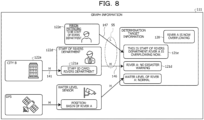
- FIG. 8 is a diagram illustrating an example of the label assignment of the reliability for the edge leading to the determination target information.
- the peculiar graph information generation unit 12 confirms that a label representing reliability of the edge 141 is "H". Subsequently, the peculiar graph information generation unit 12 inputs, to the reliability determination model 113, information on the label of the edge 141 and sub-graph information including entities 122d and 122a. As an output to the input, the peculiar graph information generation unit 12 acquires a determination result of reliability of property information 121d provided from the entity 122d representing the staff of the rivers department. The peculiar graph information generation unit 12 acquires "H” as a label representing the reliability of the property information 121d, and assigns "H" to an edge 146.
- the peculiar graph information generation unit 12 inputs, to the reliability determination model 113, sub-graph information including property information 121e, and acquires a determination result of reliability of the property information 121e provided from an entity 122e representing a person pretending to be the staff of the rivers department. In this case, since an edge extending to the entity 122e representing the person pretending to be the staff of the rivers department is not present, the peculiar graph information generation unit 12 does not input information on the label about the edge that is not present. The peculiar graph information generation unit 12 acquires "L" as a label indicating the reliability of the property information 121e provided from the entity 122e, and assigns "L" to an edge 147 (step S5).
- the credibility determination unit 13 acquires the credibility determination tendency model 114 from the data retention unit 11.
- the credibility determination unit 13 receives input of the peculiar graph information of the recipient from the peculiar graph information generation unit 12. Subsequently, the credibility determination unit 13 inputs the peculiar graph information to the credibility determination tendency model 114, and acquires the determination result of the credibility output from the credibility determination tendency model 114. Thereafter, the credibility determination unit 13 outputs the acquired determination result of the credibility to the output unit 14.
- the credibility determination unit 13 outputs the determination result of the credibility of the determination target information to the machine learning model update unit 15.
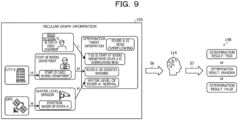
- FIG. 9 is a diagram illustrating an example of the credibility determination using the credibility determination tendency model.
- the credibility determination unit 13 inputs peculiar graph information 150 acquired from the peculiar graph information generation unit 12 to the credibility determination tendency model 114 (step S6).
- the credibility determination unit 13 acquires a determination result 148 of the credibility of the determination target information input from the credibility determination tendency model 114 (step S7).
- the credibility determination unit 13 acquires information indicating any of "true", "unknown", or "false” as the determination result 148 of the credibility of the determination target information.
- the output unit 14 receives input of the peculiar graph information of the recipient from the peculiar graph information generation unit 12.
- the output unit 14 receives input of the determination result of the credibility of the determination target information from the credibility determination unit 13.
- the output unit 14 transmits the peculiar graph information of the recipient and the determination result of the credibility of the determination target information to the recipient terminal apparatus 2, and provides the peculiar graph information and the determination result to the recipient.
- the recipient confirms the provided peculiar graph information and determination result of the credibility of the determination target information by using the recipient terminal apparatus 2, and determines the credibility of the determination target. Thereafter, by using the recipient terminal apparatus 2 or the like, the recipient generates credibility determination result information 21 indicating the determination result of the credibility finally obtained for the determination target. By using the recipient terminal apparatus 2 or the like, the recipient generates virtual evaluation information 22 which is a proposal for property information that is not currently added to the acquired peculiar graph information but with which the recipient determines that the credibility of the determination target is high if it is added to the peculiar graph information.
- the recipient In a case where there is a label of which the value is to be corrected among the labels of the reliabilities assigned to the acquired peculiar graph information, the recipient generates reliability label correction information 23 indicating the label and the corrected value.
- the recipient terminal apparatus 2 transmits, to the information processing apparatus 1, the credibility determination result information 21, the virtual evaluation information 22, and the reliability label correction information 23, as the feedback information 20.
- the output unit 14 receives, from the machine learning model update unit 15, a request to transmit the updated reliability determination model 113 and the updated credibility determination tendency model 114.
- the output unit 14 transmits, to the recipient terminal apparatus 2, the updated reliability determination model 113 and the updated credibility determination tendency model 114.
- the machine learning model update unit 15 receives, from the recipient terminal apparatus 2, the feedback information 20 including the credibility determination result information 21, the virtual evaluation information 22, and the reliability label correction information 23.
- the machine learning model update unit 15 receives, from the credibility determination unit 13, input of the determination result of the credibility for the determination target information.
- the machine learning model update unit 15 updates parameters of the reliability determination model 113 to reduce an error between the output of the reliability determination model 113 and the determination of the recipient by using the correction information of the label designated in the reliability label correction information 23.
- the machine learning model update unit 15 compares the determination result of the credibility registered in the credibility determination result information 21 with the credibility of the determination target information determined by the credibility determination tendency model 114, and updates parameters of the credibility determination tendency model 114 by using the virtual evaluation information 22. In this case, the machine learning model update unit 15 updates the parameters of the credibility determination tendency model 114 to reduce an error between the output of the credibility determination tendency model 114 and the determination of the recipient.
- the machine learning model update unit 15 may update the parameters by using a method based on an error between an output of the neural network and the determination of the recipient that is a ground truth label, such as stochastic gradient descent (SGD) or Adam.
- SGD stochastic gradient descent
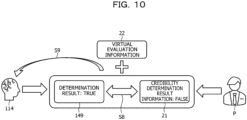
- FIG. 10 is a diagram illustrating an example of the parameter update of the credibility determination tendency model.
- the machine learning model update unit 15 acquires a determination result 149 indicating that the credibility output from the credibility determination tendency model 114 is "true".
- the machine learning model update unit 15 acquires the credibility determination result information 21 in which the credibility is determined to be "false” by a recipient P. Subsequently, the machine learning model update unit 15 compares the determination result 149 and the credibility determination result information 21 with each other (step S8).
- the machine learning model update unit 15 updates the parameters of the credibility determination tendency model 114 by using the comparison result and the virtual evaluation information 22 (step S9).
- the parameters of the credibility determination tendency model 114 are updated by using the virtual evaluation information 22 fed back from the recipient, and thus, it is possible to increase the reliability of the credibility determination by the information processing apparatus 1.
- the virtual evaluation information 22 is an example of data for increasing the reliability of the credibility determination fed back from the recipient, and another data may be used as long as the other data may contribute to the increase in the reliability of the credibility determination.
- the machine learning model update unit 15 may update the parameters of the credibility determination tendency model 114 based on the credibility determination result information 21.
- This virtual evaluation information 22 is an example of "virtual property information".
- the machine learning model update unit 15 outputs, to the output unit 14, the updated reliability determination model 113 and the updated credibility determination tendency model 114, and requests the output unit 14 to transmit, to the recipient terminal apparatus 2, the updated reliability determination model 113 and the updated credibility determination tendency model 114.
- the recipient transmits, to the reliability determination model management server 31, the transmitted updated reliability determination model 113 and causes the reliability determination model management server 31 to update the reliability determination model 113 retained therein.
- the recipient transmits, to the credibility determination tendency model management server 32, the transmitted updated credibility determination tendency model 114, and causes the credibility determination tendency model management server 32 to update the credibility determination tendency model 114 retained therein.
- the recipient updates the reliability determination model 113 and the credibility determination tendency model 114 respectively retained in the reliability determination model management server 31 and the credibility determination tendency model management server 32, this update may be performed by the machine learning model update unit 15.
- FIG. 11 is a diagram illustrating an overall flow of the credibility determination processing according to the embodiment. Next, an overview of the credibility determination processing by the information processing apparatus 1 will be described again with reference to FIG. 11 .
- the recipient inputs, to the information processing apparatus 1, the designation of the determination target information, the reliability list 112, the reliability determination model 113, and the credibility determination tendency model 114 by using the recipient terminal apparatus 2.
- the data retention unit 11 receives the reliability list 112 designated by the recipient from the reliability list management server 33 and stores the reliability list 112.
- the data retention unit 11 acquires the reliability determination model 113 designated by the recipient from the reliability determination model management server 31 and stores the reliability determination model 113.
- the data retention unit 11 acquires the credibility determination tendency model 114 designated by the recipient from the credibility determination tendency model management server 32 and stores the credibility determination tendency model 114.
- the data retention unit 11 requests the graph information management server 34 to create the graph information 111 about the input determination target information.
- the data retention unit 11 receives the graph information 111 about the determination target information created by the graph information management server 34 and stores the graph information 111.
- the peculiar graph information generation unit 12 generates peculiar graph information 151 by using the graph information 111, the reliability list 112, and the reliability determination model 113 stored in the data retention unit 11 (step S11).
- the credibility determination unit 13 inputs, to the credibility determination tendency model 114, the peculiar graph information 151 generated by the peculiar graph information generation unit 12 (step S12).
- the credibility determination unit 13 acquires a determination result 152 of credibility output from the credibility determination tendency model 114.
- the output unit 14 transmits, to the recipient terminal apparatus 2, the determination result 152 of the credibility acquired from the credibility determination unit 13 (step S13).
- the output unit 14 transmits, to the recipient terminal apparatus 2, the peculiar graph information 151 generated by the peculiar graph information generation unit 12 (step S14).
- the recipient terminal apparatus 2 provides, to the recipient P, result information 153 including the peculiar graph information 151 and the determination result 152 of the credibility by displaying the result information 153 on a monitor or the like.
- the recipient P confirms the result information 153 and determines the credibility of the determination target information. Thereafter, the recipient P transmits, to the machine learning model update unit 15 of the information processing apparatus 1, the feedback information 20 including the credibility determination result information 21, the virtual evaluation information 22, and the reliability label correction information 23 (step S15).
- the machine learning model update unit 15 updates the parameters of the credibility determination tendency model 114 by using the credibility determination result information 21 and the virtual evaluation information 22 included in the feedback information 20 (step S16).
- the machine learning model update unit 15 updates the parameters of the reliability determination model 113 by using the reliability label correction information 23 included in the feedback information 20 (step S17).
- the information processing apparatus 1 executes the credibility determination processing by using the reliability determination model 113 and the credibility determination tendency model 114 in which the parameters are updated.
- FIG. 12 is a flowchart of the credibility determination processing by the information processing apparatus according to the embodiment. Next, a flow of the credibility determination processing by the information processing apparatus 1 according to the embodiment will be described with reference to FIG. 12 .
- the data retention unit 11 receives, from the recipient terminal apparatus 2, input of the designation of the determination target information, the reliability list 112, the reliability determination model 113, and the credibility determination tendency model 114 (step S101).
- the data retention unit 11 acquires the designated reliability determination model 113, the designated credibility determination tendency model 114, and the designated reliability list 112 respectively from the reliability determination model management server 31, the credibility determination tendency model management server 32, and the reliability list management server 33 (step S102).
- the data retention unit 11 requests the graph information management server 34 to create the graph information 111 about the input determination target information. Thereafter, the data retention unit 11 acquires the graph information 111 about the determination target information from the graph information management server 34 (step S103).
- the peculiar graph information generation unit 12 generates the peculiar graph information 151 by using the graph information 111, the reliability list 112, and the reliability determination model 113 stored in the data retention unit 11 (step S104).
- the credibility determination unit 13 determines the credibility for the determination target information by inputting the peculiar graph information 151 generated by the peculiar graph information generation unit 12 to the credibility determination tendency model 114 and obtaining an output thereof (step S105).
- the output unit 14 outputs, to the recipient terminal apparatus 2, the peculiar graph information generated by the peculiar graph information generation unit 12 and the determination result of the credibility acquired from the credibility determination unit 13 (step S106).
- the recipient P confirms the result information 153 and determines the credibility of the determination target information.
- the machine learning model update unit 15 determines whether or not there is feedback from the recipient P (step S107). In a case where there is no feedback (step S107: No), the machine learning model update unit 15 ends the processing.
- step S107 the machine learning model update unit 15 then acquires, from the recipient terminal apparatus 2, the feedback information 20 including the credibility determination result information 21, the virtual evaluation information 22, and the reliability label correction information 23 (in step S108).
- the machine learning model update unit 15 updates the parameters of the reliability determination model 113 by using the reliability label correction information 23 included in the feedback information 20 (step S109).
- the machine learning model update unit 15 updates the parameters of the credibility determination tendency model 114 by using the credibility determination result information 21 and the virtual evaluation information 22 included in the feedback information 20 (step S110).
- the output unit 14 transmits, to the recipient terminal apparatus 2, the reliability determination model 113 and the credibility determination tendency model 114 updated by the machine learning model update unit 15 (step S111).
- the information processing apparatus determines the reliability of the property information by each generator indicated in the graph information of the determination target information, by using the reliability list and the reliability determination model, and generates the peculiar graph information by adding the label indicating the reliability to the graph information.
- the information processing apparatus determines the credibility of the determination target information by using the generated peculiar graph information in the credibility determination tendency model.
- the recipient may determine the credibility of the determination target information, based on the determination result of the credibility of the determination target information and the peculiar graph information.
- the information processing apparatus acquires feedback information including information on the result of the determination of the credibility by the recipient, and updates the reliability determination model and the credibility determination tendency model.
- the reliability determination model may determine the credibility of the property information from each generator in accordance with a determination tendency of the recipient.
- a label of reliability is assigned to the graph information by using the information of the generator reliable by the recipient and written in the reliability list and the reliability determination model, and thus, it is possible to generate the peculiar graph information representing the reliability according to the determination tendency of the recipient.
- the credibility of the determination target information is determined by using the peculiar graph information, and thus, it is possible to determine the credibility of the determination target by using the peculiar graph information reflecting reliability of each generator from the recipient's point of view, and it is possible to obtain the determination result of the credibility according to the determination tendency of the recipient.
- the determination of the credibility of the data may be supported in consideration of the reliability of the generator from the recipient's point of view. Accordingly, it is possible to appropriately determine the credibility of the received information received from the Internet or the like.
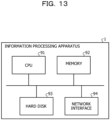
- FIG. 13 is a hardware configuration diagram of the information processing apparatus. Next, an example of a hardware configuration for realizing functions of the information processing apparatus 1 is described with reference to FIG. 13 .
- the information processing apparatus 1 includes a central processing unit (CPU) 91, a memory 92, a hard disk 93, and a network interface 94.
- the CPU 91 is coupled to the memory 92, the hard disk 93, and the network interface 94 via a bus.
- the network interface 94 is an interface for communication between the information processing apparatus 1 and an external apparatus.
- the network interface 94 relays communication between the CPU 91 and the recipient terminal apparatus 2, the reliability determination model management server 31, the credibility determination tendency model management server 32, the reliability list management server 33, and the graph information management server 34.
- the hard disk 93 is an auxiliary storage device.
- the hard disk 93 may store the graph information 111, the reliability list 112, the reliability determination model 113, and the credibility determination tendency model 114 illustrated in FIG. 2 .
- the hard disk 93 stores various programs including a program for realizing functions of the data retention unit 11, the peculiar graph information generation unit 12, the credibility determination unit 13, the output unit 14, and the machine learning model update unit 15 illustrated in FIG. 2 .
- the memory 92 is a main storage device.
- a dynamic random-access memory (DRAM) may be used as the memory 92.
- the CPU 91 reads various programs from the hard disk 93, loads the programs to the memory 92, and executes the programs. Accordingly, the CPU 91 realizes the functions of the data retention unit 11, the peculiar graph information generation unit 12, the credibility determination unit 13, the output unit 14, and the machine learning model update unit 15 illustrated in FIG. 2 .
Landscapes
- Engineering & Computer Science (AREA)
- Theoretical Computer Science (AREA)
- Software Systems (AREA)
- General Engineering & Computer Science (AREA)
- Physics & Mathematics (AREA)
- Evolutionary Computation (AREA)
- Computing Systems (AREA)
- General Physics & Mathematics (AREA)
- Mathematical Physics (AREA)
- Artificial Intelligence (AREA)
- Data Mining & Analysis (AREA)
- Computational Linguistics (AREA)
- Medical Informatics (AREA)
- Computer Vision & Pattern Recognition (AREA)
- Health & Medical Sciences (AREA)
- Biophysics (AREA)
- General Health & Medical Sciences (AREA)
- Molecular Biology (AREA)
- Biomedical Technology (AREA)
- Life Sciences & Earth Sciences (AREA)
- Management, Administration, Business Operations System, And Electronic Commerce (AREA)
Abstract
An information processing program causes a computer to execute a process. The computer includes a trained first machine learning model that receives, as an input, property information which indicates a probability of data and is assigned reliability information which indicates reliability of the property information, and outputs credibility of the data. The process includes: acquiring first property information that indicates a probability of predetermined data received by a recipient; generating first reliability information that indicates reliability of the first property information, based on a reliability list in which a generator reliable for the recipient among generators of the first property information is registered; and inputting, to the first machine learning model, the first property information that is assigned the first reliability information, determining credibility of the predetermined data, and presenting a result.
Description
- The embodiment discussed herein is related to an information processing program, an information processing method, and an information processing apparatus.
- Various kinds of information such as articles on news sites and information provided through a social networking service (SNS) are widely spread over the Internet. Such pieces of information present over the Internet may include false information that is information including incorrect content. Recently, it has been regarded as a problem that such false information causes confusion in the economy and society.
- Therefore, as a countermeasure against the false information, there has been proposed a technology for confirming a probability of data over the Internet in a generic manner. In this technology, data over the Internet is assigned property information representing evaluation related to confirmation or evaluation by a third party other than a sender and a recipient of the data. The property information and the information on a provider who is the third party that provides the property information are disclosed to the recipient as a graph. This may allow the recipient to determine credibility of the data that is assigned the property information, and may increase reliability of the data. For example, in the graph, information on the sender of the data and information on the provider of the property information are each represented as a node that is an element related to the data.
- As a method of using the technology using such a graph, the following technology is conceivable. For example, a machine learning model is trained by using training data including data for which true or false is known and property information. Unknown data for which true or false is not known and property information for the unknown data may be input to the trained machine learning model, and true or false of the data may be output.
- As a technology related to the credibility of information, a technology for training a machine learning model by using evaluation reliabilities and evaluation tendencies of a plurality of evaluators and determining credibility of news evaluated by an evaluator has been proposed. Another technology for training a machine learning model by using a post history of a poster and determining a questionable product review post by using the trained machine learning model has been proposed. Still another technology for receiving a report, specifying a category of the report, and evaluating reliability of the report by using a machine learning model corresponding to the specified category has been proposed.
- Japanese National Publication of International Patent Application No.
2020-508518 Japanese Laid-open Patent Publication No. 2022-147013 U.S. Patent Application Publication No. 2021/0289166 are disclosed as related art. - However, in the technology for obtaining the true or false determination result by inputting the unknown data and the property information to the machine learning model, determination is performed in a state where it is not clear how reliable the provider of each property information is. How reliable the provider of the property information depends on a recipient and a determination target.
- For example, a case where the recipient wants to confirm credibility of an explanatory text "easy to understand" about a technical document of economics will be described as an example. In this case, it is considered that an expert of the economics evaluates the technical document as being easy to understand and a person who has started to study the economics evaluates the technical document as being difficult to understand. In this situation, if the recipient of the explanatory text is familiar with the economics to some extent, the recipient regards the explanatory text as true by relying on an opinion of the expert rather than on the person who has started to study the economics. By contrast, if the recipient of the explanatory text is a beginner of the economics, the recipient regards the explanatory text as false by relying on an opinion of the person who has started to study the economics rather than an expert. As described above, the reliability of the provider of the property information changes depending on an attribute of the recipient.
- Therefore, in the technology for obtaining the true or false determination result by inputting the unknown data and the property information to the machine learning model, the reliability of the provider of the property information is not taken into consideration, and it is difficult to obtain a determination result of credibility appropriate for the recipient. Accordingly, it is difficult to appropriately determine the credibility of the received information.
- In the technology for training the machine learning model by using the evaluation reliabilities and the evaluation tendencies of the plurality of evaluators and evaluating the credibility, evaluation of the credibility is based on the information of the general evaluators, and it is difficult to obtain the credibility of the acquired data for the recipient who has acquired the data. Even in the technology for training the machine learning model by using the post history of the poster and determining a questionable product review post or the technology for evaluating the reliability by using the machine learning model corresponding to the category of the report, the credibility of the acquired data for the recipient who has acquired the data is not taken into consideration. Thus, it is difficult to appropriately determine the credibility for the received information by using any of the technologies.
- The disclosed technology has been made in view of the foregoing, and an object thereof is to provide an information processing program, an information processing method, and an information processing apparatus that allow determination of credibility for received information to be appropriately performed.
- According to an aspect of the embodiments, An information processing program causes a computer to execute a process. The computer includes a trained first machine learning model that receives, as an input, property information which indicates a probability of data and is assigned reliability information which indicates reliability of the property information, and outputs credibility of the data. The process includes: acquiring first property information that indicates a probability of predetermined data received by a recipient; generating first reliability information that indicates reliability of the first property information, based on a reliability list in which a generator reliable for the recipient among generators of the first property information is registered; and inputting, to the first machine learning model, the first property information that is assigned the first reliability information, determining credibility of the predetermined data, and presenting a result.
- According to one aspect, the present disclosure allows determination of credibility for received information to be appropriately performed.
-
-
FIG. 1 is a system configuration diagram of an information processing system according to an embodiment; -
FIG. 2 is a block diagram of an information processing apparatus according to the embodiment; -
FIG. 3 is a diagram illustrating an example of graph information; -
FIG. 4 is a diagram illustrating an example of a reliability list; -
FIG. 5 is a diagram illustrating an example of label assignment of reliability using the reliability list; -
FIG. 6 is a first diagram illustrating an example of the label assignment of the reliability using a reliability determination model; -
FIG. 7 is a second diagram illustrating an example of the label assignment of the reliability using the reliability determination model; -
FIG. 8 is a diagram illustrating an example of label assignment of reliability for an edge leading to determination target information; -
FIG. 9 is a diagram illustrating an example of credibility determination using a credibility determination tendency model; -
FIG. 10 is a diagram illustrating an example of parameter update of a credibility determination tendency model; -
FIG. 11 is a diagram illustrating an overall flow of credibility determination processing according to the embodiment; -
FIG. 12 is a flowchart of the credibility determination processing by the information processing apparatus according to the embodiment; and -
FIG. 13 is a hardware configuration diagram of the information processing apparatus. - Hereinafter, an embodiment of an information processing program, an information processing method, and an information processing apparatus disclosed in this application will be described in detail based on the drawings. The following embodiment is not intended to limit the information processing program, the information processing method, and the information processing apparatus disclosed in this application.
-
FIG. 1 is a system configuration diagram of an information processing system according to an embodiment.FIG. 2 is a block diagram of an information processing apparatus according to the embodiment. Although illustration of Internet 4 is omitted inFIG. 2 such that a flow of communication is easily understood, each apparatus actually performs communication via the Internet 4 as illustrated inFIG. 1 . - An
information processing system 100 includes aninformation processing apparatus 1, arecipient terminal apparatus 2, and a server group 3. Theinformation processing apparatus 1, therecipient terminal apparatus 2, and the server group 3 are each coupled to the Internet 4, and may transmit and receive data to and from each other. - The server group 3 includes a reliability determination
model management server 31, a credibility determination tendencymodel management server 32, a reliability list management server 33, a graph information management server 34, and an SNS server 35. The SNS server 35 is an apparatus that provides information that serves as a true/false determination target. A recipient determines how credible the information provided from the SNS server 35 is. For this determination, the recipient uses credibility determination processing by theinformation processing apparatus 1 described later. A server that provides information serving as a credibility determination target may be a server other than the SNS server 35. - The graph information management server 34 receives, from the
information processing apparatus 1, input of information set by the recipient as a target for which credibility is to be determined. Hereinafter, the information set by the recipient as a target for which credibility is to be determined is referred to as "determination target information". The graph information management server 34 createsgraph information 111, about the determination target information, having the determination target information as a root, by acquiring various kinds of information over theInternet 4 including the information provided from the SNS server 35. A graph hierarchized by repeated branching from one starting point is registered in thegraph information 111, and the starting point of the hierarchy in the graph is referred to as the root. For example, thegraph information 111 has a hierarchical structure or a tree structure having the root as the starting point. The graph information management server 34 transmits the createdgraph information 111 about the determination target information to theinformation processing apparatus 1. - The reliability determination
model management server 31, the credibility determination tendencymodel management server 32, and the reliability list management server 33 are servers that manage pieces of information owned by the recipient. InFIG. 1 , although the reliability determinationmodel management server 31, the credibility determination tendencymodel management server 32, and the reliability list management server 33 are illustrated to be coupled to theInternet 4, these servers may be disposed in, for example, a local environment of the recipient. The reliability determinationmodel management server 31, the credibility determination tendencymodel management server 32, and the reliability list management server 33 provide various kinds of information regarding the recipient to theinformation processing apparatus 1 via theInternet 4. - The
recipient terminal apparatus 2 is a terminal apparatus operated by the recipient who determines the credibility for the information provided from the SNS server 35. Therecipient terminal apparatus 2 notifies theinformation processing apparatus 1 of designation of the determination target information. Upon receiving the designation from the recipient, therecipient terminal apparatus 2 notifies theinformation processing apparatus 1 of designation of areliability list 112, areliability determination model 113, and a credibilitydetermination tendency model 114 corresponding to the recipient. Details of thereliability list 112, thereliability determination model 113, and the credibilitydetermination tendency model 114 will be described later. - The
recipient terminal apparatus 2 receives, from theinformation processing apparatus 1, a determination result of the credibility of the determination target information and thegraph information 111 serving as a determination material of the credibility therefor. Therecipient terminal apparatus 2 provides these pieces of information to the recipient by displaying these pieces of information on a monitor or the like. - Thereafter, in a case where there is information to be fed back to the
information processing apparatus 1 from the recipient for the determination result of the credibility received from theinformation processing apparatus 1, therecipient terminal apparatus 2 transmits designatedfeedback information 20 to theinformation processing apparatus 1. Details of thefeedback information 20 will be described later. - The
information processing apparatus 1 executes the credibility determination processing, corresponding to the recipient and the determination target information, on the determination target information by using the pieces of information acquired from the reliability determinationmodel management server 31, the credibility determination tendencymodel management server 32, the reliability list management server 33, and the graph information management server 34. Theinformation processing apparatus 1 generates peculiar graph information, peculiar to the recipient, to which the information serving as the determination material of the credibility for the determination target information is added. Theinformation processing apparatus 1 transmits, to therecipient terminal apparatus 2, the determination result of the credibility of the determination target information and the peculiar graph information. - Hereinafter, the credibility determination processing by the
information processing apparatus 1 will be described in detail with reference toFIG. 2 . As illustrated inFIG. 2 , theinformation processing apparatus 1 includes adata retention unit 11, a peculiar graphinformation generation unit 12, acredibility determination unit 13, anoutput unit 14, and a machine learningmodel update unit 15. - The
data retention unit 11 receives, from therecipient terminal apparatus 2, notification of designation of the determination target information and notification of designation of thereliability list 112, thereliability determination model 113, and the credibilitydetermination tendency model 114 corresponding to the recipient. For example, the determination target information is input to thedata retention unit 11 by a drag operation using a mouse or the like on a portion set as a credibility determination target in a sentence of an SNS post displayed on the monitor of therecipient terminal apparatus 2. Information indicating to which topic, among topics determined in advance, the determination target information belongs is added to the determination target information. Information on property information for the determination target information may be added to the determination target information. - The
data retention unit 11 gives, the graph information management server 34 of the server group 3, an instruction to create thegraph information 111 about the determination target information. Thereafter, thedata retention unit 11 receives, from the graph information management server 34, thegraph information 111 of the determination target information in which a graph having a hierarchical structure having the determination target information designated by the recipient as the root is registered. Thedata retention unit 11 stores the receivedgraph information 111 about the determination target information. -
FIG. 3 is a diagram illustrating an example of the graph information. For example, thegraph information 111 is information having a graph structure constituted bydetermination target information 120, a plurality of pieces ofproperty information 121, and a plurality ofentities 122 indicating respective generators of the pieces ofproperty information 121. Theproperty information 121 is data in which a property that is information on an attribute or a function of data, an individual, a corporation, a device, or the like is recorded in a tempering impossible format with a digital signature. Theproperty information 121 may include information indicating the generator thereof. - As illustrated in
FIG. 3 , information represented by a hierarchical structure having, as the root, thedetermination target information 120 designated by the recipient is registered in thegraph information 111. For example, in thegraph information 111, the three pieces ofproperty information 121 are associated with thedetermination target information 120 designated by the recipient. The three pieces ofproperty information 121 are associated with therespective entities 122. For example, theentity 122 indicating staff of the rivers department is associated with theproperty information 121 of "River A: no disaster warning". In a case where there isproperty information 121 for eachentity 122, they are associated with each other. Anentity 122 is further associated with theproperty information 121 for eachentity 122. For example,property information 121 "staff ID card: rivers department" is associated with theentity 122 representing the staff of the rivers department. Anentity 122 representing "city B" is associated as a generator of theproperty information 121. As described above, thegraph information 111 has a hierarchical structure in which eachproperty information 121 and theentity 122 that is the generator of theproperty information 121 are linked to each other with thedetermination target information 120 being set as the root that is the starting point of the hierarchical structure. - By viewing the
graph information 111, a user may confirm which kind of evaluation is performed on thedetermination target information 120 by which generator. However, thegraph information 111 in this state represents generic information that is the same for everyone, and the user may simply confirm a content of theproperty information 121 related to thedetermination target information 120 and the generator thereof, but it is difficult to grasp how much each generator is reliable for the user. - Description continues while referring back to
FIG. 2 . Thedata retention unit 11 receives thereliability list 112 designated by the recipient from the reliability list management server 33 of the server group 3. Thedata retention unit 11 stores the receivedreliability list 112. -
FIG. 4 is a diagram illustrating an example of the reliability list. As illustrated inFIG. 4 , thereliability list 112 is created for every recipient and for every topic as a determination target. Thereliability list 112 is a list of generators for which property information for a specific topic is regarded to be reliable by the recipient. A topic of the determination target information and a unique identifier of the generator regarded to be reliable by the recipient are written in thereliability list 112. For example, a decentralized identifier (DID) may be used as the unique identifier. In the present embodiment, information indicating who the generator is is added to the property information by using the same type of identifier as the identifier handled in thereliability list 112. - For example, the
reliability list 112 inFIG. 4 is a list for a topic of a disaster. In the case of thereliability list 112 inFIG. 4 , city B that is a municipality where the recipient lives and a Global Positioning System (GPS) that issues positional information of a water level sensor or the like are designated as the reliable generators by the recipient. For example, asyntax 130 is an example of a document of thereliability list 112 using the DID. - Description continues while referring back to
FIG. 2 . Thedata retention unit 11 receives thereliability determination model 113 designated by the recipient from the reliability determinationmodel management server 31 of the server group 3. Thedata retention unit 11 stores the receivedreliability determination model 113. - The
reliability determination model 113 is a machine learning model that determines reliability of the property information registered in thegraph information 111 by using a part of thegraph information 111 including a path traced from the determination target information which is the root to the property information. The part of thegraph information 111 traced from the determination target information for which reliability is to be determined is referred to as "sub-graph information". For example, inFIG. 3 , information including up to anentity 122 indicating the GPS traced from thedetermination target information 120 via anentity 122 indicating a water level sensor is an example of the sub-graph information. - For example, the
reliability determination model 113 is used when, in thegraph information 111, reliability of property information from a specific generator that is not explicitly indicated in thereliability list 112 is determined based on a relationship with another generator. For example, thereliability determination model 113 determines the reliability of the property information obtained from the specific generator by learning what kind of property information is issued for the specific generator from the generator determined to have high reliability by the recipient. For example, thereliability determination model 113 may use, for the machine learning, determination of the reliability of the property information made by the recipient himself or herself in the past on the same type of determination target information such as the same topic. - The
reliability determination model 113 is an example of a "second machine learning model". Property information included in training data used for the machine learning of thereliability determination model 113 is an example of "second property information". For example, thereliability determination model 113 is a machine learning model that receives, as inputs, specific property information and information of a generator of the specific property information, and that outputs reliability information of the specific property information, and machine learning is performed based on a past determination result of reliability for the second property information by the recipient. - Description continues while referring back to
FIG. 2 . Thedata retention unit 11 receives the credibilitydetermination tendency model 114 designated by the recipient from the credibility determination tendencymodel management server 32 of the server group 3. Thedata retention unit 11 stores the received credibilitydetermination tendency model 114. - The credibility
determination tendency model 114 is a machine learning model that receives input of peculiar graph information that is graph information peculiar to the recipient for the determination target information and outputs a determination result of the credibility of the determination target information. The determination result of the credibility is represented by, for example, information such as true, false, or unknown, a numerical value indicating a level of the credibility, or the like. The credibilitydetermination tendency model 114 performs machine learning by using the determination of the credibility made by the recipient himself or herself in the past on the same topic as the determination target information. For example, Graph Neural Network (GNN) or the like that may use a graph as the input may be used for the credibilitydetermination tendency model 114. The credibilitydetermination tendency model 114 is an example of a "first machine learning model". - The peculiar graph
information generation unit 12 acquires thegraph information 111, thereliability list 112, and thereliability determination model 113 from thedata retention unit 11. The peculiar graphinformation generation unit 12 generates peculiar graph information in which information on reliability is added to each property information in thegraph information 111, by using thereliability list 112 and thereliability determination model 113. The peculiar graphinformation generation unit 12 outputs the generated peculiar graph information to thecredibility determination unit 13 and theoutput unit 14. Hereinafter, details of the creation of the peculiar graph information by the peculiar graphinformation generation unit 12 will be described. - The peculiar graph
information generation unit 12 assigns, in thegraph information 111, a label indicating "high reliability" to the property information from the generator written in thereliability list 112.FIG. 5 is a diagram illustrating an example of the label assignment of the reliability using the reliability list. - For example, a case where city B that is a municipality where the recipient lives is registered in the
reliability list 112 and a GPS that issues positional information of a water level sensor or the like as property information is not registered in thereliability list 112 is considered. As assignment of a label representing high reliability, the peculiar graphinformation generation unit 12 assigns "H" to anedge 141 extending from anentity 122a representing city B toproperty information 121a in thegraph information 111 inFIG. 5 (step S1). In this case, since the GPS is not registered in thereliability list 112, the peculiar graphinformation generation unit 12 does not assign a label to an edge extending from the GPS to the property information in thegraph information 111 inFIG. 5 . - The determination target information is an example of "predetermined data". The property information for the determination target information in the
graph information 111 is an example of "first property information". A label representing reliability assigned to an edge extending to the property information from the generator registered in thereliability list 112 is an example of "first reliability information". For example, the peculiar graphinformation generation unit 12 generates the first reliability information indicating the reliability of the first property information, based on thereliability list 112 in which the generator reliable for the recipient among the generators of the first property information is registered. The peculiar graphinformation generation unit 12 acquires the first property information by acquiring thegraph information 111 representing a relationship among the predetermined data, the first property information, and the generator. - In the following description, in the
graph information 111, a label "H" represents high reliability, and a label "L" represents low reliability. In the present embodiment, although the peculiar graphinformation generation unit 12 assigns the label by using the information indicating whether the reliability is high or low, a numerical value indicating the level of the reliability may be used as the label. - Subsequently, the peculiar graph
information generation unit 12 assigns, to the property information by the generator that is not written in thereliability list 112, a label indicating the determination result of the reliability that is output by inputting, to thereliability determination model 113, the sub-graph information having, as the root, the determination target information for which the reliability is to be determined.FIG. 6 is a first diagram illustrating an example of the label assignment of the reliability using the reliability determination model.FIG. 7 is a second diagram illustrating an example of the label assignment of reliability using the reliability determination model. - From the
graph information 111 illustrated inFIG. 6 , the peculiar graphinformation generation unit 12 extractssub-graph information 142 including up to anentity 122b of the GPS, that is not registered in thereliability list 112, traced fromdetermination target information 120 via anentity 122c of the water level sensor. Subsequently, the peculiar graphinformation generation unit 12 inputs thesub-graph information 142 to the reliability determination model 113 (step S2). The peculiar graphinformation generation unit 12 obtains the determination result of the reliability output from thereliability determination model 113. The peculiar graphinformation generation unit 12 obtains anoutput 143 indicating that reliability of any piece of property information provided from the GPS indicated by theentity 122b and the water level sensor indicated by theentity 122c in thesub-graph information 142 is high (step S3). - As illustrated in
FIG. 7 , the peculiar graphinformation generation unit 12 assigns "H" which is a label indicating high reliability, to anedge 144 extending from theentity 122b toproperty information 121b. The peculiar graphinformation generation unit 12 assigns "H" which is a label indicating high reliability, to anedge 145 extending from theentity 122c toproperty information 121c (step S4). - For example, the GPS corresponds to a "generator not registered in the
reliability list 112". Theproperty information 121b provided from the GPS and theproperty information 121c provided from the water level sensor to which theproperty information 121b is assigned are an example of "the third property information and information of a generator of the third property information". The labels assigned to theedges information generation unit 12 inputs the third property information and the information of the generator of the third property information to thereliability determination model 113 which is the second machine learning model, and generates the first reliability information. - Subsequently, the peculiar graph
information generation unit 12 determines labels of reliabilities for the pieces of property information indicating the generators by using thereliability determination model 113 sequentially from edges away from the determination target information of thegraph information 111, and assigns labels indicating the reliabilities to the edges. The labels are assigned sequentially from the edges away from the determination target information, and thus, the peculiar graphinformation generation unit 12 may perform the reliability determination by also using information on the label assigned to an edge in a lower layer from a label assignment target. Reliability labels are assigned to all edges of thegraph information 111, and thus, the peculiar graphinformation generation unit 12 generates peculiar label information.FIG. 8 is a diagram illustrating an example of the label assignment of the reliability for the edge leading to the determination target information. - For example, as illustrated in
FIG. 8 , the peculiar graphinformation generation unit 12 confirms that a label representing reliability of theedge 141 is "H". Subsequently, the peculiar graphinformation generation unit 12 inputs, to thereliability determination model 113, information on the label of theedge 141 and sub-graphinformation including entities information generation unit 12 acquires a determination result of reliability ofproperty information 121d provided from theentity 122d representing the staff of the rivers department. The peculiar graphinformation generation unit 12 acquires "H" as a label representing the reliability of theproperty information 121d, and assigns "H" to anedge 146. The peculiar graphinformation generation unit 12 inputs, to thereliability determination model 113, sub-graph information includingproperty information 121e, and acquires a determination result of reliability of theproperty information 121e provided from anentity 122e representing a person pretending to be the staff of the rivers department. In this case, since an edge extending to theentity 122e representing the person pretending to be the staff of the rivers department is not present, the peculiar graphinformation generation unit 12 does not input information on the label about the edge that is not present. The peculiar graphinformation generation unit 12 acquires "L" as a label indicating the reliability of theproperty information 121e provided from theentity 122e, and assigns "L" to an edge 147 (step S5). - Description continues while referring back to
FIG. 2 . Thecredibility determination unit 13 acquires the credibilitydetermination tendency model 114 from thedata retention unit 11. Thecredibility determination unit 13 receives input of the peculiar graph information of the recipient from the peculiar graphinformation generation unit 12. Subsequently, thecredibility determination unit 13 inputs the peculiar graph information to the credibilitydetermination tendency model 114, and acquires the determination result of the credibility output from the credibilitydetermination tendency model 114. Thereafter, thecredibility determination unit 13 outputs the acquired determination result of the credibility to theoutput unit 14. Thecredibility determination unit 13 outputs the determination result of the credibility of the determination target information to the machine learningmodel update unit 15. -
FIG. 9 is a diagram illustrating an example of the credibility determination using the credibility determination tendency model. Thecredibility determination unit 13 inputspeculiar graph information 150 acquired from the peculiar graphinformation generation unit 12 to the credibility determination tendency model 114 (step S6). Thecredibility determination unit 13 acquires adetermination result 148 of the credibility of the determination target information input from the credibility determination tendency model 114 (step S7). For example, as illustrated inFIG. 9 , thecredibility determination unit 13 acquires information indicating any of "true", "unknown", or "false" as thedetermination result 148 of the credibility of the determination target information. - Description continues while referring back to
FIG. 2 . Theoutput unit 14 receives input of the peculiar graph information of the recipient from the peculiar graphinformation generation unit 12. Theoutput unit 14 receives input of the determination result of the credibility of the determination target information from thecredibility determination unit 13. Theoutput unit 14 transmits the peculiar graph information of the recipient and the determination result of the credibility of the determination target information to therecipient terminal apparatus 2, and provides the peculiar graph information and the determination result to the recipient. - The recipient confirms the provided peculiar graph information and determination result of the credibility of the determination target information by using the
recipient terminal apparatus 2, and determines the credibility of the determination target. Thereafter, by using therecipient terminal apparatus 2 or the like, the recipient generates credibility determination resultinformation 21 indicating the determination result of the credibility finally obtained for the determination target. By using therecipient terminal apparatus 2 or the like, the recipient generatesvirtual evaluation information 22 which is a proposal for property information that is not currently added to the acquired peculiar graph information but with which the recipient determines that the credibility of the determination target is high if it is added to the peculiar graph information. In a case where there is a label of which the value is to be corrected among the labels of the reliabilities assigned to the acquired peculiar graph information, the recipient generates reliabilitylabel correction information 23 indicating the label and the corrected value. Therecipient terminal apparatus 2 transmits, to theinformation processing apparatus 1, the credibility determination resultinformation 21, thevirtual evaluation information 22, and the reliabilitylabel correction information 23, as thefeedback information 20. - The
output unit 14 receives, from the machine learningmodel update unit 15, a request to transmit the updatedreliability determination model 113 and the updated credibilitydetermination tendency model 114. Theoutput unit 14 transmits, to therecipient terminal apparatus 2, the updatedreliability determination model 113 and the updated credibilitydetermination tendency model 114. - The machine learning
model update unit 15 receives, from therecipient terminal apparatus 2, thefeedback information 20 including the credibility determination resultinformation 21, thevirtual evaluation information 22, and the reliabilitylabel correction information 23. The machine learningmodel update unit 15 receives, from thecredibility determination unit 13, input of the determination result of the credibility for the determination target information. The machine learningmodel update unit 15 updates parameters of thereliability determination model 113 to reduce an error between the output of thereliability determination model 113 and the determination of the recipient by using the correction information of the label designated in the reliabilitylabel correction information 23. - The machine learning
model update unit 15 compares the determination result of the credibility registered in the credibility determination resultinformation 21 with the credibility of the determination target information determined by the credibilitydetermination tendency model 114, and updates parameters of the credibilitydetermination tendency model 114 by using thevirtual evaluation information 22. In this case, the machine learningmodel update unit 15 updates the parameters of the credibilitydetermination tendency model 114 to reduce an error between the output of the credibilitydetermination tendency model 114 and the determination of the recipient. - For example, a case where the
reliability determination model 113 and the credibilitydetermination tendency model 114 are modeled as a neural network such as a GNN will be described as an example. In this case, the machine learningmodel update unit 15 may update the parameters by using a method based on an error between an output of the neural network and the determination of the recipient that is a ground truth label, such as stochastic gradient descent (SGD) or Adam. -
FIG. 10 is a diagram illustrating an example of the parameter update of the credibility determination tendency model. The machine learningmodel update unit 15 acquires adetermination result 149 indicating that the credibility output from the credibilitydetermination tendency model 114 is "true". The machine learningmodel update unit 15 acquires the credibility determination resultinformation 21 in which the credibility is determined to be "false" by a recipient P. Subsequently, the machine learningmodel update unit 15 compares thedetermination result 149 and the credibility determination resultinformation 21 with each other (step S8). The machine learningmodel update unit 15 updates the parameters of the credibilitydetermination tendency model 114 by using the comparison result and the virtual evaluation information 22 (step S9). - In the present embodiment, the parameters of the credibility
determination tendency model 114 are updated by using thevirtual evaluation information 22 fed back from the recipient, and thus, it is possible to increase the reliability of the credibility determination by theinformation processing apparatus 1. Note that thevirtual evaluation information 22 is an example of data for increasing the reliability of the credibility determination fed back from the recipient, and another data may be used as long as the other data may contribute to the increase in the reliability of the credibility determination. Even though special data for increasing the reliability of the credibility determination such as thevirtual evaluation information 22 is not used, the machine learningmodel update unit 15 may update the parameters of the credibilitydetermination tendency model 114 based on the credibility determination resultinformation 21. Thisvirtual evaluation information 22 is an example of "virtual property information". - Thereafter, the machine learning
model update unit 15 outputs, to theoutput unit 14, the updatedreliability determination model 113 and the updated credibilitydetermination tendency model 114, and requests theoutput unit 14 to transmit, to therecipient terminal apparatus 2, the updatedreliability determination model 113 and the updated credibilitydetermination tendency model 114. By using therecipient terminal apparatus 2, the recipient transmits, to the reliability determinationmodel management server 31, the transmitted updatedreliability determination model 113 and causes the reliability determinationmodel management server 31 to update thereliability determination model 113 retained therein. Similarly, by using therecipient terminal apparatus 2, the recipient transmits, to the credibility determination tendencymodel management server 32, the transmitted updated credibilitydetermination tendency model 114, and causes the credibility determination tendencymodel management server 32 to update the credibilitydetermination tendency model 114 retained therein. - In the present embodiment, although the recipient updates the
reliability determination model 113 and the credibilitydetermination tendency model 114 respectively retained in the reliability determinationmodel management server 31 and the credibility determination tendencymodel management server 32, this update may be performed by the machine learningmodel update unit 15. -
FIG. 11 is a diagram illustrating an overall flow of the credibility determination processing according to the embodiment. Next, an overview of the credibility determination processing by theinformation processing apparatus 1 will be described again with reference toFIG. 11 . - To determine the credibility of the determination target information obtained from the SNS server 35, the recipient inputs, to the
information processing apparatus 1, the designation of the determination target information, thereliability list 112, thereliability determination model 113, and the credibilitydetermination tendency model 114 by using therecipient terminal apparatus 2. Thedata retention unit 11 receives thereliability list 112 designated by the recipient from the reliability list management server 33 and stores thereliability list 112. Thedata retention unit 11 acquires thereliability determination model 113 designated by the recipient from the reliability determinationmodel management server 31 and stores thereliability determination model 113. Thedata retention unit 11 acquires the credibilitydetermination tendency model 114 designated by the recipient from the credibility determination tendencymodel management server 32 and stores the credibilitydetermination tendency model 114. Thedata retention unit 11 requests the graph information management server 34 to create thegraph information 111 about the input determination target information. Thereafter, thedata retention unit 11 receives thegraph information 111 about the determination target information created by the graph information management server 34 and stores thegraph information 111. The peculiar graphinformation generation unit 12 generatespeculiar graph information 151 by using thegraph information 111, thereliability list 112, and thereliability determination model 113 stored in the data retention unit 11 (step S11). - The
credibility determination unit 13 inputs, to the credibilitydetermination tendency model 114, thepeculiar graph information 151 generated by the peculiar graph information generation unit 12 (step S12). Thecredibility determination unit 13 acquires adetermination result 152 of credibility output from the credibilitydetermination tendency model 114. - The
output unit 14 transmits, to therecipient terminal apparatus 2, thedetermination result 152 of the credibility acquired from the credibility determination unit 13 (step S13). Theoutput unit 14 transmits, to therecipient terminal apparatus 2, thepeculiar graph information 151 generated by the peculiar graph information generation unit 12 (step S14). Therecipient terminal apparatus 2 provides, to the recipient P, resultinformation 153 including thepeculiar graph information 151 and thedetermination result 152 of the credibility by displaying theresult information 153 on a monitor or the like. - The recipient P confirms the
result information 153 and determines the credibility of the determination target information. Thereafter, the recipient P transmits, to the machine learningmodel update unit 15 of theinformation processing apparatus 1, thefeedback information 20 including the credibility determination resultinformation 21, thevirtual evaluation information 22, and the reliability label correction information 23 (step S15). - The machine learning
model update unit 15 updates the parameters of the credibilitydetermination tendency model 114 by using the credibility determination resultinformation 21 and thevirtual evaluation information 22 included in the feedback information 20 (step S16). The machine learningmodel update unit 15 updates the parameters of thereliability determination model 113 by using the reliabilitylabel correction information 23 included in the feedback information 20 (step S17). At the next time, theinformation processing apparatus 1 executes the credibility determination processing by using thereliability determination model 113 and the credibilitydetermination tendency model 114 in which the parameters are updated. -
FIG. 12 is a flowchart of the credibility determination processing by the information processing apparatus according to the embodiment. Next, a flow of the credibility determination processing by theinformation processing apparatus 1 according to the embodiment will be described with reference toFIG. 12 . - The
data retention unit 11 receives, from therecipient terminal apparatus 2, input of the designation of the determination target information, thereliability list 112, thereliability determination model 113, and the credibility determination tendency model 114 (step S101). - Subsequently, the
data retention unit 11 acquires the designatedreliability determination model 113, the designated credibilitydetermination tendency model 114, and the designatedreliability list 112 respectively from the reliability determinationmodel management server 31, the credibility determination tendencymodel management server 32, and the reliability list management server 33 (step S102). - The
data retention unit 11 requests the graph information management server 34 to create thegraph information 111 about the input determination target information. Thereafter, thedata retention unit 11 acquires thegraph information 111 about the determination target information from the graph information management server 34 (step S103). - The peculiar graph
information generation unit 12 generates thepeculiar graph information 151 by using thegraph information 111, thereliability list 112, and thereliability determination model 113 stored in the data retention unit 11 (step S104). - The
credibility determination unit 13 determines the credibility for the determination target information by inputting thepeculiar graph information 151 generated by the peculiar graphinformation generation unit 12 to the credibilitydetermination tendency model 114 and obtaining an output thereof (step S105). - The
output unit 14 outputs, to therecipient terminal apparatus 2, the peculiar graph information generated by the peculiar graphinformation generation unit 12 and the determination result of the credibility acquired from the credibility determination unit 13 (step S106). The recipient P confirms theresult information 153 and determines the credibility of the determination target information. - Thereafter, the machine learning
model update unit 15 determines whether or not there is feedback from the recipient P (step S107). In a case where there is no feedback (step S107: No), the machine learningmodel update unit 15 ends the processing. - By contrast, in a case where there is feedback (step S107: Yes), the machine learning
model update unit 15 then acquires, from therecipient terminal apparatus 2, thefeedback information 20 including the credibility determination resultinformation 21, thevirtual evaluation information 22, and the reliability label correction information 23 (in step S108). - The machine learning
model update unit 15 updates the parameters of thereliability determination model 113 by using the reliabilitylabel correction information 23 included in the feedback information 20 (step S109). - Subsequently, the machine learning
model update unit 15 updates the parameters of the credibilitydetermination tendency model 114 by using the credibility determination resultinformation 21 and thevirtual evaluation information 22 included in the feedback information 20 (step S110). - Thereafter, the
output unit 14 transmits, to therecipient terminal apparatus 2, thereliability determination model 113 and the credibilitydetermination tendency model 114 updated by the machine learning model update unit 15 (step S111). - As described above, the information processing apparatus according to the present embodiment determines the reliability of the property information by each generator indicated in the graph information of the determination target information, by using the reliability list and the reliability determination model, and generates the peculiar graph information by adding the label indicating the reliability to the graph information. The information processing apparatus determines the credibility of the determination target information by using the generated peculiar graph information in the credibility determination tendency model. The recipient may determine the credibility of the determination target information, based on the determination result of the credibility of the determination target information and the peculiar graph information. The information processing apparatus acquires feedback information including information on the result of the determination of the credibility by the recipient, and updates the reliability determination model and the credibility determination tendency model.
- Since the reliability determination model performs machine learning by using the determination result of the credibility fed back from the recipient, the reliability determination model may determine the credibility of the property information from each generator in accordance with a determination tendency of the recipient. A label of reliability is assigned to the graph information by using the information of the generator reliable by the recipient and written in the reliability list and the reliability determination model, and thus, it is possible to generate the peculiar graph information representing the reliability according to the determination tendency of the recipient. The credibility of the determination target information is determined by using the peculiar graph information, and thus, it is possible to determine the credibility of the determination target by using the peculiar graph information reflecting reliability of each generator from the recipient's point of view, and it is possible to obtain the determination result of the credibility according to the determination tendency of the recipient. Accordingly, when the recipient is supported in the determination of the credibility of received data with an unknown probability by using the graph information, the determination of the credibility of the data may be supported in consideration of the reliability of the generator from the recipient's point of view. Accordingly, it is possible to appropriately determine the credibility of the received information received from the Internet or the like.
-
FIG. 13 is a hardware configuration diagram of the information processing apparatus. Next, an example of a hardware configuration for realizing functions of theinformation processing apparatus 1 is described with reference toFIG. 13 . - As illustrated in FIG. 16, for example, the
information processing apparatus 1 includes a central processing unit (CPU) 91, amemory 92, ahard disk 93, and anetwork interface 94. The CPU 91 is coupled to thememory 92, thehard disk 93, and thenetwork interface 94 via a bus. - The
network interface 94 is an interface for communication between theinformation processing apparatus 1 and an external apparatus. For example, thenetwork interface 94 relays communication between the CPU 91 and therecipient terminal apparatus 2, the reliability determinationmodel management server 31, the credibility determination tendencymodel management server 32, the reliability list management server 33, and the graph information management server 34. - The
hard disk 93 is an auxiliary storage device. Thehard disk 93 may store thegraph information 111, thereliability list 112, thereliability determination model 113, and the credibilitydetermination tendency model 114 illustrated inFIG. 2 . Thehard disk 93 stores various programs including a program for realizing functions of thedata retention unit 11, the peculiar graphinformation generation unit 12, thecredibility determination unit 13, theoutput unit 14, and the machine learningmodel update unit 15 illustrated inFIG. 2 . - The
memory 92 is a main storage device. For example, a dynamic random-access memory (DRAM) may be used as thememory 92. - The CPU 91 reads various programs from the
hard disk 93, loads the programs to thememory 92, and executes the programs. Accordingly, the CPU 91 realizes the functions of thedata retention unit 11, the peculiar graphinformation generation unit 12, thecredibility determination unit 13, theoutput unit 14, and the machine learningmodel update unit 15 illustrated inFIG. 2 .
Claims (8)
- An information processing program for causing a computer to execute a process, whereinthe computer includesa trained first machine learning model that receives, as an input, property information which indicates a probability of data and is assigned reliability information which indicates reliability of the property information, and outputs credibility of the data, andthe process comprises:acquiring first property information that indicates a probability of predetermined data received by a recipient;generating first reliability information that indicates reliability of the first property information, based on a reliability list in which a generator reliable for the recipient among generators of the first property information is registered; andinputting, to the first machine learning model, the first property information that is assigned the first reliability information, determining credibility of the predetermined data, and presenting a result.
- The information processing program according to claim 1, whereinthe acquiring of the first property information is performed by acquiring graph information that represents a relationship among the predetermined data, the first property information, and the generator, andthe first machine learning model is trained by using, as input data, peculiar graph information obtained by adding the first reliability information to the graph information.
- The information processing program according to claim 2, wherein
the computer further includesa second machine learning model that is trained based on a past determination result of reliability for second property information by the recipient, and that receives, as inputs, specific property information and information on a generator of the specific property information, and outputs reliability information of the specific property information, andin the generating of the first reliability information, the first reliability information is generated by inputting, to the second machine learning model, third property information associated with a generator that is not registered in the reliability list among the generators of the first property information and information of a generator of the third property information. - The information processing program according to claim 3, further causing the computer to execute a process comprising:
receiving a determination result of the reliability for the first property information by the recipient, and updating the second machine learning model. - The information processing program according to claim 1, further causing the computer to execute a process comprising:
receiving a determination result of the credibility for the predetermined data by the recipient, and updating the first machine learning model based on the determination result of the credibility. - The information processing program according to claim 5, wherein
the computer is caused to execute the process of updating the first machine learning model by using virtual property information for which reliability is determined to be high by the recipient in addition to the determination result of the credibility. - An information processing method comprising:preparing a trained first machine learning model that receives, as an input, property information which indicates a probability of data and is assigned reliability information which indicates reliability of the property information, and outputs credibility of the data;acquiring first property information that indicates a probability of predetermined data received by a recipient;generating first reliability information that indicates reliability of the first property information, based on a reliability list in which a generator reliable for the recipient among generators of the first property information is registered; andinputting, to the first machine learning model, the first property information that is assigned the first reliability information, determining credibility of the predetermined data, and presenting a result.
- An information processing apparatus comprising:a data retention unit configured to acquire first property information that indicates a probability of predetermined data received by a recipient;a generation unit configured to generate first reliability information that indicates reliability of the first property information, based on a reliability list in which a generator reliable for the recipient among generators of the first property information is registered; anda credibility determination unit configured to input, to a trained first machine learning model that receives, as an input, property information which indicates a probability of data and is assigned reliability information which indicates reliability of the property information, and outputs credibility of the data, the first property information that is assigned the first reliability information, and determine credibility of the predetermined data, and presenting a result.
Applications Claiming Priority (1)
| Application Number | Priority Date | Filing Date | Title |
|---|---|---|---|
| JP2023107501A JP2025006604A (en) | 2023-06-29 | 2023-06-29 | Information processing program, information processing method, and information processing device |
Publications (1)
| Publication Number | Publication Date |
|---|---|
| EP4485289A1 true EP4485289A1 (en) | 2025-01-01 |
Family
ID=91129957
Family Applications (1)
| Application Number | Title | Priority Date | Filing Date |
|---|---|---|---|
| EP24176218.6A Pending EP4485289A1 (en) | 2023-06-29 | 2024-05-16 | Computer-readable recording medium storing information processing program, information processing method, and information processing apparatus |
Country Status (3)
| Country | Link |
|---|---|
| US (1) | US20250005448A1 (en) |
| EP (1) | EP4485289A1 (en) |
| JP (1) | JP2025006604A (en) |
Citations (3)
| Publication number | Priority date | Publication date | Assignee | Title |
|---|---|---|---|---|
| JP2020508518A (en) | 2017-02-21 | 2020-03-19 | ソニー・インタラクティブエンタテインメント エルエルシー | How to determine the authenticity of news |
| US20210289166A1 (en) | 2020-03-13 | 2021-09-16 | Hyperconnect Inc. | Report evaluation device and operation method thereof |
| JP2022147013A (en) | 2021-03-23 | 2022-10-06 | 株式会社エヌ・ティ・ティ・データ | Information processing device, control method, and program |
-
2023
- 2023-06-29 JP JP2023107501A patent/JP2025006604A/en active Pending
-
2024
- 2024-05-15 US US18/664,993 patent/US20250005448A1/en active Pending
- 2024-05-16 EP EP24176218.6A patent/EP4485289A1/en active Pending
Patent Citations (3)
| Publication number | Priority date | Publication date | Assignee | Title |
|---|---|---|---|---|
| JP2020508518A (en) | 2017-02-21 | 2020-03-19 | ソニー・インタラクティブエンタテインメント エルエルシー | How to determine the authenticity of news |
| US20210289166A1 (en) | 2020-03-13 | 2021-09-16 | Hyperconnect Inc. | Report evaluation device and operation method thereof |
| JP2022147013A (en) | 2021-03-23 | 2022-10-06 | 株式会社エヌ・ティ・ティ・データ | Information processing device, control method, and program |
Non-Patent Citations (4)
| Title |
|---|
| H. T. PHAN ET AL: "Fake news detection: a survey of graph neural network methods", APPLIED SOFT COMPUTING, vol. 139, 24 March 2023 (2023-03-24), pages 110235, XP093222024, DOI: 10.1016/j.asoc.2023.110235 * |
| INFORMATION PROCESSING SOCIETY OF JAPAN (IPSJ): "Official webpage: Registration, Program, Call for papers (closed), Personal information", JOINT RESEARCH PRESENTATION SYMPOSIUM OF THE 118TH GROUPWARE AND NETWORK SERVICES (GN-118), THE 36TH CONSUMER DEVICES & SYSTEMS (CDS-36), AND THE 33RD DIGITAL CONTENT CREATION (DCC-36): 23-24 JANUARY 2023, 3 February 2023 (2023-02-03), XP093221167, Retrieved from the Internet <URL:https://web.archive.org/web/20230203031039/https://www.ipsj.or.jp/kenkyukai/event/gn118cds36dcc33.html> [retrieved on 20241105] * |
| TRUSTED INTERNET ARCHITECTURE LAB (TIAL): "Trustable Internet: towards a trustable Internet in which people can use information securely", WHITE PAPER, VERSION 1.0, 13 October 2022 (2022-10-13), XP093221185, Retrieved from the Internet <URL:https://web.archive.org/web/20221024094706/https://tial.sfc.keio.ac.jp/blob/Trustable_Internet_Whitepaper_V1.0.pdf> [retrieved on 20221024] * |
| Y. SAKUMA ET AL: "Proposal of trustable Internet architecture for confirming credibility of data on Internet", RESEARCH REPORTS OF THE 118TH GROUPWARE AND NETWORK SERVICES (GN-118), THE 36TH CONSUMER DEVICES & SYSTEMS (CDS-36), AND THE 33RD DIGITAL CONTENT CREATION (DCC-33), JOINT RESEARCH PRESENTATION SYMPOSIUM (TO BE HELD 23-24 JANUARY 2023), 16 January 2023 (2023-01-16), XP093221144, Retrieved from the Internet <URL:http://id.nii.ac.jp/1001/00223466/> [retrieved on 20241105] * |
Also Published As
| Publication number | Publication date |
|---|---|
| US20250005448A1 (en) | 2025-01-02 |
| JP2025006604A (en) | 2025-01-17 |
Similar Documents
| Publication | Publication Date | Title |
|---|---|---|
| US11347889B2 (en) | Data processing systems for generating and populating a data inventory | |
| US10949170B2 (en) | Data processing systems for integration of consumer feedback with data subject access requests and related methods | |
| US10564935B2 (en) | Data processing systems for integration of consumer feedback with data subject access requests and related methods | |
| US10346637B2 (en) | Data processing systems for the identification and deletion of personal data in computer systems | |
| CN113177396B (en) | Report generation method and device, computer equipment and storage medium | |
| US10346638B2 (en) | Data processing systems for identifying and modifying processes that are subject to data subject access requests | |
| US10275614B2 (en) | Data processing systems for generating and populating a data inventory | |
| US20210256161A1 (en) | Data processing systems for generating and populating a data inventory for processing data access requests | |
| US8892534B2 (en) | System and method for integrating data quality metrics into enterprise data management processes | |
| US12223352B2 (en) | Systems and methods for maintaining data objects to manage asynchronous workflows | |
| US20180276415A1 (en) | Data processing systems for generating and populating a data inventory for processing data access requests | |
| CN114791846B (en) | Method for realizing observability aiming at cloud-originated chaos engineering experiment | |
| CN110337648B (en) | Systems and methods for efficiently distributing reminder messages | |
| US20080263076A1 (en) | Dynamic group creation or reconfiguration based upon available metadata | |
| WO2011136780A1 (en) | Information tracking system and method | |
| US20190332803A1 (en) | Data processing systems for the identification and deletion of personal data in computer systems | |
| US20220035946A1 (en) | Data processing systems for identifying and modifying processes that are subject to data subject access requests | |
| US20140280352A1 (en) | Processing semi-structured data | |
| US9984125B1 (en) | Apparatus and method for acquiring, managing, sharing, monitoring, analyzing and publishing web-based time series data | |
| WO2019028405A1 (en) | Data processing systems for the identification and deletion of personal data in computer systems | |
| US20150379112A1 (en) | Creating an on-line job function ontology | |
| CN112686717A (en) | Data processing method and system for advertisement recall | |
| US10650098B2 (en) | Content analyzer and recommendation tool | |
| US20250005448A1 (en) | Information processing program, information processing method, and information processing apparatus | |
| CN116796310B (en) | Data attack processing method and system applied to intelligent cloud |
Legal Events
| Date | Code | Title | Description |
|---|---|---|---|
| PUAI | Public reference made under article 153(3) epc to a published international application that has entered the european phase |
Free format text: ORIGINAL CODE: 0009012 |
|
| STAA | Information on the status of an ep patent application or granted ep patent |
Free format text: STATUS: THE APPLICATION HAS BEEN PUBLISHED |
|
| STAA | Information on the status of an ep patent application or granted ep patent |
Free format text: STATUS: REQUEST FOR EXAMINATION WAS MADE |
|
| AK | Designated contracting states |
Kind code of ref document: A1 Designated state(s): AL AT BE BG CH CY CZ DE DK EE ES FI FR GB GR HR HU IE IS IT LI LT LU LV MC ME MK MT NL NO PL PT RO RS SE SI SK SM TR |
|
| 17P | Request for examination filed |
Effective date: 20241217 |