EP4485275A1 - Generation of microstructural images of titanium alloys as a function of heat treatment conditions using conditional generative adversarial networks - Google Patents
Generation of microstructural images of titanium alloys as a function of heat treatment conditions using conditional generative adversarial networks Download PDFInfo
- Publication number
- EP4485275A1 EP4485275A1 EP24173013.4A EP24173013A EP4485275A1 EP 4485275 A1 EP4485275 A1 EP 4485275A1 EP 24173013 A EP24173013 A EP 24173013A EP 4485275 A1 EP4485275 A1 EP 4485275A1
- Authority
- EP
- European Patent Office
- Prior art keywords
- component
- images
- microstructural
- machine learning
- heat treatment
- Prior art date
- Legal status (The legal status is an assumption and is not a legal conclusion. Google has not performed a legal analysis and makes no representation as to the accuracy of the status listed.)
- Pending
Links
Images

Classifications
-
- G—PHYSICS
- G06—COMPUTING OR CALCULATING; COUNTING
- G06N—COMPUTING ARRANGEMENTS BASED ON SPECIFIC COMPUTATIONAL MODELS
- G06N3/00—Computing arrangements based on biological models
- G06N3/02—Neural networks
- G06N3/04—Architecture, e.g. interconnection topology
- G06N3/045—Combinations of networks
-
- G—PHYSICS
- G06—COMPUTING OR CALCULATING; COUNTING
- G06T—IMAGE DATA PROCESSING OR GENERATION, IN GENERAL
- G06T11/00—Two-dimensional [2D] image generation
-
- B—PERFORMING OPERATIONS; TRANSPORTING
- B33—ADDITIVE MANUFACTURING TECHNOLOGY
- B33Y—ADDITIVE MANUFACTURING, i.e. MANUFACTURING OF THREE-DIMENSIONAL [3D] OBJECTS BY ADDITIVE DEPOSITION, ADDITIVE AGGLOMERATION OR ADDITIVE LAYERING, e.g. BY 3D PRINTING, STEREOLITHOGRAPHY OR SELECTIVE LASER SINTERING
- B33Y50/00—Data acquisition or data processing for additive manufacturing
-
- C—CHEMISTRY; METALLURGY
- C22—METALLURGY; FERROUS OR NON-FERROUS ALLOYS; TREATMENT OF ALLOYS OR NON-FERROUS METALS
- C22F—CHANGING THE PHYSICAL STRUCTURE OF NON-FERROUS METALS AND NON-FERROUS ALLOYS
- C22F1/00—Changing the physical structure of non-ferrous metals or alloys by heat treatment or by hot or cold working
- C22F1/16—Changing the physical structure of non-ferrous metals or alloys by heat treatment or by hot or cold working of other metals or alloys based thereon
- C22F1/18—High-melting or refractory metals or alloys based thereon
- C22F1/183—High-melting or refractory metals or alloys based thereon of titanium or alloys based thereon
-
- G—PHYSICS
- G06—COMPUTING OR CALCULATING; COUNTING
- G06F—ELECTRIC DIGITAL DATA PROCESSING
- G06F18/00—Pattern recognition
- G06F18/20—Analysing
- G06F18/24—Classification techniques
- G06F18/241—Classification techniques relating to the classification model, e.g. parametric or non-parametric approaches
- G06F18/2415—Classification techniques relating to the classification model, e.g. parametric or non-parametric approaches based on parametric or probabilistic models, e.g. based on likelihood ratio or false acceptance rate versus a false rejection rate
-
- G—PHYSICS
- G06—COMPUTING OR CALCULATING; COUNTING
- G06F—ELECTRIC DIGITAL DATA PROCESSING
- G06F30/00—Computer-aided design [CAD]
- G06F30/20—Design optimisation, verification or simulation
- G06F30/27—Design optimisation, verification or simulation using machine learning, e.g. artificial intelligence, neural networks, support vector machines [SVM] or training a model
-
- G—PHYSICS
- G06—COMPUTING OR CALCULATING; COUNTING
- G06N—COMPUTING ARRANGEMENTS BASED ON SPECIFIC COMPUTATIONAL MODELS
- G06N3/00—Computing arrangements based on biological models
- G06N3/02—Neural networks
- G06N3/04—Architecture, e.g. interconnection topology
- G06N3/047—Probabilistic or stochastic networks
-
- G—PHYSICS
- G06—COMPUTING OR CALCULATING; COUNTING
- G06N—COMPUTING ARRANGEMENTS BASED ON SPECIFIC COMPUTATIONAL MODELS
- G06N3/00—Computing arrangements based on biological models
- G06N3/02—Neural networks
- G06N3/04—Architecture, e.g. interconnection topology
- G06N3/0475—Generative networks
-
- G—PHYSICS
- G06—COMPUTING OR CALCULATING; COUNTING
- G06N—COMPUTING ARRANGEMENTS BASED ON SPECIFIC COMPUTATIONAL MODELS
- G06N3/00—Computing arrangements based on biological models
- G06N3/02—Neural networks
- G06N3/08—Learning methods
-
- G—PHYSICS
- G06—COMPUTING OR CALCULATING; COUNTING
- G06T—IMAGE DATA PROCESSING OR GENERATION, IN GENERAL
- G06T7/00—Image analysis
- G06T7/0002—Inspection of images, e.g. flaw detection
-
- G—PHYSICS
- G06—COMPUTING OR CALCULATING; COUNTING
- G06F—ELECTRIC DIGITAL DATA PROCESSING
- G06F2119/00—Details relating to the type or aim of the analysis or the optimisation
- G06F2119/08—Thermal analysis or thermal optimisation
-
- G—PHYSICS
- G06—COMPUTING OR CALCULATING; COUNTING
- G06T—IMAGE DATA PROCESSING OR GENERATION, IN GENERAL
- G06T2207/00—Indexing scheme for image analysis or image enhancement
- G06T2207/20—Special algorithmic details
- G06T2207/20081—Training; Learning
-
- G—PHYSICS
- G06—COMPUTING OR CALCULATING; COUNTING
- G06T—IMAGE DATA PROCESSING OR GENERATION, IN GENERAL
- G06T2207/00—Indexing scheme for image analysis or image enhancement
- G06T2207/20—Special algorithmic details
- G06T2207/20084—Artificial neural networks [ANN]
Definitions
- the present disclosure relates to the generation of microstructural images of components (e.g., titanium alloys) using machine learning frameworks and, more particularly, to the generation of microstructural images of components (e.g., titanium alloys) as a function of heat treatment conditions using conditional generative adversarial networks.
- components e.g., titanium alloys
- microstructural images of components e.g., titanium alloys
- microstructure of manufactured components can play an important role in understanding process-structure-property relationships in the design of titanium alloys.
- experimentally obtaining microstructural images for a wide range of heat treatment conditions can be expensive, which limits the design space of exploration.
- the present disclosure provides for the generation of microstructural images of components (e.g., titanium alloys) using machine learning frameworks. More particularly, the present disclosure provides for the generation of microstructural images of components (e.g., titanium alloys) as a function of heat treatment conditions using conditional generative adversarial networks.
- the present disclosure advantageously provides ways to accelerate component designs (e.g., titanium alloy designs) by developing generative models which can produce synthetic yet realistic microstructures conditioned on heat treatment conditions.
- component designs e.g., titanium alloy designs
- the present disclosure provides for a method for the generation of microstructural images of a component including providing a machine learning framework with user-specified heat treatment conditions of a component, and utilizing the machine learning framework to generate microstructural images of the component as a function of the user-specified heat treatment conditions of the component.
- the component comprises a titanium alloy.
- the machine learning framework comprises utilizing a conditional generative adversarial network.
- the machine learning framework generates the microstructural images of the component utilizing a range of user-specified heat treatment conditions of the component.
- the generated microstructural images of the component comprise synthetic yet realistic microstructure images conditioned on the heat treatment conditions of the component.
- the component is a test specimen or a full-scale component.
- the machine learning framework allows high fidelity knowledge capture and virtual prediction of microstructure in substantially any location of the component.
- each microstructural image takes less than one second.
- the user-specified heat treatment conditions of the component are represented in an embedded space, and are used as conditional inputs to a mapping network, along with random noise to generate a latent space distribution for a class of images in a training set, and latent space vectors are then transformed as inputs to a synthesis network, which generates images at different resolutions for different random noise inputs.
- the machine learning framework learns to distinguish fake images from real ones, along with classifying the generated images into class labels seen in the training set.
- the machine learning framework comprises utilizing a conditional generative modeling approach.
- the machine learning framework comprises utilizing a trained conditional generative model.
- the machine learning framework generates microstructural images of the component for new conditions outside a training set.
- the example embodiments disclosed herein are illustrative of methods for the generation of microstructural images of a component, and systems of the present disclosure and methods/techniques thereof. It should be understood, however, that the disclosed embodiments are merely examples of the present disclosure, which may be embodied in various forms. Therefore, details disclosed herein with reference to example methods and associated processes/techniques of use are not to be interpreted as limiting, but merely as the basis for teaching one skilled in the art how to make and use the methods/systems and/or alternative methods/systems of the present disclosure.
- the present disclosure provides for the generation of microstructural images of components (e.g., titanium alloys) using machine learning frameworks. More particularly, the present disclosure provides for the generation of microstructural images of components (e.g., titanium alloys) as a function of heat treatment conditions using conditional generative adversarial networks.
- microstructural images for a wide range of heat treatment conditions can be expensive, which limits the design space of exploration.
- present disclosure advantageously provides ways to accelerate component designs (e.g., titanium alloy designs) by developing generative models which can produce synthetic yet realistic microstructures conditioned on heat treatment conditions.
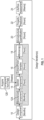
- FIG. 1 is a process diagram for conventional component design 10 and evaluation; it is noted that long lead times and high cost of data can restrict engineering design iterations.
- the component is manufactured or at step 12B the component is acquired from the field.
- the component is sectioned, and at step 16 some samples are extracted and/or polished.
- some microscopy is performed, followed by microstructure quantification at step 20.
- Step 22 provides property predictions, and step 24 provides life/risk assessments of the component.
- microstructure models typically predict changes to these scalar metrics (e.g., average grain size). Complex microstructure features and spatial interactions are generally ignored or at best, homogenized.
- alpha-beta titanium microstructures include grain area fraction, diameter and less commonly the alpha lath thickness.
- the present disclosure advantageously provides that a machine learning approach can allow high fidelity knowledge capture and virtual prediction of microstructure in substantially any location in substantially any part. Moreover, it is noted that repeated sampling from machine learning models can generate variations of microstructures which can help quantify and understand the uncertainty in microstructural features and frequency of rare events.
- FIG. 2 is a schematic of the overall framework 100 of an example conditional generative modeling approach for microstructural image generation of a component, according to the present disclosure.
- a goal of the present disclosure is to generate realistic microstructure images 110 ( FIG. 3 ) as a function of user-specified heat treatment conditions 101.
- generative artificial intelligence models e.g., StyleGAN or the like
- StyleGAN e.g., StyleGAN or the like
- These models can be conditioned on controlling parameters, which can be leveraged to generate class conditional image outputs.
- microstructure of manufactured components can play an important role in understanding process-structure-property relationships in the design of some components (e.g., titanium alloys).
- some components e.g., titanium alloys
- experimentally obtaining microstructural images for a wide range of heat treatment conditions can be expensive (utilizing conventional methods), which limits the design space of exploration.
- the present disclosure aims to accelerate the component design (e.g., titanium alloy design) by developing generative models 100 which can produce synthetic but realistic microstructural images 110 conditioned on user-specified heat treatment conditions 101.
- the user-specified heat treatment conditions 101 can be represented in an embedded space 102, which can be used as conditional inputs to a mapping network 104, along with random noise 103A to generate the latent space distribution 105 for a class of images in the training set.
- the latent space vectors from latent space 105 are then transformed to serve as inputs to the synthesis network 106, which generates images at different resolutions for different random noise inputs 103B.
- the network 106 learns to distinguish fake images from the real ones at step 108, along with classifying the generated images via a classifier model 107 into a set of class labels (predicted class 109).
- FIG. 3 is a schematic of an operational workflow of an example conditional generative modeling approach 100 for microstructural image generation of a component, according to the present disclosure, and depicts the close to real-time implementation.
- an end-user should specify the heat treatment conditions 101 for the component (e.g., titanium alloy component).
- the component e.g., titanium alloy component
- conditional generative model 100 provides synthetic microstructure images 110 for the input heat treatment conditions 101.
- the generated images 110 can be utilized to infer statistical representation of microstructural properties of the component.
- the generated images 110 resemble the true images, thereby making this approach 100 the most realistic synthetic microstructural feature generator available to date for such applications.
- Other conventional modeling approaches are significantly lower fidelity in terms of the generated outputs, with the end user resorted to having high level statistical descriptions of features such as grain diameter, area fraction without the level of details the generated images 110 from the method/framework 100 provided by the present disclosure.
- each microstructure image 110 can take less than one second. As shown in Table 1 below, this is several orders of magnitude speed-up when compared to the traditional approach of material processing and characterization (e.g., using scanning electron microscopy (SEM) imaging).
- SEM scanning electron microscopy
- Table 1: ML Method is the example method 100 of the present disclosure: Task Current Method ML Method Image generation Hours Seconds Image quantification Hours Seconds Large volume characterization (in 3 +) N/A (not industrially feasible) Minutes Replace all / part microstructure characterization 3-6 months Hours
- the present disclosure provides a method/system 100 of synthetic microstructural image 110 generation, conditioned on heat treatment conditions 101.
- the designed method/system 100 utilizes generative adversarial networks for generating realistic microstructural images 110, coupled with a novel embedding scheme discussed above which represents heat treatment conditions in a latent space 105, and that supports image 110 generation for heat treatment conditions outside the training dataset.
- some conventional generative models used for synthetic microstructural image generation can only handle heat treatment conditions as present in the training set, and they cannot generate microstructures for new conditions outside the training set. This limits their applicability in exploring a range of heat treatment conditions.
- the deployment of the designed method/framework 100 of the present disclosure can help in generating out of dataset microstructural images which can advance component (e.g., titanium-alloy component) design.
- ranges disclosed herein are inclusive of the endpoints, and the endpoints are independently combinable with each other (e.g., ranges of "up to 25 wt.%, or, more specifically, 5 wt.% to 20 wt.%", is inclusive of the endpoints and all intermediate values of the ranges of "5 wt.% to 25 wt.%,” etc.).
- “Combinations” is inclusive of blends, mixtures, alloys, reaction products, and the like.
- the terms “first,” “second,” and the like, do not denote any order, quantity, or importance, but rather are used to distinguish one element from another.
Landscapes
- Engineering & Computer Science (AREA)
- Physics & Mathematics (AREA)
- Theoretical Computer Science (AREA)
- General Physics & Mathematics (AREA)
- Evolutionary Computation (AREA)
- Data Mining & Analysis (AREA)
- General Engineering & Computer Science (AREA)
- Artificial Intelligence (AREA)
- Life Sciences & Earth Sciences (AREA)
- Software Systems (AREA)
- General Health & Medical Sciences (AREA)
- Computing Systems (AREA)
- Mathematical Physics (AREA)
- Molecular Biology (AREA)
- Computer Vision & Pattern Recognition (AREA)
- Computational Linguistics (AREA)
- Biophysics (AREA)
- Biomedical Technology (AREA)
- Health & Medical Sciences (AREA)
- Chemical & Material Sciences (AREA)
- Probability & Statistics with Applications (AREA)
- Materials Engineering (AREA)
- Quality & Reliability (AREA)
- Evolutionary Biology (AREA)
- Bioinformatics & Computational Biology (AREA)
- Bioinformatics & Cheminformatics (AREA)
- Computer Hardware Design (AREA)
- Manufacturing & Machinery (AREA)
- Medical Informatics (AREA)
- Geometry (AREA)
- Metallurgy (AREA)
- Organic Chemistry (AREA)
- Thermal Sciences (AREA)
- Crystallography & Structural Chemistry (AREA)
- Mechanical Engineering (AREA)
- Materials For Medical Uses (AREA)
- Investigating Or Analyzing Materials Using Thermal Means (AREA)
- Management, Administration, Business Operations System, And Electronic Commerce (AREA)
Abstract
Description
- The present disclosure relates to the generation of microstructural images of components (e.g., titanium alloys) using machine learning frameworks and, more particularly, to the generation of microstructural images of components (e.g., titanium alloys) as a function of heat treatment conditions using conditional generative adversarial networks.
- In general, the microstructure of manufactured components can play an important role in understanding process-structure-property relationships in the design of titanium alloys. However, experimentally obtaining microstructural images for a wide range of heat treatment conditions can be expensive, which limits the design space of exploration.
- The present disclosure provides for the generation of microstructural images of components (e.g., titanium alloys) using machine learning frameworks. More particularly, the present disclosure provides for the generation of microstructural images of components (e.g., titanium alloys) as a function of heat treatment conditions using conditional generative adversarial networks.
- The present disclosure advantageously provides ways to accelerate component designs (e.g., titanium alloy designs) by developing generative models which can produce synthetic yet realistic microstructures conditioned on heat treatment conditions.
- The present disclosure provides for a method for the generation of microstructural images of a component including providing a machine learning framework with user-specified heat treatment conditions of a component, and utilizing the machine learning framework to generate microstructural images of the component as a function of the user-specified heat treatment conditions of the component.
- In addition to one or more of the features described, or as an alternative to any of the foregoing, the component comprises a titanium alloy.
- In addition to one or more of the features described, or as an alternative to any of the foregoing, the machine learning framework comprises utilizing a conditional generative adversarial network.
- In addition to one or more of the features described, or as an alternative to any of the foregoing, the machine learning framework generates the microstructural images of the component utilizing a range of user-specified heat treatment conditions of the component.
- In addition to one or more of the features described, or as an alternative to any of the foregoing, the generated microstructural images of the component comprise synthetic yet realistic microstructure images conditioned on the heat treatment conditions of the component.
- In addition to one or more of the features described, or as an alternative to any of the foregoing, the component is a test specimen or a full-scale component.
- In addition to one or more of the features described, or as an alternative to any of the foregoing, the machine learning framework allows high fidelity knowledge capture and virtual prediction of microstructure in substantially any location of the component.
- In addition to one or more of the features described, or as an alternative to any of the foregoing, further including utilizing the generated microstructural images to predict life or risk assessments of the component.
- In addition to one or more of the features described, or as an alternative to any of the foregoing, further including utilizing the machine learning framework to generate variations of microstructural images of the component to facilitate a user to understand uncertainty and frequency of rare events of the component.
- In addition to one or more of the features described, or as an alternative to any of the foregoing, the generation of each microstructural image takes less than one second.
- In addition to one or more of the features described, or as an alternative to any of the foregoing, the user-specified heat treatment conditions of the component are represented in an embedded space, and are used as conditional inputs to a mapping network, along with random noise to generate a latent space distribution for a class of images in a training set, and latent space vectors are then transformed as inputs to a synthesis network, which generates images at different resolutions for different random noise inputs.
- In addition to one or more of the features described, or as an alternative to any of the foregoing, where during a training phase, the machine learning framework learns to distinguish fake images from real ones, along with classifying the generated images into class labels seen in the training set.
- In addition to one or more of the features described, or as an alternative to any of the foregoing, further including utilizing the generated microstructural images to infer statistical representations of microstructural properties of the component.
- In addition to one or more of the features described, or as an alternative to any of the foregoing, the machine learning framework comprises utilizing a conditional generative modeling approach.
- In addition to one or more of the features described, or as an alternative to any of the foregoing, the machine learning framework comprises utilizing a trained conditional generative model.
- In addition to one or more of the features described, or as an alternative to any of the foregoing, the machine learning framework generates microstructural images of the component for new conditions outside a training set.
- The above described and other features are exemplified by the following figures and detailed description.
- Any combination or permutation of features is envisioned. Additional features, functions and applications of the disclosed systems, assemblies and methods of the present disclosure will be apparent from the description which follows, particularly when read in conjunction with the appended figures. All references listed in this disclosure are hereby incorporated by reference in their entireties.
- The following figures are example embodiments wherein the like elements are numbered alike.
- Features and aspects of embodiments are described below with reference to the accompanying drawings, in which elements are not necessarily depicted to scale.
- Example embodiments of the present disclosure are further described with reference to the appended figures. It is to be noted that the various features, steps, and combinations of features/steps described below and illustrated in the figures can be arranged and organized differently to result in embodiments which are still within the scope of the present disclosure. To assist those of ordinary skill in the art in making and using the disclosed systems, assemblies and methods, reference is made to the appended figures, wherein:
-
FIG. 1 is a process diagram for conventional component design and evaluation; it is noted that long lead times and high cost of data can restrict engineering design iterations; -
FIG. 2 is a schematic of the overall framework of an example conditional generative modeling approach for microstructural image generation of a component, according to the present disclosure; and -
FIG. 3 is a schematic of an operational workflow of an example conditional generative modeling approach for microstructural image generation of a component, according to the present disclosure, and depicts the close to real-time implementation. - The example embodiments disclosed herein are illustrative of methods for the generation of microstructural images of a component, and systems of the present disclosure and methods/techniques thereof. It should be understood, however, that the disclosed embodiments are merely examples of the present disclosure, which may be embodied in various forms. Therefore, details disclosed herein with reference to example methods and associated processes/techniques of use are not to be interpreted as limiting, but merely as the basis for teaching one skilled in the art how to make and use the methods/systems and/or alternative methods/systems of the present disclosure.
- The present disclosure provides for the generation of microstructural images of components (e.g., titanium alloys) using machine learning frameworks. More particularly, the present disclosure provides for the generation of microstructural images of components (e.g., titanium alloys) as a function of heat treatment conditions using conditional generative adversarial networks.
- As noted, experimentally obtaining microstructural images for a wide range of heat treatment conditions can be expensive, which limits the design space of exploration. The present disclosure advantageously provides ways to accelerate component designs (e.g., titanium alloy designs) by developing generative models which can produce synthetic yet realistic microstructures conditioned on heat treatment conditions.
-
FIG. 1 is a process diagram forconventional component design 10 and evaluation; it is noted that long lead times and high cost of data can restrict engineering design iterations. As shown inFIG. 1 , atstep 12A the component is manufactured or atstep 12B the component is acquired from the field. Atstep 14, the component is sectioned, and atstep 16 some samples are extracted and/or polished. Atstep 18, some microscopy is performed, followed by microstructure quantification atstep 20.Step 22 provides property predictions, andstep 24 provides life/risk assessments of the component. - It is noted that some conventional standards for microstructure analysis have largely relied on domain expertise, institutional knowledge, and visual conformity to established materials specifications. Across the industry it is standard practice to report metrics like average grain size and associated area fraction.
- Moreover, some material microstructure models typically predict changes to these scalar metrics (e.g., average grain size). Complex microstructure features and spatial interactions are generally ignored or at best, homogenized.
- Furthermore, long lead times and the high cost of data can restrict engineering design iterations (e.g., see
FIG. 1 ). As such, a higher number of configurations is substantially impossible to manufacture and physically evaluate. Additionally, some current microstructure characterization techniques assess small volumes of material, which can increase uncertainty in full size components. - Conventional practice also provides that some typical descriptions of alpha-beta titanium microstructures include grain area fraction, diameter and less commonly the alpha lath thickness.
- The present disclosure advantageously provides that a machine learning approach can allow high fidelity knowledge capture and virtual prediction of microstructure in substantially any location in substantially any part. Moreover, it is noted that repeated sampling from machine learning models can generate variations of microstructures which can help quantify and understand the uncertainty in microstructural features and frequency of rare events.
-
FIG. 2 is a schematic of theoverall framework 100 of an example conditional generative modeling approach for microstructural image generation of a component, according to the present disclosure. - A goal of the present disclosure is to generate realistic microstructure images 110 (
FIG. 3 ) as a function of user-specifiedheat treatment conditions 101. - It is noted that generative artificial intelligence models (e.g., StyleGAN or the like) have found success in generating some synthetic high resolution images. These models can be conditioned on controlling parameters, which can be leveraged to generate class conditional image outputs.
- It is noted that the microstructure of manufactured components can play an important role in understanding process-structure-property relationships in the design of some components (e.g., titanium alloys). However, experimentally obtaining microstructural images for a wide range of heat treatment conditions can be expensive (utilizing conventional methods), which limits the design space of exploration. The present disclosure aims to accelerate the component design (e.g., titanium alloy design) by developing
generative models 100 which can produce synthetic but realisticmicrostructural images 110 conditioned on user-specifiedheat treatment conditions 101. - The user-specified
heat treatment conditions 101 can be represented in an embeddedspace 102, which can be used as conditional inputs to amapping network 104, along withrandom noise 103A to generate thelatent space distribution 105 for a class of images in the training set. The latent space vectors fromlatent space 105 are then transformed to serve as inputs to thesynthesis network 106, which generates images at different resolutions for differentrandom noise inputs 103B. During the training phase, thenetwork 106 learns to distinguish fake images from the real ones atstep 108, along with classifying the generated images via aclassifier model 107 into a set of class labels (predicted class 109). -
FIG. 3 is a schematic of an operational workflow of an example conditionalgenerative modeling approach 100 for microstructural image generation of a component, according to the present disclosure, and depicts the close to real-time implementation. - During operation, an end-user should specify the
heat treatment conditions 101 for the component (e.g., titanium alloy component). - As shown in
FIG. 3 , the conditionalgenerative model 100 providessynthetic microstructure images 110 for the inputheat treatment conditions 101. The generatedimages 110 can be utilized to infer statistical representation of microstructural properties of the component. - The generated
images 110 resemble the true images, thereby making thisapproach 100 the most realistic synthetic microstructural feature generator available to date for such applications. Other conventional modeling approaches are significantly lower fidelity in terms of the generated outputs, with the end user resorted to having high level statistical descriptions of features such as grain diameter, area fraction without the level of details the generatedimages 110 from the method/framework 100 provided by the present disclosure. - It is advantageously noted that the implementation of this method/
framework 100 is extremely fast. The generation of eachmicrostructure image 110 can take less than one second. As shown in Table 1 below, this is several orders of magnitude speed-up when compared to the traditional approach of material processing and characterization (e.g., using scanning electron microscopy (SEM) imaging).Table 1: ML Method is the example method 100 of the present disclosure:Task Current Method ML Method Image generation Hours Seconds Image quantification Hours Seconds Large volume characterization (in3+) N/A (not industrially feasible) Minutes Replace all / part microstructure characterization 3-6 months Hours - As such, the present disclosure provides a method/
system 100 of syntheticmicrostructural image 110 generation, conditioned onheat treatment conditions 101. The designed method/system 100 utilizes generative adversarial networks for generating realisticmicrostructural images 110, coupled with a novel embedding scheme discussed above which represents heat treatment conditions in alatent space 105, and that supportsimage 110 generation for heat treatment conditions outside the training dataset. - It is noted that some conventional generative models used for synthetic microstructural image generation can only handle heat treatment conditions as present in the training set, and they cannot generate microstructures for new conditions outside the training set. This limits their applicability in exploring a range of heat treatment conditions. The deployment of the designed method/
framework 100 of the present disclosure can help in generating out of dataset microstructural images which can advance component (e.g., titanium-alloy component) design. - While particular embodiments have been described, alternatives, modifications, variations, improvements, and substantial equivalents that are or may be presently unforeseen may arise to applicants or others skilled in the art. Accordingly, the appended claims as filed and as they may be amended are intended to embrace all such alternatives, modifications variations, improvements, and substantial equivalents.
- The ranges disclosed herein are inclusive of the endpoints, and the endpoints are independently combinable with each other (e.g., ranges of "up to 25 wt.%, or, more specifically, 5 wt.% to 20 wt.%", is inclusive of the endpoints and all intermediate values of the ranges of "5 wt.% to 25 wt.%," etc.). "Combinations" is inclusive of blends, mixtures, alloys, reaction products, and the like. The terms "first," "second," and the like, do not denote any order, quantity, or importance, but rather are used to distinguish one element from another. The terms "a" and "an" and "the" do not denote a limitation of quantity and are to be construed to cover both the singular and the plural, unless otherwise indicated herein or clearly contradicted by context. "Or" means "and/or" unless clearly stated otherwise. Reference throughout the specification to "some embodiments", "an embodiment", and so forth, means that a particular element described in connection with the embodiment is included in at least one embodiment described herein, and may or may not be present in other embodiments. In addition, it is to be understood that the described elements may be combined in any suitable manner in the various embodiments. A "combination thereof' is open and includes any combination comprising at least one of the listed components or properties optionally together with a like or equivalent component or property not listed.
- Unless defined otherwise, technical and scientific terms used herein have the same meaning as is commonly understood by one of skill in the art to which this application belongs. All cited patents, patent applications, and other references are incorporated herein by reference in their entirety. However, if a term in the present application contradicts or conflicts with a term in the incorporated reference, the term from the present application takes precedence over the conflicting term from the incorporated reference.
- Although the assemblies, systems and methods of the present disclosure have been described with reference to example embodiments thereof, the present disclosure is not limited to such example embodiments and/or implementations. Rather, the assemblies, systems and methods of the present disclosure are susceptible to many implementations and applications, as will be readily apparent to persons skilled in the art from the disclosure hereof. The present disclosure expressly encompasses such modifications, enhancements and/or variations of the disclosed embodiments. Since many changes could be made in the above construction and many widely different embodiments of this disclosure could be made without departing from the scope thereof, it is intended that all matter contained in the drawings and specification shall be interpreted as illustrative and not in a limiting sense. Additional modifications, changes, and substitutions are intended in the foregoing disclosure. Accordingly, it is appropriate that the appended claims be construed broadly and in a manner consistent with the scope of the disclosure.
Claims (15)
- A method for the generation of microstructural images (110) of a component comprising:providing a machine learning framework (100) with user-specified heat treatment conditions (101) of a component; andutilizing the machine learning framework (100) to generate microstructural images (110) of the component as a function of the user-specified heat treatment conditions (101) of the component.
- The method of claim 1, wherein the component comprises a titanium alloy.
- The method of claim 1 or 2, wherein the machine learning framework (100) comprises utilizing a conditional generative adversarial network.
- The method of any preceding claim, wherein the machine learning framework (100) generates the microstructural images (110) of the component utilizing a range of user-specified heat treatment conditions (101) of the component.
- The method of any preceding claim, wherein the generated microstructural images (110) of the component comprise synthetic yet realistic microstructure images (110) conditioned on the heat treatment conditions (101) of the component.
- The method of any preceding claim, wherein the component is a test specimen or a full-scale component.
- The method of any preceding claim, wherein the machine learning framework (100) allows high fidelity knowledge capture and virtual prediction of microstructure in substantially any location of the component.
- The method of any preceding claim, further comprising utilizing the generated microstructural images (110) to predict life or risk assessments of the component.
- The method of any preceding claim, further comprising utilizing the machine learning framework (100) to generate variations of microstructural images (110) of the component to facilitate a user to understand uncertainty and frequency of rare events of the component.
- The method of any preceding claim, wherein the generation of each microstructural image (110) takes less than one second.
- The method of any preceding claim, wherein the user-specified heat treatment conditions (101) of the component are represented in an embedded space (102), and are used as conditional inputs to a mapping network (104), along with random noise (103A) to generate a latent space distribution (105) for a class of images in a training set, and latent space vectors are then transformed as inputs to a synthesis network (106), which generates images at different resolutions for different random noise inputs (103B).
- The method of claim 11, wherein during a training phase, the machine learning framework (100) learns to distinguish fake images from real ones, along with classifying the generated images (110) into class labels (109) seen in the training set.
- The method of any preceding claim, further comprising utilizing the generated microstructural images (110) to infer statistical representations of microstructural properties of the component.
- The method of any preceding claim, wherein the machine learning framework (100) comprises utilizing a conditional generative modeling approach (100) or utilizing a trained conditional generative model (100).
- The method of any preceding claim, wherein the machine learning framework (100) generates microstructural images (110) of the component for new conditions outside a training set.
Applications Claiming Priority (1)
| Application Number | Priority Date | Filing Date | Title |
|---|---|---|---|
| US18/345,577 US12524924B2 (en) | 2023-06-30 | 2023-06-30 | Generation of microstructural images of titanium alloys as a function of heat treatment conditions using conditional generative adversarial networks |
Publications (1)
| Publication Number | Publication Date |
|---|---|
| EP4485275A1 true EP4485275A1 (en) | 2025-01-01 |
Family
ID=90924552
Family Applications (1)
| Application Number | Title | Priority Date | Filing Date |
|---|---|---|---|
| EP24173013.4A Pending EP4485275A1 (en) | 2023-06-30 | 2024-04-29 | Generation of microstructural images of titanium alloys as a function of heat treatment conditions using conditional generative adversarial networks |
Country Status (2)
| Country | Link |
|---|---|
| US (1) | US12524924B2 (en) |
| EP (1) | EP4485275A1 (en) |
Citations (1)
| Publication number | Priority date | Publication date | Assignee | Title |
|---|---|---|---|---|
| CN113870373A (en) * | 2021-09-23 | 2021-12-31 | 北京理工大学 | Method for generating titanium alloy microstructure image by inputting multiple mechanical properties |
Family Cites Families (5)
| Publication number | Priority date | Publication date | Assignee | Title |
|---|---|---|---|---|
| US12345568B2 (en) * | 2012-04-13 | 2025-07-01 | View Operating Corporation | Predictive modeling for tintable windows |
| EP3614389B1 (en) | 2018-08-23 | 2023-10-11 | Tata Consultancy Services Limited | Systems and methods for predicting structure and properties of atomic elements and alloy materials thereof |
| US11783100B2 (en) * | 2018-09-14 | 2023-10-10 | Northwestern University | Integrated process-structure-property modeling frameworks and methods for design optimization and/or performance prediction of material systems and applications of same |
| EP4016366A1 (en) | 2020-11-30 | 2022-06-22 | Airbus SAS | Method of combining multi phase-field and crystal plasticity modelling |
| CN114283900B (en) | 2021-12-14 | 2024-09-13 | 燕山大学 | Prediction and control method for low-magnification coarse-grained microstructure distribution in near-β titanium alloys |
-
2023
- 2023-06-30 US US18/345,577 patent/US12524924B2/en active Active
-
2024
- 2024-04-29 EP EP24173013.4A patent/EP4485275A1/en active Pending
Patent Citations (1)
| Publication number | Priority date | Publication date | Assignee | Title |
|---|---|---|---|---|
| CN113870373A (en) * | 2021-09-23 | 2021-12-31 | 北京理工大学 | Method for generating titanium alloy microstructure image by inputting multiple mechanical properties |
Non-Patent Citations (3)
| Title |
|---|
| AKSHAY IYER ET AL: "A Conditional Generative Model for Predicting Material Microstructures from Processing Methods", ARXIV.ORG, CORNELL UNIVERSITY LIBRARY, 201 OLIN LIBRARY CORNELL UNIVERSITY ITHACA, NY 14853, 4 October 2019 (2019-10-04), XP081510956 * |
| SCOTT HOWLAND ET AL: "Parameters, Properties, and Process: Conditional Neural Generation of Realistic SEM Imagery Toward ML-Assisted Advanced Manufacturing", INTEGRATING MATERIALS AND MANUFACTURING INNOVATION, BIOMED CENTRAL LTD, LONDON, UK, vol. 12, no. 1, 24 January 2023 (2023-01-24), pages 1 - 10, XP021315171, ISSN: 2193-9764, DOI: 10.1007/S40192-022-00287-Y * |
| TERO KARRAS ET AL: "A Style-Based Generator Architecture for Generative Adversarial Networks", ARXIV.ORG, CORNELL UNIVERSITY LIBRARY, 201 OLIN LIBRARY CORNELL UNIVERSITY ITHACA, NY 14853, 29 March 2018 (2018-03-29), XP081124391 * |
Also Published As
| Publication number | Publication date |
|---|---|
| US20250005806A1 (en) | 2025-01-02 |
| US12524924B2 (en) | 2026-01-13 |
Similar Documents
| Publication | Publication Date | Title |
|---|---|---|
| Borysov et al. | How to generate micro-agents? A deep generative modeling approach to population synthesis | |
| Geng et al. | Consistency models made easy | |
| JP7691548B2 (en) | Text-based real-life image editing using diffusion models | |
| Tu et al. | Interpretable objective assessment of dysarthric speech based on deep neural networks | |
| WO2019013913A1 (en) | Spatio-temporal interaction network for learning object interactions | |
| EP3834137A1 (en) | Committed information rate variational autoencoders | |
| CN108154236A (en) | For assessing the technology of the cognitive state of group's level | |
| JP2019056975A (en) | Improved hostile generation network realization program, improved hostile generation network realization apparatus, and learned model generation method | |
| Zhang et al. | Crafting training degradation distribution for the accuracy-generalization trade-off in real-world super-resolution | |
| JP2020129439A (en) | Information processing system and information processing method | |
| CN113965659A (en) | HEVC (high efficiency video coding) video steganalysis training method and system based on network-to-network | |
| Govind et al. | Deep learning of crystalline defects from TEM images: A solution for the problem of ‘never enough training data’ | |
| WO2023032665A1 (en) | Label generation method, model generation method, label generation device, label generation program, model generation device, and model generation program | |
| He et al. | Generative structural design integrating BIM and diffusion model | |
| Casagrande et al. | Predicting sensor events, activities, and time of occurrence using binary sensor data from homes with older adults | |
| Chisholm et al. | Non-parametric data-driven background modelling using conditional probabilities | |
| CN116825083A (en) | Speech synthesis system based on face grid | |
| US12524924B2 (en) | Generation of microstructural images of titanium alloys as a function of heat treatment conditions using conditional generative adversarial networks | |
| CN110045691B (en) | Multi-task processing fault monitoring method for multi-source heterogeneous big data | |
| Favaro et al. | How to unfold top decays | |
| Shreya et al. | Impact of artificial intelligence tools and text-to-3d model generators on interior design | |
| Fan et al. | Learning noise-robust joint representation for multimodal emotion recognition under incomplete data scenarios | |
| Nijhawan et al. | Satellite image classification through stable diffusion and vision transformers | |
| CN108090905A (en) | The determination methods and system of producing line exception | |
| Putri et al. | Augmented Reality Development for Garbage Sortation Education for Children. |
Legal Events
| Date | Code | Title | Description |
|---|---|---|---|
| PUAI | Public reference made under article 153(3) epc to a published international application that has entered the european phase |
Free format text: ORIGINAL CODE: 0009012 |
|
| STAA | Information on the status of an ep patent application or granted ep patent |
Free format text: STATUS: THE APPLICATION HAS BEEN PUBLISHED |
|
| AK | Designated contracting states |
Kind code of ref document: A1 Designated state(s): AL AT BE BG CH CY CZ DE DK EE ES FI FR GB GR HR HU IE IS IT LI LT LU LV MC ME MK MT NL NO PL PT RO RS SE SI SK SM TR |
|
| STAA | Information on the status of an ep patent application or granted ep patent |
Free format text: STATUS: REQUEST FOR EXAMINATION WAS MADE |
|
| 17P | Request for examination filed |
Effective date: 20250630 |
|
| STAA | Information on the status of an ep patent application or granted ep patent |
Free format text: STATUS: EXAMINATION IS IN PROGRESS |
|
| 17Q | First examination report despatched |
Effective date: 20260219 |