EP4485247A1 - Translation of vulnerable code to remediated code - Google Patents
Translation of vulnerable code to remediated code Download PDFInfo
- Publication number
- EP4485247A1 EP4485247A1 EP24183238.5A EP24183238A EP4485247A1 EP 4485247 A1 EP4485247 A1 EP 4485247A1 EP 24183238 A EP24183238 A EP 24183238A EP 4485247 A1 EP4485247 A1 EP 4485247A1
- Authority
- EP
- European Patent Office
- Prior art keywords
- code
- source
- graph
- remediated
- directional
- Prior art date
- Legal status (The legal status is an assumption and is not a legal conclusion. Google has not performed a legal analysis and makes no representation as to the accuracy of the status listed.)
- Pending
Links
Images






Classifications
-
- G—PHYSICS
- G06—COMPUTING OR CALCULATING; COUNTING
- G06F—ELECTRIC DIGITAL DATA PROCESSING
- G06F21/00—Security arrangements for protecting computers, components thereof, programs or data against unauthorised activity
- G06F21/50—Monitoring users, programs or devices to maintain the integrity of platforms, e.g. of processors, firmware or operating systems
- G06F21/57—Certifying or maintaining trusted computer platforms, e.g. secure boots or power-downs, version controls, system software checks, secure updates or assessing vulnerabilities
- G06F21/577—Assessing vulnerabilities and evaluating computer system security
-
- G—PHYSICS
- G06—COMPUTING OR CALCULATING; COUNTING
- G06F—ELECTRIC DIGITAL DATA PROCESSING
- G06F8/00—Arrangements for software engineering
- G06F8/40—Transformation of program code
- G06F8/41—Compilation
-
- G—PHYSICS
- G06—COMPUTING OR CALCULATING; COUNTING
- G06F—ELECTRIC DIGITAL DATA PROCESSING
- G06F21/00—Security arrangements for protecting computers, components thereof, programs or data against unauthorised activity
- G06F21/50—Monitoring users, programs or devices to maintain the integrity of platforms, e.g. of processors, firmware or operating systems
- G06F21/55—Detecting local intrusion or implementing counter-measures
-
- G—PHYSICS
- G06—COMPUTING OR CALCULATING; COUNTING
- G06F—ELECTRIC DIGITAL DATA PROCESSING
- G06F21/00—Security arrangements for protecting computers, components thereof, programs or data against unauthorised activity
- G06F21/50—Monitoring users, programs or devices to maintain the integrity of platforms, e.g. of processors, firmware or operating systems
- G06F21/55—Detecting local intrusion or implementing counter-measures
- G06F21/56—Computer malware detection or handling, e.g. anti-virus arrangements
- G06F21/562—Static detection
-
- G—PHYSICS
- G06—COMPUTING OR CALCULATING; COUNTING
- G06F—ELECTRIC DIGITAL DATA PROCESSING
- G06F21/00—Security arrangements for protecting computers, components thereof, programs or data against unauthorised activity
- G06F21/50—Monitoring users, programs or devices to maintain the integrity of platforms, e.g. of processors, firmware or operating systems
- G06F21/55—Detecting local intrusion or implementing counter-measures
- G06F21/56—Computer malware detection or handling, e.g. anti-virus arrangements
- G06F21/562—Static detection
- G06F21/563—Static detection by source code analysis
-
- G—PHYSICS
- G06—COMPUTING OR CALCULATING; COUNTING
- G06F—ELECTRIC DIGITAL DATA PROCESSING
- G06F40/00—Handling natural language data
- G06F40/10—Text processing
- G06F40/103—Formatting, i.e. changing of presentation of documents
- G06F40/117—Tagging; Marking up; Designating a block; Setting of attributes
-
- G—PHYSICS
- G06—COMPUTING OR CALCULATING; COUNTING
- G06N—COMPUTING ARRANGEMENTS BASED ON SPECIFIC COMPUTATIONAL MODELS
- G06N3/00—Computing arrangements based on biological models
- G06N3/02—Neural networks
- G06N3/04—Architecture, e.g. interconnection topology
- G06N3/044—Recurrent networks, e.g. Hopfield networks
-
- G—PHYSICS
- G06—COMPUTING OR CALCULATING; COUNTING
- G06F—ELECTRIC DIGITAL DATA PROCESSING
- G06F21/00—Security arrangements for protecting computers, components thereof, programs or data against unauthorised activity
- G06F21/50—Monitoring users, programs or devices to maintain the integrity of platforms, e.g. of processors, firmware or operating systems
- G06F21/55—Detecting local intrusion or implementing counter-measures
- G06F21/56—Computer malware detection or handling, e.g. anti-virus arrangements
-
- G—PHYSICS
- G06—COMPUTING OR CALCULATING; COUNTING
- G06N—COMPUTING ARRANGEMENTS BASED ON SPECIFIC COMPUTATIONAL MODELS
- G06N3/00—Computing arrangements based on biological models
- G06N3/02—Neural networks
- G06N3/04—Architecture, e.g. interconnection topology
- G06N3/044—Recurrent networks, e.g. Hopfield networks
- G06N3/0442—Recurrent networks, e.g. Hopfield networks characterised by memory or gating, e.g. long short-term memory [LSTM] or gated recurrent units [GRU]
-
- G—PHYSICS
- G06—COMPUTING OR CALCULATING; COUNTING
- G06N—COMPUTING ARRANGEMENTS BASED ON SPECIFIC COMPUTATIONAL MODELS
- G06N3/00—Computing arrangements based on biological models
- G06N3/02—Neural networks
- G06N3/04—Architecture, e.g. interconnection topology
- G06N3/045—Combinations of networks
-
- G—PHYSICS
- G06—COMPUTING OR CALCULATING; COUNTING
- G06N—COMPUTING ARRANGEMENTS BASED ON SPECIFIC COMPUTATIONAL MODELS
- G06N3/00—Computing arrangements based on biological models
- G06N3/02—Neural networks
- G06N3/08—Learning methods
Definitions
- Code vulnerability is a flaw in the source code that leads to a potential risk of compromising the security of the application. Code vulnerabilities may allow hackers to take advantage of the source code to extract data, tamper with the functioning of an application, erase user data, etc. There are many types of code vulnerabilities such as but not limited to, an injection, cross-site scripting (XSS), buffer overflow, broken authentication, etc.
- XSS cross-site scripting
- a code translation apparatus receives vulnerable source code and automatically generates remediated code for the vulnerable source code.
- the source code may include programming statements or a set of instructions written in a computer programming language and saved to a file.
- the code translation apparatus may receive an entire source code of an application or portions of the source code for translation to remediated code.
- code remediation may include identifying and removing code vulnerabilities such as hard-coded authentication information from the source code.
- the source code is initially converted into an abstract syntax tree (AST) by the code translation apparatus, with the nodes representing the different programming statements of the source code and the edges connecting the different nodes.
- a unique identifier may be assigned to each node within a given AST when generating the graph.
- the graph is converted into a directed graph by setting directions to each of the edges thereby defining the source node and the destination node for each edge. The directions are set from the lowest layer of nodes to the highest node in a bottom-up direction thereby converting the graph into a directional graph.
- the source code may be converted into a source AST which may be further converted into a source directional graph.
- an AST does not include all the details of the source code, the information conveyed by the ASTs and the source directional graph generated therefrom is rather sparse.
- certain data is added to the edges of the source directional graph.
- the data can include additional attributes defined for edges connecting nodes associated with specific programming statements or constructs.
- the sparse data available from the source ASTs is therefore made denser by imputing additional data or additional attributes to the edges.
- Each of the nodes in the augmented source directional graph can be converted into a corresponding distributed vector representation which forms multilayer perceptrons (MLPs).
- MLPs multilayer perceptrons
- the multilayer perceptrons form a Long Short Term Memory (LSTM) neural network for each node.
- LSTM Long Short Term Memory
- a source graph vector representation is generated from the distributed vector representations of the nodes of the augmented source directional graph.
- the source graph vector representation is provided to an encoder of a trained code transformer for conversion into the remediated code.
- Neural Machine Translation based on the sequence-to-sequence modeling technique, is generally used for language translation tasks.
- the sample input in the source language along with its translated input needs to be converted to corresponding vector sequences.
- the vector sequences are provided to the code transformer to train as pairs for languages for translation purposes.
- vulnerable code can be converted to the remediated code by converting both the vulnerable source code and the corresponding remediated code into the vector format to be fed into an encoder-decoder model as inputs. This approach works well with dense data.
- the source code converted to a vector representation is not dense data - rather it is sparse data. This reduces the accuracy percentage of the outcome to below 30 percent.
- the code translation apparatus and methods described herein including the transformer model with focused attention can dynamically identify and remove vulnerable authentication components by adjusting attention weights based on the presence of authentication-related tags associated with elements of the graphs e.g., nodes and edges. This approach ensures that the code transformer model accurately identifies, prioritizes, and removes vulnerabilities, resulting in a secure codebase without insecure authentication information.
- the code translation apparatus is configured to provide more accurate translations using graph-graph modeling to convert the sparse data extracted from the source code to dense data. Instead of converting the source code directly into a vector representation, the source code is initially converted into a directional graph which is augmented with additional information. The augmented directional graph is converted into a graph vector representation.
- the apparatus 100 includes a source code processor 102, a directional graph processor 104, a code transformer 106, and a transformer trainer 108.
- Each of the source code processor 102, the directional graph processor 104, the code transformer 106, and the transformer trainer 108 can be executed by at least one hardware processor (e.g., the hardware processor(s) 802 of Figure 8 ).
- the apparatus 100 may include or may be communicatively coupled to a data store 170 to store and retrieve data generated or used during operations.
- the source code processor 102 receives the source code 110 and outputs a source directional graph 112 corresponding to the source code 110.
- the source directional graph 112 may include nodes connected by the edges. The nodes may represent the various code and data elements from the source code 110.
- the source directional graph 112 is provided to the directional graph processor 104 which is configured to create a representation for each of the nodes therein.
- the data stored in each of the nodes of the source directional graph 112 is encoded into a Multi-Layer Perceptron (MLP).
- MLP Multi-Layer Perceptron
- a multilayer perceptron (MLP) is a feed-forward artificial neural network that generates a set of outputs from a set of inputs.
- An MLP is characterized by several layers of input nodes connected as a directed graph between the input and output layers.
- the directional graph processor 104 further parses the source directional graph 112 based on information encoded in the MLPs. Particularly, the data stored in the nodes of the source directional graph 112 is encoded into the corresponding source graph vector representation 114.
- the source graph vector representation 114 is provided to the code transformer 106 which outputs the final remediated code 128.
- the final remediated code 128 generated from the source code 110 may have greater accuracy than remediated code generated automatically from other code remediation systems/methods. Greater accuracy of the final remediated code 128 may be manifested as better identification and removal of code vulnerabilities while maintaining the functionality of the source code 110.
- the code transformer 106 may include an encoder 162 and a decoder 164.
- the code transformer 106 is trained by the transformer trainer 108 via methodologies such as but not limited to, the teacher forcing method.
- the transformer trainer 108 includes a training data generator 182 and a training data provider 184.
- Training data can include a diverse labelled data set of both sample source codes 192-1 ...,192-n that include both authentication-related and non-authentication related functions.
- the training data can be used to train a classifier to initially output a probability that a node in an AST is related to authentication tasks.
- the sample source codes 192-1...,192-n can be labeled to identify nodes that handle authentication tasks such as login handlers, password checks, token verification, etc.
- Relevant features are extracted from the sample source codes 192-1...,192-n for training.
- Features can include method names, variable names, and code patterns commonly associated with authentication.
- authentication-related features can include method names like “authenticate”, “login”, “verify Password” or variable names like "username”, “password”, etc.
- the classifier is optimized to distinguish between authentication-related and non-authentication-related nodes based on the extracted features.
- the classifier output includes tagging of nodes with appropriate identifiers. For example, nodes identified as authentication-related are tagged with labels such as auth_function, auth_variable, etc.
- Each corresponding remediated code e.g., remediated code 194-1 is generated by remediating vulnerabilities of the sample source code 192-1, etc.
- Each of the sample source codes 192-1 ...,192-n and remediated codes 194-1,..., 194-n are further processed by the training data generator 182 as detailed herein to generate the respective graph vector representations 196-1, ..., 196-2n.
- the training data provider 184 may provide the subset of the graph vector representations 196-1, ..., 196-2n that represent the remediated codes 194-1,..., 194-n to the decoder 164 of the code transformer 106 for training the code transformer 106 via teacher forcing methodology to produce remediated codes for unknown source codes.
- FIG. 2A shows a block diagram of the source code processor 102 in accordance with the examples disclosed herein.
- the source code processor 102 includes a source code converter 202, a node identifier 204, and a graph generator 206.
- the source code converter 202 accesses and converts the source code 110 into a source Abstract Syntax Trees (AST) 210.
- AST Source Abstract Syntax Trees
- An AST or a syntax tree is a tree representation of a block of text e.g., source code.
- the nodes in the AST denote a construct from the textual block.
- the abstract syntax may not represent every detail of the source code but may represent structural or content-related details.
- the nodes of the source AST 210 include respective code constructs from the source code 110.
- the source code processor 102 identifies nodes pertaining to authentication and non-authentication tasks using the classifier trained as described herein.
- the next step is to convert the AST into a graph and augment the nodes with additional information to enhance the contextual understanding of nodes.
- the code constructs may be identified in the order in which they occur in the source code 110. Therefore, the nodes in a given AST may be labeled from the top to bottom by the node identifier 204.
- the graph generator 206 generates the directional graphs e.g., the source directional graph 112 by setting the directions to the edges from the bottom to the top of the graphs with the labeled nodes.
- the graph generator 206 may execute instructions programmatically to identify for each of the edges, a source node and a destination node, thereby generating the source directional graph 112.
- directional graphs may also be generated for the sample source codes 192-1 ... ,192-n and remediated codes 194-1,..., 194-n by the training data generator 182 using the source code processor 102 for the generation of training data 190.
- FIG. 2B shows an example of a code converted into an AST and directional graph in accordance with some examples.
- the code 250 can be fed to a software package e.g., Javalang Python package to generate the corresponding AST 252.
- the nodes of the AST 252 are labeled with unique IDs as shown in graph 254 which is then converted to a directional graph 256 by setting directions on each of the edges of the graph 254. As shown in the directional graph 256, the directions are set from the bottom to the top wherein the source and destination of each edge are set accordingly.
- Each node of a directional graph represents a syntactic element of the source code e.g., method declaration, variable declaration, etc. and the edges represent the syntactic relationships between the elements of the source code.
- the identified authentication-related nodes are tagged with specific attributes that denote the specific roles the nodes play in the authentication process.
- the tags provide semantic meaning to the nodes and assist in further processing.
- common tags include auth_function for methods handling authentication, auth_variable for variables storing authentication data, and auth_check for conditional statements verifying credentials.
- the additional metadata for node augmentation includes but is not limited to, node type, authentication role and contextual information.
- Node type metadata includes the type of syntactic element, e.g., method declaration, variable declaration, etc.
- Authentication role includes the specific role the node plays in the authentication process and the contextual information includes the additional context such as parent-child relationships, surrounding code snippets, or associated comments.
- a method node identified as an authentication function can be tagged with auth_function and augmented with metadata like parameters and return type.
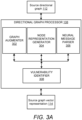
- FIG. 3A shows a block diagram of the directional graph processor 104 in accordance with the examples disclosed herein.
- the directional graph processor 104 includes a graph augmenter 302, a node representation generator 304, a neural message parser 306 and a vulnerability identifier 308.
- ASTs need not convey every detail of the code but may only represent certain structural or content details.
- the source directional graph 112 output by the source code processor 102 is rather sparse in data which causes difficulty in generating the vector representations for the source code 110.
- edges connecting the identified authentication nodes to other parts of the graph are augmented with additional attributes.
- the additional attributes capture the nature and direction of data flow related to authentication, providing a more informative graph structure. Therefore, the graph augmenter 302 is configured to add additional edge attributes for at least a subset of edges of the source directional graph 112 originating or terminating on specific statements or loops.
- the additional edge attributes are provided to the subset of edges that originate from or terminate on a subset of the nodes representing an 'if' statement, a 'for' statement, or a 'while' statement.
- the edge attributes may indicate the specific statement associated with the edges.
- edges in the graphs that connect authentication-related nodes to other nodes can be identified.
- the edges thus identified represent data flows and dependencies in the authentication process.
- the graph augmenter 302 can add specific attributes to the edges to indicate the type of data flow or dependency that the edges represent.
- Common edge attributes indicative of authentication information exchange include but are not limited to, data flow type, authentication dependency, and security level.
- Data flow type indicates the nature of the data flowing through the edge, such as credential flow for password transmission or token_flow for token handling.
- the nature of the data flowing can specify whether the data involves credentials, tokens, or other authentication-related data.
- the graph neural network in the neural message parser 306 can better process the context and significance of each edge in the graph.
- Different types of data flows can include without limitation:
- Credential Flow Represents the transfer of user credentials, such as usernames and passwords, between nodes.
- Token Flow Indicates the handling or transfer of authentication tokens (e.g., JWT, OAuth tokens) across nodes.
- authentication tokens e.g., JWT, OAuth tokens
- Session Flow Denotes data flows related to session identifiers or session state management.
- each edge is analysed to determine if the edge involves the flow of authentication-related data. Based on the context and the nodes connected by the edge, the appropriate data_flow_type attribute is assigned.
- Authentication dependency flags edges that denote dependencies between authentication nodes and other functionalities, such as session management (auth_dependency) or access control. These dependencies are crucial for understanding how authentication mechanisms are integrated with other parts of the application.
- the types of dependencies can include but are not limited to:
- Session Management Edges that indicate dependencies on session creation, validation, or termination functions.
- Access Control Edges that connect authentication nodes with access control checks or role-based access control (RBAC) mechanisms.
- RBAC role-based access control
- Authentication dependency involves analysing the functions and methods involved and assigning the authentication_dependency attribute accordingly.
- Edges involving highly sensitive data such as passwords, authentication tokens, or personal identification information (PII).
- security_level 'high'.
- the sensitivity of the data associated with each edge is determined from the security level attribute of the edge. Based on the evaluation, a value from one of high, low or medium is assigned to the security_level attribute to prioritize the handling of sensitive data flows.
- the vulnerability identifier 308 includes a classifier trained to select particular edges and nodes associated with the attributes discussed above to be identified with appropriate tags as described herein.
- the node representation generator 304 generates a distributed vector representation for each node encoding the data associated with the node.
- the data in each of the nodes may include data aggregated from a subset of the nodes below the node.
- the distributed vector representations may form multi-layer perceptrons (MLPs) so that each node in the source directional graph 112 is represented by a respective MLP.
- MLPs multi-layer perceptrons
- Each may form a fully connected neural network such as a Long Short Term Memory (LSTM) network.
- the neural message parser 306 parses the information stored in each of the nodes to generate a graph representation for each of the nodes of the source directional graph 112.
- the output representation for each node of a directional graph includes aggregated information from other nodes lower down in the graph as the direction is set from the bottom up.
- the output representations of the nodes in the source directional graph 112 may include information not only about a programming construct e.g., a 'while' statement but also about how the 'while statement' belongs in the context of the particular graph.
- the neural message parser 306 may include a graph neural network that is trained to generate the output representations for the nodes of the source directional graph 112.
- the directional graph processor 104 may also be used by the training data generator 182 to generate respective graph vector representations 196-1, ..., 196-2n for each of the sample source codes 192-1...,192-n and remediated codes 194-1,..., 194-n as described above for the source code 110.
- FIG. 3B shows examples of augmented directional graphs and the output representations generated for the nodes in accordance with some examples.
- the directional graph 350 includes the edges of graph 254 augmented with additional information. For example, additional attributes 352, and 354 are defined for the edges 356 and 358 associated with node 360 representing the 'IF' statement.
- each of the nodes of the directional graph 350 is represented by a corresponding output representation such as a neural network (MLP/LSTM) e.g., the information in node 372 is encoded in the neural network 374.
- MLP/LSTM neural network
- the data in all the nodes of the directional graph 350 is aggregated into a final graph vector representation 378.
- Figure 4A shows a block diagram of the code transformer 106 in operation in accordance with some examples.
- the code transformer 106 may be trained via the teacher forcing method on training data 190.
- the decoder 164 of the code transformer 106 outputs the final remediated code 128.
- a transformer may receive a text sequence as input and produce another text sequence as output e.g., a translated version of a textual input.
- the code transformer 106 may include a stack of encoder layers and decoder layers. The encoder stack and the decoder stack each have their corresponding embedding layers for their respective inputs and an output layer to generate the final output.
- the encoder 162 contains attention layer 414 that computes the relationship between different words in the sequence, as well as a feed-forward layer 416.
- the decoder 164 also contains an attention layer 424 and the feed-forward layer 426, as well as a second encoder-decoder attention layer 428.
- the transformer architecture uses attention by relating every word in the input sequence to every other word.
- the code transformer 106 can be configured to learn how to output the target sequence, by using both the input and target sequences.
- the stack of decoders processes a target sequence converted into embeddings (with position encoding 432) along with the encoder's encoded representation to produce an encoded representation of the target sequence.
- the output layer or Softmax 434 converts the target sequence into word probabilities and the final output sequence or the final remediated code 128.
- the code transformer 106 pays more attention to the parts of the code including such vulnerabilities.
- the code transformer 106 can be configured to pay greater attention to authentication related code without requiring specific pre-training for authentication-related data. Therefore, the attention layer 414 of the code transformer 106 can dynamically adjust the weights based on the presence of authentication-related tags in the source code 110. For example, tags such as auth_function, auth_variable, and auth_check are used to mark the nodes and edges in the graph that are associated with authentication processes.
- the attention mechanism e.g., the attention layer 414 prioritizes the nodes and edges bearing such tags indicative of authentication processes, hence effectively giving them higher attention weights.
- the dynamic adjustment of weights allows the code transformer 106 to focus on specific parts of the source code 110 based on the vulnerability being remediated hence ensuring accurate remediation of the source code 110.
- Figure 4B shows the training of the code transformer 106 in accordance with the examples disclosed herein.
- two graph vector representations 196-1 and 196-2 respectively encoding data of e.g., sample source code 192-1 and its corresponding remediated code 194-1 are provided.
- the graph vector representation 196-1 encoding the sample source code 192-1 is generated from a corresponding augmented source directional graph 452.
- the graph vector representation 196-2 encoding the remediated code 194-1 is generated from a corresponding augmented remediated directional graph 454.
- the graph vector representation 196-1 of the sample source code 192-1 is provided to the encoder 162 and the graph vector representation 196-2 of the remediated code 194-1 is provided to the decoder 164.
- numerous graphical vector representations generated from augmented directional graphs of pairs of sample source codes and corresponding remediated codes can be provided to the encoder 162 and the decoder 164 to train the code transformer 106 to output the remediated code for a given source code.
- the code transformer 106 can be trained on a dataset of graph vector representations e.g., graph vector representation 196-1 which further include authentication-related tags. As the code transformer 106 learns to translate the source code110 including vulnerabilities to remediated code, the code transformer 106 inherently adjusts the attention weights based on the authentication-related tags, hence enhancing its ability to handle authentication information. Therefore, the code transformer 106 is trained with focused attention for removal of authentication information from the source code 110. As mentioned above, the attention layer 414 of the code transformer 106 dynamically adjusts the weights based on the tags indicating authentication related components.
- Tags such as auth_function, auth_variable, and auth_check are used to identify nodes and edges related to vulnerable authentication mechanisms, such as hardcoded passwords, insecure token handling, or flawed session management.
- the code transformer 106 processes the code graph, it assigns higher attention weights to these tagged nodes and edges.
- the dynamic adjustment of attention weights allows the code transformer 106 to focus on the vulnerable portions of the source code 110 for subsequent removal or refactoring of the authentication information. Such removal may involve deleting hardcoded passwords and replacing them with secure password management methods or refactoring/removal of insecure token handling and session management practices.
- the output of the code transformer 106 is secure code where vulnerable authentication mechanisms have been removed, ensuring that no insecure authentication information remains.
- Figure 5 shows flowchart 500 of a method of automatic code translation of vulnerable source code to remediated code in accordance with the examples disclosed herein.
- the method begins at 502 wherein the source directional graph 112 generated from source code 110 is accessed.
- the source directional graph 112 may be sparse and may not provide adequate information to enable automatic remediation of the source code 110. Therefore, the source directional graph 112 is augmented with additional data at 504.
- the additional data can include additional edge attributes provided to at least a subset of edges that connect a subset of the nodes of the source directional graph 112 that represent particular programming loops or constructs.
- additional edge attributes can be defined for edges connecting the nodes representing an 'if' statement, a 'for' statement, or a 'while' statement, etc.
- a source graph vector representation 114 is generated for the source directional graph 112.
- the source graph vector representation 114 can be generated by encoding within a corresponding distributed vector representation, the data stored in each of the nodes of the source directional graph 112 augmented with the additional data.
- the source graph vector representation 114 can be provided to the code transformer 106 which is trained to automatically generate the final remediated code 128 for the source code 110.
- the source graph vector representation 114 is provided to the encoder 162 of the code transformer 106.
- the final remediated code 128 is obtained from decoder 164 of the code transformer 106 at 510.
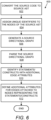
- Figure 6 shows a flowchart 600 for augmenting the source directional graph 112 with additional data in accordance with some examples.
- the source code 110 is converted into a source AST 210 by providing the source code 110 to a software tool.
- a unique ID is assigned to each of the nodes of the source AST 210 thereby converting the source AST 210 into a graph.
- directions are provided to the edges between the nodes of the source AST 210 to generate the source directional graph 112. The directions are set from the bottom to the top of the graph so that the lowest layer of the graph is the source and the highest node is the destination.
- the node in the lower layer is the source node and the node in the higher layer is set as the destination node.
- the source directional graph 112 is parsed using tools such as but not limited to a parsing script.
- the particular statements/programming constructs for which additional attributes can be defined are identified programmatically using text/string/pattern recognition techniques.
- an additional attribute is defined for each edge attached to at least one node associated with the particular statement. In an example, the additional attribute can define the particular statement associated with the node(s).
- a directional graph with sparse data is augmented with additional attributes defined for the edges.
- FIG. 7 shows flowchart 700 of a method of training the code transformer 106 to generate the final remediated code 128 in accordance with some examples.
- the training data 190 is initially generated and then provided to train the code transformer 106.
- the source code samples 192-1,...,192-n and the corresponding remediated codes 194-1, ..., 194-n are accessed.
- the ASTs are generated for the source code samples 192-1,...,192-n, and the corresponding remediated codes 194-1, ..., 194-n.
- the ASTs are converted to graphs by identifying each of the nodes in the ASTs at 706.
- the graphs are converted to sample source directional graphs and the corresponding remediated directional graphs by assigning directions to each of the edges in the various graphs with the lowest layer of nodes in each of the graphs as the source and the highest node as the destination.
- the edges of the sample source directional graphs and the corresponding remediated directional graphs are augmented with additional data at 710 wherein the additional data includes additional edge attributes.
- the graph vector representations 196-1, ..., 196-2n are generated for each of the source code samples 192-1,...,192-n and the corresponding remediated codes 194-1, ..., 194-n by parsing the sample source directional graphs and the corresponding remediated directional graphs augmented with the additional data.
- the graph vector representations 196-1, ..., 196-2n are provided to the code transformer 106 for training.
- Each pair of the graph vector representations 196-1, ..., 196-2n including one of the source code samples 192-1,...,192-n and the corresponding one of the remediated codes 194-1, ..., 194-n are simultaneously provided to the code transformer 106.
- the graph vector representation of a source code sample is provided to the encoder 162 and the graph vector representation of a corresponding remediated code is provided simultaneously to the decoder 164 for training the code transformer 106.
- Figure 8 illustrates a computer system 800 that may be used to implement the code translation apparatus 100 in accordance with the examples disclosed herein. More particularly, computing machines such as desktops, laptops, smartphones, tablets, and wearables which may be used to generate or access the data from the code translation apparatus 100 may have the structure of the computer system 800.
- the computer system 800 may include additional components not shown and some of the process components described may be removed and/or modified.
- a computer system 800 can sit on external-cloud platforms such as Amazon Web Services, AZURE ® cloud or internal corporate cloud computing clusters, or organizational computing resources, etc.
- the computer system 800 includes processor(s) 802, such as a central processing unit, ASIC or another type of processing circuit, input/output (I/O) devices 812, such as a display, mouse keyboard, etc., a network interface 804, such as a Local Area Network (LAN), a wireless 802.11x LAN, a 3G, 4G or 5G mobile WAN or a WiMax WAN, and a processor-readable medium 806. Each of these components may be operatively coupled to a bus 808.
- the processor-readable or computer-readable medium 806 may be any suitable medium that participates in providing instructions to the processor(s) 802 for execution.
- the processor-readable medium 806 may be a non-transitory or non-volatile medium, such as a magnetic disk or solid-state non-volatile memory, or a volatile medium such as RAM.
- the instructions or modules stored on the processor-readable medium 806 may include machine-readable instructions 864 executed by the processor(s) 802 that cause the processor(s) 802 to perform the methods and functions of the code translation apparatus 100.
- the code translation apparatus 100 may be implemented as software or machine-readable instructions stored on a non-transitory processor-readable storage medium and executed by one or more processors 802.
- the computer-readable storage medium or non-transitory processor-readable medium 806 may store an operating system 862, such as MAC OS, MS WINDOWS, UNIX, or LINUX, and code/instructions 864 for the code translation apparatus 100.
- the operating system 862 may be multi-user, multiprocessing, multitasking, multithreading, real-time, and the like. For example, during runtime, the operating system 862 is running and the code for the code translation apparatus 100 is executed by the processor(s) 802.
- the computer system 800 may include a data storage 810, which may include non-volatile data storage.
- the data storage 810 stores any data used by the code translation apparatus 100.
- the data storage 810 may be used as local data storage of the code translation apparatus 100 to store the source codes, corresponding remediation codes, directional graphs, graph vector representations, and other data generated or used by the code translation apparatus 100.
- the network interface 804 connects the computer system 800 to internal systems for example, via a LAN. Also, the network interface 804 may connect the computer system 800 to the Internet. For example, the computer system 800 may connect to web browsers and other external applications and systems via the network interface 804.
Landscapes
- Engineering & Computer Science (AREA)
- Theoretical Computer Science (AREA)
- General Engineering & Computer Science (AREA)
- Computer Security & Cryptography (AREA)
- Software Systems (AREA)
- Physics & Mathematics (AREA)
- Computer Hardware Design (AREA)
- General Physics & Mathematics (AREA)
- Health & Medical Sciences (AREA)
- General Health & Medical Sciences (AREA)
- Virology (AREA)
- Artificial Intelligence (AREA)
- Computational Linguistics (AREA)
- Computing Systems (AREA)
- Biomedical Technology (AREA)
- Mathematical Physics (AREA)
- Molecular Biology (AREA)
- Evolutionary Computation (AREA)
- Audiology, Speech & Language Pathology (AREA)
- Data Mining & Analysis (AREA)
- Biophysics (AREA)
- Life Sciences & Earth Sciences (AREA)
- Machine Translation (AREA)
Abstract
Description
- Code vulnerability is a flaw in the source code that leads to a potential risk of compromising the security of the application. Code vulnerabilities may allow hackers to take advantage of the source code to extract data, tamper with the functioning of an application, erase user data, etc. There are many types of code vulnerabilities such as but not limited to, an injection, cross-site scripting (XSS), buffer overflow, broken authentication, etc. There are at least two methods to ensure the security of computer applications. One method involves addressing code vulnerabilities during application development. The second method involves updating the application regularly. Modern operating systems and applications are connected over the Internet and regularly updated. These updates may not only pertain to improving the functionality of the applications but may also include security patches developed in response to new threats to application security that may emerge with time.
- Features of the present disclosure are illustrated by way of examples shown in the following figures. In the following figures, like numerals indicate like elements, in which:
-
Figure 1 illustrates a block diagram of a code translation apparatus in accordance with the examples disclosed herein. -
Figure 2A shows a block diagram of a source code processor in accordance with the examples disclosed herein. -
Figure 2B shows an example of a code converted into an Abstract Syntax Tree (AST) and a directional graph in accordance with some examples. -
Figure 3A shows a block diagram of a directional graph processor in accordance with the examples disclosed herein. -
Figure 3B shows examples of augmented directional graphs and output representations generated for nodes in accordance with some examples. -
Figure 4A shows an example of a code transformer in operation in accordance with some examples. -
Figure 4B shows the training of the code transformer in accordance with the examples disclosed herein. -
Figure 5 shows a flowchart of a method of code translation in accordance with the examples disclosed herein. -
Figure 6 shows a flowchart of a method for augmenting the source directional graph with additional data in accordance with some examples. -
Figure 7 shows a flowchart of a method of training the code transformer to generate the final remediated code in accordance with some examples. -
Figure 8 illustrates a computer system that may be used to implement the code translation apparatus in accordance with the examples disclosed herein. - For simplicity and illustrative purposes, the present disclosure is described by referring to examples thereof. In the following description, numerous specific details are set forth in order to provide a thorough understanding of the present disclosure. It will be readily apparent however that the present disclosure may be practiced without limitation to these specific details. In other instances, some methods and structures have not been described in detail so as not to unnecessarily obscure the present disclosure. Throughout the present disclosure, the terms "a" and "an" are intended to denote at least one of a particular element. As used herein, the term "includes" means includes but not limited to, the term "including" means including but not limited to. The term "based on" means based at least in part on.
- A code translation apparatus receives vulnerable source code and automatically generates remediated code for the vulnerable source code. The source code may include programming statements or a set of instructions written in a computer programming language and saved to a file. The code translation apparatus may receive an entire source code of an application or portions of the source code for translation to remediated code. In an example, code remediation may include identifying and removing code vulnerabilities such as hard-coded authentication information from the source code.
- The source code is initially converted into an abstract syntax tree (AST) by the code translation apparatus, with the nodes representing the different programming statements of the source code and the edges connecting the different nodes. The AST is converted into a graph, G = (V, E) (where V represents the vertices/nodes and E the edges) by identifying each of the nodes uniquely. A unique identifier may be assigned to each node within a given AST when generating the graph. The graph is converted into a directed graph by setting directions to each of the edges thereby defining the source node and the destination node for each edge. The directions are set from the lowest layer of nodes to the highest node in a bottom-up direction thereby converting the graph into a directional graph. Accordingly, the source code may be converted into a source AST which may be further converted into a source directional graph. Since an AST does not include all the details of the source code, the information conveyed by the ASTs and the source directional graph generated therefrom is rather sparse. To improve the information conveyed by the source directional graph, certain data is added to the edges of the source directional graph. The data can include additional attributes defined for edges connecting nodes associated with specific programming statements or constructs. The sparse data available from the source ASTs is therefore made denser by imputing additional data or additional attributes to the edges. Each of the nodes in the augmented source directional graph can be converted into a corresponding distributed vector representation which forms multilayer perceptrons (MLPs). The multilayer perceptrons form a Long Short Term Memory (LSTM) neural network for each node. A source graph vector representation is generated from the distributed vector representations of the nodes of the augmented source directional graph. The source graph vector representation is provided to an encoder of a trained code transformer for conversion into the remediated code.
- The code transformer includes an encoder and a decoder based on a sequence-to-sequence model for code conversion. The code transformer is trained via the teacher forcing method on training data including graph vector representations generated for various source codes and corresponding remediated codes as described above. Accordingly, the ASTs are generated for the sample source codes and their corresponding remediated codes and converted into directional graphs augmented with additional edge attributes which are further used to obtain the graph vector representations of the sample source code and the corresponding remediated codes. The corresponding graph vector representations of the sample source codes are provided to the encoder of the code transformer while the graph vector representations of the remediated codes are provided to the decoder of the code transformer. The code transformer which is thus trained is used for the automatic translation of unseen source codes into remediated codes.
- The code translation apparatus and methods described herein afford a technical solution to the technical problem of improving the accuracy of code transformers for the translation of source code to remediated code while removing code vulnerabilities by accurately identifying and removing authentication information. Neural Machine Translation, based on the sequence-to-sequence modeling technique, is generally used for language translation tasks. In order to convert the source language to a target language, the sample input in the source language along with its translated input needs to be converted to corresponding vector sequences. The vector sequences are provided to the code transformer to train as pairs for languages for translation purposes. Similarly, vulnerable code can be converted to the remediated code by converting both the vulnerable source code and the corresponding remediated code into the vector format to be fed into an encoder-decoder model as inputs. This approach works well with dense data. However, the source code converted to a vector representation is not dense data - rather it is sparse data. This reduces the accuracy percentage of the outcome to below 30 percent.
- The code translation apparatus and methods described herein including the transformer model with focused attention can dynamically identify and remove vulnerable authentication components by adjusting attention weights based on the presence of authentication-related tags associated with elements of the graphs e.g., nodes and edges. This approach ensures that the code transformer model accurately identifies, prioritizes, and removes vulnerabilities, resulting in a secure codebase without insecure authentication information. Furthermore, the code translation apparatus is configured to provide more accurate translations using graph-graph modeling to convert the sparse data extracted from the source code to dense data. Instead of converting the source code directly into a vector representation, the source code is initially converted into a directional graph which is augmented with additional information. The augmented directional graph is converted into a graph vector representation. This multi-pronged approach to translating the vulnerable code to remediated code has provided a substantial increase in accuracy than the general transformer approach based on the sequence-to-sequence modeling technique. Incorporating machine learning-based classification for node identification, followed by graph augmentation and the addition of edge attributes as disclosed further infra, results in a robust and detailed processing of authentication mechanisms within the source code and hence, significantly enhancing the accuracy and effectiveness of translating vulnerable code to remediated code.
-
Figure 1 illustrates a block diagram of acode translation apparatus 100 in accordance with the examples disclosed herein. Thecode translation apparatus 100 receivesvulnerable source code 110 which includes some code vulnerabilities such as hard-coded authentication information etc. and outputs afinal remediated code 128 wherein the code vulnerabilities are remediated or fixed. In an example, the code vulnerability such as the authentication information may be remediated by removing the authentication information and providing other access to the authentication information such as storing the authentication data on a vault and providing a link to the vault storage area in the remediated code. Thecode translation apparatus 100 can be configured to automatically translate vulnerable source code to remediated code that provides different remediations for different types of code vulnerabilities. - The
apparatus 100 includes asource code processor 102, adirectional graph processor 104, acode transformer 106, and atransformer trainer 108. Each of thesource code processor 102, thedirectional graph processor 104, thecode transformer 106, and thetransformer trainer 108 can be executed by at least one hardware processor (e.g., the hardware processor(s) 802 ofFigure 8 ). In an example, theapparatus 100 may include or may be communicatively coupled to adata store 170 to store and retrieve data generated or used during operations. Thesource code processor 102 receives thesource code 110 and outputs a sourcedirectional graph 112 corresponding to thesource code 110. In an example, the sourcedirectional graph 112 may include nodes connected by the edges. The nodes may represent the various code and data elements from thesource code 110. - The source
directional graph 112 is provided to thedirectional graph processor 104 which is configured to create a representation for each of the nodes therein. In an example, the data stored in each of the nodes of the sourcedirectional graph 112 is encoded into a Multi-Layer Perceptron (MLP). A multilayer perceptron (MLP) is a feed-forward artificial neural network that generates a set of outputs from a set of inputs. An MLP is characterized by several layers of input nodes connected as a directed graph between the input and output layers. Thedirectional graph processor 104 further parses the sourcedirectional graph 112 based on information encoded in the MLPs. Particularly, the data stored in the nodes of the sourcedirectional graph 112 is encoded into the corresponding sourcegraph vector representation 114. - The source
graph vector representation 114 is provided to thecode transformer 106 which outputs thefinal remediated code 128. Thefinal remediated code 128 generated from thesource code 110 may have greater accuracy than remediated code generated automatically from other code remediation systems/methods. Greater accuracy of thefinal remediated code 128 may be manifested as better identification and removal of code vulnerabilities while maintaining the functionality of thesource code 110. In an example, thecode transformer 106 may include anencoder 162 and adecoder 164. Thecode transformer 106 is trained by thetransformer trainer 108 via methodologies such as but not limited to, the teacher forcing method. - The
transformer trainer 108 includes atraining data generator 182 and atraining data provider 184. Training data can include a diverse labelled data set of both sample source codes 192-1 ...,192-n that include both authentication-related and non-authentication related functions. The training data can be used to train a classifier to initially output a probability that a node in an AST is related to authentication tasks. Accordingly, the sample source codes 192-1...,192-n can be labeled to identify nodes that handle authentication tasks such as login handlers, password checks, token verification, etc. Relevant features are extracted from the sample source codes 192-1...,192-n for training. Features can include method names, variable names, and code patterns commonly associated with authentication. Techniques such as tokenization, bag-of-words, or more advanced embeddings can be used to represent the extracted features numerically. By way of illustration and not limitation, authentication-related features can include method names like "authenticate", "login", "verify Password" or variable names like "username", "password", etc. The classifier is optimized to distinguish between authentication-related and non-authentication-related nodes based on the extracted features. The classifier output includes tagging of nodes with appropriate identifiers. For example, nodes identified as authentication-related are tagged with labels such as auth_function, auth_variable, etc. - In an example, the
training data generator 182 generatestraining data 190 for thecode transformer 106 including respective graph vector representations 196-1, ...,196-2n for both the sample source codes 192-1..., 192-n and remediated codes 194-1,..., 194-n wherein n is a natural number and n = 1, 2, ... Each corresponding remediated code e.g., remediated code 194-1 is generated by remediating vulnerabilities of the sample source code 192-1, etc. Each of the sample source codes 192-1 ...,192-n and remediated codes 194-1,..., 194-n are further processed by thetraining data generator 182 as detailed herein to generate the respective graph vector representations 196-1, ..., 196-2n. - The
training data 190, more particularly, the graph vector representations 196-1, ..., 196-2n generated for each of the sample source codes 192-1...,192-n and remediated codes 194-1,..., 194-n are provided by thetraining data provider 184 to train thecode transformer 106. Thetraining data provider 184 may provide the subset of the graph vector representations 196-1, ..., 196-2n that represent the sample source codes 192-1 ... ,192-n to theencoder 162 of thecode transformer 106. Thetraining data provider 184 may provide the subset of the graph vector representations 196-1, ..., 196-2n that represent the remediated codes 194-1,..., 194-n to thedecoder 164 of thecode transformer 106 for training thecode transformer 106 via teacher forcing methodology to produce remediated codes for unknown source codes. -
Figure 2A shows a block diagram of thesource code processor 102 in accordance with the examples disclosed herein. Thesource code processor 102 includes asource code converter 202, anode identifier 204, and agraph generator 206. Thesource code converter 202 accesses and converts thesource code 110 into a source Abstract Syntax Trees (AST) 210. An AST or a syntax tree is a tree representation of a block of text e.g., source code. The nodes in the AST denote a construct from the textual block. The abstract syntax may not represent every detail of the source code but may represent structural or content-related details. The nodes of thesource AST 210 include respective code constructs from thesource code 110. When the ASTs are generated, thesource code processor 102 identifies nodes pertaining to authentication and non-authentication tasks using the classifier trained as described herein. When the authentication-related nodes are identified within the AST, the next step is to convert the AST into a graph and augment the nodes with additional information to enhance the contextual understanding of nodes. - ASTs can be edited and enhanced with additional information. Accordingly, the
node identifier 204 generates corresponding graph G = (V, E) (where V are vertices/nodes and E are the edges from the source AST 210) by providing corresponding unique identifiers (IDs) to the nodes of thesource AST 210. In an example, the code constructs may be identified in the order in which they occur in thesource code 110. Therefore, the nodes in a given AST may be labeled from the top to bottom by thenode identifier 204. Thegraph generator 206 generates the directional graphs e.g., the sourcedirectional graph 112 by setting the directions to the edges from the bottom to the top of the graphs with the labeled nodes. In an example, thegraph generator 206 may execute instructions programmatically to identify for each of the edges, a source node and a destination node, thereby generating the sourcedirectional graph 112. - It may be appreciated that similar to the source
directional graph 112, directional graphs may also be generated for the sample source codes 192-1 ... ,192-n and remediated codes 194-1,..., 194-n by thetraining data generator 182 using thesource code processor 102 for the generation oftraining data 190. -
Figure 2B shows an example of a code converted into an AST and directional graph in accordance with some examples. Thecode 250 can be fed to a software package e.g., Javalang Python package to generate thecorresponding AST 252. The nodes of theAST 252 are labeled with unique IDs as shown ingraph 254 which is then converted to adirectional graph 256 by setting directions on each of the edges of thegraph 254. As shown in thedirectional graph 256, the directions are set from the bottom to the top wherein the source and destination of each edge are set accordingly. Each node of a directional graph represents a syntactic element of the source code e.g., method declaration, variable declaration, etc. and the edges represent the syntactic relationships between the elements of the source code. Again, as described above, the identified authentication-related nodes are tagged with specific attributes that denote the specific roles the nodes play in the authentication process. The tags provide semantic meaning to the nodes and assist in further processing. For example, common tags include auth_function for methods handling authentication, auth_variable for variables storing authentication data, and auth_check for conditional statements verifying credentials. The additional metadata for node augmentation includes but is not limited to, node type, authentication role and contextual information. Node type metadata includes the type of syntactic element, e.g., method declaration, variable declaration, etc. Authentication role includes the specific role the node plays in the authentication process and the contextual information includes the additional context such as parent-child relationships, surrounding code snippets, or associated comments. For example, a method node identified as an authentication function can be tagged with auth_function and augmented with metadata like parameters and return type. -
Figure 3A shows a block diagram of thedirectional graph processor 104 in accordance with the examples disclosed herein. Thedirectional graph processor 104 includes agraph augmenter 302, anode representation generator 304, aneural message parser 306 and a vulnerability identifier 308. As mentioned above, ASTs need not convey every detail of the code but may only represent certain structural or content details. Hence, the sourcedirectional graph 112 output by thesource code processor 102 is rather sparse in data which causes difficulty in generating the vector representations for thesource code 110. - Again, as mentioned above, ASTs can be edited to provide more information. To further enhance a graph representation, edges connecting the identified authentication nodes to other parts of the graph are augmented with additional attributes. The additional attributes capture the nature and direction of data flow related to authentication, providing a more informative graph structure. Therefore, the
graph augmenter 302 is configured to add additional edge attributes for at least a subset of edges of the sourcedirectional graph 112 originating or terminating on specific statements or loops. The additional edge attributes are provided to the subset of edges that originate from or terminate on a subset of the nodes representing an 'if' statement, a 'for' statement, or a 'while' statement. The edge attributes may indicate the specific statement associated with the edges. - Referring to removal of authentication information in the
source code 110 when generating thefinal remediated code 128, the edges in the graphs that connect authentication-related nodes to other nodes can be identified. The edges thus identified represent data flows and dependencies in the authentication process. To provide more context to the directional graphs about the role of authentication information several specific edge attributes can be added. Thegraph augmenter 302 can add specific attributes to the edges to indicate the type of data flow or dependency that the edges represent. Common edge attributes indicative of authentication information exchange include but are not limited to, data flow type, authentication dependency, and security level. - Data flow type indicates the nature of the data flowing through the edge, such as credential flow for password transmission or token_flow for token handling. The nature of the data flowing can specify whether the data involves credentials, tokens, or other authentication-related data. By identifying the type of data flow, the graph neural network in the
neural message parser 306 can better process the context and significance of each edge in the graph. Different types of data flows can include without limitation: - Credential Flow: Represents the transfer of user credentials, such as usernames and passwords, between nodes.
- Token Flow: Indicates the handling or transfer of authentication tokens (e.g., JWT, OAuth tokens) across nodes.
- Session Flow: Denotes data flows related to session identifiers or session state management.
- For example, an edge between a node representing a password check method and a conditional statement node verifying the password can be labelled as data_flow_type = 'credential_flow'. During the graph construction (e.g., source directional graph 112), each edge is analysed to determine if the edge involves the flow of authentication-related data. Based on the context and the nodes connected by the edge, the appropriate data_flow_type attribute is assigned.
- Authentication dependency flags edges that denote dependencies between authentication nodes and other functionalities, such as session management (auth_dependency) or access control. These dependencies are crucial for understanding how authentication mechanisms are integrated with other parts of the application. The types of dependencies can include but are not limited to:
- Session Management: Edges that indicate dependencies on session creation, validation, or termination functions.
- Access Control: Edges that connect authentication nodes with access control checks or role-based access control (RBAC) mechanisms.
- Token Validation: Edges that represent the dependency on token issuance and validation processes.
- For example, an edge connecting an authentication function node to a session initiation method node can be annotated with dependency_type = 'session_management'. Authentication dependency involves analysing the functions and methods involved and assigning the authentication_dependency attribute accordingly.
- Security level annotates the sensitivity level of the data flowing through the edge, helping to prioritize certain edges during analysis (e.g., high, medium, and low). For example, an edge between an auth_function node and an if_statement node checking the password might be augmented with attributes like data_flow_type='credential_flow' and security_level='high'. Security level attribute enables the
code transformer 106 to apply greater processing on high security edges. Accordingly, security levels include: - High: Edges involving highly sensitive data, such as passwords, authentication tokens, or personal identification information (PII).
- Medium: Edges handling moderately sensitive data, such as session identifiers or non-critical authentication checks.
- Low: Edges with low sensitivity data, such as public keys or non-sensitive configuration settings.
- For example, an edge representing the transfer of a password between a login form and an authentication function might be labelled as security_level='high'. During the construction of the various directional graphs, the sensitivity of the data associated with each edge is determined from the security level attribute of the edge. Based on the evaluation, a value from one of high, low or medium is assigned to the security_level attribute to prioritize the handling of sensitive data flows. The vulnerability identifier 308 includes a classifier trained to select particular edges and nodes associated with the attributes discussed above to be identified with appropriate tags as described herein.
- The
node representation generator 304 generates a distributed vector representation for each node encoding the data associated with the node. The data in each of the nodes may include data aggregated from a subset of the nodes below the node. In an example, the distributed vector representations may form multi-layer perceptrons (MLPs) so that each node in the sourcedirectional graph 112 is represented by a respective MLP. Each may form a fully connected neural network such as a Long Short Term Memory (LSTM) network. Theneural message parser 306 parses the information stored in each of the nodes to generate a graph representation for each of the nodes of the sourcedirectional graph 112. The output representation for each node of a directional graph includes aggregated information from other nodes lower down in the graph as the direction is set from the bottom up. The output representations of the nodes in the sourcedirectional graph 112 may include information not only about a programming construct e.g., a 'while' statement but also about how the 'while statement' belongs in the context of the particular graph. In an example, theneural message parser 306 may include a graph neural network that is trained to generate the output representations for the nodes of the sourcedirectional graph 112. Thedirectional graph processor 104 may also be used by thetraining data generator 182 to generate respective graph vector representations 196-1, ..., 196-2n for each of the sample source codes 192-1...,192-n and remediated codes 194-1,..., 194-n as described above for thesource code 110. -
Figure 3B shows examples of augmented directional graphs and the output representations generated for the nodes in accordance with some examples. Thedirectional graph 350 includes the edges ofgraph 254 augmented with additional information. For example,additional attributes edges node 360 representing the 'IF' statement. At 370, each of the nodes of thedirectional graph 350 is represented by a corresponding output representation such as a neural network (MLP/LSTM) e.g., the information innode 372 is encoded in theneural network 374. The data in all the nodes of thedirectional graph 350 is aggregated into a finalgraph vector representation 378. -
Figure 4A shows a block diagram of thecode transformer 106 in operation in accordance with some examples. Thecode transformer 106 may be trained via the teacher forcing method ontraining data 190. In response to providing the sourcegraph vector representation 114 of thesource code 110 to theencoder 162 of thecode transformer 106, thedecoder 164 of thecode transformer 106 outputs thefinal remediated code 128. A transformer may receive a text sequence as input and produce another text sequence as output e.g., a translated version of a textual input. Thecode transformer 106 may include a stack of encoder layers and decoder layers. The encoder stack and the decoder stack each have their corresponding embedding layers for their respective inputs and an output layer to generate the final output. Theencoder 162 containsattention layer 414 that computes the relationship between different words in the sequence, as well as a feed-forward layer 416. Thedecoder 164 also contains anattention layer 424 and the feed-forward layer 426, as well as a second encoder-decoder attention layer 428. The transformer architecture uses attention by relating every word in the input sequence to every other word. Thecode transformer 106 can be configured to learn how to output the target sequence, by using both the input and target sequences. The stack of decoders processes a target sequence converted into embeddings (with position encoding 432) along with the encoder's encoded representation to produce an encoded representation of the target sequence. The output layer orSoftmax 434 converts the target sequence into word probabilities and the final output sequence or thefinal remediated code 128. - Depending on the type of vulnerability to be remediated, the
code transformer 106 pays more attention to the parts of the code including such vulnerabilities. For example, in the case of source code including authentication information, thecode transformer 106, can be configured to pay greater attention to authentication related code without requiring specific pre-training for authentication-related data. Therefore, theattention layer 414 of thecode transformer 106 can dynamically adjust the weights based on the presence of authentication-related tags in thesource code 110. For example, tags such as auth_function, auth_variable, and auth_check are used to mark the nodes and edges in the graph that are associated with authentication processes. During both training and inference, the attention mechanism e.g., theattention layer 414 prioritizes the nodes and edges bearing such tags indicative of authentication processes, hence effectively giving them higher attention weights. The dynamic adjustment of weights allows thecode transformer 106 to focus on specific parts of thesource code 110 based on the vulnerability being remediated hence ensuring accurate remediation of thesource code 110. -
Figure 4B shows the training of thecode transformer 106 in accordance with the examples disclosed herein. In order to train thecode transformer 106, two graph vector representations 196-1 and 196-2 respectively encoding data of e.g., sample source code 192-1 and its corresponding remediated code 194-1 are provided. Particularly, the graph vector representation 196-1 encoding the sample source code 192-1 is generated from a corresponding augmented source directional graph 452. Similarly, the graph vector representation 196-2 encoding the remediated code 194-1 is generated from a corresponding augmented remediated directional graph 454. The graph vector representation 196-1 of the sample source code 192-1 is provided to theencoder 162 and the graph vector representation 196-2 of the remediated code 194-1 is provided to thedecoder 164. Similarly, numerous graphical vector representations generated from augmented directional graphs of pairs of sample source codes and corresponding remediated codes can be provided to theencoder 162 and thedecoder 164 to train thecode transformer 106 to output the remediated code for a given source code. - For particular applications such as remediation of source code including authentication information, the
code transformer 106 can be trained on a dataset of graph vector representations e.g., graph vector representation 196-1 which further include authentication-related tags. As thecode transformer 106 learns to translate the source code110 including vulnerabilities to remediated code, thecode transformer 106 inherently adjusts the attention weights based on the authentication-related tags, hence enhancing its ability to handle authentication information. Therefore, thecode transformer 106 is trained with focused attention for removal of authentication information from thesource code 110. As mentioned above, theattention layer 414 of thecode transformer 106 dynamically adjusts the weights based on the tags indicating authentication related components. Tags such as auth_function, auth_variable, and auth_check are used to identify nodes and edges related to vulnerable authentication mechanisms, such as hardcoded passwords, insecure token handling, or flawed session management. As thecode transformer 106 processes the code graph, it assigns higher attention weights to these tagged nodes and edges. The dynamic adjustment of attention weights allows thecode transformer 106 to focus on the vulnerable portions of thesource code 110 for subsequent removal or refactoring of the authentication information. Such removal may involve deleting hardcoded passwords and replacing them with secure password management methods or refactoring/removal of insecure token handling and session management practices. The output of thecode transformer 106 is secure code where vulnerable authentication mechanisms have been removed, ensuring that no insecure authentication information remains. -
Figure 5 showsflowchart 500 of a method of automatic code translation of vulnerable source code to remediated code in accordance with the examples disclosed herein. The method begins at 502 wherein the sourcedirectional graph 112 generated fromsource code 110 is accessed. The sourcedirectional graph 112 may be sparse and may not provide adequate information to enable automatic remediation of thesource code 110. Therefore, the sourcedirectional graph 112 is augmented with additional data at 504. The additional data can include additional edge attributes provided to at least a subset of edges that connect a subset of the nodes of the sourcedirectional graph 112 that represent particular programming loops or constructs. For example, additional edge attributes can be defined for edges connecting the nodes representing an 'if' statement, a 'for' statement, or a 'while' statement, etc. At 506, a sourcegraph vector representation 114 is generated for the sourcedirectional graph 112. The sourcegraph vector representation 114 can be generated by encoding within a corresponding distributed vector representation, the data stored in each of the nodes of the sourcedirectional graph 112 augmented with the additional data. At 508, the sourcegraph vector representation 114 can be provided to thecode transformer 106 which is trained to automatically generate thefinal remediated code 128 for thesource code 110. Particularly, the sourcegraph vector representation 114 is provided to theencoder 162 of thecode transformer 106. Thefinal remediated code 128 is obtained fromdecoder 164 of thecode transformer 106 at 510. - Below is shown a pair of sample vulnerable source code and the corresponding remediated code after removal of authentication information:
- vulnerable code:
        public class Example {
          public boolean authenticate(String username, String password) {
            if (username.equals("admin") && password.equals("password123")) {
        // Hardcoded password
               return true;
            }
            return false;
          } }
        public class Example {
          public boolean authenticate(String username, String password) {
    return false; // Authentication information removed
          } }
Claims (15)
- A code translation apparatus (100), comprising:at least one processor (802);a non-transitory, processor-readable medium storing machine-readable (806) instructions that cause the at least one processor to:access (502) a source directional graph (112) generated from a source code (110) including a code vulnerability;augment (504) nodes (360, 372) and edges (356, 358) of the source directional graph with additional data,
wherein the additional data includes corresponding attributes (352, 354) indicative of the code vulnerability;tag the nodes and edges of the source directional graph associated with the code vulnerability;generate a graph vector representation (114) for the source directional graph augmented with the additional data, wherein the graph vector representation includes neural network encoding data stored in the nodes of the source directional graph augmented with the additional data;provide the graph vector representation to a trained code transformer (106),
wherein the trained code transformer assigns higher attention weights to the tagged nodes and edges; andobtain a final remediated code (128) as output from the trained code transformer wherein the code vulnerability is remediated. - The code translation apparatus of claim 1, wherein the code vulnerability includes hardcoded passwords, insecure token handling, or flawed session management.
- The code translation apparatus of claim 1 or 2, wherein the non-transitory, processor-readable medium stores further machine-readable instructions that cause the at least one processor to:generate the source directional graph by converting the source code into a source abstract syntax tree (AST),
wherein nodes of the source AST include code constructs from the source code; ;convert the source AST into a source graph by specifying corresponding unique identifiers for each of the nodes of the source AST; andset directions to edges between the nodes of the source graph in a bottom-up direction by identifying for each of the edges a source node and a destination node. - The code translation apparatus of claim 3, wherein to augment the source directional graph with the additional data, the at least one processor is to:
add additional edge attributes for at least a subset of the edges of the source directional graph,
wherein, optionally, the additional edge attributes are provided to the subset of edges that connect a subset of the nodes representing one or more of an 'if' statement and a 'while' statement. - The code translation apparatus of any of the preceding claims, wherein to generate the graph vector representation, the at least one processor is to:
parse the data stored in each node of the source directional graph augmented with the additional data,
wherein the data in each of the nodes includes data aggregated from a subset of the nodes below the node. - The code translation apparatus of claim 5, wherein to generate the graph vector representation, the at least one processor is to:
encode within a distributed vector representation, the data stored in each of the nodes,
wherein, optionally, the distributed vector representation includes multilayer perceptrons (MLPs) and the MLPs form a Long Short Term Memory (LSTM) neural network for each node. - The code translation apparatus of any of the preceding claims, wherein the attributes of the nodes include noted type, authentication role and contextual information and the attributes of the edges include data flow type, authentication dependency and security level.
- The code translation apparatus of any of the preceding claims, wherein the code transformer includes an encoder and a decoder, and the encoder and the decoder include attention layers,
wherein, optionally, to provide the graph vector representation to the trained transformer, the at least one processor to:provide the source directional graph augmented with the additional data to the encoder; andreceive the final remediated code as output from the decoder. - The code translation apparatus of any of the preceding claims, wherein the non-transitory, processor-readable medium stores further machine-readable instructions that cause the at least one processor to:
generate the trained code transformer by training a code transformer on training data including sample source graph vector representations and corresponding remediated graph vector representations. - The code translation apparatus of claim 9, wherein each of the sample source graph vector representations and corresponding remediated graph vector representations are generated from sample source directional graphs and the corresponding remediated directional graphs augmented with additional data including corresponding tags indicative of the authentication information,
wherein, optionally, the non-transitory, processor-readable medium stores further machine-readable instructions that cause the at least one processor to:
train the code transformer via a teacher forcing methodology by providing the source directional graphs augmented with the additional data to an encoder of the code transformer and the remediated directional graphs augmented with the additional data to a decoder of the code transformer. - A method (500) of obtaining an output remediated code for an input source code comprising:generating training data (190) including graph vector representations for a code transformer by:
accessing source directional graphs and remediated directional graphs generated from sample source codes (192-1-192-n) and remediated codes (196-1-196-n),wherein each of the remediated codes is generated from a corresponding one of the sample source codes;augmenting the source directional graphs and the remediated directional graphs with additional data;generating the graph vector representations (196-1, 196-2n) for the source directional graphs and the remediated directional graphs augmented with the additional data,wherein each of the graph vector representations includes neural networks encoding data stored in nodes of the source directional graphs and the remediated directional graphs augmented with the additional data;training the code transformer on the graph vector representations; andobtaining the output remediated code (128) for the input source code (110) from the trained code transformer (106). - The method of claim 11, wherein training the transformer on the graph vector representations further comprises:providing to an encoder of the code transformer, each of the graph vector representations for the source directional graphs; andproviding simultaneously to a decoder of the code transformer each of the graph vector representations for corresponding ones of the remediated directional graphs.
- The method of claim 11 or 12, wherein obtaining the output remediated code for the input source code further comprises:generating an input directional graph of the input source code;augmenting the input directional graph with additional edge attributes; andgenerating a graph vector representation from the input directional graph augmented with additional edge attributes,wherein, optionally, obtaining the output remediated code for the input source code further comprises:
providing the graph vector representation of the input source code to an encoder of the trained code transformer. - A non-transitory processor-readable storage medium (806) comprising machine-readable instructions that cause a processor to:access (502) a source directional graph (112) generated from a source code (110);augment (504) the source directional graph with additional data (352, 354);generate a graph vector representation (114) for the source directional graph augmented with the additional data,wherein the graph vector representation includes neural networks encoding data stored in nodes of the source directional graph augmented with the additional data;provide the graph vector representation to a trained code transformer (106); andobtain a final remediated code (128) as output from the trained code transformer.
- The non-transitory processor-readable storage medium of claim 14, wherein the source code includes at least one vulnerability and the final remediated code remediates the at least one vulnerability in the source code.
Applications Claiming Priority (1)
| Application Number | Priority Date | Filing Date | Title |
|---|---|---|---|
| US18/340,958 US12602210B2 (en) | 2023-06-26 | 2023-06-26 | Translation of vulnerable code to remediated code |
Publications (1)
| Publication Number | Publication Date |
|---|---|
| EP4485247A1 true EP4485247A1 (en) | 2025-01-01 |
Family
ID=91620923
Family Applications (1)
| Application Number | Title | Priority Date | Filing Date |
|---|---|---|---|
| EP24183238.5A Pending EP4485247A1 (en) | 2023-06-26 | 2024-06-19 | Translation of vulnerable code to remediated code |
Country Status (2)
| Country | Link |
|---|---|
| US (1) | US12602210B2 (en) |
| EP (1) | EP4485247A1 (en) |
Families Citing this family (1)
| Publication number | Priority date | Publication date | Assignee | Title |
|---|---|---|---|---|
| US12511486B2 (en) * | 2023-07-05 | 2025-12-30 | International Business Machines Corporation | Bottom-up neural semantic parser |
Citations (5)
| Publication number | Priority date | Publication date | Assignee | Title |
|---|---|---|---|---|
| CN112699377A (en) * | 2020-12-30 | 2021-04-23 | 哈尔滨工业大学 | Function-level code vulnerability detection method based on slice attribute graph representation learning |
| US20210240453A1 (en) * | 2020-02-04 | 2021-08-05 | X Development Llc | Generating and using joint representations of source code |
| US20220083450A1 (en) * | 2020-09-17 | 2022-03-17 | RAM Laboratories, Inc. | Automated bug fixing using deep learning |
| US20240028740A1 (en) * | 2022-07-22 | 2024-01-25 | Microsoft Technology Licensing, Llc. | Source code vulnerability detection and repair through machine learning |
| US20240045971A1 (en) * | 2020-11-05 | 2024-02-08 | Accenture Global Solutions Limited | Scalable source code vulnerability remediation |
Family Cites Families (2)
| Publication number | Priority date | Publication date | Assignee | Title |
|---|---|---|---|---|
| US12079106B1 (en) * | 2021-12-08 | 2024-09-03 | Amazon Technologies, Inc. | Transformer-based bug fixing |
| US12124522B2 (en) * | 2021-12-31 | 2024-10-22 | Ebay Inc. | Search result identification using vector aggregation |
-
2023
- 2023-06-26 US US18/340,958 patent/US12602210B2/en active Active
-
2024
- 2024-06-19 EP EP24183238.5A patent/EP4485247A1/en active Pending
Patent Citations (5)
| Publication number | Priority date | Publication date | Assignee | Title |
|---|---|---|---|---|
| US20210240453A1 (en) * | 2020-02-04 | 2021-08-05 | X Development Llc | Generating and using joint representations of source code |
| US20220083450A1 (en) * | 2020-09-17 | 2022-03-17 | RAM Laboratories, Inc. | Automated bug fixing using deep learning |
| US20240045971A1 (en) * | 2020-11-05 | 2024-02-08 | Accenture Global Solutions Limited | Scalable source code vulnerability remediation |
| CN112699377A (en) * | 2020-12-30 | 2021-04-23 | 哈尔滨工业大学 | Function-level code vulnerability detection method based on slice attribute graph representation learning |
| US20240028740A1 (en) * | 2022-07-22 | 2024-01-25 | Microsoft Technology Licensing, Llc. | Source code vulnerability detection and repair through machine learning |
Non-Patent Citations (1)
| Title |
|---|
| CHRISTOPH SENDNER ET AL: "G-Scan: Graph Neural Networks for Line-Level Vulnerability Identification in Smart Contracts", ARXIV.ORG, CORNELL UNIVERSITY LIBRARY, 201 OLIN LIBRARY CORNELL UNIVERSITY ITHACA, NY 14853, 17 July 2023 (2023-07-17), XP091565736 * |
Also Published As
| Publication number | Publication date |
|---|---|
| US20240427575A1 (en) | 2024-12-26 |
| US12602210B2 (en) | 2026-04-14 |
Similar Documents
| Publication | Publication Date | Title |
|---|---|---|
| US12591686B2 (en) | Scalable source code vulnerability remediation | |
| US20140222662A1 (en) | Intelligent automated online transaction system for automated interaction with online transaction web sites | |
| Mai et al. | A natural language programming approach for requirements-based security testing | |
| US12326801B2 (en) | System and method for generating non-fungible token-based test suites from design diagrams | |
| Foteinopoulou et al. | A hitchhiker's guide to fine-grained face forgery detection using common sense reasoning | |
| US20260111568A1 (en) | Method and system for the automatic detection of cyber vulnerabilities in an api | |
| CN117574385A (en) | A smart contract vulnerability detection method and system based on graph attention network | |
| CN118536119B (en) | Smart contract vulnerability detection method, device, equipment and medium | |
| CN114357443A (en) | Malicious code detection method, equipment and storage medium based on deep learning | |
| Yang et al. | Extraction of machine enforceable ABAC policies from natural language text using LLM knowledge distillation | |
| CN117113080A (en) | Data processing and code processing methods, devices, all-in-one machines and storage media | |
| CN116484384A (en) | A method for detecting and locating Ethereum smart contract vulnerabilities based on deep learning | |
| Cheng et al. | Say what you mean: Natural language access control with large language models for internet of things | |
| CN120315687A (en) | Intelligent template generation method, device and medium based on static code | |
| CN113836866B (en) | Text encoding method, device, computer readable medium and electronic device | |
| Sirbu et al. | Automatic code generation based on Abstract Syntax-based encoding. Application on malware detection code generation based on MITRE ATT&CK techniques | |
| CN111881446A (en) | Method and device for identifying malicious code in industrial Internet | |
| US12602210B2 (en) | Translation of vulnerable code to remediated code | |
| US10733303B1 (en) | Polymorphic code translation systems and methods | |
| US8453239B2 (en) | Secure third party scripting environment | |
| US20250315519A1 (en) | System and method for building an attack flow graph | |
| Khan | Ll-xss: End-to-end generative model-based xss payload creation | |
| CN120910868A (en) | Code multi-category vulnerability detection method based on vulnerability description and large model | |
| CN114861184A (en) | Code vulnerability scanning method, device, device and storage medium | |
| CN114764567B (en) | Model training, semantic dependency analysis method, device, equipment and storage medium |
Legal Events
| Date | Code | Title | Description |
|---|---|---|---|
| PUAI | Public reference made under article 153(3) epc to a published international application that has entered the european phase |
Free format text: ORIGINAL CODE: 0009012 |
|
| STAA | Information on the status of an ep patent application or granted ep patent |
Free format text: STATUS: THE APPLICATION HAS BEEN PUBLISHED |
|
| AK | Designated contracting states |
Kind code of ref document: A1 Designated state(s): AL AT BE BG CH CY CZ DE DK EE ES FI FR GB GR HR HU IE IS IT LI LT LU LV MC ME MK MT NL NO PL PT RO RS SE SI SK SM TR |
|
| STAA | Information on the status of an ep patent application or granted ep patent |
Free format text: STATUS: REQUEST FOR EXAMINATION WAS MADE |
|
| 17P | Request for examination filed |
Effective date: 20250109 |
|
| GRAP | Despatch of communication of intention to grant a patent |
Free format text: ORIGINAL CODE: EPIDOSNIGR1 |
|
| STAA | Information on the status of an ep patent application or granted ep patent |
Free format text: STATUS: GRANT OF PATENT IS INTENDED |