EP4485146A1 - Physiology based bio-kinematics modeling for segmentation model unsupervised feedback - Google Patents
Physiology based bio-kinematics modeling for segmentation model unsupervised feedback Download PDFInfo
- Publication number
- EP4485146A1 EP4485146A1 EP24182635.3A EP24182635A EP4485146A1 EP 4485146 A1 EP4485146 A1 EP 4485146A1 EP 24182635 A EP24182635 A EP 24182635A EP 4485146 A1 EP4485146 A1 EP 4485146A1
- Authority
- EP
- European Patent Office
- Prior art keywords
- bio
- processor
- eye tracking
- kinematic model
- task
- Prior art date
- Legal status (The legal status is an assumption and is not a legal conclusion. Google has not performed a legal analysis and makes no representation as to the accuracy of the status listed.)
- Pending
Links
Images

Classifications
-
- A—HUMAN NECESSITIES
- A61—MEDICAL OR VETERINARY SCIENCE; HYGIENE
- A61B—DIAGNOSIS; SURGERY; IDENTIFICATION
- A61B3/00—Apparatus for testing the eyes; Instruments for examining the eyes
- A61B3/10—Objective types, i.e. instruments for examining the eyes independent of the patients' perceptions or reactions
- A61B3/113—Objective types, i.e. instruments for examining the eyes independent of the patients' perceptions or reactions for determining or recording eye movement
-
- G—PHYSICS
- G06—COMPUTING OR CALCULATING; COUNTING
- G06F—ELECTRIC DIGITAL DATA PROCESSING
- G06F3/00—Input arrangements for transferring data to be processed into a form capable of being handled by the computer; Output arrangements for transferring data from processing unit to output unit, e.g. interface arrangements
- G06F3/01—Input arrangements or combined input and output arrangements for interaction between user and computer
- G06F3/011—Arrangements for interaction with the human body, e.g. for user immersion in virtual reality
- G06F3/013—Eye tracking input arrangements
-
- A—HUMAN NECESSITIES
- A61—MEDICAL OR VETERINARY SCIENCE; HYGIENE
- A61B—DIAGNOSIS; SURGERY; IDENTIFICATION
- A61B3/00—Apparatus for testing the eyes; Instruments for examining the eyes
- A61B3/0016—Operational features thereof
- A61B3/0025—Operational features thereof characterised by electronic signal processing, e.g. eye models
-
- A—HUMAN NECESSITIES
- A61—MEDICAL OR VETERINARY SCIENCE; HYGIENE
- A61B—DIAGNOSIS; SURGERY; IDENTIFICATION
- A61B5/00—Measuring for diagnostic purposes; Identification of persons
- A61B5/0059—Measuring for diagnostic purposes; Identification of persons using light, e.g. diagnosis by transillumination, diascopy, fluorescence
- A61B5/0077—Devices for viewing the surface of the body, e.g. camera, magnifying lens
-
- A—HUMAN NECESSITIES
- A61—MEDICAL OR VETERINARY SCIENCE; HYGIENE
- A61B—DIAGNOSIS; SURGERY; IDENTIFICATION
- A61B5/00—Measuring for diagnostic purposes; Identification of persons
- A61B5/16—Devices for psychotechnics; Testing reaction times ; Devices for evaluating the psychological state
- A61B5/163—Devices for psychotechnics; Testing reaction times ; Devices for evaluating the psychological state by tracking eye movement, gaze, or pupil change
-
- A—HUMAN NECESSITIES
- A61—MEDICAL OR VETERINARY SCIENCE; HYGIENE
- A61B—DIAGNOSIS; SURGERY; IDENTIFICATION
- A61B5/00—Measuring for diagnostic purposes; Identification of persons
- A61B5/16—Devices for psychotechnics; Testing reaction times ; Devices for evaluating the psychological state
- A61B5/18—Devices for psychotechnics; Testing reaction times ; Devices for evaluating the psychological state for vehicle drivers or machine operators
-
- A—HUMAN NECESSITIES
- A61—MEDICAL OR VETERINARY SCIENCE; HYGIENE
- A61B—DIAGNOSIS; SURGERY; IDENTIFICATION
- A61B5/00—Measuring for diagnostic purposes; Identification of persons
- A61B5/72—Signal processing specially adapted for physiological signals or for diagnostic purposes
- A61B5/7235—Details of waveform analysis
- A61B5/7264—Classification of physiological signals or data, e.g. using neural networks, statistical classifiers, expert systems or fuzzy systems
- A61B5/7267—Classification of physiological signals or data, e.g. using neural networks, statistical classifiers, expert systems or fuzzy systems involving training the classification device
-
- B—PERFORMING OPERATIONS; TRANSPORTING
- B64—AIRCRAFT; AVIATION; COSMONAUTICS
- B64D—EQUIPMENT FOR FITTING IN OR TO AIRCRAFT; FLIGHT SUITS; PARACHUTES; ARRANGEMENT OR MOUNTING OF POWER PLANTS OR PROPULSION TRANSMISSIONS IN AIRCRAFT
- B64D45/00—Aircraft indicators or protectors not otherwise provided for
-
- G—PHYSICS
- G06—COMPUTING OR CALCULATING; COUNTING
- G06N—COMPUTING ARRANGEMENTS BASED ON SPECIFIC COMPUTATIONAL MODELS
- G06N20/00—Machine learning
-
- G—PHYSICS
- G06—COMPUTING OR CALCULATING; COUNTING
- G06N—COMPUTING ARRANGEMENTS BASED ON SPECIFIC COMPUTATIONAL MODELS
- G06N3/00—Computing arrangements based on biological models
- G06N3/02—Neural networks
-
- G—PHYSICS
- G06—COMPUTING OR CALCULATING; COUNTING
- G06N—COMPUTING ARRANGEMENTS BASED ON SPECIFIC COMPUTATIONAL MODELS
- G06N3/00—Computing arrangements based on biological models
- G06N3/02—Neural networks
- G06N3/04—Architecture, e.g. interconnection topology
- G06N3/045—Combinations of networks
-
- G—PHYSICS
- G06—COMPUTING OR CALCULATING; COUNTING
- G06N—COMPUTING ARRANGEMENTS BASED ON SPECIFIC COMPUTATIONAL MODELS
- G06N3/00—Computing arrangements based on biological models
- G06N3/02—Neural networks
- G06N3/08—Learning methods
-
- G—PHYSICS
- G06—COMPUTING OR CALCULATING; COUNTING
- G06V—IMAGE OR VIDEO RECOGNITION OR UNDERSTANDING
- G06V20/00—Scenes; Scene-specific elements
- G06V20/50—Context or environment of the image
- G06V20/59—Context or environment of the image inside of a vehicle, e.g. relating to seat occupancy, driver state or inner lighting conditions
- G06V20/597—Recognising the driver's state or behaviour, e.g. attention or drowsiness
-
- G—PHYSICS
- G06—COMPUTING OR CALCULATING; COUNTING
- G06V—IMAGE OR VIDEO RECOGNITION OR UNDERSTANDING
- G06V40/00—Recognition of biometric, human-related or animal-related patterns in image or video data
- G06V40/10—Human or animal bodies, e.g. vehicle occupants or pedestrians; Body parts, e.g. hands
- G06V40/18—Eye characteristics, e.g. of the iris
-
- G—PHYSICS
- G06—COMPUTING OR CALCULATING; COUNTING
- G06V—IMAGE OR VIDEO RECOGNITION OR UNDERSTANDING
- G06V40/00—Recognition of biometric, human-related or animal-related patterns in image or video data
- G06V40/10—Human or animal bodies, e.g. vehicle occupants or pedestrians; Body parts, e.g. hands
- G06V40/18—Eye characteristics, e.g. of the iris
- G06V40/19—Sensors therefor
-
- A—HUMAN NECESSITIES
- A61—MEDICAL OR VETERINARY SCIENCE; HYGIENE
- A61B—DIAGNOSIS; SURGERY; IDENTIFICATION
- A61B2503/00—Evaluating a particular growth phase or type of persons or animals
- A61B2503/20—Workers
- A61B2503/22—Motor vehicles operators, e.g. drivers, pilots, captains
-
- A—HUMAN NECESSITIES
- A61—MEDICAL OR VETERINARY SCIENCE; HYGIENE
- A61B—DIAGNOSIS; SURGERY; IDENTIFICATION
- A61B3/00—Apparatus for testing the eyes; Instruments for examining the eyes
- A61B3/10—Objective types, i.e. instruments for examining the eyes independent of the patients' perceptions or reactions
- A61B3/14—Arrangements specially adapted for eye photography
- A61B3/145—Arrangements specially adapted for eye photography by video means
-
- G—PHYSICS
- G06—COMPUTING OR CALCULATING; COUNTING
- G06T—IMAGE DATA PROCESSING OR GENERATION, IN GENERAL
- G06T2207/00—Indexing scheme for image analysis or image enhancement
- G06T2207/20—Special algorithmic details
- G06T2207/20081—Training; Learning
-
- G—PHYSICS
- G06—COMPUTING OR CALCULATING; COUNTING
- G06T—IMAGE DATA PROCESSING OR GENERATION, IN GENERAL
- G06T2207/00—Indexing scheme for image analysis or image enhancement
- G06T2207/20—Special algorithmic details
- G06T2207/20084—Artificial neural networks [ANN]
-
- G—PHYSICS
- G06—COMPUTING OR CALCULATING; COUNTING
- G06T—IMAGE DATA PROCESSING OR GENERATION, IN GENERAL
- G06T7/00—Image analysis
- G06T7/0002—Inspection of images, e.g. flaw detection
Definitions
- Data is the driving component for success in machine learning applications.
- the scarcity of data creates many challenges in the training pilot monitoring systems, and the labor-intensive nature of data collection is a non-trivial problem to solve.
- the amount of annotated data required to reach suitable performance must be manually generated.
- a model that must be run on video can be bootstrapped with annotated still images, but the problem remains that, for its intended application, there is no real time way to assess performance.
- embodiments of the inventive concepts disclosed herein are directed to a computer system that records eye tracking data.
- the system identifies movements in the eye tracking data to generate a model of eye movement and pupil dynamics.
- the model is used to produce a performance metric for the user based on deviations of the predicted output from what is physically possible as defined by the bio-kinematic model.
- the system continuously stores eye tracking data to enhance the bio-kinematic models.
- Bio-kinematic models may be generalized or specific to a particular user.
- inventive concepts are not limited in their application to the details of construction and the arrangement of the components or steps or methodologies set forth in the following description or illustrated in the drawings.
- inventive concepts disclosed herein may be practiced without these specific details.
- well-known features may not be described in detail to avoid unnecessarily complicating the instant disclosure.
- inventive concepts disclosed herein are capable of other embodiments or of being practiced or carried out in various ways. Also, it is to be understood that the phraseology and terminology employed herein is for the purpose of description and should not be regarded as limiting.
- embodiments of the inventive concepts disclosed herein are directed to a computer system that records eye tracking data and identifies movements in the eye tracking data to generate a model of eye movement and pupil dynamics.
- the model is used to produce a performance metric for the user based on deviations of the predicted output from what is physically possible as defined by the bio-kinematic model.
- the system continuously stores eye tracking data to enhance the bio-kinematic models.
- Bio-kinematic models may be generalized or specific to a particular user.
- the system continuously adjusts and / or weights the bio-kinematic model in real-time based on eye tracking data.
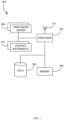
- the system 100 includes a processor 102, memory 104 in data communication with the processor 102 for storing processor executable code, and one or more eye tracking sensors / cameras 108 for receiving eye tracking data stream.
- the eye tracking sensors 108 record eye movement / gaze of a pilot and eye lid position.
- the processor executable code configures the processor 102 to continuously log the eye tracking data in a data storage element 106.
- the processor 102 analyzes the eye tracking data to generate a bio-kinematic model of eye movement and pupil dynamics (i.e., a model of physical movement defined by the properties and abilities of bone, muscles, tendons, etc.).
- the bio-kinematic model may define physical limitations of eye movement, either generally or for a specific user.
- the processor 102 may correlate eye tracking data with discreet portions of a training scenario / task that may be defined by a set of steps stored in the data storage element 106.
- the processor 102 may define metrics for each step that can be characterized via the eye tracking data with respect to the bio-kinematic model; for example, each step may define a scan pattern of instruments that the user should observe. Eye movement may be difficult to detect or characterize generally, and in absolute terms. By comparing eye movements to a bio-kinematic model defined for the specific task, and with respect to specific limitations of the user as defined by the model, faster and more accurate eye movement determinations can be generated.
- the discreet portions of the training scenario / task may be associated with known sets of eye movements and pupil dynamics as defined by an expert in the field (e.g., an expert pilot).
- an expert in the field e.g., an expert pilot
- the processor 102 may automatically annotate the eye movement and pupil dynamics data for including in a training data set without the intervention of a outside observer.
- the processor 102 may receive specific stimuli such as instrument readings, alerts, or the like, and include such data in the training data set.
- specific stimuli such as instrument readings, alerts, or the like
- Embodiments of the present disclosure are directed toward mechanisms for compiling training data to construct a model of movement coincident with specific scenarios to characterize a user's later performance in similar scenarios.
- the processor 102 transfers the stored eye tracking data and other correlated system and task data to an offline storage device for later analysis and correlation to historic data and other outside factors such as crew rest, crew sleet rhythms, flight schedules, etc. Such transfer may be in real time via the wireless communication device 112.
- a computer system implementing embodiments of the inventive concepts disclosed herein receives 200 an image stream corresponding to eye tracking data from one or more vision-based sensors.
- the eye tracking data is correlated 202 to a specific flight task or an individual duty schedule of the user / pilot, packaged 204 into a data packet.
- the data packet is included 206 into a training data set to create or refine 208 a bio-kinematic model of eye movement and pupil dynamics.
- the system may contemporaneously characterize 210 the eye tracking data to produce a gaze estimate and scan pattern estimate.
- the gaze and scan pattern estimates are determined with respect to a bio-kinematic model that may be continuously refined 208 while in use.
- Scan patterns may be more accurately characterized with reference to limitations defined by the bio-kinematic model.
- the bio-kinematic model may be specific to the user.
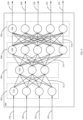
- the neural network 300 comprises an input layer 302 that receives external inputs (including eye tracking data, avionics data, and potentially user or task specific profiles), an output layer 304, and a plurality of internal layers 306, 308.
- Each layer comprises a plurality of neurons or nodes 310, 336, 338, 340.
- each node 310 receives one or more inputs 318, 320, 322, 324 corresponding to a digital signal and produces an output 312 based on an activation function unique to each node 310 in the input layer 302.
- An activation function may be a Hyperbolic tangent function, a linear output function, and / or a logistic function, or some combination thereof, and different nodes 310, 336, 338, 340 may utilize different types of activation functions.
- such activation function comprises the sum of each input multiplied by a synaptic weight.
- the output 312 may comprise a real value with a defined range or a Boolean value if the activation function surpasses a defined threshold. Such ranges and thresholds may be defined during a training process. Furthermore, the synaptic weights are determined during the training process.
Landscapes
- Engineering & Computer Science (AREA)
- Health & Medical Sciences (AREA)
- Life Sciences & Earth Sciences (AREA)
- Physics & Mathematics (AREA)
- General Health & Medical Sciences (AREA)
- Theoretical Computer Science (AREA)
- Biomedical Technology (AREA)
- Biophysics (AREA)
- Molecular Biology (AREA)
- Medical Informatics (AREA)
- Heart & Thoracic Surgery (AREA)
- Veterinary Medicine (AREA)
- General Physics & Mathematics (AREA)
- Public Health (AREA)
- Animal Behavior & Ethology (AREA)
- Surgery (AREA)
- Artificial Intelligence (AREA)
- General Engineering & Computer Science (AREA)
- Ophthalmology & Optometry (AREA)
- Human Computer Interaction (AREA)
- Evolutionary Computation (AREA)
- Software Systems (AREA)
- Mathematical Physics (AREA)
- Pathology (AREA)
- Data Mining & Analysis (AREA)
- Computing Systems (AREA)
- Psychiatry (AREA)
- Computational Linguistics (AREA)
- Multimedia (AREA)
- Signal Processing (AREA)
- Psychology (AREA)
- Hospice & Palliative Care (AREA)
- Educational Technology (AREA)
- Developmental Disabilities (AREA)
- Social Psychology (AREA)
- Child & Adolescent Psychology (AREA)
- Computer Vision & Pattern Recognition (AREA)
- Fuzzy Systems (AREA)
- Physiology (AREA)
- Aviation & Aerospace Engineering (AREA)
Abstract
A computer system records eye tracking data and identifies movements in the eye tracking data to generate a model of eye movement and pupil dynamics. The model is used to produce a performance metric for the user based on deviations of the predicted output from what is physically possible as defined by the bio-kinematic model. The system continuously stores eye tracking data to enhance the bio-kinematic models. Bio-kinematic models may be generalized or specific to a particular user. The system continuously adjusts and / or weights the bio-kinematic model in real-time based on eye tracking data.
Description
- Data is the driving component for success in machine learning applications. The scarcity of data creates many challenges in the training pilot monitoring systems, and the labor-intensive nature of data collection is a non-trivial problem to solve. The amount of annotated data required to reach suitable performance must be manually generated. A model that must be run on video can be bootstrapped with annotated still images, but the problem remains that, for its intended application, there is no real time way to assess performance.
- Consequently, it would be advantageous if an improved apparatus existed that is suitable for gathering data and creating bio-kinematic models for pilot monitoring.
- In one aspect, embodiments of the inventive concepts disclosed herein are directed to a computer system that records eye tracking data. The system identifies movements in the eye tracking data to generate a model of eye movement and pupil dynamics. The model is used to produce a performance metric for the user based on deviations of the predicted output from what is physically possible as defined by the bio-kinematic model.
- In a further aspect, the system continuously stores eye tracking data to enhance the bio-kinematic models. Bio-kinematic models may be generalized or specific to a particular user.
- In a further aspect, the system continuously adjusts and / or weights the bio-kinematic model in real-time based on eye tracking data.
- It is to be understood that both the foregoing general description and the following detailed description are exemplary and explanatory only and should not restrict the scope of the claims. The accompanying drawings, which are incorporated in and constitute a part of the specification, illustrate exemplary embodiments of the inventive concepts disclosed herein and together with the general description, serve to explain the principles.
- The numerous advantages of the embodiments of the inventive concepts disclosed herein may be better understood by those skilled in the art by reference to the accompanying figures in which:
-
FIG. 1 shows a block diagram of a system suitable for implementing embodiments of the incentive concepts disclosed herein; -
FIG. 2 shows a flowchart of an exemplary embodiment of the inventive concepts disclosed herein; and -
FIG. 3 shows a block diagram of a neural network according an exemplary embodiment of the inventive concepts disclosed herein. - Before explaining at least one embodiment of the inventive concepts disclosed herein in detail, it is to be understood that the inventive concepts are not limited in their application to the details of construction and the arrangement of the components or steps or methodologies set forth in the following description or illustrated in the drawings. In the following detailed description of embodiments of the instant inventive concepts, numerous specific details are set forth in order to provide a more thorough understanding of the inventive concepts. However, it will be apparent to one of ordinary skill in the art having the benefit of the instant disclosure that the inventive concepts disclosed herein may be practiced without these specific details. In other instances, well-known features may not be described in detail to avoid unnecessarily complicating the instant disclosure. The inventive concepts disclosed herein are capable of other embodiments or of being practiced or carried out in various ways. Also, it is to be understood that the phraseology and terminology employed herein is for the purpose of description and should not be regarded as limiting.
- As used herein a letter following a reference numeral is intended to reference an embodiment of the feature or element that may be similar, but not necessarily identical, to a previously described element or feature bearing the same reference numeral (e.g., 1, 1a, 1b). Such shorthand notations are used for purposes of convenience only, and should not be construed to limit the inventive concepts disclosed herein in any way unless expressly stated to the contrary.
- Further, unless expressly stated to the contrary, "or" refers to an inclusive or and not to an exclusive or. For example, a condition A or B is satisfied by anyone of the following: A is true (or present) and B is false (or not present), A is false (or not present) and B is true (or present), and both A and B are true (or present).
- In addition, use of the "a" or "an" are employed to describe elements and components of embodiments of the instant inventive concepts. This is done merely for convenience and to give a general sense of the inventive concepts, and "a' and "an" are intended to include one or at least one and the singular also includes the plural unless it is obvious that it is meant otherwise.
- Finally, as used herein any reference to "one embodiment," or "some embodiments" means that a particular element, feature, structure, or characteristic described in connection with the embodiment is included in at least one embodiment of the inventive concepts disclosed herein. The appearances of the phrase "in some embodiments" in various places in the specification are not necessarily all referring to the same embodiment, and embodiments of the inventive concepts disclosed may include one or more of the features expressly described or inherently present herein, or any combination of sub-combination of two or more such features, along with any other features which may not necessarily be expressly described or inherently present in the instant disclosure.
- Broadly, embodiments of the inventive concepts disclosed herein are directed to a computer system that records eye tracking data and identifies movements in the eye tracking data to generate a model of eye movement and pupil dynamics. The model is used to produce a performance metric for the user based on deviations of the predicted output from what is physically possible as defined by the bio-kinematic model. The system continuously stores eye tracking data to enhance the bio-kinematic models. Bio-kinematic models may be generalized or specific to a particular user. The system continuously adjusts and / or weights the bio-kinematic model in real-time based on eye tracking data.
- Referring to
FIG. 1 , a block diagram of asystem 100 suitable for implementing embodiments of the incentive concepts disclosed herein is shown. Thesystem 100 includes aprocessor 102,memory 104 in data communication with theprocessor 102 for storing processor executable code, and one or more eye tracking sensors /cameras 108 for receiving eye tracking data stream. In at least one embodiment, theeye tracking sensors 108 record eye movement / gaze of a pilot and eye lid position. The processor executable code configures theprocessor 102 to continuously log the eye tracking data in adata storage element 106. Theprocessor 102 analyzes the eye tracking data to generate a bio-kinematic model of eye movement and pupil dynamics (i.e., a model of physical movement defined by the properties and abilities of bone, muscles, tendons, etc.). The bio-kinematic model may define physical limitations of eye movement, either generally or for a specific user. - In at least one embodiment, the
processor 102 may correlate eye tracking data with discreet portions of a training scenario / task that may be defined by a set of steps stored in thedata storage element 106. Theprocessor 102 may define metrics for each step that can be characterized via the eye tracking data with respect to the bio-kinematic model; for example, each step may define a scan pattern of instruments that the user should observe. Eye movement may be difficult to detect or characterize generally, and in absolute terms. By comparing eye movements to a bio-kinematic model defined for the specific task, and with respect to specific limitations of the user as defined by the model, faster and more accurate eye movement determinations can be generated. - In at least one embodiment, the discreet portions of the training scenario / task may be associated with known sets of eye movements and pupil dynamics as defined by an expert in the field (e.g., an expert pilot). By recording the user's eye movement and pupil dynamics and correlating that data with corresponding previously sets of expert data, the
processor 102 may automatically annotate the eye movement and pupil dynamics data for including in a training data set without the intervention of a outside observer. - In at least one embodiment, the
processor 102 may receive specific stimuli such as instrument readings, alerts, or the like, and include such data in the training data set. Embodiments of the present disclosure are directed toward mechanisms for compiling training data to construct a model of movement coincident with specific scenarios to characterize a user's later performance in similar scenarios. - In at least one embodiment, the
processor 102 may compare the eye tracking data to an existing bio-kinematic model to characterize the user's performance while simultaneously incorporating the eye tracking data into the training data set. - In at least one embodiment, the
processor 102 transfers the stored eye tracking data and other correlated system and task data to an offline storage device for later analysis and correlation to historic data and other outside factors such as crew rest, crew sleet rhythms, flight schedules, etc. Such transfer may be in real time via thewireless communication device 112. - Referring to
FIG. 2 , a flowchart of an exemplary embodiment of the inventive concepts disclosed herein is shown. A computer system implementing embodiments of the inventive concepts disclosed herein receives 200 an image stream corresponding to eye tracking data from one or more vision-based sensors. The eye tracking data is correlated 202 to a specific flight task or an individual duty schedule of the user / pilot, packaged 204 into a data packet. The data packet is included 206 into a training data set to create or refine 208 a bio-kinematic model of eye movement and pupil dynamics. - In at least one embodiment, the system may contemporaneously characterize 210 the eye tracking data to produce a gaze estimate and scan pattern estimate. The gaze and scan pattern estimates are determined with respect to a bio-kinematic model that may be continuously refined 208 while in use.
- Scan patterns may be more accurately characterized with reference to limitations defined by the bio-kinematic model. The bio-kinematic model may be specific to the user.
- Referring to
FIG. 3 , a block diagram of aneural network 300 embodying a bio-kinematic model according an exemplary embodiment of the inventive concepts disclosed herein is shown. Theneural network 300 comprises aninput layer 302 that receives external inputs (including eye tracking data, avionics data, and potentially user or task specific profiles), anoutput layer 304, and a plurality ofinternal layers nodes input layer 302, eachnode 310 receives one ormore inputs output 312 based on an activation function unique to eachnode 310 in theinput layer 302. An activation function may be a Hyperbolic tangent function, a linear output function, and / or a logistic function, or some combination thereof, anddifferent nodes output 312 may comprise a real value with a defined range or a Boolean value if the activation function surpasses a defined threshold. Such ranges and thresholds may be defined during a training process. Furthermore, the synaptic weights are determined during the training process. - Within the context of the present application, synaptic weights are determined, at least in part, from training data derived from actual eye tracking data recorded during a training scenario or task. The eye tracking data is correlated to the task, and potentially to deviations from predefined expected movements. During training, synaptic weights are iteratively computed and tested against separate data sets.
- It is believed that the inventive concepts disclosed herein and many of their attendant advantages will be understood by the foregoing description of embodiments of the inventive concepts disclosed, and it will be apparent that various changes may be made in the form, construction, and arrangement of the components thereof without departing from the broad scope of the inventive concepts disclosed herein or without sacrificing all of their material advantages; and individual features from various embodiments may be combined to arrive at other embodiments. The form herein before described being merely an explanatory embodiment thereof, it is the intention of the following claims to encompass and include such changes. Furthermore, any of the features disclosed in relation to any of the individual embodiments may be incorporated into any other embodiment.
Claims (15)
- A computer apparatus comprising:at least one eye tracking camera (108); andat least one processor (102) in data communication with a memory storing processor executable code; andwherein the processor executable code configures the at least one processor (102) to:receive an image stream from the at least one eye tracking camera (108);include the eye tracking data into a training set or eye tracking data; andproduce a bio-kinematic model of eye movement via a machine learning algorithm trained on the training set.
- The computer apparatus of Claim 1, wherein the processor executable code further configures the at least one processor (102) to characterize a user's eye movement to identify gaze and scan pattern with respect to the bio-kinematic model.
- The computer apparatus of Claim 1 or 2, wherein:the processor executable code further configures the at least one processor (102) to receive a training scenario or task; andproducing the bio-kinematic model is further based on the training scenario or task.
- The computer apparatus of Claim 3, wherein the training scenario or task includes predicted eye movement, or wherein the processor executable code further configures the at least one processor (102) to annotate the training set according to the training scenario or task.
- The computer apparatus of any preceding Claim, wherein the bio-kinematic model defines user specific physical limitations, or wherein the processor executable code further configures the at least one processor (102) as a machine learning neural network embodying the bio-kinematic model.
- A method comprising:receiving an image stream from at least one eye tracking camera;including the eye tracking data into a training set or eye tracking data; andproducing a bio-kinematic model of eye movement via a machine learning algorithm trained on the training set.
- The method of Claim 6, further comprising characterizing a user's eye movement to identify gaze and scan pattern with respect to the bio-kinematic model.
- The method of Claim 6 or 7, further comprising receiving a training scenario or task, wherein producing the bio-kinematic model is further based on the training scenario or task.
- The method of Claim 8, wherein the training scenario or task includes predicted eye movement, or further comprising annotating the training set according to the training scenario or task.
- The method of Claim 6, wherein the bio-kinematic model defines user specific physical limitations.
- A pilot monitoring system comprising:at least one eye tracking camera; andat least one processor (102) in data communication with a memory storing processor executable code; andwherein the processor executable code configures the at least one processor (102) to:receive an image stream from the at least one eye tracking camera;include the eye tracking data into a training set or eye tracking data; andproduce a bio-kinematic model of eye movement via a machine learning algorithm trained on the training set.
- The pilot monitoring system of Claim 11, wherein the processor executable code further configures the at least one processor (102) to characterize a user's eye movement to identify gaze and scan pattern with respect to the bio-kinematic model.
- The pilot monitoring system of Claim 11, wherein:the processor executable code further configures the at least one processor (102) to receive a training scenario or task; andproducing the bio-kinematic model is further based on the training scenario or task.
- The pilot monitoring system of Claim 13, wherein the training scenario or task includes predicted eye movement, or wherein the processor executable code further configures the at least one processor (102) to annotate the training set according to the training scenario or task.
- The pilot monitoring system of Claim 11, wherein the bio-kinematic model defines user specific physical limitations, or wherein the processor executable code further configures the at least one processor (102) as a machine learning neural network embodying the bio-kinematic model.
Applications Claiming Priority (1)
| Application Number | Priority Date | Filing Date | Title |
|---|---|---|---|
| US18/216,911 US20250000357A1 (en) | 2023-06-30 | 2023-06-30 | Physiology based bio-kinematics modeling for segmentation model unsupervised feedback |
Publications (1)
| Publication Number | Publication Date |
|---|---|
| EP4485146A1 true EP4485146A1 (en) | 2025-01-01 |
Family
ID=91581768
Family Applications (1)
| Application Number | Title | Priority Date | Filing Date |
|---|---|---|---|
| EP24182635.3A Pending EP4485146A1 (en) | 2023-06-30 | 2024-06-17 | Physiology based bio-kinematics modeling for segmentation model unsupervised feedback |
Country Status (2)
| Country | Link |
|---|---|
| US (1) | US20250000357A1 (en) |
| EP (1) | EP4485146A1 (en) |
Families Citing this family (1)
| Publication number | Priority date | Publication date | Assignee | Title |
|---|---|---|---|---|
| CN120295466A (en) * | 2019-02-01 | 2025-07-11 | 苹果公司 | Biofeedback method for conditioning digital content to stimulate a larger pupil radius response |
Citations (2)
| Publication number | Priority date | Publication date | Assignee | Title |
|---|---|---|---|---|
| US20210327085A1 (en) * | 2017-09-20 | 2021-10-21 | Magic Leap, Inc. | Personalized neural network for eye tracking |
| US20220366568A1 (en) * | 2021-05-13 | 2022-11-17 | Nvidia Corporation | Adaptive eye tracking machine learning model engine |
Family Cites Families (8)
| Publication number | Priority date | Publication date | Assignee | Title |
|---|---|---|---|---|
| WO2015073368A1 (en) * | 2013-11-12 | 2015-05-21 | Highland Instruments, Inc. | Analysis suite |
| US10521012B2 (en) * | 2015-03-13 | 2019-12-31 | Apple Inc. | Method for automatically identifying at least one user of an eye tracking device and eye tracking device |
| US20180125405A1 (en) * | 2016-11-08 | 2018-05-10 | International Business Machines Corporation | Mental state estimation using feature of eye movement |
| US11513593B2 (en) * | 2018-11-29 | 2022-11-29 | Blink Technologies Inc. | Systems and methods for anatomy-constrained gaze estimation |
| US11999356B2 (en) * | 2020-11-13 | 2024-06-04 | Toyota Research Institute, Inc. | Cognitive heat map: a model for driver situational awareness |
| US12118825B2 (en) * | 2021-05-03 | 2024-10-15 | NeuraLight Ltd. | Obtaining high-resolution oculometric parameters |
| US11630510B2 (en) * | 2021-06-23 | 2023-04-18 | Huawei Technologies Co., Ltd. | System, method and storage medium for 2D on-screen user gaze estimation |
| US12517576B2 (en) * | 2022-06-28 | 2026-01-06 | Apple Inc. | Gaze behavior detection |
-
2023
- 2023-06-30 US US18/216,911 patent/US20250000357A1/en active Pending
-
2024
- 2024-06-17 EP EP24182635.3A patent/EP4485146A1/en active Pending
Patent Citations (2)
| Publication number | Priority date | Publication date | Assignee | Title |
|---|---|---|---|---|
| US20210327085A1 (en) * | 2017-09-20 | 2021-10-21 | Magic Leap, Inc. | Personalized neural network for eye tracking |
| US20220366568A1 (en) * | 2021-05-13 | 2022-11-17 | Nvidia Corporation | Adaptive eye tracking machine learning model engine |
Non-Patent Citations (1)
| Title |
|---|
| WILSON JUSTIN C: "Cognition and Context-Aware Computing: Towards a Situation-Aware System with a Case Study in Aviation", SOUTHERN METHODIST UNIVERSITY, COMPUTER SCIENCE AND ENGINEERING THESES AND DISSERTATIONS, 4 August 2020 (2020-08-04), XP093140529, Retrieved from the Internet <URL:https://scholar.smu.edu/cgi/viewcontent.cgi?article=1017&context=engineering_compsci_etds> [retrieved on 20240312] * |
Also Published As
| Publication number | Publication date |
|---|---|
| US20250000357A1 (en) | 2025-01-02 |
Similar Documents
| Publication | Publication Date | Title |
|---|---|---|
| US12048528B2 (en) | Annotation method, annotation device, storage medium, and identification system | |
| EP3422127B1 (en) | Work analysis assistance device, work analysis assistance method, computer program, and information storage medium | |
| US8306931B1 (en) | Detecting, classifying, and tracking abnormal data in a data stream | |
| CN114556331B (en) | New frame with less lens time action positioning | |
| KR20180062000A (en) | Apparatus and method for learning diagnosis, adaptive learning system using thereof | |
| US12572791B2 (en) | Method, device and computer program for predicting a suitable configuration of a machine learning system for a training data set | |
| US20250000357A1 (en) | Physiology based bio-kinematics modeling for segmentation model unsupervised feedback | |
| TWM583566U (en) | Cutting tool service life prediction equipment | |
| US20220383652A1 (en) | Monitoring Animal Pose Dynamics from Monocular Images | |
| Ravichandar et al. | Gaze and motion information fusion for human intention inference | |
| Kachhia et al. | Deep learning enhanced BCI technology for 3D printing | |
| EP4485149A1 (en) | Pupil dynamics, physiology, and performance for estimating competency in situational awareness | |
| EP4485147A1 (en) | Pupil dynamics, physiology, and performance for estimating competency in situational awareness | |
| US12124625B1 (en) | Pupil dynamics, physiology, and context for estimating vigilance | |
| US20210390427A1 (en) | Enhanced collection of training data for machine learning to improve worksite safety and operations | |
| US12573081B2 (en) | Online correction for context-aware image analysis for object classification | |
| Papamitsiou et al. | Student modeling in real-time during self-assessment using stream mining techniques | |
| EP4361963A1 (en) | Processing videos based on temporal stages | |
| KR101893290B1 (en) | System for instructional video learning and evaluation using deep learning | |
| WO2024115175A1 (en) | Ai model optimization through user feedback | |
| CN117975545A (en) | Communication module calling system and method | |
| Plambeck et al. | Explaining cyber-physical systems using decision trees | |
| EP4485148A1 (en) | Pupil dynamics, physiology, and context for estimating affect and workload | |
| Petlenkov et al. | Application of self organizing Kohonen map to detection of surgeon motions during endoscopic surgery | |
| US20250013294A1 (en) | Pupil dynamics, pose, and performance for inferring intent |
Legal Events
| Date | Code | Title | Description |
|---|---|---|---|
| PUAI | Public reference made under article 153(3) epc to a published international application that has entered the european phase |
Free format text: ORIGINAL CODE: 0009012 |
|
| STAA | Information on the status of an ep patent application or granted ep patent |
Free format text: STATUS: THE APPLICATION HAS BEEN PUBLISHED |
|
| AK | Designated contracting states |
Kind code of ref document: A1 Designated state(s): AL AT BE BG CH CY CZ DE DK EE ES FI FR GB GR HR HU IE IS IT LI LT LU LV MC ME MK MT NL NO PL PT RO RS SE SI SK SM TR |
|
| STAA | Information on the status of an ep patent application or granted ep patent |
Free format text: STATUS: REQUEST FOR EXAMINATION WAS MADE |
|
| 17P | Request for examination filed |
Effective date: 20250630 |