EP4484521A1 - Insulation light-conversion film for photovoltaic assembly and preparation method thereof and photovoltaic assembly - Google Patents
Insulation light-conversion film for photovoltaic assembly and preparation method thereof and photovoltaic assembly Download PDFInfo
- Publication number
- EP4484521A1 EP4484521A1 EP24160324.0A EP24160324A EP4484521A1 EP 4484521 A1 EP4484521 A1 EP 4484521A1 EP 24160324 A EP24160324 A EP 24160324A EP 4484521 A1 EP4484521 A1 EP 4484521A1
- Authority
- EP
- European Patent Office
- Prior art keywords
- parts
- quantum dots
- carbon quantum
- light
- photovoltaic assembly
- Prior art date
- Legal status (The legal status is an assumption and is not a legal conclusion. Google has not performed a legal analysis and makes no representation as to the accuracy of the status listed.)
- Granted
Links
Images


Classifications
-
- H—ELECTRICITY
- H10—SEMICONDUCTOR DEVICES; ELECTRIC SOLID-STATE DEVICES NOT OTHERWISE PROVIDED FOR
- H10F—INORGANIC SEMICONDUCTOR DEVICES SENSITIVE TO INFRARED RADIATION, LIGHT, ELECTROMAGNETIC RADIATION OF SHORTER WAVELENGTH OR CORPUSCULAR RADIATION
- H10F77/00—Constructional details of devices covered by this subclass
- H10F77/40—Optical elements or arrangements
- H10F77/42—Optical elements or arrangements directly associated or integrated with photovoltaic cells, e.g. light-reflecting means or light-concentrating means
- H10F77/45—Wavelength conversion means, e.g. by using luminescent material, fluorescent concentrators or up-conversion arrangements
-
- C—CHEMISTRY; METALLURGY
- C09—DYES; PAINTS; POLISHES; NATURAL RESINS; ADHESIVES; COMPOSITIONS NOT OTHERWISE PROVIDED FOR; APPLICATIONS OF MATERIALS NOT OTHERWISE PROVIDED FOR
- C09K—MATERIALS FOR MISCELLANEOUS APPLICATIONS, NOT PROVIDED FOR ELSEWHERE
- C09K11/00—Luminescent materials, e.g. electroluminescent or chemiluminescent
- C09K11/02—Use of particular materials as binders, particle coatings or suspension media therefor
-
- B—PERFORMING OPERATIONS; TRANSPORTING
- B82—NANOTECHNOLOGY
- B82Y—SPECIFIC USES OR APPLICATIONS OF NANOSTRUCTURES; MEASUREMENT OR ANALYSIS OF NANOSTRUCTURES; MANUFACTURE OR TREATMENT OF NANOSTRUCTURES
- B82Y20/00—Nanooptics, e.g. quantum optics or photonic crystals
-
- B—PERFORMING OPERATIONS; TRANSPORTING
- B82—NANOTECHNOLOGY
- B82Y—SPECIFIC USES OR APPLICATIONS OF NANOSTRUCTURES; MEASUREMENT OR ANALYSIS OF NANOSTRUCTURES; MANUFACTURE OR TREATMENT OF NANOSTRUCTURES
- B82Y40/00—Manufacture or treatment of nanostructures
-
- C—CHEMISTRY; METALLURGY
- C09—DYES; PAINTS; POLISHES; NATURAL RESINS; ADHESIVES; COMPOSITIONS NOT OTHERWISE PROVIDED FOR; APPLICATIONS OF MATERIALS NOT OTHERWISE PROVIDED FOR
- C09J—ADHESIVES; NON-MECHANICAL ASPECTS OF ADHESIVE PROCESSES IN GENERAL; ADHESIVE PROCESSES NOT PROVIDED FOR ELSEWHERE; USE OF MATERIALS AS ADHESIVES
- C09J11/00—Features of adhesives not provided for in group C09J9/00, e.g. additives
- C09J11/02—Non-macromolecular additives
- C09J11/04—Non-macromolecular additives inorganic
-
- C—CHEMISTRY; METALLURGY
- C09—DYES; PAINTS; POLISHES; NATURAL RESINS; ADHESIVES; COMPOSITIONS NOT OTHERWISE PROVIDED FOR; APPLICATIONS OF MATERIALS NOT OTHERWISE PROVIDED FOR
- C09J—ADHESIVES; NON-MECHANICAL ASPECTS OF ADHESIVE PROCESSES IN GENERAL; ADHESIVE PROCESSES NOT PROVIDED FOR ELSEWHERE; USE OF MATERIALS AS ADHESIVES
- C09J123/00—Adhesives based on homopolymers or copolymers of unsaturated aliphatic hydrocarbons having only one carbon-to-carbon double bond; Adhesives based on derivatives of such polymers
- C09J123/02—Adhesives based on homopolymers or copolymers of unsaturated aliphatic hydrocarbons having only one carbon-to-carbon double bond; Adhesives based on derivatives of such polymers not modified by chemical after-treatment
- C09J123/04—Homopolymers or copolymers of ethene
- C09J123/08—Copolymers of ethene
- C09J123/0807—Copolymers of ethene with unsaturated hydrocarbons only containing more than three carbon atoms
- C09J123/0815—Copolymers of ethene with aliphatic 1-olefins
-
- C—CHEMISTRY; METALLURGY
- C09—DYES; PAINTS; POLISHES; NATURAL RESINS; ADHESIVES; COMPOSITIONS NOT OTHERWISE PROVIDED FOR; APPLICATIONS OF MATERIALS NOT OTHERWISE PROVIDED FOR
- C09J—ADHESIVES; NON-MECHANICAL ASPECTS OF ADHESIVE PROCESSES IN GENERAL; ADHESIVE PROCESSES NOT PROVIDED FOR ELSEWHERE; USE OF MATERIALS AS ADHESIVES
- C09J123/00—Adhesives based on homopolymers or copolymers of unsaturated aliphatic hydrocarbons having only one carbon-to-carbon double bond; Adhesives based on derivatives of such polymers
- C09J123/02—Adhesives based on homopolymers or copolymers of unsaturated aliphatic hydrocarbons having only one carbon-to-carbon double bond; Adhesives based on derivatives of such polymers not modified by chemical after-treatment
- C09J123/04—Homopolymers or copolymers of ethene
- C09J123/08—Copolymers of ethene
- C09J123/0846—Copolymers of ethene with unsaturated hydrocarbons containing other atoms than carbon or hydrogen atoms
- C09J123/0853—Vinylacetate
-
- C—CHEMISTRY; METALLURGY
- C09—DYES; PAINTS; POLISHES; NATURAL RESINS; ADHESIVES; COMPOSITIONS NOT OTHERWISE PROVIDED FOR; APPLICATIONS OF MATERIALS NOT OTHERWISE PROVIDED FOR
- C09J—ADHESIVES; NON-MECHANICAL ASPECTS OF ADHESIVE PROCESSES IN GENERAL; ADHESIVE PROCESSES NOT PROVIDED FOR ELSEWHERE; USE OF MATERIALS AS ADHESIVES
- C09J7/00—Adhesives in the form of films or foils
- C09J7/10—Adhesives in the form of films or foils without carriers
-
- C—CHEMISTRY; METALLURGY
- C09—DYES; PAINTS; POLISHES; NATURAL RESINS; ADHESIVES; COMPOSITIONS NOT OTHERWISE PROVIDED FOR; APPLICATIONS OF MATERIALS NOT OTHERWISE PROVIDED FOR
- C09J—ADHESIVES; NON-MECHANICAL ASPECTS OF ADHESIVE PROCESSES IN GENERAL; ADHESIVE PROCESSES NOT PROVIDED FOR ELSEWHERE; USE OF MATERIALS AS ADHESIVES
- C09J7/00—Adhesives in the form of films or foils
- C09J7/30—Adhesives in the form of films or foils characterised by the adhesive composition
-
- C—CHEMISTRY; METALLURGY
- C09—DYES; PAINTS; POLISHES; NATURAL RESINS; ADHESIVES; COMPOSITIONS NOT OTHERWISE PROVIDED FOR; APPLICATIONS OF MATERIALS NOT OTHERWISE PROVIDED FOR
- C09K—MATERIALS FOR MISCELLANEOUS APPLICATIONS, NOT PROVIDED FOR ELSEWHERE
- C09K11/00—Luminescent materials, e.g. electroluminescent or chemiluminescent
- C09K11/02—Use of particular materials as binders, particle coatings or suspension media therefor
- C09K11/025—Use of particular materials as binders, particle coatings or suspension media therefor non-luminescent particle coatings or suspension media
-
- C—CHEMISTRY; METALLURGY
- C09—DYES; PAINTS; POLISHES; NATURAL RESINS; ADHESIVES; COMPOSITIONS NOT OTHERWISE PROVIDED FOR; APPLICATIONS OF MATERIALS NOT OTHERWISE PROVIDED FOR
- C09K—MATERIALS FOR MISCELLANEOUS APPLICATIONS, NOT PROVIDED FOR ELSEWHERE
- C09K11/00—Luminescent materials, e.g. electroluminescent or chemiluminescent
- C09K11/08—Luminescent materials, e.g. electroluminescent or chemiluminescent containing inorganic luminescent materials
- C09K11/65—Luminescent materials, e.g. electroluminescent or chemiluminescent containing inorganic luminescent materials containing carbon
-
- H—ELECTRICITY
- H10—SEMICONDUCTOR DEVICES; ELECTRIC SOLID-STATE DEVICES NOT OTHERWISE PROVIDED FOR
- H10F—INORGANIC SEMICONDUCTOR DEVICES SENSITIVE TO INFRARED RADIATION, LIGHT, ELECTROMAGNETIC RADIATION OF SHORTER WAVELENGTH OR CORPUSCULAR RADIATION
- H10F19/00—Integrated devices, or assemblies of multiple devices, comprising at least one photovoltaic cell covered by group H10F10/00, e.g. photovoltaic modules
- H10F19/80—Encapsulations or containers for integrated devices, or assemblies of multiple devices, having photovoltaic cells
- H10F19/804—Materials of encapsulations
-
- C—CHEMISTRY; METALLURGY
- C08—ORGANIC MACROMOLECULAR COMPOUNDS; THEIR PREPARATION OR CHEMICAL WORKING-UP; COMPOSITIONS BASED THEREON
- C08L—COMPOSITIONS OF MACROMOLECULAR COMPOUNDS
- C08L2203/00—Applications
- C08L2203/20—Applications use in electrical or conductive gadgets
- C08L2203/206—Applications use in electrical or conductive gadgets use in coating or encapsulating of electronic parts
-
- C—CHEMISTRY; METALLURGY
- C09—DYES; PAINTS; POLISHES; NATURAL RESINS; ADHESIVES; COMPOSITIONS NOT OTHERWISE PROVIDED FOR; APPLICATIONS OF MATERIALS NOT OTHERWISE PROVIDED FOR
- C09J—ADHESIVES; NON-MECHANICAL ASPECTS OF ADHESIVE PROCESSES IN GENERAL; ADHESIVE PROCESSES NOT PROVIDED FOR ELSEWHERE; USE OF MATERIALS AS ADHESIVES
- C09J2423/00—Presence of polyolefin
-
- Y—GENERAL TAGGING OF NEW TECHNOLOGICAL DEVELOPMENTS; GENERAL TAGGING OF CROSS-SECTIONAL TECHNOLOGIES SPANNING OVER SEVERAL SECTIONS OF THE IPC; TECHNICAL SUBJECTS COVERED BY FORMER USPC CROSS-REFERENCE ART COLLECTIONS [XRACs] AND DIGESTS
- Y02—TECHNOLOGIES OR APPLICATIONS FOR MITIGATION OR ADAPTATION AGAINST CLIMATE CHANGE
- Y02E—REDUCTION OF GREENHOUSE GAS [GHG] EMISSIONS, RELATED TO ENERGY GENERATION, TRANSMISSION OR DISTRIBUTION
- Y02E10/00—Energy generation through renewable energy sources
- Y02E10/50—Photovoltaic [PV] energy
- Y02E10/52—PV systems with concentrators
Definitions
- the present disclosure belongs to the technical field of encapsulating adhesive films and in particular relates to an insulation light-conversion film for a photovoltaic assembly and a preparation method thereof and a photovoltaic assembly.
- Solar spectrum is a continuous spectrum of different wavelengths, which consists of ultraviolet ray, visible light and infrared ray, where the ultraviolet ray and the infrared ray are invisible light.
- the solar cells have good response to medium-wavelength light (for example, blue light, green light and red light).
- the ultraviolet ray has a low generation efficiency and can bring a severe damage to the photovoltaic assemblies, for example, the problems such as ultraviolet photolysis of backplates, EVA decolorization, ultraviolet photolysis of organic batteries (organic batteries, dye-sensitized batteries, and perovskite batteries), light induced degradation and light and elevated temperature induced degradation of crystalline silicon batteries are all resulted from light irradiation, severely affecting the power generation efficiency and assembly reliability.
- the battery indexes almost drop linearly, and especially the open-circuit voltage drops most severely.
- the present disclosure provides an insulation light-conversion film for a photovoltaic assembly and a preparation method thereof and a photovoltaic assembly, so as to solve the problem of failure to apply a high conductivity of carbon-based quantum dots to encapsulation adhesive films.
- an insulation light-conversion film for a photovoltaic assembly which includes: thermoplastic elastomer granules, siloxane-coated carbon quantum dots, a crosslinking agent, a co-crosslinking agent, a photostabilizer, an antioxidant, where the weight ratio of the above substances is as follows:
- the present disclosure provides a preparation method of an insulation light-conversion film for a photovoltaic assembly, which includes the following steps: at step S1, by co-hydrolytic condensation of silicate ester and a silane coupling agent, performing insulation coating on carbon quantum dots to obtain siloxane-coated carbon quantum dots; at step S2, mixing the siloxane-coated carbon quantum dots, thermoplastic elastomer granules and aids uniformly to obtain a pre-prepared material; at step S3, preparing the pre-prepared material by film casting method into an insulation light-conversion film for the photovoltaic assembly; where the co-hydrolytic condensation includes the following steps: dissolving silicate ester and the silane coupling agent in an aqueous solution of an alcohol, and then adding carbon quantum dots and a catalyst and then stirring for 2 to 8 hours; performing centrifugation, washing and drying to obtain the siloxane-coated carbon quantum dots for later use; the thermoplastic elastomer granules are one of POE or EVA
- the stirring manner is a mechanical stirring at a speed of 500 to 800rpm for a time of 2 to 8 hours; the centrifugation speed is 5000 to 10000rpm; the washing manner is alternately washing several times, preferably three times, with ethanol and water; the drying manner is vacuum drying at a drying temperature of 60 to 80°C.
- the co-hydrolytic condensation used herein is environment-friendly and simplifies the preparation method and thus favors industrialized production.
- the carbon quantum dots are one of or a mixture of carbon nanotube quantum dots, graphene quantum dots, nano-diamond quantum dots and fluorescent carbon particle quantum dots.
- the carbon quantum dots are one of carboxyl-modified carbon quantum dots (CQDs-COOH), animated carbon quantum dots (CQDs-NH2) and hydroxylated carbon quantum dots (CQDs-OH).
- CQDs-COOH carboxyl-modified carbon quantum dots
- CQDs-NH2 animated carbon quantum dots
- CQDs-OH hydroxylated carbon quantum dots
- the used carbon quantum dots come from various sources and are inexpensive. Further, they are modified by active groups to facilitate post-treatments such as coating and modification and the like.
- the carbon quantum dots can generate fluorescent effect under the excitation of ultraviolet light and convert this part of ultraviolet light into visible light. Furthermore, an amount of ultraviolet ray entering the assembly can be reduced effectively and a damage resulting from the ultraviolet ray can also be reduced.
- the siloxane coating can improve the dispersion effect of the carbon quantum dots and increase the conversion efficiency of the ultraviolet ray while ensuring the insulation and safety of the adhesive film. More importantly, after siloxane is coated on the carbon quantum dots, silicon oxygen bonds are present in the coating layer and can serve as a silane coupling agent, and thus there is no need to add the silane coupling agent again into the formula.
- the dotted line is an XRD diagram of the carbon quantum dots and the solid line is the siloxane-coated carbon quantum dots and can clearly represent siloxane has been coated on the carbon quantum dots.
- the silicate ester is any one of silicon tetraacetate, tetrakis(2-ethylhexyl) ester, tetraisopropyl orthosilicate, and tetramethyl orthosilicate.
- the silane coupling agent is any one ofKH550, KH560, KH570, KH792 and DL602.
- the alcohol is one of or a mixture of methanol, ethanol, propanol, isopropanol and n-butanol.
- the weight ratio of the alcohol to water is 9:1, 8:2, 7:3 and 6:4.
- the catalyst is any one of ammonia water, formic acid, acetic acid, hydrochloric acid and ammonium chloride.
- the weight ratio of the silicate ester, the silane coupling agent, the catalyst, the alcohol, water and the carbon quantum dots is: the carbon quantum dots 1 to 5 parts; the silicate ester 1 to 10 parts; the silane coupling agent 1 to 10 parts; the catalyst 0.1 to 1 part; the alcohol 60 to 90 parts; and water 10 to 40 parts.
- the weight ratio of the thermoplastic elastomer granules, the siloxane-coated carbon quantum dots, the crosslinking agent, the co-crosslinking agent, the photostabilizer and the antioxidant is: the thermoplastic elastomer granules 100 parts; the siloxane-coated carbon quantum dots 1 to 5 parts; the crosslinking agent 0.2 to 2 parts; the co-crosslinking agent 0.2 to 0.5 parts; the photostabilizer 0.01 to 0.2 parts; and the antioxidant 0.02 to 0.3 parts.
- thermoplastic elastomer granules are one of POE or EVA.
- the crosslinking agent is a mixture of one or more of tert-butylperoxy 2-ethylhexyl carbonate, tert-amylperoxy 2-ethylhexyl carbonate, 2,5-dimethyl-2,5-di(tert-butylperoxy)hexane, tert-butylperoxy-3,5,5-trimethylhexanoate, di-(4-methylbenzoyl) peroxide, dibenzoyl peroxide, 1,1-di(tert-butylperoxy)cyclohexane, tert-butylperoxy 2-ethylhexyl carbonate, butyl 4,4-bis(tert-butyldioxy)valerate, dicumyl peroxide, ⁇ , ⁇ '-di(tert-butylperoxy) -1,3-diisopropylbenzene, and 1,1-bis(tert-butylper
- the co-crosslinking agent is a mixture of one or more of triallyl isocyanurate, triallyl cyanurate, and acrylate co-crosslinking agent; where the acrylate co-crosslinking agent is one of trimethylolpropane triacrylate, ethoxylated trimethylolpropane triacrylate, propylene glycerol triacrylate, and ethoxylated Pentaerythritol tetraacrylate.
- the photostabilizer is a mixture of one or more of a light screening agent type photostabilizer, a quenching agent type photostabilizer, a free radical scavenger type photostabilizer and a hydroperoxide decomposer type photostabilizer.
- the antioxidant is a mixture of one or more of hindered phenol antioxidant, aromatic amine antioxidant, phosphite antioxidant, thioether antioxidant, and metal passivator type antioxidant.
- the step S3 of preparing the pre-prepared material by film casting method into the insulation light-conversion film for the photovoltaic assembly includes: performing material mixing based on a formula and then allowing the mixture to go through screw plasticization and extrusion and then flow out of a mould head and then be rolled by a roller into the insulation light-conversion film for the photovoltaic assembly.
- the siloxane-coated carbon quantum dots are used because their particle size of 10nm will not affect penetration of the visible light. The light hitting on the surface of the solar cells actually does not decrease and thus the original power generation efficiency of the solar cells will not be negatively affected.
- the siloxane-coated carbon quantum dots have the following advantages: (1) the coating of siloxane can improve the dispersion effect of the carbon quantum dots; (2) the coating of siloxane can effectively reduce the conductivity of the carbon quantum dots; (3) after siloxane is coated on the carbon quantum dots, silicon oxygen bonds are present in the coating layer and can serve as a silane coupling agent, and thus there is no need to add the silane coupling agent again as done for the conventional adhesive film.
- the insulation carbon quantum dot light-conversion film can be used as an ultraviolet light-conversion layer which is used together with the ultraviolet cutoff layer to be co-extruded to form the light-conversion encapsulation adhesive film, where the ultraviolet cutoff layer is close to the solar cell side.
- the weight part ratio of the ultraviolet cutoff layer is: the thermoplastic elastomer granules 100 parts; the ultraviolet absorbent 0.5 to 1 part; the crosslinking agent 0.2 to 2 parts; the co-crosslinking agent 0.2 to 0.5 parts; the silane coupling agent 0.3 to 1 part; the photostabilizer 0.01 to 0.2 parts; the antioxidant 0.02 to 0.3 parts.
- thermoplastic elastomer granules are one of POE or EVA;
- the ultraviolet absorbent is a mixture of one or more of 2-hydroxy-4-(octyloxy)benzophenone, ethyl 2-cyano-3,3-diphenylacrylate, P-methoxycinnamate ethylhexyl ester, 2-ethylhexyl trans-4-methoxycinnamate, dimethyl (p-methoxybenzylidene)malonate, N-(2-ethoxyphenyl)-N'-(4-ethylphenyl)-ethlyene diamide, 2-(2'-hydroxy-5 '-tert-octylphenyl)benzotriazole, hexadecyl 3,5-bis-tert-butyl-4-hydroxybenzoate, 2-(4,6-diphenyl-1,3,5-triazin-2-yl)-5-(hexyloxy)phenol,
- the crosslinking agent is a mixture of one or more of tert-butylperoxy 2-ethylhexyl carbonate, tert-amylperoxy 2-ethylhexyl carbonate, 2,5-dimethyl-2,5-di(tert-butylperoxy)hexane, tert-butylperoxy-3,5,5-trimethylhexanoate, di-(4-methylbenzoyl) peroxide, dibenzoyl peroxide, 1,1-di(tert-butylperoxy)cyclohexane, tert-butylperoxy 2-ethylhexyl carbonate, butyl 4,4-bis(tert-butyldioxy)valerate, dicumyl peroxide, ⁇ , ⁇ '-di(tert-butylperoxy) -1,3-diisopropylbenzene, and 1,1-bis(tert-butylperoxy)-3,3,
- the co-crosslinking agent is a mixture of one or more of triallyl isocyanurate, triallyl cyanurate, and acrylate co-crosslinking agent; where the acrylate co-crosslinking agent is one of trimethylolpropane triacrylate, ethoxylated trimethylolpropane triacrylate, propylene glycerol triacrylate, and ethoxylated pentaerythritol tetraacrylate.
- the photostabilizer is a mixture of one or more of a light screening agent type photostabilizer, a quenching agent type photostabilizer, a free radical scavenger type photostabilizer and a hydroperoxide decomposer type photostabilizer.
- the silane coupling agent is any one of KH550, KH560, KH570, KH792 and DL602.
- the antioxidant is a mixture of one or more of a hindered phenol antioxidant, an aromatic amine antioxidant, a phosphite antioxidant, a thioether antioxidant, and a metal passivator type antioxidant.
- the ultraviolet cutoff layer has the same type of thermoplastic elastomer granules as the ultraviolet light-conversion layer.
- the formula of the ultraviolet light-conversion layer is same as that of the above photovoltaic light-conversion film and will not be repeated herein.
- the two layers are mixed based on the formula and then the mixed material is added to the co-extruder for extrusion, and then goes through respective screw plasticization and gathers at the mould head so as to form the ultraviolet light-conversion adhesive film of double layer.
- the EVA model is E282PV manufactured by Hanwha Total; the POE model is 8669 manufactured by DOW Chemical.
- the transmittance of the ultraviolet light and the visible light is tested by an ultraviolet spectrophotometer (UV-6000); for the light conversion effect, a light emission band is determined by using a fluorescence spectrometer; and the improvement effect of the light conversion on the assembly is determined using a solar cell assembly tester (XJCM-11A+); the insulation performance of the prepared adhesive film is tested using an electrostatic charge tester (6517B); the coating effect of the co-hydrolytic condensation is evaluated by using a transmission electron microscope (JEM-2100) and an X-ray diffractometer (XRD-6000).
- Embodiment 1 the siloxane-coated carbon quantum dots are prepared using the following weight parts.
- the light-conversion film is prepared using the following weight parts:
- Embodiment 2 the siloxane-coated carbon quantum dots are prepared using the following weight parts:
- the light-conversion film is prepared using the following weight parts:
- Embodiment 3 the siloxane-coated carbon quantum dots are prepared using the following weight parts.
- the light-conversion film is prepared using the following weight parts:
- Embodiment 4 the siloxane-coated carbon quantum dots are prepared using the following weight parts.
- the light-conversion film is prepared using the following weight parts:
- Embodiment 5 the siloxane-coated carbon quantum dots are prepared using the following weight parts.
- the light-conversion film is prepared using the following weight parts:
- Embodiment 6 the siloxane-coated carbon quantum dots are prepared using the following weight parts.
- the ultraviolet light-conversion layer is prepared using the following weight parts:
- the two layers are mixed based on the formula and then the mixed material is added to the co-extruder for extrusion, and then goes through respective screw plasticization and gathers at the mould head so as to form the ultraviolet light-conversion adhesive film of double layer.
- the light-conversion film is prepared using the following weight parts:
- the light-conversion film is prepared using the following weight parts:
- the ultraviolet cutoff layer is prepared using the following weight parts:
- the mixed material is added into the co-extruder for extrusion and goes through respective screw plasticization and gathers in the mould head so as to form the ultraviolet light-conversion adhesive film of double layer.
- the adhesive films prepared in the embodiments 1 to 6 and the comparative embodiments 1 to 4 are used to prepare a photovoltaic assembly in the following preparation method:
- the photovoltaic assemblies specifically include an upper-layer glass, an upper-layer light-conversion adhesive film, a heterojunction cell, a lower-layer light-conversion adhesive film and a lower-layer glass, and all of them are double-glass assemblies.
- the upper-layer light-conversion adhesive film and the lower-layer light-conversion adhesive film both are the light-conversion films of the present disclosure.
- the siloxane-coated carbon nanotube quantum dots are changed into the carbon nanotube quantum dots. Because the carbon nanotube quantum dots have a high conductivity, noticeable increase of the resistivity occurs while the anti-aging performance of the photovoltaic assembly drops.
- the comparative embodiment 3 involves pure EVA adhesive film and its ultraviolet light transmittance is far higher than that of other embodiments and comparative embodiments, but it has poorer anti-aging performance and is not applicable to the ultraviolet light-conversion film.
- the ultraviolet light-conversion layer in the embodiment 6 is replaced with a pure EVA layer. Despite increase of the volume resistivity, the ultraviolet light transmittance increases.
- the POE adhesive film containing the siloxane-coated carbon quantum dots suffers a small displacement relative to the POE adhesive film containing the carbon quantum dots because the coating of siloxane can have effect on the wave band of the light received by the carbon quantum dots and the converted wave band after the fluorescent effect is generated differs slightly. But due to small offset, only a tiny effect on the light conversion can be generated. Thus, the light conversion effect is ensured while the insulation performance is guaranteed.
- the insulation light-conversion film for a photovoltaic assembly and a preparation method thereof in the present disclosure by better dispersing the insulation-modified siloxane-coated carbon quantum dots in the resin substrate, the light-conversion rate of the adhesive film for the ultraviolet light is effectively increased, which increases the power generation efficiency of the assembly and reduces the attenuation of the power generation efficiency of the aged assembly.
- the preparation process is simple, and environment-friendly and can be applied to the existing photovoltaic production process.
Landscapes
- Chemical & Material Sciences (AREA)
- Engineering & Computer Science (AREA)
- Organic Chemistry (AREA)
- Materials Engineering (AREA)
- Nanotechnology (AREA)
- Inorganic Chemistry (AREA)
- Physics & Mathematics (AREA)
- Crystallography & Structural Chemistry (AREA)
- Manufacturing & Machinery (AREA)
- General Physics & Mathematics (AREA)
- Condensed Matter Physics & Semiconductors (AREA)
- Life Sciences & Earth Sciences (AREA)
- Biophysics (AREA)
- Optics & Photonics (AREA)
- Compositions Of Macromolecular Compounds (AREA)
- Insulating Bodies (AREA)
Abstract
Description
- This application is based upon and claims foreign priority to
Chinese Patent Application No. 202310744701.5, filed on June 25, 2023 - The present disclosure belongs to the technical field of encapsulating adhesive films and in particular relates to an insulation light-conversion film for a photovoltaic assembly and a preparation method thereof and a photovoltaic assembly.
- Solar spectrum is a continuous spectrum of different wavelengths, which consists of ultraviolet ray, visible light and infrared ray, where the ultraviolet ray and the infrared ray are invisible light. Generally, the solar cells have good response to medium-wavelength light (for example, blue light, green light and red light).
- The ultraviolet ray has a low generation efficiency and can bring a severe damage to the photovoltaic assemblies, for example, the problems such as ultraviolet photolysis of backplates, EVA decolorization, ultraviolet photolysis of organic batteries (organic batteries, dye-sensitized batteries, and perovskite batteries), light induced degradation and light and elevated temperature induced degradation of crystalline silicon batteries are all resulted from light irradiation, severely affecting the power generation efficiency and assembly reliability. Basically, along with increase of the injection amount of the ultraviolet ray, the battery indexes almost drop linearly, and especially the open-circuit voltage drops most severely.
- Therefore, it is extremely significant to convert ultraviolet light into visible light, which can not only improve the power generation efficiency but also prolong the service life of the assemblies.
- The present disclosure provides an insulation light-conversion film for a photovoltaic assembly and a preparation method thereof and a photovoltaic assembly, so as to solve the problem of failure to apply a high conductivity of carbon-based quantum dots to encapsulation adhesive films.
- In order to solve the above technical problem, the present disclosure provides an insulation light-conversion film for a photovoltaic assembly, which includes:
thermoplastic elastomer granules, siloxane-coated carbon quantum dots, a crosslinking agent, a co-crosslinking agent, a photostabilizer, an antioxidant, where the weight ratio of the above substances is as follows: - the thermoplastic elastomer granules: 100 parts;
- the siloxane-coated carbon quantum dots: 1 to 5 parts;
- the crosslinking agent: 0.2 to 2 parts;
- the co-crosslinking agent: 0.2 to 0.5 parts;
- the photostabilizer: 0.01 to 0.2 parts;
- the antioxidant: 0.02 to 0.3 parts.
- The summary of the present disclosure aims to provide brief descriptions for the subjects of the specification. Thus, it should be understood that the above features are only illustrative and shall not be interpreted as narrowing the scope or essence of the subject of the specification in any way.
- Other features, aspects and advantages of the subjects of the present disclosure will become apparent by way of the specific embodiments, drawings and claims.
- In order to more clearly describe the technical solutions in the embodiments of the present disclosure or in the prior arts, the drawings required for descriptions of the specific embodiments or the prior arts will be briefly introduced. Apparently, the drawings described hereunder are only some embodiments of the present disclosure. Those skilled in the arts can obtain other drawings based on these drawings without making creative work.
-
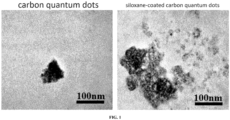
FIG. 1 is a morphological change diagram of carbon quantum dots after and before being coated according to the present disclosure. -
FIG. 2 is an XRD diagram of carbon quantum dots and siloxane-coated carbon quantum dots according to the present disclosure. -
FIG. 3 is a spectrum diagram of fluorescence emission of different adhesive films according to the present disclosure. - In order to make the object, technical solutions and advantages of the embodiments of the present disclosure clearer, the technical solutions of the present disclosure will be fully and clearly described in combination with drawings. Apparently, the embodiments described herein are only some embodiments rather than all embodiments. All other embodiments obtained by those skilled in the art based on these drawings without making creative work shall fall within the scope of protection of the present disclosure.
- The present disclosure provides a preparation method of an insulation light-conversion film for a photovoltaic assembly, which includes the following steps: at step S1, by co-hydrolytic condensation of silicate ester and a silane coupling agent, performing insulation coating on carbon quantum dots to obtain siloxane-coated carbon quantum dots; at step S2, mixing the siloxane-coated carbon quantum dots, thermoplastic elastomer granules and aids uniformly to obtain a pre-prepared material; at step S3, preparing the pre-prepared material by film casting method into an insulation light-conversion film for the photovoltaic assembly; where the co-hydrolytic condensation includes the following steps: dissolving silicate ester and the silane coupling agent in an aqueous solution of an alcohol, and then adding carbon quantum dots and a catalyst and then stirring for 2 to 8 hours; performing centrifugation, washing and drying to obtain the siloxane-coated carbon quantum dots for later use; the thermoplastic elastomer granules are one of POE or EVA; the aids include a crosslinking agent, a co-crssolinking agent, a photostabilizer, and an antioxidant.
- In one embodiment, in the co-hydrolytic condensation, the stirring manner is a mechanical stirring at a speed of 500 to 800rpm for a time of 2 to 8 hours; the centrifugation speed is 5000 to 10000rpm; the washing manner is alternately washing several times, preferably three times, with ethanol and water; the drying manner is vacuum drying at a drying temperature of 60 to 80°C. The co-hydrolytic condensation used herein is environment-friendly and simplifies the preparation method and thus favors industrialized production.
- In one embodiment, specifically, the carbon quantum dots are one of or a mixture of carbon nanotube quantum dots, graphene quantum dots, nano-diamond quantum dots and fluorescent carbon particle quantum dots. Preferably, the carbon quantum dots are one of carboxyl-modified carbon quantum dots (CQDs-COOH), animated carbon quantum dots (CQDs-NH2) and hydroxylated carbon quantum dots (CQDs-OH). The used carbon quantum dots come from various sources and are inexpensive. Further, they are modified by active groups to facilitate post-treatments such as coating and modification and the like.
- As shown in
FIG. 1 , after siloxane is coated on the carbon quantum dots, a uniform coating effect is formed on an outer surface of the carbon quantum dots. The carbon quantum dots can generate fluorescent effect under the excitation of ultraviolet light and convert this part of ultraviolet light into visible light. Furthermore, an amount of ultraviolet ray entering the assembly can be reduced effectively and a damage resulting from the ultraviolet ray can also be reduced. The siloxane coating can improve the dispersion effect of the carbon quantum dots and increase the conversion efficiency of the ultraviolet ray while ensuring the insulation and safety of the adhesive film. More importantly, after siloxane is coated on the carbon quantum dots, silicon oxygen bonds are present in the coating layer and can serve as a silane coupling agent, and thus there is no need to add the silane coupling agent again into the formula. - As shown in
FIG. 2 , the dotted line is an XRD diagram of the carbon quantum dots and the solid line is the siloxane-coated carbon quantum dots and can clearly represent siloxane has been coated on the carbon quantum dots. - In one embodiment, specifically, the silicate ester is any one of silicon tetraacetate, tetrakis(2-ethylhexyl) ester, tetraisopropyl orthosilicate, and tetramethyl orthosilicate.
- In one embodiment, specifically, the silane coupling agent is any one ofKH550, KH560, KH570, KH792 and DL602.
- In one embodiment, specifically, the alcohol is one of or a mixture of methanol, ethanol, propanol, isopropanol and n-butanol. Preferably, the weight ratio of the alcohol to water is 9:1, 8:2, 7:3 and 6:4.
- In one embodiment, specifically, the catalyst is any one of ammonia water, formic acid, acetic acid, hydrochloric acid and ammonium chloride.
- In one embodiment, specifically, the weight ratio of the silicate ester, the silane coupling agent, the catalyst, the alcohol, water and the carbon quantum dots is: the carbon quantum dots 1 to 5 parts; the silicate ester 1 to 10 parts; the silane coupling agent 1 to 10 parts; the catalyst 0.1 to 1 part; the alcohol 60 to 90 parts; and water 10 to 40 parts.
- In one embodiment, specifically, the weight ratio of the thermoplastic elastomer granules, the siloxane-coated carbon quantum dots, the crosslinking agent, the co-crosslinking agent, the photostabilizer and the antioxidant is: the thermoplastic elastomer granules 100 parts; the siloxane-coated carbon quantum dots 1 to 5 parts; the crosslinking agent 0.2 to 2 parts; the co-crosslinking agent 0.2 to 0.5 parts; the photostabilizer 0.01 to 0.2 parts; and the antioxidant 0.02 to 0.3 parts.
- In one embodiment, preferably, the thermoplastic elastomer granules are one of POE or EVA.
- In one embodiment, specifically, the crosslinking agent is a mixture of one or more of tert-butylperoxy 2-ethylhexyl carbonate, tert-amylperoxy 2-ethylhexyl carbonate, 2,5-dimethyl-2,5-di(tert-butylperoxy)hexane, tert-butylperoxy-3,5,5-trimethylhexanoate, di-(4-methylbenzoyl) peroxide, dibenzoyl peroxide, 1,1-di(tert-butylperoxy)cyclohexane, tert-butylperoxy 2-ethylhexyl carbonate, butyl 4,4-bis(tert-butyldioxy)valerate, dicumyl peroxide, α,α'-di(tert-butylperoxy) -1,3-diisopropylbenzene, and 1,1-bis(tert-butylperoxy)-3,3,5-trimethylcyclohexane.
- In one embodiment, specifically, the co-crosslinking agent is a mixture of one or more of triallyl isocyanurate, triallyl cyanurate, and acrylate co-crosslinking agent; where the acrylate co-crosslinking agent is one of trimethylolpropane triacrylate, ethoxylated trimethylolpropane triacrylate, propylene glycerol triacrylate, and ethoxylated Pentaerythritol tetraacrylate.
- In one embodiment, specifically, the photostabilizer is a mixture of one or more of a light screening agent type photostabilizer, a quenching agent type photostabilizer, a free radical scavenger type photostabilizer and a hydroperoxide decomposer type photostabilizer.
- In one embodiment, specifically, the antioxidant is a mixture of one or more of hindered phenol antioxidant, aromatic amine antioxidant, phosphite antioxidant, thioether antioxidant, and metal passivator type antioxidant.
- In one embodiment, specifically, the step S3 of preparing the pre-prepared material by film casting method into the insulation light-conversion film for the photovoltaic assembly includes: performing material mixing based on a formula and then allowing the mixture to go through screw plasticization and extrusion and then flow out of a mould head and then be rolled by a roller into the insulation light-conversion film for the photovoltaic assembly.
- In one embodiment, specifically, the siloxane-coated carbon quantum dots are used because their particle size of 10nm will not affect penetration of the visible light. The light hitting on the surface of the solar cells actually does not decrease and thus the original power generation efficiency of the solar cells will not be negatively affected. The siloxane-coated carbon quantum dots have the following advantages: (1) the coating of siloxane can improve the dispersion effect of the carbon quantum dots; (2) the coating of siloxane can effectively reduce the conductivity of the carbon quantum dots; (3) after siloxane is coated on the carbon quantum dots, silicon oxygen bonds are present in the coating layer and can serve as a silane coupling agent, and thus there is no need to add the silane coupling agent again as done for the conventional adhesive film.
- In one embodiment, specifically, the insulation carbon quantum dot light-conversion film can be used as an ultraviolet light-conversion layer which is used together with the ultraviolet cutoff layer to be co-extruded to form the light-conversion encapsulation adhesive film, where the ultraviolet cutoff layer is close to the solar cell side.
- In one embodiment, specifically, the weight part ratio of the ultraviolet cutoff layer is: the thermoplastic elastomer granules 100 parts; the ultraviolet absorbent 0.5 to 1 part; the crosslinking agent 0.2 to 2 parts; the co-crosslinking agent 0.2 to 0.5 parts; the silane coupling agent 0.3 to 1 part; the photostabilizer 0.01 to 0.2 parts; the antioxidant 0.02 to 0.3 parts. Preferably, the thermoplastic elastomer granules are one of POE or EVA; the ultraviolet absorbent is a mixture of one or more of 2-hydroxy-4-(octyloxy)benzophenone, ethyl 2-cyano-3,3-diphenylacrylate, P-methoxycinnamate ethylhexyl ester, 2-ethylhexyl trans-4-methoxycinnamate, dimethyl (p-methoxybenzylidene)malonate, N-(2-ethoxyphenyl)-N'-(4-ethylphenyl)-ethlyene diamide, 2-(2'-hydroxy-5 '-tert-octylphenyl)benzotriazole, hexadecyl 3,5-bis-tert-butyl-4-hydroxybenzoate, 2-(4,6-diphenyl-1,3,5-triazin-2-yl)-5-(hexyloxy)phenol, 2-4,6-bis(2,4-dimethylphenyl)-1,3,5-triazin-2-yl-5-(octyloxy)-phenol, 2-(2'-hydroxy-5 '-methylphenyl)benzotriazole, and polysilicone-15. The crosslinking agent is a mixture of one or more of tert-butylperoxy 2-ethylhexyl carbonate, tert-amylperoxy 2-ethylhexyl carbonate, 2,5-dimethyl-2,5-di(tert-butylperoxy)hexane, tert-butylperoxy-3,5,5-trimethylhexanoate, di-(4-methylbenzoyl) peroxide, dibenzoyl peroxide, 1,1-di(tert-butylperoxy)cyclohexane, tert-butylperoxy 2-ethylhexyl carbonate, butyl 4,4-bis(tert-butyldioxy)valerate, dicumyl peroxide, α,α'-di(tert-butylperoxy) -1,3-diisopropylbenzene, and 1,1-bis(tert-butylperoxy)-3,3,5-trimethylcyclohexane. The co-crosslinking agent is a mixture of one or more of triallyl isocyanurate, triallyl cyanurate, and acrylate co-crosslinking agent; where the acrylate co-crosslinking agent is one of trimethylolpropane triacrylate, ethoxylated trimethylolpropane triacrylate, propylene glycerol triacrylate, and ethoxylated pentaerythritol tetraacrylate. The photostabilizer is a mixture of one or more of a light screening agent type photostabilizer, a quenching agent type photostabilizer, a free radical scavenger type photostabilizer and a hydroperoxide decomposer type photostabilizer. The silane coupling agent is any one of KH550, KH560, KH570, KH792 and DL602. The antioxidant is a mixture of one or more of a hindered phenol antioxidant, an aromatic amine antioxidant, a phosphite antioxidant, a thioether antioxidant, and a metal passivator type antioxidant.
- In one embodiment, preferably, the ultraviolet cutoff layer has the same type of thermoplastic elastomer granules as the ultraviolet light-conversion layer. The formula of the ultraviolet light-conversion layer is same as that of the above photovoltaic light-conversion film and will not be repeated herein. The two layers are mixed based on the formula and then the mixed material is added to the co-extruder for extrusion, and then goes through respective screw plasticization and gathers at the mould head so as to form the ultraviolet light-conversion adhesive film of double layer.
- If no detailed descriptions are made, various raw materials of the present disclosure can be purchased from markets or prepared by conventional method in the prior arts. The EVA model is E282PV manufactured by Hanwha Total; the POE model is 8669 manufactured by DOW Chemical. The transmittance of the ultraviolet light and the visible light is tested by an ultraviolet spectrophotometer (UV-6000); for the light conversion effect, a light emission band is determined by using a fluorescence spectrometer; and the improvement effect of the light conversion on the assembly is determined using a solar cell assembly tester (XJCM-11A+); the insulation performance of the prepared adhesive film is tested using an electrostatic charge tester (6517B); the coating effect of the co-hydrolytic condensation is evaluated by using a transmission electron microscope (JEM-2100) and an X-ray diffractometer (XRD-6000).
- Embodiment 1: the siloxane-coated carbon quantum dots are prepared using the following weight parts.
- carbon nanotube quantum dots: 1 part
- silicon tetraacetate: 1 part
- KH550: 10 parts
- ammonia water: 1 part
- ethanol: 60 parts
- water: 10 parts
- mechanically stir at the speed of 500rpm for 8 hours and then perform centrifugation at the speed of 5000rpm and then wash and then dry at the temperature of 60°C for later use.
- The light-conversion film is prepared using the following weight parts:
- EVA: 100 parts
- siloxane-coated carbon nanotube quantum dots: 1 part
- tert-butylperoxy 2-ethylhexyl carbonate: 1 part
- triallyl isocyanurate: 0.3 parts
- photostabilizer: 0.05 parts
- antioxidant: 0.25 parts
- material mixing is performed based on the formula and then the mixed material is added to the extruder and then goes through screw plasticization and is cast into a light-conversion film.
- Embodiment 2: the siloxane-coated carbon quantum dots are prepared using the following weight parts:
- graphene quantum dots: 5 parts
- tetrakis(2-ethylhexyl) ester: 10 parts
- KH560: 1 part
- acetic acid: 0.1 part
- methanol: 90 parts
- water: 20 parts
- mechanically stir at the speed of 800rpm for 2 hours, and then perform centrifugation at the speed of 10000rpm and then wash and then dry at the temperature of 80°C for later use.
- The light-conversion film is prepared using the following weight parts:
- POE: 100 parts
- siloxane-coated graphene quantum dots: 5 parts
- tert-amylperoxy 2-ethylhexyl carbonate: 1.5 parts
- triallyl cyanurate: 0.4 parts
- photostabilizer: 0.15 parts
- antioxidant: 0.25 parts
- material mixing is performed based on the formula and then the mixed material is added to the extruder and then goes through screw plasticization and is cast into a light-conversion film.
- Embodiment 3: the siloxane-coated carbon quantum dots are prepared using the following weight parts.
- nanodiamond quantum dots: 1 part
- tetraisopropyl orthosilicate: 5 parts
- KH570: 5 parts
- formic acid: 0.5 parts
- isopropanol: 70 parts
- water: 30 parts
- mechanically stir at the speed of 600rpm for 4 hours, and then perform centrifugation at the speed of 8000rpm and then wash and then dry at the temperature of 70°C for later use.
- The light-conversion film is prepared using the following weight parts:
- EVA: 100 parts
- siloxane-coated nanodiamond quantum dots: 3 parts
- 2,5-dimethyl-2,5-di(tert-butylperoxy)hexane: 0.5 parts
- trimethylolpropane triacrylate: 0.3 parts
- photostabilizer: 0.05 parts
- antioxidant: 0.1 parts
- material mixing is performed based on the formula and then the mixed material is added to the extruder and then goes through screw plasticization and is cast into a light-conversion film.
- Embodiment 4: the siloxane-coated carbon quantum dots are prepared using the following weight parts.
- fluorescent carbon particle quantum dots: 2 parts
- tetramethyl orthosilicate: 7 parts
- KH592: 3 parts
- ammonia water: 0.1 parts
- propanol: 80 parts
- water: 20 parts
- mechanically stir at the speed of 700rpm for 6 hours, and then perform centrifugation at the speed of 6000rpm and then wash and then dry at the temperature of 75°C for later use.
- The light-conversion film is prepared using the following weight parts:
- POE: 100 parts
- siloxane-coated fluorescent carbon particle quantum dots: 2 parts
- tert-butylperoxy-3,5,5-trimethylhexanoate: 1 part
- ethoxylated trimethylolpropane triacrylate: 0.2 parts
- photostabilizer: 0.1 parts
- antioxidant: 0.05 parts
- material mixing is performed based on the formula and then the mixed material is added to the extruder and then goes through screw plasticization and is cast into a light-conversion film.
- Embodiment 5: the siloxane-coated carbon quantum dots are prepared using the following weight parts.
- carbon nanotube quantum dots: 3 parts
- silicon tetraacetate: 4 parts
- DL602: 5 parts
- ammonium chloride: 0.1 parts
- methanol: 50 parts
- n- butanol: 20 parts
- water: 40 parts
- mechanically stir at the speed of 600rpm for 3 hours, and then perform centrifugation at the speed of 7000rpm and then wash and then dry at the temperature of 75°C for later use.
- The light-conversion film is prepared using the following weight parts:
- POE: 100 parts
- siloxane-coated carbon nanotube quantum dots: 4 parts
- di-(4-methylbenzoyl) peroxide: 2 parts
- propylene glycerol triacrylate: 0.2 parts
- photostabilizer: 0.2 parts
- antioxidant: 0.02 parts
- material mixing is performed based on the formula and then the mixed material is added to the extruder and then goes through screw plasticization and is cast into a light-conversion film.
- Embodiment 6: the siloxane-coated carbon quantum dots are prepared using the following weight parts.
- carbon nanotube quantum dots: 4 parts
- silicon tetraacetate: 8 parts
- KH570: 4 parts
- hydrochloric acid: 0.3 parts
- ethanol: 60 parts
- n- butanol: 10 parts
- water: 10 parts
- mechanically stir at the speed of 800rpm for 3 hours, and then perform centrifugation at the speed of 7000rpm and then wash and then dry at the temperature of 75°C for later use.
- The ultraviolet light-conversion layer is prepared using the following weight parts:
- EVA: 100 parts
- siloxane-coated carbon nanotube quantum dots: 2 parts
- dibenzoyl peroxide: 0.2 parts
- ethoxylated Pentaerythritol tetraacrylate: 0.5 parts
- photostabilizer: 0.01 parts
- antioxidant: 0.3 parts
- The ultraviolet cutoff layer is prepared using the following weight parts.
- EVA: 100 parts
- 2-hydroxy-4-(octyloxy)benzophenone: 1 part
- tert-butylperoxy 2-ethylhexyl carbonate: 1 parts
- triallyl isocyanurate: 0.5 parts
- KH570: 0.3 parts
- photostabilizer: 0.01 parts
- antioxidant: 0.02 parts
- The two layers are mixed based on the formula and then the mixed material is added to the co-extruder for extrusion, and then goes through respective screw plasticization and gathers at the mould head so as to form the ultraviolet light-conversion adhesive film of double layer.
- The light-conversion film is prepared using the following weight parts:
- EVA: 100 parts
- siloxane-coated carbon nanotube quantum dots: 10 parts
- tert-butylperoxy 2-ethylhexyl carbonate: 1 part
- triallyl isocyanurate: 0.3 parts
- photostabilizer: 0.05 parts
- antioxidant: 0.25 parts
- material mixing is performed based on the formula and then the mixed material is added to the extruder and then goes through screw plasticization and is cast into a light-conversion film.
- The light-conversion film is prepared using the following weight parts:
- EVA: 100 parts
- carbon nanotube quantum dots: 1 part
- tert-butylperoxy 2-ethylhexyl carbonate: 1 part
- triallyl isocyanurate: 0.3 parts
- photostabilizer: 0.05 parts
- antioxidant: 0.25 parts
- material mixing is performed based on the formula and then the mixed material is added to the extruder and then goes through screw plasticization and is cast into a light-conversion film.
- Pure EVA goes through screw plasticization and is cast into a light-conversion film.
- The ultraviolet cutoff layer is prepared using the following weight parts:
- EVA: 100 parts
- 2-hydroxy-4-(octyloxy)benzophenone: 1 part
- tert-butylperoxy 2-ethylhexyl carbonate: 1 part
- triallyl isocyanurate: 0.5 parts
- KH570: 0.3 parts
- photostabilizer: 0.01 parts
- antioxidant: 0.02 parts
- With the pure EVA replacing the ultraviolet light-conversion layer, the mixed material is added into the co-extruder for extrusion and goes through respective screw plasticization and gathers in the mould head so as to form the ultraviolet light-conversion adhesive film of double layer.
- The adhesive films prepared in the embodiments 1 to 6 and the comparative embodiments 1 to 4 are used to prepare a photovoltaic assembly in the following preparation method:
- The photovoltaic assemblies specifically include an upper-layer glass, an upper-layer light-conversion adhesive film, a heterojunction cell, a lower-layer light-conversion adhesive film and a lower-layer glass, and all of them are double-glass assemblies. The upper-layer light-conversion adhesive film and the lower-layer light-conversion adhesive film both are the light-conversion films of the present disclosure.
Table 1 test performances of the photovoltaic assemblies in the embodiments 1 to 6 and the comparative embodiments 1 to 4 Volume resistivity (Ω·m) Ultraviolet light transmittance (%) Visible light transmittance (%) Initial assembly power (W) After-UV300kwh assembly power (W) Embodiment 1 7.5×10¹¹ 8.6 91.5 342.77 334.71 Embodiment 2 9.5×10¹⁰ 6.5 90.8 343.52 336.85 Embodiment 3 2.5×10¹¹ 7.3 91.1 343.09 335.91 Embodiment 4 3.7×10¹¹ 7.9 91.3 342.98 335.71 Embodiment 5 1.1×10¹¹ 7.2 90.9 343.14 334.98 Embodiment 6 3.2×10¹¹ 4.2 91.2 339.87 334.9 Comparative embodiment 1 2.4×10⁷ 5.9 90.2 341.22 325.85 Comparative embodiment 2 9.8×10⁹ 8.9 91.0 337.57 328.64 Comparative embodiment 3 3.5×10¹³ 13.4 91.1 336.54 303.47 Comparative embodiment 4 4.1×10¹² 5.3 90.8 337.21 332.57 - The experimental results of the Table show that the coating of the co-hydrolytic condensation can effectively reduce the conductivity of the carbon quantum dots and the use of the siloxane-coated carbon quantum dots can effectively increase the power generation efficiency of the photovoltaic assembly, reducing the power attenuation of the assembly.
- Compared with the embodiment 1, in the comparative embodiment 1, excess siloxane-coated carbon nanotube quantum dots are added. Since excess dosage will result in agglomeration which will then bring damage to the performance of the adhesive film. Therefore, the power attenuation will worsen. Furthermore, although the siloxane-coated carbon nanotube quantum dots can reduce the conductivity of the carbon quantum dots, the insulation coating can only weaken the conductivity of the carbon material to some extent and cannot achieve complete insulation. When the system-coated carbon quantum dots are excessively high in content, the adhesive film will suffer the phenomenon of decreasing insulation performance. Further, compared with the pure EVA adhesive film of the comparative embodiment 3, the agglomeration resulting from excess dosage enables the comparative embodiments with addition of siloxane-coated carbon nanotube quantum dots to suffer a lower ultraviolet transmittance.
- Compared with the embodiment 1, in the comparative embodiment 2, the siloxane-coated carbon nanotube quantum dots are changed into the carbon nanotube quantum dots. Because the carbon nanotube quantum dots have a high conductivity, noticeable increase of the resistivity occurs while the anti-aging performance of the photovoltaic assembly drops.
- The comparative embodiment 3 involves pure EVA adhesive film and its ultraviolet light transmittance is far higher than that of other embodiments and comparative embodiments, but it has poorer anti-aging performance and is not applicable to the ultraviolet light-conversion film.
- Compared with the embodiment 6, in the comparative embodiment 4, the ultraviolet light-conversion layer in the embodiment 6 is replaced with a pure EVA layer. Despite increase of the volume resistivity, the ultraviolet light transmittance increases.
- As shown in
FIG. 3 , the POE adhesive film containing the siloxane-coated carbon quantum dots suffers a small displacement relative to the POE adhesive film containing the carbon quantum dots because the coating of siloxane can have effect on the wave band of the light received by the carbon quantum dots and the converted wave band after the fluorescent effect is generated differs slightly. But due to small offset, only a tiny effect on the light conversion can be generated. Thus, the light conversion effect is ensured while the insulation performance is guaranteed. - The detailed process equipment and process flow of the present disclosure are described by the above embodiments in the present disclosure, but the present disclosure is not limited to the above detailed process equipment and process flow, namely, it does not mean the present disclosure must be carried out by depending on the above detailed process equipment and process flow. Those skilled in the arts should understand that any improvement to the present disclosure, equivalent substitution to the raw material of the product of the present disclosure, addition of the auxiliary ingredients, and selection of the specific implementation and the like all fall within the scope of protection of the present disclosure.
- In conclusion, in the insulation light-conversion film for a photovoltaic assembly and a preparation method thereof in the present disclosure, by better dispersing the insulation-modified siloxane-coated carbon quantum dots in the resin substrate, the light-conversion rate of the adhesive film for the ultraviolet light is effectively increased, which increases the power generation efficiency of the assembly and reduces the attenuation of the power generation efficiency of the aged assembly. The preparation process is simple, and environment-friendly and can be applied to the existing photovoltaic production process.
- Enlightened by the ideal embodiments of the present disclosure, relevant workers can, based on the contents of the specification, make various changes and modifications within the scope of protection of the technical idea of the present disclosure. The technical scope of the present disclosure is not limited to the contents of the specification but to the technical scope claimed by the claims.
Claims (10)
- An insulation light-conversion film for a photovoltaic assembly, comprising:
thermoplastic elastomer granules, siloxane-coated carbon quantum dots, a crosslinking agent, a co-crosslinking agent, a photostabilizer, and an antioxidant, wherein the weight ratio of the above substances is as follows:thermoplastic elastomer granules: 100 parts;siloxane-coated carbon quantum dots: 1 to 5 parts;crosslinking agent: 0.2 to 2 parts;co-crosslinking agent: 0.2 to 0.5 parts;photostabilizer: 0.01 to 0.2 parts; andantioxidant: 0.02 to 0.3 parts. - The insulation light-conversion film according to claim 1, wherein the siloxane-coated carbon quantum dots comprise:
silicate ester, a silane coupling agent, a catalyst, an alcohol, water, and carbon quantum dots, wherein the weight ratio of the above substances is as follows:carbon quantum dots: 1 to 5 parts;silicate ester: 1 to 10 parts;silane coupling agent: 1 to 10 parts;catalyst: 0.1 to 1 part;alcohol: 60 to 90 parts; andwater: 10 to 40 parts. - The insulation light-conversion film according to claim 2, wherein the carbon quantum dots are one of or a mixture of carbon nanotube quantum dots, graphene quantum dots, nano-diamond quantum dots, and fluorescent carbon particle quantum dots;andthe silicate ester is any one of silicon tetraacetate, tetrakis(2-ethylhexyl) ester, tetraisopropyl orthosilicate, and tetramethyl orthosilicate;andthe silane coupling agent is any one of KH550, KH560, KH570, KH792, and DL602; andthe silicate ester is any one of silicon tetraacetate, tetrakis(2-ethylhexyl) ester, tetraisopropyl orthosilicate, and tetramethyl orthosilicate;andthe alcohol is one of or a mixture of methanol, ethanol, propanol, isopropanol, and n-butanol;andthe thermoplastic elastomer granules are one of POE or EVA.
- A double-layer light-conversion adhesive film, comprising:
the insulation light-conversion film for the photovoltaic assembly according to any of claims 1-3, and an ultraviolet cutoff-layer adhesive film. - A photovoltaic assembly, comprising:
the insulation light-conversion film for the photovoltaic assembly according to any of claims 1-3 as a single-layer light-conversion adhesive film. - A photovoltaic assembly, comprising:
the double-layer light-conversion adhesive film according to claim 4. - A preparation method of an insulation light-conversion film for a photovoltaic assembly, comprising the following steps:at step S1, by co-hydrolytic condensation of silicate ester and a silane coupling agent, performing insulation coating on carbon quantum dots to obtain siloxane-coated carbon quantum dots;at step S2, mixing the siloxane-coated carbon quantum dots, thermoplastic elastomer granules and aids uniformly to obtain a pre-prepared material;at step S3, preparing the pre-prepared material by film casting method into an insulation light-conversion film for the photovoltaic assembly; wherein,the co-hydrolytic condensation comprises the following steps:dissolving silicate ester and the silane coupling agent in an aqueous solution of an alcohol, and then adding carbon quantum dots and a catalyst and then stirring for 2 to 8 hours;performing centrifugation, washing and drying to obtain the siloxane-coated carbon quantum dots for later use;the thermoplastic elastomer granules are one of POE or EVA; andthe aids comprise a crosslinking agent, a co-crssolinking agent, a photostabilizer, and an antioxidant.
- The preparation method according to claim 7, wherein,the carbon quantum dots are one of or a mixture of carbon nanotube quantum dots, graphene quantum dots, nano-diamond quantum dots, and fluorescent carbon particle quantum dots; andthe silicate ester is any one of silicon tetraacetate, tetrakis(2-ethylhexyl) ester, tetraisopropyl orthosilicate, and tetramethyl orthosilicate; andthe silane coupling agent is any one of KH550, KH560, KH570, KH792, and DL602; and the alcohol is one of or a mixture of methanol, ethanol, propanol, isopropanol, and n-butanol.
- The preparation method according to claim 7, whereinthe weight ratio of silicate ester, the silane coupling agent, the catalyst, the alcohol, water, and the carbon quantum dots is as follows:carbon quantum dots: 1 to 5 parts;silicate ester: 1 to 10 parts;silane coupling agent: 1 to 10 parts;catalyst: 0.1 to 1 part;alcohol: 60 to 90 parts; andwater: 10 to 40 parts;andthe weight ratio of the thermoplastic elastomer granules, the siloxane-coated carbon quantum dots, the crosslinking agent, the co-crosslinking agent, the photostabilizer, and the antioxidant is as follows:thermoplastic elastomer granules: 100 parts;siloxane-coated carbon quantum dots: 1 to 5 parts;crosslinking agent: 0.2 to 2 parts;co-crosslinking agent: 0.2 to 0.5 parts;photostabilizer: 0.01 to 0.2 parts; andantioxidant: 0.02 to 0.3 parts.
- The preparation method according to claim 7, wherein the step S3 of preparing the pre-prepared material by film casting method into the insulation light-conversion film for the photovoltaic assembly comprises:
performing material mixing based on a formula and then allowing the mixture to go through screw plasticization and extrusion and then flow out of a mould head and then be rolled by a roller into the insulation light-conversion film for the photovoltaic assembly.
Applications Claiming Priority (1)
| Application Number | Priority Date | Filing Date | Title |
|---|---|---|---|
| CN202310744701.5A CN116496722B (en) | 2023-06-25 | 2023-06-25 | Insulating light conversion film for photovoltaic module, preparation method of insulating light conversion film and photovoltaic module |
Publications (2)
| Publication Number | Publication Date |
|---|---|
| EP4484521A1 true EP4484521A1 (en) | 2025-01-01 |
| EP4484521B1 EP4484521B1 (en) | 2025-09-03 |
Family
ID=87320525
Family Applications (1)
| Application Number | Title | Priority Date | Filing Date |
|---|---|---|---|
| EP24160324.0A Active EP4484521B1 (en) | 2023-06-25 | 2024-02-28 | Insulation light-conversion film for photovoltaic assembly and preparation method thereof and photovoltaic assembly |
Country Status (3)
| Country | Link |
|---|---|
| US (1) | US20240429337A1 (en) |
| EP (1) | EP4484521B1 (en) |
| CN (1) | CN116496722B (en) |
Families Citing this family (5)
| Publication number | Priority date | Publication date | Assignee | Title |
|---|---|---|---|---|
| CN117025133B (en) * | 2023-10-08 | 2024-01-05 | 苏州弘道新材料有限公司 | Low-auxiliary-agent-migration photovoltaic adhesive film and preparation method and application thereof |
| CN117025208B (en) * | 2023-10-10 | 2023-12-08 | 江苏鹿山新材料有限公司 | Composite light conversion powder, preparation method thereof and light conversion adhesive film |
| CN118325506A (en) * | 2024-05-06 | 2024-07-12 | 苏州易昇光学材料股份有限公司 | Preparation method of light conversion adhesive film capable of realizing up-conversion and down-conversion at the same time |
| CN118344835A (en) * | 2024-06-17 | 2024-07-16 | 镭昱光电科技(苏州)有限公司 | Quantum dot glue and preparation method thereof, and display device |
| CN119997643B (en) * | 2024-12-30 | 2025-10-10 | 中北大学 | A highly dispersed carbon quantum dot-based light conversion film for photovoltaics and its preparation method |
Citations (4)
| Publication number | Priority date | Publication date | Assignee | Title |
|---|---|---|---|---|
| CN106098952A (en) * | 2016-06-15 | 2016-11-09 | 中国科学院理化技术研究所 | Organosilicon functionalized red-light carbon quantum dot and preparation method and application thereof |
| CN109504368A (en) * | 2018-11-19 | 2019-03-22 | 太原科技大学 | A kind of CDs/TPU fluorescence nano composite material preparation method |
| CN110643181B (en) * | 2019-08-30 | 2021-07-20 | 北京化工大学 | A kind of silane carbon quantum dots compatibilized polymer blend and preparation method and application |
| CN114685907A (en) * | 2022-04-02 | 2022-07-01 | 常州大学 | Preparation method and application of adjustable amphiphobic fluorescent polystyrene microsphere filler |
Family Cites Families (17)
| Publication number | Priority date | Publication date | Assignee | Title |
|---|---|---|---|---|
| US20080047599A1 (en) * | 2006-03-18 | 2008-02-28 | Benyamin Buller | Monolithic integration of nonplanar solar cells |
| CN101724402A (en) * | 2009-11-26 | 2010-06-09 | 上海大学 | Preparation method of CdSe/SiO2 quantum dot composite fluorescent nanoparticles |
| WO2011133228A2 (en) * | 2010-04-23 | 2011-10-27 | Pixelligent Technologies, Llc | Synthesis, capping and dispersion of nanocrystals |
| JP5988974B2 (en) * | 2010-08-07 | 2016-09-07 | ティーピーケイ ホールディング カンパニー リミテッド | Device component having surface embedded additive and related manufacturing method |
| EP2613610A4 (en) * | 2010-09-03 | 2015-05-20 | Adeka Corp | COLOR CONVERSION FILTER |
| CN102226064B (en) * | 2011-04-29 | 2013-03-13 | 浙江大学 | Ethylene-vinyl acetate adhesive film containing quantum dots as well as preparation method and application thereof |
| CN103232603B (en) * | 2013-04-03 | 2015-03-18 | 京东方科技集团股份有限公司 | Alkali-soluble resin and preparation method thereof, and photoresist composition |
| CN104650848A (en) * | 2014-04-24 | 2015-05-27 | 陈续晋 | Preparation method for high-stability quantum dot composite |
| KR101612514B1 (en) * | 2014-06-16 | 2016-04-14 | 포항공과대학교 산학협력단 | Process for preparing carbon quantum dots using emulsion |
| CN104927686B (en) * | 2015-05-21 | 2018-06-19 | 杭州福斯特应用材料股份有限公司 | A kind of packaging adhesive film for solar cell with high light conversion efficiency |
| CN105425540B (en) * | 2016-01-04 | 2019-11-05 | 京东方科技集团股份有限公司 | The patterning method and display of quantum dot film and preparation method thereof, quantum dot film |
| CN107474821A (en) * | 2016-06-07 | 2017-12-15 | 上海交通大学 | A kind of Silica-coated quantum dot and preparation method thereof |
| US20200235254A1 (en) * | 2017-02-17 | 2020-07-23 | Institut National De La Recherche Scientifique | Luminescent solar concentrator using a metal-free emitter |
| TWI614927B (en) * | 2017-04-26 | 2018-02-11 | 國立清華大學 | Light diffusing quantum dot nanostructure and light emitting diode chip having the same |
| EP3623796A1 (en) * | 2018-09-12 | 2020-03-18 | Centre National de la Recherche Scientifique - CNRS | Calibration standard for evanescence microscopy |
| CN111635758A (en) * | 2020-06-16 | 2020-09-08 | 青岛科技大学 | A kind of preparation method of silica-wrapped fluorescent carbon quantum dot composite microspheres |
| CN111960686A (en) * | 2020-09-22 | 2020-11-20 | 常州亚玛顿股份有限公司 | Application of graphene quantum dots, glass plate containing the same, and preparation method |
-
2023
- 2023-06-25 CN CN202310744701.5A patent/CN116496722B/en active Active
-
2024
- 2024-01-22 US US18/418,382 patent/US20240429337A1/en active Pending
- 2024-02-28 EP EP24160324.0A patent/EP4484521B1/en active Active
Patent Citations (4)
| Publication number | Priority date | Publication date | Assignee | Title |
|---|---|---|---|---|
| CN106098952A (en) * | 2016-06-15 | 2016-11-09 | 中国科学院理化技术研究所 | Organosilicon functionalized red-light carbon quantum dot and preparation method and application thereof |
| CN109504368A (en) * | 2018-11-19 | 2019-03-22 | 太原科技大学 | A kind of CDs/TPU fluorescence nano composite material preparation method |
| CN110643181B (en) * | 2019-08-30 | 2021-07-20 | 北京化工大学 | A kind of silane carbon quantum dots compatibilized polymer blend and preparation method and application |
| CN114685907A (en) * | 2022-04-02 | 2022-07-01 | 常州大学 | Preparation method and application of adjustable amphiphobic fluorescent polystyrene microsphere filler |
Also Published As
| Publication number | Publication date |
|---|---|
| EP4484521B1 (en) | 2025-09-03 |
| US20240429337A1 (en) | 2024-12-26 |
| CN116496722B (en) | 2023-09-12 |
| CN116496722A (en) | 2023-07-28 |
Similar Documents
| Publication | Publication Date | Title |
|---|---|---|
| EP4484521A1 (en) | Insulation light-conversion film for photovoltaic assembly and preparation method thereof and photovoltaic assembly | |
| US12281401B2 (en) | Composite sheet for shielding electromagnetic and radiating heat including graphene sheet | |
| CN102226064B (en) | Ethylene-vinyl acetate adhesive film containing quantum dots as well as preparation method and application thereof | |
| CN107731947A (en) | Adhesive film for encapsulation of photovoltaic modules, preparation method thereof, and photovoltaic module containing the adhesive film | |
| CN102766412A (en) | Novel photovoltaic encapsulation glue film, as well as preparation method and using method thereof | |
| CN106047194B (en) | Ultraviolet light conversion solar cell encapsulation adhesive film and preparation method thereof | |
| CN115216044B (en) | High-light-transmission high-breakdown-voltage backboard and preparation method thereof | |
| CN119570390A (en) | EVA packaging film and preparation method thereof | |
| CN116333406A (en) | Long-life nuclear grade cable insulation material and its preparation method and application | |
| CN118165392B (en) | Insulating material and preparation method and application thereof | |
| CN120888291A (en) | Organic-inorganic hybrid light-converting agent and its preparation method, as well as light-converting film | |
| KR20190043769A (en) | Perovskite solar cell and preparation method thereof | |
| CN103972395A (en) | Zinc oxide composite material, preparing method of zinc oxide composite material and solar cell | |
| TWI815868B (en) | Composite of polar organic copolymer and ultra-low-wettability carbon black | |
| CN111004475A (en) | Nonlinear composite insulating material with core-shell structure and preparation method thereof | |
| KR20150118595A (en) | Organic-Inorganic Composite Adhesive for Backsheets In Photovoltaic Modules | |
| CN120173415B (en) | Silicone rubber compound, and preparation method and application thereof | |
| CN112516986A (en) | Cerium-doped zinc oxide nanoflower-loaded indium oxide photocatalytic degradation material and preparation method thereof | |
| CN119899604B (en) | A butyl hot melt adhesive for thermally conductive and water-blocking photovoltaic modules and its preparation method | |
| KR101509757B1 (en) | Method of manufacturing solar cell and solar cell | |
| CN102931247B (en) | Preparation method of polyaniline and II-VI family semiconductor compound photovoltaic conversion film | |
| CN116179091A (en) | A kind of anti-aging EVA adhesive film for solar cell encapsulation and preparation method thereof | |
| KR102259452B1 (en) | Solar energy converting material, High-Durability Encapsulants for Sola cells and Sola Cells comprising the same | |
| CN116496721A (en) | A kind of UV light conversion packaging thermally conductive adhesive film and its preparation method and application | |
| CN120843004A (en) | Encapsulation film layer preparation method, flexible perovskite battery |
Legal Events
| Date | Code | Title | Description |
|---|---|---|---|
| PUAI | Public reference made under article 153(3) epc to a published international application that has entered the european phase |
Free format text: ORIGINAL CODE: 0009012 |
|
| STAA | Information on the status of an ep patent application or granted ep patent |
Free format text: STATUS: REQUEST FOR EXAMINATION WAS MADE |
|
| 17P | Request for examination filed |
Effective date: 20240228 |
|
| AK | Designated contracting states |
Kind code of ref document: A1 Designated state(s): AL AT BE BG CH CY CZ DE DK EE ES FI FR GB GR HR HU IE IS IT LI LT LU LV MC ME MK MT NL NO PL PT RO RS SE SI SK SM TR |
|
| GRAP | Despatch of communication of intention to grant a patent |
Free format text: ORIGINAL CODE: EPIDOSNIGR1 |
|
| STAA | Information on the status of an ep patent application or granted ep patent |
Free format text: STATUS: GRANT OF PATENT IS INTENDED |
|
| RIC1 | Information provided on ipc code assigned before grant |
Ipc: C09K 11/65 20060101ALI20250403BHEP Ipc: C09K 11/02 20060101AFI20250403BHEP |
|
| INTG | Intention to grant announced |
Effective date: 20250417 |
|
| GRAS | Grant fee paid |
Free format text: ORIGINAL CODE: EPIDOSNIGR3 |
|
| GRAA | (expected) grant |
Free format text: ORIGINAL CODE: 0009210 |
|
| STAA | Information on the status of an ep patent application or granted ep patent |
Free format text: STATUS: THE PATENT HAS BEEN GRANTED |
|
| AK | Designated contracting states |
Kind code of ref document: B1 Designated state(s): AL AT BE BG CH CY CZ DE DK EE ES FI FR GB GR HR HU IE IS IT LI LT LU LV MC ME MK MT NL NO PL PT RO RS SE SI SK SM TR |
|
| REG | Reference to a national code |
Ref country code: CH Ref legal event code: EP |
|
| REG | Reference to a national code |
Ref country code: DE Ref legal event code: R096 Ref document number: 602024000561 Country of ref document: DE |
|
| REG | Reference to a national code |
Ref country code: IE Ref legal event code: FG4D |
|
| REG | Reference to a national code |
Ref country code: NL Ref legal event code: MP Effective date: 20250903 |
|
| PG25 | Lapsed in a contracting state [announced via postgrant information from national office to epo] |
Ref country code: NO Free format text: LAPSE BECAUSE OF FAILURE TO SUBMIT A TRANSLATION OF THE DESCRIPTION OR TO PAY THE FEE WITHIN THE PRESCRIBED TIME-LIMIT Effective date: 20251203 |
|
| REG | Reference to a national code |
Ref country code: LT Ref legal event code: MG9D |
|
| PG25 | Lapsed in a contracting state [announced via postgrant information from national office to epo] |
Ref country code: FI Free format text: LAPSE BECAUSE OF FAILURE TO SUBMIT A TRANSLATION OF THE DESCRIPTION OR TO PAY THE FEE WITHIN THE PRESCRIBED TIME-LIMIT Effective date: 20250903 |
|
| PG25 | Lapsed in a contracting state [announced via postgrant information from national office to epo] |
Ref country code: HR Free format text: LAPSE BECAUSE OF FAILURE TO SUBMIT A TRANSLATION OF THE DESCRIPTION OR TO PAY THE FEE WITHIN THE PRESCRIBED TIME-LIMIT Effective date: 20250903 |
|
| PG25 | Lapsed in a contracting state [announced via postgrant information from national office to epo] |
Ref country code: GR Free format text: LAPSE BECAUSE OF FAILURE TO SUBMIT A TRANSLATION OF THE DESCRIPTION OR TO PAY THE FEE WITHIN THE PRESCRIBED TIME-LIMIT Effective date: 20251204 |
|
| PG25 | Lapsed in a contracting state [announced via postgrant information from national office to epo] |
Ref country code: SE Free format text: LAPSE BECAUSE OF FAILURE TO SUBMIT A TRANSLATION OF THE DESCRIPTION OR TO PAY THE FEE WITHIN THE PRESCRIBED TIME-LIMIT Effective date: 20250903 |
|
| PG25 | Lapsed in a contracting state [announced via postgrant information from national office to epo] |
Ref country code: LV Free format text: LAPSE BECAUSE OF FAILURE TO SUBMIT A TRANSLATION OF THE DESCRIPTION OR TO PAY THE FEE WITHIN THE PRESCRIBED TIME-LIMIT Effective date: 20250903 |
|
| PG25 | Lapsed in a contracting state [announced via postgrant information from national office to epo] |
Ref country code: PL Free format text: LAPSE BECAUSE OF FAILURE TO SUBMIT A TRANSLATION OF THE DESCRIPTION OR TO PAY THE FEE WITHIN THE PRESCRIBED TIME-LIMIT Effective date: 20250903 Ref country code: BG Free format text: LAPSE BECAUSE OF FAILURE TO SUBMIT A TRANSLATION OF THE DESCRIPTION OR TO PAY THE FEE WITHIN THE PRESCRIBED TIME-LIMIT Effective date: 20250903 |
|
| PG25 | Lapsed in a contracting state [announced via postgrant information from national office to epo] |
Ref country code: RS Free format text: LAPSE BECAUSE OF FAILURE TO SUBMIT A TRANSLATION OF THE DESCRIPTION OR TO PAY THE FEE WITHIN THE PRESCRIBED TIME-LIMIT Effective date: 20251203 |
|
| PG25 | Lapsed in a contracting state [announced via postgrant information from national office to epo] |
Ref country code: ES Free format text: LAPSE BECAUSE OF FAILURE TO SUBMIT A TRANSLATION OF THE DESCRIPTION OR TO PAY THE FEE WITHIN THE PRESCRIBED TIME-LIMIT Effective date: 20250903 |
|
| REG | Reference to a national code |
Ref country code: AT Ref legal event code: MK05 Ref document number: 1833055 Country of ref document: AT Kind code of ref document: T Effective date: 20250903 |
|
| PG25 | Lapsed in a contracting state [announced via postgrant information from national office to epo] |
Ref country code: NL Free format text: LAPSE BECAUSE OF FAILURE TO SUBMIT A TRANSLATION OF THE DESCRIPTION OR TO PAY THE FEE WITHIN THE PRESCRIBED TIME-LIMIT Effective date: 20250903 |
|
| PGFP | Annual fee paid to national office [announced via postgrant information from national office to epo] |
Ref country code: LU Payment date: 20260127 Year of fee payment: 3 |
|
| PG25 | Lapsed in a contracting state [announced via postgrant information from national office to epo] |
Ref country code: SM Free format text: LAPSE BECAUSE OF FAILURE TO SUBMIT A TRANSLATION OF THE DESCRIPTION OR TO PAY THE FEE WITHIN THE PRESCRIBED TIME-LIMIT Effective date: 20250903 |
|
| PGFP | Annual fee paid to national office [announced via postgrant information from national office to epo] |
Ref country code: MC Payment date: 20260127 Year of fee payment: 3 |
|
| PGFP | Annual fee paid to national office [announced via postgrant information from national office to epo] |
Ref country code: IE Payment date: 20260121 Year of fee payment: 3 Ref country code: DE Payment date: 20260206 Year of fee payment: 3 |
|
| PG25 | Lapsed in a contracting state [announced via postgrant information from national office to epo] |
Ref country code: AT Free format text: LAPSE BECAUSE OF FAILURE TO SUBMIT A TRANSLATION OF THE DESCRIPTION OR TO PAY THE FEE WITHIN THE PRESCRIBED TIME-LIMIT Effective date: 20250903 |
|
| PG25 | Lapsed in a contracting state [announced via postgrant information from national office to epo] |
Ref country code: IT Free format text: LAPSE BECAUSE OF FAILURE TO SUBMIT A TRANSLATION OF THE DESCRIPTION OR TO PAY THE FEE WITHIN THE PRESCRIBED TIME-LIMIT Effective date: 20250903 |
|
| PGFP | Annual fee paid to national office [announced via postgrant information from national office to epo] |
Ref country code: BE Payment date: 20260223 Year of fee payment: 3 |
|
| PG25 | Lapsed in a contracting state [announced via postgrant information from national office to epo] |
Ref country code: IS Free format text: LAPSE BECAUSE OF FAILURE TO SUBMIT A TRANSLATION OF THE DESCRIPTION OR TO PAY THE FEE WITHIN THE PRESCRIBED TIME-LIMIT Effective date: 20260103 |
|
| PGFP | Annual fee paid to national office [announced via postgrant information from national office to epo] |
Ref country code: FR Payment date: 20260227 Year of fee payment: 3 |
|
| PG25 | Lapsed in a contracting state [announced via postgrant information from national office to epo] |
Ref country code: PT Free format text: LAPSE BECAUSE OF FAILURE TO SUBMIT A TRANSLATION OF THE DESCRIPTION OR TO PAY THE FEE WITHIN THE PRESCRIBED TIME-LIMIT Effective date: 20260105 Ref country code: CZ Free format text: LAPSE BECAUSE OF FAILURE TO SUBMIT A TRANSLATION OF THE DESCRIPTION OR TO PAY THE FEE WITHIN THE PRESCRIBED TIME-LIMIT Effective date: 20250903 |
|
| PG25 | Lapsed in a contracting state [announced via postgrant information from national office to epo] |
Ref country code: EE Free format text: LAPSE BECAUSE OF FAILURE TO SUBMIT A TRANSLATION OF THE DESCRIPTION OR TO PAY THE FEE WITHIN THE PRESCRIBED TIME-LIMIT Effective date: 20250903 Ref country code: SK Free format text: LAPSE BECAUSE OF FAILURE TO SUBMIT A TRANSLATION OF THE DESCRIPTION OR TO PAY THE FEE WITHIN THE PRESCRIBED TIME-LIMIT Effective date: 20250903 |