EP4484420A1 - Inhibitor of interaction between yap/taz and tead, preparation thereof, pharmaceutical composition thereof and use thereof - Google Patents
Inhibitor of interaction between yap/taz and tead, preparation thereof, pharmaceutical composition thereof and use thereof Download PDFInfo
- Publication number
- EP4484420A1 EP4484420A1 EP23755927.3A EP23755927A EP4484420A1 EP 4484420 A1 EP4484420 A1 EP 4484420A1 EP 23755927 A EP23755927 A EP 23755927A EP 4484420 A1 EP4484420 A1 EP 4484420A1
- Authority
- EP
- European Patent Office
- Prior art keywords
- substituted
- unsubstituted
- membered
- alkyl
- heterocyclyl
- Prior art date
- Legal status (The legal status is an assumption and is not a legal conclusion. Google has not performed a legal analysis and makes no representation as to the accuracy of the status listed.)
- Pending
Links
Classifications
-
- A—HUMAN NECESSITIES
- A61—MEDICAL OR VETERINARY SCIENCE; HYGIENE
- A61K—PREPARATIONS FOR MEDICAL, DENTAL OR TOILETRY PURPOSES
- A61K31/00—Medicinal preparations containing organic active ingredients
- A61K31/33—Heterocyclic compounds
- A61K31/395—Heterocyclic compounds having nitrogen as a ring hetero atom, e.g. guanethidine or rifamycins
- A61K31/535—Heterocyclic compounds having nitrogen as a ring hetero atom, e.g. guanethidine or rifamycins having six-membered rings with at least one nitrogen and one oxygen as the ring hetero atoms, e.g. 1,2-oxazines
- A61K31/5375—1,4-Oxazines, e.g. morpholine
- A61K31/5377—1,4-Oxazines, e.g. morpholine not condensed and containing further heterocyclic rings, e.g. timolol
-
- A—HUMAN NECESSITIES
- A61—MEDICAL OR VETERINARY SCIENCE; HYGIENE
- A61K—PREPARATIONS FOR MEDICAL, DENTAL OR TOILETRY PURPOSES
- A61K31/00—Medicinal preparations containing organic active ingredients
- A61K31/33—Heterocyclic compounds
- A61K31/335—Heterocyclic compounds having oxygen as the only ring hetero atom, e.g. fungichromin
- A61K31/34—Heterocyclic compounds having oxygen as the only ring hetero atom, e.g. fungichromin having five-membered rings with one oxygen as the only ring hetero atom, e.g. isosorbide
- A61K31/343—Heterocyclic compounds having oxygen as the only ring hetero atom, e.g. fungichromin having five-membered rings with one oxygen as the only ring hetero atom, e.g. isosorbide condensed with a carbocyclic ring, e.g. coumaran, bufuralol, befunolol, clobenfurol, amiodarone
-
- A—HUMAN NECESSITIES
- A61—MEDICAL OR VETERINARY SCIENCE; HYGIENE
- A61K—PREPARATIONS FOR MEDICAL, DENTAL OR TOILETRY PURPOSES
- A61K31/00—Medicinal preparations containing organic active ingredients
- A61K31/33—Heterocyclic compounds
- A61K31/395—Heterocyclic compounds having nitrogen as a ring hetero atom, e.g. guanethidine or rifamycins
- A61K31/40—Heterocyclic compounds having nitrogen as a ring hetero atom, e.g. guanethidine or rifamycins having five-membered rings with one nitrogen as the only ring hetero atom, e.g. sulpiride, succinimide, tolmetin, buflomedil
- A61K31/4025—Heterocyclic compounds having nitrogen as a ring hetero atom, e.g. guanethidine or rifamycins having five-membered rings with one nitrogen as the only ring hetero atom, e.g. sulpiride, succinimide, tolmetin, buflomedil not condensed and containing further heterocyclic rings, e.g. cromakalim
-
- A—HUMAN NECESSITIES
- A61—MEDICAL OR VETERINARY SCIENCE; HYGIENE
- A61K—PREPARATIONS FOR MEDICAL, DENTAL OR TOILETRY PURPOSES
- A61K31/00—Medicinal preparations containing organic active ingredients
- A61K31/33—Heterocyclic compounds
- A61K31/395—Heterocyclic compounds having nitrogen as a ring hetero atom, e.g. guanethidine or rifamycins
- A61K31/40—Heterocyclic compounds having nitrogen as a ring hetero atom, e.g. guanethidine or rifamycins having five-membered rings with one nitrogen as the only ring hetero atom, e.g. sulpiride, succinimide, tolmetin, buflomedil
- A61K31/403—Heterocyclic compounds having nitrogen as a ring hetero atom, e.g. guanethidine or rifamycins having five-membered rings with one nitrogen as the only ring hetero atom, e.g. sulpiride, succinimide, tolmetin, buflomedil condensed with carbocyclic rings, e.g. carbazole
- A61K31/404—Indoles, e.g. pindolol
-
- A—HUMAN NECESSITIES
- A61—MEDICAL OR VETERINARY SCIENCE; HYGIENE
- A61K—PREPARATIONS FOR MEDICAL, DENTAL OR TOILETRY PURPOSES
- A61K31/00—Medicinal preparations containing organic active ingredients
- A61K31/33—Heterocyclic compounds
- A61K31/395—Heterocyclic compounds having nitrogen as a ring hetero atom, e.g. guanethidine or rifamycins
- A61K31/41—Heterocyclic compounds having nitrogen as a ring hetero atom, e.g. guanethidine or rifamycins having five-membered rings with two or more ring hetero atoms, at least one of which being nitrogen, e.g. tetrazole
- A61K31/415—1,2-Diazoles
- A61K31/416—1,2-Diazoles condensed with carbocyclic ring systems, e.g. indazole
-
- A—HUMAN NECESSITIES
- A61—MEDICAL OR VETERINARY SCIENCE; HYGIENE
- A61K—PREPARATIONS FOR MEDICAL, DENTAL OR TOILETRY PURPOSES
- A61K31/00—Medicinal preparations containing organic active ingredients
- A61K31/33—Heterocyclic compounds
- A61K31/395—Heterocyclic compounds having nitrogen as a ring hetero atom, e.g. guanethidine or rifamycins
- A61K31/41—Heterocyclic compounds having nitrogen as a ring hetero atom, e.g. guanethidine or rifamycins having five-membered rings with two or more ring hetero atoms, at least one of which being nitrogen, e.g. tetrazole
- A61K31/415—1,2-Diazoles
- A61K31/4162—1,2-Diazoles condensed with heterocyclic ring systems
-
- A—HUMAN NECESSITIES
- A61—MEDICAL OR VETERINARY SCIENCE; HYGIENE
- A61K—PREPARATIONS FOR MEDICAL, DENTAL OR TOILETRY PURPOSES
- A61K31/00—Medicinal preparations containing organic active ingredients
- A61K31/33—Heterocyclic compounds
- A61K31/395—Heterocyclic compounds having nitrogen as a ring hetero atom, e.g. guanethidine or rifamycins
- A61K31/41—Heterocyclic compounds having nitrogen as a ring hetero atom, e.g. guanethidine or rifamycins having five-membered rings with two or more ring hetero atoms, at least one of which being nitrogen, e.g. tetrazole
- A61K31/4164—1,3-Diazoles
- A61K31/4188—1,3-Diazoles condensed with other heterocyclic ring systems, e.g. biotin, sorbinil
-
- A—HUMAN NECESSITIES
- A61—MEDICAL OR VETERINARY SCIENCE; HYGIENE
- A61K—PREPARATIONS FOR MEDICAL, DENTAL OR TOILETRY PURPOSES
- A61K31/00—Medicinal preparations containing organic active ingredients
- A61K31/33—Heterocyclic compounds
- A61K31/395—Heterocyclic compounds having nitrogen as a ring hetero atom, e.g. guanethidine or rifamycins
- A61K31/435—Heterocyclic compounds having nitrogen as a ring hetero atom, e.g. guanethidine or rifamycins having six-membered rings with one nitrogen as the only ring hetero atom
- A61K31/4353—Heterocyclic compounds having nitrogen as a ring hetero atom, e.g. guanethidine or rifamycins having six-membered rings with one nitrogen as the only ring hetero atom ortho- or peri-condensed with heterocyclic ring systems
- A61K31/437—Heterocyclic compounds having nitrogen as a ring hetero atom, e.g. guanethidine or rifamycins having six-membered rings with one nitrogen as the only ring hetero atom ortho- or peri-condensed with heterocyclic ring systems the heterocyclic ring system containing a five-membered ring having nitrogen as a ring hetero atom, e.g. indolizine, beta-carboline
-
- A—HUMAN NECESSITIES
- A61—MEDICAL OR VETERINARY SCIENCE; HYGIENE
- A61K—PREPARATIONS FOR MEDICAL, DENTAL OR TOILETRY PURPOSES
- A61K31/00—Medicinal preparations containing organic active ingredients
- A61K31/33—Heterocyclic compounds
- A61K31/395—Heterocyclic compounds having nitrogen as a ring hetero atom, e.g. guanethidine or rifamycins
- A61K31/435—Heterocyclic compounds having nitrogen as a ring hetero atom, e.g. guanethidine or rifamycins having six-membered rings with one nitrogen as the only ring hetero atom
- A61K31/47—Quinolines; Isoquinolines
- A61K31/4709—Non-condensed quinolines and containing further heterocyclic rings
-
- A—HUMAN NECESSITIES
- A61—MEDICAL OR VETERINARY SCIENCE; HYGIENE
- A61K—PREPARATIONS FOR MEDICAL, DENTAL OR TOILETRY PURPOSES
- A61K31/00—Medicinal preparations containing organic active ingredients
- A61K31/33—Heterocyclic compounds
- A61K31/395—Heterocyclic compounds having nitrogen as a ring hetero atom, e.g. guanethidine or rifamycins
- A61K31/495—Heterocyclic compounds having nitrogen as a ring hetero atom, e.g. guanethidine or rifamycins having six-membered rings with two or more nitrogen atoms as the only ring heteroatoms, e.g. piperazine or tetrazines
- A61K31/4965—Non-condensed pyrazines
- A61K31/497—Non-condensed pyrazines containing further heterocyclic rings
-
- A—HUMAN NECESSITIES
- A61—MEDICAL OR VETERINARY SCIENCE; HYGIENE
- A61K—PREPARATIONS FOR MEDICAL, DENTAL OR TOILETRY PURPOSES
- A61K31/00—Medicinal preparations containing organic active ingredients
- A61K31/33—Heterocyclic compounds
- A61K31/395—Heterocyclic compounds having nitrogen as a ring hetero atom, e.g. guanethidine or rifamycins
- A61K31/495—Heterocyclic compounds having nitrogen as a ring hetero atom, e.g. guanethidine or rifamycins having six-membered rings with two or more nitrogen atoms as the only ring heteroatoms, e.g. piperazine or tetrazines
- A61K31/4985—Pyrazines or piperazines ortho- or peri-condensed with heterocyclic ring systems
-
- A—HUMAN NECESSITIES
- A61—MEDICAL OR VETERINARY SCIENCE; HYGIENE
- A61K—PREPARATIONS FOR MEDICAL, DENTAL OR TOILETRY PURPOSES
- A61K31/00—Medicinal preparations containing organic active ingredients
- A61K31/33—Heterocyclic compounds
- A61K31/395—Heterocyclic compounds having nitrogen as a ring hetero atom, e.g. guanethidine or rifamycins
- A61K31/495—Heterocyclic compounds having nitrogen as a ring hetero atom, e.g. guanethidine or rifamycins having six-membered rings with two or more nitrogen atoms as the only ring heteroatoms, e.g. piperazine or tetrazines
- A61K31/50—Pyridazines; Hydrogenated pyridazines
- A61K31/5025—Pyridazines; Hydrogenated pyridazines ortho- or peri-condensed with heterocyclic ring systems
-
- A—HUMAN NECESSITIES
- A61—MEDICAL OR VETERINARY SCIENCE; HYGIENE
- A61K—PREPARATIONS FOR MEDICAL, DENTAL OR TOILETRY PURPOSES
- A61K31/00—Medicinal preparations containing organic active ingredients
- A61K31/33—Heterocyclic compounds
- A61K31/395—Heterocyclic compounds having nitrogen as a ring hetero atom, e.g. guanethidine or rifamycins
- A61K31/495—Heterocyclic compounds having nitrogen as a ring hetero atom, e.g. guanethidine or rifamycins having six-membered rings with two or more nitrogen atoms as the only ring heteroatoms, e.g. piperazine or tetrazines
- A61K31/505—Pyrimidines; Hydrogenated pyrimidines, e.g. trimethoprim
- A61K31/519—Pyrimidines; Hydrogenated pyrimidines, e.g. trimethoprim ortho- or peri-condensed with heterocyclic rings
-
- A—HUMAN NECESSITIES
- A61—MEDICAL OR VETERINARY SCIENCE; HYGIENE
- A61K—PREPARATIONS FOR MEDICAL, DENTAL OR TOILETRY PURPOSES
- A61K31/00—Medicinal preparations containing organic active ingredients
- A61K31/33—Heterocyclic compounds
- A61K31/395—Heterocyclic compounds having nitrogen as a ring hetero atom, e.g. guanethidine or rifamycins
- A61K31/535—Heterocyclic compounds having nitrogen as a ring hetero atom, e.g. guanethidine or rifamycins having six-membered rings with at least one nitrogen and one oxygen as the ring hetero atoms, e.g. 1,2-oxazines
- A61K31/5365—Heterocyclic compounds having nitrogen as a ring hetero atom, e.g. guanethidine or rifamycins having six-membered rings with at least one nitrogen and one oxygen as the ring hetero atoms, e.g. 1,2-oxazines ortho- or peri-condensed with heterocyclic ring systems
-
- A—HUMAN NECESSITIES
- A61—MEDICAL OR VETERINARY SCIENCE; HYGIENE
- A61K—PREPARATIONS FOR MEDICAL, DENTAL OR TOILETRY PURPOSES
- A61K31/00—Medicinal preparations containing organic active ingredients
- A61K31/33—Heterocyclic compounds
- A61K31/395—Heterocyclic compounds having nitrogen as a ring hetero atom, e.g. guanethidine or rifamycins
- A61K31/535—Heterocyclic compounds having nitrogen as a ring hetero atom, e.g. guanethidine or rifamycins having six-membered rings with at least one nitrogen and one oxygen as the ring hetero atoms, e.g. 1,2-oxazines
- A61K31/5375—1,4-Oxazines, e.g. morpholine
- A61K31/538—1,4-Oxazines, e.g. morpholine ortho- or peri-condensed with carbocyclic ring systems
-
- A—HUMAN NECESSITIES
- A61—MEDICAL OR VETERINARY SCIENCE; HYGIENE
- A61K—PREPARATIONS FOR MEDICAL, DENTAL OR TOILETRY PURPOSES
- A61K31/00—Medicinal preparations containing organic active ingredients
- A61K31/33—Heterocyclic compounds
- A61K31/395—Heterocyclic compounds having nitrogen as a ring hetero atom, e.g. guanethidine or rifamycins
- A61K31/535—Heterocyclic compounds having nitrogen as a ring hetero atom, e.g. guanethidine or rifamycins having six-membered rings with at least one nitrogen and one oxygen as the ring hetero atoms, e.g. 1,2-oxazines
- A61K31/5375—1,4-Oxazines, e.g. morpholine
- A61K31/5383—1,4-Oxazines, e.g. morpholine ortho- or peri-condensed with heterocyclic ring systems
-
- A—HUMAN NECESSITIES
- A61—MEDICAL OR VETERINARY SCIENCE; HYGIENE
- A61K—PREPARATIONS FOR MEDICAL, DENTAL OR TOILETRY PURPOSES
- A61K45/00—Medicinal preparations containing active ingredients not provided for in groups A61K31/00 - A61K41/00
- A61K45/06—Mixtures of active ingredients without chemical characterisation, e.g. antiphlogistics and cardiaca
-
- A—HUMAN NECESSITIES
- A61—MEDICAL OR VETERINARY SCIENCE; HYGIENE
- A61P—SPECIFIC THERAPEUTIC ACTIVITY OF CHEMICAL COMPOUNDS OR MEDICINAL PREPARATIONS
- A61P35/00—Antineoplastic agents
-
- C—CHEMISTRY; METALLURGY
- C07—ORGANIC CHEMISTRY
- C07D—HETEROCYCLIC COMPOUNDS
- C07D307/00—Heterocyclic compounds containing five-membered rings having one oxygen atom as the only ring hetero atom
- C07D307/77—Heterocyclic compounds containing five-membered rings having one oxygen atom as the only ring hetero atom ortho- or peri-condensed with carbocyclic rings or ring systems
- C07D307/78—Benzo [b] furans; Hydrogenated benzo [b] furans
- C07D307/79—Benzo [b] furans; Hydrogenated benzo [b] furans with only hydrogen atoms, hydrocarbon or substituted hydrocarbon radicals, directly attached to carbon atoms of the hetero ring
- C07D307/81—Radicals substituted by nitrogen atoms not forming part of a nitro radical
-
- C—CHEMISTRY; METALLURGY
- C07—ORGANIC CHEMISTRY
- C07D—HETEROCYCLIC COMPOUNDS
- C07D405/00—Heterocyclic compounds containing both one or more hetero rings having oxygen atoms as the only ring hetero atoms, and one or more rings having nitrogen as the only ring hetero atom
- C07D405/02—Heterocyclic compounds containing both one or more hetero rings having oxygen atoms as the only ring hetero atoms, and one or more rings having nitrogen as the only ring hetero atom containing two hetero rings
- C07D405/04—Heterocyclic compounds containing both one or more hetero rings having oxygen atoms as the only ring hetero atoms, and one or more rings having nitrogen as the only ring hetero atom containing two hetero rings directly linked by a ring-member-to-ring-member bond
-
- C—CHEMISTRY; METALLURGY
- C07—ORGANIC CHEMISTRY
- C07D—HETEROCYCLIC COMPOUNDS
- C07D405/00—Heterocyclic compounds containing both one or more hetero rings having oxygen atoms as the only ring hetero atoms, and one or more rings having nitrogen as the only ring hetero atom
- C07D405/14—Heterocyclic compounds containing both one or more hetero rings having oxygen atoms as the only ring hetero atoms, and one or more rings having nitrogen as the only ring hetero atom containing three or more hetero rings
-
- C—CHEMISTRY; METALLURGY
- C07—ORGANIC CHEMISTRY
- C07D—HETEROCYCLIC COMPOUNDS
- C07D413/00—Heterocyclic compounds containing two or more hetero rings, at least one ring having nitrogen and oxygen atoms as the only ring hetero atoms
- C07D413/02—Heterocyclic compounds containing two or more hetero rings, at least one ring having nitrogen and oxygen atoms as the only ring hetero atoms containing two hetero rings
- C07D413/04—Heterocyclic compounds containing two or more hetero rings, at least one ring having nitrogen and oxygen atoms as the only ring hetero atoms containing two hetero rings directly linked by a ring-member-to-ring-member bond
-
- C—CHEMISTRY; METALLURGY
- C07—ORGANIC CHEMISTRY
- C07D—HETEROCYCLIC COMPOUNDS
- C07D413/00—Heterocyclic compounds containing two or more hetero rings, at least one ring having nitrogen and oxygen atoms as the only ring hetero atoms
- C07D413/14—Heterocyclic compounds containing two or more hetero rings, at least one ring having nitrogen and oxygen atoms as the only ring hetero atoms containing three or more hetero rings
-
- C—CHEMISTRY; METALLURGY
- C07—ORGANIC CHEMISTRY
- C07D—HETEROCYCLIC COMPOUNDS
- C07D471/00—Heterocyclic compounds containing nitrogen atoms as the only ring hetero atoms in the condensed system, at least one ring being a six-membered ring with one nitrogen atom, not provided for by groups C07D451/00 - C07D463/00
- C07D471/02—Heterocyclic compounds containing nitrogen atoms as the only ring hetero atoms in the condensed system, at least one ring being a six-membered ring with one nitrogen atom, not provided for by groups C07D451/00 - C07D463/00 in which the condensed system contains two hetero rings
- C07D471/04—Ortho-condensed systems
-
- C—CHEMISTRY; METALLURGY
- C07—ORGANIC CHEMISTRY
- C07D—HETEROCYCLIC COMPOUNDS
- C07D471/00—Heterocyclic compounds containing nitrogen atoms as the only ring hetero atoms in the condensed system, at least one ring being a six-membered ring with one nitrogen atom, not provided for by groups C07D451/00 - C07D463/00
- C07D471/02—Heterocyclic compounds containing nitrogen atoms as the only ring hetero atoms in the condensed system, at least one ring being a six-membered ring with one nitrogen atom, not provided for by groups C07D451/00 - C07D463/00 in which the condensed system contains two hetero rings
- C07D471/10—Spiro-condensed systems
-
- C—CHEMISTRY; METALLURGY
- C07—ORGANIC CHEMISTRY
- C07D—HETEROCYCLIC COMPOUNDS
- C07D491/00—Heterocyclic compounds containing in the condensed ring system both one or more rings having oxygen atoms as the only ring hetero atoms and one or more rings having nitrogen atoms as the only ring hetero atoms, not provided for by groups C07D451/00 - C07D459/00, C07D463/00, C07D477/00 or C07D489/00
- C07D491/02—Heterocyclic compounds containing in the condensed ring system both one or more rings having oxygen atoms as the only ring hetero atoms and one or more rings having nitrogen atoms as the only ring hetero atoms, not provided for by groups C07D451/00 - C07D459/00, C07D463/00, C07D477/00 or C07D489/00 in which the condensed system contains two hetero rings
- C07D491/04—Ortho-condensed systems
- C07D491/044—Ortho-condensed systems with only one oxygen atom as ring hetero atom in the oxygen-containing ring
- C07D491/048—Ortho-condensed systems with only one oxygen atom as ring hetero atom in the oxygen-containing ring the oxygen-containing ring being five-membered
-
- C—CHEMISTRY; METALLURGY
- C07—ORGANIC CHEMISTRY
- C07D—HETEROCYCLIC COMPOUNDS
- C07D491/00—Heterocyclic compounds containing in the condensed ring system both one or more rings having oxygen atoms as the only ring hetero atoms and one or more rings having nitrogen atoms as the only ring hetero atoms, not provided for by groups C07D451/00 - C07D459/00, C07D463/00, C07D477/00 or C07D489/00
- C07D491/02—Heterocyclic compounds containing in the condensed ring system both one or more rings having oxygen atoms as the only ring hetero atoms and one or more rings having nitrogen atoms as the only ring hetero atoms, not provided for by groups C07D451/00 - C07D459/00, C07D463/00, C07D477/00 or C07D489/00 in which the condensed system contains two hetero rings
- C07D491/04—Ortho-condensed systems
- C07D491/044—Ortho-condensed systems with only one oxygen atom as ring hetero atom in the oxygen-containing ring
- C07D491/052—Ortho-condensed systems with only one oxygen atom as ring hetero atom in the oxygen-containing ring the oxygen-containing ring being six-membered
-
- C—CHEMISTRY; METALLURGY
- C07—ORGANIC CHEMISTRY
- C07D—HETEROCYCLIC COMPOUNDS
- C07D491/00—Heterocyclic compounds containing in the condensed ring system both one or more rings having oxygen atoms as the only ring hetero atoms and one or more rings having nitrogen atoms as the only ring hetero atoms, not provided for by groups C07D451/00 - C07D459/00, C07D463/00, C07D477/00 or C07D489/00
- C07D491/02—Heterocyclic compounds containing in the condensed ring system both one or more rings having oxygen atoms as the only ring hetero atoms and one or more rings having nitrogen atoms as the only ring hetero atoms, not provided for by groups C07D451/00 - C07D459/00, C07D463/00, C07D477/00 or C07D489/00 in which the condensed system contains two hetero rings
- C07D491/04—Ortho-condensed systems
- C07D491/056—Ortho-condensed systems with two or more oxygen atoms as ring hetero atoms in the oxygen-containing ring
-
- C—CHEMISTRY; METALLURGY
- C07—ORGANIC CHEMISTRY
- C07D—HETEROCYCLIC COMPOUNDS
- C07D491/00—Heterocyclic compounds containing in the condensed ring system both one or more rings having oxygen atoms as the only ring hetero atoms and one or more rings having nitrogen atoms as the only ring hetero atoms, not provided for by groups C07D451/00 - C07D459/00, C07D463/00, C07D477/00 or C07D489/00
- C07D491/02—Heterocyclic compounds containing in the condensed ring system both one or more rings having oxygen atoms as the only ring hetero atoms and one or more rings having nitrogen atoms as the only ring hetero atoms, not provided for by groups C07D451/00 - C07D459/00, C07D463/00, C07D477/00 or C07D489/00 in which the condensed system contains two hetero rings
- C07D491/10—Spiro-condensed systems
- C07D491/107—Spiro-condensed systems with only one oxygen atom as ring hetero atom in the oxygen-containing ring
-
- C—CHEMISTRY; METALLURGY
- C07—ORGANIC CHEMISTRY
- C07D—HETEROCYCLIC COMPOUNDS
- C07D498/00—Heterocyclic compounds containing in the condensed system at least one hetero ring having nitrogen and oxygen atoms as the only ring hetero atoms
- C07D498/02—Heterocyclic compounds containing in the condensed system at least one hetero ring having nitrogen and oxygen atoms as the only ring hetero atoms in which the condensed system contains two hetero rings
- C07D498/04—Ortho-condensed systems
-
- C—CHEMISTRY; METALLURGY
- C07—ORGANIC CHEMISTRY
- C07D—HETEROCYCLIC COMPOUNDS
- C07D498/00—Heterocyclic compounds containing in the condensed system at least one hetero ring having nitrogen and oxygen atoms as the only ring hetero atoms
- C07D498/02—Heterocyclic compounds containing in the condensed system at least one hetero ring having nitrogen and oxygen atoms as the only ring hetero atoms in which the condensed system contains two hetero rings
- C07D498/06—Peri-condensed systems
-
- C—CHEMISTRY; METALLURGY
- C07—ORGANIC CHEMISTRY
- C07F—ACYCLIC, CARBOCYCLIC OR HETEROCYCLIC COMPOUNDS CONTAINING ELEMENTS OTHER THAN CARBON, HYDROGEN, HALOGEN, OXYGEN, NITROGEN, SULFUR, SELENIUM OR TELLURIUM
- C07F5/00—Compounds containing elements of Groups 3 or 13 of the Periodic Table
- C07F5/02—Boron compounds
-
- C—CHEMISTRY; METALLURGY
- C07—ORGANIC CHEMISTRY
- C07B—GENERAL METHODS OF ORGANIC CHEMISTRY; APPARATUS THEREFOR
- C07B2200/00—Indexing scheme relating to specific properties of organic compounds
- C07B2200/05—Isotopically modified compounds, e.g. labelled
Definitions
- the present disclosure relates to an inhibitor of interaction between YAP/TAZ and TEAD, a preparation thereof, a pharmaceutical composition thereof and a use thereof.
- the Hippo pathway is involved in regulating cell growth, proliferation and apoptosis, and plays an important role in regulating organ size, cancer occurrence, tissue regeneration, and the renewal and differentiation of stem cells and progenitor cells, etc. Studies have found that in mammals, this pathway has a tumor-suppressing function, and the abnormal activation of the main effector molecules in the pathway is closely related to the occurrence and development of various tumors. In addition, the Hippo pathway interacts with other pathways such as Wnt, Notch, Hedgehog and MAPK/ERK to jointly regulate cell fate. The dysregulation of this pathway also has a significant impact on diseases other than tumors.
- the Hippo signaling pathway is highly conserved in the process of evolution.
- the core part of the Hippo signaling pathway in mammalian cells includes a kinase chain composed of MST1/2 (member of Ste20-like kinase, the homologous gene in Drosophila is Hippo) and LATS1/2 (large tumor suppressor 1/2, the homologous gene in Drosophila is Warts) protein kinases and their adaptor proteins SAV1 and Mob1 (Mps one binder kinase activator-like 1A and 1B, the homologous gene in Drosophila is Mats).
- This kinase chain can phosphorylate the transcription co-activators YAP (Yes-Associated Protein) and TAZ (Transcription co-activator with PDZ binding motif, also known as WWTR1) (corresponding to Yorkie in Drosophila).
- LATS1/2 The core components of the mammalian Hippo pathway, LATS1/2, belong to the Nuclear Dbf2-related (NDR) family of kinases, which are activated by binding to the scaffold protein Mob1A/B. LATS1/2 can also be directly activated after phosphorylation by MST1/2. LATS1/2 kinase can phosphorylate multiple sites on the downstream effector YAP, among which the phosphorylation at Ser127 plays a key role in inhibiting YAP. YAP phosphorylated at Ser127 binds to the 14-3-3 protein in the cytoplasm, is retained in the cytoplasm, and cannot enter the nucleus to perform transcription functions, thereby inhibiting YAP's pro-proliferation and anti-apoptotic activity.
- NDR Nuclear Dbf2-related
- LATS1/2 kinase can phosphorylate multiple sites on the transcription factor TAZ, among which the phosphorylation at Ser89 plays a key role in inhibiting TAZ.
- Phosphorylated TAZ will be retained or isolated in the cytoplasm.
- phosphorylated YAP or TAZ can be further recognized and degraded by ubiquitin ligase SCF ⁇ -TRCP. Therefore, if the Hippo pathway is "on”, YAP and/or TAZ will be phosphorylated and inactivated, and retained in the cytoplasm. Conversely, if the Hippo pathway is "off”, YAP and/or TAZ will be dephosphorylated and activated, and are often found to be located in the cell nucleus.
- YAP as a transcription factor, does not contain a DNA binding region itself.
- the activated YAP must bind to the transcription factor after entering the cell nucleus to jointly perform transcription functions.
- the transcription factor that YAP binds most closely after entering the cell nucleus is TEAD.
- Human TEAD family proteins include TEAD 1/TEAD2/TEAD3/TEAD4.
- YAP, together with TEAD can initiate a series of downstream genes, including the transcription of CTGF (connective tissue growth factor), Gli2, Birc5, Birc2, FGF1 (fibroblast growth factor 1) and AREG (amphiregulin).
- non-phosphorylated TAZ will enter the cell nucleus, where it binds to a variety of DNA-binding transcription factors, such as PPAP ⁇ (peroxisome proliferation-activated receptor ⁇ ), TTF-1 (thyroid transcription factor-1), Pax3, TBX5, RUNX, TEAD1 and Smad2/3/4. Most of the genes whose expression is activated by YAP or TAZ transcription factor complexes are related to cell growth and proliferation.
- PPAP ⁇ peroxisome proliferation-activated receptor ⁇
- TTF-1 thyroid transcription factor-1
- Pax3, TBX5, RUNX, TEAD1 and Smad2/3/4 Most of the genes whose expression is activated by YAP or TAZ transcription factor complexes are related to cell growth and proliferation.
- the Hippo-YAP pathway regulates the size and normal physiological functions of organs by regulating cell proliferation and apoptosis, and is strictly regulated under normal physiological conditions.
- the inactivation of the protein kinase or the activation of YAP in the Hippo pathway can promote tumor occurrence.
- the abnormal activation of the Hippo pathway is a major event in the occurrence and development of various malignant tumors.
- tumors including non-small cell lung cancer, breast cancer, head and neck cancer, esophageal cancer, ovarian cancer, liver cancer, prostate cancer, mesothelioma and skin cancer, etc., increased expression levels and nuclear localization of YAP or TAZ have been found.
- MMM Malignant pleural mesothelioma
- Hippo-YAP Malignant pleural mesothelioma
- the treatment options for surgically unresectable MPM are extremely limited, and the current first-line pemetrexed/platinum treatment is unsatisfactory, only achieving a median overall survival of about one year, leaving a large unmet clinical need.
- Abnormal activation of the Hippo-YAP pathway is present in about 70% of MPM patients and is considered an important cancer driver gene. Lowering the activity of the Hippo-YAP pathway through biological means and small chemical molecules has shown good tumor growth inhibitory activity, indicating that Hippo-YAP is a potential therapeutic target for MPM.
- Lung cancer is currently one of the cancers with the highest mortality rate in the world.
- various treatment options for lung cancer in clinical practice including targeted therapy and immunotherapy, but they all face problems of low response rate or recurrence.
- the YAP signaling pathway can mediate tumor cell dormancy, resist apoptosis, and other mechanisms to produce drug resistance to lung cancer drugs such as EGFR inhibitors. Inhibiting the Hippo-YAP signaling pathway can increase the sensitivity of tumor cells to EGFR-targeted drugs, suggesting that a combination strategy can be used in clinical practice to improve treatment effects.
- Liver cancer is a high-incidence cancer in China, and the current clinical treatment breakthroughs are very limited, leaving a large unmet clinical need.
- YAP is an important gene regulating the occurrence and development of liver cancer.
- Multiple in vivo experiments have shown that overexpression of YAP alone or knockout of upstream regulatory factors MST1-2 in mouse liver, without introducing other oncogenes, will induce the occurrence of hepatocellular carcinoma; at the same time, in the established liver cancer mouse model, knocking down YAP expression can significantly inhibit tumors and promote tumor cells to differentiate into functional hepatic parenchymal-like cells, accompanied by the recovery of liver function, suggesting that YAP is a potential therapeutic target for liver cancer.
- pancreatic ductal adenocarcinoma PDAC
- KRas mutations are widespread, and the means of targeting KRas are considered to have broad clinical application prospects in PDAC.
- PDAC mouse model targeting KRas can inhibit tumor growth, but also faces tumor recurrence.
- YAP plays an important role in this by regulating Fos and inducing EMT (epithelial-mesenchymal transition); knocking down YAP expression in recurrent tumors can re-inhibit tumor growth, indicating that targeting YAP also has potential clinical application prospects in pancreatic ductal adenocarcinoma.
- Inhibitors targeting BRAF and MEK have a wide range of clinical applications in various tumors, including melanoma, colon cancer, thyroid cancer, etc., but they also face the problem of resistance and recurrence after administration. Studies have shown that Hippo-YAP, as a pathway promoting tumor cell growth, is overactivated in multiple drug-resistant tumor models, and inhibiting its activity can significantly increase the sensitivity to BRAF/MEK inhibitors, suggesting that it has the potential for drug combination in clinical practice.
- YAP or TAZ in mammalian epithelial cells can lead to cell transformation.
- Enhanced YAP/TAZ transcriptional activity can induce EMT (epithelial-mesenchymal transition) and endow stem cells with the characteristics of breast cancer cells.
- treatment strategies targeting the Hippo-Yap pathway are very likely to provide new ideas for the treatment of various tumors.
- the development of specific small molecules to disrupt the interaction between YAP/TAZ and TEAD, weaken YAP's transcriptional activity, and thereby inhibit the occurrence of tumors with abnormal Hippo pathway is expected to become a new strategy for tumor treatment, with a relatively broad clinical application prospect.
- the present disclosure provides an inhibitor of interaction between YAP/TAZ and TEAD.
- the present disclosure also provides a preparation method for the inhibitor, a pharmaceutical composition containing the same and a use thereof for treating or preventing diseases mediated by the interaction between YAP/TAZ and TEAD.
- the present disclosure provides a compound of the following formula I or a pharmaceutically acceptable salt, enantiomer, diastereomer, tautomer, solvate, isotopic substitute, polymorph, prodrug or metabolite thereof: in the formula:
- the present disclosure provides a pharmaceutical composition
- a pharmaceutical composition comprising a therapeutically or preventively effective amount of the compound of formula I or any subformula thereof (including but not limited to Ia, Ib, IIa, IIb, IIc, IId, IIe, IIIa, IIIb, IVa, IVb, IVc, XI, XIa, XIb, XIIa, XIIb, XIIc, XIId, XIIe, XIII a, XIIIb, XIVa, XIVb and XIVc) or the pharmaceutically acceptable salt, enantiomer, diastereomer, tautomer, solvate, isotopic substitute, polymorph, prodrug or metabolite thereof of the present disclosure, and the pharmaceutical composition can further comprise a pharmaceutically acceptable carrier or excipient.
- the present disclosure provides a use of the compound of formula I or any subformula thereof (including but not limited to Ia, Ib, IIa, IIb, IIc, IId, IIe, IIIa, IIIb, IVa, IVb, IVc, XI, XIa, XIb, XIIa, XIIb, XIIc, XIId, XIIe, XIIIa, XIIIb, XIVa, XIVb and XIVc) or the pharmaceutically acceptable salt, enantiomer, diastereomer, tautomer, solvate, isotopic substitute, polymorph, prodrug or metabolite thereof, or the pharmaceutical composition of the present disclosure in the manufacture of a medicament for treating or preventing diseases mediated by the interaction between YAP/TAZ and TEAD.
- any subformula thereof including but not limited to Ia, Ib, IIa, IIb, IIc, IId, IIe, IIIa, IIIb,
- the present disclosure provides the compound of formula I or any subformula thereof (including but not limited to Ia, Ib, IIa, IIb, IIc, IId, IIe, IIIa, IIIb, IVa, IVb, IVc, XI, XIa, XIb, XIIa, XIIb, XIIc, XIId, XIIe, XIIIa, XIIIb, XIVa, XIVb and XIVc) or the pharmaceutically acceptable salt, enantiomer, diastereomer, tautomer, solvate, isotopic substitute, polymorph, prodrug or metabolite thereof, or the pharmaceutical composition of the present disclosure for use in treating or preventing diseases.
- any subformula thereof including but not limited to Ia, Ib, IIa, IIb, IIc, IId, IIe, IIIa, IIIb, IVa, IVb, IVc, XI, XIa, XIb,
- the present disclosure also provides the compound of formula I or any subformula thereof (including but not limited to Ia, Ib, IIa, IIb, IIc, IId, IIe, IIIa, IIIb, IVa, IVb, IVc, XI, XIa, XIb, XIIa, XIIb, XIIc, XIId, XIIe, XIIIa, XIIIb, XIVa, XIVb and XIVc) or the pharmaceutically acceptable salt, enantiomer, diastereomer, tautomer, solvate, isotopic substitute, polymorph, prodrug or metabolite thereof, or the pharmaceutical composition of the present disclosure for use in treating or preventing diseases mediated by the interaction between YAP/TAZ and TEAD.
- the compound of formula I or any subformula thereof including but not limited to Ia, Ib, IIa, IIb, IIc, IId, IIe, IIIa, IIIb, IVa
- the present disclosure provides a method for treating or preventing diseases mediated by the interaction between YAP/TAZ and TEAD, and the method comprises administering to a subject in need thereof a therapeutically effective amount of the compound of formula I or any subformula thereof (including but not limited to Ia, Ib, IIa, IIb, IIc, IId, IIe, IIIa, IIIb, IVa, IVb, IVc, XI, XIa, XIb, XIIa, XIIb, XIIc, XIId, XIIe, XIIIa, XIIIb, XIVa, XIVb and XIVc) or the pharmaceutically acceptable salt, enantiomer, diastereomer, tautomer, solvate, isotopic substitute, polymorph, prodrug or metabolite thereof of the present disclosure, or the pharmaceutical composition of the present disclosure.
- a therapeutically effective amount of the compound of formula I or any subformula thereof including but
- reaction and purification can be carried out using the manufacturer's instructions for the use of the kit, or in a manner known in the art or as described in the present disclosure.
- the above techniques and methods can generally be implemented in accordance with conventional methods well known in the art, as described in the various general and more specific documents cited and discussed in this specification.
- groups and substituents thereof can be selected by those skilled in the art to provide stable structural moieties and compounds.
- substituent When a substituent is described by a conventional chemical formula written from left to right, the substituent also includes the chemically equivalent substituent obtained when the structural formula is written from right to left.
- substituent -CH 2 O- is equivalent to -OCH 2 -.
- C1-C6 alkyl refers to an alkyl group as defined below having a total of 1 to 6 carbon atoms.
- the total number of carbon atoms in the simplified symbols does not include carbon that may be present in the substituent of the group.
- variable is selected from any one of the options listed after the colon, or, where possible, it means that the variable is selected from one or more of the options listed after the colon.
- halogen refers to fluorine, chlorine, bromine or iodine.
- Hydrophill refers to -OH group.
- Hydroxyalkyl refers to an alkyl group as defined below substituted by hydroxyl (-OH).
- Niro refers to -NO 2 .
- Cyano refers to -CN.
- Amino refers to -NH 2 .
- Substituted amino refers to an amino group substituted by one or two of the alkyl, alkylcarbonyl, aralkyl, aryl, heteroaryl, heterocyclyl, heteroaralkyl as defined below, for example, monoalkylamino, dialkylamino, alkylcarbonylamino, aralkylamino, heteroaralkylamino, heterocyclylamino, heteroarylamino and arylamino.
- substituted amino is represented as -NR'R", wherein R' and R" are each independently selected from H, C1-C4 alkyl, C3-C6 cycloalkyl, C1-C4 alkyl-S(O) 2 - and C1-C4 haloalkyl (provided that at least one of R' and R" is not H).
- Carboxyl refers to -COOH.
- Ci-Cj represents a range of carbon atom numbers, where i and j are integers, and where the range of carbon atom numbers includes the endpoints (i.e., i and j) as well as each integer point between the endpoints, where j is greater than i.
- C1-C6 represents a range of 1 to 6 carbon atoms, including 1 carbon atom, 2 carbon atoms, 3 carbon atoms, 4 carbon atoms, 5 carbon atoms and 6 carbon atoms.
- the term “C1-C12” represents 1 to 12, especially 1 to 10, especially 1 to 8, especially 1 to 6, especially 1 to 5, especially 1 to 4, especially 1 to 3 or especially 1 to 2 carbon atoms.
- alkyl refers to a fully saturated straight or branched hydrocarbon chain group consisting only of carbon and hydrogen atoms, having, for example, 1 to 12 (preferably 1 to 8, more preferably 1 to 6) carbon atoms, and is linked to the rest of the molecule by a single bond. In some embodiments, the alkyl contains 1 to 11 carbon atoms.
- the alkyl contains 1 to 10 carbon atoms, 1 to 9 carbon atoms, 1 to 8 carbon atoms, 1 to 7 carbon atoms, 1 to 6 carbon atoms, 1 to 5 carbon atoms, 1 to 4 carbon atoms, 1 to 3 carbon atoms or 1 to 2 carbon atoms.
- Non-limiting examples of the alkyl include, but are not limited to, methyl, ethyl, n -propyl, isopropyl, n -butyl, isobutyl, sec -butyl, tert-butyl, n -pentyl, tert -pentyl, 2-methylbutyl, 2,2-dimethylpropyl, n -hexyl, n -heptyl, 2-methylhexyl, 3-methylhexyl, n -octyl, n -nonyl, n -decyl, n -undecyl, n -dodecyl, etc.
- each alkyl of embodiments of the present disclosure is C1-C4 alkyl.
- the carbon chain length of the alkyl may range from 8 to 22 carbon atoms, and is preferably an aliphatic chain. Unless otherwise specifically stated in this specification, the alkyl can be optionally substituted.
- the alkenyl contains 2 to 12 carbon atoms. In some embodiments, the alkenyl contains 2 to 11 carbon atoms.
- the alkenyl contains 2 to 10 carbon atoms, 2 to 9 carbon atoms, 2 to 8 carbon atoms, 2 to 7 carbon atoms, 2 to 6 carbon atoms, 2 to 5 carbon atoms, 2 to 4 carbon atoms, 2 to 3 carbon atoms, and in some embodiments, the alkenyl contains 2 carbon atoms.
- alkenyl examples include vinyl, 1-propenyl, 2-propenyl (allyl), isopropenyl, 2-methyl-1-propenyl, 1-butenyl, 2-butenyl, 3-butenyl, 1-pentenyl, 2-pentenyl, 3-pentenyl, 4-pentenyl, 1-hexenyl, 2-hexenyl, 3-hexenyl, 4-hexenyl, 5-hexenyl, 1-heptenyl, 2-heptenyl, 3-heptenyl, 4-heptenyl, 5-heptenyl, 6-heptenyl, 1-octenyl, 2-octenyl, 3-octenyl, 4-octenyl, 5-octenyl, 6-octenyl, 7-octenyl, 1-nonenyl, 2-nonenyl, 3-nonenyl, 4-nonenyl, 5-nonenyl, 6-nonenyl,
- the alkynyl contains 2 to 12 carbon atoms. In some embodiments, the alkynyl contains 2 to 11 carbon atoms.
- the alkynyl contains 2 to 10 carbon atoms, 2 to 9 carbon atoms, 2 to 8 carbon atoms, 2 to 7 carbon atoms, 2 to 6 carbon atoms, 2 to 5 carbon atoms, 2 to 4 carbon atoms, 2 to 3 carbon atoms, and in some embodiments, the alkynyl contains 2 carbon atoms.
- Non-limiting examples of the alkynyl include ethynyl, propynyl, butynyl, pentynyl, etc. Unless otherwise specifically stated in this specification, the alkynyl can be optionally substituted.
- alkoxy refers to "-O-alkyl” group, wherein the alkyl has the meaning described above.
- haloalkyl refers to an alkyl group substituted by one or more halogens, wherein the alkyl has the meaning described above and the number of halogens may be as many as the number of substitutable hydrogens on the alkyl.
- G represents H or the alkyl, alkenyl or alkynyl as described above.
- C1-C4 acyl include, but are not limited to, formyl, acetyl, propionyl, butyryl, etc.
- the cyclohydrocarbyl contains 3, 4, 5, 6, 7, 8, 9, 10, 11 or 12 ring carbon atoms.
- Non-limiting examples of the cyclohydrocarbyl include, but are not limited to, cyclopropyl, cyclobutyl, cyclopentyl, 1-cyclopent-1-enyl, 1-cyclopent-2-enyl, 1-cyclopent-3-enyl, cyclohexyl, 1-cyclohex-1-enyl, 1-cyclohex-2-enyl, 1-cyclohex-3-enyl, cyclohexadienyl, cycloheptyl, cyclooctyl, cyclononyl, cyclodecyl, cycloundecyl, cyclododecyl and cyclooctynyl.
- cycloalkyl refers to a saturated non-aromatic monocyclic or polycyclic hydrocarbyl or moiety consisting only of carbon and hydrogen atoms, which can be linked to the rest of the molecule by any suitable carbon atom.
- the cycloalkyl contains 3 to 12 ring carbon atoms, 3 to 10 ring carbon atoms, 3 to 9 ring carbon atoms, 3 to 8 ring carbon atoms, 3 to 7 ring carbon atoms, 3 to 6 ring carbon atoms, 3 to 5 ring carbon atoms, 4 to 12 ring carbon atoms, 4 to 10 ring carbon atoms, 4 to 9 ring carbon atoms, 4 to 8 ring carbon atoms, 4 to 7 ring carbon atoms, 4 to 6 ring carbon atoms, 4 to 5 ring carbon atoms.
- Non-limiting examples of the cycloalkyl include cyclopropyl, cyclobutyl, cyclopentyl, cyclohexyl, cycloheptyl, cyclooctyl, etc.
- the cycloalkenyl contains 5 to 12 ring carbon atoms, 5 to 10 ring carbon atoms, 5 to 9 ring carbon atoms, 5 to 8 ring carbon atoms, 5 to 7 ring carbon atoms, 5 to 6 ring carbon atoms.
- Non-limiting examples of the cycloalkenyl include cyclopentenyl, cyclohexenyl, cycloheptenyl, cyclooctenyl, etc.
- the cycloalkynyl contains 8 to 12 ring carbon atoms, 8 to 11 ring carbon atoms, 8 to 10 ring carbon atoms, 8 to 9 ring carbon atoms.
- Non-limiting examples of the cycloalkynyl include cyclooctynyl, etc.
- the term "spiro cyclyl" or “spiro ring” refers to a ring system of a cyclohydrocarbyl consisting of a plurality of rings (e.g., two, three or more), wherein at least two rings are bonded to each other by sharing a carbon atom.
- the spiro cyclyl contains 6 to 12 ring carbon atoms, 6 to 11 ring carbon atoms, 6 to 10 ring carbon atoms, 6 to 9 ring carbon atoms, 6 to 8 ring carbon atoms, 6 to 7 ring carbon atoms.
- Non-limiting examples of the spiro cyclyl include, but are not limited to, spiro[5.5]undecyl, spiro-pentadienyl, spiro[3.6]decyl, etc. Unless otherwise specifically stated in this specification, the spiro cyclyl can be optionally substituted.
- fused cyclyl or “fused ring” (also referred to as “condensed ring”) refers to a ring system of a cyclohydrocarbyl consisting of a plurality of rings (e.g., two, three or more), wherein at least two rings are bonded to each other by sharing two adjacent carbon atoms (i.e., the at least two rings share a covalent bond, so that the bridgehead atoms are directly connected).
- the fused cyclyl contains 5 to 12 ring carbon atoms, 5 to 11 ring carbon atoms, 5 to 10 ring carbon atoms, 5 to 9 ring carbon atoms, 5 to 8 ring carbon atoms, 5 to 7 ring carbon atoms, 5 to 6 ring carbon atoms.
- Non-limiting examples of the fused cyclyl include, but are not limited to, 2,3-indanyl, 1,2,3,4-tetrahydro-naphthyl, 5,6,7,8-tetrahydro-naphthyl, 8,9-dihydro-7 H -benzocyclohepten-6-yl, 6,7,8,9-tetrahydro-5 H -benzocycloheptenyl, 5,6,7,8,9,10-hexahydro-benzocyclooctenyl, etc. Unless otherwise specifically stated in this specification, the fused cyclyl can be optionally substituted.
- bridged cyclyl or “bridged ring” refers to a ring system of a cyclohydrocarbyl consisting of a plurality of rings (e.g., two, three or more), wherein at least two rings are bonded to each other by sharing three or more carbon atoms (the at least two rings are separated by two bridgehead atoms by a bridge containing at least one atom).
- the bridged cyclyl contains 8 to 12 ring carbon atoms, 8 to 11 ring carbon atoms, 8 to 10 ring carbon atoms, 8 to 9 ring carbon atoms.
- Non-limiting examples of the bridged cyclyl include, but are not limited to, bicyclo[1.1.1]pentenyl, bicyclo[2.2.1]heptenyl, bicyclo[2.2.1]heptyl, bicyclo[3.1.1]heptyl, bicyclo[2.2.2]octyl, bicyclo[3.2.1]octyl, bicyclo[3.2.1]octenyl, bicyclo[3.3.1]nonyl, bicyclo[3.3.3]undecyl, adamantyl, etc. Unless otherwise specifically stated in this specification, the bridged cyclyl can be optionally substituted.
- heterocyclyl or “heterocycle” refers to a stable saturated or partially unsaturated non-aromatic cyclic group or moiety consisting of carbon atoms (e.g., 2, 3, 4, 5, 6, 7, 8, 9, 10, 11, 12, 13 or 14 carbon atoms), as well as heteroatoms (e.g., 1 to 6 heteroatoms, more preferably 1, 2 or 3 heteroatoms) selected from nitrogen, phosphorus, oxygen and sulfur (preferably nitrogen, oxygen or sulfur).
- the heterocyclyl can contain 3, 4, 5, 6, 7, 8, 9, 10, 11, 12, 13, 14, 15, 16, 17, 18, 19 or 20 ring-forming atoms, e.g., 3 to 20 ring-forming atoms, 3 to 19 ring-forming atoms, 3 to 18 ring-forming atoms, 3 to 17 ring-forming atoms, 3 to 16 ring-forming atoms, 3 to 15 ring-forming atoms, 4 to 12 ring-forming atoms, 4 to 10 ring-forming atoms, 4 to 9 ring-forming atoms, 4 to 8 ring-forming atoms, 4 to 7 ring-forming atoms, 4 to 6 ring-forming atoms, 4 to 5 ring-forming atoms.
- the heterocyclyl can be monocyclic, bicyclic, tricyclic or more cyclic systems, which can include a condensed/fused ring system (i.e., fused heterocyclyl, such as 4- to 9-membered fused heterocyclyl), bridged ring system (i.e., bridged heterocyclyl, such as 6- to 12-membered bridged heterocyclyl) or spiro ring system (i.e., spiroheterocyclyl, such as 6- to 12-membered spiroheterocyclyl).
- a condensed/fused ring system i.e., fused heterocyclyl, such as 4- to 9-membered fused heterocyclyl
- bridged ring system i.e., bridged heterocyclyl, such as 6- to 12-membered bridged heterocyclyl
- spiro ring system i.e., spiroheterocyclyl, such as 6- to 12-membered
- a fused heterocyclyl group refers to a ring system of a heterocyclyl group consisting of a plurality of rings (e.g., two, three or more), wherein at least two rings are bonded to each other by sharing two adjacent atoms (i.e., at least two rings share a covalent bond, so that the bridgehead atoms are directly connected), preferably bicyclic fused heterocyclyl.
- a bridged heterocyclyl group refers to a ring system of a heterocyclyl group consisting of a plurality of rings (e.g., two, three or more), wherein at least two rings are bonded to each other by sharing three or more atoms (at least two rings are separated by two bridgehead atoms by a bridge containing at least one atom).
- a spiroheterocyclyl group refers to a ring system of a heterocyclyl group consisting of a plurality of rings (e.g., two, three or more), wherein at least two rings are bonded to each other by sharing a carbon atom.
- the nitrogen, carbon or sulfur atoms can be optionally oxidized, and the nitrogen atoms can be optionally quaternized.
- the heterocyclyl can be linked to the rest of the molecule via a carbon atom or a heteroatom and through a single bond. In some cases, the heterocyclyl can be carbon-linked, nitrogen-linked or sulfur-linked. In some embodiments, the heterocyclyl is carbon-linked. In some embodiments, the heterocyclyl is nitrogen-linked. In some embodiments, the heterocyclyl is sulfur-linked. Unless otherwise specifically stated in this specification, the heterocyclyl can be optionally substituted.
- the heterocyclyl also includes groups in which the heterocyclyl group is fused to a saturated, partially unsaturated or fully unsaturated (i.e., aromatic) cyclohydrocarbyl, aryl, heterocyclyl or heteroaryl group.
- a saturated, partially unsaturated or fully unsaturated (i.e., aromatic) cyclohydrocarbyl, aryl, heterocyclyl or heteroaryl group In the heterocyclyl containing fused rings, one or more rings can be the aryl or heteroaryl as defined below.
- fused heterocyclyl examples include, but are not limited to, phenyl-fused heterocyclyl or pyridyl-fused heterocyclyl, as well as quinolinyl, isoquinolinyl, quinoxalinyl, quinozinyl, quinazolinyl, azaindolizinyl, pteridinyl, chromenyl, isochromenyl, indolyl, isoindolyl, indolizinyl, indazolyl, purinyl, benzofuranyl, isobenzofuranyl, benzimidazolyl, benzothienyl, benzothiazolyl, carbazolyl, phenazinyl, phenothiazinyl, phenanthridinyl, imidazo[1,2- a ]pyridinyl, [1,2,4]triazolo[4,3- a ]pyridyl, [1,2,3]triazol
- the heterocyclyl is a stable 4- to 12-membered, 5- to 12-membered, 6- to 10-membered, 4- to 10-membered or 4- to 9-membered nonaromatic monocyclic, bicyclic, tricyclic or more cyclic group (including a fused, bridged or spiro ring group) containing 1 to 3 heteroatoms selected from nitrogen, oxygen and sulfur, for example, a stable 5- to 10-membered (e.g., 4- to 9-membered) nonaromatic monocyclic, bicyclic, tricyclic or more cyclic group (including a fused, bridged or spiro ring group) containing 1 to 3 heteroatoms selected from nitrogen, oxygen and sulfur.
- a stable 5- to 10-membered e.g., 4- to 9-membered
- nonaromatic monocyclic, bicyclic, tricyclic or more cyclic group including a fused, bridged or spiro ring group
- heterocyclyl examples include, but are not limited to: pyrrolidinyl, morpholinyl, piperazinyl, homopiperazinyl, piperidinyl, thiomorpholinyl, 2,7-diaza-spiro[3.5]nonan-7-yl, 2-oxa-6-aza-spiro[3.3]heptan-6-yl, 2-oxa-6-aza-spiro[3.4]octan-7-yl, 8-oxa-2-aza-spiro[4.5]decan-6-yl, 2,5-diaza-bicyclo[2.2.1]heptan-2-yl, azetidinyl, oxetanyl, thietanyl, thiolanyl, pyranyl, tetrahydropyranyl, thiopyranyl, tetrahydrofuranyl, oxazinyl, dioxolanyl, tetrahydroisoquinol
- aryl or “aromatic ring” refers to a conjugated hydrocarbon ring system group or moiety having 6 to 18 carbon atoms (e.g., 6 to 14 carbon atoms or 6 to 10 carbon atoms, e.g., 6, 7, 8, 9 or 10 carbon atoms).
- the aryl can be monocyclic, bicyclic, tricyclic or more cyclic ring systems, and can also be fused with the cyclohydrocarbyl or heterocyclyl as defined above. In the case of polycyclic systems, only one ring needs to be aromatic, although all rings can be aromatic.
- aryl examples include, but are not limited to, phenyl, naphthyl, anthracenyl, phenanthrenyl, fluorenyl, 2,3-dihydro-1 H -isoindolyl, 2-benzoxazolinone, 2 H -1,4-benzoxazin-3(4 H )-one-7-yl, etc. Unless otherwise specifically stated in this specification, the aryl can be optionally substituted.
- heteroaryl or “heteroaromatic ring” refers to a conjugated ring system group or moiety having carbon atoms (e.g., 1 to 15 carbon atoms, 1 to 14 carbon atoms, 1 to 13 carbon atoms, 1 to 12 carbon atoms, 1 to 11 carbon atoms, 1 to 10 carbon atoms, e.g., 1, 2, 3, 4, 5, 6, 7, 8, 9 or 10 carbon atoms) and heteroatoms selected from nitrogen, oxygen and sulfur (e.g., 1 to 6 heteroatoms, more preferably 1, 2 or 3 heteroatoms) within the ring.
- carbon atoms e.g., 1 to 15 carbon atoms, 1 to 14 carbon atoms, 1 to 13 carbon atoms, 1 to 12 carbon atoms, 1 to 11 carbon atoms, 1 to 10 carbon atoms, e.g., 1, 2, 3, 4, 5, 6, 7, 8, 9 or 10 carbon atoms
- heteroatoms selected from nitrogen, oxygen and sulfur (e.g., 1 to 6 heteroatoms
- the heteroaryl can contain 5, 6, 7, 8, 9, 10, 11, 12, 13, 14, 15, 16, 17, 18, 19 or 20 ring-forming atoms, e.g., 5 to 20 ring-forming atoms, 5 to 19 ring-forming atoms, 5 to 18 ring-forming atoms, 5 to 17 ring-forming atoms, 5 to 16 ring-forming atoms, 5 to 15 ring-forming atoms, 5 to 14 ring-forming atoms, 5 to 13 ring-forming atoms, 5 to 12 ring-forming atoms, 5 to 10 ring-forming carbon atoms, 5 to 9 ring-forming atoms, 5 to 8 ring-forming atoms, 5 to 7 ring-forming atoms or 5 to 6 ring-forming atoms.
- 5 to 20 ring-forming atoms e.g., 5 to 20 ring-forming atoms, 5 to 19 ring-forming atoms, 5 to 18 ring-forming atoms, 5 to 17 ring-forming atoms,
- the heteroaryl can be monocyclic, bicyclic, tricyclic or more cyclic ring systems, and can also be fused with the cyclohydrocarbyl, aryl or heterocyclyl as defined above.
- the nitrogen, carbon or sulfur atoms can be optionally oxidized, and the nitrogen atoms can be optionally quaternized.
- the heteroaryl is preferably a stabilized 5- to 12-membered aromatic group comprising 1 to 5 heteroatoms selected from nitrogen, oxygen and sulfur, more preferably a stabilized 5- to 10-membered aromatic group comprising 1 to 4 heteroatoms selected from nitrogen, oxygen and sulfur or a 5- to 6-membered aromatic group comprising 1, 2 or 3 heteroatoms selected from nitrogen, oxygen and sulfur.
- the heteroaryl can be optionally substituted.
- heteroaryl examples include, but are not limited to, thienyl, imidazolyl, pyrazolyl, thiazolyl, isothiazolyl, oxazolyl, oxadiazolyl, isoxazolyl, pyridyl, pyrimidinyl, pyrazinyl, pyridazinyl, benzimidazolyl, benzomorpholinyl, benzoisodiazolyl, benzotriazolyl, benzopyrazolyl, imidazopyridyl, pyridomorpholinyl, pyrazolopyridyl, indolyl, furyl, pyrrolyl, triazolyl, tetrazolyl, triazinyl, pyridinonyl, pyrimidinonyl, pyridazinonyl, indolizinyl, isoindolyl, indazolyl, isoindazolyl, purinyl,
- all cyclic groups can exist as substituents on the mother nucleus, or they can exist as part of a chain-like (including straight and branched) structure, mother nucleus or part of the mother nucleus.
- heteroarylalkyl refers to the alkyl as defined above substituted by the heteroaryl as defined above.
- substituted means that one or more hydrogens of a specified group or moiety are substituted by a "suitable substituent".
- the number of the substituent can be one or more, i.e., 1, 2, 3, 4, 5 or 6 or more, depending on the group being substituted and the nature of the substituent.
- the substituent of the ethyl is halogen
- the group can be substituted by 1, 2, 3, 4 or 5 substituents according to the structure of the substituted group, such as trifluoromethyl, pentafluoroethyl, etc.
- the number of the substituent is 1, 2 or 3. In some embodiments, the number of the substituent is 1 or 2. In some embodiments, the number of the substituent is 1. It will be understood that "substituted” or “substituted by " includes the implicit condition that such substitution is carried out according to the allowable valence of the substitution atom, and the substitution results in a stable or chemically viable compound, such as a compound that does not spontaneously transform, for example, by rearrangement, cyclization and elimination.
- an "optionally substituted” group can have a suitable substituent at each substitutable position of the group, and where more than one position in any given structure can be substituted by more than one substituent selected from the specified group, the substituent can be the same or different at each position.
- substituents themselves can be substituted, if appropriate.
- references to chemical moieties herein are to be understood as including substituted variants.
- reference to an "aryl” group or moiety implicitly includes both unsubstituted aryl groups and substituted variations.
- suitable substituents should be understood to include, but are not limited to, alkyl, alkenyl, alkynyl, halogen, haloalkyl, haloalkenyl, haloalkynyl, alkoxy, cyano, hydroxyl, amino, monoalkylamino, dialkylamino, nitro, aryl, heteroaryl, cyclohydrocarbyl (e.g., cycloalkyl and cycloalkenyl) and heterocyclyl as described herein; these groups as substituents, including alkyl, alkenyl, alkynyl, alkyl in haloalkyl, alkenyl in haloalkenyl, alkynyl in haloalkynyl, alkoxy, alkyl in monoalkylamino, alkyl in dialkylamino, aryl, heteroaryl, cyclohydrocarbyl and heterocycly
- the "suitable substituents" are selected from: hydroxyl, halogen, C1-C4 alkoxy optionally substituted by halogen, C1-C4 alkoxycarbonyl, cyano, -S(O) 2 -C1-C4 alkyl optionally substituted by halogen, C1-C4 alkyl optionally substituted by halogen, -NR'R", -S(O) 2 -NR'R", -S(O) 2 -NH 2 , -C(O)-C1-C4 alkyl, -NR'-C(O)-C1-C4 alkyl, C3-C8 cyclohydrocarbyloxy and 6- to 14-membered aryl, 5- to 10-membered heteroaryl, C3-C8 cyclohydrocarbyl and 4- to 9-membered heterocyclyl, wherein the 6- to 14-membered aryl, 5- to 10-membered heteroaryl, C3-C8
- the "suitable substituents" are hydroxyl, amino, halogen, substituted or unsubstituted alkyl, -NR'R" and substituted or unsubstituted alkoxy, wherein R' and R" are each independently selected from H, C1-C4 alkyl, C3-C6 cycloalkyl, C1-C4 alkyl-S(O) 2 - and C1-C4 haloalkyl. In some embodiments, the "suitable substituents” are selected from deuterium, hydroxyl, cyano, C1-C4 alkyl, halogen and C1-C4 alkoxy.
- the "suitable substituents” are deuterium, hydroxyl, methyl, F and methoxy. In some embodiments, the "suitable substituents” are selected from hydroxyl, halogen, C1-C4 alkoxy, cyano and -S(O) 2 -C1-C4 alkyl. In some embodiments, the "suitable substituents” are hydroxyhalogen, hydroxyl, cyano, -S(O) 2 -C1-C4 alkyl, C1-C4 alkyl and C1-C4 alkoxy. In some embodiments, the "suitable substituents" are hydroxy-C1-C4 alkyl, C1-C4 alkoxy and cyano. In some embodiments, the "suitable substituents" are F, hydroxyl and cyano.
- moiety As used herein, the terms “moiety”, “structural moiety”, “chemical moiety”, “group”, “chemical group” refer to a specific fragment or functional group in a molecule. Chemical moieties are generally considered as chemical entities embedded in or attached to a molecule.
- the functional group of the intermediate compound may need to be protected by an appropriate protecting group.
- Such functional groups include hydroxyl, amino, amidino, guanidino, sulfhydryl and carboxyl.
- Suitable hydroxyl protecting groups include trialkylsilyl or diarylalkylsilyl (e.g., tert -butyldimethylsilyl, tert -butyldiphenylsilyl or trimethylsilyl), tetrahydropyranyl, benzyl, etc.
- Suitable protecting groups for amino, amidino and guanidino include tert -butoxycarbonyl, benzyloxycarbonyl, etc.
- Suitable sulfhydryl protecting groups include -C(O)-R X (wherein R X is alkyl, aryl or aralkyl), p -methoxybenzyl, triphenylmethyl, etc.
- Suitable carboxyl protecting groups include alkyl esters, aryl esters or aralkyl esters.
- Protecting groups can be introduced and removed according to standard techniques known to those skilled in the art and as described herein. The use of protecting groups is detailed in Greene, T. W. and P. G. M. Wuts, Protective Groups in Organi Synthesis, (1999), 4th Ed., Wiley .
- the protecting group can also be a polymer resin.
- subjects are mammals such as primates, rats, mice, cows, horses, pigs, sheep, goats, dogs and cats, especially primates, more specifically humans.
- mammals are selected from: humans; domesticated animals, such as laboratory animals, household pets or farm animals, such as cats, dogs, pigs, cows, sheep, goats, horses, rabbits; and non-domesticated animals, such as wild animals.
- the subject may be suspected of or at risk of suffering from cancers such as prostate cancer, breast cancer, ovarian cancer, bladder cancer, glioblastoma, melanoma, renal cell carcinoma, mantle cell lymphoma, pancreatic cancer, hepatocellular carcinoma, endometrial cancer, salivary gland cancer, or suspected of or at risk of suffering from alopecia, acne, hirsutism, ovarian cysts, polycystic ovary disease, precocious puberty, spinal and bulbar muscular atrophy, age-related macular degeneration.
- cancers such as prostate cancer, breast cancer, ovarian cancer, bladder cancer, glioblastoma, melanoma, renal cell carcinoma, mantle cell lymphoma, pancreatic cancer, hepatocellular carcinoma, endometrial cancer, salivary gland cancer, or suspected of or at risk of suffering from alopecia, acne, hirsutism, ovarian cysts, polycystic ovary disease,
- cancers such as prostate cancer, breast cancer, ovarian cancer, bladder cancer, glioblastoma, melanoma, renal cell carcinoma, mantle cell lymphoma, pancreatic cancer, hepatocellular carcinoma, endometrial cancer, salivary gland cancer, and diagnostic methods for alopecia, acne, hirsutism, ovarian cysts, polycystic ovary disease, precocious puberty, spinal and bulbar muscular atrophy or age-related macular degeneration, as well as clinical characteristics for cancers such as prostate cancer, breast cancer, ovarian cancer, bladder cancer, glioblastoma, melanoma, renal cell carcinoma, mantle cell lymphoma, pancreatic cancer, hepatocellular carcinoma, endometrial cancer, salivary gland cancer, and clinical characteristics for alopecia, acne, hirsutism, ovarian cysts, polycystic ovary disease, precocious
- the term "pharmaceutically acceptable” refers to a substance (e.g., a carrier or diluent) that does not affect the biological activity or properties of the active pharmaceutical ingredient (i.e., the compound or the pharmaceutically acceptable salt, enantiomer, diastereomer, tautomer, solvate, isotopic substitute, polymorph, prodrug or metabolite thereof of the present disclosure) and is relatively non-toxic, i.e., the substance can be administered to an individual without causing adverse biological reactions or interacting adversely with any component of the pharmaceutical composition.
- a substance e.g., a carrier or diluent
- the active pharmaceutical ingredient i.e., the compound or the pharmaceutically acceptable salt, enantiomer, diastereomer, tautomer, solvate, isotopic substitute, polymorph, prodrug or metabolite thereof of the present disclosure
- Pharmaceutically acceptable carriers or excipients include, but are not limited to, any adjuvants, carriers, excipients, flow enhancers, sweeteners, diluents, preservatives, dyes/colorants, flavor enhancers, surfactants, wetting agents, dispersants, suspending agents, stabilizers, isotonic agents, solvents or emulsifying agents that have been approved for use in humans or domesticated animals by regulatory agencies such as the Food and Drug Administration (FDA) of the United States.
- FDA Food and Drug Administration
- pharmaceutical composition refers to a formulation containing the compound or the pharmaceutically acceptable salt, enantiomer, diastereomer, tautomer, solvate, isotopic substitute, polymorph, prodrug or metabolite thereof of the present disclosure, together with a medium generally accepted in the art for the delivery of a biologically (pharmacologically) active compound to a mammal (e.g., a human).
- the medium includes a pharmaceutically acceptable carrier or excipient.
- the purpose of the pharmaceutical composition is to facilitate the administration to living organisms, facilitate the absorption of active ingredients, and thereby exert biological (pharmacological) activity.
- the pharmaceutical composition of the present disclosure contains 0.1% to 99.5% by weight of the active pharmaceutical ingredient (i.e., the compound or the pharmaceutically acceptable salt, enantiomer, diastereomer, tautomer, solvate, isotopic substitute, polymorph, prodrug or metabolite thereof of the present disclosure).
- the pharmaceutical composition of the present disclosure contains 0.5% to 90% by weight of the active pharmaceutical ingredient, such as 1%, 1.5%, 2%, 5%, 10%, 15%, 20%, 25%, 30% or 50% by weight.
- the compounds of the present disclosure can exist in a number of different forms or derivatives, all of which are within the scope of the present disclosure. These forms or derivatives include, for example, tautomers, stereoisomers (such as enantiomers, diastereomers), racemic mixtures, geometric isomers, salts, prodrugs, solvates, isotopic substitutes, different crystal forms or polymorphs and metabolites (herein specifically referred to as active metabolites).
- pharmaceutically acceptable salts includes pharmaceutically acceptable acid addition salts and pharmaceutically acceptable base addition salts.
- “Pharmaceutically acceptable acid addition salts” refer to salts formed with inorganic or organic acids that retain the biological effectiveness of the free base without other side effects.
- Inorganic acid salts include, but are not limited to, hydrochloride, hydrobromide, sulfate, nitrate, phosphate, etc.
- organic acid salts include, but are not limited to, formate, acetate, 2,2-dichloroacetate, trifluoroacetate, propionate, caproate, caprylate, decanoate, undecylenate, glycolate, gluconate, lactate, sebacate, adipate, glutarate, malonate, oxalate, maleate, succinate, fumarate, tartrate, citrate, palmitate, stearate, oleate, cinnamate, laurate, malate, glutamate, pyroglutamate, aspartate, benzoate, methanesulfonate, benzenesulfon
- “Pharmaceutically acceptable base addition salts” refer to salts formed with inorganic or organic bases that retain the biological effectiveness of the free acid without other side effects.
- Salts derived from inorganic bases include, but are not limited to, sodium salts, potassium salts, lithium salts, ammonium salts, calcium salts, magnesium salts, iron salts, zinc salts, copper salts, manganese salts, aluminum salts, etc.
- Preferred inorganic salts are ammonium salts, sodium salts, potassium salts, calcium salts and magnesium salts.
- Salts derived from organic bases include, but are not limited to, the following salts: primary, secondary and tertiary amines, substituted amines, including natural substituted amines, cyclic amines and basic ion exchange resins, such as ammonia, isopropylamine, trimethylamine, diethylamine, triethylamine, tripropylamine, ethanolamine, diethanolamine, triethanolamine, dimethylethanolamine, 2-dimethylaminoethanol, 2-diethylaminoethanol, dicyclohexylamine, lysine, arginine, histidine, caffeine, procaine, choline, betaine, ethylenediamine, glucosamine, methylglucosamine, theobromine, purine, piperazine, piperidine, N-ethylpiperidine, polyamine resin, etc.
- Preferred organic bases include isopropylamine, diethylamine, ethanolamine, trimethylamine, dicyclohexy
- prodrug refers to those compounds that will be metabolized (i.e., converted in vivo ) into compounds of the present disclosure with pharmacological activity after administration.
- the compound of the present disclosure itself is difficult to absorb from the gastrointestinal tract, its bioavailability can be improved by making it into a prodrug.
- prodrugs of the compounds of the present disclosure can include simple esters of carboxyl-containing compounds (e.g., esters obtained by condensation with C 1-4 alcohols according to methods known in the art); esters of hydroxyl-containing compounds (e.g., esters obtained by condensation with C 1-4 monocarboxylic acids, C 3-6 dicarboxylic acids or anhydrides thereof such as succinic anhydride or fumaric anhydride according to methods known in the art); imines of amino-containing compounds (e.g., imines obtained by condensation with C 1-4 aldehydes or ketones according to methods known in the art); carbamates of amino-containing compounds, such as those described by Leu et al. (J. Med.
- solvate refers to an aggregate comprising one or more molecules of the compound of the present disclosure and one or more solvent molecules.
- the solvent can be water, in which case the solvate can be a hydrate.
- the solvent can be an organic solvent.
- the compounds of the present disclosure can exist as hydrates, including monohydrate, dihydrate, hemihydrate, sesquihydrate, trihydrate, tetrahydrate, etc., as well as the corresponding solvated forms.
- the compounds of the present disclosure can be true solvates, while in other cases, the compounds of the present disclosure can remain merely amorphous water or a mixture of water plus some indefinite solvent.
- stereoisomer refers to a compound composed of the same atoms, bonded by the same bonds, but having different three-dimensional structures.
- the present disclosure will cover various stereoisomers and mixtures thereof.
- the compounds of the present disclosure contain an alkene double bond
- the compounds of the present disclosure are intended to contain E- and Z- geometric isomers unless otherwise indicated.
- Tautomer refers to an isomer formed by the transfer of a proton from one atom of a molecule to another atom of the same molecule. All tautomeric forms of the compounds of the present disclosure are also intended to be included within the scope of the present disclosure.
- the compounds or pharmaceutically acceptable salts thereof of the present disclosure may contain one or more chiral carbon atoms, and thus may produce enantiomeric, diastereomeric and other stereoisomeric forms.
- Each chiral carbon atom can be defined as (R)- or (S)- based on stereochemistry.
- the present disclosure is intended to include all possible isomers, as well as their racemic and optically pure forms.
- the compounds of the present disclosure can be prepared by selecting racemates, diastereomers or enantiomers as raw materials or intermediates.
- Optically active isomers can be prepared using chiral synthons or chiral reagents, or resolved using conventional techniques such as crystallization and chiral chromatography.
- the present disclosure also includes all suitable isotopic substitutes (or isotopic variants) of the compounds or pharmaceutically acceptable salts thereof of the present disclosure.
- Isotopic variants of the compounds or pharmaceutically acceptable salts thereof of the present disclosure are defined as those in which at least one atom has been replaced by an atom having the same atomic number but an atomic mass different from that typically found in nature.
- Isotopes that can be incorporated into the compounds and pharmaceutically acceptable salts thereof of the present disclosure include, but are not limited to, isotopes of H, C, N and O, such as 2 H, 3 H, 11 C, 13 C, 14 C, 15 N, 17 O, 18 O, 35 S, 18 F, 36 Cl and 125 I.
- Isotopic variants of the compounds or pharmaceutically acceptable salts thereof described in the present disclosure can be prepared by conventional techniques using appropriate isotopic variants of suitable reagents.
- each structural formula or group generally indicate the position where the structural formula or group is connected to other parts of the compound.
- crystalline form As used herein, the terms “crystalline form”, “crystal form” and “polymorph” are used interchangeably and refer to crystal structures in which compounds (or salts, solvates or other derivatives thereof such as prodrugs or metabolites) can crystallize in different crystal stacking arrangements (all with the same elemental composition). Different crystal forms typically have different X-ray diffraction patterns, infrared spectra, melting points, density hardness, crystal shape, optical and electrical properties, stability and solubility. Recrystallization solvent, crystallization rate, storage temperature or other factors may lead to the dominance of one of these crystalline forms. Polymorphs of compounds can be prepared by crystallization under different conditions.
- metabolite and “active metabolite” can be used interchangeably, and refer to derivatives with the same pharmacological activity produced by the metabolic process of the active ingredient of the parent drug in a subject.
- metabolites can be produced by oxidation, reduction, hydrolysis, amidation, deamidation, esterification, deesterification, enzymatic cleavage, etc. of administered compounds or salts or prodrugs.
- prevention refers to preventing the occurrence of the disease or condition in a mammal (preferably a human), in particular when the mammal is susceptible to the condition but has not yet been diagnosed with the condition, or preventing the recurrence of a cured disease or condition in a mammal (preferably a human).
- treatment encompasses the treatment of a disease or condition of interest in a mammal (preferably a human) suffering from the disease or condition of interest, including one or more of the following aspects: (i) inhibiting the disease or condition, i.e., curbing its development; (ii) alleviating the disease or condition, i.e., causing the disease or condition to subside; and (iii) alleviating the symptoms caused by the disease or condition, i.e., alleviating pain without addressing the underlying disease or condition.
- Effective amount refers to a therapeutically effective amount or a prophylactically effective amount.
- “Therapeutically effective amount” refers to the amount that effectively achieves the required therapeutic result (alleviating one or more symptoms of the treated disease or condition, such as reducing tumor size, increasing lifespan or enhancing life expectancy to some extent) at the necessary dosage and for the necessary time period.
- the therapeutically effective amount of a compound may vary according to the following factors: the disease state, age, sex and weight of the subject, and the ability of the compound to elicit the desired response in the subject. The dosage regimen can be adjusted to provide the optimal therapeutic response.
- a therapeutically effective amount is also an amount in which any toxic or detrimental effects of the compound are outweighed by therapeutically beneficial effects.
- prophylactically effective amount refers to the amount that effectively achieves the required preventive results (such as preventing the occurrence of diseases in subjects at risk of suffering from diseases and the recurrence of diseases in cured sick subjects) at the necessary dosage and for the necessary time period.
- a prophylactic dose is administered to a subject before or during the early stages of the disease such that the prophylactically effective amount can be less than the therapeutically effective amount.
- Techniques such as dose-escalation tests can be used to determine the effective amount appropriate in any individual case.
- the terms “taking”, “administering”, “administrating” and the like refer to methods capable of delivering a compound or pharmaceutical composition to a desired site for biological action. Any method of administration well known in the art can be used in the present disclosure. These methods include, but are not limited to, oral administration, transduodenal administration, parenteral administration (including intrapulmonary, intranasal administration; intrathecal, intravenous, subcutaneous, intraperitoneal, intramuscular, intraarterial injection or infusion), topical administration and transrectal administration.
- the compounds, the pharmaceutically acceptable salts, enantiomers, diastereomers, tautomers, solvates, isotopic substitutes, polymorphs, prodrugs or metabolites thereof, or the pharmaceutical compositions thereof of the present disclosure are administered by oral administration.
- combination refers to drug treatment obtained by mixing or combining more than one active ingredient, which includes fixed and unfixed combinations of active ingredients, and also includes the combination of two or more different treatment methods.
- fixed combination refers to the simultaneous administration to a patient of at least one compound described herein and at least one other active ingredient in the form of a single entity or a single dosage form.
- unfixed combination refers to the simultaneous administration, combined administration or sequential administration at variable intervals of at least one compound described herein and at least one other active ingredient to a patient in the form of a single entity. These are also applied to cocktail therapy, such as the administration of three or more active ingredients.
- compounds drawn with wedge bonds are compounds of a single configuration determined by the absolute stereochemical structure.
- the present disclosure provides a compound of the following formula I or a pharmaceutically acceptable salt, enantiomer, diastereomer, tautomer, solvate, isotopic substitute, polymorph, prodrug or metabolite thereof: in the formula:
- R' and R" are each independently selected from H, C1-C4 alkyl, C1-C4 alkyl-S(O) 2 - and C1-C4 haloalkyl.
- the compound of formula I has a structure shown in the following formula Ia:
- the compound of formula I has a structure shown in the following formula Ib : in the formula, ring C is a substituted or unsubstituted 4- to 12-membered monocyclic or fused heterocyclyl, substituted or unsubstituted 6- to 12-membered bridged heterocyclyl or substituted or unsubstituted 6- to 12-membered spiro heterocyclyl ring, and the 4- to 12-membered monocyclic or fused heterocyclyl, 6- to 12-membered bridged heterocyclyl and 6- to 12-membered spiro heterocyclyl each optionally further contain 1 or 2 heteroatoms selected from N and O; ring C is preferably a substituted or unsubstituted 4- to 8-membered nitrogen-containing monocyclic heterocyclyl, substituted or unsubstituted 6- to 12-membered nitrogen-containing spiro heterocyclyl or substituted or unsubstituted 6- to 12-membered nitrogen-containing fused heterocycly
- ring A is a benzene ring or a 6-membered heteroaryl ring.
- ring A is a benzene ring or a pyridine ring.
- the compound of formula I has a structure shown in the following formula IIa: in the formula,
- X 2 is selected from: C and N;
- R' and R" are each independently selected from H, C1-C4 alkyl and C3-C6 cycloalkyl.
- R 1 is selected from: cyano, -C(O)NH 2 and -C(O)NHCH 3 ;
- R 2 is selected from: H, fluorine and methoxy;
- R 1 is selected from: cyano, -C(O)NH 2 , -C(O)NHCH 3 and
- the compound of formula I has a structure shown in the following formula lib: in the formula,
- X 2 and X 3 are C;
- R 1 is selected from: cyano, -C(O)NH 2 and -C(O)NHCH 3 ;
- ring D is a 3- to 6-membered cyclohydrocarbyl, 4- to 6-membered heterocyclyl, 6- to 10-membered aryl or 5- to 8-membered heteroaryl ring, wherein the 4- to 6-membered heterocyclyl and 5- to 8-membered heteroaryl contain 1, 2 or 3 heteroatoms selected from O, N and S;
- R 15 is selected from: H, halogen, substituted or unsubstituted C1-C4 acyl, hydroxyl, substituted or unsubstituted C1-C4 alkoxy, cyano, -NR'R", substituted or unsubstituted 4- to 9-membered heterocyclyl, NR'R"-C(O)-, substituted or unsubstituted 3- to 8-membered cyclohydrocarbyl, substituted or unsubstituted 3- to 8-membered cyclohydrocarbyl, substituted or unsubstituted 3- to 8
- R 1 is selected from: cyano, -C(O)NH 2 , -C(O)NHCH 3 and
- R 15 is selected from: H, fluorine, chlorine, acetyl, hydroxyl, C1-C4 alkoxy, cyano, -NR'R", NR'R"-C(O)-, 3- to 8-membered cyclohydrocarbyl-C(O)-, C1-C4 haloalkyl and C1-C4 alkyl;
- R' and R" are each independently selected from H and C1-C4 alkyl; n is 0 or 1.
- R' and R" are each independently selected from H, C1-C4 alkyl and C3-C6 cycloalkyl.
- the compound of formula I has a structure shown in the following formula IIc: in the formula,
- X 2 and X 3 are C;
- R 1 is selected from: cyano, -C(O)NH 2 and -C(O)NHCH 3 ;
- R' and R" are each independently selected from H, C1-C4 alkyl and C3-C6 cycloalkyl.
- R 1 is selected from: cyano, -C(O)NH 2 , -C(O)NHCH 3 and
- the compound of formula I has a structure shown in the following formula IId: in the formula,
- X 2 and X 3 are C;
- R 1 is selected from: cyano, -C(O)NH 2 and -C(O)NHCH 3 ;
- ring E is a 3- to 6-membered cyclohydrocarbyl or 4- to 6-membered heterocyclyl ring, wherein the 4- to 6-membered heterocyclyl contains 1, 2 or 3 heteroatoms selected from O, N and S; R 16 is selected from H, halogen, C1-C4 alkyl, hydroxyl and acetyl; n is 0 or 1.
- ring E is a cyclopropyl, cyclobutyl, cyclopentyl, cyclohexyl, oxetanyl, oxolanyl, tetrahydropyranyl, azetidinyl, azacyclopentyl or piperidinyl ring;
- R 16 is selected from H, fluorine, methyl, ethyl, hydroxyl and acetyl; n is 0 or 1.
- the compound of formula I has a structure shown in the following formula IIe: in the formula,
- ring F is a phenyl or 5- or 6-membered heteroaryl ring, wherein the 5- or 6-membered heteroaryl contains 1, 2 or 3 heteroatoms selected from O, N and S; and/or R 15 is selected from: H, halogen, substituted or unsubstituted C1-C4 acyl, hydroxyl, substituted or unsubstituted C1-C4 alkoxy, cyano, -NR'R", substituted or unsubstituted 4- to 9-membered heterocyclyl, NR'R"-C(O)-, substituted or unsubstituted 3- to 8-membered cyclohydrocarbyl, substituted or unsubstituted 3- to 8-membered cyclohydrocarbyl-C(O)-, substituted or unsubstituted C1-C4 haloalkyl and substituted or unsubstituted C1-C4 alkyl.
- the C1-C4 acyl, C1-C4 alkoxy, 4- to 9-membered heterocyclyl, 3- to 8-membered cyclohydrocarbyl, 3- to 8-membered cyclohydrocarbyl-C(O)-, C1-C4 haloalkyl and C1-C4 alkyl are optionally substituted by 1, 2 or 3 substituents selected from F, hydroxyl and cyano; wherein R' and R" are each independently selected from H and C1-C4 alkyl, and n is 0, 1 or 2.
- ring F is a 5-membered heteroaryl ring, wherein the 5-membered heteroaryl contains 1 or 2 heteroatoms selected from O and N; and/or R 15 is selected from: H, fluorine, chlorine, acetyl, hydroxyl, C1-C4 alkoxy, cyano, -NR'R", NR'R"-C(O)-, 3- to 8-membered cyclohydrocarbyl-C(O)-, C1-C4 haloalkyl and C1-C4 alkyl; wherein R' and R" are each independently selected from H and C1-C4 alkyl.
- n is 0 or 1.
- ring F is a pyrrolyl, furyl, pyrazolyl, imidazolyl, oxazolyl or isoxazolyl ring.
- Y 1 , Y 4 and Y 5 are independently selected from: O, CH, CH 2 , - CH(CH 3 )-, N, NH and -N(CH 3 )-;
- R' and R" are each independently selected from H, C1-C4 alkyl and C3-C6 cycloalkyl.
- R 1 is selected from: cyano, -C(O)NH 2 , -C(O)NHCH 3 and
- the compound of formula IIa has a structure shown in the following formula IIIa: in the formula,
- X 2 is selected from: C and N;
- R 1 is selected from: cyano, -C(O)NH 2 , -C(O)NHCH 3 and
- R' and R" are each independently selected from H, C1-C4 alkyl and C3-C6 cycloalkyl.
- the compound of formula IIb has a structure shown in the following formula IIIb: in the formula,
- X 2 and X 3 are C;
- R 1 is selected from: cyano, -C(O)NH 2 and -C(O)NHCH 3 ;
- R 1 is selected from: cyano, -C(O)NH 2 , -C(O)NHCH 3 and
- R' and R" are each independently selected from H, C1-C4 alkyl and C3-C6 cycloalkyl.
- the compound of formula IIIa has a structure shown in the following formula IVa: in the formula, ring C is a substituted or unsubstituted 4- to 12-membered monocyclic or fused heterocyclyl, substituted or unsubstituted 6- to 12-membered bridged heterocyclyl or substituted or unsubstituted 6- to 12-membered spiro heterocyclyl ring, and the 4- to 12-membered monocyclic or fused heterocyclyl, 6- to 12-membered bridged heterocyclyl and 6- to 12-membered spiro heterocyclyl each optionally further contain 1 or 2 heteroatoms selected from N and O; ring C is preferably a substituted or unsubstituted 4- to 8-membered nitrogen-containing monocyclic heterocyclyl, substituted or unsubstituted 6- to 12-membered nitrogen-containing spiro heterocyclyl or substituted or unsubstituted 6- to 12-membered nitrogen-containing fused heterocycly
- the compound of formula IIIb has a structure shown in the following formula IVb: in the formula, ring C is a substituted or unsubstituted 4- to 12-membered monocyclic or fused heterocyclyl, substituted or unsubstituted 6- to 12-membered bridged heterocyclyl or substituted or unsubstituted 6- to 12-membered spiro heterocyclyl ring, and the 4- to 12-membered monocyclic or fused heterocyclyl, 6- to 12-membered bridged heterocyclyl and 6- to 12-membered spiro heterocyclyl each optionally further contain 1 or 2 heteroatoms selected from N and O; ring C is preferably a substituted or unsubstituted 4- to 8-membered nitrogen-containing monocyclic heterocyclyl, substituted or unsubstituted 6- to 12-membered nitrogen-containing spiro heterocyclyl or substituted or unsubstituted 6- to 12-membered nitrogen-containing fused heterocycly
- the compound of formula IIe has a structure shown in the following formula IVc: in the formula,
- ring C is a substituted or unsubstituted 4- to 8-membered nitrogen-containing monocyclic heterocyclyl, substituted or unsubstituted 6- to 12-membered nitrogen-containing spiro heterocyclyl or substituted or unsubstituted 6- to 12-membered nitrogen-containing fused heterocyclyl ring, and the 4- to 8-membered nitrogen-containing monocyclicheterocyclyl, 6- to 12-membered nitrogen-containing spiro heterocyclyl and 6- to 12-membered nitrogen-containing fused heterocyclyl each optionally further contain 1 or 2 heteroatoms selected from N and O.
- ring C is a 4- to 9-membered monocyclic or fused heterocyclyl ring optionally substituted by 1, 2 or 3 substituents selected from H, deuterium, hydroxyl, cyano, C1-C4 alkyl, halogen and C1-C4 alkoxy.
- ring C is the following groups, which are optionally substituted by 1, 2 or 3 substituents selected from H, deuterium, hydroxyl, methyl, F and methoxy; wherein the wavy line indicates the bond connection position.
- ring C is which is optionally substituted by 1, 2 or 3 substituents selected from H, deuterium, hydroxyl, methyl, F and methoxy.
- R 1 is -C(O)NR'R".
- R 1 is -C(O)NHR'; the R' is selected from H and C1-C4 alkyl.
- R 1 is -C(O)NHR'; the R' is selected from H, C1-C4 alkyl and C3-C6 cycloalkyl.
- R 1 is -C(O)NH 2 .
- R 1 is -C(O)NHCH 3 .
- R 2 is selected from: H, halogen, substituted or unsubstituted C1-C4 alkyl and substituted or unsubstituted C1-C4 alkoxy.
- R 2 is selected from H, halogen, C1-C4 alkyl and C1-C4 alkoxy.
- R 2 is selected from H, halogen, C1-C3 alkyl and C1-C3 alkoxy.
- R 2 is selected from H, halogen and methoxy.
- R 2 is halogen
- R 2 is selected from fluorine and chlorine.
- R 2 is fluorine
- R 3 is selected from phenyl or heteroaryl, and the phenyl and heteroaryl are unsubstituted or substituted by 1 to 3 substituents selected from hydroxyl, halogen, C1-C4 alkyl, C1-C4 haloalkyl and C1-C4 alkoxy.
- R 3 is selected from substituted or unsubstituted aryl and substituted or unsubstituted heteroaryl.
- R 3 is selected from substituted or unsubstituted phenyl and substituted or unsubstituted pyridyl.
- R 3 is phenyl, fluorophenyl or pyridyl.
- R 3 is phenyl
- R 4 and R 5 are each independently selected from: H, halogen and substituted or unsubstituted C1-C4 alkyl; alternatively, R 4 and R 5 , together with the carbon atom to which they are attached, form a 3- to 6-membered substituted or unsubstituted ring, and the ring optionally contains 1, 2 or 3 heteroatoms selected from O, N and S.
- R 4 and R 5 are each independently selected from: H and substituted or unsubstituted alkyl; alternatively, R 4 and R 5 , together with the carbon atom to which they are attached, form a 3- to 6-membered substituted or unsubstituted ring, and the ring optionally contains 1, 2 or 3 heteroatoms selected from O, N and S.
- R 4 and R 5 are each independently selected from: H, substituted or unsubstituted C1-C3 alkyl; alternatively, R 4 and R 5 , together with the carbon atom to which they are attached, form a 3- to 6-membered substituted or unsubstituted ring, and the ring optionally contains 1, 2 or 3 heteroatoms selected from O, N and S.
- R 4 and R 5 are each independently selected from: H and substituted or unsubstituted C1-C4 alkyl.
- R 4 and R 5 are each independently selected from: H and substituted or unsubstituted C1-C3 alkyl.
- R 4 and R 5 are each independently selected from: H and C1-C3 alkyl.
- R 4 and R 5 are each independently selected from: H and methyl.
- R 4 and R 5 are both H.
- R 6 is selected from: H, substituted or unsubstituted C1-C6 alkyl, substituted or unsubstituted C1-C6 alkoxy, substituted or unsubstituted C2-C6 alkenyl, substituted or unsubstituted C2-C6 alkynyl, substituted or unsubstituted 3- to 8-membered cyclohydrocarbyl, substituted or unsubstituted 6- to 14-membered aryl, substituted or unsubstituted 5- to 10-membered heteroaryl, substituted or unsubstituted 4- to 9-membered monocyclic or fused heterocyclyl, substituted or unsubstituted 6- to 12-membered bridged cyclyl, substituted or unsubstituted 6- to 12-membered bridged heterocyclyl, substituted or unsubstituted 6- to 12-membered spiro cyclyl and substituted or unsubstituted 6-
- R 6 is H, substituted or unsubstituted C1-C6 alkyl, substituted or unsubstituted C1-C6 alkoxy, substituted or unsubstituted C2-C6 alkenyl or substituted or unsubstituted C2-C6 alkynyl, and their substituents are 1, 2 or 3 substituents selected from: hydroxyl, halogen, C1-C4 alkoxy optionally substituted by halogen, cyano, -S(O) 2 -C1-C4 alkyl optionally substituted by halogen, C1-C4 alkyl optionally substituted by halogen, -S(O) 2 -NR'R", -S(O) 2 -NH 2 , -C(O)-C1-C4 alkyl, -NR'-C(O)-C1-C4 alkyl and 6- to 14-membered aryl, 5- to 10-membered heteroaryl, 3- to
- R 6 is substituted or unsubstituted 3- to 8-membered cyclohydrocarbyl or substituted or unsubstituted 4- to 9-membered monocyclic or fused heterocyclyl, and their substituents are 1, 2 or 3 substituents selected from: halogen, hydroxyl, cyano, -NR'R", -S(O) 2 -NR'R", -S(O) 2 -NH 2 , -NR'-C(O)-C1-C4 alkyl, -S(O) 2 -C1-C4 alkyl, C1-C4 alkyl, C1-C4 alkoxy, C1-C4 haloalkoxy, - C(O)-C1-C4 alkyl and C1-C4 alkoxycarbonyl, and the C1-C4 alkyl and C1-C4 alkoxy are optionally substituted by 1, 2 or 3 groups selected from halogen, hydroxyl and -NR'
- R 6 is substituted or unsubstituted 6- to 12-membered bridged cyclyl, substituted or unsubstituted 6- to 12-membered bridged heterocyclyl, substituted or unsubstituted 6- to 12-membered spiro cyclyl or substituted or unsubstituted 6- to 12-membered spiro heterocyclyl, and their substituents are 1, 2 or 3 substituents selected from: C1-C4 alkyl, C1-C4 haloalkyl, C1-C4 alkoxy, C1-C4 haloalkoxy, cyano, -S(O) 2 -C1-C4 alkyl, hydroxyl, halogen, NR'R", -S(O) 2 -NR'R", -S(O) 2 -NH 2 and -NR'-C(O)-C1-C4 alkyl, wherein the R' and R" are each independently selected from H and C1-C4 alky
- R 6 is selected from: H; C1-C4 alkyl, which is optionally substituted by 1, 2 or 3 substituents selected from hydroxyl, halogen, C1-C4 alkoxy, cyano and C1-C4 alkyl-S(O) 2 -; 3- to 8-membered cyclohydrocarbyl, which is optionally substituted by 1, 2 or 3 substituents selected from halogen, hydroxyl, cyano, C1-C4 alkyl-S(O) 2 -, C1-C4 alkyl and C1-C4 alkoxy; 4- to 9-membered heterocyclyl, which is optionally substituted by 1, 2 or 3 substituents selected from halogen, hydroxyl, cyano, C1-C4 alkyl-S(O) 2 -, C1-C4 alkyl and C1-C4 alkoxy; and 6- to 12-membered bridged cyclyl, 6- to 12-membered spiro
- R 6 is -L-W-Z, wherein L is a bond or substituted or unsubstituted C1-C4 alkyl; W is a bond, substituted or unsubstituted C1-C4 alkyl, substituted or unsubstituted 3- to 8-membered cyclohydrocarbyl, substituted or unsubstituted 6- to 14-membered aryl, substituted or unsubstituted 5- to 10-membered heteroaryl, substituted or unsubstituted 4- to 9-membered monocyclic or fused heterocyclyl, substituted or unsubstituted 6- to 12-membered bridged cyclyl, substituted or unsubstituted 6- to 12-membered bridged heterocyclyl, substituted or unsubstituted 6- to 12-membered spiro cyclyl or substituted or unsubstituted 6- to 12-membered spiro heterocyclyl or substituted or unsubstituted 6-
- the -L-W-Z is selected from: wherein the wavy line indicates the bond connection position.
- R 4 or R 5 and R 6 together with the atom to which they are attached, form a 4- to 9-membered monocyclic or fused heterocyclyl, 6- to 12-membered bridged heterocyclyl or 6- to 12-membered spiro heterocyclyl ring, and the 4- to 9-membered monocyclic or fused heterocyclyl, 6- to 12-membered bridged heterocyclyl and 6- to 12-membered spiro heterocyclyl are optionally substituted by 1, 2 or 3 substituents selected from H, deuterium, hydroxyl, cyano, C1-C4 alkyl, halogen and C1-C4 alkoxy.
- R 4 or R 5 and R 6 together with the atom to which they are attached, form the following group optionally substituted by 1, 2 or 3 substituents selected from H, deuterium, hydroxyl, methyl, F and methoxy: wherein the wavy line indicates the bond connection position.
- R 4 or R 5 and R 6 together with the atom to which they are attached, form which is optionally substituted by 1, 2 or 3 substituents selected from H, deuterium, hydroxyl, methyl, F and methoxy.
- R 7 and R 8 are each independently selected from: H, halogen, cyano, substituted or unsubstituted C1-C4 alkyl, substituted or unsubstituted C1-C4 haloalkyl, substituted or unsubstituted C1-C4 alkoxy, substituted or unsubstituted C2-C4 alkenyl and substituted or unsubstituted C2-C4 alkynyl.
- R 7 and R 8 are each independently selected from: H, halogen, cyano, substituted or unsubstituted C1-C3 alkyl, substituted or unsubstituted C1-C3 haloalkyl, substituted or unsubstituted C1-C3 alkoxy, substituted or unsubstituted C2-C4 alkenyl and substituted or unsubstituted C2-C4 alkynyl.
- R 7 and R 8 are each independently selected from: H, halogen, cyano, methyl and methoxy.
- R 7 and R 8 are each independently selected from: fluorine and chlorine.
- R 7 is chlorine
- R 8 is fluorine
- R 9 is selected from H, C1-C4 alkyl, C1-C4 alkoxy, hydroxyl and halogen.
- R 9 is selected from H, C1-C3 alkyl, C1-C3 alkoxy, hydroxyl and halogen.
- R 9 is selected from H, methyl, methoxy, hydroxyl and F.
- R 9 is H.
- R 10 is selected from: H, halogen and C1-C4 alkyl.
- R 10 is selected from: H, halogen and C1-C3 alkyl.
- R 10 is selected from: H, F and methyl.
- R 10 is H.
- Rn is selected from: H, hydroxyl, amino, halogen, C1-C3 alkyl, - NR'R" and C1-C3 alkoxy, wherein R' and R" are independently selected from C1-C4 alkyl.
- Rn is selected from: H, hydroxyl, amino, fluorine, chlorine, methyl, methoxy and -NH(CH 3 ).
- Rn is H.
- each R 12 is independently selected from: H, substituted or unsubstituted C1-C4 acyl, substituted or unsubstituted C1-C4 alkoxy, substituted or unsubstituted C1-C4 alkyl-S(O) 2 -, substituted or unsubstituted 4- to 9-membered heterocyclyl, NR'R"-C(O)-, substituted or unsubstituted 3- to 8-membered cyclohydrocarbyl-C(O)- and substituted or unsubstituted C1-C4 alkyl, wherein R' and R" are each independently selected from H and C1-C4 alkyl; preferably, the C1-C4 acyl, C1-C4 alkoxy, C1-C4 alkyl-S(O) 2 -, 4- to 9-membered heterocyclyl, 3- to 8-member
- each R 12 is independently selected from: H, acetyl, propionyl, C1-C4 alkoxy, C1-C4 alkyl-S(O) 2 -, 4- to 6-membered heterocyclyl, 3- to 5-membered cyclohydrocarbyl-C(O)- and substituted or unsubstituted C1-C4 alkyl; preferably, the C1-C4 alkyl is optionally substituted by 1, 2 or 3 substituents selected from F, hydroxyl and cyano.
- each R 13 is independently selected from: H, fluorine, chlorine, C1-C4 acyl, hydroxyl, cyano, C1-C4 alkoxy, C1-C6 alkyl, C1-C4 alkyl-S(O) 2 - and 3- to 4-membered cyclohydrocarbyl-C(O)-.
- R' and R" are each independently selected from H and C1-C4 alkyl.
- R' and R" are each independently selected from H, methyl and ethyl.
- R a is selected from H, methyl and ethyl.
- R 14 is H, halogen or C1-C4 alkyl.
- R 14 is H or methyl.
- R 14 is H.
- R 15 is selected from: H, halogen, substituted or unsubstituted C1-C4 acyl, hydroxyl, substituted or unsubstituted C1-C4 alkoxy, cyano, -NR'R", substituted or unsubstituted 4- to 9-membered heterocyclyl, NR'R"-C(O)-, substituted or unsubstituted 3- to 8-membered cyclohydrocarbyl, substituted or unsubstituted 3- to 8-membered cyclohydrocarbyl-C(O)-, substituted or unsubstituted C1-C4 haloalkyl and substituted or unsubstituted C1-C4 alkyl; preferably, the C1-C4 acyl, C1-C4 alkoxy, 4- to 9-membered heterocyclyl, 3- to 8-membered cyclohydrocarbyl, 3- to 8-membered cyclooocarby
- R 15 is selected from: H, fluorine, chlorine, acetyl, hydroxyl, C1-C4 alkoxy, cyano, -NR'R", NR'R"-C(O)-, 3- to 8-membered cyclohydrocarbyl-C(O)-, C1-C4 haloalkyl and C1-C4 alkyl; R' and R" are each independently selected from H and C1-C4 alkyl.
- R 16 is selected from halogen, C1-C4 alkyl, hydroxyl, C1-C4 acyl and C1-C4 alkoxy.
- R 16 is selected from H, halogen, C1-C4 alkyl, hydroxyl and acetyl.
- R 16 is selected from H, hydroxyl, halogen and C1-C4 alkyl.
- R 16 is selected from H, fluorine, methyl, ethyl, hydroxyl and acetyl.
- R 16 is H, hydroxyl or methyl.
- R 16 is H.
- n 0, 1, 2, 3 or 4.
- n 0, 1 or 2.
- n is 0 or 1.
- X 1 is O.
- X 1 is NH
- X 1 is N(CH 3 ).
- X 2 is C.
- X 2 is N.
- X 3 is C.
- X 3 is N.
- Y 5 is selected from: O, S, N, CH(R 13 ), C(R 13 ), -OCH 2 -, - N(R 12 )CH 2 -, -CH 2 CH 2 - or N(R 12 ).
- Y 5 is selected from: a bond, O, S, -S(O)-, N, CH 2 , CH, -C(O)-, - CH(OH)-, NH, -N(CH 3 )-, -OCH 2 -, -NHCH 2 -, -N(CH 3 )CH 2 - and -CH 2 CH 2 -.
- Y 5 is selected from: O, S, N, CH 2 , CH, NH and -N(CH 3 )-.
- Y 5 is selected from: a bond, O, S, N, CH 2 , CH, NH and -N(CH 3 )-.
- Y 5 is selected from: a bond, O, CH 2 , NH, -N(CH 3 )- and -CH(CH 3 )-.
- Y 5 is O.
- Y 5 is CH or CH 2 .
- Y 5 is NH or N.
- Y 6 is selected from: O, N, -S(O)-, -SO 2 -, S, CH(R 13 ), C(R 13 ), - OCH 2 -, -N(R 12 )CH 2 -, -CH 2 CH 2 - and N(R 12 ).
- Y 6 is selected from: a bond, O, S, -S(O)-, -S(O) 2 -, N, CH, -C(O)-, CH 2 , NH, -N(CH 3 )-, -N(C 2 H 4 OH)-, -N(C(O)CH 3 )-, -N(C(O)C 2 H 5 )-, -OCH 2 -, -NHCH 2 -, - N(CH 3 )CH 2 - and -CH 2 CH 2 -.
- Y 6 is selected from: O, S, N, CH 2 , CH, NH and -N(CH 3 )-.
- Y 6 is selected from: a bond, O, S, N, CH, CH 2 , NH and -N(CH 3 )-.
- Y 1 and Y 4 are independently selected from: a bond, O, N, NH, - N(CH 3 )-, CH, CH 2 and -CH(CH 3 )-, and Y 1 and Y 4 are not simultaneously a bond or O.
- Y 1 is selected from: a bond, O, NH, -N(CH 3 )-, CH 2 and -CH(CH 3 )-.
- Y 1 is selected from: O or CH 2 .
- ring B can be optionally substituted by one or more R 13 and/or R 12 that do not participate in ring formation, and can be further optionally substituted by 1, 2 or 3 substituents selected from hydroxyl, amino, halogen, substituted or unsubstituted C1-C4 alkyl, - NR'R" and substituted or unsubstituted C1-C4 alkoxy.
- ring B can be optionally substituted by one or more R 13 and/or R 12 that do not participate in ring formation, and can be further optionally substituted by 1, 2 or 3 substituents selected from hydroxyl, amino, halogen, substituted or unsubstituted C1-C3 alkyl, - NR'R" and substituted or unsubstituted C1-C3 alkoxy.
- ring A and ring B together with their substituents, form any one of the following groups: wherein R 1 is cyano or -C(O)NR'R"; R 2 is H or halogen; Rn is H, hydroxyl, -NR'R", halogen or C1-C4 alkyl; R e is selected from H, substituted or unsubstituted C1-C4 alkyl, substituted or unsubstituted C1-C4 alkoxy, substituted or unsubstituted 3- to 6-membered cyclohydrocarbyl, substituted or unsubstituted 3- to 6-membered cyclohydrocarbyl-C(O)- and substituted or unsubstituted C1-C4 acyl; R f is selected from H, halogen, hydroxyl, cyano, -NR'R", substituted or unsubstituted C1-C4 alkoxy, substituted or unsubstituted C
- R 1 is cyano, -C(O)NH 2 , -CONHCH 3 and R 2 is H or F;
- Rn is H;
- R e is selected from H, methyl, difluoromethyl, trifluoromethyl, ethyl, fluoroethyl, difluoroethyl, trifluoroethyl, isopropyl, cyclopropyl, cyclobutyl, trifluoropropyl, oxocyclobutyl, 1,1-difluorocyclobutyl, -CH 2 CH 2 OH, acetyl, propionyl and cyclopropionyl;
- R f is selected from H, F, Cl, hydroxyl, cyano, -NH 2 , methoxy, -CH 2 OH, -(CH 2 ) 2 OH, -(CH 2 ) 2 OCH 3 , methyl, ethyl, cyclopropyl and
- R 1 is cyano, -C(O)NH 2 or -C(O)NHCH 3 ;
- R 2 is H or F;
- Rn is H;
- R e is selected from H, methyl, ethyl, cyclopropyl, cyclobutyl, -CH 2 CH 2 OH, acetyl, propionyl and cyclopropionyl;
- R f is selected from H, F, Cl, hydroxyl, cyano, -NH 2 , methoxy, methyl, ethyl, cyclopropyl and cyclobutyl.
- R 1 is -C(O)NH 2 or -C(O)NHCH 3 ;
- R 2 is F;
- Rn is H;
- R e is selected from H, methyl, cyclopropyl and acetyl;
- R f is selected from H, F, Cl, hydroxyl, cyano, -NH 2 , - CH 2 OH, methoxy and methyl.
- R 1 is -C(O)NH 2 or -C(O)NHCH 3 ;
- R 2 is F;
- Rn is H;
- R e is selected from H, methyl, cyclopropyl and acetyl;
- R f is selected from H, F, Cl, hydroxyl, cyano, -NH 2 , methoxy and methyl.
- ring A and ring B together with their substituents, form any one of the following groups: wherein R 1 is cyano or -C(O)NR'R"; R 2 is H or halogen; Rn is H, hydroxyl, -NR'R", halogen or C1-C4 alkyl; R 14 is H, halogen or C1-C4 alkyl; n is 0, 1 or 2; R 16 is selected from H, hydroxyl, halogen and C1-C4 alkyl; R e is selected from H, substituted or unsubstituted C1-C4 alkyl, substituted or unsubstituted C1-C4 alkoxy, substituted or unsubstituted 3- to 6-membered cyclohydrocarbyl, substituted or unsubstituted 3- to 6-membered cyclohydrocarbyl-C(O)- and substituted or unsubstituted C1-C4 acyl; R f is
- R' and R" are each independently selected from H, C1-C4 alkyl and C3-C6 cycloalkyl.
- R 1 is cyano, -C(O)NH 2 , -C(O)NHCH 3 and R 2 is H or F;
- Rn is H;
- R 14 is H or methyl;
- n is 0, 1 or 2;
- R 16 is H, hydroxyl or methyl;
- R e is selected from H, methyl, deuteromethyl, difluoromethyl, trifluoromethyl, ethyl, fluoroethyl, difluoroethyl, trifluoroethyl, isopropyl, cyclopropyl, cyclobutyl, trifluoropropyl, oxocyclobutyl, 1,1-difluorocyclobutyl, -CH 2 CH 2 OH, acetyl, propionyl and cyclopropionyl;
- R f is selected from H, F, Cl, hydroxyl, cyano, -NH 2 , methoxy, methyl, e
- R 1 is cyano, -C(O)NH 2 or -C(O)NHCH 3 ;
- R 2 is H or F;
- Rn is H;
- R 14 is H or methyl;
- n is 0, 1 or 2;
- R 16 is H, hydroxyl or methyl;
- R e is selected from H, methyl, ethyl, cyclopropyl, cyclobutyl, -CH 2 CH 2 OH, acetyl, propionyl and cyclopropionyl;
- R f is selected from H, F, Cl, hydroxyl, cyano, -NH 2 , methoxy, methyl, ethyl, cyclopropyl and cyclobutyl.
- R 1 is -C(O)NH 2 , -C(O)NHCH 3 and R 2 is F;
- R 11 is H;
- R 14 is H;
- R 16 is H;
- R e is selected from H, methyl, deuteromethyl, difluoromethyl, trifluoromethyl, ethyl, fluoroethyl, difluoroethyl, trifluoroethyl, isopropyl, trifluoropropyl, oxocyclobutyl, 1,1-difluorocyclobutyl, cyclopropyl and acetyl;
- R f is selected from H, F, Cl, hydroxyl, cyano, -NH 2 , -CH 2 OH, methoxy and methyl.
- R 1 is -C(O)NH 2 or -C(O)NHCH 3 ;
- R 2 is F;
- Rn is H;
- R 14 is H;
- R 16 is H;
- R e is selected from H, methyl, ethyl, cyclopropyl and acetyl;
- R f is selected from H, F, Cl, hydroxyl, cyano, -NH 2 , methoxy and methyl.
- ring A and ring B together with their substituents, form any one of the following groups: wherein R 1 is cyano or -C(O)NR'R"; R 2 is H or halogen; R 14 is H, halogen or C1-C4 alkyl; n is 0, 1 or 2; R e is selected from H, substituted or unsubstituted C1-C4 alkyl, substituted or unsubstituted C1-C4 alkoxy, substituted or unsubstituted 3- to 6-membered cyclohydrocarbyl, substituted or unsubstituted 3- to 6-membered cyclohydrocarbyl-C(O)- and substituted or unsubstituted C1-C4 acyl; R f is selected from H, halogen, hydroxyl, cyano, -NR'R", substituted or unsubstituted C1-C4 alkoxy, substituted or unsubstituted C1-
- R 1 is cyano, -C(O)NH 2 , -C(O)NHCH 3 and R 2 is H or F;
- R 14 is H or methyl;
- n is 0, 1 or 2;
- R e is selected from H, methyl, deuteromethyl, difluoromethyl, trifluoromethyl, ethyl, fluoroethyl, difluoroethyl, trifluoroethyl, isopropyl, cyclopropyl, cyclobutyl, trifluoropropyl, oxocyclobutyl, 1,1-difluorocyclobutyl, -CH 2 CH 2 OH, acetyl, propionyl and cyclopropionyl;
- R f is selected from H, F, Cl, hydroxyl, cyano, -NH 2 , methoxy, methyl, ethyl, - CH 2 OH, cyclopropyl and cyclo
- R 1 is cyano, -C(O)NH 2 or -C(O)NHCH 3 ;
- R 2 is H or F;
- R 14 is H or methyl;
- n is 0, 1 or 2;
- R e is selected from H, methyl, cyclopropyl, cyclobutyl, -CH 2 CH 2 OH, acetyl, propionyl and cyclopropionyl;
- R f is selected from H, F, Cl, hydroxyl, cyano, -NH 2 , methoxy, methyl, ethyl, cyclopropyl and cyclobutyl.
- X 2 is selected from: C and N;
- R' and R" can also be each independently selected from C3-C6 cycloalkyl.
- R 1 is N-(2-aminoethyl)-2-aminoethyl-N-(2-aminoethyl)-2-aminoethyl-N-(2-aminoethyl)-2-aminoethyl-N-(2-aminoethyl)-2-aminoethyl-N-(2-aminoethyl)-2-aminoethyl
- X 2 is selected from: C and N;
- ring A and ring B together with their ring substituents, form any one of the following groups: and wherein R 1 is cyano or -C(O)NR'R"; R 2 is H or halogen; Rn is H, hydroxyl, -NR'R", halogen or C1-C4 alkyl; R 14 is H, halogen or C1-C4 alkyl; n is 0, 1 or 2; R 16 is selected from H, hydroxyl, halogen and C1-C4 alkyl; R e is selected from H, substituted or unsubstituted C1-C4 alkyl, substituted or unsubstituted C1-C4 alkoxy, substituted or unsubstituted 3- to 6-membered cyclohydrocarbyl, substituted or unsubstituted 3- to 6-membered cyclohydrocarbyl-C(O)- and substituted or unsubstituted C1-C4 acyl; R
- R' and R" are each independently selected from H, C1-C4 alkyl and C3-C6 cycloalkyl.
- ring A and ring B together with their ring substituents, form any one of the following groups: wherein R 1 is -C(O)NR'R"; R 2 is F; Rn is H, F or methyl; R e is selected from H, methyl, difluoromethyl, trifluoromethyl, ethyl, fluoroethyl, difluoroethyl, trifluoroethyl, isopropyl, cyclopropyl, cyclobutyl, trifluoropropyl, oxocyclobutyl, 1,1-difluorocyclobutyl, -CH 2 CH 2 OH, - CH 2 CH 2 (CH 3 )OH, -CH 2 CH 2 OCH 3 and acetyl; R f is selected from H, F, Cl, hydroxyl, cyano, - NR'R", methoxy, ethoxy, -CH 2 OH, -CH 2 CH 2
- R 1 is -C(O)NR'R";
- R 2 is F;
- Rn is H, F or methyl;
- R e is selected from H, methyl, ethyl, cyclopropyl, cyclobutyl, -CH 2 CH 2 OH, -CH 2 CH 2 OCH 3 and acetyl;
- R f is selected from H, F, Cl, hydroxyl, cyano, -NR'R", methoxy, ethoxy, C1-C6 alkyl and 3- to 6-membered cyclohydrocarbyl, wherein R' and R" are each independently selected from H and methyl.
- ring A and ring B together with their ring substituents, form any one of the following groups: wherein R 1 is -C(O)NR'R"; R 2 is F; Rn is H, F or methyl; R 14 is H, F or methyl; n is 0, 1 or 2; R 16 is selected from H, hydroxyl and methyl; R e is selected from H, methyl, difluoromethyl, trifluoromethyl, ethyl, fluoroethyl, difluoroethyl, trifluoroethyl, isopropyl, cyclopropyl, cyclobutyl, trifluoropropyl, oxocyclobutyl, 1,1-difluorocyclobutyl, -CH 2 CH 2 OH, -CH 2 CH 2 OCH 3 and acetyl; R f is selected from H, F, Cl, hydroxyl, cyano, -NR'R", methoxy,
- R 1 is -C(O)NR'R";
- R 2 is F;
- Rn is H, F or methyl;
- R 14 is H, F or methyl;
- n is 0, 1 or 2;
- R 16 is selected from H, hydroxyl and methyl;
- R e is selected from H, methyl, ethyl, cyclopropyl, cyclobutyl, -CH 2 CH 2 OH, -CH 2 CH 2 OCH 3 and acetyl;
- R f is selected from H, F, Cl, hydroxyl, cyano, -NR'R", methoxy, ethoxy, C1-C6 alkyl and 3- to 6-membered cyclohydrocarbyl, wherein R' and R" are each independently selected from H and methyl.
- the compound is selected from the following compounds:
- the compound is selected from the following compounds: wherein ring C is a substituted or unsubstituted 4- to 12-membered monocyclic or fused heterocyclyl, substituted or unsubstituted 6- to 12-membered bridged heterocyclyl or substituted or unsubstituted 6- to 12-membered spiro heterocyclyl ring, and the 4- to 12-membered monocyclic or fused heterocyclyl, 6- to 12-membered bridged heterocyclyl and 6- to 12-membered spiro heterocyclyl each optionally further contain 1 or 2 heteroatoms selected from N and O; ring C is preferably a substituted or unsubstituted 4- to 8-membered nitrogen-containing monocyclic heterocyclyl, substituted or unsubstituted 6- to 12-membered nitrogen-containing spiro heterocyclyl or substituted or unsubstituted 6- to 12-membered nitrogen-containing fused heterocyclyl ring.
- the compound is selected from the following compounds: in the formula,
- the compound is selected from the following compounds: in the formula,
- the compound is selected from the following compounds: in the formula,
- the compound is selected from the following compounds: in the formula,
- the compound is selected from the following compounds: in the formula,
- D 2 is selected from: O, S, S(O), S(O) 2 , N, NR e , (CR f ) p , (CR f R g ) p , N - - - N and N - - C(R f ).
- the compound is selected from the following compounds: in the formula,
- D 2 is selected from: O, S, S(O), S(O) 2 , N, NR e , (CR f ) p , (CR f R g ) p , N - - - N and N - - C(R f) .
- the compound is selected from the following compounds: in the formula,
- D 2 is selected from: O, S, S(O), S(O) 2 , N, NR e , (CR f ) p , (CR f R g ) p , N - - - N and N - - C(R f ).
- the compound is selected from the following compounds: in the formula,
- D 2 is selected from: O, S, S(O), S(O) 2 , N, NR e , (CR f ) p , (CR f R g ) p , N - - - N and N - - C(R f) .
- the compound is selected from the following compounds: in the formula,
- the compound is selected from the following compounds: in the formula,
- the compound is selected from the following compounds: in the formula,
- R e is selected from H, methyl, difluoromethyl, trifluoromethyl, deuteromethyl, ethyl, fluoroethyl, difluoroethyl, trifluoroethyl, isopropyl, cyclopropyl, cyclobutyl, trifluoropropyl, oxocyclobutyl, 1,1-difluorocyclobutyl, -CH 2 CH 2 OH, -CH 2 CH 2 OCH 3 and acetyl.
- the C1-C4 acyl, C1-C4 alkoxy, C1-C4 alkyl-S(O) 2 -, 4- to 9-membered heterocyclyl, 3- to 6-membered cyclohydrocarbyl, 3- to 6-membered cyclohydrocarbyl-C(O)-, C1-C4 haloalkyl and C1-C4 alkyl are optionally substituted by 1, 2 or 3 substituents selected from F, hydroxyl and cyano.
- the compound is selected from the following compounds: in the formula, in the formula,
- the C1-C4 acyl, C1-C4 alkoxy, C1-C4 alkyl-S(O) 2 -, 4- to 9-membered heterocyclyl, 3- to 6-membered cyclohydrocarbyl, 3- to 6-membered cyclohydrocarbyl-C(O)-, C1-C4 haloalkyl and C1-C4 alkyl are optionally substituted by 1, 2 or 3 substituents selected from F, hydroxyl and cyano.
- R e is selected from H, methyl, difluoromethyl, trifluoromethyl, deuteromethyl, ethyl, fluoroethyl, difluoroethyl, trifluoroethyl, isopropyl, cyclopropyl, cyclobutyl, trifluoropropyl, oxocyclobutyl, 1,1-difluorocyclobutyl, -CH 2 CH 2 OH, -CH 2 CH 2 OCH 3 and acetyl.
- the compound is selected from the following compounds: in the formula,
- R e is selected from H, methyl, difluoromethyl, trifluoromethyl, deuteromethyl, ethyl, fluoroethyl, difluoroethyl, trifluoroethyl, isopropyl, cyclopropyl, cyclobutyl, trifluoropropyl, oxocyclobutyl, 1,1-difluorocyclobutyl, -CH 2 CH 2 OH, -CH 2 CH 2 OCH 3 and acetyl.
- the compound is selected from the following compounds: in the formula,
- R e is selected from H, methyl, difluoromethyl, trifluoromethyl, deuteromethyl, ethyl, fluoroethyl, difluoroethyl, trifluoroethyl, isopropyl, cyclopropyl, cyclobutyl, trifluoropropyl, oxocyclobutyl, 1,1-difluorocyclobutyl, -CH 2 CH 2 OH, -CH 2 CH 2 OCH 3 and acetyl.
- the compound is selected from the following compounds:
- the present disclosure provides a compound of the following formula Ya, in the formula,
- the present disclosure provides a preparation method for a compound of formula Ya, comprising the following steps:
- the organic solvent in step (ii) is selected from polar organic solvents. In some embodiments, the organic solvent in step (ii) is selected from methanol, ethanol, acetone and acetonitrile. In some embodiments, the organic solvent in step (ii) is acetonitrile.
- the organic solvent in step (iii) is selected from polar organic solvents. In some embodiments, the organic solvent in step (iii) is selected from acetonitrile, acetone, 1,2-dichloroethane, dioxane and cyclopentyl methyl ether.
- the present disclosure provides a compound of formula Za, in the formula, Pg is a nitrogen protecting group.
- Pg is Boc
- the present disclosure provides a preparation method for the compound of formula Za, comprising the following steps:
- the organic solvent in step (ii) is selected from polar organic solvents. In some embodiments, the organic solvent in step (ii) is selected from methanol, ethanol, acetone and acetonitrile. In some embodiments, the organic solvent in step (ii) is acetonitrile.
- the organic solvent in step (iii) is selected from polar organic solvents. In some embodiments, the organic solvent in step (iii) is selected from acetonitrile, acetone, 1,2-dichloroethane, dioxane and cyclopentyl methyl ether.
- the present disclosure also includes pharmaceutically acceptable salts, enantiomers, diastereomers, tautomers, solvates, isotopic substitutes, polymorphs, prodrugs or metabolites of the above compounds of each formula.
- stereoisomer refers to a compound composed of the same atoms, bonded by the same bonds, but having different three-dimensional structures.
- the present disclosure will cover various stereoisomers and mixtures thereof.
- the compounds of the present disclosure contain an alkene double bond
- the compounds of the present disclosure are intended to contain E- and Z- geometric isomers unless otherwise indicated.
- Tautomer refers to an isomer formed by the transfer of a proton from one atom of a molecule to another atom of the same molecule. All tautomeric forms of the compounds of the present disclosure are also intended to be included within the scope of the present disclosure.
- the compounds or pharmaceutically acceptable salts thereof of the present disclosure may contain one or more chiral carbon atoms, and thus may produce enantiomeric, diastereomeric and other stereoisomeric forms.
- Each chiral carbon atom can be defined as (R)- or (S)- based on stereochemistry.
- the present disclosure is intended to include all possible isomers, as well as their racemic and optically pure forms.
- the compounds of the present disclosure can be prepared by selecting racemates, diastereomers or enantiomers as raw materials or intermediates.
- Optically active isomers can be prepared using chiral synthons or chiral reagents, or resolved using conventional techniques such as crystallization and chiral chromatography.
- the present disclosure also includes all suitable isotopic substitutes (or isotopic variants) of the compounds or pharmaceutically acceptable salts thereof of the present disclosure.
- Isotopic variants of the compounds or pharmaceutically acceptable salts thereof of the present disclosure are defined as those in which at least one atom has been replaced by an atom having the same atomic number but an atomic mass different from that typically found in nature.
- Isotopes that can be incorporated into the compounds and pharmaceutically acceptable salts thereof of the present disclosure include, but are not limited to, isotopes of H, C, N and O, such as 2 H, 3 H, 11 C, 13 C, 14 C, 15 N, 17 O, 18 O, 35 S, 18 F, 36 Cl and 125 I.
- Isotopic variants of the compounds or pharmaceutically acceptable salts thereof described in the present disclosure can be prepared by conventional techniques using appropriate isotopic variants of suitable reagents.
- pharmaceutically acceptable salts include pharmaceutically acceptable acid addition salts and pharmaceutically acceptable base addition salts.
- “Pharmaceutically acceptable acid addition salts” refer to salts formed with inorganic or organic acids that retain the biological effectiveness of the free base without other side effects.
- Inorganic acid salts include, but are not limited to, hydrochloride, hydrobromide, sulfate, nitrate, phosphate, etc.
- organic acid salts include, but are not limited to, formate, acetate, 2,2-dichloroacetate, trifluoroacetate, propionate, caproate, caprylate, decanoate, undecylenate, glycolate, gluconate, lactate, sebacate, adipate, glutarate, malonate, oxalate, maleate, succinate, fumarate, tartrate, citrate, palmitate, stearate, oleate, cinnamate, laurate, malate, glutamate, pyroglutamate, aspartate, benzoate, methanesulfonate, benzenesulfon
- “Pharmaceutically acceptable base addition salts” refer to salts formed with inorganic or organic bases that retain the biological effectiveness of the free acid without other side effects.
- Salts derived from inorganic bases include, but are not limited to, sodium salts, potassium salts, lithium salts, ammonium salts, calcium salts, magnesium salts, iron salts, zinc salts, copper salts, manganese salts, aluminum salts, etc.
- Preferred inorganic salts are ammonium salts, sodium salts, potassium salts, calcium salts and magnesium salts.
- Salts derived from organic bases include, but are not limited to, the following salts: primary, secondary and tertiary amines, substituted amines, including natural substituted amines, cyclic amines and basic ion exchange resins, such as ammonia, isopropylamine, trimethylamine, diethylamine, triethylamine, tripropylamine, ethanolamine, diethanolamine, triethanolamine, dimethylethanolamine, 2-dimethylaminoethanol, 2-diethylaminoethanol, dicyclohexylamine, lysine, arginine, histidine, caffeine, procaine, choline, betaine, ethylenediamine, glucosamine, methylglucosamine, theobromine, purine, piperazine, piperidine, N- ethylpiperidine, polyamine resin, etc.
- Preferred organic bases include isopropylamine, diethylamine, ethanolamine, trimethylamine, dicyclohex
- prodrug refers to those compounds that will be metabolized (i.e., converted in vivo ) into compounds of the present disclosure with pharmacological activity after administration.
- the compound of the present disclosure itself is difficult to absorb from the gastrointestinal tract, its bioavailability can be improved by making it into a prodrug.
- prodrugs of the compounds of the present disclosure can include simple esters of carboxyl-containing compounds (e.g., esters obtained by condensation with C1-C4 alcohols according to methods known in the art); esters of hydroxyl-containing compounds (e.g., esters obtained by condensation with C1-C4 monocarboxylic acids, C3-C6 dicarboxylic acids or anhydrides thereof such as succinic anhydride or fumaric anhydride according to methods known in the art); imines of amino-containing compounds (e.g., imines obtained by condensation with C1-C4 aldehydes or ketones according to methods known in the art); carbamates of amino-containing compounds, such as those described by Leu et al. (J. Med.
- R 1 -R 10 , R 11 , X 1 -X 3 and Y 1 -Y 6 in each structural formula are as defined in any one of the previous embodiments;
- G is boric acid, potassium trifluoroborate salt or borate ester, etc.;
- X is halogen, preferably Br or I;
- R 1 ' is a conversion functional group of R 1 , preferably cyano or ester group, which can be converted into R 1 under suitable conditions;
- Pg is a nitrogen protecting group, preferably tert -butoxycarbonyl (tBuOC(O)-).
- the above method includes:
- step 1 formulas Xa and Xb are coupled via a palladium catalyst, ligand and base to obtain formula Xc.
- step 2 formula Xc usually contains a pair of axial chiral isomers.
- step 3 Pg is removed from formula Xc under suitable conditions to obtain the compound of formula I.
- step 1 When R 1 is CONH 2 and R 1 ' is cyano, the compound of formula I can be obtained through step 1, step 2 and step 3.
- step 1 formulas Xa and Xb are coupled via a palladium catalyst, ligand and base to obtain formula Xc.
- R 1 ' and/or R 2 are not H, formula Xc usually contains a pair of axial chiral isomers.
- step 2 formula Xc is hydrolyzed to amide via a copper catalyst to obtain formula Xd, and the copper catalyst is preferably copper acetate.
- step 3 Pg is removed from formula Xd under suitable conditions to obtain the compound of formula I.
- step 1 formulas Xa and Xb are coupled via a palladium catalyst, ligand and base to obtain formula Xc.
- formula Xc usually contains a pair of axial chiral isomers.
- step 4 formula Xc is hydrolyzed by an inorganic base to obtain formula Xc', and the inorganic base is preferably sodium hydroxide, lithium hydroxide, potassium hydroxide, etc.
- step 5 formula Xc' and R'R"NH are condensed by a condensing agent to obtain formula Xd.
- Pg is removed from formula Xd under suitable conditions to obtain the compound of formula I.
- formula Ya can be synthesized by the following route 2:
- R 3 -R 6 , R 8 -R 10 and X 1 in each structural formula are as defined in any one of the previous embodiments; preferably, R 8 is F, R 9 and R 10 are H, R 3 is phenyl, and R 4 or R 5 and R 6 , together with the C and N to which they are attached, form formula Za can be synthesized by the following route 3:
- Hal 1 is halogen, preferably Br or I;
- Q-B-Q is boric acid or borate ester, preferably boric acid (B(OH) 2 ), pinacol borate diisopropyl borate or Pg is a nitrogen protecting group, preferably tert -butoxycarbonyl (tBuOC(O)-).
- step 1 the halogen (Hal 1 ) in formula Ya-1 or formula Za-1 is converted into boric acid or borate ester (QBQ), which can be obtained by palladium-catalyzed coupling of the borate ester under alkaline conditions;
- the palladium catalyst is preferably 1,1'-bis(diphenylphosphino)ferrocene-palladium(II)dichloride dichloromethane complex
- the borate ester is preferably pinacol borate
- the base used is preferably potassium acetate
- the reaction solvent is preferably toluene
- the reaction temperature is preferably 75 to 105°C.
- Step 2 Boric acid or borate ester (QBQ) is converted into potassium trifluoroborate salt Ya-3 in an organic solvent (preferably an alcohol solvent) by the addition of potassium hydrogen fluoride aqueous solution at room temperature.
- Step 3 Ya-3 is chlorinated using a chlorinated reagent in an organic solvent under acid catalysis to obtain Ya; the organic solvent is preferably acetonitrile, the chlorinated reagent is preferably N -chlorosuccinimide, the acid is preferably p-toluenesulfonic acid, and the reaction temperature is preferably -10 to 40°C.
- the present disclosure provides a pharmaceutical composition
- the pharmaceutical composition comprises the compound of formula I or any subformula thereof (including but not limited to Ia, Ib, IIa, IIb, IIc, IId, IIe, IIIa, IIIb, IVa, IVb, IVc, XI, XIa, XIb, XIIa, XIIb, XIIc, XIId, XIIe, XIII a, XIIIb, XIVa, XIVb and XIVc) or the pharmaceutically acceptable salt, enantiomer, diastereomer, tautomer, solvate, isotopic substitute, polymorph, prodrug or metabolite thereof of the present disclosure and a pharmaceutically acceptable carrier or excipient.
- the present disclosure provides a use of the compound of formula I or any subformula thereof (including but not limited to Ia, Ib, IIa, IIb, IIc, IId, IIe, IIIa, IIIb, IVa, IVb, IVc, XI, XIa, XIb, XIIa, XIIb, XIIc, XIId, XIIe, XIIIa, XIIIb, XIVa, XIVb and XIVc) or the pharmaceutically acceptable salt, enantiomer, diastereomer, tautomer, solvate, isotopic substitute, polymorph, prodrug or metabolite thereof, or the pharmaceutical composition of the present disclosure in the manufacture of a medicament for treating or preventing diseases mediated by the interaction between YAP/TAZ and TEAD.
- any subformula thereof including but not limited to Ia, Ib, IIa, IIb, IIc, IId, IIe, IIIa, IIIb,
- the present disclosure provides the compound of formula I or any subformula thereof (including but not limited to Ia, Ib, IIa, IIb, IIc, IId, IIe, IIIa, IIIb, IVa, IVb, IVc, XI, XIa, XIb, XIIa, XIIb, XIIc, XIId, XIIe, XIIIa, XIIIb, XIVa, XIVb and XIVc) or the pharmaceutically acceptable salt, enantiomer, diastereomer, tautomer, solvate, isotopic substitute, polymorph, prodrug or metabolite thereof, or the pharmaceutical composition of the present disclosure for use in treating or preventing diseases.
- any subformula thereof including but not limited to Ia, Ib, IIa, IIb, IIc, IId, IIe, IIIa, IIIb, IVa, IVb, IVc, XI, XIa, XIb,
- the present disclosure also provides the compound of formula I or any subformula thereof (including but not limited to Ia, Ib, IIa, IIb, IIc, IId, IIe, IIIa, IIIb, IVa, IVb, IVc, XI, XIa, XIb, XIIa, XIIb, XIIc, XIId, XIIe, XIIIa, XIIIb, XIVa, XIVb and XIVc) or the pharmaceutically acceptable salt, enantiomer, diastereomer, tautomer, solvate, isotopic substitute, polymorph, prodrug or metabolite thereof, or the pharmaceutical composition of the present disclosure for use in treating or preventing diseases mediated by the interaction between YAP/TAZ and TEAD.
- the compound of formula I or any subformula thereof including but not limited to Ia, Ib, IIa, IIb, IIc, IId, IIe, IIIa, IIIb, IVa
- the present disclosure provides a method for treating or preventing diseases mediated by the interaction between YAP/TAZ and TEAD, and the method comprises administering to a subject in need thereof a therapeutically effective amount of the compound of formula I or any subformula thereof (including but not limited to Ia, Ib, IIa, IIb, IIc, IId, IIe, IIIa, IIIb, IVa, IVb, IVc, XI, XIa, XIb, XIIa, XIIb, XIIc, XIId, XIIe, XIIIa, XIIIb, XIVa, XIVb and XIVc) or the pharmaceutically acceptable salt, enantiomer, diastereomer, tautomer, solvate, isotopic substitute, polymorph, prodrug or metabolite thereof of the present disclosure, or the pharmaceutical composition of the present disclosure.
- a therapeutically effective amount of the compound of formula I or any subformula thereof including but
- the compound of formula I or any subformula thereof can be used to treat or prevent diseases mediated by the interaction between YAP/TAZ and TEAD.
- diseases mediated by the interaction between YAP/TAZ and TEAD refer to diseases in which the interaction between YAP/TAZ and TEAD is involved in the occurrence and/or development of the disease, and the purpose of alleviation, treatment and/or prevention can be achieved by inhibiting the expression and/or activity of YAP and TEAD or by inhibiting or blocking the interaction of YAP-TEAD protein.
- the diseases mediated by the interaction between YAP/TAZ and TEAD are tumors, liver fibrosis and renal fibrosis.
- the diseases mediated by the interaction between YAP/TAZ and TEAD are benign tumors.
- the diseases mediated by the interaction between YAP/TAZ and TEAD are malignant tumors, such as cancers or sarcomas.
- the diseases mediated by the interaction between YAP/TAZ and TEAD are solid tumors or hematological tumors.
- the diseases mediated by the interaction between YAP/TAZ and TEAD are: mesothelioma (e.g., pleural mesothelioma (such as malignant pleural mesothelioma), peritoneal mesothelioma, pericardial mesothelioma or tunica vaginalis mesothelioma), cervical squamous cell carcinoma, endometrial carcinoma, bladder urothelial carcinoma, skin squamous cell carcinoma, poroma (e.g., benign poroma), porocarcinoma, epithelioid hemangioendothelioma, breast cancer (e.g., triple-negative breast cancer), lung cancer (e.g., non-small cell lung cancer), ovarian cancer, colorectal cancer, melanoma, pancreatic cancer, prostate cancer, gastric cancer, esophageal cancer (e.g., esophageal
- the disease mediated by the interaction between YAP/TAZ and TEAD is mesothelioma (e.g., pleural mesothelioma (such as malignant pleural mesothelioma), peritoneal mesothelioma, pericardial mesothelioma or tunica vaginalis mesothelioma).
- the disease mediated by the interaction between YAP/TAZ and TEAD is malignant pleural mesothelioma (MPM), which is a rare malignant tumor of the chest.
- MPM malignant pleural mesothelioma
- Abnormal activation of the Hippo-YAP pathway is present in about 70% of MPM patients and is considered an important cancer driver gene. Reducing the activity of the Hippo-YAP pathway by biological means and by chemical small molecules has shown good tumor growth inhibitory activity.
- the disease mediated by the interaction between YAP/TAZ and TEAD is breast cancer (e.g., triple negative breast cancer).
- the disease mediated by the interaction between YAP/TAZ and TEAD is lung cancer (e.g., non-small cell lung cancer).
- the disease mediated by the interaction between YAP/TAZ and TEAD is colorectal cancer.
- the disease mediated by the interaction between YAP/TAZ and TEAD is pancreatic cancer (e.g., pancreatic ductal adenocarcinoma (PDAC)).
- pancreatic cancer e.g., pancreatic ductal adenocarcinoma (PDAC)
- the disease mediated by the interaction between YAP/TAZ and TEAD is gastric cancer.
- the disease mediated by the interaction between YAP/TAZ and TEAD is liver cancer (e.g., hepatocellular carcinoma or hepatoblastoma).
- the disease mediated by the interaction between YAP/TAZ and TEAD is brain cancer (e.g., ependymoma (e.g., supratentorial ependymoma, such as pediatric supratentorial ependymoma), neuroblastoma, medulloblastoma, glioma or meningioma).
- ependymoma e.g., supratentorial ependymoma, such as pediatric supratentorial ependymoma
- neuroblastoma medulloblastoma
- glioma or meningioma e.g., glioma or meningioma
- the disease mediated by the interaction between YAP/TAZ and TEAD is head and neck cancer (e.g., head and neck squamous cell carcinoma).
- the YAP signaling pathway can produce drug resistance to a variety of anticancer targeted drugs by mechanisms such as mediating tumor cell dormancy and resistance to apoptosis, so inhibiting the Hippo-YAP signaling pathway can increase the sensitivity of tumor cells to targeted drugs.
- Hippo-YAP as a pathway that promotes tumor cell growth, is overactivated in multiple drug-resistant tumor models, and inhibiting its activity can significantly increase the sensitivity of treated tumor cells to related inhibitors.
- the compound of formula I or any subformula thereof can be used to improve the sensitivity of treated tumor cells by targeted drugs (e.g., EGFR inhibitors, BRAF-targeting inhibitors, MEK-targeting inhibitors), thereby improving the therapeutic effect of these targeted drugs.
- targeted drugs e.g., EGFR inhibitors, BRAF-targeting inhibitors, MEK-targeting inhibitors
- the terms “taking”, “administering”, “administrating” and the like refer to methods capable of delivering a compound or pharmaceutical composition to a desired site for biological action. Any method of administration well known in the art can be used in the present disclosure. These methods include, but are not limited to, oral administration, transduodenal administration, parenteral administration (including intrapulmonary, intranasal administration; intrathecal, intravenous, subcutaneous, intraperitoneal, intramuscular, intraarterial injection or infusion), topical administration and transrectal administration.
- the compounds, the pharmaceutically acceptable salts, enantiomers, diastereomers, tautomers, solvates, isotopic substitutes, polymorphs, prodrugs or metabolites thereof, or the pharmaceutical compositions thereof of the present disclosure are administered by oral administration.
- the compound of formula I or any subformula thereof (including but not limited to Ia, Ib, IIa, IIb, IIc, IId, IIe, IIIa, IIIb, IVa, IVb, IVc, XI, XIa, XIb, XIIa, XIIb, XIIc, XIId, XIIe, XIIIa, XIIIb, XIVa, XIVb and XIVc) or the pharmaceutically acceptable salt, enantiomer, diastereomer, tautomer, solvate, isotopic substitute, polymorph, prodrug or metabolite thereof, or the pharmaceutical composition thereof of the present disclosure is used in combination with other compounds with pharmacological activity, for example, for the treatment of cancer.
- the compound of formula I or any subformula thereof (including but not limited to Ia, Ib, IIa, IIb, IIc, IId, IIe, IIIa, IIIb, IVa, IVb, IVc, XI, XIa, XIb, XIIa, XIIb, XIIc, XIId, XIIe, XIIIa, XIIIb, XIVa, XIVb and XIVc) or the pharmaceutically acceptable salt, enantiomer, diastereomer, tautomer, solvate, isotopic substitute, polymorph, prodrug or metabolite thereof of the present disclosure, or the pharmaceutical composition of the present disclosure is administered simultaneously, sequentially or separately in combination with one or more compounds with pharmacological activity selected from: chemotherapeutic agents, such as mitotic inhibitors, such as taxane compounds (e.g., paclitaxel or docetaxel), vinca alkaloids
- the compound of formula I or any subformula thereof (including but not limited to Ia, Ib, IIa, IIb, IIc, IId, IIe, IIIa, IIIb, IVa, IVb, IVc, XI, XIa, XIb, XIIa, XIIb, XIIc, XIId, XIIe, XIIIa, XIIIb, XIVa, XIVb and XIVc) or the pharmaceutically acceptable salt, enantiomer, diastereomer, tautomer, solvate, isotopic substitute, polymorph, prodrug or metabolite thereof of the present disclosure, or the pharmaceutical composition of the present disclosure is used in combination with tumor immunotherapy drugs (such as anti-PD1 antibodies) and the like well known in the art for the treatment of cancer.
- tumor immunotherapy drugs such as anti-PD1 antibodies
- the compound of formula I or any subformula thereof (including but not limited to Ia, Ib, IIa, IIb, IIc, IId, IIe, IIIa, IIIb, IVa, IVb, IVc, XI, XIa, XIb, XIIa, XIIb, XIIc, XIId, XIIe, XIIIa, XIIIb, XIVa, XIVb and XIVc) or the pharmaceutically acceptable salt, enantiomer, diastereomer, tautomer, solvate, isotopic substitute, polymorph, prodrug or metabolite thereof of the present disclosure, or the pharmaceutical composition of the present disclosure is used in combination with conventional radiotherapy.
- combination refers to drug treatment obtained by mixing or combining more than one active ingredient, which includes fixed and unfixed combinations of active ingredients, and also includes the combination of two or more different treatment methods.
- fixed combination refers to the simultaneous administration to a patient of at least one compound described herein and at least one other active ingredient in the form of a single entity or a single dosage form.
- unfixed combination refers to the simultaneous administration, combined administration or sequential administration at variable intervals of at least one compound described herein and at least one other active ingredient to a patient in the form of a single entity. These are also applied to cocktail therapy, such as the administration of three or more active ingredients.
- a pharmaceutical composition contains the compound of formula I or any subformula thereof (including but not limited to Ia, Ib, IIa, IIb, IIc, IId, IIe, IIIa, IIIb, IVa, IVb, IVc, XI, XIa, XIb, XIIa, XIIb, XIIc, XIId, XIIe, XIIIa, XIIIb, XIVa, XIVb and XIVc) or the pharmaceutically acceptable salt, enantiomer, diastereomer, tautomer, solvate, isotopic substitute, polymorph, prodrug or metabolite thereof of the present disclosure and a pharmaceutically acceptable carrier or excipient (which is a generally accepted medium in the art for delivering bioactive compounds to mammals (such as humans)).
- a pharmaceutically acceptable carrier or excipient which is a generally accepted medium in the art for delivering bioactive compounds to mammals (such as humans)
- the pharmaceutical composition of the present disclosure contains 0.1% to 99.5% by weight of the active pharmaceutical ingredient. In some embodiments, the pharmaceutical composition of the present disclosure contains 0.5% to 90% by weight of the active pharmaceutical ingredient, such as 1%, 1.5%, 2%, 5%, 10%, 15%, 20%, 25%, 30% or 50% by weight.
- the pharmaceutical composition of the present disclosure contains, in addition to the compound of formula I or any subformula thereof (including but not limited to Ia, Ib, IIa, IIb, IIc, IId, IIe, IIIa, IIIb, IVa, IVb, IVc, XI, XIa, XIb, XIIa, XIIb, XIIc, XIId, XIIe, XIIIa, XIIIb, XIVa, XIVb and XIVc) or the pharmaceutically acceptable salt, enantiomer, diastereomer, tautomer, solvate, isotopic substitute, polymorph, prodrug or metabolite thereof of the present disclosure, other known anticancer agents, including but not limited to chemotherapeutic agents, such as mitotic inhibitors, such as taxane compounds (e.g., paclitaxel or docetaxel), vinca alkaloids (e.g., vincristine,
- the present disclosure also provides the following embodiments:
- the starting materials used in the following examples can be purchased from chemical vendors such as Aldrich, TCI, Alfa Aesar, Bide, Energy, etc., or synthesized using known methods.
- the ice bath is carried out at a temperature of -5°C to 0°C
- room temperature refers to 10°C to 30°C
- the reflux temperature refers to the temperature at which the solvent is refluxed under normal pressure
- reaction overnight refers to a reaction duration of 8 to 15 hours.
- the specific operating temperature is not limited, all operations are carried out at room temperature.
- the separation and purification of the intermediates and the final product are carried out by normal or reversed phase chromatographic column separation or other suitable methods.
- Normal phase flash chromatographic columns use ethyl acetate and n-hexane or methanol and dichloromethane as mobile phases.
- Reversed phase preparative high-pressure liquid chromatography (HPLC) is carried out by a C18 column and detected at UV 214 nm and 254 nm.
- the mobile phases are mobile phases A (0.1% formic acid aqueous solution) and B (acetonitrile) or mobile phases A (0.1% ammonium bicarbonate aqueous solution) and B (acetonitrile).
- Step 1 Tetrahydrofuran (THF) (150 mL) and A1-1 (15 g, 47.04 mmol) were sequentially added to a dry three-neck flask under nitrogen atmosphere, and i -PrMgCl.LiCl (39.8 mL, 51.74 mmol, a solution dissolved in THF, concentration of 1.3 M) was added dropwise after cooling to -70°C, and stirred at this temperature for 1 hour. Then DMF (5.16 g, 70.56 mmol) was added dropwise, and stirred for another 1 hour. TLC (thin-layer chromatography) showed that the reaction was completed.
- THF i -PrMgCl.LiCl
- reaction mixture was quenched by pouring into saturated NH 4 Cl aqueous solution at 0°C and extracted with ethyl acetate, then the combined organic phases were washed with saturated brine, dried over anhydrous sodium sulfate, filtered, and concentrated under reduced pressure to obtain yellow oily A1-2 (5.8 g, crude), which was used directly in the next step.
- Step 2 THF (60 mL), MeOH (10 mL), A1-2 (5.8 g, crude) and NaBH 4 (596 mg, 15.75 mmol) were sequentially added to a dry 250 mL single-neck flask. The reaction mixture was stirred at 20°C for 0.5 hours. TLC showed that the reaction was completed. The reaction mixture was quenched by pouring into saturated NH 4 Cl aqueous solution at 0°C and extracted with ethyl acetate, then the combined organic phases were washed with saturated brine, dried over anhydrous sodium sulfate, filtered, and concentrated under reduced pressure to obtain yellow oily A1-3 (4.2 g, crude), which was used directly in the next step.
- Step 3 DCM (40 mL), A1-3 (4.2 g, 18.83 mmol) and PPh 3 (5.93 g, 22.6 mmol) were sequentially added to a dry 100 mL single-neck flask, and stirred to dissolve. Then NBS (4.02 g, 22.6 mmol) was slowly added thereto. The resulting yellow reaction mixture was stirred at 20°C for 0.5 hours. TLC showed that the reaction was completed. The reaction mixture was loaded onto the column using the wet method, then subjected to silica gel column chromatography (5 to 10% dichloromethane/petroleum ether) to obtain A1-4 as a colorless oil (4.1 g, yield: 76%).
- Step 4 Cyclohexane (150 mL), ( S )-(+)-mandelic acid (25 g, 164 mmol, 1.0 eq) and trimethyl orthoformate (27 mL, 246 mmol, 1.5 eq) were sequentially added to a reaction flask and stirred at 100°C for 2 hours, and then concentrated under reduced pressure.
- reaction mixture was quenched by pouring into saturated NH 4 Cl aqueous solution and extracted with ethyl acetate, then the combined organic phases were washed with saturated brine, dried over anhydrous sodium sulfate, filtered, and concentrated under reduced pressure, and the resulting residue was subjected to silica gel column chromatography (0 to 5% ethyl acetate/petroleum ether) to obtain A1-5 as a white solid (8.3 g, yield: 86%).
- Step 5 A1-5 (8.3 g, 19.52 mmol) and MeONa (8.3 mL, 44.89 mmol, methanol solution, concentration of 5.4 M) were sequentially added to a dry 250 mL single-neck flask, and the resulting yellow suspension was stirred at 50°C for 2 hours. After the reaction was completed, the reaction mixture was quenched by pouring into 1 M hydrochloric acid, diluted with water and extracted with ethyl acetate.
- Step 6 Acetonitrile (45 mL), A1-6 (4.4 g, 12.53 mmol) and N-chlorosuccinimide (NCS) (1.84 g, 13.7 mmol) were sequentially added to a dry single-neck flask. The resulting reaction mixture was stirred at 80°C for 2 hours. After TLC showed that the reaction was completed, the reaction mixture was concentrated under reduced pressure, and the resulting residue was purified by silica gel chromatography (0 to 4% ethyl acetate/petroleum ether) to obtain A1-7 as a colorless oil (4.3 g, yield: 89%).
- NCS N-chlorosuccinimide
- Step 7 THF (15 mL), water (7.5 mL), A1-7 (1.5 g, 3.89 mmol) and lithium hydroxide monohydrate (653 mg, 2.07 mmol) were sequentially added to a clean 100 mL single-neck flask. The resulting yellow reaction mixture was stirred at 20°C for 1.5 hours. TLC showed that the reaction was completed. The pH of the reaction mixture was adjusted to about 5 with 1 M hydrochloric acid, and the mixture was extracted with ethyl acetate. The combined organic phases were washed with saturated brine, dried over anhydrous sodium sulfate, filtered, and concentrated under reduced pressure to obtain A1-8 as a colorless oil (1.5 g, crude), which was used directly in the next step.
- Step 8 DMF (50 mL), A1-8 (1.2 g, 3.2 mmol), N,O -dimethylhydroxylamine hydrochloride (0.46 g, 1.5 mmol) and HATU (1.85 g, 1.5 mmol) were sequentially added to a dry 100 mL single-neck flask. Then triethylamine (2.5 mL, 16.5 mmol) was slowly added dropwise, and the resulting yellow suspension was stirred at 25°C for 1 hour. TLC showed that the reaction was completed.
- reaction mixture was diluted with water and extracted with ethyl acetate, then the combined organic phases were washed with saturated brine, dried over anhydrous sodium sulfate, filtered, and concentrated under reduced pressure, and the resulting residue was purified by silica gel chromatography (0 to 20% ethyl acetate/petroleum ether) to obtain yellow oily A1-9 (0.91 g, yield: 67%).
- Step 9 Metal magnesium chips (150 mg, 6.25 mmol), iodine (50 mg, 0.20 mmol) and anhydrous tetrahydrofuran (10 mL) were added to a 50 mL three-neck flask. The reaction mixture was heated and stirred at 60°C under nitrogen atmosphere until the color disappeared. A tetrahydrofuran solution (9 mL) of A1-13 (1.0 g, 3.58 mmol) was added dropwise to the reaction mixture. After the addition was completed, the reaction mixture continued to reflux for 2 hours. The reaction mixture was cooled to room temperature to obtain a tetrahydrofuran solution of A1-14 (0.32 M), which was used directly in the next step.
- Step 10 A1-9 (1.0 g, 2.5 mmol) and anhydrous tetrahydrofuran solution (20 mL) were added to a 100 mL eggplant-shaped flask, and then A1-14 (0.32 M, 15.6 mL, 4.99 mmol) was added thereto. The reaction mixture was stirred at room temperature overnight, and then quenched by adding saturated ammonium chloride. The mixture was extracted with ethyl acetate, dried, and concentrated to obtain crude A1-10 (1.1 g).
- Step 11 A1-10 (600 mg, 1.5 mmol), anhydrous DCM (80 mL) and NaBH(OAc) 3 (485 mg, 2.3 mmol) were added to a dry eggplant-shaped flask, and then 0.2 mL of acetic acid was added thereto. The reaction mixture was stirred at room temperature overnight and concentrated. The resulting residue was added with saturated sodium bicarbonate solution and extracted with ethyl acetate. The organic phase was dried and then concentrated under reduced pressure to obtain crude A1-11 (600 mg).
- Step 1 DCM (100 mL), A2-5-1 (9.3 g, 38.543 mmol) and A2-5-2 (7.5 g, 46.251 mmol) were sequentially added to a dry 250 mL single-neck flask at 0°C, restored to room temperature, and stirred for 12 hours. TLC showed that the reaction was completed. The reaction mixture was washed separately with water, saturated sodium bicarbonate solution and saturated brine, each once. Then the organic phase was dried over anhydrous sodium sulfate, filtered, and concentrated under reduced pressure to obtain A2-5 as a white solid (11.2 g, crude).
- Step 2 i -PrMgCl.LiCl (20.383 mL, 40.766 mmol, a solution dissolved in THF, concentration of 1.3 M) was added to a THF (100 mL) solution of A2-1 (10 g, 31.359 mmol) at - 40°C under nitrogen atmosphere. The mixture was then slowly warmed to 0°C and stirred for 1 hour. CuI (1.49 g, 7.840 mmol) was added to the mixture and stirred at 0°C (gray solution) for 10 minutes. A THF (10 mL) solution of 3-bromoprop-1-ene (4.094 mL, 47.038 mmol) was added dropwise to the mixture (temperature ⁇ 10°C).
- Step 3 A solution of sodium periodate (917.75 mg, 4.291 mmol) dissolved in water (8 mL) was added to a solution of A2-2 (200.00 mg, 0.858 mmol) dissolved in CCl 4 (4 mL). After stirring at room temperature for 5 minutes, a solution of ruthenium chloride trihydrate (22.44 mg, 0.086 mmol) dissolved in ACN (4 mL) was added dropwise to the above two-phase solution. The reaction was stirred at 13°C for 18 hours. TLC showed that the reaction was completed. 10% H 2 SO 4 (20 mL) was added to the mixture and extracted with DCM (2 * 15 mL).
- Step 4 Iodomethane (0.274 mL, 4.402 mmol) and potassium carbonate (935.90 mg, 6.772 mmol) were added to a DMF (10 mL) solution of A2-3 (850 mg, 3.386 mmol), and the mixture was stirred at 13°C for 18 hours. TLC showed that the reaction was completed. The mixture was diluted with water (200 mL) and extracted with ethyl acetate (EA) (80 mL ⁇ 2). The combined organic layers were washed with saturated saline, dried over Na 2 SO 4 , filtered and concentrated under reduced pressure. The resulting A2-4 as a colorless oil (890 mg, crude) was used directly for the next step.
- EA ethyl acetate
- Step 5 A2-4 (890 mg, 3.358 mmol), A2-5 (978.31 mg, 3.358 mmol) and THF (10 mL) were sequentially added to a dry 50 mL three-neck flask under nitrogen atmosphere at -65°C. LiHMDS (6.7 mL, 6.7 mmol, a solution dissolved in THF, concentration of 1 M) was added dropwise to the mixture, and the resulting yellow suspension was slowly warmed to room temperature and stirred for 3 hours.
- LiHMDS 6.7 mL, 6.7 mmol, a solution dissolved in THF, concentration of 1 M
- reaction mixture was quenched by pouring into ice-cold saturated ammonium chloride solution (20 mL), and then the pH was adjusted to 4 with 3 M hydrochloric acid, and the mixture was diluted with water and then extracted with ethyl acetate.
- the combined organic phases were washed with saturated brine, dried over anhydrous sodium sulfate, filtered, and concentrated under reduced pressure, and the resulting residue was subjected to silica gel column chromatography (0 to 6% ethyl acetate/petroleum ether) to obtain A2-6 as a yellow oil (860 mg, yield: 52.44%).
- Step 6 Dimethylacetamide (DMAc) (17 mL), water (1.7 mL), A2-6 (860 mg, 1.761 mmol) and LiCl (149.31 mg, 3.522 mmol) were sequentially added to a dry single-neck flask. The resulting reaction mixture was stirred at 100°C for 12 hours. TLC showed that the reaction was completed, and then the mixture was diluted with water (200 mL) and extracted with EA (80 mL * 2). The combined organic layers were washed with saturated brine, dried over Na 2 SO 4 , filtered and concentrated under reduced pressure. The resulting residue was purified by silica gel chromatography (0 to 20% ethyl acetate/petroleum ether) to obtain A2-7 as a colorless oil (750 g, yield: 98.97%).
- DMAc Dimethylacetamide
- A2-6 860 mg, 1.761 mmol
- LiCl 149.31 mg, 3.522 mmol
- Step 7 DCM (5 mL), n -heptane (5 mL) and A2-7 (950 mg, 2.208 mmol) were sequentially added to a dry 50 mL three-neck flask under nitrogen atmosphere at 0°C, and phenylmagnesium bromide (9.9 mL, 9.9 mmol, a solution dissolved in THF, concentration of 1 M) was added dropwise to the mixture. After the reaction was completed, the reaction mixture was quenched by pouring into ice-cold saturated ammonium chloride solution (20 mL), diluted with water and extracted with ethyl acetate.
- Step 8 THF (5 mL), A2-8 (300 mg, 0.598 mmol) and potassium tert -butoxide (0.708 mL, 0.708 mmol, a solution dissolved in THF, concentration of 1 M) were sequentially added to a dry 50 mL single-neck flask. The resulting yellow solution was stirred at 0°C for 10 minutes. TLC showed that the reaction was completed. The reaction mixture was quenched by adding saturated citric acid aqueous solution (5 mL) and extracted with MTBE (5 mL).
- Step 1 THF (150 mL) and A11-1 (15 g, 47.04 mmol) were sequentially added to a dry three-neck flask under nitrogen atmosphere, and i -PrMgCl.LiCl (39.8 mL, 51.74 mmol, a solution dissolved in THF, concentration of 1.3 M) was added dropwise after cooling to -70°C, and stirred at this temperature for 1 hour. Then DMF (5.16 g, 70.56 mmol) was added dropwise, and stirred for another 1 hour. TLC showed that the reaction was completed.
- reaction mixture was quenched by pouring into saturated NH 4 Cl aqueous solution at 0°C and extracted with ethyl acetate, then the combined organic phases were washed with saturated brine, dried over anhydrous sodium sulfate, filtered, and concentrated under reduced pressure to obtain yellow oily A11-2 (5.8 g, crude), which was used directly in the next step.
- Step 2 THF (60 mL), MeOH (10 mL), A11-2 (5.8 g, crude) and NaBH 4 (596 mg, 15.75 mmol) were sequentially added to a dry 250 mL single-neck flask. The reaction mixture was stirred at 20°C for 0.5 hours. TLC showed that the reaction was completed. The reaction mixture was quenched by pouring into saturated NH 4 Cl aqueous solution at 0°C and extracted with ethyl acetate, then the combined organic phases were washed with saturated brine, dried over anhydrous sodium sulfate, filtered, and concentrated under reduced pressure to obtain yellow oily A11-3 (4.2 g, crude), which was used directly in the next step.
- Step 3 DCM (40 mL), A11-3 (4.2 g, 18.83 mmol) and PPh 3 (5.93 g, 22.6 mmol) were sequentially added to a dry 100 mL single-neck flask, and stirred to dissolve. Then NBS (4.02 g, 22.6 mmol) was slowly added thereto. The resulting yellow reaction mixture was stirred at 20°C for 0.5 hours. TLC showed that the reaction was completed. The reaction mixture was loaded onto the column using the wet method, then subjected to silica gel column chromatography (5 to 10% dichloromethane/petroleum ether) to obtain A11-4 as a colorless oil (4.1 g, yield: 76%).
- Step 4 DMF (65 mL), A11-4 (6.5 g, 22.73 mmol) and A1-4A (5.01 g, 22.73 mmol) were sequentially added to a dry 250 mL three-neck flask. The mixture was stirred to dissolve and slowly added with NaH (1.27 g, 31.83 mmol, dispersed in mineral oil, concentration of 60%). The resulting yellow reaction mixture was stirred at 25°C for 2 hours. TLC showed that the reaction was completed.
- reaction mixture was quenched by pouring into saturated NH 4 Cl aqueous solution and extracted with ethyl acetate, then the combined organic phases were washed with saturated brine, dried over anhydrous sodium sulfate, filtered, and concentrated under reduced pressure, and the resulting residue was subjected to silica gel column chromatography (0 to 5% ethyl acetate/petroleum ether) to obtain A11-5 as a white solid (8.3 g, yield: 86%).
- Step 5 A11-5 (8.3 g, 19.52 mmol) and MeONa (8.3 mL, 44.89 mmol, a solution dissolved in MeOH, concentration of 5.4 M) were sequentially added to a dry 250 mL single-neck flask, and the resulting yellow suspension was stirred at 50°C for 2 hours. After the reaction was completed, the reaction mixture was quenched by pouring into 1 M hydrochloric acid, diluted with water and extracted with ethyl acetate.
- Step 6 Acetonitrile (45 mL), A11-6 (4.4 g, 12.53 mmol) and NCS (1.84 g, 13.7 mmol) were sequentially added to a dry single-neck flask. The resulting reaction mixture was stirred at 80°C for 2 hours. After TLC showed that the reaction was completed, the reaction mixture was concentrated under reduced pressure, and the resulting residue was purified by silica gel chromatography (0 to 4% ethyl acetate/petroleum ether) to obtain A11-7 as a colorless oil (4.3 g, yield: 89%).
- Step 7 DMF (120 mL), A11-7 (10 g, 26.91 mmol), methylamine hydrochloride (3.63 g, 53.82 mmol) and HATU (15.35 g, 40.37 mmol) were sequentially added to a dry 250 mL single-neck flask. Then TEA (8.17 g, 80.73 mmol) was slowly added dropwise, and the resulting yellow suspension was stirred at 25°C for 1 hour. TLC showed that the reaction was completed.
- reaction mixture was diluted with water and extracted with ethyl acetate, then the combined organic phases were washed with saturated brine, dried over anhydrous sodium sulfate, filtered, and concentrated under reduced pressure, and the resulting residue was purified by silica gel chromatography (0 to 20% ethyl acetate/petroleum ether) to obtain yellow oily A11-8 (6.8 g, yield: 65.7%).
- Step 8 THF (80 mL) and A11-8 (8.0 g, 20.8 mmol) were sequentially added to a dry 300 mL sealed tube, and then BH 3 .Me 2 S (62.4 mL, 2 M, 124.8 mmol) was slowly added thereto at room temperature, and the resulting colorless solution was heated to 80°C and stirred for 12 hours. TLC showed that the reaction was completed. The reaction mixture was quenched by slowly adding MeOH dropwise until there was no obvious bubbling, and then subjected to rotary evaporation to dryness. The residue was then quenched with a 4 M dioxane solution of hydrochloric acid until there was no bubbling. Then the pH was adjusted to about 9 with saturated NaHCO 3 solution.
- Step 9 DCM (75 mL), A11-9 (7.5 g, 20.23 mmol), TEA (2.46 g, 24.28 mmol) and Boc 2 O (5.3 g, 24.28 mmol) were sequentially added to a dry 250 mL single-neck flask. The resulting yellow reaction mixture was stirred at 20°C for 1 hour. TLC showed that the reaction was completed. The reaction mixture was subjected to rotary evaporation to dryness under reduced pressure, and subjected to silica gel column chromatography (0 to 10% dichloromethane/petroleum ether) to obtain A11-10 as a colorless oil (8.0 g, purity: 84%).
- Step 10 Anhydrous xylene (89 mL), A11-10 (8.9 g, 18.91 mmol), bis(pinacolato)diboron (6.7 g, 26.47 mmol, 1.4 eq), Pd(dppf)Cl 2 .CH 2 Cl 2 (1.24 g, 1.51 mmol) and KOAc (5.57 g, 56.72 mmol) were sequentially added to a 250 mL dry single-neck flask, and the reaction mixture was replaced with nitrogen three times and then heated to 120°C and stirred for 11 hours. TLC showed that the reaction was completed.
- reaction mixture was filtered, subjected to rotary evaporation to dryness under reduced pressure, and subjected to silica gel column chromatography (0 to 9% ethyl acetate/petroleum ether) to obtain A11 as a white solid (6.6 g, purity: 74%).
- Step 1 Lithium aluminum hydride (7.36 g, 217.05 mmol) was added to anhydrous tetrahydrofuran (300 mL), cooled to -30°C, and a tetrahydrofuran solution (300 mL) of A1-9 (60 g, 144.70 mmol) was slowly added dropwise, and then the reaction mixture was stirred and reacted for another 1 hour at 0°C. TLC showed that the reaction was completed. Water (7.4 mL), 15% sodium hydroxide solution (7.4 mL) and water (22 mL) were sequentially added to the reaction mixture, and diatomite was added thereto, stirred for 10 minutes and then subjected to suction filtration. The filtrate was concentrated to obtain A20-1 (60.00 g, crude) as a brown oil.
- Step 2 A20-1 (60 g, 168.74 mmol) and A20-2 (20.45 g, 168.74 mmol) were dissolved in dichloroethane (600 mL), and tetraisopropyl titanate (143.87 g, 506.21 mmol) was added dropwise, and the reaction mixture was heated to 60°C and reacted for 3 hours after the addition was completed. TLC showed that the raw materials basically disappeared.
- Step 4 A20-5 (17 g, 33.94 mmol) was dissolved in dichloromethane (300 mL), and m- chloroperoxybenzoic acid (17.51 g, 101.83 mmol) was added thereto, and the reaction mixture was stirred and reacted at 25°C for 16 hours. Additional 300 mL of dichloromethane was added thereto, and the reaction mixture was washed with saturated sodium bicarbonate (500 mL ⁇ 2) and saturated brine (500 mL), respectively. The organic phase was separated and concentrated to obtain A20-6 (14.30 g, crude) as a yellow oil, which was used directly in the next step.
- Step 5 A20-6 (14.3 g, 26.84 mmol) and potassium carbonate (11.13 g, 80.51 mmol) were added to N,N- dimethylformamide (200 mL), and the system was replaced with nitrogen three times, and then the reaction mixture was heated to 100°C, stirred and reacted for 12 hours. TLC showed that the reaction was completed. The reaction mixture was cooled to room temperature, filtered, and the filtrate was concentrated directly to dryness to obtain A20-7 (13.10 g, crude) as a yellow solid product.
- Step 6 A20-7 (13.1 g, 24.58 mmol) was dissolved in dichloromethane (200 mL), cooled to 0°C, and trifluoromethanesulfonic acid (11.07 g, 73.75 mmol) was added dropwise, and then the system was stirred and reacted at 0°C for 2 hours after the addition was completed. TLC showed that the reaction was completed. The pH was adjusted to 7 to 8 by slowly adding 1 M sodium hydroxide solution. The organic phase was separated, washed with saturated brine (100 mL), dried over anhydrous sodium sulfate, filtered, and the filtrate was concentrated to dryness to obtain A20-8 (10.00 g, crude) as a yellow solid product.
- Step 7 A20-8 (10 g, 24.23 mmol), Boc anhydride (6.35 g, 29.08 mmol) and triethylamine (7.36 g, 72.70 mmol) were sequentially added to 1,4-dioxane (200 mL), and the reaction mixture was stirred and reacted at 25°C for 1 hour.
- Step 8 Referring to the synthesis method of compound A2, intermediate A20-9 was used instead of intermediate A2-9, and one-step reaction was carried out to obtain intermediate A20.
- Step 1 Zinc cyanide (0.08 g, 77.295 mmol) and t-BuXPhos-Pd-G3 (1.54 g, 1.932 mmol) were added to a solution of B8-1 (8 g, 38.647 mmol) in water (100 mL) and tetrahydrofuran (20 mL) under argon atmosphere. The reaction mixture was stirred at 70°C for 12 hours under nitrogen atmosphere. Insoluble substances were filtered out with diatomite, and the filter residue was thoroughly rinsed with ethyl acetate (200 mL). Dilute hydrochloric acid (100 mL) was added thereto and stirred thoroughly to separate the organic phase.
- Step 2 Potassium carbonate (10.52 g, 76.154 mmol ) and benzyl bromide (12.73 g, 74.424 mmol) were added to a DMAc (70 mL) solution of A23-1 (5.3 g, 34.616 mmol). The reaction mixture was stirred at 50°C for 12 hours.
- Step 3 LDA (2.0 mol/L in THF/hexane, 3.75 mL, 7.499 mmol) was added dropwise to a tetrahydrofuran (20 mL) solution of A23-2 (1000 mg, 3 mmol) at -70°C under argon atmosphere. After the dropwise addition was completed, the mixture was stirred at -70°C for 30 minutes. A tetrahydrofuran solution (5 mL) of iodine (914 mg, 3.6 mmol) was added dropwise.
- Step 4 A23-3 (1.3 g, 2.829 mmol), intermediate A1 (2308 mg, 3.395 mmol), potassium phosphate (3.6 g, 16.975 mmol), toluene (14 mL), water (5.6 mL), 1,4-dioxane (14 mL), Pd 2 (dba) 3 (259 mg, 0.283 mmol) and N -XantPhos (312 mg, 0.566 mmol) were sequentially added to a reaction flask. The reaction mixture was stirred at 100°C for 18 hours under nitrogen atmosphere. The reaction mixture was added with water and extracted with ethyl acetate.
- Step 5 A23-4 (900 mg, 1.201 mmol), 10% wet palladium on carbon (320 mg, 0.3 mmol) and ethanol (20 mL) were sequentially added to a reaction flask, and the reaction mixture was stirred at 30°C for 18 hours under hydrogen atmosphere. Insoluble substances were filtered out with diatomite, and the filter residue was thoroughly rinsed with ethanol (100 mL) and concentrated to obtain A23 as a white solid (660 mg, yield: 97%).
- Step 1 A24-1 (10 g, 31.359 mmol) and tetrahydrofuran (100 mL) were added to a dry three-neck flask and cooled to -40°C under nitrogen atmosphere. Isopropylmagnesium chloride (20.383 mL, 40.766 mmol, 2 mmol/L) was slowly added dropwise to the reaction mixture. The reaction mixture was warmed to 0°C and stirred for 1 hour.
- Step 2 A24-2 (7.8 g, 33.468 mmol), carbon tetrachloride (150 mL), water (300 mL) and sodium periodate (35.79 g, 167.339 mmol) were sequentially added to a dry three-neck flask under nitrogen atmosphere. Then an acetonitrile (150 mL) solution of RuCl 3 (0.88 g, 3.347 mmol) was added dropwise to the reaction mixture, and the reaction mixture was reacted at room temperature (13°C) for 18 hours until TLC showed that the reaction was completed. 10% sulfuric acid aqueous solution (100 mL) was added to the reaction mixture, and extracted with ethyl acetate.
- Step 3 A24-3 (6.64 g, 26.451 mmol), DMF (65 mL), iodomethane (2.141 mL, 34.386 mmol) and K 2 CO 3 (7.31 g, 52.902 mmol) were sequentially added to a dry three-neck flask under nitrogen atmosphere. The reaction mixture was stirred at room temperature (13°C) for 18 hours. TLC showed that the reaction was completed. The reaction mixture was quenched with water and extracted with ethyl acetate. The combined organic phases were washed with saturated brine, dried over anhydrous sodium sulfate, filtered, and concentrated under reduced pressure to obtain A24-4 as a colorless oil (6.9 g, yield: 98.42%).
- Step 4 A three-neck flask was cooled to -65°C under nitrogen atmosphere.
- A24-4 (1 g, 3.77 mmol), A24-5 (1.1 g, 4.15 mmol), THF (10 mL) and LiHMDS (7.5 mL, 7.5 mmol) were sequentially added thereto and stirred for 30 minutes, and the reaction mixture was warmed to 13°C and stirred for 3 hours. TLC showed that the reaction was completed.
- the reaction mixture was quenched with saturated ammonium chloride and the pH was adjusted to about 4 with 1 mmol/L hydrochloric acid.
- the mixture was extracted with ethyl acetate.
- Step 5 A24-6 (1.7 g, 3.68 mmol), dioxane (9 mL) and 3 mmol/L hydrochloric acid (9 mL) were sequentially added to a dry three-neck flask under nitrogen atmosphere. The reaction mixture was heated to 95°C and stirred for 6 hours. TLC showed that the reaction was completed. The pH of the reaction mixture was adjusted to about 9 with saturated sodium carbonate aqueous solution. Sodium carbonate (0.78 g, 7.35 mmol) and di- tert -butyl dicarbonate (1.61 g, 7.35 mmol) were added to the solution and stirred at room temperature (13°C) for 3 hours. TLC showed that the reaction was completed.
- reaction mixture was quenched with water and extracted with ethyl acetate.
- the combined organic phases were washed with saturated brine, dried over anhydrous sodium sulfate, filtered, and concentrated under reduced pressure.
- the concentrated residue was subjected to silica gel column chromatography (5% ethyl acetate/petroleum ether) to obtain A24-7 as a white solid (1.35 g, yield: 90.8%).
- Step 6 A24-7 (8 g, 19.79 mmol) was dissolved in dichloromethane (20 mL) and n- heptane (20 mL), then A24-12 (20.65 g, 110.82 mmol, see step 10 for the synthesis method) was added thereto at 0°C, and the reaction mixture was reacted at 20°C for 2 hours. LC-MS detected that the reaction was completed. The reaction mixture was poured into saturated ammonium chloride (200 mL), and the pH was adjusted to 6 with 6N hydrochloric acid.
- Step 7 Compound A24-8 (1.5 g, 3.08 mmol) was dissolved in NMP (20 mL), and NaH (492.42 mg, 12.31 mmol, purity of 60%) was added thereto at 25°C and stirred for 2 hours. LC-MS showed that the reaction was completed. The reaction mixture was quenched by pouring into ice water (50 mL), extracted with ethyl acetate (30 mL ⁇ 3).
- Step 10 A24-11 (18 g, 111.08 mmol) was dissolved in tetrahydrofuran (150 mL), and polished magnesium strips (4.05 g, 166.63 mmol) and iodine (281.94 mg, 1.11 mmol) were added thereto, and then the reaction mixture was reacted at 70°C for 2 hours under N 2 atmosphere.
- A24-12 (20.65 g, 110.82 mmol) was obtained as a light yellow liquid, which was directly used in the next reaction step.
- Step 1 Toluene (10 to 20 kg) was added to a reaction kettle under nitrogen atmosphere, and stirring was started. A26-1 (1.74 kg, see WO2021186324A for synthesis steps), potassium acetate (0.227 to 1.13 kg) and bis(pinacolato)diboron (0.6 to 1.8 kg) were added thereto, and the reaction mixture was bubbled with nitrogen for 0.1 to 2 hours with stirring. 1,1'-Bis(diphenylphosphino)ferrocene-palladium(II)dichloride dichloromethane complex (9.2 g to 0.64 kg) was added thereto, and the reaction mixture was bubbled with nitrogen for 0.1 to 2 hours with stirring.
- reaction mixture was heated to 75 to 105°C under nitrogen atmosphere, stirred at this temperature for 5 to 20 hours.
- HPLC detected that the reaction was completed, and then the reaction mixture was cooled to 25 to 50°C, filtered with 300 to 400 mesh silica gel (0.35 to 0.90 kg) on a Buchner funnel, soaked in n -heptane (0.87 kg), compacted and filtered.
- n-Heptane (3.1 to 6.2 kg) was added to the reaction kettle to rinse the filter cake.
- the filtrates were combined and concentrated at 25 to 50°C under reduced pressure until no fraction was distilled off, thus obtaining crude A26-2 (1.65 kg, yield: 86%), which was directly used in the next production.
- Step 2 Acetone (5.50 to 9.16 kg) and A26-2 (2.3 kg) were added to a reaction kettle, stirred until dissolved, and methanol (5.28 to 8.80 kg) was added thereto, and then prepared potassium hydrogen fluoride aqueous solution (10.56 kg, 3 M) was added thereto.
- the reaction mixture was stirred at 0 to 35°C for 6 to 16 hours.
- HPLC detected that the reaction was completed, and then tap water (12 to 20 kg) was added to the reaction kettle and stirred for 30 minutes.
- the temperature was controlled at 25 to 50°C and the reaction mixture was concentrated under reduced pressure. After concentrating until there was no obvious fraction, distillation under reduced pressure was carried out for another 2 to 3 hours. The temperature was reduced to 5 to 15°C.
- the residue was stirred for 1 hour and filtered.
- the filtrate was put into a barrel, and the filter cake was put into a bag.
- Tap water (12 to 20 kg) was added to the reaction kettle, and the filter cake was added to the reaction kettle. The temperature was controlled at 0 to 30°C and the mixture was stirred for 0.5 to 1 hour.
- the mixture was filtered.
- the filtrate was put into a barrel, and the filter cake was put into a bag.
- n -Heptane (2 to 6 kg) was added to the reaction kettle and the filter cake was added to the reaction kettle. The temperature was controlled at 0 to 30°C and the mixture was stirred for 1 to 2 hours.
- the mixture was filtered.
- the filtrate was put into a barrel, and the filter cake was put into a bag.
- the filter cake was transferred to a vacuum oven with the oven temperature set at 25 to 50°C and vacuum dried for 10 to 30 hours.
- the crude was slurried with n- heptane and dichloromethane (20:1 to 5:1, v/v) at room temperature for 0.5 to 2 hours, filtered, rinsed and dried to obtain A26-3 as a white solid (1.64 kg, yield: 89%, purity > 95%).
- Step 3 A26-3 (1.75 kg) and acetonitrile (15 to 20 L) were sequentially added to a three-neck flask, and stirring was started at room temperature.
- p -Toluenesulfonic acid hydrate (0.34 to 0.68 kg) was added to the reaction mixture with continued stirring, and NCS (429 to 716 g, added in three times with an interval of 0.5 to 1 hour), and then the reaction was continued with stirring at room temperature for 3 to 20 hours.
- NCS 429 to 716 g, added in three times with an interval of 0.5 to 1 hour
- the process control results by HPLC met the predetermined quality standards, and the reaction mixture was subjected to suction filtration.
- the filter cake was rinsed with acetonitrile (2.2 L).
- the organic phase that was concentrated to dryness was dissolved by adding methyl tert -butyl ether (5 to 10 V) and transferred to a reaction kettle. 10% potassium bicarbonate aqueous solution (10 V) was added to the reaction kettle, stirred for 0.5 to 1 hour, and the phases were separated (repeated 4 times).
- the organic phase was concentrated to dryness under reduced pressure at 10 to 50°C.
- Methyl tert -butyl ether (2 to 5 V) was added to dissolve the organic phase that was concentrated to dryness, and concentrated to dryness under reduced pressure at 10 to 50°C (repeat 2 times).
- the organic phase that was concentrated to dryness was transferred to a reaction kettle, and methyl tert -butyl ether (3 to 5 V) was added thereto, then n-heptane (3 to 5 V) was added slowly dropwise, and stirring was continued for 1 to 5 hours after the addition.
- the reaction mixture was subjected to suction filtration and the filter cake was rinsed with n -heptane (0.5 to 2 V).
- the filter cake was dried in a vacuum drying oven at 20 to 40°C to obtain A26 as an off-white solid (1.175 kg, yield: 62.5%, purity > 90%).
- Step 1 Referring to step 1 of example 5, 4,5-dichloro-2-(tetrahydro-pyran-2-yl)-2 H- pyrazin-3-one was used in the reaction instead of 2,3-dichloropyridazine, and compound A28-1 (mixture) was obtained after purification.
- Step 2 A28-1 (120 mg, 0.16 mmol, mixture) was dissolved in DCM (2 mL), and TFA (1 mL) was added thereto. The reaction mixture was reacted at room temperature for 3 hours, and the TLC plate showed that the reaction was completed. The reaction mixture was concentrated under reduced pressure to obtain A28-2 as a white solid (90 mg, mixture).
- Step 1 B1-1 (125.00 g, 598.115 mmol), methyl bromoacetate (62.511 mL, 657.926 mmol), K 2 CO 3 (124.00 g, 897.172 mmol) and DMF (1000 mL) were sequentially added to a single-neck flask.
- the reaction mixture was stirred at 80°C for 8 hours under nitrogen atmosphere.
- the mixture was diluted with water and extracted three times with a mixed solution of petroleum ether/ethyl acetate (1/1).
- the organic layer was dried over Na 2 SO 4 and concentrated under reduced pressure.
- Step 2 B1-2 (164 g, 583.526 mmol) and THF (1500 mL) were added to a single-neck flask. The mixture was cooled to -20°C under nitrogen atmosphere, and LiAlH 4 (33.22 g, 875.289 mmol) was slowly added thereto, and then the reaction mixture was stirred at -20°C for 1 hour. TLC showed that the reaction was completed. H 2 O (33 mL), 15% NaOH solution (33 mL) and H 2 O (99 mL) were added to the reaction mixture, filtered, and the filtrate was diluted with water and extracted three times with ethyl acetate (500 mL * 3). The organic layer was dried over Na 2 SO 4 and concentrated under reduced pressure to obtain B1-3 (129 g, yield: 87%) as a yellow solid.
- Step 5 B1-5 (21500 mg, 120.011 mmol) was dissolved in THF (1000 mL), and n-butyllithium solution (62.406 mL, 156.015 mmol) was slowly added dropwise at -78°C, and then the reaction mixture was stirred at -78°C for 1 hour after the dropwise addition was completed. Iodine (45690.05 mg, 180.017 mmol) was added thereto and stirred at -78°C for 1 hour after the addition was completed. The reaction mixture was quenched with water and poured into saturated sodium sulfite aqueous solution.
- Step 1 Dichloromethane (20 mL), B2-1 (2 g, 14.6 mmol, 1.0 eq) and N- bromosuccinimide (NBS) (3.12 g, 17.504 mmol, 1.2 eq) were sequentially added to a dry single-neck flask. The reaction mixture was stirred at 25°C for 12 hours. After the reaction was completed, the reaction mixture was diluted with water (100 mL) and extracted with ethyl acetate (35 mL * 3). The combined organic phases were washed with saturated brine (100 mL), dried over anhydrous sodium sulfate, filtered, and concentrated under reduced pressure. The resulting residue was purified by silica gel chromatography (0 to 15% ethyl acetate/petroleum ether) to obtain B2- 2 as a yellow solid (3 g, yield: 95.2%).
- Step 2 Extra dry tetrahydrofuran (10 mL), B2-2 (1 g, 4.629 mmol, 1.0 eq), B2-3 (0.62 g, 5.555 mmol, 1.2 eq) were sequentially added to a dry three-neck flask, and then triphenylphosphine (1.2 g, 4.6 mmol, 1 eq) and di- tert -butyl azodicarboxylate (DBAD) (1.05 g, 4.6 mmol, 1 eq) were added thereto under nitrogen atmosphere. The reaction mixture was stirred at 25°C for 3 hours.
- triphenylphosphine 1.2 g, 4.6 mmol, 1 eq
- DBAD di- tert -butyl azodicarboxylate
- reaction mixture was diluted with water (100 mL) and extracted with ethyl acetate (40 mL * 2). The combined organic phases were washed with saturated brine (100 mL), dried over anhydrous sodium sulfate, filtered, and concentrated under reduced pressure. The resulting residue was purified by silica gel chromatography (0 to 15% ethyl acetate/petroleum ether) to obtain B2-4 as a white solid (950 mg, yield: 66%).
- Step 3 Extra dry dimethylacetamide (DMAc) (16 mL), B2-4 (500 mg, 1.6 mmol, 1.0 eq), palladium acetate (36.2 mg, 0.161 mmol, 0.1 eq) and potassium acetate (190 mg, 1.935 mmol, 1.2 eq) were sequentially added to a dry single-neck flask, and the reaction mixture was stirred at 120°C for 15 hours under nitrogen atmosphere. After the reaction was complete, the reaction mixture was diluted with water (30 mL) and extracted with ethyl acetate (20 mL * 2). The combined organic phases were washed with saturated brine (100 mL), dried over anhydrous sodium sulfate, filtered, and concentrated under reduced pressure. The resulting solid was slurried with petroleum ether and ethyl acetate (10/1) to obtain B2-5 as a brown solid (220 mg, yield: 59%).
- DMAc dimethylacetamide
- B2-4 500 mg,
- Step 4 B2-5 (1.25 g, 5.43 mmol) and iodine (1 capsule, about 40 mg) were dissolved in dry tetrahydrofuran (2.0 L). After three replacements with argon, the mixture was cooled to -65°C with a dry ice acetone bath. LDA was added dropwise until the color of the iodine faded (became colorless), then lithium diisopropylamide (LDA) (5.4 mL, 10.8 mmol) was added dropwise. After the addition was completed, the reaction mixture was reacted at -65°C for 1 hour.
- LDA lithium diisopropylamide
- Step 1 Zn(CN) 2 (405.20 mg, 3.45 mmol) was added to a solution of B3-1 (1.00 g, 4.42 mmol) in tetrahydrofuran (45 mL) and water (15 mL). After vacuuming, the mixture was replaced with argon three times. Methanesulfonato(2-di-t-butylphosphino-2',4',6'-tri- i -propyl-1,1'-biphenyl)(2'-amino-1,1'-biphenyl-2-yl)palladium(II) (t-BuXphos-Pd-G3) (175.70 mg, 0.22 mmol) was added thereto.
- Step 2 LDA (2.0 mol/L in THF/hexane, 2.46 mL, 4.92 mmol) was added dropwise to a tetrahydrofuran (10 mL) solution of B3-2 (705.0 mg, 4.09 mmol) at -65°C under argon atmosphere. After the dropwise addition was completed, the mixture was stirred at -65°C for 1 hour. A tetrahydrofuran (10 mL) solution of iodine (1.04 g, 4.09 mmol) was added dropwise. The reaction mixture was reacted at -65°C for 1 hour, slowly poured into ice water (20 mL), and extracted by adding ethyl acetate (3 * 30 mL).
- Step 1 2,2,6,6-Tetramethylpiperidine (10.276 mL, 60.381 mmol) was dissolved in THF (192 mL), and the mixture was cooled to -65°C under argon atmosphere in a dry ice acetone bath. Butyl lithium (26.165 mL, 65.413 mmol) was added dropwise, and then the temperature of the mixture was maintained at 0°C for half an hour and then lowered to -65°C again. A mixture of B5-2-1 (4.553 mL, 50.318 mmol) and THF (192 mL) was added dropwise, and the temperature was maintained for 30 minutes.
- Step 2 MeOH (120 mL) was added dropwise at -65°C, and the mixture was stirred for 10 minutes.
- NaBH 4 (3.678 mL, 100.635 mmol) was slowly added thereto, and the temperature of the mixture was slowly raised to 0°C and maintained for 1 hour, then the reaction was completed.
- the reaction mixture was poured into 500 mL of NH 4 Cl ice-aqueous solution and extracted three times with ethyl acetate. The organic phase was washed with saturated brine. The organic phases were combined, dried over anhydrous sodium sulfate, filtered, and concentrated to obtain B5-2-3 (7 g, yield: 73.61%).
- Step 7 Triphenylphosphine (434 mg, 1.655 mmol) and di- tert -butyl azodicarboxylate (381 mg, 1.655 mmol) were added to a tetrahydrofuran (30 mL) solution of B5-5 (450 mg, 1.505 mmol). After vacuuming, the mixture was replaced with argon three times. The reaction mixture was reacted at room temperature for 18 hours, slowly poured into ice water (10 mL), and extracted with ethyl acetate (3 * 20 mL).
- Step 9 A tetrahydrofuran (2 mL) solution of iodine (268 mg, 1.056 mmol) was added dropwise to a tetrahydrofuran (8 mL) solution of B5-7 (160 mg, 0.704 mmol) at -65°C under argon atmosphere. After the dropwise addition was completed, the mixture was stirred at -65°C for 10 minutes. LDA (2.0 mol/L in THF/hexane, 0.704 mL, 1.408 mmol) was added dropwise.
- Step 1 Sodium hydride (60% dispersed in oil, 1.57 g, 39.34 mmol) was added to a tetrahydrofuran (250 mL) solution of B6-1 (2.5 g, 19.67 mmol) at 0°C under argon atmosphere. The mixture was stirred and reacted at 0°C for 10 minutes. 2-(Trimethylsilyl)ethoxymethyl chloride (SEMCl) (3.44 g, 20.65 mmol) was added dropwise. The reaction mixture was stirred and reacted at 0°C for 1 hour, poured into ice water (100 mL), and extracted with ethyl acetate (3 * 200 mL).
- SEMCl 2-(Trimethylsilyl)ethoxymethyl chloride
- Step 2 A tetrahydrofuran solution of LiBH 4 (2 M, 4.27 mL, 8.54 mmol) was added dropwise to a tetrahydrofuran (20 mL) solution of B6-2 (1.1 g, 4.27 mmol) at 0°C under argon atmosphere. The reaction mixture was stirred and reacted at 0°C for 1 hour. The reaction mixture was poured into ice water (15 mL). The reaction mixture was extracted with ethyl acetate (3 * 20 mL), and the organic phases were combined, washed with saturated brine (2 * 10 mL), dried over anhydrous sodium sulfate, and filtered.
- Step 3 Diethyl azodicarboxylate (951.8 mg, 5.57 mmol) was added dropwise to a tetrahydrofuran (260 mL) solution of B6-3 (850 mg, 3.71 mmol), B2-2 (975.8 mg, 3.71 mmol) and triphenylphosphine (1.24 g, 5.57 mmol) at 0°C under argon atmosphere.
- the reaction mixture was warmed to room temperature and reacted for 3 hours, slowly poured into ice water (40 mL), and extracted with ethyl acetate (3 * 60 mL). The phases were separated.
- Step 4 Palladium acetate (75.8 mg, 0.34 mmol) and potassium acetate (662.5 mg, 6.74 mmol) were added to a dry N,N -dimethylacetamide (DMA) (40 mL) solution of B6-4 (1.6 g, 3.37 mmol) under argon atmosphere. After vacuuming, the mixture was replaced with argon three times. The reaction mixture was reacted at 100°C for 10 hours, slowly poured into ice water (20 mL), and extracted by adding ethyl acetate (3 * 60 mL).
- DMA N,N -dimethylacetamide
- Step 5 A solution of LDA (2.0 M, 2.85 mL, 5.70 mmol) in tetrahydrofuran and n-hexane was added dropwise to a dry tetrahydrofuran (20 mL) solution of B6-5 (790 mg, 2.28 mmol) at - 78°C under argon atmosphere. After vacuuming, the mixture was replaced with argon three times. The mixture was reacted at -78°C for 1 hour. A tetrahydrofuran (10 mL) solution of iodine (264.18 mg, 4.56 mmol) was added dropwise. After vacuuming, the reaction mixture was replaced with argon three times.
- Step 2 tert-Butoxy bis(dimethylamino)methane (7.1 g, 40.7 mmol) was added to a 1,4-dioxane (80 mL) solution of B7-2 (8.0 g, 27.1 mmol) under argon atmosphere. The reaction mixture was stirred and reacted at 75°C for 1 hour. The filtrate of the reaction mixture was concentrated to dryness under reduced pressure to obtain crude B7-3 (6.0 g, yield: 63.2%). The crude was directly used in the next step. LCMS: m/z 350.0 [M+H] +
- Step 4 Zinc cyanide (723.7 mg, 6.16 mmol) was added to a solution of B7-4 (2.3 g, 7.90 mmol) in tetrahydrofuran (50 mL) and water (15 mL). After vacuuming, the mixture was replaced with argon three times. t-BuXPhos-Pd-G3(313.8 mg, 0.40 mmol) was added thereto. The reaction mixture was replaced with argon three times, reacted at 65°C for 8 hours, and slowly poured into ice water (50 mL). The reaction mixture was extracted by adding ethyl acetate (3 * 100 mL), and filtered to remove the solid.
- Step 5 K 2 CO 3 (2.3 g, 16.86 mmol) was added to a DMSO (20 mL) solution of B7-5 (2.0 g, 8.43 mmol) under argon atmosphere. After vacuuming, the mixture was replaced with argon three times. The reaction mixture was stirred and reacted at 110°C for 2 hours, slowly poured into ice water (20 mL), and extracted by adding ethyl acetate (3 * 40 mL).
- Step 7 A solution of LDA (2.0 M, 1.79 mL, 3.58 mmol) in tetrahydrofuran and n-hexane was added dropwise to a dry tetrahydrofuran (20 mL) solution of B7-7 (690 mg, 2.98 mmol) at - 78°C under argon atmosphere. After vacuuming, the reaction mixture was replaced with argon three times and reacted at -78°C for 1 hour. A tetrahydrofuran solution (20 mL) of iodine (757.5 mg, 2.98 mmol) was slowly added dropwise.
- reaction mixture was replaced with argon three times, reacted at this temperature for another 4 hours, slowly poured into ice water (20 mL), and extracted by adding ethyl acetate (3 * 30 mL). The organic phases were combined, washed with saturated brine (2 * 20 mL), dried over anhydrous sodium sulfate, and filtered. The filtrate was concentrated under reduced pressure, and the crude was purified by Prep-HPLC to obtain intermediate B7 as a white powder (95 mg, yield: 8.9%).
- Step 1 2,3-Dichloropyrazine (950 mg, 6.377 mmol) and potassium carbonate (2644 mg, 19.131 mmol) were added to a DMF (10 mL) solution of B8-1 (950 mg, 4.589 mmol), and the mixture was heated to 100°C under microwave irradiation and maintained for 0.5 hours, and then the reaction was completed.
- Step 3 LDA (2.0 mol/L in THF/hexane, 0.655 mL, 1.309 mmol) was added dropwise to a tetrahydrofuran (2 mL) solution of B8-3 (100 mg, 0.436 mmol) at -65°C under argon atmosphere. After the dropwise addition was completed, the mixture was stirred at -65°C for 30 minutes. A tetrahydrofuran solution (2 mL) of iodine (166.1 mg, 0.655 mmol) was added dropwise.
- Step 1 4-Pyridylmethanol (2.40 g, 22.00 mmol) and triphenylphosphine (5.07 g, 22.00 mmol) were added to a dichloromethane (100 mL) solution of B9-1 (4.77 g, 20.04 mmol). A dichloromethane (50 mL) solution of di- tert -butyl azodicarboxylate (11.94 g, 22.00 mmol) was slowly added dropwise under nitrogen atmosphere. The reaction mixture was reacted overnight at room temperature. TLC detected that the reaction was completed, and then the reaction mixture was added with water (100 mL) and extracted with dichloromethane (2 * 100 mL).
- Step 2 Benzyl bromide (3.91 g, 22.85 mmol) was added to an acetonitrile (50 mL) solution of B9-2 (5.79 g, 17.58 mmol). The reaction mixture was refluxed at 90°C for 8 hours. The reaction mixture was cooled to room temperature, cooled to 0°C with an ice bath, and a methanol (50 mL) solution of sodium borohydride (781 mg, 21.10 mmol) was added dropwise. After returning to room temperature, glacial acetic acid (1 mL) was added to catalyze, and the reaction mixture was reacted at room temperature for 1 hour.
- Step 3 Tributyltin hydride (16.43 g, 22.1 mmol) was added to a toluene (300 mL) solution of B9-3 (3.75 g, 8.84 mmol). The mixture was refluxed at 130°C for 4.5 hours. Azobisisobutyronitrile (290 mg, 1.77 mmol) was added thereto. The reaction mixture was refluxed at 130°C for 2 hours, and no raw material was detected by thin-layer chromatography. The reaction mixture was added with saturated potassium fluoride solution (150 mL) and extracted with ethyl acetate (2 * 100 mL).
- Step 5 Triethylamine (2.45 mL, 17.6 mmol) was added to a dichloromethane (50 mL) solution of B9-5 (1.72 g, 8.30 mmol). After cooling to 0°C, di- tert -butyl dicarbonate (3.84 g, 17.6 mmol) was added thereto. The reaction mixture was warmed to room temperature and stirred for 0.5 hours. The reaction mixture was added with water (100 mL) and extracted with dichloromethane (2 * 30 mL). The organic phases were combined, washed with saturated brine (100 mL), dried over anhydrous sodium sulfate, and filtered.
- Step 6 N-Bromosuccinimide (0.70 g, 3.90 mmol) was added to a methanol (50 mL) solution of B9-6 (1.00 g, 3.25 mmol). The reaction mixture was stirred overnight at room temperature to obtain a bright yellow solution. The reaction mixture was added with saturated sodium thiosulfate solution (25 mL) and extracted with ethyl acetate (3 * 50 mL). The organic phases were combined, washed with saturated brine (50 mL), dried over anhydrous sodium sulfate, and filtered.
- Step 7 Zinc powder (15.9 mg, 0.245 mmol), zinc bromide (55 mg, 0.245 mmol), zinc cyanide (205.5 mg, 1.75 mmol), tris(dibenzylideneacetone)dipalladium (56 mg, 0.06 mmol) and 4,5-bis(diphenylphosphino)-9,9-dimethylxanthene (77.5 mg, 0.134 mmol) were added to a dimethylacetamide (8 mL) solution of B9-7 (0.95 g, 2.45 mmol). The reaction mixture was replaced with nitrogen three times and then stirred at 100°C for 16 hours.
- Step 8 After cooling a tetrahydrofuran (20 mL) solution of B9-8 (0.70 g, 2.10 mmol) to -78°C, lithium diisopropylamide (1.60 mL, 3.16 mmol) was added thereto, and stirred for 30 minutes to obtain a light yellow solution. The temperature was maintained at -78°C, and a tetrahydrofuran (10 mL) solution of iodine (3.84 g, 17.6 mmol) was added dropwise, then the mixture first faded and then gradually turned red, stirred for 30 minutes.
- Step 1 Extra dry tetrahydrofuran (30 mL), B2-2 (2.5 g, 11.57 mmol) and B53-1 (1.56 g, 13.89 mmol) were sequentially added to a dry three-neck flask. Under nitrogen atmosphere, triphenylphosphine (2.97 g, 11.34 mmol) and DBAD (3.38 g, 11.34 mmol) were added thereto. The reaction mixture was stirred at 25°C for 3 hours. After the reaction was completed, the reaction mixture was diluted by adding water (100 mL) and extracted with ethyl acetate (40 mL * 2).
- Step 2 Extra dry DMAc (16 mL), B53-2 (2.0 g, 6.45 mmol), palladium acetate (2.0 g, 6.45 mmol) and potassium acetate (2.0 g, 6.45 mmol) were sequentially added to a dry single-neck flask, and the reaction mixture was stirred at 120°C for 15 hours under nitrogen atmosphere. After the reaction was completed, the reaction mixture was diluted by adding water (30 mL) and extracted with ethyl acetate (60 mL * 2). The combined organic phases were washed with saturated brine (100 mL), dried over anhydrous sodium sulfate, filtered, and concentrated under reduced pressure. The resulting solid was slurried with petroleum ether and ethyl acetate (10/1) to obtain B53-3 as a brown solid (400 mg, yield: 27.1%).
- Step 3 B53-3 (230 mg, 1.00 mmol) and iodine (1 capsule, about 40 mg) were dissolved in dry tetrahydrofuran (120 mL). After three replacements with argon, the mixture was cooled to -65°C with a dry ice acetone bath. LDA was added dropwise until the color of the iodine faded (became colorless), then LDA (1 M in THF, 2.0 mL, 2.00 mmol) was added dropwise.
- Step 1 NIS (90.2 g, 400.9 mmol) was added to an acetonitrile (600 mL) solution of B2-1 (50.0 g, 364.7 mmol) under an ice water bath. The reaction mixture was stirred at room temperature overnight. The reaction mixture was concentrated under reduced pressure to remove nearly half of the solvent, poured into saturated sodium sulfite aqueous solution (1200 mL), and extracted with ethyl acetate (3 * 800 mL).
- Step 2 Benzyl bromide (14.3 g, 83.65 mmol) was added dropwise to a DMF (200 mL) solution of B54-1 (20.0 g, 76.04 mmol) and potassium carbonate (21.0 g, 152.09 mmol). The reaction mixture was heated to 50°C, stirred and reacted for 5 hours, and then cooled to room temperature. The reaction mixture was diluted by adding ethyl acetate (500 mL), washed with saturated brine (3 * 2.0 L), dried over anhydrous sodium sulfate, and filtered.
- Step 3 Sodium hydride (60% dispersed in oil, 2.93 g, 73.38 mmol) was added to a dry tetrahydrofuran (120 mL) solution of B54-3 (10.03 g, 49.65 mmol) in batches at 0°C under argon atmosphere. After the addition was completed, the mixture was stirred for another 30 minutes. 2-(Trimethylsilyl)ethoxymethyl chloride (9.80 g, 58.78 mmol) was added dropwise. The reaction mixture was stirred and reacted at room temperature for 2 hours. The reaction was quenched by adding ice water. The reaction mixture was extracted with ethyl acetate.
- Step 5 Tetrakis(triphenylphosphine)palladium (3.5 g, 3.03 mmol) was added to a suspension of a mixture of B54-5 and B54-5' (9.1 g), B54-2 (10.7 g, 30.3 mmol) and potassium carbonate (8.4 g, 60.6 mmol) in 1,4-dioxane (250 mL) and water (30 mL). After vacuuming, the reaction mixture was replaced with argon three times, heated to 100°C and reacted for 16 hours. The reaction mixture was concentrated, added with ethyl acetate (500 mL) and water (500 mL).
- Step 6 Palladium on carbon (10%, 1.0 g) was added to a solution of B54-6 (2.0 g, 4.15 mmol) in methanol (100 mL) and tetrahydrofuran (15 mL). The reaction mixture was reacted overnight at 60°C under 3 MP hydrogen pressure. The reaction mixture was filtered and concentrated. The residue was purified by silica gel chromatography to obtain B54-7 as a white solid (700 mg, yield: 43.1%).
- Step 7 A lithium borohydride suspension (2.0 mol/L in THF, 4.2 mL, 8.4 mmol) was added dropwise to an anhydrous tetrahydrofuran (30 mL) solution of B54-7 (680 mg, 1.74 mmol) at 0°C under argon atmosphere. After the addition was completed, the reaction mixture was slowly warmed to room temperature and reacted for 16 hours. The reaction mixture was added with cold water (200 mL), concentrated to remove most of the tetrahydrofuran, and extracted with dichloromethane (2 * 150 mL). The organic phases were combined, washed with saturated brine, dried over anhydrous sodium sulfate, filtered and concentrated. The residue was purified by silica gel chromatography to obtain B54-8 as an off-white solid (550 mg, yield: 87.1%).
- Step 8 Diisopropyl azodicarboxylate (400 mg, 1.98 mmol) was added dropwise to a tetrahydrofuran (100 mL) solution of B54-8 (480 mg, 1.32 mmol) and triphenylphosphine (520 mg, 1.98 mmol) at 0°C under argon atmosphere. After the addition was completed, the reaction mixture was warmed to room temperature and reacted for 2 hours. The reaction mixture was slowly poured into ice water (100 mL), concentrated to remove most of the tetrahydrofuran, and extracted with dichloromethane/methanol (10/1, 3 * 80 mL).
- Step 9 B54-9 (380 mg, 1.10 mmol) and iodine (1 capsule, about 40 mg) were dissolved in dry tetrahydrofuran (60 mL) at -78°C under argon atmosphere. After three replacements with argon, the mixture was cooled to -65°C with a dry ice acetone bath, and LDA (2.0 mol/L in THF/hexane) was added dropwise until the color of the iodine faded (became colorless), then LDA (2.0 mol/L in THF/hexane, 1.1 mL, 2.20 mmol) was added dropwise. After the addition was completed, the mixture was reacted at -65°C for 1 hour.
- LDA 2.0 mol/L in THF/hexane
- Step 1 A tetrahydrofuran (20 mL) solution of Lawesson's reagent (316.75 mg, 282.90 ⁇ mol) was slowly added dropwise to a tetrahydrofuran (20 mL) solution of I-B7 (300 mg, 0.94 mmol) under argon atmosphere. After vacuuming, the reaction mixture was replaced with argon three times. The reaction mixture was stirred and reacted at room temperature for 4 hours, slowly poured into ice water (10 mL) and extracted by adding ethyl acetate (3 * 20 mL).
- Step 1 B70-2 (3031 mg, 15.87 mmol) was added to a sodium methoxide solution (3 mL, 30 wt% in methanol) of B70-1 (500 mg, 3.17 mmol).
- the reaction mixture was reacted under a low vacuum oil pump at 50°C for 2 hours, cooled to room temperature and then heated to 168°C and reacted for 3 hours in an open environment. After cooling to room temperature, the reaction mixture was dissolved with dilute hydrochloric acid (10 mL), extracted by adding ethyl acetate (30 mL * 3), washed with saturated brine (10 mL), dried over anhydrous sodium sulfate, and filtered.
- Step 3 Zn(CN) 2 (639 mg, 5.44 mmol) was added to a solution of B70-4 (800 mg, 2.72 mmol) in tetrahydrofuran (4 mL) and water (20 mL). After vacuuming, the mixture was replaced with argon three times. t-BuXPhos-Pd-G3 (794.4 mg, 0.163 mmol) was added thereto. After vacuuming, the reaction mixture was replaced with argon three times. The reaction mixture was reacted at 45°C for 15 hours.
- reaction mixture was slowly poured into ice water (50 mL), extracted by adding ethyl acetate (3 ⁇ 50 mL), filtered with diatomite to remove the insoluble substances and the filter residue was rinsed with ethyl acetate (50 mL).
- Step 4 THF (5 mL), MeOH (10 mL), B70-5 (300 mg, 1.25 mmol) and NaBH 4 (142 mg, 3.75 mmol) were sequentially added to a dry 50 mL single-neck flask. The reaction mixture was stirred at 20°C for 1 hour. TLC showed that the reaction was completed. The reaction mixture was quenched by pouring into saturated NH 4 Cl aqueous solution at 0°C and extracted with ethyl acetate, then the combined organic phases were washed with saturated brine, dried over anhydrous sodium sulfate, filtered, and concentrated under reduced pressure to obtain B70-6 as a light yellow solid (300 mg, crude), which was used directly in the next step.
- Step 5 DCM (20 mL), B70-6 (290 mg, 1.20 mmol) and p -toluenesulfonic acid (21 mg, 0.125 mmol) were sequentially added to a dry 50 mL single-neck flask. The reaction mixture was stirred at 20°C for 3 hours. TLC showed that the reaction was completed. The reaction mixture was poured into saturated sodium bicarbonate aqueous solution and extracted with ethyl acetate.
- Step 6 A solution of LDA (2.0 M, 0.975 mL, 1.95 mmol) in tetrahydrofuran and n-hexane was added dropwise to a dry tetrahydrofuran (5 mL) solution of B70-7 (215 mg, 0.65 mmol) at - 78°C under argon atmosphere. After vacuuming, the mixture was replaced with argon three times. The mixture was reacted at -78°C for 1 hour. A tetrahydrofuran solution (2 mL) of iodine (214.5 mg, 0.845 mmol) was slowly added dropwise.
- reaction mixture was replaced with argon three times, reacted at this temperature for another 0.5 hours, slowly poured into ice water (20 mL), and extracted by adding ethyl acetate (3 * 30 mL). The organic phases were combined, washed with saturated brine (2 * 20 mL), dried over anhydrous sodium sulfate, and filtered. The filtrate was concentrated under reduced pressure, and the crude was purified by Prep-HPLC to obtain intermediate B70 as a white powder (66 mg, yield: 22.5%).
- Step 1 I-B1-1 (74.50 g, 390.05 mmol) was dissolved in tetrahydrofuran (260 mL) and water (1000 mL), then Zn(CN) 2 (30.22 g, 257.45 mmol) was added thereto. After vacuuming, the mixture was replaced with argon three times. t-BuXPhos-Pd-G3 (6.80 g, 8.56 mmol) was added thereto. After vacuuming, the reaction mixture was replaced with argon three times and reacted at 40°C for 15 hours.
- reaction mixture was slowly poured into ice water (1.0 L), extracted by adding ethyl acetate (3 ⁇ 400 mL), filtered with diatomite to remove the insoluble substances and the filter residue was rinsed with tetrahydrofuran (300 mL).
- Step 2 I-B1-2 (28.53 g, 208.10 mmol) was dissolved in acetone (290 mL) and tert- butanol (145 mL), and DMAP (82.84 g, 677.9 mmol) was added thereto.
- Step 3 I-B1-3 (58.32 g, 172.85 mmol) was dissolved in tetrahydrofuran (630 mL), and iodine (87.72 g, 345.64 mmol) was added thereto, and then the mixture was cooled to -65°C under nitrogen atmosphere.
- LDA 2.0 M in THF, 440 mL, 880.00 mmol
- the reaction mixture was stirred for 10 minutes, then warmed to room temperature and reacted for 16 hours.
- the reaction mixture was slowly poured into ice water (1.0 L) and extracted by adding ethyl acetate (3 ⁇ 400 mL).
- Step 4 TFA (130 mL) was added dropwise to a dichloromethane (360 mL) solution of I-B1-4 (32.06 g, 88.29 mmol) at 0°C. The reaction mixture was reacted at room temperature for 2 hours, and concentrated to remove most of the solvent and TFA. The reaction mixture was diluted with ethyl acetate (60 mL) and poured into saturated sodium carbonate aqueous solution (500 mL).
- Step 5 40 wt.% chloroacetaldehyde aqueous solution (290 mL) was added to a solution of I-B1-5 (14.29 g, 54.35 mmol) dissolved in n-butanol (290 mL). The reaction mixture was heated to 100°C and reacted for 2 hours. The reaction mixture was cooled to room temperature to precipitate a large number of crystals, poured into ice water (800 mL), filtered, and the filter cake was washed with water to obtain crude 1. The filtrate was extracted with ethyl acetate (3 ⁇ 200 mL).
- Step 1 I-B3-6 (30 mg, 0.125 mmol) and THF (1 mL) were sequentially added to a 25 mL round-bottom flask under an ice bath. Then NaH (60%) (7.5 mg, 0.188 mmol) was added thereto, and after stirring for 1 hour, TsCl (28.6 mg, 0.15 mmol) was added thereto. The reaction mixture was stirred at room temperature for 12 hours. TLC showed that the reaction was completed, then the reaction mixture was diluted by adding water (10 mL) and extracted with ethyl acetate (10 mL * 3).
- Step 1 I-B3-1 (6.5 g, 27.8 mmol), DMF-DMA (13 mL, 61.1 mmol), triethylamine (4.25 mL, 61.1 mmol) and DMF (25 mL) were sequentially added to a 500 mL round-bottom flask. Then the reaction mixture was heated to 110°C and stirred for 3 hours. TLC showed that the reaction was completed, then the reaction mixture was diluted by adding water (50 mL) and extracted with ethyl acetate (50 mL * 3).
- Step 2 Under nitrogen atmosphere, intermediate I-B3-2 (3.7 g, 17.3 mmol), zinc cyanide (1.34 g, 11.42 mmol) and t-BuXPhos-Pd-G3 (686 mg, 0.86 mmol) were sequentially added to a dry three-neck flask, and then THF/H 2 O (10 mL/50 mL) was added thereto. The reaction mixture was stirred at 40°C for 12 hours. After the reaction was completed, the reaction mixture was concentrated under reduced pressure, and the resulting residue was purified by silica gel chromatography (0 to 40% ethyl acetate/petroleum ether) to obtain I-B3-3 as a yellow solid (2.85 g, yield: 93%).
- Step 3 Under nitrogen atmosphere, intermediate I-B3-3 (0.68 g, 4.25 mmol), triethylsilane (1 mL, 26.6 mmol) and tetrahydrofuran (6 mL) were sequentially added to a dry round-bottom flask. The reaction mixture was stirred at 60°C for 5 hours. TLC showed that the reaction was completed, then the reaction mixture was subjected to rotary evaporation to dryness, diluted by adding water (10 mL) and extracted with ethyl acetate (10 mL * 3).
- Step 4 Intermediate I-B3-4 (562 mg, 3.47 mmol) and acetonitrile (10 mL) were sequentially added to a dry round-bottom flask under cooling in an ice bath, and then an acetonitrile (10 mL) solution of NBS (617 mg, 3.47 mmol) was added dropwise. The reaction mixture was stirred at 0°C for 0.5 hours. TLC showed that the reaction was completed, then the reaction mixture was diluted by adding water (30 mL) and extracted with ethyl acetate (30 mL * 3).
- Step 5 Under nitrogen atmosphere, intermediate I-B3-5 (200 mg, 0.83 mmol), DDQ (377 mg, 1.66 mmol) and xylene (10 mL) were sequentially added to a dry three-neck flask, and the reaction mixture was stirred at 120°C for 12 hours. After the reaction was completed, the reaction mixture was concentrated under reduced pressure, and the resulting residue was purified by silica gel chromatography (0 to 50% ethyl acetate/petroleum ether) to obtain I-B3-6 as a yellow-white solid (170 g, yield: 86%).
- Step 6 I-B3-6 (50 mg, 0.20 mmol) and DMF (1 mL) were sequentially added to a 25 mL round-bottom flask under an ice bath. Then NaH (60%) (12 mg, 0.24 mmol) was added thereto, and after stirring for 5 minutes, iodomethane (42.6 mg, 0.3 mmol) was added thereto. The reaction mixture was stirred at room temperature for 2 hours. TLC showed that the reaction was completed, then the reaction mixture was diluted by adding water (10 mL) and extracted with ethyl acetate (10 mL * 3).
- Step 1 Intermediate I-B3-5 (50 mg, 0.2 mmol) and dichloromethane (4 mL) were sequentially added to a dry round-bottom flask under cooling in an ice bath, and then (BOC) 2 O (66 mg, 0.3 mmol) and DMAP (24.4 mg, 0.2 mmol) were added thereto. The reaction mixture was stirred at room temperature for 2 hours. TLC showed that the reaction was completed, and the reaction mixture was concentrated. The resulting residue was purified by silica gel chromatography (0 to 20% ethyl acetate/petroleum ether) to obtain I-B4 as a white solid (50 mg, yield: 73%).
- Step 1 n -Butanol (2.5 mL), I-B1-1 (120 mg, 0.456 mmol) and bromoacetone (249.85 mg, 1.824 mmol) were sequentially added to a dry single-neck flask, and the resulting reaction mixture was heated to 110°C and stirred for 16 hours. TLC showed that the reaction was completed. The reaction mixture was subjected to rotary evaporation to dryness, slurried with ethyl acetate/petroleum ether (3:1), and filtered to obtain I-B5 as a yellow solid (41 mg, yield: 29%).
- Step 1 2-Bromo-6-fluorophenol (7.60 g, 40 mmol), 1,2-dibromoethane (14.9 g, 80 mmol), potassium carbonate (11 g, 80 mmol) and acetonitrile (400 mL) were sequentially added to a dry single-neck flask, and the reaction mixture was stirred at 65°C for 16 hours. TLC showed that the reaction was completed, and the reaction mixture was filtered and concentrated. The resulting residue was purified by silica gel chromatography (petroleum ether) to obtain I-B6-1 as a colorless oily liquid (9.10 g, yield: 77%).
- Step 2 I-B6-1 (9.11 g, 30.8 mmol) and tetrahydrofuran (240 mL) were sequentially added to a dry three-neck flask, and n -butyllithium (15.4 mL, 38.5 mmol, 2.5 M) was added dropwise at -70°C under nitrogen atmosphere for 15 minutes. The resulting colorless solution was stirred at - 70°C for 90 minutes. TLC showed that the reaction was completed. The reaction mixture was quenched by pouring into water and brine. The aqueous layer was extracted with methyl tert-butyl ether. The combined organic phases were washed with saturated brine, dried over anhydrous sodium sulfate, filtered, and concentrated under reduced pressure. The resulting residue was purified by silica gel chromatography (petroleum ether) to obtain I-B6-2 as a colorless oily liquid (3.4 g, yield: 80%).
- Step 3 Compound I-B6-2 (3.4 g, 24.6 mmol), methanol (100 mL) and NBS (4.9 g, 27.8 mmol) were sequentially added to a dry single-neck flask at 20°C. The reaction mixture was stirred at 20°C for 16 hours. TLC showed that the reaction was completed. The reaction mixture was quenched with saturated sodium thiosulfate aqueous solution and concentrated to dryness under reduced pressure. The resulting residue was diluted with petroleum ether/ethyl acetate (1:1), and the organic layer was washed twice with water, and the combined aqueous layers were extracted once with petroleum ether/ethyl acetate (1:1).
- Step 4 Compound I-B6-3 (4.57 g, 21.2 mmol), zinc cyanide (1.72 g, 14.8 mmol), zinc powder (137 mg, 2.1 mmol), Pd 2 (dba) 3 (484 mg, 0.53 mmol), XantPhos (672 mg, 1.16 mmol), zinc bromide (470 mg, 2.1 mmol) and dry N,N -dimethylacetamide (37 mL) were sequentially added to a dry 50 mL single-neck flask, and the reaction flask was purged with nitrogen. The reaction mixture was stirred at 100°C for 16 hours under nitrogen atmosphere. TLC showed that the reaction was completed.
- the reaction mixture was filtered, and the filter cake was washed with ethyl acetate.
- the organic layer was washed twice with water and the combined aqueous layers were extracted once with ethyl acetate.
- the combined organic phases were washed with saturated brine, dried over anhydrous sodium sulfate, filtered, and concentrated under reduced pressure.
- the resulting residue was purified by silica gel chromatography (40 to 80% dichloromethane/petroleum ether) to obtain I-B6-4 as a light yellow solid (3.2 g, yield: 95%).
- Step 5 I-B6-4 (3.55 g, 21.8 mmol) and tetrahydrofuran (100 mL) were sequentially added to a dry three-neck flask, and LDA (16.3 mL, 32.7 mmol, 2.0 M) was added dropwise at -70°C under nitrogen atmosphere. The yellow suspension was stirred at -70°C for 30 minutes. A tetrahydrofuran (50 mL) solution of iodine (8.3 g, 32.7 mmol) was then added to the suspension, and the reaction mixture was stirred at -70°C for another 30 minutes. TLC showed that there was a small amount of raw material remaining.
- Step 1 Potassium carbonate (11.71 g, 84.75 mmol) was added to an acetone (200 mL) solution of 4-bromo-2-fluoro-6-nitrophenol (10 g, 42.37 mmol). After vacuuming, the mixture was replaced with argon three times, and ethyl bromoacetate (11.94 g, 63.56 mmol) was slowly added dropwise. After vacuuming, the reaction mixture was replaced with argon three times. The reaction mixture was reacted at 80°C for 6 hours.
- Step 2 Ammonium chloride (5.68 g, 106.14 mmol) and deionized water (15 mL) were added to an absolute ethanol (50 mL) solution of ethyl 2-(4-bromo-2-fluoro-6-nitrophenoxy)acetate (I-B7-2, 7.28 g, 21.23 mmol). Iron powder (5.93 g, 106.14 mmol) was added thereto during stirring. After vacuuming, the mixture was replaced with argon three times. The reaction mixture was reacted at 80°C for 10 hours, cooled to room temperature, filtered, and the filter cake was rinsed with ethanol (300 mL).
- Step 3 Zinc cyanide (1.61 g, 13.73 mmol) was added to a solution of 6-bromo-8-fluoro-2 H -benzo[ b ][1,4]oxazin-3(4 H )-one (I-B7-3, 4.55 g, 19.61 mmol) in tetrahydrofuran (50 mL) and water (15 mL). After vacuuming, the mixture was replaced with argon three times. t-BuXPhos-Pd-G3 (682.50 mg, 0.98 mmol) was added thereto. After vacuuming, the reaction mixture was replaced with argon three times. The reaction mixture was reacted at 40°C for 15 hours.
- Step 4 LDA (1 M in THF, 1.56 mL, 1.56 mmol) was added dropwise to a tetrahydrofuran (10 mL) solution of 8-fluoro-3,4-dihydro-2 H -benzo[ b ][1,4]oxazine-6-carbonitrile (I-B7-4, 100 mg, 520.43 ⁇ mmol) at -78°C under argon atmosphere. The mixture was reacted at -78°C for 1 hour. A tetrahydrofuran solution (10 mL) of iodine (264.18 mg, 1.04 mmol) was slowly added dropwise. The reaction mixture was reacted at -78°C for another 4 hours.
- Step 1 K 2 CO 3 (11.71 g, 84.75 mmol) was added to a DMF (200 mL) solution of I-B8-1 (10.0 g, 42.37 mmol). 1,2-Dibromoethane (11.94 g, 63.56 mmol) was slowly added dropwise under argon atmosphere. The reaction mixture was reacted at 80°C for 6 hours.
- Step 2 A deionized water (15 mL) solution of ammonium chloride (5.68 g, 106.14 mmol) was added to an ethanol (50 mL) solution of I-B8-2 (7.28 g, 21.23 mmol). Iron powder (5.93 g, 106.14 mmol) was added thereto during stirring. After vacuuming, the reaction mixture was replaced with argon three times. The reaction mixture was reacted at 80°C for 10 hours. The reaction mixture was cooled to room temperature, filtered, and the filter cake was rinsed with ethanol (300 mL).
- Step 3 Zn(CN) 2 (1.61 g, 13.73 mmol) was added to a solution of I-B8-3 (4.55 g, 19.61 mmol) in tetrahydrofuran (50 mL) and water (15 mL). After vacuuming, the mixture was replaced with argon three times. t-BuXPhos-Pd-G3 (682.50 mg, 0.98 mmol) was added thereto. After vacuuming, the reaction mixture was replaced with argon three times.
- reaction mixture was reacted at 40°C for 15 hours, slowly poured into ice water (50 mL), extracted by adding ethyl acetate (3 ⁇ 50 mL), filtered with diatomite to remove the insoluble substances, and the filter residue was rinsed with ethyl acetate (50 mL).
- Step 1 I-B8-5 (0.1 g, 0.389 mmol) was dissolved in DMF (0.5 mL), and sodium hydride (35 mg, 0.584 mmol) was added thereto. The mixture was cooled to 0°C and stirred for 30 minutes under nitrogen atmosphere. Iodomethane (83 mg, 0.584 mmol) was added dropwise. After the dropwise addition was completed, the reaction mixture was warmed to room temperature and reacted for 1 hour. The reaction mixture was slowly poured into ice-cold saturated ammonium chloride solution (10 mL), and extracted by adding ethyl acetate (3 ⁇ 10 mL).
- Step 1 DMF (1 mL) and I-B7 (100 mg, 0.31 mmol) were sequentially added to a dry two-neck flask under nitrogen atmosphere, cooled to 0°C, added with NaH (19 mg, 0.47 mmol, 60% dispersion in mineral oil), and stirred for 10 minutes. Then CH 3 I (67 mg, 0.47 mmol) was added thereto, and the reaction mixture was warmed to room temperature and stirred for 1 hour. TLC showed that the reaction was completed. The reaction mixture was poured into water and extracted with ethyl acetate. The combined organic phases were washed with saturated brine, dried over anhydrous sodium sulfate, filtered, and concentrated under reduced pressure. The resulting residue was purified by silica gel chromatography to obtain I-B10 as a yellow solid (70 mg, yield: 67.1%).
- Step 1 DMF (3 mL) and I-B8-5 (150 mg, 0.58 mmol) were sequentially added to a dry two-neck flask under nitrogen atmosphere, cooled to 0°C, added with NaH (30 mg, 0.76 mmol, 60% dispersion in mineral oil), and stirred for 10 minutes. Then propionyl chloride (81 mg, 0.87 mmol) was added thereto, and the reaction mixture was warmed to room temperature and stirred for 1 hour. TLC showed that the reaction was completed. The reaction mixture was poured into water and extracted with ethyl acetate. The combined organic phases were washed with saturated brine, dried over anhydrous sodium sulfate, filtered, and concentrated under reduced pressure. The resulting residue was purified by silica gel chromatography to obtain I-B11 as a yellow solid (160 mg, yield: 87.5%).
- Step 1 I-B8-5 (1.1 g, 4.279 mmol) was dissolved in acetic anhydride (5 mL), heated to 100°C and reacted for 3 hours. The reaction mixture was slowly poured into ice-cold saturated sodium bicarbonate solution (100 mL) until the pH was equal to 8, and extracted by adding ethyl acetate (3 ⁇ 100 mL). The organic phase was washed with saturated brine (100 mL), dried, concentrated, and purified by silica gel chromatography (0 to 50% ethyl acetate/petroleum ether) to obtain I-B12 as a light yellow solid (1.06 g, yield: 82.81%).
- Step 1 Zn(CN) 2 (352 mg, 3.0 mmol) was added to a solution of I-B13-1 (483 mg, 2.24 mmol) in tetrahydrofuran (1.0 mL) and water (5.0 mL). After vacuuming, the mixture was replaced with argon three times. t -BuXPhos-Pd-G3 (119 mg, 0.15 mmol) was added thereto. After vacuuming, the reaction mixture was replaced with argon three times. The reaction mixture was reacted at 45°C for 18 hours.
- reaction mixture was slowly poured into ice water (10 mL), extracted by adding ethyl acetate (3 ⁇ 10 mL), filtered with diatomite to remove the insoluble substances and the filter residue was rinsed with ethyl acetate (20 mL).
- Step 2 SEM-Cl (320 mg, 1.92 mmol) and DIEA (0.53 mL, 2.88 mmol) were added to a dichloromethane (5.0 mL) solution of I-B13-2 (154 mg, 0.96 mmol), and the reaction mixture was reacted at room temperature 2 hours. The reaction mixture was poured into water (10 mL) and extracted by adding ethyl acetate (3 ⁇ 10 mL).
- Step 3 I-B13-3 (243 mg, 0.83 mmol) was dissolved in tetrahydrofuran (15 mL), and iodine (423 mg, 1.67 mmol) was added thereto, and then the mixture was cooled to -65°C under nitrogen atmosphere. LDA (2.0 M in THF, 2.08 mL, 4.15 mmol) was added dropwise. After the dropwise addition was completed, the reaction mixture was stirred for 30 minutes, then warmed to room temperature and reacted for 1 hour. The reaction mixture was slowly poured into ice water (30 mL) and extracted by adding ethyl acetate (3 ⁇ 50 mL).
- Step 1 Ammonium chloride (6.11 g, 114.3 mmol) and reduced iron powder (6.4 g, 114.3 mmol) were added to a solution of I-B21-1 (5.35 g, 22.9 mmol) in ethanol (60 mL) and water (30 mL). The reaction mixture was reacted at 80°C for 2 hours. The reaction mixture was cooled to room temperature, filtered, and the filter cake was rinsed with ethanol (300 mL). The filtrate was concentrated, added with ethyl acetate (100 mL) to dissolve, washed with saturated brine (2 ⁇ 100 mL), dried over anhydrous sodium sulfate, and filtered.
- Step 2 Zn(CN) 2 (2.69 g, 22.8 mmol) was added to a solution of I-B21-2 (4.65 g, 22.8 mmol) in tetrahydrofuran (10 mL) and water (50 mL). After vacuuming, the mixture was replaced with argon three times. t -BuXPhos-Pd-G3 (909 mg, 1.15 mmol) was added thereto. After vacuuming, the reaction mixture was replaced with argon three times. The reaction mixture was reacted at 45°C for 15 hours.
- reaction mixture was slowly poured into ice water (50 mL), extracted by adding ethyl acetate (3 ⁇ 50 mL), filtered with diatomite to remove the insoluble substances and the filter residue was rinsed with ethyl acetate (50 mL).
- Step 5 I-B21-5 (500 mg, 2.08 mmol) and DMF (10 mL) were sequentially added to a 25 mL round-bottom flask under an ice bath. Then NaH (60%) (166 mg, 4.16 mmol) was added thereto, and after stirring for 5 minutes, iodomethane (590 mg, 4.16 mmol) was added thereto. The reaction mixture was stirred at room temperature for 1 hour. TLC showed that the reaction was completed, then the reaction mixture was diluted by adding water (10 mL) and extracted with ethyl acetate (15 mL * 3).
- Step 1 LDA (2.0 M in THF/hexane, 52.1 mL, 104.2 mmol) was added dropwise to a THF (200 mL) solution of I-B22-1 (20.0 g, 94.8 mmol) at -65°C under argon atmosphere. The mixture was reacted at -65°C for 1 hour. DMF (20 mL) was added dropwise quickly. The reaction mixture was reacted at -65°C for another 1 hour. The reaction mixture was poured into ice-cold saturated ammonium chloride solution (500 mL) and extracted with dichloromethane (3 ⁇ 500 mL). The organic phases were combined, dried over anhydrous sodium sulfate, and filtered.
- Step 3 Methanesulfonato(2-di-t-butylphosphino-2',4',6'-tri- i -propyl-1,1'-biphenyl)(2'-amino-1,1'-biphenyl-2-yl)palladium(II) (2.26 g, 2.84 mmol) was added to a solution of I-B22-3 (15.8 g, 57.0 mmol) and zinc cyanide (4.7 g, 40.0 mmol) in THF (1.05 L) and water (700 mL). The air was replaced with argon three times. The reaction mixture was heated to 50°C, reacted for 16 hours, and filtered.
- the filtrate was concentrated under reduced pressure to remove the solvent THF.
- the reaction mixture was diluted with water (500 mL), then extracted with dichloromethane (3 ⁇ 500 mL). The organic phases were combined, washed with saturated brine, dried over anhydrous sodium sulfate, filtered, and the filtrate was concentrated to dryness under reduced pressure.
- Step 4 LDA (2.0 mol/L in THF/hexane, 60.5 mL, 60.5 mmol) was added dropwise to a THF (250 mL) solution of I-B22-4 (9.0 g, 40.3 mmol) at -65°C under argon atmosphere. The mixture was reacted at -65°C for 60 minutes. A THF (30 mL) solution of iodine (15.4 g, 60.5 mmol) was added dropwise. The reaction mixture was reacted at -65°C for 30 minutes. The reaction mixture was poured into ice-cold saturated ammonium chloride aqueous solution (500 mL) and extracted with ethyl acetate (3 ⁇ 300 mL).
- Step 6 A dichloromethane (5 mL) solution of methanesulfonyl chloride (180.4 mg, 1.57 mmol) was slowly added dropwise to a dichloromethane (20 mL) solution of I-B22-8 (366 mg, 1.05 mol) and triethylamine (213.1 mg, 2.10 mol) at 0°C under argon atmosphere. The reaction mixture was reacted at room temperature for 1 hour. The reaction mixture was diluted by adding dichloromethane (20 mL), washed with saturated brine (2 ⁇ 20 mL), dried over anhydrous sodium sulfate, and filtered. The filtrate was concentrated nearly to dryness under reduced pressure to obtain crude I-B22-9, which was directly used in the next step.
- Step 7 Cesium carbonate (687 mg, 2.10 mmol) and tetrabutylammonium iodide (9 mg, 0.1 mmol) were added to a DMF (10 mL) solution of crude I-B22-9 from the previous step. After vacuuming, the reaction mixture was replaced with argon three times and reacted at room temperature for 3 hours. The reaction mixture was slowly poured into ice water (10 mL) and extracted by adding ethyl acetate (3 ⁇ 20 mL). The organic phases were combined, washed with saturated brine (2 ⁇ 20 mL), dried over anhydrous sodium sulfate, and filtered.
- Step 1 5-Bromo-7-fluoro-2,3-dihydro-1 H -inden-1-one (1.37 g, 6 mmol), 1,1'-bis(diphenylphosphino)ferrocene-palladium(II)dichloride dichloromethane complex (245 mg, 0.30 mmol), zinc cyanide (493.2 mg, 4.2 mmol), zinc bromide (135.1 mg, 0.60 mmol), zinc powder (19.6 mg, 0.30 mmol) and N , N -dimethylacetamide (15 mL) were sequentially added to a dry single-neck flask.
- Step 2 I-B24-1 (800 mg, 4.57 mmol), tetrahydrofuran (12 mL) and water (4 mL) were sequentially added to a dry three-neck flask, and sodium borohydride (172 mg, 4.57 mmol) was added thereto, and the reaction mixture was stirred at room temperature for 16 hours. TLC showed that the reaction was completed, then water and dilute hydrochloric acid were added thereto. The aqueous layer was extracted with ethyl acetate. The organic phase was washed with brine, dried over sodium sulfate and concentrated to obtain crude B24-2 as a brownish-yellow solid (782 mg, yield: 96%).
- Step 3 Compound I-B24-2 (870 mg, 4.91 mmol) was dissolved in dichloromethane (20 mL) in a dry single-neck flask at 20°C. Triethylamine (993 mg, 9.82 mmol) and 4-dimethylaminopyridine (60 mg, 0.49 mmol) were added thereto. Finally, tert- butylchlorodiphenylsilane (2.02 g, 7.37 mmol) was added thereto. The reaction mixture was stirred at 20°C for 16 hours. TLC showed that the reaction was completed. The reaction mixture was concentrated to dryness under reduced pressure. The resulting residue was purified by silica gel chromatography (3% ethyl acetate/petroleum ether) to obtain I-B24-3 as a yellow oily liquid (675 mg, yield: 33%).
- Step 4 I-B24-3 (575 mg, 1.38 mmol) and tetrahydrofuran (5 mL) were sequentially added to a dry three-neck flask, and LDA (1.38 mL, 2.77 mmol, 2.0 M) was added dropwise at -70°C under nitrogen atmosphere. The resulting yellow solution was stirred at -70°C for 90 minutes. Iodine (702 mg, 2.77 mmol) was then added to the solution, and the reaction mixture was stirred at -70°C for another 30 minutes. TLC showed that there was a very small amount of raw material remaining. The reaction was quenched with water and returned to room temperature, and 10% sodium thiosulfate aqueous solution was added thereto.
- Step 2 Intermediate I-B26-2 (8 g, 52.56 mmol) was dissolved in NMP (80 mL), heated to 200°C and stirred for 3 hours, cooled to room temperature and diluted by adding ethyl acetate (300 mL). The organic layer was washed with brine, dried over anhydrous sodium sulfate, filtered and the solvent was removed. The resulting intermediate I-B26-3 (5 g, yield: 62.5%) was a yellow oil.
- Step 3 Intermediate I-B26-3 (5 g, 32.85 mmol) was dissolved in dichloromethane (50 mL). m -CPBA (7.37 g, 42.715 mmol) was added thereto at 0°C, and the reaction mixture was stirred at room temperature for 4 hours. The reaction mixture was diluted with ethyl acetate, washed with saturated sodium bicarbonate solution, and washed with saturated sodium sulfite aqueous solution. The organic phase was washed with saturated brine, dried over anhydrous sodium sulfate, and concentrated to obtain a crude.
- Step 7 A tetrahydrofuran (20 mL) solution of iodine (2.47 g, 9.437 mmol) was added dropwise to a tetrahydrofuran (8 mL) solution of I-B26-7 (1.8 g, 6.491 mmol) at -65°C under argon atmosphere. After the dropwise addition was completed, the mixture was stirred at -65°C for 10 minutes. LDA (2.0 mol/L in THF/hexane, 6.5 mL, 12.982 mmol) was added dropwise. The reaction mixture was reacted at -65°C for 2 hours. The reaction mixture was slowly poured into ice-cold saturated ammonium chloride solution (20 mL).
- Step 1 Extra dry tetrahydrofuran (50 mL), I-B27-1 (0.5 g, 3.33 mmol) and I-B27-2 (1.24 g, 3.87 mmol) were sequentially added to a dry three-neck flask. Under nitrogen atmosphere, triphenylphosphine (1.27 g, 4.84 mmol) and DIAD (0.978 g, 4.84 mmol) were added thereto. The reaction mixture was stirred at 25°C for 3 hours. After the reaction was completed, the reaction mixture was diluted by adding water (100 mL) and extracted with ethyl acetate (40 mL * 2).
- Step 2 DCM (20 mL), I-B27-3 (1.476 g, 3.33 mmol) and 1,4-dioxane hydrochloride solution (20 mL, 4.0 M) were sequentially added to a dry three-neck flask, and the reaction mixture was stirred at 25°C for 2 hours. After the reaction was completed, the reaction mixture was concentrated under reduced pressure, and the resulting residue was purified by silica gel chromatography to obtain I-B27-4 (0.58 g, yield: 77.2%).
- Step 3 DCM (5 mL), I-B27-4 (100 mg, 0.436 mmol), DHP (37 mg, 0.436 mmol) and TsOH (7.5 mg, 0.0436 mmol) were sequentially added to a dry three-neck flask, and the reaction mixture was stirred at 25°C overnight. After the reaction was completed, the reaction mixture was concentrated under reduced pressure, and the resulting residue was purified by silica gel chromatography to obtain I-B27-5 (40 mg, yield: 29.3%).
- Step 4 DMF (5 mL), I-B27-5 (100 mg, 0.319 mmol) and Cs 2 CO 3 (156 mg, 0.479 mmol) were sequentially added to a dry three-neck flask, and the reaction mixture was stirred under microwave irradiation at 80°C for 0.5 hours. After the reaction was completed, the reaction mixture was diluted by adding water (20 mL) and extracted with ethyl acetate (10 mL * 2). The combined organic phases were washed with saturated brine (30 mL), dried over anhydrous sodium sulfate, filtered, and concentrated under reduced pressure. The resulting residue was purified by silica gel chromatography to obtain I-B27-6 (40 mg, yield: 42.7%).
- Step 5 After cooling a tetrahydrofuran (20 mL) solution of I-B27-6 (0.20 g, 682 mmol) to -78°C, lithium diisopropylamide (0.68 mL, 1.36 mmol) was added thereto, and the mixture was stirred for 30 minutes to obtain a light yellow solution. The temperature was maintained at -78°C, and a tetrahydrofuran (2 mL) solution of iodine (0.260 g, 1.02 mmol) was added dropwise, then the reaction mixture first faded and then gradually turned red, stirred for 30 minutes.
- Step 1 Compound C1-1 (100 mg, 0.606 mmol), cyclopropylboronic acid (78 mg, 0.909 mmol), pyridine (96 mg, 1.212 mmol), copper acetate (220 mg, 1.212 mmol), triethylamine (123 mg, 1.212 mmol), molecular sieve (210 mg, 1.212 mmol) and DCM (10 mL) were sequentially added to a single-neck flask. The reaction mixture was stirred at 40°C for 18 hours. The insoluble substances were filtered off with diatomite and the filtrate residue was rinsed with DCM (100 mL).
Landscapes
- Chemical & Material Sciences (AREA)
- Organic Chemistry (AREA)
- Health & Medical Sciences (AREA)
- Veterinary Medicine (AREA)
- Medicinal Chemistry (AREA)
- Pharmacology & Pharmacy (AREA)
- Life Sciences & Earth Sciences (AREA)
- Animal Behavior & Ethology (AREA)
- General Health & Medical Sciences (AREA)
- Public Health (AREA)
- Epidemiology (AREA)
- Chemical Kinetics & Catalysis (AREA)
- General Chemical & Material Sciences (AREA)
- Nuclear Medicine, Radiotherapy & Molecular Imaging (AREA)
- Pharmaceuticals Containing Other Organic And Inorganic Compounds (AREA)
- Disinfection, Sterilisation Or Deodorisation Of Air (AREA)
- Catching Or Destruction (AREA)
- Medicines That Contain Protein Lipid Enzymes And Other Medicines (AREA)
- Medicines Containing Antibodies Or Antigens For Use As Internal Diagnostic Agents (AREA)
- Acyclic And Carbocyclic Compounds In Medicinal Compositions (AREA)
- Peptides Or Proteins (AREA)
Abstract
Description
- The present application claims the benefit of
Chinese patent application No. 202210158641.4 filed on February 21, 2022 Chinese patent application No. 202210344511.X filed on March 31, 2022 Chinese patent application No. 202210794926.7 filed on July 5, 2022 Chinese patent application No. 202211544166.0 filed on December 1, 2022 Chinese patent application No. 202211559809.9 filed on December 6, 2022 - The present disclosure relates to an inhibitor of interaction between YAP/TAZ and TEAD, a preparation thereof, a pharmaceutical composition thereof and a use thereof.
- The Hippo pathway is involved in regulating cell growth, proliferation and apoptosis, and plays an important role in regulating organ size, cancer occurrence, tissue regeneration, and the renewal and differentiation of stem cells and progenitor cells, etc. Studies have found that in mammals, this pathway has a tumor-suppressing function, and the abnormal activation of the main effector molecules in the pathway is closely related to the occurrence and development of various tumors. In addition, the Hippo pathway interacts with other pathways such as Wnt, Notch, Hedgehog and MAPK/ERK to jointly regulate cell fate. The dysregulation of this pathway also has a significant impact on diseases other than tumors.
- The Hippo signaling pathway is highly conserved in the process of evolution. The core part of the Hippo signaling pathway in mammalian cells includes a kinase chain composed of MST1/2 (member of Ste20-like kinase, the homologous gene in Drosophila is Hippo) and LATS1/2 (large tumor suppressor 1/2, the homologous gene in Drosophila is Warts) protein kinases and their adaptor proteins SAV1 and Mob1 (Mps one binder kinase activator-like 1A and 1B, the homologous gene in Drosophila is Mats). This kinase chain can phosphorylate the transcription co-activators YAP (Yes-Associated Protein) and TAZ (Transcription co-activator with PDZ binding motif, also known as WWTR1) (corresponding to Yorkie in Drosophila).
- The core components of the mammalian Hippo pathway, LATS1/2, belong to the Nuclear Dbf2-related (NDR) family of kinases, which are activated by binding to the scaffold protein Mob1A/B. LATS1/2 can also be directly activated after phosphorylation by MST1/2. LATS1/2 kinase can phosphorylate multiple sites on the downstream effector YAP, among which the phosphorylation at Ser127 plays a key role in inhibiting YAP. YAP phosphorylated at Ser127 binds to the 14-3-3 protein in the cytoplasm, is retained in the cytoplasm, and cannot enter the nucleus to perform transcription functions, thereby inhibiting YAP's pro-proliferation and anti-apoptotic activity. Similarly, LATS1/2 kinase can phosphorylate multiple sites on the transcription factor TAZ, among which the phosphorylation at Ser89 plays a key role in inhibiting TAZ. Phosphorylated TAZ will be retained or isolated in the cytoplasm. At the same time, phosphorylated YAP or TAZ can be further recognized and degraded by ubiquitin ligase SCF β-TRCP. Therefore, if the Hippo pathway is "on", YAP and/or TAZ will be phosphorylated and inactivated, and retained in the cytoplasm. Conversely, if the Hippo pathway is "off", YAP and/or TAZ will be dephosphorylated and activated, and are often found to be located in the cell nucleus.
- YAP, as a transcription factor, does not contain a DNA binding region itself. The activated YAP must bind to the transcription factor after entering the cell nucleus to jointly perform transcription functions. The transcription factor that YAP binds most closely after entering the cell nucleus is TEAD. Human TEAD family proteins include TEAD 1/TEAD2/TEAD3/TEAD4. YAP, together with TEAD (or other transcription factors, such as Smad1, RUNX, ErbB4 and p73), can initiate a series of downstream genes, including the transcription of CTGF (connective tissue growth factor), Gli2, Birc5, Birc2, FGF1 (fibroblast growth factor 1) and AREG (amphiregulin). Like YAP, non-phosphorylated TAZ will enter the cell nucleus, where it binds to a variety of DNA-binding transcription factors, such as PPAPγ (peroxisome proliferation-activated receptor γ), TTF-1 (thyroid transcription factor-1), Pax3, TBX5, RUNX, TEAD1 and Smad2/3/4. Most of the genes whose expression is activated by YAP or TAZ transcription factor complexes are related to cell growth and proliferation.
- Based on the above, the Hippo-YAP pathway regulates the size and normal physiological functions of organs by regulating cell proliferation and apoptosis, and is strictly regulated under normal physiological conditions. The inactivation of the protein kinase or the activation of YAP in the Hippo pathway can promote tumor occurrence. In fact, the abnormal activation of the Hippo pathway is a major event in the occurrence and development of various malignant tumors. In tumors including non-small cell lung cancer, breast cancer, head and neck cancer, esophageal cancer, ovarian cancer, liver cancer, prostate cancer, mesothelioma and skin cancer, etc., increased expression levels and nuclear localization of YAP or TAZ have been found.
- Malignant pleural mesothelioma (MPM) is a rare malignant tumor of the chest. Its clinical manifestations are usually non-specific and hidden, and many patients are in the late stage of the disease at the time of diagnosis. The treatment options for surgically unresectable MPM are extremely limited, and the current first-line pemetrexed/platinum treatment is unsatisfactory, only achieving a median overall survival of about one year, leaving a large unmet clinical need. Abnormal activation of the Hippo-YAP pathway is present in about 70% of MPM patients and is considered an important cancer driver gene. Lowering the activity of the Hippo-YAP pathway through biological means and small chemical molecules has shown good tumor growth inhibitory activity, indicating that Hippo-YAP is a potential therapeutic target for MPM.
- Lung cancer is currently one of the cancers with the highest mortality rate in the world. At present, there are various treatment options for lung cancer in clinical practice, including targeted therapy and immunotherapy, but they all face problems of low response rate or recurrence. In recent years, many studies have shown that the YAP signaling pathway can mediate tumor cell dormancy, resist apoptosis, and other mechanisms to produce drug resistance to lung cancer drugs such as EGFR inhibitors. Inhibiting the Hippo-YAP signaling pathway can increase the sensitivity of tumor cells to EGFR-targeted drugs, suggesting that a combination strategy can be used in clinical practice to improve treatment effects.
- Liver cancer is a high-incidence cancer in China, and the current clinical treatment breakthroughs are very limited, leaving a large unmet clinical need. YAP is an important gene regulating the occurrence and development of liver cancer. Multiple in vivo experiments have shown that overexpression of YAP alone or knockout of upstream regulatory factors MST1-2 in mouse liver, without introducing other oncogenes, will induce the occurrence of hepatocellular carcinoma; at the same time, in the established liver cancer mouse model, knocking down YAP expression can significantly inhibit tumors and promote tumor cells to differentiate into functional hepatic parenchymal-like cells, accompanied by the recovery of liver function, suggesting that YAP is a potential therapeutic target for liver cancer.
- In pancreatic ductal adenocarcinoma (PDAC), KRas mutations are widespread, and the means of targeting KRas are considered to have broad clinical application prospects in PDAC. In the PDAC mouse model, targeting KRas can inhibit tumor growth, but also faces tumor recurrence. Studies have shown that YAP plays an important role in this by regulating Fos and inducing EMT (epithelial-mesenchymal transition); knocking down YAP expression in recurrent tumors can re-inhibit tumor growth, indicating that targeting YAP also has potential clinical application prospects in pancreatic ductal adenocarcinoma.
- Inhibitors targeting BRAF and MEK have a wide range of clinical applications in various tumors, including melanoma, colon cancer, thyroid cancer, etc., but they also face the problem of resistance and recurrence after administration. Studies have shown that Hippo-YAP, as a pathway promoting tumor cell growth, is overactivated in multiple drug-resistant tumor models, and inhibiting its activity can significantly increase the sensitivity to BRAF/MEK inhibitors, suggesting that it has the potential for drug combination in clinical practice.
- In vitro, overexpression of YAP or TAZ in mammalian epithelial cells can lead to cell transformation. Enhanced YAP/TAZ transcriptional activity can induce EMT (epithelial-mesenchymal transition) and endow stem cells with the characteristics of breast cancer cells.
- In summary, treatment strategies targeting the Hippo-Yap pathway are very likely to provide new ideas for the treatment of various tumors. The development of specific small molecules to disrupt the interaction between YAP/TAZ and TEAD, weaken YAP's transcriptional activity, and thereby inhibit the occurrence of tumors with abnormal Hippo pathway is expected to become a new strategy for tumor treatment, with a relatively broad clinical application prospect.
- The present disclosure provides an inhibitor of interaction between YAP/TAZ and TEAD. The present disclosure also provides a preparation method for the inhibitor, a pharmaceutical composition containing the same and a use thereof for treating or preventing diseases mediated by the interaction between YAP/TAZ and TEAD.
- In one aspect, the present disclosure provides a compound of the following formula I or a pharmaceutically acceptable salt, enantiomer, diastereomer, tautomer, solvate, isotopic substitute, polymorph, prodrug or metabolite thereof:

- X1 is selected from: O and NRa;
- X2 is selected from: C and N;
- X3 is selected from: C and N;
- Y5 and Y6 are independently selected from: a bond, O, S, N, -S(O)-, -S(O)2-, C, CH(R13), C(R13)2, C(R13), -OCH2-, -N(R12)CH2-, -CH2CH2- and N(R12), and Y5 and Y6 are not simultaneously a bond;
- Y1 and Y4 are independently selected from: a bond, O, N, C, S, -S(O)-, -C(O)-, -S(O)2-, CH, CH2, NH, C(R13), CH(R13), C(R13)2 and N(R12), provided that Y1 and Y4, Y1 and Y5, Y4 and Y6 are not simultaneously a bond, O, S, -S(O)- or -S(O)2- and satisfy the valence bond theory;
- alternatively, when Y1, Y4 and Y6 are arbitrarily selected from C(R13)2, two R13 on the same carbon atom, together with the C atom to which they are attached, can form a substituted or unsubstituted 3- to 8-membered cyclohydrocarbyl or substituted or unsubstituted 4- to 9-membered heterocyclyl ring, thereby forming a spiro ring structure with ring B;
- alternatively, the ring atom in Y1 or Y6 and the ring atom in Y4, together with the substituent attached to the ring atom, form a substituted or unsubstituted 3- to 8-membered cyclohydrocarbyl, substituted or unsubstituted 4- to 9-membered heterocyclyl, substituted or unsubstituted 6- to 10-membered aryl or substituted or unsubstituted 5- to 10-membered heteroaryl ring, thereby forming a fused ring structure with ring B;
- alternatively, X2, together with the ring atom in Y6 and the ring atom attached to R11 and the substituent attached to the ring atom, forms a substituted or unsubstituted 5- or 6-membered cyclohydrocarbyl, substituted or unsubstituted 5- or 6-membered heterocyclyl, substituted or unsubstituted phenyl or substituted or unsubstituted 5- or 6-membered heteroaryl ring, thereby forming a three-fused ring structure with rings A and B;
- ring B is a 5-, 6- or 7-membered heterocyclyl ring, a benzene ring or a 5-, 6- or 7-membered heteroaryl ring; ring B can be optionally substituted by one or more R13 and/or R12 that do not participate in ring formation, and can be further optionally substituted by 1, 2 or 3 substituents selected from hydroxyl, amino, halogen, substituted or unsubstituted alkyl, -NR'R" and substituted or unsubstituted alkoxy;
- R1 is selected from: cyano and -C(O)NR'R";
- R2 is selected from: H, halogen, substituted or unsubstituted alkyl and substituted or unsubstituted alkoxy;
- R3 is selected from: substituted or unsubstituted aryl, substituted or unsubstituted heteroaryl and substituted or unsubstituted heterocyclyl;
- R4 and R5 are each independently selected from: H, halogen and substituted or unsubstituted alkyl; alternatively, R4 and R5, together with the carbon atom to which they are attached, form a 3- to 6-membered substituted or unsubstituted ring, and the ring optionally contains 1, 2 or 3 heteroatoms selected from O, N and S;
- R6 is selected from: H, substituted or unsubstituted alkyl, substituted or unsubstituted alkoxy, substituted or unsubstituted alkenyl, substituted or unsubstituted alkynyl, substituted or unsubstituted cyclohydrocarbyl, substituted or unsubstituted aryl, substituted or unsubstituted heteroaryl and substituted or unsubstituted heterocyclyl;
- alternatively, R4 or R5 and R6, together with the atom to which they are attached, form a substituted or unsubstituted 4- to 12-membered monocyclic or fused heterocyclyl, substituted or unsubstituted 6- to 12-membered bridged heterocyclyl or substituted or unsubstituted 6- to 12-membered spiro heterocyclyl ring; the 4- to 12-membered monocyclic or fused heterocyclyl, 6- to 12-membered bridged heterocyclyl and 6- to 12-membered spiro heterocyclyl each optionally further contain 1 or 2 heteroatoms selected from N and O;
- R7 is selected from: H, halogen, cyano, nitro, substituted or unsubstituted alkyl, substituted or unsubstituted haloalkyl, substituted or unsubstituted alkoxy, substituted or unsubstituted alkenyl and substituted or unsubstituted alkynyl;
- R8 is selected from: H, halogen, cyano, nitro, substituted or unsubstituted alkyl, substituted or unsubstituted haloalkyl, substituted or unsubstituted alkoxy, substituted or unsubstituted alkenyl and substituted or unsubstituted alkynyl;
- R9 is selected from: H, substituted or unsubstituted alkyl, substituted or unsubstituted alkoxy, hydroxyl and halogen;
- R10 is selected from: H, halogen and substituted or unsubstituted alkyl;
- R11 is selected from: H, hydroxyl, amino, halogen, substituted or unsubstituted alkyl, - NR'R" and substituted or unsubstituted alkoxy;
- each R12 that does not participate in ring formation is independently selected from: H, substituted or unsubstituted C1-C4 acyl, substituted or unsubstituted C1-C4 alkoxy, cyano, substituted or unsubstituted C1-C4 alkyl-S(O)2-, substituted or unsubstituted 6- to 14-membered aryl-S(O)2-, substituted or unsubstituted 4- to 9-membered heterocyclyl, NR'R"-C(O)-, substituted or unsubstituted 3- to 8-membered cyclohydrocarbyl-C(O)- and substituted or unsubstituted C1-C4 alkyl;
- each R13 that does not participate in ring formation is independently selected from: H, halogen, substituted or unsubstituted C1-C4 acyl, hydroxyl, cyano, -NR'R", substituted or unsubstituted C1-C4 alkoxy, substituted or unsubstituted C1-6 alkyl, substituted or unsubstituted C1-C4 alkyl-S(O)2-, substituted or unsubstituted C6-14 aryl-S(O)2-, substituted or unsubstituted 3- to 6-membered cyclohydrocarbyl-C(O)- and NR'R"-C(O)-, or two R13 on the same carbon atom form an oxo (=O) or thio (=S) group;
- after R13 or R12 participates in ring formation, its ring atom can be optionally substituted by 1 to 3 heteroatoms selected from O, N and S;
- R' and R" are each independently selected from H, C1-C4 alkyl, C3-C6 cycloalkyl, C1-C4 alkyl-S(O)2- and C1-C4 haloalkyl;
- Ra is selected from H and C1-C4 alkyl;
- wherein the dashed line indicates the presence or absence of a double bond.
- In another aspect, the present disclosure provides a pharmaceutical composition comprising a therapeutically or preventively effective amount of the compound of formula I or any subformula thereof (including but not limited to Ia, Ib, IIa, IIb, IIc, IId, IIe, IIIa, IIIb, IVa, IVb, IVc, XI, XIa, XIb, XIIa, XIIb, XIIc, XIId, XIIe, XIII a, XIIIb, XIVa, XIVb and XIVc) or the pharmaceutically acceptable salt, enantiomer, diastereomer, tautomer, solvate, isotopic substitute, polymorph, prodrug or metabolite thereof of the present disclosure, and the pharmaceutical composition can further comprise a pharmaceutically acceptable carrier or excipient.
- In another aspect, the present disclosure provides a use of the compound of formula I or any subformula thereof (including but not limited to Ia, Ib, IIa, IIb, IIc, IId, IIe, IIIa, IIIb, IVa, IVb, IVc, XI, XIa, XIb, XIIa, XIIb, XIIc, XIId, XIIe, XIIIa, XIIIb, XIVa, XIVb and XIVc) or the pharmaceutically acceptable salt, enantiomer, diastereomer, tautomer, solvate, isotopic substitute, polymorph, prodrug or metabolite thereof, or the pharmaceutical composition of the present disclosure in the manufacture of a medicament for treating or preventing diseases mediated by the interaction between YAP/TAZ and TEAD.
- In another aspect, the present disclosure provides the compound of formula I or any subformula thereof (including but not limited to Ia, Ib, IIa, IIb, IIc, IId, IIe, IIIa, IIIb, IVa, IVb, IVc, XI, XIa, XIb, XIIa, XIIb, XIIc, XIId, XIIe, XIIIa, XIIIb, XIVa, XIVb and XIVc) or the pharmaceutically acceptable salt, enantiomer, diastereomer, tautomer, solvate, isotopic substitute, polymorph, prodrug or metabolite thereof, or the pharmaceutical composition of the present disclosure for use in treating or preventing diseases. In some embodiments, the present disclosure also provides the compound of formula I or any subformula thereof (including but not limited to Ia, Ib, IIa, IIb, IIc, IId, IIe, IIIa, IIIb, IVa, IVb, IVc, XI, XIa, XIb, XIIa, XIIb, XIIc, XIId, XIIe, XIIIa, XIIIb, XIVa, XIVb and XIVc) or the pharmaceutically acceptable salt, enantiomer, diastereomer, tautomer, solvate, isotopic substitute, polymorph, prodrug or metabolite thereof, or the pharmaceutical composition of the present disclosure for use in treating or preventing diseases mediated by the interaction between YAP/TAZ and TEAD.
- In yet another aspect, the present disclosure provides a method for treating or preventing diseases mediated by the interaction between YAP/TAZ and TEAD, and the method comprises administering to a subject in need thereof a therapeutically effective amount of the compound of formula I or any subformula thereof (including but not limited to Ia, Ib, IIa, IIb, IIc, IId, IIe, IIIa, IIIb, IVa, IVb, IVc, XI, XIa, XIb, XIIa, XIIb, XIIc, XIId, XIIe, XIIIa, XIIIb, XIVa, XIVb and XIVc) or the pharmaceutically acceptable salt, enantiomer, diastereomer, tautomer, solvate, isotopic substitute, polymorph, prodrug or metabolite thereof of the present disclosure, or the pharmaceutical composition of the present disclosure.
- The more detailed technical solutions and descriptions of the present disclosure are as follows.
- The following specific embodiments are provided to enable those skilled in the art to more clearly understand the contents of the present disclosure. It should be noted that these embodiments are described for the purpose of illustration only and are not intended to limit the scope of protection of the present disclosure.
- In the following description, certain specific details are set forth in order to provide a thorough understanding of various embodiments. However, those skilled in the art should understand that the technical solutions of the present disclosure may be implemented without these details. In other instances, well-known structures are not shown or described in detail to avoid unnecessarily obscuring the description of the embodiments. Unless the context requires otherwise, throughout this specification and the following claims, the word "include" and variations thereof, such as "comprise" and "contain" are to be interpreted in an open, inclusive sense, that is, as "include but not limited to". In addition, the headings provided herein are for convenience only and do not interpret the scope or meaning of the claimed disclosure.
- Reference in this specification to "an embodiment" means that a particular feature, structure or characteristic described with respect to the embodiment is included in at least one embodiment. Accordingly, the appearances of the phrase "in an embodiment" in various places in this specification are not necessarily all referring to the same embodiment. In addition, the particular features, structures or characteristics can be combined in any suitable manner in one or more embodiments. Additionally, as used in this specification and the claims, the singular forms "a", "an" and "the" include plural referents unless the context clearly dictates otherwise. It should also be noted that the term "or" is generally used in its sense including "and/or" unless the context clearly dictates otherwise.
- Definitions of standard chemical terms can be found in references (including Carey and Sundberg "ADVANCED ORGANIC CHEMISTRY 4TH ED." Vols. A (2000) and B (2001), Plenum Press, New York). Unless otherwise stated, conventional methods within the skill in the art, such as mass spectrometry, NMR, IR and UV/VIS spectroscopy and pharmacological methods, are used. Unless specific definitions are given, the terms used herein in the relevant descriptions of analytical chemistry, organic synthetic chemistry, and pharmaceutical and medicinal chemistry are those known in the art. Standard techniques can be used in chemical synthesis, chemical analysis, drug preparation, formulation and delivery, and in the treatment of patients. For example, the reaction and purification can be carried out using the manufacturer's instructions for the use of the kit, or in a manner known in the art or as described in the present disclosure. The above techniques and methods can generally be implemented in accordance with conventional methods well known in the art, as described in the various general and more specific documents cited and discussed in this specification. In this specification, groups and substituents thereof can be selected by those skilled in the art to provide stable structural moieties and compounds.
- When a substituent is described by a conventional chemical formula written from left to right, the substituent also includes the chemically equivalent substituent obtained when the structural formula is written from right to left. For example, -CH2O- is equivalent to -OCH2-.
- Certain chemical groups defined herein are preceded by simplified symbols to indicate the total number of carbon atoms present in the group. For example, C1-C6 alkyl refers to an alkyl group as defined below having a total of 1 to 6 carbon atoms. The total number of carbon atoms in the simplified symbols does not include carbon that may be present in the substituent of the group.
- When a variable is mentioned in the present disclosure as "selected from: ...", it means that the variable is selected from any one of the options listed after the colon, or, where possible, it means that the variable is selected from one or more of the options listed after the colon.
- All numerical ranges referred to in the present disclosure are expressed to include both endpoints of the range, all integers within the range, and subranges formed from those integers.
- In addition to the foregoing, when used in the specification and claims of the present disclosure, the following terms have the meanings shown below unless otherwise specifically stated.
- The term "halogen" refers to fluorine, chlorine, bromine or iodine.
- "Hydroxyl" refers to -OH group.
- "Hydroxyalkyl" refers to an alkyl group as defined below substituted by hydroxyl (-OH).
- "Carbonyl" refers to -C(=O)- group.
- "Oxo" refers to =O group.
- "Thio" refers to =S group.
- "Nitro" refers to -NO2.
- "Cyano" refers to -CN.
- "Amino" refers to -NH2.
- "Substituted amino" refers to an amino group substituted by one or two of the alkyl, alkylcarbonyl, aralkyl, aryl, heteroaryl, heterocyclyl, heteroaralkyl as defined below, for example, monoalkylamino, dialkylamino, alkylcarbonylamino, aralkylamino, heteroaralkylamino, heterocyclylamino, heteroarylamino and arylamino. In some embodiments herein, "substituted amino" is represented as -NR'R", wherein R' and R" are each independently selected from H, C1-C4 alkyl, C3-C6 cycloalkyl, C1-C4 alkyl-S(O)2- and C1-C4 haloalkyl (provided that at least one of R' and R" is not H).
- "Carboxyl" refers to -COOH.
- -C(O) refers to -C(=O).
- In the present disclosure, the term "Ci-Cj" represents a range of carbon atom numbers, where i and j are integers, and where the range of carbon atom numbers includes the endpoints (i.e., i and j) as well as each integer point between the endpoints, where j is greater than i. For example, C1-C6 represents a range of 1 to 6 carbon atoms, including 1 carbon atom, 2 carbon atoms, 3 carbon atoms, 4 carbon atoms, 5 carbon atoms and 6 carbon atoms. For another example, the term "C1-C12" represents 1 to 12, especially 1 to 10, especially 1 to 8, especially 1 to 6, especially 1 to 5, especially 1 to 4, especially 1 to 3 or especially 1 to 2 carbon atoms.
- In the present disclosure, as a group or a part of other groups (e.g., used in a group such as an alkyl group substituted by halogen (e.g., fluorine, chlorine, bromine or iodine)), the term "alkyl" refers to a fully saturated straight or branched hydrocarbon chain group consisting only of carbon and hydrogen atoms, having, for example, 1 to 12 (preferably 1 to 8, more preferably 1 to 6) carbon atoms, and is linked to the rest of the molecule by a single bond. In some embodiments, the alkyl contains 1 to 11 carbon atoms. In some embodiments, the alkyl contains 1 to 10 carbon atoms, 1 to 9 carbon atoms, 1 to 8 carbon atoms, 1 to 7 carbon atoms, 1 to 6 carbon atoms, 1 to 5 carbon atoms, 1 to 4 carbon atoms, 1 to 3 carbon atoms or 1 to 2 carbon atoms. Non-limiting examples of the alkyl include, but are not limited to, methyl, ethyl, n-propyl, isopropyl, n-butyl, isobutyl, sec-butyl, tert-butyl, n-pentyl, tert-pentyl, 2-methylbutyl, 2,2-dimethylpropyl, n-hexyl, n-heptyl, 2-methylhexyl, 3-methylhexyl, n-octyl, n-nonyl, n-decyl, n-undecyl, n-dodecyl, etc. Preferably, each alkyl of embodiments of the present disclosure is C1-C4 alkyl. In some embodiments, the carbon chain length of the alkyl may range from 8 to 22 carbon atoms, and is preferably an aliphatic chain. Unless otherwise specifically stated in this specification, the alkyl can be optionally substituted.
- In the present disclosure, as a group or a part of other groups, the term "alkenyl" refers to a straight or branched hydrocarbon chain group consisting only of carbon and hydrogen atoms with one or more carbon-carbon double bonds (-C=C-), and is linked to the rest of the molecule by a single bond. In some embodiments, the alkenyl contains 2 to 12 carbon atoms. In some embodiments, the alkenyl contains 2 to 11 carbon atoms. In some embodiments, the alkenyl contains 2 to 10 carbon atoms, 2 to 9 carbon atoms, 2 to 8 carbon atoms, 2 to 7 carbon atoms, 2 to 6 carbon atoms, 2 to 5 carbon atoms, 2 to 4 carbon atoms, 2 to 3 carbon atoms, and in some embodiments, the alkenyl contains 2 carbon atoms. Non-limiting examples of the alkenyl include vinyl, 1-propenyl, 2-propenyl (allyl), isopropenyl, 2-methyl-1-propenyl, 1-butenyl, 2-butenyl, 3-butenyl, 1-pentenyl, 2-pentenyl, 3-pentenyl, 4-pentenyl, 1-hexenyl, 2-hexenyl, 3-hexenyl, 4-hexenyl, 5-hexenyl, 1-heptenyl, 2-heptenyl, 3-heptenyl, 4-heptenyl, 5-heptenyl, 6-heptenyl, 1-octenyl, 2-octenyl, 3-octenyl, 4-octenyl, 5-octenyl, 6-octenyl, 7-octenyl, 1-nonenyl, 2-nonenyl, 3-nonenyl, 4-nonenyl, 5-nonenyl, 6-nonenyl, 7-nonenyl, 8-nonenyl, 1-decenyl, 2-decenyl, 3-decenyl, 4-decenyl, 5-decenyl, 6-decenyl, 7-decenyl, 8-decenyl, 9-decenyl, 1-undecenyl, 2-undecenyl, 3-undecenyl, 4-undecenyl, 5-undecenyl, 6-undecenyl, 7-undecenyl, 8-undecenyl, 9-undecenyl, 10-undecenyl, 1-dodecenyl, 2-dodecenyl, 3-dodecenyl, 4-dodecenyl, 5-dodecenyl, 6-dodecenyl, 7-dodecenyl, 8-dodecenyl, 9-dodecenyl, 10-dodecenyl and 11-dodecenyl. Unless otherwise specifically stated in this specification, the alkenyl can be optionally substituted.
- In the present disclosure, as a group or a part of other groups, the term "alkynyl" refers to a straight or branched hydrocarbon chain group consisting only of carbon and hydrogen atoms with one or more carbon-carbon triple bonds (-C=C-), and is linked to the rest of the molecule by a single bond. In some embodiments, the alkynyl contains 2 to 12 carbon atoms. In some embodiments, the alkynyl contains 2 to 11 carbon atoms. In some embodiments, the alkynyl contains 2 to 10 carbon atoms, 2 to 9 carbon atoms, 2 to 8 carbon atoms, 2 to 7 carbon atoms, 2 to 6 carbon atoms, 2 to 5 carbon atoms, 2 to 4 carbon atoms, 2 to 3 carbon atoms, and in some embodiments, the alkynyl contains 2 carbon atoms. Non-limiting examples of the alkynyl include ethynyl, propynyl, butynyl, pentynyl, etc. Unless otherwise specifically stated in this specification, the alkynyl can be optionally substituted.
- In the present disclosure, as a group or a part of other groups, the term "alkoxy" refers to "-O-alkyl" group, wherein the alkyl has the meaning described above.
- In the present disclosure, as a group or a part of other groups, the term "haloalkyl" refers to an alkyl group substituted by one or more halogens, wherein the alkyl has the meaning described above and the number of halogens may be as many as the number of substitutable hydrogens on the alkyl.
- In the present disclosure, as a group or a part of other groups, the term "acyl" refers to the monovalent group remaining after removing the hydroxyl from an aliphatic carboxylic acid, which can be represented by the general formula "G-C(=O)-", wherein G represents H or the alkyl, alkenyl or alkynyl as described above. For example, specific examples of C1-C4 acyl include, but are not limited to, formyl, acetyl, propionyl, butyryl, etc.
- In the present disclosure, as a group or a part of other groups, the term "cyclohydrocarbyl" refers to a saturated or partially unsaturated non-aromatic monocyclic or polycyclic hydrocarbyl or moiety (representing a structural fragment of an organic molecule) consisting only of carbon and hydrogen atoms and optionally having one or more carbon-carbon double bonds (-C=C-) or carbon-carbon triple bonds (-C=C-), which can be linked to the rest of the molecule by any suitable carbon atom, and includes "cycloalkyl", "cycloalkenyl" and "cycloalkynyl". In some embodiments, the cyclohydrocarbyl contains 3, 4, 5, 6, 7, 8, 9, 10, 11 or 12 ring carbon atoms. Non-limiting examples of the cyclohydrocarbyl include, but are not limited to, cyclopropyl, cyclobutyl, cyclopentyl, 1-cyclopent-1-enyl, 1-cyclopent-2-enyl, 1-cyclopent-3-enyl, cyclohexyl, 1-cyclohex-1-enyl, 1-cyclohex-2-enyl, 1-cyclohex-3-enyl, cyclohexadienyl, cycloheptyl, cyclooctyl, cyclononyl, cyclodecyl, cycloundecyl, cyclododecyl and cyclooctynyl. Unless otherwise specifically stated in this specification, the carbon atoms in the cyclohydrocarbyl can be optionally oxidized (thus forming an oxo (=O) group), and the cyclohydrocarbyl can be optionally substituted.
- In the present disclosure, as a group or a part of other groups, the term "cycloalkyl" refers to a saturated non-aromatic monocyclic or polycyclic hydrocarbyl or moiety consisting only of carbon and hydrogen atoms, which can be linked to the rest of the molecule by any suitable carbon atom. In some embodiments, the cycloalkyl contains 3 to 12 ring carbon atoms, 3 to 10 ring carbon atoms, 3 to 9 ring carbon atoms, 3 to 8 ring carbon atoms, 3 to 7 ring carbon atoms, 3 to 6 ring carbon atoms, 3 to 5 ring carbon atoms, 4 to 12 ring carbon atoms, 4 to 10 ring carbon atoms, 4 to 9 ring carbon atoms, 4 to 8 ring carbon atoms, 4 to 7 ring carbon atoms, 4 to 6 ring carbon atoms, 4 to 5 ring carbon atoms. Non-limiting examples of the cycloalkyl include cyclopropyl, cyclobutyl, cyclopentyl, cyclohexyl, cycloheptyl, cyclooctyl, etc. Unless otherwise specifically stated in this specification, the carbon atoms in the cycloalkyl can be optionally oxidized (thus forming an oxo (=O) group), and the cycloalkyl can be optionally substituted.
- In the present disclosure, as a group or a part of other groups, the term "cycloalkenyl" refers to a partially unsaturated non-aromatic monocyclic or polycyclic hydrocarbyl or moiety consisting only of carbon and hydrogen atoms and having one or more carbon-carbon double bonds (-C=C-), which can be linked to the rest of the molecule by any suitable carbon atom. In some embodiments, the cycloalkenyl contains 5 to 12 ring carbon atoms, 5 to 10 ring carbon atoms, 5 to 9 ring carbon atoms, 5 to 8 ring carbon atoms, 5 to 7 ring carbon atoms, 5 to 6 ring carbon atoms. Non-limiting examples of the cycloalkenyl include cyclopentenyl, cyclohexenyl, cycloheptenyl, cyclooctenyl, etc. Unless otherwise specifically stated in this specification, the carbon atoms in the cycloalkenyl can be optionally oxidized (thus forming an oxo (=O) group), and the cycloalkenyl can be optionally substituted.
- In the present disclosure, as a group or a part of other groups, the term "cycloalkynyl" refers to a partially unsaturated non-aromatic monocyclic or polycyclic hydrocarbyl or moiety consisting only of carbon and hydrogen atoms and having one or more carbon-carbon triple bonds (-C=C-), which can be linked to the rest of the molecule by any suitable carbon atom. In some embodiments, the cycloalkynyl contains 8 to 12 ring carbon atoms, 8 to 11 ring carbon atoms, 8 to 10 ring carbon atoms, 8 to 9 ring carbon atoms. Non-limiting examples of the cycloalkynyl include cyclooctynyl, etc. Unless otherwise specifically stated in this specification, the carbon atoms in the cycloalkynyl can be optionally oxidized (thus forming an oxo (=O) group), and the cycloalkynyl can be optionally substituted.
- In the present disclosure, as a group or a part of other groups, the term "spiro cyclyl" or "spiro ring" refers to a ring system of a cyclohydrocarbyl consisting of a plurality of rings (e.g., two, three or more), wherein at least two rings are bonded to each other by sharing a carbon atom. In some embodiments, the spiro cyclyl contains 6 to 12 ring carbon atoms, 6 to 11 ring carbon atoms, 6 to 10 ring carbon atoms, 6 to 9 ring carbon atoms, 6 to 8 ring carbon atoms, 6 to 7 ring carbon atoms. Non-limiting examples of the spiro cyclyl include, but are not limited to, spiro[5.5]undecyl, spiro-pentadienyl, spiro[3.6]decyl, etc. Unless otherwise specifically stated in this specification, the spiro cyclyl can be optionally substituted.
- In the present disclosure, as a group or a part of other groups, the term "fused cyclyl" or "fused ring" (also referred to as "condensed ring") refers to a ring system of a cyclohydrocarbyl consisting of a plurality of rings (e.g., two, three or more), wherein at least two rings are bonded to each other by sharing two adjacent carbon atoms (i.e., the at least two rings share a covalent bond, so that the bridgehead atoms are directly connected). In some embodiments, the fused cyclyl contains 5 to 12 ring carbon atoms, 5 to 11 ring carbon atoms, 5 to 10 ring carbon atoms, 5 to 9 ring carbon atoms, 5 to 8 ring carbon atoms, 5 to 7 ring carbon atoms, 5 to 6 ring carbon atoms. Non-limiting examples of the fused cyclyl include, but are not limited to, 2,3-indanyl, 1,2,3,4-tetrahydro-naphthyl, 5,6,7,8-tetrahydro-naphthyl, 8,9-dihydro-7H-benzocyclohepten-6-yl, 6,7,8,9-tetrahydro-5H-benzocycloheptenyl, 5,6,7,8,9,10-hexahydro-benzocyclooctenyl, etc. Unless otherwise specifically stated in this specification, the fused cyclyl can be optionally substituted.
- In the present disclosure, as a group or a part of other groups, the term "bridged cyclyl" or "bridged ring" refers to a ring system of a cyclohydrocarbyl consisting of a plurality of rings (e.g., two, three or more), wherein at least two rings are bonded to each other by sharing three or more carbon atoms (the at least two rings are separated by two bridgehead atoms by a bridge containing at least one atom). In some embodiments, the bridged cyclyl contains 8 to 12 ring carbon atoms, 8 to 11 ring carbon atoms, 8 to 10 ring carbon atoms, 8 to 9 ring carbon atoms. Non-limiting examples of the bridged cyclyl include, but are not limited to, bicyclo[1.1.1]pentenyl, bicyclo[2.2.1]heptenyl, bicyclo[2.2.1]heptyl, bicyclo[3.1.1]heptyl, bicyclo[2.2.2]octyl, bicyclo[3.2.1]octyl, bicyclo[3.2.1]octenyl, bicyclo[3.3.1]nonyl, bicyclo[3.3.3]undecyl, adamantyl, etc. Unless otherwise specifically stated in this specification, the bridged cyclyl can be optionally substituted.
- In the present disclosure, as a group or a part of other groups, the term "heterocyclyl" or "heterocycle" refers to a stable saturated or partially unsaturated non-aromatic cyclic group or moiety consisting of carbon atoms (e.g., 2, 3, 4, 5, 6, 7, 8, 9, 10, 11, 12, 13 or 14 carbon atoms), as well as heteroatoms (e.g., 1 to 6 heteroatoms, more preferably 1, 2 or 3 heteroatoms) selected from nitrogen, phosphorus, oxygen and sulfur (preferably nitrogen, oxygen or sulfur). In some embodiments, the heterocyclyl can contain 3, 4, 5, 6, 7, 8, 9, 10, 11, 12, 13, 14, 15, 16, 17, 18, 19 or 20 ring-forming atoms, e.g., 3 to 20 ring-forming atoms, 3 to 19 ring-forming atoms, 3 to 18 ring-forming atoms, 3 to 17 ring-forming atoms, 3 to 16 ring-forming atoms, 3 to 15 ring-forming atoms, 4 to 12 ring-forming atoms, 4 to 10 ring-forming atoms, 4 to 9 ring-forming atoms, 4 to 8 ring-forming atoms, 4 to 7 ring-forming atoms, 4 to 6 ring-forming atoms, 4 to 5 ring-forming atoms. Unless otherwise specifically stated in this specification, the heterocyclyl can be monocyclic, bicyclic, tricyclic or more cyclic systems, which can include a condensed/fused ring system (i.e., fused heterocyclyl, such as 4- to 9-membered fused heterocyclyl), bridged ring system (i.e., bridged heterocyclyl, such as 6- to 12-membered bridged heterocyclyl) or spiro ring system (i.e., spiroheterocyclyl, such as 6- to 12-membered spiroheterocyclyl). A fused heterocyclyl group refers to a ring system of a heterocyclyl group consisting of a plurality of rings (e.g., two, three or more), wherein at least two rings are bonded to each other by sharing two adjacent atoms (i.e., at least two rings share a covalent bond, so that the bridgehead atoms are directly connected), preferably bicyclic fused heterocyclyl. A bridged heterocyclyl group refers to a ring system of a heterocyclyl group consisting of a plurality of rings (e.g., two, three or more), wherein at least two rings are bonded to each other by sharing three or more atoms (at least two rings are separated by two bridgehead atoms by a bridge containing at least one atom). A spiroheterocyclyl group refers to a ring system of a heterocyclyl group consisting of a plurality of rings (e.g., two, three or more), wherein at least two rings are bonded to each other by sharing a carbon atom. In the heterocyclyl, the nitrogen, carbon or sulfur atoms can be optionally oxidized, and the nitrogen atoms can be optionally quaternized. The heterocyclyl can be linked to the rest of the molecule via a carbon atom or a heteroatom and through a single bond. In some cases, the heterocyclyl can be carbon-linked, nitrogen-linked or sulfur-linked. In some embodiments, the heterocyclyl is carbon-linked. In some embodiments, the heterocyclyl is nitrogen-linked. In some embodiments, the heterocyclyl is sulfur-linked. Unless otherwise specifically stated in this specification, the heterocyclyl can be optionally substituted.
- The heterocyclyl also includes groups in which the heterocyclyl group is fused to a saturated, partially unsaturated or fully unsaturated (i.e., aromatic) cyclohydrocarbyl, aryl, heterocyclyl or heteroaryl group. In the heterocyclyl containing fused rings, one or more rings can be the aryl or heteroaryl as defined below. Examples of the fused heterocyclyl include, but are not limited to, phenyl-fused heterocyclyl or pyridyl-fused heterocyclyl, as well as quinolinyl, isoquinolinyl, quinoxalinyl, quinozinyl, quinazolinyl, azaindolizinyl, pteridinyl, chromenyl, isochromenyl, indolyl, isoindolyl, indolizinyl, indazolyl, purinyl, benzofuranyl, isobenzofuranyl, benzimidazolyl, benzothienyl, benzothiazolyl, carbazolyl, phenazinyl, phenothiazinyl, phenanthridinyl, imidazo[1,2-a]pyridinyl, [1,2,4]triazolo[4,3-a]pyridyl, [1,2,3]triazolo[4,3-a]pyridyl-fused heterocyclyl, etc.
- In some embodiments, the heterocyclyl is a stable 4- to 12-membered, 5- to 12-membered, 6- to 10-membered, 4- to 10-membered or 4- to 9-membered nonaromatic monocyclic, bicyclic, tricyclic or more cyclic group (including a fused, bridged or spiro ring group) containing 1 to 3 heteroatoms selected from nitrogen, oxygen and sulfur, for example, a stable 5- to 10-membered (e.g., 4- to 9-membered) nonaromatic monocyclic, bicyclic, tricyclic or more cyclic group (including a fused, bridged or spiro ring group) containing 1 to 3 heteroatoms selected from nitrogen, oxygen and sulfur. Examples of the heterocyclyl include, but are not limited to: pyrrolidinyl, morpholinyl, piperazinyl, homopiperazinyl, piperidinyl, thiomorpholinyl, 2,7-diaza-spiro[3.5]nonan-7-yl, 2-oxa-6-aza-spiro[3.3]heptan-6-yl, 2-oxa-6-aza-spiro[3.4]octan-7-yl, 8-oxa-2-aza-spiro[4.5]decan-6-yl, 2,5-diaza-bicyclo[2.2.1]heptan-2-yl, azetidinyl, oxetanyl, thietanyl, thiolanyl, pyranyl, tetrahydropyranyl, thiopyranyl, tetrahydrofuranyl, oxazinyl, dioxolanyl, tetrahydroisoquinolinyl, decahydroisoquinolinyl, imidazolinyl, imidazolidinyl, quinozinyl, thiazolidinyl, isothiazolidinyl, isoxazolidinyl, indolinyl, octahydroindolyl, octahydroisoindolyl, pyrazolidinyl, phthalimido, dioxothiomorpholinyl, dioxothiolanyl, dioxothietanyl, thianyl, dioxothianyl, thiomorpholinyl, 1,4-oxathianyl, etc.
- In the present disclosure, as a group or a part of other groups, "aryl" or "aromatic ring" refers to a conjugated hydrocarbon ring system group or moiety having 6 to 18 carbon atoms (e.g., 6 to 14 carbon atoms or 6 to 10 carbon atoms, e.g., 6, 7, 8, 9 or 10 carbon atoms). The aryl can be monocyclic, bicyclic, tricyclic or more cyclic ring systems, and can also be fused with the cyclohydrocarbyl or heterocyclyl as defined above. In the case of polycyclic systems, only one ring needs to be aromatic, although all rings can be aromatic. Examples of the aryl include, but are not limited to, phenyl, naphthyl, anthracenyl, phenanthrenyl, fluorenyl, 2,3-dihydro-1H-isoindolyl, 2-benzoxazolinone, 2H-1,4-benzoxazin-3(4H)-one-7-yl, etc. Unless otherwise specifically stated in this specification, the aryl can be optionally substituted.
- In the present disclosure, as a group or a part of other groups, the term "heteroaryl" or "heteroaromatic ring" refers to a conjugated ring system group or moiety having carbon atoms (e.g., 1 to 15 carbon atoms, 1 to 14 carbon atoms, 1 to 13 carbon atoms, 1 to 12 carbon atoms, 1 to 11 carbon atoms, 1 to 10 carbon atoms, e.g., 1, 2, 3, 4, 5, 6, 7, 8, 9 or 10 carbon atoms) and heteroatoms selected from nitrogen, oxygen and sulfur (e.g., 1 to 6 heteroatoms, more preferably 1, 2 or 3 heteroatoms) within the ring. In some embodiments, the heteroaryl can contain 5, 6, 7, 8, 9, 10, 11, 12, 13, 14, 15, 16, 17, 18, 19 or 20 ring-forming atoms, e.g., 5 to 20 ring-forming atoms, 5 to 19 ring-forming atoms, 5 to 18 ring-forming atoms, 5 to 17 ring-forming atoms, 5 to 16 ring-forming atoms, 5 to 15 ring-forming atoms, 5 to 14 ring-forming atoms, 5 to 13 ring-forming atoms, 5 to 12 ring-forming atoms, 5 to 10 ring-forming carbon atoms, 5 to 9 ring-forming atoms, 5 to 8 ring-forming atoms, 5 to 7 ring-forming atoms or 5 to 6 ring-forming atoms. Unless otherwise specifically stated in this specification, the heteroaryl can be monocyclic, bicyclic, tricyclic or more cyclic ring systems, and can also be fused with the cyclohydrocarbyl, aryl or heterocyclyl as defined above. In the heteroaryl, the nitrogen, carbon or sulfur atoms can be optionally oxidized, and the nitrogen atoms can be optionally quaternized. For the purposes of the present disclosure, the heteroaryl is preferably a stabilized 5- to 12-membered aromatic group comprising 1 to 5 heteroatoms selected from nitrogen, oxygen and sulfur, more preferably a stabilized 5- to 10-membered aromatic group comprising 1 to 4 heteroatoms selected from nitrogen, oxygen and sulfur or a 5- to 6-membered aromatic group comprising 1, 2 or 3 heteroatoms selected from nitrogen, oxygen and sulfur. Unless otherwise specifically stated in this specification, the heteroaryl can be optionally substituted.
- Examples of the heteroaryl include, but are not limited to, thienyl, imidazolyl, pyrazolyl, thiazolyl, isothiazolyl, oxazolyl, oxadiazolyl, isoxazolyl, pyridyl, pyrimidinyl, pyrazinyl, pyridazinyl, benzimidazolyl, benzomorpholinyl, benzoisodiazolyl, benzotriazolyl, benzopyrazolyl, imidazopyridyl, pyridomorpholinyl, pyrazolopyridyl, indolyl, furyl, pyrrolyl, triazolyl, tetrazolyl, triazinyl, pyridinonyl, pyrimidinonyl, pyridazinonyl, indolizinyl, isoindolyl, indazolyl, isoindazolyl, purinyl, quinolinyl, isoquinolinyl, phthalazinyl, naphthyridinyl, quinoxalinyl, pteridinyl, carbazolyl, carbolinyl, phenanthridinyl, phenanthrolinyl, acridinyl, phenazinyl, isothiazolyl, benzothiazolyl, benzothienyl, oxatriazolyl, cinnolinyl, quinazolinyl, indolizinyl, o-phenanthrolinyl, phenoxazinyl, phenothiazinyl, 4,5,6,7-tetrahydrobenzo[b]thienyl, naphthopyridyl, [1,2,4]triazolo[4,3-b]pyridazinyl, [1,2,4]triazolo[4,3-a]pyrazinyl, [1,2,4]triazolo[4,3-c]pyrimidinyl, [1,2,4]triazolo[4,3-a]pyridyl, imidazo[1,2-a]pyridyl, imidazo[1,2-b]pyridazinyl, imidazo[1,2-a]pyrazinyl, etc.
- In the present disclosure, all cyclic groups can exist as substituents on the mother nucleus, or they can exist as part of a chain-like (including straight and branched) structure, mother nucleus or part of the mother nucleus.
- In the present disclosure, the term "heteroarylalkyl" refers to the alkyl as defined above substituted by the heteroaryl as defined above.
- In the present disclosure, "optional" or "optionally" means that the subsequently described event or condition may or may not occur, and that the description includes both instances in which the event or condition does and does not occur.
- In the present disclosure, the term "substituted", whether or not the term "optionally" is used before (i.e., equivalent to substituted or unsubstituted), means that one or more hydrogens of a specified group or moiety are substituted by a "suitable substituent". Herein, the number of the substituent can be one or more, i.e., 1, 2, 3, 4, 5 or 6 or more, depending on the group being substituted and the nature of the substituent. For example, when the substituent of the ethyl is halogen, the group can be substituted by 1, 2, 3, 4 or 5 substituents according to the structure of the substituted group, such as trifluoromethyl, pentafluoroethyl, etc. In some embodiments, the number of the substituent is 1, 2 or 3. In some embodiments, the number of the substituent is 1 or 2. In some embodiments, the number of the substituent is 1. It will be understood that "substituted" or "substituted by ..." includes the implicit condition that such substitution is carried out according to the allowable valence of the substitution atom, and the substitution results in a stable or chemically viable compound, such as a compound that does not spontaneously transform, for example, by rearrangement, cyclization and elimination. Unless otherwise stated, an "optionally substituted" group can have a suitable substituent at each substitutable position of the group, and where more than one position in any given structure can be substituted by more than one substituent selected from the specified group, the substituent can be the same or different at each position. Those skilled in the art will understand that the substituents themselves can be substituted, if appropriate. Unless specifically indicated as "unsubstituted", references to chemical moieties herein are to be understood as including substituted variants. For example, reference to an "aryl" group or moiety implicitly includes both unsubstituted aryl groups and substituted variations.
- For the entirety of this application, the above "suitable substituents" should be understood to include, but are not limited to, alkyl, alkenyl, alkynyl, halogen, haloalkyl, haloalkenyl, haloalkynyl, alkoxy, cyano, hydroxyl, amino, monoalkylamino, dialkylamino, nitro, aryl, heteroaryl, cyclohydrocarbyl (e.g., cycloalkyl and cycloalkenyl) and heterocyclyl as described herein; these groups as substituents, including alkyl, alkenyl, alkynyl, alkyl in haloalkyl, alkenyl in haloalkenyl, alkynyl in haloalkynyl, alkoxy, alkyl in monoalkylamino, alkyl in dialkylamino, aryl, heteroaryl, cyclohydrocarbyl and heterocyclyl, are also optionally substituted, for example, they can also be optionally substituted by one or more groups selected from alkyl, halogen, haloalkyl, alkoxy, hydroxyl, amino, monoalkylamino, dialkylamino, nitro, aryl, heteroaryl, cyclohydrocarbyl and heterocyclyl.
- In some embodiments, the "suitable substituents" are selected from: hydroxyl, halogen, C1-C4 alkoxy optionally substituted by halogen, C1-C4 alkoxycarbonyl, cyano, -S(O)2-C1-C4 alkyl optionally substituted by halogen, C1-C4 alkyl optionally substituted by halogen, -NR'R", -S(O)2-NR'R", -S(O)2-NH2, -C(O)-C1-C4 alkyl, -NR'-C(O)-C1-C4 alkyl, C3-C8 cyclohydrocarbyloxy and 6- to 14-membered aryl, 5- to 10-membered heteroaryl, C3-C8 cyclohydrocarbyl and 4- to 9-membered heterocyclyl, wherein the 6- to 14-membered aryl, 5- to 10-membered heteroaryl, C3-C8 cyclohydrocarbyl and 4- to 9-membered heterocyclyl are optionally substituted by 1, 2 or 3 substituents selected from C1-C4 alkyl, C1-C4 haloalkyl, C1-C4 alkoxy, C1-C4 haloalkoxy, halogen, cyano, C1-C4 alkyl-S(O)2-, hydroxyl, carboxyl, -NR'R", 6- to 14-membered aryl, 5- to 10-membered heteroaryl, C3-C8 cyclohydrocarbyl and 4- to 9-membered heterocyclyl; wherein R' and R" are each independently selected from H and C1-C4 alkyl. In some embodiments, the "suitable substituents" are hydroxyl, amino, halogen, substituted or unsubstituted alkyl, -NR'R" and substituted or unsubstituted alkoxy, wherein R' and R" are each independently selected from H, C1-C4 alkyl, C3-C6 cycloalkyl, C1-C4 alkyl-S(O)2- and C1-C4 haloalkyl. In some embodiments, the "suitable substituents" are selected from deuterium, hydroxyl, cyano, C1-C4 alkyl, halogen and C1-C4 alkoxy. In some embodiments, the "suitable substituents" are deuterium, hydroxyl, methyl, F and methoxy. In some embodiments, the "suitable substituents" are selected from hydroxyl, halogen, C1-C4 alkoxy, cyano and -S(O)2-C1-C4 alkyl. In some embodiments, the "suitable substituents" are hydroxyhalogen, hydroxyl, cyano, -S(O)2-C1-C4 alkyl, C1-C4 alkyl and C1-C4 alkoxy. In some embodiments, the "suitable substituents" are hydroxy-C1-C4 alkyl, C1-C4 alkoxy and cyano. In some embodiments, the "suitable substituents" are F, hydroxyl and cyano.
- As used herein, the terms "moiety", "structural moiety", "chemical moiety", "group", "chemical group" refer to a specific fragment or functional group in a molecule. Chemical moieties are generally considered as chemical entities embedded in or attached to a molecule.
- It should also be understood by those skilled in the art that in the method described below, the functional group of the intermediate compound may need to be protected by an appropriate protecting group. Such functional groups include hydroxyl, amino, amidino, guanidino, sulfhydryl and carboxyl. Suitable hydroxyl protecting groups include trialkylsilyl or diarylalkylsilyl (e.g., tert-butyldimethylsilyl, tert-butyldiphenylsilyl or trimethylsilyl), tetrahydropyranyl, benzyl, etc. Suitable protecting groups for amino, amidino and guanidino include tert-butoxycarbonyl, benzyloxycarbonyl, etc. Suitable sulfhydryl protecting groups include -C(O)-RX (wherein RX is alkyl, aryl or aralkyl), p-methoxybenzyl, triphenylmethyl, etc. Suitable carboxyl protecting groups include alkyl esters, aryl esters or aralkyl esters.
- Protecting groups can be introduced and removed according to standard techniques known to those skilled in the art and as described herein. The use of protecting groups is detailed in Greene, T. W. and P. G. M. Wuts, Protective Groups in Organi Synthesis, (1999), 4th Ed., Wiley. The protecting group can also be a polymer resin.
- As used herein, "subjects" are mammals such as primates, rats, mice, cows, horses, pigs, sheep, goats, dogs and cats, especially primates, more specifically humans. In some embodiments, "mammals" are selected from: humans; domesticated animals, such as laboratory animals, household pets or farm animals, such as cats, dogs, pigs, cows, sheep, goats, horses, rabbits; and non-domesticated animals, such as wild animals. The subject may be suspected of or at risk of suffering from cancers such as prostate cancer, breast cancer, ovarian cancer, bladder cancer, glioblastoma, melanoma, renal cell carcinoma, mantle cell lymphoma, pancreatic cancer, hepatocellular carcinoma, endometrial cancer, salivary gland cancer, or suspected of or at risk of suffering from alopecia, acne, hirsutism, ovarian cysts, polycystic ovary disease, precocious puberty, spinal and bulbar muscular atrophy, age-related macular degeneration. Those skilled in the art know the diagnosis methods for a variety of cancers such as prostate cancer, breast cancer, ovarian cancer, bladder cancer, glioblastoma, melanoma, renal cell carcinoma, mantle cell lymphoma, pancreatic cancer, hepatocellular carcinoma, endometrial cancer, salivary gland cancer, and diagnostic methods for alopecia, acne, hirsutism, ovarian cysts, polycystic ovary disease, precocious puberty, spinal and bulbar muscular atrophy or age-related macular degeneration, as well as clinical characteristics for cancers such as prostate cancer, breast cancer, ovarian cancer, bladder cancer, glioblastoma, melanoma, renal cell carcinoma, mantle cell lymphoma, pancreatic cancer, hepatocellular carcinoma, endometrial cancer, salivary gland cancer, and clinical characteristics for alopecia, acne, hirsutism, ovarian cysts, polycystic ovary disease, precocious puberty, spinal and bulbar muscular atrophy or age-related macular degeneration. In some embodiments, the subject is confirmed or diagnosed with the disease described above.
- As used herein, the term "pharmaceutically acceptable" refers to a substance (e.g., a carrier or diluent) that does not affect the biological activity or properties of the active pharmaceutical ingredient (i.e., the compound or the pharmaceutically acceptable salt, enantiomer, diastereomer, tautomer, solvate, isotopic substitute, polymorph, prodrug or metabolite thereof of the present disclosure) and is relatively non-toxic, i.e., the substance can be administered to an individual without causing adverse biological reactions or interacting adversely with any component of the pharmaceutical composition. Pharmaceutically acceptable carriers or excipients include, but are not limited to, any adjuvants, carriers, excipients, flow enhancers, sweeteners, diluents, preservatives, dyes/colorants, flavor enhancers, surfactants, wetting agents, dispersants, suspending agents, stabilizers, isotonic agents, solvents or emulsifying agents that have been approved for use in humans or domesticated animals by regulatory agencies such as the Food and Drug Administration (FDA) of the United States.
- The term "pharmaceutical composition" refers to a formulation containing the compound or the pharmaceutically acceptable salt, enantiomer, diastereomer, tautomer, solvate, isotopic substitute, polymorph, prodrug or metabolite thereof of the present disclosure, together with a medium generally accepted in the art for the delivery of a biologically (pharmacologically) active compound to a mammal (e.g., a human). The medium includes a pharmaceutically acceptable carrier or excipient. The purpose of the pharmaceutical composition is to facilitate the administration to living organisms, facilitate the absorption of active ingredients, and thereby exert biological (pharmacological) activity. Generally, the pharmaceutical composition of the present disclosure contains 0.1% to 99.5% by weight of the active pharmaceutical ingredient (i.e., the compound or the pharmaceutically acceptable salt, enantiomer, diastereomer, tautomer, solvate, isotopic substitute, polymorph, prodrug or metabolite thereof of the present disclosure). In some embodiments, the pharmaceutical composition of the present disclosure contains 0.5% to 90% by weight of the active pharmaceutical ingredient, such as 1%, 1.5%, 2%, 5%, 10%, 15%, 20%, 25%, 30% or 50% by weight.
- The compounds of the present disclosure can exist in a number of different forms or derivatives, all of which are within the scope of the present disclosure. These forms or derivatives include, for example, tautomers, stereoisomers (such as enantiomers, diastereomers), racemic mixtures, geometric isomers, salts, prodrugs, solvates, isotopic substitutes, different crystal forms or polymorphs and metabolites (herein specifically referred to as active metabolites).
- In the present disclosure, the term "pharmaceutically acceptable salts" includes pharmaceutically acceptable acid addition salts and pharmaceutically acceptable base addition salts.
- "Pharmaceutically acceptable acid addition salts" refer to salts formed with inorganic or organic acids that retain the biological effectiveness of the free base without other side effects. Inorganic acid salts include, but are not limited to, hydrochloride, hydrobromide, sulfate, nitrate, phosphate, etc.; organic acid salts include, but are not limited to, formate, acetate, 2,2-dichloroacetate, trifluoroacetate, propionate, caproate, caprylate, decanoate, undecylenate, glycolate, gluconate, lactate, sebacate, adipate, glutarate, malonate, oxalate, maleate, succinate, fumarate, tartrate, citrate, palmitate, stearate, oleate, cinnamate, laurate, malate, glutamate, pyroglutamate, aspartate, benzoate, methanesulfonate, benzenesulfonate, p-toluenesulfonate, alginate, ascorbate, salicylate, 4-aminosalicylate, naphthalene disulfonate, etc. These salts can be prepared by methods known in the art.
- "Pharmaceutically acceptable base addition salts" refer to salts formed with inorganic or organic bases that retain the biological effectiveness of the free acid without other side effects. Salts derived from inorganic bases include, but are not limited to, sodium salts, potassium salts, lithium salts, ammonium salts, calcium salts, magnesium salts, iron salts, zinc salts, copper salts, manganese salts, aluminum salts, etc. Preferred inorganic salts are ammonium salts, sodium salts, potassium salts, calcium salts and magnesium salts. Salts derived from organic bases include, but are not limited to, the following salts: primary, secondary and tertiary amines, substituted amines, including natural substituted amines, cyclic amines and basic ion exchange resins, such as ammonia, isopropylamine, trimethylamine, diethylamine, triethylamine, tripropylamine, ethanolamine, diethanolamine, triethanolamine, dimethylethanolamine, 2-dimethylaminoethanol, 2-diethylaminoethanol, dicyclohexylamine, lysine, arginine, histidine, caffeine, procaine, choline, betaine, ethylenediamine, glucosamine, methylglucosamine, theobromine, purine, piperazine, piperidine, N-ethylpiperidine, polyamine resin, etc. Preferred organic bases include isopropylamine, diethylamine, ethanolamine, trimethylamine, dicyclohexylamine, choline and caffeine. These salts can be prepared by methods known in the art.
- As used herein, the term "prodrug" refers to those compounds that will be metabolized (i.e., converted in vivo) into compounds of the present disclosure with pharmacological activity after administration. When the compound of the present disclosure itself is difficult to absorb from the gastrointestinal tract, its bioavailability can be improved by making it into a prodrug. Examples of prodrugs of the compounds of the present disclosure can include simple esters of carboxyl-containing compounds (e.g., esters obtained by condensation with C1-4 alcohols according to methods known in the art); esters of hydroxyl-containing compounds (e.g., esters obtained by condensation with C1-4 monocarboxylic acids, C3-6 dicarboxylic acids or anhydrides thereof such as succinic anhydride or fumaric anhydride according to methods known in the art); imines of amino-containing compounds (e.g., imines obtained by condensation with C1-4 aldehydes or ketones according to methods known in the art); carbamates of amino-containing compounds, such as those described by Leu et al. (J. Med. Chem., 42:3623-3628(1999)) and Greenwald et al. (J. Med. Chem., 42:3657-3667(1999)); aldehyde acetals or ketone acetals of hydroxyl-containing compounds (e.g., those acetals obtained by condensation with chloromethyl methyl ether or chloromethyl ethyl ether according to methods known in the art).
- As used herein, the term "solvate" refers to an aggregate comprising one or more molecules of the compound of the present disclosure and one or more solvent molecules. The solvent can be water, in which case the solvate can be a hydrate. Alternatively, the solvent can be an organic solvent. Accordingly, the compounds of the present disclosure can exist as hydrates, including monohydrate, dihydrate, hemihydrate, sesquihydrate, trihydrate, tetrahydrate, etc., as well as the corresponding solvated forms. The compounds of the present disclosure can be true solvates, while in other cases, the compounds of the present disclosure can remain merely amorphous water or a mixture of water plus some indefinite solvent.
- Herein, "stereoisomer" refers to a compound composed of the same atoms, bonded by the same bonds, but having different three-dimensional structures. The present disclosure will cover various stereoisomers and mixtures thereof.
- When the compounds of the present disclosure contain an alkene double bond, the compounds of the present disclosure are intended to contain E- and Z- geometric isomers unless otherwise indicated.
- "Tautomer" refers to an isomer formed by the transfer of a proton from one atom of a molecule to another atom of the same molecule. All tautomeric forms of the compounds of the present disclosure are also intended to be included within the scope of the present disclosure.
- The compounds or pharmaceutically acceptable salts thereof of the present disclosure may contain one or more chiral carbon atoms, and thus may produce enantiomeric, diastereomeric and other stereoisomeric forms. Each chiral carbon atom can be defined as (R)- or (S)- based on stereochemistry. The present disclosure is intended to include all possible isomers, as well as their racemic and optically pure forms. The compounds of the present disclosure can be prepared by selecting racemates, diastereomers or enantiomers as raw materials or intermediates. Optically active isomers can be prepared using chiral synthons or chiral reagents, or resolved using conventional techniques such as crystallization and chiral chromatography.
- Conventional techniques for the preparation/separation of individual isomers include chiral synthesis from suitable optically pure precursors or the resolution of racemates (or racemates of salts or derivatives) using methods like chiral high-performance liquid chromatography, see, for example, GeRald Gübitz and Martin G. Schmid (Eds.), ChiRal SepaRations, Methods and Protocols, Methods in Molecular Biology, Vol. 243, 2004; A.M. Stalcup, ChiRal SepaRations, Annu. Rev. Anal. Chem. 3:341-63, 2010; Fumiss et al.(eds.), VOGEL'S ENCYCLOPEDIA OF PRaCTICAL ORGANIC CHEMISTRY.sup.TH ED., Longman Scientific and Technical Ltd., Essex, 1991, 809-816; Heller, Acc. Chem. Res. 1990, 23, 128, and the disclosure of which is incorporated herein by reference in its entirety.
- The present disclosure also includes all suitable isotopic substitutes (or isotopic variants) of the compounds or pharmaceutically acceptable salts thereof of the present disclosure. Isotopic variants of the compounds or pharmaceutically acceptable salts thereof of the present disclosure are defined as those in which at least one atom has been replaced by an atom having the same atomic number but an atomic mass different from that typically found in nature. Isotopes that can be incorporated into the compounds and pharmaceutically acceptable salts thereof of the present disclosure include, but are not limited to, isotopes of H, C, N and O, such as 2H, 3H, 11C, 13C, 14C, 15N, 17O, 18O, 35S, 18F, 36Cl and 125I. Isotopic variants of the compounds or pharmaceutically acceptable salts thereof described in the present disclosure can be prepared by conventional techniques using appropriate isotopic variants of suitable reagents.
- Herein, unless otherwise specified, the wavy lines on each structural formula or group generally indicate the position where the structural formula or group is connected to other parts of the compound.
- As used herein, the terms "crystalline form", "crystal form" and "polymorph" are used interchangeably and refer to crystal structures in which compounds (or salts, solvates or other derivatives thereof such as prodrugs or metabolites) can crystallize in different crystal stacking arrangements (all with the same elemental composition). Different crystal forms typically have different X-ray diffraction patterns, infrared spectra, melting points, density hardness, crystal shape, optical and electrical properties, stability and solubility. Recrystallization solvent, crystallization rate, storage temperature or other factors may lead to the dominance of one of these crystalline forms. Polymorphs of compounds can be prepared by crystallization under different conditions.
- As used herein, the terms "metabolite" and "active metabolite" can be used interchangeably, and refer to derivatives with the same pharmacological activity produced by the metabolic process of the active ingredient of the parent drug in a subject. For example, such metabolites can be produced by oxidation, reduction, hydrolysis, amidation, deamidation, esterification, deesterification, enzymatic cleavage, etc. of administered compounds or salts or prodrugs.
- As used herein, "prevention" refers to preventing the occurrence of the disease or condition in a mammal (preferably a human), in particular when the mammal is susceptible to the condition but has not yet been diagnosed with the condition, or preventing the recurrence of a cured disease or condition in a mammal (preferably a human).
- As used herein, "treatment" encompasses the treatment of a disease or condition of interest in a mammal (preferably a human) suffering from the disease or condition of interest, including one or more of the following aspects: (i) inhibiting the disease or condition, i.e., curbing its development; (ii) alleviating the disease or condition, i.e., causing the disease or condition to subside; and (iii) alleviating the symptoms caused by the disease or condition, i.e., alleviating pain without addressing the underlying disease or condition.
- "Effective amount" refers to a therapeutically effective amount or a prophylactically effective amount. "Therapeutically effective amount" refers to the amount that effectively achieves the required therapeutic result (alleviating one or more symptoms of the treated disease or condition, such as reducing tumor size, increasing lifespan or enhancing life expectancy to some extent) at the necessary dosage and for the necessary time period. The therapeutically effective amount of a compound may vary according to the following factors: the disease state, age, sex and weight of the subject, and the ability of the compound to elicit the desired response in the subject. The dosage regimen can be adjusted to provide the optimal therapeutic response. A therapeutically effective amount is also an amount in which any toxic or detrimental effects of the compound are outweighed by therapeutically beneficial effects. "Prophylactically effective amount" refers to the amount that effectively achieves the required preventive results (such as preventing the occurrence of diseases in subjects at risk of suffering from diseases and the recurrence of diseases in cured sick subjects) at the necessary dosage and for the necessary time period. Typically, a prophylactic dose is administered to a subject before or during the early stages of the disease such that the prophylactically effective amount can be less than the therapeutically effective amount. Techniques such as dose-escalation tests can be used to determine the effective amount appropriate in any individual case.
- As used herein, the terms "taking", "administering", "administrating" and the like refer to methods capable of delivering a compound or pharmaceutical composition to a desired site for biological action. Any method of administration well known in the art can be used in the present disclosure. These methods include, but are not limited to, oral administration, transduodenal administration, parenteral administration (including intrapulmonary, intranasal administration; intrathecal, intravenous, subcutaneous, intraperitoneal, intramuscular, intraarterial injection or infusion), topical administration and transrectal administration. Those skilled in the art are familiar with administration techniques that can be used for the compounds and methods described herein, such as those discussed in Goodman and Gilman, The Pharmacological Basis of Therapeutics, current ed.; Pergamon; and Remington's, Pharmaceutical Sciences (current edition), Mack Publishing Co., Easton, Pa. In preferred embodiments, the compounds, the pharmaceutically acceptable salts, enantiomers, diastereomers, tautomers, solvates, isotopic substitutes, polymorphs, prodrugs or metabolites thereof, or the pharmaceutical compositions thereof of the present disclosure are administered by oral administration.
- Herein, "combination", "drug combination", "combination administration" or "combination therapy" refers to drug treatment obtained by mixing or combining more than one active ingredient, which includes fixed and unfixed combinations of active ingredients, and also includes the combination of two or more different treatment methods. The term "fixed combination" refers to the simultaneous administration to a patient of at least one compound described herein and at least one other active ingredient in the form of a single entity or a single dosage form. The term "unfixed combination" refers to the simultaneous administration, combined administration or sequential administration at variable intervals of at least one compound described herein and at least one other active ingredient to a patient in the form of a single entity. These are also applied to cocktail therapy, such as the administration of three or more active ingredients.
- For the avoidance of doubt, in the present disclosure, compounds drawn with wedge bonds (e.g., compound 67) are compounds of a single configuration determined by the absolute stereochemical structure.
- In one aspect, the present disclosure provides a compound of the following formula I or a pharmaceutically acceptable salt, enantiomer, diastereomer, tautomer, solvate, isotopic substitute, polymorph, prodrug or metabolite thereof:

- X1 is selected from: O and NRa;
- X2 is selected from: C and N;
- X3 is selected from: C and N;
- Y5 and Y6 are independently selected from: a bond, O, S, N, -S(O)-, -S(O)2-, C, CH(R13), C(R13)2, C(R13), -OCH2-, -N(R12)CH2-, -CH2CH2- and N(R12), and Y5 and Y6 are not simultaneously a bond;
- Y1 and Y4 are independently selected from: a bond, O, N, C, S, -S(O)-, -C(O)-, -S(O)2-, CH, CH2, NH, C(R13), CH(R13), C(R13)2 and N(R12), provided that Y1 and Y4, Y1 and Y5, Y4 and Y6 are not simultaneously a bond, O, S, -S(O)- or -S(O)2- and satisfy the valence bond theory;
- alternatively, when Y1, Y4 and Y6 are arbitrarily selected from C(R13)2, two R13 on the same carbon atom, together with the C atom to which they are attached, can form a substituted or unsubstituted 3- to 8-membered cyclohydrocarbyl or substituted or unsubstituted 4- to 9-membered heterocyclyl ring, thereby forming a spiro ring structure with ring B;
- alternatively, the ring atom in Y1 or Y6 and the ring atom in Y4, together with the substituent attached to the ring atom, form a substituted or unsubstituted 3- to 8-membered cyclohydrocarbyl, substituted or unsubstituted 4- to 9-membered heterocyclyl, substituted or unsubstituted 6- to 10-membered aryl or substituted or unsubstituted 5- to 10-membered heteroaryl ring, thereby forming a fused ring structure with ring B;
- alternatively, X2, together with the ring atom in Y6 and the ring atom attached to R11 and the substituent attached to the ring atom, forms a substituted or unsubstituted 5- or 6-membered cyclohydrocarbyl, substituted or unsubstituted 5- or 6-membered heterocyclyl, substituted or unsubstituted phenyl or substituted or unsubstituted 5- or 6-membered heteroaryl ring, thereby forming a three-fused ring structure with rings A and B;
- ring B is a 5-, 6- or 7-membered heterocyclyl ring, a benzene ring or a 5-, 6- or 7-membered heteroaryl ring; ring B can be optionally substituted by one or more R13 and/or R12 that do not participate in ring formation, and can be further optionally substituted by 1, 2 or 3 substituents selected from hydroxyl, amino, halogen, substituted or unsubstituted alkyl, -NR'R" and substituted or unsubstituted alkoxy;
- R1 is selected from: cyano and -C(O)NR'R";
- R2 is selected from: H, halogen, substituted or unsubstituted alkyl and substituted or unsubstituted alkoxy;
- R3 is selected from: substituted or unsubstituted aryl, substituted or unsubstituted heteroaryl and substituted or unsubstituted heterocyclyl;
- R4 and R5 are each independently selected from: H, halogen and substituted or unsubstituted alkyl; alternatively, R4 and R5, together with the carbon atom to which they are attached, form a 3- to 6-membered substituted or unsubstituted ring, and the ring optionally contains 1, 2 or 3 heteroatoms selected from O, N and S;
- R6 is selected from: H, substituted or unsubstituted alkyl, substituted or unsubstituted alkoxy, substituted or unsubstituted alkenyl, substituted or unsubstituted alkynyl, substituted or unsubstituted cyclohydrocarbyl, substituted or unsubstituted aryl, substituted or unsubstituted heteroaryl and substituted or unsubstituted heterocyclyl;
- alternatively, R4 or R5 and R6, together with the atom to which they are attached, form a substituted or unsubstituted 4- to 12-membered monocyclic or fused heterocyclyl, substituted or unsubstituted 6- to 12-membered bridged heterocyclyl or substituted or unsubstituted 6- to 12-membered spiro heterocyclyl ring; the 4- to 12-membered monocyclic or fused heterocyclyl, 6- to 12-membered bridged heterocyclyl and 6- to 12-membered spiro heterocyclyl each optionally further contain 1 or 2 heteroatoms selected from N and O;
- R7 is selected from: H, halogen, cyano, nitro, substituted or unsubstituted alkyl, substituted or unsubstituted haloalkyl, substituted or unsubstituted alkoxy, substituted or unsubstituted alkenyl and substituted or unsubstituted alkynyl;
- R8 is selected from: H, halogen, cyano, nitro, substituted or unsubstituted alkyl, substituted or unsubstituted haloalkyl, substituted or unsubstituted alkoxy, substituted or unsubstituted alkenyl and substituted or unsubstituted alkynyl;
- R9 is selected from: H, substituted or unsubstituted alkyl, substituted or unsubstituted alkoxy, hydroxyl and halogen;
- R10 is selected from: H, halogen and substituted or unsubstituted alkyl;
- R11 is selected from: H, hydroxyl, amino, halogen, substituted or unsubstituted alkyl, - NR'R" and substituted or unsubstituted alkoxy;
- each R12 that does not participate in ring formation is independently selected from: H, substituted or unsubstituted C1-C4 acyl, substituted or unsubstituted C1-C4 alkoxy, cyano, substituted or unsubstituted C1-C4 alkyl-S(O)2-, substituted or unsubstituted 6- to 14-membered aryl-S(O)2-, substituted or unsubstituted 4- to 9-membered heterocyclyl, NR'R"-C(O)-, substituted or unsubstituted 3- to 8-membered cyclohydrocarbyl-C(O)- and substituted or unsubstituted C1-C4 alkyl;
- each R13 that does not participate in ring formation is independently selected from: H, halogen, substituted or unsubstituted C1-C4 acyl, hydroxyl, cyano, -NR'R", substituted or unsubstituted C1-C4 alkoxy, substituted or unsubstituted C1-6 alkyl, substituted or unsubstituted C1-C4 alkyl-S(O)2-, substituted or unsubstituted C6-14 aryl-S(O)2-, substituted or unsubstituted 3- to 6-membered cyclohydrocarbyl-C(O)- and NR'R"-C(O)-, or two R13 on the same carbon atom form an oxo (=O) or thio (=S) group;
- after R13 or R12 participates in ring formation, its ring atom can be optionally substituted by 1 to 3 heteroatoms selected from O, N and S;
- R' and R" are each independently selected from H, C1-C4 alkyl, C3-C6 cycloalkyl, C1-C4 alkyl-S(O)2- and C1-C4 haloalkyl;
- Ra is selected from H and C1-C4 alkyl;
- wherein the dashed line indicates the presence or absence of a double bond.
- In some embodiments, R' and R" are each independently selected from H, C1-C4 alkyl, C1-C4 alkyl-S(O)2- and C1-C4 haloalkyl.
- In some embodiments, the compound of formula I has a structure shown in the following formula Ia:

- In some embodiments, the compound of formula I has a structure shown in the following formula Ib :

ring C is a substituted or unsubstituted 4- to 12-membered monocyclic or fused heterocyclyl, substituted or unsubstituted 6- to 12-membered bridged heterocyclyl or substituted or unsubstituted 6- to 12-membered spiro heterocyclyl ring, and the 4- to 12-membered monocyclic or fused heterocyclyl, 6- to 12-membered bridged heterocyclyl and 6- to 12-membered spiro heterocyclyl each optionally further contain 1 or 2 heteroatoms selected from N and O; ring C is preferably a substituted or unsubstituted 4- to 8-membered nitrogen-containing monocyclic heterocyclyl, substituted or unsubstituted 6- to 12-membered nitrogen-containing spiro heterocyclyl or substituted or unsubstituted 6- to 12-membered nitrogen-containing fused heterocyclyl ring. - In some embodiments, ring A is a benzene ring or a 6-membered heteroaryl ring.
- In some embodiments, ring A is a benzene ring or a pyridine ring.
- In some embodiments, the compound of formula I has a structure shown in the following formula IIa:

- Y4 is selected from: C, CH and N;
- Y6 is selected from: C, CH and N;
- ring D is a 3- to 8-membered cyclohydrocarbyl, 4- to 9-membered heterocyclyl, 6- to 10-membered aryl or 5- to 10-membered heteroaryl ring, wherein the 4- to 9-membered heterocyclyl and 5- to 10-membered heteroaryl contain 1, 2 or 3 heteroatoms selected from O, N and S;
- R15 is selected from: H, halogen, oxo (=O), thio (=S), substituted or unsubstituted C1-C4 acyl, hydroxyl, substituted or unsubstituted C1-C4 alkoxy, cyano, -NR'R", substituted or unsubstituted C1-C4 alkyl-S(O)2-, substituted or unsubstituted 6- to 10-membered aryl-S(O)2-, substituted or unsubstituted 4- to 9-membered heterocyclyl, NR'R"-C(O)-, substituted or unsubstituted 3- to 8-membered cyclohydrocarbyl, substituted or unsubstituted 3- to 8-membered cyclohydrocarbyl-C(O)-, substituted or unsubstituted C1-C4 haloalkyl and substituted or unsubstituted C1-C4 alkyl; preferably, the C1-C4 acyl, C1-C4 alkoxy, C1-C4 alkyl-S(O)2-, 6- to 10-membered aryl-S(O)2-, 4- to 9-membered heterocyclyl, 3- to 8-membered cyclohydrocarbyl, 3- to 8-membered cyclohydrocarbyl-C(O)-, C1-C4 haloalkyl and C1-C4 alkyl are optionally substituted by 1, 2 or 3 substituents selected from F, hydroxyl and cyano;
- n is 0, 1, 2, 3 or 4.
- In some embodiments, X2 is selected from: C and N;
- X3 is selected from: C and N;
- Y1 is selected from: a bond, O, NH, -N(CH3)-, CH2 and -CH(CH3)-;
- Y5 is selected from: O, S, N, CH2, CH, NH, -N(CH3)-, -OCH2-, -NHCH2-, -N(CH3)CH2- and -CH2CH2-;
- Y4 is selected from: C, CH or N;
- Y6 is selected from: C, CH or N;
- R15 is selected from: H, fluorine, chlorine, acetyl, hydroxyl, C1-C4 alkoxy, cyano, - NR'R", NR'R"-C(O)-, 3- to 8-membered cyclohydrocarbyl-C(O)-, C1-C4 haloalkyl and C1-C4 alkyl; R' and R" are each independently selected from H and C1-C4 alkyl;
- n is 0 or 1;
- R1 is selected from: cyano and -C(O)NR'R";
- R2 is selected from: H, halogen, substituted or unsubstituted C1-C4 alkyl and substituted or unsubstituted C1-C4 alkoxy;
- R3 is selected from: substituted or unsubstituted aryl;
- R4 and R5 are each independently selected from: H, halogen and substituted or unsubstituted C1-C4 alkyl; alternatively, R4 and R5, together with the carbon atom to which they are attached, form a 3- to 6-membered substituted or unsubstituted ring, and the ring optionally contains 1, 2 or 3 heteroatoms selected from O, N and S;
- R6 is selected from: H, substituted or unsubstituted C1-C6 alkyl, substituted or unsubstituted C1-C6 alkoxy, substituted or unsubstituted C2-C6 alkenyl, substituted or unsubstituted C2-C6 alkynyl, substituted or unsubstituted 3- to 8-membered cyclohydrocarbyl, substituted or unsubstituted 6- to 14-membered aryl, substituted or unsubstituted 5- to 10-membered heteroaryl, substituted or unsubstituted 4- to 9-membered monocyclic or fused heterocyclyl, substituted or unsubstituted 6- to 12-membered bridged cyclyl, substituted or unsubstituted 6- to 12-membered bridged heterocyclyl, substituted or unsubstituted 6- to 12-membered spiro cyclyl and substituted or unsubstituted 6- to 12-membered spiro heterocyclyl;
- alternatively, R4 or R5 and R6, together with the atom to which they are attached, form a 4- to 9-membered monocyclic or fused heterocyclyl, 6- to 12-membered bridged heterocyclyl or 6- to 12-membered spiro heterocyclyl ring, and the 4- to 9-membered monocyclic or fused heterocyclyl, 6- to 12-membered bridged heterocyclyl and 6- to 12-membered spiro heterocyclyl are optionally substituted by 1, 2 or 3 substituents selected from H, deuterium, hydroxyl, cyano, C1-C4 alkyl, halogen and C1-C4 alkoxy;
- R7 and R8 are each independently selected from: H, halogen, cyano, substituted or unsubstituted C1-C4 alkyl, substituted or unsubstituted C1-C4 haloalkyl and substituted or unsubstituted C1-C4 alkoxy;
- R9 is selected from: H, C1-C4 alkyl, C1-C4 alkoxy, hydroxyl and halogen;
- R10 is selected from: H, halogen and C1-C4 alkyl;
- R11 is selected from: H, hydroxyl, amino, halogen, C1-C4 alkyl, -NR'R" and C1-C4 alkoxy;
- R' and R" are each independently selected from H and C1-C4 alkyl;
- wherein the dashed line indicates the presence or absence of a double bond.
- In some embodiments, R' and R" are each independently selected from H, C1-C4 alkyl and C3-C6 cycloalkyl.
- In some embodiments, R1 is selected from: cyano, -C(O)NH2 and -C(O)NHCH3; R2 is selected from: H, fluorine and methoxy;
- R3 is phenyl;
- R4 and R5 are each independently selected from: Hand C1-C4 alkyl;
- R6 is H, substituted or unsubstituted C1-C6 alkyl, substituted or unsubstituted C1-C6 alkoxy, substituted or unsubstituted C2-C6 alkenyl or substituted or unsubstituted C2-C6 alkynyl, and their substituents are 1, 2 or 3 substituents selected from: hydroxyl, halogen, C1-C4 alkoxy optionally substituted by halogen, cyano, -S(O)2-C1-C4 alkyl optionally substituted by halogen, C1-C4 alkyl optionally substituted by halogen, -S(O)2-NR'R", -S(O)2-NH2, -C(O)-C1-C4 alkyl, - NR'-C(O)-C1-C4 alkyl and 6- to 14-membered aryl, 5- to 10-membered heteroaryl, 3- to 8-membered cyclohydrocarbyl and 4- to 9-membered heterocyclyl, wherein the 6- to 14-membered aryl, 5- to 10-membered heteroaryl, 3- to 8-membered cyclohydrocarbyl and 4- to 9-membered heterocyclyl are optionally substituted by 1, 2 or 3 substituents selected from C1-C4 alkyl, C1-C4 haloalkyl, C1-C4 alkoxy, C1-C4 haloalkoxy, halogen, cyano, C1-C4 alkyl-S(O)2-, hydroxyl, carboxyl, -NR'R", 6- to 14-membered aryl, 5- to 10-membered heteroaryl, 3- to 8-membered cyclohydrocarbyl and 4- to 9-membered heterocyclyl; wherein R' and R" are each independently selected from H and C1-C4 alkyl; or
- R6 is substituted or unsubstituted 3- to 8-membered cyclohydrocarbyl or substituted or unsubstituted 4- to 9-membered monocyclic or fused heterocyclyl, and their substituents are 1, 2 or 3 substituents selected from: halogen, hydroxyl, cyano, -NR'R", -S(O)2-NR'R", -S(O)2-NH2, -NR'-C(O)-C1-C4 alkyl, -S(O)2-C1-C4 alkyl, C1-C4 alkyl, C1-C4 alkoxy, C1-C4 haloalkoxy, - C(O)-C1-C4 alkyl and C1-C4 alkoxycarbonyl, and the C1-C4 alkyl and C1-C4 alkoxy are optionally substituted by 1, 2 or 3 groups selected from halogen, hydroxyl and -NR'R", wherein the R' and R" are each independently selected from H and C1-C4 alkyl; or
- R6 is substituted or unsubstituted 6- to 12-membered bridged cyclyl, substituted or unsubstituted 6- to 12-membered bridged heterocyclyl, substituted or unsubstituted 6- to 12-membered spiro cyclyl or substituted or unsubstituted 6- to 12-membered spiro heterocyclyl, and their substituents are 1, 2 or 3 substituents selected from: C1-C4 alkyl, C1-C4 haloalkyl, C1-C4 alkoxy, C1-C4 haloalkoxy, cyano, -S(O)2-C1-C4 alkyl, hydroxyl, halogen, NR'R", -S(O)2-NR'R", -S(O)2-NH2 and -NR'-C(O)-C1-C4 alkyl, wherein the R' and R" are each independently selected from H and C1-C4 alkyl;
- alternatively, R4 or R5 and R6, together with the atom to which they are attached, form the following group optionally substituted by 1, 2 or 3 substituents selected from H, deuterium, hydroxyl, methyl, F and methoxy:

- R7 and R8 are each independently selected from: H, halogen, cyano, methyl and methoxy;
- R9 is selected from: H, methyl, methoxy, hydroxyl and F;
- R10 is selected from: H, F and methyl;
- R11 is selected from: H, hydroxyl, amino, fluorine, chlorine, methyl, methoxy and - NH(CH3).
- In some embodiments, R1 is selected from: cyano, -C(O)NH2, -C(O)NHCH3 and

- In some embodiments, the compound of formula I has a structure shown in the following formula lib:

- Y1 is selected from: C, CH and N;
- Y4 is selected from: C, CH and N;
- ring D is a 3- to 8-membered cyclohydrocarbyl, 4- to 9-membered heterocyclyl, 6- to 10-membered aryl or 5- to 10-membered heteroaryl ring, wherein the 4- to 9-membered heterocyclyl and 5- to 10-membered heteroaryl contain 1, 2 or 3 heteroatoms selected from O, N and S;
- R15 is selected from: H, halogen, oxo (=O), thio (=S), substituted or unsubstituted C1-C4 acyl, hydroxyl, substituted or unsubstituted C1-C4 alkoxy, cyano, -NR'R", substituted or unsubstituted C1-C4 alkyl-S(O)2-, substituted or unsubstituted 6- to 10-membered aryl-S(O)2-, substituted or unsubstituted 4- to 9-membered heterocyclyl, NR'R"-C(O)-, substituted or unsubstituted 3- to 8-membered cyclohydrocarbyl, substituted or unsubstituted 3- to 8-membered cyclohydrocarbyl-C(O)-, substituted or unsubstituted C1-C4 haloalkyl and substituted or unsubstituted C1-C4 alkyl; preferably, the C1-C4 acyl, C1-C4 alkoxy, C1-C4 alkyl-S(O)2-, 6- to 10-membered aryl-S(O)2-, 4- to 9-membered heterocyclyl, 3- to 8-membered cyclohydrocarbyl, 3- to 8-membered cyclohydrocarbyl-C(O)-, C1-C4 haloalkyl and C1-C4 alkyl are optionally substituted by 1, 2 or 3 substituents selected from F, hydroxyl and cyano;
- n is 0, 1, 2, 3 or 4.
- In some embodiments, X2 and X3 are C;
- Y1 is selected from: C, CH and N;
- Y4 is selected from: C, CH and N;
- Y5 is selected from: a bond, O, S, -S(O)-, -S(O)2-, -C(O)-, N, NH, -N(CH3)-, CH2, - CH(CH3)-, -OCH2-, -NHCH2-, -N(CH3)CH2- and -CH2CH2-;
- Y6 is selected from: a bond, O, S, -S(O)-, -S(O)2-, -C(O)-, N, CH2, CH, NH, -N(CH3)-, - OCH2-, -NHCH2-, -N(CH3)CH2- and -CH2CH2-; and Y5 and Y6 are not simultaneously a bond;
- R15 is selected from: H, fluorine, chlorine, acetyl, hydroxyl, C1-C4 alkoxy, cyano, - NR'R", NR'R"-C(O)-, 3- to 8-membered cyclohydrocarbyl-C(O)-, C1-C4 haloalkyl and C1-C4 alkyl; R' and R" are each independently selected from H and C1-C4 alkyl;
- n is 0 or 1;
- R1 is selected from: cyano and -C(O)NR'R";
- R2 is selected from: H, halogen, substituted or unsubstituted C1-C4 alkyl and substituted or unsubstituted C1-C4 alkoxy;
- R3 is selected from: substituted or unsubstituted aryl;
- R4 and R5 are each independently selected from: H, halogen and substituted or unsubstituted C1-C4 alkyl; alternatively, R4 and R5, together with the carbon atom to which they are attached, form a 3- to 6-membered substituted or unsubstituted ring, and the ring optionally contains 1, 2 or 3 heteroatoms selected from O, N and S;
- R6 is selected from: H, substituted or unsubstituted C1-C6 alkyl, substituted or unsubstituted C1-C6 alkoxy, substituted or unsubstituted C2-C6 alkenyl, substituted or unsubstituted C2-C6 alkynyl, substituted or unsubstituted 3- to 8-membered cyclohydrocarbyl, substituted or unsubstituted 6- to 14-membered aryl, substituted or unsubstituted 5- to 10-membered heteroaryl, substituted or unsubstituted 4- to 9-membered monocyclic or fused heterocyclyl, substituted or unsubstituted 6- to 12-membered bridged cyclyl, substituted or unsubstituted 6- to 12-membered bridged heterocyclyl, substituted or unsubstituted 6- to 12-membered spiro cyclyl and substituted or unsubstituted 6- to 12-membered spiro heterocyclyl;
- alternatively, R4 or R5 and R6, together with the atom to which they are attached, form a 4- to 9-membered monocyclic or fused heterocyclyl, 6- to 12-membered bridged heterocyclyl or 6- to 12-membered spiro heterocyclyl ring, and the 4- to 9-membered monocyclic or fused heterocyclyl, 6- to 12-membered bridged heterocyclyl and 6- to 12-membered spiro heterocyclyl are optionally substituted by 1, 2 or 3 substituents selected from H, deuterium, hydroxyl, cyano, C1-C4 alkyl, halogen and C1-C4 alkoxy;
- R7 and R8 are each independently selected from: H, halogen, cyano, substituted or unsubstituted C1-C4 alkyl, substituted or unsubstituted C1-C4 haloalkyl and substituted or unsubstituted C1-C4 alkoxy;
- R9 is selected from: H, C1-C4 alkyl, C1-C4 alkoxy, hydroxyl and halogen;
- R10 is selected from: H, halogen and C1-C4 alkyl;
- R11 is selected from: H, hydroxyl, amino, halogen, C1-C4 alkyl, -NR'R" and C1-C4 alkoxy;
- R' and R" are each independently selected from H and C1-C4 alkyl;
- wherein the dashed line indicates the presence or absence of a double bond.
- In some embodiments, R1 is selected from: cyano, -C(O)NH2 and -C(O)NHCH3;
- R2 is selected from: H, fluorine and methoxy;
- R3 is phenyl;
- R4 and R5 are each independently selected from: H and C1-C4 alkyl;
- R6 is H, substituted or unsubstituted C1-C6 alkyl, substituted or unsubstituted C1-C6 alkoxy, substituted or unsubstituted C2-C6 alkenyl or substituted or unsubstituted C2-C6 alkynyl, and their substituents are 1, 2 or 3 substituents selected from: hydroxyl, halogen, C1-C4 alkoxy optionally substituted by halogen, cyano, -S(O)2-C1-C4 alkyl optionally substituted by halogen, C1-C4 alkyl optionally substituted by halogen, -S(O)2-NR'R", -S(O)2-NH2, -C(O)-C1-C4 alkyl, - NR'-C(O)-C1-C4 alkyl and 6- to 14-membered aryl, 5- to 10-membered heteroaryl, 3- to 8-membered cyclohydrocarbyl and 4- to 9-membered heterocyclyl, wherein the 6- to 14-membered aryl, 5- to 10-membered heteroaryl, 3- to 8-membered cyclohydrocarbyl and 4- to 9-membered heterocyclyl are optionally substituted by 1, 2 or 3 substituents selected from C1-C4 alkyl, C1-C4 haloalkyl, C1-C4 alkoxy, C1-C4 haloalkoxy, halogen, cyano, C1-C4 alkyl-S(O)2-, hydroxyl, carboxyl, -NR'R", 6- to 14-membered aryl, 5- to 10-membered heteroaryl, 3- to 8-membered cyclohydrocarbyl and 4- to 9-membered heterocyclyl; wherein R' and R" are each independently selected from H and C1-C4 alkyl; or
- R6 is substituted or unsubstituted 3- to 8-membered cyclohydrocarbyl or substituted or unsubstituted 4- to 9-membered monocyclic or fused heterocyclyl, and their substituents are 1, 2 or 3 substituents selected from: halogen, hydroxyl, cyano, -NR'R", -S(O)2-NR'R", -S(O)2-NH2, -NR'-C(O)-C1-C4 alkyl, -S(O)2-C1-C4 alkyl, C1-C4 alkyl, C1-C4 alkoxy, C1-C4 haloalkoxy, - C(O)-C1-C4 alkyl and C1-C4 alkoxycarbonyl, and the C1-C4 alkyl and C1-C4 alkoxy are optionally substituted by 1, 2 or 3 groups selected from halogen, hydroxyl and -NR'R", wherein the R' and R" are each independently selected from H and C1-C4 alkyl; or
- R6 is substituted or unsubstituted 6- to 12-membered bridged cyclyl, substituted or unsubstituted 6- to 12-membered bridged heterocyclyl, substituted or unsubstituted 6- to 12-membered spiro cyclyl or substituted or unsubstituted 6- to 12-membered spiro heterocyclyl, and their substituents are 1, 2 or 3 substituents selected from: C1-C4 alkyl, C1-C4 haloalkyl, C1-C4 alkoxy, C1-C4 haloalkoxy, cyano, -S(O)2-C1-C4 alkyl, hydroxyl, halogen, NR'R", -S(O)2-NR'R", -S(O)2-NH2 and -NR'-C(O)-C1-C4 alkyl, wherein the R' and R" are each independently selected from H and C1-C4 alkyl;
- alternatively, R4 or R5 and R6, together with the atom to which they are attached, form the following group optionally substituted by 1, 2 or 3 substituents selected from H, deuterium, hydroxyl, methyl, F and methoxy:

- R7 and R8 are each independently selected from: H, halogen, cyano, methyl and methoxy;
- R9 is selected from: H, methyl, methoxy, hydroxyl and F;
- R10 is selected from: H, F and methyl;
- R11 is selected from: H, hydroxyl, amino, fluorine, chlorine, methyl, methoxy and - NH(CH3).
- In some embodiments, ring D is a 3- to 6-membered cyclohydrocarbyl, 4- to 6-membered heterocyclyl, 6- to 10-membered aryl or 5- to 8-membered heteroaryl ring, wherein the 4- to 6-membered heterocyclyl and 5- to 8-membered heteroaryl contain 1, 2 or 3 heteroatoms selected from O, N and S; R15 is selected from: H, halogen, substituted or unsubstituted C1-C4 acyl, hydroxyl, substituted or unsubstituted C1-C4 alkoxy, cyano, -NR'R", substituted or unsubstituted 4- to 9-membered heterocyclyl, NR'R"-C(O)-, substituted or unsubstituted 3- to 8-membered cyclohydrocarbyl, substituted or unsubstituted 3- to 8-membered cyclohydrocarbyl-C(O)-, substituted or unsubstituted C1-C4 haloalkyl and substituted or unsubstituted C1-C4 alkyl; preferably, the C1-C4 acyl, C1-C4 alkoxy, 4- to 9-membered heterocyclyl, 3- to 8-membered cyclohydrocarbyl, 3- to 8-membered cyclohydrocarbyl-C(O)-, C1-C4 haloalkyl and C1-C4 alkyl are optionally substituted by 1, 2 or 3 substituents selected from F, hydroxyl and cyano; R' and R" are each independently selected from H and C1-C4 alkyl; n is 0, 1 or 2.
- In some embodiments, R1 is selected from: cyano, -C(O)NH2, -C(O)NHCH3 and
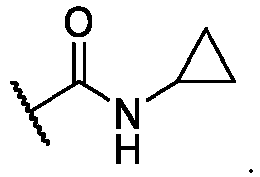
- In some embodiments, R' and R" are each independently selected from H, C1-C4 alkyl and C3-C6 cycloalkyl.
- In some embodiments, the compound of formula I has a structure shown in the following formula IIc:

- ring E is a 3- to 8-membered cyclohydrocarbyl or 4- to 9-membered heterocyclyl ring, wherein the 4- to 9-membered heterocyclyl contains 1, 2 or 3 heteroatoms selected from O, N and S;
- R16 is selected from H, halogen, substituted or unsubstituted C1-C4 alkyl, hydroxyl, substituted or unsubstituted C1-C4 acyl and substituted or unsubstituted C1-C4 alkoxy; preferably, the C1-C4 alkyl, C1-C4 acyl and C1-C4 alkoxy are optionally substituted by 1, 2 or 3 substituents selected from F, hydroxyl and cyano;
- n is 0, 1, 2, 3 or 4.
- In some embodiments, X2 and X3 are C;
- Y1 is selected from: O or CH2;
- Y5 is selected from: a bond, O, NH, -N(CH3)-, CH2 and -CH(CH3)-;
- Y6 is selected from: a bond, O, S, N, CH2, CH, NH and -N(CH3)-;
- R16 is selected from halogen, C1-C4 alkyl, hydroxyl, C1-C4 acyl and C1-C4 alkoxy;
- R1 is selected from: cyano and -C(O)NR'R";
- R2 is selected from: H, halogen, substituted or unsubstituted C1-C4 alkyl and substituted or unsubstituted C1-C4 alkoxy;
- R3 is selected from: substituted or unsubstituted aryl;
- R4 and R5 are each independently selected from: H, halogen and substituted or unsubstituted C1-C4 alkyl; alternatively, R4 and R5, together with the carbon atom to which they are attached, form a 3- to 6-membered substituted or unsubstituted ring, and the ring optionally contains 1, 2 or 3 heteroatoms selected from O, N and S;
- R6 is selected from: H, substituted or unsubstituted C1-C6 alkyl, substituted or unsubstituted C1-C6 alkoxy, substituted or unsubstituted C2-C6 alkenyl, substituted or unsubstituted C2-C6 alkynyl, substituted or unsubstituted 3- to 8-membered cyclohydrocarbyl, substituted or unsubstituted 6- to 14-membered aryl, substituted or unsubstituted 5- to 10-membered heteroaryl, substituted or unsubstituted 4- to 9-membered monocyclic or fused heterocyclyl, substituted or unsubstituted 6- to 12-membered bridged cyclyl, substituted or unsubstituted 6- to 12-membered bridged heterocyclyl, substituted or unsubstituted 6- to 12-membered spiro cyclyl and substituted or unsubstituted 6- to 12-membered spiro heterocyclyl;
- alternatively, R4 or R5 and R6, together with the atom to which they are attached, form a 4- to 9-membered monocyclic or fused heterocyclyl, 6- to 12-membered bridged heterocyclyl or 6- to 12-membered spiro heterocyclyl ring, and the 4- to 9-membered monocyclic or fused heterocyclyl, 6- to 12-membered bridged heterocyclyl and 6- to 12-membered spiro heterocyclyl are optionally substituted by 1, 2 or 3 substituents selected from H, deuterium, hydroxyl, cyano, C1-C4 alkyl, halogen and C1-C4 alkoxy;
- R7 and R8 are each independently selected from: H, halogen, cyano, substituted or unsubstituted C1-C4 alkyl, substituted or unsubstituted C1-C4 haloalkyl and substituted or unsubstituted C1-C4 alkoxy;
- R9 is selected from: H, C1-C4 alkyl, C1-C4 alkoxy, hydroxyl and halogen;
- R10 is selected from: H, halogen and C1-C4 alkyl;
- R11 is selected from: H, hydroxyl, amino, halogen, C1-C4 alkyl, -NR'R" and C1-C4 alkoxy;
- R' and R" are each independently selected from H and C1-C4 alkyl;
- wherein the dashed line indicates the presence or absence of a double bond.
- In some embodiments, R1 is selected from: cyano, -C(O)NH2 and -C(O)NHCH3;
- R2 is selected from: H, fluorine and methoxy;
- R3 is phenyl;
- R4 and R5 are each independently selected from: H and C1-C4 alkyl;
- R6 is H, substituted or unsubstituted C1-C6 alkyl, substituted or unsubstituted C1-C6 alkoxy, substituted or unsubstituted C2-C6 alkenyl or substituted or unsubstituted C2-C6 alkynyl, and their substituents are 1, 2 or 3 substituents selected from: hydroxyl, halogen, C1-C4 alkoxy optionally substituted by halogen, cyano, -S(O)2-C1-C4 alkyl optionally substituted by halogen, C1-C4 alkyl optionally substituted by halogen, -S(O)2-NR'R", -S(O)2-NH2, -C(O)-C1-C4 alkyl, - NR'-C(O)-C1-C4 alkyl and 6- to 14-membered aryl, 5- to 10-membered heteroaryl, 3- to 8-membered cyclohydrocarbyl and 4- to 9-membered heterocyclyl, wherein the 6- to 14-membered aryl, 5- to 10-membered heteroaryl, 3- to 8-membered cyclohydrocarbyl and 4- to 9-membered heterocyclyl are optionally substituted by 1, 2 or 3 substituents selected from C1-C4 alkyl, C1-C4 haloalkyl, C1-C4 alkoxy, C1-C4 haloalkoxy, halogen, cyano, C1-C4 alkyl-S(O)2-, hydroxyl, carboxyl, -NR'R", 6- to 14-membered aryl, 5- to 10-membered heteroaryl, 3- to 8-membered cyclohydrocarbyl and 4- to 9-membered heterocyclyl; wherein R' and R" are each independently selected from H and C1-C4 alkyl; or
- R6 is substituted or unsubstituted 3- to 8-membered cyclohydrocarbyl or substituted or unsubstituted 4- to 9-membered monocyclic or fused heterocyclyl, and their substituents are 1, 2 or 3 substituents selected from: halogen, hydroxyl, cyano, -NR'R", -S(O)2-NR'R", -S(O)2-NH2, -NR'-C(O)-C1-C4 alkyl, -S(O)2-C1-C4 alkyl, C1-C4 alkyl, C1-C4 alkoxy, C1-C4 haloalkoxy, - C(O)-C1-C4 alkyl and C1-C4 alkoxycarbonyl, and the C1-C4 alkyl and C1-C4 alkoxy are optionally substituted by 1, 2 or 3 groups selected from halogen, hydroxyl and -NR'R", wherein the R' and R" are each independently selected from H and C1-C4 alkyl; or
- R6 is substituted or unsubstituted 6- to 12-membered bridged cyclyl, substituted or unsubstituted 6- to 12-membered bridged heterocyclyl, substituted or unsubstituted 6- to 12-membered spiro cyclyl or substituted or unsubstituted 6- to 12-membered spiro heterocyclyl, and their substituents are 1, 2 or 3 substituents selected from: C1-C4 alkyl, C1-C4 haloalkyl, C1-C4 alkoxy, C1-C4 haloalkoxy, cyano, -S(O)2-C1-C4 alkyl, hydroxyl, halogen, NR'R", -S(O)2-NR'R", -S(O)2-NH2 and -NR'-C(O)-C1-C4 alkyl, wherein the R' and R" are each independently selected from H and C1-C4 alkyl;
- alternatively, R4 or R5 and R6, together with the atom to which they are attached, form the following group optionally substituted by 1, 2 or 3 substituents selected from H, deuterium, hydroxyl, methyl, F and methoxy:

- R7 and R8 are each independently selected from: H, halogen, cyano, methyl and methoxy;
- R9 is selected from: H, methyl, methoxy, hydroxyl and F;
- R10 is selected from: H, F and methyl;
- R11 is selected from: H, hydroxyl, amino, fluorine, chlorine, methyl, methoxy and - NH(CH3).
- In some embodiments, R' and R" are each independently selected from H, C1-C4 alkyl and C3-C6 cycloalkyl.
- In some embodiments, R1 is selected from: cyano, -C(O)NH2, -C(O)NHCH3 and
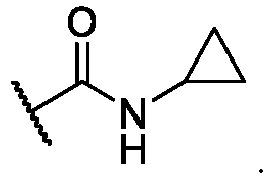
- In some embodiments, the compound of formula I has a structure shown in the following formula IId:

- ring E is a 3- to 8-membered cyclohydrocarbyl or 4- to 9-membered heterocyclyl ring, wherein the 4- to 9-membered heterocyclyl contains 1, 2 or 3 heteroatoms selected from O, N and S;
- R16 is selected from H, halogen, substituted or unsubstituted C1-C4 alkyl, hydroxyl, substituted or unsubstituted C1-C4 acyl and substituted or unsubstituted C1-C4 alkoxy; preferably, the C1-C4 alkyl, C1-C4 acyl and C1-C4 alkoxy are optionally substituted by 1, 2 or 3 substituents selected from F, hydroxyl and cyano;
- n is 0, 1, 2, 3 or 4.
- In some embodiments, X2 and X3 are C;
- Y4 is selected from: O or CH2;
- Y5 is selected from: a bond, O, NH, -N(CH3)-, CH2 and -CH(CH3)-;
- Y6 is selected from: a bond, O, S, N, CH2, CH, NH and -N(CH3)-;
- R16 is selected from halogen, C1-C4 alkyl, hydroxyl, C1-C4 acyl and C1-C4 alkoxy;
- R1 is selected from: cyano and -C(O)NR'R";
- R2 is selected from: H, halogen, substituted or unsubstituted C1-C4 alkyl and substituted or unsubstituted C1-C4 alkoxy;
- R3 is selected from: substituted or unsubstituted aryl;
- R4 and R5 are each independently selected from: H, halogen and substituted or unsubstituted C1-C4 alkyl; alternatively, R4 and R5, together with the carbon atom to which they are attached, form a 3- to 6-membered substituted or unsubstituted ring, and the ring optionally contains 1, 2 or 3 heteroatoms selected from O, N and S;
- R6 is selected from: H, substituted or unsubstituted C1-C6 alkyl, substituted or unsubstituted C1-C6 alkoxy, substituted or unsubstituted C2-C6 alkenyl, substituted or unsubstituted C2-C6 alkynyl, substituted or unsubstituted 3- to 8-membered cyclohydrocarbyl, substituted or unsubstituted 6- to 14-membered aryl, substituted or unsubstituted 5- to 10-membered heteroaryl, substituted or unsubstituted 4- to 9-membered monocyclic or fused heterocyclyl, substituted or unsubstituted 6- to 12-membered bridged cyclyl, substituted or unsubstituted 6- to 12-membered bridged heterocyclyl, substituted or unsubstituted 6- to 12-membered spiro cyclyl and substituted or unsubstituted 6- to 12-membered spiro heterocyclyl;
- alternatively, R4 or R5 and R6, together with the atom to which they are attached, form a 4- to 9-membered monocyclic or fused heterocyclyl, 6- to 12-membered bridged heterocyclyl or 6- to 12-membered spiro heterocyclyl ring, and the 4- to 9-membered monocyclic or fused heterocyclyl, 6- to 12-membered bridged heterocyclyl and 6- to 12-membered spiro heterocyclyl are optionally substituted by 1, 2 or 3 substituents selected from H, deuterium, hydroxyl, cyano, C1-C4 alkyl, halogen and C1-C4 alkoxy;
- R7 and R8 are each independently selected from: H, halogen, cyano, substituted or unsubstituted C1-C4 alkyl, substituted or unsubstituted C1-C4 haloalkyl and substituted or unsubstituted C1-C4 alkoxy;
- R9 is selected from: H, C1-C4 alkyl, C1-C4 alkoxy, hydroxyl and halogen;
- R10 is selected from: H, halogen and C1-C4 alkyl;
- R11 is selected from: H, hydroxyl, amino, halogen, C1-C4 alkyl, -NR'R" and C1-C4 alkoxy;
- R' and R" are each independently selected from H and C1-C4 alkyl;
- wherein the dashed line indicates the presence or absence of a double bond.
- In some embodiments, R1 is selected from: cyano, -C(O)NH2 and -C(O)NHCH3;
- R2 is selected from: H, fluorine and methoxy;
- R3 is phenyl;
- R4 and R5 are each independently selected from: Hand C1-C4 alkyl;
- R6 is H, substituted or unsubstituted C1-C6 alkyl, substituted or unsubstituted C1-C6 alkoxy, substituted or unsubstituted C2-C6 alkenyl or substituted or unsubstituted C2-C6 alkynyl, and their substituents are 1, 2 or 3 substituents selected from: hydroxyl, halogen, C1-C4 alkoxy optionally substituted by halogen, cyano, -S(O)2-C1-C4 alkyl optionally substituted by halogen, C1-C4 alkyl optionally substituted by halogen, -S(O)2-NR'R", -S(O)2-NH2, -C(O)-C1-C4 alkyl, - NR'-C(O)-C1-C4 alkyl and 6- to 14-membered aryl, 5- to 10-membered heteroaryl, 3- to 8-membered cyclohydrocarbyl and 4- to 9-membered heterocyclyl, wherein the 6- to 14-membered aryl, 5- to 10-membered heteroaryl, 3- to 8-membered cyclohydrocarbyl and 4- to 9-membered heterocyclyl are optionally substituted by 1, 2 or 3 substituents selected from C1-C4 alkyl, C1-C4 haloalkyl, C1-C4 alkoxy, C1-C4 haloalkoxy, halogen, cyano, C1-C4 alkyl-S(O)2-, hydroxyl, carboxyl, -NR'R", 6- to 14-membered aryl, 5- to 10-membered heteroaryl, 3- to 8-membered cyclohydrocarbyl and 4- to 9-membered heterocyclyl; wherein R' and R" are each independently selected from H and C1-C4 alkyl; or
- R6 is substituted or unsubstituted 3- to 8-membered cyclohydrocarbyl or substituted or unsubstituted 4- to 9-membered monocyclic or fused heterocyclyl, and their substituents are 1, 2 or 3 substituents selected from: halogen, hydroxyl, cyano, -NR'R", -S(O)2-NR'R", -S(O)2-NH2, -NR'-C(O)-C1-C4 alkyl, -S(O)2-C1-C4 alkyl, C1-C4 alkyl, C1-C4 alkoxy, C1-C4 haloalkoxy, - C(O)-C1-C4 alkyl and C1-C4 alkoxycarbonyl, and the C1-C4 alkyl and C1-C4 alkoxy are optionally substituted by 1, 2 or 3 groups selected from halogen, hydroxyl and -NR'R", wherein the R' and R" are each independently selected from H and C1-C4 alkyl; or
- R6 is substituted or unsubstituted 6- to 12-membered bridged cyclyl, substituted or unsubstituted 6- to 12-membered bridged heterocyclyl, substituted or unsubstituted 6- to 12-membered spiro cyclyl or substituted or unsubstituted 6- to 12-membered spiro heterocyclyl, and their substituents are 1, 2 or 3 substituents selected from: C1-C4 alkyl, C1-C4 haloalkyl, C1-C4 alkoxy, C1-C4 haloalkoxy, cyano, -S(O)2-C1-C4 alkyl, hydroxyl, halogen, NR'R", -S(O)2-NR'R", -S(O)2-NH2 and -NR'-C(O)-C1-C4 alkyl, wherein the R' and R" are each independently selected from H and C1-C4 alkyl;
- alternatively, R4 or R5 and R6, together with the atom to which they are attached, form the following group optionally substituted by 1, 2 or 3 substituents selected from H, deuterium, hydroxyl, methyl, F and methoxy:

- R7 and R8 are each independently selected from: H, halogen, cyano, methyl and methoxy;
- R9 is selected from: H, methyl, methoxy, hydroxyl and F;
- R10 is selected from: H, F and methyl;
- R11 is selected from: H, hydroxyl, amino, fluorine, chlorine, methyl, methoxy and - NH(CH3).
- In some embodiments, ring E is a 3- to 6-membered cyclohydrocarbyl or 4- to 6-membered heterocyclyl ring, wherein the 4- to 6-membered heterocyclyl contains 1, 2 or 3 heteroatoms selected from O, N and S; R16 is selected from H, halogen, C1-C4 alkyl, hydroxyl and acetyl; n is 0 or 1.
- In some embodiments, ring E is a cyclopropyl, cyclobutyl, cyclopentyl, cyclohexyl, oxetanyl, oxolanyl, tetrahydropyranyl, azetidinyl, azacyclopentyl or piperidinyl ring; R16 is selected from H, fluorine, methyl, ethyl, hydroxyl and acetyl; n is 0 or 1.
- In some embodiments, the compound of formula I has a structure shown in the following formula IIe:

- X2 is C;
- Y6 is selected from: C, CH and N;
- ring F is a 5- or 6-membered cyclohydrocarbyl, 5- or 6-membered heterocyclyl, phenyl or 5- or 6-membered heteroaryl ring, wherein the 5- or 6-membered heterocyclyl or 5- or 6-membered heteroaryl contains 1, 2 or 3 heteroatoms selected from O, N and S;
- R15 is selected from: H, halogen, oxo (=O), thio (=S), substituted or unsubstituted C1-C4 acyl, hydroxyl, substituted or unsubstituted C1-C4 alkoxy, cyano, -NR'R", substituted or unsubstituted C1-C4 alkyl-S(O)2-, substituted or unsubstituted 6- to 10-membered aryl-S(O)2-, substituted or unsubstituted 4- to 9-membered heterocyclyl, NR'R"-C(O)-, substituted or unsubstituted 3- to 8-membered cyclohydrocarbyl, substituted or unsubstituted 3- to 8-membered cyclohydrocarbyl-C(O)-, substituted or unsubstituted C1-C4 haloalkyl and substituted or unsubstituted C1-C4 alkyl; preferably, the C1-C4 acyl, C1-C4 alkoxy, C1-C4 alkyl-S(O)2-, 6- to 10-membered aryl-S(O)2-, 4- to 9-membered heterocyclyl, 3- to 8-membered cyclohydrocarbyl, 3- to 8-membered cyclohydrocarbyl-C(O)-, C1-C4 haloalkyl and C1-C4 alkyl are optionally substituted by 1, 2 or 3 substituents selected from F, hydroxyl and cyano; and
- n is 0, 1, 2 or 3.
- In some embodiments, ring F is a phenyl or 5- or 6-membered heteroaryl ring, wherein the 5- or 6-membered heteroaryl contains 1, 2 or 3 heteroatoms selected from O, N and S; and/or R15 is selected from: H, halogen, substituted or unsubstituted C1-C4 acyl, hydroxyl, substituted or unsubstituted C1-C4 alkoxy, cyano, -NR'R", substituted or unsubstituted 4- to 9-membered heterocyclyl, NR'R"-C(O)-, substituted or unsubstituted 3- to 8-membered cyclohydrocarbyl, substituted or unsubstituted 3- to 8-membered cyclohydrocarbyl-C(O)-, substituted or unsubstituted C1-C4 haloalkyl and substituted or unsubstituted C1-C4 alkyl. In some embodiments, the C1-C4 acyl, C1-C4 alkoxy, 4- to 9-membered heterocyclyl, 3- to 8-membered cyclohydrocarbyl, 3- to 8-membered cyclohydrocarbyl-C(O)-, C1-C4 haloalkyl and C1-C4 alkyl are optionally substituted by 1, 2 or 3 substituents selected from F, hydroxyl and cyano; wherein R' and R" are each independently selected from H and C1-C4 alkyl, and n is 0, 1 or 2.
- In some embodiments, ring F is a 5-membered heteroaryl ring, wherein the 5-membered heteroaryl contains 1 or 2 heteroatoms selected from O and N; and/or R15 is selected from: H, fluorine, chlorine, acetyl, hydroxyl, C1-C4 alkoxy, cyano, -NR'R", NR'R"-C(O)-, 3- to 8-membered cyclohydrocarbyl-C(O)-, C1-C4 haloalkyl and C1-C4 alkyl; wherein R' and R" are each independently selected from H and C1-C4 alkyl. In some embodiments, n is 0 or 1.
- In some embodiments, ring F is a pyrrolyl, furyl, pyrazolyl, imidazolyl, oxazolyl or isoxazolyl ring.
- In some embodiments, Y1, Y4 and Y5 are independently selected from: O, CH, CH2, - CH(CH3)-, N, NH and -N(CH3)-;
- ring F is a phenyl or 5- or 6-membered heteroaryl ring, wherein the 5- or 6-membered heteroaryl contains 1, 2 or 3 heteroatoms selected from O, N and S; R15 is selected from: H, fluorine, chlorine, acetyl, hydroxyl, C1-C4 alkoxy, cyano, -NR'R", NR'R"-C(O)-, 3- to 8-membered cyclohydrocarbyl-C(O)-, C1-C4 haloalkyl and C1-C4 alkyl; R' and R" are each independently selected from H and C1-C4 alkyl; n is 0 or 1;
- R1 is selected from: cyano and -C(O)NR'R";
- R2 is selected from: H, halogen, substituted or unsubstituted C1-C4 alkyl and substituted or unsubstituted C1-C4 alkoxy;
- R3 is selected from: substituted or unsubstituted aryl;
- R4 and R5 are each independently selected from: H, halogen and substituted or unsubstituted C1-C4 alkyl; alternatively, R4 and R5, together with the carbon atom to which they are attached, form a 3- to 6-membered substituted or unsubstituted ring, and the ring optionally contains 1, 2 or 3 heteroatoms selected from O, N and S;
- R6 is selected from: H, substituted or unsubstituted C1-C6 alkyl, substituted or unsubstituted C1-C6 alkoxy, substituted or unsubstituted C2-C6 alkenyl, substituted or unsubstituted C2-C6 alkynyl, substituted or unsubstituted 3- to 8-membered cyclohydrocarbyl, substituted or unsubstituted 6- to 14-membered aryl, substituted or unsubstituted 5- to 10-membered heteroaryl, substituted or unsubstituted 4- to 9-membered monocyclic or fused heterocyclyl, substituted or unsubstituted 6- to 12-membered bridged cyclyl, substituted or unsubstituted 6- to 12-membered bridged heterocyclyl, substituted or unsubstituted 6- to 12-membered spiro cyclyl and substituted or unsubstituted 6- to 12-membered spiro heterocyclyl;
- alternatively, R4 or R5 and R6, together with the atom to which they are attached, form a 4- to 9-membered monocyclic or fused heterocyclyl, 6- to 12-membered bridged heterocyclyl or 6- to 12-membered spiro heterocyclyl ring, and the 4- to 9-membered monocyclic or fused heterocyclyl, 6- to 12-membered bridged heterocyclyl and 6- to 12-membered spiro heterocyclyl are optionally substituted by 1, 2 or 3 substituents selected from H, deuterium, hydroxyl, cyano, C1-C4 alkyl, halogen and C1-C4 alkoxy;
- R7 and R8 are each independently selected from: H, halogen, cyano, substituted or unsubstituted C1-C4 alkyl, substituted or unsubstituted C1-C4 haloalkyl and substituted or unsubstituted C1-C4 alkoxy;
- R9 is selected from: H, C1-C4 alkyl, C1-C4 alkoxy, hydroxyl and halogen;
- R10 is selected from: H, halogen and C1-C4 alkyl;
- R11 is selected from: H, hydroxyl, amino, halogen, C1-C4 alkyl, -NR'R" and C1-C4 alkoxy;
- R' and R" are each independently selected from H and C1-C4 alkyl;
- wherein the dashed line indicates the presence or absence of a double bond.
- In some embodiments, R1 is selected from: cyano, -C(O)NH2 and -C(O)NHCH3;
- R2 is selected from: H, fluorine and methoxy;
- R3 is phenyl;
- R4 and R5 are each independently selected from: H and C1-C4 alkyl;
- R6 is H, substituted or unsubstituted C1-C6 alkyl, substituted or unsubstituted C1-C6 alkoxy, substituted or unsubstituted C2-C6 alkenyl or substituted or unsubstituted C2-C6 alkynyl, and their substituents are 1, 2 or 3 substituents selected from: hydroxyl, halogen, C1-C4 alkoxy optionally substituted by halogen, cyano, -S(O)2-C1-C4 alkyl optionally substituted by halogen, C1-C4 alkyl optionally substituted by halogen, -S(O)2-NR'R", -S(O)2-NH2, -C(O)-C1-C4 alkyl, - NR'-C(O)-C1-C4 alkyl and 6- to 14-membered aryl, 5- to 10-membered heteroaryl, 3- to 8-membered cyclohydrocarbyl and 4- to 9-membered heterocyclyl, wherein the 6- to 14-membered aryl, 5- to 10-membered heteroaryl, 3- to 8-membered cyclohydrocarbyl and 4- to 9-membered heterocyclyl are optionally substituted by 1, 2 or 3 substituents selected from C1-C4 alkyl, C1-C4 haloalkyl, C1-C4 alkoxy, C1-C4 haloalkoxy, halogen, cyano, C1-C4 alkyl-S(O)2-, hydroxyl, carboxyl, -NR'R", 6- to 14-membered aryl, 5- to 10-membered heteroaryl, 3- to 8-membered cyclohydrocarbyl and 4- to 9-membered heterocyclyl; wherein R' and R" are each independently selected from H and C1-C4 alkyl; or
- R6 is substituted or unsubstituted 3- to 8-membered cyclohydrocarbyl or substituted or unsubstituted 4- to 9-membered monocyclic or fused heterocyclyl, and their substituents are 1, 2 or 3 substituents selected from: halogen, hydroxyl, cyano, -NR'R", -S(O)2-NR'R", -S(O)2-NH2, -NR'-C(O)-C1-C4 alkyl, -S(O)2-C1-C4 alkyl, C1-C4 alkyl, C1-C4 alkoxy, C1-C4 haloalkoxy, - C(O)-C1-C4 alkyl and C1-C4 alkoxycarbonyl, and the C1-C4 alkyl and C1-C4 alkoxy are optionally substituted by 1, 2 or 3 groups selected from halogen, hydroxyl and -NR'R", wherein the R' and R" are each independently selected from H and C1-C4 alkyl; or
- R6 is substituted or unsubstituted 6- to 12-membered bridged cyclyl, substituted or unsubstituted 6- to 12-membered bridged heterocyclyl, substituted or unsubstituted 6- to 12-membered spiro cyclyl or substituted or unsubstituted 6- to 12-membered spiro heterocyclyl, and their substituents are 1, 2 or 3 substituents selected from: C1-C4 alkyl, C1-C4 haloalkyl, C1-C4 alkoxy, C1-C4 haloalkoxy, cyano, -S(O)2-C1-C4 alkyl, hydroxyl, halogen, NR'R", -S(O)2-NR'R", -S(O)2-NH2 and -NR'-C(O)-C1-C4 alkyl, wherein the R' and R" are each independently selected from H and C1-C4 alkyl;
- alternatively, R4 or R5 and R6, together with the atom to which they are attached, form the following group optionally substituted by 1, 2 or 3 substituents selected from H, deuterium, hydroxyl, methyl, F and methoxy:

- R7 and R8 are each independently selected from: H, halogen, cyano, methyl and methoxy;
- R9 is selected from: H, methyl, methoxy, hydroxyl and F;
- R10 is selected from: H, F and methyl;
- R11 is selected from: H, hydroxyl, amino, fluorine, chlorine, methyl, methoxy and - NH(CH3).
- In some embodiments, R' and R" are each independently selected from H, C1-C4 alkyl and C3-C6 cycloalkyl.
- In some embodiments, R1 is selected from: cyano, -C(O)NH2, -C(O)NHCH3 and

- In some embodiments, the compound of formula IIa has a structure shown in the following formula IIIa:

- D1 is selected from: O, S, S(O), S(O)2, N, NRe, CRf and CRfRg;
- D2 is selected from: O, S, S(O), S(O)2, N, NRe, (CRf)p, (CRfRg)p, C(O)-NRe, N-NRe, CRf-NRe,

- D3 is selected from: O, S, S(O), S(O)2, N, NRe, (CRf)p and (CRfRg)p;
- provided that D1 and D2, D1 and D3 are not simultaneously O, S, -S(O)- or -S(O)2- and satisfy the valence bond theory;
- each Re at each occurrence is independently selected from: H, substituted or unsubstituted C1-C4 acyl, substituted or unsubstituted C1-C4 alkoxy, cyano, substituted or unsubstituted C1-C4 alkyl-S(O)2-, substituted or unsubstituted 4- to 9-membered heterocyclyl, NR'R"-C(O)-, substituted or unsubstituted 3- to 6-membered cyclohydrocarbyl, substituted or unsubstituted 3- to 6-membered cyclohydrocarbyl-C(O)-, substituted or unsubstituted C1-C4 haloalkyl and substituted or unsubstituted C1-C4 alkyl, wherein R' and R" are each independently selected from H and C1-C4 alkyl; preferably, the C1-C4 acyl, C1-C4 alkoxy, C1-C4 alkyl-S(O)2-, 4- to 9-membered heterocyclyl, 3- to 6-membered cyclohydrocarbyl, 3- to 6-membered cyclohydrocarbyl-C(O)-, C1-C4 haloalkyl and C1-C4 alkyl are optionally substituted by 1, 2 or 3 substituents selected from F, hydroxyl and cyano;
- each Rf at each occurrence is independently selected from: H, halogen, substituted or unsubstituted C1-C4 acyl, hydroxyl, cyano, -NR'R", substituted or unsubstituted C1-C4 alkoxy, substituted or unsubstituted C1-C4 alkyl, substituted or unsubstituted 3- to 6-membered cyclohydrocarbyl, substituted or unsubstituted C1-C4 alkyl-S(O)2-, substituted or unsubstituted 3-to 6-membered cyclohydrocarbyl-C(O)- and NR'R"-C(O)-, wherein R' and R" are each independently selected from H and C1-C4 alkyl; preferably, the C1-C4 acyl, C1-C4 alkoxy, C1-C4 alkyl, 3- to 6-membered cyclohydrocarbyl, C1-C4 alkyl-S(O)2- and 3- to 6-membered cyclohydrocarbyl-C(O)- are optionally substituted by 1, 2 or 3 substituents selected from F, hydroxyl and cyano;
- each Rg at each occurrence is independently selected from: H, halogen, substituted or unsubstituted C1-C4 acyl, hydroxyl, cyano, -NR'R", substituted or unsubstituted C1-C4 alkoxy, substituted or unsubstituted C1-C4 alkyl, substituted or unsubstituted 3- to 6-membered cyclohydrocarbyl, substituted or unsubstituted C1-C4 alkyl-S(O)2-, substituted or unsubstituted 3-to 6-membered cyclohydrocarbyl-C(O)- and NR'R"-C(O)-, wherein R' and R" are each independently selected from H and C1-C4 alkyl; preferably, the C1-C4 acyl, C1-C4 alkoxy, C1-C4 alkyl, 3- to 6-membered cyclohydrocarbyl, C1-C4 alkyl-S(O)2- and 3- to 6-membered cyclohydrocarbyl-C(O)- are optionally substituted by 1, 2 or 3 substituents selected from F, hydroxyl and cyano;
- alternatively, Rf and Rg on the same carbon atom form an oxo (=O) or thio (=S) group; and
- each p is independently 1, 2, 3 or 4, preferably 1 or 2.
- In some embodiments, X2 is selected from: C and N;
- X3 is selected from: C and N;
- Y1 is selected from: a bond, O, NH, -N(CH3)-, CH2 and -CH(CH3)-;
- Y5 is selected from: O, S, N, CH2, CH, NH, -N(CH3)-, -OCH2-, -NHCH2-, -N(CH3)CH2- and -CH2CH2-;
- Y4 is selected from: C, CH or N;
- Y6 is selected from: C, CH or N;
- D1 is selected from: O, S, N, NRe, CRf and CRfRg;
- D2 is selected from: O, S, N, NRe, (CRf)p and (CRfRg)p;
- D3 is selected from: O, S, N, NRe, (CRf)p and (CRfRg)p;
- R1 is selected from: cyano and -C(O)NR'R";
- R2 is selected from: H, halogen, substituted or unsubstituted C1-C4 alkyl and substituted or unsubstituted C1-C4 alkoxy;
- R3 is selected from: substituted or unsubstituted aryl;
- R4 and R5 are each independently selected from: H, halogen and substituted or unsubstituted C1-C4 alkyl; alternatively, R4 and R5, together with the carbon atom to which they are attached, form a 3- to 6-membered substituted or unsubstituted ring, and the ring optionally contains 1, 2 or 3 heteroatoms selected from O, N and S;
- R6 is selected from: H, substituted or unsubstituted C1-C6 alkyl, substituted or unsubstituted C1-C6 alkoxy, substituted or unsubstituted C2-C6 alkenyl, substituted or unsubstituted C2-C6 alkynyl, substituted or unsubstituted 3- to 8-membered cyclohydrocarbyl, substituted or unsubstituted 6- to 14-membered aryl, substituted or unsubstituted 5- to 10-membered heteroaryl, substituted or unsubstituted 4- to 9-membered monocyclic or fused heterocyclyl, substituted or unsubstituted 6- to 12-membered bridged cyclyl, substituted or unsubstituted 6- to 12-membered bridged heterocyclyl, substituted or unsubstituted 6- to 12-membered spiro cyclyl and substituted or unsubstituted 6- to 12-membered spiro heterocyclyl;
- alternatively, R4 or R5 and R6, together with the atom to which they are attached, form a 4- to 9-membered monocyclic or fused heterocyclyl, 6- to 12-membered bridged heterocyclyl or 6- to 12-membered spiro heterocyclyl ring, and the 4- to 9-membered monocyclic or fused heterocyclyl, 6- to 12-membered bridged heterocyclyl and 6- to 12-membered spiro heterocyclyl are optionally substituted by 1, 2 or 3 substituents selected from H, deuterium, hydroxyl, cyano, C1-C4 alkyl, halogen and C1-C4 alkoxy;
- R7 and R8 are each independently selected from: H, halogen, cyano, substituted or unsubstituted C1-C4 alkyl, substituted or unsubstituted C1-C4 haloalkyl and substituted or unsubstituted C1-C4 alkoxy;
- R9 is selected from: H, C1-C4 alkyl, C1-C4 alkoxy, hydroxyl and halogen;
- R10 is selected from: H, halogen and C1-C4 alkyl;
- R11 is selected from: H, hydroxyl, amino, halogen, C1-C4 alkyl, -NR'R" and C1-C4 alkoxy;
- R' and R" are each independently selected from H and C1-C4 alkyl;
- wherein the dashed line indicates the presence or absence of a double bond.
- In some embodiments, R1 is selected from: cyano, -C(O)NH2 and -C(O)NHCH3;
- R2 is selected from: H, fluorine and methoxy;
- R3 is phenyl;
- R4 and R5 are each independently selected from: H and C1-C4 alkyl;
- R6 is H, substituted or unsubstituted C1-C6 alkyl, substituted or unsubstituted C1-C6 alkoxy, substituted or unsubstituted C2-C6 alkenyl or substituted or unsubstituted C2-C6 alkynyl, and their substituents are 1, 2 or 3 substituents selected from: hydroxyl, halogen, C1-C4 alkoxy optionally substituted by halogen, cyano, -S(O)2-C1-C4 alkyl optionally substituted by halogen, C1-C4 alkyl optionally substituted by halogen, -S(O)2-NR'R", -S(O)2-NH2, -C(O)-C1-C4 alkyl, - NR'-C(O)-C1-C4 alkyl and 6- to 14-membered aryl, 5- to 10-membered heteroaryl, 3- to 8-membered cyclohydrocarbyl and 4- to 9-membered heterocyclyl, wherein the 6- to 14-membered aryl, 5- to 10-membered heteroaryl, 3- to 8-membered cyclohydrocarbyl and 4- to 9-membered heterocyclyl are optionally substituted by 1, 2 or 3 substituents selected from C1-C4 alkyl, C1-C4 haloalkyl, C1-C4 alkoxy, C1-C4 haloalkoxy, halogen, cyano, C1-C4 alkyl-S(O)2-, hydroxyl, carboxyl, -NR'R", 6- to 14-membered aryl, 5- to 10-membered heteroaryl, 3- to 8-membered cyclohydrocarbyl and 4- to 9-membered heterocyclyl; wherein R' and R" are each independently selected from H and C1-C4 alkyl; or
- R6 is substituted or unsubstituted 3- to 8-membered cyclohydrocarbyl or substituted or unsubstituted 4- to 9-membered monocyclic or fused heterocyclyl, and their substituents are 1, 2 or 3 substituents selected from: halogen, hydroxyl, cyano, -NR'R", -S(O)2-NR'R", -S(O)2-NH2, -NR'-C(O)-C1-C4 alkyl, -S(O)2-C1-C4 alkyl, C1-C4 alkyl, C1-C4 alkoxy, C1-C4 haloalkoxy, - C(O)-C1-C4 alkyl and C1-C4 alkoxycarbonyl, and the C1-C4 alkyl and C1-C4 alkoxy are optionally substituted by 1, 2 or 3 groups selected from halogen, hydroxyl and -NR'R", wherein the R' and R" are each independently selected from H and C1-C4 alkyl; or
- R6 is substituted or unsubstituted 6- to 12-membered bridged cyclyl, substituted or unsubstituted 6- to 12-membered bridged heterocyclyl, substituted or unsubstituted 6- to 12-membered spiro cyclyl or substituted or unsubstituted 6- to 12-membered spiro heterocyclyl, and their substituents are 1, 2 or 3 substituents selected from: C1-C4 alkyl, C1-C4 haloalkyl, C1-C4 alkoxy, C1-C4 haloalkoxy, cyano, -S(O)2-C1-C4 alkyl, hydroxyl, halogen, NR'R", -S(O)2-NR'R", -S(O)2-NH2 and -NR'-C(O)-C1-C4 alkyl, wherein the R' and R" are each independently selected from H and C1-C4 alkyl;
- alternatively, R4 or R5 and R6, together with the atom to which they are attached, form the following group optionally substituted by 1, 2 or 3 substituents selected from H, deuterium, hydroxyl, methyl, F and methoxy:

- R7 and R8 are each independently selected from: H, halogen, cyano, methyl and methoxy;
- R9 is selected from: H, methyl, methoxy, hydroxyl and F;
- R10 is selected from: H, F and methyl;
- R11 is selected from: H, hydroxyl, amino, fluorine, chlorine, methyl, methoxy and - NH(CH3).
- In some embodiments, R1 is selected from: cyano, -C(O)NH2, -C(O)NHCH3 and
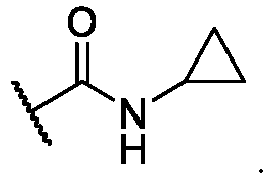
- In some embodiments, R' and R" are each independently selected from H, C1-C4 alkyl and C3-C6 cycloalkyl.
- In some embodiments, the compound of formula IIb has a structure shown in the following formula IIIb:

- D1 is selected from: O, S, S(O), S(O)2, N, NRe, CRf and CRfRg;
- D2 is selected from: O, S, S(O), S(O)2, N, NRe, (CRf)p, (CRfRg)p, C(O)-NRe, N-NRe, CRf-NRe,

- D3 is selected from: O, S, S(O), S(O)2, N, NRe, (CRf)p and (CRfRg)p;
- provided that D1 and D2, D1 and D3 are not simultaneously O, S, -S(O)- or -S(O)2- and satisfy the valence bond theory;
- each Re at each occurrence is independently selected from: H, substituted or unsubstituted C1-C4 acyl, substituted or unsubstituted C1-C4 alkoxy, cyano, substituted or unsubstituted C1-C4 alkyl-S(O)2-, substituted or unsubstituted 4- to 9-membered heterocyclyl, NR'R"-C(O)-, substituted or unsubstituted 3- to 6-membered cyclohydrocarbyl, substituted or unsubstituted 3- to 6-membered cyclohydrocarbyl-C(O)-, substituted or unsubstituted C1-C4 haloalkyl and substituted or unsubstituted C1-C4 alkyl, wherein R' and R" are each independently selected from H and C1-C4 alkyl; preferably, the C1-C4 acyl, C1-C4 alkoxy, C1-C4 alkyl-S(O)2-, 4- to 9-membered heterocyclyl, 3- to 6-membered cyclohydrocarbyl, 3- to 6-membered cyclohydrocarbyl-C(O)-, C1-C4 haloalkyl and C1-C4 alkyl are optionally substituted by 1, 2 or 3 substituents selected from F, hydroxyl and cyano;
- each Rf at each occurrence is independently selected from: H, halogen, substituted or unsubstituted C1-C4 acyl, hydroxyl, cyano, -NR'R", substituted or unsubstituted C1-C4 alkoxy, substituted or unsubstituted C1-C4 alkyl, substituted or unsubstituted 3- to 6-membered cyclohydrocarbyl, substituted or unsubstituted C1-C4 alkyl-S(O)2-, substituted or unsubstituted 3-to 6-membered cyclohydrocarbyl-C(O)- and NR'R"-C(O)-, wherein R' and R" are each independently selected from H and C1-C4 alkyl; preferably, the C1-C4 acyl, C1-C4 alkoxy, C1-C4 alkyl, 3- to 6-membered cyclohydrocarbyl, C1-C4 alkyl-S(O)2- and 3- to 6-membered cyclohydrocarbyl-C(O)- are optionally substituted by 1, 2 or 3 substituents selected from F, hydroxyl and cyano;
- each Rg at each occurrence is independently selected from: H, halogen, substituted or unsubstituted C1-C4 acyl, hydroxyl, cyano, -NR'R", substituted or unsubstituted C1-C4 alkoxy, substituted or unsubstituted C1-C4 alkyl, substituted or unsubstituted 3- to 6-membered cyclohydrocarbyl, substituted or unsubstituted C1-C4 alkyl-S(O)2-, substituted or unsubstituted 3-to 6-membered cyclohydrocarbyl-C(O)- and NR'R"-C(O)-, wherein R' and R" are each independently selected from H and C1-C4 alkyl; preferably, the C1-C4 acyl, C1-C4 alkoxy, C1-C4 alkyl, 3- to 6-membered cyclohydrocarbyl, C1-C4 alkyl-S(O)2- and 3- to 6-membered cyclohydrocarbyl-C(O)- are optionally substituted by 1, 2 or 3 substituents selected from F, hydroxyl and cyano;
- alternatively, Rf and Rg on the same carbon atom form an oxo (=O) or thio (=S) group; and
- each p is independently 1, 2, 3 or 4, preferably 1 or 2.
- In some embodiments, X2 and X3 are C;
- Y1 is selected from: C, CH and N;
- Y4 is selected from: C, CH and N;
- Y5 is selected from: a bond, O, S, -S(O)-, -S(O)2-, -C(O)-, N, NH, -N(CH3)-, CH, CH2, - CH(CH3)-, -OCH2-, -NHCH2-, -N(CH3)CH2- and -CH2CH2-;
- Y6 is selected from: a bond, O, S, -S(O)-, -S(O)2-, -C(O)-, N, CH2, CH, -CH(CH3)-, NH, -N(CH3)-, -OCH2-, -NHCH2-, -N(CH3)CH2- and -CH2CH2-; and Y5 and Y6 are not simultaneously a bond;
- D1 is selected from: O, S, N, NRe, CRf and CRfRg;
- D2 is selected from: O, S, N, NRe, (CRf)p, (CRfRg)p, C(O)-NRe, N-NRe, CRf-NRe,
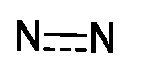

- D3 is selected from: O, S, N, NRe, (CRf)p and (CRfRg)p;
- R1 is selected from: cyano and -C(O)NR'R";
- R2 is selected from: H, halogen, substituted or unsubstituted C1-C4 alkyl and substituted or unsubstituted C1-C4 alkoxy;
- R3 is selected from: substituted or unsubstituted aryl;
- R4 and R5 are each independently selected from: H, halogen and substituted or unsubstituted C1-C4 alkyl; alternatively, R4 and R5, together with the carbon atom to which they are attached, form a 3- to 6-membered substituted or unsubstituted ring, and the ring optionally contains 1, 2 or 3 heteroatoms selected from O, N and S;
- R6 is selected from: H, substituted or unsubstituted C1-C6 alkyl, substituted or unsubstituted C1-C6 alkoxy, substituted or unsubstituted C2-C6 alkenyl, substituted or unsubstituted C2-C6 alkynyl, substituted or unsubstituted 3- to 8-membered cyclohydrocarbyl, substituted or unsubstituted 6- to 14-membered aryl, substituted or unsubstituted 5- to 10-membered heteroaryl, substituted or unsubstituted 4- to 9-membered monocyclic or fused heterocyclyl, substituted or unsubstituted 6- to 12-membered bridged cyclyl, substituted or unsubstituted 6- to 12-membered bridged heterocyclyl, substituted or unsubstituted 6- to 12-membered spiro cyclyl and substituted or unsubstituted 6- to 12-membered spiro heterocyclyl;
- alternatively, R4 or R5 and R6, together with the atom to which they are attached, form a 4- to 9-membered monocyclic or fused heterocyclyl, 6- to 12-membered bridged heterocyclyl or 6- to 12-membered spiro heterocyclyl ring, and the 4- to 9-membered monocyclic or fused heterocyclyl, 6- to 12-membered bridged heterocyclyl and 6- to 12-membered spiro heterocyclyl are optionally substituted by 1, 2 or 3 substituents selected from H, deuterium, hydroxyl, cyano, C1-C4 alkyl, halogen and C1-C4 alkoxy;
- R7 and R8 are each independently selected from: H, halogen, cyano, substituted or unsubstituted C1-C4 alkyl, substituted or unsubstituted C1-C4 haloalkyl and substituted or unsubstituted C1-C4 alkoxy;
- R9 is selected from: H, C1-C4 alkyl, C1-C4 alkoxy, hydroxyl and halogen;
- R10 is selected from: H, halogen and C1-C4 alkyl;
- R11 is selected from: H, hydroxyl, amino, halogen, C1-C4 alkyl, -NR'R" and C1-C4 alkoxy;
- R' and R" are each independently selected from H and C1-C4 alkyl;
- wherein the dashed line indicates the presence or absence of a double bond.
- In some embodiments, R1 is selected from: cyano, -C(O)NH2 and -C(O)NHCH3;
- R2 is selected from: H, fluorine and methoxy;
- R3 is phenyl;
- R4 and R5 are each independently selected from: H and C1-C4 alkyl;
- R6 is H, substituted or unsubstituted C1-C6 alkyl, substituted or unsubstituted C1-C6 alkoxy, substituted or unsubstituted C2-C6 alkenyl or substituted or unsubstituted C2-C6 alkynyl, and their substituents are 1, 2 or 3 substituents selected from: hydroxyl, halogen, C1-C4 alkoxy optionally substituted by halogen, cyano, -S(O)2-C1-C4 alkyl optionally substituted by halogen, C1-C4 alkyl optionally substituted by halogen, -S(O)2-NR'R", -S(O)2-NH2, -C(O)-C1-C4 alkyl, - NR'-C(O)-C1-C4 alkyl and 6- to 14-membered aryl, 5- to 10-membered heteroaryl, 3- to 8-membered cyclohydrocarbyl and 4- to 9-membered heterocyclyl, wherein the 6- to 14-membered aryl, 5- to 10-membered heteroaryl, 3- to 8-membered cyclohydrocarbyl and 4- to 9-membered heterocyclyl are optionally substituted by 1, 2 or 3 substituents selected from C1-C4 alkyl, C1-C4 haloalkyl, C1-C4 alkoxy, C1-C4 haloalkoxy, halogen, cyano, C1-C4 alkyl-S(O)2-, hydroxyl, carboxyl, -NR'R", 6- to 14-membered aryl, 5- to 10-membered heteroaryl, 3- to 8-membered cyclohydrocarbyl and 4- to 9-membered heterocyclyl; wherein R' and R" are each independently selected from H and C1-C4 alkyl; or
- R6 is substituted or unsubstituted 3- to 8-membered cyclohydrocarbyl or substituted or unsubstituted 4- to 9-membered monocyclic or fused heterocyclyl, and their substituents are 1, 2 or 3 substituents selected from: halogen, hydroxyl, cyano, -NR'R", -S(O)2-NR'R", -S(O)2-NH2, -NR'-C(O)-C1-C4 alkyl, -S(O)2-C1-C4 alkyl, C1-C4 alkyl, C1-C4 alkoxy, C1-C4 haloalkoxy, - C(O)-C1-C4 alkyl and C1-C4 alkoxycarbonyl, and the C1-C4 alkyl and C1-C4 alkoxy are optionally substituted by 1, 2 or 3 groups selected from halogen, hydroxyl and -NR'R", wherein the R' and R" are each independently selected from H and C1-C4 alkyl; or
- R6 is substituted or unsubstituted 6- to 12-membered bridged cyclyl, substituted or unsubstituted 6- to 12-membered bridged heterocyclyl, substituted or unsubstituted 6- to 12-membered spiro cyclyl or substituted or unsubstituted 6- to 12-membered spiro heterocyclyl, and their substituents are 1, 2 or 3 substituents selected from: C1-C4 alkyl, C1-C4 haloalkyl, C1-C4 alkoxy, C1-C4 haloalkoxy, cyano, -S(O)2-C1-C4 alkyl, hydroxyl, halogen, NR'R", -S(O)2-NR'R", -S(O)2-NH2 and -NR'-C(O)-C1-C4 alkyl, wherein the R' and R" are each independently selected from H and C1-C4 alkyl;
- alternatively, R4 or R5 and R6, together with the atom to which they are attached, form the following group optionally substituted by 1, 2 or 3 substituents selected from H, deuterium, hydroxyl, methyl, F and methoxy:

- R7 and R8 are each independently selected from: H, halogen, cyano, methyl and methoxy;
- R9 is selected from: H, methyl, methoxy, hydroxyl and F;
- R10 is selected from: H, F and methyl;
- R11 is selected from: H, hydroxyl, amino, fluorine, chlorine, methyl, methoxy and - NH(CH3).
- In some embodiments, R1 is selected from: cyano, -C(O)NH2, -C(O)NHCH3 and

- In some embodiments, R' and R" are each independently selected from H, C1-C4 alkyl and C3-C6 cycloalkyl.
- In some embodiments, the compound of formula IIIa has a structure shown in the following formula IVa:

ring C is a substituted or unsubstituted 4- to 12-membered monocyclic or fused heterocyclyl, substituted or unsubstituted 6- to 12-membered bridged heterocyclyl or substituted or unsubstituted 6- to 12-membered spiro heterocyclyl ring, and the 4- to 12-membered monocyclic or fused heterocyclyl, 6- to 12-membered bridged heterocyclyl and 6- to 12-membered spiro heterocyclyl each optionally further contain 1 or 2 heteroatoms selected from N and O; ring C is preferably a substituted or unsubstituted 4- to 8-membered nitrogen-containing monocyclic heterocyclyl, substituted or unsubstituted 6- to 12-membered nitrogen-containing spiro heterocyclyl or substituted or unsubstituted 6- to 12-membered nitrogen-containing fused heterocyclyl ring. - In some embodiments, the compound of formula IIIb has a structure shown in the following formula IVb:

ring C is a substituted or unsubstituted 4- to 12-membered monocyclic or fused heterocyclyl, substituted or unsubstituted 6- to 12-membered bridged heterocyclyl or substituted or unsubstituted 6- to 12-membered spiro heterocyclyl ring, and the 4- to 12-membered monocyclic or fused heterocyclyl, 6- to 12-membered bridged heterocyclyl and 6- to 12-membered spiro heterocyclyl each optionally further contain 1 or 2 heteroatoms selected from N and O; ring C is preferably a substituted or unsubstituted 4- to 8-membered nitrogen-containing monocyclic heterocyclyl, substituted or unsubstituted 6- to 12-membered nitrogen-containing spiro heterocyclyl or substituted or unsubstituted 6- to 12-membered nitrogen-containing fused heterocyclyl ring. - In some embodiments, the compound of formula IIe has a structure shown in the following formula IVc:

- Y7, Y8 and Y9 are independently selected from: a bond, O, S, S(O), S(O)2, N, NRe, CRf and CRfRg, provided that at most one of Y7, Y8 and Y9 is a bond, Y7 and Y8, Y8 and Y9 are not simultaneously O, S, -S(O)- or -S(O)2- and satisfy the valence bond theory,
- each Re at each occurrence is independently selected from: H, substituted or unsubstituted C1-C4 acyl, substituted or unsubstituted C1-C4 alkoxy, cyano, substituted or unsubstituted C1-C4 alkyl-S(O)2-, substituted or unsubstituted 4- to 9-membered heterocyclyl, NR'R"-C(O)-, substituted or unsubstituted 3- to 6-membered cyclohydrocarbyl, substituted or unsubstituted 3- to 6-membered cyclohydrocarbyl-C(O)-, substituted or unsubstituted C1-C4 haloalkyl and substituted or unsubstituted C1-C4 alkyl, wherein R' and R" are each independently selected from H and C1-C4 alkyl; preferably, the C1-C4 acyl, C1-C4 alkoxy, C1-C4 alkyl-S(O)2-, 4- to 9-membered heterocyclyl, 3- to 6-membered cyclohydrocarbyl, 3- to 6-membered cyclohydrocarbyl-C(O)-, C1-C4 haloalkyl and C1-C4 alkyl are optionally substituted by 1, 2 or 3 substituents selected from F, hydroxyl and cyano;
- each Rf at each occurrence is independently selected from: H, halogen, substituted or unsubstituted C1-C4 acyl, hydroxyl, cyano, -NR'R", substituted or unsubstituted C1-C4 alkoxy, substituted or unsubstituted C1-C4 alkyl, substituted or unsubstituted 3- to 6-membered cyclohydrocarbyl, substituted or unsubstituted C1-C4 alkyl-S(O)2-, substituted or unsubstituted 3-to 6-membered cyclohydrocarbyl-C(O)- and NR'R"-C(O)-, wherein R' and R" are each independently selected from H and C1-C4 alkyl; preferably, the C1-C4 acyl, C1-C4 alkoxy, C1-C4 alkyl, 3- to 6-membered cyclohydrocarbyl, C1-C4 alkyl-S(O)2- and 3- to 6-membered cyclohydrocarbyl-C(O)- are optionally substituted by 1, 2 or 3 substituents selected from F, hydroxyl and cyano;
- each Rg at each occurrence is independently selected from: H, halogen, substituted or unsubstituted C1-C4 acyl, hydroxyl, cyano, -NR'R", substituted or unsubstituted C1-C4 alkoxy, substituted or unsubstituted C1-C4 alkyl, substituted or unsubstituted 3- to 6-membered cyclohydrocarbyl, substituted or unsubstituted C1-C4 alkyl-S(O)2-, substituted or unsubstituted 3-to 6-membered cyclohydrocarbyl-C(O)- and NR'R"-C(O)-, wherein R' and R" are each independently selected from H and C1-C4 alkyl; preferably, the C1-C4 acyl, C1-C4 alkoxy, C1-C4 alkyl, 3- to 6-membered cyclohydrocarbyl, C1-C4 alkyl-S(O)2- and 3- to 6-membered cyclohydrocarbyl-C(O)- are optionally substituted by 1, 2 or 3 substituents selected from F, hydroxyl and cyano;
- alternatively, Rf and Rg on the same carbon atom form an oxo (=O) or thio (=S) group;
- ring C is a substituted or unsubstituted 4- to 12-membered monocyclic or fused heterocyclyl, substituted or unsubstituted 6- to 12-membered bridged heterocyclyl or substituted or unsubstituted 6- to 12-membered spiro heterocyclyl ring, and the 4- to 12-membered monocyclic or fused heterocyclyl, 6- to 12-membered bridged heterocyclyl and 6- to 12-membered spiro heterocyclyl each optionally further contain 1 or 2 heteroatoms selected from N and O; ring C is preferably a substituted or unsubstituted 4- to 8-membered nitrogen-containing monocyclic heterocyclyl, substituted or unsubstituted 6- to 12-membered nitrogen-containing spiro heterocyclyl or substituted or unsubstituted 6- to 12-membered nitrogen-containing fused heterocyclyl ring.
- In some embodiments, ring C is a substituted or unsubstituted 4- to 8-membered nitrogen-containing monocyclic heterocyclyl, substituted or unsubstituted 6- to 12-membered nitrogen-containing spiro heterocyclyl or substituted or unsubstituted 6- to 12-membered nitrogen-containing fused heterocyclyl ring, and the 4- to 8-membered nitrogen-containing monocyclicheterocyclyl, 6- to 12-membered nitrogen-containing spiro heterocyclyl and 6- to 12-membered nitrogen-containing fused heterocyclyl each optionally further contain 1 or 2 heteroatoms selected from N and O.
- In some embodiments, ring C is a 4- to 9-membered monocyclic or fused heterocyclyl ring optionally substituted by 1, 2 or 3 substituents selected from H, deuterium, hydroxyl, cyano, C1-C4 alkyl, halogen and C1-C4 alkoxy.
- In some embodiments, ring C is the following groups, which are optionally substituted by 1, 2 or 3 substituents selected from H, deuterium, hydroxyl, methyl, F and methoxy;

- In some embodiments, ring C is

- In some embodiments, R1 is selected from: cyano and -C(=O)NR'R"; the R' and R" are each independently selected from H, C1-C4 alkyl, C1-C4 alkyl-S(O)2- and C1-C4 haloalkyl.
- In some embodiments, R1 is selected from: cyano and -C(=O)NR'R"; the R' and R" are each independently selected from H, C1-C4 alkyl, C3-C6 cycloalkyl, C1-C4 alkyl-S(O)2- and C1-C4 haloalkyl.
- In some embodiments, R1 is selected from: cyano, -C(=O)NH2 and -C(=O)NHCH3.
- In some embodiments, R1 is selected from: cyano, -C(=O)NH2, -C(=O)NHCH3 and

- In some embodiments, R1 is -C(O)NR'R".
- In some embodiments, R1 is -C(O)NHR'; the R' is selected from H and C1-C4 alkyl.
- In some embodiments, R1 is -C(O)NHR'; the R' is selected from H, C1-C4 alkyl and C3-C6 cycloalkyl.
- In some embodiments, R1 is -C(O)NH2.
- In some embodiments, R1 is -C(O)NHCH3.
- In some embodiments, R2 is selected from: H, halogen, substituted or unsubstituted C1-C4 alkyl and substituted or unsubstituted C1-C4 alkoxy.
- In some embodiments, R2 is selected from H, halogen, C1-C4 alkyl and C1-C4 alkoxy.
- In some embodiments, R2 is selected from H, halogen, C1-C3 alkyl and C1-C3 alkoxy.
- In some embodiments, R2 is selected from H, halogen and methoxy.
- In some embodiments, R2 is halogen.
- In some embodiments, R2 is selected from fluorine and chlorine.
- In some embodiments, R2 is fluorine.
- In some embodiments, R3 is selected from phenyl or heteroaryl, and the phenyl and heteroaryl are unsubstituted or substituted by 1 to 3 substituents selected from hydroxyl, halogen, C1-C4 alkyl, C1-C4 haloalkyl and C1-C4 alkoxy.
- In some embodiments, R3 is selected from substituted or unsubstituted aryl and substituted or unsubstituted heteroaryl.
- In some embodiments, R3 is selected from substituted or unsubstituted phenyl and substituted or unsubstituted pyridyl.
- In some embodiments, R3 is phenyl, fluorophenyl or pyridyl.
- In some embodiments, R3 is phenyl.
- In some embodiments, R4 and R5 are each independently selected from: H, halogen and substituted or unsubstituted C1-C4 alkyl; alternatively, R4 and R5, together with the carbon atom to which they are attached, form a 3- to 6-membered substituted or unsubstituted ring, and the ring optionally contains 1, 2 or 3 heteroatoms selected from O, N and S.
- In some embodiments, R4 and R5 are each independently selected from: H and substituted or unsubstituted alkyl; alternatively, R4 and R5, together with the carbon atom to which they are attached, form a 3- to 6-membered substituted or unsubstituted ring, and the ring optionally contains 1, 2 or 3 heteroatoms selected from O, N and S.
- In some embodiments, R4 and R5 are each independently selected from: H, substituted or unsubstituted C1-C3 alkyl; alternatively, R4 and R5, together with the carbon atom to which they are attached, form a 3- to 6-membered substituted or unsubstituted ring, and the ring optionally contains 1, 2 or 3 heteroatoms selected from O, N and S.
- In some embodiments, R4 and R5 are each independently selected from: H and substituted or unsubstituted C1-C4 alkyl.
- In some embodiments, R4 and R5 are each independently selected from: H and substituted or unsubstituted C1-C3 alkyl.
- In some embodiments, R4 and R5 are each independently selected from: H and C1-C3 alkyl.
- In some embodiments, R4 and R5 are each independently selected from: H and methyl.
- In some embodiments, R4 and R5 are both H.
- In some embodiments, R6 is selected from: H, substituted or unsubstituted C1-C6 alkyl, substituted or unsubstituted C1-C6 alkoxy, substituted or unsubstituted C2-C6 alkenyl, substituted or unsubstituted C2-C6 alkynyl, substituted or unsubstituted 3- to 8-membered cyclohydrocarbyl, substituted or unsubstituted 6- to 14-membered aryl, substituted or unsubstituted 5- to 10-membered heteroaryl, substituted or unsubstituted 4- to 9-membered monocyclic or fused heterocyclyl, substituted or unsubstituted 6- to 12-membered bridged cyclyl, substituted or unsubstituted 6- to 12-membered bridged heterocyclyl, substituted or unsubstituted 6- to 12-membered spiro cyclyl and substituted or unsubstituted 6- to 12-membered spiro heterocyclyl.
- In some embodiments, R6 is H, substituted or unsubstituted C1-C6 alkyl, substituted or unsubstituted C1-C6 alkoxy, substituted or unsubstituted C2-C6 alkenyl or substituted or unsubstituted C2-C6 alkynyl, and their substituents are 1, 2 or 3 substituents selected from: hydroxyl, halogen, C1-C4 alkoxy optionally substituted by halogen, cyano, -S(O)2-C1-C4 alkyl optionally substituted by halogen, C1-C4 alkyl optionally substituted by halogen, -S(O)2-NR'R", -S(O)2-NH2, -C(O)-C1-C4 alkyl, -NR'-C(O)-C1-C4 alkyl and 6- to 14-membered aryl, 5- to 10-membered heteroaryl, 3- to 8-membered cyclohydrocarbyl and 4- to 9-membered heterocyclyl, wherein the 6- to 14-membered aryl, 5- to 10-membered heteroaryl, 3- to 8-membered cyclohydrocarbyl and 4- to 9-membered heterocyclyl are optionally substituted by 1, 2 or 3 substituents selected from C1-C4 alkyl, C1-C4 haloalkyl, C1-C4 alkoxy, C1-C4 haloalkoxy, halogen, cyano, C1-C4 alkyl-S(O)2-, hydroxyl, carboxyl, -NR'R", 6- to 14-membered aryl, 5- to 10-membered heteroaryl, 3- to 8-membered cyclohydrocarbyl and 4- to 9-membered heterocyclyl; wherein R' and R" are each independently selected from H and C1-C4 alkyl; or
- R6 is substituted or unsubstituted 3- to 8-membered cyclohydrocarbyl or substituted or unsubstituted 4- to 9-membered monocyclic or fused heterocyclyl, and their substituents are 1, 2 or 3 substituents selected from: halogen, hydroxyl, cyano, -NR'R", -S(O)2-NR'R", -S(O)2-NH2, -NR'-C(O)-C1-C4 alkyl, -S(O)2-C1-C4 alkyl, C1-C4 alkyl, C1-C4 alkoxy, C1-C4 haloalkoxy, - C(O)-C1-C4 alkyl and C1-C4 alkoxycarbonyl, and the C1-C4 alkyl and C1-C4 alkoxy are optionally substituted by 1, 2 or 3 groups selected from halogen, hydroxyl and -NR'R", wherein the R' and R" are each independently selected from H and C1-C4 alkyl; or
- R6 is substituted or unsubstituted 6- to 12-membered bridged cyclyl, substituted or unsubstituted 6- to 12-membered bridged heterocyclyl, substituted or unsubstituted 6- to 12-membered spiro cyclyl or substituted or unsubstituted 6- to 12-membered spiro heterocyclyl, and their substituents are 1, 2 or 3 substituents selected from: C1-C4 alkyl, C1-C4 haloalkyl, C1-C4 alkoxy, C1-C4 haloalkoxy, cyano, -S(O)2-C1-C4 alkyl, hydroxyl, halogen, NR'R", -S(O)2-NR'R", -S(O)2-NH2 and -NR'-C(O)-C1-C4 alkyl, wherein the R' and R" are each independently selected from H and C1-C4 alkyl.
- In some embodiments, R6 is selected from: H; C1-C4 alkyl, which is optionally substituted by 1, 2 or 3 substituents selected from hydroxyl, halogen, C1-C4 alkoxy, cyano and C1-C4 alkyl-S(O)2-; 3- to 8-membered cyclohydrocarbyl, which is optionally substituted by 1, 2 or 3 substituents selected from halogen, hydroxyl, cyano, C1-C4 alkyl-S(O)2-, C1-C4 alkyl and C1-C4 alkoxy; 4- to 9-membered heterocyclyl, which is optionally substituted by 1, 2 or 3 substituents selected from halogen, hydroxyl, cyano, C1-C4 alkyl-S(O)2-, C1-C4 alkyl and C1-C4 alkoxy; and 6- to 12-membered bridged cyclyl, 6- to 12-membered spiro cyclyl, 6- to 12-membered bridged heterocyclyl or 6- to 12-membered spiro heterocyclyl, each of which is optionally substituted by 1, 2 or 3 substituents selected from C1-C4 alkyl, C1-C4 alkoxy and cyano.
- In some embodiments, R6 is -L-W-Z, wherein L is a bond or substituted or unsubstituted C1-C4 alkyl; W is a bond, substituted or unsubstituted C1-C4 alkyl, substituted or unsubstituted 3- to 8-membered cyclohydrocarbyl, substituted or unsubstituted 6- to 14-membered aryl, substituted or unsubstituted 5- to 10-membered heteroaryl, substituted or unsubstituted 4- to 9-membered monocyclic or fused heterocyclyl, substituted or unsubstituted 6- to 12-membered bridged cyclyl, substituted or unsubstituted 6- to 12-membered bridged heterocyclyl, substituted or unsubstituted 6- to 12-membered spiro cyclyl or substituted or unsubstituted 6- to 12-membered spiro heterocyclyl; Z is hydrogen, halogen, C1-C4 alkyl, C1-C4 alkoxy, hydroxyl, -S(O)2-C1-C4 alkyl, -S(O)2-NR'R", -S(O)2-NH2, cyano, -C(O)-C1-C4 alkyl, -O-3- to 8-membered cyclohydrocarbyl or -NR'-C(O)-C 1-C4 alkyl, wherein R' and R" are each independently H or C1-C4 alkyl.
- In some embodiments, the -L-W-Z is selected from:


- In some embodiments, R4 or R5 and R6, together with the atom to which they are attached, form a 4- to 9-membered monocyclic or fused heterocyclyl, 6- to 12-membered bridged heterocyclyl or 6- to 12-membered spiro heterocyclyl ring, and the 4- to 9-membered monocyclic or fused heterocyclyl, 6- to 12-membered bridged heterocyclyl and 6- to 12-membered spiro heterocyclyl are optionally substituted by 1, 2 or 3 substituents selected from H, deuterium, hydroxyl, cyano, C1-C4 alkyl, halogen and C1-C4 alkoxy.
- In some embodiments, R4 or R5 and R6, together with the atom to which they are attached, form the following group optionally substituted by 1, 2 or 3 substituents selected from H, deuterium, hydroxyl, methyl, F and methoxy:

- In some embodiments, R4 or R5 and R6, together with the atom to which they are attached, form

- In some embodiments, R7 and R8 are each independently selected from: H, halogen, cyano, substituted or unsubstituted C1-C4 alkyl, substituted or unsubstituted C1-C4 haloalkyl, substituted or unsubstituted C1-C4 alkoxy, substituted or unsubstituted C2-C4 alkenyl and substituted or unsubstituted C2-C4 alkynyl.
- In some embodiments, R7 and R8 are each independently selected from: H, halogen, cyano, substituted or unsubstituted C1-C3 alkyl, substituted or unsubstituted C1-C3 haloalkyl, substituted or unsubstituted C1-C3 alkoxy, substituted or unsubstituted C2-C4 alkenyl and substituted or unsubstituted C2-C4 alkynyl.
- In some embodiments, R7 and R8 are each independently selected from: H, halogen, cyano, methyl and methoxy.
- In some embodiments, R7 and R8 are each independently selected from: fluorine and chlorine.
- In some embodiments, R7 is chlorine, R8 is fluorine.
- In some embodiments, R9 is selected from H, C1-C4 alkyl, C1-C4 alkoxy, hydroxyl and halogen.
- In some embodiments, R9 is selected from H, C1-C3 alkyl, C1-C3 alkoxy, hydroxyl and halogen.
- In some embodiments, R9 is selected from H, methyl, methoxy, hydroxyl and F.
- In some embodiments, R9 is H.
- In some embodiments, R10 is selected from: H, halogen and C1-C4 alkyl.
- In some embodiments, R10 is selected from: H, halogen and C1-C3 alkyl.
- In some embodiments, R10 is selected from: H, F and methyl.
- In some embodiments, R10 is H.
- In some embodiments, Rn is selected from: H, hydroxyl, amino, halogen, C1-C3 alkyl, - NR'R" and C1-C3 alkoxy, wherein R' and R" are independently selected from C1-C4 alkyl.
- In some embodiments, Rn is selected from: H, hydroxyl, amino, fluorine, chlorine, methyl, methoxy and -NH(CH3).
- In some embodiments, Rn is H.
- In some embodiments, when R12, which does not participate in ring formation, is present, each R12 is independently selected from: H, substituted or unsubstituted C1-C4 acyl, substituted or unsubstituted C1-C4 alkoxy, substituted or unsubstituted C1-C4 alkyl-S(O)2-, substituted or unsubstituted 4- to 9-membered heterocyclyl, NR'R"-C(O)-, substituted or unsubstituted 3- to 8-membered cyclohydrocarbyl-C(O)- and substituted or unsubstituted C1-C4 alkyl, wherein R' and R" are each independently selected from H and C1-C4 alkyl; preferably, the C1-C4 acyl, C1-C4 alkoxy, C1-C4 alkyl-S(O)2-, 4- to 9-membered heterocyclyl, 3- to 8-membered cyclohydrocarbyl-C(O)- and C1-C4 alkyl are optionally substituted by 1, 2 or 3 substituents selected from F, hydroxyl and cyano.
- In some embodiments, when R12, which does not participate in ring formation, is present, each R12 is independently selected from: H, acetyl, propionyl, C1-C4 alkoxy, C1-C4 alkyl-S(O)2-, 4- to 6-membered heterocyclyl, 3- to 5-membered cyclohydrocarbyl-C(O)- and substituted or unsubstituted C1-C4 alkyl; preferably, the C1-C4 alkyl is optionally substituted by 1, 2 or 3 substituents selected from F, hydroxyl and cyano.
- In some embodiments, when R13, which does not participate in ring formation, is present, each R13 is independently selected from: H, halogen, substituted or unsubstituted C1-C4 acyl, hydroxyl, cyano, -NR'R", substituted or unsubstituted C1-C4 alkoxy, substituted or unsubstituted C1-C6 alkyl, substituted or unsubstituted C1-C4 alkyl-S(O)2-, substituted or unsubstituted 3- to 6-membered cyclohydrocarbyl-C(O)- and NR'R"-C(O)-, or two R13 on the same carbon atom form an oxo (=O) or thio (=S) group; wherein R' and R" are each independently selected from H and C1-C4 alkyl; preferably, the C1-C4 acyl, C1-C4 alkoxy, C1-C6 alkyl, C1-C4 alkyl-S(O)2- and 3-to 6-membered cyclohydrocarbyl-C(O)- are optionally substituted by 1, 2 or 3 substituents selected from F, hydroxyl and cyano.
- In some embodiments, when R13, which does not participate in ring formation, is present, each R13 is independently selected from: H, fluorine, chlorine, C1-C4 acyl, hydroxyl, cyano, C1-C4 alkoxy, C1-C6 alkyl, C1-C4 alkyl-S(O)2- and 3- to 4-membered cyclohydrocarbyl-C(O)-.
- In some embodiments, R' and R" are each independently selected from H and C1-C4 alkyl.
- In some embodiments, R' and R" are each independently selected from H, methyl and ethyl.
- In some embodiments, Ra is selected from H, methyl and ethyl.
- In some embodiments, R14 is H, halogen or C1-C4 alkyl.
- In some embodiments, R14 is H or methyl.
- In some embodiments, R14 is H.
- In some embodiments, R15 is selected from: H, halogen, substituted or unsubstituted C1-C4 acyl, hydroxyl, substituted or unsubstituted C1-C4 alkoxy, cyano, -NR'R", substituted or unsubstituted 4- to 9-membered heterocyclyl, NR'R"-C(O)-, substituted or unsubstituted 3- to 8-membered cyclohydrocarbyl, substituted or unsubstituted 3- to 8-membered cyclohydrocarbyl-C(O)-, substituted or unsubstituted C1-C4 haloalkyl and substituted or unsubstituted C1-C4 alkyl; preferably, the C1-C4 acyl, C1-C4 alkoxy, 4- to 9-membered heterocyclyl, 3- to 8-membered cyclohydrocarbyl, 3- to 8-membered cyclohydrocarbyl-C(O)-, C1-C4 haloalkyl and C1-C4 alkyl are optionally substituted by 1, 2 or 3 substituents selected from F, hydroxyl and cyano; R' and R" are each independently selected from H and C1-C4 alkyl.
- In some embodiments, R15 is selected from: H, fluorine, chlorine, acetyl, hydroxyl, C1-C4 alkoxy, cyano, -NR'R", NR'R"-C(O)-, 3- to 8-membered cyclohydrocarbyl-C(O)-, C1-C4 haloalkyl and C1-C4 alkyl; R' and R" are each independently selected from H and C1-C4 alkyl.
- In some embodiments, R16 is selected from halogen, C1-C4 alkyl, hydroxyl, C1-C4 acyl and C1-C4 alkoxy.
- In some embodiments, R16 is selected from H, halogen, C1-C4 alkyl, hydroxyl and acetyl.
- In some embodiments, R16 is selected from H, hydroxyl, halogen and C1-C4 alkyl.
- In some embodiments, R16 is selected from H, fluorine, methyl, ethyl, hydroxyl and acetyl.
- In some embodiments, R16 is H, hydroxyl or methyl.
- In some embodiments, R16 is H.
- In some embodiments, n is 0, 1, 2, 3 or 4.
- In some embodiments, n is 0, 1 or 2.
- In some embodiments, n is 0 or 1.
- In some embodiments, X1 is O.
- In some embodiments, X1 is NH.
- In some embodiments, X1 is N(CH3).
- In some embodiments, X2 is C.
- In some embodiments, X2 is N.
- In some embodiments, X3 is C.
- In some embodiments, X3 is N.
- In some embodiments, Y5 is selected from: O, S, N, CH(R13), C(R13), -OCH2-, - N(R12)CH2-, -CH2CH2- or N(R12).
- In some embodiments, Y5 is selected from: a bond, O, S, -S(O)-, N, CH2, CH, -C(O)-, - CH(OH)-, NH, -N(CH3)-, -OCH2-, -NHCH2-, -N(CH3)CH2- and -CH2CH2-.
- In some embodiments, Y5 is selected from: O, S, N, CH2, CH, NH and -N(CH3)-.
- In some embodiments, Y5 is selected from: a bond, O, S, N, CH2, CH, NH and -N(CH3)-.
- In some embodiments, Y5 is selected from: a bond, O, CH2, NH, -N(CH3)- and -CH(CH3)-.
- In some embodiments, Y5 is O.
- In some embodiments, Y5 is CH or CH2.
- In some embodiments, Y5 is NH or N.
- In some embodiments, Y6 is selected from: O, N, -S(O)-, -SO2-, S, CH(R13), C(R13), - OCH2-, -N(R12)CH2-, -CH2CH2- and N(R12).
- In some embodiments, Y6 is selected from: a bond, O, S, -S(O)-, -S(O)2-, N, CH, -C(O)-, CH2, NH, -N(CH3)-, -N(C2H4OH)-, -N(C(O)CH3)-, -N(C(O)C2H5)-, -OCH2-, -NHCH2-, - N(CH3)CH2- and -CH2CH2-.
- In some embodiments, Y6 is selected from: O, S, N, CH2, CH, NH and -N(CH3)-.
- In some embodiments, Y6 is selected from: a bond, O, S, N, CH, CH2, NH and -N(CH3)-.
- In some embodiments, Y1 and Y4 are independently selected from: a bond, O, N, NH, - N(CH3)-, CH, CH2 and -CH(CH3)-, and Y1 and Y4 are not simultaneously a bond or O.
- In some embodiments, Y1 is selected from: a bond, O, NH, -N(CH3)-, CH2 and -CH(CH3)-.
- In some embodiments, Y1 is selected from: O or CH2.
- In some embodiments,
- Y1 is selected from: a bond, O, N, CH, CH2, NH, CH(R13), C(R13)2 and N(R12);
- Y4 is selected from: a bond, O, N, CH, CH2, NH, CH(R13), C(R13)2 and N(R12);
- and Y1 and Y4 are not simultaneously a bond or O.
- In some embodiments,
- Y1 is selected from: a bond, O, NH, -N(CH3)-, CH2 and -CH(CH3)-;
- Y4 is selected from: a bond, O, NH, -N(CH3)-, CH2 and -CH(CH3)-;
- and Y1 and Y4 are not simultaneously a bond or O.
- In some embodiments,
- Y5 is selected from: O, S, N, CH2, CH, NH and -N(CH3)-;
- Y6 is selected from: O, S, N, CH2, CH, NH and -N(CH3)-;
- Y1 is selected from: a bond, O, NH, -N(CH3)-, CH2 and -CH(CH3)-;
- Y4 is selected from: a bond, O, NH, -N(CH3)-, CH2 and -CH(CH3)-;
- and Y1 and Y4 are not simultaneously a bond or O.
- In some embodiments,
- Y1 is selected from: a bond, O, NH, -N(CH3)-, CH2 and -CH(CH3)-;
- Y5 is selected from: O, S, N, CH2, CH, NH and -N(CH3)-;
- and Y1 and Y5 are not simultaneously O.
- In some embodiments, ring B can be optionally substituted by one or more R13 and/or R12 that do not participate in ring formation, and can be further optionally substituted by 1, 2 or 3 substituents selected from hydroxyl, amino, halogen, substituted or unsubstituted C1-C4 alkyl, - NR'R" and substituted or unsubstituted C1-C4 alkoxy.
- In some embodiments, ring B can be optionally substituted by one or more R13 and/or R12 that do not participate in ring formation, and can be further optionally substituted by 1, 2 or 3 substituents selected from hydroxyl, amino, halogen, substituted or unsubstituted C1-C3 alkyl, - NR'R" and substituted or unsubstituted C1-C3 alkoxy.
- In some embodiments, ring A and ring B, together with their substituents, form any one of the following groups:





- In some embodiments, R1 is cyano, -C(O)NH2, -CONHCH3 and

- In some embodiments, R1 is cyano, -C(O)NH2 or -C(O)NHCH3; R2 is H or F; Rn is H; Re is selected from H, methyl, ethyl, cyclopropyl, cyclobutyl, -CH2CH2OH, acetyl, propionyl and cyclopropionyl; Rf is selected from H, F, Cl, hydroxyl, cyano, -NH2, methoxy, methyl, ethyl, cyclopropyl and cyclobutyl.
- In some embodiments, R1 is -C(O)NH2 or -C(O)NHCH3; R2 is F; Rn is H; Re is selected from H, methyl, cyclopropyl and acetyl; Rf is selected from H, F, Cl, hydroxyl, cyano, -NH2, - CH2OH, methoxy and methyl.
- In some embodiments, R1 is -C(O)NH2 or -C(O)NHCH3; R2 is F; Rn is H; Re is selected from H, methyl, cyclopropyl and acetyl; Rf is selected from H, F, Cl, hydroxyl, cyano, -NH2, methoxy and methyl.
- In some embodiments, ring A and ring B, together with their substituents, form any one of the following groups:


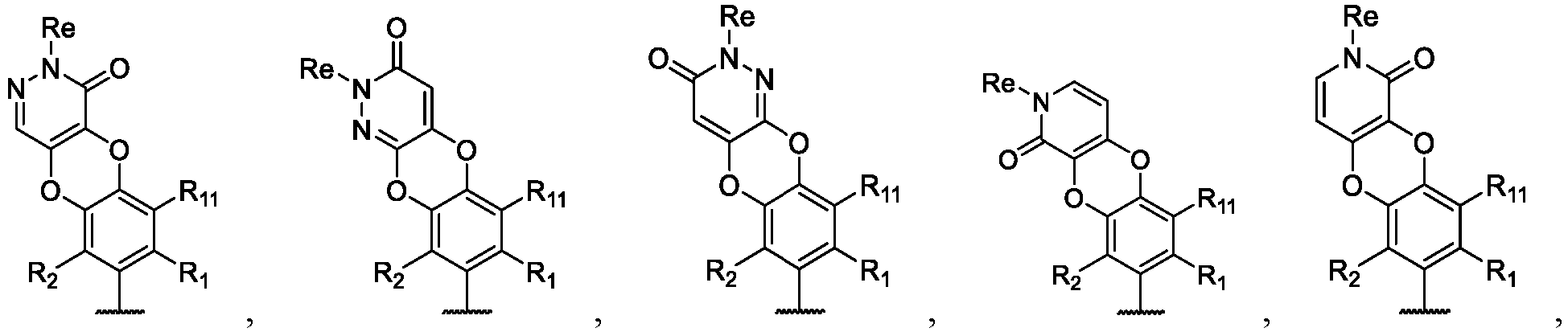

- In some embodiments, R' and R" are each independently selected from H, C1-C4 alkyl and C3-C6 cycloalkyl.
- In some embodiments, R1 is cyano, -C(O)NH2, -C(O)NHCH3 and

- In some embodiments, R1 is cyano, -C(O)NH2 or -C(O)NHCH3; R2 is H or F; Rn is H; R14 is H or methyl; n is 0, 1 or 2; R16 is H, hydroxyl or methyl; Re is selected from H, methyl, ethyl, cyclopropyl, cyclobutyl, -CH2CH2OH, acetyl, propionyl and cyclopropionyl; Rf is selected from H, F, Cl, hydroxyl, cyano, -NH2, methoxy, methyl, ethyl, cyclopropyl and cyclobutyl.
- In some embodiments, R1 is -C(O)NH2, -C(O)NHCH3 and

- In some embodiments, R1 is -C(O)NH2 or -C(O)NHCH3; R2 is F; Rn is H; R14 is H; R16 is H; Re is selected from H, methyl, ethyl, cyclopropyl and acetyl; Rf is selected from H, F, Cl, hydroxyl, cyano, -NH2, methoxy and methyl.
- In some embodiments, ring A and ring B, together with their substituents, form any one of the following groups:

- In some embodiments, R1 is cyano, -C(O)NH2, -C(O)NHCH3 and

- In some embodiments, R1 is cyano, -C(O)NH2 or -C(O)NHCH3; R2 is H or F; R14 is H or methyl; n is 0, 1 or 2; Re is selected from H, methyl, cyclopropyl, cyclobutyl, -CH2CH2OH, acetyl, propionyl and cyclopropionyl; Rf is selected from H, F, Cl, hydroxyl, cyano, -NH2, methoxy, methyl, ethyl, cyclopropyl and cyclobutyl.
- In some embodiments, X2 is selected from: C and N;
- X3 is selected from: C and N;
- Y5 and Y6 are independently selected from: O, S, N, -S(O)-, -S(O)2-, CH(R13), C(R13)2, C(R13), -OCH2-, -N(R12)CH2-, -CH2CH2- and N(R12); and Y5 and Y6 are not simultaneously a bond;
- Y1 is selected from: a bond, O, N, CH, CH2, NH, CH(R13), C(R13)2 and N(R12);
- Y4 is selected from: a bond, O, N, CH, CH2, NH, CH(R13), C(R13)2 and N(R12);
- ring B is optionally substituted by one or more R13 and/or R12 that do not participate in ring formation, and further optionally substituted by 1, 2 or 3 substituents selected from hydroxyl, amino, halogen, substituted or unsubstituted C1-C4 alkyl, -NR'R" and substituted or unsubstituted C1-C4 alkoxy;
- R1 is selected from: cyano and -C(O)NR'R";
- R2 is selected from: H, halogen, substituted or unsubstituted C1-C4 alkyl and substituted or unsubstituted C1-C4 alkoxy;
- R3 is selected from: substituted or unsubstituted aryl;
- R4 and R5 are each independently selected from: H, halogen and substituted or unsubstituted C1-C4 alkyl; alternatively, R4 and R5, together with the carbon atom to which they are attached, form a 3- to 6-membered substituted or unsubstituted ring, and the ring optionally contains 1, 2 or 3 heteroatoms selected from O, N and S;
- R6 is selected from: H, substituted or unsubstituted C1-C6 alkyl, substituted or unsubstituted C1-C6 alkoxy, substituted or unsubstituted C2-C6 alkenyl, substituted or unsubstituted C2-C6 alkynyl, substituted or unsubstituted 3- to 8-membered cyclohydrocarbyl, substituted or unsubstituted 6- to 14-membered aryl, substituted or unsubstituted 5- to 10-membered heteroaryl, substituted or unsubstituted 4- to 9-membered monocyclic or fused heterocyclyl, substituted or unsubstituted 6- to 12-membered bridged cyclyl, substituted or unsubstituted 6- to 12-membered bridged heterocyclyl, substituted or unsubstituted 6- to 12-membered spiro cyclyl and substituted or unsubstituted 6- to 12-membered spiro heterocyclyl;
- alternatively, R4 or R5 and R6, together with the atom to which they are attached, form a 4- to 9-membered monocyclic or fused heterocyclyl, 6- to 12-membered bridged heterocyclyl or 6- to 12-membered spiro heterocyclyl ring, and the 4- to 9-membered monocyclic or fused heterocyclyl, 6- to 12-membered bridged heterocyclyl and 6- to 12-membered spiro heterocyclyl are optionally substituted by 1, 2 or 3 substituents selected from H, deuterium, hydroxyl, cyano, C1-C4 alkyl, halogen and C1-C4 alkoxy;
- R7 and R8 are each independently selected from: H, halogen, cyano, substituted or unsubstituted C1-C4 alkyl, substituted or unsubstituted C1-C4 haloalkyl and substituted or unsubstituted C1-C4 alkoxy;
- R9 is selected from: H, C1-C4 alkyl, C1-C4 alkoxy, hydroxyl and halogen;
- R10 is selected from: H, halogen and C1-C4 alkyl;
- R11 is selected from: H, hydroxyl, amino, halogen, C1-C4 alkyl, -NR'R" and C1-C4 alkoxy;
- each R12 that does not participate in ring formation is independently selected from H, substituted or unsubstituted C1-C4 acyl, substituted or unsubstituted C1-C4 alkoxy, substituted or unsubstituted C1-C4 alkyl-S(O)2-, substituted or unsubstituted 4- to 9-membered heterocyclyl, NR'R"-C(O)-, 3- to 8-membered cyclohydrocarbyl-C(O)- and substituted or unsubstituted C1-C4 alkyl; the C1-C4 acyl, C1-C4 alkoxy, C1-C4 alkyl-S(O)2-, 4- to 9-membered heterocyclyl and C1-C4 alkyl are optionally substituted by 1, 2 or 3 substituents selected from F, hydroxyl and cyano;
- each R13 that does not participate in ring formation is independently selected from: H, halogen, substituted or unsubstituted C1-C4 acyl, hydroxyl, cyano, -NR'R", substituted or unsubstituted C1-C4 alkoxy, substituted or unsubstituted C1-C4 alkyl, substituted or unsubstituted C1-C4 alkyl-S(O)2-, substituted or unsubstituted 3- to 6-membered cyclohydrocarbyl-C(O)- and NR'R"-C(O)-; the C1-C4 acyl, C1-C4 alkoxy, C1-C4 alkyl, C1-C4 alkyl-S(O)2- and 3- to 6-membered cyclohydrocarbyl-C(O)- are optionally substituted by 1, 2 or 3 substituents selected from F, hydroxyl and cyano, or two R13 on the same carbon atom form an oxo (=O) or thio (=S) group;
- R' and R" are each independently selected from H and C1-C4 alkyl;
- wherein the dashed line indicates the presence or absence of a double bond.
- In some embodiments, R' and R" can also be each independently selected from C3-C6 cycloalkyl.
- In some embodiments, R1 is

- In some embodiments, X2 is selected from: C and N;
- X3 is selected from: C and N;
- Y5 is selected from: O, S, -S(O)-, -S(O)2-, N, CH2, CH, -C(O)-, NH and -N(CH3)-;
- Y6 is selected from: O, S, -S(O)-, -S(O)2-, N, CH2, CH, -C(O)-, NH and -N(CH3)-;
- Y1 is selected from: a bond, O, NH, -N(CH3)-, CH2 and -CH(CH3)-;
- Y4 is selected from: a bond, O, NH, -N(CH3)-, CH2 and -CH(CH3)-;
- H on ring B is further optionally substituted by 1, 2 or 3 substituents selected from hydroxyl, amino, halogen, substituted or unsubstituted C1-C4 alkyl, -NR'R" and substituted or unsubstituted C1-C4 alkoxy;
- R1 is selected from: cyano, -C(O)NH2 and -C(O)NHCH3;
- R2 is selected from: H, fluorine and methoxy;
- R3 is phenyl;
- R4 and R5 are each independently selected from: H and C1-C4 alkyl;
- R6 is H, substituted or unsubstituted C1-C6 alkyl, substituted or unsubstituted C1-C6 alkoxy, substituted or unsubstituted C2-C6 alkenyl or substituted or unsubstituted C2-C6 alkynyl, and their substituents are 1, 2 or 3 substituents selected from: hydroxyl, halogen, C1-C4 alkoxy optionally substituted by halogen, cyano, -S(O)2-C1-C4 alkyl optionally substituted by halogen, C1-C4 alkyl optionally substituted by halogen, -S(O)2-NR'R", -S(O)2-NH2, -C(O)-C1-C4 alkyl, - NR'-C(O)-C1-C4 alkyl and 6- to 14-membered aryl, 5- to 10-membered heteroaryl, 3- to 8-membered cyclohydrocarbyl and 4- to 9-membered heterocyclyl, wherein the 6- to 14-membered aryl, 5- to 10-membered heteroaryl, 3- to 8-membered cyclohydrocarbyl and 4- to 9-membered heterocyclyl are optionally substituted by 1, 2 or 3 substituents selected from C1-C4 alkyl, C1-C4 haloalkyl, C1-C4 alkoxy, C1-C4 haloalkoxy, halogen, cyano, C1-C4 alkyl-S(O)2-, hydroxyl, carboxyl, -NR'R", 6- to 14-membered aryl, 5- to 10-membered heteroaryl, 3- to 8-membered cyclohydrocarbyl and 4- to 9-membered heterocyclyl; wherein R' and R" are each independently selected from H and C1-C4 alkyl; or
- R6 is substituted or unsubstituted 3- to 8-membered cyclohydrocarbyl or substituted or unsubstituted 4- to 9-membered monocyclic or fused heterocyclyl, and their substituents are 1, 2 or 3 substituents selected from: halogen, hydroxyl, cyano, -NR'R", -S(O)2-NR'R", -S(O)2-NH2, -NR'-C(O)-C1-C4 alkyl, -S(O)2-C1-C4 alkyl, C1-C4 alkyl, C1-C4 alkoxy, C1-C4 haloalkoxy, - C(O)-C1-C4 alkyl and C1-C4 alkoxycarbonyl, and the C1-C4 alkyl and C1-C4 alkoxy are optionally substituted by 1, 2 or 3 groups selected from halogen, hydroxyl and -NR'R", wherein the R' and R" are each independently selected from H and C1-C4 alkyl; or
- R6 is substituted or unsubstituted 6- to 12-membered bridged cyclyl, substituted or unsubstituted 6- to 12-membered bridged heterocyclyl, substituted or unsubstituted 6- to 12-membered spiro cyclyl or substituted or unsubstituted 6- to 12-membered spiro heterocyclyl, and their substituents are 1, 2 or 3 substituents selected from: C1-C4 alkyl, C1-C4 haloalkyl, C1-C4 alkoxy, C1-C4 haloalkoxy, cyano, -S(O)2-C1-C4 alkyl, hydroxyl, halogen, NR'R", -S(O)2-NR'R", -S(O)2-NH2 and -NR'-C(O)-C1-C4 alkyl, wherein the R' and R" are each independently selected from H and C1-C4 alkyl;
- alternatively, R4 or R5 and R6, together with the atom to which they are attached, form the following group optionally substituted by 1, 2 or 3 substituents selected from H, deuterium, hydroxyl, methyl, F and methoxy:

- R7 and R8 are each independently selected from: H, halogen, cyano, methyl and methoxy;
- R9 is selected from: H, methyl, methoxy, hydroxyl and F;
- R10 is selected from: H, F and methyl; Rn is selected from: H, hydroxyl, amino, fluorine, chlorine, methyl, methoxy and -NH(CH3).
- In some embodiments, ring A and ring B, together with their ring substituents, form any one of the following groups:


- X1 is O;
- R3 is selected from unsubstituted phenyl or phenyl substituted by 1, 2 or 3 substituents selected from hydroxyl, halogen, C1-C4 alkyl, C1-C4 haloalkyl and C1-C4 alkoxy;
- R4 is selected from H and C1-C4 alkyl;
- R5 is selected from H and C1-C4 alkyl;
- R6 is selected from: H; C1-C4 alkyl, which is optionally substituted by 1, 2 or 3 substituents selected from hydroxyl, halogen, C1-C4 alkoxy, cyano and -S(O)2-C1-C4 alkyl; 3- to 8-membered cyclohydrocarbyl, which is optionally substituted by 1, 2 or 3 substituents selected from halogen, hydroxyl, cyano, -S(O)2-C1-C4 alkyl, C1-C4 alkyl and C1-C4 alkoxy; 4- to 9-membered monocyclic or fused heterocyclyl, which is optionally substituted by 1, 2 or 3 substituents selected from halogen, hydroxyl, cyano, -S(O)2-C1-C4 alkyl, C1-C4 alkyl and C1-C4 alkoxy; and 6- to 12-membered bridged cyclyl, 6- to 12-membered spiro cyclyl, 6- to 12-membered bridged heterocyclyl or 6- to 12-membered spiro heterocyclyl, which are each optionally substituted by 1, 2 or 3 substituents selected from C1-C4 alkyl, C1-C4 alkoxy and cyano;
- alternatively, R4 or R5 and R6, together with the atom to which they are attached, form the following group optionally substituted by 1, 2 or 3 substituents selected from H, deuterium, hydroxyl, methyl, F and methoxy:

- R7 and R8 are each independently selected from: H, halogen, cyano, methyl and methoxy;
- R9 is selected from: H, methyl, methoxy, hydroxyl and F;
- R10 is selected from: H, F and methyl.
- In some embodiments, R' and R" are each independently selected from H, C1-C4 alkyl and C3-C6 cycloalkyl.
- In some embodiments, ring A and ring B, together with their ring substituents, form any one of the following groups:


- In some embodiments, R1 is -C(O)NR'R"; R2 is F; Rn is H, F or methyl; Re is selected from H, methyl, ethyl, cyclopropyl, cyclobutyl, -CH2CH2OH, -CH2CH2OCH3 and acetyl; Rf is selected from H, F, Cl, hydroxyl, cyano, -NR'R", methoxy, ethoxy, C1-C6 alkyl and 3- to 6-membered cyclohydrocarbyl, wherein R' and R" are each independently selected from H and methyl.
- In some embodiments, ring A and ring B, together with their ring substituents, form any one of the following groups:

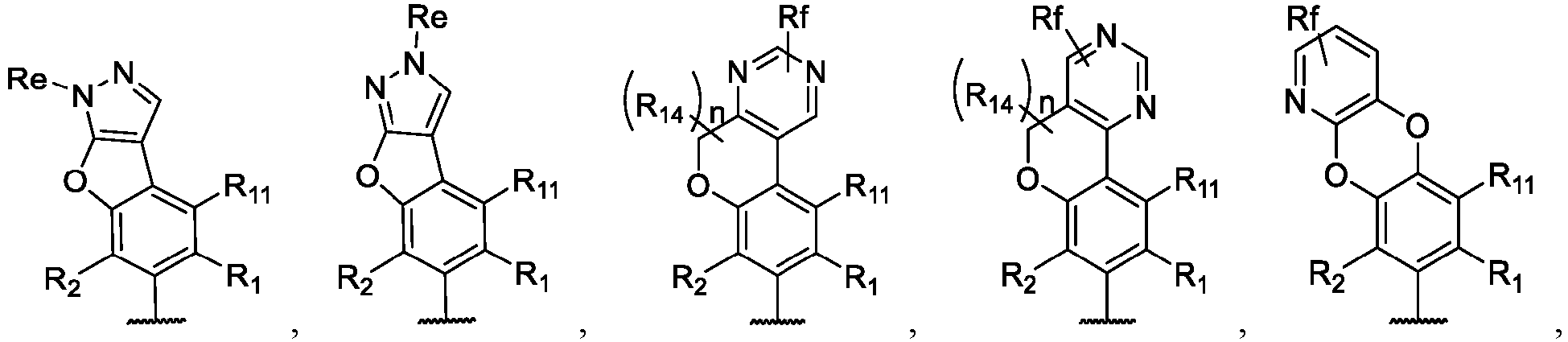


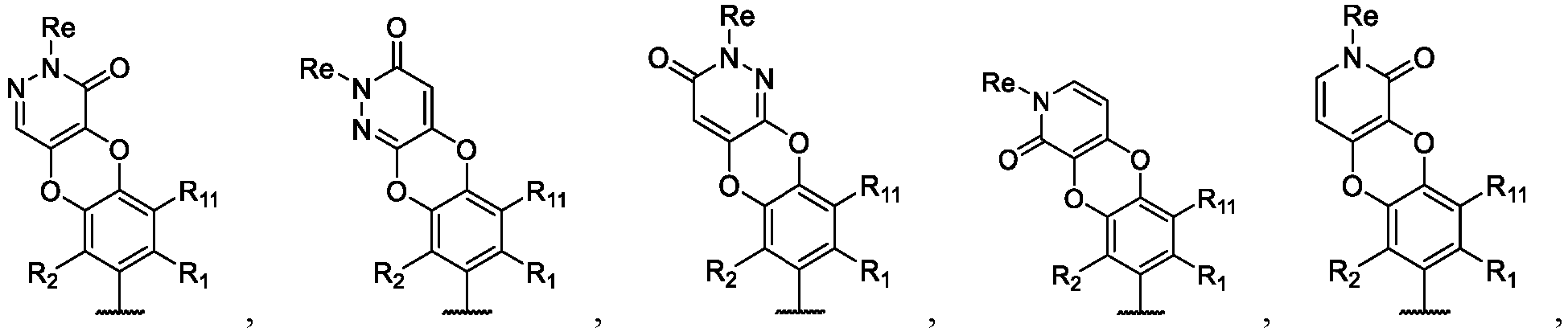

- In some embodiments, R1 is -C(O)NR'R"; R2 is F; Rn is H, F or methyl; R14 is H, F or methyl; n is 0, 1 or 2; R16 is selected from H, hydroxyl and methyl; Re is selected from H, methyl, ethyl, cyclopropyl, cyclobutyl, -CH2CH2OH, -CH2CH2OCH3 and acetyl; Rf is selected from H, F, Cl, hydroxyl, cyano, -NR'R", methoxy, ethoxy, C1-C6 alkyl and 3- to 6-membered cyclohydrocarbyl, wherein R' and R" are each independently selected from H and methyl.
- In some embodiments, the compound is selected from the following compounds:

- In some embodiments, the compound is selected from the following compounds:

- In some embodiments, the compound is selected from the following compounds:

- Y4 is selected from: C, CH and N;
- Y6 is selected from: C, CH and N;
- ring D is a 3- to 8-membered cyclohydrocarbyl, 4- to 9-membered heterocyclyl, 6- to 10-membered aryl or 5- to 10-membered heteroaryl ring, wherein the 4- to 9-membered heterocyclyl and 5- to 10-membered heteroaryl contain 1, 2 or 3 heteroatoms selected from O, N and S;
- R15 is selected from: H, halogen, oxo (=O), thio (=S), substituted or unsubstituted C1-C4 acyl, hydroxyl, substituted or unsubstituted C1-C4 alkoxy, cyano, -NR'R", substituted or unsubstituted C1-C4 alkyl-S(O)2-, substituted or unsubstituted 6- to 10-membered aryl-S(O)2-, substituted or unsubstituted 4- to 9-membered heterocyclyl, NR'R"-C(O)-, substituted or unsubstituted 3- to 8-membered cyclohydrocarbyl, substituted or unsubstituted 3- to 8-membered cyclohydrocarbyl-C(O)-, substituted or unsubstituted C1-C4 haloalkyl and substituted or unsubstituted C1-C4 alkyl; preferably, the C1-C4 acyl, C1-C4 alkoxy, C1-C4 alkyl-S(O)2-, 6- to 10-membered aryl-S(O)2-, 4- to 9-membered heterocyclyl, 3- to 8-membered cyclohydrocarbyl, 3- to 8-membered cyclohydrocarbyl-C(O)-, C1-C4 haloalkyl and C1-C4 alkyl are optionally substituted by 1, 2 or 3 substituents selected from F, hydroxyl and cyano;
- n is 0, 1, 2, 3 or 4.
- In some embodiments, the compound is selected from the following compounds:

- Y1 is selected from: C, CH and N;
- Y4 is selected from: C, CH and N;
- ring D is a 3- to 8-membered cyclohydrocarbyl, 4- to 9-membered heterocyclyl, 6- to 10-membered aryl or 5- to 10-membered heteroaryl ring, wherein the 4- to 9-membered heterocyclyl and 5- to 10-membered heteroaryl contain 1, 2 or 3 heteroatoms selected from O, N and S;
- R15 is selected from: H, halogen, oxo (=O), thio (=S), substituted or unsubstituted C1-C4 acyl, hydroxyl, substituted or unsubstituted C1-C4 alkoxy, cyano, -NR'R", substituted or unsubstituted C1-C4 alkyl-S(O)2-, substituted or unsubstituted 6- to 10-membered aryl-S(O)2-, substituted or unsubstituted 4- to 9-membered heterocyclyl, NR'R"-C(O)-, substituted or unsubstituted 3- to 8-membered cyclohydrocarbyl, substituted or unsubstituted 3- to 8-membered cyclohydrocarbyl-C(O)-, substituted or unsubstituted C1-C4 haloalkyl and substituted or unsubstituted C1-C4 alkyl; preferably, the C1-C4 acyl, C1-C4 alkoxy, C1-C4 alkyl-S(O)2-, 6- to 10-membered aryl-S(O)2-, 4- to 9-membered heterocyclyl, 3- to 8-membered cyclohydrocarbyl, 3- to 8-membered cyclohydrocarbyl-C(O)-, C1-C4 haloalkyl and C1-C4 alkyl are optionally substituted by 1, 2 or 3 substituents selected from F, hydroxyl and cyano;
- n is 0, 1, 2, 3 or 4.
- In some embodiments, the compound is selected from the following compounds:

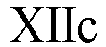
- ring E is a 3- to 8-membered cyclohydrocarbyl or 4- to 9-membered heterocyclyl ring, wherein the 4- to 9-membered heterocyclyl contains 1, 2 or 3 heteroatoms selected from O, N and S;
- R16 is selected from H, halogen, substituted or unsubstituted C1-C4 alkyl, hydroxyl, substituted or unsubstituted C1-C4 acyl and substituted or unsubstituted C1-C4 alkoxy; preferably, the C1-C4 alkyl, C1-C4 acyl and C1-C4 alkoxy are optionally substituted by 1, 2 or 3 substituents selected from F, hydroxyl and cyano;
- n is 0, 1, 2, 3 or 4.
- In some embodiments, the compound is selected from the following compounds:

- ring E is a 3- to 8-membered cyclohydrocarbyl or 4- to 9-membered heterocyclyl ring, wherein the 4- to 9-membered heterocyclyl contains 1, 2 or 3 heteroatoms selected from O, N and S;
- R16 is selected from H, halogen, substituted or unsubstituted C1-C4 alkyl, hydroxyl, substituted or unsubstituted C1-C4 acyl and substituted or unsubstituted C1-C4 alkoxy; preferably, the C1-C4 alkyl, C1-C4 acyl and C1-C4 alkoxy are optionally substituted by 1, 2 or 3 substituents selected from F, hydroxyl and cyano;
- n is 0, 1, 2, 3 or 4.
- In some embodiments, the compound is selected from the following compounds:

- Y4 is selected from: C, CH and N;
- Y6 is selected from: C, CH and N;
- ring D is a 3- to 8-membered cyclohydrocarbyl, 4- to 9-membered heterocyclyl, 6- to 10-membered aryl or 5- to 10-membered heteroaryl ring, wherein the 4- to 9-membered heterocyclyl and 5- to 10-membered heteroaryl contain 1, 2 or 3 heteroatoms selected from O, N and S;
- D1 is selected from: O, S, S(O), S(O)2, N, NRe, CRf and CRfRg;
- D2 is selected from: O, S, S(O), S(O)2, N, NRe, (CRf)p, (CRfRg)p, C(O)-NRe, N-NRe, CRf-NRe, N
- - - N and N- - C(Rf); - D3 is selected from: O, S, S(O), S(O)2, N, NRe, (CRf)p and (CRfRg)p;
- provided that D1 and D2, D1 and D3 are not simultaneously O, S, -S(O)- or -S(O)2- and satisfy the valence bond theory;
- each Re at each occurrence is independently selected from: H, substituted or unsubstituted C1-C4 acyl, substituted or unsubstituted C1-C4 alkoxy, cyano, substituted or unsubstituted C1-C4 alkyl-S(O)2-, substituted or unsubstituted 4- to 9-membered heterocyclyl, NR'R"-C(O)-, substituted or unsubstituted 3- to 6-membered cyclohydrocarbyl, substituted or unsubstituted 3- to 6-membered cyclohydrocarbyl-C(O)-, substituted or unsubstituted C1-C4 haloalkyl and substituted or unsubstituted C1-C4 alkyl, wherein R' and R" are each independently selected from H and C1-C4 alkyl; preferably, the C1-C4 acyl, C1-C4 alkoxy, C1-C4 alkyl-S(O)2-, 4- to 9-membered heterocyclyl, 3- to 6-membered cyclohydrocarbyl, 3- to 6-membered cyclohydrocarbyl-C(O)-, C1-C4 haloalkyl and C1-C4 alkyl are optionally substituted by 1, 2 or 3 substituents selected from F, hydroxyl and cyano;
- each Rf at each occurrence is independently selected from: H, halogen, substituted or unsubstituted C1-C4 acyl, hydroxyl, cyano, -NR'R", substituted or unsubstituted C1-C4 alkoxy, substituted or unsubstituted C1-C4 alkyl, substituted or unsubstituted 3- to 6-membered cyclohydrocarbyl, substituted or unsubstituted C1-C4 alkyl-S(O)2-, substituted or unsubstituted 3-to 6-membered cyclohydrocarbyl-C(O)- and NR'R"-C(O)-, wherein R' and R" are each independently selected from H and C1-C4 alkyl; preferably, the C1-C4 acyl, C1-C4 alkoxy, C1-C4 alkyl, 3- to 6-membered cyclohydrocarbyl, C1-C4 alkyl-S(O)2- and 3- to 6-membered cyclohydrocarbyl-C(O)- are optionally substituted by 1, 2 or 3 substituents selected from F, hydroxyl and cyano;
- each Rg at each occurrence is independently selected from: H, halogen, substituted or unsubstituted C1-C4 acyl, hydroxyl, cyano, -NR'R", substituted or unsubstituted C1-C4 alkoxy, substituted or unsubstituted C1-C4 alkyl, substituted or unsubstituted 3- to 6-membered cyclohydrocarbyl, substituted or unsubstituted C1-C4 alkyl-S(O)2-, substituted or unsubstituted 3-to 6-membered cyclohydrocarbyl-C(O)- and NR'R"-C(O)-, wherein R' and R" are each independently selected from H and C1-C4 alkyl; preferably, the C1-C4 acyl, C1-C4 alkoxy, C1-C4 alkyl, 3- to 6-membered cyclohydrocarbyl, C1-C4 alkyl-S(O)2- and 3- to 6-membered cyclohydrocarbyl-C(O)- are optionally substituted by 1, 2 or 3 substituents selected from F, hydroxyl and cyano;
- alternatively, Rf and Rg on the same carbon atom form an oxo (=O) or thio (=S) group;
- each p is independently 1, 2, 3 or 4, preferably 1 or 2.
- In some embodiments, D2 is selected from: O, S, S(O), S(O)2, N, NRe, (CRf)p, (CRfRg)p, N
- - - N and N- - C(Rf). - In some embodiments, the compound is selected from the following compounds:

- Y1 is selected from: C, CH and N;
- Y4 is selected from: C, CH and N;
- ring D is a 3- to 8-membered cyclohydrocarbyl, 4- to 9-membered heterocyclyl, 6- to 10-membered aryl or 5- to 10-membered heteroaryl ring, wherein the 4- to 9-membered heterocyclyl and 5- to 10-membered heteroaryl contain 1, 2 or 3 heteroatoms selected from O, N and S;
- D1 is selected from: O, S, S(O), S(O)2, N, NRe, CRf and CRfRg;
- D2 is selected from: O, S, S(O), S(O)2, N, NRe, (CRf)p, (CRfRg)p, C(O)-NRe, N-NRe, CRf-NRe, N
- - - N and - D3 is selected from: O, S, S(O), S(O)2, N, NRe, (CRf)p and (CRfRg)p;
- provided that D1 and D2, D1 and D3 are not simultaneously O, S, -S(O)- or -S(O)2- and satisfy the valence bond theory;
- each Re at each occurrence is independently selected from: H, substituted or unsubstituted C1-C4 acyl, substituted or unsubstituted C1-C4 alkoxy, cyano, substituted or unsubstituted C1-C4 alkyl-S(O)2-, substituted or unsubstituted 4- to 9-membered heterocyclyl, NR'R"-C(O)-, substituted or unsubstituted 3- to 6-membered cyclohydrocarbyl, substituted or unsubstituted 3- to 6-membered cyclohydrocarbyl-C(O)-, substituted or unsubstituted C1-C4 haloalkyl and substituted or unsubstituted C1-C4 alkyl, wherein R' and R" are each independently selected from H and C1-C4 alkyl; preferably, the C1-C4 acyl, C1-C4 alkoxy, C1-C4 alkyl-S(O)2-, 4- to 9-membered heterocyclyl, 3- to 6-membered cyclohydrocarbyl, 3- to 6-membered cyclohydrocarbyl-C(O)-, C1-C4 haloalkyl and C1-C4 alkyl are optionally substituted by 1, 2 or 3 substituents selected from F, hydroxyl and cyano;
- each Rf at each occurrence is independently selected from: H, halogen, substituted or unsubstituted C1-C4 acyl, hydroxyl, cyano, -NR'R", substituted or unsubstituted C1-C4 alkoxy, substituted or unsubstituted C1-C4 alkyl, substituted or unsubstituted 3- to 6-membered cyclohydrocarbyl, substituted or unsubstituted C1-C4 alkyl-S(O)2-, substituted or unsubstituted 3-to 6-membered cyclohydrocarbyl-C(O)- and NR'R"-C(O)-, wherein R' and R" are each independently selected from H and C1-C4 alkyl; preferably, the C1-C4 acyl, C1-C4 alkoxy, C1-C4 alkyl, 3- to 6-membered cyclohydrocarbyl, C1-C4 alkyl-S(O)2- and 3- to 6-membered cyclohydrocarbyl-C(O)- are optionally substituted by 1, 2 or 3 substituents selected from F, hydroxyl and cyano;
- each Rg at each occurrence is independently selected from: H, halogen, substituted or unsubstituted C1-C4 acyl, hydroxyl, cyano, -NR'R", substituted or unsubstituted C1-C4 alkoxy, substituted or unsubstituted C1-C4 alkyl, substituted or unsubstituted 3- to 6-membered cyclohydrocarbyl, substituted or unsubstituted C1-C4 alkyl-S(O)2-, substituted or unsubstituted 3-to 6-membered cyclohydrocarbyl-C(O)- and NR'R"-C(O)-, wherein R' and R" are each independently selected from H and C1-C4 alkyl; preferably, the C1-C4 acyl, C1-C4 alkoxy, C1-C4 alkyl, 3- to 6-membered cyclohydrocarbyl, C1-C4 alkyl-S(O)2- and 3- to 6-membered cyclohydrocarbyl-C(O)- are optionally substituted by 1, 2 or 3 substituents selected from F, hydroxyl and cyano;
- alternatively, Rf and Rg on the same carbon atom form an oxo (=O) or thio (=S) group;
- each p is independently 1, 2, 3 or 4, preferably 1 or 2.
- In some embodiments, D2 is selected from: O, S, S(O), S(O)2, N, NRe, (CRf)p, (CRfRg)p, N
- - - N and N- - C(Rf). - In some embodiments, the compound is selected from the following compounds:

- Y4 is selected from: C, CH and N;
- Y6 is selected from: C, CH and N;
- ring D is a 3- to 8-membered cyclohydrocarbyl, 4- to 9-membered heterocyclyl, 6- to 10-membered aryl or 5- to 10-membered heteroaryl ring, wherein the 4- to 9-membered heterocyclyl and 5- to 10-membered heteroaryl contain 1, 2 or 3 heteroatoms selected from O, N and S;
- D1 is selected from: O, S, S(O), S(O)2, N, NRe, CRf and CRfRg;
- D2 is selected from: O, S, S(O), S(O)2, N, NRe, (CRf)p, (CRfRg)p, C(O)-NRe, N-NRe, CRf-NRe, N
- - - N and N- - C(Rf); - D3 is selected from: O, S, S(O), S(O)2, N, NRe, (CRf)p and (CRfRg)p;
- provided that D1 and D2, D1 and D3 are not simultaneously O, S, -S(O)- or -S(O)2- and satisfy the valence bond theory;
- each Re at each occurrence is independently selected from: H, substituted or unsubstituted C1-C4 acyl, substituted or unsubstituted C1-C4 alkoxy, cyano, substituted or unsubstituted C1-C4 alkyl-S(O)2-, substituted or unsubstituted 4- to 9-membered heterocyclyl, NR'R"-C(O)-, substituted or unsubstituted 3- to 6-membered cyclohydrocarbyl, substituted or unsubstituted 3- to 6-membered cyclohydrocarbyl-C(O)-, substituted or unsubstituted C1-C4 haloalkyl and substituted or unsubstituted C1-C4 alkyl, wherein R' and R" are each independently selected from H and C1-C4 alkyl; preferably, the C1-C4 acyl, C1-C4 alkoxy, C1-C4 alkyl-S(O)2-, 4- to 9-membered heterocyclyl, 3- to 6-membered cyclohydrocarbyl, 3- to 6-membered cyclohydrocarbyl-C(O)-, C1-C4 haloalkyl and C1-C4 alkyl are optionally substituted by 1, 2 or 3 substituents selected from F, hydroxyl and cyano;
- each Rf at each occurrence is independently selected from: H, halogen, substituted or unsubstituted C1-C4 acyl, hydroxyl, cyano, -NR'R", substituted or unsubstituted C1-C4 alkoxy, substituted or unsubstituted C1-C4 alkyl, substituted or unsubstituted 3- to 6-membered cyclohydrocarbyl, substituted or unsubstituted C1-C4 alkyl-S(O)2-, substituted or unsubstituted 3-to 6-membered cyclohydrocarbyl-C(O)- and NR'R"-C(O)-, wherein R' and R" are each independently selected from H and C1-C4 alkyl; preferably, the C1-C4 acyl, C1-C4 alkoxy, C1-C4 alkyl, 3- to 6-membered cyclohydrocarbyl, C1-C4 alkyl-S(O)2- and 3- to 6-membered cyclohydrocarbyl-C(O)- are optionally substituted by 1, 2 or 3 substituents selected from F, hydroxyl and cyano;
- each Rg at each occurrence is independently selected from: H, halogen, substituted or unsubstituted C1-C4 acyl, hydroxyl, cyano, -NR'R", substituted or unsubstituted C1-C4 alkoxy, substituted or unsubstituted C1-C4 alkyl, substituted or unsubstituted 3- to 6-membered cyclohydrocarbyl, substituted or unsubstituted C1-C4 alkyl-S(O)2-, substituted or unsubstituted 3-to 6-membered cyclohydrocarbyl-C(O)- and NR'R"-C(O)-, wherein R' and R" are each independently selected from H and C1-C4 alkyl; preferably, the C1-C4 acyl, C1-C4 alkoxy, C1-C4 alkyl, 3- to 6-membered cyclohydrocarbyl, C1-C4 alkyl-S(O)2- and 3- to 6-membered cyclohydrocarbyl-C(O)- are optionally substituted by 1, 2 or 3 substituents selected from F, hydroxyl and cyano;
- alternatively, Rf and Rg on the same carbon atom form an oxo (=O) or thio (=S) group;
- each p is independently 1, 2, 3 or 4, preferably 1 or 2;
- ring C is a substituted or unsubstituted 4- to 12-membered monocyclic or fused heterocyclyl, substituted or unsubstituted 6- to 12-membered bridged heterocyclyl or substituted or unsubstituted 6- to 12-membered spiro heterocyclyl ring, and the 4- to 12-membered monocyclic or fused heterocyclyl, 6- to 12-membered bridged heterocyclyl and 6- to 12-membered spiro heterocyclyl each optionally further contain 1 or 2 heteroatoms selected from N and O; ring C is preferably a substituted or unsubstituted 4- to 8-membered nitrogen-containing monocyclic heterocyclyl, substituted or unsubstituted 6- to 12-membered nitrogen-containing spiro heterocyclyl or substituted or unsubstituted 6- to 12-membered nitrogen-containing fused heterocyclyl ring.
- In some embodiments, in formula XIVa, D2 is selected from: O, S, S(O), S(O)2, N, NRe, (CRf)p, (CRfRg)p, N
- - - N and N- - C(Rf). - In some embodiments, the compound is selected from the following compounds:

- Y1 is selected from: C, CH and N;
- Y4 is selected from: C, CH and N;
- ring D is a 3- to 8-membered cyclohydrocarbyl, 4- to 9-membered heterocyclyl, 6- to 10-membered aryl or 5- to 10-membered heteroaryl ring, wherein the 4- to 9-membered heterocyclyl and 5- to 10-membered heteroaryl contain 1, 2 or 3 heteroatoms selected from O, N and S;
- D1 is selected from: O, S, S(O), S(O)2, N, NRe, CRf and CRfRg;
- D2 is selected from: O, S, S(O), S(O)2, N, NRe, (CRf)p, (CRfRg)p, C(O)-NRe, N-NRe, CRf-NRe, N
- - - N and N- - C(Rf); - D3 is selected from: O, S, S(O), S(O)2, N, NRe, (CRf)p and (CRfRg)p;
- provided that D1 and D2, D1 and D3 are not simultaneously O, S, -S(O)- or -S(O)2- and satisfy the valence bond theory;
- each Re at each occurrence is independently selected from: H, substituted or unsubstituted C1-C4 acyl, substituted or unsubstituted C1-C4 alkoxy, cyano, substituted or unsubstituted C1-C4 alkyl-S(O)2-, substituted or unsubstituted 4- to 9-membered heterocyclyl, NR'R"-C(O)-, substituted or unsubstituted 3- to 6-membered cyclohydrocarbyl, substituted or unsubstituted 3- to 6-membered cyclohydrocarbyl-C(O)-, substituted or unsubstituted C1-C4 haloalkyl and substituted or unsubstituted C1-C4 alkyl, wherein R' and R" are each independently selected from H and C1-C4 alkyl; preferably, the C1-C4 acyl, C1-C4 alkoxy, C1-C4 alkyl-S(O)2-, 4- to 9-membered heterocyclyl, 3- to 6-membered cyclohydrocarbyl, 3- to 6-membered cyclohydrocarbyl-C(O)-, C1-C4 haloalkyl and C1-C4 alkyl are optionally substituted by 1, 2 or 3 substituents selected from F, hydroxyl and cyano;
- each Rf at each occurrence is independently selected from: H, halogen, substituted or unsubstituted C1-C4 acyl, hydroxyl, cyano, -NR'R", substituted or unsubstituted C1-C4 alkoxy, substituted or unsubstituted C1-C4 alkyl, substituted or unsubstituted 3- to 6-membered cyclohydrocarbyl, substituted or unsubstituted C1-C4 alkyl-S(O)2-, substituted or unsubstituted 3-to 6-membered cyclohydrocarbyl-C(O)- and NR'R"-C(O)-, wherein R' and R" are each independently selected from H and C1-C4 alkyl; preferably, the C1-C4 acyl, C1-C4 alkoxy, C1-C4 alkyl, 3- to 6-membered cyclohydrocarbyl, C1-C4 alkyl-S(O)2- and 3- to 6-membered cyclohydrocarbyl-C(O)- are optionally substituted by 1, 2 or 3 substituents selected from F, hydroxyl and cyano;
- each Rg at each occurrence is independently selected from: H, halogen, substituted or unsubstituted C1-C4 acyl, hydroxyl, cyano, -NR'R", substituted or unsubstituted C1-C4 alkoxy, substituted or unsubstituted C1-C4 alkyl, substituted or unsubstituted 3- to 6-membered cyclohydrocarbyl, substituted or unsubstituted C1-C4 alkyl-S(O)2-, substituted or unsubstituted 3-to 6-membered cyclohydrocarbyl-C(O)- and NR'R"-C(O)-, wherein R' and R" are each independently selected from H and C1-C4 alkyl; preferably, the C1-C4 acyl, C1-C4 alkoxy, C1-C4 alkyl, 3- to 6-membered cyclohydrocarbyl, C1-C4 alkyl-S(O)2- and 3- to 6-membered cyclohydrocarbyl-C(O)- are optionally substituted by 1, 2 or 3 substituents selected from F, hydroxyl and cyano;
- alternatively, Rf and Rg on the same carbon atom form an oxo (=O) or thio (=S) group;
- each p is independently 1, 2, 3 or 4, preferably 1 or 2;
- ring C is a substituted or unsubstituted 4- to 12-membered monocyclic or fused heterocyclyl, substituted or unsubstituted 6- to 12-membered bridged heterocyclyl or substituted or unsubstituted 6- to 12-membered spiro heterocyclyl ring, and the 4- to 12-membered monocyclic or fused heterocyclyl, 6- to 12-membered bridged heterocyclyl and 6- to 12-membered spiro heterocyclyl each optionally further contain 1 or 2 heteroatoms selected from N and O; ring C is preferably a substituted or unsubstituted 4- to 8-membered nitrogen-containing monocyclic heterocyclyl, substituted or unsubstituted 6- to 12-membered nitrogen-containing spiro heterocyclyl or substituted or unsubstituted 6- to 12-membered nitrogen-containing fused heterocyclyl ring.
- In some embodiments, in formula XIVb, D2 is selected from: O, S, S(O), S(O)2, N, NRe, (CRf)p, (CRfRg)p, N
- - - N and N- - C(Rf). - In some embodiments, the compound is selected from the following compounds:

- X2 is C;
- Y6 is selected from: C, CH and N;
- ring F is a 5- or 6-membered cyclohydrocarbyl, 5- or 6-membered heterocyclyl, phenyl or 5- or 6-membered heteroaryl ring, wherein the 5- or 6-membered heterocyclyl or 5- or 6-membered heteroaryl contains 1, 2 or 3 heteroatoms selected from O, N and S;
- R15 is selected from: H, halogen, oxo (=O), thio (=S), substituted or unsubstituted C1-C4 acyl, hydroxyl, substituted or unsubstituted C1-C4 alkoxy, cyano, -NR'R", substituted or unsubstituted C1-C4 alkyl-S(O)2-, substituted or unsubstituted 6- to 10-membered aryl-S(O)2-, substituted or unsubstituted 4- to 9-membered heterocyclyl, NR'R"-C(O)-, substituted or unsubstituted 3- to 8-membered cyclohydrocarbyl, substituted or unsubstituted 3- to 8-membered cyclohydrocarbyl-C(O)-, substituted or unsubstituted C1-C4 haloalkyl and substituted or unsubstituted C1-C4 alkyl; preferably, the C1-C4 acyl, C1-C4 alkoxy, C1-C4 alkyl-S(O)2-, 6- to 10-membered aryl-S(O)2-, 4- to 9-membered heterocyclyl, 3- to 8-membered cyclohydrocarbyl, 3- to 8-membered cyclohydrocarbyl-C(O)-, C1-C4 haloalkyl and C1-C4 alkyl are optionally substituted by 1, 2 or 3 substituents selected from F, hydroxyl and cyano;
- n is 0, 1, 2 or 3.
- In some embodiments, the compound is selected from the following compounds:

- X2 is C;
- Y6 is selected from: C, CH and N;
- ring F is a 5- or 6-membered cyclohydrocarbyl, 5- or 6-membered heterocyclyl, phenyl or 5- or 6-membered heteroaryl ring, wherein the 5- or 6-membered heterocyclyl or 5- or 6-membered heteroaryl contains 1, 2 or 3 heteroatoms selected from O, N and S;
- Y7, Ys and Y9 are independently selected from: a bond, O, S, S(O), S(O)2, N, NRe, CRf and CRfRg, provided that at most one of Y7, Y8 and Y9 is a bond, Y7 and Y8, Y8 and Y9 are not simultaneously O, S, -S(O)- or -S(O)2- and satisfy the valence bond theory,
- each Re at each occurrence is independently selected from: H, substituted or unsubstituted C1-C4 acyl, substituted or unsubstituted C1-C4 alkoxy, cyano, substituted or unsubstituted C1-C4 alkyl-S(O)2-, substituted or unsubstituted 4- to 9-membered heterocyclyl, NR'R"-C(O)-, substituted or unsubstituted 3- to 6-membered cyclohydrocarbyl, substituted or unsubstituted 3- to 6-membered cyclohydrocarbyl-C(O)-, substituted or unsubstituted C1-C4 haloalkyl and substituted or unsubstituted C1-C4 alkyl, wherein R' and R" are each independently selected from H and C1-C4 alkyl; preferably, the C1-C4 acyl, C1-C4 alkoxy, C1-C4 alkyl-S(O)2-, 4- to 9-membered heterocyclyl, 3- to 6-membered cyclohydrocarbyl, 3- to 6-membered cyclohydrocarbyl-C(O)-, C1-C4 haloalkyl and C1-C4 alkyl are optionally substituted by 1, 2 or 3 substituents selected from F, hydroxyl and cyano;
- each Rf at each occurrence is independently selected from: H, halogen, substituted or unsubstituted C1-C4 acyl, hydroxyl, cyano, -NR'R", substituted or unsubstituted C1-C4 alkoxy, substituted or unsubstituted C1-C4 alkyl, substituted or unsubstituted 3- to 6-membered cyclohydrocarbyl, substituted or unsubstituted C1-C4 alkyl-S(O)2-, substituted or unsubstituted 3-to 6-membered cyclohydrocarbyl-C(O)- and NR'R"-C(O)-, wherein R' and R" are each independently selected from H and C1-C4 alkyl; preferably, the C1-C4 acyl, C1-C4 alkoxy, C1-C4 alkyl, 3- to 6-membered cyclohydrocarbyl, C1-C4 alkyl-S(O)2- and 3- to 6-membered cyclohydrocarbyl-C(O)- are optionally substituted by 1, 2 or 3 substituents selected from F, hydroxyl and cyano;
- each Rg at each occurrence is independently selected from: H, halogen, substituted or unsubstituted C1-C4 acyl, hydroxyl, cyano, -NR'R", substituted or unsubstituted C1-C4 alkoxy, substituted or unsubstituted C1-C4 alkyl, substituted or unsubstituted 3- to 6-membered cyclohydrocarbyl, substituted or unsubstituted C1-C4 alkyl-S(O)2-, substituted or unsubstituted 3-to 6-membered cyclohydrocarbyl-C(O)- and NR'R"-C(O)-, wherein R' and R" are each independently selected from H and C1-C4 alkyl; preferably, the C1-C4 acyl, C1-C4 alkoxy, C1-C4 alkyl, 3- to 6-membered cyclohydrocarbyl, C1-C4 alkyl-S(O)2- and 3- to 6-membered cyclohydrocarbyl-C(O)- are optionally substituted by 1, 2 or 3 substituents selected from F, hydroxyl and cyano;
- alternatively, Rf and Rg on the same carbon atom form an oxo (=O) or thio (=S) group;
- ring C is a substituted or unsubstituted 4- to 12-membered monocyclic or fused heterocyclyl, substituted or unsubstituted 6- to 12-membered bridged heterocyclyl or substituted or unsubstituted 6- to 12-membered spiro heterocyclyl ring, and the 4- to 12-membered monocyclic or fused heterocyclyl, 6- to 12-membered bridged heterocyclyl and 6- to 12-membered spiro heterocyclyl each optionally further contain 1 or 2 heteroatoms selected from N and O; ring C is preferably a substituted or unsubstituted 4- to 8-membered nitrogen-containing monocyclic heterocyclyl, substituted or unsubstituted 6- to 12-membered nitrogen-containing spiro heterocyclyl or substituted or unsubstituted 6- to 12-membered nitrogen-containing fused heterocyclyl ring.
- In some embodiments, the compound is selected from the following compounds:

- D1 is selected from: O, S, S(O), S(O)2, N, NRe, CRfRg, CRf and C(=O);
- D2 is selected from: O, S, S(O), S(O)2, N, NRe, CRfRg, CRf and C(=O);
- D3 is selected from: O, S, S(O), S(O)2, N, NRe, CRfRg, CRf and C(=O);
- D4 is selected from: O, S, S(O), S(O)2, N, NRe, CRfRg, CRf and C(=O); and wherein the ring in which D1, D2, D3 and D4 are located satisfies valence bond theory and contains at most two C(=O) and three N atoms;
- each Re at each occurrence is independently selected from: H, substituted or unsubstituted C1-C4 acyl, substituted or unsubstituted C1-C4 alkoxy, cyano, substituted or unsubstituted C1-C4 alkyl-S(O)2-, substituted or unsubstituted 4- to 9-membered heterocyclyl, NR'R"-C(O)-, substituted or unsubstituted 3- to 6-membered cyclohydrocarbyl, substituted or unsubstituted 3- to 6-membered cyclohydrocarbyl-C(O)-, substituted or unsubstituted C1-C4 haloalkyl and substituted or unsubstituted C1-C4 alkyl; each Rf at each occurrence is independently selected from: H, halogen, hydroxyl, cyano, oxo, substituted or unsubstituted C1-C4 alkoxy, substituted or unsubstituted C1-C4 alkyl; preferably, the C1-C4 alkoxy and C1-C4 alkyl are optionally substituted by 1, 2 or 3 substituents selected from F, hydroxyl and cyano;
- Y5 and Y6 are independently selected from: a bond, O, S, N, -S(O)-, -S(O)2-, C, CH(R13), C(R13)2 and N(R12), and Y5 and Y6 are not simultaneously a bond;
- R1 is selected from: cyano and -C(O)NR'R";
- R2 is selected from: H, halogen, substituted or unsubstituted alkyl and substituted or unsubstituted alkoxy;
- R3 is selected from: substituted or unsubstituted aryl, substituted or unsubstituted heteroaryl and substituted or unsubstituted heterocyclyl;
- R4 and R5 are each independently selected from: H, halogen and substituted or unsubstituted C1-C4 alkyl;
- R6 is selected from: H, substituted or unsubstituted alkyl, substituted or unsubstituted alkoxy, substituted or unsubstituted alkenyl, substituted or unsubstituted alkynyl, substituted or unsubstituted cyclohydrocarbyl, substituted or unsubstituted aryl, substituted or unsubstituted heteroaryl and substituted or unsubstituted heterocyclyl;
- alternatively, R4 or R5 and R6, together with the atom to which they are attached, form a substituted or unsubstituted 4- to 6-membered heterocyclyl ring; the 4- to 6-membered heterocyclyl contains 1 or 2 heteroatoms selected from N and O;
- R7 is selected from: H, halogen, cyano, nitro, substituted or unsubstituted C1-C4 alkyl and substituted or unsubstituted C1-C4 alkoxy;
- R8 is selected from: H, halogen, cyano, nitro, substituted or unsubstituted C1-C4 alkyl and substituted or unsubstituted C1-C4 alkoxy;
- R9 is selected from: H, substituted or unsubstituted C1-C4 alkyl, substituted or unsubstituted C1-C4 alkoxy, hydroxyl and halogen;
- R10 is selected from: H, halogen and substituted or unsubstituted C1-C4 alkyl;
- R11 is selected from: H, hydroxyl, amino, halogen, substituted or unsubstituted C1-C4 alkyl, -NR'R" and substituted or unsubstituted C1-C4 alkoxy;
- R' and R" are each independently selected from H, C1-C4 alkyl, C3-C6 cycloalkyl, C1-C4 alkyl-S(O)2- and C1-C4 haloalkyl;
- each p is independently 1, 2, 3 or 4.
- In some embodiments, Re is selected from H, methyl, difluoromethyl, trifluoromethyl, deuteromethyl, ethyl, fluoroethyl, difluoroethyl, trifluoroethyl, isopropyl, cyclopropyl, cyclobutyl, trifluoropropyl, oxocyclobutyl, 1,1-difluorocyclobutyl, -CH2CH2OH, -CH2CH2OCH3 and acetyl.
- In some embodiments, in XVa, the C1-C4 acyl, C1-C4 alkoxy, C1-C4 alkyl-S(O)2-, 4- to 9-membered heterocyclyl, 3- to 6-membered cyclohydrocarbyl, 3- to 6-membered cyclohydrocarbyl-C(O)-, C1-C4 haloalkyl and C1-C4 alkyl are optionally substituted by 1, 2 or 3 substituents selected from F, hydroxyl and cyano.
- In some embodiments, the compound is selected from the following compounds:

in the formula, - D1 is selected from: O, S, S(O), S(O)2, N, NRe, CRfRg, CRf and C(=O);
- D2 is selected from: O, S, S(O), S(O)2, N, NRe, CRfRg, CRf and C(=O);
- D3 is selected from: O, S, S(O), S(O)2, N, NRe, CRfRg, CRf and C(=O);
- D4 is selected from: O, S, S(O), S(O)2, N, NRe, CRfRg, CRf and C(=O); and wherein the ring in which D1, D2, D3 and D4 are located satisfies valence bond theory and contains at most two C(=O) and three N atoms;
- each Re at each occurrence is independently selected from: H, substituted or unsubstituted C1-C4 acyl, substituted or unsubstituted C1-C4 alkoxy, cyano, substituted or unsubstituted C1-C4 alkyl-S(O)2-, substituted or unsubstituted 4- to 9-membered heterocyclyl, NR'R"-C(O)-, substituted or unsubstituted 3- to 6-membered cyclohydrocarbyl, substituted or unsubstituted 3- to 6-membered cyclohydrocarbyl-C(O)-, substituted or unsubstituted C1-C4 haloalkyl and substituted or unsubstituted C1-C4 alkyl, wherein R' and R" are each independently selected from H and C1-C4 alkyl; preferably, the C1-C4 acyl, C1-C4 alkoxy, C1-C4 alkyl-S(O)2-, 4- to 9-membered heterocyclyl, 3- to 6-membered cyclohydrocarbyl, 3- to 6-membered cyclohydrocarbyl-C(O)-, C1-C4 haloalkyl and C1-C4 alkyl are optionally substituted by 1, 2 or 3 substituents selected from F, hydroxyl and cyano;
- Y5 and Y6 are independently selected from: a bond, O, S, N, -S(O)-, -S(O)2-, C, CH(R13), C(R13)2 and N(R12), and Y5 and Y6 are not simultaneously a bond;
- R2 is selected from: H, halogen, substituted or unsubstituted alkyl and substituted or unsubstituted alkoxy;
- R7 is selected from: H, halogen, cyano, nitro, substituted or unsubstituted C1-C4 alkyl and substituted or unsubstituted C1-C4 alkoxy;
- R8 is selected from: H, halogen, cyano, nitro, substituted or unsubstituted C1-C4 alkyl and substituted or unsubstituted C1-C4 alkoxy;
- R9 is selected from: H, substituted or unsubstituted C1-C4 alkyl, substituted or unsubstituted C1-C4 alkoxy, hydroxyl and halogen;
- R10 is selected from: H, halogen and substituted or unsubstituted C1-C4 alkyl;
- R11 is selected from: H, hydroxyl, amino, halogen, substituted or unsubstituted C1-C4 alkyl, -NR'R" and substituted or unsubstituted C1-C4 alkoxy;
- R' and R" are each independently selected from H, C1-C4 alkyl, C3-C6 cycloalkyl, C1-C4 alkyl-S(O)2- and C1-C4 haloalkyl;
- ring C is a substituted or unsubstituted 4- to 12-membered monocyclic or fused heterocyclyl, substituted or unsubstituted 6- to 12-membered bridged heterocyclyl or substituted or unsubstituted 6- to 12-membered spiro heterocyclyl ring, and the 4- to 12-membered monocyclic or fused heterocyclyl, 6- to 12-membered bridged heterocyclyl and 6- to 12-membered spiro heterocyclyl each optionally further contain 1 or 2 heteroatoms selected from N and O; ring C is preferably a substituted or unsubstituted 4- to 8-membered nitrogen-containing monocyclic heterocyclyl, substituted or unsubstituted 6- to 12-membered nitrogen-containing spiro heterocyclyl or substituted or unsubstituted 6- to 12-membered nitrogen-containing fused heterocyclyl ring;
- each p is 0, 1, 2, 3 or 4.
- In some embodiments, in XVb, the C1-C4 acyl, C1-C4 alkoxy, C1-C4 alkyl-S(O)2-, 4- to 9-membered heterocyclyl, 3- to 6-membered cyclohydrocarbyl, 3- to 6-membered cyclohydrocarbyl-C(O)-, C1-C4 haloalkyl and C1-C4 alkyl are optionally substituted by 1, 2 or 3 substituents selected from F, hydroxyl and cyano.
- In some embodiments, Re is selected from H, methyl, difluoromethyl, trifluoromethyl, deuteromethyl, ethyl, fluoroethyl, difluoroethyl, trifluoroethyl, isopropyl, cyclopropyl, cyclobutyl, trifluoropropyl, oxocyclobutyl, 1,1-difluorocyclobutyl, -CH2CH2OH, -CH2CH2OCH3 and acetyl.
- In some embodiments, the compound is selected from the following compounds:
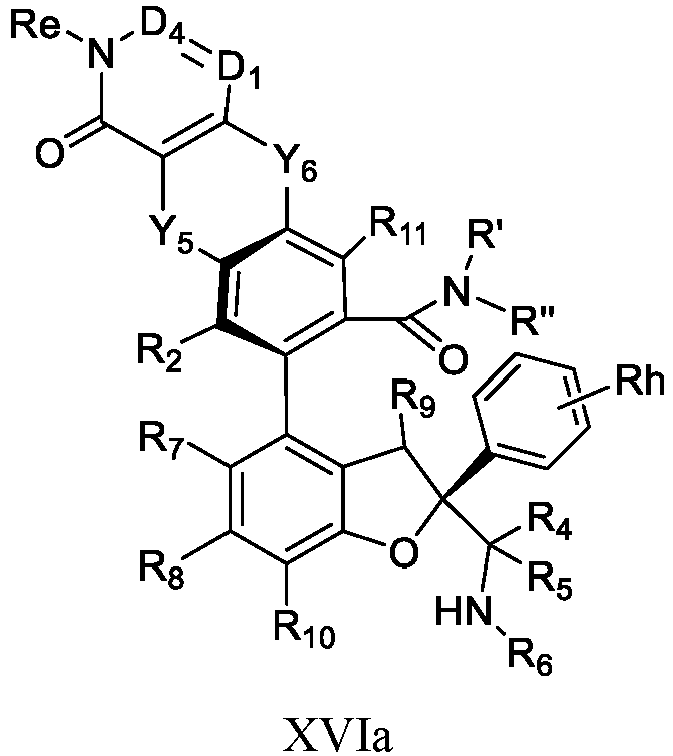
- D1 is selected from: N and CRf;
- D4 is selected from: N and CRf, and D1 and D4 are not simultaneously N;
- Re is selected from: H, substituted or unsubstituted C1-C4 acyl, substituted or unsubstituted C1-C4 alkoxy, cyano, substituted or unsubstituted C1-C4 alkyl-S(O)2-, substituted or unsubstituted 4- to 9-membered heterocyclyl, NR'R"-C(O)-, substituted or unsubstituted 3- to 6-membered cyclohydrocarbyl, substituted or unsubstituted 3- to 6-membered cyclohydrocarbyl-C(O)-, substituted or unsubstituted C1-C4 haloalkyl and substituted or unsubstituted C1-C4 alkyl; each Rf at each occurrence is independently selected from: H, halogen, hydroxyl, cyano, substituted or unsubstituted C1-C4 alkoxy, substituted or unsubstituted C1-C4 alkyl; preferably, the C1-C4 alkoxy and C1-C4 alkyl are optionally substituted by 1, 2 or 3 substituents selected from F, hydroxyl and cyano;
- Y5 and Y6 are independently selected from: a bond, O, S, N, -S(O)-, -S(O)2-, C, CH(R13), C(R13)2 and N(R12), and Y5 and Y6 are not simultaneously a bond;
- R2 is selected from: H, halogen, substituted or unsubstituted alkyl and substituted or unsubstituted alkoxy;
- R4 and R5 are each independently selected from: H, halogen and substituted or unsubstituted C1-C4 alkyl;
- R6 is selected from: H, substituted or unsubstituted alkyl, substituted or unsubstituted alkoxy, substituted or unsubstituted alkenyl, substituted or unsubstituted alkynyl, substituted or unsubstituted cyclohydrocarbyl, substituted or unsubstituted aryl, substituted or unsubstituted heteroaryl and substituted or unsubstituted heterocyclyl;
- alternatively, R4 or R5 and R6, together with the atom to which they are attached, form a substituted or unsubstituted 4- to 6-membered heterocyclyl ring; the 4- to 6-membered heterocyclyl contains 1 or 2 heteroatoms selected from N and O;
- R7 is selected from: H, halogen, cyano, nitro, substituted or unsubstituted C1-C4 alkyl and substituted or unsubstituted C1-C4 alkoxy;
- R8 is selected from: H, halogen, cyano, nitro, substituted or unsubstituted C1-C4 alkyl and substituted or unsubstituted C1-C4 alkoxy;
- R9 is selected from: H, substituted or unsubstituted C1-C4 alkyl, substituted or unsubstituted C1-C4 alkoxy, hydroxyl and halogen;
- R10 is selected from: H, halogen and substituted or unsubstituted C1-C4 alkyl;
- R11 is selected from: H, hydroxyl, amino, halogen, substituted or unsubstituted C1-C4 alkyl, -NR'R" and substituted or unsubstituted C1-C4 alkoxy;
- R' and R" are each independently selected from H, C1-C4 alkyl, C3-C6 cycloalkyl, C1-C4 alkyl-S(O)2- and C1-C4 haloalkyl;
- Rh is selected from: H, halogen, substituted or unsubstituted C1-C4 alkyl and substituted or unsubstituted C1-C4 alkoxy.
- In some embodiments, Re is selected from H, methyl, difluoromethyl, trifluoromethyl, deuteromethyl, ethyl, fluoroethyl, difluoroethyl, trifluoroethyl, isopropyl, cyclopropyl, cyclobutyl, trifluoropropyl, oxocyclobutyl, 1,1-difluorocyclobutyl, -CH2CH2OH, -CH2CH2OCH3 and acetyl.
- In some embodiments, the compound is selected from the following compounds:

- D1 is selected from: N and CRf;
- D4 is selected from: N and CRf, and D1 and D4 are not simultaneously N;
- Re is selected from: H, substituted or unsubstituted C1-C4 acyl, substituted or unsubstituted C1-C4 alkoxy, cyano, substituted or unsubstituted C1-C4 alkyl-S(O)2-, substituted or unsubstituted 4- to 9-membered heterocyclyl, NR'R"-C(O)-, substituted or unsubstituted 3- to 6-membered cyclohydrocarbyl, substituted or unsubstituted 3- to 6-membered cyclohydrocarbyl-C(O)-, substituted or unsubstituted C1-C4 haloalkyl and substituted or unsubstituted C1-C4 alkyl; each Rf at each occurrence is independently selected from: H, halogen, hydroxyl, cyano, substituted or unsubstituted C1-C4 alkoxy, substituted or unsubstituted C1-C4 alkyl; preferably, the C1-C4 alkoxy and C1-C4 alkyl are optionally substituted by 1, 2 or 3 substituents selected from F, hydroxyl and cyano;
- Y5 and Y6 are independently selected from: a bond, O, S, N, -S(O)-, -S(O)2-, C, CH(R13), C(R13)2 and N(R12), and Y5 and Y6 are not simultaneously a bond;
- R2 is selected from: H, halogen, substituted or unsubstituted alkyl and substituted or unsubstituted alkoxy;
- R7 is selected from: H, halogen, cyano, nitro, substituted or unsubstituted C1-C4 alkyl and substituted or unsubstituted C1-C4 alkoxy;
- R8 is selected from: H, halogen, cyano, nitro, substituted or unsubstituted C1-C4 alkyl and substituted or unsubstituted C1-C4 alkoxy;
- R9 is selected from: H, substituted or unsubstituted C1-C4 alkyl, substituted or unsubstituted C1-C4 alkoxy, hydroxyl and halogen;
- R10 is selected from: H, halogen and substituted or unsubstituted C1-C4 alkyl;
- R11 is selected from: H, hydroxyl, amino, halogen, substituted or unsubstituted C1-C4 alkyl, -NR'R" and substituted or unsubstituted C1-C4 alkoxy;
- R' and R" are each independently selected from H, C1-C4 alkyl, C3-C6 cycloalkyl, C1-C4 alkyl-S(O)2- and C1-C4 haloalkyl;
- Rh is selected from: H, halogen, substituted or unsubstituted C1-C4 alkyl and substituted or unsubstituted C1-C4 alkoxy;
- Ri is selected from: H, halogen, substituted or unsubstituted C1-C4 alkyl and substituted or unsubstituted C1-C4 alkoxy;
- p is 1, 2 or 3;
- q is 0, 1, 2, 3 or 4.
- In some embodiments, Re is selected from H, methyl, difluoromethyl, trifluoromethyl, deuteromethyl, ethyl, fluoroethyl, difluoroethyl, trifluoroethyl, isopropyl, cyclopropyl, cyclobutyl, trifluoropropyl, oxocyclobutyl, 1,1-difluorocyclobutyl, -CH2CH2OH, -CH2CH2OCH3 and acetyl.
- In some embodiments, the compound is selected from the following compounds:


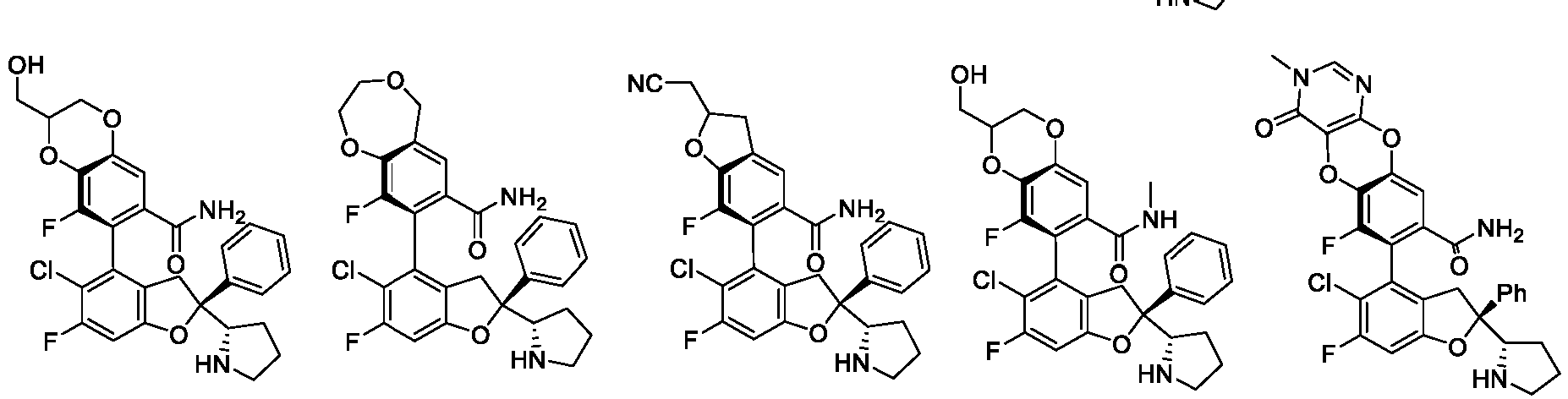


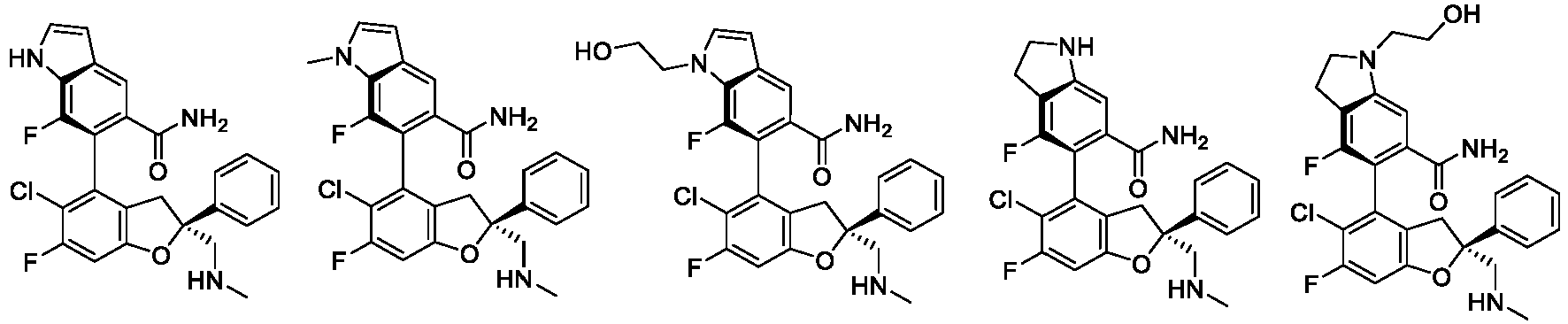


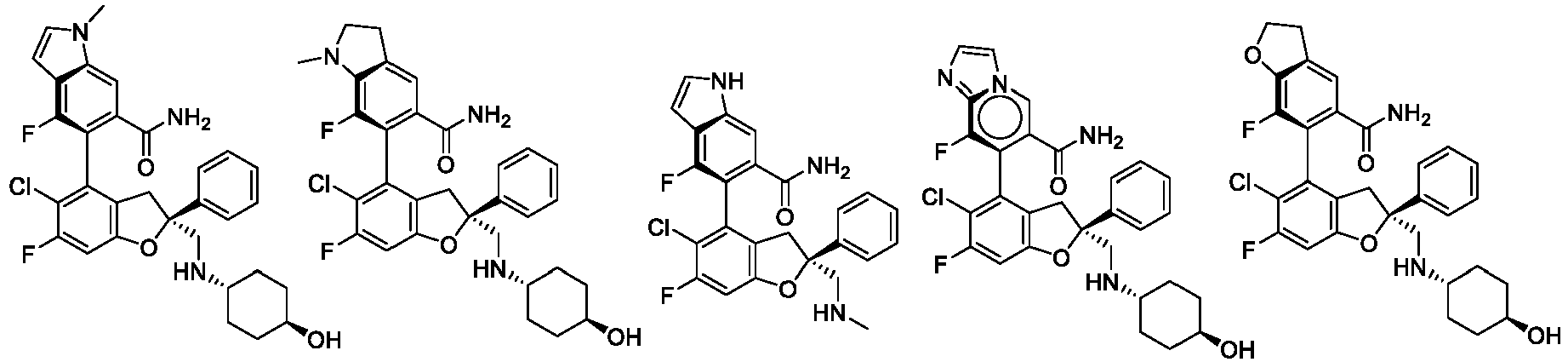

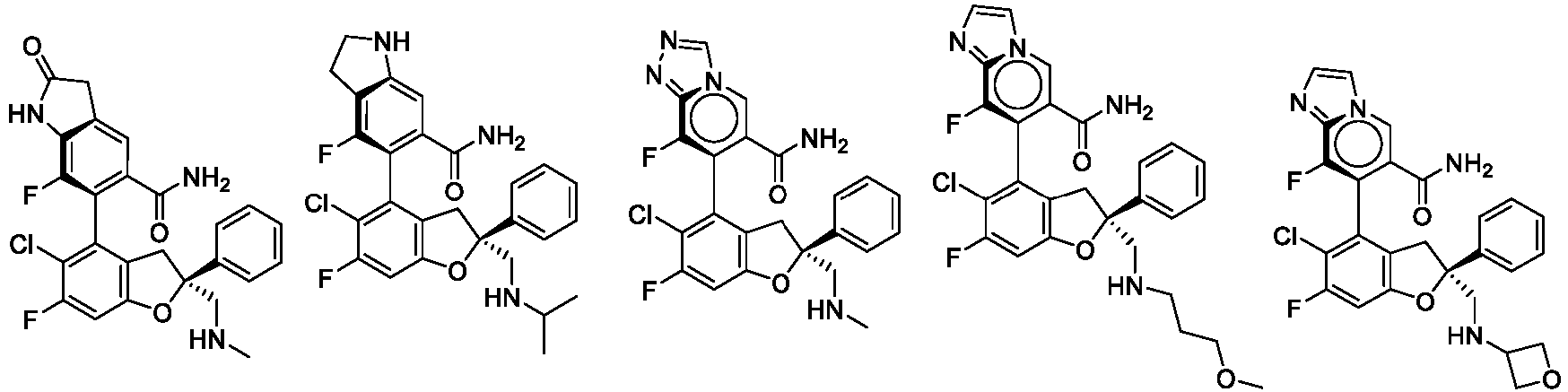


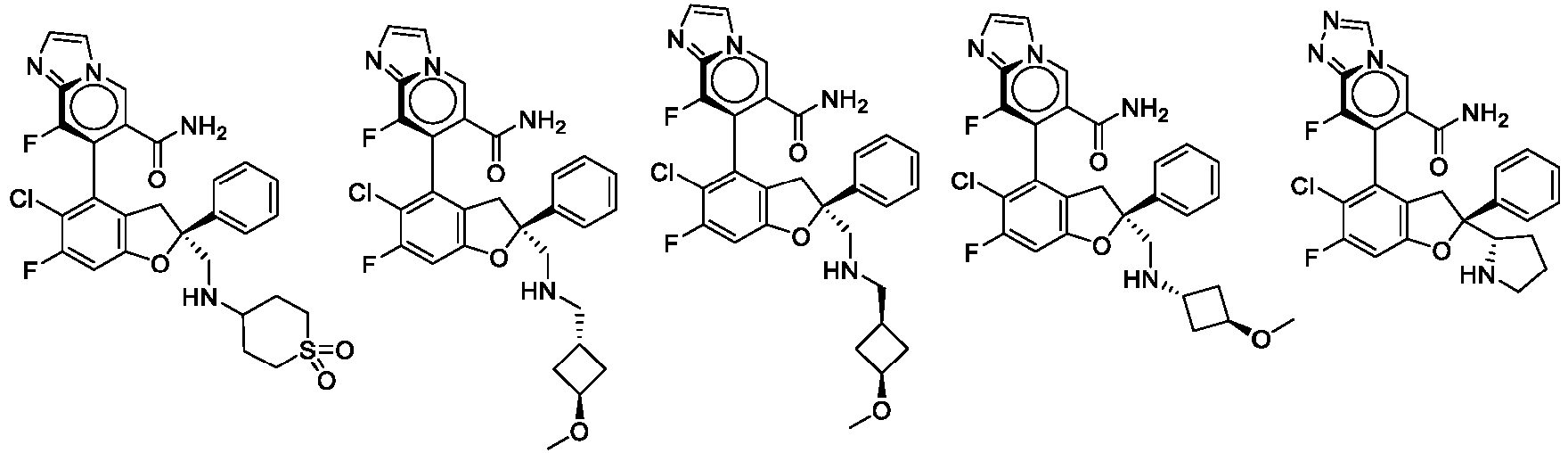


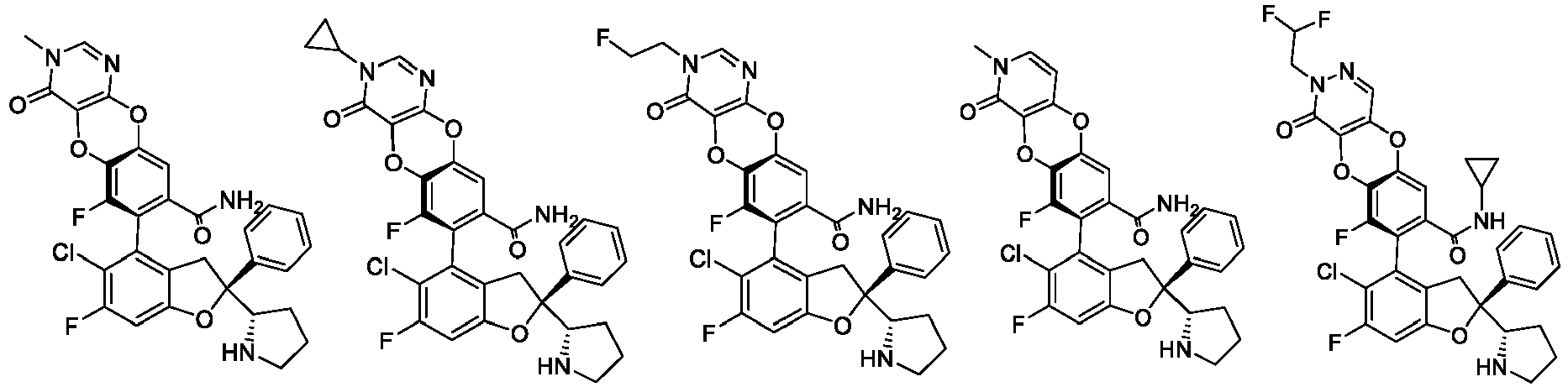


- In another aspect, the present disclosure provides a compound of the following formula Ya,

- X1 is selected from: O and NRa;
- R3 is selected from: substituted or unsubstituted aryl, substituted or unsubstituted heteroaryl and substituted or unsubstituted heterocyclyl;
- R4 and R5 are each independently selected from: H, halogen and substituted or unsubstituted alkyl; alternatively, R4 and R5, together with the carbon atom to which they are attached, form a 3- to 6-membered substituted or unsubstituted ring, and the ring optionally contains 1, 2 or 3 heteroatoms selected from O, N and S;
- R6 is selected from: H, substituted or unsubstituted alkyl, substituted or unsubstituted alkoxy, substituted or unsubstituted alkenyl, substituted or unsubstituted alkynyl, substituted or unsubstituted cyclohydrocarbyl, substituted or unsubstituted aryl, substituted or unsubstituted heteroaryl and substituted or unsubstituted heterocyclyl;
- alternatively, R4 or R5 and R6, together with the atom to which they are attached, form a substituted or unsubstituted 4- to 12-membered monocyclic or fused heterocyclyl, substituted or unsubstituted 6- to 12-membered bridged heterocyclyl or substituted or unsubstituted 6- to 12-membered spiro heterocyclyl ring; the 4- to 12-membered monocyclic or fused heterocyclyl, 6- to 12-membered bridged heterocyclyl and 6- to 12-membered spiro heterocyclyl each optionally further contain 1 or 2 heteroatoms selected from N and O;
- R8 is selected from: H, halogen, cyano, nitro, substituted or unsubstituted alkyl, substituted or unsubstituted haloalkyl, substituted or unsubstituted alkoxy, substituted or unsubstituted alkenyl and substituted or unsubstituted alkynyl;
- R9 is selected from: H, substituted or unsubstituted alkyl, substituted or unsubstituted alkoxy, hydroxyl and halogen;
- R10 is selected from: H, halogen and substituted or unsubstituted alkyl.
- In yet another aspect, the present disclosure provides a preparation method for a compound of formula Ya, comprising the following steps:

- (i) coupling a borate ester under alkaline conditions with palladium catalysis, converting halogen Hal1 in formula Ya-1 into Q-B-Q to obtain Ya-2;
- (ii) converting Ya-2 into the potassium trifluoroborate salt of Ya-3 in an organic solvent at room temperature;
- (iii) using a chlorinating reagent to convert Ya-3 into Ya under acid catalysis in an organic solvent;
- X1 is selected from: O and NRa; wherein Ra is selected from H and C1-C4 alkyl;
- R3 is selected from: substituted or unsubstituted aryl, substituted or unsubstituted heteroaryl and substituted or unsubstituted heterocyclyl;
- R4 and R5 are each independently selected from: H, halogen and substituted or unsubstituted alkyl; alternatively, R4 and R5, together with the carbon atom to which they are attached, form a 3- to 6-membered substituted or unsubstituted ring, and the ring optionally contains 1, 2 or 3 heteroatoms selected from O, N and S;
- R6 is selected from: H, substituted or unsubstituted alkyl, substituted or unsubstituted alkoxy, substituted or unsubstituted alkenyl, substituted or unsubstituted alkynyl, substituted or unsubstituted cyclohydrocarbyl, substituted or unsubstituted aryl, substituted or unsubstituted heteroaryl and substituted or unsubstituted heterocyclyl;
- alternatively, R4 or R5 and R6, together with the atom to which they are attached, form a substituted or unsubstituted 4- to 12-membered monocyclic or fused heterocyclyl, substituted or unsubstituted 6- to 12-membered bridged heterocyclyl or substituted or unsubstituted 6- to 12-membered spiro heterocyclyl ring; the 4- to 12-membered monocyclic or fused heterocyclyl, 6- to 12-membered bridged heterocyclyl and 6- to 12-membered spiro heterocyclyl each optionally further contain 1 or 2 heteroatoms selected from N and O;
- R8 is selected from: H, halogen, cyano, nitro, substituted or unsubstituted alkyl, substituted or unsubstituted haloalkyl, substituted or unsubstituted alkoxy, substituted or unsubstituted alkenyl and substituted or unsubstituted alkynyl;
- R9 is selected from: H, substituted or unsubstituted alkyl, substituted or unsubstituted alkoxy, hydroxyl and halogen;
- R10 is selected from: H, halogen and substituted or unsubstituted alkyl;
- Hal1 is halogen;
- Q-B-Q is boric acid or borate ester;
- Pg is a nitrogen protecting group.
- In some embodiments, the organic solvent in step (ii) is selected from polar organic solvents. In some embodiments, the organic solvent in step (ii) is selected from methanol, ethanol, acetone and acetonitrile. In some embodiments, the organic solvent in step (ii) is acetonitrile.
- In some embodiments, the organic solvent in step (iii) is selected from polar organic solvents. In some embodiments, the organic solvent in step (iii) is selected from acetonitrile, acetone, 1,2-dichloroethane, dioxane and cyclopentyl methyl ether.
- In yet another aspect, the present disclosure provides a compound of formula Za,

- In some embodiments, Pg is Boc.
- In a further aspect, the present disclosure provides a preparation method for the compound of formula Za, comprising the following steps:

- (i) coupling a borate ester under alkaline conditions with palladium catalysis, converting halogen Hal1 in formula Za-1 into Q-B-Q to obtain Za-2;
- (ii) adding potassium hydrogen fluoride aqueous solution to convert Q-B-Q into potassium trifluoroborate salt in an organic solvent at room temperature to obtain Za-3;
- (iii) using a chlorinating reagent to convert Za-3 into Za under acid catalysis in an organic solvent;
- In some embodiments, the organic solvent in step (ii) is selected from polar organic solvents. In some embodiments, the organic solvent in step (ii) is selected from methanol, ethanol, acetone and acetonitrile. In some embodiments, the organic solvent in step (ii) is acetonitrile.
- In some embodiments, the organic solvent in step (iii) is selected from polar organic solvents. In some embodiments, the organic solvent in step (iii) is selected from acetonitrile, acetone, 1,2-dichloroethane, dioxane and cyclopentyl methyl ether.
- The present disclosure also includes pharmaceutically acceptable salts, enantiomers, diastereomers, tautomers, solvates, isotopic substitutes, polymorphs, prodrugs or metabolites of the above compounds of each formula.
- Herein, "stereoisomer" refers to a compound composed of the same atoms, bonded by the same bonds, but having different three-dimensional structures. The present disclosure will cover various stereoisomers and mixtures thereof.
- When the compounds of the present disclosure contain an alkene double bond, the compounds of the present disclosure are intended to contain E- and Z- geometric isomers unless otherwise indicated.
- "Tautomer" refers to an isomer formed by the transfer of a proton from one atom of a molecule to another atom of the same molecule. All tautomeric forms of the compounds of the present disclosure are also intended to be included within the scope of the present disclosure.
- The compounds or pharmaceutically acceptable salts thereof of the present disclosure may contain one or more chiral carbon atoms, and thus may produce enantiomeric, diastereomeric and other stereoisomeric forms. Each chiral carbon atom can be defined as (R)- or (S)- based on stereochemistry. The present disclosure is intended to include all possible isomers, as well as their racemic and optically pure forms. The compounds of the present disclosure can be prepared by selecting racemates, diastereomers or enantiomers as raw materials or intermediates. Optically active isomers can be prepared using chiral synthons or chiral reagents, or resolved using conventional techniques such as crystallization and chiral chromatography.
- Conventional techniques for the preparation/separation of individual isomers include chiral synthesis from suitable optically pure precursors or the resolution of racemates (or racemates of salts or derivatives) using methods like chiral high-performance liquid chromatography, see, for example, GeRald Gübitz and Martin G. Schmid(Eds.), ChiRal SepaRations, Methods and Protocols, Methods in Molecular Biology, Vol. 243, 2004; A.M. Stalcup, ChiRal SepaRations, Annu. Rev. Anal. Chem. 3:341-63, 2010; Fumiss et al.(eds.), VOGEL'S ENCYCLOPEDIA OF PRaCTICAL ORGANIC CHEMISTRY.sup.TH ED., Longman Scientific and Technical Ltd., Essex, 1991, 809-816; Heller, Acc. Chem. Res. 1990, 23, 128, and the disclosure of which is incorporated herein by reference in its entirety.
- The present disclosure also includes all suitable isotopic substitutes (or isotopic variants) of the compounds or pharmaceutically acceptable salts thereof of the present disclosure. Isotopic variants of the compounds or pharmaceutically acceptable salts thereof of the present disclosure are defined as those in which at least one atom has been replaced by an atom having the same atomic number but an atomic mass different from that typically found in nature. Isotopes that can be incorporated into the compounds and pharmaceutically acceptable salts thereof of the present disclosure include, but are not limited to, isotopes of H, C, N and O, such as 2H, 3H, 11C, 13C, 14C, 15N, 17O, 18O, 35S, 18F, 36Cl and 125I. Isotopic variants of the compounds or pharmaceutically acceptable salts thereof described in the present disclosure can be prepared by conventional techniques using appropriate isotopic variants of suitable reagents.
- In the present disclosure, the term "pharmaceutically acceptable salts" include pharmaceutically acceptable acid addition salts and pharmaceutically acceptable base addition salts.
- "Pharmaceutically acceptable acid addition salts" refer to salts formed with inorganic or organic acids that retain the biological effectiveness of the free base without other side effects. Inorganic acid salts include, but are not limited to, hydrochloride, hydrobromide, sulfate, nitrate, phosphate, etc.; organic acid salts include, but are not limited to, formate, acetate, 2,2-dichloroacetate, trifluoroacetate, propionate, caproate, caprylate, decanoate, undecylenate, glycolate, gluconate, lactate, sebacate, adipate, glutarate, malonate, oxalate, maleate, succinate, fumarate, tartrate, citrate, palmitate, stearate, oleate, cinnamate, laurate, malate, glutamate, pyroglutamate, aspartate, benzoate, methanesulfonate, benzenesulfonate, p-toluenesulfonate, alginate, ascorbate, salicylate, 4-aminosalicylate, naphthalene disulfonate, etc. These salts can be prepared by methods known in the art.
- "Pharmaceutically acceptable base addition salts" refer to salts formed with inorganic or organic bases that retain the biological effectiveness of the free acid without other side effects. Salts derived from inorganic bases include, but are not limited to, sodium salts, potassium salts, lithium salts, ammonium salts, calcium salts, magnesium salts, iron salts, zinc salts, copper salts, manganese salts, aluminum salts, etc. Preferred inorganic salts are ammonium salts, sodium salts, potassium salts, calcium salts and magnesium salts. Salts derived from organic bases include, but are not limited to, the following salts: primary, secondary and tertiary amines, substituted amines, including natural substituted amines, cyclic amines and basic ion exchange resins, such as ammonia, isopropylamine, trimethylamine, diethylamine, triethylamine, tripropylamine, ethanolamine, diethanolamine, triethanolamine, dimethylethanolamine, 2-dimethylaminoethanol, 2-diethylaminoethanol, dicyclohexylamine, lysine, arginine, histidine, caffeine, procaine, choline, betaine, ethylenediamine, glucosamine, methylglucosamine, theobromine, purine, piperazine, piperidine, N-ethylpiperidine, polyamine resin, etc. Preferred organic bases include isopropylamine, diethylamine, ethanolamine, trimethylamine, dicyclohexylamine, choline and caffeine. These salts can be prepared by methods known in the art.
- As used herein, the term "prodrug" refers to those compounds that will be metabolized (i.e., converted in vivo) into compounds of the present disclosure with pharmacological activity after administration. When the compound of the present disclosure itself is difficult to absorb from the gastrointestinal tract, its bioavailability can be improved by making it into a prodrug. Examples of prodrugs of the compounds of the present disclosure can include simple esters of carboxyl-containing compounds (e.g., esters obtained by condensation with C1-C4 alcohols according to methods known in the art); esters of hydroxyl-containing compounds (e.g., esters obtained by condensation with C1-C4 monocarboxylic acids, C3-C6 dicarboxylic acids or anhydrides thereof such as succinic anhydride or fumaric anhydride according to methods known in the art); imines of amino-containing compounds (e.g., imines obtained by condensation with C1-C4 aldehydes or ketones according to methods known in the art); carbamates of amino-containing compounds, such as those described by Leu et al. (J. Med. Chem., 42:3623-3628(1999)) and Greenwald et al. (J. Med. Chem., 42:3657-3667(1999)); aldehyde acetals or ketone acetals of hydroxyl-containing compounds (e.g., those acetals obtained by condensation with chloromethyl methyl ether or chloromethyl ethyl ether according to methods known in the art).
- Herein, the compound of formula I can be prepared by the following general synthetic route:
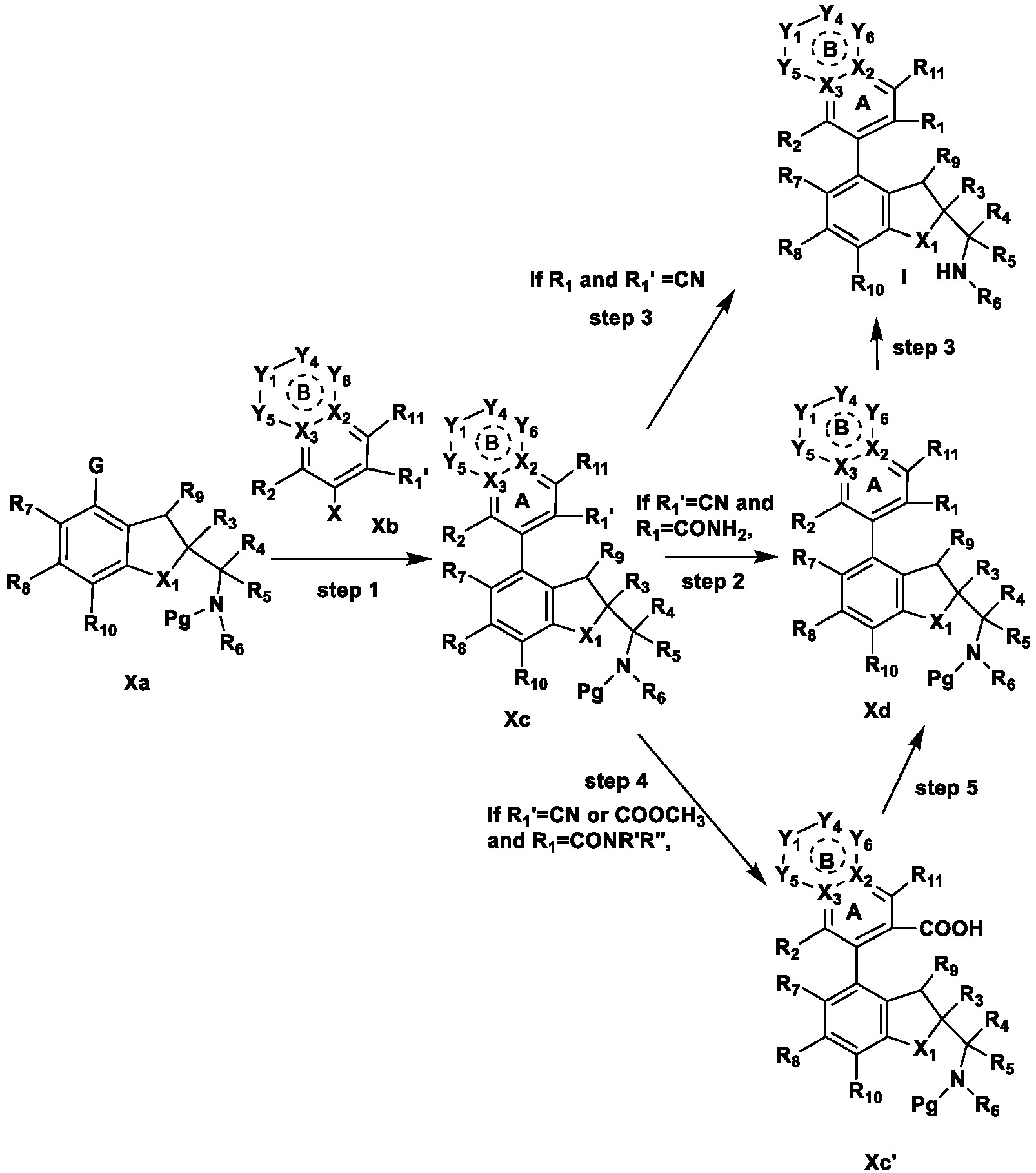
- R1-R10, R11, X1-X3 and Y1-Y6 in each structural formula are as defined in any one of the previous embodiments; G is boric acid, potassium trifluoroborate salt or borate ester, etc.; X is halogen, preferably Br or I; R1' is a conversion functional group of R1, preferably cyano or ester group, which can be converted into R1 under suitable conditions; Pg is a nitrogen protecting group, preferably tert-butoxycarbonyl (tBuOC(O)-).
- When R1 and R1' are both cyano, the compound of formula I can be obtained through steps 1 and 3. In step 1, formulas Xa and Xb are coupled via a palladium catalyst, ligand and base to obtain formula Xc. When R1' and/or R2 are not H, formula Xc usually contains a pair of axial chiral isomers. In step 3, Pg is removed from formula Xc under suitable conditions to obtain the compound of formula I.
- When R1 is CONH2 and R1' is cyano, the compound of formula I can be obtained through step 1, step 2 and step 3. In step 1, formulas Xa and Xb are coupled via a palladium catalyst, ligand and base to obtain formula Xc. When R1' and/or R2 are not H, formula Xc usually contains a pair of axial chiral isomers. In step 2, formula Xc is hydrolyzed to amide via a copper catalyst to obtain formula Xd, and the copper catalyst is preferably copper acetate. In step 3, Pg is removed from formula Xd under suitable conditions to obtain the compound of formula I.
- When R1 is CONR'R", R' and R" are not simultaneously H, and R1' is cyano or methyl formate group (-COOCH3), then the compound of formula I can be obtained by the reaction sequence of step 1, step 4, step 5 and step 3. In step 1, formulas Xa and Xb are coupled via a palladium catalyst, ligand and base to obtain formula Xc. When R1' and/or R2 are not H, formula Xc usually contains a pair of axial chiral isomers. In step 4, formula Xc is hydrolyzed by an inorganic base to obtain formula Xc', and the inorganic base is preferably sodium hydroxide, lithium hydroxide, potassium hydroxide, etc. In step 5, formula Xc' and R'R"NH are condensed by a condensing agent to obtain formula Xd. In step 3, Pg is removed from formula Xd under suitable conditions to obtain the compound of formula I.
- Other compounds of the present disclosure can be prepared by referring to the above reaction flow chart.
- When G in formula Xa is BF3K and R7 is chlorine, then formula Ya can be synthesized by the following route 2:

- R3-R6, R8-R10 and X1 in each structural formula are as defined in any one of the previous embodiments; preferably, R8 is F, R9 and R10 are H, R3 is phenyl, and R4 or R5 and R6, together with the C and N to which they are attached, form


- In the synthesis routes 2 and 3, Hal1 is halogen, preferably Br or I; Q-B-Q is boric acid or borate ester, preferably boric acid (B(OH)2), pinacol borate
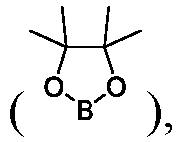

- In another aspect, the present disclosure provides a pharmaceutical composition, and the pharmaceutical composition comprises the compound of formula I or any subformula thereof (including but not limited to Ia, Ib, IIa, IIb, IIc, IId, IIe, IIIa, IIIb, IVa, IVb, IVc, XI, XIa, XIb, XIIa, XIIb, XIIc, XIId, XIIe, XIII a, XIIIb, XIVa, XIVb and XIVc) or the pharmaceutically acceptable salt, enantiomer, diastereomer, tautomer, solvate, isotopic substitute, polymorph, prodrug or metabolite thereof of the present disclosure and a pharmaceutically acceptable carrier or excipient.
- In another aspect, the present disclosure provides a use of the compound of formula I or any subformula thereof (including but not limited to Ia, Ib, IIa, IIb, IIc, IId, IIe, IIIa, IIIb, IVa, IVb, IVc, XI, XIa, XIb, XIIa, XIIb, XIIc, XIId, XIIe, XIIIa, XIIIb, XIVa, XIVb and XIVc) or the pharmaceutically acceptable salt, enantiomer, diastereomer, tautomer, solvate, isotopic substitute, polymorph, prodrug or metabolite thereof, or the pharmaceutical composition of the present disclosure in the manufacture of a medicament for treating or preventing diseases mediated by the interaction between YAP/TAZ and TEAD.
- In another aspect, the present disclosure provides the compound of formula I or any subformula thereof (including but not limited to Ia, Ib, IIa, IIb, IIc, IId, IIe, IIIa, IIIb, IVa, IVb, IVc, XI, XIa, XIb, XIIa, XIIb, XIIc, XIId, XIIe, XIIIa, XIIIb, XIVa, XIVb and XIVc) or the pharmaceutically acceptable salt, enantiomer, diastereomer, tautomer, solvate, isotopic substitute, polymorph, prodrug or metabolite thereof, or the pharmaceutical composition of the present disclosure for use in treating or preventing diseases. In some embodiments, the present disclosure also provides the compound of formula I or any subformula thereof (including but not limited to Ia, Ib, IIa, IIb, IIc, IId, IIe, IIIa, IIIb, IVa, IVb, IVc, XI, XIa, XIb, XIIa, XIIb, XIIc, XIId, XIIe, XIIIa, XIIIb, XIVa, XIVb and XIVc) or the pharmaceutically acceptable salt, enantiomer, diastereomer, tautomer, solvate, isotopic substitute, polymorph, prodrug or metabolite thereof, or the pharmaceutical composition of the present disclosure for use in treating or preventing diseases mediated by the interaction between YAP/TAZ and TEAD.
- In yet another aspect, the present disclosure provides a method for treating or preventing diseases mediated by the interaction between YAP/TAZ and TEAD, and the method comprises administering to a subject in need thereof a therapeutically effective amount of the compound of formula I or any subformula thereof (including but not limited to Ia, Ib, IIa, IIb, IIc, IId, IIe, IIIa, IIIb, IVa, IVb, IVc, XI, XIa, XIb, XIIa, XIIb, XIIc, XIId, XIIe, XIIIa, XIIIb, XIVa, XIVb and XIVc) or the pharmaceutically acceptable salt, enantiomer, diastereomer, tautomer, solvate, isotopic substitute, polymorph, prodrug or metabolite thereof of the present disclosure, or the pharmaceutical composition of the present disclosure.
- The compound of formula I or any subformula thereof (including but not limited to Ia, Ib, IIa, IIb, IIc, IId, IIe, IIIa, IIIb, IVa, IVb, IVc, XI, XIa, XIb, XIIa, XIIb, XIIc, XIId, XIIe, XIIIa, XIIIb, XIVa, XIVb and XIVc) or the pharmaceutically acceptable salt, enantiomer, diastereomer, tautomer, solvate, isotopic substitute, polymorph, prodrug or metabolite thereof of the present disclosure is an inhibitor of the interaction between YAP/TAZ and TEAD, more specifically, an inhibitor of the interaction between YAP and TEAD. Accordingly, the compound of formula I or any subformula thereof (including but not limited to Ia, Ib, IIa, IIb, IIc, IId, IIe, IIIa, IIIb, IVa, IVb, IVc, XI, XIa, XIb, XIIa, XIIb, XIIc, XIId, XIIe, XIIIa, XIIIb, XIVa, XIVb and XIVc) or the pharmaceutically acceptable salt, enantiomer, diastereomer, tautomer, solvate, isotopic substitute, polymorph, prodrug or metabolite thereof of the present disclosure can be used to treat or prevent diseases mediated by the interaction between YAP/TAZ and TEAD.
- Herein, "diseases mediated by the interaction between YAP/TAZ and TEAD" refer to diseases in which the interaction between YAP/TAZ and TEAD is involved in the occurrence and/or development of the disease, and the purpose of alleviation, treatment and/or prevention can be achieved by inhibiting the expression and/or activity of YAP and TEAD or by inhibiting or blocking the interaction of YAP-TEAD protein.
- In some embodiments, the diseases mediated by the interaction between YAP/TAZ and TEAD are tumors, liver fibrosis and renal fibrosis.
- In some embodiments, the diseases mediated by the interaction between YAP/TAZ and TEAD are benign tumors.
- In some embodiments, the diseases mediated by the interaction between YAP/TAZ and TEAD are malignant tumors, such as cancers or sarcomas.
- In some embodiments, the diseases mediated by the interaction between YAP/TAZ and TEAD are solid tumors or hematological tumors.
- In some embodiments, the diseases mediated by the interaction between YAP/TAZ and TEAD are: mesothelioma (e.g., pleural mesothelioma (such as malignant pleural mesothelioma), peritoneal mesothelioma, pericardial mesothelioma or tunica vaginalis mesothelioma), cervical squamous cell carcinoma, endometrial carcinoma, bladder urothelial carcinoma, skin squamous cell carcinoma, poroma (e.g., benign poroma), porocarcinoma, epithelioid hemangioendothelioma, breast cancer (e.g., triple-negative breast cancer), lung cancer (e.g., non-small cell lung cancer), ovarian cancer, colorectal cancer, melanoma, pancreatic cancer, prostate cancer, gastric cancer, esophageal cancer (e.g., esophageal squamous cell carcinoma or esophageal adenocarcinoma), liver cancer (e.g., hepatocellular carcinoma or hepatoblastoma), cholangiocarcinoma, neurilemmoma, renal cancer, sarcoma (e.g., rhabdomyosarcoma, embryonal rhabdomyosarcoma, osteosarcoma, undifferentiated pleomorphic sarcoma, Kaposi's sarcoma and soft tissue sarcoma (such as rare soft tissue sarcoma)), bone cancer, brain cancer (e.g., ependymoma (e.g., supratentorial ependymoma, such as pediatric supratentorial ependymoma), neuroblastoma, medulloblastoma, glioma or meningioma) or head and neck cancer (e.g., head and neck squamous cell carcinoma).
- In some embodiments, the disease mediated by the interaction between YAP/TAZ and TEAD is mesothelioma (e.g., pleural mesothelioma (such as malignant pleural mesothelioma), peritoneal mesothelioma, pericardial mesothelioma or tunica vaginalis mesothelioma). In some embodiments, the disease mediated by the interaction between YAP/TAZ and TEAD is malignant pleural mesothelioma (MPM), which is a rare malignant tumor of the chest. Abnormal activation of the Hippo-YAP pathway is present in about 70% of MPM patients and is considered an important cancer driver gene. Reducing the activity of the Hippo-YAP pathway by biological means and by chemical small molecules has shown good tumor growth inhibitory activity.
- In some embodiments, the disease mediated by the interaction between YAP/TAZ and TEAD is breast cancer (e.g., triple negative breast cancer).
- In some embodiments, the disease mediated by the interaction between YAP/TAZ and TEAD is lung cancer (e.g., non-small cell lung cancer).
- In some embodiments, the disease mediated by the interaction between YAP/TAZ and TEAD is colorectal cancer.
- In some embodiments, the disease mediated by the interaction between YAP/TAZ and TEAD is pancreatic cancer (e.g., pancreatic ductal adenocarcinoma (PDAC)).
- In some embodiments, the disease mediated by the interaction between YAP/TAZ and TEAD is gastric cancer.
- In some embodiments, the disease mediated by the interaction between YAP/TAZ and TEAD is liver cancer (e.g., hepatocellular carcinoma or hepatoblastoma).
- In some embodiments, the disease mediated by the interaction between YAP/TAZ and TEAD is brain cancer (e.g., ependymoma (e.g., supratentorial ependymoma, such as pediatric supratentorial ependymoma), neuroblastoma, medulloblastoma, glioma or meningioma).
- In some embodiments, the disease mediated by the interaction between YAP/TAZ and TEAD is head and neck cancer (e.g., head and neck squamous cell carcinoma).
- The YAP signaling pathway can produce drug resistance to a variety of anticancer targeted drugs by mechanisms such as mediating tumor cell dormancy and resistance to apoptosis, so inhibiting the Hippo-YAP signaling pathway can increase the sensitivity of tumor cells to targeted drugs. In addition, Hippo-YAP, as a pathway that promotes tumor cell growth, is overactivated in multiple drug-resistant tumor models, and inhibiting its activity can significantly increase the sensitivity of treated tumor cells to related inhibitors. Accordingly, in some embodiments, the compound of formula I or any subformula thereof (including but not limited to Ia, Ib, IIa, IIb, IIc, IId, IIe, IIIa, IIIb, IVa, IVb, IVc, XI, XIa, XIb, XIIa, XIIb, XIIc, XIId, XIIe, XIIIa, XIIIb, XIVa, XIVb and XIVc) or the pharmaceutically acceptable salt, enantiomer, diastereomer, tautomer, solvate, isotopic substitute, polymorph, prodrug or metabolite thereof of the present disclosure can be used to improve the sensitivity of treated tumor cells by targeted drugs (e.g., EGFR inhibitors, BRAF-targeting inhibitors, MEK-targeting inhibitors), thereby improving the therapeutic effect of these targeted drugs.
- As used herein, the terms "taking", "administering", "administrating" and the like refer to methods capable of delivering a compound or pharmaceutical composition to a desired site for biological action. Any method of administration well known in the art can be used in the present disclosure. These methods include, but are not limited to, oral administration, transduodenal administration, parenteral administration (including intrapulmonary, intranasal administration; intrathecal, intravenous, subcutaneous, intraperitoneal, intramuscular, intraarterial injection or infusion), topical administration and transrectal administration. Those skilled in the art are familiar with administration techniques that can be used for the compounds and methods described herein, such as those discussed in Goodman and Gilman, The Pharmacological Basis of Therapeutics, current ed.; Pergamon; and Remington's, Pharmaceutical Sciences (current edition), Mack Publishing Co., Easton, Pa. In preferred embodiments, the compounds, the pharmaceutically acceptable salts, enantiomers, diastereomers, tautomers, solvates, isotopic substitutes, polymorphs, prodrugs or metabolites thereof, or the pharmaceutical compositions thereof of the present disclosure are administered by oral administration.
- In some embodiments, the compound of formula I or any subformula thereof (including but not limited to Ia, Ib, IIa, IIb, IIc, IId, IIe, IIIa, IIIb, IVa, IVb, IVc, XI, XIa, XIb, XIIa, XIIb, XIIc, XIId, XIIe, XIIIa, XIIIb, XIVa, XIVb and XIVc) or the pharmaceutically acceptable salt, enantiomer, diastereomer, tautomer, solvate, isotopic substitute, polymorph, prodrug or metabolite thereof, or the pharmaceutical composition thereof of the present disclosure is used in combination with other compounds with pharmacological activity, for example, for the treatment of cancer. For example, in some embodiments, the compound of formula I or any subformula thereof (including but not limited to Ia, Ib, IIa, IIb, IIc, IId, IIe, IIIa, IIIb, IVa, IVb, IVc, XI, XIa, XIb, XIIa, XIIb, XIIc, XIId, XIIe, XIIIa, XIIIb, XIVa, XIVb and XIVc) or the pharmaceutically acceptable salt, enantiomer, diastereomer, tautomer, solvate, isotopic substitute, polymorph, prodrug or metabolite thereof of the present disclosure, or the pharmaceutical composition of the present disclosure is administered simultaneously, sequentially or separately in combination with one or more compounds with pharmacological activity selected from: chemotherapeutic agents, such as mitotic inhibitors, such as taxane compounds (e.g., paclitaxel or docetaxel), vinca alkaloids (e.g., vincristine, vinblastine, vinorelbine or vinflunine), other anticancer agents such as metal platinum complexes (e.g., cisplatin, carboplatin or oxaliplatin), antimetabolites (e.g., pyrimidine antagonists, such as 5-fluorouracil, 5-fluoro-2-4(1H,3H)-pyrimidinedione (5FU) or gemcitabine), hormonal antitumor drugs (e.g., flutamide), etc. In some embodiments, the compound of formula I or any subformula thereof (including but not limited to Ia, Ib, IIa, IIb, IIc, IId, IIe, IIIa, IIIb, IVa, IVb, IVc, XI, XIa, XIb, XIIa, XIIb, XIIc, XIId, XIIe, XIIIa, XIIIb, XIVa, XIVb and XIVc) or the pharmaceutically acceptable salt, enantiomer, diastereomer, tautomer, solvate, isotopic substitute, polymorph, prodrug or metabolite thereof of the present disclosure, or the pharmaceutical composition of the present disclosure is used in combination with tumor immunotherapy drugs (such as anti-PD1 antibodies) and the like well known in the art for the treatment of cancer. In some embodiments, the compound of formula I or any subformula thereof (including but not limited to Ia, Ib, IIa, IIb, IIc, IId, IIe, IIIa, IIIb, IVa, IVb, IVc, XI, XIa, XIb, XIIa, XIIb, XIIc, XIId, XIIe, XIIIa, XIIIb, XIVa, XIVb and XIVc) or the pharmaceutically acceptable salt, enantiomer, diastereomer, tautomer, solvate, isotopic substitute, polymorph, prodrug or metabolite thereof of the present disclosure, or the pharmaceutical composition of the present disclosure is used in combination with conventional radiotherapy.
- Herein, "combination", "drug combination", "combination administration" or "combination therapy" refers to drug treatment obtained by mixing or combining more than one active ingredient, which includes fixed and unfixed combinations of active ingredients, and also includes the combination of two or more different treatment methods. The term "fixed combination" refers to the simultaneous administration to a patient of at least one compound described herein and at least one other active ingredient in the form of a single entity or a single dosage form. The term "unfixed combination" refers to the simultaneous administration, combined administration or sequential administration at variable intervals of at least one compound described herein and at least one other active ingredient to a patient in the form of a single entity. These are also applied to cocktail therapy, such as the administration of three or more active ingredients.
- In the present disclosure, a pharmaceutical composition contains the compound of formula I or any subformula thereof (including but not limited to Ia, Ib, IIa, IIb, IIc, IId, IIe, IIIa, IIIb, IVa, IVb, IVc, XI, XIa, XIb, XIIa, XIIb, XIIc, XIId, XIIe, XIIIa, XIIIb, XIVa, XIVb and XIVc) or the pharmaceutically acceptable salt, enantiomer, diastereomer, tautomer, solvate, isotopic substitute, polymorph, prodrug or metabolite thereof of the present disclosure and a pharmaceutically acceptable carrier or excipient (which is a generally accepted medium in the art for delivering bioactive compounds to mammals (such as humans)). The purpose of preparing active compounds into pharmaceutical compositions is to facilitate the administration to living organisms, facilitate the absorption of active ingredients, and thereby exert biological activity. Generally, the pharmaceutical composition of the present disclosure contains 0.1% to 99.5% by weight of the active pharmaceutical ingredient. In some embodiments, the pharmaceutical composition of the present disclosure contains 0.5% to 90% by weight of the active pharmaceutical ingredient, such as 1%, 1.5%, 2%, 5%, 10%, 15%, 20%, 25%, 30% or 50% by weight.
- In some embodiments, the pharmaceutical composition of the present disclosure contains, in addition to the compound of formula I or any subformula thereof (including but not limited to Ia, Ib, IIa, IIb, IIc, IId, IIe, IIIa, IIIb, IVa, IVb, IVc, XI, XIa, XIb, XIIa, XIIb, XIIc, XIId, XIIe, XIIIa, XIIIb, XIVa, XIVb and XIVc) or the pharmaceutically acceptable salt, enantiomer, diastereomer, tautomer, solvate, isotopic substitute, polymorph, prodrug or metabolite thereof of the present disclosure, other known anticancer agents, including but not limited to chemotherapeutic agents, such as mitotic inhibitors, such as taxane compounds (e.g., paclitaxel or docetaxel), vinca alkaloids (e.g., vincristine, vinblastine, vinorelbine or vinflunine), other anticancer agents such as metal platinum complexes (e.g., cisplatin, carboplatin or oxaliplatin), antimetabolites (e.g., pyrimidine antagonists, such as 5-fluorouracil, 5-fluoro-2-4(1H,3H)-pyrimidinedione (5FU), gemcitabine), hormonal antitumor drugs (e.g., flutamide), tumor immunotherapy drugs (such as anti-PD1 antibody), etc.
- In another aspect, the present disclosure also provides the following embodiments:
- 1. A compound of the following formula I or a pharmaceutically acceptable salt, enantiomer, diastereomer, tautomer, solvate, isotopic substitute, polymorph, prodrug or metabolite thereof:

- X1 is selected from: O and NRa;
- X2 is selected from: C or N;
- X3 is selected from: C or N;
- Y5 is selected from: a bond, O, S, N, S(=O), SO2, CHR13, C(R13)2, CR13, -OCH2-, -NCH2-, - CH2CH2- or NR12;
- Y1, Y4 and Y6 are independently selected from: a bond, O, N, C, S, -S(O)-, -SO2-, CH, CH2, NH, CHR13, CHR13, C(R13)2 or NR12; alternatively, when Y1, Y4 and Y6 are arbitrarily selected from C(R13)2, two R13, together with the C atom to which they are attached, can form a substituted or unsubstituted 3- to 8-membered cyclohydrocarbyl or substituted or unsubstituted 4- to 9-membered heterocyclyl ring, thereby forming a spiro ring structure with ring B; alternatively, the ring atom in Y1 or Y6 and the ring atom in Y4, together with the substituent attached to the ring atom, form a substituted or unsubstituted 3- to 8-membered cyclohydrocarbyl, substituted or unsubstituted 4- to 9-membered heterocyclyl, substituted or unsubstituted 6- to 10-membered aryl or substituted or unsubstituted 5- to 10-membered heteroaryl ring, thereby forming a fused ring structure with ring B;
- ring B is a 5- or 6-membered heterocyclyl, cyclohydrocarbyl or heteroaryl ring; ring B can be optionally substituted by one or more R13 and/or R12 that do not participate in ring formation, and can be further optionally substituted by 1 to 3 substituents selected from hydroxyl, amino, halogen, substituted or unsubstituted alkyl, -NR'R" and substituted or unsubstituted alkoxy;
- R1 is selected from: cyano and -C(=O)NR'R";
- R2 is selected from: H, halogen, substituted or unsubstituted alkyl and substituted or unsubstituted alkoxy;
- R3 is selected from: substituted or unsubstituted aryl, substituted or unsubstituted heteroaryl and substituted or unsubstituted heterocyclyl;
- R4 and R5 are each independently selected from: H, halogen and substituted or unsubstituted alkyl; alternatively, R4 and R5, together with the carbon atom to which they are attached, form a 3- to 6-membered substituted or unsubstituted ring, and the ring optionally contains 1 to 3 heteroatoms selected from O, N and S;
- R6 is selected from: H, substituted or unsubstituted alkyl, substituted or unsubstituted alkoxy, substituted or unsubstituted alkenyl, substituted or unsubstituted alkynyl, substituted or unsubstituted cyclohydrocarbyl, substituted or unsubstituted aryl, substituted or unsubstituted heteroaryl or substituted or unsubstituted heterocyclyl;
- alternatively, R4 or R5 and R6, together with the C and N to which they are attached, form a substituted or unsubstituted 4- to 12-membered monocyclic or fused heterocyclyl, 6- to 12-membered bridged heterocyclyl or 6- to 12-membered spiro heterocyclyl ring; the 4- to 12-membered monocyclic or fused heterocyclyl, 6- to 12-membered bridged heterocyclyl and 6- to 12-membered spiro heterocyclyl each optionally further contain 1 or 2 heteroatoms selected from O or N;
- R7 is selected from: H, halogen, cyano, nitro, substituted or unsubstituted alkyl, substituted or unsubstituted haloalkyl, substituted or unsubstituted alkoxy, substituted or unsubstituted alkenyl and substituted or unsubstituted alkynyl;
- R8 is selected from: H, halogen, cyano, nitro, substituted or unsubstituted alkyl, substituted or unsubstituted haloalkyl, substituted or unsubstituted alkoxy, substituted or unsubstituted alkenyl and substituted or unsubstituted alkynyl;
- R9 is selected from: H, substituted or unsubstituted alkyl, substituted or unsubstituted alkoxy, hydroxyl and halogen;
- R10 is selected from: H, halogen and substituted or unsubstituted alkyl;
- R11 is selected from: H, hydroxyl, amino, halogen, substituted or unsubstituted alkyl, -NR'R" and substituted or unsubstituted alkoxy;
- each R12 is independently selected from: H, substituted or unsubstituted C1-C4 acyl, substituted or unsubstituted C1-C4 alkoxy, cyano, substituted or unsubstituted C1-C4 alkyl-S(O)2-, substituted or unsubstituted 6- to 14-membered aryl-S(O)2-, 4- to 9-membered heterocyclyl, NR'R"-C(O)-, C3-C8 cyclohydrocarbyl-C(O)- and substituted or unsubstituted C1-C4 alkyl;
- each R13 is independently selected from: H, halogen, oxo (=O), substituted or unsubstituted C1-C4 acyl, -OH, cyano, -NR'R", substituted or unsubstituted C1-C4 alkoxy, substituted or unsubstituted C1-6 alkyl, substituted or unsubstituted C1-C4 alkyl-S(O)2-, substituted or unsubstituted C6-14 aryl-S(O)2-, C3-C6 cyclohydrocarbyl-C(O)- and -C(O)-NR'R";
- and after R13 or R12 participates in ring formation, its ring atom can be optionally substituted by 1 to 3 heteroatoms selected from O, N and S;
- R' and R" are each independently selected from H, C1-C4 alkyl, C1-C4 alkyl-S(O)2-, C1-C4 haloalkyl;
- Ra is selected from H or C1-C4 alkyl;
- wherein the dashed line indicates the presence or absence of a double bond.
- 2. The compound or the pharmaceutically acceptable salt, enantiomer, diastereomer, tautomer, solvate, isotopic substitute, polymorph, prodrug or metabolite thereof according to embodiment 1, characterized in that the compound of formula I has a structure shown in the following formula Ia:

- in the formula, Y1 and Y4 are independently selected from: a bond, O, N, CH, CH2, CHR13, CR13, C(R13)2 or NR12; and Y1 and Y4 are not simultaneously a bond or O;
- Y5 and Y6 are independently selected from: O, N, S, -S(O)-, -SO2-, CH, CH2, NH, CHR13, CR13, C(R13)2 or NR12;
- ring B, R1 to R13, X2 and X3 are as defined in embodiment 1;
- wherein the dashed line indicates the presence or absence of a double bond.
- 3. The compound or the pharmaceutically acceptable salt, enantiomer, diastereomer, tautomer, solvate, isotopic substitute, polymorph, prodrug or metabolite thereof according to embodiment 1 or 2, characterized in that the compound of formula I has a structure shown in the following formula Ib:


- in the formula, Y1, Y4, Y5 and Y6 are as defined in embodiment 2; R1 to R3, R7 to R13, X2 and X3 are as defined in embodiment 1;
- ring C is a substituted or unsubstituted 4- to 12-membered monocyclic or fused heterocyclyl, substituted or unsubstituted 6- to 12-membered bridged heterocyclyl or substituted or unsubstituted 6- to 12-membered spiro heterocyclyl ring, preferably a substituted or unsubstituted 4- to 8-membered nitrogen-containing monocyclic heterocyclyl, substituted or unsubstituted 6- to 12-membered nitrogen-containing spiro heterocyclyl or substituted or unsubstituted 6- to 12-membered nitrogen-containing fused heterocyclyl ring; the 4- to 12-membered monocyclic or fused heterocyclyl, substituted or unsubstituted 6- to 12-membered bridged heterocyclyl or substituted or unsubstituted 6- to 12-membered spiro heterocyclyl can optionally further contain 1, 2 or 3 heteroatoms selected from N and O;
- wherein the dashed line indicates the presence or absence of a double bond.
- 4. The compound or the pharmaceutically acceptable salt, enantiomer, diastereomer, tautomer, solvate, isotopic substitute, polymorph, prodrug or metabolite thereof according to any one of embodiments 1 to 3, characterized in that when Y1 or Y4 or Y5 or Y6 is NR12, R12 is selected from: H, substituted or unsubstituted C1-C4 acyl, substituted or unsubstituted C1-C4 alkoxy, substituted or unsubstituted C1-C4 alkyl-S(O)2-, substituted or unsubstituted 4- to 9-membered heterocyclyl, NR'R"-C(O)-, C3-C8 cyclohydrocarbyl-C(O)- and substituted or unsubstituted C1-C4 alkyl; R' and R" are each independently selected from H and C1-C4 alkyl; preferably, the C1-C4 acyl, C1-C4 alkoxy, C1-C4 alkyl-S(O)2-, 4- to 9-membered heterocyclyl and C1-C4 alkyl are optionally substituted by 1 to 3 substituents selected from F, hydroxyl and cyano.
- 5. The compound or the pharmaceutically acceptable salt, enantiomer, diastereomer, tautomer, solvate, isotopic substitute, polymorph, prodrug or metabolite thereof according to any one of embodiments 1 to 4, characterized in that when Y1 or Y4 or Y5 or Y6 is NR12, R12 is selected from: H, acetyl, propionyl, C1-C3 alkoxy, C1-C3 alkyl-S(O)2-, 4- to 6-membered heterocyclyl, C3-C5 cyclohydrocarbyl-C(O)- and substituted or unsubstituted C1-C4 alkyl; preferably, the C1-C4 alkyl is optionally substituted by 1 to 3 substituents selected from F, hydroxyl and cyano.
- 6. The compound or the pharmaceutically acceptable salt, enantiomer, diastereomer, tautomer, solvate, isotopic substitute, polymorph, prodrug or metabolite thereof according to any one of embodiments 1 to 5, characterized in that when Y1 or Y4 or Y5 or Y6 is arbitrarily selected from CHR13, CR13 or C(R13)2, R13 is selected from: H, halogen, oxo (=O), substituted or unsubstituted C1-C4 acyl, -OH, cyano, -NR'R", substituted or unsubstituted C1-C4 alkoxy, substituted or unsubstituted C1-C6 alkyl, substituted or unsubstituted C1-C4 alkyl-S(O)2-, C3-C6 cyclohydrocarbyl-C(O)- and -C(O)-NR'R"; R' and R" are each independently selected from H, C1-C4 alkyl; preferably, the C1-C4 acyl, C1-C4 alkoxy and C1-C6 alkyl are optionally substituted by 1 to 3 substituents selected from F, hydroxyl and cyano.
- 7. The compound or the pharmaceutically acceptable salt, enantiomer, diastereomer, tautomer, solvate, isotopic substitute, polymorph, prodrug or metabolite thereof according to any one of embodiments 1 to 6, characterized in that when Y1 or Y4 or Y5 or Y6 is arbitrarily selected from CHR13, CR13 or C(R13)2, R13 is selected from: H, fluorine, chlorine, oxo (=O), C1-C4 acyl, -OH, cyano, C1-C4 alkoxy, C1-C6 alkyl, C1-C4 alkyl-S(O)2- and C3-C4 cyclohydrocarbyl-C(O)-.
- 8. The compound or the pharmaceutically acceptable salt, enantiomer, diastereomer, tautomer, solvate, isotopic substitute, polymorph, prodrug or metabolite thereof according to embodiment 1, characterized in that the compound of formula I has a structure shown in the following formula IIa:

- in the formula, R1 to R13, X2, X3, Y1 and Y5 are as defined in embodiment 1;
- Y4 is selected from: C, CH or N;
- Y6 is selected from: C, CH or N;
- ring D is a C3-C8 cyclohydrocarbyl, C4-C9 heterocyclyl, C5-C10 heteroaryl or C6-C10 aryl ring; the C4-C9 heterocyclyl and C5-C10 heteroaryl can optionally contain 1 to 3 heteroatoms selected from O, N and S;
- R15 is selected from: H, halogen, oxo (=O), substituted or unsubstituted C1-C4 acyl, hydroxyl, substituted or unsubstituted C1-C4 alkoxy, cyano, -NR'R", -C(O)-NR'R", substituted or unsubstituted C1-C4 alkyl-S(O)2-, substituted or unsubstituted C6-C14 aryl-S(O)2-, 4- to 9-membered heterocyclyl, NR'R"-C(O)-, C3-C8 cyclohydrocarbyl, C3-C8 cyclohydrocarbyl-C(O)-, substituted or unsubstituted C1-C4 haloalkyl and substituted or unsubstituted C1-C4 alkyl; preferably, the C1-C4 acyl, C1-C4 alkoxy, C1-C4 haloalkyl and C1-C4 alkyl are optionally substituted by 1 to 3 substituents selected from F, hydroxyl, and cyano;
- each n is independently 0, 1, 2, 3 or 4;
- wherein the dashed line indicates the presence or absence of a double bond.
- 9. The compound or the pharmaceutically acceptable salt, enantiomer, diastereomer, tautomer, solvate, isotopic substitute, polymorph, prodrug or metabolite thereof according to embodiment 1, characterized in that the compound of formula I has a structure shown in the following formula lib:

- in the formula, R1 to R13, X2, X3, Y5 and Y6 are as defined in embodiment 1;
- Y1 is selected from: C, CH or N;
- Y4 is selected from: C, CH or N;
- ring D, R15 and n are as defined in embodiment 8;
- wherein the dashed line indicates the presence or absence of a double bond.
- 10. The compound or the pharmaceutically acceptable salt, enantiomer, diastereomer, tautomer, solvate, isotopic substitute, polymorph, prodrug or metabolite thereof according to embodiment 8 or 9, characterized in that ring D is a C3-C6 cyclohydrocarbyl, C4-C6 heterocyclyl, C5-C8 heteroaryl or C6-C10 aryl ring; the C4-C6 heterocyclyl and C5-C8 heteroaryl can optionally contain 1 to 3 heteroatoms selected from O, N and S; R15 is selected from: H, halogen, substituted or unsubstituted C1-C4 acyl, hydroxyl, substituted or unsubstituted C1-C4 alkoxy, cyano, -NR'R", -C(O)-NR'R", 4- to 9-membered heterocyclyl, NR'R"-C(O)-, C3-C8 cyclohydrocarbyl, C3-C8 cyclohydrocarbyl-C(O)-, substituted or unsubstituted C1-C4 haloalkyl and substituted or unsubstituted C1-C4 alkyl; preferably, the C1-C4 acyl, C1-C4 alkoxy, C1-C4 haloalkyl and C1-C4 alkyl are optionally substituted by 1 to 3 substituents selected from F, hydroxyl and cyano; R' and R" are each independently selected from H, C1-C4 alkyl; n is 0, 1 or 2.
- 11. The compound or the pharmaceutically acceptable salt, enantiomer, diastereomer, tautomer, solvate, isotopic substitute, polymorph, prodrug or metabolite thereof according to any one of embodiments 8 to 10, characterized in that R15 is selected from: H, fluorine, chlorine, acetyl, hydroxyl, C1-C4 alkoxy, cyano, -NR'R", -C(O)-NR'R", NR'R"-C(O)-, C3-C8 cyclohydrocarbyl-C(O)-, C1-C4 haloalkyl and C1-C4 alkyl; R' and R" are each independently selected from H, C1-C4 alkyl; n is 0 or 1.
- 12. The compound or the pharmaceutically acceptable salt, enantiomer, diastereomer, tautomer, solvate, isotopic substitute, polymorph, prodrug or metabolite thereof according to embodiment 1, characterized in that the compound of formula I has a structure shown in the following formula IIc:

- in the formula, R1 to R13, X2, X3, Y1, Y5 and Y6 are as defined in embodiment 1;
- ring E is a C3-C8 cyclohydrocarbyl or C4-C9 heterocyclyl ring; the C4-C9 heterocyclyl can optionally contain 1 to 3 heteroatoms selected from O, N and S;
- R16 is selected from halogen, substituted or unsubstituted C1-C4 alkyl, hydroxyl, substituted or unsubstituted C1-C4 acyl and substituted or unsubstituted C1-C4 alkoxy; preferably, the C1-C4 acyl, C1-C4 alkoxy and C1-C4 alkyl are optionally substituted by 1 to 3 substituents selected from F, hydroxyl and cyano;
- n is 0, 1, 2, 3 or 4;
- wherein the dashed line indicates the presence or absence of a double bond.
- 13. The compound or the pharmaceutically acceptable salt, enantiomer, diastereomer, tautomer, solvate, isotopic substitute, polymorph, prodrug or metabolite thereof according to embodiment 1, characterized in that the compound of formula I has a structure shown in the following formula IIc:

- in the formula, R1 to R13, X2, X3, Y4, Y5 and Y6 are as defined in embodiment 1;
- ring E, R16 and n are as defined in embodiment 12;
- wherein the dashed line indicates the presence or absence of a double bond.
- 14. The compound or the pharmaceutically acceptable salt, enantiomer, diastereomer, tautomer, solvate, isotopic substitute, polymorph, prodrug or metabolite thereof according to embodiment 12 or 13, characterized in that ring E is a C3-C6 cyclohydrocarbyl or C4-C6 heterocyclyl ring; the C4-C6 heterocyclyl can optionally contain 1 to 3 heteroatoms selected from O, N and S; R16 is selected from H, halogen, C1-C4 alkyl and hydroxyl; n is 0 or 1.
- 15. The compound or the pharmaceutically acceptable salt, enantiomer, diastereomer, tautomer, solvate, isotopic substitute, polymorph, prodrug or metabolite thereof according to any one of embodiments 12 to 15, wherein ring E is a cyclopropyl, cyclobutyl, cyclopentyl, cyclohexyl, oxetanyl, oxolanyl, azetidinyl, azacyclopentyl ring; R16 is selected from H, fluorine, methyl, ethyl, hydroxyl.
- 16. The compound or the pharmaceutically acceptable salt, enantiomer, diastereomer, tautomer, solvate, isotopic substitute, polymorph, prodrug or metabolite thereof according to embodiment 8, characterized in that the compound of formula IIa has a structure shown in the following formula IIIa:
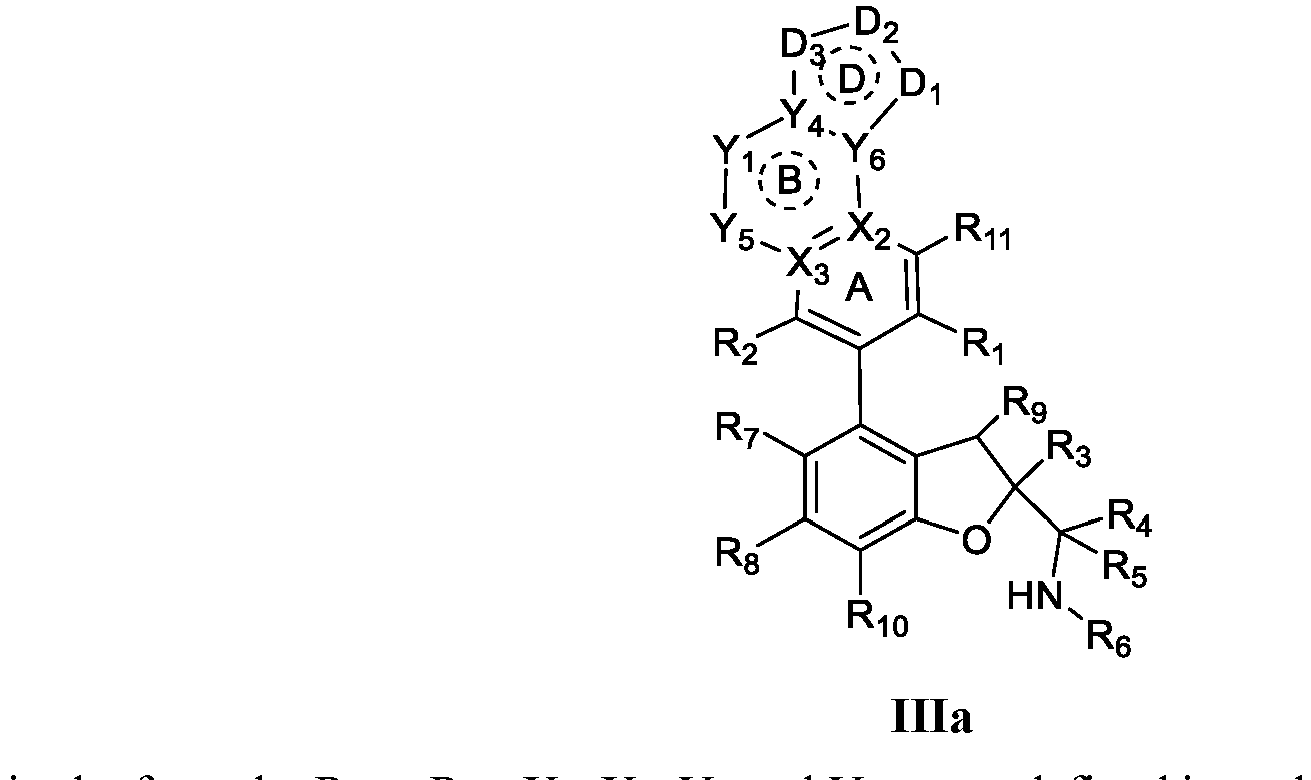
- in the formula, R1 to R13, X2, X3, Y1 and Y5 are as defined in embodiment 1;
- Y4 and Y6 are as defined in embodiment 8;
- D1 is selected from: O, S, S(O)2, N, NRe, CRf and CRfRg;
- D2 is selected from: O, S, S(O)2, N, NRe, (CRf)p and (CRfRg)p;
- D3 is selected from: O, S, S(O)2, N, NRe, (CRf)p and (CRfRg)p;
- each Re is independently selected from: H, substituted or unsubstituted C1-C4 acyl, substituted or unsubstituted C1-C4 alkoxy, cyano, substituted or unsubstituted C1-C4 alkyl-S(O)2-, 4- to 9-membered heteroaryl, 4- to 9-membered heterocyclyl, NR'R"-C(O)-, C3-C6 cyclohydrocarbyl, C3-C6 cyclohydrocarbyl-C(O)-, substituted or unsubstituted C1-C4 haloalkyl and substituted or unsubstituted C1-C4 alkyl; wherein R' and R" are each independently selected from H and C1-C4 alkyl; preferably, the C1-C4 acyl, C1-C4 alkoxy and C1-C4 alkyl are optionally substituted by 1 to 3 substituents selected from F, hydroxyl and cyano;
- each Rf is independently selected from: H, halogen, oxo (=O), substituted or unsubstituted C1-C4 acyl, -OH, cyano, -NR'R", substituted or unsubstituted C1-C4 alkoxy, substituted or unsubstituted C1-C4 alkyl, C3-C6 cyclohydrocarbyl, substituted or unsubstituted C1-C4 alkylS(O)2-, C3-C6 cyclohydrocarbyl-C(O)- and -C(O)-NR'R"; wherein R' and R" are each independently selected from H and C1-C4 alkyl; preferably, the C1-C4 acyl, C1-C4 alkoxy and C1-C4 alkyl are optionally substituted by 1 to 3 substituents selected from F, hydroxyl and cyano;
- each Rg is independently selected from: H, halogen, substituted or unsubstituted C1-C4 acyl, -OH, cyano, -NR'R", substituted or unsubstituted C1-C4 alkoxy, substituted or unsubstituted C1-C4 alkyl, C3-C6 cyclohydrocarbyl, substituted or unsubstituted C1-C4 alkyl-S(O)2-, C3-C6 cyclohydrocarbyl-C(O)- and -C(O)-NR'R"; wherein R' and R" are each independently selected from H and C1-C4 alkyl; preferably, the C1-C4 acyl, C1-C4 alkoxy and C1-C4 alkyl are optionally substituted by 1 to 3 substituents selected from F, hydroxyl and cyano; each p is independently an integer from 1 to 4, preferably 1 or 2;
- wherein the dashed line indicates the presence or absence of a double bond.
- 17. The compound or the pharmaceutically acceptable salt, enantiomer, diastereomer, tautomer, solvate, isotopic substitute, polymorph, prodrug or metabolite thereof according to embodiment 9, characterized in that the compound of formula IIb has a structure shown in the following formula IIIb:

- in the formula, R1 to R13, X2, X3, Y5 and Y6 are as defined in embodiment 1;
- Y1 and Y4 are as defined in embodiment 9;
- D1, D2 and D3 are as defined in embodiment 16;
- wherein the dashed line indicates the presence or absence of a double bond.
- 18. The compound or the pharmaceutically acceptable salt, enantiomer, diastereomer, tautomer, solvate, isotopic substitute, polymorph, prodrug or metabolite thereof according to embodiment 16, characterized in that the compound of formula IIIa has a structure shown in the following formula IVa:

- in the formula, R1 to R13, X2, X3, Y1 and Y5 are as defined in embodiment 1;
- Y4 and Y6 are as defined in embodiment 8;
- D1, D2 and D3 are as defined in embodiment 16;
- ring C is as defined in embodiment 3;
- wherein the dashed line indicates the presence or absence of a double bond.
- 19. The compound or the pharmaceutically acceptable salt, enantiomer, diastereomer, tautomer, solvate, isotopic substitute, polymorph, prodrug or metabolite thereof according to embodiment 17, characterized in that the compound of formula IIIb has a structure shown in the following formula IVb:

- in the formula, R1 to R13, X2, X3, Y5 and Y6 are as defined in embodiment 1;
- Y1 and Y4 are as defined in embodiment 9;
- D1, D2 and D3 are as defined in embodiment 16;
- ring C is as defined in embodiment 3;
- wherein the dashed line indicates the presence or absence of a double bond.
- 20. The compound or the pharmaceutically acceptable salt, enantiomer, diastereomer, tautomer, solvate, isotopic substitute, polymorph, prodrug or metabolite thereof according to any one of embodiments 1 to 19, characterized in that R1 is -C(=O)NR'R"; R' and R" are each independently selected from H, C1-C4 alkyl, C1-C4 alkyl-S(O)2-, C1-C4 haloalkyl.
- 21. The compound or the pharmaceutically acceptable salt, enantiomer, diastereomer, tautomer, solvate, isotopic substitute, polymorph, prodrug or metabolite thereof according to any one of embodiments 1 to 20, characterized in that R1 is -C(=O)NHR'; the R' is selected from H and C1-C4 alkyl.
- 22. The compound or the pharmaceutically acceptable salt, enantiomer, diastereomer, tautomer, solvate, isotopic substitute, polymorph, prodrug or metabolite thereof according to any one of embodiments 1 to 21, characterized in that R1 is -C(=O)NH2.
- 23. The compound or the pharmaceutically acceptable salt, enantiomer, diastereomer, tautomer, solvate, isotopic substitute, polymorph, prodrug or metabolite thereof according to any one of embodiments 1 to 21, characterized in that R1 is -C(=O)NHCH3.
- 24. The compound or the pharmaceutically acceptable salt, enantiomer, diastereomer, tautomer, solvate, isotopic substitute, polymorph, prodrug or metabolite thereof according to any one of embodiments 1 to 23, characterized in that R2 is selected from H, halogen, C1-C4 alkyl and C1-C4 alkoxy.
- 25. The compound or the pharmaceutically acceptable salt, enantiomer, diastereomer, tautomer, solvate, isotopic substitute, polymorph, prodrug or metabolite thereof according to any one of embodiments 1 to 24, characterized in that R2 is selected from H, halogen and methoxy.
- 26. The compound or the pharmaceutically acceptable salt, enantiomer, diastereomer, tautomer, solvate, isotopic substitute, polymorph, prodrug or metabolite thereof according to any one of embodiments 1 to 25, characterized in that R2 is selected from halogen.
- 27. The compound or the pharmaceutically acceptable salt, enantiomer, diastereomer, tautomer, solvate, isotopic substitute, polymorph, prodrug or metabolite thereof according to any one of embodiments 1 to 26, characterized in that R2 is selected from fluorine and chlorine.
- 28. The compound or the pharmaceutically acceptable salt, enantiomer, diastereomer, tautomer, solvate, isotopic substitute, polymorph, prodrug or metabolite thereof according to any one of embodiments 1 to 27, characterized in that R2 is selected from fluorine.
- 29. The compound or the pharmaceutically acceptable salt, enantiomer, diastereomer, tautomer, solvate, isotopic substitute, polymorph, prodrug or metabolite thereof according to any one of embodiments 1 to 28, characterized in that R3 is selected from substituted or unsubstituted aryl.
- 30. The compound or the pharmaceutically acceptable salt, enantiomer, diastereomer, tautomer, solvate, isotopic substitute, polymorph, prodrug or metabolite thereof according to any one of embodiments 1 to 29, characterized in that R3 is selected from substituted or unsubstituted phenyl.
- 31. The compound or the pharmaceutically acceptable salt, enantiomer, diastereomer, tautomer, solvate, isotopic substitute, polymorph, prodrug or metabolite thereof according to any one of embodiments 1 to 30, characterized in that R3 is selected from phenyl.
- 32. The compound or the pharmaceutically acceptable salt, enantiomer, diastereomer, tautomer, solvate, isotopic substitute, polymorph, prodrug or metabolite thereof according to any one of embodiments 1 to 31, characterized in that R4 and R5 are each independently selected from: H, substituted or unsubstituted alkyl; alternatively, R4 and R5, together with the carbon atom to which they are attached, form a 3- to 6-membered substituted or unsubstituted ring, and the ring optionally contains 1 to 3 heteroatoms selected from O, N and S.
- 33. The compound or the pharmaceutically acceptable salt, enantiomer, diastereomer, tautomer, solvate, isotopic substitute, polymorph, prodrug or metabolite thereof according to any one of embodiments 1 to 32, characterized in that R4 and R5 are each independently selected from: H, substituted or unsubstituted C1-C4 alkyl.
- 34. The compound or the pharmaceutically acceptable salt, enantiomer, diastereomer, tautomer, solvate, isotopic substitute, polymorph, prodrug or metabolite thereof according to any one of embodiments 1 to 33, characterized in that R4 and R5 are each independently selected from: H, C1-C3 alkyl.
- 35. The compound or the pharmaceutically acceptable salt, enantiomer, diastereomer, tautomer, solvate, isotopic substitute, polymorph, prodrug or metabolite thereof according to any one of embodiments 1 to 34, characterized in that R4 and R5 are each independently selected from: H, methyl.
- 36. The compound or the pharmaceutically acceptable salt, enantiomer, diastereomer, tautomer, solvate, isotopic substitute, polymorph, prodrug or metabolite thereof according to any one of embodiments 1 to 35, characterized in that R4 and R5 are both H.
- 37. The compound or the pharmaceutically acceptable salt, enantiomer, diastereomer, tautomer, solvate, isotopic substitute, polymorph, prodrug or metabolite thereof according to any one of embodiments 1 to 36, characterized in that R7 and R8 are each independently selected from: H, halogen, cyano, substituted or unsubstituted C1-C4 alkyl, substituted or unsubstituted C1-C4 haloalkyl, substituted or unsubstituted C1-C4 alkoxy, substituted or unsubstituted alkenyl and substituted or unsubstituted alkynyl.
- 38. The compound or the pharmaceutically acceptable salt, enantiomer, diastereomer, tautomer, solvate, isotopic substitute, polymorph, prodrug or metabolite thereof according to any one of embodiments 1 to 37, characterized in that R7 and R8 are each independently selected from: H, halogen, cyano, methyl and methoxy.
- 39. The compound or the pharmaceutically acceptable salt, enantiomer, diastereomer, tautomer, solvate, isotopic substitute, polymorph, prodrug or metabolite thereof according to any one of embodiments 1 to 38, characterized in that R7 and R8 are each independently selected from: fluorine and chlorine.
- 40. The compound or the pharmaceutically acceptable salt, enantiomer, diastereomer, tautomer, solvate, isotopic substitute, polymorph, prodrug or metabolite thereof according to any one of embodiments 1 to 39, characterized in that R7 is chlorine, R8 is fluorine.
- 41. The compound or the pharmaceutically acceptable salt, enantiomer, diastereomer, tautomer, solvate, isotopic substitute, polymorph, prodrug or metabolite thereof according to any one of embodiments 1 to 40, characterized in that R9 is selected from H, C1-C4 alkyl, C1-C4 alkoxy, hydroxyl and halogen.
- 42. The compound or the pharmaceutically acceptable salt, enantiomer, diastereomer, tautomer, solvate, isotopic substitute, polymorph, prodrug or metabolite thereof according to any one of embodiments 1 to 41, characterized in that R9 is selected from H, methyl, methoxy, hydroxyl and F.
- 43. The compound or the pharmaceutically acceptable salt, enantiomer, diastereomer, tautomer, solvate, isotopic substitute, polymorph, prodrug or metabolite thereof according to any one of embodiments 1 to 42, characterized in that R9 is selected from H.
- 44. The compound or the pharmaceutically acceptable salt, enantiomer, diastereomer, tautomer, solvate, isotopic substitute, polymorph, prodrug or metabolite thereof according to any one of embodiments 1 to 43, characterized in that R10 is selected: from H, halogen and C1-C4 alkyl.
- 45. The compound or the pharmaceutically acceptable salt, enantiomer, diastereomer, tautomer, solvate, isotopic substitute, polymorph, prodrug or metabolite thereof according to any one of embodiments 1 to 44, characterized in that R10 is selected from: H, F and methyl.
- 46. The compound or the pharmaceutically acceptable salt, enantiomer, diastereomer, tautomer, solvate, isotopic substitute, polymorph, prodrug or metabolite thereof according to any one of embodiments 1 to 45, characterized in that R10 is H.
- 47. The compound or the pharmaceutically acceptable salt, enantiomer, diastereomer, tautomer, solvate, isotopic substitute, polymorph, prodrug or metabolite thereof according to any one of embodiments 1 to 46, characterized in that R11 is selected from: H, hydroxyl, amino, halogen, C1-C4 alkyl, -NR'R" and C1-C4 alkoxy, wherein R' and R" are independently selected from C1-C4 alkyl.
- 48. The compound or the pharmaceutically acceptable salt, enantiomer, diastereomer, tautomer, solvate, isotopic substitute, polymorph, prodrug or metabolite thereof according to any one of embodiments 1 to 47, characterized in that R11 is selected from: H, hydroxyl, amino, fluorine, chlorine, methyl, methoxy and -NCH3.
- 49. The compound or the pharmaceutically acceptable salt, enantiomer, diastereomer, tautomer, solvate, isotopic substitute, polymorph, prodrug or metabolite thereof according to any one of embodiments 1 to 48, characterized in that R11 is H.
- 50. The compound or the pharmaceutically acceptable salt, enantiomer, diastereomer, tautomer, solvate, isotopic substitute, polymorph, prodrug or metabolite thereof according to any one of embodiments 1 to 49, characterized in that X2 is C.
- 51. The compound or the pharmaceutically acceptable salt, enantiomer, diastereomer, tautomer, solvate, isotopic substitute, polymorph, prodrug or metabolite thereof according to any one of embodiments 1 to 49, characterized in that X2 is N.
- 52. The compound or the pharmaceutically acceptable salt, enantiomer, diastereomer, tautomer, solvate, isotopic substitute, polymorph, prodrug or metabolite thereof according to any one of embodiments 1 to 51, characterized in that X3 is C.
- 53. The compound or the pharmaceutically acceptable salt, enantiomer, diastereomer, tautomer, solvate, isotopic substitute, polymorph, prodrug or metabolite thereof according to any one of embodiments 1 to 50, characterized in that X3 is N.
- 54. The compound or the pharmaceutically acceptable salt, enantiomer, diastereomer, tautomer, solvate, isotopic substitute, polymorph, prodrug or metabolite thereof according to any one of embodiments 1 to 53, characterized in that Y5 is selected from: a bond, O, S, N, CH2, CH, NH and NCH3.
- 55. The compound or the pharmaceutically acceptable salt, enantiomer, diastereomer, tautomer, solvate, isotopic substitute, polymorph, prodrug or metabolite thereof according to any one of embodiments 1 to 54, characterized in that Y5 is O.
- 56. The compound or the pharmaceutically acceptable salt, enantiomer, diastereomer, tautomer, solvate, isotopic substitute, polymorph, prodrug or metabolite thereof according to any one of embodiments 1 to 54, characterized in that Y5 is CH or CH2.
- 57. The compound or the pharmaceutically acceptable salt, enantiomer, diastereomer, tautomer, solvate, isotopic substitute, polymorph, prodrug or metabolite thereof according to any one of embodiments 1 to 54, characterized in that Y5 is NH or N.
- 58. The compound or the pharmaceutically acceptable salt, enantiomer, diastereomer, tautomer, solvate, isotopic substitute, polymorph, prodrug or metabolite thereof according to any one of embodiments 2 to 7, 9, 12 to 13, 17 and 19 to 56, characterized in that Y6 is selected from: a bond, O, S, N, CH, CH2, NH or NCH3.
- 59. The compound or the pharmaceutically acceptable salt, enantiomer, diastereomer, tautomer, solvate, isotopic substitute, polymorph, prodrug or metabolite thereof according to any one of embodiments 2 to 7, 8, 12, 16 and 18 to 53, characterized in that Y1 is selected from: a bond, O, NH, -NCH3, CH, CH2 and -CH(CH3)-.
- 60. The compound or the pharmaceutically acceptable salt, enantiomer, diastereomer, tautomer, solvate, isotopic substitute, polymorph, prodrug or metabolite thereof according to any one of embodiments 1 to 59, characterized in that R6 is selected from: H, substituted or unsubstituted C1-C6 alkyl, substituted or unsubstituted C1-C6 alkoxy, substituted or unsubstituted C2-C6 alkenyl, substituted or unsubstituted C2-C6 alkynyl, substituted or unsubstituted C3-C8 cyclohydrocarbyl, substituted or unsubstituted 6- to 14-membered aryl, substituted or unsubstituted 5- to 10-membered heteroaryl, substituted or unsubstituted 4- to 9-membered monocyclic or fused heterocyclyl, substituted or unsubstituted 6- to 12-membered bridged cyclyl, substituted or unsubstituted 6- to 12-membered bridged heterocyclyl, substituted or unsubstituted 6- to 12-membered spiro cyclyl and substituted or unsubstituted 6- to 12-membered spiro heterocyclyl.
- 61. The compound or the pharmaceutically acceptable salt, enantiomer, diastereomer, tautomer, solvate, isotopic substitute, polymorph, prodrug or metabolite thereof according to any one of embodiments 1 to 60, characterized in that R6 is H, substituted C1-C6 alkyl, substituted C1-C6 alkoxy, substituted C2-C6 alkenyl or substituted C2-C6 alkynyl, and their substituents are 1 to 3 substituents selected from: hydroxyl, halogen, C1-C4 alkoxy optionally substituted by halogen, cyano, C1-C4 alkyl-S(O)2- optionally substituted by halogen, sulfonyl, C1-C4 alkyl optionally substituted by halogen, -S(O)2-NR'R", sulfanilamido, -C(O)-C1-C4 alkyl, -NR'-C(O)-C1-C4 alkyl and 6- to 14-membered aryl, 5- to 10-membered heteroaryl, C3-C8 cyclohydrocarbyl and 4-to 9-membered heterocyclyl, wherein the 6- to 14-membered aryl, 5- to 10-membered heteroaryl, C3-C8 cyclohydrocarbyl and 4- to 9-membered heterocyclyl are optionally substituted by substituents selected from C1-C4 alkyl, C1-C4 haloalkyl, C1-C4 alkoxy, C1-C4 haloalkoxy, halogen, cyano, C1-C4 alkyl-S(O)2-, hydroxyl, carboxyl, NR'R", 6- to 14-membered aryl, 5- to 10-membered heteroaryl, C3-C8 cyclohydrocarbyl and 4- to 9-membered heterocyclyl; wherein R' and R" are each independently selected from H and C1-C4 alkyl; or
- R6 is substituted C3-C8 cyclohydrocarbyl or substituted 4- to 9-membered monocyclic or fused heterocyclyl, and their substituents are 1 to 3 substituents selected from: halogen, hydroxyl, cyano, -NR'R", C1-C4 alkoxy, C1-C4 haloalkoxy, -C(O)-C1-C4 alkyl and C1-C4 alkoxycarbonyl, and the C1-C4 alkyl and C1-C4 alkoxy are optionally substituted by 1 to 3 groups selected from halogen, hydroxyl and -NR'R", wherein the R' and R" are each independently selected from H and C1-C4 alkyl; or
- R6 is substituted 6- to 12-membered bridged cyclyl, substituted 6- to 12-membered bridged heterocyclyl, substituted 6- to 12-membered spiro cyclyl or substituted 6- to 12-membered spiro heterocyclyl, and their substituents are 1 to 3 substituents selected from: C1-C4 alkyl, C1-C4 haloalkyl, C1-C4 alkoxy, C1-C4 haloalkoxy, cyano, C1-C4 alkyl-S(O)2-, hydroxyl, halogen and NR'R", wherein the R' and R" are each independently selected from H and C1-C4 alkyl.
- 62. The compound or the pharmaceutically acceptable salt, enantiomer, diastereomer, tautomer, solvate, isotopic substitute, polymorph, prodrug or metabolite thereof according to any one of embodiments 1 to 59, characterized in that R6 is -L-W-Z, wherein L is a bond or substituted or unsubstituted C1-C4 alkyl; W is a bond, substituted or unsubstituted C1-C4 alkyl, substituted or unsubstituted C3-C8 cyclohydrocarbyl, substituted or unsubstituted 6- to 14-membered aryl, substituted or unsubstituted 5- to 10-membered heteroaryl, substituted or unsubstituted 4- to 9-membered heterocyclyl, substituted or unsubstituted 6- to 12-membered bridged cyclyl, substituted or unsubstituted 6- to 12-membered bridged heterocyclyl, substituted or unsubstituted 6- to 12-membered spiro cyclyl or substituted or unsubstituted 6- to 12-membered spiro heterocyclyl; Z is hydrogen, halogen, C1-C4 alkyl, -O-C1-C4 alkyl, hydroxyl, sulfonyl, -S(O)2-C1-C4 alkyl, -S(O)2-NR'R", sulfanilamido, cyano, -C(O)-C1-C4 alkyl, C3-C8 cyclohydrocarbyl-O- or -NR'-C(O)-C1-C4 alkyl, wherein R' and R" are each independently H or C1-C4 alkyl.
- 63. The compound or the pharmaceutically acceptable salt, enantiomer, diastereomer, tautomer, solvate, isotopic substitute, polymorph, prodrug or metabolite thereof according to embodiment 62, characterized in that the -L-W-Z is selected from: (the wavy line indicates the bond connection position)


- 64. The compound or the pharmaceutically acceptable salt, enantiomer, diastereomer, tautomer, solvate, isotopic substitute, polymorph, prodrug or metabolite thereof according to any one of embodiments 1 to 2, 4 to 17 and 20 to 62, characterized in that R4 or R5 and R6, together with the C and N to which they are attached, form a 4- to 9-membered heterocyclyl ring, and the 4- to 9-membered heterocyclyl can be substituted by 1 to 3 substituents selected from H, deuterium, hydroxyl, cyano, C1-C4 alkyl, halogen and C1-C4 alkoxy.
- 65. The compound or the pharmaceutically acceptable salt, enantiomer, diastereomer, tautomer, solvate, isotopic substitute, polymorph, prodrug or metabolite thereof according to any one of embodiments 1 to 2, 4 to 17, 20 to 62 and 64, characterized in that R4 or R5 and R6, together with the C and N to which they are attached, form the following groups substituted by 1 to 3 substituents selected from H, deuterium, hydroxyl, methyl, F and methoxy:

- 66. The compound or the pharmaceutically acceptable salt, enantiomer, diastereomer, tautomer, solvate, isotopic substitute, polymorph, prodrug or metabolite thereof according to any one of embodiments 1 to 2, 4 to 17, 20 to 62 and 64 to 65, characterized in that R4 or R5 and R6, together with the C and N to which they are attached, form

- 67. The compound or the pharmaceutically acceptable salt, enantiomer, diastereomer, tautomer, solvate, isotopic substitute, polymorph, prodrug or metabolite thereof according to any one of embodiments 3 and 18 to 19, characterized in that ring C is a 4- to 9-membered heterocyclyl ring, which can be substituted by 1 to 3 substituents selected from H, deuterium, hydroxyl, cyano, C1-C4 alkyl, halogen and C1-C4 alkoxy.
- 68. The compound or the pharmaceutically acceptable salt, enantiomer, diastereomer, tautomer, solvate, isotopic substitute, polymorph, prodrug or metabolite thereof according to any one of embodiments 3, 18 to 19 and 67, characterized in that ring C is the following groups substituted by 1 to 3 substituents selected from H, deuterium, hydroxyl, methyl, F and methoxy:

- 69. The compound or the pharmaceutically acceptable salt, enantiomer, diastereomer, tautomer, solvate, isotopic substitute, polymorph, prodrug or metabolite thereof according to any one of embodiments 3, 18 to 19 and 67 to 68, characterized in that ring C is

- 70. The compound or the pharmaceutically acceptable salt, enantiomer, diastereomer, tautomer, solvate, isotopic substitute, polymorph, prodrug or metabolite thereof according to any one of embodiments 1 to 7, 29 to 46 and 50 to 69, characterized in that the ring A and ring B of formulas I, Ia and Ib, together with their substituents, form any one of the following groups:


- 71. The compound or the pharmaceutically acceptable salt, enantiomer, diastereomer, tautomer, solvate, isotopic substitute, polymorph, prodrug or metabolite thereof according to embodiment 70, characterized in that R1 is cyano, -C(=O)NH2 or -C(=O)NHCH3; R2 is H or F; R11 is H; Re is selected from H, methyl, ethyl, cyclopropyl, cyclobutyl, ethylhydroxyl, acetyl, propionyl and cyclopropionyl; Rf is selected from H, F, Cl, -OH, cyano, -NH2, methoxy, methyl, ethyl, cyclopropyl and cyclobutyl.
- 72. The compound or the pharmaceutically acceptable salt, enantiomer, diastereomer, tautomer, solvate, isotopic substitute, polymorph, prodrug or metabolite thereof according to embodiment 71, characterized in that R1 is -C(=O)NH2 or -C(=O)NHCH3; R2 is F; R11 is H; Re is selected from H, methyl, cyclopropyl and acetyl; Rf is selected from H, F, Cl, -OH, cyano, -NH2, methoxy and methyl.
- 73. The compound or the pharmaceutically acceptable salt, enantiomer, diastereomer, tautomer, solvate, isotopic substitute, polymorph, prodrug or metabolite thereof according to any one of embodiments 1, 8 to 19, 29 to 46 and 50 to 69, characterized in that ring A and ring B of formula I together with their substituents, or ring A, ring B and ring D of formula IIa, IIb, IIIa, IIIb, IVa and IVb together with their substituents, or ring A, ring B and ring E of formula IIc and IId together with their substituents form any one of the following groups:


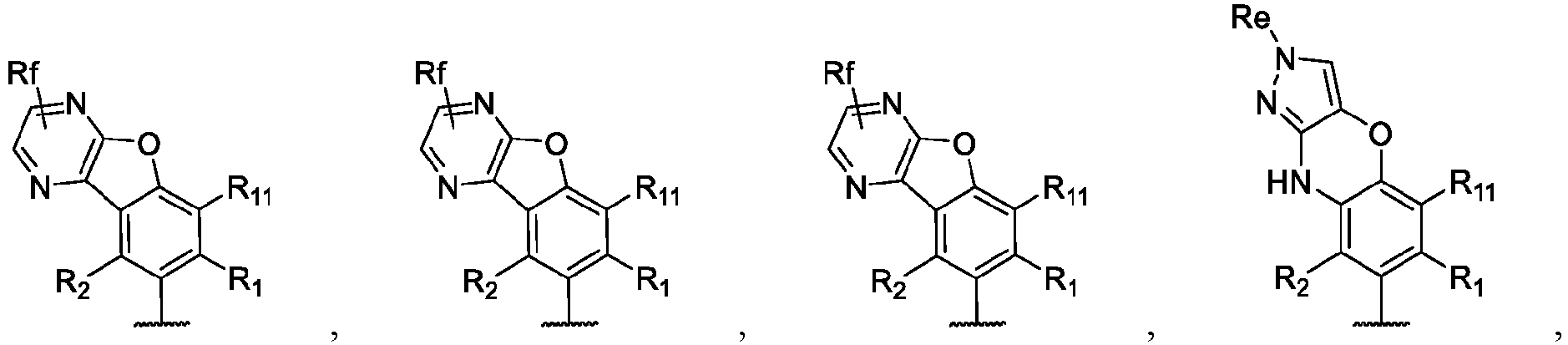


- 74. The compound or the pharmaceutically acceptable salt, enantiomer, diastereomer, tautomer, solvate, isotopic substitute, polymorph, prodrug or metabolite thereof according to embodiment 73, characterized in that R1 is cyano, -C(=O)NH2 or -C(=O)NHCH3; R2 is H or F; R11 is H; R14 is H or methyl; n is 0, 1 or 2; R16 is H, hydroxyl or methyl; Re is selected from H, methyl, ethyl, cyclopropyl, cyclobutyl, ethylhydroxyl, acetyl, propionyl and cyclopropionyl; Rf is selected from H, F, Cl, -OH, cyano, -NH2, methoxy, methyl, ethyl, cyclopropyl and cyclobutyl.
- 75. The compound or the pharmaceutically acceptable salt, enantiomer, diastereomer, tautomer, solvate, isotopic substitute, polymorph, prodrug or metabolite thereof according to embodiment 74, characterized in that R1 is -C(=O)NH2 or -C(=O)NHCH3; R2 is F; R11 is H; R14 is H; R16 is H; Re is selected from H, methyl, cyclopropyl and acetyl; Rf is selected from H, F, Cl, - OH, cyano, -NH2, methoxy and methyl.
- 76. The compound or the pharmaceutically acceptable salt, enantiomer, diastereomer, tautomer, solvate, isotopic substitute, polymorph, prodrug or metabolite thereof according to any one of embodiments 1 to 3, characterized in that
- X2 is selected from: C or N;
- X3 is selected from: C or N;
- Y5 is selected from: O, S, N, CHR13, CR13, -OCH2-, -NCH2-, -CH2CH2- or NR12;
- Y6 is selected from: O, N, -S(O)-, -SO2-, S, CHR13, CR13, -OCH2-, -NCH2-, -CH2CH2- or NR12;
- Y1 is selected from: a bond, O, N, CH, CH2, NH, CHR13, C(R13)2 or NR12;
- Y4 is selected from: a bond, O, N, CH, CH2, NH, CHR13, C(R13)2 or NR12;
- and Y1 and Y4 are not simultaneously a bond or O;
- ring B can be optionally substituted by R13 and/or R12 that do not participate in ring formation, and can be further optionally substituted by 1 to 3 substituents selected from hydroxyl, amino, halogen, substituted or unsubstituted C1-C4 alkyl, -NR'R" and substituted or unsubstituted C1-C4 alkoxy;
- R1 is selected from: cyano and -C(=O)NR'R";
- R2 is selected from: H, halogen, substituted or unsubstituted C1-C4 alkyl and substituted or unsubstituted C1-C4 alkoxy;
- R3 is selected from: substituted or unsubstituted aryl;
- R4 and R5 are each independently selected from: H, halogen and substituted or unsubstituted C1-C4 alkyl; alternatively, R4 and R5, together with the carbon atom to which they are attached, form a 3- to 6-membered substituted or unsubstituted ring, and the ring optionally contains 1 to 3 heteroatoms selected from O, N and S;
- R6 is selected from H, substituted or unsubstituted C1-C6 alkyl, substituted or unsubstituted C1-C6 alkoxy, substituted or unsubstituted C2-C6 alkenyl, substituted or unsubstituted C2-C6 alkynyl, substituted or unsubstituted C3-C8 cyclohydrocarbyl, substituted or unsubstituted 6- to 14-membered aryl, substituted or unsubstituted 5- to 10-membered heteroaryl, substituted or unsubstituted 4- to 9-membered monocyclic or fused heterocyclyl, substituted or unsubstituted 6-to 12-membered bridged cyclyl, substituted or unsubstituted 6- to 12-membered bridged heterocyclyl, substituted or unsubstituted 6- to 12-membered spiro cyclyl and substituted or unsubstituted 6- to 12-membered spiro heterocyclyl;
- alternatively, R4 or R5 and R6, together with the C and N to which they are attached, form a 4- to 9-membered heterocyclyl ring, and the 4- to 9-membered heterocyclyl can be substituted by 1 to 3 substituents selected from H, deuterium, hydroxyl, cyano, C1-C4 alkyl, halogen and C1-C4 alkoxy;
- R7 and R8 are each independently selected from: H, halogen, cyano, substituted or unsubstituted C1-C4 alkyl, substituted or unsubstituted C1-C4 haloalkyl or substituted or unsubstituted C1-C4 alkoxy;
- R9 is selected from: H, C1-C4 alkyl, C1-C4 alkoxy, hydroxyl and halogen;
- R10 is selected from: H, halogen or C1-C4 alkyl;
- R11 is selected from: H, hydroxyl, amino, halogen, C1-C4 alkyl, -NR'R" and C1-C4 alkoxy;
- each R12 is independently selected from H, substituted or unsubstituted C1-C4 acyl, substituted or unsubstituted C1-C4 alkoxy, substituted or unsubstituted C1-C4 alkyl-S(O)2-, 4- to 9-membered heterocyclyl, NR'R"-C(O)-, C3-C8 cyclohydrocarbyl-C(O)- and substituted or unsubstituted C1-C4 alkyl; the substituted or unsubstituted C1-C4 acyl, substituted or unsubstituted C1-C4 alkoxy and substituted or unsubstituted C1-C4 alkyl can be optionally substituted by 1 to 3 substituents selected from F, hydroxy, and cyano;
- each R13 is independently selected from: H, halogen, oxo (=O), substituted or unsubstituted C1-C4 acyl, -OH, cyano, -NR'R", substituted or unsubstituted C1-C4 alkoxy, substituted or unsubstituted C1-C4 alkyl, substituted or unsubstituted C1-C4 alkyl-S(O)2-, C3-C6 cyclohydrocarbyl-C(O)- and -C(O)-NR'R"; the substituted or unsubstituted C1-C4 acyl, substituted or unsubstituted C1-C4 alkoxy and substituted or unsubstituted C1-C4 alkyl can be optionally substituted by 1 to 3 substituents selected from F, hydroxyl and cyano;
- R' and R" are each independently selected from H and C1-C4 alkyl;
- wherein the dashed line indicates the presence or absence of a double bond.
- 77. The compound or the pharmaceutically acceptable salt, enantiomer, diastereomer, tautomer, solvate, isotopic substitute, polymorph, prodrug or metabolite thereof according to any one of embodiments 1 to 3 and 76, characterized in that
- X2 is selected from: C or N;
- X3 is selected from: C or N;
- Y5 is selected from: O, S, N, CH2, CH, NH and NCH3;
- Y6 is selected from: O, S, N, CH2, CH, NH and NCH3;
- Y1 is selected from: a bond, O, NH, -NCH3, CH2 and -CH(CH3)-;
- Y4 is selected from: a bond, O, NH, -NCH3, CH2 and -CH(CH3)-;
- and Y1 and Y4 are not simultaneously a bond or O;
- ring B can be further optionally substituted by 1 to 3 substituents selected from hydroxyl, amino, halogen, substituted or unsubstituted C1-C4 alkyl, -NR'R" and substituted or unsubstituted C1-C4 alkoxy;
- R1 is selected from: cyano, -C(=O)NH2 and -C(=O)NH2CH3;
- R2 is selected from: H, fluorine and methoxy;
- R3 is benzene ring;
- R4 and R5 are each independently selected from: H and C1-C4 alkyl;
- R6 is H, substituted C1-C6 alkyl, substituted C1-C6 alkoxy, substituted C2-C6 alkenyl or substituted C2-C6 alkynyl, and their substituents are 1 to 3 substituents selected from: hydroxyl, halogen, C1-C4 alkoxy optionally substituted by halogen, cyano, C1-C4 alkyl-S(O)2- optionally substituted by halogen, sulfonyl, C1-C4 alkyl optionally substituted by halogen, -S(O)2-NR'R", sulfanilamido, -C(O)-C1-C4 alkyl, -NR'-C(O)-C1-C4 alkyl and 6- to 14-membered aryl, 5- to 10-membered heteroaryl, C3-C8 cyclohydrocarbyl and 4- to 9-membered heterocyclyl, wherein the 6- to 14-membered aryl, 5- to 10-membered heteroaryl, C3-C8 cyclohydrocarbyl and 4- to 9-membered heterocyclyl are optionally substituted by substituents selected from C1-C4 alkyl, C1-C4 haloalkyl, C1-C4 alkoxy, C1-C4 haloalkoxy, halogen, cyano, C1-C4 alkyl-S(O)2-, hydroxyl, carboxyl, NR'R", 6- to 14-membered aryl, 5- to 10-membered heteroaryl, C3-C8 cyclohydrocarbyl and 4- to 9-membered heterocyclyl; wherein R' and R" are each independently selected from H and C1-C4 alkyl; or
- R6 is substituted C3-C8 cyclohydrocarbyl or substituted 4- to 9-membered monocyclic or fused heterocyclyl, and their substituents are 1 to 3 substituents selected from: halogen, hydroxyl, cyano, -NR'R", C1-C4 alkoxy, C1-C4 haloalkoxy, -C(O)-C1-C4 alkyl and C1-C4 alkoxycarbonyl, and the C1-C4 alkyl and C1-C4 alkoxy are optionally substituted by 1 to 3 groups selected from halogen, hydroxyl and -NR'R", wherein the R' and R" are each independently selected from H and C1-C4 alkyl; or
- R6 is substituted 6- to 12-membered bridged cyclyl, substituted 6- to 12-membered bridged heterocyclyl, substituted 6- to 12-membered spiro cyclyl or substituted 6- to 12-membered spiro heterocyclyl, and their substituents are 1 to 3 substituents selected from: C1-C4 alkyl, C1-C4 haloalkyl, C1-C4 alkoxy, C1-C4 haloalkoxy, cyano, C1-C4 alkyl-S(O)2-, hydroxyl, halogen and NR'R", wherein the R' and R" are each independently selected from H and C1-C4 alkyl;
- alternatively, R4 or R5 and R6, together with the C and N to which they are attached, form the following groups substituted by 1 to 3 substituents selected from H, deuterium, hydroxyl, methyl, F and methoxy:

- R7 and R8 are each independently selected from: H, halogen, cyano, methyl and methoxy;
- R9 is selected from: H, methyl, methoxy, hydroxyl and F;
- R10 is selected from: H, methyl and F;
- R11 is selected from: H, hydroxyl, amino, fluorine, chlorine, methyl, methoxy and -NCH3;
- each R12 is independently selected from H, acetyl, propionyl, C1-C4 alkoxy, C1-C4 alkylS(O)2-, 4- to 6-membered heterocyclyl, C3-C5 cyclohydrocarbyl-C(O)- and substituted or unsubstituted C1-C4 alkyl;
- each R13 is independently selected from H, fluorine, chlorine, oxo (=O), C1-C4 acyl, -OH, cyano, C1-C4 alkoxy, C1-6 alkyl, C1-C4 alkyl-S(O)2- and C3-C4 cyclohydrocarbyl-C(O)-,
- the wavy line indicates the bond connection position.
- 78. The compound or the pharmaceutically acceptable salt, enantiomer, diastereomer, tautomer, solvate, isotopic substitute, polymorph, prodrug or metabolite thereof according to embodiment 8, characterized in that
- X2 is selected from: C or N;
- X3 is selected from: C or N;
- Y1 is selected from: a bond, O, NH, -NCH3, CH2 and -CH(CH3)-;
- Y5 is selected from: O, S, N, CH2, CH, NH and NCH3; and Y1 and Y5 are not simultaneously O;
- Y4 is selected from: C, CH or N;
- Y6 is selected from: C, CH or N;
- ring D is a C3-C8 cyclohydrocarbyl, C4-C9 heterocyclyl, C5-C10 heteroaryl or C6-C10 aryl ring; the C4-C9 heterocyclyl and C5-C10 heteroaryl can optionally contain 1 to 3 heteroatoms selected from O, N and S;
- R15 is selected from: H, halogen, oxo (=O), substituted or unsubstituted C1-C4 acyl, hydroxyl, substituted or unsubstituted C1-C4 alkoxy, cyano, -NR'R", -C(O)-NR'R", substituted or unsubstituted C1-C4 alkyl-S(O)2-, substituted or unsubstituted C6-C14 aryl-S(O)2-, 4- to 9-membered heterocyclyl, NR'R"-C(O)-, C3-C8 cyclohydrocarbyl-C(O)-, substituted or unsubstituted C1-C4 haloalkyl and substituted or unsubstituted C1-C4 alkyl;
- each n is independently 0, 1, 2, 3 or 4;
- R1 to R11 are as defined in embodiment 76.
- 79. The compound or the pharmaceutically acceptable salt, enantiomer, diastereomer, tautomer, solvate, isotopic substitute, polymorph, prodrug or metabolite thereof according to embodiment 78, characterized in that R1 to R11 are as defined in embodiment 77.
- 80. The compound or the pharmaceutically acceptable salt, enantiomer, diastereomer, tautomer, solvate, isotopic substitute, polymorph, prodrug or metabolite thereof according to embodiment 9, characterized in that
- X2 and X3 are C;
- Y1 is selected from: C, CH or N;
- Y4 is selected from: C, CH or N;
- Y5 is selected from: a bond, O, NH, -NCH3, CH2 and -CH(CH3)-;
- Y6 is selected from: a bond, O, S, N, CH2, CH, NH and NCH3; and Y5 and Y6 are not simultaneously a bond;
- ring D is a C3-C8 cyclohydrocarbyl, C4-C9 heterocyclyl, C5-C10 heteroaryl or C6-C10 aryl ring; the C4-C9 heterocyclyl and C5-C10 heteroaryl can optionally contain 1 to 3 heteroatoms selected from O, N and S;
- R15 is selected from: H, halogen, oxo (=O), substituted or unsubstituted C1-C4 acyl, hydroxyl, substituted or unsubstituted C1-C4 alkoxy, cyano, -NR'R", -C(O)-NR'R", substituted or unsubstituted C1-C4 alkyl-S(O)2-, substituted or unsubstituted C6-C14 aryl-S(O)2-, 4- to 9-membered heterocyclyl, NR'R"-C(O)-, C3-C8 cyclohydrocarbyl-C(O)-, substituted or unsubstituted C1-C4 haloalkyl and substituted or unsubstituted C1-C4 alkyl; preferably, the C1-C4 acyl, C1-C4 alkoxy and C1-C4 alkyl are optionally substituted by 1 to 3 substituents selected from F, hydroxyl, and cyano;
- each n is independently 0, 1, 2, 3 or 4;
- R1 to R11 are as defined in embodiment 76.
- 81. The compound or the pharmaceutically acceptable salt, enantiomer, diastereomer, tautomer, solvate, isotopic substitute, polymorph, prodrug or metabolite thereof according to embodiment 80, characterized in that R1 to R11 are as defined in embodiment 77.
- 82. The compound or the pharmaceutically acceptable salt, enantiomer, diastereomer, tautomer, solvate, isotopic substitute, polymorph, prodrug or metabolite thereof according to embodiment 12, characterized in that
- X2 and X3 are C;
- Y1 is selected from: O or CH2;
- Y5 is selected from: a bond, O, NH, -NCH3, CH2 and -CH(CH3)-;
- Y6 is selected from: a bond, O, S, N, CH2, CH, NH and NCH3; and Y5 and Y6 are not simultaneously a bond;
- ring E is a C3-C8 cyclohydrocarbyl or C4-C9 heterocyclyl ring; the C4-C9 heterocyclyl can optionally contain 1 to 3 heteroatoms selected from O, N and S;
- R16 is selected from halogen, C1-C4 alkyl, hydroxyl, C1-C4 acyl and C1-C4 alkoxy;
- n is 0, 1, 2, 3 or 4;
- R1 to R11 are as defined in embodiment 76.
- 83. The compound or the pharmaceutically acceptable salt, enantiomer, diastereomer, tautomer, solvate, isotopic substitute, polymorph, prodrug or metabolite thereof according to embodiment 82, characterized in that R1 to R11 are as defined in embodiment 77.
- 84. The compound or the pharmaceutically acceptable salt, enantiomer, diastereomer, tautomer, solvate, isotopic substitute, polymorph, prodrug or metabolite thereof according to embodiment 16, characterized in that
- X2, X3, Y1, Y5, Y4 and Y6 are as defined in embodiment 78;
- D1 is selected from: O, S, N, NRe, CRf and CRfRg;
- D2 is selected from: O, S, N, NRe, (CRf)p and (CRfRg)p;
- D3 is selected from: O, S, N, NRe, (CRf)p and (CRfRg)p;
- each Re is independently selected from: H, substituted or unsubstituted C1-C4 acyl, substituted or unsubstituted C1-C4 alkoxy, cyano, substituted or unsubstituted C1-C4 alkyl-S(O)2-, 4- to 9-membered heterocyclyl, NR'R"-C(O)-, C3-C6 cyclohydrocarbyl, C3-C6 cyclohydrocarbyl-C(O)-, substituted or unsubstituted C1-C4 haloalkyl and substituted or unsubstituted C1-C4 alkyl; preferably, the C1-C4 acyl, C1-C4 alkoxy and C1-C4 alkyl are optionally substituted by 1 to 3 substituents selected from F, hydroxyl and cyano;
- wherein R' and R" are each independently selected from H and C1-C4 alkyl;
- each Rf is independently selected from: H, halogen, oxo (=O), substituted or unsubstituted C1-C4 acyl, -OH, cyano, -NR'R", substituted or unsubstituted C1-C4 alkoxy, substituted or unsubstituted C1-C4 alkyl, C3-C6 cyclohydrocarbyl, substituted or unsubstituted C1-C4 alkylS(O)2-, C3-C6 cyclohydrocarbyl-C(O)- and -C(O)-NR'R"; preferably, the C1-C4 acyl, C1-C4 alkoxy and C1-C4 alkyl are optionally substituted by 1 to 3 substituents selected from F, hydroxyl and cyano; wherein R' and R" are each independently selected from H and C1-C4 alkyl;
- each Rg is independently selected from: H, halogen, substituted or unsubstituted C1-C4 acyl, -OH, cyano, -NR'R", substituted or unsubstituted C1-C4 alkoxy, substituted or unsubstituted C1-C4 alkyl, C3-C6 cyclohydrocarbyl, substituted or unsubstituted C1-C4 alkyl-S(O)2-, C3-C6 cyclohydrocarbyl-C(O)- and -C(O)-NR'R"; preferably, the C1-C4 acyl, C1-C4 alkoxy and C1-C4 alkyl are optionally substituted by 1 to 3 substituents selected from F, hydroxyl and cyano;
- wherein R' and R" are each independently selected from H and C1-C4 alkyl;
- each p is independently an integer from 1 to 4, preferably 1 or 2;
- R1 to R11 are as defined in embodiment 76.
- 85. The compound or the pharmaceutically acceptable salt, enantiomer, diastereomer, tautomer, solvate, isotopic substitute, polymorph, prodrug or metabolite thereof according to embodiment 84, characterized in that R1 to R11 are as defined in embodiment 77.
- 86. The compound or the pharmaceutically acceptable salt, enantiomer, diastereomer, tautomer, solvate, isotopic substitute, polymorph, prodrug or metabolite thereof according to embodiment 17, characterized in that
- X2, X3, Y1, Y5, Y4, Y6 and n are as defined in embodiment 80;
- D1, D2 and D3 are as defined in embodiment 84;
- R1 to R11 are as defined in embodiment 76.
- 87. The compound or the pharmaceutically acceptable salt, enantiomer, diastereomer, tautomer, solvate, isotopic substitute, polymorph, prodrug or metabolite thereof according to embodiment 86, characterized in that R1 to R11 are as defined in embodiment 77.
- 88. The compound or the pharmaceutically acceptable salt, enantiomer, diastereomer, tautomer, solvate, isotopic substitute, polymorph, prodrug or metabolite thereof according to embodiment 1, characterized in that
ring A and ring B, together with their ring substituents, form:


- wherein R1 is cyano or -C(=O)NR'R"; R2 is H or halogen; R11 is H, OH, -NR'R", halogen or C1-C4 alkyl; R14 is H, halogen or C1-C4 alkyl; n is 0, 1 or 2; R16 is selected from H, hydroxyl, halogen and C1-C4 alkyl; Re is selected from H, substituted or unsubstituted C1-C4 alkyl, substituted or unsubstituted C1-C4 alkoxy, C3-C6 cyclohydrocarbyl, substituted unsubstituted C1-C4 acyl; Rf is selected from H, halogen, -OH, cyano, -NR'R", substituted or Unsubstituted C1-C4 alkoxy, substituted or unsubstituted C1-C4 alkyl, C3-C6 cyclohydrocarbyl; preferably, the C1-C4 acyl, C1-C4 alkoxy and C1-C4 alkyl are optionally substituted by 1 to 3 substituents selected from F, hydroxyl and cyano; wherein R' and R" are each independently selected from H and C1-C4 alkyl; the wavy line indicates the bond connection position;
- X1 is O;
- R3 is selected from unsubstituted phenyl or phenyl substituted by 1 to 3 substituents selected from hydroxyl, halogen, C1-C4 alkyl, C1-C4 haloalkyl and C1-C4 alkoxy;
- R4 is selected from H or C1-C4 alkyl;
- R5 is selected from H or C1-C4 alkyl;
- R6 is selected from: H; C1-C4 alkyl, which is optionally substituted by 1 to 3 substituents selected from hydroxyl, halogen, C1-C4 alkoxy, cyano, C1-C4 alkyl-S(O)2- and sulfonyl; 3- to 8-membered cyclohydrocarbyl, which is optionally substituted by 1 to 3 substituents selected from halogen, hydroxyl, cyano, C1-C4 alkyl-S(O)2-, C1-C4 alkyl and C1-C4 alkoxy; 4- to 9-membered heterocyclyl, which is optionally substituted by 1 to 3 substituents selected from halogen, hydroxyl, cyano, C1-C4 alkyl-S(O)2-, C1-C4 alkyl and C1-C4 alkoxy; and 6- to 12-membered bridged cyclyl, 6- to 12-membered spiro cyclyl, 6- to 12-membered bridged heterocyclyl or 6- to 12-membered spiro heterocyclyl, each of which is optionally substituted by 1 to 3 substituents selected from C1-C4 alkyl, C1-C4 alkoxy and cyano;
- alternatively, R4 or R5 and R6, together with the C and N to which they are attached, form the following groups substituted by 1 to 3 substituents selected from H, deuterium, hydroxyl, methyl, F and methoxy:

- R7 and R8 are each independently selected from: H, halogen, cyano, methyl and methoxy;
- R9 is selected from: H, methyl, methoxy, hydroxyl and F;
- R10 is selected from: H, methyl and F,
- the wavy line indicates the bond connection position.
- 89. The compound or the pharmaceutically acceptable salt, enantiomer, diastereomer, tautomer, solvate, isotopic substitute, polymorph, prodrug or metabolite thereof according to embodiment 88, characterized in that
ring A and ring B, together with their ring substituents, form:


- 90. The compound or the pharmaceutically acceptable salt, enantiomer, diastereomer, tautomer, solvate, isotopic substitute, polymorph, prodrug or metabolite thereof according to embodiment 88, characterized in that
ring A and ring B, together with their ring substituents, form:

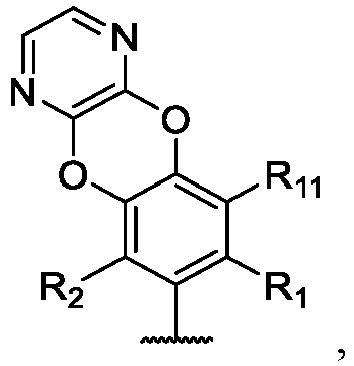
- 91. The compound or the pharmaceutically acceptable salt, enantiomer, diastereomer, tautomer, solvate, isotopic substitute, polymorph, prodrug or metabolite thereof according to embodiment 1, characterized in that the compound is selected from the following compounds:

R1 to R11, X1 to X3, Y1, Y4, Y5, Y6 and ring B are as defined in embodiment 1. - 92. The compound or the pharmaceutically acceptable salt, enantiomer, diastereomer, tautomer, solvate, isotopic substitute, polymorph, prodrug or metabolite thereof according to embodiment 1, characterized in that the compound is selected from the following compounds:
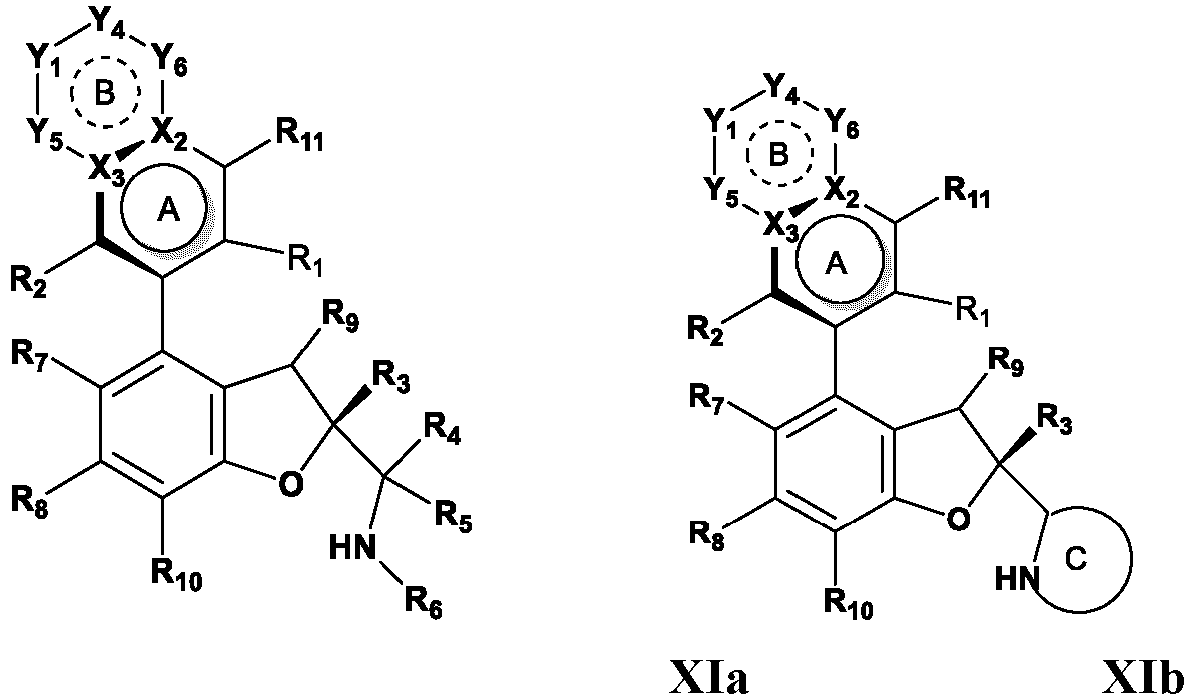
- in formula XIa, R1 to R11, X2 to X3, Y1, Y4, Y5, Y6 and ring B are as defined in embodiment 2;
- in formula XIb, R1 to R3, R7 to R13, X2, X3 and ring B are as defined in embodiment 1; Y1, Y4, Y5, Y6 and ring C are as defined in embodiment 2.
- 93. The compound or the pharmaceutically acceptable salt, enantiomer, diastereomer, tautomer, solvate, isotopic substitute, polymorph, prodrug or metabolite thereof according to embodiment 1, characterized in that the compound is selected from the following compounds:


- in formula XIIa, R1 to R13, X2 to X3, Y1 and Y5 are as defined in embodiment 1; Y4, Y6, R15, ring D and n are as defined in embodiment 8;
- in formula XIIb, R1 to R13, X2 to X3, Y1 and Y5 are as defined in embodiment 1; Y4, Y6, R15, ring D and n are as defined in embodiment 9;
- in formula XIIc, R1 to R13, X2 to X3, Y1, Y5 and Y6 are as defined in embodiment 1; ring E, R16 and n are as defined in embodiment 12;
- in formula XIId, R1 to R13, X2, X3, Y4, Y5 and Y6 are as defined in embodiment 1; ring E, R16 and n are as defined in embodiment 12;
- in each formula, the dashed line indicates the presence or absence of a double bond.
- 94. The compound or the pharmaceutically acceptable salt, enantiomer, diastereomer, tautomer, solvate, isotopic substitute, polymorph, prodrug or metabolite thereof according to embodiment 1, characterized in that the compound is selected from the following compounds:


- in formula XIIIa, R1 to R13, X2 to X3, Y1 and Y5 are as defined in embodiment 1; Y4 and Y6 are as defined in embodiment 8; D1, D2 and D3 are as defined in embodiment 16;
- in formula XIIIb, R1 to R13, X2 to X3, Y5 and Y6 are as defined in embodiment 1; Y1 and Y4 are as defined in embodiment 9; D1, D2 and D3 are as defined in embodiment 16;
- in formula XIVa, R1 to R13, X2 to X3, Y1 and Y5 are as defined in embodiment 1; Y4 and Y6 are as defined in embodiment 8; D1, D2 and D3 are as defined in embodiment 16; ring C is as defined in embodiment 3;
- in formula XIVb, R1 to R13, X2, X3, Y5 and Y6 are as defined in embodiment 1; Y1 and Y4 are as defined in embodiment 9; D1, D2 and D3 are as defined in embodiment 16; ring C is as defined in embodiment 3;
- in each formula, the dashed line indicates the presence or absence of a double bond.
- 95. The compound or the pharmaceutically acceptable salt, enantiomer, diastereomer, tautomer, solvate, isotopic substitute, polymorph, prodrug or metabolite thereof according to embodiment 1, characterized in that the compound is selected from the following compounds:


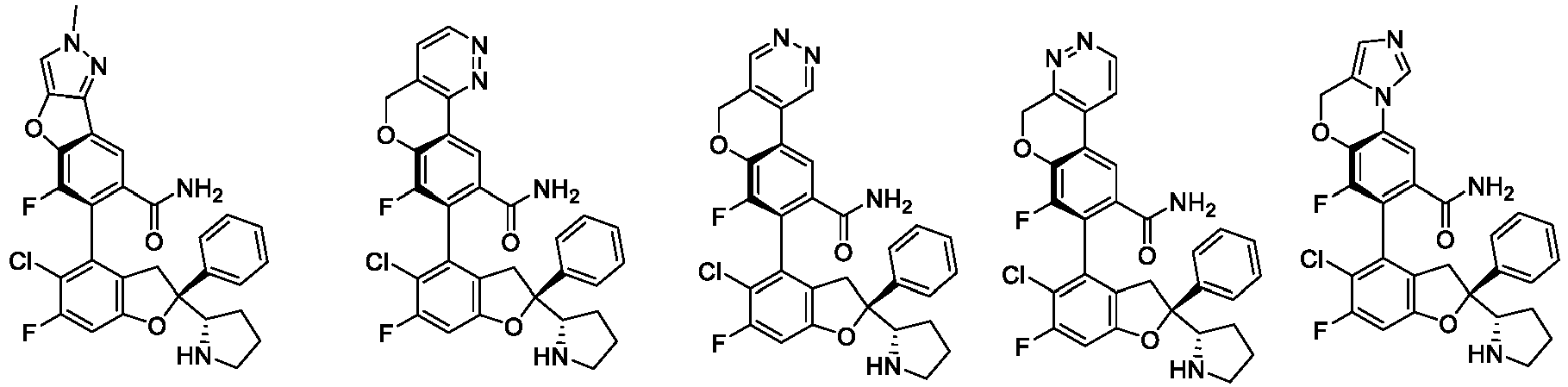


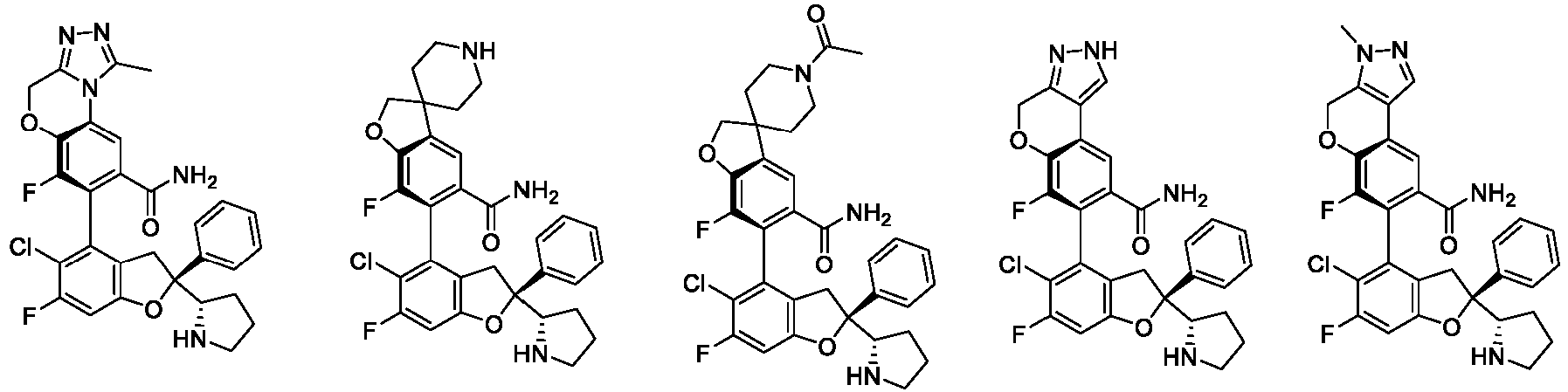


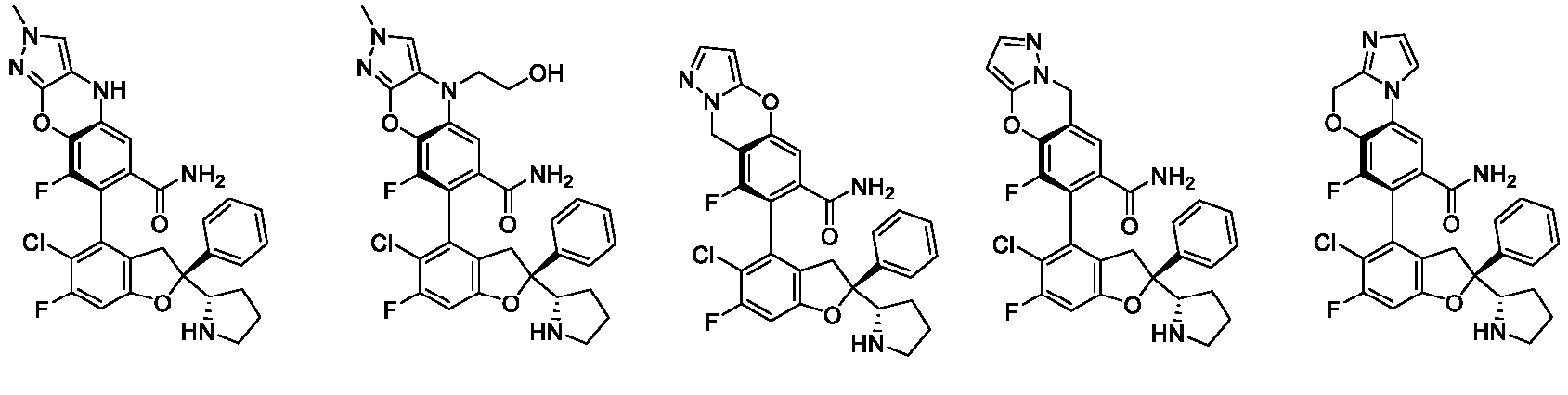


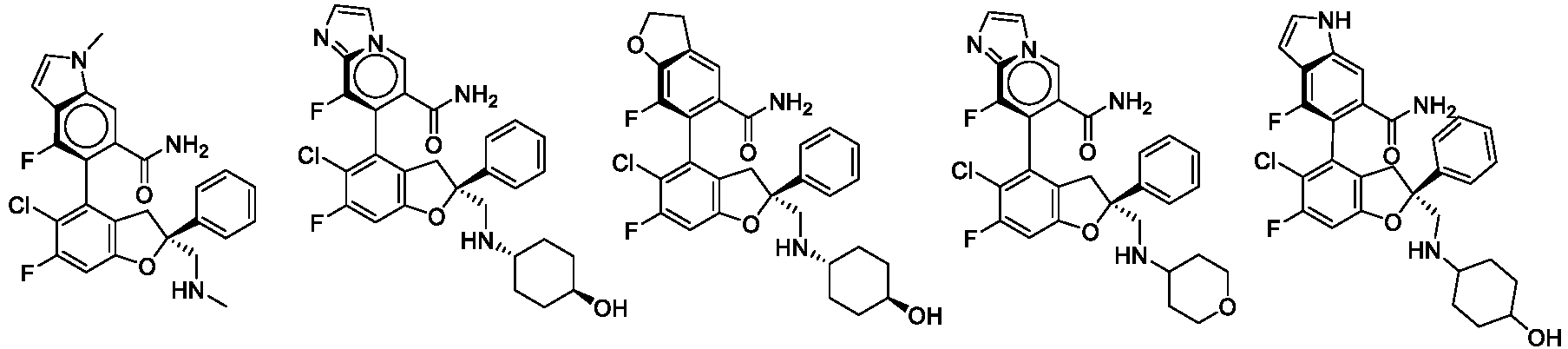


- 95. A pharmaceutical composition, characterized in that the pharmaceutical composition comprises the compound or the pharmaceutically acceptable salt, enantiomer, diastereomer, tautomer, solvate, isotopic substitute, polymorph, prodrug or metabolite thereof according to any one of embodiments 1 to 94, and a pharmaceutically acceptable carrier or excipient.
- 96. A use of the compound or the pharmaceutically acceptable salt, enantiomer, diastereomer, tautomer, solvate, isotopic substitute, polymorph, prodrug or metabolite thereof according to any one of embodiments 1 to 95 in the manufacture of a medicament for treating or preventing diseases mediated by interaction between YAP/TAZ and TEAD; preferably, the diseases mediated by the interaction between YAP/TAZ and TEAD are tumors or cancers, including solid tumors or hematological tumors; more preferably, the diseases mediated by the interaction between YAP/TAZ and TEAD are selected from mesothelioma (including pleural mesothelioma, malignant pleural mesothelioma, peritoneal mesothelioma, pericardial mesothelioma and tunica vaginalis mesothelioma), cervical squamous cell carcinoma, endometrial carcinoma, esophageal squamous cell carcinoma, esophageal adenocarcinoma, bladder urothelial carcinoma, skin squamous cell carcinoma, poroma (benign poroma), porocarcinoma (including malignant porocarcinoma), supratentorial ependymoma (including pediatric supratentorial ependymoma), epithelioid hemangioendothelioma, ependymoma, breast cancer (including triple-negative breast cancer), lung cancer (including non-small cell lung cancer), ovarian cancer, colorectal cancer, melanoma, pancreatic cancer, prostate cancer, gastric cancer, esophageal cancer, liver cancer (including hepatocellular carcinoma, cholangiocarcinoma and hepatoblastoma), neuroblastoma, neurilemmoma, renal cancer, sarcoma (including rhabdomyosarcoma, embryonal rhabdomyosarcoma, osteosarcoma, undifferentiated pleomorphic sarcoma, Kaposi's sarcoma, soft tissue sarcoma and rare soft tissue sarcoma), bone cancer, brain cancer, medulloblastoma, glioma, meningioma and head and neck cancer (including head and neck squamous cell carcinoma).
- The present disclosure will be further described below in conjunction with specific examples. It should be understood that these examples are only used to illustrate the present disclosure and are not intended to limit the scope of the present disclosure. Experimental methods for which specific conditions are not indicated in the following examples are usually in accordance with conventional conditions, or in accordance with conditions recommended by the manufacturer. Unless otherwise stated, percentages and parts are calculated by weight.
- The starting materials used in the following examples can be purchased from chemical vendors such as Aldrich, TCI, Alfa Aesar, Bide, Energy, etc., or synthesized using known methods.
- In the following examples, if not otherwise indicated, the ice bath is carried out at a temperature of -5°C to 0°C, room temperature refers to 10°C to 30°C, the reflux temperature refers to the temperature at which the solvent is refluxed under normal pressure, and reaction overnight refers to a reaction duration of 8 to 15 hours. In the following examples, when the specific operating temperature is not limited, all operations are carried out at room temperature.
- In the following examples, if not otherwise indicated, the separation and purification of the intermediates and the final product are carried out by normal or reversed phase chromatographic column separation or other suitable methods. Normal phase flash chromatographic columns use ethyl acetate and n-hexane or methanol and dichloromethane as mobile phases. Reversed phase preparative high-pressure liquid chromatography (HPLC) is carried out by a C18 column and detected at UV 214 nm and 254 nm. The mobile phases are mobile phases A (0.1% formic acid aqueous solution) and B (acetonitrile) or mobile phases A (0.1% ammonium bicarbonate aqueous solution) and B (acetonitrile).
- The analytical conditions used in each example are as follows:
- LCMS instrument: Pump Agilent 1260;
- UV detector: Agilent 1260 DAD Mass Spectrometer API 3000;
- chromatographic column: Waters sunfire C18, 4.6 × 50 mm, 5 µm;
- mobile phase: A-H2O (containing 0.1% HCOOH); B-acetonitrile
- NMR: Bruker Ascend 400M (1H NMR: 400 MHz; 13C NMR: 100 MHz).
- The corresponding meanings of the English abbreviations appearing in the chemical equations and texts of the present disclosure are as shown in the following table:
Ti(OEt)4 Tetraethyl titanate DMF N,N-Dimethylformamide LiBH4 Lithium borohydride Na2CO3 Sodium carbonate TFA Trifluoroacetic acid EtOH Ethanol LDA Lithium diisopropylamide CBr4 Carbon tetrabromide Pd(AmPhos)2 Cl2 Bis(di-tert-butyl(4-dimethylaminophenyl)phosphine)dichloropalladium(II) Ph3P Triphenylphosphine Cs2CO3 Cesium carbonate NBS N-bromosuccinimide DMAc or DMA N,N-Dimethylacetatnide BPO Benzoyl peroxide THF Tetrahydrofuran TMP 2,2,6,6-Tetramethylpiperidine DCM Dichloromethane PBr3 Phosphorus tribromide MszO Methanesulfonic anhydride CCl4 Carbon tetrachloride n-BuLi n-Butyllithium N2H4 Hydrazine Dibal-H Diisobutylaluminium hydride H2SO4 Sulfuric acid Dioxane 1,4-Dioxane POCl3 Phosphorus oxychloride PPA Polyphosphoric acid Pd(OAc)2 Palladium acetate NaBH4 Sodium borohydride EtONa Sodium ethoxide MeOH Methanol Pd2(dba)3 Tris(dibenzylideneacetone)dip alladium Et3N or TEA Triethylamine XantPhos 4,5-Bis(diphenylphosphino)-9,9-dimethylxanthene DIPEA N,N-Diisopropylethylamine CH3CN Acetonitrile HCl Hydrogen chloride Boc2O Di-tert-butyl dicarbonate PMB-Br 4-Methoxybenzyl bromide K2CO3 Potassium carbonate SEMCl 2-(Trimethylsilyl)ethoxymethyl chloride DBAD Diisopropyl azodicarboxylate t-BuXphos-Pd-G3 Methanesulfonato(2-di-t-butylphosphino-2',4',6'-tri-i-propyl-1,1'-biphenyl)(2'-amino-1,1'-biphenyl-2-yl)palladium(II) Ruphos-Pd-G3 Methanesulfonato(2-dicyclohexylphosphino-2',6'-di-i-propoxy-1,1'-biphenyl)(2'-amino-1,1'-biphenyl-2-yl)palladium(II) Cyclohexane Cyclohexane Toluene Toluene i-PrMgBr Isopropylmagnesium bromide LiCl Lithium chloride NaH Sodium hydride CH3ONa Sodium methoxide NCS N-Chlorosuccinimide LiOH Lithium hydroxide NaBH(OAc)3 Sodium triacetoxyborohydride Pddppf(Cl)2 [1,1'-Bis(diphenylphosphino)ferroc ene]dichloropalladium(II) CuI Cuprous iodide MeI Iodomethane LiHMDS Lithium bis(trimethylsilyl)amide Bromo(phe nyl) magnesium Phenylmagnesium bromide n-Heptane n-Heptane t-BuOK Potassium tert-butoxide B2(Pin)2 Pinacol borate KOPiv Potassium pivalate Xylene Xylene Ti(iPrO)4 Tetraisopropyl titanate HTMP 2,2,6,6-Tetramethylpiperidine TBSOTf tert-Butyldimethylsilyl trifluoromethanesulfonate DtBuAD Di-tert-butyl azodicarboxylate KOAc Potassium acetate DMSO Dimethyl sulfoxide DMAP 4-Dimethylaminopyridine tert-BuOH tert-Butanol Acetone Acetone 1-Butanol/n-BuOH n-Butanol NMP N-Methylpyrrolidone Ac2O Acetic anhydride AcOH Acetic acid Lawesson's reagent Lawesson's reagent NIS N-Iodosuccinimide BnBr Benzyl bromide N-Xantphos 4,6-Bis(diphenylphosphino)pheno xazine Ruphos 2-Dicyclohexylphosphino-2',6'-di-i-propoxy-1,1'-biphenyl TsOH p-Toluenesulfonic acid Cu(OAc)2 Copper acetate Microwave Microwave RT Room temperature -

- Step 1: Tetrahydrofuran (THF) (150 mL) and A1-1 (15 g, 47.04 mmol) were sequentially added to a dry three-neck flask under nitrogen atmosphere, and i-PrMgCl.LiCl (39.8 mL, 51.74 mmol, a solution dissolved in THF, concentration of 1.3 M) was added dropwise after cooling to -70°C, and stirred at this temperature for 1 hour. Then DMF (5.16 g, 70.56 mmol) was added dropwise, and stirred for another 1 hour. TLC (thin-layer chromatography) showed that the reaction was completed. The reaction mixture was quenched by pouring into saturated NH4Cl aqueous solution at 0°C and extracted with ethyl acetate, then the combined organic phases were washed with saturated brine, dried over anhydrous sodium sulfate, filtered, and concentrated under reduced pressure to obtain yellow oily A1-2 (5.8 g, crude), which was used directly in the next step.
- Step 2: THF (60 mL), MeOH (10 mL), A1-2 (5.8 g, crude) and NaBH4 (596 mg, 15.75 mmol) were sequentially added to a dry 250 mL single-neck flask. The reaction mixture was stirred at 20°C for 0.5 hours. TLC showed that the reaction was completed. The reaction mixture was quenched by pouring into saturated NH4Cl aqueous solution at 0°C and extracted with ethyl acetate, then the combined organic phases were washed with saturated brine, dried over anhydrous sodium sulfate, filtered, and concentrated under reduced pressure to obtain yellow oily A1-3 (4.2 g, crude), which was used directly in the next step.
- Step 3: DCM (40 mL), A1-3 (4.2 g, 18.83 mmol) and PPh3 (5.93 g, 22.6 mmol) were sequentially added to a dry 100 mL single-neck flask, and stirred to dissolve. Then NBS (4.02 g, 22.6 mmol) was slowly added thereto. The resulting yellow reaction mixture was stirred at 20°C for 0.5 hours. TLC showed that the reaction was completed. The reaction mixture was loaded onto the column using the wet method, then subjected to silica gel column chromatography (5 to 10% dichloromethane/petroleum ether) to obtain A1-4 as a colorless oil (4.1 g, yield: 76%).
- 1H NMR (400 MHz, Chloroform-d) δ 7.19 (dt, J = 7.8, 2.1 Hz, 1H), 6.85 (ddd, J = 9.4, 8.4, 2.5 Hz, 1H), 4.60 (d, J = 2.0 Hz, 2H).
- Step 4: Cyclohexane (150 mL), (S)-(+)-mandelic acid (25 g, 164 mmol, 1.0 eq) and trimethyl orthoformate (27 mL, 246 mmol, 1.5 eq) were sequentially added to a reaction flask and stirred at 100°C for 2 hours, and then concentrated under reduced pressure. The residue was dissolved in toluene (100 mL), then pivalaldehyde (23.1 mL, 181 mmol, 1.1 eq, purity of 85%) and p-toluenesulfonic acid (936 mg, 4.92 mmol, 0.03 eq) were added thereto, stirred at 25°C for 12 hours and concentrated under reduced pressure. The residue was slurried with a mixed solvent of cyclohexane/toluene (100 mL, 3/1) and filtered. The filter cake was vacuum dried to obtain A1-4A as a white solid (23 g, yield: 63.5%).
- 1H NMR (400 MHz, DMSO-d 6) δ 7.50 - 7.35 (m, 5H), 5.57 (d, J= 1.2 Hz, 1H), 5.48 (d, J= 1.2 Hz, 1H), 1.02 (s, 9H).
- DMF (65 mL), A1-4 (6.5 g, 22.73 mmol) and A1-4A (5.01 g, 22.73 mmol) were sequentially added to a dry 250 mL three-neck flask. The mixture was stirred to dissolve and slowly added with NaH (1.27 g, 31.83 mmol, dispersed in mineral oil, concentration of 60%). The resulting yellow reaction mixture was stirred at 25°C for 2 hours. TLC showed that the reaction was completed. The reaction mixture was quenched by pouring into saturated NH4Cl aqueous solution and extracted with ethyl acetate, then the combined organic phases were washed with saturated brine, dried over anhydrous sodium sulfate, filtered, and concentrated under reduced pressure, and the resulting residue was subjected to silica gel column chromatography (0 to 5% ethyl acetate/petroleum ether) to obtain A1-5 as a white solid (8.3 g, yield: 86%).
- 1H NMR (400 MHz, Chloroform-d) δ 7.67 - 7.62 (m, 2H), 7.39 - 7.31 (m, 3H), 7.12 (ddd, J = 8.0, 2.6, 1.8 Hz, 1H), 6.73 (ddd, J = 9.6, 8.4, 2.6 Hz, 1H), 5.12 (s, 1H), 3.62 (dd, J= 14.2, 2.0 Hz, 1H), 3.47 (dd, J = 14.2, 2.3 Hz, 1H), 0.90 (s, 9H).
- Step 5: A1-5 (8.3 g, 19.52 mmol) and MeONa (8.3 mL, 44.89 mmol, methanol solution, concentration of 5.4 M) were sequentially added to a dry 250 mL single-neck flask, and the resulting yellow suspension was stirred at 50°C for 2 hours. After the reaction was completed, the reaction mixture was quenched by pouring into 1 M hydrochloric acid, diluted with water and extracted with ethyl acetate. The combined organic phases were washed with saturated brine, dried over anhydrous sodium sulfate, filtered, and concentrated under reduced pressure, and the resulting residue was subjected to silica gel column chromatography (0 to 5% ethyl acetate/petroleum ether) to obtain A1-6 as a yellow oil (6 g, yield: 87%).
- 1H NMR (400 MHz, Chloroform-d) δ 7.59 - 7.53 (m, 2H), 7.43 - 7.32 (m, 3H), 6.81 (dd, J = 8.8, 2.1 Hz, 1H), 6.70 (dd, J= 8.9, 2.1 Hz, 1H), 4.13 (dd, J= 16.2, 1.4 Hz, 1H), 3.77 (s, 3H), 3.50 (dd, J = 16.2, 1.7 Hz, 1H).
- Step 6: Acetonitrile (45 mL), A1-6 (4.4 g, 12.53 mmol) and N-chlorosuccinimide (NCS) (1.84 g, 13.7 mmol) were sequentially added to a dry single-neck flask. The resulting reaction mixture was stirred at 80°C for 2 hours. After TLC showed that the reaction was completed, the reaction mixture was concentrated under reduced pressure, and the resulting residue was purified by silica gel chromatography (0 to 4% ethyl acetate/petroleum ether) to obtain A1-7 as a colorless oil (4.3 g, yield: 89%).
- 1H NMR (400 MHz, Chloroform-d) δ 7.58 - 7.52 (m, 2H), 7.44 - 7.34 (m, 3H), 6.83 (d, J = 8.8 Hz, 1H), 4.16 - 4.08 (m, 1H), 3.77 (s, 3H), 3.54 (dd, J = 16.4, 1.9 Hz, 1H).
- Step 7: THF (15 mL), water (7.5 mL), A1-7 (1.5 g, 3.89 mmol) and lithium hydroxide monohydrate (653 mg, 2.07 mmol) were sequentially added to a clean 100 mL single-neck flask. The resulting yellow reaction mixture was stirred at 20°C for 1.5 hours. TLC showed that the reaction was completed. The pH of the reaction mixture was adjusted to about 5 with 1 M hydrochloric acid, and the mixture was extracted with ethyl acetate. The combined organic phases were washed with saturated brine, dried over anhydrous sodium sulfate, filtered, and concentrated under reduced pressure to obtain A1-8 as a colorless oil (1.5 g, crude), which was used directly in the next step.
- 1H NMR (400 MHz, DMSO-d 6) δ 13.72 (s, 1H), 7.55 (d, J = 7.5 Hz, 2H), 7.49 - 7.34 (m, 3H), 7.26 (d, J= 9.4 Hz, 1H), 4.05 (d, J = 15.2 Hz, 1H), 3.56 (d, J = 16.4 Hz, 1H).
- Step 8: DMF (50 mL), A1-8 (1.2 g, 3.2 mmol), N,O-dimethylhydroxylamine hydrochloride (0.46 g, 1.5 mmol) and HATU (1.85 g, 1.5 mmol) were sequentially added to a dry 100 mL single-neck flask. Then triethylamine (2.5 mL, 16.5 mmol) was slowly added dropwise, and the resulting yellow suspension was stirred at 25°C for 1 hour. TLC showed that the reaction was completed. The reaction mixture was diluted with water and extracted with ethyl acetate, then the combined organic phases were washed with saturated brine, dried over anhydrous sodium sulfate, filtered, and concentrated under reduced pressure, and the resulting residue was purified by silica gel chromatography (0 to 20% ethyl acetate/petroleum ether) to obtain yellow oily A1-9 (0.91 g, yield: 67%).
- Step 9: Metal magnesium chips (150 mg, 6.25 mmol), iodine (50 mg, 0.20 mmol) and anhydrous tetrahydrofuran (10 mL) were added to a 50 mL three-neck flask. The reaction mixture was heated and stirred at 60°C under nitrogen atmosphere until the color disappeared. A tetrahydrofuran solution (9 mL) of A1-13 (1.0 g, 3.58 mmol) was added dropwise to the reaction mixture. After the addition was completed, the reaction mixture continued to reflux for 2 hours. The reaction mixture was cooled to room temperature to obtain a tetrahydrofuran solution of A1-14 (0.32 M), which was used directly in the next step.
- Step 10: A1-9 (1.0 g, 2.5 mmol) and anhydrous tetrahydrofuran solution (20 mL) were added to a 100 mL eggplant-shaped flask, and then A1-14 (0.32 M, 15.6 mL, 4.99 mmol) was added thereto. The reaction mixture was stirred at room temperature overnight, and then quenched by adding saturated ammonium chloride. The mixture was extracted with ethyl acetate, dried, and concentrated to obtain crude A1-10 (1.1 g).
- 1H NMR (400 MHz, Chloroform-d) δ ppm 7.49 - 7.19 (m, 5 H), 6.71 (d, 1 H), 4.42 (d, 1 H), 3.90 - 3.70 (m, 2 H), 3.27 (d, 1 H), 2.70 - 2.55 (m, 1 H), 2.33 - 2.20 (m, 1 H), 1.80 - 1.70 (m, 2H).
- Step 11: A1-10 (600 mg, 1.5 mmol), anhydrous DCM (80 mL) and NaBH(OAc)3 (485 mg, 2.3 mmol) were added to a dry eggplant-shaped flask, and then 0.2 mL of acetic acid was added thereto. The reaction mixture was stirred at room temperature overnight and concentrated. The resulting residue was added with saturated sodium bicarbonate solution and extracted with ethyl acetate. The organic phase was dried and then concentrated under reduced pressure to obtain crude A1-11 (600 mg).
- Step 12: A1-11 (600 mg, 1.52 mmol), DCM (50 mL), Boc2O (397mg, 1.82 mmol) and triethylamine (460 mg, 4.55 mmol) were added to an eggplant-shaped flask. The reaction mixture was stirred at room temperature overnight. After the reaction was completed, the reaction mixture was concentrated, and the resulting residue was purified by silica gel chromatography (petroleum ether/ethyl acetate = 10:1) to obtain intermediate A1-12 (350 mg).
- LC-MS: m/z 496.8 [M+H]+.
- Step 13: Intermediate A1-12 (89 mg, 0.179 mmol), bis(pinacolato)diboron (63 mg, 0.25 mmol), xylene (2 mL), Pd(dppf)Cl2·CH2Cl2 (15 mg, 0.018 mmol) and potassium acetate (52 mg, 0.537 mmol) were sequentially added to a dry three-neck flask. The reaction mixture was stirred at 100°C for 12 hours under nitrogen atmosphere. After the reaction was completed, the reaction mixture was diluted by adding water and extracted twice with ethyl acetate. The combined organic phases were washed with saturated brine, dried over anhydrous sodium sulfate, filtered, and concentrated under reduced pressure. The resulting residue was purified by silica gel chromatography (petroleum ether/ethyl acetate = 10:1) to obtain crude intermediate A1.
-

- Step 1: DCM (100 mL), A2-5-1 (9.3 g, 38.543 mmol) and A2-5-2 (7.5 g, 46.251 mmol) were sequentially added to a dry 250 mL single-neck flask at 0°C, restored to room temperature, and stirred for 12 hours. TLC showed that the reaction was completed. The reaction mixture was washed separately with water, saturated sodium bicarbonate solution and saturated brine, each once. Then the organic phase was dried over anhydrous sodium sulfate, filtered, and concentrated under reduced pressure to obtain A2-5 as a white solid (11.2 g, crude).
- 1H NMR (400 MHz, CDCl3) δ 8.22 (d, J = 5.8 Hz, 1H), 7.51 (d, J= 13.5 Hz, 1H), 7.17 - 7.07 (m, 1H), 5.03 (ddd, J = 13.9, 8.6, 4.7 Hz, 1H), 3.50 (dt, J = 19.4, 10.2 Hz, 2H), 2.40 (ddd, J = 44.0, 12.8, 8.6 Hz, 1H), 1.94 (ddd, J= 16.7, 12.7, 4.6 Hz, 1H), 1.48 - 1.28 (m, 9H), 0.81 - 0.50 (m, 4H).
- Step 2: i-PrMgCl.LiCl (20.383 mL, 40.766 mmol, a solution dissolved in THF, concentration of 1.3 M) was added to a THF (100 mL) solution of A2-1 (10 g, 31.359 mmol) at - 40°C under nitrogen atmosphere. The mixture was then slowly warmed to 0°C and stirred for 1 hour. CuI (1.49 g, 7.840 mmol) was added to the mixture and stirred at 0°C (gray solution) for 10 minutes. A THF (10 mL) solution of 3-bromoprop-1-ene (4.094 mL, 47.038 mmol) was added dropwise to the mixture (temperature < 10°C). The mixture was warmed to 17°C overnight. TLC showed that the reaction was completed. The mixture was quenched with saturated ammonium chloride solution and extracted with DCM. The organic phases were mixed, washed with saturated brine, dried over anhydrous sodium sulfate, filtered, and concentrated under reduced pressure. The resulting residue was subjected to silica gel column chromatography (100% petroleum ether) to obtain A2-2 as a colorless oil (7 g, yield: 95.76%).
- 1HNMR (400MHz, CDCl3) δ 7.14 (m, 1H), 6.80 (m, 1H), 5.88 (ddt,J = 16.4, 10.2, 6.1Hz, 1H), 5.05 (ddd,J = 20.4, 10.7, 1. 1Hz, 2H), 3.51 (m, 2H).
- Step 3: A solution of sodium periodate (917.75 mg, 4.291 mmol) dissolved in water (8 mL) was added to a solution of A2-2 (200.00 mg, 0.858 mmol) dissolved in CCl4 (4 mL). After stirring at room temperature for 5 minutes, a solution of ruthenium chloride trihydrate (22.44 mg, 0.086 mmol) dissolved in ACN (4 mL) was added dropwise to the above two-phase solution. The reaction was stirred at 13°C for 18 hours. TLC showed that the reaction was completed. 10% H2SO4 (20 mL) was added to the mixture and extracted with DCM (2 * 15 mL). The resulting organic layers were combined, dried over anhydrous Na2SO4, filtered and concentrated under reduced pressure. The resulting residue was subjected to silica gel column chromatography (0 to 30% ethyl acetate/petroleum ether) to obtain A2-3 as a white solid (140 mg, yield: 63.64%).
- 1HNMR (400MHz, DMSO-d 6) δ 12.74 (s, 1H), 7.54 (m, 1H), 7.39 (m, 1H), 3.72 (d, J = 2.0Hz, 2H).
- Step 4: Iodomethane (0.274 mL, 4.402 mmol) and potassium carbonate (935.90 mg, 6.772 mmol) were added to a DMF (10 mL) solution of A2-3 (850 mg, 3.386 mmol), and the mixture was stirred at 13°C for 18 hours. TLC showed that the reaction was completed. The mixture was diluted with water (200 mL) and extracted with ethyl acetate (EA) (80 mL × 2). The combined organic layers were washed with saturated saline, dried over Na2SO4, filtered and concentrated under reduced pressure. The resulting A2-4 as a colorless oil (890 mg, crude) was used directly for the next step.
- 1H NMR (400 MHz, CDCl3) δ 7.21 - 7.15 (m, 1H), 6.89 - 6.80 (m, 1H), 3.82 (d, J= 2.0 Hz, 2H), 3.73 (s, 3H).
- Step 5: A2-4 (890 mg, 3.358 mmol), A2-5 (978.31 mg, 3.358 mmol) and THF (10 mL) were sequentially added to a dry 50 mL three-neck flask under nitrogen atmosphere at -65°C. LiHMDS (6.7 mL, 6.7 mmol, a solution dissolved in THF, concentration of 1 M) was added dropwise to the mixture, and the resulting yellow suspension was slowly warmed to room temperature and stirred for 3 hours. After the reaction was completed, the reaction mixture was quenched by pouring into ice-cold saturated ammonium chloride solution (20 mL), and then the pH was adjusted to 4 with 3 M hydrochloric acid, and the mixture was diluted with water and then extracted with ethyl acetate. The combined organic phases were washed with saturated brine, dried over anhydrous sodium sulfate, filtered, and concentrated under reduced pressure, and the resulting residue was subjected to silica gel column chromatography (0 to 6% ethyl acetate/petroleum ether) to obtain A2-6 as a yellow oil (860 mg, yield: 52.44%).
- 1H NMR (400 MHz, CDCl3) δ 7.26 - 7.16 (m, 1H), 6.86 (ddd, J = 12.9, 11.1, 5.4 Hz, 1H), 4.30 (dd, J = 14.3, 8.2 Hz, 1H), 3.84 - 3.75 (m, 1H), 3.74 - 3.62 (m, 3H), 3.49 - 3.15 (m, 2H), 1.97 - 1.60 (m, 2H), 1.55 - 1.26 (m, 9H), 0.70 - 0.32 (m, 4H).
- Step 6: Dimethylacetamide (DMAc) (17 mL), water (1.7 mL), A2-6 (860 mg, 1.761 mmol) and LiCl (149.31 mg, 3.522 mmol) were sequentially added to a dry single-neck flask. The resulting reaction mixture was stirred at 100°C for 12 hours. TLC showed that the reaction was completed, and then the mixture was diluted with water (200 mL) and extracted with EA (80 mL * 2). The combined organic layers were washed with saturated brine, dried over Na2SO4, filtered and concentrated under reduced pressure. The resulting residue was purified by silica gel chromatography (0 to 20% ethyl acetate/petroleum ether) to obtain A2-7 as a colorless oil (750 g, yield: 98.97%).
- 1H NMR (400 MHz, CDCl3) δ 7.17 (t, J = 7.9 Hz, 1H), 6.88 - 6.77 (m, 1H), 4.52 (ddd, J = 13.1, 9.0, 3.7 Hz, 1H), 4.12 (dd, J = 16.9, 10.1 Hz, 2H), 3.55 (dd, J = 27.8, 10.4 Hz, 1H), 3.33 (dd, J = 41.6, 10.4 Hz, 1H), 2.37 - 2.23 (m, 1H), 1.94 - 1.83 (m, 1H), 1.49 (d, J = 3.8 Hz, 9H), 0.72 - 0.55 (m, 4H).
- Step 7: DCM (5 mL), n-heptane (5 mL) and A2-7 (950 mg, 2.208 mmol) were sequentially added to a dry 50 mL three-neck flask under nitrogen atmosphere at 0°C, and phenylmagnesium bromide (9.9 mL, 9.9 mmol, a solution dissolved in THF, concentration of 1 M) was added dropwise to the mixture. After the reaction was completed, the reaction mixture was quenched by pouring into ice-cold saturated ammonium chloride solution (20 mL), diluted with water and extracted with ethyl acetate. The combined organic phases were washed with saturated brine, dried over anhydrous sodium sulfate, filtered, and concentrated under reduced pressure, and the resulting residue was subjected to silica gel column chromatography (0 to 20% ethyl acetate/petroleum ether) to obtain A2-8 as a yellow oil (300 mg, yield: 26.73%).
- 1H NMR (400 MHz, CDCl3) δ 7.67 (d, J = 7.2 Hz, 2H), 7.29 (t, J = 7.4 Hz, 2H), 7.25 - 7.20 (m, 1H), 7.12 - 7.05 (m, 1H), 6.57 (ddd, J = 10.0, 8.7, 2.6 Hz, 1H), 6.22 (s, 1H), 4.28 (d, J = 5.1 Hz, 1H), 3.69 (d, J = 14.0 Hz, 1H), 3.63 - 3.55 (m, 2H), 3.41 (s, 1H), 1.96 (dd, J = 13.3, 4.5 Hz, 1H), 1.74 (s, 1H), 1.51 (s, 9H), 0.66 - 0.42 (m, 4H).
- Step 8: THF (5 mL), A2-8 (300 mg, 0.598 mmol) and potassium tert-butoxide (0.708 mL, 0.708 mmol, a solution dissolved in THF, concentration of 1 M) were sequentially added to a dry 50 mL single-neck flask. The resulting yellow solution was stirred at 0°C for 10 minutes. TLC showed that the reaction was completed. The reaction mixture was quenched by adding saturated citric acid aqueous solution (5 mL) and extracted with MTBE (5 mL). The combined organic phases were washed with saturated brine, dried over anhydrous sodium sulfate, filtered, and concentrated under reduced pressure, and the resulting residue was purified by silica gel chromatography (0 to 10% ethyl acetate/petroleum ether) to obtain A2-9 as a white solid (288 mg, yield: 99.93%).
- LC-MS: m/z 434 [M-55]+.
- Step 9: Compound A2-9 (288 mg, 0.59 mmol), bis(pinacolato)diboron (299.5 mg, 1.179 mmol), xylene (6 mL), Pd(dppf)Cl2·CH2Cl2 (48.16 mg, 0.059 mmol) and potassium pivalate (248.06 mg, 1.769 mmol) were sequentially added to a dry three-neck flask. The reaction mixture was stirred at 100°C for 12 hours under nitrogen atmosphere. After the reaction was completed, the reaction mixture was diluted with water and extracted twice with ethyl acetate. The combined organic phases were washed with saturated brine, dried over anhydrous sodium sulfate, filtered, and concentrated under reduced pressure. The resulting residue was purified by silica gel chromatography (petroleum ether/ethyl acetate = 10:1) to obtain crude intermediate A2 (289 mg).
- LC-MS: m/z 436 [M+H-100]+.
- 1H NMR (400 MHz, CDCl3) δ 7.55 - 7.49 (m, 2H), 7.32 (dd, J = 10.3, 4.7 Hz, 2H), 7.23 (d, J = 7.3 Hz, 1H), 6.91 (dd, J = 9.5, 2.2 Hz, 1H), 6.63 (dd, J = 9.3, 2.3 Hz, 1H), 4.63 (t, J = 11.0 Hz, 1H), 4.10 - 4.02 (m, 1H), 3.61 - 3.34 (m, 2H), 3.02 - 2.75 (m, 1H), 2.18 (dd, J = 25.7, 12.5 Hz, 1H), 1.77 (dd, J = 22.4, 14.7 Hz, 1H), 1.47 - 1.36 (m, 9H), 1.31 (t, J = 5.8 Hz, 12H), 0.48 - 0.32 (m, 2H), 0.23 - 0.01 (m, 2H).
-
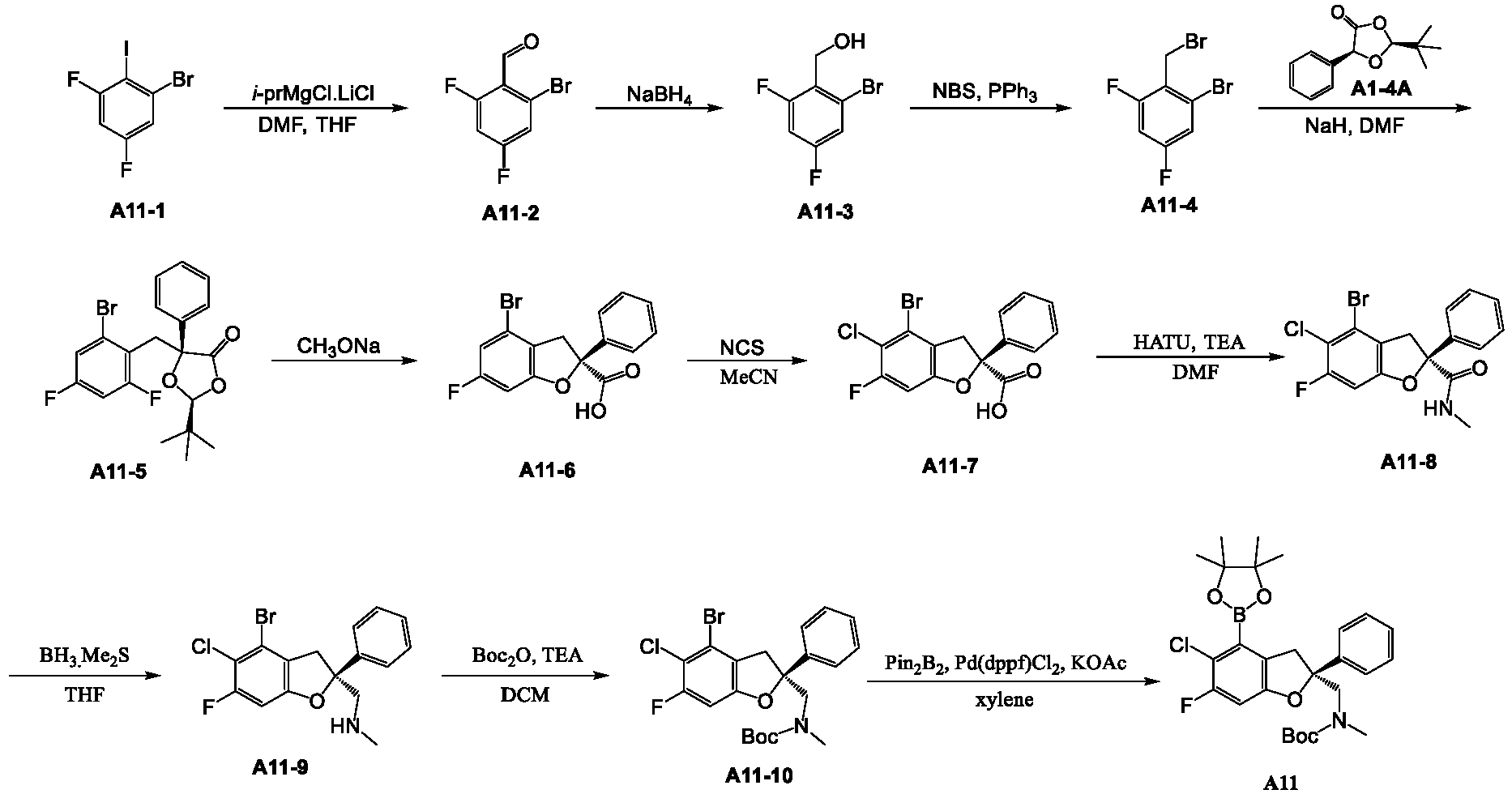
- Step 1: THF (150 mL) and A11-1 (15 g, 47.04 mmol) were sequentially added to a dry three-neck flask under nitrogen atmosphere, and i-PrMgCl.LiCl (39.8 mL, 51.74 mmol, a solution dissolved in THF, concentration of 1.3 M) was added dropwise after cooling to -70°C, and stirred at this temperature for 1 hour. Then DMF (5.16 g, 70.56 mmol) was added dropwise, and stirred for another 1 hour. TLC showed that the reaction was completed. The reaction mixture was quenched by pouring into saturated NH4Cl aqueous solution at 0°C and extracted with ethyl acetate, then the combined organic phases were washed with saturated brine, dried over anhydrous sodium sulfate, filtered, and concentrated under reduced pressure to obtain yellow oily A11-2 (5.8 g, crude), which was used directly in the next step.
- 1H NMR (400 MHz, Chloroform-d) δ 10.28 (s, 1H), 7.31 - 7.23 (m, 1H), 6.92 (ddd, J = 10.7, 8.4, 2.5 Hz, 1H).
- Step 2: THF (60 mL), MeOH (10 mL), A11-2 (5.8 g, crude) and NaBH4 (596 mg, 15.75 mmol) were sequentially added to a dry 250 mL single-neck flask. The reaction mixture was stirred at 20°C for 0.5 hours. TLC showed that the reaction was completed. The reaction mixture was quenched by pouring into saturated NH4Cl aqueous solution at 0°C and extracted with ethyl acetate, then the combined organic phases were washed with saturated brine, dried over anhydrous sodium sulfate, filtered, and concentrated under reduced pressure to obtain yellow oily A11-3 (4.2 g, crude), which was used directly in the next step.
- Step 3: DCM (40 mL), A11-3 (4.2 g, 18.83 mmol) and PPh3 (5.93 g, 22.6 mmol) were sequentially added to a dry 100 mL single-neck flask, and stirred to dissolve. Then NBS (4.02 g, 22.6 mmol) was slowly added thereto. The resulting yellow reaction mixture was stirred at 20°C for 0.5 hours. TLC showed that the reaction was completed. The reaction mixture was loaded onto the column using the wet method, then subjected to silica gel column chromatography (5 to 10% dichloromethane/petroleum ether) to obtain A11-4 as a colorless oil (4.1 g, yield: 76%).
- 1H NMR (400 MHz, Chloroform-d) δ 7.19 (dt, J = 7.8, 2.1 Hz, 1H), 6.85 (ddd, J = 9.4, 8.4, 2.5 Hz, 1H), 4.60 (d, J = 2.0 Hz, 2H).
- Step 4: DMF (65 mL), A11-4 (6.5 g, 22.73 mmol) and A1-4A (5.01 g, 22.73 mmol) were sequentially added to a dry 250 mL three-neck flask. The mixture was stirred to dissolve and slowly added with NaH (1.27 g, 31.83 mmol, dispersed in mineral oil, concentration of 60%). The resulting yellow reaction mixture was stirred at 25°C for 2 hours. TLC showed that the reaction was completed. The reaction mixture was quenched by pouring into saturated NH4Cl aqueous solution and extracted with ethyl acetate, then the combined organic phases were washed with saturated brine, dried over anhydrous sodium sulfate, filtered, and concentrated under reduced pressure, and the resulting residue was subjected to silica gel column chromatography (0 to 5% ethyl acetate/petroleum ether) to obtain A11-5 as a white solid (8.3 g, yield: 86%).
- Step 5: A11-5 (8.3 g, 19.52 mmol) and MeONa (8.3 mL, 44.89 mmol, a solution dissolved in MeOH, concentration of 5.4 M) were sequentially added to a dry 250 mL single-neck flask, and the resulting yellow suspension was stirred at 50°C for 2 hours. After the reaction was completed, the reaction mixture was quenched by pouring into 1 M hydrochloric acid, diluted with water and extracted with ethyl acetate. The combined organic phases were washed with saturated brine, dried over anhydrous sodium sulfate, filtered, and concentrated under reduced pressure, and the resulting residue was subjected to silica gel column chromatography (0 to 5% ethyl acetate/petroleum ether) to obtain A11-6 as a yellow oil (6 g, yield: 87%).
- 1H NMR (400 MHz, DMSO-d 6) δ 13.64 (s, 1H), 7.59 - 7.52 (m, 2H), 7.48 - 7.34 (m, 3H), 7.07 (dd, J = 9.1, 2.2 Hz, 1H), 7.02 (dd, J = 9.4, 2.2 Hz, 1H), 3.98 (dd, J = 16.2, 1.4 Hz, 1H), 3.50 (dd, J = 16.2, 1.8 Hz, 1H).
- LCMS: m/z 337 [M+H]+.
- Step 6: Acetonitrile (45 mL), A11-6 (4.4 g, 12.53 mmol) and NCS (1.84 g, 13.7 mmol) were sequentially added to a dry single-neck flask. The resulting reaction mixture was stirred at 80°C for 2 hours. After TLC showed that the reaction was completed, the reaction mixture was concentrated under reduced pressure, and the resulting residue was purified by silica gel chromatography (0 to 4% ethyl acetate/petroleum ether) to obtain A11-7 as a colorless oil (4.3 g, yield: 89%).
- Step 7: DMF (120 mL), A11-7 (10 g, 26.91 mmol), methylamine hydrochloride (3.63 g, 53.82 mmol) and HATU (15.35 g, 40.37 mmol) were sequentially added to a dry 250 mL single-neck flask. Then TEA (8.17 g, 80.73 mmol) was slowly added dropwise, and the resulting yellow suspension was stirred at 25°C for 1 hour. TLC showed that the reaction was completed. The reaction mixture was diluted with water and extracted with ethyl acetate, then the combined organic phases were washed with saturated brine, dried over anhydrous sodium sulfate, filtered, and concentrated under reduced pressure, and the resulting residue was purified by silica gel chromatography (0 to 20% ethyl acetate/petroleum ether) to obtain yellow oily A11-8 (6.8 g, yield: 65.7%).
- 1H NMR (400 MHz, Chloroform-d) δ 7.64 - 7.56 (m, 2H), 7.41 - 7.31 (m, 3H), 6.78 (d, J = 8.6 Hz, 1H), 6.62 (s, 1H), 4.22 (dd, J = 16.5, 1.7 Hz, 1H), 3.46 (dd, J = 16.6, 2.0 Hz, 1H), 2.82 (d, J = 5.0 Hz, 3H).
- LC-MS: m/z 385.9 [M+H]+.
- Step 8: THF (80 mL) and A11-8 (8.0 g, 20.8 mmol) were sequentially added to a dry 300 mL sealed tube, and then BH3.Me2S (62.4 mL, 2 M, 124.8 mmol) was slowly added thereto at room temperature, and the resulting colorless solution was heated to 80°C and stirred for 12 hours. TLC showed that the reaction was completed. The reaction mixture was quenched by slowly adding MeOH dropwise until there was no obvious bubbling, and then subjected to rotary evaporation to dryness. The residue was then quenched with a 4 M dioxane solution of hydrochloric acid until there was no bubbling. Then the pH was adjusted to about 9 with saturated NaHCO3 solution. The mixture was extracted with ethyl acetate, then the combined organic phases were washed with saturated brine, dried over anhydrous sodium sulfate, filtered, and concentrated under reduced pressure to obtain yellow oily A11-9 (7.5 g, crude), which was used directly in the next step.
- Step 9: DCM (75 mL), A11-9 (7.5 g, 20.23 mmol), TEA (2.46 g, 24.28 mmol) and Boc2O (5.3 g, 24.28 mmol) were sequentially added to a dry 250 mL single-neck flask. The resulting yellow reaction mixture was stirred at 20°C for 1 hour. TLC showed that the reaction was completed. The reaction mixture was subjected to rotary evaporation to dryness under reduced pressure, and subjected to silica gel column chromatography (0 to 10% dichloromethane/petroleum ether) to obtain A11-10 as a colorless oil (8.0 g, purity: 84%).
- Step 10: Anhydrous xylene (89 mL), A11-10 (8.9 g, 18.91 mmol), bis(pinacolato)diboron (6.7 g, 26.47 mmol, 1.4 eq), Pd(dppf)Cl2.CH2Cl2 (1.24 g, 1.51 mmol) and KOAc (5.57 g, 56.72 mmol) were sequentially added to a 250 mL dry single-neck flask, and the reaction mixture was replaced with nitrogen three times and then heated to 120°C and stirred for 11 hours. TLC showed that the reaction was completed. The reaction mixture was filtered, subjected to rotary evaporation to dryness under reduced pressure, and subjected to silica gel column chromatography (0 to 9% ethyl acetate/petroleum ether) to obtain A11 as a white solid (6.6 g, purity: 74%).
-

- Step 1: Lithium aluminum hydride (7.36 g, 217.05 mmol) was added to anhydrous tetrahydrofuran (300 mL), cooled to -30°C, and a tetrahydrofuran solution (300 mL) of A1-9 (60 g, 144.70 mmol) was slowly added dropwise, and then the reaction mixture was stirred and reacted for another 1 hour at 0°C. TLC showed that the reaction was completed. Water (7.4 mL), 15% sodium hydroxide solution (7.4 mL) and water (22 mL) were sequentially added to the reaction mixture, and diatomite was added thereto, stirred for 10 minutes and then subjected to suction filtration. The filtrate was concentrated to obtain A20-1 (60.00 g, crude) as a brown oil.
- Step 2: A20-1 (60 g, 168.74 mmol) and A20-2 (20.45 g, 168.74 mmol) were dissolved in dichloroethane (600 mL), and tetraisopropyl titanate (143.87 g, 506.21 mmol) was added dropwise, and the reaction mixture was heated to 60°C and reacted for 3 hours after the addition was completed. TLC showed that the raw materials basically disappeared. Additional dichloromethane (2000 mL) was added thereto, then water (100 mL) and diatomite (20 g) were sequentially added to the system, stirred for 10 minutes, filtered, and the filtrate was concentrated and purified by column chromatography (ethyl acetate/petroleum ether = 0 to 5%) to obtain A20-3 (22.00 g, yield: 27.00%) as a yellow oily product.
- 1H NMR (400 MHz, DMSO-d 6) δ 7.97 (s, 1H), 7.56 - 7.38 (m, 5H), 7.17 (d, J= 9.7 Hz, 1H), 4.06 (d, J = 16.1 Hz, 1H), 3.55 (d, J = 16.1 Hz, 1H), 0.92 (s, 9H).
- Step 3: A20-3 (22 g, 47.95 mmol) was dissolved in tetrahydrofuran (220 mL), and the system was replaced with nitrogen three times, cooled to 0°C, and A20-4 (20.90 g, 143.86 mmol) was slowly added dropwise, and then the reaction mixture was stirred at 0°C for 2 hours after the addition was completed. TLC showed that the reaction was completed. Ammonium chloride (50 mL) was added to quench the reaction, and the mixture was extracted with dichloromethane (500 mL × 3). The organic phases were combined and concentrated to dryness, and purified by column chromatography (ethyl acetate/petroleum ether = 0 to 20%) to obtain A20-5 (17.00 g, yield: 67.24%) as a yellow oil.
- LC-MS: m/z 499.7 [M+H]+.
- Step 4: A20-5 (17 g, 33.94 mmol) was dissolved in dichloromethane (300 mL), and m-chloroperoxybenzoic acid (17.51 g, 101.83 mmol) was added thereto, and the reaction mixture was stirred and reacted at 25°C for 16 hours. Additional 300 mL of dichloromethane was added thereto, and the reaction mixture was washed with saturated sodium bicarbonate (500 mL × 2) and saturated brine (500 mL), respectively. The organic phase was separated and concentrated to obtain A20-6 (14.30 g, crude) as a yellow oil, which was used directly in the next step.
- LC-MS: m/z 553.8 [M+Na]+.
- Step 5: A20-6 (14.3 g, 26.84 mmol) and potassium carbonate (11.13 g, 80.51 mmol) were added to N,N-dimethylformamide (200 mL), and the system was replaced with nitrogen three times, and then the reaction mixture was heated to 100°C, stirred and reacted for 12 hours. TLC showed that the reaction was completed. The reaction mixture was cooled to room temperature, filtered, and the filtrate was concentrated directly to dryness to obtain A20-7 (13.10 g, crude) as a yellow solid product.
- Step 6: A20-7 (13.1 g, 24.58 mmol) was dissolved in dichloromethane (200 mL), cooled to 0°C, and trifluoromethanesulfonic acid (11.07 g, 73.75 mmol) was added dropwise, and then the system was stirred and reacted at 0°C for 2 hours after the addition was completed. TLC showed that the reaction was completed. The pH was adjusted to 7 to 8 by slowly adding 1 M sodium hydroxide solution. The organic phase was separated, washed with saturated brine (100 mL), dried over anhydrous sodium sulfate, filtered, and the filtrate was concentrated to dryness to obtain A20-8 (10.00 g, crude) as a yellow solid product.
- LC-MS: m/z 411.7 [M+H]+.
- Step 7: A20-8 (10 g, 24.23 mmol), Boc anhydride (6.35 g, 29.08 mmol) and triethylamine (7.36 g, 72.70 mmol) were sequentially added to 1,4-dioxane (200 mL), and the reaction mixture was stirred and reacted at 25°C for 1 hour. The reaction mixture was concentrated to dryness, and ethyl acetate (200 mL) was added thereto, washed with water (100 mL) and saturated brine (100 mL) respectively, dried over anhydrous sodium sulfate, and then purified by column chromatography (ethyl acetate/petroleum ether = 0 to 20%) to obtain A20-9 (4.00 g, yield: 30.58%) as a yellow solid product.
- 1H NMR (400 MHz, DMSO-d 6) δ 7.48 - 7.26 (m, 5H), 7.19 (d, J = 9.5 Hz, 1H), 4.55 (s, 1H), 4.33 (d, J = 15.6 Hz, 1H), 4.01 - 3.61 (m, 2H), 3.11 (s, 1H), 2.61 (s, 1H), 1.83 (s, 1H), 1.59 - 1.05 (m, 10H).
- LC-MS: m/z 411.7 [M+H-100]+.
- Step 8: Referring to the synthesis method of compound A2, intermediate A20-9 was used instead of intermediate A2-9, and one-step reaction was carried out to obtain intermediate A20.
- LC-MS: m/z 460 [M+H-100]+.
-
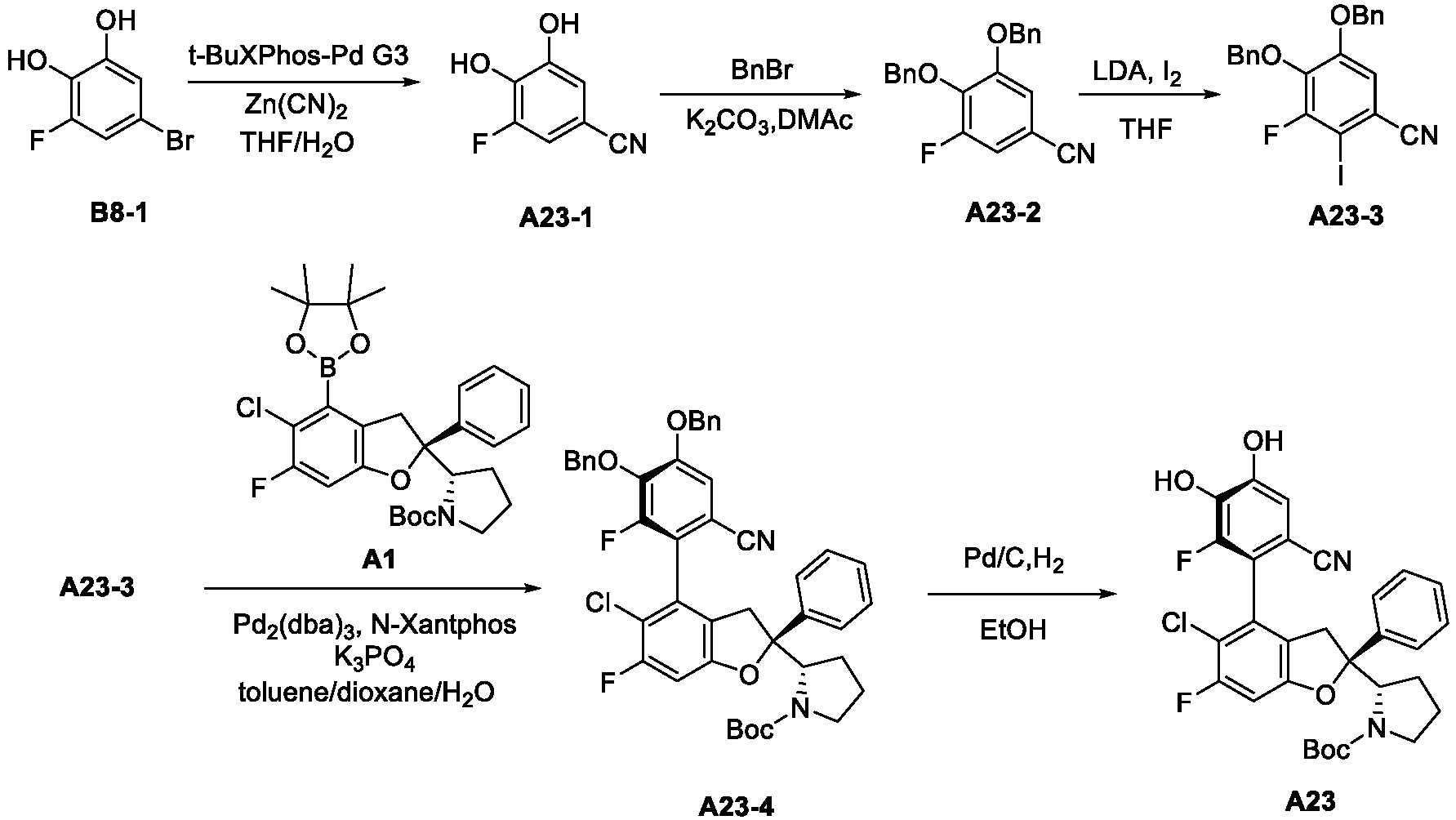
- Step 1: Zinc cyanide (0.08 g, 77.295 mmol) and t-BuXPhos-Pd-G3 (1.54 g, 1.932 mmol) were added to a solution of B8-1 (8 g, 38.647 mmol) in water (100 mL) and tetrahydrofuran (20 mL) under argon atmosphere. The reaction mixture was stirred at 70°C for 12 hours under nitrogen atmosphere. Insoluble substances were filtered out with diatomite, and the filter residue was thoroughly rinsed with ethyl acetate (200 mL). Dilute hydrochloric acid (100 mL) was added thereto and stirred thoroughly to separate the organic phase. The organic phase was washed with saturated brine (2 × 100 mL), dried over anhydrous sodium sulfate, and filtered. The filtrate was concentrated under reduced pressure, stirred thoroughly for 3 hours with 100 mL of a mixed solvent (ethyl acetate/petroleum ether = 1/3), and filtered to obtain A23-1 as a white solid (5.4 g, yield: 91.26%).
- LCMS: m/z 305 [2M-H]-.
- 1H NMR (400 MHz, DMSO-d 6) δ 10.33 (s, 2H), 7.24 (d, J = 10.3 Hz, 1H), 6.96 (s, 1H).
- Step 2: Potassium carbonate (10.52 g, 76.154 mmol ) and benzyl bromide (12.73 g, 74.424 mmol) were added to a DMAc (70 mL) solution of A23-1 (5.3 g, 34.616 mmol). The reaction mixture was stirred at 50°C for 12 hours. The reaction mixture was filtered, diluted with ethyl acetate (200 mL), washed first with water (5 × 100 mL), then with saturated brine (2 × 100 mL), dried over anhydrous sodium sulfate, filtered, and the filtrate was concentrated under reduced pressure and purified by silica gel chromatography (ethyl acetate/petroleum ether/dichloromethane = 1/10/100) to obtain A23-2 as a white solid (10 g, yield: 87%).
- 1H NMR (400 MHz, CDCl3) δ 7.28 (d, J = 11.9 Hz, 2H), 7.26 - 7.21 (m, 4H), 7.21 - 7.16 (m, 3H), 7.13 (s, 1H), 6.91 (dd, J = 9.6, 1.7 Hz, 1H), 6.86 (s, 1H), 5.07 (s, 2H), 4.98 (s, 2H).
- Step 3: LDA (2.0 mol/L in THF/hexane, 3.75 mL, 7.499 mmol) was added dropwise to a tetrahydrofuran (20 mL) solution of A23-2 (1000 mg, 3 mmol) at -70°C under argon atmosphere. After the dropwise addition was completed, the mixture was stirred at -70°C for 30 minutes. A tetrahydrofuran solution (5 mL) of iodine (914 mg, 3.6 mmol) was added dropwise. The reaction mixture was reacted at -70°C for 1 hour, slowly poured into ice-cold saturated ammonium chloride solution (30 mL), and extracted by adding ethyl acetate (3 × 50 mL). The organic phases were combined, washed with saturated brine (2 × 10 mL), dried over anhydrous sodium sulfate, filtered. The filtrate was concentrated under reduced pressure and purified by silica gel chromatography (ethyl acetate/petroleum ether/dichloromethane = 1/10/100) to obtain A23-3 (1000 mg, yield: 72.6 %).
- 1H NMR (400 MHz, CDCl3) δ 7.41 - 7.31 (m, 10H), 7.04 (d, J = 1.6 Hz, 1H), 5.19 (s, 2H), 5.11 (s, 2H).
- Step 4: A23-3 (1.3 g, 2.829 mmol), intermediate A1 (2308 mg, 3.395 mmol), potassium phosphate (3.6 g, 16.975 mmol), toluene (14 mL), water (5.6 mL), 1,4-dioxane (14 mL), Pd2(dba)3 (259 mg, 0.283 mmol) and N-XantPhos (312 mg, 0.566 mmol) were sequentially added to a reaction flask. The reaction mixture was stirred at 100°C for 18 hours under nitrogen atmosphere. The reaction mixture was added with water and extracted with ethyl acetate. The organic phase was dried over anhydrous sodium sulfate, filtered, concentrated, and the residue was purified by silica gel chromatography (petroleum ether/ethyl acetate = 5:1) to obtain a mixture as light yellow solid A23-4 (600 mg, yield: 28.3%).
- LC-MS: m/z 693 [M-55+H]+.
- Step 5: A23-4 (900 mg, 1.201 mmol), 10% wet palladium on carbon (320 mg, 0.3 mmol) and ethanol (20 mL) were sequentially added to a reaction flask, and the reaction mixture was stirred at 30°C for 18 hours under hydrogen atmosphere. Insoluble substances were filtered out with diatomite, and the filter residue was thoroughly rinsed with ethanol (100 mL) and concentrated to obtain A23 as a white solid (660 mg, yield: 97%).
- LC-MS: m/z 567 [M-H]-.
-

- Step 1: A24-1 (10 g, 31.359 mmol) and tetrahydrofuran (100 mL) were added to a dry three-neck flask and cooled to -40°C under nitrogen atmosphere. Isopropylmagnesium chloride (20.383 mL, 40.766 mmol, 2 mmol/L) was slowly added dropwise to the reaction mixture. The reaction mixture was warmed to 0°C and stirred for 1 hour. CuI (1.49 g, 7.840 mmol) was added to the reaction mixture and stirred for 10 minutes to obtain a gray solution, then a tetrahydrofuran solution of 3-bromoprop-1-ene (4.094 mL, 47.038 mmol) was slowly added dropwise (with obviously exothermic, controlling the internal temperature to be less than 10°C). The reaction mixture was warmed to room temperature (17°C) and stirred overnight. TLC showed that the reaction was completed. The reaction mixture was quenched with saturated NH4Cl aqueous solution and ammonia water, and extracted with dichloromethane. The combined organic phases were washed with saturated brine, dried over anhydrous sodium sulfate, filtered, and concentrated under reduced pressure. The concentrated residue was subjected to silica gel column chromatography (PE = 1) to obtain A24-2 as a colorless oil (7 g, yield: 95.76%).
- Step 2: A24-2 (7.8 g, 33.468 mmol), carbon tetrachloride (150 mL), water (300 mL) and sodium periodate (35.79 g, 167.339 mmol) were sequentially added to a dry three-neck flask under nitrogen atmosphere. Then an acetonitrile (150 mL) solution of RuCl3 (0.88 g, 3.347 mmol) was added dropwise to the reaction mixture, and the reaction mixture was reacted at room temperature (13°C) for 18 hours until TLC showed that the reaction was completed. 10% sulfuric acid aqueous solution (100 mL) was added to the reaction mixture, and extracted with ethyl acetate. The combined organic phases were washed with saturated brine, dried over anhydrous sodium sulfate, filtered, and concentrated under reduced pressure. The concentrated residue was subjected to silica gel column chromatography (30% ethyl acetate/petroleum ether) to obtain A24-3 (6.50 g, yield: 77.37%).
- Step 3: A24-3 (6.64 g, 26.451 mmol), DMF (65 mL), iodomethane (2.141 mL, 34.386 mmol) and K2CO3 (7.31 g, 52.902 mmol) were sequentially added to a dry three-neck flask under nitrogen atmosphere. The reaction mixture was stirred at room temperature (13°C) for 18 hours. TLC showed that the reaction was completed. The reaction mixture was quenched with water and extracted with ethyl acetate. The combined organic phases were washed with saturated brine, dried over anhydrous sodium sulfate, filtered, and concentrated under reduced pressure to obtain A24-4 as a colorless oil (6.9 g, yield: 98.42%).
- Step 4: A three-neck flask was cooled to -65°C under nitrogen atmosphere. A24-4 (1 g, 3.77 mmol), A24-5 (1.1 g, 4.15 mmol), THF (10 mL) and LiHMDS (7.5 mL, 7.5 mmol) were sequentially added thereto and stirred for 30 minutes, and the reaction mixture was warmed to 13°C and stirred for 3 hours. TLC showed that the reaction was completed. The reaction mixture was quenched with saturated ammonium chloride and the pH was adjusted to about 4 with 1 mmol/L hydrochloric acid. The mixture was extracted with ethyl acetate. The combined organic phases were washed with saturated brine, dried over anhydrous sodium sulfate, filtered, and concentrated under reduced pressure. The concentrated residue was subjected to silica gel column chromatography (6% ethyl acetate/petroleum ether) to obtain A24-6 as a colorless oil (1.7 g, yield: 97.5%).
- Step 5: A24-6 (1.7 g, 3.68 mmol), dioxane (9 mL) and 3 mmol/L hydrochloric acid (9 mL) were sequentially added to a dry three-neck flask under nitrogen atmosphere. The reaction mixture was heated to 95°C and stirred for 6 hours. TLC showed that the reaction was completed. The pH of the reaction mixture was adjusted to about 9 with saturated sodium carbonate aqueous solution. Sodium carbonate (0.78 g, 7.35 mmol) and di-tert-butyl dicarbonate (1.61 g, 7.35 mmol) were added to the solution and stirred at room temperature (13°C) for 3 hours. TLC showed that the reaction was completed. The reaction mixture was quenched with water and extracted with ethyl acetate. The combined organic phases were washed with saturated brine, dried over anhydrous sodium sulfate, filtered, and concentrated under reduced pressure. The concentrated residue was subjected to silica gel column chromatography (5% ethyl acetate/petroleum ether) to obtain A24-7 as a white solid (1.35 g, yield: 90.8%).
- Step 6: A24-7 (8 g, 19.79 mmol) was dissolved in dichloromethane (20 mL) and n-heptane (20 mL), then A24-12 (20.65 g, 110.82 mmol, see step 10 for the synthesis method) was added thereto at 0°C, and the reaction mixture was reacted at 20°C for 2 hours. LC-MS detected that the reaction was completed. The reaction mixture was poured into saturated ammonium chloride (200 mL), and the pH was adjusted to 6 with 6N hydrochloric acid. The mixture was extracted with ethyl acetate (100 mL × 3), dried, concentrated under reduced pressure, and subjected to column chromatography (ethyl acetate/petroleum ether = 0 to 10%) to obtain target product A24-8 (1.50 g, yield: 12.44%) as a colorless oil.
- LC-MS: m/z 509.20 [M+23]+.
- Step 7: Compound A24-8 (1.5 g, 3.08 mmol) was dissolved in NMP (20 mL), and NaH (492.42 mg, 12.31 mmol, purity of 60%) was added thereto at 25°C and stirred for 2 hours. LC-MS showed that the reaction was completed. The reaction mixture was quenched by pouring into ice water (50 mL), extracted with ethyl acetate (30 mL × 3). The organic phase was washed with saturated brine (30 mL × 3), dried over anhydrous sodium sulfate, filtered, concentrated under reduced pressure, and subjected to column chromatography (ethyl acetate/petroleum ether = 0 to 10%) to obtain target product A24-9 (1.25 g, yield: 78.21%) as a colorless oil.
- LC-MS: m/z 411.20 [M-56+1]+.
- Step 8: A24-9 (1.25 g, 2.67 mmol) was dissolved in acetonitrile (20 mL), then NCS (535.68 mg, 4.01 mmol) was added thereto, and then the reaction mixture was reacted at 60°C for 4 hours. LC-MS showed that the reaction was completed. The reaction mixture was concentrated under reduced pressure and subjected to column chromatography (ethyl acetate/petroleum ether = 0 to 5%) to obtain target product A24-10 (1.20 g, yield: 80.47%) as a colorless oil.
- LC-MS: m/z 445.20 [M-56+1]+.
- Step 9: Compound A24-10 (1.25 g, 2.49 mmol), bis(pinacolato)diboron (948.81 mg, 3.74 mmol), Pd(dppf)Cl2 (90.38 mg, 124.54 µmol) and KOAc (488.91 mg, 4.98 mmol) were sequentially added to toluene (20 mL), and the reaction mixture was reacted at 100°C for 16 hours. LC-MS showed that the reaction was completed. The reaction mixture was directly concentrated under reduced pressure and subjected to column chromatography (ethyl acetate/petroleum ether = 0 to 10%) to obtain target product A24 (1.0 g, yield: 58.51%) as a yellow oil.
- LC-MS: m/z 493.30 [M-56+1]+.
- Step 10: A24-11 (18 g, 111.08 mmol) was dissolved in tetrahydrofuran (150 mL), and polished magnesium strips (4.05 g, 166.63 mmol) and iodine (281.94 mg, 1.11 mmol) were added thereto, and then the reaction mixture was reacted at 70°C for 2 hours under N2 atmosphere. A24-12 (20.65 g, 110.82 mmol) was obtained as a light yellow liquid, which was directly used in the next reaction step.
- The following intermediates were synthesized from the corresponding intermediates or raw materials, using the above methods or improved methods and the methods reported in the literature (
WO2021186324 ).Intermediate number Structural formula Name Analytical data A5 
tert-Butyl (S)-(5-chloro-6-fluoro-2-phenyl-4-(4,4,5,5-tetramethyl-1,3,2-dioxaborolan-2-yl)-2,3-dihydrobenzofuran-2-yl)methyl)carbamate LCMS: m/z 504.20 [M+H]+. A6 
tert-Butyl (S)-2-((S)-5-chloro-6-methoxy-2-phenyl-4-(4,4,5,5-tetramethyl-1,3,2-dioxaborolan-2-yl)-2,3-dihydrobenzofuran-2-yl)pyrrolidine-1-carboxylate LCMS: m/z 556.26 [M+H]+. A15 
tert-Butyl (S)-2-((2S,3S)-5-chloro-6-fluoro-3-methoxy-2-phenyl-4-(4,4,5,5-tetramethyl-1,3,2-dioxaborolan-2-yl)-2,3-dihydrobenzofuran-2-yl)pyrrolidine-1-carboxylate LCMS: m/z 574.2 [M+H]+. A16 
tert-Butyl (S)-2-((2S,3S)-5-chloro-6-fluoro-3-methyl-2-phenyl-4-(4,4,5,5-tetramethyl-1,3,2-dioxaborolan-2-yl)-2,3-dihydrobenzofuran-2-yl)pyrrolidine-1-carboxylate LCMS: m/z 558.2 [M+H]+. A17 
tert-Butyl (S)-2-((2S,3S)-5-chloro-6-fluoro-3-hydroxy-2-phenyl-4-(4,4,5,5-tetramethyl-1,3,2-dioxaborolan-2-yl)-2,3-dihydrobenzofuran-2-yl)pyrrolidine-1-carboxylate LCMS: m/z 560.2 [M+H]+. A25 
tert-Butyl (((2S,3S)-5-chloro-3,6-difluoro-2-phenyl-4-(4,4,5,5-tetramethyl-1,3,2-dioxaborolan-2-yl)-2,3-dihydrobenzofuran-2-yl)methyl)(methyl)carbamate LCMS: m/z 536 [M+H]+. A27 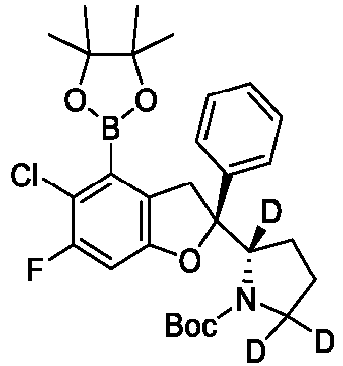
tert-Butyl (S)-2-((S)-5-chloro-6-fluoro-2-phenyl-4-(4,4,5,5-tetramethyl-1,3,2-dioxaborolan-2-yl)-2,3-dihydrobenzofuran-2-yl)pyrrolidine-1-carboxylate-2,5,5-d 3 LCMS: m/z 547 [M+H]+. -

- Step 1: Toluene (10 to 20 kg) was added to a reaction kettle under nitrogen atmosphere, and stirring was started. A26-1 (1.74 kg, see
WO2021186324A for synthesis steps), potassium acetate (0.227 to 1.13 kg) and bis(pinacolato)diboron (0.6 to 1.8 kg) were added thereto, and the reaction mixture was bubbled with nitrogen for 0.1 to 2 hours with stirring. 1,1'-Bis(diphenylphosphino)ferrocene-palladium(II)dichloride dichloromethane complex (9.2 g to 0.64 kg) was added thereto, and the reaction mixture was bubbled with nitrogen for 0.1 to 2 hours with stirring. The reaction mixture was heated to 75 to 105°C under nitrogen atmosphere, stirred at this temperature for 5 to 20 hours. HPLC detected that the reaction was completed, and then the reaction mixture was cooled to 25 to 50°C, filtered with 300 to 400 mesh silica gel (0.35 to 0.90 kg) on a Buchner funnel, soaked in n-heptane (0.87 kg), compacted and filtered. n-Heptane (3.1 to 6.2 kg) was added to the reaction kettle to rinse the filter cake. The filtrates were combined and concentrated at 25 to 50°C under reduced pressure until no fraction was distilled off, thus obtaining crude A26-2 (1.65 kg, yield: 86%), which was directly used in the next production. - Step 2: Acetone (5.50 to 9.16 kg) and A26-2 (2.3 kg) were added to a reaction kettle, stirred until dissolved, and methanol (5.28 to 8.80 kg) was added thereto, and then prepared potassium hydrogen fluoride aqueous solution (10.56 kg, 3 M) was added thereto. The reaction mixture was stirred at 0 to 35°C for 6 to 16 hours. HPLC detected that the reaction was completed, and then tap water (12 to 20 kg) was added to the reaction kettle and stirred for 30 minutes. The temperature was controlled at 25 to 50°C and the reaction mixture was concentrated under reduced pressure. After concentrating until there was no obvious fraction, distillation under reduced pressure was carried out for another 2 to 3 hours. The temperature was reduced to 5 to 15°C. The residue was stirred for 1 hour and filtered. The filtrate was put into a barrel, and the filter cake was put into a bag. Tap water (12 to 20 kg) was added to the reaction kettle, and the filter cake was added to the reaction kettle. The temperature was controlled at 0 to 30°C and the mixture was stirred for 0.5 to 1 hour. The mixture was filtered. The filtrate was put into a barrel, and the filter cake was put into a bag. n-Heptane (2 to 6 kg) was added to the reaction kettle and the filter cake was added to the reaction kettle. The temperature was controlled at 0 to 30°C and the mixture was stirred for 1 to 2 hours. The mixture was filtered. The filtrate was put into a barrel, and the filter cake was put into a bag. The filter cake was transferred to a vacuum oven with the oven temperature set at 25 to 50°C and vacuum dried for 10 to 30 hours. The crude was slurried with n-heptane and dichloromethane (20:1 to 5:1, v/v) at room temperature for 0.5 to 2 hours, filtered, rinsed and dried to obtain A26-3 as a white solid (1.64 kg, yield: 89%, purity > 95%).
- Step 3: A26-3 (1.75 kg) and acetonitrile (15 to 20 L) were sequentially added to a three-neck flask, and stirring was started at room temperature. p-Toluenesulfonic acid hydrate (0.34 to 0.68 kg) was added to the reaction mixture with continued stirring, and NCS (429 to 716 g, added in three times with an interval of 0.5 to 1 hour), and then the reaction was continued with stirring at room temperature for 3 to 20 hours. The process control results by HPLC met the predetermined quality standards, and the reaction mixture was subjected to suction filtration. The filter cake was rinsed with acetonitrile (2.2 L). Potassium bicarbonate (715 to 1430 g) and di-tert-butyl dicarbonate (780 to 1559 g) were added to the filtrate, and stirred at room temperature. The process control results by HPLC met the predetermined quality standards. Methyl tert-butyl ether (3 to 5 V) and 10% potassium bicarbonate aqueous solution (10 V) were added to the reaction mixture, and the reaction mixture was stirred for another 0.5 to 1 hour, left to stand, and then the phases were separated. The reaction mixture was extracted twice, and the organic phases were combined twice and concentrated to dryness under reduced pressure at 10 to 50. The organic phase that was concentrated to dryness was dissolved by adding methyl tert-butyl ether (5 to 10 V) and transferred to a reaction kettle. 10% potassium bicarbonate aqueous solution (10 V) was added to the reaction kettle, stirred for 0.5 to 1 hour, and the phases were separated (repeated 4 times). The organic phase was concentrated to dryness under reduced pressure at 10 to 50°C. Methyl tert-butyl ether (2 to 5 V) was added to dissolve the organic phase that was concentrated to dryness, and concentrated to dryness under reduced pressure at 10 to 50°C (repeat 2 times). The organic phase that was concentrated to dryness was transferred to a reaction kettle, and methyl tert-butyl ether (3 to 5 V) was added thereto, then n-heptane (3 to 5 V) was added slowly dropwise, and stirring was continued for 1 to 5 hours after the addition. The reaction mixture was subjected to suction filtration and the filter cake was rinsed with n-heptane (0.5 to 2 V). The filter cake was dried in a vacuum drying oven at 20 to 40°C to obtain A26 as an off-white solid (1.175 kg, yield: 62.5%, purity > 90%).
-

- Step 1: Referring to step 1 of example 5, 4,5-dichloro-2-(tetrahydro-pyran-2-yl)-2H-pyrazin-3-one was used in the reaction instead of 2,3-dichloropyridazine, and compound A28-1 (mixture) was obtained after purification.
- LC-MS: m/z 745 [M+H]+.
- Step 2: A28-1 (120 mg, 0.16 mmol, mixture) was dissolved in DCM (2 mL), and TFA (1 mL) was added thereto. The reaction mixture was reacted at room temperature for 3 hours, and the TLC plate showed that the reaction was completed. The reaction mixture was concentrated under reduced pressure to obtain A28-2 as a white solid (90 mg, mixture).
- LC-MS: m/z 561 [M+H]+.
- Step 3: A28-2 (90 mg, mixture) was dissolved in THF (2 mL), and then Boc2O (52 mg, 0.24 mmol) and TEA (32 mg, 0.32 mmol) were added thereto. The reaction mixture was reacted at room temperature for 1 hour, and the TLC plate showed that the reaction was completed. The reaction mixture was concentrated under reduced pressure. The crude was purified by column chromatography (petroleum ether: ethyl acetate = 2:1) to obtain A28 as a white solid (90 mg, mixture).
- LC-MS: m/z 661 [M+H]+.
-

- Step 1: B1-1 (125.00 g, 598.115 mmol), methyl bromoacetate (62.511 mL, 657.926 mmol), K2CO3 (124.00 g, 897.172 mmol) and DMF (1000 mL) were sequentially added to a single-neck flask. The reaction mixture was stirred at 80°C for 8 hours under nitrogen atmosphere. The mixture was diluted with water and extracted three times with a mixed solution of petroleum ether/ethyl acetate (1/1). The organic layer was dried over Na2SO4 and concentrated under reduced pressure. The residue was purified by silica gel chromatography (petroleum ether/ethyl acetate = 20/1) to obtain B1-2 (168.1 g, yield: 100%) as a colorless oil.
- 1H NMR (400 MHz, CD3OD) δ 7.11 - 7.02 (m, 2H), 4.71 (s, 2H), 3.83 (s, 3H).
- Step 2: B1-2 (164 g, 583.526 mmol) and THF (1500 mL) were added to a single-neck flask. The mixture was cooled to -20°C under nitrogen atmosphere, and LiAlH4 (33.22 g, 875.289 mmol) was slowly added thereto, and then the reaction mixture was stirred at -20°C for 1 hour. TLC showed that the reaction was completed. H2O (33 mL), 15% NaOH solution (33 mL) and H2O (99 mL) were added to the reaction mixture, filtered, and the filtrate was diluted with water and extracted three times with ethyl acetate (500 mL * 3). The organic layer was dried over Na2SO4 and concentrated under reduced pressure to obtain B1-3 (129 g, yield: 87%) as a yellow solid.
- 1H NMR (400 MHz, CD3OD) δ 6.99 - 6.98 (m, 2H), 4.25 - 4.21 (m, 2H), 3.90 - 3.83 (m, 2H).
- Step 3: B1-3 (60 g, 237.117 mmol), Cs2CO3 (115.89 mg, 355.675 mmol) and DMF (500 mL) were sequentially added to a single-neck flask. The reaction mixture was stirred at 80°C for 8 hours under nitrogen atmosphere. TLC showed that the reaction was completed. The mixture was diluted with water and extracted three times with ethyl acetate (300 mL * 3). The organic layer was dried over Na2SO4 and concentrated under reduced pressure. The residue was purified by silica gel chromatography (petroleum ether/ethyl acetate = 5/1) to obtain B1-4 (40 g, yield: 72.39%) as a white solid.
- Step 4: B1-4 (40000 mg, 171.644 mmol), t-BuXPhos-Pd-G3 (6826.12 mg, 8.582 mmol), Zn(CN)2 (14110.54 mg, 120.151 mmol), THF (300 mL) and H2O (100 mL) were sequentially added to a single-neck flask, and the reaction mixture was stirred at 40°C under nitrogen atmosphere overnight. TLC detected that the reaction was completed. The mixture was filtered, and the filtrate was concentrated under reduced pressure. The residue was purified by silica gel column chromatography (petroleum ether/ethyl acetate = 10/1) to obtain B1-5 (26500 mg, yield: 86.18%).
- 1H NMR (400 MHz, CD3OD) δ 7.01 - 6.98 (m, 2H), 4.40 - 4.38 (m, 2H), 4.34 - 4.32 (m, 2H).
- Step 5: B1-5 (21500 mg, 120.011 mmol) was dissolved in THF (1000 mL), and n-butyllithium solution (62.406 mL, 156.015 mmol) was slowly added dropwise at -78°C, and then the reaction mixture was stirred at -78°C for 1 hour after the dropwise addition was completed. Iodine (45690.05 mg, 180.017 mmol) was added thereto and stirred at -78°C for 1 hour after the addition was completed. The reaction mixture was quenched with water and poured into saturated sodium sulfite aqueous solution. The mixture was extracted with ethyl acetate (300 mL * 3), and the organic phase was washed with saturated brine, dried over anhydrous sodium sulfate, filtered, and the volatiles were removed under reduced pressure. The crude was purified by silica gel column chromatography (petroleum ether/ethyl acetate = 3/1) to obtain B1 as a white solid (16300 mg, yield: 52.63%).
-

- Step 1: Dichloromethane (20 mL), B2-1 (2 g, 14.6 mmol, 1.0 eq) and N-bromosuccinimide (NBS) (3.12 g, 17.504 mmol, 1.2 eq) were sequentially added to a dry single-neck flask. The reaction mixture was stirred at 25°C for 12 hours. After the reaction was completed, the reaction mixture was diluted with water (100 mL) and extracted with ethyl acetate (35 mL * 3). The combined organic phases were washed with saturated brine (100 mL), dried over anhydrous sodium sulfate, filtered, and concentrated under reduced pressure. The resulting residue was purified by silica gel chromatography (0 to 15% ethyl acetate/petroleum ether) to obtain B2-2 as a yellow solid (3 g, yield: 95.2%).
- 1HNMR (400 MHz, CDCl3) δ 6.19 (s, 1H), 7.39 (dd, J = 1.6, 9.6 Hz, 1H), 7.63 (d, J = 1.6 Hz, 1H).
- Step 2: Extra dry tetrahydrofuran (10 mL), B2-2 (1 g, 4.629 mmol, 1.0 eq), B2-3 (0.62 g, 5.555 mmol, 1.2 eq) were sequentially added to a dry three-neck flask, and then triphenylphosphine (1.2 g, 4.6 mmol, 1 eq) and di-tert-butyl azodicarboxylate (DBAD) (1.05 g, 4.6 mmol, 1 eq) were added thereto under nitrogen atmosphere. The reaction mixture was stirred at 25°C for 3 hours. After the reaction was complete, the reaction mixture was diluted with water (100 mL) and extracted with ethyl acetate (40 mL * 2). The combined organic phases were washed with saturated brine (100 mL), dried over anhydrous sodium sulfate, filtered, and concentrated under reduced pressure. The resulting residue was purified by silica gel chromatography (0 to 15% ethyl acetate/petroleum ether) to obtain B2-4 as a white solid (950 mg, yield: 66%).
- LC-MS: m/z 309.99 [M+H]+.
- Step 3: Extra dry dimethylacetamide (DMAc) (16 mL), B2-4 (500 mg, 1.6 mmol, 1.0 eq), palladium acetate (36.2 mg, 0.161 mmol, 0.1 eq) and potassium acetate (190 mg, 1.935 mmol, 1.2 eq) were sequentially added to a dry single-neck flask, and the reaction mixture was stirred at 120°C for 15 hours under nitrogen atmosphere. After the reaction was complete, the reaction mixture was diluted with water (30 mL) and extracted with ethyl acetate (20 mL * 2). The combined organic phases were washed with saturated brine (100 mL), dried over anhydrous sodium sulfate, filtered, and concentrated under reduced pressure. The resulting solid was slurried with petroleum ether and ethyl acetate (10/1) to obtain B2-5 as a brown solid (220 mg, yield: 59%).
- LC-MS: m/z 230 [M+H]+.
- Step 4: B2-5 (1.25 g, 5.43 mmol) and iodine (1 capsule, about 40 mg) were dissolved in dry tetrahydrofuran (2.0 L). After three replacements with argon, the mixture was cooled to -65°C with a dry ice acetone bath. LDA was added dropwise until the color of the iodine faded (became colorless), then lithium diisopropylamide (LDA) (5.4 mL, 10.8 mmol) was added dropwise. After the addition was completed, the reaction mixture was reacted at -65°C for 1 hour. Iodine (1.45 g, 5.71 mmol) dissolved in dry tetrahydrofuran (20 mL) was slowly added dropwise (over about 2 hours) to the reaction mixture. After the addition was completed, the reaction mixture was reacted at -65°C for 30 minutes, and the reaction mixture was poured into ice water, concentrated to remove most of the tetrahydrofuran, extracted with dichloromethane/methanol (10:1, 3 * 500 mL). The organic phases were combined, washed with saturated brine, dried, filtered, dried, concentrated, and the residue was purified by column chromatography (dichloromethane: methanol = 1:0 to 500:1) to obtain B2 as a light yellow solid (a total of 0.6 g of product was obtained, yield: 31.0%).
- LCMS: m/z: 355.9 [M+H]+.
-

- Step 1: Zn(CN)2 (405.20 mg, 3.45 mmol) was added to a solution of B3-1 (1.00 g, 4.42 mmol) in tetrahydrofuran (45 mL) and water (15 mL). After vacuuming, the mixture was replaced with argon three times. Methanesulfonato(2-di-t-butylphosphino-2',4',6'-tri-i-propyl-1,1'-biphenyl)(2'-amino-1,1'-biphenyl-2-yl)palladium(II) (t-BuXphos-Pd-G3) (175.70 mg, 0.22 mmol) was added thereto. After vacuuming, the mixture was replaced with argon three times. The reaction mixture was reacted at 65°C for 8 hours. The reaction mixture was slowly poured into ice water (20 mL), extracted by adding ethyl acetate (3 * 30 mL), filtered to remove the insoluble substances and the filter cake was rinsed with ethyl acetate (50 mL). The organic phases were combined, washed with saturated brine (2 * 30 mL), dried over anhydrous sodium sulfate, filtered, and the filtrate was concentrated under reduced pressure and purified by silica gel chromatography (ethyl acetate/petroleum ether = 1/30 to 1/5) to obtain B3-2 (705 mg, yield: 92.6%).
- 1H NMR (400 MHz, CDCl3): δ ppm 9.13 (dd, J = 4.0, 1.5 Hz, 1H), 8.29 - 8.27 (m, 1H), 8.06 (s, 1H), 7.66 - 7.62 (M, 1H), 7.61 (dd, J = 9.6, 1.6 Hz, 1H).
- 19F NMR (376 MHz, CDCl3): δ ppm -120.74.
- Step 2: LDA (2.0 mol/L in THF/hexane, 2.46 mL, 4.92 mmol) was added dropwise to a tetrahydrofuran (10 mL) solution of B3-2 (705.0 mg, 4.09 mmol) at -65°C under argon atmosphere. After the dropwise addition was completed, the mixture was stirred at -65°C for 1 hour. A tetrahydrofuran (10 mL) solution of iodine (1.04 g, 4.09 mmol) was added dropwise. The reaction mixture was reacted at -65°C for 1 hour, slowly poured into ice water (20 mL), and extracted by adding ethyl acetate (3 * 30 mL). The organic phases were combined, washed with saturated brine (2 * 30 mL), dried over anhydrous sodium sulfate, and filtered. The filtrate was concentrated under reduced pressure and purified by silica gel chromatography (ethyl acetate/petroleum ether = 1/50 to 1/4) to obtain B3 (940 mg, yield: 77.0%).
- LCMS: m/z 298.9 [M+H]+
- 1H NMR (400 MHz, CDCl3): δ ppm 9.13 (dd, J = 4.0, 1.2 Hz, 1H), 8.27 (d, J = 8.4 Hz, 1H), 8.06 (d, J = 1.2 Hz, 1H), 7.65 (dd, J = 8.4, 4.4 Hz, 1H).
- 19F NMR (376 MHz, CDCl3): δ ppm -95.55.
-

- Step 1: A suspension of B4-1 (9000 mg, 43064 mmol), methyl 2-bromoacetate (4.5 mL, 47371 mmol) and K2CO3 (8927.87 mg, 64596 mmol) in DMF (70 mL) was stirred at room temperature for 1.5 hours. The reaction mixture was diluted with water and extracted with a mixed solution of ethyl acetate/petroleum ether (1/1). The organic layer was dried over Na2SO4 and concentrated under reduced pressure, and the residue was purified by silica gel chromatography (ethyl acetate/petroleum ether = 1/20) to obtain intermediate B4-2 (12500 mg, yield: 103.28%) as a colorless oil.
- 1H NMR (400 MHz, CDCl3) δ 7.16 - 7.03 (m, 2H), 4.75 (s, 2H), 3.80 (s, 3H).
- Step 2: Intermediate B4-2 (4000 mg, 14232 mmol) was added to THF (60 mL), and tetraisopropyl titanate (4.3 mL, 14232 mmol) was added thereto at 0°C. Ethylmagnesium bromide (3.4 M, 11.3 mL) was slowly added thereto at 0°C, and the reaction mixture was stirred at room temperature for 1 hour. 1 M hydrochloric acid was added to the reaction mixture at 0°C, and the mixture was extracted with ethyl acetate. The organic layer was washed with brine, dried over anhydrous sodium sulfate, filtered and the solvent was removed. The resulting crude was purified by silica gel column chromatography (ethyl acetate/petroleum ether = 1/4) to obtain intermediate B4-3 (3400 mg, yield: 85.60%) as a yellow oil.
- 1H NMR (400 MHz, CDCl3) δ 7.14 - 7.08 (m, 2H), 4.14 (s, 2H), 0.96 - 0.87 (m, 2H), 0.64 - 0.56 (m, 2H).
- Step 3: A suspension of intermediate B4-3 (1000 mg, 3583 mmol) and NaH (214.99 mg, 5375 mmol) in DMF (30 mL) was stirred at 80°C for 4 hours under nitrogen atmosphere. The reaction mixture was poured into ice water and extracted with ethyl acetate. The organic phase was washed with saturated brine, dried, concentrated, and purified by silica gel column chromatography (ethyl acetate/petroleum ether= 1/10) to obtain intermediate B4-4 (550 mg, yield: 59.25%).
- Step 4: Intermediate B4-4 (440 mg, 1.698 mmol), t-BuXPhos-Pd-G3 (67.54 mg, 0.085 mmol) and Zn(CN)2 (179.51 mg, 1.529 mmol) were dissolved in THF (20 mL) and H2O (6 mL), and the reaction mixture was stirred at 40°C under nitrogen atmosphere overnight. The mixture was filtered, and the filtrate was concentrated under reduced pressure. The residue was purified by silica gel column chromatography (ethyl acetate/petroleum ether = 1/10) to obtain intermediate B4-5 (210 mg, yield: 60.26%).
- Step 5: Intermediate B4-5 (220 mg, 1.072 mmol) was dissolved in THF (10 mL), cooled to -78°C, then n-BuLi (0.558 mL, 1.394 mmol) was added dropwise. After the addition was completed, the reaction mixture was stirred at -78°C for 20 minutes, and iodine (408.19 mg, 1.608 mmol) was added to the reaction mixture, and the mixture was warmed to room temperature. Water was added to quench the reaction, and the reaction mixture was extracted with ethyl acetate, dried over Na2SO4, and concentrated. The crude was purified by silica gel column chromatography (ethyl acetate/petroleum ether = 1/10) to obtain intermediate B4 (200 mg, 0604 mmol, 56.34%) as a yellow solid.
-
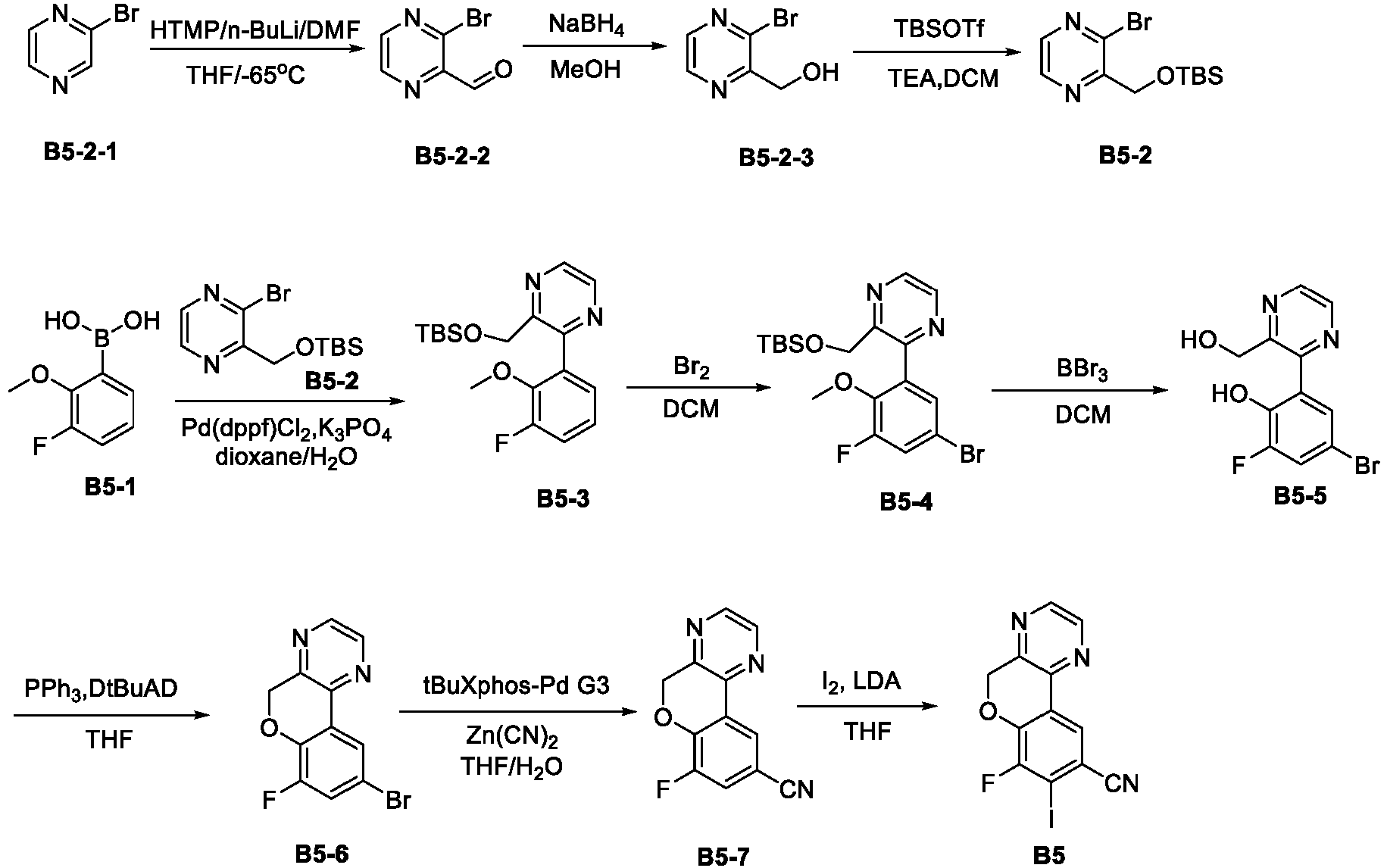
- Step 1: 2,2,6,6-Tetramethylpiperidine (10.276 mL, 60.381 mmol) was dissolved in THF (192 mL), and the mixture was cooled to -65°C under argon atmosphere in a dry ice acetone bath. Butyl lithium (26.165 mL, 65.413 mmol) was added dropwise, and then the temperature of the mixture was maintained at 0°C for half an hour and then lowered to -65°C again. A mixture of B5-2-1 (4.553 mL, 50.318 mmol) and THF (192 mL) was added dropwise, and the temperature was maintained for 30 minutes. A mixture of DMF (9.729 mL, 125.794 mmol) and THF (192 mL) was added dropwise, and the resulting mixture was stirred for another 2 hours. The reaction was then completed to produce B5-2-2. The untreated reaction mixture was directly used in the next step.
- Step 2: MeOH (120 mL) was added dropwise at -65°C, and the mixture was stirred for 10 minutes. NaBH4 (3.678 mL, 100.635 mmol) was slowly added thereto, and the temperature of the mixture was slowly raised to 0°C and maintained for 1 hour, then the reaction was completed. The reaction mixture was poured into 500 mL of NH4Cl ice-aqueous solution and extracted three times with ethyl acetate. The organic phase was washed with saturated brine. The organic phases were combined, dried over anhydrous sodium sulfate, filtered, and concentrated to obtain B5-2-3 (7 g, yield: 73.61%).
- LCMS: m/z: 191 [M+H]+.
- Step 3: Triethylamine (1.798 mL, 12.936 mmol) and tert-butyldimethylsilyl trifluoromethanesulfonate (2.181 mL, 9.486 mmol) were added to a DCM (30 mL) solution ofB5-2-3 (1630 mg, 8.624 mmol). The reaction mixture was reacted at room temperature for 1 hour under argon atmosphere. The reaction mixture was concentrated under reduced pressure and purified by silica gel chromatography (ethyl acetate/petroleum ether = 1/40 to 1/10) to obtain B5-2 (2550 mg, yield: 97.5%).
- 1H NMR (400 MHz, CDCl3) δ 8.50 (d, J = 2.5 Hz, 1H), 8.26 (d, J = 2.4 Hz, 1H), 4.91 (s, 2H), 0.92 (s, 9H), 0.13 (s, 6H).
- Step 4: Intermediate B5-1 (950 mg, 5.59 mmol), intermediate B5-2 (1525.72 mg, 5.031 mmol), dioxane (60 mL), water (12 mL), Pd(dppf)Cl2 (204.51 mg, 0.279 mmol) and potassium phosphate (2373.13 mg, 11.18 mmol) were sequentially added to a dry single-neck flask. The reaction mixture was stirred at 90°C for 12 hours under nitrogen atmosphere. After the reaction was completed, the reaction mixture was diluted with water and extracted twice with ethyl acetate. The combined organic phases were washed with saturated brine, dried over anhydrous sodium sulfate, filtered, and concentrated under reduced pressure. The resulting residue was purified by silica gel chromatography (petroleum ether/ethyl acetate = 1/10 to 1/1) to obtain B5-3 (1620 mg, yield: 83.16%).
- 1H NMR (400 MHz, CDCl3) δ 8.58 - 8.55 (m, 2H), 7.22 - 7.07 (m, 3H), 4.74 (s, 2H), 3.73 (d, J = 2.0 Hz, 3H), 0.77 (d, J = 2.9 Hz, 9H), -0.08 (s, 6H).
- Step 5: Liquid bromine (0.287 mL, 5.596 mmol) was added to a dichloromethane (13 mL) solution of B5-3 (1300 mg, 3.73 mmol), and the reaction mixture was stirred at 0°C for 6 hours under nitrogen atmosphere. The reaction mixture was slowly poured into ice water (20 mL) and extracted by adding dichloromethane (3 * 20 mL). The organic phases were combined, washed with saturated sodium thiosulfate solution (30 mL), washed with saturated brine (30 mL), dried over anhydrous sodium sulfate, and filtered. The filtrate was concentrated under reduced pressure and purified by silica gel chromatography (ethyl acetate/petroleum ether = 1/10 to 1/1) to obtain B5-4 (600 mg, yield: 37.63%).
- 1H NMR (400 MHz, CDCl3) δ 8.57 (d, J = 0.7 Hz, 2H), 7.37 - 7.34 (m, 1H), 7.32 - 7.30 (m, 1H), 4.74 (s, 2H), 3.73 (d, J= 2.1 Hz, 3H), 0.80 (s, 9H), -0.05 (s, 6H).
- Step 6: Boron tribromide (1.106 mL, 11.7 mmol) was added to a dichloromethane (12 mL) solution of B5-4 (500 mg, 1.17 mmol) at 0°C, and the reaction mixture was stirred at room temperature for 12 hours under nitrogen atmosphere. The reaction mixture was slowly poured into ice water (20 mL) and extracted by adding dichloromethane (3 * 20 mL). The organic phases were combined, washed with saturated brine (30 mL), dried over anhydrous sodium sulfate, and filtered. The filtrate was concentrated under reduced pressure, and the residue was purified by silica gel chromatography (ethyl acetate/petroleum ether = 1/10 to 1/1) to obtain B5-5 (340 mg, yield: 97.17%).
- LCMS: m/z: 301 [M+H]+.
- Step 7: Triphenylphosphine (434 mg, 1.655 mmol) and di-tert-butyl azodicarboxylate (381 mg, 1.655 mmol) were added to a tetrahydrofuran (30 mL) solution of B5-5 (450 mg, 1.505 mmol). After vacuuming, the mixture was replaced with argon three times. The reaction mixture was reacted at room temperature for 18 hours, slowly poured into ice water (10 mL), and extracted with ethyl acetate (3 * 20 mL). The organic phases were combined, washed with saturated brine (2 * 20 mL), dried over anhydrous sodium sulfate, filtered, and the filtrate was concentrated under reduced pressure and purified by silica gel chromatography (ethyl acetate/petroleum ether = 1/10 to 2/5) to obtain B5-6 (420 mg, yield: 99.2%).
- 1H NMR (400 MHz, CDCl3) δ 8.53 (d, J = 2.5 Hz, 1H), 8.45 (d, J = 2.6 Hz, 1H), 8.10 - 8.06 (m, 1H), 7.32 (dd, J = 9.7, 2.3 Hz, 1H), 5.43 (s, 2H).
- LCMS: m/z: 281 [M+H]+.
- Step 8: Zinc cyanide (334.25 mg, 2.846 mmol) and t-BuXPhos-Pd-G3 (67.83 mg, 0.085 mmol) were added to a solution of B5-6 (400 mg, 1.423 mmol) in water (20 mL) and tetrahydrofuran (4 mL) under argon atmosphere. The reaction mixture was stirred at 70°C for 12 hours under nitrogen atmosphere. The reaction mixture was diluted with ethyl acetate (20 mL), washed with saturated brine (2 * 20 mL), dried over anhydrous sodium sulfate, and filtered. The filtrate was concentrated under reduced pressure and purified by silica gel chromatography (ethyl acetate/petroleum ether = 1/3) to obtain B5-7 (256 mg, yield: 79.18%).
- 1H NMR (400 MHz, CDCl3) δ 8.57 (d, J = 2.5 Hz, 1H), 8.50 (d, J = 2.5 Hz, 1H), 8.29 (t, J = 1.6 Hz, 1H), 7.43 (dd, J = 9.7, 1.9 Hz, 1H), 5.55 (s, 2H).
- Step 9: A tetrahydrofuran (2 mL) solution of iodine (268 mg, 1.056 mmol) was added dropwise to a tetrahydrofuran (8 mL) solution of B5-7 (160 mg, 0.704 mmol) at -65°C under argon atmosphere. After the dropwise addition was completed, the mixture was stirred at -65°C for 10 minutes. LDA (2.0 mol/L in THF/hexane, 0.704 mL, 1.408 mmol) was added dropwise. The reaction mixture was reacted at -65°C for 2 hours, slowly poured into ice-cold saturated ammonium chloride solution (20 mL), and extracted by adding ethyl acetate (3 * 30 mL). The organic phases were combined, washed with saturated brine (2 * 30 mL), dried over anhydrous sodium sulfate, and filtered. The filtrate was concentrated under reduced pressure and purified by silica gel chromatography (ethyl acetate/petroleum ether = 1/3) to obtain B5 (50 mg, yield: 20.11%).
- 1H NMR (400 MHz, CDCl3) δ 8.57 (d, J = 2.5 Hz, 1H), 8.51 (d, J = 2.5 Hz, 1H), 8.26 (d, J = 1.6 Hz, 1H), 5.56 (s, 2H).
-

- Step 1: Sodium hydride (60% dispersed in oil, 1.57 g, 39.34 mmol) was added to a tetrahydrofuran (250 mL) solution of B6-1 (2.5 g, 19.67 mmol) at 0°C under argon atmosphere. The mixture was stirred and reacted at 0°C for 10 minutes. 2-(Trimethylsilyl)ethoxymethyl chloride (SEMCl) (3.44 g, 20.65 mmol) was added dropwise. The reaction mixture was stirred and reacted at 0°C for 1 hour, poured into ice water (100 mL), and extracted with ethyl acetate (3 * 200 mL). The organic phases were combined, washed with saturated brine (2 * 100 mL), dried over anhydrous sodium sulfate, filtered, and the filtrate was concentrated to dryness under reduced pressure. The residue was purified by silica gel chromatography (petroleum ether/ethyl acetate = 50/1 to 10/1) to obtain B6-2 as a colorless oil (1.1 g, yield: 21.7%).
- 1H NMR (400 MHz, CDCl3): δ ppm 8.16 (s, 1H), 5.76 (s, 2H), 4.00 (s, 3H), 3.78 - 3.64 (m, 2H), 1.02 - 0.89 (m, 2H), 0.06 (s, 9H).
- Step 2: A tetrahydrofuran solution of LiBH4 (2 M, 4.27 mL, 8.54 mmol) was added dropwise to a tetrahydrofuran (20 mL) solution of B6-2 (1.1 g, 4.27 mmol) at 0°C under argon atmosphere. The reaction mixture was stirred and reacted at 0°C for 1 hour. The reaction mixture was poured into ice water (15 mL). The reaction mixture was extracted with ethyl acetate (3 * 20 mL), and the organic phases were combined, washed with saturated brine (2 * 10 mL), dried over anhydrous sodium sulfate, and filtered. The filtrate was concentrated to dryness under reduced pressure and purified by silica gel chromatography (ethyl acetate/petroleum ether = 1/30 to 1/1) to obtain B6-3 as a colorless liquid (870 mg, yield: 88.8%).
- 1H NMR (400 MHz, CDCl3): δ ppm 7.68 (s, 1H), 5.66 (s, 2H), 4.83 (s, 2H), 3.66 (dd, J = 11.1, 5.5 Hz, 2H), 0.94 (dd, J = 11.0, 5.6 Hz, 2H), 0.07 (s, 9H).
- Step 3: Diethyl azodicarboxylate (951.8 mg, 5.57 mmol) was added dropwise to a tetrahydrofuran (260 mL) solution of B6-3 (850 mg, 3.71 mmol), B2-2 (975.8 mg, 3.71 mmol) and triphenylphosphine (1.24 g, 5.57 mmol) at 0°C under argon atmosphere. The reaction mixture was warmed to room temperature and reacted for 3 hours, slowly poured into ice water (40 mL), and extracted with ethyl acetate (3 * 60 mL). The phases were separated. The organic phases were combined, washed with saturated brine (2 * 40 mL), dried over anhydrous sodium sulfate, and filtered. The filtrate was concentrated under reduced pressure and purified by silica gel chromatography (ethyl acetate/petroleum ether = 1/40 to 1/1) to obtain B6-4 as a light white powder (1.6 g, yield: 91.0%).
- LCMS: m/z 475.0 [M+H]+
- 1H NMR (400 MHz, DMSO-d 6): δ ppm 7.90 - 7.84 (m, 2H), 7.43 (dd, J = 10.6, 1.9 Hz, 1H), 5.67 (s, 2H), 5.42 (d, J = 1.1 Hz, 2H), 3.70 - 3.59 (m, 2H), 1.00 - 0.89 (m, 2H), 0.05 (s, 9H).
- Step 4: Palladium acetate (75.8 mg, 0.34 mmol) and potassium acetate (662.5 mg, 6.74 mmol) were added to a dry N,N-dimethylacetamide (DMA) (40 mL) solution of B6-4 (1.6 g, 3.37 mmol) under argon atmosphere. After vacuuming, the mixture was replaced with argon three times. The reaction mixture was reacted at 100°C for 10 hours, slowly poured into ice water (20 mL), and extracted by adding ethyl acetate (3 * 60 mL). The organic phases were combined, washed with saturated brine (2 * 30 mL), dried over anhydrous sodium sulfate, filtered, and the filtrate was concentrated under reduced pressure and purified by silica gel chromatography (ethyl acetate/petroleum ether = 1/20 to 1/1) to obtain B6-5 as a light white powder (790 mg, yield: 67.6%).
- 1H NMR (400 MHz, CDCl3): δ ppm 7.85 (s, 1H), 7.40 (d, J = 9.7 Hz, 1H), 5.87 (s, 2H), 5.71 (s, 2H), 3.71 - 3.63 (m, 2H), 1.03 - 0.93 (m, 2H), 0.00 (s, 9H).
- Step 5: A solution of LDA (2.0 M, 2.85 mL, 5.70 mmol) in tetrahydrofuran and n-hexane was added dropwise to a dry tetrahydrofuran (20 mL) solution of B6-5 (790 mg, 2.28 mmol) at - 78°C under argon atmosphere. After vacuuming, the mixture was replaced with argon three times. The mixture was reacted at -78°C for 1 hour. A tetrahydrofuran (10 mL) solution of iodine (264.18 mg, 4.56 mmol) was added dropwise. After vacuuming, the reaction mixture was replaced with argon three times. The reaction mixture was reacted at this temperature for another 4 hours, slowly poured into ice water (20 mL), and extracted by adding ethyl acetate (3 * 40 mL). The organic phases were combined, washed with saturated brine (2 * 30 mL), dried over anhydrous sodium sulfate, filtered, and the filtrate was concentrated under reduced pressure and purified by silica gel chromatography (ethyl acetate/petroleum ether = 1/20 to 1/1) to obtain B6 as a light yellow powder (325 mg, yield: 30.2%).
- 1H NMR (400 MHz, DMSO-d 6): δ ppm 7.98 (d, J = 1.1 Hz, 1H), 5.79 (d, J = 13.7 Hz, 4H), 3.74 - 3.65 (m, 2H), 0.98 - 0.85 (m, 2H), 0.07 (s, 9H).
-

- Step 1: K2CO3 (29.5 g, 210.6 mmol) was added to an acetone (200 mL) solution ofB7-1 (22.0 g, 105.3 mmol) under argon atmosphere. Ethyl bromoacetate (17.6 g, 105.3 mmol) was added dropwise. The reaction mixture was stirred and reacted at 80°C for 6 hours. The reaction mixture was poured into ice water (100 mL). The reaction mixture was extracted with ethyl acetate (3 * 400 mL). The organic phases were combined, washed with saturated brine (2 * 100 mL), dried over anhydrous sodium sulfate, filtered, and the filtrate was concentrated to dryness under reduced pressure. The residue was purified by silica gel chromatography (petroleum ether/ethyl acetate = 50/1 to 10/1) to obtain B7-2 as a white solid (21.5 g, yield: 69.2%).
- 1H NMR (400 MHz, MeOD-d4 ): δ ppm 7.15 - 7.11 (m, 1H), 7.08 - 7.05 (m, 1H), 4.83 9s, 2H), 4.25 (q, J = 7.2 Hz, 2H), 1.28 (t, J = 7.2 Hz, 3H).
- Step 2: tert-Butoxy bis(dimethylamino)methane (7.1 g, 40.7 mmol) was added to a 1,4-dioxane (80 mL) solution of B7-2 (8.0 g, 27.1 mmol) under argon atmosphere. The reaction mixture was stirred and reacted at 75°C for 1 hour. The filtrate of the reaction mixture was concentrated to dryness under reduced pressure to obtain crude B7-3 (6.0 g, yield: 63.2%). The crude was directly used in the next step.
LCMS: m/z 350.0 [M+H]+ - Step 3: Hydrazine hydrate (98%, 8.4 mL) was added to an ethanol (20 mL) solution of B7-3 (6.0 g, 17.14 mmol) under argon atmosphere. The reaction mixture was reacted at 90°C for 10 hours, slowly poured into ice water (20 mL), and extracted by adding ethyl acetate (3 * 40 mL). The organic phases were combined, washed with saturated brine (2 * 20 mL), dried over anhydrous sodium sulfate, and filtered. The filtrate was concentrated under reduced pressure and purified by silica gel chromatography (methanol/dichloromethane = 1/40 to 1/10) to obtain B7-4 as a white powder (3.7 g, yield: 74.2%).
LCMS: m/z 290.9 [M+H]+ - Step 4: Zinc cyanide (723.7 mg, 6.16 mmol) was added to a solution of B7-4 (2.3 g, 7.90 mmol) in tetrahydrofuran (50 mL) and water (15 mL). After vacuuming, the mixture was replaced with argon three times. t-BuXPhos-Pd-G3(313.8 mg, 0.40 mmol) was added thereto. The reaction mixture was replaced with argon three times, reacted at 65°C for 8 hours, and slowly poured into ice water (50 mL). The reaction mixture was extracted by adding ethyl acetate (3 * 100 mL), and filtered to remove the solid. The organic phases were combined, washed with saturated brine (2 * 50 mL), dried over anhydrous sodium sulfate, and filtered. The filtrate was concentrated under reduced pressure and purified by silica gel chromatography (methanol/dichloromethane = 1/40 to 1/10) to obtain B7-5 as a light white powder (1.36 g, yield: 72.6%).
LCMS: m/z 236.2 [M-H]- - Step 5: K2CO3 (2.3 g, 16.86 mmol) was added to a DMSO (20 mL) solution of B7-5 (2.0 g, 8.43 mmol) under argon atmosphere. After vacuuming, the mixture was replaced with argon three times. The reaction mixture was stirred and reacted at 110°C for 2 hours, slowly poured into ice water (20 mL), and extracted by adding ethyl acetate (3 * 40 mL). The organic phases were combined, washed with saturated brine (2 * 30 mL), dried over anhydrous sodium sulfate, filtered, and the filtrate was concentrated under reduced pressure and purified by silica gel chromatography (ethyl acetate/petroleum ether = 1/20 to 1/1) to obtain B7-6 as a light yellow powder (980 mg, yield: 53.5%).
LCMS: m/z 216.2 [M-H]- - Step 6: K2CO3 (935.4 mg, 9.02 mmol) was added to a DMF (20 mL) solution of B7-6 (980 mg, 4.51 mmol) under argon atmosphere. Then iodomethane (1.9 g, 13.53 mmol) was added dropwise using a syringe. After vacuuming, the reaction mixture was replaced with argon three times, warmed to 30°C and reacted for 3 hours, slowly poured into ice water (20 mL), and extracted by adding ethyl acetate (3 * 40 mL). The organic phases were combined, washed with saturated brine (2 * 30 mL), dried over anhydrous sodium sulfate, and filtered. The filtrate was concentrated under reduced pressure and purified by silica gel chromatography (ethyl acetate/petroleum ether = 1/20 to 1/1) to obtain B7-7 as a white powder (515 mg, yield: 49.4%).
- LCMS: m/z 232.1 [M+H]+
- 1H NMR (400 MHz, CDCl3): δ ppm 7.09 (dd, J = 9.2, 1.9 Hz, 1H), 6.98 (t, J = 1.9 Hz, 1H), 6.95 (s, 1H), 3.72 (s, 3H).
- 19F NMR (376 Hz, CDCl3): δ ppm -128.97.
- Step 7: A solution of LDA (2.0 M, 1.79 mL, 3.58 mmol) in tetrahydrofuran and n-hexane was added dropwise to a dry tetrahydrofuran (20 mL) solution of B7-7 (690 mg, 2.98 mmol) at - 78°C under argon atmosphere. After vacuuming, the reaction mixture was replaced with argon three times and reacted at -78°C for 1 hour. A tetrahydrofuran solution (20 mL) of iodine (757.5 mg, 2.98 mmol) was slowly added dropwise. The reaction mixture was replaced with argon three times, reacted at this temperature for another 4 hours, slowly poured into ice water (20 mL), and extracted by adding ethyl acetate (3 * 30 mL). The organic phases were combined, washed with saturated brine (2 * 20 mL), dried over anhydrous sodium sulfate, and filtered. The filtrate was concentrated under reduced pressure, and the crude was purified by Prep-HPLC to obtain intermediate B7 as a white powder (95 mg, yield: 8.9%).
- 1H NMR (400 MHz, CDCl3): δ ppm 7.64 (s, 1H), 7.60 (d, J = 1.7 Hz, 1H), 3.65 (s, 3H).
- 19F NMR (376 Hz, CDCl3): δ ppm -108.85.
-

- Step 1: 2,3-Dichloropyrazine (950 mg, 6.377 mmol) and potassium carbonate (2644 mg, 19.131 mmol) were added to a DMF (10 mL) solution of B8-1 (950 mg, 4.589 mmol), and the mixture was heated to 100°C under microwave irradiation and maintained for 0.5 hours, and then the reaction was completed. The reaction mixture was diluted by adding water and extracted twice with ethyl acetate. The combined organic phases were washed with saturated brine, dried over anhydrous sodium sulfate, filtered, and concentrated under reduced pressure. The resulting residue was purified by silica gel chromatography (petroleum ether/ethyl acetate = 1/10 to 5/1) to obtain B8-2 (1000 mg, yield: 55.4%).
- 1H NMR (400 MHz, CDCl3) δ 7.88 (s, 2H), 7.05 (dd, J = 9.1, 2.2 Hz, 1H), 7.00 (t, J = 2.1 Hz, 1H).
- Step 2: Zinc cyanide (788.3 mg, 6.712 mmol) and t-BuXPhos-Pd-G3 (160 mg, 0.201 mmol) were added to a solution of B8-2 (950 mg, 3.356 mmol) in water (20 mL) and tetrahydrofuran (4 mL) under argon atmosphere. The reaction mixture was stirred at 70°C for 12 hours under nitrogen atmosphere. The reaction mixture was diluted with ethyl acetate (20 mL), washed with saturated brine (2 * 20 mL), dried over anhydrous sodium sulfate, and filtered. The filtrate was concentrated under reduced pressure and purified by silica gel chromatography (ethyl acetate/petroleum ether = 1/3) to obtain B8-3 (730 mg, yield: 94.91%).
- 1H NMR (400 MHz, CDCl3) δ 7.95 (dd, J = 5.9, 2.7 Hz, 2H), 7.21 (dd, J = 9.0, 1.8 Hz, 1H), 7.15 (t, J = 1.8 Hz, 1H).
- Step 3: LDA (2.0 mol/L in THF/hexane, 0.655 mL, 1.309 mmol) was added dropwise to a tetrahydrofuran (2 mL) solution of B8-3 (100 mg, 0.436 mmol) at -65°C under argon atmosphere. After the dropwise addition was completed, the mixture was stirred at -65°C for 30 minutes. A tetrahydrofuran solution (2 mL) of iodine (166.1 mg, 0.655 mmol) was added dropwise. The reaction mixture was reacted at -65°C for 2 hours, slowly poured into ice-cold saturated ammonium chloride solution (10 mL), and extracted by adding ethyl acetate (3 * 10 mL). The organic phases were combined, washed with saturated brine (2 * 10 mL), dried over anhydrous sodium sulfate, and filtered. The filtrate was concentrated under reduced pressure and purified by silica gel chromatography (ethyl acetate/petroleum ether = 1/3) to obtain B8 (100 mg, yield: 64.54%).
- 1H NMR (400 MHz, CDCl3) δ 7.89 (dd, J = 7.1, 2.7 Hz, 2H), 7.11 (d, J = 1.9 Hz, 1H).
-
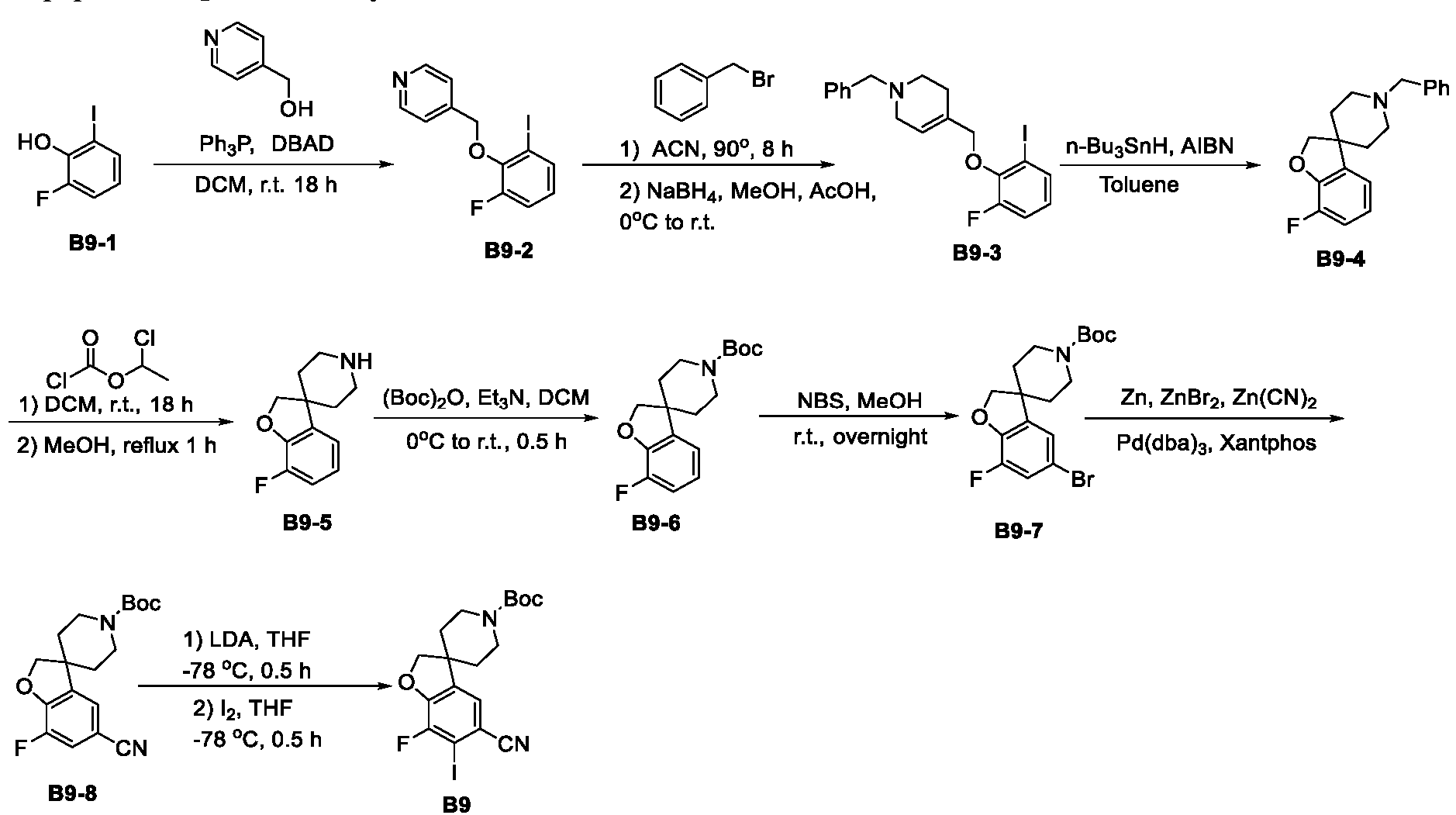
- Step 1: 4-Pyridylmethanol (2.40 g, 22.00 mmol) and triphenylphosphine (5.07 g, 22.00 mmol) were added to a dichloromethane (100 mL) solution of B9-1 (4.77 g, 20.04 mmol). A dichloromethane (50 mL) solution of di-tert-butyl azodicarboxylate (11.94 g, 22.00 mmol) was slowly added dropwise under nitrogen atmosphere. The reaction mixture was reacted overnight at room temperature. TLC detected that the reaction was completed, and then the reaction mixture was added with water (100 mL) and extracted with dichloromethane (2 * 100 mL). The organic phases were combined, washed with saturated brine (2 * 30 mL), and dried over anhydrous sodium sulfate. The filtrate was concentrated to dryness under reduced pressure and purified by silica gel column chromatography (ethyl acetate/petroleum ether = 1/100 to 1/5) to obtain B9-2 as a gray oil (5.89 g, yield: 89.34%).
- Step 2: Benzyl bromide (3.91 g, 22.85 mmol) was added to an acetonitrile (50 mL) solution of B9-2 (5.79 g, 17.58 mmol). The reaction mixture was refluxed at 90°C for 8 hours. The reaction mixture was cooled to room temperature, cooled to 0°C with an ice bath, and a methanol (50 mL) solution of sodium borohydride (781 mg, 21.10 mmol) was added dropwise. After returning to room temperature, glacial acetic acid (1 mL) was added to catalyze, and the reaction mixture was reacted at room temperature for 1 hour. The reaction mixture was diluted with water (100 mL), and then extracted with ethyl acetate (3 * 100 mL). The organic phases were combined, washed with saturated brine (100 mL), dried over anhydrous sodium sulfate, and filtered. The filtrate was concentrated to dryness under reduced pressure and purified by silica gel column chromatography (ethyl acetate/petroleum ether = 1/100 to 1/5) to obtain B9-3 as a light yellow oil (3.75 g, yield: 50%).
- LCMS: m/z 423.9 [M+H]+.
- Step 3: Tributyltin hydride (16.43 g, 22.1 mmol) was added to a toluene (300 mL) solution of B9-3 (3.75 g, 8.84 mmol). The mixture was refluxed at 130°C for 4.5 hours. Azobisisobutyronitrile (290 mg, 1.77 mmol) was added thereto. The reaction mixture was refluxed at 130°C for 2 hours, and no raw material was detected by thin-layer chromatography. The reaction mixture was added with saturated potassium fluoride solution (150 mL) and extracted with ethyl acetate (2 * 100 mL). The organic phases were combined, washed with saturated brine (100 mL), dried over anhydrous sodium sulfate, and filtered. The filtrate was concentrated to dryness under reduced pressure to obtain B9-4 as a colorless oil (2.50 g, yield: 95%).
- LCMS: m/z 298 [M+H]+.
- Step 4: Chloroethyl 1-chloroformate (2.59 g, 18.13 mmol) was added to a dichloromethane (30 mL) solution of B9-4 (2.50 g, 8.40 mmol). The reaction mixture was stirred overnight at room temperature, and no reactant was detected by LCMS. The reaction mixture was added with methanol (30 mL), refluxed for 1.5 hours, concentrated to dryness under reduced pressure, and purified by silica gel column chromatography (ethyl acetate/petroleum ether = 1/100 to 1/10) to obtain B9-5 as a white solid (1.72 g, yield: 99%).
- LCMS: m/z: 208 [M+H] +.
- Step 5: Triethylamine (2.45 mL, 17.6 mmol) was added to a dichloromethane (50 mL) solution of B9-5 (1.72 g, 8.30 mmol). After cooling to 0°C, di-tert-butyl dicarbonate (3.84 g, 17.6 mmol) was added thereto. The reaction mixture was warmed to room temperature and stirred for 0.5 hours. The reaction mixture was added with water (100 mL) and extracted with dichloromethane (2 * 30 mL). The organic phases were combined, washed with saturated brine (100 mL), dried over anhydrous sodium sulfate, and filtered. The filtrate was concentrated to dryness under reduced pressure and purified by silica gel column chromatography (ethyl acetate/petroleum ether = 1/100 to 1/10) to obtain B9-6 as a colorless oil (2.09 g, yield: 77%).
- LCMS: m/z: 308 [M+H]+.
- Step 6: N-Bromosuccinimide (0.70 g, 3.90 mmol) was added to a methanol (50 mL) solution of B9-6 (1.00 g, 3.25 mmol). The reaction mixture was stirred overnight at room temperature to obtain a bright yellow solution. The reaction mixture was added with saturated sodium thiosulfate solution (25 mL) and extracted with ethyl acetate (3 * 50 mL). The organic phases were combined, washed with saturated brine (50 mL), dried over anhydrous sodium sulfate, and filtered. The filtrate was concentrated to dryness under reduced pressure and purified by silica gel column chromatography (ethyl acetate/petroleum ether = 1/100 to 1/10) to obtain B9-7 as a white solid (0.96 g, yield: 76%).
- LCMS: m/z: 386 [M+H]+.
- Step 7: Zinc powder (15.9 mg, 0.245 mmol), zinc bromide (55 mg, 0.245 mmol), zinc cyanide (205.5 mg, 1.75 mmol), tris(dibenzylideneacetone)dipalladium (56 mg, 0.06 mmol) and 4,5-bis(diphenylphosphino)-9,9-dimethylxanthene (77.5 mg, 0.134 mmol) were added to a dimethylacetamide (8 mL) solution of B9-7 (0.95 g, 2.45 mmol). The reaction mixture was replaced with nitrogen three times and then stirred at 100°C for 16 hours. The reaction mixture was added with water (20 mL) and extracted with ethyl acetate (3 * 20 mL). The organic phases were combined, washed with saturated brine (30 mL), dried over anhydrous sodium sulfate, and filtered. The filtrate was concentrated to dryness under reduced pressure and purified by silica gel column chromatography (ethyl acetate/petroleum ether = 1/100 to 1/10) to obtain B9-8 as a white solid (0.79 g, yield: 95%).
- LCMS: m/z: 333 [M+H]+.
- 1H NMR (400 MHz, Chloroform-d) δ 7.29 - 7.26 (m, 1H), 7.19 (d, J = 1.5 Hz, 1H), 4.61 (s, 2H), 4.19 - 4.04 (m, 2H), 2.86 (t, J = 13.0 Hz, 2H), 1.90 - 1.72 (m, 4H), 1.48 (s, 9H).
- Step 8: After cooling a tetrahydrofuran (20 mL) solution of B9-8 (0.70 g, 2.10 mmol) to -78°C, lithium diisopropylamide (1.60 mL, 3.16 mmol) was added thereto, and stirred for 30 minutes to obtain a light yellow solution. The temperature was maintained at -78°C, and a tetrahydrofuran (10 mL) solution of iodine (3.84 g, 17.6 mmol) was added dropwise, then the mixture first faded and then gradually turned red, stirred for 30 minutes. The reaction mixture was warmed to room temperature, added with saturated sodium thiosulfate solution (20 mL), and extracted with ethyl acetate (3 * 30 mL). The organic phases were combined, washed with saturated brine (50 mL), dried over anhydrous sodium sulfate, and filtered. The filtrate was concentrated to dryness under reduced pressure and purified by silica gel column chromatography (ethyl acetate/petroleum ether = 1/100 to 1/20) to obtain white intermediate B9 (0.876 g, yield: 91%).
- 1H NMR (400 MHz, Chloroform-d) δ 7.19 (d, J = 0.9 Hz, 1H), 4.62 (s, 2H), 4.12 (d, J = 7.1 Hz, 2H), 2.86 (t, J = 12.6 Hz, 2H), 1.79 (dt, J = 21.2, 9.0 Hz, 4H), 1.48 (s, 9H).
-

- Step 1: Extra dry tetrahydrofuran (30 mL), B2-2 (2.5 g, 11.57 mmol) and B53-1 (1.56 g, 13.89 mmol) were sequentially added to a dry three-neck flask. Under nitrogen atmosphere, triphenylphosphine (2.97 g, 11.34 mmol) and DBAD (3.38 g, 11.34 mmol) were added thereto. The reaction mixture was stirred at 25°C for 3 hours. After the reaction was completed, the reaction mixture was diluted by adding water (100 mL) and extracted with ethyl acetate (40 mL * 2). The combined organic phases were washed with saturated brine (100 mL), dried over anhydrous sodium sulfate, filtered, and concentrated under reduced pressure. The resulting residue was purified by silica gel chromatography (0 to 15% ethyl acetate/petroleum ether) to obtain crude B53-2 (2.0 g, yield: 55.7%) as a white solid.
- Step 2: Extra dry DMAc (16 mL), B53-2 (2.0 g, 6.45 mmol), palladium acetate (2.0 g, 6.45 mmol) and potassium acetate (2.0 g, 6.45 mmol) were sequentially added to a dry single-neck flask, and the reaction mixture was stirred at 120°C for 15 hours under nitrogen atmosphere. After the reaction was completed, the reaction mixture was diluted by adding water (30 mL) and extracted with ethyl acetate (60 mL * 2). The combined organic phases were washed with saturated brine (100 mL), dried over anhydrous sodium sulfate, filtered, and concentrated under reduced pressure. The resulting solid was slurried with petroleum ether and ethyl acetate (10/1) to obtain B53-3 as a brown solid (400 mg, yield: 27.1%).
- 1H NMR (400 MHz, CDCl3): δ ppm 7.94 (s, 1H), 7.86 (s, 1H), 7.67 (dd, J = 10.8, 1.6 Hz, 1H), 5.69 (s, 2H), 3.79 (s, 3H).
- LC-MS: m/z 230.0 [M +H]+.
- Step 3: B53-3 (230 mg, 1.00 mmol) and iodine (1 capsule, about 40 mg) were dissolved in dry tetrahydrofuran (120 mL). After three replacements with argon, the mixture was cooled to -65°C with a dry ice acetone bath. LDA was added dropwise until the color of the iodine faded (became colorless), then LDA (1 M in THF, 2.0 mL, 2.00 mmol) was added dropwise. After the addition was completed, the reaction mixture was reacted at -65°C for 30 minutes, poured into ice water, concentrated to remove most of the tetrahydrofuran, and extracted with dichloromethane: methanol (10:1, 3 * 500 mL). The organic phases were combined, washed with saturated brine, dried, filtered, dried, concentrated, and the residue was subjected to column chromatography (dichloromethane: methanol = 1:0 to 500: 1) to obtain intermediate B53 as a light yellow solid (120 mg, yield: 33.7%).
- 1H NMR (400 MHz, CDCl3): δ ppm 7.71 (s, 1H), 7.41 (d, J = 1.2 Hz, 1H), 5.55 (s, 2H), 3.85 (s, 3H).
- LC-MS: m/z 356.1 [M+H]+.
-
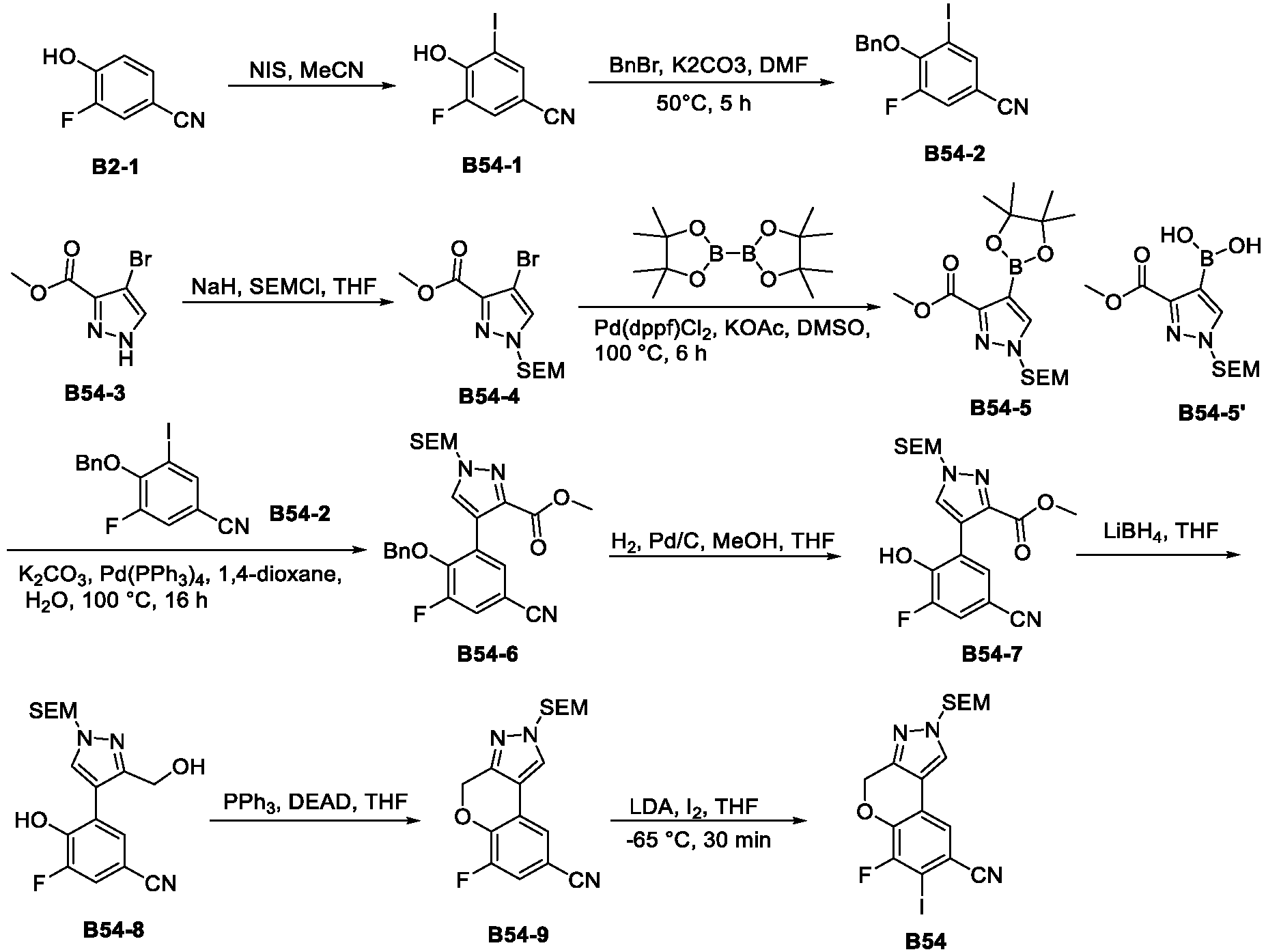
- Step 1: NIS (90.2 g, 400.9 mmol) was added to an acetonitrile (600 mL) solution of B2-1 (50.0 g, 364.7 mmol) under an ice water bath. The reaction mixture was stirred at room temperature overnight. The reaction mixture was concentrated under reduced pressure to remove nearly half of the solvent, poured into saturated sodium sulfite aqueous solution (1200 mL), and extracted with ethyl acetate (3 * 800 mL). The extracts were combined, washed with saturated brine, dried over anhydrous sodium sulfate, filtered, concentrated and purified by silica gel chromatography (petroleum ether: ethyl acetate = 25:1) to obtain B54-1 as a light yellow solid (85.5 g, yield: 89.2%).
- 1H NMR (400 MHz, CDCl3): δ ppm 7.81 (t, J = 1.6 Hz, 1H), 7.41 (dd, J = 9.2, 1.6 Hz, 1H), 6.17 (br, 1H).
- Step 2: Benzyl bromide (14.3 g, 83.65 mmol) was added dropwise to a DMF (200 mL) solution of B54-1 (20.0 g, 76.04 mmol) and potassium carbonate (21.0 g, 152.09 mmol). The reaction mixture was heated to 50°C, stirred and reacted for 5 hours, and then cooled to room temperature. The reaction mixture was diluted by adding ethyl acetate (500 mL), washed with saturated brine (3 * 2.0 L), dried over anhydrous sodium sulfate, and filtered. The filtrate was concentrated to dryness under reduced pressure and purified by silica gel chromatography (petroleum ether: ethyl acetate = 30: 1) to obtain B54-2 as a white solid (25.0 g, yield: 93.1%).
- 1H NMR (400 MHz, DMSO-d 6): δ ppm 8.18 (t, J = 1.6 Hz, 1H), 8.01 (dd, J = 11.6, 2.0 Hz, 1H), 7.53 - 7.51 (m, 2H), 7.44 - 7.35 (m, 3H), 5.27 (d, J = 1.2 Hz, 2H).
- Step 3: Sodium hydride (60% dispersed in oil, 2.93 g, 73.38 mmol) was added to a dry tetrahydrofuran (120 mL) solution of B54-3 (10.03 g, 49.65 mmol) in batches at 0°C under argon atmosphere. After the addition was completed, the mixture was stirred for another 30 minutes. 2-(Trimethylsilyl)ethoxymethyl chloride (9.80 g, 58.78 mmol) was added dropwise. The reaction mixture was stirred and reacted at room temperature for 2 hours. The reaction was quenched by adding ice water. The reaction mixture was extracted with ethyl acetate. The organic phases were combined, washed with saturated brine, dried over anhydrous sodium sulfate, and filtered. The filtrate was concentrated under reduced pressure and purified by silica gel chromatography (petroleum ether: ethyl acetate = 10:1) to obtain B54-4 as a colorless oil (10.28 g, yield: 61.7%).
- 1H NMR (400 MHz, CDCl3): δ ppm 7.69 (s, 1H), 5.45 (s, 2H), 3.93 (s, 3H), 3.57 - 3.53 (m, 2H), 0.91 - 0.87 (m, 2H), -0.04 (s, 9H).
- LCMS: m/z 337.0 [M+H]+
- Step 4: Pd(dppf)Cl2 (1.5 g, 1.98 mmol) was added to a DMSO (150 mL) solution ofB54-4 (13.3 g, 39.67 mmol), bis(pinacolato)diboron (50.4 g, 198.47 mmol) and potassium acetate (7.8 g, 79.47 mmol) under argon atmosphere. The reaction mixture was stirred and reacted at 100°C for 6 hours. The reaction mixture was poured into water, filtered and the filter cake was purified by silica gel chromatography (0 to 10% gradient of ethyl acetate: petroleum ether) to obtain a light yellow oil (10.1 g, B54-5/B54-5' = 1/2).
- Step 5: Tetrakis(triphenylphosphine)palladium (3.5 g, 3.03 mmol) was added to a suspension of a mixture of B54-5 and B54-5' (9.1 g), B54-2 (10.7 g, 30.3 mmol) and potassium carbonate (8.4 g, 60.6 mmol) in 1,4-dioxane (250 mL) and water (30 mL). After vacuuming, the reaction mixture was replaced with argon three times, heated to 100°C and reacted for 16 hours. The reaction mixture was concentrated, added with ethyl acetate (500 mL) and water (500 mL). The phases were separated, and the aqueous phase was extracted with ethyl acetate (300 mL). The organic phases were combined, concentrated, and the residue was purified by silica gel chromatography (ethyl acetate/petroleum ether = 1/3) to obtain B54-6 as a light yellow solid (7.0 g, two-step yield: 36.6%).
- 1H NMR (400 MHz, CDCl3): δ ppm 7.53 (s, 1H), 7.45 - 7.41 (m, 2H), 7.29 - 7.24 (m, 3H), 7.12 - 7.09 (m, 2H), 5.49 (s, 2H), 5.09 (m, 2H), 3.80 (s, 3H), 3.62 (t, J = 8.0 Hz, 2H), 0.94 (t, J = 8.4 Hz, 2H), 0.00 (s, 9H).
- LCMS: m/z 482.6 [M+H]+
- Step 6: Palladium on carbon (10%, 1.0 g) was added to a solution of B54-6 (2.0 g, 4.15 mmol) in methanol (100 mL) and tetrahydrofuran (15 mL). The reaction mixture was reacted overnight at 60°C under 3 MP hydrogen pressure. The reaction mixture was filtered and concentrated. The residue was purified by silica gel chromatography to obtain B54-7 as a white solid (700 mg, yield: 43.1%).
- 1H NMR (400 MHz, DMSO-d 6): δ ppm 10.98 (brs, 1H), 8.20 (s, 1H), 7.80 (dd, J = 10.8, 1.6 Hz, 1H), 7.55 (s, 1H), 5.52 (s, 2H), 3.72 (s, 3H), 3.64 (t, J = 8.0 Hz, 2H), 0.89 (t, J = 8.0 Hz, 2H), 0.00 (s, 9H).
- LCMS: m/z 392.2 [M+H]+
- Step 7: A lithium borohydride suspension (2.0 mol/L in THF, 4.2 mL, 8.4 mmol) was added dropwise to an anhydrous tetrahydrofuran (30 mL) solution of B54-7 (680 mg, 1.74 mmol) at 0°C under argon atmosphere. After the addition was completed, the reaction mixture was slowly warmed to room temperature and reacted for 16 hours. The reaction mixture was added with cold water (200 mL), concentrated to remove most of the tetrahydrofuran, and extracted with dichloromethane (2 * 150 mL). The organic phases were combined, washed with saturated brine, dried over anhydrous sodium sulfate, filtered and concentrated. The residue was purified by silica gel chromatography to obtain B54-8 as an off-white solid (550 mg, yield: 87.1%).
- 1H NMR (400 MHz, DMSO-d 6): δ ppm 8.19 (s, 1H), 7.92 (s, 1H), 7.72 (dd, J = 10.4, 1.6 Hz, 1H), 5.44 (s, 2H), 4.50 (s, 2H), 3.61 (t, J = 7.6 Hz, 2H), 0.88 (t, J = 8.0 Hz, 2H), 0.00 (s, 9H).
- LCMS: m/z 364.5 [M+H]+
- Step 8: Diisopropyl azodicarboxylate (400 mg, 1.98 mmol) was added dropwise to a tetrahydrofuran (100 mL) solution of B54-8 (480 mg, 1.32 mmol) and triphenylphosphine (520 mg, 1.98 mmol) at 0°C under argon atmosphere. After the addition was completed, the reaction mixture was warmed to room temperature and reacted for 2 hours. The reaction mixture was slowly poured into ice water (100 mL), concentrated to remove most of the tetrahydrofuran, and extracted with dichloromethane/methanol (10/1, 3 * 80 mL). The organic phases were combined, washed with saturated brine (100 mL), dried over anhydrous sodium sulfate, concentrated, and the residue was purified by silica gel chromatography to obtain B54-9 as a white solid (400 mg, yield: 87.7%).
- 1H NMR (400 MHz, DMSO-d 6): δ ppm 8.40 (s, 1H), 7.90 (d, J = 1.2 Hz, 1H), 7.71 (dd, J = 10.8, 1.6 Hz, 1H), 5.48 (s, 2H), 5.45 (s, 2H), 3.57 (t, J = 8.0 Hz, 2H), 0.88 (t, J = 8.0 Hz, 2H), -0.04 (s, 9H).
- Step 9: B54-9 (380 mg, 1.10 mmol) and iodine (1 capsule, about 40 mg) were dissolved in dry tetrahydrofuran (60 mL) at -78°C under argon atmosphere. After three replacements with argon, the mixture was cooled to -65°C with a dry ice acetone bath, and LDA (2.0 mol/L in THF/hexane) was added dropwise until the color of the iodine faded (became colorless), then LDA (2.0 mol/L in THF/hexane, 1.1 mL, 2.20 mmol) was added dropwise. After the addition was completed, the mixture was reacted at -65°C for 1 hour. A dry tetrahydrofuran solution (20 mL) of iodine (293 mg, 1.16 mmol) was slowly added dropwise (over about 30 min). After the addition was completed, the reaction mixture was reacted at -65°C for 30 minutes. The reaction mixture was poured into ice water, concentrated to remove most of the tetrahydrofuran, and extracted with dichloromethane: methanol (10:1, 3 * 500 mL). The organic phases were combined, washed with saturated brine, dried over anhydrous sodium sulfate, filtered, concentrated, and the residue was purified by column chromatography (dichloromethane: methanol = 1:0 to 500: 1) to obtain B54 as an off-white solid (340 mg, yield: 65.6%).
- 1H NMR (400 MHz, DMSO-d 6): δ ppm 8.44 (s, 1H), 7.99 (d, J = 1.2 Hz, 1H), 5.54 (s, 2H), 5.48 (s, 2H), 3.60 (t, J = 8.0 Hz, 2H), 0.89 (t, J = 8.0 Hz, 2H), 0.00 (s, 9H).
- LCMS: m/z: 472.0 [M+H]+
-

- Step 1: A tetrahydrofuran (20 mL) solution of Lawesson's reagent (316.75 mg, 282.90 µmol) was slowly added dropwise to a tetrahydrofuran (20 mL) solution of I-B7 (300 mg, 0.94 mmol) under argon atmosphere. After vacuuming, the reaction mixture was replaced with argon three times. The reaction mixture was stirred and reacted at room temperature for 4 hours, slowly poured into ice water (10 mL) and extracted by adding ethyl acetate (3 * 20 mL). The organic phases were combined, washed with saturated brine (2 * 20 mL), dried over anhydrous sodium sulfate, filtered, and the filtrate was concentrated under reduced pressure and purified by silica gel chromatography (ethyl acetate/petroleum ether = 1/20 to 1/1) to obtain B55-1 as a light yellow powder (211 mg, yield: 67.1%).
- 1H NMR (400 MHz, DMSO-d 6): δ ppm 13.12 (s, 1H), 7.28 (d, J = 1.6 Hz, 1H), 5.08 (s, 2H).
- LCMS: m/z: 334.9 [M+H]+
- Step 2: A mixture of intermediate B55-1 (300 mg, 0.90 mmol) and formylhydrazine (64.7 mg, 1.08 mmol) was reacted under microwave irradiation at 160°C for 3 hours. After the reaction was completed, the reaction mixture was slowly poured into ice water (10 mL) and extracted by adding ethyl acetate (3 * 20 mL). The organic phases were combined, washed with saturated brine (2 * 20 mL), dried over anhydrous sodium sulfate, and filtered. The filtrate was concentrated under reduced pressure and purified by silica gel chromatography (methanol/dichloromethane = 1/50 to 1/15) to obtain B55 as a white powder (200 mg, yield: 65.1%).
- LCMS: m/z: 342.9 [M+H]+.
-

- Step 1: A mixture of intermediate B55-1 (400 mg, 1.20 mmol) and acethydrazide (106.43 mg, 1.44 mmol) was reacted under microwave irradiation at 160°C for 3 hours. After the reaction was completed, the reaction mixture was slowly poured into ice water (10 mL) and extracted by adding ethyl acetate (3 * 20 mL). The organic phases were combined, washed with saturated brine (2 * 20 mL), dried over anhydrous sodium sulfate, and filtered. The filtrate was concentrated under reduced pressure and purified by silica gel chromatography (methanol/dichloromethane = 1/50 to 1/15) to obtain white intermediate B56 (198 mg, yield: 46.4%).
- LCMS: m/z: 356.9 [M+H]+.
-

- Step 1: B70-2 (3031 mg, 15.87 mmol) was added to a sodium methoxide solution (3 mL, 30 wt% in methanol) of B70-1 (500 mg, 3.17 mmol). The reaction mixture was reacted under a low vacuum oil pump at 50°C for 2 hours, cooled to room temperature and then heated to 168°C and reacted for 3 hours in an open environment. After cooling to room temperature, the reaction mixture was dissolved with dilute hydrochloric acid (10 mL), extracted by adding ethyl acetate (30 mL * 3), washed with saturated brine (10 mL), dried over anhydrous sodium sulfate, and filtered. The filtrate was concentrated to dryness under reduced pressure and purified by silica gel column chromatography (ethyl acetate/petroleum ether = 1/100 to 1/1) to obtain B70-3 as a light yellow solid (950 mg, yield: 96%).
- LCMS: m/z 314 [M+H]+.
- Step 2: B70-3 (950 mg, 3.044 mmol) was added to polyphosphoric acid (10 mL), heated to 160°C and reacted for 6 hours. The reaction mixture was slowly poured into ice water (50 mL). The pH was adjusted to 10 with 10 N sodium hydroxide solution. The mixture was extracted with ethyl acetate (3 × 50 mL), washed with saturated brine (100 mL), dried over anhydrous sodium sulfate, concentrated, and purified by silica gel column chromatography (ethyl acetate/petroleum ether = 1/40 to 1/2) to obtain B70-4 as a light yellow solid (800 mg, yield: 89.4 %).
- LCMS: m/z 294 [M+H]+.
- Step 3: Zn(CN)2 (639 mg, 5.44 mmol) was added to a solution of B70-4 (800 mg, 2.72 mmol) in tetrahydrofuran (4 mL) and water (20 mL). After vacuuming, the mixture was replaced with argon three times. t-BuXPhos-Pd-G3 (794.4 mg, 0.163 mmol) was added thereto. After vacuuming, the reaction mixture was replaced with argon three times. The reaction mixture was reacted at 45°C for 15 hours. The reaction mixture was slowly poured into ice water (50 mL), extracted by adding ethyl acetate (3 × 50 mL), filtered with diatomite to remove the insoluble substances and the filter residue was rinsed with ethyl acetate (50 mL). The organic phases were combined, washed with saturated brine (2 × 100 mL), dried over anhydrous sodium sulfate, concentrated and purified by silica gel column chromatography (ethyl acetate/petroleum ether = 1/40 to 1/2) to obtain B70-5 as a light yellow solid (500 mg, yield: 76.5%).
- 1H NMR (400 MHz, CDCl3) δ 8.84 (dd, J = 4.5, 1.9 Hz, 1H), 8.74 (dd, J = 7.8, 2.0 Hz, 1H), 8.43 (s, 1H), 7.80 (dd, J = 9.2, 1.9 Hz, 1H), 7.57 (dd, J = 7.7, 4.6 Hz, 1H).
- Step 4: THF (5 mL), MeOH (10 mL), B70-5 (300 mg, 1.25 mmol) and NaBH4 (142 mg, 3.75 mmol) were sequentially added to a dry 50 mL single-neck flask. The reaction mixture was stirred at 20°C for 1 hour. TLC showed that the reaction was completed. The reaction mixture was quenched by pouring into saturated NH4Cl aqueous solution at 0°C and extracted with ethyl acetate, then the combined organic phases were washed with saturated brine, dried over anhydrous sodium sulfate, filtered, and concentrated under reduced pressure to obtain B70-6 as a light yellow solid (300 mg, crude), which was used directly in the next step.
- LCMS: m/z 243 [M+H]+.
- Step 5: DCM (20 mL), B70-6 (290 mg, 1.20 mmol) and p-toluenesulfonic acid (21 mg, 0.125 mmol) were sequentially added to a dry 50 mL single-neck flask. The reaction mixture was stirred at 20°C for 3 hours. TLC showed that the reaction was completed. The reaction mixture was poured into saturated sodium bicarbonate aqueous solution and extracted with ethyl acetate. The combined organic phases were washed with saturated brine, dried over anhydrous sodium sulfate, filtered, concentrated under reduced pressure and purified by silica gel column chromatography (ethyl acetate/petroleum ether = 1/10 to 1/2) to obtain B70-7 as a colorless oil (215 mg, yield: 56%).
- LCMS: m/z 326.9 [M+H]+.
- Step 6: A solution of LDA (2.0 M, 0.975 mL, 1.95 mmol) in tetrahydrofuran and n-hexane was added dropwise to a dry tetrahydrofuran (5 mL) solution of B70-7 (215 mg, 0.65 mmol) at - 78°C under argon atmosphere. After vacuuming, the mixture was replaced with argon three times. The mixture was reacted at -78°C for 1 hour. A tetrahydrofuran solution (2 mL) of iodine (214.5 mg, 0.845 mmol) was slowly added dropwise. The reaction mixture was replaced with argon three times, reacted at this temperature for another 0.5 hours, slowly poured into ice water (20 mL), and extracted by adding ethyl acetate (3 * 30 mL). The organic phases were combined, washed with saturated brine (2 * 20 mL), dried over anhydrous sodium sulfate, and filtered. The filtrate was concentrated under reduced pressure, and the crude was purified by Prep-HPLC to obtain intermediate B70 as a white powder (66 mg, yield: 22.5%).
- LCMS: m/z 453 [M+H]+.
-

- Step 1: I-B1-1 (74.50 g, 390.05 mmol) was dissolved in tetrahydrofuran (260 mL) and water (1000 mL), then Zn(CN)2(30.22 g, 257.45 mmol) was added thereto. After vacuuming, the mixture was replaced with argon three times. t-BuXPhos-Pd-G3 (6.80 g, 8.56 mmol) was added thereto. After vacuuming, the reaction mixture was replaced with argon three times and reacted at 40°C for 15 hours. The reaction mixture was slowly poured into ice water (1.0 L), extracted by adding ethyl acetate (3 × 400 mL), filtered with diatomite to remove the insoluble substances and the filter residue was rinsed with tetrahydrofuran (300 mL). The organic phases were combined, washed with saturated brine (2 × 500 mL), dried over anhydrous sodium sulfate, concentrated and purified by silica gel column chromatography (ethyl acetate/petroleum ether = 1/20 to 1/1) to obtain I-B1-2 as a light yellow powder (28.53 g, yield: 53.3%).
- 1H NMR(400 MHz, DMSO-d 6): δ ppm 8.21 (d, J = 1.2 Hz, 1H), 7.85 (dd, J = 11.2, 1.6 Hz, 1H), 7.36 (s, 2H).
- 19F NMR (376 MHz, DMSO-d 6): δ ppm -137.53.
- LCMS: m/z 138.2 [M+H]+.
- Step 2: I-B1-2 (28.53 g, 208.10 mmol) was dissolved in acetone (290 mL) and tert-butanol (145 mL), and DMAP (82.84 g, 677.9 mmol) was added thereto. (Boc)2O (200.39 g, 919.26 mmol) was slowly added thereto, and the reaction mixture was reacted at 60°C for 12 hours. The reaction mixture was concentrated to nearly dryness, loaded onto the column using the wet method, and purified by silica gel column chromatography (ethyl acetate/petroleum ether = 1/100 to 1/15) to obtain I-B1-3 as a white solid (58.32 g, yield: 83.1%).
- 1H NMR (400 MHz, CDCl3): δ ppm 8.60 (d, J = 2.0 Hz, 1H), 7.75 (dd, J = 8.4, 2.0 Hz, 1H), 1.44 (s, 18H).
- 19F NMR (376 MHz, CDCl3): δ ppm -121.23.
- LCMS: m/z 360.0 [M+Na]+.
- Step 3: I-B1-3 (58.32 g, 172.85 mmol) was dissolved in tetrahydrofuran (630 mL), and iodine (87.72 g, 345.64 mmol) was added thereto, and then the mixture was cooled to -65°C under nitrogen atmosphere. LDA (2.0 M in THF, 440 mL, 880.00 mmol) was added dropwise. After the dropwise addition was completed, the reaction mixture was stirred for 10 minutes, then warmed to room temperature and reacted for 16 hours. The reaction mixture was slowly poured into ice water (1.0 L) and extracted by adding ethyl acetate (3 × 400 mL). The organic phase was washed with saturated brine (2 × 500 mL), dried, concentrated, and purified by silica gel column chromatography (ethyl acetate/petroleum ether = 0/1 to 1/10), and then slurried with dichloromethane/petroleum ether (1/50) to obtain I-B1-4 as a light yellow powder (23.27 g, yield: 37.1%).
- 1H NMR (400 MHz, CDCl3) δ ppm: 8.35 (s, 1H), 7.21 (s, 1H), 1.55 (s, 9H).
- 19F NMR (400 MHz, CDCl3) δ ppm: -110.85.
- LCMS: m/z 362.1 [M-H]-.
- Step 4: TFA (130 mL) was added dropwise to a dichloromethane (360 mL) solution ofI-B1-4 (32.06 g, 88.29 mmol) at 0°C. The reaction mixture was reacted at room temperature for 2 hours, and concentrated to remove most of the solvent and TFA. The reaction mixture was diluted with ethyl acetate (60 mL) and poured into saturated sodium carbonate aqueous solution (500 mL). The aqueous phase was extracted with ethyl acetate (3 × 200 mL), and the organic phase was washed with saturated brine (100 mL), dried, and concentrated to obtain I-B1-5 as an off-white solid (19.08 g, yield: 82.2%).
- 1H NMR (400 MHz, DMSO-d 6) δ ppm 8.10 (s, 1H), 7.53 (s, 2H).
- 19F NMR (400 MHz, DMSO-d 6) δ ppm: -118.25.
- LCMS: m/z: 264.0 [M+H]+.
- Step 5: 40 wt.% chloroacetaldehyde aqueous solution (290 mL) was added to a solution of I-B1-5 (14.29 g, 54.35 mmol) dissolved in n-butanol (290 mL). The reaction mixture was heated to 100°C and reacted for 2 hours. The reaction mixture was cooled to room temperature to precipitate a large number of crystals, poured into ice water (800 mL), filtered, and the filter cake was washed with water to obtain crude 1. The filtrate was extracted with ethyl acetate (3 × 200 mL). The organic phase was washed with saturated brine (2 × 100 mL), dried, and concentrated to obtain an oily crude product, which was crystallized by adding n-hexane (300 mL) and filtered to obtain crude 2. Crude 1 and crude 2 were combined and slurried with n-hexane/ethyl acetate (300 mL/20 mL) to obtain I-B1 as a yellow powder (12.32 g, yield: 79.0%).
- 1H NMR (400 MHz, DMSO-d 6) δ ppm: 9.28 (s, 1H), 8.18 (dd, J = 3.2, 1.6 Hz, 1H), 7.76 (d, J = 1.2 Hz, 1H).
- 19F NMR (376 MHz, DMSO-d 6) δ ppm: -107.29.
- LCMS: m/z: 288.0 [M+H]+.
-

- Step 1: I-B3-6 (30 mg, 0.125 mmol) and THF (1 mL) were sequentially added to a 25 mL round-bottom flask under an ice bath. Then NaH (60%) (7.5 mg, 0.188 mmol) was added thereto, and after stirring for 1 hour, TsCl (28.6 mg, 0.15 mmol) was added thereto. The reaction mixture was stirred at room temperature for 12 hours. TLC showed that the reaction was completed, then the reaction mixture was diluted by adding water (10 mL) and extracted with ethyl acetate (10 mL * 3). The combined organic phases were washed with saturated sodium bicarbonate aqueous solution (30 mL) and saturated brine (30 mL), dried over anhydrous sodium sulfate, filtered, and concentrated under reduced pressure. The resulting residue was purified by silica gel chromatography (0 to 30% ethyl acetate/petroleum ether) to obtain I-B2 as a white solid (38 mg, yield: 77.2%).
- 1H NMR (400 MHz, CDCl3) δ 8.16 (s, 1H), 7.79 - 7.74 (m, 3H), 7.33 (d, J = 8.4 Hz, 2H), 6.81 (d, J = 3.6 Hz, 1H), 2.40 (s, 3H).
- 19F-NMR (376 MHz, CDCl3): -108.89.
- LC-MS: m/z 393.1 [M-H]-.
-
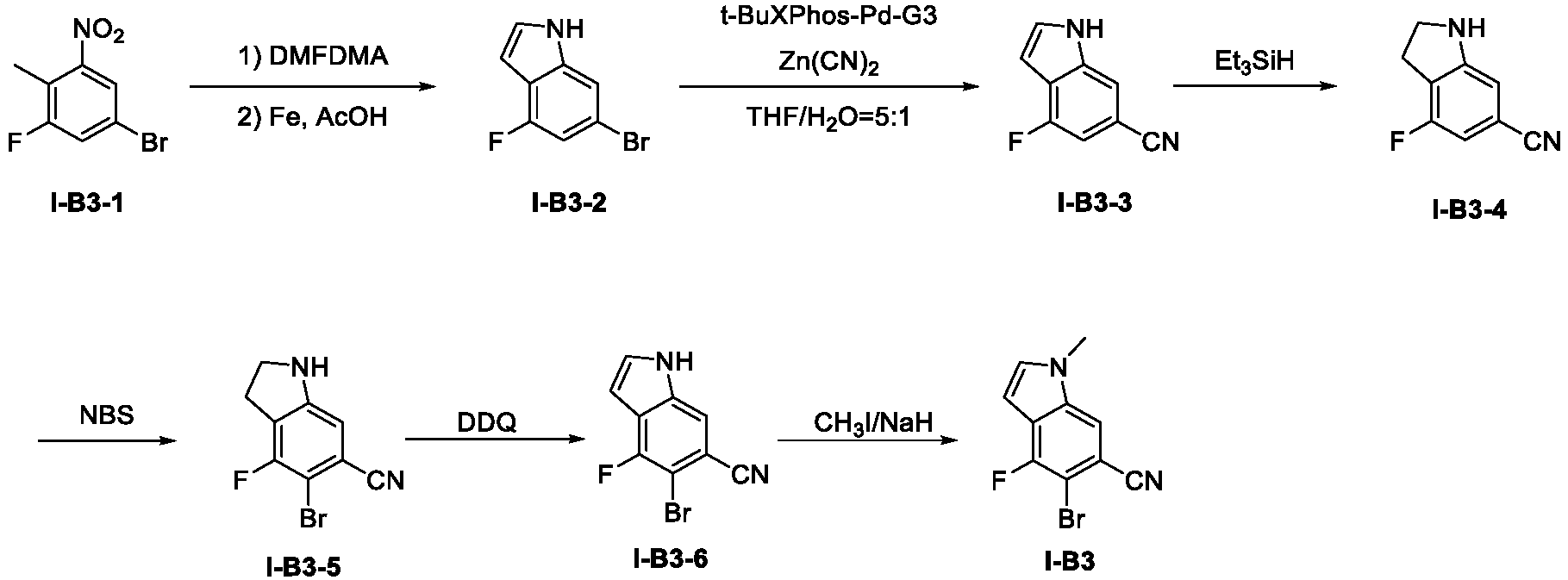
- Step 1: I-B3-1 (6.5 g, 27.8 mmol), DMF-DMA (13 mL, 61.1 mmol), triethylamine (4.25 mL, 61.1 mmol) and DMF (25 mL) were sequentially added to a 500 mL round-bottom flask. Then the reaction mixture was heated to 110°C and stirred for 3 hours. TLC showed that the reaction was completed, then the reaction mixture was diluted by adding water (50 mL) and extracted with ethyl acetate (50 mL * 3). The combined organic phases were washed with saturated sodium bicarbonate aqueous solution (150 mL), saturated sodium thiosulfate aqueous solution (150 mL) and saturated brine (150 mL), dried over anhydrous sodium sulfate, filtered, and concentrated under reduced pressure. The resulting residue was dissolved in acetic acid/toluene (100 mL/150 mL), and reduced iron powder (31 g, 555 mmol) was added thereto. Then the reaction mixture was heated to 100°C and stirred for 1 hour. The reaction mixture was cooled, filtered, poured into ice water, and extracted with ethyl acetate (150 mL * 3). The combined organic phases were washed with saturated brine (300 mL), dried over anhydrous sodium sulfate, filtered, and concentrated under reduced pressure. The resulting residue was purified by silica gel chromatography (0 to 40% ethyl acetate/petroleum ether) to obtain I-B3-2 as a yellow solid (3.7 g, yield: 60%).
- 1H NMR (400 MHz, CDCl3) δ 8.27 (brs, 1H), 7.34 (t, J = 1.2 Hz, 1H), 7.16 - 7.14 (m, 1H), 6.96 (dd, J = 9.6, 1.2 Hz, 1H), 6.61 - 6.59 (m, 1H).
- 19F NMR (376 MHz, CDCl3) δ -119.68.
- Step 2: Under nitrogen atmosphere, intermediate I-B3-2 (3.7 g, 17.3 mmol), zinc cyanide (1.34 g, 11.42 mmol) and t-BuXPhos-Pd-G3 (686 mg, 0.86 mmol) were sequentially added to a dry three-neck flask, and then THF/H2O (10 mL/50 mL) was added thereto. The reaction mixture was stirred at 40°C for 12 hours. After the reaction was completed, the reaction mixture was concentrated under reduced pressure, and the resulting residue was purified by silica gel chromatography (0 to 40% ethyl acetate/petroleum ether) to obtain I-B3-3 as a yellow solid (2.85 g, yield: 93%).
- 1H NMR (400 MHz, CDCl3) δ 8.76 (brs, 1H), 7.59 (s, 1H), 7.41(t, J = 1.6 Hz, 1H), 7.05 (dd, J = 9.6, 0.8 Hz, 1H), 6.73(t, J = 2.0 Hz, 1H).
- 19F NMR (376 MHz, CDCl3) δ -118.93.
- LC-MS: m/z 159.0 [M-H]-.
- Step 3: Under nitrogen atmosphere, intermediate I-B3-3 (0.68 g, 4.25 mmol), triethylsilane (1 mL, 26.6 mmol) and tetrahydrofuran (6 mL) were sequentially added to a dry round-bottom flask. The reaction mixture was stirred at 60°C for 5 hours. TLC showed that the reaction was completed, then the reaction mixture was subjected to rotary evaporation to dryness, diluted by adding water (10 mL) and extracted with ethyl acetate (10 mL * 3). The combined organic phases were washed with saturated sodium bicarbonate aqueous solution (30 mL) and saturated brine (30 mL), dried over anhydrous sodium sulfate, filtered, and concentrated under reduced pressure. The resulting residue was purified by silica gel chromatography (0 to 50% ethyl acetate/petroleum ether) to obtain I-B3-4 as a yellow solid (566 mg, yield: 82.2%).
- 1H NMR (400 MHz, CDCl3) δ 6.68 (dd, J = 8.0, 0.8 Hz, 1H), 6.58(s, 1H), 4.09 (brs, 1H), 3.69 (t, J = 8.8 Hz, 2H), 3.12 (t, J = 8.8 Hz, 2H).
- 19F NMR (376 MHz, CDCl3) δ -116.52.
- LC-MS: m/z 163.1 [M+H]+.
- Step 4: Intermediate I-B3-4 (562 mg, 3.47 mmol) and acetonitrile (10 mL) were sequentially added to a dry round-bottom flask under cooling in an ice bath, and then an acetonitrile (10 mL) solution of NBS (617 mg, 3.47 mmol) was added dropwise. The reaction mixture was stirred at 0°C for 0.5 hours. TLC showed that the reaction was completed, then the reaction mixture was diluted by adding water (30 mL) and extracted with ethyl acetate (30 mL * 3). The combined organic phases were washed with saturated sodium bicarbonate aqueous solution (60 mL) and saturated brine (60 mL), dried over anhydrous sodium sulfate, filtered, and concentrated under reduced pressure. The resulting residue was purified by silica gel chromatography (0 to 30% ethyl acetate/petroleum ether) to obtain I-B3-5 as a white solid (423 mg, yield: 59.6%).
- 1H NMR (400 MHz, CDCl3): 6.62 (s, 1H), 4.08 (brs, 1H), 3.72 (t, J= 8.8 Hz, 2H), 3.19 - 3.14 (m, 2H).
- 19F-NMR (376 MHz, CDCl3): -108.97.
- Step 5: Under nitrogen atmosphere, intermediate I-B3-5 (200 mg, 0.83 mmol), DDQ (377 mg, 1.66 mmol) and xylene (10 mL) were sequentially added to a dry three-neck flask, and the reaction mixture was stirred at 120°C for 12 hours. After the reaction was completed, the reaction mixture was concentrated under reduced pressure, and the resulting residue was purified by silica gel chromatography (0 to 50% ethyl acetate/petroleum ether) to obtain I-B3-6 as a yellow-white solid (170 g, yield: 86%).
- 1H NMR (400 MHz, CDCl3): 8.68 (brs, 1H), 7.62 (s, 1H), 7.42 (t, J = 2.8 Hz, 1H), 6.74 - 6.72 (m, 1H).
- 19F-NMR (376 MHz, CDCl3): -110.50.
- Step 6: I-B3-6 (50 mg, 0.20 mmol) and DMF (1 mL) were sequentially added to a 25 mL round-bottom flask under an ice bath. Then NaH (60%) (12 mg, 0.24 mmol) was added thereto, and after stirring for 5 minutes, iodomethane (42.6 mg, 0.3 mmol) was added thereto. The reaction mixture was stirred at room temperature for 2 hours. TLC showed that the reaction was completed, then the reaction mixture was diluted by adding water (10 mL) and extracted with ethyl acetate (10 mL * 3). The combined organic phases were washed with saturated sodium bicarbonate aqueous solution (30 mL) and saturated brine (30 mL), dried over anhydrous sodium sulfate, filtered, and concentrated under reduced pressure. The resulting residue was purified by silica gel chromatography (0 to 30% ethyl acetate/petroleum ether) to obtain I-B3 as a white solid (37 mg, yield: 73%).
- 1H NMR (400 MHz, CDCl3): 7.52 (s, 1H), 7.25 (d, J = 2.8 Hz, 1H), 6.64 (dd, J = 3.2, 0.4 Hz, 1H), 3.85 (s, 3H).
- 19F-NMR (376 MHz, CDCl3): -110.85.
- LC-MS: m/z 253.0 [M+H]+.
-

- Step 1: Intermediate I-B3-5 (50 mg, 0.2 mmol) and dichloromethane (4 mL) were sequentially added to a dry round-bottom flask under cooling in an ice bath, and then (BOC)2O (66 mg, 0.3 mmol) and DMAP (24.4 mg, 0.2 mmol) were added thereto. The reaction mixture was stirred at room temperature for 2 hours. TLC showed that the reaction was completed, and the reaction mixture was concentrated. The resulting residue was purified by silica gel chromatography (0 to 20% ethyl acetate/petroleum ether) to obtain I-B4 as a white solid (50 mg, yield: 73%).
- 1H NMR (400 MHz, CDCl3): 7.97 (brs, 1H), 4.08 (t, J = 8.8 Hz, 2H), 3.20 (t, J = 8.4 Hz, 2H), 1.56 (s, 9H).
- 19F-NMR (376 MHz, CDCl3): -108.61.
-

- Step 1: n-Butanol (2.5 mL), I-B1-1 (120 mg, 0.456 mmol) and bromoacetone (249.85 mg, 1.824 mmol) were sequentially added to a dry single-neck flask, and the resulting reaction mixture was heated to 110°C and stirred for 16 hours. TLC showed that the reaction was completed. The reaction mixture was subjected to rotary evaporation to dryness, slurried with ethyl acetate/petroleum ether (3:1), and filtered to obtain I-B5 as a yellow solid (41 mg, yield: 29%).
- 1H NMR (400 MHz, DMSO-d 6): δ ppm 9.29 (s, 1H), 7.93 (d, J = 2.8 Hz, 1H), 2.40 (s, 3H).
- LCMS: m/z=302 (M+H)+.
-

- Step 1: 2-Bromo-6-fluorophenol (7.60 g, 40 mmol), 1,2-dibromoethane (14.9 g, 80 mmol), potassium carbonate (11 g, 80 mmol) and acetonitrile (400 mL) were sequentially added to a dry single-neck flask, and the reaction mixture was stirred at 65°C for 16 hours. TLC showed that the reaction was completed, and the reaction mixture was filtered and concentrated. The resulting residue was purified by silica gel chromatography (petroleum ether) to obtain I-B6-1 as a colorless oily liquid (9.10 g, yield: 77%).
- 1H NMR (400 MHz, CDCl3) δ ppm: 7.34 - 7.32 (m, 1H), 7.10 - 7.05 (m, 1H), 6.97 - 6.92 (m, 1H), 4.38 (t, J =7.2 Hz, 2H), 3.66 (t, J = 6.8 Hz, 2H)
- 19F NMR (376 MHz, CDCl3) δ -126.41.
- Step 2: I-B6-1 (9.11 g, 30.8 mmol) and tetrahydrofuran (240 mL) were sequentially added to a dry three-neck flask, and n-butyllithium (15.4 mL, 38.5 mmol, 2.5 M) was added dropwise at -70°C under nitrogen atmosphere for 15 minutes. The resulting colorless solution was stirred at - 70°C for 90 minutes. TLC showed that the reaction was completed. The reaction mixture was quenched by pouring into water and brine. The aqueous layer was extracted with methyl tert-butyl ether. The combined organic phases were washed with saturated brine, dried over anhydrous sodium sulfate, filtered, and concentrated under reduced pressure. The resulting residue was purified by silica gel chromatography (petroleum ether) to obtain I-B6-2 as a colorless oily liquid (3.4 g, yield: 80%).
- 1H NMR (400 MHz, CDCl3) δ ppm: 6.97 - 6.95 (m, 1H), 6.92 - 6.87 (m, 1H), 6.79 - 6.74 (m, 1H), 4.66 (t, J = 8.8 Hz, 2H), 3.26 (t, J = 8.8 Hz, 2H).
- 19F NMR (376 MHz, CDCl3) δ -139.36.
- Step 3: Compound I-B6-2 (3.4 g, 24.6 mmol), methanol (100 mL) and NBS (4.9 g, 27.8 mmol) were sequentially added to a dry single-neck flask at 20°C. The reaction mixture was stirred at 20°C for 16 hours. TLC showed that the reaction was completed. The reaction mixture was quenched with saturated sodium thiosulfate aqueous solution and concentrated to dryness under reduced pressure. The resulting residue was diluted with petroleum ether/ethyl acetate (1:1), and the organic layer was washed twice with water, and the combined aqueous layers were extracted once with petroleum ether/ethyl acetate (1:1). The combined organic phases were washed with saturated brine, dried over anhydrous sodium sulfate, filtered, and concentrated under reduced pressure. The resulting residue was purified by silica gel chromatography (8% ethyl acetate/petroleum ether) to obtain I-B6-3 as a yellow-green oily liquid (4.57 g, yield: 86%).
- 1H NMR (400 MHz, CDCl3) δ ppm: 7.09 - 7.05 (m, 2H), 4.67 (t, J = 8.8 Hz, 2H), 3.25 (t, J = 8.8 Hz, 2H). 19F NMR (376 MHz, CDCl3) δ -136.10.
- Step 4: Compound I-B6-3 (4.57 g, 21.2 mmol), zinc cyanide (1.72 g, 14.8 mmol), zinc powder (137 mg, 2.1 mmol), Pd2(dba)3 (484 mg, 0.53 mmol), XantPhos (672 mg, 1.16 mmol), zinc bromide (470 mg, 2.1 mmol) and dry N,N-dimethylacetamide (37 mL) were sequentially added to a dry 50 mL single-neck flask, and the reaction flask was purged with nitrogen. The reaction mixture was stirred at 100°C for 16 hours under nitrogen atmosphere. TLC showed that the reaction was completed. The reaction mixture was filtered, and the filter cake was washed with ethyl acetate. The organic layer was washed twice with water and the combined aqueous layers were extracted once with ethyl acetate. The combined organic phases were washed with saturated brine, dried over anhydrous sodium sulfate, filtered, and concentrated under reduced pressure. The resulting residue was purified by silica gel chromatography (40 to 80% dichloromethane/petroleum ether) to obtain I-B6-4 as a light yellow solid (3.2 g, yield: 95%).
- 1H NMR (400 MHz, CDCl3) δ ppm: 7.29 - 7.23 (m, 2H), 4.78 (t, J = 8.8 Hz, 2H), 3.32 (t, J = 8.8 Hz, 2H). 19F NMR (376 MHz, CDCl3) δ -136.04.
- Step 5: I-B6-4 (3.55 g, 21.8 mmol) and tetrahydrofuran (100 mL) were sequentially added to a dry three-neck flask, and LDA (16.3 mL, 32.7 mmol, 2.0 M) was added dropwise at -70°C under nitrogen atmosphere. The yellow suspension was stirred at -70°C for 30 minutes. A tetrahydrofuran (50 mL) solution of iodine (8.3 g, 32.7 mmol) was then added to the suspension, and the reaction mixture was stirred at -70°C for another 30 minutes. TLC showed that there was a small amount of raw material remaining. The reaction was quenched with water and returned to room temperature, and 10% sodium thiosulfate aqueous solution was added thereto. The aqueous layer was extracted with ethyl acetate. The combined organic phases were washed with saturated brine, dried over anhydrous sodium sulfate, filtered, and concentrated under reduced pressure. The resulting residue was slurried with petroleum ether/ethyl acetate (10:1) to obtain I-B6 as a yellow solid (6.4 g, crude). A small amount of analytically pure sample was obtained by preparative TLC.
- 1H NMR (400 MHz, CDCl3) δ ppm: 7.28 (d, J = 0.8 Hz, 1H), 4.80 (t, J = 8.8 Hz, 2H), 3.33 (t, J = 8.8 Hz, 2H).
- 19F NMR (376 MHz, CDCl3) δ -113.04.
-
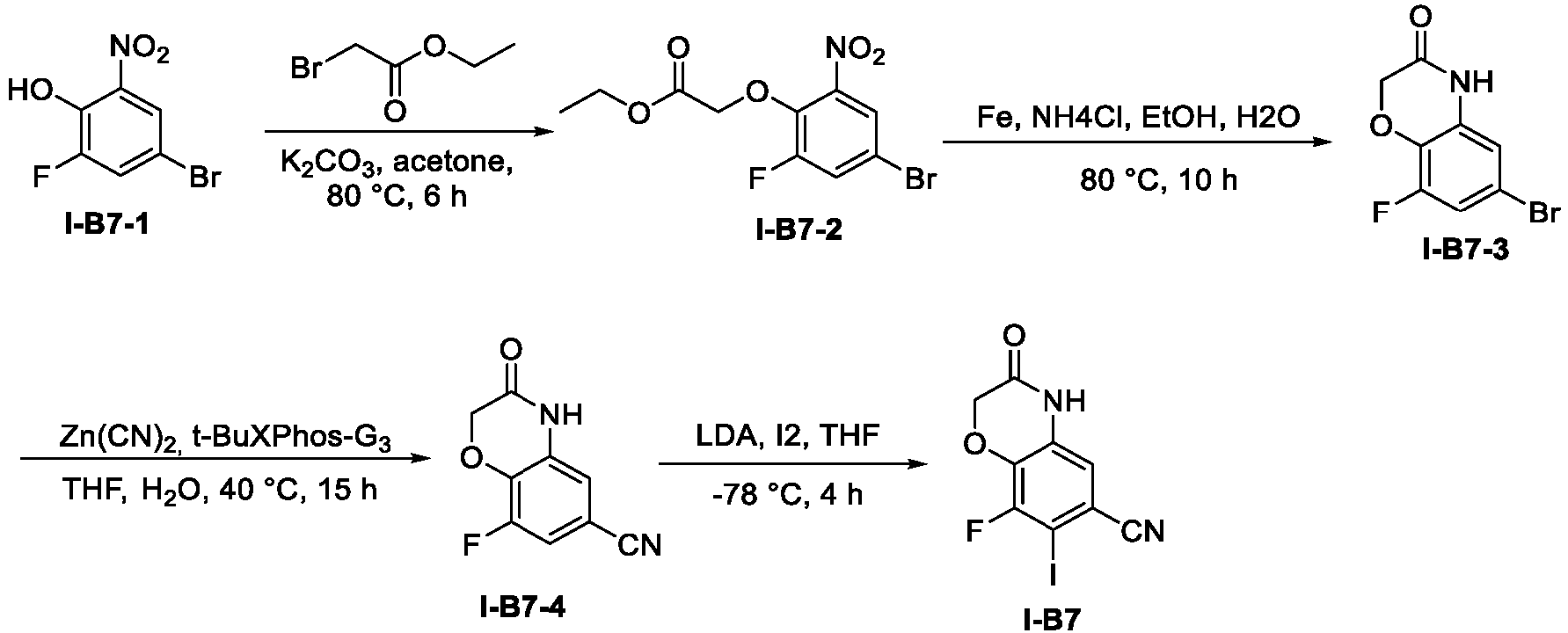
- Step 1: Potassium carbonate (11.71 g, 84.75 mmol) was added to an acetone (200 mL) solution of 4-bromo-2-fluoro-6-nitrophenol (10 g, 42.37 mmol). After vacuuming, the mixture was replaced with argon three times, and ethyl bromoacetate (11.94 g, 63.56 mmol) was slowly added dropwise. After vacuuming, the reaction mixture was replaced with argon three times. The reaction mixture was reacted at 80°C for 6 hours. The reaction mixture was cooled to room temperature, added with ethyl acetate (300 mL), washed with saturated brine (2 × 100 mL), dried over anhydrous sodium sulfate, concentrated, and purified by silica gel chromatography (ethyl acetate/petroleum ether = 1/100 to 1/5) to obtain I-B7-2 as a colorless liquid (7.28 g, yield: 50.1%).
- Step 2: Ammonium chloride (5.68 g, 106.14 mmol) and deionized water (15 mL) were added to an absolute ethanol (50 mL) solution of ethyl 2-(4-bromo-2-fluoro-6-nitrophenoxy)acetate (I-B7-2, 7.28 g, 21.23 mmol). Iron powder (5.93 g, 106.14 mmol) was added thereto during stirring. After vacuuming, the mixture was replaced with argon three times. The reaction mixture was reacted at 80°C for 10 hours, cooled to room temperature, filtered, and the filter cake was rinsed with ethanol (300 mL). The filtrate was concentrated under reduced pressure and purified by silica gel chromatography (ethyl acetate/petroleum ether = 1/40) to obtain I-B7-3 as an off-white powder (4.55 g, yield: 92.4%).
- 1H NMR (400 MHz, DMSO-d 6): δ ppm 11.01 (s, 1H), 7.22 (dd, J = 10.4, 2.4 Hz, 1H), 6.87 (t, J = 2.0 Hz, 1H), 4.69 (s, 2H).
- Step 3: Zinc cyanide (1.61 g, 13.73 mmol) was added to a solution of 6-bromo-8-fluoro-2H-benzo[b][1,4]oxazin-3(4H)-one (I-B7-3, 4.55 g, 19.61 mmol) in tetrahydrofuran (50 mL) and water (15 mL). After vacuuming, the mixture was replaced with argon three times. t-BuXPhos-Pd-G3 (682.50 mg, 0.98 mmol) was added thereto. After vacuuming, the reaction mixture was replaced with argon three times. The reaction mixture was reacted at 40°C for 15 hours. The reaction mixture was slowly poured into ice water (50 mL), filtered, and extracted by adding ethyl acetate (3 × 100 mL). The organic phases were combined, washed with saturated brine (2 × 100 mL), dried over anhydrous sodium sulfate, concentrated, and purified by silica gel chromatography (ethyl acetate/petroleum ether = 1/40 to 1/5) to obtain I-B7-4 as a light yellow powder (2.91 g, yield: 83.3%).
- 1H NMR (400 MHz, DMSO-d 6): δ ppm 11.19 (s, 1H), 7.57 (dd, J = 10.4, 2.0 Hz, 1H), 7.06 (t, J = 1.2 Hz, 1H), 4.80 (s, 2H).
- 19F NMR(376 Hz, DMSO-d 6)ppm: δ -133.71.
- Step 4: LDA (1 M in THF, 1.56 mL, 1.56 mmol) was added dropwise to a tetrahydrofuran (10 mL) solution of 8-fluoro-3,4-dihydro-2H-benzo[b][1,4]oxazine-6-carbonitrile (I-B7-4, 100 mg, 520.43 µmmol) at -78°C under argon atmosphere. The mixture was reacted at -78°C for 1 hour. A tetrahydrofuran solution (10 mL) of iodine (264.18 mg, 1.04 mmol) was slowly added dropwise. The reaction mixture was reacted at -78°C for another 4 hours. The reaction mixture was slowly poured into ice water (10 mL) and extracted by adding ethyl acetate (3 × 20 mL). The organic phases were combined, washed with saturated brine (2 × 20 mL), dried over anhydrous sodium sulfate, concentrated, and purified by silica gel chromatography (ethyl acetate/petroleum ether = 1/20 to 1/1) to obtain I-B7 as a light yellow powder (137 mg, yield: 82.7%).
- 1H NMR (400 MHz, DMSO-d 6): δ ppm 11.27 (s, 1H), 7.14 (d, J= 1.2 Hz, 1H), 4.87 (s, 2H).
- 19F NMR(376 Hz, DMSO-d 6): δ ppm -111.86.
- LCMS: m/z: 317 [M-H]-.
-

- Step 1: K2CO3 (11.71 g, 84.75 mmol) was added to a DMF (200 mL) solution of I-B8-1 (10.0 g, 42.37 mmol). 1,2-Dibromoethane (11.94 g, 63.56 mmol) was slowly added dropwise under argon atmosphere. The reaction mixture was reacted at 80°C for 6 hours. The reaction mixture was cooled to room temperature, diluted with ethyl acetate (300 mL), washed with saturated brine (2 × 500 mL), dried over anhydrous sodium sulfate, concentrated, and purified by silica gel column chromatography (ethyl acetate/petroleum ether = 1/100 to 1/5) to obtain I-B8-2 as a colorless liquid (7.28 g, yield: 50.1%).
- 1H NMR (400 MHz, CDCl3): δ ppm 7.77 (t, J = 2.0 Hz, 1H), 7.55 (dd, J = 10.0, 2.4 Hz, 1H), 4.51 - 4.47 (m, 2H), 3.66 (t, J = 6.4 Hz, 2H).
- Step 2: A deionized water (15 mL) solution of ammonium chloride (5.68 g, 106.14 mmol) was added to an ethanol (50 mL) solution of I-B8-2 (7.28 g, 21.23 mmol). Iron powder (5.93 g, 106.14 mmol) was added thereto during stirring. After vacuuming, the reaction mixture was replaced with argon three times. The reaction mixture was reacted at 80°C for 10 hours. The reaction mixture was cooled to room temperature, filtered, and the filter cake was rinsed with ethanol (300 mL). The filtrate was concentrated, and ethyl acetate (100 mL) was added to dissolve the residue, washed with saturated brine (2 × 100 mL), dried over anhydrous sodium sulfate, and filtered. The filtrate was concentrated to dryness under reduced pressure and purified by silica gel column chromatography (ethyl acetate/petroleum ether = 1/40) to obtain I-B8-3 as an off-white solid (4.55 g, yield: 92.4%).
- 1H NMR (400 MHz, CDCl3): δ ppm 6.63 (dd, J = 10.0, 2.0 Hz, 1H), 6.50 (t, J = 2.0 Hz, 1H), 4.26 (t, J = 4.4 Hz, 1H), 3.95 (br, 1H), 3.45 - 3.42 (m, 2H).
- LCMS: m/z 234.0 [M+H]+.
- Step 3: Zn(CN)2 (1.61 g, 13.73 mmol) was added to a solution of I-B8-3 (4.55 g, 19.61 mmol) in tetrahydrofuran (50 mL) and water (15 mL). After vacuuming, the mixture was replaced with argon three times. t-BuXPhos-Pd-G3 (682.50 mg, 0.98 mmol) was added thereto. After vacuuming, the reaction mixture was replaced with argon three times. The reaction mixture was reacted at 40°C for 15 hours, slowly poured into ice water (50 mL), extracted by adding ethyl acetate (3 × 50 mL), filtered with diatomite to remove the insoluble substances, and the filter residue was rinsed with ethyl acetate (50 mL). The organic phases were combined, washed with saturated brine (2 × 100 mL), dried over anhydrous sodium sulfate, concentrated and purified by silica gel column chromatography (ethyl acetate/petroleum ether = 1/40 to 1/5) to obtain I-B8-4 as a light yellow solid (2.91 g, yield: 83.3%).
- 1H NMR (400 MHz, CDCl3): δ ppm 6.78 (dd, J = 10.0, 2.0 Hz, 1H), 6.65 (t, J = 1.6 Hz, 1H), 4.36 - 4.34 (m, 2H), 4.15 (br, 1H), 3.49 - 3.47 (m, 2H).
- LCMS: m/z 179.0 [M+H]-.
- Step 4: NBS (928.97 mg, 16.33 mmol) was added to an acetonitrile (100 mL) solution of I-B8-4 (2.91 g, 16.33 mmol) under an ice water bath. The reaction mixture was stirred and reacted at room temperature for 4 hours. The reaction mixture was poured into ice-cold saturated sodium sulfite aqueous solution (50 mL) and filtered. The filter cake was washed with water and purified by silica gel chromatography (ethyl acetate/petroleum ether = 1/20 to 1/5) to obtain I-B8-5 as a white solid (2.20 g, yield: 52.40%).
- 1H NMR (400 MHz, CDCl3): δ ppm 6.71 (d, J = 1.6 Hz, 1H), 4.37 - 4.34 (m, 2H), 4.19 (br, 1H), 3.49 - 3.47 (m, 2H).
- Step 5: I-B8-5 (200 mg, 0.781 mmol), Boc2O (255 mg, 1.17 mmol), triethylamine (217 mL, 1.4 mmol) and dichloromethane (5 mL) were sequentially added to a reaction flask, and the reaction mixture was stirred at room temperature for 16 hours. The reaction mixture was diluted by adding water and extracted twice with ethyl acetate. The combined organic phases were washed with saturated brine, dried over anhydrous sodium sulfate, filtered, and concentrated under reduced pressure. The resulting residue was purified by silica gel chromatography (petroleum ether/ethyl acetate = 5:1) to obtain I-B8 as a colorless oil (220 mg, yield: 79.1%).
- 1H NMR (400 MHz, CDCl3): δ ppm 8.12 (s, 1H), 4.39 (t, J = 4.4 Hz, 2H), 3.92 (t, J = 4.4 Hz, 2H), 1.56 (s, 9H).
- LC-MS: m/z 358.9 [M+H]+.
-

- Step 1: I-B8-5 (0.1 g, 0.389 mmol) was dissolved in DMF (0.5 mL), and sodium hydride (35 mg, 0.584 mmol) was added thereto. The mixture was cooled to 0°C and stirred for 30 minutes under nitrogen atmosphere. Iodomethane (83 mg, 0.584 mmol) was added dropwise. After the dropwise addition was completed, the reaction mixture was warmed to room temperature and reacted for 1 hour. The reaction mixture was slowly poured into ice-cold saturated ammonium chloride solution (10 mL), and extracted by adding ethyl acetate (3 × 10 mL). The organic phase was washed with saturated brine (10 mL), dried, concentrated, and purified by silica gel chromatography (0 to 50% ethyl acetate/petroleum ether) to obtain I-B9 as a light yellow solid (80 mg, yield: 76%).
- 1H NMR (400 MHz, CDCl3): δ ppm 6.69 (d, J = 1.6 Hz, 2H), 4.41 - 4.39 (m, 2H), 3.36 - 3.34 (m, 2H), 2.93 (s, 3H).
- LC-MS: m/z = 271.2 [M+H]+.
-

- Step 1: DMF (1 mL) and I-B7 (100 mg, 0.31 mmol) were sequentially added to a dry two-neck flask under nitrogen atmosphere, cooled to 0°C, added with NaH (19 mg, 0.47 mmol, 60% dispersion in mineral oil), and stirred for 10 minutes. Then CH3I (67 mg, 0.47 mmol) was added thereto, and the reaction mixture was warmed to room temperature and stirred for 1 hour. TLC showed that the reaction was completed. The reaction mixture was poured into water and extracted with ethyl acetate. The combined organic phases were washed with saturated brine, dried over anhydrous sodium sulfate, filtered, and concentrated under reduced pressure. The resulting residue was purified by silica gel chromatography to obtain I-B10 as a yellow solid (70 mg, yield: 67.1%).
- 1H NMR (400 MHz, DMSO-d 6): δ ppm 7.63 (s, 1H), 4.90 (s, 2H), 3.29 (s, 3H).
-

- Step 1: DMF (3 mL) and I-B8-5 (150 mg, 0.58 mmol) were sequentially added to a dry two-neck flask under nitrogen atmosphere, cooled to 0°C, added with NaH (30 mg, 0.76 mmol, 60% dispersion in mineral oil), and stirred for 10 minutes. Then propionyl chloride (81 mg, 0.87 mmol) was added thereto, and the reaction mixture was warmed to room temperature and stirred for 1 hour. TLC showed that the reaction was completed. The reaction mixture was poured into water and extracted with ethyl acetate. The combined organic phases were washed with saturated brine, dried over anhydrous sodium sulfate, filtered, and concentrated under reduced pressure. The resulting residue was purified by silica gel chromatography to obtain I-B11 as a yellow solid (160 mg, yield: 87.5%).
- 1H NMR (400 MHz, CDCl3) δ 8.06 (brs, 1H), 4.45 (t, J = 4.8 Hz, 2H), 3.96 (t, J = 4.4 Hz, 2H), 2.57 (q, J = 7.32 Hz, 2H), 1.23 (t, J = 7.2 Hz, 3H).
- LCMS: m/z= 313.0 (M+H)+.
-

- Step 1: I-B8-5 (1.1 g, 4.279 mmol) was dissolved in acetic anhydride (5 mL), heated to 100°C and reacted for 3 hours. The reaction mixture was slowly poured into ice-cold saturated sodium bicarbonate solution (100 mL) until the pH was equal to 8, and extracted by adding ethyl acetate (3 × 100 mL). The organic phase was washed with saturated brine (100 mL), dried, concentrated, and purified by silica gel chromatography (0 to 50% ethyl acetate/petroleum ether) to obtain I-B12 as a light yellow solid (1.06 g, yield: 82.81%).
- 1H NMR (400 MHz, CDCl3) δ 8.03 (brs, 1H), 4.46 (t, J = 4.8 Hz, 2H), 3.96 (t, J = 4.4 Hz, 2H), 2.34 (s, 3H).
- LC-MS: m/z =297.0 [M+H]+.
-

- Step 1: Zn(CN)2 (352 mg, 3.0 mmol) was added to a solution of I-B13-1 (483 mg, 2.24 mmol) in tetrahydrofuran (1.0 mL) and water (5.0 mL). After vacuuming, the mixture was replaced with argon three times. t-BuXPhos-Pd-G3 (119 mg, 0.15 mmol) was added thereto. After vacuuming, the reaction mixture was replaced with argon three times. The reaction mixture was reacted at 45°C for 18 hours. The reaction mixture was slowly poured into ice water (10 mL), extracted by adding ethyl acetate (3 × 10 mL), filtered with diatomite to remove the insoluble substances and the filter residue was rinsed with ethyl acetate (20 mL). The organic phases were combined, washed with saturated brine (2 × 50 mL), dried over anhydrous sodium sulfate, concentrated and purified by silica gel column chromatography (ethyl acetate/petroleum ether = 1/40 to 1/2) to obtain I-B13-2 as a light yellow solid (170 mg, yield: 47%).
- 1H NMR (400 MHz, DMSO-d 6) δ 14.21 (brs, 1H), 8.41 (d, J=3.2 Hz, 1H), 8.30 (d, J=0.8 Hz, 1H), 7.72 (d, J=10.8 Hz, 1H).
- LCMS: m/z 162.0 [M+H]+.
- Step 2: SEM-Cl (320 mg, 1.92 mmol) and DIEA (0.53 mL, 2.88 mmol) were added to a dichloromethane (5.0 mL) solution of I-B13-2 (154 mg, 0.96 mmol), and the reaction mixture was reacted at room temperature 2 hours. The reaction mixture was poured into water (10 mL) and extracted by adding ethyl acetate (3 × 10 mL). The organic phases were combined, washed with saturated brine (2 × 50 mL), dried over anhydrous sodium sulfate, concentrated and purified by silica gel column chromatography (ethyl acetate/petroleum ether = 1/40 to 1/2) to obtain I-B13-3 as a light yellow solid (145 mg, yield: 52%).
- 1H NMR (400 MHz, CDCl3) δ 8.16 (d, J = 2.0 Hz, 1H), 7.94 (d, J = 1.2 Hz, 1H), 7.34 (dd, J = 10.8, 1.2 Hz, 1H), 5.84 (s, 2H), 3.60 (t, J=8.4 Hz, 2H), 0.89 (t, J=8.0 Hz, 2H), 0.00 (s, 9H).
- 19F NMR (376 MHz, CDCl3): δ ppm -128.48.
- Step 3: I-B13-3 (243 mg, 0.83 mmol) was dissolved in tetrahydrofuran (15 mL), and iodine (423 mg, 1.67 mmol) was added thereto, and then the mixture was cooled to -65°C under nitrogen atmosphere. LDA (2.0 M in THF, 2.08 mL, 4.15 mmol) was added dropwise. After the dropwise addition was completed, the reaction mixture was stirred for 30 minutes, then warmed to room temperature and reacted for 1 hour. The reaction mixture was slowly poured into ice water (30 mL) and extracted by adding ethyl acetate (3 × 50 mL). The organic phase was washed with saturated brine (2 × 50 mL), dried, concentrated, and purified by silica gel column chromatography (ethyl acetate/petroleum ether = 0/1 to 1/10) to obtain I-B13 as a colorless oil (20 mg, yield: 5.1%).
- LCMS: m/z 416.1 [M-H]-.
-
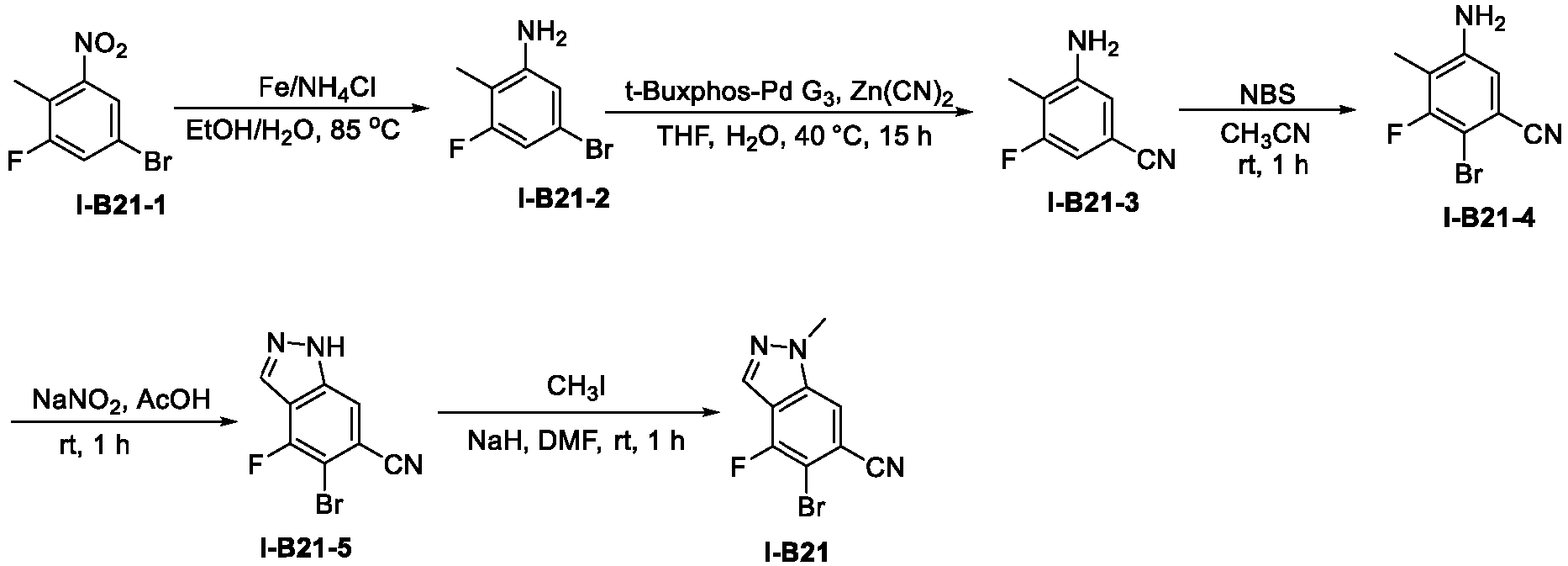
- Step 1: Ammonium chloride (6.11 g, 114.3 mmol) and reduced iron powder (6.4 g, 114.3 mmol) were added to a solution of I-B21-1 (5.35 g, 22.9 mmol) in ethanol (60 mL) and water (30 mL). The reaction mixture was reacted at 80°C for 2 hours. The reaction mixture was cooled to room temperature, filtered, and the filter cake was rinsed with ethanol (300 mL). The filtrate was concentrated, added with ethyl acetate (100 mL) to dissolve, washed with saturated brine (2 × 100 mL), dried over anhydrous sodium sulfate, and filtered. The filtrate was concentrated to dryness under reduced pressure and purified by silica gel column chromatography (ethyl acetate/petroleum ether = 1/100 to 1/3) to obtain I-B21-2 as a colorless oil (4.65 g, yield: 99%).
- LCMS: m/z 204 [M+H]+.
- Step 2: Zn(CN)2 (2.69 g, 22.8 mmol) was added to a solution of I-B21-2 (4.65 g, 22.8 mmol) in tetrahydrofuran (10 mL) and water (50 mL). After vacuuming, the mixture was replaced with argon three times. t-BuXPhos-Pd-G3 (909 mg, 1.15 mmol) was added thereto. After vacuuming, the reaction mixture was replaced with argon three times. The reaction mixture was reacted at 45°C for 15 hours. The reaction mixture was slowly poured into ice water (50 mL), extracted by adding ethyl acetate (3 × 50 mL), filtered with diatomite to remove the insoluble substances and the filter residue was rinsed with ethyl acetate (50 mL). The organic phases were combined, washed with saturated brine (2 × 100 mL), dried over anhydrous sodium sulfate, concentrated and purified by silica gel column chromatography (ethyl acetate/petroleum ether = 1/40 to 1/2) to obtain I-B21-3 as a light yellow solid (3.03 g, yield: 87.6%).
- 1H NMR (400 MHz, DMSO-d6 ) δ 6.82 - 6.78 (m, 2H), 5.74 (s, 2H), 2.01 (d, J = 1.6 Hz, 3H).
- Step 3: NBS (3.18 mg, 17.9 mmol) was added to an acetonitrile (60 mL) solution of I-B21-3 (2.70 g, 17.9 mmol) under an ice water bath. The reaction mixture was stirred and reacted at room temperature for 1 hour. The reaction mixture was poured into ice-cold saturated sodium sulfite aqueous solution (50 mL) and filtered. The filter cake was washed with water and purified by silica gel chromatography (ethyl acetate/petroleum ether = 1/20 to 1/5) to obtain I-B21-4 as a white solid (3.5 g, yield: 95%).
- LCMS: m/z 228.9 [M+H]+.
- Step 4: I-B21-4 (3.5 g, 15.3 mmol), acetic acid (50 mL) and sodium nitrite (2.11 g, 30.6 mmol) were sequentially added to a reaction flask, and the reaction mixture was stirred at room temperature for 1 hour. The reaction mixture was diluted by adding water and extracted twice with ethyl acetate. The combined organic phases were washed with saturated brine, dried over anhydrous sodium sulfate, filtered, and concentrated under reduced pressure. The resulting residue was purified by silica gel chromatography (ethyl acetate/petroleum ether = 1/40 to 1/2) to obtain I-B21-5 as a colorless oil (3.2 g, yield: 87%).
- LC-MS: m/z 239.3 [M+H]+.
- Step 5: I-B21-5 (500 mg, 2.08 mmol) and DMF (10 mL) were sequentially added to a 25 mL round-bottom flask under an ice bath. Then NaH (60%) (166 mg, 4.16 mmol) was added thereto, and after stirring for 5 minutes, iodomethane (590 mg, 4.16 mmol) was added thereto. The reaction mixture was stirred at room temperature for 1 hour. TLC showed that the reaction was completed, then the reaction mixture was diluted by adding water (10 mL) and extracted with ethyl acetate (15 mL * 3). The combined organic phases were washed with saturated sodium bicarbonate aqueous solution (30 mL) and saturated brine (30 mL), dried over anhydrous sodium sulfate, filtered, and concentrated under reduced pressure. The resulting residue was purified by silica gel chromatography (0 to 30% ethyl acetate/petroleum ether) to obtain I-B21 as a white solid (270 mg, yield: 51%).
- 1H NMR (400 MHz, DMSO-d 6): δ ppm 8.48 (s, 1H), 8.38 (s, 1H), 4.14 (s, 3H).
- LC-MS: m/z 255.8 [M+H]+.
-

- Step 1: LDA (2.0 M in THF/hexane, 52.1 mL, 104.2 mmol) was added dropwise to a THF (200 mL) solution of I-B22-1 (20.0 g, 94.8 mmol) at -65°C under argon atmosphere. The mixture was reacted at -65°C for 1 hour. DMF (20 mL) was added dropwise quickly. The reaction mixture was reacted at -65°C for another 1 hour. The reaction mixture was poured into ice-cold saturated ammonium chloride solution (500 mL) and extracted with dichloromethane (3 × 500 mL). The organic phases were combined, dried over anhydrous sodium sulfate, and filtered. The filtrate was concentrated to dryness under reduced pressure, and the crude was purified by silica gel chromatography (petroleum ether: ethyl acetate = 100:1) to obtain I-B22-2 as a yellow oil (18.6 g, yield: 82.1%).
- 1H NMR (400 MHz, CDCl3): δ ppm 10.24 (s, 1H), 7.41 - 7.36 (m, 1H).
- Step 2: An ethanol (180 mL) solution of I-B22-2 (18.0 g, 75.3 mmol) and 2-hydrazinoethanol (11.7 g, 154.2 mmol) was placed in a sealed jar. The reaction mixture was reacted at room temperature for 2 hours, then heated to 140°C and reacted for 16 hours. The reaction mixture was concentrated, and the residue was purified by column chromatography (dichloromethane: petroleum ether: ethyl acetate = 2:4:1) to obtain I-B22-3 as a white solid (14.7 g, yield: 70.4%).
- 1H NMR (400 MHz, CDCl3): δ ppm 7.99 (d, J = 2.0 Hz, 1H), 7.21(dd, J = 9.6, 5.6 Hz, 1H), 4.64 (t, J = 4.8 Hz, 2H), 4.12 (q, J = 5.2 Hz, 2H), 2.55 (t, J = 6.0 Hz, 1H).
- 19F NMR (376 MHz, CDCl3): δ ppm -139.98, -161.46.
- Step 3: Methanesulfonato(2-di-t-butylphosphino-2',4',6'-tri-i-propyl-1,1'-biphenyl)(2'-amino-1,1'-biphenyl-2-yl)palladium(II) (2.26 g, 2.84 mmol) was added to a solution of I-B22-3 (15.8 g, 57.0 mmol) and zinc cyanide (4.7 g, 40.0 mmol) in THF (1.05 L) and water (700 mL). The air was replaced with argon three times. The reaction mixture was heated to 50°C, reacted for 16 hours, and filtered. The filtrate was concentrated under reduced pressure to remove the solvent THF. The reaction mixture was diluted with water (500 mL), then extracted with dichloromethane (3 × 500 mL). The organic phases were combined, washed with saturated brine, dried over anhydrous sodium sulfate, filtered, and the filtrate was concentrated to dryness under reduced pressure. The crude was purified by column chromatography (petroleum ether: ethyl acetate = 3:1) to obtain I-B22-4 as an off-white solid (12 g, yield: 94.3%).
- 1H NMR (400 MHz, DMSO-d 6): δ ppm 8.44 (d, J = 2.4 Hz, 1H), 8.11 (dd, J = 10.4, 6.0 Hz, 1H), 4.92 (t, J = 5.6 Hz, 1H), 4.57 (t, J = 5.6 Hz, 2H), 3.81 (q, J = 5.2 Hz, 2H).
- 19F NMR (376 MHz, DMSO-d 6): δ ppm -142.12, -148.35.
- Step 4: LDA (2.0 mol/L in THF/hexane, 60.5 mL, 60.5 mmol) was added dropwise to a THF (250 mL) solution of I-B22-4 (9.0 g, 40.3 mmol) at -65°C under argon atmosphere. The mixture was reacted at -65°C for 60 minutes. A THF (30 mL) solution of iodine (15.4 g, 60.5 mmol) was added dropwise. The reaction mixture was reacted at -65°C for 30 minutes. The reaction mixture was poured into ice-cold saturated ammonium chloride aqueous solution (500 mL) and extracted with ethyl acetate (3 × 300 mL). The organic phases were combined, washed with saturated brine (3 × 500 mL), dried over anhydrous sodium sulfate, and filtered. The filtrate was concentrated to dryness under reduced pressure and purified by silica gel chromatography (petroleum ether: ethyl acetate = 2:1) to obtain I-B22-5 as a yellow oil (7.6 g, yield: 54.0%).
- 1H NMR (400 MHz, DMSO-d 6): δ ppm 8.38 (d, J = 2.0 Hz, 1H), 4.55 (t, J = 5.2 Hz, 2H), 3.79 (t, J = 5.2 Hz, 2H).
- 19F NMR (376 MHz, DMSO-d 6): δ ppm -120.26, -145.05.
- Step 5: Acetohydroxamic acid (4.3 g, 56.7 mmol) was added to a DMSO (70 mL) solution of I-B22-5 (6.6 g, 18.9 mmol) and potassium carbonate (13.1 g, 94.5 mmol). The reaction mixture was heated to 80°C, reacted for 4 hours, and poured into ice water (200 mL). The pH was adjusted to 6 with aq. 2M HCl. The mixture was filtered, and the filter cake was purified by silica gel chromatography (dichloromethane: methanol = 10:1) to obtain I-B22-6 as a yellow oil (5.6 g, yield: 85.3%).
- 1H NMR (400 MHz, DMSO-d 6): δ ppm 8.08 (s, 1H), 4.66 (t, J = 5.6 Hz, 2H), 3.79 (t, J = 5.6 Hz, 2H).
- 19F NMR (376 MHz, DMSO-d 6): δ ppm -120.23.
- Step 6: A dichloromethane (5 mL) solution of methanesulfonyl chloride (180.4 mg, 1.57 mmol) was slowly added dropwise to a dichloromethane (20 mL) solution of I-B22-8 (366 mg, 1.05 mol) and triethylamine (213.1 mg, 2.10 mol) at 0°C under argon atmosphere. The reaction mixture was reacted at room temperature for 1 hour. The reaction mixture was diluted by adding dichloromethane (20 mL), washed with saturated brine (2 × 20 mL), dried over anhydrous sodium sulfate, and filtered. The filtrate was concentrated nearly to dryness under reduced pressure to obtain crude I-B22-9, which was directly used in the next step.
- 1H NMR (400 MHz, DMSO-d 6): δ ppm 8.24 (s, 1H), 4.85 (t, J = 4.8 Hz, 2H), 3.61 (t, J = 5.2 Hz, 2H), 3.32 (s, 3H).
- 19F NMR (376 MHz, DMSO-d 6): δ ppm -121.16.
- Step 7: Cesium carbonate (687 mg, 2.10 mmol) and tetrabutylammonium iodide (9 mg, 0.1 mmol) were added to a DMF (10 mL) solution of crude I-B22-9 from the previous step. After vacuuming, the reaction mixture was replaced with argon three times and reacted at room temperature for 3 hours. The reaction mixture was slowly poured into ice water (10 mL) and extracted by adding ethyl acetate (3 × 20 mL). The organic phases were combined, washed with saturated brine (2 × 20 mL), dried over anhydrous sodium sulfate, and filtered. The filtrate was concentrated under reduced pressure and purified by silica gel chromatography (ethyl acetate/petroleum ether = 1/50 to 1/3) to obtain I-B22 9-fluoro-8-iodo-2,3-dihydro-[1,4]oxazino[2,3,4-hi]indazole-7-carbonitrile (198 mg, two-step yield: 57.1%).
- 1H NMR (400 MHz, DMSO-d 6): δ ppm 8.24 (s, 1H), 4.85 (t, J = 4.4 Hz, 2H), 4.61 (t, J = 5.2 Hz, 2H).
- 19F NMR (376 MHz, DMSO-d 6): δ ppm -121.16.
-

- Step 1: 5-Bromo-7-fluoro-2,3-dihydro-1H-inden-1-one (1.37 g, 6 mmol), 1,1'-bis(diphenylphosphino)ferrocene-palladium(II)dichloride dichloromethane complex (245 mg, 0.30 mmol), zinc cyanide (493.2 mg, 4.2 mmol), zinc bromide (135.1 mg, 0.60 mmol), zinc powder (19.6 mg, 0.30 mmol) and N,N-dimethylacetamide (15 mL) were sequentially added to a dry single-neck flask. The reaction system was purged with nitrogen for half a minute, and the reaction mixture was stirred at 100°C for 17 hours. TLC showed that the reaction was completed. Ethyl acetate was added thereto, and the reaction mixture was filtered with diatomite. The filter cake was washed with ethyl acetate. The filtrate was added with water and extracted with ethyl acetate. The organic phase was washed with brine, dried over sodium sulfate and concentrated. The residue was purified by silica gel chromatography (25% ethyl acetate/petroleum ether) to obtain I-B24-1 as a brown solid (987 mg, yield: 94%).
- 1H NMR (400 MHz, CDCl3) δ7.58 (s,1H), 7.28 (d, J = 8.4 Hz, 1H), 3.23 (t, J = 6.0 Hz, 2H), 2.80 (t, J = 6.0 Hz, 2H).
- Step 2: I-B24-1 (800 mg, 4.57 mmol), tetrahydrofuran (12 mL) and water (4 mL) were sequentially added to a dry three-neck flask, and sodium borohydride (172 mg, 4.57 mmol) was added thereto, and the reaction mixture was stirred at room temperature for 16 hours. TLC showed that the reaction was completed, then water and dilute hydrochloric acid were added thereto. The aqueous layer was extracted with ethyl acetate. The organic phase was washed with brine, dried over sodium sulfate and concentrated to obtain crude B24-2 as a brownish-yellow solid (782 mg, yield: 96%).
- Step 3: Compound I-B24-2 (870 mg, 4.91 mmol) was dissolved in dichloromethane (20 mL) in a dry single-neck flask at 20°C. Triethylamine (993 mg, 9.82 mmol) and 4-dimethylaminopyridine (60 mg, 0.49 mmol) were added thereto. Finally, tert-butylchlorodiphenylsilane (2.02 g, 7.37 mmol) was added thereto. The reaction mixture was stirred at 20°C for 16 hours. TLC showed that the reaction was completed. The reaction mixture was concentrated to dryness under reduced pressure. The resulting residue was purified by silica gel chromatography (3% ethyl acetate/petroleum ether) to obtain I-B24-3 as a yellow oily liquid (675 mg, yield: 33%).
- 1H NMR (400 MHz, CDCl3) δ7.75-7.65 (m, 4H), 7.50-7.35 (m, 6H), 7.30 (s, 1H),7.13 (d, J = 8.4 Hz, 1H), 5.45 (t, J = 5.2 Hz, 1H), 3.17-3.07 (m, 1H), 2.76-2.65 (m, 1H), 2.05-1.99 (m, 2H), 1.05 (s, 9H).
- Step 4: I-B24-3 (575 mg, 1.38 mmol) and tetrahydrofuran (5 mL) were sequentially added to a dry three-neck flask, and LDA (1.38 mL, 2.77 mmol, 2.0 M) was added dropwise at -70°C under nitrogen atmosphere. The resulting yellow solution was stirred at -70°C for 90 minutes. Iodine (702 mg, 2.77 mmol) was then added to the solution, and the reaction mixture was stirred at -70°C for another 30 minutes. TLC showed that there was a very small amount of raw material remaining. The reaction was quenched with water and returned to room temperature, and 10% sodium thiosulfate aqueous solution was added thereto. The aqueous layer was extracted with ethyl acetate. The combined organic phases were washed with saturated brine, dried over anhydrous sodium sulfate, filtered, and concentrated under reduced pressure. The resulting residue was purified by silica gel chromatography (5% ethyl acetate/petroleum ether) to obtain I-B24 as a colorless oily liquid (648 mg, yield: 86%).
-
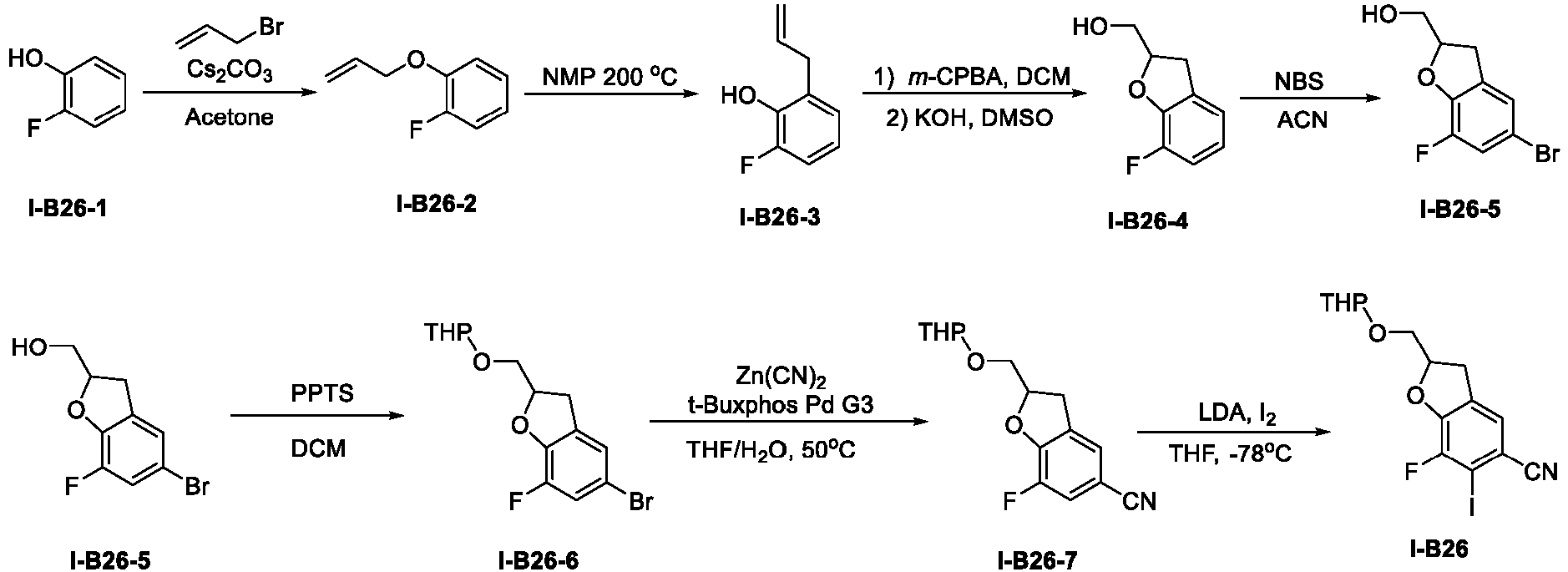
- Step 1: I-B26-1 (10 g, 89.206 mmol), allyl bromide (12.95 g, 107 mmol) and Cs2CO3 (43.6 g, 133.8 mmol) were added to acetone (100 mL), and the reaction mixture was stirred at room temperature for 12 hours. The reaction mixture was diluted with water and extracted with ethyl acetate. The organic layer was dried over Na2SO4 and concentrated under reduced pressure, and the residue was purified by silica gel chromatography (ethyl acetate/petroleum ether = 1/20) to obtain intermediate I-B26-2 (13 g, yield: 95.77%) as a colorless oil.
- 1H NMR (400 MHz, Chloroform-d) δ 7.14 - 6.85 (m, 4H), 6.06 (ddt, J = 17.3, 10.6, 5.4 Hz, 1H), 5.42 (dq, J = 17.4, 1.7 Hz, 1H), 5.30 (dq, J = 10.5, 1.4 Hz, 1H), 4.60 (dt, J = 5.4, 1.5 Hz, 2H).
- Step 2: Intermediate I-B26-2 (8 g, 52.56 mmol) was dissolved in NMP (80 mL), heated to 200°C and stirred for 3 hours, cooled to room temperature and diluted by adding ethyl acetate (300 mL). The organic layer was washed with brine, dried over anhydrous sodium sulfate, filtered and the solvent was removed. The resulting intermediate I-B26-3 (5 g, yield: 62.5%) was a yellow oil.
- Step 3: Intermediate I-B26-3 (5 g, 32.85 mmol) was dissolved in dichloromethane (50 mL). m-CPBA (7.37 g, 42.715 mmol) was added thereto at 0°C, and the reaction mixture was stirred at room temperature for 4 hours. The reaction mixture was diluted with ethyl acetate, washed with saturated sodium bicarbonate solution, and washed with saturated sodium sulfite aqueous solution. The organic phase was washed with saturated brine, dried over anhydrous sodium sulfate, and concentrated to obtain a crude. The crude was dissolved in DMSO (50 mL), and an aqueous solution (15 mL) of KOH (2.4 g, 42.715 mmol) was added thereto at 0°C. The reaction mixture was reacted at room temperature for 4 hours. The reaction mixture was quenched by adding ice water and diluted with ethyl acetate. The organic phase was hydrolyzed, washed with saturated brine, dried over anhydrous sodium sulfate, concentrated under reduced pressure, and purified by silica gel column chromatography (ethyl acetate/petroleum ether = 1/10) to obtain intermediate I-B26-4 (5 g, yield: 90.49%).
- Step 4: Intermediate I-B26-4 (5 g, 29.73 mmol) was dissolved in acetonitrile (50 mL), and NBS (5.82 g, 32.71 mmol) was slowly added thereto at room temperature. The reaction mixture was stirred at room temperature for 2 hours. The mixture was filtered, and the filtrate was concentrated under reduced pressure. The residue was purified by silica gel column chromatography (ethyl acetate/petroleum ether = 1/10) to obtain intermediate I-B26-5 (6 g, yield: 81.68%).
- Step 5: Intermediate I-B26-5 (2 g, 8.095 mmol), DHP (1.36 g, 16.19 mmol) and PPTS (0.2 g, 0.81 mmol) were dissolved in DCM (20 mL), and the reaction mixture was stirred at room temperature overnight. The mixture was filtered, and the filtrate was concentrated under reduced pressure. The residue was purified by silica gel column chromatography (ethyl acetate/petroleum ether = 1/20) to obtain intermediate I-B26-6 (2.7 g, yield: 98%).
- Step 6: Intermediate I-B26-6 (2.7 g, 8.153 mmol), t-BuXPhos-Pd-G3 (0.32 g, 0.408 mmol) and Zn(CN)2 (0.96 g, 8.153 mmol) were dissolved in THF (30 mL) and H2O (10 mL), and the reaction mixture was stirred at 40°C under nitrogen atmosphere overnight. The mixture was filtered, and the filtrate was concentrated under reduced pressure. The residue was purified by silica gel column chromatography (ethyl acetate/petroleum ether = 1/10) to obtain intermediate I-B26-7 (2 g, yield: 88.47%).
- Step 7: A tetrahydrofuran (20 mL) solution of iodine (2.47 g, 9.437 mmol) was added dropwise to a tetrahydrofuran (8 mL) solution of I-B26-7 (1.8 g, 6.491 mmol) at -65°C under argon atmosphere. After the dropwise addition was completed, the mixture was stirred at -65°C for 10 minutes. LDA (2.0 mol/L in THF/hexane, 6.5 mL, 12.982 mmol) was added dropwise. The reaction mixture was reacted at -65°C for 2 hours. The reaction mixture was slowly poured into ice-cold saturated ammonium chloride solution (20 mL). The reaction mixture was extracted by adding ethyl acetate (3 * 30 mL), and the organic phases were combined, washed with saturated brine (2 * 30 mL), dried over anhydrous sodium sulfate, and filtered. The filtrate was concentrated under reduced pressure and purified by silica gel chromatography (ethyl acetate/petroleum ether = 1/5) to obtain I-B26 (1.9 g, yield: 72.60%).
-

- Step 1: Extra dry tetrahydrofuran (50 mL), I-B27-1 (0.5 g, 3.33 mmol) and I-B27-2 (1.24 g, 3.87 mmol) were sequentially added to a dry three-neck flask. Under nitrogen atmosphere, triphenylphosphine (1.27 g, 4.84 mmol) and DIAD (0.978 g, 4.84 mmol) were added thereto. The reaction mixture was stirred at 25°C for 3 hours. After the reaction was completed, the reaction mixture was diluted by adding water (100 mL) and extracted with ethyl acetate (40 mL * 2). The combined organic phases were washed with saturated brine (100 mL), dried over anhydrous sodium sulfate, filtered, and concentrated under reduced pressure. The resulting residue was purified by silica gel chromatography (0 to 15% ethyl acetate/petroleum ether) to obtain I-B27-3 (1.476 g, yield: 100%).
- Step 2: DCM (20 mL), I-B27-3 (1.476 g, 3.33 mmol) and 1,4-dioxane hydrochloride solution (20 mL, 4.0 M) were sequentially added to a dry three-neck flask, and the reaction mixture was stirred at 25°C for 2 hours. After the reaction was completed, the reaction mixture was concentrated under reduced pressure, and the resulting residue was purified by silica gel chromatography to obtain I-B27-4 (0.58 g, yield: 77.2%).
- 1H NMR (400 MHz, CD3OD) δ 7.31 - 7.24 (m, 2H), 4.43-4.40 (m, 1H), 3.97 - 3.96 (m, 4H).
- Step 3: DCM (5 mL), I-B27-4 (100 mg, 0.436 mmol), DHP (37 mg, 0.436 mmol) and TsOH (7.5 mg, 0.0436 mmol) were sequentially added to a dry three-neck flask, and the reaction mixture was stirred at 25°C overnight. After the reaction was completed, the reaction mixture was concentrated under reduced pressure, and the resulting residue was purified by silica gel chromatography to obtain I-B27-5 (40 mg, yield: 29.3%).
- 1H NMR (400 MHz, DMSO-d 6) δ 7.88-7.80 (m, 2H), 5.01-4.97 (m, 1H), 4.55-4.50 (m, 2H), 3.63-3.60 (m, 4H), 3.40-3.33 (m, 1H), 1.51-1.39 (m, 6H).
- Step 4: DMF (5 mL), I-B27-5 (100 mg, 0.319 mmol) and Cs2CO3 (156 mg, 0.479 mmol) were sequentially added to a dry three-neck flask, and the reaction mixture was stirred under microwave irradiation at 80°C for 0.5 hours. After the reaction was completed, the reaction mixture was diluted by adding water (20 mL) and extracted with ethyl acetate (10 mL * 2). The combined organic phases were washed with saturated brine (30 mL), dried over anhydrous sodium sulfate, filtered, and concentrated under reduced pressure. The resulting residue was purified by silica gel chromatography to obtain I-B27-6 (40 mg, yield: 42.7%).
- Step 5: After cooling a tetrahydrofuran (20 mL) solution of I-B27-6 (0.20 g, 682 mmol) to -78°C, lithium diisopropylamide (0.68 mL, 1.36 mmol) was added thereto, and the mixture was stirred for 30 minutes to obtain a light yellow solution. The temperature was maintained at -78°C, and a tetrahydrofuran (2 mL) solution of iodine (0.260 g, 1.02 mmol) was added dropwise, then the reaction mixture first faded and then gradually turned red, stirred for 30 minutes. The reaction mixture was warmed to room temperature, added with saturated sodium sulfite solution (20 mL), and extracted with ethyl acetate (3 * 30 mL). The organic phases were combined, washed with saturated brine (50 mL), dried over anhydrous sodium sulfate, and filtered. The filtrate was concentrated to dryness under reduced pressure and purified by silica gel column chromatography to obtain intermediate I-B27 (0.10 g, yield: 35%).
- The following intermediates were synthesized from the corresponding intermediates or raw materials, using the above methods or improved methods and the methods reported in the literature.
Intermediate number Structural formula Name Analytical data B10 
5-Fluoro-6-iodo-2-methyl-2H-benzofuro[3,2-c]pyrazole-7-carbonitrile LCMS: m/z 342.1 [M+H]+. B12 
5-Fluoro-6-iodo-1-((2-(trimethylsilyl)ethoxy)methyl)-1H-benzofuro[3,2-c]pyrazole-7-carbonitrile LCMS: m/z 458 [M+H]+. B39 
2-Ethyl-6-fluoro-7-iodo-2,4-dihydrochromeno[4,3 - c]pyrazole-8-carbonitrile LCMS: m/z 369.9 [M+H]+. B71 
6-Fluoro-7-iodo-11H-benzo[2,3][1,4]dioxa [5,6-b]pyrazine-8-carbonitrile LCMS: m/z 370 [M+H]+. I-B16 
7-Bromo-8-fluoroquinazoline-6-carbonitrile LCMS: m/z 252 [M+H]+. I-B17 
7-Bromo-8-fluoroquinoxaline-6-carbonitrile LCMS: m/z 252 [M+H]+. I-B23 
7-Bromo-6-fluoro-3,4-dihydro-5-oxa-1,2a-diazaacenaphthylene-8-carbonitrile LCMS: m/z 282 [M+H]+. I-B25 
1-((tert-Butyldiphenylsilyl)oxy)-7-fluoro-6-iodo-2-methyl-2, 3 - dihydro-1H-indene-5-carbonitrile LCMS: m/z 556 [M+H]+. -

- Step 1: Compound C1-1 (100 mg, 0.606 mmol), cyclopropylboronic acid (78 mg, 0.909 mmol), pyridine (96 mg, 1.212 mmol), copper acetate (220 mg, 1.212 mmol), triethylamine (123 mg, 1.212 mmol), molecular sieve (210 mg, 1.212 mmol) and DCM (10 mL) were sequentially added to a single-neck flask. The reaction mixture was stirred at 40°C for 18 hours. The insoluble substances were filtered off with diatomite and the filtrate residue was rinsed with DCM (100 mL). The filtrate was concentrated to dryness under reduced pressure and purified by silica gel column chromatography (ethyl acetate/petroleum ether = 1/10 to 1/1) to obtain C1 as a white solid (60 mg, yield: 48.3%).
- LCMS: m/z 205 [M+H]+.
- 1H NMR (400 MHz, CDCl3) δ 7.72 (s, 1H), 4.12 (ddd, J = 14.4, 7.5, 4.1 Hz, 1H), 1.16 - 1.10 (m, 2H), 1.08 - 1.01 (m, 2H).
-

- Step 1: C2-1 (2 g, 9 mmol), THF (15 mL) and tert-butyl nitrite (8.6 mL, 72 mmol) were sequentially added to a single-neck flask. The reaction mixture was stirred at 80°C for 18 hours, cooled and concentrated under reduced pressure. The residue was purified by silica gel chromatography (petroleum ether/ethyl acetate = 10/1) to obtain C2-2 (0.96 g, yield: 100%) as a colorless oil.
- 1H NMR (400 MHz, CDCl3) δ 9.00 (s, 1H), 4.05 (s, 3H).
- Step 2: C2-2 (950 mg, 4.59 mmol) and THF (15 mL) were added to a single-neck flask. The reaction mixture was cooled to 0°C, slowly added with DIBAL-H (9.2 mL, 9.18 mmol), and stirred at 0°C for 1 hour. TLC showed that the reaction was completed. Saturated potassium sodium tartrate aqueous solution was added to the reaction mixture and stirred for half an hour. The filtrate was diluted with water and extracted with ethyl acetate. The organic layer was dried over Na2SO4 and concentrated under reduced pressure. The residue was purified by silica gel chromatography (petroleum ether/ethyl acetate = 3/1) to obtain C2 (620 mg, yield: 75.4%) as a yellow oil.
- LC-MS: m/z 179 [M+H]+.
-
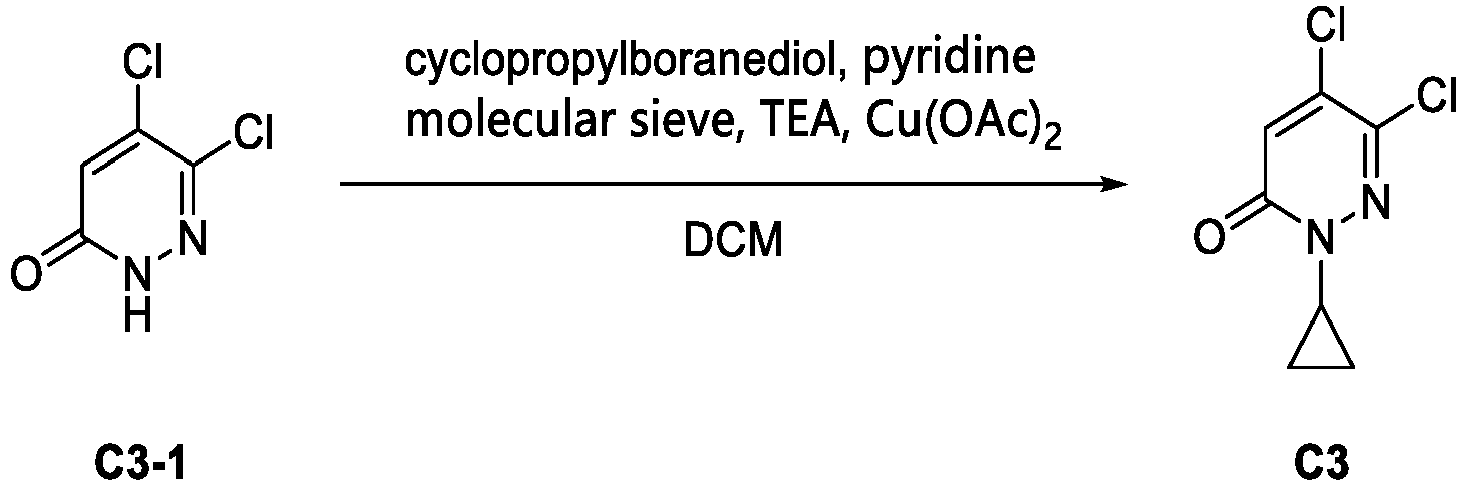
- Step 1: Compound C3-1 (200 mg, 1.21 mmol), cyclopropylboronic acid (156 mg, 1.82 mmol), pyridine (192 mg, 2.42 mmol), copper acetate (440 mg, 2.42 mmol), triethylamine (246 mg, 2.42 mmol), molecular sieve (210 mg) and DCM (15 mL) were sequentially added to a single-neck flask. The reaction mixture was stirred at 40°C for 18 hours. The insoluble substances were filtered off with diatomite and the filtrate residue was rinsed with DCM (100 mL). The filtrate was concentrated to dryness under reduced pressure and purified by silica gel column chromatography (ethyl acetate/petroleum ether, 0 to 25%) to obtain C3 as a yellow solid (105 mg, yield: 42.2%).
- 1H NMR (400 MHz, CDCl3) δ 7.08 (s, 1H), 4.03 (ddd, J = 7.6, 4.4, 3.3 Hz, 1H), 1.17 - 1.01 (m, 4H).
-

- Step 1: THF (2 mL), compound C1-1 (100 mg, 0.6 mmol), CD3OD (24 mg, 0.67 mmol), PPh3 (191 mg, 0.73 mmol) and DEAD (127 mg, 0.73 mmol) were sequentially added to a single-neck flask, and the reaction mixture was stirred at room temperature for 1 hour. TLC showed the formation of new dots, and the reaction mixture was subjected to rotary evaporation to dryness and column chromatography (ethyl acetate/petroleum ether, 0 to 20%) to obtain C4 as a white solid (95 mg, 0.52 mmol, yield: 86.1%).
- LCMS: m/z 182[M+H] +
- 1H NMR (400 MHz, CDCl3) δ 7.77 (s, 1H).
-

- Step 1: THF (5 mL), compound C1-1 (300 mg, 1.82 mmol), oxetan-3-ol (270 mg, 3.64 mmol), PPh3 (954 mg, 3.64) and DEAD (127 mg, 0.73 mmol) were sequentially added to a single-neck flask, and the reaction mixture was stirred at 35°C for 1 hour. LCMS showed the formation of the target product, and the reaction mixture was subjected to rotary evaporation to dryness and column chromatography (ethyl acetate/petroleum ether, 0 to 35%) to obtain C5 as a white solid (110 mg, 0.5 mmol, yield: 27.3%).
- LCMS: m/z 221[M+H] +
- 1H NMR (400 MHz, CDCl3) δ 7.94 (s, 1H), 5.97 - 5.83 (m, 1H), 5.04 - 4.93 (m, 4H).
-

- Step 1: Intermediate A1 (3.57 g, 6.556 mmol), intermediate B1 (2 g, 6.556 mmol), potassium phosphate (5.57 g, 26.225 mmol), toluene (30 mL), water (15 mL), 1,4-dioxane (30 mL), Pd2(dba)3 (0.90 g, 0.983 mmol) and N-XantPhos 97% (CAS: 261733-18-0, 0.72 g, 1.311 mmol) were sequentially added to a reaction flask. The reaction mixture was stirred at 110°C for 18 hours under nitrogen atmosphere. The reaction mixture was added with water and extracted with ethyl acetate. The organic phase was dried over anhydrous sodium sulfate, filtered, concentrated, and the residue was purified by silica gel chromatography (petroleum ether/ethyl acetate = 5:1) to obtain a mixture as yellow solid 1-1 (2.03 g, yield: 52.03%). LC-MS: m/z 595.1 [M+H]+.
- Step 2: Compound 1-1 (2000 mg, 3.361 mmol), methanol (30 mL), copper acetate (1825.09 mg, 10.083 mmol) and diethylhydroxylamine (10.367 mL, 100.834 mmol) were sequentially added to a single-neck flask, and the reaction mixture was stirred at 25°C for 16 hours. A red solid precipitated. After the reaction was completed, the reaction mixture was concentrated, and the resulting residue was added with ammonia water and extracted with ethyl acetate. The organic phase was dried over anhydrous sodium sulfate, filtered, concentrated, and purified by silica gel chromatography (petroleum ether/ethyl acetate = 2:1) to obtain 1-2 (660 mg, yield: 36.03%) and 1-3 (100 mg, yield: 5.5%). LC-MS: m/z 613.2 [M+H]+.
- Step 3: Compound 1-2 (470 mg, 0.767 mmol) was dissolved in MeOH (10 mL), and HCl/1,4-dioxane (4 M, 10 mL) was added thereto. The mixture was stirred at 20°C for 3 hours. The mixture was concentrated to obtain the hydrochloride of compound 1 (385 mg, yield: 91.41%) as a yellow solid.
- 1H NMR (400 MHz, Methanol-d4 ) δ 7.58 - 7.56 (m, 2H), 7.51 - 7.47 (m, 2H), 7.43 - 7.39 (m, 1H), 7.15 - 7.14 (m, 1H), 6.98 (d, J =1.2 Hz, 1H), 4.30 (s, 4H), 4.23 - 4.21 (m, 1H), 3.61 - 3.56 (m, 1H), 3.23 - 3.13 (m, 3H), 2.25 - 2.19 (m, 1H), 2.06 - 1.89 (m, 3H).
- LC-MS: m/z 513.1 [M+H]+.

- Step 4: Compound 1-3 (100 mg, 0.163 mmol) was dissolved in MeOH (5 mL), and HCl/1,4-dioxane (4 M, 5 mL) was added thereto. The mixture was stirred at 20°C for 3 hours. The mixture was concentrated to obtain the hydrochloride of compound 1' (80 mg, yield: 89.27%) as a white solid.
- 1H NMR (400 MHz, Methanol-d4 ) δ 7.45 - 7.43 (m, 2H), 7.39 - 7.37 (m, 2H), 7.35 - 7.31 (m, 1H), 7.09 (s, 1H), 6.95 (d, J =1.2 Hz, 1H), 4.36 - 4.33 (m, 4H), 4.25 - 4.21 (m, 1H), 3.35 - 3.47 (m, 1H), 3.31 - 3.29 (m, 1H), 3.21 - 3.19 (m, 1H), 3.18 - 3.15 (m, 1H), 2.27 - 2.19(m, 1H), 2.05 - 2.00 (m, 2H), 1.87 - 1.81 (m, 1H).
- LC-MS: m/z 513.1 [M+H]+.
-

- Step 1: Intermediate B2 (90 mg, 0.25 mmol), intermediate A1 (138 mg, 0.25 mmol), potassium phosphate (323 mg, 1.52 mmol), toluene (1 mL), 1,4-dioxane (1 mL), water (0.4 mL), Pd2(dba)3 (23 mg, 0.025 mmol) and N-XantPhos (28 mg, 0.05 mmol) were sequentially added to a reaction flask. The reaction mixture was stirred at 100°C for 12 hours under nitrogen atmosphere. The reaction mixture was diluted by adding water and extracted twice with ethyl acetate. The combined organic phases were washed with saturated brine, dried over anhydrous sodium sulfate, filtered, and concentrated under reduced pressure. The resulting residue was purified by silica gel chromatography (petroleum ether/ethyl acetate = 3:1) to obtain intermediate 3-1 (90 mg, yield: 33.61%).
- LC-MS: m/z 545 [M-100]+.
- Step 2: Intermediate 3-1 (60 mg, 0.14 mmol), methanol (5 mL), copper acetate (76 mg, 0.419 mmol) and diethylhydroxylamine (313 mg, 4.185 mmol) were sequentially added to a reaction flask, and the reaction mixture was stirred at room temperature for 12 hours. After the reaction was completed, the reaction mixture was filtered and concentrated. The resulting residue was purified by thin-layer chromatography (petroleum ether/ethyl acetate = 1:1) to obtain 3-2 as a white solid (70 mg, yield: 76.1%).
- LC-MS: m/z 663 [M+H]+.
- Step 3: Intermediate 3-2 (70 mg, 0.105 mmol), methanol (1 mL) and 1,4-dioxane hydrochloride solution (1 mL, 4.0 M) were sequentially added to a reaction flask, and the reaction mixture was stirred at 25°C for 2 hours. After the reaction was completed, the reaction mixture was concentrated under reduced pressure. The residue was purified by preparative HPLC and lyophilized to obtain compound 3 as a yellow solid (18.81 mg, hydrochloride) and compound 3' as a yellow solid (13.68 mg, hydrochloride).
- Compound 3: 1H NMR (400 MHz, Methanol-d4 ) δ 7.92 (s, 1H), 7.50 (d, J = 1.4 Hz, 1H), 7.44 (dt, J = 6.8, 1.3 Hz, 2H), 7.36 (t, J = 7.6 Hz, 2H), 7.31 - 7.25 (m, 1H), 6.89 (d, J = 9.1 Hz, 1H), 5.31 (s, 2H), 4.16-4.11 (m, 1H), 3.86 (s, 3H), 3.53-3.48 (m, 3H), 3.1-3.06 (m, 1H), 2.17-2.13 (m, 1H), 2.01-1.91 (m, 2H), 1.82 - 1.68 (m, 1H).
- LC-MS: m/z 563 [M+H]+.
- Compound 3': 1H NMR (400 MHz, Methanol-d4 ) δ 8.03 (s, 1H), 7.61 (d, J = 1.4 Hz, 1H), 7.60 - 7.53 (m, 2H), 7.47 (t, J = 7.6 Hz, 2H), 7.43 - 7.37 (m, 1H), 7.00 (d, J = 9.2 Hz, 1H), 5.42 (d, J = 2.2 Hz, 2H), 4.24 (dd, J = 9.8, 7.0 Hz, 1H), 3.97 (s, 3H), 3.65 - 3.47 (m, 3H), 3.44 - 3.33 (m, 1H), 2.38 - 2.16 (m, 1H), 2.16 - 1.98 (m, 2H), 1.87 (dt, J = 21.2, 8.7 Hz, 1H).
- LC-MS: m/z 563 [M+H]+.
-

- B2 (104 g), A26 (174.69 g, 1.15 eq), Na2CO3 (76.84 g, 2.5 eq), CPME (1787 mL, 20 V) and H2O (894 mL, 10 V) were sequentially added to a three-neck flask. A CPME solution of [Pd(C3H3)Cl]2 (2.12 g, 0.02 eq) and (t-Bu)PhCPhos (9.39 g, 0.08 eq) was added thereto under nitrogen atmosphere. The reaction mixture was heated to 85°C and stirred for 18 hours under nitrogen atmosphere, with a controlled conversion rate of over 95%. The reaction mixture was cooled and filtered. The organic phase was washed with water, dried and concentrated under reduced pressure to obtain 190 g of a light yellow solid product (3-1/3-1' = 54/46, purity: 90%, yield: 99%).
-

- Step 1: Referring to the synthesis method of compound 1, intermediate A2 was used instead of intermediate A1, and intermediate B2 was used instead of intermediate B1, and then one-step reaction was carried out to obtain intermediate 9-1.
- LC-MS: m/z 537 [M+H-100]+.
- Step 2: Intermediate 9-1 (55 mg, 0.086 mmol), MeCN (1.6 mL), THF (0.4 mL) and NCS (13.26 mg, 0.099 mmol) were sequentially added to a pressure-resistant sealed tube, and the reaction mixture was stirred at 47°C overnight. The reaction mixture was diluted by adding water and extracted three times with ethyl acetate. The combined organic phases were washed with saturated brine, dried over anhydrous sodium sulfate, filtered, and concentrated under reduced pressure. The resulting residue was purified by silica gel chromatography (ethyl acetate/petroleum ether = 3/1) to obtain 9-2 as a yellow solid (57.5 mg, yield: 99%).
- LC-MS: m/z 615 [M-55]+.
- Step 3: Referring to the synthesis method of compound 1, intermediate 9-2 was used instead of intermediate 1-1, and one-step reaction was carried out to obtain intermediate 9-3.
- LC-MS: m/z 589 [M+H-100]+.
- Step 4: Referring to the synthesis method of compound 1, intermediate 9-3 was used instead of intermediate 1-2, and one-step reaction was carried out to obtain compound 9.
- 1H NMR (400 MHz, Methanol-d 4) δ 8.03 (s, 1H), 7.63 (d, J = 1.3 Hz, 1H), 7.61 - 7.55 (m, 2H), 7.48 (t, J = 7.6 Hz, 2H), 7.41 (t, J = 7.3 Hz, 1H), 7.01 (d, J = 9.1 Hz, 1H), 5.36 (s, 2H), 4.46 (t, J = 8.6 Hz, 1H), 3.96 (s, 3H), 3.56 (d, J = 16.4 Hz, 1H), 3.24 - 3.06 (m, 3H), 2.05 (d, J = 8.5 Hz, 2H), 0.82 - 0.64 (m, 4H).
- LC-MS: m/z 589 [M+H]+.
-

- Step 1: Intermediate B8 (390 mg, 0.717 mmol), intermediate A1 (300 mg, 0.591 mmol), potassium phosphate (761.08 mg, 3.585 mmol), toluene (3 mL), dioxane (3 mL), water (1.2 mL), Pd2(dba)3 (54.72 mg, 0.060 mmol) and N-XantPhos (65.92 mg, 0.120 mmol) were sequentially added to a reaction flask. The reaction mixture was stirred at 100°C for 12 hours under nitrogen atmosphere. The reaction mixture was diluted by adding water and extracted twice with ethyl acetate. The combined organic phases were washed with saturated brine, dried over anhydrous sodium sulfate, filtered, and concentrated under reduced pressure. The resulting residue was purified by silica gel chromatography (petroleum ether/ethyl acetate = 3:1) to obtain intermediate 10-1 (160 mg, yield: 41.51%).
- LC-MS: m/z 645 [M+H]+.
- Step 2: Intermediate 10-1 (160 mg, 0.248 mmol), methanol (5 mL), copper acetate (148.56 mg, 0.744 mmol) and diethylhydroxylamine (0.765 mL, 7.441 mmol) were sequentially added to a reaction flask, and the reaction mixture was stirred at 30°C for 1.5 hours. After the reaction was completed, the reaction mixture was filtered and concentrated. The resulting residue was purified by column chromatography (petroleum ether/ethyl acetate = 2:1) to obtain 10-2 as a white solid (60 mg, yield: 36.3%).
- Step 3: Intermediate 10-2 (60 mg, 0.090 mmol), dichloromethane (2 mL) and 1,4-dioxane hydrochloride (2 mL, 4.0 M) were sequentially added to a reaction flask, and the reaction mixture was stirred at 35°C for 2 hours. After the reaction was completed, the reaction mixture was concentrated under reduced pressure. The residue was lyophilized to obtain the hydrochloride of compound 10 (26 mg, yield: 48%).
- 1H NMR (400 MHz, Methanol-d 4) δ 7.89 (dd, J = 13.7, 2.8 Hz, 2H), 7.59 - 7.54 (m, 2H), 7.48 (t, J = 7.6 Hz, 2H), 7.42 (d, J = 7.3 Hz, 1H), 7.28 (d, J = 1.7 Hz, 1H), 7.02 (t, J = 6.5 Hz, 1H), 4.29 - 4.18 (m, 1H), 3.63 (dd, J = 22.7, 7.1 Hz, 2H), 3.25 - 3.16 (m, 2H), 2.30 - 2.21 (m, 1H), 2.05 (dd, J = 15.5, 7.5 Hz, 2H), 1.98 - 1.91 (m, 1H).
- LC-MS: m/z 563 [M+H]+.
-

- Step 1: Compound A23 (60 mg, 0.105 mmol), 3,4-dichloropyridazine (22 mg, 0.148 mmol), DMF (1 mL) and potassium carbonate (44 mg, 0.316 mmol) were sequentially added to an 8 mL microwaveable tube, and the reaction mixture was stirred at 130°C for half an hour under microwave irradiation in a sealed tube. TLC showed that the reaction was completed. The reaction mixture was diluted by adding water and extracted three times with ethyl acetate. The combined organic phases were washed with saturated brine, dried over anhydrous sodium sulfate, filtered, and concentrated under reduced pressure. The resulting residue was purified by silica gel chromatography (PE/EA = 1:1) to obtain a mixture of 71-1 (or 103-1) and 103-1 (or 71-1) as a light yellow foamy solid (30 mg, yield: 44.1%).
- LC-MS: m/z 589 [M-56+H]+.
- Step 2: The mixture of 71-1 (or 103-1) and 103-1 (or 71-1) (30 mg, 0.047 mmol), THF (2 mL), water (0.2 mL), copper acetate (28 mg, 0.14 mmol) and diethylhydroxylamine (124.4 mg, 1.395 mmol) were sequentially added to a single-neck flask, and the reaction mixture was stirred at 30°C for 12 hours. A red solid precipitated. After the reaction was completed, the reaction mixture was filtered and concentrated. The resulting residue was purified by preparative TLC (PE/EA = 1:10) to obtain 71-2 (or 103-2) as a light yellow solid (10 mg, yield: 32.43%) and 103-2 (or 71-2) as a light yellow solid (5 mg, yield: 16.22%), respectively.
- 71-2 (or 103-2): LC-MS: m/z 563 [M-100+H]+.
- 103-2 (or 71-1): LC-MS: m/z 563 [M-100+H]+.
- Step 3: 71-2 (or 103-2) (7 mg, 0.011 mmol), DCM (1 mL) and TFA (0.1 mL) were sequentially added to a reaction flask, and the reaction mixture was stirred at 30°C for 1 hour. After the reaction was completed, the reaction mixture was concentrated under reduced pressure. The residue was purified by preparative HPLC and lyophilized to obtain compound 71 (or 103) as a white solid (2 mg, hydrochloride).
- 103-2 (or 71-2) (5 mg, 0.007 mmol), DCM (1 mL) and TFA (0.1 mL) were sequentially added to a reaction flask, and the reaction mixture was stirred at 30°C for 1 hour. After the reaction was completed, the reaction mixture was concentrated under reduced pressure. The residue was purified by preparative HPLC and lyophilized to obtain compound 103 (or 71) as a white solid (1.34 mg, hydrochloride).
- Compound 71 (or 103): 1H NMR (400 MHz, DMSO-d6) δ 9.31 - 9.17 (m, 1H), 8.89 - 8.80 (m, 1H), 8.39 - 8.28 (m, 1H), 8.04 - 7.94 (m, 1H), 7.58 - 7.29 (m, 6H), 7.21 - 7.13 (m, 1H), 4.38 - 4.26 (m, 1H), 3.18 - 3.06 (m, 2H), 2.25 - 2.13 (m, 1H), 2.04 - 1.67 (m, 4H), 1.54 - 1.39 (m, 1H).
- LC-MS: m/z 563 [M+H]+.
- Compound 103 (or 71): LC-MS: m/z 563 [M+H]+.
-

- Step 1: Referring to the synthesis method of compound 71, intermediate 3,4,5-trichloropyridazine was used instead of intermediate 3,4-dichloropyridazine, and one-step reaction was carried out to obtain intermediates 67-1 and 67-2.
- LC-MS: m/z 623 [M-56+H]+.
- Step 2: Compound 67-1 (5 mg, 0.007 mmol), 67-2 (5 mg, 0.007 mmol), ethyl acetate (2 mL) and 10% wet palladium on carbon (3 mg, 0.03 mmol) were sequentially added to a single-neck flask, and the reaction mixture was stirred at 30°C for 18 hours under hydrogen atmosphere. Insoluble substances were filtered out with diatomite, and the filter residue was rinsed with ethyl acetate (50 mL) and concentrated to obtain 67-3 as a white solid (9 mg, yield: 95%).
- LC-MS: m/z 589 [M-55+H]+.
- Step 3: Referring to the synthesis method of compound 71, intermediate 67-3 was used instead of intermediate 71-1, and one-step reaction was carried out to obtain intermediate 67-4.
- LC-MS: m/z 563 [M-100+H]+.
- Step 4: Referring to the synthesis method of compound 71, intermediate 67-4 was used instead of intermediate 71-2, and one-step reaction was carried out to obtain product 67.
- 1HNMR (400 MHz, DMSO-d6) δ 9.24 (s, 1H), 9.05 (d, J = 6.6 Hz, 1H), 8.34 (s, 1H), 7.97 (s, 1H), 7.52 (d, J = 7.4 Hz, 2H), 7.45 (t, J = 7.5 Hz, 2H), 7.38 (t, J = 7.3 Hz, 1H), 7.30 (d, J = 1.5 Hz, 1H), 7.17 (d, J = 9.3 Hz, 1H), 4.30 (d, J = 6.6 Hz, 1H), 3.16 (s, 3H), 2.16 (s, 1H), 2.00 (d, J = 7.6 Hz, 1H), 1.89 (d, J = 28.9 Hz, 2H), 1.73 (d, J= 12.3 Hz, 1H).
- LC-MS: m/z 563 [M+H]+.
-

- Step 1: Compound A1-9 (4 g, 9.65 mmol) was dissolved in dry THF (40 mL), and the reaction mixture was cooled to -70°C. Dibal-H (19 mL, 19.29 mmol,! M) was slowly added dropwise, and the reaction mixture was stirred at this temperature for another 1 hour. TLC showed that the reaction was completed. The reaction mixture was slowly added with saturated sodium potassium tartrate aqueous solution (30 mL), naturally warmed to room temperature, and extracted with ethyl acetate. The combined organic phases were washed with saturated brine, dried over anhydrous sodium sulfate, filtered, and concentrated under reduced pressure to obtain yellow oily 78-1 (3.7 g, crude), which was used directly in the next step.
- Step 2: Compound 78-1 (3.7 g, 10.41 mmol) was dissolved in methanol (30 mL), and sodium borohydride (0.59 g, 15.61 mmol) was slowly added under an ice bath, and then the reaction mixture was stirred at room temperature for another 2 hours. TLC showed that the reaction was completed. The reaction mixture was slowly added with ice water and extracted with ethyl acetate, then the combined organic phases were washed with saturated brine, dried over anhydrous sodium sulfate, filtered, and concentrated under reduced pressure. The resulting residue was subjected to silica gel column chromatography (0 to 30% ethyl acetate/petroleum ether) to obtain compound 78-2 (3.3 g, yield: 88.71%).
- LC-MS: m/z 357 [M+H]+.
- Step 3: Anhydrous 1,4-dioxane (35 mL), 78-2 (3.3 g, 9.23 mmol), bis(pinacolato)diboron (3.28 g, 12.92 mmol, 1.4 eq), Pd(dppf)Cl2.CH2Cl2 (0.75 g, 0.92 mmol) and KOAc (2.72 g, 27.69 mmol) were sequentially added to a dry 250 mL single-neck flask, and the reaction mixture was replaced with N2 three times and then heated to 100°C and stirred for 12 hours. TLC showed that the reaction was completed. The reaction mixture was filtered, subjected to rotary evaporation to dryness under reduced pressure, and subjected to silica gel column chromatography (0 to 30% ethyl acetate/petroleum ether) to obtain compound 78-3 (3 g, purity: 80.43%).
- LC-MS: m/z 405.1 [M+H]+.
- Step 4: Compound B2 (600 mg, 1.95 mmol), compound 78-3 (946 mg, 2.34 mmol), potassium phosphate (1240 mg, 5.84 mmol), toluene (1 mL), dioxane (1 mL), water (0.5 mL), Pd2(dba)3 (178 mg, 0.195 mmol) and N-XantPhos (215 mg, 0.39 mmol) were sequentially added to a reaction flask. The reaction mixture was stirred at 100°C for 16 hours under nitrogen atmosphere. The reaction mixture was diluted by adding water and extracted twice with ethyl acetate. The combined organic phases were washed with saturated brine, dried over anhydrous sodium sulfate, filtered, and concentrated under reduced pressure. The resulting residue was purified by silica gel chromatography (0 to 40% ethyl acetate/petroleum ether) to obtain compound 78-4 (900 mg, yield: 91%).
- LC-MS: m/z 506.1 [M+H]+.
- Step 5: At -78°C, anhydrous dichloromethane (2 mL), oxalyl chloride (376.31 mg, 2.97 mmol) and anhydrous DMSO (78.13 mg, 5.93 mmol) were sequentially added to a dry 10 mL single-neck flask, and the reaction mixture was stirred at this temperature for 1 hour. After that, a dichloromethane (2 mL) solution of 78-4 (500 mg, 0.988 mmol) and triethylamine (500 mg, 4.94 mmol) were added to the above reaction mixture. The reaction mixture was stirred for another 1 hour. The reaction mixture was quenched by adding water and extracted twice with ethyl acetate. The combined organic phases were washed with saturated brine, dried over anhydrous sodium sulfate, filtered, and concentrated under reduced pressure to obtain 78-5 (490 g, crude), which was used directly in the next step.
- LC-MS: m/z 504.1[M+H]+.
- Step 6: DCM (1 mL), 78-5 (50 mg, 0.099 mmol), trans-4-methoxycyclohexylamine (25 mg, 0.198 mmol) and one drop of acetic acid were sequentially added to a dry 10 mL single-neck flask. The reaction mixture was stirred at room temperature for 15 minutes, then added with NaBH(OAc)3 (63 mg, 0.298 mmol), and stirred at room temperature overnight. The reaction solvent was subjected to rotary evaporation to dryness under reduced pressure. The reaction mixture was added with saturated NaHCO3 aqueous solution and extracted with ethyl acetate. The combined organic phases were washed with saturated brine, dried over anhydrous sodium sulfate, filtered, and concentrated under reduced pressure. The resulting residue was purified by silica gel chromatography (0 to 80% ethyl acetate/petroleum ether) to obtain compound 78-6 (30 mg, yield: 50%).
- LC-MS: m/z 617 [M+H]+.
- Step 7: Compound 78-6 (30 mg, 0.049 mmol), methanol (5 mL), copper acetate (26.49 mg, 0.146 mmol) and diethylhydroxylamine (130 mg, 1.458 mmol) were sequentially added to a dry 10 mL single-neck flask, and the reaction mixture was stirred at room temperature for 3 hours. After the reaction was completed, the reaction mixture was filtered and concentrated. The resulting residue was purified by Prep-HPLC to obtain the formate of compound 78 (5.75 mg, yield: 18.62%).
- LC-MS: m/z 635 [M+H]+.
-
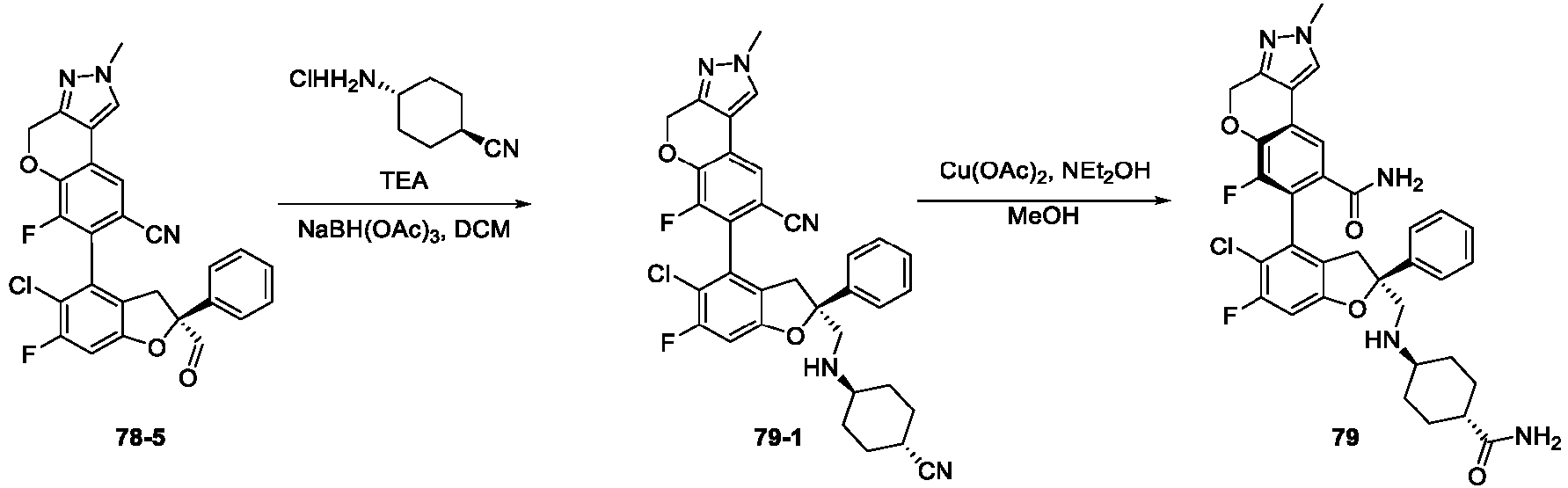
- Referring to the synthesis method of compound 78, (1r,4r)-4-aminocyclopropane-1-carbonitrile hydrochloride was used instead of trans-4-methoxycyclohexylamine, and a two-step reaction was carried out to obtain the formate of compound 79 (20 mg, 50%).
- LC-MS: m/z 648.2 [M+H]+.
- 1H NMR (400 MHz, Methanol-d 4) δ 8.02 (s, 1H), 7.63 (d, J = 1.4 Hz, 1H), 7.55 - 7.32 (m, 5H), 6.94 (d, J = 9.3 Hz, 1H), 5.36 (s, 2H), 3.95 (s, 3H), 3.48 (d, J = 16.2 Hz, 1H), 3.40 (s, 1H), 3.09 (d, J = 16.0 Hz, 1H), 2.76 (s, 1H), 2.23 - 1.84 (m, 5H), 1.45 (q, J = 12.6 Hz, 2H), 1.26 (d, J = 15.7 Hz, 3H).
-

- Referring to the synthesis method of compound 78, (1r,4r)-4-aminocyclopropan-1-ol was used instead of trans-4-methoxycyclohexylamine, and a two-step reaction was carried out to obtain the formate of compound 81 (6 mg, formate).
- LC-MS: m/z 621.1 [M+H]+.
- 1H NMR (400 MHz, Methanol-d 4) δ 8.02 (s, 1H), 7.62 (d, J = 1.3 Hz, 1H), 7.48 (d, J = 7.6 Hz, 2H), 7.41 (t, J = 7.5 Hz, 2H), 7.34 (t, J = 7.1 Hz, 1H), 6.93 (d, J = 9.1 Hz, 1H), 5.36 (s, 2H), 3.95 (s, 3H), 3.47 (d, J = 15.2 Hz, 2H), 3.08 (d, J = 15.9 Hz, 1H), 2.67 (s, 1H), 1.93 (s, 4H), 1.28 - 1.16 (m, 4H).
-

- Referring to the synthesis method of compound 78, 3-methoxypropylamine was used instead of trans-4-methoxycyclohexylamine, and a two-step reaction was carried out to obtain the formate of compound 83 (30 mg, yield: 50%).
- LC-MS: m/z 595 [M+H]+.
- 1H NMR (400 MHz, Methanol-d 4) δ 8.02 (s, 1H), 7.63 (d, J = 1.4 Hz, 1H), 7.51 - 7.41 (m, 4H), 7.36 (t, J = 7.3 Hz, 1H), 6.95 (d, J = 9.3 Hz, 1H), 5.36 (s, 2H), 3.95 (s, 4H), 3.48 (d, J = 15.6 Hz, 1H), 3.40 (t, J = 5.7 Hz, 4H), 3.19 (s, 3H), 3.11 (d, J = 16.2 Hz, 1H), 2.92 (d, J = 27.4 Hz, 2H), 1.86 - 1.71 (m, 2H).
-

- Referring to the synthesis method of compound 78, trans-3-methoxycyclobutyl-1-methanamine hydrochloride was used instead of trans-4-methoxycyclohexylamine, and a two-step reaction was carried out to obtain the formate of compound 84 (6.58 mg, yield: 12.78%).
-

- Step 1: Referring to the synthesis method of compound 71, intermediate 4,5-dichloro-2-methylpyridazin-3-one was used instead of intermediate 3,4-dichloropyridazine, and one-step reaction was carried out to obtain intermediates 105-1 and 106-1 (mixture).
- LC-MS: m/z 619 [M-56+H]+.
- Step 2: Referring to the synthesis method of compound 71, intermediates 105-1 and 106-1 (mixture) were used instead of intermediate 71-1, and one-step reaction was carried out to obtain intermediates 105-2 and 106-2.
- LC-MS: m/z 593 [M-100+H]+.
- Step 3: Referring to the synthesis method of compound 71, intermediates 105-2 and 106-2 were used instead of intermediate 71-2, and one-step reaction was carried out to obtain compounds 105 and 106.
- Compound 105, LC-MS: m/z 593 [M+H]+.
- 1H NMR (400 MHz, DMSO-d6) δ 9.31 (s, 1H), 8.35 (s, 1H), 7.98 (s, 1H), 7.96 (s, 1H), 7.53 (d, J = 7.2 Hz, 3H), 7.45 (t, J = 7.5 Hz, 2H), 7.39 (dd, J = 13.4, 6.2 Hz, 1H), 7.23 (d, J = 1.5 Hz, 1H), 7.16 (d, J = 9.3 Hz, 1H), 4.30 (s, 1H), 3.63 (s, 3H), 3.59 (d, J = 17.0 Hz, 1H), 3.08 (dd, J = 32.0, 17.8 Hz, 3H), 2.21 - 2.11 (m, 1H), 1.95 - 1.80 (m, 2H), 1.72 (dt, J = 17.4, 8.3 Hz, 1H).
- Compound 106, LC-MS: m/z 593 [M+H]+.
- 1H NMR (400 MHz, DMSO-d 6) δ 9.03 (s, 1H), 8.33 (s, 1H), 7.98 (s, 1H), 7.95 (s, 1H), 7.53 (d, J = 7.6 Hz, 2H), 7.46 (t, J = 7.5 Hz, 2H), 7.40 (d, J = 8.6 Hz, 2H), 7.26 (dd, J = 8.5, 2.3 Hz, 1H), 7.16 (d, J = 9.3 Hz, 1H), 4.30 (s, 1H), 3.64 (d, J = 5.4 Hz, 3H), 3.58 (d, J = 17.1 Hz, 1H), 3.12 (d, J = 43.2 Hz, 3H), 2.17 (d, J = 6.7 Hz, 1H), 1.87 (dd, J = 17.1, 9.3 Hz, 2H), 1.73 (dd, J = 22.1, 9.3 Hz, 1H).
-

- Step 1: Referring to the synthesis method of compound 71, intermediate C1 was used instead of intermediate 3,4-dichloropyridazine, and one-step reaction was carried out to obtain intermediates 111-1 and 112-1 (mixture).
- LC-MS: m/z 645 [M-56+H]+.
- Step 2: Referring to the synthesis method of compound 71, intermediates 111-1 and 112-1 (mixture) were used instead of intermediate 71-1, and one-step reaction was carried out to obtain intermediates 111-2 and 112-2.
- LC-MS: m/z 619 [M-100+H]+.
- Step 3: Referring to the synthesis method of compound 71, intermediates 111-2 and 112-2 were used instead of intermediate 71-2, and one-step reaction was carried out to obtain compounds 111 and 112.
- Compound 111: LC-MS: m/z 619 [M+H]+.
- 1H NMR (400 MHz, DMSO-d6) δ 8.99 (s, 1H), 8.33 (s, 1H), 7.96 (s, 1H), 7.95 (s, 1H), 7.53 (d, J = 7.3 Hz, 2H), 7.46 (t, J = 7.6 Hz, 2H), 7.39 (t, J = 9.2 Hz, 2H), 7.22 (d, J = 1.6 Hz, 1H), 7.17 (d, J = 9.3 Hz, 1H), 4.29 (s, 1H), 3.95 (dd, J = 11.9, 6.0 Hz, 1H), 3.58 (d, J = 16.9 Hz, 1H), 3.09 (t, J = 26.7 Hz, 3H), 2.18 (s, 1H), 1.87 (dd, J = 17.4, 9.6 Hz, 2H), 1.77 - 1.67 (m, 1H), 0.96 (d, J = 7.1 Hz, 4H).
- Compound 112: LC-MS: m/z 619 [M+H]+.
- 1H NMR (400 MHz, DMSO-d 6) δ 9.00 (s, 1H), 8.32 (s, 1H), 7.95 (s, 1H), 7.94 (s, 1H), 7.55 - 7.51 (m, 2H), 7.46 (t, J = 7.5 Hz, 2H), 7.42 - 7.35 (m, 2H), 7.32 (d, J = 1.6 Hz, 1H), 7.16 (d, J = 9.3 Hz, 1H), 4.29 (s, 1H), 3.98 (dt, J = 11.5, 5.8 Hz, 1H), 3.58 (d, J = 16.3 Hz, 1H), 3.08 (t, J = 29.8 Hz, 3H), 2.17 (d, J = 7.5 Hz, 1H), 2.00 - 1.85 (m, 3H), 1.75 - 1.67 (m, 1H), 0.97 (d, J = 5.7 Hz, 4H).
-

- 3 (150 mg, 266.43 µmol) was added to EA/H2O = 15 mL: 9 mL (24 mL), cooled to about 0°C, then added with solid materials RuO2 (28.36 mg, 213.15 µmol) and NaIO4 (227.95 mg, 1.07 mmol), and stirred for 20 minutes. TCL (EA/MeOH = 100:5) confirmed the complete reaction of raw materials, and a sample was sent for testing. After 30 minutes, EA (100 mL) and water (30 mL) were added to separate most of the aqueous phase and filtered with diatomite. The organic phase was washed with water and brine, subjected to rotary evaporation to dryness, and purified by TCL (EA/MeOH = 100:7) to obtain a crude product. Then the crude product was added with acetonitrile to dissolve and sent to preparative purification to obtain 115 as a white solid (35.00 mg, 60.66 µmol, yield: 22.77%).
- 1HNMR (400 MHz, DMSO-d 6) δ 8.16 (s, 1H), 7.67 (s, 1H), 7.63 (s, 1H), 7.58 (d, J = 1.1 Hz, 1H), 7.37 - 7.23 (m, 5H), 7.08 (d, J = 9.5 Hz, 1H), 5.36 (s, 2H), 3.97 (dd, J = 8.5, 4.0 Hz, 1H), 3.88 (s, 3H), 3.50 - 3.45 (m, 1H), 2.96 - 2.89 (m, 1H), 2.03 - 1.94 (m, 1H), 1.91 - 1.77 (m, 2H), 1.58 - 1.44 (m, 1H).
- LCMS: m/z 577.2 [M+H]+.
-

- Step 1: 1-Fluoro-2-iodoethane (10 mg, 0.054 mmol) and K2CO3 (13 mg, 0.09 mmol) were added to a DMA (0.5 mL) solution of A28 (30 mg, 0.045 mmol, mixture) at room temperature, and the reaction mixture was reacted at room temperature for 2 hours. TLC plate showed that the reaction was completed. The reaction mixture was diluted by adding water and extracted twice with ethyl acetate. The combined organic phases were washed with saturated brine and concentrated under reduced pressure. The resulting residue was purified by silica gel chromatography (petroleum ether/ethyl acetate = 3:1) to obtain 118-1 and 119-1 as a white solid (28 mg, mixture, yield: 87.2%).
- LC-MS: m/z 707 [M+H]+.
- Step 2: Referring to step 2 of example 5, compounds 118-1 and 119-1 (28 mg, mixture) were used instead of 71-1 for reaction to obtain compounds 118-2 (12 mg, 41.8%) and 119-2 (6 mg, 20.9%).
- LC-MS: m/z 725 [M+H]+.
- Step 6: Referring to step 3 of example 5, compounds 118-2 and 119-2 were used instead of 71-2 for reaction to obtain compound 118 and compound 119, respectively.
- Compound 118, LC-MS: m/z 625 [M+H]+.
- 1H NMR (400 MHz, Methanol-d4 ) δ 7.89 (s, 1H), 7.59 - 7.50 (m, 2H), 7.48 - 7.34 (m, 3H), 7.18 (d, J = 1.8 Hz, 1H), 7.02 (d, J = 9.1 Hz, 1H), 4.82 (t, J = 4.9 Hz, 1H), 4.70 (t, J = 4.9 Hz, 1H), 4.44 (ddd, J = 25.2, 5.6, 4.2 Hz, 2H), 4.25 (dd, J = 9.6, 7.2 Hz, 1H), 3.69 - 3.60 (m, 1H), 3.38 - 3.32 (m, 1H), 3.25 - 3.14 (m, 2H), 2.25 (dt, J = 12.4, 6.1 Hz, 1H), 2.03 (dt, J = 13.7, 7.1 Hz, 2H), 1.92 (dt, J = 12.8, 9.0 Hz, 1H).
- Compound 119, LC-MS: m/z 625 [M+H]+.
- 1H NMR (400 MHz, Methanol-d4 ) δ 7.86 (s, 1H), 7.59-7.53 (m, 2H), 7.51-7.45 (m, 2H), 7.41 (d, J = 7.3 Hz, 1H), 7.23 (d, J = 1.8 Hz, 1H), 7.03 (d, J = 9.1 Hz, 1H), 4.83 (t, J = 4.9 Hz, 1H), 4.72 (t, J = 4.9 Hz, 1H), 4.46 (dq, J = 25.3, 4.3 Hz, 2H), 4.26 (dd, J = 9.4, 7.3 Hz, 1H), 3.63 (d, J = 16.6 Hz, 1H), 3.35 (d, J = 7.0 Hz, 1H), 3.19 (d, J = 15.9 Hz, 2H), 2.30 - 2.21 (m, 1H), 2.03 (dt, J = 13.5, 5.0 Hz, 2H), 1.97 - 1.89 (m, 1H).
-

- Referring to example 15, compound 1,1-difluoro-2-iodoethane was used instead of 1-fluoro-2-iodoethane for reaction to obtain compounds 120 and 121.
- Compound 120, LC-MS: m/z 643 [M+H]+.
- 1H NMR (400 MHz, Methanol-d4 ) δ 7.90 (s, 1H), 7.58 - 7.50 (m, 2H), 7.48 - 7.34 (m, 3H), 7.18 (d, J = 1.7 Hz, 1H), 7.03 (d, J = 9.1 Hz, 1H), 6.40 - 6.05 (m, 1H), 4.51 (td, J = 13.7, 4.3 Hz, 2H), 4.25 (dd, J = 9.6, 7.2 Hz, 1H), 3.64 (d, J = 16.5 Hz, 1H), 3.35 (d, J = 7.4 Hz, 1H), 3.19 (t, J = 12.3 Hz, 2H), 2.26 (q, J = 5.2 Hz, 1H), 2.03 (dt, J = 13.6, 7.3 Hz, 2H), 1.97 - 1.86 (m, 1H).
- Compound 121, LC-MS: m/z 643 [M+H]+.
- 1H NMR (400 MHz, Methanol-d 4) δ 7.87 (s, 1H), 7.60 - 7.53 (m, 2H), 7.52 - 7.38 (m, 3H), 7.23 (d, J = 1.9 Hz, 1H), 7.03 (d, J = 9.1 Hz, 1H), 6.24 (tt, J = 55.6, 4.3 Hz, 1H), 4.58 - 4.47 (m, 2H), 4.26 (dd, J = 9.5, 7.3 Hz, 1H), 3.63 (d, J = 16.5 Hz, 1H), 3.35 (d, J = 7.0 Hz, 1H), 3.25 - 3.14 (m, 2H), 2.29 - 2.21 (m, 1H), 2.04 (p, J = 7.1, 6.2 Hz, 2H), 1.92 (dd, J = 12.7, 8.8 Hz, 1H).
-

- Step 1: Referring to the synthesis method of compound 71, intermediate 4,5-dichloro-2-methylpyridazin-3-one was used instead of intermediate 3,4-dichloropyridazine, and one-step reaction was carried out to obtain intermediates 124-1 and 125-1 (mixture).
- LC-MS: m/z 619 [M-56+H]+.
- Step 2: Referring to the synthesis method of compound 71, intermediates 124-1 and 125-1 (mixture) were used instead of intermediate 71-1, and one-step reaction was carried out to obtain intermediates 124-2 and 125-2.
- LC-MS: m/z 593 [M-100+H]+.
- Step 3: Referring to the synthesis method of compound I-26, intermediates 124-2 and 125-2 (mixture) were used instead of intermediate I-26-2, and one-step reaction was carried out to obtain intermediates 124-3 and 125-3.
- LC-MS: m/z 594 [M-100+H]+.
- Step 4: Referring to the synthesis method of compound I-26, intermediates 124-3 and 125-3 (mixture) were used instead of intermediate I-26-3, and one-step reaction was carried out to obtain intermediates 124-4 and 125-4.
- LC-MS: m/z 607 [M-100+H]+.
- Step 5: Referring to the synthesis method of compound I-26, intermediates 124-4 and 125-4 were used instead of intermediate I-26-4, and one-step reaction was carried out to obtain compounds 124 and 125.
- Compound 124: 1H NMR (400 MHz, DMSO-d6) δ 9.42 (s, 1H), 8.46 (d, J = 4.5 Hz, 1H), 8.40 (s, 1H), 7.98 (s, 1H), 7.56 - 7.36 (m, 5H), 7.22 (s, 1H), 7.16 (d, J = 9.3 Hz, 1H), 4.31 (s, 1H), 3.62 (s, 3H), 3.04 (d, J = 17.0 Hz, 4H), 2.63 (d, J = 4.2 Hz, 3H), 2.09 (s, 1H), 1.96 - 1.83 (m, 2H), 1.74 (d, J = 8.5 Hz, 1H).
- LC-MS: m/z 607 [M+H]+.
- Compound 125: 1H NMR (400 MHz, DMSO-d6) δ 9.27 (s, 1H), 8.44 (s, 1H), 8.35 (s, 1H), 7.98 (d, J = 4.9 Hz, 1H), 7.52 (d, J = 7.7 Hz, 2H), 7.45 (t, J = 7.5 Hz, 2H), 7.41 - 7.36 (m, 1H), 7.24 (d, J = 31.1 Hz, 1H), 7.19 - 7.14 (m, 1H), 4.31 (s, 1H), 3.64 (s, 3H), 3.23 - 2.97 (m, 4H), 2.63 (d, J = 4.6 Hz, 3H), 2.10 (s, 1H), 1.84 (s, 2H), 1.69 (s, 1H).
- LC-MS: m/z 607 [M+H]+.
-

- Step 1: Referring to the synthesis method of compound 71, intermediate 4,6-dichloro-5-fluoropyrimidine was used instead of intermediate 3,4-dichloropyridazine, and one-step reaction was carried out to obtain intermediates 126-1 and 127-1 (mixture).
- LC-MS: m/z 623 [M-56+H]+.
- Step 2: Compounds 126-1 and 127-1 (mixture) (70 mg, 0.103 mmol), sodium hydroxide solution (1 mL, 2 mol/L) and dioxane (1 mL) were sequentially added to an 8 mL microwave tube, and the reaction mixture was stirred at 135°C for half an hour under microwave irradiation in a sealed tube. TLC showed that the reaction was completed. The reaction mixture was diluted by adding water and extracted three times with ethyl acetate. The combined organic phases were washed with saturated brine, dried over anhydrous sodium sulfate, filtered, and concentrated under reduced pressure. The resulting residue was purified by silica gel chromatography (PE/EA =1:1) to obtain 126-2 (15 mg, yield: 21.5%) and 127-2 (30 mg, yield: 43%) as a light yellow foamy solid.
- LC-MS: m/z 579 [M-100+H]+.
- Step 3: Referring to the synthesis method of compounds 118 and 119, intermediates 126-2 and 127-2 were used instead of intermediates 118-3 and 119-3, and intermediate iodomethane was used instead of 1-fluoro-2-iodoethane, and then one-step reaction was carried out to obtain intermediates 126-3 and 127-3.
- LC-MS: m/z 593 [M-100+H]+.
- Step 4: Referring to the synthesis method of compound 71, intermediates 126-3 and 127-3 were used instead of intermediate 71-2, and one-step reaction was carried out to obtain compounds 126 and 127.
- Compound 126: 1H NMR (400 MHz, DMSO-d6) δ 9.38 (s, 1H), 8.35 (s, 1H), 8.29 (s, 1H), 7.93 (s, 1H), 7.53 (d, J = 7.6 Hz, 3H), 7.44 (t, J = 7.5 Hz, 2H), 7.37 (t, J = 7.0 Hz, 1H), 7.27 (s, 1H), 7.15 (d, J = 9.2 Hz, 1H), 4.35 - 4.21 (m, 1H), 3.41 (s, 3H), 3.10 (s, 2H), 2.94 (s, 1H), 2.78 (s, 1H), 2.16 (d, J = 6.0 Hz, 1H), 1.86 (dd, J = 17.4, 9.7 Hz, 2H), 1.71 (dd, J = 19.8, 7.8 Hz, 1H).
- LC-MS: m/z 593 [M+H]+.
- Compound 127: 1H NMR (400 MHz, DMSO-d6) δ 9.29 (s, 1H), 8.32 (s, 1H), 8.23 (s, 1H), 7.95 (s, 1H), 7.53 (d, J = 7.3 Hz, 2H), 7.45 (t, J = 7.4 Hz, 2H), 7.42 - 7.34 (m, 2H), 7.33 (s, 1H), 7.16 (d, J= 9.3 Hz, 1H), 4.30 (s, 1H), 3.97 (s, 3H), 3.10 (s, 2H), 2.94 (s, 1H), 2.78 (s, 1H), 2.21 - 2.11 (m, 2H), 1.85 (s, 1H), 1.75 (s, 1H).
- LC-MS: m/z 593 [M+H]+.
-

- Step 1: Referring to the synthesis method of compound 71, intermediate C4 was used instead of intermediate 3,4-dichloropyridazine, and one-step reaction was carried out to obtain intermediates 131-1 and 132-1 (mixture).
- LC-MS: m/z 645 [M-56+H]+.
- Step 2: Referring to the synthesis method of compound 71, intermediates 131-1 and 132-1 (mixture) were used instead of intermediate 71-1, and one-step reaction was carried out to obtain intermediates 131-2 and 132-2.
- LC-MS: m/z 596 [M-100+H]+.
- Step 3: Referring to the synthesis method of compound 71, intermediates 131-2 and 132-2 were used instead of intermediate 71-2, and one-step reaction was carried out to obtain compounds 131 and 132.
- Compound 131: LC-MS: m/z 596 [M+H]+.
- 1H NMR (400 MHz, Methanol-d 4) δ 7.83 (s, 1H), 7.58 - 7.50 (m, 2H), 7.47 - 7.41 (m, 2H), 7.38 (d, J = 7.3 Hz, 1H), 7.17 (d, J = 1.7 Hz, 1H), 7.02 (d, J = 9.1 Hz, 1H), 4.25 (dd, J = 9.6, 7.2 Hz, 1H), 3.64 (dd, J = 16.8, 1.6 Hz, 1H), 3.35 (d, J = 7.1 Hz, 1H), 3.18 (d, J = 16.7 Hz, 2H), 2.30 - 2.21 (m, 1H), 2.04 (dq, J = 13.5, 7.4, 6.1 Hz, 2H), 1.92 (dt, J = 12.9, 8.9 Hz, 1H).
- Compound 132: LC-MS: m/z 596 [M+H]+.
- 1H NMR (400 MHz, Methanol-d 4) δ 7.80 (s, 1H), 7.56 (dt, J = 6.4, 1.3 Hz, 2H), 7.48 (t, J = 7.6 Hz, 2H), 7.43 - 7.37 (m, 1H), 7.23 (d, J = 1.7 Hz, 1H), 7.03 (d, J = 9.1 Hz, 1H), 4.26 (dd, J = 9.5, 7.3 Hz, 1H), 3.63 (d, J = 16.5 Hz, 1H), 3.36 - 3.32 (m, 1H), 3.25 - 3.13 (m, 2H), 2.25 (dt, J = 12.4, 6.1 Hz, 1H), 2.04 (dp, J = 13.0, 7.0 Hz, 2H), 1.96 - 1.86 (m, 1H).
-

- Referring to example 15, compound 1,1,1-trifluoro-3-iodopropane was used instead of 1-fluoro-2-iodoethane for reaction to obtain compounds 133 and 134.
- Compound 133, LC-MS: m/z 675 [M+H]+.
- 1H NMR (400 MHz, Methanol-d4 ) δ 7.89 (s, 1H), 7.58 - 7.32 (m, 5H), 7.18 (d, J = 1.8 Hz, 1H), 7.02 (d, J = 9.1 Hz, 1H), 4.39 (t, J = 7.0 Hz, 2H), 4.25 (dd, J = 9.6, 7.2 Hz, 1H), 3.68 - 3.58 (m, 1H), 3.38 - 3.32 (m, 1H), 3.25 - 3.13 (m, 2H), 2.73 (dtd, J = 17.7, 10.8, 7.0 Hz, 2H), 2.25 (dt, J = 12.4, 5.8 Hz, 1H), 2.02 (td, J = 13.1, 12.7, 5.6 Hz, 2H), 1.95 - 1.86 (m, 1H).
- Compound 134, LC-MS: m/z 675 [M+H]+.
- 1H NMR (400 MHz, Methanol-d4 ) δ 7.86 (s, 1H), 7.60 - 7.37 (m, 5H), 7.23 (d, J = 1.9 Hz, 1H), 7.04 (s, 1H), 4.41 (td, J = 7.0, 1.6 Hz, 2H), 4.25 (dd, J = 9.5, 7.3 Hz, 1H), 3.63 (d, J = 16.5 Hz, 1H), 3.35 (d, J = 7.0 Hz, 1H), 3.19 (d, J = 16.6 Hz, 2H), 2.74 (qt, J = 10.8, 6.9 Hz, 2H), 2.30 - 2.20 (m, 1H), 2.04 (dq, J = 13.7, 7.2, 6.2 Hz, 2H), 1.93 (dt, J = 12.8, 8.8 Hz, 1H).
-
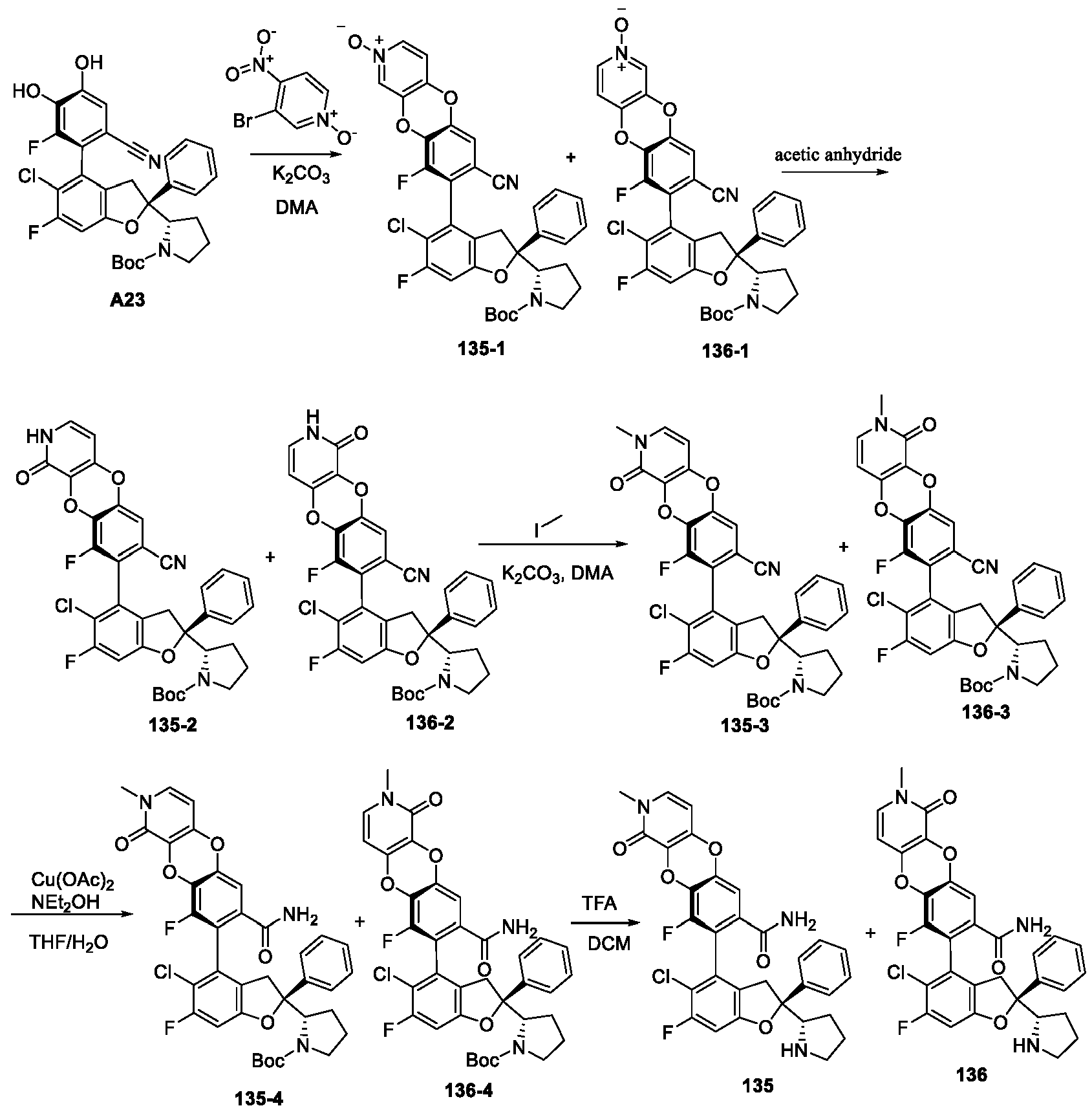
- Step 1: Referring to the synthesis method of compound 71, intermediate 3-bromo-4-nitropyridine N-oxide was used instead of intermediate 3,4-dichloropyridazine, and one-step reaction was carried out to obtain intermediates 135-1 and 136-1 (mixture).
- LC-MS: m/z 701 [M+41+H]+.
- Step 2: Compounds 135-1 and 136-1 (mixture) (50 mg, 0.076 mmol) and acetic anhydride (1.5 mL) were sequentially added to an 8 mL microwave tube, and the reaction mixture was stirred at 135°C for 4 hours under microwave irradiation in a sealed tube. TLC showed that the reaction was completed. The reaction mixture was diluted by adding water and extracted three times with ethyl acetate. The combined organic phases were washed with saturated brine, dried over anhydrous sodium sulfate, filtered, and concentrated under reduced pressure. The resulting residue was purified by silica gel chromatography (PE/EA = 1:1) to obtain 135-2 and 136-2 (mixture, 30 mg, yield: 60%) as a light yellow foamy solid.
- LC-MS: m/z 604 [M-56+H]+.
- Step 3: Referring to the synthesis method of compounds 118 and 119, intermediates 135-2 and 136-2 were used instead of intermediates 118-3 and 119-3, and intermediate iodomethane was used instead of 1-fluoro-2-iodoethane, and then one-step reaction was carried out to obtain intermediates 135-3 and 136-3 (mixture).
- LC-MS: m/z 574 [M-100+H]+.
- Step 4: Referring to the synthesis method of compound 71, intermediates 135-3 and 136-3 (mixture) were used instead of intermediate 71-1, and one-step reaction was carried out to obtain compounds 135-4 and 136-4.
- LC-MS: m/z 592 [M-100+H]+.
- Step 5: Referring to the synthesis method of compound 71, intermediates 135-4 and 136-4 were used instead of intermediate 71-2, and one-step reaction was carried out to obtain compounds 135 and 136.
- Compound 135: 1H NMR (400 MHz, DMSO-d6) δ 9.36 (s, 1H), 8.34 (s, 1H), 7.92 (s, 1H), 7.55 (dd, J = 12.7, 7.5 Hz, 3H), 7.46 (dd, J = 15.3, 8.0 Hz, 3H), 7.37 (t, J = 7.2 Hz, 1H), 7.20 (d, J = 1.3 Hz, 1H), 7.15 (d, J= 9.3 Hz, 1H), 6.16 (d, J = 7.6 Hz, 1H), 4.32 - 4.25 (m, 1H), 3.58 (d, J = 16.8 Hz, 1H), 3.41 (s, 3H), 3.09 (dd, J = 24.3, 15.9 Hz, 3H), 2.21 - 2.11 (m, 1H), 1.93 - 1.79 (m, 2H), 1.78 - 1.68 (m, 1H).
- LC-MS: m/z 592 [M+H]+.
- Compound 136: 1H NMR (400 MHz, DMSO-d 6) δ 9.37 (s, 1H), 8.32 (s, 1H), 7.93 (s, 1H), 7.57 - 7.35 (m, 7H), 7.24 (s, 1H), 7.14 (d, J = 9.4 Hz, 1H), 6.15 (d, J = 7.5 Hz, 1H), 4.29 (s, 1H), 3.58 (d, J= 16.8 Hz, 1H), 3.43 (s, 3H), 3.06 (t, J = 15.6 Hz, 3H), 2.17 (d, J = 7.7 Hz, 1H), 2.02 - 1.81 (m, 3H).
- LC-MS: m/z 592 [M+H]+.
-

- Step 1: Referring to the synthesis method of compound I-26, intermediate 120-1 was used instead of intermediate I-26-2, and one-step reaction was carried out to obtain intermediate 141-1.
- LC-MS: m/z 742 [M-H]-.
- Step 2: Referring to the synthesis method of compound I-26, intermediate 141-1 was used instead of intermediate I-26-3, and one-step reaction was carried out to obtain intermediate 141-2.
- LC-MS: m/z 757 [M+H]+.
- Step 3: Referring to the synthesis method of compound I-26, intermediate 141-2 was used instead of intermediate I-26-4, and one-step reaction was carried out to obtain compound 141.
- LC-MS: m/z 657 [M+H]+.
- 1H NMR (400 MHz, Methanol-d 4) δ 7.90 (s, 1H), 7.62 - 7.33 (m, 5H), 7.12 (s, 1H), 7.03 (d, J = 9.0 Hz, 1H), 6.23 (t, J = 55.7 Hz, 1H), 4.51 (td, J = 13.7, 4.0 Hz, 2H), 4.27 (s, 1H), 3.73 - 3.58 (m, 1H), 3.22 (s, 2H), 2.76 (s, 3H), 2.25 (m, 1H), 2.07 (m, 2H), 1.94 (m, 1H).
-

- Step 1: 133-2 (35 mg, 0.045 mmol) was dissolved in acetic acid (2 mL) at room temperature, and sodium nitrite (62.31 mg, 0.903 mmol) was added thereto. The reaction mixture was stirred at 80°C for 12 hours. The mixture was filtered, and the filtrate was concentrated under reduced pressure to obtain crude product 142-1 (30 mg, yield: 85.64%).
- LC-MS: m/z 776 [M+H]+.
- Step 2: Crude product 142-1 (30 mg, 0.039 mmol), HATU (17.64 mg, 0.046 mmol), TEA (15 mg, 0.116 mmol) and methylamine hydrochloride (7.83 mg, 0.116 mmol) were dissolved in DMF (1 mL), and the reaction mixture was stirred at room temperature overnight. The mixture was filtered, and the filtrate was concentrated under reduced pressure. The residue was purified by silica gel column chromatography (ethyl acetate/petroleum ether = 1/1) to obtain 142-2 (16 mg, yield: 52.46%).
- LC-MS: m/z 789 [M+H]+.
- Step 3: 142-2 (16 mg, 0.020 mmol), methanol (1 mL) and 1,4-dioxane hydrochloride (1 mL, 4.0 M) were sequentially added to a reaction flask, and the reaction mixture was stirred at 35°C for 2 hours. After the reaction was completed, the reaction mixture was concentrated under reduced pressure. The residue was lyophilized to obtain the hydrochloride of compound 142 (13 mg, yield: 89.59%).
- LC-MS: m/z 689 [M+H]+.
- 1HNMR (400 MHz, Methanol-d 4) δ 7.88 (s, 1H), 7.58 - 7.51 (m, 2H), 7.45 (t, J = 7.5 Hz, 2H), 7.38 (dd, J = 8.3, 6.1 Hz, 1H), 7.11 (d, J = 1.7 Hz, 1H), 7.03 (d, J = 9.2 Hz, 1H), 4.39 (t, J = 7.0 Hz, 2H), 4.27 (t, J = 8.4 Hz, 1H), 3.60 (d, J = 9.8 Hz, 1H), 3.38 - 3.32 (m, 1H), 3.22 (ddd, J = 14.9, 10.0, 5.7 Hz, 2H), 2.82 (s, 3H), 2.75 - 2.66 (m, 2H), 2.31 - 2.19 (m, 1H), 2.04 (td, J = 14.2, 13.0, 7.1 Hz, 2H), 1.99 - 1.88 (m, 1H).
-

- Step 1: Referring to the synthesis method of compound 118, intermediate 2,2,2-trifluoroethyl trifluoromethanesulfonate was used instead of 1-fluoro-2-iodoethane, and one-step reaction was carried out to obtain intermediate 143-1.
- LC-MS: m/z 643 [M-100+H]+.
- Step 2: Referring to the synthesis method of compound 71, intermediate 143-1 was used instead of intermediate 71-1, and one-step reaction was carried out to obtain compound 143-2.
- LC-MS: m/z 661 [M-100+H]+.
- Step 3: Referring to the synthesis method of compound 71, intermediate 143-2 was used instead of intermediate 71-2, and one-step reaction was carried out to obtain compound 143.
- 1H NMR (400 MHz, DMSO-d6) δ 9.39 (s, 1H), 8.33 (s, 1H), 8.13 (s, 1H), 7.95 (s, 1H), 7.44 (ddd, J = 44.9, 29.6, 16.0 Hz, 7H), 7.16 (d, J = 9.3 Hz, 1H), 4.97 (d, J = 8.2 Hz, 2H), 4.31 (s, 1H), 3.59 (d, J = 17.1 Hz, 1H), 3.10 (s, 2H), 3.00 (d, J = 17.1 Hz, 1H), 2.16 (s, 1H), 1.95 - 1.81 (m, 2H), 1.71 (s, 1H).
- LC-MS: m/z 661 [M+H]+.
-

- Step 1: Referring to the synthesis method of compound 124, intermediate 143-2 was used instead of intermediate 124-2, and one-step reaction was carried out to obtain compound 144-3.
- LC-MS: m/z 662 [M-100+H]+.
- Step 2: Referring to the synthesis method of compound 124, intermediate 144-3 was used instead of intermediate 124-3, and one-step reaction was carried out to obtain compound 144-4.
- LC-MS: m/z 675 [M-100+H]+.
- Step 3: Referring to the synthesis method of compound 124, intermediate 144-4 was used instead of intermediate 124-4, and one-step reaction was carried out to obtain compound 144.
- 1H NMR (400 MHz, DMSO-d6) δ 9.38 (s, 1H), 8.44 (d, J = 4.5 Hz, 1H), 8.37 (s, 1H), 8.13 (s, 1H), 7.44 (ddd, J = 28.2, 19.5, 7.5 Hz, 5H), 7.29 (s, 1H), 7.16 (d, J = 9.4 Hz, 1H), 5.03 - 4.90 (m, 2H), 4.31 (s, 1H), 3.38 (s, 1H), 3.13 (d, J= 23.1 Hz, 2H), 3.01 (d, J = 16.9 Hz, 1H), 2.63 (d, J = 4.3 Hz, 3H), 2.10 (d, J= 7.1 Hz, 1H), 1.97 - 1.82 (m, 2H), 1.73 (d, J = 11.6 Hz, 1H).
- LC-MS: m/z 675 [M+H]+.
-

- Step 1: A28 (200 mg, 0.303 mmol) was dissolved in DMF (3 mL), then potassium carbonate (83.62 mg, 0.605 mmol) and 3-bromo-1,1-difluorocyclobutane (103.46 mg, 0.605 mmol) were added thereto at room temperature, and the reaction mixture was stirred at 80°C for 2 hours. The reaction mixture was diluted with ethyl acetate and washed with saturated sodium bicarbonate solution. The organic phase was washed with saturated brine, dried over anhydrous sodium sulfate, and concentrated to obtain a crude. The crude was purified by silica gel column chromatography (ethyl acetate/petroleum ether = 1/3) to obtain a mixture of 147-1 and 147-2 (15 mg, yield: 6.6%).
- LC-MS: m/z 751 [M+H]+.
- Step 2: The mixture of 147-1 and 147-2 (15 mg, 0.02 mmol) was dissolved in methanol (1 mL), then copper acetate (7.25 mg, 0.04 mmol) and diethylhydroxylamine (35.6 mg, 0.4 mmol) were added thereto, and stirred at room temperature for 1 hour. After the reaction was completed, the reaction mixture was filtered and concentrated. The resulting residue was purified by Prep-TLC (petroleum ether/ethyl acetate = 1:1) to obtain 147-3 (6 mg, yield: 32.55%).
- LC-MS: m/z 769 [M+H]+.
- Step 3: 147-3 (6 mg, 0.007 mmol), methanol (1 mL) and 1,4-dioxane hydrochloride (1 mL, 4.0 M) were sequentially added to a reaction flask, and the reaction mixture was stirred at 35°C for 1 hour. After the reaction was completed, the reaction mixture was concentrated under reduced pressure. The residue was lyophilized to obtain the hydrochloride of compound 147 (1.5 mg, yield: 27.36%).
- LC-MS: m/z 669 [M+H]+.
- 1H NMR (400 MHz, Methanol-d 4): δ 7.96 (s, 1H), 7.54 (d, J = 7.4 Hz, 2H), 7.40 (dt, J = 26.3, 7.3 Hz, 3H), 7.18 (s, 1H), 7.03 (d, J = 9.1 Hz, 1H), 3.22 - 2.96 (m, 6H), 2.38 - 2.19 (m, 2H), 1.98 (d, J = 53.7 Hz, 4H), 1.59 (s, 2H).
-

- Step 1: A28 (25 mg, 0.038 mmol), 2-methoxyethanol (5.76 mg, 0.076 mmol), DEAD (13.17 mg, 0.076 mmol) and triphenylphosphine (19.84 mg, 0.076 mmol) were added to tetrahydrofuran (1 mL), and the reaction mixture was stirred at room temperature for 12 hours. The reaction mixture was diluted with water and extracted with ethyl acetate. The organic layer was dried over Na2SO4 and concentrated under reduced pressure, and the residue was purified by silica gel chromatography (ethyl acetate/petroleum ether = 1/3) to obtain a mixture of 149-1 and 149-2 (25 mg, yield: 70%).
- LC-MS: m/z 719 [M+H]+.
- Step 2: The mixture of 149-1 and 149-2 (25 mg, 0.035 mmol) was dissolved in methanol (1 mL), then copper acetate (12.63 mg, 0.07 mmol) and diethylhydroxylamine (62 mg, 0.695 mmol) were added thereto, and stirred at room temperature for 1 hour. After the reaction was completed, the reaction mixture was filtered and concentrated. The resulting residue was purified by Prep-TLC (petroleum ether/ethyl acetate = 1:1) to obtain 149-3 (6 mg, yield: 15%).
- LC-MS: m/z 737 [M+H]+.
- Step 3: 149-3 (6 mg, 0.008 mmol), methanol (1 mL) and 1,4-dioxane hydrochloride (1 mL, 4.0 M) were sequentially added to a reaction flask, and the reaction mixture was stirred at 35°C for 2 hours. After the reaction was completed, the reaction mixture was concentrated under reduced pressure. The residue was lyophilized to obtain the hydrochloride of compound 149 (1.5 mg, yield: 27.36%).
- LC-MS: m/z 673 [M+H]+.
- 1H NMR (400 MHz, Methanol-d 4) δ 7.86 (s, 1H), 7.55 (d, J = 7.3 Hz, 2H), 7.47 (t, J = 7.5 Hz, 2H), 7.40 (t, J = 7.2 Hz, 1H), 7.18 (d, J = 1.7 Hz, 1H), 7.02 (d, J = 9.2 Hz, 1H), 4.33 (td, J = 6.2, 5.8, 2.7 Hz, 2H), 4.28 - 4.19 (m, 2H), 3.76 (t, J = 5.4 Hz, 2H), 3.59 (s, 4H), 3.24 - 3.17 (m, 2H), 2.10 - 1.87 (m, 4H).
-

- Step 1: Compound A1 (227 mg, 0.418 mmol), compound I-B1 (100 mg, 0.348 mmol), potassium phosphate (443.7 mg, 2.09 mmol), toluene (5 mL), water (1 mL), 1,4-dioxane (5 mL), RuPhos-Pd-G3 (23.07 mg, 0.028 mmol) and RuPhos (12.87 mg, 0.028 mmol) were sequentially added to a reaction flask. The reaction mixture was stirred at 100°C for 18 hours under nitrogen atmosphere. TLC showed that the reaction was completed. The reaction mixture was concentrated under reduced pressure, and the resulting residue was purified by silica gel chromatography (PE/EA = 3:1) to obtain I-11-1 as a yellow solid (65 mg, yield: 32%).
- Step 2: Compound I-11-1 (50 mg, 0.274 mmol), methanol (10 mL), copper acetate (261.65 mg, 1.44 mmol) and diethylhydroxylamine (128.41 mg, 1.44 mmol) were sequentially added to a single-neck flask, and the reaction mixture was stirred at 25°C for 12 hours. A red solid precipitated. After the reaction was completed, the reaction mixture was filtered and concentrated. The resulting residue was purified by silica gel chromatography (DCM/MeOH = 20:1) to obtain I-11-2 as a yellow solid (16 mg, yield: 31.2%).
- Step 3: Intermediate I-11-2 (15 mg, 0.105 mmol), methanol (2 mL) and 1,4-dioxane (2 mL, 4.0 M) were sequentially added to a reaction flask, and the reaction mixture was stirred at 25°C for 2 hours. After the reaction was completed, the reaction mixture was concentrated under reduced pressure. The residue was dissolved in water and lyophilized to obtain compound I-11 as a yellow solid (11 mg, hydrochloride).
- 1H NMR (400 MHz, Methanol-d4 ) δ 8.78 (s, 1H), 8.18 (s, 1H), 8.03 (d, J = 1.9 Hz, 1H), 7.64 (d, J = 1.3 Hz, 1H), 7.42 - 7.32 (m, 3H), 7.30 - 7.23 (m, 2H), 7.02 (d, J = 9.2 Hz, 1H), 4.19 - 4.14 (m, 1H), 3.60 - 3.54 (m, 1H), 3.27 (dd, J = 11.4, 4.0 Hz, 2H), 2.95 (d, J = 7.4 Hz, 1H), 1.97 - 1.79 (m, 3H), 1.64 (s, 1H).
- LC-MS: m/z 495.2 [M+H]+.
-

- Step 1: Compound A1 (152 mg, 0.280 mmol), compound I-B8 (100 mg, 0.280 mmol), potassium phosphate (356.56 mg, 1.655 mmol), toluene (0.5 mL), water (0.2 mL), 1,4-dioxane (0.5 mL), Pd2(dba)3 (30 mg, 0.19 mmol) and Ni-Xantphos (20 mg, 0.036 mmol) were sequentially added to a reaction flask. The reaction mixture was stirred at 100°C for 18 hours under nitrogen atmosphere. TLC showed that the reaction was completed. The reaction mixture was concentrated under reduced pressure, and the resulting residue was purified by silica gel chromatography (PE/EA = 3:1) to obtain I-19-1 as a yellow solid (100 mg, yield: 52%).
- Step 2: Compound I-19-1 (50 mg, 0.072 mmol), methanol (20 mL), copper acetate (261.6 mg, 1.44 mmol) and diethylhydroxylamine (128.4 mg, 1.44 mmol) were sequentially added to a single-neck flask, and the reaction mixture was stirred at 25°C for 12 hours. A red solid precipitated. After the reaction was completed, the reaction mixture was filtered and concentrated. The resulting residue was purified by silica gel chromatography (DCM/MeOH = 20:1) to obtain I-19-2 as a yellow solid (22 mg, yield: 17.95%).
- LC-MS: m/z 712.2 [M+H]+.
- Step 3: Intermediate I-19-2 (20 mg, 0.105 mmol), methanol (2 mL) and 1,4-dioxane hydrochloride (2 mL, 4.0 M) were sequentially added to a reaction flask, and the reaction mixture was stirred at 25°C for 2 hours. After the reaction was completed, the reaction mixture was concentrated under reduced pressure. The residue was purified by preparative HPLC and lyophilized to obtain compound I-19 as a yellow solid (15 mg, hydrochloride).
- 1H NMR (400 MHz, Methanol-d4 ) δ 7.47-7.45 (m, 2H), 7.39-7.36 (m, 2H), 7.32-7.28 (m, 1H), 6.85 (d, J= 12Hz, 1H), 6.74 (s, 1H),4.18 - 4.16 (m, 2H),4.13-4.09 (m, 1H), 3.57 - 3.52 (m, 1H), 3.49-3.45 (m, 1H), 3.35-3.33 (m, 2H), 3.13-3.03 (m, 2H), 2.13-2.06 (m, 1H), 1.93-1.79 (m, 3H).
- LC-MS: m/z 512.9 [M+H]+.
-

- Step 1: Compound A1 (152 mg, 0.28 mmol), compound I-B8 (100 mg, 0.28 mmol), potassium phosphate (356 mg, 1.68 mmol), toluene (5 mL), water (1 mL), 1,4-dioxane (5 mL), RuPhos-Pd-G3 (23.07 mg, 0.028 mmol) and RuPhos (12.87 mg, 0.028 mmol) were sequentially added to a reaction flask. The reaction mixture was stirred at 100°C for 18 hours under nitrogen atmosphere. TLC showed that the reaction was completed. The reaction mixture was concentrated under reduced pressure, and the resulting residue was purified by silica gel chromatography (PE/EA = 3:1) to obtain I-26-1 as a yellow solid (100 mg, yield: 53.35%).
- Step 2: Compound I-26-1 (190 mg, 0.274 mmol), methanol (20 mL), copper acetate (149.14 mg, 0.821 mmol) and diethylhydroxylamine (487.97 mg, 5.474 mmol) were sequentially added to a single-neck flask, and the reaction mixture was stirred at 25°C for 12 hours. A red solid precipitated. After the reaction was completed, the reaction mixture was filtered and concentrated. The resulting residue was purified by silica gel chromatography (DCM/MeOH = 20:1) to obtain 1-26-2 as a yellow solid (35 mg, yield: 17.95%).
- LC-MS: m/z 712.2 [M+H]+.
- Step 3: Compound 1-26-2 (100 mg, 0.140 mmol), acetic acid (10 mL) and sodium nitrite (96.88 mg, 1.404 mmol) were sequentially added to a pressure-resistant sealed tube, and the reaction mixture was stirred at 60°C overnight. The reaction mixture was diluted by adding water and extracted three times with ethyl acetate. The combined organic phases were washed with saturated brine, dried over anhydrous sodium sulfate, filtered, and concentrated under reduced pressure. I-26-3 (77.3 mg, yield: 89.8%) was obtained without purification and used directly in the next reaction step.
- LC-MS: m/z 713.2 [M+H]+.
- Step 4: Compound I-26-3 (270 mg, 0.379 mmol), methylamine hydrochloride (177.5 mg, 2.650 mmol), HATU (431.9 mg, 1.136 mmol), DMF (15 mL) and TEA (766.19 mg, 7.572 mmol) were sequentially added to a single-neck flask, and the reaction mixture was stirred at room temperature for 4 hours. The reaction mixture was diluted by adding water and extracted three times with ethyl acetate. The combined organic phases were washed with saturated brine, dried over anhydrous sodium sulfate, filtered, and concentrated under reduced pressure. The resulting residue was purified by silica gel chromatography (DCM/MeOH = 20:1) to obtain I-26-4 as a yellow solid (160 mg, yield: 58.1%).
- LC-MS: m/z 726.2 [M+H]+.
- Step 5: Referring to the synthesis method of compound I-19, compound I-26-4 was used instead of compound I-19-2, and one-step reaction was carried out to obtain compound I-26.
- 1HNMR(400MHz, MeOD) δ 7.56 (s, 2H), 7.49 (s, 2H), 7.41 (t,J = 7.3Hz, 1H), 6.95 (d,J = 9.2Hz, 1H), 6.77 (d,J = 1.4Hz, 1H), 4.29 (s, 2H), 4.25 - 4.19 (m, 1H), 3.52 - 3.45 (m, 2H), 3.36 (dd,J = 11.3, 7.2Hz, 2H), 3.21 (dd,J = 13.2, 7.2Hz, 2H), 2.75 (s, 3H), 2.22 - 2.15 (m, 1H), 2.00 (ddd,J = 19.3, 13.1, 5.0Hz, 3H).
- LC-MS: m/z 526.1 [M+H]+.
-

- Step 1: NaBH4 (0.83 g, 21.92 mmol) was added to a solution of I-54-1 (4.0 g, 18.26 mmol) in THF (200 mL) and MeOH (8 mL) at 0°C. The reaction mixture was reacted at room temperature for 0.5 hours. TLC plate showed that the reaction was completed. The reaction mixture was subjected to rotary evaporation to dryness, acidified with 1 M HCl solution, and extracted twice with EA. The organic phases were combined, dried over anhydrous sodium sulfate, filtered, and the filtrate was concentrated to dryness under reduced pressure. The crude was purified by silica gel chromatography (petroleum ether: ethyl acetate = 2:1) to obtain I-54-2 as a white solid (3.9 g, yield: 96.6%).
- 1H NMR (400 MHz, CDCl3) δ 7.20 (dd, J = 9.7, 2.3 Hz, 1H), 7.10 (ddt, J = 2.3, 1.5, 0.7 Hz, 1H), 6.67 (s, 1H), 4.82 (s, 2H).
- Step 2: I-54-2 (3.9 g, 17.6 mmol) was dissolved in DCM (50 mL), and then TBSCl (5.85 g, 38.82 mmol) and imidazole (3 g, 44.1 mmol) were added thereto. The reaction mixture was reacted at room temperature for 1.5 hours, and the TLC plate showed that the reaction was completed. The reaction mixture was concentrated, and the residue was purified by column chromatography (petroleum ether: ethyl acetate = 10:1) to obtain I-54-3 as a white solid (7.7 g, yield: 97.1%).
- 1H NMR (400 MHz, CDCl3) δ 7.30 - 7.20 (m, 1H), 7.00 (dd, J = 9.9, 2.4 Hz, 1H), 4.61 (s, 2H), 0.92 - 0.87 (m, 9H), 0.84 (d, J = 1.7 Hz, 9H), 0.08 (d, J = 2.4 Hz, 6H), 0.03 - -0.04 (m, 6H).
- Step 3: Methanesulfonato(2-di-t-butylphosphino-2',4',6'-tri-i-propyl-1,1'-biphenyl)(2'-amino-1,1'-biphenyl-2-yl)palladium(II) (0.82 g, 1.03 mmol) was added to a solution of I-54-3 (7.7 g, 17.1 mmol) and zinc cyanide (4.0 g, 34.2 mmol) in THF (15 mL) and water (75 mL). The air was replaced with nitrogen three times. The reaction mixture was heated to 70°C, reacted for 16 hours, and filtered. The filtrate was concentrated under reduced pressure to remove the solvent THF. The reaction mixture was diluted with water (200 mL), then extracted with dichloromethane (3 × 150 mL). The organic phases were combined, washed with saturated brine, dried over anhydrous sodium sulfate, filtered, and the filtrate was concentrated to dryness under reduced pressure. The crude was purified by column chromatography (petroleum ether: ethyl acetate = 2:1) to obtain I-54-4 as an off-white solid (4.6 g, yield: 95.4%).
- Step 4: HCl/dioxane (8.2 mL) was added to a MeOH (40 mL) solution of I-54-4 (4.6 g, 16.3 mmol) at room temperature. The mixture was reacted for 2 minutes. A THF (30 mL) solution of iodine (15.4 g, 60.5 mmol) was added dropwise. TLC plate showed that the reaction was completed. The reaction mixture was concentrated to dryness under reduced pressure and purified by silica gel chromatography (petroleum ether: ethyl acetate = 1:1) to obtain I-54-5 as a white solid (2.7 g, yield: 98.8%).
- 1H NMR (400 MHz, DMSO-d 6) δ 10.89 (s, 1H), 7.69 (dd, J = 10.7, 2.1 Hz, 1H), 7.51 (dd, J = 2.1, 1.1 Hz, 1H), 4.51 (s, 2H), 3.57 (s, 1H).
- Step 5: 2,2-Dimethoxypropane (8 mL, 64.6 mmol), TsOH.H2O (0.46 g, 2.4 mmol) and 4 A molecular sieve (0.5 g) were added to a toluene (30 mL) solution of I-54-5 (2.7 g, 16.1 mmol) and a DMSO (70 mL) solution of potassium carbonate (13.1 g, 94.5 mmol). The reaction mixture was heated to 110°C, reacted for 18 hours, and filtered. The filtrate was concentrated to dryness under reduced pressure and purified by silica gel chromatography (petroleum ether: ethyl acetate = 10:1) to obtain I-54-6 as a white solid (2.1 g, yield: 62.7%).
- 1H NMR (400 MHz, CDCl3) δ 7.30 - 7.25 (m, 1H), 7.16 - 7.10 (m, 1H), 4.87 (s, 2H), 1.61 (s, 6H).
- Step 6: LDA (2.0 mol/L in THF/hexane, 5.3 mL, 10.6 mmol) was added dropwise to a THF (10 mL) solution of I-54-6 (1 g, 4.8 mmol) at -65°C under nitrogen atmosphere. The mixture was reacted at -65°C for 30 minutes. A THF (2 mL) solution of iodine (1.47 g, 5.8 mmol) was added dropwise. The reaction mixture was reacted at -65°C for 30 minutes. The reaction mixture was poured into ice-cold saturated ammonium chloride aqueous solution (50 mL) and extracted with ethyl acetate (3 × 30 mL). The organic phases were combined, washed with saturated brine, dried over anhydrous sodium sulfate, and filtered. The filtrate was concentrated to dryness under reduced pressure and purified by silica gel chromatography (petroleum ether: ethyl acetate = 5:1) to obtain I-54-7 as a yellow solid (800 mg, yield: 49.7%).
- 1H NMR (400 MHz, CDCl3) δ 7.16 - 7.12 (m, 1H), 4.83 (d, J = 1.0 Hz, 2H), 1.61 (s, 6H).
- Step 7: Intermediate I-54-7 (780 mg, 2.34 mmol), intermediate A1 (1.5 g, 2.34 mmol), potassium phosphate (2.99 g, 14.01 mmol), toluene (7 mL), dioxane (7 mL), water (3 mL), Pd2(dba)3 (190 mg, 0.21 mmol) and N-XantPhos (230 mg, 0.42 mmol) were sequentially added to a reaction flask. The reaction mixture was stirred at 100°C for 12 hours under nitrogen atmosphere. The reaction mixture was diluted by adding water and extracted twice with ethyl acetate. The combined organic phases were washed with saturated brine, dried over anhydrous sodium sulfate, filtered, and concentrated under reduced pressure. The resulting residue was purified by silica gel chromatography (petroleum ether/ethyl acetate = 3:1) obtain intermediate I-54-8 (260 mg, yield: 17.8%).
- LC-MS: m/z 623 [M+H]+.
- Step 8: Intermediate I-54-8 (260 mg, 0.417 mmol), THF (2.6 mL), water (1.2 mL) and TsOH.H2O (198 mg, 1.04 mmol) were sequentially added to a reaction flask, and the reaction mixture was stirred at room temperature for 12 hours. After the reaction was completed, the reaction mixture was filtered and concentrated. The resulting residue was purified by column chromatography (DCM/MeOH = 10:1) to obtain I-54-9 as a white solid (157 mg, yield: 64.5%).
- LC-MS: m/z 581 [M-H]-.
- Step 9: Intermediate I-54-9 (70 mg, 0.12 mmol), ethylene glycol (1.5 mL) and TsOH.H2O (46 mg, 0.24 mmol) were sequentially added to a reaction flask, and the reaction mixture was stirred at 100°C for 12 hours. After the reaction was completed, water and ethyl acetate were added for extraction and the organic phase was concentrated under reduced pressure to obtain I-54-10 (60 mg, crude).
- LC-MS: m/z 527 [M+H]+.
- Step 10: Intermediate I-54-10 (60 mg, crude), THF (1 mL), Boc2O (30 mg, 0.14 mmol) and TEA (23 mg, 0.23 mmol) were sequentially added to a reaction flask, and the reaction mixture was stirred at room temperature for 0.5 hours. After the reaction was completed, the reaction mixture was filtered and concentrated. The resulting residue was purified by column chromatography (DCM/MeOH = 10:1) to obtain I-54-11 as a white solid (65 mg, yield: 91%).
- LC-MS: m/z 625 [M-H]-.
- Step 11: Intermediate I-54-11 (65 mg, 0.1 mmol), THF (1.5 mL), triphenylphosphine (33 mg, 0.12 mmol) and DEAD (27 mg, 0.16 mmol) were sequentially added to a reaction flask, and the reaction mixture was stirred at room temperature for 0.5 hours. After the reaction was completed, the reaction mixture was filtered and concentrated. The resulting residue was purified by column chromatography (petroleum ether/ethyl acetate = 3:1) to obtain I-54-12 as a white solid (40 mg, yield: 63.3%).
- LC-MS: m/z 609 [M+H]+.
- Step 12: Referring to the synthesis method of compound 1, intermediate I-54-12 was used instead of intermediate 1-1, and one-step reaction was carried out to obtain intermediate I-54-13.
- LC-MS: m/z 627 [M+H]+.
- Step 13: Referring to the synthesis method of compound 1, intermediate I-54-13 was used instead of intermediate 1-2, and one-step reaction was carried out to obtain compound I-54.
- LC-MS: m/z 527 [M+H]+.
- 1H NMR (400 MHz, Methanol-d4) δ 7.58 - 7.52 (m, 2H), 7.51 - 7.43 (m, 3H), 7.43 - 7.37 (m, 1H), 7.00 (d, J = 9.1 Hz, 1H), 4.75 (s, 2H), 4.26 - 4.16 (m, 3H), 4.08 - 4.01 (m, 2H), 3.60 - 3.54 (m, 1H), 3.35 (d, J = 7.3 Hz, 1H), 3.23 - 3.09 (m, 2H), 2.28 - 2.15 (m, 1H), 2.08 - 1.89 (m, 3H).
-

- Step 1: Intermediate I-52-2 (160 mg, 0.225 mmol) was dissolved in methanol (5 mL), and PPTS (5.65 mg, 0.022 mmol) was added thereto at room temperature. The reaction mixture was stirred at room temperature for 6 hours. The reaction mixture was concentrated under reduced pressure to obtain a crude (160 mg). The crude, MSCl (82.2 mg, 0.718 mmol) and TEA (72.62 mg, 0.718 mmol) were dissolved in DCM (4 mL), and the reaction mixture was stirred at room temperature for 3 hours. The filtrate was concentrated under reduced pressure. The residue was purified by silica gel column chromatography (ethyl acetate/petroleum ether = 1/4) to obtain intermediate I-55-1 (120 mg, yield: 70%).
- Step 2: I-55-1 (65 mg, 92.18 µmol) was dissolved in DMF (2 mL), then K2CO3 (25.44 mg, 184.35 µmol), TMSCN (13.72 mg, 138.27 µmol) and TBAF (1 M, 92.18 µL) were added thereto, and the reaction mixture was reacted at 50°C for 4 hours. LC-MS showed that the reaction was completed, and the reaction mixture was prepared by Prep-HPLC (YMC-PACK ODS-A, 250 × 20 mml.D.S-5 µm, 12 nm AA12S05-2520WT, Ser.No.114ZB00083) (FA), and lyophilized to obtain target product I-55-2 (9 mg, yield: 13.81%) as a white solid.
- LCMS: m/z 658.3 [M+H]+.
- Step 3: I-55-2 (11.93 mg, 18.76 µmol) was dissolved in DCM (4 mL), then TFA (0.25 mL) was added thereto, and the reaction mixture was reacted at room temperature (30°C) for 2 hours. LC-MS showed the presence of the target product, and the reaction mixture was prepared by Prep-HPLC (YMC-PACK ODS-A, 250 × 20 mml.D.S-5 µm, 12 nm AA12S05-2520WT, Ser.No.114ZB00083) (FA) to obtain target product I-55 (5.74 mg, yield: 52.06%) as a yellow solid.
- 1H NMR (400 MHz, Methanol-d4) δ 7.64 (d, J = 1.1 Hz, 1H), 7.53 (d, J = 7.4 Hz, 2H), 7.44 (t, J = 7.6 Hz, 2H), 7.36 (t, J = 7.2 Hz, 1H), 7.07 - 6.93 (m, 2H), 6.43 (dd, J = 16.0, 5.7 Hz, 1H), 4.18 (t, J = 8.3 Hz, 1H), 3.55 (d, J = 17.5 Hz, 1H), 3.46 (dd, J = 5.7, 1.7 Hz, 2H), 3.34 - 3.29 (m, 1H), 3.12 (m, 3H), 2.99 (s, 1H), 2.18 (m,1H), 2.08 - 1.85 (m, 4H).
- LCMS: m/z 536.3 [M+H]+.
- The following compounds were synthesized using the corresponding intermediate A and intermediate B or intermediates I-B, using the methods described above or improved methods. If the N-Boc protecting group needs to be removed from the final product, the following conditions can be used for removal: 1) 4 N HCl/1,4-dioxane/methanol (1/1) solution, stirring at room temperature or heating with stirring until the reaction is completed, and the reaction mixture is concentrated and then separated by preparative HPLC to obtain the target product; 2) trifluoroacetic acid/dichloromethane (1/10) solution, reacting at room temperature until the reaction is completed, and the reaction mixture is concentrated and then separated by preparative HPLC to obtain the target product. If the N-Ts protecting group needs to be removed from the final product, 2 N sodium hydroxide/ethanol (1/1) solution can be used with stirring at room temperature or heating with stirring until the reaction is completed, extracting with an organic solvent, and the organic phase is dried and concentrated, and then separated by preparative HPLC to obtain the target product. If the O-TBS protective group needs to be removed from the final product, 4 N HCl/1,4-dioxane/methanol (1/1) solution can be used with stirring at room temperature or heating with stirring until the reaction is completed, and the reaction mixture is concentrated and then separated by preparative HPLC to obtain the target product. If the N-SEM protecting group needs to be removed from the final product, 4 N HCl/1,4-dioxane/methanol (1/1) solution can be used with stirring at room temperature or heating with stirring until the reaction is completed, and the reaction mixture is concentrated and then separated by preparative HPLC to obtain the target product.
- The following compounds are free compounds or pharmaceutically acceptable salts.
Compound num-ber Starting Intermediate Structural formula Name Analytical data 2 A1 
(S)-7-((S)-5-Chloro-6-fluoro-2-phenyl-2-((S)-pyrrolidin-2-yl)-2,3-dihydrobenzofuran-4-yl)-6-fluoro-2-methyl-2,4-dihydrochromeno[3,4-c]pyrazole-8-carbonitrile LCMS: m/z 545.2 [M+H]+. B2 4 A1 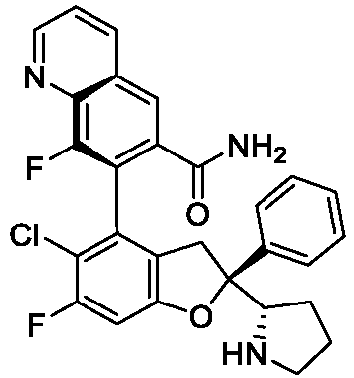
(S)-7-((S)-5-Chloro-6-fluoro-2-phenyl-2-((S)-pyrrolidin-2-yl)-2,3-dihydrobenzofuran-4-yl)-8-fluoroquinoline-6-carboxamide 1H NMR (400 MHz, Methanol-d4) δ 9.25 (s, 1H), 9.14 (d, J = 8.1 Hz, 1H), 8.45 (s, 1H), 8.14 (dd, J = 8.1, 4.7 Hz, 1H), 7.47 (ddd, J = 28.6, 23.8, 7.4 Hz, 5H), 7.13 (d, J = 9.1 Hz, 1H), 4.34 - 4.23 (m, 1H), 3.70 - 3.61 (m, 1H), 3.35 (s, 1H), 3.23 (t, J = 17.3 Hz, 2H), 2.30 (d, J = 7.3 Hz, 1H), 2.13 - 1.92 (m, 3H). B3 LC-MS: m/z = 506 [M+H]+. 4' A1 
(R)-7-((S)-5-Chloro-6-fluoro-2-phenyl-2-((S)-pyrrolidin-2-yl)-2,3-dihydrobenzofuran-4-yl)-8-fluoroquinoline-6-carboxamide 1H NMR (400 MHz, Methanol-d4) δ 9.28 (s, 1H), 8.97 (d, J = 8.4 Hz, 1H), 8.32 (s, 1H), 8.06 (s, 1H), 7.60 - 7.34 (m, 5H), 7.10 (d, J = 9.2 Hz, 1H), 4.29 (s, 1H), 3.63 - 3.57 (m, 2H), 3.40 (d, J = 17.6 Hz, 1H), 3.22 (dd, J = 15.5, 9.5 Hz, 1H), 2.33 (s, 1H), 2.19 - 2.02 (m, 2H), 1.92 (d, J = 8.7 Hz, 1H). B3 LC-MS: m/z = 506 [M+H]+. 5 A1 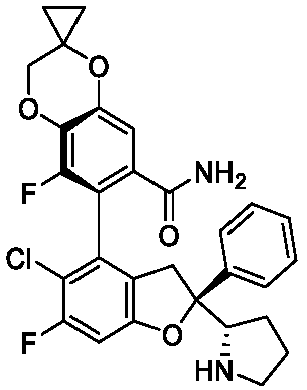
(S)-6-((S)-5-Chloro-6-fluoro-2-phenyl-2-((S)-pyrrolidin-2-yl)-2,3-dihydrobenzofuran-4-yl)-5-fluoro-3H-spiro[benzo[b][1,4]dioxine-2,1'-cyclopropane]-7-carboxamide LC-MS: m/z 539.2 [M+H]+. B4 6 A1 
(S)-8-((S)-5-Chloro-6-fluoro-2-phenyl-2-((S)-pyrrolidin-2-yl)-2,3-dihydrobenzofuran-4-yl)-7-fluoro-5H-chromeno [3,4-b]pyrazine-9-carboxamide 1H NMR (400 MHz, Methanol-d4) δ 8.64 (d, J = 2.5 Hz, 1H), 8.54 (d, J = 2.6 Hz, 1H), 8.36 (d, J = 1.2 Hz, 1H), 7.56 (d, J = 7.5 Hz, 2H), 7.48 (t, J = 7.7 Hz, 2H), 7.39 (dd, J = 13.7, 6.5 Hz, 1H), 7.03 (d, J = 9.2 Hz, 1H), 5.53 (s, 2H), 4.31 - 4.21 (m, 1H), 3.67 - 3.56 (m, 2H), 3.21 (t, J = 12.9 Hz, 2H), 2.30 - 2.21 (m, 1H), 2.12 - 1.93 (m, 3H). B5 LCMS: m/z 561.1 [M+H]+. 7 A1 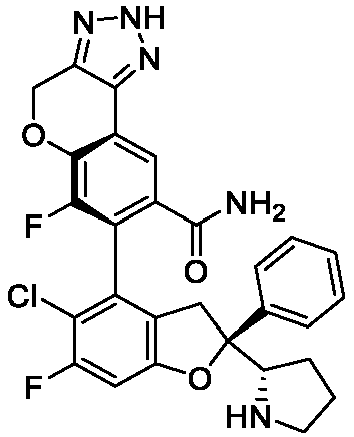
(S)-7-((S)-5-Chloro-6-fluoro-2-phenyl-2-((S)-pyrrolidin-2-yl)-2,3-dihydrobenzofuran-4-yl)-6-fluoro-2,4-dihydrochromeno [3,4-d][1,2,3]triazole-8-carboxamide 1H NMR (400 MHz, Methanol-d4) δ 7.83 (d, J = 1.4 Hz, 1H), 7.55 - 7.49 (m, 2H), 7.43 (t, J = 7.6 Hz, 2H), 7.39 - 7.30 (m, 1H), 6.93 (d, J = 9.2 Hz, 1H), 5.62 (s, 2H), 4.00 (t, J = 8.0 Hz, 1H), 3.57 (dd, J = 16.3, 1.7 Hz, 1H), 3.25 - 3.09 (m, 2H), 3.08-3.01 (m, 1H), 2.09-2.05 (m, 1H), 1.95-1.82 (m, 3H). B6 LCMS: m/z 550.2 [M+H]+. 8 A1 
(S)-7-((S)-5-Chloro-6-fluoro-2-phenyl-2-((S)-pyrrolidin-2-yl)-2,3-dihydrobenzofuran-4-yl)-8-fluoro-2-methyl-2H-benzo [5,6][1,4]dioxino[2,3-c]pyrazole-6-carboxamide 1H NMR (500 MHz, Methanol-d4) δ 7.58 - 7.53 (m, 2H), 7.47 (dd, J = 8.5, 6.9 Hz, 2H), 7.41 (d, J = 1.3 Hz, 1H), 7.35 (s, 1H), 7.18 (d, J = 1.8 Hz, 1H), 7.01 (d, J = 9.1 Hz, 1H), 4.24 - 4.18 (m, 1H), 3.69 (s, 3H), 3.61 (d, J = 15.7 Hz, 1H), 3.34 (dd, J = 7.6, 3.8 Hz, 1H), 3.24 - 3.17 (m, 2H), 2.26 - 2.17 (m, 1H), 2.09 - 2.00 (m, 2H), 1.96 - 1.87 (m, 1H). B7 LCMS: m/z 565.2 [M+H]+. 11 A1 
(S)-6-((S)-5-Chloro-6-fluoro-2-phenyl-2-((S)-pyrrolidin-2-yl)-2,3-dihydrobenzofuran-4-yl)-5-fluoro-1-methyl-1H-benzofuro[3,2-c]pyrazole-7-carboxamide LCMS: m/z 549 [M+H]+. B10 12 A1 
(S)-6-((S)-5-Chloro-6-fluoro-2-phenyl-2-((S)-pyrrolidin-2-yl)-2,3-dihydrobenzofuran-4-yl)-5-fluoro-2H-benzofuro [3,2-c]pyrazole-7-carboxamide LCMS: m/z 535.1 [M+H]+. B12 38 A6 
(S)-7-((S)-5-Chloro-6-methoxy-2-phenyl-2-((S)-pyrrolidin-2-yl)-2,3-dihydrobenzofuran-4-yl)-6-fluoro-2-methyl-2,4-dihydrochromeno[3,4-c]pyrazole-8-carboxamide LCMS: m/z 575.2 [M+H]+. B2 39 A1 
(S)-7-((S)-5-Chloro-6-fluoro-2-phenyl-2-((S)-pyrrolidin-2-yl)-2,3-dihydrobenzofuran-4-yl)-6-fluoro-N,2-dimethyl-2,4-dihydrochromeno[3,4-c]pyrazole-8-carboxamide 1H NMR (400 MHz, Methanol-d4) δ 8.52 (s, 1H), 8.00 (s, 1H), 7.58 - 7.51 (m, 3H), 7.45 (t, J = 7.6 Hz, 2H), 7.39 (d, J = 7.3 Hz, 1H), 6.96 (d, J = 9.3 Hz, 1H), 5.36 (s, 2H), 4.11 (dd, J = 9.0, 7.2 Hz, 1H), 3.95 (s, 3H), 3.57 (dd, J = 16.4, 1.8 Hz, 1H), 3.28 - 3.05 (m, 3H), 2.78 (s, 3H), 2.19-2.07 (m, 1H), 2.07 - 1.85 (m, 3H). B2 LCMS: m/z 577 [M+H]+. 40 A5 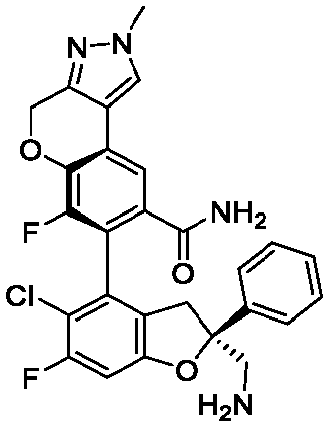
(S)-7-((S)-2-(Aminomethyl)-5-chloro-6-fluoro-2-phenyl-2,3-dihydrobenzofuran-4-yl)-6-fluoro-2-methyl-2,4-dihydrochromeno [3,4-c]pyrazole-8-carboxamide LCMS: m/z 523.1 [M+H]+. B2 41 A11 
(S)-7-((S)-5-Chloro-6-fluoro-2-((methylamino)methyl)-2-phenyl-2,3-dihydrobenzofuran-4-yl)-6-fluoro-2-methyl-2,4-dihydrochromeno [3,4-c]pyrazole-8-carboxamide 1H NMR (400 MHz, Methanol-d4) δ 8.04 (s, 1H), 7.77 (s, 1H), 7.51-7.38 (m,5H), 7.21 (d, J = 8 Hz, 1H), 5.37 (s, 2H), 3.96 (s, 3H), 3.59-3.51 (m, 3H), 3.19-3.15 (m, 1H),2.69 (s, 3H). B2 LCMS: m/z 537.1 [M+H]+. 42 A1 
(S)-7-((S)-5-Chloro-6-fluoro-2-phenyl-2-((S)-pyrrolidin-2-yl)-2,3-dihydrobenzofuran-4-yl)-6-fluoro-4H-benzo[b][1,2,4]triazolo[4,3-d][1,4]oxazine-8-carboxamide 1H NMR (400 MHz, Methanol-d4) δ 9.70 (s, 1H), 8.11 (s, 1H), 7.73 - 7.25 (m, 5H), 7.04 (d, J = 9.1 Hz, 1H), 5.70 (s, 2H), 4.30 (d, J = 10.5 Hz, 1H), 3.72 - 3.59 (m, 2H), 3.26 - 3.11 (m, 2H), 2.28 (d, J = 13.8Hz, 1H), 2.04 (t, J = 11.7 Hz, 2H), 1.95 (s, 1H). B55 LC-MS: m/z 550.2 [M+H]+. 43 A1 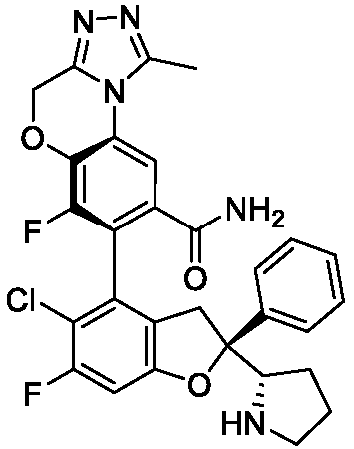
(S)-7-((S)-5-Chloro-6-fluoro-2-phenyl-2-((S)-pyrrolidin-2-yl)-2,3-dihydrobenzofuran-4-yl)-6-fluoro-1-methyl-4H-benzo[b][1,2,4]triazolo[4,3-d][1,4]oxazine-8-carboxamide 1H NMR (400 MHz, Methanol-d4) δ 7.97 (s, 1H), 7.63 - 7.37 (m, 5H), 7.07 (d, J = 9.0 Hz, 1H), 5.63 (s, 2H), 4.32 (d, J = 8.4 Hz, 1H), 3.65 (d, J = 23.0 Hz, 3H), 3.24 (d, J = 14.2 Hz, 1H), 3.13 (s, 3H), 2.27 (dd, J = 17.6, 7.8 Hz, 1H), 2.13 - 1.94 (m, 3H). B56 LC-MS: m/z 564.2 [M+H]+. 44 A1 
(S)-6-((S)-5-Chloro-6-fluoro-2-phenyl-2-((S)-pyrrolidin-2-yl)-2,3-dihydrobenzofuran-4-yl)-7-fluoro-2H-spiro[benzofuran-3,4'-piperidine]-5-carboxamide 1H NMR (400 MHz, Methanol-d4) δ 7.56 - 7.45 (m, 5H), 7.41 (d, J = 7.2 Hz, 1H), 7.00 (d, J = 9.1 Hz, 1H), 4.75 (s, 2H), 4.23 (t, J = 8.4 Hz, 1H), 3.67 (d, J = 5.4 Hz, 1H), 3.60 (s, 2H), 3.57 - 3.48 (m, 3H), 3.23 - 3.10 (m, 4H), 2.34 - 1.97 (m, 8H). B9 LCMS: m/z 566 [M+H]+. 46 A1 
(S)-7-((S)-5-Chloro-6-fluoro-2-phenyl-2-((S)-pyrrolidin-2-yl)-2,3-dihydrobenzofuran-4-yl)-6-fluoro-2,4-dihydrochromeno[3,4-c]pyrazole-8-carboxamide 1HNMR(400MHz, MeOD) δ 8.12 (s, 1H), 7.72 (d,J = 1.3Hz, 1H), 7.57 (d,J =7.3Hz, 2H), 7.48 (dd,J = 14.8, 7.0Hz, 2H), 7.41 (t,J = 7.2Hz, 1H), 7.00 (dd,J = 8.7, 3.0Hz, 2H), 6.63 (d,J = 8.4Hz, 1H), 5.44 (s, 2H), 4.26 - 4.20 (m, 1H), 3.61 (d,J = 15.9Hz, 1H), 3.20 (d,J = 14.8Hz, 3H), 2.23 (d,J = 12.3Hz, 2H), 2.02 (dd,J = 20.5, 12.9Hz, 4H). LC-MS: m/z = 549.1 [M+H]+. B54 47 A1 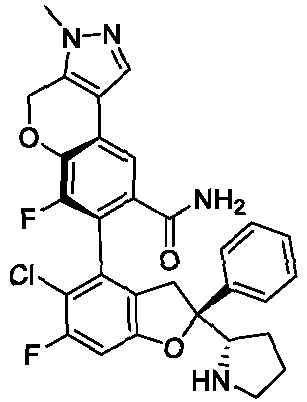
(S)-7-((S)-5-Chloro-6-fluoro-2-phenyl-2-((S)-pyrrolidin-2-yl)-2,3-dihydrobenzofuran-4-yl)-6-fluoro-3-methy1-3,4-dihydrochromeno[3,4-c]pyrazole-8-carboxamide LC-MS: m/z 563.2 [M+H]+. B53 51 A25 
(S)-7-((2S,3S)-5-Chloro-3,6-difluoro-2-phenyl-2-((S)-pyrrolidin-2-yl)-2,3-dihydrobenzofuran-4-yl)-6-fluoro-2-methyl-2,4-dihydrochromeno [3,4-c]pyrazole-8-carboxamide LCMS: m/z 581.2 [M+H]+. B2 52 A16 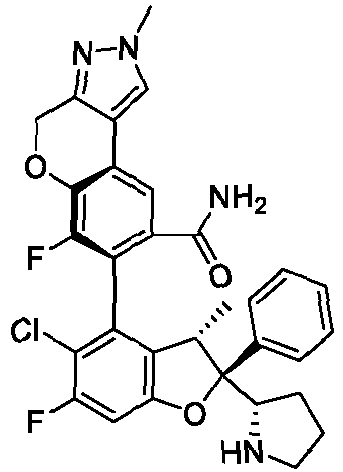
(S)-7-((2S,3S)-5-Chloro-6-fluoro-3-methyl-2-phenyl-2-((S)-pyrrolidin-2-yl)-2,3-dihydrobenzofuran-4-yl)-6-fluoro-2-methyl-2,4-dihydrochromeno[3,4-c]pyrazole-8-carboxamide LCMS: m/z 577.2 [M+H]+. B2 53 A17 
(S)-7-((2S,3S)-5-Chloro-6-fluoro-3-hydroxy-2-phenyl-2-((S)-pyrrolidin-2-yl)-2,3-dihydrobenzofuran-4-yl)-6-fluoro-2-methyl-2,4-dihydrochromeno [3,4-c]pyrazole-8-carboxamide LCMS: m/z 579.2 [M+H]+. B2 54 A15 
(S)-7-((2S,3S)-5-Chloro-6-fluoro-3-methoxy-2-phenyl-2-((S)-pyrrolidin-2-yl)-2,3-dihydrobenzofuran-4-yl)-6-fluoro-2-methyl-2,4-dihydrochromeno [3,4-c]pyrazole-8-carboxamide LCMS: m/z 593.2 [M+H]+. B2 55 A20 
(7S)-7-((2S)-5-Chloro-6-fluoro-2-((2S)-4-hydroxypyrrolidin-2-yl)-2-phenyl-2,3-dihydrobenzofuran-4-yl)-6-fluoro-2-methyl-2,4-dihydrochromeno[3,4-c]pyrazole-8-carboxamide 1H NMR (400 MHz, Methanol-d4) δ 8.02 (s, 1H), 7.49 (s, 1H), 7.45 - 7.36 (m, 5H), 7.04 (d, J = 8.0 Hz, 1H), 5.37 (s, 2H), 4.45 (s, 1H),4.25 - 4.21 (m, 1H), 3.95 (s, 3H), 3.68 - 3.65 (m, 1H), 3.34- 3.30 (m, 2H), 3.30 - 3.27 (m, 1H), 2.07 - 2.04 (m, 1H), 1.35 - 1.26 (m, 1H). B2 LCMS: m/z 579.1 [M+H]+. 62 A1 
(S)-7-((S)-5-Chloro-6-fluoro-2-phenyl-2-((S)-pyrrolidin-2-yl)-2,3-dihydrobenzofuran-4-yl)-2-ethyl-6-fluoro-2,4-dihydrochromeno [3,4-c]pyrazole-8-carboxamide 1H NMR (400 MHz, Methanol-d4) δ 7.98 (s, 1H), 7.70 (d, J = 1.4 Hz, 1H), 7.60 - 7.54 (m, 2H), 7.47 (t, J = 7.6 Hz, 2H), 7.44 - 7.35 (m, 1H), 6.99 (d, J = 9.2 Hz, 1H), 5.59 (s, 2H), 4.21 (dq, J = 22.4, 7.4 Hz, 3H), 3.68 - 3.55 (m, 1H), 3.35 (d, J = 6.7 Hz, 1H), 3.19 (ddd, J = 18.6, 15.3, 4.7 Hz, 2H), 2.29 - 2.18 (m, 1H), 2.11 - 1.88 (m, 3H), 1.44 (t, J = 7.2 Hz, 3H). B39 LCMS: m/z 577 [M+H]+. 66 A23 
(S)-8-((S)-5-Chloro-6-fluoro-2-phenyl-2-((S)-pyrrolidin-2-yl)-2,3-dihydrobenzofuran-4-yl)-9-fluorobenzo[5,6][1,4]dioxo [2,3-d]pyrimidine-7-carboxamide (S)-7-((S)-5-Chloro-6-fluoro-2-phenyl-2-((S)-pyrrolidin-2-yl)-2,3-dihydrobenzofuran-4-yl)-6-fluorobenzo[5,6][1,4]dioxo [2,3-d]pyrimidine-8-carboxamide 1H NMR (400 MHz, DMSO-d6) δ 9.02 (d, J = 17.4 Hz, 1H), 8.54 (s, 1H), 8.48 (s, 1H), 8.33 (s, 1H), 7.96 (s, 1H), 7.52 (d, J = 7.3 Hz, 3H), 7.46 (t, J = 7.5 Hz, 2H), 7.39 (d, J = 6.9 Hz, 1H), 7.37 (d, J = 1.5 Hz, 1H), 7.16 (d, J = 9.4 Hz, 1H), 4.30 (s, 1H), 3.21 - 3.02 (m, 4H), 2.18 (t, J = 7.4 Hz, 1H), 1.87 (dd, J = 17.3, 10.2 Hz, 2H), 1.72 (dd, J = 14.7, 6.4 Hz, 1H). LCMS: m/z 563 [M+H]+. 99 A1 
(S)-7-((S)-5-Chloro-6-fluoro-2-phenyl-2-((S)-pyrrolidin-2-yl)-2,3-dihydrobenzofuran-4-yl)-6-fluoro-11H-benzo[2,3][1,4]dioxa [5,6-b]pyrazine-8-carboxamide LCMS: m/z 577 [M+H]+. B71 101 A23 
(S)-8-((S)-5-Chloro-6-fluoro-2-phenyl-2-((S)-pyrrolidin-2-yl)-2,3- dihydrobenzofuran-4-yl)-9-fluoro-2-(hydroxymethyl)benzo[5,6][ 1,4]dioxo[2,3-b]pyrazine-7-carboxamide 1H NMR (400 MHz, Methanol-d4) δ 7.97 (s, 1H), 7.62 - 7.35 (m, 5H), 7.28 (d, J = 1.8 Hz, 1H), 7.02 (d, J = 9.1 Hz, 1H), 4.57 (s, 2H), 4.22 (t, J = 8.4 Hz, 1H), 3.62 (d, J = 16.5 Hz, 1H), 3.34 (s, 1H), 3.24 - 3.15 (m, 2H), 2.30 - 2.20 (m, 1H), 2.08 - 1.99 (m, 2H), 1.92 (dd, J = 12.7, 8.5 Hz, 1H). C2 LCMS: m/z 593 [M+H]+. 102 A23 
(S)-8-((S)-5-Chloro-6-fluoro-2-phenyl-2-((S)-pyrrolidin-2-yl)-2,3-dihydrobenzofuran-4-yl)-9-fluoro-3-(hydroxymethyl)benzo[5,6][ 1,4]dioxo [2,3-b]pyrazine-7-carboxamide 1H NMR (400 MHz, Methanol-d4) δ 7.93 (d, J = 0.9 Hz, 1H), 7.60 - 7.38 (m, 5H), 7.28 (d, J = 1.8 Hz, 1H), 7.03 (d, J = 9.1 Hz, 1H), 4.59 (d, J = 0.8 Hz, 2H), 4.24 (dd, J = 9.5, 7.3 Hz, 1H), 3.62 (dd, J = 16.2, 1.5 Hz, 1H), 3.35 (d, J = 7.1 Hz, 1H), 3.24 - 3.16 (m, 2H), 2.31 - 2.20 (m, 1H), 2.03 (dt, J = 13.5, 5.2 Hz, 2H), 1.96 - 1.88 (m, 1H). C2 LCMS: m/z 593 [M+H]+. 104 A1 
(S)-8-((S)-5-Chloro-6-fluoro-2-phenyl-2-((S)-pyrrolidin-2-yl)-2,3-dihydrobenzofuran-4-yl)-9-fluoro-5-hydroxy-5H-benzo [2,3-b]pyridine-7-carboxamide 1H NMR (400 MHz, DMSO-d6) δ 8.36 (d, J = 13.0 Hz, 2H), 8.16 (d, J = 7.4 Hz, 1H), 7.78 (d, J = 15.5 Hz, 1H), 7.57 - 7.37 (m, 5H), 7.22 - 7.16 (m, 1H), 5.94 - 5.84 (m, 1H), 3.68 - 3.65 (m, 1H), 3.30 - 3.27 (m, 4H), 2.10 - 1.90 (m, 4H). B70 LCMS: m/z 576.1 [M+H]+. 107 A23 
(S)-8-((S)-5-Chloro-6-fluoro-2-phenyl-2-((S)-pyrrolidin-2-yl)-2,3-dihydrobenzofuran-4-yl)-9-fluoro-1-oxo-1,2-dihydrobenzo[5,6][1,4]diox o [2,3-d]pyridazine-7-carboxamide 1H NMR (400 MHz, DMSO-d6) δ 13.31 (s, 1H), 9.14 (s, 1H), 8.34 (s, 1H), 7.95 (s, 1H), 7.93 (s, 1H), 7.53 (d, J = 7.2 Hz, 3H), 7.46 (t, J = 7.5 Hz, 2H), 7.41 - 7.35 (m, 1H), 7.22 (d, J = 1.6 Hz, 1H), 7.16 (d, J = 9.3 Hz, 1H), 4.30 (s, 1H), 3.58 (d, J = 16.4 Hz, 1H), 3.16 (s, 1H), 3.05 (t, J = 8.3 Hz, 2H), 2.18 (s, 1H), 1.91 - 1.82 (m, 2H), 1.75 - 1.70 (m, 1H). LCMS: m/z 579 [M+H]+. 108 A23 
(S)-8-((S)-5-Chloro-6-fluoro-2-phenyl-2-((S)-pyrrolidin-2-yl)-2,3-dihydrobenzofuran-4-yl)-9-fluoro-4-oxo-3,4-dihydrobenzo[5,6][1,4]diox o [2,3-d]pyridazine-7-carboxamide 1H NMR (400 MHz, DMSO-d6) δ 13.31 (s, 1H), 9.13 (s, 1H), 8.32 (s, 1H), 7.95 (s, 1H), 7.91 (s, 1H), 7.53 (d, J = 7.1 Hz, 3H), 7.46 (t, J = 7.6 Hz, 2H), 7.38 (t, J = 7.2 Hz, 1H), 7.27 (s, 1H), 7.16 (d, J = 9.3 Hz, 1H), 4.30 (s, 1H), 3.58 (d, J = 17.5 Hz, 1H), 3.11 (d, J = 40.9 Hz, 3H), 2.19 (d, J = 7.5 Hz, 1H), 1.92 - 1.82 (m, 2H), 1.71 (s, 1H). LCMS: m/z 579 [M+H]+. 109 A23 
(S)-8-((S)-5-Chloro-6-fluoro-2-phenyl-2-((S)-pyrrolidin-2-yl)-2,3-dihydrobenzofuran-4-yl)-2-ethyl-9-fluoro-1-oxo-1,2-dihydrobenzo[5,6][1,4]diox o [2,3-d]pyridazine-7-carboxamide 1H NMR (400 MHz, DMSO-d6) δ 9.00 (s, 1H), 8.33 (s, 1H), 8.01 (s, 1H), 7.97 (s, 1H), 7.53 (d, J = 7.2 Hz, 2H), 7.46 (t, J = 7.6 Hz, 2H), 7.39 (t, J = 9.2 Hz, 2H), 7.22 (s, 1H), 7.17 (d, J = 9.3 Hz, 1H), 4.29 (s, 1H), 4.10 - 4.01 (m, 2H), 3.56 (s, 1H), 3.50 (s, 3H), 3.16 (s, 1H), 3.05 (d, J = 16.6 Hz, 2H), 2.18 (s, 1H), 1.85 (s, 2H), 1.68 (s, 1H). LCMS: m/z 607 [M+H]+. 110 A23 
(S)-8-((S)-5-Chloro-6-fluoro-2-phenyl-2-((S)-pyrrolidin-2-yl)-2,3-dihydrobenzofuran-4-yl)-3-ethyl-9-fluoro-4-oxo-3,4-dihydrobenzo[5,6][1,4]diox o [2,3-d]pyridazine-7-carboxamide 1H NMR (400 MHz, DMSO-d6) δ 9.03 (s, 1H), 8.33 (s, 1H), 8.01 (s, 1H), 7.96 (s, 1H), 7.53 (d, J = 7.4 Hz, 2H), 7.46 (t, J = 7.6 Hz, 2H), 7.40 (d, J = 8.5 Hz, 2H), 7.31 (d, J = 1.5 Hz, 1H), 7.16 (d, J = 9.3 Hz, 1H), 4.30 (s, 1H), 4.07 (q, J = 7.2 Hz, 2H), 3.58 (d, J = 17.2 Hz, 1H), 3.41 (s, 3H), 3.16 (s, 1H), 3.03 (d, J = 16.8 Hz, 2H), 2.18 (t, J = 7.4 Hz, 1H), 1.87 (dd, J = 18.1, 9.9 Hz, 2H), 1.75 - 1.67 (m, 1H). LCMS: m/z 607 [M+H]+. 113 A23 
(S)-4-Amino-8-((S)-5-chloro-6-fluoro-2-phenyl-2-((S)-pyrrolidin-2-yl)-2,3 - dihydrobenzofuran-4-yl)-9-fluorobenzo[5,6][1,4]dioxo [2,3-d]pyrimidine-7-carboxamide 1H NMR (400 MHz, DMSO-d6) δ 9.01 (s, 1H), 8.33 (s, 1H), 7.94 (s, 1H), 7.87 (s, 1H), 7.49 (dt, J = 20.3, 7.5 Hz, 4H), 7.42 - 7.35 (m, 1H), 7.28 (d, J = 1.6 Hz, 1H), 7.16 (d, J = 9.3 Hz, 1H), 7.12 (s, 1H), 4.31 (s, 1H), 3.58 (d, J = 17.1 Hz, 1H), 3.20 - 2.97 (m, 3H), 2.19 (d, J = 6.8 Hz, 1H), 1.95 - 1.80 (m, 2H), 1.78 - 1.68 (m, 1H). LCMS: m/z 578 [M+H]+. 114 A23 
(S)-4-Amino-7-((S)-5-chloro-6-fluoro-2-phenyl-2-((S)-pyrrolidin-2-yl)-2,3-dihydrobenzofuran-4-yl)-6-fluorobenzo [5,6][1,4]dioxo [2,3-d]pyrimidine-8-carboxamide 1H NMR (400 MHz, DMSO-d6) δ 8.27 - 8.22 (m, 1H), 7.51 - 7.33 (m, 5H), 7.26 (d, J = 8.7 Hz, 2H), 7.23 -7.18 (m, 1H), 6.83 (s, 1H), 6.70 - 6.65 (m, 1H), 6.63 (s, 1H), 3.81 (s, 1H), 3.51 (s, 2H), 2.93 (s, 2H), 1.99 (d, J = 7.5 Hz, 4H). LCMS: m/z 578 [M+H]+. 116 A24 
(S)-7-((S)-5-Chloro-6-fluoro-2-(phenyl-d 5)-2-((S)-pyrrolidin-2-yl)-2,3-dihydrobenzofuran-4-yl)-6-fluoro-2-methyl-2,4-dihydrochromeno [3,4-c]pyrazole-8-carboxamide 1H NMR (400 MHz, Methanol-d4) δ 7.99 (s, 1H), 7.60 (d, J = 1.4 Hz, 1H), 6.91 (d, J = 9.3 Hz, 1H), 5.34 (s, 2H), 3.95 (m, 1H), 3.93 (s, 3H), 3.61-3.46 (m, 1H), 3.17-3.07 (m, 2H), 3.04-2.95 (m, 1H), 2.15-1.70 (m, 4H). B2 LCMS: m/z 568.30 [M+H]+. 117 A24 
(S)-7-((S)-5-Chloro-6-fluoro-2-(phenyl-d5)-2-((S)-pyrrolidin-2-yl)-2,3-dihydrobenzofuran-4-yl)-6-fluoro-2-methyl-2,4-dihydrochromeno [3,4-c]pyrazole-8-carboxamide 1H NMR (400 MHz, Methanol-d4) δ 7.98 (s, 1H), 7.56 (d, J = 1.6 Hz, 1H), 6.91 (d, J = 9.3 Hz, 1H), 5.38 (s, 2H), 4.00-3.94 (m, 1H), 3.93 (s, 3H), 3.44 (d, J = 17.5 Hz, 1H), 3.31 (d, J = 1.6 Hz, 1H), 3.16-2.92 (m, 2H), 2.11-1.66 (m, 4H). B2 LCMS: m/z 568.40 [M+H]+. 122 (or 123) A23 
(S)-8-((S)-5-Chloro-6-fluoro-2-phenyl-2-((S)-pyrrolidin-2-yl)-2,3-dihydrobenzofuran-4-yl)-9-fluoro-2-methyl-3-oxo-2,3-trihydrobenzo [5,6][1,4]dioxo[2,3-c]pyridazine-7-carboxamide 1H NMR (400 MHz, Methanol-d 4) δ 7.58 - 7.52 (m, 2H), 7.48 (dd, J = 8.5, 6.7 Hz, 2H), 7.43 - 7.38 (m, 1H), 7.34 (d, J = 1.8 Hz, 1H), 7.03 (d, J = 9.2 Hz, 1H), 4.25 (dd, J = 9.5, 7.3 Hz, 1H), 3.62 (s, 4H), 3.34 (t, J = 5.2 Hz, 1H), 3.23 - 3.13 (m, 2H), 2.30 - 2.22 (m, 1H), 2.03 (q, J = 7.0, 6.2 Hz, 2H), 1.93 (dt, J = 12.9, 8.8 Hz, 1H). LCMS: m/z 593 [M+H]+. 123 (or 122) A23 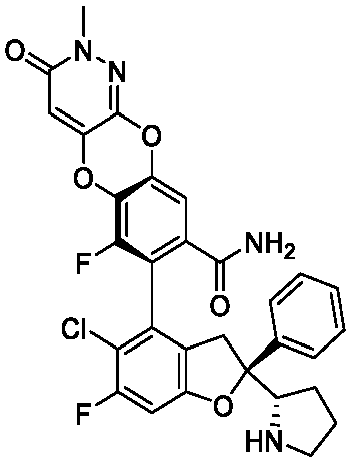
(S)-7-((S)-5-Chloro-6-fluoro-2-phenyl-2-((S)-pyrrolidin-2-yl)-2,3-dihydrobenzofuran-4-yl)-6-fluoro-1-methyl-3-oxo-2,3-trihydrobenzo [5,6][1,4]dioxo [2,3-c]pyridazine-8-carboxamide 1H NMR (400 MHz, Methanol-d4) δ 7.58 - 7.52 (m, 2H), 7.51 - 7.45 (m, 2H), 7.44 - 7.38 (m, 1H), 7.34 (d, J = 1.8 Hz, 1H), 7.03 (d, J = 9.1 Hz, 1H), 6.56 (s, 1H), 4.26 (dd, J = 9.5, 7.3 Hz, 1H), 3.60 (s, 4H), 3.36 -3.32 (m, 1H), 3.23 -3.15 (m, 2H), 2.31 - 2.17 (m, 1H), 2.03 (dd, J = 14.3, 6.9 Hz, 2H), 1.96 - 1.86 (m, 1H). LCMS: m/z 593 [M+H]+. 128 A23 
(S)-8-((S)-5-Chloro-6-fluoro-2-phenyl-2-((S)-pyrrolidin-2-yl)-2,3-dihydrobenzofuran-4-yl)-2-cyclopropyl-9-fluoro-3-oxo-2,3-hydrobenzo[5,6][1,4]dioxo [2,3-c]pyridazine-7-carboxamide 1H NMR (400 MHz, Methanol-d4) δ 7.57 - 7.38 (m, 5H), 7.33 (d, J = 1.7 Hz, 1H), 7.03 (d, J = 9.1 Hz, 1H), 6.56 (s, 1H), 4.32 - 4.19 (m, 1H), 3.88 (dt, J = 7.6, 3.5 Hz, 1H), 3.61 (d, J = 16.6 Hz, 1H), 3.35 (d, J = 7.3 Hz, 1H), 3.23 - 3.13 (m, 2H), 2.30 - 2.21 (m, 1H), 2.04 (dt, J = 13.6, 7.3 Hz, 2H), 1.92 (dd, J = 12.6, 8.8 Hz, 1H), 1.08 - 0.96 (m, 4H). LCMS: m/z 619 [M+H]+. 129 A23 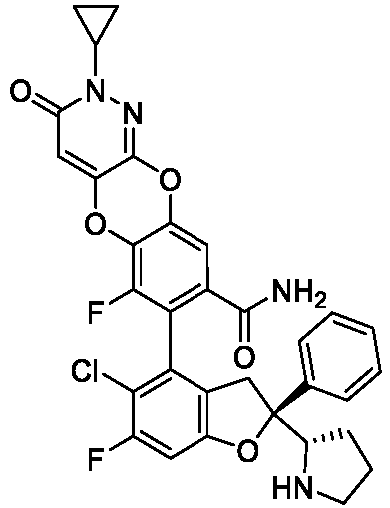
(S)-8-((S)-5-Chloro-6-fluoro-2-phenyl-2-((S)-pyrrolidin-2-yl)-2,3-dihydrobenzofuran-4-yl)-2-cyclopropyl-9-fluoro-3-oxo-2,3-hydrobenzo[5,6][1,4]dioxo [2,3-c]pyridazine-7-carboxamide 1H NMR (400 MHz, Methanol-d4) δ 7.58 - 7.37 (m, 5H), 7.34 (d, J = 1.9 Hz, 1H), 7.03 (d, J = 9.1 Hz, 1H), 6.55 (s, 1H), 4.26 (dd, J = 9.5, 7.3 Hz, 1H), 3.87 (tt, J = 7.6, 4.0 Hz, 1H), 3.61 (dd, J = 16.2, 1.5 Hz, 1H), 3.37 - 3.32 (m, 1H), 3.24 - 3.13 (m, 2H), 2.30 - 2.19 (m, 1H), 2.05 (dq, J = 14.1, 7.0, 6.5 Hz, 2H), 1.95 - 1.85 (m, 1H), 1.05 (dd, J = 4.0, 2.4 Hz, 2H), 1.00 - 0.92 (m, 2H). LCMS: m/z 619 [M+H]+. 137 A23 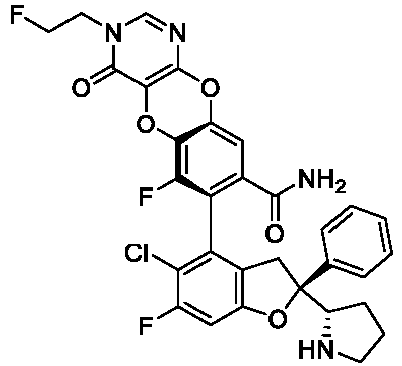
(S)-7-((S)-5-Chloro-6-fluoro-2-phenyl-2-((S)-pyrrolidin-2-yl)-2,3-dihydrobenzofuran-4-yl)-6-fluoro-3-(2-fluoroethyl)-4-oxo-3,4-dihydrobenzo[5,6][1,4]diox o [2,3-d]pyrimidine-8-carboxamide 1H NMR (400 MHz, DMSO-d6) δ 9.16 (s, 1H), 8.29 (s, 1H), 8.23 (d, J = 7.9 Hz, 1H), 7.95 (s, 1H), 7.52 (d, J = 7.2 Hz, 3H), 7.45 (t, J = 7.5 Hz, 2H), 7.41 - 7.36 (m, 1H), 7.33 (s, 1H), 7.16 (d, J = 9.3 Hz, 1H), 4.79 (d, J = 3.9 Hz, 1H), 4.67 (s, 2H), 4.61 (d, J = 3.5 Hz, 1H), 4.30 (s, 1H), 3.58 (d, J = 17.0 Hz, 1H), 3.15 (s, 2H), 3.03 (d, J= 17.3 Hz, 1H), 2.17 (s, 1H), 1.86 (dd,J= 18.7, 10.7 Hz, 2H), 1.76 - 1.69 (m, 1H). LCMS: m/z 625 [M+H]+. 138 A23 
(S)-8-((S)-5-Chloro-6-fluoro-2-phenyl-2-((S)-pyrrolidin-2-yl)-2,3-dihydrobenzofuran-4-yl)-9-fluoro-3-(2-fluoroethyl)-4-oxo-3,4-dihydrobenzo[5,6][1,4]diox o [2,3-d]pyrimidine-7-carboxamide 1H NMR (400 MHz, DMSO-d6) δ 9.50 (s, 1H), 8.35 (s, 1H), 8.27 (d, J = 8.7 Hz, 1H), 7.94 (s, 1H), 7.53 (d, J = 7.7 Hz, 3H), 7.44 (t, J = 7.4 Hz, 2H), 7.38 (d, J = 7.1 Hz, 1H), 7.28 (s, 1H), 7.15 (d, J = 9.3 Hz, 1H), 4.71 (s, 1H), 4.60 (s, 1H), 4.29 (s, 2H), 4.22 (s, 1H), 3.59 (d, J = 17.0 Hz, 1H), 3.12 (s, 2H), 3.03 (d, J = 17.2 Hz, 1H), 2.15 (s, 1H), 1.92 - 1.77 (m, 2H), 1.74 (d, J = 8.0 Hz, 1H). LCMS: m/z 625 [M+H]+. 139 A23 
(S)-7-((S)-5-Chloro-6-fluoro-2-phenyl-2-((S)-pyrrolidin-2-yl)-2,3-dihydrobenzofuran-4-yl)-3-cyclopropyl-6-fluoro-4-oxo-3,4-dihydrobenzo[5,6][1,4]diox o [2,3-d]pyrimidine-8-carboxamide 1H NMR (400 MHz, DMSO-d6) δ 9.14 (s, 1H), 8.31 (s, 1H), 8.26 (s, 1H), 7.95 (s, 1H), 7.46 (tt, J = 20.7, 14.8 Hz, 6H), 7.30 (d, J = 17.1 Hz, 1H), 7.16 (d, J = 9.1 Hz, 1H), 4.37 (d, J = 3.3 Hz, 1H), 4.30 (s, 1H), 3.12 (d, J = 32.3 Hz, 4H), 2.18 (s, 1H), 1.86 (dd, J = 17.9, 10.4 Hz, 2H), 1.73 (d, J = 12.6 Hz, 1H), 0.87 - 0.78 (m, 4H). LCMS: m/z 619 [M+H]+. 140 A23 
(S)-8-((S)-5-Chloro-6-fluoro-2-phenyl-2-((S)-pyrrolidin-2-yl)-2,3-dihydrobenzofuran-4-yl)-3-cyclopropyl-9-fluoro-4-oxo-3,4-dihydrobenzo[5,6][1,4]diox o [2,3-d]pyrimidine-7-carboxamide 1H NMR (400 MHz, DMSO-d 6) δ 9.07 (s, 1H), 8.33 (s, 1H), 8.19 (d, J = 7.8 Hz, 1H), 7.93 (s, 1H), 7.56 - 7.34 (m, 6H), 7.27 (s, 1H), 7.16 (d, J = 9.3 Hz, 1H), 4.28 (s, 1H), 3.58 (d, J = 17.0 Hz, 1H), 3.20 (s, 2H), 3.11 - 3.06 (m, 2H), 2.18 (s, 2H), 1.84 (d, J = 7.4 Hz, 1H), 1.74 (s, 1H), 1.01 (d, J = 6.9 Hz, 2H), 0.93 (d, J = 3.9 Hz, 2H). LCMS: m/z 619 [M+H]+. 145 A23 
(S)-8-((S)-5-Chloro-6-fluoro-2-phenyl-2-((S)-pyrrolidin-2-yl)-2,3-dihydrobenzofuran-4-)-9-fluoro-2-(oxetan-3-yl)-1-oxo-1,2-dihydrobenzo[5,6][1,4]diox o [2,3-d]pyridazine-7-carboxamide 1H NMR (400 MHz, Methanol-d4) δ 8.01-7.93 (m, 1H), 7.57 - 7.50 (m, 2H), 7.48 - 7.33 (m, 3H), 7.20 (d, J = 1.9 Hz, 1H), 7.02 (d, J = 9.1 Hz, 1H), 4.99 - 4.89 (m, 2H), 4.85 - 4.79 (m, 1H), 4.26 (t, J = 8.5 Hz, 1H), 3.96 - 3.81 (m, 2H), 3.64 (d, J = 16.6 Hz, 1H), 3.35 (d, J = 7.3 Hz, 1H), 3.25 - 3.12 (m, 2H), 2.26 (d, J = 8.8 Hz, 1H), 2.05 (q, J = 7.6 Hz, 2H), 1.95 - 1.84 (m, 1H). LCMS: m/z 635 [M+H]+. 146 A23 
(S)-8-((S)-5-Chloro-6-fluoro-2-phenyl-2-((S)-pyrrolidin-2-yl)-2,3-dihydrobenzofuran-4-yl)-9-fluoro-N-methyl-2-(oxetan-3-yl)-1-oxo-1,2-dihydrobenzo[5,6][1,4]diox o [2,3-d]pyridazine-7-carboxamide LCMS: m/z 649 [M+H]+. 148 A28 
(S)-8-((S)-5-Chloro-6-fluoro-2-phenyl-2-((S)-pyrrolidin-2-yl)-2,3-dihydrobenzofuran-4-yl)-2-(3,3-difluorocyclobutyl)-9-fluoro-N-methyl-1-oxo-1,2-dihydrobenzo[5,6][1,4]diox o [2,3-d]pyridazine-7-carboxamide LCMS: m/z 683 [M+H]+. 150 A28 
(S)-8-((S)-5-Chloro-6-fluoro-2-phenyl-2-((S)-pyrrolidin-2-yl)-2,3-dihydrobenzofuran-4-yl)-9-fluoro-2-(2-methoxyethyl)-N-methyl-1-oxo-1,2-dihydrobenzo[5,6][1,4]diox o [2,3-d]pyridazine-7-carboxamide ] LCMS: m/z 651 [M+H]+. 151 A23 
(S)-8-((S)-5-Chloro-6-fluoro-2-phenyl-2-((S)-pyrrolidin-2-yl)-2,3-dihydrobenzofuran-4-yl)-9-fluoro-N-methyl-2-(methyl-d3)-1-oxo-1,2-dihydrobenzo[5,6][1,4]diox o [2,3-d]pyridazine-7-carboxamide LCMS: m/z 610 [M+H]+. 152 A27 
(S)-8-((S)-5-Chloro-6-fluoro-2-phenyl-2-((S)-pyrrolidin-2-yl-2,5,5-d 3)-2,3-dihydrobenzofuran-4-yl)-2-(2,2-difluoroethyl)-9-fluoro-1-oxo-1,2-dihydrobenzo[5,6][1,4]diox o [2,3-d]pyridazine-7-carboxamide LCMS: m/z 646 [M+H]+. 153 A27 
(S)-8-((S)-5-Chloro-6-fluoro-2-phenyl-2-((S)-pyrrolidin-2-yl-2,5,5-d 3)-2,3 -dihydrobenzofuran-4-yl)-9-fluoro-1-oxo-2-(2,2,2-trifluoroethyl)-1,2-dihydroxybenzo[5,6][1,4]di oxo [2,3-d]pyridazine-7-carboxamide LCMS: m/z 664 [M+H]+. 154 A27 
(S)-8-((S)-5-Chloro-6-fluoro-2-phenyl-2-((S)-pyrrolidin-2-yl-2,5,5-d 3)-2,3 -dihydrobenzofuran-4-yl)-2-(3,3-difluorocyclobutyl)-9-fluoro-1-oxo-1,2-dihydrobenzo[5,6][1,4]diox o [2,3-d]pyridazine-7-carboxamide LCMS: m/z 672 [M+H]+. 155 A27 
(S)-8-((S)-5-Chloro-6-fluoro-2-phenyl-2-((S)-pyrrolidin-2-yl-2,5,5-d 3)-2,3-dihydrobenzofuran-4-yl)-9-fluoro-1-oxo-2-(3,3,3-trifluoropropyl)-1,2-dihydroxybenzo[5,6][1,4]di oxo [2,3-d]pyridazine-7-carboxamide LCMS: m/z 678 [M+H]+. 156 A27 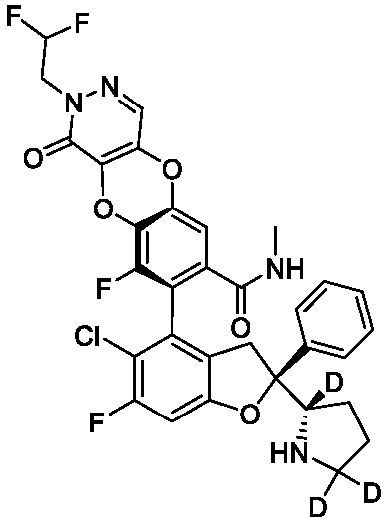
(S)-8-((S)-5-Chloro-6-fluoro-2-phenyl-2-((S)-pyrrolidin-2-yl-2,5,5-d 3)-2,3-dihydrobenzofuran-4-yl)-2-(2,2-difluoroethyl)-9-fluoro-N-methyl-1-oxo-1,2-dihydrobenzo[5,6][1,4]diox o [2,3-d]pyridazine-7-carboxamide LCMS: m/z 660 [M+H]+. 157 A27 
(S)-8-((S)-5-Chloro-6-fluoro-2-phenyl-2-((S)-pyrrolidin-2-yl-2,5,5-d3)-2,3-dihydrobenzofuran-4-yl)-9-fluoro-N-methyl-1-oxo-2-(2,2,2-trifluoroethyl)-1,2-dihydroxybenzo[5,6][1,4]di oxo [2,3-d]pyridazine-7-carboxamide LCMS: m/z 678 [M+H]+. 158 A27 
(S)-8-((S)-5-Chloro-6-fluoro-2-phenyl-2-((S)-pyrrolidin-2-yl-2,5,5-d 3)-2,3 -dihydrobenzofuran-4-yl)-2-(3,3-difluorocyclobutyl)-9-fluoro-N-methyl-1-oxo-1,2-dihydrobenzo[5,6][1,4]diox o [2,3-d]pyridazine-7-carboxamide LCMS: m/z 686 [M+H]+. 159 A27 
(S)-8-((S)-5-Chloro-6-fluoro-2-phenyl-2-((S)-pyrrolidin-2-yl-2,5,5-d3)-2,3-dihydrobenzofuran-4-yl)-9-fluoro-N-methyl-1-oxo-2-(3,3,3-trifluoropropyl)-1,2-dihydroxybenzo[5,6][1,4]di oxo [2,3-d]pyridazine-7-carboxamide LCMS: m/z 692 [M+H]+. 160 A28 
(S)-8-((S)-5-Chloro-6-fluoro-2-phenyl-2-((S)-pyrrolidin-2-yl-2,5,5-d3)-2,3-dihydrobenzofuran-4-yl)-9-fluoro-N-methyl-1-oxo-2-(3,3,3-trifluoropropyl)-1,2-dihydroxybenzo[5,6][1,4]di oxo [2,3-d]pyridazine-7-carboxamide 1H NMR (400 MHz, Methanol-d4) δ 7.80 (s, 1H), 7.45 (dd, J = 7.5, 1.6 Hz, 2H), 7.36 (t, J = 7.5 Hz, 2H), 7.30 (d, J = 7.2 Hz, 1H), 7.00 - 6.92 (m, 2H), 6.13 (tt, J = 55.6, 4.2 Hz, 1H), 4.41 (td, J = 13.7, 4.3 Hz, 2H), 4.21 - 4.13 (m, 1H), 3.55 (d, J = 16.4 Hz, 1H), 3.31 - 3.24 (m, 1H), 3.11 (d, J = 16.4 Hz, 2H), 2.56 (tt, J = 7.5, 3.9 Hz, 1H), 2.20 (dd, J = 12.1, 5.4 Hz, 1H), 1.95 (dd, J = 14.8, 7.2 Hz, 2H), 1.89 - 1.78 (m, 1H), 0.68 - 0.57 (m, 2H), 0.46 (dd, J = 10.5, 4.4 Hz, 1H), 0.30 (dt, J = 10.7, 4.9 Hz, 1H). LCMS: m/z 683 [M+H]+. I-1 A11 
(S)-7-((S)-(5-Chloro-6-fluoro-2-((methylamino)methyl)-2-phenyl-2,3-dihydrobenzofuran-4-yl)-8-fluoroimidazo[1,2-a]pyridine-6-carboxamide 1H NMR (400 MHz, Methanol-d4) δ 8.99 (s, 1H), 8.26 (dd, J = 2.8, 1.6 Hz, 1H), 7.94 (d, J = 1.7 Hz, 1H), 7.57 - 7.39 (m, 5H), 7.12 (d, J = 9.1 Hz, 1H), 3.68 (s, 2H), 3.57 (dd, J = 16.4, 1.5 Hz, 1H), 3.30 - 3.24 (m, 1H), 2.69 (s, 3H). I-B1 LCMS: m/z 469.3 [M+H]+. I-2 A11 
(S)-5-((S)-5-Chloro-6-fluoro-2-((methylamino)methyl)-2-phenyl-2,3-dihydrobenzofuran-4-yl)-4-fluoro-1-methyl-1H-indole-6-carboxamide 1H NMR (400 MHz, DMSO-d6) δ B3 8.59 (s, 1H), 8.43 (s, 1H), 7.93 (s, 1H), 7.77 (s, 1H), 7.58 (d, J = 3.1 Hz, 1H), 7.52 - 7.31 (m, 6H), 7.15 (d, J = 9.4 Hz, 1H), 6.53 (d, J = 3.0 Hz, 1H), 3.90 (s, 3H), 3.66 - 3.48 (m, 6H), 3.98 - 2.94 (d, J = 16.4 Hz, 1H). LC-MS: m/z 482 [M+H]+. I-16 A11 
(S)-7-((S)-5-Chloro-6-fluoro-2-((methylamino)methyl)-2-phenyl-2,3-dihydrobenzofuran-4-yl)-8-fluoro-2-methylimidazo[1,2-a]pyridine-6-carboxamide 1H NMR (400 MHz, MeOD-d 4) δ I-B5 8.73 (s, 1H), 7.84 (d, J = 2.3 Hz, 1H), 7.51 - 7.35 (m, 6H), 7.01 (d, J = 9.3 Hz, 1H), 3.49 (s, 1H), 3.39 (d, J = 5.1 Hz, 1H), 3.35 (s, 1H), 3.20 (dd, J = 16.1, 1.5 Hz, 1H), 2.52 (s, 3H), 2.45 (t, J = 3.2 Hz, 3H). LCMS: m/z 483.1 [M+H]+. I-17 A11 
(S)-7-((S)-5-Chloro-6-fluoro-2-((methylamino)methyl)-2-phenyl-2,3-dihydrobenzofuran-4-yl)-8-fluoro-3,4-dihydro-2H-benzo[b][1,4]oxazine-6-carboxamide 1H NMR (400 MHz, Methanol-d 4) δ 7.45 - 7.40 (m, 2H), 7.39 - 7.32 (m, 2H), 7.31 - 7.26 (m, 1H), 6.88 (d, J = 9.2 Hz, 1H), 6.83 (d, J = 1.5 Hz, 1H), 4.32 - 4.21 (m, 2H), 3.60 (d, J = 13.3 Hz, 1H), 3.50 (s, 1H), 3.45-3.44 (m, 2H), 3.27 - 3.21 (m, 2H), 2.54 (s, 3H). I-B8 LCMS: m/z 486 [M+H]+. I-23 A1 
(S)-7-((S)-5-Chloro-6-fluoro-2-phenyl-2-((S)-pyrrolidin-2-yl)-2,3 - dihydrobenzofuran-4-yl)-8-fluoro-3-oxo-3,4-dihydro-2H-benzo[b][1,4]oxazine-6-carboxamide 1H NMR (400 MHz, Methanol-d 4) δ 7.55 - 7.36 (m, 5H), 7.08 (d, J = 1.3 Hz, 1H), 6.96 (d, J = 9.2 Hz, 1H), 4.72 (s, 2H), 4.06 (t, J = 8.1 Hz, 1H), 3.56 (d, J = 17.3 Hz, 1H), 3.25 - 3.03 (m, 4H), 2.12 (dd, J = 12.1, 5.0 Hz, 1H), 2.00 - 1.79 (m, 3H). I-B7 LCMS: m/z 526.1 [M+H]+. I-24 A1 
(S)-7-((S)-5-Chloro-6-fluoro-2-phenyl-2-((S)-pyrrolidin-2-yl)-2,3 -dihydrobenzofuran-4-yl)-8-fluoro-4-methyl-3,4-dihydro-2H-benzo[b][1,4]oxazine-6-carboxamide 1H NMR (400 MHz, Methanol-d 4) δ 7.56 (d, J = 7.5 Hz, 2H), 7.46 (t, J = 7.2 Hz, 2H), 7.38 (t, J = 7.2 Hz, 1H), 6.94 (d, J = 9.2 Hz, 2H), 4.35 (t, J = 3.9 Hz, 2H), 4.23 (d, J = 8.9 Hz, 1H), 3.67 - 3.61 (m, 1H), 3.60 - 3.52 (m, 1H), 3.40 (d, J = 4.3 Hz, 2H), 3.26 - 3.09 (m, 2H), 3.03 (s, 3H), 2.20 (d, J = 11.6 Hz, 1H), 2.04 (s, 2H), 1.93 (s, 1H). I-B9 LCMS: m/z 526.2 [M+H]+. I-25 A1 
(S)-7-((S)-5-Chloro-6-fluoro-2-phenyl-2-((S)-pyrrolidin-2-yl)-2,3-dihydrobenzofuran-4-yl)-8-fluoro-4-methyl-3-oxo-3,4-dihydro-2H-benzo[b][1,4]oxazine-6-carboxamide 1H NMR (400 MHz, Methanol-d 4) δ 7.55 (d, J = 7.4 Hz, 2H), 7.47 (t, J = 7.6 Hz, 2H), 7.41 (d, J = 7.2 Hz, 1H), 7.34 (s, 1H), 7.00 (d, J = 9.1 Hz, 1H), 4.77 (s, 2H), 4.29 - 4.19 (m, 1H), 3.58 (d, J = 14.1 Hz, 1H), 3.45 (s, 3H), 3.35 (d, J = 6.3 Hz, 1H), 3.24 - 3.11 (m, 2H), 2.28 - 2.19 (m, 1H), 2.03 (dt, J = 13.0, 6.7 Hz, 2H), 1.99 - 1.90 (m, 1H). I-B10 LCMS: m/z 540.1 [M+H]+. I-27 A1 
(S)-4-Acetyl-7-((S)-5-chloro-6-fluoro-2-phenyl-2-((S)-pyrrolidin-2-yl)-2,3-dihydrobenzofuran-4-yl)-8-fluoro-3,4-dihydro-2H-benzo[b][1,4]oxazine-6-carboxamide 1H NMR (400 MHz, Methanol-d 4) δ 8.17 (s, 1H), 7.65 - 7.30 (m, 6H), 6.99 (d, J = 9.1 Hz, 1H), 4.44 (q, J = 4.9 Hz, 2H), 4.23 (dd, J = 9.5, 7.3 Hz, 1H), 4.02 (t, J = 4.5 Hz, 2H), 3.59 (dd, J = 16.5, 1.6 Hz, 1H), 3.37 - 3.32 (m, 1H), 3.24 - 3.19 (m, 1H), 3.15 (dd, J = 16.4, 1.7 Hz, 1H), 2.39 (s, 3H), 2.22 (dt, J = 12.4, 6.4 Hz, 1H), 2.09 - 1.91 (m, 3H). I-B12 LCMS: m/z 554.2 [M+H]+. I-28 A1 
(S)-5-((S)-5-Chloro-6-fluoro-2-phenyl-2-((S)-pyrrolidin-2-yl)-2,3-dihydrobenzofuran-4-yl)-4-fluoro-1-methyl-1H-indazole-6-carboxamide 1H NMR (400 MHz, Methanol-d 4) δ 8.02 (s, 1H), 7.73 (s, 1H), 7.47 - 7.41 (m, 2H), 7.37 (t, J = 7.6 Hz, 2H), 7.30 (t, J = 7.2 Hz, 1H), 6.91 (d, J = 9.2 Hz, 1H), 4.22 (d, J = 7.4 Hz, 1H), 4.14 - 4.10 (m, 1H), 4.07 (s, 3H), 3.57 (q, J = 4.9 Hz, 1H), 3.49 - 3.45 (m, 1H), 3.11 (d, J = 7.8 Hz, 1H), 2.13 (td, J = 14.6, 13.3, 6.4 Hz, 1H), 2.03 - 1.83 (m, 3H). I-B21 LCMS: m/z 509.2 [M+H]+. I-29 A1 
(S)-7-((S)-5-Chloro-6-fluoro-2-phenyl-2-((S)-pyrrolidin-2-yl)-2,3-dihydrobenzofuran-4-yl)-8-fluoro-4-propiony1-3,4-dihydro-2H-benzo[b][1,4]oxazine-6-carboxamide 1H NMR (400 MHz, CDCl3) δ 7.53 (d, J = 6.8 Hz, 2H), 7.44 - 7.27 (m, 5H), 6.87 (d, J = 8.4 Hz, 1H), 4.44 (s, 3H), 4.19 - 3.88 (m, 4H), 3.69 (d, J = 22.2 Hz, 2H), 3.33 (dd, J = 55.0, 14.4 Hz, 4H), 2.69 (s, 3H), 1.92 (s, 2H). I-B11 LCMS: m/z 568.2 [M+H]+. I-30 A1 
(S)-6-((S)-5-Chloro-6-fluoro-2-phenyl-2-((S)-pyrrolidin-2-yl)-2,3-dihydrobenzofuran-4-yl)-7-fluoro-1H-indazole-5-carboxamide 1H NMR (400 MHz, Methanol-d 4) δ 8.19 (d, J = 3.3 Hz, 1H), 7.96 (s, 1H), 7.46 (d, J = 7.7 Hz, 2H), 7.37 (t, J = 7.5 Hz, 2H), 7.31 (d, J = 7.7 Hz, 1H), 6.93 (d, J = 9.2 Hz, 1H), 3.49 (d, J = 16.5 Hz, 1H), 3.25 (s, 1H), 3.12 - 3.02 (m, 3H), 2.05 -2.11 (m, 1H), 1.96-1.90 (m, 3H). I-B13 LC-MS: m/z 495 [M+H]+. I-31 A1 
(2S,4S)-5-Chloro-6,7'-difluoro-2-phenyl-2-((S)-pyrrolidin-2-yl)-2,2',3,3'-tetrahydrofuran-[4,6'-bibenzofuran]-5'-carboxamide 1H NMR (400 MHz, Methanol-d 4) δ 7.58 - 7.38 (m, 6H), 6.97 (d, J = 9.1 Hz, 1H), 4.80 - 4.72 (m, 2H), 4.22 (t, J = 8.3 Hz, 1H), 3.76 - 3.51 (m, 2H), 3.40 - 3.34 (m, 2H), 3.17 (ddd, J = 28.9, 15.2, 4.6 Hz, 2H), 2.21 (dd, J = 12.3, 6.0 Hz, 1H), 2.11 - 1.90 (m, 3H). I-B6 LCMS: m/z 497.3 [M+H]+. I-32 A1 
8-((2S,4S)-5-Chloro-6-fluoro-2-phenyl-2-((S)-pyrrolidin-2-yl)-2,3-dihydrobenzofuran-4-yl)-9-fluoro-2,3 -dihydro-[1,4]oxazino[2,3,4-hi]indazole-7-carboxamide 1H NMR (400 MHz, MeOD) δ 8.16 (s, 1H), 7.56 - 7.50 (m, 2H), 7.47 (t, J = 7.5 Hz, 2H), 7.41 (d, J = 7.2 Hz, 1H), 7.03 (d, J = 9.2 Hz, 1H), 4.76 (t, J = 4.8 Hz, 2H), 4.58 (dt, J = 8.3, 4.4 Hz, 2H), 4.24 - 4.17 (m, 1H), 3.62 (d, J = 14.5 Hz, 1H), 3.37 - 3.32 (m, 1H), 3.25 -3.17 (m, 1H), 3.13 (d, J = 16.6 Hz, 1H), 2.29 - 2.17 (m, 1H), 2.10 - 2.01 (m, 2H), 1.99 - 1.91 (m, 1H). I-B22 LC-MS: m/z 537 [M+H]+. I-33 A1 
(S)-7-((2S)-5-Chloro-6-fluoro-2-phenyl-2-((S)-pyrrolidin-2-yl)-2,3-dihydrobenzofuran-4-yl)-8-fluoro-N-methyl-2,3-dihydrobenzo[b][1,4]dioxi ne-6-carboxamide LCMS: m/z 527.1 [M+H]+. B1 I-35 A1 
(S)-7-((2S)-5-Chloro-6-fluoro-2-phenyl-2-((S)-pyrrolidin-2-yl)-2,3-dihydrobenzofuran-4-yl)-6-fluoro-3 ,4-dihydro-5-oxa-1,2a-diazaacenaphthylene-8-carboxamide LCMS: m/z 537 [M+H]+. I-B23 I-43 A1 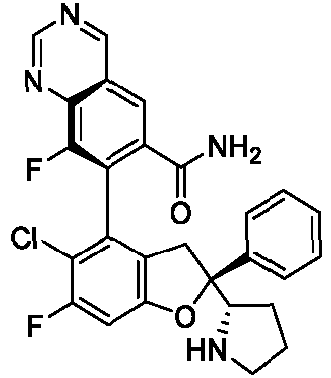
(S)-7-((S)-5-Chloro-6-fluoro-2-phenyl-2-((S)-pyrrolidin-2-yl)-2,3-dihydrobenzofuran-4-yl)-8-fluoroquinazoline-6-carboxamide LCMS: m/z 507 [M+H]+. I-B16 I-44 A1 
(S)-7-((S)-5-Chloro-6-fluoro-2-phenyl-2-((S)-pyrrolidin-2-yl)-2,3-dihydrobenzofuran-4-yl)-8-fluoroquinoxaline-6-carboxamide LCMS: m/z 507 [M+H]+. I-B17 I-52 A1 
(2S,6'S)-5-Chloro-6,7'-difluoro-2'-(hydroxymethyl)-2-phenyl-2-((S)-pyrrolidin-2-yl)-2,2',3,3'-tetrahydro-[4,6'-bibenzofuran]-5'-carboxamide 1H NMR (400 MHz, Methanol-d 4) δ 7.49 - 7.42 (m, 2H), 7.38 (t, J = 7.6 Hz, 2H), 7.35 - 7.28 (m, 2H), 6.88 (d, J = 9.1 Hz, 1H), 4.98 (td, J = 8.2, 4.0 Hz, 1H), 4.12 (td, J = 7.5, 7.1, 3.8 Hz, 1H), 3.76 (ddd, J = 12.4, 7.8, 3.5 Hz, 1H), 3.62 (ddd, J = 12.4, 8.9, 4.9 Hz, 1H), 3.46 (dd, J = 16.3, 1.7 Hz, 1H), 3.37 - 3.23 (m, 2H), 3.19 - 3.00 (m, 3H), 2.11 (dt, J = 12.6, 6.4 Hz, 1H), 2.01 - 1.78 (m, 3H). I-B26 LC-MS: m/z 527 [M+H]+. I-53 A1 
(S)-7-((S)-5-Chloro-6-fluoro-2-phenyl-2-((S)-pyrrolidin-2-yl)-2,3-dihydrobenzofuran-4-yl)-8-fluoro-2-(hydroxymethyl)-2,4-dihydrobenzo[b][1,4]dioxi ne-6-carboxamide 1H NMR (400 MHz, Methanol-d 4) δ 7.56 - 7.54 (m, 2H), 7.47 - 7.45 (m, 2H), 7.42 - 7.38 (m, 1H), 7.15 (s, 1H), 6.96 (d, J = 12.0 Hz, 1H), 4.48 - 4.45 (m, 1H), 4.35 - 4.31 (m, 1H), 4.20 - 4.12 (m, 2H), 3.83 - 3.82 (m, 2H), 3.68 - 3.66 (m, 1H), 3.42 - 3.36 (m, 1H), 3.22 - 3.13 (m, 2H), 2.22 - 2.18 (m, 1H), 1.97 - 1.90 (m, 3H). I-B27 LCMS: m/z 543.1 [M+H]+. I-56 A1 
(S)-7-((S)-5-Chloro-6-fluoro-2-phenyl-2-((S)-pyrrolidin-2-yl)-2,3-dihydrobenzofuran-4-yl)-8-fluoro-2-(hydroxymethyl)-N-methyl-2,3-dihydrobenzo[b][1,4]dioxin e-6-carboxamide 1H NMR (400 MHz, Methanol-d4) δ 7.51 - 7.49 (m, 2H), 7.41 - 7.39 (m, 2H), 7.35 - 7.30 (m, 1H), 7.06 - 7.04 (m, 1H), 6.90 (d, J = 12.0 Hz, 1H), 4.61 - 4.45 (m, 1H), 4.29 - 4.25 (m, 1H), 4.20 - 4.12 (m, 1H), 3.88 - 3.82 (m, 3H), 3.50 - 3.46 (m, 1H), 3.11 - 3.06 (m, 2H), 2.97 - 2.95 (m, 1H), 2.74 (s, 3H), 1.97 - 1.73 (m, 4H). I-B27 LCMS: m/z 557.1 [M+H]+. I-57 (or I-58) A1 
(1S,6S)-6-((S)-5-Chloro-6-fluoro-2-phenyl-2-((S)-pyrrolidin-2-yl)-2,3-dihydrobenzofuran-4-yl)-7-fluoro-1-hydroxy-2,3-dihydro-1H-indene-5-carboxamide 1H NMR (400 MHz, Methanol-d4) δ 8.51 (s, 1H), 7.56 - 7.36 (m, 5H), 6.97 (d, J = 12.0 Hz, 1H), 5.38 (dd, J = 4.0, 8.0 Hz, 1H), 4.13 (t, J = 8.0 Hz, 1H), 3.53 (d, J = 16.0 Hz, 1H), 3.28 - 3.05 (m, 3H), 2.95 - 2.85 (m, 1H), 2.51 - 2.37 (m, 1H), 2.23 - 1.82 (m, 5H). I-B24 LCMS: m/z 511 [M+H]+. I-58 (or I-57) A1 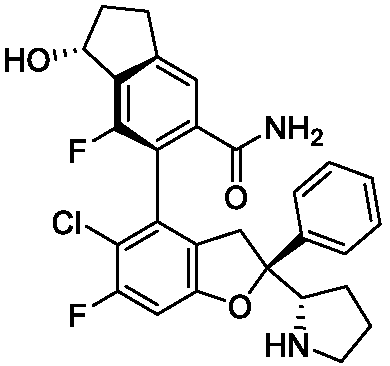
(1R,6S)-6-((1S)-5-Chloro-6-fluoro-2-phenyl-2-((S)-pyrrolidin-2-yl)-2,3-dihydrobenzofuran-4-yl)-7-fluoro-1-hydroxy-2,3-dihydro-1H-indene-5-carboxamide 1H NMR (400 MHz, Methanol-d4) δ 8.51 (s, 1H), 7.56 - 7.36 (m, 5H), 6.97 (d, J = 12.0 Hz, 1H), 5.41 (dd, J = 4.0, 8.0 Hz, 1H), 4.16 (t, J = 8.0 Hz, 1H), 3.56 (d, J = 16.0 Hz, 1H), 3.25 - 3.10 (m, 4H), 3.25 - 2.92 (m, 1H), 2.52 - 2.42 (m, 1H), 2.25 - 1.82 (m, 5H). I-B24 LCMS: m/z 511 [M+H]+. I-59 (or I-60) A1 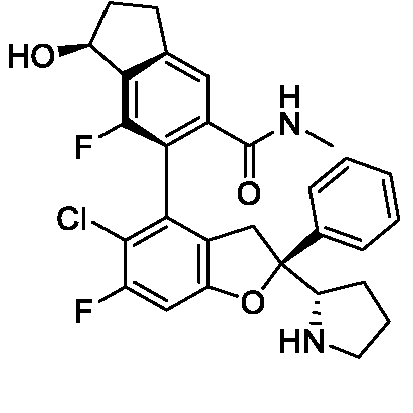
(1S,6S)-6-((S)-5-Chloro-6-fluoro-2-phenyl-2-((S)-pyrrolidin-2-yl)-2,3-dihydrobenzofuran-4-yl)-7-fluoro-1-hydroxy-N-methyl-2,3-dihydro-1H-indene-5-carboxamide LCMS: m/z 525 [M+H]+. I-B24 I-60 (or I-59) A1 
(1R,6S)-6-((S)-5-Chloro-6-fluoro-2-phenyl-2-((S)-pyrrolidin-2-yl)-2,3-dihydrobenzofuran-4-yl)-7-fluoro-1-hydroxy-N-methyl-2,3-dihydro-1H-indene-5-carboxamide LCMS: m/z 525 [M+H]+. I-B24 I-61 A1 
(1S,2S,6S)-6-((S)-5-Chloro-5-fluoro-2-phenyl-2-((S)-pyrrolidin-2-yl)-2,3-dihydrobenzofuran-4-yl)-7-fluoro-1-hydroxy-N,2-dimethy1-2,3-dihydro-1H-indene-5-carboxamide LCMS: m/z 539 [M+H]+. I-B25 I-62 A1 
(1S,2S,6S)-6-((S)-5-Chloro-6-fluoro-2-phenyl-2-((S)-pyrrolidin-2-yl)-2,3-dihydrobenzofuran-4-yl)-7-fluoro-1-hydroxy-N,2-dimethy1-2,3-dihydro-1H-indene-5-carboxamide LCMS: m/z 539 [M+H]+. I-B25 I-63 A1 
(1R,2S,6S)-6-((S)-5-Chloro-6-fluoro-2-phenyl-2-((S)-pyrrolidin-2-yl)-2,3-dihydrobenzofuran-4-yl)-7-fluoro-1-hydroxy-N,2-dimethy1-2,3-dihydro-1H-indene-5-carboxamide LCMS: m/z 539 [M+H]+. I-B25 I-64 A1 
(1R,2R,6S)-6-((S)-5-Chloro-6-fluoro-2-phenyl-2-((S)-pyrrolidin-2-yl)-2,3-dihydrobenzofuran-4-yl)-7-fluoro-1-hydroxy-N,2-dimethyl-2,2-dihydro-1H-indene-5-carboxamide LCMS: m/z 539 [M+H]+. I-B25 - The following compounds are free compounds or pharmaceutically acceptable salts.
Compound num-ber Structural formula Name Analytical data I-65 
(S)-6-((S)-5-Chloro-6-fluoro-2-((methylamino)methyl)-2-phenyl-2,3-dihydrobenzofuran-4-yl)-7-fluoro-1H-indole-5-carboxamide LC-MS: m/z = 468.1 [M+H]+. I-66 
(S)-5-((S)-5-Chloro-6-fluoro-2-((methylamino)methyl)-2-phenyl-2,3-dihydrobenzofuran-4-yl)-4-fluoroindoline-6-carboxamide LC-MS: m/z 470.3 [M+H]+. I-67 
(S)-5-((S)-5-Chloro-6-fluoro-2-((methylamino)methyl)-2-phenyl-2,3-dihydrobenzofuran-4-yl)-4-fluoro-1-(2-hydroxyethyl)indoline-6-carboxamide LC-MS: m/z 514 [M+H]+. I-68 
(S)-6-((S)-5-Chloro-6-fluoro-2-((methylamino)methyl)-2-phenyl-2,3-dihydrobenzofuran-4-yl)-7-fluoroindoline-5-carboxamide LCMS: m/z 470.2 [M+H]+. I-69 
(S)-5-((S)-5-Chloro-6-fluoro-2-((methylamino)methyl)-2-phenyl-2,3-dihydrobenzofuran-4-yl)-4-fluoro-1-methylindoline-6-carboxamide LC-MS: m/z 484 [M+H]+. I-70 
(S)-6-((S)-5-Chloro-6-fluoro-2-((methylamino)methyl)-2-phenyl-2,3-dihydrobenzofuran-4-yl)-7-fluoro-1-methylindoline-5-carboxamide LCMS: m/z 484.3 [M+H]+. I-71 
(S)-5-((S)-5-Chloro-6-fluoro-2-((methylamino)methyl)-2-phenyl-2,3-dihydrobenzofuran-4-yl)-1-ethyl-4-fluoroindoline-6-carboxamide LC-MS: m/z 498.25 [M+H]+. I-72 
(S)-6-((S)-5-Chloro-6-fluoro-2-((methylamino)methyl)-2-phenyl-2,3-dihydrobenzofuran-4-yl)-1-ethyl-7-fluoroindoline-5-carboxamide LCMS: m/z 498.3 [M+H]+. I-73 
(S)-5-((S)-5-Chloro-6-fluoro-2-((methylamino)methyl)-2-phenyl-2,3-dihydrobenzofuran-4-yl)-4-fluoro-1-methyl-1H-indole-6-carboxamide LC-MS: m/z 482 [M+H]+. I-74 
(2S,6'S)-5-Chloro-6,7'-difluoro-2-((methylamino)methyl)-2-phenyl-2,2',3,3'-tetrahydrofuran-[4,6'-bibenzofuran]-5'-carboxamide LC-MS: m/z 471.2 [M+H]+. I-75 
(S)-5-((S)-5-Chloro-6-fluoro-2-((((1R,4S)-4-hydroxycyclohexyl)amino)methyl)-2-phenyl-2,3-dihydrobenzofuran-4-yl)-4-fluoroindole-6-carboxamide LCMS: m/z 554.3 [M+H]+. I-76 
5-((2S,4S)-5-Chloro-6-fluoro-2-((methylamino)methyl)-2-phenyl-2,3-dihydrobenzofuran-4-yl)-4-fluoro-1H-indole-6-carboxamide LC-MS: m/z 468.1 [M+H]+. I-77 
(S)-7-((S)-5-Chloro-6-fluoro-2-((((1r,4S)-4-hydroxycyclohexyl)amino)methyl)-2-phenyl-2,3-dihydrobenzofuran-4-yl)-8-fluoroimidazo[1,2-a]pyridine-6-carboxamide LC-MS: m/z = 553.3 [M+H]+. I-78 
(2S,6'S)-5-Chloro-6,7'-difluoro-2-((((1R,4S)-4-hydroxycyclohexyl)amino)methyl)-2-phenyl-2,2',3,3'-tetrahydrofuran-[4,6'-bibenzofuran]-5'-carboxamide LC-MS: m/z 555.2 [M+H]+. I-79 
(S)-5-((S)-Chloro-6-fluoro-2-(((2-hydroxyethyl)amino)methyl)-2-phenyl-2,3-dihydrobenzofuran-4-yl)-4-fluoroindoline-6-carboxamide LC-MS: m/z = 500.3 [M+H]+. I-80 
(S)-5-((S)-5-Chloro-6-fluoro-2-((methylamino)methyl)-2-phenyl-2,3-dihydrobenzofuran-4-yl)-1-ethyl-4-fluoro-1H-indole-6-carboxamide LC-MS: m/z 496.25 [M+H]+. I-81 
(S)-5-((S)-5-Chloro-6-fluoro-2-(((4-hydroxycyclohexyl)amino)methyl)-2-phenyl-2,3-dihydrobenzofuran-4-yl)-4-fluoro-1H-indole-6-carboxamide LC-MS: m/z = 552.3 [M+H]+. I-82 
(S)-7-((S)-5-Chloro-6-fluoro-2-((methylamino)methyl)-2-phenyl-2,3-dihydrobenzofuran-4-yl)-8-fluoro-[1,2,4]triazolo[4,3-a]pyridine-6-carboxamide LC-MS: m/z 470.2 [M+H]+. I-83 
(S)-7-((S)-5-Chloro-6-methoxy-2-((methylamino)methyl)-2-phenyl-2,3-dihydrobenzofuran-4-yl)-8-fluoroimidazo[1,2-a]pyridine-6-carboxamide LCMS: m/z 481.1 [M+H]+. I-84 
(S)-7-((S)-(2-(Aminomethyl)-5-chloro-6-fluoro-2-phenyl-2,3-dihydrobenzofuran-4-yl)-8-fluoroimidazo[1,2-a]pyridine-6-carboxamide LC-MS: m/z = 457.1 [M+H]+. I-85 
(S)-7-((S)-5-Chloro-6-methoxy-2-phenyl-2-((S)-pyrrolidin-2-yl)-2,3-dihydrobenzofuran-4-yl)-8-fluoroimidazo[1,2-a]pyridine-6-carboxamide LC-MS: m/z 507.1 [M+H]+. I-86 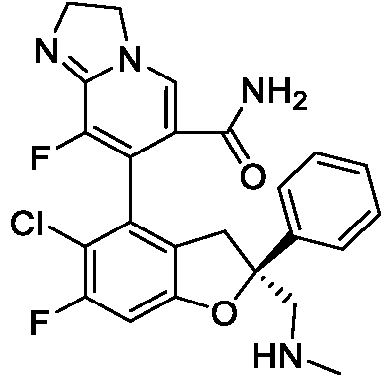
(S)-7-(5-Chloro-6-fluoro-2-((methylamino)methyl)-2-phenyl-2,3-dihydrobenzofuran-4-yl)-8-fluoro-2,3-dihydroimidazo[1,2-a]pyridine-6-carboxamide LC-MS: m/z 471.1 [M+H]+. I-87 
(S)-7-((S)-(5-Chloro-6-fluoro-2-((methylamino)methyl)-2-phenyl-2,3-dihydrobenzofuran-4-yl)-8-fluoro-2-(hydroxymethyl)imidazo[1,2-a]pyridine-6-carboxamide LC-MS: m/z = 499.2 [M+H]+. I-88 
(S)-7-((S)-5-Chloro-6-fluoro-2-phenyl-2-(pyrrolidin-2-yl)-2,3-dihydrobenzofuran-4-yl)-8-fluoro-[1,2,4]triazolo[4,3-a]pyridine-6-carboxamide LC-MS: m/z 496.1 [M+H]+. I-89 
(S)-7-((S)-5-Chloro-6-fluoro-2-phenyl-2-((S)-pyrrolidin-2-yl)-2,3-dihydrobenzofuran-4-yl)-8-fluoro-3-methyl-[1,2,4]triazolo[4,3-a]pyridine-6-carboxamide LC-MS: m/z 510.1 [M+H]+. I-90 
(S)-6'-((S)-5-Chloro-7'-fluoro-6-methoxy-2-phenyl-2-((S)-pyrrolidin-2-yl))-2,2',3,3'-tetrahydro-[4,6'-bibenzofuran]-5'-carboxamide LC-MS: m/z 509.2 [M+H]+. I-91 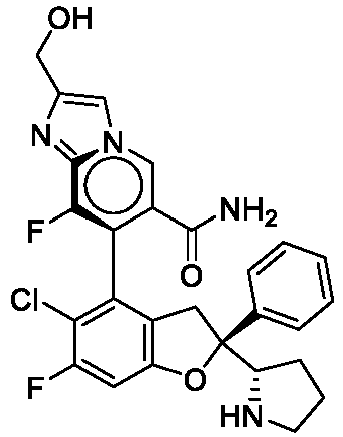
(S)-7-((S)-5-Chloro-6-fluoro-2-phenyl-2-((S)-pyrrolidin-2-yl)-2,3-dihydrobenzofuran-4-yl)-8-fluoro-2-(hydroxymethyl)imidazo[1,2-a]pyridine-6-carboxamide LC-MS: m/z = 525.2 [M+H]+. I-92 
(S)-7-((S)-5-Chloro-6-methoxy-2-phenyl-2-((S)-pyrrolidin-2-yl)-2,3-dihydrobenzofuran-4-yl)-8-fluoro-3,4-dihydro-2H-benzo[b][1,4]oxazine-6-carboxamide LC-MS: m/z 524.2 [M+H]+. I-94 
(S)-7-((S)-5-Chloro-6-methyl-2-phenyl-2-((S)-pyrrolidin-2-yl)-2,3-dihydrobenzofuran-4-yl)-8-fluoroimidazo[1,2-a]pyridine-6-carboxamide LC-MS: m/z 491.2 [M+H]+. I-95 
(S)-7-((S)-5-Chloro-6-fluoro-2-phenyl-2-((S)-pyrrolidin-2-yl)-2,3-dihydrobenzofuran-4-yl)-8-fluoro-4-(methylsulfonyl)-3,4-dihydro-2H-benzo[b][1,4]oxazine-6-carboxamide LC-MS: m/z = 590.2 [M+H]+. I-96 
(S)-7-((S)-5-Chloro-6-methyl-2-phenyl-2-((S)-tetrahydropyrrol-2-yl)-2,3-dihydrobenzofuran-4-yl)-8-fluoro-3-oxo-3,4-dihydro-2H-benzo[b][1,4]oxazine-6-carboxamide LC-MS: m/z 522.2 [M+H]+. I-97 
(S)-7-((S)-5-Chloro-6-fluoro-2-phenyl-2-((S)-pyrrolidin-2-yl)-2,3-dihydrobenzofuran-4-yl)-8-fluoro-4-(2-hydroxyethyl)-3,4-dihydro-2H-benzo[b][1,4]oxazine-6-carboxamide LC-MS: m/z =556.2 [M+H]+. I-98 
(S)-5-((S)-5-Chloro-6-fluoro-2-phenyl-2-((S)-pyrrolidin-2-yl)-2,3-dihydrobenzofuran-4-yl)-4-fluoro-2-methyl-2H-indazole-6-carboxamide LC-MS: m/z =509.2 [M+H]+. I-99 
(S)-7-((S)-5-Chloro-6-fluoro-2-phenyl-2-((S)-pyrrolidin-2-yl)-2,3-dihydrobenzofuran-4-yl)-8-fluoro-3-methyl-3,4-dihydro-2H-benzo[b][1,4]oxazine-6-carboxamide LC-MS: m/z =526.1 [M+H]+. I-100 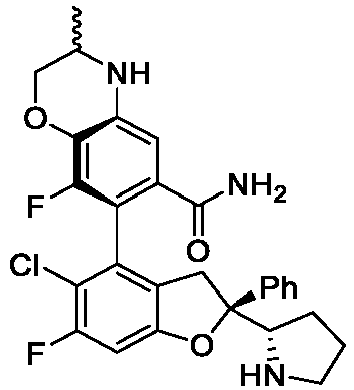
(S)-7-((S)-5-Chloro-6-fluoro-2-phenyl-2-((S)-pyrrolidin-2-yl)-2,3-dihydrobenzofuran-4-yl)-8-fluoro-3-methyl-3,4-dihydro-2H-benzo[b][1,4]oxazine-6-carboxamide LC-MS: m/z =526.1 [M+H]+. I-101 
(S)-5-((S)-5-Chloro-6-fluoro-2-phenyl-2-((S)-pyrrolidin-2-yl)-2,3-dihydrobenzofuran-4-yl)-4-fluoro-1-methyl-1H-indazole-6-carboxamide LC-MS: m/z =509.2 [M+H]+. I-102 
(S)-7-((S)-5-Chloro-6-fluoro-2-phenyl-2-((S)-pyrrolidin-2-yl)-2,3-dihydrobenzofuran-4-yl)-4-(cyclopropanecarbonyl)-8-fluoro-3,4-dihydro-2H-benzo[b][1,4]oxazine-6-carboxamide LC-MS: m/z 580.1 [M+H]+. I-103 
(S)-5-((S)-5-Chloro-6-fluoro-2-phenyl-2-((S)-pyrrolidin-2-yl)-2,3-dihydrobenzofuran-4-yl)-4-fluoro-1-(2-methoxyethyl)-1H-indazole-6-carboxamide LC-MS: m/z =553.2 [M+H]+. I-104 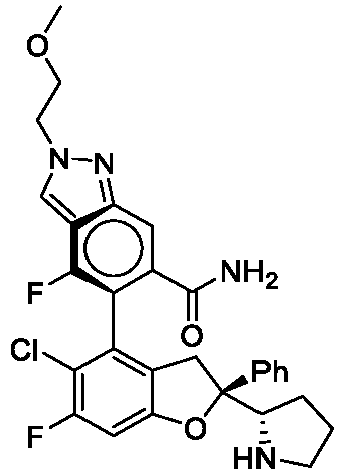
(S)-5-((S)-5-Chloro-6-fluoro-2-phenyl-2-((S)-pyrrolidin-2-yl)-2,3-dihydrobenzofuran-4-yl)-4-fluoro-2-(2-methoxyethyl)-2H-indazole-6-carboxamide LC-MS: m/z = 553.2 [M+H]+. I-105 
(S)-6-((S)-5-Chloro-6-fluoro-2-phenyl-2-((S)-pyrrolidin-2-yl)-2,3-dihydrobenzofuran-4-yl)-7-fluoro-1H-benzo[d][1,2,3]triazole-5-carboxamide LC-MS: m/z 496 [M+H]+. I-106 
(S)-7-((S)-5-Chloro-6-fluoro-2-(4-fluorophenyl)-2-((S)-pyrrolidin-2-yl)-2,3-dihydrobenzofuran-4-yl)-8-fluoro-3,4-dihydro-2H-benzo[b][1,4]oxazine-6-carboxamide LC-MS: m/z 530.2 [M+H]+. I-107 
7-((4S)-5-Chloro-6-fluoro-2-(3-fluorophenyl)-2-(pyrrolidin-2-yl)-2,3-dihydrobenzofuran-4-yl)-8-fluoro-2,3-dihydrobenzo[b][1,4]dioxine-6-carboxamide LCMS: m/z 531.2 [M+H]+. I-108 
2-Amino-(S)-7-((S)-5-chloro-6-fluoro-2-phenyl-2-((S)-pyrrolidin-2-yl)-2,3-dihydrobenzofuran-4-yl)-8-fluoroimidazo[1,2-a]pyridine-6-carboxamide LCMS: m/z 510.1 [M+H]+. I-109 
(S)-7-((S)-5-Chloro-6-fluoro-2-phenyl-2-((S)-pyrrolidin-2-yl)-2,3-dihydrobenzofuran-4-yl)-2,8-difluoroimidazo[1,2-a]pyridine-6-carboxamide LCMS: m/z 513.1 [M+H]+. I-110 
(S)-7-((S)-5-Chloro-6-fluoro-2-phenyl-2-((S)-5-azaspiro[2.4]heptan-6-yl)-2,3-dihydrobenzofuran-4-yl)-8-fluoro-2,3-dihydrobenzo[b][1,4]dioxine-6-carboxamide LCMS: m/z 539.2 [M+H]+. I-111 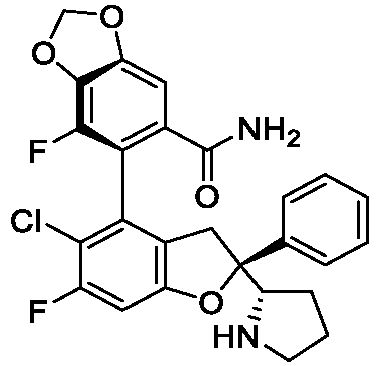
(S)-6-((S)-5-Chloro-6-fluoro-2-phenyl-2-((S)-pyrrolidin-2-yl)-2,3-dihydrobenzofuran-4-yl)-7-fluorobenzo[d][1,3]dioxole-5-carboxamide LCMS: m/z 499.1 [M+H]+. I-112 
(S)-7-((S)-5-Chloro-6-fluoro-2-phenyl-2-((S)-pyrrolidin-2-yl)-2,3-dihydrobenzofuran-4-yl)-8-fluoro-1,2,3,4-tetrahydroquinoline-6-carboxamide LCMS: m/z 511.2 [M+H]+. I-113 
(S)-7-((S)-5-Chloro-6-fluoro-2-phenyl-2-((S)-pyrrolidin-2-yl)-2,3-dihydrobenzofuran-4-yl)-8-fluoro-4-methyl-1,2,3,4-tetrahydroquinoline-6-carboxamide LCMS: m/z 525.2 [M+H]+. I-114 
(S)-6-((S)-5-Chloro-6-fluoro-2-phenyl-2-((S)-pyrrolidin-2-yl)-2,3-dihydrobenzofuran-4-yl)-5-fluoroquinoline-7-carboxamide LCMS: m/z 506.1 [M+H]+. I-115 
(S)-6-((S)-5-Chloro-6-fluoro-2-phenyl-2-((S)-pyrrolidin-2-yl)-2,3-dihydrobenzofuran-4-yl)-5-fluoroquinazoline-7-carboxamide LCMS: m/z 507.1 [M+H]+. I-117 
(S)-6'-(2S,3S)-5-Chloro-6,7'-difluoro-3-hydroxy-2-phenyl-2-((S)-pyrrolidin-2-yl)-2,2',3,3'-tetrahydrofuran-[4,6'-bibenzofuran]-5'-carbonitrile LCMS: m/z 495.1 [M+H]+. I-118 
(S)-7-((S)-5-Chloro-6-methyl-2-phenyl-2-((S)-pyrrolidin-2-yl)-2,3-dihydrobenzofuran-4-yl)-8-fluoro-2,3-dihydrobenzo[b] [1,4]dioxine-6-carboxamide LCMS: m/z 59.2 [M+H]+. I-119 
(S)-7-((S)-5-Chloro-6-fluoro-2-phenyl-2-((S)-4-azaspiro[2.4]heptan-5-yl)-2,3-dihydrobenzofuran-4-yl)-8-fluoro-2,3-dihydrobenzo[b][1,4]dioxine-6-carboxamide LCMS: m/z 539.2 [M+H]+. I-120 
(S)-7-((2S,3S)-5-Chloro-6-fluoro-3-methyl-2-phenyl-2-((S)-pyrrolidin-2-yl)-2,3-dihydrobenzofuran-4-yl)-8-fluoro-2,3-dihydrobenzo[b][1,4]dioxine-6-carboxamide LCMS: m/z 527.2 [M+H]+. I-121 
(S)-6'-(2S)-5-Chloro-6,7'-difluoro-2-phenyl-2-((S)-pyrrolidin-2-yl-5,5-d 2)-2,2',3,3'-tetrahydrofuran-[4,6'-bibenzofuran]-5'-carboxamide LCMS: m/z 499.2 [M+H]+. I-122 
(S)-6'-(2S)-5-Chloro-6,7'-difluoro-2-phenyl-2-((S)-pyrrolidin-2-yl)-2,2',3,3'-tetrahydrofuran-[4,6'-bibenzofuran]-7-d-5'-carboxamide LCMS: m/z 498.1 [M+H]+. I-123 
(S)-6'-(2S)-5-Chloro-6,1'-difluoro-2-(phenyl-4-d)-2-((S)-pyrrolidin-2-yl)-2,2',3,3'-tetrahydrofuran-[4,6'-bibenzofuran]-5'-carboxamide LCMS: m/z 498.1 [M+H]+. I-124 
(S)-6'-(2S,3S)-5-Chloro-6,1'-difluoro-3-methoxy-2-phenyl-2-((S)-pyrrolidin-2-yl)-2,2',3,3'-tetrahydrofuran-[4,6'-bibenzofuran]-5'-carboxamide LCMS: m/z 527.2 [M+H]+. I-125 
(S)-6'-(2S,3S)-5-Chloro-6,7'-difluoro-3-methyl-2-phenyl-2-((S)-pyrrolidin-2-yl)-2,2',3,3'-tetrahydrofuran-[4,6'-bibenzofuran]-5'-carboxamide LCMS: m/z 511.2 [M+H]+. I-126 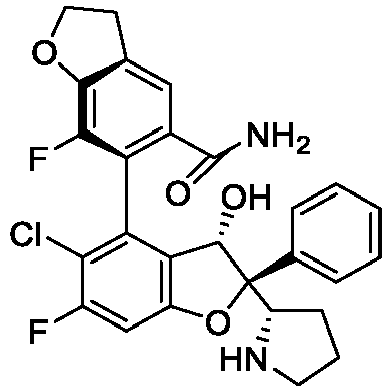
(S)-6'-(2S,3S)-5-Chloro-6,7'-difluoro-3-hydroxy-2-phenyl-2-((S)-pyrrolidin-2-yl)-2,2',3,3'-tetrahydrofuran-[4,6'-bibenzofuran]-5'-carboxamide LCMS: m/z 513.1 [M+H]+. I-127 
(S)-6'-(2S)-5-Chloro-6,7'-difluoro-2-((2S)-4-fluoropyrrolidin-2-yl)-2-phenyl-2,2',3,3'-tetrahydrofuran-[4,6'-bibenzofuran]-5'-carboxamide LCMS: m/z 515.1 [M+H]+. I-128 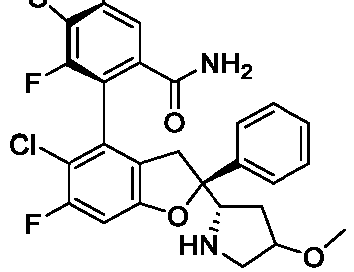
(S)-6'-(2S)-5-Chloro-6,7'-difluoro-2-((2S)-4-methoxypyrrolidin-2-yl)-2-phenyl-2,2',3,3'-tetrahydrofuran-[4,6'-bibenzofuran]-5'-carboxamide LCMS: m/z 527.2 [M+H]+. I-129 
(S)-8-Fluoro-7-((S)-6-fluoro-5-methyl-2-phenyl-2-((S)-pyrrolidin-2-yl)-2,3-dihydrobenzofuran-4-yl)-2,3-dihydrobenzo[b][1,4]dioxopyrimidine-6-carboxamide LCMS: m/z 493.2 [M+H]+. I-130 
(S)-7-((S)-5-Chloro-6,7-difluoro-2-phenyl-2-((S)-pyrrolidin-2-yl)-2,3-dihydrobenzofuran-4-yl)-8-fluoro-2,3-dihydrobenzo[b][1,4]dioxine-6-carboxamide LCMS: m/z 493.2 [M+H]+. I-131 
(S)-7-((S)-5-Chloro-6-fluoro-2-(4-fluorophenyl)-2-((S)-pyrrolidin-2-yl)-2,3-dihydrobenzofuran-4-yl)-8-fluoro-2,3-dihydrobenzo[b][1,4]dioxine-6-carboxamide LCMS: m/z 531.1 [M+H]+. I-132 
(S)-7-((S)-5-Chloro-6-fluoro-2-(3-fluorophenyl)-2-((S)-pyrrolidin-2-yl)-2,3-dihydrobenzofuran-4-yl)-8-fluoro-2,3-dihydrobenzo[b][1,4]dioxine-6-carboxamide LCMS: m/z 531.1 [M+H]+. I-133 
(S)-7-((S)-5-Chloro-6-fluoro-2-(4-methoxyphenyl)-2-((S)-pyrrolidin-2-yl)-2,3-dihydrobenzofuran-4-yl)-8-fluoro-2,3-dihydrobenzo[b][1,4]dioxine-6-carboxamide LCMS: m/z 543.1 [M+H]+. I-134 
(S)-7-((2S,3S)-2-((S)-Azetidin-2-yl)-5-chloro-6-fluoro-3-methyl-2-phenyl-2,3-dihydrobenzofuran-4-yl)-8-fluoro-2,3-dihydrobenzo[b][1,4]dioxopyrimidine-6-carboxamide LCMS: m/z 513.1 [M+H]+. I-135 
(S)-7-((2S,3S)-5-Chloro-6-fluoro-3-methyl-2-phenyl-2-((S)-pyrrolidin-2-yl)-2,3-dihydrobenzofuran-4-yl)-8-fluoro-5-methyl-2,3-dihydrobenzo[b][1,4]dioxopyrimidine-6-carboxamide LCMS: m/z 541.2 [M+H]+. I-136 
(S)-5-Amino-7-((2S,3S)-5-chloro-6-fluoro-3-methyl-2-phenyl-2-((S)-pyrrolidin-2-yl)-2,3-dihydrobenzofuran-4-yl)-8-fluoro-2,3-dihydrobenzo[b][1,4]dioxine-6-carboxamide LCMS: m/z 542.2 [M+H]+. I-137 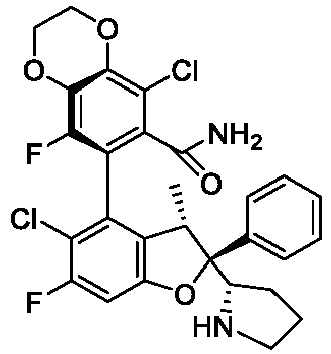
(S)-5-Chloro-7-((2S,3S)-5-chloro-6-fluoro-3-methyl-2-phenyl-2-((S)-pyrrolidin-2-yl)-2,3-dihydrobenzofuran-4-yl)-8-fluoro-2,3-dihydrobenzo[b][1,4]dioxine-6-carboxamide LCMS: m/z 561.1 [M+H]+. - In this example, the YAP-TEAD protein interaction HTRF experiment was used to detect the activity of each compound in blocking the YAP-TEAD protein interaction.
- The experiment was carried out according to the following operation steps:
- Step 1: His-TEAD1 (209-426) protein was added to a 384-well detection white plate to a final concentration of 10 nM, and buffer was used as the background signal well. The compounds to be tested were subjected to 3-fold dilution and a total of 10 concentration gradients were set up, and each diluted solution was mixed well. A certain volume of the compound to be tested was added to each well separately, 2 replicates were set for each concentration, and the final concentration of DMSO was controlled at 1%. Incubation was carried out at room temperature for 20 minutes. The amino acid sequence of TAED1 (209-426) used in this step is shown in SEQ ID NO: 1:
SEQ ID NO: 1:
- Step 2: The YAP peptide (60-100) part of the Bio-YAP peptide was added to each well, achieving a final concentration of 50 nM. After mixing evenly, the mixture was incubated at room temperature for 10 minutes. The amino acid sequence of the YAP peptide (60-100) part of the Bio-YAP peptide used in this step is shown in SEQ ID NO: 2:
SEQ ID NO: 2:
- Step 3: Anti-His-Eu cryptate gold and streptavidin-XL665 were diluted according to the instructions and mixed in equal proportions. A certain volume of the detection reagent was added to the well, and the mixture was incubated at room temperature for 1 hour.
- Step 4: The signal was detected using an Envision (Perkin Elmer) microplate reader at an excitation wavelength of 320 nm and emission wavelengths of 665 nm and 620 nm.
- Step 5: The signal was calculated based on the ratio of Em665 / Em620 * 10000.
- The inhibition percentage (%) was calculated using the following formula:
Inhibition percentage (%) = (1 - (compound (cpd)signal - backgroundsignal) / (DMSOsignal - backgroundsignal)) * 100 - The half-maximal inhibitory concentration (IC50) values were calculated using GraphPad Prism software.
- The activity of each compound in blocking the YAP-TEAD protein interaction (expressed by grades A, B, C and D of IC50 values, where the letter A represents an IC50 of less than 0.05 µM; the letter B represents an IC50 between 0.05 µM and 0.5 µM; the letter C represents an IC50 between 0.5 µM and 5 µM; the letter D represents an IC50 greater than 5 µM) is as shown in Table 1.
Table 1: Activity of each compound in blocking YAP-TEAD protein interaction Compound number Activity Compound number Activity Compound number Activity Compound 1 A Compound 110 A Compound 149 A Compound 1' B Compound 111 A Compound 150 A Compound 2 A Compound 112 A Compound 151 A Compound 3 A Compound 113 B Compound 152 A Compound 3' B Compound 114 A Compound 153 A Compound 4 A Compound 115 A Compound 154 A Compound 5 A Compound 116 A Compound 155 A Compound 6 A Compound 117 D Compound 156 A Compound 7 A Compound 118 A Compound 157 A Compound 8 A Compound 119 A Compound 158 A Compound 9 A Compound 120 A Compound 159 A Compound 10 A Compound 121 A Compound 160 A Compound 39 A Compound 122 A Compound I-1 A Compound 41 A Compound 123 A Compound I-2 A Compound 42 A Compound 124 A Compound I-11 A Compound 43 B Compound 125 A Compound I-16 A Compound 44 B Compound 126 A Compound I-17 A Compound 46 A Compound 127 A Compound I-19 A Compound 55 C Compound 128 A Compound I-23 A Compound 62 A Compound 129 A Compound I-24 A Compound 66 A Compound 131 A Compound I-25 A Compound 67 A Compound 132 A Compound I-26 A Compound 71 A Compound 133 A Compound I-27 A Compound 78 A Compound 134 A Compound I-28 A Compound 79 A Compound 135 A Compound I-29 A Compound 81 A Compound 136 A Compound I-30 A Compound 83 A Compound 137 A Compound I-31 A Compound 84 A Compound 138 A Compound I-32 A Compound 101 A Compound 139 A Compound I-52 A Compound 102 A Compound 140 A Compound I-53 A Compound 103 A Compound 141 A Compound I-54 A Compound 104 A Compound 142 A Compound I-55 A Compound 105 A Compound 143 A Compound I-56 A Compound 106 A Compound 144 A Compound I-57 A Compound 107 A Compound 145 A Compound I-58 B Compound 108 A Compound 147 A Compound I-59 A Compound 109 A Compound 148 A Compound I-60 B - In this example, the inhibition of the compound on the target was detected by the signal of the reporter gene in the stable cell line SF268-YAP-Luc containing the YAP/TEAD reporter gene.
- A sequence containing 6 tandem YAP/TEAD binding sites and a basal transcription promoter was constructed on the vector pGL4.76 of Promega Company. The constructed reporter gene vector was transfected into SF268 cells (NCI DCTD tumor/cell line repository) and screened with 0.5 µg/mL hygromycin to obtain SF268-YAP-Luc stable strain.
- SF268-YAP-Luc cells were seeded into a 96-well plate at a density of 3000 cells per well with a volume of 100 µL per well (cell culture medium composition: RPMI1640 (Gibco-A10491-01) + 10% FBS (Gibco-10099-141C) + 1% penicillin-streptomycin (5,000 U/mL, Gibco-15070-063)), and the cells were incubated overnight in a 37°C, 5% carbon dioxide incubator.
- On the next day, the compounds to be tested were 3-fold diluted, and a total of 8 concentration gradients were set up; a certain volume of DMSO or the compounds to be tested was added to each well, respectively, and 2 replicates were set up for each concentration, and the final concentration of DMSO was controlled to be no higher than 0.5%. The cells were incubated for 24 hours in a 37°C, 5% carbon dioxide incubator. Two identical parallel plates were set up for cell seeding and compound treatment.
- Renila-Glo luciferase assay system kit (Promega, E2720) was used to detect the reporter gene signals of the control group and treatment group. 70 µL of Renila-Glo was added to each well, mixed well, and incubated at room temperature for 10 minutes. The signal was read using En Vision® Multilabel Plate Reader (Perkin Elmer).
- Cell viability was detected in the control group and treatment group using CellTiter-Glo Luminescent Cell Viability Assay kit (Promega, G7570). 50 µL of CellTiter-Glo was added to each well, mixed well, and incubated at room temperature for 10 minutes. The signal was read using En Vision® Multilabel Plate Reader (Perkin Elmer).
- The signal of Renila luciferase after correcting for cell viability was analyzed, and the inhibition rate of the compound on the reporter gene was calculated. The inhibition percentage (%) is calculated by the following formula:
Inhibition percentage (%) = (1-(compound-treated well Renila signal / DMSO-treated well Renila signal) / (compound-treated well CTG signal / DMSO-treated well CTG signal)) * 100 - Using Graphpad Prism software, the IC50 values for the compounds' inhibitory activity against Renila luciferase signaling were calculated.
- The activity of each compound in inhibiting the expression of YAP/TEAD reporter gene (expressed by grades A, B, C and D of IC50 values, where the letter A represents an IC50 of less than 0.05 µM; the letter B represents an IC50 between 0.05 µM and 0.5 µM; the letter C represents an IC50 between 0.5 µM and 5 µM; the letter D represents an IC50 greater than 5 µM) is as shown in Table 2.
Table 2: Activity of each compound in inhibiting the expression of YAP/TEAD reporter gene Compound number Activity Compound number Activity Compound 1 A Compound I-23 B Compound 3 A Compound I-24 A Compound 8 A Compound I-25 B Compound I-1 A Compound I-27 A Compound I-19 A - In this example, the intracellular ATP was quantitatively determined by the CellTiter-Glo luminescence cell viability detection kit to detect the number of living cells in the culture.
- Step 1: MSTO-211H (ATCC, CRL-2081™) or NCI-H2052 (ATCC, CRL-5915™) cells were inoculated in a 96-well plate at a density of 1500 cells per well with a volume of 100 µL per well, and the cells were incubated overnight in a 37°C, 5% carbon dioxide incubator. The culture medium used was RPMI1640 medium (GIBCO-A10491-01) + 10% FBS (GIBCO-10099141C) + 1% penicillin/streptomycin (Pen/Strep) (GIBCO-15070-063).
- Step 2: The cells were treated with the compounds to be tested. The compounds to be tested were 3-fold diluted, and a total of 9 concentration gradients were set up; a certain volume of DMSO or the compounds to be tested was added to each well, respectively, and 2 replicates were set up for each concentration, and the final concentration of DMSO was controlled to be no higher than 0.5%. The cells were incubated for 96 hours in a 37°C, 5% carbon dioxide incubator.
- Step 3: Cell viability was detected in the control group and treatment group using CellTiter-Glo Luminescent Cell Viability Assay kit (Promega, G7570). 50 µL of CellTiter-Glo was added to each well, mixed well, and incubated at room temperature for 10 minutes. The signal was read using EnVision® Multilabel Plate Reader (Perkin Elmer).
- The inhibition percentage (%) was calculated using the following formula:
Inhibition percentage (%) = (1 - compound-treated well CTG signal / DMSO-treated well CTG signal) * 100 - Using Graphpad Prism software, the IC50 values of the compounds inhibiting the CTG signal of cell proliferation activity was calculated.
- The inhibitory activity of each compound on the proliferation of MSTO-211H cells (expressed by grades A, B, C and D of IC50 values, where the letter A represents an IC50 of less than 0.2 µM; the letter B represents an IC50 between 0.2 µM and 0.5 µM; the letter C represents an IC50 between 0.5 µM and 5 µM; the letter D represents an IC50 greater than 5 µM) is as shown in Table 3.
Table 3: Inhibitory activity of each compound on the proliferation of MSTO-211H cells Compound number Activity Compound number Activity Compound number Activity Compound 1 A Compound 109 A Compound 144 A Compound 2 B Compound 110 B Compound 147 A Compound 3 A Compound 111 A Compound 148 A Compound 4 A Compound 112 B Compound 149 A Compound 5 A Compound 114 C Compound 150 A Compound 6 A Compound 115 C Compound 151 A Compound 7 B Compound 116 A Compound 152 A Compound 8 A Compound 118 A Compound 153 A Compound 9 A Compound 119 B Compound 154 A Compound 10 A Compound 120 A Compound 155 A Compound 39 A Compound 121 B Compound 156 A Compound 41 A Compound 122 A Compound 157 A Compound 42 C Compound 123 B Compound 158 A Compound 44 D Compound 124 A Compound 159 A Compound 46 A Compound 125 A Compound 160 A Compound 62 A Compound 126 A Compound I-1 A Compound 66 B Compound 127 B Compound I-14 A Compound 67 B Compound 128 A Compound I-16 A Compound 71 B Compound 129 B Compound I-17 A Compound 78 A Compound 131 A Compound I-18 B Compound 79 B Compound 132 A Compound I-21 A Compound 81 A Compound 133 A Compound I-23 A Compound 83 A Compound 134 C Compound I-24 A Compound 84 B Compound 135 A Compound I-25 B Compound 101 A Compound 136 A Compound I-27 B Compound 102 A Compound 137 A Compound I-28 A Compound 103 C Compound 138 A Compound I-29 B Compound 104 B Compound 139 A Compound I-30 B Compound 105 A Compound 140 A Compound 106 B Compound 141 A Compound 107 A Compound 142 A Compound 108 C Compound 143 A - Pharmacokinetic assays were performed on the compounds of the present disclosure. Specifically, pharmacokinetic parameters of the compounds of the present disclosure were determined using the following methods.
- Healthy male adult mice were used in this study and each group of animals was administrated 5 to 100 mg/kg by single gavage. Fasting was maintained from 10 hours before administration to 4 hours after administration. After administration, blood was collected at different time points, and the plasma content of the compound was determined (using LC-MS/MS). Plasma concentration-time relationships were analyzed using professional software (WinNonlin) to calculate the pharmacokinetic parameters of the compounds. The compounds of the present disclosure have excellent pharmacokinetic properties.
- All documents mentioned in the present disclosure are incorporated herein by reference in their entirety as if each document is individually cited and incorporated herein. The above content describes the preferred embodiments of the present disclosure in detail, but the present disclosure is not limited to the specific details in the above embodiments. Within the scope of the technical concept of the present disclosure, various simple modifications can be made to the technical solution of the present disclosure, and these simple modifications all belong to the protection scope of the present disclosure.
- In addition, it should be noted that each specific technical feature described in the above detailed description of the preferred embodiment can be combined in any suitable manner as long as there is no contradiction. In order to avoid unnecessary repetition, various possible combinations are not further described in the present disclosure. In addition, various embodiments of the present disclosure can also be arbitrarily combined, as long as they do not violate the idea of the present disclosure, which should also be regarded as the contents disclosed in the present disclosure.
Claims (127)
- A compound of the following formula I or a pharmaceutically acceptable salt, enantiomer, diastereomer, tautomer, solvate, isotopic substitute, polymorph, prodrug or metabolite thereof:
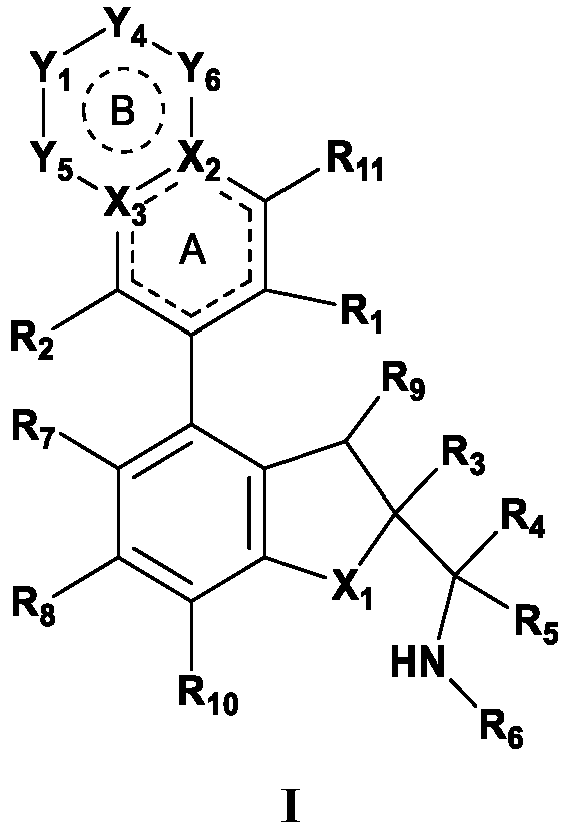 X1 is selected from: O and NRa;X2 is selected from: C and N;X3 is selected from: C and N;Y5 and Y6 are independently selected from: a bond, O, S, N, -S(O)-, -S(O)2-, C, CH(R13), C(R13)2, C(R13), -OCH2-, -N(R12)CH2-, -CH2CH2- and N(R12), and Y5 and Y6 are not simultaneously a bond;Y1 and Y4 are independently selected from: a bond, O, N, C, S, -S(O)-, -C(O)-, -S(O)2-, CH, CH2, NH, C(R13), CH(R13), C(R13)2 and N(R12), provided that Y1 and Y4, Y1 and Y5, Y4 and Y6 are not simultaneously a bond, O, S, -S(O)- or -S(O)2- and satisfy the valence bond theory;alternatively, when Y1, Y4 and Y6 are arbitrarily selected from C(R13)2, two R13 on the same carbon atom, together with the C atom to which they are attached, can form a substituted or unsubstituted 3- to 8-membered cyclohydrocarbyl or substituted or unsubstituted 4- to 9-membered heterocyclyl ring, thereby forming a spiro ring structure with ring B;alternatively, the ring atom in Y1 or Y6 and the ring atom in Y4, together with the substituent attached to the ring atom, form a substituted or unsubstituted 3- to 8-membered cyclohydrocarbyl, substituted or unsubstituted 4- to 9-membered heterocyclyl, substituted or unsubstituted 6- to 10-membered aryl or substituted or unsubstituted 5- to 10-membered heteroaryl ring, thereby forming a fused ring structure with ring B;alternatively, X2, together with the ring atom in Y6 and the ring atom attached to R11 and the substituent attached to the ring atom, forms a substituted or unsubstituted 5- or 6-membered cyclohydrocarbyl, substituted or unsubstituted 5- or 6-membered heterocyclyl, substituted or unsubstituted phenyl or substituted or unsubstituted 5- or 6-membered heteroaryl ring, thereby forming a three-fused ring structure with rings A and B;ring B is a 5-, 6- or 7-membered heterocyclyl ring, a benzene ring or a 5-, 6- or 7-membered heteroaryl ring; ring B can be optionally substituted by one or more R13 and/or R12 that do not participate in ring formation, and can be further optionally substituted by 1, 2 or 3 substituents selected from hydroxyl, amino, halogen, substituted or unsubstituted alkyl, -NR'R" and substituted or unsubstituted alkoxy;R1 is selected from: cyano and -C(O)NR'R";R2 is selected from: H, halogen, substituted or unsubstituted alkyl and substituted or unsubstituted alkoxy;R3 is selected from: substituted or unsubstituted aryl, substituted or unsubstituted heteroaryl and substituted or unsubstituted heterocyclyl;R4 and R5 are each independently selected from: H, halogen and substituted or unsubstituted alkyl; alternatively, R4 and R5, together with the carbon atom to which they are attached, form a 3- to 6-membered substituted or unsubstituted ring, and the ring optionally contains 1, 2 or 3 heteroatoms selected from O, N and S;R6 is selected from: H, substituted or unsubstituted alkyl, substituted or unsubstituted alkoxy, substituted or unsubstituted alkenyl, substituted or unsubstituted alkynyl, substituted or unsubstituted cyclohydrocarbyl, substituted or unsubstituted aryl, substituted or unsubstituted heteroaryl and substituted or unsubstituted heterocyclyl;alternatively, R4 or R5 and R6, together with the atom to which they are attached, form a substituted or unsubstituted 4- to 12-membered monocyclic or fused heterocyclyl, substituted or unsubstituted 6- to 12-membered bridged heterocyclyl or substituted or unsubstituted 6- to 12-membered spiro heterocyclyl ring; the 4- to 12-membered monocyclic or fused heterocyclyl, 6- to 12-membered bridged heterocyclyl and 6- to 12-membered spiro heterocyclyl each optionally further contain 1 or 2 heteroatoms selected from N and O;R7 is selected from: H, halogen, cyano, nitro, substituted or unsubstituted alkyl, substituted or unsubstituted haloalkyl, substituted or unsubstituted alkoxy, substituted or unsubstituted alkenyl and substituted or unsubstituted alkynyl;R8 is selected from: H, halogen, cyano, nitro, substituted or unsubstituted alkyl, substituted or unsubstituted haloalkyl, substituted or unsubstituted alkoxy, substituted or unsubstituted alkenyl and substituted or unsubstituted alkynyl;R9 is selected from: H, substituted or unsubstituted alkyl, substituted or unsubstituted alkoxy, hydroxyl and halogen;R10 is selected from: H, halogen and substituted or unsubstituted alkyl;R11 is selected from: H, hydroxyl, amino, halogen, substituted or unsubstituted alkyl, -NR'R" and substituted or unsubstituted alkoxy;each R12 that does not participate in ring formation is independently selected from: H, substituted or unsubstituted C1-C4 acyl, substituted or unsubstituted C1-C4 alkoxy, cyano, substituted or unsubstituted C1-C4 alkyl-S(O)2-, substituted or unsubstituted 6- to 14-membered aryl-S(O)2-, substituted or unsubstituted 4- to 9-membered heterocyclyl, NR'R"-C(O)-, substituted or unsubstituted 3- to 8-membered cyclohydrocarbyl-C(O)- and substituted or unsubstituted C1-C4 alkyl;each R13 that does not participate in ring formation is independently selected from: H, halogen, substituted or unsubstituted C1-C4 acyl, hydroxyl, cyano, -NR'R", substituted or unsubstituted C1-C4 alkoxy, substituted or unsubstituted C1-6 alkyl, substituted or unsubstituted C1-C4 alkylS(O)2-, substituted or unsubstituted C6-14 aryl-S(O)2-, substituted or unsubstituted 3- to 6-membered cyclohydrocarbyl-C(O)- and NR'R"-C(O)-, or two R13 on the same carbon atom form an oxo (=O) or thio (=S) group;after R13 or R12 participates in ring formation, its ring atom can be optionally substituted by 1 to 3 heteroatoms selected from O, N and S;R' and R" are each independently selected from H, C1-C4 alkyl, C3-C6 cycloalkyl, C1-C4 alkyl-S(O)2- and C1-C4 haloalkyl;Ra is selected from H and C1-C4 alkyl;wherein the dashed line indicates the presence or absence of a double bond.
 - The compound or the pharmaceutically acceptable salt, enantiomer, diastereomer, tautomer, solvate, isotopic substitute, polymorph, prodrug or metabolite thereof according to claim 1, wherein ring A is a benzene ring or a 6-membered heteroaryl ring.
- The compound or the pharmaceutically acceptable salt, enantiomer, diastereomer, tautomer, solvate, isotopic substitute, polymorph, prodrug or metabolite thereof according to claim 1 or 2, wherein ring A is a benzene ring or a pyridine ring.
- The compound or the pharmaceutically acceptable salt, enantiomer, diastereomer, tautomer, solvate, isotopic substitute, polymorph, prodrug or metabolite thereof according to any one of claims 1 to 3, wherein the compound of formula I has a structure shown in the following formula Ia:

- The compound or the pharmaceutically acceptable salt, enantiomer, diastereomer, tautomer, solvate, isotopic substitute, polymorph, prodrug or metabolite thereof according to any one of claims 1 to 4, wherein the compound of formula I has a structure shown in the following formula Ib:

ring C is a substituted or unsubstituted 4- to 12-membered monocyclic or fused heterocyclyl, substituted or unsubstituted 6- to 12-membered bridged heterocyclyl or substituted or unsubstituted 6- to 12-membered spiro heterocyclyl ring, and the 4- to 12-membered monocyclic or fused heterocyclyl, 6- to 12-membered bridged heterocyclyl and 6- to 12-membered spiro heterocyclyl each optionally further contain 1 or 2 heteroatoms selected from N and O; ring C is preferably a substituted or unsubstituted 4- to 8-membered nitrogen-containing monocyclic heterocyclyl, substituted or unsubstituted 6- to 12-membered nitrogen-containing spiro heterocyclyl or substituted or unsubstituted 6- to 12-membered nitrogen-containing fused heterocyclyl ring. - The compound or the pharmaceutically acceptable salt, enantiomer, diastereomer, tautomer, solvate, isotopic substitute, polymorph, prodrug or metabolite thereof according to any one of claims 1 to 5, wherein when R12, which does not participate in ring formation, is present, each R12 is independently selected from: H, substituted or unsubstituted C1-C4 acyl, substituted or unsubstituted C1-C4 alkoxy, substituted or unsubstituted C1-C4 alkyl-S(O)2-, substituted or unsubstituted 4- to 9-membered heterocyclyl, NR'R"-C(O)-, substituted or unsubstituted 3- to 8-membered cyclohydrocarbyl-C(O)- and substituted or unsubstituted C1-C4 alkyl, wherein R' and R" are each independently selected from H and C1-C4 alkyl; preferably, the C1-C4 acyl, C1-C4 alkoxy, C1-C4 alkyl-S(O)2-, 4- to 9-membered heterocyclyl, 3- to 8-membered cyclohydrocarbyl-C(O)- and C1-C4 alkyl are optionally substituted by 1, 2 or 3 substituents selected from F, hydroxyl and cyano.
- The compound or the pharmaceutically acceptable salt, enantiomer, diastereomer, tautomer, solvate, isotopic substitute, polymorph, prodrug or metabolite thereof according to any one of claims 1 to 6, wherein when R12, which does not participate in ring formation, is present, each R12 is independently selected from: H, acetyl, propionyl, C1-C4 alkoxy, C1-C4 alkyl-S(O)2-, 4- to 6-membered heterocyclyl, 3- to 5-membered cyclohydrocarbyl-C(O)- and substituted or unsubstituted C1-C4 alkyl; preferably, the C1-C4 alkyl is optionally substituted by 1, 2 or 3 substituents selected from F, hydroxyl and cyano.
- The compound or the pharmaceutically acceptable salt, enantiomer, diastereomer, tautomer, solvate, isotopic substitute, polymorph, prodrug or metabolite thereof according to any one of claims 1 to 7, wherein when R13, which does not participate in ring formation, is present, each R13 is independently selected from: H, halogen, substituted or unsubstituted C1-C4 acyl, hydroxyl, cyano, -NR'R", substituted or unsubstituted C1-C4 alkoxy, substituted or unsubstituted C1-C6 alkyl, substituted or unsubstituted C1-C4 alkyl-S(O)2-, substituted or unsubstituted 3- to 6-membered cyclohydrocarbyl-C(O)- and NR'R"-C(O)-, or two R13 on the same carbon atom form an oxo (=O) or thio (=S) group; wherein R' and R" are each independently selected from H and C1-C4 alkyl; preferably, the C1-C4 acyl, C1-C4 alkoxy, C1-C6 alkyl, C1-C4 alkyl-S(O)2- and 3-to 6-membered cyclohydrocarbyl-C(O)- are optionally substituted by 1, 2 or 3 substituents selected from F, hydroxyl and cyano.
- The compound or the pharmaceutically acceptable salt, enantiomer, diastereomer, tautomer, solvate, isotopic substitute, polymorph, prodrug or metabolite thereof according to any one of claims 1 to 8, wherein when R13, which does not participate in ring formation, is present, each R13 is independently selected from: H, fluorine, chlorine, C1-C4 acyl, hydroxyl, cyano, C1-C4 alkoxy, C1-C6 alkyl, C1-C4 alkyl-S(O)2- and 3- to 4-membered cyclohydrocarbyl-C(O)-.
- The compound or the pharmaceutically acceptable salt, enantiomer, diastereomer, tautomer, solvate, isotopic substitute, polymorph, prodrug or metabolite thereof according to any one of claims 1 to 9, wherein the compound of formula I has a structure shown in the following formula IIa:
 Y4 is selected from: C, CH and N;Y6 is selected from: C, CH and N;ring D is a 3- to 8-membered cyclohydrocarbyl, 4- to 9-membered heterocyclyl, 6- to 10-membered aryl or 5- to 10-membered heteroaryl ring, wherein the 4- to 9-membered heterocyclyl and 5- to 10-membered heteroaryl contain 1, 2 or 3 heteroatoms selected from O, N and S;R15 is selected from: H, halogen, oxo (=O), thio (=S), substituted or unsubstituted C1-C4 acyl, hydroxyl, substituted or unsubstituted C1-C4 alkoxy, cyano, -NR'R", substituted or unsubstituted C1-C4 alkyl-S(O)2-, substituted or unsubstituted 6- to 10-membered aryl-S(O)2-, substituted or unsubstituted 4- to 9-membered heterocyclyl, NR'R"-C(O)-, substituted or unsubstituted 3- to 8-membered cyclohydrocarbyl, substituted or unsubstituted 3- to 8-membered cyclohydrocarbyl-C(O)-, substituted or unsubstituted C1-C4 haloalkyl and substituted or unsubstituted C1-C4 alkyl; preferably, the C1-C4 acyl, C1-C4 alkoxy, C1-C4 alkyl-S(O)2-, 6- to 10-membered aryl-S(O)2-, 4- to 9-membered heterocyclyl, 3- to 8-membered cyclohydrocarbyl, 3- to 8-membered cyclohydrocarbyl-C(O)-, C1-C4 haloalkyl and C1-C4 alkyl are optionally substituted by 1, 2 or 3 substituents selected from F, hydroxyl and cyano;n is 0, 1, 2, 3 or 4.
 - The compound or the pharmaceutically acceptable salt, enantiomer, diastereomer, tautomer, solvate, isotopic substitute, polymorph, prodrug or metabolite thereof according to any one of claims 1 to 9, wherein the compound of formula I has a structure shown in the following formula lib:
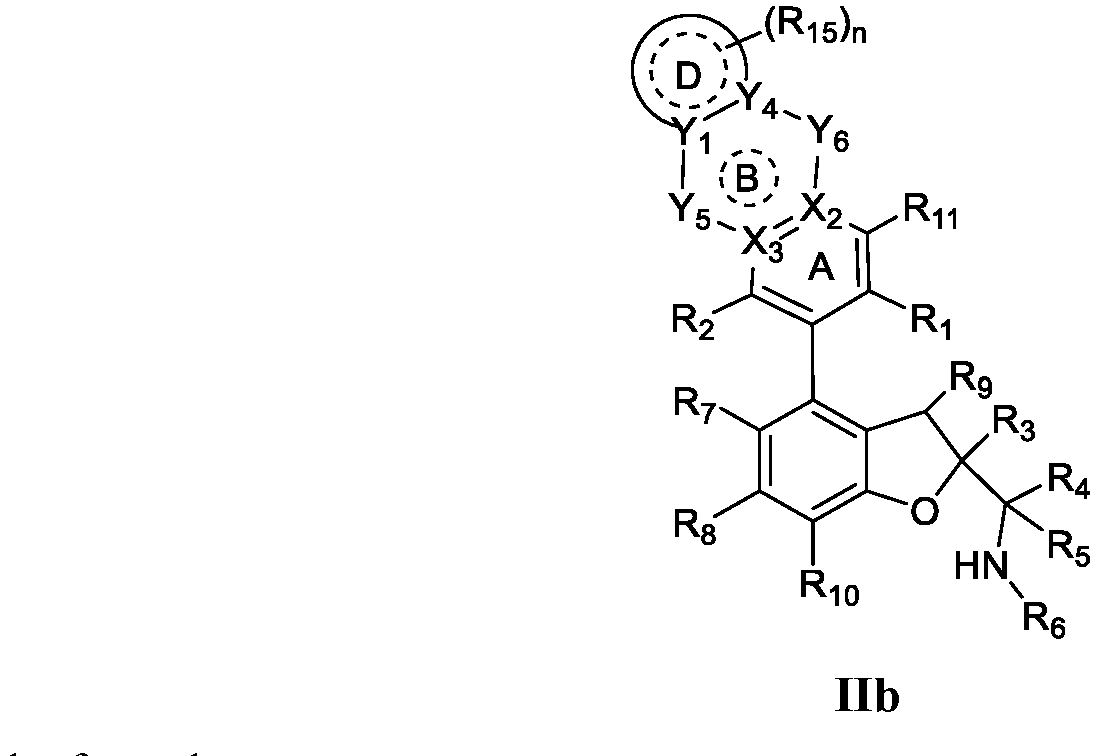 Y1 is selected from: C, CH and N;Y4 is selected from: C, CH and N;ring D is a 3- to 8-membered cyclohydrocarbyl, 4- to 9-membered heterocyclyl, 6- to 10-membered aryl or 5- to 10-membered heteroaryl ring, wherein the 4- to 9-membered heterocyclyl and 5- to 10-membered heteroaryl contain 1, 2 or 3 heteroatoms selected from O, N and S;R15 is selected from: H, halogen, oxo (=O), thio (=S), substituted or unsubstituted C1-C4 acyl, hydroxyl, substituted or unsubstituted C1-C4 alkoxy, cyano, -NR'R", substituted or unsubstituted C1-C4 alkyl-S(O)2-, substituted or unsubstituted 6- to 10-membered aryl-S(O)2-, substituted or unsubstituted 4- to 9-membered heterocyclyl, NR'R"-C(O)-, substituted or unsubstituted 3- to 8-membered cyclohydrocarbyl, substituted or unsubstituted 3- to 8-membered cyclohydrocarbyl-C(O)-, substituted or unsubstituted C1-C4 haloalkyl and substituted or unsubstituted C1-C4 alkyl; preferably, the C1-C4 acyl, C1-C4 alkoxy, C1-C4 alkyl-S(O)2-, 6- to 10-membered aryl-S(O)2-, 4- to 9-membered heterocyclyl, 3- to 8-membered cyclohydrocarbyl, 3- to 8-membered cyclohydrocarbyl-C(O)-, C1-C4 haloalkyl and C1-C4 alkyl are optionally substituted by 1, 2 or 3 substituents selected from F, hydroxyl and cyano;n is 0, 1, 2, 3 or 4.
 - The compound or the pharmaceutically acceptable salt, enantiomer, diastereomer, tautomer, solvate, isotopic substitute, polymorph, prodrug or metabolite thereof according to claim 10 or 11, wherein ring D is a 3- to 6-membered cyclohydrocarbyl, 4- to 6-membered heterocyclyl, 6- to 10-membered aryl or 5- to 8-membered heteroaryl ring, wherein the 4- to 6-membered heterocyclyl and 5- to 8-membered heteroaryl contain 1, 2 or 3 heteroatoms selected from O, N and S; R15 is selected from: H, halogen, substituted or unsubstituted C1-C4 acyl, hydroxyl, substituted or unsubstituted C1-C4 alkoxy, cyano, -NR'R", substituted or unsubstituted 4- to 9-membered heterocyclyl, NR'R"-C(O)-, substituted or unsubstituted 3- to 8-membered cyclohydrocarbyl, substituted or unsubstituted 3- to 8-membered cyclohydrocarbyl-C(O)-, substituted or unsubstituted C1-C4 haloalkyl and substituted or unsubstituted C1-C4 alkyl; preferably, the C1-C4 acyl, C1-C4 alkoxy, 4- to 9-membered heterocyclyl, 3- to 8-membered cyclohydrocarbyl, 3- to 8-membered cyclohydrocarbyl-C(O)-, C1-C4 haloalkyl and C1-C4 alkyl are optionally substituted by 1, 2 or 3 substituents selected from F, hydroxyl and cyano; R' and R" are each independently selected from H and C1-C4 alkyl; n is 0, 1 or 2.
- The compound or the pharmaceutically acceptable salt, enantiomer, diastereomer, tautomer, solvate, isotopic substitute, polymorph, prodrug or metabolite thereof according to any one of claims 10 to 12, wherein R15 is selected from: H, fluorine, chlorine, acetyl, hydroxyl, C1-C4 alkoxy, cyano, -NR'R", NR'R"-C(O)-, 3- to 8-membered cyclohydrocarbyl-C(O)-, C1-C4 haloalkyl and C1-C4 alkyl; R' and R" are each independently selected from H and C1-C4 alkyl; n is 0 or 1.
- The compound or the pharmaceutically acceptable salt, enantiomer, diastereomer, tautomer, solvate, isotopic substitute, polymorph, prodrug or metabolite thereof according to any one of claims 1 to 9, wherein the compound of formula I has a structure shown in the following formula IIc:
 ring E is a 3- to 8-membered cyclohydrocarbyl or 4- to 9-membered heterocyclyl ring, wherein the 4- to 9-membered heterocyclyl contains 1, 2 or 3 heteroatoms selected from O, N and S;R16 is selected from H, halogen, substituted or unsubstituted C1-C4 alkyl, hydroxyl, substituted or unsubstituted C1-C4 acyl and substituted or unsubstituted C1-C4 alkoxy; preferably, the C1-C4 alkyl, C1-C4 acyl and C1-C4 alkoxy are optionally substituted by 1, 2 or 3 substituents selected from F, hydroxyl and cyano;n is 0, 1, 2, 3 or 4.
 - The compound or the pharmaceutically acceptable salt, enantiomer, diastereomer, tautomer, solvate, isotopic substitute, polymorph, prodrug or metabolite thereof according to any one of claims 1 to 9, wherein the compound of formula I has a structure shown in the following formula IId:
 ring E is a 3- to 8-membered cyclohydrocarbyl or 4- to 9-membered heterocyclyl ring, wherein the 4- to 9-membered heterocyclyl contains 1, 2 or 3 heteroatoms selected from O, N and S;R16 is selected from H, halogen, substituted or unsubstituted C1-C4 alkyl, hydroxyl, substituted or unsubstituted C1-C4 acyl and substituted or unsubstituted C1-C4 alkoxy; preferably, the C1-C4 alkyl, C1-C4 acyl and C1-C4 alkoxy are optionally substituted by 1, 2 or 3 substituents selected from F, hydroxyl and cyano;n is 0, 1, 2, 3 or 4.
 - The compound or the pharmaceutically acceptable salt, enantiomer, diastereomer, tautomer, solvate, isotopic substitute, polymorph, prodrug or metabolite thereof according to claim 14 or 15, wherein ring E is a 3- to 6-membered cyclohydrocarbyl or 4- to 6-membered heterocyclyl ring, wherein the 4- to 6-membered heterocyclyl contains 1, 2 or 3 heteroatoms selected from O, N and S; R16 is selected from H, halogen, C1-C4 alkyl, hydroxyl and acetyl; n is 0 or 1.
- The compound or the pharmaceutically acceptable salt, enantiomer, diastereomer, tautomer, solvate, isotopic substitute, polymorph, prodrug or metabolite thereof according to any one of claims 14 to 16, wherein ring E is a cyclopropyl, cyclobutyl, cyclopentyl, cyclohexyl, oxetanyl, oxolanyl, tetrahydropyranyl, azetidinyl, azacyclopentyl or piperidinyl ring; R16 is selected from H, fluorine, methyl, ethyl, hydroxyl and acetyl; n is 0 or 1.
- The compound or the pharmaceutically acceptable salt, enantiomer, diastereomer, tautomer, solvate, isotopic substitute, polymorph, prodrug or metabolite thereof according to any one of claims 1 to 9, wherein the compound of formula I has a structure shown in the following formula IIe:
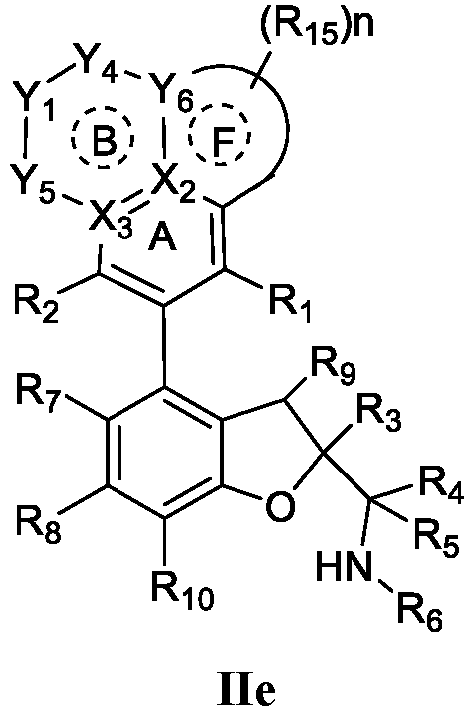 X2 is C;Y6 is selected from: C, CH and N;ring F is a 5- or 6-membered cyclohydrocarbyl, 5- or 6-membered heterocyclyl, phenyl or 5- or 6-membered heteroaryl ring, wherein the 5- or 6-membered heterocyclyl or 5- or 6-membered heteroaryl contains 1, 2 or 3 heteroatoms selected from O, N and S;R15 is selected from: H, halogen, oxo (=O), thio (=S), substituted or unsubstituted C1-C4 acyl, hydroxyl, substituted or unsubstituted C1-C4 alkoxy, cyano, -NR'R", substituted or unsubstituted C1-C4 alkyl-S(O)2-, substituted or unsubstituted 6- to 10-membered aryl-S(O)2-, substituted or unsubstituted 4- to 9-membered heterocyclyl, NR'R"-C(O)-, substituted or unsubstituted 3- to 8-membered cyclohydrocarbyl, substituted or unsubstituted 3- to 8-membered cyclohydrocarbyl-C(O)-, substituted or unsubstituted C1-C4 haloalkyl and substituted or unsubstituted C1-C4 alkyl; preferably, the C1-C4 acyl, C1-C4 alkoxy, C1-C4 alkyl-S(O)2-, 6- to 10-membered aryl-S(O)2-, 4- to 9-membered heterocyclyl, 3- to 8-membered cyclohydrocarbyl, 3- to 8-membered cyclohydrocarbyl-C(O)-, C1-C4 haloalkyl and C1-C4 alkyl are optionally substituted by 1, 2 or 3 substituents selected from F, hydroxyl and cyano; andn is 0, 1, 2 or 3.
 - The compound or the pharmaceutically acceptable salt, enantiomer, diastereomer, tautomer, solvate, isotopic substitute, polymorph, prodrug or metabolite thereof according to claim 18, wherein ring F is a phenyl or 5- or 6-membered heteroaryl ring, wherein the 5- or 6-membered heteroaryl contains 1, 2 or 3 heteroatoms selected from O, N and S; and/or
R15 is selected from: H, halogen, substituted or unsubstituted C1-C4 acyl, hydroxyl, substituted or unsubstituted C1-C4 alkoxy, cyano, -NR'R", substituted or unsubstituted 4- to 9-membered heterocyclyl, NR'R"-C(O)-, substituted or unsubstituted 3- to 8-membered cyclohydrocarbyl, substituted or unsubstituted 3- to 8-membered cyclohydrocarbyl-C(O)-, substituted or unsubstituted C1-C4 haloalkyl and substituted or unsubstituted C1-C4 alkyl; preferably, the C1-C4 acyl, C1-C4 alkoxy, 4- to 9-membered heterocyclyl, 3- to 8-membered cyclohydrocarbyl, 3- to 8-membered cyclohydrocarbyl-C(O)-, C1-C4 haloalkyl and C1-C4 alkyl are optionally substituted by 1, 2 or 3 substituents selected from F, hydroxyl and cyano; wherein R' and R" are each independently selected from H and C1-C4 alkyl, and n is 0, 1 or 2. - The compound or the pharmaceutically acceptable salt, enantiomer, diastereomer, tautomer, solvate, isotopic substitute, polymorph, prodrug or metabolite thereof according to claim 18 or 19, wherein ring F is a 5-membered heteroaryl ring, wherein the 5-membered heteroaryl contains 1 or 2 heteroatoms selected from O and N; and/or
R15 is selected from: H, fluorine, chlorine, acetyl, hydroxyl, C1-C4 alkoxy, cyano, -NR'R", NR'R"-C(O)-, 3- to 8-membered cyclohydrocarbyl-C(O)-, C1-C4 haloalkyl and C1-C4 alkyl; R' and R" are each independently selected from H and C1-C4 alkyl; n is 0 or 1. - The compound or the pharmaceutically acceptable salt, enantiomer, diastereomer, tautomer, solvate, isotopic substitute, polymorph, prodrug or metabolite thereof according to any one of claims 18 to 20, wherein ring F is a pyrrolyl, furyl, pyrazolyl, imidazolyl, oxazolyl or isoxazolyl ring.
- The compound or the pharmaceutically acceptable salt, enantiomer, diastereomer, tautomer, solvate, isotopic substitute, polymorph, prodrug or metabolite thereof according to claim 10, wherein the compound of formula IIa has a structure shown in the following formula IIIa:
 D1 is selected from: O, S, S(O), S(O)2, N, NRe, CRf and CRfRg;D2 is selected from: O, S, S(O), S(O)2, N, NRe, (CRf)p, (CRfRg)p, C(O)-NRe, N-NRe, CRf-NRe,
 D3 is selected from: O, S, S(O), S(O)2, N, NRe, (CRf)p and (CRfRg)p;provided that D1 and D2, D1 and D3 are not simultaneously O, S, -S(O)- or -S(O)2- and satisfy the valence bond theory;each Re at each occurrence is independently selected from: H, substituted or unsubstituted C1-C4 acyl, substituted or unsubstituted C1-C4 alkoxy, cyano, substituted or unsubstituted C1-C4 alkyl-S(O)2-, substituted or unsubstituted 4- to 9-membered heterocyclyl, NR'R"-C(O)-, substituted or unsubstituted 3- to 6-membered cyclohydrocarbyl, substituted or unsubstituted 3- to 6-membered cyclohydrocarbyl-C(O)-, substituted or unsubstituted C1-C4 haloalkyl and substituted or unsubstituted C1-C4 alkyl, wherein R' and R" are each independently selected from H and C1-C4 alkyl; preferably, the C1-C4 acyl, C1-C4 alkoxy, C1-C4 alkyl-S(O)2-, 4- to 9-membered heterocyclyl, 3- to 6-membered cyclohydrocarbyl, 3- to 6-membered cyclohydrocarbyl-C(O)-, C1-C4 haloalkyl and C1-C4 alkyl are optionally substituted by 1, 2 or 3 substituents selected from F, hydroxyl and cyano;each Rf at each occurrence is independently selected from: H, halogen, substituted or unsubstituted C1-C4 acyl, hydroxyl, cyano, -NR'R", substituted or unsubstituted C1-C4 alkoxy, substituted or unsubstituted C1-C4 alkyl, substituted or unsubstituted 3- to 6-membered cyclohydrocarbyl, substituted or unsubstituted C1-C4 alkyl-S(O)2-, substituted or unsubstituted 3-to 6-membered cyclohydrocarbyl-C(O)- and NR'R"-C(O)-, wherein R' and R" are each independently selected from H and C1-C4 alkyl; preferably, the C1-C4 acyl, C1-C4 alkoxy, C1-C4 alkyl, 3- to 6-membered cyclohydrocarbyl, C1-C4 alkyl-S(O)2- and 3- to 6-membered cyclohydrocarbyl-C(O)- are optionally substituted by 1, 2 or 3 substituents selected from F, hydroxyl and cyano;each Rg at each occurrence is independently selected from: H, halogen, substituted or unsubstituted C1-C4 acyl, hydroxyl, cyano, -NR'R", substituted or unsubstituted C1-C4 alkoxy, substituted or unsubstituted C1-C4 alkyl, substituted or unsubstituted 3- to 6-membered cyclohydrocarbyl, substituted or unsubstituted C1-C4 alkyl-S(O)2-, substituted or unsubstituted 3-to 6-membered cyclohydrocarbyl-C(O)- and NR'R"-C(O)-, wherein R' and R" are each independently selected from H and C1-C4 alkyl; preferably, the C1-C4 acyl, C1-C4 alkoxy, C1-C4 alkyl, 3- to 6-membered cyclohydrocarbyl, C1-C4 alkyl-S(O)2- and 3- to 6-membered cyclohydrocarbyl-C(O)- are optionally substituted by 1, 2 or 3 substituents selected from F, hydroxyl and cyano;alternatively, Rf and Rg on the same carbon atom form an oxo (=O) or thio (=S) group; andeach p is independently 1, 2, 3 or 4, preferably 1 or 2.
 - The compound or the pharmaceutically acceptable salt, enantiomer, diastereomer, tautomer, solvate, isotopic substitute, polymorph, prodrug or metabolite thereof according to claim 11, wherein the compound of formula IIb has a structure shown in the following formula IIIb:
 D1 is selected from: O, S, S(O), S(O)2, N, NRc, CRf and CRfRg;D2 is selected from: O, S, S(O), S(O)2, N, NRc, (CRf)p, (CRfRg)p, C(O)-NRc, N-NRe, CRf-NRe,
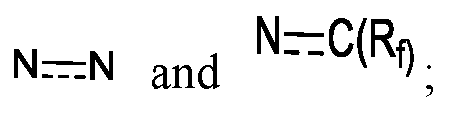 D3 is selected from: O, S, S(O), S(O)2, N, NRe, (CRf)p and (CRfRg)p;provided that D1 and D2, D1 and D3 are not simultaneously O, S, -S(O)- or -S(O)2- and satisfy the valence bond theory;each Re at each occurrence is independently selected from: H, substituted or unsubstituted C1-C4 acyl, substituted or unsubstituted C1-C4 alkoxy, cyano, substituted or unsubstituted C1-C4 alkyl-S(O)2-, substituted or unsubstituted 4- to 9-membered heterocyclyl, NR'R"-C(O)-, substituted or unsubstituted 3- to 6-membered cyclohydrocarbyl, substituted or unsubstituted 3- to 6-membered cyclohydrocarbyl-C(O)-, substituted or unsubstituted C1-C4 haloalkyl and substituted or unsubstituted C1-C4 alkyl, wherein R' and R" are each independently selected from H and C1-C4 alkyl; preferably, the C1-C4 acyl, C1-C4 alkoxy, C1-C4 alkyl-S(O)2-, 4- to 9-membered heterocyclyl, 3- to 6-membered cyclohydrocarbyl, 3- to 6-membered cyclohydrocarbyl-C(O)-, C1-C4 haloalkyl and C1-C4 alkyl are optionally substituted by 1, 2 or 3 substituents selected from F, hydroxyl and cyano;each Rf at each occurrence is independently selected from: H, halogen, substituted or unsubstituted C1-C4 acyl, hydroxyl, cyano, -NR'R", substituted or unsubstituted C1-C4 alkoxy, substituted or unsubstituted C1-C4 alkyl, substituted or unsubstituted 3- to 6-membered cyclohydrocarbyl, substituted or unsubstituted C1-C4 alkyl-S(O)2-, substituted or unsubstituted 3-to 6-membered cyclohydrocarbyl-C(O)- and NR'R"-C(O)-, wherein R' and R" are each independently selected from H and C1-C4 alkyl; preferably, the C1-C4 acyl, C1-C4 alkoxy, C1-C4 alkyl, 3- to 6-membered cyclohydrocarbyl, C1-C4 alkyl-S(O)2- and 3- to 6-membered cyclohydrocarbyl-C(O)- are optionally substituted by 1, 2 or 3 substituents selected from F, hydroxyl and cyano;each Rg at each occurrence is independently selected from: H, halogen, substituted or unsubstituted C1-C4 acyl, hydroxyl, cyano, -NR'R", substituted or unsubstituted C1-C4 alkoxy, substituted or unsubstituted C1-C4 alkyl, substituted or unsubstituted 3- to 6-membered cyclohydrocarbyl, substituted or unsubstituted C1-C4 alkyl-S(O)2-, substituted or unsubstituted 3-to 6-membered cyclohydrocarbyl-C(O)- and NR'R"-C(O)-, wherein R' and R" are each independently selected from H and C1-C4 alkyl; preferably, the C1-C4 acyl, C1-C4 alkoxy, C1-C4 alkyl, 3- to 6-membered cyclohydrocarbyl, C1-C4 alkyl-S(O)2- and 3- to 6-membered cyclohydrocarbyl-C(O)- are optionally substituted by 1, 2 or 3 substituents selected from F, hydroxyl and cyano;alternatively, Rf and Rg on the same carbon atom form an oxo (=O) or thio (=S) group; andeach p is independently 1, 2, 3 or 4, preferably 1 or 2.
 - The compound or the pharmaceutically acceptable salt, enantiomer, diastereomer, tautomer, solvate, isotopic substitute, polymorph, prodrug or metabolite thereof according to claim 22, wherein the compound of formula IIIa has a structure shown in the following formula IVa:
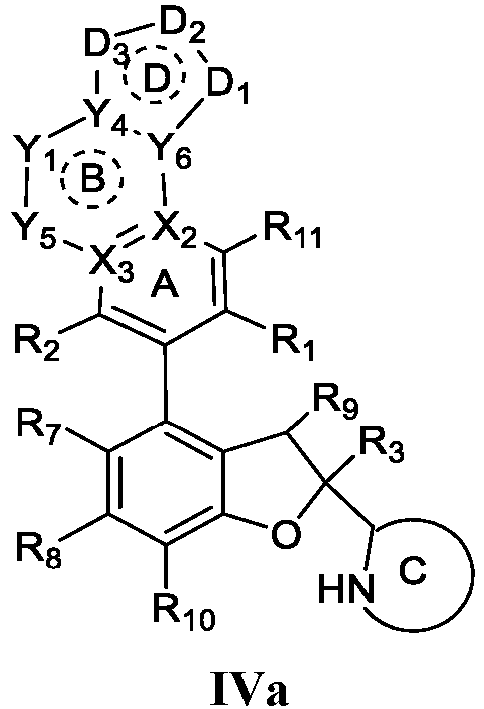
ring C is a substituted or unsubstituted 4- to 12-membered monocyclic or fused heterocyclyl, substituted or unsubstituted 6- to 12-membered bridged heterocyclyl or substituted or unsubstituted 6- to 12-membered spiro heterocyclyl ring, and the 4- to 12-membered monocyclic or fused heterocyclyl, 6- to 12-membered bridged heterocyclyl and 6- to 12-membered spiro heterocyclyl each optionally further contain 1 or 2 heteroatoms selected from N and O; ring C is preferably a substituted or unsubstituted 4- to 8-membered nitrogen-containing monocyclic heterocyclyl, substituted or unsubstituted 6- to 12-membered nitrogen-containing spiro heterocyclyl or substituted or unsubstituted 6- to 12-membered nitrogen-containing fused heterocyclyl ring. - The compound or the pharmaceutically acceptable salt, enantiomer, diastereomer, tautomer, solvate, isotopic substitute, polymorph, prodrug or metabolite thereof according to claim 23, wherein the compound of formula IIIb has a structure shown in the following formula IVb:

ring C is a substituted or unsubstituted 4- to 12-membered monocyclic or fused heterocyclyl, substituted or unsubstituted 6- to 12-membered bridged heterocyclyl or substituted or unsubstituted 6- to 12-membered spiro heterocyclyl ring, and the 4- to 12-membered monocyclic or fused heterocyclyl, 6- to 12-membered bridged heterocyclyl and 6- to 12-membered spiro heterocyclyl each optionally further contain 1 or 2 heteroatoms selected from N and O; ring C is preferably a substituted or unsubstituted 4- to 8-membered nitrogen-containing monocyclic heterocyclyl, substituted or unsubstituted 6- to 12-membered nitrogen-containing spiro heterocyclyl or substituted or unsubstituted 6- to 12-membered nitrogen-containing fused heterocyclyl ring. - The compound or the pharmaceutically acceptable salt, enantiomer, diastereomer, tautomer, solvate, isotopic substitute, polymorph, prodrug or metabolite thereof according to claim 18, wherein the compound of formula IIe has a structure shown in the following formula IVc:
 Y7, Y8 and Y9 are independently selected from: a bond, O, S, S(O), S(O)2, N, NRe, CRf and CRfRg, provided that at most one of Y7, Y8 and Y9 is a bond, Y7 and Y8, Y8 and Y9 are not simultaneously O, S, -S(O)- or -S(O)2- and satisfy the valence bond theory,each Re at each occurrence is independently selected from: H, substituted or unsubstituted C1-C4 acyl, substituted or unsubstituted C1-C4 alkoxy, cyano, substituted or unsubstituted C1-C4 alkyl-S(O)2-, substituted or unsubstituted 4- to 9-membered heterocyclyl, NR'R"-C(O)-, substituted or unsubstituted 3- to 6-membered cyclohydrocarbyl, substituted or unsubstituted 3- to 6-membered cyclohydrocarbyl-C(O)-, substituted or unsubstituted C1-C4 haloalkyl and substituted or unsubstituted C1-C4 alkyl, wherein R' and R" are each independently selected from H and C1-C4 alkyl; preferably, the C1-C4 acyl, C1-C4 alkoxy, C1-C4 alkyl-S(O)2-, 4- to 9-membered heterocyclyl, 3- to 6-membered cyclohydrocarbyl, 3- to 6-membered cyclohydrocarbyl-C(O)-, C1-C4 haloalkyl and C1-C4 alkyl are optionally substituted by 1, 2 or 3 substituents selected from F, hydroxyl and cyano;each Rf at each occurrence is independently selected from: H, halogen, substituted or unsubstituted C1-C4 acyl, hydroxyl, cyano, -NR'R", substituted or unsubstituted C1-C4 alkoxy, substituted or unsubstituted C1-C4 alkyl, substituted or unsubstituted 3- to 6-membered cyclohydrocarbyl, substituted or unsubstituted C1-C4 alkyl-S(O)2-, substituted or unsubstituted 3-to 6-membered cyclohydrocarbyl-C(O)- and NR'R"-C(O)-, wherein R' and R" are each independently selected from H and C1-C4 alkyl; preferably, the C1-C4 acyl, C1-C4 alkoxy, C1-C4 alkyl, 3- to 6-membered cyclohydrocarbyl, C1-C4 alkyl-S(O)2- and 3- to 6-membered cyclohydrocarbyl-C(O)- are optionally substituted by 1, 2 or 3 substituents selected from F, hydroxyl and cyano;each Rg at each occurrence is independently selected from: H, halogen, substituted or unsubstituted C1-C4 acyl, hydroxyl, cyano, -NR'R", substituted or unsubstituted C1-C4 alkoxy, substituted or unsubstituted C1-C4 alkyl, substituted or unsubstituted 3- to 6-membered cyclohydrocarbyl, substituted or unsubstituted C1-C4 alkyl-S(O)2-, substituted or unsubstituted 3-to 6-membered cyclohydrocarbyl-C(O)- and NR'R"-C(O)-, wherein R' and R" are each independently selected from H and C1-C4 alkyl; preferably, the C1-C4 acyl, C1-C4 alkoxy, C1-C4 alkyl, 3- to 6-membered cyclohydrocarbyl, C1-C4 alkyl-S(O)2- and 3- to 6-membered cyclohydrocarbyl-C(O)- are optionally substituted by 1, 2 or 3 substituents selected from F, hydroxyl and cyano;alternatively, Rf and Rg on the same carbon atom form an oxo (=O) or thio (=S) group;ring C is a substituted or unsubstituted 4- to 12-membered monocyclic or fused heterocyclyl, substituted or unsubstituted 6- to 12-membered bridged heterocyclyl or substituted or unsubstituted 6- to 12-membered spiro heterocyclyl ring, and the 4- to 12-membered monocyclic or fused heterocyclyl, 6- to 12-membered bridged heterocyclyl and 6- to 12-membered spiro heterocyclyl each optionally further contain 1 or 2 heteroatoms selected from N and O; ring C is preferably a substituted or unsubstituted 4- to 8-membered nitrogen-containing monocyclic heterocyclyl, substituted or unsubstituted 6- to 12-membered nitrogen-containing spiro heterocyclyl or substituted or unsubstituted 6- to 12-membered nitrogen-containing fused heterocyclyl ring.
 - The compound or the pharmaceutically acceptable salt, enantiomer, diastereomer, tautomer, solvate, isotopic substitute, polymorph, prodrug or metabolite thereof according to any one of claims 1 to 26, wherein R1 is -C(O)NR'R".
- The compound or the pharmaceutically acceptable salt, enantiomer, diastereomer, tautomer, solvate, isotopic substitute, polymorph, prodrug or metabolite thereof according to any one of claims 1 to 27, wherein R1 is -C(O)NHR'; the R' is selected from H, C1-C4 alkyl and C3-C6 cycloalkyl.
- The compound or the pharmaceutically acceptable salt, enantiomer, diastereomer, tautomer, solvate, isotopic substitute, polymorph, prodrug or metabolite thereof according to any one of claims 1 to 28, wherein R1 is -C(O)NH2.
- The compound or the pharmaceutically acceptable salt, enantiomer, diastereomer, tautomer, solvate, isotopic substitute, polymorph, prodrug or metabolite thereof according to any one of claims 1 to 28, wherein R1 is -C(O)NHCH3 and

- The compound or the pharmaceutically acceptable salt, enantiomer, diastereomer, tautomer, solvate, isotopic substitute, polymorph, prodrug or metabolite thereof according to any one of claims 1 to 30, wherein R2 is selected from H, halogen, C1-C4 alkyl and C1-C4 alkoxy.
- The compound or the pharmaceutically acceptable salt, enantiomer, diastereomer, tautomer, solvate, isotopic substitute, polymorph, prodrug or metabolite thereof according to any one of claims 1 to 31, wherein R2 is selected from H, halogen and methoxy.
- The compound or the pharmaceutically acceptable salt, enantiomer, diastereomer, tautomer, solvate, isotopic substitute, polymorph, prodrug or metabolite thereof according to any one of claims 1 to 32, wherein R2 is halogen.
- The compound or the pharmaceutically acceptable salt, enantiomer, diastereomer, tautomer, solvate, isotopic substitute, polymorph, prodrug or metabolite thereof according to any one of claims 1 to 33, wherein R2 is selected from fluorine and chlorine.
- The compound or the pharmaceutically acceptable salt, enantiomer, diastereomer, tautomer, solvate, isotopic substitute, polymorph, prodrug or metabolite thereof according to any one of claims 1 to 34, wherein R2 is fluorine.
- The compound or the pharmaceutically acceptable salt, enantiomer, diastereomer, tautomer, solvate, isotopic substitute, polymorph, prodrug or metabolite thereof according to any one of claims 1 to 35, wherein R3 is selected from substituted or unsubstituted aryl and substituted or unsubstituted heteroaryl.
- The compound or the pharmaceutically acceptable salt, enantiomer, diastereomer, tautomer, solvate, isotopic substitute, polymorph, prodrug or metabolite thereof according to any one of claims 1 to 36, wherein R3 is selected from substituted or unsubstituted phenyl and substituted or unsubstituted pyridyl.
- The compound or the pharmaceutically acceptable salt, enantiomer, diastereomer, tautomer, solvate, isotopic substitute, polymorph, prodrug or metabolite thereof according to any one of claims 1 to 37, wherein R3 is phenyl, fluorophenyl or pyridyl.
- The compound or the pharmaceutically acceptable salt, enantiomer, diastereomer, tautomer, solvate, isotopic substitute, polymorph, prodrug or metabolite thereof according to any one of claims 1 to 38, wherein R4 and R5 are each independently selected from: H and substituted or unsubstituted alkyl; alternatively, R4 and R5, together with the carbon atom to which they are attached, form a 3- to 6-membered substituted or unsubstituted ring, and the ring optionally contains 1, 2 or 3 heteroatoms selected from O, N and S.
- The compound or the pharmaceutically acceptable salt, enantiomer, diastereomer, tautomer, solvate, isotopic substitute, polymorph, prodrug or metabolite thereof according to any one of claims 1 to 39, wherein R4 and R5 are each independently selected from: H and substituted or unsubstituted C1-C4 alkyl.
- The compound or the pharmaceutically acceptable salt, enantiomer, diastereomer, tautomer, solvate, isotopic substitute, polymorph, prodrug or metabolite thereof according to any one of claims 1 to 40, wherein R4 and R5 are each independently selected from: Hand C1-C3 alkyl.
- The compound or the pharmaceutically acceptable salt, enantiomer, diastereomer, tautomer, solvate, isotopic substitute, polymorph, prodrug or metabolite thereof according to any one of claims 1 to 41, wherein R4 and R5 are each independently selected from: H and methyl.
- The compound or the pharmaceutically acceptable salt, enantiomer, diastereomer, tautomer, solvate, isotopic substitute, polymorph, prodrug or metabolite thereof according to any one of claims 1 to 42, wherein R4 and R5 are both H.
- The compound or the pharmaceutically acceptable salt, enantiomer, diastereomer, tautomer, solvate, isotopic substitute, polymorph, prodrug or metabolite thereof according to any one of claims 1 to 43, wherein R7 and R8 are each independently selected from: H, halogen, cyano, substituted or unsubstituted C1-C4 alkyl, substituted or unsubstituted C1-C4 haloalkyl, substituted or unsubstituted C1-C4 alkoxy, substituted or unsubstituted C2-C4 alkenyl and substituted or unsubstituted C2-C4 alkynyl.
- The compound or the pharmaceutically acceptable salt, enantiomer, diastereomer, tautomer, solvate, isotopic substitute, polymorph, prodrug or metabolite thereof according to any one of claims 1 to 44, wherein R7 and R8 are each independently selected from: H, halogen, cyano, methyl and methoxy.
- The compound or the pharmaceutically acceptable salt, enantiomer, diastereomer, tautomer, solvate, isotopic substitute, polymorph, prodrug or metabolite thereof according to any one of claims 1 to 45, wherein R7 and R8 are each independently selected from: fluorine and chlorine.
- The compound or the pharmaceutically acceptable salt, enantiomer, diastereomer, tautomer, solvate, isotopic substitute, polymorph, prodrug or metabolite thereof according to any one of claims 1 to 46, wherein R7 is chlorine, R8 is fluorine.
- The compound or the pharmaceutically acceptable salt, enantiomer, diastereomer, tautomer, solvate, isotopic substitute, polymorph, prodrug or metabolite thereof according to any one of claims 1 to 47, wherein R9 is selected from H, C1-C4 alkyl, C1-C4 alkoxy, hydroxyl and halogen.
- The compound or the pharmaceutically acceptable salt, enantiomer, diastereomer, tautomer, solvate, isotopic substitute, polymorph, prodrug or metabolite thereof according to any one of claims 1 to 48, wherein R9 is selected from H, methyl, methoxy, hydroxyl and F.
- The compound or the pharmaceutically acceptable salt, enantiomer, diastereomer, tautomer, solvate, isotopic substitute, polymorph, prodrug or metabolite thereof according to any one of claims 1 to 49, wherein R9 is H.
- The compound or the pharmaceutically acceptable salt, enantiomer, diastereomer, tautomer, solvate, isotopic substitute, polymorph, prodrug or metabolite thereof according to any one of claims 1 to 50, wherein R10 is selected from: H, halogen and C1-C4 alkyl.
- The compound or the pharmaceutically acceptable salt, enantiomer, diastereomer, tautomer, solvate, isotopic substitute, polymorph, prodrug or metabolite thereof according to any one of claims 1 to 51, wherein R10 is selected from: H, F and methyl.
- The compound or the pharmaceutically acceptable salt, enantiomer, diastereomer, tautomer, solvate, isotopic substitute, polymorph, prodrug or metabolite thereof according to any one of claims 1 to 52, wherein R10 is H.
- The compound or the pharmaceutically acceptable salt, enantiomer, diastereomer, tautomer, solvate, isotopic substitute, polymorph, prodrug or metabolite thereof according to any one of claims 1 to 53, wherein R11 is selected from: H, hydroxyl, amino, halogen, C1-C4 alkyl, - NR'R" and C1-C4 alkoxy, wherein R' and R" are independently selected from C1-C4 alkyl.
- The compound or the pharmaceutically acceptable salt, enantiomer, diastereomer, tautomer, solvate, isotopic substitute, polymorph, prodrug or metabolite thereof according to any one of claims 1 to 54, wherein R11 is selected from: H, hydroxyl, amino, fluorine, chlorine, methyl, methoxy and -NH(CH3).
- The compound or the pharmaceutically acceptable salt, enantiomer, diastereomer, tautomer, solvate, isotopic substitute, polymorph, prodrug or metabolite thereof according to any one of claims 1 to 55, wherein R11 is H.
- The compound or the pharmaceutically acceptable salt, enantiomer, diastereomer, tautomer, solvate, isotopic substitute, polymorph, prodrug or metabolite thereof according to any one of claims 1 to 56, wherein X2 is C.
- The compound or the pharmaceutically acceptable salt, enantiomer, diastereomer, tautomer, solvate, isotopic substitute, polymorph, prodrug or metabolite thereof according to any one of claims 1 to 56, wherein X2 is N.
- The compound or the pharmaceutically acceptable salt, enantiomer, diastereomer, tautomer, solvate, isotopic substitute, polymorph, prodrug or metabolite thereof according to any one of claims 1 to 58, wherein X3 is C.
- The compound or the pharmaceutically acceptable salt, enantiomer, diastereomer, tautomer, solvate, isotopic substitute, polymorph, prodrug or metabolite thereof according to any one of claims 1 to 58, wherein X3 is N.
- The compound or the pharmaceutically acceptable salt, enantiomer, diastereomer, tautomer, solvate, isotopic substitute, polymorph, prodrug or metabolite thereof according to any one of claims 1 to 60, wherein Y5 is selected from: a bond, O, S, -S(O)-, N, CH2, CH, -C(O)-, - CH(OH)-, NH, -N(CH3)-, -OCH2-, -NHCH2-, -N(CH3)CH2- and -CH2CH2-.
- The compound or the pharmaceutically acceptable salt, enantiomer, diastereomer, tautomer, solvate, isotopic substitute, polymorph, prodrug or metabolite thereof according to any one of claims 1 to 61, wherein Y5 is O.
- The compound or the pharmaceutically acceptable salt, enantiomer, diastereomer, tautomer, solvate, isotopic substitute, polymorph, prodrug or metabolite thereof according to any one of claims 1 to 61, wherein Y5 is CH or CH2.
- The compound or the pharmaceutically acceptable salt, enantiomer, diastereomer, tautomer, solvate, isotopic substitute, polymorph, prodrug or metabolite thereof according to any one of claims 1 to 61, wherein Y5 is NH or N.
- The compound or the pharmaceutically acceptable salt, enantiomer, diastereomer, tautomer, solvate, isotopic substitute, polymorph, prodrug or metabolite thereof according to any one of claims 1 to 64, wherein Y6 is selected from: a bond, O, S, -S(O)-, -S(O)2-, N, CH, -C(O)-, CH2, NH, -N(CH3)-, -N(C2H4OH)-, -N(C(O)CH3)-, -N(C(O)C2H5)-, -OCH2-, -NHCH2-, - N(CH3)CH2- and -CH2CH2-.
- The compound or the pharmaceutically acceptable salt, enantiomer, diastereomer, tautomer, solvate, isotopic substitute, polymorph, prodrug or metabolite thereof according to any one of claims 1 to 65, wherein Y1 and Y4 are independently selected from: a bond, O, N, NH, - N(CH3)-, CH, CH2 and -CH(CH3)-, and Y1 and Y4 are not simultaneously a bond or O.
- The compound or the pharmaceutically acceptable salt, enantiomer, diastereomer, tautomer, solvate, isotopic substitute, polymorph, prodrug or metabolite thereof according to any one of claims 1 to 66, wherein R6 is selected from: H, substituted or unsubstituted C1-C6 alkyl, substituted or unsubstituted C1-C6 alkoxy, substituted or unsubstituted C2-C6 alkenyl, substituted or unsubstituted C2-C6 alkynyl, substituted or unsubstituted 3- to 8-membered cyclohydrocarbyl, substituted or unsubstituted 6- to 14-membered aryl, substituted or unsubstituted 5- to 10-membered heteroaryl, substituted or unsubstituted 4- to 9-membered monocyclic or fused heterocyclyl, substituted or unsubstituted 6- to 12-membered bridged cyclyl, substituted or unsubstituted 6- to 12-membered bridged heterocyclyl, substituted or unsubstituted 6- to 12-membered spiro cyclyl and substituted or unsubstituted 6- to 12-membered spiro heterocyclyl.
- The compound or the pharmaceutically acceptable salt, enantiomer, diastereomer, tautomer, solvate, isotopic substitute, polymorph, prodrug or metabolite thereof according to any one of claims 1 to 67, wherein R6 is H, substituted or unsubstituted C1-C6 alkyl, substituted or unsubstituted C1-C6 alkoxy, substituted or unsubstituted C2-C6 alkenyl or substituted or unsubstituted C2-C6 alkynyl, and their substituents are 1, 2 or 3 substituents selected from: hydroxyl, halogen, C1-C4 alkoxy optionally substituted by halogen, cyano, -S(O)2-C1-C4 alkyl optionally substituted by halogen, C1-C4 alkyl optionally substituted by halogen, -S(O)2-NR'R", -S(O)2-NH2, -C(O)-C1-C4 alkyl, -NR'-C(O)-C1-C4 alkyl and 6- to 14-membered aryl, 5- to 10-membered heteroaryl, 3- to 8-membered cyclohydrocarbyl and 4- to 9-membered heterocyclyl, wherein the 6- to 14-membered aryl, 5- to 10-membered heteroaryl, 3- to 8-membered cyclohydrocarbyl and 4- to 9-membered heterocyclyl are optionally substituted by 1, 2 or 3 substituents selected from C1-C4 alkyl, C1-C4 haloalkyl, C1-C4 alkoxy, C1-C4 haloalkoxy, halogen, cyano, C1-C4 alkyl-S(O)2-, hydroxyl, carboxyl, -NR'R", 6- to 14-membered aryl, 5- to 10-membered heteroaryl, 3- to 8-membered cyclohydrocarbyl and 4- to 9-membered heterocyclyl; wherein R' and R" are each independently selected from H and C1-C4 alkyl; orR6 is substituted or unsubstituted 3- to 8-membered cyclohydrocarbyl or substituted or unsubstituted 4- to 9-membered monocyclic or fused heterocyclyl, and their substituents are 1, 2 or 3 substituents selected from: halogen, hydroxyl, cyano, -NR'R", -S(O)2-NR'R", -S(O)2-NH2, -NR'-C(O)-C1-C4 alkyl, -S(O)2-C1-C4 alkyl, C1-C4 alkyl, C1-C4 alkoxy, C1-C4 haloalkoxy, - C(O)-C1-C4 alkyl and C1-C4 alkoxycarbonyl, and the C1-C4 alkyl and C1-C4 alkoxy are optionally substituted by 1, 2 or 3 groups selected from halogen, hydroxyl and -NR'R", wherein the R' and R" are each independently selected from H and C1-C4 alkyl; orR6 is substituted or unsubstituted 6- to 12-membered bridged cyclyl, substituted or unsubstituted 6- to 12-membered bridged heterocyclyl, substituted or unsubstituted 6- to 12-membered spiro cyclyl or substituted or unsubstituted 6- to 12-membered spiro heterocyclyl, and their substituents are 1, 2 or 3 substituents selected from: C1-C4 alkyl, C1-C4 haloalkyl, C1-C4 alkoxy, C1-C4 haloalkoxy, cyano, -S(O)2-C1-C4 alkyl, hydroxyl, halogen, NR'R", -S(O)2-NR'R", -S(O)2-NH2 and -NR'-C(O)-C1-C4 alkyl, wherein the R' and R" are each independently selected from H and C1-C4 alkyl.
- The compound or the pharmaceutically acceptable salt, enantiomer, diastereomer, tautomer, solvate, isotopic substitute, polymorph, prodrug or metabolite thereof according to any one of claims 1 to 68, wherein R6 is -L-W-Z, wherein L is a bond or substituted or unsubstituted C1-C4 alkyl; W is a bond, substituted or unsubstituted C1-C4 alkyl, substituted or unsubstituted 3- to 8-membered cyclohydrocarbyl, substituted or unsubstituted 6- to 14-membered aryl, substituted or unsubstituted 5- to 10-membered heteroaryl, substituted or unsubstituted 4- to 9-membered monocyclic or fused heterocyclyl, substituted or unsubstituted 6- to 12-membered bridged cyclyl, substituted or unsubstituted 6- to 12-membered bridged heterocyclyl, substituted or unsubstituted 6- to 12-membered spiro cyclyl or substituted or unsubstituted 6- to 12-membered spiro heterocyclyl; Z is hydrogen, halogen, C1-C4 alkyl, C1-C4 alkoxy, hydroxyl, -S(O)2-C1-C4 alkyl, -S(O)2-NR'R", -S(O)2-NH2, cyano, -C(O)-C1-C4 alkyl, -O-3- to 8-membered cyclohydrocarbyl or -NR'-C(O)-C1-C4 alkyl, wherein R' and R" are each independently H or C1-C4 alkyl.
- The compound or the pharmaceutically acceptable salt, enantiomer, diastereomer, tautomer, solvate, isotopic substitute, polymorph, prodrug or metabolite thereof according to claim 69, wherein the -L-W-Z is selected from:


- The compound or the pharmaceutically acceptable salt, enantiomer, diastereomer, tautomer, solvate, isotopic substitute, polymorph, prodrug or metabolite thereof according to any one of claims 1 to 70, wherein R4 or R5 and R6, together with the atom to which they are attached, form a 4- to 9-membered monocyclic or fused heterocyclyl, 6- to 12-membered bridged heterocyclyl or 6- to 12-membered spiro heterocyclyl ring, and the 4- to 9-membered monocyclic or fused heterocyclyl, 6- to 12-membered bridged heterocyclyl or 6- to 12-membered spiro heterocyclyl are optionally substituted by 1, 2 or 3 substituents selected from H, deuterium, hydroxyl, cyano, C1-C4 alkyl, halogen and C1-C4 alkoxy.
- The compound or the pharmaceutically acceptable salt, enantiomer, diastereomer, tautomer, solvate, isotopic substitute, polymorph, prodrug or metabolite thereof according to any one of claims 1 to 71, wherein R4 or R5 and R6, together with the atom to which they are attached, form the following group optionally substituted by 1, 2 or 3 substituents selected from H, deuterium, hydroxyl, methyl, F and methoxy:

- The compound or the pharmaceutically acceptable salt, enantiomer, diastereomer, tautomer, solvate, isotopic substitute, polymorph, prodrug or metabolite thereof according to any one of claims 1 to 72, wherein R4 or R5 and R6, together with the atom to which they are attached, form
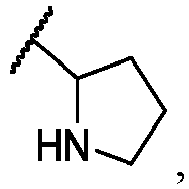
- The compound or the pharmaceutically acceptable salt, enantiomer, diastereomer, tautomer, solvate, isotopic substitute, polymorph, prodrug or metabolite thereof according to any one of claims 5 and 24 to 26, wherein ring C is a 4- to 9-membered monocyclic or fused heterocyclyl ring, which is optionally substituted by 1, 2 or 3 substituents selected from H, deuterium, hydroxyl, cyano, C1-C4 alkyl, halogen and C1-C4 alkoxy.
- The compound or the pharmaceutically acceptable salt, enantiomer, diastereomer, tautomer, solvate, isotopic substitute, polymorph, prodrug or metabolite thereof according to any one of claims 5, 24 to 26 and 74, wherein ring C is the following group optionally substituted by 1, 2 or 3 substituents selected from H, deuterium, hydroxyl, methyl, F and methoxy:

- The compound or the pharmaceutically acceptable salt, enantiomer, diastereomer, tautomer, solvate, isotopic substitute, polymorph, prodrug or metabolite thereof according to any one of claims 5, 24 to 26 and 74 to 75, wherein ring C is

- The compound or the pharmaceutically acceptable salt, enantiomer, diastereomer, tautomer, solvate, isotopic substitute, polymorph, prodrug or metabolite thereof according to any one of claims 1 to 76, wherein the ring A and ring B, together with their substituents, form any one of the following groups:




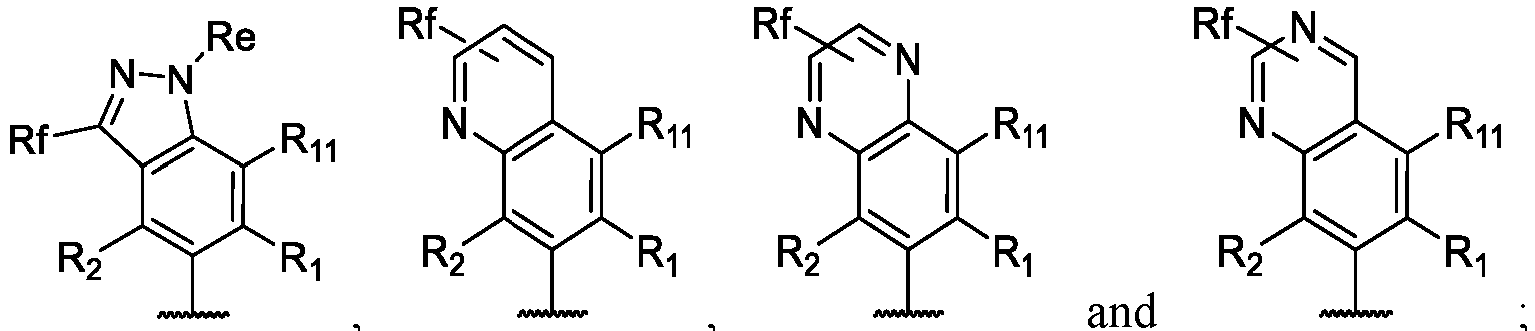
- The compound or the pharmaceutically acceptable salt, enantiomer, diastereomer, tautomer, solvate, isotopic substitute, polymorph, prodrug or metabolite thereof according to any one of claims 1 to 77, wherein R1 is cyano, -C(O)NH2 or -C(O)NHCH3; R2 is H or F; R11 is H; Re is selected from H, methyl, difluoromethyl, trifluoromethyl, ethyl, fluoroethyl, difluoroethyl, trifluoroethyl, isopropyl, cyclopropyl, cyclobutyl, trifluoropropyl, oxocyclobutyl, 1,1-difluorocyclobutyl, -CH2CH2OH, -CH2CH2(CH3)OH, acetyl, propionyl and cyclopropionyl; Rf is selected from H, F, Cl, hydroxyl, cyano, -NH2, -CH2OH, -(CH2)2OH, -(CH2)2OCH3, methoxy, methyl, ethyl, cyclopropyl and cyclobutyl.
- The compound or the pharmaceutically acceptable salt, enantiomer, diastereomer, tautomer, solvate, isotopic substitute, polymorph, prodrug or metabolite thereof according to any one of claims 1 to 78, wherein R1 is -C(O)NH2 or -C(O)NHCH3; R2 is F; R11 is H; Re is selected from H, methyl, difluoromethyl, trifluoromethyl, ethyl, fluoroethyl, difluoroethyl, trifluoroethyl, isopropyl, -CH2CH2OH, -CH2CH2(CH3)OH, trifluoropropyl, oxocyclobutyl, 1,1-difluorocyclobutyl, cyclopropyl and acetyl; Rf is selected from H, F, Cl, hydroxyl, cyano, -NH2, - CH2OH, -(CH2)2OH, -(CH2)2OCH3, methoxy and methyl.
- The compound or the pharmaceutically acceptable salt, enantiomer, diastereomer, tautomer, solvate, isotopic substitute, polymorph, prodrug or metabolite thereof according to any one of claims 1 to 76, wherein the ring A and ring B, together with their substituents, form any one of the following groups:
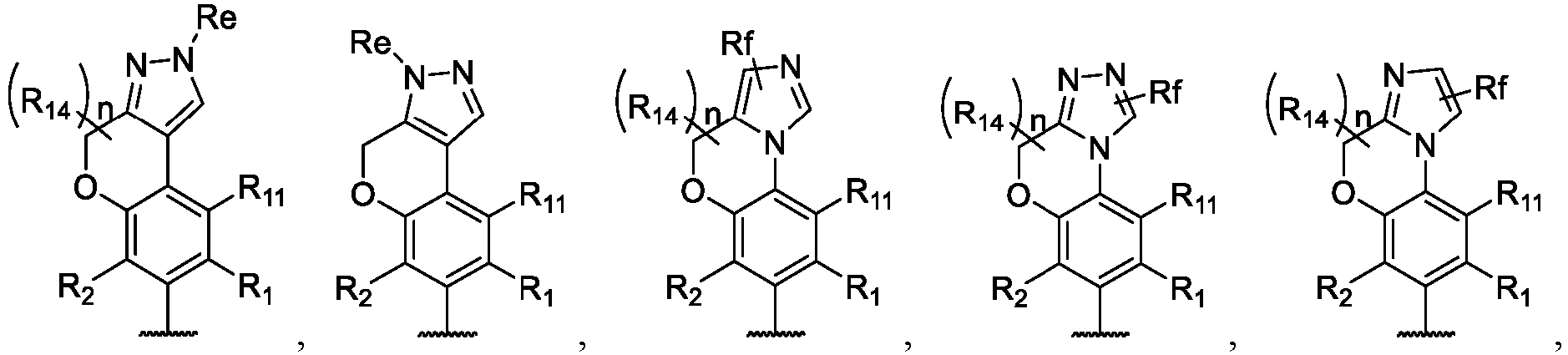


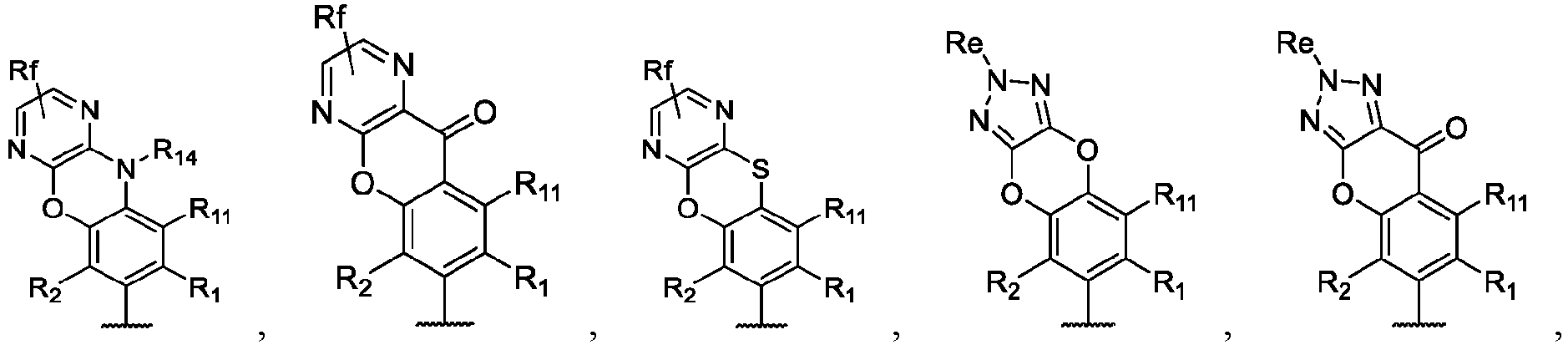


- The compound or the pharmaceutically acceptable salt, enantiomer, diastereomer, tautomer, solvate, isotopic substitute, polymorph, prodrug or metabolite thereof according to any one of claims 1 to 76 and 80, wherein R1 is cyano, -C(O)NH2 or -C(O)NHCH3; R2 is H or F; R11 is H; R14 is H or methyl; n is 0, 1 or 2; R16 is H, hydroxyl or methyl; Re is selected from H, methyl, difluoromethyl, trifluoromethyl, ethyl, fluoroethyl, difluoroethyl, trifluoroethyl, isopropyl, cyclopropyl, cyclobutyl, trifluoropropyl, oxocyclobutyl, 1,1-difluorocyclobutyl, -CH2CH2OH, - CH2CH2(CH3)OH, acetyl, propionyl and cyclopropionyl; Rf is selected from H, F, Cl, hydroxyl, cyano, -NH2, -CH2OH, -(CH2)2OH, -(CH2)2OCH3, methoxy, methyl, ethyl, cyclopropyl and cyclobutyl.
- The compound or the pharmaceutically acceptable salt, enantiomer, diastereomer, tautomer, solvate, isotopic substitute, polymorph, prodrug or metabolite thereof according to any one of claims 1 to 76 and 80 to 81, wherein R1 is -C(O)NH2 or -C(O)NHCH3; R2 is F; R11 is H; R14 is H; R16 is H; Rc is selected from H, methyl, difluoromethyl, trifluoromethyl, ethyl, fluoroethyl, difluoroethyl, trifluoroethyl, isopropyl, trifluoropropyl, oxocyclobutyl, 1,1-difluorocyclobutyl, cyclopropyl, -CH2CH2OH, -CH2CH2(CH3)OH and acetyl; Rf is selected from H, F, Cl, hydroxyl, cyano, -NH2, methoxy, -CH2OH, -(CH2)2OH, -(CH2)2OCH3 and methyl.
- The compound or the pharmaceutically acceptable salt, enantiomer, diastereomer, tautomer, solvate, isotopic substitute, polymorph, prodrug or metabolite thereof according to any one of claims 1 to 76, wherein the ring A and ring B, together with their substituents, form any one of the following groups:


- The compound or the pharmaceutically acceptable salt, enantiomer, diastereomer, tautomer, solvate, isotopic substitute, polymorph, prodrug or metabolite thereof according to any one of claims 1 to 76 and 83, wherein R1 is cyano, -C(O)NH2 or -C(O)NHCH3; R2 is H or F; R14 is H or methyl; n is 0, 1 or 2; Rc is selected from H, methyl, difluoromethyl, trifluoromethyl, ethyl, fluoroethyl, difluoroethyl, trifluoroethyl, isopropyl, ethyl, cyclopropyl, cyclobutyl, -CH2CH2OH, -CH2CH2(CH3)OH, acetyl, propionyl and cyclopropionyl; Rf is selected from H, F, Cl, hydroxyl, cyano, -NH2, methoxy, -CH2OH, -(CH2)2OH, -(CH2)2OCH3, methyl, ethyl, cyclopropyl and cyclobutyl.
- The compound or the pharmaceutically acceptable salt, enantiomer, diastereomer, tautomer, solvate, isotopic substitute, polymorph, prodrug or metabolite thereof according to any one of claims 1 to 84, whereinX2 is selected from: C and N;X3 is selected from: C and N;Y5 and Y6 are independently selected from: O, S, N, -S(O)-, -S(O)2-, CH(R13), C(R13)2, C(R13), -OCH2-, -N(R12)CH2-, -CH2CH2- and N(R12); and Y5 and Y6 are not simultaneously a bond;Y1 is selected from: a bond, O, N, CH, CH2, NH, CH(R13), C(R13)2 and N(R12);Y4 is selected from: a bond, O, N, CH, CH2, NH, CH(R13), C(R13)2 and N(R12);ring B can be optionally substituted by one or more R13 and/or R12 that do not participate in ring formation, and can be further optionally substituted by 1, 2 or 3 substituents selected from hydroxyl, amino, halogen, substituted or unsubstituted C1-C4 alkyl, -NR'R" and substituted or unsubstituted C1-C4 alkoxy;R1 is selected from: cyano and -C(O)NR'R";R2 is selected from: H, halogen, substituted or unsubstituted C1-C4 alkyl and substituted or unsubstituted C1-C4 alkoxy;R3 is selected from: substituted or unsubstituted aryl;R4 and R5 are each independently selected from: H, halogen and substituted or unsubstituted C1-C4 alkyl; alternatively, R4 and R5, together with the carbon atom to which they are attached, form a 3- to 6-membered substituted or unsubstituted ring, and the ring optionally contains 1, 2 or 3 heteroatoms selected from O, N and S;R6 is selected from: H, substituted or unsubstituted C1-C6 alkyl, substituted or unsubstituted C1-C6 alkoxy, substituted or unsubstituted C2-C6 alkenyl, substituted or unsubstituted C2-C6 alkynyl, substituted or unsubstituted 3- to 8-membered cyclohydrocarbyl, substituted or unsubstituted 6- to 14-membered aryl, substituted or unsubstituted 5- to 10-membered heteroaryl, substituted or unsubstituted 4- to 9-membered monocyclic or fused heterocyclyl, substituted or unsubstituted 6- to 12-membered bridged cyclyl, substituted or unsubstituted 6- to 12-membered bridged heterocyclyl, substituted or unsubstituted 6- to 12-membered spiro cyclyl and substituted or unsubstituted 6- to 12-membered spiro heterocyclyl;alternatively, R4 or R5 and R6, together with the atom to which they are attached, form a 4- to 9-membered monocyclic or fused heterocyclyl, 6- to 12-membered bridged heterocyclyl or 6- to 12-membered spiro heterocyclyl ring, and the 4- to 9-membered monocyclic or fused heterocyclyl, 6- to 12-membered bridged heterocyclyl and 6- to 12-membered spiro heterocyclyl are optionally substituted by 1, 2 or 3 substituents selected from H, deuterium, hydroxyl, cyano, C1-C4 alkyl, halogen and C1-C4 alkoxy;R7 and R8 are each independently selected from: H, halogen, cyano, substituted or unsubstituted C1-C4 alkyl, substituted or unsubstituted C1-C4 haloalkyl and substituted or unsubstituted C1-C4 alkoxy;R9 is selected from: H, C1-C4 alkyl, C1-C4 alkoxy, hydroxyl and halogen;R10 is selected from: H, halogen and C1-C4 alkyl;R11 is selected from: H, hydroxyl, amino, halogen, C1-C4 alkyl, -NR'R" and C1-C4 alkoxy;each R12 that does not participate in ring formation is independently selected from H, substituted or unsubstituted C1-C4 acyl, substituted or unsubstituted C1-C4 alkoxy, substituted or unsubstituted C1-C4 alkyl-S(O)2-, substituted or unsubstituted 4- to 9-membered heterocyclyl, NR'R"-C(O)-, 3- to 8-membered cyclohydrocarbyl-C(O)- and substituted or unsubstituted C1-C4 alkyl; the C1-C4 acyl, C1-C4 alkoxy, C1-C4 alkyl-S(O)2-, 4- to 9-membered heterocyclyl and C1-C4 alkyl are optionally substituted by 1, 2 or 3 substituents selected from F, hydroxyl and cyano;each R13 that does not participate in ring formation is independently selected from: H, halogen, substituted or unsubstituted C1-C4 acyl, hydroxyl, cyano, -NR'R", substituted or unsubstituted C1-C4 alkoxy, substituted or unsubstituted C1-C4 alkyl, substituted or unsubstituted C1-C4 alkylS(O)2-, substituted or unsubstituted 3- to 6-membered cyclohydrocarbyl-C(O)- and NR'R"-C(O)-; the C1-C4 acyl, C1-C4 alkoxy, C1-C4 alkyl, C1-C4 alkyl-S(O)2- and 3- to 6-membered cyclohydrocarbyl-C(O)- are optionally substituted by 1, 2 or 3 substituents selected from F, hydroxyl and cyano, or two R13 on the same carbon atom form an oxo (=O) or thio (=S) group;R' and R" are each independently selected from H, C1-C4 alkyl and C3-C6 cycloalkyl;wherein the dashed line indicates the presence or absence of a double bond.
- The compound or the pharmaceutically acceptable salt, enantiomer, diastereomer, tautomer, solvate, isotopic substitute, polymorph, prodrug or metabolite thereof according to any one of claims 1 to 85, whereinX2 is selected from: C and N;X3 is selected from: C and N;Y5 is selected from: O, S, -S(O)-, -S(O)2-, N, CH2, CH, -C(O)-, NH and -N(CH3)-;Y6 is selected from: O, S, -S(O)-, -S(O)2-, N, CH2, CH, -C(O)-, NH and -N(CH3)-;Y1 is selected from: a bond, O, NH, -N(CH3)-, CH2 and -CH(CH3)-;Y4 is selected from: a bond, O, NH, -N(CH3)-, CH2 and -CH(CH3)-;H on ring B can be further optionally substituted by 1, 2 or 3 substituents selected from hydroxyl, amino, halogen, substituted or unsubstituted C1-C4 alkyl, -NR'R" and substituted or unsubstituted C1-C4 alkoxy;R1 is selected from: cyano, -C(O)NH2, -C(O)NHCH3 and
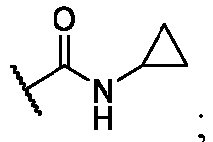 R2 is selected from: H, fluorine and methoxy;R3 is phenyl;R4 and R5 are each independently selected from: H and C1-C4 alkyl;R6 is H, substituted or unsubstituted C1-C6 alkyl, substituted or unsubstituted C1-C6 alkoxy, substituted or unsubstituted C2-C6 alkenyl or substituted or unsubstituted C2-C6 alkynyl, and their substituents are 1, 2 or 3 substituents selected from: hydroxyl, halogen, C1-C4 alkoxy optionally substituted by halogen, cyano, -S(O)2-C1-C4 alkyl optionally substituted by halogen, C1-C4 alkyl optionally substituted by halogen, -S(O)2-NR'R", -S(O)2-NH2, -C(O)-C1-C4 alkyl, -NR'-C(O)-C1-C4 alkyl and 6- to 14-membered aryl, 5- to 10-membered heteroaryl, 3- to 8-membered cyclohydrocarbyl and 4- to 9-membered heterocyclyl, wherein the 6- to 14-membered aryl, 5- to 10-membered heteroaryl, 3- to 8-membered cyclohydrocarbyl and 4- to 9-membered heterocyclyl are optionally substituted by 1, 2 or 3 substituents selected from C1-C4 alkyl, C1-C4 haloalkyl, C1-C4 alkoxy, C1-C4 haloalkoxy, halogen, cyano, C1-C4 alkyl-S(O)2-, hydroxyl, carboxyl, - NR'R", 6- to 14-membered aryl, 5- to 10-membered heteroaryl, 3- to 8-membered cyclohydrocarbyl and 4- to 9-membered heterocyclyl; wherein R' and R" are each independently selected from H and C1-C4 alkyl; orR6 is substituted or unsubstituted 3- to 8-membered cyclohydrocarbyl or substituted or unsubstituted 4- to 9-membered monocyclic or fused heterocyclyl, and their substituents are 1, 2 or 3 substituents selected from: halogen, hydroxyl, cyano, -NR'R", -S(O)2-NR'R", -S(O)2-NH2, -NR'-C(O)-C1-C4 alkyl, -S(O)2-C1-C4 alkyl, C1-C4 alkyl, C1-C4 alkoxy, C1-C4 haloalkoxy, - C(O)-C1-C4 alkyl and C1-C4 alkoxycarbonyl, and the C1-C4 alkyl and C1-C4 alkoxy are optionally substituted by 1, 2 or 3 groups selected from halogen, hydroxyl and -NR'R", wherein the R' and R" are each independently selected from H and C1-C4 alkyl; orR6 is substituted or unsubstituted 6- to 12-membered bridged cyclyl, substituted or unsubstituted 6- to 12-membered bridged heterocyclyl, substituted or unsubstituted 6- to 12-membered spiro cyclyl or substituted or unsubstituted 6- to 12-membered spiro heterocyclyl, and their substituents are 1, 2 or 3 substituents selected from: C1-C4 alkyl, C1-C4 haloalkyl, C1-C4 alkoxy, C1-C4 haloalkoxy, cyano, -S(O)2-C1-C4 alkyl, hydroxyl, halogen, NR'R", -S(O)2-NR'R", -S(O)2-NH2 and -NR'-C(O)-C1-C4 alkyl, wherein the R' and R" are each independently selected from H and C1-C4 alkyl;alternatively, R4 or R5 and R6, together with the atom to which they are attached, form the following group optionally substituted by 1, 2 or 3 substituents selected from H, deuterium, hydroxyl, methyl, F and methoxy:
 R7 and R8 are each independently selected from: H, halogen, cyano, methyl and methoxy;R9 is selected from: H, methyl, methoxy, hydroxyl and F;R10 is selected from: H, F and methyl; R11 is selected from: H, hydroxyl, amino, fluorine, chlorine, methyl, methoxy and -NH(CH3).
 - The compound or the pharmaceutically acceptable salt, enantiomer, diastereomer, tautomer, solvate, isotopic substitute, polymorph, prodrug or metabolite thereof according to claim 10, whereinX2 is selected from: C and N;X3 is selected from: C and N;Y1 is selected from: a bond, O, NH, -N(CH3)-, CH2 and -CH(CH3)-;Y5 is selected from: O, S, N, CH2, CH, NH, -N(CH3)-, -OCH2-, -NHCH2-, -N(CH3)CH2- and -CH2CH2-;Y4 is selected from: C, CH or N;Y6 is selected from: C, CH or N;R15 is selected from: H, fluorine, chlorine, acetyl, hydroxyl, C1-C4 alkoxy, cyano, -NR'R", NR'R"-C(O)-, 3- to 8-membered cyclohydrocarbyl-C(O)-, C1-C4 haloalkyl and C1-C4 alkyl; R' and R" are each independently selected from H and C1-C4 alkyl;n is 0 or 1;R1 is selected from: cyano and -C(O)NR'R";R2 is selected from: H, halogen, substituted or unsubstituted C1-C4 alkyl and substituted or unsubstituted C1-C4 alkoxy;R3 is selected from: substituted or unsubstituted aryl;R4 and R5 are each independently selected from: H, halogen and substituted or unsubstituted C1-C4 alkyl; alternatively, R4 and R5, together with the carbon atom to which they are attached, form a 3- to 6-membered substituted or unsubstituted ring, and the ring optionally contains 1, 2 or 3 heteroatoms selected from O, N and S;R6 is selected from: H, substituted or unsubstituted C1-C6 alkyl, substituted or unsubstituted C1-C6 alkoxy, substituted or unsubstituted C2-C6 alkenyl, substituted or unsubstituted C2-C6 alkynyl, substituted or unsubstituted 3- to 8-membered cyclohydrocarbyl, substituted or unsubstituted 6- to 14-membered aryl, substituted or unsubstituted 5- to 10-membered heteroaryl, substituted or unsubstituted 4- to 9-membered monocyclic or fused heterocyclyl, substituted or unsubstituted 6- to 12-membered bridged cyclyl, substituted or unsubstituted 6- to 12-membered bridged heterocyclyl, substituted or unsubstituted 6- to 12-membered spiro cyclyl and substituted or unsubstituted 6- to 12-membered spiro heterocyclyl;alternatively, R4 or R5 and R6, together with the atom to which they are attached, form a 4- to 9-membered monocyclic or fused heterocyclyl, 6- to 12-membered bridged heterocyclyl or 6- to 12-membered spiro heterocyclyl ring, and the 4- to 9-membered monocyclic or fused heterocyclyl, 6- to 12-membered bridged heterocyclyl and 6- to 12-membered spiro heterocyclyl are optionally substituted by 1, 2 or 3 substituents selected from H, deuterium, hydroxyl, cyano, C1-C4 alkyl, halogen and C1-C4 alkoxy;R7 and R8 are each independently selected from: H, halogen, cyano, substituted or unsubstituted C1-C4 alkyl, substituted or unsubstituted C1-C4 haloalkyl and substituted or unsubstituted C1-C4 alkoxy;R9 is selected from: H, C1-C4 alkyl, C1-C4 alkoxy, hydroxyl and halogen;R10 is selected from: H, halogen and C1-C4 alkyl;R11 is selected from: H, hydroxyl, amino, halogen, C1-C4 alkyl, -NR'R" and C1-C4 alkoxy;R' and R" are each independently selected from H, C1-C4 alkyl and C3-C6 cycloalkyl;wherein the dashed line indicates the presence or absence of a double bond.
- The compound or the pharmaceutically acceptable salt, enantiomer, diastereomer, tautomer, solvate, isotopic substitute, polymorph, prodrug or metabolite thereof according to claim 87, whereinR1 is selected from: cyano, -C(O)NH2, -C(O)NHCH3 and
 R2 is selected from: H, fluorine and methoxy;R3 is phenyl;R4 and R5 are each independently selected from: H and C1-C4 alkyl;R6 is H, substituted or unsubstituted C1-C6 alkyl, substituted or unsubstituted C1-C6 alkoxy, substituted or unsubstituted C2-C6 alkenyl or substituted or unsubstituted C2-C6 alkynyl, and their substituents are 1, 2 or 3 substituents selected from: hydroxyl, halogen, C1-C4 alkoxy optionally substituted by halogen, cyano, -S(O)2-C1-C4 alkyl optionally substituted by halogen, C1-C4 alkyl optionally substituted by halogen, -S(O)2-NR'R", -S(O)2-NH2, -C(O)-C1-C4 alkyl, -NR'-C(O)-C1-C4 alkyl and 6- to 14-membered aryl, 5- to 10-membered heteroaryl, 3- to 8-membered cyclohydrocarbyl and 4- to 9-membered heterocyclyl, wherein the 6- to 14-membered aryl, 5- to 10-membered heteroaryl, 3- to 8-membered cyclohydrocarbyl and 4- to 9-membered heterocyclyl are optionally substituted by 1, 2 or 3 substituents selected from C1-C4 alkyl, C1-C4 haloalkyl, C1-C4 alkoxy, C1-C4 haloalkoxy, halogen, cyano, C1-C4 alkyl-S(O)2-, hydroxyl, carboxyl, - NR'R", 6- to 14-membered aryl, 5- to 10-membered heteroaryl, 3- to 8-membered cyclohydrocarbyl and 4- to 9-membered heterocyclyl; wherein R' and R" are each independently selected from H and C1-C4 alkyl; orR6 is substituted or unsubstituted 3- to 8-membered cyclohydrocarbyl or substituted or unsubstituted 4- to 9-membered monocyclic or fused heterocyclyl, and their substituents are 1, 2 or 3 substituents selected from: halogen, hydroxyl, cyano, -NR'R", -S(O)2-NR'R", -S(O)2-NH2, -NR'-C(O)-C1-C4 alkyl, -S(O)2-C1-C4 alkyl, C1-C4 alkyl, C1-C4 alkoxy, C1-C4 haloalkoxy, - C(O)-C1-C4 alkyl and C1-C4 alkoxycarbonyl, and the C1-C4 alkyl and C1-C4 alkoxy are optionally substituted by 1, 2 or 3 groups selected from halogen, hydroxyl and -NR'R", wherein the R' and R" are each independently selected from H and C1-C4 alkyl; orR6 is substituted or unsubstituted 6- to 12-membered bridged cyclyl, substituted or unsubstituted 6- to 12-membered bridged heterocyclyl, substituted or unsubstituted 6- to 12-membered spiro cyclyl or substituted or unsubstituted 6- to 12-membered spiro heterocyclyl, and their substituents are 1, 2 or 3 substituents selected from: C1-C4 alkyl, C1-C4 haloalkyl, C1-C4 alkoxy, C1-C4 haloalkoxy, cyano, -S(O)2-C1-C4 alkyl, hydroxyl, halogen, NR'R", -S(O)2-NR'R", -S(O)2-NH2 and -NR'-C(O)-C1-C4 alkyl, wherein the R' and R" are each independently selected from H and C1-C4 alkyl;alternatively, R4 or R5 and R6, together with the atom to which they are attached, form the following group optionally substituted by 1, 2 or 3 substituents selected from H, deuterium, hydroxyl, methyl, F and methoxy:
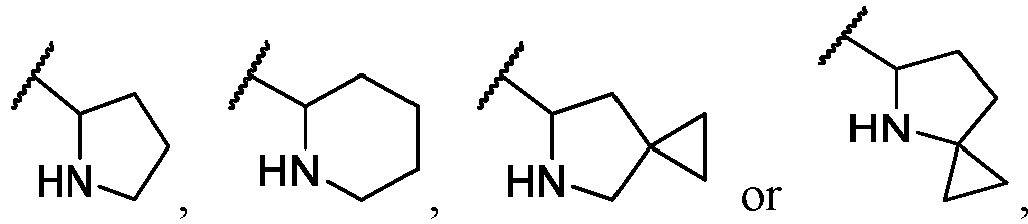 R7 and R8 are each independently selected from: H, halogen, cyano, methyl and methoxy;R9 is selected from: H, methyl, methoxy, hydroxyl and F;R10 is selected from: H, F and methyl;R11 is selected from: H, hydroxyl, amino, fluorine, chlorine, methyl, methoxy and -NH(CH3).
 - The compound or the pharmaceutically acceptable salt, enantiomer, diastereomer, tautomer, solvate, isotopic substitute, polymorph, prodrug or metabolite thereof according to claim 11, whereinX2 and X3 are C;Y1 is selected from: C, CH and N;Y4 is selected from: C, CH and N;Y5 is selected from: a bond, O, S, -S(O)-, -S(O)2-, -C(O)-, N, NH, -N(CH3)-, CH2, -CH(CH3)-, -OCH2-, -NHCH2-, -N(CH3)CH2- and -CH2CH2-;Y6 is selected from: a bond, O, S, -S(O)-, -S(O)2-, -C(O)-, N, CH2, CH, NH, -N(CH3)-, - OCH2-, -NHCH2-, -N(CH3)CH2- and -CH2CH2-; and Y5 and Y6 are not simultaneously a bond;R15 is selected from: H, fluorine, chlorine, acetyl, hydroxyl, C1-C4 alkoxy, cyano, -NR'R", NR'R"-C(O)-, 3- to 8-membered cyclohydrocarbyl-C(O)-, C1-C4 haloalkyl and C1-C4 alkyl; R' and R" are each independently selected from H and C1-C4 alkyl;n is 0 or 1;R1 is selected from: cyano and -C(O)NR'R";R2 is selected from: H, halogen, substituted or unsubstituted C1-C4 alkyl and substituted or unsubstituted C1-C4 alkoxy;R3 is selected from: substituted or unsubstituted aryl;R4 and R5 are each independently selected from: H, halogen and substituted or unsubstituted C1-C4 alkyl; alternatively, R4 and R5, together with the carbon atom to which they are attached, form a 3- to 6-membered substituted or unsubstituted ring, and the ring optionally contains 1, 2 or 3 heteroatoms selected from O, N and S;R6 is selected from: H, substituted or unsubstituted C1-C6 alkyl, substituted or unsubstituted C1-C6 alkoxy, substituted or unsubstituted C2-C6 alkenyl, substituted or unsubstituted C2-C6 alkynyl, substituted or unsubstituted 3- to 8-membered cyclohydrocarbyl, substituted or unsubstituted 6- to 14-membered aryl, substituted or unsubstituted 5- to 10-membered heteroaryl, substituted or unsubstituted 4- to 9-membered monocyclic or fused heterocyclyl, substituted or unsubstituted 6- to 12-membered bridged cyclyl, substituted or unsubstituted 6- to 12-membered bridged heterocyclyl, substituted or unsubstituted 6- to 12-membered spiro cyclyl and substituted or unsubstituted 6- to 12-membered spiro heterocyclyl;alternatively, R4 or R5 and R6, together with the atom to which they are attached, form a 4- to 9-membered monocyclic or fused heterocyclyl, 6- to 12-membered bridged heterocyclyl or 6- to 12-membered spiro heterocyclyl ring, and the 4- to 9-membered monocyclic or fused heterocyclyl, 6- to 12-membered bridged heterocyclyl and 6- to 12-membered spiro heterocyclyl are optionally substituted by 1, 2 or 3 substituents selected from H, deuterium, hydroxyl, cyano, C1-C4 alkyl, halogen and C1-C4 alkoxy;R7 and R8 are each independently selected from: H, halogen, cyano, substituted or unsubstituted C1-C4 alkyl, substituted or unsubstituted C1-C4 haloalkyl and substituted or unsubstituted C1-C4 alkoxy;R9 is selected from: H, C1-C4 alkyl, C1-C4 alkoxy, hydroxyl and halogen;R10 is selected from: H, halogen and C1-C4 alkyl;R11 is selected from: H, hydroxyl, amino, halogen, C1-C4 alkyl, -NR'R" and C1-C4 alkoxy;R' and R" are each independently selected from H, C1-C4 alkyl and C3-C6 cycloalkyl;wherein the dashed line indicates the presence or absence of a double bond.
- The compound or the pharmaceutically acceptable salt, enantiomer, diastereomer, tautomer, solvate, isotopic substitute, polymorph, prodrug or metabolite thereof according to claim 89, whereinR1 is selected from: cyano, -C(O)NH2, -C(O)NHCH3 and
 R2 is selected from: H, fluorine and methoxy;R3 is phenyl;R4 and R5 are each independently selected from: H and C1-C4 alkyl;R6 is H, substituted or unsubstituted C1-C6 alkyl, substituted or unsubstituted C1-C6 alkoxy, substituted or unsubstituted C2-C6 alkenyl or substituted or unsubstituted C2-C6 alkynyl, and their substituents are 1, 2 or 3 substituents selected from: hydroxyl, halogen, C1-C4 alkoxy optionally substituted by halogen, cyano, -S(O)2-C1-C4 alkyl optionally substituted by halogen, C1-C4 alkyl optionally substituted by halogen, -S(O)2-NR'R", -S(O)2-NH2, -C(O)-C1-C4 alkyl, -NR'-C(O)-C1-C4 alkyl and 6- to 14-membered aryl, 5- to 10-membered heteroaryl, 3- to 8-membered cyclohydrocarbyl and 4- to 9-membered heterocyclyl, wherein the 6- to 14-membered aryl, 5- to 10-membered heteroaryl, 3- to 8-membered cyclohydrocarbyl and 4- to 9-membered heterocyclyl are optionally substituted by 1, 2 or 3 substituents selected from C1-C4 alkyl, C1-C4 haloalkyl, C1-C4 alkoxy, C1-C4 haloalkoxy, halogen, cyano, C1-C4 alkyl-S(O)2-, hydroxyl, carboxyl, - NR'R", 6- to 14-membered aryl, 5- to 10-membered heteroaryl, 3- to 8-membered cyclohydrocarbyl and 4- to 9-membered heterocyclyl; wherein R' and R" are each independently selected from H and C1-C4 alkyl; orR6 is substituted or unsubstituted 3- to 8-membered cyclohydrocarbyl or substituted or unsubstituted 4- to 9-membered monocyclic or fused heterocyclyl, and their substituents are 1, 2 or 3 substituents selected from: halogen, hydroxyl, cyano, -NR'R", -S(O)2-NR'R", -S(O)2-NH2, -NR'-C(O)-C1-C4 alkyl, -S(O)2-C1-C4 alkyl, C1-C4 alkyl, C1-C4 alkoxy, C1-C4 haloalkoxy, - C(O)-C1-C4 alkyl and C1-C4 alkoxycarbonyl, and the C1-C4 alkyl and C1-C4 alkoxy are optionally substituted by 1, 2 or 3 groups selected from halogen, hydroxyl and -NR'R", wherein the R' and R" are each independently selected from H and C1-C4 alkyl; orR6 is substituted or unsubstituted 6- to 12-membered bridged cyclyl, substituted or unsubstituted 6- to 12-membered bridged heterocyclyl, substituted or unsubstituted 6- to 12-membered spiro cyclyl or substituted or unsubstituted 6- to 12-membered spiro heterocyclyl, and their substituents are 1, 2 or 3 substituents selected from: C1-C4 alkyl, C1-C4 haloalkyl, C1-C4 alkoxy, C1-C4 haloalkoxy, cyano, -S(O)2-C1-C4 alkyl, hydroxyl, halogen, NR'R", -S(O)2-NR'R", -S(O)2-NH2 and -NR'-C(O)-C1-C4 alkyl, wherein the R' and R" are each independently selected from H and C1-C4 alkyl;alternatively, R4 or R5 and R6, together with the atom to which they are attached, form the following group optionally substituted by 1, 2 or 3 substituents selected from H, deuterium, hydroxyl, methyl, F and methoxy:
 R7 and R8 are each independently selected from: H, halogen, cyano, methyl and methoxy;R9 is selected from: H, methyl, methoxy, hydroxyl and F;R10 is selected from: H, F and methyl;R11 is selected from: H, hydroxyl, amino, fluorine, chlorine, methyl, methoxy and -NH(CH3).
 - The compound or the pharmaceutically acceptable salt, enantiomer, diastereomer, tautomer, solvate, isotopic substitute, polymorph, prodrug or metabolite thereof according to claim 14, whereinX2 and X3 are C;Y1 is selected from: O or CH2;Y5 is selected from: a bond, O, NH, -N(CH3)-, CH2 and -CH(CH3)-;Y6 is selected from: a bond, O, S, N, CH2, CH, NH and -N(CH3)-;R16 is selected from halogen, C1-C4 alkyl, hydroxyl, C1-C4 acyl and C1-C4 alkoxy;R1 is selected from: cyano and -C(O)NR'R";R2 is selected from: H, halogen, substituted or unsubstituted C1-C4 alkyl and substituted or unsubstituted C1-C4 alkoxy;R3 is selected from: substituted or unsubstituted aryl;R4 and R5 are each independently selected from: H, halogen and substituted or unsubstituted C1-C4 alkyl; alternatively, R4 and R5, together with the carbon atom to which they are attached, form a 3- to 6-membered substituted or unsubstituted ring, and the ring optionally contains 1, 2 or 3 heteroatoms selected from O, N and S;R6 is selected from: H, substituted or unsubstituted C1-C6 alkyl, substituted or unsubstituted C1-C6 alkoxy, substituted or unsubstituted C2-C6 alkenyl, substituted or unsubstituted C2-C6 alkynyl, substituted or unsubstituted 3- to 8-membered cyclohydrocarbyl, substituted or unsubstituted 6- to 14-membered aryl, substituted or unsubstituted 5- to 10-membered heteroaryl, substituted or unsubstituted 4- to 9-membered monocyclic or fused heterocyclyl, substituted or unsubstituted 6- to 12-membered bridged cyclyl, substituted or unsubstituted 6- to 12-membered bridged heterocyclyl, substituted or unsubstituted 6- to 12-membered spiro cyclyl and substituted or unsubstituted 6- to 12-membered spiro heterocyclyl;alternatively, R4 or R5 and R6, together with the atom to which they are attached, form a 4- to 9-membered monocyclic or fused heterocyclyl, 6- to 12-membered bridged heterocyclyl or 6- to 12-membered spiro heterocyclyl ring, and the 4- to 9-membered monocyclic or fused heterocyclyl, 6- to 12-membered bridged heterocyclyl and 6- to 12-membered spiro heterocyclyl are optionally substituted by 1, 2 or 3 substituents selected from H, deuterium, hydroxyl, cyano, C1-C4 alkyl, halogen and C1-C4 alkoxy;R7 and R8 are each independently selected from: H, halogen, cyano, substituted or unsubstituted C1-C4 alkyl, substituted or unsubstituted C1-C4 haloalkyl and substituted or unsubstituted C1-C4 alkoxy;R9 is selected from: H, C1-C4 alkyl, C1-C4 alkoxy, hydroxyl and halogen;R10 is selected from: H, halogen and C1-C4 alkyl;R11 is selected from: H, hydroxyl, amino, halogen, C1-C4 alkyl, -NR'R" and C1-C4 alkoxy;R' and R" are each independently selected from H, C1-C4 alkyl and C3-C6 cycloalkyl;wherein the dashed line indicates the presence or absence of a double bond.
- The compound or the pharmaceutically acceptable salt, enantiomer, diastereomer, tautomer, solvate, isotopic substitute, polymorph, prodrug or metabolite thereof according to claim 91, whereinR1 is selected from: cyano, -C(O)NH2, -C(O)NHCH3 and
 R2 is selected from: H, fluorine and methoxy;R3 is phenyl;R4 and R5 are each independently selected from: H and C1-C4 alkyl;R6 is H, substituted or unsubstituted C1-C6 alkyl, substituted or unsubstituted C1-C6 alkoxy, substituted or unsubstituted C2-C6 alkenyl or substituted or unsubstituted C2-C6 alkynyl, and their substituents are 1, 2 or 3 substituents selected from: hydroxyl, halogen, C1-C4 alkoxy optionally substituted by halogen, cyano, -S(O)2-C1-C4 alkyl optionally substituted by halogen, C1-C4 alkyl optionally substituted by halogen, -S(O)2-NR'R", -S(O)2-NH2, -C(O)-C1-C4 alkyl, -NR'-C(O)-C1-C4 alkyl and 6- to 14-membered aryl, 5- to 10-membered heteroaryl, 3- to 8-membered cyclohydrocarbyl and 4- to 9-membered heterocyclyl, wherein the 6- to 14-membered aryl, 5- to 10-membered heteroaryl, 3- to 8-membered cyclohydrocarbyl and 4- to 9-membered heterocyclyl are optionally substituted by 1, 2 or 3 substituents selected from C1-C4 alkyl, C1-C4 haloalkyl, C1-C4 alkoxy, C1-C4 haloalkoxy, halogen, cyano, C1-C4 alkyl-S(O)2-, hydroxyl, carboxyl, - NR'R", 6- to 14-membered aryl, 5- to 10-membered heteroaryl, 3- to 8-membered cyclohydrocarbyl and 4- to 9-membered heterocyclyl; wherein R' and R" are each independently selected from H and C1-C4 alkyl; orR6 is substituted or unsubstituted 3- to 8-membered cyclohydrocarbyl or substituted or unsubstituted 4- to 9-membered monocyclic or fused heterocyclyl, and their substituents are 1, 2 or 3 substituents selected from: halogen, hydroxyl, cyano, -NR'R", -S(O)2-NR'R", -S(O)2-NH2, -NR'-C(O)-C1-C4 alkyl, -S(O)2-C1-C4 alkyl, C1-C4 alkyl, C1-C4 alkoxy, C1-C4 haloalkoxy, - C(O)-C1-C4 alkyl and C1-C4 alkoxycarbonyl, and the C1-C4 alkyl and C1-C4 alkoxy are optionally substituted by 1, 2 or 3 groups selected from halogen, hydroxyl and -NR'R", wherein the R' and R" are each independently selected from H and C1-C4 alkyl; orR6 is substituted or unsubstituted 6- to 12-membered bridged cyclyl, substituted or unsubstituted 6- to 12-membered bridged heterocyclyl, substituted or unsubstituted 6- to 12-membered spiro cyclyl or substituted or unsubstituted 6- to 12-membered spiro heterocyclyl, and their substituents are 1, 2 or 3 substituents selected from: C1-C4 alkyl, C1-C4 haloalkyl, C1-C4 alkoxy, C1-C4 haloalkoxy, cyano, -S(O)2-C1-C4 alkyl, hydroxyl, halogen, NR'R", -S(O)2-NR'R", -S(O)2-NH2 and -NR'-C(O)-C1-C4 alkyl, wherein the R' and R" are each independently selected from H and C1-C4 alkyl;alternatively, R4 or R5 and R6, together with the atom to which they are attached, form the following group optionally substituted by 1, 2 or 3 substituents selected from H, deuterium, hydroxyl, methyl, F and methoxy:
 R7 and R8 are each independently selected from: H, halogen, cyano, methyl and methoxy;R9 is selected from: H, methyl, methoxy, hydroxyl and F;R10 is selected from: H, F and methyl;R11 is selected from: H, hydroxyl, amino, fluorine, chlorine, methyl, methoxy and -NH(CH3).
 - The compound or the pharmaceutically acceptable salt, enantiomer, diastereomer, tautomer, solvate, isotopic substitute, polymorph, prodrug or metabolite thereof according to claim 15, whereinX2 and X3 are C;Y4 is selected from: O or CH2;Y5 is selected from: a bond, O, NH, -N(CH3)-, CH2 and -CH(CH3)-;Y6 is selected from: a bond, O, S, N, CH2, CH, NH and -N(CH3)-;R16 is selected from halogen, C1-C4 alkyl, hydroxyl, C1-C4 acyl and C1-C4 alkoxy;R1 is selected from: cyano and -C(O)NR'R";R2 is selected from: H, halogen, substituted or unsubstituted C1-C4 alkyl and substituted or unsubstituted C1-C4 alkoxy;R3 is selected from: substituted or unsubstituted aryl;R4 and R5 are each independently selected from: H, halogen and substituted or unsubstituted C1-C4 alkyl; alternatively, R4 and R5, together with the carbon atom to which they are attached, form a 3- to 6-membered substituted or unsubstituted ring, and the ring optionally contains 1, 2 or 3 heteroatoms selected from O, N and S;R6 is selected from: H, substituted or unsubstituted C1-C6 alkyl, substituted or unsubstituted C1-C6 alkoxy, substituted or unsubstituted C2-C6 alkenyl, substituted or unsubstituted C2-C6 alkynyl, substituted or unsubstituted 3- to 8-membered cyclohydrocarbyl, substituted or unsubstituted 6- to 14-membered aryl, substituted or unsubstituted 5- to 10-membered heteroaryl, substituted or unsubstituted 4- to 9-membered monocyclic or fused heterocyclyl, substituted or unsubstituted 6- to 12-membered bridged cyclyl, substituted or unsubstituted 6- to 12-membered bridged heterocyclyl, substituted or unsubstituted 6- to 12-membered spiro cyclyl and substituted or unsubstituted 6- to 12-membered spiro heterocyclyl;alternatively, R4 or R5 and R6, together with the atom to which they are attached, form a 4- to 9-membered monocyclic or fused heterocyclyl, 6- to 12-membered bridged heterocyclyl or 6- to 12-membered spiro heterocyclyl ring, and the 4- to 9-membered monocyclic or fused heterocyclyl, 6- to 12-membered bridged heterocyclyl and 6- to 12-membered spiro heterocyclyl are optionally substituted by 1, 2 or 3 substituents selected from H, deuterium, hydroxyl, cyano, C1-C4 alkyl, halogen and C1-C4 alkoxy;R7 and R8 are each independently selected from: H, halogen, cyano, substituted or unsubstituted C1-C4 alkyl, substituted or unsubstituted C1-C4 haloalkyl and substituted or unsubstituted C1-C4 alkoxy;R9 is selected from: H, C1-C4 alkyl, C1-C4 alkoxy, hydroxyl and halogen;R10 is selected from: H, halogen and C1-C4 alkyl;R11 is selected from: H, hydroxyl, amino, halogen, C1-C4 alkyl, -NR'R" and C1-C4 alkoxy;R' and R" are each independently selected from H, C1-C4 alkyl and C3-C6 cycloalkyl;wherein the dashed line indicates the presence or absence of a double bond.
- The compound or the pharmaceutically acceptable salt, enantiomer, diastereomer, tautomer, solvate, isotopic substitute, polymorph, prodrug or metabolite thereof according to claim 93, whereinR1 is selected from: cyano, -C(O)NH2, -C(O)NHCH3 and
 R2 is selected from: H, fluorine and methoxy;R3 is phenyl;R4 and R5 are each independently selected from: H and C1-C4 alkyl;R6 is H, substituted or unsubstituted C1-C6 alkyl, substituted or unsubstituted C1-C6 alkoxy, substituted or unsubstituted C2-C6 alkenyl or substituted or unsubstituted C2-C6 alkynyl, and their substituents are 1, 2 or 3 substituents selected from: hydroxyl, halogen, C1-C4 alkoxy optionally substituted by halogen, cyano, -S(O)2-C1-C4 alkyl optionally substituted by halogen, C1-C4 alkyl optionally substituted by halogen, -S(O)2-NR'R", -S(O)2-NH2, -C(O)-C1-C4 alkyl, -NR'-C(O)-C1-C4 alkyl and 6- to 14-membered aryl, 5- to 10-membered heteroaryl, 3- to 8-membered cyclohydrocarbyl and 4- to 9-membered heterocyclyl, wherein the 6- to 14-membered aryl, 5- to 10-membered heteroaryl, 3- to 8-membered cyclohydrocarbyl and 4- to 9-membered heterocyclyl are optionally substituted by 1, 2 or 3 substituents selected from C1-C4 alkyl, C1-C4 haloalkyl, C1-C4 alkoxy, C1-C4 haloalkoxy, halogen, cyano, C1-C4 alkyl-S(O)2-, hydroxyl, carboxyl, - NR'R", 6- to 14-membered aryl, 5- to 10-membered heteroaryl, 3- to 8-membered cyclohydrocarbyl and 4- to 9-membered heterocyclyl; wherein R' and R" are each independently selected from H and C1-C4 alkyl; orR6 is substituted or unsubstituted 3- to 8-membered cyclohydrocarbyl or substituted or unsubstituted 4- to 9-membered monocyclic or fused heterocyclyl, and their substituents are 1, 2 or 3 substituents selected from: halogen, hydroxyl, cyano, -NR'R", -S(O)2-NR'R", -S(O)2-NH2, -NR'-C(O)-C1-C4 alkyl, -S(O)2-C1-C4 alkyl, C1-C4 alkyl, C1-C4 alkoxy, C1-C4 haloalkoxy, - C(O)-C1-C4 alkyl and C1-C4 alkoxycarbonyl, and the C1-C4 alkyl and C1-C4 alkoxy are optionally substituted by 1, 2 or 3 groups selected from halogen, hydroxyl and -NR'R", wherein the R' and R" are each independently selected from H and C1-C4 alkyl; orR6 is substituted or unsubstituted 6- to 12-membered bridged cyclyl, substituted or unsubstituted 6- to 12-membered bridged heterocyclyl, substituted or unsubstituted 6- to 12-membered spiro cyclyl or substituted or unsubstituted 6- to 12-membered spiro heterocyclyl, and their substituents are 1, 2 or 3 substituents selected from: C1-C4 alkyl, C1-C4 haloalkyl, C1-C4 alkoxy, C1-C4 haloalkoxy, cyano, -S(O)2-C1-C4 alkyl, hydroxyl, halogen, NR'R", -S(O)2-NR'R", -S(O)2-NH2 and -NR'-C(O)-C1-C4 alkyl, wherein the R' and R" are each independently selected from H and C1-C4 alkyl;alternatively, R4 or R5 and R6, together with the atom to which they are attached, form the following group optionally substituted by 1, 2 or 3 substituents selected from H, deuterium, hydroxyl, methyl, F and methoxy:
 R7 and R8 are each independently selected from: H, halogen, cyano, methyl and methoxy;R9 is selected from: H, methyl, methoxy, hydroxyl and F;R10 is selected from: H, F and methyl;R11 is selected from: H, hydroxyl, amino, fluorine, chlorine, methyl, methoxy and -NH(CH3).
 - The compound or the pharmaceutically acceptable salt, enantiomer, diastereomer, tautomer, solvate, isotopic substitute, polymorph, prodrug or metabolite thereof according to claim 18, whereinY1, Y4 and Y5 are independently selected from: O, CH, CH2, -CH(CH3)-, N, NH and -N(CH3)-;ring F is a phenyl or 5- or 6-membered heteroaryl ring, wherein the 5- or 6-membered heteroaryl contains 1, 2 or 3 heteroatoms selected from O, N and S; R15 is selected from: H, fluorine, chlorine, acetyl, hydroxyl, C1-C4 alkoxy, cyano, -NR'R", NR'R"-C(O)-, 3- to 8-membered cyclohydrocarbyl-C(O)-, C1-C4 haloalkyl and C1-C4 alkyl; R' and R" are each independently selected from H and C1-C4 alkyl; n is 0 or 1;R1 is selected from: cyano and -C(O)NR'R";R2 is selected from: H, halogen, substituted or unsubstituted C1-C4 alkyl and substituted or unsubstituted C1-C4 alkoxy;R3 is selected from: substituted or unsubstituted aryl;R4 and R5 are each independently selected from: H, halogen and substituted or unsubstituted C1-C4 alkyl; alternatively, R4 and R5, together with the carbon atom to which they are attached, form a 3- to 6-membered substituted or unsubstituted ring, and the ring optionally contains 1, 2 or 3 heteroatoms selected from O, N and S;R6 is selected from: H, substituted or unsubstituted C1-C6 alkyl, substituted or unsubstituted C1-C6 alkoxy, substituted or unsubstituted C2-C6 alkenyl, substituted or unsubstituted C2-C6 alkynyl, substituted or unsubstituted 3- to 8-membered cyclohydrocarbyl, substituted or unsubstituted 6- to 14-membered aryl, substituted or unsubstituted 5- to 10-membered heteroaryl, substituted or unsubstituted 4- to 9-membered monocyclic or fused heterocyclyl, substituted or unsubstituted 6- to 12-membered bridged cyclyl, substituted or unsubstituted 6- to 12-membered bridged heterocyclyl, substituted or unsubstituted 6- to 12-membered spiro cyclyl and substituted or unsubstituted 6- to 12-membered spiro heterocyclyl;alternatively, R4 or R5 and R6, together with the atom to which they are attached, form a 4- to 9-membered monocyclic or fused heterocyclyl, 6- to 12-membered bridged heterocyclyl or 6- to 12-membered spiro heterocyclyl ring, and the 4- to 9-membered monocyclic or fused heterocyclyl, 6- to 12-membered bridged heterocyclyl and 6- to 12-membered spiro heterocyclyl are optionally substituted by 1, 2 or 3 substituents selected from H, deuterium, hydroxyl, cyano, C1-C4 alkyl, halogen and C1-C4 alkoxy;R7 and R8 are each independently selected from: H, halogen, cyano, substituted or unsubstituted C1-C4 alkyl, substituted or unsubstituted C1-C4 haloalkyl and substituted or unsubstituted C1-C4 alkoxy;R9 is selected from: H, C1-C4 alkyl, C1-C4 alkoxy, hydroxyl and halogen;R10 is selected from: H, halogen and C1-C4 alkyl;R11 is selected from: H, hydroxyl, amino, halogen, C1-C4 alkyl, -NR'R" and C1-C4 alkoxy;R' and R" are each independently selected from H, C1-C4 alkyl and C3-C6 cycloalkyl;wherein the dashed line indicates the presence or absence of a double bond.
- The compound or the pharmaceutically acceptable salt, enantiomer, diastereomer, tautomer, solvate, isotopic substitute, polymorph, prodrug or metabolite thereof according to claim 95, whereinR1 is selected from: cyano, -C(O)NH2, -C(O)NHCH3 and
 R2 is selected from: H, fluorine and methoxy;R3 is phenyl;R4 and R5 are each independently selected from: H and C1-C4 alkyl;R6 is H, substituted or unsubstituted C1-C6 alkyl, substituted or unsubstituted C1-C6 alkoxy, substituted or unsubstituted C2-C6 alkenyl or substituted or unsubstituted C2-C6 alkynyl, and their substituents are 1, 2 or 3 substituents selected from: hydroxyl, halogen, C1-C4 alkoxy optionally substituted by halogen, cyano, -S(O)2-C1-C4 alkyl optionally substituted by halogen, C1-C4 alkyl optionally substituted by halogen, -S(O)2-NR'R", -S(O)2-NH2, -C(O)-C1-C4 alkyl, -NR'-C(O)-C1-C4 alkyl and 6- to 14-membered aryl, 5- to 10-membered heteroaryl, 3- to 8-membered cyclohydrocarbyl and 4- to 9-membered heterocyclyl, wherein the 6- to 14-membered aryl, 5- to 10-membered heteroaryl, 3- to 8-membered cyclohydrocarbyl and 4- to 9-membered heterocyclyl are optionally substituted by 1, 2 or 3 substituents selected from C1-C4 alkyl, C1-C4 haloalkyl, C1-C4 alkoxy, C1-C4 haloalkoxy, halogen, cyano, C1-C4 alkyl-S(O)2-, hydroxyl, carboxyl, - NR'R", 6- to 14-membered aryl, 5- to 10-membered heteroaryl, 3- to 8-membered cyclohydrocarbyl and 4- to 9-membered heterocyclyl; wherein R' and R" are each independently selected from H and C1-C4 alkyl; orR6 is substituted or unsubstituted 3- to 8-membered cyclohydrocarbyl or substituted or unsubstituted 4- to 9-membered monocyclic or fused heterocyclyl, and their substituents are 1, 2 or 3 substituents selected from: halogen, hydroxyl, cyano, -NR'R", -S(O)2-NR'R", -S(O)2-NH2, -NR'-C(O)-C1-C4 alkyl, -S(O)2-C1-C4 alkyl, C1-C4 alkyl, C1-C4 alkoxy, C1-C4 haloalkoxy, - C(O)-C1-C4 alkyl and C1-C4 alkoxycarbonyl, and the C1-C4 alkyl and C1-C4 alkoxy are optionally substituted by 1, 2 or 3 groups selected from halogen, hydroxyl and -NR'R", wherein the R' and R" are each independently selected from H and C1-C4 alkyl; orR6 is substituted or unsubstituted 6- to 12-membered bridged cyclyl, substituted or unsubstituted 6- to 12-membered bridged heterocyclyl, substituted or unsubstituted 6- to 12-membered spiro cyclyl or substituted or unsubstituted 6- to 12-membered spiro heterocyclyl, and their substituents are 1, 2 or 3 substituents selected from: C1-C4 alkyl, C1-C4 haloalkyl, C1-C4 alkoxy, C1-C4 haloalkoxy, cyano, -S(O)2-C1-C4 alkyl, hydroxyl, halogen, NR'R", -S(O)2-NR'R", -S(O)2-NH2 and -NR'-C(O)-C1-C4 alkyl, wherein the R' and R" are each independently selected from H and C1-C4 alkyl;alternatively, R4 or R5 and R6, together with the atom to which they are attached, form the following group optionally substituted by 1, 2 or 3 substituents selected from H, deuterium, hydroxyl, methyl, F and methoxy:
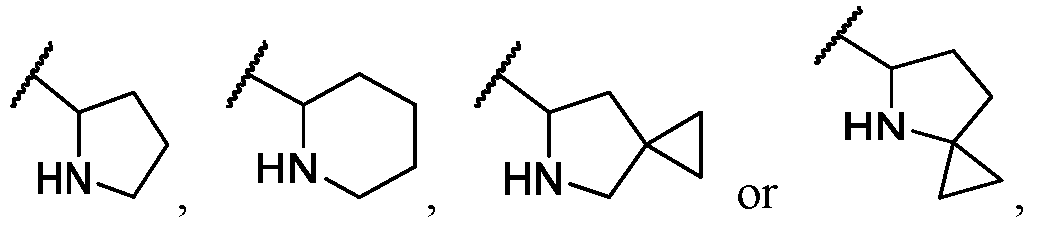 R7 and R8 are each independently selected from: H, halogen, cyano, methyl and methoxy;R9 is selected from: H, methyl, methoxy, hydroxyl and F;R10 is selected from: H, F and methyl;R11 is selected from: H, hydroxyl, amino, fluorine, chlorine, methyl, methoxy and -NH(CH3).
 - The compound or the pharmaceutically acceptable salt, enantiomer, diastereomer, tautomer, solvate, isotopic substitute, polymorph, prodrug or metabolite thereof according to claim 22, whereinX2 is selected from: C and N;X3 is selected from: C and N;Y1 is selected from: a bond, O, NH, -N(CH3)-, CH2 and -CH(CH3)-;Y5 is selected from: O, S, N, CH2, CH, NH, -N(CH3)-, -OCH2-, -NHCH2-, -N(CH3)CH2- and -CH2CH2-;Y4 is selected from: C, CH or N;Y6 is selected from: C, CH or N;D1 is selected from: O, S, N, NRc, CRf and CRfRg;D2 is selected from: O, S, N, NRc, N-NRc, C(O)-NRe, CRf-NRc, (CRf)p and (CRfRg)p;D3 is selected from: O, S, N, NRc, (CRf)p and (CRfRg)p;R1 is selected from: cyano and -C(O)NR'R";R2 is selected from: H, halogen, substituted or unsubstituted C1-C4 alkyl and substituted or unsubstituted C1-C4 alkoxy;R3 is selected from: substituted or unsubstituted aryl;R4 and R5 are each independently selected from: H, halogen and substituted or unsubstituted C1-C4 alkyl; alternatively, R4 and R5, together with the carbon atom to which they are attached, form a 3- to 6-membered substituted or unsubstituted ring, and the ring optionally contains 1, 2 or 3 heteroatoms selected from O, N and S;R6 is selected from: H, substituted or unsubstituted C1-C6 alkyl, substituted or unsubstituted C1-C6 alkoxy, substituted or unsubstituted C2-C6 alkenyl, substituted or unsubstituted C2-C6 alkynyl, substituted or unsubstituted 3- to 8-membered cyclohydrocarbyl, substituted or unsubstituted 6- to 14-membered aryl, substituted or unsubstituted 5- to 10-membered heteroaryl, substituted or unsubstituted 4- to 9-membered monocyclic or fused heterocyclyl, substituted or unsubstituted 6- to 12-membered bridged cyclyl, substituted or unsubstituted 6- to 12-membered bridged heterocyclyl, substituted or unsubstituted 6- to 12-membered spiro cyclyl and substituted or unsubstituted 6- to 12-membered spiro heterocyclyl;alternatively, R4 or R5 and R6, together with the atom to which they are attached, form a 4- to 9-membered monocyclic or fused heterocyclyl, 6- to 12-membered bridged heterocyclyl or 6- to 12-membered spiro heterocyclyl ring, and the 4- to 9-membered monocyclic or fused heterocyclyl, 6- to 12-membered bridged heterocyclyl and 6- to 12-membered spiro heterocyclyl are optionally substituted by 1, 2 or 3 substituents selected from H, deuterium, hydroxyl, cyano, C1-C4 alkyl, halogen and C1-C4 alkoxy;R7 and R8 are each independently selected from: H, halogen, cyano, substituted or unsubstituted C1-C4 alkyl, substituted or unsubstituted C1-C4 haloalkyl and substituted or unsubstituted C1-C4 alkoxy;R9 is selected from: H, C1-C4 alkyl, C1-C4 alkoxy, hydroxyl and halogen;R10 is selected from: H, halogen and C1-C4 alkyl;R11 is selected from: H, hydroxyl, amino, halogen, C1-C4 alkyl, -NR'R" and C1-C4 alkoxy;R' and R" are each independently selected from H, C1-C4 alkyl and C3-C6 cycloalkyl;wherein the dashed line indicates the presence or absence of a double bond.
- The compound or the pharmaceutically acceptable salt, enantiomer, diastereomer, tautomer, solvate, isotopic substitute, polymorph, prodrug or metabolite thereof according to claim 97, whereinR1 is selected from: cyano, -C(O)NH2, -C(O)NHCH3 and
 R2 is selected from: H, fluorine and methoxy;R3 is phenyl;R4 and R5 are each independently selected from: H and C1-C4 alkyl;R6 is H, substituted or unsubstituted C1-C6 alkyl, substituted or unsubstituted C1-C6 alkoxy, substituted or unsubstituted C2-C6 alkenyl or substituted or unsubstituted C2-C6 alkynyl, and their substituents are 1, 2 or 3 substituents selected from: hydroxyl, halogen, C1-C4 alkoxy optionally substituted by halogen, cyano, -S(O)2-C1-C4 alkyl optionally substituted by halogen, C1-C4 alkyl optionally substituted by halogen, -S(O)2-NR'R", -S(O)2-NH2, -C(O)-C1-C4 alkyl, -NR'-C(O)-C1-C4 alkyl and 6- to 14-membered aryl, 5- to 10-membered heteroaryl, 3- to 8-membered cyclohydrocarbyl and 4- to 9-membered heterocyclyl, wherein the 6- to 14-membered aryl, 5- to 10-membered heteroaryl, 3- to 8-membered cyclohydrocarbyl and 4- to 9-membered heterocyclyl are optionally substituted by 1, 2 or 3 substituents selected from C1-C4 alkyl, C1-C4 haloalkyl, C1-C4 alkoxy, C1-C4 haloalkoxy, halogen, cyano, C1-C4 alkyl-S(O)2-, hydroxyl, carboxyl, - NR'R", 6- to 14-membered aryl, 5- to 10-membered heteroaryl, 3- to 8-membered cyclohydrocarbyl and 4- to 9-membered heterocyclyl; wherein R' and R" are each independently selected from H and C1-C4 alkyl; orR6 is substituted or unsubstituted 3- to 8-membered cyclohydrocarbyl or substituted or unsubstituted 4- to 9-membered monocyclic or fused heterocyclyl, and their substituents are 1, 2 or 3 substituents selected from: halogen, hydroxyl, cyano, -NR'R", -S(O)2-NR'R", -S(O)2-NH2, -NR'-C(O)-C1-C4 alkyl, -S(O)2-Cl-C4 alkyl, C1-C4 alkyl, C1-C4 alkoxy, C1-C4 haloalkoxy, - C(O)-C1-C4 alkyl and C1-C4 alkoxycarbonyl, and the C1-C4 alkyl and C1-C4 alkoxy are optionally substituted by 1, 2 or 3 groups selected from halogen, hydroxyl and -NR'R", wherein the R' and R" are each independently selected from H and C1-C4 alkyl; orR6 is substituted or unsubstituted 6- to 12-membered bridged cyclyl, substituted or unsubstituted 6- to 12-membered bridged heterocyclyl, substituted or unsubstituted 6- to 12-membered spiro cyclyl or substituted or unsubstituted 6- to 12-membered spiro heterocyclyl, and their substituents are 1, 2 or 3 substituents selected from: C1-C4 alkyl, C1-C4 haloalkyl, C1-C4 alkoxy, C1-C4 haloalkoxy, cyano, -S(O)2-Cl-C4 alkyl, hydroxyl, halogen, NR'R", -S(O)2-NR'R", -S(O)2-NH2 and -NR'-C(O)-C1-C4 alkyl, wherein the R' and R" are each independently selected from H and C1-C4 alkyl;alternatively, R4 or R5 and R6, together with the atom to which they are attached, form the following group optionally substituted by 1, 2 or 3 substituents selected from H, deuterium, hydroxyl, methyl, F and methoxy:
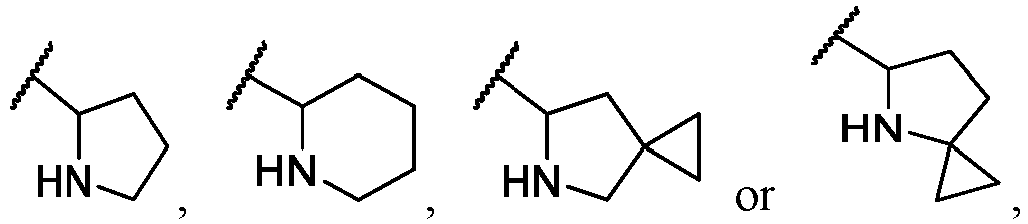 R7 and R8 are each independently selected from: H, halogen, cyano, methyl and methoxy;R9 is selected from: H, methyl, methoxy, hydroxyl and F;R10 is selected from: H, F and methyl;R11 is selected from: H, hydroxyl, amino, fluorine, chlorine, methyl, methoxy and -NH(CH3).
 - The compound or the pharmaceutically acceptable salt, enantiomer, diastereomer, tautomer, solvate, isotopic substitute, polymorph, prodrug or metabolite thereof according to claim 23, whereinX2 and X3 are C;Y1 is selected from: C, CH and N;Y4 is selected from: C, CH and N;Y5 is selected from: a bond, O, S, -S(O)-, -S(O)2-, -C(O)-, N, NH, -N(CH3)-, CH, CH2, - CH(CH3)-, -OCH2-, -NHCH2-, -N(CH3)CH2- and -CH2CH2-;Y6 is selected from: a bond, O, S, -S(O)-, -S(O)2-, -C(O)-, N, CH2, CH, -CH(CH3)-, NH, - N(CH3)-, -OCH2-, -NHCH2-, -N(CH3)CH2- and -CH2CH2-; and Y5 and Y6 are not simultaneously a bond;D1 is selected from: O, S, N, NRe, CRf and CRfRg;D2 is selected from: O, S, N, NRe, C(O)-NRe, N-NRe, CRf-NRe, (CRf)p and (CRfRg)p;D3 is selected from: O, S, N, NRe, (CRf)p and (CRfRg)p; R1 is selected from: cyano and - C(O)NR'R";R2 is selected from: H, halogen, substituted or unsubstituted C1-C4 alkyl and substituted or unsubstituted C1-C4 alkoxy;R3 is selected from: substituted or unsubstituted aryl;R4 and R5 are each independently selected from: H, halogen and substituted or unsubstituted C1-C4 alkyl; alternatively, R4 and R5, together with the carbon atom to which they are attached, form a 3- to 6-membered substituted or unsubstituted ring, and the ring optionally contains 1, 2 or 3 heteroatoms selected from O, N and S;R6 is selected from: H, substituted or unsubstituted C1-C6 alkyl, substituted or unsubstituted C1-C6 alkoxy, substituted or unsubstituted C2-C6 alkenyl, substituted or unsubstituted C2-C6 alkynyl, substituted or unsubstituted 3- to 8-membered cyclohydrocarbyl, substituted or unsubstituted 6- to 14-membered aryl, substituted or unsubstituted 5- to 10-membered heteroaryl, substituted or unsubstituted 4- to 9-membered monocyclic or fused heterocyclyl, substituted or unsubstituted 6- to 12-membered bridged cyclyl, substituted or unsubstituted 6- to 12-membered bridged heterocyclyl, substituted or unsubstituted 6- to 12-membered spiro cyclyl and substituted or unsubstituted 6- to 12-membered spiro heterocyclyl;alternatively, R4 or R5 and R6, together with the atom to which they are attached, form a 4- to 9-membered monocyclic or fused heterocyclyl, 6- to 12-membered bridged heterocyclyl or 6- to 12-membered spiro heterocyclyl ring, and the 4- to 9-membered monocyclic or fused heterocyclyl, 6- to 12-membered bridged heterocyclyl and 6- to 12-membered spiro heterocyclyl are optionally substituted by 1, 2 or 3 substituents selected from H, deuterium, hydroxyl, cyano, C1-C4 alkyl, halogen and C1-C4 alkoxy;R7 and R8 are each independently selected from: H, halogen, cyano, substituted or unsubstituted C1-C4 alkyl, substituted or unsubstituted C1-C4 haloalkyl and substituted or unsubstituted C1-C4 alkoxy;R9 is selected from: H, C1-C4 alkyl, C1-C4 alkoxy, hydroxyl and halogen;R10 is selected from: H, halogen and C1-C4 alkyl;R11 is selected from: H, hydroxyl, amino, halogen, C1-C4 alkyl, -NR'R" and C1-C4 alkoxy;R' and R" are each independently selected from H and C1-C4 alkyl;wherein the dashed line indicates the presence or absence of a double bond.
- The compound or the pharmaceutically acceptable salt, enantiomer, diastereomer, tautomer, solvate, isotopic substitute, polymorph, prodrug or metabolite thereof according to claim 99, whereinR1 is selected from: cyano, -C(O)NH2, -C(O)NHCH3 and
 R2 is selected from: H, fluorine and methoxy;R3 is phenyl;R4 and R5 are each independently selected from: H and C1-C4 alkyl;R6 is H, substituted or unsubstituted C1-C6 alkyl, substituted or unsubstituted C1-C6 alkoxy, substituted or unsubstituted C2-C6 alkenyl or substituted or unsubstituted C2-C6 alkynyl, and their substituents are 1, 2 or 3 substituents selected from: hydroxyl, halogen, C1-C4 alkoxy optionally substituted by halogen, cyano, -S(O)2-Cl-C4 alkyl optionally substituted by halogen, C1-C4 alkyl optionally substituted by halogen, -S(O)2-NR'R", -S(O)2-NH2, -C(O)-C1-C4 alkyl, -NR'-C(O)-C1-C4 alkyl and 6- to 14-membered aryl, 5- to 10-membered heteroaryl, 3- to 8-membered cyclohydrocarbyl and 4- to 9-membered heterocyclyl, wherein the 6- to 14-membered aryl, 5- to 10-membered heteroaryl, 3- to 8-membered cyclohydrocarbyl and 4- to 9-membered heterocyclyl are optionally substituted by 1, 2 or 3 substituents selected from C1-C4 alkyl, C1-C4 haloalkyl, C1-C4 alkoxy, C1-C4 haloalkoxy, halogen, cyano, C1-C4 alkyl-S(O)2-, hydroxyl, carboxyl, - NR'R", 6- to 14-membered aryl, 5- to 10-membered heteroaryl, 3- to 8-membered cyclohydrocarbyl and 4- to 9-membered heterocyclyl; wherein R' and R" are each independently selected from H and C1-C4 alkyl; orR6 is substituted or unsubstituted 3- to 8-membered cyclohydrocarbyl or substituted or unsubstituted 4- to 9-membered monocyclic or fused heterocyclyl, and their substituents are 1, 2 or 3 substituents selected from: halogen, hydroxyl, cyano, -NR'R", -S(O)2-NR'R", -S(O)2-NH2, -NR'-C(O)-C1-C4 alkyl, -S(O)2-Cl-C4 alkyl, C1-C4 alkyl, C1-C4 alkoxy, C1-C4 haloalkoxy, - C(O)-C1-C4 alkyl and C1-C4 alkoxycarbonyl, and the C1-C4 alkyl and C1-C4 alkoxy are optionally substituted by 1, 2 or 3 groups selected from halogen, hydroxyl and -NR'R", wherein the R' and R" are each independently selected from H and C1-C4 alkyl; orR6 is substituted or unsubstituted 6- to 12-membered bridged cyclyl, substituted or unsubstituted 6- to 12-membered bridged heterocyclyl, substituted or unsubstituted 6- to 12-membered spiro cyclyl or substituted or unsubstituted 6- to 12-membered spiro heterocyclyl, and their substituents are 1, 2 or 3 substituents selected from: C1-C4 alkyl, C1-C4 haloalkyl, C1-C4 alkoxy, C1-C4 haloalkoxy, cyano, -S(O)2-Cl-C4 alkyl, hydroxyl, halogen, NR'R", -S(O)2-NR'R", -S(O)2-NH2 and -NR'-C(O)-C1-C4 alkyl, wherein the R' and R" are each independently selected from H and C1-C4 alkyl;alternatively, R4 or R5 and R6, together with the atom to which they are attached, form the following group optionally substituted by 1, 2 or 3 substituents selected from H, deuterium, hydroxyl, methyl, F and methoxy:
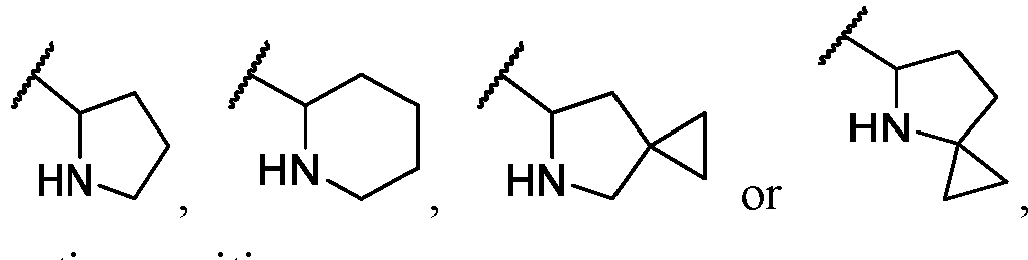 R7 and R8 are each independently selected from: H, halogen, cyano, methyl and methoxy;R9 is selected from: H, methyl, methoxy, hydroxyl and F;R10 is selected from: H, F and methyl;R11 is selected from: H, hydroxyl, amino, fluorine, chlorine, methyl, methoxy and -NH(CH3).
 - The compound or the pharmaceutically acceptable salt, enantiomer, diastereomer, tautomer, solvate, isotopic substitute, polymorph, prodrug or metabolite thereof according to any one of claims 1 to 100, whereinring A and ring B, together with their ring substituents, form any one of the following groups:







 wherein R1 is cyano or -C(O)NR'R"; R2 is H or halogen; R11 is H, hydroxyl, -NR'R", halogen or C1-C4 alkyl; R14 is H, halogen or C1-C4 alkyl; n is 0, 1 or 2; R16 is selected from H, hydroxyl, halogen and C1-C4 alkyl; Re is selected from H, substituted or unsubstituted C1-C4 alkyl, substituted or unsubstituted C1-C4 alkoxy, substituted or unsubstituted 3- to 6-membered cyclohydrocarbyl, substituted or unsubstituted 3- to 6-membered cyclohydrocarbyl-C(O)- and substituted or unsubstituted C1-C4 acyl; Rf is selected from H, halogen, hydroxyl, cyano, -NR'R", substituted or unsubstituted C1-C4 alkoxy, substituted or unsubstituted C1-C4 alkyl and substituted or unsubstituted 3- to 6-membered cyclohydrocarbyl; preferably, the C1-C4 alkyl, C1-C4 alkoxy, 3- to 6-membered cyclohydrocarbyl, 3- to 6-membered cyclohydrocarbyl-C(O)- and C1-C4 acyl are optionally substituted by 1, 2 or 3 substituents selected from F, hydroxyl and cyano; wherein R' and R" are each independently selected from H, C1-C4 alkyl and C3-C6 cycloalkyl; the wavy line indicates the bond connection position;X1 is O;R3 is selected from unsubstituted phenyl or phenyl substituted by 1, 2 or 3 substituents selected from hydroxyl, halogen, C1-C4 alkyl, C1-C4 haloalkyl and C1-C4 alkoxy;R4 is selected from H and C1-C4 alkyl;R5 is selected from H and C1-C4 alkyl;R6 is selected from: H; C1-C4 alkyl, which is optionally substituted by 1, 2 or 3 substituents selected from hydroxyl, halogen, C1-C4 alkoxy, cyano and -S(O)2-Cl-C4 alkyl; 3- to 8-membered cyclohydrocarbyl, which is optionally substituted by 1, 2 or 3 substituents selected from halogen, hydroxyl, cyano, -S(O)2-Cl-C4 alkyl, C1-C4 alkyl and C1-C4 alkoxy; 4- to 9-membered monocyclic or fused heterocyclyl, which is optionally substituted by 1, 2 or 3 substituents selected from halogen, hydroxyl, cyano, -S(O)2-Cl-C4 alkyl, C1-C4 alkyl and C1-C4 alkoxy; and 6- to 12-membered bridged cyclyl, 6- to 12-membered spiro cyclyl, 6- to 12-membered bridged heterocyclyl or 6- to 12-membered spiro heterocyclyl, each of which is optionally substituted by 1, 2 or 3 substituents selected from C1-C4 alkyl, C1-C4 alkoxy and cyano;alternatively, R4 or R5 and R6, together with the atom to which they are attached, form the following group optionally substituted by 1, 2 or 3 substituents selected from H, deuterium, hydroxyl, methyl, F and methoxy:
 R7 and R8 are each independently selected from: H, halogen, cyano, methyl and methoxy;R9 is selected from: H, methyl, methoxy, hydroxyl and F;R10 is selected from: H, F and methyl.
 - The compound or the pharmaceutically acceptable salt, enantiomer, diastereomer, tautomer, solvate, isotopic substitute, polymorph, prodrug or metabolite thereof according to any one of claims 1 to 101, whereinring A and ring B, together with their ring substituents, form any one of the following groups:


 and
and wherein R1 is -C(O)NR'R"; R2 is F; R11 is H, F or methyl; Re is selected from H, methyl, difluoromethyl, trifluoromethyl, ethyl, fluoroethyl, difluoroethyl, trifluoroethyl, isopropyl, cyclopropyl, cyclobutyl, trifluoropropyl, oxocyclobutyl, 1,1-difluorocyclobutyl, -CH2CH2OH, - CH2CH2(CH3)OH, -CH2CH2OCH3 and acetyl; Rf is selected from H, F, Cl, hydroxyl, cyano, - NR'R", methoxy, ethoxy, -CH2OH, -(CH2)2OH, -(CH2)2OCH3, C1-C6 alkyl and 3- to 6-membered cyclohydrocarbyl, wherein R' and R" are each independently selected from H and methyl; the wavy line indicates the bond connection position.
 - The compound or the pharmaceutically acceptable salt, enantiomer, diastereomer, tautomer, solvate, isotopic substitute, polymorph, prodrug or metabolite thereof according to any one of claims 1 to 102, whereinring A and ring B, together with their ring substituents, form any one of the following groups:


 wherein R1 is -C(O)NR'R"; R2 is F; R11 is H, F or methyl; R14 is H, F or methyl; n is 0, 1 or 2; R16 is selected from H, hydroxyl and methyl; Re is selected from H, methyl, difluoromethyl, trifluoromethyl, ethyl, fluoroethyl, difluoroethyl, trifluoroethyl, isopropyl, cyclopropyl, cyclobutyl, trifluoropropyl, oxocyclobutyl, 1,1-difluorocyclobutyl, -CH2CH2OH, -CH2CH2(CH3)OH, - CH2CH2OCH3 and acetyl; Rf is selected from H, F, Cl, hydroxyl, cyano, -NR'R", methoxy, ethoxy, -CH2OH, -(CH2)2OH, -(CH2)2OCH3, C1-C6 alkyl and 3- to 6-membered cyclohydrocarbyl, wherein R' and R" are each independently selected from H, methyl and cyclopropyl; the wavy line indicates the bond connection position.
 - The compound or the pharmaceutically acceptable salt, enantiomer, diastereomer, tautomer, solvate, isotopic substitute, polymorph, prodrug or metabolite thereof according to any one of claims 1 to 103, wherein the compound is selected from the following compounds:

- The compound or the pharmaceutically acceptable salt, enantiomer, diastereomer, tautomer, solvate, isotopic substitute, polymorph, prodrug or metabolite thereof according to any one of claims 1 to 104, wherein the compound is selected from the following compounds:

- The compound or the pharmaceutically acceptable salt, enantiomer, diastereomer, tautomer, solvate, isotopic substitute, polymorph, prodrug or metabolite thereof according to any one of claims 1 to 105, wherein the compound is selected from the following compounds:
 Y4 is selected from: C, CH and N;Y6 is selected from: C, CH and N;ring D is a 3- to 8-membered cyclohydrocarbyl, 4- to 9-membered heterocyclyl, 6- to 10-membered aryl or 5- to 10-membered heteroaryl ring, wherein the 4- to 9-membered heterocyclyl and 5- to 10-membered heteroaryl contain 1, 2 or 3 heteroatoms selected from O, N and S;R15 is selected from: H, halogen, oxo (=O), thio (=S), substituted or unsubstituted C1-C4 acyl, hydroxyl, substituted or unsubstituted C1-C4 alkoxy, cyano, -NR'R", substituted or unsubstituted C1-C4 alkyl-S(O)2-, substituted or unsubstituted 6- to 10-membered aryl-S(O)2-, substituted or unsubstituted 4- to 9-membered heterocyclyl, NR'R"-C(O)-, substituted or unsubstituted 3- to 8-membered cyclohydrocarbyl, substituted or unsubstituted 3- to 8-membered cyclohydrocarbyl-C(O)-, substituted or unsubstituted C1-C4 haloalkyl and substituted or unsubstituted C1-C4 alkyl; preferably, the C1-C4 acyl, C1-C4 alkoxy, C1-C4 alkyl-S(O)2-, 6- to 10-membered aryl-S(O)2-, 4- to 9-membered heterocyclyl, 3- to 8-membered cyclohydrocarbyl, 3- to 8-membered cyclohydrocarbyl-C(O)-, C1-C4 haloalkyl and C1-C4 alkyl are optionally substituted by 1, 2 or 3 substituents selected from F, hydroxyl and cyano;n is 0, 1, 2, 3 or 4.
 - The compound or the pharmaceutically acceptable salt, enantiomer, diastereomer, tautomer, solvate, isotopic substitute, polymorph, prodrug or metabolite thereof according to any one of claims 1 to 106, wherein the compound is selected from the following compounds:
 Y1 is selected from: C, CH and N;Y4 is selected from: C, CH and N;ring D is a 3- to 8-membered cyclohydrocarbyl, 4- to 9-membered heterocyclyl, 6- to 10-membered aryl or 5- to 10-membered heteroaryl ring, wherein the 4- to 9-membered heterocyclyl and 5- to 10-membered heteroaryl contain 1, 2 or 3 heteroatoms selected from O, N and S;R15 is selected from: H, halogen, oxo (=O), thio (=S), substituted or unsubstituted C1-C4 acyl, hydroxyl, substituted or unsubstituted C1-C4 alkoxy, cyano, -NR'R", substituted or unsubstituted C1-C4 alkyl-S(O)2-, substituted or unsubstituted 6- to 10-membered aryl-S(O)2-, substituted or unsubstituted 4- to 9-membered heterocyclyl, NR'R"-C(O)-, substituted or unsubstituted 3- to 8-membered cyclohydrocarbyl, substituted or unsubstituted 3- to 8-membered cyclohydrocarbyl-C(O)-, substituted or unsubstituted C1-C4 haloalkyl and substituted or unsubstituted C1-C4 alkyl; preferably, the C1-C4 acyl, C1-C4 alkoxy, C1-C4 alkyl-S(O)2-, 6- to 10-membered aryl-S(O)2-, 4- to 9-membered heterocyclyl, 3- to 8-membered cyclohydrocarbyl, 3- to 8-membered cyclohydrocarbyl-C(O)-, C1-C4 haloalkyl and C1-C4 alkyl are optionally substituted by 1, 2 or 3 substituents selected from F, hydroxyl and cyano;n is 0, 1, 2, 3 or 4.
 - The compound or the pharmaceutically acceptable salt, enantiomer, diastereomer, tautomer, solvate, isotopic substitute, polymorph, prodrug or metabolite thereof according to any one of claims 1 to 107, wherein the compound is selected from the following compounds:
 ring E is a 3- to 8-membered cyclohydrocarbyl or 4- to 9-membered heterocyclyl ring, wherein the 4- to 9-membered heterocyclyl contains 1, 2 or 3 heteroatoms selected from O, N and S;R16 is selected from H, halogen, substituted or unsubstituted C1-C4 alkyl, hydroxyl, substituted or unsubstituted C1-C4 acyl and substituted or unsubstituted C1-C4 alkoxy; preferably, the C1-C4 alkyl, C1-C4 acyl and C1-C4 alkoxy are optionally substituted by 1, 2 or 3 substituents selected from F, hydroxyl and cyano;n is 0, 1, 2, 3 or 4.
 - The compound or the pharmaceutically acceptable salt, enantiomer, diastereomer, tautomer, solvate, isotopic substitute, polymorph, prodrug or metabolite thereof according to any one of claims 1 to 108, wherein the compound is selected from the following compounds:

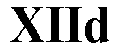 ring E is a 3- to 8-membered cyclohydrocarbyl or 4- to 9-membered heterocyclyl ring, wherein the 4- to 9-membered heterocyclyl contains 1, 2 or 3 heteroatoms selected from O, N and S;R16 is selected from H, halogen, substituted or unsubstituted C1-C4 alkyl, hydroxyl, substituted or unsubstituted C1-C4 acyl and substituted or unsubstituted C1-C4 alkoxy; preferably, the C1-C4 alkyl, C1-C4 acyl and C1-C4 alkoxy are optionally substituted by 1, 2 or 3 substituents selected from F, hydroxyl and cyano;n is 0, 1, 2, 3 or 4.
 - The compound or the pharmaceutically acceptable salt, enantiomer, diastereomer, tautomer, solvate, isotopic substitute, polymorph, prodrug or metabolite thereof according to any one of claims 1 to 109, wherein the compound is selected from the following compounds:
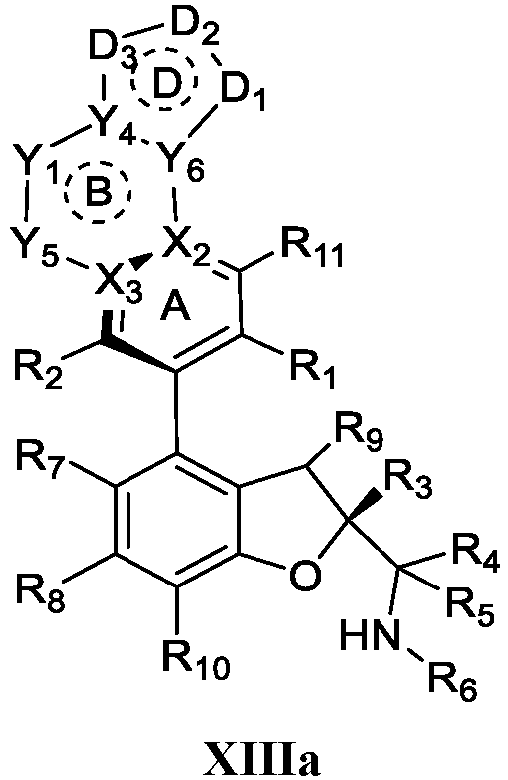 Y4 is selected from: C, CH and N;Y6 is selected from: C, CH and N;ring D is a 3- to 8-membered cyclohydrocarbyl, 4- to 9-membered heterocyclyl, 6- to 10-membered aryl or 5- to 10-membered heteroaryl ring, wherein the 4- to 9-membered heterocyclyl and 5- to 10-membered heteroaryl contain 1, 2 or 3 heteroatoms selected from O, N and S;D1 is selected from: O, S, S(O), S(O)2, N, NRe, CRf and CRfRg;D2 is selected from: O, S, S(O), S(O)2, N, NRe, (CRf)p, (CRfRg)p, C(O)-NRe, N-NRe, CRf-NRe,
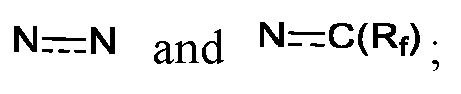 D3 is selected from: O, S, S(O), S(O)2, N, NRe, (CRf)p and (CRfRg)p;provided that D1 and D2, D1 and D3 are not simultaneously O, S, -S(O)- or -S(O)2- and satisfy the valence bond theory;each Rc at each occurrence is independently selected from: H, substituted or unsubstituted C1-C4 acyl, substituted or unsubstituted C1-C4 alkoxy, cyano, substituted or unsubstituted C1-C4 alkyl-S(O)2-, substituted or unsubstituted 4- to 9-membered heterocyclyl, NR'R"-C(O)-, substituted or unsubstituted 3- to 6-membered cyclohydrocarbyl, substituted or unsubstituted 3- to 6-membered cyclohydrocarbyl-C(O)-, substituted or unsubstituted C1-C4 haloalkyl and substituted or unsubstituted C1-C4 alkyl, wherein R' and R" are each independently selected from H and C1-C4 alkyl; preferably, the C1-C4 acyl, C1-C4 alkoxy, C1-C4 alkyl-S(O)2-, 4- to 9-membered heterocyclyl, 3- to 6-membered cyclohydrocarbyl, 3- to 6-membered cyclohydrocarbyl-C(O)-, C1-C4 haloalkyl and C1-C4 alkyl are optionally substituted by 1, 2 or 3 substituents selected from F, hydroxyl and cyano;each Rf at each occurrence is independently selected from: H, halogen, substituted or unsubstituted C1-C4 acyl, hydroxyl, cyano, -NR'R", substituted or unsubstituted C1-C4 alkoxy, substituted or unsubstituted C1-C4 alkyl, substituted or unsubstituted 3- to 6-membered cyclohydrocarbyl, substituted or unsubstituted C1-C4 alkyl-S(O)2-, substituted or unsubstituted 3-to 6-membered cyclohydrocarbyl-C(O)- and NR'R"-C(O)-, wherein R' and R" are each independently selected from H and C1-C4 alkyl; preferably, the C1-C4 acyl, C1-C4 alkoxy, C1-C4 alkyl, 3- to 6-membered cyclohydrocarbyl, C1-C4 alkyl-S(O)2- and 3- to 6-membered cyclohydrocarbyl-C(O)- are optionally substituted by 1, 2 or 3 substituents selected from F, hydroxyl and cyano;each Rg at each occurrence is independently selected from: H, halogen, substituted or unsubstituted C1-C4 acyl, hydroxyl, cyano, -NR'R", substituted or unsubstituted C1-C4 alkoxy, substituted or unsubstituted C1-C4 alkyl, substituted or unsubstituted 3- to 6-membered cyclohydrocarbyl, substituted or unsubstituted C1-C4 alkyl-S(O)2-, substituted or unsubstituted 3-to 6-membered cyclohydrocarbyl-C(O)- and NR'R"-C(O)-, wherein R' and R" are each independently selected from H and C1-C4 alkyl; preferably, the C1-C4 acyl, C1-C4 alkoxy, C1-C4 alkyl, 3- to 6-membered cyclohydrocarbyl, C1-C4 alkyl-S(O)2- and 3- to 6-membered cyclohydrocarbyl-C(O)- are optionally substituted by 1, 2 or 3 substituents selected from F, hydroxyl and cyano;alternatively, Rf and Rg on the same carbon atom form an oxo (=O) or thio (=S) group;each p is independently 1, 2, 3 or 4, preferably 1 or 2.
 - The compound or the pharmaceutically acceptable salt, enantiomer, diastereomer, tautomer, solvate, isotopic substitute, polymorph, prodrug or metabolite thereof according to any one of claims 1 to 110, wherein the compound is selected from the following compounds:

 Y1 is selected from: C, CH and N;Y4 is selected from: C, CH and N;ring D is a 3- to 8-membered cyclohydrocarbyl, 4- to 9-membered heterocyclyl, 6- to 10-membered aryl or 5- to 10-membered heteroaryl ring, wherein the 4- to 9-membered heterocyclyl and 5- to 10-membered heteroaryl contain 1, 2 or 3 heteroatoms selected from O, N and S;D1 is selected from: O, S, S(O), S(O)2, N, NRe, CRf and CRfRg;D2 is selected from: O, S, S(O), S(O)2, N, NRe, (CRf)p, (CRfRg)p, C(O)-NRe, N-NRe, CRf-NRe, N
- - - N and N- - C(Rf);D3 is selected from: O, S, S(O), S(O)2, N, NRe, (CRf)p and (CRfRg)p;provided that D1 and D2, D1 and D3 are not simultaneously O, S, -S(O)- or -S(O)2- and satisfy the valence bond theory;each Re at each occurrence is independently selected from: H, substituted or unsubstituted C1-C4 acyl, substituted or unsubstituted C1-C4 alkoxy, cyano, substituted or unsubstituted C1-C4 alkyl-S(O)2-, substituted or unsubstituted 4- to 9-membered heterocyclyl, NR'R"-C(O)-, substituted or unsubstituted 3- to 6-membered cyclohydrocarbyl, substituted or unsubstituted 3- to 6-membered cyclohydrocarbyl-C(O)-, substituted or unsubstituted C1-C4 haloalkyl and substituted or unsubstituted C1-C4 alkyl, wherein R' and R" are each independently selected from H and C1-C4 alkyl; preferably, the C1-C4 acyl, C1-C4 alkoxy, C1-C4 alkyl-S(O)2-, 4- to 9-membered heterocyclyl, 3- to 6-membered cyclohydrocarbyl, 3- to 6-membered cyclohydrocarbyl-C(O)-, C1-C4 haloalkyl and C1-C4 alkyl are optionally substituted by 1, 2 or 3 substituents selected from F, hydroxyl and cyano;each Rf at each occurrence is independently selected from: H, halogen, substituted or unsubstituted C1-C4 acyl, hydroxyl, cyano, -NR'R", substituted or unsubstituted C1-C4 alkoxy, substituted or unsubstituted C1-C4 alkyl, substituted or unsubstituted 3- to 6-membered cyclohydrocarbyl, substituted or unsubstituted C1-C4 alkyl-S(O)2-, substituted or unsubstituted 3-to 6-membered cyclohydrocarbyl-C(O)- and NR'R"-C(O)-, wherein R' and R" are each independently selected from H and C1-C4 alkyl; preferably, the C1-C4 acyl, C1-C4 alkoxy, C1-C4 alkyl, 3- to 6-membered cyclohydrocarbyl, C1-C4 alkyl-S(O)2- and 3- to 6-membered cyclohydrocarbyl-C(O)- are optionally substituted by 1, 2 or 3 substituents selected from F, hydroxyl and cyano;each Rg at each occurrence is independently selected from: H, halogen, substituted or unsubstituted C1-C4 acyl, hydroxyl, cyano, -NR'R", substituted or unsubstituted C1-C4 alkoxy, substituted or unsubstituted C1-C4 alkyl, substituted or unsubstituted 3- to 6-membered cyclohydrocarbyl, substituted or unsubstituted C1-C4 alkyl-S(O)2-, substituted or unsubstituted 3-to 6-membered cyclohydrocarbyl-C(O)- and NR'R"-C(O)-, wherein R' and R" are each independently selected from H and C1-C4 alkyl; preferably, the C1-C4 acyl, C1-C4 alkoxy, C1-C4 alkyl, 3- to 6-membered cyclohydrocarbyl, C1-C4 alkyl-S(O)2- and 3- to 6-membered cyclohydrocarbyl-C(O)- are optionally substituted by 1, 2 or 3 substituents selected from F, hydroxyl and cyano;alternatively, Rf and Rg on the same carbon atom form an oxo (=O) or thio (=S) group;each p is independently 1, 2, 3 or 4, preferably 1 or 2. - The compound or the pharmaceutically acceptable salt, enantiomer, diastereomer, tautomer, solvate, isotopic substitute, polymorph, prodrug or metabolite thereof according to any one of claims 1 to 111, wherein the compound is selected from the following compounds:
 Y4 is selected from: C, CH and N;Y6 is selected from: C, CH and N;ring D is a 3- to 8-membered cyclohydrocarbyl, 4- to 9-membered heterocyclyl, 6- to 10-membered aryl or 5- to 10-membered heteroaryl ring, wherein the 4- to 9-membered heterocyclyl and 5- to 10-membered heteroaryl contain 1, 2 or 3 heteroatoms selected from O, N and S;D1 is selected from: O, S, S(O), S(O)2, N, NRe, CRf and CRfRg;D2 is selected from: O, S, S(O), S(O)2, N, NRe, (CRf)p, (CRfRg)p, C(O)-NRe, N-NRe, CRf-NRe, N
- - - N and N- - C(Rf);D3 is selected from: O, S, S(O), S(O)2, N, NRe, (CRf)p and (CRfRg)p;provided that D1 and D2, D1 and D3 are not simultaneously O, S, -S(O)- or -S(O)2- and satisfy the valence bond theory;each Re at each occurrence is independently selected from: H, substituted or unsubstituted C1-C4 acyl, substituted or unsubstituted C1-C4 alkoxy, cyano, substituted or unsubstituted C1-C4 alkyl-S(O)2-, substituted or unsubstituted 4- to 9-membered heterocyclyl, NR'R"-C(O)-, substituted or unsubstituted 3- to 6-membered cyclohydrocarbyl, substituted or unsubstituted 3- to 6-membered cyclohydrocarbyl-C(O)-, substituted or unsubstituted C1-C4 haloalkyl and substituted or unsubstituted C1-C4 alkyl, wherein R' and R" are each independently selected from H and C1-C4 alkyl; preferably, the C1-C4 acyl, C1-C4 alkoxy, C1-C4 alkyl-S(O)2-, 4- to 9-membered heterocyclyl, 3- to 6-membered cyclohydrocarbyl, 3- to 6-membered cyclohydrocarbyl-C(O)-, C1-C4 haloalkyl and C1-C4 alkyl are optionally substituted by 1, 2 or 3 substituents selected from F, hydroxyl and cyano;each Rf at each occurrence is independently selected from: H, halogen, substituted or unsubstituted C1-C4 acyl, hydroxyl, cyano, -NR'R", substituted or unsubstituted C1-C4 alkoxy, substituted or unsubstituted C1-C4 alkyl, substituted or unsubstituted 3- to 6-membered cyclohydrocarbyl, substituted or unsubstituted C1-C4 alkyl-S(O)2-, substituted or unsubstituted 3-to 6-membered cyclohydrocarbyl-C(O)- and NR'R"-C(O)-, wherein R' and R" are each independently selected from H and C1-C4 alkyl; preferably, the C1-C4 acyl, C1-C4 alkoxy, C1-C4 alkyl, 3- to 6-membered cyclohydrocarbyl, C1-C4 alkyl-S(O)2- and 3- to 6-membered cyclohydrocarbyl-C(O)- are optionally substituted by 1, 2 or 3 substituents selected from F, hydroxyl and cyano;each Rg at each occurrence is independently selected from: H, halogen, substituted or unsubstituted C1-C4 acyl, hydroxyl, cyano, -NR'R", substituted or unsubstituted C1-C4 alkoxy, substituted or unsubstituted C1-C4 alkyl, substituted or unsubstituted 3- to 6-membered cyclohydrocarbyl, substituted or unsubstituted C1-C4 alkyl-S(O)2-, substituted or unsubstituted 3-to 6-membered cyclohydrocarbyl-C(O)- and NR'R"-C(O)-, wherein R' and R" are each independently selected from H and C1-C4 alkyl; preferably, the C1-C4 acyl, C1-C4 alkoxy, C1-C4 alkyl, 3- to 6-membered cyclohydrocarbyl, C1-C4 alkyl-S(O)2- and 3- to 6-membered cyclohydrocarbyl-C(O)- are optionally substituted by 1, 2 or 3 substituents selected from F, hydroxyl and cyano;alternatively, Rf and Rg on the same carbon atom form an oxo (=O) or thio (=S) group;each p is independently 1, 2, 3 or 4, preferably 1 or 2;ring C is a substituted or unsubstituted 4- to 12-membered monocyclic or fused heterocyclyl, substituted or unsubstituted 6- to 12-membered bridged heterocyclyl or substituted or unsubstituted 6- to 12-membered spiro heterocyclyl ring, and the 4- to 12-membered monocyclic or fused heterocyclyl, 6- to 12-membered bridged heterocyclyl and 6- to 12-membered spiro heterocyclyl each optionally further contain 1 or 2 heteroatoms selected from N and O; ring C is preferably a substituted or unsubstituted 4- to 8-membered nitrogen-containing monocyclic heterocyclyl, substituted or unsubstituted 6- to 12-membered nitrogen-containing spiro heterocyclyl or substituted or unsubstituted 6- to 12-membered nitrogen-containing fused heterocyclyl ring. - The compound or the pharmaceutically acceptable salt, enantiomer, diastereomer, tautomer, solvate, isotopic substitute, polymorph, prodrug or metabolite thereof according to any one of claims 1 to 112, wherein the compound is selected from the following compounds:
 Y1 is selected from: C, CH and N;Y4 is selected from: C, CH and N;ring D is a 3- to 8-membered cyclohydrocarbyl, 4- to 9-membered heterocyclyl, 6- to 10-membered aryl or 5- to 10-membered heteroaryl ring, wherein the 4- to 9-membered heterocyclyl and 5- to 10-membered heteroaryl contain 1, 2 or 3 heteroatoms selected from O, N and S;D1 is selected from: O, S, S(O), S(O)2, N, NRc, CRf and CRfRg;D2 is selected from: O, S, S(O), S(O)2, N, NRc, (CRf)p, (CRfRg)p, C(O)-NRe, N-NRc, CRf-NRc,
 D3 is selected from: O, S, S(O), S(O)2, N, NRc, (CRf)p and (CRfRg)p;provided that D1 and D2, D1 and D3 are not simultaneously O, S, -S(O)- or -S(O)2- and satisfy the valence bond theory;each Rc at each occurrence is independently selected from: H, substituted or unsubstituted C1-C4 acyl, substituted or unsubstituted C1-C4 alkoxy, cyano, substituted or unsubstituted C1-C4 alkyl-S(O)2-, substituted or unsubstituted 4- to 9-membered heterocyclyl, NR'R"-C(O)-, substituted or unsubstituted 3- to 6-membered cyclohydrocarbyl, substituted or unsubstituted 3- to 6-membered cyclohydrocarbyl-C(O)-, substituted or unsubstituted C1-C4 haloalkyl and substituted or unsubstituted C1-C4 alkyl, wherein R' and R" are each independently selected from H and C1-C4 alkyl; preferably, the C1-C4 acyl, C1-C4 alkoxy, C1-C4 alkyl-S(O)2-, 4- to 9-membered heterocyclyl, 3- to 6-membered cyclohydrocarbyl, 3- to 6-membered cyclohydrocarbyl-C(O)-, C1-C4 haloalkyl and C1-C4 alkyl are optionally substituted by 1, 2 or 3 substituents selected from F, hydroxyl and cyano;each Rf at each occurrence is independently selected from: H, halogen, substituted or unsubstituted C1-C4 acyl, hydroxyl, cyano, -NR'R", substituted or unsubstituted C1-C4 alkoxy, substituted or unsubstituted C1-C4 alkyl, substituted or unsubstituted 3- to 6-membered cyclohydrocarbyl, substituted or unsubstituted C1-C4 alkyl-S(O)2-, substituted or unsubstituted 3-to 6-membered cyclohydrocarbyl-C(O)- and NR'R"-C(O)-, wherein R' and R" are each independently selected from H and C1-C4 alkyl; preferably, the C1-C4 acyl, C1-C4 alkoxy, C1-C4 alkyl, 3- to 6-membered cyclohydrocarbyl, C1-C4 alkyl-S(O)2- and 3- to 6-membered cyclohydrocarbyl-C(O)- are optionally substituted by 1, 2 or 3 substituents selected from F, hydroxyl and cyano;each Rg at each occurrence is independently selected from: H, halogen, substituted or unsubstituted C1-C4 acyl, hydroxyl, cyano, -NR'R", substituted or unsubstituted C1-C4 alkoxy, substituted or unsubstituted C1-C4 alkyl, substituted or unsubstituted 3- to 6-membered cyclohydrocarbyl, substituted or unsubstituted C1-C4 alkyl-S(O)2-, substituted or unsubstituted 3-to 6-membered cyclohydrocarbyl-C(O)- and NR'R"-C(O)-, wherein R' and R" are each independently selected from H and C1-C4 alkyl; preferably, the C1-C4 acyl, C1-C4 alkoxy, C1-C4 alkyl, 3- to 6-membered cyclohydrocarbyl, C1-C4 alkyl-S(O)2- and 3- to 6-membered cyclohydrocarbyl-C(O)- are optionally substituted by 1, 2 or 3 substituents selected from F, hydroxyl and cyano;alternatively, Rf and Rg on the same carbon atom form an oxo (=O) or thio (=S) group;each p is independently 1, 2, 3 or 4, preferably 1 or 2;ring C is a substituted or unsubstituted 4- to 12-membered monocyclic or fused heterocyclyl, substituted or unsubstituted 6- to 12-membered bridged heterocyclyl or substituted or unsubstituted 6- to 12-membered spiro heterocyclyl ring, and the 4- to 12-membered monocyclic or fused heterocyclyl, 6- to 12-membered bridged heterocyclyl and 6- to 12-membered spiro heterocyclyl each optionally further contain 1 or 2 heteroatoms selected from N and O; ring C is preferably a substituted or unsubstituted 4- to 8-membered nitrogen-containing monocyclic heterocyclyl, substituted or unsubstituted 6- to 12-membered nitrogen-containing spiro heterocyclyl or substituted or unsubstituted 6- to 12-membered nitrogen-containing fused heterocyclyl ring.
 - The compound or the pharmaceutically acceptable salt, enantiomer, diastereomer, tautomer, solvate, isotopic substitute, polymorph, prodrug or metabolite thereof according to any one of claims 1 to 113, wherein the compound is selected from the following compounds:
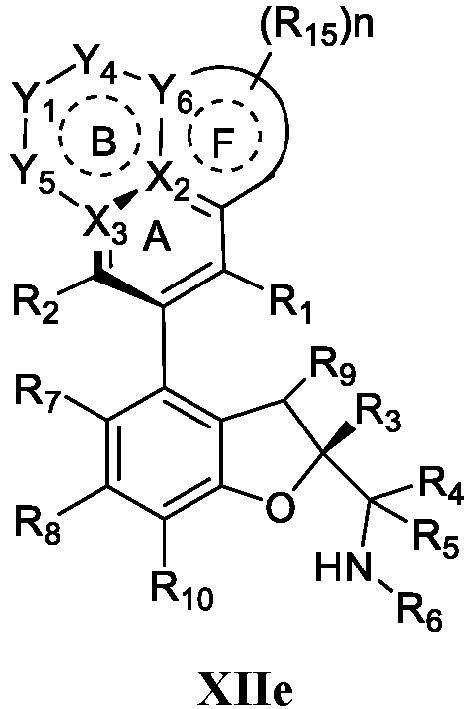 X2 is C;Y6 is selected from: C, CH and N;ring F is a 5- or 6-membered cyclohydrocarbyl, 5- or 6-membered heterocyclyl, phenyl or 5- or 6-membered heteroaryl ring, wherein the 5- or 6-membered heterocyclyl or 5- or 6-membered heteroaryl contains 1, 2 or 3 heteroatoms selected from O, N and S;R15 is selected from: H, halogen, oxo (=O), thio (=S), substituted or unsubstituted C1-C4 acyl, hydroxyl, substituted or unsubstituted C1-C4 alkoxy, cyano, -NR'R", substituted or unsubstituted C1-C4 alkyl-S(O)2-, substituted or unsubstituted 6- to 10-membered aryl-S(O)2-, substituted or unsubstituted 4- to 9-membered heterocyclyl, NR'R"-C(O)-, substituted or unsubstituted 3- to 8-membered cyclohydrocarbyl, substituted or unsubstituted 3- to 8-membered cyclohydrocarbyl-C(O)-, substituted or unsubstituted C1-C4 haloalkyl and substituted or unsubstituted C1-C4 alkyl; preferably, the C1-C4 acyl, C1-C4 alkoxy, C1-C4 alkyl-S(O)2-, 6- to 10-membered aryl-S(O)2-, 4- to 9-membered heterocyclyl, 3- to 8-membered cyclohydrocarbyl, 3- to 8-membered cyclohydrocarbyl-C(O)-, C1-C4 haloalkyl and C1-C4 alkyl are optionally substituted by 1, 2 or 3 substituents selected from F, hydroxyl and cyano;n is 0, 1, 2 or 3.
 - The compound or the pharmaceutically acceptable salt, enantiomer, diastereomer, tautomer, solvate, isotopic substitute, polymorph, prodrug or metabolite thereof according to any one of claims 1 to 114, wherein the compound is selected from the following compounds:
 X2 is C;Y6 is selected from: C, CH and N;ring F is a 5- or 6-membered cyclohydrocarbyl, 5- or 6-membered heterocyclyl, phenyl or 5- or 6-membered heteroaryl ring, wherein the 5- or 6-membered heterocyclyl or 5- or 6-membered heteroaryl contains 1, 2 or 3 heteroatoms selected from O, N and S;Y7, Y8 and Y9 are independently selected from: a bond, O, S, S(O), S(O)2, N, NRe, CRf and CRfRg, provided that at most one of Y7, Y8 and Y9 is a bond, Y7 and Y8, Y8 and Y9 are not simultaneously O, S, -S(O)- or -S(O)2- and satisfy the valence bond theory,each Re at each occurrence is independently selected from: H, substituted or unsubstituted C1-C4 acyl, substituted or unsubstituted C1-C4 alkoxy, cyano, substituted or unsubstituted C1-C4 alkyl-S(O)2-, substituted or unsubstituted 4- to 9-membered heterocyclyl, NR'R"-C(O)-, substituted or unsubstituted 3- to 6-membered cyclohydrocarbyl, substituted or unsubstituted 3- to 6-membered cyclohydrocarbyl-C(O)-, substituted or unsubstituted C1-C4 haloalkyl and substituted or unsubstituted C1-C4 alkyl, wherein R' and R" are each independently selected from H and C1-C4 alkyl; preferably, the C1-C4 acyl, C1-C4 alkoxy, C1-C4 alkyl-S(O)2-, 4- to 9-membered heterocyclyl, 3- to 6-membered cyclohydrocarbyl, 3- to 6-membered cyclohydrocarbyl-C(O)-, C1-C4 haloalkyl and C1-C4 alkyl are optionally substituted by 1, 2 or 3 substituents selected from F, hydroxyl and cyano;each Rf at each occurrence is independently selected from: H, halogen, substituted or unsubstituted C1-C4 acyl, hydroxyl, cyano, -NR'R", substituted or unsubstituted C1-C4 alkoxy, substituted or unsubstituted C1-C4 alkyl, substituted or unsubstituted 3- to 6-membered cyclohydrocarbyl, substituted or unsubstituted C1-C4 alkyl-S(O)2-, substituted or unsubstituted 3-to 6-membered cyclohydrocarbyl-C(O)- and NR'R"-C(O)-, wherein R' and R" are each independently selected from H and C1-C4 alkyl; preferably, the C1-C4 acyl, C1-C4 alkoxy, C1-C4 alkyl, 3- to 6-membered cyclohydrocarbyl, C1-C4 alkyl-S(O)2- and 3- to 6-membered cyclohydrocarbyl-C(O)- are optionally substituted by 1, 2 or 3 substituents selected from F, hydroxyl and cyano;each Rg at each occurrence is independently selected from: H, halogen, substituted or unsubstituted C1-C4 acyl, hydroxyl, cyano, -NR'R", substituted or unsubstituted C1-C4 alkoxy, substituted or unsubstituted C1-C4 alkyl, substituted or unsubstituted 3- to 6-membered cyclohydrocarbyl, substituted or unsubstituted C1-C4 alkyl-S(O)2-, substituted or unsubstituted 3-to 6-membered cyclohydrocarbyl-C(O)- and NR'R"-C(O)-, wherein R' and R" are each independently selected from H and C1-C4 alkyl; preferably, the C1-C4 acyl, C1-C4 alkoxy, C1-C4 alkyl, 3- to 6-membered cyclohydrocarbyl, C1-C4 alkyl-S(O)2- and 3- to 6-membered cyclohydrocarbyl-C(O)- are optionally substituted by 1, 2 or 3 substituents selected from F, hydroxyl and cyano;alternatively, Rf and Rg on the same carbon atom form an oxo (=O) or thio (=S) group;ring C is a substituted or unsubstituted 4- to 12-membered monocyclic or fused heterocyclyl, substituted or unsubstituted 6- to 12-membered bridged heterocyclyl or substituted or unsubstituted 6- to 12-membered spiro heterocyclyl ring, and the 4- to 12-membered monocyclic or fused heterocyclyl, 6- to 12-membered bridged heterocyclyl and 6- to 12-membered spiro heterocyclyl each optionally further contain 1 or 2 heteroatoms selected from N and O; ring C is preferably a substituted or unsubstituted 4- to 8-membered nitrogen-containing monocyclic heterocyclyl, substituted or unsubstituted 6- to 12-membered nitrogen-containing spiro heterocyclyl or substituted or unsubstituted 6- to 12-membered nitrogen-containing fused heterocyclyl ring.
 - The compound or the pharmaceutically acceptable salt, enantiomer, diastereomer, tautomer, solvate, isotopic substitute, polymorph, prodrug or metabolite thereof according to any one of claims 1 to 115, wherein the compound has a structure shown in the following formula XVa:
 D1 is selected from: O, S, S(O), S(O)2, N, NRe, CRfRg, CRf and C(=O);D2 is selected from: O, S, S(O), S(O)2, N, NRe, CRfRg, CRf and C(=O);D3 is selected from: O, S, S(O), S(O)2, N, NRe, CRfRg, CRf and C(=O);D4 is selected from: O, S, S(O), S(O)2, N, NRe, CRfRg, CRf and C(=O); and wherein the ring in which D1, D2, D3 and D4 are located satisfies valence bond theory and contains at most two C(=O) and three N atoms;each Re at each occurrence is independently selected from: H, substituted or unsubstituted C1-C4 acyl, substituted or unsubstituted C1-C4 alkoxy, cyano, substituted or unsubstituted C1-C4 alkyl-S(O)2-, substituted or unsubstituted 4- to 9-membered heterocyclyl, NR'R"-C(O)-, substituted or unsubstituted 3- to 6-membered cyclohydrocarbyl, substituted or unsubstituted 3- to 6-membered cyclohydrocarbyl-C(O)-, substituted or unsubstituted C1-C4 haloalkyl and substituted or unsubstituted C1-C4 alkyl; each Rf at each occurrence is independently selected from: H, halogen, hydroxyl, cyano, oxo, substituted or unsubstituted C1-C4 alkoxy, substituted or unsubstituted C1-C4 alkyl; preferably, the C1-C4 alkoxy and C1-C4 alkyl are optionally substituted by 1, 2 or 3 substituents selected from F, hydroxyl and cyano;Y5 and Y6 are independently selected from: a bond, O, S, N, -S(O)-, -S(O)2-, C, CH(R13), C(R13)2 and N(R12), and Y5 and Y6 are not simultaneously a bond;R1 is selected from: cyano and -C(O)NR'R";R2 is selected from: H, halogen, substituted or unsubstituted alkyl and substituted or unsubstituted alkoxy;R3 is selected from: substituted or unsubstituted aryl, substituted or unsubstituted heteroaryl and substituted or unsubstituted heterocyclyl;R4 and R5 are each independently selected from: H, halogen and substituted or unsubstituted C1-C4 alkyl;R6 is selected from: H, substituted or unsubstituted alkyl, substituted or unsubstituted alkoxy, substituted or unsubstituted alkenyl, substituted or unsubstituted alkynyl, substituted or unsubstituted cyclohydrocarbyl, substituted or unsubstituted aryl, substituted or unsubstituted heteroaryl and substituted or unsubstituted heterocyclyl;alternatively, R4 or R5 and R6, together with the atom to which they are attached, form a substituted or unsubstituted 4- to 6-membered heterocyclyl ring; the 4- to 6-membered heterocyclyl contains 1 or 2 heteroatoms selected from N and O;R7 is selected from: H, halogen, cyano, nitro, substituted or unsubstituted C1-C4 alkyl and substituted or unsubstituted C1-C4 alkoxy;R8 is selected from: H, halogen, cyano, nitro, substituted or unsubstituted C1-C4 alkyl and substituted or unsubstituted C1-C4 alkoxy;R9 is selected from: H, substituted or unsubstituted C1-C4 alkyl, substituted or unsubstituted C1-C4 alkoxy, hydroxyl and halogen;R10 is selected from: H, halogen and substituted or unsubstituted C1-C4 alkyl;R11 is selected from: H, hydroxyl, amino, halogen, substituted or unsubstituted C1-C4 alkyl, -NR'R" and substituted or unsubstituted C1-C4 alkoxy;R' and R" are each independently selected from H, C1-C4 alkyl, C3-C6 cycloalkyl, C1-C4 alkyl-S(O)2- and C1-C4 haloalkyl;each p is independently 1, 2, 3 or 4.
 - The compound or the pharmaceutically acceptable salt, enantiomer, diastereomer, tautomer, solvate, isotopic substitute, polymorph, prodrug or metabolite thereof according to any one of claims 1 to 116, wherein the compound has a structure shown in the following formula XVb:
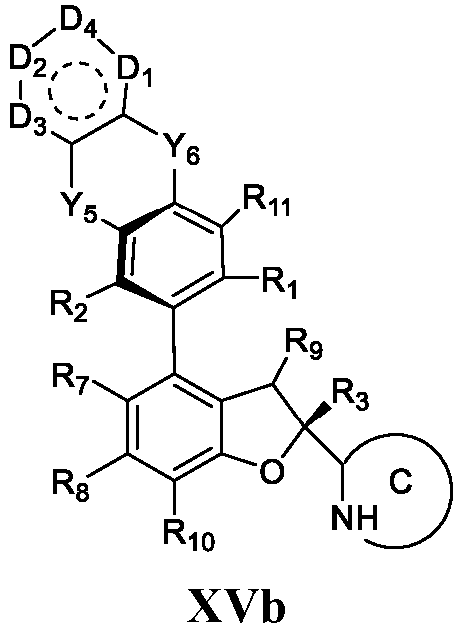 D1 is selected from: O, S, S(O), S(O)2, N, NRc, CRfRg, CRf and C(=O);D2 is selected from: O, S, S(O), S(O)2, N, NRe, CRfRg, CRf and C(=O);D3 is selected from: O, S, S(O), S(O)2, N, NRe, CRfRg, CRf and C(=O);D4 is selected from: O, S, S(O), S(O)2, N, NRe, CRfRg, CRf and C(=O); and wherein the ring in which D1, D2, D3 and D4 are located satisfies valence bond theory and contains at most two C(=O) and three N atoms;each Re at each occurrence is independently selected from: H, substituted or unsubstituted C1-C4 acyl, substituted or unsubstituted C1-C4 alkoxy, cyano, substituted or unsubstituted C1-C4 alkyl-S(O)2-, substituted or unsubstituted 4- to 9-membered heterocyclyl, NR'R"-C(O)-, substituted or unsubstituted 3- to 6-membered cyclohydrocarbyl, substituted or unsubstituted 3- to 6-membered cyclohydrocarbyl-C(O)-, substituted or unsubstituted C1-C4 haloalkyl and substituted or unsubstituted C1-C4 alkyl; each Rf at each occurrence is independently selected from: H, halogen, hydroxyl, cyano, oxo, substituted or unsubstituted C1-C4 alkoxy, substituted or unsubstituted C1-C4 alkyl; preferably, the C1-C4 alkoxy and C1-C4 alkyl are optionally substituted by 1, 2 or 3 substituents selected from F, hydroxyl and cyano;Y5 and Y6 are independently selected from: a bond, O, S, N, -S(O)-, -S(O)2-, C, CH(R13), C(R13)2 and N(R12), and Y5 and Y6 are not simultaneously a bond;R2 is selected from: H, halogen, substituted or unsubstituted alkyl and substituted or unsubstituted alkoxy;R7 is selected from: H, halogen, cyano, nitro, substituted or unsubstituted C1-C4 alkyl and substituted or unsubstituted C1-C4 alkoxy;R8 is selected from: H, halogen, cyano, nitro, substituted or unsubstituted C1-C4 alkyl and substituted or unsubstituted C1-C4 alkoxy;R9 is selected from: H, substituted or unsubstituted C1-C4 alkyl, substituted or unsubstituted C1-C4 alkoxy, hydroxyl and halogen;R10 is selected from: H, halogen and substituted or unsubstituted C1-C4 alkyl;R11 is selected from: H, hydroxyl, amino, halogen, substituted or unsubstituted C1-C4 alkyl, -NR'R" and substituted or unsubstituted C1-C4 alkoxy;R' and R" are each independently selected from H, C1-C4 alkyl, C3-C6 cycloalkyl, C1-C4 alkyl-S(O)2- and C1-C4 haloalkyl;ring C is a substituted or unsubstituted 4- to 12-membered monocyclic or fused heterocyclyl, substituted or unsubstituted 6- to 12-membered bridged heterocyclyl or substituted or unsubstituted 6- to 12-membered spiro heterocyclyl ring, and the 4- to 12-membered monocyclic or fused heterocyclyl, 6- to 12-membered bridged heterocyclyl and 6- to 12-membered spiro heterocyclyl each optionally further contain 1 or 2 heteroatoms selected from N and O; ring C is preferably a substituted or unsubstituted 4- to 8-membered nitrogen-containing monocyclic heterocyclyl, substituted or unsubstituted 6- to 12-membered nitrogen-containing spiro heterocyclyl or substituted or unsubstituted 6- to 12-membered nitrogen-containing fused heterocyclyl ring;each p is 0, 1, 2, 3 or 4.
 - The compound or the pharmaceutically acceptable salt, enantiomer, diastereomer, tautomer, solvate, isotopic substitute, polymorph, prodrug or metabolite thereof according to any one of claims 1 to 117, wherein the compound is selected from the following compounds:
 D1 is selected from: N and CRf;D4 is selected from: N and CRf, and D1 and D4 are not simultaneously N;Re is selected from: H, substituted or unsubstituted C1-C4 acyl, substituted or unsubstituted C1-C4 alkoxy, cyano, substituted or unsubstituted C1-C4 alkyl-S(O)2-, substituted or unsubstituted 4- to 9-membered heterocyclyl, NR'R"-C(O)-, substituted or unsubstituted 3- to 6-membered cyclohydrocarbyl, substituted or unsubstituted 3- to 6-membered cyclohydrocarbyl-C(O)-, substituted or unsubstituted C1-C4 haloalkyl and substituted or unsubstituted C1-C4 alkyl;each Rf at each occurrence is independently selected from: H, halogen, hydroxyl, cyano, substituted or unsubstituted C1-C4 alkoxy, substituted or unsubstituted C1-C4 alkyl; preferably, the C1-C4 alkoxy and C1-C4 alkyl are optionally substituted by 1, 2 or 3 substituents selected from F, hydroxyl and cyano;Y5 and Y6 are independently selected from: a bond, O, S, N, -S(O)-, -S(O)2-, C, CH(R13), C(R13)2 and N(R12), and Y5 and Y6 are not simultaneously a bond;R2 is selected from: H, halogen, substituted or unsubstituted alkyl and substituted or unsubstituted alkoxy;R4 and R5 are each independently selected from: H, halogen and substituted or unsubstituted C1-C4 alkyl;R6 is selected from: H, substituted or unsubstituted alkyl, substituted or unsubstituted alkoxy, substituted or unsubstituted alkenyl, substituted or unsubstituted alkynyl, substituted or unsubstituted cyclohydrocarbyl, substituted or unsubstituted aryl, substituted or unsubstituted heteroaryl and substituted or unsubstituted heterocyclyl;alternatively, R4 or R5 and R6, together with the atom to which they are attached, form a substituted or unsubstituted 4- to 6-membered heterocyclyl ring; the 4- to 6-membered heterocyclyl contains 1 or 2 heteroatoms selected from N and O;R7 is selected from: H, halogen, cyano, nitro, substituted or unsubstituted C1-C4 alkyl and substituted or unsubstituted C1-C4 alkoxy;R8 is selected from: H, halogen, cyano, nitro, substituted or unsubstituted C1-C4 alkyl and substituted or unsubstituted C1-C4 alkoxy;R9 is selected from: H, substituted or unsubstituted C1-C4 alkyl, substituted or unsubstituted C1-C4 alkoxy, hydroxyl and halogen;R10 is selected from: H, halogen and substituted or unsubstituted C1-C4 alkyl;R11 is selected from: H, hydroxyl, amino, halogen, substituted or unsubstituted C1-C4 alkyl, -NR'R" and substituted or unsubstituted C1-C4 alkoxy;R' and R" are each independently selected from H, C1-C4 alkyl, C3-C6 cycloalkyl, C1-C4 alkyl-S(O)2- and C1-C4 haloalkyl;Rh is selected from: H, halogen, substituted or unsubstituted C1-C4 alkyl and substituted or unsubstituted C1-C4 alkoxy.
 - The compound or the pharmaceutically acceptable salt, enantiomer, diastereomer, tautomer, solvate, isotopic substitute, polymorph, prodrug or metabolite thereof according to any one of claims 1 to 117, wherein the compound has a structure shown in the following formula XVIb:
 D1 is selected from: N and CRf;D4 is selected from: N and CRf, and D1 and D4 are not simultaneously N;Re is selected from: H, substituted or unsubstituted C1-C4 acyl, substituted or unsubstituted C1-C4 alkoxy, cyano, substituted or unsubstituted C1-C4 alkyl-S(O)2-, substituted or unsubstituted 4- to 9-membered heterocyclyl, NR'R"-C(O)-, substituted or unsubstituted 3- to 6-membered cyclohydrocarbyl, substituted or unsubstituted 3- to 6-membered cyclohydrocarbyl-C(O)-, substituted or unsubstituted C1-C4 haloalkyl and substituted or unsubstituted C1-C4 alkyl; each Rf at each occurrence is independently selected from: H, halogen, hydroxyl, cyano, substituted or unsubstituted C1-C4 alkoxy, substituted or unsubstituted C1-C4 alkyl; preferably, the C1-C4 alkoxy and C1-C4 alkyl are optionally substituted by 1, 2 or 3 substituents selected from F, hydroxyl and cyano;Y5 and Y6 are independently selected from: a bond, O, S, N, -S(O)-, -S(O)2-, C, CH(R13), C(R13)2 and N(R12), and Y5 and Y6 are not simultaneously a bond;R2 is selected from: H, halogen, substituted or unsubstituted alkyl and substituted or unsubstituted alkoxy;R7 is selected from: H, halogen, cyano, nitro, substituted or unsubstituted C1-C4 alkyl and substituted or unsubstituted C1-C4 alkoxy;R8 is selected from: H, halogen, cyano, nitro, substituted or unsubstituted C1-C4 alkyl and substituted or unsubstituted C1-C4 alkoxy;R9 is selected from: H, substituted or unsubstituted C1-C4 alkyl, substituted or unsubstituted C1-C4 alkoxy, hydroxyl and halogen;R10 is selected from: H, halogen and substituted or unsubstituted C1-C4 alkyl;R11 is selected from: H, hydroxyl, amino, halogen, substituted or unsubstituted C1-C4 alkyl, -NR'R" and substituted or unsubstituted C1-C4 alkoxy;R' and R" are each independently selected from H, C1-C4 alkyl, C3-C6 cycloalkyl, C1-C4 alkyl-S(O)2- and C1-C4 haloalkyl;Rh is selected from: H, halogen, substituted or unsubstituted C1-C4 alkyl and substituted or unsubstituted C1-C4 alkoxy;Ri is selected from: H, halogen, substituted or unsubstituted C1-C4 alkyl and substituted or unsubstituted C1-C4 alkoxy;p is 1, 2 or 3;q is 0, 1, 2, 3 or 4.
 - The compound or the pharmaceutically acceptable salt, enantiomer, diastereomer, tautomer, solvate, isotopic substitute, polymorph, prodrug or metabolite thereof according to claim 1, wherein the compound is selected from the following compounds:
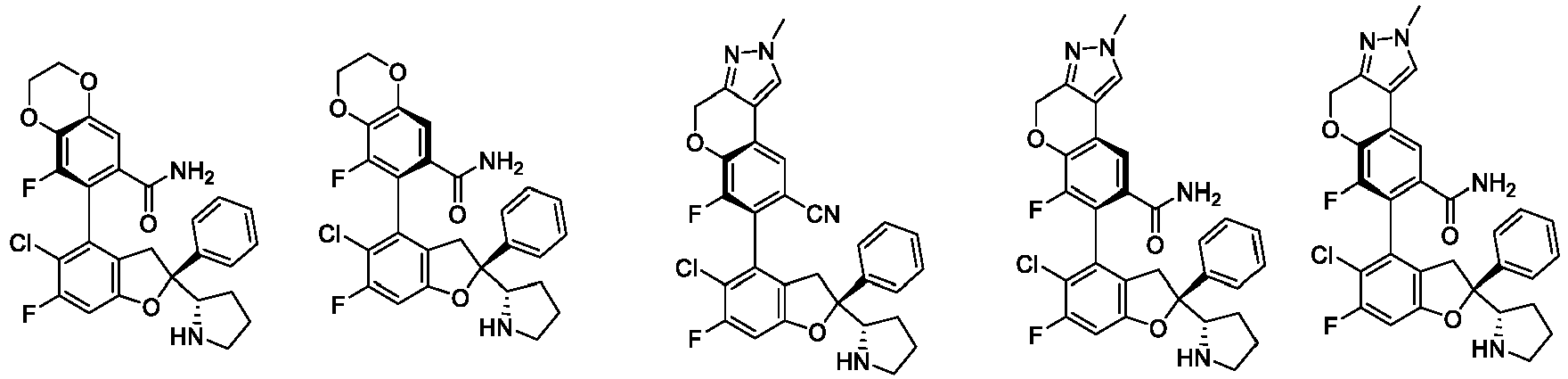


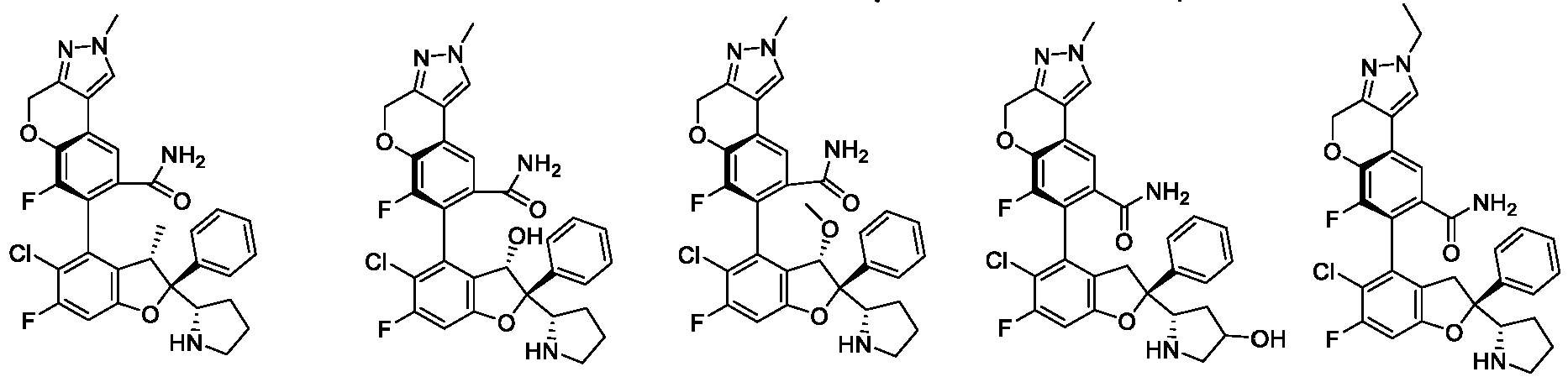


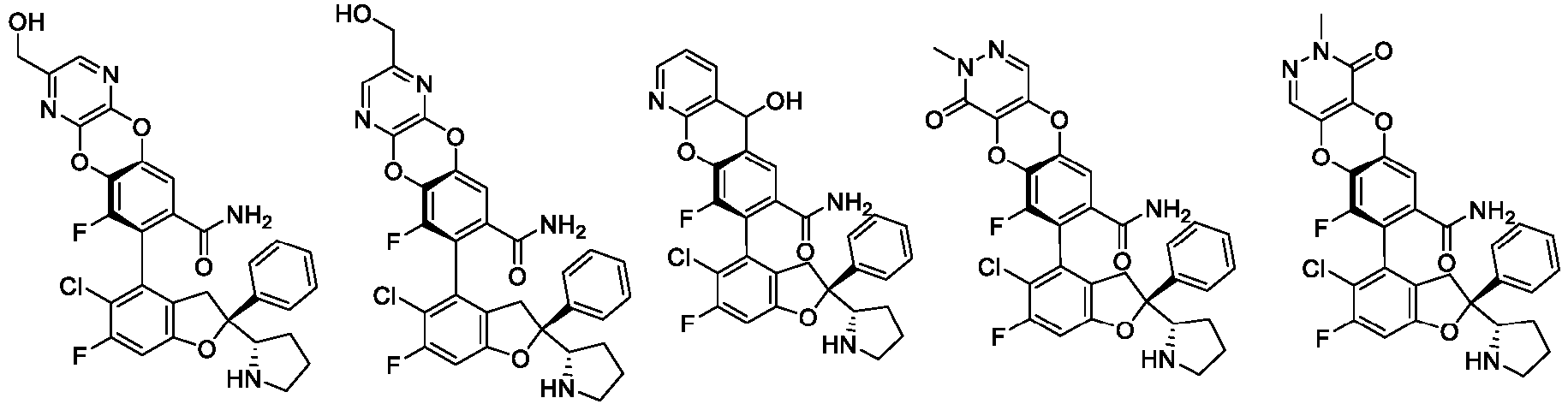


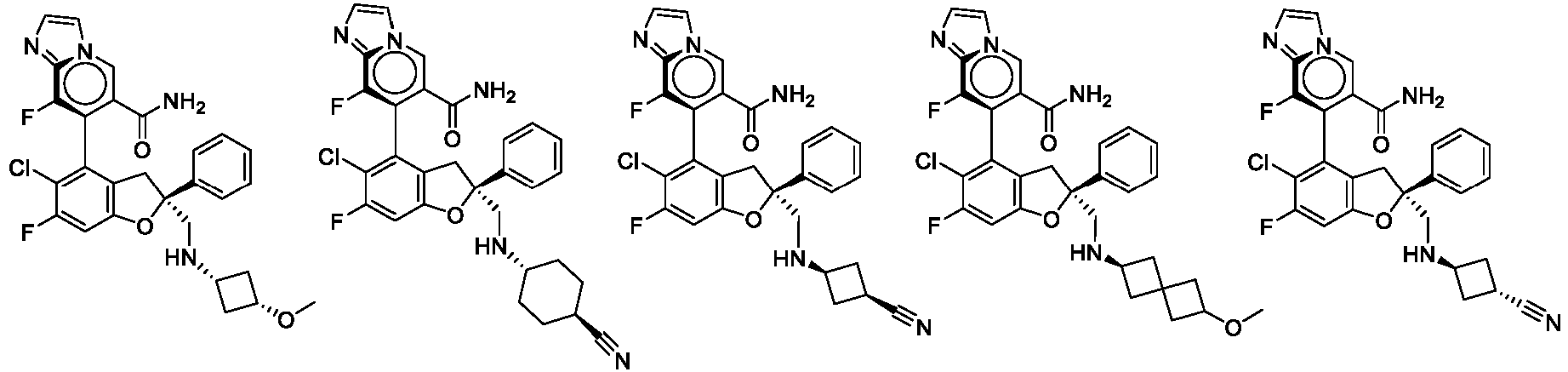


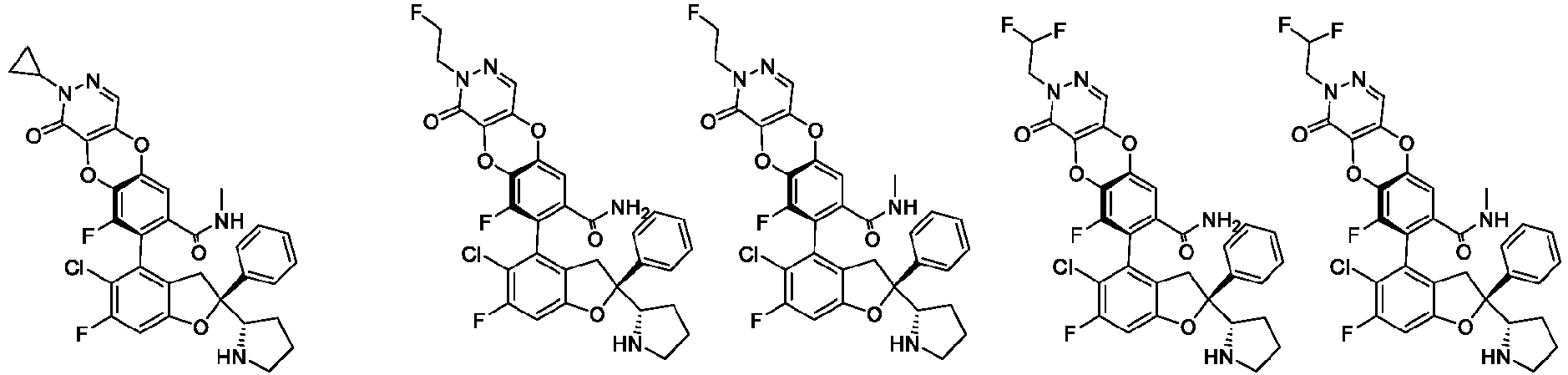


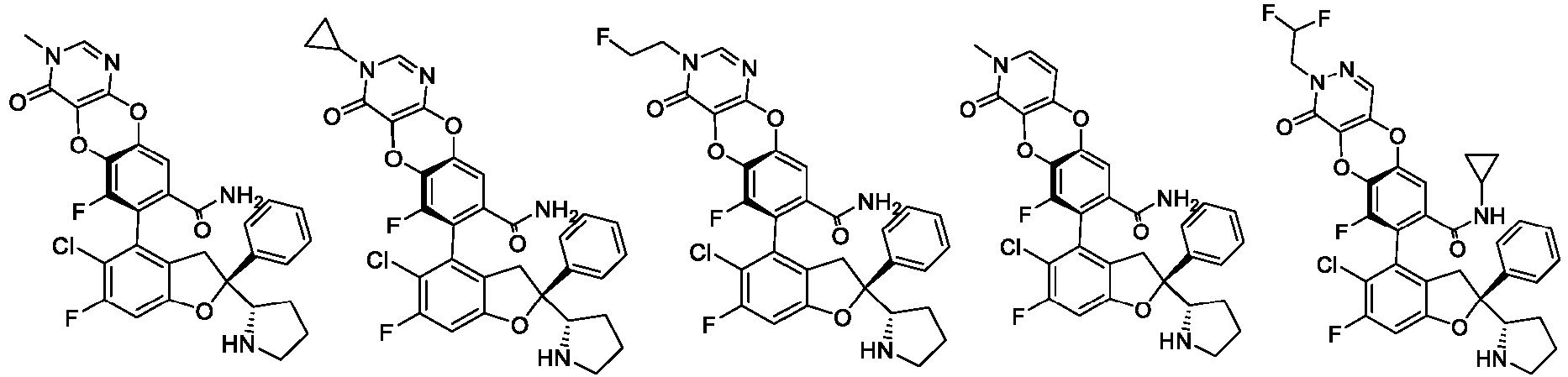


- A pharmaceutical composition, wherein the pharmaceutical composition comprises the compound or the pharmaceutically acceptable salt, enantiomer, diastereomer, tautomer, solvate, isotopic substitute, polymorph, prodrug or metabolite thereof according to any one of claims 1 to 120 and a pharmaceutically acceptable carrier or excipient.
- The pharmaceutical composition according to claim 121, wherein the pharmaceutical composition further comprises other known anticancer agents, including but not limited to chemotherapeutic agents, such as mitotic inhibitors, such as taxane compounds (e.g., paclitaxel or docetaxel), vinca alkaloids (e.g., vincristine, vinblastine, vinorelbine or vinflunine), other anticancer agents such as metal platinum complexes (e.g., cisplatin, carboplatin or oxaliplatin), antimetabolites (e.g., pyrimidine antagonists, such as 5-fluorouracil, 5-fluoro-2-4(1H,3H)-pyrimidinedione (5FU), gemcitabine), hormonal antitumor drugs (e.g., flutamide), and tumor immunotherapy drugs (such as anti-PD1 antibody).
- A use of the compound or the pharmaceutically acceptable salt, enantiomer, diastereomer, tautomer, solvate, isotopic substitute, polymorph, prodrug or metabolite thereof according to any one of claims 1 to 120, or the pharmaceutical composition according to claim 117 or 118 in the manufacture of a medicament for treating or preventing diseases mediated by interaction between YAP/TAZ and TEAD; preferably, the diseases mediated by the interaction between YAP/TAZ and TEAD are tumors, liver fibrosis and renal fibrosis; preferably, the tumors comprise benign tumors and malignant tumors, especially cancers or sarcomas, such as solid tumors or hematological tumors; more preferably, the diseases mediated by the interaction between YAP/TAZ and TEAD are: mesothelioma (e.g., pleural mesothelioma (such as malignant pleural mesothelioma), peritoneal mesothelioma, pericardial mesothelioma or tunica vaginalis mesothelioma), cervical squamous cell carcinoma, endometrial carcinoma, bladder urothelial carcinoma, skin squamous cell carcinoma, poroma (e.g., benign poroma), porocarcinoma, epithelioid hemangioendothelioma, breast cancer (e.g., triple-negative breast cancer), lung cancer (e.g., non-small cell lung cancer), ovarian cancer, colorectal cancer, melanoma, pancreatic cancer (e.g., pancreatic ductal adenocarcinoma), prostate cancer, gastric cancer, esophageal cancer (e.g., esophageal squamous cell carcinoma or esophageal adenocarcinoma), liver cancer (e.g., hepatocellular carcinoma or hepatoblastoma), cholangiocarcinoma, neurilemmoma, renal cancer, sarcoma (e.g., rhabdomyosarcoma, embryonal rhabdomyosarcoma, osteosarcoma, undifferentiated pleomorphic sarcoma, Kaposi's sarcoma and soft tissue sarcoma (such as rare soft tissue sarcoma)), bone cancer, brain cancer (e.g., ependymoma (e.g., supratentorial ependymoma, such as pediatric supratentorial ependymoma), neuroblastoma, medulloblastoma, glioma or meningioma) or head and neck cancer (e.g., head and neck squamous cell carcinoma).
- A compound of formula Ya,
 X1 is selected from: O and NRa;R3 is selected from: substituted or unsubstituted aryl, substituted or unsubstituted heteroaryl and substituted or unsubstituted heterocyclyl;R4 and R5 are each independently selected from: H, halogen and substituted or unsubstituted alkyl; alternatively, R4 and R5, together with the carbon atom to which they are attached, form a 3- to 6-membered substituted or unsubstituted ring, and the ring optionally contains 1, 2 or 3 heteroatoms selected from O, N and S;R6 is selected from: H, substituted or unsubstituted alkyl, substituted or unsubstituted alkoxy, substituted or unsubstituted alkenyl, substituted or unsubstituted alkynyl, substituted or unsubstituted cyclohydrocarbyl, substituted or unsubstituted aryl, substituted or unsubstituted heteroaryl and substituted or unsubstituted heterocyclyl;alternatively, R4 or R5 and R6, together with the atom to which they are attached, form a substituted or unsubstituted 4- to 12-membered monocyclic or fused heterocyclyl, substituted or unsubstituted 6- to 12-membered bridged heterocyclyl or substituted or unsubstituted 6- to 12-membered spiro heterocyclyl ring; the 4- to 12-membered monocyclic or fused heterocyclyl, 6- to 12-membered bridged heterocyclyl and 6- to 12-membered spiro heterocyclyl each optionally further contain 1 or 2 heteroatoms selected from N and O;R8 is selected from: H, halogen, cyano, nitro, substituted or unsubstituted alkyl, substituted or unsubstituted haloalkyl, substituted or unsubstituted alkoxy, substituted or unsubstituted alkenyl and substituted or unsubstituted alkynyl;R9 is selected from: H, substituted or unsubstituted alkyl, substituted or unsubstituted alkoxy, hydroxyl and halogen;R10 is selected from: H, halogen and substituted or unsubstituted alkyl.
 - A preparation method for a compound of formula Ya, comprising the following steps:
 (i) coupling a borate ester under alkaline conditions with palladium catalysis, converting halogen Hal1 in formula Ya-1 into Q-B-Q to obtain Ya-2;(ii) converting Ya-2 into the potassium trifluoroborate salt of Ya-3 in an organic solvent at room temperature;(iii) using a chlorinating reagent to convert Ya-3 into Ya under acid catalysis in an organic solvent;
in the formula,X1 is selected from: O and NRa; Ra is selected from H and C1-C4 alkyl;R3 is selected from: substituted or unsubstituted aryl, substituted or unsubstituted heteroaryl and substituted or unsubstituted heterocyclyl;R4 and R5 are each independently selected from: H, halogen and substituted or unsubstituted alkyl; alternatively, R4 and R5, together with the carbon atom to which they are attached, form a 3- to 6-membered substituted or unsubstituted ring, and the ring optionally contains 1, 2 or 3 heteroatoms selected from O, N and S;R6 is selected from: H, substituted or unsubstituted alkyl, substituted or unsubstituted alkoxy, substituted or unsubstituted alkenyl, substituted or unsubstituted alkynyl, substituted or unsubstituted cyclohydrocarbyl, substituted or unsubstituted aryl, substituted or unsubstituted heteroaryl and substituted or unsubstituted heterocyclyl;alternatively, R4 or R5 and R6, together with the atom to which they are attached, form a substituted or unsubstituted 4- to 12-membered monocyclic or fused heterocyclyl, substituted or unsubstituted 6- to 12-membered bridged heterocyclyl or substituted or unsubstituted 6- to 12-membered spiro heterocyclyl ring; the 4- to 12-membered monocyclic or fused heterocyclyl, 6- to 12-membered bridged heterocyclyl and 6- to 12-membered spiro heterocyclyl each optionally further contain 1 or 2 heteroatoms selected from N and O;R8 is selected from: H, halogen, cyano, nitro, substituted or unsubstituted alkyl, substituted or unsubstituted haloalkyl, substituted or unsubstituted alkoxy, substituted or unsubstituted alkenyl and substituted or unsubstituted alkynyl;R9 is selected from: H, substituted or unsubstituted alkyl, substituted or unsubstituted alkoxy, hydroxyl and halogen;R10 is selected from: H, halogen and substituted or unsubstituted alkyl;Hal1 is halogen;Q-B-Q is boric acid or borate ester;Pg is a nitrogen protecting group. - A compound of formula Za,
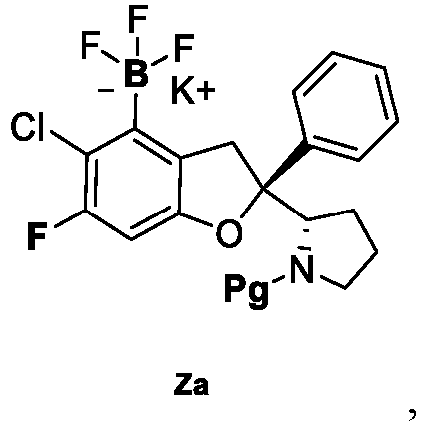
- A preparation method for a compound of formula Za, comprising the following steps:
 (i) coupling a borate ester under alkaline conditions with palladium catalysis, converting halogen Hal1 in formula Za-1 into Q-B-Q to obtain Za-2;(ii) adding potassium hydrogen fluoride aqueous solution to convert Q-B-Q into potassium trifluoroborate salt in an organic solvent at room temperature to obtain Za-3;(iii) using a chlorinating reagent to convert Za-3 into Za under acid catalysis in an organic solvent;in the formula, Hal1 is halogen; Q-B-Q is boric acid or borate ester; Pg is a nitrogen protecting group.
Applications Claiming Priority (6)
| Application Number | Priority Date | Filing Date | Title |
|---|---|---|---|
| CN202210158641 | 2022-02-21 | ||
| CN202210344511 | 2022-03-31 | ||
| CN202210794926 | 2022-07-05 | ||
| CN202211544166 | 2022-12-01 | ||
| CN202211559809 | 2022-12-06 | ||
| PCT/CN2023/077504 WO2023155927A1 (en) | 2022-02-21 | 2023-02-21 | Inhibitor of interaction between yap/taz and tead, preparation thereof, pharmaceutical composition thereof and use thereof |
Publications (1)
| Publication Number | Publication Date |
|---|---|
| EP4484420A1 true EP4484420A1 (en) | 2025-01-01 |
Family
ID=87577632
Family Applications (1)
| Application Number | Title | Priority Date | Filing Date |
|---|---|---|---|
| EP23755927.3A Pending EP4484420A1 (en) | 2022-02-21 | 2023-02-21 | Inhibitor of interaction between yap/taz and tead, preparation thereof, pharmaceutical composition thereof and use thereof |
Country Status (8)
| Country | Link |
|---|---|
| US (1) | US20250177408A1 (en) |
| EP (1) | EP4484420A1 (en) |
| JP (1) | JP2025508449A (en) |
| KR (1) | KR20250004633A (en) |
| CN (1) | CN118946562A (en) |
| AU (1) | AU2023221924A1 (en) |
| CA (1) | CA3252938A1 (en) |
| WO (1) | WO2023155927A1 (en) |
Families Citing this family (2)
| Publication number | Priority date | Publication date | Assignee | Title |
|---|---|---|---|---|
| US20240368134A1 (en) * | 2021-12-02 | 2024-11-07 | Shanghai Kygent Pharmaceutical Co., Ltd | Aromatic compound, pharmaceutical composition, and application thereof |
| WO2024235254A1 (en) * | 2023-05-15 | 2024-11-21 | Jiangsu Hansoh Pharmaceutical Group Co., Ltd. | Biaryl compounds preparation methods and medicinal uses thereof |
Family Cites Families (6)
| Publication number | Priority date | Publication date | Assignee | Title |
|---|---|---|---|---|
| DE102005010000A1 (en) * | 2005-03-04 | 2006-09-07 | Merck Patent Gmbh | indanes |
| EP3353156B1 (en) * | 2015-09-23 | 2021-11-03 | The General Hospital Corporation | Tead transcription factor autopalmitoylation inhibitors |
| MA53506A (en) * | 2018-08-29 | 2021-07-07 | Chemocentryx Inc | METHODS OF CANCER TREATMENT WITH SMALL MOLECULE PD-L1 INHIBITORS |
| EP3847154A1 (en) * | 2018-09-03 | 2021-07-14 | F. Hoffmann-La Roche AG | Carboxamide and sulfonamide derivatives useful as tead modulators |
| CN109776377B (en) * | 2019-02-01 | 2021-08-24 | 沈阳药科大学 | Indoline compounds and preparation method and application thereof |
| PY2121402A (en) | 2020-03-16 | 2022-08-09 | Norvatis Ag | BIARYL DERIVATIVES AS INHIBITORS OF THE YAP/TAZ-TEAD PROTEIN-PROTEIN INTERACTION |
-
2023
- 2023-02-21 US US18/840,394 patent/US20250177408A1/en active Pending
- 2023-02-21 AU AU2023221924A patent/AU2023221924A1/en active Pending
- 2023-02-21 CN CN202380022797.2A patent/CN118946562A/en active Pending
- 2023-02-21 KR KR1020247031743A patent/KR20250004633A/en active Pending
- 2023-02-21 CA CA3252938A patent/CA3252938A1/en active Pending
- 2023-02-21 EP EP23755927.3A patent/EP4484420A1/en active Pending
- 2023-02-21 WO PCT/CN2023/077504 patent/WO2023155927A1/en not_active Ceased
- 2023-02-21 JP JP2024549189A patent/JP2025508449A/en active Pending
Also Published As
| Publication number | Publication date |
|---|---|
| US20250177408A1 (en) | 2025-06-05 |
| KR20250004633A (en) | 2025-01-08 |
| AU2023221924A1 (en) | 2024-10-10 |
| CN118946562A (en) | 2024-11-12 |
| CA3252938A1 (en) | 2025-07-08 |
| JP2025508449A (en) | 2025-03-26 |
| WO2023155927A1 (en) | 2023-08-24 |
Similar Documents
| Publication | Publication Date | Title |
|---|---|---|
| EP3712151B1 (en) | (s)-1'-(8-((2-amino-3-chloropyridin-4-yl)thio)imidazo[1,2-c]pyrimidin-5-yl)-5,7-dihydrospiro[cyclopenta[b]pyridine-6,4'-piperidine]-5-amine as shp2 inhibitor for the treatment of cancer | |
| EP3753941B1 (en) | Pyrimidine-fused cyclic compound, preparation method therefor and application thereof | |
| CN113795483A (en) | Carboxamide-pyrimidine derivatives as SHP2 antagonists | |
| CN116262749A (en) | A class of compounds substituted by aromatic heterocycles and their preparation methods and uses | |
| WO2020108590A1 (en) | Pyrimidine and five-membered nitrogen heterocycle derivative, preparation method therefor, and medical uses thereof | |
| CA2764653A1 (en) | Tetracyclic compounds | |
| CN109790160B (en) | Pyrido five-membered aromatic ring compound, preparation method and application thereof | |
| RS65761B1 (en) | Rapamycin analogs and uses thereof | |
| JP2023508858A (en) | Triazolopyridazine derivative, preparation method, pharmaceutical composition and use thereof | |
| KR20250048262A (en) | Aza-quinazoline compounds and methods of use | |
| WO2024015412A1 (en) | Tetrahydronaphthalene derivatives as estrogen receptor degraders | |
| US20250177408A1 (en) | Inhibitor of interaction between yap/taz and tead, preparation thereof, pharmaceutical composition thereof and use thereof | |
| JP2025524020A (en) | Quinazoline Compounds and Methods of Use | |
| TW202417449A (en) | Cdk2 inhibitors and methods of using the same | |
| KR20150009599A (en) | Pyranopyridone inhibitors of tankyrase | |
| CN115397815B (en) | Condensed bicyclic derivatives, preparation methods thereof and their application in medicine | |
| CN111867584A (en) | Ethylenediamine-heterocyclic derivatives as inhibitors of protein arginine methyltransferases | |
| WO2025155742A1 (en) | Methods of use for quinazoline compounds | |
| WO2025155740A1 (en) | Combinations comprising aza-quinazoline compounds for use in the treatment of cancer | |
| IL317345A (en) | Tricyclic compounds and uses thereof | |
| TW202415660A (en) | Triazine compounds and uses thereof | |
| HK40010063A (en) | Pyrido five-element aromatic ring compound, preparation method therefor and use thereof | |
| HK40036078B (en) | Spiro aromatic ring compound and application thereof | |
| HK40040220B (en) | Pyrimidine-fused cyclic compound, preparation method therefor and application thereof |
Legal Events
| Date | Code | Title | Description |
|---|---|---|---|
| STAA | Information on the status of an ep patent application or granted ep patent |
Free format text: STATUS: THE INTERNATIONAL PUBLICATION HAS BEEN MADE |
|
| PUAI | Public reference made under article 153(3) epc to a published international application that has entered the european phase |
Free format text: ORIGINAL CODE: 0009012 |
|
| STAA | Information on the status of an ep patent application or granted ep patent |
Free format text: STATUS: REQUEST FOR EXAMINATION WAS MADE |
|
| 17P | Request for examination filed |
Effective date: 20240920 |
|
| AK | Designated contracting states |
Kind code of ref document: A1 Designated state(s): AL AT BE BG CH CY CZ DE DK EE ES FI FR GB GR HR HU IE IS IT LI LT LU LV MC ME MK MT NL NO PL PT RO RS SE SI SK SM TR |
|
| DAV | Request for validation of the european patent (deleted) | ||
| DAX | Request for extension of the european patent (deleted) | ||
| RAP1 | Party data changed (applicant data changed or rights of an application transferred) |
Owner name: ETERN THERAPEUTICS HONGKONG LIMITED |
|
| REG | Reference to a national code |
Ref country code: DE Ref legal event code: R079 Free format text: PREVIOUS MAIN CLASS: C07D0405140000 Ipc: A61K0031343000 |
|
| RIC1 | Information provided on ipc code assigned before grant |
Ipc: A61K 31/343 20060101AFI20260128BHEP Ipc: A61K 31/5025 20060101ALI20260128BHEP Ipc: A61K 45/06 20060101ALI20260128BHEP Ipc: A61P 35/00 20060101ALI20260128BHEP Ipc: C07D 405/04 20060101ALI20260128BHEP Ipc: C07D 405/14 20060101ALI20260128BHEP Ipc: C07D 413/04 20060101ALI20260128BHEP Ipc: C07D 413/14 20060101ALI20260128BHEP Ipc: C07D 471/04 20060101ALI20260128BHEP Ipc: C07D 491/048 20060101ALI20260128BHEP Ipc: C07D 491/052 20060101ALI20260128BHEP Ipc: C07D 491/056 20060101ALI20260128BHEP Ipc: C07D 491/107 20060101ALI20260128BHEP Ipc: C07D 498/06 20060101ALI20260128BHEP |