EP4484412A1 - Fused quinone oxime imidazole, onium derivative thereof, preparation therefor and use thereof - Google Patents
Fused quinone oxime imidazole, onium derivative thereof, preparation therefor and use thereof Download PDFInfo
- Publication number
- EP4484412A1 EP4484412A1 EP22930534.7A EP22930534A EP4484412A1 EP 4484412 A1 EP4484412 A1 EP 4484412A1 EP 22930534 A EP22930534 A EP 22930534A EP 4484412 A1 EP4484412 A1 EP 4484412A1
- Authority
- EP
- European Patent Office
- Prior art keywords
- substituents
- zero
- branched alkyl
- imidazole
- dihydro
- Prior art date
- Legal status (The legal status is an assumption and is not a legal conclusion. Google has not performed a legal analysis and makes no representation as to the accuracy of the status listed.)
- Pending
Links
Classifications
-
- C—CHEMISTRY; METALLURGY
- C07—ORGANIC CHEMISTRY
- C07D—HETEROCYCLIC COMPOUNDS
- C07D235/00—Heterocyclic compounds containing 1,3-diazole or hydrogenated 1,3-diazole rings, condensed with other rings
- C07D235/02—Heterocyclic compounds containing 1,3-diazole or hydrogenated 1,3-diazole rings, condensed with other rings condensed with carbocyclic rings or ring systems
-
- A—HUMAN NECESSITIES
- A61—MEDICAL OR VETERINARY SCIENCE; HYGIENE
- A61K—PREPARATIONS FOR MEDICAL, DENTAL OR TOILETRY PURPOSES
- A61K31/00—Medicinal preparations containing organic active ingredients
- A61K31/33—Heterocyclic compounds
- A61K31/395—Heterocyclic compounds having nitrogen as a ring hetero atom, e.g. guanethidine or rifamycins
- A61K31/41—Heterocyclic compounds having nitrogen as a ring hetero atom, e.g. guanethidine or rifamycins having five-membered rings with two or more ring hetero atoms, at least one of which being nitrogen, e.g. tetrazole
- A61K31/4164—1,3-Diazoles
- A61K31/4184—1,3-Diazoles condensed with carbocyclic rings, e.g. benzimidazoles
-
- A—HUMAN NECESSITIES
- A61—MEDICAL OR VETERINARY SCIENCE; HYGIENE
- A61K—PREPARATIONS FOR MEDICAL, DENTAL OR TOILETRY PURPOSES
- A61K31/00—Medicinal preparations containing organic active ingredients
- A61K31/33—Heterocyclic compounds
- A61K31/395—Heterocyclic compounds having nitrogen as a ring hetero atom, e.g. guanethidine or rifamycins
- A61K31/495—Heterocyclic compounds having nitrogen as a ring hetero atom, e.g. guanethidine or rifamycins having six-membered rings with two or more nitrogen atoms as the only ring heteroatoms, e.g. piperazine or tetrazines
- A61K31/4965—Non-condensed pyrazines
- A61K31/497—Non-condensed pyrazines containing further heterocyclic rings
-
- A—HUMAN NECESSITIES
- A61—MEDICAL OR VETERINARY SCIENCE; HYGIENE
- A61P—SPECIFIC THERAPEUTIC ACTIVITY OF CHEMICAL COMPOUNDS OR MEDICINAL PREPARATIONS
- A61P31/00—Antiinfectives, i.e. antibiotics, antiseptics, chemotherapeutics
- A61P31/04—Antibacterial agents
-
- A—HUMAN NECESSITIES
- A61—MEDICAL OR VETERINARY SCIENCE; HYGIENE
- A61P—SPECIFIC THERAPEUTIC ACTIVITY OF CHEMICAL COMPOUNDS OR MEDICINAL PREPARATIONS
- A61P31/00—Antiinfectives, i.e. antibiotics, antiseptics, chemotherapeutics
- A61P31/12—Antivirals
-
- A—HUMAN NECESSITIES
- A61—MEDICAL OR VETERINARY SCIENCE; HYGIENE
- A61P—SPECIFIC THERAPEUTIC ACTIVITY OF CHEMICAL COMPOUNDS OR MEDICINAL PREPARATIONS
- A61P35/00—Antineoplastic agents
-
- C—CHEMISTRY; METALLURGY
- C07—ORGANIC CHEMISTRY
- C07D—HETEROCYCLIC COMPOUNDS
- C07D401/00—Heterocyclic compounds containing two or more hetero rings, having nitrogen atoms as the only ring hetero atoms, at least one ring being a six-membered ring with only one nitrogen atom
- C07D401/02—Heterocyclic compounds containing two or more hetero rings, having nitrogen atoms as the only ring hetero atoms, at least one ring being a six-membered ring with only one nitrogen atom containing two hetero rings
- C07D401/04—Heterocyclic compounds containing two or more hetero rings, having nitrogen atoms as the only ring hetero atoms, at least one ring being a six-membered ring with only one nitrogen atom containing two hetero rings directly linked by a ring-member-to-ring-member bond
-
- C—CHEMISTRY; METALLURGY
- C07—ORGANIC CHEMISTRY
- C07D—HETEROCYCLIC COMPOUNDS
- C07D401/00—Heterocyclic compounds containing two or more hetero rings, having nitrogen atoms as the only ring hetero atoms, at least one ring being a six-membered ring with only one nitrogen atom
- C07D401/14—Heterocyclic compounds containing two or more hetero rings, having nitrogen atoms as the only ring hetero atoms, at least one ring being a six-membered ring with only one nitrogen atom containing three or more hetero rings
-
- C—CHEMISTRY; METALLURGY
- C07—ORGANIC CHEMISTRY
- C07D—HETEROCYCLIC COMPOUNDS
- C07D403/00—Heterocyclic compounds containing two or more hetero rings, having nitrogen atoms as the only ring hetero atoms, not provided for by group C07D401/00
- C07D403/02—Heterocyclic compounds containing two or more hetero rings, having nitrogen atoms as the only ring hetero atoms, not provided for by group C07D401/00 containing two hetero rings
- C07D403/06—Heterocyclic compounds containing two or more hetero rings, having nitrogen atoms as the only ring hetero atoms, not provided for by group C07D401/00 containing two hetero rings linked by a carbon chain containing only aliphatic carbon atoms
-
- C—CHEMISTRY; METALLURGY
- C07—ORGANIC CHEMISTRY
- C07D—HETEROCYCLIC COMPOUNDS
- C07D405/00—Heterocyclic compounds containing both one or more hetero rings having oxygen atoms as the only ring hetero atoms, and one or more rings having nitrogen as the only ring hetero atom
- C07D405/02—Heterocyclic compounds containing both one or more hetero rings having oxygen atoms as the only ring hetero atoms, and one or more rings having nitrogen as the only ring hetero atom containing two hetero rings
- C07D405/04—Heterocyclic compounds containing both one or more hetero rings having oxygen atoms as the only ring hetero atoms, and one or more rings having nitrogen as the only ring hetero atom containing two hetero rings directly linked by a ring-member-to-ring-member bond
-
- C—CHEMISTRY; METALLURGY
- C07—ORGANIC CHEMISTRY
- C07D—HETEROCYCLIC COMPOUNDS
- C07D405/00—Heterocyclic compounds containing both one or more hetero rings having oxygen atoms as the only ring hetero atoms, and one or more rings having nitrogen as the only ring hetero atom
- C07D405/02—Heterocyclic compounds containing both one or more hetero rings having oxygen atoms as the only ring hetero atoms, and one or more rings having nitrogen as the only ring hetero atom containing two hetero rings
- C07D405/06—Heterocyclic compounds containing both one or more hetero rings having oxygen atoms as the only ring hetero atoms, and one or more rings having nitrogen as the only ring hetero atom containing two hetero rings linked by a carbon chain containing only aliphatic carbon atoms
-
- C—CHEMISTRY; METALLURGY
- C07—ORGANIC CHEMISTRY
- C07D—HETEROCYCLIC COMPOUNDS
- C07D405/00—Heterocyclic compounds containing both one or more hetero rings having oxygen atoms as the only ring hetero atoms, and one or more rings having nitrogen as the only ring hetero atom
- C07D405/02—Heterocyclic compounds containing both one or more hetero rings having oxygen atoms as the only ring hetero atoms, and one or more rings having nitrogen as the only ring hetero atom containing two hetero rings
- C07D405/12—Heterocyclic compounds containing both one or more hetero rings having oxygen atoms as the only ring hetero atoms, and one or more rings having nitrogen as the only ring hetero atom containing two hetero rings linked by a chain containing hetero atoms as chain links
-
- C—CHEMISTRY; METALLURGY
- C07—ORGANIC CHEMISTRY
- C07D—HETEROCYCLIC COMPOUNDS
- C07D409/00—Heterocyclic compounds containing two or more hetero rings, at least one ring having sulfur atoms as the only ring hetero atoms
- C07D409/02—Heterocyclic compounds containing two or more hetero rings, at least one ring having sulfur atoms as the only ring hetero atoms containing two hetero rings
- C07D409/04—Heterocyclic compounds containing two or more hetero rings, at least one ring having sulfur atoms as the only ring hetero atoms containing two hetero rings directly linked by a ring-member-to-ring-member bond
-
- C—CHEMISTRY; METALLURGY
- C07—ORGANIC CHEMISTRY
- C07D—HETEROCYCLIC COMPOUNDS
- C07D409/00—Heterocyclic compounds containing two or more hetero rings, at least one ring having sulfur atoms as the only ring hetero atoms
- C07D409/02—Heterocyclic compounds containing two or more hetero rings, at least one ring having sulfur atoms as the only ring hetero atoms containing two hetero rings
- C07D409/06—Heterocyclic compounds containing two or more hetero rings, at least one ring having sulfur atoms as the only ring hetero atoms containing two hetero rings linked by a carbon chain containing only aliphatic carbon atoms
-
- C—CHEMISTRY; METALLURGY
- C07—ORGANIC CHEMISTRY
- C07D—HETEROCYCLIC COMPOUNDS
- C07D471/00—Heterocyclic compounds containing nitrogen atoms as the only ring hetero atoms in the condensed system, at least one ring being a six-membered ring with one nitrogen atom, not provided for by groups C07D451/00 - C07D463/00
- C07D471/02—Heterocyclic compounds containing nitrogen atoms as the only ring hetero atoms in the condensed system, at least one ring being a six-membered ring with one nitrogen atom, not provided for by groups C07D451/00 - C07D463/00 in which the condensed system contains two hetero rings
- C07D471/04—Ortho-condensed systems
Definitions
- the present invention falls within the field of pharmaceuticals, and relates to a fused quinonoxime imidazole, an onium derivative thereof, preparation and use thereof, and in particular to a category of antibacterial, antiviral quinonoxime imidazolium derivatives useful for the treatment of cancer and preparation thereof, newly synthesized intermediates and preparation thereof.
- doxorubicin and mitomycin C can be used as chemotherapeutic agents in clinical application to treat a variety of cancers; alkannin and its derivatives have anti-inflammatory, anticancer, antiviral, anti-thrombotic, glucose-lowering, liver-protecting, and other multiple biological activities.
- Synthesized quinone-containing drugs also have been applied widely, e.g., doxorubicin and pharmorubicin are very good front-line anticancer agents. In recent years, people have concerned studies on the antitumor activity of active substances containing quinones.
- N-heterocyclic carbene is a category of extensively-applied metal organic-catalyst ligands and small-molecular catalysts with excellent activity; and it is efficient, easy to get, easy to modify, cheap, etc., which is highly identical to the features of pharmaceutical molecules.
- quinonoids are organically combined with carbene and then subjected to oximation by fusion of subjects, which designs and synthesizes a series of quinonoxime imidazolium derivatives with efficient antitumor activity for the first time.
- the derivative includes: (E)-or (Z)-4-(hydroxylimino)-1,3-dimethyl-9-oxo-4,9-dihydro-1H-naphtol[2,3-d]imidazole-3-oniu m, (E)-or (Z)-1-ethyl-4-(hydroxylimino)-3-methyl-9-oxo-4,9-dihydro-1H-naphthol[2,3-d] imidazol-3-onium, (E)-or (Z)-1-propyl-4-(hydroxylimino)-3-methyl-9-oxo-4,9-dihydro-1H-naphthol[2,3-d] imidazol-3-onium, (E)-or (Z)-1-butyl-4-(hydroxylimino)-3-methyl-9-oxo-4,9-dihydro-1H-naphthol[2,3-d]imidazo
- the present invention further relates to a pharmaceutical composition, including the one or more quinonoxime imidazolium derivatives above, and a pharmaceutically acceptable carrier.
- the present invention further relates to use of the pharmaceutical composition above in preparing an anti-cancer, anti-bacterial, or antiviral drug.
- the present invention further relates to a (Z) or (E)-fused quinonoxime imidazole derivative represented by the following Formula (I) and (II) and a hydrochloride thereof;
- the derivative includes (E)-9-(hydroxylimino)-3-methyl-3,9-dihydro-4H-naphthol [2,3-d] imidazole-4-one, (E)-3-ethyl-9-(hydroxylimino)-3,9-dihydro-4H-naphthol [2,3-d] imidazole-4-one, (E)-3-propyl-9-(hydroxylimino)-3,9-dihydro-4H-naphthol [2,3-d] imidazole-4-one, (E)-3-butyl-9-(hydroxylimino)-3,9-dihydro-4H-naphthol [2,3-d] imidazole-4-one, (E)-3-isopropyl-9-(hydroxylimino)-3,9-dihydro-4H-naphthol [2,3-d] imidazole-4-one, (E)-3-isopropyl-9-(hydroxylim
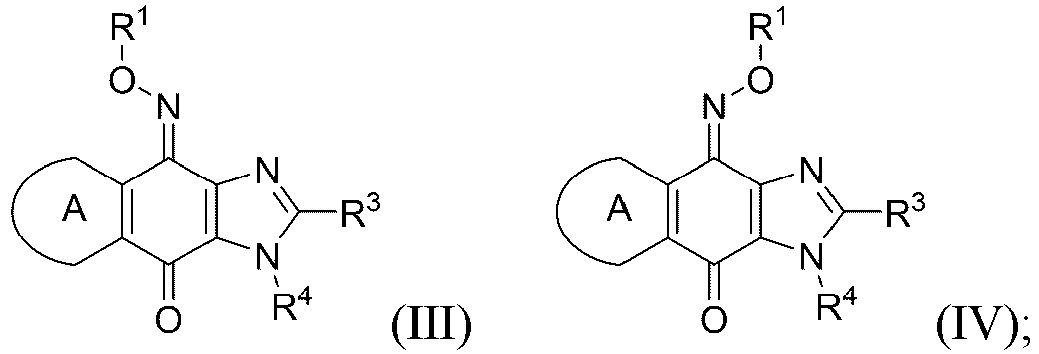
- the (Z) or (E)-fused quinonoxime imidazole derivative represented by Formula (III) or (IV) and a hydrochloride thereof are synthetic intermediates of the above Formulas (I) and (II); and the synthetic intermediates have good antitumor activity. Therefore, in a fifth aspect, the present invention further relates to a pharmaceutical composition, including the compound or hydrochloride thereof, and a pharmaceutically acceptable carrier.
- the pharmaceutical composition has anticancer, antibacterial and antiviral effects.
- the present invention further relates to use of the above pharmaceutical composition above in preparing an anti-cancer, anti-bacterial, or antiviral drug.
- Lower refers to a linear or branched hydrocarbon having 1 to 6 carbon atoms.
- Lower alkyl generally refers to alkyl having 1 to 4 carbon atoms, particularly preferably, methyl, ethyl, propyl, isopropyl, butyl, and isobutyl.
- Lower alkenyl generally refers to vinyl, allyl, 1-propenyl, isopropenyl, 1-butenyl, 2-butenyl, 3-butenyl, and 3-methyl-2-butenyl.
- “Lower alkynyl” generally refers to acetenyl, 1-propinyl, 2-propinyl, 1-butynyl, 2-butynyl, 3-butynyl, and 1-methyl-2-propinyl.
- “Aryl” refers to aromatic radicals, more preferably, aryl having 6 and 14 carbon atoms, and most preferably, phenyl, naphthyl, and fluorenyl.
- ring A refers to a ring forming the above aryl, most preferably, phenyl and naphthyl.
- Heteroaromatic ring refers to 5-6 membered monocyclic heteroaryl having 1-4 heteroatoms selected from one or more of N, S, and O, and bicyclic heteroaryl obtained by fusing a benzene ring or 5-6 membered monocyclic heteroaryl therewith.
- the 5-6 membered monocyclic heteroaryl is preferably furyl, thienyl, pyrryl, imidazolyl, thiazolyl, pyrazolyl, isothiazolyl, oxazolyl, isoxazolyl, oxadiazolyl, thiadiazolyl, triazolyl, tetrazolyl, pyridyl, pyrimidyl, pyrazinyl, pyridazinyl and triazinyl;
- the bicyclic heteroaryl is preferably benzofuryl, benzothiophenyl, benzothiadiazolyl, benzothiazolyl, benzoxazolyl, benzoxadiazolyl, benzimidazolyl, indolyl, isoindolyl, indazolyl, quinolyl, isoquinolyl, quinazolinyl, quinoxalinyl, benzodioxoly, indoli
- “Lower heteroalkyl” refers to C1-C4 alkyl having 1 to 4 heteroatoms selected from one or more of N, S, and O.
- Cycloalkyl refers to cycloalkyl group having 3 to 10 carbon atoms, particularly preferably, cyclopropyl, cyclobutyl, cyclopentyl, and cyclohexyl.
- Cycloalkenyl is preferably cycloalkenyl having 3 to 8 carbon atoms.
- Coanion is not limited particularly as long as it is a pharmaceutically acceptable anion as a coanion against imidazolium cation, preferably, univalent or bivalent anion, e.g., halide ions, organic sulfonate ions, acetate ions, trifluoroacetate ions, carbonate ions, and sulfate ions, most preferably, halide ions.
- univalent or bivalent anion e.g., halide ions, organic sulfonate ions, acetate ions, trifluoroacetate ions, carbonate ions, and sulfate ions, most preferably, halide ions.
- Heterocyclyl refers to 5 to 7-membered monocyclic saturated heterocycle having 1-4 heteroatoms selected from N, S, and O, or a bridge ring thereof, preferably, tetrahydrofuryl, tetrahydrofuryl, pyrrolidyl, piperazinyl, azacycloheptyl, diazacycloheptyl, quinuclidinyl, piperidyl, and morpholinyl.
- the compound of the present invention has tautomers of the following formula due to the non-localized effect of cation, and the present invention also includes isolated tautomers or a mixture thereof. Therefore, in the present invention, the compound represented by 1H-imidazole-3-onium derivative also includes a mixture of the tautomer 3H-imidazole-1-onium derivative and two isomers.
- hydrochlorides of Formulas (III) and (IV) in the present invention also fall within the present invention.
- the compounds (I), (II), (III), and (IV) of the present invention have geometrical isomers and tautomers according to different types of substituents. Isolated forms of these isomers or a mixture thereof are included in the present invention. Moreover, due to the existence of asymmetric carbon atoms in the compounds of the present invention, there are isomers to these asymmetric carbon atoms; the present invention includes mixed and isolated forms of these optical isomers.
- the compounds of the present invention form N-oxides due to different types of substituents; these substances are also included in the present invention; the present invention further includes various hydrates, solvates, and polymorphic substances of the compounds (I), (II), (III), and (IV) herein.
- the present invention further relates to a method for preparing the preceding quinonoxime imidazolium derivative and synthetic intermediates thereof; the method includes the following steps:
- a molar ratio of the substituted naphthoquinone imidazole to the substituted oxamine hydrochloride R1ONH2•HCl, and to the weak base is 1:1.2-5:0.001-0.01.
- the substituted oxamine hydrochloride is selected from hydroxylamine hydrochloride, methoxyamine hydrochloride, phenoxyamine hydrochloride, and benzyloxyamine hydrochloride.
- the weak base is selected from potassium carbonate, triethylamine, pyridine, etc.
- the protic solvent is selected from methanol, ethanol, and isopropanol.
- reaction temperature is 90-125°C
- reaction time is 12-48 h.
- step B a molar ratio of the quinonoxime imidazole derivative (III) or (IV) to the halide reagent R2X is 1:1-1:100.
- the halohydrocarbon is selected from iodomethane, iodoethane, etc.
- the organic solvent is selected from acetonitrile, ethyl acetate, tetrahydrofuran, etc.
- the reaction temperature is 50-120°C
- reaction time is 8-48 h.
- the compounds (III) and (IV) of the present invention may be used as a broad-spectrum anticancer, antibacterial and antiviral drug, and has low toxicity and good safety. Therefore, the compounds of the present invention have inhibition activity against proliferation of all solid tumors and lymphomas, in particular to breast cancer, cervical cancer, non-small cell lung cancer, rectal cancer, liver cancer, leukemia, prostate cancer, ovarian cancer, myeloma, esophageal cancer, pancreatic cancer, bladder cancer, melanoma, stomach cancer and other tumors.
- the pharmaceutical composition of the present invention may be prepared by one or two compounds of Formulas (III) and (IV) above, and a conventional pharmaceutically acceptable carrier (a drug carrier, an excipient, etc.) in the art according to a conventional method.
- Administration may be conducted via any one of oral means of troches, pills, capsules, granules, powders, liquids, inhalants, etc. and para-oral means such as intravenous injection and intramuscular injection of injections, suppositories, eye drops, eye ointments, percutaneous liquids, ointments, percutaneous patches, transmucosal liquids, transmucosal patches, etc.
- troches, powders, granules, etc. are available.
- one or more active substances are mixed with at least one of inert excipients (e.g., lactose, mannitol, glucose, hydroxypropyl cellulose, microcrystalline cellulose, starch, polyvinylpyrrolidone, aluminum/magnesium metasilicate, etc.).
- the compound may contain inert additives, e.g., lubricants (magnesium stearate, etc.), disintegrating agents (sodium carboxymethyl starch, etc.), and cosolvents.
- troches or pills may be coated with icing, gastric-soluble or enteric soluble coating.
- Liquid compositions for oral administration include pharmaceutically acceptable emulsions, liquids, suspending agents, syrups, elixirs, etc., and contain common inert solvents such as purified water or ethanol. Besides inert solvents, the composition may further contain a solubilizer, a wetting agent, a suspending agent, a sweetener, a flavoring agent, an aromatic, a preservative, and other additives.
- Injections for para-oral administration contain sterile aqueous or aqueous solvents, suspending agents, and emulsions.
- aqueous solvents include distilled water and normal saline for injection.
- Insoluble agents include propylene glycol, polyethylene glycol, olive oil and other vegetable oil, ethanol and other alcohols, polysorbate 80, etc.
- These compositions may further contain isotonic agents, preservatives, wetting agents, emulsifiers, dispersants, stabilizers and co-solvents.
- These compositions are sterilized by, for example, filtering with a sterilizing membrane, mixing with a bactericide, or irradiation, etc.
- it may be prepared into sterile solid compositions may be further prepared, dissolved with sterile water or sterile solvent for injection or suspended for use.
- 2,3-Diamine-1,4-benzoquinone (20 g) was dissolved into 100 mL of formic acid, subjected to reflux reaction for 6 h, and cooled to room temperature, then poured into an ice-water mixture with the addition of ammonium hydroxide to regulate pH to 9-10, and the obtained solution was subjected to suction filtration and vacuum dried to obtain yellow solid 1,4-naphthoquinone imidazole (22 g).
- 1,4-naphthoquinone imidazole (0.3 g) and potassium hydroxide (0.15 g) were added to dimethyl sulfoxide solution (3 mL); the mixture was stirred at 50°C for 30 min and added with iodomethane (0.2 mL), after reaction for 2, water was added to separate out solid; the solid was subjected to suction filtration, washed with water, and vacuum dried to obtain yellow solid 2-methyl-1,4-naphthoquinone imidazole (0.31 g).
- 1,4-Naphthoquinone imidazole was reacted with halohydrocarbons having different substitutes to prepare Compounds 2-20 according to the method in Example 1; other materials and reaction conditions for the compounds were kept the same and raw materials could be purchased commercially:
- Compound 21 could be prepared using the method in Example 2:
- Nitrogen-(3-chloro-1,4-dioxy-1,4,6,7-tetrahydronaphthalene-2-yl) acetamide (0.25 g) was dissolved into 20 mL of tetrahydrofuran; reaction liquid was added with triethylamine and tert-butylamine in turn, subjected to reflux reaction for 26 h under nitrogen protection, and cooled to room temperature, and then solvent was removed, the remaining solution was added with 10 mL of ultrapure water, and pulped for half an hour to obtain nitrogen-(3-(tert-butylamino)-1,4-dioxy-1,4,6,7-tetrahydronaphthalene-2-yl) acetamide.
- the obtained product was dispersed into 85 mL of hydrazine hydrate (50%) for reaction for 2 h at 80°C and extracted with dichloromethane; organic phase was collected, washed with saturated salt solution, dried with anhydrous sodium sulfate, filtered, concentrated, and isolated by silica gel column chromatography to obtain a product 2-amino-3-(tert-butylamino)-6,7-dihydronaphthalene-1,4-dione.
- 2,3-Diamine-1,4-benzoquinone (20 g) was dissolved into 100 mL of acetic acid, subjected to reflux reaction for 6 h, and cooled to room temperature, then poured into an ice-water mixture with the addition of ammonium hydroxide to regulate pH to 9-10, and the obtained solution was subjected to suction filtration and vacuum dried to obtain yellow solid 1,4-naphthoquinone imidazole (22 g).
- 1,4-naphthoquinone imidazole (0.3 g) and potassium hydroxide (0.15 g) were added to dimethyl sulfoxide solution (3 mL); the mixture was stirred at 50°C for 30 min and added with iodomethane (0.2 mL), after reaction for 2, water was added to separate out solid; the solid was subjected to suction filtration, washed with water, and vacuum dried to obtain yellow solid 2-methyl-1,4-naphthoquinone imidazole (0.31 g).
- 2,3,-Diamine-1,4-naphthoquinone (20 g) was dissolved into 100 mL of acetic acid and subjected to reflux reaction for 6 h to obtain anthraquinone imidazole; or halohydrocarbons having different substitutes were added to prepare Compounds 33-41 according to the method in Example 4; other materials and reaction conditions for the compounds were kept the same and raw materials could be purchased commercially:
- 2,3-Diamine-1,4-benzoquinone (4 g) was dissolved into 13 mL of dimethyl sulfoxide, added with butyraldehyde (2.12 mL), and subjected to open-ended reaction at 80°C for 13 h, and cooled to room temperature, then slowly added with water, solid was separated out, subjected to suction filtration and vacuum dried to obtain yellow solid 1,4-naphthoquinone imidazole (0.15 g).
- 1,4-naphthoquinone imidazole (0.3 g) and potassium hydroxide (0.15 g) were added to dimethyl sulfoxide solution (3 mL), respectively; the mixture was stirred at 50°C for 30 min and added with iodobutane (0.2 mL), after reaction for 2, water was added to separate out solid; the solid was subjected to suction filtration, washed with water, and vacuum dried to obtain yellow solid 2-methyl-1,4-naphthoquinone imidazole (0.31 g).
- 2,3-Diamine-1,4-benzoquinone (20 g) was dissolved into 100 mL of formic acid, subjected to reflux reaction for 6 h, and cooled to room temperature, then poured into an ice-water mixture with the addition of ammonium hydroxide to regulate pH to 9-10, and the obtained solution was subjected to suction filtration and vacuum dried to obtain yellow solid 1,4-naphthoquinone imidazole (22 g).
- 1,4-naphthoquinone imidazole (0.3 g) and potassium hydroxide (0.15 g) were added to dimethyl sulfoxide solution (3 mL); the mixture was stirred at 50°C for 30 min and added with iodomethane (0.2 mL), after reaction for 2, water was added to separate out solid; the solid was subjected to suction filtration, washed with water, and vacuum dried to obtain yellow solid 2-methyl-1,4-naphthoquinone imidazole (0.31 g).
- 2,3-Diamine-1,4-naphthoquinone (20 g) was dissolved into 100 mL of formic acid and subjected to reflux reaction for 6 h to obtain anthraquinone imidazole; or aminoxyhydrochlorides having different substitutes were added to prepare Compounds 60-77 according to the method in Example 6; other materials and reaction conditions for the compounds were kept the same and raw materials could be purchased commercially:
- 2,3-Diamine-1,4-benzoquinone (20 g) was dissolved into 100 mL of formic acid, subjected to reflux reaction for 6 h, and cooled to room temperature, then poured into an ice-water mixture with the addition of ammonium hydroxide to regulate pH to 9-10, and the obtained solution was subjected to suction filtration and vacuum dried to obtain yellow solid 1,4-naphthoquinone imidazole (22 g).
- 1,4-naphthoquinone imidazole (0.3 g) and potassium hydroxide (0.15 g) were added to dimethyl sulfoxide solution (3 mL); the mixture was stirred at 50°C for 30 min and added with iodomethane (0.2 mL), after reaction for 2, water was added to separate out solid; the solid was subjected to suction filtration, washed with water, and vacuum dried to obtain yellow solid 2-methyl-1,4-naphthoquinone imidazole (0.31 g).
- oximate product 106 mg was added to 2 mL of a dimethyl sulfoxide solution; 56 ⁇ L of bromoethyl methyl ether and 104 mg of potassium hydroxide were added successively, and these materials were reacted for 2 h at room temperature.
- water was added for quenching and dichloromethane was used for extraction; organic phase was washed with a saturated salt solution, dried with anhydrous magnesium sulfate, and concentrated, then isolated by silica gel column chromatography.
- 2,3-Diamine-1,4-benzoquinone (20 g) was dissolved into 100 mL of formic acid, subjected to reflux reaction for 6 h, and cooled to room temperature, then poured into an ice-water mixture with the addition of ammonium hydroxide to regulate pH to 9-10, and the obtained solution was subjected to suction filtration and vacuum dried to obtain yellow solid 1,4-naphthoquinone imidazole (22 g).
- 1,4-naphthoquinone imidazole (0.3 g) and potassium hydroxide (0.15 g) were added to dimethyl sulfoxide solution (3 mL), respectively; the mixture was stirred at 50°C for 30 min and added with iodobutane (0.18 mL), after reaction for 5 h, water was added to separate out solid; the solid was subjected to suction filtration, washed with water, and vacuum dried to obtain yellow solid 2-butyl-1,4-naphthoquinone imidazole (0.31 g).
- 2,3-Diamine-1,4-naphthoquinone (20 g) was dissolved into 100 mL of formic acid and subjected to reflux reaction for 6 h to obtain anthraquinone imidazole; halohydrocarbons having different substitutes or aminoxyhydrochlorides having different substitutes were used to prepare Compounds 83-86 according to the method in Example 8; other materials and reaction conditions for the compounds were kept the same and raw materials could be purchased commercially:
- 2,3-Diamine-1,4-benzoquinone (20 g) was dissolved into 100 mL of acetic acid, subjected to reflux reaction for 6 h, and cooled to room temperature, then poured into an ice-water mixture with the addition of ammonium hydroxide to regulate pH to 9-10, and the obtained solution was subjected to suction filtration and vacuum dried to obtain yellow solid 1,4-naphthoquinone imidazole (22 g).
- 1,4-naphthoquinone imidazole (0.3 g) and potassium hydroxide (0.15 g) were added to dimethyl sulfoxide solution (3 mL), respectively; the mixture was stirred at 50°C for 30 min and added with iodobutane (0.18 mL), after reaction for 5 h, water was added to separate out solid; the solid was subjected to suction filtration, washed with water, and vacuum dried to obtain yellow solid 2-butyl-1,4-naphthoquinone imidazole (0.31 g).
- 2,3-Diamine-1,4-naphthoquinone (20 g) was dissolved into 100 mL of formic acid and subjected to reflux reaction for 6 h to obtain anthraquinone imidazole; or Compounds 87-88 may be prepared according to the method in Example 9; other materials and reaction conditions for the compounds were kept the same and raw materials could be purchased commercially:
- 2,3-Diamine-1,4-benzoquinone (4 g) was dissolved into 13 mL of dimethyl sulfoxide, added with 3,4,5-trimethoxybenzaldehyde (2.5 mL), and subjected to open-ended reaction for 13 h at 80°C, and cooled to room temperature, then slowly added with water, solid was separated out, subjected to suction filtration and vacuum dried to obtain yellow solid 2-(3,4,5-trimethoxyphenyl)-1,4-naphthoquinone imidazole (0.15 g).
- Naphthoquinone imidazole (0.4 g) and potassium hydroxide (0.15 g) were added to dimethyl sulfoxide solution (3 mL), respectively; the mixture was stirred at 50°C for 30 min and added with iodobutane (0.17 mL), after reaction for 5 h, water was added to separate out solid; the solid was subjected to suction filtration, washed with water, and vacuum dried to obtain yellow solid 1-butyl-2-(3,4,5-trimethoxyphenyl)-1,4-naphthoquinone imidazole (0.35 g).
- Test Example 1 In vitro inhibition test for cancer cell proliferation
- Test method pancreatic cancer cells CFPAC-1 were cultured in a Dalbeco-improved Eagle medium with the addition of 10% FBS and 5% double-antibody. CFPAC-1 cancer cells were inoculated into a 96-well plate for incubation for 24 h; in the following day, test compounds having various concentrations of (100, 20, 10, 1, 0.1, 0.01, and 0.001 ⁇ M) and positive control agents were added per well; corresponding volume of fresh medium was added to blank control. After addition for 24 h or 48 h, cell proliferation was evaluated by chromogenic reaction of MTT formazan.
- Test result compounds of the present invention inhibit proliferation of cancer cells well; the median lethal concentration IC 50 value is below 1 ⁇ M, and the optimal compound may be up to 10 nM below.
- compounds (I), (II), (III), and (IV) of the present invention have good inhibition activity against the proliferation of other cancer cells, including non-small cell lung cancer cell (H460, H1299), liver tumor cell (HepG2), rectal cancer cell (HT29), leukemia cell (CCRF-CEM), prostate cancer cell (PC-3), ovarian carcinoma cell (SKOV-3), melanoma cell (A375), myeloma cell (RPMI-8226), esophageal carcinoma cell (TE-1), pancreatic cancer cell (CFPAC-1, PANC-1, SW1990, ASPC-1, and BXPC-3), bladder cancer cell (5637), and gastric cancer cell (KATO-III).
- Test Example 2 In vivo inhibition test of cancer cell proliferation
- test result in this test, compounds (III) and (IV) of the present invention inhibit cancer cell proliferation well; for example, Examples 123, 124, 125, and 128 show 100% proliferation inhibition activity at an administration dosage of 7 mg/kg compared with the positive control group; compounds 121, 132, 137, 138, 139, 140, 143, 144, 145, 146, and 147 have inhibition ratios of being up to 80% above, and are dose-dependent obviously.
- the compounds of the present invention also show good an inhibition effect on cancer cell proliferation after being transplanted into animal models with other cancer cells (non-small cell lung cancer A549).
- Test method the compounds 121, 123, 124, 125, 128, 132, 137, 138, 139, 140, 143, 144, 145, 146, and 147 in the examples of the present invention were administered every day via tail intravenous injection at a dose of 5 mg/kg for 7 consecutive days, and then body weight changes of the balb/c mice were monitored.
- the present invention has the following beneficial effects:
Landscapes
- Chemical & Material Sciences (AREA)
- Organic Chemistry (AREA)
- Health & Medical Sciences (AREA)
- Life Sciences & Earth Sciences (AREA)
- General Health & Medical Sciences (AREA)
- Veterinary Medicine (AREA)
- Pharmacology & Pharmacy (AREA)
- Animal Behavior & Ethology (AREA)
- Medicinal Chemistry (AREA)
- Public Health (AREA)
- General Chemical & Material Sciences (AREA)
- Chemical Kinetics & Catalysis (AREA)
- Nuclear Medicine, Radiotherapy & Molecular Imaging (AREA)
- Communicable Diseases (AREA)
- Oncology (AREA)
- Epidemiology (AREA)
- Virology (AREA)
- Pharmaceuticals Containing Other Organic And Inorganic Compounds (AREA)
Abstract

Description
- The present invention falls within the field of pharmaceuticals, and relates to a fused quinonoxime imidazole, an onium derivative thereof, preparation and use thereof, and in particular to a category of antibacterial, antiviral quinonoxime imidazolium derivatives useful for the treatment of cancer and preparation thereof, newly synthesized intermediates and preparation thereof.
- Compounds containing quinones extensively exist in natural world, and many of them have good bioactivity; for example, doxorubicin and mitomycin C can be used as chemotherapeutic agents in clinical application to treat a variety of cancers; alkannin and its derivatives have anti-inflammatory, anticancer, antiviral, anti-thrombotic, glucose-lowering, liver-protecting, and other multiple biological activities. Synthesized quinone-containing drugs also have been applied widely, e.g., doxorubicin and pharmorubicin are very good front-line anticancer agents. In recent years, people have concerned studies on the antitumor activity of active substances containing quinones. N-heterocyclic carbene is a category of extensively-applied metal organic-catalyst ligands and small-molecular catalysts with excellent activity; and it is efficient, easy to get, easy to modify, cheap, etc., which is highly identical to the features of pharmaceutical molecules.
- There are two categories of structure modifications on quinone imidazole derivatives reported by the existing literatures; one is accidental, unsystematic sporadic development of mono-substituted imidazole products (US patent
US 20090163545 A1, published on June 25, 2009 ; international patentsWO 2009023773 A2, published on February 19, 2009 andWO 2012149523 A1, published on November 01, 2012 ); another one is to synthesize 2-substituted naphthoquinone imidazole non-carbene precursor derivatives by introducing a fixed group at position 2 of naphthoquinone imidazole and then modifying the imidazole structure (Japanese patentJP 2014156400 A, published on August 29, 2014 US 20150086535 A1, published on March 26, 2015 ; international patents2001060803 A1 20010823 2004092160 A1 20041028 2012161177 A1 20121129 2013148649 A1 20131003 2014142220 A1 20140918 - At present, cancer is mainly treated by chemotherapy, but toxicity of chemotherapeutic agents used clinically cannot be ignored. Therefore, there is an urgent need for developing high-activity, low-toxic, safe and reliable anti-cancer drugs. It has been found through in-depth studies on quinone drugs in the present invention that toxicity of quinones is mainly derived from ROS generated in the transformation of quinone into quinonoxime. In addition, natural quinonoxime product alkannin has good antitumor activity. The objective of the present invention is thus to provide a fused quinonoxime imidazole, an onium derivative thereof, preparation and use thereof. These compounds are novel in structure and easy to be prepared. Based on in vitro and in vivo test results, these compounds show good antitumor activity, low toxicity, safety and reliability.
- The objective of the present invention is achieved by the following technical solutions:
- In a first aspect, the present invention relates to a fused quinonoxime imidazolium derivative represented by the following Formula (I) and (II);
- the structural formula is shown in:


- In the formula, the symbols denote the following meanings:
- a ring A is selected from an aromatic ring having zero, one or more substituents, or a heteroaromatic ring having zero, one or more substituents;
- R1, R2, R3, and R4 are the same or different, and each represent -hydrogen atom, -lower linear/branched alkyl having zero, one or more substituents, -lower alkenyl having zero, one or more substituents, -lower alkynyl having zero, one or more substituents, -saturated heterocyclyl having zero, one or more substituents, -cycloalkyl having zero, one or more substituents, -cycloalkenyl having zero, one or more substituents, -aryl having zero, one or more substituents, and -heteroaryl having zero, one or more substituents;
- and the substituents on the above ring A as well as in the R1, the R2, the R3, and the R4 are selected from a radical in group B;
- group B: -lower linear/branched alkyl having zero, one or more substituents, -lower alkenyl having zero, one or more substituents, -lower alkynyl having zero, one or more substituents, -saturated heterocyclyl having zero, one or more substituents, -cycloalkyl having zero, one or more substituents, -cycloalkenyl having zero, one or more substituents, -aryl having zero, one or more substituents, -heteroaryl having zero, one or more substituents, -ORa, -SRa, -O-lower alkylene-ORa, -O-lower alkylene-O-lower alkylene-ORa, -O-lower alkylene-O-lower alkylene-O-lower alkylene-ORa, -O-lower alkylene-NRaRb, -O-lower alkylene-O-lower alkylene-NRaRb, -O-lower alkylene-NRc-lower alkylene-NRaRb, -O-CO-NRaRb, -SORa, -SO2Ra, -SO2NRaRb, -NRa-SO2Rb, -NRaRb, -NRc-lower alkylene-NRaRb, -N(-lower alkylene-NRaRb)2, -NO2, -CN, -halogen, -CO2Ra, -COO-, -CONRaRb, -CONRa-O-Rb, -NRa-CORb, -NRa-CO-NRbRc, -OCORa, and -CORa;
- Ra, Rb, and Rc are the same or different, and each represent -hydrogen atom, -lower linear/branched alkyl having zero, one or more substituents, -lower alkenyl having zero, one or more substituents, -lower alkynyl having zero, one or more substituents, -saturated heterocyclyl having zero, one or more substituents, -cycloalkyl having zero, one or more substituents, -cycloalkenyl having zero, one or more substituents, -aryl having zero, one or more substituents. -heteroaryl having zero, one or more substituents, -lower alkylene-(5 to 7-membered saturated heterocycle having zero, one or more substituents), -lower alkylene-(cycloalkyl having zero, one or more substituents), -lower alkylene-(aryl having zero, one or more substituents), and -lower alkylene-(heteroaryl having zero, one or more substituents), wherein the substituents refer to lower alkyl or heteroalkyl;
- X- is a coanion including a halide ion, a sulfonate ion (methanesulfonate ion, trifluoromethanesulfonate ion, phenylsulfonate ion, p-toluene sulfonate, etc.), an acetate ion, a trifluoroacetate ion, a carbonate ion, a sulfate ion, etc.; and when an anion on a substituent and an imidazolium cation form an inner salt, X- is absent.
- As an embodiment of the present invention, in the structural formula,
- the ring A is selected from an aromatic ring having zero, one or more substituents, and the substituent is NO2;
- the R1 is selected from -hydrogen atom, -lower linear/branched alkyl having zero, one or more substituents, -lower alkenyl having zero, one or more substituents, -lower alkynyl having zero, one or more substituents, and -aryl having zero, one or more substituents;
- the substituent is selected from -cycloalkyl, -aryl, -ORa, -O-lower linear/branched alkyl-ORa, -O-lower linear/branched alkyl-O-lower linear/branched alkyl-ORa, -aryl substituted by -ORa, -aryl substituted by halogen, -aryl substituted by -CF3, -aryl substituted by -NO2, and -NH2, where Ra is -hydrogen atom, -aryl, -lower linear/branched alkyl, or lower linear/branched alkyl substituted by aryl;
- the R2 is selected from lower linear/branched alkyl having zero, one or more substituents;
- the R3 is selected from -hydrogen atom, -lower linear/branched alkyl having zero, one or more substituents, -cycloalkyl, -aryl, heteroaryl, -aryl substituted by lower linear/branched alkyl, -aryl substituted by -ORa and/or halogen, -heteroaryl, and -heteroaryl substituted by lower linear/branched alkyl;
- the substituent is -heteroaryl, -halogen, and -heteroaryl substituted by lower linear/branched alkyl; Ra is -lower linear/branched alkyl;
- the R4 is selected from -hydrogen atom, -lower linear/branched alkyl having zero, one or more substituents, -lower alkenyl having zero, one or more substituents, -lower alkynyl having zero, one or more substituents, cycloalkyl, and -aryl having zero, one or more substituents;
- the substituent is -CN, lower linear/branched alkyl, halogen, ORa-substituted aryl, ORa, heteroaryl, aryl, halogen-substituted aryl, -CO2Ra, saturated heterocyclyl, and -O-lower linear/branched alkyl-ORa; Ra is lower linear/branched alkyl.
- As a further embodiment of the present invention, in the structural formula,
- the ring A is selected from a benzene ring, a naphthalene ring, or a NO2-substituted benzene ring;
- the R1 is selected from -hydrogen atom, -lower alkyl, -lower alkynyl, -lower alkenyl, -lower linear/branched alkyl-O-lower linear/branched alkyl, -lower linear/branched alkyl-O-aryl, -lower linear/branched alkyl-O-lower linear/branched alkyl-O-lower linear/branched alkyl, -lower linear/branched alkyl-O-lower linear/branched alkyl-O-lower linear/branched alkyl-O-lower linear/branched alkyl, -aryl, -(5 to 7-membered) saturated heterocycle, and -heteroaryl;
- the R2 is selected from lower linear/branched alkyl;
- the R3 is selected from -hydrogen atom, -lower linear/branched alkyl, -(3 to 7-membered) saturated cycloalkyl, -heterocyclyl, -aryl, -aryl substituted by lower linear/branched alkyl, -aryl substituted by halogen, -heteroaryl, -heteroaryl substituted by lower linear/branched alkyl, -O-lower linear/branched alkyl, -S-lower linear/branched alkyl, -acyl, and acyl substituted by lower alkyl; and
- the R4 is selected from -hydrogen atom, -lower linear/branched alkyl, -lower alkenyl, -lower alkynyl, -aryl, -CN, -(3 to 7-membered) saturated cycloalkyl, -aryl substituted by halogen, -aryl substituted by lower alkyl, -heteroaryl, -CO2Ra, -saturated heterocyclyl, -lower linear/branched alkyl-ORa, -lower linear/branched alkyl-O-lower linear/branched alkyl, -lower linear/branched alkyl-S-lower linear/branched alkyl, -lower linear/branched alkyl-O-lower linear/branched alkyl-ORa, where the Ra is -lower linear/branched alkyl.
- As a further embodiment of the present invention, in the structural formula,
- the ring A is selected from a benzene ring, a naphthalene ring, or a NO2-substituted benzene ring;
- R1 is selected from -hydrogen atom, -(C1 to C6) linear alkyl or branched alkyl, -benzyl, -(C4 to C6) methylcycloalkyl, -(C3 to C6) alkenyl, -CH2(C6H5-m-Xm) (m=1-5, X is a halogen atom, NO2, a hydrogen atom or -OCnH2n+1, n=1-6), -CH2(C6H4-CHnX3-n) (n=1-3, X is a halogen atom), -(CnH2n-O)y-CmH2m+1 (n=1-6, m=1-6, y=1-3), -CnH2n-O-CmH2m-Ph (n=1-6, m=1-6), -CnH2n-NH2(n=1-6) or -CH2CH(-OCH2CH2O-);
- the R2 is selected from lower linear/branched alkyl;
- the R3 is selected from -hydrogen atom, -(C1 to C6) linear alkyl or branched alkyl, -(C4 to C6) methylcycloalkyl, -heteroaryl, -phenyl, or substituted phenyl;
- the R4 is selected from -(C1 to C6) linear alkyl or branched alkyl, -(C3 to C6) methylcycloalkyl, -lower alkylene-0-lower alkyl, -(C3 to C6) alkenyl, -benzyl or substituted benzyl, an -ester group or a substituted ester group, -phenyl or substituted phenyl, -CH2(thienyl) or -CH2CH(-OCH2CH2O-).
- As a further embodiment of the present invention, in the structural formula,
- the ring A is selected from a benzene ring, a naphthalene ring, or a NO2-substituted benzene ring;
- R1 is selected from -hydrogen atom, -(C1 to C6) linear alkyl or branched alkyl, -benzyl, -(C4 to C6) methylcycloalkyl, -(C3 to C6) alkenyl, -CH2(C6H5-m-Xm) (m=1-5, X is a halogen atom, NO2, a hydrogen atom or -OCnH2n+1, n=1-6), -CH2(C6H4-CHnX3-n) (n=1-3, X is a halogen atom), -(CnH2n-O)y-CmH2m+1 ( n=1-6, m=1-6, y=1-3), -CnH2n-O-CmH2m-Ph (n=1-6, m=1-6), -CnH2n-NH2(n=1-6) or -CH2CH(-OCH2CH2O-);
- the R2 is selected from lower linear/branched alkyl;
- the R3 is selected from -hydrogen atom, -methyl, -phenyl, or substituted phenyl;
- the R4 is selected from -(C1 to C6) linear alkyl or branched alkyl; and
- X is selected from Br, I, Oms, and OTs.
- As a further embodiment of the present invention, the derivative includes: (E)-or (Z)-4-(hydroxylimino)-1,3-dimethyl-9-oxo-4,9-dihydro-1H-naphtol[2,3-d]imidazole-3-oniu m, (E)-or (Z)-1-ethyl-4-(hydroxylimino)-3-methyl-9-oxo-4,9-dihydro-1H-naphthol[2,3-d] imidazol-3-onium, (E)-or (Z)-1-propyl-4-(hydroxylimino)-3-methyl-9-oxo-4,9-dihydro-1H-naphthol[2,3-d] imidazol-3-onium, (E)-or (Z)-1-butyl-4-(hydroxylimino)-3-methyl-9-oxo-4,9-dihydro-1H-naphthol[2,3-d]imidazole-3 -onium, (E)-or (Z)-1-isopropyl-4-(hydroxylimino)-3-methyl-9-oxo-4,9-dihydro-1H-naphthol[2,3-d]imidaz ole-3-onium, (E)-or (Z)-1-isobutyl-4-(hydroxylimino)-3-methyl-9-oxo-4,9-dihydro-1H-naphthol[2,3-d]imidazol e-3-onium, (E)-or (Z)-1-(2-methylbutyl)-4-(hydroxylimino)-3-methyl-9-oxo-4,9-dihydro-1H-naphthol[2,3-d]i midazole-3-onium, (E)-or (Z)-1-tert-butyl-4-(hydroxylimino)-3-methyl-9-oxo-4,9-dihydro-1H-naphthol[2,3-d]imidaz ole-3-onium, (E)-or (Z)-1-cyclopropyl-4-(hydroxylimino)-3-methyl-9-oxo-4,9-dihydro-1H-naphthol[2,3-d]imid azole-3-onium, (E)-or (Z)-1-(2-methoxyethyl)-4-(hydroxylimino)-3-methyl-9-oxo-4,9-dihydro-1H-naphthol[2,3-d] imidazole-3-onium, (E)-or (Z)-1-(3-methyl-2-ene-1-yl)-4-(hydroxylimino)-3-methyl-9-oxo-4,9-dihydro-1H-naphthol[ 2,3-d]imidazole-3-onium, (E)-or (Z)-1-benzyl-4-(hydroxylimino)-3-methyl-9-oxo-4,9-dihydro-1H-naphthol[2,3-d]imidazole -3-onium, (E)-or (Z)-1-(2-ethoxy-2-oxyethyl)-4-(hydroxylimino)-3-methyl-9-oxo-4,9-dihydro-1H-naphthol[ 2,3-d]imidazole-3-onium, (E)-or (Z)-1-phenyl-4-(hydroxylimino)-3-methyl-9-oxo-4,9-dihydro-1H-naphthol[2,3-d]imidazole -3-onium, (E)-or (Z)-1-(2,4,6-trimethylphenyl)-4-(hydroxylimino)-3-methyl-9-oxo-4,9-dihydro-1H-naphthol [2,3-d]imidazole-3-onium, (E)-or (Z)-1-(thiophene-2-methyl)-4-(hydroxylimino)-3-methyl-9-oxo-4,9-dihydro-1H-naphthol[2, 3-d]imidazole-3-onium, (E)-or (Z)-1-((1,3-dioxoheterocycle-2-yl)methyl)-4-(hydroxylimino)-3-methyl-9-oxo-4,9-dihydro-1H-naphthol[2,3-d]imidazole-3 -onium, (E)-or (Z)-1-(4-fluorobenzyl)-4-(hydroxylimino)-3-methyl-9-oxo-4,9-dihydro-1H-naphthol[2,3-d] imidazole-3-onium, (E)-or (Z)-1-(2-fluorophenyl)-4-(hydroxylimino)-3-methyl-9-oxo-4,9-dihydro- 1H-naphthol[2,3 -d] imidazole-3-onium, (E)-or (Z)-1-(3-fluorophenyl)-4-(hydroxylimino)-3-methyl-9-oxo-4,9-dihydro- 1H-naphthol[2,3 -d] imidazole-3-onium, (E)-or (Z)-1-(4-fluorophenyl)-4-(hydroxylimino)-3-methyl-9-oxo-4,9-dihydro- 1H-naphthol[2,3 -d] imidazole-3-onium, (E)-or (Z)-1-(2-fluorobenzyl)-4-(hydroxylimino)-3-methyl-9-oxo-4,9-dihydro-1H-naphthol[2,3-d] imidazole-3-onium, (E)-or (Z)-1-(3-fluorobenzyl)-4-(hydroxylimino)-3-methyl-9-oxo-4,9-dihydro-1H-naphthol[2,3-d] imidazole-3-onium, (E)-or (Z)-1-(4-methoxyphenyl)-4-(hydroxylimino)-3-methyl-9-oxo-4,9-dihydro-1H-naphthol[2,3 -d]imidazole-3-onium, (E)-or (Z)-1-(4-methoxybenzyl)-4-(hydroxylimino)-3-methyl-9-oxo-4,9-dihydro-1H-naphthol[2,3-d]imidazole-3-onium, (E)-or (Z)-1-(3-chloro-4-fluorophenyl)-4-(hydroxylimino)-3-methyl-9-oxo-4,9-dihydro-1H-napht hol[2,3-d]imidazole-3-onium, (E)-or (Z)-1-(3-bromo-4-fluorophenyl)-4-(hydroxylimino)-3-methyl-9-oxo-4,9-dihydro-1H-napht hol[2,3-d]imidazole-3-onium, (E)-or (Z)-1-butyl-4-(methoxyimino)-3-methyl-9-oxo-4,9-dihydro-1H-naphthol[2,3-d]imidazoliu m, (E)-or (Z)-1-butyl-4-(ethoxyimino)-3-methyl-9-oxo-4,9-dihydro-1H-naphthol[2,3-d]imidazolium, (E)-or (Z)-1-butyl-4-(benzyloxyimino)-3-methyl-9-oxo-4,9-dihydro-1H-naphthol[2,3-d]imidazoli um, (E)-or (Z)-1-butyl-4-(methoxyimino)-3-methyl-9-oxo-4,9-dihydro-1H-naphthol[2,3-d]imidazoliu m, (E)-or (Z)-1-butyl-4-(methoxyimino)-3-ethyl-9-oxo-4,9-dihydro-1H-naphthol[2,3-d]imidazolium, (E)-or (Z)-4-(methoxyimino)-1,3-dimethyl-9-oxo-4,9-dihydro-1H-naphthol[2,3-d]imidazolium, (E)-or (Z)-4-(ethoxyimino)-1,3-dimethyl-9-oxo-4,9-dihydro-1H-naphthol[2,3-d]imidazolium, (E)-or (Z)-4-(benzyloxyimino)-1,3-dimethyl-9-oxo-4,9-dihydro-1H-naphthol[2,3-d]imidazolium, (E)-or (Z)-3-ethyl-4-(methoxyimino)-1-methyl-9-oxo-4,9-dihydro-1H-naphthol[2,3-d]imidazoliu m, (E)-or (Z)-4-(isopropoxyimino)-1,3-dimethyl-9-oxo-4,9-dihydro-1H-naphthol[2,3-d]imidazolium, (E)-or (Z)-4-(butoxyimino)-1,3-dimethyl-9-oxo-4,9-dihydro-1H-naphthol[2,3-d]imidazolium, (E)-or (Z)-4-(isobutoxyimino)-1,3-dimethyl-9-oxo-4,9-dihydro-1H-naphthol[2,3-d]imidazolium, (E)-or (Z)-4-(tert-butoxyimino)-1,3-dimethyl-9-oxo-4,9-dihydro-1H-naphthol[2,3-d]imidazolium, (E)-or (Z)-4-(cyclopropylmethoxyimino)-1,3-dimethyl-9-oxo-4,9-dihydro-1H-naphthol[2,3-d]imi dazolium, (E)-or (Z)-4-(allyloxy)imino)-1,3-dimethyl-9-oxo-4,9-dihydro-1H-naphthol[2,3-d]imidazolium, (E)-or (Z)-4-((4-methoxybenzyloxy)imino)-1,3-dimethyl-9-oxo-4,9-dihydro-1H-naphthol[2,3-d]i midazolium, (E)-or (Z)-4-((4-benzyloxy)imino)-1,3-dimethyl-9-oxo-4,9-dihydro-1H-naphthol[2,3-d]imidazoliu m, (E)-or (Z)-4-((4-trifluoromethylbenzyloxy)imino)-1,3-dimethyl-9-oxo-4,9-dihydro-1H-naphthol[2, 3-d]imidazolium, (E)-or (Z)-4-((4-fluorobenzyloxy)imino)-1,3-dimethyl-9-oxo-4,9-dihydro-1H-naphthol[2,3-d]imid azolium, (E)-or (Z)-4-(perfluorobenzyloxyimino)-1,3-dimethyl-9-oxo-4,9-dihydro-1H-naphthol[2,3-d]imid azolium, (E)-or (Z)-4-((4-nitrobenzyloxy)imino)-1,3-dimethyl-9-oxo-4,9-dihydro-1H-naphthol[2,3-d]imida zolium, (E)-or (Z)-4-((2-methoxyethoxy)imino)-1,3-dimethyl-9-oxo-4,9-dihydro-1H-naphthol[2,3-d]imida zolium, (E)-or (Z)-4-((2-(benzyloxy)ethoxy)imino)-1,3-dimethyl-9-oxo-4,9-dihydro-1H-naphthol[2,3-d]i midazolium, (E)-or (Z)-4-((2-(2-methoxyethoxy)ethoxy)imino)-1,3-dimethyl-9-oxo-4,9-dihydro-1H-naphthol[2, 3-d]imidazolium, (E)-or (Z)-4-((2-(2-(2-methoxyethoxy)ethoxy)ethoxy)imino)-1,3-dimethyl-9-oxo-4,9-dihydro-1H-naphthol[2,3-d]imidazolium, and (E)-or (Z)-4-((benzyloxy)imino)-1-butyl-3-methyl-9-oxo-2-(3,4,5-trimethoxyphenyl)-4,9-dihydro-1H-naphthol[2,3-d]imidazolium, etc.
- In a second aspect, the present invention further relates to a pharmaceutical composition, including the one or more quinonoxime imidazolium derivatives above, and a pharmaceutically acceptable carrier.
- In a third aspect, the present invention further relates to use of the pharmaceutical composition above in preparing an anti-cancer, anti-bacterial, or antiviral drug.
- In a fourth aspect, the present invention further relates to a (Z) or (E)-fused quinonoxime imidazole derivative represented by the following Formula (I) and (II) and a hydrochloride thereof;
- structural formulas are shown in:

- a ring A is selected from an aromatic ring having zero, one or more substituents, or a heteroaromatic ring having zero, one or more substituents;
- R1, R3, and R4 are the same or different, and each represent -hydrogen atom, -lower linear/branched alkyl having zero, one or more substituents, -lower alkenyl having zero, one or more substituents, -lower alkynyl having zero, one or more substituents, -saturated heterocyclyl having zero, one or more substituents, -cycloalkyl having zero, one or more substituents, -cycloalkenyl having zero, one or more substituents, -aryl having zero, one or more substituents, and -heteroaryl having zero, one or more substituents;
- and the substituents on the above ring A as well as in the R1, the R2, the R3, and the R4 are selected from a radical in group B;
- group B: -lower linear/branched alkyl having zero, one or more substituents, -lower alkenyl having zero, one or more substituents, -lower alkynyl having zero, one or more substituents, -saturated heterocyclyl having zero, one or more substituents, -cycloalkyl having zero, one or more substituents, -cycloalkenyl having zero, one or more substituents, -aryl having zero, one or more substituents, -heteroaryl having zero, one or more substituents, -ORa, -SRa, -O-lower alkylene-ORa, -O-lower alkylene-O-lower alkylene-ORa, -O-lower alkylene-O-lower alkylene-O-lower alkylene-ORa, -O-lower alkylene-NRaRb, -O-lower alkylene-O-lower alkylene-NRaRb, -O-lower alkylene-NRc-lower alkylene-NRaRb, -O-CO-NRaRb, -SORa, -SO2Ra, -SO2NRaRb, -NRa-SO2Rb, -NRaRb, -NRc-lower alkylene-NRaRb, -N(-lower alkylene-NRaRb)2, -NO2, -CN, -halogen, -CO2Ra, -COO-, -CONRaRb, -CONRa-O-Rb, -NRa-CORb, -NRa-CO-NRbRc, -OCORa, and -CORa;
- Ra, Rb, and Rc are the same or different, and each represent -hydrogen atom, -lower linear/branched alkyl having zero, one or more substituents, -lower alkenyl having zero, one or more substituents, -lower alkynyl having zero, one or more substituents, -saturated heterocyclyl having zero, one or more substituents, -cycloalkyl having zero, one or more substituents, -cycloalkenyl having zero, one or more substituents, -aryl having zero, one or more substituents, and -heteroaryl having zero, one or more substituents; wherein the substituents refer to lower alkyl or heteroalkyl.
- As an embodiment, in the structural formula,
- the ring A is selected from an aromatic ring having zero, one or more substituents, and the substituent is NO2;
- the R1 is selected from -hydrogen atom, -lower linear/branched alkyl having zero, one or more substituents, -lower alkenyl having zero, one or more substituents, and -lower alkynyl having zero, one or more substituents;
- the substituent is selected from -cycloalkyl, -aryl, -ORa, -O-lower linear/branched alkyl-ORa, -O-lower linear/branched alkyl-O-lower linear/branched alkyl-ORa, -aryl substituted by -ORa, -aryl substituted by halogen, -aryl substituted by -CF3, -aryl substituted by -NO2, and -NH2, where Ra is -hydrogen atom, -aryl, -lower linear/branched alkyl, or lower linear/branched alkyl substituted by aryl;
- the R3 denotes -hydrogen atom, -lower linear/branched alkyl having zero, one or more substituents, -cycloalkyl, -aryl, heteroaryl, -aryl substituted by lower linear/branched alkyl, -aryl substituted by -ORa and/or halogen, or -heteroaryl;
- the substituent is -heteroaryl, -halogen, and -heteroaryl substituted by lower linear/branched alkyl; Ra is -lower linear/branched alkyl;
- the R4 denotes -hydrogen atom, -lower linear/branched alkyl having zero, one or more substituents, -lower alkenyl having zero, one or more substituents, -lower alkynyl having zero, one or more substituents, cycloalkyl, or -aryl having zero, one or more substituents;
- the substituent is -CN, -lower linear/branched alkyl, -halogen, -aryl substituted by ORa, -ORa, -heteroaryl, -aryl, -aryl substituted by halogen, -CO2Ra, -saturated heterocyclyl, -O-lower linear/branched alkyl-ORa; the Ra is -lower linear/branched alkyl.
- As another embodiment, in the structural formula,
- the ring A is selected from an aromatic ring having zero, one or more substituents, and the substituent is NO2;
- the R1 is selected from -hydrogen atom, -lower linear/branched alkyl having zero, one or more substituents, -lower alkenyl having zero, one or more substituents, and -lower alkynyl having zero, one or more substituents;
- the substituent is selected from -cycloalkyl, -aryl, -ORa, -O-lower linear/branched alkyl-ORa, -O-lower linear/branched alkyl-O-lower linear/branched alkyl-ORa, -aryl substituted by -ORa, -aryl substituted by halogen, -aryl substituted by -CF3, -aryl substituted by -NO2, and -NH2, where Ra is -hydrogen atom, -aryl, -lower linear/branched alkyl, or lower linear/branched alkyl substituted by aryl;
- the R3 denotes -hydrogen atom, -lower linear/branched alkyl having zero, one or more substituents, -cycloalkyl, -aryl, heteroaryl, -aryl substituted by lower linear/branched alkyl, -aryl substituted by -ORa and/or halogen, or -heteroaryl;
- the substituent is -heteroaryl, -halogen, and -heteroaryl substituted by lower linear/branched alkyl; Ra is -lower linear/branched alkyl;
- the R4 denotes -hydrogen atom, -lower linear/branched alkyl having zero, one or more substituents, -lower alkenyl having zero, one or more substituents, -lower alkynyl having zero, one or more substituents, cycloalkyl, or -aryl having zero, one or more substituents;
- the substituent is -CN, -lower linear/branched alkyl, -halogen, -aryl substituted by ORa, -ORa, -heteroaryl, -aryl, -aryl substituted by halogen, -CO2Ra, -saturated heterocyclyl, -O-lower linear/branched alkyl-ORa; the Ra is -lower linear/branched alkyl.
- As a further embodiment of the present invention, in the structural formula,
- the ring A is selected from a benzene ring, a naphthalene ring, or a NO2-substituted benzene ring;
- R1 is selected from -hydrogen atom, -(C1 to C6) linear alkyl or branched alkyl, -benzyl, -(C3 to C6) methylcycloalkyl, -(C3 to C6) alkenyl, -CH2(C6H5-m-Xm) (X is a halogen atom, NO2, a hydrogen atom or -OCnH2n+1, n=1-6), -CH2(C6H4-CHnX3-n) (n=1-3, X is a halogen atom), -(CnH2n-O)y-CmH2m+1 (n=1-6, m=1-6, y=1-3), -CnH2n-O-CmH2m-Ph (n=1-6, m=1-6) or -CnH2n-NH2 (n=1-6);
- R3 is selected from -hydrogen atom, -(C1 to C6) linear alkyl or branched alkyl, -phenyl or substituted phenyl, -(C4 to C6) methylcycloalkyl, -heteroaryl, -CHnX3-n (n=1-3, X is a halogen atom), or -CH2CH2 (2-CH3-furyl);
- R4 is selected from -(C1 to C6) linear alkyl or branched alkyl, -(C3 to C6) methylcycloalkyl, -lower alkylene-0-lower alkyl, -(C3 to C6) alkenyl, -alkynyl, -heteroaryl, -benzyl or substituted benzyl, an -ester group or a substituted ester group, -phenyl or substituted phenyl, -cyano, -CH2(thienyl), -CH2CH(-OCH2CH2O-), or -CH2(pyrazinyl).
- As a further embodiment of the present invention, in the structural formula,
- the ring A is selected from a benzene ring, a naphthalene ring, or a NO2-substituted benzene ring;
- R1 is selected from -hydrogen atom, -(C1 to C6) linear alkyl or branched alkyl, -benzyl, -(C3 to C6) methylcycloalkyl, -(C3 to C6) alkenyl, -CH2(C6H5-m-Xm) (X is a halogen atom, NO2, a hydrogen atom or -OCnH2n+1, n=1-6), -CH2(C6H4-CHnX3-n) (n=1-3, X is a halogen atom), -(CnH2n-O)y-CmH2m+1 (n=1-6, m=1-6, y=1-3), -CnH2n-O-CmH2m-Ph (n=1-6, m=1-6) or -CnH2n-NH2 (n=1-6);
- R3 is selected from -hydrogen atom, -(C1 to C6) linear alkyl or branched alkyl;
- R4 is selected from -(C1 to C6) linear alkyl or branched alkyl, -lower alkylene-0-lower alkyl, -(C3 to C6) alkenyl, -ester group or substituted ester group, -phenyl or substituted phenyl, and -cyano.
- As a further embodiment of the present invention, the derivative includes (E)-9-(hydroxylimino)-3-methyl-3,9-dihydro-4H-naphthol [2,3-d] imidazole-4-one, (E)-3-ethyl-9-(hydroxylimino)-3,9-dihydro-4H-naphthol [2,3-d] imidazole-4-one, (E)-3-propyl-9-(hydroxylimino)-3,9-dihydro-4H-naphthol [2,3-d] imidazole-4-one, (E)-3-butyl-9-(hydroxylimino)-3,9-dihydro-4H-naphthol [2,3-d] imidazole-4-one, (E)-3-isopropyl-9-(hydroxylimino)-3,9-dihydro-4H-naphthol [2,3-d] imidazole-4-one, (E)-3-isobutyl-9-(hydroxylimino)-3,9-dihydro-4H-naphthol [2,3-d] imidazole-4-one, (E)-9-(hydroxylimino)-3-(2-methylbutyl)-3,9-dihydro-4H-naphthol [2,3-d] imidazole-4-one, (E)-9-(hydroxylimino)-3-(4-methoxybenzyl)-3,9-dihydro-4H-naphthol [2,3-d] imidazole-4-one, (E)-9-(hydroxylimino)-3-(2-methoxyethyl)-3,9-dihydro-4H-naphthol [2,3-d] imidazole-4-one, (E)-9-(hydroxylimino)-3-(3-methyl-2-ene-1-yl)-3,9-dihydro-4H-naphthol [2,3-d] imidazole-4-one, (E)-9-(hydroxylimino)-3-(propyl-2-yne-1-yl)-3,9-dihydro-4H-naphthol [2,3-d] imidazole-4-one, (E)-9-(hydroxylimino)-3-(thiophen-2-yl-methyl)-3,9-dihydro-4H-naphthol [2,3-d] imidazole-4-one, (E)-9-(hydroxylimino)-3-benzyl-3,9-dihydro-4H-naphthol [2,3-d] imidazole-4-one, (E)-9-(hydroxylimino)-3-(2-fluorobenzyl)-3,9-dihydro-4H-naphthol [2,3-d] imidazole-4-one, (E)-9-(hydroxylimino)-3-(3-fluorobenzyl)-3,9-dihydro-4H-naphthol [2,3-d] imidazole-4-one, (E)-9-(hydroxylimino)-3-(4-fluorobenzyl)-3,9-dihydro-4H-naphthol [2,3-d] imidazole-4-one, (E)-2-(4-hydroxylimino)-9-oxo-4,9-dihydro-1H-naphthol [2,3-d] imidazole-1-yl) acetate, (E)-3-((1,3-dioxoheterocycle-2-yl)methyl)-9-(hydroxylimino)-3,9-dihydro-4H-naphthol [2,3-d] imidazole-4-one, (E)-11-(hydroxylimino)-3-methyl-3,11-dihydro-4H-anthraquinone [2,3-d] imidazole-4-one, (E)-11-(hydroxylimino)-3-ethyl-3,11-dihydro-4H-anthraquinone [2,3-d] imidazole-4-one, (E)-3-cyclopropyl-9-(hydroxylimino)-3,9-dihydro-4H-naphthol [2,3-d] imidazole-4-one, (E)-3-tert-butyl-9-(hydroxylimino)-3,9-dihydro-4H-naphthol [2,3-d] imidazole-4-one, (E)-9-(hydroxylimino)-3-(pyrazine-2-yl-methyl)-3,9-dihydro-4H-naphthol [2,3-d] imidazole-4-one, (E)-9-(hydroxylimino)-3-benzyl-3,9-dihydro-4H-naphthol [2,3-d] imidazole-4-one, (E)-9-(hydroxylimino)-3-(2,4,6-trimethylphenyl)-3,9-dihydro-4H-naphthol [2,3-d] imidazole-4-one, (E)-9-(hydroxylimino)-3-(2-fluorophenyl)-3,9-dihydro-4H-naphthol [2,3-d] imidazole-4-one, (E)-9-(hydroxylimino)-3-(3-fluorophenyl)-3,9-dihydro-4H-naphthol [2,3-d] imidazole-4-one, (E)-9-(hydroxylimino)-3-(4-fluorophenyl)-3,9-dihydro-4H-naphthol [2,3-d] imidazole-4-one, (E)-9-(hydroxylimino)-3-(4-methoxyphenyl)-3,9-dihydro-4H-naphthol [2,3-d] imidazole-4-one, (E)-9-(hydroxylimino)-3-(3-chloro-4-fluorophenyl)-3,9-dihydro-4H-naphthol [2,3-d] imidazole-4-one, (E)-9-(hydroxylimino)-3-(3-bromo-4-fluorophenyl)-3,9-dihydro-4H-naphthol [2,3-d] imidazole-4-one, (E)-9-(hydroxylimino)-3-methyl-8-nitro-3,9-dihydro-4H-naphthol [2,3-d] imidazole-4-one, (E)-9-(hydroxylimino)-2,3-dimethyl-3,9-dihydro-4H-naphthol [2,3-d] imidazole-4-one, (E)-3-butyl-9-(hydroxylimino)-2-methyl-3,9-dihydro-4H-naphthol [2,3-d] imidazole-4-one, (E)-1 1-(hydroxylimino)-2,3-dimethyl-3,11-dihydro-4H-anthraquinone [2,3-d] imidazole-4-one, (E)-3-ethyl-11-(hydroxylimino)-2-methyl-3,11-dihydro-4H-anthraquinone [2,3-d] imidazole-4-one, (E)-3-isobutyl-11-(hydroxylimino)-2-methyl-3,11-dihydro-4H-anthraquinone [2,3-d] imidazole-4-one, (E)-11-(hydroxylimino)-2-methyl-3-(3-methyl-2-ene-1-yl)-3,11-dihydro-4H-anthraquinone [2,3-d] imidazole-4-one, (E)-2-(4-(hydroxylimino)-2-methyl-11-oxo-4,11-dihydro-1H-anthracene [2,3-d] imidazole-1-yl) acetonitrile, (E)-3-benzyl-11-(hydroxylimino)-2-methyl-3,11-dihydro-4H-anthraquinone [2,3-d] imidazole-4-one, (E)-3-(4-fluorobenzyl)-11-(hydroxylimino)-2-methyl-3,11-dihydro-4H-anthraquinone [2,3-d] imidazole-4-one, (E)-3-butyl-9-(hydroxylimino)-2-ethyl-3,9-dihydro-4H-naphthol [2,3-d] imidazole-4-one, (E)-3-butyl-9-(hydroxylimino)-2-propyl-3,9-dihydro-4H-naphthol [2,3-d] imidazole-4-one, (E)-2-(sec-butyl)-3-butyl-9-(hydroxylimino)-3,9-dihydro-4H-naphthol [2,3-d] imidazole-4-one, (E)-3-butyl-9-(hydroxylimino)-2-isobutyl-3,9-dihydro-4H-naphthol [2,3-d] imidazole-4-one, (E)-3-butyl-9-(hydroxylimino)-2-(pentane-3-yl)-3,9-dihydro-4H-naphthol [2,3-d] imidazole-4-one, (E)-3-butyl-9-(hydroxylimino)-2-tert-butyl-3,9-dihydro-4H-naphthol [2,3-d] imidazole-4-one, (E)-3-butyl-9-(hydroxylimino)-2-(2-(5-methylfuran-2-yl)-ethyl)-3,9-dihydro-4H-naphthol [2,3-d] imidazole-4-one, (E)-3-butyl-9-(hydroxylimino)-2-cyclobutyl-3,9-dihydro-4H-naphthol [2,3-d] imidazole-4-one, (E)-3-butyl-9-(hydroxylimino)-2-phenyl-3,9-dihydro-4H-naphthol [2,3-d] imidazole-4-one, (E)-3-butyl-9-(hydroxylimino)-2-(4-isopropylphenyl)-3,9-dihydro-4H-naphthol [2,3-d] imidazole-4-one, (E)-3-butyl-9-(hydroxylimino)-2-(3,4,5-trimethoxyphenyl)-3,9-dihydro-4H-naphthol [2,3-d] imidazole-4-one, (E)-3-butyl-2-(3-chloro-4-methoxyphenyl)-9-(hydroxylimino)-3,9-dihydro-4H-naphthol [2,3-d] imidazole-4-one, (E)-3-butyl-9-(hydroxylimino)-2-naphthyl-3,9-dihydro-4H-naphthol [2,3-d] imidazole-4-one, (E)-3-butyl-9-(hydroxylimino)-2-(trifluoromethyl)-3,9-dihydro-4H-naphthol [2,3-d] imidazole-4-one, (E)-3-butyl-9-(hydroxylimino)-2-(furan-2-yl)-3,9-dihydro-4H-naphthol [2,3-d] imidazole-4-one, (E)-3-butyl-9-(hydroxylimino)-2-(thiophene-2-yl)-3,9-dihydro-4H-naphthol [2,3-d] imidazole-4-one, (E)-2-ethyl-11-(hydroxylimino)-3-methyl-3,11-dihydro-4H-anthraquinone [2,3-d] imidazole-4-one, (E)-2-(furan-2-yl)-11-(hydroxylimino)-3-methyl-3,11-dihydro-4H-anthraquinone [2,3-d] imidazole-4-one, (E) and (Z)-9-(methoxyimino)-3-methyl-3,9-dihydro-4H-naphthol [2,3-d] imidazole-4-one, (E) and (Z)-9-(ethoxyimino)-3-methyl-3,9-dihydro-4H-naphthol [2,3-d] imidazole-4-one, (E) and (Z)-9-(benzyloxyimino)-3-methyl-3,9-dihydro-4H-naphthol [2,3-d] imidazole-4-one, (E) and (Z)-9-(isopropoxyimino)-3-methyl-3,9-dihydro-4H-naphthol [2,3-d] imidazole-4-one, (E) and (Z)-9-(butoxyimino)-3-methyl-3,9-dihydro-4H-naphthol [2,3-d] imidazole-4-one, (E) and (Z)-9-(isobutoxyimino)-3-methyl-3,9-dihydro-4H-naphthol [2,3-d] imidazole-4-one, (E) and (Z)-9-(tert-butoxyimino)-3-methyl-3,9-dihydro-4H-naphthol [2,3-d] imidazole-4-one, (E) and (Z)-9-((cyclopropoxy)imino)-3-methyl-3,9-dihydro-4H-naphthol [2,3-d] imidazole-4-one, (E) and (Z)-9-((allyloxy)imino)-3-methyl-3,9-dihydro-4H-naphthol [2,3-d] imidazole-4-one, (E) and (Z)-3-methyl-9-(((4-methoxybenzyl)oxy)imino)-3,9-dihydro-4H-naphthol [2,3-d] imidazole-4-one, (E) and (Z)-3-methyl-9-(((4-chlorobenzyl)oxy)imino)-3,9-dihydro-4H-naphthol [2,3-d] imidazole-4-one, (E) and (Z)-3-methyl-9-(((4-trifluoromethylbenzyl)oxy)imino)-3,9-dihydro-4H-naphthol [2,3-d] imidazole-4-one, (E) and (Z)-3-methyl-9-(((4-fluorobenzyl)oxy)imino)-3,9-dihydro-4H-naphthol [2,3-d] imidazole-4-one, (E) and (Z)-3-methyl-9-(((perfluorobenzyl)oxy)imino)-3,9-dihydro-4H-naphthol [2,3-d] imidazole-4-one, (E) and (Z)-3-methyl-9-(((4-nitrobenzyl)oxy)imino)-3,9-dihydro-4H-naphthol [2,3-d] imidazole-4-one, (E) and (Z)-11-(benzyloxyimino)-3-methyl-3,11-dihydro-4H-anthraquinone [2,3-d] imidazole-4-one, (E) and (Z)-11-(butoxyimino)-3-methyl-3,11-dihydro-4H-anthraquinone [2,3-d] imidazole-4-one, (E) and (Z)-11-(tert-butoxyimino)-3-methyl-3,1 1-dihydro-4H-anthraquinone [2,3-d] imidazole-4-one, (E)-9-((2-methoxyethoxy)imino)-3-methyl-3,9-dihydro-4H-naphthol [2,3-d] imidazole-4-one, (E) and (Z)-9-((2-benzyloxy)ethoxy)imino)-3-methyl-3,9-dihydro-4H-naphthol [2,3-d] imidazole-4-one, (E)-9-((2-(2-methoxyethoxy)ethoxy)imino)-3 -methyl-3,9-dihydro-4H-naphthol [2,3-d] imidazole-4-one, (E) and (Z)-9-((2-(2-(2-methoxyethoxy)ethoxy)ethoxy)imino)-3-methyl-3,9-dihydro-4H-naphthol [2,3-d] imidazole-4-one, (E)-9-((3-aminopropoxy)imino)-3-methyl-3,9-dihydro-4H-naphthol [2,3-d] imidazole-4-one, (E) and (Z)-3-butyl-9-(methoxyimino)-3,9-dihydro-4H-naphthol [2,3-d] imidazole-4-one, (E) and (Z)-3-butyl-9-(ethoxyimino)-3,9-dihydro-4H-naphthol [2,3-d] imidazole-4-one, (E) and (Z)-9-((benzyloxy)imino)-3-butyl-3,9-dihydro-4H-naphthol [2,3-d] imidazole-4-one, (E) and (Z)-11 -((methoxy)imino)-3 -(2-(2-methoxy ethoxy)ethyl)-3,11 -dihy dro-4H-anthraquinone [2,3-d] imidazole-4-one, (E) and (Z)-9-((benzyloxy)imino)-2,3-dimethyl-3,9-dihydro-4H-naphthol [2,3-d] imidazole-4-one, (E) and (Z)-11-((benzyloxy)imino)-2,3-dimethyl-3,11-dihydro-4H-anthraquinone [2,3-d] imidazole-4-one, (E) and (Z)-9-((benzyloxy)imino)-3-butyl-2-(3,4,5-trimethoxyphenyl)-3,9-dihydro-4H-naphthol [2,3-d] imidazole-4-one, and (E) and (Z)-2-cyclopropyl-11-(methoxyimino)-3-methyl-3,11-dihydro-4H-anthraquinone [2,3-d] imidazole-4-one.
- The (Z) or (E)-fused quinonoxime imidazole derivative represented by Formula (III) or (IV) and a hydrochloride thereof are synthetic intermediates of the above Formulas (I) and (II); and the synthetic intermediates have good antitumor activity. Therefore, in a fifth aspect, the present invention further relates to a pharmaceutical composition, including the compound or hydrochloride thereof, and a pharmaceutically acceptable carrier. The pharmaceutical composition has anticancer, antibacterial and antiviral effects.
- In a fifth aspect, the present invention further relates to use of the above pharmaceutical composition above in preparing an anti-cancer, anti-bacterial, or antiviral drug.
- Compounds of Formulas (I), (II), (III), and (IV) will be further described below.
- Term "lower" refers to a linear or branched hydrocarbon having 1 to 6 carbon atoms. "Lower alkyl" generally refers to alkyl having 1 to 4 carbon atoms, particularly preferably, methyl, ethyl, propyl, isopropyl, butyl, and isobutyl. "Lower alkenyl" generally refers to vinyl, allyl, 1-propenyl, isopropenyl, 1-butenyl, 2-butenyl, 3-butenyl, and 3-methyl-2-butenyl. "Lower alkynyl" generally refers to acetenyl, 1-propinyl, 2-propinyl, 1-butynyl, 2-butynyl, 3-butynyl, and 1-methyl-2-propinyl. "Aryl" refers to aromatic radicals, more preferably, aryl having 6 and 14 carbon atoms, and most preferably, phenyl, naphthyl, and fluorenyl. In addition, ring A refers to a ring forming the above aryl, most preferably, phenyl and naphthyl. "Heteroaromatic ring" refers to 5-6 membered monocyclic heteroaryl having 1-4 heteroatoms selected from one or more of N, S, and O, and bicyclic heteroaryl obtained by fusing a benzene ring or 5-6 membered monocyclic heteroaryl therewith. In this case, the 5-6 membered monocyclic heteroaryl is preferably furyl, thienyl, pyrryl, imidazolyl, thiazolyl, pyrazolyl, isothiazolyl, oxazolyl, isoxazolyl, oxadiazolyl, thiadiazolyl, triazolyl, tetrazolyl, pyridyl, pyrimidyl, pyrazinyl, pyridazinyl and triazinyl; the bicyclic heteroaryl is preferably benzofuryl, benzothiophenyl, benzothiadiazolyl, benzothiazolyl, benzoxazolyl, benzoxadiazolyl, benzimidazolyl, indolyl, isoindolyl, indazolyl, quinolyl, isoquinolyl, quinazolinyl, quinoxalinyl, benzodioxoly, indolizinyl, imidazolpyridyl, and cinnolinyl. Some of the saturated heteroaryl groups are, for example, 1,2,3,4-tetrahydroquinolyl, preferably, furyl and thienyl.
- "Lower heteroalkyl" refers to C1-C4 alkyl having 1 to 4 heteroatoms selected from one or more of N, S, and O.
- "Cycloalkyl" refers to cycloalkyl group having 3 to 10 carbon atoms, particularly preferably, cyclopropyl, cyclobutyl, cyclopentyl, and cyclohexyl. "Cycloalkenyl" is preferably cycloalkenyl having 3 to 8 carbon atoms.
- "Coanion" is not limited particularly as long as it is a pharmaceutically acceptable anion as a coanion against imidazolium cation, preferably, univalent or bivalent anion, e.g., halide ions, organic sulfonate ions, acetate ions, trifluoroacetate ions, carbonate ions, and sulfate ions, most preferably, halide ions.
- "Heterocyclyl" refers to 5 to 7-membered monocyclic saturated heterocycle having 1-4 heteroatoms selected from N, S, and O, or a bridge ring thereof, preferably, tetrahydrofuryl, tetrahydrofuryl, pyrrolidyl, piperazinyl, azacycloheptyl, diazacycloheptyl, quinuclidinyl, piperidyl, and morpholinyl.
- The compound of the present invention has tautomers of the following formula due to the non-localized effect of cation, and the present invention also includes isolated tautomers or a mixture thereof. Therefore, in the present invention, the compound represented by 1H-imidazole-3-onium derivative also includes a mixture of the tautomer 3H-imidazole-1-onium derivative and two isomers.


- Additionally, hydrochlorides of Formulas (III) and (IV) in the present invention also fall within the present invention.
- In some cases, the compounds (I), (II), (III), and (IV) of the present invention have geometrical isomers and tautomers according to different types of substituents. Isolated forms of these isomers or a mixture thereof are included in the present invention. Moreover, due to the existence of asymmetric carbon atoms in the compounds of the present invention, there are isomers to these asymmetric carbon atoms; the present invention includes mixed and isolated forms of these optical isomers. Moreover, in some cases, the compounds of the present invention form N-oxides due to different types of substituents; these substances are also included in the present invention; the present invention further includes various hydrates, solvates, and polymorphic substances of the compounds (I), (II), (III), and (IV) herein.
- In a sixth aspect, the present invention further relates to a method for preparing the preceding quinonoxime imidazolium derivative and synthetic intermediates thereof; the method includes the following steps:
- A, serving a protic solvent as a solvent, and subjecting a substituted quinone imidazole derivative


- B, performing N-alkylation reaction on the quinonoxime imidazole derivative (III) or (IV) and a corresponding halide reagent R2X in an organic solvent, to obtain a quinonoxime imidazolium derivative (I) or (II).
- Preferably, in step A,
a molar ratio of the substituted naphthoquinone imidazole to the substituted oxamine hydrochloride R1ONH2•HCl, and to the weak base is 1:1.2-5:0.001-0.01. - Preferably, the substituted oxamine hydrochloride is selected from hydroxylamine hydrochloride, methoxyamine hydrochloride, phenoxyamine hydrochloride, and benzyloxyamine hydrochloride.
- As an embodiment, in step A, the weak base is selected from potassium carbonate, triethylamine, pyridine, etc.
- As an embodiment, in step A, the protic solvent is selected from methanol, ethanol, and isopropanol.
- As an embodiment, in step A, reaction temperature is 90-125°C, and reaction time is 12-48 h.
- As an embodiment, in step B, a molar ratio of the quinonoxime imidazole derivative (III) or (IV) to the halide reagent R2X is 1:1-1:100.
- As an embodiment, in step B, the halohydrocarbon is selected from iodomethane, iodoethane, etc.
- As an embodiment, in step B, the organic solvent is selected from acetonitrile, ethyl acetate, tetrahydrofuran, etc.
- As an embodiment, in step B, the reaction temperature is 50-120°C, and reaction time is 8-48 h.
- The compounds (III) and (IV) of the present invention may be used as a broad-spectrum anticancer, antibacterial and antiviral drug, and has low toxicity and good safety. Therefore, the compounds of the present invention have inhibition activity against proliferation of all solid tumors and lymphomas, in particular to breast cancer, cervical cancer, non-small cell lung cancer, rectal cancer, liver cancer, leukemia, prostate cancer, ovarian cancer, myeloma, esophageal cancer, pancreatic cancer, bladder cancer, melanoma, stomach cancer and other tumors.
- The pharmaceutical composition of the present invention may be prepared by one or two compounds of Formulas (III) and (IV) above, and a conventional pharmaceutically acceptable carrier (a drug carrier, an excipient, etc.) in the art according to a conventional method. Administration may be conducted via any one of oral means of troches, pills, capsules, granules, powders, liquids, inhalants, etc. and para-oral means such as intravenous injection and intramuscular injection of injections, suppositories, eye drops, eye ointments, percutaneous liquids, ointments, percutaneous patches, transmucosal liquids, transmucosal patches, etc.
- As solid compositions for oral administration of the present invention, troches, powders, granules, etc. are available. In these solid compositions, one or more active substances are mixed with at least one of inert excipients (e.g., lactose, mannitol, glucose, hydroxypropyl cellulose, microcrystalline cellulose, starch, polyvinylpyrrolidone, aluminum/magnesium metasilicate, etc.). According to conventional steps, the compound may contain inert additives, e.g., lubricants (magnesium stearate, etc.), disintegrating agents (sodium carboxymethyl starch, etc.), and cosolvents. According to the need, troches or pills may be coated with icing, gastric-soluble or enteric soluble coating.
- Liquid compositions for oral administration include pharmaceutically acceptable emulsions, liquids, suspending agents, syrups, elixirs, etc., and contain common inert solvents such as purified water or ethanol. Besides inert solvents, the composition may further contain a solubilizer, a wetting agent, a suspending agent, a sweetener, a flavoring agent, an aromatic, a preservative, and other additives.
- Injections for para-oral administration contain sterile aqueous or aqueous solvents, suspending agents, and emulsions. Examples of aqueous solvents include distilled water and normal saline for injection. Insoluble agents include propylene glycol, polyethylene glycol, olive oil and other vegetable oil, ethanol and other alcohols, polysorbate 80, etc. These compositions may further contain isotonic agents, preservatives, wetting agents, emulsifiers, dispersants, stabilizers and co-solvents. These compositions are sterilized by, for example, filtering with a sterilizing membrane, mixing with a bactericide, or irradiation, etc. In addition, it may be prepared into sterile solid compositions may be further prepared, dissolved with sterile water or sterile solvent for injection or suspended for use.
- The following examples will help those skilled in the art further understand the present invention, but are not construed as limiting the present invention. It should be indicated that those skilled in the art may make further adjustments and improvements in the premise of not departing from the inventive concept herein. These all fall within the protection scope of the present invention. Compounds of the present invention are not limited to the compounds recited in the following examples at all. Experimental methods not marked with specific conditions in the following examples are generally subjected to conventional conditions, or conditions recommended by manufacturers. Moreover, the examples show the synthesis of raw materials of the compounds of the present invention.
- 2,3-Diamine-1,4-benzoquinone (20 g) was dissolved into 100 mL of formic acid, subjected to reflux reaction for 6 h, and cooled to room temperature, then poured into an ice-water mixture with the addition of ammonium hydroxide to regulate pH to 9-10, and the obtained solution was subjected to suction filtration and vacuum dried to obtain yellow solid 1,4-naphthoquinone imidazole (22 g). 1,4-naphthoquinone imidazole (0.3 g) and potassium hydroxide (0.15 g) were added to dimethyl sulfoxide solution (3 mL); the mixture was stirred at 50°C for 30 min and added with iodomethane (0.2 mL), after reaction for 2, water was added to separate out solid; the solid was subjected to suction filtration, washed with water, and vacuum dried to obtain yellow solid 2-methyl-1,4-naphthoquinone imidazole (0.31 g). 2-methyl-naphthoquinone imidazole (0.21 g), hydroxylamine hydrochloride (0.35 g), and pyridine (0.8 mL) were dissolved into ethanol (70 mL) and reacted for 48 h at 90°C; at the end of reaction, solid was separated out from solution, directly subjected to suction filtration, and vacuum dried to obtain light yellow solid (0.15 g), i.e., Compound 1.

- 1H NMR (400 MHz, DMSO-d6) δ 13.01 (s, 1H), 8.26 (d, J = 0.8 Hz, 2H), 8.07 (dd, J = 8.0, 4.0 Hz, 1H), 7.72-7.64 (m, 1H), 7.61-7.52 (m, 1H), 4.00 (s, 3H).
- 13C NMR (101 MHz, DMSO-d6) δ 175.27, 145.22, 140.18, 139.62, 133.71, 133.06, 131.04, 129.58, 127.17, 126.12, 123.92, 34.14.
- High-resolution mass spectrometry (electrospray ionization) (HRMS (ESI)): m/z theoretical value: C12H9N3O2[M+H]+ 228.0768, measured value: 228.0771.
- 1,4-Naphthoquinone imidazole was reacted with halohydrocarbons having different substitutes to prepare Compounds 2-20 according to the method in Example 1; other materials and reaction conditions for the compounds were kept the same and raw materials could be purchased commercially:

- 1H NMR (400 MHz, DMSO-d6) δ 13.04 (s, 1H), 8.36 (s, 1H), 8.26 (d, J = 8.0 Hz, 1H), 8.10 (d, J = 8.0 Hz, 1H), 7.72-7.64 (m, 1H), 7.60 (t, J = 7.2 Hz, 1H), 4.46 (q, J = 7.2 Hz, 2H), 1.39 (t, J = 8.0 Hz, 3H).
- 13C NMR (101 MHz, DMSO-d6) δ 174.94, 144.31, 140.21, 140.08, 133.66, 133.06, 131.10, 129.59, 126.48, 126.22, 123.91, 42.17, 16.64.
- HRMS (ESI): m/z theoretical value: C13H11N3O2[M+H]+ 242.0924, measured value: 242.0927.

- 1H NMR (400 MHz, DMSO-d6) δ 13.05 (s, 1H), 8.34 (s, 1H), 8.26 (d, J = 8.0 Hz, 1H), 8.09 (dd, J = 8.0, 1.0 Hz, 1H), 7.72-7.65 (m, 1H), 7.59 (td, J = 8.0, 1.0 Hz, 1H), 4.39 (t, J = 8.0 Hz, 2H), 1.85-1.72 (m, 2H), 0.83 (t, J = 7.4 Hz, 3H).
- 13C NMR (101 MHz, DMSO-d6) δ 174.99, 144.84, 140.20, 140.05, 133.64, 133.05, 131.11, 129.58, 126.57, 126.21, 123.89, 48.30, 23.97, 11.02.
- HRMS (ESI): m/z theoretical value: C14H13N3O2[M+H]+ 256.1081, measured value: 256.1084.

- 1H NMR (400 MHz, DMSO-d6) δ 13.05 (s, 1H), 8.34 (s, 1H), 8.26 (dd, J = 8.0, 1.2 Hz, 1H), 8.09 (dd, J = 8.0, 1.2 Hz, 1H), 7.67 (td, J = 4.0, 1.6 Hz, 1H), 7.59 (td, J = 8.0, 1.2 Hz, 1H), 4.42 (t, J = 8.0 Hz, 2H), 1.81-1.66 (m, 2H), 1.30-1.19 (m, 2H), 0.86 (t, J = 8.0 Hz, 3H).
- 13C NMR (101 MHz, DMSO-d6) δ 174.97, 144.77, 140.20, 140.03, 133.63, 133.04, 131.11, 129.57, 126.54, 126.22, 123.89, 46.55, 32.70, 19.48, 13.84.
- HRMS (ESI): m/z theoretical value: C15H15N3O2[M+H]+ 270.1237, measured value: 270.1240.


- 1H NMR (400 MHz, DMSO-d6) δ 13.12 (s, 1H), 8.52 (s, 1H), 8.26 (d, J = 8.0 Hz, 1H), 8.11 (dd, J = 8.0, 1.6 Hz, 1H), 7.73-7.63 (m, 1H), 7.59 (td, J = 8.0, 1.2 Hz, 1H), 5.39-5.25 (m, 1H), 1.51 (d, J = 8.0 Hz, 6H).
- 13C NMR (101 MHz, DMSO-d6) δ 174.95, 141.88, 140.23, 140.16, 133.33, 133.04, 131.27, 129.61, 126.36, 126.16, 123.78, 49.64, 23.06.

- 1H NMR (400 MHz, DMSO-d6) δ 13.05 (s, 1H), 8.33 (s, 1H), 8.27 (dd, J = 8.0, 1.2 Hz, 1H), 8.10 (dd, J = 8.0, 1.4 Hz, 1H), 7.68 (td, J = 8.0, 1.4 Hz, 1H), 7.59 (td, J = 8.0, 1.2 Hz, 1H), 4.26 (d, J = 8.0 Hz, 2H), 2.17-2.02 (m, 1H), 0.84 (d, J = 4.0 Hz, 6H).
- 13C NMR (101 MHz, DMSO-d6) δ 175.08, 145.17, 140.19, 140.03, 133.64, 133.07, 131.13, 129.59, 126.69, 126.22, 123.90, 53.53, 29.52, 19.75.
- HRMS (ESI): m/z theoretical value: C15H15N3O2[M+H]+ 270.1237, measured value: 270.1237.

- 1H NMR (400 MHz, DMSO-d6) δ 13.05 (s, 1H), 8.33 (s, 1H), 8.27 (dd, J = 8.0, 1.2 Hz, 1H), 8.10 (dd, J = 8.0, 1.4 Hz, 1H), 7.71-7.64 (m, 1H), 7.60 (td, J = 8.0, 1.2 Hz, 1H), 4.43-4.35 (m, 1H), 4.24-4.16 (m, 1H), 1.99-1.83 (m, 1H), 1.37-1.20 (m, 1H), 1.17-1.07 (m, 1H), 0.85 (t, J = 8.0 Hz, 3H), 0.77 (d, J = 4.0 Hz, 3H).
- 13C NMR (101 MHz, DMSO-d6) δ 175.08, 159.51, 145.25, 140.19, 140.05, 133.65, 133.08, 131.14, 129.60, 126.72, 126.25, 123.90, 52.24, 35.68, 26.51, 16.57, 11.31.
- HRMS (ESI): m/z theoretical value: C16H17N3O2[M+H]+ 284.1394, measured value: 284.1390.
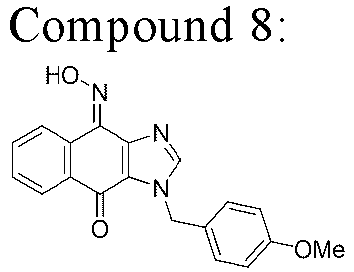
- 1H NMR (400 MHz, DMSO-d6) δ 13.03 (s, 1H), 8.48 (s, 1H), 8.27 (d, J = 8.0 Hz, 1H), 8.09 (dd, J = 8.0, 1.2 Hz, 1H), 7.68 (td, J = 8.0, 1.2 Hz, 1H), 7.62-7.55 (m, 1H), 7.28 (d, J = 8.0 Hz, 2H), 6.86 (d, J = 8.0 Hz, 2H), 5.62 (s, 2H).
- 13C NMR (101 MHz, DMSO-d6) δ 175.10, 159.52, 159.38, 144.87, 140.11, 133.77, 133.14, 131.03, 129.59, 129.50, 129.35, 126.36, 126.22, 123.96, 114.49, 55.52, 49.10.
- HRMS (ESI): m/z theoretical value: C19H15FN3O3[M+H]+ 334.1186, measured value: 334.1182.

- 1H NMR (400 MHz, DMSO-d6) δ 13.04 (s, 1H), 8.30-8.23 (m, 2H), 8.09 (dd, J = 8.0, 1.4 Hz, 1H), 7.68 (td, J = 8.0, 1.4 Hz, 1H), 7.59 (td, J = 8.0, 1.2 Hz, 1H), 4.61 (t, J = 5.2 Hz, 2H), 3.68 (t, J = 4.0 Hz, 2H), 3.20 (s, 3H).
- 13C NMR (101 MHz, DMSO-d6) δ 175.16, 145.37, 140.16, 139.96, 133.69, 133.09, 131.05, 129.57, 126.48, 126.20, 123.93, 70.72, 58.48, 46.46.
- HRMS (ESI): m/z theoretical value: C14H13N3O3[M+H]+ 272.1030, measured value: 272.1032.

- 1H NMR (400 MHz, DMSO-d6) δ 13.03 (s, 1H), 8.32 (s, 1H), 8.26 (dd, J = 8.0, 1.2 Hz, 1H), 8.10 (dd, J = 8.0, 1.4 Hz, 1H), 7.68 (td, J = 8.0, 1.4 Hz, 1H), 7.59 (td, J = 8.0, 1.2 Hz, 1H), 5.44-5.35 (m, 1H), 5.06 (d, J = 8.0 Hz, 2H), 1.77 (s, 3H), 1.67 (s, 3H).
- 13C NMR (101 MHz, DMSO-d6) δ 175.05, 144.24, 140.17, 139.91, 137.77, 133.66, 133.07, 131.08, 129.58, 126.45, 126.23, 123.92, 119.76, 44.64, 25.77, 18.42.
- HRMS (ESI): m/z theoretical value: C16H15N3O2[M+H]+ 282.1237, measured value: 282.1239.

- 1H NMR (400 MHz, DMSO-d6) δ 13.02 (s, 1H), 8.41 (s, 1H), 8.28 (d, J = 8.0 Hz, 1H), 8.11 (d, J = 8.0 Hz, 1H), 7.73-7.64 (m, 1H), 7.64-7.54 (m, 1H), 5.35 (s, 2H), 3.53 (s, 1H).
- 13C NMR (101 MHz, DMSO-d6) δ 175.02, 144.29, 139.99, 133.91, 133.22, 130.86, 129.61, 129.58, 126.61, 126.12, 124.05, 78.38, 77.22, 36.50.
- HRMS (ESI): m/z theoretical value: C14H9N3O2[M+H]+ 252.0768, measured value: 252.0769.

- 1H NMR (400 MHz, DMSO-d6) δ 13.01 (s, 1H), 8.49 (s, 1H), 8.27 (d, J = 8.0, 1H), 8.12 (dd, J = 7.9, 1.5 Hz, 1H), 7.69 (t, J = 8.0, 1H), 7.60 (t, J = 8.0 Hz, 1H), 7.43 (d, J = 8.0 Hz, 1H), 7.19 (d, J = 4.0 Hz, 1H), 6.95 (dd, J = 8.0, 4.0 Hz, 1H), 5.88 (s, 2H).
- 13C NMR (101 MHz, DMSO-d6) δ 175.20, 144.72, 140.04, 139.91, 139.42, 133.87, 133.20, 130.93, 129.60, 127.89, 127.49, 127.25, 126.19,126.18, 124.02, 44.36.
- HRMS (ESI): m/z theoretical value: C16H11N3O2S[M+H]+ 310.0645, measured value: 310.0642.

- 1H NMR (400 MHz, DMSO-d6) δ 13.05 (s, 1H), 8.51 (s, 1H), 8.27 (dd, J = 8.0, 1.2 Hz, 1H), 8.07 (dd, J = 8.0, 1.4 Hz, 1H), 7.67 (td, J = 8.0 1.4 Hz, 1H), 7.57 (td, J = 8.0, 1.2 Hz, 1H), 7.39-7.10 (m, 5H), 5.70 (s, 2H).
- 13C NMR (101 MHz, DMSO-d6) δ 175.08, 145.10, 140.10, 140.06, 137.44, 133.81, 133.14, 130.98, 129.56, 129.12, 128.25, 127.72, 126.48, 126.18, 123.97, 49.58.
- HRMS (ESI): m/z theoretical value: C18H13N3O2[M+H]+ 304.1081, measured value: 304.1082.

- 1H NMR (400 MHz, DMSO-d6) δ 13.04 (s, 1H), 8.41 (s, 1H), 8.31-8.22 (m, 1H), 8.04 (dd, J = 8.0, 1.4 Hz, 1H), 7.70-7.64 (m, 1H), 7.62-7.54 (m, 1H), 7.35-7.27 (m, 1H), 7.25-7.18 (m, 1H), 7.10 (td, J = 7.5, 1.2 Hz, 1H), 7.04 (td, J = 8.0, 1.8 Hz, 1H), 5.77 (s, 2H).
- 13C NMR (101 MHz, DMSO-d6) δ 175.00, 163.05 (160.71, J = 234.0 Hz), 145.45, 140.08, 139.99, 133.88, 133.16, 130.90, 130.45 (130.37, J = 8.0 Hz), 129.56, 129.35 (129.31, J = 4.0 Hz), 126.66, 126.15, 125.19 (125.15, J = 4.0 Hz), 124.45 (124.31, J = 14.0 Hz), 123.99, 115.92 (115.71, J = 21.0 Hz), 44.17 (44.12, J = 5.0 Hz).
- HRMS (ESI): m/z theoretical value: C18H12FN3O2[M+H]+ 322.0986, measured value: 322.0984.

- 1H NMR (400 MHz, DMSO-d6) δ 8.51 (s, 1H), 8.27 (d, J = 8.0 Hz, 1H), 8.07 (d, J = 8.0 Hz, 1H), 7.68 (t, J = 8.0 Hz, 1H), 7.58 (t, J = 8.0 Hz, 1H), 7.40-7.30 (m, 1H), 7.17-7.06 (m, 3H), 5.71 (s, 2H).
- 13C NMR (101 MHz, DMSO-d6) δ 175.12, 163.82 (161.39, J = 243.0 Hz), 145.17, 140.22 (140.15, J = 7.0 Hz), 140.10, 133.87, 133.17, 131.22 (131.14, J = 8.0 Hz), 130.95, 129.56, 126.63, 126.47, 126.18, 123.99, 123.75 (123.72, J = 3.0 Hz), 115.21 (115.00, J = 21.0 Hz), 114.78 (114.56, J = 22.0 Hz), 49.06 (49.05, J = 1.0 Hz).

- 1H NMR (400 MHz, DMSO-d6) δ 13.04 (s, 1H), 8.51 (s, 1H), 8.27 (dd, J = 8.0, 1.2 Hz, 1H), 8.07 (dd, J = 8.0, 1.4 Hz, 1H), 7.68 (td, J = 8.0, 1.4 Hz, 1H), 7.58 (td, J = 8.0, 1.2 Hz, 1H), 7.39-7.31 (m, 2H), 7.18 -7.07 (m, 2H), 5.68 (s, 2H).
- 13C NMR (101 MHz, DMSO-d6) δ 175.11, 163.34 (160.91, J = 243.0 Hz), 145.01, 140.13, 140.09, 133.83, 133.65 (133.62, J = 3.0 Hz), 133.15, 130.96, 130.15 (130.07, J = 8.0 Hz), 129.56, 126.40, 126.19, 123.97, 116.03 (115.81, J = 22.0 Hz), 48.87.
- HRMS (ESI): m/z theoretical value: C18H12FN3O2[M+H]+ 322.0986, measured value: 322.0986.

- 1H NMR (400 MHz, DMSO-d6) δ 13.01 (s, 1H), 8.31-8.25 (m, 2H), 8.06 (dd, J = 8.0, 0.8 Hz, 1H), 7.70 (td, J = 8.0, 1.2 Hz, 1H), 7.60 (td, J = 8.0, 0.8 Hz, 1H), 5.32 (s, 2H), 4.15 (q, J = 7.2 Hz, 2H), 1.19 (t, J = 7.2 Hz, 3H).
- 13C NMR (101 MHz, DMSO-d6) δ 175.27, 168.10, 145.42, 134.05, 133.27, 130.71, 129.61, 127.16, 126.61, 126.05, 124.13, 61.78, 48.16, 14.47.
- HRMS (ESI): m/z theoretical value: C15H13N3O4[M+H]+ 300.0979, measured value: 300.0981.
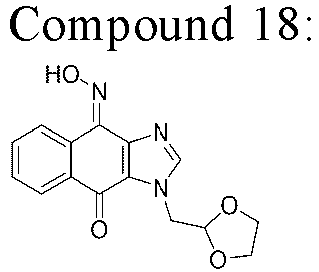
- 1H NMR (400 MHz, DMSO-d6) δ 13.03 (s, 1H), 8.30-8.20 (m, 2H), 8.09 (dd, J = 8.0, 1.4 Hz, 1H), 7.68 (td, J = 8.0, 1.4 Hz, 1H), 7.59 (td, J = 8.0, 1.2 Hz, 1H), 5.20 (t, J = 4.0 Hz, 1H), 4.67 (d, J = 4.0 Hz, 2H), 3.82-3.73 (m, 4H).
- 13C NMR (101 MHz, DMSO-d6) δ 175.26, 145.49, 140.06, 139.55, 133.72, 133.12, 131.03, 129.58, 126.88, 126.19, 123.95, 101.10, 65.05, 48.12.
- HRMS (ESI): m/z theoretical value: C15H13N3O4[M+H]+ 300.0979, measured value: 300.0978.

- 1H NMR (400 MHz, DMSO-d6) δ 13.09 (s, 1H), 9.04 (s, 1H), 8.77 (d, J = 12.4 Hz, 2H), 8.15 (dd, J = 26.4, 7.7 Hz, 2H), 7.64 (d, J = 20.0 Hz, 2H), 4.03 (s, 3H).
- HRMS (ESI): m/z theoretical value: C15H13N3O4[M+H]+ 278.0924, measured value: 278.0922.

- 1H NMR (400 MHz, DMSO-d6) δ 13.89 (s, 1H), 8.93 (s, 1H), 8.84 (s, 2H), 8.21 (dd, J = 22.4, 8.2 Hz, 2H), 7.82-7.64 (m, 2H), 4.60 (d, J = 7.8 Hz, 2H), 1.41 (t, J = 8.0 Hz, 3H).
- HRMS (ESI): m/z theoretical value: C15H13N3O4[M+H]+ 292.1081, measured value: 292.1078.
- 2,2'-(1,4-dioxy-1,4,6,7-tetrahydronaphthalene-2,3-diyl)bis(isoindolin-1,3-dione) (13.3 g) was dissolved into 200 mL of dichloromethane and 20 mL of methanol with the addition of cyclopropylamine, and subjected to reaction for 2h, then solvent was removed, the obtained product was added with 100 mL of water, pulped for 10 min, and subjected to suction filtration to obtain red solid (10 g). 10 g solid was directly added to 150 mL of ethanol; 8 mL hydrazine hydrate (80) was dropwisely added, and the mixture was stirred at room temperature for half an hour; organic phase was removed; 200 mL of water was added, and the obtained product was pulped for 10 min, filtered and washed with water until colorless, and then vacuum dried to obtain blue solid 2-amino-3-cyclopropyl-6,7-dihydronaphthalene-1,4-dione (6.2 g). 2-amino-3-cyclopropyl-6,7-dihydronaphthalene-1,4-dione (1 g) was subjected to reflux for 2.5 h in an orthoformic acid medium (25 mL), and solvent was removed, and the remaining material was isolated by silica gel column chromatography to obtain white solid 1-cyclopropyl 6,7-dihydro-1H-naphthol [2,3-d] imidazole-4,9-dione (0.46 g). 3-Cyclopropylnaphthoquinone imidazole (0.21 g), hydroxylamine hydrochloride (0.35 g), and pyridine (0.8 mL) were dissolved into ethanol (70 mL) and reacted for 36 h at 100°C; at the end of reaction, solid was separated out from solution, directly subjected to suction filtration, and vacuum dried to obtain light yellow solid (0.15 g).
- Compound 21 could be prepared using the method in Example 2:

- 1H NMR (400 MHz, DMSO-d6) δ 13.00 (s, 1H), 8.31 (s, 1H), 8.25 (dd, J = 8.0, 1.2 Hz, 1H), 8.11 (dd, J = 8.0, 1.4 Hz, 1H), 7.67 (td, J = 8.0, 1.4 Hz, 1H), 7.59 (td, J = 8.0, 1.2 Hz, 1H), 3.93-3.86 (m, 1H), 1.13-1.03 (m, 4H).
- 13C NMR (101 MHz, DMSO-d6) δ 174.50, 143.32, 140.18, 139.97, 133.46, 132.97, 131.25, 129.58, 128.36, 126.23, 123.86, 29.61, 7.44.
- HRMS (ESI): m/z theoretical value: C14H11N3O2[M+H]+ 254.0924, measured value: 254.0927.
- Nitrogen-(3-chloro-1,4-dioxy-1,4,6,7-tetrahydronaphthalene-2-yl) acetamide (0.25 g) was dissolved into 20 mL of tetrahydrofuran; reaction liquid was added with triethylamine and tert-butylamine in turn, subjected to reflux reaction for 26 h under nitrogen protection, and cooled to room temperature, and then solvent was removed, the remaining solution was added with 10 mL of ultrapure water, and pulped for half an hour to obtain nitrogen-(3-(tert-butylamino)-1,4-dioxy-1,4,6,7-tetrahydronaphthalene-2-yl) acetamide. The obtained product was dispersed into 85 mL of hydrazine hydrate (50%) for reaction for 2 h at 80°C and extracted with dichloromethane; organic phase was collected, washed with saturated salt solution, dried with anhydrous sodium sulfate, filtered, concentrated, and isolated by silica gel column chromatography to obtain a product 2-amino-3-(tert-butylamino)-6,7-dihydronaphthalene-1,4-dione. 2-Amino-3-(tert-butylamino)-6,7-dihydronaphthalene-1,4-dione (1.63 g) was added with 50 mL of triethyl orthoformate for reflux reaction for 3 h, and then cooled to room temperature; solvent was removed, isolated and purified by silica gel column chromatography to obtain a product 3-tert-butylnaphthoquinone imidazole. 3-tert-butylnaphthoquinone imidazole (0.21 g), hydroxylamine hydrochloride (0.17 g), and pyridine (0.4 mL) were dissolved into ethanol (50 mL) and reacted for 24 h at 110°C; at the end of reaction, solid was separated out from solution, directly subjected to suction filtration, and vacuum dried to obtain light yellow solid (0.16 g).
- Amines having different substitutes were added to prepare Compounds 22-32 according to the method in Example 3; other materials and reaction conditions for the compounds were kept the same and raw materials could be purchased commercially:

- 1H NMR (400 MHz, DMSO-d6) δ 13.55 (s, 1H), 8.49 (s, 1H), 8.23 (d, J = 8.0 Hz, 1H), 8.17 (d, J = 7.4 Hz, 1H), 7.68 (t, J = 8.0 Hz, 1H), 7.60 (t, J = 8.0 Hz, 1H), 1.72 (s, 9H).
- 13C NMR (101 MHz, DMSO-d6) δ 173.70, 142.87, 142.71, 140.17, 132.99, 132.43, 131.66, 129.80, 127.11, 127.08, 123.26, 59.59, 29.32.
- HRMS (ESI): m/z theoretical value: C15H15N3O2[M+H]+ 270.1237, measured value: 270.1241.

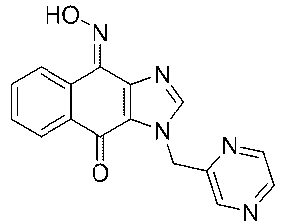
- 1H NMR (400 MHz, DMSO-d6) δ 13.06 (s, 1H), 8.71 (s, 1H), 8.59-8.41 (m, 3H), 8.27 (d, J = 8.0 Hz, 1H), 7.99 (d, J = 8.0 Hz, 1H), 7.72-7.51 (m, 2H), 5.87 (s, 2H).
- 13C NMR (101 MHz, DMSO-d6) δ 174.99, 151.72, 145.78, 144.60, 144.34, 143.98, 140.12, 139.84, 133.89, 133.16, 130.80, 129.55, 126.79, 126.08, 124.01, 49.11.
- HRMS (ESI): m/z theoretical value: C16H11N5O2[M+H]+ 306.0986, measured value: 306.0985.

- 1H NMR (400 MHz, DMSO-d6) δ 13.10 (s, 1H), 8.47 (s, 1H), 8.30 (dd, J = 8.0, 1.2 Hz, 1H), 8.02 (dd, J = 8.0, 1.4 Hz, 1H), 7.69 (td, J = 8.0, 1.4 Hz, 1H), 7.63-7.48 (m, 6H).
- 13C NMR (101 MHz, DMSO-d6) δ 174.10, 145.03, 140.19, 140.10, 135.90, 133.66, 133.07, 131.24, 129.59, 129.36, 129.31, 127.14, 126.57, 126.27, 123.91.
- HRMS (ESI): m/z theoretical value: C17H11N3O2[M+H]+ 290.0924, measured value: 290.0922.

- 1H NMR (400 MHz, DMSO-d6) δ 13.09 (s, 1H), 8.35-8.26 (m, 2H), 8.00-7.95 (m, 1H), 7.73-7.65 (m, 1H), 7.62-7.54 (m, 1H), 7.03 (s, 2H), 3.34 (s, 9H).
- 13C NMR (101 MHz, DMSO-d6) δ 174.25, 144.93, 140.19, 139.83, 138.97, 135.02, 133.96, 133.14, 132.50, 130.95, 129.58, 129.12, 127.34, 126.10, 124.05, 21.06, 17.48.
- HRMS (ESI): m/z theoretical value: C20H17N3O2[M+H]+ 322.1394, measured value: 322.1392.

- 1H NMR (400 MHz, DMSO-d6) δ 13.09 (s, 1H), 8.50 (s, 1H), 8.32 (dd, J = 8.0, 1.2 Hz, 1H), 8.01 (dd, J = 8.0, 1.4 Hz, 1H), 7.75-7.65 (m, 2H), 7.64-7.56 (m, 2H), 7.51-7.44 (m, 1H), 7.38 (td, J = 8.0, 1.2 Hz, 1H).
- 13C NMR (101 MHz, DMSO-d6) δ 174.23, 158.18 (155.70, J = 248.0 Hz), 145.23, 139.94 (139.68, J = 26.0 Hz), 133.93, 133.26, 131.86 (131.78, J = 8.0 Hz), 130.84, 129.64, 129.18, 127.94, 127.80, 126.10, 125.33 (125.29, J = 4.0 Hz), 124.21, 124.10, 116.75 (116.55, J = 20.0 Hz).
- HRMS (ESI): m/z theoretical value: C17H10FN3O2[M+H]+ 308.0830, measured value: 308.0831.

- 1H NMR (400 MHz, DMSO-d6) δ 13.08 (s, 1H), 8.49 (s, 1H), 8.30 (dd, J = 8.0, 1.2 Hz, 1H), 8.03 (dd, J = 8.0, 1.4 Hz, 1H), 7.70 (td, J = 8.0, 1.4 Hz, 1H), 7.62-7.54 (m, 3H), 7.48-7.43 (m, 1H), 7.42-7.35 (m, 1H).
- 13C NMR (101 MHz, DMSO-d6) δ 174.15, 163.26 (160.83, J = 243.0 Hz), 145.03, 140.17 (140.02, J = 15.0 Hz), 137.30, 137.19, 133.70, 133.11, 131.17, 130.96 (130.87, J = 9.0 Hz), 129.58, 127.19, 126.28, 123.92, 122.87 (122.84, J = 3.0 Hz), 116.42 (116.21, J = 21.0 Hz), 114.56 (114.31, J = 25.0 Hz).
- HRMS (ESI): m/z theoretical value: C17H10FN3O2[M+H]+ 308.0830, measured value: 308.0832.

- 1H NMR (400 MHz, DMSO-d6) δ 13.07 (s, 1H), 8.45 (s, 1H), 8.32-8.27 (m, 1H), 8.02 (dd, J = 8.0, 1.4 Hz, 1H), 7.72-7.62 (m, 3H), 7.61-7.55 (m, 1H), 7.41-7.35 (m, 2H).
- 13C NMR (101 MHz, DMSO-d6) δ 174.18, 163.67 (161.22, J = 245.0 Hz), 145.09, 140.08, 133.72, 133.10, 132.30 (132.27, J = 3.0 Hz), 131.19, 129.59, 128.95 (128.86, J = 9.0 Hz), 127.28, 126.60, 126.24, 123.93, 116.22 (115.99, J = 23.0 Hz).
- HRMS (ESI): m/z theoretical value: C17H10FN3O2[M+H]+ 308.0830, measured value: 308.0829.
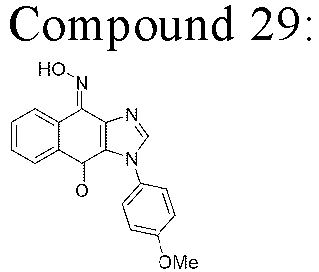
- 1H NMR (400 MHz, DMSO-d6) δ 13.07 (s, 1H), 8.40 (s, 1H), 8.32-8.28 (m, 1H), 8.02 (dd, J = 8.0, 1.4 Hz, 1H), 7.70 (td, J = 8.0, 1.4 Hz, 1H), 7.59 (td, J = 8.0, 1.2 Hz, 1H), 7.51-7.47 (m, 2H), 7.08-7.04 (m, 2H), 3.82 (s, 3H).
- 13C NMR (101 MHz, DMSO-d6) δ 174.10, 159.95, 159.53, 145.06, 140.16, 133.63, 133.05, 131.28, 129.59, 128.73, 127.82, 127.23, 126.25, 123.90, 114.40, 56.00.
- HRMS (ESI): m/z theoretical value: C18H13FN3O3[M+H]+ 320.1030, measured value: 320.1026.

- 1H NMR (400 MHz, DMSO-d6) δ 13.13 (s, 1H), 8.52 (s, 1H), 8.30 (dd, J = 8.0, 1.2 Hz, 1H), 8.05-7.97 (m, 2H), 7.72-7.64 (m, 2H), 7.62-7.55 (m, 2H).
- 13C NMR (101 MHz, DMSO-d6) δ 174.25, 158.99 (156.52, J = 247.0 Hz), 145.02, 139.91, 133.71, 133.19, 132.90 (132.87, J = 3.0 Hz), 131.06, 129.61, 129.20, 127.83, 127.75, 127.28, 126.26, 123.95, 120.02 (119.83, J = 19.0 Hz), 117.46 (117.24 J = 22.0 Hz).
- HRMS (ESI): m/z theoretical value: C17H9ClFN3O2[M+H]+ 342.0440, measured value: 342.0438.

- 1H NMR (400 MHz, DMSO-d6) δ 13.06 (s, 1H), 8.47 (s, 1H), 8.30 (dd, J = 8.0, 1.2 Hz, 1H), 8.10-8.00 (m, 2H), 7.72 - 7.66 (m, 2H), 7.61-7.53 (m, 2H).
- 13C NMR (101 MHz, DMSO-d6) δ 174.27, 159.55, 145.12, 140.03 (139.98, J = 5.0 Hz), 133.77, 133.16, 133.15, 131.83, 131.11, 129.59, 128.45, 128.37, 127.34, 126.25, 123.96, 117.20 (116.96, J = 24.0 Hz), 108.33 (108.11, J = 22.0 Hz).
- HRMS (ESI): m/z theoretical value: C17H9BrFN3O2[M+H]+ 385.9935, measured value: 385.9930.

- 1H NMR (400 MHz, DMSO-d6) δ 14.67 (s, 1H), 9.66 (s, 1H), 8.37 (d, J = 7.8 Hz, 1H), 8.25 (d, J = 7.9 Hz, 1H), 8.09 (t, J = 7.8 Hz, 1H), 4.14 (s, 3H).
- HRMS (ESI): m/z theoretical value: C17H9BrFN3O2[M+H]+ 273.0619, measured value: 273.0620.
- 2,3-Diamine-1,4-benzoquinone (20 g) was dissolved into 100 mL of acetic acid, subjected to reflux reaction for 6 h, and cooled to room temperature, then poured into an ice-water mixture with the addition of ammonium hydroxide to regulate pH to 9-10, and the obtained solution was subjected to suction filtration and vacuum dried to obtain yellow solid 1,4-naphthoquinone imidazole (22 g). 1,4-naphthoquinone imidazole (0.3 g) and potassium hydroxide (0.15 g) were added to dimethyl sulfoxide solution (3 mL); the mixture was stirred at 50°C for 30 min and added with iodomethane (0.2 mL), after reaction for 2, water was added to separate out solid; the solid was subjected to suction filtration, washed with water, and vacuum dried to obtain yellow solid 2-methyl-1,4-naphthoquinone imidazole (0.31 g). 2-methylnaphthoquinone imidazole (0.2 g), hydroxylamine hydrochloride (0.28 g), and pyridine (0.7 mL) were dissolved into ethanol (70 mL) and reacted for 36 h at 105°C; at the end of reaction, solid was separated out from solution, directly subjected to suction filtration, and vacuum dried to obtain light yellow solid (0.16 g).
- 2,3,-Diamine-1,4-naphthoquinone (20 g) was dissolved into 100 mL of acetic acid and subjected to reflux reaction for 6 h to obtain anthraquinone imidazole; or halohydrocarbons having different substitutes were added to prepare Compounds 33-41 according to the method in Example 4; other materials and reaction conditions for the compounds were kept the same and raw materials could be purchased commercially:

- 1H NMR (400 MHz, DMSO-d6) δ 13.01 (s, 1H), 8.26 (d, J = 0.8 Hz, 2H), 8.07 (dd, J = 8.0, 4.0 Hz, 1H), 7.72-7.64 (m, 1H), 7.61-7.52 (m, 1H), 4.00 (s, 3H), 2.81 (s, 3H).
- 13C NMR (101 MHz, DMSO-d6) δ 175.27, 145.22, 140.18, 139.62, 133.71, 133.06, 131.04, 129.58, 127.17, 126.12, 123.92, 34.14, 20.1.
- HRMS (ESI): m/z theoretical value: C12H9N3O2[M+H]+ 241.0851, measured value: 241.0854.

- 1H NMR (400 MHz, DMSO-d6) δ 13.14 (s, 1H), 8.27 (d, J = 7.9 Hz, 1H), 8.12 (dd, J = 7.8, 1.5 Hz, 1H), 7.73 - 7.65 (m, 1H), 7.65 - 7.57 (m, 1H), 4.41 (d, J = 15.1 Hz, 2H), 1.73 - 1.65 (m, 2H), 1.32 (q, J = 7.4 Hz, 2H), 0.90 (t, J = 7.3 Hz, 3H).

- 1H NMR (400 MHz, DMSO-d6) δ 13.09 (s, 1H), 8.77 (d, J = 12.4 Hz, 2H), 8.15 (dd, J = 26.4, 7.8 Hz, 2H), 7.64 (d, J = 20.0 Hz, 2H), 4.03 (s, 3H), 2.54 (s, 3H).
- HRMS (ESI): m/z theoretical value: C12H9N3O2[M+H]+ 292.1081, measured value: 292.1082.
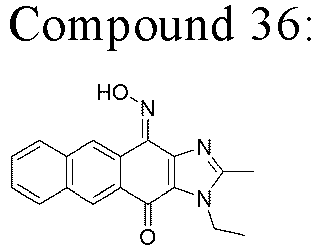
- 1H NMR (400 MHz, DMSO-d6) δ 13.87 (s, 1H), 8.84 (s, 2H), 8.21 (dd, J = 22.4, 8.2 Hz, 2H), 7.82-7.64 (m, 2H), 4.60 (d, J = 7.8 Hz, 2H), 2.79 (s, 3H), 1.40 (d, J = 8.0 Hz, 3H).
- HRMS (ESI): m/z theoretical value: C12H9N3O2[M+H]+ 306.1237, measured value: 306.1240.

- 1H NMR (400 MHz, DMSO-d6) δ 13.90 (s, 1H), 8.84 (s, 2H), 8.20 (dd, J = 15.0, 8.4 Hz, 2H), 7.81-7.58 (m, 2H), 4.41 (d, J = 7.0 Hz, 2H), 2.78 (s, 3H), 2.22-2.14 (m, 1H), 0.95 (d, J = 6.8 Hz, 6H).
- HRMS (ESI): m/z theoretical value: C12H9N3O2[M+H]+ 344.1550, measured value: 344.1554.

- 1H NMR (400 MHz, DMSO-d6) δ 13.44 (s, 1H), 8.81 (s, 2H), 8.24-8.13 (m, 2H), 7.74-7.66 (m, 2H), 5.30-5.22 (m, 2H), 5.14-5.10 (m, 1H), 2.65 (s, 3H), 1.84 (s, 3H), 1.70 (s, 3H).
- HRMS (ESI): m/z theoretical value: C12H9N3O2[M+H]+ 346.1550, measured value: 346.1555.

- 1H NMR (400 MHz, DMSO-d6) δ 13.46 (s, 1H), 8.69 (s, 2H), 8.26 (s, 2H), 7.76 (d, J = 6.4 Hz, 2H), 5.70 (s, 2H), 2.59 (s, 3H).
- HRMS (ESI): m/z theoretical value: C12H9N3O2[M+H]+ 317.1033, measured value: 317.1035.

- 1H NMR (400 MHz, DMSO-d6) δ 13.01 (s, 1H), 8.78 (d, J = 33.2 Hz, 2H), 8.15 (dd, J = 16.8, 7.8 Hz, 2H), 7.65 (d, J = 19.9 Hz, 2H), 7.43-7.12 (m, 5H), 5.83 (s, 2H), 2.65 (s, 3H).
- HRMS (ESI): m/z theoretical value: C12H9N3O2[M+H]+ 368.1394, measured value: 368.1395.

- 1H NMR (400 MHz, DMSO-d6) δ 13.50 (s, 1H), 8.81 (d, J = 16.8 Hz, 2H), 8.24 - 8.13 (m, 2H), 7.75 - 7.60 (m, 2H), 7.16 (d, J = 8.8 Hz, 4H), 5.86 (s, 2H), 2.62 (s, 3H).
- HRMS (ESI): m/z theoretical value: C12H9N3O2[M+H]+ 386.1300, measured value: 386.1327.
- 2,3-Diamine-1,4-benzoquinone (4 g) was dissolved into 13 mL of dimethyl sulfoxide, added with butyraldehyde (2.12 mL), and subjected to open-ended reaction at 80°C for 13 h, and cooled to room temperature, then slowly added with water, solid was separated out, subjected to suction filtration and vacuum dried to obtain yellow solid 1,4-naphthoquinone imidazole (0.15 g). 1,4-naphthoquinone imidazole (0.3 g) and potassium hydroxide (0.15 g) were added to dimethyl sulfoxide solution (3 mL), respectively; the mixture was stirred at 50°C for 30 min and added with iodobutane (0.2 mL), after reaction for 2, water was added to separate out solid; the solid was subjected to suction filtration, washed with water, and vacuum dried to obtain yellow solid 2-methyl-1,4-naphthoquinone imidazole (0.31 g). 2-methylnaphthoquinone imidazole (0.2 g), hydroxylamine hydrochloride (0.11 g), and pyridine (0.35 mL) were dissolved into ethanol (35 mL) and reacted for 36 h at 105°C; at the end of reaction, solid was separated out from solution, directly subjected to suction filtration, and vacuum dried to obtain light yellow solid (0.15 g).
- 2,3,-Diamine-1,4-benzoquinone (4 g) was dissolved into 13 mL of dimethyl sulfoxide and reacted with different aldehydes; or 2,3,-diamine-1,4-naphthoquinone (20 g) was dissolved into dimethyl sulfoxide and reacted with different aldehydes; or halohydrocarbons having different substitutes were added to prepare Compounds 42-59 according to the method in Example 5; other materials and reaction conditions for the compounds were kept the same and raw materials could be purchased commercially:

- 1H NMR (400 MHz, DMSO-d6) δ 13.26 (s, 1H), 8.25 (d, J = 7.9 Hz, 1H), 8.10 (d, J = 8.0 Hz, 1H), 7.75 - 7.65 (m, 1H), 7.60 (t, J = 7.5 Hz, 1H), 4.38 (t, J = 7.5 Hz, 2H), 2.86 (q, J = 7.5 Hz, 2H), 1.67 (ddd, J = 12.6, 10.2, 6.5 Hz, 2H), 1.31 (td, J = 7.5, 3.7 Hz, 5H), 0.89 (t, J = 7.4 Hz, 3H).
- HRMS (ESI): m/z theoretical value: C12H9N3O2[M+H]+ 298.1550, measured value: 298.1557.

- 1H NMR (400 MHz, Chloroform-d) δ 13.95 (s, 1H), 8.42 (d, J = 7.8 Hz, 1H), 8.28 - 8.21 (m, 1H), 7.65 (t, J = 7.3 Hz, 1H), 7.59 - 7.55 (m, 1H), 4.46 (t, J = 7.6 Hz, 2H), 2.80 (t, J = 7.6 Hz, 2H), 1.93 (h, J = 7.7 Hz, 2H), 1.79 (q, J = 7.7 Hz, 2H), 1.44 (q, J = 7.6 Hz, 2H), 1.08 (t, J = 7.4 Hz, 3H), 0.99 (t, J = 7.4 Hz, 3H).
- HRMS (ESI): m/z theoretical value: C12H9N3O2[M+H]+ 312.1707, measured value: 312.1709.

- 1H NMR (400 MHz, DMSO-d6) δ 13.32 (s, 1H), 8.26 (d, J = 8.0 Hz, 1H), 8.13 (d, J = 7.8 Hz, 1H), 7.70 (t, J = 7.7 Hz, 1H), 7.62 (t, J = 7.5 Hz, 1H), 4.52-4.40 (m, 2H), 3.08 (q, J = 6.8 Hz, 1H), 1.80 (dt, J = 14.0, 7.4 Hz, 1H), 1.67 (q, J = 7.3 Hz, 3H), 1.39 - 1.32 (m, 2H), 1.28 (d, J = 6.8 Hz, 3H), 0.90 (t, J = 7.4 Hz, 3H), 0.83 (t, J = 7.2 Hz, 3H).
- HRMS (ESI): m/z theoretical value: C12H9N3O2[M+H]+ 326.1863, measured value: 326.1865.


- 1H NMR (400 MHz, Chloroform-d) δ 13.91 (s, 1H), 8.38 (d, J = 7.8 Hz, 1H), 8.21 (d, J = 7.8 Hz, 1H), 7.62 (t, J = 7.6 Hz, 1H), 7.54 (t, J = 7.6 Hz, 1H), 4.44 (t, J = 7.8 Hz, 2H), 2.68 (d, J = 7.0 Hz, 2H), 2.32 (dp, J = 13.8, 6.8 Hz, 1H), 1.78 (p, J = 7.6 Hz, 2H), 1.44 (p, J = 7.4 Hz, 2H), 1.11 - 0.91 (m, 9H).
- HRMS (ESI): m/z theoretical value: C12H9N3O2[M+H]+ 326.1863, measured value: 326.1862.

- 1H NMR (400 MHz, Chloroform-d) δ 14.05 (s, 1H), 8.44 (dd, J = 8.0, 1.2 Hz, 1H), 8.29 - 8.20 (m, 1H), 7.67 (td, J = 7.6, 1.6 Hz, 1H), 7.59 (td, J = 7.6, 1.4 Hz, 1H), 4.57 - 4.46 (m, 2H), 2.79 (tt, J = 8.4, 5.6 Hz, 1H), 1.92 - 1.80 (m, 6H), 1.49 (h, J = 7.4 Hz, 2H), 1.02 (t, J = 7.4 Hz, 3H), 0.90 (t, J = 7.4 Hz, 6H).
- HRMS (ESI): m/z theoretical value: C12H9N3O2[M+H]+ 340.2020, measured value: 340.2025.

- 1H NMR (400 MHz, Chloroform-d) δ 14.09 (s, 1H), 8.40 (d, J = 7.8 Hz, 1H), 8.25 (d, J = 7.8 Hz, 1H), 7.64 (t, J = 7.2 Hz, 1H), 7.56 (t, J = 7.8 Hz, 1H), 4.62-4.49 (m, 2H), 1.95-1.85 (m, 2H), 1.60-1.53 (m, 11H), 1.03 (t, J = 7.2 Hz, 3H).
- HRMS (ESI): m/z theoretical value: C12H9N3O2[M+H]+ 326.1863, measured value: 326.1864.

- 1H NMR (400 MHz, Chloroform-d) δ 13.87 (s, 1H), 8.42 (d, J = 7.8 Hz, 1H), 8.24 (d, J = 7.8 Hz, 1H), 7.67 - 7.62 (m, 1H), 7.60 - 7.53 (m, 1H), 5.91 (d, J = 3.0 Hz, 1H), 5.88 - 5.81 (m, 1H), 4.38 (t, J = 7.6 Hz, 2H), 3.24 - 3.07 (m, 3H), 2.25 (s, 3H), 1.90-1.83 (m, 1H), 1.78-1.67 (m, 2H), 1.41 (q, J = 7.6 Hz, 2H), 0.97 (t, J = 7.2 Hz, 3H).
- HRMS (ESI): m/z theoretical value: C12H9N3O2[M+H]+ 378.1812, measured value: 378.1813.

- 1H NMR (400 MHz, Chloroform-d) δ 14.08 (s, 1H), 8.42 (d, J = 7.8 Hz, 1H), 8.29 - 8.19 (m, 1H), 7.65 (td, J = 8.2, 7.8, 1.6 Hz, 1H), 7.60 - 7.51 (m, 1H), 4.44 - 4.28 (m, 2H), 3.68 (q, J = 8.5 Hz, 1H), 2.62 - 2.52 (m, 2H), 2.44 (q, J = 8.9 Hz, 2H), 2.17 (q, J = 9.5 Hz, 1H), 2.09-2.04 (m, 1H), 1.76 (p, J = 7.8 Hz, 2H), 1.48-1.35 (m, 2H), 0.98 (t, J = 7.3 Hz, 3H).
- HRMS (ESI): m/z theoretical value: C12H9N3O2[M+H]+ 324.1707, measured value: 324.1709.

- 1H NMR (400 MHz, Chloroform-d) δ 13.92 (s, 1H), 8.46 (d, J = 7.8 Hz, 1H), 8.29 (d, J = 7.8 Hz, 1H), 7.69 (d, J = 7.4 Hz, 2H), 7.63-7.58 (m, 5H), 4.58 (t, J = 7.8 Hz, 2H), 1.86 (q, J = 7.6 Hz, 2H), 1.37 - 1.31 (m, 2H), 0.89 (t, J = 7.2 Hz, 3H).
- HRMS (ESI): m/z theoretical value: C12H9N3O2[M+H]+ 346.1550, measured value: 346.1554.

- 1H NMR (400 MHz, Chloroform-d) δ 13.96 (s, 1H), 8.44 (d, J = 7.8 Hz, 1H), 8.28 (dd, J = 78, 1.6 Hz, 1H), 7.93 - 7.54 (m, 4H), 7.52 - 7.31 (m, 2H), 4.57 (t, J = 7.8 Hz, 2H), 1.92-1.83 (m, 2H), 1.42-1.25 (m, 8H), 0.90 (t, J = 7.4 Hz, 3H).
- HRMS (ESI): m/z theoretical value: C12H9N3O2[M+H]+ 388.2020, measured value: 388.2024.

- 1H NMR (400 MHz, Chloroform-d) δ 13.85 (s, 1H), 8.45 (d, J = 7.8 Hz, 1H), 8.29 (d, J = 7.8 Hz, 1H), 7.68 (t, J = 8.0 Hz, 1H), 7.60 (t, J = 7.4 Hz, 1H), 6.88 (s, 2H), 4.63 - 4.52 (m, 2H), 3.94 (s, 9H), 1.92-1.86 (m, 2H), 1.40-1.34 (m, 2H), 0.93 (t, J = 7.4 Hz, 3H).
- HRMS (ESI): m/z theoretical value: C12H9N3O2[M+H]+ 436.1867, measured value: 436.1868.

- 1H NMR (400 MHz, DMSO-d6) δ 13.10 (s, 1H), 8.30 (d, J = 8.0 Hz, 1H), 8.16 (d, J = 7.6 Hz, 1H), 7.81 (s, 1H), 7.70 (d, J = 8.4 Hz, 2H), 7.64 (d, J = 7.6 Hz, 1H), 7.34 (d, J = 8.5 Hz, 1H), 4.48 (t, J = 8.4 Hz, 2H), 3.94 (s, 3H), 1.72-1.67 (m, 2H), 1.19-1.12 (m, 2H), 0.76 (t, J = 7.4 Hz, 3H).
- HRMS (ESI): m/z theoretical value: C12H9N3O2[M+H]+ 410.1266, measured value: 410.1266.

- 1H NMR (400 MHz, Chloroform-d) δ 13.83 (s, 1H), 8.50 (dd, J = 7.8, 1.2 Hz, 1H), 8.34 (dd, J = 7.8, 1.6 Hz, 1H), 8.12 (dd, J = 7.2, 2.2 Hz, 1H), 8.01 (dd, J = 8.0, 1.8 Hz, 1H), 7.78 - 7.51 (m, 7H), 4.38 (t, J = 7.4 Hz, 2H), 1.67 (p, J = 7.6 Hz, 2H), 1.13 (h, J = 7.4 Hz, 2H), 0.69 (t, J = 7.4 Hz, 3H).
- HRMS (ESI): m/z theoretical value: C12H9N3O2[M+H]+ 396.1707, measured value: 396.1709.

- 1H NMR (400 MHz, Chloroform-d) δ 12.85 (s, 1H), 8.41 (dd, J = 8.0, 1.2 Hz, 1H), 8.24 (dd, J = 7.8, 1.6 Hz, 1H), 7.69 (td, J = 7.8, 1.6 Hz, 1H), 7.59 (td, J = 7.6, 1.2 Hz, 1H), 4.72 - 4.54 (m, 2H), 1.88 (p, J = 8.0 Hz, 2H), 1.50 (h, J = 7.4 Hz, 2H), 1.01 (t, J = 7.4 Hz, 3H).
- HRMS (ESI): m/z theoretical value: C12H9N3O2[M+H]+ 338.1111, measured value: 338.1115.

- 1H NMR (400 MHz, Chloroform-d) δ 13.80 (s, 1H), 8.43 (d, J = 8.0 Hz, 1H), 8.28 (d, J = 7.8 Hz, 1H), 7.66 (d, J = 10.2 Hz, 2H), 7.61 - 7.55 (m, 1H), 7.24 (d, J = 4.8 Hz, 1H), 4.96 - 4.89 (m, 2H), 1.89 (q, J = 7.6 Hz, 2H), 1.47 (q, J = 7.6 Hz, 2H), 0.99 (t, J = 7.2 Hz, 3H).
- HRMS (ESI): m/z theoretical value: C12H9N3O2[M+H]+ 336.1343, measured value: 336.1344.


- 1H NMR (400 MHz, Chloroform-d) δ 13.78 (s, 1H), 8.44 (d, J = 8.0 Hz, 1H), 8.34 - 8.13 (m, 1H), 7.70 - 7.52 (m, 4H), 7.24 (s, 1H), 4.82 - 4.71 (m, 2H), 1.95 (p, J = 8.2 Hz, 2H), 1.53 - 1.45 (m, 2H), 1.01 (t, J = 7.4 Hz, 3H).
- HRMS (ESI): m/z theoretical value: C12H9N3O2[M+H]+ 352.1114, measured value: 352.1116.

- 1H NMR (400 MHz, DMSO-d6) δ 13.71 (s, 1H), 8.60 (d, J = 5.6 Hz, 2H), 8.21-8.15 (m, 2H), 7.71-7.65 (m, 2H), 2.76 (q, J = 7.6 Hz, 2H), 1.27 (t, J = 7.6 Hz, 2H), 4.09 (s, 1H).
- HRMS (ESI): m/z theoretical value: C12H9N3O2[M+H]+ 306.1237, measured value: 306.1236.

- 1H NMR (400 MHz, DMSO-d6) δ 13.85 (s, 1H), 8.69 (s, 2H), 8.27-8.22 (m, 2H), 7.95 (d, J = 1.2 Hz, 1H), 7.76-7.70 (m, 2H), 7.35 (d, J = 3.4 Hz, 1H), 6.75-6.70 (m, 1H), 4.25 (s, 1H).
- HRMS (ESI): m/z theoretical value: C12H9N3O2[M+H]+ 344.1030, measured value: 344.1031.
- 2,3-Diamine-1,4-benzoquinone (20 g) was dissolved into 100 mL of formic acid, subjected to reflux reaction for 6 h, and cooled to room temperature, then poured into an ice-water mixture with the addition of ammonium hydroxide to regulate pH to 9-10, and the obtained solution was subjected to suction filtration and vacuum dried to obtain yellow solid 1,4-naphthoquinone imidazole (22 g). 1,4-naphthoquinone imidazole (0.3 g) and potassium hydroxide (0.15 g) were added to dimethyl sulfoxide solution (3 mL); the mixture was stirred at 50°C for 30 min and added with iodomethane (0.2 mL), after reaction for 2, water was added to separate out solid; the solid was subjected to suction filtration, washed with water, and vacuum dried to obtain yellow solid 2-methyl-1,4-naphthoquinone imidazole (0.31 g). 2-methylnaphthoquinone imidazole (0.2 g), methoxyamine hydrochloride (0.1 g), and pyridine (0.08 mL) were dissolved into ethanol (30 mL) and reacted for 12 h at 125°C; at the end of reaction, solid was separated out from solution, directly subjected to suction filtration, and vacuum dried to obtain light yellow solid (0.15 g).
- 2,3-Diamine-1,4-naphthoquinone (20 g) was dissolved into 100 mL of formic acid and subjected to reflux reaction for 6 h to obtain anthraquinone imidazole; or aminoxyhydrochlorides having different substitutes were added to prepare Compounds 60-77 according to the method in Example 6; other materials and reaction conditions for the compounds were kept the same and raw materials could be purchased commercially:

- 1H NMR (400 MHz, DMSO-d6) δ 8.99 (dd, J = 8.0, 1.2 Hz, 1H), 8.31-8.20 (m, 4H), 8.16-8.07 (m, 2H), 7.82-7.60 (m, 5H), 4.24 (s, 3H), 4.20 (s, 4H), 4.03 (s, 4H), 3.99 (s, 3H).
- 13C NMR (101 MHz, DMSO) δ 175.40, 174.52, 145.91, 145.85, 145.58, 140.34, 139.95, 139.03, 133.69, 133.20, 133.12, 132.39, 131.62, 131.20, 131.09, 129.94, 128.10, 128.03, 127.04, 126.43, 126.16, 124.33, 64.73, 64.47, 34.20, 33.92.
- HRMS (ESI): m/z theoretical value: C13H11N3O2[M+H]+ 242.0924, measured value: 242.0928.

- 1H NMR (400 MHz, DMSO-d6) δ 9.04 (dd, J = 8.0, 1.2 Hz, 1H), 8.30 (dd, J = 8.0, 1.2 Hz, 2H), 8.26-8.20 (m, 3H), 8.14-8.07 (m, 3H), 7.79 (td, J = 8.0, 1.6 Hz, 1H), 7.75-7.68 (m, 3H), 7.63 (td, J = 8.0, 1.2 Hz, 2H), 4.53-4.42 (m, 6H), 4.04 (s, 6H), 4.00 (s, 3H), 1.46-1.32 (m, 9H).
- 13C NMR (101 MHz, DMSO) δ 175.42, 174.53, 146.10, 145.90, 145.64, 140.16, 139.75, 139.33, 133.66, 133.50, 133.04, 132.38, 131.51, 131.07, 129.79, 128.08, 128.04, 127.00, 126.37, 126.10, 124.33, 124.09, 72.72, 72.20, 34.16, 33.90, 15.29, 15.04.
- HRMS (ESI): m/z theoretical value: C14H13N3O2[M+H]+ 256.1081, measured value: 256.1085.

- 1H NMR (400 MHz, DMSO-d6) δ 8.30-8.22 (m, 2H), 8.11 (dd, J = 8.0, 1.2 Hz, 1H), 7.71 (td, J = 8.0, 1.6 Hz, 1H), 7.64 (td, J = 8.0, 1.2 Hz, 1H), 7.55-7.49 (m, 2H), 7.45-7.31 (m, 3H), 5.50 (s, 2H), 4.03 (s, 3H).


- 1H NMR (400 MHz, DMSO-d6) δ 9.07 (dd, J = 8.0, 1.2 Hz, 1H), 8.33 (dd, J = 8.0, 1.2 Hz, 1H), 8.28-8.21 (m, 2H), 8.16-8.10 (m, 2H), 7.80 (td, J = 8.0, 1.6 Hz, 1H), 7.72 (td, J = 8.0, 1.4 Hz, 2H), 7.63 (td, J = 8.0, 1.2 Hz, 1H), 4.72-4.60 (m, 2H), 4.04 (s, 3H), 4.00 (s, 3H), 1.43 (dd, J = 12.0, 8.0 Hz, 12H).
- 13C NMR (101 MHz, DMSO) δ 175.44, 174.53, 146.27, 145.91, 145.69, 139.80, 139.47, 139.28, 133.77, 133.66, 133.03, 132.39, 131.42, 131.07, 130.99, 129.68, 128.14, 128.00, 127.00, 126.32, 126.07, 124.33, 79.35, 78.63, 34.16, 33.91, 22.10, 21.97.
- HRMS (ESI): m/z theoretical value: C15H15N3O2[M+H]+ 270.1237, measured value: 270.1238.

- 1H NMR (400 MHz, DMSO-d6) δ 9.03 (dd, J = 8.0, 1.2 Hz, 2H), 8.30 (dd, J = 8.0, 1.2 Hz, 1H), 8.28- 8.21 (m, 4H), 8.14 (s, 3H), 7.87-7.78 (m, 3H), 7.76-7.69 (m, 3H), 7.64 (td, J = 8.0, 1.2 Hz, 1H), 4.48-4.38 (m, 7H), 4.04 (s, 3H), 4.00 (s, 7H), 1.85-1.72 (m, 7H), 1.53-1.39 (m, 7H), 1.00-0.92 (m, 10H).
- 13C NMR (101 MHz, DMSO) δ 175.45, 174.54, 146.12, 145.96, 145.75, 140.23, 139.79, 139.45, 133.74, 133.53, 133.09, 132.41, 131.42, 131.14, 129.82, 128.11, 128.07, 127.07, 126.92, 126.40, 126.14, 124.34, 76.88, 76.36, 34.17, 33.92, 31.53, 31.20, 19.23, 19.08, 14.25, 14.23.
- HRMS (ESI): m/z theoretical value: C16H17N3O2[M+H]+ 284.1394, measured value: 284.1398.

- 1H NMR (400 MHz, DMSO-d6) δ 9.04 (dd, J = 8.1, 1.2 Hz, 1H), 8.33-8.23 (m, 4H), 8.15-8.09 (m, 3H), 7.82 (td, J = 8.0, 1.6 Hz, 1H), 7.75-7.69 (m, 2H), 7.64 (td, J = 8.0, 1.2 Hz, 2H), 4.25 (d, J = 8.0 Hz, 2H), 4.21 (d, J = 8.0 Hz, 3H), 4.04 (s, 5H), 4.00 (s, 3H), 2.20-2.09 (m, 3H), 1.01 (t, J = 6.0 Hz, 16H).
- 13C NMR (101 MHz, DMSO) δ 175.44, 174.52, 146.10, 145.95, 145.77, 140.24, 139.84, 139.48, 133.73, 133.50, 133.07, 132.42, 131.34, 131.14, 131.10, 129.80, 128.08, 127.09, 126.40, 126.13, 124.32, 83.43, 82.87, 34.16, 33.92, 28.50, 28.21, 19.45, 19.42.
- HRMS (ESI): m/z theoretical value: C16H17N3O2[M+H]+ 284.1394, measured value: 284.1397.

- 1H NMR (400 MHz, DMSO-d6) δ 9.10 (dd, J = 8.0, 1.2 Hz, 1H), 8.38 (dd, J = 8.0, 1.2 Hz, 1H), 8.27- 8.21 (m, 2H), 8.15-8.10 (m, 2H), 7.83-7.60 (m, 5H), 4.05 (s, 3H), 4.01 (s, 4H), 1.50 (s, 12H), 1.48 (s, 9H).
- 13C NMR (101 MHz, DMSO) δ 175.47, 174.56, 146.58, 145.91, 145.70, 139.61, 139.39, 138.81, 134.17, 133.61, 133.01, 132.40, 131.32, 131.05, 130.83, 129.52, 128.22, 127.95, 126.95, 126.23, 126.02, 124.29, 82.90, 82.08, 34.15, 33.90, 28.02, 27.74.
- HRMS (ESI): m/z theoretical value: C16H17N3O2[M+H]+ 284.1394, measured value: 284.1393.

- 1H NMR (400 MHz, DMSO-d6) δ 9.10 (dd, J = 8.0, 1.2 Hz, 1H), 8.33-8.24 (m, 4H), 8.16- 8.09 (m, 3H), 7.84-7.77 (m, 1H), 7.75-7.70 (m, 2H), 7.64 (td, J = 8.0, 1.2 Hz, 2H), 4.32-4.24 (m, 5H), 4.04 (s, 5H), 4.00 (s, 3H), 1.36-1.26 (m, 3H), 0.65-0.55 (m, 6H), 0.48-0.35 (m, 5H).
- 13C NMR (101 MHz, DMSO) δ 175.45, 174.54, 146.15, 145.95, 145.72, 140.08, 139.62, 139.41, 133.69, 133.58, 133.07, 132.40, 131.50, 131.11, 131.09, 129.77, 128.17, 128.06, 127.04, 126.39, 126.12, 124.35, 81.62, 80.98, 34.16, 33.91, 11.04, 10.65, 3.64, 3.59.
- HRMS (ESI): m/z theoretical value: C16H15N3O2[M+H]+ 282.1237, measured value: 282.1238.

- 1H NMR (400 MHz, DMSO-d6) δ 9.03 (dd, J = 8.0, 1.2 Hz, 1H), 8.30-8.21 (m, 6H), 8.15-8.08 (m, 4H), 7.80 (td, J = 8.0, 1.6 Hz, 1H), 7.77-7.65 (m, 4H), 7.64 (td, J = 8.0, 1.2 Hz, 3H), 6.22-6.08 (m, 4H), 5.55-5.40 (m, 4H), 5.36-5.27 (m, 4H), 5.00-4.92 (m, 7H), 4.04 (s, 8H), 3.99 (s, 3H).
- 13C NMR (101 MHz, DMSO) δ 175.43, 174.51, 145.94, 145.72, 140.65, 140.24, 139.31, 135.14, 134.58, 134.13, 133.71, 133.34, 133.09, 132.42, 131.59, 131.22, 131.12, 129.93, 128.15, 128.05, 127.08, 126.48, 126.15, 124.37, 119.04, 118.54, 77.72, 77.22, 34.16, 33.92.
- HRMS (ESI): m/z theoretical value: C15H13N3O2[M+H]+ 268.1081, measured value: 268.1083.

- 1H NMR (400 MHz, DMSO-d6) δ 9.05-8.98 (m, 1H), 8.34-8.27 (m, 3H), 8.27-8.20 (m, 4H), 8.15-8.09 (m, 4H), 7.76-7.61 (m, 8H), 7.49-7.43 (m, 8H), 6.99-6.93 (m, 8H), 5.44 (s, 2H), 5.41 (s, 6H), 4.03 (s, 9H), 3.99 (s, 3H), 3.76 (s, 3H), 3.75 (s, 9H).
- 13C NMR (101 MHz, DMSO) δ 175.43, 174.52, 159.81, 159.60, 145.98, 145.75, 140.52, 140.16, 139.34, 133.72, 133.41, 133.13, 132.42, 131.50, 131.19, 131.13, 130.65, 130.54, 129.93, 129.82, 129.17, 128.15, 128.09, 127.08, 126.48, 126.16, 124.38, 114.40, 114.24, 78.57, 78.04, 55.58, 55.55, 34.16, 33.92.
- HRMS (ESI): m/z theoretical value: C20H17N3O3[M+H]+ 348.1343, measured value: 348.1339.

- 1H NMR (400 MHz, DMSO-d6) δ 9.03 (dd, J = 8.0, 1.2 Hz, 1H), 8.28-8.22 (m, 5H), 8.14-8.08 (m, 3H), 7.82-7.60 (m, 7H), 7.57-7.43 (m, 13H), 5.51 (s, 2H), 5.49 (s, 4H), 4.03 (s, 6H), 3.99 (s, 3H).
- 13C NMR (101 MHz, DMSO) δ 175.42, 174.50, 145.97, 145.80, 140.99, 140.68, 139.26, 137.10, 136.54, 133.77, 133.30, 133.21, 133.16, 132.98, 132.47, 131.63, 131.33, 131.31, 131.16, 130.52, 130.32, 130.06, 129.03, 128.87, 128.27, 128.03, 127.13, 126.55, 126.20, 124.40, 77.67, 77.17, 34.17, 33.92.
- HRMS (ESI): m/z theoretical value: C19H14ClN3O2[M+H]+ 352.0847, measured value: 352.0843.

- yellow solid, 100mg, % yield, m. p. 136-138 °C.
- 1H NMR (400 MHz, DMSO-d6) δ 9.07 (dd, J = 8.0, 1.2 Hz, 1H), 8.28-8.21 (m, 4H), 8.14-8.07 (m, 3H), 7.82-7.60 (m, 17H), 5.63 (s, 2H), 5.60 (s, 3H), 4.04 (s, 5H), 3.99 (s, 3H).
- 13C NMR (101 MHz, DMSO) δ 175.40, 174.48, 145.95, 145.80, 145.73, 142.98, 142.48, 141.24, 140.95, 139.23, 133.78, 133.15, 133.11, 132.48, 131.70, 131.35, 131.16, 130.09, 128.94, 128.74, 128.62, 128.31, 128.00, 127.13, 126.57, 126.19, 126.07, 125.95, 125.91, 125.87, 125.83, 125.79, 125.76, 125.72, 125.68, 124.39, 123.37, 77.49, 77.04, 34.17, 33.90.
- HRMS (ESI): m/z theoretical value: C20H14F3N3O2[M+H]+ 386.1111, measured value: 386.1107.

- 1H NMR (400 MHz, DMSO-d6) δ 9.03 (dd, J = 8.0, 1.4 Hz, 1H), 8.33-8.20 (m, 5H), 8.18-8.09 (m, 3H), 7.79-7.53 (m, 12H), 7.30-7.17 (m, 7H), 5.50 (s, 2H), 5.48 (s, 3H), 4.03 (s, 5H), 3.99 (s, 3H).
- 13C NMR (101 MHz, DMSO) δ 175.43, 174.51, 163.71, 163.54, 161.12, 145.98, 145.88, 145.79, 140.85, 140.53, 139.28, 134.26, 134.23, 133.76, 133.72, 133.69, 133.27, 133.16, 132.46, 131.59, 131.28, 131.16, 131.06, 130.98, 130.84, 130.76, 130.03, 129.51, 128.24, 128.04, 127.12, 126.54, 126.19, 124.40, 115.96, 115.79, 115.75, 115.57, 77.83, 77.35, 34.17, 33.92.
- HRMS (ESI): m/z theoretical value: C19H14FN3O2[M+H]+ 336.1143, measured value: 336.1140.

- yellow solid, 100mg, % yield, m. p. 224-226 °C.
- 1H NMR (400 MHz, DMSO-d6) δ 8.92 (dd, J = 8.0, 1.2 Hz, 1H), 8.26-8.07 (m, 7H), 7.83-7.71 (m, 4H), 7.65 (td, J = 8.0, 1.2 Hz, 2H), 5.61 (s, 2H), 5.53 (s, 3H), 4.02 (s, 5H), 3.98 (s, 3H).
- 13C NMR (101 MHz, DMSO) δ 175.39, 174.49, 146.06, 145.82, 145.43, 144.63, 141.75, 141.24, 138.94, 133.86, 133.81, 133.32, 132.90, 132.55, 131.67, 131.67, 131.59, 131.23, 130.34, 130.11, 128.49, 128.46, 127.93, 127.87, 127.20, 126.26, 124.69, 124.25, 65.48, 64.75, 34.17, 33.93.
- HRMS (ESI): m/z theoretical value: C19H10F5N3O2[M+H]+ 408.0766, measured value: 408.0767.


- 1H NMR (400 MHz, DMSO-d6) δ 9.09 (dd, J = 8.0, 1.2 Hz, 1H), 8.31-8.17 (m, 14H), 8.13-8.09 (m, 3H), 7.84-7.62 (m, 15H), 5.67 (s, 2H), 5.65 (s, 5H), 4.08-4.02 (m, 8H), 3.99-3.97 (m, 3H).
- 13C NMR (101 MHz, DMSO) δ 175.42, 174.50, 147.64, 147.47, 146.09, 145.97, 145.85, 145.66, 145.55, 141.45, 141.20, 139.20, 133.85, 133.21, 133.02, 132.51, 131.79, 131.46, 131.18, 130.20, 129.18, 128.95, 128.37, 127.98, 127.19, 126.62, 126.24, 124.43, 124.15, 124.03, 77.09, 76.65, 34.20, 33.93.
- HRMS (ESI): m/z theoretical value: C19H14N4O4[M+H]+ 363.1088, measured value: 363.1084.

- 1H NMR (400 MHz, DMSO-d6) δ 9.67 (s, 1H), 8.79 (d, J = 6.8 Hz, 2H), 8.73 (s, 1H), 8.27 (s, 1H), 8.23 - 8.08 (m, 6H), 8.00 - 7.95 (m, 1H), 7.73 - 7.55 (m, 11H), 7.46 - 7.33 (m, 8H), 5.57 (s, 2H), 5.53 (s, 3H), 4.06 (s, 5H), 4.01 (s, 3H).
- HRMS (ESI): m/z theoretical value: C19H14N4O4[M+H]+ 368.1394, measured value: 368.1397.

- 1H NMR (400 MHz, DMSO-d6) δ 9.58 (s, 1H), 8.75 (d, J = 2.1 Hz, 2H), 8.69 (s, 1H), 8.24 (s, 1H), 8.21 - 8.09 (m, 5H), 8.02 - 7.98 (m, 1H), 7.73 - 7.59 (m, 5H), 4.45 (dt, J = 20.6, 6.6 Hz, 5H), 4.05 (s, 3H), 4.01 (s, 4H), 1.90-1.75 (m, 5H), 1.57-1.45 (m, 5H), 1.05-0.96 (m, 7H).
- HRMS (ESI): m/z theoretical value: C19H14N4O4[M+H]+ 334.2210, measured value: 334.2214.

- 1H NMR (400 MHz, DMSO-d6) δ 9.70 (s, 1H), 8.87 (s, 1H), 8.81 (s, 1H), 8.74 (s, 1H), 8.28 - 8.13 (m, 5H), 8.07 - 8.02 (m, 1H), 7.75 - 7.60 (m, 4H), 4.08 (s, 3H), 4.04 (s, 3H), 1.55 (s, 9H), 1.52 (s, 9H).
- HRMS (ESI): m/z theoretical value: C19H14N4O4[M+H]+ 334.2210, measured value: 334.2213.
- 2,3-Diamine-1,4-benzoquinone (20 g) was dissolved into 100 mL of formic acid, subjected to reflux reaction for 6 h, and cooled to room temperature, then poured into an ice-water mixture with the addition of ammonium hydroxide to regulate pH to 9-10, and the obtained solution was subjected to suction filtration and vacuum dried to obtain yellow solid 1,4-naphthoquinone imidazole (22 g). 1,4-naphthoquinone imidazole (0.3 g) and potassium hydroxide (0.15 g) were added to dimethyl sulfoxide solution (3 mL); the mixture was stirred at 50°C for 30 min and added with iodomethane (0.2 mL), after reaction for 2, water was added to separate out solid; the solid was subjected to suction filtration, washed with water, and vacuum dried to obtain yellow solid 2-methyl-1,4-naphthoquinone imidazole (0.31 g). 2-methylnaphthoquinone imidazole (0.2 g), hydroxylamine hydrochloride (0.3 g), and pyridine (0.7 mL) were dissolved into ethanol (70 mL) and reacted for 36 h at 105°C; at the end of reaction, solid was separated out from solution, directly subjected to suction filtration, and vacuum dried to obtain light yellow solid (E)-9-(hydroxylimino)-3-methyl-3,6,7,9-tetrahydro-4H-naphthol [2,3-d] imidazole-4-one (0.15 g). 106 mg of oximate product was added to 2 mL of a dimethyl sulfoxide solution; 56 µL of bromoethyl methyl ether and 104 mg of potassium hydroxide were added successively, and these materials were reacted for 2 h at room temperature. At the end of the reaction, water was added for quenching and dichloromethane was used for extraction; organic phase was washed with a saturated salt solution, dried with anhydrous magnesium sulfate, and concentrated, then isolated by silica gel column chromatography.
- The oximated product was reacted with halohydrocarbons having different substitutes to prepare Compounds 78-82 according to the method in Example 7; other materials and reaction conditions for the compounds were kept the same and raw materials could be purchased commercially:

- 1H NMR (400 MHz, DMSO-d6) δ 8.34-8.24 (m, 2H), 8.16-8.09 (m, 1H), 7.76-7.70 (m, 1H), 7.65 (td, J = 8.0, 1.2 Hz, 1H), 4.53 (t, J = 4.0 Hz, 2H), 4.04 (s, 3H), 3.76 (t, J = 4.0 Hz, 2H), 3.32 (s, 3H).
- 13C NMR (101 MHz, DMSO) δ 175.46, 145.74, 140.04, 139.32, 133.40, 133.14, 131.13, 129.95, 128.15, 126.17, 124.43, 76.07, 70.75, 58.76, 34.18.
- HRMS (ESI): m/z theoretical value: C15H15N3O3[M+H]+ 286.1186, measured value: 286.1188.


- 1H NMR (400 MHz, DMSO-d6) δ 8.30-8.25 (m, 2H), 8.15-8.10 (m, 1H), 7.75-7.61 (m, 2H), 7.38-7.31 (m, 2H), 7.30-7.21 (m, 3H), 4.63-4.54 (m, 4H), 4.04 (s, 3H), 3.89-3.82 (m, 2H).
- 13C NMR (101 MHz, DMSO-d6) δ 175.45, 145.72, 140.12, 139.36, 138.95, 133.39, 133.08, 131.13, 129.92, 128.60, 128.15, 127.86, 127.74, 126.14, 124.43, 76.28, 72.40, 68.47, 34.18.
- HRMS (ESI): m/z theoretical value: C21H19N3O3[M+H]+ 362.1499, measured value: 362.1495.

- 1H NMR (400 MHz, DMSO-d6) δ 8.31 (dd, J = 8.0, 1.2 Hz, 1H), 8.24 (s, 1H), 8.13 (dd, J = 8.0, 1.6 Hz, 1H), 7.72 (td, J = 8.0, 1.6 Hz, 1H), 7.65 (td, J = 8.0, 1.4 Hz, 1H), 4.55-4.49 (m, 2H), 4.04 (s, 3H), 3.86 -3.80 (m, 2H), 3.64-3.59 (m, 2H), 3.46-3.42 (m, 2H), 3.22 (s, 3H).
- 13C NMR (101 MHz, DMSO-d6) δ 175.45, 145.72, 140.07, 139.31, 133.40, 133.13, 131.13, 129.95, 128.15, 126.16, 124.45, 76.25, 71.78, 70.26, 69.26, 58.52, 34.18.
- HRMS (ESI): m/z theoretical value: C17H19N3O4[M+H]+ 330.1448, measured value: 330.1447.

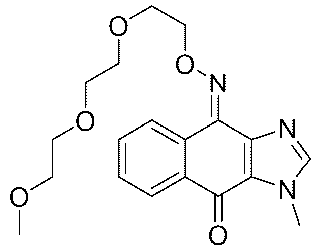
- 1H NMR (400 MHz, DMSO-d6) δ 8.30 (dd, J = 8.0, 1.2 Hz, 1H), 8.23 (s, 1H), 8.14-8.10 (m, 1H), 7.74-7.69 (m, 1H), 7.65 (td, J = 8.0, 1.2 Hz, 1H), 4.55-4.51 (m, 2H), 4.04 (s, 3H), 3.87-3.82 (m, 2H), 3.65-3.59 (m, 2H), 3.54-3.47 (m, 4H), 3.39-3.35 (m, 2H), 3.19 (s, 3H).
- 13C NMR (101 MHz, DMSO-d6) δ 175.44, 145.70, 140.04, 139.29, 133.39, 133.11, 131.10, 129.93, 128.12, 126.14, 124.43, 76.23, 71.70, 70.48, 70.24, 70.03, 69.26, 58.46, 34.16.
- HRMS (ESI): m/z theoretical value: C19H23N3O5[M+H]+ 374.1710, measured value: 374.1709.
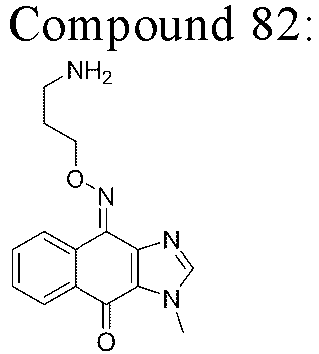
- 1H NMR (400 MHz, DMSO-d6) δ 8.30-8.25 (m, 2H), 8.15-8.10 (m, 1H), 7.75-7.61 (m, 2H), 4.04 (s, 3H), 3.51 (t, J = 8.0 Hz, 2H), 2.68 (t, J = 8.0 Hz, 2H),1.79-1.70 (m, 2H).
- HRMS (ESI): m/z theoretical value: C19H23N3O5[M+H]+ 285.1346, measured value: 285.1347.
- 2,3-Diamine-1,4-benzoquinone (20 g) was dissolved into 100 mL of formic acid, subjected to reflux reaction for 6 h, and cooled to room temperature, then poured into an ice-water mixture with the addition of ammonium hydroxide to regulate pH to 9-10, and the obtained solution was subjected to suction filtration and vacuum dried to obtain yellow solid 1,4-naphthoquinone imidazole (22 g). 1,4-naphthoquinone imidazole (0.3 g) and potassium hydroxide (0.15 g) were added to dimethyl sulfoxide solution (3 mL), respectively; the mixture was stirred at 50°C for 30 min and added with iodobutane (0.18 mL), after reaction for 5 h, water was added to separate out solid; the solid was subjected to suction filtration, washed with water, and vacuum dried to obtain yellow solid 2-butyl-1,4-naphthoquinone imidazole (0.31 g). 2-butylnaphthoquinone imidazole (0.21 g), methoxyamine hydrochloride (0.3 g), and pyridine (0.7 mL) were dissolved into ethanol (70 mL) and reacted for 36 h at 105°C; at the end of reaction, the obtained solution was concentrated and isolated by silica gel column chromatography to obtain light yellow product (0.18 g).
- 2,3-Diamine-1,4-naphthoquinone (20 g) was dissolved into 100 mL of formic acid and subjected to reflux reaction for 6 h to obtain anthraquinone imidazole; halohydrocarbons having different substitutes or aminoxyhydrochlorides having different substitutes were used to prepare Compounds 83-86 according to the method in Example 8; other materials and reaction conditions for the compounds were kept the same and raw materials could be purchased commercially:

- 1H NMR (400 MHz, DMSO-d6) δ 9.00 (dd, J = 8.0, 1.2 Hz, 1H), 8.34-8.21 (m, 4H), 8.13 (dd, J = 8.0, 1.4 Hz, 1H), 7.82-7.62 (m, 4H), 4.46 (t, J = 7.2 Hz, 2H), 4.40 (t, J = 7.0 Hz, 2H), 4.24 (s, 3H), 4.21 (s, 3H), 1.84-1.72 (m, 4H), 1.37-1.18 (m, 4H), 0.91 (t, J = 8.0 Hz, 6H).
- 13C NMR (101 MHz, DMSO) δ 175.14, 174.26, 146.33, 145.50, 145.23, 140.43, 140.02, 139.65, 133.69, 133.17, 133.10, 132.43, 131.59, 131.20, 131.15, 129.93, 127.94, 127.51, 127.14, 126.25, 125.85, 124.31, 64.75, 64.49, 46.53, 46.39, 32.75, 19.52, 19.50, 13.88.
- HRMS (ESI): m/z theoretical value: C16H17N3O2[M+H]+ 284.1394, measured value: 284.1394.

- 1H NMR (400 MHz, DMSO-d6) δ 9.06 (d, J = 8.0 Hz, 1H), 8.37-8.19 (m, 6H), 8.14 (d, J = 8.0 Hz, 2H), 7.83-7.61 (m, 6H), 4.55-4.36 (m, 11H), 1.82-1.72 (m, 6H), 1.46-1.38 (m, 9H), 1.35-1.20 (m, 7H), 0.91 (t, J = 8.0 Hz, 9H).
- 13C NMR (101 MHz, DMSO) δ 175.16, 174.27, 146.52, 145.50, 145.27, 140.23, 139.77, 133.69, 133.43, 133.07, 132.42, 131.50, 131.13, 129.82, 128.00, 127.43, 127.13, 126.21, 125.79, 124.31, 72.74, 72.25, 46.52, 46.38, 32.78, 19.52, 19.50, 15.29, 15.06, 13.89.
- HRMS (ESI): m/z theoretical value: C17H19N3O2[M+H]+ 298.1550, measured value: 298.1549.

- 1H NMR (400 MHz, DMSO-d6) δ 9.06 (dd, J = 8.0, 1.2 Hz, 1H), 8.36-8.24 (m, 6H), 8.22 (s, 1H), 8.13 (dd, J = 8.0, 1.6 Hz, 2H), 7.81-7.69 (m, 4H), 7.65 (dd, J = 8.0, 1.4 Hz, 2H), 7.63-7.59 (m, 1H), 7.56-7.49 (m, 6H), 7.45-7.31 (m, 16H), 5.53 (s, 2H), 5.50 (s, 5H), 4.45 (t, J = 7.2 Hz, 5H), 4.39 (t, J = 7.1 Hz, 2H), 1.82-1.72 (m, 7H), 1.34-1.22 (m, 7H), 0.90 (td, J = 8.0, 1.0 Hz, 11H).

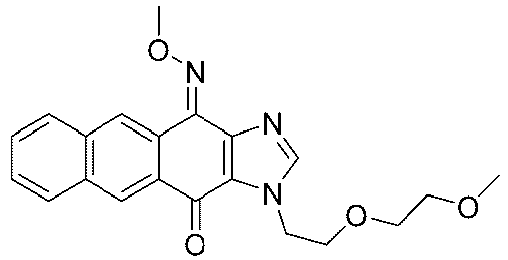
- 1H NMR (400 MHz, DMSO-d6) δ 9.55 (s, 2H), 8.74 (d, J = 9.3 Hz, 3H), 8.69 (s, 1H), 8.63 (s, 1H), 8.59 (s, 1H), 8.25 - 8.04 (m, 12H), 7.75 - 7.63 (m, 7H), 4.58 (dq, J = 16.0, 5.2 Hz, 7H), 4.25 (s, 5H), 4.18 (s, 3H), 3.83-3.75 (m, 7H), 3.55-3.10 (m, 7H), 3.14 - 3.12 (m, 8H).
- HRMS (ESI): m/z theoretical value: C17H19N3O2[M+H]+ 380.1605, measured value: 380.1609.
- 2,3-Diamine-1,4-benzoquinone (20 g) was dissolved into 100 mL of acetic acid, subjected to reflux reaction for 6 h, and cooled to room temperature, then poured into an ice-water mixture with the addition of ammonium hydroxide to regulate pH to 9-10, and the obtained solution was subjected to suction filtration and vacuum dried to obtain yellow solid 1,4-naphthoquinone imidazole (22 g). 1,4-naphthoquinone imidazole (0.3 g) and potassium hydroxide (0.15 g) were added to dimethyl sulfoxide solution (3 mL), respectively; the mixture was stirred at 50°C for 30 min and added with iodobutane (0.18 mL), after reaction for 5 h, water was added to separate out solid; the solid was subjected to suction filtration, washed with water, and vacuum dried to obtain yellow solid 2-butyl-1,4-naphthoquinone imidazole (0.31 g). 2-butylnaphthoquinone imidazole (0.21 g), methoxyamine hydrochloride (0.3 g), and pyridine (0.7 mL) were dissolved into ethanol (70 mL) and reacted for 36 h at 105°C; at the end of reaction, the obtained solution was concentrated and isolated by silica gel column chromatography to obtain light yellow product (0.16 g).
- 2,3-Diamine-1,4-naphthoquinone (20 g) was dissolved into 100 mL of formic acid and subjected to reflux reaction for 6 h to obtain anthraquinone imidazole; or Compounds 87-88 may be prepared according to the method in Example 9; other materials and reaction conditions for the compounds were kept the same and raw materials could be purchased commercially:

- 1H NMR (400 MHz, DMSO-d6) δ 8.99 (dd, J = 8.0, 1.4 Hz, 1H), 8.22-8.16 (m, 4H), 8.05 (dd, J = 7.8, 1.6 Hz, 3H), 7.73 - 7.68 (m, 1H), 7.66 - 7.62 (m, 3H), 7.58 (td, J = 7.6, 1.4 Hz, 3H), 7.51 - 7.45 (m, 7H), 7.39 - 7.31 (m, 8H), 7.31 - 7.26 (m, 3H), 5.48 (s, 2H), 5.46 (s, 5H), 3.93 (s, 8H), 3.87 (s, 3H), 2.45 (s, 8H), 2.40 (s, 3H).
- HRMS (ESI): m/z theoretical value: C17H19N3O2[M+H]+ 332.1394, measured value: 332.1398.

- 1H NMR (400 MHz, DMSO-d6) δ 8.69 (d, J = 10.2 Hz, 2H), 8.13 (d, J = 8.2 Hz, 1H), 8.05 (d, J = 8.0 Hz, 1H), 7.69 - 7.52 (m, 2H), 7.39 - 7.31 (m, 3H), 5.59 (s, 2H), 4.03 (s, 3H), 2.72 (s, 3H).
- HRMS (ESI): m/z theoretical value: C17H19N3O2[M+H]+ 382.1550, measured value: 382.1558.
- 2,3-Diamine-1,4-benzoquinone (4 g) was dissolved into 13 mL of dimethyl sulfoxide, added with 3,4,5-trimethoxybenzaldehyde (2.5 mL), and subjected to open-ended reaction for 13 h at 80°C, and cooled to room temperature, then slowly added with water, solid was separated out, subjected to suction filtration and vacuum dried to obtain yellow solid 2-(3,4,5-trimethoxyphenyl)-1,4-naphthoquinone imidazole (0.15 g). Naphthoquinone imidazole (0.4 g) and potassium hydroxide (0.15 g) were added to dimethyl sulfoxide solution (3 mL), respectively; the mixture was stirred at 50°C for 30 min and added with iodobutane (0.17 mL), after reaction for 5 h, water was added to separate out solid; the solid was subjected to suction filtration, washed with water, and vacuum dried to obtain yellow solid 1-butyl-2-(3,4,5-trimethoxyphenyl)-1,4-naphthoquinone imidazole (0.35 g). Naphthoquinone imidazole (0.42 g), benzyloxyamine hydrochloride (0.64 g), and pyridine (0.7 mL) were dissolved into ethanol (70 mL) and reacted for 36 h at 105°C; at the end of reaction, the obtained solution was concentrated and isolated by silica gel column chromatography to obtain light yellow product (0.36 g).
- 2,3-Diamine-1,4-naphthoquinone (4 g) was dissolved into 13 mL of dimethyl sulfoxide and reacted with different aldehydes; or aminoxyhydrochlorides having different substitutes were used to prepare Compounds 89-90 according to the method in Example 10; other materials and reaction conditions for the compounds were kept the same and raw materials could be purchased commercially:

- 1H NMR (400 MHz, DMSO-d6) δ 9.04 (d, J = 8.0 Hz, 1H), 8.27 (t, J = 7.0 Hz, 2H), 8.13 (dd, J = 7.8, 1.6 Hz, 2H), 7.72 (dt, J = 15.2, 7.4 Hz, 3H), 7.63 (t, J = 7.6 Hz, 2H), 7.57 - 7.50 (m, 3H), 7.47 (d, J = 7.4 Hz, 2H), 7.40-7.18 (m, 14H), 6.98 (s, 3H), 6.95 (s, 2H), 5.52 (s, 2H), 5.48 (s, 3H), 4.53 (s, 3H), 4.47 (t, J = 7.4 Hz, 3H), 4.41 (t, J = 7.6 Hz, 2H), 3.82 (s, 4H), 3.80 (s, 7H), 3.72 (d, J = 1.2 Hz, 5H), 1.70-1.65 (m, 5H), 1.21 - 1.15 (m, 5H), 0.85-0.70 (m, 7H).
- HRMS (ESI): m/z theoretical value: C17H19N3O2[M+H]+ 526.2337, measured value: 526.2337.

- 1H NMR (400 MHz, DMSO-d6) δ 8.55 (s, 2H), 8.18-8.12 (m, 2H), 7.73-7.60 (m, 2H), 2.15-2.01 (m, 1H), 1.12-0.97 (m, 4H), 4.05 (s, 3H), 3.84 (s, 3H).
- HRMS (ESI): m/z theoretical value: C17H19N3O2[M+H]+ 332.1394, measured value: 332.1395.
- Compound 1 (0.05 mmol) and 31 µL of iodomethane were added to 3 mL acetonitrile for reaction for 24 h at 120°C. At the end of the reaction, solvent was removed to obtain a yellow solid, and the solid was pulped for half an hour and subjected to suction filtration to obtain the final product.
- Different synthetic intermediate compounds above were used to prepare Compounds 91-118 according to the method in Example 11; other materials and reaction conditions for the compounds were kept the same and raw materials could be purchased commercially:

- 1H NMR (500 MHz, DMSO-d6) δ 14.50 (s, 1H), 9.57 (s, 1H), 9.25 (dd, J = 10.0, 0.5 Hz, 1H), 8.33 (dd, J = 10.0, 1.0 Hz, 1H), 8.01-7.93 (m, 1H), 7.85 (td, J = 5.0, 1.5 Hz, 1H), 4.19 (s, 3H), 4.10 (s, 3H).
- 13C NMR (126 MHz, DMSO-d6) δ 174.28, 143.85, 138.38, 135.34, 135.31, 131.90, 131.49, 130.83, 127.34, 127.16, 125.39, 38.98, 36.41.
- HRMS(ESI-TOF) m/z theoretical value: C13H12N3O2[M - I]+, 242.0924, measured value: 242.0928.

- 1H NMR (500 MHz, DMSO-d6) δ 14.49 (s, 1H), 9.67 (s, 1H), 9.26 (dd, J = 10.0, 1.0 Hz, 1H), 8.34 (dd, J = 10.0, 1.0 Hz, 1H), 7.96 (td, J = 10.0, 1.5 Hz, 1H), 7.85 (td, J = 10.0, 1.0 Hz, 1H), 4.63 (q, J = 7.5 Hz, 2H), 4.11 (s, 3H), 1.53 (t, J = 5.0 Hz, 3H).
- 13C NMR (126 MHz, DMSO-d6) δ 174.01, 143.12, 138.52, 135.86, 135.28, 131.83, 131.37, 130.85, 127.39, 127.03, 124.77, 44.93, 39.09, 15.42.
- HRMS(ESI-TOF) m/z theoretical value: C14H14N3O2[M - I]+, 256.1081, measured value: 256.1078.

- 1H NMR (500 MHz, DMSO-d6) δ 14.51 (s, 1H), 9.67 (s, 1H), 9.25 (dd, J = 10.0, 1.0 Hz, 1H), 8.34 (dd, J = 10.0, 1.5 Hz, 1H), 8.00-7.93 (m, 1H), 7.85 (td, J = 10.0, 1.0 Hz, 1H), 4.57 (t, J = 7.0 Hz, 2H), 4.11 (s, 3H), 1.96-1.85 (m, 2H), 0.96 (t, J = 7.5 Hz, 3H).
- 13C NMR (126 MHz, DMSO-d6) δ 174.09, 143.40, 138.51, 135.95, 135.29, 131.88, 131.43, 130.91, 127.42, 127.08, 124.84, 50.68, 39.17, 23.13, 10.92.
- HRMS(ESI-TOF) m/z theoretical value: C15H16N3O2[M - I]+, 270.1237, measured value: 270.1244.

- 1H NMR (500 MHz, DMSO-d6) δ 14.50 (s, 1H), 9.67 (s, 1H), 9.25 (dd, J = 10.0, 0.5 Hz, 1H), 8.34 (dd, J = 10.0, 1.5 Hz, 1H), 7.96 (td, J = 10.0, 1.5 Hz, 1H), 7.85 (td, J = 10.0, 1.5 Hz, 1H), 4.60 (t, J = 7.0 Hz, 2H), 4.10 (s, 3H), 1.91-1.85 (m, 2H), 1.44-1.33 (m, 2H), 0.95 (t, J = 7.5 Hz, 3H).
- 13C NMR (126 MHz, DMSO-d6) δ 174.06, 143.37, 138.52, 135.93, 135.28, 131.85, 131.40, 130.89, 127.42, 127.06, 124.80, 49.00, 39.16, 31.69, 19.28, 13.86.
- HRMS(ESI-TOF) m/z theoretical value: C16H18N3O2[M - I]+, 284.1394, measured value: 284.1393.:

- 1H NMR (400 MHz, DMSO-d6) δ 14.50 (s, 1H), 9.81 (s, 1H), 9.24 (dd, J = 8.0, 1.2 Hz, 1H), 8.35 (dd, J = 8.0, 1.6 Hz, 1H), 8.04-7.90 (m, 1H), 7.85 (td, J = 8.0, 1.2 Hz, 1H), 5.49-5.40 (m, 1H), 4.11 (s, 3H), 1.61 (d, J = 8.0 Hz, 6H).
- 13C NMR (101 MHz, DMSO-d6) δ 174.04, 141.76, 138.52, 135.96, 135.23, 131.88, 131.36, 131.04, 127.51, 126.85, 124.69, 52.90, 39.23, 22.54.
- HRMS(ESI-TOF) m/z theoretical value: C15H16N3O2[M - I]+, 270.12374, measured value: 270.1237.:


- 1H NMR (500 MHz, DMSO-d6) δ 14.51 (s, 1H), 9.68 (s, 1H), 9.25 (dd, J = 10.0, 0.5 Hz, 1H), 8.33 (dd, J = 10.0, 1.0 Hz, 1H), 7.99-7.93 (m, 1H), 7.85 (td, J = 10.0, 1.0 Hz, 1H), 4.44 (d, J = 10.0 Hz, 2H), 4.12 (s, 3H), 2.27-2.10 (m, 1H), 0.98 (d, J = 5.0 Hz, 6H).
- 13C NMR (126 MHz, DMSO-d6) δ 174.14, 143.52, 138.52, 136.06, 135.31, 131.87, 131.41, 130.92, 127.42, 127.08, 124.84, 55.59, 39.26, 29.14, 19.66.
- HRMS(ESI-TOF) m/z theoretical value: C16H18N3O2[M - I]+, 284.1394, measured value: 284.1387.:

- 1H NMR (400 MHz, DMSO-d6) δ 14.50 (s, 1H), 9.69 (s, 1H), 9.25 (dd, J = 8.0, 0.8 Hz, 1H), 8.33 (dd, J = 8.0, 1.4 Hz, 1H), 8.01-7.91 (m, 1H), 7.84 (td, J = 8.0, 1.2 Hz, 1H), 4.56 (dd, J = 12.0, 4.0 Hz, 1H), 4.42-4.35 (m, 1H), 4.12 (s, 3H), 2.07-1.90 (m, 1H), 1.53-1.40 (m, 1H), 1.33-1.19 (m, 1H), 1.00-0.87 (m, 6H).
- 13C NMR (101 MHz, DMSO-d6) δ 174.12, 143.58, 138.52, 136.06, 135.29, 131.86, 131.40, 130.91, 127.43, 127.07, 124.87, 54.38, 39.27, 35.19, 26.25, 16.46, 11.30.
- HRMS(ESI-TOF) m/z theoretical value: C17H20N3O2[M - I]+, 298.1550, measured value: 298.1551.


- 1H NMR (400 MHz, DMSO-d6) δ 14.50 (s, 1H), 9.67 (s, 1H), 9.19 (dd, J = 8.0, 1.2 Hz, 1H), 8.38 (dd, J = 8.0, 1.4 Hz, 1H), 7.98-7.91 (m, 1H), 7.89-7.79 (m, 1H), 4.11 (s, 3H), 1.81 (s, 9H).
- 13C NMR (101 MHz, DMSO-d6) δ 173.08, 142.92, 138.84, 138.42, 134.98, 131.90, 131.45, 130.93, 1210.06, 126.24, 126.02, 63.89, 36.40, 28.72.
- HRMS(ESI-TOF) m/z theoretical value: C16H18N3O2[M - I]+, 284.1394, measured value: 284.1395.

- 1H NMR (500 MHz, DMSO-d6) δ 14.48 (s, 1H), 9.73 (s, 1H), 9.31-9.16 (m, 1H), 8.35 (dd, J = 10.0, 1.5 Hz, 1H), 7.96 (td, J = 10.0, 1.0 Hz, 1H), 7.86 (td, J = 10.0, 1.0 Hz, 1H), 4.16-4.05 (m, 1H), 4.06 (s, 3H), 1.31-1.18 (m, 4H).
- 13C NMR (126 MHz, DMSO-d6) δ 173.42, 143.46, 138.43, 135.56, 135.19, 131.93, 131.43, 131.00, 127.40, 126.93, 126.42, 39.02, 31.83, 7.48.
- HRMS(ESI-TOF) m/z theoretical value: C15H14N3O2[M - I]+, 268.1081, measured value: 268.1081.

- 1H NMR (500 MHz, DMSO-d6) δ 14.51 (s, 1H), 9.65 (s, 1H), 9.25 (d, J = 10.0, 1H), 8.33 (dd, J = 10.0, 1.5 Hz, 1H), 7.97 (td, J = 10.0, 1.5 Hz, 1H), 7.85 (td, J = 10.0, 1.0 Hz, 1H), 4.81 (t, J = 5.0 Hz, 2H), 4.14 (s, 3H), 3.81 (t, J = 5.0 Hz, 2H), 3.30 (s, 3H).
- 13C NMR (126 MHz, DMSO-d6) δ 174.24, 143.67, 138.44, 135.78, 135.33, 131.86, 131.44, 130.88, 127.41, 127.09, 124.77, 69.37, 58.66, 48.91, 39.15.
- HRMS(ESI-TOF) m/z theoretical value: C15H16N3O3[M - I]+, 286.1186, measured value: 286.1187.:

- 1H NMR (500 MHz, DMSO-d6) δ 14.50 (s, 1H), 9.62 (s, 1H), 9.25 (dd, J = 10.0, 1.0 Hz, 1H), 8.34 (dd, J = 10.0, 1.5 Hz, 1H), 7.96 (td, J = 10.0, 1.5 Hz, 1H), 7.85 (td, J = 10.0, 1.0 Hz, 1H), 5.55-5.45 (m, 1H), 5.22 (d, J = 5.0 Hz, 2H), 4.11 (s, 3H), 1.84 (s, 3H), 1.80 (s, 3H).
- 13C NMR (126 MHz, DMSO-d6) δ 174.14, 142.89, 141.39, 138.44, 135.86, 135.31, 131.89, 131.45, 130.86, 127.42, 127.07, 124.81, 116.94, 47.08, 39.11, 26.02, 18.66.
- HRMS(ESI-TOF) m/z theoretical value: C17H18N3O2[M - I]+, 296.1394, measured value: 296.1390.

- 1H NMR (500 MHz, DMSO-d6) δ 14.53 (s, 1H), 9.76 (s, 1H), 9.24 (d, J = 10.0 Hz, 1H), 8.30 (dd, J = 10.0, 1.5 Hz, 1H), 7.95 (td, J = 10.0, 1.5 Hz, 1H), 7.83 (td, J = 10.0, 1.0 Hz, 1H), 7.51-7.45 (m, 2H), 7.45-7.36 (m, 3H), 5.88 (s, 2H), 4.13 (s, 3H).
- 13C NMR (126 MHz, DMSO-d6) δ 174.00, 143.75, 138.46, 136.14, 135.37, 134.74, 131.87, 131.44, 130.76, 129.34, 129.11, 128.56, 127.39, 127.12, 124.57, 51.80, 39.35.
- HRMS(ESI-TOF) m/z theoretical value: C19H16N3O2[M - I]+, 318.1237, measured value: 318.1233.

- 1H NMR (500 MHz, DMSO-d6) δ 14.62 (s, 1H), 9.61 (s, 1H), 9.27 (d, J = 10.0 Hz, 1H), 8.30 (dd, J = 10.0, 1.5 Hz, 1H), 7.99 (td, J = 10.0, 1.5 Hz, 1H), 7.88-7.82 (m, 1H), 5.58 (s, 2H), 4.26 (q, J = 7.0 Hz, 2H), 4.19 (s, 3H), 1.27 (t, J = 7.0 Hz, 3H).
- 13C NMR (126 MHz, DMSO-d6) δ 174.04, 166.57, 144.24, 138.22, 135.63, 135.54, 131.97, 131.59, 130.42, 127.36, 127.23, 124.83, 62.54, 49.97, 39.38, 14.51.
- HRMS(ESI-TOF) m/z theoretical value: C16H16N3O4[M - I]+, 314.1135, measured value: 314.1138.:

- 1H NMR (500 MHz, DMSO-d6) δ 14.60 (s, 1H), 10.00 (s, 1H), 9.28 (d, J = 5.0, Hz, 1H), 8.23 (dd, J = 10.0, 1.5 Hz, 1H), 8.01-7.95 (m, 1H), 7.84 (td, J = 10.0, 1.0 Hz, 1H), 7.77-7.74 (m, 2H), 7.71-7.67 (m, 3H), 4.19 (s, 3H).
- 13C NMR (126 MHz, DMSO-d6) δ 172.91, 144.41, 138.47, 135.61, 135.26, 133.99, 131.95, 131.41, 131.18, 131.04, 129.83, 127.44, 126.91, 126.62, 125.20, 39.40.
- HRMS(ESI-TOF) m/z theoretical value: C18H14N3O2[M - I]+, 304.1081, measured value: 304.1085.

- 1H NMR (500 MHz, DMSO-d6) δ 14.58 (s, 1H), 9.81 (s, 1H), 9.29 (dd, J = 10.0, 0.5 Hz, 1H), 8.18 (dd, J = 10.0, 1.0 Hz, 1H), 8.03-7.93 (m, 1H), 7.82 (td, J = 10.0, 1.0 Hz, 1H), 7.16 (s, 2H), 4.20 (s, 3H), 2.38 (s, 3H), 2.04 (s, 6H).
- 13C NMR (126 MHz, DMSO-d6) δ 173.08, 144.26, 140.75, 138.74, 136.36, 135.27, 135.12, 131.82, 131.44, 130.87, 130.41, 129.56, 127.35, 127.27, 124.97, 39.78, 21.15, 17.54.
- HRMS(ESI-TOF) m/z theoretical value: C21H20N3O2[M - I]+, 346.1550, measured value: 346.1555.

- 1H NMR (400 MHz, DMSO-d6) δ 13.01 (s, 1H), 8.49 (s, 1H), 8.27 (d, J = 7.8 Hz, 1H), 8.12 (dd, J = 8.0, 1.6 Hz, 1H), 7.69 (t, J = 7.6 Hz, 1H), 7.60 (t, J = 7.1 Hz, 1H), 7.43 (d, J = 5.9 Hz, 1H), 7.19 (d, J = 3.0 Hz, 1H), 6.95 (dd, J = 5.1, 3.5 Hz, 1H), 5.88 (s, 2H), 4.28 (s, 3H).
- HRMS(ESI-TOF) m/z theoretical value: C17H14N3O2S[M-I]+, 324.0801, measured value: 324.0802.
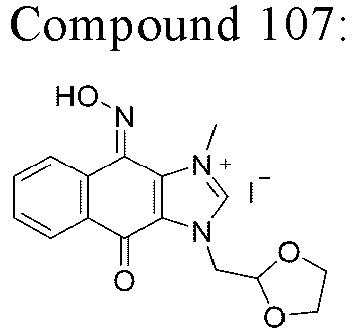
- 1H NMR (500 MHz, DMSO-d6) δ 14.53 (s, 1H), 9.64 (s, 1H), 9.25 (dd, J = 10.0, 0.5 Hz, 1H), 8.33 (dd, J = 10.0, 1.5 Hz, 1H), 8.01-7.93 (m, 1H), 7.85 (td, J = 10.0, 1.0 Hz, 1H), 5.34 (t, J = 3.5 Hz, 1H), 4.91 (d, J = 5.0 Hz, 2H), 4.16 (s, 3H), 3.86 (s, 4H).
- 13C NMR (126 MHz, DMSO-d6) δ 174.18, 144.11, 138.36, 135.52, 135.39, 131.89, 131.45, 130.83, 127.43, 127.06, 125.01, 99.99, 65.37, 49.50, 39.28.
- HRMS(ESI-TOF) m/z theoretical value: C16H15N3O4[M - I]+, 314.1135, measured value: 314.1136.

- 1H NMR (500 MHz, DMSO-d6) δ 14.54 (s, 1H), 9.71 (s, 1H), 9.24 (dd, J = 10.0, 0.5 Hz, 1H), 8.31 (dd, J = 10.0, 1.5 Hz, 1H), 7.96 (td, J = 10.0, 1.5 Hz, 1H), 7.83 (td, J = 10.0, 1.0 Hz, 1H), 7.57 (dd, J = 10.0, 5.0 Hz, 2H), 7.28 (t, J = 10.0 Hz, 2H), 5.85 (s, 2H), 4.12 (s, 3H).
- 13C NMR (126 MHz, DMSO-d6) δ 174.02, 163.66 (161.71, J = 243.8 Hz), 143.70, 138.45, 136.13, 135.39, 131.89, 131.45, 131.20 (131.14, J = 7.5 Hz), 130.89 (130.87, J = 2.5 Hz), 130.76, 127.40, 127.12, 124.57, 116.29 (116.12, J = 21.3 Hz), 51.15, 39.33.
- HRMS(ESI-TOF) m/z theoretical value: C19H15FN3O2[M-I]+, 336.1143, measured value: 336.1138.

- 1H NMR (500 MHz, DMSO-d6) δ 14.68 (s, 1H), 10.08 (s, 1H), 9.29 (dd, J = 10.0, 1.0 Hz, 1H), 8.24 (dd, J = 10.0, 1.5 Hz, 1H), 8.03-7.95 (m, 1H), 7.89-7.77 (m, 3H), 7.68-7.61 (m, 1H), 7.54 (td, J = 10.0, 1.0 Hz, 1H), 4.21 (s, 3H).
- 13C NMR (126 MHz, DMSO) δ 172.95, 157.58 (155.57, J = 251.3 Hz), 145.03, 138.34, 135.74, 135.52, 133.83 (133.77, J = 7.5 Hz), 132.01, 131.52, 130.65, 128.91, 127.34, 127.06, 125.88 (125.85, J = 3.8 Hz), 125.17, 121.97 (121.87, J = 12.5 Hz), 117.28 (117.13, J = 18.8 Hz), 39.62.
- HRMS(ESI-TOF) m/z theoretical value: C18H13FN3O2[M-I]+, 322.0986, measured value: 322.0986.

- 1H NMR (400 MHz, DMSO-d6) δ 14.64 (s, 1H), 10.04 (d, J = 0.4 Hz, 1H), 9.28 (dd, J = 8.0, 0.8 Hz, 1H), 8.25 (dd, J = 8.0, 1.2 Hz, 1H), 8.03-7.95 (m, 1H), 7.85 (td, J = 8.0, 1.2 Hz, 1H), 7.80-7.71 (m, 2H), 7.66-7.54 (m, 2H), 4.20 (s, 3H).
- 13C NMR (101 MHz, DMSO) δ 172.90, 163.16 (160.72, J = 244.0 Hz), 144.62, 138.38, 135.43, 135.33, 135.07 (134.96, J = 11.0 Hz), 131.98, 131.76 (131.67, J = 9.0 Hz), 131.41, 130.99, 127.49, 126.87, 125.21, 123.05 (123.02, J = 3.0 Hz), 118.47 (118.26, J = 21.0 Hz), 114.78 (114.53, J = 25.0 Hz), 39.45.
- HRMS(ESI-TOF) m/z theoretical value: C18H13FN3O2 [M-I]+, 322.0986, measured value: 322.0982.:

- 1H NMR (400 MHz, DMSO-d6) δ 14.60 (s, 1H), 9.96 (s, 1H), 9.26 (d, J = 8.0 Hz, 1H), 8.22 (d, J = 8.0 Hz, 1H), 7.95 (t, J = 8.0 Hz, 1H), 7.86-7.72 (m, 3H), 7.54 (t, J = 8.0 Hz, 2H), 4.17 (s, 3H).
- 13C NMR (126 MHz, DMSO) δ 172.97, 164.38 (162.40, J = 1910.0 Hz), 144.56, 138.40, 135.41 (135.31, J = 10.0 Hz), 131.97, 131.44, 130.99, 130.26, 130.24, 129.22 (129.14, J = 10.0 Hz), 127.44, 126.91, 125.32, 116.93 (116.74, J = 19.0 Hz), 39.39.
- HRMS(ESI-TOF) m/z theoretical value: C18H13FN3O2[M-I]+, 322.0986, measured value: 322.0991.

- 1H NMR (500 MHz, DMSO-d6) δ 14.55 (s, 1H), 9.71 (s, 1H), 9.25 (dd, J = 10.0, 1.0 Hz, 1H), 8.29 (dd, J = 10.0, 1.5 Hz, 1H), 7.96 (td, J = 10.0, 1.5 Hz, 1H), 7.83 (td, J = 10.0, 1.0 Hz, 1H), 7.52-7.43 (m, 2H), 7.37-7.30 (m, 1H), 7.24 (td, J = 10.0, 1.0 Hz, 1H), 5.94 (s, 2H), 4.14 (s, 3H).
- 13C NMR (126 MHz, DMSO-d6) δ 173.93, 161.62 (159.66, J = 245.0 Hz), 144.04, 138.44, 136.14, 135.42, 131.90, 131.61 (131.55, J = 7.5 Hz), 131.46, 130.70, 130.67, 127.40, 127.13, 125.35 (125.32, J = 3.8 Hz), 124.67, 121.80 (121.69, J = 13.8 Hz), 116.23 (116.07, J = 20.0 Hz), 46.44 (46.41, J = 3.8 Hz), 39.32.
- HRMS(ESI-TOF) m/z theoretical value: C19H15FN3O2[M-I]+, 336.1143, measured value: 336.1145.

- 1H NMR (500 MHz, DMSO-d6) δ 14.55 (s, 1H), 9.74 (s, 1H), 9.25 (dd, J = 10.0, 1.0 Hz, 1H), 8.30 (dd, J = 10.0, 2.0 Hz, 1H), 7.96 (td, J = 10.0, 1.5 Hz, 1H), 7.83 (td, J = 10.0, 1.0 Hz, 1H), 7.50-7.45 (m, 1H), 7.36-7.29 (m, 2H), 7.26-7.18 (m, 1H), 5.89 (s, 2H), 4.13 (s, 3H).
- 13C NMR (126 MHz, DMSO-d6) δ 173.96, 163.70 (161.76, J = 242.5 Hz), 143.95, 138.48, 137.47 (137.41, J = 7.5 Hz), 136.15, 135.39, 131.88, 131.45, 131.39 (131.32, J = 8.8 Hz), 130.75, 127.40, 127.15, 124.61, 124.59, 115.98 (115.82, J = 20.0 Hz), 115.41 (115.23, J = 22.5 Hz), 51.21, 39.38.
- HRMS(ESI-TOF) m/z theoretical value: C19H15FN3O2[M-I]+, 336.1143, measured value: 336.1146.

- 1H NMR (500 MHz, DMSO-d6) δ 14.58 (s, 1H), 9.92 (s, 1H), 9.27 (dd, J = 10.0, 1.0 Hz, 1H), 8.24 (dd, J = 10.0, 1.5 Hz, 1H), 8.01-7.93 (m, 1H), 7.84 (td, J = 10.0, 1.5 Hz, 1H), 7.66 (d, J = 10.0 Hz, 2H), 7.21 (d, J = 10.0 Hz, 2H), 4.17 (s, 3H), 3.89 (s, 3H).
- 13C NMR (126 MHz, DMSO-d6) δ 172.93, 161.12, 144.32, 138.47, 135.44, 135.22, 131.94, 131.40, 131.08, 127.96, 127.42, 126.91, 126.64, 125.31, 114.85, 56.23, 39.30.
- HRMS(ESI-TOF) m/z theoretical value: C19H16N3O3[M - I]+, 334.1186, measured value: 334.1184.

- 1H NMR (500 MHz, DMSO-d6) δ 14.51 (s, 1H), 9.68 (s, 1H), 9.23 (dd, J = 10.0, 1.0 Hz, 1H), 8.32 (dd, J = 10.0, 1.0 Hz, 1H), 7.99-7.91 (m, 1H), 7.83 (td, J = 10.0, 1.0 Hz, 1H), 7.52-7.45 (m, 2H), 7.04-6.96 (m, 2H), 5.79 (s, 2H), 4.10 (s, 3H), 3.76 (s, 3H).
- 13C NMR (126 MHz, DMSO-d6) δ 174.06, 160.08, 143.40, 138.44, 136.09, 135.36, 131.88, 131.43, 130.78, 130.66, 127.41, 127.09, 126.36, 124.56, 114.74, 55.72, 51.49, 39.29.
- HRMS(ESI-TOF) m/z theoretical value: C20H18N3O3[M - I]+, 348.1343, measured value: 348.1347.

- 1H NMR (500 MHz, DMSO-d6) δ 14.66 (s, 1H), 10.02 (s, 1H), 9.28 (dd, J = 10.0, 1.0 Hz, 1H), 8.26 (dd, J = 10.0, 1.5 Hz, 1H), 8.17 (dd, J = 10.0, 2.5 Hz, 1H), 7.99 (td, J = 5.0, 1.5 Hz, 1H), 7.88-7.77 (m, 3H), 4.20 (s, 3H).
- 13C NMR (126 MHz, DMSO-d6) δ 173.01, 159.77 (157.78, J = 250.0 Hz), 144.77, 138.33, 135.39, 135.23, 132.01, 131.44, 130.92, 130.75 (130.72, J = 3.8 Hz), 129.46, 128.10 (1210.03, J = 8.8 Hz), 127.49, 126.88, 125.30, 120.56 (120.40, J = 20.0 Hz), 118.20 (118.02, J = 22.5 Hz), 39.46.
- HRMS(ESI-TOF) m/z theoretical value: C18H12ClFN3O2[M-I]+, 356.0597, measured value: 356.0593.

- 1H NMR (400 MHz, DMSO-d6) δ 14.65 (s, 1H), 10.02 (s, 1H), 9.28 (dd, J = 8.0, 1.2 Hz, 1H), 8.33-8.20 (m, 2H), 8.02-7.95 (m, 1H), 7.90-7.80 (m, 2H), 7.75 (t, J = 8.0 Hz, 1H), 4.19 (s, 3H).
- 13C NMR (101 MHz, DMSO) δ 173.01, 161.09 (158.62, J = 247.0 Hz), 144.79, 138.33, 135.38, 135.20, 132.12 (131.99, J = 13.0 Hz), 131.44, 130.97, 130.93, 130.92, 128.70 (128.61, J = 9.0 Hz), 127.48, 126.88, 125.32, 117.93 (117.69, J = 24.0 Hz), 108.84 (108.62, J = 22.0 Hz), 39.44.
- HRMS(ESI-TOF) m/z theoretical value: C18H12BrFN3O2[M-I]+, 400.0091, measured value: 400.0088.

- 1H NMR (400 MHz, DMSO-d6) δ 14.67 (s, 1H), 9.67 (s, 1H), 8.41 (d, J = 7.8 Hz, 1H), 8.30 (d, J = 7.9 Hz, 1H), 8.19 (t, J = 7.8 Hz, 1H), 4.14 (d, J = 21.7 Hz, 6H).
- HRMS(ESI-TOF) m/z theoretical value: C18H12BrFN3O2[M-I]+, 287.0775, measured value: 287.0778.
- Compound 1 (0.05 mmol) and 310 µL of iodomethane were added to 3 mL of acetonitrile for reaction for 48 h at 70°C. At the end of the reaction, solvent was removed to obtain a yellow solid, and the solid was pulped for half an hour and subjected to suction filtration to obtain the final product.
- Different synthetic intermediate compounds above were used to prepare Compounds 119-126 according to the method in Example 12; other materials and reaction conditions for the compounds were kept the same and raw materials could be purchased commercially:

- 1H NMR (500 MHz, DMSO-d6) δ 9.65 (s, 1H), 9.02 (dd, J = 5.0, 0.5 Hz, 1H), 8.35 (dd, J = 10.0, 1.0 Hz, 1H), 7.99-7.92 (m, 1H), 7.88 (td, J = 5.0, 1.0 Hz, 1H), 4.60 (t, J = 7.0 Hz, 2H), 4.41 (s, 3H), 4.13 (s, 3H), 1.93-1.81 (m, 2H), 1.43-1.35 (m, 2H), 0.95 (t, J = 5.0 Hz, 3H).
- 13C NMR (126 MHz, DMSO-d6) δ 173.98, 143.58, 138.41, 135.35, 134.86, 132.54, 131.66, 131.22, 127.73, 126.70, 125.33, 66.37, 49.06, 39.25, 31.67, 19.28, 13.86.
- HRMS(ESI-TOF) m/z theoretical value: C17H20N3O2[M - I]+, 298.1550, measured value: 298.1555.

- yellow solid, m. p. 134-136 °C.
- 1H NMR (500 MHz, DMSO-d6) δ 9.67 (s, 1H), 9.05 (d, J = 10.0 Hz, 1H), 8.34 (dd, J = 10.0, 1.5 Hz, 1H), 7.98 (td, J = 10.0 1.5 Hz, 1H), 7.88 (td, J = 10.0, 1.0 Hz, 1H), 4.67 (q, J = 7.0 Hz, 2H), 4.60 (t, J = 7.0 Hz, 2H), 4.13 (s, 3H), 1.94-1.82 (m, 2H), 1.50 (t, J = 7.0 Hz, 3H), 1.42-1.33 (m, 2H), 0.95 (t, J = 7.5 Hz, 3H).
- 13C NMR (126 MHz, DMSO-d6) δ 173.97, 143.54, 138.27, 135.36, 135.06, 132.45, 131.55, 131.19, 127.70, 126.73, 125.24, 74.48, 49.06, 39.33, 31.67, 19.28, 15.04, 13.87.
- HRMS(ESI-TOF) m/z theoretical value: C18H22N3O2[M - I]+, 312.1707, measured value: 312.1707.

- yellow solid, m. p. 122-124°C.
- 1H NMR (500 MHz, DMSO-d6) δ 9.62 (s, 1H), 9.09 (d, J = 10.0 Hz, 1H), 8.34 (dd, J = 10.0, 1.0 Hz, 1H), 8.01-7.94 (m, 1H), 7.88 (td, J = 10.0, 1.0 Hz, 1H), 7.61-7.54 (m, 2H), 7.48-7.37 (m, 3H), 5.68 (s, 2H), 4.57 (t, J = 7.0 Hz, 2H), 4.03 (s, 3H), 1.90-1.77 (m, 2H), 1.41-1.32 (m, 2H), 0.97-0.90 (m, 3H).
- 13C NMR (126 MHz, DMSO) δ 173.94, 143.58, 138.73, 136.71, 135.39, 134.89, 132.57, 131.60, 131.25, 129.47, 129.21, 129.18, 127.76, 126.70, 125.35, 80.08, 49.03, 39.33, 31.66, 19.24, 13.85.
- HRMS(ESI-TOF) m/z theoretical value: C23H23N3O2[M - I]+, 374.1863, measured value: 374.1863.

- yellow solid, m. p. 135-137°C.
- 1H NMR (500 MHz, DMSO-d6) δ 9.71 (s, 1H), 9.02 (d, J = 10.0 Hz, 1H), 8.34 (d, J = 10.0, 1H), 7.97 (td, J = 10.0, 1.5 Hz, 1H), 7.88 (t, J = 10.0, 1H), 4.65-4.55 (m, 5H), 4.41 (s, 3H), 1.92-1.83 (m, 3H), 1.54 (t, J = 7.0 Hz, 3H), 1.47-1.35 (m, 3H), 0.95 (t, J = 7.0 Hz, 4H).
- 13C NMR (126 MHz, DMSO-d6) δ 174.09, 142.86, 138.14, 135.34, 134.19, 132.51, 131.70, 131.11, 127.70, 126.81, 125.71, 66.27, 49.20, 47.07, 31.65, 19.35, 14.86, 13.89.
- HRMS(ESI-TOF) m/z theoretical value: C18H22N3O2[M - I]+, 312.1707, measured value: 312.1708.

- yellow solid, m. p. 167-169°C.
- 1H NMR (400 MHz, DMSO-d6) δ 9.58 (s, 1H), 9.01 (d, J = 8.0, 1H), 8.33 (dd, J = 4.0, 1.2 Hz, 1H), 7.97 (td, J = 8.0, 1.6 Hz, 1H), 7.88 (td, J = 8.0, 1.2 Hz, 1H), 4.41 (s, 3H), 4.18 (s, 3H), 4.13 (s, 3H).
- 13C NMR (101 MHz, DMSO) δ 174.16, 144.05, 138.25, 135.38, 134.26, 132.56, 131.72, 131.10, 127.63, 126.76, 125.85, 66.37, 39.08, 36.44.
- HRMS(ESI-TOF) m/z theoretical value: C14H14N3O2[M - I]+, 256.1081, measured value: 256.1085.

- yellow solid, m. p. 165-167°C.
- 1H NMR (500 MHz, DMSO-d6) δ 9.57 (s, 1H), 9.06 (dd, J = 10.0, 1.0 Hz, 1H), 8.34 (dd, J = 10.0, 1.0 Hz, 1H), 7.98 (td, J = 10.0, 1.5 Hz, 1H), 7.88 (td, J = 5.0, 1.0 Hz, 1H), 4.67 (q, J = 7.0 Hz, 2H), 4.18 (s, 3H), 4.13 (s, 3H), 1.50 (t, J = 7.0 Hz, 3H).
- 13C NMR (126 MHz, DMSO-d6) δ 174.18, 144.02, 138.15, 135.39, 134.49, 132.49, 131.62, 131.11, 127.63, 126.81, 125.80, 74.48, 39.12, 36.43, 15.02.
- HRMS(ESI-TOF) m/z theoretical value: C15H15N3O2[M - I]+, 270.1243, measured value: 270.1244.

- yellow solid, m. p. 177-179°C.
- 1H NMR (500 MHz, DMSO-d6) δ 9.53 (s, 1H), 9.08 (dd, J = 10.0, 1.0 Hz, 1H), 8.33 (dd, J = 10.0, 1.0 Hz, 1H), 8.01-7.93 (m, 1H), 7.88 (td, J = 10.0, 1.0 Hz, 1H), 7.60-7.55 (m, 2H), 7.49-7.38 (m, 3H), 5.68 (s, 2H), 4.16 (s, 3H), 4.03 (s, 3H).
- 13C NMR (126 MHz, DMSO-d6) δ 174.15, 144.04, 138.61, 136.66, 135.42, 134.32, 132.61, 131.66, 131.16, 129.49, 129.23, 129.19, 127.67, 126.77, 125.90, 80.09, 39.13, 36.39.
- 1H NMR (400 MHz, DMSO-d6) δ 9.57 (s, 1H), 8.22 (d, J = 8.1 Hz, 1H), 8.15 (d, J = 7.8 Hz, 1H), 7.86 (t, J = 7.7 Hz, 1H), 7.75 (t, J = 7.6 Hz, 1H), 7.54 (d, J = 7.1 Hz, 2H), 7.41 (d, J = 8.2 Hz, 3H), 5.57 (s, 2H), 4.13 (s, 3H), 4.00 (s, 3H).
- 1H NMR (400 MHz, DMSO-d6) δ 9.55 (s, 3H), 9.50 (s, 1H), 9.04 (d, J = 8.0 Hz, 1H), 8.29 (dd, J = 8.0, 1.6 Hz, 1H), 8.20 (dd, J = 8.0, 1.2 Hz, 3H), 8.13 (dd, J = 7.8, 1.4 Hz, 3H), 7.97 - 7.90 (m, 1H), 7.84 (td, J = 7.6, 1.6 Hz, 4H), 7.73 (td, J = 7.6, 1.2 Hz, 3H), 7.59 - 7.48 (m, 8H), 7.47 - 7.33 (m, 12H), 5.64 (s, 2H), 5.55 (s, 6H), 4.11 (s, 3H), 4.11 (s, 6H), 3.99 (s, 3H), 3.98 (s, 6H).
- HRMS(ESI-TOF) m/z theoretical value: C20H18N3O2[M - I]+, 332.1394, measured value: 332.1402.
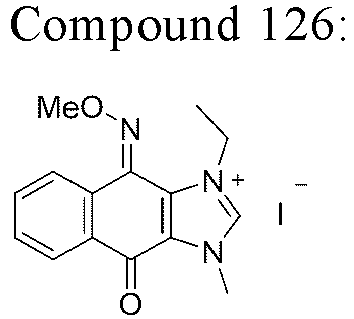
- yellow solid, m. p. 162-164°C.
- 1H NMR (500 MHz, DMSO-d6) δ 9.57 (s, 1H), 9.06 (d, J = 10.0 Hz, 1H), 8.34 (dd, J = 10.0, 2.0 Hz, 1H), 7.98 (td, J = 10.0, 2.0 Hz, 1H), 7.88 (td, J = 10.0, 1.5 Hz, 1H), 4.67 (q, J = 7.0 Hz, 2H), 4.18 (s, 3H), 4.13 (s, 3H), 1.50 (t, J = 7.0 Hz, 3H).
- 13C NMR (126 MHz, DMSO-d6) δ 174.18, 144.02, 138.15, 135.39, 134.49, 132.49, 131.62, 131.11, 127.63, 126.81, 125.80, 74.48, 39.12, 36.43, 15.02.
- HRMS(ESI-TOF) m/z theoretical value: C15H16N3O2[M - I]+, 270.1237, measured value: 270.1241.
- Compound 1 (0.05 mmol) and 150 µL of iodomethane were added to 3 mL of acetonitrile for reaction for 8 h at 100°C. At the end of the reaction, solvent was removed to obtain a yellow solid, and the solid was pulped for half an hour and subjected to suction filtration to obtain the final product.
- Different synthetic intermediate compounds above were used to prepare Compounds 127-151 according to the method in Example 13; other materials and reaction conditions for the compounds were kept the same and raw materials could be purchased commercially:

- yellow solid, m. p. 187-189°C.
- 1H NMR (400 MHz, DMSO-d6) δ 9.58 (s, 1H), 9.07 (dd, J = 8.0, 0.4 Hz, 1H), 8.34 (dd, J = 8.0, 1.2 Hz, 1H), 8.03-7.95 (m, 1H), 7.88 (td, J = 8.0, 1.2 Hz, 1H), 4.92-4.82 (m, 1H), 4.18 (s, 3H), 4.14 (s, 3H), 1.51 (d, J = 8.0 Hz, 6H).
- 13C NMR (101 MHz, DMSO-d6) δ 174.16, 143.98, 137.79, 135.40, 134.67, 132.39, 131.52, 131.09, 127.60, 126.84, 125.73, 81.42, 39.23, 36.45, 21.77.
- HRMS(ESI-TOF) m/z theoretical value: C16H18N3O2[M - I]+, 284.1394, measured value: 284.1399.

- yellow solid, m. p. 201-203°C.
- 1H NMR (500 MHz, DMSO-d6) δ 9.59 (s, 1H), 9.03 (dd, J = 8.0, 1.0 Hz, 1H), 8.34 (dd, J = 8.0, 1.5 Hz, 1H), 8.02-7.93 (m, 1H), 7.90-7.85 (m, 1H), 4.64 (t, J = 6.5 Hz, 2H), 4.18 (s, 3H), 4.12 (s, 3H), 1.95-1.77 (m, 2H), 1.53-1.42 (m, 2H), 0.98 (t, J = 7.5 Hz, 3H).
- 13C NMR (126 MHz, DMSO-d6) δ 174.16, 144.02, 138.15, 135.43, 134.46, 132.49, 131.48, 131.10, 127.64, 126.80, 125.78, 78.53, 39.11, 36.43, 31.07, 19.09, 14.20.
- HRMS(ESI-TOF) m/z theoretical value: C17H20N3O2[M - I]+, 298.1550, measured value: 298.1551.

- yellow solid, m. p. 139-141 °C.
- 1H NMR (500 MHz, DMSO-d6) δ 9.57 (s, 1H), 9.03 (J = 10.0 Hz, 1H), 8.35 (dd, J = 10.0, 1.5 Hz, 1H), 8.05-7.98 (m, 1H), 7.89 (t, J = 7.5 Hz, 1H), 4.44 (d, J = 6.5 Hz, 2H), 4.18 (s, 3H), 4.12 (s, 3H), 2.30-2.15 (m, 1H), 1.05 (d, J = 5.0 Hz, 6H).
- 13C NMR (126 MHz, DMSO-d6) δ 174.16, 144.03, 138.16, 135.45, 134.47, 132.51, 131.41, 131.13, 127.69, 126.82, 125.81, 84.91, 39.11, 36.43, 28.32, 19.37.
- HRMS(ESI-TOF) m/z theoretical value: C17H20N3O2[M - I]+, 298.1550, measured value: 298.1551.

- yellow solid, m. p. 221-223 °C.
- 1H NMR (500 MHz, DMSO-d6) δ 9.59 (s, 1H), 9.10 (dd, J = 10.0 Hz, 1H), 8.35 (dd, J = 5.0, 1.5 Hz, 1H), 8.02-7.95 (m, 1H), 7.91-7.85 (m, 1H), 4.19 (s, 3H), 4.15 (s, 3H), 1.56 (s, 9H).
- 13C NMR (126 MHz, DMSO-d6) δ 174.19, 143.95, 137.64, 135.39, 134.97, 132.32, 131.49, 131.12, 127.59, 126.94, 125.70, 85.60, 39.44, 36.44, 27.70, 27.65.
- HRMS(ESI-TOF) m/z theoretical value: C17H20N3O2[M - I]+, 298.1550, measured value: 298.1551.

- yellow solid, m. p. 170-172 °C.
- 1H NMR (400 MHz, DMSO-d6) δ 9.58 (s, 1H), 9.09 (dd, J = 8.0, 0.4 Hz, 1H), 8.34 (dd, J = 8.0, 1.6 Hz, 1H), 8.03-7.95 (m, 1H), 7.88 (td, J = 8.0, 1.2 Hz, 1H), 4.47 (d, J = 8.0 Hz, 2H), 4.18 (s, 4H), 4.13 (s, 3H), 1.47-1.35 (m, 1H), 0.70-0.62 (m, 2H), 0.51-0.42 (m, 2H).
- 13C NMR (101 MHz, DMSO-d6) δ 174.17, 144.01, 1310.08, 135.38, 134.48, 132.46, 131.56, 131.11, 127.62, 126.88, 125.79, 83.19, 39.14, 36.44, 10.70, 3.76.
- HRMS(ESI-TOF) m/z theoretical value: C17H18N3O2[M - I]+, 296.1394, measured value: 296.1397.

- yellow solid, m. p. 139-141 °C.
- 1H NMR (400 MHz, DMSO-d6) δ 9.57 (s, 1H), 9.04 (dd, J = 8.0, 1.2 Hz, 1H), 8.34 (dd, J = 8.0, 1.2 Hz, 1H), 7.99 (td, J = 8.0, 1.2 Hz, 1H), 7.89 (td, J = 8.0, 1.2 Hz, 1H), 6.28-6.15 (m, 1H), 5.58-5.50 (m, 1H), 5.46-5.39 (m, 1H), 5.12 (d, J = 8.0 Hz, 2H), 4.18 (s, 3H), 4.10 (s, 3H).
- 13C NMR (101 MHz, DMSO-d6) δ 174.16, 144.07, 138.48, 135.41, 134.38, 133.51, 132.59, 131.66, 131.13, 127.67, 126.74, 125.88, 120.67, 79.10, 39.17, 36.44.
- HRMS(ESI-TOF) m/z theoretical value: C16H16N3O2[M - I]+, 282.1237, measured value: 282.1239.

- 1H NMR (400 MHz, DMSO-d6) δ 9.54 (s, 1H), 9.05 (dd, J = 10.0, 0.8 Hz, 1H), 8.32 (dd, J = 8.0, 1.2 Hz, 1H), 8.02-7.92 (m, 1H), 7.86 (td, J = 8.0, 1.2 Hz, 1H), 7.56-7.49 (m, 2H), 7.03-6.95 (m, 2H), 5.60 (s, 2H), 4..16 (s, 3H), 4.06 (s, 3H), 3.77 (s, 3H).
- 13C NMR (101 MHz, DMSO-d6) δ 174.13, 160.14, 144.02, 138.38, 135.38, 134.37, 132.53, 131.58, 131.44, 131.11, 128.50, 127.63, 126.79, 125.83, 114.51, 79.91, 55.65, 39.22, 36.41.
- HRMS(ESI-TOF) m/z theoretical value: C21H20N3O3[M-I]+, 363.11499, measured value: 363.1499.

- 1H NMR (400 MHz, DMSO-d6) δ 9.54 (s, 1H), 9.07 (dd, J = 8.0, 0.8 Hz, 1H), 8.33 (dd, J = 8.0, 1.6 Hz, 1H), 8.01-.95 (m, 1H), 7.88 (td, J = 8.0, 1.2 Hz, 1H), 7.65-7.58 (m, 2H), 7.55-7.48 (m, 2H), 5.67 (s, 2H), 4.16 (s, 3H), 4.02 (s, 3H).
- 13C NMR (101 MHz, DMSO-d6) δ 174.14, 144.05, 138.81, 135.74, 135.43, 134.25, 133.88, 132.66, 131.75, 131.41, 131.16, 129.19, 127.68, 126.73, 125.93, 78.99, 39.17, 36.41.
- HRMS(ESI-TOF) m/z theoretical value: C20H17ClN3O2[M-I]+, 366.1004, measured value: 366.1006.

- yellow solid, m. p. 158-160 °C.
- 1H NMR (400 MHz, DMSO-d6) δ 9.53 (s, 1H), 9.11 (dd, J = 8.0, 0.8 Hz, 1H), 8.34 (dd, J = 8.0, 0.8 Hz, 1H), 7.99 (td, J = 8.0, 1.6 Hz, 1H), 7.89 (td, J = 8.0, 1.2 Hz, 1H), 7.86-7.76 (m, 4H), 5.78 (s, 2H), 4.16 (s, 3H), 4.00 (s, 3H).
- 13C NMR (101 MHz, DMSO-d6) δ 174.14, 144.07, 141.53, 139.03, 135.46, 134.20, 132.73, 131.84, 131.19, 129.63, 129.32, 127.71, 126.72, 126.11 (126.08, 126.04, 126.00, J = 4.0 Hz), 123.26, 78.84, 39.12, 36.41.
- HRMS (ESI): m/z theoretical value: C21H17F3N3O2 [M-I]+, 400.1267, measured value: 400.1268.

- yellow solid, m. p. 175-177 °C.
- 1H NMR (400 MHz, DMSO-d6) δ 9.54 (s, 1H), 9.07 (d, J = 8.0 Hz, 1H), 8.32 (dd, J = 8.0, 1.2 Hz, 1H), 7.97 (td, J = 8.0, 1.6 Hz, 1H), 7.88 (td, J = 8.0, 1.2 Hz, 1H), 7.69-7.56 (m, 2H), 7.35-7.24 (m, 2H), 5.66 (s, 2H), 4.16 (s, 3H), 4.03 (s, 3H).
- 13C NMR (101 MHz, DMSO-d6) δ 174.14, 163.99 (161.55, J = 244.0 Hz), 144.04, 138.68, 135.40, 134.29, 133.02 (132.99, J = 3.0 Hz), 132.62, 131.98 (131.89, J = 9.0 Hz), 131.70, 131.15, 127.66, 126.75, 125.91, 116.14 (115.93, J = 21.0 Hz), 79.14, 39.18, 36.41.
- HRMS(ESI-TOF) m/z theoretical value: C20H17FN3O2[M-I]+, 350.1299, measured value: 350.1302.

- 1H NMR (400 MHz, DMSO-d6) δ 9.54 (s, 1H), 8.94 (d, J = 8.0 Hz, 1H), 8.30 (d, J = 8.0 Hz, 1H), 8.02-7.92 (m, 1H), 7.87 (t, J = 8.0 Hz, 1H), 5.78 (s, 2H), 4.14 (s, 3H), 4.03 (s, 3H).
- 13C NMR (126 MHz, DMSO-d6) δ 175.44, 174.10, 144.09, 139.74, 135.84, 135.44, 133.92, 132.92, 132.27, 131.84, 131.26, 127.79, 127.39, 126.66, 126.23, 66.49, 38.71, 36.47.
- HRMS (ESI): m/z theoretical value: C20H13F5N3O2[M-I]+, 422.0922, measured value: 422.0920.

- 1H NMR (500 MHz, DMSO-d6) δ 9.53 (s, 1H), 9.08 (dd, J = 10.0, 1.0 Hz, 1H), 8.33 (dd, J = 10.0, 1.0 Hz, 1H), 8.01-7.93 (m, 1H), 7.88 (td, J = 10.0, 1.0 Hz, 1H), 7.60-7.55 (m, 2H), 7.49-7.38 (m, 3H), 5.68 (s, 2H), 4.16 (s, 3H), 4.03 (s, 3H).
- 13C NMR (126 MHz, DMSO-d6) δ 174.15, 144.04, 138.61, 136.66, 135.42, 134.32, 132.61, 131.66, 131.16, 129.49, 129.23, 129.19, 127.67, 126.77, 125.90, 80.09, 39.13, 36.39.
- HRMS(ESI-TOF) m/z theoretical value: C20H18N3O2[M - I]+, 322.1394, measured value: 322.1393.

- 1H NMR (500 MHz, DMSO-d6) δ 9.53 (s, 1H), 9.08 (dd, J = 10.0, 1.0 Hz, 1H), 8.33 (dd, J = 10.0, 1.0 Hz, 1H), 8.01-7.93 (m, 1H), 7.88 (td, J = 10.0, 1.0 Hz, 1H), 7.60-7.55 (m, 2H), 7.49-7.38 (m, 3H), 5.68 (s, 2H), 4.16 (s, 3H), 4.03 (s, 3H).
- 13C NMR (126 MHz, DMSO-d6) δ 174.15, 144.04, 138.61, 136.66, 135.42, 134.32, 132.61, 131.66, 131.16, 129.49, 129.23, 129.19, 127.67, 126.77, 125.90, 80.09, 39.13, 36.39.
- HRMS(ESI-TOF) m/z theoretical value: C20H18N3O2[M - I]+, 322.1394, measured value: 322.1393.

- 1H NMR (500 MHz, DMSO-d6) δ 9.53 (s, 1H), 9.08 (dd, J = 10.0, 1.0 Hz, 1H), 8.33 (dd, J = 10.0, 1.0 Hz, 1H), 8.01-7.93 (m, 1H), 7.88 (td, J = 10.0, 1.0 Hz, 1H), 7.60-7.55 (m, 2H), 7.49-7.38 (m, 3H), 5.68 (s, 2H), 4.16 (s, 3H), 4.03 (s, 3H).
- 13C NMR (126 MHz, DMSO-d6) δ 174.15, 144.04, 138.61, 136.66, 135.42, 134.32, 132.61, 131.66, 131.16, 129.49, 129.23, 129.19, 127.67, 126.77, 125.90, 80.09, 39.13, 36.39.
- HRMS(ESI-TOF) m/z theoretical value: C20H18N3O2[M - I]+, 322.1394, measured value: 322.1395.

- 1H NMR (500 MHz, DMSO-d6) δ 9.54 (s, 1H), 9.11 (d, J = 10.0 Hz, 1H), 8.35-8.28 (m, 3H), 8.00 (td, J = 10.0, 1.5 Hz, 1H), 7.90 (td, J = 10.0, 1.0 Hz, 1H), 7.84 (d, J = 10.0 Hz, 2H), 5.83 (s, 2H), 4.16 (s, 3H), 3.98 (s, 3H).
- 13C NMR (126 MHz, DMSO-d6) δ 174.14, 147.97, 144.44, 144.09, 139.22, 135.47, 134.14, 132.79, 131.92, 131.21, 130.21, 127.74, 126.70, 126.04, 124.28, 78.38, 39.14, 36.44.
- HRMS(ESI-TOF) m/z theoretical value: C20H17N4O4[M - I]+, 377.1244, measured value: 377.1247.
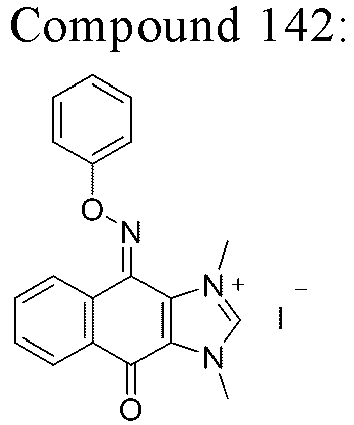
- 1H NMR (400 MHz, DMSO-d6) δ 9.62 (s, 3H), 9.56 (s, 1H), 9.07 (d, J = 8.0 Hz, 1H), 8.35 (dd, J = 8.0, 1.6 Hz, 1H), 8.29 (dd, J = 8.0, 1.2 Hz, 3H), 8.18 (dd, J = 7.8, 1.4 Hz, 3H), 8.03 - 7.95 (m, 1H), 7.89 (td, J = 7.6, 1.6 Hz, 4H), 7.79 (td, J = 7.6, 1.2 Hz, 3H), 7.69 - 7.58 (m, 8H), 7.49 - 7.36 (m, 12H), 4.14 (s, 3H), 4.13 (s, 6H), 4.02 (s, 3H), 4.00 (s, 6H).
- HRMS(ESI-TOF) m/z theoretical value: C20H18N3O2[M - I]+, 318.1237, measured value: 318.1238.

- 1H NMR (400 MHz, DMSO-d6) δ 9.56 (s, 1H), 9.03 (d, J = 8.0 Hz, 1H), 8.35 (d, J = 8.0 Hz, 1H), 7.98 (t, J = 8.0 Hz, 1H), 7.87 (t, J = 8.0 Hz, 1H), 5.46 (t, J = 4.0 Hz, 2H), 4.18 (s, 3H), 4.06 (s, 3H), 4.01 (t, J = 4.0 Hz, 2H), 3.98 (s, J = 4.0 Hz, 2H).
- HRMS(ESI-TOF) m/z theoretical value: C20H18N3O2[M-I]+, 328.1292, measured value: 328.1297.

- 1H NMR (400 MHz, DMSO-d6) δ 9.55 (s, 1H), 9.02 (d, J = 8.0 Hz, 1H), 8.32 (d, J = 8.0 Hz, 1H), 7.96 (t, J = 8.0 Hz, 1H), 7.86 (t, J = 8.0 Hz, 1H), 4.73 (t, J = 4.0 Hz, 2H), 4.16 (s, 3H), 4.11 (s, 3H), 3.81 (t, J = 4.0 Hz, 2H), 3.32 (s, 3H).
- 13C NMR (126 MHz, DMSO-d6) δ 174.17, 144.02, 138.40, 135.39, 134.38, 132.57, 131.62, 131.14, 127.65, 126.78, 125.88, 77.73, 70.56, 58.77, 39.12, 36.45.
- HRMS(ESI-TOF) m/z theoretical value: C16H18N3O3[M-I]+, 300.1343, measured value: 300.1347.

- 1H NMR (400 MHz, DMSO-d6) δ 9.53 (s, 1H), 9.04 (d, J = 8.0 Hz, 1H), 8.32 (d, J = 8.0 Hz, 1H), 7.94 (t, J = 8.0 Hz, 1H), 7.87 (t, J = 8.0 Hz, 1H), 7.34-7.19 (m, 4H), 4.76 (t, J = 4.0 Hz, 2H), 4.56 (s, 2H), 4.16 (s, 3H), 4.03 (s, 3H), 3.90 (t, J = 4.0 Hz, 2H).
- 13C NMR (126 MHz, DMSO-d6) δ 174.17, 144.00, 138.69, 138.43, 135.32, 134.33, 132.59, 131.65, 131.15, 128.71, 1210.04, 127.98, 127.65, 126.79, 125.87, 77.75, 72.48, 68.19, 39.03, 36.46.
- HRMS(ESI-TOF) m/z theoretical value: C22H22N3O3[M-I]+, 376.1656, measured value: 376.1656.

- 1H NMR (400 MHz, DMSO-d6) δ 9.58 (s, 1H), 9.07 (dd, J = 8.0, 0.8 Hz, 1H), 8.34 (dd, J = 8.0, 1.2 Hz, 1H), 8.00-7.93 (m, 1H), 7.89 (td, J = 8.0, 1.2 Hz, 1H), 4.82-4.69 (m, 2H), 4.18 (s, 3H), 4.13 (s, 3H), 3.95-3.86 (m, 2H), 3.68-3.59 (m, 2H), 3.53-3.44 (m, 2H), 3.23 (s, 3H).
- 13C NMR (101 MHz, DMSO-d6) δ 174.17, 144.01, 138.40, 135.34, 134.37, 132.57, 131.68, 131.13, 127.62, 126.77, 125.86, 77.83, 71.77, 70.18, 69.12, 58.57, 39.08, 36.43.
- HRMS(ESI-TOF) m/z theoretical value: C18H22N3O4[M - I]+, 344.1605, measured value: 344.1609.

- 1H NMR (400 MHz, DMSO-d6) δ 9.63 (s, 1H), 9.56 (s, 1H), 9.02 (d, J = 8.0 Hz, 1H), 8.34-8.09 (m, 3H), 8.01-7.70 (m, 4H), 4.78-4.58 (m, 4H), 4.21-4.01 (m, 11H), 3.90-3.80 (m, 4H), 3.63- 3.42 (m, 10H), 3.40-3.30 (m, 5H), 3.16 (d, J = 12.0 Hz, 5H).
- 13C NMR (101 MHz, DMSO) δ 175.23, 174.18, 144.73, 144.01, 138.39, 137.03, 135.84, 135.36, 134.81, 133.19, 132.56, 131.67, 131.13, 131.03, 130.53, 129.74, 128.12, 127.62, 127.38, 126.61, 125.85, 125.38, 77.84, 76.78, 71.73, 70.42, 70.26, 70.22, 70.10, 70.05, 70.01, 69.12, 68.72, 58.54, 58.50, 41.50, 39.09, 36.70, 36.62, 36.42.
- HRMS(ESI-TOF) m/z theoretical value: C20H26N3O5[M-I]+, 388.1867, measured value: 388.1866.

- 1H NMR (400 MHz, DMSO-d6) δ 9.01 (d, J = 8.1 Hz, 1H), 8.27 (dd, J = 7.8, 1.6 Hz, 1H), 8.17 - 8.08 (m, 5H), 7.93 - 7.89 (m, 1H), 7.85 - 7.79 (m, 3H), 7.72 (t, J = 7.4 Hz, 3H), 7.54 - 7.47 (m, 7H), 7.45-7.30 (m, 9H), 5.64 (s, 2H), 5.54 (s, 2H), 5.53 (s, 3H), 4.10 (d, J = 3.4 Hz, 8H), 4.02 (s, 2H), 3.95 (s, 3H), 3.84 (s, 6H), 2.76 (s, 3H), 2.75 (s, 5H), 2.67 (s, 3H).
- HRMS(ESI-TOF) m/z theoretical value: C20H26N3O5[M-I]+, 540.2493, measured value: 540.2495.

- 1H NMR (400 MHz, DMSO-d6) δ 9.67 (s, 1H), 9.60 (s, 1H), 9.54 (s, 1H), 8.88 (s, 1H), 8.82 (s, 1H), 8.74 (s, 1H), 8.31 - 8.13 (m, 4H), 7.84 - 7.68 (m, 4H), 7.68-7.55 (m, 4H), 7.51 - 7.38 (m, 6H), 5.71 (s, 2H), 5.61 (s, 2H), 4.17 (m, 6H), 4.02 (s, 3H), 4.00 (s, 3H).
- 13C NMR (101 MHz, DMSO-d6) δ 174.07, 144.77, 144.17, 138.54, 137.03, 136.19, 135.13, 135.08, 133.61, 132.73, 130.69, 130.54, 130.41, 130.37, 130.17, 130.10, 129.85, 129.75, 129.40, 129.26, 129.23, 129.17, 129.13, 129.04, 128.92, 128.47, 126.26, 125.23, 122.71, 79.71, 78.95.
- HRMS(ESI-TOF) m/z theoretical value: C20H26N3O5[M-I]+, 382.1550, measured value: 382.1555.

- 1H NMR (400 MHz, DMSO-d6) δ 9.67 (s, 2H), 9.58 (s, 2H), 8.98 (s, 2H), 8.87 (s, 1H), 8.75 (s, 1H), 8.38 - 8.34 (m, 2H), 8.23 (dd, J = 6.4, 2.8 Hz, 3H), 7.87 - 7.79 (m, 5H), 6.32 - 6.17 (m, 5H), 5.18 (dt, J = 5.8, 1.2 Hz, 3H), 5.07 (d, J = 6.0 Hz, 2H), 4.23 - 4.20 (m, 5H), 4.20 (s, 3H), 4.11 (d, J = 1.6 Hz, 8H).
- HRMS(ESI-TOF) m/z theoretical value: C20H26N3O5[M-I]+, 332.1334, measured value: 332.1335.
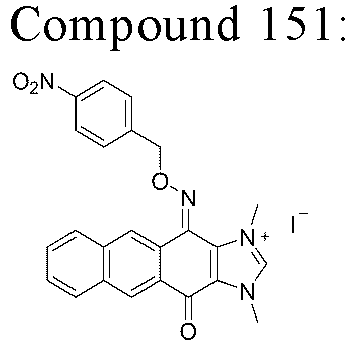
- 1H NMR (400 MHz, DMSO-d6) δ 9.74 (s, 1H), 9.53 (s, 1H), 8.94 (s, 1H), 8.34 - 8.24 (m, 5H), 7.86 - 7.79 (m, 3H), 5.86 (s, 2H), 4.18 (s, 3H), 3.97 (s, 3H).
- HRMS(ESI-TOF) m/z theoretical value: C20H26N3O5[M-I]+, 427.1401, measured value: 427.1405.
- Compounds obtained by the method of Examples 1-10 may be used to obtain the final imidazolium derivative in Examples 11-13. In addition, other similar quinonoxime imidazolium derivatives and synthetic intermediates thereof may be prepared by the method recited in the above examples or preparation methods, or prepared by some change methods commonly known by those skilled in the art.
- Effects of the compounds in the present invention are confirmed by the following tests.
- Test method: pancreatic cancer cells CFPAC-1 were cultured in a Dalbeco-improved Eagle medium with the addition of 10% FBS and 5% double-antibody. CFPAC-1 cancer cells were inoculated into a 96-well plate for incubation for 24 h; in the following day, test compounds having various concentrations of (100, 20, 10, 1, 0.1, 0.01, and 0.001 µM) and positive control agents were added per well; corresponding volume of fresh medium was added to blank control. After addition for 24 h or 48 h, cell proliferation was evaluated by chromogenic reaction of MTT formazan.
- Test result: compounds of the present invention inhibit proliferation of cancer cells well; the median lethal concentration IC50 value is below 1 µM, and the optimal compound may be up to 10 nM below.
Compound No. IC50(A549) IC50(HeLa) IC50(MCF-7 ) IC50(L929 ) 91 0.53 0.67 0.84 4.70 92 0.54 1.63 0.94 13.47 93 1.03 2.18 1.43 32.73 94 0.67 1.43 0.84 39.23 95 1.89 18.3 2.00 26.28 96 2.43 9.70 1.26 57.38 97 1.37 1.97 1.05 74.02 98 0.59 2.18 1.81 38.90 99 1.72 5.74 1.63 19.8 100 0.62 2.18 0.87 6.64 101 0.64 1.80 0.87 13.05 102 0.63 1.05 0.89 37.35 103 0.60 2.73 1.63 >100 104 12.2 12.48 1.43 >100 105 1.11 22.58 6.12 >100 106 11.2 9.2 20.2 >100 107 0.60 >100 9.85 >100 108 0.50 2.38 1.63 >100 109 11.2 50.0 57.8 >100 110 17.2 49.0 42.3 >100 111 11.6 19.7 24.6 >100 112 0.57 7.7 3.7 27.3 113 0.57 7.1 10.0 73.4 114 2.42 33.8 33.0 >100 115 0.13 2.5 1.64 17.6 116 2.3 >100 >100 >100 117 5.2 87.8 67.7 >100 118 0.54 0.78 0.89 12.9 119 0.52 33.0 18.1 4.6 120 0.69 26.0 13.0 >100 121 0.09 28.0 6.8 61.0 122 1.8 52.0 33.0 >100 123 0.007 23.0 1.8 3.8 124 0.009 11.3 3.3 4.6 125 0.005 5.3 4.5 45.3 126 0.59 39.0 12.2 85.2 127 0.09 25.1 7.9 29.6 128 0.004 4.8 2.9 6.5 129 0.07 8.7 12.1 26.4 130 0.6 48.4 56.2 >100 131 0.07 21.0 9.9 24.7 132 0.06 46.3 56.1 2.4 133 0.08 23.9 17.9 16.0 134 0.07 17.5 25.6 4.9 135 0.16 45.4 34.9 4.03 136 0.06 23.9 29.8 4.4 137 0.05 15.4 24.8 9.7 138 0.004 4.2 5.9 25.9 139 0.005 6.8 8.6 19.9 140 0.007 9.8 10.9 34.5 141 0.05 23.9 45.6 23.4 142 0.06 34.0 43.5 61.3 143 0.03 25.8 34.9 34.8 144 0.06 23.3 33.0 46.6 145 0.04 34.2 34.8 45.1 146 0.009 23.0 32.8 24.6 147 0.02 13.2 26.8 15.7 148 0.09 23.6 34.6 44.1 149 0.33 67.4 75.3 >100 150 0.46 34.4 45.9 97.8 151 0.12 56.8 78.8 89.6 - In addition, compounds (I), (II), (III), and (IV) of the present invention have good inhibition activity against the proliferation of other cancer cells, including non-small cell lung cancer cell (H460, H1299), liver tumor cell (HepG2), rectal cancer cell (HT29), leukemia cell (CCRF-CEM), prostate cancer cell (PC-3), ovarian carcinoma cell (SKOV-3), melanoma cell (A375), myeloma cell (RPMI-8226), esophageal carcinoma cell (TE-1), pancreatic cancer cell (CFPAC-1, PANC-1, SW1990, ASPC-1, and BXPC-3), bladder cancer cell (5637), and gastric cancer cell (KATO-III). Results are as follows:
IC50 Compound 123 Compound 124 Compound 125 Compound 128 H460 0.22 0.34 0.16 0.14 H1299 0.43 0.45 0.26 0.17 HepG2 0.01 0.02 0.009 0.02 HT29 6.7 7.9 5.4 9.8 CCRF-CEM 0.12 0.22 0.09 0.53 PC-3 13.5 23.1 26.5 8.8 SKOV-3 0.09 0.10 0.09 0.08 A375 4.65 5.65 2.21 1.66 RPMI-8226 90.9 99.2 89.0 78.9 TE-1 0.07 0.08 0.06 0.009 CFPAC-1 0.007 0.009 0.006 0.008 PANC-1 0.76 0.89 0.97 0.1 SW1990 0.008 0.009 0.009 0.009 ASPC-1 0.007 0.008 0.005 0.008 BXPC-3 0.004 0.006 0.003 0.006 5637 0.05 0.06 0.04 0.01 KATO-III 0.01 0.02 0.009 0.009 - Test method: 3×10⁷ CFPAC-1 pancreatic cancer cells were transplanted to subcutaneous tissues of armpit of a Balb/c naked mouse; administration was conducted when the tumor grew to 50-100 mm3, 100-200 mm3, and greater than 200 mm3; the mouse was administered once every other three days, 7 times in total, and 7 mg/kg each time. Normal saline was injected in the control group. Tumor length and diameter were measured by calipers and weight of the moue was weighed until the next day of the final administration. Gross tumor volume was calculated by the following equation:

- Test result: in this test, compounds (III) and (IV) of the present invention inhibit cancer cell proliferation well; for example, Examples 123, 124, 125, and 128 show 100% proliferation inhibition activity at an administration dosage of 7 mg/kg compared with the positive control group; compounds 121, 132, 137, 138, 139, 140, 143, 144, 145, 146, and 147 have inhibition ratios of being up to 80% above, and are dose-dependent obviously.
- The compounds of the present invention also show good an inhibition effect on cancer cell proliferation after being transplanted into animal models with other cancer cells (non-small cell lung cancer A549).
- Test method: the compounds 121, 123, 124, 125, 128, 132, 137, 138, 139, 140, 143, 144, 145, 146, and 147 in the examples of the present invention were administered every day via tail intravenous injection at a dose of 5 mg/kg for 7 consecutive days, and then body weight changes of the balb/c mice were monitored.
- Test result: the mice are in good condition without obviously reduced weight, but gemcitabine mice in the positive control group have obviously reduced weight and are dispirited.
- Experimental method: 4.59 mg of the compound 125 were weighed and put to a 15 mL centrifugal tube with the addition of 10 mL of sterile water, and dissolved via vortex oscillation until there was no obvious yellow particle, then subpackaged and stored at -20°C, 200 µL/piece (concentration: 1 mM); 2.79 mg Cidofovir (molecular weight: 279) were weighed and added to the 15 mL centrifugal tube, dissolved with the addition of 10 mL sterile water, then subpackaged and stored at -20°C, 200 µL/piece (concentration: 1 mM).
- Plaque test:
- 1. 293A cells were paved into a 24-well plate with 150,000 cells per well, and cultured at 37°C for 12-24 h, then used for test after growing to 90%.
- 2. 2% low-melting point agarose gel was melted and put to a 56°C water bath kettle for further use.
- 3. Adenovirus having a titer of 109 TCID50/mL was diluted by 105 folds; medium in the 24-well plate was removed, and 200 µL of adenoviral diluent was added per well and incubated in a 37°C 5% CO2 incubator, shaken once every 30 min, and incubated for 1 h in total.
- 4. The drug compound 125 to be tested and Cidofovir were double diluted with 2 × MEM (16 µL compound 125 was added to 8 mL of 2 × MEM, oscillated and mixed well, then 4 mL mixed solution was taken and added to fresh 4 mL of 2 × MEM and mixed well, and 5 dilutions were conducted, being 2 µM, 1 µM, 500 nM, 250 nM, and 125 nM, respectively; the maximum concentration of the compound 125 was 1 µM. Similarly, 400 µL Cidofovir was added to 7.6 mL of 2 × MEM, oscillated and mixed well, then 4 mL mixed solution was taken and added to fresh 4 mL of 2 × MEM and mixed well, and 5 dilutions were conducted, being 50 µM, 25 µM, 12.5 µM, 6.25 µM, and 3.125 µM, respectively); the diluted solution was put at 37°C for further use.
- 4. The viral solution was discarded, and agarose gel preheated at 56°C was added to 2xMEM by the same volume and mixed well, and then 2 mL of mixed solution was added per well, and incubated at room temperature for 30 min (gel).
- 5. The incubation was conducted in a 37°C incubator, and during the incubation, a fluorescent microscope was used to observe the replication of virus.
- Experimental result: 4 days later, lots of blank plaques formed by non-CPE could be observed in the Cidofovir group; 5 days later, non-CPE blank plaque also appeared in the low concentration group of the Compound 127. The Compound 125 has an inhibiting effect on viral replication, and is very obviously dose-dependent.
- Compared with the prior art, the present invention has the following beneficial effects:
- 1. In the present invention, the quinone-fused imidazole framework is modified systematically to obtain a series of quinonoxime imidazole derivatives and quinonoxime quinone imidazole derivatives having novel structures.
- 2. The present invention adopts exploratory novel preparation methods; synthesis is simpler; raw materials are easier to get and low in cost; moreover, the present invention is suitable for large-scale preparation.
- Detailed examples of the present invention are described above. It need be understood that the present invention is not limited to the above specific embodiments. Those skilled in the art would make various transformations or amendments within the scope of the claims, which will affect the substantive content of the present invention.
Claims (10)
- A fused quinonoxime imidazolium derivative, having a structure represented by the following Formula (I) or (II):
 a ring A is selected from an aromatic ring having zero, one, or more substituents, or a heteroaromatic ring having zero, one, or more substituents;R1, R2, R3, and R4 are the same or different, and each represent -hydrogen atom, -lower linear/branched alkyl having zero, one, or more substituents, -lower alkenyl having zero, one, or more substituents, -lower alkynyl having zero, one, or more substituents, -saturated heterocyclyl having zero, one, or more substituents, -cycloalkyl having zero, one, or more substituents, -cycloalkenyl having zero, one, or more substituents, -aryl having zero, one, or more substituents, and -heteroaryl having zero, one, or more substituents;and substituents on the ring A as well as in the R1, the R2, the R3, and the R4 are selected from a radical of group B;the group B: -lower linear/branched alkyl having zero, one, or more substituents, -lower alkenyl having zero, one, or more substituents, -lower alkynyl having zero, one, or more substituents, -saturated heterocyclyl having zero, one, or more substituents, -cycloalkyl having zero, one, or more substituents, -cycloalkenyl having zero, one, or more substituents, -aryl having zero, one, or more substituents, -heteroaryl having zero, one, or more substituents, -ORa, -SRa, -O-lower alkylene-ORa, -O-lower alkylene-O-lower alkylene-ORa, -O-lower alkylene-O-lower alkylene-O-lower alkylene-ORa, -O-lower alkylene-NRaRb, -O-lower alkylene-O-lower alkylene-NRaRb, -O-lower alkylene-NRc-lower alkylene-NRaRb, -O-CO-NRaRb, -SORa, -SO2Ra, -SO2NRaRb, -NRa-SO2Rb, -NRaRb, -NRc-lower alkylene-NRaRb, -N(-lower alkylene-NRaRb)2, -NO2, -CN, -halogen, -CO2Ra, -COO-, -CONRaRb, -CONRa-O-Rb, -NRa-CORb, -NRa-CO-NRbRc, -OCORa, and -CORa;Ra, Rb, and Rc are the same or different, and each represent -hydrogen atom, -lower linear/branched alkyl having zero, one, or more substituents, -lower alkenyl having zero, one, or more substituents, -lower alkynyl having zero, one, or more substituents, -saturated heterocyclyl having zero, one, or more substituents, -cycloalkyl having zero, one, or more substituents, -cycloalkenyl having zero, one, or more substituents, -aryl having zero, one, or more substituents, -heteroaryl having zero, one, or more substituents, -lower alkylene-(5 to 7-membered saturated heterocycle having zero, one, or more substituents), -lower alkylene-(cycloalkyl having zero, one, or more substituents), -lower alkylene-(aryl having zero, one, or more substituents), and -lower alkylene-(heteroaryl having zero, one, or more substituents), wherein the substituents refer to lower alkyl or heteroalkyl;X- is a coanion comprising a halide ion, a sulfonate ion, an acetate ion, a trifluoroacetate ion, a carbonate ion, a sulfate ion, etc.; and when an anion on a substituent and an imidazolium cation form an inner salt, X- is absent.
 - The fused quinonoxime imidazolium derivative according to claim 1, wherein in the structural formula,the ring A is selected from a benzene ring, a naphthalene ring, or a NO2-substituted benzene ring;the R1 is selected from -hydrogen atom, -lower alkyl, -lower alkynyl, -lower alkenyl, -lower linear/branched alkyl-O-lower linear/branched alkyl, -lower linear/branched alkyl-O-aryl, -lower linear/branched alkyl-O-lower linear/branched alkyl-O-lower linear/branched alkyl, -lower linear/branched alkyl-O-lower linear/branched alkyl-O-lower linear/branched alkyl-O-lower linear/branched alkyl, -aryl, -(5 to 7-membered) saturated heterocycle, and -heteroaryl;the R2 is selected from lower linear/branched alkyl;the R3 is selected from -hydrogen atom, -lower linear/branched alkyl, -(3 to 7-membered) saturated cycloalkyl, -heterocyclyl, -aryl, -aryl substituted by lower linear/branched alkyl, -aryl substituted by halogen, -heteroaryl, -heteroaryl substituted by lower linear/branched alkyl, -O-lower linear/branched alkyl, -S-lower linear/branched alkyl, -acyl, and -acyl substituted by lower alkyl; andthe R4 is selected from -hydrogen atom, -lower linear/branched alkyl, -lower alkenyl, -lower alkynyl, -aryl, -CN, -(3 to 7-membered) saturated cycloalkyl, -aryl substituted by halogen, -aryl substituted by lower alkyl, -heteroaryl, -CO2Ra, -saturated heterocyclyl, -lower linear/branched alkyl-ORa, -lower linear/branched alkyl-O-lower linear/branched alkyl, -lower linear/branched alkyl-S-lower linear/branched alkyl, -lower linear/branched alkyl-O-lower linear/branched alkyl-ORa, wherein the Ra is -lower linear/branched alkyl.
- A fused quinonoxime imidazole derivative and a hydrochloride thereof, having a structure represented by the following Formula (III) or (IV):
 a ring A is selected from an aromatic ring having zero, one, or more substituents, or a heteroaromatic ring having zero, one, or more substituents;R1, R3, and R4 are the same or different, and each represent -hydrogen atom, -lower linear/branched alkyl having zero, one, or more substituents, -lower alkenyl having zero, one, or more substituents, -lower alkynyl having zero, one, or more substituents, -saturated heterocyclyl having zero, one, or more substituents, -cycloalkyl having zero, one, or more substituents, -cycloalkenyl having zero, one, or more substituents, -aryl having zero, one, or more substituents, and -heteroaryl having zero, one, or more substituents;and the substituents on the ring A as well as in the R1, the R2, the R3, and the R4 are selected from a radical in group B;the group B: -lower linear/branched alkyl having zero, one, or more substituents, -lower alkenyl having zero, one, or more substituents, -lower alkynyl having zero, one, or more substituents, -saturated heterocyclyl having zero, one, or more substituents, -cycloalkyl having zero, one, or more substituents, -cycloalkenyl having zero, one, or more substituents, -aryl having zero, one, or more substituents, -heteroaryl having zero, one, or more substituents, -ORa, -SRa, -O-lower alkylene-ORa, -O-lower alkylene-O-lower alkylene-ORa, -O-lower alkylene-O-lower alkylene-O-lower alkylene-ORa, -O-lower alkylene-NRaRb, -O-lower alkylene-O-lower alkylene-NRaRb, -O-lower alkylene-NRc-lower alkylene-NRaRb, -O-CO-NRaRb, -SORa, -SO2Ra, -SO2NRaRb, -NRa-SO2Rb, -NRaRb, -NRc-lower alkylene-NRaRb, -N(-lower alkylene-NRaRb)2, -NO2, -CN, -halogen, -CO2Ra, -COO-, -CONRaRb, -CONRa-O-Rb, -NRa-CORb, -NRa-CO-NRbRc, -OCORa, and -CORa;Ra, Rb, and Rc are the same or different, and each represent -hydrogen atom, -lower linear/branched alkyl having zero, one, or more substituents, -lower alkenyl having zero, one, or more substituents, -lower alkynyl having zero, one, or more substituents, -saturated heterocyclyl having zero, one, or more substituents, -cycloalkyl having zero, one, or more substituents, -cycloalkenyl having zero, one, or more substituents, -aryl having zero, one, or more substituents, and -heteroaryl having zero, one, or more substituents; wherein the substituents refer to lower alkyl or heteroalkyl.
 - The fused quinonoxime imidazole derivative and the hydrochloride thereof according to claim 3, wherein in the structural formula,the ring A is selected from a -benzene ring, a -naphthalene ring, or a NO2-substituted benzene ring;the R1 is selected from -hydrogen atom, -lower alkyl, -lower alkynyl, -lower alkenyl, -lower linear/branched alkyl-O-lower linear/branched alkyl, -lower linear/branched alkyl-O-aryl, -lower linear/branched alkyl-O-lower linear/branched alkyl-O-lower linear/branched alkyl, -lower linear/branched alkyl-O-lower linear/branched alkyl-O-lower linear/branched alkyl-O-lower linear/branched alkyl, -aryl, -(5 to 7-membered) saturated heterocycle, and -heteroaryl;the R3 is selected from -hydrogen atom, -lower linear/branched alkyl, -(3 to 7-membered) saturated cycloalkyl, -heterocyclyl, -aryl, -aryl substituted by lower linear/branched alkyl, -aryl substituted by halogen, -heteroaryl, -heteroaryl substituted by lower linear/branched alkyl, -O-lower linear/branched alkyl, -S-lower linear/branched alkyl, -acyl, and acyl substituted by lower alkyl; andthe R4 is selected from -hydrogen atom, -lower linear/branched alkyl, -lower alkenyl, -lower alkynyl, -aryl, -CN, -(3 to 7-membered) saturated cycloalkyl, -aryl substituted by halogen, -aryl substituted by lower alkyl, -heteroaryl, -CO2Ra, -saturated heterocyclyl, -lower linear/branched alkyl-ORa, -lower linear/branched alkyl-O-lower linear/branched alkyl, -lower linear/branched alkyl-S-lower linear/branched alkyl, -lower linear/branched alkyl-O-lower linear/branched alkyl-ORa, wherein the Ra is lower linear/branched alkyl.
- A pharmaceutical composition, comprising one or more of the quinonoxime imidazolium derivative according to claim 1 or 2, and a pharmaceutically acceptable carrier.
- A pharmaceutical composition, comprising one or more of the fused quinonoxime imidazole derivative according to claim 3 or 4, or the hydrochloride thereof, and a pharmaceutically acceptable carrier.
- A use of the pharmaceutical composition according to claim 5 or 6 in preparing an anti-cancer, anti-bacterial, or antiviral drug.
- A preparation method of the fused quinonoxime imidazolium derivative according to claim 1 or 2, or the fused quinonoxime imidazole derivative according to claim 3 or 4, comprising the following steps:A, serving a protic solvent as a solvent, and subjecting a substituted quinone imidazole derivative


 B, performing an N-alkylation reaction on the quinonoxime imidazole derivative (III) or (IV) and a corresponding halide reagent R2X in an organic solvent, to obtain the quinonoxime imidazolium derivative (I) or (II).
 - The preparation method according to claim 8, wherein in the step A, a molar ratio of the quinone imidazole derivative

- The preparation method according to claim 8, wherein in the step B, a molar ratio of the quinonoxime imidazole derivative (III) or (IV) to the halide reagent R2X is 1:1-1:100; the solvent is selected from acetonitrile, ethyl acetate, and tetrahydrofuran; and the reaction is performed at 50-120°C for 8-48 h.
Applications Claiming Priority (2)
| Application Number | Priority Date | Filing Date | Title |
|---|---|---|---|
| CN202210224058.9A CN116768801B (en) | 2022-03-07 | Condensed quinone oxime imidazoles and their onium derivatives, their preparation and use | |
| PCT/CN2022/112932 WO2023168908A1 (en) | 2022-03-07 | 2022-08-17 | Fused quinone oxime imidazole, onium derivative thereof, preparation therefor and use thereof |
Publications (2)
| Publication Number | Publication Date |
|---|---|
| EP4484412A1 true EP4484412A1 (en) | 2025-01-01 |
| EP4484412A4 EP4484412A4 (en) | 2025-07-02 |
Family
ID=87937075
Family Applications (1)
| Application Number | Title | Priority Date | Filing Date |
|---|---|---|---|
| EP22930534.7A Pending EP4484412A4 (en) | 2022-03-07 | 2022-08-17 | CONDENSED QUINONE OXIMIMIDAZOLES, THEIR ONIUM DERIVATIVES, THEIR PREPARATION AND USE |
Country Status (4)
| Country | Link |
|---|---|
| US (1) | US20250163002A1 (en) |
| EP (1) | EP4484412A4 (en) |
| JP (1) | JP2024545520A (en) |
| WO (1) | WO2023168908A1 (en) |
Family Cites Families (16)
| Publication number | Priority date | Publication date | Assignee | Title |
|---|---|---|---|---|
| JPS63310830A (en) * | 1987-06-10 | 1988-12-19 | Meiji Seika Kaisha Ltd | Antiretroviral agent |
| MA21995A1 (en) * | 1989-11-13 | 1991-07-01 | Menarini Farma Ind | NOVEL FLUORONAPHTHACENEDIONES, THEIR GLYCOZYL DERIVATIVES AND THEIR MANUFACTURING METHODS. |
| JPH05112533A (en) * | 1991-05-08 | 1993-05-07 | Upjohn Co:The | Imidazobenzoquinoline and agent for preventing and treating hypertension and conjestive heart failure containing same as effective component |
| JP3598168B2 (en) * | 1996-03-18 | 2004-12-08 | 独立行政法人 科学技術振興機構 | Antiviral agent |
| US6734203B2 (en) * | 2000-02-15 | 2004-05-11 | Akira Matsuhisa | Fused imidazolium derivatives |
| WO2009023773A2 (en) | 2007-08-15 | 2009-02-19 | University Of Miami | Galactokinase inhibitors |
| US8642660B2 (en) | 2007-12-21 | 2014-02-04 | The University Of Rochester | Method for altering the lifespan of eukaryotic organisms |
| US9278951B2 (en) | 2011-04-29 | 2016-03-08 | The University Of Akron | Azolium and purinium salt anticancer and antimicrobial agents |
| JP2014156400A (en) | 2011-05-24 | 2014-08-28 | Astellas Pharma Inc | Labeled derivative for image diagnosis of tumor |
| US9662329B2 (en) | 2012-03-26 | 2017-05-30 | University of Pittsburgh—of the Commonwealth System of Higher Education | Use of survivin antagonists in polyomavirus-related disease |
| DE102012211020B4 (en) | 2012-06-27 | 2022-11-24 | Robert Bosch Gmbh | Adjustment drive with load compensation |
| WO2014142220A1 (en) | 2013-03-13 | 2014-09-18 | アステラス製薬株式会社 | Anti-tumor agent |
| RU2545091C1 (en) * | 2014-03-18 | 2015-03-27 | Федеральное государственное бюджетное учреждение "Российский онкологический научный центр имени Н.Н. Блохина" Российской академии медицинских наук (ФГБУ "РОНЦ им. Н.Н. Блохина" РАМН) | 1-R-4,9-DIOXO-1H-NAPTHO[2,3-d][1,2,3]TRIAZOLE-4-OXIM-2-OXIDES AND THEIR DERIVATIVES POSSESSING CYTOTOXIC ACTIVITY |
| CN108530365B (en) * | 2018-06-26 | 2020-07-14 | 上海交通大学 | 1, 4-naphthoquinone/anthraquinone imidazole derivative and preparation and application thereof |
| CN108794403A (en) * | 2018-06-26 | 2018-11-13 | 上海交通大学 | A kind of acyl methylnaphthoquinone imdazole derivatives and its preparation and use |
| US11156623B2 (en) | 2018-12-20 | 2021-10-26 | Public Joint Stock Company “Scientific Industrial Centre Borshchahivskiy Chemical-Pharmaceutical Plant” | Methods of monitoring safety of quercetin compositions |
-
2022
- 2022-08-17 EP EP22930534.7A patent/EP4484412A4/en active Pending
- 2022-08-17 JP JP2024536034A patent/JP2024545520A/en active Pending
- 2022-08-17 WO PCT/CN2022/112932 patent/WO2023168908A1/en not_active Ceased
- 2022-08-17 US US18/840,106 patent/US20250163002A1/en active Pending
Also Published As
| Publication number | Publication date |
|---|---|
| US20250163002A1 (en) | 2025-05-22 |
| JP2024545520A (en) | 2024-12-09 |
| EP4484412A4 (en) | 2025-07-02 |
| CN116768801A (en) | 2023-09-19 |
| WO2023168908A1 (en) | 2023-09-14 |
Similar Documents
| Publication | Publication Date | Title |
|---|---|---|
| EP3893889B1 (en) | Thrb receptor agonist compound and preparation method and use thereof | |
| EP4549440A1 (en) | Class of prmt5 inhibitors and use thereof | |
| EP3747508A1 (en) | Dna alkylating agents for use in the treatment of cancer | |
| JP2003523392A (en) | Antiviral azaindole derivatives | |
| BRPI0613639A2 (en) | compound, pharmaceutical composition, use of the compound, and process for producing a compound | |
| KR20060127909A (en) | Polycyclic materials for the treatment of respiratory multinuclear virus infection | |
| KR20030001551A (en) | Benzophenones as inhibitors of IL-1β and TNF-α | |
| JP6622205B2 (en) | Thienopiperidine derivatives and uses thereof | |
| UA79229C2 (en) | 3-nitrogen-6,7-dioxygen steroids and uses related thereto | |
| EP3782995B1 (en) | Spiro condensed imidazoline-2,4-dione derivatives as histone acetyltransferase inhibitors for the treatment of cancer diseases | |
| EP2436669B1 (en) | Preparation of anticancer-active tricyclic compounds via alkyne coupling reaction | |
| EP3825308B1 (en) | Thiohydantoin compound, composition, and use thereof as androgen receptor antagonists | |
| JPWO2014017515A1 (en) | Crystalline polymorph of 4- [5- (pyridin-4-yl) -1H-1,2,4-triazol-3-yl] pyridine-2-carbonitrile and process for producing the same | |
| CN106892920A (en) | Aloperine derivative, its preparation method and use | |
| CN116003394A (en) | Hydrochloride crystal form of amide compound, pharmaceutical composition and application | |
| KR101545068B1 (en) | Polymorphs of cddo ethyl ester and uses thereof | |
| CN115710257B (en) | Sulfate crystal form of an amide compound, pharmaceutical composition and use thereof | |
| EP4461736A1 (en) | Steroid compound, and preparation method therefor and use thereof | |
| JP2005527518A (en) | Novel chalcone derivatives and their use | |
| WO2020140894A1 (en) | Fluorine-containing substituted benzothiophene compound, and pharmaceutical composition and application thereof | |
| CN101195597A (en) | 1-substituted-4,4-disubstituted thiosemicarbazide compounds, their preparation method and their use | |
| CN111423483A (en) | Cyclic dinucleotide prodrug molecule and preparation method and application thereof | |
| CN116768801B (en) | Condensed quinone oxime imidazoles and their onium derivatives, their preparation and use | |
| US20250163002A1 (en) | Fused quinonoxime imidazole, onium derivatives thereof, preparation and use thereof | |
| NL8701214A (en) | 3- (HYDROXYMETHYL) -ISOQUINOLINE DERIVATIVES, METHOD FOR THE PREPARATION THEREOF, AND PHARMACEUTICAL PREPARATIONS WITH SUCH DERIVATIVES THEREIN. |
Legal Events
| Date | Code | Title | Description |
|---|---|---|---|
| STAA | Information on the status of an ep patent application or granted ep patent |
Free format text: STATUS: THE INTERNATIONAL PUBLICATION HAS BEEN MADE |
|
| PUAI | Public reference made under article 153(3) epc to a published international application that has entered the european phase |
Free format text: ORIGINAL CODE: 0009012 |
|
| STAA | Information on the status of an ep patent application or granted ep patent |
Free format text: STATUS: REQUEST FOR EXAMINATION WAS MADE |
|
| 17P | Request for examination filed |
Effective date: 20240923 |
|
| AK | Designated contracting states |
Kind code of ref document: A1 Designated state(s): AL AT BE BG CH CY CZ DE DK EE ES FI FR GB GR HR HU IE IS IT LI LT LU LV MC MK MT NL NO PL PT RO RS SE SI SK SM TR |
|
| DAV | Request for validation of the european patent (deleted) | ||
| DAX | Request for extension of the european patent (deleted) | ||
| A4 | Supplementary search report drawn up and despatched |
Effective date: 20250602 |
|
| RIC1 | Information provided on ipc code assigned before grant |
Ipc: A61P 31/12 20060101ALI20250526BHEP Ipc: A61P 31/04 20060101ALI20250526BHEP Ipc: A61P 35/00 20060101ALI20250526BHEP Ipc: A61K 31/497 20060101ALI20250526BHEP Ipc: A61K 31/4184 20060101ALI20250526BHEP Ipc: C07D 405/12 20060101ALI20250526BHEP Ipc: C07D 409/04 20060101ALI20250526BHEP Ipc: C07D 405/04 20060101ALI20250526BHEP Ipc: C07D 403/06 20060101ALI20250526BHEP Ipc: C07D 405/06 20060101ALI20250526BHEP Ipc: C07D 409/06 20060101ALI20250526BHEP Ipc: C07D 235/02 20060101AFI20250526BHEP |
|
| GRAP | Despatch of communication of intention to grant a patent |
Free format text: ORIGINAL CODE: EPIDOSNIGR1 |
|
| STAA | Information on the status of an ep patent application or granted ep patent |
Free format text: STATUS: GRANT OF PATENT IS INTENDED |
|
| INTG | Intention to grant announced |
Effective date: 20260227 |