EP4484285A1 - Reclining seat with coordinated lowering motion and sliding monitor - Google Patents
Reclining seat with coordinated lowering motion and sliding monitor Download PDFInfo
- Publication number
- EP4484285A1 EP4484285A1 EP24181775.8A EP24181775A EP4484285A1 EP 4484285 A1 EP4484285 A1 EP 4484285A1 EP 24181775 A EP24181775 A EP 24181775A EP 4484285 A1 EP4484285 A1 EP 4484285A1
- Authority
- EP
- European Patent Office
- Prior art keywords
- backrest
- extension
- passenger seat
- actuator
- monitor
- Prior art date
- Legal status (The legal status is an assumption and is not a legal conclusion. Google has not performed a legal analysis and makes no representation as to the accuracy of the status listed.)
- Granted
Links
Images



Classifications
-
- B—PERFORMING OPERATIONS; TRANSPORTING
- B64—AIRCRAFT; AVIATION; COSMONAUTICS
- B64D—EQUIPMENT FOR FITTING IN OR TO AIRCRAFT; FLIGHT SUITS; PARACHUTES; ARRANGEMENT OR MOUNTING OF POWER PLANTS OR PROPULSION TRANSMISSIONS IN AIRCRAFT
- B64D11/00—Passenger or crew accommodation; Flight-deck installations not otherwise provided for
- B64D11/0015—Arrangements for entertainment or communications, e.g. radio, television
- B64D11/00151—Permanently mounted seat back monitors
-
- B—PERFORMING OPERATIONS; TRANSPORTING
- B60—VEHICLES IN GENERAL
- B60R—VEHICLES, VEHICLE FITTINGS, OR VEHICLE PARTS, NOT OTHERWISE PROVIDED FOR
- B60R11/00—Arrangements for holding or mounting articles, not otherwise provided for
- B60R11/02—Arrangements for holding or mounting articles, not otherwise provided for for radio sets, television sets, telephones, or the like; Arrangement of controls thereof
- B60R11/0229—Arrangements for holding or mounting articles, not otherwise provided for for radio sets, television sets, telephones, or the like; Arrangement of controls thereof for displays, e.g. cathodic tubes
- B60R11/0235—Arrangements for holding or mounting articles, not otherwise provided for for radio sets, television sets, telephones, or the like; Arrangement of controls thereof for displays, e.g. cathodic tubes of flat type, e.g. LCD
-
- B—PERFORMING OPERATIONS; TRANSPORTING
- B64—AIRCRAFT; AVIATION; COSMONAUTICS
- B64D—EQUIPMENT FOR FITTING IN OR TO AIRCRAFT; FLIGHT SUITS; PARACHUTES; ARRANGEMENT OR MOUNTING OF POWER PLANTS OR PROPULSION TRANSMISSIONS IN AIRCRAFT
- B64D11/00—Passenger or crew accommodation; Flight-deck installations not otherwise provided for
- B64D11/06—Arrangements of seats, or adaptations or details specially adapted for aircraft seats
- B64D11/0639—Arrangements of seats, or adaptations or details specially adapted for aircraft seats with features for adjustment or converting of seats
- B64D11/064—Adjustable inclination or position of seats
-
- B—PERFORMING OPERATIONS; TRANSPORTING
- B64—AIRCRAFT; AVIATION; COSMONAUTICS
- B64D—EQUIPMENT FOR FITTING IN OR TO AIRCRAFT; FLIGHT SUITS; PARACHUTES; ARRANGEMENT OR MOUNTING OF POWER PLANTS OR PROPULSION TRANSMISSIONS IN AIRCRAFT
- B64D11/00—Passenger or crew accommodation; Flight-deck installations not otherwise provided for
- B64D11/06—Arrangements of seats, or adaptations or details specially adapted for aircraft seats
- B64D11/0639—Arrangements of seats, or adaptations or details specially adapted for aircraft seats with features for adjustment or converting of seats
- B64D11/0642—Adjustable headrests
Definitions
- the present disclosure relates generally to a reclinable passenger seat, and more particularly, to a passenger seat including a backrest extension including a video monitor, wherein the backrest extension is configured to move as the backrest reclines to maintain privacy and a consistent use of the monitor for a passenger seated in the next row.
- Passenger seats such as those utilized in airliners are typically configured to adjust between an upright sitting position for taxi, takeoff, and landing (TTOL), and a more comfortable sitting position during flight.
- Economy class seat adjustment is typically limited to shallow backrest recline, whereas business and other premium class seat adjustments may be more comprehensive, and in some instances include coordinated seat component adjustments to achieve a flat bed.
- the extent of the seat adjustment depends on the seating class, present seat components, capabilities of the seat, and seat pitch.
- business class seats may include a leg rest to provide lower leg and foot comfort.
- Economy and premium economy class seats typically do not include a leg rest, and therefore focus their comfort efforts on the reclining backrest and angular relationship with the seat pan.
- seat constructions also consider the placement of controls and devices.
- armrests may serve to locate seat controls
- backrests may be used to locate in-flight entertainment (IFE) devices and tray tables for use by passengers seated in the next row.
- IFE in-flight entertainment
- a limited angular change of a backrest may have a minimal impact on the viewing angle and use of backrest-mounted devices, significant elevation and angular changes result in poor ergonomic use positions for the aft passenger.
- a highly adjustable seat in a row configuration is reclined, the aft passenger is able to see over the backrest thereby degrading the privacy between seat rows.
- the passenger seat assembly includes a seat frame, a seat pan coupled to the seat frame, a backrest coupled to the seat frame, a backrest extension movably coupled to the backrest, the backrest extension configured to move between a retracted position within the backrest and an extended position above a top of the backrest, and a monitor rotatably mounted to the backrest extension and movable with the backrest extension.
- the assembly further includes a first actuator coupled to the backrest and to the backrest extension, a second actuator coupled to the backrest extension and to the monitor, and a controller, including a processor.
- the controller is configured to operate the first actuator to move the backrest extension toward the extended position as the backrest reclines, wherein the amount of movement of the backrest extension is determined by the amount of backrest recline, and operate the second actuator to rotate the monitor, wherein the amount of rotation of the monitor is determined by the amount of backrest recline.
- the operation of the first actuator and the operation of the second actuator are mutually inclusive operations.
- the assembly further includes a third actuator coupled to the seat frame and to the backrest, wherein the controller is further configured to operate the third actuator to rotate the backrest.
- the controller is configured to coordinate operation of the first actuator, the second actuator, and the third actuator.
- the seat pan is configured to lower as the backrest reclines.
- the backrest is configured with more than 5 degrees of recline, and in some embodiments, more than 10 degrees of recline.
- the backrest includes a fixed headrest portion, and the backrest extension is positioned behind the fixed headrest portion.
- the backrest extension and the backrest have substantially equal widths.
- inventive concepts are not limited in their application to the details of construction and the arrangement of the components or steps or methodologies set forth in the following description or illustrated in the drawings.
- inventive concepts disclosed herein may be practiced without these specific details.
- well-known features may not be described in detail to avoid unnecessarily complicating the instant disclosure.
- inventive concepts disclosed herein are capable of other embodiments or of being practiced or carried out in various ways. Also, it is to be understood that the phraseology and terminology employed herein is for the purpose of description and should not be regarded as limiting.
- a letter following a reference numeral is intended to reference an embodiment of the feature or element that may be similar, but not necessarily identical, to a previously described element or feature bearing the same reference numeral (e.g., 1, 1a, 1b).
- reference numeral e.g. 1, 1a, 1b
- Such shorthand notations are used for purposes of convenience only, and should not be construed to limit the inventive concepts disclosed herein in any way unless expressly stated to the contrary.
- any reference to “one embodiment” or “some embodiments” means that a particular element, feature, structure, or characteristic described in connection with the embodiment is included in at least one embodiment of the inventive concepts disclosed herein.
- the appearances of the phrase “in some embodiments” in various places in the specification are not necessarily all referring to the same embodiment, and embodiments of the inventive concepts disclosed may include one or more of the features expressly described or inherently present herein, or any combination of sub-combination of two or more such features, along with any other features which may not necessarily be expressly described or inherently present in the instant disclosure.
- the passenger seat assembly 100 on the left is shown with its backrest extension 112 in the extended position and its monitor 114 rotated relative to the backrest extension 112, considering the reclined and lowered state of the passenger seat assembly 100.
- the passenger seat assembly 102 on the right is shown with its backrest extension 112 in the retracted condition and its monitor 114 within the backrest extension 112. It can be seen from the figures that the backrest extension 112 is configured to move upward to occupy space above the top of the backrest 110 to maintain privacy between seat rows.
- the vertical position of the monitor 114 is substantially maintained as is the viewing angle of the monitor 114 considering the available rotation of the monitor 114 relative to the backrest extension 112.
- FIG. 2 illustrates the adjustment capabilities of the backrest extension 112 and the monitor 114.
- the backrest extension 112 is configured to move linearly “up” and “down” relative to the backrest 110 between a retracted position within the backrest 110 and an extended position above the top of the backrest 110.
- the backrest 110 includes a fixed front portion 116 that forms a headrest portion of the backrest.
- the fixed front portion 116 may serve to mount an additional headrest assembly that may be adjustable relative to the backrest 110.
- the monitor 114 is rotatably mounted to the backrest extension 112 such that the monitor 114 travels up and down with the backrest extension 112 while also being capable of rotating relative to the backrest extension 112.
- the axis of rotation 118 of the monitor 114 may be located proximal to the top of the monitor 114 such that the bottom of the monitor 114 can be manipulated to change the tilt of the screen.
- FIG. 3 illustrates a non-limiting example of a subassembly including the backrest extension 112 and the monitor 114.
- the axis of rotation 188 is positioned above the monitor 114 such that the bottom free edge of the monitor 114 can be rotated away from the backrest extension 112 to angle the screen upward.
- the subassembly may include a brace 120 defining discrete positions configured to interact with the backrest extension 112 and/or structure positioned in the backrest extension 112. Electrical connections may be concealed from view behind the monitor 114, routed down through the backrest extension 112, and routed through the backrest 110.
- the memory may be an example of tangible, computer-readable storage medium that provides storage functionality to store various data and/or program code associated with operation of the controller/processor, such as software programs and/or code segments, or other data to instruct the processor, and possibly other components of the controller 200, to perform the functionality described herein.
- the memory can store data, such as a program of instructions for operating the controller 200, including its components (e.g., processor, communication interface, etc.), and so forth.
- components e.g., processor, communication interface, etc.
- the memory may be integral with the processor, may comprise stand-alone memory, or may be a combination of both.
- the memory may include removable and non-removable memory components, such as random-access memory (RAM), read-only memory (ROM), flash memory (e.g., a secure digital (SD) memory card, a mini-SD memory card, and/or a micro-SD memory card), solid-state drive (SSD) memory, magnetic memory, optical memory, universal serial bus (USB) memory devices, hard disk memory, external memory, and so forth.
- RAM random-access memory
- ROM read-only memory
- flash memory e.g., a secure digital (SD) memory card, a mini-SD memory card, and/or a micro-SD memory card
- SSD solid-state drive
- magnetic memory magnetic memory
- optical memory optical memory
- USB universal serial bus
- inventive concepts disclosed herein are well adapted to achieve the objectives and to attain the advantages mentioned herein as well as those inherent in the inventive concepts disclosed herein. While presently preferred embodiments of the inventive concepts disclosed herein have been described for purposes of this disclosure, it will be understood that numerous changes may be made which will readily suggest themselves to those skilled in the art and which are accomplished within the broad scope and coverage of the inventive concepts disclosed and claimed herein.
Landscapes
- Engineering & Computer Science (AREA)
- Aviation & Aerospace Engineering (AREA)
- Mechanical Engineering (AREA)
- Seats For Vehicles (AREA)
Abstract
Description
- The present disclosure relates generally to a reclinable passenger seat, and more particularly, to a passenger seat including a backrest extension including a video monitor, wherein the backrest extension is configured to move as the backrest reclines to maintain privacy and a consistent use of the monitor for a passenger seated in the next row.
- Passenger seats such as those utilized in airliners are typically configured to adjust between an upright sitting position for taxi, takeoff, and landing (TTOL), and a more comfortable sitting position during flight. Economy class seat adjustment is typically limited to shallow backrest recline, whereas business and other premium class seat adjustments may be more comprehensive, and in some instances include coordinated seat component adjustments to achieve a flat bed.
- The extent of the seat adjustment depends on the seating class, present seat components, capabilities of the seat, and seat pitch. For example, business class seats may include a leg rest to provide lower leg and foot comfort. Economy and premium economy class seats typically do not include a leg rest, and therefore focus their comfort efforts on the reclining backrest and angular relationship with the seat pan.
- In addition to comfort, seat constructions also consider the placement of controls and devices. For example, armrests may serve to locate seat controls, while backrests may be used to locate in-flight entertainment (IFE) devices and tray tables for use by passengers seated in the next row. While a limited angular change of a backrest may have a minimal impact on the viewing angle and use of backrest-mounted devices, significant elevation and angular changes result in poor ergonomic use positions for the aft passenger. In addition, when a highly adjustable seat in a row configuration is reclined, the aft passenger is able to see over the backrest thereby degrading the privacy between seat rows.
- Therefore, there is a need for a passenger seat with features for maintaining privacy and consistent use of seat features when the backrest is reclined.
- In one aspect, embodiments of the inventive concepts disclosed herein are directed to a passenger seat assembly. In embodiments, the passenger seat assembly includes a seat frame, a seat pan coupled to the seat frame, a backrest coupled to the seat frame, a backrest extension movably coupled to the backrest, the backrest extension configured to move between a retracted position within the backrest and an extended position above a top of the backrest, and a monitor rotatably mounted to the backrest extension and movable with the backrest extension.
- In some embodiments, the assembly further includes a first actuator coupled to the backrest and to the backrest extension, a second actuator coupled to the backrest extension and to the monitor, and a controller, including a processor. The controller is configured to operate the first actuator to move the backrest extension toward the extended position as the backrest reclines, wherein the amount of movement of the backrest extension is determined by the amount of backrest recline, and operate the second actuator to rotate the monitor, wherein the amount of rotation of the monitor is determined by the amount of backrest recline.
- In some embodiments, the operation of the first actuator and the operation of the second actuator are mutually inclusive operations.
- In some embodiments, the assembly further includes a third actuator coupled to the seat frame and to the backrest, wherein the controller is further configured to operate the third actuator to rotate the backrest.
- In some embodiments, the controller is configured to coordinate operation of the first actuator, the second actuator, and the third actuator.
- In some embodiments, the seat pan is configured to lower as the backrest reclines.
- In some embodiments, the backrest is configured with more than 5 degrees of recline, and in some embodiments, more than 10 degrees of recline.
- In some embodiments, the backrest includes a fixed headrest portion, and the backrest extension is positioned behind the fixed headrest portion.
- In some embodiments, the backrest extension and the backrest have substantially equal widths.
- According to another aspect, the present disclosure provides an aircraft passenger seat assembly. In embodiments, the aircraft passenger seat assembly includes a seat frame, a seat pan coupled to the seat frame, and a backrest coupled to the seat frame, the backrest having an axis of rotation configured to lower as the backrest reclines. The assembly further includes a backrest extension movably coupled to the backrest configured to move between a retracted position within the backrest and an extended position above a top of the backrest, and a monitor rotatably mounted to the backrest extension and movable with the backrest extension.
- This summary is provided solely as an introduction to subject matter that is fully described in the following detailed description and drawing figures. This summary should not be considered to describe essential features nor be used to determine the scope of the claims. Moreover, it is to be understood that both the foregoing summary and the following detailed description are explanatory only and are not necessarily restrictive of the subject matter claimed.
- Implementations of the inventive concepts disclosed herein may be better understood when consideration is given to the following detailed description thereof. Such description refers to the included drawings, which are not necessarily to scale, and in which some features may be exaggerated and some features may be omitted or may be represented schematically in the interest of clarity. Like reference numerals in the drawings may represent and refer to the same or similar element, feature, or function. In the drawings:
-
FIG. 1 is a side elevation view of two longitudinally-adjacent passenger seats shown in different states of recline and with different backrest extension positions, in accordance with example embodiments of this disclosure; -
FIG. 2 is a detailed view of the top portion of the backrest showing the backrest extension positions and movement therebetween; -
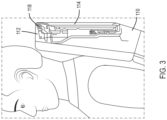
FIG. 3 is another detailed view of the top portion of the backrest showing the backrest extension in the retracted position and the monitor fully within the backrest extension, in accordance with example embodiments of this disclosure; -
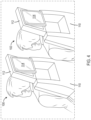
FIG. 4 is a perspective view showing backrest extensions and rotated monitors in use in a passenger cabin, in accordance with example embodiments of this disclosure; and -
FIG. 5 is a schematic diagram illustrating an actuator control system for the passenger seat assembly, in accordance with example embodiments of this disclosure. - Before explaining at least one embodiment of the inventive concepts disclosed herein in detail, it is to be understood that the inventive concepts are not limited in their application to the details of construction and the arrangement of the components or steps or methodologies set forth in the following description or illustrated in the drawings. In the following detailed description of embodiments of the instant inventive concepts, numerous specific details are set forth in order to provide a more thorough understanding of the inventive concepts. However, it will be apparent to one of ordinary skill in the art having the benefit of the instant disclosure that the inventive concepts disclosed herein may be practiced without these specific details. In other instances, well-known features may not be described in detail to avoid unnecessarily complicating the instant disclosure. The inventive concepts disclosed herein are capable of other embodiments or of being practiced or carried out in various ways. Also, it is to be understood that the phraseology and terminology employed herein is for the purpose of description and should not be regarded as limiting.
- As used herein, a letter following a reference numeral is intended to reference an embodiment of the feature or element that may be similar, but not necessarily identical, to a previously described element or feature bearing the same reference numeral (e.g., 1, 1a, 1b). Such shorthand notations are used for purposes of convenience only, and should not be construed to limit the inventive concepts disclosed herein in any way unless expressly stated to the contrary.
- Further, unless expressly stated to the contrary, "or" refers to an inclusive or and not to an exclusive or. For example, a condition A or B is satisfied by anyone of the following: A is true (or present) and B is false (or not present), A is false (or not present) and B is true (or present), and both A and B are true (or present).
- In addition, use of the "a" or "an" are employed to describe elements and components of embodiments of the instant inventive concepts. This is done merely for convenience and to give a general sense of the inventive concepts, and "a" and "an" are intended to include one or at least one and the singular also includes the plural unless it is obvious that it is meant otherwise.
- Finally, as used herein any reference to "one embodiment" or "some embodiments" means that a particular element, feature, structure, or characteristic described in connection with the embodiment is included in at least one embodiment of the inventive concepts disclosed herein. The appearances of the phrase "in some embodiments" in various places in the specification are not necessarily all referring to the same embodiment, and embodiments of the inventive concepts disclosed may include one or more of the features expressly described or inherently present herein, or any combination of sub-combination of two or more such features, along with any other features which may not necessarily be expressly described or inherently present in the instant disclosure.
- Broadly, embodiments of the inventive concepts disclosed herein are directed to a passenger seat assembly, for instance a passenger seat assembly for use in an airliner. In embodiments, multiple passenger seat assemblies may be positioned to form rows in a cabin, for instance longitudinally-aligned in an economy class cabin, premium economy class cabin, business class cabin, etc. Each passenger seat assembly includes a front portion configured to support a passenger, and a back portion configured to mount amenities for use by a passenger sitting in the next row.
- In embodiments, the passenger seat assembly includes a backrest configured to recline, and in some embodiments, also configured to lower at the same time the backrest reclines. By both reclining and lowering, privacy between seat rows is diminished considering the low resultant height of the fully reclined backrest. At the same time, the viewing experience of a passenger in the next row using the forward monitor may be diminished considering the lower monitor height and changed viewing angle. To compensate for the change in backrest position, the seat assembly includes a backrest extension movably coupled to the backrest. The monitor is rotatably mounted to the backrest extension such that the monitor moves with the backrest extension and also relative to the backrest extension.
- In some embodiments, operation of the backrest extension and rotation of the monitor may be performed manually. In other embodiments, operation of the backrest extension and rotation of the monitor may be automated, for instance by a controller configured to coordinate at least one of backrest extension motion and monitor rotation with the backrest recline motion. For example, the controller, via actuator control, may move (e.g., raise) the backrest extension toward its extended position responsive to the backrest being reclined, and may move (e.g., lower) the backrest extension toward its retracted position responsive to the backrest being moved toward upright. The same may be true for monitor rotation. In some embodiments, the amount of backrest extension linear motion may correspond to the amount of backrest rotational motion. The same may be true for monitor rotation, with a direct relationship to the backrest or to the backrest extension.
- Benefits and advantages of the backrest extension with the rotating monitor include the ability to maintain privacy and ergonomic use of seat features for a highly-reclinable backrest and/or a backrest that moves closer to the floor as the backrest reclines. As used herein, the term "highly-reclinable" may mean a backrest configured with more than about 5 degrees of recline, more preferably more than about 10 degrees of recline. In use, the backrest extension essentially functions to lengthen the backrest to compensate for the backrest lowering during recline, thereby blocking the forward view of the aft passenger.
- In some embodiments, the adjustments of one or more of the passenger seat, backrest extension position, and monitor tilt may be performed manually by the respective passengers. In other embodiments, in which the seat, backrest extension, and monitor motions are automated, the controller may operate to return the monitor to a stowed state within the backrest extension, return the backrest extension to its retracted state within the backrest, and return the sitting position of the seat to upright in preparation for taxi, takeoff, and landing (TTOL). Component adjustments may be performed using actuators, known to those in the field of adjustable passenger seats, capable of linear and/or rotational motions. In some embodiments, the seat does not include a leg rest considering the lowering motion instead provides improved lower leg and foot comfort.
- Additional advantages and benefits of the passenger seat assemblies disclosed herein include, but are not limited to, a more highly adjustable and ergonomic seat without having to add a leg rest, a highly reclinable seat without having to introduce a privacy shell in surrounding relation to the seat, a more comfortable seat suitable for application in both economy and premium cabin classes, seat automation to return to an upright sitting position, and enhanced positioning of a monitor for an aft passenger.
-
FIG. 1 illustrates a positional relationship of twopassenger seat assemblies passenger seat assemblies passenger seat assemblies passenger seat assembly 100 on the left. Passenger seat assemblies may be repeated along the longitudinal length of the cabin, and may be positioned with any predefined number of seats in each row. Eachpassenger seat assembly seat frame 104 supporting asubassembly 106 generally including aseat pan 108 and abackrest 110. Theseat pan 108 and thebackrest 110 may be separately coupled to theseat frame 104, or may be coupled to theseat frame 104 as a unit, for instance through a guide assembly for guiding motions of each component. - The
passenger seat assembly 100 on the left is shown in a reclined and lowered sitting position. Thepassenger seat assembly 102 on the right is shown in an upright sitting position, for instance a TTOL compliant sitting position. It can be seen that thebackrest 110 on the leftpassenger seat assembly 100 is shallower in angle (i.e., nearer to horizontal) and positioned lower in elevation as compared to thebackrest 110 on the rightpassenger seat assembly 102. The particular mechanism that controls the seat component motions is not critical to the present invention. For example, a motion mechanism may include a pivotal attachment of theseat pan 108 and thebackrest 110 forming the axis of rotation of the backrest, and tracking the pivotal attachment using linkages configured to travel along guideways in theseat frame 104. - The
passenger seat assembly 100 on the left is shown with itsbackrest extension 112 in the extended position and itsmonitor 114 rotated relative to thebackrest extension 112, considering the reclined and lowered state of thepassenger seat assembly 100. Thepassenger seat assembly 102 on the right is shown with itsbackrest extension 112 in the retracted condition and itsmonitor 114 within thebackrest extension 112. It can be seen from the figures that thebackrest extension 112 is configured to move upward to occupy space above the top of thebackrest 110 to maintain privacy between seat rows. At the same time, the vertical position of themonitor 114 is substantially maintained as is the viewing angle of themonitor 114 considering the available rotation of themonitor 114 relative to thebackrest extension 112. -
FIG. 2 illustrates the adjustment capabilities of thebackrest extension 112 and themonitor 114. Thebackrest extension 112 is configured to move linearly "up" and "down" relative to thebackrest 110 between a retracted position within thebackrest 110 and an extended position above the top of thebackrest 110. In embodiments, thebackrest 110 includes a fixedfront portion 116 that forms a headrest portion of the backrest. The fixedfront portion 116 may serve to mount an additional headrest assembly that may be adjustable relative to thebackrest 110. Themonitor 114 is rotatably mounted to thebackrest extension 112 such that themonitor 114 travels up and down with thebackrest extension 112 while also being capable of rotating relative to thebackrest extension 112. As shown, the axis ofrotation 118 of themonitor 114 may be located proximal to the top of themonitor 114 such that the bottom of themonitor 114 can be manipulated to change the tilt of the screen. -
FIG. 3 illustrates a non-limiting example of a subassembly including thebackrest extension 112 and themonitor 114. In embodiments, the axis of rotation 188 is positioned above themonitor 114 such that the bottom free edge of themonitor 114 can be rotated away from thebackrest extension 112 to angle the screen upward. In some embodiments, the subassembly may include a brace 120 defining discrete positions configured to interact with thebackrest extension 112 and/or structure positioned in thebackrest extension 112. Electrical connections may be concealed from view behind themonitor 114, routed down through thebackrest extension 112, and routed through thebackrest 110. -
FIG. 4 illustratespassenger seat assemblies backrest extension 112 may be about equal to the width of the top of thebackrest 110 such that the backrest extension functions as a privacy divider when in the extended position as shown. The size of themonitor 114 may vary depending on the dimensions of thebackrest extension 112. -
FIG. 5 illustrates an automated version of thepassenger seat assembly 100. In embodiments, acontroller 200 is operably coupled to a plurality of actuators configured to perform adjustments of the seat components. As shown, afirst actuator 202 is coupled between thebackrest 110 and thebackrest extension 112 and is operable for moving thebackrest extension 112 between its extended position and retracted position. For example, thefirst actuator 202 may be a linear actuator. Asecond actuator 204 is coupled between thebackrest extension 112 and themonitor 114 and is operable for rotating themonitor 114 relative to thebackrest extension 112. Athird actuator 206 is operable for at least one of backrest recline and backrest lowering, for instance through control of the axis of rotation of thebackrest 110. - In embodiments, the
controller 200 is configured to coordinate operation of at least some of the actuators. For example, responsive to thethird actuator 206 changing the reclined state of thebackrest 110, thecontroller 200 may operate at least one of the first andsecond actuators backrest 110, wherein movement of thebackrest 110 to a fully reclined state may cause thebackrest extension 112 to be moved to the fully extended state and themonitor 114 to be rotated to its fully deployed state. In embodiments, the operation of thefirst actuator 202 and the operation of thesecond actuator 204 are mutually inclusive operations, for example, performed to maintain a substantially consistent monitor position. In some embodiments, in preparation for TTOL, thecontroller 200 may operate to return thebackrest 110 to upright, retract thebackrest extension 112 into thebackrest 110, and rotate themonitor 114 to its stowed position in thebackrest extension 112, in no particular order. In embodiments, thecontroller 200 may be part of a passenger seat controller including a user interface. - The
controller 200 may be configured to detect, determine, operate, etc. Thecontroller 200 may include at least one processor, memory, and a communication interface. The processor provides processing functionality for at least thecontroller 200 and may include any number of processors, micro-controllers, circuitry, field programmable gate array (FPGA) or other processing systems, and resident or external memory for storing data, executable code, and other information accessed or generated by the controller. The processor may execute one or more software programs embodied in a non-transitory computer readable medium (e.g., memory) that implements techniques described herein. The processor is not limited by the materials from which it is formed, or the processing mechanisms employed therein and, as such, can be implemented via semiconductor(s) and/or transistors (e.g., using electronic integrated circuit (IC) components), and so forth. - The memory may be an example of tangible, computer-readable storage medium that provides storage functionality to store various data and/or program code associated with operation of the controller/processor, such as software programs and/or code segments, or other data to instruct the processor, and possibly other components of the
controller 200, to perform the functionality described herein. Thus, the memory can store data, such as a program of instructions for operating thecontroller 200, including its components (e.g., processor, communication interface, etc.), and so forth. It should be noted that while a single memory is described, a wide variety of types and combinations of memory (e.g., tangible, non-transitory memory) may be employed. The memory may be integral with the processor, may comprise stand-alone memory, or may be a combination of both. Some examples of the memory may include removable and non-removable memory components, such as random-access memory (RAM), read-only memory (ROM), flash memory (e.g., a secure digital (SD) memory card, a mini-SD memory card, and/or a micro-SD memory card), solid-state drive (SSD) memory, magnetic memory, optical memory, universal serial bus (USB) memory devices, hard disk memory, external memory, and so forth. - The communication interface may be operatively configured to communicate with components of the
controller 200. For example, the communication interface may be configured to retrieve data from the processor or other devices, transmit data for storage in the memory, retrieve data from storage in the memory, and so forth. The communication interface may also be communicatively coupled with the processor to facilitate data transfer between components of the controller and the processor. It should be noted that while the communication interface is described as a component of the controller, one or more components of the communication interface may be implemented as external components communicatively coupled to the controller via a wired and/or wireless connection. Thecontroller 200 may also include and/or connect to one or more input/output (I/O) devices (e.g., human machine interface (HMI) devices) via the communication interface. In embodiments, the communication interface may include a transmitter, receiver, transceiver, physical connection interface, or any combination thereof. - From the above description, it is clear that the inventive concepts disclosed herein are well adapted to achieve the objectives and to attain the advantages mentioned herein as well as those inherent in the inventive concepts disclosed herein. While presently preferred embodiments of the inventive concepts disclosed herein have been described for purposes of this disclosure, it will be understood that numerous changes may be made which will readily suggest themselves to those skilled in the art and which are accomplished within the broad scope and coverage of the inventive concepts disclosed and claimed herein.
Claims (13)
- A passenger seat assembly (100), comprising:a seat frame (104);a seat pan (108) coupled to the seat frame;a backrest (110) coupled to the seat frame;a backrest extension (112) movably coupled to the backrest (110), the backrest extension (112) configured to move between a retracted position within the backrest (110) and an extended position above a top of the backrest (110); anda monitor (114) rotatably mounted to the backrest extension (112) and movable with the backrest extension (112).
- The passenger seat assembly (100) according to claim 1, further comprising:a first actuator (202) coupled to the backrest (110) and to the backrest extension (112);a second actuator (204) coupled to the backrest extension (112) and to the monitor (114); anda controller (200), including a processor, configured to:operate the first actuator (202) to move the backrest extension (112) toward the extended position as the backrest (110) reclines, wherein an amount of movement of the backrest extension (112) is determined by an amount of backrest (110) recline; andoperate the second actuator (204) to rotate the monitor (114), wherein an amount of rotation of the monitor (114) is determined by the amount of backrest (110) recline.
- The passenger seat assembly (100) according to claim 2, wherein operation of the first actuator (202) and operation of the second actuator (204) are mutually inclusive operations.
- The passenger seat assembly (100) according to claim 2 or 3, further comprising a third actuator (206) coupled to the seat frame (104) and to the backrest (110), wherein the controller (200) is further configured to operate the third actuator (206) to rotate the backrest (110).
- The passenger seat assembly (100) according to claim 4, wherein the controller (200) is configured to coordinate synchronous operation of the first actuator (202), the second actuator (204), and the third actuator (206).
- The passenger seat assembly (100) according to any preceding claim, wherein the seat pan (108) is configured to lower as the backrest (110) reclines.
- The passenger seat assembly (100) according to any preceding claim, wherein the backrest (110) is configured with more than 5 degrees of recline motion.
- The passenger seat assembly (100) according to any preceding claim, wherein the backrest (110) is configured with more than 10 degrees of recline motion.
- The passenger seat assembly (100) according to any preceding claim, wherein the backrest (110) comprises a fixed headrest portion (116), and the backrest extension (112) is positioned behind the fixed headrest portion (116).
- The passenger seat assembly (100) according to any preceding claim, wherein the backrest extension (112) and the backrest (110) are substantially equal in width.
- The passenger seat assembly (100) according to any preceding claim, wherein the passenger seat assembly (100) is an aircraft passenger seat assembly.
- The passenger seat assembly (100) according to any preceding claim, wherein:the seat bottom (108) and the backrest (110) are grouped together as a subassembly (106);a coupling of the seat bottom (108) and the backrest (110) lowers and translates forward as the seat reclines; andbackrest extension (112) deployment and monitor (114) rotation occur synchronously as the subassembly (106) reclines.
- A seating configuration including two like passenger seat assemblies (100) wherein one of the passenger seat assemblies (100) is positioned directly forward of the other passenger seat assembly (100).
Applications Claiming Priority (1)
| Application Number | Priority Date | Filing Date | Title |
|---|---|---|---|
| US18/216,265 US12486034B2 (en) | 2023-06-29 | 2023-06-29 | Reclining seat with coordinated lowering motion and sliding monitor |
Publications (2)
| Publication Number | Publication Date |
|---|---|
| EP4484285A1 true EP4484285A1 (en) | 2025-01-01 |
| EP4484285B1 EP4484285B1 (en) | 2026-01-14 |
Family
ID=91530169
Family Applications (1)
| Application Number | Title | Priority Date | Filing Date |
|---|---|---|---|
| EP24181775.8A Active EP4484285B1 (en) | 2023-06-29 | 2024-06-12 | Reclining seat with coordinated lowering motion and sliding monitor |
Country Status (2)
| Country | Link |
|---|---|
| US (1) | US12486034B2 (en) |
| EP (1) | EP4484285B1 (en) |
Citations (3)
| Publication number | Priority date | Publication date | Assignee | Title |
|---|---|---|---|---|
| EP2147614B1 (en) * | 2007-05-14 | 2018-07-25 | Panasonic Corporation | Image display |
| EP3206951B1 (en) * | 2014-10-16 | 2021-03-31 | Bentley Motors Limited | Display screen mount |
| EP3594121B1 (en) * | 2018-07-09 | 2022-10-26 | AMI Industries, Inc. | Adjustable upper thoracic support for aircraft seat |
Family Cites Families (18)
| Publication number | Priority date | Publication date | Assignee | Title |
|---|---|---|---|---|
| US6994236B2 (en) * | 2002-07-27 | 2006-02-07 | Te Hsin Hsu | Monitoring supporting device for attaching to vehicles |
| ATE502815T1 (en) * | 2005-12-22 | 2011-04-15 | Johnson Controls Tech Co | BACKREST ENTERTAINMENT DISPLAY SYSTEM |
| US7959226B2 (en) * | 2007-07-03 | 2011-06-14 | Toyota Boshoku Kabushiki Kaisha | Vehicle seats |
| US20090085383A1 (en) * | 2007-10-01 | 2009-04-02 | Lear Corporation | Vehicle seat having an electronic display mounted thereon |
| JP5375289B2 (en) * | 2009-04-08 | 2013-12-25 | トヨタ紡織株式会社 | Display device for vehicle seat |
| KR20150077619A (en) * | 2013-12-29 | 2015-07-08 | 현대다이모스(주) | Apparatus for auto tilting of monitor for vehicle seat |
| JP6516234B2 (en) * | 2014-04-24 | 2019-05-22 | Tianma Japan株式会社 | Stereoscopic display |
| US20160159481A1 (en) * | 2014-12-04 | 2016-06-09 | B/E Aerospace, Inc. | Passenger seat with full seatback video display |
| US20170129413A1 (en) * | 2015-11-05 | 2017-05-11 | Dongkang Holdings Co., Ltd. | Articulation type supporter for seat of a means of transportation |
| EP3600970B1 (en) * | 2017-03-24 | 2022-07-13 | Safran Passenger Innovations, LLC | Pivoting internal display unit with fixed screen |
| CA3086225A1 (en) * | 2017-12-21 | 2019-06-27 | Bombardier Inc. | Reclinable passenger seat |
| US10853962B2 (en) * | 2018-02-22 | 2020-12-01 | Panasonic Intellectual Property Management Co., Ltd. | Device, system, and method of determining reclining state |
| US11305877B2 (en) * | 2018-09-20 | 2022-04-19 | Panasonic Intellectual Property Management Co., Ltd. | Electronic device and information processing apparatus |
| WO2021021162A1 (en) * | 2019-07-31 | 2021-02-04 | Safran Seats Usa Llc | Cradling passenger seat assembly |
| WO2021066800A1 (en) * | 2019-09-30 | 2021-04-08 | Safran Seats Usa Llc | Non-intrusive stationary monitor shroud |
| US11975842B2 (en) * | 2019-09-30 | 2024-05-07 | Safran Seats Usa Llc | Bottom pan torque bearing attachment |
| US11897395B2 (en) * | 2021-05-03 | 2024-02-13 | Faurecia Automotive Seating, Llc | Vehicle seat with self-adjusting display |
| US11590903B1 (en) * | 2021-08-09 | 2023-02-28 | Faurecia Automotive Seating, Llc | Vehicle seat having a docking station for a mobile device |
-
2023
- 2023-06-29 US US18/216,265 patent/US12486034B2/en active Active
-
2024
- 2024-06-12 EP EP24181775.8A patent/EP4484285B1/en active Active
Patent Citations (3)
| Publication number | Priority date | Publication date | Assignee | Title |
|---|---|---|---|---|
| EP2147614B1 (en) * | 2007-05-14 | 2018-07-25 | Panasonic Corporation | Image display |
| EP3206951B1 (en) * | 2014-10-16 | 2021-03-31 | Bentley Motors Limited | Display screen mount |
| EP3594121B1 (en) * | 2018-07-09 | 2022-10-26 | AMI Industries, Inc. | Adjustable upper thoracic support for aircraft seat |
Also Published As
| Publication number | Publication date |
|---|---|
| US12486034B2 (en) | 2025-12-02 |
| EP4484285B1 (en) | 2026-01-14 |
| US20250002151A1 (en) | 2025-01-02 |
Similar Documents
| Publication | Publication Date | Title |
|---|---|---|
| EP2086833B1 (en) | Translatable and rotatable passenger seat | |
| EP3122632B1 (en) | Aircraft seat with segmented seatback for achieving in-bed lounge sitting position | |
| CN105163628B (en) | The vehicle seat at the linkage joint part with chair disk and the chair back | |
| US11787545B2 (en) | Platform first class | |
| US10450070B2 (en) | Aircraft passenger seat assembly including a backrest tilt apparatus | |
| RU2703323C2 (en) | Multi-position chair for control operator | |
| US9045062B2 (en) | Reversible airline seat | |
| CN110091995B (en) | Work-dining aircraft seat with tilt and shift articulation | |
| US9227729B2 (en) | Aircraft seat employing dual actuators for seat translaton and seat recline | |
| EP3129289B1 (en) | A seat unit | |
| EP3374266B1 (en) | Aircraft seating arrangement with enhanced lay flat position spacing | |
| EP2983988B1 (en) | Aircraft seat with translating seatback linkage pivot | |
| US9399517B2 (en) | Seating device comprising a forward-foldable backrest | |
| CN113613949A (en) | Passenger seat unit for an aircraft cabin | |
| EP3873806B1 (en) | Aircraft seat and cabin arrangement | |
| EP4484285A1 (en) | Reclining seat with coordinated lowering motion and sliding monitor | |
| US12157574B2 (en) | Interior layout of an aircraft cabin and associated method | |
| EP4570662A1 (en) | Systems and methods for monitoring seating in an aircraft | |
| EP4446225A1 (en) | Pilot sleeper seat with integrated rudder controls and lockout function | |
| CN112105525A (en) | Headrest for seat |
Legal Events
| Date | Code | Title | Description |
|---|---|---|---|
| PUAI | Public reference made under article 153(3) epc to a published international application that has entered the european phase |
Free format text: ORIGINAL CODE: 0009012 |
|
| STAA | Information on the status of an ep patent application or granted ep patent |
Free format text: STATUS: THE APPLICATION HAS BEEN PUBLISHED |
|
| AK | Designated contracting states |
Kind code of ref document: A1 Designated state(s): AL AT BE BG CH CY CZ DE DK EE ES FI FR GB GR HR HU IE IS IT LI LT LU LV MC ME MK MT NL NO PL PT RO RS SE SI SK SM TR |
|
| STAA | Information on the status of an ep patent application or granted ep patent |
Free format text: STATUS: REQUEST FOR EXAMINATION WAS MADE |
|
| 17P | Request for examination filed |
Effective date: 20250210 |
|
| GRAP | Despatch of communication of intention to grant a patent |
Free format text: ORIGINAL CODE: EPIDOSNIGR1 |
|
| STAA | Information on the status of an ep patent application or granted ep patent |
Free format text: STATUS: GRANT OF PATENT IS INTENDED |
|
| INTG | Intention to grant announced |
Effective date: 20250829 |
|
| GRAS | Grant fee paid |
Free format text: ORIGINAL CODE: EPIDOSNIGR3 |
|
| GRAA | (expected) grant |
Free format text: ORIGINAL CODE: 0009210 |
|
| STAA | Information on the status of an ep patent application or granted ep patent |
Free format text: STATUS: THE PATENT HAS BEEN GRANTED |
|
| AK | Designated contracting states |
Kind code of ref document: B1 Designated state(s): AL AT BE BG CH CY CZ DE DK EE ES FI FR GB GR HR HU IE IS IT LI LT LU LV MC ME MK MT NL NO PL PT RO RS SE SI SK SM TR |
|
| REG | Reference to a national code |
Ref country code: CH Ref legal event code: F10 Free format text: ST27 STATUS EVENT CODE: U-0-0-F10-F00 (AS PROVIDED BY THE NATIONAL OFFICE) Effective date: 20260114 Ref country code: GB Ref legal event code: FG4D |
|
| REG | Reference to a national code |
Ref country code: DE Ref legal event code: R096 Ref document number: 602024002032 Country of ref document: DE |
|
| REG | Reference to a national code |
Ref country code: IE Ref legal event code: FG4D |