EP4483798A1 - Analysis device, analysis method, analysis program, and computer-readable non-transitory storage medium - Google Patents
Analysis device, analysis method, analysis program, and computer-readable non-transitory storage medium Download PDFInfo
- Publication number
- EP4483798A1 EP4483798A1 EP23760113.3A EP23760113A EP4483798A1 EP 4483798 A1 EP4483798 A1 EP 4483798A1 EP 23760113 A EP23760113 A EP 23760113A EP 4483798 A1 EP4483798 A1 EP 4483798A1
- Authority
- EP
- European Patent Office
- Prior art keywords
- person
- measured
- ingested
- electric resistance
- component
- Prior art date
- Legal status (The legal status is an assumption and is not a legal conclusion. Google has not performed a legal analysis and makes no representation as to the accuracy of the status listed.)
- Pending
Links
Images




Classifications
-
- A—HUMAN NECESSITIES
- A61—MEDICAL OR VETERINARY SCIENCE; HYGIENE
- A61B—DIAGNOSIS; SURGERY; IDENTIFICATION
- A61B5/00—Measuring for diagnostic purposes; Identification of persons
- A61B5/05—Detecting, measuring or recording for diagnosis by means of electric currents or magnetic fields; Measuring using microwaves or radio waves
- A61B5/053—Measuring electrical impedance or conductance of a portion of the body
- A61B5/0531—Measuring skin impedance
-
- A—HUMAN NECESSITIES
- A61—MEDICAL OR VETERINARY SCIENCE; HYGIENE
- A61B—DIAGNOSIS; SURGERY; IDENTIFICATION
- A61B5/00—Measuring for diagnostic purposes; Identification of persons
- A61B5/01—Measuring temperature of body parts ; Diagnostic temperature sensing, e.g. for malignant or inflamed tissue
-
- A—HUMAN NECESSITIES
- A61—MEDICAL OR VETERINARY SCIENCE; HYGIENE
- A61B—DIAGNOSIS; SURGERY; IDENTIFICATION
- A61B5/00—Measuring for diagnostic purposes; Identification of persons
- A61B5/05—Detecting, measuring or recording for diagnosis by means of electric currents or magnetic fields; Measuring using microwaves or radio waves
- A61B5/053—Measuring electrical impedance or conductance of a portion of the body
- A61B5/0531—Measuring skin impedance
- A61B5/0533—Measuring galvanic skin response
-
- A—HUMAN NECESSITIES
- A61—MEDICAL OR VETERINARY SCIENCE; HYGIENE
- A61B—DIAGNOSIS; SURGERY; IDENTIFICATION
- A61B5/00—Measuring for diagnostic purposes; Identification of persons
- A61B5/05—Detecting, measuring or recording for diagnosis by means of electric currents or magnetic fields; Measuring using microwaves or radio waves
- A61B5/053—Measuring electrical impedance or conductance of a portion of the body
- A61B5/0537—Measuring body composition by impedance, e.g. tissue hydration or fat content
-
- G—PHYSICS
- G16—INFORMATION AND COMMUNICATION TECHNOLOGY [ICT] SPECIALLY ADAPTED FOR SPECIFIC APPLICATION FIELDS
- G16H—HEALTHCARE INFORMATICS, i.e. INFORMATION AND COMMUNICATION TECHNOLOGY [ICT] SPECIALLY ADAPTED FOR THE HANDLING OR PROCESSING OF MEDICAL OR HEALTHCARE DATA
- G16H20/00—ICT specially adapted for therapies or health-improving plans, e.g. for handling prescriptions, for steering therapy or for monitoring patient compliance
- G16H20/60—ICT specially adapted for therapies or health-improving plans, e.g. for handling prescriptions, for steering therapy or for monitoring patient compliance relating to nutrition control, e.g. diets
-
- G—PHYSICS
- G16—INFORMATION AND COMMUNICATION TECHNOLOGY [ICT] SPECIALLY ADAPTED FOR SPECIFIC APPLICATION FIELDS
- G16H—HEALTHCARE INFORMATICS, i.e. INFORMATION AND COMMUNICATION TECHNOLOGY [ICT] SPECIALLY ADAPTED FOR THE HANDLING OR PROCESSING OF MEDICAL OR HEALTHCARE DATA
- G16H50/00—ICT specially adapted for medical diagnosis, medical simulation or medical data mining; ICT specially adapted for detecting, monitoring or modelling epidemics or pandemics
- G16H50/30—ICT specially adapted for medical diagnosis, medical simulation or medical data mining; ICT specially adapted for detecting, monitoring or modelling epidemics or pandemics for calculating health indices; for individual health risk assessment
Definitions
- the present disclosure relates to an analysis device, an analysis method, and an analysis program.
- One way to know nutrients, minerals, or water ingested by a person during a meal, hydration, and the like is by determining components included in the ingesta from diet records and diet image records and calculating nutrition.
- the conventional method mentioned above would require time and effort to create diet records or image records, and might yield results that do not align with reality since the ingesta are not actually measured. Even if the contents of a meal are recorded accurately in detail, the substances in the record may not be nutrients actually included in the meal. Besides, whether the nutrients included in the meal have been actually absorbed by the human body or not cannot be known.
- Patent document 1 Japanese Patent Laid-Open Application No. 2000-23936 , for example, describes a health management guidance device that converts a measured value of the bioimpedance of a person to be measured to a circulatory condition index indicating the circulatory condition of the person to be measured.
- the device described in Patent document 1 converts an impedance value to a circulatory condition index based on the pattern of the diurnal variation in the impedance.
- the physical condition of a person to be measured can be identified more directly by using the impedance of the person to be measured. What is determined in Patent document 1, however, is the circulatory condition of a person to be measured, and is not a component ingested by a person to be measured.
- a purpose of the disclosure made in view of the above is to provide an analysis device, an analysis method, and an analysis program that are able to more accurately identify components ingested by a person to be measured.
- An analysis device of an aspect of the disclosure comprises: calculation means for calculating electric resistance of a person to be measured based on a measurement result obtained by using a plurality of electrode units being in contact with the person to be measured; and determination means for determining a component ingested by the person to be measured based on reference information indicating a temporal change in the electric resistance according to a component ingested by a human and on a temporal change in the electric resistance calculated by the calculation means.
- a component ingested by a person to be measured is determined by using a phenomenon of the electric resistance of a person to be measured changing in accordance with a component ingested by the person to be measured.
- This configuration thus allows an ingested component to be identified more accurately without a person to be measured recording the contents of a meal.
- An analysis device of an aspect of the disclosure comprises: calculation means for calculating electric resistance of a person to be measured based on a measurement result obtained by using a plurality of electrode units being in contact with the person to be measured; and determination means for determining whether the person to be measured has ingested a specified component or not based on reference information indicating a temporal change in the electric resistance according to a component ingested by a human and on a temporal change in the electric resistance calculated by the calculation means.
- This configuration allows a person to be measured to recognize whether the person has ingested a specified component or not.
- the reference information may be first reference information that indicates a temporal change in the electric resistance for each component resulting from a human ingesting the component, which is protein, fat, or carbohydrate
- the determination means may determine the component ingested by the person to be measured based on a temporal change in the electric resistance calculated by the calculation means and on a temporal change for each component indicated by the first reference information.
- the first reference information may include a relation between an amount of the ingested component, which is protein, fat, or carbohydrate, and time until the electric resistance returns to a level before ingestion of the component, and the determination means may determine an amount of the component ingested by the person to be measured based on time until the electric resistance calculated by the calculation means returns to a level before ingestion of the component and on the first reference information.
- This configuration allows for qualitatively determining the amount of nutrients ingested by a person to be measured.
- the analysis device described above may have correction means for correcting an amount of the component determined by the determination means based on variations over one day or more in body composition of the person to be measured. This configuration allows for more accurately identifying a component ingested by a person to be measured.
- the first reference information may be generated by acquiring a temporal change in the electric resistance within a predetermined period of time after the person to be measured ingests protein, fat, or carbohydrate. This configuration allows for more accurately identifying a component ingested by a person to be measured through generating the first reference information according to the person to be measured.
- the analysis device described above may have body temperature acquisition means for acquiring body temperature of the person to be measured, where the first reference information may include a temporal change in the body temperature for each component resulting from a human ingesting protein, fat, or carbohydrate, and where the determination means may determine the component ingested by the person to be measured based on a combination of the body temperature acquired by the body temperature acquisition means and the electric resistance calculated by the calculation means and on the first reference information.
- This configuration allows for more accurately identifying a component ingested by a person to be measured.
- the analysis device described above may have body temperature acquisition means for acquiring body temperature of the person to be measured, where the determination means may determine a physical condition of the person to be measured based on a relation between a temporal change in the body temperature acquired by the body temperature acquisition means and a temporal change in the electric resistance calculated by the calculation means and on the reference information.
- This configuration allows for easily identifying a change in the physical condition of a person to be measured.
- the reference information may be second reference information indicating that the body temperature increases before the electric resistance increases and that ingestion of water causes the body temperature to decrease along with the electric resistance. This configuration allows for identifying a person to be measured as being dehydrated.
- the reference information may be third reference information indicating that there is no temporal change in the body temperature while the electric resistance increases and then decreases. This configuration allows for identifying a person to be measured as having edema due to excessive salt intake.
- the analysis device described above may have advice derivation means for deriving advice to maintain health for the person to be measured according to a determination result obtained by the determination means.
- This configuration allows for presenting an appropriate advice according to a component ingested by a person to be measured.
- the electrode units may be made to be wearable on the person to be measured. This configuration allows for identifying a component ingested by a person to be measured regardless of where the person eats.
- An analysis method of an aspect of the disclosure has: a first process for calculating electric resistance of a person to be measured based on a measurement result obtained by using a plurality of electrode units being in contact with the person to be measured; and a second process for determining a component ingested by the person to be measured based on reference information indicating a temporal change in the electric resistance according to a component ingested by a human and on a temporal change in the electric resistance calculated by the first process.
- An analysis program of an aspect of the disclosure causes a computer to function as: calculation means for calculating electric resistance of a person to be measured based on a measurement result obtained by using a plurality of electrode units being in contact with the person to be measured; and determination means for determining a component ingested by the person to be measured based on reference information indicating a temporal change in the electric resistance according to a component ingested by a human and on a temporal change in the electric resistance calculated by the calculation means.
- An analysis method of an aspect of the disclosure has: a first process for calculating electric resistance of a person to be measured based on a measurement result obtained by using a plurality of electrode units being in contact with the person to be measured; and a second process for determining whether the person to be measured has ingested a specified component or not based on reference information indicating a temporal change in the electric resistance according to a component ingested by a human and on a temporal change in the electric resistance calculated by the first process.
- An analysis program of an aspect of the disclosure causes a computer to function as: calculation means for calculating electric resistance of a person to be measured based on a measurement result obtained by using a plurality of electrode units being in contact with the person to be measured; and determination means for determining whether the person to be measured has ingested a specified component or not based on reference information indicating a temporal change in the electric resistance according to a component ingested by a human and on a temporal change in the electric resistance calculated by the calculation means.
- the disclosure allows for more accurately identifying a component ingested by a person to be measured.
- Figure 1 is a schematic configuration diagram of an analysis device 10 of the embodiment.
- the analysis device 10 of the embodiment is made to be wearable on a person to be measured and is shaped like, for example, a band.
- the analysis device 10 is, for example, a wristband that is worn on a wrist, but is not limited to this and may be worn on an ancle.
- the analysis device 10 may also be shaped like, for example, a plane instead of a band, which may be sticked on the chest, the abdomen, or the like by means of an adhesive.
- the analysis device 10 is provided with two or more electrode units 20 and a body temperature measuring unit 22 on the inside so that they are in contact with the arm of a person to be measured, and with a monitor 24 and a power switch 26 on the outside. Note that the analysis device 10 does not have to have the body temperature measuring unit 22. In such a mode, a body temperature acquisition unit 32 described later acquires the body temperature of a person to be measured from another device.
- Each electrode unit 20 comprises a current electrode 20A and a voltage electrode 20B.
- the analysis device 10 applies electric current to the current electrodes 20A, and uses the voltage electrodes 20B to measure the potential difference occurring across the current path between the electrode units 20 being in contact with a person to be measured. Based on the potential difference, the analysis device 10 calculates the electric resistance of the person to be measured as bioimpedance (hereinafter referred to as "BI"), and based on the BI, determines an ingested component, which is a component ingested by the person to be measured.
- BI bioimpedance
- the current electrodes 20A and the voltage electrodes 20B are vertically long in the example in Figure 1 , they are not limited to this and may have a horizontally long shape which lengthens in the circumferential direction of the analysis device 10.
- the monitor 24 is, for example, a touch-panel display, through which a person to be measured performs an input operation on the analysis device 10 and a result of determining an ingested component is output.
- the power switch 26 accepts power-on and power-off operations of the analysis device 10.
- FIG. 2 is a function block diagram of the analysis device 10 of the embodiment.
- the analysis device 10 comprises a BI calculation unit 30, the body temperature acquisition unit 32, a determination unit 34, a monitor controller 36, a storage 38, and a communications unit 40.
- Each function performed by the BI calculation unit 30, the body temperature acquisition unit 32, and the determination unit 34 shown in Figure 2 may, for example, be performed by an arithmetic unit provided on the analysis device 10 through activation of a program, or be realized by an ASIC (Application Specific Integrated Circuit) or other individual hardware components.
- ASIC Application Specific Integrated Circuit
- the BI calculation unit 30 calculates the BI of a person to be measured based on a measurement result obtained by using the electrode units 20 being in contact with the person to be measured (hereinafter referred to as "actual measured BI").
- the body temperature acquisition unit 32 acquires the body temperature of a person to be measured from the body temperature measuring unit 22 as actual measured body temperature.
- the determination unit 34 determines a component ingested by a person to be measured from diurnal and chronological changes in actual measured BI calculated by the BI calculation unit 30. Specifically, the determination unit 34 determines an ingested component, which is a component ingested by a person to be measured, based on a temporal change in actual measured BI and on reference change information. That is, as described later in detail, the determination unit 34 determines a component ingested by a person to be measured using a phenomenon of the BI of a person to be measured changing in accordance with a component ingested by the person to be measured.
- the reference change information indicates a temporal change in BI according to a component ingested by a human, and is stored in the storage 42 in advance.
- the reference change information of the embodiment includes reference PFC information, reference dehydration information, and reference excessive salt information.
- the monitor controller 36 controls the monitor 24 so as to display a determination result obtained by the determination unit 34.
- the storage 38 is, for example, a non-volatile memory, and contains various data, a program used for analysis processing, and the like.
- the various data includes the reference change information, a result of determination on an ingested component, and the like.
- the communications unit 40 sends and receives data to and from a portable terminal device such as a smartphone owned by a person to be measured or another information processing device such as a server.
- a portable terminal device such as a smartphone owned by a person to be measured or another information processing device such as a server.
- the determination unit 34 comprises a PFC determination unit 50 and a physical condition determination unit 52.
- the PFC determination unit 50 uses the reference PFC information as the reference change information.
- the reference PFC information indicates a temporal change in BI for each ingested component resulting from a human ingesting protein (P), fat (F), and carbohydrate (C) which are ingested components. Protein, fat, and carbohydrate are also collectively referred to as nutrients in the description below.
- diet-induced thermogenesis is known to detect a change in body temperature before and after eating and thereby determine the degree of thermal productivity resulting from dietary intake, and digestion and absorption. Specifically, a higher-protein meal causes a larger increase in body temperature after eating, and a higher-carbohydrate and higher-fat meal causes a smaller increase in body temperature after eating.
- the PFC determination unit 50 therefore identifies a component ingested by a person to be measured from a temporal change in actual measured BI.
- the PFC determination unit 50 determines that a component ingested by a person to be measured is protein, fat, or carbohydrate based on a temporal change in actual measured BI and on a temporal change for each nutrient indicated by the reference PFC information. This allows for identifying which of protein, fat, and carbohydrate the person to be measured has ingested as a nutrient.
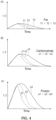
- Figure 4 shows temporal changes of BI for nutrients ingested by a human.
- the vertical axis in Figure 4 is the reciprocal of bioimpedance Z (1/Z), where the bioimpedance Z is BI, and the horizontal axis is time.
- Figure 4 (A) shows temporal changes in BI resulting from the ingestion of fat, where the amounts of ingested fat increase in the order of the dash-dot line f1, the dashed line f2, and the solid line f3.
- Figure 4 (B) shows temporal changes in BI resulting from the ingestion of carbohydrate, where the amounts of ingested fat increase in the order of the dash-dot line c1, the dashed line c2, and the solid line c3.
- Figure 4 (C) shows temporal changes in BI resulting from the ingestion of protein, where the amounts of ingested fat increase in the order of the dash-dot line p1, the dashed line p2, and the solid line p
- the peak height of 1/Z is the lowest for fat, and increases in the order of carbohydrate, and protein. Additionally, for all of fat, carbohydrate, and protein, the larger the amount of ingestion, the longer the time until 1/Z returns to the pre-ingestion level. Time until 1/Z returns to the level before the ingestion of a nutrient is referred to as the temporal change width in the description below.
- the reference PFC information includes the maximum amount of change in BI (the maximum value of 1/Z) for each nutrient resulting from a human ingesting protein, fat, and carbohydrate.
- the PFC determination unit 50 of the embodiment compares the maximum amount of change in actual measured BI with the maximum amount of change for protein, fat, or carbohydrate indicated by the reference PFC information, and thereby determines that a nutrient ingested by a person to be measured is protein, fat, or carbohydrate.
- the PFC determination unit 50 of the embodiment determines a nutrient ingested by a person to be measured based on 1/Z, where the maximum amount of change in BI for each nutrient is the maximum value of 1/Z, but this is not the only way, and the PFC determination unit 50 may determine a nutrient ingested by a person to be measured based on the minimum value of Z for each nutrient.
- the PFC determination unit 50 may therefore determine a nutrient ingested by a person to be measured based on the slope of the temporal change in 1/Z or Z.
- the reference PFC information further includes a relation between the amount of an ingested nutrient, which is protein, fat, or carbohydrate, and time until BI returns to the level before the ingestion of the nutrient (hereinafter referred to as the "temporal change width").
- the temporal change width has different values according to the amount of ingestion of each nutrient as shown in Figure 4 . That is, the larger the amount of an ingested nutrient, the larger the temporal change width.
- the PFC determination unit 50 therefore determines the amount of a nutrient ingested by a person to be measured based on the temporal change width until actual measured BI returns to the level before the ingestion of the nutrient and on the first reference information. Specifically, the PFC determination unit 50 of the embodiment determines the temporal change width from when the actual measured BI starts changing until it returns to its original level. The PFC determination unit 50 then, after identifying a nutrient ingested by the person to be measured, compares the temporal change width for each amount of the ingested nutrient indicated by the reference PFC information with the temporal change width of actual measured BI to determine the amount of the ingested nutrient.
- the temporal change width for each amount of an ingested nutrient included in the reference PFC information and the temporal change width of actual measured BI are, for example, the full width at half maximum.
- the PFC determination unit 50 can identify a nutrient ingested by a person to be measured from the peak height of actual measured BI, and can quantitatively determine the amount of a nutrient ingested by a person to be measured from the temporal change width of actual measured BI.
- the PFC determination unit 50 may indicate to the person to be measured via the monitor 24 or the like that the nutrient has been ingested too much.
- the predetermined amount mentioned here may be, for example, a reference value determined in advance, or an average value over the past few days multiplied by a predetermined factor.
- the reference PFC information may include the maximum amount of change in BI and the temporal change width for each amount of ingestion for when protein, fat, and carbohydrate are mixed in predetermined proportions.
- the reference PFC information may include the maximum amount of change in BI and the temporal change width for each amount of ingestion for when 50% protein and 50% fat are mixed and ingested, when 50% protein, 25% fat, and 25% carbohydrate are mixed and ingested, or the like. This allows for identifying a nutrient ingested by a person to be measured even when a plurality of nutrients are ingested at the same time.
- the reference PFC information described above is generated from, for example, actual measured values resulting from a plurality of adults ingesting nutrients, this is not the only way, and it may be generated from actual measured values of a person to be measured concerned. That is, the reference PFC information may be generated by acquiring a temporal change in BI within a predetermined period of time after a person to be measured ingests protein, fat, or carbohydrate. A component ingested by a person to be measured can be more accurately identified through generating in advance the reference PFC information according to the person to be measured.
- the person to be measured is given a protein-prescribed diet (prescribed supplement) to ingest.
- the temporal change in BI is then recorded from the ingestion for a predetermined period of time, so that the reference change for 100% protein of the person to be measured is acquired.
- the person to be measured is given a carbohydrate-prescribed diet and a fat-prescribed diet to ingest, so that the reference change for 100% carbohydrate and the reference change for 100% fat of the person to be measured are acquired, and these are set as the reference PFC information according to the person to be measured.
- a balanced mixed diet that is a mixture of 50% protein and 50% fat may also be given to a person to be measured to ingest as a prescribed diet to acquire the temporal change in BI.
- the reference PFC information may include a temporal change in body temperature for each ingested component resulting from a human ingesting protein, fat, and carbohydrate.
- the reference PFC information in this mode includes, for example, the maximum amount of change and the temporal change width of body temperature elevation for when protein, fat, and carbohydrate are ingested. Note that the maximum amount of change in body temperature elevation increases in the order of carbohydrate, fat, and protein.
- the PFC determination unit 50 determines that a nutrient ingested by a person to be measured is one of protein, fat, and carbohydrate based on a combination of actual measured body temperature and actual measured BI and on the reference PFC information. For example, the PFC determination unit 50 compares an average value of the rate of change of actual measured body temperature and rate of change of actual measured BI (1/Z) with an average value of the rate of change of body temperature for each nutrient and rate of change of BI (1/Z) included in the reference PFC information, and identifies a nutrient ingested by the person to be measured. This allows for more accurately identifying a component ingested by a person to be measured. An average value of the temporal change width of actual measured body temperature and temporal change width of actual measured BI may also be used to identify the amount of a nutrient ingested by a person to be measured.
- the determination of the PFC determination unit 50 with consideration for a temporal change in body temperature allows for separately determining a state of dehydration of a person to be measured and the ingestion of a nutrient. If a person to be measured is dehydrated, body temperature increases first and is followed by BI, but the ingestion of water causes body temperature and BI to decrease together, as described later. On the other hand, if body temperature decreases as BI increases, it can be determined that the person to be measured is not dehydrated and has ingested a nutrient. This allows for raising the accuracy of determining the ingestion of a component by a person to be measured.
- the physical condition determination unit 52 determines a physical condition of a person to be measured based on a relation between a temporal change in actual measured body temperature acquired by the body temperature acquisition unit 32 and a temporal change in the electric resistance and on the reference change information.
- the reference change information used by the physical condition determination unit 52 comprises the reference dehydration information and the reference excessive salt information.
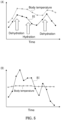
- Figure 5 shows temporal changes of BI and body temperature according to physical conditions of a human.
- Figure 5 (A) is for a dehydrated human
- Figure 5 (B) is for a human with excessive salt.
- the reference dehydration information indicates that body temperature increases before BI increases and the ingestion of water causes body temperature and BI to decrease together.
- the physical condition determination unit 52 compares a combination of actual measured BI and actual measured body temperature with the reference dehydration information, and if they match each other, the physical condition determination unit 52 can determine that the person to be measured is dehydrated. In other words, if actual measured body temperature increases before actual measured BI increases and then actual measured body temperature decreases together with actual measured BI, the person to be measured is determined to be dehydrated.
- the reference excessive salt information indicates that there is no temporal change in body temperature while BI increases and then decreases.
- a human ingesting too much salt results in a phenomena where BI increases first due to absorption of salt (Na) and then decreases because a change in osmotic pressure causes water to be drawn in. Accordingly, excessive salt intake results in a temporal change in BI as shown in Figure 5 (B) .
- Excessive salt does not affect body temperature, and therefore body temperature remains constant.
- the physical condition determination unit 52 therefore compares a combination of actual measured BI and actual measured body temperature with the reference excessive salt information, and if they match each other, the physical condition determination unit 52 can identify the person to be measured as having edema due to excessive salt intake. In other words, if there is no temporal change in actual measured body temperature while actual measured BI increases and then decreases, the person to be measured is determined to have ingested too much salt.
- Figure 6 is a flowchart showing a flow of an analysis process performed by the analysis device 10. The analysis process is started when the power switch 26 is turned on after the analysis device 10 is worn by a person to be measured.
- step S100 calculation of actual measured BI and acquisition of actual measured body temperature of the person to be measured are started.
- the determination unit 34 determines whether the actual measured BI has a variation equal to or greater than a predetermined value or not, and the process proceeds to a step S104 if the determination is affirmative.
- a variation equal to or greater than the predetermined value means a significant variation equal to or greater than a measurement error, and the predetermined value is determined in advance. If the determination is negative on the other hand, the calculation of actual measured BI and acquisition of actual measured body temperature of the person to be measured are repeatedly continued.
- the PFC determination unit 50 performs a PFC determination process to identify a nutrient ingested by the person to be measured, and the physical condition determination unit 52 performs a physical condition determination process to determine the physical condition of the person to be measured.
- the determination result to be obtained is one of an identification of a nutrient ingested by the person to be measured made by the PFC determination process, a determination that the person to be measured is dehydrated, and a determination that the person to be measured has ingested too much salt. That is, there is no such determination result that, for example, a nutrient ingested by a person to be measured is identified and at the same time the person to be measured is dehydrated.
- the PFC determination unit 50 may perform the PFC determination process when temporal changes in actual measured body temperature and actual measured BI of a person to be measured match each other, and the physical condition determination unit 52 may perform the physical condition determination process when temporal changes in actual measured body temperature and actual measured BI of a person to be measured do not match each other.
- the determination result obtained by the PFC determination process or the physical condition determination process is stored in the storage 38.
- the monitor controller 36 causes the monitor 24 to output (display) the determination result.
- the determination result may be output (sent) via the communications unit 40 to another information processing device.
- the calculation of actual measured BI and the acquisition of actual measured body temperature are continued while the steps from S104 to S108 are being performed, and the analysis process is continued until the analysis device 10 is powered off.
- a second embodiment of the embodiment will be described below. Based on variations over one day or more in body composition of a person to be measured, the analysis device 10 of the embodiment corrects the amount of an ingested nutrient determined from diurnal and chronological changes in BI.
- FIG. 7 is a schematic configuration diagram of an analysis system 70 of the embodiment.
- the analysis system 70 comprises the analysis device 10 and a body composition analyzer 80.
- the body composition analyzer 80 shown in Figure 7 comprises electrode-equipped handgrips 82R and 82L, sole electrodes 84R and 84L, and a scale.
- the body composition analyzer 80 measures a difference in potential that occurs in a current path through the handgrips 82R and 82L and the sole electrodes 84R and 84L, thereby calculates the bioimpedance (BI) of the whole body and each body part of a person to be measured, and calculates a body composition value based on the BI and weight of the person to be measured.
- BI bioimpedance
- body composition value calculated by the body composition analyzer 80 is fat percentage, fat mass, fat-free mass, muscle mass, visceral fat mass, visceral fat level, visceral fat area, subcutaneous fat mass, basal metabolic expenditure, bone mass, body water percentage, BMI, intracellular fluid volume, extracellular fluid volume, or the like.
- a person to be measured of the embodiment uses the body composition analyzer 80 to acquire the person's own body composition value one or more times per day.
- the body composition value acquired by the body composition analyzer 80 is sent to the analysis device 10 by means of a communications function.
- the body composition analyzer 80 may be configured not to have the handgrips 82R and 82L but to comprise the sole electrodes 84R and 84L and the scale.
- the body composition analyzer 80 may also calculate a body composition value based on a difference in potential that occurs in a current path through the electrode units 20 provided on the analysis device 10 worn by a person to be measured and the electrodes provided on the body composition analyzer 80.
- a body composition value acquired by the body composition analyzer 80 may also be input to the analysis device 10 by a person to be measured in cases such as when the analysis device 10 and the body composition analyzer 80 cannot send and receive information through communication.
- a person to be measured may wear two or more analysis devices 10 as the analysis system 70, and a body composition value may be calculated based on a difference in potential that occurs in a current path through the electrode units 20 that the two or more analysis devices 10 has and on a separately-measured weight of the person to be measured.
- Figure 8 is a function block diagram relating to analysis functions that the analysis device 10 of the embodiment has. Note that the same components in Figure 8 as in Figure 2 are designated by the same symbols as in Figure 2 , and their descriptions are omitted.
- the determination unit 34 of the embodiment has an ingested amount correction unit 54.
- the ingested amount correction unit 54 corrects the amount of an ingested component (nutrient) determined by the PFC determination unit 50 based on variations over one day or more in body composition of the person to be measured (hereinafter referred to as the "ingested component correction function").
- Continuous contact BI in Figure 9 is the amount of fat ingested by a person to be measured determined from diurnal and chronological changes in BI obtained by the analysis device 10.
- Body composition BI is the amount of fat of a person to be measured calculated from BI obtained by the body composition analyzer 80. In other words, body composition BI is the daily amount of fat of a person to be measured.
- the ingested amount correction unit 54 corrects the daily amount of fat ingested by a person to be measured using, for example, below-described Equation (1) and based on the amount of change in fat over days of the person to be measured.
- the amount of change in fat over days of a person to be measured, ⁇ FATkg is shown for four days in Figure 9 and Equation (1), but this is just an example, and the amount of fat ingested by a person to be measured just needs to be corrected based on the amount of change in fat ⁇ FATkg over one day or more.
- ⁇ FATkg FATkg 4 ⁇ FATkg 0 a * fat 1 + fat 2 + fat 3 + fat 4
- the ingested amount correction unit 54 corrects the amount of ingested fat, fat(n), so that the amount of change in fat, ⁇ FATkg, matches the total of the amount of ingested fat, fat(n).
- the method of correction is, for example, to equally increase or decrease each of the daily amount of ingested fat, fat(n), so that the amount of change in fat, ⁇ FATkg, matches the total of the amount of ingested fat, fat(n).
- Fat ingested by a person to be measured does not entirely and continually accumulate in the person to be measured. Ingested fat is consumed in daily activities of the person to be measured. Therefore, a term indicating the amount of daily activities of a person to be measured may be added to the right side of Equation (1). This takes the amount of fat consumed in activities into consideration for the amount of fat ingested by a person to be measured, and thus allows for correction with higher accuracy. Incidentally, for example, a value calculated by an activity monitor worn by a person to be measured is used as the amount of activity.
- the ingested amount correction unit 54 may correct the amount of protein or carbohydrate ingested by a person to be measured using a body composition value that has a correlation with the amount of protein or carbohydrate ingested.
- the analysis device 10 of the embodiment derives advice to maintain health for a person to be measured according to a determination result obtained by the determination unit 34.
- Figure 10 is a function block diagram relating to analysis functions that the analysis device 10 of the embodiment has.
- the analysis device 10 of the embodiment has an advice derivation unit 60.
- the advice derivation unit 60 derives advice to maintain health for a person to be measured according to a determination result obtained by the determination unit 34.
- Advice to be derived is, for example, prepared in patterns according to determination results, and the patterns are stored in the storage 38. Derived advice is, for example, displayed on the monitor 24 or output as sound from a speaker (not shown), and is thus presented to the person to be measured.
- the advice derivation unit 60 presents the person to be measured with advice to ingest potassium (K). This is aimed at promoting the excretion of sodium (Na) from the person to be measured before the person's blood pressure rises due to the excessive salt.
- Specific names of food including much potassium may also be presented.
- Such food items include, for example, spinach and lettuces as vegetables, bananas and apples as fruits, and avocados and wakame as other food items.
- Predetermined supplements, electrolyte drinks, or the like may also be presented as food items.
- the advice derivation unit 60 may present advice to ingest a beverage with a diuretic effect.
- Beverages with diuretic effects include, for example, coffee and oolong tea. This is not the only way, and there may also be presentation of advice to promote excreting sodium along with sweat through exercise or bathing. This advice should also be presented with advice to hydrate.
- the advice derivation unit 60 presents the person to be measured with advice to ingest high-fiber food and beverages in order to suppress the absorption of carbohydrate.
- High-fiber food includes, for example, vegetables, fruits, seaweed, and beans.
- High-fiber beverages include, for example, functional tea containing indigestible dextrin.
- the advice derivation unit 60 may also present a person to be measured with advice to do light exercise within a predetermined period of time (e.g., a few minutes to 60 minutes) from the ingestion of carbohydrate. This aims to cause skeletal muscles to take up sugar before elevation of blood sugar level or insulin secretion caused by absorbed carbohydrate and thereby prevent excessive insulin secretion due to a rapid increase in blood sugar level.
- a predetermined period of time e.g., a few minutes to 60 minutes
- This aims to cause skeletal muscles to take up sugar before elevation of blood sugar level or insulin secretion caused by absorbed carbohydrate and thereby prevent excessive insulin secretion due to a rapid increase in blood sugar level.
- specific examples such as rotating arms and legs, marching in place, and stretching may be presented as the light exercise.
- the advice derivation unit 60 may also derive advice based on variations in BI, variations in weight, and variations in body composition over a few days, and the like.
- the advice derivation unit 60 selects and presents a nutrient that should be ingested according to the physique or body composition of a person to be measured.
- nutrients that should be ingested include, for example, protein according to the muscle mass of the person to be measured, and fat-burning components according to the body fat ratio of the person to be measured.
- the advice derivation unit 60 may also present an exercise menu according to the physique or body composition of a person to be measured.
- Such exercise menus include, for example, an aerobic exercise menu according to the body fat ratio or visceral fat of the person to be measured, and a strength training menu according to a determination of the muscle mass score or SMI (skeletal muscle mass index) of the person to be measured.
- SMI skeletal muscle mass index
- a fourth embodiment of the embodiment will be described below. While a component (nutrient, salt, or the like) ingested by a person to be measured is determined in the above-described embodiments, the analysis device 10 of the embodiment determines whether a person to be measured has ingested a predetermined specific component (hereinafter referred to as a "specified component") or not.
- a predetermined specific component hereinafter referred to as a "specified component”
- a specified component to be determined in the analysis device 10 of the embodiment is set by a person to be measured or the like.
- a specified component to be set is, for example, one of protein, fat, carbohydrate, and salt that can be determined.
- the determination unit 34 determines whether the person to be measured has ingested the set specified component or not.
- the determination unit 34 of the embodiment may also determine the status of injection of a set specified component (e.g., comparison with the previous day). It may also determine whether a person to be measured has excessively ingested a specified component concerned or not according to the status of ingestion. The determination of whether there has been an excessive ingestion or not is made by determining whether the amount of the ingested specified component is equal to or greater than a predetermined amount or not.
- the predetermined amount mentioned here may be, for example, a predetermined reference value or an average value over the past few days multiplied by a predetermined factor.
- the analysis device 10 may be provided with a meal start button.
- a person to be measured wearing the analysis device 10 pushes the meal start button when starting a meal.
- This causes the analysis device 10 to measure the BI of the person to be measured for a predetermined period of time (e.g., an hour) after the push of the meal start button, and determine an ingested nutrient.
- an information processing device 100 such as a smartphone that a person to be measured has may have the BI calculation unit 30, the body temperature acquisition unit 32, the determination unit 34, the monitor controller 36, the storage 38, the communications unit 40, and the like.
- the information processing device 100 receives actual measured body temperature and voltages detected by the voltage electrodes 20B from the analysis device 10, and determines a component ingested by the person to be measured.
- the analysis device 10 does not have to have the monitor 24 in this mode.
- the information processing device 100 may also be a server, and in this mode, a result of determination of the server on a component ingested by a person to be measured is stored in the server.
- the person to be measured then causes a smartphone or the like to display the determination result stored in the server to confirm the determination result.
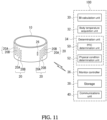
- the analysis device 10 may also have three or more electrode units 20 as shown in Figure 11 (the analysis device 10 has four electrode units 20 in the example in Figure 11 ).
- the physical condition determination unit 52 determines a change in salt and water of a person to be measured, it uses BI calculated from a difference in potential between electrode units 20 the distance between which is the shortest. This is because lymph and capillaries flowing closer to the surface of a human body are more susceptible to a change in salt.
- the PFC determination unit 50 determines a nutrient ingested by a person to be measure, it uses BI calculated from a difference in potential between electrode units 20 that are positioned farther apart than the electrode units 20 used by the physical condition determination unit 52. This is because a change in temperature caused by nutrient intake occurs more easily in deeper parts of a human body.
Landscapes
- Health & Medical Sciences (AREA)
- Life Sciences & Earth Sciences (AREA)
- Medical Informatics (AREA)
- Public Health (AREA)
- Engineering & Computer Science (AREA)
- General Health & Medical Sciences (AREA)
- Biomedical Technology (AREA)
- Pathology (AREA)
- Biophysics (AREA)
- Molecular Biology (AREA)
- Surgery (AREA)
- Animal Behavior & Ethology (AREA)
- Physics & Mathematics (AREA)
- Veterinary Medicine (AREA)
- Heart & Thoracic Surgery (AREA)
- Radiology & Medical Imaging (AREA)
- Nuclear Medicine, Radiotherapy & Molecular Imaging (AREA)
- Dermatology (AREA)
- Epidemiology (AREA)
- Primary Health Care (AREA)
- Nutrition Science (AREA)
- Databases & Information Systems (AREA)
- Data Mining & Analysis (AREA)
- Measuring And Recording Apparatus For Diagnosis (AREA)
- Measurement And Recording Of Electrical Phenomena And Electrical Characteristics Of The Living Body (AREA)
- Investigating Or Analysing Biological Materials (AREA)
Abstract
Description
- This application claims the benefit of
Japanese Patent Application No. 2022-026849 filed on February 24, 2022 - The present disclosure relates to an analysis device, an analysis method, and an analysis program.
- One way to know nutrients, minerals, or water ingested by a person during a meal, hydration, and the like is by determining components included in the ingesta from diet records and diet image records and calculating nutrition.
- The conventional method mentioned above would require time and effort to create diet records or image records, and might yield results that do not align with reality since the ingesta are not actually measured. Even if the contents of a meal are recorded accurately in detail, the substances in the record may not be nutrients actually included in the meal. Besides, whether the nutrients included in the meal have been actually absorbed by the human body or not cannot be known.
- Meanwhile, Patent document 1 (
Japanese Patent Laid-Open Application No. 2000-23936 Patent document 1 converts an impedance value to a circulatory condition index based on the pattern of the diurnal variation in the impedance. - As in
Patent document 1, the physical condition of a person to be measured can be identified more directly by using the impedance of the person to be measured. What is determined inPatent document 1, however, is the circulatory condition of a person to be measured, and is not a component ingested by a person to be measured. - A purpose of the disclosure made in view of the above is to provide an analysis device, an analysis method, and an analysis program that are able to more accurately identify components ingested by a person to be measured.
- An analysis device of an aspect of the disclosure comprises: calculation means for calculating electric resistance of a person to be measured based on a measurement result obtained by using a plurality of electrode units being in contact with the person to be measured; and determination means for determining a component ingested by the person to be measured based on reference information indicating a temporal change in the electric resistance according to a component ingested by a human and on a temporal change in the electric resistance calculated by the calculation means.
- With this configuration, a component ingested by a person to be measured is determined by using a phenomenon of the electric resistance of a person to be measured changing in accordance with a component ingested by the person to be measured. This configuration thus allows an ingested component to be identified more accurately without a person to be measured recording the contents of a meal.
- An analysis device of an aspect of the disclosure comprises: calculation means for calculating electric resistance of a person to be measured based on a measurement result obtained by using a plurality of electrode units being in contact with the person to be measured; and determination means for determining whether the person to be measured has ingested a specified component or not based on reference information indicating a temporal change in the electric resistance according to a component ingested by a human and on a temporal change in the electric resistance calculated by the calculation means. This configuration allows a person to be measured to recognize whether the person has ingested a specified component or not.
- In the analysis device described above, the reference information may be first reference information that indicates a temporal change in the electric resistance for each component resulting from a human ingesting the component, which is protein, fat, or carbohydrate, and the determination means may determine the component ingested by the person to be measured based on a temporal change in the electric resistance calculated by the calculation means and on a temporal change for each component indicated by the first reference information. This configuration allows for identifying which of protein, fat, or carbohydrate a person to be measured has ingested as a nutrient.
- In the analysis device described above, the first reference information may include a relation between an amount of the ingested component, which is protein, fat, or carbohydrate, and time until the electric resistance returns to a level before ingestion of the component, and the determination means may determine an amount of the component ingested by the person to be measured based on time until the electric resistance calculated by the calculation means returns to a level before ingestion of the component and on the first reference information. This configuration allows for qualitatively determining the amount of nutrients ingested by a person to be measured.
- The analysis device described above may have correction means for correcting an amount of the component determined by the determination means based on variations over one day or more in body composition of the person to be measured. This configuration allows for more accurately identifying a component ingested by a person to be measured.
- In the analysis device described above, the first reference information may be generated by acquiring a temporal change in the electric resistance within a predetermined period of time after the person to be measured ingests protein, fat, or carbohydrate. This configuration allows for more accurately identifying a component ingested by a person to be measured through generating the first reference information according to the person to be measured.
- The analysis device described above may have body temperature acquisition means for acquiring body temperature of the person to be measured, where the first reference information may include a temporal change in the body temperature for each component resulting from a human ingesting protein, fat, or carbohydrate, and where the determination means may determine the component ingested by the person to be measured based on a combination of the body temperature acquired by the body temperature acquisition means and the electric resistance calculated by the calculation means and on the first reference information. This configuration allows for more accurately identifying a component ingested by a person to be measured.
- The analysis device described above may have body temperature acquisition means for acquiring body temperature of the person to be measured, where the determination means may determine a physical condition of the person to be measured based on a relation between a temporal change in the body temperature acquired by the body temperature acquisition means and a temporal change in the electric resistance calculated by the calculation means and on the reference information. This configuration allows for easily identifying a change in the physical condition of a person to be measured.
- In the analysis device described above, the reference information may be second reference information indicating that the body temperature increases before the electric resistance increases and that ingestion of water causes the body temperature to decrease along with the electric resistance. This configuration allows for identifying a person to be measured as being dehydrated.
- In the analysis device described above, the reference information may be third reference information indicating that there is no temporal change in the body temperature while the electric resistance increases and then decreases. This configuration allows for identifying a person to be measured as having edema due to excessive salt intake.
- The analysis device described above may have advice derivation means for deriving advice to maintain health for the person to be measured according to a determination result obtained by the determination means. This configuration allows for presenting an appropriate advice according to a component ingested by a person to be measured.
- In the analysis device described above, the electrode units may be made to be wearable on the person to be measured. This configuration allows for identifying a component ingested by a person to be measured regardless of where the person eats.
- An analysis method of an aspect of the disclosure has: a first process for calculating electric resistance of a person to be measured based on a measurement result obtained by using a plurality of electrode units being in contact with the person to be measured; and a second process for determining a component ingested by the person to be measured based on reference information indicating a temporal change in the electric resistance according to a component ingested by a human and on a temporal change in the electric resistance calculated by the first process.
- An analysis program of an aspect of the disclosure causes a computer to function as: calculation means for calculating electric resistance of a person to be measured based on a measurement result obtained by using a plurality of electrode units being in contact with the person to be measured; and determination means for determining a component ingested by the person to be measured based on reference information indicating a temporal change in the electric resistance according to a component ingested by a human and on a temporal change in the electric resistance calculated by the calculation means.
- An analysis method of an aspect of the disclosure has: a first process for calculating electric resistance of a person to be measured based on a measurement result obtained by using a plurality of electrode units being in contact with the person to be measured; and a second process for determining whether the person to be measured has ingested a specified component or not based on reference information indicating a temporal change in the electric resistance according to a component ingested by a human and on a temporal change in the electric resistance calculated by the first process.
- An analysis program of an aspect of the disclosure causes a computer to function as: calculation means for calculating electric resistance of a person to be measured based on a measurement result obtained by using a plurality of electrode units being in contact with the person to be measured; and determination means for determining whether the person to be measured has ingested a specified component or not based on reference information indicating a temporal change in the electric resistance according to a component ingested by a human and on a temporal change in the electric resistance calculated by the calculation means.
- The disclosure allows for more accurately identifying a component ingested by a person to be measured.
-
-
Figure 1 is a schematic configuration diagram of an analysis device of a first embodiment; -
Figure 2 is a function block diagram of the analysis device of the first embodiment; -
Figure 3 shows a relation between BI and body temperature; -
Figure 4 shows temporal changes of BI for nutrients ingested by a human, where (A) is for fat, (B) is for carbohydrate, and (C) is for protein; -
Figure 5 shows temporal changes of BI and body temperature according to physical conditions of a human, where (A) is for a dehydrated human, and (B) is for a human with excessive salt; -
Figure 6 is a flowchart showing a flow of an analysis process of the first embodiment; -
Figure 7 is a schematic configuration diagram of an analysis system of a second embodiment; -
Figure 8 is a function block diagram relating to analysis functions of the second embodiment; -
Figure 9 is a schematic diagram relating to an ingested component correction function of the second embodiment; -
Figure 10 is a function block diagram relating to analysis functions of a third embodiment; and -
Figure 11 is a schematic configuration diagram of an analysis device of another embodiment. - Embodiments of the disclosure will now be described with reference to the drawings. The embodiments described below are merely illustrative of ways to implement the disclosure, and do not limit the disclosure to the specific configurations described below. When the disclosure is to be implemented, any specific configuration may be appropriately adopted according to the mode of implementation.
-
Figure 1 is a schematic configuration diagram of ananalysis device 10 of the embodiment. - The
analysis device 10 of the embodiment is made to be wearable on a person to be measured and is shaped like, for example, a band. Theanalysis device 10 is, for example, a wristband that is worn on a wrist, but is not limited to this and may be worn on an ancle. Theanalysis device 10 may also be shaped like, for example, a plane instead of a band, which may be sticked on the chest, the abdomen, or the like by means of an adhesive. - The
analysis device 10 is provided with two ormore electrode units 20 and a bodytemperature measuring unit 22 on the inside so that they are in contact with the arm of a person to be measured, and with amonitor 24 and apower switch 26 on the outside. Note that theanalysis device 10 does not have to have the bodytemperature measuring unit 22. In such a mode, a bodytemperature acquisition unit 32 described later acquires the body temperature of a person to be measured from another device. - Each
electrode unit 20 comprises acurrent electrode 20A and avoltage electrode 20B. Theanalysis device 10 applies electric current to thecurrent electrodes 20A, and uses thevoltage electrodes 20B to measure the potential difference occurring across the current path between theelectrode units 20 being in contact with a person to be measured. Based on the potential difference, theanalysis device 10 calculates the electric resistance of the person to be measured as bioimpedance (hereinafter referred to as "BI"), and based on the BI, determines an ingested component, which is a component ingested by the person to be measured. - While the
current electrodes 20A and thevoltage electrodes 20B are vertically long in the example inFigure 1 , they are not limited to this and may have a horizontally long shape which lengthens in the circumferential direction of theanalysis device 10. - The
monitor 24 is, for example, a touch-panel display, through which a person to be measured performs an input operation on theanalysis device 10 and a result of determining an ingested component is output. Thepower switch 26 accepts power-on and power-off operations of theanalysis device 10. -
Figure 2 is a function block diagram of theanalysis device 10 of the embodiment. Theanalysis device 10 comprises aBI calculation unit 30, the bodytemperature acquisition unit 32, adetermination unit 34, amonitor controller 36, astorage 38, and acommunications unit 40. Each function performed by theBI calculation unit 30, the bodytemperature acquisition unit 32, and thedetermination unit 34 shown inFigure 2 may, for example, be performed by an arithmetic unit provided on theanalysis device 10 through activation of a program, or be realized by an ASIC (Application Specific Integrated Circuit) or other individual hardware components. - The
BI calculation unit 30 calculates the BI of a person to be measured based on a measurement result obtained by using theelectrode units 20 being in contact with the person to be measured (hereinafter referred to as "actual measured BI"). - The body
temperature acquisition unit 32 acquires the body temperature of a person to be measured from the bodytemperature measuring unit 22 as actual measured body temperature. - The
determination unit 34 determines a component ingested by a person to be measured from diurnal and chronological changes in actual measured BI calculated by theBI calculation unit 30. Specifically, thedetermination unit 34 determines an ingested component, which is a component ingested by a person to be measured, based on a temporal change in actual measured BI and on reference change information. That is, as described later in detail, thedetermination unit 34 determines a component ingested by a person to be measured using a phenomenon of the BI of a person to be measured changing in accordance with a component ingested by the person to be measured. - The reference change information indicates a temporal change in BI according to a component ingested by a human, and is stored in the storage 42 in advance. As described later in detail, the reference change information of the embodiment includes reference PFC information, reference dehydration information, and reference excessive salt information.
- The
monitor controller 36 controls themonitor 24 so as to display a determination result obtained by thedetermination unit 34. - The
storage 38 is, for example, a non-volatile memory, and contains various data, a program used for analysis processing, and the like. The various data includes the reference change information, a result of determination on an ingested component, and the like. - The
communications unit 40 sends and receives data to and from a portable terminal device such as a smartphone owned by a person to be measured or another information processing device such as a server. - The
determination unit 34 comprises aPFC determination unit 50 and a physicalcondition determination unit 52. - The
PFC determination unit 50 uses the reference PFC information as the reference change information. The reference PFC information indicates a temporal change in BI for each ingested component resulting from a human ingesting protein (P), fat (F), and carbohydrate (C) which are ingested components. Protein, fat, and carbohydrate are also collectively referred to as nutrients in the description below. - Incidentally, diet-induced thermogenesis (DIT) is known to detect a change in body temperature before and after eating and thereby determine the degree of thermal productivity resulting from dietary intake, and digestion and absorption. Specifically, a higher-protein meal causes a larger increase in body temperature after eating, and a higher-carbohydrate and higher-fat meal causes a smaller increase in body temperature after eating.
- There is a correlation between such a change in body temperature after eating and a change in BI within a short period of time (a temporal change within dozens of minutes to a few hours), and BI falls as body temperature rises as shown in
Figure 3 . Note that the dashed line inFigure 3 is an approximate line. ThePFC determination unit 50 therefore identifies a component ingested by a person to be measured from a temporal change in actual measured BI. - The
PFC determination unit 50 determines that a component ingested by a person to be measured is protein, fat, or carbohydrate based on a temporal change in actual measured BI and on a temporal change for each nutrient indicated by the reference PFC information. This allows for identifying which of protein, fat, and carbohydrate the person to be measured has ingested as a nutrient. -
Figure 4 shows temporal changes of BI for nutrients ingested by a human. The vertical axis inFigure 4 is the reciprocal of bioimpedance Z (1/Z), where the bioimpedance Z is BI, and the horizontal axis is time.Figure 4 (A) shows temporal changes in BI resulting from the ingestion of fat, where the amounts of ingested fat increase in the order of the dash-dot line f1, the dashed line f2, and the solid line f3.Figure 4 (B) shows temporal changes in BI resulting from the ingestion of carbohydrate, where the amounts of ingested fat increase in the order of the dash-dot line c1, the dashed line c2, and the solid line c3.Figure 4 (C) shows temporal changes in BI resulting from the ingestion of protein, where the amounts of ingested fat increase in the order of the dash-dot line p1, the dashed line p2, and the solid line p3. - As shown in
Figure 4 , when a human ingests fat, carbohydrate, and protein, the peak height of 1/Z is the lowest for fat, and increases in the order of carbohydrate, and protein. Additionally, for all of fat, carbohydrate, and protein, the larger the amount of ingestion, the longer the time until 1/Z returns to the pre-ingestion level. Time until 1/Z returns to the level before the ingestion of a nutrient is referred to as the temporal change width in the description below. - As shown in
Figure 4 , the reference PFC information includes the maximum amount of change in BI (the maximum value of 1/Z) for each nutrient resulting from a human ingesting protein, fat, and carbohydrate. ThePFC determination unit 50 of the embodiment compares the maximum amount of change in actual measured BI with the maximum amount of change for protein, fat, or carbohydrate indicated by the reference PFC information, and thereby determines that a nutrient ingested by a person to be measured is protein, fat, or carbohydrate. - As described above, the
PFC determination unit 50 of the embodiment determines a nutrient ingested by a person to be measured based on 1/Z, where the maximum amount of change in BI for each nutrient is the maximum value of 1/Z, but this is not the only way, and thePFC determination unit 50 may determine a nutrient ingested by a person to be measured based on the minimum value of Z for each nutrient. - Additionally, the slope from the ingestion of fat, carbohydrate, and protein until 1/Z becomes the maximum varies as shown in
Figure 4 (A) to (C) . ThePFC determination unit 50 may therefore determine a nutrient ingested by a person to be measured based on the slope of the temporal change in 1/Z or Z. - The reference PFC information further includes a relation between the amount of an ingested nutrient, which is protein, fat, or carbohydrate, and time until BI returns to the level before the ingestion of the nutrient (hereinafter referred to as the "temporal change width"). The temporal change width has different values according to the amount of ingestion of each nutrient as shown in
Figure 4 . That is, the larger the amount of an ingested nutrient, the larger the temporal change width. - The
PFC determination unit 50 therefore determines the amount of a nutrient ingested by a person to be measured based on the temporal change width until actual measured BI returns to the level before the ingestion of the nutrient and on the first reference information. Specifically, thePFC determination unit 50 of the embodiment determines the temporal change width from when the actual measured BI starts changing until it returns to its original level. ThePFC determination unit 50 then, after identifying a nutrient ingested by the person to be measured, compares the temporal change width for each amount of the ingested nutrient indicated by the reference PFC information with the temporal change width of actual measured BI to determine the amount of the ingested nutrient. Incidentally, the temporal change width for each amount of an ingested nutrient included in the reference PFC information and the temporal change width of actual measured BI are, for example, the full width at half maximum. - In this way, the
PFC determination unit 50 can identify a nutrient ingested by a person to be measured from the peak height of actual measured BI, and can quantitatively determine the amount of a nutrient ingested by a person to be measured from the temporal change width of actual measured BI. - When the amount of an identified nutrient is a predetermined level or more, the
PFC determination unit 50 may indicate to the person to be measured via themonitor 24 or the like that the nutrient has been ingested too much. The predetermined amount mentioned here may be, for example, a reference value determined in advance, or an average value over the past few days multiplied by a predetermined factor. - Note that the reference PFC information may include the maximum amount of change in BI and the temporal change width for each amount of ingestion for when protein, fat, and carbohydrate are mixed in predetermined proportions. For example, the reference PFC information may include the maximum amount of change in BI and the temporal change width for each amount of ingestion for when 50% protein and 50% fat are mixed and ingested, when 50% protein, 25% fat, and 25% carbohydrate are mixed and ingested, or the like. This allows for identifying a nutrient ingested by a person to be measured even when a plurality of nutrients are ingested at the same time.
- While the reference PFC information described above is generated from, for example, actual measured values resulting from a plurality of adults ingesting nutrients, this is not the only way, and it may be generated from actual measured values of a person to be measured concerned. That is, the reference PFC information may be generated by acquiring a temporal change in BI within a predetermined period of time after a person to be measured ingests protein, fat, or carbohydrate. A component ingested by a person to be measured can be more accurately identified through generating in advance the reference PFC information according to the person to be measured.
- When the reference PFC information is generated according to a person to be measured, the person to be measured is given a protein-prescribed diet (prescribed supplement) to ingest. The temporal change in BI is then recorded from the ingestion for a predetermined period of time, so that the reference change for 100% protein of the person to be measured is acquired. Likewise, the person to be measured is given a carbohydrate-prescribed diet and a fat-prescribed diet to ingest, so that the reference change for 100% carbohydrate and the reference change for 100% fat of the person to be measured are acquired, and these are set as the reference PFC information according to the person to be measured. A balanced mixed diet that is a mixture of 50% protein and 50% fat may also be given to a person to be measured to ingest as a prescribed diet to acquire the temporal change in BI.
- The reference PFC information may include a temporal change in body temperature for each ingested component resulting from a human ingesting protein, fat, and carbohydrate. The reference PFC information in this mode includes, for example, the maximum amount of change and the temporal change width of body temperature elevation for when protein, fat, and carbohydrate are ingested. Note that the maximum amount of change in body temperature elevation increases in the order of carbohydrate, fat, and protein.
- Given the above, the
PFC determination unit 50 determines that a nutrient ingested by a person to be measured is one of protein, fat, and carbohydrate based on a combination of actual measured body temperature and actual measured BI and on the reference PFC information. For example, thePFC determination unit 50 compares an average value of the rate of change of actual measured body temperature and rate of change of actual measured BI (1/Z) with an average value of the rate of change of body temperature for each nutrient and rate of change of BI (1/Z) included in the reference PFC information, and identifies a nutrient ingested by the person to be measured. This allows for more accurately identifying a component ingested by a person to be measured. An average value of the temporal change width of actual measured body temperature and temporal change width of actual measured BI may also be used to identify the amount of a nutrient ingested by a person to be measured. - Incidentally, the determination of the
PFC determination unit 50 with consideration for a temporal change in body temperature allows for separately determining a state of dehydration of a person to be measured and the ingestion of a nutrient. If a person to be measured is dehydrated, body temperature increases first and is followed by BI, but the ingestion of water causes body temperature and BI to decrease together, as described later. On the other hand, if body temperature decreases as BI increases, it can be determined that the person to be measured is not dehydrated and has ingested a nutrient. This allows for raising the accuracy of determining the ingestion of a component by a person to be measured. - The physical
condition determination unit 52 determines a physical condition of a person to be measured based on a relation between a temporal change in actual measured body temperature acquired by the bodytemperature acquisition unit 32 and a temporal change in the electric resistance and on the reference change information. Note that the reference change information used by the physicalcondition determination unit 52 comprises the reference dehydration information and the reference excessive salt information. -
Figure 5 shows temporal changes of BI and body temperature according to physical conditions of a human.Figure 5 (A) is for a dehydrated human, andFigure 5 (B) is for a human with excessive salt. - As shown in
Figure 5 (A) , the reference dehydration information indicates that body temperature increases before BI increases and the ingestion of water causes body temperature and BI to decrease together. The physicalcondition determination unit 52 compares a combination of actual measured BI and actual measured body temperature with the reference dehydration information, and if they match each other, the physicalcondition determination unit 52 can determine that the person to be measured is dehydrated. In other words, if actual measured body temperature increases before actual measured BI increases and then actual measured body temperature decreases together with actual measured BI, the person to be measured is determined to be dehydrated. - As shown in
Figure 5 (B) , the reference excessive salt information indicates that there is no temporal change in body temperature while BI increases and then decreases. Incidentally, a human ingesting too much salt results in a phenomena where BI increases first due to absorption of salt (Na) and then decreases because a change in osmotic pressure causes water to be drawn in. Accordingly, excessive salt intake results in a temporal change in BI as shown inFigure 5 (B) . Excessive salt, however, does not affect body temperature, and therefore body temperature remains constant. The physicalcondition determination unit 52 therefore compares a combination of actual measured BI and actual measured body temperature with the reference excessive salt information, and if they match each other, the physicalcondition determination unit 52 can identify the person to be measured as having edema due to excessive salt intake. In other words, if there is no temporal change in actual measured body temperature while actual measured BI increases and then decreases, the person to be measured is determined to have ingested too much salt. -
Figure 6 is a flowchart showing a flow of an analysis process performed by theanalysis device 10. The analysis process is started when thepower switch 26 is turned on after theanalysis device 10 is worn by a person to be measured. - First, at a step S100, calculation of actual measured BI and acquisition of actual measured body temperature of the person to be measured are started.
- At the next step S102, the
determination unit 34 determines whether the actual measured BI has a variation equal to or greater than a predetermined value or not, and the process proceeds to a step S104 if the determination is affirmative. A variation equal to or greater than the predetermined value means a significant variation equal to or greater than a measurement error, and the predetermined value is determined in advance. If the determination is negative on the other hand, the calculation of actual measured BI and acquisition of actual measured body temperature of the person to be measured are repeatedly continued. - At the next step S104, based on the actual measured BI and the actual measured body temperature, the
PFC determination unit 50 performs a PFC determination process to identify a nutrient ingested by the person to be measured, and the physicalcondition determination unit 52 performs a physical condition determination process to determine the physical condition of the person to be measured. - Note that the determination result to be obtained is one of an identification of a nutrient ingested by the person to be measured made by the PFC determination process, a determination that the person to be measured is dehydrated, and a determination that the person to be measured has ingested too much salt. That is, there is no such determination result that, for example, a nutrient ingested by a person to be measured is identified and at the same time the person to be measured is dehydrated.
- Additionally, as described above, temporal changes in actual measured body temperature and actual measured BI approximately match each other when a person to be measured ingests a nutrient such as protein, fat, and carbohydrate. On the other hand, when a person to be measured is dehydrated or has ingested too much salt, temporal changes in actual measured body temperature and actual measured BI rarely match each other. Therefore, the
PFC determination unit 50 may perform the PFC determination process when temporal changes in actual measured body temperature and actual measured BI of a person to be measured match each other, and the physicalcondition determination unit 52 may perform the physical condition determination process when temporal changes in actual measured body temperature and actual measured BI of a person to be measured do not match each other. - At the next step S106, the determination result obtained by the PFC determination process or the physical condition determination process is stored in the
storage 38. - At the next step S108, the
monitor controller 36 causes themonitor 24 to output (display) the determination result. The determination result may be output (sent) via thecommunications unit 40 to another information processing device. - Incidentally, the calculation of actual measured BI and the acquisition of actual measured body temperature are continued while the steps from S104 to S108 are being performed, and the analysis process is continued until the
analysis device 10 is powered off. - A second embodiment of the embodiment will be described below. Based on variations over one day or more in body composition of a person to be measured, the
analysis device 10 of the embodiment corrects the amount of an ingested nutrient determined from diurnal and chronological changes in BI. -
Figure 7 is a schematic configuration diagram of ananalysis system 70 of the embodiment. Theanalysis system 70 comprises theanalysis device 10 and abody composition analyzer 80. Thebody composition analyzer 80 shown inFigure 7 comprises electrode-equippedhandgrips sole electrodes body composition analyzer 80 measures a difference in potential that occurs in a current path through thehandgrips sole electrodes body composition analyzer 80 is fat percentage, fat mass, fat-free mass, muscle mass, visceral fat mass, visceral fat level, visceral fat area, subcutaneous fat mass, basal metabolic expenditure, bone mass, body water percentage, BMI, intracellular fluid volume, extracellular fluid volume, or the like. - A person to be measured of the embodiment uses the
body composition analyzer 80 to acquire the person's own body composition value one or more times per day. The body composition value acquired by thebody composition analyzer 80 is sent to theanalysis device 10 by means of a communications function. - Incidentally, the
body composition analyzer 80 may be configured not to have thehandgrips sole electrodes body composition analyzer 80 may also calculate a body composition value based on a difference in potential that occurs in a current path through theelectrode units 20 provided on theanalysis device 10 worn by a person to be measured and the electrodes provided on thebody composition analyzer 80. A body composition value acquired by thebody composition analyzer 80 may also be input to theanalysis device 10 by a person to be measured in cases such as when theanalysis device 10 and thebody composition analyzer 80 cannot send and receive information through communication. - In addition, a person to be measured may wear two or
more analysis devices 10 as theanalysis system 70, and a body composition value may be calculated based on a difference in potential that occurs in a current path through theelectrode units 20 that the two ormore analysis devices 10 has and on a separately-measured weight of the person to be measured. -
Figure 8 is a function block diagram relating to analysis functions that theanalysis device 10 of the embodiment has. Note that the same components inFigure 8 as inFigure 2 are designated by the same symbols as inFigure 2 , and their descriptions are omitted. - The
determination unit 34 of the embodiment has an ingestedamount correction unit 54. The ingestedamount correction unit 54 corrects the amount of an ingested component (nutrient) determined by thePFC determination unit 50 based on variations over one day or more in body composition of the person to be measured (hereinafter referred to as the "ingested component correction function"). - The ingested component correction function performed by the ingested
amount correction unit 54 will be described with reference to a schematic diagram inFigure 9 . Continuous contact BI inFigure 9 is the amount of fat ingested by a person to be measured determined from diurnal and chronological changes in BI obtained by theanalysis device 10. Body composition BI is the amount of fat of a person to be measured calculated from BI obtained by thebody composition analyzer 80. In other words, body composition BI is the daily amount of fat of a person to be measured. - The ingested
amount correction unit 54 corrects the daily amount of fat ingested by a person to be measured using, for example, below-described Equation (1) and based on the amount of change in fat over days of the person to be measured. The amount of change in fat over days of a person to be measured, ΔFATkg, is shown for four days inFigure 9 and Equation (1), but this is just an example, and the amount of fat ingested by a person to be measured just needs to be corrected based on the amount of change in fat ΔFATkg over one day or more.
- As indicated by Equation (1), the amount of change in fat of a person to be measured, ΔFATkg, has a correlation with the amount of ingested fat, fat(n), summed over corresponding days. Therefore, the ingested
amount correction unit 54 corrects the amount of ingested fat, fat(n), so that the amount of change in fat, ΔFATkg, matches the total of the amount of ingested fat, fat(n). Incidentally, the method of correction is, for example, to equally increase or decrease each of the daily amount of ingested fat, fat(n), so that the amount of change in fat, ΔFATkg, matches the total of the amount of ingested fat, fat(n). - Fat ingested by a person to be measured does not entirely and continually accumulate in the person to be measured. Ingested fat is consumed in daily activities of the person to be measured. Therefore, a term indicating the amount of daily activities of a person to be measured may be added to the right side of Equation (1). This takes the amount of fat consumed in activities into consideration for the amount of fat ingested by a person to be measured, and thus allows for correction with higher accuracy. Incidentally, for example, a value calculated by an activity monitor worn by a person to be measured is used as the amount of activity.
- While
Figure 9 and Equation (1) are for when the nutrient is fat, the ingestedamount correction unit 54 may correct the amount of protein or carbohydrate ingested by a person to be measured using a body composition value that has a correlation with the amount of protein or carbohydrate ingested. - A third embodiment of the embodiment will be described below. The
analysis device 10 of the embodiment derives advice to maintain health for a person to be measured according to a determination result obtained by thedetermination unit 34. -
Figure 10 is a function block diagram relating to analysis functions that theanalysis device 10 of the embodiment has. Theanalysis device 10 of the embodiment has anadvice derivation unit 60. - The
advice derivation unit 60 derives advice to maintain health for a person to be measured according to a determination result obtained by thedetermination unit 34. Advice to be derived is, for example, prepared in patterns according to determination results, and the patterns are stored in thestorage 38. Derived advice is, for example, displayed on themonitor 24 or output as sound from a speaker (not shown), and is thus presented to the person to be measured. - Specific examples of the advice to be derived will be described next.
- For example, if the physical
condition determination unit 52 has determined excessive salt, theadvice derivation unit 60 presents the person to be measured with advice to ingest potassium (K). This is aimed at promoting the excretion of sodium (Na) from the person to be measured before the person's blood pressure rises due to the excessive salt. Specific names of food including much potassium may also be presented. Such food items include, for example, spinach and lettuces as vegetables, bananas and apples as fruits, and avocados and wakame as other food items. Predetermined supplements, electrolyte drinks, or the like may also be presented as food items. - There are also cases where BI decreases significantly and the person to be measured continues to have a tendency for swelling even after a predetermined period of time has passed following a determination of excessive salt. In such cases, the
advice derivation unit 60 may present advice to ingest a beverage with a diuretic effect. Beverages with diuretic effects include, for example, coffee and oolong tea. This is not the only way, and there may also be presentation of advice to promote excreting sodium along with sweat through exercise or bathing. This advice should also be presented with advice to hydrate. - For another example, if the
PFC determination unit 50 results in a determination of excessive carbohydrate intake, theadvice derivation unit 60 presents the person to be measured with advice to ingest high-fiber food and beverages in order to suppress the absorption of carbohydrate. High-fiber food includes, for example, vegetables, fruits, seaweed, and beans. High-fiber beverages include, for example, functional tea containing indigestible dextrin. - Moreover, the
advice derivation unit 60 may also present a person to be measured with advice to do light exercise within a predetermined period of time (e.g., a few minutes to 60 minutes) from the ingestion of carbohydrate. This aims to cause skeletal muscles to take up sugar before elevation of blood sugar level or insulin secretion caused by absorbed carbohydrate and thereby prevent excessive insulin secretion due to a rapid increase in blood sugar level. Incidentally, specific examples such as rotating arms and legs, marching in place, and stretching may be presented as the light exercise. - Furthermore, the
advice derivation unit 60 may also derive advice based on variations in BI, variations in weight, and variations in body composition over a few days, and the like. For example, theadvice derivation unit 60 selects and presents a nutrient that should be ingested according to the physique or body composition of a person to be measured. Such nutrients that should be ingested include, for example, protein according to the muscle mass of the person to be measured, and fat-burning components according to the body fat ratio of the person to be measured. For another example, theadvice derivation unit 60 may also present an exercise menu according to the physique or body composition of a person to be measured. Such exercise menus include, for example, an aerobic exercise menu according to the body fat ratio or visceral fat of the person to be measured, and a strength training menu according to a determination of the muscle mass score or SMI (skeletal muscle mass index) of the person to be measured. - A fourth embodiment of the embodiment will be described below. While a component (nutrient, salt, or the like) ingested by a person to be measured is determined in the above-described embodiments, the
analysis device 10 of the embodiment determines whether a person to be measured has ingested a predetermined specific component (hereinafter referred to as a "specified component") or not. - A specified component to be determined in the
analysis device 10 of the embodiment is set by a person to be measured or the like. A specified component to be set is, for example, one of protein, fat, carbohydrate, and salt that can be determined. Thedetermination unit 34 then determines whether the person to be measured has ingested the set specified component or not. - The
determination unit 34 of the embodiment may also determine the status of injection of a set specified component (e.g., comparison with the previous day). It may also determine whether a person to be measured has excessively ingested a specified component concerned or not according to the status of ingestion. The determination of whether there has been an excessive ingestion or not is made by determining whether the amount of the ingested specified component is equal to or greater than a predetermined amount or not. The predetermined amount mentioned here may be, for example, a predetermined reference value or an average value over the past few days multiplied by a predetermined factor. - While the disclosure has been described with reference to the above embodiments, the technical scope of the disclosure is not limited to the scope provided by the embodiments. Various modifications or improvements can be made to the embodiments without departing from the gist of the disclosure, and those added with the modifications or improvements are also included in the technical scope of the disclosure.
- While a description has been made for the above embodiments on a mode in which the
analysis device 10 continually calculates the BI of a person to be measured after thepower switch 26 is turned on, the disclosure is not limited to this. For example, theanalysis device 10 may be provided with a meal start button. In this mode, a person to be measured wearing theanalysis device 10 pushes the meal start button when starting a meal. This causes theanalysis device 10 to measure the BI of the person to be measured for a predetermined period of time (e.g., an hour) after the push of the meal start button, and determine an ingested nutrient. - While a description has been made for the above embodiments on a mode in which the
analysis device 10 determines a component ingested by a person to be measured, the disclosure is not limited to this. For example, as shown inFigure 11 , aninformation processing device 100 such as a smartphone that a person to be measured has may have theBI calculation unit 30, the bodytemperature acquisition unit 32, thedetermination unit 34, themonitor controller 36, thestorage 38, thecommunications unit 40, and the like. In this mode, theinformation processing device 100 receives actual measured body temperature and voltages detected by thevoltage electrodes 20B from theanalysis device 10, and determines a component ingested by the person to be measured. Incidentally, theanalysis device 10 does not have to have themonitor 24 in this mode. - The
information processing device 100 may also be a server, and in this mode, a result of determination of the server on a component ingested by a person to be measured is stored in the server. The person to be measured then causes a smartphone or the like to display the determination result stored in the server to confirm the determination result. - The
analysis device 10 may also have three ormore electrode units 20 as shown inFigure 11 (theanalysis device 10 has fourelectrode units 20 in the example inFigure 11 ). In this mode, for example, when the physicalcondition determination unit 52 determines a change in salt and water of a person to be measured, it uses BI calculated from a difference in potential betweenelectrode units 20 the distance between which is the shortest. This is because lymph and capillaries flowing closer to the surface of a human body are more susceptible to a change in salt. - On the other hand, when the
PFC determination unit 50 determines a nutrient ingested by a person to be measure, it uses BI calculated from a difference in potential betweenelectrode units 20 that are positioned farther apart than theelectrode units 20 used by the physicalcondition determination unit 52. This is because a change in temperature caused by nutrient intake occurs more easily in deeper parts of a human body. -
- 10: Analysis device
- 30: BI calculation unit (Calculation means)
- 32: Body temperature acquisition unit (Body temperature acquisition means)
- 34: Determination unit (Determination means)
- 54: Ingested amount correction unit (Correction means)
- 60: Advice derivation unit (Advice derivation means)
Claims (17)
- An analysis device comprising:calculation means for calculating electric resistance of a person to be measured based on a measurement result obtained by using a plurality of electrode units being in contact with the person to be measured; anddetermination means for determining a component ingested by the person to be measured based on reference information indicating a temporal change in the electric resistance according to a component ingested by a human and on a temporal change in the electric resistance calculated by the calculation means.
- An analysis device comprising:calculation means for calculating electric resistance of a person to be measured based on a measurement result obtained by using a plurality of electrode units being in contact with the person to be measured; anddetermination means for determining whether the person to be measured has ingested a specified component or not based on reference information indicating a temporal change in the electric resistance according to a component ingested by a human and on a temporal change in the electric resistance calculated by the calculation means.
- The analysis device according to claim 1 or 2,wherein the reference information includes a relation between an amount of the ingested component and time until the electric resistance returns to a level before ingestion of the component, andwherein the determination means determines an amount of the component ingested by the person to be measured based on time until the electric resistance calculated by the calculation means returns to a level before ingestion of the component and on the reference information.
- The analysis device according to any one of claims 1 to 3, having
correction means for correcting an amount of the component determined by the determination means based on variations over one day or more in body composition of the person to be measured. - The analysis device according to any one of claims 1 to 4,
wherein the reference information is generated by acquiring a temporal change in the electric resistance within a predetermined period of time after the person to be measured ingests the component. - The analysis device according to any one of claims 1 to 5, having
body temperature acquisition means for acquiring body temperature of the person to be measured,wherein the reference information includes a temporal change in the body temperature for each component resulting from a human ingesting the component, andwherein the determination means determines the component ingested by the person to be measured based on a combination of the body temperature acquired by the body temperature acquisition means and the electric resistance calculated by the calculation means and on the reference information. - The analysis device according to claim 6,
wherein the reference information indicates that the body temperature increases before the electric resistance increases and that ingestion of water causes the body temperature to decrease along with the electric resistance. - The analysis device according to claim 6,
wherein the reference information indicates that there is no temporal change in the body temperature while the electric resistance increases and then decreases. - The analysis device according to any one of claims 1 to 8,
wherein the reference information indicates a temporal change in the electric resistance for each component resulting from a human ingesting the component, which is protein, fat, carbohydrate, or salt, or water while dehydrated. - The analysis device according to any one of claims 1 to 9, having
advice derivation means for deriving advice to maintain health for the person to be measured according to a determination result obtained by the determination means. - The analysis device according to any one of claims 1 to 10,
wherein the electrode units are made to be wearable on the person to be measured. - An analysis method having:a first process for calculating electric resistance of a person to be measured based on a measurement result obtained by using a plurality of electrode units being in contact with the person to be measured; anda second process for determining a component ingested by the person to be measured based on reference information indicating a temporal change in the electric resistance according to a component ingested by a human and on a temporal change in the electric resistance calculated by the first process.
- An analysis program causing a computer to function as:calculation means for calculating electric resistance of a person to be measured based on a measurement result obtained by using a plurality of electrode units being in contact with the person to be measured; anddetermination means for determining a component ingested by the person to be measured based on reference information indicating a temporal change in the electric resistance according to a component ingested by a human and on a temporal change in the electric resistance calculated by the calculation means.
- An analysis method having:a first process for calculating electric resistance of a person to be measured based on a measurement result obtained by using a plurality of electrode units being in contact with the person to be measured; anda second process for determining whether the person to be measured has ingested a specified component or not based on reference information indicating a temporal change in the electric resistance according to a component ingested by a human and on a temporal change in the electric resistance calculated by the first process.
- An analysis program causing a computer to function as:calculation means for calculating electric resistance of a person to be measured based on a measurement result obtained by using a plurality of electrode units being in contact with the person to be measured; anddetermination means for determining whether the person to be measured has ingested a specified component or not based on reference information indicating a temporal change in the electric resistance according to a component ingested by a human and on a temporal change in the electric resistance calculated by the calculation means.
- A computer-readable non-transitory storage medium holding the analysis program according to claim 13.
- A computer-readable non-transitory storage medium holding the analysis program according to claim 15.
Applications Claiming Priority (2)
| Application Number | Priority Date | Filing Date | Title |
|---|---|---|---|
| JP2022026849A JP7872976B2 (en) | 2022-02-24 | 2022-02-24 | Analytical equipment, analytical method, and analytical program |
| PCT/JP2023/006774 WO2023163115A1 (en) | 2022-02-24 | 2023-02-24 | Analysis device, analysis method, analysis program, and computer-readable non-transitory storage medium |
Publications (2)
| Publication Number | Publication Date |
|---|---|
| EP4483798A1 true EP4483798A1 (en) | 2025-01-01 |
| EP4483798A4 EP4483798A4 (en) | 2025-01-22 |
Family
ID=87766068
Family Applications (1)
| Application Number | Title | Priority Date | Filing Date |
|---|---|---|---|
| EP23760113.3A Pending EP4483798A4 (en) | 2022-02-24 | 2023-02-24 | ANALYSIS DEVICE, ANALYSIS METHOD, ANALYSIS PROGRAM, AND COMPUTER-READABLE NON-TRANSITORY STORAGE MEDIUM |
Country Status (5)
| Country | Link |
|---|---|
| US (1) | US20240415403A1 (en) |
| EP (1) | EP4483798A4 (en) |
| JP (1) | JP7872976B2 (en) |
| CN (1) | CN118891002A (en) |
| WO (1) | WO2023163115A1 (en) |
Family Cites Families (5)
| Publication number | Priority date | Publication date | Assignee | Title |
|---|---|---|---|---|
| JP2000023936A (en) | 1998-07-14 | 2000-01-25 | Omron Corp | Health management guideline advice device |
| US20120277619A1 (en) * | 2011-04-29 | 2012-11-01 | Medtronic, Inc. | Detecting food intake based on impedance |
| JP2016508755A (en) * | 2012-12-19 | 2016-03-24 | アクセス ビジネス グループ インターナショナル リミテッド ライアビリティ カンパニー | System and apparatus for estimating caloric energy intake and / or macronutrient composition |
| US11627892B2 (en) * | 2017-09-01 | 2023-04-18 | Happy Health Inc. | System and device for non-invasive drink detection |
| EP3895601A1 (en) * | 2020-04-14 | 2021-10-20 | Stichting IMEC Nederland | System and method for monitoring hydration status of a human body |
-
2022
- 2022-02-24 JP JP2022026849A patent/JP7872976B2/en active Active
-
2023
- 2023-02-24 WO PCT/JP2023/006774 patent/WO2023163115A1/en not_active Ceased
- 2023-02-24 CN CN202380023455.2A patent/CN118891002A/en active Pending
- 2023-02-24 EP EP23760113.3A patent/EP4483798A4/en active Pending
-
2024
- 2024-08-22 US US18/812,172 patent/US20240415403A1/en active Pending
Also Published As
| Publication number | Publication date |
|---|---|
| JP2023123029A (en) | 2023-09-05 |
| EP4483798A4 (en) | 2025-01-22 |
| WO2023163115A1 (en) | 2023-08-31 |
| US20240415403A1 (en) | 2024-12-19 |
| JP7872976B2 (en) | 2026-06-11 |
| CN118891002A (en) | 2024-11-01 |
Similar Documents
| Publication | Publication Date | Title |
|---|---|---|
| US11395603B2 (en) | Hydration monitoring apparatus | |
| US20080224716A1 (en) | Method and System For Determining Freshness and Palatability and Assessing Organ Vitality | |
| US20170193854A1 (en) | Smart wearable device and health monitoring method | |
| Dobrosielski et al. | Body composition values of NCAA Division 1 female athletes derived from dual-energy X-ray absorptiometry | |
| CN112365955A (en) | Body-building plan determination method and device and wearable system | |
| O’Keeffe et al. | Dietary status of trained female cyclists | |
| CN110634543A (en) | Fat-reducing management platform and implementation method thereof | |
| Ekberg et al. | Does the menstrual cycle influence aerobic capacity in endurance-trained women? | |
| CN103543648A (en) | Exerciser control method and system for implementing same | |
| Derksen et al. | Monitoring potentially modifiable lifestyle factors in cancer survivors: a narrative review on currently available methodologies and innovations for large-scale surveillance | |
| Boughman et al. | Assessing the validity of bioelectrical impedance and skinfold calipers for measuring body composition in NOLS backcountry hikers | |
| US20190313951A1 (en) | Organism analyzing apparatus and organism analyzing method | |
| US8808146B2 (en) | Activity meter | |
| Joaquim et al. | Do paralympic track and field athletes have low energy availability? | |
| US20240415403A1 (en) | Analysis device, analysis method, analysis program, and computer-readable non-transitory storage medium | |
| Bergmann et al. | Waist circumference as screening instrument for cardiovascular disease risk factors in schoolchildren | |
| US11737706B2 (en) | Methods for optimizing the timing of food ingestion through monitoring of acoustical activity of the abdominal region | |
| Güllü et al. | The relationship between serum leptin and VO2max levels in pre-puberty swimmer girls: effect of acute exercise | |
| Johnson et al. | Body composition comparison of upper-and underclass reserve officers’ training corps cadets | |
| Campa | Evaluation of body fluids changes in sport practice and effects of dehydration during exercise | |
| Olsson | Swedish Elite Swimmers Blood Glucose Levels during Recovery: A Descriptive Study Using Continuous Glucose Monitoring Systems | |
| Karas et al. | Determination of the glycaemic index of preparations for sports performance | |
| Farrer et al. | Assessment of Nutritional and Fluid Status | |
| JPS62254260A (en) | Diagnosis device for nutriment balance | |
| Esco et al. | Wearable bioimpedance technology demonstrates closer agreement with laboratory-based total body water estimates than standing devices in adults with Down syndrome |
Legal Events
| Date | Code | Title | Description |
|---|---|---|---|
| STAA | Information on the status of an ep patent application or granted ep patent |
Free format text: STATUS: THE INTERNATIONAL PUBLICATION HAS BEEN MADE |
|
| PUAI | Public reference made under article 153(3) epc to a published international application that has entered the european phase |
Free format text: ORIGINAL CODE: 0009012 |
|
| STAA | Information on the status of an ep patent application or granted ep patent |
Free format text: STATUS: REQUEST FOR EXAMINATION WAS MADE |
|
| 17P | Request for examination filed |
Effective date: 20240923 |
|
| AK | Designated contracting states |
Kind code of ref document: A1 Designated state(s): AL AT BE BG CH CY CZ DE DK EE ES FI FR GB GR HR HU IE IS IT LI LT LU LV MC ME MK MT NL NO PL PT RO RS SE SI SK SM TR |
|
| A4 | Supplementary search report drawn up and despatched |
Effective date: 20241219 |
|
| RIC1 | Information provided on ipc code assigned before grant |
Ipc: A61B 5/01 20060101ALI20241213BHEP Ipc: A61B 5/0531 20210101ALI20241213BHEP Ipc: A61B 5/0533 20210101ALI20241213BHEP Ipc: A61B 5/0537 20210101AFI20241213BHEP |
|
| DAV | Request for validation of the european patent (deleted) | ||
| DAX | Request for extension of the european patent (deleted) | ||
| STAA | Information on the status of an ep patent application or granted ep patent |
Free format text: STATUS: EXAMINATION IS IN PROGRESS |
|
| 17Q | First examination report despatched |
Effective date: 20260330 |