EP4482039A1 - Apparatus and method for successive cancellation list decoding of polar code using power gating - Google Patents
Apparatus and method for successive cancellation list decoding of polar code using power gating Download PDFInfo
- Publication number
- EP4482039A1 EP4482039A1 EP23219590.9A EP23219590A EP4482039A1 EP 4482039 A1 EP4482039 A1 EP 4482039A1 EP 23219590 A EP23219590 A EP 23219590A EP 4482039 A1 EP4482039 A1 EP 4482039A1
- Authority
- EP
- European Patent Office
- Prior art keywords
- successive cancellation
- cancellation list
- decoders
- codeword
- decoding
- Prior art date
- Legal status (The legal status is an assumption and is not a legal conclusion. Google has not performed a legal analysis and makes no representation as to the accuracy of the status listed.)
- Pending
Links
Images



Classifications
-
- H—ELECTRICITY
- H03—ELECTRONIC CIRCUITRY
- H03M—CODING; DECODING; CODE CONVERSION IN GENERAL
- H03M13/00—Coding, decoding or code conversion, for error detection or error correction; Coding theory basic assumptions; Coding bounds; Error probability evaluation methods; Channel models; Simulation or testing of codes
- H03M13/03—Error detection or forward error correction by redundancy in data representation, i.e. code words containing more digits than the source words
- H03M13/05—Error detection or forward error correction by redundancy in data representation, i.e. code words containing more digits than the source words using block codes, i.e. a predetermined number of check bits joined to a predetermined number of information bits
- H03M13/13—Linear codes
-
- H—ELECTRICITY
- H03—ELECTRONIC CIRCUITRY
- H03K—PULSE TECHNIQUE
- H03K19/00—Logic circuits, i.e. having at least two inputs acting on one output; Inverting circuits
- H03K19/0008—Arrangements for reducing power consumption
- H03K19/0016—Arrangements for reducing power consumption by using a control or a clock signal, e.g. in order to apply power supply
-
- H—ELECTRICITY
- H03—ELECTRONIC CIRCUITRY
- H03M—CODING; DECODING; CODE CONVERSION IN GENERAL
- H03M13/00—Coding, decoding or code conversion, for error detection or error correction; Coding theory basic assumptions; Coding bounds; Error probability evaluation methods; Channel models; Simulation or testing of codes
- H03M13/37—Decoding methods or techniques, not specific to the particular type of coding provided for in groups H03M13/03 - H03M13/35
- H03M13/3738—Decoding methods or techniques, not specific to the particular type of coding provided for in groups H03M13/03 - H03M13/35 with judging correct decoding
-
- H—ELECTRICITY
- H03—ELECTRONIC CIRCUITRY
- H03M—CODING; DECODING; CODE CONVERSION IN GENERAL
- H03M13/00—Coding, decoding or code conversion, for error detection or error correction; Coding theory basic assumptions; Coding bounds; Error probability evaluation methods; Channel models; Simulation or testing of codes
- H03M13/37—Decoding methods or techniques, not specific to the particular type of coding provided for in groups H03M13/03 - H03M13/35
- H03M13/45—Soft decoding, i.e. using symbol reliability information
- H03M13/451—Soft decoding, i.e. using symbol reliability information using a set of candidate code words, e.g. ordered statistics decoding [OSD]
- H03M13/453—Soft decoding, i.e. using symbol reliability information using a set of candidate code words, e.g. ordered statistics decoding [OSD] wherein the candidate code words are obtained by an algebraic decoder, e.g. Chase decoding
- H03M13/455—Soft decoding, i.e. using symbol reliability information using a set of candidate code words, e.g. ordered statistics decoding [OSD] wherein the candidate code words are obtained by an algebraic decoder, e.g. Chase decoding using a set of erasure patterns or successive erasure decoding, e.g. generalized minimum distance [GMD] decoding
-
- H—ELECTRICITY
- H03—ELECTRONIC CIRCUITRY
- H03M—CODING; DECODING; CODE CONVERSION IN GENERAL
- H03M13/00—Coding, decoding or code conversion, for error detection or error correction; Coding theory basic assumptions; Coding bounds; Error probability evaluation methods; Channel models; Simulation or testing of codes
- H03M13/65—Purpose and implementation aspects
- H03M13/6502—Reduction of hardware complexity or efficient processing
-
- H—ELECTRICITY
- H03—ELECTRONIC CIRCUITRY
- H03M—CODING; DECODING; CODE CONVERSION IN GENERAL
- H03M13/00—Coding, decoding or code conversion, for error detection or error correction; Coding theory basic assumptions; Coding bounds; Error probability evaluation methods; Channel models; Simulation or testing of codes
- H03M13/65—Purpose and implementation aspects
- H03M13/6561—Parallelized implementations
-
- H—ELECTRICITY
- H04—ELECTRIC COMMUNICATION TECHNIQUE
- H04L—TRANSMISSION OF DIGITAL INFORMATION, e.g. TELEGRAPHIC COMMUNICATION
- H04L12/00—Data switching networks
- H04L12/02—Details
- H04L12/12—Arrangements for remote connection or disconnection of substations or of equipment thereof
Definitions
- Embodiments of the present disclosure relate to a successive cancellation list decoding technique of polar codes using power gating.
- a polar code is the first error correcting code capable of achieving channel capacity in discrete memoryless channels.
- the polar code uses a successive cancellation (SC) algorithm as a basic decoding method, but it has a disadvantage.
- SC successive cancellation
- the polar code shows low error correction performance compared to the low-density parity-check (LDPC) code and the turbo code.
- SCL successive cancellation list
- the number of the paths is a list size of SCL decoding.
- each of the paths performs individual SC decoding, and the bits decoded in each path are stored to obtain a final codeword decoded in that path.
- each path is copied into two paths each time one information bit is decoded.
- the SCL decoding method may decode polar codes with improved error correction performance.
- the SCL decoding method has a disadvantage of requiring approximately L times as much computation (the size of the list) as the existing SC decoding method.
- Examples of the related art include Korean Patent Registration No. 10-1951663 (Date: February 19, 2019 ).
- Embodiments of the present disclosure are intended to provide an apparatus and method for successive cancellation list decoding of polar codes using power gating.
- an apparatus for successive cancellation list decoding of polar codes using power gating includes a plurality of successive cancellation list decoders configured to receive a polar encoded codeword and decode the codeword using a successive cancellation list technique and a power gating circuit connected to a preset number of successive cancellation list decoders among the plurality of successive cancellation list decoders to control current supply.
- the power gating circuit may include a signal generator configured to generate a power signal according to a preset condition and a current controller configured to control current supply to the preset number of successive cancellation list decoders by increasing or decreasing a gate voltage of a sleep transistor according to the generated power signal.
- the signal generator may be configured to generate a first power signal to block current supply to the preset number of successive cancellation list decoders in a decoding process when the plurality of successive cancellation list decoders receive the codeword.
- the signal generator may be configured to generate a second power signal to block current supply to the preset number of successive cancellation list decoders in a preset section during a decoding process when the plurality of successive cancellation list decoders receive the codeword.
- the signal generator may be configured to extract a Rate-1 node from the codeword when the plurality of successive cancellation list decoders receive the codeword and generate the second power signal to block current supply to the preset number of successive cancellation list decoders in a section corresponding to the Rate-1 node in the decoding process.
- the embodiments of the present disclosure may include a program for performing the methods described herein on a computer, and a computer-readable recording medium including the program.
- the computer-readable recording medium may include program instructions, a local data file, a local data structure, or the like alone or in combination.
- the media may be specially designed and configured for the present disclosure, or may be commonly used in the field of computer software.
- Examples of computer-readable recording media include magnetic media such as hard disks, floppy disks and magnetic tapes, optical recording media such as a CD-ROM and a DVD, and hardware devices specially configured to store and execute program instructions such as a ROM, a RAM, and a flash memory.
- Examples of the program may include not only machine language codes such as those produced by a compiler, but also high-level language codes that can be executed by a computer using an interpreter or the like.
- FIG. 1 is a diagram illustrating an apparatus for successive cancellation list encoding and decoding of polar codes according to one embodiment of the present disclosure.
- the polar encoding apparatus 1 may encode data (information bits) to be transmitted through polar encoders 5 and transmit the encoded data (codewords) through a channel 2 to the successive cancellation list decoding apparatus 3.
- the polar code is a code that achieves channel capacity by using the channel polarization phenomenon that occurs when multiple channels are combined and then properly separated.
- the successive cancellation list decoding apparatus 3 may decode the codeword received from the polar encoding apparatus 1 through the channel 2 with successive cancellation list decoders 6 based on a successive cancellation list (SCL) decoding technique, and estimate and output data encoded by the polar encoding apparatus 1.
- a CRC code is generated by operating the CRC encoders 4 of the polar encoding apparatus 1, and a check as to whether an error has occurred in the data is performed by comparing a CRC code of a result value generated through the CRC decoders 7 of the successive cancellation list decoding apparatus 3 with the CRC code generated by the CRC encoders 4. When there are no errors in the check for error occurrence, the data is output.
- Such a successive cancellation list decoding apparatus 3 includes L (the size of the list) successive cancellation list decoders 6 that operate simultaneously and in parallel.
- the successive cancellation list decoding apparatus 3, which includes the L successive cancellation list decoders 6, requires the area and the amount of calculation approximately L times larger than the existing successive cancellation decoding apparatus.
- the amount of calculation is directly related to power consumption, and the successive cancellation list decoding apparatus 3 consumes approximately L times more power than the successive cancellation decoding apparatus.
- power supply of some of the L successive cancellation list decoders 200 may be controlled using power gating, thereby providing a method capable of reducing the amount of calculation and the amount of power consumption of an apparatus 100 for successive cancellation list decoding of polar codes.
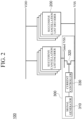
- FIG. 2 is a diagram illustrating an apparatus for successive cancellation list decoding of polar codes using power gating according to one embodiment of the present disclosure.
- an apparatus 100 for successive cancellation list decoding of polar codes using power gating may include successive cancellation list decoders 200 and a power gating circuit 300.
- each component may have different functions and capabilities in addition to those described below, and additional components may be included in addition to those not described below.
- successive cancellation list decoders 200 and the power gating circuit 300 may be implemented by using one or more physically separated devices or be implemented by one or more processors or a combination of one or more processors and software, and may not be clearly distinguished in specific operations, unlike the illustrated example.
- the successive cancellation list decoders 200 may decode a received codeword using a successive cancellation list method.
- the successive cancellation list method used in the present disclosure is a known technology, and thus detailed description thereof will be omitted; however, to briefly describe, the successive cancellation list decoding method is a decoding method proposed by Tal and Vardy in 2011 for improving the existing polar code successive cancellation (SC) decoding performance.
- the power gating circuit 300 may control current supply to the successive cancellation list decoders 200.
- the power gating circuit 300 may include a signal generator 310, a sleep transistor 320, and a current controller 330.
- the power gating circuit 300 may control the current supply to the successive cancellation list decoders 200 by the current controller 330 increasing or decreasing a gate voltage of the sleep transistor 320 according to a power signal generated by the signal generator 310. For example, since the sleep transistor 320 is in a linear region in an active mode, a gated VSS has a value close to VSS. Meanwhile, since the sleep transistor 320 is turned off in a sleep mode, the gated VSS has a value close to VDD.
- the power gating circuit 300 may be connected to a preset number of successive cancellation list decoders 200.
- the power gating circuit 320 may be connected to four successive cancellation list decoders 200 among the eight successive cancellation list decoders 200.
- the signal generator 310 may generate a power signal according to a preset condition. A detailed description thereof will be provided with reference to FIGS. 3 and 4 below.
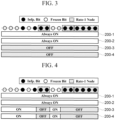
- FIG. 3 is a diagram illustrating a method of operating the apparatus for successive cancellation list decoding of polar codes using power gating according to one embodiment of the present disclosure.
- the apparatus 100 for successive cancellation list decoding of polar codes using power gating when receiving a codeword with a total code length of 8 bits, may block current supply to a preset number of decoders in a decoding process.
- the codeword may be composed of information bits and frozen bits.
- the signal generator 310 may generate a power signal to block current supply to the preset number of successive cancellation list decoders 200 when the successive cancellation list decoders 200 receive the codeword.
- the amount of calculation and power consumption may be reduced in proportion to M/L.
- L may refer to the total number of the successive cancellation list decoders 200
- M may refer to the number of successive cancellation list decoders 200 to which the power gating circuit is applied.
- the apparatus 100 for successive cancellation list decoding of polar codes using power gating may select an error correction performance priority mode or a power efficiency priority mode by applying the power gating circuit to a certain number of successive cancellation list decoders 200.
- FIG. 4 is a diagram illustrating a method of operating the apparatus for successive cancellation list decoding of polar codes using power gating according to another embodiment of the present disclosure.
- the apparatus 100 for successive cancellation list decoding of polar codes using power gating may block current supply to a preset number of successive cancellation list decoders 200 in a preset section while decoding is in progress.
- the codeword may be composed of information bits and frozen bits.
- the preset section may be a decoding section of a Rate-1 node.
- the Rate-1 node may refer to a node composed of information bits gathered together over a certain length.
- a section including the seventh and eighth bits, a section including the eleventh and twelfth bits, and a section including the thirteenth to sixteenth bits may be Rate-1 nodes.
- the signal generator 310 may extract the Rate-1 nodes from the codeword when the successive cancellation list decoders 200 receive the codeword and generate a power signal to block current supply to the preset number of successive cancellation list decoders 200 in sections corresponding to the Rate-1 nodes in a decoding process. For example, among L successive cancellation list decoders 200-1, 200-2, 200-3, and 200-4, current supply to M successive cancellation list decoders 200-3 and 200-4 may be blocked in the sections corresponding to the Rate-1 nodes while decoding is in progress.
- FIG. 5 is a graph comparing error correction performances according to apparatuses for decoding of polar codes
- FIG. 6 is a diagram illustrating a reduction rate of the amount of calculation of the apparatuses for successive cancellation list decoding of polar codes using power gating according to the disclosed embodiments.
- SCL 8-4 may mean that power gating is applied to four successive cancellation list decoders 200 among eight successive cancellation list decoders 200
- SCL 4-2 may mean that power gating is applied to two successive cancellation list decoders 200 among four successive cancellation list decoders 200.
- FIG. 7 is a block diagram for exemplarily illustrating a computing environment 10 including a computing device 12 according to one embodiment.
- respective components may have different functions and capabilities in addition to those described below, and additional components may be included in addition to those not described below.
- the illustrated computing environment 10 includes a computing device 12.
- the computing device 12 may be one or more components included in the apparatus 100 for successive cancellation list decoding of polar codes using power gating.
- the computing device 12 includes at least one processor 14, a computer-readable storage medium 16, and a communication bus 18.
- the processor 14 may cause the computing device 12 to operate according to the above-described exemplary embodiments.
- the processor 14 may execute one or more programs stored in the computer-readable storage medium 16.
- the one or more programs may include one or more computer-executable instructions, which may be configured to cause, when executed by the processor 14, the computing device 12 to perform operations according to the exemplary embodiments.
- the computer-readable storage medium 16 is configured to store computer-executable instructions or program codes, program data, and/or other suitable forms of information.
- a program 20 stored in the computer-readable storage medium 16 includes a set of instructions executable by the processor 14.
- the computer-readable storage medium 16 may be a memory (a volatile memory such as a random access memory, a non-volatile memory, or any suitable combination thereof), one or more magnetic disk storage devices, optical disc storage devices, flash memory devices, other types of storage media that are accessible by the computing device 12 and may store desired information, or any suitable combination thereof.
- the communication bus 18 interconnects various other components of the computing device 12, including the processor 14 and the computer-readable storage medium 16.
- the computing device 12 may also include one or more input/output interfaces 22 that provide an interface for one or more input/output devices 24, and one or more network communication interfaces 26.
- the input/output interface 22 and the network communication interface 26 are connected to the communication bus 18.
- the input/output device 24 may be connected to other components of the computing device 12 via the input/output interface 22.
- the exemplary input/output device 24 may include a pointing device (a mouse, a trackpad, or the like), a keyboard, a touch input device (a touch pad, a touch screen, or the like), a voice or sound input device, input devices such as various types of sensor devices and/or imaging devices, and/or output devices such as a display device, a printer, an interlocutor, and/or a network card.
- the exemplary input/output device 24 may be included inside the computing device 12 as one of components constituting the computing device 12, or may be connected to a computing device 12 as a separate device distinct from the computing device 12.
- the SCL decoding method can have an effect of improving error correction performance while reducing the amount of calculation and the amount of power consumption, which are L times increased compared to the existing SC decoding method.
Landscapes
- Physics & Mathematics (AREA)
- Engineering & Computer Science (AREA)
- Probability & Statistics with Applications (AREA)
- Theoretical Computer Science (AREA)
- Mathematical Physics (AREA)
- Computer Hardware Design (AREA)
- Computing Systems (AREA)
- General Engineering & Computer Science (AREA)
- Error Detection And Correction (AREA)
- Compression, Expansion, Code Conversion, And Decoders (AREA)
- Power Sources (AREA)
Abstract
An apparatus and method for successive cancellation list decoding of polar codes using power gating are provided. The apparatus for successive cancellation list decoding of polar codes using power gating according to one embodiment includes a plurality of successive cancellation list decoders configured to receive a polar encoded codeword and decode the codeword using a successive cancellation list technique and a power gating circuit connected to a preset number of successive cancellation list decoders among the plurality of successive cancellation list decoders to control current supply.
Description
- Embodiments of the present disclosure relate to a successive cancellation list decoding technique of polar codes using power gating.
- A polar code is the first error correcting code capable of achieving channel capacity in discrete memoryless channels. The polar code uses a successive cancellation (SC) algorithm as a basic decoding method, but it has a disadvantage. The polar code shows low error correction performance compared to the low-density parity-check (LDPC) code and the turbo code.
- In order to improve this disadvantage, several decoding methods for increasing error correction performance based on the successive cancellation algorithm have been presented. One of the presented decoding methods is a successive cancellation list (SC list (SCL)) decoding method. The SCL decoding method is basically the same as the SC decoding method, but the difference is that there are as many paths as powers of 2 (L = 2l, 1 = 1, 2, 3, ...). The number of the paths is a list size of SCL decoding. In the SCL decoding method, each of the paths performs individual SC decoding, and the bits decoded in each path are stored to obtain a final codeword decoded in that path. In the SCL decoding method, each path is copied into two paths each time one information bit is decoded. That is, as decoding progresses, L paths increase to 2L paths, and through a path selection process, the L paths with the highest reliability are selected again. When all bits are decoded, a cyclic redundancy check (CRC) is performed on each path result, and the codeword of the path that passes the CRC is output as the final decoding result. When this SCL decoding method is used, the low error correction performance of the SC decoding method may be improved.
- That is, the SCL decoding method may decode polar codes with improved error correction performance. However, the SCL decoding method has a disadvantage of requiring approximately L times as much computation (the size of the list) as the existing SC decoding method.
- Examples of the related art include
Korean Patent Registration No. 10-1951663 (Date: February 19, 2019 - Embodiments of the present disclosure are intended to provide an apparatus and method for successive cancellation list decoding of polar codes using power gating.
- In one general aspect, there is provided an apparatus for successive cancellation list decoding of polar codes using power gating includes a plurality of successive cancellation list decoders configured to receive a polar encoded codeword and decode the codeword using a successive cancellation list technique and a power gating circuit connected to a preset number of successive cancellation list decoders among the plurality of successive cancellation list decoders to control current supply.
- The power gating circuit may include a signal generator configured to generate a power signal according to a preset condition and a current controller configured to control current supply to the preset number of successive cancellation list decoders by increasing or decreasing a gate voltage of a sleep transistor according to the generated power signal.
- The signal generator may be configured to generate a first power signal to block current supply to the preset number of successive cancellation list decoders in a decoding process when the plurality of successive cancellation list decoders receive the codeword.
- The signal generator may be configured to generate a second power signal to block current supply to the preset number of successive cancellation list decoders in a preset section during a decoding process when the plurality of successive cancellation list decoders receive the codeword.
- The signal generator may be configured to extract a Rate-1 node from the codeword when the plurality of successive cancellation list decoders receive the codeword and generate the second power signal to block current supply to the preset number of successive cancellation list decoders in a section corresponding to the Rate-1 node in the decoding process.
-
-
FIG. 1 is a diagram illustrating an apparatus for successive cancellation list encoding and decoding of polar codes according to one embodiment of the present disclosure. -
FIG. 2 is a diagram illustrating an apparatus for successive cancellation list decoding of polar codes using power gating according to one embodiment of the present disclosure. -
FIG. 3 is a diagram illustrating a method of operating the apparatus for successive cancellation list decoding of polar codes using power gating according to one embodiment of the present disclosure. -
FIG. 4 is a diagram illustrating a method of operating the apparatus for successive cancellation list decoding of polar codes using power gating according to another embodiment of the present disclosure. -
FIG. 5 is a graph comparing error correction performances according to apparatuses for decoding of polar codes. -
FIG. 6 is a diagram illustrating a reduction rate of the amount of calculation of the apparatuses for successive cancellation list decoding of polar codes using power gating according to disclosed embodiments. -
FIG. 7 is a block diagram for exemplarily illustrating a computing environment including a computing device according to one embodiment. - Hereinafter, specific embodiments of the present disclosure will be described with reference to the accompanying drawings. The following detailed description is provided to assist in a comprehensive understanding of the methods, devices and/or systems described herein. However, the detailed description is only for illustrative purposes and the present disclosure is not limited thereto.
- In describing the embodiments of the present disclosure, when it is determined that detailed descriptions of known technology related to the present disclosure may unnecessarily obscure the gist of the present disclosure, the detailed descriptions thereof will be omitted. The terms used below are defined in consideration of functions in the present disclosure, but may be changed depending on the customary practice, the intention of a user or operator, or the like. Thus, the definitions should be determined based on the overall content of the present specification. The terms used herein are only for describing the embodiments of the present disclosure, and should not be construed as limitative. Unless expressly used otherwise, a singular form includes a plural form. In the present description, the terms "including", "comprising", "having", and the like are used to indicate certain characteristics, numbers, steps, operations, elements, and a portion or combination thereof, but should not be interpreted to preclude one or more other characteristics, numbers, steps, operations, elements, and a portion or combination thereof.
- Meanwhile, the embodiments of the present disclosure may include a program for performing the methods described herein on a computer, and a computer-readable recording medium including the program. The computer-readable recording medium may include program instructions, a local data file, a local data structure, or the like alone or in combination. The media may be specially designed and configured for the present disclosure, or may be commonly used in the field of computer software. Examples of computer-readable recording media include magnetic media such as hard disks, floppy disks and magnetic tapes, optical recording media such as a CD-ROM and a DVD, and hardware devices specially configured to store and execute program instructions such as a ROM, a RAM, and a flash memory. Examples of the program may include not only machine language codes such as those produced by a compiler, but also high-level language codes that can be executed by a computer using an interpreter or the like.
-
FIG. 1 is a diagram illustrating an apparatus for successive cancellation list encoding and decoding of polar codes according to one embodiment of the present disclosure. - Referring to
FIG. 1 , in the present disclosure, apolar encoding apparatus 1 and a successive cancellationlist decoding apparatus 3 used in a communication system will be described as one example. Thepolar encoding apparatus 1 may encode data (information bits) to be transmitted throughpolar encoders 5 and transmit the encoded data (codewords) through achannel 2 to the successive cancellationlist decoding apparatus 3. Here, the polar code is a code that achieves channel capacity by using the channel polarization phenomenon that occurs when multiple channels are combined and then properly separated. In addition, the successive cancellationlist decoding apparatus 3 may decode the codeword received from thepolar encoding apparatus 1 through thechannel 2 with successivecancellation list decoders 6 based on a successive cancellation list (SCL) decoding technique, and estimate and output data encoded by thepolar encoding apparatus 1. In this case, a CRC code is generated by operating theCRC encoders 4 of thepolar encoding apparatus 1, and a check as to whether an error has occurred in the data is performed by comparing a CRC code of a result value generated through the CRC decoders 7 of the successive cancellationlist decoding apparatus 3 with the CRC code generated by theCRC encoders 4. When there are no errors in the check for error occurrence, the data is output. - Such a successive cancellation
list decoding apparatus 3 includes L (the size of the list) successivecancellation list decoders 6 that operate simultaneously and in parallel. In this case, the successive cancellationlist decoding apparatus 3, which includes the L successivecancellation list decoders 6, requires the area and the amount of calculation approximately L times larger than the existing successive cancellation decoding apparatus. In particular, the amount of calculation is directly related to power consumption, and the successive cancellationlist decoding apparatus 3 consumes approximately L times more power than the successive cancellation decoding apparatus. - In the present disclosure, power supply of some of the L successive
cancellation list decoders 200 may be controlled using power gating, thereby providing a method capable of reducing the amount of calculation and the amount of power consumption of anapparatus 100 for successive cancellation list decoding of polar codes. -
FIG. 2 is a diagram illustrating an apparatus for successive cancellation list decoding of polar codes using power gating according to one embodiment of the present disclosure. - Referring to
FIG. 2 , anapparatus 100 for successive cancellation list decoding of polar codes using power gating according to one embodiment may include successivecancellation list decoders 200 and apower gating circuit 300. - In the following embodiment, each component may have different functions and capabilities in addition to those described below, and additional components may be included in addition to those not described below.
- In addition, in the following embodiment, the successive
cancellation list decoders 200 and thepower gating circuit 300 may be implemented by using one or more physically separated devices or be implemented by one or more processors or a combination of one or more processors and software, and may not be clearly distinguished in specific operations, unlike the illustrated example. - The successive
cancellation list decoders 200 may decode a received codeword using a successive cancellation list method. - Meanwhile, the successive cancellation list method used in the present disclosure is a known technology, and thus detailed description thereof will be omitted; however, to briefly describe, the successive cancellation list decoding method is a decoding method proposed by Tal and Vardy in 2011 for improving the existing polar code successive cancellation (SC) decoding performance.
- The
power gating circuit 300 may control current supply to the successivecancellation list decoders 200. In addition, thepower gating circuit 300 may include asignal generator 310, asleep transistor 320, and acurrent controller 330. Thepower gating circuit 300 may control the current supply to the successivecancellation list decoders 200 by thecurrent controller 330 increasing or decreasing a gate voltage of thesleep transistor 320 according to a power signal generated by thesignal generator 310. For example, since thesleep transistor 320 is in a linear region in an active mode, a gated VSS has a value close to VSS. Meanwhile, since thesleep transistor 320 is turned off in a sleep mode, the gated VSS has a value close to VDD. In this case, thepower gating circuit 300 may be connected to a preset number of successivecancellation list decoders 200. For example, thepower gating circuit 320 may be connected to four successivecancellation list decoders 200 among the eight successivecancellation list decoders 200. - The
signal generator 310 may generate a power signal according to a preset condition. A detailed description thereof will be provided with reference toFIGS. 3 and 4 below. -
FIG. 3 is a diagram illustrating a method of operating the apparatus for successive cancellation list decoding of polar codes using power gating according to one embodiment of the present disclosure. - Referring to
FIG. 3 , when receiving a codeword with a total code length of 8 bits, theapparatus 100 for successive cancellation list decoding of polar codes using power gating according to one embodiment may block current supply to a preset number of decoders in a decoding process. Here, the codeword may be composed of information bits and frozen bits. In this case, thesignal generator 310 may generate a power signal to block current supply to the preset number of successivecancellation list decoders 200 when the successivecancellation list decoders 200 receive the codeword. For example, by blocking power supply to M (e.g., two) successive cancellation list decoders 200-3 and 200-4 during decoding among L (e.g., four) successive cancellation list decoders 200-1, 200-2, 200-3, and 200-4, the amount of calculation and power consumption may be reduced in proportion to M/L. Here, L may refer to the total number of the successivecancellation list decoders 200, and M may refer to the number of successivecancellation list decoders 200 to which the power gating circuit is applied. - That is, the
apparatus 100 for successive cancellation list decoding of polar codes using power gating according to one embodiment may select an error correction performance priority mode or a power efficiency priority mode by applying the power gating circuit to a certain number of successivecancellation list decoders 200. -
FIG. 4 is a diagram illustrating a method of operating the apparatus for successive cancellation list decoding of polar codes using power gating according to another embodiment of the present disclosure. - Referring to
FIG. 4 , when receiving a codeword with a total code length of 8 bits, theapparatus 100 for successive cancellation list decoding of polar codes using power gating according to one embodiment may block current supply to a preset number of successivecancellation list decoders 200 in a preset section while decoding is in progress. Here, the codeword may be composed of information bits and frozen bits. In addition, the preset section may be a decoding section of a Rate-1 node. The Rate-1 node may refer to a node composed of information bits gathered together over a certain length. Here, a section including the seventh and eighth bits, a section including the eleventh and twelfth bits, and a section including the thirteenth to sixteenth bits may be Rate-1 nodes. - In this case, the
signal generator 310 may extract the Rate-1 nodes from the codeword when the successivecancellation list decoders 200 receive the codeword and generate a power signal to block current supply to the preset number of successivecancellation list decoders 200 in sections corresponding to the Rate-1 nodes in a decoding process. For example, among L successive cancellation list decoders 200-1, 200-2, 200-3, and 200-4, current supply to M successive cancellation list decoders 200-3 and 200-4 may be blocked in the sections corresponding to the Rate-1 nodes while decoding is in progress. - That is, since decoding path splitting and pruning is performed on information bits in the SCL decoding process, by cutting off power to the preset number of successive
cancellation list decoders 200 at the node (Rate-1) composed of information bits gathered together over a certain length, the amount of calculation and power consumption may be reduced. -
FIG. 5 is a graph comparing error correction performances according to apparatuses for decoding of polar codes, andFIG. 6 is a diagram illustrating a reduction rate of the amount of calculation of the apparatuses for successive cancellation list decoding of polar codes using power gating according to the disclosed embodiments. - Referring to
FIGS. 5 and 6 , when polar codes are decoded using theapparatus 100 for successive cancellation list decoding of polar codes using power gating according to one embodiment of the present disclosure, although error correction performance deteriorates compared to the same list size, the amount of calculation may be reduced compared to the same list size, which may reduce the amount of power consumption. For example, SCL 8-4 has a deterioration in error correction performance compared to SCL 8, but it can be seen that error correction performance is improved compared toSCL 4, and SCL 8-4 reduces the amount of calculation by 19% compared to SCL 8. Here, SCL 8-4 may mean that power gating is applied to four successivecancellation list decoders 200 among eight successivecancellation list decoders 200, and SCL 4-2 may mean that power gating is applied to two successivecancellation list decoders 200 among four successivecancellation list decoders 200. - That is, when only some of the successive
cancellation list decoders 200 are used in theapparatus 100 for successive cancellation list decoding of polar codes, the error correction performance deteriorates compared with when all successivecancellation list decoders 200 are operated, but it can be seen that the effect of reducing the amount of calculation and thus reducing the amount of power consumption is produced. -
FIG. 7 is a block diagram for exemplarily illustrating acomputing environment 10 including acomputing device 12 according to one embodiment. - In the illustrated embodiment, respective components may have different functions and capabilities in addition to those described below, and additional components may be included in addition to those not described below.
- The illustrated
computing environment 10 includes acomputing device 12. In one embodiment, thecomputing device 12 may be one or more components included in theapparatus 100 for successive cancellation list decoding of polar codes using power gating. - The
computing device 12 includes at least oneprocessor 14, a computer-readable storage medium 16, and acommunication bus 18. Theprocessor 14 may cause thecomputing device 12 to operate according to the above-described exemplary embodiments. For example, theprocessor 14 may execute one or more programs stored in the computer-readable storage medium 16. The one or more programs may include one or more computer-executable instructions, which may be configured to cause, when executed by theprocessor 14, thecomputing device 12 to perform operations according to the exemplary embodiments. - The computer-
readable storage medium 16 is configured to store computer-executable instructions or program codes, program data, and/or other suitable forms of information. Aprogram 20 stored in the computer-readable storage medium 16 includes a set of instructions executable by theprocessor 14. In one embodiment, the computer-readable storage medium 16 may be a memory (a volatile memory such as a random access memory, a non-volatile memory, or any suitable combination thereof), one or more magnetic disk storage devices, optical disc storage devices, flash memory devices, other types of storage media that are accessible by thecomputing device 12 and may store desired information, or any suitable combination thereof. - The
communication bus 18 interconnects various other components of thecomputing device 12, including theprocessor 14 and the computer-readable storage medium 16. - The
computing device 12 may also include one or more input/output interfaces 22 that provide an interface for one or more input/output devices 24, and one or more network communication interfaces 26. The input/output interface 22 and thenetwork communication interface 26 are connected to thecommunication bus 18. The input/output device 24 may be connected to other components of thecomputing device 12 via the input/output interface 22. The exemplary input/output device 24 may include a pointing device (a mouse, a trackpad, or the like), a keyboard, a touch input device (a touch pad, a touch screen, or the like), a voice or sound input device, input devices such as various types of sensor devices and/or imaging devices, and/or output devices such as a display device, a printer, an interlocutor, and/or a network card. The exemplary input/output device 24 may be included inside thecomputing device 12 as one of components constituting thecomputing device 12, or may be connected to acomputing device 12 as a separate device distinct from thecomputing device 12. - According to the disclosed embodiments, by using power gating in a successive cancellation list (SCL) decoding method, the SCL decoding method can have an effect of improving error correction performance while reducing the amount of calculation and the amount of power consumption, which are L times increased compared to the existing SC decoding method.
- Although the representative embodiments of the present disclosure have been described in detail as above, those skilled in the art will understand that various modifications may be made thereto without departing from the scope of the present disclosure. Therefore, the scope of rights of the present disclosure should not be limited to the described embodiments, but should be defined not only by the claims set forth below but also by equivalents of the claims.
Claims (9)
- An apparatus for successive cancellation list decoding of polar codes using power gating, the apparatus comprising:a plurality of successive cancellation list decoders configured to receive a polar encoded codeword and decode the codeword using a successive cancellation list technique; anda power gating circuit connected to a preset number of successive cancellation list decoders among the plurality of successive cancellation list decoders to control current supply.
- The apparatus of claim 1, wherein the power gating circuit includes:a signal generator configured to generate a power signal according to a preset condition; anda current controller configured to control current supply to the preset number of successive cancellation list decoders by increasing or decreasing a gate voltage of a sleep transistor according to the generated power signal.
- The apparatus of claim 2, wherein the signal generator is configured to generate a first power signal to block current supply to the preset number of successive cancellation list decoders in a decoding process when the plurality of successive cancellation list decoders receive the codeword.
- The apparatus of claim 2, wherein the signal generator is configured to generate a second power signal to block current supply to the preset number of successive cancellation list decoders in a preset section during a decoding process when the plurality of successive cancellation list decoders receive the codeword.
- The apparatus of claim 4, wherein the signal generator is configured to extract a Rate-1 node from the codeword when the plurality of successive cancellation list decoders receive the codeword and generate the second power signal to block current supply to the preset number of successive cancellation list decoders in a section corresponding to the Rate-1 node in the decoding process.
- A method for successive cancellation list decoding of polar codes using power gating that is performed by a computing device comprising:one or more processors; anda memory storing one or more programs executed by the one or more processors, the method comprising:generating a power signal according to a preset condition; andcontrolling current supply to a plurality of successive cancellation list decoders by increasing or decreasing a gate voltage of a sleep transistor according to the generated power signal.
- The method of claim 6, wherein the generating of the power signal includes generating a first power signal to block current supply to a preset number of successive cancellation list decoders among the plurality of successive cancellation list decoders in a decoding process when the plurality of successive cancellation list decoders receive a codeword.
- The method of claim 6, wherein the generating of the power signal includes generating a second power signal to block current supply to a preset number of successive cancellation list decoders among the plurality of successive cancellation list decoders in a preset section during a decoding process when the plurality of successive cancellation list decoders receive the codeword.
- The method of claim 8, wherein the generating of the power signal includes:extracting a Rate-1 node from the codeword when the plurality of successive cancellation list decoders receive the codeword; andgenerating the second power signal to block current supply to the preset number of successive cancellation list decoders in a section corresponding to the Rate-1 node in the decoding process.
Applications Claiming Priority (1)
| Application Number | Priority Date | Filing Date | Title |
|---|---|---|---|
| KR1020230078970A KR102757663B1 (en) | 2023-06-20 | 2023-06-20 | Apparatus and method for successive cansellation list decoding of polar code using power gating |
Publications (1)
| Publication Number | Publication Date |
|---|---|
| EP4482039A1 true EP4482039A1 (en) | 2024-12-25 |
Family
ID=89321725
Family Applications (1)
| Application Number | Title | Priority Date | Filing Date |
|---|---|---|---|
| EP23219590.9A Pending EP4482039A1 (en) | 2023-06-20 | 2023-12-22 | Apparatus and method for successive cancellation list decoding of polar code using power gating |
Country Status (4)
| Country | Link |
|---|---|
| EP (1) | EP4482039A1 (en) |
| JP (1) | JP7724563B2 (en) |
| KR (1) | KR102757663B1 (en) |
| WO (1) | WO2024262699A1 (en) |
Citations (2)
| Publication number | Priority date | Publication date | Assignee | Title |
|---|---|---|---|---|
| KR101951663B1 (en) | 2012-12-14 | 2019-02-25 | 삼성전자주식회사 | Method and apparatus of encoding with CRC code and polar code |
| US20200403644A1 (en) * | 2018-03-15 | 2020-12-24 | Telefonaktiebolaget Lm Ericsson (Publ) | Information Decoder for Polar Codes |
Family Cites Families (12)
| Publication number | Priority date | Publication date | Assignee | Title |
|---|---|---|---|---|
| TWI305087B (en) | 2006-05-25 | 2009-01-01 | Ind Tech Res Inst | Power adjusting device for a viterbi decoder |
| EP3657684B1 (en) | 2015-11-24 | 2022-08-31 | Coherent Logix Incorporated | Path sorting for list decoding for example for polar code decoding |
| WO2017185377A1 (en) * | 2016-04-29 | 2017-11-02 | 华为技术有限公司 | Polar code encoding method and apparatus |
| US10383106B2 (en) | 2017-01-04 | 2019-08-13 | Coherent Logix, Incorporated | Scrambling sequence design for embedding UE ID into frozen bits for DCI blind detection |
| WO2018126496A1 (en) * | 2017-01-09 | 2018-07-12 | Qualcomm Incorporated | Bit allocation for encoding and decoding |
| KR101856416B1 (en) * | 2017-02-28 | 2018-05-09 | 성균관대학교산학협력단 | A method of low complexity scl decoding for polar codes and an apparatus thereof |
| KR102488910B1 (en) * | 2017-05-15 | 2023-01-13 | 퀄컴 인코포레이티드 | Early termination of contiguous erasure list decoding |
| GB2563419B (en) * | 2017-06-15 | 2020-04-22 | Accelercomm Ltd | Polar decoder, communication unit, integrated circuit and method therefor |
| WO2019133039A1 (en) | 2017-12-29 | 2019-07-04 | Intel Corporation | Polar encoding and polar decoding systems and methods |
| WO2020106230A1 (en) * | 2018-11-23 | 2020-05-28 | Aselsan Elektroni̇k Sanayi̇ Ve Ti̇caret Anoni̇m Şi̇rketi̇ | Hardware complexity reduction technique for successive cancellation list decoders |
| US10868571B2 (en) | 2019-03-15 | 2020-12-15 | Sequans Communications S.A. | Adaptive-SCL polar decoder |
| KR20210006807A (en) * | 2019-07-09 | 2021-01-19 | 삼성전자주식회사 | Apparatus and method to transmit and receive signal in communication system |
-
2023
- 2023-06-20 KR KR1020230078970A patent/KR102757663B1/en active Active
- 2023-09-22 WO PCT/KR2023/014504 patent/WO2024262699A1/en not_active Ceased
- 2023-12-20 JP JP2023214889A patent/JP7724563B2/en active Active
- 2023-12-22 EP EP23219590.9A patent/EP4482039A1/en active Pending
Patent Citations (2)
| Publication number | Priority date | Publication date | Assignee | Title |
|---|---|---|---|---|
| KR101951663B1 (en) | 2012-12-14 | 2019-02-25 | 삼성전자주식회사 | Method and apparatus of encoding with CRC code and polar code |
| US20200403644A1 (en) * | 2018-03-15 | 2020-12-24 | Telefonaktiebolaget Lm Ericsson (Publ) | Information Decoder for Polar Codes |
Non-Patent Citations (3)
| Title |
|---|
| AGNES SHINY RACHEL N ET AL: "Integration of Clock Gating and Power Gating in Digital Circuits", 2019 5TH INTERNATIONAL CONFERENCE ON ADVANCED COMPUTING & COMMUNICATION SYSTEMS (ICACCS), IEEE, 15 March 2019 (2019-03-15), pages 704 - 707, XP033559055, ISBN: 978-1-5386-9531-9, [retrieved on 20190603], DOI: 10.1109/ICACCS.2019.8728370 * |
| ROWSHAN MOHAMMAD ET AL: "Stepped List Decoding for Polar Codes", 2018 IEEE 10TH INTERNATIONAL SYMPOSIUM ON TURBO CODES & ITERATIVE INFORMATION PROCESSING (ISTC), IEEE, 3 December 2018 (2018-12-03), pages 1 - 5, XP033506470, DOI: 10.1109/ISTC.2018.8625267 * |
| TAO YAOYU ET AL: "A Configurable Successive-Cancellation List Polar Decoder Using Split-Tree Architecture", IEEE JOURNAL OF SOLID-STATE CIRCUITS, IEEE, USA, vol. 56, no. 2, 20 July 2020 (2020-07-20), pages 612 - 623, XP011834379, ISSN: 0018-9200, [retrieved on 20210127], DOI: 10.1109/JSSC.2020.3005763 * |
Also Published As
| Publication number | Publication date |
|---|---|
| KR20240177511A (en) | 2024-12-27 |
| KR102757663B1 (en) | 2025-01-21 |
| JP2025001619A (en) | 2025-01-08 |
| JP7724563B2 (en) | 2025-08-18 |
| WO2024262699A1 (en) | 2024-12-26 |
Similar Documents
| Publication | Publication Date | Title |
|---|---|---|
| Hashemi et al. | Partitioned successive-cancellation list decoding of polar codes | |
| KR102601215B1 (en) | Apparatus for polar coding | |
| US7823043B2 (en) | Corruption-resistant data porting with multiple error correction schemes | |
| US10790857B1 (en) | Systems and methods for using decoders of different complexity in a hybrid decoder architecture | |
| JP2008544721A (en) | Method and apparatus for iterative decoder power reduction | |
| KR20050111201A (en) | Apparatus and method for decoding symbol with low density parity check code | |
| WO2018045788A1 (en) | Partial sum computation for polar code decoding | |
| JP2006508577A (en) | Running minimum message passing LDPC decoding | |
| ES2356767T3 (en) | NODE PROCESSORS FOR USE IN PARITY CONTROL DECODERS. | |
| WO2018179246A1 (en) | Check bit concatenated polar codes | |
| JP2009278686A (en) | Turbo decoder with circular redundancy code signature comparison | |
| US11539380B2 (en) | Decoding device, decoding method, control circuit, and storage medium | |
| US20230084339A1 (en) | Method and apparatus for generating a decoding position control signal for decoding using polar codes | |
| US11664827B2 (en) | Apparatus and method for successive cancellation bit-flip decoding of polar code | |
| US8566665B2 (en) | Systems and methods for error correction using low density parity check codes using multiple layer check equations | |
| US8166364B2 (en) | Low density parity check decoder using multiple variable node degree distribution codes | |
| US8375278B2 (en) | Compact decoding of punctured block codes | |
| US20090037799A1 (en) | Operating method applied to low density parity check (ldpc) decoder and circuit thereof | |
| US10742355B2 (en) | Apparatus that receives non-binary polar code and decoding method thereof | |
| US9397699B2 (en) | Compact decoding of punctured codes | |
| US8516351B2 (en) | Compact decoding of punctured block codes | |
| US8516352B2 (en) | Compact decoding of punctured block codes | |
| KR102757663B1 (en) | Apparatus and method for successive cansellation list decoding of polar code using power gating | |
| KR102511779B1 (en) | Apparatus and method for successive cancellation flip decoding of polar code | |
| KR101722798B1 (en) | Compact decoding of punctured codes |
Legal Events
| Date | Code | Title | Description |
|---|---|---|---|
| PUAI | Public reference made under article 153(3) epc to a published international application that has entered the european phase |
Free format text: ORIGINAL CODE: 0009012 |
|
| STAA | Information on the status of an ep patent application or granted ep patent |
Free format text: STATUS: REQUEST FOR EXAMINATION WAS MADE |
|
| 17P | Request for examination filed |
Effective date: 20231222 |
|
| AK | Designated contracting states |
Kind code of ref document: A1 Designated state(s): AL AT BE BG CH CY CZ DE DK EE ES FI FR GB GR HR HU IE IS IT LI LT LU LV MC ME MK MT NL NO PL PT RO RS SE SI SK SM TR |