EP4481552A1 - Concurrent reception of multiple user speech input for translation - Google Patents
Concurrent reception of multiple user speech input for translation Download PDFInfo
- Publication number
- EP4481552A1 EP4481552A1 EP24211859.4A EP24211859A EP4481552A1 EP 4481552 A1 EP4481552 A1 EP 4481552A1 EP 24211859 A EP24211859 A EP 24211859A EP 4481552 A1 EP4481552 A1 EP 4481552A1
- Authority
- EP
- European Patent Office
- Prior art keywords
- voice input
- mobile device
- auxiliary device
- input
- microphone
- Prior art date
- Legal status (The legal status is an assumption and is not a legal conclusion. Google has not performed a legal analysis and makes no representation as to the accuracy of the status listed.)
- Pending
Links
Images



Classifications
-
- G—PHYSICS
- G06—COMPUTING OR CALCULATING; COUNTING
- G06F—ELECTRIC DIGITAL DATA PROCESSING
- G06F3/00—Input arrangements for transferring data to be processed into a form capable of being handled by the computer; Output arrangements for transferring data from processing unit to output unit, e.g. interface arrangements
- G06F3/16—Sound input; Sound output
- G06F3/165—Management of the audio stream, e.g. setting of volume, audio stream path
-
- G—PHYSICS
- G06—COMPUTING OR CALCULATING; COUNTING
- G06F—ELECTRIC DIGITAL DATA PROCESSING
- G06F3/00—Input arrangements for transferring data to be processed into a form capable of being handled by the computer; Output arrangements for transferring data from processing unit to output unit, e.g. interface arrangements
- G06F3/16—Sound input; Sound output
- G06F3/167—Audio in a user interface, e.g. using voice commands for navigating, audio feedback
-
- G—PHYSICS
- G06—COMPUTING OR CALCULATING; COUNTING
- G06F—ELECTRIC DIGITAL DATA PROCESSING
- G06F40/00—Handling natural language data
- G06F40/40—Processing or translation of natural language
- G06F40/58—Use of machine translation, e.g. for multi-lingual retrieval, for server-side translation for client devices or for real-time translation
-
- G—PHYSICS
- G10—MUSICAL INSTRUMENTS; ACOUSTICS
- G10L—SPEECH ANALYSIS TECHNIQUES OR SPEECH SYNTHESIS; SPEECH RECOGNITION; SPEECH OR VOICE PROCESSING TECHNIQUES; SPEECH OR AUDIO CODING OR DECODING
- G10L15/00—Speech recognition
- G10L15/28—Constructional details of speech recognition systems
- G10L15/30—Distributed recognition, e.g. in client-server systems, for mobile phones or network applications
-
- G—PHYSICS
- G10—MUSICAL INSTRUMENTS; ACOUSTICS
- G10L—SPEECH ANALYSIS TECHNIQUES OR SPEECH SYNTHESIS; SPEECH RECOGNITION; SPEECH OR VOICE PROCESSING TECHNIQUES; SPEECH OR AUDIO CODING OR DECODING
- G10L15/00—Speech recognition
- G10L15/28—Constructional details of speech recognition systems
- G10L15/32—Multiple recognisers used in sequence or in parallel; Score combination systems therefor, e.g. voting systems
-
- H—ELECTRICITY
- H04—ELECTRIC COMMUNICATION TECHNIQUE
- H04M—TELEPHONIC COMMUNICATION
- H04M1/00—Substation equipment, e.g. for use by subscribers
- H04M1/60—Substation equipment, e.g. for use by subscribers including speech amplifiers
- H04M1/6033—Substation equipment, e.g. for use by subscribers including speech amplifiers for providing handsfree use or a loudspeaker mode in telephone sets
- H04M1/6041—Portable telephones adapted for handsfree use
- H04M1/6058—Portable telephones adapted for handsfree use involving the use of a headset accessory device connected to the portable telephone
- H04M1/6066—Portable telephones adapted for handsfree use involving the use of a headset accessory device connected to the portable telephone including a wireless connection
-
- G—PHYSICS
- G10—MUSICAL INSTRUMENTS; ACOUSTICS
- G10L—SPEECH ANALYSIS TECHNIQUES OR SPEECH SYNTHESIS; SPEECH RECOGNITION; SPEECH OR VOICE PROCESSING TECHNIQUES; SPEECH OR AUDIO CODING OR DECODING
- G10L25/00—Speech or voice analysis techniques not restricted to a single one of groups G10L15/00 - G10L21/00
- G10L25/78—Detection of presence or absence of voice signals
- G10L25/87—Detection of discrete points within a voice signal
-
- H—ELECTRICITY
- H04—ELECTRIC COMMUNICATION TECHNIQUE
- H04M—TELEPHONIC COMMUNICATION
- H04M2250/00—Details of telephonic subscriber devices
- H04M2250/58—Details of telephonic subscriber devices including a multilanguage function
-
- H—ELECTRICITY
- H04—ELECTRIC COMMUNICATION TECHNIQUE
- H04M—TELEPHONIC COMMUNICATION
- H04M2250/00—Details of telephonic subscriber devices
- H04M2250/74—Details of telephonic subscriber devices with voice recognition means
Definitions
- auxiliary devices which can offer additional functionality.
- some earbuds offer a translation experience where a user can touch one earbud, speak in a first language, and the spoken phrase is translated into a second language. The user may hear the translated phrase, for example, from speakers in the mobile computing device.
- phrases spoken into the mobile phone in the second language may be translated to the first language and output through the earbuds.
- This exchange is performed serially, such that each participant must wait for the other's speech to be completed, translated, and output through speakers of the mobile computing device or auxiliary device before speaking a response.
- the serial nature of the exchange adds significant delays to conversational patterns, and introduces uncomfortable social cues.
- the interaction flow requires both parties to pay careful attention to which person is speaking, whether the translation is being output on each device, and as a result is unintuitive.
- the present disclosure provides for a more natural, conversational exchange between a user and a foreign language speaker using translation features of mobile devices and auxiliary devices.
- microphones of both the mobile device and the auxiliary device are always listening for speech input.
- the mobile and auxiliary device may also determine whether the speech input is from the user or the foreign language speaker.
- the mobile device and auxiliary device can automatically determine when a spoken phrase is complete and ready for translation, send the spoken phrase for translation, and immediately begin listening again.
- acknowledgements or other social cues such as "OK,” “Yes,” “Oh no,” etc. may be captured, translated, and output throughout a conversation in response to the other user's translated speech, even if the other user is still speaking.
- One aspect of the disclosure provides a system for providing translations, including an auxiliary device and a mobile computing device coupled to the auxiliary device.
- the mobile computing device may be wirelessly coupled to the auxiliary device.
- the auxiliary device includes a microphone configured to continually listen for first input from a first user, and a communication interface adapted to transmit the first input.
- the microphone of the auxiliary device may be configured to continually listen for first input from the first user by continuing listening when an endpoint in speech is detected.
- the mobile computing device includes a mobile computing device microphone configured to continually listen for second input from a second user while the auxiliary device microphone listens for the first input from the first user, a communication interface adapted to receive the first input from the auxiliary device and to transmit information to the auxiliary device, one or more processors adapted to process the first input and the second input, and an output adapted to provide at least one of the processed first input or the processed second input.
- the microphone of the mobile computing device may be configured to continually listen for second input from the second user by continuing listening when an endpoint in speech is detected.
- the processing of the first input and the second input by the one or more processors may include providing a translation of at least one of the first input and second input. This may include the one or more processors of the mobile computing device performing the translation or the one or more processors of the mobile computing device sending at least one of the first input and second input to a remote device for translation.
- the auxiliary device and the mobile device may be wirelessly coupled using two independent wireless communication channels, including a first channel used for transmission from the auxiliary device to the mobile device, and a second channel used for transmission from the mobile device to the auxiliary device.
- the first channel and the second channel may be different types.
- the first channel may be an RFComm channel
- the second channel may be an A2DP channel.
- either or both of the auxiliary device and the mobile device may be configured to automatically determine an endpoint in received speech, and immediately continue listening for subsequent speech after the endpoint. Either or both devices may be further configured, in some examples, to determine which of the first user or the second user is providing input.
- the devices may include a speaker recognition unit configured to determine at least one of a voice or a language spoken.
- one or more processors of the mobile device are further configured to cross reference a volume level of input received through the auxiliary device microphone with a volume level of input received through the mobile computing device microphone, such as to determine which of the first user or the second user is providing input.
- one or more processors of the mobile device are further configured to cross reference waveforms of speech input received through the auxiliary device microphone with waveforms of speech input received through the mobile computing device microphone.
- an auxiliary device such as an earbud, including a microphone, a communication interface configured to wirelessly communicate with a computing device, an output source, and one or more processors in communication with the microphone, the communication interface, and the output source.
- the one or more processors may be configured to receive, through the microphone, first input from a first user, detect an endpoint in the first input, receive subsequent input from the first user after the endpoint, and send, through the communication interface, the first input up to the endpoint to the computing device, while receiving the subsequent input.
- the one or more processors may be further configured to receive, from the computing device, translated speech from a second user, and output, through the output source, the translated speech.
- the communication interface may be configured to communicate with the computing device using two independent wireless communication channels, including a first channel used for transmitting information to the computing device, and a second channel of a different type than the first channel used for receiving information from the computing device.
- a mobile computing device such as a mobile phone, including a microphone, a communication interface configured to wirelessly communicate with an electronic accessory, an output source, and one or more processors.
- the one or more processors may be configured to, receive, through the microphone, first voice input, detect an endpoint in the first voice input, translate the received first input up to the endpoint, listen for subsequent input while translating, and transmit the translated first input to the electronic accessory for output.
- the one or more processors are configured to distinguish first voice input from the first user from second voice input from a second user.
- a speaker recognition unit may be configured to determine at least one of a voice or a language spoken.
- the one or more processors are further configured to receive, from the electronic accessory, second input, and cross reference a volume level of the second input with a volume level of the first input, or cross reference waveforms of the second input with waveforms of the first input.
- the auxiliary device 180 is wirelessly coupled to the mobile device 170.
- the wireless connections between the devices may include, for example, a short range pairing connection, such as Bluetooth. Other types of wireless connections are also possible.
- different wireless protocols may be used for transmission of information from the earbuds 180 to the mobile device 170, than for transmission of information in a reverse path from the mobile device 170 to the earbuds 180.
- Wireless pairing between mobile and auxiliary devices may typically use an HFP/SCO channel, which provides for lower quality two-way communication.
- the present example provides for replacing the HFP/SCO channel with two concurrent channels.
- the concurrent channels may be of different types.
- a first channel 240, used for transmitting information from the mobile device 170 to the auxiliary device 180, may be a high quality one-way audio channel, such as A2DP.
- a second channel 250 used for transmitting information from the auxiliary device 180 to the mobile device 170, may be, for example, an RFComm channel. This allows for the mobile device 170 to process two streams of input audio at once.
- microphones on both the mobile device 170 and auxiliary device 180 may be used concurrently, with audio transmitted simultaneously in both directions.
- A2DP and RFComm are merely examples of the different types of channels that can be used.
- the channels 240, 250 may be independent channels of a same type, each providing one-way communication.
- Fig. 3 provides an example block diagram of the auxiliary device 180 and the mobile device 170.
- Each device includes one or more processors 371, 381, memory 372, 382, and other components typically present in mobile computing devices and auxiliary devices. While a number of components are shown, it should be understood that such components are merely non-limiting examples, and that other components may additionally or alternatively be included.
- Memory 382 may store information that is accessible by the processors 381, including instructions 383 that may be executed by the processors 381, and data 384.
- the memory 382 may be of a type of memory operative to store information accessible by the processors 381, including a non-transitory computer-readable medium, or other medium that stores data that may be read with the aid of an electronic device, such as a hard-drive, memory card, read-only memory (“ROM”), random access memory (“RAM”), optical disks, as well as other write-capable and read-only memories.
- ROM read-only memory
- RAM random access memory
- optical disks as well as other write-capable and read-only memories.
- the subject matter disclosed herein may include different combinations of the foregoing, whereby different portions of the instructions 383 and data 384 are stored on different types of media.
- Data 384 may be retrieved, stored or modified by processors 381 in accordance with the instructions 383.
- the data 384 may be stored in computer registers, in a relational database as a table having a plurality of different fields and records, XML documents, or flat files.
- the data 384 may also be formatted in a computer-readable format such as, but not limited to, binary values, ASCII or Unicode.
- the data 384 may be stored as bitmaps comprised of pixels that are stored in compressed or uncompressed, or various image formats (e.g., JPEG), vector-based formats (e.g., SVG) or computer instructions for drawing graphics.
- the data 384 may comprise information sufficient to identify the relevant information, such as numbers, descriptive text, proprietary codes, pointers, references to data stored in other memories (including other network locations) or information that is used by a function to calculate the relevant data.
- the instructions 383 may be executed to facilitate translations performed by a mobile computing device.
- the instructions 383 provide for listening for and receiving user speech, for example, through microphone 388.
- the microphone 388 may be beamformed, such that it is directed to receive audio coming from a direction of the user's mouth.
- the auxiliary device 180 may recognize received speech as being that of the user, as opposed to a foreign language speaker that is not wearing the auxiliary device 180.
- the instructions 383 may further provide for detecting an endpoint in the received speech.
- the endpoint may be automatically determined based on a pause in speech, key words, intonation, inflection, or any of a combination of these or other factors.
- the auxiliary device 180 may buffer the received speech while immediately resuming listening.
- the auxiliary device 180 may transmit the received speech to the mobile device 170 for translation.
- the auxiliary device 180 may transmit the speech via an RFComm or other communication link, as discussed above in connection with Fig. 2 .
- all endpointing may be performed by the mobile device 170.
- the auxiliary device 180 may stream all audio to the mobile device 170, which handles all endpointing, voice recognition, and translation, either offline or online.
- the mobile device 170 may also be executing instructions 373 stored in memory 372 along with data 374.
- the mobile device 170 may also include memory 372 storing data 374 and instructions 373 executable by the one or more processors 371.
- the memory 372 may be any of a variety of types, and the data 374 may be any of a variety of formats, similar to the memory 382 and data 384 of the auxiliary device 180.
- the auxiliary device 180 is listening for and receiving speech from the user wearing the auxiliary device 180
- the mobile device 170 may be listening for and receiving speech as well through microphone 378.
- the microphone 378 may not be beamformed, and may receive audio input from both the foreign language speaker (e.g., first user 101 of Fig. 1 ) and the user of the auxiliary device 180 (e.g., second user 102 of Fig. 1 ). Accordingly, the instructions 373 may provide for determining which user is providing speech input, such that some speech input (e.g., from the foreign language speaker) can be translated for output through the auxiliary device 180 and other speech input (e.g., from the user) can be filtered.
- some speech input e.g., from the foreign language speaker
- other speech input e.g., from the user
- the mobile device 170 may cross reference a volume level between the auxiliary device microphone 388 and the mobile device microphone 378. If the sound received through microphone 388 is quiet and the sounds received through the microphone 378 is loud, then it may be determined that the foreign language speaker is providing speech input. Conversely, if the sounds received through both microphones 388, 378 is loud, then it may be determined that the owner/user is speaking.
- a voice recognition unit may be used. The voice recognition unit may be trained to recognize a voice of the user/owner of the auxiliary device 180 and mobile device 170. Accordingly, if the voice recognition unit detects the owner's voice, it may ignore it.
- the voice recognition unit may be trained to detect a language primarily spoken by the owner/user, and may filter out speech detected in that language.
- audio echo cancellation techniques may be used.
- the mobile device 170 may listen to both microphone 388, 378, detect overlapping audio, and, recognize that the overlapping audio belongs to the owner. The overlapping audio may be detected by identifying similar waveforms or patterns of sound input, or detecting similar plosives or transient attacks. In some examples, any combination of the foregoing or other techniques may be used.
- the instructions 373 may further provide for continued listening until an endpoint is detected.
- the endpoint may be detected based on a pause, keyword, inflection, or other factor.
- the received speech from the foreign language speaker is buffered, and the microphone 378 resumes listening.
- the mobile device 170 may perform translations of both foreign language speaker input received through the microphone 378, as well as owner input received through communication from the auxiliary device 180. Such translations may be performed on the mobile device 170 itself, or may be performed using one or more remote computing devices, such as the cloud. For example, the mobile device 170 may upload speech for translation to a remote computing network which performs the translation, and receive a response including translated speech from the remote computing network. Translations of speech from the foreign language speaker may be provided to the auxiliary device 180 for output through output 387. Translations of speech from the owner may be output through output 377 of mobile device 170.
- the outputs 377, 387 may each include, for example, one or more speakers adapted to provide audible output. In some examples, the outputs 377, 387 may also include one or more other types, such as displays, tactile feedback, etc.
- auxiliary device 180 and mobile device 170 may each include other components which are not shown, such charging input for the battery, signals processing components, etc. Such components may also be utilized in execution of the instructions 383, 373.
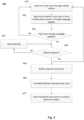
- Fig. 4 illustrates a method 400 executed by the mobile device 170.
- the mobile device listens for and receives voice input. While the mobile device is intended to capture the voice of a secondary user, such as a foreign language speaker (e.g., user 101 of Fig. 1 ), it may also capture voice input of a primary user (e.g., user 102 of Fig. 1 ). The device may continually listen for and receive input without manual interaction, such as pressing buttons, etc.
- a secondary user such as a foreign language speaker
- a primary user e.g., user 102 of Fig. 1
- the device may continually listen for and receive input without manual interaction, such as pressing buttons, etc.
- the mobile device determines whether the received voice input is from the mobile device owner or the foreign language speaker. For example, the mobile device may use voice recognition, language recognition, etc. As another example, the mobile device may cross reference a volume of sound received at the mobile device with a volume of sound received at the auxiliary device and relayed to the mobile device.
- the mobile device may ignore the input. Accordingly, the method returns to block 410 to keep listening for input from the foreign language speaker. If, however, the input is determined to be from the foreign language speaker, the method proceeds to block 440.
- the mobile device determines whether an endpoint in speech is detected. For example, if there is a pause in the speech input for a predetermined period of time, such as half a second, one second, two seconds, etc., the mobile device may determine that an endpoint in speech has been reached.
- Other examples of detecting endpoints may include detecting changes in intonation or inflection, or detecting keywords. Detecting the endpoint helps to ensure proper translation of complete phrases. For example, translations of each individual word are typically inaccurate. By way of example only, while in English adjectives are typically spoken before their associated nouns, in Spanish the adjectives are spoken after the noun. By endpointing the speech after a complete statement, phrases may be translated as a whole and the words rearranged as appropriate for the translated language.
- the mobile device keeps listening in block 445 and waiting for an endpoint. If an endpoint is detected, however, the mobile device buffers the received input in block 450. It should be understood that the buffering may be performed while the input is received, prior to detection of the endpoint.
- the mobile device translates the buffered voice input up until the endpoint.
- the translation may be performed at the mobile device, or through remote computing devices.
- the translated input is provided to the auxiliary device for output.
- the translated input may be provided through one of the two communication channels described in Fig. 2 .
- the mobile device also receives speech from the auxiliary device.
- the auxiliary device receives speech from the owner as described below in connection with Fig. 5 , and provides the received speech to the mobile device for translation.
- the mobile device may output the translated speech for the foreign language speaker.
- the mobile device may emit an audible translation of the speech through a speaker for the foreign language speaker to hear, may provide a text translation of the speech on a display, etc..
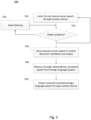
- Fig. 5 illustrates a method 500 performed by the auxiliary device for receiving translation.
- the method 500 may be performed by the auxiliary device contemporaneously with execution of the method 400 by the mobile device.
- the auxiliary device listens for and receives voice input from the owner. Where a microphone in the auxiliary device is beamformed, it may determine that any input received is from the owner. In other examples, voice recognition techniques such as those described above may be used.
- the auxiliary device determines whether an endpoint was reached.
- the endpoint may be automatically detected based on patterns in the speech. In other examples, the endpoint may be manually input by the owner, such as by pressing a button. If no endpoint is detected, the device continues listening in block 525 until an endpoint is detected.
- the received speech may be buffered at the auxiliary device during and/or after receipt.
- the auxiliary device streams the received audio continuously to the mobile device.
- the mobile device may run two voice recognizers simultaneously in order to detect voice and endpoint accordingly.
- the received speech from the owner is transmitted to the mobile device for translation and output.
- the speech may be sent through a second communication channel, as discussed above in connection with Fig. 2 .
- This speech may be sent concurrently with speech received (block 540) from the mobile device for output (block 550) by the auxiliary device.
- auxiliary device By keeping microphones on both the auxiliary device and the mobile device continually open, speech from both the owner and the foreign language speaker is continually received.
- the owner and foreign language speaker may have a more natural conversation, including interjections, affirmations, acknowledgements, etc., and without awkward pauses while waiting for translation.
- automatic endpointing phrases or other blocks of speech may be detected and translated without requiring manual input from a user.
- voice recognition techniques may be used to determine which user is providing the input and thus how it should be translated. Accordingly, less user manipulation of devices is required. Rather, the users may converse naturally, and the auxiliary and mobile devices may automatically provide assistance, providing for a near real-time translation.
Landscapes
- Engineering & Computer Science (AREA)
- Theoretical Computer Science (AREA)
- Health & Medical Sciences (AREA)
- Audiology, Speech & Language Pathology (AREA)
- Physics & Mathematics (AREA)
- Multimedia (AREA)
- Human Computer Interaction (AREA)
- General Physics & Mathematics (AREA)
- General Engineering & Computer Science (AREA)
- General Health & Medical Sciences (AREA)
- Computational Linguistics (AREA)
- Acoustics & Sound (AREA)
- Computer Networks & Wireless Communication (AREA)
- Signal Processing (AREA)
- Artificial Intelligence (AREA)
- Machine Translation (AREA)
- Circuit For Audible Band Transducer (AREA)
Abstract
Description
- The present application claims the benefit of the filing date of
U.S. Provisional Patent Application No. 62/628,421 filed February 9, 2018 - Mobile computing devices, such as mobile phones, have available auxiliary devices which can offer additional functionality. For example, some earbuds offer a translation experience where a user can touch one earbud, speak in a first language, and the spoken phrase is translated into a second language. The user may hear the translated phrase, for example, from speakers in the mobile computing device. Similarly, phrases spoken into the mobile phone in the second language may be translated to the first language and output through the earbuds. This exchange is performed serially, such that each participant must wait for the other's speech to be completed, translated, and output through speakers of the mobile computing device or auxiliary device before speaking a response. The serial nature of the exchange adds significant delays to conversational patterns, and introduces uncomfortable social cues. The interaction flow requires both parties to pay careful attention to which person is speaking, whether the translation is being output on each device, and as a result is unintuitive.
- The present disclosure provides for a more natural, conversational exchange between a user and a foreign language speaker using translation features of mobile devices and auxiliary devices. In particular, microphones of both the mobile device and the auxiliary device are always listening for speech input. The mobile and auxiliary device may also determine whether the speech input is from the user or the foreign language speaker. The mobile device and auxiliary device can automatically determine when a spoken phrase is complete and ready for translation, send the spoken phrase for translation, and immediately begin listening again. In this regard, acknowledgements or other social cues, such as "OK," "Yes," "Oh no," etc. may be captured, translated, and output throughout a conversation in response to the other user's translated speech, even if the other user is still speaking.
- One aspect of the disclosure provides a system for providing translations, including an auxiliary device and a mobile computing device coupled to the auxiliary device. For example, the mobile computing device may be wirelessly coupled to the auxiliary device. The auxiliary device includes a microphone configured to continually listen for first input from a first user, and a communication interface adapted to transmit the first input. The microphone of the auxiliary device may be configured to continually listen for first input from the first user by continuing listening when an endpoint in speech is detected. The mobile computing device, includes a mobile computing device microphone configured to continually listen for second input from a second user while the auxiliary device microphone listens for the first input from the first user, a communication interface adapted to receive the first input from the auxiliary device and to transmit information to the auxiliary device, one or more processors adapted to process the first input and the second input, and an output adapted to provide at least one of the processed first input or the processed second input. The microphone of the mobile computing device may be configured to continually listen for second input from the second user by continuing listening when an endpoint in speech is detected. The processing of the first input and the second input by the one or more processors may include providing a translation of at least one of the first input and second input. This may include the one or more processors of the mobile computing device performing the translation or the one or more processors of the mobile computing device sending at least one of the first input and second input to a remote device for translation.
- The auxiliary device and the mobile device may be wirelessly coupled using two independent wireless communication channels, including a first channel used for transmission from the auxiliary device to the mobile device, and a second channel used for transmission from the mobile device to the auxiliary device. The first channel and the second channel may be different types. For example, the first channel may be an RFComm channel, and the second channel may be an A2DP channel. According to some examples, either or both of the auxiliary device and the mobile device may be configured to automatically determine an endpoint in received speech, and immediately continue listening for subsequent speech after the endpoint. Either or both devices may be further configured, in some examples, to determine which of the first user or the second user is providing input. For example, the devices may include a speaker recognition unit configured to determine at least one of a voice or a language spoken. In some examples, one or more processors of the mobile device are further configured to cross reference a volume level of input received through the auxiliary device microphone with a volume level of input received through the mobile computing device microphone, such as to determine which of the first user or the second user is providing input. In other examples, one or more processors of the mobile device are further configured to cross reference waveforms of speech input received through the auxiliary device microphone with waveforms of speech input received through the mobile computing device microphone.
- Another aspect of the disclosure provides an auxiliary device, such as an earbud, including a microphone, a communication interface configured to wirelessly communicate with a computing device, an output source, and one or more processors in communication with the microphone, the communication interface, and the output source. The one or more processors may be configured to receive, through the microphone, first input from a first user, detect an endpoint in the first input, receive subsequent input from the first user after the endpoint, and send, through the communication interface, the first input up to the endpoint to the computing device, while receiving the subsequent input. According to some examples, the one or more processors may be further configured to receive, from the computing device, translated speech from a second user, and output, through the output source, the translated speech. The communication interface may be configured to communicate with the computing device using two independent wireless communication channels, including a first channel used for transmitting information to the computing device, and a second channel of a different type than the first channel used for receiving information from the computing device.
- Yet another aspect of the disclosure provides a mobile computing device, such as a mobile phone, including a microphone, a communication interface configured to wirelessly communicate with an electronic accessory, an output source, and one or more processors. The one or more processors may be configured to, receive, through the microphone, first voice input, detect an endpoint in the first voice input, translate the received first input up to the endpoint, listen for subsequent input while translating, and transmit the translated first input to the electronic accessory for output. In some examples, the one or more processors are configured to distinguish first voice input from the first user from second voice input from a second user. For example, a speaker recognition unit may be configured to determine at least one of a voice or a language spoken. According to other examples, the one or more processors are further configured to receive, from the electronic accessory, second input, and cross reference a volume level of the second input with a volume level of the first input, or cross reference waveforms of the second input with waveforms of the first input.
- Yet another aspect of the disclosure provides a method of providing translations using an auxiliary device and a computing device wirelessly coupled to the auxiliary device, the method comprising: continually listening, at a microphone of the auxiliary device, for first input from a first user, and on receiving first input transmitting the first input; continually listening, at a microphone of the computing device, for second input from a second user while the auxiliary device microphone listens for the first input from the first user; receiving, at a communication interface of the computing device, the first input transmitted from the auxiliary device; processing, at the computing device, the first input and the second input to provide a translation of at least one of the first input and second input; and outputting, from the computing device, the translation of the at least one of the first input and second input. There is further provided a non-transitory computer-readable storage medium comprising computer program instructions, that when executed by a system comprising an auxiliary device and a computing device, cause the system to perform the steps of the method.
-
-
Fig. 1 is a pictorial diagram of an example system in use by two users according to aspects of the disclosure. -
Fig. 2 is pictorial diagram of the example system ofFig. 1 . -
Fig. 3 is a block diagram illustrating components of the example system ofFig. 1 . -
Fig. 4 is a flow diagram illustrating an example method in accordance with aspects of the disclosure. -
Fig. 5 is a flow diagram illustrating another example method in accordance with aspects of the disclosure. - The present disclosure provides for an improved translation experience between a first user and a second user using a mobile computing device and an auxiliary device, such as a pair of earbuds. The first user may be, for example, a foreign language speaker, and the second user may be the owner of the mobile computing device and auxiliary device. Microphones on both the mobile device and the auxiliary device simultaneously capture input from the first user and the second user, respectively, rather than alternating between the mobile device and the auxiliary device. Each device may determine when to endpoint, or send a block of speech for translation, for example based on pauses in the speech. Each device may accordingly send the received speech up to the endpoint for translation and output, such that it is provided in a natural flow of communication. Listening by the microphones automatically resumes immediately after endpointing, and therefore speech will not be lost.
-
Fig. 1 is a pictorial diagram of an example system in use. Afirst user 101 providesspeech input 110. Thespeech input 110 may be in a language foreign to asecond user 102. Thespeech input 110 is received at amobile computing device 170 of thesecond user 102. Thesecond user 102 also providessecond speech input 120 in a second language. Thesecond speech input 120 may be received by both themobile device 170 and by anauxiliary device 180 worn by thesecond user 102. According to some examples, theauxiliary device 180 may be intended to primarily receive thesecond speech input 120, while themobile device 170 is intended to primarily receive thefirst speech input 110. However, even in this example, themobile device 170 may also pick up some of thesecond speech input 120 as a side effect, and may filter out thesecond speech input 120. For example, themobile device 170 may determine which input is received from thefirst user 101 and which input is received from thesecond user 102, and translate the speech from thefirst user 101. Theauxiliary device 180 may also determine that received input is from thesecond user 102, and send that input to the mobile device for translation. Each of themobile device 170 and theauxiliary device 180 remains listening throughout an exchange between thefirst user 101 and thesecond user 102, and provides translated output at times relevant to one another. - In the example shown, the
auxiliary device 180 is a pair of wireless earbuds. However, it should be understood that theauxiliary device 180 may be any of a number of different types of auxiliary devices. For example, theauxiliary device 180 may be a pair of wired earbuds, a headset, a head-mounted display, a smart watch, a mobile assistant, etc. - The
mobile computing device 170 may be, for example, a mobile phone, tablet, laptop, gaming system, or any other type of mobile computing device. In some examples, themobile computing device 170 may be coupled to a network, such as a cellular network, wireless Internet network, etc. Translations capabilities may be stored on themobile computing device 170, or accessed from a remote source by themobile computing device 170. For example, themobile device 170 may interface with a cloud computing environment in which the speech translations from a first language to a second language are performed and provided back to themobile device 170. -
Fig. 2 is pictorial diagram of the example system includingauxiliary device 180 andmobile device 170, and illustrates an exchange of signals between themobile device 170 and theauxiliary device 180. - In this example, the
auxiliary device 180 is illustrated as a pair of earbuds, which may include, for example,speaker portion 187 adjacent an inner ear-engaging surface 188, andinput portion 185 adjacent an outer surface. In some examples, a user may enter input by pressing theinput portion 185 while speaking, or by tapping theinput portion 185 prior to speaking. In other examples, manual input by a user is not required, and the user may simply begin speaking. The user's speech may be received by a microphone in the earbuds (not shown) or in themobile device 170. The user may hear translated speech from another person through thespeaker portion 187. - The
auxiliary device 180 is wirelessly coupled to themobile device 170. The wireless connections between the devices may include, for example, a short range pairing connection, such as Bluetooth. Other types of wireless connections are also possible. - In some examples, such as shown in
Fig. 2 , different wireless protocols may be used for transmission of information from theearbuds 180 to themobile device 170, than for transmission of information in a reverse path from themobile device 170 to theearbuds 180. Wireless pairing between mobile and auxiliary devices may typically use an HFP/SCO channel, which provides for lower quality two-way communication. The present example provides for replacing the HFP/SCO channel with two concurrent channels. In some examples, the concurrent channels may be of different types. Afirst channel 240, used for transmitting information from themobile device 170 to theauxiliary device 180, may be a high quality one-way audio channel, such as A2DP. Asecond channel 250, used for transmitting information from theauxiliary device 180 to themobile device 170, may be, for example, an RFComm channel. This allows for themobile device 170 to process two streams of input audio at once. In this regard, microphones on both themobile device 170 andauxiliary device 180 may be used concurrently, with audio transmitted simultaneously in both directions. It should be understood that A2DP and RFComm are merely examples of the different types of channels that can be used. Moreover, in some examples thechannels -
Fig. 3 provides an example block diagram of theauxiliary device 180 and themobile device 170. Each device includes one ormore processors memory - As mentioned above, the
auxiliary device 180 can be any of various types of devices, such as earbuds, head-mounted device, smart watch, etc. Themobile device 170 can also take a variety of forms, such as smart phone, tablet, laptop, game console, etc. - The one or
more processors Fig. 3 functionally illustrates the processor, memory, and other elements ofauxiliary device 180 andmobile computing device 170 as being within the same respective blocks, it will be understood by those of ordinary skill in the art that the processor or memory may actually include multiple processors or memories that may or may not be stored within the same physical housing. Similarly, the memory may be a hard drive or other storage media located in a housing different from that of theauxiliary device 180 ormobile computing device 170. Accordingly, references to a processor or computing device will be understood to include references to a collection of processors or computing devices or memories that may or may not operate in parallel. -
Memory 382 may store information that is accessible by theprocessors 381, includinginstructions 383 that may be executed by theprocessors 381, anddata 384. Thememory 382 may be of a type of memory operative to store information accessible by theprocessors 381, including a non-transitory computer-readable medium, or other medium that stores data that may be read with the aid of an electronic device, such as a hard-drive, memory card, read-only memory ("ROM"), random access memory ("RAM"), optical disks, as well as other write-capable and read-only memories. The subject matter disclosed herein may include different combinations of the foregoing, whereby different portions of theinstructions 383 anddata 384 are stored on different types of media. -
Data 384 may be retrieved, stored or modified byprocessors 381 in accordance with theinstructions 383. For instance, although the present disclosure is not limited by a particular data structure, thedata 384 may be stored in computer registers, in a relational database as a table having a plurality of different fields and records, XML documents, or flat files. Thedata 384 may also be formatted in a computer-readable format such as, but not limited to, binary values, ASCII or Unicode. By further way of example only, thedata 384 may be stored as bitmaps comprised of pixels that are stored in compressed or uncompressed, or various image formats (e.g., JPEG), vector-based formats (e.g., SVG) or computer instructions for drawing graphics. Moreover, thedata 384 may comprise information sufficient to identify the relevant information, such as numbers, descriptive text, proprietary codes, pointers, references to data stored in other memories (including other network locations) or information that is used by a function to calculate the relevant data. - The
instructions 383 may be executed to facilitate translations performed by a mobile computing device. For example, theinstructions 383 provide for listening for and receiving user speech, for example, throughmicrophone 388. Themicrophone 388 may be beamformed, such that it is directed to receive audio coming from a direction of the user's mouth. In this regard, theauxiliary device 180 may recognize received speech as being that of the user, as opposed to a foreign language speaker that is not wearing theauxiliary device 180. - The
instructions 383 may further provide for detecting an endpoint in the received speech. For example, the endpoint may be automatically determined based on a pause in speech, key words, intonation, inflection, or any of a combination of these or other factors. Once the endpoint is detected, theauxiliary device 180 may buffer the received speech while immediately resuming listening. In other examples, alternatively or additionally to buffering, theauxiliary device 180 may transmit the received speech to themobile device 170 for translation. For example, theauxiliary device 180 may transmit the speech via an RFComm or other communication link, as discussed above in connection withFig. 2 . In some examples, all endpointing may be performed by themobile device 170. In such examples, theauxiliary device 180 may stream all audio to themobile device 170, which handles all endpointing, voice recognition, and translation, either offline or online. - While the
auxiliary device 180 is executing theinstructions 383, themobile device 170 may also be executinginstructions 373 stored inmemory 372 along withdata 374. For example, similar to theauxiliary device 180, themobile device 170 may also includememory 372 storingdata 374 andinstructions 373 executable by the one ormore processors 371. Thememory 372 may be any of a variety of types, and thedata 374 may be any of a variety of formats, similar to thememory 382 anddata 384 of theauxiliary device 180. While theauxiliary device 180 is listening for and receiving speech from the user wearing theauxiliary device 180, themobile device 170 may be listening for and receiving speech as well throughmicrophone 378. Themicrophone 378 may not be beamformed, and may receive audio input from both the foreign language speaker (e.g.,first user 101 ofFig. 1 ) and the user of the auxiliary device 180 (e.g.,second user 102 ofFig. 1 ). Accordingly, theinstructions 373 may provide for determining which user is providing speech input, such that some speech input (e.g., from the foreign language speaker) can be translated for output through theauxiliary device 180 and other speech input (e.g., from the user) can be filtered. - Any of a variety of voice recognition techniques may be used. As one example, the
mobile device 170 may cross reference a volume level between theauxiliary device microphone 388 and themobile device microphone 378. If the sound received throughmicrophone 388 is quiet and the sounds received through themicrophone 378 is loud, then it may be determined that the foreign language speaker is providing speech input. Conversely, if the sounds received through bothmicrophones auxiliary device 180 andmobile device 170. Accordingly, if the voice recognition unit detects the owner's voice, it may ignore it. Similarly, the voice recognition unit may be trained to detect a language primarily spoken by the owner/user, and may filter out speech detected in that language. As yet another example technique, audio echo cancellation techniques may be used. For example, themobile device 170 may listen to bothmicrophone - When the detected speech is from the foreign language speaker, the
instructions 373 may further provide for continued listening until an endpoint is detected. As mentioned above, the endpoint may be detected based on a pause, keyword, inflection, or other factor. The received speech from the foreign language speaker is buffered, and themicrophone 378 resumes listening. - The
mobile device 170 may perform translations of both foreign language speaker input received through themicrophone 378, as well as owner input received through communication from theauxiliary device 180. Such translations may be performed on themobile device 170 itself, or may be performed using one or more remote computing devices, such as the cloud. For example, themobile device 170 may upload speech for translation to a remote computing network which performs the translation, and receive a response including translated speech from the remote computing network. Translations of speech from the foreign language speaker may be provided to theauxiliary device 180 for output throughoutput 387. Translations of speech from the owner may be output throughoutput 377 ofmobile device 170. Theoutputs outputs - It should be understood that the
auxiliary device 180 andmobile device 170 may each include other components which are not shown, such charging input for the battery, signals processing components, etc. Such components may also be utilized in execution of theinstructions - In addition to the operations described above and illustrated in the figures, various operations will now be described. It should be understood that the following operations do not have to be performed in the precise order described below. Rather, various steps can be handled in a different order or simultaneously, and steps may also be added or omitted.
-
Fig. 4 illustrates amethod 400 executed by themobile device 170. Inblock 410, the mobile device listens for and receives voice input. While the mobile device is intended to capture the voice of a secondary user, such as a foreign language speaker (e.g.,user 101 ofFig. 1 ), it may also capture voice input of a primary user (e.g.,user 102 ofFig. 1 ). The device may continually listen for and receive input without manual interaction, such as pressing buttons, etc. - In
block 420, the mobile device determines whether the received voice input is from the mobile device owner or the foreign language speaker. For example, the mobile device may use voice recognition, language recognition, etc. As another example, the mobile device may cross reference a volume of sound received at the mobile device with a volume of sound received at the auxiliary device and relayed to the mobile device. - If in
block 430 it is determined that the input is from the mobile device owner, the mobile device may ignore the input. Accordingly, the method returns to block 410 to keep listening for input from the foreign language speaker. If, however, the input is determined to be from the foreign language speaker, the method proceeds to block 440. - In
block 440, the mobile device determines whether an endpoint in speech is detected. For example, if there is a pause in the speech input for a predetermined period of time, such as half a second, one second, two seconds, etc., the mobile device may determine that an endpoint in speech has been reached. Other examples of detecting endpoints may include detecting changes in intonation or inflection, or detecting keywords. Detecting the endpoint helps to ensure proper translation of complete phrases. For example, translations of each individual word are typically inaccurate. By way of example only, while in English adjectives are typically spoken before their associated nouns, in Spanish the adjectives are spoken after the noun. By endpointing the speech after a complete statement, phrases may be translated as a whole and the words rearranged as appropriate for the translated language. - If no endpoint is detected, the mobile device keeps listening in
block 445 and waiting for an endpoint. If an endpoint is detected, however, the mobile device buffers the received input inblock 450. It should be understood that the buffering may be performed while the input is received, prior to detection of the endpoint. - In
block 460, the mobile device translates the buffered voice input up until the endpoint. The translation may be performed at the mobile device, or through remote computing devices. - In
block 470, the translated input is provided to the auxiliary device for output. For example, the translated input may be provided through one of the two communication channels described inFig. 2 . - Though not shown, the mobile device also receives speech from the auxiliary device. For example, the auxiliary device receives speech from the owner as described below in connection with
Fig. 5 , and provides the received speech to the mobile device for translation. Once translated, the mobile device may output the translated speech for the foreign language speaker. For example, the mobile device may emit an audible translation of the speech through a speaker for the foreign language speaker to hear, may provide a text translation of the speech on a display, etc.. -
Fig. 5 illustrates amethod 500 performed by the auxiliary device for receiving translation. Themethod 500 may be performed by the auxiliary device contemporaneously with execution of themethod 400 by the mobile device. - In
block 510, the auxiliary device listens for and receives voice input from the owner. Where a microphone in the auxiliary device is beamformed, it may determine that any input received is from the owner. In other examples, voice recognition techniques such as those described above may be used. - In
block 520, the auxiliary device determines whether an endpoint was reached. The endpoint may be automatically detected based on patterns in the speech. In other examples, the endpoint may be manually input by the owner, such as by pressing a button. If no endpoint is detected, the device continues listening inblock 525 until an endpoint is detected. The received speech may be buffered at the auxiliary device during and/or after receipt. In some alternatives, rather than endpointing being performed by the auxiliary device, the auxiliary device streams the received audio continuously to the mobile device. The mobile device may run two voice recognizers simultaneously in order to detect voice and endpoint accordingly. - In
block 530, the received speech from the owner is transmitted to the mobile device for translation and output. For example, the speech may be sent through a second communication channel, as discussed above in connection withFig. 2 . This speech may be sent concurrently with speech received (block 540) from the mobile device for output (block 550) by the auxiliary device. - By keeping microphones on both the auxiliary device and the mobile device continually open, speech from both the owner and the foreign language speaker is continually received. In this regard, the owner and foreign language speaker may have a more natural conversation, including interjections, affirmations, acknowledgements, etc., and without awkward pauses while waiting for translation. By automatic endpointing, phrases or other blocks of speech may be detected and translated without requiring manual input from a user. Moreover, voice recognition techniques may be used to determine which user is providing the input and thus how it should be translated. Accordingly, less user manipulation of devices is required. Rather, the users may converse naturally, and the auxiliary and mobile devices may automatically provide assistance, providing for a near real-time translation.
- The proposed solution in particular relates to the following embodiments:
- Embodiment 1: A system for providing translations, comprising:
- an auxiliary device, comprising:
- an auxiliary device microphone configured to continually listen for first input from a first user; and
- a communication interface adapted to transmit the first input;
- a mobile computing device wirelessly coupled to the auxiliary device, the mobile computing device comprising:
- a mobile computing device microphone configured to continually listen for second input from a second user while the auxiliary device microphone listens for the first input from the first user;
- a communication interface adapted to receive the first input from the auxiliary device and to transmit information to the auxiliary device;
- one or more processors adapted to process the first input and the second input and provide a translation of at least one of the first input and second input; and
- an output adapted to provide the translation of the at least one of the first input or the second input.
- an auxiliary device, comprising:
- Embodiment 2: The system of Embodiment 1, wherein the auxiliary device and the mobile device are wirelessly coupled using two independent wireless communication channels, including a first channel used for transmission from the auxiliary device to the mobile device, and a second channel used for transmission from the mobile device to the auxiliary device.
- Embodiment 3: The system of Embodiment 2, wherein the first channel and the second channel are different types.
- Embodiment 4: The system of Embodiment 3, wherein the first channel is an RFComm channel, and the second channel is an A2DP channel.
- Embodiment 5: The system of any one of Embodiments 1 to 4, wherein the auxiliary device further comprises one or more auxiliary device processors configured to automatically determine an endpoint in received speech.
- Embodiment 6: The system of any one of Embodiments 1 to 5, wherein the one or more processors of the mobile device are further configured to automatically determine an endpoint in the received speech.
- Embodiment 7: The system of Embodiment 6, wherein the mobile computing device microphone is configured to continue listening immediately after the endpoint.
- Embodiment 8: The system of any one of Embodiments 1 to 7, wherein the one or more processors of the mobile device are configured to determine which of the first user or the second user is providing input.
- Embodiment 9: The system of Embodiment 8, wherein the mobile device further comprises a speaker recognition unit configured to determine at least one of a voice or a language spoken.
- Embodiment 10: The system of Embodiment 8 or Embodiment 9, wherein the one or more processors of the mobile device are further configured to cross reference a volume level of input received through the auxiliary device microphone with a volume level of input received through the mobile computing device microphone to determine which of the first user or the second user is providing input.
- Embodiment 11: The system of any of Embodiments 8 to 10, wherein the one or more processors of the mobile device are further configured to cross reference waveforms of speech input received through the auxiliary device microphone with waveforms of speech input received through the mobile computing device microphone.
- Embodiment 12: An auxiliary device, comprising:
- a microphone;
- a communication interface configured to wirelessly communicate with a computing device;
- an output source; and
- one or more processors in communication with the microphone, the communication interface, and the output source, the one or more processors configured to:
- receive, through the microphone, first input from a first user;
- detect an endpoint in the first input;
- receive subsequent input from the first user after the endpoint; and
- send, through the communication interface, the first input up to the endpoint to the computing device, while receiving the subsequent input.
- Embodiment 13: The auxiliary device of Embodiment 12, wherein the one or more processors are further configured to:
- receive, from the computing device, translated speech from a second user; and
- output, through the output source, the translated speech.
- Embodiment 14: The auxiliary device of Embodiment 12 or 13, wherein the auxiliary device comprises an earbud.
- Embodiment 15: The auxiliary device of any of Embodiments 12 to 14, wherein the communication interface is configured to communicate with the computing device using two independent wireless communication channels, including a first channel used for transmitting information to the computing device, and a second channel of a different type than the first channel used for receiving information from the computing device.
- Embodiment 16: A mobile computing device, comprising:
- a microphone;
- a communication interface configured to wirelessly communicate with an electronic accessory;
- an output source ; and
- one or more processors configured to:
- receive, through the microphone, first voice input;
- detect an endpoint in the first voice input;
- translate the received first input up to the endpoint;
- listen for subsequent input while translating; and
- transmit the translated first input to the electronic accessory for output.
- Embodiment 17: The mobile computing device of Embodiment 16, further comprising a speaker recognition unit configured to determine at least one of a voice or a language spoken.
- Embodiment 18: The mobile computing device of Embodiment 16 or Embodiment 17, wherein the one or more processors are configured to distinguish first voice input from the first user from second voice input from a second user.
- Embodiment 19: The mobile computing device of Embodiment 18, wherein the one or more processors are further configured to:
- receive, from the electronic accessory, second input; and
- cross reference a volume level of the second input with a volume level of the first input to determine which of the first user or the second user is providing input.
- Embodiment 20: The mobile computing device of any of Embodiments 16 to 19, wherein the one or more processors are further configured to:
- receive, from the electronic accessory, second input; and
- cross reference waveforms of the second input with waveforms of the first input.
- Embodiment 21: A method of providing translations using an auxiliary device and a computing device wirelessly coupled to the auxiliary device, the method comprising:
- continually listening, at a microphone of the auxiliary device, for first input from a first user, and on receiving first input transmitting the first input;
- continually listening, at a microphone of the computing device, for second input from a second user while the auxiliary device microphone listens for the first input from the first user;
- receiving, at a communication interface of the computing device, the first input transmitted from the auxiliary device;
- processing, at the computing device, the first input and the second input to provide a translation of at least one of the first input and second input; and
- outputting, from the computing device, the translation of the at least one of the first input and second input.
- Embodiment 22: A non-transitory computer-readable storage medium comprising computer program instructions, that when executed by a system comprising an auxiliary device and a computing device, cause the system to perform the steps of Embodiment 21.
- Unless otherwise stated, the foregoing alternative examples are not mutually exclusive, but may be implemented in various combinations to achieve unique advantages. As these and other variations and combinations of the features discussed above can be utilized without departing from the subject matter defined by the claims, the foregoing description of the embodiments should be taken by way of illustration rather than by way of limitation of the subject matter defined by the claims. In addition, the provision of the examples described herein, as well as clauses phrased as "such as," "including" and the like, should not be interpreted as limiting the subject matter of the claims to the specific examples; rather, the examples are intended to illustrate only one of many possible embodiments. Further, the same reference numbers in different drawings can identify the same or similar elements.
Claims (15)
- A method comprising:receiving, by a mobile device for providing translations, voice input;determining that the voice input is from a foreign language speaker;in response to determining that the voice input is from the foreign language speaker, detecting an endpoint in the voice input; andin response to detecting the endpoint in the voice input:buffering the voice input until the endpoint;translating, by the mobile device or through remote computing devices, the buffered voice input until the endpoint into another language; andproviding the translated voice input for output.
- The method of claim 1, wherein the detecting the endpoint in the voice input is based on a pause in the voice input.
- The method of claim 1, wherein the detecting the endpoint in the voice input is based on patterns in the voice input or based on at least one of key words, intonation or inflection.
- The method of any of claims 1 to 3, wherein the determining that the voice input is from the foreign language speaker is based on a volume level of the voice input or a waveform of the voice input.
- The method of claim 4, wherein the determining that the voice input is from the foreign language speaker comprises cross-referencing a volume level of a further voice input received through a microphone of an auxiliary device wirelessly coupled to the mobile device with the volume level of the voice input received through a microphone of the mobile device.
- The method of claim 4 or 5, wherein the determining that the voice input is from the foreign language speaker comprises cross-referencing a waveform of a further voice input received through a microphone of an auxiliary device wirelessly coupled to the mobile device with the waveform of the voice input received through a microphone of the mobile device.
- The method of claim 1, wherein the determining that the voice input is from the foreign language speaker comprises determining that the voice input is not from a user of the mobile device but the foreign language speaker.
- The method of claim 1, wherein the mobile device is wirelessly coupled to an auxiliary device, and the method further comprises:continually listening, at a microphone of the auxiliary device, for first voice input from a user of the mobile device; andcontinually listening, at a microphone of the mobile device, for second voice input from the foreign language speaker while the microphone of the auxiliary device listens for the first voice input from the user of the mobile device.
- The method of claim 8, wherein the auxiliary device and the mobile device are wirelessly coupled using two independent wireless communication channels, including a first channel used for transmission from the auxiliary device to the mobile device, and a second channel used for transmission from the mobile device to the auxiliary device.
- The method of claim 9, wherein the first channel and the second channel are different types.
- The method of claim 1, further comprising sending the translated voice input sent to an auxiliary device for output.
- The method of any one of claims 8 to 11, wherein:the mobile device is a mobile phone, a tablet, a laptop, or a gaming system; andthe auxiliary device is a pair of wired or wireless earbuds, a headset, a head-mounted display, or a smart watch.
- A non-transitory computer-readable storage medium comprising computer program instructions, that when executed by a mobile device, cause the mobile device to perform the steps of any of claims 1 to 12.
- A mobile device, comprising a mobile device microphone configured to continually listen for voice input from a foreign language speaker, wherein the mobile device is configured to:receive the voice input;determine that the voice input is from the foreign language speaker;in response to determining that the voice input is from the foreign language speaker, detect an endpoint in the voice input; andin response to detecting the endpoint in the voice input:buffer the voice input until the endpoint;translate the buffered voice input until the endpoint into another language; andprovide the translated voice input for output.
- A system for providing translations, comprising:an auxiliary device, comprising an auxiliary device microphone configured to continually listen for first voice input from a user of a mobile device; and a communication interface adapted to transmit the first voice input; andthe mobile device of claim 14, wherein the mobile device is wirelessly coupled to the auxiliary device and configured to continually listen for the voice input from the foreign language speaker while the auxiliary device microphone listens for the first voice input from the user of the mobile device.
Applications Claiming Priority (3)
| Application Number | Priority Date | Filing Date | Title |
|---|---|---|---|
| US201862628421P | 2018-02-09 | 2018-02-09 | |
| EP19707534.4A EP3721337B1 (en) | 2018-02-09 | 2019-02-06 | Concurrent reception of multiple user speech input for translation |
| PCT/US2019/016872 WO2019157069A1 (en) | 2018-02-09 | 2019-02-06 | Concurrent reception of multiple user speech input for translation |
Related Parent Applications (1)
| Application Number | Title | Priority Date | Filing Date |
|---|---|---|---|
| EP19707534.4A Division EP3721337B1 (en) | 2018-02-09 | 2019-02-06 | Concurrent reception of multiple user speech input for translation |
Publications (1)
| Publication Number | Publication Date |
|---|---|
| EP4481552A1 true EP4481552A1 (en) | 2024-12-25 |
Family
ID=65529788
Family Applications (2)
| Application Number | Title | Priority Date | Filing Date |
|---|---|---|---|
| EP24211859.4A Pending EP4481552A1 (en) | 2018-02-09 | 2019-02-06 | Concurrent reception of multiple user speech input for translation |
| EP19707534.4A Active EP3721337B1 (en) | 2018-02-09 | 2019-02-06 | Concurrent reception of multiple user speech input for translation |
Family Applications After (1)
| Application Number | Title | Priority Date | Filing Date |
|---|---|---|---|
| EP19707534.4A Active EP3721337B1 (en) | 2018-02-09 | 2019-02-06 | Concurrent reception of multiple user speech input for translation |
Country Status (4)
| Country | Link |
|---|---|
| US (3) | US11138390B2 (en) |
| EP (2) | EP4481552A1 (en) |
| CN (2) | CN111684411B (en) |
| WO (1) | WO2019157069A1 (en) |
Families Citing this family (4)
| Publication number | Priority date | Publication date | Assignee | Title |
|---|---|---|---|---|
| WO2019157069A1 (en) * | 2018-02-09 | 2019-08-15 | Google Llc | Concurrent reception of multiple user speech input for translation |
| US11188721B2 (en) * | 2018-10-22 | 2021-11-30 | Andi D'oleo | Headphones for a real time natural language machine interpretation |
| CN111325039B (en) * | 2020-01-21 | 2020-12-01 | 陈刚 | Language translation method, system, program and handheld terminal based on real-time call |
| WO2022051097A1 (en) * | 2020-09-03 | 2022-03-10 | Spark23 Corp. | Eyeglass augmented reality speech to text device and method |
Citations (8)
| Publication number | Priority date | Publication date | Assignee | Title |
|---|---|---|---|---|
| US20020198704A1 (en) * | 2001-06-07 | 2002-12-26 | Canon Kabushiki Kaisha | Speech processing system |
| WO2007080517A2 (en) * | 2006-01-16 | 2007-07-19 | Gregory Nathan | Headset with voip capability for a cellular phone without voip capability |
| US20110301952A1 (en) * | 2009-03-31 | 2011-12-08 | Nec Corporation | Speech recognition processing system and speech recognition processing method |
| US20150058023A1 (en) * | 2013-08-26 | 2015-02-26 | Motorola Mobility Llc | Method and System for Translating Speech |
| US20150134320A1 (en) * | 2013-11-14 | 2015-05-14 | At&T Intellectual Property I, L.P. | System and method for translating real-time speech using segmentation based on conjunction locations |
| US20150134322A1 (en) * | 2013-11-08 | 2015-05-14 | Google Inc. | User interface for realtime language translation |
| WO2016050298A1 (en) * | 2014-10-01 | 2016-04-07 | Binauric SE | Audio terminal |
| US20170286407A1 (en) * | 2016-04-01 | 2017-10-05 | Samsung Electronics Co., Ltd. | Device and method for voice translation |
Family Cites Families (21)
| Publication number | Priority date | Publication date | Assignee | Title |
|---|---|---|---|---|
| US7707035B2 (en) * | 2005-10-13 | 2010-04-27 | Integrated Wave Technologies, Inc. | Autonomous integrated headset and sound processing system for tactical applications |
| US8275602B2 (en) * | 2006-04-21 | 2012-09-25 | Scomm, Inc. | Interactive conversational speech communicator method and system |
| US8825468B2 (en) * | 2007-07-31 | 2014-09-02 | Kopin Corporation | Mobile wireless display providing speech to speech translation and avatar simulating human attributes |
| US20100030549A1 (en) * | 2008-07-31 | 2010-02-04 | Lee Michael M | Mobile device having human language translation capability with positional feedback |
| US9037458B2 (en) * | 2011-02-23 | 2015-05-19 | Qualcomm Incorporated | Systems, methods, apparatus, and computer-readable media for spatially selective audio augmentation |
| US9507772B2 (en) * | 2012-04-25 | 2016-11-29 | Kopin Corporation | Instant translation system |
| US9721563B2 (en) * | 2012-06-08 | 2017-08-01 | Apple Inc. | Name recognition system |
| US9112991B2 (en) * | 2012-08-27 | 2015-08-18 | Nokia Technologies Oy | Playing synchronized multichannel media on a combination of devices |
| US9201865B2 (en) * | 2013-03-15 | 2015-12-01 | Bao Tran | Automated assistance for user request that determines semantics by domain, task, and parameter |
| CN106060272A (en) * | 2016-07-12 | 2016-10-26 | 魏喜国 | Bilingual instant translation device taking smart phone as carrier |
| US10339918B2 (en) * | 2016-09-27 | 2019-07-02 | Intel IP Corporation | Adaptive speech endpoint detector |
| US9936278B1 (en) * | 2016-10-03 | 2018-04-03 | Vocollect, Inc. | Communication headsets and systems for mobile application control and power savings |
| TW201834438A (en) * | 2017-03-08 | 2018-09-16 | 捷音特科技股份有限公司 | Headset-based translation system |
| US20180293974A1 (en) * | 2017-04-10 | 2018-10-11 | Intel IP Corporation | Spoken language understanding based on buffered keyword spotting and speech recognition |
| CN107168959A (en) * | 2017-05-17 | 2017-09-15 | 深圳市沃特沃德股份有限公司 | Interpretation method and translation system |
| CN107247711B (en) * | 2017-06-28 | 2020-10-02 | 河南拓恒电子科技有限公司 | Bidirectional translation method, mobile terminal and computer readable storage medium |
| CN107506353B (en) * | 2017-10-17 | 2021-01-26 | 深圳市沃特沃德股份有限公司 | Translation box and translation system |
| US10542574B1 (en) * | 2017-11-15 | 2020-01-21 | Amazon Technologies, Inc. | Wireless device connection handover |
| WO2019157069A1 (en) * | 2018-02-09 | 2019-08-15 | Google Llc | Concurrent reception of multiple user speech input for translation |
| CN119170019A (en) * | 2018-04-11 | 2024-12-20 | 谷歌有限责任公司 | Low latency proximity group translation |
| US10542405B2 (en) * | 2018-06-01 | 2020-01-21 | Apple Inc. | Bluetooth profile fast connect |
-
2019
- 2019-02-06 WO PCT/US2019/016872 patent/WO2019157069A1/en not_active Ceased
- 2019-02-06 EP EP24211859.4A patent/EP4481552A1/en active Pending
- 2019-02-06 EP EP19707534.4A patent/EP3721337B1/en active Active
- 2019-02-06 CN CN201980011421.5A patent/CN111684411B/en active Active
- 2019-02-06 US US16/269,207 patent/US11138390B2/en active Active
- 2019-02-06 CN CN202411572674.9A patent/CN119690372A/en active Pending
-
2021
- 2021-10-04 US US17/493,239 patent/US12032924B2/en active Active
-
2024
- 2024-07-08 US US18/766,157 patent/US20240362430A1/en active Pending
Patent Citations (8)
| Publication number | Priority date | Publication date | Assignee | Title |
|---|---|---|---|---|
| US20020198704A1 (en) * | 2001-06-07 | 2002-12-26 | Canon Kabushiki Kaisha | Speech processing system |
| WO2007080517A2 (en) * | 2006-01-16 | 2007-07-19 | Gregory Nathan | Headset with voip capability for a cellular phone without voip capability |
| US20110301952A1 (en) * | 2009-03-31 | 2011-12-08 | Nec Corporation | Speech recognition processing system and speech recognition processing method |
| US20150058023A1 (en) * | 2013-08-26 | 2015-02-26 | Motorola Mobility Llc | Method and System for Translating Speech |
| US20150134322A1 (en) * | 2013-11-08 | 2015-05-14 | Google Inc. | User interface for realtime language translation |
| US20150134320A1 (en) * | 2013-11-14 | 2015-05-14 | At&T Intellectual Property I, L.P. | System and method for translating real-time speech using segmentation based on conjunction locations |
| WO2016050298A1 (en) * | 2014-10-01 | 2016-04-07 | Binauric SE | Audio terminal |
| US20170286407A1 (en) * | 2016-04-01 | 2017-10-05 | Samsung Electronics Co., Ltd. | Device and method for voice translation |
Also Published As
| Publication number | Publication date |
|---|---|
| US20220027580A1 (en) | 2022-01-27 |
| US20240362430A1 (en) | 2024-10-31 |
| WO2019157069A1 (en) | 2019-08-15 |
| EP3721337B1 (en) | 2024-11-13 |
| US12032924B2 (en) | 2024-07-09 |
| CN111684411A (en) | 2020-09-18 |
| US20190251176A1 (en) | 2019-08-15 |
| US11138390B2 (en) | 2021-10-05 |
| CN119690372A (en) | 2025-03-25 |
| CN111684411B (en) | 2024-11-15 |
| EP3721337A1 (en) | 2020-10-14 |
Similar Documents
| Publication | Publication Date | Title |
|---|---|---|
| US12032924B2 (en) | Concurrent reception of multiple user speech input for translation | |
| US12160699B2 (en) | Two-way wireless headphones | |
| US12137331B2 (en) | Using auxiliary device case for translation | |
| US20090198497A1 (en) | Method and apparatus for speech synthesis of text message | |
| CN104462070A (en) | A speech translating system and a speech translating method | |
| US11363396B2 (en) | Automatically switching active microphone for wireless headsets | |
| CN102984666A (en) | Contact list speech information processing method and system during communication | |
| CN116685977A (en) | Voice translation processing device | |
| US20170364516A1 (en) | Linguistic model selection for adaptive automatic speech recognition | |
| KR102000282B1 (en) | Conversation support device for performing auditory function assistance | |
| CN113196800B (en) | Hybrid Microphone for Wireless Headphones | |
| US20250149042A1 (en) | Speech-to-text captioning system | |
| WO2017187674A1 (en) | Information processing device, information processing system, and program | |
| JP2022116869A (en) | Communication support device, communication support system | |
| US20250285611A1 (en) | Conversation support device, conversation support system, conversation support method, and storage medium | |
| CN121768366A (en) | Voice processing methods, smartwatches, storage media and application products | |
| JP2007336395A (en) | Voice processor and voice communication system |
Legal Events
| Date | Code | Title | Description |
|---|---|---|---|
| PUAI | Public reference made under article 153(3) epc to a published international application that has entered the european phase |
Free format text: ORIGINAL CODE: 0009012 |
|
| STAA | Information on the status of an ep patent application or granted ep patent |
Free format text: STATUS: THE APPLICATION HAS BEEN PUBLISHED |
|
| AC | Divisional application: reference to earlier application |
Ref document number: 3721337 Country of ref document: EP Kind code of ref document: P |
|
| AK | Designated contracting states |
Kind code of ref document: A1 Designated state(s): AL AT BE BG CH CY CZ DE DK EE ES FI FR GB GR HR HU IE IS IT LI LT LU LV MC MK MT NL NO PL PT RO RS SE SI SK SM TR |
|
| STAA | Information on the status of an ep patent application or granted ep patent |
Free format text: STATUS: REQUEST FOR EXAMINATION WAS MADE |
|
| 17P | Request for examination filed |
Effective date: 20250625 |
|
| STAA | Information on the status of an ep patent application or granted ep patent |
Free format text: STATUS: EXAMINATION IS IN PROGRESS |
|
| 17Q | First examination report despatched |
Effective date: 20251106 |