EP4481218A1 - Cage for rolling bearing and rolling bearing incorporating cage - Google Patents
Cage for rolling bearing and rolling bearing incorporating cage Download PDFInfo
- Publication number
- EP4481218A1 EP4481218A1 EP23756120.4A EP23756120A EP4481218A1 EP 4481218 A1 EP4481218 A1 EP 4481218A1 EP 23756120 A EP23756120 A EP 23756120A EP 4481218 A1 EP4481218 A1 EP 4481218A1
- Authority
- EP
- European Patent Office
- Prior art keywords
- cage
- rolling bearing
- polyamide
- present
- rolling
- Prior art date
- Legal status (The legal status is an assumption and is not a legal conclusion. Google has not performed a legal analysis and makes no representation as to the accuracy of the status listed.)
- Pending
Links
Images
Classifications
-
- F—MECHANICAL ENGINEERING; LIGHTING; HEATING; WEAPONS; BLASTING
- F16—ENGINEERING ELEMENTS AND UNITS; GENERAL MEASURES FOR PRODUCING AND MAINTAINING EFFECTIVE FUNCTIONING OF MACHINES OR INSTALLATIONS; THERMAL INSULATION IN GENERAL
- F16C—SHAFTS; FLEXIBLE SHAFTS; ELEMENTS OR CRANKSHAFT MECHANISMS; ROTARY BODIES OTHER THAN GEARING ELEMENTS; BEARINGS
- F16C19/00—Bearings with rolling contact, for exclusively rotary movement
-
- F—MECHANICAL ENGINEERING; LIGHTING; HEATING; WEAPONS; BLASTING
- F16—ENGINEERING ELEMENTS AND UNITS; GENERAL MEASURES FOR PRODUCING AND MAINTAINING EFFECTIVE FUNCTIONING OF MACHINES OR INSTALLATIONS; THERMAL INSULATION IN GENERAL
- F16C—SHAFTS; FLEXIBLE SHAFTS; ELEMENTS OR CRANKSHAFT MECHANISMS; ROTARY BODIES OTHER THAN GEARING ELEMENTS; BEARINGS
- F16C33/00—Parts of bearings; Special methods for making bearings or parts thereof
- F16C33/30—Parts of ball or roller bearings
- F16C33/38—Ball cages
- F16C33/44—Selection of substances
-
- C—CHEMISTRY; METALLURGY
- C08—ORGANIC MACROMOLECULAR COMPOUNDS; THEIR PREPARATION OR CHEMICAL WORKING-UP; COMPOSITIONS BASED THEREON
- C08L—COMPOSITIONS OF MACROMOLECULAR COMPOUNDS
- C08L101/00—Compositions of unspecified macromolecular compounds
- C08L101/16—Compositions of unspecified macromolecular compounds the macromolecular compounds being biodegradable
-
- C—CHEMISTRY; METALLURGY
- C10—PETROLEUM, GAS OR COKE INDUSTRIES; TECHNICAL GASES CONTAINING CARBON MONOXIDE; FUELS; LUBRICANTS; PEAT
- C10M—LUBRICATING COMPOSITIONS; USE OF CHEMICAL SUBSTANCES EITHER ALONE OR AS LUBRICATING INGREDIENTS IN A LUBRICATING COMPOSITION
- C10M105/00—Lubricating compositions characterised by the base-material being a non-macromolecular organic compound
- C10M105/08—Lubricating compositions characterised by the base-material being a non-macromolecular organic compound containing oxygen
- C10M105/32—Esters
-
- F—MECHANICAL ENGINEERING; LIGHTING; HEATING; WEAPONS; BLASTING
- F16—ENGINEERING ELEMENTS AND UNITS; GENERAL MEASURES FOR PRODUCING AND MAINTAINING EFFECTIVE FUNCTIONING OF MACHINES OR INSTALLATIONS; THERMAL INSULATION IN GENERAL
- F16C—SHAFTS; FLEXIBLE SHAFTS; ELEMENTS OR CRANKSHAFT MECHANISMS; ROTARY BODIES OTHER THAN GEARING ELEMENTS; BEARINGS
- F16C19/00—Bearings with rolling contact, for exclusively rotary movement
- F16C19/02—Bearings with rolling contact, for exclusively rotary movement with bearing balls essentially of the same size in one or more circular rows
- F16C19/04—Bearings with rolling contact, for exclusively rotary movement with bearing balls essentially of the same size in one or more circular rows for radial load mainly
- F16C19/06—Bearings with rolling contact, for exclusively rotary movement with bearing balls essentially of the same size in one or more circular rows for radial load mainly with a single row or balls
-
- F—MECHANICAL ENGINEERING; LIGHTING; HEATING; WEAPONS; BLASTING
- F16—ENGINEERING ELEMENTS AND UNITS; GENERAL MEASURES FOR PRODUCING AND MAINTAINING EFFECTIVE FUNCTIONING OF MACHINES OR INSTALLATIONS; THERMAL INSULATION IN GENERAL
- F16C—SHAFTS; FLEXIBLE SHAFTS; ELEMENTS OR CRANKSHAFT MECHANISMS; ROTARY BODIES OTHER THAN GEARING ELEMENTS; BEARINGS
- F16C33/00—Parts of bearings; Special methods for making bearings or parts thereof
- F16C33/30—Parts of ball or roller bearings
- F16C33/38—Ball cages
-
- F—MECHANICAL ENGINEERING; LIGHTING; HEATING; WEAPONS; BLASTING
- F16—ENGINEERING ELEMENTS AND UNITS; GENERAL MEASURES FOR PRODUCING AND MAINTAINING EFFECTIVE FUNCTIONING OF MACHINES OR INSTALLATIONS; THERMAL INSULATION IN GENERAL
- F16C—SHAFTS; FLEXIBLE SHAFTS; ELEMENTS OR CRANKSHAFT MECHANISMS; ROTARY BODIES OTHER THAN GEARING ELEMENTS; BEARINGS
- F16C33/00—Parts of bearings; Special methods for making bearings or parts thereof
- F16C33/30—Parts of ball or roller bearings
- F16C33/38—Ball cages
- F16C33/3837—Massive or moulded cages having cage pockets surrounding the balls, e.g. machined window cages
- F16C33/3843—Massive or moulded cages having cage pockets surrounding the balls, e.g. machined window cages formed as one-piece cages, i.e. monoblock cages
- F16C33/3856—Massive or moulded cages having cage pockets surrounding the balls, e.g. machined window cages formed as one-piece cages, i.e. monoblock cages made from plastic, e.g. injection moulded window cages
-
- F—MECHANICAL ENGINEERING; LIGHTING; HEATING; WEAPONS; BLASTING
- F16—ENGINEERING ELEMENTS AND UNITS; GENERAL MEASURES FOR PRODUCING AND MAINTAINING EFFECTIVE FUNCTIONING OF MACHINES OR INSTALLATIONS; THERMAL INSULATION IN GENERAL
- F16C—SHAFTS; FLEXIBLE SHAFTS; ELEMENTS OR CRANKSHAFT MECHANISMS; ROTARY BODIES OTHER THAN GEARING ELEMENTS; BEARINGS
- F16C33/00—Parts of bearings; Special methods for making bearings or parts thereof
- F16C33/30—Parts of ball or roller bearings
- F16C33/38—Ball cages
- F16C33/3837—Massive or moulded cages having cage pockets surrounding the balls, e.g. machined window cages
- F16C33/3862—Massive or moulded cages having cage pockets surrounding the balls, e.g. machined window cages comprising two annular parts joined together
- F16C33/3875—Massive or moulded cages having cage pockets surrounding the balls, e.g. machined window cages comprising two annular parts joined together made from plastic, e.g. two injection moulded parts joined by a snap fit
-
- F—MECHANICAL ENGINEERING; LIGHTING; HEATING; WEAPONS; BLASTING
- F16—ENGINEERING ELEMENTS AND UNITS; GENERAL MEASURES FOR PRODUCING AND MAINTAINING EFFECTIVE FUNCTIONING OF MACHINES OR INSTALLATIONS; THERMAL INSULATION IN GENERAL
- F16C—SHAFTS; FLEXIBLE SHAFTS; ELEMENTS OR CRANKSHAFT MECHANISMS; ROTARY BODIES OTHER THAN GEARING ELEMENTS; BEARINGS
- F16C33/00—Parts of bearings; Special methods for making bearings or parts thereof
- F16C33/30—Parts of ball or roller bearings
- F16C33/38—Ball cages
- F16C33/41—Ball cages comb-shaped
- F16C33/412—Massive or moulded comb cages, e.g. snap ball cages
- F16C33/414—Massive or moulded comb cages, e.g. snap ball cages formed as one-piece cages, i.e. monoblock comb cages
- F16C33/416—Massive or moulded comb cages, e.g. snap ball cages formed as one-piece cages, i.e. monoblock comb cages made from plastic, e.g. injection moulded comb cages
-
- F—MECHANICAL ENGINEERING; LIGHTING; HEATING; WEAPONS; BLASTING
- F16—ENGINEERING ELEMENTS AND UNITS; GENERAL MEASURES FOR PRODUCING AND MAINTAINING EFFECTIVE FUNCTIONING OF MACHINES OR INSTALLATIONS; THERMAL INSULATION IN GENERAL
- F16C—SHAFTS; FLEXIBLE SHAFTS; ELEMENTS OR CRANKSHAFT MECHANISMS; ROTARY BODIES OTHER THAN GEARING ELEMENTS; BEARINGS
- F16C33/00—Parts of bearings; Special methods for making bearings or parts thereof
- F16C33/30—Parts of ball or roller bearings
- F16C33/46—Cages for rollers or needles
-
- F—MECHANICAL ENGINEERING; LIGHTING; HEATING; WEAPONS; BLASTING
- F16—ENGINEERING ELEMENTS AND UNITS; GENERAL MEASURES FOR PRODUCING AND MAINTAINING EFFECTIVE FUNCTIONING OF MACHINES OR INSTALLATIONS; THERMAL INSULATION IN GENERAL
- F16C—SHAFTS; FLEXIBLE SHAFTS; ELEMENTS OR CRANKSHAFT MECHANISMS; ROTARY BODIES OTHER THAN GEARING ELEMENTS; BEARINGS
- F16C33/00—Parts of bearings; Special methods for making bearings or parts thereof
- F16C33/30—Parts of ball or roller bearings
- F16C33/46—Cages for rollers or needles
- F16C33/4617—Massive or moulded cages having cage pockets surrounding the rollers, e.g. machined window cages
- F16C33/4623—Massive or moulded cages having cage pockets surrounding the rollers, e.g. machined window cages formed as one-piece cages, i.e. monoblock cages
- F16C33/4635—Massive or moulded cages having cage pockets surrounding the rollers, e.g. machined window cages formed as one-piece cages, i.e. monoblock cages made from plastic, e.g. injection moulded window cages
-
- F—MECHANICAL ENGINEERING; LIGHTING; HEATING; WEAPONS; BLASTING
- F16—ENGINEERING ELEMENTS AND UNITS; GENERAL MEASURES FOR PRODUCING AND MAINTAINING EFFECTIVE FUNCTIONING OF MACHINES OR INSTALLATIONS; THERMAL INSULATION IN GENERAL
- F16C—SHAFTS; FLEXIBLE SHAFTS; ELEMENTS OR CRANKSHAFT MECHANISMS; ROTARY BODIES OTHER THAN GEARING ELEMENTS; BEARINGS
- F16C33/00—Parts of bearings; Special methods for making bearings or parts thereof
- F16C33/30—Parts of ball or roller bearings
- F16C33/46—Cages for rollers or needles
- F16C33/49—Cages for rollers or needles comb-shaped
- F16C33/494—Massive or moulded comb cages
- F16C33/495—Massive or moulded comb cages formed as one piece cages, i.e. monoblock comb cages
- F16C33/498—Massive or moulded comb cages formed as one piece cages, i.e. monoblock comb cages made from plastic, e.g. injection moulded comb cages
-
- F—MECHANICAL ENGINEERING; LIGHTING; HEATING; WEAPONS; BLASTING
- F16—ENGINEERING ELEMENTS AND UNITS; GENERAL MEASURES FOR PRODUCING AND MAINTAINING EFFECTIVE FUNCTIONING OF MACHINES OR INSTALLATIONS; THERMAL INSULATION IN GENERAL
- F16C—SHAFTS; FLEXIBLE SHAFTS; ELEMENTS OR CRANKSHAFT MECHANISMS; ROTARY BODIES OTHER THAN GEARING ELEMENTS; BEARINGS
- F16C33/00—Parts of bearings; Special methods for making bearings or parts thereof
- F16C33/30—Parts of ball or roller bearings
- F16C33/46—Cages for rollers or needles
- F16C33/56—Selection of substances
-
- F—MECHANICAL ENGINEERING; LIGHTING; HEATING; WEAPONS; BLASTING
- F16—ENGINEERING ELEMENTS AND UNITS; GENERAL MEASURES FOR PRODUCING AND MAINTAINING EFFECTIVE FUNCTIONING OF MACHINES OR INSTALLATIONS; THERMAL INSULATION IN GENERAL
- F16C—SHAFTS; FLEXIBLE SHAFTS; ELEMENTS OR CRANKSHAFT MECHANISMS; ROTARY BODIES OTHER THAN GEARING ELEMENTS; BEARINGS
- F16C33/00—Parts of bearings; Special methods for making bearings or parts thereof
- F16C33/30—Parts of ball or roller bearings
- F16C33/66—Special parts or details in view of lubrication
- F16C33/6603—Special parts or details in view of lubrication with grease as lubricant
-
- F—MECHANICAL ENGINEERING; LIGHTING; HEATING; WEAPONS; BLASTING
- F16—ENGINEERING ELEMENTS AND UNITS; GENERAL MEASURES FOR PRODUCING AND MAINTAINING EFFECTIVE FUNCTIONING OF MACHINES OR INSTALLATIONS; THERMAL INSULATION IN GENERAL
- F16C—SHAFTS; FLEXIBLE SHAFTS; ELEMENTS OR CRANKSHAFT MECHANISMS; ROTARY BODIES OTHER THAN GEARING ELEMENTS; BEARINGS
- F16C33/00—Parts of bearings; Special methods for making bearings or parts thereof
- F16C33/72—Sealings
- F16C33/76—Sealings of ball or roller bearings
- F16C33/78—Sealings of ball or roller bearings with a diaphragm, disc, or ring, with or without resilient members
-
- F—MECHANICAL ENGINEERING; LIGHTING; HEATING; WEAPONS; BLASTING
- F16—ENGINEERING ELEMENTS AND UNITS; GENERAL MEASURES FOR PRODUCING AND MAINTAINING EFFECTIVE FUNCTIONING OF MACHINES OR INSTALLATIONS; THERMAL INSULATION IN GENERAL
- F16C—SHAFTS; FLEXIBLE SHAFTS; ELEMENTS OR CRANKSHAFT MECHANISMS; ROTARY BODIES OTHER THAN GEARING ELEMENTS; BEARINGS
- F16C2208/00—Plastics; Synthetic resins, e.g. rubbers
- F16C2208/02—Plastics; Synthetic resins, e.g. rubbers comprising fillers, fibres
- F16C2208/04—Glass fibres
-
- F—MECHANICAL ENGINEERING; LIGHTING; HEATING; WEAPONS; BLASTING
- F16—ENGINEERING ELEMENTS AND UNITS; GENERAL MEASURES FOR PRODUCING AND MAINTAINING EFFECTIVE FUNCTIONING OF MACHINES OR INSTALLATIONS; THERMAL INSULATION IN GENERAL
- F16C—SHAFTS; FLEXIBLE SHAFTS; ELEMENTS OR CRANKSHAFT MECHANISMS; ROTARY BODIES OTHER THAN GEARING ELEMENTS; BEARINGS
- F16C2208/00—Plastics; Synthetic resins, e.g. rubbers
- F16C2208/20—Thermoplastic resins
- F16C2208/60—Polyamides [PA]
-
- F—MECHANICAL ENGINEERING; LIGHTING; HEATING; WEAPONS; BLASTING
- F16—ENGINEERING ELEMENTS AND UNITS; GENERAL MEASURES FOR PRODUCING AND MAINTAINING EFFECTIVE FUNCTIONING OF MACHINES OR INSTALLATIONS; THERMAL INSULATION IN GENERAL
- F16C—SHAFTS; FLEXIBLE SHAFTS; ELEMENTS OR CRANKSHAFT MECHANISMS; ROTARY BODIES OTHER THAN GEARING ELEMENTS; BEARINGS
- F16C2208/00—Plastics; Synthetic resins, e.g. rubbers
- F16C2208/80—Thermosetting resins
- F16C2208/82—Composites, i.e. fibre reinforced thermosetting resins
-
- F—MECHANICAL ENGINEERING; LIGHTING; HEATING; WEAPONS; BLASTING
- F16—ENGINEERING ELEMENTS AND UNITS; GENERAL MEASURES FOR PRODUCING AND MAINTAINING EFFECTIVE FUNCTIONING OF MACHINES OR INSTALLATIONS; THERMAL INSULATION IN GENERAL
- F16C—SHAFTS; FLEXIBLE SHAFTS; ELEMENTS OR CRANKSHAFT MECHANISMS; ROTARY BODIES OTHER THAN GEARING ELEMENTS; BEARINGS
- F16C2212/00—Natural materials, i.e. based on animal or plant products such as leather, wood or cotton or extracted therefrom, e.g. lignin
-
- F—MECHANICAL ENGINEERING; LIGHTING; HEATING; WEAPONS; BLASTING
- F16—ENGINEERING ELEMENTS AND UNITS; GENERAL MEASURES FOR PRODUCING AND MAINTAINING EFFECTIVE FUNCTIONING OF MACHINES OR INSTALLATIONS; THERMAL INSULATION IN GENERAL
- F16C—SHAFTS; FLEXIBLE SHAFTS; ELEMENTS OR CRANKSHAFT MECHANISMS; ROTARY BODIES OTHER THAN GEARING ELEMENTS; BEARINGS
- F16C2212/00—Natural materials, i.e. based on animal or plant products such as leather, wood or cotton or extracted therefrom, e.g. lignin
- F16C2212/04—Wood
-
- F—MECHANICAL ENGINEERING; LIGHTING; HEATING; WEAPONS; BLASTING
- F16—ENGINEERING ELEMENTS AND UNITS; GENERAL MEASURES FOR PRODUCING AND MAINTAINING EFFECTIVE FUNCTIONING OF MACHINES OR INSTALLATIONS; THERMAL INSULATION IN GENERAL
- F16C—SHAFTS; FLEXIBLE SHAFTS; ELEMENTS OR CRANKSHAFT MECHANISMS; ROTARY BODIES OTHER THAN GEARING ELEMENTS; BEARINGS
- F16C2212/00—Natural materials, i.e. based on animal or plant products such as leather, wood or cotton or extracted therefrom, e.g. lignin
- F16C2212/08—Woven, unwoven fabrics, e.g. felt
Definitions
- the present invention relates to an improvement of a synthetic resin-made cage to be incorporated in a rolling bearing and a rolling bearing incorporating the synthetic resin-made cage.
- synthetic resin-made cages that constitute rolling bearings are most often made of a polyamide 66 resin reinforced with a glass fiber.
- the polyamide 66 resin is derived from petroleum, and carbon dioxide is generated during the production and disposal of this type of synthetic resin-made cage made of the polyamide 66 resin, which imparts a load on the environment, and thus environmental conservation is not taken into consideration.
- biomass plastic products in which a "biomass”-derived material as a renewable resource is utilized have been widely proposed instead of plastic products that are formed using fossil resources that are in danger of depletion.
- the "biomass plastic” is defined as "a polymer material including substances derived from renewable organic resources as raw materials and obtained by chemically or biologically synthesis” (Japan BioPlastics Association (JBPA)).
- Patent Literature 1 a technique using a "biomass"-derived material has already been proposed (Patent Literature 1) because it is preferable to use a resin material having a low environmental load during production or disposal as the resin material constituting this type of synthetic resin-made cage.
- Patent Literature 1 Although a proportion of using the biomass-derived material is disclosed, some of raw materials include "partial biomass plastics" containing petroleum-derived raw materials, and although the environmental load is lower than that of general plastics, it is incomplete as an initiative toward SDGs.
- Patent Literature 1 JP2009-197938A
- the present invention has been made to solve such problems in the related art, and an object thereof is to provide an environmentally friendly synthetic resin-made cage which is formed using a 100% biomass raw material, has performance as a bearing in a related-art process, and aims for carbon neutrality, and a rolling bearing incorporating the cage.
- a first aspect of the present invention relates to a cage for a rolling bearing including a reinforcing material in a 100% biomass-derived raw material.
- a second aspect of the present invention relates to the cage for the rolling bearing according to the first aspect of the present invention, in which the raw material is polyamide 410, and the cage is made of a polyamide resin composition containing 10 wt% to 40 wt% of the reinforcing material in the polyamide 410.
- a third aspect of the present invention relates to the cage for the rolling bearing according to the second aspect of the present invention, in which the polyamide 410 is composed of tetramethylenediamine and sebacic acid, which are plant-derived raw materials.
- a fourth aspect of the present invention relates to the cage for the rolling bearing according to the third aspect of the present invention, in which the reinforcing material is a glass fiber having an average fiber diameter of 13 ⁇ m.
- a fifth aspect of the present invention relates to a rolling bearing including:
- a sixth aspect of the present invention relates to the rolling bearing according to the fifth aspect of the present invention, in which a lubricant is enclosed in a bearing internal space formed between the inner ring and the outer ring, and the lubricant is a grease containing an ester-based base oil as a main component.
- a seventh aspect of the present invention relates to the rolling bearing according to the fifth aspect of the present invention or the sixth aspect of the present invention, in which a sealing member is provided between the inner ring and the outer ring to seal a bearing internal space.
- an environmentally friendly synthetic resin-made cage which has performance as a bearing in a related-art process and aims for carbon neutrality, and a rolling bearing incorporating the cage.
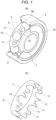
- FIG. 1 (a) of FIG. 1 is a schematic perspective view showing a rolling bearing according to one embodiment of the present invention with a part cut away, and (b) of FIG. 1 is a schematic perspective view showing a synthetic resin-made cage according to one embodiment of the present invention.
- the deep groove ball bearing includes an inner ring 1 having a rolling surface 1a on a circumferential surface thereof, an outer ring 3 having a rolling surface 3a on an inner circumferential surface thereof, a plurality of rolling elements (balls) 5 interposed between the rolling surfaces 1a and 3a, a cage 7 made of a synthetic resin for retaining the plurality of rolling elements 5, a sealing member 15 disposed between the inner ring 1 and the outer ring 3 to seal a bearing internal space, and a lubricant (not shown) enclosed in the bearing internal space, and the cage 7 is a rolling element guide.
- the cage 7 is a crown-shaped cage made of a synthetic resin.
- the crown-shaped cage 7 includes: a main portion 9 formed in a short cylindrical shape; a pair of claw portions 11, 11 provided on one side of the main portion 9 in a cylinder center axis direction, a plurality of the pair of claw portions 11, 11 being provided at predetermined intervals in a circumferential direction of the main portion 9; and a pocket 13 for retaining the rolling element 5 in a rollable manner and formed between each pair of claw portions 11, 11.
- the crown-shaped cage according to the present embodiment is one embodiment, and other general crown-shaped cages can be employed within the scope of the present invention.
- a crown-shaped cage is described, but the cage is not limited to this, and other types of cages made of a synthetic resin can be modified in design within the scope of the present invention.
- sealing member 15 is not limited to the illustrated form, and a general shield plate, rubber seal, or the like to be incorporated in a rolling bearing can be appropriately modified in design within the scope of the present invention.
- the cage 7 contains a reinforcing material in a 100% biomass-derived raw material.
- a reinforcing material in a 100% biomass-derived raw material.
- it is produced by injection molding with a polyamide resin composition containing polyamide 410 (PA410) and a reinforcing material in a content of 10 wt% to 40 wt%. This is because, in this type of cage, since claws of the cage are thin, it is often possible to suppress cracking and whitening during ball incorporation by reducing the content of the reinforcing material.
- the polyamide 410 resin used as a base resin for forming the synthetic resin-made cage 7 in each of the above embodiments is originally a polycondensation product of petroleum-derived tetramethylenediamine (1,4-diaminobutane, butanediamine) and sebacic acid derived from a plant-derived castor oil, but tetramethylenediamine also evolved into a plant-derived material made from wood chips.
- the polyamide 410 is synthesized by reacting the two plant-derived raw materials, i.e., tetramethylenediamine and sebacic acid, and has a biomass degree of 100%. It is a very environmentally friendly material (carbon-neutral) compared to a material having a biomass degree of 70% and using petroleum-derived tetramethylenediamine.
- the polyamide 410 has a water absorption rate of 5.8% (23°C, in water, 2 weeks), which is reduced to about 73% compared to a water absorption rate of 8% (23°C, in water, 2 weeks) of polyamide 66 most commonly used for cages for the rolling bearing, and thus has a small dimensional change due to water absorption and has improved reliability due to excellent dimensional stability.
- the polyamide 410 has a molecular weight in a range that allows injection molding in a state containing a reinforcing material such as a glass fiber, specifically, in a range of 13,000 to 28,000 in terms of a number average molecular weight, and more preferably in a range of 18,000 to 26,000 in terms of a number average molecular weight considering fatigue resistance and moldability.
- the number average molecular weight is less than 13,000, the molecular weight is too low, the fatigue resistance is poor and the practicality is low.
- the number average molecular weight is more than 28,000
- a preferred content of the reinforcing material such as a glass fiber is 15 wt% to 35 wt%, the melt viscosity becomes too high, making it difficult to produce the cage with high accuracy by injection molding, which is not preferred.
- the polyamide 410 exhibits a certain level of durability even when used alone as a resin, works well against wear of a mating member (rolling element and outer ring) with which the cage may come into contact, and functions sufficiently as a cage. However, when it is used under severer use conditions, it is also assumed that the cage is damaged, deformed, or worn. Therefore, it is preferable to blend a reinforcing material in order to further increase the reliability.
- the reinforcing material is preferably a glass fiber, a carbon fiber, an aramid fiber, a potassium titanate whisker, an aluminum borate whisker, or the like. Considering adhesiveness with the above polyamide resin, a reinforcing material subjected to a surface treatment with a silane coupling agent or the like is more preferred. These reinforcing materials can be used in combination of multiple types.
- a fibrous material such as a glass fiber or a carbon fiber
- a whisker-like material in combination with the fibrous material.
- the mixing ratio varies depending on the types of the fibrous material and the whisker-like material, and is appropriately selected considering the impact strength, the damage to the mating material, or the like.
- glass fiber for example, those generally having an average fiber diameter of 10 ⁇ m to 13 ⁇ m, those having an average fiber diameter of 5 ⁇ m to 7 ⁇ m that can increase strength and improve wear resistance with a small content, or those having an irregular cross section are more preferred.
- the carbon fiber for example, PAN-based ones are preferred if priority is given to strength, but pitch-based ones, which are advantageous in terms of cost, can be used. Those having an average fiber diameter of 5 ⁇ m to 15 ⁇ m are preferred. Since the carbon fiber itself has high strength and high elastic modulus, it is possible to increase the strength and elastic modulus of the cage compared to the glass fiber.
- the aramid fiber for example, a para-aramid fiber having excellent reinforcing properties can be preferably used. Those having an average fiber diameter of 5 ⁇ m to 15 ⁇ m are preferred. Unlike the glass fiber and the carbon fiber, the aramid fiber does not damage a steel material and therefore does not deteriorate the surface condition of the mating member with which the cage comes into contact. Therefore, the aramid fiber is more preferred when acoustic characteristics of the bearing are important.
- an iodide-based heat stabilizer or an amine-based antioxidant as an additive to the resin, either singly or in combination.
- the polyamide 410 Compared to the polyamide 66 commonly used in cages for the rolling bearing, the polyamide 410 has a C10 (sebacic acid-derived) moiety having a long hydrocarbon chain between amide groups, and thus has excellent wettability with a poly- ⁇ -olefin oil.
- a grease can also contain 0% to 40% of a thickening agent.
- the thickening agent can be selected within the range described above.
- additives can also be added to this grease.
- examples of the additives include antioxidants such as amines and phenols, rust inhibitors such as Ca sulfonate, extreme pressure additives such as MoDTC, and oiliness improvers such as montan acid ester wax, a montan acid ester partially saponified wax, a polyethylene wax, and oleic acid.
- a polyamide resin composition (resin pellet) can be prepared by blending a polyamide resin and a reinforcing material (glass fiber GF).
- a polyamide resin composition (resin pellet) can be prepared by blending a polyamide resin and a reinforcing material (glass fiber GF).
- Resin Composition of Cage Example Comparative Example Base resin Polyamide 410
- Polyamide 66 70 wt% Reinforcing material GF treated with silane coupling agent (average fiber diameter: 13 ⁇ m), 30 wt% GF treated with silane coupling agent (average fiber diameter: 13 ⁇ m), 30 wt% Melting point (°C) 250 265 Biomass degree (%) 100 0
- the synthetic resin-made crown-shaped cage 7 for a deep groove ball bearing according to the present embodiment can be prepared by injection molding.
Landscapes
- General Engineering & Computer Science (AREA)
- Engineering & Computer Science (AREA)
- Mechanical Engineering (AREA)
- Chemical & Material Sciences (AREA)
- Organic Chemistry (AREA)
- Chemical Kinetics & Catalysis (AREA)
- Health & Medical Sciences (AREA)
- Medicinal Chemistry (AREA)
- Polymers & Plastics (AREA)
- Emergency Medicine (AREA)
- General Chemical & Material Sciences (AREA)
- Oil, Petroleum & Natural Gas (AREA)
- Rolling Contact Bearings (AREA)
- Lubricants (AREA)
- Biological Depolymerization Polymers (AREA)
- Sealing Of Bearings (AREA)
Abstract
Description
- The present invention relates to an improvement of a synthetic resin-made cage to be incorporated in a rolling bearing and a rolling bearing incorporating the synthetic resin-made cage.
- In the related art, synthetic resin-made cages that constitute rolling bearings are most often made of a polyamide 66 resin reinforced with a glass fiber. The polyamide 66 resin is derived from petroleum, and carbon dioxide is generated during the production and disposal of this type of synthetic resin-made cage made of the polyamide 66 resin, which imparts a load on the environment, and thus environmental conservation is not taken into consideration.
- In recent years, the concentration of carbon dioxide, which is a greenhouse gas, in the atmosphere has been increasing year by year, which is one of the major issues that must be solved globally since it is one of the causes of climate change problems represented by global warming.
- As one of the means to solve this problem, biomass plastic products in which a "biomass"-derived material as a renewable resource is utilized have been widely proposed instead of plastic products that are formed using fossil resources that are in danger of depletion. The "biomass plastic" is defined as "a polymer material including substances derived from renewable organic resources as raw materials and obtained by chemically or biologically synthesis" (Japan BioPlastics Association (JBPA)).
- In Japan, various companies have been making efforts to achieve SDGs (Sustainable Development Goals).
- Therefore, a technique using a "biomass"-derived material has already been proposed (Patent Literature 1) because it is preferable to use a resin material having a low environmental load during production or disposal as the resin material constituting this type of synthetic resin-made cage.
- However, in
Patent Literature 1, although a proportion of using the biomass-derived material is disclosed, some of raw materials include "partial biomass plastics" containing petroleum-derived raw materials, and although the environmental load is lower than that of general plastics, it is incomplete as an initiative toward SDGs. - Patent Literature 1:
JP2009-197938A - The present invention has been made to solve such problems in the related art, and an object thereof is to provide an environmentally friendly synthetic resin-made cage which is formed using a 100% biomass raw material, has performance as a bearing in a related-art process, and aims for carbon neutrality, and a rolling bearing incorporating the cage.
- In order to achieve this object, a first aspect of the present invention relates to a cage for a rolling bearing including a reinforcing material in a 100% biomass-derived raw material.
- A second aspect of the present invention relates to the cage for the rolling bearing according to the first aspect of the present invention, in which the raw material is polyamide 410, and the cage is made of a polyamide resin composition containing 10 wt% to 40 wt% of the reinforcing material in the polyamide 410.
- A third aspect of the present invention relates to the cage for the rolling bearing according to the second aspect of the present invention, in which the polyamide 410 is composed of tetramethylenediamine and sebacic acid, which are plant-derived raw materials.
- A fourth aspect of the present invention relates to the cage for the rolling bearing according to the third aspect of the present invention, in which the reinforcing material is a glass fiber having an average fiber diameter of 13 µm.
- A fifth aspect of the present invention relates to a rolling bearing including:
- an inner ring and an outer ring disposed to be relatively rotatable;
- a plurality of rolling elements incorporated between the inner ring and the outer ring; and
- a cage configured to retain the rolling elements, in which
- the cage is the cage according to any one of the first aspect of the present invention to the fourth aspect of the present invention.
- A sixth aspect of the present invention relates to the rolling bearing according to the fifth aspect of the present invention, in which a lubricant is enclosed in a bearing internal space formed between the inner ring and the outer ring, and the lubricant is a grease containing an ester-based base oil as a main component.
- A seventh aspect of the present invention relates to the rolling bearing according to the fifth aspect of the present invention or the sixth aspect of the present invention, in which a sealing member is provided between the inner ring and the outer ring to seal a bearing internal space.
- According to the present invention, it is possible to provide an environmentally friendly synthetic resin-made cage which has performance as a bearing in a related-art process and aims for carbon neutrality, and a rolling bearing incorporating the cage.
- [
FIG. 1 ] (a) ofFIG. 1 is a schematic perspective view showing a rolling bearing according to one embodiment of the present invention with a part cut away, and (b) ofFIG. 1 is a schematic perspective view showing a synthetic resin-made cage according to one embodiment of the present invention. - An embodiment of a synthetic resin-made cage for a rolling bearing according to the present invention and a rolling bearing incorporating the cage will be described below. The present embodiment is merely one embodiment of the present invention and is not to be construed as being limited in any way, and can be appropriately modified in design within the scope of the present invention.
- In the present embodiment, for example, a deep groove ball bearing incorporated in an air conditioner fan motor or the like is assumed.
- The deep groove ball bearing includes an
inner ring 1 having arolling surface 1a on a circumferential surface thereof, anouter ring 3 having arolling surface 3a on an inner circumferential surface thereof, a plurality of rolling elements (balls) 5 interposed between therolling surfaces cage 7 made of a synthetic resin for retaining the plurality ofrolling elements 5, asealing member 15 disposed between theinner ring 1 and theouter ring 3 to seal a bearing internal space, and a lubricant (not shown) enclosed in the bearing internal space, and thecage 7 is a rolling element guide. - In the present embodiment, the
cage 7 is a crown-shaped cage made of a synthetic resin. The crown-shaped cage 7 includes: amain portion 9 formed in a short cylindrical shape; a pair ofclaw portions main portion 9 in a cylinder center axis direction, a plurality of the pair ofclaw portions main portion 9; and apocket 13 for retaining therolling element 5 in a rollable manner and formed between each pair ofclaw portions - The crown-shaped cage according to the present embodiment is one embodiment, and other general crown-shaped cages can be employed within the scope of the present invention. In addition, in the present embodiment, a crown-shaped cage is described, but the cage is not limited to this, and other types of cages made of a synthetic resin can be modified in design within the scope of the present invention.
- Further, the sealing
member 15 is not limited to the illustrated form, and a general shield plate, rubber seal, or the like to be incorporated in a rolling bearing can be appropriately modified in design within the scope of the present invention. - Here, the
cage 7, which is a characteristic configuration of the present invention, will be described in detail. - The
cage 7 contains a reinforcing material in a 100% biomass-derived raw material. In the present embodiment, for example, it is produced by injection molding with a polyamide resin composition containing polyamide 410 (PA410) and a reinforcing material in a content of 10 wt% to 40 wt%. This is because, in this type of cage, since claws of the cage are thin, it is often possible to suppress cracking and whitening during ball incorporation by reducing the content of the reinforcing material. - The polyamide 410 resin used as a base resin for forming the synthetic resin-made
cage 7 in each of the above embodiments is originally a polycondensation product of petroleum-derived tetramethylenediamine (1,4-diaminobutane, butanediamine) and sebacic acid derived from a plant-derived castor oil, but tetramethylenediamine also evolved into a plant-derived material made from wood chips. - The polyamide 410 is synthesized by reacting the two plant-derived raw materials, i.e., tetramethylenediamine and sebacic acid, and has a biomass degree of 100%. It is a very environmentally friendly material (carbon-neutral) compared to a material having a biomass degree of 70% and using petroleum-derived tetramethylenediamine.
- The polyamide 410 has a water absorption rate of 5.8% (23°C, in water, 2 weeks), which is reduced to about 73% compared to a water absorption rate of 8% (23°C, in water, 2 weeks) of polyamide 66 most commonly used for cages for the rolling bearing, and thus has a small dimensional change due to water absorption and has improved reliability due to excellent dimensional stability.
- The polyamide 410 has a molecular weight in a range that allows injection molding in a state containing a reinforcing material such as a glass fiber, specifically, in a range of 13,000 to 28,000 in terms of a number average molecular weight, and more preferably in a range of 18,000 to 26,000 in terms of a number average molecular weight considering fatigue resistance and moldability. When the number average molecular weight is less than 13,000, the molecular weight is too low, the fatigue resistance is poor and the practicality is low. On the other hand, in a case where the number average molecular weight is more than 28,000, when a preferred content of the reinforcing material such as a glass fiber is 15 wt% to 35 wt%, the melt viscosity becomes too high, making it difficult to produce the cage with high accuracy by injection molding, which is not preferred.
- The polyamide 410 exhibits a certain level of durability even when used alone as a resin, works well against wear of a mating member (rolling element and outer ring) with which the cage may come into contact, and functions sufficiently as a cage. However, when it is used under severer use conditions, it is also assumed that the cage is damaged, deformed, or worn. Therefore, it is preferable to blend a reinforcing material in order to further increase the reliability.
- The reinforcing material is preferably a glass fiber, a carbon fiber, an aramid fiber, a potassium titanate whisker, an aluminum borate whisker, or the like. Considering adhesiveness with the above polyamide resin, a reinforcing material subjected to a surface treatment with a silane coupling agent or the like is more preferred. These reinforcing materials can be used in combination of multiple types.
- Considering impact strength, it is preferable to blend a fibrous material such as a glass fiber or a carbon fiber, and further, considering damage to the mating material, it is preferable to blend a whisker-like material in combination with the fibrous material. In the case of mixed use, the mixing ratio varies depending on the types of the fibrous material and the whisker-like material, and is appropriately selected considering the impact strength, the damage to the mating material, or the like.
- As the glass fiber, for example, those generally having an average fiber diameter of 10 µm to 13 µm, those having an average fiber diameter of 5 µm to 7 µm that can increase strength and improve wear resistance with a small content, or those having an irregular cross section are more preferred.
- As the carbon fiber, for example, PAN-based ones are preferred if priority is given to strength, but pitch-based ones, which are advantageous in terms of cost, can be used. Those having an average fiber diameter of 5 µm to 15 µm are preferred. Since the carbon fiber itself has high strength and high elastic modulus, it is possible to increase the strength and elastic modulus of the cage compared to the glass fiber.
- As the aramid fiber, for example, a para-aramid fiber having excellent reinforcing properties can be preferably used. Those having an average fiber diameter of 5 µm to 15 µm are preferred. Unlike the glass fiber and the carbon fiber, the aramid fiber does not damage a steel material and therefore does not deteriorate the surface condition of the mating member with which the cage comes into contact. Therefore, the aramid fiber is more preferred when acoustic characteristics of the bearing are important.
- These reinforcing materials are preferably blended in a proportion of 10 wt% to 40 wt%, particularly 15 wt% to 30 wt%. A blending amount of the reinforcing material of less than 10 wt% is not preferred since an improvement in mechanical strength is unfavorable. A blending amount of the reinforcing material of more than 40 wt% is not preferred since the moldability decreases and depending on the type of the reinforcing material, the damage to the mating material increases.
- Further, in order to suppress deterioration due to heat during molding and use, it is preferable to add an iodide-based heat stabilizer or an amine-based antioxidant as an additive to the resin, either singly or in combination.
- Compared to the polyamide 66 commonly used in cages for the rolling bearing, the polyamide 410 has a C10 (sebacic acid-derived) moiety having a long hydrocarbon chain between amide groups, and thus has excellent wettability with a poly-α-olefin oil.
- In addition, a grease can also contain 0% to 40% of a thickening agent. The thickening agent can be selected within the range described above.
- Other additives can also be added to this grease. Examples of the additives include antioxidants such as amines and phenols, rust inhibitors such as Ca sulfonate, extreme pressure additives such as MoDTC, and oiliness improvers such as montan acid ester wax, a montan acid ester partially saponified wax, a polyethylene wax, and oleic acid.
- Specifically, as shown in Table 1, a polyamide resin composition (resin pellet) can be prepared by blending a polyamide resin and a reinforcing material (glass fiber GF).
[Table 1] Resin Composition of Cage Example Comparative Example Base resin Polyamide 410 Polyamide 66 70 wt% Reinforcing material GF treated with silane coupling agent (average fiber diameter: 13 µm), 30 wt% GF treated with silane coupling agent (average fiber diameter: 13 µm), 30 wt% Melting point (°C) 250 265 Biomass degree (%) 100 0 - -Example: polyamide 410 resin containing 30 mass% of GF (EcoPaXX (registered trademark) Q-HG6 manufactured by DSM, heat stabilizer-containing grade, average molecular weight unknown)
- •Comparative Example: polyamide 66 resin containing 30 mass% of GF (Ultramid (registered trademark) A3HG6 manufactured by BASF, heat stabilizer-containing grade, average molecular weight unknown)
- Using the resin pellet shown in Table 1, the synthetic resin-made crown-shaped
cage 7 for a deep groove ball bearing according to the present embodiment can be prepared by injection molding. - The sealing
member 15 to be incorporated in the rolling bearing according to the present embodiment can also be prepared using the 100% biomass-derived raw material described above. - The present invention can be generally used for rolling bearings in which synthetic resin-made cages are incorporated, and can be generally used for cages for the rolling bearing.
- Although various embodiments have been described above, it goes without saying that the present invention is not limited to such examples. It is apparent for those skilled in the art to which the present invention belongs that various modified examples or corrected examples are conceivable within the scope recited in the claims, and it is understood that the above falls within the technical scope of the present invention. In addition, within the scope not departing from the gist of the invention, each of the configuration elements in the above embodiments may be combined in any manner.
- The present application is based on a
Japanese Patent Application (No. 2022-022921) filed on February 17, 2022 -
- 1 inner ring
- 3 outer ring
- 5 rolling element
- 7 cage (crown-shaped cage)
- 13 pocket
- 15 sealing member
Claims (7)
- A cage for a rolling bearing comprising:
a reinforcing material in a 100% biomass-derived raw material. - The cage for the rolling bearing according to claim 1, wherein the raw material is polyamide 410, and the cage is made of a polyamide resin composition containing 10 wt% to 40 wt% of the reinforcing material in the polyamide 410.
- The cage for the rolling bearing according to claim 2, wherein the polyamide 410 is composed of tetramethylenediamine and sebacic acid, which are plant-derived raw materials.
- The cage for the rolling bearing according to claim 3, wherein the reinforcing material is a glass fiber having an average fiber diameter of 13 µm.
- A rolling bearing comprising:an inner ring and an outer ring disposed to be relatively rotatable;a plurality of rolling elements incorporated between the inner ring and the outer ring; anda cage configured to retain the rolling elements, whereinthe cage is the cage according to any one of claims 1 to 4.
- The rolling bearing according to claim 5, wherein a lubricant is enclosed in a bearing internal space formed between the inner ring and the outer ring, and the lubricant is a grease containing an ester-based base oil as a main component.
- The rolling bearing according to claim 5 or 6, wherein a sealing member is provided between the inner ring and the outer ring to seal a bearing internal space.
Applications Claiming Priority (2)
| Application Number | Priority Date | Filing Date | Title |
|---|---|---|---|
| JP2022022921A JP2023119833A (en) | 2022-02-17 | 2022-02-17 | Cage for rolling bearing and rolling bearing incorporating cage |
| PCT/JP2023/002322 WO2023157592A1 (en) | 2022-02-17 | 2023-01-25 | Cage for rolling bearing and rolling bearing incorporating cage |
Publications (2)
| Publication Number | Publication Date |
|---|---|
| EP4481218A1 true EP4481218A1 (en) | 2024-12-25 |
| EP4481218A4 EP4481218A4 (en) | 2025-06-18 |
Family
ID=87578338
Family Applications (1)
| Application Number | Title | Priority Date | Filing Date |
|---|---|---|---|
| EP23756120.4A Pending EP4481218A4 (en) | 2022-02-17 | 2023-01-25 | CAGE FOR ROLLING BEARINGS AND ROLLING BEARINGS WITH THE CAGE |
Country Status (5)
| Country | Link |
|---|---|
| US (1) | US12345297B2 (en) |
| EP (1) | EP4481218A4 (en) |
| JP (1) | JP2023119833A (en) |
| CN (1) | CN117062992A (en) |
| WO (1) | WO2023157592A1 (en) |
Families Citing this family (2)
| Publication number | Priority date | Publication date | Assignee | Title |
|---|---|---|---|---|
| DE102024129979A1 (en) * | 2024-10-16 | 2026-04-16 | Schaeffler Technologies AG & Co. KG | Ball bearing, electric motor and method for operating a ball bearing |
| DE102024129985A1 (en) * | 2024-10-16 | 2026-04-16 | Schaeffler Technologies AG & Co. KG | Ball bearings, use of a ball bearing and methods for operating a ball bearing |
Family Cites Families (14)
| Publication number | Priority date | Publication date | Assignee | Title |
|---|---|---|---|---|
| CN101946099A (en) * | 2008-02-22 | 2011-01-12 | Ntn株式会社 | Rolling bearing is with parts and rolling bearing |
| JP2009204121A (en) * | 2008-02-28 | 2009-09-10 | Ntn Corp | Rolling bearing member and rolling bearing |
| JP2009197938A (en) | 2008-02-22 | 2009-09-03 | Ntn Corp | Member for rolling bearing and rolling bearing |
| JP5411010B2 (en) * | 2010-01-28 | 2014-02-12 | Ntn株式会社 | Rolling bearing member and rolling bearing |
| US8672556B2 (en) | 2010-01-28 | 2014-03-18 | Ntn Corporation | Member for rolling bearing and rolling bearing |
| JP2013167295A (en) * | 2012-02-15 | 2013-08-29 | Nsk Ltd | Rolling bearing |
| EP2921372A4 (en) * | 2012-11-15 | 2016-11-02 | Nsk Ltd | Electric power steering system |
| JP6577184B2 (en) * | 2014-12-24 | 2019-09-18 | Ntn株式会社 | Rolling bearing |
| KR102329010B1 (en) * | 2016-03-30 | 2021-11-19 | 도레이 카부시키가이샤 | Fiber-reinforced polyamide resin substrate, manufacturing method thereof, molded articles and composite molded articles containing the same |
| JP6917593B2 (en) | 2017-08-31 | 2021-08-11 | 株式会社服部商店 | Grease composition, its manufacturing method, and rolling gear |
| JP2020111636A (en) * | 2019-01-09 | 2020-07-27 | 東レ株式会社 | Polyamide resin composition for guideway member for rolling element and guideway member for rolling element using the same |
| EP4141279A4 (en) * | 2020-04-21 | 2024-05-08 | Oiles Corporation | Polyamide resin composition and sliding member |
| JPWO2022071172A1 (en) * | 2020-09-29 | 2022-04-07 | ||
| WO2023286384A1 (en) * | 2021-07-12 | 2023-01-19 | 日本精工株式会社 | Rolling device |
-
2022
- 2022-02-17 JP JP2022022921A patent/JP2023119833A/en active Pending
-
2023
- 2023-01-25 US US18/282,937 patent/US12345297B2/en active Active
- 2023-01-25 CN CN202380010808.5A patent/CN117062992A/en active Pending
- 2023-01-25 WO PCT/JP2023/002322 patent/WO2023157592A1/en not_active Ceased
- 2023-01-25 EP EP23756120.4A patent/EP4481218A4/en active Pending
Also Published As
| Publication number | Publication date |
|---|---|
| WO2023157592A1 (en) | 2023-08-24 |
| JP2023119833A (en) | 2023-08-29 |
| US20240167512A1 (en) | 2024-05-23 |
| EP4481218A4 (en) | 2025-06-18 |
| CN117062992A (en) | 2023-11-14 |
| US12345297B2 (en) | 2025-07-01 |
Similar Documents
| Publication | Publication Date | Title |
|---|---|---|
| US12345297B2 (en) | Cage for rolling bearing and rolling bearing incorporating cage | |
| CN102471572B (en) | Resin composition, manufacturing method therefor, rolling-element bearing, and slide bearing | |
| EP2530341B1 (en) | Member for rolling bearing and rolling bearing | |
| US6926447B2 (en) | Rolling bearing | |
| EP4223859A1 (en) | Rolling bearing | |
| JP2010090364A (en) | Injection-molded body, resin slide bearing, resin gearwheel, crown-shaped resin holder, resin seal, and roller bearing | |
| US8672556B2 (en) | Member for rolling bearing and rolling bearing | |
| JP2012013094A (en) | Cage for rolling bearing and rolling bearing using the same | |
| CN109337259B (en) | Fluororubber composition with high Shore hardness | |
| JP2013167295A (en) | Rolling bearing | |
| JP2011140976A (en) | Seal for rolling support device | |
| EP4372240A1 (en) | Rolling device | |
| JP3772688B2 (en) | Sealing device | |
| JP2002130295A (en) | Method of manufacturing plastic cage for rolling bearing and rolling bearing provided with the cage | |
| JP5321211B2 (en) | Biodegradable plastic machine parts and rolling bearings | |
| JP2022055412A (en) | Rolling bearing | |
| JP2002275312A (en) | Rubber material composition | |
| JP2009108251A (en) | Method for modifying plastic molded product and plastic molded product | |
| JP2022069965A (en) | Rolling bearing | |
| JP5605152B2 (en) | Rolling bearing | |
| JP5605167B2 (en) | Manufacturing method of biodegradable resin machine parts | |
| JP2022055411A (en) | Rolling bearing | |
| CN117940684A (en) | Rolling device | |
| JP2023023310A (en) | Resin pulley | |
| JP2004068913A (en) | Rolling bearing |
Legal Events
| Date | Code | Title | Description |
|---|---|---|---|
| STAA | Information on the status of an ep patent application or granted ep patent |
Free format text: STATUS: THE INTERNATIONAL PUBLICATION HAS BEEN MADE |
|
| PUAI | Public reference made under article 153(3) epc to a published international application that has entered the european phase |
Free format text: ORIGINAL CODE: 0009012 |
|
| STAA | Information on the status of an ep patent application or granted ep patent |
Free format text: STATUS: REQUEST FOR EXAMINATION WAS MADE |
|
| 17P | Request for examination filed |
Effective date: 20230918 |
|
| AK | Designated contracting states |
Kind code of ref document: A1 Designated state(s): AL AT BE BG CH CY CZ DE DK EE ES FI FR GB GR HR HU IE IS IT LI LT LU LV MC ME MK MT NL NO PL PT RO RS SE SI SK SM TR |
|
| DAV | Request for validation of the european patent (deleted) | ||
| DAX | Request for extension of the european patent (deleted) | ||
| A4 | Supplementary search report drawn up and despatched |
Effective date: 20250516 |
|
| RIC1 | Information provided on ipc code assigned before grant |
Ipc: F16C 33/56 20060101ALI20250512BHEP Ipc: F16C 33/49 20060101ALI20250512BHEP Ipc: F16C 33/46 20060101ALI20250512BHEP Ipc: F16C 33/38 20060101ALI20250512BHEP Ipc: F16C 19/00 20060101ALI20250512BHEP Ipc: F16C 33/78 20060101ALI20250512BHEP Ipc: F16C 33/41 20060101ALI20250512BHEP Ipc: F16C 19/06 20060101ALI20250512BHEP Ipc: C10M 105/32 20060101ALI20250512BHEP Ipc: C08L 101/16 20060101ALI20250512BHEP Ipc: F16C 33/44 20060101AFI20250512BHEP |