EP4478568A1 - Wireless remote monitoring of surge protective devices - Google Patents
Wireless remote monitoring of surge protective devices Download PDFInfo
- Publication number
- EP4478568A1 EP4478568A1 EP24174752.6A EP24174752A EP4478568A1 EP 4478568 A1 EP4478568 A1 EP 4478568A1 EP 24174752 A EP24174752 A EP 24174752A EP 4478568 A1 EP4478568 A1 EP 4478568A1
- Authority
- EP
- European Patent Office
- Prior art keywords
- controller
- power source
- battery
- alarm
- communication protocol
- Prior art date
- Legal status (The legal status is an assumption and is not a legal conclusion. Google has not performed a legal analysis and makes no representation as to the accuracy of the status listed.)
- Pending
Links
Images



Classifications
-
- G—PHYSICS
- G08—SIGNALLING
- G08C—TRANSMISSION SYSTEMS FOR MEASURED VALUES, CONTROL OR SIMILAR SIGNALS
- G08C17/00—Arrangements for transmitting signals characterised by the use of a wireless electrical link
- G08C17/02—Arrangements for transmitting signals characterised by the use of a wireless electrical link using a radio link
-
- H—ELECTRICITY
- H01—ELECTRIC ELEMENTS
- H01H—ELECTRIC SWITCHES; RELAYS; SELECTORS; EMERGENCY PROTECTIVE DEVICES
- H01H71/00—Details of the protective switches or relays covered by groups H01H73/00 - H01H83/00
- H01H71/04—Means for indicating condition of the switching device
-
- H—ELECTRICITY
- H01—ELECTRIC ELEMENTS
- H01T—SPARK GAPS; OVERVOLTAGE ARRESTERS USING SPARK GAPS; SPARKING PLUGS; CORONA DEVICES; GENERATING IONS TO BE INTRODUCED INTO NON-ENCLOSED GASES
- H01T4/00—Overvoltage arresters using spark gaps
- H01T4/06—Mounting arrangements for a plurality of overvoltage arresters
-
- H—ELECTRICITY
- H02—GENERATION; CONVERSION OR DISTRIBUTION OF ELECTRIC POWER
- H02H—EMERGENCY PROTECTIVE CIRCUIT ARRANGEMENTS
- H02H9/00—Emergency protective circuit arrangements for limiting excess current or voltage without disconnection
- H02H9/04—Emergency protective circuit arrangements for limiting excess current or voltage without disconnection responsive to excess voltage
- H02H9/042—Emergency protective circuit arrangements for limiting excess current or voltage without disconnection responsive to excess voltage comprising means to limit the absorbed power or indicate damaged over-voltage protection device
-
- H—ELECTRICITY
- H01—ELECTRIC ELEMENTS
- H01C—RESISTORS
- H01C7/00—Non-adjustable resistors formed as one or more layers or coatings; Non-adjustable resistors made from powdered conducting material or powdered semi-conducting material with or without insulating material
- H01C7/10—Non-adjustable resistors formed as one or more layers or coatings; Non-adjustable resistors made from powdered conducting material or powdered semi-conducting material with or without insulating material voltage responsive, i.e. varistors
- H01C7/12—Overvoltage protection resistors; Arresters
- H01C7/126—Means for protecting against excessive pressure or for disconnecting in case of failure
-
- H—ELECTRICITY
- H01—ELECTRIC ELEMENTS
- H01H—ELECTRIC SWITCHES; RELAYS; SELECTORS; EMERGENCY PROTECTIVE DEVICES
- H01H71/00—Details of the protective switches or relays covered by groups H01H73/00 - H01H83/00
- H01H71/04—Means for indicating condition of the switching device
- H01H2071/044—Monitoring, detection or measuring systems to establish the end of life of the switching device, can also contain other on-line monitoring systems, e.g. for detecting mechanical failures
-
- H—ELECTRICITY
- H02—GENERATION; CONVERSION OR DISTRIBUTION OF ELECTRIC POWER
- H02H—EMERGENCY PROTECTIVE CIRCUIT ARRANGEMENTS
- H02H1/00—Details of emergency protective circuit arrangements
- H02H1/0061—Details of emergency protective circuit arrangements concerning transmission of signals
-
- H—ELECTRICITY
- H02—GENERATION; CONVERSION OR DISTRIBUTION OF ELECTRIC POWER
- H02J—ELECTRIC POWER NETWORKS; CIRCUIT ARRANGEMENTS OR SYSTEMS FOR SUPPLYING OR DISTRIBUTING ELECTRIC POWER; SYSTEMS FOR STORING ELECTRIC ENERGY
- H02J13/00—Circuit arrangements for providing remote monitoring or remote control of equipment in a power distribution network
- H02J13/12—Monitoring network conditions, e.g. electrical magnitudes or operational status
Definitions
- the present invention relates to surge protective devices and, more particularly, to monitoring the status and/or performance of surge protective devices.
- SPDs surge protective devices
- an overvoltage protection device may be installed at a power input of equipment to be protected, which is typically protected against overcurrents when it fails.
- Typical failure mode of an SPD is a short circuit.
- the overcurrent protection typically employed is a combination of an internal thermal disconnector to protect the device from overheating due to increased leakage currents and an external fuse to protect the device from higher fault currents.
- Different SPD technologies may avoid the use of the internal thermal disconnector because, in the event of failure, they change their operation mode to a low ohmic resistance.
- a surge current in a line L e.g., a voltage line of a three phase electrical power circuit
- protection of power system load devices may necessitate providing a current path to ground for the excess current of the surge current.
- the surge current may generate a transient overvoltage between the line L and the neutral line N (the neutral line N may be conductively coupled to a protective earth ground PE). Because the transient overvoltage significantly exceeds the operating voltage of the SPD, the SPD may become conductive, allowing the excess current to flow from line L through the SPD to the neutral line N. Once the surge current has been conducted to the neutral line N, the overvoltage condition ends and the SPD may become non-conducting again.
- SPDs are typically connected in parallel in an installation and overvoltage/surge current events may not always be noticed by personnel responsible for managing a facility.
- an SPD is generally not self-aware and does not provide a direct or automated way to communicate its status or operational state.
- maintenance personnel typically use an external device to test one or more components of the SPD using physical wires or connectors.
- multiple such external devices may be used to evaluate different components of the SPD. It may, therefore, be difficult for management personnel of a facility to obtain an overview of the status of various SPDs deployed throughout a facility to assess the overall level of risk as well as the risks to particular areas throughout the facility.
- a device comprises a wireless transmitter; a controller; and a remote control switch connector that is configured to connect the controller and the wireless transmitter to a power source for a transmit period responsive to a transition of a switch in a surge protective device indicating an end-of-life state of the surge protective device, the controller being configured to communicate an alarm code to a destination via the wireless transmitter during the transmit period.
- the wireless transmitter is configured to communicate the alarm code to the destination via a wireless communication protocol.
- the wireless communication protocol comprises a Lower Power Device 433 (LPD433) radio communication protocol, a cellular communication protocol, a Wi-Fi communication protocol, a Zigbee protocol, a Bluetooth communication protocol, and/or a Near Field Communication (NFC) communication protocol.
- LPD433 Lower Power Device 433
- NFC Near Field Communication
- the remote control switch connector is configured to disconnect the transmitter and the controller from the power source at an end of the transmit period.
- the power source is a battery.
- the device further comprises: a test switch that is configured to connect the controller and wireless transmitter to the power source responsive to operation of the test switch.
- the controller is further configured to perform a status check of the power source responsive to being connected to the power source due to operation of the test switch.
- the controller is further configured to communicate the status of the power source to the destination via the wireless transmitter responsive to performing the status check of the power source.
- the power source is a battery; the controller is further configured to communicate a battery OK code responsive to a determination that the battery has a voltage above a threshold level during the status check of the power source; and the controller is further configured to communicate a battery not OK code responsive to a determination that the battery has a voltage less than or equal to the threshold level during the status check of the power source.
- the device further comprises: a visual indicator that is configured to light responsive to operation of the test switch.
- the visual indicator is a light emitting diode.
- test switch is further configured for manual operation thereof.
- the device further comprises: a housing that encloses the wireless transmitter and the controller and is configured to connect to an assembly including the surge protective device.
- a device comprises: a wireless receiver configured to receive an alarm code from a wireless transmitter indicating transition of a surge protective device to an end-of-life state; and a controller connected to the wireless receiver and that is configured to activate an alarm circuit responsive to receipt of the alarm code via the wireless receiver.
- the alarm circuit is an audible alarm circuit and/or a visual alarm circuit.
- the device further comprises a remote control switch; and a remote control connector connected to the remote control switch.
- the controller is configured to communicate an alarm notification to an external entity via the remote control switch and remote control connector responsive to wireless receiver receiving the alarm code.
- the wireless receiver is further configured to receive a status of a power source connected to the wireless transmitter; and the controller is configured to activate the alarm circuit and/or to generate the alarm notification to indicate the status of the power source.
- the power source is a battery; the wireless receiver is further configured to receive a battery OK code as the status of the power source when the battery has a voltage above a threshold level; and the wireless receiver is further configured to receive a battery not OK code as the status of the power source when the battery has a voltage less than or equal to the threshold level.
- the controller is configured to activate the alarm circuit and/or generate the alarm notification to indicate a normal operation state responsive to receiving the battery OK code and is configured to activate the alarm circuit and/or generate the alarm notification to indicate an error state responsive to receiving the battery not OK code.
- the device further comprises: a reset switch that is configured to reset the alarm circuit and/or the alarm notification responsive to operation thereof.
- the wireless receiver is configured to communicate with the wireless transmitter via a wireless communication protocol.
- the wireless communication protocol comprises a Lower Power Device 433 (LPD433) radio communication protocol, a cellular communication protocol, a Wi-Fi communication protocol, a Zigbee protocol, a Bluetooth communication protocol, and/or a Near Field Communication (NFC) communication protocol.
- LPD433 Lower Power Device 433
- NFC Near Field Communication
- the wireless receiver is further configured to receive a plurality of alarm codes from a plurality of wireless transmitters indicating transitions of a plurality of surge protective devices to end-of-life states, respectively.
- a device comprises: a wireless transmitter; a controller; and a remote control switch connector that is configured to connect the controller and the wireless transmitter to a power source for a transmit period responsive to a transition of a switch in a surge protective device indicating a surge event, the controller being configured to communicate an alarm code to a destination via the wireless transmitter during the transmit period.
- a data processing system may include, but it is not limited to, a hardware element, firmware component, and/or software component.
- Some embodiments of the inventive concept stem from a realization that typically surge protective devices (SPDs) provide only a lower level, local protection to installations where they are deployed. Power network stress events, however, such as overvoltages, current surges, and the like may affect broader areas of an installation. It has typically been difficult to obtain SPD status information, which can be used to evaluate the health of the SPD(s), predict a lifespan of an SPD, assess the vulnerability of an installation over a broader geographic area, and/or provide a basis for a statistical analysis of stress events.
- SPDs typically surge protective devices
- the transmitting device may include a remote control switch connector that is configured to connect a wireless transmitter and a controller in the transmitting device to a power source, such as a battery, responsive to a transition of a switch, such as a remote control switch, in an SPD indicating the SPD has transitioned to an end-of-life state and/or that it has operated in response to a surge event.
- a remote control switch connector configured to connect a wireless transmitter and a controller in the transmitting device to a power source, such as a battery, responsive to a transition of a switch, such as a remote control switch, in an SPD indicating the SPD has transitioned to an end-of-life state and/or that it has operated in response to a surge event.
- the status of the SPD is communicated by the wireless transmitter in the transmitting device by transmitting an alarm code to the receiving device using a wireless communication protocol, such as the Lower Power Device 433 (LPD433) protocol.
- the receiving device may be equipped with a wireless receiver configured to receive the alarm code and a controller that may be configured to activate an alarm circuit in response to receipt of the alarm code via the wireless receiver.
- the alarm circuit may include an audible alarm circuit and/or a visual alarm circuit to notify an operator of an installation, for example, that an SPD has transitioned to an end-of-life state in response to a surge event.
- the receiving device may include a remote control switch and a remote control connector connected to the remote control switch that may be used to communicate an alarm notification to an external entity, such as some type of computing device, e.g., smartphone, laptop, tablet, or the like.
- the transmitting device may further include a test switch that may couple the controller to the power source, e.g.,, battery, to perform a status check.
- the status check may be a determination of whether the battery has a voltage above a threshold level.
- the wireless transmitter may then communicate the battery status, e.g., battery OK or not OK, to the receiving device, which can then communicate the battery status via the audible and/or visual alarm circuit or via a notification to an external entity via the remote control switch and remote control connector.
- the receiving device may be used to receive surge event alarm codes and/or transmitting device battery status updates from multiple transmitting devices in a many to one arrangement.
- the transmitting device(s) and receiving device may be used to track the status of multiple SPDs as part of an SPD management system in an installation.
- FIG. 2 is a perspective diagram of an SPD 100 including a transmitting device configured to wireless communicate an alarm code for surge events according to some embodiments of the inventive concept.
- the SPD 100 includes one or overvoltage protection circuits 120-1, 120-2, 120-3 and 120-4 along with the transmitting device 105, which is attached thereto.
- Each of the overvoltage protection circuits 120-1, 120-2, 120-3 and 120-4 may include one or more varistors and/or one or more gas discharge tubes (GDTs).
- GDTs gas discharge tubes
- the overvoltage protection circuits 120-1, 120-2, 120-3 and 120-4 may be configured, for example, to provide a path to ground to divert excess current and high potential away from one or more protected devices in response to a surge event, such as a lightning strike.
- the transmitting device 105 may have a housing that is configured to facilitate an attachment to the SPD 100 to be communicatively coupled thereto.
- FIG. 3 is a perspective diagram of the transmitting device 105 of FIG. 2 according to some embodiments of the inventive concept.
- the transmitting device 105 includes a housing 135 that contains therein the various circuit elements and modules that are configured to provide at least some of the functionality of the transmitting device 105.
- the housing includes a test switch button 115 that is configured to provide an interface for manual operation of a test switch to determine whether a power supply, such as a battery, is in a normal operating state, e.g., can provide a sufficient voltage, or is in an error state and may need replacement.
- a visual indicator 125 such as a light emitting diode (LED) may indicate when the test switch button 115 has been engaged.
- LED light emitting diode
- the wireless transmitter 460 under the control of the controller 455 communicates the status of the SPD by transmitting an alarm code to the receiving device 110 using a wireless communication protocol.
- the wireless communication protocol comprises a Lower Power Device 433 (LPD433) radio communication protocol, a cellular communication protocol, a Wi-Fi communication protocol, a Zigbee protocol, a Bluetooth communication protocol, and/or a Near Field Communication (NFC) communication protocol.
- the RC switch connector 465 may be coupled to the SPD such that when a switch therein, such as an RC switch, transitions states in response to the SPD transitioning to an end-of-life state and/or a surge event, the transition of the switch in the SPD couples the controller 455 to the power source 470 in the transmitting device 105.
- the surge event may be sufficiently temporary and/or sufficiently lower power that the SPD remains useful upon termination of the surge event.
- the surge event may be sufficiently lengthy and/or at a sufficiently high power that the SPD transitions to an end-of-life state, such as a thermal disconnection resulting from a build-up of heat due to the high current running through the SPD.
- the transmitted alarm code may serve as a notification that the SPD needs to be repaired or replaced.
- the controller 455 and wireless transmitter 460 may be coupled to the power source 470 for a transmit period for communicating the alarm code to the receiving device 110 that terminates upon receipt of a surge event termination signal from the SPD, such as the switch in the SPD to which the RC switch connector 465 is connected changing states, or a programmed duration managed by the controller 455.
- the transmitting device 105 may further include a test switch 475 that may be manually operated by the test switch button 115 and may be used to couple the controller 455 to the power source 470, e.g.,, battery, to perform a status check of the power source 470 by bypassing the RC switch connector 465.
- the status check may be a determination of whether the battery has a voltage above a threshold level that is deemed sufficient to power the transmitting device 105.
- the wireless transmitter 460 under the supervision of the controller 455 may communicate the battery status, e.g., battery OK or not OK, to the receiving device 110 for generating an alert when the battery in the transmitting device 105 needs replacing.
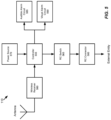
- FIG. 5 is a block diagram of a receiving device 110 configured to wirelessly receive alarm codes for SPD end-of-life events and/or surge events from the transmitting devices of FIGS. 2-4 according to some embodiments of the inventive concept.
- the receiving device 110 includes a wireless receiver 560.
- the wireless receiver 560 may be configured to receive the alarm code from the transmitting device 105 and the controller 555 may be configured to activate an alarm circuit in response to receipt of the alarm code via the wireless receiver 560. As shown in FIG.
- the receiving device 110 may include one or more alarm circuits including, for example, an audible alarm circuit 585, such as a tone or buzzer generator, and a visual alarm circuit 590, such as an LED.
- an audible alarm circuit 585 such as a tone or buzzer generator
- a visual alarm circuit 590 such as an LED.
- the audible alarm circuit 585 and the visual alarm circuit 590 may be used to alert an operator of supervisor of an installation that an SPD end-of-life and/or surge event has occurred and one or more SPDs have reached their end-of-life states and/or have been triggered in response thereto.
- the receiving device may be configured to receive power source status messages, such as battery status messages from the transmitting devices 105.
- the receiving device further includes an RC switch 565, which is wirelessly coupled to the controller and an RC connector 580 that can be used to communicate notifications to an external entity, such as some type of computing device, e.g., smartphone, laptop, tablet, or the like, communicatively coupled to the RC connector 580.
- the controller 55 and RC switch 565 may use a wireless protocol to communicate such as, for example, a Wi-Fi communication protocol, a Bluetooth communication protocol, and/or a Near Field Communication (NFC) communication protocol.
- the alerts and notifications may include SPD end-of-life and/or surge event alerts based on receipt of an end-of-life and/or surge event alarm code from a transmitting device 105 and/or power source status updates.
- the receiving device 110 may include a manually operated reset switch that can be used to turn off the audible alarm circuit 585, the visual alarm circuit 590, and/or the notification function to an external entity by way of the RC switch 565 and RC connector 580.
- FIG. 6 is a block diagram of a data processing system hardware/software architecture for use in a transmitting device 105 according to some embodiments of the inventive concept.
- the transmitting device controller 455 comprises a processor circuit 605 and a memory circuit 610.
- the processor circuit 605 may comprise one or more data processing circuits, such as a general purpose and/or special purpose processor, e.g., microprocessor and/or digital signal processor.
- the processor circuit 605 is configured to execute computer readable program code including an alarm code module 620, a battery code module 625, a switch management module 630, and a communication module 635.
- the alarm code module 620 may be configured to generate an alarm code indicative of an SPD end-of-life and/or surge event responsive to a transition of a switch in an SPD indicating the SPD has transitioned to an end-of-life state and/or that it has operated in response to a surge event.
- the alarm code module 620 may be further configured to operate the wireless transmitter 460 to wirelessly communicate the alarm code to a receiving device 110.
- the battery code module 625 may be configured to generate a power source status message responsive to invocation of the test switch 475 and to operate the wireless transmitter 460 to wirelessly communicate the power source status message to a receiving device 110.
- the communication module 630 may be configured to implement one or more wireless communication protocols for communicating with the receiving device 110 and/or for communicating with an associated SPD.
- the one or more wireless communication protocols may include, but are not limited to, a LPD433 radio communication protocol, a cellular communication protocol, a Wi-Fi communication protocol, a Zigbee protocol, a Bluetooth communication protocol, and/or an NFC communication protocol.
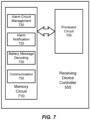
- FIG. 7 is a block diagram of a data processing system hardware/software architecture for use in a receiving device 110 according to some embodiments of the inventive concept.
- the receiving device controller 555 comprises a processor circuit 705 and a memory circuit 710.
- the processor circuit 705 may comprise one or more data processing circuits, such as a general purpose and/or special purpose processor, e.g., microprocessor and/or digital signal processor.
- the processor circuit 705 is configured to execute computer readable program code including an alarm circuit management module 720, an alarm notification module 725, a battery message decoding module 730, and a communication module 735.
- the alarm circuit management module 720 may be configured to manage operation of the audible alarm circuit 585 and the visual alarm circuit 590 in response to SPD end-of-life and/or surge event alarm codes and/or power source status updates from a transmitting device 105.
- the alarm notification module 725 may be configured to communicate SPD end-of-life and/or surge event alarm codes and/or power source status updates from a transmitting device 105 to an external entity by way of the RC switch 565 and RC connector 580.
- the battery message decoding module 730 may be configured to decode one or more status messages related to a power source in a transmitting device 105, such as a battery OK code and/or a battery not OK code, which may be received based on whether a battery in a transmitting device 105 can output a voltage greater than a threshold.
- the communication module 735 may be configured to implement one or more wireless communication protocols for communicating with the transmitting device 110 and/or for communicating with an external entity by way of the RC switch 565 and RC connector 580.
- the one or more wireless communication protocols may include, but are not limited to, a LPD433 radio communication protocol, a cellular communication protocol, a Wi-Fi communication protocol, a Zigbee protocol, a Bluetooth communication protocol, and/or an NFC communication protocol.
- some embodiments of the inventive concept may provide a wireless SPD monitoring system including a transmitting device that may be coupled to an SPD assembly and a receiving device that may be located apart from the transmitting device.
- the transmitting device and receiving device may use wireless communication to communicate operation of an SPD in response to a surge event, such as the SPD transitioning to an end-of-life state, and also communicate status of the power supply in the transmitting device.
- a surge event such as the SPD transitioning to an end-of-life state
- operational components of the transmitting device may be disconnected from a battery until the SPD transitions to an end-of-life state and/or a surge event occurs and/or a manual status check of the battery is requested.
- the extensive use of wireless technology may allow the wireless SPD monitoring system to be installed faster and with less complication.
- aspects of the present disclosure may be illustrated and described herein in any of a number of patentable classes or contexts including any new and useful process, machine, manufacture, or composition of matter, or any new and useful improvement thereof. Accordingly, aspects of the present disclosure may be implemented entirely hardware, entirely software (including firmware, resident software, micro-code, etc.) or combining software and hardware implementation that may all generally be referred to herein as a "circuit,” “module,” “component,” or “system.” Furthermore, aspects of the present disclosure may take the form of a computer program product comprising one or more computer readable media having computer readable program code embodied thereon.
- a computer readable storage medium may be any tangible medium that can contain, or store a program for use by or in connection with an instruction execution system, apparatus, or device.
- a computer readable signal medium may include a propagated data signal with computer readable program code embodied therein, for example, in baseband or as part of a carrier wave. Such a propagated signal may take any of a variety of forms, including, but not limited to, electro-magnetic, optical, or any suitable combination thereof.
- a computer readable signal medium may be any computer readable medium that is not a computer readable storage medium and that can communicate, propagate, or transport a program for use by or in connection with an instruction execution system, apparatus, or device.
- Program code embodied on a computer readable signal medium may be transmitted using any appropriate medium, including but not limited to wireless, wireline, optical fiber cable, RF, etc., or any suitable combination of the foregoing.
- Computer program code for carrying out operations for aspects of the present disclosure may be written in any combination of one or more programming languages, including an object oriented programming language such as Java, Scala, Smalltalk, Eiffel, JADE, Emerald, C++, C#, VB.NET, Python or the like, conventional procedural programming languages, such as the "C" programming language, Visual Basic, Fortran 2003, Perl, COBOL 2002, PHP, ABAP, LabVIEW, dynamic programming languages, such as Python, Ruby and Groovy, or other programming languages.
- the program code may execute entirely on the user's computer, partly on the user's computer, as a stand-alone software package, partly on the user's computer and partly on a remote computer or entirely on the remote computer or server.
- the remote computer may be connected to the user's computer through any type of network, including a local area network (LAN) or a wide area network (WAN), or the connection may be made to an external computer (for example, through the Internet using an Internet Service Provider) or in a cloud computing environment or offered as a service such as a Software as a Service (SaaS).
- LAN local area network
- WAN wide area network
- SaaS Software as a Service
- each block in the block diagrams may represent a module, segment, or portion of code, which comprises one or more executable instructions for implementing the specified logical function(s).
- the functions noted in the block may occur out of the order noted in the figures. For example, two blocks shown in succession may, in fact, be executed substantially concurrently, or the blocks may sometimes be executed in the reverse order, depending upon the functionality involved.
- each block of the block diagrams, and combinations of blocks in the block diagrams can be implemented by special purpose hardware-based systems that perform the specified functions or acts, or combinations of special purpose hardware and computer instructions.
Landscapes
- Engineering & Computer Science (AREA)
- Computer Networks & Wireless Communication (AREA)
- Physics & Mathematics (AREA)
- General Physics & Mathematics (AREA)
- Selective Calling Equipment (AREA)
- Transmitters (AREA)
Abstract
A device includes a wireless transmitter; a controller; and a remote control switch connector that is configured to connect the controller and the wireless transmitter to a power source for a transmit period responsive to a transition of a switch in a surge protective device indicating an end-of-life state of the surge protective device, the controller being configured to communicate an alarm code to a destination via the wireless transmitter during the transmit period.
Description
- The present invention relates to surge protective devices and, more particularly, to monitoring the status and/or performance of surge protective devices.
- Frequently, excessive voltage or current is applied across service lines that deliver power to residences and commercial and institutional facilities. Such excess voltage or current spikes (transient overvoltages and surge currents) may result from lightning strikes, for example. The above events may be of particular concern in telecommunications distribution centers, hospitals and other facilities where equipment damage caused by overvoltages and/or current surges is not acceptable and resulting down time may be very costly.
- Typically, sensitive electronic equipment may be protected against transient overvoltages and surge currents using surge protective devices (SPDs). For example, an overvoltage protection device may be installed at a power input of equipment to be protected, which is typically protected against overcurrents when it fails. Typical failure mode of an SPD is a short circuit. The overcurrent protection typically employed is a combination of an internal thermal disconnector to protect the device from overheating due to increased leakage currents and an external fuse to protect the device from higher fault currents. Different SPD technologies may avoid the use of the internal thermal disconnector because, in the event of failure, they change their operation mode to a low ohmic resistance.
- In the event of a surge current in a line L (e.g., a voltage line of a three phase electrical power circuit), protection of power system load devices may necessitate providing a current path to ground for the excess current of the surge current. The surge current may generate a transient overvoltage between the line L and the neutral line N (the neutral line N may be conductively coupled to a protective earth ground PE). Because the transient overvoltage significantly exceeds the operating voltage of the SPD, the SPD may become conductive, allowing the excess current to flow from line L through the SPD to the neutral line N. Once the surge current has been conducted to the neutral line N, the overvoltage condition ends and the SPD may become non-conducting again.
- SPDs are typically connected in parallel in an installation and overvoltage/surge current events may not always be noticed by personnel responsible for managing a facility. In addition, an SPD is generally not self-aware and does not provide a direct or automated way to communicate its status or operational state. Thus, when multiple SPDs are distributed in multiple locations throughout an installation, which may have different protection requirements, they may not include an automated capability of communicating information concerning their status to other SPDs and/or to the personnel responsible for managing the facility. To evaluate the status of an SPD, maintenance personnel typically use an external device to test one or more components of the SPD using physical wires or connectors. In some examples, multiple such external devices may be used to evaluate different components of the SPD. It may, therefore, be difficult for management personnel of a facility to obtain an overview of the status of various SPDs deployed throughout a facility to assess the overall level of risk as well as the risks to particular areas throughout the facility.
- According to some embodiments of the inventive concept, a device comprises a wireless transmitter; a controller; and a remote control switch connector that is configured to connect the controller and the wireless transmitter to a power source for a transmit period responsive to a transition of a switch in a surge protective device indicating an end-of-life state of the surge protective device, the controller being configured to communicate an alarm code to a destination via the wireless transmitter during the transmit period.
- In other embodiments, the wireless transmitter is configured to communicate the alarm code to the destination via a wireless communication protocol.
- In still other embodiments, the wireless communication protocol comprises a Lower Power Device 433 (LPD433) radio communication protocol, a cellular communication protocol, a Wi-Fi communication protocol, a Zigbee protocol, a Bluetooth communication protocol, and/or a Near Field Communication (NFC) communication protocol.
- In still other embodiments, the remote control switch connector is configured to disconnect the transmitter and the controller from the power source at an end of the transmit period.
- In still other embodiments, the power source is a battery.
- In still other embodiments, the device further comprises: a test switch that is configured to connect the controller and wireless transmitter to the power source responsive to operation of the test switch. The controller is further configured to perform a status check of the power source responsive to being connected to the power source due to operation of the test switch.
- In still other embodiments, the controller is further configured to communicate the status of the power source to the destination via the wireless transmitter responsive to performing the status check of the power source.
- In still other embodiments, the power source is a battery; the controller is further configured to communicate a battery OK code responsive to a determination that the battery has a voltage above a threshold level during the status check of the power source; and the controller is further configured to communicate a battery not OK code responsive to a determination that the battery has a voltage less than or equal to the threshold level during the status check of the power source.
- In still other embodiments, the device further comprises: a visual indicator that is configured to light responsive to operation of the test switch.
- In still other embodiments, the visual indicator is a light emitting diode.
- In still other embodiments, the test switch is further configured for manual operation thereof.
- In still other embodiments, the device further comprises: a housing that encloses the wireless transmitter and the controller and is configured to connect to an assembly including the surge protective device.
- In some embodiments of the inventive concept, a device comprises: a wireless receiver configured to receive an alarm code from a wireless transmitter indicating transition of a surge protective device to an end-of-life state; and a controller connected to the wireless receiver and that is configured to activate an alarm circuit responsive to receipt of the alarm code via the wireless receiver.
- In further embodiments, the alarm circuit is an audible alarm circuit and/or a visual alarm circuit.
- In still further embodiments, the device further comprises a remote control switch; and a remote control connector connected to the remote control switch. The controller is configured to communicate an alarm notification to an external entity via the remote control switch and remote control connector responsive to wireless receiver receiving the alarm code.
- In still further embodiments, the wireless receiver is further configured to receive a status of a power source connected to the wireless transmitter; and the controller is configured to activate the alarm circuit and/or to generate the alarm notification to indicate the status of the power source.
- In still further embodiments, the power source is a battery; the wireless receiver is further configured to receive a battery OK code as the status of the power source when the battery has a voltage above a threshold level; and the wireless receiver is further configured to receive a battery not OK code as the status of the power source when the battery has a voltage less than or equal to the threshold level.
- In still further embodiments, the controller is configured to activate the alarm circuit and/or generate the alarm notification to indicate a normal operation state responsive to receiving the battery OK code and is configured to activate the alarm circuit and/or generate the alarm notification to indicate an error state responsive to receiving the battery not OK code.
- In still further embodiments, the device further comprises: a reset switch that is configured to reset the alarm circuit and/or the alarm notification responsive to operation thereof.
- In still further embodiments, the wireless receiver is configured to communicate with the wireless transmitter via a wireless communication protocol.
- In still further embodiments, the wireless communication protocol comprises a Lower Power Device 433 (LPD433) radio communication protocol, a cellular communication protocol, a Wi-Fi communication protocol, a Zigbee protocol, a Bluetooth communication protocol, and/or a Near Field Communication (NFC) communication protocol.
- In still further embodiments, the wireless receiver is further configured to receive a plurality of alarm codes from a plurality of wireless transmitters indicating transitions of a plurality of surge protective devices to end-of-life states, respectively.
- In some embodiments of the inventive concept, a device comprises: a wireless transmitter; a controller; and a remote control switch connector that is configured to connect the controller and the wireless transmitter to a power source for a transmit period responsive to a transition of a switch in a surge protective device indicating a surge event, the controller being configured to communicate an alarm code to a destination via the wireless transmitter during the transmit period.
- The accompanying drawings, which form a part of the specification, illustrate embodiments of the present invention.
-
FIG. 1 is a block diagram that illustrates wireless remote monitoring of surge protective devices according to some embodiments of the inventive concept; -
FIG. 2 is a perspective diagram of a surge protective device (SPD) including a transmitting device configured to wireless communicate an alarm code for surge events according to some embodiments of the inventive concept; -
FIG. 3 is a perspective diagram of the transmitting device ofFIG. 2 according to some embodiments of the inventive concept; -
FIG. 4 is a block diagram of the transmitting device ofFIGS. 2 and 3 according to some embodiments of the inventive concept; -
FIG. 5 is a block diagram of a receiving device configured to wirelessly receive alarm codes for surge events from the transmitting devices ofFIGS. 2-4 according to some embodiments of the inventive concept; -
FIG. 6 is a block diagram of a hardware/software architecture for use in a transmitting device according to some embodiments of the inventive concept; and -
FIG. 7 is a block diagram of a hardware/software architecture for use in a receiving device according to some embodiments of the inventive concept. - The present invention now will be described more fully hereinafter with reference to the accompanying drawings, in which illustrative embodiments of the invention are shown. In the drawings, the relative sizes of regions or features may be exaggerated for clarity. This invention may, however, be embodied in many different forms and should not be construed as limited to the embodiments set forth herein; rather, these embodiments are provided so that this disclosure will be thorough and complete, and will fully convey the scope of the invention to those skilled in the art. It is noted that aspects described with respect to one embodiment may be incorporated in different embodiments although not specifically described relative thereto. That is, all embodiments and/or features of any embodiments can be combined in any way and/or combination
- As used herein, the term a data processing system may include, but it is not limited to, a hardware element, firmware component, and/or software component.
- Some embodiments of the inventive concept stem from a realization that typically surge protective devices (SPDs) provide only a lower level, local protection to installations where they are deployed. Power network stress events, however, such as overvoltages, current surges, and the like may affect broader areas of an installation. It has typically been difficult to obtain SPD status information, which can be used to evaluate the health of the SPD(s), predict a lifespan of an SPD, assess the vulnerability of an installation over a broader geographic area, and/or provide a basis for a statistical analysis of stress events. Some embodiments of the inventive concept may provide both a transmitting device that may be associated with or coupled to an SPD assembly and may wirelessly transmit the status of an SPD, such as whether the SPD has transitioned to an end-of-life state due to, for example, a thermal disconnect in response to a surge event, to a receiving device located apart from the SPD. For example, the receiving device may be located near a control or monitoring center for managing an installation of equipment that is protected by one or more SPDs. In some embodiments, the transmitting device may include a remote control switch connector that is configured to connect a wireless transmitter and a controller in the transmitting device to a power source, such as a battery, responsive to a transition of a switch, such as a remote control switch, in an SPD indicating the SPD has transitioned to an end-of-life state and/or that it has operated in response to a surge event. This may allow the transmitting device to be disconnected from the power source when it is operating in a standby mode and only consume power in response to a transition to a transition of an SPD to an end-of-life state and/or operation of an SPD in response to a surge event. In some embodiments, the status of the SPD is communicated by the wireless transmitter in the transmitting device by transmitting an alarm code to the receiving device using a wireless communication protocol, such as the Lower Power Device 433 (LPD433) protocol. The receiving device may be equipped with a wireless receiver configured to receive the alarm code and a controller that may be configured to activate an alarm circuit in response to receipt of the alarm code via the wireless receiver. The alarm circuit may include an audible alarm circuit and/or a visual alarm circuit to notify an operator of an installation, for example, that an SPD has transitioned to an end-of-life state in response to a surge event. The receiving device may include a remote control switch and a remote control connector connected to the remote control switch that may be used to communicate an alarm notification to an external entity, such as some type of computing device, e.g., smartphone, laptop, tablet, or the like. The transmitting device may further include a test switch that may couple the controller to the power source, e.g.,, battery, to perform a status check. In some embodiments, the status check may be a determination of whether the battery has a voltage above a threshold level. The wireless transmitter may then communicate the battery status, e.g., battery OK or not OK, to the receiving device, which can then communicate the battery status via the audible and/or visual alarm circuit or via a notification to an external entity via the remote control switch and remote control connector. The receiving device may be used to receive surge event alarm codes and/or transmitting device battery status updates from multiple transmitting devices in a many to one arrangement. Thus, the transmitting device(s) and receiving device according to some embodiments may be used to track the status of multiple SPDs as part of an SPD management system in an installation.
-
FIG. 1 is a block diagram that illustrates wireless remote monitoring of surge protective devices according to some embodiments of the inventive concept. As shown inFIG. 1 ,multiple transmitting devices receiving device 110, which is located remote from the transmittingdevices device 110 may, for example, be located near a control or monitoring center for managing an installation of equipment that is protected by the one or more SPDs respectively associated with the transmittingdevices -
FIG. 2 is a perspective diagram of anSPD 100 including a transmitting device configured to wireless communicate an alarm code for surge events according to some embodiments of the inventive concept. As shown inFIG. 2 , theSPD 100 includes one or overvoltage protection circuits 120-1, 120-2, 120-3 and 120-4 along with the transmittingdevice 105, which is attached thereto. Each of the overvoltage protection circuits 120-1, 120-2, 120-3 and 120-4 may include one or more varistors and/or one or more gas discharge tubes (GDTs). The overvoltage protection circuits 120-1, 120-2, 120-3 and 120-4 may be configured, for example, to provide a path to ground to divert excess current and high potential away from one or more protected devices in response to a surge event, such as a lightning strike. The transmittingdevice 105 may have a housing that is configured to facilitate an attachment to theSPD 100 to be communicatively coupled thereto. -
FIG. 3 is a perspective diagram of the transmittingdevice 105 ofFIG. 2 according to some embodiments of the inventive concept. Referring toFIG. 3 , the transmittingdevice 105 includes ahousing 135 that contains therein the various circuit elements and modules that are configured to provide at least some of the functionality of the transmittingdevice 105. The housing includes atest switch button 115 that is configured to provide an interface for manual operation of a test switch to determine whether a power supply, such as a battery, is in a normal operating state, e.g., can provide a sufficient voltage, or is in an error state and may need replacement. Avisual indicator 125, such as a light emitting diode (LED) may indicate when thetest switch button 115 has been engaged. -
FIG. 4 is a block diagram of the transmittingdevice 105 ofFIGS. 2 and 3 according to some embodiments of the inventive concept. Referring toFIG. 4 , the transmittingdevice 105 includes acontroller 455, a remote control (RC)switch connector 465, and awireless transmitter 460. TheRC switch connector 465 may be configured to connect thewireless transmitter 460 and thecontroller 455 to apower source 470, such as a battery, responsive to a transition of a switch, such as a remote control switch, in an SPD indicating the SPD has transitioned to an end-of-life state and/or that it has operated in response to a surge event. This may allow the components of the transmittingdevice 105 to be disconnected from thepower source 470 when it is operating in a standby mode and only consume power in response to the SPD transitioning to an end-of-life state and/or operating in response to a surge event that triggers the SPD. When thecontroller 455 andwireless transmitter 460 are coupled to the power source during a transmit period, thewireless transmitter 460 under the control of thecontroller 455 communicates the status of the SPD by transmitting an alarm code to the receivingdevice 110 using a wireless communication protocol. In some embodiments, the wireless communication protocol comprises a Lower Power Device 433 (LPD433) radio communication protocol, a cellular communication protocol, a Wi-Fi communication protocol, a Zigbee protocol, a Bluetooth communication protocol, and/or a Near Field Communication (NFC) communication protocol. TheRC switch connector 465 may be coupled to the SPD such that when a switch therein, such as an RC switch, transitions states in response to the SPD transitioning to an end-of-life state and/or a surge event, the transition of the switch in the SPD couples thecontroller 455 to thepower source 470 in the transmittingdevice 105. In some embodiments, the surge event may be sufficiently temporary and/or sufficiently lower power that the SPD remains useful upon termination of the surge event. In some embodiments, the surge event may be sufficiently lengthy and/or at a sufficiently high power that the SPD transitions to an end-of-life state, such as a thermal disconnection resulting from a build-up of heat due to the high current running through the SPD. In this case, the transmitted alarm code may serve as a notification that the SPD needs to be repaired or replaced. In accordance with different embodiments of the inventive concept, thecontroller 455 andwireless transmitter 460 may be coupled to thepower source 470 for a transmit period for communicating the alarm code to the receivingdevice 110 that terminates upon receipt of a surge event termination signal from the SPD, such as the switch in the SPD to which theRC switch connector 465 is connected changing states, or a programmed duration managed by thecontroller 455. - The transmitting
device 105 may further include atest switch 475 that may be manually operated by thetest switch button 115 and may be used to couple thecontroller 455 to thepower source 470, e.g.,, battery, to perform a status check of thepower source 470 by bypassing theRC switch connector 465. In some embodiments, the status check may be a determination of whether the battery has a voltage above a threshold level that is deemed sufficient to power the transmittingdevice 105. Thewireless transmitter 460 under the supervision of thecontroller 455 may communicate the battery status, e.g., battery OK or not OK, to the receivingdevice 110 for generating an alert when the battery in the transmittingdevice 105 needs replacing. -
FIG. 5 is a block diagram of a receivingdevice 110 configured to wirelessly receive alarm codes for SPD end-of-life events and/or surge events from the transmitting devices ofFIGS. 2-4 according to some embodiments of the inventive concept. Referring toFIG. 5 , the receivingdevice 110 includes awireless receiver 560. Apower source 570, acontroller 555, anRC switch 565, and anRC connector 580 that are configured as shown. Thewireless receiver 560 may be configured to receive the alarm code from the transmittingdevice 105 and thecontroller 555 may be configured to activate an alarm circuit in response to receipt of the alarm code via thewireless receiver 560. As shown inFIG. 5 , the receivingdevice 110 may include one or more alarm circuits including, for example, anaudible alarm circuit 585, such as a tone or buzzer generator, and a visual alarm circuit 590, such as an LED. One or both of theaudible alarm circuit 585 and the visual alarm circuit 590 may be used to alert an operator of supervisor of an installation that an SPD end-of-life and/or surge event has occurred and one or more SPDs have reached their end-of-life states and/or have been triggered in response thereto. In addition to end-of-life or surge event alarm codes, the receiving device may be configured to receive power source status messages, such as battery status messages from the transmittingdevices 105. Thecontroller 555 may be configured to decode these power source or battery status messages, such as a battery OK code when the battery has a voltage above a threshold level and a battery not OK code when the battery has a voltage less than or equal to the threshold level, and may activate one or both of theaudible alarm circuit 585 and the visual alarm circuit 590 in response to a battery not OK code or other message indicating a bad power source. To distinguish between the power source status checks of the transmittingdevices 105 and SPD end-of-life and/or surge events, the controller may generate different audible or visual patterns using theaudible alarm circuit 585 and/or visual alarm circuit 590 for a power supply problem versus an end-of-life and/or surge event. - As shown in
FIG. 5 , the receiving device further includes anRC switch 565, which is wirelessly coupled to the controller and anRC connector 580 that can be used to communicate notifications to an external entity, such as some type of computing device, e.g., smartphone, laptop, tablet, or the like, communicatively coupled to theRC connector 580. The controller 55 andRC switch 565 may use a wireless protocol to communicate such as, for example, a Wi-Fi communication protocol, a Bluetooth communication protocol, and/or a Near Field Communication (NFC) communication protocol. The alerts and notifications may include SPD end-of-life and/or surge event alerts based on receipt of an end-of-life and/or surge event alarm code from a transmittingdevice 105 and/or power source status updates. - In some embodiments, the receiving
device 110 may include a manually operated reset switch that can be used to turn off theaudible alarm circuit 585, the visual alarm circuit 590, and/or the notification function to an external entity by way of theRC switch 565 andRC connector 580. -
FIG. 6 is a block diagram of a data processing system hardware/software architecture for use in atransmitting device 105 according to some embodiments of the inventive concept. The transmittingdevice controller 455 comprises aprocessor circuit 605 and amemory circuit 610. Theprocessor circuit 605 may comprise one or more data processing circuits, such as a general purpose and/or special purpose processor, e.g., microprocessor and/or digital signal processor. Theprocessor circuit 605 is configured to execute computer readable program code including analarm code module 620, abattery code module 625, aswitch management module 630, and a communication module 635. Thealarm code module 620 may be configured to generate an alarm code indicative of an SPD end-of-life and/or surge event responsive to a transition of a switch in an SPD indicating the SPD has transitioned to an end-of-life state and/or that it has operated in response to a surge event. Thealarm code module 620 may be further configured to operate thewireless transmitter 460 to wirelessly communicate the alarm code to areceiving device 110. Thebattery code module 625 may be configured to generate a power source status message responsive to invocation of thetest switch 475 and to operate thewireless transmitter 460 to wirelessly communicate the power source status message to areceiving device 110. Thecommunication module 630 may be configured to implement one or more wireless communication protocols for communicating with the receivingdevice 110 and/or for communicating with an associated SPD. The one or more wireless communication protocols may include, but are not limited to, a LPD433 radio communication protocol, a cellular communication protocol, a Wi-Fi communication protocol, a Zigbee protocol, a Bluetooth communication protocol, and/or an NFC communication protocol. -
FIG. 7 is a block diagram of a data processing system hardware/software architecture for use in areceiving device 110 according to some embodiments of the inventive concept. The receivingdevice controller 555 comprises aprocessor circuit 705 and amemory circuit 710. Theprocessor circuit 705 may comprise one or more data processing circuits, such as a general purpose and/or special purpose processor, e.g., microprocessor and/or digital signal processor. Theprocessor circuit 705 is configured to execute computer readable program code including an alarmcircuit management module 720, analarm notification module 725, a batterymessage decoding module 730, and acommunication module 735. The alarmcircuit management module 720 may be configured to manage operation of theaudible alarm circuit 585 and the visual alarm circuit 590 in response to SPD end-of-life and/or surge event alarm codes and/or power source status updates from a transmittingdevice 105. Thealarm notification module 725 may be configured to communicate SPD end-of-life and/or surge event alarm codes and/or power source status updates from a transmittingdevice 105 to an external entity by way of theRC switch 565 andRC connector 580. The batterymessage decoding module 730 may be configured to decode one or more status messages related to a power source in atransmitting device 105, such as a battery OK code and/or a battery not OK code, which may be received based on whether a battery in atransmitting device 105 can output a voltage greater than a threshold. Thecommunication module 735 may be configured to implement one or more wireless communication protocols for communicating with the transmittingdevice 110 and/or for communicating with an external entity by way of theRC switch 565 andRC connector 580. The one or more wireless communication protocols may include, but are not limited to, a LPD433 radio communication protocol, a cellular communication protocol, a Wi-Fi communication protocol, a Zigbee protocol, a Bluetooth communication protocol, and/or an NFC communication protocol. - Thus, some embodiments of the inventive concept may provide a wireless SPD monitoring system including a transmitting device that may be coupled to an SPD assembly and a receiving device that may be located apart from the transmitting device. The transmitting device and receiving device may use wireless communication to communicate operation of an SPD in response to a surge event, such as the SPD transitioning to an end-of-life state, and also communicate status of the power supply in the transmitting device. To reduce battery drain, operational components of the transmitting device may be disconnected from a battery until the SPD transitions to an end-of-life state and/or a surge event occurs and/or a manual status check of the battery is requested. The extensive use of wireless technology may allow the wireless SPD monitoring system to be installed faster and with less complication.
- In the above-description of various embodiments of the present disclosure, aspects of the present disclosure may be illustrated and described herein in any of a number of patentable classes or contexts including any new and useful process, machine, manufacture, or composition of matter, or any new and useful improvement thereof. Accordingly, aspects of the present disclosure may be implemented entirely hardware, entirely software (including firmware, resident software, micro-code, etc.) or combining software and hardware implementation that may all generally be referred to herein as a "circuit," "module," "component," or "system." Furthermore, aspects of the present disclosure may take the form of a computer program product comprising one or more computer readable media having computer readable program code embodied thereon.
- Any combination of one or more computer readable media may be used. The computer readable media may be a computer readable signal medium or a computer readable storage medium. A computer readable storage medium may be, for example, but not limited to, an electronic, magnetic, optical, electromagnetic, or semiconductor system, apparatus, or device, or any suitable combination of the foregoing. More specific examples (a non-exhaustive list) of the computer readable storage medium would include the following: a portable computer diskette, a hard disk, a random access memory (RAM), a read-only memory (ROM), an erasable programmable read-only memory (EPROM or Flash memory), an appropriate optical fiber with a repeater, a portable compact disc read-only memory (CD-ROM), an optical storage device, a magnetic storage device, or any suitable combination of the foregoing. In the context of this document, a computer readable storage medium may be any tangible medium that can contain, or store a program for use by or in connection with an instruction execution system, apparatus, or device.
- A computer readable signal medium may include a propagated data signal with computer readable program code embodied therein, for example, in baseband or as part of a carrier wave. Such a propagated signal may take any of a variety of forms, including, but not limited to, electro-magnetic, optical, or any suitable combination thereof. A computer readable signal medium may be any computer readable medium that is not a computer readable storage medium and that can communicate, propagate, or transport a program for use by or in connection with an instruction execution system, apparatus, or device. Program code embodied on a computer readable signal medium may be transmitted using any appropriate medium, including but not limited to wireless, wireline, optical fiber cable, RF, etc., or any suitable combination of the foregoing.
- Computer program code for carrying out operations for aspects of the present disclosure may be written in any combination of one or more programming languages, including an object oriented programming language such as Java, Scala, Smalltalk, Eiffel, JADE, Emerald, C++, C#, VB.NET, Python or the like, conventional procedural programming languages, such as the "C" programming language, Visual Basic, Fortran 2003, Perl, COBOL 2002, PHP, ABAP, LabVIEW, dynamic programming languages, such as Python, Ruby and Groovy, or other programming languages. The program code may execute entirely on the user's computer, partly on the user's computer, as a stand-alone software package, partly on the user's computer and partly on a remote computer or entirely on the remote computer or server. In the latter scenario, the remote computer may be connected to the user's computer through any type of network, including a local area network (LAN) or a wide area network (WAN), or the connection may be made to an external computer (for example, through the Internet using an Internet Service Provider) or in a cloud computing environment or offered as a service such as a Software as a Service (SaaS).
- Aspects of the present disclosure are described herein with reference to block diagrams of methods, apparatus (systems), and computer program products according to embodiments of the disclosure. It will be understood that each block of the block diagrams, and combinations of blocks in the block diagrams, can be implemented by computer program instructions. These computer program instructions may be provided to a processor of a general purpose computer, special purpose computer, or other programmable data processing apparatus to produce a machine, such that the instructions, which execute via the processor of the computer or other programmable instruction execution apparatus, create a mechanism for implementing the functions/acts specified in the block diagram block or blocks.
- These computer program instructions may also be stored in a computer readable medium that when executed can direct a computer, other programmable data processing apparatus, or other devices to function in a particular manner, such that the instructions when stored in the computer readable medium produce an article of manufacture including instructions which when executed, cause a computer to implement the function/act specified in the block diagram block or blocks. The computer program instructions may also be loaded onto a computer, other programmable instruction execution apparatus, or other devices to cause a series of operational steps to be performed on the computer, other programmable apparatuses or other devices to produce a computer implemented process such that the instructions which execute on the computer or other programmable apparatus provide processes for implementing the functions/acts specified in the block diagram block or blocks.
- The block diagrams in the figures illustrate the architecture, functionality, and operation of possible implementations of systems, methods, and computer program products according to various aspects of the present disclosure. In this regard, each block in the block diagrams may represent a module, segment, or portion of code, which comprises one or more executable instructions for implementing the specified logical function(s). It should also be noted that, in some alternative implementations, the functions noted in the block may occur out of the order noted in the figures. For example, two blocks shown in succession may, in fact, be executed substantially concurrently, or the blocks may sometimes be executed in the reverse order, depending upon the functionality involved. It will also be noted that each block of the block diagrams, and combinations of blocks in the block diagrams, can be implemented by special purpose hardware-based systems that perform the specified functions or acts, or combinations of special purpose hardware and computer instructions.
- The terminology used herein is for the purpose of describing particular aspects only and is not intended to be limiting of the disclosure. As used herein, the singular forms "a", "an" and "the" are intended to include the plural forms as well, unless the context clearly indicates otherwise. It will be further understood that the terms "comprises" and/or "comprising," when used in this specification, specify the presence of stated features, integers, steps, operations, elements, and/or components, but do not preclude the presence or addition of one or more other features, integers, steps, operations, elements, components, and/or groups thereof. As used herein, the term "and/or" includes any and all combinations of one or more of the associated listed items. Like reference numbers signify like elements throughout the description of the figures.
- Many alterations and modifications may be made by those having ordinary skill in the art, given the benefit of present disclosure, without departing from the spirit and scope of the invention. Therefore, it must be understood that the illustrated embodiments have been set forth only for the purposes of example, and that it should not be taken as limiting the invention as defined by the following claims. The following claims, therefore, are to be read to include not only the combination of elements which are literally set forth but all equivalent elements for performing substantially the same function in substantially the same way to obtain substantially the same result. The claims are thus to be understood to include what is specifically illustrated and described above, what is conceptually equivalent, and also what incorporates the essential idea of the invention.
Claims (23)
- A device, comprising:a wireless transmitter;a controller; anda remote control switch connector that is configured to connect the controller and the wireless transmitter to a power source for a transmit period responsive to a transition of a switch in a surge protective device indicating an end-of-life state of the surge protective device, the controller being configured to communicate an alarm code to a destination via the wireless transmitter during the transmit period.
- The device of Claim 1, wherein the wireless transmitter is configured to communicate the alarm code to the destination via a wireless communication protocol.
- The device of Claim 2, wherein the wireless communication protocol comprises a Lower Power Device 433 (LPD433) radio communication protocol, a cellular communication protocol, a Wi-Fi communication protocol, a Zigbee protocol, a Bluetooth communication protocol, and/or a Near Field Communication (NFC) communication protocol.
- The device of any one of Claims 1 to 3, wherein the remote control switch connector is configured to disconnect the transmitter and the controller from the power source at an end of the transmit period.
- The device of any one of Claims 1 to 4, wherein the power source is a battery.
- The device of any one of Claims 1 to 5, further comprising:a test switch that is configured to connect the controller and wireless transmitter to the power source responsive to operation of the test switch;wherein the controller is further configured to perform a status check of the power source responsive to being connected to the power source due to operation of the test switch.
- The device of Claim 6, wherein the controller is further configured to communicate the status of the power source to the destination via the wireless transmitter responsive to performing the status check of the power source.
- The device of Claim 7, wherein the power source is a battery;wherein the controller is further configured to communicate a battery OK code responsive to a determination that the battery has a voltage above a threshold level during the status check of the power source; andwherein the controller is further configured to communicate a battery not OK code responsive to a determination that the battery has a voltage less than or equal to the threshold level during the status check of the power source.
- The device of any one of Claims 6 to 8, further comprising:
a visual indicator that is configured to light responsive to operation of the test switch. - The device of Claim 9, wherein the visual indicator is a light emitting diode.
- The device of any one of Claims 6 to 10, wherein the test switch is further configured for manual operation thereof.
- The device of any one of Claims 1 to 11, further comprising:
a housing that encloses the wireless transmitter and the controller and is configured to connect to an assembly including the surge protective device. - A device, comprising:a wireless receiver configured to receive an alarm code from a wireless transmitter indicating transition of a surge protective device to an end-of-life state; anda controller connected to the wireless receiver and that is configured to activate an alarm circuit responsive to receipt of the alarm code via the wireless receiver.
- The device of Claim 13, wherein the alarm circuit is an audible alarm circuit and/or a visual alarm circuit.
- The device of any one of Claims 13 or 14, further comprising:a remote control switch; anda remote control connector connected to the remote control switch;wherein the controller is configured to communicate an alarm notification to an external entity via the remote control switch and remote control connector responsive to wireless receiver receiving the alarm code.
- The device of Claim 15, wherein the wireless receiver is further configured to receive a status of a power source connected to the wireless transmitter; and
wherein the controller is configured to activate the alarm circuit and/or to generate the alarm notification to indicate the status of the power source. - The device of Claim 16, wherein the power source is a battery;wherein the wireless receiver is further configured to receive a battery OK code as the status of the power source when the battery has a voltage above a threshold level; andwherein the wireless receiver is further configured to receive a battery not OK code as the status of the power source when the battery has a voltage less than or equal to the threshold level.
- The device of Claim 17, wherein the controller is configured to activate the alarm circuit and/or generate the alarm notification to indicate a normal operation state responsive to receiving the battery OK code and is configured to activate the alarm circuit and/or generate the alarm notification to indicate an error state responsive to receiving the battery not OK code.
- The device of any one of Claims 16 to 18, further comprising:
a reset switch that is configured to reset the alarm circuit and/or the alarm notification responsive to operation thereof. - The device of any one of Claims 13 to 19, wherein the wireless receiver is configured to communicate with the wireless transmitter via a wireless communication protocol.
- The device of Claim 20, wherein the wireless communication protocol comprises a Lower Power Device 433 (LPD433) radio communication protocol, a cellular communication protocol, a Wi-Fi communication protocol, a Zigbee protocol, a Bluetooth communication protocol, and/or a Near Field Communication (NFC) communication protocol.
- The device of any one of Claims 13 to 21, wherein the wireless receiver is further configured to receive a plurality of alarm codes from a plurality of wireless transmitters indicating transitions of a plurality of surge protective devices to end-of-life states, respectively.
- A device, comprising:a wireless transmitter;a controller; anda remote control switch connector that is configured to connect the controller and the wireless transmitter to a power source for a transmit period responsive to a transition of a switch in a surge protective device indicating a surge event, the controller being configured to communicate an alarm code to a destination via the wireless transmitter during the transmit period.
Applications Claiming Priority (1)
| Application Number | Priority Date | Filing Date | Title |
|---|---|---|---|
| DE202023102859.4U DE202023102859U1 (en) | 2023-05-24 | 2023-05-24 | Wireless remote monitoring of surge protectors |
Publications (1)
| Publication Number | Publication Date |
|---|---|
| EP4478568A1 true EP4478568A1 (en) | 2024-12-18 |
Family
ID=87430408
Family Applications (1)
| Application Number | Title | Priority Date | Filing Date |
|---|---|---|---|
| EP24174752.6A Pending EP4478568A1 (en) | 2023-05-24 | 2024-05-08 | Wireless remote monitoring of surge protective devices |
Country Status (2)
| Country | Link |
|---|---|
| EP (1) | EP4478568A1 (en) |
| DE (1) | DE202023102859U1 (en) |
Families Citing this family (1)
| Publication number | Priority date | Publication date | Assignee | Title |
|---|---|---|---|---|
| DE102024118740A1 (en) * | 2024-07-02 | 2026-01-08 | Dehn Se | Surge protection device, surge protection system and method for activating a function in a surge protection device |
Citations (3)
| Publication number | Priority date | Publication date | Assignee | Title |
|---|---|---|---|---|
| AU2017202441A1 (en) * | 2016-04-13 | 2017-11-02 | Lightning Protection International Pty Ltd | Surge protection device monitoring |
| US10380869B1 (en) * | 2018-05-02 | 2019-08-13 | North American Power Products, Inc. | Surge protector with wireless notification |
| US20230124733A1 (en) * | 2021-10-20 | 2023-04-20 | Erico International Corporation | Monitor System for Surge Protection Devices |
-
2023
- 2023-05-24 DE DE202023102859.4U patent/DE202023102859U1/en active Active
-
2024
- 2024-05-08 EP EP24174752.6A patent/EP4478568A1/en active Pending
Patent Citations (3)
| Publication number | Priority date | Publication date | Assignee | Title |
|---|---|---|---|---|
| AU2017202441A1 (en) * | 2016-04-13 | 2017-11-02 | Lightning Protection International Pty Ltd | Surge protection device monitoring |
| US10380869B1 (en) * | 2018-05-02 | 2019-08-13 | North American Power Products, Inc. | Surge protector with wireless notification |
| US20230124733A1 (en) * | 2021-10-20 | 2023-04-20 | Erico International Corporation | Monitor System for Surge Protection Devices |
Also Published As
| Publication number | Publication date |
|---|---|
| DE202023102859U1 (en) | 2023-07-10 |
Similar Documents
| Publication | Publication Date | Title |
|---|---|---|
| US11289945B2 (en) | Remote power outage and restoration notification | |
| ES2686429T3 (en) | Power management and control device with remote access | |
| ES2712209T3 (en) | Monitoring of security system status | |
| JP7016417B2 (en) | A method for remotely monitoring the disconnector of a failed lightning protection device, and an energy harvester for the autonomous power supply of the monitoring device installed in the lightning protection device. | |
| US10090662B2 (en) | Power monitoring and management with remote access | |
| CN111226366A (en) | Method and apparatus for adaptive AC/DC surge protection | |
| KR100906304B1 (en) | Leakage current blocking control device of surge voltage protection circuit | |
| AU2019261887B2 (en) | Surge protector with wireless notification | |
| CN103065419A (en) | Monitor system of electric fire | |
| EP4478568A1 (en) | Wireless remote monitoring of surge protective devices | |
| KR20200136295A (en) | Remote control and management system for earth leakage breaker | |
| KR102072736B1 (en) | Apparatus for forecasting the lifetime of SPD using discharge characteristic of MOV | |
| US20070002511A1 (en) | Meter-base surge protector | |
| US20240006871A1 (en) | Metrology device including a high-voltage protection module | |
| KR20180023661A (en) | Apparatus and method for managing power outage | |
| KR100923006B1 (en) | Intelligent earth leakage alarm system | |
| KR20240039379A (en) | Apparatus and method for monitoring protective relay | |
| KR101200534B1 (en) | Apparatus and method for protecting from surge and overvoltage noise | |
| KR101982105B1 (en) | Apparatus for forecasting the lifetime of SPD using impedance characteristic of MOV | |
| US20250283924A1 (en) | Apparatus, system and method of providing a smart powerline event and health monitoring of power distribution systems using surge protection devices | |
| CN103187797B (en) | Early-warning device of converting station spare channel | |
| KR101518238B1 (en) | Monitoring apparatus for earth condition ascertainment | |
| US20250293507A1 (en) | Overvoltage protection system | |
| Çatalca et al. | Power system fault detection and notification with Wi-Fi | |
| CN207518151U (en) | A kind of safe early warning equipment of high-low pressure transformation cabinet |
Legal Events
| Date | Code | Title | Description |
|---|---|---|---|
| PUAI | Public reference made under article 153(3) epc to a published international application that has entered the european phase |
Free format text: ORIGINAL CODE: 0009012 |
|
| STAA | Information on the status of an ep patent application or granted ep patent |
Free format text: STATUS: THE APPLICATION HAS BEEN PUBLISHED |
|
| AK | Designated contracting states |
Kind code of ref document: A1 Designated state(s): AL AT BE BG CH CY CZ DE DK EE ES FI FR GB GR HR HU IE IS IT LI LT LU LV MC ME MK MT NL NO PL PT RO RS SE SI SK SM TR |
|
| STAA | Information on the status of an ep patent application or granted ep patent |
Free format text: STATUS: REQUEST FOR EXAMINATION WAS MADE |
|
| 17P | Request for examination filed |
Effective date: 20250618 |