EP4478482A1 - Secondary battery diagnostic method and secondary battery diagnostic program - Google Patents
Secondary battery diagnostic method and secondary battery diagnostic program Download PDFInfo
- Publication number
- EP4478482A1 EP4478482A1 EP23749848.0A EP23749848A EP4478482A1 EP 4478482 A1 EP4478482 A1 EP 4478482A1 EP 23749848 A EP23749848 A EP 23749848A EP 4478482 A1 EP4478482 A1 EP 4478482A1
- Authority
- EP
- European Patent Office
- Prior art keywords
- secondary battery
- diffusion coefficient
- electrolyte diffusion
- threshold value
- cycles
- Prior art date
- Legal status (The legal status is an assumption and is not a legal conclusion. Google has not performed a legal analysis and makes no representation as to the accuracy of the status listed.)
- Pending
Links
Images



Classifications
-
- H—ELECTRICITY
- H01—ELECTRIC ELEMENTS
- H01M—PROCESSES OR MEANS, e.g. BATTERIES, FOR THE DIRECT CONVERSION OF CHEMICAL ENERGY INTO ELECTRICAL ENERGY
- H01M10/00—Secondary cells; Manufacture thereof
- H01M10/42—Methods or arrangements for servicing or maintenance of secondary cells or secondary half-cells
-
- G—PHYSICS
- G01—MEASURING; TESTING
- G01R—MEASURING ELECTRIC VARIABLES; MEASURING MAGNETIC VARIABLES
- G01R31/00—Arrangements for testing electric properties; Arrangements for locating electric faults; Arrangements for electrical testing characterised by what is being tested not provided for elsewhere
- G01R31/36—Arrangements for testing, measuring or monitoring the electrical condition of accumulators or electric batteries, e.g. capacity or state of charge [SoC]
- G01R31/367—Software therefor, e.g. for battery testing using modelling or look-up tables
-
- G—PHYSICS
- G01—MEASURING; TESTING
- G01R—MEASURING ELECTRIC VARIABLES; MEASURING MAGNETIC VARIABLES
- G01R31/00—Arrangements for testing electric properties; Arrangements for locating electric faults; Arrangements for electrical testing characterised by what is being tested not provided for elsewhere
- G01R31/36—Arrangements for testing, measuring or monitoring the electrical condition of accumulators or electric batteries, e.g. capacity or state of charge [SoC]
- G01R31/378—Arrangements for testing, measuring or monitoring the electrical condition of accumulators or electric batteries, e.g. capacity or state of charge [SoC] specially adapted for the type of battery or accumulator
-
- G—PHYSICS
- G01—MEASURING; TESTING
- G01R—MEASURING ELECTRIC VARIABLES; MEASURING MAGNETIC VARIABLES
- G01R31/00—Arrangements for testing electric properties; Arrangements for locating electric faults; Arrangements for electrical testing characterised by what is being tested not provided for elsewhere
- G01R31/36—Arrangements for testing, measuring or monitoring the electrical condition of accumulators or electric batteries, e.g. capacity or state of charge [SoC]
- G01R31/392—Determining battery ageing or deterioration, e.g. state of health
-
- H—ELECTRICITY
- H01—ELECTRIC ELEMENTS
- H01M—PROCESSES OR MEANS, e.g. BATTERIES, FOR THE DIRECT CONVERSION OF CHEMICAL ENERGY INTO ELECTRICAL ENERGY
- H01M10/00—Secondary cells; Manufacture thereof
- H01M10/42—Methods or arrangements for servicing or maintenance of secondary cells or secondary half-cells
- H01M10/48—Accumulators combined with arrangements for measuring, testing or indicating the condition of cells, e.g. the level or density of the electrolyte
-
- H—ELECTRICITY
- H01—ELECTRIC ELEMENTS
- H01M—PROCESSES OR MEANS, e.g. BATTERIES, FOR THE DIRECT CONVERSION OF CHEMICAL ENERGY INTO ELECTRICAL ENERGY
- H01M10/00—Secondary cells; Manufacture thereof
- H01M10/42—Methods or arrangements for servicing or maintenance of secondary cells or secondary half-cells
- H01M10/44—Methods for charging or discharging
-
- Y—GENERAL TAGGING OF NEW TECHNOLOGICAL DEVELOPMENTS; GENERAL TAGGING OF CROSS-SECTIONAL TECHNOLOGIES SPANNING OVER SEVERAL SECTIONS OF THE IPC; TECHNICAL SUBJECTS COVERED BY FORMER USPC CROSS-REFERENCE ART COLLECTIONS [XRACs] AND DIGESTS
- Y02—TECHNOLOGIES OR APPLICATIONS FOR MITIGATION OR ADAPTATION AGAINST CLIMATE CHANGE
- Y02E—REDUCTION OF GREENHOUSE GAS [GHG] EMISSIONS, RELATED TO ENERGY GENERATION, TRANSMISSION OR DISTRIBUTION
- Y02E60/00—Enabling technologies; Technologies with a potential or indirect contribution to GHG emissions mitigation
- Y02E60/10—Energy storage using batteries
Definitions
- the present invention relates to a secondary battery diagnostic method and a secondary battery diagnostic program.
- a secondary battery such as a lithium ion battery gradually decreases in discharge capacity with repeated charging and discharging. Therefore, the secondary battery is preferably diagnosed at an appropriate time to evaluate a degree of deterioration thereof and determine whether reuse is possible or determine a replacement period. Further, to reuse the secondary battery after diagnosis, preferably the diagnosis is performed in a non-destructive manner.
- JP 2017-97997 A describes a characteristic analysis method for a secondary battery in which a model equation, parameters of which are characteristic values of members constituting the battery, is used, and the characteristic values of the member are estimated by fitting a voltage value of the battery represented by the model equation with actual measurement data.
- the actual measurement data used is obtained by applying a charge/discharge pattern to the battery under analysis, which includes an operation period consisting of either a constant current discharge period or a constant current charge period, followed by a rest period.
- the publication describes, as the characteristic values estimated by the fitting with the actual measurement data, a lithium ion diffusion coefficient in a positive electrode active material, a lithium ion diffusion coefficient in a negative electrode active material, a lithium ion diffusion coefficient in an electrolyte (electrolyte diffusion coefficient), an interface resistance in the positive electrode active material, an interface resistance in the negative electrode active material, a lithium ion salt concentration in the electrolyte, and the like.
- Patent Document 1 JP 2017-97997 A
- the degree of deterioration of a secondary battery is evaluated on the basis of a magnitude of discharge capacity or a magnitude of internal resistance at the time of diagnosis.
- the magnitudes of discharge capacity and the magnitudes of internal resistance at the time of diagnosis are substantially the same, the numbers of times that secondary batteries can be used thereafter are not necessarily substantially the same.
- secondary batteries having substantially the same magnitudes of discharge capacity and magnitudes of internal resistance at the time of diagnosis there exist secondary batteries in which the discharge capacity drops sharply after a small number of charge/discharge cycles, secondary batteries in which the discharge capacity does not substantially drop even after charging/discharging, and the like.
- a remaining life of the secondary battery cannot be accurately evaluated by measuring only the magnitude of discharge capacity and the magnitude of internal resistance at the time of diagnosis.
- JP 2017-97997 A describes a method for estimating characteristic values of members constituting a secondary battery without disassembly of the secondary battery.
- this publication does not describe a specific method for evaluating the remaining life of the secondary battery from these characteristic values.
- An object of the present invention is to provide a secondary battery diagnostic method and a secondary battery diagnostic program that can evaluate a remaining life of a secondary battery more accurately than in the related art without disassembly of the secondary battery.
- a secondary battery diagnostic method includes estimating, on the basis of data obtained by measuring load characteristics of a secondary battery to be diagnosed, characteristic parameters of the secondary battery to be diagnosed at a time of diagnosis by using a predetermined model equation, the characteristic parameters including an electrolyte diffusion coefficient Dn of the secondary battery to be diagnosed at the time of diagnosis; obtaining, on the basis of the model equation and the characteristic parameters estimated, a discharge capacity when an electrolyte diffusion coefficient is changed, and obtaining a relationship between the electrolyte diffusion coefficient and the discharge capacity; determining, on the basis of the relationship between the electrolyte diffusion coefficient and the discharge capacity, a threshold value Dth of the electrolyte diffusion coefficient; and obtaining a difference ⁇ D between the threshold value Dth and the electrolyte diffusion coefficient Dn at the time of diagnosis.
- a secondary battery diagnostic program is a secondary battery diagnostic program for causing a computer to execute estimating, on the basis of data obtained by measuring load characteristics of a secondary battery to be diagnosed, characteristic parameters of the secondary battery to be diagnosed at a time of diagnosis by using a predetermined model equation, the characteristic parameters including an electrolyte diffusion coefficient Dn of the secondary battery to be diagnosed at the time of diagnosis; obtaining, on the basis of the model equation and the characteristic parameters estimated, a discharge capacity when an electrolyte diffusion coefficient is changed, and obtaining a relationship between the electrolyte diffusion coefficient and the discharge capacity; determining, on the basis of the relationship between the electrolyte diffusion coefficient and the discharge capacity, a threshold value Dth of the electrolyte diffusion coefficient; and obtaining a difference ⁇ D between the threshold value Dth and the electrolyte diffusion coefficient Dn at the time of diagnosis.
- the present inventors focused on an electrolyte diffusion coefficient when evaluating a remaining life of a secondary battery.
- a secondary battery approaches a state of so-called “liquid depletion” as an electrolyte amount and a salt concentration therein decrease. It is known that, at this time, the value of the electrolyte diffusion coefficient decreases.
- a value Dn of the electrolyte diffusion coefficient of the secondary battery at the time of diagnosis can be estimated in a non-destructive manner by using measurement data of load characteristics and a model equation well known in this field. Further, a relationship between the electrolyte diffusion coefficient and a discharge capacity can be obtained by simulation using the model equation described above.
- This ⁇ D can be used as an index of the remaining life of the secondary battery. That is, an evaluation can be made as follows: the larger the value of ⁇ D, the lower the likelihood early liquid depletion occurs, and the higher the likelihood the secondary battery can be used over a long period of time. Conversely, the smaller the value of ⁇ D, the higher the likelihood early liquid depletion occurs and the lower the likelihood the secondary battery can be used over a long period of time. A method for predicting a sharp drop in discharge capacity due to such liquid depletion has been nonexistent heretofore. By using this technique, it is possible to evaluate the remaining life of a secondary battery more accurately than in the related art.
- the present inventors have further studied methods for determining the threshold value Dth of the electrolyte diffusion coefficient used in the above evaluation.
- the threshold value Dth can be determined as desired in accordance with the application of the secondary battery and the like.
- Amax maximum capacity
- B decrease rate
- Dh decrease coefficient
- the threshold value Dth may be set to a value of from 50% to 60% of Dh in equation (1) described above. While the electrolyte diffusion coefficient is in a range of from 50% to 60% of Dh, with reference to the absolute value of the discharge capacity, it can still be said that the discharge capacity is being sufficiently maintained. On the other hand, in view of the fact that the discharge capacity decreases exponentially thereafter, by defining the value of the electrolyte diffusion coefficient of this time point as the threshold value Dth, it is possible to more reliably evaluate the reusable life. Even in a case in which there is a measurement error in the data used at the time of diagnosis or a simulation error, for example, it is possible to more reliably evaluate the reusable life.
- a sharp drop in discharge capacity indicates that the diffusivity of the electrolyte inside the secondary battery is insufficient, and all active materials inside the electrodes are starting to become unable to contribute to reactions.
- the reaction is localized, increasing the likelihood of Li deposition. That is, it can be said that the time point of the onset of a sharp drop in discharge capacity is the time point at which the likelihood of Li deposition increases. Therefore, from the viewpoint of taking into consideration the likelihood of Li deposition as well, ideally the threshold value Dth is preferably determined to be a value of from 50% to 60% of Dh.
- the present inventors have found that, in a secondary battery that uses a general-purpose active material such as NCM, LCO, GC, or SiO, when the secondary battery undergoes cycle deterioration under certain conditions, the electrolyte diffusion coefficient decreases substantially linearly with respect to the number of cycles. Therefore, in a case in which it is assumed that the secondary battery is used under certain conditions, the number of cycles at which the difference ⁇ D described above becomes zero can be predicted on the basis of a relationship between the electrolyte diffusion coefficient and the number of cycles.
- a general-purpose active material such as NCM, LCO, GC, or SiO
- the present inventors further analyzed a deterioration state of the secondary battery in more detail in order to improve the accuracy of the prediction.
- the threshold value Dth of the electrolyte diffusion coefficient described above is determined on the basis of the relationship between the electrolyte diffusion coefficient and the discharge capacity acquired from the characteristic parameters at the time of diagnosis.
- a change in a characteristic parameter other than the electrolyte diffusion coefficient is incorporated into a change in the electrolyte diffusion coefficient, making it possible to evaluate the remaining life by one parameter (electrolyte diffusion coefficient).
- the remaining life of the secondary battery can be evaluated with high accuracy to a certain extent.
- characteristic parameters other than the electrolyte diffusion coefficient also change with cycle deterioration, resulting in the possibility of occurrence of deviation between the threshold value Dth obtained from the characteristic parameters at the time of diagnosis and the actual threshold value.
- the present inventors measured load characteristics of secondary batteries that had undergone cycle charge/discharge tests under certain conditions at a plurality of time points with different numbers of cycles, and obtained the threshold value of the electrolyte diffusion coefficient from the data of the load characteristics in the same manner as described above. As a result, it was found that the threshold value of the electrolyte diffusion coefficient also changes substantially linearly with respect to the number of cycles as in the case of the electrolyte diffusion coefficient. Taking this into consideration, by predicting the time point at which the electrolyte diffusion coefficient falls below the threshold value, it is possible to obtain, with higher accuracy, the number of cycles at the onset of a sharp drop in discharge capacity.
- FIG. 1 is a flowchart of a secondary battery diagnostic method according to a first embodiment of the present invention.
- This diagnostic method includes a process of estimating characteristic parameters of a secondary battery to be diagnosed (hereinafter "target battery") at a time of diagnosis (step S 1), a process of obtaining the relationship between the electrolyte diffusion coefficient and the discharge capacity (step S2), a process of determining the threshold value Dth of the electrolyte diffusion coefficient (step S3), and a process of obtaining the difference ⁇ D between the threshold value Dth and the electrolyte diffusion coefficient Dn at the time of diagnosis (step S4).
- target battery a process of estimating characteristic parameters of a secondary battery to be diagnosed
- step S2 a process of obtaining the relationship between the electrolyte diffusion coefficient and the discharge capacity
- step S3 a process of determining the threshold value Dth of the electrolyte diffusion coefficient
- Dn the difference ⁇ D between the threshold value Dth and the electrolyte diffusion coefficient Dn at the time of diagnosis
- Characteristic parameters of the target battery at the time of diagnosis are estimated (step S 1). More specifically, on the basis of the data obtained by measuring the load characteristics of the target battery, the characteristic parameters of the target battery at the time of diagnosis, including the electrolyte diffusion coefficient Dn of the target battery at the time of diagnosis, are estimated by using a predetermined model equation.
- characteristic parameters of the target battery at the time of diagnosis are estimated by fitting the data obtained by measuring the load characteristics of the target battery by using a predetermined model equation.
- This analysis can be performed by a computer program that can perform fluid analysis, and can be performed by, for example, the software Battery Design Studio available from Siemens AG.
- the model equation used can be an equation well known in this field.
- the model equation for example, the equation described in Marc Doyle et al., "Modeling of Galvanostatic Charge and Discharge of the Lithium/Polymer/Insertion Cell," J. Electrochem. Soc., Vol. 140, No. 6, June (1993 ) can be used.
- the target battery is, for example, a lithium ion battery.
- the data obtained by measuring the load characteristics of the target battery is, for example, a discharge curve obtained by measuring the target battery at a plurality of discharge rates.
- This data preferably includes a discharge curve obtained by measurement at an extremely low discharge rate (0.02 C, for example). Further, this data preferably includes a discharge curve obtained by measurement at a discharge rate of 1 C or higher.
- This data preferably includes a discharge curve obtained by measurement at discharge rates of three or more levels, and more preferably includes a discharge curve obtained by measurement at discharge rates of four or more levels.
- the data obtained by measuring the load characteristics of the target battery may be a charge curve obtained by measuring the target battery at a plurality of charge rates.
- the characteristic parameters estimated in this process include at least the electrolyte diffusion coefficient Dn of the target battery at the time of diagnosis.
- the characteristic parameters can include, for example, a solid-phase diffusion coefficient of positive and negative electrode active materials and an electrolyte conductivity. Other specific examples of the characteristic parameters will be described below.
- FIG. 2 is a flowchart illustrating an example of a more specific procedure of the process of estimating characteristic parameters (step S1).
- the process of estimating the characteristic parameters (step S1) includes a process of inputting basic specifications of the target battery (step S 1-1), a process of inputting data obtained by measuring load characteristics of the target battery (step S 1-2), a process of estimating static parameters of the target battery (step S1-3), and a process of estimating dynamic parameters of the target battery (step S1-4).
- Basic specifications of the secondary battery to be diagnosed are input to the analysis software (step S1-1).
- the basic specifications input can include, but are not limited to, for example, the following.
- composition information of the electrolyte at the time of diagnosis cannot be obtained. Therefore, general information of the secondary battery to be diagnosed (or standard information of a new battery) is obtained and input as parameters. Although some values need to be input when the simulation is actually performed, the composition of the electrolyte does not significantly affect the result of the simulation. In the diagnostic method of the present embodiment, the role of the electrolyte composition information is only for reference purposes.
- step S 1-4 Although the densities of the positive and negative electrodes are also expected to change due to expansion from initial states, accurate values at the time of diagnosis cannot be measured. Therefore, an initial value (standard value or the like) or a value predicted from the initial value is input. If the value is completely unknown, a typical value may be input. If necessary, fine adjustment may be performed in step S 1-4.
- the data obtained by measuring the load characteristics of the target battery is input to the analysis software (step S1-2).
- the data obtained by measuring the load characteristics of the target battery is, as described above, a discharge curve obtained by measuring the target battery at a plurality of discharge rates, or the like.
- the "data obtained by measuring the load characteristics of the target battery” is hereinafter also referred to as "actual measurement data”.
- the static parameters of the target battery are estimated from the actual measurement data and the model equation (step S 1-3). For example, the static parameters of the target battery are adjusted so as to match a shape of the discharge curve obtained by measurement at an extremely low discharge rate.
- the discharge curve obtained by measurement at an extremely low discharge rate (0.02 C, for example) can be considered to approximately coincide with a voltage curve when no load is connected (open-circuit voltage curve (OCV)).
- OCV open-circuit voltage curve
- the static parameters can include, but are not limited to, for example, the following.
- the dynamic parameters of the target battery are estimated from the actual measurement data and the model equation (step S 1-4). For example, a simulation is performed in which the target battery is discharged at a current value equivalent to that of the measurement conditions of actual measurement data, and the dynamic parameters are adjusted while comparing the data obtained by this simulation result and the actual measurement data such that the two coincide. This simulation can be performed using, for example, the discharge curve prediction of Battery Design Studio described above.
- the dynamic parameters may include, but are not limited to, for example, the following.
- the ambient temperature at the time of the simulation is preferably set so as to coincide with the ambient temperature at the time of actual measurement data acquisition.
- the influence of heat generation is taken into consideration.
- measurements are performed at least at 1 C and fitting is conducted with the actual measurement data affected by heat generation.
- the target battery is a small cell for a desk test or the like, the influence of heat generation need not be considered.
- the relationship between the electrolyte diffusion coefficient and the discharge capacity is obtained (step S2). More specifically, the discharge capacity is obtained by performing a discharge simulation while changing only the electrolyte diffusion coefficient among the characteristic parameters estimated in step S1 and keeping the other characteristic parameters constant.
- a discharge rate and an ambient temperature at the time of the discharge simulation are preferably set in accordance with the reuse application. For example, if the target battery is expected to be used in the application at an average rate of about 1 C, then the discharge rate used when obtaining the relationship between the electrolyte diffusion coefficient and the discharge capacity is also 1 C. Since it is difficult to precisely match all environmental conditions, simulations may be performed using average values.
- FIG. 3 is a graph showing an example of a relationship between the electrolyte diffusion coefficient and the discharge capacity.
- the discharge capacity with the ambient temperature set to 45°C and the discharge rate set to 0.5 C was obtained for each case in which the electrolyte diffusion coefficient was 4.8 ⁇ 10 -6 , 4.0 ⁇ 10 -6 , 2.95 ⁇ 10 -6 , 1.85 ⁇ 10 -6 , 1.48 ⁇ 10 -6 , and 1.1 ⁇ 10 -6 cm 2 /s.
- the smaller the electrolyte diffusion coefficient the smaller the discharge capacity.
- the relationship between the electrolyte diffusion coefficient and the discharge capacity is not linear, but rather has a tendency to exhibit a curve such that the decrease in discharge capacity increases as the electrolyte diffusion coefficient decreases.
- the threshold value Dth of the electrolyte diffusion coefficient is determined (step S3). More specifically, with reference to the relationship between the electrolyte diffusion coefficient and the discharge capacity obtained in step S2, the value of the electrolyte diffusion coefficient when the target battery becomes unsuitable for reuse is determined to be the threshold value Dth.
- a criterion for determining that the target battery is "not suitable for reuse” differs according to the intended reuse application of the target battery. Therefore, the criterion for determining that the target battery is "not suitable for reuse" is set in accordance with the application.
- the determination may be made that the battery is not suitable for reuse.
- the electrolyte diffusion coefficient when the discharge capacity becomes equal to or less than the predetermined permissible value is determined to be the threshold value Dth.
- the threshold value Dth is 1.40 ⁇ 10 -6 cm 2 /s.
- the determination may be made that the battery is not suitable for reuse.
- the electrolyte diffusion coefficient at the onset of a sharp drop in discharge capacity is determined to be the threshold value Dth.
- the electrolyte diffusion coefficient when a slope of the discharge capacity is equal to or greater than a predetermined magnitude may be set as the threshold value Dth.
- a point at which tangents of each curve before and after the onset of a sharp drop in discharge capacity intersect may be set as the threshold value Dth.
- This ⁇ D can be used as an index for the remaining life of the target battery. That is, the target battery can be evaluated as follows: the larger the value of ⁇ D, the higher the likelihood the target battery can be used for a long period of time, and the smaller the value of ⁇ D, the lower the likelihood the target battery can be used for a long period of time. Even if the discharge capacities at the time of diagnosis are about the same, ⁇ D may be different. By using ⁇ D, it is possible to more accurately evaluate the remaining life of the target battery as compared with known methods in which the remaining life is evaluated on the basis of the magnitude of the discharge capacity at the time of diagnosis.
- the life of the secondary battery greatly varies depending on usage conditions, and thus "accurate evaluation of the remaining life” does not necessarily mean prediction of a specific number of charge/discharge cycles until unsuitable for reuse.
- the target battery is continuously used under certain conditions, it is also possible to predict the remaining life (number of charge/discharge cycles) of the target battery from ⁇ D. For example, a relationship between ⁇ D and the remaining life may be measured in advance, and the remaining life of the target battery may be predicted on the basis of this relationship between ⁇ D and the remaining life.
- the secondary battery diagnostic method according to a second embodiment of the present invention differs from that of the first embodiment in the process of determining the threshold value Dth of the electrolyte diffusion coefficient (step S3).
- FIG. 5 is a flowchart illustrating a more specific procedure of the process of determining the threshold value Dth of the electrolyte diffusion coefficient (step S3) in the secondary battery diagnostic method according to the present embodiment.
- the process of determining the threshold value Dth of the electrolyte diffusion coefficient (step S3) includes a process of obtaining Amax, B, and Dh by fitting the relationship between the electrolyte diffusion coefficient D and the discharge capacity with equation (1) below (step S3-1), and a process of determining the threshold value Dth on the basis of Dh (step S3-2).
- Discharge capacity Amax ⁇ B ⁇ EXP Dh/D
- FIG. 6 is a graph obtained by fitting the relationship between the electrolyte diffusion coefficient and the discharge capacity shown in FIG. 3 with equation (1).
- the dashed line in FIG. 6 represents the discharge capacity calculated by equation (1).
- Amax 36.2 mAh
- B 0.034 mAh
- Dh 2.51 ⁇ 10 -6 cm 2 /s.
- the relationship between the electrolyte diffusion coefficient D and the discharge capacity can be accurately approximated by equation (1).
- the threshold value Dth is determined (step S3-2).
- Dh is a parameter characterizing the value of the electrolyte diffusion coefficient at the onset of a sharp drop in discharge capacity, and it is rational to determine the threshold value Dth by using Dh as reference.
- the threshold value Dth is determined to be to a value of from 50 to 60% of Dh.
- the threshold value Dth is 1.40 ⁇ 10 -6 cm 2 /s.
- the value of the electrolyte diffusion coefficient of this time point is defined as the threshold value Dth. Even in a case in which there is a measurement error in the data used at the time of diagnosis or a simulation error, for example, it is possible to more reliably evaluate the reusable life.
- a sharp drop in discharge capacity indicates that the diffusivity of the electrolyte inside the secondary battery is insufficient, and all active materials inside the electrodes are starting to become unable to contribute to reactions.
- the reaction is localized, increasing the likelihood of Li deposition. That is, it can be said that the time point of the onset of a sharp drop in discharge capacity is the time point at which the likelihood of Li deposition increases. Therefore, from the viewpoint of taking into consideration the likelihood of Li deposition as well, ideally the threshold value Dth is preferably determined to be a value of from 50% to 60% of Dh.
- the threshold value Dth is more preferably a value of from 54% to 58% of Dh.
- FIG. 7 is a flowchart of the secondary battery diagnostic method according to a third embodiment of the present invention.
- this diagnostic method further includes a process of obtaining, on the basis of the relationship between the number of cycles and the electrolyte diffusion coefficient acquired in advance, the number of cycles corresponding to the difference ⁇ D (step S5).
- the number of cycles corresponding to the difference ⁇ D is obtained on the basis of the relationship between the number of cycles and the electrolyte diffusion coefficient acquired in advance (step S5).
- the life of the secondary battery greatly varies depending on usage conditions, and thus the evaluation of the remaining life by the difference ⁇ D does not necessarily mean prediction of a specific number of charge/discharge cycles until the secondary battery becomes unsuitable for reuse.
- the electrolyte diffusion coefficient decreases substantially linearly with respect to the number of cycles.
- the relationship between the number of cycles and the electrolyte diffusion coefficient is acquired in advance, and the number of cycles described above until the difference ⁇ D becomes zero can be predicted on the basis of the relationship between the number of cycles and the electrolyte diffusion coefficient.
- the relationship between the number of cycles and the electrolyte diffusion coefficient can be acquired, for example, as follows.
- a charge/discharge cycle test is conducted on a secondary battery of the same type as that of the target battery under certain conditions to deteriorate this secondary battery.
- a “secondary battery of the same type as that of the target battery” means a secondary battery in which the materials and shapes of the positive and negative electrodes, the type and amount of the electrolyte, and the like are equivalent to those of the target battery.
- a “secondary battery of the same type as that of the target battery” means a secondary battery or the like having the same model number.
- this "secondary battery of the same type as that of the target battery” is referred to as a "secondary battery for measurement.”
- the discharge rate, the ambient temperature, and the like in the charge/discharge cycle test are preferably set in accordance with the reuse application of the target battery. For example, if the target battery is expected to be used in the application at around 1C on average, then the discharge rate used during the charge/discharge cycle test is also 1C. Since it is difficult to precisely match all environmental conditions, the charge/discharge cycle test may be conducted using average values.
- the charge/discharge cycle test does not need to be repeated until the secondary battery for measurement is sufficiently deteriorated, and need only be conducted until the number of cycles reaches an appropriate number.
- the load characteristics of the secondary battery for measurement are measured at two or more time points having different numbers of cycles, and the characteristic parameters of the secondary battery for measurement at each time point are estimated from the data of the load characteristics.
- the characteristic parameters can be estimated in the same manner as in the process of estimating the characteristic parameters of the target battery (step S 1).
- the fitting is performed by changing only the discharge capacity, the electrolyte diffusion coefficient, and the electrolyte conductivity among the characteristic parameters estimated at the first point and fixing the other characteristic parameters to the characteristic parameters estimated at the first point.
- the fitting may be performed by changing all characteristic parameters.
- the fitting may become inaccurate with the number of parameters, and the relationship between the number of cycles and the electrolyte diffusion coefficient may become inaccurate.
- the relationship between the number of cycles and the electrolyte diffusion coefficient may be obtained by conducting a charge/discharge cycle test on the target battery itself instead of the secondary battery for measurement.
- the load characteristics may be measured, and the data of these load characteristics obtained by the measurement may then be used to update the relationship between the number of cycles and the electrolyte diffusion coefficient, allowing for continuous correction of the prediction.
- the load characteristics that can be measured in a short period of time such as at 3 C and 5 C, may be acquired.
- the number of cycles corresponding to the difference ⁇ D is obtained on the basis of the acquired relationship between the number of cycles and the electrolyte diffusion coefficient. More specifically, the number of cycles at which the difference ⁇ D becomes zero is obtained.
- FIG. 8 is a flowchart of the secondary battery diagnostic method according to a fourth embodiment of the present invention.
- this diagnostic method further includes a process of correcting the number of cycles on the basis of the relationship between the number of cycles and the threshold value of the electrolyte diffusion coefficient acquired in advance (step S6).
- step S6 The number of cycles obtained in step S5 (number of cycles N 0 corresponding to the difference ⁇ D) is corrected on the basis of the relationship between the number of cycles and the threshold value of the electrolyte diffusion coefficient acquired in advance (step S6).
- the threshold value of the electrolyte diffusion coefficient changes substantially linearly with respect to the number of cycles. Taking this into consideration, by predicting the time point at which the electrolyte diffusion coefficient falls below the threshold value Dth, it is possible to predict, with higher accuracy, the specific number of cycles at which the target battery becomes unsuitable for reuse.
- the relationship between the number of cycles and the threshold value Dth of the electrolyte diffusion coefficient can be acquired as follows, for example.
- a charge/discharge cycle test is conducted on the secondary battery for measurement under certain conditions to deteriorate the secondary battery for measurement.
- the load characteristics of the secondary battery for measurement are measured at two or more time points having different numbers of cycles, and the characteristic parameters of the secondary battery for measurement at each time point are estimated from the data of the load characteristics.
- the data of the load characteristics and the characteristic parameters those acquired when the relationship between the number of cycles and the electrolyte diffusion coefficient was obtained may be used.
- the relationship between the electrolyte diffusion coefficient and the discharge capacity is obtained at each time point by using these characteristic parameters, and the threshold value of the electrolyte diffusion coefficient at each time point is then determined.
- These processes can be performed as in the process of obtaining the relationship between the electrolyte diffusion coefficient and the discharge capacity of the target battery (step S2) and the process of determining the threshold value Dth of the electrolyte diffusion coefficient of the target battery (step S3).
- the threshold value of the electrolyte diffusion coefficient changes substantially linearly with respect to the number of cycles. Therefore, if the threshold values of the electrolyte diffusion coefficient at at least two time points are known, the relationship between the number of cycles and the threshold value of the electrolyte diffusion coefficient can be acquired.
- the threshold value of the electrolyte diffusion coefficient may be determined at three or more time points to obtain the slope k th , thereby further reducing errors.
- the relationship between the number of cycles and the threshold value of the electrolyte diffusion coefficient may be obtained by conducting a charge/discharge cycle test on the target battery itself instead of the secondary battery for measurement.
- the number of cycles obtained in step S5 is corrected on the basis of the acquired relationship between the number of cycles and the threshold value of the electrolyte diffusion coefficient.
- N 1 (Dn - Dth)/(k th - k D ). This makes it possible to predict the specific number of cycles at which the target battery becomes unsuitable for reuse with higher accuracy.
- a secondary battery diagnostic program is a secondary battery diagnostic program for causing a computer to execute estimating, on the basis of data obtained by measuring load characteristics of a secondary battery to be diagnosed, characteristic parameters of the secondary battery to be diagnosed at a time of diagnosis by using a predetermined model equation, the characteristic parameters including the electrolyte diffusion coefficient Dn of the secondary battery to be diagnosed at the time of diagnosis; obtaining, on the basis of the model equation and the characteristic parameters estimated, a discharge capacity when an electrolyte diffusion coefficient is changed, and obtaining a relationship between the electrolyte diffusion coefficient and the discharge capacity; determining, on the basis of the relationship between the electrolyte diffusion coefficient and the discharge capacity, the threshold value Dth of the electrolyte diffusion coefficient; and obtaining the difference ⁇ D between the threshold value Dth and the electrolyte diffusion coefficient Dn at the time of diagnosis.
- the present embodiment it is possible to more accurately evaluate the remaining life of the target battery
- the secondary battery electrode diagnostic methods described above can also be realized as computer-readable recording media in which the computer program described above is recorded.
- a secondary battery diagnostic system includes a memory and a processor, and the processor, according to a program in the memory, executes estimating, on the basis of data obtained by measuring load characteristics of a secondary battery to be diagnosed, characteristic parameters of the secondary battery to be diagnosed at a time of diagnosis by using a predetermined model equation, the characteristic parameters including the electrolyte diffusion coefficient Dn of the secondary battery to be diagnosed at the time of diagnosis; obtaining, on the basis of the model equation and the characteristic parameters estimated, a discharge capacity when an electrolyte diffusion coefficient is changed, and obtaining a relationship between the electrolyte diffusion coefficient and the discharge capacity; determining, on the basis of the relationship between the electrolyte diffusion coefficient and the discharge capacity, the threshold value Dth of the electrolyte diffusion coefficient; and obtaining the difference ⁇ D between the threshold value Dth and the electrolyte diffusion coefficient Dn at the time of diagnosis.
- a plurality of medium-sized laminate-type cells having a rated capacity of 5 Ah and a plurality of small-sized laminate-type cells having a rated capacity of 36 mAh were fabricated.
- a positive-electrode-mixture-containing slurry was prepared by uniformly mixing 93 parts by mass of LiCoO 2 as a positive electrode active material, 3 parts by mass of carbon black as a conductive aid, and 4 parts by mass of polyvinylidene fluoride (PVDF) as a binder, using N-methyl-2-pyrrolidone (NMP) as a solvent.
- PVDF polyvinylidene fluoride
- This positive-electrode-mixture-containing slurry was applied to both sides of a positive electrode current collector made of aluminum foil having a thickness of 15 ⁇ m, dried, subsequently pressure-formed using a roller press machine, and then punched out so that a portion of the positive electrode current collector not coated with the positive-electrode-mixture-containing slurry became a tab portion, thereby fabricating the positive electrode.
- a negative-electrode-mixture-containing slurry was prepared by mixing 97.5 parts by mass of graphite as a negative electrode active material, 1.5 parts by mass of carboxymethyl cellulose as a binder, and 1 part by mass of styrene-butadiene rubber, and then adding an appropriate amount of water and thoroughly mixing.
- This negative-electrode-mixture-containing slurry was applied to both sides of a negative electrode current collector made of copper foil having a thickness of 10 ⁇ m, dried, subsequently pressure-formed using a roller press machine, and then punched out so that a portion of the negative electrode current collector not coated with the negative-electrode-mixture-containing slurry became a tab portion, thereby fabricating the negative electrode.
- the positive electrodes described above and eight of the negative electrodes described above were alternately layered with a polyolefin microporous film separator interposed therebetween to form a multilayer electrode body, the polyolefin microporous film separator having a thickness of 18 ⁇ m and a three-layer structure consisting of a polyethylene layer as a middle layer and two polypropylene layers as outer layers.
- the tab portions of the positive electrodes of the multilayer electrode body were welded together and the tab portions of the negative electrodes of the multilayer electrode body were welded together and leads were connected respectively thereto.
- the multilayer electrode body was enclosed inside an outer packaging made from an aluminum laminate film together with a non-aqueous electrolyte prepared by dissolving LiPF 6 at a concentration of 1 mol/L in a solution obtained by mixing ethylene carbonate, diethyl carbonate, and methyl ethyl carbonate at a volume ratio of 1:1:1, and further dissolving vinylene carbonate in an amount of 1 mass%, thereby fabricating a non-aqueous electrolyte secondary battery with a rated capacity of 5 Ah.
- a positive-electrode-mixture-containing slurry was prepared by uniformly mixing 94 parts by mass of LiCoO 2 as the positive electrode active material, 4 parts by mass of carbon black as the conductive aid, and 2 parts by mass of PVDF as the binder, using NMP as the solvent.
- This positive-electrode-mixture-containing slurry was applied to both sides of a positive electrode current collector made of aluminum foil having a thickness of 15 ⁇ m, dried, subsequently pressure-formed using a roller press machine, and then punched out so that a portion of the positive electrode current collector not coated with the positive-electrode-mixture-containing slurry became a tab portion, thereby fabricating the positive electrode.
- a negative-electrode-mixture-containing slurry was prepared by mixing 94.5 parts by mass of graphite and 3 parts by mass of SiO particles (D50: 5.0 ⁇ m) including a front surface coated with carbon as the negative electrode active material, 1.5 parts by mass of carboxymethyl cellulose and 1 part by mass of styrene-butadiene rubber as the binder, and then adding an appropriate amount of water and thoroughly mixing.
- This negative-electrode-mixture-containing slurry was applied to both sides of a negative electrode current collector made of copper foil having a thickness of 10 ⁇ m, dried, subsequently pressure-formed using a roller press machine, and then punched out so that a portion of the negative electrode current collector not coated with the negative-electrode-mixture-containing slurry became a tab portion, thereby fabricating the negative electrode.
- the positive electrode described above and the negative electrode described above were layered with a polyolefin microporous film separator interposed therebetween to form a multilayer electrode body, the polyolefin microporous film separator having a thickness of 12 ⁇ m and a three-layer structure consisting of a polyethylene layer as the middle layer and two polypropylene layers as the outer layers.
- the multilayer electrode body was enclosed inside an outer packaging made from an aluminum laminate film together with a non-aqueous electrolyte prepared by dissolving LiPF 6 at a concentration of 1 mol/L in a solution obtained by mixing ethylene carbonate and diethyl carbonate at a volume ratio of 3:7, and further dissolving vinylene carbonate in an amount of 1 mass%, thereby fabricating a non-aqueous electrolyte secondary battery with a rated capacity of 36 mAh.
- a non-aqueous electrolyte prepared by dissolving LiPF 6 at a concentration of 1 mol/L in a solution obtained by mixing ethylene carbonate and diethyl carbonate at a volume ratio of 3:7, and further dissolving vinylene carbonate in an amount of 1 mass%, thereby fabricating a non-aqueous electrolyte secondary battery with a rated capacity of 36 mAh.
- a plurality of deteriorated cells having discharge capacities reduced to 4.8 Ah were fabricated by conducting charge/discharge cycle tests on the medium-sized laminate-type cells having a rated capacity of 5 Ah under a plurality of conditions different in terms of charge/discharge rate, ambient temperature, and the like.
- a plurality of deteriorated cells having discharge capacities reduced to 35 mAh were fabricated by conducting charge/discharge cycle tests on the small-sized laminate-type cells having a rated capacity of 36 mAh under a plurality of conditions different in charge/discharge rate, ambient temperature, and the like.
- the load characteristics of these deteriorated cells were measured. Specifically, discharge curves were measured at discharge rates of 0.02 C, 0.2 C, 0.5 C, and 1 C.
- the secondary battery diagnostic method described in the embodiment was carried out using these deteriorated cells as target batteries.
- the analysis (simulation) was carried out by the software Battery Design Studio available from Siemens AG. Among the basic specifications, a solvent ratio and a salt concentration were input using the same values as those at the time of fabrication (because the values at the time of diagnosis cannot be measured).
- the relationship between the electrolyte diffusion coefficient and the discharge capacity was acquired by estimating the characteristic parameters at the time of diagnosis and subsequently, on the basis of the estimated characteristic parameters, obtaining the discharge capacity at an ambient temperature of 45°C and a discharge rate of 0.5 C while changing the electrolyte diffusion coefficient.
- the difference ⁇ D between the threshold value Dth and the electrolyte diffusion coefficient Dn at the time of diagnosis was obtained with the point at which tangents of each curve before and after the onset of a sharp drop in discharge capacity intersect defined as the threshold value Dth.
- FIG. 9 shows the relationship between ⁇ D obtained by the diagnosis and the number of cycles at the onset of a sharp drop. Note that FIG. 9 excludes the data of a cell in which Li deposition described below occurred in the charge/discharge cycle test.
- FIG. 10 is a graph illustrating the relationship between the number of cycles and the discharge capacity of two cells (Cell No. 1 and Cell No. 3) in which Li deposition occurred.
- the solid line represents actual measurement data, and the dashed line represents predicted values by simulation.
- m is the number of cycles when Dm is estimated.
- r is a parameter obtained by fitting.
- the predicted value by simulation corresponds to a change in discharge capacity in a case in which Li deposition does not occur.
- a sharp drop in discharge capacity occurs at a time point earlier than the predicted value.
- the triangular mark in FIG. 10 indicates a time point at which the electrolyte diffusion coefficient becomes 56% of Dh.
- the discharge capacity becomes unstable, and Li deposition begins to occur.
- the threshold value Dth of the electrolyte diffusion coefficient is desirably set to a value of from 50% to 60% of Dh.
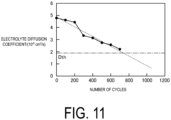
- FIG. 11 is a graph showing the relationship between the number of cycles and the electrolyte diffusion coefficient.
- the alternate long and short dashed line indicates the threshold value Dth of the electrolyte diffusion coefficient.
- the electrolyte diffusion coefficient decreases substantially linearly with respect to the number of cycles. Furthermore, in FIG. 11 , at the time point of 700 cycles, ⁇ D is only 0.3 ⁇ 10 -6 cm 2 /s and, when the change in the electrolyte diffusion coefficient is subsequently extrapolated, it is possible to predict the onset of a sharp drop, that is, the onset of deviation from the root law, around approximately 800 cycles.
- FIG. 12 is a graph showing the results of the cycle test of the deteriorated cell used for estimation in FIG. 11 .
- the solid line is the actual measurement value
- the dashed line is a line showing a cycle curve based on the root law. As shown in FIG. 12 , it was confirmed that onset of deviation from the root law occurred after about 900 cycles and, although there was a slight prediction error, a sharp drop actually occurred.
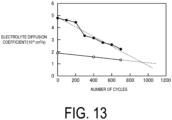
- FIG. 13 is a graph obtained by adding the relationship between the number of cycles and the threshold value of the electrolyte diffusion coefficient to the graph of FIG. 11 .
- the unfilled marks in the graph are the threshold values of the electrolyte diffusion coefficient.
- the threshold value of the electrolyte diffusion coefficient also decreases substantially linearly with respect to the number of cycles, as with the electrolyte diffusion coefficient. It can be predicted that the line obtained by extrapolating the change in the electrolyte diffusion coefficient and the line obtained by extrapolating the change in the threshold value of the electrolyte diffusion coefficient will intersect at the time point of approximately 900 cycles. This is in favorable agreement with the number of cycles at the onset of deviation from the root law in FIG. 12 . These prediction results were found to reproduce the actually measured cycle capacity decrease with great accuracy and found to be valid.
Landscapes
- Physics & Mathematics (AREA)
- General Physics & Mathematics (AREA)
- Engineering & Computer Science (AREA)
- Manufacturing & Machinery (AREA)
- Chemical & Material Sciences (AREA)
- Chemical Kinetics & Catalysis (AREA)
- Electrochemistry (AREA)
- General Chemical & Material Sciences (AREA)
- Secondary Cells (AREA)
Abstract
Description
- The present invention relates to a secondary battery diagnostic method and a secondary battery diagnostic program.
- A secondary battery such as a lithium ion battery gradually decreases in discharge capacity with repeated charging and discharging. Therefore, the secondary battery is preferably diagnosed at an appropriate time to evaluate a degree of deterioration thereof and determine whether reuse is possible or determine a replacement period. Further, to reuse the secondary battery after diagnosis, preferably the diagnosis is performed in a non-destructive manner.
-
JP 2017-97997 A - Further, the publication describes, as the characteristic values estimated by the fitting with the actual measurement data, a lithium ion diffusion coefficient in a positive electrode active material, a lithium ion diffusion coefficient in a negative electrode active material, a lithium ion diffusion coefficient in an electrolyte (electrolyte diffusion coefficient), an interface resistance in the positive electrode active material, an interface resistance in the negative electrode active material, a lithium ion salt concentration in the electrolyte, and the like.
- Patent Document 1:
JP 2017-97997 A - In the related art, the degree of deterioration of a secondary battery is evaluated on the basis of a magnitude of discharge capacity or a magnitude of internal resistance at the time of diagnosis. However, according to research conducted by the present inventors, it has been found that, even if the magnitudes of discharge capacity and the magnitudes of internal resistance at the time of diagnosis are substantially the same, the numbers of times that secondary batteries can be used thereafter are not necessarily substantially the same. Specifically, among secondary batteries having substantially the same magnitudes of discharge capacity and magnitudes of internal resistance at the time of diagnosis, there exist secondary batteries in which the discharge capacity drops sharply after a small number of charge/discharge cycles, secondary batteries in which the discharge capacity does not substantially drop even after charging/discharging, and the like. As a result, a remaining life of the secondary battery cannot be accurately evaluated by measuring only the magnitude of discharge capacity and the magnitude of internal resistance at the time of diagnosis.
- The aforementioned
JP 2017-97997 A - An object of the present invention is to provide a secondary battery diagnostic method and a secondary battery diagnostic program that can evaluate a remaining life of a secondary battery more accurately than in the related art without disassembly of the secondary battery.
- A secondary battery diagnostic method according to an embodiment of the present invention includes estimating, on the basis of data obtained by measuring load characteristics of a secondary battery to be diagnosed, characteristic parameters of the secondary battery to be diagnosed at a time of diagnosis by using a predetermined model equation, the characteristic parameters including an electrolyte diffusion coefficient Dn of the secondary battery to be diagnosed at the time of diagnosis; obtaining, on the basis of the model equation and the characteristic parameters estimated, a discharge capacity when an electrolyte diffusion coefficient is changed, and obtaining a relationship between the electrolyte diffusion coefficient and the discharge capacity; determining, on the basis of the relationship between the electrolyte diffusion coefficient and the discharge capacity, a threshold value Dth of the electrolyte diffusion coefficient; and obtaining a difference ΔD between the threshold value Dth and the electrolyte diffusion coefficient Dn at the time of diagnosis.
- A secondary battery diagnostic program according to an embodiment of the present invention is a secondary battery diagnostic program for causing a computer to execute estimating, on the basis of data obtained by measuring load characteristics of a secondary battery to be diagnosed, characteristic parameters of the secondary battery to be diagnosed at a time of diagnosis by using a predetermined model equation, the characteristic parameters including an electrolyte diffusion coefficient Dn of the secondary battery to be diagnosed at the time of diagnosis; obtaining, on the basis of the model equation and the characteristic parameters estimated, a discharge capacity when an electrolyte diffusion coefficient is changed, and obtaining a relationship between the electrolyte diffusion coefficient and the discharge capacity; determining, on the basis of the relationship between the electrolyte diffusion coefficient and the discharge capacity, a threshold value Dth of the electrolyte diffusion coefficient; and obtaining a difference ΔD between the threshold value Dth and the electrolyte diffusion coefficient Dn at the time of diagnosis.
- According to the present invention, it is possible to evaluate a remaining life of a secondary battery more accurately than in the related art without disassembly of the secondary battery.
-
-
FIG. 1 is a flowchart of a secondary battery diagnostic method according to a first embodiment of the present invention. -
FIG. 2 is a flowchart illustrating an example of a more specific procedure of a process of estimating characteristic parameters. -
FIG. 3 is a graph showing an example of a relationship between an electrolyte diffusion coefficient and a discharge capacity. -
FIG. 4 is a graph showing an example of how to determine a threshold value Dth. -
FIG. 5 is a flowchart illustrating a more specific procedure of a process of determining the threshold value Dth of the electrolyte diffusion coefficient in the secondary battery diagnostic method according to a second embodiment of the present invention. -
FIG. 6 is a graph obtained by fitting the relationship between the electrolyte diffusion coefficient and the discharge capacity shown inFIG. 3 with equation (1). -
FIG. 7 is a flowchart of the secondary battery diagnostic method according to a third embodiment of the present invention. -
FIG. 8 is a flowchart of the secondary battery diagnostic method according to a fourth embodiment of the present invention. -
FIG. 9 shows the relationship between ΔD obtained by diagnosis and the number of cycles at the onset of a sharp drop. -
FIG. 10 is a graph showing a relationship between the number of cycles and the discharge capacity of two cells (cell No. 1 and cell No. 3) in which Li deposition occurred. -
FIG. 11 is a graph showing a relationship between the number of cycles and the electrolyte diffusion coefficient. -
FIG. 12 is a graph showing results of a cycle test of a deteriorated cell used for estimation inFIG. 11 . -
FIG. 13 is a graph obtained by adding a relationship between the number of cycles and the threshold value of the electrolyte diffusion coefficient to the graph inFIG. 11 . - The present inventors focused on an electrolyte diffusion coefficient when evaluating a remaining life of a secondary battery. In the course of cycle deterioration, a secondary battery approaches a state of so-called "liquid depletion" as an electrolyte amount and a salt concentration therein decrease. It is known that, at this time, the value of the electrolyte diffusion coefficient decreases. A value Dn of the electrolyte diffusion coefficient of the secondary battery at the time of diagnosis can be estimated in a non-destructive manner by using measurement data of load characteristics and a model equation well known in this field. Further, a relationship between the electrolyte diffusion coefficient and a discharge capacity can be obtained by simulation using the model equation described above.
- A value Dth of the electrolyte diffusion coefficient when the secondary battery becomes unsuitable for reuse is determined from the relationship between the electrolyte diffusion coefficient and the discharge capacity, and a difference ΔD = Dn - Dth from the value Dn of the electrolyte diffusion coefficient at the time of diagnosis is then obtained. This ΔD can be used as an index of the remaining life of the secondary battery. That is, an evaluation can be made as follows: the larger the value of ΔD, the lower the likelihood early liquid depletion occurs, and the higher the likelihood the secondary battery can be used over a long period of time. Conversely, the smaller the value of ΔD, the higher the likelihood early liquid depletion occurs and the lower the likelihood the secondary battery can be used over a long period of time. A method for predicting a sharp drop in discharge capacity due to such liquid depletion has been nonexistent heretofore. By using this technique, it is possible to evaluate the remaining life of a secondary battery more accurately than in the related art.
- The present inventors have further studied methods for determining the threshold value Dth of the electrolyte diffusion coefficient used in the above evaluation. Basically, the threshold value Dth can be determined as desired in accordance with the application of the secondary battery and the like. On the other hand, in terms of more reliably evaluating the reusable life, it is a reasonable approach to determine, as the threshold value Dth, the value of the electrolyte diffusion coefficient at an initial stage of onset of a sharp drop in discharge capacity, and intentionally secure a large margin.
- The relationship between the electrolyte diffusion coefficient and the discharge capacity is not linear, but rather exhibits a curve in which the decrease in discharge capacity increases as the electrolyte diffusion coefficient decreases. The relationship between an electrolyte diffusion coefficient D and the discharge capacity can be accurately approximated by equation (1) below.

- Here, Amax (maximum capacity), B (decrease rate), and Dh (decrease coefficient) are parameters obtained by fitting the relationship between the electrolyte diffusion coefficient and the discharge capacity obtained by the simulation described above.
- When the value of the electrolyte diffusion coefficient at the initial stage of onset of a sharp drop in discharge capacity is determined to be the threshold value Dth, the threshold value Dth may be set to a value of from 50% to 60% of Dh in equation (1) described above. While the electrolyte diffusion coefficient is in a range of from 50% to 60% of Dh, with reference to the absolute value of the discharge capacity, it can still be said that the discharge capacity is being sufficiently maintained. On the other hand, in view of the fact that the discharge capacity decreases exponentially thereafter, by defining the value of the electrolyte diffusion coefficient of this time point as the threshold value Dth, it is possible to more reliably evaluate the reusable life. Even in a case in which there is a measurement error in the data used at the time of diagnosis or a simulation error, for example, it is possible to more reliably evaluate the reusable life.
- Further, a sharp drop in discharge capacity indicates that the diffusivity of the electrolyte inside the secondary battery is insufficient, and all active materials inside the electrodes are starting to become unable to contribute to reactions. When all active materials inside the electrodes can no longer contribute to reactions, the reaction is localized, increasing the likelihood of Li deposition. That is, it can be said that the time point of the onset of a sharp drop in discharge capacity is the time point at which the likelihood of Li deposition increases. Therefore, from the viewpoint of taking into consideration the likelihood of Li deposition as well, arguably the threshold value Dth is preferably determined to be a value of from 50% to 60% of Dh.
- The life of a secondary battery greatly varies depending on usage conditions (for example, discharge rate). Therefore, the evaluation of the remaining life by ΔD described above does not necessarily mean the prediction of a specific number of charge/discharge cycles until the battery becomes unsuitable for reuse.
- However, the present inventors have found that, in a secondary battery that uses a general-purpose active material such as NCM, LCO, GC, or SiO, when the secondary battery undergoes cycle deterioration under certain conditions, the electrolyte diffusion coefficient decreases substantially linearly with respect to the number of cycles. Therefore, in a case in which it is assumed that the secondary battery is used under certain conditions, the number of cycles at which the difference ΔD described above becomes zero can be predicted on the basis of a relationship between the electrolyte diffusion coefficient and the number of cycles.
- In the case of cycle deterioration, as steady deterioration, a decrease in discharge capacity following the root law occurs, making it necessary to anticipate the occurrence of both this decrease and the sharp drop due to a reduction in liquid diffusivity. Until now, there has been no method for predicting, in terms of the "number" of cycles, the "sharp drop" that deviates from the root law. By using this technique, it is possible to evaluate the remaining life of a secondary battery more accurately than in the related art.
- The present inventors further analyzed a deterioration state of the secondary battery in more detail in order to improve the accuracy of the prediction.
- The threshold value Dth of the electrolyte diffusion coefficient described above is determined on the basis of the relationship between the electrolyte diffusion coefficient and the discharge capacity acquired from the characteristic parameters at the time of diagnosis. In this case, a change in a characteristic parameter other than the electrolyte diffusion coefficient is incorporated into a change in the electrolyte diffusion coefficient, making it possible to evaluate the remaining life by one parameter (electrolyte diffusion coefficient). In this way as well, the remaining life of the secondary battery can be evaluated with high accuracy to a certain extent. However, in an actual secondary battery, characteristic parameters other than the electrolyte diffusion coefficient also change with cycle deterioration, resulting in the possibility of occurrence of deviation between the threshold value Dth obtained from the characteristic parameters at the time of diagnosis and the actual threshold value.
- The present inventors measured load characteristics of secondary batteries that had undergone cycle charge/discharge tests under certain conditions at a plurality of time points with different numbers of cycles, and obtained the threshold value of the electrolyte diffusion coefficient from the data of the load characteristics in the same manner as described above. As a result, it was found that the threshold value of the electrolyte diffusion coefficient also changes substantially linearly with respect to the number of cycles as in the case of the electrolyte diffusion coefficient. Taking this into consideration, by predicting the time point at which the electrolyte diffusion coefficient falls below the threshold value, it is possible to obtain, with higher accuracy, the number of cycles at the onset of a sharp drop in discharge capacity.
- The present invention has been completed on the basis of the above findings. Hereinafter, embodiments of the present invention will be described in detail with reference to the drawings.
-
FIG. 1 is a flowchart of a secondary battery diagnostic method according to a first embodiment of the present invention. This diagnostic method includes a process of estimating characteristic parameters of a secondary battery to be diagnosed (hereinafter "target battery") at a time of diagnosis (step S 1), a process of obtaining the relationship between the electrolyte diffusion coefficient and the discharge capacity (step S2), a process of determining the threshold value Dth of the electrolyte diffusion coefficient (step S3), and a process of obtaining the difference ΔD between the threshold value Dth and the electrolyte diffusion coefficient Dn at the time of diagnosis (step S4). Hereinafter, each process will be described in detail. - Characteristic parameters of the target battery at the time of diagnosis are estimated (step S 1). More specifically, on the basis of the data obtained by measuring the load characteristics of the target battery, the characteristic parameters of the target battery at the time of diagnosis, including the electrolyte diffusion coefficient Dn of the target battery at the time of diagnosis, are estimated by using a predetermined model equation.
- In this process, characteristic parameters of the target battery at the time of diagnosis are estimated by fitting the data obtained by measuring the load characteristics of the target battery by using a predetermined model equation. This analysis (simulation) can be performed by a computer program that can perform fluid analysis, and can be performed by, for example, the software Battery Design Studio available from Siemens AG.
- The model equation used can be an equation well known in this field. As the model equation, for example, the equation described in Marc Doyle et al., "Modeling of Galvanostatic Charge and Discharge of the Lithium/Polymer/Insertion Cell," J. Electrochem. Soc., Vol. 140, No. 6, June (1993) can be used.
- The target battery is, for example, a lithium ion battery.
- The data obtained by measuring the load characteristics of the target battery is, for example, a discharge curve obtained by measuring the target battery at a plurality of discharge rates. This data preferably includes a discharge curve obtained by measurement at an extremely low discharge rate (0.02 C, for example). Further, this data preferably includes a discharge curve obtained by measurement at a discharge rate of 1 C or higher. This data preferably includes a discharge curve obtained by measurement at discharge rates of three or more levels, and more preferably includes a discharge curve obtained by measurement at discharge rates of four or more levels. The data obtained by measuring the load characteristics of the target battery may be a charge curve obtained by measuring the target battery at a plurality of charge rates.
- The characteristic parameters estimated in this process (characteristic parameters of the target battery at the time of diagnosis) include at least the electrolyte diffusion coefficient Dn of the target battery at the time of diagnosis. The characteristic parameters can include, for example, a solid-phase diffusion coefficient of positive and negative electrode active materials and an electrolyte conductivity. Other specific examples of the characteristic parameters will be described below.
-
FIG. 2 is a flowchart illustrating an example of a more specific procedure of the process of estimating characteristic parameters (step S1). In this example, the process of estimating the characteristic parameters (step S1) includes a process of inputting basic specifications of the target battery (step S 1-1), a process of inputting data obtained by measuring load characteristics of the target battery (step S 1-2), a process of estimating static parameters of the target battery (step S1-3), and a process of estimating dynamic parameters of the target battery (step S1-4). - Basic specifications of the secondary battery to be diagnosed are input to the analysis software (step S1-1). The basic specifications input can include, but are not limited to, for example, the following.
- • Electrode compositions of positive and negative electrodes (constituent materials, content ratios, particle sizes, and the like)
- • Electrode thicknesses, densities, and tortuosities (approximately 1.5 in many cases) of positive and negative electrodes
- • Materials, thicknesses, and electrical conductivities of positive and negative electrode currentcollecting foils
- • Thickness and porosity of separator
- • Composition of electrolyte (constituent materials, content ratios)
- • Thermal conductivities and heat capacities of the constituent materials (basic physical property values specific to the materials)
- • Electrode area
- With the diagnosis being basically performed non-destructively, accurate composition information of the electrolyte at the time of diagnosis cannot be obtained. Therefore, general information of the secondary battery to be diagnosed (or standard information of a new battery) is obtained and input as parameters. Although some values need to be input when the simulation is actually performed, the composition of the electrolyte does not significantly affect the result of the simulation. In the diagnostic method of the present embodiment, the role of the electrolyte composition information is only for reference purposes.
- Although the densities of the positive and negative electrodes are also expected to change due to expansion from initial states, accurate values at the time of diagnosis cannot be measured. Therefore, an initial value (standard value or the like) or a value predicted from the initial value is input. If the value is completely unknown, a typical value may be input. If necessary, fine adjustment may be performed in step S 1-4.
- The data obtained by measuring the load characteristics of the target battery is input to the analysis software (step S1-2). The data obtained by measuring the load characteristics of the target battery is, as described above, a discharge curve obtained by measuring the target battery at a plurality of discharge rates, or the like. The "data obtained by measuring the load characteristics of the target battery" is hereinafter also referred to as "actual measurement data".
- The static parameters of the target battery are estimated from the actual measurement data and the model equation (step S 1-3). For example, the static parameters of the target battery are adjusted so as to match a shape of the discharge curve obtained by measurement at an extremely low discharge rate. The discharge curve obtained by measurement at an extremely low discharge rate (0.02 C, for example) can be considered to approximately coincide with a voltage curve when no load is connected (open-circuit voltage curve (OCV)). The static parameters can include, but are not limited to, for example, the following.
- • Capacities per unit weight of positive and negative electrode active materials (battery after use decreases in discharge capacity)
- • Respective utilization rates of positive and negative electrode active materials (not all regions are mutually used)
- • Maximum voltage and minimum voltage of target battery usage range
- The dynamic parameters of the target battery are estimated from the actual measurement data and the model equation (step S 1-4). For example, a simulation is performed in which the target battery is discharged at a current value equivalent to that of the measurement conditions of actual measurement data, and the dynamic parameters are adjusted while comparing the data obtained by this simulation result and the actual measurement data such that the two coincide. This simulation can be performed using, for example, the discharge curve prediction of Battery Design Studio described above. The dynamic parameters may include, but are not limited to, for example, the following.
- • Electrolyte conductivity
- • Electrolyte diffusion coefficient
- • Solid phase diffusion coefficients of positive and negative electrode active materials
- • Heat capacity of target battery
- The ambient temperature at the time of the simulation is preferably set so as to coincide with the ambient temperature at the time of actual measurement data acquisition. In the case of a medium or larger sized product battery, particularly, a product battery assumed to be used at a high rate, preferably the influence of heat generation is taken into consideration. To achieve this, preferably measurements are performed at least at 1 C and fitting is conducted with the actual measurement data affected by heat generation. On the other hand, as long as the target battery is a small cell for a desk test or the like, the influence of heat generation need not be considered.
- Through the above processes, it is possible to estimate the characteristic parameters of the target battery at the time of diagnosis, including the electrolyte diffusion coefficient Dn of the target battery at the time of diagnosis.
- On the basis of the model equation used in step S1 and the characteristic parameters estimated in step S1, the relationship between the electrolyte diffusion coefficient and the discharge capacity is obtained (step S2). More specifically, the discharge capacity is obtained by performing a discharge simulation while changing only the electrolyte diffusion coefficient among the characteristic parameters estimated in step S1 and keeping the other characteristic parameters constant. A discharge rate and an ambient temperature at the time of the discharge simulation are preferably set in accordance with the reuse application. For example, if the target battery is expected to be used in the application at an average rate of about 1 C, then the discharge rate used when obtaining the relationship between the electrolyte diffusion coefficient and the discharge capacity is also 1 C. Since it is difficult to precisely match all environmental conditions, simulations may be performed using average values.
-
FIG. 3 is a graph showing an example of a relationship between the electrolyte diffusion coefficient and the discharge capacity. In this example, the discharge capacity with the ambient temperature set to 45°C and the discharge rate set to 0.5 C was obtained for each case in which the electrolyte diffusion coefficient was 4.8 × 10⁻⁶, 4.0 × 10⁻⁶, 2.95 × 10⁻⁶, 1.85 × 10⁻⁶, 1.48 × 10⁻⁶, and 1.1 × 10⁻⁶ cm2/s. - As shown in this example, generally, the smaller the electrolyte diffusion coefficient, the smaller the discharge capacity. Further, the relationship between the electrolyte diffusion coefficient and the discharge capacity is not linear, but rather has a tendency to exhibit a curve such that the decrease in discharge capacity increases as the electrolyte diffusion coefficient decreases.
- On the basis of the relationship between the electrolyte diffusion coefficient and the discharge capacity obtained in step S2, the threshold value Dth of the electrolyte diffusion coefficient is determined (step S3). More specifically, with reference to the relationship between the electrolyte diffusion coefficient and the discharge capacity obtained in step S2, the value of the electrolyte diffusion coefficient when the target battery becomes unsuitable for reuse is determined to be the threshold value Dth. A criterion for determining that the target battery is "not suitable for reuse" differs according to the intended reuse application of the target battery. Therefore, the criterion for determining that the target battery is "not suitable for reuse" is set in accordance with the application.
- For example, when the discharge capacity becomes equal to or less than a predetermined permissible value, the determination may be made that the battery is not suitable for reuse. In this case, the electrolyte diffusion coefficient when the discharge capacity becomes equal to or less than the predetermined permissible value is determined to be the threshold value Dth. For example, in the example of
FIG. 3 , in a case in which the permissible value of the discharge capacity is 36.02 mAh, the threshold value Dth is 1.40 × 10⁻⁶ cm2/s. - Alternatively, at the onset of a sharp drop in discharge capacity, the determination may be made that the battery is not suitable for reuse. In this case, the electrolyte diffusion coefficient at the onset of a sharp drop in discharge capacity is determined to be the threshold value Dth. For example, the electrolyte diffusion coefficient when a slope of the discharge capacity is equal to or greater than a predetermined magnitude may be set as the threshold value Dth. Further, as shown in
FIG. 4 , a point at which tangents of each curve before and after the onset of a sharp drop in discharge capacity intersect may be set as the threshold value Dth. - A difference ΔD between the threshold value Dth determined in step S3 and the electrolyte diffusion coefficient Dn at the time of diagnosis estimated in step S1 is obtained (step S4). For example, if Dn = 2.22 × 10⁻⁶ cm2/s and Dth = 1.40 × 10⁻⁶ cm2/s, then ΔD = Dn - Dth = 0.82 × 10⁻⁶ cm2/s.
- This ΔD can be used as an index for the remaining life of the target battery. That is, the target battery can be evaluated as follows: the larger the value of ΔD, the higher the likelihood the target battery can be used for a long period of time, and the smaller the value of ΔD, the lower the likelihood the target battery can be used for a long period of time. Even if the discharge capacities at the time of diagnosis are about the same, ΔD may be different. By using ΔD, it is possible to more accurately evaluate the remaining life of the target battery as compared with known methods in which the remaining life is evaluated on the basis of the magnitude of the discharge capacity at the time of diagnosis.
- As described above, the life of the secondary battery greatly varies depending on usage conditions, and thus "accurate evaluation of the remaining life" does not necessarily mean prediction of a specific number of charge/discharge cycles until unsuitable for reuse. However, if it is assumed that the target battery is continuously used under certain conditions, it is also possible to predict the remaining life (number of charge/discharge cycles) of the target battery from ΔD. For example, a relationship between ΔD and the remaining life may be measured in advance, and the remaining life of the target battery may be predicted on the basis of this relationship between ΔD and the remaining life.
- The secondary battery diagnostic method according to a second embodiment of the present invention differs from that of the first embodiment in the process of determining the threshold value Dth of the electrolyte diffusion coefficient (step S3).
FIG. 5 is a flowchart illustrating a more specific procedure of the process of determining the threshold value Dth of the electrolyte diffusion coefficient (step S3) in the secondary battery diagnostic method according to the present embodiment. In the present embodiment, the process of determining the threshold value Dth of the electrolyte diffusion coefficient (step S3) includes a process of obtaining Amax, B, and Dh by fitting the relationship between the electrolyte diffusion coefficient D and the discharge capacity with equation (1) below (step S3-1), and a process of determining the threshold value Dth on the basis of Dh (step S3-2).
- Amax, B, and Dh are obtained by fitting the relationship between the electrolyte diffusion coefficient D and the discharge capacity obtained in step S2 with equation (1) described above (step S3-1).
FIG. 6 is a graph obtained by fitting the relationship between the electrolyte diffusion coefficient and the discharge capacity shown inFIG. 3 with equation (1). The dashed line inFIG. 6 represents the discharge capacity calculated by equation (1). In this example, Amax = 36.2 mAh, B = 0.034 mAh, and Dh = 2.51 × 10⁻⁶ cm2/s. As shown inFIG. 6 , the relationship between the electrolyte diffusion coefficient D and the discharge capacity can be accurately approximated by equation (1). - On the basis of Dh obtained in step S3-1, the threshold value Dth is determined (step S3-2). In equation (1) described above, Dh is a parameter characterizing the value of the electrolyte diffusion coefficient at the onset of a sharp drop in discharge capacity, and it is rational to determine the threshold value Dth by using Dh as reference.
- Preferably, the threshold value Dth is determined to be to a value of from 50 to 60% of Dh.
- For example, in the example of
FIG. 6 , in a case in which the threshold value Dth is set to a value of 56% of Dh (= 2.51 × 10⁻⁶ cm2/s), the threshold value Dth is 1.40 × 10⁻⁶ cm2/s. The discharge capacity when the electrolyte diffusion coefficient is 1.40 × 10⁻⁶ cm2/s is estimated to be approximately 36.0 mAh from equation (1). This value represents a decrease within 1% from Amax (= 36.2 mAh), and looking at the absolute value of the discharge capacity, it still can be said that the discharge capacity is being maintained. On the other hand, in view of the fact that the discharge capacity decreases exponentially thereafter, by defining the value of the electrolyte diffusion coefficient of this time point as the threshold value Dth, it is possible to more reliably evaluate the reusable life. Even in a case in which there is a measurement error in the data used at the time of diagnosis or a simulation error, for example, it is possible to more reliably evaluate the reusable life. - Further, a sharp drop in discharge capacity indicates that the diffusivity of the electrolyte inside the secondary battery is insufficient, and all active materials inside the electrodes are starting to become unable to contribute to reactions. When all active materials inside the electrodes can no longer contribute to reactions, the reaction is localized, increasing the likelihood of Li deposition. That is, it can be said that the time point of the onset of a sharp drop in discharge capacity is the time point at which the likelihood of Li deposition increases. Therefore, from the viewpoint of taking into consideration the likelihood of Li deposition as well, arguably the threshold value Dth is preferably determined to be a value of from 50% to 60% of Dh.
- The larger the threshold value Dth, the shorter the remaining life of the target battery is evaluated to be. Therefore, if the threshold value Dth is set to a large value, the likelihood of overestimating the remaining life decreases, but the likelihood of underestimating the remaining life increases. On the other hand, if the threshold value Dth is set to a small value, the likelihood of underestimating the remaining life decreases, but the likelihood of overestimating the remaining life increases. The threshold value Dth is more preferably a value of from 54% to 58% of Dh.
-
FIG. 7 is a flowchart of the secondary battery diagnostic method according to a third embodiment of the present invention. In addition to the processes included in the secondary battery diagnostic method according to the first embodiment (FIG. 1 ), this diagnostic method further includes a process of obtaining, on the basis of the relationship between the number of cycles and the electrolyte diffusion coefficient acquired in advance, the number of cycles corresponding to the difference ΔD (step S5). - The number of cycles corresponding to the difference ΔD is obtained on the basis of the relationship between the number of cycles and the electrolyte diffusion coefficient acquired in advance (step S5). As described above, the life of the secondary battery greatly varies depending on usage conditions, and thus the evaluation of the remaining life by the difference ΔD does not necessarily mean prediction of a specific number of charge/discharge cycles until the secondary battery becomes unsuitable for reuse. On the other hand, it has been experimentally revealed that, in a case in which the secondary battery undergoes cycle deterioration under certain conditions, the electrolyte diffusion coefficient decreases substantially linearly with respect to the number of cycles. Therefore, in a case in which it is assumed that the target battery is used under certain conditions, the relationship between the number of cycles and the electrolyte diffusion coefficient is acquired in advance, and the number of cycles described above until the difference ΔD becomes zero can be predicted on the basis of the relationship between the number of cycles and the electrolyte diffusion coefficient.
- The relationship between the number of cycles and the electrolyte diffusion coefficient can be acquired, for example, as follows.
- A charge/discharge cycle test is conducted on a secondary battery of the same type as that of the target battery under certain conditions to deteriorate this secondary battery. Here, a "secondary battery of the same type as that of the target battery" means a secondary battery in which the materials and shapes of the positive and negative electrodes, the type and amount of the electrolyte, and the like are equivalent to those of the target battery. For example, when the target battery is a product battery, a "secondary battery of the same type as that of the target battery" means a secondary battery or the like having the same model number. Hereinafter, this "secondary battery of the same type as that of the target battery" is referred to as a "secondary battery for measurement."
- The discharge rate, the ambient temperature, and the like in the charge/discharge cycle test are preferably set in accordance with the reuse application of the target battery. For example, if the target battery is expected to be used in the application at around 1C on average, then the discharge rate used during the charge/discharge cycle test is also 1C. Since it is difficult to precisely match all environmental conditions, the charge/discharge cycle test may be conducted using average values.
- With the relationship between the number of cycles and the electrolyte diffusion coefficient being linear, the charge/discharge cycle test does not need to be repeated until the secondary battery for measurement is sufficiently deteriorated, and need only be conducted until the number of cycles reaches an appropriate number.
- The load characteristics of the secondary battery for measurement are measured at two or more time points having different numbers of cycles, and the characteristic parameters of the secondary battery for measurement at each time point are estimated from the data of the load characteristics. The characteristic parameters can be estimated in the same manner as in the process of estimating the characteristic parameters of the target battery (step S 1).
- As described above, in a case in which the secondary battery undergoes cycle deterioration under certain conditions, the electrolyte diffusion coefficient decreases substantially linearly with respect to the number of cycles. Therefore, if the electrolyte diffusion coefficients at at least two time points are known, the relationship between the number of cycles and the electrolyte diffusion coefficient can be acquired. For example, given D1 as the value of the electrolyte diffusion coefficient when the number of cycles is n1 and D2 as the value of the electrolyte diffusion coefficient when the number of cycles is n2, a slope kD of the electrolyte diffusion coefficient with respect to the number of cycles can be obtained from kD = (D2 - D1)/(n2 - n1). Needless to say, the electrolyte diffusion coefficient may be estimated at three or more time points to obtain the slope kD, thereby further reducing errors.
- Note that, when the characteristic parameters at second and subsequent points are estimated, preferably, fitting is performed by changing only the discharge capacity, the electrolyte diffusion coefficient, and the electrolyte conductivity among the characteristic parameters estimated at the first point and fixing the other characteristic parameters to the characteristic parameters estimated at the first point. When estimating the characteristic parameters of second and subsequent points, the fitting may be performed by changing all characteristic parameters. However, when the fitting is performed by a person other than a skilled technician, the fitting may become inaccurate with the number of parameters, and the relationship between the number of cycles and the electrolyte diffusion coefficient may become inaccurate.
- The relationship between the number of cycles and the electrolyte diffusion coefficient may be obtained by conducting a charge/discharge cycle test on the target battery itself instead of the secondary battery for measurement.
- Further, after subjecting the target battery to a predetermined number of charge/discharge cycles during use, the load characteristics may be measured, and the data of these load characteristics obtained by the measurement may then be used to update the relationship between the number of cycles and the electrolyte diffusion coefficient, allowing for continuous correction of the prediction. In this case, only the load characteristics that can be measured in a short period of time, such as at 3 C and 5 C, may be acquired.
- The number of cycles corresponding to the difference ΔD is obtained on the basis of the acquired relationship between the number of cycles and the electrolyte diffusion coefficient. More specifically, the number of cycles at which the difference ΔD becomes zero is obtained. The number of cycles N0 at which the difference ΔD becomes zero can be obtained by N0 = ΔD/|kD| by using the slope kD of the electrolyte diffusion coefficient with respect to the number of cycles. This makes it possible to predict the specific number of cycles at which the target battery becomes unsuitable for reuse.
-
FIG. 8 is a flowchart of the secondary battery diagnostic method according to a fourth embodiment of the present invention. In addition to the processes included in the secondary battery diagnostic method according to the third embodiment (FIG. 7 ), this diagnostic method further includes a process of correcting the number of cycles on the basis of the relationship between the number of cycles and the threshold value of the electrolyte diffusion coefficient acquired in advance (step S6). - The number of cycles obtained in step S5 (number of cycles N0 corresponding to the difference ΔD) is corrected on the basis of the relationship between the number of cycles and the threshold value of the electrolyte diffusion coefficient acquired in advance (step S6). As described above, it has been experimentally revealed that the threshold value of the electrolyte diffusion coefficient changes substantially linearly with respect to the number of cycles. Taking this into consideration, by predicting the time point at which the electrolyte diffusion coefficient falls below the threshold value Dth, it is possible to predict, with higher accuracy, the specific number of cycles at which the target battery becomes unsuitable for reuse.
- The relationship between the number of cycles and the threshold value Dth of the electrolyte diffusion coefficient can be acquired as follows, for example.
- As when obtaining the relationship between the number of cycles and the electrolyte diffusion coefficient, a charge/discharge cycle test is conducted on the secondary battery for measurement under certain conditions to deteriorate the secondary battery for measurement. The load characteristics of the secondary battery for measurement are measured at two or more time points having different numbers of cycles, and the characteristic parameters of the secondary battery for measurement at each time point are estimated from the data of the load characteristics. As the data of the load characteristics and the characteristic parameters, those acquired when the relationship between the number of cycles and the electrolyte diffusion coefficient was obtained may be used.
- The relationship between the electrolyte diffusion coefficient and the discharge capacity is obtained at each time point by using these characteristic parameters, and the threshold value of the electrolyte diffusion coefficient at each time point is then determined. These processes can be performed as in the process of obtaining the relationship between the electrolyte diffusion coefficient and the discharge capacity of the target battery (step S2) and the process of determining the threshold value Dth of the electrolyte diffusion coefficient of the target battery (step S3).
- In a case in which the secondary battery undergoes cycle deterioration under certain conditions, the threshold value of the electrolyte diffusion coefficient changes substantially linearly with respect to the number of cycles. Therefore, if the threshold values of the electrolyte diffusion coefficient at at least two time points are known, the relationship between the number of cycles and the threshold value of the electrolyte diffusion coefficient can be acquired. For example, given Dth1 as the threshold value of the electrolyte diffusion coefficient when the number of cycles is n1 and Dth2 as the threshold value of the electrolyte diffusion coefficient when the number of cycles is n2, a slope kth of the threshold value of the electrolyte diffusion coefficient with respect to the number of cycles can be obtained by kth = (Dth2 - Dth1)/(n2 - n1). Needless to say, the threshold value of the electrolyte diffusion coefficient may be determined at three or more time points to obtain the slope kth, thereby further reducing errors.
- As when obtaining the relationship between the number of cycles and the electrolyte diffusion coefficient, the relationship between the number of cycles and the threshold value of the electrolyte diffusion coefficient may be obtained by conducting a charge/discharge cycle test on the target battery itself instead of the secondary battery for measurement.
- The number of cycles obtained in step S5 is corrected on the basis of the acquired relationship between the number of cycles and the threshold value of the electrolyte diffusion coefficient. In a case in which the electrolyte diffusion coefficient changes with the slope kD with respect to the number of cycles, an electrolyte diffusion coefficient D' after N cycles from the time of diagnosis is D' = Dn + kD × N. Similarly, in a case in which the threshold value of the electrolyte diffusion coefficient changes with the slope kth with respect to the number of cycles, a threshold value Dth' after N cycles from the time of diagnosis is Dth' = Dth + kth × N. The number of cycles Ni at which D' and Dth' become equal can be obtained by N1 = (Dn - Dth)/(kth - kD). This makes it possible to predict the specific number of cycles at which the target battery becomes unsuitable for reuse with higher accuracy.
- The secondary battery diagnostic method described above can also be realized as a computer program. A secondary battery diagnostic program according to an embodiment of the present invention is a secondary battery diagnostic program for causing a computer to execute estimating, on the basis of data obtained by measuring load characteristics of a secondary battery to be diagnosed, characteristic parameters of the secondary battery to be diagnosed at a time of diagnosis by using a predetermined model equation, the characteristic parameters including the electrolyte diffusion coefficient Dn of the secondary battery to be diagnosed at the time of diagnosis; obtaining, on the basis of the model equation and the characteristic parameters estimated, a discharge capacity when an electrolyte diffusion coefficient is changed, and obtaining a relationship between the electrolyte diffusion coefficient and the discharge capacity; determining, on the basis of the relationship between the electrolyte diffusion coefficient and the discharge capacity, the threshold value Dth of the electrolyte diffusion coefficient; and obtaining the difference ΔD between the threshold value Dth and the electrolyte diffusion coefficient Dn at the time of diagnosis. According to the present embodiment as well, it is possible to more accurately evaluate the remaining life of the target battery as compared with known methods in which the remaining life is evaluated on the basis of the magnitude of the discharge capacity at the time of diagnosis.
- The computer program of a form corresponding to the secondary battery diagnostic method according to the first embodiment has been described above, However, the secondary battery diagnostic methods according to the second to fourth embodiments can also be realized as computer programs.
- The secondary battery electrode diagnostic methods described above can also be realized as computer-readable recording media in which the computer program described above is recorded.
- The secondary battery diagnostic methods described above can also be realized as computer systems. A secondary battery diagnostic system according to an embodiment of the present invention includes a memory and a processor, and the processor, according to a program in the memory, executes estimating, on the basis of data obtained by measuring load characteristics of a secondary battery to be diagnosed, characteristic parameters of the secondary battery to be diagnosed at a time of diagnosis by using a predetermined model equation, the characteristic parameters including the electrolyte diffusion coefficient Dn of the secondary battery to be diagnosed at the time of diagnosis; obtaining, on the basis of the model equation and the characteristic parameters estimated, a discharge capacity when an electrolyte diffusion coefficient is changed, and obtaining a relationship between the electrolyte diffusion coefficient and the discharge capacity; determining, on the basis of the relationship between the electrolyte diffusion coefficient and the discharge capacity, the threshold value Dth of the electrolyte diffusion coefficient; and obtaining the difference ΔD between the threshold value Dth and the electrolyte diffusion coefficient Dn at the time of diagnosis.
- Hereinafter, the present invention will be described more specifically with reference to examples. The present invention is not limited to these examples.
- A plurality of medium-sized laminate-type cells having a rated capacity of 5 Ah and a plurality of small-sized laminate-type cells having a rated capacity of 36 mAh were fabricated.
- A positive-electrode-mixture-containing slurry was prepared by uniformly mixing 93 parts by mass of LiCoO2 as a positive electrode active material, 3 parts by mass of carbon black as a conductive aid, and 4 parts by mass of polyvinylidene fluoride (PVDF) as a binder, using N-methyl-2-pyrrolidone (NMP) as a solvent. This positive-electrode-mixture-containing slurry was applied to both sides of a positive electrode current collector made of aluminum foil having a thickness of 15 µm, dried, subsequently pressure-formed using a roller press machine, and then punched out so that a portion of the positive electrode current collector not coated with the positive-electrode-mixture-containing slurry became a tab portion, thereby fabricating the positive electrode.
- A negative-electrode-mixture-containing slurry was prepared by mixing 97.5 parts by mass of graphite as a negative electrode active material, 1.5 parts by mass of carboxymethyl cellulose as a binder, and 1 part by mass of styrene-butadiene rubber, and then adding an appropriate amount of water and thoroughly mixing. This negative-electrode-mixture-containing slurry was applied to both sides of a negative electrode current collector made of copper foil having a thickness of 10 µm, dried, subsequently pressure-formed using a roller press machine, and then punched out so that a portion of the negative electrode current collector not coated with the negative-electrode-mixture-containing slurry became a tab portion, thereby fabricating the negative electrode.
- Seven of the positive electrodes described above and eight of the negative electrodes described above were alternately layered with a polyolefin microporous film separator interposed therebetween to form a multilayer electrode body, the polyolefin microporous film separator having a thickness of 18 µm and a three-layer structure consisting of a polyethylene layer as a middle layer and two polypropylene layers as outer layers.
- Next, the tab portions of the positive electrodes of the multilayer electrode body were welded together and the tab portions of the negative electrodes of the multilayer electrode body were welded together and leads were connected respectively thereto. Then, the multilayer electrode body was enclosed inside an outer packaging made from an aluminum laminate film together with a non-aqueous electrolyte prepared by dissolving LiPF6 at a concentration of 1 mol/L in a solution obtained by mixing ethylene carbonate, diethyl carbonate, and methyl ethyl carbonate at a volume ratio of 1:1:1, and further dissolving vinylene carbonate in an amount of 1 mass%, thereby fabricating a non-aqueous electrolyte secondary battery with a rated capacity of 5 Ah.
- A positive-electrode-mixture-containing slurry was prepared by uniformly mixing 94 parts by mass of LiCoO2 as the positive electrode active material, 4 parts by mass of carbon black as the conductive aid, and 2 parts by mass of PVDF as the binder, using NMP as the solvent. This positive-electrode-mixture-containing slurry was applied to both sides of a positive electrode current collector made of aluminum foil having a thickness of 15 µm, dried, subsequently pressure-formed using a roller press machine, and then punched out so that a portion of the positive electrode current collector not coated with the positive-electrode-mixture-containing slurry became a tab portion, thereby fabricating the positive electrode.
- A negative-electrode-mixture-containing slurry was prepared by mixing 94.5 parts by mass of graphite and 3 parts by mass of SiO particles (D50: 5.0 µm) including a front surface coated with carbon as the negative electrode active material, 1.5 parts by mass of carboxymethyl cellulose and 1 part by mass of styrene-butadiene rubber as the binder, and then adding an appropriate amount of water and thoroughly mixing. This negative-electrode-mixture-containing slurry was applied to both sides of a negative electrode current collector made of copper foil having a thickness of 10 µm, dried, subsequently pressure-formed using a roller press machine, and then punched out so that a portion of the negative electrode current collector not coated with the negative-electrode-mixture-containing slurry became a tab portion, thereby fabricating the negative electrode.
- The positive electrode described above and the negative electrode described above were layered with a polyolefin microporous film separator interposed therebetween to form a multilayer electrode body, the polyolefin microporous film separator having a thickness of 12 µm and a three-layer structure consisting of a polyethylene layer as the middle layer and two polypropylene layers as the outer layers.
- Next, leads were respectively connected to the tab portion of the positive electrode and the tab portion of the negative electrode of the multilayer electrode body. Then, the multilayer electrode body was enclosed inside an outer packaging made from an aluminum laminate film together with a non-aqueous electrolyte prepared by dissolving LiPF6 at a concentration of 1 mol/L in a solution obtained by mixing ethylene carbonate and diethyl carbonate at a volume ratio of 3:7, and further dissolving vinylene carbonate in an amount of 1 mass%, thereby fabricating a non-aqueous electrolyte secondary battery with a rated capacity of 36 mAh.
- A plurality of deteriorated cells having discharge capacities reduced to 4.8 Ah were fabricated by conducting charge/discharge cycle tests on the medium-sized laminate-type cells having a rated capacity of 5 Ah under a plurality of conditions different in terms of charge/discharge rate, ambient temperature, and the like. Similarly, a plurality of deteriorated cells having discharge capacities reduced to 35 mAh were fabricated by conducting charge/discharge cycle tests on the small-sized laminate-type cells having a rated capacity of 36 mAh under a plurality of conditions different in charge/discharge rate, ambient temperature, and the like.
- The load characteristics of these deteriorated cells were measured. Specifically, discharge curves were measured at discharge rates of 0.02 C, 0.2 C, 0.5 C, and 1 C.
- The secondary battery diagnostic method described in the embodiment was carried out using these deteriorated cells as target batteries. The analysis (simulation) was carried out by the software Battery Design Studio available from Siemens AG. Among the basic specifications, a solvent ratio and a salt concentration were input using the same values as those at the time of fabrication (because the values at the time of diagnosis cannot be measured).
- The relationship between the electrolyte diffusion coefficient and the discharge capacity was acquired by estimating the characteristic parameters at the time of diagnosis and subsequently, on the basis of the estimated characteristic parameters, obtaining the discharge capacity at an ambient temperature of 45°C and a discharge rate of 0.5 C while changing the electrolyte diffusion coefficient. The difference ΔD between the threshold value Dth and the electrolyte diffusion coefficient Dn at the time of diagnosis was obtained with the point at which tangents of each curve before and after the onset of a sharp drop in discharge capacity intersect defined as the threshold value Dth.
- These deteriorated cells were subjected to charge/discharge cycle tests under the same conditions, and the number of charge/discharge cycles until a sharp drop in discharge capacity occurred (number of cycles at the onset of a sharp drop) was measured.
FIG. 9 shows the relationship between ΔD obtained by the diagnosis and the number of cycles at the onset of a sharp drop. Note thatFIG. 9 excludes the data of a cell in which Li deposition described below occurred in the charge/discharge cycle test. - As shown in
FIG. 9 , even when the discharge capacities at the time of diagnosis were equivalent (4.8 Ah or 35 mAh), a difference in ΔD was confirmed. Further, the number of cycles at the onset of a sharp drop was found to also change in accordance with ΔD, confirming the validity of this diagnostic method. -
FIG. 10 is a graph illustrating the relationship between the number of cycles and the discharge capacity of two cells (Cell No. 1 and Cell No. 3) in which Li deposition occurred. The solid line represents actual measurement data, and the dashed line represents predicted values by simulation. - Specifically, the predicted values by simulation were calculated as follows.
- The load characteristics of the deteriorated cell were measured during the charge/discharge cycle test, and an electrolyte diffusion coefficient Dm during the charge/discharge cycle test was estimated by the same method as that for estimating Dn. Under the assumption that the electrolyte diffusion coefficient linearly decreases with respect to the number of cycles, the electrolyte diffusion coefficient DN after N cycles was expressed by equation (2) below. The value of DN obtained from equation (2) was substituted for D in equation (1) to obtain the discharge capacity C(N) after N cycles. The discharge capacity C(N) after N cycles was divided by the initial discharge capacity C(0) to obtain a capacity retention rate q(N) = C(N)/C(0) after N cycles.

- Here, m is the number of cycles when Dm is estimated.
- In the case of cycle deterioration, in addition to a decrease in discharge capacity due to a decrease in liquid diffusivity, a decrease in discharge capacity in accordance with the root law occurs as steady deterioration. Of the actual measurement data, data before a sharp drop in discharge capacity occurred was fitted with equation (3) below to obtain a discharge capacity R(N) after N cycles in accordance with the root law. The predicted value from the simulation was obtained by multiplying this discharge capacity R(N) by the capacity retention rate q(N) described above.

- Here, r is a parameter obtained by fitting.
- The predicted value by simulation corresponds to a change in discharge capacity in a case in which Li deposition does not occur. In the actual measurement data, due to Li deposition, a sharp drop in discharge capacity occurs at a time point earlier than the predicted value.
- The triangular mark in
FIG. 10 indicates a time point at which the electrolyte diffusion coefficient becomes 56% of Dh. In the actual measurement data, shortly after the time point when the electrolyte diffusion coefficient reaches 56% of the value of Dh, the discharge capacity becomes unstable, and Li deposition begins to occur. - Cells in which Li deposition does not occur can be used for a longer period. However, taking into consideration the likelihood of Li deposition, it can be said that the threshold value Dth of the electrolyte diffusion coefficient is desirably set to a value of from 50% to 60% of Dh.
- For deteriorated cells having a discharge capacity of 4.8 Ah, the load characteristics were measured every 100 cycles during the charge/discharge cycle test, and the electrolyte diffusion coefficient at each time point was estimated by using the same method as that used to estimate Dn.
FIG. 11 is a graph showing the relationship between the number of cycles and the electrolyte diffusion coefficient. The alternate long and short dashed line indicates the threshold value Dth of the electrolyte diffusion coefficient. - As shown in
FIG. 11 , it can be seen that the electrolyte diffusion coefficient decreases substantially linearly with respect to the number of cycles. Furthermore, inFIG. 11 , at the time point of 700 cycles, ΔD is only 0.3 × 10⁻⁶ cm2/s and, when the change in the electrolyte diffusion coefficient is subsequently extrapolated, it is possible to predict the onset of a sharp drop, that is, the onset of deviation from the root law, around approximately 800 cycles. -
FIG. 12 is a graph showing the results of the cycle test of the deteriorated cell used for estimation inFIG. 11 . The solid line is the actual measurement value, and the dashed line is a line showing a cycle curve based on the root law. As shown inFIG. 12 , it was confirmed that onset of deviation from the root law occurred after about 900 cycles and, although there was a slight prediction error, a sharp drop actually occurred. - In the related art, a method for predicting the "sharp drop" deviating from the root law in terms of the "number" of cycles is nonexistent, making this technique a completely novel technique. Furthermore, the predicted number of cycles deviates only by about 100 cycles from the final life of approximately 1000 cycles, indicating that the prediction is generally valid.
- Next, the relationship between the electrolyte diffusion coefficient and the discharge capacity was obtained from the characteristic parameters estimated at 400 cycles and at 700 cycles, and the threshold value of the electrolyte diffusion coefficient was obtained at 400 cycles and at 700 cycles.
FIG. 13 is a graph obtained by adding the relationship between the number of cycles and the threshold value of the electrolyte diffusion coefficient to the graph ofFIG. 11 . The unfilled marks in the graph are the threshold values of the electrolyte diffusion coefficient. - As shown in
FIG. 13 , it can be seen that the threshold value of the electrolyte diffusion coefficient also decreases substantially linearly with respect to the number of cycles, as with the electrolyte diffusion coefficient. It can be predicted that the line obtained by extrapolating the change in the electrolyte diffusion coefficient and the line obtained by extrapolating the change in the threshold value of the electrolyte diffusion coefficient will intersect at the time point of approximately 900 cycles. This is in favorable agreement with the number of cycles at the onset of deviation from the root law inFIG. 12 . These prediction results were found to reproduce the actually measured cycle capacity decrease with great accuracy and found to be valid. - Although embodiments of the present invention have been described above, the present invention is not limited to the above-described embodiments, and various modifications can be made within the scope of the invention.
Claims (15)
- A secondary battery diagnostic method comprising:estimating, on the basis of data obtained by measuring load characteristics of a secondary battery to be diagnosed, characteristic parameters of the secondary battery to be diagnosed at a time of diagnosis by using a predetermined model equation, the characteristic parameters including an electrolyte diffusion coefficient Dn of the secondary battery to be diagnosed at the time of diagnosis;obtaining, on the basis of the model equation and the characteristic parameters estimated, a discharge capacity when an electrolyte diffusion coefficient is changed, and obtaining a relationship between the electrolyte diffusion coefficient and the discharge capacity;determining, on the basis of the relationship between the electrolyte diffusion coefficient and the discharge capacity, a threshold value Dth of the electrolyte diffusion coefficient; andobtaining a difference ΔD between the threshold value Dth and the electrolyte diffusion coefficient Dn at the time of diagnosis.
- The secondary battery diagnostic method according to claim 1, wherein
in the determination of the threshold value Dth, an electrolyte diffusion coefficient when the discharge capacity is a predetermined permissible value or less is determined to be the threshold value Dth. - The secondary battery diagnostic method according to claim 1, wherein
in the determination of the threshold value Dth, an electrolyte diffusion coefficient at the onset of a sharp drop in the discharge capacity is determined to be the threshold value Dth. - The secondary battery diagnostic method according to claim 1, whereinthe determination of the threshold value Dth includesobtaining Amax, B, and Dh by fitting the relationship between the electrolyte diffusion coefficient D and the discharge capacity with equation (1) below, anddetermining the threshold value Dth on the basis of the Dh

- The secondary battery diagnostic method according to claim 4, wherein
the threshold value Dth is set to a value of from 50% to 60% of the Dh. - The secondary battery diagnostic method according to any one of claims 1 to 5, further comprising:
predicting, on the basis of a relationship between the difference ΔD and a remaining life measured in advance, a remaining life of the secondary battery to be diagnosed. - The secondary battery diagnostic method according to any one of claims 1 to 5, further comprising:
obtaining, on the basis of a relationship between the number of cycles and the electrolyte diffusion coefficient acquired in advance, the number of cycles corresponding to the difference ΔD. - The secondary battery diagnostic method according to claim 7, wherein
the number of cycles corresponding to the difference ΔD is obtained by approximating the relationship between the number of cycles and the electrolyte diffusion coefficient by a straight line. - The secondary battery diagnostic method according to claim 7, wherein
the relationship between the number of cycles and the electrolyte diffusion coefficient is acquired from data obtained for a secondary battery of an identical type to the secondary battery to be diagnosed. - The secondary battery diagnostic method according to claim 7, wherein
the relationship between the number of cycles and the electrolyte diffusion coefficient is acquired from data obtained for the secondary battery to be diagnosed. - The secondary battery diagnostic method according to claim 7, further comprising:
correcting the number of cycles corresponding to the difference ΔD on the basis of a relationship between the number of cycles and a threshold value of the electrolyte diffusion coefficient acquired in advance. - The secondary battery diagnostic method according to claim 11, wherein
the number of cycles corresponding to the difference ΔD is corrected by approximating the relationship between the number of cycles and the threshold value of the electrolyte diffusion coefficient by a straight line. - The secondary battery diagnostic method according to any one of claims 1 to 5, wherein
the data obtained by measuring the load characteristics includes a discharge curve obtained by measuring the secondary battery to be diagnosed at a plurality of discharge rates. - The secondary battery diagnostic method according to any one of claims 1 to 5, wherein
the secondary battery to be diagnosed is a lithium ion battery. - A secondary battery diagnostic program for causing a computer to execute:estimating, on the basis of data obtained by measuring load characteristics of a secondary battery to be diagnosed, characteristic parameters of the secondary battery to be diagnosed at a time of diagnosis by using a predetermined model equation, the characteristic parameters including an electrolyte diffusion coefficient Dn of the secondary battery to be diagnosed at the time of diagnosis;obtaining, on the basis of the model equation and the characteristic parameters estimated, a discharge capacity when an electrolyte diffusion coefficient is changed, and obtaining a relationship between the electrolyte diffusion coefficient and the discharge capacity;determining, on the basis of the relationship between the electrolyte diffusion coefficient and the discharge capacity, a threshold value Dth of the electrolyte diffusion coefficient; andobtaining a difference ΔD between the threshold value Dth and the electrolyte diffusion coefficient Dn at the time of diagnosis.
Applications Claiming Priority (5)
| Application Number | Priority Date | Filing Date | Title |
|---|---|---|---|
| JP2022017035 | 2022-02-07 | ||
| JP2022070009 | 2022-04-21 | ||
| JP2022069870 | 2022-04-21 | ||
| JP2022069863 | 2022-04-21 | ||
| PCT/JP2023/003516 WO2023149532A1 (en) | 2022-02-07 | 2023-02-03 | Secondary battery diagnostic method and secondary battery diagnostic program |
Publications (2)
| Publication Number | Publication Date |
|---|---|
| EP4478482A1 true EP4478482A1 (en) | 2024-12-18 |
| EP4478482A4 EP4478482A4 (en) | 2025-05-07 |
Family
ID=87552597
Family Applications (1)
| Application Number | Title | Priority Date | Filing Date |
|---|---|---|---|
| EP23749848.0A Pending EP4478482A4 (en) | 2022-02-07 | 2023-02-03 | AUXILIARY BATTERY DIAGNOSTIC METHOD AND AUXILIARY BATTERY DIAGNOSTIC PROGRAM |
Country Status (3)
| Country | Link |
|---|---|
| EP (1) | EP4478482A4 (en) |
| JP (1) | JP7699243B2 (en) |
| WO (1) | WO2023149532A1 (en) |
Families Citing this family (2)
| Publication number | Priority date | Publication date | Assignee | Title |
|---|---|---|---|---|
| WO2024029501A1 (en) * | 2022-08-01 | 2024-02-08 | マクセル株式会社 | Secondary battery diagnostic method, secondary battery diagnostic program, and secondary battery diagnostic device |
| EP4685920A4 (en) | 2023-04-03 | 2026-08-12 | Maxell Ltd | Secondary battery diagnostic procedure, secondary battery diagnostic program and secondary battery diagnostic device |
Family Cites Families (4)
| Publication number | Priority date | Publication date | Assignee | Title |
|---|---|---|---|---|
| JP5036662B2 (en) * | 2008-09-03 | 2012-09-26 | トヨタ自動車株式会社 | Secondary battery monitoring device and secondary battery system |
| KR101619634B1 (en) * | 2014-11-06 | 2016-05-10 | 현대자동차주식회사 | System for estimating state of health using battery moedel parameter and method thereof |
| JP2017097997A (en) | 2015-11-19 | 2017-06-01 | 日立マクセル株式会社 | Characteristic analysis method of secondary battery, and characteristic analysis device |
| KR20200026607A (en) * | 2018-09-03 | 2020-03-11 | 엘지전자 주식회사 | Device including battery |
-
2023
- 2023-02-03 EP EP23749848.0A patent/EP4478482A4/en active Pending
- 2023-02-03 WO PCT/JP2023/003516 patent/WO2023149532A1/en not_active Ceased
- 2023-02-03 JP JP2023578632A patent/JP7699243B2/en active Active
Also Published As
| Publication number | Publication date |
|---|---|
| WO2023149532A1 (en) | 2023-08-10 |
| JPWO2023149532A1 (en) | 2023-08-10 |
| JP7699243B2 (en) | 2025-06-26 |
| EP4478482A4 (en) | 2025-05-07 |
Similar Documents
| Publication | Publication Date | Title |
|---|---|---|
| Sadabadi et al. | Prediction of remaining useful life for a composite electrode lithium ion battery cell using an electrochemical model to estimate the state of health | |
| Mei et al. | Experimental and numerical methods to investigate the overcharge caused lithium plating for lithium ion battery | |
| Müller et al. | Study of the influence of mechanical pressure on the performance and aging of Lithium-ion battery cells | |
| Lybbert et al. | Integrating life cycle assessment and electrochemical modeling to study the effects of cell design and operating conditions on the environmental impacts of lithium-ion batteries | |
| Eddahech et al. | Determination of lithium-ion battery state-of-health based on constant-voltage charge phase | |
| Yang et al. | State of charge estimation for pulse discharge of a LiFePO4 battery by a revised Ah counting | |
| Xu et al. | Investigation of lithium-ion battery degradation by corrected differential voltage analysis based on reference electrode | |
| EP3145021B1 (en) | Secondary-battery monitoring device and method for predicting capacity of secondary battery | |
| Tang et al. | Systematic parameter acquisition method for electrochemical model of 4.35 V LiCoO2 batteries | |
| EP3051305B1 (en) | Status determining method for secondary battery, status determining apparatus for secondary battery, secondary battery system, and charge/discharge control apparatus having status determining apparatus | |
| Molaeimanesh et al. | Experimental analysis of commercial LiFePO4 battery life span used in electric vehicle under extremely cold and hot thermal conditions: GR Molaeimanesh et al. | |
| CN117930026A (en) | Mechanism-based wide temperature range lithium ion battery life prediction method | |
| JP2017097997A (en) | Characteristic analysis method of secondary battery, and characteristic analysis device | |
| CN115494394B (en) | Electrochemical methods for battery quality assessment | |
| Yu et al. | Optimized multi-stage constant current fast charging protocol suppressing lithium plating for lithium-ion batteries using reduced order electrochemical-thermal-life model | |
| Roth et al. | Transient self-discharge after formation in lithium-ion cells: Impact of state-of-charge and anode overhang | |
| JP7699243B2 (en) | Secondary battery diagnostic method and secondary battery diagnostic program | |
| Mbeya et al. | Off-line method to determine the electrode balancing of Li-ion batteries | |
| Bin-Mat-Arishad et al. | Influence of voltage profile and fitting technique on the accuracy of lithium-ion battery degradation identification through the Voltage Profile Model | |
| Liu et al. | Design and application: Simplified electrochemical modeling for Lithium-ion batteries in whole lifespan | |
| EP4685920A1 (en) | Secondary battery diagnostic method, secondary battery diagnostic program, and secondary battery diagnostic device | |
| CN115855751B (en) | Calculation method of lithium ion diffusion rate in lithium ion battery | |
| EP4679664A1 (en) | Method for assessing recycling of secondary battery electrode, program for assessing recycling of secondary battery electrode, and device for assessing recycling of secondary battery electrode | |
| JP7799070B2 (en) | Secondary battery diagnostic method, secondary battery diagnostic program, and secondary battery diagnostic device | |
| CN116324447A (en) | Method for predicting life characteristics of lithium secondary battery |
Legal Events
| Date | Code | Title | Description |
|---|---|---|---|
| STAA | Information on the status of an ep patent application or granted ep patent |
Free format text: STATUS: THE INTERNATIONAL PUBLICATION HAS BEEN MADE |
|
| PUAI | Public reference made under article 153(3) epc to a published international application that has entered the european phase |
Free format text: ORIGINAL CODE: 0009012 |
|
| STAA | Information on the status of an ep patent application or granted ep patent |
Free format text: STATUS: REQUEST FOR EXAMINATION WAS MADE |
|
| 17P | Request for examination filed |
Effective date: 20240807 |
|
| AK | Designated contracting states |
Kind code of ref document: A1 Designated state(s): AL AT BE BG CH CY CZ DE DK EE ES FI FR GB GR HR HU IE IS IT LI LT LU LV MC ME MK MT NL NO PL PT RO RS SE SI SK SM TR |
|
| REG | Reference to a national code |
Ref country code: DE Ref legal event code: R079 Free format text: PREVIOUS MAIN CLASS: H01M0010480000 Ipc: G01R0031367000 |
|
| A4 | Supplementary search report drawn up and despatched |
Effective date: 20250408 |
|
| RIC1 | Information provided on ipc code assigned before grant |
Ipc: H01M 10/44 20060101ALI20250402BHEP Ipc: H01M 10/48 20060101ALI20250402BHEP Ipc: G01R 31/378 20190101ALI20250402BHEP Ipc: G01R 31/392 20190101ALI20250402BHEP Ipc: G01R 31/367 20190101AFI20250402BHEP |
|
| DAV | Request for validation of the european patent (deleted) | ||
| DAX | Request for extension of the european patent (deleted) | ||
| GRAP | Despatch of communication of intention to grant a patent |
Free format text: ORIGINAL CODE: EPIDOSNIGR1 |
|
| STAA | Information on the status of an ep patent application or granted ep patent |
Free format text: STATUS: GRANT OF PATENT IS INTENDED |
|
| INTG | Intention to grant announced |
Effective date: 20260707 |
|
| RIC1 | Information provided on ipc code assigned before grant |
Ipc: G01R 31/367 20190101AFI20260629BHEP Ipc: G01R 31/392 20190101ALI20260629BHEP Ipc: G01R 31/378 20190101ALI20260629BHEP Ipc: H01M 10/42 20060101ALI20260629BHEP Ipc: H01M 10/48 20060101ALI20260629BHEP |