EP4478464A1 - Electrochemical cell, electrochemical cell device, module, and module accommodation device - Google Patents
Electrochemical cell, electrochemical cell device, module, and module accommodation device Download PDFInfo
- Publication number
- EP4478464A1 EP4478464A1 EP23770931.6A EP23770931A EP4478464A1 EP 4478464 A1 EP4478464 A1 EP 4478464A1 EP 23770931 A EP23770931 A EP 23770931A EP 4478464 A1 EP4478464 A1 EP 4478464A1
- Authority
- EP
- European Patent Office
- Prior art keywords
- electrochemical cell
- module
- cell
- metal body
- coating material
- Prior art date
- Legal status (The legal status is an assumption and is not a legal conclusion. Google has not performed a legal analysis and makes no representation as to the accuracy of the status listed.)
- Pending
Links
Images



Classifications
-
- H—ELECTRICITY
- H01—ELECTRIC ELEMENTS
- H01M—PROCESSES OR MEANS, e.g. BATTERIES, FOR THE DIRECT CONVERSION OF CHEMICAL ENERGY INTO ELECTRICAL ENERGY
- H01M8/00—Fuel cells; Manufacture thereof
- H01M8/10—Fuel cells with solid electrolytes
- H01M8/12—Fuel cells with solid electrolytes operating at high temperature, e.g. with stabilised ZrO2 electrolyte
- H01M8/1213—Fuel cells with solid electrolytes operating at high temperature, e.g. with stabilised ZrO2 electrolyte characterised by the electrode/electrolyte combination or the supporting material
-
- C—CHEMISTRY; METALLURGY
- C25—ELECTROLYTIC OR ELECTROPHORETIC PROCESSES; APPARATUS THEREFOR
- C25B—ELECTROLYTIC OR ELECTROPHORETIC PROCESSES FOR THE PRODUCTION OF COMPOUNDS OR NON-METALS; APPARATUS THEREFOR
- C25B9/00—Cells or assemblies of cells; Constructional parts of cells; Assemblies of constructional parts, e.g. electrode-diaphragm assemblies; Process-related cell features
- C25B9/17—Cells comprising dimensionally-stable non-movable electrodes; Assemblies of constructional parts thereof
- C25B9/19—Cells comprising dimensionally-stable non-movable electrodes; Assemblies of constructional parts thereof with diaphragms
- C25B9/23—Cells comprising dimensionally-stable non-movable electrodes; Assemblies of constructional parts thereof with diaphragms comprising ion-exchange membranes in or on which electrode material is embedded
-
- C—CHEMISTRY; METALLURGY
- C25—ELECTROLYTIC OR ELECTROPHORETIC PROCESSES; APPARATUS THEREFOR
- C25B—ELECTROLYTIC OR ELECTROPHORETIC PROCESSES FOR THE PRODUCTION OF COMPOUNDS OR NON-METALS; APPARATUS THEREFOR
- C25B1/00—Electrolytic production of inorganic compounds or non-metals
- C25B1/01—Products
- C25B1/02—Hydrogen or oxygen
- C25B1/04—Hydrogen or oxygen by electrolysis of water
-
- C—CHEMISTRY; METALLURGY
- C25—ELECTROLYTIC OR ELECTROPHORETIC PROCESSES; APPARATUS THEREFOR
- C25B—ELECTROLYTIC OR ELECTROPHORETIC PROCESSES FOR THE PRODUCTION OF COMPOUNDS OR NON-METALS; APPARATUS THEREFOR
- C25B11/00—Electrodes; Manufacture thereof not otherwise provided for
- C25B11/04—Electrodes; Manufacture thereof not otherwise provided for characterised by the material
- C25B11/051—Electrodes formed of electrocatalysts on a substrate or carrier
- C25B11/073—Electrodes formed of electrocatalysts on a substrate or carrier characterised by the electrocatalyst material
- C25B11/075—Electrodes formed of electrocatalysts on a substrate or carrier characterised by the electrocatalyst material consisting of a single catalytic element or catalytic compound
- C25B11/077—Electrodes formed of electrocatalysts on a substrate or carrier characterised by the electrocatalyst material consisting of a single catalytic element or catalytic compound the compound being a non-noble metal oxide
-
- C—CHEMISTRY; METALLURGY
- C25—ELECTROLYTIC OR ELECTROPHORETIC PROCESSES; APPARATUS THEREFOR
- C25B—ELECTROLYTIC OR ELECTROPHORETIC PROCESSES FOR THE PRODUCTION OF COMPOUNDS OR NON-METALS; APPARATUS THEREFOR
- C25B13/00—Diaphragms; Spacing elements
- C25B13/04—Diaphragms; Spacing elements characterised by the material
- C25B13/05—Diaphragms; Spacing elements characterised by the material based on inorganic materials
- C25B13/07—Diaphragms; Spacing elements characterised by the material based on inorganic materials based on ceramics
-
- C—CHEMISTRY; METALLURGY
- C25—ELECTROLYTIC OR ELECTROPHORETIC PROCESSES; APPARATUS THEREFOR
- C25B—ELECTROLYTIC OR ELECTROPHORETIC PROCESSES FOR THE PRODUCTION OF COMPOUNDS OR NON-METALS; APPARATUS THEREFOR
- C25B9/00—Cells or assemblies of cells; Constructional parts of cells; Assemblies of constructional parts, e.g. electrode-diaphragm assemblies; Process-related cell features
- C25B9/60—Constructional parts of cells
-
- C—CHEMISTRY; METALLURGY
- C25—ELECTROLYTIC OR ELECTROPHORETIC PROCESSES; APPARATUS THEREFOR
- C25B—ELECTROLYTIC OR ELECTROPHORETIC PROCESSES FOR THE PRODUCTION OF COMPOUNDS OR NON-METALS; APPARATUS THEREFOR
- C25B9/00—Cells or assemblies of cells; Constructional parts of cells; Assemblies of constructional parts, e.g. electrode-diaphragm assemblies; Process-related cell features
- C25B9/70—Assemblies comprising two or more cells
-
- H—ELECTRICITY
- H01—ELECTRIC ELEMENTS
- H01M—PROCESSES OR MEANS, e.g. BATTERIES, FOR THE DIRECT CONVERSION OF CHEMICAL ENERGY INTO ELECTRICAL ENERGY
- H01M8/00—Fuel cells; Manufacture thereof
- H01M8/02—Details
- H01M8/0202—Collectors; Separators, e.g. bipolar separators; Interconnectors
- H01M8/0204—Non-porous and characterised by the material
- H01M8/0215—Glass; Ceramic materials
- H01M8/0217—Complex oxides, optionally doped, of the type AMO3, A being an alkaline earth metal or rare earth metal and M being a metal, e.g. perovskites
-
- H—ELECTRICITY
- H01—ELECTRIC ELEMENTS
- H01M—PROCESSES OR MEANS, e.g. BATTERIES, FOR THE DIRECT CONVERSION OF CHEMICAL ENERGY INTO ELECTRICAL ENERGY
- H01M8/00—Fuel cells; Manufacture thereof
- H01M8/02—Details
- H01M8/0202—Collectors; Separators, e.g. bipolar separators; Interconnectors
- H01M8/0204—Non-porous and characterised by the material
- H01M8/0223—Composites
- H01M8/0228—Composites in the form of layered or coated products
-
- H—ELECTRICITY
- H01—ELECTRIC ELEMENTS
- H01M—PROCESSES OR MEANS, e.g. BATTERIES, FOR THE DIRECT CONVERSION OF CHEMICAL ENERGY INTO ELECTRICAL ENERGY
- H01M8/00—Fuel cells; Manufacture thereof
- H01M8/24—Grouping of fuel cells, e.g. stacking of fuel cells
- H01M8/2465—Details of groupings of fuel cells
- H01M8/247—Arrangements for tightening a stack, for accommodation of a stack in a tank or for assembling different tanks
- H01M8/2475—Enclosures, casings or containers of fuel cell stacks
-
- H—ELECTRICITY
- H01—ELECTRIC ELEMENTS
- H01M—PROCESSES OR MEANS, e.g. BATTERIES, FOR THE DIRECT CONVERSION OF CHEMICAL ENERGY INTO ELECTRICAL ENERGY
- H01M8/00—Fuel cells; Manufacture thereof
- H01M8/10—Fuel cells with solid electrolytes
- H01M8/12—Fuel cells with solid electrolytes operating at high temperature, e.g. with stabilised ZrO2 electrolyte
- H01M2008/1293—Fuel cells with solid oxide electrolytes
-
- H—ELECTRICITY
- H01—ELECTRIC ELEMENTS
- H01M—PROCESSES OR MEANS, e.g. BATTERIES, FOR THE DIRECT CONVERSION OF CHEMICAL ENERGY INTO ELECTRICAL ENERGY
- H01M8/00—Fuel cells; Manufacture thereof
- H01M8/02—Details
- H01M8/0202—Collectors; Separators, e.g. bipolar separators; Interconnectors
- H01M8/0204—Non-porous and characterised by the material
- H01M8/0206—Metals or alloys
- H01M8/0208—Alloys
- H01M8/021—Alloys based on iron
-
- Y—GENERAL TAGGING OF NEW TECHNOLOGICAL DEVELOPMENTS; GENERAL TAGGING OF CROSS-SECTIONAL TECHNOLOGIES SPANNING OVER SEVERAL SECTIONS OF THE IPC; TECHNICAL SUBJECTS COVERED BY FORMER USPC CROSS-REFERENCE ART COLLECTIONS [XRACs] AND DIGESTS
- Y02—TECHNOLOGIES OR APPLICATIONS FOR MITIGATION OR ADAPTATION AGAINST CLIMATE CHANGE
- Y02E—REDUCTION OF GREENHOUSE GAS [GHG] EMISSIONS, RELATED TO ENERGY GENERATION, TRANSMISSION OR DISTRIBUTION
- Y02E60/00—Enabling technologies; Technologies with a potential or indirect contribution to GHG emissions mitigation
- Y02E60/10—Energy storage using batteries
Definitions
- the present disclosure relates to an electrochemical cell, an electrochemical cell device, a module, and a module housing device.
- a fuel cell is a type of electrochemical cell that can obtain electrical power by using a fuel gas such as a hydrogen-containing gas and an oxygen-containing gas such as air.
- Patent Document 1 JP 2015-162357 A
- An electrochemical cell includes an element portion, a metal body, and an oxide coating material.
- the metal body contains chromium and is electrically connected to the element portion.
- the oxide coating material covers the metal body and is exposed to an oxidizing atmosphere.
- the oxide coating material is reducible the release of chromium into the oxidizing atmosphere.
- the oxide coating material includes at least a first coating material that is electrically conductive.
- An electrochemical cell device of the present disclosure includes a cell stack including the electrochemical cell described above.
- a module of the present disclosure includes the electrochemical cell device described above and a container storing the electrochemical cell device.
- a module housing device of the present disclosure includes the module described above, an auxiliary device operating the module, and an external case housing the module and the auxiliary device.
- the above-described fuel cell stack device has room for improvement in terms of improving power generation performance.
- an electrochemical cell an electrochemical cell device, a module, and a module housing device that can improve performance.
- An electrochemical cell device may include a cell stack including a plurality of electrochemical cells.
- the electrochemical cell device including the plurality of electrochemical cells is simply referred to as a cell stack device.
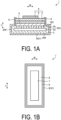
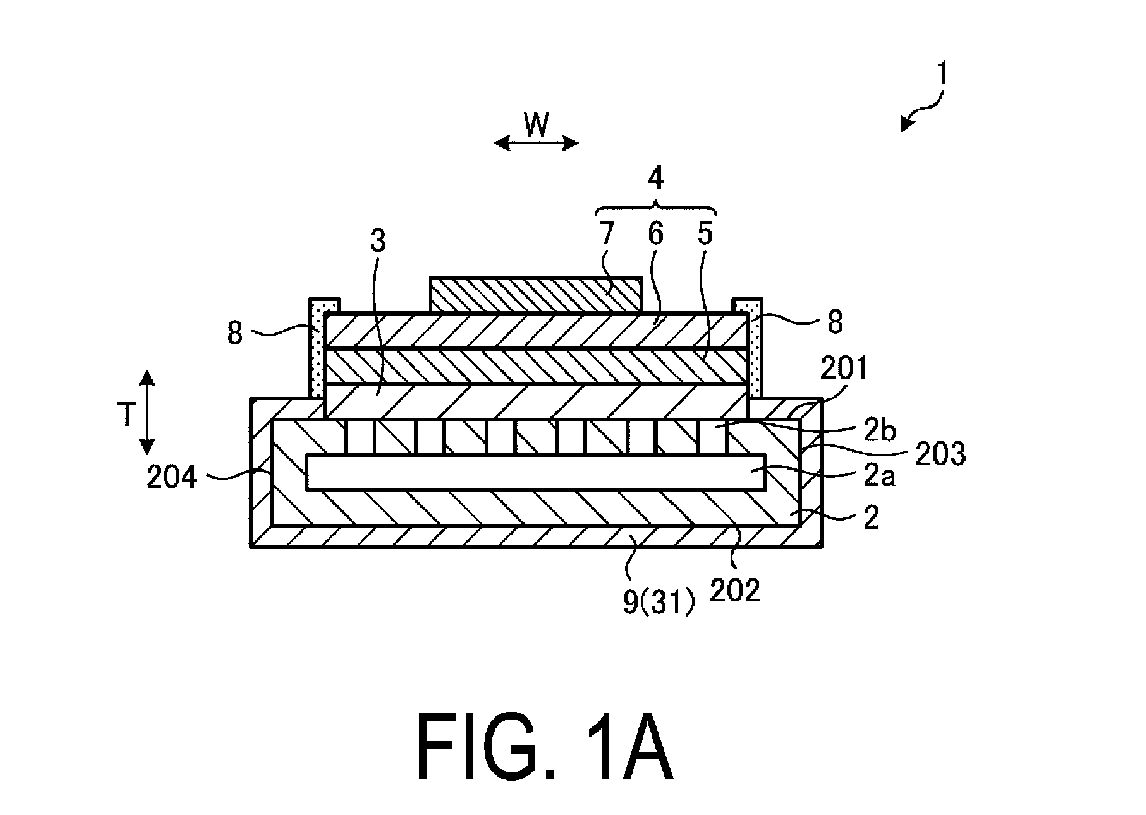
- FIG. 1A is a cross-sectional view illustrating an example of the electrochemical cell according to the first embodiment.
- FIG. 1B is a side view of an example of the electrochemical cell according to the first embodiment when viewed from the side of an air electrode. Note that FIGs. 1A and 1B illustrate an enlarged portion of each configuration of the cell 1.
- the electrochemical cell may be simply referred to as a cell.
- a cell 1 includes a metal body 2, an element portion 4, and a sealing material 8.
- the element portion 4 includes a fuel electrode 5, a solid electrolyte layer 6, and an air electrode 7.
- the metal body 2 has a first surface 201 and a second surface 202 facing each other in a thickness direction T, and a third surface 203 and a fourth surface 204 connecting the first surface 201 and the second surface 202.
- the metal body 2 has a gas-flow passage 2a and an opening 2b.
- the gas-flow passage 2a is a space that is located between the first surface 201 and the second surface 202 and extends in the length direction L.
- the opening 2b is a through-hole having a first end opened to the first surface 201 and a second end communicating with the gas-flow passage 2a.
- a fuel gas flowing through the gas-flow passage 2a is supplied to a fuel electrode 5 of the element portion 4 through the opening 2b.
- the diameter of the opening 2b may be, for example, from 0.1 mm to 0.5 mm, in particular, from 0.3 mm to 0.4 mm.
- An aperture ratio in a region where the opening 2b is formed may be, for example, 10% or more.
- the metal body 2 is a member made of metal containing chromium.
- the metal body 2 has electrical conductivity.
- the metal body 2 may be, for example, stainless steel such as ferritic stainless steel or austenitic stainless steel having high heat resistance.
- the metal body 2 may be made of, for example, a nickel-chromium alloy or an iron-chromium alloy.
- the metal body 2 may contain, for example, a metal oxide.
- the metal body 2 may have a structure in which a plurality of plate materials such as a plate material having the first surface 201 and a plate material having the second surface 202 are layered and end portions thereof are welded.
- the element portion 4 is located on the first surface 201 side of the metal body 2.
- the element portion 4 is located to face the first surface 201.
- Such an element portion 4 is fixed to the metal body 2 via an adhesive 3 and supported by the metal body 2.
- the element portion 4 includes the fuel electrode 5, the solid electrolyte layer 6, and the air electrode 7.
- the fuel electrode 5 may use porous electrically conductive ceramics, for example, ceramics containing ZrO 2 in which a calcium oxide, a magnesium oxide, or a rare earth element oxide is in solid solution, and Ni and/or NiO.
- This rare earth element oxide may contain a plurality of rare earth elements selected from, for example, Sc, Y, La, Nd, Sm, Gd, Dy, and Yb.
- ZrO 2 in which a calcium oxide, a magnesium oxide, or a rare earth element oxide is in solid solution may be referred to as stabilized zirconia.
- the stabilized zirconia may include partially stabilized zirconia.
- the fuel electrode 5 contains metal particles. An electrode containing the metal particles may be referred to as a first electrode.
- the solid electrolyte layer 6 is an electrolyte and delivers ions between the fuel electrode 5 and the air electrode 7. At the same time, the solid electrolyte layer 6 has gas blocking properties, and makes leakage of the fuel gas and the oxygen-containing gas less likely to occur.
- the material of the solid electrolyte layer 6 may be, for example, ZrO 2 in which from 3 mole% to 15 mole% of a rare earth element oxide is in solid solution.
- the rare earth element oxide may contain, for example, one or more rare earth elements selected from Sc, Y, La, Nd, Sm, Gd, Dy, and Yb.
- the solid electrolyte layer 6 may contain, for example, ZrO 2 in which Yb, Sc, or Gd is in solid solution, CeO 2 in which La, Nd, or Yb is in solid solution, BaZrO 3 in which Sc or Yb is in solid solution, or BaCeO 3 in which Sc or Yb is in solid solution.
- the air electrode 7 has gas permeability.
- the open porosity of the air electrode 7 may be, for example, in a range from 20% to 50%, in particular, in a range from 30% to 50%.
- the open porosity of the air electrode 7 may also be referred to as the porosity of the air electrode 7.
- the material of the air electrode 7 is not particularly limited as long as the material is one generally used for an air electrode.
- the material of the air electrode 7 may be, for example, an electrically conductive ceramic such as a so-called ABO 3 type perovskite oxide.
- the material of the air electrode 7 may be, for example, a composite oxide in which strontium (Sr) and lanthanum (La) coexist at an A site.
- a composite oxide examples include La x Sr 1 - x Co y Fe 1 - y O 3 , La x Sr 1 - x MnO 3 , La x Sr 1 - x FeO 3 , and La x Sr 1 - x CoO 3 .
- x is 0 ⁇ x ⁇ 1
- y is 0 ⁇ y ⁇ 1.
- the air electrode 7 may be referred to as a second electrode in contrast to the first electrode containing metal particles.
- the element portion 4 may include an intermediate layer between the solid electrolyte layer 6 and the air electrode 7.
- the intermediate layer has a function as a diffusion suppression layer, for example.
- strontium (Sr) contained in the air electrode 7 diffuses into the solid electrolyte layer 6, a resistance layer of SrZrO 3 is formed in the solid electrolyte layer 6.
- the intermediate layer makes it difficult for Sr to diffuse, thereby making it difficult for SrZrO 3 to be formed.
- the material of the intermediate layer is not particularly limited as long as the material generally makes it difficult for an element to diffuse between the air electrode 7 and the solid electrolyte layer 6.
- the material of the intermediate layer may contain, for example, cerium oxide (CeO 2 ) in which rare earth elements other than cerium (Ce) are in solid solution.
- CeO 2 cerium oxide
- rare earth elements for example, gadolinium (Gd), samarium (Sm), or the like may be used.
- the sealing material 8 is located on an end surface of the fuel electrode 5.
- the sealing material 8 has gas blocking properties, is located to cover the periphery of the fuel electrode 5, and seals the flow of the fuel gas between the fuel electrode 5 and the outside.
- the sealing material 8 may have a porosity of, for example, 5% or less. When the sealing material 8 has a porosity of 5% or less, the fuel gas does not easily flow between the fuel electrode 5 and the outside.
- the porosity of the sealing material 8 may be, for example, an average value of the porosities of at least three arbitrary cross sections of the sealing material 8. As illustrated in FIGs. 1A and 1B , the sealing material 8 may be located on the end surfaces of the fuel electrode 5 and the solid electrolyte layer 6.
- the sealing material 8 has electrical insulating properties.
- the electrical insulating properties may be simply referred to as insulating properties.
- Examples of the sealing material 8 that can be used include an oxide having low electrical conductivity such as glass.
- “having insulating properties or low electrical conductivity” means that the conductivity is 1/10 or less of that of the solid electrolyte layer 6.
- the electrical conductivity of the sealing material 8 may be, for example, 0.2 S/m or less, in particular, 0.002 S/m or less, at room temperature (25°C).
- the material of the sealing material 8 may be, for example, amorphous glass or the like, or crystallized glass.
- any one selected from the group consisting of SiO 2 -CaO-based, MgO-B 2 O 3 -based, La 2 O 3 -B 2 O 3 -MgO-based, La 2 O 3 -B 2 O 3 -ZnO-based, and SiO 2 -CaO-ZnO-based materials may be used, or, in particular, a SiO 2 -MgO-based material may be used.
- the cell 1 may further include the adhesive 3 located between the metal body 2 and the element portion 4.
- the adhesive 3 is located between the first surface 201 of the metal body 2 and the fuel electrode 5, and bonds the metal body 2 and the element portion 4.
- the adhesive 3 has electrical conductivity, for example.
- the adhesive 3 may have gas permeability, for example.
- a coating film containing, for example, chromic oxide (Cr 2 O 3 ) may be further located between the first surface 201 of the metal body 2 and the adhesive 3.
- the adhesive 3 may contain, for example, conductive particles such as Ni, and inorganic oxides such as TiO 2 , rare earth element oxides (Y 2 O 3 , CeO 2 , or the like), and transition metal oxides (Fe 2 O 3 , CuO, or the like). Note that the adhesive 3 may be located to be in contact with the first surface 201 where the opening 2b is not located.
- the fuel electrode 5 may be fixed to the metal body 2 without the intervention of the adhesive 3.
- Portions of the first surface 201 to the fourth surface 204 located on the surface of the metal body 2 that are not in contact with the adhesive 3 or the element portion 4 are exposed to an external space.
- Such an external space is a space where the air electrode 7 of the cell 1 is exposed, and is filled with oxygen-containing gas. That is, the external space is an oxidizing atmosphere.
- the chromium (Cr) contained in the metal body 2 is desorbed into an oxidizing atmosphere and adheres to the element portion 4, so that power generation performance may be deteriorated.
- the cell 1 according to the present embodiment further includes an oxide coating film 9.
- the oxide coating film 9 covers the metal body 2 and is exposed to an oxidizing atmosphere. Since the oxide coating film 9 is reducible the release of chromium from the metal body 2 to the oxidizing atmosphere, the power generation performance of the cell 1 is improved. Since the chromium is hardly released from the metal body 2 to the oxidizing atmosphere by the oxide coating film 9, the oxidation resistance and durability of the metal body 2 are improved.
- the oxide coating film 9 may make it difficult to increase a coating film containing chromic oxide (Cr 2 O 3 ) located on the surface of the metal body 2.
- the oxide coating film 9 may have, for example, a first coating film 31 that is electrically conductive.
- the first coating film 31 is an example of a first coating material.
- the first coating film 31 may have an electrical conductivity of 0. 005 S/cm or more.
- the first coating film 31 may include a transition metal oxide, for example, manganese (Mn).
- the first coating film 31 may include, for example, a composite oxide containing Mn.
- the composite oxide containing Mn may have a spinel structure.
- the first coating film 31 may contain, for example, CoMn 2 O 4 , MnCo 2 O 4 , Mn 1.5 Co 1.5 O 4 , ZnMnCoO 4 , or the like.
- the composition ratio of Mn to Co and/or Zn can be arbitrarily selected.
- the first coating film 31 may further contain, for example, a trace amount of Cr 2 O 3 , Al 2 O 3 , ZrO 2 , or the like.
- the composite oxide containing Mn may contain, for example, Al, Zr, or the like.
- Such a cell 1 is obtained as follows. For example, a layered body obtained by layering and firing a molded sheet of the fuel electrode 5 and a molded sheet of the solid electrolyte layer 6, and the metal body 2 having the first coating film 31 (or a molded film of the first coating film 31) are prepared. The surface of the fuel electrode 5 of the layered body is bonded to the first surface 201 having the opening 2b of the metal body 2 via the adhesive 3. Subsequently, an intermediate layer and the air electrode 7 are formed on the solid electrolyte layer 6, and the sealing material 8 is further provided on the lateral surface of the element portion 4, thereby obtaining the cell 1. The sealing material 8 may be located only on the lateral surface of the fuel electrode 5 in the element portion 4.
- the sealing material 8 may be located on at least a part of the lateral surface of the solid electrolyte layer 6, and further on at least a part of the surface of the solid electrolyte layer 6.
- the sealing material 8 may be located on the adhesive 3 or may be located on at least a part of the first coating film 31.
- the first coating film 31 may not be disposed on the first surface 201 having the opening 2b of the metal body 2.
- the layered body of the fuel electrode 5 and the solid electrolyte layer 6 may be produced, for example, as follows. A mixture of a Ni or NiO powder, a stabilized zirconia powder, an organic solvent, and a binder is sheet-molded to obtain a sheet-molded body of the fuel electrode 5. A mixture of a stabilized zirconia powder, an organic solvent, and a binder is sheet-molded on the sheet-molded body of the fuel electrode 5 to obtain a layered molded body. The obtained layered molded body is fired to obtain the layered body of the fuel electrode 5 and the solid electrolyte layer 6.
- the first coating film 31 may be formed as follows. For example, a paste obtained by mixing a powder of a composite oxide containing Mn, a solvent, and a binder is applied to a surface of the metal body 2 having no opening 2b and dried to form a molded film of first coating film 31. Further, a composite in which the surface of the fuel electrode 5 of the layered body is bonded to a surface of the metal body 2 having the opening 2b by using the adhesive 3 is fired at, for example, 900°C to 1200°C to obtain a bonded body of the metal body 2 having the first coating film 31 and the layered body.
- a molded body of an intermediate layer is formed on the surface of the solid electrolyte layer 6 of the bonded body, and is fired at, for example, 1000°C to 1200°C to form the intermediate layer.
- a molded body of the air electrode 7 is formed on the intermediate layer, and fired at, for example, 1000°C to 1200°C to form the air electrode 7, thereby obtaining the cell 1.
- the fuel electrode 5, the solid electrolyte layer 6, the intermediate layer, and the air electrode 7 may be sequentially formed directly on the first surface 201 having the opening 2b of the metal body 2 having the first coating film 31 or the molded film of the first coating film 31.
- a layered sheet to be the element portion 4 may be produced in advance, may be bonded onto the first surface 201 having the opening 2b of the metal body 2, and then fired.
- the sealing material 8 can be formed by, for example, applying the paste of the glass powder described above to a predetermined portion, drying the paste, and then performing heat treatment at, for example, 800°C to 900°C.
- FIG. 2A is a perspective view illustrating an example of a cell stack device according to the first embodiment
- FIG. 2B is a cross-sectional view taken along a line X-X illustrated in FIG. 2A
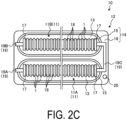
- FIG. 2C is a top view illustrating an example of the cell stack device according to the first embodiment.
- a cell stack device 10 includes a cell stack 11 including a plurality of cells 1 arrayed (layered) in the thickness direction T (see FIG. 1A ) of each cell 1, and a fixing member 12.
- the fixing member 12 includes a fixing material 13 and a support member 14.
- the support member 14 supports the cells 1.
- the fixing material 13 fixes the cells 1 to the support member 14.
- the support member 14 includes a support body 15 and a gas tank 16.
- the support body 15 and the gas tank 16, constituting the support member 14, are made of metal and electrically conductive.
- the support body 15 includes an insertion hole 15a, into which the lower end portions of the plurality of cells 1 are inserted.
- the lower end portions of the plurality of cells 1 and the inner wall of the insertion hole 15a are bonded by the fixing material 13.
- the gas tank 16 includes an opening portion through which a reactive gas is supplied to the plurality of cells 1 via the insertion hole 15a, and a recessed groove 16a located in the periphery of the opening portion.
- the outer peripheral end portion of the support body 15 is bonded to the gas tank 16 by a bonding material 21 with which the recessed groove 16a of the gas tank 16 is filled.
- the fuel gas is stored in an internal space 22 formed by the support body 15 and the gas tank 16 constituting the support member 14.
- the gas tank 16 includes a gas circulation pipe 20 connected thereto.
- the fuel gas is supplied to the gas tank 16 through the gas circulation pipe 20 and is supplied from the gas tank 16 to the gas-flow passages 2a (see FIG. 1A ) inside the cells 1.
- the fuel gas supplied to the gas tank 16 is generated by a reformer 102 (see FIG. 3 ) to be described below.
- a hydrogen-rich fuel gas can be produced, for example, by steam-reforming a raw fuel.
- the fuel gas is produced by steam reforming, the fuel gas contains steam.
- two rows of the cell stacks 11, two of the support bodies 15, and the gas tank 16 are provided.
- the two rows of the cell stacks 11 each have the plurality of cells 1.
- Each of the cell stacks 11 is fixed to a corresponding one of the support bodies 15.
- An upper surface of the gas tank 16 includes two through holes.
- Each of the support bodies 15 is disposed in a corresponding one of the through holes.
- the internal space 22 is formed by the one gas tank 16 and the two support bodies 15.
- the insertion hole 15a has, for example, an oval shape in a top surface view.
- the length of the insertion hole 15a in an arrangement direction of the cells 1, that is, the thickness direction T, is longer than the distance between two end current collection members 17 located at two ends of the cell stack 11, for example.
- the width of the insertion hole 15a is, for example, greater than the length of the cell 1 in the width direction W (see FIG. 1A ).
- a bonding portion between the inner wall of the insertion hole 15a and the lower end portion of each of the cells 1 is filled with the fixing material 13 and solidified.
- the inner wall of the insertion hole 15a and the lower end portions of the plurality of cells 1 are bonded and fixed, and the lower end portions of the cells 1 are bonded and fixed to each other.
- the gas-flow passages 2a of each of the cells 1 communicate, at the lower end portion thereof, with the internal space 22 of the support member 14.
- the fixing material 13 and the bonding material 21 may be of low electrical conductivity, such as glass.
- amorphous glass or the like may be used, and in particular, crystallized glass or the like may be used.
- any one selected from the group consisting of SiO 2 -CaO-based, MgO-B 2 O 3 -based, La 2 O 3 -B 2 O 3 -MgO-based, La 2 O 3 -B 2 O 3 -ZnO-based, and SiO 2 -CaO-ZnO-based materials may be used, or, in particular, a SiO 2 -MgO-based material may be used.
- electrically conductive members 18 are each interposed between adjacent ones of the cells 1 of the plurality of cells 1. Each of the electrically conductive members 18 electrically connects in series one of the adjacent ones of the cells 1 to another one of the adjacent ones of the cells 1. More specifically, the electrically conductive member 18 connects the fuel electrode 5 of one of cells 1 with the air electrode 7 of another one of the cells 1.
- the end current collection members 17 are electrically connected to the cells 1 located at the outermost sides in the arrangement direction of the plurality of cells 1.
- the end current collection members 17 are each connected to an electrically conductive portion 19 protruding outward from the cell stack 11.
- the electrically conductive portion 19 collects electricity generated by the cells 1, and conducts the electricity to the outside. Note that in FIG. 2A , the end current collection members 17 are not illustrated.
- the cell stack device 10 may be one battery in which two cell stacks 11A and 11B are connected in series.
- the electrically conductive portion 19 of the cell stack device 10 may include a positive electrode terminal 19A, a negative electrode terminal 19B, and a connection terminal 19C.
- the positive electrode terminal 19A functions as a positive electrode when the electrical power generated by the cell stack 11 is output to the outside, and is electrically connected to the end current collection member 17 on a positive electrode side in the cell stack 11A.
- the negative electrode terminal 19B functions as a negative electrode when the electrical power generated by the cell stack 11 is output to the outside, and is electrically connected to the end current collection member 17 on a negative electrode side in the cell stack 11B.
- connection terminal 19C electrically connects the end current collection member 17 on the negative electrode side in the cell stack 11A and the end current collection member 17 on the positive electrode side in the cell stack 11B.
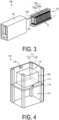
- FIG. 3 is an exterior appearance perspective view illustrating a module according to the first embodiment.
- FIG. 3 illustrates a state in which the front and rear surfaces, which are part of a container 101, are removed and the cell stack device 10 of the fuel cell housed therein is taken out rearward.
- the module 100 includes the container 101, and the cell stack device 10 stored in the container 101.
- the reformer 102 is disposed above the cell stack device 10.
- the reformer 102 generates a fuel gas by reforming a raw fuel such as natural gas and kerosene, and supplies the fuel gas to the cell 1.
- the raw fuel is supplied to the reformer 102 through a raw fuel supply pipe 103.
- the reformer 102 may include a vaporizing unit 102a for vaporizing water and a reforming unit 102b.
- the reforming unit 102b includes a reforming catalyst (not illustrated) for reforming the raw fuel into a fuel gas.
- Such a reformer 102 can perform steam reforming, which is a highly efficient reformation reaction.
- the fuel gas generated by the reformer 102 is supplied to the gas-flow passages 2a (see FIG. 1A ) of the cell 1 through the gas circulation pipe 20, the gas tank 16, and the support member 14.
- the temperature in the module 100 during normal power generation is about from 500°C to 1000°C due to combustion of gas and power generation by the cell 1.
- such a module 100 is configured to house the cell stack device 10 having the cell 1, whose power generation performance is improved, so that the power generation performance of the module 100 can be improved.
- FIG. 4 is an exploded perspective view illustrating an example of a module housing device according to the first embodiment.
- a module housing device 110 according to the present embodiment includes an external case 111, the module 100 illustrated in FIG. 3 , and an auxiliary device (not illustrated).
- the auxiliary device operates the module 100.
- the module 100 and the auxiliary device are housed in the external case 111. Note that in FIG. 4 , the configuration is partially omitted.
- the external case 111 of the module housing device 110 illustrated in FIG. 4 includes a support 112 and an external plate 113.
- a dividing plate 114 vertically partitions the interior of the external case 111.
- the space above the dividing plate 114 in the external case 111 is a module housing chamber 115 for housing the module 100.
- the space below the dividing plate 114 in the external case 111 is an auxiliary device housing chamber 116 for housing the auxiliary device configured to operate the module 100. Note that in FIG. 4 , the auxiliary device housed in the auxiliary device housing chamber 116 is omitted.
- the dividing plate 114 includes an air circulation hole 117 for causing air in the auxiliary device housing chamber 116 to flow into the module housing chamber 115 side.
- the external plate 113 constituting the module housing chamber 115 includes an exhaust hole 118 for discharging air inside the module housing chamber 115.
- such a module housing device 110 is configured such that the module 100 with improved power generation performance is provided in the module housing chamber 115, so that the power generation performance of the module housing device 110 can be improved.
- FIG. 5 is a cross-sectional view illustrating an example of an electrochemical cell according to a second embodiment.
- a cell 1 according to the present embodiment is different from the cell 1 according to the first embodiment in that the first coating film 31 is located away from the adhesive 3. Since the first coating film 31 and the adhesive 3 are located away from each other, so-called back diffusion in which ions such as O 2- move between the first coating film 31 and the adhesive 3 is less likely to occur, so that the power generation performance of the cell 1 is improved.
- the cell 1 according to the present embodiment is obtained as follows.
- the surface of the fuel electrode 5 of the layered body described in the first embodiment is bonded to the first surface 201 having the opening 2b of the metal body 2 via the adhesive 3.
- the layered body is disposed so that the first coating film 31 formed on the metal body 2 and the fuel electrode 5 of the layered body are separated from each other.
- the intermediate layer and the air electrode 7 are formed on the solid electrolyte layer 6, and the sealing material 8 is further provided on the lateral surface of the element portion 4, so that the cell 1 according to the present embodiment is obtained.
- the sealing material 8 may be located in a gap between the first coating film 31 and the adhesive 3. Thus, for example, since the release of chromium from the first surface 201 of the metal body 2 exposed to an oxidizing atmosphere is reducible, durability of the metal body 2 can be enhanced.
- a sealing material 8 is an example of a second coating material located between the metal body 2 and the element portion 4.
- a second coating film 32 may be located between the metal body 2 and the sealing material 8.
- the second coating film 32 may include, for example, Cr 2 O 3 .
- the second coating film 32 is neither the first coating material nor the second coating material.
- FIG. 6 is a cross-sectional view illustrating an example of an electrochemical cell according to a third embodiment.
- a cell 1 according to the present embodiment is different from the cell 1 illustrated in FIG. 5 in that a sealing material 28 is provided instead of the sealing material 8.
- the sealing material 28 has gas blocking properties.
- the sealing material 28 may have a porosity of 5% or less, for example. When the sealing material 28 has a porosity of 5% or less, the fuel gas does not easily flow between the fuel electrode 5 and the outside.
- the porosity of the sealing material 28 may be, for example, an average value of the porosities of at least three arbitrary cross-sections of the sealing material 28.
- the cell 1 according to the present embodiment is obtained as follows.
- the surface of the fuel electrode 5 of the layered body described in the first embodiment is bonded to the first surface 201 having the opening 2b of the metal body 2 via the adhesive 3.
- the layered body is disposed so that the first coating film 31 formed on the metal body 2 and the fuel electrode 5 of the layered body are separated from each other.
- the intermediate layer is formed on the solid electrolyte layer 6, and the sealing material 28 is further provided on the lateral surface of the layered body.
- the air electrode 7 is formed on the intermediate layer to obtain the cell 1 according to the present embodiment.
- the intermediate layer may be formed by a vapor phase method such as vacuum deposition.
- the sealing material 28 may contain, for example, an insulating oxide having higher heat resistance than the sealing material 8, such as forsterite.
- the sealing material 28 is reducible the release of chromium from the first surface 201 of the metal body 2 not only during the operation of the cell 1 but also during the manufacturing of the cell 1, for example, so that the power generation performance of the cell 1 can be further enhanced.
- the sealing material 28 is less likely to be dissolved in high-temperature water vapor, less likely to evaporate components, and thus less likely to cause gas leakage and a decrease in electrode performance.
- the forsterite has a thermal expansion coefficient close to that of the metal/alloy as the material of the metal body 2 and/or the element portion 4, and can enhance the thermal shock resistance of the cell 1.
- the forsterite has lower ion conductivity of O 2- or the like than glass or the like used for the sealing material 8 even in high-temperature water vapor, and is less likely to cause back diffusion.
- the forsterite has an electrical resistivity of 1 ⁇ 10 12 ⁇ m or more at room temperature (25°C), for example.
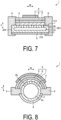
- FIG. 7 is a cross-sectional view illustrating an example of an electrochemical cell according to a fourth embodiment.
- a cell 1 according to the present embodiment is different from the cell 1 illustrated in FIG. 1A in that the sealing material 8 is located to wrap around the third surface 203 and the fourth surface 204 from a first surface 211 of the metal body 2 to a second surface 212 on which the oxide coating film 9 is located.
- the metal body 2 is covered with the oxide coating film 9 exposed to the oxidizing atmosphere and the sealing material 8, and the metal body 2 itself is not exposed to the oxidizing atmosphere.
- the chromium (Cr) contained in the metal body 2 is less likely to be released into the oxidizing atmosphere during high-temperature operation. Consequently, the present embodiment can improve the power generation performance of the cell 1.
- the oxide coating film 9 according to the present embodiment is, for example, the first coating film 31.
- the cell 1 may have, for example, the second coating film 32 between the oxide coating film 9 and the metal body 2.
- FIG. 8 is a cross-sectional view illustrating an example of an electrochemical cell according to a fifth embodiment.
- FIG. 9 is a cross-sectional view illustrating an example of an electrochemical cell according to a sixth embodiment.
- a cell 1 may include a metal body 2 having a substantially cylindrical shape.
- a cell 1 may include a metal body 2 having a flat plate shape.
- the metal body 2 having a flat plate shape includes a gas-flow passage 2a located between a first surface 211 and a second surface 212 facing each other in the thickness direction T and extending in the length direction L (see FIG. 1B ).
- the oxide coating film 9 according to the present embodiment is, for example, the first coating film 31.
- the cell 1 may have, for example, the second coating film 32 between the oxide coating film 9 and the metal body 2.
- the sealing material 8 is provided, but the sealing material 28 may be provided instead of the sealing material 8.
- a fuel cell, a fuel cell stack device, a fuel cell module, and a fuel cell device have been illustrated as examples of the "electrochemical cell”, the “electrochemical cell device”, the “module”, and the “module housing device”; however, they may be an electrolytic cell, an electrolytic cell stack device, an electrolytic module, and an electrolytic device, respectively, as other examples.
- the electrolytic cell includes a first electrode layer, a solid electrolyte layer, and a second electrode layer, and decomposes water vapor into hydrogen and oxygen or decomposes carbon dioxide into carbon monoxide and oxygen by supplying electric power.
- the electrolyte material may be a hydroxide ion conductor. According to the electrolytic cell, the electrolytic cell stack device, the electrolytic module, and the electrolytic device described above, electrolytic performance can be improved.
- the electrochemical cell (cell 1) includes the element portion 4, the metal body 2, and the oxide coating material.
- the metal body 2 contains chromium and supports the element portion 4.
- the oxide coating material covers the surface of the metal body 2 and is exposed to an oxidizing atmosphere.
- the oxide coating material is reducible the release of chromium into the oxidizing atmosphere.
- the oxide coating material includes at least a first coating material (first coating film 31) that is electrically conductive. This can improve the performance of the cell 1.
- the electrochemical cell device (cell stack device 10) according to the embodiment includes the cell stack 11 including the electrochemical cell. This can improve the performance of the cell stack device 10.
- the module 100 includes the electrochemical cell device described above, and the container 101 storing the electrochemical cell device. This can improve the performance of the module 100.
- the module housing device 110 includes the module 100 described above, the auxiliary device configured to operate the module 100, and the external case housing the module 100 and the auxiliary device. This can improve the performance of the module housing device 110.
Landscapes
- Chemical & Material Sciences (AREA)
- Engineering & Computer Science (AREA)
- Electrochemistry (AREA)
- Chemical Kinetics & Catalysis (AREA)
- Materials Engineering (AREA)
- Organic Chemistry (AREA)
- Metallurgy (AREA)
- Sustainable Energy (AREA)
- General Chemical & Material Sciences (AREA)
- Life Sciences & Earth Sciences (AREA)
- Sustainable Development (AREA)
- Manufacturing & Machinery (AREA)
- Ceramic Engineering (AREA)
- Inorganic Chemistry (AREA)
- Composite Materials (AREA)
- Fuel Cell (AREA)
Abstract
Description
- The present disclosure relates to an electrochemical cell, an electrochemical cell device, a module, and a module housing device.
- In recent years, various fuel cell stack devices each including a plurality of fuel cells have been proposed as next-generation energy. A fuel cell is a type of electrochemical cell that can obtain electrical power by using a fuel gas such as a hydrogen-containing gas and an oxygen-containing gas such as air.
- Patent Document 1:
JP 2015-162357 A - An electrochemical cell according to an aspect of an embodiment includes an element portion, a metal body, and an oxide coating material. The metal body contains chromium and is electrically connected to the element portion. The oxide coating material covers the metal body and is exposed to an oxidizing atmosphere. The oxide coating material is reducible the release of chromium into the oxidizing atmosphere. The oxide coating material includes at least a first coating material that is electrically conductive.
- An electrochemical cell device of the present disclosure includes a cell stack including the electrochemical cell described above.
- A module of the present disclosure includes the electrochemical cell device described above and a container storing the electrochemical cell device.
- A module housing device of the present disclosure includes the module described above, an auxiliary device operating the module, and an external case housing the module and the auxiliary device.
-
-
FIG. 1A is a cross-sectional view illustrating an example of an electrochemical cell according to a first embodiment. -
FIG. 1B is a side view of an example of the electrochemical cell according to the first embodiment when viewed from the side of an air electrode. -
FIG. 2A is a perspective view illustrating an example of a cell stack device according to the first embodiment. -
FIG. 2B is a cross-sectional view taken along a line X-X illustrated inFIG. 2A . -
FIG. 2C is a top view illustrating the example of the cell stack device according to the first embodiment. -
FIG. 3 is an external appearance perspective view illustrating an example of a module according to the first embodiment. -
FIG. 4 is an exploded perspective view schematically illustrating an example of a module housing device according to the first embodiment. -
FIG. 5 is a cross-sectional view illustrating an example of an electrochemical cell according to a second embodiment. -
FIG. 6 is a cross-sectional view illustrating an example of an electrochemical cell according to a third embodiment. -
FIG. 7 is a cross-sectional view illustrating an example of an electrochemical cell according to a fourth embodiment. -
FIG. 8 is a cross-sectional view illustrating an example of an electrochemical cell according to a fifth embodiment. -
FIG. 9 is a cross-sectional view illustrating an example of an electrochemical cell according to a sixth embodiment. - The above-described fuel cell stack device has room for improvement in terms of improving power generation performance.
- In this regard, it is expected to provide an electrochemical cell, an electrochemical cell device, a module, and a module housing device that can improve performance.
- Embodiments of an electrochemical cell, an electrochemical cell device, a module, and a module housing device disclosed in the present application is described below in detail with reference to the accompanying drawings. Note that the invention is not limited by the following embodiments.
- Note that the drawings are schematic and that the dimensional relationships between elements, the proportions of the elements, and the like may differ from the actual ones. There may be differences between the drawings in terms of dimensional relationships, proportions, and the like.
- First, with reference to
FIGs. 1A and 1B , an example of a solid oxide fuel cell is described as an electrochemical cell according to a first embodiment. An electrochemical cell device may include a cell stack including a plurality of electrochemical cells. The electrochemical cell device including the plurality of electrochemical cells is simply referred to as a cell stack device. -
FIG. 1A is a cross-sectional view illustrating an example of the electrochemical cell according to the first embodiment.FIG. 1B is a side view of an example of the electrochemical cell according to the first embodiment when viewed from the side of an air electrode. Note thatFIGs. 1A and 1B illustrate an enlarged portion of each configuration of thecell 1. Hereinafter, the electrochemical cell may be simply referred to as a cell. - As illustrated in
FIG. 1A , acell 1 includes ametal body 2, anelement portion 4, and a sealingmaterial 8. Theelement portion 4 includes afuel electrode 5, asolid electrolyte layer 6, and anair electrode 7. - The
metal body 2 has afirst surface 201 and asecond surface 202 facing each other in a thickness direction T, and athird surface 203 and afourth surface 204 connecting thefirst surface 201 and thesecond surface 202. - The
metal body 2 has a gas-flow passage 2a and an opening 2b. The gas-flow passage 2a is a space that is located between thefirst surface 201 and thesecond surface 202 and extends in the length direction L. The opening 2b is a through-hole having a first end opened to thefirst surface 201 and a second end communicating with the gas-flow passage 2a. A fuel gas flowing through the gas-flow passage 2a is supplied to afuel electrode 5 of theelement portion 4 through the opening 2b. The diameter of the opening 2b may be, for example, from 0.1 mm to 0.5 mm, in particular, from 0.3 mm to 0.4 mm. An aperture ratio in a region where the opening 2b is formed may be, for example, 10% or more. - The
metal body 2 is a member made of metal containing chromium. Themetal body 2 has electrical conductivity. Themetal body 2 may be, for example, stainless steel such as ferritic stainless steel or austenitic stainless steel having high heat resistance. Themetal body 2 may be made of, for example, a nickel-chromium alloy or an iron-chromium alloy. Themetal body 2 may contain, for example, a metal oxide. Themetal body 2 may have a structure in which a plurality of plate materials such as a plate material having thefirst surface 201 and a plate material having thesecond surface 202 are layered and end portions thereof are welded. - The
element portion 4 is located on thefirst surface 201 side of themetal body 2. Theelement portion 4 is located to face thefirst surface 201. Such anelement portion 4 is fixed to themetal body 2 via an adhesive 3 and supported by themetal body 2. - The
element portion 4 includes thefuel electrode 5, thesolid electrolyte layer 6, and theair electrode 7. As the material of thefuel electrode 5, a commonly known material can be used. Thefuel electrode 5 may use porous electrically conductive ceramics, for example, ceramics containing ZrO2 in which a calcium oxide, a magnesium oxide, or a rare earth element oxide is in solid solution, and Ni and/or NiO. This rare earth element oxide may contain a plurality of rare earth elements selected from, for example, Sc, Y, La, Nd, Sm, Gd, Dy, and Yb. Hereinafter, ZrO2 in which a calcium oxide, a magnesium oxide, or a rare earth element oxide is in solid solution may be referred to as stabilized zirconia. The stabilized zirconia may include partially stabilized zirconia. Thefuel electrode 5 contains metal particles. An electrode containing the metal particles may be referred to as a first electrode. - The
solid electrolyte layer 6 is an electrolyte and delivers ions between thefuel electrode 5 and theair electrode 7. At the same time, thesolid electrolyte layer 6 has gas blocking properties, and makes leakage of the fuel gas and the oxygen-containing gas less likely to occur. - The material of the
solid electrolyte layer 6 may be, for example, ZrO2 in which from 3 mole% to 15 mole% of a rare earth element oxide is in solid solution. The rare earth element oxide may contain, for example, one or more rare earth elements selected from Sc, Y, La, Nd, Sm, Gd, Dy, and Yb. Thesolid electrolyte layer 6 may contain, for example, ZrO2 in which Yb, Sc, or Gd is in solid solution, CeO2 in which La, Nd, or Yb is in solid solution, BaZrO3 in which Sc or Yb is in solid solution, or BaCeO3 in which Sc or Yb is in solid solution. - The
air electrode 7 has gas permeability. The open porosity of theair electrode 7 may be, for example, in a range from 20% to 50%, in particular, in a range from 30% to 50%. The open porosity of theair electrode 7 may also be referred to as the porosity of theair electrode 7. - The material of the
air electrode 7 is not particularly limited as long as the material is one generally used for an air electrode. The material of theair electrode 7 may be, for example, an electrically conductive ceramic such as a so-called ABO3 type perovskite oxide. - The material of the
air electrode 7 may be, for example, a composite oxide in which strontium (Sr) and lanthanum (La) coexist at an A site. Examples of such a composite oxide include LaxSr1 - xCoyFe1 - yO3, LaxSr1 - xMnO3, LaxSr1 - xFeO3, and LaxSr1 - xCoO3. Here, x is 0 < x < 1, and y is 0 < y < 1. Theair electrode 7 may be referred to as a second electrode in contrast to the first electrode containing metal particles. - The
element portion 4 may include an intermediate layer between thesolid electrolyte layer 6 and theair electrode 7. When theelement portion 4 includes the intermediate layer, the intermediate layer has a function as a diffusion suppression layer, for example. When strontium (Sr) contained in theair electrode 7 diffuses into thesolid electrolyte layer 6, a resistance layer of SrZrO3 is formed in thesolid electrolyte layer 6. The intermediate layer makes it difficult for Sr to diffuse, thereby making it difficult for SrZrO3 to be formed. - The material of the intermediate layer is not particularly limited as long as the material generally makes it difficult for an element to diffuse between the
air electrode 7 and thesolid electrolyte layer 6. The material of the intermediate layer may contain, for example, cerium oxide (CeO2) in which rare earth elements other than cerium (Ce) are in solid solution. As such rare earth elements, for example, gadolinium (Gd), samarium (Sm), or the like may be used. - The sealing
material 8 is located on an end surface of thefuel electrode 5. The sealingmaterial 8 has gas blocking properties, is located to cover the periphery of thefuel electrode 5, and seals the flow of the fuel gas between thefuel electrode 5 and the outside. The sealingmaterial 8 may have a porosity of, for example, 5% or less. When the sealingmaterial 8 has a porosity of 5% or less, the fuel gas does not easily flow between thefuel electrode 5 and the outside. The porosity of the sealingmaterial 8 may be, for example, an average value of the porosities of at least three arbitrary cross sections of the sealingmaterial 8. As illustrated inFIGs. 1A and 1B , the sealingmaterial 8 may be located on the end surfaces of thefuel electrode 5 and thesolid electrolyte layer 6. - The sealing
material 8 has electrical insulating properties. Hereinafter, the electrical insulating properties may be simply referred to as insulating properties. Examples of the sealingmaterial 8 that can be used include an oxide having low electrical conductivity such as glass. Here, "having insulating properties or low electrical conductivity" means that the conductivity is 1/10 or less of that of thesolid electrolyte layer 6. The electrical conductivity of the sealingmaterial 8 may be, for example, 0.2 S/m or less, in particular, 0.002 S/m or less, at room temperature (25°C). The material of the sealingmaterial 8 may be, for example, amorphous glass or the like, or crystallized glass. As the crystallized glass, for example, any one selected from the group consisting of SiO2-CaO-based, MgO-B2O3-based, La2O3-B2O3-MgO-based, La2O3-B2O3-ZnO-based, and SiO2-CaO-ZnO-based materials may be used, or, in particular, a SiO2-MgO-based material may be used. - The
cell 1 may further include the adhesive 3 located between themetal body 2 and theelement portion 4. The adhesive 3 is located between thefirst surface 201 of themetal body 2 and thefuel electrode 5, and bonds themetal body 2 and theelement portion 4. The adhesive 3 has electrical conductivity, for example. The adhesive 3 may have gas permeability, for example. In thecell 1, a coating film containing, for example, chromic oxide (Cr2O3) may be further located between thefirst surface 201 of themetal body 2 and the adhesive 3. - The adhesive 3 may contain, for example, conductive particles such as Ni, and inorganic oxides such as TiO2, rare earth element oxides (Y2O3, CeO2, or the like), and transition metal oxides (Fe2O3, CuO, or the like). Note that the adhesive 3 may be located to be in contact with the
first surface 201 where theopening 2b is not located. Thefuel electrode 5 may be fixed to themetal body 2 without the intervention of the adhesive 3. - Portions of the
first surface 201 to thefourth surface 204 located on the surface of themetal body 2 that are not in contact with the adhesive 3 or theelement portion 4 are exposed to an external space. Such an external space is a space where theair electrode 7 of thecell 1 is exposed, and is filled with oxygen-containing gas. That is, the external space is an oxidizing atmosphere. - In the
cell 1 used in such an environment, during high-temperature operation, the chromium (Cr) contained in themetal body 2 is desorbed into an oxidizing atmosphere and adheres to theelement portion 4, so that power generation performance may be deteriorated. - The
cell 1 according to the present embodiment further includes anoxide coating film 9. Theoxide coating film 9 covers themetal body 2 and is exposed to an oxidizing atmosphere. Since theoxide coating film 9 is reducible the release of chromium from themetal body 2 to the oxidizing atmosphere, the power generation performance of thecell 1 is improved. Since the chromium is hardly released from themetal body 2 to the oxidizing atmosphere by theoxide coating film 9, the oxidation resistance and durability of themetal body 2 are improved. Theoxide coating film 9 may make it difficult to increase a coating film containing chromic oxide (Cr2O3) located on the surface of themetal body 2. - The
oxide coating film 9 may have, for example, afirst coating film 31 that is electrically conductive. Thefirst coating film 31 is an example of a first coating material. Thefirst coating film 31 may have an electrical conductivity of 0. 005 S/cm or more. Thefirst coating film 31 may include a transition metal oxide, for example, manganese (Mn). Thefirst coating film 31 may include, for example, a composite oxide containing Mn. The composite oxide containing Mn may have a spinel structure. Thefirst coating film 31 may contain, for example, CoMn2O4, MnCo2O4, Mn1.5Co1.5O4, ZnMnCoO4, or the like. In such a spinel-type composite oxide containing Mn, Co, and/or Zn, the composition ratio of Mn to Co and/or Zn can be arbitrarily selected. Thus, since the internal resistance of theelement portion 4 is reduced compared to when thefirst coating film 31 is not provided, the power generation performance of thecell 1 is improved. Thefirst coating film 31 may further contain, for example, a trace amount of Cr2O3, Al2O3, ZrO2, or the like. The composite oxide containing Mn may contain, for example, Al, Zr, or the like. - Such a
cell 1 is obtained as follows. For example, a layered body obtained by layering and firing a molded sheet of thefuel electrode 5 and a molded sheet of thesolid electrolyte layer 6, and themetal body 2 having the first coating film 31 (or a molded film of the first coating film 31) are prepared. The surface of thefuel electrode 5 of the layered body is bonded to thefirst surface 201 having theopening 2b of themetal body 2 via theadhesive 3. Subsequently, an intermediate layer and theair electrode 7 are formed on thesolid electrolyte layer 6, and the sealingmaterial 8 is further provided on the lateral surface of theelement portion 4, thereby obtaining thecell 1. The sealingmaterial 8 may be located only on the lateral surface of thefuel electrode 5 in theelement portion 4. The sealingmaterial 8 may be located on at least a part of the lateral surface of thesolid electrolyte layer 6, and further on at least a part of the surface of thesolid electrolyte layer 6. The sealingmaterial 8 may be located on the adhesive 3 or may be located on at least a part of thefirst coating film 31. Thefirst coating film 31 may not be disposed on thefirst surface 201 having theopening 2b of themetal body 2. - The layered body of the
fuel electrode 5 and thesolid electrolyte layer 6 may be produced, for example, as follows. A mixture of a Ni or NiO powder, a stabilized zirconia powder, an organic solvent, and a binder is sheet-molded to obtain a sheet-molded body of thefuel electrode 5. A mixture of a stabilized zirconia powder, an organic solvent, and a binder is sheet-molded on the sheet-molded body of thefuel electrode 5 to obtain a layered molded body. The obtained layered molded body is fired to obtain the layered body of thefuel electrode 5 and thesolid electrolyte layer 6. - The
first coating film 31 may be formed as follows. For example, a paste obtained by mixing a powder of a composite oxide containing Mn, a solvent, and a binder is applied to a surface of themetal body 2 having noopening 2b and dried to form a molded film offirst coating film 31. Further, a composite in which the surface of thefuel electrode 5 of the layered body is bonded to a surface of themetal body 2 having theopening 2b by using the adhesive 3 is fired at, for example, 900°C to 1200°C to obtain a bonded body of themetal body 2 having thefirst coating film 31 and the layered body. Further, a molded body of an intermediate layer is formed on the surface of thesolid electrolyte layer 6 of the bonded body, and is fired at, for example, 1000°C to 1200°C to form the intermediate layer. Further, a molded body of theair electrode 7 is formed on the intermediate layer, and fired at, for example, 1000°C to 1200°C to form theair electrode 7, thereby obtaining thecell 1. - The
fuel electrode 5, thesolid electrolyte layer 6, the intermediate layer, and theair electrode 7 may be sequentially formed directly on thefirst surface 201 having theopening 2b of themetal body 2 having thefirst coating film 31 or the molded film of thefirst coating film 31. For example, a layered sheet to be theelement portion 4 may be produced in advance, may be bonded onto thefirst surface 201 having theopening 2b of themetal body 2, and then fired. - The sealing
material 8 can be formed by, for example, applying the paste of the glass powder described above to a predetermined portion, drying the paste, and then performing heat treatment at, for example, 800°C to 900°C. - A cell stack device according to the present embodiment using the
cell 1 described above is described below with reference toFIGs. 2A to 2C .FIG. 2A is a perspective view illustrating an example of a cell stack device according to the first embodiment,FIG. 2B is a cross-sectional view taken along a line X-X illustrated inFIG. 2A , andFIG. 2C is a top view illustrating an example of the cell stack device according to the first embodiment. - As illustrated in
FIG. 2A , acell stack device 10 includes acell stack 11 including a plurality ofcells 1 arrayed (layered) in the thickness direction T (seeFIG. 1A ) of eachcell 1, and a fixingmember 12. - The fixing
member 12 includes a fixingmaterial 13 and asupport member 14. Thesupport member 14 supports thecells 1. The fixingmaterial 13 fixes thecells 1 to thesupport member 14. Thesupport member 14 includes asupport body 15 and agas tank 16. Thesupport body 15 and thegas tank 16, constituting thesupport member 14, are made of metal and electrically conductive. - As illustrated in
FIG. 2B , thesupport body 15 includes aninsertion hole 15a, into which the lower end portions of the plurality ofcells 1 are inserted. The lower end portions of the plurality ofcells 1 and the inner wall of theinsertion hole 15a are bonded by the fixingmaterial 13. - The
gas tank 16 includes an opening portion through which a reactive gas is supplied to the plurality ofcells 1 via theinsertion hole 15a, and a recessedgroove 16a located in the periphery of the opening portion. The outer peripheral end portion of thesupport body 15 is bonded to thegas tank 16 by abonding material 21 with which the recessedgroove 16a of thegas tank 16 is filled. - In the example illustrated in
FIG. 2A , the fuel gas is stored in aninternal space 22 formed by thesupport body 15 and thegas tank 16 constituting thesupport member 14. Thegas tank 16 includes agas circulation pipe 20 connected thereto. The fuel gas is supplied to thegas tank 16 through thegas circulation pipe 20 and is supplied from thegas tank 16 to the gas-flow passages 2a (seeFIG. 1A ) inside thecells 1. The fuel gas supplied to thegas tank 16 is generated by a reformer 102 (seeFIG. 3 ) to be described below. - A hydrogen-rich fuel gas can be produced, for example, by steam-reforming a raw fuel. When the fuel gas is produced by steam reforming, the fuel gas contains steam.
- In the example illustrated in
FIG. 2A , two rows of the cell stacks 11, two of thesupport bodies 15, and thegas tank 16 are provided. The two rows of the cell stacks 11 each have the plurality ofcells 1. Each of the cell stacks 11 is fixed to a corresponding one of thesupport bodies 15. An upper surface of thegas tank 16 includes two through holes. Each of thesupport bodies 15 is disposed in a corresponding one of the through holes. Theinternal space 22 is formed by the onegas tank 16 and the twosupport bodies 15. - The
insertion hole 15a has, for example, an oval shape in a top surface view. The length of theinsertion hole 15a in an arrangement direction of thecells 1, that is, the thickness direction T, is longer than the distance between two endcurrent collection members 17 located at two ends of thecell stack 11, for example. The width of theinsertion hole 15a is, for example, greater than the length of thecell 1 in the width direction W (seeFIG. 1A ). - As illustrated in
FIG. 2B , a bonding portion between the inner wall of theinsertion hole 15a and the lower end portion of each of thecells 1 is filled with the fixingmaterial 13 and solidified. Thus, the inner wall of theinsertion hole 15a and the lower end portions of the plurality ofcells 1 are bonded and fixed, and the lower end portions of thecells 1 are bonded and fixed to each other. The gas-flow passages 2a of each of thecells 1 communicate, at the lower end portion thereof, with theinternal space 22 of thesupport member 14. - The fixing
material 13 and thebonding material 21 may be of low electrical conductivity, such as glass. As the specific materials of the fixingmaterial 13 and thebonding material 21, amorphous glass or the like may be used, and in particular, crystallized glass or the like may be used. - As the crystallized glass, for example, any one selected from the group consisting of SiO2-CaO-based, MgO-B2O3-based, La2O3-B2O3-MgO-based, La2O3-B2O3-ZnO-based, and SiO2-CaO-ZnO-based materials may be used, or, in particular, a SiO2-MgO-based material may be used.
- As illustrated in
FIG. 2B , electricallyconductive members 18 are each interposed between adjacent ones of thecells 1 of the plurality ofcells 1. Each of the electricallyconductive members 18 electrically connects in series one of the adjacent ones of thecells 1 to another one of the adjacent ones of thecells 1. More specifically, the electricallyconductive member 18 connects thefuel electrode 5 of one ofcells 1 with theair electrode 7 of another one of thecells 1. - As illustrated in
FIG. 2B , the endcurrent collection members 17 are electrically connected to thecells 1 located at the outermost sides in the arrangement direction of the plurality ofcells 1. The endcurrent collection members 17 are each connected to an electricallyconductive portion 19 protruding outward from thecell stack 11. The electricallyconductive portion 19 collects electricity generated by thecells 1, and conducts the electricity to the outside. Note that inFIG. 2A , the endcurrent collection members 17 are not illustrated. - As illustrated in
FIG. 2C , thecell stack device 10 may be one battery in which twocell stacks conductive portion 19 of thecell stack device 10 may include apositive electrode terminal 19A, anegative electrode terminal 19B, and a connection terminal 19C. - The
positive electrode terminal 19A functions as a positive electrode when the electrical power generated by thecell stack 11 is output to the outside, and is electrically connected to the endcurrent collection member 17 on a positive electrode side in thecell stack 11A. Thenegative electrode terminal 19B functions as a negative electrode when the electrical power generated by thecell stack 11 is output to the outside, and is electrically connected to the endcurrent collection member 17 on a negative electrode side in thecell stack 11B. - The connection terminal 19C electrically connects the end
current collection member 17 on the negative electrode side in thecell stack 11A and the endcurrent collection member 17 on the positive electrode side in thecell stack 11B. - A module according to an embodiment of the present disclosure using the
cell stack device 10 described above is described below with reference toFIG. 3. FIG. 3 is an exterior appearance perspective view illustrating a module according to the first embodiment.FIG. 3 illustrates a state in which the front and rear surfaces, which are part of acontainer 101, are removed and thecell stack device 10 of the fuel cell housed therein is taken out rearward. - As illustrated in
FIG. 3 , themodule 100 includes thecontainer 101, and thecell stack device 10 stored in thecontainer 101. Thereformer 102 is disposed above thecell stack device 10. - The
reformer 102 generates a fuel gas by reforming a raw fuel such as natural gas and kerosene, and supplies the fuel gas to thecell 1. The raw fuel is supplied to thereformer 102 through a rawfuel supply pipe 103. Note that thereformer 102 may include avaporizing unit 102a for vaporizing water and a reformingunit 102b. The reformingunit 102b includes a reforming catalyst (not illustrated) for reforming the raw fuel into a fuel gas. Such areformer 102 can perform steam reforming, which is a highly efficient reformation reaction. - The fuel gas generated by the
reformer 102 is supplied to the gas-flow passages 2a (seeFIG. 1A ) of thecell 1 through thegas circulation pipe 20, thegas tank 16, and thesupport member 14. - In the
module 100 having the configuration mentioned above, the temperature in themodule 100 during normal power generation is about from 500°C to 1000°C due to combustion of gas and power generation by thecell 1. - As described above, such a
module 100 is configured to house thecell stack device 10 having thecell 1, whose power generation performance is improved, so that the power generation performance of themodule 100 can be improved. -
FIG. 4 is an exploded perspective view illustrating an example of a module housing device according to the first embodiment. Amodule housing device 110 according to the present embodiment includes anexternal case 111, themodule 100 illustrated inFIG. 3 , and an auxiliary device (not illustrated). The auxiliary device operates themodule 100. Themodule 100 and the auxiliary device are housed in theexternal case 111. Note that inFIG. 4 , the configuration is partially omitted. - The
external case 111 of themodule housing device 110 illustrated inFIG. 4 includes asupport 112 and anexternal plate 113. A dividingplate 114 vertically partitions the interior of theexternal case 111. The space above the dividingplate 114 in theexternal case 111 is amodule housing chamber 115 for housing themodule 100. The space below the dividingplate 114 in theexternal case 111 is an auxiliarydevice housing chamber 116 for housing the auxiliary device configured to operate themodule 100. Note that inFIG. 4 , the auxiliary device housed in the auxiliarydevice housing chamber 116 is omitted. - The dividing
plate 114 includes anair circulation hole 117 for causing air in the auxiliarydevice housing chamber 116 to flow into themodule housing chamber 115 side. Theexternal plate 113 constituting themodule housing chamber 115 includes anexhaust hole 118 for discharging air inside themodule housing chamber 115. - As described above, such a
module housing device 110 is configured such that themodule 100 with improved power generation performance is provided in themodule housing chamber 115, so that the power generation performance of themodule housing device 110 can be improved. -
FIG. 5 is a cross-sectional view illustrating an example of an electrochemical cell according to a second embodiment. Acell 1 according to the present embodiment is different from thecell 1 according to the first embodiment in that thefirst coating film 31 is located away from the adhesive 3. Since thefirst coating film 31 and the adhesive 3 are located away from each other, so-called back diffusion in which ions such as O2- move between thefirst coating film 31 and the adhesive 3 is less likely to occur, so that the power generation performance of thecell 1 is improved. - The
cell 1 according to the present embodiment is obtained as follows. For example, the surface of thefuel electrode 5 of the layered body described in the first embodiment is bonded to thefirst surface 201 having theopening 2b of themetal body 2 via theadhesive 3. At this time, the layered body is disposed so that thefirst coating film 31 formed on themetal body 2 and thefuel electrode 5 of the layered body are separated from each other. Subsequently, the intermediate layer and theair electrode 7 are formed on thesolid electrolyte layer 6, and the sealingmaterial 8 is further provided on the lateral surface of theelement portion 4, so that thecell 1 according to the present embodiment is obtained. - The sealing
material 8 may be located in a gap between thefirst coating film 31 and the adhesive 3. Thus, for example, since the release of chromium from thefirst surface 201 of themetal body 2 exposed to an oxidizing atmosphere is reducible, durability of themetal body 2 can be enhanced. Such a sealingmaterial 8 is an example of a second coating material located between themetal body 2 and theelement portion 4. - A
second coating film 32 may be located between themetal body 2 and the sealingmaterial 8. Thesecond coating film 32 may include, for example, Cr2O3. Thesecond coating film 32 is neither the first coating material nor the second coating material. -
FIG. 6 is a cross-sectional view illustrating an example of an electrochemical cell according to a third embodiment. Acell 1 according to the present embodiment is different from thecell 1 illustrated inFIG. 5 in that a sealingmaterial 28 is provided instead of the sealingmaterial 8. The sealingmaterial 28 has gas blocking properties. The sealingmaterial 28 may have a porosity of 5% or less, for example. When the sealingmaterial 28 has a porosity of 5% or less, the fuel gas does not easily flow between thefuel electrode 5 and the outside. The porosity of the sealingmaterial 28 may be, for example, an average value of the porosities of at least three arbitrary cross-sections of the sealingmaterial 28. - The
cell 1 according to the present embodiment is obtained as follows. For example, the surface of thefuel electrode 5 of the layered body described in the first embodiment is bonded to thefirst surface 201 having theopening 2b of themetal body 2 via theadhesive 3. At this time, the layered body is disposed so that thefirst coating film 31 formed on themetal body 2 and thefuel electrode 5 of the layered body are separated from each other. Subsequently, the intermediate layer is formed on thesolid electrolyte layer 6, and the sealingmaterial 28 is further provided on the lateral surface of the layered body. After the sealingmaterial 28 is provided, theair electrode 7 is formed on the intermediate layer to obtain thecell 1 according to the present embodiment. The intermediate layer may be formed by a vapor phase method such as vacuum deposition. - The sealing
material 28 may contain, for example, an insulating oxide having higher heat resistance than the sealingmaterial 8, such as forsterite. Thus, the sealingmaterial 28 is reducible the release of chromium from thefirst surface 201 of themetal body 2 not only during the operation of thecell 1 but also during the manufacturing of thecell 1, for example, so that the power generation performance of thecell 1 can be further enhanced. Compared with the sealingmaterial 8, the sealingmaterial 28 is less likely to be dissolved in high-temperature water vapor, less likely to evaporate components, and thus less likely to cause gas leakage and a decrease in electrode performance. In particular, the forsterite has a thermal expansion coefficient close to that of the metal/alloy as the material of themetal body 2 and/or theelement portion 4, and can enhance the thermal shock resistance of thecell 1. The forsterite has lower ion conductivity of O2- or the like than glass or the like used for the sealingmaterial 8 even in high-temperature water vapor, and is less likely to cause back diffusion. The forsterite has an electrical resistivity of 1 × 10¹² Ω·m or more at room temperature (25°C), for example. -
FIG. 7 is a cross-sectional view illustrating an example of an electrochemical cell according to a fourth embodiment. Acell 1 according to the present embodiment is different from thecell 1 illustrated inFIG. 1A in that the sealingmaterial 8 is located to wrap around thethird surface 203 and thefourth surface 204 from afirst surface 211 of themetal body 2 to asecond surface 212 on which theoxide coating film 9 is located. Themetal body 2 is covered with theoxide coating film 9 exposed to the oxidizing atmosphere and the sealingmaterial 8, and themetal body 2 itself is not exposed to the oxidizing atmosphere. Thus, the chromium (Cr) contained in themetal body 2 is less likely to be released into the oxidizing atmosphere during high-temperature operation. Consequently, the present embodiment can improve the power generation performance of thecell 1. Theoxide coating film 9 according to the present embodiment is, for example, thefirst coating film 31. Thecell 1 may have, for example, thesecond coating film 32 between theoxide coating film 9 and themetal body 2. -
FIG. 8 is a cross-sectional view illustrating an example of an electrochemical cell according to a fifth embodiment.FIG. 9 is a cross-sectional view illustrating an example of an electrochemical cell according to a sixth embodiment. - As illustrated in
FIG. 8 , acell 1 may include ametal body 2 having a substantially cylindrical shape. As illustrated inFIG. 9 , acell 1 may include ametal body 2 having a flat plate shape. Themetal body 2 having a flat plate shape includes a gas-flow passage 2a located between afirst surface 211 and asecond surface 212 facing each other in the thickness direction T and extending in the length direction L (seeFIG. 1B ). In this way, regardless of the shape of themetal body 2, the power generation performance of thecell 1 can be improved by covering the portion exposed to the oxidizing atmosphere with theoxide coating film 9 and the sealingmaterial 8. Theoxide coating film 9 according to the present embodiment is, for example, thefirst coating film 31. Thecell 1 may have, for example, thesecond coating film 32 between theoxide coating film 9 and themetal body 2. - In the
cells 1 illustrated inFIGs. 7 to 9 , the sealingmaterial 8 is provided, but the sealingmaterial 28 may be provided instead of the sealingmaterial 8. - In each of the embodiments described above, a fuel cell, a fuel cell stack device, a fuel cell module, and a fuel cell device have been illustrated as examples of the "electrochemical cell", the "electrochemical cell device", the "module", and the "module housing device"; however, they may be an electrolytic cell, an electrolytic cell stack device, an electrolytic module, and an electrolytic device, respectively, as other examples. The electrolytic cell includes a first electrode layer, a solid electrolyte layer, and a second electrode layer, and decomposes water vapor into hydrogen and oxygen or decomposes carbon dioxide into carbon monoxide and oxygen by supplying electric power. Although an oxide ion conductor or a hydrogen ion conductor is shown as an example of the electrolyte material of the electrochemical cell in each of the above embodiments, the electrolyte material may be a hydroxide ion conductor. According to the electrolytic cell, the electrolytic cell stack device, the electrolytic module, and the electrolytic device described above, electrolytic performance can be improved.
- While the present disclosure has been described in detail, the present disclosure is not limited to the aforementioned embodiment, and various changes, improvements, and the like can be made without departing from the gist of the present disclosure.
- As described above, the electrochemical cell (cell 1) according to the embodiment includes the
element portion 4, themetal body 2, and the oxide coating material. Themetal body 2 contains chromium and supports theelement portion 4. The oxide coating material covers the surface of themetal body 2 and is exposed to an oxidizing atmosphere. The oxide coating material is reducible the release of chromium into the oxidizing atmosphere. The oxide coating material includes at least a first coating material (first coating film 31) that is electrically conductive. This can improve the performance of thecell 1. - The electrochemical cell device (cell stack device 10) according to the embodiment includes the
cell stack 11 including the electrochemical cell. This can improve the performance of thecell stack device 10. - The
module 100 according to the embodiment includes the electrochemical cell device described above, and thecontainer 101 storing the electrochemical cell device. This can improve the performance of themodule 100. - The
module housing device 110 according to the embodiment includes themodule 100 described above, the auxiliary device configured to operate themodule 100, and the external case housing themodule 100 and the auxiliary device. This can improve the performance of themodule housing device 110. - Note that the embodiments disclosed herein are exemplary in all respects and not restrictive. The aforementioned embodiments can be embodied in a variety of forms. The aforementioned embodiments may be omitted, replaced, or changed in various forms without departing from the scope of the appended claims and the purpose thereof.
-
- 1 Cell
- 2 Metal body
- 4 Element portion
- 8 Sealing material
- 9 Oxide coating film
- 10 Cell stack device
- 11 Cell stack
- 31 First coating film
- 32 Second coating film
- 100 Module
- 110 Module housing device
Claims (10)
- An electrochemical cell, comprising:an element portion;a metal body containing chromium and electrically connected to the element portion; andan oxide coating material:covering the metal body;being reducible in release of chromium into the oxidizing atmosphere when exposed in an oxidizing atmosphere;
andcomprising at least a first coating material that is electrically conductive. - The electrochemical cell according to claim 1, wherein the oxide coating material further comprises a second coating material that is electrically insulative.
- The electrochemical cell according to claim 2, wherein the second coating material is between the element portion and the first coating material.
- The electrochemical cell according to claim 2 or 3, wherein the element portion comprises a first electrode, a solid electrolyte layer, and a second electrode, and
an electrical conductivity of the second coating material is 1/10 or less of an electrical conductivity of the solid electrolyte layer. - The electrochemical cell according to any one of claims 2 to 4, wherein the second coating material has a porosity of 10% or less.
- The electrochemical cell according to any one of claims 2 to 4, wherein the second coating material contains forsterite.
- The electrochemical cell according to any one of claims 1 to 6, wherein the first coating material contains manganese.
- An electrochemical cell device comprising a cell stack comprising the electrochemical cell according to any one of claims 1 to 7.
- A module comprising:the electrochemical cell device according to claim 8; anda container storing the electrochemical cell device.
- A module housing device comprising:the module according to claim 9;an auxiliary device configured to operate the module; andan external case housing the module and the auxiliary device.
Applications Claiming Priority (2)
| Application Number | Priority Date | Filing Date | Title |
|---|---|---|---|
| JP2022044678 | 2022-03-18 | ||
| PCT/JP2023/010764 WO2023176979A1 (en) | 2022-03-18 | 2023-03-17 | Electrochemical cell, electrochemical cell device, module, and module accommodation device |
Publications (2)
| Publication Number | Publication Date |
|---|---|
| EP4478464A1 true EP4478464A1 (en) | 2024-12-18 |
| EP4478464A4 EP4478464A4 (en) | 2025-10-01 |
Family
ID=88023517
Family Applications (1)
| Application Number | Title | Priority Date | Filing Date |
|---|---|---|---|
| EP23770931.6A Pending EP4478464A4 (en) | 2022-03-18 | 2023-03-17 | ELECTROCHEMICAL CELL, ELECTROCHEMICAL CELL DEVICE, MODULE AND MODULE RECEPTION DEVICE |
Country Status (5)
| Country | Link |
|---|---|
| US (1) | US20250192215A1 (en) |
| EP (1) | EP4478464A4 (en) |
| JP (1) | JPWO2023176979A1 (en) |
| CN (1) | CN118922969A (en) |
| WO (1) | WO2023176979A1 (en) |
Families Citing this family (2)
| Publication number | Priority date | Publication date | Assignee | Title |
|---|---|---|---|---|
| WO2025164665A1 (en) * | 2024-01-29 | 2025-08-07 | 京セラ株式会社 | Composite member, electrochemical cell, electrochemical cell device, module, and module storage device |
| WO2025164668A1 (en) * | 2024-01-30 | 2025-08-07 | 京セラ株式会社 | Composite member, electrochemical cell, electrochemical cell device, module, and module storage device |
Family Cites Families (9)
| Publication number | Priority date | Publication date | Assignee | Title |
|---|---|---|---|---|
| TWI552417B (en) * | 2011-11-17 | 2016-10-01 | 博隆能源股份有限公司 | Multi-layer coating that provides corrosion resistance to zirconia-based electrolytes |
| JP5932394B2 (en) * | 2012-02-29 | 2016-06-08 | 京セラ株式会社 | Solid oxide fuel cell assembly, cell stack device, and fuel cell device |
| TWI487183B (en) * | 2012-08-16 | 2015-06-01 | Atomic Energy Council | Metal-supported solid oxide fuel cell structure |
| JP6147606B2 (en) * | 2013-08-06 | 2017-06-14 | 日本特殊陶業株式会社 | Solid oxide fuel cell stack |
| JP6175385B2 (en) | 2014-02-27 | 2017-08-02 | 京セラ株式会社 | Cell stack device, fuel cell module and fuel cell device |
| CA3017847A1 (en) * | 2016-03-18 | 2017-09-21 | Osaka Gas Co., Ltd. | Electrochemical element for a solid oxide fuel cell |
| JP7250910B2 (en) * | 2019-04-24 | 2023-04-03 | 京セラ株式会社 | Cells, cell stack equipment, modules and module housing equipment |
| CN114651353B (en) * | 2019-11-29 | 2024-12-24 | 京瓷株式会社 | Single cell stack device, module, module receiving device and metal component |
| WO2021206175A1 (en) * | 2020-04-09 | 2021-10-14 | 京セラ株式会社 | Cell stack device, module, and module accommodating apparatus |
-
2023
- 2023-03-17 US US18/846,552 patent/US20250192215A1/en active Pending
- 2023-03-17 EP EP23770931.6A patent/EP4478464A4/en active Pending
- 2023-03-17 WO PCT/JP2023/010764 patent/WO2023176979A1/en not_active Ceased
- 2023-03-17 JP JP2024508287A patent/JPWO2023176979A1/ja active Pending
- 2023-03-17 CN CN202380027702.6A patent/CN118922969A/en active Pending
Also Published As
| Publication number | Publication date |
|---|---|
| EP4478464A4 (en) | 2025-10-01 |
| CN118922969A (en) | 2024-11-08 |
| JPWO2023176979A1 (en) | 2023-09-21 |
| WO2023176979A1 (en) | 2023-09-21 |
| US20250192215A1 (en) | 2025-06-12 |
Similar Documents
| Publication | Publication Date | Title |
|---|---|---|
| EP4525107A1 (en) | Electrochemical cell, electrochemical cell device, module, and module accommodating device | |
| EP4394958A1 (en) | Electrochemical cell, electrochemical cell device, module, and module storage device | |
| EP4478464A1 (en) | Electrochemical cell, electrochemical cell device, module, and module accommodation device | |
| US20240322193A1 (en) | Electrochemical cell, electrochemical cell device, module, and module housing device | |
| US20250219109A1 (en) | Electrochemical cell, electrochemical cell device, module and module housing device | |
| US20240213500A1 (en) | Electrically conductive member, electrochemical cell device, module, module housing device, slurry, electrically conductive member manufacturing method, conductive material, and conductive powder material | |
| CN115066772B (en) | Conductive member, battery cell, battery stack device, module, and module receiving device | |
| JP7543601B1 (en) | Conductive member, electrochemical cell device, module, and module housing device | |
| EP4571907A1 (en) | Electrochemical cell, electrochemical cell device, module, and module accommodating device | |
| US20250385275A1 (en) | Electrically conductive member, electrochemical cell, electrochemical cell device, module, and module housing device | |
| JP7736802B2 (en) | Conductive member, electrochemical cell, electrochemical cell device, module, and module housing device | |
| EP4404312A1 (en) | Electrochemical cell, electrochemical cell device, module, and module storage device | |
| EP4456210B1 (en) | Electroconductive member, electrochemical cell, electrochemical cell device, module, and module accommodation device | |
| EP4715914A1 (en) | Solid electrolyte layer, electrochemical cell, electrochemical cell device, module, and module storage device | |
| EP4597649A1 (en) | Electrochemical cell, electrochemical cell device, module, and module-accommodating device | |
| EP4708415A1 (en) | Electroconductive member, electrochemical cell device, module, and module accommodation device | |
| EP4641719A1 (en) | Solid electrolyte layer, electrochemical cell, electrochemical cell device, module, and module storage device | |
| WO2025183149A1 (en) | Electrochemical cell, electrochemical cell device, module, and module storage device | |
| JP2025074789A (en) | Electrochemical cell, electrochemical cell device, module and module housing device | |
| WO2025095015A1 (en) | Electrochemical cell, electrochemical cell device, module, and module accommodation device | |
| WO2026048889A1 (en) | Electrochemical cell, electrochemical cell device, module, and module storage device | |
| WO2024143355A1 (en) | Electrochemical cell, electrochemical cell device, module, and module-accommodating device | |
| WO2026029158A1 (en) | Electrochemical cell, electrochemical cell device, module, and module storage device | |
| JP2023006816A (en) | Cell, cell stack apparatus, module and module housing apparatus | |
| JP5769661B2 (en) | Solid oxide fuel cell, fuel cell module and fuel cell device |
Legal Events
| Date | Code | Title | Description |
|---|---|---|---|
| STAA | Information on the status of an ep patent application or granted ep patent |
Free format text: STATUS: THE INTERNATIONAL PUBLICATION HAS BEEN MADE |
|
| PUAI | Public reference made under article 153(3) epc to a published international application that has entered the european phase |
Free format text: ORIGINAL CODE: 0009012 |
|
| STAA | Information on the status of an ep patent application or granted ep patent |
Free format text: STATUS: REQUEST FOR EXAMINATION WAS MADE |
|
| 17P | Request for examination filed |
Effective date: 20240909 |
|
| AK | Designated contracting states |
Kind code of ref document: A1 Designated state(s): AL AT BE BG CH CY CZ DE DK EE ES FI FR GB GR HR HU IE IS IT LI LT LU LV MC ME MK MT NL NO PL PT RO RS SE SI SK SM TR |
|
| DAV | Request for validation of the european patent (deleted) | ||
| DAX | Request for extension of the european patent (deleted) | ||
| REG | Reference to a national code |
Ref country code: DE Ref legal event code: R079 Free format text: PREVIOUS MAIN CLASS: H01M0008121300 Ipc: C25B0001040000 |
|
| A4 | Supplementary search report drawn up and despatched |
Effective date: 20250901 |
|
| RIC1 | Information provided on ipc code assigned before grant |
Ipc: C25B 1/04 20210101AFI20250826BHEP Ipc: C25B 9/23 20210101ALI20250826BHEP Ipc: C25B 11/077 20210101ALI20250826BHEP Ipc: C25B 13/07 20210101ALI20250826BHEP Ipc: H01M 8/021 20160101ALI20250826BHEP Ipc: H01M 8/0228 20160101ALI20250826BHEP Ipc: H01M 8/0217 20160101ALI20250826BHEP Ipc: C25B 9/60 20210101ALI20250826BHEP Ipc: C25B 9/70 20210101ALI20250826BHEP Ipc: H01M 8/12 20160101ALN20250826BHEP |