EP4478451A1 - Negative electrode for secondary battery, method for manufacturing the same, and lithium metal secondary battery comprising the same - Google Patents
Negative electrode for secondary battery, method for manufacturing the same, and lithium metal secondary battery comprising the same Download PDFInfo
- Publication number
- EP4478451A1 EP4478451A1 EP24209781.4A EP24209781A EP4478451A1 EP 4478451 A1 EP4478451 A1 EP 4478451A1 EP 24209781 A EP24209781 A EP 24209781A EP 4478451 A1 EP4478451 A1 EP 4478451A1
- Authority
- EP
- European Patent Office
- Prior art keywords
- negative electrode
- lithium metal
- secondary battery
- lithium
- thin film
- Prior art date
- Legal status (The legal status is an assumption and is not a legal conclusion. Google has not performed a legal analysis and makes no representation as to the accuracy of the status listed.)
- Pending
Links
Images
Classifications
-
- H—ELECTRICITY
- H01—ELECTRIC ELEMENTS
- H01M—PROCESSES OR MEANS, e.g. BATTERIES, FOR THE DIRECT CONVERSION OF CHEMICAL ENERGY INTO ELECTRICAL ENERGY
- H01M4/00—Electrodes
- H01M4/02—Electrodes composed of, or comprising, active material
- H01M4/04—Processes of manufacture in general
- H01M4/0402—Methods of deposition of the material
- H01M4/0404—Methods of deposition of the material by coating on electrode collectors
-
- H—ELECTRICITY
- H01—ELECTRIC ELEMENTS
- H01M—PROCESSES OR MEANS, e.g. BATTERIES, FOR THE DIRECT CONVERSION OF CHEMICAL ENERGY INTO ELECTRICAL ENERGY
- H01M10/00—Secondary cells; Manufacture thereof
- H01M10/05—Accumulators with non-aqueous electrolyte
- H01M10/052—Li-accumulators
-
- H—ELECTRICITY
- H01—ELECTRIC ELEMENTS
- H01M—PROCESSES OR MEANS, e.g. BATTERIES, FOR THE DIRECT CONVERSION OF CHEMICAL ENERGY INTO ELECTRICAL ENERGY
- H01M10/00—Secondary cells; Manufacture thereof
- H01M10/05—Accumulators with non-aqueous electrolyte
- H01M10/056—Accumulators with non-aqueous electrolyte characterised by the materials used as electrolytes, e.g. mixed inorganic/organic electrolytes
-
- H—ELECTRICITY
- H01—ELECTRIC ELEMENTS
- H01M—PROCESSES OR MEANS, e.g. BATTERIES, FOR THE DIRECT CONVERSION OF CHEMICAL ENERGY INTO ELECTRICAL ENERGY
- H01M4/00—Electrodes
- H01M4/02—Electrodes composed of, or comprising, active material
- H01M4/04—Processes of manufacture in general
- H01M4/049—Manufacturing of an active layer by chemical means
-
- H—ELECTRICITY
- H01—ELECTRIC ELEMENTS
- H01M—PROCESSES OR MEANS, e.g. BATTERIES, FOR THE DIRECT CONVERSION OF CHEMICAL ENERGY INTO ELECTRICAL ENERGY
- H01M4/00—Electrodes
- H01M4/02—Electrodes composed of, or comprising, active material
- H01M4/13—Electrodes for accumulators with non-aqueous electrolyte, e.g. for lithium-accumulators; Processes of manufacture thereof
- H01M4/134—Electrodes based on metals, Si or alloys
-
- H—ELECTRICITY
- H01—ELECTRIC ELEMENTS
- H01M—PROCESSES OR MEANS, e.g. BATTERIES, FOR THE DIRECT CONVERSION OF CHEMICAL ENERGY INTO ELECTRICAL ENERGY
- H01M4/00—Electrodes
- H01M4/02—Electrodes composed of, or comprising, active material
- H01M4/13—Electrodes for accumulators with non-aqueous electrolyte, e.g. for lithium-accumulators; Processes of manufacture thereof
- H01M4/139—Processes of manufacture
- H01M4/1395—Processes of manufacture of electrodes based on metals, Si or alloys
-
- H—ELECTRICITY
- H01—ELECTRIC ELEMENTS
- H01M—PROCESSES OR MEANS, e.g. BATTERIES, FOR THE DIRECT CONVERSION OF CHEMICAL ENERGY INTO ELECTRICAL ENERGY
- H01M4/00—Electrodes
- H01M4/02—Electrodes composed of, or comprising, active material
- H01M4/36—Selection of substances as active materials, active masses, active liquids
- H01M4/362—Composites
- H01M4/366—Composites as layered products
-
- H—ELECTRICITY
- H01—ELECTRIC ELEMENTS
- H01M—PROCESSES OR MEANS, e.g. BATTERIES, FOR THE DIRECT CONVERSION OF CHEMICAL ENERGY INTO ELECTRICAL ENERGY
- H01M4/00—Electrodes
- H01M4/02—Electrodes composed of, or comprising, active material
- H01M4/36—Selection of substances as active materials, active masses, active liquids
- H01M4/38—Selection of substances as active materials, active masses, active liquids of elements or alloys
- H01M4/381—Alkaline or alkaline earth metals elements
- H01M4/382—Lithium
-
- H—ELECTRICITY
- H01—ELECTRIC ELEMENTS
- H01M—PROCESSES OR MEANS, e.g. BATTERIES, FOR THE DIRECT CONVERSION OF CHEMICAL ENERGY INTO ELECTRICAL ENERGY
- H01M4/00—Electrodes
- H01M4/02—Electrodes composed of, or comprising, active material
- H01M4/36—Selection of substances as active materials, active masses, active liquids
- H01M4/48—Selection of substances as active materials, active masses, active liquids of inorganic oxides or hydroxides
- H01M4/50—Selection of substances as active materials, active masses, active liquids of inorganic oxides or hydroxides of manganese
- H01M4/505—Selection of substances as active materials, active masses, active liquids of inorganic oxides or hydroxides of manganese of mixed oxides or hydroxides containing manganese for inserting or intercalating light metals, e.g. LiMn2O4 or LiMn2OxFy
-
- H—ELECTRICITY
- H01—ELECTRIC ELEMENTS
- H01M—PROCESSES OR MEANS, e.g. BATTERIES, FOR THE DIRECT CONVERSION OF CHEMICAL ENERGY INTO ELECTRICAL ENERGY
- H01M4/00—Electrodes
- H01M4/02—Electrodes composed of, or comprising, active material
- H01M4/36—Selection of substances as active materials, active masses, active liquids
- H01M4/48—Selection of substances as active materials, active masses, active liquids of inorganic oxides or hydroxides
- H01M4/52—Selection of substances as active materials, active masses, active liquids of inorganic oxides or hydroxides of nickel, cobalt or iron
- H01M4/525—Selection of substances as active materials, active masses, active liquids of inorganic oxides or hydroxides of nickel, cobalt or iron of mixed oxides or hydroxides containing iron, cobalt or nickel for inserting or intercalating light metals, e.g. LiNiO2, LiCoO2 or LiCoOxFy
-
- H—ELECTRICITY
- H01—ELECTRIC ELEMENTS
- H01M—PROCESSES OR MEANS, e.g. BATTERIES, FOR THE DIRECT CONVERSION OF CHEMICAL ENERGY INTO ELECTRICAL ENERGY
- H01M4/00—Electrodes
- H01M4/02—Electrodes composed of, or comprising, active material
- H01M4/62—Selection of inactive substances as ingredients for active masses, e.g. binders, fillers
-
- H—ELECTRICITY
- H01—ELECTRIC ELEMENTS
- H01M—PROCESSES OR MEANS, e.g. BATTERIES, FOR THE DIRECT CONVERSION OF CHEMICAL ENERGY INTO ELECTRICAL ENERGY
- H01M4/00—Electrodes
- H01M4/02—Electrodes composed of, or comprising, active material
- H01M4/64—Carriers or collectors
- H01M4/66—Selection of materials
- H01M4/661—Metal or alloys, e.g. alloy coatings
-
- H—ELECTRICITY
- H01—ELECTRIC ELEMENTS
- H01M—PROCESSES OR MEANS, e.g. BATTERIES, FOR THE DIRECT CONVERSION OF CHEMICAL ENERGY INTO ELECTRICAL ENERGY
- H01M10/00—Secondary cells; Manufacture thereof
- H01M10/05—Accumulators with non-aqueous electrolyte
- H01M10/056—Accumulators with non-aqueous electrolyte characterised by the materials used as electrolytes, e.g. mixed inorganic/organic electrolytes
- H01M10/0564—Accumulators with non-aqueous electrolyte characterised by the materials used as electrolytes, e.g. mixed inorganic/organic electrolytes the electrolyte being constituted of organic materials only
- H01M10/0566—Liquid materials
- H01M10/0567—Liquid materials characterised by the additives
-
- H—ELECTRICITY
- H01—ELECTRIC ELEMENTS
- H01M—PROCESSES OR MEANS, e.g. BATTERIES, FOR THE DIRECT CONVERSION OF CHEMICAL ENERGY INTO ELECTRICAL ENERGY
- H01M10/00—Secondary cells; Manufacture thereof
- H01M10/05—Accumulators with non-aqueous electrolyte
- H01M10/056—Accumulators with non-aqueous electrolyte characterised by the materials used as electrolytes, e.g. mixed inorganic/organic electrolytes
- H01M10/0564—Accumulators with non-aqueous electrolyte characterised by the materials used as electrolytes, e.g. mixed inorganic/organic electrolytes the electrolyte being constituted of organic materials only
- H01M10/0566—Liquid materials
- H01M10/0568—Liquid materials characterised by the solutes
-
- H—ELECTRICITY
- H01—ELECTRIC ELEMENTS
- H01M—PROCESSES OR MEANS, e.g. BATTERIES, FOR THE DIRECT CONVERSION OF CHEMICAL ENERGY INTO ELECTRICAL ENERGY
- H01M4/00—Electrodes
- H01M4/02—Electrodes composed of, or comprising, active material
- H01M2004/021—Physical characteristics, e.g. porosity, surface area
-
- H—ELECTRICITY
- H01—ELECTRIC ELEMENTS
- H01M—PROCESSES OR MEANS, e.g. BATTERIES, FOR THE DIRECT CONVERSION OF CHEMICAL ENERGY INTO ELECTRICAL ENERGY
- H01M4/00—Electrodes
- H01M4/02—Electrodes composed of, or comprising, active material
- H01M2004/026—Electrodes composed of, or comprising, active material characterised by the polarity
- H01M2004/027—Negative electrodes
-
- H—ELECTRICITY
- H01—ELECTRIC ELEMENTS
- H01M—PROCESSES OR MEANS, e.g. BATTERIES, FOR THE DIRECT CONVERSION OF CHEMICAL ENERGY INTO ELECTRICAL ENERGY
- H01M4/00—Electrodes
- H01M4/02—Electrodes composed of, or comprising, active material
- H01M2004/026—Electrodes composed of, or comprising, active material characterised by the polarity
- H01M2004/028—Positive electrodes
-
- Y—GENERAL TAGGING OF NEW TECHNOLOGICAL DEVELOPMENTS; GENERAL TAGGING OF CROSS-SECTIONAL TECHNOLOGIES SPANNING OVER SEVERAL SECTIONS OF THE IPC; TECHNICAL SUBJECTS COVERED BY FORMER USPC CROSS-REFERENCE ART COLLECTIONS [XRACs] AND DIGESTS
- Y02—TECHNOLOGIES OR APPLICATIONS FOR MITIGATION OR ADAPTATION AGAINST CLIMATE CHANGE
- Y02E—REDUCTION OF GREENHOUSE GAS [GHG] EMISSIONS, RELATED TO ENERGY GENERATION, TRANSMISSION OR DISTRIBUTION
- Y02E60/00—Enabling technologies; Technologies with a potential or indirect contribution to GHG emissions mitigation
- Y02E60/10—Energy storage using batteries
Definitions
- the present disclosure relates to a negative electrode for a secondary battery, including a negative electrode protective layer which can be formed by a more simplified method and can effectively suppress the growth of acicular dendrites generated in the negative electrode of a lithium metal secondary battery, a method for manufacturing the same, and a lithium metal secondary battery comprising the same.
- Lithium metal secondary battery is a battery to which a negative electrode active material made from lithium metal (Li-metal)material is applied, and has the advantage of having a theoretically very high energy density and capacity as compared with a battery to which a graphite-based or lithium alloy-based negative electrode is applied according to the prior art.
- Li-metal lithium metal
- the lithium metal secondary battery has a problem that due to the characteristics of lithium metal, which is for a negative electrode active material, the volume change of the negative electrode is very large in a charge and discharge process, and lithium generated during charging grows into an acicular shape to form lithium dendrites. When such lithium dendrites continue to grow, they may penetrate through a separator to cause a cell short circuit, and as a result, a large problem may occur in battery performance, or a safety problem such as ignition may occur.
- the present disclosure provides a negative electrode for a secondary battery, including a negative electrode protective layer which can be formed by a more simplified method and can effectively suppress the growth of acicular dendrites, etc. generated in the negative electrode of a lithium metal secondary battery, and a method for manufacturing the same.
- the present disclosure provides a method for manufacturing a lithium metal secondary battery including the negative electrode for the secondary battery.
- a negative electrode for a secondary battery including:
- Also provided herein is a method for forming a negative electrode for a secondary battery, including a step of forming a diazonium ion or a salt thereof by reacting a nitrite compound and an amine compound on a lithium metal thin film.
- a lithium metal secondary battery including: the negative electrode for thesecondary battery, an electrolyte, and a positive electrode.
- a negative electrode protective layer having a nanoscale thin and uniform thickness can be effectively formed on the lithium metal by a very simplified method of forming diazonium ions and the like by reacting an amine compound and a nitrite compound in a solvent on a lithium metal thin film.
- Such a negative electrode protective layer can be formed by a very simplified process as compared with the atomic layer deposition method, and can have a very uniform and thin thickness comparable to that of a protective layer formed by the atomic layer deposition method.
- the diazonium ion-containing negative electrode protective layer formed by such as method can effectively suppress various problems occurring on the negative electrode of the lithium metal secondary battery, for example, problems caused by continuous irreversible reactions and/or problems caused by the growth of acicular lithium dendrites, and thus can greatly contribute to improving the performance and lifetime characteristics of the lithium metal secondary batteries capable of being mass-produced.
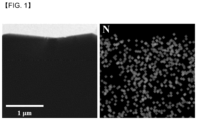
- FIG. 1 is a diagram showing the results of analyzing a negative electrode surface on which a negative electrode protective layer is formed in Example 1 by TEM (left) and EELS (right) mapping, respectively.
- a negative electrode for a secondary battery including: a negative electrode current collector; a lithium metal (Li-metal) thin film formed on the negative electrode current collector; and a negative electrode protective layer including a diazonium ion chemically bonded to the lithium metal thin film.
- the present inventors have continued research to form a negative electrode protective layer having a thin and uniform thickness and capable of effectively suppressing various problems of a lithium metal negative electrode through a more simplified process.
- the inventors have found that as a diazonium ion-containing negative electrode protective layer is formed on the lithium metal negative electrode by applying a diazonium ion formation reaction, the above-mentioned various requirements can be satisfied, and completed the invention.
- the diazonium ion-containing negative electrode protective layer included in the negative electrode of one embodiment can be formed to have a nanoscale thin and uniform thickness on a lithium metal, by a very simplified method of forming diazonium ions or the like by reacting an amine compound and a nitrite compound in a solvent on a lithium metal thin film.
- the negative electrode protective forms the diazonium ions and at the same time, can be formed to have a very thin and uniform thicknesswhilethe diazonium ion-containing compound being chemically bonded in the form of a graft bond to the surface of the lithium metal negative electrode.
- such anegative electrode protective layer can be formed by a process of a single reaction step, which is much simplified as compared with the atomic layer deposition method or the like, andcan have a very uniform and thin thickness comparable to that of the protective layer formed by the atomic layer deposition method.
- the diazonium ion-containing negative electrode protective layer formed by such a method can very effectively suppress various problems occurring on the negative electrode of the lithium metal secondary battery, for example, the problem caused by continuous irreversible reactions and/or the problem caused by the growth of acicular lithium dendrites.
- the negative electrode for the secondary battery of one embodiment has very high mass productivity as compared with the atomic layer deposition method, and can effectively suppress the growth of acicular lithium dendrites, etc., and thus can greatly contribute to the improvement of the performance and lifetime characteristics of the lithium metal secondary battery.
- the negative electrode for a secondary battery includes a lithium metal thin film formed on the negative electrode current collector, and also includes a negative electrode protective layer including a diazonium ion chemically bonded to the lithium metal thin film.
- the negative electrode protective layer may include a diazonium ion formed by reacting a predetermined organic group-bonded amine compound with a nitrite compound: [Reaction Scheme 1] A-NH 2 + NO 2 - + 2H + ⁇ A-N + ⁇ N + 2H 2 O
- the alkyl group or the aryl group may be substituted or unsubstituted with an alkyl group having 1 to 20 carbon atoms, a nitro group (-NO 2 ), an alkoxy group, an amine group, a halogen, a carboxyl group (-COOH), -SOsH, -SH or -CS.
- the organic group A included in the diazonium ion may be chemically bonded in the form of a graft bond or the like to the surface of the lithium metal thin film by the function of the diazonium ion and the radical reaction based thereon.
- the negative electrode protective layer can effectively suppress problems caused by an irreversible reaction and/or the growth of acicular lithium dendrites, and problems of a short circuit associated therewith, on the lithium metal thin film serving as a negative electrode of a secondary battery.
- the negative electrode protective layer including diazonium ions and the like may have a thickness of 1 nm to 1 ⁇ m, or 2 to 500 nm, or 5 to 300 nm.By applying the diazonium ion formation reaction of the above-mentioned Reaction Scheme 1 or the like, the negative electrode protective layer having the above-mentioned thickness can be appropriately formed by controlling the thickness. Further, by forming the negative electrode protective layer having such thickness, it can effectively suppress the growth of acicular dendrites on the surface of the negative electrode, and also cannot impair the capacity characteristics of the negative electrode and the lithium metal secondary battery including the same.
- the copper current collector may be generally formed to have a thickness of 3 to 500 ⁇ m.
- the lithium metal thin film formed on the copper current collector may be formed to have a thickness of 1 to 100 ⁇ m, or 2 to 50 ⁇ m, or 3 to 30 ⁇ m, depending on a typical configuration of a lithium metal secondary battery.
- the lithium metal thin film may be formed on the copper current collector through a method widely known in the art, such as deposition, electroplating, and rolling.
- the method for manufacturing such negative electrode may include a step of forming a diazonium ion or a salt thereof by reacting a nitrite compound and an amine compound on the lithium metal thin film.
- the method for manufacturing the negative electrode may further include a step of reacting the diazonium ion formed through the above reaction step, a compound including the same, or a salt thereof with the lithium metal thin film.By the reaction with the lithium metal thin film, the diazonium ion, for example, the organic group A contained therein, can be chemically bonded in the form of a graft bond to the lithium metal thin film to form a negative electrode protective layer and a negative electrode of one embodiment.
- the step of reacting the diazonium ion with the lithium metal thin film is not substantially performed separately from the step of forming the diazonium ion or a salt thereof, and can be performed spontaneously and sequentially with the reaction step for forming the diazonium ion orthe like in a single solvent system
- the above-mentioned diazonium ion-containing negative electrode protective layer can be formed through a single process substantially in a single solvent system, and the process of forming the negative electrode protective layer can be greatly simplified as compared with the conventional atomic layer deposition method or the like. As a result, it can be applied very easily to the mass production process of lithium metal secondary batteries.
- the types of the amine compound, the nitrite compound and the solvent for forming the diazonium ion are not particularly limited, and any component previously known to be applicable to form a diazonium ion or a salt thereof can be used.
- a compound represented by the following Chemical Formula 2 maybe used as the amine compound, and depending on the type of the organic group A bonded to the Chemical Formula 1, a compound in which the organic group is bonded to an amine group may be appropriately selected and used: [Chemical Formula 2] A-NH 2 in Chemical Formula 2, A is as defined in Chemical Formula 1.
- nitrite compound that reacts with the amine compound to form a diazonium ion tert-butyl nitrite, sodium nitrite, or the like may be used.
- the reaction step thereof may be performed in the presence of an acid such as hydrochloric acid, if necessary.
- the step of forming the diazonium ion and the step of reacting with the lithium metal thin film performed in a solvent system identical thereto may be performed in an organic solvent such as acetonitrile or tetrahydrofuran.More specifically, these reaction steps may be performed, for example, by a method of reacting the amine compound and the nitrite compound in the organic solvent in a state where the lithium metal thin film formed on the negative electrode current collector is immersed in the organic solvent.
- the negative electrode for the secondary battery of one embodiment can be manufactured by a conventional method for forming a negative electrode of a lithium metal secondary battery, except that the negative electrode protective layer containing diazonium ions is formed by the above-mentioned method, and thus, additional descriptions thereof will be omitted.
- a lithium metal secondary battery including the negative electrode for the secondary battery according to the above-mentioned one embodiment.
- a secondary battery may include the negative electrode of the above-mentioned one embodiment, an electrolyte, and a positive electrode.
- the electrolyte of the lithium metal secondary battery may be a liquid electrolyte (i.e., an electrolyte solution) or a solid electrolyte.
- the electrolyte of the lithium metal secondary battery is a liquid electrolyte, it includes a non-aqueous organic solvent and a lithium salt.
- the non-aqueous organic solvent serves as a medium capable of moving ions that are involved in an electrochemical reaction of a battery.
- the type of the non-aqueous organic solvent is not particularly limited, and an ether-based, carbonate-based, ester-based, ketone-based, alcohol-based, or aprotic solvent may be used.
- the carbonate-based solvent may include dimethyl carbonate (DMC), diethyl carbonate (DEC), dipropyl carbonate (DPC), methylpropyl carbonate (MPC), ethylpropyl carbonate (EPC), ethylmethyl carbonate (EMC), methylethyl carbonate (MEC), ethylene carbonate (EC), propylene carbonate (PC), butylene carbonate (BC), and the like.
- ester-based solvent may include methyl acetate, ethyl acetate, n-propyl acetate, 1,1-dimethylethylacetate, methylpropionate, ethylpropionate, ⁇ -butyrolactone, decanolide, valerolactone, mevalonolactone, caprolactone, and the like.
- ether-based solvent may include dimethyl ether, 1,2-dimethoxyethane, dibutyl ether, tetraglyme, diglyme, 2-methyltetrahydrofuran, tetrahydrofuran, and the like.
- the ketone-based solvent may include cyclohexanone and the like.
- Examples of the alcohol-based solvent may include ethyl alcohol, isopropyl alcohol, and the like.
- the aprotic solvent may include nitriles such as R-CN (where R is a C2 to C20 linear, branched, or cyclic hydrocarbon group, which may include a double bond, an aromatic ring, or an ether bond), amides such as dimethylformamide, dioxolanes such as 1,3-dioxolane, sulfolane, and the like.
- R-CN where R is a C2 to C20 linear, branched, or cyclic hydrocarbon group, which may include a double bond, an aromatic ring, or an ether bond
- amides such as dimethylformamide
- dioxolanes such as 1,3-dioxolane, sulfolane, and the like.
- an ether-based solvent or a carbonate-based solvent can be appropriately used from the viewpoint of improving the life characteristics of the lithium metal secondary battery.
- non-aqueous organic solvent may be used alone or as a mixture of two or more thereof.
- the mixing ratio thereof may be appropriately controlled according to the desired battery performance, which may be widely understood by those skilled in the art.
- the carbonate-based solvent when used, it is favorable to use a mixture of a cyclic carbonate and a chained carbonate.
- the cyclic carbonate and the chained carbonate are mixed in a volume ratio of 1:1 to 1:9, so that the performance of the electrolyte solution can be favorably exhibited.
- the non-aqueous organic solvent may further include an aromatic hydrocarbon-based organic solvent in addition to the carbonate-based solvent.
- the carbonate-based solvent and the aromatic hydrocarbon-based organic solvent may be mixed in a volume ratio of 1:1 to 30:1.
- an aromatic hydrocarbon-based compound of the following Chemical Formula 3 may be used.
- R 1 to R 6 are each independently hydrogen, halogen, a C 1 to C 10 alkyl group, a C1 to C10 haloalkyl group, or a combination thereof.
- the aromatic hydrocarbon-based organic solvent may include benzene, fluorobenzene, 1,2-difluorobenzene, 1,3-difluorobenzene, 1,4-difluorobenzene, 1,2,3-trifluorobenzene, 1,2,4-trifluorobenzene, chlorobenzene, 1,2-dichlorobenzene, 1,3-dichlorobenzene, 1,4-dichlorobenzene, 1,2,3-trichlorobenzene, 1,2,4-trichlorobenzene, iodobenzene, 1,2-diiodobenzene, 1,3-diiodobenzene, 1,4-diiodobenzene, 1,2,3-triiodobenzene, 1,2,4-triiodobenzene, toluene, fluorotoluene, 1,2-difluorotoluene, 1,3-difluorotol
- the non-aqueous organic solvent may further contain a vinylene carbonate or an ethylene carbonate-based compound of the following Chemical Formula 4 in order to improve the lifetime of the battery:
- R 7 and R 8 are each independently hydrogen, a halogen group, a cyano group (CN), a nitro group (NO 2 ), or a C1 to C5 fluoroalkyl group, and at least one of R 7 and R 8 is a halogen group, a cyano group (CN), a nitro group (NO 2 ), or a C1 to C5 fluoroalkyl group.
- ethylene carbonate-based compound may include difluoroethylene carbonate, chloroethylene carbonate, dichloroethylene carbonate, bromoethylene carbonate, dibromoethylene carbonate, nitroethylene carbonate, cyanoethylene carbonate, fluoroethylene carbonate, and the like.
- the use amounts thereof can be appropriately adjusted to improve the lifetime.
- the lithium salt is dissolved in the organic solvent to act as a lithium ion supply source in the battery, thereby enabling a basic operation of a lithium secondary battery of another embodiment, and promoting the movement of lithium ions between a positive electrode and a negative electrode.
- lithium salt a lithium salt widely applied to an electrolyte may be generally used.
- LiFSI lithium bis(fluorosulfonyl)imide
- LiPF 6 LiBF 4 , LiSbF 6 , LiAsF 6 , LiC 4 F 9 SO 3 , LiClO 4 , LiAlO 2 , LiAlCl 4 , LiN(C x F 2x+1 SO 2 )(C y F 2y+1 SO 2 ) (where, x and y are a natural number)
- LiCl, Lil, LiB(C 2 O 4 ) 2 (lithium bis(oxalato)borate; LiBOB) or a combination thereof may be used.
- the concentration of the lithium salt may be controlled within the range of 0.1 to 5.0M. Within this range, the electrolyte solution can have adequate conductivity and viscosity, so that the lithium ions can be effectively moved within the lithium metal secondary battery.
- this is merely an example, and the invention is not limited thereto.
- the electrolyte may be in the form of being impregnated in a porous separator disposed between the negative electrode and the positive electrode.
- the porous separator can be used without limitation as long as it separates the negative electrode and the positive electrode to provide a passage for moving lithium ions, and thus is normally used in a lithium battery. That is, those having low resistance to ion movement of the electrolyte and having excellent electrolyte-moisturizing capability can be used.
- the separator may be selected from glass fiber, polyester, Teflon, polyethylene, polypropylene, polytetrafluoroethylene (PTFE) or a combination thereof, and it may be in the form of non-woven fabric or woven fabric.
- PTFE polytetrafluoroethylene
- polyolefin-based polymer separators such as polyethylene and polypropylene are mainly used for lithium ion batteries.
- a coated separator containing a ceramic component or a polymer material may be used to secure heat resistance or mechanical strength.
- it may be used in a single-layer or multi-layer structure.
- the electrolyte of the lithium secondary battery is a solid electrolyte
- the solid electrolyte that can be used is not particularly limited.
- the positive electrode may include a positive electrode current collector, and a positive electrode mixture layer disposed on the positive electrode current collector.
- the positive electrode mixture layer can be manufactured by mixing a positive electrode active material and a binder, and optionally, a conductive material or a filler, etc. in a solvent to produce a positive electrode mixture in the form of slurry, and then coating the positive electrode mixture onto the positive electrode current collector. Since the above-mentioned positive electrode-manufacturing method is widely known in the art, a detailed description thereof will be omitted herein.
- the positive electrode active material it is not particularly limited as long as it is a material capable of reversibly intercalating and deintercalating lithium ions.
- it may include one or more of complex oxides of cobalt, manganese, nickel, iron, or a combination of metals; and lithium.
- a compound represented by any of the following chemical formulas can be used as the positive electrode active material.
- Li a A 1-b R b D 2 (where, 0.90 ⁇ a ⁇ 1.8 and 0 ⁇ b ⁇ 0.5);
- Li a E 1-b R b O 2-c D c (where, 0.90 ⁇ a ⁇ 1.8, 0 ⁇ b ⁇ 0.5, and 0 ⁇ c ⁇ 0.05);
- LiE 2-b R b O 4-c D c (where, 0 ⁇ b ⁇ 0.5, 0 ⁇ c ⁇ 0.05);
- Li a Ni 1-b-c Co b R c D ⁇ (where, 0.90 ⁇ a ⁇ 1.8, 0 ⁇ b ⁇ 0.5, 0 ⁇ c ⁇ 0.05 and 0 ⁇ ⁇ ⁇ 2);
- Li a Ni 1-b-c Co b R c O 2- ⁇ Z ⁇ (where, 0.90 ⁇ a ⁇ 1.8
- A is Ni, Co, Mn or a combination thereof;
- R is Al, Ni, Co, Mn, Cr, Fe, Mg, Sr, V, a rare earth element or a combination thereof;
- D is O, F, S, P or a combination thereof;
- E is Co, Mn or a combination thereof;
- Z is F, S, P or a combination thereof;
- G is Al, Cr, Mn, Fe, Mg, La, Ce, Sr, V or a combination thereof;
- Q is Ti, Mo, Mn or a combination thereof;
- the coating layer may include a coating element compound, such as coating element oxide, hydroxide, coating element oxyhydroxide, coating element oxycarbonate or coating element hydroxycarbonate.
- the compounds forming these coating layers may be amorphous or crystalline.
- As a coating element included in the coating layer Mg, Al, Co, K, Na, Ca, Si, Ti, V, Sn, Ge, Ga, B, As, Zr or a mixture thereof can be used.
- any coating method can be used as long as it can be coated by a method (e.g., spray coating or dipping method, etc.) that does not adversely affect the physical properties of the positive electrode active material by using these elements in the compound. Since this is a content that may be widely understood by those skilled in the art, detailed descriptions thereof will be omitted.
- the positive electrode current collector is typically produced to have a thickness of 3 to 500 ⁇ m.
- the positive electrode current collector is not particularly limited as long as it has high conductivity without causing a chemical change in the battery, and for example, may be formed of stainless steel, aluminum, nickel, titanium, baked carbon, or a material formed by surface-treating a surface of aluminum or stainless steel with carbon, nickel, titanium, silver, or the like.
- the current collector may have fine protrusions and depressions formed on a surface thereof to enhance adherence of a positive electrode active material, and may be formed in various forms such as a film, a sheet, a foil, a net, a porous body, a foaming body, and a non-woven fabric structure.
- the conductive material is not particularly limited as long as it is an electronically conductive material without causing a chemical change in the battery.
- graphite such as natural graphite or artificial graphite
- carbon blacks such as carbon black, acetylene black, ketjen black, channel black, furnace black, lamp black, and thermal black
- conductive fibers such as carbon fiber and metal fiber
- metal powders such as carbon fluoride powder, aluminum powder, and nickel powder
- conductive whiskey such as zinc oxide and potassium titanate
- conductive metal oxides such as titanium oxide
- conductive materials such as polyphenylene derivatives may be used.
- the lithium metal secondary battery of one embodiment may not only be used in a unit cell used as a power source for a small device, but also it can be used as a unit cell in a medium- or large-sized battery module including a plurality of battery cells. Furthermore, a battery pack including the battery module may be configured.
- Example 1 Manufacture of a negative electrode in which a diazonium ion-containing negative electrode protective layeris formed
- the surface of the negative electrode formed in the Example was analysed by TEM and EELS (electron energy loss spectroscopy) mapping. The results of such surface analysis were shown in FIG. 1 .
- EELS analysis result it was confirmed that the nitrogen component derived from diazonium ions was well distributed on the surface of the negative electrode. From this, it was confirmed that the negative electrode protective layer was uniformly and favorably formed on the surface of the negative electrode. In addition, it was confirmed that the nitrogen component in the negative electrode protective layer was included in an amount of 6.16 wt.%.
- Example 2 Manufacture of lithium metal secondary battery including the negative electrode of Example
- LiNi 0.5 Mn 1.5 O 4 as a positive electrode active material, Super-P as a conductive material, and polyvinylidene fluoride (PVDF) as a binder were used, respectively, and the positive electrode active material: the conductive material: the binder were mixed in a weight ratio of 94:3:3 to form a mixture.
- NMP as a solvent was added to the mixture to prepare a positive electrode active material slurry.
- the positive electrode active material slurry was coated onto one surface of an aluminium foil (thickness: 10 ⁇ m), and dried at 120°C for 30 minutes.
- the produced positive electrode was punched with a diameter of 11 mm, and then dried under vacuum at 120°C for 12 hours to manufacture a positive electrode.
- a 2032 type coin cell was manufactured using each negative electrode sample of Example 1 and the positive electrode in a glove box under an argonatmosphere.At this time, a PP/PE/PP multilayer separator was used as the separator, and 1.3M LiPF 6 dissolved in a mixed solvent (30:20:50 in vol%) of DMC, EMC, and DEC was used as an electrolyte solution, 100 ⁇ L was injected into the coin cell. Thereby, a lithium metal secondary battery of Example 2 was manufactured.
- a lithium metal secondary battery of Comparative Example 1 was manufactured in the same manner as in Example 2, except that lithium metal in which the negative electrode protective layer was not formed was used as the negative electrode, instead of the negative electrode of Example 1.
- Example 2 Using the cells manufactured in Example 2 and Comparative Example 1, first, charging and discharging were performed three times at a current density of 12 mA ⁇ g -1 . Then, a constant current charge/discharge test was performed in the range of 3.5V to 4.9V.At this time, a charge/discharge test was performed at a current density of 120 mA ⁇ g -1 at 60°C, and the cycle in which the capacity-to-capacity retention ratio became 80% during initial charge/discharge was evaluated and shown in Table 1 below.
- Example 2 the time point of occurrence of a cell short circuit was evaluated by the following method.That is, charging was performed up to 4.9V with a current density of 12 mA ⁇ g -1 , and a constant voltage of 4.9V was continuously applied to confirm the time when a cell short circuit occurred.
- the time elapsed until the cell short circuit occurred is shown in Table 1 below.
- Example 2 the growth of acicular dendrites was effectively suppressed by the formation of the negative electrode protective layer, and the time elapsed until the cell short occurred was much longerthan that of Comparative Example 1. Further, it was confirmed that by suppressing the growth of acicular dendrites,the battery of Example 2 exhibited a capacity retention rate of 80% in a very long cycle as compared with Comparative Example 1 and could have excellent life characteristics.
- a negative electrode for a secondary battery comprising:
- the negative electrode for the secondary battery according to embodiment 1, wherein the negative electrode protective layer includes a diazonium ion of the following Chemical Formula 1, or includes a salt of the diazonium ion: [Chemical Formula 1] A-N + N in Chemical Formula 1, A is a substituted or unsubstituted alkyl group having 1 to 20 carbon atoms, or a substituted or unsubstituted aryl group having 6 to 40 carbon atoms.
- a method for forming the negative electrode of embodiment 1 comprising: a step of forming a diazonium ion or a salt thereof by reacting a nitrite compound and an amine compound on a lithium metal thin film.
- amine compound is a compound represented by the following Chemical Formula 2: [Chemical Formula 2] A-NH 2 in Chemical Formula 2, A is a substituted or unsubstituted alkyl group having 1 to 20 carbon atoms, or a substituted or unsubstituted aryl group having 6 to 40 carbon atoms.
- nitrite compound includes tert-butyl nitrite or sodium nitrite.
- a lithium metal secondary battery comprising the negative electrode of embodiment 1, an electrolyte, and a positive electrode.
- the positive electrode active material includes one or more of complex oxides of cobalt, manganese, nickel, iron or a combination of metals; and lithium.
- the electrolyte includes a lithium salt selected among lithium bis(fluorosulfonyl)imide (LiFSI), LiPF 6 , LiBF 4 , LiSbF 6 , LiAsF 6 , LiC 4 F 9 SO 3 , LiClO 4 , LiAlO 2 , LiAlCl 4 , LiN(C x F 2x+1 SO 2 )(C y F 2y+1 SO 2 ), (where, x and y are a natural number), LiCl, Lil, LiB(C 2 O 4 ) 2 (lithium bis(oxalato)borate; LiBOB) or a combination thereof; and a non-aqueous organic solvent.
- LiFSI lithium bis(fluorosulfonyl)imide
- LiPF 6 LiBF 4
- LiSbF 6 LiAsF 6
- LiC 4 F 9 SO 3 LiClO 4 , LiAlO 2 , LiAlCl 4 , LiN(C
Landscapes
- Chemical & Material Sciences (AREA)
- General Chemical & Material Sciences (AREA)
- Electrochemistry (AREA)
- Chemical Kinetics & Catalysis (AREA)
- Engineering & Computer Science (AREA)
- Manufacturing & Machinery (AREA)
- Materials Engineering (AREA)
- Inorganic Chemistry (AREA)
- Composite Materials (AREA)
- Secondary Cells (AREA)
- Battery Electrode And Active Subsutance (AREA)
- Physics & Mathematics (AREA)
- Condensed Matter Physics & Semiconductors (AREA)
- General Physics & Mathematics (AREA)
- Cell Electrode Carriers And Collectors (AREA)
Abstract
The present disclosure relates to a negative electrode for a secondary battery, including a negative electrode protective layer which can be formed by a more simplified method and can effectively suppress the growth of acicular dendrites generatedin the negative electrode of a lithium metal secondary battery, a method for manufacturing the same, and a lithium metal secondary battery comprising the same. The negative electrode for secondary battery includes a negative electrode current collector; a lithium metal (Li-metal) thin film formed on the negative electrode current collector; and a negative electrode protective layer including a diazonium ion chemically bonded to the lithium metal thin film.
Description
- This application claims the benefit of
Korean Patent Application No. 1 0-2019-0172498 filed on December 20, 2019 - The present disclosure relates to a negative electrode for a secondary battery, including a negative electrode protective layer which can be formed by a more simplified method and can effectively suppress the growth of acicular dendrites generated in the negative electrode of a lithium metal secondary battery, a method for manufacturing the same, and a lithium metal secondary battery comprising the same.
- Lithium metal secondary battery is a battery to which a negative electrode active material made from lithium metal (Li-metal)material is applied, and has the advantage of having a theoretically very high energy density and capacity as compared with a battery to which a graphite-based or lithium alloy-based negative electrode is applied according to the prior art. Thus,research and development are ongoing to apply such a lithium metal secondary battery to a battery that requires a high energy density.
- However, the lithium metal secondary battery has a problem that due to the characteristics of lithium metal, which is for a negative electrode active material, the volume change of the negative electrode is very large in a charge and discharge process, and lithium generated during charging grows into an acicular shape to form lithium dendrites. When such lithium dendrites continue to grow, they may penetrate through a separator to cause a cell short circuit, and as a result, a large problem may occur in battery performance, or a safety problem such as ignition may occur.
- Meanwhile, in the case of lithium metal used as a negative electrode material in the lithium metal secondary battery, since the reactivity with the electrolyte solution is high, an irreversible reaction can be steadily generated in a charge and discharge process. The surface film produced by such irreversible reaction collapses due to a large volume change during charging and discharging, and shows a problem of causing an additional irreversible reaction. In addition, such continuous irreversible reaction may cause a problem that the coulombic efficiency of the cell is decreased, and the performance of the cell is deteriorated as a whole.
- Due to such a large disadvantage resulting from the lithium metal negative electrode, in order to suppress the problems caused by continuous irreversible reactions on the surface of the lithium metal or the drawbacks caused by the growth of lithium dendrites, research and attempts have been continuously made since before to form a negative electrode protective layer by applying various materials and methods to the surface of the lithium metal negative electrode.
- Previously, as a representative example, techniques of forming a negative electrode protective layer on the surface of a lithium metal negative electrode by applying an atomic layer deposition method (ALD) or a molecular layer deposition method (MLD) have been mainly researched and applied. In the case of the atomic layer deposition method and the molecular layer deposition method, etc., there is an advantage in that a nanoscale thin negative electrode protective layer can be uniformly formed, but there is a disadvantage in that the economic efficiency of the overall process are greatly degraded, for example, formation of a high vacuum for progressing the process is necessary, and additional expensive equipment is necessary. Moreover, in the case of the atomic layer deposition method, there is a drawback that the overall process is complicated and the deposition rate is very slow, which makes it difficult to apply in the mass production process.
- Due to the problems of the atomic layer deposition method and the like, attempts have been made to form the negative electrode protective layer by applying other chemical methods and materials, but no techniques have been developed that can form a uniform and thin negative electrode protective layer comparable to the atomic layer deposition method, while effectively suppressing the growth of acicular dendrites and the like.
- Due to the various problems of the prior arts, there is a continuing need to develop techniques capable of forming a negative electrode protective layer that can be formed by a more simplified method and thus has high mass productivity, and can effectively suppress the growth of acicular dendrites generated in the negative electrode of the lithium metal secondary battery.
- The present disclosure provides a negative electrode for a secondary battery, including a negative electrode protective layer which can be formed by a more simplified method and can effectively suppress the growth of acicular dendrites, etc. generated in the negative electrode of a lithium metal secondary battery, and a method for manufacturing the same.
- Further, the present disclosure provides a method for manufacturing a lithium metal secondary battery including the negative electrode for the secondary battery.
- Provided herein is a negative electrode for a secondary batteryincluding:
- a negative electrode current collector;
- a lithium metal (Li-metal) thin film formed on the negative electrode current collector; and
- a negative electrode protective layer including a diazonium ion chemically bonded to the lithium metal thin film.
- Also provided herein is a method for forming a negative electrode for a secondary battery, including a step of forming a diazonium ion or a salt thereof by reacting a nitrite compound and an amine compound on a lithium metal thin film.
- Further provided herein is a lithium metal secondary battery including: the negative electrode for thesecondary battery, an electrolyte, and a positive electrode.
- According to the present disclosure,a negative electrode protective layer having a nanoscale thin and uniform thickness can be effectively formed on the lithium metal by a very simplified method of forming diazonium ions and the like by reacting an amine compound and a nitrite compound in a solvent on a lithium metal thin film.
- Such a negative electrode protective layer can be formed by a very simplified process as compared with the atomic layer deposition method, and can have a very uniform and thin thickness comparable to that of a protective layer formed by the atomic layer deposition method. In addition, the diazonium ion-containing negative electrode protective layer formed by such as method can effectively suppress various problems occurring on the negative electrode of the lithium metal secondary battery, for example, problems caused by continuous irreversible reactions and/or problems caused by the growth of acicular lithium dendrites, and thus can greatly contribute to improving the performance and lifetime characteristics of the lithium metal secondary batteries capable of being mass-produced.
-
FIG. 1 is a diagram showing the results of analyzing a negative electrode surface on which a negative electrode protective layer is formed in Example 1 by TEM (left) and EELS (right) mapping, respectively. - Throughout the specification, when a part is referred to as "including" a certain component, it means that it can further include other components, without excluding the other components, unless otherwise stated. The term "about or approximately" or "substantially" used herein is intended to have meanings close to numerical values or ranges specified with an allowable error and intended to prevent accurate or absolute numerical values disclosed for understanding of the present disclosure from being illegally or unfairly used by any unconscionable third party. Further, the term "step of-" as used throughout the specification does not mean "step for~".
- Throughout the specification, the term "combination(s) thereof" included in Markush type description means mixture or combination of one or more selected from a group consisting of components described in Markush type, and thereby means including one or more selected from a group consisting of the components.
- Based on the definitions as described above, embodiments of the present disclosure will be described in detail. However, these embodiments are presented for illustrative purposes only, and the scope of the present disclosure is not limited thereto, and the present disclosure is only defined by the scope of the claims described hereinafter.
- According to one embodiment of the present disclosure, there is provided a negative electrode for a secondary batteryincluding: a negative electrode current collector; a lithium metal (Li-metal) thin film formed on the negative electrode current collector; and a negative electrode protective layer including a diazonium ion chemically bonded to the lithium metal thin film.
- The present inventors have continued research to form a negative electrode protective layer having a thin and uniform thickness and capable of effectively suppressing various problems of a lithium metal negative electrode through a more simplified process. As a result of the continuous research, the inventors have found that as a diazonium ion-containing negative electrode protective layer is formed on the lithium metal negative electrode by applying a diazonium ion formation reaction, the above-mentioned various requirements can be satisfied, and completed the invention.
- As also confirmed in Examples and the like described hereinafter, the diazonium ion-containing negative electrode protective layer included in the negative electrode of one embodiment can be formed to have a nanoscale thin and uniform thickness on a lithium metal, by a very simplified method of forming diazonium ions or the like by reacting an amine compound and a nitrite compound in a solvent on a lithium metal thin film. The negative electrode protective forms the diazonium ions and at the same time, can be formed to have a very thin and uniform thicknesswhilethe diazonium ion-containing compound being chemically bonded in the form of a graft bond to the surface of the lithium metal negative electrode.
- Therefore, such anegative electrode protective layer can be formed by a process of a single reaction step, which is much simplified as compared with the atomic layer deposition method or the like, andcan have a very uniform and thin thickness comparable to that of the protective layer formed by the atomic layer deposition method. In addition, it has been found that the diazonium ion-containing negative electrode protective layer formed by such a method can very effectively suppress various problems occurring on the negative electrode of the lithium metal secondary battery, for example, the problem caused by continuous irreversible reactions and/or the problem caused by the growth of acicular lithium dendrites.
- Therefore, the negative electrode for the secondary battery of one embodiment has very high mass productivity as compared with the atomic layer deposition method, and can effectively suppress the growth of acicular lithium dendrites, etc., and thus can greatly contribute to the improvement of the performance and lifetime characteristics of the lithium metal secondary battery.
- Hereinafter, a negative electrode for a secondary battery according to an embodiment of the present disclosure, a method for manufacturing the same, and a lithium metal secondary battery including the same will be described in more detail.
- As described above, the negative electrode for a secondary battery according to one embodiment includes a lithium metal thin film formed on the negative electrode current collector, and also includes a negative electrode protective layer including a diazonium ion chemically bonded to the lithium metal thin film.
- In the negative electrode of one embodiment, the negative electrode protective layer may include a diazonium ion formed by reacting a predetermined organic group-bonded amine compound with a nitrite compound:
[Reaction Scheme 1] A-NH2 + NO2 - + 2H+ → A-N+≡N + 2H2O
- Thereby, the negative electrode protective layer may be formed to include a diazonium ion of the following Chemical Formula 1, or include a salt of the diazonium ion, for example, a halogen salt of the diazonium ion:
[Chemical Formula 1] A-N+ = N
in Reaction Scheme 1 and Chemical Formula 1,A is a substituted or unsubstituted alkyl group having 1 to 20 carbon atoms, or a substituted or unsubstituted aryl group having 6 to 40 carbon atoms. Wherein, the alkyl group or the aryl group may be substituted or unsubstituted with an alkyl group having 1 to 20 carbon atoms, a nitro group (-NO2), an alkoxy group, an amine group, a halogen, a carboxyl group (-COOH), -SOsH, -SH or -CS. - In the negative electrode protective layer,the organic group A included in the diazonium ion may be chemically bonded in the form of a graft bond or the like to the surface of the lithium metal thin film by the function of the diazonium ion and the radical reaction based thereon.As a result, the negative electrode protective layer can effectively suppress problems caused by an irreversible reaction and/or the growth of acicular lithium dendrites, and problems of a short circuit associated therewith, on the lithium metal thin film serving as a negative electrode of a secondary battery.
- Further, the negative electrode protective layer including diazonium ions and the like may have a thickness of 1 nm to 1 µm, or 2 to 500 nm, or 5 to 300 nm.By applying the diazonium ion formation reaction of the above-mentioned Reaction Scheme 1 or the like, the negative electrode protective layer having the above-mentioned thickness can be appropriately formed by controlling the thickness. Further, by forming the negative electrode protective layer having such thickness, it can effectively suppress the growth of acicular dendrites on the surface of the negative electrode, and also cannot impair the capacity characteristics of the negative electrode and the lithium metal secondary battery including the same.
- Meanwhile, in the negative electrode of the above-described one embodiment, the copper current collector may be generally formed to have a thickness of 3 to 500 µm. Further, the lithium metal thin film formed on the copper current collector may be formed to have a thickness of 1 to 100 µm, or 2 to 50 µm, or 3 to 30 µm, depending on a typical configuration of a lithium metal secondary battery. Further, the lithium metal thin film may be formed on the copper current collector through a method widely known in the art, such as deposition, electroplating, and rolling.
- According to another embodiment of the present disclosure, there is provided a method for manufacturing the negative electrode for a secondary battery according to the above-mentioned one embodiment.The method for manufacturing such negative electrode may include a step of forming a diazonium ion or a salt thereof by reacting a nitrite compound and an amine compound on the lithium metal thin film.
- In a more specific embodiment, the method for manufacturing the negative electrode may further include a step of reacting the diazonium ion formed through the above reaction step, a compound including the same, or a salt thereof with the lithium metal thin film.By the reaction with the lithium metal thin film, the diazonium ion, for example, the organic group A contained therein, can be chemically bonded in the form of a graft bond to the lithium metal thin film to form a negative electrode protective layer and a negative electrode of one embodiment.
- However, the step of reacting the diazonium ion with the lithium metal thin film is not substantially performed separately from the step of forming the diazonium ion or a salt thereof, and can be performed spontaneously and sequentially with the reaction step for forming the diazonium ion orthe like in a single solvent system
- In this way, since the above-mentioned diazonium ion-containing negative electrode protective layer can be formed through a single process substantially in a single solvent system, and the process of forming the negative electrode protective layer can be greatly simplified as compared with the conventional atomic layer deposition method or the like. As a result, it can be applied very easily to the mass production process of lithium metal secondary batteries.
- Meanwhile, in the process of forming the above-mentioned negative electrode protective layer, the types of the amine compound, the nitrite compound and the solvent for forming the diazonium ion are not particularly limited, and any component previously known to be applicable to form a diazonium ion or a salt thereof can be used.
- For example, a compound represented by the following Chemical Formula 2 maybe used as the amine compound, and depending on the type of the organic group A bonded to the Chemical Formula 1, a compound in which the organic group is bonded to an amine group may be appropriately selected and used:
[Chemical Formula 2] A-NH2
in Chemical Formula 2, A is as defined in Chemical Formula 1. - Further, as the nitrite compound that reacts with the amine compound to form a diazonium ion, tert-butyl nitrite, sodium nitrite, or the like may be used. In addition to this, in order to effectively react the amine compound and the nitrite compound to form a diazonium ion, the reaction step thereof may be performed in the presence of an acid such as hydrochloric acid, if necessary.
- Further, the step of forming the diazonium ion and the step of reacting with the lithium metal thin film performed in a solvent system identical thereto may be performed in an organic solvent such as acetonitrile or tetrahydrofuran.More specifically, these reaction steps may be performed, for example, by a method of reacting the amine compound and the nitrite compound in the organic solvent in a state where the lithium metal thin film formed on the negative electrode current collector is immersed in the organic solvent.
- Meanwhile, the negative electrode for the secondary battery of one embodiment can be manufactured by a conventional method for forming a negative electrode of a lithium metal secondary battery, except that the negative electrode protective layer containing diazonium ions is formed by the above-mentioned method, and thus, additional descriptions thereof will be omitted.
- Meanwhile, according to another embodiment of the present disclosure,there is provided a lithium metal secondary battery including the negative electrode for the secondary battery according to the above-mentioned one embodiment.Such a secondary battery may include the negative electrode of the above-mentioned one embodiment, an electrolyte, and a positive electrode.
- Meanwhile, the electrolyte of the lithium metal secondary battery may be a liquid electrolyte (i.e., an electrolyte solution) or a solid electrolyte.
- When the electrolyte of the lithium metal secondary battery is a liquid electrolyte, it includes a non-aqueous organic solvent and a lithium salt.
- The non-aqueous organic solvent serves as a medium capable of moving ions that are involved in an electrochemical reaction of a battery.
- The type of the non-aqueous organic solvent is not particularly limited, and an ether-based, carbonate-based, ester-based, ketone-based, alcohol-based, or aprotic solvent may be used. Examples of the carbonate-based solvent may include dimethyl carbonate (DMC), diethyl carbonate (DEC), dipropyl carbonate (DPC), methylpropyl carbonate (MPC), ethylpropyl carbonate (EPC), ethylmethyl carbonate (EMC), methylethyl carbonate (MEC), ethylene carbonate (EC), propylene carbonate (PC), butylene carbonate (BC), and the like. Examples of the ester-based solvent may include methyl acetate, ethyl acetate, n-propyl acetate, 1,1-dimethylethylacetate, methylpropionate, ethylpropionate, γ-butyrolactone, decanolide, valerolactone, mevalonolactone, caprolactone, and the like. Examples of the ether-based solvent may include dimethyl ether, 1,2-dimethoxyethane, dibutyl ether, tetraglyme, diglyme, 2-methyltetrahydrofuran, tetrahydrofuran, and the like. Examples of the ketone-based solvent may include cyclohexanone and the like. Examples of the alcohol-based solvent may include ethyl alcohol, isopropyl alcohol, and the like. Examples of the aprotic solvent may include nitriles such as R-CN (where R is a C2 to C20 linear, branched, or cyclic hydrocarbon group, which may include a double bond, an aromatic ring, or an ether bond), amides such as dimethylformamide, dioxolanes such as 1,3-dioxolane, sulfolane, and the like. Among them, an ether-based solvent or a carbonate-based solvent can be appropriately used from the viewpoint of improving the life characteristics of the lithium metal secondary battery.
- Further, the non-aqueous organic solvent may be used alone or as a mixture of two or more thereof. When the solvent is used as a mixture of two or more, the mixing ratio thereof may be appropriately controlled according to the desired battery performance, which may be widely understood by those skilled in the art.
- In addition, when the carbonate-based solvent is used, it is favorable to use a mixture of a cyclic carbonate and a chained carbonate. In this case, the cyclic carbonate and the chained carbonate are mixed in a volume ratio of 1:1 to 1:9, so that the performance of the electrolyte solution can be favorably exhibited.
- The non-aqueous organic solvent may further include an aromatic hydrocarbon-based organic solvent in addition to the carbonate-based solvent. Wherein, the carbonate-based solvent and the aromatic hydrocarbon-based organic solvent may be mixed in a volume ratio of 1:1 to 30:1.
- As the aromatic hydrocarbon-based organic solvent, an aromatic hydrocarbon-based compound of the following Chemical Formula 3 may be used.

- The aromatic hydrocarbon-based organic solvent may include benzene, fluorobenzene, 1,2-difluorobenzene, 1,3-difluorobenzene, 1,4-difluorobenzene, 1,2,3-trifluorobenzene, 1,2,4-trifluorobenzene, chlorobenzene, 1,2-dichlorobenzene, 1,3-dichlorobenzene, 1,4-dichlorobenzene, 1,2,3-trichlorobenzene, 1,2,4-trichlorobenzene, iodobenzene, 1,2-diiodobenzene, 1,3-diiodobenzene, 1,4-diiodobenzene, 1,2,3-triiodobenzene, 1,2,4-triiodobenzene, toluene, fluorotoluene, 1,2-difluorotoluene, 1,3-difluorotoluene, 1,4-difluorotoluene, 1,2,3-trifluorotoluene, 1,2,4-trifluorotoluene, chlorotoluene, 1,2-dichlorotoluene, 1,3-dichlorotoluene, 1,4-dichlorotoluene, 1,2,3-trichlorotoluene, 1,2,4-trichlorotoluene, iodotoluene, 1,2-diiodotoluene, 1,3-diiodotoluene, 1,4-diiodotoluene, 1,2,3-triiodotoluene, 1,2,4-triiodotoluene, xylene, and a combination thereof.
- The non-aqueous organic solvent may further contain a vinylene carbonate or an ethylene carbonate-based compound of the following Chemical Formula 4 in order to improve the lifetime of the battery:

- Representative examples of the ethylene carbonate-based compound may include difluoroethylene carbonate, chloroethylene carbonate, dichloroethylene carbonate, bromoethylene carbonate, dibromoethylene carbonate, nitroethylene carbonate, cyanoethylene carbonate, fluoroethylene carbonate, and the like. When the vinylene carbonate or the ethylene carbonate-based compound is further used, the use amounts thereof can be appropriately adjusted to improve the lifetime.
- In the electrolyte of the lithium metal secondary battery, the lithium salt is dissolved in the organic solvent to act as a lithium ion supply source in the battery, thereby enabling a basic operation of a lithium secondary battery of another embodiment, and promoting the movement of lithium ions between a positive electrode and a negative electrode.
- As the lithium salt, a lithium salt widely applied to an electrolyte may be generally used. For example, as in Experimental Example described hereinafter, lithium bis(fluorosulfonyl)imide (LiFSI) may be used, but additionally, LiPF6, LiBF4, LiSbF6, LiAsF6, LiC4F9SO3, LiClO4, LiAlO2, LiAlCl4, LiN(CxF2x+1SO2)(CyF2y+1SO2) (where, x and y are a natural number), LiCl, Lil, LiB(C2O4)2 (lithium bis(oxalato)borate; LiBOB) or a combination thereof may be used.
- Further, in the electrolyte, the concentration of the lithium salt may be controlled within the range of 0.1 to 5.0M. Within this range, the electrolyte solution can have adequate conductivity and viscosity, so that the lithium ions can be effectively moved within the lithium metal secondary battery. However, this is merely an example, and the invention is not limited thereto.
- The electrolyte may be in the form of being impregnated in a porous separator disposed between the negative electrode and the positive electrode. Here, the porous separator can be used without limitation as long as it separates the negative electrode and the positive electrode to provide a passage for moving lithium ions, and thus is normally used in a lithium battery. That is, those having low resistance to ion movement of the electrolyte and having excellent electrolyte-moisturizing capability can be used.
- For example, the separator may be selected from glass fiber, polyester, Teflon, polyethylene, polypropylene, polytetrafluoroethylene (PTFE) or a combination thereof, and it may be in the form of non-woven fabric or woven fabric. For example, polyolefin-based polymer separators such as polyethylene and polypropylene are mainly used for lithium ion batteries. A coated separator containing a ceramic component or a polymer material may be used to secure heat resistance or mechanical strength. Optionally, it may be used in a single-layer or multi-layer structure.
- Meanwhile, when the electrolyte of the lithium secondary battery is a solid electrolyte, the solid electrolyte that can be used is not particularly limited.
- Further, regardless of the electrolyte of the lithium metal secondary battery, the positive electrode may include a positive electrode current collector, and a positive electrode mixture layer disposed on the positive electrode current collector.
- In this case, the positive electrode mixture layer can be manufactured by mixing a positive electrode active material and a binder, and optionally, a conductive material or a filler, etc. in a solvent to produce a positive electrode mixture in the form of slurry, and then coating the positive electrode mixture onto the positive electrode current collector. Since the above-mentioned positive electrode-manufacturing method is widely known in the art, a detailed description thereof will be omitted herein.
- In the case of the positive electrode active material, it is not particularly limited as long as it is a material capable of reversibly intercalating and deintercalating lithium ions. For example, it may include one or more of complex oxides of cobalt, manganese, nickel, iron, or a combination of metals; and lithium.
- In a more specific example, a compound represented by any of the following chemical formulas can be used as the positive electrode active material. LiaA1-bRbD2(where, 0.90 ≤ a ≤ 1.8 and 0 ≤ b ≤ 0.5); LiaE1-bRbO2-cDc(where, 0.90 ≤ a ≤ 1.8, 0 ≤ b ≤ 0.5, and 0 ≤ c ≤ 0.05); LiE2-bRbO4-cDc(where, 0 ≤ b ≤ 0.5, 0 ≤ c ≤ 0.05); LiaNi1-b-cCobRcDα(where, 0.90 ≤ a ≤ 1.8, 0 ≤ b ≤ 0.5, 0 ≤ c ≤ 0.05 and 0 < α ≤ 2); LiaNi1-b-cCobRcO2-αZα(where, 0.90 ≤ a ≤ 1.8, 0 ≤ b ≤ 0.5, 0 ≤ c ≤ 0.05 and 0 < α < 2); LiaNi1-b-cCobRcO2-αZ2(where, 0.90 ≤ a ≤ 1.8, 0 ≤ b ≤ 0.5, 0 ≤ c ≤ 0.05 and 0 < α < 2); LiaNi1-b-cMnbRcDα(where, 0.90 ≤ a ≤ 1.8, 0 ≤ b ≤ 0.5, 0 ≤ c ≤ 0.05 and 0 < α ≤ 2); LiaNi1-b-cMnbRcO2-αZα(where, 0.90 ≤ a ≤ 1.8, 0 ≤ b ≤ 0.5, 0 ≤ c ≤ 0.05 and 0 < α < 2); LiaNi1-b-cMnbRcO2-αZ2(where, 0.90 ≤ a ≤ 1.8, 0 ≤ b ≤ 0.5, 0 ≤ c ≤ 0.05 and 0 < α < 2); LiaNibEcGdO2(where, 0.90 ≤ a ≤ 1.8, 0 ≤ b ≤ 0.9, 0 ≤ c ≤ 0.5 and 0.001 ≤ d ≤ 0.1); LiaNibCocMndGeO2(where, 0.90 ≤ a ≤ 1.8, 0 ≤ b ≤ 0.9, 0 ≤ c ≤ 0.5, 0 ≤ d ≤0.5 and 0 ≤ e ≤ 0.1); LiaNiGbO2(where, 0.90 ≤ a ≤ 1.8 and 0.001 ≤ b ≤ 0.1); LiaCoGbO2(where, 0.90 ≤ a ≤ 1.8 and 0.001 ≤ b ≤ 0.1); LiaMnGbO2(where, 0.90 ≤ a ≤ 1.8 and 0.001 ≤ b ≤ 0.1); LiaMn2GbO4(where, 0.90 ≤ a ≤ 1.8 and 0.001 ≤ b ≤ 0.1); QO2; QS2; LiQS2; V2O5; LiV2O5; LiTO2; LiNiVO4; Li(3-f)J2(PO4)3(0 ≤ f ≤ 2); Li(3-f)Fe2(PO4)3(0 ≤ f ≤ 2); and LiFePO4.
- In the above chemical formulas, A is Ni, Co, Mn or a combination thereof; R is Al, Ni, Co, Mn, Cr, Fe, Mg, Sr, V, a rare earth element or a combination thereof; D is O, F, S, P or a combination thereof; E is Co, Mn or a combination thereof; Z is F, S, P or a combination thereof; G is Al, Cr, Mn, Fe, Mg, La, Ce, Sr, V or a combination thereof; Q is Ti, Mo, Mn or a combination thereof; T is Cr, V, Fe, Sc, Y or a combination thereof; and J is V, Cr, Mn, Co, Ni, Cu or a combination thereof.
- Of course, one having a coating layer on the surface of the above-mentioned compound can also be used, or a mixture of the compound with a compound having a coating layer can be used. The coating layer may include a coating element compound, such as coating element oxide, hydroxide, coating element oxyhydroxide, coating element oxycarbonate or coating element hydroxycarbonate. The compounds forming these coating layers may be amorphous or crystalline. As a coating element included in the coating layer, Mg, Al, Co, K, Na, Ca, Si, Ti, V, Sn, Ge, Ga, B, As, Zr or a mixture thereof can be used. As the coating layer forming process, any coating method can be used as long as it can be coated by a method (e.g., spray coating or dipping method, etc.) that does not adversely affect the physical properties of the positive electrode active material by using these elements in the compound. Since this is a content that may be widely understood by those skilled in the art, detailed descriptions thereof will be omitted.
- The positive electrode current collector is typically produced to have a thickness of 3 to 500 µm. The positive electrode current collector is not particularly limited as long as it has high conductivity without causing a chemical change in the battery, and for example, may be formed of stainless steel, aluminum, nickel, titanium, baked carbon, or a material formed by surface-treating a surface of aluminum or stainless steel with carbon, nickel, titanium, silver, or the like. The current collector may have fine protrusions and depressions formed on a surface thereof to enhance adherence of a positive electrode active material, and may be formed in various forms such as a film, a sheet, a foil, a net, a porous body, a foaming body, and a non-woven fabric structure.
- The conductive material is not particularly limited as long as it is an electronically conductive material without causing a chemical change in the battery. As examples thereof, graphite such as natural graphite or artificial graphite;carbon blacks such as carbon black, acetylene black, ketjen black, channel black, furnace black, lamp black, and thermal black; conductive fibers such as carbon fiber and metal fiber; metal powders such as carbon fluoride powder, aluminum powder, and nickel powder; conductive whiskey such as zinc oxide and potassium titanate; conductive metal oxides such as titanium oxide; conductive materials such as polyphenylene derivatives may be used.
- The lithium metal secondary battery of one embodiment may not only be used in a unit cell used as a power source for a small device, but also it can be used as a unit cell in a medium- or large-sized battery module including a plurality of battery cells. Furthermore, a battery pack including the battery module may be configured.
- Hereinafter, preferred examples of the present disclosure, comparative examples, and test examples for evaluating them are described. However, the following examples are only preferred examples of the present disclosure, and the present disclosure is not limited to the following examples.
- 10 mmol of 4-nitroaniline and 10 mmol of tert-butyl nitrite were dissolved in 50 mL of acetonitrile, and then lithium metal was immersed for 2 hours under the condition of 25°C. Then, it was washed with acetonitrile and vacuum-dried for 12 hours to manufacture a negative electrode in which a negative electrode protective layerwas formed.
- The surface of the negative electrode formed in the Example was analysed by TEM and EELS (electron energy loss spectroscopy) mapping. The results of such surface analysis were shown in
FIG. 1 . Referring to the right figure ofFIG. 1 (EELS analysis result), it was confirmed that the nitrogen component derived from diazonium ions was well distributed on the surface of the negative electrode. From this, it was confirmed that the negative electrode protective layer was uniformly and favorably formed on the surface of the negative electrode. In addition, it was confirmed that the nitrogen component in the negative electrode protective layer was included in an amount of 6.16 wt.%. - LiNi0.5Mn1.5O4as a positive electrode active material, Super-P as a conductive material, and polyvinylidene fluoride (PVDF) as a binder were used, respectively, and the positive electrode active material: the conductive material: the binder were mixed in a weight ratio of 94:3:3 to form a mixture. NMP as a solvent was added to the mixture to prepare a positive electrode active material slurry.The positive electrode active material slurry was coated onto one surface of an aluminium foil (thickness: 10 µm), and dried at 120°C for 30 minutes.The produced positive electrode was punched with a diameter of 11 mm, and then dried under vacuum at 120°C for 12 hours to manufacture a positive electrode.
- A 2032 type coin cell was manufactured using each negative electrode sample of Example 1 and the positive electrode in a glove box under an argonatmosphere.At this time, a PP/PE/PP multilayer separator was used as the separator, and 1.3M LiPF6 dissolved in a mixed solvent (30:20:50 in vol%) of DMC, EMC, and DEC was used as an electrolyte solution, 100 µL was injected into the coin cell. Thereby, a lithium metal secondary battery of Example 2 was manufactured.
- A lithium metal secondary battery of Comparative Example 1 was manufactured in the same manner as in Example 2, except that lithium metal in which the negative electrode protective layer was not formed was used as the negative electrode, instead of the negative electrode of Example 1.
- Using the cells manufactured in Example 2 and Comparative Example 1, first, charging and discharging were performed three times at a current density of 12 mA·g-1. Then, a constant current charge/discharge test was performed in the range of 3.5V to 4.9V.At this time, a charge/discharge test was performed at a current density of 120 mA·g-1 at 60°C, and the cycle in which the capacity-to-capacity retention ratio became 80% during initial charge/discharge was evaluated and shown in Table 1 below.
- On the other hand, using the cells manufactured in Example 2 and Comparative Example 1, the time point of occurrence of a cell short circuit was evaluated by the following method.That is, charging was performed up to 4.9V with a current density of 12 mA·g-1, and a constant voltage of 4.9V was continuously applied to confirm the time when a cell short circuit occurred.The time elapsed until the cell short circuit occurred is shown in Table 1 below.
- For reference, during the charge process of the lithium metal secondary battery, lithium electrodeposition reaction occurs on the negative electrode surface, and as a result, acicular dendrite grows. When such acicular dendrites continue to grow due to continued charging, they may break through the separator and cause a short circuit of the cell. Therefore, the time elapsed until the cell short circuit occurred may reflect the growth of acicular dendrites and the degree of suppression thereof on the negative electrode surface.
[Table 1] Capacity retention rate (80%) Occurrence time of cell short circuit (hr.) Comparative Example 1 52 cycle 21 hours Example 2 76 cycle 34 hours - Referring to Table 1, it was confirmed that in Example 2, the growth of acicular dendrites was effectively suppressed by the formation of the negative electrode protective layer, and the time elapsed until the cell short occurred was much longerthan that of Comparative Example 1. Further, it was confirmed that by suppressing the growth of acicular dendrites,the battery of Example 2 exhibited a capacity retention rate of 80% in a very long cycle as compared with Comparative Example 1 and could have excellent life characteristics.
- A negative electrode for a secondary battery comprising:
- a negative electrode current collector;
- a lithium metal (Li-metal) thin film formed on the negative electrode current collector; and
- a negative electrode protective layer including a diazonium ion chemically bonded to the lithium metal thin film.
- The negative electrode for the secondary battery according to embodiment 1, wherein the negative electrode protective layer includes a diazonium ion of the following Chemical Formula 1, or includes a salt of the diazonium ion:
[Chemical Formula 1] A-N+ = N
in Chemical Formula 1, A is a substituted or unsubstituted alkyl group having 1 to 20 carbon atoms, or a substituted or unsubstituted aryl group having 6 to 40 carbon atoms. - The negative electrode for the secondary battery according to embodiment 2, wherein the organic group A included in the diazonium ion is chemically bonded in the form of a graft bond to the surface of the lithium metal thin film.
- The negative electrode for the secondary battery according to embodiment 1, wherein the negative electrode protective layer has a thickness of 1 nm to 1 µm.
- The negative electrode for the secondary battery according to embodiment 1, wherein the negative electrode current collector includes a copper.
- A method for forming the negative electrode of embodiment 1 comprising: a step of forming a diazonium ion or a salt thereof by reacting a nitrite compound and an amine compound on a lithium metal thin film.
- The method for forming a negative electrode according to embodiment 6, further comprising a step of reacting the diazonium ion with the lithium metal thin film.
- The method for forming a negative electrode according to embodiment 7, wherein the step of forming a diazonium ion or a salt thereof, and the step of reacting with the lithium metal thin film are performed spontaneously and sequentially in a single solvent system.
- The method for forming a negative electrode according to embodiment 6, wherein the amine compound is a compound represented by the following Chemical Formula 2:
[Chemical Formula 2] A-NH2
in Chemical Formula 2, A is a substituted or unsubstituted alkyl group having 1 to 20 carbon atoms, or a substituted or unsubstituted aryl group having 6 to 40 carbon atoms. - The method for forming a negative electrode according to embodiment 6, wherein the nitrite compound includes tert-butyl nitrite or sodium nitrite.
- The method for forming a negative electrode according to embodiment 8, whereinthe step of forming a diazonium ion or a salt thereof, and the step of reacting with the lithium metal thin film are performed in an organic solvent of acetonitrile or tetrahydrofuran.
- A lithium metal secondary battery comprising the negative electrode of embodiment 1, an electrolyte, and a positive electrode.
- The lithium metal secondary battery according to embodiment 12, wherein the positive electrode active material includes one or more of complex oxides of cobalt, manganese, nickel, iron or a combination of metals; and lithium.
- The lithium metal secondary battery according to embodiment 12, wherein the electrolyte includes a lithium salt selected among lithium bis(fluorosulfonyl)imide (LiFSI), LiPF6, LiBF4, LiSbF6, LiAsF6, LiC4F9SO3, LiClO4, LiAlO2, LiAlCl4, LiN(CxF2x+1SO2)(CyF2y+1SO2), (where, x and y are a natural number), LiCl, Lil, LiB(C2O4)2 (lithium bis(oxalato)borate; LiBOB) or a combination thereof; and a non-aqueous organic solvent.
Claims (13)
- A negative electrode for a secondary battery comprising:a negative electrode current collector;a lithium metal (Li-metal) thin film formed on the negative electrode current collector; anda negative electrode protective layer including a diazonium ion chemically bonded to the lithium metal thin film,wherein the negative electrode current collector includes a copper.
- The negative electrode for the secondary battery according to claim 1, wherein the negative electrode protective layer includes a diazonium ion of the following Chemical Formula 1, or includes a salt of the diazonium ion:
[Chemical Formula 1] A-N+ = N
in Chemical Formula 1, A is a substituted or unsubstituted alkyl group having 1 to 20 carbon atoms, or a substituted or unsubstituted aryl group having 6 to 40 carbon atoms. - The negative electrode for the secondary battery according to claim 2, wherein the organic group A included in the diazonium ion is chemically bonded in the form of a graft bond to the surface of the lithium metal thin film.
- The negative electrode for the secondary battery according to claim 1, wherein the negative electrode protective layer has a thickness of 1 nm to 1 µm.
- A method for forming the negative electrode of claim 1 comprising: a step of forming a diazonium ion or a salt thereof by reacting a nitrite compound and an amine compound on a lithium metal thin film.
- The method for forming a negative electrode according to claim 5, further comprising a step of reacting the diazonium ion with the lithium metal thin film.
- The method for forming a negative electrode according to claim 6, wherein the step of forming a diazonium ion or a salt thereof, and the step of reacting with the lithium metal thin film are performed spontaneously and sequentially in a single solvent system.
- The method for forming a negative electrode according to claim 5, wherein the amine compound is a compound represented by the following Chemical Formula 2:
[Chemical Formula 2] A-NH2
in Chemical Formula 2, A is a substituted or unsubstituted alkyl group having 1 to 20 carbon atoms, or a substituted or unsubstituted aryl group having 6 to 40 carbon atoms. - The method for forming a negative electrode according to claim 5, wherein the nitrite compound includes tert-butyl nitrite or sodium nitrite.
- The method for forming a negative electrode according to claim 7, wherein the step of forming a diazonium ion or a salt thereof, and the step of reacting with the lithium metal thin film are performed in an organic solvent of acetonitrile or tetrahydrofuran.
- A lithium metal secondary battery comprising the negative electrode of claim 1, an electrolyte, and a positive electrode.
- The lithium metal secondary battery according to claim 11, wherein the positive electrode active material includes one or more of complex oxides of cobalt, manganese, nickel, iron or a combination of metals; and lithium.
- The lithium metal secondary battery according to claim 11, wherein
the electrolyte includes a lithium salt selected among lithium bis(fluorosulfonyl)imide (LiFSI), LiPF6, LiBF4, LiSbF6, LiAsF6, LiC4F9SO3, LiClO4, LiAlO2, LiAlCl4, LiN(CxF2x+1SO2)(CyF2y+1SO2), (where, x and y are a natural number), LiCl, Lil, LiB(C2O4)2 (lithium bis(oxalato)borate; LiBOB) or a combination thereof; and a non-aqueous organic solvent.
Applications Claiming Priority (3)
| Application Number | Priority Date | Filing Date | Title |
|---|---|---|---|
| KR1020190172498A KR102804538B1 (en) | 2019-12-20 | 2019-12-20 | Anode for secondary battery, manufacturing method of the same, lithium metal secondary battery including the same |
| PCT/KR2020/014368 WO2021125536A1 (en) | 2019-12-20 | 2020-10-21 | Anode for secondary battery, manufacturing method of same, and lithium metal secondary battery including same |
| EP20902505.5A EP4009399B1 (en) | 2019-12-20 | 2020-10-21 | Negative electrode for secondary battery, method for manufacturing the same, and lithium metal secondary battery comprising the same |
Related Parent Applications (2)
| Application Number | Title | Priority Date | Filing Date |
|---|---|---|---|
| EP20902505.5A Division EP4009399B1 (en) | 2019-12-20 | 2020-10-21 | Negative electrode for secondary battery, method for manufacturing the same, and lithium metal secondary battery comprising the same |
| EP20902505.5A Division-Into EP4009399B1 (en) | 2019-12-20 | 2020-10-21 | Negative electrode for secondary battery, method for manufacturing the same, and lithium metal secondary battery comprising the same |
Publications (1)
| Publication Number | Publication Date |
|---|---|
| EP4478451A1 true EP4478451A1 (en) | 2024-12-18 |
Family
ID=76477731
Family Applications (2)
| Application Number | Title | Priority Date | Filing Date |
|---|---|---|---|
| EP20902505.5A Active EP4009399B1 (en) | 2019-12-20 | 2020-10-21 | Negative electrode for secondary battery, method for manufacturing the same, and lithium metal secondary battery comprising the same |
| EP24209781.4A Pending EP4478451A1 (en) | 2019-12-20 | 2020-10-21 | Negative electrode for secondary battery, method for manufacturing the same, and lithium metal secondary battery comprising the same |
Family Applications Before (1)
| Application Number | Title | Priority Date | Filing Date |
|---|---|---|---|
| EP20902505.5A Active EP4009399B1 (en) | 2019-12-20 | 2020-10-21 | Negative electrode for secondary battery, method for manufacturing the same, and lithium metal secondary battery comprising the same |
Country Status (9)
| Country | Link |
|---|---|
| US (1) | US12374676B2 (en) |
| EP (2) | EP4009399B1 (en) |
| JP (1) | JP7384528B2 (en) |
| KR (1) | KR102804538B1 (en) |
| CN (1) | CN114270563B (en) |
| ES (1) | ES3006692T3 (en) |
| HU (1) | HUE069812T2 (en) |
| PL (1) | PL4009399T3 (en) |
| WO (1) | WO2021125536A1 (en) |
Citations (3)
| Publication number | Priority date | Publication date | Assignee | Title |
|---|---|---|---|---|
| WO2012158924A2 (en) * | 2011-05-17 | 2012-11-22 | Indiana Research And Technology Corporation | Rechargeable alkaline metal and alkaline earth electrodes having controlled dendritic growth and methods for making and using the same |
| EP3109924A1 (en) * | 2015-06-25 | 2016-12-28 | Samsung Electronics Co., Ltd. | Negative electrode for lithium metal battery and lithium metal battery including the same |
| EP3579310A2 (en) * | 2017-03-15 | 2019-12-11 | LG Chem, Ltd. | Anode for lithium secondary battery, production method therefor, and lithium secondary battery comprising same |
Family Cites Families (15)
| Publication number | Priority date | Publication date | Assignee | Title |
|---|---|---|---|---|
| US6280871B1 (en) | 1999-10-12 | 2001-08-28 | Cabot Corporation | Gas diffusion electrodes containing modified carbon products |
| KR100450208B1 (en) | 2002-09-23 | 2004-09-24 | 삼성에스디아이 주식회사 | Negative electrode for lithium battery and lithium battery comprising same |
| FR2964966B1 (en) | 2010-09-17 | 2013-07-19 | Commissariat Energie Atomique | DIAZONIUM ARYLATE SALT AND USE IN ELECTROLYTIC SOLUTION OF AN ELECTROCHEMICAL GENERATOR |
| FR2965109B1 (en) * | 2010-09-17 | 2012-09-28 | Commissariat Energie Atomique | ELECTROCHEMICAL GENERATOR AND METHOD FOR PRODUCING SUCH A GENERATOR |
| JP6475627B2 (en) | 2012-10-19 | 2019-02-27 | コロラド ステート ユニバーシティー リサーチ ファウンデーション | Electropolymerization of coatings on electrode materials. |
| KR20140066052A (en) * | 2012-11-22 | 2014-05-30 | 삼성정밀화학 주식회사 | Cathode active material, method for preparing the same, and lithium secondary batteries comprising the same |
| FR2998585B1 (en) | 2012-11-26 | 2014-12-19 | Univ Rennes | PROCESS FOR COATING AN ORGANIC OR METALLIC MATERIAL WITH ORGANIC COMPOUNDS BY ELECTROCHEMICAL REDUCTION OF DIAZONIUM IONS OF THE ORGANIC COMPOUNDS BY CURING PULSE |
| US20150318530A1 (en) * | 2014-05-01 | 2015-11-05 | Sila Nanotechnologies, Inc. | Aqueous electrochemical energy storage devices and components |
| US10644319B2 (en) | 2015-05-27 | 2020-05-05 | Transfert Plus, S.E.C. | Process for protecting electrode materials against moisture |
| KR102158241B1 (en) | 2015-06-24 | 2020-09-21 | 에스케이넥실리스 주식회사 | Electrolytic Copper Foil, Current Collector Comprising The Same, Electrode Comprising The Same, Secondary Battery Comprising The Same, and Method for Manufacturing The Same |
| EP3136475B1 (en) | 2015-08-31 | 2021-09-22 | Samsung Electronics Co., Ltd. | Lithium metal battery |
| KR102140122B1 (en) | 2016-08-19 | 2020-07-31 | 주식회사 엘지화학 | Anode comprising multi passivation layers and lithium secondary battery comprising the same |
| KR101990617B1 (en) * | 2016-09-30 | 2019-06-18 | 주식회사 엘지화학 | Lithium secondary battery |
| JP2018148158A (en) | 2017-03-09 | 2018-09-20 | ソニーセミコンダクタソリューションズ株式会社 | Ferromagnetic tunnel junction device and manufacturing method of the same |
| ES2973131T3 (en) | 2019-05-30 | 2024-06-18 | Acondicionamiento Tarrasense | Functionalized lithium anode for batteries |
-
2019
- 2019-12-20 KR KR1020190172498A patent/KR102804538B1/en active Active
-
2020
- 2020-10-21 US US17/639,007 patent/US12374676B2/en active Active
- 2020-10-21 WO PCT/KR2020/014368 patent/WO2021125536A1/en not_active Ceased
- 2020-10-21 EP EP20902505.5A patent/EP4009399B1/en active Active
- 2020-10-21 PL PL20902505.5T patent/PL4009399T3/en unknown
- 2020-10-21 JP JP2022511335A patent/JP7384528B2/en active Active
- 2020-10-21 EP EP24209781.4A patent/EP4478451A1/en active Pending
- 2020-10-21 HU HUE20902505A patent/HUE069812T2/en unknown
- 2020-10-21 CN CN202080058974.9A patent/CN114270563B/en active Active
- 2020-10-21 ES ES20902505T patent/ES3006692T3/en active Active
Patent Citations (3)
| Publication number | Priority date | Publication date | Assignee | Title |
|---|---|---|---|---|
| WO2012158924A2 (en) * | 2011-05-17 | 2012-11-22 | Indiana Research And Technology Corporation | Rechargeable alkaline metal and alkaline earth electrodes having controlled dendritic growth and methods for making and using the same |
| EP3109924A1 (en) * | 2015-06-25 | 2016-12-28 | Samsung Electronics Co., Ltd. | Negative electrode for lithium metal battery and lithium metal battery including the same |
| EP3579310A2 (en) * | 2017-03-15 | 2019-12-11 | LG Chem, Ltd. | Anode for lithium secondary battery, production method therefor, and lithium secondary battery comprising same |
Non-Patent Citations (1)
| Title |
|---|
| ANOTHUMAKKOOL BIHAG ET AL: "Interest of molecular functionalization for electrochemical storage", NANO RESEARCH, TSINGHUA UNIVERSITY PRESS, CN, vol. 10, no. 12, 5 September 2017 (2017-09-05), pages 4175 - 4200, XP036437482, ISSN: 1998-0124, [retrieved on 20170905], DOI: 10.1007/S12274-017-1797-7 * |
Also Published As
| Publication number | Publication date |
|---|---|
| US12374676B2 (en) | 2025-07-29 |
| WO2021125536A1 (en) | 2021-06-24 |
| EP4009399A1 (en) | 2022-06-08 |
| US20220293897A1 (en) | 2022-09-15 |
| EP4009399A4 (en) | 2023-04-12 |
| JP7384528B2 (en) | 2023-11-21 |
| EP4009399B1 (en) | 2024-12-25 |
| JP2022545108A (en) | 2022-10-25 |
| KR102804538B1 (en) | 2025-05-07 |
| CN114270563A (en) | 2022-04-01 |
| KR20210080102A (en) | 2021-06-30 |
| PL4009399T3 (en) | 2025-02-24 |
| ES3006692T3 (en) | 2025-03-18 |
| HUE069812T2 (en) | 2025-04-28 |
| CN114270563B (en) | 2024-08-06 |
Similar Documents
| Publication | Publication Date | Title |
|---|---|---|
| EP2237359B1 (en) | Electrolyte including additives, and rechargeable lithium battery including the same | |
| EP2498329B1 (en) | Non-aqueous electrolyte for rechargeable lithium battery and rechargeable lithium battery including the same | |
| EP2503633B1 (en) | Electrolyte for rechargeable lithium battery and rechargeable lithium battery including the same | |
| KR101765190B1 (en) | Rechargeable lithium battery | |
| EP2306557B1 (en) | Negative active material, method of preparing same, and rechargeable lithium battering including same | |
| EP3217453B1 (en) | Positive active material for rechargeable lithium battery, method of manufacturing the same, and rechargeable lithium battery including the same | |
| EP3671912A1 (en) | Anode for lithium metal battery, manufacturing method therefor, lithium metal battery including same | |
| EP3163654B1 (en) | Rechargeable lithium battery | |
| EP4142006B1 (en) | Rechargeable lithium battery | |
| KR102941248B1 (en) | Lithium metal battery and method of manufacturing the same | |
| KR20150087457A (en) | Electrolyte and rechargeable lithium battery including the same | |
| US11424485B2 (en) | Lithium secondary battery electrolyte and lithium secondary battery comprising same | |
| KR102764219B1 (en) | Electrolyte for rechargeable lithium battery and rechargeable lithium battery | |
| US20240047764A1 (en) | Lithium-free secondary battery | |
| KR20150091712A (en) | Electrolyte and rechargeable lithium battery including the same | |
| JP7842421B2 (en) | Additives for secondary batteries and lithium metal batteries containing the same | |
| KR20140033539A (en) | Electrolyte additive for lithium secondary battery and lithium secondary battery comprising same | |
| US20140065476A1 (en) | Electrolyte for rechargeable lithium battery and rechargeable lithium battery including same | |
| EP4009399B1 (en) | Negative electrode for secondary battery, method for manufacturing the same, and lithium metal secondary battery comprising the same | |
| KR102587915B1 (en) | Additive, electrolyte for rechargeable lithium battery and rechargeable lithium battery | |
| EP4012808A1 (en) | Lithium metal battery and method for manufacturing same | |
| KR20210114248A (en) | Additive, electrolyte for rechargeable lithium battery and rechargeable lithium battery |
Legal Events
| Date | Code | Title | Description |
|---|---|---|---|
| PUAI | Public reference made under article 153(3) epc to a published international application that has entered the european phase |
Free format text: ORIGINAL CODE: 0009012 |
|
| STAA | Information on the status of an ep patent application or granted ep patent |
Free format text: STATUS: REQUEST FOR EXAMINATION WAS MADE |
|
| 17P | Request for examination filed |
Effective date: 20241030 |
|
| AC | Divisional application: reference to earlier application |
Ref document number: 4009399 Country of ref document: EP Kind code of ref document: P |
|
| AK | Designated contracting states |
Kind code of ref document: A1 Designated state(s): AL AT BE BG CH CY CZ DE DK EE ES FI FR GB GR HR HU IE IS IT LI LT LU LV MC MK MT NL NO PL PT RO RS SE SI SK SM TR |