EP4478253A1 - Method and system for personalized outfit compatibility prediction - Google Patents
Method and system for personalized outfit compatibility prediction Download PDFInfo
- Publication number
- EP4478253A1 EP4478253A1 EP24175870.5A EP24175870A EP4478253A1 EP 4478253 A1 EP4478253 A1 EP 4478253A1 EP 24175870 A EP24175870 A EP 24175870A EP 4478253 A1 EP4478253 A1 EP 4478253A1
- Authority
- EP
- European Patent Office
- Prior art keywords
- outfit
- embedding
- visual
- outfits
- style
- Prior art date
- Legal status (The legal status is an assumption and is not a legal conclusion. Google has not performed a legal analysis and makes no representation as to the accuracy of the status listed.)
- Granted
Links
Images


Classifications
-
- G—PHYSICS
- G06—COMPUTING OR CALCULATING; COUNTING
- G06V—IMAGE OR VIDEO RECOGNITION OR UNDERSTANDING
- G06V10/00—Arrangements for image or video recognition or understanding
- G06V10/70—Arrangements for image or video recognition or understanding using pattern recognition or machine learning
- G06V10/82—Arrangements for image or video recognition or understanding using pattern recognition or machine learning using neural networks
-
- G—PHYSICS
- G06—COMPUTING OR CALCULATING; COUNTING
- G06Q—INFORMATION AND COMMUNICATION TECHNOLOGY [ICT] SPECIALLY ADAPTED FOR ADMINISTRATIVE, COMMERCIAL, FINANCIAL, MANAGERIAL OR SUPERVISORY PURPOSES; SYSTEMS OR METHODS SPECIALLY ADAPTED FOR ADMINISTRATIVE, COMMERCIAL, FINANCIAL, MANAGERIAL OR SUPERVISORY PURPOSES, NOT OTHERWISE PROVIDED FOR
- G06Q30/00—Commerce
- G06Q30/06—Buying, selling or leasing transactions
- G06Q30/0601—Electronic shopping [e-shopping]
- G06Q30/0631—Recommending goods or services
-
- G—PHYSICS
- G06—COMPUTING OR CALCULATING; COUNTING
- G06N—COMPUTING ARRANGEMENTS BASED ON SPECIFIC COMPUTATIONAL MODELS
- G06N3/00—Computing arrangements based on biological models
- G06N3/02—Neural networks
- G06N3/04—Architecture, e.g. interconnection topology
- G06N3/045—Combinations of networks
-
- G—PHYSICS
- G06—COMPUTING OR CALCULATING; COUNTING
- G06N—COMPUTING ARRANGEMENTS BASED ON SPECIFIC COMPUTATIONAL MODELS
- G06N3/00—Computing arrangements based on biological models
- G06N3/02—Neural networks
- G06N3/08—Learning methods
-
- G—PHYSICS
- G06—COMPUTING OR CALCULATING; COUNTING
- G06V—IMAGE OR VIDEO RECOGNITION OR UNDERSTANDING
- G06V20/00—Scenes; Scene-specific elements
- G06V20/30—Scenes; Scene-specific elements in albums, collections or shared content, e.g. social network photos or video
Definitions
- the disclosure herein generally relates to the field of e-commerce and, more particularly, to a method and system for personalized outfit compatibility prediction.
- RecSys Recommendation systems
- RecSys improve user's shopping experience by helping them to find relevant products.
- User's feedback and purchase history help RecSys to recommend suitable products to the users.
- RecSys have been adapted for various business domains, e.g., video streaming services, fashion, grocery, etc.
- recommendation systems also recommend fashion outfits apart from complementary and substitute products.
- a fashion outfit is a set of fashion items or apparel that are worn together and represent a particular style.
- visual compatibility is a complex concept in outfit recommendation. Determining visual similarity between fashion items involves comparing visual attributes of the items, e.g., the color of the shirt and trousers. Visual similarity helps in fashion item search and substitute item recommendation. Visual compatibility uses latent concepts to determine the compatibility between fashion items. In the case of fashion outfits, all the items should be visually compatible with each other.
- a method for personalized outfit compatibility prediction includes receiving, by one or more hardware processors, a plurality of images pertaining to a plurality of outfits, wherein the outfit defines a set of fashion items representing a particular style. Further, the method includes extracting via the one or more hardware processors, a visual embedding corresponding to each of the plurality of outfit using a visual feature extractor, wherein each of the visual embedding pertains to each of the plurality of images associated with each of the plurality of outfits.
- the method includes generating via the one or more hardware processors, a fully connected graph for each of the plurality of outfits based on the visual embedding using a Graph Neural Network (GNN) with an attention mechanism. Furthermore, the method includes generating via the one or more hardware processors, an outfit embedding based on fully connected graph associated with each of the plurality of outfits using a graph read out layer associated with the GNN. Furthermore, the method includes simultaneously generating via the one or more hardware processors, a style-specific user embedding corresponding to each of a plurality of users based on user information and style information corresponding to each of the plurality of users using a feature transformation network.
- GNN Graph Neural Network
- the method includes computing via the one or more hardware processors, a visual compatibility score between each of a plurality of outfit embedding and each of the plurality of style-specific user embedding using a similarity based matching technique.
- the method includes predicting via the one or more hardware processors, a visually compatible outfit for each of the plurality of users based on the computed visual compatibility score, wherein an outfit with the visual compatibility score above a predefined threshold is selected.
- a system for personalized outfit compatibility prediction includes at least one memory storing programmed instructions, one or more Input /Output (I/O) interfaces, and one or more hardware processors operatively coupled to the at least one memory, wherein the one or more hardware processors are configured by the programmed instructions to receive a plurality of images pertaining to a plurality of outfits, wherein the outfit defines a set of fashion items representing a particular style. Further, the one or more hardware processors are configured by the programmed instructions to extract a visual embedding corresponding to each of the plurality of outfit using a visual feature extractor, wherein each of the visual embedding pertains to each of the plurality of images associated with each of the plurality of outfits.
- I/O Input /Output
- the one or more hardware processors are configured by the programmed instructions to generate a fully connected graph for each of the plurality of outfits based on the visual embedding using a Graph Neural Network (GNN) with an attention mechanism. Furthermore, the one or more hardware processors are configured by the programmed instructions to generate an outfit embedding based on fully connected graph associated with each of the plurality of outfits using a graph read out layer associated with the GNN. Furthermore, the one or more hardware processors are configured by the programmed instructions to simultaneously generate a style-specific user embedding corresponding to each of a plurality of users based on user information and style information corresponding to each of the plurality of users using a feature transformation network.
- GNN Graph Neural Network
- the one or more hardware processors are configured by the programmed instructions to compute a visual compatibility score between each of a plurality of outfit embedding and each of the plurality of style-specific user embedding using a similarity based matching technique.
- the one or more hardware processors are configured by the programmed instructions to predict a visually compatible outfit for each of the plurality of users based on the computed visual compatibility score, wherein an outfit with the visual compatibility score above a predefined threshold is selected.
- a computer program product including a non-transitory computer-readable medium having embodied therein a computer program for personalized outfit compatibility prediction.
- the computer readable program when executed on a computing device, causes the computing device to receive a plurality of images pertaining to a plurality of outfits, wherein the outfit defines a set of fashion items representing a particular style. Further, the computer readable program, when executed on a computing device, causes the computing device to extract a visual embedding corresponding to each of the plurality of outfit using a visual feature extractor, wherein each of the visual embedding pertains to each of the plurality of images associated with each of the plurality of outfits.
- the computer readable program when executed on a computing device, causes the computing device to generate a fully connected graph for each of the plurality of outfits based on the visual embedding using a Graph Neural Network (GNN) with an attention mechanism. Furthermore, the computer readable program, when executed on a computing device, causes the computing device to generate an outfit embedding based on fully connected graph associated with each of the plurality of outfits using a graph read out layer associated with the GNN. Furthermore, the computer readable program, when executed on a computing device, causes the computing device to simultaneously generate a style-specific user embedding corresponding to each of a plurality of users based on user information and style information corresponding to each of the plurality of users using a feature transformation network.
- GNN Graph Neural Network
- the computer readable program when executed on a computing device, causes the computing device to compute a visual compatibility score between each of a plurality of outfit embedding and each of the plurality of style-specific user embedding using a similarity based matching technique.
- the computer readable program when executed on a computing device, causes the computing device to predict a visually compatible outfit for each of the plurality of users based on the computed visual compatibility score, wherein an outfit with the visual compatibility score above a predefined threshold is selected.
- visual compatibility is a complex concept. Determining visual similarity between fashion items involves comparing visual attributes of the items, e.g., the color of the shirt and trousers. Visual similarity helps in fashion item search and substitute item recommendation. Visual compatibility uses latent concepts to determine the compatibility between fashion items. In the case of fashion outfits, all the items should be visually compatible with each other.
- outfit compatibility prediction can be grouped into two types: (i) methods without personalization and (ii) methods with personalization.
- the main aim of methods without personalization is to learn an optimal representation of the items or outfits.
- the methods in this group ignore individual users' preferences and implicitly capture population preferences.
- those conventional personalization based methods fail to capture relationship between fashion items.
- embodiments herein provide a relative score based method and system for personalized outfit compatibility prediction.
- the present disclosure proposes an approach to model the user's preference for different styles.
- the outfit compatibility prediction module is a critical component of an outfit recommendation system. An outfit is said to be compatible if all the items are visually compatible and match the user's preferences.
- the outfit compatibility is subjective, i.e., an outfit liked by one user need not necessarily be preferred by another user.
- the use of population preferences for outfit recommendations leads to sub-optimal results. Therefore, it is necessary to consider the user's preferences for compatibility scoring.
- the present disclosure represents the outfit as a graph and uses graph neural network (GNN) with an attention mechanism (e.g., dot attention, multi-head attention, and self attention) to capture the interrelationship between the items.
- GNN graph neural network
- an attention mechanism e.g., dot attention, multi-head attention, and self attention
- a graph read-out layer generates the final outfit embedding.
- the proposed approach efficiently models the preferences of the users for different styles.
- the outfit compatibility score is generated by computing the similarity between the outfit embedding and the style-specific user embedding.
- FIGS. 1 through 6 where similar reference characters denote corresponding features consistently throughout the figures, there are shown preferred embodiments and these embodiments are described in the context of the following exemplary system and/or method.
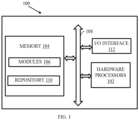
- FIG. 1 is a functional block diagram of a system 100 for personalized outfit compatibility prediction, in accordance with some embodiments of the present disclosure.
- the system 100 includes or is otherwise in communication with hardware processors 102, at least one memory such as a memory 104, an I/O interface 112.
- the hardware processors 102, memory 104, and the Input /Output (I/O) interface 112 may be coupled by a system bus such as a system bus 108 or a similar mechanism.
- the hardware processors 102 can be one or more hardware processors.
- the I/O interface 112 may include a variety of software and hardware interfaces, for example, a web interface, a graphical user interface, and the like.
- the I/O interface 112 may include a variety of software and hardware interfaces, for example, interfaces for peripheral device(s), such as a keyboard, a mouse, an external memory, a printer and the like. Further, the I/O interface 112 may enable the system 100 to communicate with other devices, such as web servers, and external databases.
- the I/O interface 112 can facilitate multiple communications within a wide variety of networks and protocol types, including wired networks, for example, local area network (LAN), cable, etc., and wireless networks, such as Wireless LAN (WLAN), cellular, or satellite.
- the I/O interface 112 may include one or more ports for connecting several computing systems with one another or to another server computer.
- the I/O interface 112 may include one or more ports for connecting several devices to one another or to another server.
- the one or more hardware processors 102 may be implemented as one or more microprocessors, microcomputers, microcontrollers, digital signal processors, central processing units, node machines, logic circuitries, and/or any devices that manipulate signals based on operational instructions.
- the one or more hardware processors 102 is configured to fetch and execute computer-readable instructions stored in the memory 104.
- the memory 104 may include any computer-readable medium known in the art including, for example, volatile memory, such as static random access memory (SRAM) and dynamic random access memory (DRAM), and/or non-volatile memory, such as read only memory (ROM), erasable programmable ROM, flash memories, hard disks, optical disks, and magnetic tapes.
- volatile memory such as static random access memory (SRAM) and dynamic random access memory (DRAM)
- non-volatile memory such as read only memory (ROM), erasable programmable ROM, flash memories, hard disks, optical disks, and magnetic tapes.
- the memory 104 includes a plurality of modules 106.
- the memory 104 also includes a data repository (or repository) 110 for storing data processed, received, and generated by the plurality of modules 106.
- the plurality of modules 106 include programs or coded instructions that supplement applications or functions performed by the system 100 for personalized outfit compatibility prediction.
- the plurality of modules 106 can include routines, programs, objects, components, and data structures, which performs particular tasks or implement particular abstract data types.
- the plurality of modules 106 may also be used as, signal processor(s), node machine(s), logic circuitries, and/or any other device or component that manipulates signals based on operational instructions.
- the plurality of modules 106 can be used by hardware, by computer-readable instructions executed by the one or more hardware processors 102, or by a combination thereof.
- the plurality of modules 106 can include various sub-modules (not shown).
- the plurality of modules 106 may include computer-readable instructions that supplement applications or functions performed by the system 100 for personalized outfit compatibility prediction.
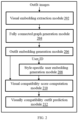
- the modules 106 include a visual embedding extraction module 202 (shown in FIG. 2 ), a Fully connected graph generation module 204 (shown in FIG. 2 ), an outfit embedding generation module 206 (shown in FIG. 2 ), a style-specific user embedding generation module 208 (shown in FIG. 2 ), a visual compatibility score computation module 210 (shown in FIG. 2 ) and a visually compatibility outfit prediction module 212 (shown in FIG. 2 ).
- FIG. 2 illustrates a functional architecture of the system of FIG. 1 , for personalized outfit compatibility prediction, in accordance with some embodiments of the present disclosure.
- the data repository (or repository) 110 may include a plurality of abstracted piece of code for refinement and data that is processed, received, or generated as a result of the execution of the plurality of modules in the module(s) 106.
- the data repository 110 is shown internal to the system 100, it will be noted that, in alternate embodiments, the data repository 110 can also be implemented external to the system 100, where the data repository 110 may be stored within a database (repository 110) communicatively coupled to the system 100.
- the data contained within such an external database may be periodically updated. For example, new data may be added into the database (not shown in FIG. 1 ) and/or existing data may be modified and/or non-useful data may be deleted from the database.
- the data may be stored in an external system, such as a Lightweight Directory Access Protocol (LDAP) directory and a Relational Database Management System (RDBMS).
- LDAP Lightweight Directory Access Protocol
- RDBMS Relational Database Management System
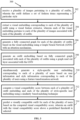
- FIG. 3 is an exemplary flow diagram illustrating a method 300 for personalized outfit compatibility prediction implemented by the system of FIG. 1 according to some embodiments of the present disclosure.
- the system 100 includes one or more data storage devices or the memory 104 operatively coupled to the one or more hardware processor(s) 102 and is configured to store instructions for execution of steps of the method 300 by the one or more hardware processors 102.
- the steps of the method 300 of the present disclosure will now be explained with reference to the components or blocks of the system 100 as depicted in FIG. 1 and the steps of flow diagram as depicted in FIG. 3 .
- the method 300 may be described in the general context of computer executable instructions.
- computer executable instructions can include routines, programs, objects, components, data structures, procedures, modules, functions, etc., that perform particular functions or implement particular abstract data types.
- the method 300 may also be practiced in a distributed computing environment where functions are performed by remote processing devices that are linked through a communication network.
- the order in which the method 300 is described is not intended to be construed as a limitation, and any number of the described method blocks can be combined in any order to implement the method 300, or an alternative method.
- the method 300 can be implemented in any suitable hardware, software, firmware, or combination thereof.
- the one or more hardware processors 102 are configured by the programmed instructions to receive a plurality of images pertaining to a plurality of outfits.
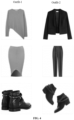
- the outfit defines a set of fashion items representing a particular style as shown in FIG. 4 .
- outfit-1 defines a set of fashion item
- outfit-2 defines another set of fashion items.
- O ⁇ I 1 , I 2 ,.. ..I N ⁇
- N fashion items I i ⁇ R H ⁇ W ⁇ 3
- i 1 to N.
- H and W represents height and width of the image.
- U l represents the l th user in the system.
- the visual embedding extraction module 202 executed by one or more hardware processors 102 is configured by the programmed instructions to extract a visual embedding ( x i ) corresponding to each of the plurality of outfit using a visual feature extractor.
- the visual feature extractor can be a Convolution Neural Network (CNN) or a vision transformer.
- CNN Convolution Neural Network
- Each of the visual embedding pertains to each of the plurality of images associated with each of the plurality of outfits.
- the visual feature extractor is trained using a plurality of positive outfits and a plurality of negative outfits corresponding to each of the plurality of users until a minimum ranking loss is obtained.
- ResNet-18 without classification layer is used in present disclosure.
- the output of global average pooling is fed to a Fully Connected (FC) to obtain the visual embedding of the item.
- the visual embedding is mathematically represented as given in equation (1), where f v is the feature extractor, x i ⁇ R d emb , wherein d emb is the dimension of visual embedding.
- x i f v I i ⁇ f v
- G V , E
- G Graph Neural Network
- the GNN with an attention mechanism can be one of a dot attention mechanism, a multi-head attention mechanism, and a self-attention mechanism.
- the GNN with an attention mechanism is trained using a plurality of positive outfits and a plurality of negative outfits corresponding to each of the plurality of users until a minimum ranking loss is obtained.
- the ranking loss can be a Bayesian personalized ranking loss, a triplet ranking loss and a margin loss.
- the fully connected graph includes a plurality of nodes and a plurality of edges connecting the plurality of nodes, wherein each of the plurality of nodes represents a visual embedding of fashion items in the outfit as shown in FIG. 5 .
- the outfit 502 is given as input to the visual feature extractor 504.
- the visual embedding obtained from the visual feature extractor 504 is converted into the fully connected graph 506.
- the dot attention mechanism is used to update the embeddings of the nodes.
- DOT-GNN uses a dot attention mechanism to capture visual interaction between the items.
- the updated node embedding is given by equation (2), where X new is the updated embedding of nodes and ⁇ gnn represents the trainable parameter of DOT-GAT, G O ⁇ represents the graph with updated node embedding.
- the updated equation for DOT-GNN is given in equation (3).
- N i represents the set of neighbor nodes of i .
- GNN with attention mechanism provides different weightage (0 ⁇ ⁇ ij ⁇ 1) to neighbor nodes of a node. This attention plays a vital role in capturing asymmetrical importance of items in the outfit.
- the outfit embedding generation module 206 executed by the one or more hardware processors 102 is configured by the programmed instructions to generate an outfit embedding based on fully connected graph associated with each of the plurality of outfits using a graph read out layer associated with the GNN.
- the output of the graph read out layer is given in equations (4) and (5).
- q ⁇ R d emb represents the outfit embedding and the f r represents the read-out function.
- each user is associated with an embedding u l ⁇ R d emb .
- the user embedding is transformed using the feature transformation network f t .
- Both user ( u l ) and style embedding ( c k ) are randomly initialized. Then, with the aid of implicit feedback of the users on the outfit, these embedding are updated using Bayesian personalized ranking (BPR) loss.
- BPR Bayesian personalized ranking
- the style-specific user embedding generation module 208 executed by the one or more hardware processors 102 is configured by the programmed instructions to simultaneously generate a style-specific user embedding corresponding to each of a plurality of users based on user information and style information corresponding to each of the plurality of users using a feature transformation network.
- the feature transformation network can be a fully connected neural network. The feature transformation network is trained using a plurality of positive outfits and a plurality of negative outfits corresponding to each of the plurality of users until a minimum ranking loss is obtained.
- the visual compatibility score computation module 210 executed by the one or more hardware processors 102 is configured by the programmed instructions to compute a visual compatibility score between each of a plurality of outfit embedding and each of the plurality of style-specific user embedding using a similarity based matching technique.
- the similarity based matching techniques includes cosine similarity and Euclidean distance.
- the compatibility score s o u l of an outfit ( o ) to a user ( u l ) is computed by taking the cosine similarity ( CS ) between outfit embedding ( q ) and style-conditioned user embedding ( u lk ), given by equation (6).
- s o p u represents compatibility score of the positive outfit and s o n u represents compatibility score of the negative outfit.
- L total 1 M ⁇ o p o n u ⁇ B log 1 + exp ⁇ s o p u ⁇ s o n u
- FIG. 6 is an experimental result showing visual compatibility score for a plurality of users implemented by the system of FIG. 1 according to some embodiments of the present disclosure. Now referring to FIG. 6 , the visual compatibility score for users u504, u495, u310 and u507 for various outfits are illustrated. It has been observed that the visual compatibility score for the user pairs (u504, u495) and (u310, u507) are similar.
- the visually compatibility outfit prediction module 216 executed by the one or more hardware processors 102 is configured by the programmed instructions to predict a visually compatible outfit for each of the plurality of users based on the computed visual compatibility score, wherein an outfit with the visual compatibility score above a predefined threshold is selected.
- Polyvore-U dataset is used for the experimentation and validation for the method (as disclosed in Z. Lu, Y. Hu, Y. Jiang, Y. Chen, and B. Zeng, "Learning binary code for personalized fashion recommendation," in Proceedings of the IEEE/CVF Conference on Computer Vision and Pattern Recognition, 2019, pp. 10 562-10 570 ).
- the details of the dataset are given in Table I.
- the dataset contains outfits collected by multiple users ('U'). Here, 'U' indicates the number of users.
- Polyvore-630 and 53 contain outfits of fixed length.
- Polyvore-519 and 32 contain outfits of variable lengths.
- Polyvore-53 and 32 datasets are used for evaluation in the cold start setting.
- the present disclosure utilizes the ranking metrics like (i) Normalized Discounted Cumulative Gain (NDCG) and (ii) Area Under the ROC curve (AUC).
- the test set is ranked in descending order using the predicted compatibility score, and the ranking metrics AUC and NDCG are used for evaluation.
- Two settings were considered for evaluation, details given in Table II.
- the ratio of positive to negative samples is 1:1.
- this ratio is set to 1:10.
- negative outfits are randomly created by sampling fashion items of different categories (i.e., top, bottom, and shoe).
- protocol 2 outfits of other users are sampled to create negative samples for a given user.
- ResNet-18 pre-trained on ImageNet is used for feature extraction.
- the user and style embedding are randomly initialized.
- the present disclosure is trained using an Adam optimizer with a learning rate of 1e-4.
- the images are normalized with mean and standard deviation same as that used for pretraining of ResNet-18.
- the present disclosure perform random horizontal flip during training.
- the training mini-batch size is set to 64.
- Table II Protocol Train Test Negative outfit Ratio Negative outfit Ratio Protocol 1 Random online 1:1 Random fixed 1:10 Protocol 2 Hard online 1:1 Hard fixed 1:10
- the present disclosure handles new users without retraining the entire network. It is common for an e-commerce platform to encounter new users. The scenario is referred to as a new user cold start problem where the RecSys has to cater to new users with little or no interaction data (purchase, viewed, add to cart).
- the outfit compatibility prediction module which is an integral part of the fashion outfit recommendation system should be able to handle new users.
- the embodiments of present disclosure herein address the unresolved problem of personalized outfit compatibility prediction.
- the present disclosure represents the outfit as a graph and uses GNN with an attention mechanism to capture the relationship between fashion items.
- a graph read-out layer is used to generate the final outfit embedding.
- Style-specific user embeddings are generated using the proposed feature transformation network.
- the outfit compatibility score is generated by computing the similarity between the outfit embedding and the style-specific user embeddings.
- the hardware device can be any kind of device which can be programmed including e.g. any kind of computer like a server or a personal computer, or the like, or any combination thereof.
- the device may also include means which could be e.g. hardware means like e.g. an application-specific integrated circuit (ASIC), a field-programmable gate array (FPGA), or a combination of hardware and software means, e.g.
- ASIC application-specific integrated circuit
- FPGA field-programmable gate array
- the means can include both hardware means and software means.
- the method embodiments described herein could be implemented in hardware and software.
- the device may also include software means.
- the embodiments may be implemented on different hardware devices, e.g. using a plurality of CPUs, GPUs and edge computing devices.
- the embodiments herein can comprise hardware and software elements.
- the embodiments that are implemented in software include but are not limited to, firmware, resident software, microcode, etc.
- the functions performed by various modules described herein may be implemented in other modules or combinations of other modules.
- a computer-usable or computer readable medium can be any apparatus that can comprise, store, communicate, propagate, or transport the program for use by or in connection with the instruction execution system, apparatus, or device.
- the illustrated steps are set out to explain the exemplary embodiments shown, and it should be anticipated that ongoing technological development will change the manner in which particular functions are performed. These examples are presented herein for purposes of illustration, and not limitation. Further, the boundaries of the functional building blocks have been arbitrarily defined herein for the convenience of the description.
- a computer-readable storage medium refers to any type of physical memory on which information or data readable by a processor may be stored.
- a computer-readable storage medium may store instructions for execution by one or more processors, including instructions for causing the processor(s) to perform steps or stages consistent with the embodiments described herein.
- the term "computer-readable medium” should be understood to include tangible items and exclude carrier waves and transient signals, i.e. non-transitory. Examples include random access memory (RAM), read-only memory (ROM), volatile memory, nonvolatile memory, hard drives, CD ROMs, DVDs, flash drives, disks, and any other known physical storage media.
Landscapes
- Engineering & Computer Science (AREA)
- Theoretical Computer Science (AREA)
- Physics & Mathematics (AREA)
- General Physics & Mathematics (AREA)
- Evolutionary Computation (AREA)
- Business, Economics & Management (AREA)
- Health & Medical Sciences (AREA)
- Artificial Intelligence (AREA)
- Software Systems (AREA)
- Computing Systems (AREA)
- General Health & Medical Sciences (AREA)
- Finance (AREA)
- Accounting & Taxation (AREA)
- General Engineering & Computer Science (AREA)
- Multimedia (AREA)
- Biophysics (AREA)
- Data Mining & Analysis (AREA)
- Mathematical Physics (AREA)
- Biomedical Technology (AREA)
- Life Sciences & Earth Sciences (AREA)
- Computational Linguistics (AREA)
- Molecular Biology (AREA)
- Economics (AREA)
- Development Economics (AREA)
- Marketing (AREA)
- Strategic Management (AREA)
- General Business, Economics & Management (AREA)
- Computer Vision & Pattern Recognition (AREA)
- Databases & Information Systems (AREA)
- Medical Informatics (AREA)
- Processing Or Creating Images (AREA)
Abstract
Description
- This patent application claims priority from
Indian Patent Application No. 202321041042, filed on June 16, 2023 - The disclosure herein generally relates to the field of e-commerce and, more particularly, to a method and system for personalized outfit compatibility prediction.
- Recommendation systems (RecSys) play a vital role in ecommerce platforms. A significant percentage of sales on these platforms is based on recommendations. RecSys improve user's shopping experience by helping them to find relevant products. User's feedback and purchase history help RecSys to recommend suitable products to the users. Recently, RecSys have been adapted for various business domains, e.g., video streaming services, fashion, grocery, etc. In fashion e-commerce platforms, recommendation systems also recommend fashion outfits apart from complementary and substitute products. A fashion outfit is a set of fashion items or apparel that are worn together and represent a particular style.
- Unlike visual similarity, visual compatibility is a complex concept in outfit recommendation. Determining visual similarity between fashion items involves comparing visual attributes of the items, e.g., the color of the shirt and trousers. Visual similarity helps in fashion item search and substitute item recommendation. Visual compatibility uses latent concepts to determine the compatibility between fashion items. In the case of fashion outfits, all the items should be visually compatible with each other.
- Existing approaches for outfit compatibility prediction can be grouped into two types: (i) methods without personalization and (ii) methods with personalization. The main aim of methods without personalization is to learn an optimal representation of the items or outfits. The methods in this group ignore individual users' preferences and implicitly capture population preferences. There are some approaches for personalization too. However, those conventional personalization based methods fail to capture relationship between fashion items.
- Embodiments of the present disclosure present technological improvements as solutions to one or more of the above-mentioned technical problems recognized by the inventors in conventional systems. For example, in one embodiment, a method for personalized outfit compatibility prediction is provided. The method includes receiving, by one or more hardware processors, a plurality of images pertaining to a plurality of outfits, wherein the outfit defines a set of fashion items representing a particular style. Further, the method includes extracting via the one or more hardware processors, a visual embedding corresponding to each of the plurality of outfit using a visual feature extractor, wherein each of the visual embedding pertains to each of the plurality of images associated with each of the plurality of outfits. Furthermore, the method includes generating via the one or more hardware processors, a fully connected graph for each of the plurality of outfits based on the visual embedding using a Graph Neural Network (GNN) with an attention mechanism. Furthermore, the method includes generating via the one or more hardware processors, an outfit embedding based on fully connected graph associated with each of the plurality of outfits using a graph read out layer associated with the GNN. Furthermore, the method includes simultaneously generating via the one or more hardware processors, a style-specific user embedding corresponding to each of a plurality of users based on user information and style information corresponding to each of the plurality of users using a feature transformation network. Furthermore, the method includes computing via the one or more hardware processors, a visual compatibility score between each of a plurality of outfit embedding and each of the plurality of style-specific user embedding using a similarity based matching technique. Finally, the method includes predicting via the one or more hardware processors, a visually compatible outfit for each of the plurality of users based on the computed visual compatibility score, wherein an outfit with the visual compatibility score above a predefined threshold is selected.
- In another aspect, a system for personalized outfit compatibility prediction is provided. The system includes at least one memory storing programmed instructions, one or more Input /Output (I/O) interfaces, and one or more hardware processors operatively coupled to the at least one memory, wherein the one or more hardware processors are configured by the programmed instructions to receive a plurality of images pertaining to a plurality of outfits, wherein the outfit defines a set of fashion items representing a particular style. Further, the one or more hardware processors are configured by the programmed instructions to extract a visual embedding corresponding to each of the plurality of outfit using a visual feature extractor, wherein each of the visual embedding pertains to each of the plurality of images associated with each of the plurality of outfits. Furthermore, the one or more hardware processors are configured by the programmed instructions to generate a fully connected graph for each of the plurality of outfits based on the visual embedding using a Graph Neural Network (GNN) with an attention mechanism. Furthermore, the one or more hardware processors are configured by the programmed instructions to generate an outfit embedding based on fully connected graph associated with each of the plurality of outfits using a graph read out layer associated with the GNN. Furthermore, the one or more hardware processors are configured by the programmed instructions to simultaneously generate a style-specific user embedding corresponding to each of a plurality of users based on user information and style information corresponding to each of the plurality of users using a feature transformation network. Furthermore, the one or more hardware processors are configured by the programmed instructions to compute a visual compatibility score between each of a plurality of outfit embedding and each of the plurality of style-specific user embedding using a similarity based matching technique. Finally, the one or more hardware processors are configured by the programmed instructions to predict a visually compatible outfit for each of the plurality of users based on the computed visual compatibility score, wherein an outfit with the visual compatibility score above a predefined threshold is selected.
- In yet another aspect, a computer program product including a non-transitory computer-readable medium having embodied therein a computer program for personalized outfit compatibility prediction is provided. The computer readable program, when executed on a computing device, causes the computing device to receive a plurality of images pertaining to a plurality of outfits, wherein the outfit defines a set of fashion items representing a particular style. Further, the computer readable program, when executed on a computing device, causes the computing device to extract a visual embedding corresponding to each of the plurality of outfit using a visual feature extractor, wherein each of the visual embedding pertains to each of the plurality of images associated with each of the plurality of outfits. Furthermore, the computer readable program, when executed on a computing device, causes the computing device to generate a fully connected graph for each of the plurality of outfits based on the visual embedding using a Graph Neural Network (GNN) with an attention mechanism. Furthermore, the computer readable program, when executed on a computing device, causes the computing device to generate an outfit embedding based on fully connected graph associated with each of the plurality of outfits using a graph read out layer associated with the GNN. Furthermore, the computer readable program, when executed on a computing device, causes the computing device to simultaneously generate a style-specific user embedding corresponding to each of a plurality of users based on user information and style information corresponding to each of the plurality of users using a feature transformation network. Furthermore, the computer readable program, when executed on a computing device, causes the computing device to compute a visual compatibility score between each of a plurality of outfit embedding and each of the plurality of style-specific user embedding using a similarity based matching technique. Finally, the computer readable program, when executed on a computing device, causes the computing device to predict a visually compatible outfit for each of the plurality of users based on the computed visual compatibility score, wherein an outfit with the visual compatibility score above a predefined threshold is selected.
- It is to be understood that both the foregoing general description and the following detailed description are exemplary and explanatory only and are not restrictive of the invention, as claimed.
- The accompanying drawings, which are incorporated in and constitute a part of this disclosure, illustrate exemplary embodiments and, together with the description, serve to explain the disclosed principles:
-
FIG. 1 is a functional block diagram of a system for personalized outfit compatibility prediction, in accordance with some embodiments of the present disclosure. -
FIG. 2 illustrates a functional architecture of the system ofFIG. 1 , for personalized outfit compatibility prediction, in accordance with some embodiments of the present disclosure. -
FIG. 3 is an exemplary flow diagram illustrating a processor implemented method for personalized outfit compatibility prediction implemented by the system ofFIG. 1 according to some embodiments of the present disclosure. -
FIG. 4 illustrates some exemplary outfit images for the processor implemented method for personalized outfit compatibility prediction implemented by the system ofFIG. 1 according to some embodiments of the present disclosure. -
FIG. 5 is a functional block diagram illustrating a fully connected graph generation from input outfit images for the processor implemented method for personalized outfit compatibility prediction implemented by the system ofFIG. 1 according to some embodiments of the present disclosure. -
FIG. 6 is an experimental result showing visual compatibility score for a plurality of users implemented by the system ofFIG. 1 according to some embodiments of the present disclosure. - Exemplary embodiments are described with reference to the accompanying drawings. In the figures, the left-most digit(s) of a reference number identifies the figure in which the reference number first appears. Wherever convenient, the same reference numbers are used throughout the drawings to refer to the same or like parts. While examples and features of disclosed principles are described herein, modifications, adaptations, and other implementations are possible without departing from the scope of the disclosed embodiments.
- Unlike visual similarity, visual compatibility is a complex concept. Determining visual similarity between fashion items involves comparing visual attributes of the items, e.g., the color of the shirt and trousers. Visual similarity helps in fashion item search and substitute item recommendation. Visual compatibility uses latent concepts to determine the compatibility between fashion items. In the case of fashion outfits, all the items should be visually compatible with each other.
- Existing approaches for outfit compatibility prediction can be grouped into two types: (i) methods without personalization and (ii) methods with personalization. The main aim of methods without personalization is to learn an optimal representation of the items or outfits. The methods in this group ignore individual users' preferences and implicitly capture population preferences. There are some approaches for personalization too. However, those conventional personalization based methods fail to capture relationship between fashion items. To overcome the challenges of the conventional approaches, embodiments herein provide a relative score based method and system for personalized outfit compatibility prediction. The present disclosure proposes an approach to model the user's preference for different styles. The outfit compatibility prediction module is a critical component of an outfit recommendation system. An outfit is said to be compatible if all the items are visually compatible and match the user's preferences. Various factors such as demography, season, occasion, and user preferences, affect the outfit compatibility score. The outfit compatibility is subjective, i.e., an outfit liked by one user need not necessarily be preferred by another user. The use of population preferences for outfit recommendations leads to sub-optimal results. Therefore, it is necessary to consider the user's preferences for compatibility scoring. The present disclosure represents the outfit as a graph and uses graph neural network (GNN) with an attention mechanism (e.g., dot attention, multi-head attention, and self attention) to capture the interrelationship between the items. A graph read-out layer generates the final outfit embedding. The proposed approach efficiently models the preferences of the users for different styles. Finally, the outfit compatibility score is generated by computing the similarity between the outfit embedding and the style-specific user embedding.
- Referring now to the drawings, and more particularly to
FIGS. 1 through 6 , where similar reference characters denote corresponding features consistently throughout the figures, there are shown preferred embodiments and these embodiments are described in the context of the following exemplary system and/or method. -
FIG. 1 is a functional block diagram of asystem 100 for personalized outfit compatibility prediction, in accordance with some embodiments of the present disclosure. Thesystem 100 includes or is otherwise in communication withhardware processors 102, at least one memory such as amemory 104, an I/O interface 112. Thehardware processors 102,memory 104, and the Input /Output (I/O)interface 112 may be coupled by a system bus such as asystem bus 108 or a similar mechanism. In an embodiment, thehardware processors 102 can be one or more hardware processors. - The I/
O interface 112 may include a variety of software and hardware interfaces, for example, a web interface, a graphical user interface, and the like. The I/O interface 112 may include a variety of software and hardware interfaces, for example, interfaces for peripheral device(s), such as a keyboard, a mouse, an external memory, a printer and the like. Further, the I/O interface 112 may enable thesystem 100 to communicate with other devices, such as web servers, and external databases. - The I/
O interface 112 can facilitate multiple communications within a wide variety of networks and protocol types, including wired networks, for example, local area network (LAN), cable, etc., and wireless networks, such as Wireless LAN (WLAN), cellular, or satellite. For the purpose, the I/O interface 112 may include one or more ports for connecting several computing systems with one another or to another server computer. The I/O interface 112 may include one or more ports for connecting several devices to one another or to another server. - The one or
more hardware processors 102 may be implemented as one or more microprocessors, microcomputers, microcontrollers, digital signal processors, central processing units, node machines, logic circuitries, and/or any devices that manipulate signals based on operational instructions. Among other capabilities, the one ormore hardware processors 102 is configured to fetch and execute computer-readable instructions stored in thememory 104. - The
memory 104 may include any computer-readable medium known in the art including, for example, volatile memory, such as static random access memory (SRAM) and dynamic random access memory (DRAM), and/or non-volatile memory, such as read only memory (ROM), erasable programmable ROM, flash memories, hard disks, optical disks, and magnetic tapes. In an embodiment, thememory 104 includes a plurality ofmodules 106. Thememory 104 also includes a data repository (or repository) 110 for storing data processed, received, and generated by the plurality ofmodules 106. - The plurality of
modules 106 include programs or coded instructions that supplement applications or functions performed by thesystem 100 for personalized outfit compatibility prediction. The plurality ofmodules 106, amongst other things, can include routines, programs, objects, components, and data structures, which performs particular tasks or implement particular abstract data types. The plurality ofmodules 106 may also be used as, signal processor(s), node machine(s), logic circuitries, and/or any other device or component that manipulates signals based on operational instructions. Further, the plurality ofmodules 106 can be used by hardware, by computer-readable instructions executed by the one ormore hardware processors 102, or by a combination thereof. The plurality ofmodules 106 can include various sub-modules (not shown). The plurality ofmodules 106 may include computer-readable instructions that supplement applications or functions performed by thesystem 100 for personalized outfit compatibility prediction. In an embodiment, themodules 106 include a visual embedding extraction module 202 (shown inFIG. 2 ), a Fully connected graph generation module 204 (shown inFIG. 2 ), an outfit embedding generation module 206 (shown inFIG. 2 ), a style-specific user embedding generation module 208 (shown inFIG. 2 ), a visual compatibility score computation module 210 (shown inFIG. 2 ) and a visually compatibility outfit prediction module 212 (shown inFIG. 2 ). In an embodiment,FIG. 2 illustrates a functional architecture of the system ofFIG. 1 , for personalized outfit compatibility prediction, in accordance with some embodiments of the present disclosure. - The data repository (or repository) 110 may include a plurality of abstracted piece of code for refinement and data that is processed, received, or generated as a result of the execution of the plurality of modules in the module(s) 106.
- Although the
data repository 110 is shown internal to thesystem 100, it will be noted that, in alternate embodiments, thedata repository 110 can also be implemented external to thesystem 100, where thedata repository 110 may be stored within a database (repository 110) communicatively coupled to thesystem 100. The data contained within such an external database may be periodically updated. For example, new data may be added into the database (not shown inFIG. 1 ) and/or existing data may be modified and/or non-useful data may be deleted from the database. In one example, the data may be stored in an external system, such as a Lightweight Directory Access Protocol (LDAP) directory and a Relational Database Management System (RDBMS). -
FIG. 3 is an exemplary flow diagram illustrating amethod 300 for personalized outfit compatibility prediction implemented by the system ofFIG. 1 according to some embodiments of the present disclosure. In an embodiment, thesystem 100 includes one or more data storage devices or thememory 104 operatively coupled to the one or more hardware processor(s) 102 and is configured to store instructions for execution of steps of themethod 300 by the one ormore hardware processors 102. The steps of themethod 300 of the present disclosure will now be explained with reference to the components or blocks of thesystem 100 as depicted inFIG. 1 and the steps of flow diagram as depicted inFIG. 3 . Themethod 300 may be described in the general context of computer executable instructions. Generally, computer executable instructions can include routines, programs, objects, components, data structures, procedures, modules, functions, etc., that perform particular functions or implement particular abstract data types. Themethod 300 may also be practiced in a distributed computing environment where functions are performed by remote processing devices that are linked through a communication network. The order in which themethod 300 is described is not intended to be construed as a limitation, and any number of the described method blocks can be combined in any order to implement themethod 300, or an alternative method. Furthermore, themethod 300 can be implemented in any suitable hardware, software, firmware, or combination thereof. - At
step 302 of themethod 300, the one ormore hardware processors 102 are configured by the programmed instructions to receive a plurality of images pertaining to a plurality of outfits. The outfit defines a set of fashion items representing a particular style as shown inFIG. 4 . Now referring toFIG. 4 , outfit-1 defines a set of fashion item and outfit-2 defines another set of fashion items. For example, an outfit is mathematically represented as O = {I 1,I 2,....IN }, with N fashion items, Ii ∈ RH×W×3 , where i = 1 to N. Here, H and W represents height and width of the image. Let Ul represents the lth user in the system. - At
step 304 of themethod 300, the visual embeddingextraction module 202 executed by one ormore hardware processors 102 is configured by the programmed instructions to extract a visual embedding (xi ) corresponding to each of the plurality of outfit using a visual feature extractor. The visual feature extractor can be a Convolution Neural Network (CNN) or a vision transformer. Each of the visual embedding pertains to each of the plurality of images associated with each of the plurality of outfits. The visual feature extractor is trained using a plurality of positive outfits and a plurality of negative outfits corresponding to each of the plurality of users until a minimum ranking loss is obtained. For example, ResNet-18 without classification layer is used in present disclosure. The output of global average pooling is fed to a Fully Connected (FC) to obtain the visual embedding of the item. The visual embedding is mathematically represented as given in equation (1), where fv is the feature extractor, xi ∈ Rdemb , wherein demb is the dimension of visual embedding.
- At
step 306 of themethod 300, the fully connectedgraph generation module 204 executed by the one ormore hardware processors 102 is configured by the programmed instructions to generate a fully connected graph (G = V, E) for each of the plurality of outfits based on the visual embedding using a Graph Neural Network (GNN) with an attention mechanism. Here, V represents nodes and E represents edges. - For example, the GNN with an attention mechanism can be one of a dot attention mechanism, a multi-head attention mechanism, and a self-attention mechanism. The GNN with an attention mechanism is trained using a plurality of positive outfits and a plurality of negative outfits corresponding to each of the plurality of users until a minimum ranking loss is obtained. For example, the ranking loss can be a Bayesian personalized ranking loss, a triplet ranking loss and a margin loss. The fully connected graph includes a plurality of nodes and a plurality of edges connecting the plurality of nodes, wherein each of the plurality of nodes represents a visual embedding of fashion items in the outfit as shown in
FIG. 5 . Now referring toFIG. 5 , theoutfit 502 is given as input to thevisual feature extractor 504. The visual embedding obtained from thevisual feature extractor 504 is converted into the fully connectedgraph 506. - Let, X = {x 1;x 2;....xN }, X ∈ Rd
emb represent the embedding of nodes. In an embodiment, the dot attention mechanism is used to update the embeddings of the nodes. DOT-GNN uses a dot attention mechanism to capture visual interaction between the items. The updated node embedding is given by equation (2), where Xnew is the updated embedding of nodes and θgnn represents the trainable parameter of DOT-GAT,


- At
step 308 of themethod 300, the outfit embeddinggeneration module 206 executed by the one ormore hardware processors 102 is configured by the programmed instructions to generate an outfit embedding based on fully connected graph associated with each of the plurality of outfits using a graph read out layer associated with the GNN. The output of the graph read out layer is given in equations (4) and (5). Here, q ∈ Rdemb represents the outfit embedding and the fr represents the read-out function.

- In the present disclosure, each user is associated with an embedding ul ∈ Rd
emb . To capture users' preferences for different styles or contexts, the user embedding is transformed using the feature transformation network ft. The feature transformation block transforms the user embedding using 'K' learnable style embedding ck ∈ Rdemb , yielding 'K' style conditioned embedding ulk ∈ Rdemb for each user, wherein ulk = ft (ul ,ck ;θft ); for k = 1 to K, ft (ul , ck ) = ωT (ul + ck ) + b. Here, θft = {ω ∈ Rdemb ×demb , b ∈ Rdemb } represents the trainable parameters. Both user (ul ) and style embedding (ck ) are randomly initialized. Then, with the aid of implicit feedback of the users on the outfit, these embedding are updated using Bayesian personalized ranking (BPR) loss. In an embodiment, the dimension of user embedding (ul ) and style embedding (ck ) are set equal to the dimension of outfit embedding (q), i.e., demb = 256. The number of style embedding was set as K = 64. - At
step 310 of themethod 300, the style-specific user embedding generation module 208 executed by the one ormore hardware processors 102 is configured by the programmed instructions to simultaneously generate a style-specific user embedding corresponding to each of a plurality of users based on user information and style information corresponding to each of the plurality of users using a feature transformation network. For example, the feature transformation network can be a fully connected neural network. The feature transformation network is trained using a plurality of positive outfits and a plurality of negative outfits corresponding to each of the plurality of users until a minimum ranking loss is obtained. - At
step 312 of themethod 300, the visual compatibilityscore computation module 210 executed by the one ormore hardware processors 102 is configured by the programmed instructions to compute a visual compatibility score between each of a plurality of outfit embedding and each of the plurality of style-specific user embedding using a similarity based matching technique. For example, the similarity based matching techniques includes cosine similarity and Euclidean distance. The compatibility score

- Training: Let


-
FIG. 6 is an experimental result showing visual compatibility score for a plurality of users implemented by the system ofFIG. 1 according to some embodiments of the present disclosure. Now referring toFIG. 6 , the visual compatibility score for users u504, u495, u310 and u507 for various outfits are illustrated. It has been observed that the visual compatibility score for the user pairs (u504, u495) and (u310, u507) are similar. - At
step 314 of themethod 300, the visually compatibility outfit prediction module 216 executed by the one ormore hardware processors 102 is configured by the programmed instructions to predict a visually compatible outfit for each of the plurality of users based on the computed visual compatibility score, wherein an outfit with the visual compatibility score above a predefined threshold is selected. - Dataset: In an embodiment, Polyvore-U dataset is used for the experimentation and validation for the method (as disclosed in Z. Lu, Y. Hu, Y. Jiang, Y. Chen, and B. Zeng, "Learning binary code for personalized fashion recommendation," in Proceedings of the IEEE/CVF Conference on Computer Vision and Pattern Recognition, 2019, pp. 10 562-10 570). The details of the dataset are given in Table I. The dataset contains outfits collected by multiple users ('U'). Here, 'U' indicates the number of users. Polyvore-630 and 53 contain outfits of fixed length. Polyvore-519 and 32 contain outfits of variable lengths. Polyvore-53 and 32 datasets are used for evaluation in the cold start setting.
Table 1 Dataset Users Outfit size Split Items Outfit Polyvore-630 630 Fixed Train 159729 127326 Test 45505 23054 Polyvore-53 53 Fixed Train 20230 10712 Test 4437 1944 Polyvore-519 519 Variable Train 146475 83416 Test 39085 14654 Polyvore-32 32 Variable Train 14594 5133 Test 2797 898 - Metrics: For evaluation, the present disclosure utilizes the ranking metrics like (i) Normalized Discounted Cumulative Gain (NDCG) and (ii) Area Under the ROC curve (AUC). The test set is ranked in descending order using the predicted compatibility score, and the ranking metrics AUC and NDCG are used for evaluation. Two settings were considered for evaluation, details given in Table II. During training, the ratio of positive to negative samples is 1:1. For evaluation, this ratio is set to 1:10. In
protocol 1, negative outfits are randomly created by sampling fashion items of different categories (i.e., top, bottom, and shoe). Inprotocol 2, outfits of other users are sampled to create negative samples for a given user. ResNet-18, pre-trained on ImageNet is used for feature extraction. The user and style embedding are randomly initialized. The present disclosure is trained using an Adam optimizer with a learning rate of 1e-4. The images are normalized with mean and standard deviation same as that used for pretraining of ResNet-18. For data augmentation, the present disclosure perform random horizontal flip during training. The training mini-batch size is set to 64.Table II Protocol Train Test Negative outfit Ratio Negative outfit Ratio Protocol 1 Random online 1:1 Random fixed 1:10 Protocol 2Hard online 1:1 Hard fixed 1:10 - The present disclosure handles new users without retraining the entire network. It is common for an e-commerce platform to encounter new users. The scenario is referred to as a new user cold start problem where the RecSys has to cater to new users with little or no interaction data (purchase, viewed, add to cart). The outfit compatibility prediction module which is an integral part of the fashion outfit recommendation system should be able to handle new users.
- The written description describes the subject matter herein to enable any person skilled in the art to make and use the embodiments. The scope of the subject matter embodiments is defined by the claims and may include other modifications that occur to those skilled in the art. Such other modifications are intended to be within the scope of the claims if they have similar elements that do not differ from the literal language of the claims or if they include equivalent elements with insubstantial differences from the literal language of the claims.
- The embodiments of present disclosure herein address the unresolved problem of personalized outfit compatibility prediction. The present disclosure represents the outfit as a graph and uses GNN with an attention mechanism to capture the relationship between fashion items. A graph read-out layer is used to generate the final outfit embedding. Style-specific user embeddings are generated using the proposed feature transformation network. The outfit compatibility score is generated by computing the similarity between the outfit embedding and the style-specific user embeddings.
- It is to be understood that the scope of the protection is extended to such a program and in addition to a computer-readable means having a message therein such computer-readable storage means contain program-code means for implementation of one or more steps of the method when the program runs on a server or mobile device or any suitable programmable device. The hardware device can be any kind of device which can be programmed including e.g. any kind of computer like a server or a personal computer, or the like, or any combination thereof. The device may also include means which could be e.g. hardware means like e.g. an application-specific integrated circuit (ASIC), a field-programmable gate array (FPGA), or a combination of hardware and software means, e.g. an ASIC and an FPGA, or at least one microprocessor and at least one memory with software modules located therein. Thus, the means can include both hardware means and software means. The method embodiments described herein could be implemented in hardware and software. The device may also include software means. Alternatively, the embodiments may be implemented on different hardware devices, e.g. using a plurality of CPUs, GPUs and edge computing devices.
- The embodiments herein can comprise hardware and software elements. The embodiments that are implemented in software include but are not limited to, firmware, resident software, microcode, etc. The functions performed by various modules described herein may be implemented in other modules or combinations of other modules. For the purposes of this description, a computer-usable or computer readable medium can be any apparatus that can comprise, store, communicate, propagate, or transport the program for use by or in connection with the instruction execution system, apparatus, or device. The illustrated steps are set out to explain the exemplary embodiments shown, and it should be anticipated that ongoing technological development will change the manner in which particular functions are performed. These examples are presented herein for purposes of illustration, and not limitation. Further, the boundaries of the functional building blocks have been arbitrarily defined herein for the convenience of the description. Alternative boundaries can be defined so long as the specified functions and relationships thereof are appropriately performed. Alternatives (including equivalents, extensions, variations, deviations, etc., of those described herein) will be apparent to persons skilled in the relevant art(s) based on the teachings contained herein. Such alternatives fall within the scope of the disclosed embodiments. Also, the words "comprising," "having," "containing," and "including," and other similar forms are intended to be equivalent in meaning and be open ended in that an item or items following any one of these words is not meant to be an exhaustive listing of such item or items, or meant to be limited to only the listed item or items. It must also be noted that as used herein and in the appended claims, the singular forms "a," "an," and "the" include plural references unless the context clearly dictates otherwise. Furthermore, one or more computer-readable storage media may be utilized in implementing embodiments consistent with the present disclosure. A computer-readable storage medium refers to any type of physical memory on which information or data readable by a processor may be stored. Thus, a computer-readable storage medium may store instructions for execution by one or more processors, including instructions for causing the processor(s) to perform steps or stages consistent with the embodiments described herein. The term "computer-readable medium" should be understood to include tangible items and exclude carrier waves and transient signals, i.e. non-transitory. Examples include random access memory (RAM), read-only memory (ROM), volatile memory, nonvolatile memory, hard drives, CD ROMs, DVDs, flash drives, disks, and any other known physical storage media.
- It is intended that the disclosure and examples be considered as exemplary only, with a true scope of disclosed embodiments being indicated by the following claims.
Claims (9)
- A processor implemented method (300), the method comprising:receiving (302), via one or more hardware processors, a plurality of images pertaining to a plurality of outfits, wherein the outfit defines a set of fashion items representing a particular style;extracting (304), via the one or more hardware processors, a visual embedding corresponding to each of the plurality of outfit using a visual feature extractor, wherein each of the visual embedding pertains to each of the plurality of images associated with each of the plurality of outfits;generating (306), via the one or more hardware processors, a fully connected graph for each of the plurality of outfits based on the visual embedding using a Graph Neural Network (GNN) with an attention mechanism;generating (308), via the one or more hardware processors, an outfit embedding based on fully connected graph associated with each of the plurality of outfits using a graph read out layer associated with the GNN;simultaneously generating (310), via the one or more hardware processors, a style-specific user embedding corresponding to each of a plurality of users based on user information and style information corresponding to each of the plurality of users using a feature transformation network;computing (312), via the one or more hardware processors, a visual compatibility score between each of a plurality of outfit embedding and each of the plurality of style-specific user embedding using a similarity based matching technique; andpredicting (314), via the one or more hardware processors, a visually compatible outfit for each of the plurality of users based on the computed visual compatibility score, wherein an outfit with the visual compatibility score above a predefined threshold is selected.
- The method as claimed in claim 1, wherein the visual feature extractor, the GNN with the attention mechanism and the feature transformation network are trained using a plurality of positive outfits and a plurality of negative outfits corresponding to each of the plurality of users until a minimum ranking loss is obtained.
- The method as claimed in claim 1, wherein the fully connected graph comprises a plurality of nodes and a plurality of edges connecting the plurality of nodes, wherein each of the plurality of nodes represents a visual embedding of fashion items in the outfit.
- A system (100) comprising:
at least one memory (104) storing programmed instructions; one or more Input /Output (I/O) interfaces (112); and one or more hardware processors (102) operatively coupled to the at least one memory (104), wherein the one or more hardware processors (102) are configured by the programmed instructions to:receive a plurality of images pertaining to a plurality of outfits, wherein the outfit defines a set of fashion items representing a particular style;extract a visual embedding corresponding to each of the plurality of outfit using a visual feature extractor, wherein each of the visual embedding pertains to each of the plurality of images associated with each of the plurality of outfits;generate a fully connected graph for each of the plurality of outfits based on the visual embedding using a Graph Neural Network (GNN) with an attention mechanism;generate an outfit embedding based on fully connected graph associated with each of the plurality of outfits using a graph read out layer associated with the GNN;simultaneously generate a style-specific user embedding corresponding to each of a plurality of users based on user information and style information corresponding to each of the plurality of users using a feature transformation network;compute a visual compatibility score between each of a plurality of outfit embedding and each of the plurality of style-specific user embedding using a similarity based matching technique; andpredict a visually compatible outfit for each of the plurality of users based on the computed visual compatibility score, wherein an outfit with the visual compatibility score above a predefined threshold is selected. - The system as claimed in claim 4, wherein the visual feature extractor, the GNN with the attention mechanism and the feature transformation network are trained using a plurality of positive outfits and a plurality of negative outfits corresponding to each of the plurality of users until a minimum ranking loss is obtained.
- The system as claimed in claim 4, wherein the fully connected graph comprises a plurality of nodes and a plurality of edges connecting the plurality of nodes, wherein each of the plurality of nodes represents a visual embedding of fashion items in the outfit.
- One or more non-transitory machine readable information storage mediums comprising one or more instructions which when executed by one or more hardware processors causes:receiving a plurality of images pertaining to a plurality of outfits, wherein the outfit defines a set of fashion items representing a particular style;extracting a visual embedding corresponding to each of the plurality of outfit using a visual feature extractor, wherein each of the visual embedding pertains to each of the plurality of images associated with each of the plurality of outfits;generating a fully connected graph for each of the plurality of outfits based on the visual embedding using a Graph Neural Network (GNN) with an attention mechanism;generating an outfit embedding based on fully connected graph associated with each of the plurality of outfits using a graph read out layer associated with the GNN;simultaneously generating a style-specific user embedding corresponding to each of a plurality of users based on user information and style information corresponding to each of the plurality of users using a feature transformation network;computing a visual compatibility score between each of a plurality of outfit embedding and each of the plurality of style-specific user embedding using a similarity based matching technique; andpredicting a visually compatible outfit for each of the plurality of users based on the computed visual compatibility score, wherein an outfit with the visual compatibility score above a predefined threshold is selected.
- The one or more non-transitory machine readable information storage mediums as claimed in claim 7, wherein the visual feature extractor, the GNN with the attention mechanism and the feature transformation network are trained using a plurality of positive outfits and a plurality of negative outfits corresponding to each of the plurality of users until a minimum ranking loss is obtained.
- The one or more non-transitory machine readable information storage mediums as claimed in claim 7, wherein the fully connected graph comprises a plurality of nodes and a plurality of edges connecting the plurality of nodes, wherein each of the plurality of nodes represents a visual embedding of fashion items in the outfit.
Applications Claiming Priority (1)
| Application Number | Priority Date | Filing Date | Title |
|---|---|---|---|
| IN202321041042 | 2023-06-16 |
Publications (3)
| Publication Number | Publication Date |
|---|---|
| EP4478253A1 true EP4478253A1 (en) | 2024-12-18 |
| EP4478253C0 EP4478253C0 (en) | 2025-08-13 |
| EP4478253B1 EP4478253B1 (en) | 2025-08-13 |
Family
ID=91128225
Family Applications (1)
| Application Number | Title | Priority Date | Filing Date |
|---|---|---|---|
| EP24175870.5A Active EP4478253B1 (en) | 2023-06-16 | 2024-05-15 | Method and system for personalized outfit compatibility prediction |
Country Status (2)
| Country | Link |
|---|---|
| US (1) | US20240420215A1 (en) |
| EP (1) | EP4478253B1 (en) |
Citations (2)
| Publication number | Priority date | Publication date | Assignee | Title |
|---|---|---|---|---|
| US20210256588A1 (en) * | 2018-08-31 | 2021-08-19 | Visa International Service Association | System, method, and computer program product for determining compatibility between items in images |
| CN114896497A (en) * | 2022-05-10 | 2022-08-12 | 中山大学 | Personalized clothing recommendation method and system based on reinforcement learning |
-
2024
- 2024-05-15 EP EP24175870.5A patent/EP4478253B1/en active Active
- 2024-05-17 US US18/666,920 patent/US20240420215A1/en active Pending
Patent Citations (2)
| Publication number | Priority date | Publication date | Assignee | Title |
|---|---|---|---|---|
| US20210256588A1 (en) * | 2018-08-31 | 2021-08-19 | Visa International Service Association | System, method, and computer program product for determining compatibility between items in images |
| CN114896497A (en) * | 2022-05-10 | 2022-08-12 | 中山大学 | Personalized clothing recommendation method and system based on reinforcement learning |
Non-Patent Citations (2)
| Title |
|---|
| VIVEK B S ET AL: "Personalized Outfit Compatibility Prediction Using Outfit Graph Network", 2023 INTERNATIONAL JOINT CONFERENCE ON NEURAL NETWORKS (IJCNN), IEEE, 18 June 2023 (2023-06-18), pages 1 - 8, XP034387002, DOI: 10.1109/IJCNN54540.2023.10191458 * |
| Z. LUY. HUY. JIANGY. CHENB. ZENG: "Learning binary code for personalized fashion recommendation", PROCEEDINGS OF THE IEEE/CVF CONFERENCE ON COMPUTER VISION AND PATTERN RECOGNITION, 2019, pages 10 562 - 10 570 |
Also Published As
| Publication number | Publication date |
|---|---|
| EP4478253C0 (en) | 2025-08-13 |
| US20240420215A1 (en) | 2024-12-19 |
| EP4478253B1 (en) | 2025-08-13 |
Similar Documents
| Publication | Publication Date | Title |
|---|---|---|
| US20220253722A1 (en) | Recommendation system with adaptive thresholds for neighborhood selection | |
| US11494616B2 (en) | Decoupling category-wise independence and relevance with self-attention for multi-label image classification | |
| KR102741221B1 (en) | Methods and apparatus for detecting, filtering, and identifying objects in streaming video | |
| US20230206076A1 (en) | Graph structure aware incremental learning for recommender system | |
| EP3267362B1 (en) | Machine learning image processing | |
| US20190251612A1 (en) | Generating user-customized items using a visually-aware image generation network | |
| US10740802B2 (en) | Systems and methods for gaining knowledge about aspects of social life of a person using visual content associated with that person | |
| WO2022041979A1 (en) | Information recommendation model training method and related device | |
| CN104182770B (en) | For the method and system automatically selected of one or more image processing algorithms | |
| CN112182166A (en) | A text matching method, device, electronic device and storage medium | |
| CN113051468B (en) | Movie recommendation method and system based on knowledge graph and reinforcement learning | |
| US9939272B1 (en) | Method and system for building personalized knowledge base of semantic image segmentation via a selective random field approach | |
| CN111400525B (en) | Intelligent matching and recommendation method of fashion clothing based on visual combination relationship learning | |
| US11501334B2 (en) | Methods and apparatuses for selecting advertisements using semantic matching | |
| CN110750523A (en) | Data annotation method, system, computer equipment and storage medium | |
| CN109471978A (en) | A kind of e-sourcing recommended method and device | |
| US20240184838A1 (en) | Diversified recommendation method for news based on graph neural network and its device | |
| KR20210060375A (en) | Method, apparatus and computer program for selecting promising content | |
| US11914638B2 (en) | Image selection from a database | |
| CN118779838A (en) | A method for ranking the importance of social network nodes based on adaptive propagation model | |
| Indira et al. | Visual and buying sequence features-based product image recommendation using optimization based deep residual network | |
| CN113641855A (en) | Video recommendation method, device, equipment and storage medium | |
| CN110162714B (en) | Content push method, device, computing device and computer-readable storage medium | |
| CN108154165B (en) | Marriage and love object matching data processing method and device based on big data and deep learning, computer equipment and storage medium | |
| EP4478253B1 (en) | Method and system for personalized outfit compatibility prediction |
Legal Events
| Date | Code | Title | Description |
|---|---|---|---|
| PUAI | Public reference made under article 153(3) epc to a published international application that has entered the european phase |
Free format text: ORIGINAL CODE: 0009012 |
|
| STAA | Information on the status of an ep patent application or granted ep patent |
Free format text: STATUS: THE APPLICATION HAS BEEN PUBLISHED |
|
| STAA | Information on the status of an ep patent application or granted ep patent |
Free format text: STATUS: REQUEST FOR EXAMINATION WAS MADE |
|
| AK | Designated contracting states |
Kind code of ref document: A1 Designated state(s): AL AT BE BG CH CY CZ DE DK EE ES FI FR GB GR HR HU IE IS IT LI LT LU LV MC ME MK MT NL NO PL PT RO RS SE SI SK SM TR |
|
| 17P | Request for examination filed |
Effective date: 20241121 |
|
| RBV | Designated contracting states (corrected) |
Designated state(s): AL AT BE BG CH CY CZ DE DK EE ES FI FR GB GR HR HU IE IS IT LI LT LU LV MC ME MK MT NL NO PL PT RO RS SE SI SK SM TR |
|
| GRAP | Despatch of communication of intention to grant a patent |
Free format text: ORIGINAL CODE: EPIDOSNIGR1 |
|
| RIC1 | Information provided on ipc code assigned before grant |
Ipc: G06V 20/30 20220101ALI20250331BHEP Ipc: G06V 10/82 20220101ALI20250331BHEP Ipc: G06N 3/08 20230101ALI20250331BHEP Ipc: G06N 3/045 20230101AFI20250331BHEP |
|
| STAA | Information on the status of an ep patent application or granted ep patent |
Free format text: STATUS: GRANT OF PATENT IS INTENDED |
|
| INTG | Intention to grant announced |
Effective date: 20250507 |
|
| GRAS | Grant fee paid |
Free format text: ORIGINAL CODE: EPIDOSNIGR3 |
|
| GRAA | (expected) grant |
Free format text: ORIGINAL CODE: 0009210 |
|
| STAA | Information on the status of an ep patent application or granted ep patent |
Free format text: STATUS: THE PATENT HAS BEEN GRANTED |
|
| AK | Designated contracting states |
Kind code of ref document: B1 Designated state(s): AL AT BE BG CH CY CZ DE DK EE ES FI FR GB GR HR HU IE IS IT LI LT LU LV MC ME MK MT NL NO PL PT RO RS SE SI SK SM TR |
|
| REG | Reference to a national code |
Ref country code: GB Ref legal event code: FG4D |
|
| REG | Reference to a national code |
Ref country code: CH Ref legal event code: EP |
|
| REG | Reference to a national code |
Ref country code: DE Ref legal event code: R096 Ref document number: 602024000443 Country of ref document: DE |
|
| REG | Reference to a national code |
Ref country code: IE Ref legal event code: FG4D |
|
| U01 | Request for unitary effect filed |
Effective date: 20250813 |
|
| U07 | Unitary effect registered |
Designated state(s): AT BE BG DE DK EE FI FR IT LT LU LV MT NL PT RO SE SI Effective date: 20250821 |
|
| REG | Reference to a national code |
Ref country code: CH Ref legal event code: R17 Free format text: ST27 STATUS EVENT CODE: U-0-0-R10-R17 (AS PROVIDED BY THE NATIONAL OFFICE) Effective date: 20251001 |
|
| PG25 | Lapsed in a contracting state [announced via postgrant information from national office to epo] |
Ref country code: IS Free format text: LAPSE BECAUSE OF FAILURE TO SUBMIT A TRANSLATION OF THE DESCRIPTION OR TO PAY THE FEE WITHIN THE PRESCRIBED TIME-LIMIT Effective date: 20251213 |
|
| PG25 | Lapsed in a contracting state [announced via postgrant information from national office to epo] |
Ref country code: NO Free format text: LAPSE BECAUSE OF FAILURE TO SUBMIT A TRANSLATION OF THE DESCRIPTION OR TO PAY THE FEE WITHIN THE PRESCRIBED TIME-LIMIT Effective date: 20251113 |
|
| PG25 | Lapsed in a contracting state [announced via postgrant information from national office to epo] |
Ref country code: HR Free format text: LAPSE BECAUSE OF FAILURE TO SUBMIT A TRANSLATION OF THE DESCRIPTION OR TO PAY THE FEE WITHIN THE PRESCRIBED TIME-LIMIT Effective date: 20250813 |
|
| PG25 | Lapsed in a contracting state [announced via postgrant information from national office to epo] |
Ref country code: GR Free format text: LAPSE BECAUSE OF FAILURE TO SUBMIT A TRANSLATION OF THE DESCRIPTION OR TO PAY THE FEE WITHIN THE PRESCRIBED TIME-LIMIT Effective date: 20251114 |
|
| PG25 | Lapsed in a contracting state [announced via postgrant information from national office to epo] |
Ref country code: PL Free format text: LAPSE BECAUSE OF FAILURE TO SUBMIT A TRANSLATION OF THE DESCRIPTION OR TO PAY THE FEE WITHIN THE PRESCRIBED TIME-LIMIT Effective date: 20250813 |
|
| PG25 | Lapsed in a contracting state [announced via postgrant information from national office to epo] |
Ref country code: RS Free format text: LAPSE BECAUSE OF FAILURE TO SUBMIT A TRANSLATION OF THE DESCRIPTION OR TO PAY THE FEE WITHIN THE PRESCRIBED TIME-LIMIT Effective date: 20251113 |
|
| PG25 | Lapsed in a contracting state [announced via postgrant information from national office to epo] |
Ref country code: ES Free format text: LAPSE BECAUSE OF FAILURE TO SUBMIT A TRANSLATION OF THE DESCRIPTION OR TO PAY THE FEE WITHIN THE PRESCRIBED TIME-LIMIT Effective date: 20250813 |
|
| PG25 | Lapsed in a contracting state [announced via postgrant information from national office to epo] |
Ref country code: SM Free format text: LAPSE BECAUSE OF FAILURE TO SUBMIT A TRANSLATION OF THE DESCRIPTION OR TO PAY THE FEE WITHIN THE PRESCRIBED TIME-LIMIT Effective date: 20250813 |
|
| PG25 | Lapsed in a contracting state [announced via postgrant information from national office to epo] |
Ref country code: CZ Free format text: LAPSE BECAUSE OF FAILURE TO SUBMIT A TRANSLATION OF THE DESCRIPTION OR TO PAY THE FEE WITHIN THE PRESCRIBED TIME-LIMIT Effective date: 20250813 |
|
| PG25 | Lapsed in a contracting state [announced via postgrant information from national office to epo] |
Ref country code: SK Free format text: LAPSE BECAUSE OF FAILURE TO SUBMIT A TRANSLATION OF THE DESCRIPTION OR TO PAY THE FEE WITHIN THE PRESCRIBED TIME-LIMIT Effective date: 20250813 |