EP4478245A1 - Method of operating radio frequency identification (rfid) devices on a vehicle - Google Patents
Method of operating radio frequency identification (rfid) devices on a vehicle Download PDFInfo
- Publication number
- EP4478245A1 EP4478245A1 EP24165850.9A EP24165850A EP4478245A1 EP 4478245 A1 EP4478245 A1 EP 4478245A1 EP 24165850 A EP24165850 A EP 24165850A EP 4478245 A1 EP4478245 A1 EP 4478245A1
- Authority
- EP
- European Patent Office
- Prior art keywords
- vehicle
- determining
- rfid devices
- rfid
- geographic location
- Prior art date
- Legal status (The legal status is an assumption and is not a legal conclusion. Google has not performed a legal analysis and makes no representation as to the accuracy of the status listed.)
- Granted
Links
Images



Classifications
-
- G—PHYSICS
- G06—COMPUTING OR CALCULATING; COUNTING
- G06K—GRAPHICAL DATA READING; PRESENTATION OF DATA; RECORD CARRIERS; HANDLING RECORD CARRIERS
- G06K7/00—Methods or arrangements for sensing record carriers, e.g. for reading patterns
- G06K7/10—Methods or arrangements for sensing record carriers, e.g. for reading patterns by electromagnetic radiation, e.g. optical sensing; by corpuscular radiation
- G06K7/10009—Methods or arrangements for sensing record carriers, e.g. for reading patterns by electromagnetic radiation, e.g. optical sensing; by corpuscular radiation sensing by radiation using wavelengths larger than 0.1 mm, e.g. radio-waves or microwaves
- G06K7/10118—Methods or arrangements for sensing record carriers, e.g. for reading patterns by electromagnetic radiation, e.g. optical sensing; by corpuscular radiation sensing by radiation using wavelengths larger than 0.1 mm, e.g. radio-waves or microwaves the sensing being preceded by at least one preliminary step
- G06K7/10128—Methods or arrangements for sensing record carriers, e.g. for reading patterns by electromagnetic radiation, e.g. optical sensing; by corpuscular radiation sensing by radiation using wavelengths larger than 0.1 mm, e.g. radio-waves or microwaves the sensing being preceded by at least one preliminary step the step consisting of detection of the presence of one or more record carriers in the vicinity of the interrogation device
-
- G—PHYSICS
- G08—SIGNALLING
- G08G—TRAFFIC CONTROL SYSTEMS
- G08G5/00—Traffic control systems for aircraft
- G08G5/20—Arrangements for acquiring, generating, sharing or displaying traffic information
-
- H—ELECTRICITY
- H04—ELECTRIC COMMUNICATION TECHNIQUE
- H04W—WIRELESS COMMUNICATION NETWORKS
- H04W4/00—Services specially adapted for wireless communication networks; Facilities therefor
- H04W4/80—Services using short range communication, e.g. near-field communication [NFC], radio-frequency identification [RFID] or low energy communication
-
- G—PHYSICS
- G06—COMPUTING OR CALCULATING; COUNTING
- G06K—GRAPHICAL DATA READING; PRESENTATION OF DATA; RECORD CARRIERS; HANDLING RECORD CARRIERS
- G06K7/00—Methods or arrangements for sensing record carriers, e.g. for reading patterns
- G06K7/10—Methods or arrangements for sensing record carriers, e.g. for reading patterns by electromagnetic radiation, e.g. optical sensing; by corpuscular radiation
- G06K7/10009—Methods or arrangements for sensing record carriers, e.g. for reading patterns by electromagnetic radiation, e.g. optical sensing; by corpuscular radiation sensing by radiation using wavelengths larger than 0.1 mm, e.g. radio-waves or microwaves
- G06K7/10118—Methods or arrangements for sensing record carriers, e.g. for reading patterns by electromagnetic radiation, e.g. optical sensing; by corpuscular radiation sensing by radiation using wavelengths larger than 0.1 mm, e.g. radio-waves or microwaves the sensing being preceded by at least one preliminary step
-
- G—PHYSICS
- G06—COMPUTING OR CALCULATING; COUNTING
- G06K—GRAPHICAL DATA READING; PRESENTATION OF DATA; RECORD CARRIERS; HANDLING RECORD CARRIERS
- G06K7/00—Methods or arrangements for sensing record carriers, e.g. for reading patterns
- G06K7/10—Methods or arrangements for sensing record carriers, e.g. for reading patterns by electromagnetic radiation, e.g. optical sensing; by corpuscular radiation
- G06K7/10009—Methods or arrangements for sensing record carriers, e.g. for reading patterns by electromagnetic radiation, e.g. optical sensing; by corpuscular radiation sensing by radiation using wavelengths larger than 0.1 mm, e.g. radio-waves or microwaves
- G06K7/10198—Methods or arrangements for sensing record carriers, e.g. for reading patterns by electromagnetic radiation, e.g. optical sensing; by corpuscular radiation sensing by radiation using wavelengths larger than 0.1 mm, e.g. radio-waves or microwaves setting parameters for the interrogator, e.g. programming parameters and operating modes
- G06K7/10217—Methods or arrangements for sensing record carriers, e.g. for reading patterns by electromagnetic radiation, e.g. optical sensing; by corpuscular radiation sensing by radiation using wavelengths larger than 0.1 mm, e.g. radio-waves or microwaves setting parameters for the interrogator, e.g. programming parameters and operating modes parameter settings controlling the transmission power of the interrogator
-
- H—ELECTRICITY
- H04—ELECTRIC COMMUNICATION TECHNIQUE
- H04W—WIRELESS COMMUNICATION NETWORKS
- H04W4/00—Services specially adapted for wireless communication networks; Facilities therefor
- H04W4/02—Services making use of location information
- H04W4/029—Location-based management or tracking services
-
- H—ELECTRICITY
- H04—ELECTRIC COMMUNICATION TECHNIQUE
- H04W—WIRELESS COMMUNICATION NETWORKS
- H04W4/00—Services specially adapted for wireless communication networks; Facilities therefor
- H04W4/30—Services specially adapted for particular environments, situations or purposes
- H04W4/40—Services specially adapted for particular environments, situations or purposes for vehicles, e.g. vehicle-to-pedestrians [V2P]
- H04W4/42—Services specially adapted for particular environments, situations or purposes for vehicles, e.g. vehicle-to-pedestrians [V2P] for mass transport vehicles, e.g. buses, trains or aircraft
-
- G—PHYSICS
- G06—COMPUTING OR CALCULATING; COUNTING
- G06K—GRAPHICAL DATA READING; PRESENTATION OF DATA; RECORD CARRIERS; HANDLING RECORD CARRIERS
- G06K7/00—Methods or arrangements for sensing record carriers, e.g. for reading patterns
- G06K7/01—Details
-
- G—PHYSICS
- G06—COMPUTING OR CALCULATING; COUNTING
- G06K—GRAPHICAL DATA READING; PRESENTATION OF DATA; RECORD CARRIERS; HANDLING RECORD CARRIERS
- G06K7/00—Methods or arrangements for sensing record carriers, e.g. for reading patterns
- G06K7/10—Methods or arrangements for sensing record carriers, e.g. for reading patterns by electromagnetic radiation, e.g. optical sensing; by corpuscular radiation
- G06K7/10009—Methods or arrangements for sensing record carriers, e.g. for reading patterns by electromagnetic radiation, e.g. optical sensing; by corpuscular radiation sensing by radiation using wavelengths larger than 0.1 mm, e.g. radio-waves or microwaves
- G06K7/10198—Methods or arrangements for sensing record carriers, e.g. for reading patterns by electromagnetic radiation, e.g. optical sensing; by corpuscular radiation sensing by radiation using wavelengths larger than 0.1 mm, e.g. radio-waves or microwaves setting parameters for the interrogator, e.g. programming parameters and operating modes
-
- G—PHYSICS
- G06—COMPUTING OR CALCULATING; COUNTING
- G06K—GRAPHICAL DATA READING; PRESENTATION OF DATA; RECORD CARRIERS; HANDLING RECORD CARRIERS
- G06K7/00—Methods or arrangements for sensing record carriers, e.g. for reading patterns
- G06K7/10—Methods or arrangements for sensing record carriers, e.g. for reading patterns by electromagnetic radiation, e.g. optical sensing; by corpuscular radiation
- G06K7/10009—Methods or arrangements for sensing record carriers, e.g. for reading patterns by electromagnetic radiation, e.g. optical sensing; by corpuscular radiation sensing by radiation using wavelengths larger than 0.1 mm, e.g. radio-waves or microwaves
- G06K7/10366—Methods or arrangements for sensing record carriers, e.g. for reading patterns by electromagnetic radiation, e.g. optical sensing; by corpuscular radiation sensing by radiation using wavelengths larger than 0.1 mm, e.g. radio-waves or microwaves the interrogation device being adapted for miscellaneous applications
-
- H—ELECTRICITY
- H04—ELECTRIC COMMUNICATION TECHNIQUE
- H04B—TRANSMISSION
- H04B7/00—Radio transmission systems, i.e. using radiation field
Definitions
- the present disclosure relates generally to the field of operating devices that are located on a vehicle and, more specifically, to a method of operating the RFID devices within compliance when used on a vehicle that travels to different geographic locations.
- Vehicles such as but not limited to aircraft, ships, trains, and buses travel between different geographic locations. Examples include but are not limited to an aircraft that travels between different countries, a train that travels between different states, and a bus that travels between different cities.
- the different geographic locations have different regulations. This can include regulations on operating equipment that is located on the vehicle. The devices need to be adjusted as necessary to ensure compliance with the requirements of the current geographic location where the vehicle is located.
- RFID devices are used for various functions, including but not limited to tracking cargo and monitoring the position of doors and compartments. Different countries have different operational requirements for the use of RFID devices. In one example, the UHF allocations for the different countries are governed by the International Organization for Standardization (ISO). Different countries are allocated different frequency ranges within a range of between 860 to 960 MHz. Example include the United States operating within 902-928 MHz, France operating within 865.6-867.6 MHz, and China operating within 920.5-924.5 MHz.
- ISO International Organization for Standardization
- An RFID device configured for use in a first country may require adjustment prior to use in a different country.
- One aspect is directed to a method of operating radio frequency identification (RFID) devices on a vehicle.
- the method comprises: determining a geographic location of the vehicle; based on the geographic location of the vehicle, determining an operational requirement for the RFID devices; and operating the RFID devices according to the operational requirement.
- RFID radio frequency identification
- the method further comprises adjusting a setting on the RFID devices resulting in the RFID devices operating according to the operational requirement.
- the method further comprises determining the geographic location of the vehicle upon arrival of the vehicle at a destination.
- determining the geographic location of the vehicle comprises determining latitude and longitude of the vehicle and determining a country code corresponding to the latitude and longitude.
- the method further comprises determining a current frequency setting for the RFID devices, determining that the frequency setting for the RFID devices is outside of a frequency range, and adjusting the RFID devices to operate within the frequency range.
- determining the operational requirement for the RFID devices comprises determining a power level of the RFID devices.
- the method further comprises determining the geographic location and the operational requirement from one or more sources that are located on the vehicle.
- determining the operation requirement comprises determining a UHF spectrum regulatory operational requirement for operating the RFID devices within a country where the vehicle is located.
- One aspect is directed to a method of operating radio frequency identification (RFID) devices on a vehicle.
- the method comprises: determining a geographic location of the vehicle; determining a country code that corresponds to the geographic location; determining a frequency range of operation of the RFID devices that corresponds to the country code; and operating the RFID devices within the frequency range while the vehicle is at the geographic location.
- RFID radio frequency identification
- the method further comprises polling an onboard computing system that is on the vehicle and determining one or more of the geographic location, the country code, and the frequency range.
- the method further comprises determining that an event has occurred with the vehicle and determining the geographic location after the occurrence of the event.
- determining the country code comprises determining an alpha-3 country code that corresponds to the geographic location.
- the method further comprises determining a current frequency for the RFID devices, determining whether the current frequency is within the frequency range, adjusting a setting of the RFID devices in which the current frequency is outside of the frequency range; and operating the RFID devices within the frequency range.
- determining the frequency range of operation of the RFID devices that corresponds to the country code comprises determining a UHF spectrum regulatory operational requirement for operating the RFID devices within a country where the vehicle is located.
- the computing device comprises memory circuitry that stores program instructions and processing circuitry.
- the processing circuitry is configured to execute the program instructions to cause the computing device to: determine a geographic location of the vehicle; determine a code that corresponds to the geographic location; determine a frequency range of operation for the RFID devices that corresponds to the code; and operate the RFID devices within the frequency range.
- processing circuitry is configured to configure one or more onboard systems and obtain the geographic location and the code.
- the code is a country code that corresponds to a country where the vehicle is located.
- processing circuitry is further configured to transmit commands to adjust an operational feature of the RFID devices to operate within the frequency range.
- the processing circuitry is configured to determine that one or more of the RFID devices are operating within the frequency range and to prevent adjustment of the one or more RFID devices.
- the code is a city code that corresponds to a city where the vehicle is located.
- FIG. 1 illustrates an example of a vehicle 100 that travels to different geographic locations.
- vehicle 100 is an aircraft configured to fly routes of a variety of different geographic locations.
- the vehicle 100 can be equipped to transport passengers and/or cargo.
- the vehicle 100 is equipped with an Radio Frequency Identification (RFID) system 20 that provides for passive reading of identifying information.
- RFID system 20 can be used for a variety of different functions. Examples include but are not limited to monitoring luggage or cargo, monitoring life vests or other safety devices, and monitoring the orientation components such as overhead compartment doors and monument doors.
- a computing device 30 is configured to control the operation of the RFID system 20 to ensure compliance with the geographic-dependent operating parameters.
- RFID Radio Frequency Identification
- the RFID system 20 operates in accordance with the requirements of the geographic location where the vehicle 100 is located.
- the size of the geographic location can vary with examples including but not limited to a country (e.g., Germany), a state (e.g., North Carolina, USA), a region (e.g., Europe), and a city (Paris).
- the operational requirements can vary.
- an operational requirement includes a frequency range with minimum and maximum allowable levels. Specific examples include the United States operating within a frequency range of 902-928 MHz, France operating within 865.6-867.6 MHz, and China operating within 920.5-924.5 MHz.
- UHF Ultra High Frequency
- operational requirements include but are not limited: power levels for operation that include the maximum wattage allowed and calculated as Effective Radiated Power (ERP) or Equivalent Isotropic Radiated Power (EIRP); and reader-tag communication techniques such as Frequency Hopping Spread Spectrum (FHSS), Listen Before Talk (LBT), and European Telecommunications Standards (ETSI).
- ERP Effective Radiated Power
- EIRP Equivalent Isotropic Radiated Power
- FHSS Frequency Hopping Spread Spectrum
- LBT Listen Before Talk
- ETSI European Telecommunications Standards
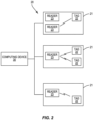
- FIG. 2 schematically illustrates an RFID system 20 that is operatively connected to a computing device 30.
- the connection can be in various manners, such as but not limited to a wireless network or through wired connections.
- the RFID system 20 is a passive system and includes one or more RFID devices 21 with tags 22 and readers 23.
- the tags 22 are configured to be attached to an object that is to be tracked/monitored.
- the readers 23 have antennas that emit an electromagnetic interrogation pulse.
- the tags 22 transmit digital data, such as an identification number or object information back to the reader 23.
- the collected information is transmitted to the computing device 30 that processes the information.
- the information is transmitted to a different system for processing.
- the computing device 30 is configured to determine the geographic location of the vehicle 100 and to operate the RFID system 20 in accordance with the one or more operational requirements for the geographic location.
- Figure 3 illustrates a flowchart of the operation of the computing device 30.
- the computing device 30 determines the geographic location of the vehicle 100 (block 200). This can occur upon the vehicle 100 experiencing an event such as but not limited to an arrival, departure, powering on, and taxiing.
- the computing device 30 determines an operational requirement for the one or more RFID devices 21 for the geographic location (block 202).
- the computing device 30 then operates the one or more RFID devices 21 according to the operational requirement (block 204).
- Figure 4 illustrates a computing device 30 that operates the RFID system 20.
- the computing device 30 includes processing circuitry 31 that controls the operation of the RFID system 20 according to program instructions 70 stored in memory circuitry 32.
- the processing circuitry 31 includes one or more circuits, microcontrollers, microprocessors, hardware, or a combination thereof.
- Memory circuitry 32 includes a non-transitory computer readable storage medium storing the program instructions 70 that configures the processing circuitry 31 to implement one or more of the techniques discussed herein.
- Memory circuitry 32 can include various memory devices such as, for example, read-only memory, and flash memory. Memory circuitry 32 can be a separate component as illustrated in Figure 4 or can be incorporated with the processing circuitry 31.
- the programming instructions 70 include an RFID sensor orchestrator 71 that provides for configuring the RFID system 20 including the one or more RFID devices 21 to operate in accordance with the applicable geographic requirements.
- the programming instructions 70 further include one or more application programming interfaces (APIs) that are software modules that are executable to facilitate the exchange of data files between one or more of the computing device 30, the a computing system 60, and the RFID system 20.
- APIs application programming interfaces
- the programming instructions 70 includes a GPS API 72, a Geolocation Translation API 73, and a UHF Regulation API 74.
- Communication circuitry 33 provides for communications with the computing system 60 located onboard the vehicle 100 and/or remotely away from the vehicle 100.
- the communication circuitry 33 also provides for communicating with the RFID system 20.
- the communication is through a network 50 located on the vehicle 100.
- the network 50 comprises a medium configured to provide communication links between various devices and systems.
- the network 50 can include connections such as wired or wireless communications links, fiber optic cables, and/or any other suitable medium for transmitting and/or communicating data between devices and/or systems.
- the communication circuitry 33 includes a WLAN interface configured to communicate with a local area network 50, e.g., via a wireless access point.
- An exemplary WLAN interface operates according to the 802.11 family of standards, which is commonly known as a WiFi interface.
- the communication circuitry 33 includes a personal area network interface, such as a Bluetooth interface.
- the communication circuitry 33 includes a cellular interface that enables communication with a mobile communication network (e.g., a WCDMA, LTE, or WiMAX network).
- a user interface 34 provides for a person such as flight personnel, a technician, or other to control one or more aspects of the computing device 30.
- the user interface 34 includes one or more input devices 35 such as but not limited to a keypad, touchpad, roller ball, and joystick that provide for entering commands to the processing circuitry 31.
- the user interface 34 can also include one or more displays 36 for displaying information.
- the computing device 30 communicates with the computing system 60 on the vehicle 100.
- the computing system 60 can include a single system that controls one or more functions of the vehicle 100, or two or more separate systems that are interconnected through the network 50. Examples of systems 60 include but are not limited to a flight control system, a flight control surface system, a navigation system, an engine system, an autopilot system, a collision avoidance system, and a weather radar system.
- Figure 4 includes an example in which the computing system 60 includes navigational functionality.
- the computing system 60 monitors the geographic location of the vehicle 100.
- the navigation computing system 60 includes a global positioning system (GPS) unit 65 that includes a transmitter that communicates with one or more satellites and ground stations that measure the latitude and longitude.
- GPS unit 65 further includes a receiver that receives the location information.
- FIG. 5 illustrates the functioning of the computing device 30 to operate the RFID devices 21 of the RFID system 20 in compliance with the applicable geographic requirements.
- the computing device 30 operates according to instructions of the RFID Sensor Orchestrator 71.
- the RFID Sensor Orchestrator 71 issues a read command for the geographic location of the vehicle 100. This request can occur in response to an event by the vehicle 100, such as but not limited to an arrival (e.g., landing), departure, taxiing, and power on of a part or entirety of the computing system 60 on the vehicle 100. In other examples, this occurs on a periodic basis such but not limited to hourly, every six hours, and at the same one or more times each day (e.g., noon, midnight).
- the GPS API 72 returns the geographic location from the GPS unit 65 of the computing system 60. In some examples, the reply from the GPS API 72 is a floating point value pair that represents the current latitude and longitude readings.
- the RFID sensor orchestrator 71 polls the Geolocation Translation API 73 for the code that corresponds to the current geographic location.
- the polling includes providing the geographic location data obtained from the GPS API 72.
- the Geolocation Translation API 73 provides the code corresponding to the provided GPS data.
- the code includes one or more of a country code, a city code, a state code, and a region code.
- the Geolocation Translation API 73 returns one or more alpha-2, alpha-3, or numeric country codes.
- the RFID sensor orchestrator 71 queries the UHF Regulation API 74 with the one or more codes.
- the UHF Regulation API 74 returns the one or more operational requirements for operating the RFID system 20 that correspond to the one or more condes.
- an operational requirement includes a frequency range that includes minimum and maximum allowable levels.
- Other examples of operational requirements include but are not limited: power levels for operation that include the maximum wattage allowed and reader-tag communication techniques.
- the RFID sensor orchestrator 71 determines whether the RFID system 20 is operating in accordance with the one or more operational requirements. The settings on the RFID devices 21 are adjusted as necessary to operate within the requirements for the identified country.
- the RFID sensor orchestrator 71 polls the RFID devices 21 for the one or more current operational settings (e.g., current frequency band).
- the current operational settings (e.g., frequency band) for the readers 23 are stored in an RFID reader map data structure.
- the map data structure is then reviewed and compared to the operational requirements returned from the UHF Regulation API 74.
- the RFID devices 21 that are within compliance are maintained. Those that are out of compliance are adjusted as necessary.
- a Change command (e.g., Frequency_Change command) is sent to the corresponding RFID Device 21.
- the RFID device 21 may use Software-Defined Radio (SDR) technology to change the frequency band in accordance with the one or more operational requirements.
- SDR RFID device may, in some examples, change the frequency band based on processing, filtering and decoding the signal data entirely via software code.
- the RFID device 21 may be a multi-frequency RFID device to operate across several distinct radio frequency bands, to be in accordance with the one or more operational requirements.
- the multi-frequency RFID device may, in some examples, comprise a combination of tunable radio frequency components, such as filters and amplifiers, and software controls that dictate the operational mode of the device.
- changing or varying a current frequency band of the RFID device 21 may for example comprise selectively coupling electrical elements, such as capacitive elements, inductive elements, or combinations thereof.
- the UHF allocations for the different countries are governed by the International Organization for Standardization (ISO). Different countries are allocated different frequency ranges within a range of between 860 to 960 MHz. Considering the frequency change between 860 to 960 MHz, the RFID device 21 is designed to change the frequency, in some examples, within 100 MHz or less. As the change of frequency within the RFID device 21 may be relatively narrow (depending on the specific design and UHF allocations where the RFID device 21 is intended to be used), the frequency band can be easily changed within the RFID device 21, without need to incorporate an additional hardware including, for example, other RFID devices operating at different frequency bands that would cover the required frequency band change.
- ISO International Organization for Standardization
- the process of determining the geographical location, the country code, the operational requirements, as well as determining the frequency settings of the RFID devices 21 and making changes as necessary are saved in an event logging system maintained in the flight system. This log can be used for various reasons, such as for maintenance, operational compliance, inspections, etc.
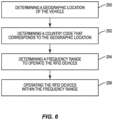
- Figure 6 illustrates a method of operating RFID devices 21 on a vehicle 100.
- the method determines a geographic location of the vehicle 100 (block 250).
- a country code is then determined that corresponds to the geographic location (block 252).
- a frequency range of operation of the RFID devices 21 is determined that corresponds to the country code (block 254).
- the RFID devices 21 are operated within the frequency range while the vehicle 100 is at the geographic location (block 256).
- the computing device 30 obtains information from an on-board source for the operation of the RFID devices 21. In other examples, the computing device 30 obtains the information from a remote source that is not on the vehicle 100. For example, the computing device 30 communicates with a remote node of an owner of the vehicle 100 that maintains the various operational requirements. In some examples, the computing device 30 communicates with a governmental authority for the one or more operational requirements.
- the computing system 60 and the RFID system 20 include processing circuitry, memory circuitry, and communication circuitry to perform the functions and communicate with the computing device 30.
- the systems are microprocessor-based such as a computer having at least one processor, memory (RAM and/or ROM), and associated input and output buses.
- the processor operates under the control of an operating system that resides in memory.
- the operating system manages computer resources so that computer program code embodied as one or more computer software applications, such as an application residing in memory, includes instructions executed by the processor.
- the processor executes the application directly, in which case the operating system may be omitted.
- the program instructions 70 are stored in the memory circuitry 32. In other examples, the program instructions 70 are located in a functional form on computer-readable media that is selectively removable and may be loaded onto or transferred to the computing device 30 for execution by the processing circuitry 31.
- the program instructions 70 include computer-readable storage media or computer-readable signal media.
- Computer-readable storage media may include, for example, an optical or magnetic disk that is inserted or placed into a drive or other device that is part of memory circuitry 32.
- Computer-readable storage media also may take the form of a persistent storage, such as a hard drive, a thumb drive, or a flash memory, that is connected to the computing device.
- computer-readable storage media is a non-transitory, physical or tangible storage device used to store program instructions.
- the program instructions 70 are transferred to the computing device 30, e.g., remotely over a network, using computer-readable signal media.
- Computer-readable signal media may be, for example, a propagated data signal containing the program instructions 70.
- the computer-readable signal media is an electromagnetic signal, an optical signal, and/or any other suitable type of signal. These signals may be transmitted over communications links, such as wireless communications links, optical fiber cable, coaxial cable, a wire, and/or any other suitable type of communications link. In other words, the communications link and/or the connection may be physical or wireless in the illustrative examples.
- program instructions 70 are downloaded over a network from another device or data processing system through computer-readable signal media for use within the computing device 30.
- the program instructions 70 include an operating system (OS).
- OS is stored in memory circuitry 32 and controls and allocates resources of the computing device 30.
- the OS includes any suitable software system configured to manage and expose hardware resources of the computing device 30.
- OS provides APIs that facilitate connection of different type of hardware and/or provide applications access to hardware and OS services.
- certain applications may provide further services for use by other applications, e.g., as is the case with so-called "middleware.”
- Vehicles 100 include but are not limited to manned aircraft, unmanned aircraft, manned spacecraft, unmanned spacecraft, manned rotorcraft, unmanned rotorcraft, satellites, rockets, missiles, manned terrestrial vehicles, unmanned terrestrial vehicles, manned surface water borne vehicles, unmanned surface water borne vehicles, manned sub-surface water borne vehicles, unmanned sub-surface water borne vehicles, and combinations thereof.
Landscapes
- Engineering & Computer Science (AREA)
- Physics & Mathematics (AREA)
- Health & Medical Sciences (AREA)
- Toxicology (AREA)
- General Physics & Mathematics (AREA)
- Computer Networks & Wireless Communication (AREA)
- Electromagnetism (AREA)
- Signal Processing (AREA)
- General Health & Medical Sciences (AREA)
- Artificial Intelligence (AREA)
- Computer Vision & Pattern Recognition (AREA)
- Theoretical Computer Science (AREA)
- Aviation & Aerospace Engineering (AREA)
- Mobile Radio Communication Systems (AREA)
- Radar, Positioning & Navigation (AREA)
- Remote Sensing (AREA)
- Traffic Control Systems (AREA)
- Geophysics And Detection Of Objects (AREA)
Abstract
Description
- The present disclosure relates generally to the field of operating devices that are located on a vehicle and, more specifically, to a method of operating the RFID devices within compliance when used on a vehicle that travels to different geographic locations.
- Vehicles such as but not limited to aircraft, ships, trains, and buses travel between different geographic locations. Examples include but are not limited to an aircraft that travels between different countries, a train that travels between different states, and a bus that travels between different cities. The different geographic locations have different regulations. This can include regulations on operating equipment that is located on the vehicle. The devices need to be adjusted as necessary to ensure compliance with the requirements of the current geographic location where the vehicle is located.
- One type of equipment located on vehicles is Radio Frequency Identification devices (RFID devices). RFID devices are used for various functions, including but not limited to tracking cargo and monitoring the position of doors and compartments. Different countries have different operational requirements for the use of RFID devices. In one example, the UHF allocations for the different countries are governed by the International Organization for Standardization (ISO). Different countries are allocated different frequency ranges within a range of between 860 to 960 MHz. Example include the United States operating within 902-928 MHz, France operating within 865.6-867.6 MHz, and China operating within 920.5-924.5 MHz.
- It is difficult to maintain compliance for RFID devices on a vehicle. An RFID device configured for use in a first country may require adjustment prior to use in a different country. There is a need for maintaining RFID devices in compliance when used on a vehicle that travels between different geographic locations.
- One aspect is directed to a method of operating radio frequency identification (RFID) devices on a vehicle. The method comprises: determining a geographic location of the vehicle; based on the geographic location of the vehicle, determining an operational requirement for the RFID devices; and operating the RFID devices according to the operational requirement.
- In another aspect, the method further comprises adjusting a setting on the RFID devices resulting in the RFID devices operating according to the operational requirement.
- In another aspect, the method further comprises determining the geographic location of the vehicle upon arrival of the vehicle at a destination.
- In another aspect, determining the geographic location of the vehicle comprises determining latitude and longitude of the vehicle and determining a country code corresponding to the latitude and longitude.
- In another aspect, the method further comprises determining a current frequency setting for the RFID devices, determining that the frequency setting for the RFID devices is outside of a frequency range, and adjusting the RFID devices to operate within the frequency range.
- In another aspects, determining the operational requirement for the RFID devices comprises determining a power level of the RFID devices.
- In another aspect, the method further comprises determining the geographic location and the operational requirement from one or more sources that are located on the vehicle.
- In another aspect, determining the operation requirement comprises determining a UHF spectrum regulatory operational requirement for operating the RFID devices within a country where the vehicle is located.
- One aspect is directed to a method of operating radio frequency identification (RFID) devices on a vehicle. The method comprises: determining a geographic location of the vehicle; determining a country code that corresponds to the geographic location; determining a frequency range of operation of the RFID devices that corresponds to the country code; and operating the RFID devices within the frequency range while the vehicle is at the geographic location.
- In another aspect, the method further comprises polling an onboard computing system that is on the vehicle and determining one or more of the geographic location, the country code, and the frequency range.
- In another aspect, the method further comprises determining that an event has occurred with the vehicle and determining the geographic location after the occurrence of the event.
- In another aspect, determining the country code comprises determining an alpha-3 country code that corresponds to the geographic location.
- In another aspect, the method further comprises determining a current frequency for the RFID devices, determining whether the current frequency is within the frequency range, adjusting a setting of the RFID devices in which the current frequency is outside of the frequency range; and operating the RFID devices within the frequency range.
- In another aspect, determining the frequency range of operation of the RFID devices that corresponds to the country code comprises determining a UHF spectrum regulatory operational requirement for operating the RFID devices within a country where the vehicle is located.
- One aspect is directed to a computing device configured to operate RFID devices. The computing device comprises memory circuitry that stores program instructions and processing circuitry. The processing circuitry is configured to execute the program instructions to cause the computing device to: determine a geographic location of the vehicle; determine a code that corresponds to the geographic location; determine a frequency range of operation for the RFID devices that corresponds to the code; and operate the RFID devices within the frequency range.
- In another aspect, the processing circuitry is configured to configure one or more onboard systems and obtain the geographic location and the code.
- In another aspect, the code is a country code that corresponds to a country where the vehicle is located.
- In another aspect, the processing circuitry is further configured to transmit commands to adjust an operational feature of the RFID devices to operate within the frequency range.
- In another aspect, the processing circuitry is configured to determine that one or more of the RFID devices are operating within the frequency range and to prevent adjustment of the one or more RFID devices.
- In another aspect, the code is a city code that corresponds to a city where the vehicle is located.
- The features, functions and advantages that have been discussed can be achieved independently in various aspects or may be combined in yet other aspects, further details of which can be seen with reference to the following description and the drawings.
-
-
Figure 1 is a schematic diagram of a vehicle equipped with a computing device and an RFID system. -
Figure 2 is schematic diagram of a computing device connected to an RFID system. -
Figure 3 is a flowchart diagram of a method of operating a radio frequency identification (RFID) device on a vehicle. -
Figure 4 is a schematic diagram of a computing device communicatively connected to a navigation system and an RFID system. -
Figure 5 is a schematic diagram of the operation of a computing device to operate an RFID system in compliance with an operational requirement. -
Figure 6 is a flowchart diagram of a method of operating RFID devices on a vehicle. -
Figure 1 illustrates an example of avehicle 100 that travels to different geographic locations. A wide variety ofvehicle 100 are applicable for use with the disclosed aspects. In this example, thevehicle 100 is an aircraft configured to fly routes of a variety of different geographic locations. Thevehicle 100 can be equipped to transport passengers and/or cargo. Thevehicle 100 is equipped with an Radio Frequency Identification (RFID)system 20 that provides for passive reading of identifying information.RFID system 20 can be used for a variety of different functions. Examples include but are not limited to monitoring luggage or cargo, monitoring life vests or other safety devices, and monitoring the orientation components such as overhead compartment doors and monument doors. Acomputing device 30 is configured to control the operation of theRFID system 20 to ensure compliance with the geographic-dependent operating parameters. - The
RFID system 20 operates in accordance with the requirements of the geographic location where thevehicle 100 is located. The size of the geographic location can vary with examples including but not limited to a country (e.g., Germany), a state (e.g., North Carolina, USA), a region (e.g., Europe), and a city (Paris). The operational requirements can vary. In some examples, an operational requirement includes a frequency range with minimum and maximum allowable levels. Specific examples include the United States operating within a frequency range of 902-928 MHz, France operating within 865.6-867.6 MHz, and China operating within 920.5-924.5 MHz. One specific requirement is an Ultra High Frequency (UHF) spectrum regulatory operational requirement for operating theRFID devices 21. Other examples of operational requirements include but are not limited: power levels for operation that include the maximum wattage allowed and calculated as Effective Radiated Power (ERP) or Equivalent Isotropic Radiated Power (EIRP); and reader-tag communication techniques such as Frequency Hopping Spread Spectrum (FHSS), Listen Before Talk (LBT), and European Telecommunications Standards (ETSI). -
Figure 2 schematically illustrates anRFID system 20 that is operatively connected to acomputing device 30. The connection can be in various manners, such as but not limited to a wireless network or through wired connections. TheRFID system 20 is a passive system and includes one ormore RFID devices 21 withtags 22 andreaders 23. Thetags 22 are configured to be attached to an object that is to be tracked/monitored. Thereaders 23 have antennas that emit an electromagnetic interrogation pulse. In response, thetags 22 transmit digital data, such as an identification number or object information back to thereader 23. In some examples, the collected information is transmitted to thecomputing device 30 that processes the information. In other examples, the information is transmitted to a different system for processing. - The
computing device 30 is configured to determine the geographic location of thevehicle 100 and to operate theRFID system 20 in accordance with the one or more operational requirements for the geographic location.Figure 3 illustrates a flowchart of the operation of thecomputing device 30. Thecomputing device 30 determines the geographic location of the vehicle 100 (block 200). This can occur upon thevehicle 100 experiencing an event such as but not limited to an arrival, departure, powering on, and taxiing. Thecomputing device 30 determines an operational requirement for the one ormore RFID devices 21 for the geographic location (block 202). Thecomputing device 30 then operates the one ormore RFID devices 21 according to the operational requirement (block 204). -
Figure 4 illustrates acomputing device 30 that operates theRFID system 20. Thecomputing device 30 includes processing circuitry 31 that controls the operation of theRFID system 20 according toprogram instructions 70 stored inmemory circuitry 32. The processing circuitry 31 includes one or more circuits, microcontrollers, microprocessors, hardware, or a combination thereof.Memory circuitry 32 includes a non-transitory computer readable storage medium storing theprogram instructions 70 that configures the processing circuitry 31 to implement one or more of the techniques discussed herein.Memory circuitry 32 can include various memory devices such as, for example, read-only memory, and flash memory.Memory circuitry 32 can be a separate component as illustrated inFigure 4 or can be incorporated with the processing circuitry 31. - The
programming instructions 70 include anRFID sensor orchestrator 71 that provides for configuring theRFID system 20 including the one ormore RFID devices 21 to operate in accordance with the applicable geographic requirements. Theprogramming instructions 70 further include one or more application programming interfaces (APIs) that are software modules that are executable to facilitate the exchange of data files between one or more of thecomputing device 30, the acomputing system 60, and theRFID system 20. In one example as illustrated inFigure 4 , theprogramming instructions 70 includes aGPS API 72, aGeolocation Translation API 73, and aUHF Regulation API 74. -
Communication circuitry 33 provides for communications with thecomputing system 60 located onboard thevehicle 100 and/or remotely away from thevehicle 100. Thecommunication circuitry 33 also provides for communicating with theRFID system 20. In some examples, the communication is through anetwork 50 located on thevehicle 100. Thenetwork 50 comprises a medium configured to provide communication links between various devices and systems. Thenetwork 50 can include connections such as wired or wireless communications links, fiber optic cables, and/or any other suitable medium for transmitting and/or communicating data between devices and/or systems. - In some examples, the
communication circuitry 33 includes a WLAN interface configured to communicate with alocal area network 50, e.g., via a wireless access point. An exemplary WLAN interface operates according to the 802.11 family of standards, which is commonly known as a WiFi interface. In some examples, thecommunication circuitry 33 includes a personal area network interface, such as a Bluetooth interface. In some examples, thecommunication circuitry 33 includes a cellular interface that enables communication with a mobile communication network (e.g., a WCDMA, LTE, or WiMAX network). - A user interface 34 provides for a person such as flight personnel, a technician, or other to control one or more aspects of the
computing device 30. The user interface 34 includes one ormore input devices 35 such as but not limited to a keypad, touchpad, roller ball, and joystick that provide for entering commands to the processing circuitry 31. The user interface 34 can also include one ormore displays 36 for displaying information. - The
computing device 30 communicates with thecomputing system 60 on thevehicle 100. Thecomputing system 60 can include a single system that controls one or more functions of thevehicle 100, or two or more separate systems that are interconnected through thenetwork 50. Examples ofsystems 60 include but are not limited to a flight control system, a flight control surface system, a navigation system, an engine system, an autopilot system, a collision avoidance system, and a weather radar system. -
Figure 4 includes an example in which thecomputing system 60 includes navigational functionality. Thecomputing system 60 monitors the geographic location of thevehicle 100. In some examples, thenavigation computing system 60 includes a global positioning system (GPS)unit 65 that includes a transmitter that communicates with one or more satellites and ground stations that measure the latitude and longitude. TheGPS unit 65 further includes a receiver that receives the location information. -
Figure 5 illustrates the functioning of thecomputing device 30 to operate theRFID devices 21 of theRFID system 20 in compliance with the applicable geographic requirements. Thecomputing device 30 operates according to instructions of theRFID Sensor Orchestrator 71. TheRFID Sensor Orchestrator 71 issues a read command for the geographic location of thevehicle 100. This request can occur in response to an event by thevehicle 100, such as but not limited to an arrival (e.g., landing), departure, taxiing, and power on of a part or entirety of thecomputing system 60 on thevehicle 100. In other examples, this occurs on a periodic basis such but not limited to hourly, every six hours, and at the same one or more times each day (e.g., noon, midnight). TheGPS API 72 returns the geographic location from theGPS unit 65 of thecomputing system 60. In some examples, the reply from theGPS API 72 is a floating point value pair that represents the current latitude and longitude readings. - Upon receiving the GPS data, the
RFID sensor orchestrator 71 polls theGeolocation Translation API 73 for the code that corresponds to the current geographic location. The polling includes providing the geographic location data obtained from theGPS API 72. In return, theGeolocation Translation API 73 provides the code corresponding to the provided GPS data. The code includes one or more of a country code, a city code, a state code, and a region code. In some examples, theGeolocation Translation API 73 returns one or more alpha-2, alpha-3, or numeric country codes. - The
RFID sensor orchestrator 71 then queries theUHF Regulation API 74 with the one or more codes. TheUHF Regulation API 74 returns the one or more operational requirements for operating theRFID system 20 that correspond to the one or more condes. In some examples, an operational requirement includes a frequency range that includes minimum and maximum allowable levels. Other examples of operational requirements include but are not limited: power levels for operation that include the maximum wattage allowed and reader-tag communication techniques. - The
RFID sensor orchestrator 71 determines whether theRFID system 20 is operating in accordance with the one or more operational requirements. The settings on theRFID devices 21 are adjusted as necessary to operate within the requirements for the identified country. - In some examples, the
RFID sensor orchestrator 71 polls theRFID devices 21 for the one or more current operational settings (e.g., current frequency band). The current operational settings (e.g., frequency band) for thereaders 23 are stored in an RFID reader map data structure. The map data structure is then reviewed and compared to the operational requirements returned from theUHF Regulation API 74. TheRFID devices 21 that are within compliance are maintained. Those that are out of compliance are adjusted as necessary. In some examples, for eachRFID device 21 that is determined to be in an incompatible operational setting, a Change command (e.g., Frequency_Change command) is sent to thecorresponding RFID Device 21. In some examples, theRFID device 21 may use Software-Defined Radio (SDR) technology to change the frequency band in accordance with the one or more operational requirements. The SDR RFID device may, in some examples, change the frequency band based on processing, filtering and decoding the signal data entirely via software code. In some examples, theRFID device 21 may be a multi-frequency RFID device to operate across several distinct radio frequency bands, to be in accordance with the one or more operational requirements. The multi-frequency RFID device may, in some examples, comprise a combination of tunable radio frequency components, such as filters and amplifiers, and software controls that dictate the operational mode of the device. In some examples, changing or varying a current frequency band of theRFID device 21 may for example comprise selectively coupling electrical elements, such as capacitive elements, inductive elements, or combinations thereof. - For example, different countries may have different operational requirements for the use of
RFID devices 21. In one example, the UHF allocations for the different countries are governed by the International Organization for Standardization (ISO). Different countries are allocated different frequency ranges within a range of between 860 to 960 MHz. Considering the frequency change between 860 to 960 MHz, theRFID device 21 is designed to change the frequency, in some examples, within 100 MHz or less. As the change of frequency within theRFID device 21 may be relatively narrow (depending on the specific design and UHF allocations where theRFID device 21 is intended to be used), the frequency band can be easily changed within theRFID device 21, without need to incorporate an additional hardware including, for example, other RFID devices operating at different frequency bands that would cover the required frequency band change. - The process of determining the geographical location, the country code, the operational requirements, as well as determining the frequency settings of the
RFID devices 21 and making changes as necessary are saved in an event logging system maintained in the flight system. This log can be used for various reasons, such as for maintenance, operational compliance, inspections, etc. -
Figure 6 illustrates a method ofoperating RFID devices 21 on avehicle 100. The method determines a geographic location of the vehicle 100 (block 250). A country code is then determined that corresponds to the geographic location (block 252). A frequency range of operation of theRFID devices 21 is determined that corresponds to the country code (block 254). TheRFID devices 21 are operated within the frequency range while thevehicle 100 is at the geographic location (block 256). - In some examples, the
computing device 30 obtains information from an on-board source for the operation of theRFID devices 21. In other examples, thecomputing device 30 obtains the information from a remote source that is not on thevehicle 100. For example, thecomputing device 30 communicates with a remote node of an owner of thevehicle 100 that maintains the various operational requirements. In some examples, thecomputing device 30 communicates with a governmental authority for the one or more operational requirements. - The
computing system 60 and theRFID system 20 include processing circuitry, memory circuitry, and communication circuitry to perform the functions and communicate with thecomputing device 30. In some examples, the systems are microprocessor-based such as a computer having at least one processor, memory (RAM and/or ROM), and associated input and output buses. In some examples, the processor operates under the control of an operating system that resides in memory. In some examples, the operating system manages computer resources so that computer program code embodied as one or more computer software applications, such as an application residing in memory, includes instructions executed by the processor. In some examples, the processor executes the application directly, in which case the operating system may be omitted. - In some examples, the
program instructions 70 are stored in thememory circuitry 32. In other examples, theprogram instructions 70 are located in a functional form on computer-readable media that is selectively removable and may be loaded onto or transferred to thecomputing device 30 for execution by the processing circuitry 31. In some examples, theprogram instructions 70 include computer-readable storage media or computer-readable signal media. Computer-readable storage media may include, for example, an optical or magnetic disk that is inserted or placed into a drive or other device that is part ofmemory circuitry 32. Computer-readable storage media also may take the form of a persistent storage, such as a hard drive, a thumb drive, or a flash memory, that is connected to the computing device. In some examples, computer-readable storage media is a non-transitory, physical or tangible storage device used to store program instructions. - In some examples, the
program instructions 70 are transferred to thecomputing device 30, e.g., remotely over a network, using computer-readable signal media. Computer-readable signal media may be, for example, a propagated data signal containing theprogram instructions 70. In some examples, the computer-readable signal media is an electromagnetic signal, an optical signal, and/or any other suitable type of signal. These signals may be transmitted over communications links, such as wireless communications links, optical fiber cable, coaxial cable, a wire, and/or any other suitable type of communications link. In other words, the communications link and/or the connection may be physical or wireless in the illustrative examples. In some examples,program instructions 70 are downloaded over a network from another device or data processing system through computer-readable signal media for use within thecomputing device 30. - In some examples, the
program instructions 70 include an operating system (OS). The OS is stored inmemory circuitry 32 and controls and allocates resources of thecomputing device 30. The OS includes any suitable software system configured to manage and expose hardware resources of thecomputing device 30. In some examples, OS provides APIs that facilitate connection of different type of hardware and/or provide applications access to hardware and OS services. In some examples, certain applications may provide further services for use by other applications, e.g., as is the case with so-called "middleware." - The methods disclosed can be used on a variety of
vehicles 100.Vehicles 100 include but are not limited to manned aircraft, unmanned aircraft, manned spacecraft, unmanned spacecraft, manned rotorcraft, unmanned rotorcraft, satellites, rockets, missiles, manned terrestrial vehicles, unmanned terrestrial vehicles, manned surface water borne vehicles, unmanned surface water borne vehicles, manned sub-surface water borne vehicles, unmanned sub-surface water borne vehicles, and combinations thereof. - The present disclosure can be carried out in other ways than those specifically set forth herein without departing from essential characteristics of the invention. The present embodiments are to be considered in all respects as illustrative and not restrictive, and all changes coming within the meaning and equivalency range of the appended claims are intended to be embraced therein.
- Illustrative, non-exclusive examples of inventive subject matter according to the present disclosure are described in the following enumerated paragraphs:
- Clause: 1: A method of operating radio frequency identification (RFID) devices on a
vehicle 100, the method comprising:- determining a geographic location of the
vehicle 100; - based on the geographic location of the
vehicle 100, determining an operational requirement for theRFID devices 21; and - operating the
RFID devices 21 according to the operational requirement.
- determining a geographic location of the
- Clause 2: The method of Clause 1, further comprising adjusting a setting on the
RFID devices 21 resulting in theRFID devices 21 operating according to the operational requirement. - Clause 3: The method of Clause 1, further comprising determining the geographic location of the
vehicle 100 upon arrival of thevehicle 100 at a destination. - Clause 4: The method of Clause 1, wherein determining the geographic location of the
vehicle 100 comprises determining latitude and longitude of thevehicle 100 and determining a country code corresponding to the latitude and longitude. - Clause 5: The method of Clause 1, further comprising:
- determining a current frequency setting for the
RFID devices 21; - determining that the current frequency setting for the
RFID devices 21 is outside of a frequency range; and - adjusting the
RFID devices 21 to operate within the frequency range.
- determining a current frequency setting for the
- Clause 6: The method of Clause 1, wherein determining the operational requirement for the
RFID devices 21 comprises determining a power level of theRFID devices 21. - Clause 7: The method of Clause 1, further comprising determining the geographic location and the operational requirement from one or more sources that are located on the
vehicle 100. - Clause 8: The method of Clause 1, wherein determining the operation requirement comprises determining a UHF spectrum regulatory operational requirement for operating the
RFID devices 21 within a country where thevehicle 100 is located. - Clause 9: A method of operating radio frequency identification (RFID) devices on a
vehicle 100, the method comprising:- determining a geographic location of the
vehicle 100; - determining a country code that corresponds to the geographic location;
- determining a frequency range of operation of the
RFID devices 21 that corresponds to the country code; and - operating the
RFID devices 21 within the frequency range while thevehicle 100 is at the geographic location.
- determining a geographic location of the
- Clause 10: The method of Clause 9, further comprising polling an
onboard computing system 60 that is on thevehicle 100 and determining one or more of the geographic location, the country code, and the frequency range. - Clause 11: The method of Clause 9, further comprising determining that an event has occurred with the
vehicle 100 and determining the geographic location after occurrence of the event. - Clause 12: The method of Clause 9, wherein determining the country code comprises determining an alpha-3 country code that corresponds to the geographic location.
- Clause 13: The method of Clause 9, further comprising:
- determining a current frequency for the
RFID devices 21; - determining whether the current frequency is within the frequency range;
- adjusting a setting of the
RFID devices 21 in which the current frequency is outside of the frequency range; and - operating the
RFID devices 21 within the frequency range.
- determining a current frequency for the
- Clause 14: The method of Clause 9, wherein determining the frequency range of operation of the
RFID devices 21 that corresponds to the country code comprises determining a UHF spectrum regulatory operational requirement for operating theRFID devices 21 within a country where thevehicle 100 is located. - Clause 15: A computing device configured to operate
RFID devices 21, the computing device comprising:-
memory circuitry 32 that storesprogram instructions 70; and - processing circuitry 31 configured to execute the
program instructions 70 to cause the computing device to:- determine a geographic location of the
vehicle 100; - determine a code that corresponds to the geographic location;
- determine a frequency range of operation for the
RFID devices 21 that corresponds to the code; and - operate the
RFID devices 21 within the frequency range.
- determine a geographic location of the
-
- Clause 16: The computing device of Clause 15, wherein the processing circuitry 31 is configured to configure one or more
onboard systems 60 and obtain the geographic location and the code. - Clause 17: The computing device of Clause 15, wherein the code is a country code that corresponds to a country where the
vehicle 100 is located. - Clause 18: The computing device of Clause 15, wherein the processing circuitry 31 is further configured to transmit commands to adjust an operational feature of the
RFID devices 21 to operate within the frequency range. - Clause 19: The computing device of Clause 15, wherein the processing circuitry 31 is configured to determine that one or more of the
RFID devices 21 are operating within the frequency range and to prevent adjustment of the one ormore RFID devices 21. - Clause 20: The computing device of Clause 15, wherein the code is a city code that corresponds to a city where the
vehicle 100 is located.
Claims (15)
- A method of operating radio frequency identification (RFID) devices (21) on a vehicle (100), the method comprising:determining (200) a geographic location of the vehicle (100);based on the geographic location of the vehicle (100), determining (202) an operational requirement for the RFID devices (21); andoperating (204) the RFID devices (21) according to the operational requirement.
- The method of claim 1, further comprising adjusting a setting on the RFID devices (21) resulting in the RFID devices (21) operating according to the operational requirement.
- The method of claim 1 or 2, further comprising determining the geographic location of the vehicle (100) upon arrival of the vehicle (100) at a destination.
- The method of any one of claims 1 to 3, wherein determining the geographic location of the vehicle (100) comprises determining latitude and longitude of the vehicle (100) and determining a country code corresponding to the latitude and longitude.
- The method of any one of claims 1 to 4, further comprising:determining a current frequency setting for the RFID devices (21);determining that the current frequency setting for the RFID devices (21) is outside of a frequency range of the operational requirement; andadjusting the RFID devices (21) to operate within the frequency range.
- The method of any one of claims 1 to 5, wherein determining the operational requirement for the RFID devices (21) comprises determining a power level of the RFID devices (21).
- The method of any one of claims 1 to 6, further comprising determining the geographic location and the operational requirement from one or more sources that are located on the vehicle (100).
- The method of any one of claims 1 to 7, wherein determining the operation requirement comprises determining a UHF spectrum regulatory operational requirement for operating the RFID devices (21) within a country where the vehicle (100) is located.
- The method of any of claims 1 to 8, further comprising:determining a country code that corresponds to the geographic location;determining a frequency range of operation of the RFID devices (21) that corresponds to the country code; andoperating the RFID devices (21) within the frequency range while the vehicle (100) is at the determined geographic location.
- The method of claim 9, further comprising polling an onboard computing system (60) that is on the vehicle (100) and determining one or more of the geographic location, the country code, and the frequency range.
- The method of claim 9 or 10, wherein determining the country code comprises determining an alpha-3 country code that corresponds to the geographic location.
- The method of any one of claims 9 to 11, wherein determining the frequency range of operation of the RFID devices (21) that corresponds to the country code comprises determining a UHF spectrum regulatory operational requirement for operating the RFID devices (21) within a country where the vehicle (100) is located.
- A computing device (30) configured to operate RFID devices (21), the computing device (30) comprising:memory circuitry (32) configured to store program instructions; andprocessing circuitry (31) configured to execute the program instructions to cause the computing device (30) to:determine a geographic location of the vehicle (100);determine a country code that corresponds to the geographic location;determine a frequency range of operation for the RFID devices (21) that corresponds to the country code; andoperate the RFID devices (21) within the frequency range.
- The computing device of claim 13, wherein the processing circuitry (31) is further configured to transmit commands to adjust an operational feature of the RFID devices (21) to operate within the frequency range.
- The computing device of claim 13 or 14, wherein the processing circuitry (31) is configured to determine that one or more of the RFID devices (21) are operating within the frequency range and to prevent adjustment of the one or more RFID devices (21).
Applications Claiming Priority (1)
| Application Number | Priority Date | Filing Date | Title |
|---|---|---|---|
| US18/334,710 US20240420575A1 (en) | 2023-06-14 | 2023-06-14 | Method of Operating Radio Frequency Identification (RFID) Devices on a Vehicle |
Publications (2)
| Publication Number | Publication Date |
|---|---|
| EP4478245A1 true EP4478245A1 (en) | 2024-12-18 |
| EP4478245B1 EP4478245B1 (en) | 2026-02-11 |
Family
ID=90468801
Family Applications (1)
| Application Number | Title | Priority Date | Filing Date |
|---|---|---|---|
| EP24165850.9A Active EP4478245B1 (en) | 2023-06-14 | 2024-03-25 | Method of operating radio frequency identification (rfid) devices on a vehicle |
Country Status (4)
| Country | Link |
|---|---|
| US (1) | US20240420575A1 (en) |
| EP (1) | EP4478245B1 (en) |
| JP (1) | JP2025026816A (en) |
| CN (1) | CN119155660A (en) |
Citations (4)
| Publication number | Priority date | Publication date | Assignee | Title |
|---|---|---|---|---|
| US20090322551A1 (en) * | 2008-06-25 | 2009-12-31 | Symbol Technologies, Inc. | Geographically agnostic wireless data communication system having wireless devices |
| US20130157638A1 (en) * | 2011-12-20 | 2013-06-20 | Per Malmbak | Detecting indoor and outdoor usage of a mobile device |
| US20130265141A1 (en) * | 2012-04-09 | 2013-10-10 | Karen M. Etzkorn | Systems and methods for multiple frequency band rfid |
| EP3261383A1 (en) * | 2016-06-23 | 2017-12-27 | BAE Systems PLC | Improvements in and relating to telecommunications networks |
Family Cites Families (6)
| Publication number | Priority date | Publication date | Assignee | Title |
|---|---|---|---|---|
| US6167238A (en) * | 1999-06-25 | 2000-12-26 | Harris Corporation | Wireless-based aircraft data communication system with automatic frequency control |
| CA2758807C (en) * | 2009-04-16 | 2018-09-04 | Andrew N. Lemmon | System and method for management of wireless devices aboard an aircraft |
| US9621584B1 (en) * | 2009-09-30 | 2017-04-11 | Amazon Technologies, Inc. | Standards compliance for computing data |
| US10915452B2 (en) * | 2019-06-19 | 2021-02-09 | Visa International Service Association | Method, system, and computer program product for maintaining a cache |
| US12272221B2 (en) * | 2019-08-30 | 2025-04-08 | Sensormatic Electronics, LLC | Radio frequency identification (RFID) tag location verification using acousto-magnetic detection |
| CN111859464A (en) * | 2020-05-27 | 2020-10-30 | 中国平安财产保险股份有限公司 | Data verification method, apparatus, device, and computer-readable storage medium |
-
2023
- 2023-06-14 US US18/334,710 patent/US20240420575A1/en active Pending
-
2024
- 2024-03-25 EP EP24165850.9A patent/EP4478245B1/en active Active
- 2024-05-16 CN CN202410611011.7A patent/CN119155660A/en active Pending
- 2024-06-13 JP JP2024095602A patent/JP2025026816A/en active Pending
Patent Citations (4)
| Publication number | Priority date | Publication date | Assignee | Title |
|---|---|---|---|---|
| US20090322551A1 (en) * | 2008-06-25 | 2009-12-31 | Symbol Technologies, Inc. | Geographically agnostic wireless data communication system having wireless devices |
| US20130157638A1 (en) * | 2011-12-20 | 2013-06-20 | Per Malmbak | Detecting indoor and outdoor usage of a mobile device |
| US20130265141A1 (en) * | 2012-04-09 | 2013-10-10 | Karen M. Etzkorn | Systems and methods for multiple frequency band rfid |
| EP3261383A1 (en) * | 2016-06-23 | 2017-12-27 | BAE Systems PLC | Improvements in and relating to telecommunications networks |
Also Published As
| Publication number | Publication date |
|---|---|
| US20240420575A1 (en) | 2024-12-19 |
| CN119155660A (en) | 2024-12-17 |
| EP4478245B1 (en) | 2026-02-11 |
| JP2025026816A (en) | 2025-02-26 |
Similar Documents
| Publication | Publication Date | Title |
|---|---|---|
| EP3194273B1 (en) | Fail safe aircraft monitoring and tracking | |
| US10650684B2 (en) | Guidance system and automatic control for vehicles | |
| US9310477B1 (en) | Systems and methods for monitoring airborne objects | |
| US9854557B2 (en) | System for automatic configuration of a mobile communication system | |
| AU2016204326B2 (en) | Aircraft distress tracking and interface to search and rescue system | |
| US12148311B2 (en) | Systems and methods for managing energy use in automated vehicles | |
| EP3258619B1 (en) | Airbourne cellular communication system | |
| EP2551700A1 (en) | Alternative communication link for an air vehicle | |
| CN101714300B (en) | Unmanned plane flight collision avoidance method and device | |
| EP3438702B1 (en) | Position reporting for vehicles | |
| AU2017425949B2 (en) | Flight information collection system, wireless communication device, relay, flight information collection method | |
| US20240420575A1 (en) | Method of Operating Radio Frequency Identification (RFID) Devices on a Vehicle | |
| US10571909B2 (en) | Autonomous distress tracking device | |
| US20230327750A1 (en) | Commanding autonomous vehicles using multi-link satellite networks | |
| CN117833993A (en) | Unmanned aerial vehicle information communication method and control equipment | |
| WO2019107047A1 (en) | Information processing device | |
| CN121239277A (en) | Control methods for airborne radio frequency modules, methods and equipment for transmitting site maps. | |
| HK40032135A (en) | Flight information collection system, wireless communication device, relay, flight information collection method |
Legal Events
| Date | Code | Title | Description |
|---|---|---|---|
| PUAI | Public reference made under article 153(3) epc to a published international application that has entered the european phase |
Free format text: ORIGINAL CODE: 0009012 |
|
| STAA | Information on the status of an ep patent application or granted ep patent |
Free format text: STATUS: THE APPLICATION HAS BEEN PUBLISHED |
|
| AK | Designated contracting states |
Kind code of ref document: A1 Designated state(s): AL AT BE BG CH CY CZ DE DK EE ES FI FR GB GR HR HU IE IS IT LI LT LU LV MC ME MK MT NL NO PL PT RO RS SE SI SK SM TR |
|
| STAA | Information on the status of an ep patent application or granted ep patent |
Free format text: STATUS: REQUEST FOR EXAMINATION WAS MADE |
|
| 17P | Request for examination filed |
Effective date: 20250520 |
|
| GRAP | Despatch of communication of intention to grant a patent |
Free format text: ORIGINAL CODE: EPIDOSNIGR1 |
|
| STAA | Information on the status of an ep patent application or granted ep patent |
Free format text: STATUS: GRANT OF PATENT IS INTENDED |
|
| RIC1 | Information provided on ipc code assigned before grant |
Ipc: G06K 7/10 20060101AFI20251021BHEP |
|
| INTG | Intention to grant announced |
Effective date: 20251030 |
|
| GRAS | Grant fee paid |
Free format text: ORIGINAL CODE: EPIDOSNIGR3 |
|
| GRAA | (expected) grant |
Free format text: ORIGINAL CODE: 0009210 |
|
| STAA | Information on the status of an ep patent application or granted ep patent |
Free format text: STATUS: THE PATENT HAS BEEN GRANTED |
|
| AK | Designated contracting states |
Kind code of ref document: B1 Designated state(s): AL AT BE BG CH CY CZ DE DK EE ES FI FR GB GR HR HU IE IS IT LI LT LU LV MC ME MK MT NL NO PL PT RO RS SE SI SK SM TR |
|
| REG | Reference to a national code |
Ref country code: CH Ref legal event code: F10 Free format text: ST27 STATUS EVENT CODE: U-0-0-F10-F00 (AS PROVIDED BY THE NATIONAL OFFICE) Effective date: 20260211 Ref country code: GB Ref legal event code: FG4D |
|
| P01 | Opt-out of the competence of the unified patent court (upc) registered |
Free format text: CASE NUMBER: UPC_APP_0001806_4478245/2026 Effective date: 20260120 |
|
| REG | Reference to a national code |
Ref country code: DE Ref legal event code: R096 Ref document number: 602024002451 Country of ref document: DE |
|
| REG | Reference to a national code |
Ref country code: IE Ref legal event code: FG4D |
|
| PGFP | Annual fee paid to national office [announced via postgrant information from national office to epo] |
Ref country code: DE Payment date: 20260327 Year of fee payment: 3 |
|
| PGFP | Annual fee paid to national office [announced via postgrant information from national office to epo] |
Ref country code: AT Payment date: 20260301 Year of fee payment: 3 |
|
| PGFP | Annual fee paid to national office [announced via postgrant information from national office to epo] |
Ref country code: FR Payment date: 20260325 Year of fee payment: 3 |
|
| REG | Reference to a national code |
Ref country code: NL Ref legal event code: MP Effective date: 20260211 |
|
| PG25 | Lapsed in a contracting state [announced via postgrant information from national office to epo] |
Ref country code: RS Free format text: LAPSE BECAUSE OF FAILURE TO SUBMIT A TRANSLATION OF THE DESCRIPTION OR TO PAY THE FEE WITHIN THE PRESCRIBED TIME-LIMIT Effective date: 20260511 |
|
| PG25 | Lapsed in a contracting state [announced via postgrant information from national office to epo] |
Ref country code: ES Free format text: LAPSE BECAUSE OF FAILURE TO SUBMIT A TRANSLATION OF THE DESCRIPTION OR TO PAY THE FEE WITHIN THE PRESCRIBED TIME-LIMIT Effective date: 20260211 |
|
| PG25 | Lapsed in a contracting state [announced via postgrant information from national office to epo] |
Ref country code: PL Free format text: LAPSE BECAUSE OF FAILURE TO SUBMIT A TRANSLATION OF THE DESCRIPTION OR TO PAY THE FEE WITHIN THE PRESCRIBED TIME-LIMIT Effective date: 20260211 |
|
| PG25 | Lapsed in a contracting state [announced via postgrant information from national office to epo] |
Ref country code: GR Free format text: LAPSE BECAUSE OF FAILURE TO SUBMIT A TRANSLATION OF THE DESCRIPTION OR TO PAY THE FEE WITHIN THE PRESCRIBED TIME-LIMIT Effective date: 20260512 |
|
| REG | Reference to a national code |
Ref country code: LT Ref legal event code: MG9D |
|
| PG25 | Lapsed in a contracting state [announced via postgrant information from national office to epo] |
Ref country code: LT Free format text: LAPSE BECAUSE OF FAILURE TO SUBMIT A TRANSLATION OF THE DESCRIPTION OR TO PAY THE FEE WITHIN THE PRESCRIBED TIME-LIMIT Effective date: 20260211 |
|
| PG25 | Lapsed in a contracting state [announced via postgrant information from national office to epo] |
Ref country code: NO Free format text: LAPSE BECAUSE OF FAILURE TO SUBMIT A TRANSLATION OF THE DESCRIPTION OR TO PAY THE FEE WITHIN THE PRESCRIBED TIME-LIMIT Effective date: 20260511 |
|
| PG25 | Lapsed in a contracting state [announced via postgrant information from national office to epo] |
Ref country code: FI Free format text: LAPSE BECAUSE OF FAILURE TO SUBMIT A TRANSLATION OF THE DESCRIPTION OR TO PAY THE FEE WITHIN THE PRESCRIBED TIME-LIMIT Effective date: 20260211 Ref country code: SE Free format text: LAPSE BECAUSE OF FAILURE TO SUBMIT A TRANSLATION OF THE DESCRIPTION OR TO PAY THE FEE WITHIN THE PRESCRIBED TIME-LIMIT Effective date: 20260211 Ref country code: AT Free format text: LAPSE BECAUSE OF FAILURE TO SUBMIT A TRANSLATION OF THE DESCRIPTION OR TO PAY THE FEE WITHIN THE PRESCRIBED TIME-LIMIT Effective date: 20260211 |
|
| REG | Reference to a national code |
Ref country code: AT Ref legal event code: MK05 Ref document number: 1886316 Country of ref document: AT Kind code of ref document: T Effective date: 20260211 |
|
| PG25 | Lapsed in a contracting state [announced via postgrant information from national office to epo] |
Ref country code: HR Free format text: LAPSE BECAUSE OF FAILURE TO SUBMIT A TRANSLATION OF THE DESCRIPTION OR TO PAY THE FEE WITHIN THE PRESCRIBED TIME-LIMIT Effective date: 20260211 |
|
| PG25 | Lapsed in a contracting state [announced via postgrant information from national office to epo] |
Ref country code: IS Free format text: LAPSE BECAUSE OF FAILURE TO SUBMIT A TRANSLATION OF THE DESCRIPTION OR TO PAY THE FEE WITHIN THE PRESCRIBED TIME-LIMIT Effective date: 20260611 Ref country code: PT Free format text: LAPSE BECAUSE OF FAILURE TO SUBMIT A TRANSLATION OF THE DESCRIPTION OR TO PAY THE FEE WITHIN THE PRESCRIBED TIME-LIMIT Effective date: 20260611 |
|
| PG25 | Lapsed in a contracting state [announced via postgrant information from national office to epo] |
Ref country code: NL Free format text: LAPSE BECAUSE OF FAILURE TO SUBMIT A TRANSLATION OF THE DESCRIPTION OR TO PAY THE FEE WITHIN THE PRESCRIBED TIME-LIMIT Effective date: 20260211 |
|
| PG25 | Lapsed in a contracting state [announced via postgrant information from national office to epo] |
Ref country code: LV Free format text: LAPSE BECAUSE OF FAILURE TO SUBMIT A TRANSLATION OF THE DESCRIPTION OR TO PAY THE FEE WITHIN THE PRESCRIBED TIME-LIMIT Effective date: 20260211 |
|
| PG25 | Lapsed in a contracting state [announced via postgrant information from national office to epo] |
Ref country code: BG Free format text: LAPSE BECAUSE OF FAILURE TO SUBMIT A TRANSLATION OF THE DESCRIPTION OR TO PAY THE FEE WITHIN THE PRESCRIBED TIME-LIMIT Effective date: 20260211 |