EP4478130A1 - Electrophotographic photoreceptor, process cartridge, and image forming apparatus - Google Patents
Electrophotographic photoreceptor, process cartridge, and image forming apparatus Download PDFInfo
- Publication number
- EP4478130A1 EP4478130A1 EP24156738.7A EP24156738A EP4478130A1 EP 4478130 A1 EP4478130 A1 EP 4478130A1 EP 24156738 A EP24156738 A EP 24156738A EP 4478130 A1 EP4478130 A1 EP 4478130A1
- Authority
- EP
- European Patent Office
- Prior art keywords
- group
- carbon atoms
- formula
- less carbon
- less
- Prior art date
- Legal status (The legal status is an assumption and is not a legal conclusion. Google has not performed a legal analysis and makes no representation as to the accuracy of the status listed.)
- Granted
Links
Images


Classifications
-
- G—PHYSICS
- G03—PHOTOGRAPHY; CINEMATOGRAPHY; ANALOGOUS TECHNIQUES USING WAVES OTHER THAN OPTICAL WAVES; ELECTROGRAPHY; HOLOGRAPHY
- G03G—ELECTROGRAPHY; ELECTROPHOTOGRAPHY; MAGNETOGRAPHY
- G03G5/00—Recording-members for original recording by exposure, e.g. to light, to heat or to electrons; Manufacture thereof; Selection of materials therefor
-
- G—PHYSICS
- G03—PHOTOGRAPHY; CINEMATOGRAPHY; ANALOGOUS TECHNIQUES USING WAVES OTHER THAN OPTICAL WAVES; ELECTROGRAPHY; HOLOGRAPHY
- G03G—ELECTROGRAPHY; ELECTROPHOTOGRAPHY; MAGNETOGRAPHY
- G03G5/00—Recording-members for original recording by exposure, e.g. to light, to heat or to electrons; Manufacture thereof; Selection of materials therefor
- G03G5/02—Charge-receiving layers
- G03G5/04—Photoconductive layers; Charge-generation layers or charge-transporting layers; Additives therefor; Binders therefor
- G03G5/05—Organic bonding materials; Methods for coating a substrate with a photoconductive layer; Inert supplements for use in photoconductive layers
- G03G5/0528—Macromolecular bonding materials
- G03G5/0557—Macromolecular bonding materials obtained otherwise than by reactions only involving carbon-to-carbon unsatured bonds
- G03G5/056—Polyesters
-
- G—PHYSICS
- G03—PHOTOGRAPHY; CINEMATOGRAPHY; ANALOGOUS TECHNIQUES USING WAVES OTHER THAN OPTICAL WAVES; ELECTROGRAPHY; HOLOGRAPHY
- G03G—ELECTROGRAPHY; ELECTROPHOTOGRAPHY; MAGNETOGRAPHY
- G03G21/00—Arrangements not provided for by groups G03G13/00 - G03G19/00, e.g. cleaning, elimination of residual charge
- G03G21/16—Mechanical means for facilitating the maintenance of the apparatus, e.g. modular arrangements
- G03G21/18—Mechanical means for facilitating the maintenance of the apparatus, e.g. modular arrangements using a processing cartridge, whereby the process cartridge comprises at least two image processing means in a single unit
-
- G—PHYSICS
- G03—PHOTOGRAPHY; CINEMATOGRAPHY; ANALOGOUS TECHNIQUES USING WAVES OTHER THAN OPTICAL WAVES; ELECTROGRAPHY; HOLOGRAPHY
- G03G—ELECTROGRAPHY; ELECTROPHOTOGRAPHY; MAGNETOGRAPHY
- G03G5/00—Recording-members for original recording by exposure, e.g. to light, to heat or to electrons; Manufacture thereof; Selection of materials therefor
- G03G5/02—Charge-receiving layers
-
- G—PHYSICS
- G03—PHOTOGRAPHY; CINEMATOGRAPHY; ANALOGOUS TECHNIQUES USING WAVES OTHER THAN OPTICAL WAVES; ELECTROGRAPHY; HOLOGRAPHY
- G03G—ELECTROGRAPHY; ELECTROPHOTOGRAPHY; MAGNETOGRAPHY
- G03G5/00—Recording-members for original recording by exposure, e.g. to light, to heat or to electrons; Manufacture thereof; Selection of materials therefor
- G03G5/02—Charge-receiving layers
- G03G5/04—Photoconductive layers; Charge-generation layers or charge-transporting layers; Additives therefor; Binders therefor
-
- G—PHYSICS
- G03—PHOTOGRAPHY; CINEMATOGRAPHY; ANALOGOUS TECHNIQUES USING WAVES OTHER THAN OPTICAL WAVES; ELECTROGRAPHY; HOLOGRAPHY
- G03G—ELECTROGRAPHY; ELECTROPHOTOGRAPHY; MAGNETOGRAPHY
- G03G5/00—Recording-members for original recording by exposure, e.g. to light, to heat or to electrons; Manufacture thereof; Selection of materials therefor
- G03G5/02—Charge-receiving layers
- G03G5/04—Photoconductive layers; Charge-generation layers or charge-transporting layers; Additives therefor; Binders therefor
- G03G5/05—Organic bonding materials; Methods for coating a substrate with a photoconductive layer; Inert supplements for use in photoconductive layers
-
- G—PHYSICS
- G03—PHOTOGRAPHY; CINEMATOGRAPHY; ANALOGOUS TECHNIQUES USING WAVES OTHER THAN OPTICAL WAVES; ELECTROGRAPHY; HOLOGRAPHY
- G03G—ELECTROGRAPHY; ELECTROPHOTOGRAPHY; MAGNETOGRAPHY
- G03G5/00—Recording-members for original recording by exposure, e.g. to light, to heat or to electrons; Manufacture thereof; Selection of materials therefor
- G03G5/02—Charge-receiving layers
- G03G5/04—Photoconductive layers; Charge-generation layers or charge-transporting layers; Additives therefor; Binders therefor
- G03G5/05—Organic bonding materials; Methods for coating a substrate with a photoconductive layer; Inert supplements for use in photoconductive layers
- G03G5/0528—Macromolecular bonding materials
- G03G5/0557—Macromolecular bonding materials obtained otherwise than by reactions only involving carbon-to-carbon unsatured bonds
- G03G5/0564—Polycarbonates
-
- G—PHYSICS
- G03—PHOTOGRAPHY; CINEMATOGRAPHY; ANALOGOUS TECHNIQUES USING WAVES OTHER THAN OPTICAL WAVES; ELECTROGRAPHY; HOLOGRAPHY
- G03G—ELECTROGRAPHY; ELECTROPHOTOGRAPHY; MAGNETOGRAPHY
- G03G5/00—Recording-members for original recording by exposure, e.g. to light, to heat or to electrons; Manufacture thereof; Selection of materials therefor
- G03G5/02—Charge-receiving layers
- G03G5/04—Photoconductive layers; Charge-generation layers or charge-transporting layers; Additives therefor; Binders therefor
- G03G5/06—Photoconductive layers; Charge-generation layers or charge-transporting layers; Additives therefor; Binders therefor characterised by the photoconductive material being organic
-
- G—PHYSICS
- G03—PHOTOGRAPHY; CINEMATOGRAPHY; ANALOGOUS TECHNIQUES USING WAVES OTHER THAN OPTICAL WAVES; ELECTROGRAPHY; HOLOGRAPHY
- G03G—ELECTROGRAPHY; ELECTROPHOTOGRAPHY; MAGNETOGRAPHY
- G03G5/00—Recording-members for original recording by exposure, e.g. to light, to heat or to electrons; Manufacture thereof; Selection of materials therefor
- G03G5/14—Inert intermediate or cover layers for charge-receiving layers
-
- G—PHYSICS
- G03—PHOTOGRAPHY; CINEMATOGRAPHY; ANALOGOUS TECHNIQUES USING WAVES OTHER THAN OPTICAL WAVES; ELECTROGRAPHY; HOLOGRAPHY
- G03G—ELECTROGRAPHY; ELECTROPHOTOGRAPHY; MAGNETOGRAPHY
- G03G5/00—Recording-members for original recording by exposure, e.g. to light, to heat or to electrons; Manufacture thereof; Selection of materials therefor
- G03G5/153—Charge-receiving layers combined with additional photo- or thermo-sensitive, but not photoconductive, layers, e.g. silver-salt layers
-
- G—PHYSICS
- G03—PHOTOGRAPHY; CINEMATOGRAPHY; ANALOGOUS TECHNIQUES USING WAVES OTHER THAN OPTICAL WAVES; ELECTROGRAPHY; HOLOGRAPHY
- G03G—ELECTROGRAPHY; ELECTROPHOTOGRAPHY; MAGNETOGRAPHY
- G03G2215/00—Apparatus for electrophotographic processes
- G03G2215/00953—Electrographic recording members
- G03G2215/00957—Compositions
-
- G—PHYSICS
- G03—PHOTOGRAPHY; CINEMATOGRAPHY; ANALOGOUS TECHNIQUES USING WAVES OTHER THAN OPTICAL WAVES; ELECTROGRAPHY; HOLOGRAPHY
- G03G—ELECTROGRAPHY; ELECTROPHOTOGRAPHY; MAGNETOGRAPHY
- G03G2215/00—Apparatus for electrophotographic processes
- G03G2215/00953—Electrographic recording members
- G03G2215/00962—Electrographic apparatus defined by the electrographic recording member
-
- G—PHYSICS
- G03—PHOTOGRAPHY; CINEMATOGRAPHY; ANALOGOUS TECHNIQUES USING WAVES OTHER THAN OPTICAL WAVES; ELECTROGRAPHY; HOLOGRAPHY
- G03G—ELECTROGRAPHY; ELECTROPHOTOGRAPHY; MAGNETOGRAPHY
- G03G2221/00—Processes not provided for by group G03G2215/00, e.g. cleaning or residual charge elimination
- G03G2221/16—Mechanical means for facilitating the maintenance of the apparatus, e.g. modular arrangements and complete machine concepts
- G03G2221/18—Cartridge systems
- G03G2221/183—Process cartridge
Definitions
- the present invention relates to an electrophotographic photoreceptor, a process cartridge, and an image forming apparatus.
- JP2007-169617A discloses a polyarylate resin that is obtained by carrying out an interfacial polycondensation reaction between an aromatic dicarboxylic acid component and an aromatic dihydric alcohol component and contains 10 ppm or less of a carboxylic acid halide terminal, and an electrophotographic photoreceptor that includes a photosensitive layer containing the polyarylate resin.
- JP2016-143024A discloses an electrophotographic photoreceptor that includes a photosensitive layer containing a charge generation material, two kinds of charge transport materials represented by predetermined structural formulae, and at least one selected from the group consisting of a hindered phenol-based antioxidant with a molecular weight of 300 or greater and a benzophenone-based ultraviolet absorbing agent.
- An object of the present disclosure is to provide an electrophotographic photoreceptor that includes a lamination type photosensitive layer, and has excellent abrasion resistance and is unlikely to cause burn-in ghosts in an image as compared with a case where the amount of an aromatic carboxylic acid halide in a charge transport layer is greater than 15 ⁇ 10 -8 mol/g per unit mass of the charge transport layer.
- Another object of the present disclosure is to provide an electrophotographic photoreceptor that includes a single layer type photosensitive layer, and has excellent abrasion resistance and is unlikely to cause burn-in ghosts in an image as compared with a case where the amount of an aromatic carboxylic acid halide in the single layer type photosensitive layer is greater than 15 ⁇ 10 -8 mol/g per unit mass of the single layer type photosensitive layer.
- an electrophotographic photoreceptor that includes a lamination type photosensitive layer, and has excellent abrasion resistance and is unlikely to cause burn-in ghosts in an image as compared with a case where the amount of an aromatic carboxylic acid halide in a charge transport layer is greater than 15 ⁇ 10 -8 mol/g per unit mass of the charge transport layer.
- an electrophotographic photoreceptor that includes a lamination type photosensitive layer, and has excellent abrasion resistance and is unlikely to cause burn-in ghosts in an image as compared with a case where the amount of an aromatic carboxylic acid halide in a charge transport layer is greater than 8 ⁇ 10 -8 mol/g per unit mass of the charge transport layer.
- an electrophotographic photoreceptor that includes a single layer type photosensitive layer, and has excellent abrasion resistance and is unlikely to cause burn-in ghosts in an image as compared with a case where the amount of an aromatic carboxylic acid halide in the single layer type photosensitive layer is greater than 15 ⁇ 10 -8 mol/g per unit mass of the single layer type photosensitive layer.
- an electrophotographic photoreceptor that includes a single layer type photosensitive layer, and has excellent abrasion resistance and is unlikely to cause burn-in ghosts in an image as compared with a case where the amount of an aromatic carboxylic acid halide in the single layer type photosensitive layer is greater than 6 ⁇ 10 -8 mol/g per unit mass of the single layer type photosensitive layer.
- ⁇ 17> it is possible to provide a process cartridge including an electrophotographic photoreceptor that has excellent abrasion resistance and is unlikely to cause burn-in ghosts in an image as compared with a case where the electrophotographic photoreceptor includes a lamination type photosensitive layer and the amount of an aromatic carboxylic acid halide in a charge transport layer is greater than 15 ⁇ 10 -8 mol/g per unit mass of the charge transport layer or a case where the electrophotographic photoreceptor includes a single layer type photosensitive layer and the amount of an aromatic carboxylic acid halide in the single layer type photosensitive layer is greater than 15 ⁇ 10 -8 mol/g per unit mass of the single layer type photosensitive layer.
- an image forming apparatus including an electrophotographic photoreceptor that has excellent abrasion resistance and is unlikely to cause burn-in ghosts in an image as compared with a case where the electrophotographic photoreceptor includes a lamination type photosensitive layer and the amount of an aromatic carboxylic acid halide in a charge transport layer is greater than 15 ⁇ 10 -8 mol/g per unit mass of the charge transport layer or a case where the electrophotographic photoreceptor includes a single layer type photosensitive layer and the amount of an aromatic carboxylic acid halide in the single layer type photosensitive layer is greater than 15 ⁇ 10 -8 mol/g per unit mass of the single layer type photosensitive layer.
- a numerical range shown using “to” indicates a range including numerical values described before and after “to” as a minimum value and a maximum value.
- an upper limit value or a lower limit value described in a certain numerical range may be replaced with an upper limit value or a lower limit value in another numerical range described in a stepwise manner.
- an upper limit value or a lower limit value described in the numerical range may be replaced with a value shown in examples.
- step includes not only an independent step but also a step whose intended purpose is achieved even in a case where the step is not clearly distinguished from other steps.
- each component may include a plurality of kinds of substances corresponding to each component.
- the amount of each component in the composition indicates the total amount of the plurality of kinds of substances present in the composition unless otherwise specified.
- each component may include a plurality of kinds of particles corresponding to each component.
- the particle diameter of each component indicates the value of a mixture of the plurality of kinds of particles present in the composition, unless otherwise specified.
- an alkyl group and an alkylene group are any of linear, branched, or cyclic unless otherwise specified.
- a hydrogen atom in an organic group, an aromatic ring, a linking group, an alkyl group, an alkylene group, an aryl group, an aralkyl group, an alkoxy group, an aryloxy group, or the like may be substituted with a halogen atom.
- the compound in a case where a compound is represented by a structural formula, the compound may be represented by a structural formula in which symbols (C and H) representing a carbon atom and a hydrogen atom in a hydrocarbon group and/or a hydrocarbon chain are omitted.
- constitutional unit of a copolymer or a resin has the same definition as that for a monomer unit.
- the present disclosure provides a first exemplary embodiment and a second exemplary embodiment of an electrophotographic photoreceptor (hereinafter, also referred to as "photoreceptor").
- the photoreceptor according to the first exemplary embodiment includes a conductive substrate, and a lamination type photosensitive layer disposed on the conductive substrate and including a charge generation layer and a charge transport layer.
- the photoreceptor according to the first exemplary embodiment may further include other layers (for example, an undercoat layer and an interlayer).
- the photoreceptor according to the second exemplary embodiment includes a conductive substrate, and a single layer type photosensitive layer disposed on the conductive substrate.
- the photoreceptor according to the second exemplary embodiment may further include other layers (for example, an undercoat layer and an interlayer).
- FIG. 1 is a partial cross-sectional view schematically showing an example of the layer configuration of the photoreceptor according to the first exemplary embodiment.
- a photoreceptor 10A shown in Fig. 1 includes a lamination type photosensitive layer.
- the photoreceptor 10A has a structure in which an undercoat layer 2, a charge generation layer 3, and a charge transport layer 4 are laminated in this order on a conductive substrate 1, and the charge generation layer 3 and the charge transport layer 4 constitute a photosensitive layer 5 (so-called function separation type photosensitive layer).
- the photoreceptor 10A may include an interlayer (not shown) between the undercoat layer 2 and the charge generation layer 3.
- the undercoat layer 2 may or may not be present.
- FIG. 2 is a partial cross-sectional view schematically showing an example of the layer configuration of the photoreceptor according to the second exemplary embodiment.
- a photoreceptor 10B shown in Fig. 2 includes a single layer type photosensitive layer.
- the photoreceptor 10B has a structure in which the undercoat layer 2 and the photosensitive layer 5 are laminated in this order on the conductive substrate 1.
- the photoreceptor 10B may include an interlayer (not shown) between the undercoat layer 2 and the photosensitive layer 5.
- the undercoat layer 2 may or may not be present.
- the charge transport layer contains a polyester resin having a constitutional unit containing biphenyl represented by Formula (1), and the amount of an aromatic carboxylic acid halide in the charge transport layer is 15 ⁇ 10 -8 mol/g or less per unit mass of the charge transport layer.
- the single layer type photosensitive layer contains a polyester resin having a constitutional unit containing biphenyl represented by Formula (1), and the amount of an aromatic carboxylic acid halide in the single layer type photosensitive layer is 15 ⁇ 10 -8 mol/g or less per unit mass of the single layer type photosensitive layer.
- j represents an integer of 0 or greater and 4 or less
- j pieces of R 11 's each independently represent a methyl group or an ethyl group
- k represents an integer of 0 or greater and 4 or less
- k pieces of R 12 's each independently represent a methyl group or an ethyl group.
- both exemplary embodiments are collectively referred to as the present exemplary embodiment.
- the photoreceptor according to the present exemplary embodiment has excellent abrasion resistance and is unlikely to cause burn-in ghosts in an image.
- the mechanism is presumed as follows.
- burn-in ghost denotes an image defect in which the surface potential of a photosensitive layer in a region with a large exposure history decreases and thus the density of a halftone image increases.
- the photosensitive layer containing a polyester resin that has a constitutional unit containing biphenyl represented by Formula (1) as a binder resin has a strong aggregation force between the polyester resins due to stacking of the biphenyl represented by Formula (1), and thus the abrasion resistance of the photosensitive layer is improved.
- burn-in ghosts may occur in an image in a case where a photoreceptor including the photosensitive layer described above is used.
- the burn-in ghosts are presumed to occur due to the aromatic carboxylic acid halide generated during the synthesis of the polyester resin.
- the detailed mechanism is not necessarily clear, but the surface potential of the photosensitive layer containing the aromatic carboxylic acid halide is lowered in a case where image formation is continuously carried out, and thus a so-called burn-in ghost phenomenon is likely to occur.
- the amount of aromatic carboxylic acid halide in the charge transport layer decreases, and the amount thereof is 15 ⁇ 10 -8 mol/g or less, for example, preferably 8 ⁇ 10 -8 mol/g or less, more preferably 2 ⁇ 10 -8 mol/g or less, and most preferably 0 mol/g per unit mass of the charge transport layer.
- the amount of aromatic carboxylic acid halide in the single layer type photosensitive layer decreases, and the amount thereof is 15 ⁇ 10 -8 mol/g or less, for example, preferably 6 ⁇ 10 -8 mol/g or less, more preferably 2 ⁇ 10 -8 mol/g or less, and most preferably 0 mol/g per unit mass of the single layer type photosensitive layer.
- the substance amount (mol) of the aromatic carboxylic acid halide contained in the charge transport layer or the single layer type photosensitive layer is quantified using high performance liquid chromatography (HPLC) by preparing a sample for measurement according to the following procedures (1) to (6).
- HPLC high performance liquid chromatography
- HPLC is performed by using an ODS column as a separation column for HPLC, water containing phosphoric acid and acetonitrile as an eluent, and a photodiode array detector (example of the detection wavelength: 254 nm) as a detection device.
- the calibration curve for quantification is created by standard samples obtained by using 4,4'-biphenyldicarbonyl chloride and 4-(4-phenylcarbonyl chloride)benzoic acid as standard substances and dissolving each of the compounds in the solution (1) (preparing six samples with a concentration range of 1 ppm to 100 ppm). It is assumed that all carbonyl chloride terminals react with diethylamine to form a diamide compound (molecular weight of 352.5) or a monoamide compound (molecular weight of 260.7) in the standard sample.
- the diamide compound and the monoamide compound formed by the reaction of the aromatic carboxylic acid halide with the diethylamine are respectively quantified by the above-described measuring method.
- the amounts (mol) of the substances are respectively calculated by dividing the mass of the quantified diamide compound by 352.5 and dividing the mass of the quantified monoamide compound by 260.7, and the calculated values are added up.
- Examples of means for reducing the content of the aromatic carboxylic acid halide contained in the charge transport layer or the single layer type photosensitive layer include means for purifying a polyester resin for forming the layer to remove the aromatic carboxylic acid halide.
- a polyester resin for forming the layer to remove the aromatic carboxylic acid halide.
- specific examples thereof include a method of increasing the purity of the monomer serving as a raw material; means for sufficiently dissolving the monomer and initiating the polymerization reaction; and a method of setting the concentration of the dicarboxylic acid (specifically, a dicarboxylic acid chloride) in the polymerization reaction system to be low.
- examples thereof include means for re-precipitating and purifying the polyester resin in a solvent (for example, alcohol) which is a poor solvent for the polyester resin and a good solvent for the aromatic carboxylic acid halide and means for performing an amine treatment on the polyester resin and decomposing the aromatic carboxylic acid halide.
- a solvent for example, alcohol
- polyester resin having a constitutional unit containing biphenyl represented by Formula (1) and the aromatic carboxylic acid halide will be described in detail.
- polyester resin (1) having a constitutional unit containing biphenyl represented by Formula (1) will be referred to as a polyester resin (1).
- j represents an integer of 0 or greater and 4 or less
- j pieces of R 11 's each independently represent a methyl group or an ethyl group
- k represents an integer of 0 or greater and 4 or less
- k pieces of R 12 's each independently represent a methyl group or an ethyl group.
- j represents an integer of 0 or greater and 4 or less, for example, preferably an integer of 0 or greater and 3 or less, more preferably an integer of 0 or greater and 2 or less, still more preferably 0 or 1, and particularly preferably 0.
- j pieces of R 11 's each independently represent a methyl group or an ethyl group and, for example, preferably a methyl group.
- k represents an integer of 0 or greater and 4 or less, for example, preferably an integer of 0 or greater and 3 or less, more preferably an integer of 0 or greater and 2 or less, still more preferably 0 or 1, and particularly preferably 0.
- k pieces of R 12 's each independently represent a methyl group or an ethyl group and, for example, preferably a methyl group.
- the polyester resin (1) has a constitutional unit containing biphenyl represented by Formula (1) in a molecule
- the polyester resin (1) has, for example, preferably at least one of a dicarboxylic acid unit (1-A) represented by Formula (1-A) or a diol unit (1-B) represented by Formula (1-B) and more preferably a dicarboxylic acid unit (1-A) represented by Formula (1-A).
- j represents an integer of 0 or greater and 4 or less
- j pieces of R 11 's each independently represent a methyl group or an ethyl group
- k represents an integer of 0 or greater and 4 or less
- k pieces of R 12 's each independently represent a methyl group or an ethyl group
- L A represents a single bond or a divalent linking group
- Ar A represents an aromatic ring that may have a substituent
- n A represents 0, 1, or 2.
- j, k, R 11 , and R 12 in Formula (1-A) each have the same definition as that for j, k, R 11 , and R 12 in Formula (1), and the specific forms and the desired forms are also the same as described above.
- examples of the divalent linking group include an oxygen atom, a sulfur atom, and -C(Ra 1 )(Ra 2 )-.
- Ra 1 and Ra 2 each independently represent a hydrogen atom, an alkyl group having 1 or more and 10 or less carbon atoms, an aryl group having 6 or more and 12 or less carbon atoms, or an aralkyl group having 7 or more and 20 or less carbon atoms, and Ra 1 and Ra 2 may be bonded to each other to form a cyclic alkyl group.
- the alkyl group having 1 or more and 10 or less carbon atoms as Ra 1 and Ra 2 may be any of linear, branched, or cyclic.
- the number of carbon atoms of the alkyl group is, for example, preferably 1 or more and 6 or less, more preferably 1 or more and 4 or less, and still more preferably 1 or 2.
- the aryl group having 6 or more and 12 or less carbon atoms as Ra 1 and Ra 2 may be any of a monocycle or a polycycle.
- the number of carbon atoms of the aryl group is, for example, preferably 6 or more and 10 or less and more preferably 6.
- the alkyl group in the aralkyl group having 7 or more and 20 or less carbon atoms as Ra 1 and Ra 2 may be any of linear, branched, or cyclic.
- the number of carbon atoms of the alkyl group in the aralkyl group having 7 or more and 20 or less carbon atoms is, for example, preferably 1 or more and 4 or less, more preferably 1 or more and 3 or less, and still more preferably 1 or 2.
- the aryl group in the aralkyl group having 7 or more and 20 or less carbon atoms as Ra 1 and Ra 2 may be any of a monocycle or a polycycle.
- the number of carbon atoms of the aryl group is, for example, preferably 6 or more and 10 or less and more preferably 6.
- the aromatic ring as Ar A may be any of a monocycle or a polycycle.
- the aromatic ring include a benzene ring, a naphthalene ring, an anthracene ring, and a phenanthrene ring.
- a benzene ring and a naphthalene ring are preferable.
- the hydrogen atom on the aromatic ring as Ar A may be substituted with an alkyl group, an aryl group, an aralkyl group, an alkoxy group, an aryloxy group, a halogen atom, or the like.
- an alkyl group having 1 or more and 10 or less carbon atoms for example, an alkyl group having 1 or more and 10 or less carbon atoms, an aryl group having 6 or more and 12 or less carbon atoms, and an alkoxy group having 1 or more and 6 or less carbon atoms are preferable.
- j represents an integer of 0 or greater and 4 or less
- j pieces of R 11 's each independently represent a methyl group or an ethyl group
- k represents an integer of 0 or greater and 4 or less
- k pieces of R 12 's each independently represent a methyl group or an ethyl group
- L B represents a single bond or a divalent linking group
- Ar B represents an aromatic ring that may have a substituent
- n B represents 0, 1, or 2.
- j, k, R 11 , and R 12 in Formula (1-B) each have the same definition as that for j, k, R 11 , and R 12 in Formula (1), and the specific forms and the desired forms are also the same as described above.
- examples of the divalent linking group include an oxygen atom, a sulfur atom, and -C(Rb 1 )(Rb 2 )-.
- Rb 1 and Rb 2 each independently represent a hydrogen atom, an alkyl group having 1 or more and 10 or less carbon atoms, an aryl group having 6 or more and 12 or less carbon atoms, or an aralkyl group having 7 or more and 20 or less carbon atoms, and Rb 1 and Rb 2 may be bonded to each other to form a cyclic alkyl group.
- the alkyl group having 1 or more and 10 or less carbon atoms as Rb 1 and Rb 2 may be linear, branched, or cyclic.
- the number of carbon atoms of the alkyl group is, for example, preferably 1 or more and 6 or less, more preferably 1 or more and 4 or less, and still more preferably 1 or 2.
- the aryl group having 6 or more and 12 or less carbon atoms as Rb 1 and Rb 2 may be any of a monocycle or a polycycle.
- the number of carbon atoms of the aryl group is, for example, preferably 6 or more and 10 or less and more preferably 6.
- the alkyl group in the aralkyl group having 7 or more and 20 or less carbon atoms as Rb 1 and Rb 2 may be any of linear, branched, or cyclic.
- the number of carbon atoms of the alkyl group in the aralkyl group having 7 or more and 20 or less carbon atoms is, for example, preferably 1 or more and 4 or less, more preferably 1 or more and 3 or less, and still more preferably 1 or 2.
- the aryl group in the aralkyl group having 7 or more and 20 or less carbon atoms as Rb 1 and Rb 2 may be any of a monocycle or a polycycle.
- the number of carbon atoms of the aryl group is, for example, preferably 6 or more and 10 or less and more preferably 6.
- the aromatic ring as Ar B may be any of a monocycle or a polycycle.
- the aromatic ring include a benzene ring, a naphthalene ring, an anthracene ring, and a phenanthrene ring.
- a benzene ring and a naphthalene ring are preferable.
- the hydrogen atom on the aromatic ring as Ar B may be substituted with an alkyl group, an aryl group, an aralkyl group, an alkoxy group, an aryloxy group, a halogen atom, or the like.
- an alkyl group having 1 or more and 10 or less carbon atoms for example, an alkyl group having 1 or more and 10 or less carbon atoms, an aryl group having 6 or more and 12 or less carbon atoms, and an alkoxy group having 1 or more and 6 or less carbon atoms are preferable.
- the dicarboxylic acid unit (1-A) represented by Formula (1-A) is, for example, a dicarboxylic acid unit (11-A) represented by Formula (11-A).
- the diol unit (1-B) represented by Formula (1-B) is, for example, a diol unit (11-B) represented by Formula (11-B).
- j represents an integer of 0 or greater and 4 or less
- j pieces of R 11 's each independently represent a methyl group or an ethyl group
- k represents an integer of 0 or greater and 4 or less
- k pieces of R 12 's each independently represent a methyl group or an ethyl group.
- j represents an integer of 0 or greater and 4 or less
- j pieces of R 11 's each independently represent a methyl group or an ethyl group
- k represents an integer of 0 or greater and 4 or less
- k pieces of R 12 's each independently represent a methyl group or an ethyl group.
- j, k, R 11 , and R 12 in Formula (11-A) each have the same definition as that for j, k, R 11 , and R 12 in Formula (1), and the specific forms and the desired forms are also the same as described above.
- j, k, R 11 , and R 12 in Formula (11-B) each have the same definition as that for j, k, R 11 , and R 12 in Formula (1), and the specific forms and the desired forms are also the same as described above.
- dicarboxylic acid unit (1-A) examples include the following dicarboxylic acid units (1-A1) to (1-A10).
- the dicarboxylic acid unit (1-A) is not limited thereto.
- the dicarboxylic acid unit (1-A) for example, at least one selected from the group consisting of the dicarboxylic acid units (1-A3) to (1-A7) is preferable, at least one selected from the group consisting of the dicarboxylic acid units (1-A3) to (1-A6) is more preferable, and the dicarboxylic acid unit (1-A3) is still more preferable.
- diol unit (1-B) examples include the following diol units (1-B1) to (1-B10).
- the diol unit (1-B) is not limited thereto.
- the diol unit (1-B) for example, at least one selected from the group consisting of the diol units (1-B3) to (1-B7) is preferable, at least one selected from the group consisting of the diol units (1-B3) to (1-B6) is more preferable, and the diol unit (1-B3) is still more preferable.
- the total mass proportion of the constitutional unit containing biphenyl represented by Formula (1) in the mass of the polyester resin (1) is, for example, preferably 15% by mass or greater and 60% by mass or less, more preferably 20% by mass or greater and 55% by mass or less, and still more preferably 25% by mass or greater and 50% by mass or less.
- the polyester resin (1) may have a constitutional unit other than the constitutional unit containing biphenyl represented by Formula (1).
- the constitutional unit other than the constitutional unit containing biphenyl represented by Formula (1) will be described.
- the polyester resin (1) may have at least one dicarboxylic acid unit (A) selected from the group consisting of a dicarboxylic acid unit (A1) represented by Formula (A1), a dicarboxylic acid unit (A3) represented by Formula (A3), and a dicarboxylic acid unit (A4) represented by Formula (A4).
- A1 dicarboxylic acid unit represented by Formula (A1)
- A3 dicarboxylic acid unit
- A4 dicarboxylic acid unit represented by Formula (A4).
- the polyester resin (1) may have one or two or more kinds of dicarboxylic acid units (A).
- the dicarboxylic acid unit (A) for example, at least one selected from the group consisting of the dicarboxylic acid unit (A3) and the dicarboxylic acid unit (A4) is preferable.
- n 101 represents an integer of 0 or greater and 4 or less
- n 101 pieces of Ra 101 's each independently represent an alkyl group having 1 or more and 10 or less carbon atoms, an aryl group having 6 or more and 12 or less carbon atoms, or an alkoxy group having 1 or more and 6 or less carbon atoms.
- n 101 represents, for example, preferably 0, 1, or 2, more preferably 0 or 1, and still more preferably 0.
- n 301 and n 302 each independently represent an integer of 0 or greater and 4 or less
- n 301 pieces of Ra 301 's and n 302 pieces of Ra 302 's each independently represent an alkyl group having 1 or more and 10 or less carbon atoms, an aryl group having 6 or more and 12 or less carbon atoms, or an alkoxy group having 1 or more and 6 or less carbon atoms.
- n 301 represents, for example, preferably 0, 1, or 2, more preferably 0 or 1, and still more preferably 0.
- n 302 represents, for example, preferably 0, 1, or 2, more preferably 0 or 1, and still more preferably 0.
- n 401 represents an integer of 0 or greater and 6 or less
- n 401 pieces of Ra 401 's each independently represent an alkyl group having 1 or more and 10 or less carbon atoms, an aryl group having 6 or more and 12 or less carbon atoms, or an alkoxy group having 1 or more and 6 or less carbon atoms.
- n 401 represents, for example, preferably an integer of 0 or greater and 4 or less, more preferably 0, 1, or 2, and still more preferably 0.
- Ra 101 in Formula (A1) The specific forms and the desired forms of Ra 101 in Formula (A1), Ra 301 and Ra 302 in Formula (A3), and Ra 401 in Formula (A4) are the same as each other, and hereinafter, Ra 101 , Ra 301 , Ra 302 , and Ra 401 will be collectively referred to as "Ra".
- the alkyl group having 1 or more and 10 or less carbon atoms as Ra may be any of linear, branched, or cyclic.
- the number of carbon atoms of the alkyl group is, for example, preferably 1 or more and 6 or less, more preferably 1 or more and 4 or less, and still more preferably 1 or 2.
- linear alkyl group having 1 or more and 10 or less carbon atoms examples include a methyl group, an ethyl group, an n-propyl group, an n-butyl group, an n-pentyl group, an n-hexyl group, an n-heptyl group, an n-octyl group, an n-nonyl group, and an n-decyl group.
- Examples of the branched alkyl group having 3 or more and 10 or less carbon atoms include an isopropyl group, an isobutyl group, a sec-butyl group, a tert-butyl group, an isopentyl group, a neopentyl group, a tert-pentyl group, an isohexyl group, a sec-hexyl group, a tert-hexyl group, an isoheptyl group, a sec-heptyl group, a tert-heptyl group, an isooctyl group, a sec-octyl group, a tert-octyl group, an isononyl group, a sec-nonyl group, a tert-nonyl group, an isodecyl group, a sec-decyl group, and a tert-decyl group.
- Examples of the cyclic alkyl group having 3 or more and 10 or less carbon atoms include a cyclopropyl group, a cyclobutyl group, a cyclopentyl group, a cyclohexyl group, a cycloheptyl group, a cyclooctyl group, a cyclononyl group, a cyclodecyl group, and polycyclic (for example, bicyclic, tricyclic, or spirocyclic) alkyl groups to which these monocyclic alkyl groups are linked.
- the aryl group having 6 or more and 12 or less carbon atoms as Ra may be any of a monocycle or a polycycle.
- the number of carbon atoms of the aryl group is, for example, preferably 6 or more and 10 or less and more preferably 6.
- Examples of the aryl group having 6 or more and 12 or less carbon atoms include a phenyl group, a biphenyl group, a 1-naphthyl group, and a 2-naphthyl group.
- the alkyl group in the alkoxy group having 1 or more and 6 or less carbon atoms as Ra may be any of linear, branched, or cyclic.
- the number of carbon atoms of the alkyl group in the alkoxy group having 1 or more and 6 or less carbon atoms is, for example, preferably 1 or more and 4 or less, more preferably 1 or more and 3 or less, and still more preferably 1 or 2.
- linear alkoxy group having 1 or more and 6 or less carbon atoms examples include a methoxy group, an ethoxy group, an n-propoxy group, an n-butoxy group, an n-pentyloxy group, and an n-hexyloxy group.
- Examples of the branched alkoxy group having 3 or more and 6 or less carbon atoms include an isopropoxy group, an isobutoxy group, a sec-butoxy group, a tert-butoxy group, an isopentyloxy group, a neopentyloxy group, a tert-pentyloxy group, an isohexyloxy group, a sec-hexyloxy group, and a tert-hexyloxy group.
- Examples of the cyclic alkoxy group having 3 or more and 6 or less carbon atoms include a cyclopropoxy group, a cyclobutoxy group, a cyclopentyloxy group, and a cyclohexyloxy group.
- dicarboxylic acid units (A1-1) to (A1-9) are shown as specific examples of the dicarboxylic acid unit (A1).
- the dicarboxylic acid unit (A1) is not limited thereto.
- dicarboxylic acid units (A3-1) and (A3-2) are shown as specific examples of the dicarboxylic acid unit (A3).
- the dicarboxylic acid unit (A3) is not limited thereto.
- dicarboxylic acid units (A4-1) to (A4-3) are shown as specific examples of the dicarboxylic acid unit (A4).
- the dicarboxylic acid unit (A4) is not limited thereto.
- the polyester resin has, for example, preferably at least one selected from the group consisting of (A1-1), (A1-7), (A3-2), and (A4-3) and more preferably at least one selected from the group consisting of (A3-2) and (A4-3) in the specific examples described above, as the dicarboxylic acid unit (A).
- the total mass proportion of the dicarboxylic acid unit (A) in the mass of the polyester resin (1) is, for example, preferably 15% by mass or greater and 60% by mass or less, more preferably 20% by mass or greater and 55% by mass or less, and still more preferably 25% by mass or greater and 50% by mass or less.
- the polyester resin (1) may have other dicarboxylic acid units in addition to the constitutional unit containing biphenyl represented by Formula (1) and the dicarboxylic acid unit (A).
- dicarboxylic acid units include aliphatic dicarboxylic acids (such as oxalic acid, malonic acid, maleic acid, fumaric acid, citraconic acid, itaconic acid, glutaconic acid, succinic acid, alkenyl succinic acid, adipic acid, and sebacic acid) units, alicyclic dicarboxylic acid (such as cyclohexanedicarboxylic acid) units, and lower (for example, having 1 or more and 5 or less carbon atoms) alkyl ester units thereof.
- These dicarboxylic acid units contained in the polyester resin (1) may be used alone or in combination of two or more kinds thereof.
- the polyester resin (1) may have at least one diol unit (B) selected from the group consisting of a diol unit (B1) represented by Formula (B 1), a diol unit (B2) represented by Formula (B2), a diol unit (B3) represented by Formula (B3), a diol unit (B4) represented by Formula (B4), a diol unit (B5) represented by Formula (B5), a diol unit (B6) represented by Formula (B6), and a diol unit (B8) represented by Formula (B8).
- B1 diol unit represented by Formula (B 1)
- B2 diol unit represented by Formula (B2)
- B3 represented by Formula (B3)
- a diol unit (B4) represented by Formula (B4) a diol unit (B5) represented by Formula (B5)
- a diol unit (B6) represented by Formula (B6) represented by Formula (B6)
- a diol unit (B8) represented by Formula (B8) represented by Formula (B8).
- the polyester resin (1) may have one or two or more kinds of diol units (B).
- the diol unit (B) for example, at least one selected from the group consisting of a diol unit (B 1), a diol unit (B2), a diol unit (B4), a diol unit (B5), and a diol unit (B6) is preferable, at least one selected from the group consisting of a diol unit (B 1), a diol unit (B2), a diol unit (B5), and a diol unit (B6) is more preferable, at least one selected from the group consisting of a diol unit (B1), a diol unit (B2), and a diol unit (B6) is still more preferable, and at least one selected from the group consisting of a diol unit (B1) and a diol unit (B2) is most preferable.
- Rb 101 represents a branched alkyl group having 4 or more and 20 or less carbon atoms
- Rb 201 represents a hydrogen atom or an alkyl group having 1 or more and 3 or less carbon atoms
- Rb 401 , Rb 501 , Rb 801 , and Rb 901 each independently represent a hydrogen atom, an alkyl group having 1 or more and 4 or less carbon atoms, an alkoxy group having 1 or more and 6 or less carbon atoms, or a halogen atom.
- the number of carbon atoms of the branched alkyl group having 4 or more and 20 or less carbon atoms as Rb 101 is, for example, preferably 4 or more and 16 or less, more preferably 4 or more and 12 or less, and still more preferably 4 or more and 8 or less.
- Rb 101 include an isobutyl group, a sec-butyl group, a tert-butyl group, an isopentyl group, a neopentyl group, a tert-pentyl group, an isohexyl group, a sec-hexyl group, a tert-hexyl group, an isoheptyl group, a sec-heptyl group, a tert-heptyl group, an isooctyl group, a sec-octyl group, a tert-octyl group, an isononyl group, a sec-nonyl group, a tert-nonyl group, an isodecyl group, a sec-decyl group, a tert-decyl group, an isododecyl group, a sec-dodecyl group, a tert-dode group,
- Rb 102 represents a linear alkyl group having 4 or more and 20 or less carbon atoms
- Rb 202 represents a hydrogen atom or an alkyl group having 1 or more and 3 or less carbon atoms
- Rb 402 , Rb 502 , Rb 802 , and Rb 902 each independently represent a hydrogen atom, an alkyl group having 1 or more and 4 or less carbon atoms, an alkoxy group having 1 or more and 6 or less carbon atoms, or a halogen atom.
- the number of carbon atoms of the linear alkyl group having 4 or more and 20 or less carbon atoms as Rb 102 is, for example, preferably 4 or more and 16 or less, more preferably 4 or more and 12 or less, and still more preferably 4 or more and 8 or less.
- Rb 102 examples include an n-butyl group, an n-pentyl group, an n-hexyl group, an n-heptyl group, an n-octyl group, an n-nonyl group, an n-decyl group, an n-undecyl group, an n-dodecyl group, a tridecyl group, an n-tetradecyl group, an n-pentadecyl group, an n-heptadecyl group, an n-octadecyl group, an n-nonadecyl group, and an n-icosyl group.
- Rb 113 and Rb 213 each independently represent a hydrogen atom, a linear alkyl group having 1 or more and 3 or less carbon atoms, an alkoxy group having 1 or more and 4 or less carbon atoms, or a halogen atom
- d represents an integer of 7 or greater and 15 or less
- Rb 403 , Rb 503 , Rb 803 , and Rb 903 each independently represent a hydrogen atom, an alkyl group having 1 or more and 4 or less carbon atoms, an alkoxy group having 1 or more and 6 or less carbon atoms, or a halogen atom.
- the number of carbon atoms of the linear alkyl group having 1 or more and 3 or less carbon atoms as Rb 113 and Rb 213 is, for example, preferably 1 or 2 and more preferably 1. Specific examples of such a group include a methyl group, an ethyl group, and an n-propyl group.
- the alkyl group in the alkoxy group having 1 or more and 4 or less carbon atoms as Rb 113 and Rb 213 may be linear, branched, or cyclic.
- the number of carbon atoms of the alkyl group in the alkoxy group having 1 or more and 4 or less carbon atoms is, for example, preferably 1 or more and 3 or less, more preferably 1 or 2, and still more preferably 1.
- Such a group include a methoxy group, an ethoxy group, an n-propoxy group, an n-butoxy group, an isopropoxy group, an isobutoxy group, a sec-butoxy group, a tert-butoxy group, a cyclopropoxy group, and a cyclobutoxy group.
- halogen atom examples include a fluorine atom, a chlorine atom, a bromine atom, and an iodine atom.
- Rb 104 and Rb 204 each independently represent a hydrogen atom, an alkyl group having 1 or more and 3 or less carbon atoms
- Rb 404 , Rb 504 , Rb 804 , and Rb 904 each independently represent a hydrogen atom, an alkyl group having 1 or more and 4 or less carbon atoms, an alkoxy group having 1 or more and 6 or less carbon atoms, or a halogen atom.
- the alkyl group having 1 or more and 3 or less carbon atoms as Rb 104 may be any of linear, branched, or cyclic.
- the number of carbon atoms of the alkyl group is, for example, preferably 1 or 2 and more preferably 1.
- Specific examples of Rb 104 include a methyl group, an ethyl group, an n-propyl group, an isopropyl group, and a cyclopropyl group.
- Ar 105 represents an aryl group having 6 or more and 12 or less carbon atoms or an aralkyl group having 7 or more and 20 or less carbon atoms
- Rb 205 represents a hydrogen atom or an alkyl group having 1 or more and 3 or less carbon atoms
- Rb 405 , Rb 505 , Rb 805 , and Rb 905 each independently represent a hydrogen atom, an alkyl group having 1 or more and 4 or less carbon atoms, an alkoxy group having 1 or more and 6 or less carbon atoms, or a halogen atom.
- the aryl group having 6 or more and 12 or less carbon atoms as Ar 105 may be any of a monocycle or a polycycle.
- the number of carbon atoms of the aryl group is, for example, preferably 6 or more and 10 or less and more preferably 6.
- the alkyl group in the aralkyl group having 7 or more and 20 or less carbon atoms as Ar 105 may be any of linear, branched, or cyclic.
- the number of carbon atoms of the alkyl group in the aralkyl group having 7 or more and 20 or less carbon atoms is, for example, preferably 1 or more and 4 or less, more preferably 1 or more and 3 or less, and still more preferably 1 or 2.
- the aryl group in the aralkyl group having 7 or more and 20 or less carbon atoms as Ar 105 may be any of a monocycle or a polycycle.
- the number of carbon atoms of the aryl group is, for example, preferably 6 or more and 10 or less and more preferably 6.
- Examples of the aralkyl group having 7 or more and 20 or less carbon atoms include a benzyl group, a phenylethyl group, a phenylpropyl group, a 4-phenylbutyl group, a phenylpentyl group, a phenylhexyl group, a phenylheptyl group, a phenyloctyl group, a phenylnonyl group, a naphthylmethyl group, a naphthylethyl group, an anthracenylmethyl group, and a phenyl-cyclopentylmethyl group.
- Rb 116 and Rb 216 each independently represent a hydrogen atom, a linear alkyl group having 1 or more and 3 or less carbon atoms, an alkoxy group having 1 or more and 4 or less carbon atoms, or a halogen atom, e represents an integer of 4 or greater and 6 or less, and Rb 406 , Rb 506 , Rb 806 , and Rb 906 each independently represent a hydrogen atom, an alkyl group having 1 or more and 4 or less carbon atoms, an alkoxy group having 1 or more and 6 or less carbon atoms, or a halogen atom.
- the number of carbon atoms of the linear alkyl group having 1 or more and 3 or less carbon atoms as Rb 116 and Rb 216 is, for example, preferably 1 or 2 and more preferably 1. Specific examples of such a group include a methyl group, an ethyl group, and an n-propyl group.
- the alkyl group in the alkoxy group having 1 or more and 4 or less carbon atoms as Rb 116 and Rb 216 may be linear, branched, or cyclic.
- the number of carbon atoms of the alkyl group in the alkoxy group having 1 or more and 4 or less carbon atoms is, for example, preferably 1 or more and 3 or less, more preferably 1 or 2, and still more preferably 1.
- Such a group include a methoxy group, an ethoxy group, an n-propoxy group, an n-butoxy group, an isopropoxy group, an isobutoxy group, a sec-butoxy group, a tert-butoxy group, a cyclopropoxy group, and a cyclobutoxy group.
- halogen atom examples include a fluorine atom, a chlorine atom, a bromine atom, and an iodine atom.
- Rb 408 , Rb 508 , Rb 808 , and Rb 908 each independently represent a hydrogen atom, an alkyl group having 1 or more and 4 or less carbon atoms, an alkoxy group having 1 or more and 6 or less carbon atoms, or a halogen atom.
- Rb 201 in Formula (B1), Rb 202 in Formula (B2), Rb 204 in Formula (B4), and Rb 205 in Formula (B5) are the same as each other, and hereinafter, Rb 201 , Rb 202 , Rb 204 , and Rb 205 will be collectively referred to as "Rb 200 ".
- the alkyl group having 1 or more and 3 or less carbon atoms as Rb 200 may be any of linear, branched, or cyclic.
- the number of carbon atoms of the alkyl group is, for example, preferably 1 or 2 and more preferably 1.
- the alkyl group having 1 or more and 3 or less carbon atoms includes a methyl group, an ethyl group, an n-propyl group, an isopropyl group, and a cyclopropyl group.
- Rb 401 in Formula (B1), Rb 402 in Formula (B2), Rb 403 in Formula (B3), Rb 404 in Formula (B4), Rb 405 in Formula (B5), Rb 406 in Formula (B6), and Rb 408 in Formula (B8) are the same as each other, and hereinafter, Rb 401 , Rb 402 , Rb 403 , Rb 404 , Rb 405 , Rb 406 , and Rb 408 will be collectively referred to as "Rb 400 ".
- the alkyl group having 1 or more and 4 or less carbon atoms as Rb 400 may be any of linear, branched, or cyclic.
- the number of carbon atoms of the alkyl group is, for example, preferably 1 or more and 3 or less, more preferably 1 or 2, and still more preferably 1.
- linear alkyl group having 1 or more and 4 or less carbon atoms examples include a methyl group, an ethyl group, an n-propyl group, and an n-butyl group.
- Examples of the branched alkyl group having 3 or 4 carbon atoms include an isopropyl group, an isobutyl group, a sec-butyl group, and a tert-butyl group.
- Examples of the cyclic alkyl group having 3 or 4 carbon atoms include a cyclopropyl group and a cyclobutyl group.
- the alkyl group in the alkoxy group having 1 or more and 6 or less carbon atoms as Rb 400 may be any of linear, branched, or cyclic.
- the number of carbon atoms of the alkyl group in the alkoxy group having 1 or more and 6 or less carbon atoms is, for example, preferably 1 or more and 4 or less, more preferably 1 or more and 3 or less, and still more preferably 1 or 2.
- linear alkoxy group having 1 or more and 6 or less carbon atoms examples include a methoxy group, an ethoxy group, an n-propoxy group, an n-butoxy group, an n-pentyloxy group, and an n-hexyloxy group.
- Examples of the branched alkoxy group having 3 or more and 6 or less carbon atoms include an isopropoxy group, an isobutoxy group, a sec-butoxy group, a tert-butoxy group, an isopentyloxy group, a neopentyloxy group, a tert-pentyloxy group, an isohexyloxy group, a sec-hexyloxy group, and a tert-hexyloxy group.
- Examples of the cyclic alkoxy group having 3 or more and 6 or less carbon atoms include a cyclopropoxy group, a cyclobutoxy group, a cyclopentyloxy group, and a cyclohexyloxy group.
- halogen atom as Rb 400 examples include a fluorine atom, a chlorine atom, a bromine atom, and an iodine atom.
- Rb 501 in Formula (B1), Rb 502 in Formula (B2), Rb 503 in Formula (B3), Rb 504 in Formula (B4), Rb 505 in Formula (B5), Rb 506 in Formula (B6), and Rb 508 in Formula (B8) are the same as each other, and hereinafter, Rb 501 , Rb 502 , Rb 503 , Rb 504 , Rb 505 , Rb 506 , and Rb 508 will be collectively referred to as "Rb 500 ".
- the alkyl group having 1 or more and 4 or less carbon atoms as Rb 500 may be any of linear, branched, or cyclic.
- the number of carbon atoms of the alkyl group is, for example, preferably 1 or more and 3 or less, more preferably 1 or 2, and still more preferably 1.
- linear alkyl group having 1 or more and 4 or less carbon atoms examples include a methyl group, an ethyl group, an n-propyl group, and an n-butyl group.
- Examples of the branched alkyl group having 3 or 4 carbon atoms include an isopropyl group, an isobutyl group, a sec-butyl group, and a tert-butyl group.
- Examples of the cyclic alkyl group having 3 or 4 carbon atoms include a cyclopropyl group and a cyclobutyl group.
- the alkyl group in the alkoxy group having 1 or more and 6 or less carbon atoms as Rb 500 may be any of linear, branched, or cyclic.
- the number of carbon atoms of the alkyl group in the alkoxy group having 1 or more and 6 or less carbon atoms is, for example, preferably 1 or more and 4 or less, more preferably 1 or more and 3 or less, and still more preferably 1 or 2.
- linear alkoxy group having 1 or more and 6 or less carbon atoms examples include a methoxy group, an ethoxy group, an n-propoxy group, an n-butoxy group, an n-pentyloxy group, and an n-hexyloxy group.
- Examples of the branched alkoxy group having 3 or more and 6 or less carbon atoms include an isopropoxy group, an isobutoxy group, a sec-butoxy group, a tert-butoxy group, an isopentyloxy group, a neopentyloxy group, a tert-pentyloxy group, an isohexyloxy group, a sec-hexyloxy group, and a tert-hexyloxy group.
- Examples of the cyclic alkoxy group having 3 or more and 6 or less carbon atoms include a cyclopropoxy group, a cyclobutoxy group, a cyclopentyloxy group, and a cyclohexyloxy group.
- halogen atom as Rb 500 examples include a fluorine atom, a chlorine atom, a bromine atom, and an iodine atom.
- Rb 801 in Formula (B1), Rb 802 in Formula (B2), Rb 803 in Formula (B3), Rb 804 in Formula (B4), Rb 805 in Formula (B5), Rb 806 in Formula (B6), and Rb 808 in Formula (B8) are the same as each other, and hereinafter, Rb 801 , Rb 802 , Rb 803 , Rb 804 , Rb 805 , Rb 806 , and Rb 808 will be collectively referred to as "Rb 800 ".
- the alkyl group having 1 or more and 4 or less carbon atoms as Rb 800 may be any of linear, branched, or cyclic.
- the number of carbon atoms of the alkyl group is, for example, preferably 1 or more and 3 or less, more preferably 1 or 2, and still more preferably 1.
- linear alkyl group having 1 or more and 4 or less carbon atoms examples include a methyl group, an ethyl group, an n-propyl group, and an n-butyl group.
- Examples of the branched alkyl group having 3 or 4 carbon atoms include an isopropyl group, an isobutyl group, a sec-butyl group, and a tert-butyl group.
- Examples of the cyclic alkyl group having 3 or 4 carbon atoms include a cyclopropyl group and a cyclobutyl group.
- the alkyl group in the alkoxy group having 1 or more and 6 or less carbon atoms as Rb 800 may be any of linear, branched, or cyclic.
- the number of carbon atoms of the alkyl group in the alkoxy group having 1 or more and 6 or less carbon atoms is, for example, preferably 1 or more and 4 or less, more preferably 1 or more and 3 or less, and still more preferably 1 or 2.
- linear alkoxy group having 1 or more and 6 or less carbon atoms examples include a methoxy group, an ethoxy group, an n-propoxy group, an n-butoxy group, an n-pentyloxy group, and an n-hexyloxy group.
- Examples of the branched alkoxy group having 3 or more and 6 or less carbon atoms include an isopropoxy group, an isobutoxy group, a sec-butoxy group, a tert-butoxy group, an isopentyloxy group, a neopentyloxy group, a tert-pentyloxy group, an isohexyloxy group, a sec-hexyloxy group, and a tert-hexyloxy group.
- Examples of the cyclic alkoxy group having 3 or more and 6 or less carbon atoms include a cyclopropoxy group, a cyclobutoxy group, a cyclopentyloxy group, and a cyclohexyloxy group.
- halogen atom as Rb 800 examples include a fluorine atom, a chlorine atom, a bromine atom, and an iodine atom.
- Rb 901 in Formula (B1), Rb 902 in Formula (B2), Rb 903 in Formula (B3), Rb 904 in Formula (B4), Rb 905 in Formula (B5), Rb 906 in Formula (B6), and Rb 908 in Formula (B8) are the same as each other, and hereinafter, Rb 901 , Rb 902 , Rb 903 , Rb 904 , Rb 905 , Rb 906 , and Rb 908 will be collectively referred to as "Rb 900 ".
- the alkyl group having 1 or more and 4 or less carbon atoms as Rb 900 may be any of linear, branched, or cyclic.
- the number of carbon atoms of the alkyl group is, for example, preferably 1 or more and 3 or less, more preferably 1 or 2, and still more preferably 1.
- linear alkyl group having 1 or more and 4 or less carbon atoms examples include a methyl group, an ethyl group, an n-propyl group, and an n-butyl group.
- Examples of the branched alkyl group having 3 or 4 carbon atoms include an isopropyl group, an isobutyl group, a sec-butyl group, and a tert-butyl group.
- Examples of the cyclic alkyl group having 3 or 4 carbon atoms include a cyclopropyl group and a cyclobutyl group.
- the alkyl group in the alkoxy group having 1 or more and 6 or less carbon atoms as Rb 900 may be any of linear, branched, or cyclic.
- the number of carbon atoms of the alkyl group in the alkoxy group having 1 or more and 6 or less carbon atoms is, for example, preferably 1 or more and 4 or less, more preferably 1 or more and 3 or less, and still more preferably 1 or 2.
- linear alkoxy group having 1 or more and 6 or less carbon atoms examples include a methoxy group, an ethoxy group, an n-propoxy group, an n-butoxy group, an n-pentyloxy group, and an n-hexyloxy group.
- Examples of the branched alkoxy group having 3 or more and 6 or less carbon atoms include an isopropoxy group, an isobutoxy group, a sec-butoxy group, a tert-butoxy group, an isopentyloxy group, a neopentyloxy group, a tert-pentyloxy group, an isohexyloxy group, a sec-hexyloxy group, and a tert-hexyloxy group.
- Examples of the cyclic alkoxy group having 3 or more and 6 or less carbon atoms include a cyclopropoxy group, a cyclobutoxy group, a cyclopentyloxy group, and a cyclohexyloxy group.
- halogen atom as Rb 900 examples include a fluorine atom, a chlorine atom, a bromine atom, and an iodine atom.
- diol units (B1-1) to (B1-6) are shown as specific examples of the diol unit (B1).
- the diol unit (B1) is not limited thereto.
- diol units (B2-1) to (B2-11) are shown as specific examples of the diol unit (B2).
- the diol unit (B2) is not limited thereto.
- diol units (B3-1) to (B3-4) are shown as specific examples of the diol unit (B3).
- the diol unit (B3) is not limited thereto.
- diol units (B4-1) to (B4-7) are shown as specific examples of the diol unit (B4).
- the diol unit (B4) is not limited thereto.
- diol units (B5-1) to (B5-6) are shown as specific examples of the diol unit (B5).
- the diol unit (B5) is not limited thereto.
- diol units (B6-1) to (B6-4) are shown as specific examples of the diol unit (B6).
- the diol unit (B6) is not limited thereto.
- diol units (B8-1) to (B8-3) are shown as specific examples of the diol unit (B8).
- the diol unit (B8) is not limited thereto.
- the mass proportion of the diol unit (B) in the mass of the polyester resin (1) is, for example, preferably 25% by mass or greater and 80% by mass or less, more preferably 30% by mass or greater and 75% by mass or less, and still more preferably 35% by mass or greater and 70% by mass or less.
- the polyester resin (1) may have other diol units in addition to the constitutional unit containing biphenyl represented by Formula (1) and the diol unit (B).
- diol units include aliphatic diol (such as ethylene glycol, diethylene glycol, triethylene glycol, propylene glycol, butanediol, hexanediol, and neopentyl glycol) units and alicyclic diol (such as cyclohexanediol, cyclohexane dimethanol, and hydrogenated bisphenol A) units.
- aliphatic diol such as ethylene glycol, diethylene glycol, triethylene glycol, propylene glycol, butanediol, hexanediol, and neopentyl glycol
- alicyclic diol such as cyclohexanediol, cyclohexane dimethanol, and hydrogenated bisphenol A
- a terminal of the polyester resin (1) may be sealed or modified with a terminal-sealing agent, a molecular weight modifier, or the like used in a case of the production.
- a terminal-sealing agent or the molecular weight modifier include monohydric phenol, monovalent acid chloride, monohydric alcohol, and monovalent carboxylic acid.
- Examples of the monohydric phenol include phenol, o-cresol, m-cresol, p-cresol, o-ethylphenol, m-ethylphenol, p-ethylphenol, o-propylphenol, m-propylphenol, p-propylphenol, o-tert-butylphenol, m-tert-butylphenol, p-tert-butylphenol, pentylphenol, hexylphenol, octylphenol, nonylphenol, a 2,6-dimethylphenol derivative, a 2-methylphenol derivative, o-phenylphenol, m-phenylphenol, p-phenylphenol, o-methoxyphenol, m-methoxyphenol, p-methoxyphenol, 2,3,5-trimethylphenol, 2,3,6-trimethylphenol, 2,3-xylenol, 2,4-xylenol, 2,5-xylenol, 2,6
- Examples of the monovalent acid chloride include monofunctional acid halides such as benzoyl chloride, benzoic acid chloride, methanesulfonyl chloride, phenylchloroformate, acetic acid chloride, butyric acid chloride, octyl acid chloride, benzenesulfonyl chloride, benzenesulfinyl chloride, sulfinyl chloride, benzene phosphonyl chloride, and substituents thereof.
- monofunctional acid halides such as benzoyl chloride, benzoic acid chloride, methanesulfonyl chloride, phenylchloroformate, acetic acid chloride, butyric acid chloride, octyl acid chloride, benzenesulfonyl chloride, benzenesulfinyl chloride, sulfinyl chloride, benzene phosphonyl chloride, and substituents thereof
- Examples of the monohydric alcohol include methanol, ethanol, n-propanol, isopropanol, n-butanol, 2-butanol, pentanol, hexanol, dodecyl alcohol, stearyl alcohol, benzyl alcohol, and phenethyl alcohol.
- Examples of the monovalent carboxylic acid include acetic acid, propionic acid, octanoic acid, cyclohexanecarboxylic acid, benzoic acid, toluic acid, phenylacetic acid, p-tert-butylbenzoic acid, and p-methoxyphenylacetic acid.
- the weight-average molecular weight of the polyester resin (1) is, for example, preferably 30,000 or greater and 300,000 or less, more preferably 40,000 or greater and 250,000 or less, and still more preferably 50,000 or greater and 200,000 or less.
- the molecular weight of the polyester resin (1) is a molecular weight measured by gel permeation chromatography (GPC) in terms of polystyrene.
- GPC gel permeation chromatography
- the polyester resin (1) can be obtained by polycondensing a monomer that provides a constitutional unit containing biphenyl represented by Formula (1), a monomer that provides a dicarboxylic acid unit (A) and a monomer that provides a diol unit (B) as necessary, and other monomers as necessary, using a method of the related art.
- Examples of the method of polycondensing monomers include an interfacial polymerization method, a solution polymerization method, and a melt polymerization method.
- the interfacial polymerization method is a polymerization method of mixing a divalent carboxylic acid halide dissolved in an organic solvent that is incompatible with water and dihydric alcohol dissolved in an alkali aqueous solution to obtain polyester.
- Examples of documents related to the interfacial polymerization method include W. M. EARECKSON, J. Poly. Sci., XL399, 1959 , and JP1965-1959B . Since the interfacial polymerization method enables the reaction to proceed faster than the reaction carried out by the solution polymerization method and also enables suppression of hydrolysis of the divalent carboxylic acid halide, as a result, a high-molecular-weight polyester resin can be obtained.
- aromatic carboxylic acid halide is generated during the synthesis of the polyester resin and is brought into the photosensitive layer by the polyester resin used for forming the photosensitive layer.
- aromatic carboxylic acid halide examples include an aromatic carboxylic acid fluoride, an aromatic carboxylic acid chloride, an aromatic carboxylic acid bromide, and an aromatic carboxylic acid iodide.
- the aromatic carboxylic acid halide is, for example, a monohalide or a dihalide of a monomer that provides a dicarboxylic acid unit (1-A), a monohalide or a dihalide of a monomer that provides a dicarboxylic acid unit (11-A), or a monohalide or a dihalide of each monomer that provides dicarboxylic acid units (1-A1) to (1-A10).
- the aromatic carboxylic acid halide is, for example, a monochloride or a dichloride of a monomer that provides a dicarboxylic acid unit (1-A), a monochloride or a dichloride of a monomer that provides a dicarboxylic acid unit (11-A), or a monochloride or a dichloride of each monomer that provides dicarboxylic acid units (1-A1) to (1-A10).
- the aromatic carboxylic acid halide is, for example, a compound represented by Formula (2).
- p represents an integer of 0 or greater and 4 or less
- p pieces of R 21 's each independently represent a methyl group or an ethyl group
- q represents an integer of 0 or greater and 4 or less
- q pieces of R 22 's each independently represent a methyl group or an ethyl group
- r represents an integer of 0 or greater and 4 or less
- r pieces of R 23 's each independently represent a methyl group or an ethyl group
- n represents 0 or 1
- X and Y each independently represent a halogen atom or -OH, and at least one of X or Y represents a halogen atom.
- p represents an integer of 0 or greater and 4 or less, for example, an integer of 0 or greater and 3 or less, an integer of 0 or greater and 2 or less, 0 or 1, or 0.
- p pieces of R 21 's each independently represent a methyl group or an ethyl group and, for example, a methyl group.
- q represents an integer of 0 or greater and 4 or less, for example, an integer of 0 or greater and 3 or less, an integer of 0 or greater and 2 or less, 0 or 1, or 0.
- q pieces of R 22 's each independently represent a methyl group or an ethyl group and, for example, a methyl group.
- r represents an integer of 0 or greater and 4 or less, for example, an integer of 0 or greater and 3 or less, an integer of 0 or greater and 2 or less, 0 or 1, or 0.
- r pieces of R 23 's each independently represent a methyl group or an ethyl group and, for example, a methyl group.
- X represents a halogen atom
- X represents, for example, a fluorine atom, a chlorine atom, a bromine atom, or an iodine atom.
- Y represents a halogen atom
- Y represents, for example, a fluorine atom, a chlorine atom, a bromine atom, or an iodine atom.
- X and Y represent a halogen atom
- X and Y typically represent the same kind of halogen atom.
- the aromatic carboxylic acid halide represented by Formula (2) is an aromatic carboxylic acid halide represented by Formula (21).
- n 0 or 1
- X and Y each independently represent a halogen atom or -OH, and at least one of X or Y represents a halogen atom.
- X represents a halogen atom
- X represents, for example, a fluorine atom, a chlorine atom, a bromine atom, or an iodine atom.
- Y represents a halogen atom
- Y represents, for example, a fluorine atom, a chlorine atom, a bromine atom, or an iodine atom.
- X and Y represent a halogen atom
- X and Y typically represent the same kind of halogen atom.
- the aromatic carboxylic acid halide includes an aromatic carboxylic acid fluoride.
- the aromatic carboxylic acid fluoride is, for example, a compound represented by Formula (2) or a compound represented by Formula (21).
- X and Y each independently represent a fluorine atom or -OH, and at least one of X or Y represents a fluorine atom.
- the amount of the aromatic carboxylic acid fluoride in the charge transport layer decreases, and the amount thereof is 15 ⁇ 10 -8 mol/g or less per unit mass of the charge transport layer, for example, preferably 8 ⁇ 10 -8 mol/g or less, more preferably 2 ⁇ 10 -8 mol/g or less, and most preferably 0 mol/g.
- the amount of the aromatic carboxylic acid fluoride in the single layer type photosensitive layer decreases, and the amount thereof is 15 ⁇ 10 -8 mol/g or less per unit mass of the single layer type photosensitive layer, for example, preferably 6 ⁇ 10 -8 mol/g or less, more preferably 2 ⁇ 10 -8 mol/g or less, and most preferably 0 mol/g.
- the aromatic carboxylic acid halide includes an aromatic carboxylic acid chloride.
- the aromatic carboxylic acid chloride is, for example, a compound represented by Formula (2) or a compound represented by Formula (21).
- X and Y each independently represent a chlorine atom or -OH, and at least one of X or Y represents a chlorine atom.
- the amount of the aromatic carboxylic acid chloride in the charge transport layer decreases, and the amount thereof is 15 ⁇ 10 -8 mol/g or less per unit mass of the charge transport layer, for example, preferably 8 ⁇ 10 -8 mol/g or less, more preferably 2 ⁇ 10 -8 mol/g or less, and most preferably 0 mol/g.
- the amount of the aromatic carboxylic acid chloride in the single layer type photosensitive layer decreases, and the amount thereof is 15 ⁇ 10 -8 mol/g or less per unit mass of the single layer type photosensitive layer, for example, preferably 6 ⁇ 10 -8 mol/g or less, more preferably 2 ⁇ 10 -8 mol/g or less, and most preferably 0 mol/g.
- the aromatic carboxylic acid halide includes an aromatic carboxylic acid bromide.
- the aromatic carboxylic acid bromide is, for example, a compound represented by Formula (2) or a compound represented by Formula (21).
- X and Y each independently represent a bromine atom or -OH, and at least one of X or Y represents a bromine atom.
- the amount of the aromatic carboxylic acid bromide in the charge transport layer decreases, and the amount thereof is 15 ⁇ 10 -8 mol/g or less per unit mass of the charge transport layer, for example, preferably 8 ⁇ 10 -8 mol/g or less, more preferably 2 ⁇ 10 -8 mol/g or less, and most preferably 0 mol/g.
- the amount of the aromatic carboxylic acid bromide in the single layer type photosensitive layer decreases, and the amount thereof is 15 ⁇ 10 -8 mol/g or less per unit mass of the single layer type photosensitive layer, for example, preferably 6 ⁇ 10 -8 mol/g or less, more preferably 2 ⁇ 10 -8 mol/g or less, and most preferably 0 mol/g.
- the aromatic carboxylic acid halide includes an aromatic carboxylic acid iodide.
- the aromatic carboxylic acid iodide is, for example, a compound represented by Formula (2) or a compound represented by Formula (21).
- X and Y each independently represent an iodine atom or -OH, and at least one of X or Y represents an iodine atom.
- the amount of the aromatic carboxylic acid iodide in the charge transport layer decreases, and the amount thereof is 15 ⁇ 10 -8 mol/g or less per unit mass of the charge transport layer, for example, preferably 8 ⁇ 10 -8 mol/g or less, more preferably 2 ⁇ 10 -8 mol/g or less, and most preferably 0 mol/g.
- the amount of the aromatic carboxylic acid iodide in the single layer type photosensitive layer decreases, and the amount thereof is 15 ⁇ 10 -8 mol/g or less per unit mass of the single layer type photosensitive layer, for example, preferably 6 ⁇ 10 -8 mol/g or less, more preferably 2 ⁇ 10 -8 mol/g or less, and most preferably 0 mol/g.
- aromatic carboxylic acid halide represented by Formula (2) include aromatic carboxylic acid chlorides (2-1-1) to (2-4-2) shown below.
- aromatic carboxylic acid fluoride examples include compounds in which the chlorine atoms in the aromatic carboxylic acid chlorides (2-1-1) to (2-4-2) are substituted with fluorine atoms.
- aromatic carboxylic acid bromide examples include compounds in which the chlorine atoms in the aromatic carboxylic acid chlorides (2-1-1) to (2-4-2) are substituted with bromine atoms.
- aromatic carboxylic acid iodide examples include compounds in which the chlorine atoms in the aromatic carboxylic acid chlorides (2-1-1) to (2-4-2) are substituted with iodine atoms.
- the conductive substrate examples include metal plates containing metals (such as aluminum, copper, zinc, chromium, nickel, molybdenum, vanadium, indium, gold, and platinum) or alloys (such as stainless steel), metal drums, metal belts, and the like. Further, examples of the conductive substrate include paper, a resin film, a belt, and the like obtained by being coated, vapor-deposited or laminated with a conductive compound (such as a conductive polymer or indium oxide), a metal (such as aluminum, palladium, or gold) or an alloy.
- conductive denotes that the volume resistivity is less than 1 ⁇ 10 13 ⁇ cm.
- the surface of the conductive substrate is roughened such that a centerline average roughness Ra thereof is 0.04 ⁇ m or greater and 0.5 ⁇ m or less for the purpose of suppressing interference fringes from occurring during irradiation with laser beams.
- a centerline average roughness Ra thereof is 0.04 ⁇ m or greater and 0.5 ⁇ m or less for the purpose of suppressing interference fringes from occurring during irradiation with laser beams.
- roughening of the surface to prevent interference fringes is not particularly necessary, and it is appropriate for longer life because occurrence of defects due to the unevenness of the surface of the conductive substrate is suppressed.
- Examples of the roughening method include wet honing performed by suspending an abrasive in water and spraying the suspension to the conductive substrate, centerless grinding performed by pressure-welding the conductive substrate against a rotating grindstone and continuously grinding the conductive substrate, and an anodizing treatment.
- Examples of the roughening method also include a method of dispersing conductive or semi-conductive powder in a resin without roughening the surface of the conductive substrate to form a layer on the surface of the conductive substrate, and performing roughening using the particles dispersed in the layer.
- the roughening treatment performed by anodization is a treatment of forming an oxide film on the surface of the conductive substrate by carrying out anodization in an electrolytic solution using a conductive substrate made of a metal (for example, aluminum) as an anode.
- the electrolytic solution include a sulfuric acid solution and an oxalic acid solution.
- a porous anodized film formed by anodization is chemically active in a natural state, is easily contaminated, and has a large resistance fluctuation depending on the environment.
- a sealing treatment is performed on the porous anodized film so that the micropores of the oxide film are closed by volume expansion due to a hydration reaction in pressurized steam or boiling water (a metal salt such as nickel may be added thereto) for a change into a more stable a hydrous oxide.
- the film thickness of the anodized film is, for example, preferably 0.3 ⁇ m or greater and 15 ⁇ m or less. In a case where the film thickness is in the above-described range, the barrier properties against injection tend to be exhibited, and an increase in the residual potential due to repeated use tends to be suppressed.
- the conductive substrate may be subjected to a treatment with an acidic treatment liquid or a boehmite treatment.
- the treatment with an acidic treatment liquid is carried out, for example, as follows.
- an acidic treatment liquid containing phosphoric acid, chromic acid, and hydrofluoric acid is prepared.
- the concentration of the phosphoric acid is 10% by mass or greater and 11% by mass or less
- the concentration of the chromic acid is 3% by mass or greater and 5% by mass or less
- the concentration of the hydrofluoric acid is 0.5% by mass or greater and 2% by mass or less
- the concentration of all these acids may be 13.5% by mass or greater and 18% by mass or less.
- the treatment temperature is, for example, preferably 42°C or higher and 48°C or lower.
- the film thickness of the coating film is, for example, preferably 0.3 ⁇ m or greater and 15 ⁇ m or less.
- the boehmite treatment is carried out, for example, by dipping the conductive substrate in pure water at 90°C or higher and 100°C or lower for 5 minutes to 60 minutes or by bringing the conductive substrate into contact with heated steam at 90°C or higher and 120°C or lower for 5 minutes to 60 minutes.
- the film thickness of the coating film is, for example, preferably 0.1 ⁇ m or greater and 5 ⁇ m or less.
- This coating film may be further subjected to the anodizing treatment using an electrolytic solution having low film solubility, such as adipic acid, boric acid, a borate, a phosphate, a phthalate, a maleate, a benzoate, a tartrate, or a citrate.
- the undercoat layer is, for example, a layer containing inorganic particles and a binder resin.
- examples of the inorganic particles include inorganic particles having a powder resistance (volume resistivity) of 1 ⁇ 10 2 ⁇ cm or greater and 1 ⁇ 10 11 ⁇ cm or less.
- the inorganic particles having the above-described resistance value for example, metal oxide particles such as tin oxide particles, titanium oxide particles, zinc oxide particles, and zirconium oxide particles may be used, and zinc oxide particles are particularly preferable.
- the specific surface area of the inorganic particles measured by the BET method may be, for example, 10 m 2 /g or greater.
- the volume average particle diameter of the inorganic particles may be, for example, 50 nm or greater and 2,000 nm or less (for example, preferably 60 nm or greater and 1,000 nm or less).
- the content of the inorganic particles is, for example, preferably 10% by mass or greater and 80% by mass or less and more preferably 40% by mass or greater and 80% by mass or less with respect to the amount of the binder resin.
- the inorganic particles may be subjected to a surface treatment.
- inorganic particles subjected to different surface treatments or inorganic particles having different particle diameters may be used in the form of a mixture of two or more kinds thereof.
- the surface treatment agent examples include a silane coupling agent, a titanate-based coupling agent, an aluminum-based coupling agent, and a surfactant.
- a silane coupling agent is preferable, and a silane coupling agent containing an amino group is more preferable.
- silane coupling agent containing an amino group examples include 3-aminopropyltriethoxysilane, N-2-(aminoethyl)-3-aminopropyltrimethoxysilane, N-2-(aminoethyl)-3-aminopropylmethyldimethoxysilane, and N,N-bis(2-hydroxyethyl)-3-aminopropyltriethoxysilane, but are not limited thereto.
- the silane coupling agent may be used in the form of a mixture of two or more kinds thereof.
- a silane coupling agent containing an amino group and another silane coupling agent may be used in combination.
- other silane coupling agents include vinyltrimethoxysilane, 3-methacryloxypropyl-tris(2-methoxyethoxy)silane, 2-(3,4-epoxycyclohexyl)ethyltrimethoxysilane, 3-glycidoxypropyltrimethoxysilane, vinyltriacetoxysilane, 3-mercaptopropyltrimethoxysilane, 3-aminopropyltriethoxysilane, N-2-(aminoethyl)-3-aminopropyltrimethoxysilane, N-2-(aminoethyl)-3-aminopropylmethyldimethoxysilane, N,N-bis(2-hydroxyethyl)-3-aminopropyltrie
- the surface treatment method using a surface treatment agent may be any method as long as the method is a known method, and any of a dry method or a wet method may be used.
- the treatment amount of the surface treatment agent is, for example, preferably 0.5% by mass or greater and 10% by mass or less with respect to the amount of the inorganic particles.
- the undercoat layer may contain an electron-accepting compound (acceptor compound) together with the inorganic particles, for example, from the viewpoint of enhancing the long-term stability of the electrical properties and the carrier blocking properties.
- the electron-accepting compound examples include electron-transporting substances, for example, a quinone-based compound such as chloranil or bromanil; a tetracyanoquinodimethane-based compound; a fluorenone compound such as 2,4,7-trinitrofluorenone or 2,4,5,7-tetranitro-9-fluorenone; an oxadiazole-based compound such as 2-(4-biphenyl)-5-(4-t-butylphenyl)-1,3,4-oxadiazole, 2,5-bis(4-naphthyl)-1,3,4-oxadiazole, or 2,5-bis(4-diethylaminophenyl)-1,3,4-oxadiazole; a xanthone-based compound; a thiophene compound; a diphenoquinone compound such as 3,3',5,5'-tetra-t-butyldiphenoquinone; and a benzophenone compound.
- a compound having an anthraquinone structure is preferable.
- a compound having an anthraquinone structure for example, a hydroxyanthraquinone compound, an aminoanthraquinone compound, or an aminohydroxyanthraquinone compound is preferable, and specifically, for example, anthraquinone, alizarin, quinizarin, anthrarufin, or purpurin is preferable.
- the electron-accepting compound may be contained in the undercoat layer in a state of being dispersed with inorganic particles or in a state of being attached to the surface of each inorganic particle.
- Examples of the method of attaching the electron-accepting compound to the surface of the inorganic particle include a dry method and a wet method.
- the dry method is, for example, a method of attaching the electron-accepting compound to the surface of each inorganic particle by adding the electron-accepting compound dropwise to inorganic particles directly or by dissolving the electron-accepting compound in an organic solvent while stirring the inorganic particles with a mixer having a large shearing force and spraying the mixture together with dry air or nitrogen gas.
- the electron-accepting compound may be added dropwise or sprayed, for example, at a temperature lower than or equal to the boiling point of the solvent. After the dropwise addition or the spraying of the electron-accepting compound, the compound may be further baked at 100°C or higher. The baking is not particularly limited as long as the temperature and the time are adjusted such that the electrophotographic characteristics can be obtained.
- the wet method is, for example, a method of attaching the electron-accepting compound to the surface of each inorganic particle by adding the electron-accepting compound to inorganic particles while dispersing the inorganic particles in a solvent by performing stirring or using ultrasonic waves, a sand mill, an attritor, or a ball mill, stirring or dispersing the mixture, and removing the solvent.
- the solvent removing method is carried out by, for example, filtration or distillation so that the solvent is distilled off.
- the mixture may be further baked at 100°C or higher. The baking is not particularly limited as long as the temperature and the time are adjusted such that the electrophotographic characteristics can be obtained.
- the moisture contained in the inorganic particles may be removed before the electron-accepting compound is added, and examples thereof include a method of removing the moisture while stirring and heating the moisture in a solvent and a method of removing the moisture by azeotropically boiling the moisture with a solvent.
- the electron-accepting compound may be attached to the surface before the inorganic particles are subjected to a surface treatment with a surface treatment agent or simultaneously with the surface treatment performed on the inorganic particles with a surface treatment agent.
- the content of the electron-accepting compound may be, for example, 0.01% by mass or greater and 20% by mass or less and preferably 0.01% by mass or greater and 10% by mass or less with respect to the amount of the inorganic particles.
- binder resin used for the undercoat layer examples include known polymer compounds such as an acetal resin (such as polyvinyl butyral), a polyvinyl alcohol resin, a polyvinyl acetal resin, a casein resin, a polyamide resin, a cellulose resin, gelatin, a polyurethane resin, a polyester resin, an unsaturated polyester resin, a methacrylic resin, an acrylic resin, a polyvinyl chloride resin, a polyvinyl acetate resin, a vinyl chloride-vinyl acetate-maleic anhydride resin, a silicone resin, a silicone-alkyd resin, a urea resin, a phenol resin, a phenol-formaldehyde resin, a melamine resin, a urethane resin, an alkyd resin, and an epoxy resin; a zirconium chelate compound; a titanium chelate compound; an aluminum chelate compound; a titanium alkoxide compound; an organic titanium compound;
- binder resin used for the undercoat layer examples include a charge-transporting resin containing a charge-transporting group, and a conductive resin (such as polyaniline).
- the binder resin used for the undercoat layer for example, a resin insoluble in a coating solvent of the upper layer is preferable, and a resin obtained by reaction between a curing agent and at least one resin selected from the group consisting of a thermosetting resin such as a urea resin, a phenol resin, a phenol-formaldehyde resin, a melamine resin, a urethane resin, an unsaturated polyester resin, an alkyd resin, or an epoxy resin; a polyamide resin, a polyester resin, a polyether resin, a methacrylic resin, an acrylic resin, a polyvinyl alcohol resin, and a polyvinyl acetal resin is particularly preferable.
- a thermosetting resin such as a urea resin, a phenol resin, a phenol-formaldehyde resin, a melamine resin, a urethane resin, an unsaturated polyester resin, an alkyd resin, or an epoxy resin
- a polyamide resin a polyester resin
- binder resins are used in combination of two or more kinds thereof, the mixing ratio thereof is set as necessary.
- the undercoat layer may contain various additives for improving the electrical properties, the environmental stability, and the image quality.
- the additives include known materials, for example, an electron-transporting pigment such as a polycyclic condensed pigment or an azo-based pigment, a zirconium chelate compound, a titanium chelate compound, an aluminum chelate compound, a titanium alkoxide compound, an organic titanium compound, and a silane coupling agent.
- an electron-transporting pigment such as a polycyclic condensed pigment or an azo-based pigment
- zirconium chelate compound such as a polycyclic condensed pigment or an azo-based pigment
- titanium chelate compound such as aluminum chelate compound
- titanium alkoxide compound such as titanium alkoxide compound
- organic titanium compound such as an organic titanium compound
- silane coupling agent is used for a surface treatment of the inorganic particles as described above, but may be further added to the undercoat layer as an additive.
- silane coupling agent serving as an additive examples include vinyltrimethoxysilane, 3-methacryloxypropyl-tris(2-methoxyethoxy)silane, 2-(3,4-epoxycyclohexyl)ethyltrimethoxysilane, 3-glycidoxypropyltrimethoxysilane, vinyltriacetoxysilane, 3-mercaptopropyltrimethoxysilane, 3-aminopropyltriethoxysilane, N-2-(aminoethyl)-3-aminopropyltrimethoxysilane, N-2-(aminoethyl)-3-aminopropylmethyldimethoxysilane, N,N-bis(2-hydroxyethyl)-3-aminopropyltriethoxysilane, and 3-chloropropyltrimethoxysilane.
- zirconium chelate compound examples include zirconium butoxide, ethyl zirconium acetoacetate, zirconium triethanolamine, acetylacetonate zirconium butoxide, ethyl zirconium butoxide acetoacetate, zirconium acetate, zirconium oxalate, zirconium lactate, zirconium phosphonate, zirconium octanoate, zirconium naphthenate, zirconium laurate, zirconium stearate, zirconium isostearate, zirconium butoxide methacrylate, stearate zirconium butoxide, and isostearate zirconium butoxide.
- titanium chelate compound examples include tetraisopropyl titanate, tetranormal butyl titanate, a butyl titanate dimer, tetra(2-ethylhexyl) titanate, titanium acetylacetonate, polytitanium acetylacetonate, titanium octylene glycolate, titanium lactate ammonium salt, titanium lactate, titanium lactate ethyl ester, titanium triethanol aminate, and polyhydroxy titanium stearate.
- Examples of the aluminum chelate compound include aluminum isopropylate, monobutoxyaluminum diisopropylate, aluminum butyrate, diethylacetoacetate aluminum diisopropylate, and aluminum tris(ethylacetoacetate).
- additives may be used alone or in the form of a mixture or a polycondensate of a plurality of compounds.
- the undercoat layer may have, for example, a Vickers hardness of 35 or greater.
- the surface roughness (ten-point average roughness) of the undercoat layer may be adjusted, for example, to 1/2 from 1/(4n) (n represents a refractive index of an upper layer) of a laser wavelength ⁇ for exposure to be used to suppress moire fringes.
- Resin particles or the like may be added to the undercoat layer to adjust the surface roughness.
- the resin particles include silicone resin particles and crosslinked polymethyl methacrylate resin particles.
- the surface of the undercoat layer may be polished to adjust the surface roughness. Examples of the polishing method include buff polishing, a sandblast treatment, wet honing, and a grinding treatment.
- the formation of the undercoat layer is not particularly limited, and a known forming method is used.
- a coating film of a coating solution for forming an undercoat layer in which the above-described components are added to a solvent is formed, and the coating film is dried and, as necessary, heated.
- Examples of the solvent for preparing the coating solution for forming an undercoat layer include known organic solvents such as an alcohol-based solvent, an aromatic hydrocarbon solvent, a halogenated hydrocarbon solvent, a ketone-based solvent, a ketone alcohol-based solvent, an ether-based solvent, and an ester-based solvent.
- organic solvents such as an alcohol-based solvent, an aromatic hydrocarbon solvent, a halogenated hydrocarbon solvent, a ketone-based solvent, a ketone alcohol-based solvent, an ether-based solvent, and an ester-based solvent.
- solvents include typical organic solvents such as methanol, ethanol, n-propanol, iso-propanol, n-butanol, benzyl alcohol, methyl cellosolve, ethyl cellosolve, acetone, methyl ethyl ketone, cyclohexanone, methyl acetate, ethyl acetate, n-butyl acetate, dioxane, tetrahydrofuran, methylene chloride, chloroform, chlorobenzene, and toluene.
- organic solvents such as methanol, ethanol, n-propanol, iso-propanol, n-butanol, benzyl alcohol, methyl cellosolve, ethyl cellosolve, acetone, methyl ethyl ketone, cyclohexanone, methyl acetate, ethyl acetate, n-butyl
- Examples of the method of dispersing the inorganic particles when preparing the coating solution for forming an undercoat layer include known methods such as a roll mill, a ball mill, a vibration ball mill, an attritor, a sand mill, a colloid mill, and a paint shaker.
- Examples of the method of coating the conductive substrate with the coating solution for forming an undercoat layer include typical methods such as a blade coating method, a wire bar coating method, a spray coating method, a dip coating method, a bead coating method, an air knife coating method, and a curtain coating method.
- the average thickness of the undercoat layer is, for example, preferably 10 ⁇ m or greater and 40 ⁇ m or less, more preferably 15 ⁇ m or greater and 35 ⁇ m or less, and still more preferably 20 ⁇ m or greater and 30 ⁇ m or less.
- An interlayer may be further provided between the undercoat layer and the photosensitive layer.
- the interlayer is, for example, a layer containing a resin.
- the resin used for the interlayer include a polymer compound, for example, an acetal resin (such as polyvinyl butyral), a polyvinyl alcohol resin, a polyvinyl acetal resin, a casein resin, a polyamide resin, a cellulose resin, gelatin, a polyurethane resin, a polyester resin, a methacrylic resin, an acrylic resin, a polyvinyl chloride resin, a polyvinyl acetate resin, a vinyl chloride-vinyl acetate-maleic anhydride resin, a silicone resin, a silicone-alkyd resin, a phenol-formaldehyde resin, or a melamine resin.
- an acetal resin such as polyvinyl butyral
- a polyvinyl alcohol resin such as polyvinyl butyral
- a polyvinyl acetal resin such as polyvinyl alcohol resin
- the interlayer may be a layer containing an organometallic compound.
- organometallic compound used for the interlayer include an organometallic compound containing metal atoms such as zirconium, titanium, aluminum, manganese, and silicon.
- the compounds used for the interlayer may be used alone or in the form of a mixture or a polycondensate of a plurality of compounds.
- the interlayer is, for example, a layer containing an organometallic compound having a zirconium atom or a silicon atom.
- the formation of the interlayer is not particularly limited, and a known forming method is used.
- a coating film of a coating solution for forming an interlayer in which the above-described components are added to a solvent is formed, and the coating film is dried and, as necessary, heated.
- Examples of the coating method of forming the interlayer include typical methods such as a dip coating method, a push-up coating method, a wire bar coating method, a spray coating method, a blade coating method, an air knife coating method, and a curtain coating method.
- the thickness of the interlayer is set to be, for example, preferably in a range of 0.1 ⁇ m or greater and 3 ⁇ m or less.
- the interlayer may be used as the undercoat layer.
- the charge generation layer is, for example, a layer containing a charge generation material and a binder resin. Further, the charge generation layer may be a deposition layer of the charge generation material.
- the deposition layer of the charge generation material is, for example, appropriate in a case where an incoherent light source such as a light emitting diode (LED) or an organic electro-luminescence (EL) image array is used.
- Examples of the charge generation material include an azo pigment such as bisazo or trisazo; a fused ring aromatic pigment such as dibromoanthanthrone; a perylene pigment; a pyrrolopyrrole pigment; a phthalocyanine pigment; zinc oxide; and trigonal selenium.
- an azo pigment such as bisazo or trisazo
- a fused ring aromatic pigment such as dibromoanthanthrone
- a perylene pigment such as a pyrrolopyrrole pigment
- a phthalocyanine pigment zinc oxide
- trigonal selenium examples of the charge generation material.
- a metal phthalocyanine pigment or a metal-free phthalocyanine pigment is preferably used as the charge generation material in order to deal with laser exposure in a near infrared region.
- a metal phthalocyanine pigment or a metal-free phthalocyanine pigment is preferably used as the charge generation material in order to deal with laser exposure in a near infrared region.
- hydroxygallium phthalocyanine; chlorogallium phthalocyanine; dichloro-tin phthalocyanine; and titanyl phthalocyanine are more preferable.
- a fused ring aromatic pigment such as dibromoanthanthrone; a thioindigo-based pigment; a porphyrazine compound; zinc oxide; trigonal selenium; or a bisazo pigment is preferable as the charge generation material in order to deal with laser exposure in a near ultraviolet region.
- the above-described charge generation material may also be used even in a case where an incoherent light source such as an LED or an organic EL image array having a center wavelength of light emission at 450 nm or greater and 780 nm or less is used, but from the viewpoint of the resolution, the electric field intensity in the photosensitive layer is increased, and a decrease in charge due to injection of a charge from the substrate, that is, image defects referred to as so-called black spots are likely to occur when a thin film having a thickness of 20 ⁇ m or less is used as the photosensitive layer.
- the above-described tendency is evident when a p-type semiconductor such as trigonal selenium or a phthalocyanine pigment is used as the charge generation material that is likely to generate a dark current.
- n-type semiconductor such as a fused ring aromatic pigment, a perylene pigment, or an azo pigment
- a dark current is unlikely to be generated, and image defects referred to as black spots can be suppressed even in a case where a thin film is used as the photosensitive layer.
- the n-type is determined by the polarity of the flowing photocurrent using a typically used time-of-flight method, and a material in which electrons more easily flow as carriers than positive holes is determined as the n-type.
- the binder resin used for the charge generation layer is selected from a wide range of insulating resins, and the binder resin may be selected from organic photoconductive polymers such as poly-N-vinylcarbazole, polyvinyl anthracene, polyvinylpyrene, and polysilane.
- binder resin examples include a polyvinyl butyral resin, a polyarylate resin (a polycondensate of bisphenols and aromatic divalent carboxylic acid), a polycarbonate resin, a polyester resin, a phenoxy resin, a vinyl chloride-vinyl acetate copolymer, a polyamide resin, an acrylic resin, a polyacrylamide resin, a polyvinylpyridine resin, a cellulose resin, a urethane resin, an epoxy resin, casein, a polyvinyl alcohol resin, and a polyvinylpyrrolidone resin.
- the term "insulating" denotes that the volume resistivity is 1 ⁇ 10 13 ⁇ cm or greater.
- binder resins may be used alone or in the form of a mixture of two or more kinds thereof.
- the blending ratio between the charge generation material and the binder resin is, for example, preferably in a range of 10:1 to 1:10 in terms of the mass ratio.
- the charge generation layer may also contain other known additives.
- the formation of the charge generation layer is not particularly limited, and a known forming method is used.
- a coating film of a coating solution for forming a charge generation layer in which the above-described components are added to a solvent is formed, and the coating film is dried and, as necessary, heated.
- the charge generation layer may be formed by vapor deposition of the charge generation material.
- the formation of the charge generation layer by vapor deposition is, for example, particularly appropriate in a case where a fused ring aromatic pigment or a perylene pigment is used as the charge generation material.
- Examples of the solvent for preparing the coating solution for forming a charge generation layer include methanol, ethanol, n-propanol, n-butanol, benzyl alcohol, methyl cellosolve, ethyl cellosolve, acetone, methyl ethyl ketone, cyclohexanone, methyl acetate, n-butyl acetate, dioxane, tetrahydrofuran, methylene chloride, chloroform, chlorobenzene, and toluene. These solvents are used alone or in the form of a mixture of two or more kinds thereof.
- a media disperser such as a ball mill, a vibration ball mill, an attritor, a sand mill, or a horizontal sand mill, or a medialess disperser such as a stirrer, an ultrasonic disperser, a roll mill, or a high-pressure homogenizer is used.
- the high-pressure homogenizer examples include a collision type high-pressure homogenizer in which a dispersion liquid is dispersed by a liquid-liquid collision or a liquid-wall collision in a high-pressure state, and a penetration type high-pressure homogenizer in which a dispersion liquid is dispersed by causing the dispersion liquid to penetrate through a micro-flow path in a high-pressure state.
- the dispersion it is effective to set the average particle diameter of the charge generation material in the coating solution for forming a charge generation layer to 0.5 ⁇ m or less, for example, preferably 0.3 ⁇ m or less, and more preferably 0.15 ⁇ m or less.
- Examples of the method of coating the undercoat layer (or the interlayer) with the coating solution for forming a charge generation layer include typical methods such as a blade coating method, a wire bar coating method, a spray coating method, a dip coating method, a bead coating method, an air knife coating method, and a curtain coating method.
- the thickness of the charge generation layer is set to be, for example, preferably in a range of 0.1 ⁇ m or greater and 5.0 ⁇ m or less and more preferably in a range of 0.2 ⁇ m or greater and 2.0 ⁇ m or less.
- the charge transport layer is, for example, a layer containing a charge transport material and a binder resin.
- the charge transport layer may be a layer containing a polymer charge transport material.
- the charge transport material examples include a quinone-based compound such as p-benzoquinone, chloranil, bromanil, or anthraquinone; a tetracyanoquinodimethane-based compound; a fluorenone compound such as 2,4,7-trinitrofluorenone; a xanthone compound; a benzophenone-based compound; a cyanovinyl-based compound; and an electron-transporting compound such as an ethylene-based compound.
- a quinone-based compound such as p-benzoquinone, chloranil, bromanil, or anthraquinone
- a tetracyanoquinodimethane-based compound examples include a fluorenone compound such as 2,4,7-trinitrofluorenone; a xanthone compound; a benzophenone-based compound; a cyanovinyl-based compound; and an electron-transporting compound such as an ethylene-based compound.
- the charge transport material examples include a positive hole-transporting compound such as a triarylamine-based compound, a benzidine-based compound, an arylalkane-based compound, an aryl-substituted ethylene-based compound, a stilbene-based compound, an anthracene-based compound, or a hydrazone-based compound.
- a positive hole-transporting compound such as a triarylamine-based compound, a benzidine-based compound, an arylalkane-based compound, an aryl-substituted ethylene-based compound, a stilbene-based compound, an anthracene-based compound, or a hydrazone-based compound.
- polymer charge transport material examples include known chemical substances having charge transport properties, such as poly-N-vinylcarbazole and polysilane.
- a polyester-based polymer charge transport material is preferable.
- the polymer charge transport material may be used alone or in combination with a binder resin.
- Examples of the charge transport material or the polymer charge transport material include a polycyclic aromatic compound, an aromatic nitro compound, an aromatic amine compound, a heterocyclic compound, a hydrazone compound, a styryl compound, an enamine compound, a benzidine compound, a triarylamine compound (particularly, a triphenylamine compound), a diamine compound, an oxadiazole compound, a carbazole compound, an organic polysilane compound, a pyrazoline compound, an indole compound, an oxazole compound, an isoxazole compound, a thiazole compound, a thiadiazole compound, an imidazole compound, a pyrazole compound, a triazole compound, a cyano compound, a benzofuran compound, an aniline compound, a butadiene compound, and a resin containing a group derived from any of these substances.
- a polycyclic aromatic compound an aromatic nitro compound, an aromatic amine
- the charge transport material contains, for example, at least one selected from the group consisting of a compound (D1) represented by Formula (D1), a compound (D2) represented by Formula (D2), a compound (D3) represented by Formula (D3), and a compound (D4) represented by Formula (D4).
- R T4 , R T5 , R T6 , R T7 , and R T8 each independently represent a hydrogen atom, an alkyl group, or an aryl group.
- R T5 and R T6 represent an aryl group
- R 51 , R 52 , R 61 , and R 62 each independently represent a hydrogen atom or an alkyl group having 1 or more and 3 or less carbon atoms.
- the group in Formula (D1) may be substituted with a halogen atom, an alkyl group having 1 or more and 5 or less carbon atoms, an alkoxy group having 1 or more and 5 or less carbon atoms, or a substituted amino group substituted with an alkyl group having 1 or more and 3 or less carbon atoms.
- R T111 , R T112 , R T121 , R T122 , R T131 , and R T132 each independently represent a hydrogen atom, a halogen atom, an alkyl group (for example, preferably an alkyl group having 1 or more and 3 or less carbon atoms), an alkoxy group (for example, preferably an alkoxy group having 1 or more and 3 or less carbon atoms), a phenyl group, or a phenoxy group.
- Tj 1, Tj2, Tj3, Tk1, Tk2, and Tk3 each independently represent 0, 1, or 2.
- R T21 , R T22 , R T23 , R T24 , and R T25 each independently represent a hydrogen atom, an alkyl group, or an aryl group.
- R T221 and R T222 each independently represent a hydrogen atom, a halogen atom, an alkyl group having 1 or more and 5 or less carbon atoms, or an alkoxy group having 1 or more and 5 or less carbon atoms.
- Tm1, Tm2, Tn1, and Tn2 each independently represent 0, 1, or 2.
- the group in Formula (D2) may be substituted with a halogen atom, an alkyl group having 1 or more and 5 or less carbon atoms, an alkoxy group having 1 or more and 5 or less carbon atoms, or a substituted amino group substituted with an alkyl group having 1 or more and 3 or less carbon atoms.
- R T31 , R T32 , R T33 , R T34 , and R T35 each independently represent a hydrogen atom, an alkyl group, or an aryl group.
- R T321 , R T322 , and R T331 each independently represent a hydrogen atom, a halogen atom, an alkyl group having 1 or more and 5 or less carbon atoms, or an alkoxy group having 1 or more and 5 or less carbon atoms.
- To1, To2, Tp1, Tp2, Tq1, Tq2, and Tr1 each independently represent 0, 1, or 2.
- the group in Formula (D3) may be substituted with a halogen atom, an alkyl group having 1 or more and 5 or less carbon atoms, an alkoxy group having 1 or more and 5 or less carbon atoms, or a substituted amino group substituted with an alkyl group having 1 or more and 3 or less carbon atoms.
- R T41 , R T42 , R T43 , R T44 , and R T45 each independently represent a hydrogen atom, an alkyl group, or an aryl group.
- R T421 , R T422 , and R T431 each independently represent a hydrogen atom, a halogen atom, an alkyl group having 1 or more and 5 or less carbon atoms, or an alkoxy group having 1 or more and 5 or less carbon atoms.
- Ts1, Ts2, Tt1, Tt2, Tu1, Tu2, and Tv1 each independently represent 0, 1, or 2.
- the group in Formula (D4) may be substituted with a halogen atom, an alkyl group having 1 or more and 5 or less carbon atoms, an alkoxy group having 1 or more and 5 or less carbon atoms, or a substituted amino group substituted with an alkyl group having 1 or more and 3 or less carbon atoms.
- the content of the charge transport material contained in the charge transport layer is, for example, preferably 20% by mass or greater and 70% by mass or less with respect to the total mass of the charge transport layer.
- the charge transport layer contains at least the polyester resin (1) as a binder resin.
- the proportion of the polyester resin (1) in the total amount of the binder resin contained in the charge transport layer is, for example, 60% by mass or greater, 70% by mass or greater, 80% by mass or greater, 90% by mass or greater, or 100% by mass.
- the charge transport layer contains, for example, the polyester resin (1) and the polycarbonate resin as binder resins.
- the mass ratio between both resins is, for example, preferably in a range of 95:5 to 40:60.
- polycarbonate resin for example, a polycarbonate resin with continuous constitutional units having an aromatic ring is preferable, and specifically, a polycarbonate resin used in examples described below is particularly preferable.
- the charge transport layer may contain other binder resins in addition to the polyester resin (1) and the polycarbonate resin.
- binder resins include a polyester resin other than the polyester resin (1), a methacrylic resin, an acrylic resin, a polyvinyl chloride resin, a polyvinylidene chloride resin, a polystyrene resin, a polyvinyl acetate resin, a styrene-butadiene copolymer, a vinylidene chloride-acrylonitrile copolymer, a vinyl chloride-vinyl acetate copolymer, a vinyl chloride-vinyl acetate-maleic anhydride copolymer, a silicone resin, a silicone alkyd resin, a phenol-formaldehyde resin, a styrene-alkyd resin, poly-N-vinylcarbazole, and polysilane.
- These binder resins may be used alone or in combination of two or more kinds thereof.
- the charge transport layer may also contain other known additives.
- the additives include an antioxidant, a leveling agent, an antifoaming agent, a filler, and a viscosity adjuster.
- the formation of the charge transport layer is not particularly limited, and a known forming method is used.
- a coating film of a coating solution for forming a charge transport layer in which the above-described components are added to a solvent is formed, and the coating film is dried and, as necessary, heated.
- Examples of the solvent for preparing the coating solution for forming a charge transport layer include typical organic solvents, for example, aromatic hydrocarbons such as benzene, toluene, xylene, and chlorobenzene; ketones such as acetone and 2-butanone; halogenated aliphatic hydrocarbons such as methylene chloride, chloroform, and ethylene chloride; and cyclic or linear ethers such as tetrahydrofuran and ethyl ether. These solvents are used alone or in the form of a mixture of two or more kinds thereof.
- aromatic hydrocarbons such as benzene, toluene, xylene, and chlorobenzene
- ketones such as acetone and 2-butanone
- halogenated aliphatic hydrocarbons such as methylene chloride, chloroform, and ethylene chloride
- cyclic or linear ethers such as tetrahydrofuran and ethyl ether.
- Examples of the coating method of coating the charge generation layer with the coating solution for forming a charge transport layer include typical methods such as a blade coating method, a wire bar coating method, a spray coating method, a dip coating method, a bead coating method, an air knife coating method, and a curtain coating method.
- the average thickness of the charge transport layer is, for example, preferably 25 ⁇ m or greater and 50 ⁇ m or less, more preferably 28 ⁇ m or greater and 45 ⁇ m or less, and still more preferably 30 ⁇ m or greater and 40 ⁇ m or less.
- the single layer type photosensitive layer (charge generation/charge transport layer) is a layer containing a charge generation material, a charge transport material, a binder resin, and as necessary, other additives. These materials are the same as the materials described in the sections of the charge generation layer and the charge transport layer.
- the single layer type photosensitive layer contains at least the polyester resin (1) as a binder resin.
- the proportion of the polyester resin (1) in the total amount of the binder resin contained in the single layer type photosensitive layer is, for example, 60% by mass or greater, 70% by mass or greater, 80% by mass or greater, 90% by mass or greater, or 100% by mass.
- the single layer type photosensitive layer contains, for example, the polyester resin (1) and the polycarbonate resin as binder resins.
- the mass ratio between both resins is, for example, preferably in a range of 95:5 to 40:60.
- polycarbonate resin for example, a polycarbonate resin with continuous constitutional units having an aromatic ring is preferable, and specifically, a polycarbonate resin used in examples described below is particularly preferable.
- the content of the charge generation material in the single layer type photosensitive layer may be, for example, 0.1% by mass or greater and 10% by mass or less and preferably 0.8% by mass or greater and 5% by mass or less with respect to the total solid content.
- the content of the charge transport material contained in the single layer type photosensitive layer may be, for example, 40% by mass or greater and 60% by mass or less with respect to the total solid content.
- the method of forming the single layer type photosensitive layer is the same as the method of forming the charge generation layer or the charge transport layer.
- the average thickness of the single layer type photosensitive layer is, for example, preferably 25 ⁇ m or greater and 50 ⁇ m or less, more preferably 28 ⁇ m or greater and 45 ⁇ m or less, and still more preferably 30 ⁇ m or greater and 40 ⁇ m or less.
- a protective layer is provided on the photosensitive layer as necessary.
- the protective layer is provided, for example, for the purpose of preventing a chemical change in the photosensitive layer during charging and further improving the mechanical strength of the photosensitive layer.
- a layer formed of a cured film may be applied to the protective layer.
- these layers include the layers described in the items 1) and 2) below.
- Examples of the reactive group of the reactive group-containing charge transport material include known reactive groups such as a chain polymerizable group, an epoxy group, -OH, -OR [here, R represents an alkyl group], -NH 2 , -SH, -COOH, and -SiR Q1 3-Qn (OR Q2 ) Qn [here, R Q1 represents a hydrogen atom, an alkyl group, or a substituted or unsubstituted aryl group, R Q2 represents a hydrogen atom, an alkyl group, or a trialkylsilyl group, and Qn represents an integer of 1 to 3].
- a chain polymerizable group such as a chain polymerizable group, an epoxy group, -OH, -OR [here, R represents an alkyl group], -NH 2 , -SH, -COOH, and -SiR Q1 3-Qn (OR Q2 ) Qn
- R Q1 represents a hydrogen atom, an alky
- the chain polymerizable group is not particularly limited as long as the group is a functional group capable of radical polymerization and is, for example, a functional group containing a group having at least a carbon double bond. Specific examples thereof include a vinyl group, a vinyl ether group, a vinyl thioether group, a phenyl vinyl group, a vinyl phenyl group, an acryloyl group, a methacryloyl group, and a group containing at least one selected from derivatives thereof.
- a vinyl group, a phenylvinyl group, a vinylphenyl group, an acryloyl group, a methacryloyl group, and a group containing at least one selected from derivatives thereof are preferable as the chain polymerizable group.
- the charge-transporting skeleton of the reactive group-containing charge transport material is not particularly limited as long as the skeleton is a known structure in the electrophotographic photoreceptor, and examples thereof include a structure conjugated with a nitrogen atom, which is a skeleton derived from a nitrogen-containing positive hole-transporting compound such as a triarylamine-based compound, a benzidine-based compound, or a hydrazone-based compound. Among these, for example, a triarylamine skeleton is preferable.
- the reactive group-containing charge transport material having the reactive group and the charge-transporting skeleton, the non-reactive charge transport material, and the reactive group-containing non-charge transport material may be selected from known materials.
- the protective layer may also contain other known additives.
- the formation of the protective layer is not particularly limited, and a known forming method is used.
- a coating film of a coating solution for forming a protective layer in which the above-described components are added to a solvent is formed, and the coating film is dried and, as necessary, subjected to a curing treatment such as heating.
- Examples of the solvent for preparing the coating solution for forming a protective layer include an aromatic solvent such as toluene or xylene; a ketone-based solvent such as methyl ethyl ketone, methyl isobutyl ketone, or cyclohexanone; an ester-based solvent such as ethyl acetate or butyl acetate; an ether-based solvent such as tetrahydrofuran or dioxane; a cellosolve-based solvent such as ethylene glycol monomethyl ether; and an alcohol-based solvent such as isopropyl alcohol or butanol. These solvents are used alone or in the form of a mixture of two or more kinds thereof.
- the coating solution for forming a protective layer may be a solvent-less coating solution.
- Examples of the method of coating the photosensitive layer (such as the charge transport layer) with the coating solution for forming a protective layer include typical methods such as a dip coating method, a push-up coating method, a wire bar coating method, a spray coating method, a blade coating method, an air knife coating method, and a curtain coating method.
- the thickness of the protective layer is set to be, for example, preferably in a range of 1 ⁇ m or greater and 20 ⁇ m or less and more preferably in a range of 2 ⁇ m or greater and 10 ⁇ m or less.
- An image forming apparatus includes the electrophotographic photoreceptor, a charging device that charges a surface of the electrophotographic photoreceptor, an electrostatic latent image forming device that forms an electrostatic latent image on the charged surface of the electrophotographic photoreceptor, a developing device that develops the electrostatic latent image formed on the surface of the electrophotographic photoreceptor with a developer containing a toner to form a toner image, and a transfer device that transfers the toner image to a surface of a recording medium.
- the electrophotographic photoreceptor according to the present exemplary embodiment is employed as the electrophotographic photoreceptor.
- known image forming apparatuses such as an apparatus including a fixing device that fixes the toner image transferred to the surface of a recording medium; a direct transfer type apparatus that transfers the toner image formed on the surface of the electrophotographic photoreceptor directly to the recording medium; an intermediate transfer type apparatus that primarily transfers the toner image formed on the surface of the electrophotographic photoreceptor to the surface of the intermediate transfer member and secondarily transfers the toner image transferred to the surface of the intermediate transfer member to the surface of the recording medium; an apparatus including a cleaning device that cleans the surface of the electrophotographic photoreceptor after the transfer of the toner image and before the charging; an apparatus including a charge erasing device that erases the charges on the surface of the electrophotographic photoreceptor by applying the charge erasing light after the transfer of the toner image and before the charging; and an apparatus including an electrophotographic photoreceptor heating member for increasing the temperature of the electrophotographic photoreceptor and decreasing the relative temperature are employed
- the transfer device is, for example, configured to include an intermediate transfer member having a surface onto which the toner image is transferred, a primary transfer device primarily transferring the toner image formed on the surface of the electrophotographic photoreceptor to the surface of the intermediate transfer member, and a secondary transfer device secondarily transferring the toner image transferred to the surface of the intermediate transfer member to the surface of the recording medium.
- the image forming apparatus may be any of a dry development type image forming apparatus or a wet development type (development type using a liquid developer) image forming apparatus.
- the portion including the electrophotographic photoreceptor may have a cartridge structure (process cartridge) that is attachable to and detachable from the image forming apparatus.
- a process cartridge including the electrophotographic photoreceptor according to the present exemplary embodiment is preferably used.
- the process cartridge may include, for example, at least one selected from the group consisting of a charging device, an electrostatic latent image forming device, a developing device, and a transfer device in addition to the electrophotographic photoreceptor.
- Fig. 3 is a schematic configuration view showing an example of an image forming apparatus according to the present exemplary embodiment.
- an image forming apparatus 100 includes a process cartridge 300 including an electrophotographic photoreceptor 7, an exposure device 9 (an example of an electrostatic latent image forming device), a transfer device 40 (primary transfer device), and an intermediate transfer member 50.
- the exposure device 9 is disposed at a position that can be exposed to the electrophotographic photoreceptor 7 from an opening portion of the process cartridge 300
- the transfer device 40 is disposed at a position that faces the electrophotographic photoreceptor 7 via the intermediate transfer member 50
- the intermediate transfer member 50 is disposed such that a part of the intermediate transfer member 50 is in contact with the electrophotographic photoreceptor 7.
- the image forming apparatus also includes a secondary transfer device that transfers the toner image transferred to the intermediate transfer member 50 to a recording medium (for example, paper).
- a secondary transfer device that transfers the toner image transferred to the intermediate transfer member 50 to a recording medium (for example, paper).
- the intermediate transfer member 50, the transfer device 40 (primary transfer device), and the secondary transfer device correspond to an example of the transfer device.
- the process cartridge 300 in Fig. 3 integrally supports the electrophotographic photoreceptor 7, a charging device 8 (an example of the charging device), a developing device 11 (an example of the developing device), and a cleaning device 13 (an example of the cleaning device) in a housing.
- the cleaning device 13 has a cleaning blade (an example of the cleaning member) 131, and the cleaning blade 131 is disposed to come into contact with the surface of the electrophotographic photoreceptor 7.
- the cleaning member may be a conductive or insulating fibrous member instead of the aspect of the cleaning blade 131, and may be used alone or in combination with the cleaning blade 131.
- Fig. 3 shows an example of an image forming apparatus including a fibrous member 132 (roll shape) that supplies a lubricant 14 to the surface of the electrophotographic photoreceptor 7 and a fibrous member 133 (flat brush shape) that assists cleaning, but these are disposed as necessary.
- a fibrous member 132 roll shape
- a fibrous member 133 flat brush shape
- a contact-type charger formed of a conductive or semi-conductive charging roller, a charging brush, a charging film, a charging rubber blade, a charging tube, or the like is used. Further, a known charger such as a non-contact type roller charger, or a scorotron charger or a corotron charger using corona discharge is also used.
- Examples of the exposure device 9 include an optical system device that exposes the surface of the electrophotographic photoreceptor 7 to light such as a semiconductor laser beam, LED light, and liquid crystal shutter light in a predetermined image pattern.
- the wavelength of the light source is within the spectral sensitivity region of the electrophotographic photoreceptor.
- a semiconductor laser near infrared, which has an oscillation wavelength in the vicinity of 780 nm, is mostly used.
- the wavelength is not limited thereto, and a laser having an oscillation wavelength of approximately 600 nm or a laser having an oscillation wavelength of 400 nm or greater and 450 nm or less as a blue laser may also be used.
- a surface emission type laser light source capable of outputting a multi-beam is also effective for forming a color image.
- Examples of the developing device 11 include a typical developing device that performs development in contact or non-contact with the developer.
- the developing device 11 is not particularly limited as long as the developing device has the above-described functions, and is selected depending on the purpose thereof.
- Examples of the developing device include known developing machines having a function of attaching a one-component developer or a two-component developer to the electrophotographic photoreceptor 7 using a brush, a roller, or the like. Among these, for example, a developing device formed of a developing roller having a surface on which a developer is held is preferably used.
- the developer used in the developing device 11 may be a one-component developer containing only a toner or a two-component developer containing a toner and a carrier. Further, the developer may be magnetic or non-magnetic. Known developers are employed as these developers.
- a cleaning blade type device including the cleaning blade 131 is used as the cleaning device 13.
- a fur brush cleaning type device or a simultaneous development cleaning type device may be employed.
- Examples of the transfer device 40 include a known transfer charger such as a contact type transfer charger using a belt, a roller, a film, or a rubber blade, and a scorotron transfer charger or a corotron transfer charger using corona discharge.
- intermediate transfer member 50 a belt-like intermediate transfer member (intermediate transfer belt) containing semi-conductive polyimide, polyamide-imide, polycarbonate, polyarylate, polyester, rubber, or the like is used. Further, as the form of the intermediate transfer member, a drum-like intermediate transfer member may be used in addition to the belt-like intermediate transfer member.
- Fig. 4 is a schematic configuration view showing an example of an image forming apparatus according to the present exemplary embodiment.
- An image forming apparatus 120 shown in Fig. 4 is a tandem type multicolor image forming apparatus on which four process cartridges 300 are mounted.
- the image forming apparatus 120 is formed such that four process cartridges 300 are arranged in parallel on the intermediate transfer member 50, and one electrophotographic photoreceptor is used for each color.
- the image forming apparatus 120 has the same configuration as the image forming apparatus 100 except that the image forming apparatus 120 is of a tandem type.
- the solution in the container B is transferred to the container A over 30 minutes using a liquid feeding pump.
- 50 ml of methylene chloride is put into the container B, and the entire liquid in the container B is transferred to the container A. Thereafter, the liquid in the container A is continuously stirred for 2 hours to proceed the polymerization reaction.
- the aqueous layer in the container A is removed, 300 ml of methylene chloride is added to the organic layer, 50 ml of methanol is further added thereto, and the mixture is continuously stirred for 2 hours.
- the polymerization reaction is carried out in the same manner as described above.
- the aqueous layer in the container A is removed, 300 ml of methylene chloride is added to the organic layer, 50 ml of methanol is further added thereto, and the mixture is continuously stirred for 30 minutes.
- the polymerization reaction is carried out in the same manner as described above.
- a polyester resin (PE-X-y) listed in Table 1 is synthesized in the same manner as in the synthesis for the polyester resins (PE-1-1) to (PE-1-3) except that the kind of the monomer subjected to the polymerization reaction is changed.
- x represents an integer of 2 to 7
- y represents an integer of 1 to 3.
- the polyester resin (PE-x-1) is a polyester resin obtained by performing the same purification treatment as the purification treatment for the polyester resin (PE-1-1).
- the polyester resin (PE-x-2) is a polyester resin obtained by performing the same purification treatment as the purification treatment for the polyester resin (PE-1-2).
- the polyester resin (PE-x-3) is a polyester resin obtained by performing the same treatment as the treatment for the polyester resin (PE-1-3).
- A3-2 and the like listed in Table 1 are specific examples of the dicarboxylic acid unit (A) described above.
- B 1-4 and the like listed in Table 1 are specific examples of the diol unit (B) described above.
- 110 parts of the surface-treated zinc oxide is stirred and mixed with 500 parts of tetrahydrofuran, a solution obtained by dissolving 0.6 parts of alizarin in 50 parts of tetrahydrofuran is added thereto, and the mixture is stirred at 50°C for 5 hours. Thereafter, the solid content is separated by filtration by carrying out filtration under reduced pressure and dried at 60°C under reduced pressure, thereby obtaining zinc oxide with alizarin.
- a solution obtained by dissolving 60 parts of the zinc oxide with alizarin 13.5 parts of a curing agent (blocked isocyanate, trade name: SUMIDUR 3175, manufactured by Sumitomo Bayer Urethane Co., Ltd.), and 15 parts of a butyral resin (trade name: S-LEC BM-1, manufactured by Sekisui Chemical Co., Ltd.) in 68 parts of methyl ethyl ketone is mixed with 5 parts of methyl ethyl ketone, and the solution is dispersed in a sand mill for 2 hours using glass beads with a diameter of 1 mm ⁇ , thereby obtaining a dispersion liquid.
- a curing agent blocked isocyanate, trade name: SUMIDUR 3175, manufactured by Sumitomo Bayer Urethane Co., Ltd.
- a butyral resin trade name: S-LEC BM-1, manufactured by Sekisui Chemical Co., Ltd.
- 0.005 parts of dioctyltin dilaurate as a catalyst and 4 parts of silicone resin particles (trade name: TOSPEARL 145, manufactured by Momentive Performance Materials Inc.) are added to the dispersion liquid, thereby obtaining a coating solution for forming an undercoat layer.
- An outer peripheral surface of a conductive substrate (a cylindrical aluminum tube with an outer diameter of 30 mm, a length of 365 mm, and a thickness of 1.6 mm) is coated with the coating solution for forming an undercoat layer by a dip coating method, and dried and cured at 185°C for 35 minutes, thereby forming an undercoat layer.
- the average thickness of the undercoat layer is 25 ⁇ m.
- a mixture of 15 parts of hydroxygallium phthalocyanine as a charge generation material (having diffraction peaks at positions where Bragg angles (2 ⁇ ⁇ 0.2°) of the X-ray diffraction spectra using Cuk ⁇ characteristic X-rays are at least of 7.5°, 9.9°, 12.5, 16.3°, 18.6°, 25.1°, and 28.3°), 10 parts of a vinyl chloride-vinyl acetate copolymer resin (trade name: VMCH, Nippon Unicar Company Limited) as a binder resin, and 200 parts of n-butyl acetate is dispersed in a sand mill for 4 hours using glass beads having a diameter of 1 mm.
- VMCH vinyl chloride-vinyl acetate copolymer resin
- n-butyl acetate and 180 parts of methyl ethyl ketone are added to the dispersion liquid, and the mixture is stirred, thereby obtaining a coating solution for forming a charge generation layer.
- the undercoat layer is dipped in and coated with the coating solution for forming a charge generation layer, and the coating solution is dried at room temperature to form a charge generation layer having an average thickness of 0.25 ⁇ m.
- the above-described materials are dissolved or dispersed in a mixed solvent of 550 parts of tetrahydrofuran and 50 parts of toluene to obtain a coating solution for forming a charge transport layer.
- the charge generation layer is dipped in and coated with the coating solution for forming a charge transport layer, and dried at a temperature of 150°C for 40 minutes to form a charge transport layer having an average thickness of 32 ⁇ m.
- Each photoreceptor is prepared in the same manner as in Example S1 except that the kind of the polyester resin is changed to the kind listed in Table 2 in the formation of the charge transport layer.
- Examples S15 to S27 and Comparative Examples SC8 and SC9 a part of the polyester resin is substituted with a polycarbonate resin.
- the structures of the polycarbonate resins (1) to (3) are as shown below.
- the above-described materials are dissolved or dispersed in a mixed solvent of 175 parts of tetrahydrofuran and 75 parts of toluene, and the solution is subjected to a dispersion treatment for 4 hours with a sand mill using glass beads having a diameter of 1 mm, thereby obtaining a coating solution for forming a photosensitive layer.
- An outer peripheral surface of a conductive substrate (a cylindrical aluminum tube with an outer diameter of 30 mm, a length of 365 mm, and a thickness of 1.6 mm) is coated with the coating solution for forming a photosensitive layer by a dip coating method, and dried at a temperature of 150°C for 60 minutes, thereby forming a single layer type photosensitive layer having an average thickness of 36 ⁇ m.
- Each photoreceptor is prepared in the same manner as in Example T1 except that the kind of the polyester resin is changed to the kind listed in Table 3.
- Example T3 a part of the polyester resin is substituted with the polycarbonate resin (1).
- the structure of the polycarbonate resin (1) is as shown below.
- Each photoreceptor of the examples or the comparative examples is mounted on an electrophotographic image forming apparatus Apeos C7070 (manufactured by FUJIFII,M Business Innovation Corporation).
- Full-surface halftone images (images with a density of 30%) of a yellow color, a magenta color, a cyan color, and a black color are continuously output onto A3 size plain paper such that 10,000 sheets of images of each color, that is, a total of 40,000 sheets of images are output, under a low-temperature and low-humidity environment of a temperature of 10°C and a relative humidity of 15%.
- the average thickness (nm) of the charge transport layer or the single layer type photosensitive layer is measured before and after the image formation, and a difference in the average thickness before and after the image formation is defined as the amount of abrasion (nm).
- PERMASCOPE manufactured by Fischer Instruments K.K.
- the amount of abrasion is classified as follows. The results are listed in Tables 2 and 3.
- the electrophotographic photoreceptor, the process cartridge, and the image forming apparatus of the present disclosure include the following aspects. Each formula is the same as the formula having the same number described below.
- an electrophotographic photoreceptor that includes a lamination type photosensitive layer, and has excellent abrasion resistance and is unlikely to cause burn-in ghosts in an image as compared with a case where the amount of an aromatic carboxylic acid halide in a charge transport layer is greater than 15 ⁇ 10 -8 mol/g per unit mass of the charge transport layer.
- an electrophotographic photoreceptor that includes a lamination type photosensitive layer, and has excellent abrasion resistance and is unlikely to cause burn-in ghosts in an image as compared with a case where the amount of an aromatic carboxylic acid halide in a charge transport layer is greater than 8 ⁇ 10 -8 mol/g per unit mass of the charge transport layer.
- an electrophotographic photoreceptor that includes a single layer type photosensitive layer, and has excellent abrasion resistance and is unlikely to cause burn-in ghosts in an image as compared with a case where the amount of an aromatic carboxylic acid halide in the single layer type photosensitive layer is greater than 15 ⁇ 10 -8 mol/g per unit mass of the single layer type photosensitive layer.
- an electrophotographic photoreceptor that includes a single layer type photosensitive layer, and has excellent abrasion resistance and is unlikely to cause burn-in ghosts in an image as compared with a case where the amount of an aromatic carboxylic acid halide in the single layer type photosensitive layer is greater than 6 ⁇ 10 -8 mol/g per unit mass of the single layer type photosensitive layer.
- a process cartridge including an electrophotographic photoreceptor that has excellent abrasion resistance and is unlikely to cause burn-in ghosts in an image as compared with a case where the electrophotographic photoreceptor includes a single layer type photosensitive layer and the amount of an aromatic carboxylic acid halide in a charge transport layer is greater than 15 ⁇ 10 -8 mol/g per unit mass of the charge transport layer or a case where the electrophotographic photoreceptor includes a single layer type photosensitive layer and the amount of an aromatic carboxylic acid halide in the single layer type photosensitive layer is greater than 15 ⁇ 10 -8 mol/g per unit mass of the single layer type photosensitive layer.
- an image forming apparatus including an electrophotographic photoreceptor that has excellent abrasion resistance and is unlikely to cause burn-in ghosts in an image as compared with a case where the electrophotographic photoreceptor includes a single layer type photosensitive layer and the amount of an aromatic carboxylic acid halide in a charge transport layer is greater than 15 ⁇ 10 -8 mol/g per unit mass of the charge transport layer or a case where the electrophotographic photoreceptor includes a single layer type photosensitive layer and the amount of an aromatic carboxylic acid halide in the single layer type photosensitive layer is greater than 15 ⁇ 10 -8 mol/g per unit mass of the single layer type photosensitive layer.
Landscapes
- Physics & Mathematics (AREA)
- General Physics & Mathematics (AREA)
- Chemical & Material Sciences (AREA)
- Chemical Kinetics & Catalysis (AREA)
- Spectroscopy & Molecular Physics (AREA)
- Engineering & Computer Science (AREA)
- Computer Vision & Pattern Recognition (AREA)
- Photoreceptors In Electrophotography (AREA)
Abstract

Description
- The present invention relates to an electrophotographic photoreceptor, a process cartridge, and an image forming apparatus.
-
JP2007-169617A -
JP2016-143024A - An object of the present disclosure is to provide an electrophotographic photoreceptor that includes a lamination type photosensitive layer, and has excellent abrasion resistance and is unlikely to cause burn-in ghosts in an image as compared with a case where the amount of an aromatic carboxylic acid halide in a charge transport layer is greater than 15×10-8 mol/g per unit mass of the charge transport layer.
- Another object of the present disclosure is to provide an electrophotographic photoreceptor that includes a single layer type photosensitive layer, and has excellent abrasion resistance and is unlikely to cause burn-in ghosts in an image as compared with a case where the amount of an aromatic carboxylic acid halide in the single layer type photosensitive layer is greater than 15×10-8 mol/g per unit mass of the single layer type photosensitive layer.
- Specific means for achieving the above-described object includes the following aspects. Each formula is the same as the formula having the same number described below.
- <1> According to a first aspect of the present disclosure, there is provided an electrophotographic photoreceptor including: a conductive substrate; and a lamination type photosensitive layer disposed on the conductive substrate and including a charge generation layer and a charge transport layer, in which the charge transport layer contains a polyester resin having a constitutional unit containing biphenyl represented by Formula (1), and an amount of an aromatic carboxylic acid halide in the charge transport layer is 15×10-8 mol/g or less per unit mass of the charge transport layer.
- <2> According to a second aspect of the present disclosure, there is provided the electrophotographic photoreceptor according to <1>, in which the amount of the aromatic carboxylic acid halide in the charge transport layer may be 8×10⁻⁸ mol/g or less per unit mass of the charge transport layer.
- <3> According to a third aspect of the present disclosure, there is provided the electrophotographic photoreceptor according to <1> or <2>, in which the aromatic carboxylic acid halide may be a compound represented by Formula (2).
- <4> According to a fourth aspect of the present disclosure, there is provided the electrophotographic photoreceptor according to any one of <1> to <3>, in which the aromatic carboxylic acid halide may include an aromatic carboxylic acid chloride.
- <5> According to a fifth aspect of the present disclosure, there is provided the electrophotographic photoreceptor according to any one of <1> to <4>, in which the charge transport layer may further contain a polycarbonate resin.
- <6> According to a sixth aspect of the present disclosure, there is provided the electrophotographic photoreceptor according to any one of <1> to <5>, in which the polyester resin may have at least one of a dicarboxylic acid unit (1-A) represented by Formula (1-A) or a diol unit (1-B) represented by Formula (1-B).
- <7> According to a seventh aspect of the present disclosure, there is provided the electrophotographic photoreceptor according to any one of <1> to <6>, in which the polyester resin has at least one selected from the group consisting of a dicarboxylic acid unit (A1) represented by Formula (A1), a dicarboxylic acid unit (A3) represented by Formula (A3), and a dicarboxylic acid unit (A4) represented by Formula (A4).
- <8> According to an eighth aspect of the present disclosure, there is provided he electrophotographic photoreceptor according to any one of <1> to <7>, in which the polyester resin has at least one selected from the group consisting of a diol unit (B1) represented by Formula (B1), a diol unit (B2) represented by Formula (B2), a diol unit (B3) represented by Formula (B3), a diol unit (B4) represented by Formula (B4), a diol unit (B5) represented by Formula (B5), a diol unit (B6) represented by Formula (B6), and a diol unit (B8) represented by Formula (B8).
- <9> According to a ninth aspect of the present disclosure, there is provided an electrophotographic photoreceptor including: a conductive substrate; and a single layer type photosensitive layer disposed on the conductive substrate, in which the single layer type photosensitive layer may contain a polyester resin having a constitutional unit containing biphenyl represented by Formula (1), and an amount of an aromatic carboxylic acid halide in the single layer type photosensitive layer is 15×10-8 mol/g or less per unit mass of the single layer type photosensitive layer.
- <10> According to a tenth aspect of the present disclosure, there is provided the electrophotographic photoreceptor according to <9>, in which the amount of the aromatic carboxylic acid halide in the single layer type photosensitive layer may be 6×10⁻⁸ mol/g or less per unit mass of the single layer type photosensitive layer.
- <11> According to an eleventh aspect of the present disclosure, there is provided the electrophotographic photoreceptor according to <9> or <10>, in which the aromatic carboxylic acid halide may be a compound represented by Formula (2).
- <12> According to a twelfth aspect of the present disclosure, there is provided the electrophotographic photoreceptor according to any one of <9> to <11>, in which the aromatic carboxylic acid halide may include an aromatic carboxylic acid chloride.
- <13> According to a thirteenth aspect of the present disclosure, there is provided the electrophotographic photoreceptor according to any one of <9> to <12>, in which the single layer type photosensitive layer may further contain a polycarbonate resin.
- <14> According to a fourteenth aspect of the present disclosure, there is provided the electrophotographic photoreceptor according to any one of <9> to <13>, in which the polyester resin may have at least one of a dicarboxylic acid unit (1-A) represented by Formula (1-A) or a diol unit (1-B) represented by Formula (1-B).
- <15> According to a fifteenth aspect of the present disclosure, there is provided the electrophotographic photoreceptor according to any one of <9> to <14>, in which the polyester resin has at least one selected from the group consisting of a dicarboxylic acid unit (A1) represented by Formula (A1), a dicarboxylic acid unit (A3) represented by Formula (A3), and a dicarboxylic acid unit (A4) represented by Formula (A4).
- <16> According to a sixteenth aspect of the present disclosure, there is provided the electrophotographic photoreceptor according to any one of <9> to <15>, in which the polyester resin has at least one selected from the group consisting of a diol unit (B1) represented by Formula (B1), a diol unit (B2) represented by Formula (B2), a diol unit (B3) represented by Formula (B3), a diol unit (B4) represented by Formula (B4), a diol unit (B5) represented by Formula (B5), a diol unit (B6) represented by Formula (B6), and a diol unit (B8) represented by Formula (B8).
- <17> According to a seventeenth aspect of the present disclosure, there is provided a process cartridge including: the electrophotographic photoreceptor according to any one of <1> to <16>, in which the process cartridge is attachable to and detachable from an image forming apparatus.
- <18> According to an eighteenth aspect of the present disclosure, there is provided an image forming apparatus including: the electrophotographic photoreceptor according to any one of <1> to <16>; a charging device that charges a surface of the electrophotographic photoreceptor; an electrostatic latent image forming device that forms an electrostatic latent image on the charged surface of the electrophotographic photoreceptor; a developing device that develops the electrostatic latent image formed on the surface of the electrophotographic photoreceptor with a developer containing a toner to form a toner image; and a transfer device that transfers the toner image to a surface of a recording medium.
- According to <1>, <3>, <4>, <5>, <6>, <7>, or <8>, it is possible to provide an electrophotographic photoreceptor that includes a lamination type photosensitive layer, and has excellent abrasion resistance and is unlikely to cause burn-in ghosts in an image as compared with a case where the amount of an aromatic carboxylic acid halide in a charge transport layer is greater than 15×10-8 mol/g per unit mass of the charge transport layer.
- According to <2>, it is possible to provide an electrophotographic photoreceptor that includes a lamination type photosensitive layer, and has excellent abrasion resistance and is unlikely to cause burn-in ghosts in an image as compared with a case where the amount of an aromatic carboxylic acid halide in a charge transport layer is greater than 8×10⁻⁸ mol/g per unit mass of the charge transport layer.
- According to <9>, <11>, <12>, <13>, <14>, <15>, or <16>, it is possible to provide an electrophotographic photoreceptor that includes a single layer type photosensitive layer, and has excellent abrasion resistance and is unlikely to cause burn-in ghosts in an image as compared with a case where the amount of an aromatic carboxylic acid halide in the single layer type photosensitive layer is greater than 15×10-8 mol/g per unit mass of the single layer type photosensitive layer.
- According to <10>, it is possible to provide an electrophotographic photoreceptor that includes a single layer type photosensitive layer, and has excellent abrasion resistance and is unlikely to cause burn-in ghosts in an image as compared with a case where the amount of an aromatic carboxylic acid halide in the single layer type photosensitive layer is greater than 6×10⁻⁸ mol/g per unit mass of the single layer type photosensitive layer.
- According to <17>, it is possible to provide a process cartridge including an electrophotographic photoreceptor that has excellent abrasion resistance and is unlikely to cause burn-in ghosts in an image as compared with a case where the electrophotographic photoreceptor includes a lamination type photosensitive layer and the amount of an aromatic carboxylic acid halide in a charge transport layer is greater than 15×10-8 mol/g per unit mass of the charge transport layer or a case where the electrophotographic photoreceptor includes a single layer type photosensitive layer and the amount of an aromatic carboxylic acid halide in the single layer type photosensitive layer is greater than 15×10-8 mol/g per unit mass of the single layer type photosensitive layer.
- According to <18>, it is possible to provide an image forming apparatus including an electrophotographic photoreceptor that has excellent abrasion resistance and is unlikely to cause burn-in ghosts in an image as compared with a case where the electrophotographic photoreceptor includes a lamination type photosensitive layer and the amount of an aromatic carboxylic acid halide in a charge transport layer is greater than 15×10-8 mol/g per unit mass of the charge transport layer or a case where the electrophotographic photoreceptor includes a single layer type photosensitive layer and the amount of an aromatic carboxylic acid halide in the single layer type photosensitive layer is greater than 15×10-8 mol/g per unit mass of the single layer type photosensitive layer.
- Exemplary embodiment(s) of the present invention will be described in detail based on the following figures, wherein:
-
Fig. 1 is a partial cross-sectional view showing an example of a layer configuration of an electrophotographic photoreceptor according to a first exemplary embodiment; -
Fig. 2 is a partial cross-sectional view showing an example of a layer configuration of an electrophotographic photoreceptor according to a second exemplary embodiment; -
Fig. 3 is a schematic configuration view showing an example of an image forming apparatus according to the present exemplary embodiment; and -
Fig. 4 is a schematic configuration view showing another example of an image forming apparatus according to the present exemplary embodiment. - Hereinafter, exemplary embodiments of the present disclosure will be described. The following descriptions and examples merely illustrate the exemplary embodiments, and do not limit the scope of the exemplary embodiments.
- In the present disclosure, a numerical range shown using "to" indicates a range including numerical values described before and after "to" as a minimum value and a maximum value.
- In a numerical range described in a stepwise manner in the present disclosure, an upper limit value or a lower limit value described in a certain numerical range may be replaced with an upper limit value or a lower limit value in another numerical range described in a stepwise manner. Further, in a numerical range described in the present disclosure, an upper limit value or a lower limit value described in the numerical range may be replaced with a value shown in examples.
- In the present disclosure, the meaning of the term "step" includes not only an independent step but also a step whose intended purpose is achieved even in a case where the step is not clearly distinguished from other steps.
- In the present disclosure, in a case where an exemplary embodiment is described with reference to drawings, the configuration of the exemplary embodiment is not limited to the configuration shown in the drawings. In addition, the sizes of members in each drawing are conceptual and the relative relation in the sizes between the members is not limited thereto.
- In the present disclosure, each component may include a plurality of kinds of substances corresponding to each component. In the present disclosure, in a case where a plurality of kinds of substances corresponding to each component in a composition are present, the amount of each component in the composition indicates the total amount of the plurality of kinds of substances present in the composition unless otherwise specified.
- In the present disclosure, each component may include a plurality of kinds of particles corresponding to each component. In a case where a plurality of kinds of particles corresponding to each component are present in a composition, the particle diameter of each component indicates the value of a mixture of the plurality of kinds of particles present in the composition, unless otherwise specified.
- In the present disclosure, an alkyl group and an alkylene group are any of linear, branched, or cyclic unless otherwise specified.
- In the present disclosure, a hydrogen atom in an organic group, an aromatic ring, a linking group, an alkyl group, an alkylene group, an aryl group, an aralkyl group, an alkoxy group, an aryloxy group, or the like may be substituted with a halogen atom.
- In the present disclosure, in a case where a compound is represented by a structural formula, the compound may be represented by a structural formula in which symbols (C and H) representing a carbon atom and a hydrogen atom in a hydrocarbon group and/or a hydrocarbon chain are omitted.
- In the present disclosure, the term "constitutional unit" of a copolymer or a resin has the same definition as that for a monomer unit.
- The present disclosure provides a first exemplary embodiment and a second exemplary embodiment of an electrophotographic photoreceptor (hereinafter, also referred to as "photoreceptor").
- The photoreceptor according to the first exemplary embodiment includes a conductive substrate, and a lamination type photosensitive layer disposed on the conductive substrate and including a charge generation layer and a charge transport layer. The photoreceptor according to the first exemplary embodiment may further include other layers (for example, an undercoat layer and an interlayer).
- The photoreceptor according to the second exemplary embodiment includes a conductive substrate, and a single layer type photosensitive layer disposed on the conductive substrate. The photoreceptor according to the second exemplary embodiment may further include other layers (for example, an undercoat layer and an interlayer).
-
Fig. 1 is a partial cross-sectional view schematically showing an example of the layer configuration of the photoreceptor according to the first exemplary embodiment. Aphotoreceptor 10A shown inFig. 1 includes a lamination type photosensitive layer. Thephotoreceptor 10A has a structure in which anundercoat layer 2, acharge generation layer 3, and a charge transport layer 4 are laminated in this order on aconductive substrate 1, and thecharge generation layer 3 and the charge transport layer 4 constitute a photosensitive layer 5 (so-called function separation type photosensitive layer). Thephotoreceptor 10A may include an interlayer (not shown) between theundercoat layer 2 and thecharge generation layer 3. Theundercoat layer 2 may or may not be present. -
Fig. 2 is a partial cross-sectional view schematically showing an example of the layer configuration of the photoreceptor according to the second exemplary embodiment. Aphotoreceptor 10B shown inFig. 2 includes a single layer type photosensitive layer. Thephotoreceptor 10B has a structure in which theundercoat layer 2 and thephotosensitive layer 5 are laminated in this order on theconductive substrate 1. Thephotoreceptor 10B may include an interlayer (not shown) between theundercoat layer 2 and thephotosensitive layer 5. Theundercoat layer 2 may or may not be present. - In the photoreceptor according to the first exemplary embodiment, the charge transport layer contains a polyester resin having a constitutional unit containing biphenyl represented by Formula (1), and the amount of an aromatic carboxylic acid halide in the charge transport layer is 15×10-8 mol/g or less per unit mass of the charge transport layer.
- In the photoreceptor according to the second exemplary embodiment, the single layer type photosensitive layer contains a polyester resin having a constitutional unit containing biphenyl represented by Formula (1), and the amount of an aromatic carboxylic acid halide in the single layer type photosensitive layer is 15×10-8 mol/g or less per unit mass of the single layer type photosensitive layer.

- In Formula (1), j represents an integer of 0 or greater and 4 or less, j pieces of R11's each independently represent a methyl group or an ethyl group, k represents an integer of 0 or greater and 4 or less, and k pieces of R12's each independently represent a methyl group or an ethyl group.
- The biphenyl represented by Formula (1) may be the whole or a part of the structure obtained by removing an ester bond (-C(=O)O-) from the constitutional unit containing the biphenyl represented by Formula (1). That is, the right end and the left end of the biphenyl represented by Formula (1) may be each independently bonded to an ester bond directly or via another atom or an atomic group.
- Hereinafter, in a case of description common to the first exemplary embodiment and the second exemplary embodiment, both exemplary embodiments are collectively referred to as the present exemplary embodiment.
- The photoreceptor according to the present exemplary embodiment has excellent abrasion resistance and is unlikely to cause burn-in ghosts in an image. The mechanism is presumed as follows.
- Here, the term "burn-in ghost" denotes an image defect in which the surface potential of a photosensitive layer in a region with a large exposure history decreases and thus the density of a halftone image increases.
- The photosensitive layer containing a polyester resin that has a constitutional unit containing biphenyl represented by Formula (1) as a binder resin has a strong aggregation force between the polyester resins due to stacking of the biphenyl represented by Formula (1), and thus the abrasion resistance of the photosensitive layer is improved.
- Here, burn-in ghosts may occur in an image in a case where a photoreceptor including the photosensitive layer described above is used. The burn-in ghosts are presumed to occur due to the aromatic carboxylic acid halide generated during the synthesis of the polyester resin. The detailed mechanism is not necessarily clear, but the surface potential of the photosensitive layer containing the aromatic carboxylic acid halide is lowered in a case where image formation is continuously carried out, and thus a so-called burn-in ghost phenomenon is likely to occur.
- In the photoreceptor according to the first exemplary embodiment, from the viewpoint of suppressing the generation of burn-in ghosts, for example, it is preferable that the amount of aromatic carboxylic acid halide in the charge transport layer decreases, and the amount thereof is 15×10-8 mol/g or less, for example, preferably 8×10⁻⁸ mol/g or less, more preferably 2×10⁻⁸ mol/g or less, and most preferably 0 mol/g per unit mass of the charge transport layer.
- In the photoreceptor according to the second exemplary embodiment, from the viewpoint of suppressing the generation of burn-in ghosts, for example, it is preferable that the amount of aromatic carboxylic acid halide in the single layer type photosensitive layer decreases, and the amount thereof is 15×10-8 mol/g or less, for example, preferably 6×10⁻⁸ mol/g or less, more preferably 2×10⁻⁸ mol/g or less, and most preferably 0 mol/g per unit mass of the single layer type photosensitive layer.
- In the present exemplary embodiment, the substance amount (mol) of the aromatic carboxylic acid halide contained in the charge transport layer or the single layer type photosensitive layer is quantified using high performance liquid chromatography (HPLC) by preparing a sample for measurement according to the following procedures (1) to (6).
- The following description is for the first exemplary embodiment. The description for the second exemplary embodiment is made in the same manner as described above except for replacing "charge transport layer" with "single layer type photosensitive layer".
- (1) 2 g of diethylamine is dissolved in methylene chloride to prepare 100 g of a solution (1).
- (2) The charge transport layer is peeled off from the photoreceptor, and 1 g of the charge transport layer is weighed accurately.
- (3) 1 g of the charge transport layer is dissolved in the solution (1), and the solution is stirred overnight to react the aromatic carboxylic acid halide with diethylamine.
- (4) Methylene chloride is distilled off under reduced pressure from the solution after the reaction.
- (5) The residues are dissolved in 1 ml of N-methyl-2-pyrrolidone (good solvent for the polyester resin), and 9 ml of methanol (poor solvent for the polyester resin) is further added thereto to precipitate the polyester resin.
- (6) The supernatant is filtered through a PTFE filter, and the filtrate is used as a measurement sample for HPLC.
- HPLC is performed by using an ODS column as a separation column for HPLC, water containing phosphoric acid and acetonitrile as an eluent, and a photodiode array detector (example of the detection wavelength: 254 nm) as a detection device. The calibration curve for quantification is created by standard samples obtained by using 4,4'-biphenyldicarbonyl chloride and 4-(4-phenylcarbonyl chloride)benzoic acid as standard substances and dissolving each of the compounds in the solution (1) (preparing six samples with a concentration range of 1 ppm to 100 ppm). It is assumed that all carbonyl chloride terminals react with diethylamine to form a diamide compound (molecular weight of 352.5) or a monoamide compound (molecular weight of 260.7) in the standard sample.
- The diamide compound and the monoamide compound formed by the reaction of the aromatic carboxylic acid halide with the diethylamine are respectively quantified by the above-described measuring method. The amounts (mol) of the substances are respectively calculated by dividing the mass of the quantified diamide compound by 352.5 and dividing the mass of the quantified monoamide compound by 260.7, and the calculated values are added up.
- Examples of means for reducing the content of the aromatic carboxylic acid halide contained in the charge transport layer or the single layer type photosensitive layer include means for purifying a polyester resin for forming the layer to remove the aromatic carboxylic acid halide. In a case of polymerization of the polyester resin, specific examples thereof include a method of increasing the purity of the monomer serving as a raw material; means for sufficiently dissolving the monomer and initiating the polymerization reaction; and a method of setting the concentration of the dicarboxylic acid (specifically, a dicarboxylic acid chloride) in the polymerization reaction system to be low.
- After the polymerization of the polyester resin, examples thereof include means for re-precipitating and purifying the polyester resin in a solvent (for example, alcohol) which is a poor solvent for the polyester resin and a good solvent for the aromatic carboxylic acid halide and means for performing an amine treatment on the polyester resin and decomposing the aromatic carboxylic acid halide.
- Hereinafter, the polyester resin having a constitutional unit containing biphenyl represented by Formula (1) and the aromatic carboxylic acid halide will be described in detail.
- In the present disclosure, the polyester resin having a constitutional unit containing biphenyl represented by Formula (1) will be referred to as a polyester resin (1).

- In Formula (1), j represents an integer of 0 or greater and 4 or less, j pieces of R11's each independently represent a methyl group or an ethyl group, k represents an integer of 0 or greater and 4 or less, and k pieces of R12's each independently represent a methyl group or an ethyl group.
- j represents an integer of 0 or greater and 4 or less, for example, preferably an integer of 0 or greater and 3 or less, more preferably an integer of 0 or greater and 2 or less, still more preferably 0 or 1, and particularly preferably 0.
- In a case where j represents an integer of 1 or greater, j pieces of R11's each independently represent a methyl group or an ethyl group and, for example, preferably a methyl group.
- k represents an integer of 0 or greater and 4 or less, for example, preferably an integer of 0 or greater and 3 or less, more preferably an integer of 0 or greater and 2 or less, still more preferably 0 or 1, and particularly preferably 0.
- In a case where k represents an integer of 1 or greater, k pieces of R12's each independently represent a methyl group or an ethyl group and, for example, preferably a methyl group.
- From the viewpoint that the polyester resin (1) has a constitutional unit containing biphenyl represented by Formula (1) in a molecule, the polyester resin (1) has, for example, preferably at least one of a dicarboxylic acid unit (1-A) represented by Formula (1-A) or a diol unit (1-B) represented by Formula (1-B) and more preferably a dicarboxylic acid unit (1-A) represented by Formula (1-A).

- In Formula (1-A), j represents an integer of 0 or greater and 4 or less, j pieces of R11's each independently represent a methyl group or an ethyl group, k represents an integer of 0 or greater and 4 or less, k pieces of R12's each independently represent a methyl group or an ethyl group, LA represents a single bond or a divalent linking group, ArA represents an aromatic ring that may have a substituent, and nA represents 0, 1, or 2.
- j, k, R11, and R12 in Formula (1-A) each have the same definition as that for j, k, R11, and R12 in Formula (1), and the specific forms and the desired forms are also the same as described above.
- In a case where LA represents a divalent linking group, examples of the divalent linking group include an oxygen atom, a sulfur atom, and -C(Ra1)(Ra2)-. Here, Ra1 and Ra2 each independently represent a hydrogen atom, an alkyl group having 1 or more and 10 or less carbon atoms, an aryl group having 6 or more and 12 or less carbon atoms, or an aralkyl group having 7 or more and 20 or less carbon atoms, and Ra1 and Ra2 may be bonded to each other to form a cyclic alkyl group.
- The alkyl group having 1 or more and 10 or less carbon atoms as Ra1 and Ra2 may be any of linear, branched, or cyclic. The number of carbon atoms of the alkyl group is, for example, preferably 1 or more and 6 or less, more preferably 1 or more and 4 or less, and still more preferably 1 or 2.
- The aryl group having 6 or more and 12 or less carbon atoms as Ra1 and Ra2 may be any of a monocycle or a polycycle. The number of carbon atoms of the aryl group is, for example, preferably 6 or more and 10 or less and more preferably 6.
- The alkyl group in the aralkyl group having 7 or more and 20 or less carbon atoms as Ra1 and Ra2 may be any of linear, branched, or cyclic. The number of carbon atoms of the alkyl group in the aralkyl group having 7 or more and 20 or less carbon atoms is, for example, preferably 1 or more and 4 or less, more preferably 1 or more and 3 or less, and still more preferably 1 or 2.
- The aryl group in the aralkyl group having 7 or more and 20 or less carbon atoms as Ra1 and Ra2 may be any of a monocycle or a polycycle. The number of carbon atoms of the aryl group is, for example, preferably 6 or more and 10 or less and more preferably 6.
- The aromatic ring as ArA may be any of a monocycle or a polycycle. Examples of the aromatic ring include a benzene ring, a naphthalene ring, an anthracene ring, and a phenanthrene ring. Among these, for example, a benzene ring and a naphthalene ring are preferable.
- The hydrogen atom on the aromatic ring as ArA may be substituted with an alkyl group, an aryl group, an aralkyl group, an alkoxy group, an aryloxy group, a halogen atom, or the like. As the substituent in a case where the aromatic ring as ArA is substituted, for example, an alkyl group having 1 or more and 10 or less carbon atoms, an aryl group having 6 or more and 12 or less carbon atoms, and an alkoxy group having 1 or more and 6 or less carbon atoms are preferable.

- In Formula (1-B), j represents an integer of 0 or greater and 4 or less, j pieces of R11's each independently represent a methyl group or an ethyl group, k represents an integer of 0 or greater and 4 or less, k pieces of R12's each independently represent a methyl group or an ethyl group, LB represents a single bond or a divalent linking group, ArB represents an aromatic ring that may have a substituent, and nB represents 0, 1, or 2.
- j, k, R11, and R12 in Formula (1-B) each have the same definition as that for j, k, R11, and R12 in Formula (1), and the specific forms and the desired forms are also the same as described above.
- In a case where LB represents a divalent linking group, examples of the divalent linking group include an oxygen atom, a sulfur atom, and -C(Rb1)(Rb2)-. Here, Rb1 and Rb2 each independently represent a hydrogen atom, an alkyl group having 1 or more and 10 or less carbon atoms, an aryl group having 6 or more and 12 or less carbon atoms, or an aralkyl group having 7 or more and 20 or less carbon atoms, and Rb1 and Rb2 may be bonded to each other to form a cyclic alkyl group.
- The alkyl group having 1 or more and 10 or less carbon atoms as Rb1 and Rb2 may be linear, branched, or cyclic. The number of carbon atoms of the alkyl group is, for example, preferably 1 or more and 6 or less, more preferably 1 or more and 4 or less, and still more preferably 1 or 2.
- The aryl group having 6 or more and 12 or less carbon atoms as Rb1 and Rb2 may be any of a monocycle or a polycycle. The number of carbon atoms of the aryl group is, for example, preferably 6 or more and 10 or less and more preferably 6.
- The alkyl group in the aralkyl group having 7 or more and 20 or less carbon atoms as Rb1 and Rb2 may be any of linear, branched, or cyclic. The number of carbon atoms of the alkyl group in the aralkyl group having 7 or more and 20 or less carbon atoms is, for example, preferably 1 or more and 4 or less, more preferably 1 or more and 3 or less, and still more preferably 1 or 2.
- The aryl group in the aralkyl group having 7 or more and 20 or less carbon atoms as Rb1 and Rb2 may be any of a monocycle or a polycycle. The number of carbon atoms of the aryl group is, for example, preferably 6 or more and 10 or less and more preferably 6.
- The aromatic ring as ArB may be any of a monocycle or a polycycle. Examples of the aromatic ring include a benzene ring, a naphthalene ring, an anthracene ring, and a phenanthrene ring. Among these, for example, a benzene ring and a naphthalene ring are preferable.
- The hydrogen atom on the aromatic ring as ArB may be substituted with an alkyl group, an aryl group, an aralkyl group, an alkoxy group, an aryloxy group, a halogen atom, or the like. As the substituent in a case where the aromatic ring as ArB is substituted, for example, an alkyl group having 1 or more and 10 or less carbon atoms, an aryl group having 6 or more and 12 or less carbon atoms, and an alkoxy group having 1 or more and 6 or less carbon atoms are preferable.
- It is preferable that the dicarboxylic acid unit (1-A) represented by Formula (1-A) is, for example, a dicarboxylic acid unit (11-A) represented by Formula (11-A).
- It is preferable that the diol unit (1-B) represented by Formula (1-B) is, for example, a diol unit (11-B) represented by Formula (11-B).
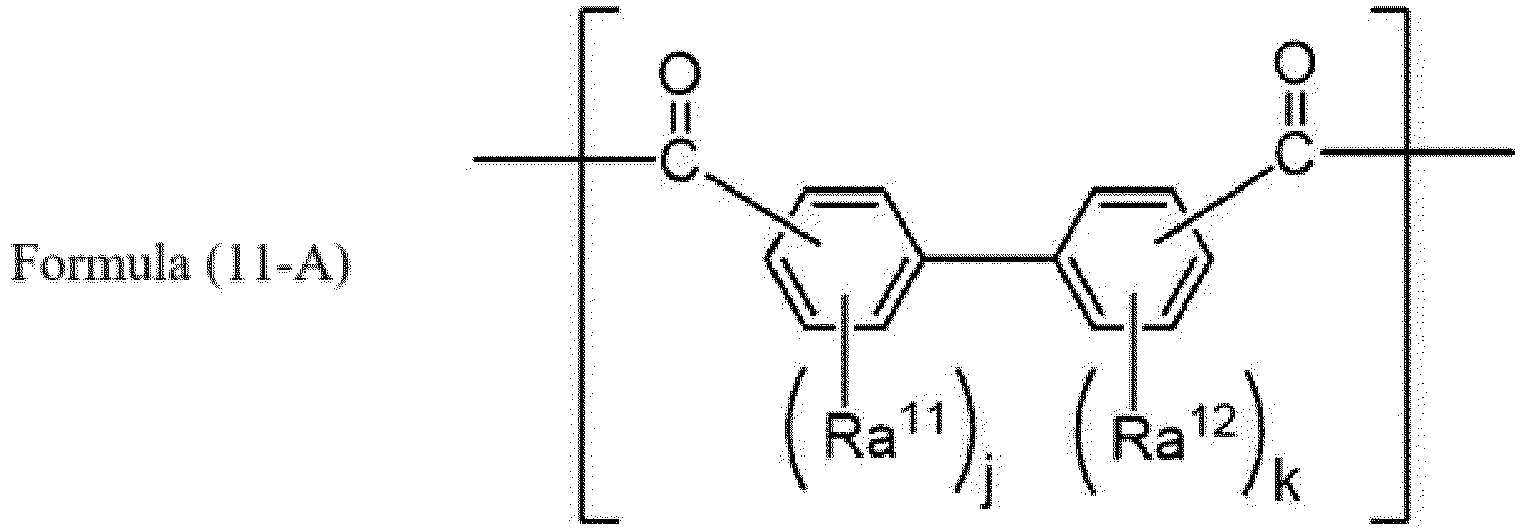

- In Formula (11-A), j represents an integer of 0 or greater and 4 or less, j pieces of R11's each independently represent a methyl group or an ethyl group, k represents an integer of 0 or greater and 4 or less, and k pieces of R12's each independently represent a methyl group or an ethyl group.
- In Formula (11-B), j represents an integer of 0 or greater and 4 or less, j pieces of R11's each independently represent a methyl group or an ethyl group, k represents an integer of 0 or greater and 4 or less, and k pieces of R12's each independently represent a methyl group or an ethyl group.
- j, k, R11, and R12 in Formula (11-A) each have the same definition as that for j, k, R11, and R12 in Formula (1), and the specific forms and the desired forms are also the same as described above.
- j, k, R11, and R12 in Formula (11-B) each have the same definition as that for j, k, R11, and R12 in Formula (1), and the specific forms and the desired forms are also the same as described above.
- Specific examples of the dicarboxylic acid unit (1-A) include the following dicarboxylic acid units (1-A1) to (1-A10). The dicarboxylic acid unit (1-A) is not limited thereto.


- As the dicarboxylic acid unit (1-A), for example, at least one selected from the group consisting of the dicarboxylic acid units (1-A3) to (1-A7) is preferable, at least one selected from the group consisting of the dicarboxylic acid units (1-A3) to (1-A6) is more preferable, and the dicarboxylic acid unit (1-A3) is still more preferable.
- Specific examples of the diol unit (1-B) include the following diol units (1-B1) to (1-B10). The diol unit (1-B) is not limited thereto.

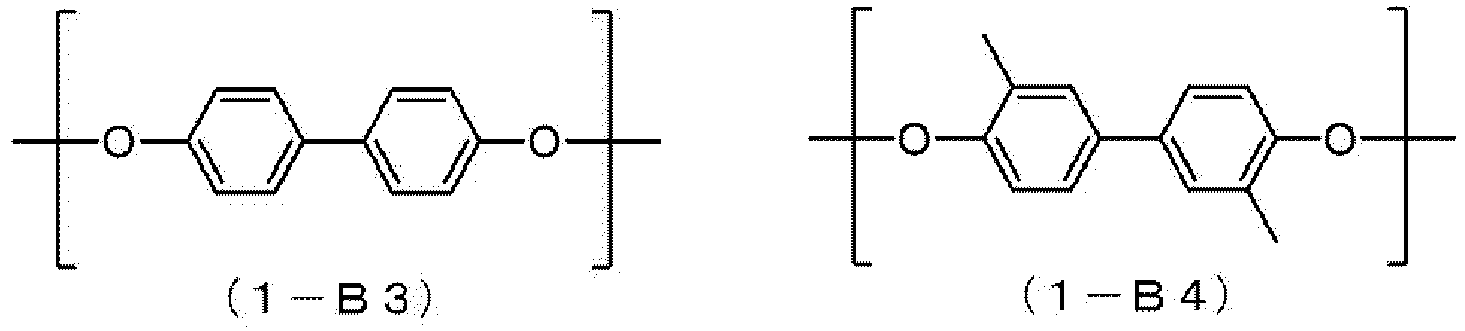


- As the diol unit (1-B), for example, at least one selected from the group consisting of the diol units (1-B3) to (1-B7) is preferable, at least one selected from the group consisting of the diol units (1-B3) to (1-B6) is more preferable, and the diol unit (1-B3) is still more preferable.
- The total mass proportion of the constitutional unit containing biphenyl represented by Formula (1) in the mass of the polyester resin (1) is, for example, preferably 15% by mass or greater and 60% by mass or less, more preferably 20% by mass or greater and 55% by mass or less, and still more preferably 25% by mass or greater and 50% by mass or less.
- The polyester resin (1) may have a constitutional unit other than the constitutional unit containing biphenyl represented by Formula (1). Hereinafter, the constitutional unit other than the constitutional unit containing biphenyl represented by Formula (1) will be described.
- The polyester resin (1) may have at least one dicarboxylic acid unit (A) selected from the group consisting of a dicarboxylic acid unit (A1) represented by Formula (A1), a dicarboxylic acid unit (A3) represented by Formula (A3), and a dicarboxylic acid unit (A4) represented by Formula (A4).
- In a case where the polyester resin (1) has a dicarboxylic acid unit (A), the polyester resin (1) may have one or two or more kinds of dicarboxylic acid units (A). As the dicarboxylic acid unit (A), for example, at least one selected from the group consisting of the dicarboxylic acid unit (A3) and the dicarboxylic acid unit (A4) is preferable.

- In Formula (A1), n101 represents an integer of 0 or greater and 4 or less, and n101 pieces of Ra101's each independently represent an alkyl group having 1 or more and 10 or less carbon atoms, an aryl group having 6 or more and 12 or less carbon atoms, or an alkoxy group having 1 or more and 6 or less carbon atoms.
- n101 represents, for example, preferably 0, 1, or 2, more preferably 0 or 1, and still more preferably 0.

- In Formula (A3), n301 and n302 each independently represent an integer of 0 or greater and 4 or less, and n301 pieces of Ra301's and n302 pieces of Ra302's each independently represent an alkyl group having 1 or more and 10 or less carbon atoms, an aryl group having 6 or more and 12 or less carbon atoms, or an alkoxy group having 1 or more and 6 or less carbon atoms.
- n301 represents, for example, preferably 0, 1, or 2, more preferably 0 or 1, and still more preferably 0.
- n302 represents, for example, preferably 0, 1, or 2, more preferably 0 or 1, and still more preferably 0.

- In Formula (A4), n401 represents an integer of 0 or greater and 6 or less, and n401 pieces of Ra401's each independently represent an alkyl group having 1 or more and 10 or less carbon atoms, an aryl group having 6 or more and 12 or less carbon atoms, or an alkoxy group having 1 or more and 6 or less carbon atoms.
- n401 represents, for example, preferably an integer of 0 or greater and 4 or less, more preferably 0, 1, or 2, and still more preferably 0.
- The specific forms and the desired forms of Ra101 in Formula (A1), Ra301 and Ra302 in Formula (A3), and Ra401 in Formula (A4) are the same as each other, and hereinafter, Ra101, Ra301, Ra302, and Ra401 will be collectively referred to as "Ra".
- The alkyl group having 1 or more and 10 or less carbon atoms as Ra may be any of linear, branched, or cyclic. The number of carbon atoms of the alkyl group is, for example, preferably 1 or more and 6 or less, more preferably 1 or more and 4 or less, and still more preferably 1 or 2.
- Examples of the linear alkyl group having 1 or more and 10 or less carbon atoms include a methyl group, an ethyl group, an n-propyl group, an n-butyl group, an n-pentyl group, an n-hexyl group, an n-heptyl group, an n-octyl group, an n-nonyl group, and an n-decyl group.
- Examples of the branched alkyl group having 3 or more and 10 or less carbon atoms include an isopropyl group, an isobutyl group, a sec-butyl group, a tert-butyl group, an isopentyl group, a neopentyl group, a tert-pentyl group, an isohexyl group, a sec-hexyl group, a tert-hexyl group, an isoheptyl group, a sec-heptyl group, a tert-heptyl group, an isooctyl group, a sec-octyl group, a tert-octyl group, an isononyl group, a sec-nonyl group, a tert-nonyl group, an isodecyl group, a sec-decyl group, and a tert-decyl group.
- Examples of the cyclic alkyl group having 3 or more and 10 or less carbon atoms include a cyclopropyl group, a cyclobutyl group, a cyclopentyl group, a cyclohexyl group, a cycloheptyl group, a cyclooctyl group, a cyclononyl group, a cyclodecyl group, and polycyclic (for example, bicyclic, tricyclic, or spirocyclic) alkyl groups to which these monocyclic alkyl groups are linked.
- The aryl group having 6 or more and 12 or less carbon atoms as Ra may be any of a monocycle or a polycycle. The number of carbon atoms of the aryl group is, for example, preferably 6 or more and 10 or less and more preferably 6.
- Examples of the aryl group having 6 or more and 12 or less carbon atoms include a phenyl group, a biphenyl group, a 1-naphthyl group, and a 2-naphthyl group.
- The alkyl group in the alkoxy group having 1 or more and 6 or less carbon atoms as Ra may be any of linear, branched, or cyclic. The number of carbon atoms of the alkyl group in the alkoxy group having 1 or more and 6 or less carbon atoms is, for example, preferably 1 or more and 4 or less, more preferably 1 or more and 3 or less, and still more preferably 1 or 2.
- Examples of the linear alkoxy group having 1 or more and 6 or less carbon atoms include a methoxy group, an ethoxy group, an n-propoxy group, an n-butoxy group, an n-pentyloxy group, and an n-hexyloxy group.
- Examples of the branched alkoxy group having 3 or more and 6 or less carbon atoms include an isopropoxy group, an isobutoxy group, a sec-butoxy group, a tert-butoxy group, an isopentyloxy group, a neopentyloxy group, a tert-pentyloxy group, an isohexyloxy group, a sec-hexyloxy group, and a tert-hexyloxy group.
- Examples of the cyclic alkoxy group having 3 or more and 6 or less carbon atoms include a cyclopropoxy group, a cyclobutoxy group, a cyclopentyloxy group, and a cyclohexyloxy group.
- Hereinafter, dicarboxylic acid units (A1-1) to (A1-9) are shown as specific examples of the dicarboxylic acid unit (A1). The dicarboxylic acid unit (A1) is not limited thereto.


- Hereinafter, dicarboxylic acid units (A3-1) and (A3-2) are shown as specific examples of the dicarboxylic acid unit (A3). The dicarboxylic acid unit (A3) is not limited thereto.

- Hereinafter, dicarboxylic acid units (A4-1) to (A4-3) are shown as specific examples of the dicarboxylic acid unit (A4). The dicarboxylic acid unit (A4) is not limited thereto.


- The polyester resin has, for example, preferably at least one selected from the group consisting of (A1-1), (A1-7), (A3-2), and (A4-3) and more preferably at least one selected from the group consisting of (A3-2) and (A4-3) in the specific examples described above, as the dicarboxylic acid unit (A).
- In a case where the polyester resin (1) has a dicarboxylic acid unit (A), the total mass proportion of the dicarboxylic acid unit (A) in the mass of the polyester resin (1) is, for example, preferably 15% by mass or greater and 60% by mass or less, more preferably 20% by mass or greater and 55% by mass or less, and still more preferably 25% by mass or greater and 50% by mass or less.
- The polyester resin (1) may have other dicarboxylic acid units in addition to the constitutional unit containing biphenyl represented by Formula (1) and the dicarboxylic acid unit (A). Examples of other dicarboxylic acid units include aliphatic dicarboxylic acids (such as oxalic acid, malonic acid, maleic acid, fumaric acid, citraconic acid, itaconic acid, glutaconic acid, succinic acid, alkenyl succinic acid, adipic acid, and sebacic acid) units, alicyclic dicarboxylic acid (such as cyclohexanedicarboxylic acid) units, and lower (for example, having 1 or more and 5 or less carbon atoms) alkyl ester units thereof. These dicarboxylic acid units contained in the polyester resin (1) may be used alone or in combination of two or more kinds thereof.
- The polyester resin (1) may have at least one diol unit (B) selected from the group consisting of a diol unit (B1) represented by Formula (B 1), a diol unit (B2) represented by Formula (B2), a diol unit (B3) represented by Formula (B3), a diol unit (B4) represented by Formula (B4), a diol unit (B5) represented by Formula (B5), a diol unit (B6) represented by Formula (B6), and a diol unit (B8) represented by Formula (B8).
- In a case where the polyester resin (1) has a diol unit (B), the polyester resin (1) may have one or two or more kinds of diol units (B).
- As the diol unit (B), for example, at least one selected from the group consisting of a diol unit (B 1), a diol unit (B2), a diol unit (B4), a diol unit (B5), and a diol unit (B6) is preferable, at least one selected from the group consisting of a diol unit (B 1), a diol unit (B2), a diol unit (B5), and a diol unit (B6) is more preferable, at least one selected from the group consisting of a diol unit (B1), a diol unit (B2), and a diol unit (B6) is still more preferable, and at least one selected from the group consisting of a diol unit (B1) and a diol unit (B2) is most preferable.

- In Formula (B1), Rb101 represents a branched alkyl group having 4 or more and 20 or less carbon atoms, Rb201 represents a hydrogen atom or an alkyl group having 1 or more and 3 or less carbon atoms, and Rb401, Rb501, Rb801, and Rb901 each independently represent a hydrogen atom, an alkyl group having 1 or more and 4 or less carbon atoms, an alkoxy group having 1 or more and 6 or less carbon atoms, or a halogen atom.
- The number of carbon atoms of the branched alkyl group having 4 or more and 20 or less carbon atoms as Rb101 is, for example, preferably 4 or more and 16 or less, more preferably 4 or more and 12 or less, and still more preferably 4 or more and 8 or less. Specific examples of Rb101 include an isobutyl group, a sec-butyl group, a tert-butyl group, an isopentyl group, a neopentyl group, a tert-pentyl group, an isohexyl group, a sec-hexyl group, a tert-hexyl group, an isoheptyl group, a sec-heptyl group, a tert-heptyl group, an isooctyl group, a sec-octyl group, a tert-octyl group, an isononyl group, a sec-nonyl group, a tert-nonyl group, an isodecyl group, a sec-decyl group, a tert-decyl group, an isododecyl group, a sec-dodecyl group, a tert-dodecyl group, a tert-tetradecyl group, and a tert-pentadecyl group.

- In Formula (B2), Rb102 represents a linear alkyl group having 4 or more and 20 or less carbon atoms, Rb202 represents a hydrogen atom or an alkyl group having 1 or more and 3 or less carbon atoms, and Rb402, Rb502, Rb802, and Rb902 each independently represent a hydrogen atom, an alkyl group having 1 or more and 4 or less carbon atoms, an alkoxy group having 1 or more and 6 or less carbon atoms, or a halogen atom.
- The number of carbon atoms of the linear alkyl group having 4 or more and 20 or less carbon atoms as Rb102 is, for example, preferably 4 or more and 16 or less, more preferably 4 or more and 12 or less, and still more preferably 4 or more and 8 or less. Specific examples of Rb102 include an n-butyl group, an n-pentyl group, an n-hexyl group, an n-heptyl group, an n-octyl group, an n-nonyl group, an n-decyl group, an n-undecyl group, an n-dodecyl group, a tridecyl group, an n-tetradecyl group, an n-pentadecyl group, an n-heptadecyl group, an n-octadecyl group, an n-nonadecyl group, and an n-icosyl group.

- In Formula (B3), Rb113 and Rb213 each independently represent a hydrogen atom, a linear alkyl group having 1 or more and 3 or less carbon atoms, an alkoxy group having 1 or more and 4 or less carbon atoms, or a halogen atom, d represents an integer of 7 or greater and 15 or less, and Rb403, Rb503, Rb803, and Rb903 each independently represent a hydrogen atom, an alkyl group having 1 or more and 4 or less carbon atoms, an alkoxy group having 1 or more and 6 or less carbon atoms, or a halogen atom.
- The number of carbon atoms of the linear alkyl group having 1 or more and 3 or less carbon atoms as Rb113 and Rb213 is, for example, preferably 1 or 2 and more preferably 1. Specific examples of such a group include a methyl group, an ethyl group, and an n-propyl group.
- The alkyl group in the alkoxy group having 1 or more and 4 or less carbon atoms as Rb113 and Rb213 may be linear, branched, or cyclic. The number of carbon atoms of the alkyl group in the alkoxy group having 1 or more and 4 or less carbon atoms is, for example, preferably 1 or more and 3 or less, more preferably 1 or 2, and still more preferably 1. Specific examples of such a group include a methoxy group, an ethoxy group, an n-propoxy group, an n-butoxy group, an isopropoxy group, an isobutoxy group, a sec-butoxy group, a tert-butoxy group, a cyclopropoxy group, and a cyclobutoxy group.
- Examples of the halogen atom as Rb113 and Rb213 include a fluorine atom, a chlorine atom, a bromine atom, and an iodine atom.

- In Formula (B4), Rb104 and Rb204 each independently represent a hydrogen atom, an alkyl group having 1 or more and 3 or less carbon atoms, and Rb404, Rb504, Rb804, and Rb904 each independently represent a hydrogen atom, an alkyl group having 1 or more and 4 or less carbon atoms, an alkoxy group having 1 or more and 6 or less carbon atoms, or a halogen atom.
- The alkyl group having 1 or more and 3 or less carbon atoms as Rb104 may be any of linear, branched, or cyclic. The number of carbon atoms of the alkyl group is, for example, preferably 1 or 2 and more preferably 1. Specific examples of Rb104 include a methyl group, an ethyl group, an n-propyl group, an isopropyl group, and a cyclopropyl group.

- In Formula (B5), Ar105 represents an aryl group having 6 or more and 12 or less carbon atoms or an aralkyl group having 7 or more and 20 or less carbon atoms, Rb205 represents a hydrogen atom or an alkyl group having 1 or more and 3 or less carbon atoms, and Rb405, Rb505, Rb805, and Rb905 each independently represent a hydrogen atom, an alkyl group having 1 or more and 4 or less carbon atoms, an alkoxy group having 1 or more and 6 or less carbon atoms, or a halogen atom.
- The aryl group having 6 or more and 12 or less carbon atoms as Ar105 may be any of a monocycle or a polycycle. The number of carbon atoms of the aryl group is, for example, preferably 6 or more and 10 or less and more preferably 6.
- The alkyl group in the aralkyl group having 7 or more and 20 or less carbon atoms as Ar105 may be any of linear, branched, or cyclic. The number of carbon atoms of the alkyl group in the aralkyl group having 7 or more and 20 or less carbon atoms is, for example, preferably 1 or more and 4 or less, more preferably 1 or more and 3 or less, and still more preferably 1 or 2. The aryl group in the aralkyl group having 7 or more and 20 or less carbon atoms as Ar105 may be any of a monocycle or a polycycle. The number of carbon atoms of the aryl group is, for example, preferably 6 or more and 10 or less and more preferably 6. Examples of the aralkyl group having 7 or more and 20 or less carbon atoms include a benzyl group, a phenylethyl group, a phenylpropyl group, a 4-phenylbutyl group, a phenylpentyl group, a phenylhexyl group, a phenylheptyl group, a phenyloctyl group, a phenylnonyl group, a naphthylmethyl group, a naphthylethyl group, an anthracenylmethyl group, and a phenyl-cyclopentylmethyl group.

- In Formula (B6), Rb116 and Rb216 each independently represent a hydrogen atom, a linear alkyl group having 1 or more and 3 or less carbon atoms, an alkoxy group having 1 or more and 4 or less carbon atoms, or a halogen atom, e represents an integer of 4 or greater and 6 or less, and Rb406, Rb506, Rb806, and Rb906 each independently represent a hydrogen atom, an alkyl group having 1 or more and 4 or less carbon atoms, an alkoxy group having 1 or more and 6 or less carbon atoms, or a halogen atom.
- The number of carbon atoms of the linear alkyl group having 1 or more and 3 or less carbon atoms as Rb116 and Rb216 is, for example, preferably 1 or 2 and more preferably 1. Specific examples of such a group include a methyl group, an ethyl group, and an n-propyl group.
- The alkyl group in the alkoxy group having 1 or more and 4 or less carbon atoms as Rb116 and Rb216 may be linear, branched, or cyclic. The number of carbon atoms of the alkyl group in the alkoxy group having 1 or more and 4 or less carbon atoms is, for example, preferably 1 or more and 3 or less, more preferably 1 or 2, and still more preferably 1. Specific examples of such a group include a methoxy group, an ethoxy group, an n-propoxy group, an n-butoxy group, an isopropoxy group, an isobutoxy group, a sec-butoxy group, a tert-butoxy group, a cyclopropoxy group, and a cyclobutoxy group.
- Examples of the halogen atom as Rb116 and Rb216 include a fluorine atom, a chlorine atom, a bromine atom, and an iodine atom.

- In Formula (B8), Rb408, Rb508, Rb808, and Rb908 each independently represent a hydrogen atom, an alkyl group having 1 or more and 4 or less carbon atoms, an alkoxy group having 1 or more and 6 or less carbon atoms, or a halogen atom.
- The specific forms and the desired forms of Rb201 in Formula (B1), Rb202 in Formula (B2), Rb204 in Formula (B4), and Rb205 in Formula (B5) are the same as each other, and hereinafter, Rb201, Rb202, Rb204, and Rb205 will be collectively referred to as "Rb200".
- The alkyl group having 1 or more and 3 or less carbon atoms as Rb200 may be any of linear, branched, or cyclic. The number of carbon atoms of the alkyl group is, for example, preferably 1 or 2 and more preferably 1.
- The alkyl group having 1 or more and 3 or less carbon atoms includes a methyl group, an ethyl group, an n-propyl group, an isopropyl group, and a cyclopropyl group.
- The specific forms and the desired forms of Rb401 in Formula (B1), Rb402 in Formula (B2), Rb403 in Formula (B3), Rb404 in Formula (B4), Rb405 in Formula (B5), Rb406 in Formula (B6), and Rb408 in Formula (B8) are the same as each other, and hereinafter, Rb401, Rb402, Rb403, Rb404, Rb405, Rb406, and Rb408 will be collectively referred to as "Rb400".
- The alkyl group having 1 or more and 4 or less carbon atoms as Rb400 may be any of linear, branched, or cyclic. The number of carbon atoms of the alkyl group is, for example, preferably 1 or more and 3 or less, more preferably 1 or 2, and still more preferably 1.
- Examples of the linear alkyl group having 1 or more and 4 or less carbon atoms include a methyl group, an ethyl group, an n-propyl group, and an n-butyl group.
- Examples of the branched alkyl group having 3 or 4 carbon atoms include an isopropyl group, an isobutyl group, a sec-butyl group, and a tert-butyl group.
- Examples of the cyclic alkyl group having 3 or 4 carbon atoms include a cyclopropyl group and a cyclobutyl group.
- The alkyl group in the alkoxy group having 1 or more and 6 or less carbon atoms as Rb400 may be any of linear, branched, or cyclic. The number of carbon atoms of the alkyl group in the alkoxy group having 1 or more and 6 or less carbon atoms is, for example, preferably 1 or more and 4 or less, more preferably 1 or more and 3 or less, and still more preferably 1 or 2.
- Examples of the linear alkoxy group having 1 or more and 6 or less carbon atoms include a methoxy group, an ethoxy group, an n-propoxy group, an n-butoxy group, an n-pentyloxy group, and an n-hexyloxy group.
- Examples of the branched alkoxy group having 3 or more and 6 or less carbon atoms include an isopropoxy group, an isobutoxy group, a sec-butoxy group, a tert-butoxy group, an isopentyloxy group, a neopentyloxy group, a tert-pentyloxy group, an isohexyloxy group, a sec-hexyloxy group, and a tert-hexyloxy group.
- Examples of the cyclic alkoxy group having 3 or more and 6 or less carbon atoms include a cyclopropoxy group, a cyclobutoxy group, a cyclopentyloxy group, and a cyclohexyloxy group.
- Examples of the halogen atom as Rb400 include a fluorine atom, a chlorine atom, a bromine atom, and an iodine atom.
- The specific forms and the desired forms of Rb501 in Formula (B1), Rb502 in Formula (B2), Rb503 in Formula (B3), Rb504 in Formula (B4), Rb505 in Formula (B5), Rb506 in Formula (B6), and Rb508 in Formula (B8) are the same as each other, and hereinafter, Rb501, Rb502, Rb503, Rb504, Rb505, Rb506, and Rb508 will be collectively referred to as "Rb500".
- The alkyl group having 1 or more and 4 or less carbon atoms as Rb500 may be any of linear, branched, or cyclic. The number of carbon atoms of the alkyl group is, for example, preferably 1 or more and 3 or less, more preferably 1 or 2, and still more preferably 1.
- Examples of the linear alkyl group having 1 or more and 4 or less carbon atoms include a methyl group, an ethyl group, an n-propyl group, and an n-butyl group.
- Examples of the branched alkyl group having 3 or 4 carbon atoms include an isopropyl group, an isobutyl group, a sec-butyl group, and a tert-butyl group.
- Examples of the cyclic alkyl group having 3 or 4 carbon atoms include a cyclopropyl group and a cyclobutyl group.
- The alkyl group in the alkoxy group having 1 or more and 6 or less carbon atoms as Rb500 may be any of linear, branched, or cyclic. The number of carbon atoms of the alkyl group in the alkoxy group having 1 or more and 6 or less carbon atoms is, for example, preferably 1 or more and 4 or less, more preferably 1 or more and 3 or less, and still more preferably 1 or 2.
- Examples of the linear alkoxy group having 1 or more and 6 or less carbon atoms include a methoxy group, an ethoxy group, an n-propoxy group, an n-butoxy group, an n-pentyloxy group, and an n-hexyloxy group.
- Examples of the branched alkoxy group having 3 or more and 6 or less carbon atoms include an isopropoxy group, an isobutoxy group, a sec-butoxy group, a tert-butoxy group, an isopentyloxy group, a neopentyloxy group, a tert-pentyloxy group, an isohexyloxy group, a sec-hexyloxy group, and a tert-hexyloxy group.
- Examples of the cyclic alkoxy group having 3 or more and 6 or less carbon atoms include a cyclopropoxy group, a cyclobutoxy group, a cyclopentyloxy group, and a cyclohexyloxy group.
- Examples of the halogen atom as Rb500 include a fluorine atom, a chlorine atom, a bromine atom, and an iodine atom.
- The specific forms and the desired forms of Rb801 in Formula (B1), Rb802 in Formula (B2), Rb803 in Formula (B3), Rb804 in Formula (B4), Rb805 in Formula (B5), Rb806 in Formula (B6), and Rb808 in Formula (B8) are the same as each other, and hereinafter, Rb801, Rb802, Rb803, Rb804, Rb805, Rb806, and Rb808 will be collectively referred to as "Rb800".
- The alkyl group having 1 or more and 4 or less carbon atoms as Rb800 may be any of linear, branched, or cyclic. The number of carbon atoms of the alkyl group is, for example, preferably 1 or more and 3 or less, more preferably 1 or 2, and still more preferably 1.
- Examples of the linear alkyl group having 1 or more and 4 or less carbon atoms include a methyl group, an ethyl group, an n-propyl group, and an n-butyl group.
- Examples of the branched alkyl group having 3 or 4 carbon atoms include an isopropyl group, an isobutyl group, a sec-butyl group, and a tert-butyl group.
- Examples of the cyclic alkyl group having 3 or 4 carbon atoms include a cyclopropyl group and a cyclobutyl group.
- The alkyl group in the alkoxy group having 1 or more and 6 or less carbon atoms as Rb800 may be any of linear, branched, or cyclic. The number of carbon atoms of the alkyl group in the alkoxy group having 1 or more and 6 or less carbon atoms is, for example, preferably 1 or more and 4 or less, more preferably 1 or more and 3 or less, and still more preferably 1 or 2.
- Examples of the linear alkoxy group having 1 or more and 6 or less carbon atoms include a methoxy group, an ethoxy group, an n-propoxy group, an n-butoxy group, an n-pentyloxy group, and an n-hexyloxy group.
- Examples of the branched alkoxy group having 3 or more and 6 or less carbon atoms include an isopropoxy group, an isobutoxy group, a sec-butoxy group, a tert-butoxy group, an isopentyloxy group, a neopentyloxy group, a tert-pentyloxy group, an isohexyloxy group, a sec-hexyloxy group, and a tert-hexyloxy group.
- Examples of the cyclic alkoxy group having 3 or more and 6 or less carbon atoms include a cyclopropoxy group, a cyclobutoxy group, a cyclopentyloxy group, and a cyclohexyloxy group.
- Examples of the halogen atom as Rb800 include a fluorine atom, a chlorine atom, a bromine atom, and an iodine atom.
- The specific forms and the desired forms of Rb901 in Formula (B1), Rb902 in Formula (B2), Rb903 in Formula (B3), Rb904 in Formula (B4), Rb905 in Formula (B5), Rb906 in Formula (B6), and Rb908 in Formula (B8) are the same as each other, and hereinafter, Rb901, Rb902, Rb903, Rb904, Rb905, Rb906, and Rb908 will be collectively referred to as "Rb900".
- The alkyl group having 1 or more and 4 or less carbon atoms as Rb900 may be any of linear, branched, or cyclic. The number of carbon atoms of the alkyl group is, for example, preferably 1 or more and 3 or less, more preferably 1 or 2, and still more preferably 1.
- Examples of the linear alkyl group having 1 or more and 4 or less carbon atoms include a methyl group, an ethyl group, an n-propyl group, and an n-butyl group.
- Examples of the branched alkyl group having 3 or 4 carbon atoms include an isopropyl group, an isobutyl group, a sec-butyl group, and a tert-butyl group.
- Examples of the cyclic alkyl group having 3 or 4 carbon atoms include a cyclopropyl group and a cyclobutyl group.
- The alkyl group in the alkoxy group having 1 or more and 6 or less carbon atoms as Rb900 may be any of linear, branched, or cyclic. The number of carbon atoms of the alkyl group in the alkoxy group having 1 or more and 6 or less carbon atoms is, for example, preferably 1 or more and 4 or less, more preferably 1 or more and 3 or less, and still more preferably 1 or 2.
- Examples of the linear alkoxy group having 1 or more and 6 or less carbon atoms include a methoxy group, an ethoxy group, an n-propoxy group, an n-butoxy group, an n-pentyloxy group, and an n-hexyloxy group.
- Examples of the branched alkoxy group having 3 or more and 6 or less carbon atoms include an isopropoxy group, an isobutoxy group, a sec-butoxy group, a tert-butoxy group, an isopentyloxy group, a neopentyloxy group, a tert-pentyloxy group, an isohexyloxy group, a sec-hexyloxy group, and a tert-hexyloxy group.
- Examples of the cyclic alkoxy group having 3 or more and 6 or less carbon atoms include a cyclopropoxy group, a cyclobutoxy group, a cyclopentyloxy group, and a cyclohexyloxy group.
- Examples of the halogen atom as Rb900 include a fluorine atom, a chlorine atom, a bromine atom, and an iodine atom.
- Hereinafter, diol units (B1-1) to (B1-6) are shown as specific examples of the diol unit (B1). The diol unit (B1) is not limited thereto.


- Hereinafter, diol units (B2-1) to (B2-11) are shown as specific examples of the diol unit (B2). The diol unit (B2) is not limited thereto.


- Hereinafter, diol units (B3-1) to (B3-4) are shown as specific examples of the diol unit (B3). The diol unit (B3) is not limited thereto.
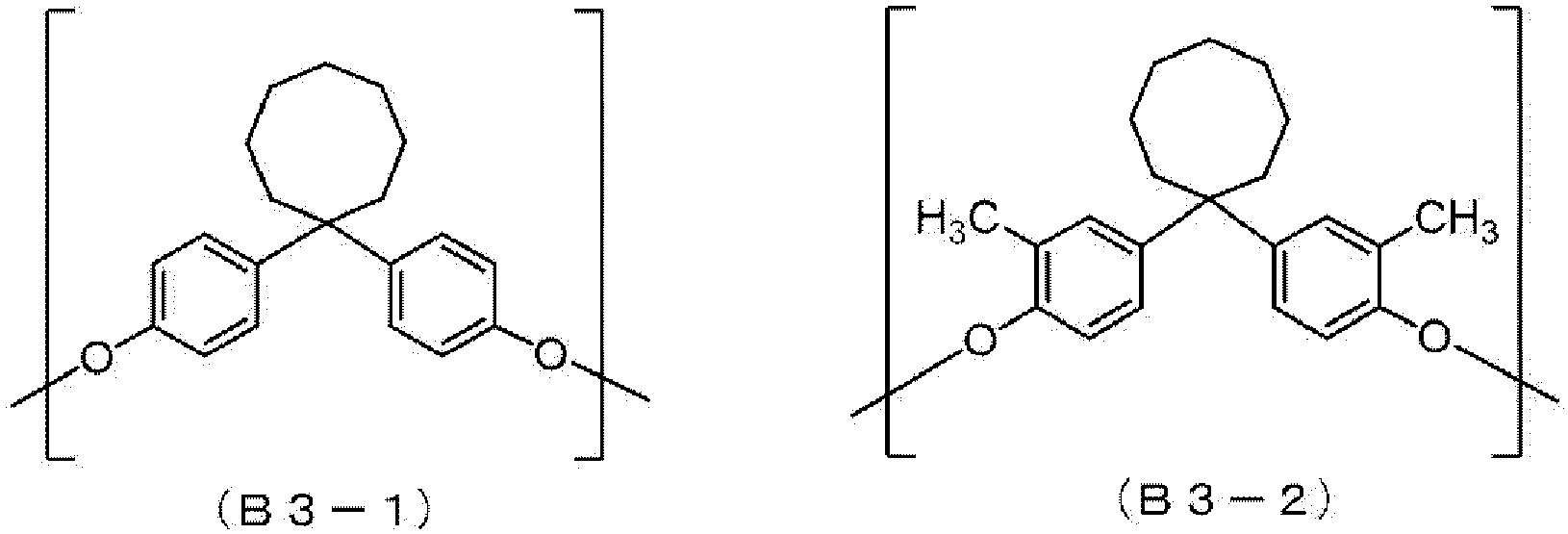

- Hereinafter, diol units (B4-1) to (B4-7) are shown as specific examples of the diol unit (B4). The diol unit (B4) is not limited thereto.


- Hereinafter, diol units (B5-1) to (B5-6) are shown as specific examples of the diol unit (B5). The diol unit (B5) is not limited thereto.


- Hereinafter, diol units (B6-1) to (B6-4) are shown as specific examples of the diol unit (B6). The diol unit (B6) is not limited thereto.


- Hereinafter, diol units (B8-1) to (B8-3) are shown as specific examples of the diol unit (B8). The diol unit (B8) is not limited thereto.


- In a case where the polyester resin (1) has a diol unit (B), the mass proportion of the diol unit (B) in the mass of the polyester resin (1) is, for example, preferably 25% by mass or greater and 80% by mass or less, more preferably 30% by mass or greater and 75% by mass or less, and still more preferably 35% by mass or greater and 70% by mass or less.
- The polyester resin (1) may have other diol units in addition to the constitutional unit containing biphenyl represented by Formula (1) and the diol unit (B). Examples of other diol units include aliphatic diol (such as ethylene glycol, diethylene glycol, triethylene glycol, propylene glycol, butanediol, hexanediol, and neopentyl glycol) units and alicyclic diol (such as cyclohexanediol, cyclohexane dimethanol, and hydrogenated bisphenol A) units. These diol units contained in the polyester resin (1) may be used alone or in combination of two or more kinds thereof.
- A terminal of the polyester resin (1) may be sealed or modified with a terminal-sealing agent, a molecular weight modifier, or the like used in a case of the production. Examples of the terminal-sealing agent or the molecular weight modifier include monohydric phenol, monovalent acid chloride, monohydric alcohol, and monovalent carboxylic acid.
- Examples of the monohydric phenol include phenol, o-cresol, m-cresol, p-cresol, o-ethylphenol, m-ethylphenol, p-ethylphenol, o-propylphenol, m-propylphenol, p-propylphenol, o-tert-butylphenol, m-tert-butylphenol, p-tert-butylphenol, pentylphenol, hexylphenol, octylphenol, nonylphenol, a 2,6-dimethylphenol derivative, a 2-methylphenol derivative, o-phenylphenol, m-phenylphenol, p-phenylphenol, o-methoxyphenol, m-methoxyphenol, p-methoxyphenol, 2,3,5-trimethylphenol, 2,3,6-trimethylphenol, 2,3-xylenol, 2,4-xylenol, 2,5-xylenol, 2,6-xylenol, 3,4-xylenol, 3,5-xylenol, 2-phenyl-2-(4-hydroxyphenyl)propane, 2-phenyl-2-(2-hydroxyphenyl)propane, and 2-phenyl-2-(3-hydroxyphenyl)propane.
- Examples of the monovalent acid chloride include monofunctional acid halides such as benzoyl chloride, benzoic acid chloride, methanesulfonyl chloride, phenylchloroformate, acetic acid chloride, butyric acid chloride, octyl acid chloride, benzenesulfonyl chloride, benzenesulfinyl chloride, sulfinyl chloride, benzene phosphonyl chloride, and substituents thereof.
- Examples of the monohydric alcohol include methanol, ethanol, n-propanol, isopropanol, n-butanol, 2-butanol, pentanol, hexanol, dodecyl alcohol, stearyl alcohol, benzyl alcohol, and phenethyl alcohol.
- Examples of the monovalent carboxylic acid include acetic acid, propionic acid, octanoic acid, cyclohexanecarboxylic acid, benzoic acid, toluic acid, phenylacetic acid, p-tert-butylbenzoic acid, and p-methoxyphenylacetic acid.
- The weight-average molecular weight of the polyester resin (1) is, for example, preferably 30,000 or greater and 300,000 or less, more preferably 40,000 or greater and 250,000 or less, and still more preferably 50,000 or greater and 200,000 or less.
- The molecular weight of the polyester resin (1) is a molecular weight measured by gel permeation chromatography (GPC) in terms of polystyrene. The GPC is carried out by using tetrahydrofuran as an eluent.
- The polyester resin (1) can be obtained by polycondensing a monomer that provides a constitutional unit containing biphenyl represented by Formula (1), a monomer that provides a dicarboxylic acid unit (A) and a monomer that provides a diol unit (B) as necessary, and other monomers as necessary, using a method of the related art. Examples of the method of polycondensing monomers include an interfacial polymerization method, a solution polymerization method, and a melt polymerization method. The interfacial polymerization method is a polymerization method of mixing a divalent carboxylic acid halide dissolved in an organic solvent that is incompatible with water and dihydric alcohol dissolved in an alkali aqueous solution to obtain polyester. Examples of documents related to the interfacial polymerization method include W. M. EARECKSON, J. Poly. Sci., XL399, 1959, and
JP1965-1959B - It is considered that the aromatic carboxylic acid halide is generated during the synthesis of the polyester resin and is brought into the photosensitive layer by the polyester resin used for forming the photosensitive layer.
- Examples of the aromatic carboxylic acid halide include an aromatic carboxylic acid fluoride, an aromatic carboxylic acid chloride, an aromatic carboxylic acid bromide, and an aromatic carboxylic acid iodide.
- The aromatic carboxylic acid halide is, for example, a monohalide or a dihalide of a monomer that provides a dicarboxylic acid unit (1-A), a monohalide or a dihalide of a monomer that provides a dicarboxylic acid unit (11-A), or a monohalide or a dihalide of each monomer that provides dicarboxylic acid units (1-A1) to (1-A10).
- The aromatic carboxylic acid halide is, for example, a monochloride or a dichloride of a monomer that provides a dicarboxylic acid unit (1-A), a monochloride or a dichloride of a monomer that provides a dicarboxylic acid unit (11-A), or a monochloride or a dichloride of each monomer that provides dicarboxylic acid units (1-A1) to (1-A10).
- The aromatic carboxylic acid halide is, for example, a compound represented by Formula (2).

- In Formula (2), p represents an integer of 0 or greater and 4 or less, p pieces of R21's each independently represent a methyl group or an ethyl group, q represents an integer of 0 or greater and 4 or less, q pieces of R22's each independently represent a methyl group or an ethyl group, r represents an integer of 0 or greater and 4 or less, r pieces of R23's each independently represent a methyl group or an ethyl group, n represents 0 or 1, X and Y each independently represent a halogen atom or -OH, and at least one of X or Y represents a halogen atom.
- p represents an integer of 0 or greater and 4 or less, for example, an integer of 0 or greater and 3 or less, an integer of 0 or greater and 2 or less, 0 or 1, or 0.
- In a case where p represents an integer of 1 or greater, p pieces of R21's each independently represent a methyl group or an ethyl group and, for example, a methyl group.
- q represents an integer of 0 or greater and 4 or less, for example, an integer of 0 or greater and 3 or less, an integer of 0 or greater and 2 or less, 0 or 1, or 0.
- In a case where q represents an integer of 1 or greater, q pieces of R22's each independently represent a methyl group or an ethyl group and, for example, a methyl group.
- r represents an integer of 0 or greater and 4 or less, for example, an integer of 0 or greater and 3 or less, an integer of 0 or greater and 2 or less, 0 or 1, or 0.
- In a case where r represents an integer of 1 or greater, r pieces of R23's each independently represent a methyl group or an ethyl group and, for example, a methyl group.
- In a case where X represents a halogen atom, X represents, for example, a fluorine atom, a chlorine atom, a bromine atom, or an iodine atom.
- In a case where Y represents a halogen atom, Y represents, for example, a fluorine atom, a chlorine atom, a bromine atom, or an iodine atom.
- In a case where X and Y represent a halogen atom, X and Y typically represent the same kind of halogen atom.
- In an example of the exemplary embodiment, the aromatic carboxylic acid halide represented by Formula (2) is an aromatic carboxylic acid halide represented by Formula (21).

- In Formula (21), n represents 0 or 1, X and Y each independently represent a halogen atom or -OH, and at least one of X or Y represents a halogen atom.
- In a case where X represents a halogen atom, X represents, for example, a fluorine atom, a chlorine atom, a bromine atom, or an iodine atom.
- In a case where Y represents a halogen atom, Y represents, for example, a fluorine atom, a chlorine atom, a bromine atom, or an iodine atom.
- In a case where X and Y represent a halogen atom, X and Y typically represent the same kind of halogen atom.
- In one example of the exemplary embodiment, the aromatic carboxylic acid halide includes an aromatic carboxylic acid fluoride. The aromatic carboxylic acid fluoride is, for example, a compound represented by Formula (2) or a compound represented by Formula (21). In this case, in Formula (2) or Formula (21), X and Y each independently represent a fluorine atom or -OH, and at least one of X or Y represents a fluorine atom.
- In the photoreceptor according to the first exemplary embodiment, from the viewpoint of suppressing the occurrence of burn-in ghosts, for example, it is preferable that the amount of the aromatic carboxylic acid fluoride in the charge transport layer decreases, and the amount thereof is 15×10-8 mol/g or less per unit mass of the charge transport layer, for example, preferably 8×10⁻⁸ mol/g or less, more preferably 2×10⁻⁸ mol/g or less, and most preferably 0 mol/g.
- In the photoreceptor according to the second exemplary embodiment, from the viewpoint of suppressing the occurrence of burn-in ghosts, for example, it is preferable that the amount of the aromatic carboxylic acid fluoride in the single layer type photosensitive layer decreases, and the amount thereof is 15×10-8 mol/g or less per unit mass of the single layer type photosensitive layer, for example, preferably 6×10⁻⁸ mol/g or less, more preferably 2×10⁻⁸ mol/g or less, and most preferably 0 mol/g.
- In one example of the exemplary embodiment, the aromatic carboxylic acid halide includes an aromatic carboxylic acid chloride. The aromatic carboxylic acid chloride is, for example, a compound represented by Formula (2) or a compound represented by Formula (21). In this case, in Formula (2) or Formula (21), X and Y each independently represent a chlorine atom or -OH, and at least one of X or Y represents a chlorine atom.
- In the photoreceptor according to the first exemplary embodiment, from the viewpoint of suppressing the occurrence of burn-in ghosts, for example, it is preferable that the amount of the aromatic carboxylic acid chloride in the charge transport layer decreases, and the amount thereof is 15×10-8 mol/g or less per unit mass of the charge transport layer, for example, preferably 8×10⁻⁸ mol/g or less, more preferably 2×10⁻⁸ mol/g or less, and most preferably 0 mol/g.
- In the photoreceptor according to the second exemplary embodiment, from the viewpoint of suppressing the occurrence of burn-in ghosts, for example, it is preferable that the amount of the aromatic carboxylic acid chloride in the single layer type photosensitive layer decreases, and the amount thereof is 15×10-8 mol/g or less per unit mass of the single layer type photosensitive layer, for example, preferably 6×10⁻⁸ mol/g or less, more preferably 2×10⁻⁸ mol/g or less, and most preferably 0 mol/g.
- In one example of the exemplary embodiment, the aromatic carboxylic acid halide includes an aromatic carboxylic acid bromide. The aromatic carboxylic acid bromide is, for example, a compound represented by Formula (2) or a compound represented by Formula (21). In this case, in Formula (2) or Formula (21), X and Y each independently represent a bromine atom or -OH, and at least one of X or Y represents a bromine atom.
- In the photoreceptor according to the first exemplary embodiment, from the viewpoint of suppressing the occurrence of burn-in ghosts, for example, it is preferable that the amount of the aromatic carboxylic acid bromide in the charge transport layer decreases, and the amount thereof is 15×10-8 mol/g or less per unit mass of the charge transport layer, for example, preferably 8×10⁻⁸ mol/g or less, more preferably 2×10⁻⁸ mol/g or less, and most preferably 0 mol/g.
- In the photoreceptor according to the second exemplary embodiment, from the viewpoint of suppressing the occurrence of burn-in ghosts, for example, it is preferable that the amount of the aromatic carboxylic acid bromide in the single layer type photosensitive layer decreases, and the amount thereof is 15×10-8 mol/g or less per unit mass of the single layer type photosensitive layer, for example, preferably 6×10⁻⁸ mol/g or less, more preferably 2×10⁻⁸ mol/g or less, and most preferably 0 mol/g.
- In one example of the exemplary embodiment, the aromatic carboxylic acid halide includes an aromatic carboxylic acid iodide. The aromatic carboxylic acid iodide is, for example, a compound represented by Formula (2) or a compound represented by Formula (21). In this case, in Formula (2) or Formula (21), X and Y each independently represent an iodine atom or -OH, and at least one of X or Y represents an iodine atom.
- In the photoreceptor according to the first exemplary embodiment, from the viewpoint of suppressing the occurrence of burn-in ghosts, for example, it is preferable that the amount of the aromatic carboxylic acid iodide in the charge transport layer decreases, and the amount thereof is 15×10-8 mol/g or less per unit mass of the charge transport layer, for example, preferably 8×10⁻⁸ mol/g or less, more preferably 2×10⁻⁸ mol/g or less, and most preferably 0 mol/g.
- In the photoreceptor according to the second exemplary embodiment, from the viewpoint of suppressing the occurrence of burn-in ghosts, for example, it is preferable that the amount of the aromatic carboxylic acid iodide in the single layer type photosensitive layer decreases, and the amount thereof is 15×10-8 mol/g or less per unit mass of the single layer type photosensitive layer, for example, preferably 6×10⁻⁸ mol/g or less, more preferably 2×10⁻⁸ mol/g or less, and most preferably 0 mol/g.
- Specific examples of the aromatic carboxylic acid halide represented by Formula (2) include aromatic carboxylic acid chlorides (2-1-1) to (2-4-2) shown below.


- Specific examples of the aromatic carboxylic acid fluoride include compounds in which the chlorine atoms in the aromatic carboxylic acid chlorides (2-1-1) to (2-4-2) are substituted with fluorine atoms.
- Specific examples of the aromatic carboxylic acid bromide include compounds in which the chlorine atoms in the aromatic carboxylic acid chlorides (2-1-1) to (2-4-2) are substituted with bromine atoms.
- Specific examples of the aromatic carboxylic acid iodide include compounds in which the chlorine atoms in the aromatic carboxylic acid chlorides (2-1-1) to (2-4-2) are substituted with iodine atoms.
- Hereinafter, each layer of the photoreceptor will be described in detail.
- Examples of the conductive substrate include metal plates containing metals (such as aluminum, copper, zinc, chromium, nickel, molybdenum, vanadium, indium, gold, and platinum) or alloys (such as stainless steel), metal drums, metal belts, and the like. Further, examples of the conductive substrate include paper, a resin film, a belt, and the like obtained by being coated, vapor-deposited or laminated with a conductive compound (such as a conductive polymer or indium oxide), a metal (such as aluminum, palladium, or gold) or an alloy. Here, the term "conductive" denotes that the volume resistivity is less than 1×10¹³ Ω·cm.
- In a case where the electrophotographic photoreceptor is used in a laser printer, for example, it is preferable that the surface of the conductive substrate is roughened such that a centerline average roughness Ra thereof is 0.04 µm or greater and 0.5 µm or less for the purpose of suppressing interference fringes from occurring during irradiation with laser beams. In a case where incoherent light is used as a light source, roughening of the surface to prevent interference fringes is not particularly necessary, and it is appropriate for longer life because occurrence of defects due to the unevenness of the surface of the conductive substrate is suppressed.
- Examples of the roughening method include wet honing performed by suspending an abrasive in water and spraying the suspension to the conductive substrate, centerless grinding performed by pressure-welding the conductive substrate against a rotating grindstone and continuously grinding the conductive substrate, and an anodizing treatment.
- Examples of the roughening method also include a method of dispersing conductive or semi-conductive powder in a resin without roughening the surface of the conductive substrate to form a layer on the surface of the conductive substrate, and performing roughening using the particles dispersed in the layer.
- The roughening treatment performed by anodization is a treatment of forming an oxide film on the surface of the conductive substrate by carrying out anodization in an electrolytic solution using a conductive substrate made of a metal (for example, aluminum) as an anode. Examples of the electrolytic solution include a sulfuric acid solution and an oxalic acid solution. However, a porous anodized film formed by anodization is chemically active in a natural state, is easily contaminated, and has a large resistance fluctuation depending on the environment. Therefore, for example, it is preferable that a sealing treatment is performed on the porous anodized film so that the micropores of the oxide film are closed by volume expansion due to a hydration reaction in pressurized steam or boiling water (a metal salt such as nickel may be added thereto) for a change into a more stable a hydrous oxide.
- The film thickness of the anodized film is, for example, preferably 0.3 µm or greater and 15 µm or less. In a case where the film thickness is in the above-described range, the barrier properties against injection tend to be exhibited, and an increase in the residual potential due to repeated use tends to be suppressed.
- The conductive substrate may be subjected to a treatment with an acidic treatment liquid or a boehmite treatment.
- The treatment with an acidic treatment liquid is carried out, for example, as follows. First, an acidic treatment liquid containing phosphoric acid, chromic acid, and hydrofluoric acid is prepared. In the blending ratio of phosphoric acid, chromic acid, and hydrofluoric acid to the acidic treatment liquid, for example, the concentration of the phosphoric acid is 10% by mass or greater and 11% by mass or less, the concentration of the chromic acid is 3% by mass or greater and 5% by mass or less, and the concentration of the hydrofluoric acid is 0.5% by mass or greater and 2% by mass or less, and the concentration of all these acids may be 13.5% by mass or greater and 18% by mass or less. The treatment temperature is, for example, preferably 42°C or higher and 48°C or lower. The film thickness of the coating film is, for example, preferably 0.3 µm or greater and 15 µm or less.
- The boehmite treatment is carried out, for example, by dipping the conductive substrate in pure water at 90°C or higher and 100°C or lower for 5 minutes to 60 minutes or by bringing the conductive substrate into contact with heated steam at 90°C or higher and 120°C or lower for 5 minutes to 60 minutes. The film thickness of the coating film is, for example, preferably 0.1 µm or greater and 5 µm or less. This coating film may be further subjected to the anodizing treatment using an electrolytic solution having low film solubility, such as adipic acid, boric acid, a borate, a phosphate, a phthalate, a maleate, a benzoate, a tartrate, or a citrate.
- The undercoat layer is, for example, a layer containing inorganic particles and a binder resin.
- Examples of the inorganic particles include inorganic particles having a powder resistance (volume resistivity) of 1×10² Ω·cm or greater and 1×10¹¹ Ω·cm or less.
- Among these, as the inorganic particles having the above-described resistance value, for example, metal oxide particles such as tin oxide particles, titanium oxide particles, zinc oxide particles, and zirconium oxide particles may be used, and zinc oxide particles are particularly preferable.
- The specific surface area of the inorganic particles measured by the BET method may be, for example, 10 m2/g or greater.
- The volume average particle diameter of the inorganic particles may be, for example, 50 nm or greater and 2,000 nm or less (for example, preferably 60 nm or greater and 1,000 nm or less).
- The content of the inorganic particles is, for example, preferably 10% by mass or greater and 80% by mass or less and more preferably 40% by mass or greater and 80% by mass or less with respect to the amount of the binder resin.
- The inorganic particles may be subjected to a surface treatment. As the inorganic particles, inorganic particles subjected to different surface treatments or inorganic particles having different particle diameters may be used in the form of a mixture of two or more kinds thereof.
- Examples of the surface treatment agent include a silane coupling agent, a titanate-based coupling agent, an aluminum-based coupling agent, and a surfactant. In particular, for example, a silane coupling agent is preferable, and a silane coupling agent containing an amino group is more preferable.
- Examples of the silane coupling agent containing an amino group include 3-aminopropyltriethoxysilane, N-2-(aminoethyl)-3-aminopropyltrimethoxysilane, N-2-(aminoethyl)-3-aminopropylmethyldimethoxysilane, and N,N-bis(2-hydroxyethyl)-3-aminopropyltriethoxysilane, but are not limited thereto.
- The silane coupling agent may be used in the form of a mixture of two or more kinds thereof. For example, a silane coupling agent containing an amino group and another silane coupling agent may be used in combination. Examples of other silane coupling agents include vinyltrimethoxysilane, 3-methacryloxypropyl-tris(2-methoxyethoxy)silane, 2-(3,4-epoxycyclohexyl)ethyltrimethoxysilane, 3-glycidoxypropyltrimethoxysilane, vinyltriacetoxysilane, 3-mercaptopropyltrimethoxysilane, 3-aminopropyltriethoxysilane, N-2-(aminoethyl)-3-aminopropyltrimethoxysilane, N-2-(aminoethyl)-3-aminopropylmethyldimethoxysilane, N,N-bis(2-hydroxyethyl)-3-aminopropyltriethoxysilane, and 3-chloropropyltrimethoxysilane, but are not limited thereto.
- The surface treatment method using a surface treatment agent may be any method as long as the method is a known method, and any of a dry method or a wet method may be used.
- The treatment amount of the surface treatment agent is, for example, preferably 0.5% by mass or greater and 10% by mass or less with respect to the amount of the inorganic particles.
- Here, the undercoat layer may contain an electron-accepting compound (acceptor compound) together with the inorganic particles, for example, from the viewpoint of enhancing the long-term stability of the electrical properties and the carrier blocking properties.
- Examples of the electron-accepting compound include electron-transporting substances, for example, a quinone-based compound such as chloranil or bromanil; a tetracyanoquinodimethane-based compound; a fluorenone compound such as 2,4,7-trinitrofluorenone or 2,4,5,7-tetranitro-9-fluorenone; an oxadiazole-based compound such as 2-(4-biphenyl)-5-(4-t-butylphenyl)-1,3,4-oxadiazole, 2,5-bis(4-naphthyl)-1,3,4-oxadiazole, or 2,5-bis(4-diethylaminophenyl)-1,3,4-oxadiazole; a xanthone-based compound; a thiophene compound; a diphenoquinone compound such as 3,3',5,5'-tetra-t-butyldiphenoquinone; and a benzophenone compound.
- In particular, as the electron-accepting compound, for example, a compound having an anthraquinone structure is preferable. As the compound having an anthraquinone structure, for example, a hydroxyanthraquinone compound, an aminoanthraquinone compound, or an aminohydroxyanthraquinone compound is preferable, and specifically, for example, anthraquinone, alizarin, quinizarin, anthrarufin, or purpurin is preferable.
- The electron-accepting compound may be contained in the undercoat layer in a state of being dispersed with inorganic particles or in a state of being attached to the surface of each inorganic particle.
- Examples of the method of attaching the electron-accepting compound to the surface of the inorganic particle include a dry method and a wet method.
- The dry method is, for example, a method of attaching the electron-accepting compound to the surface of each inorganic particle by adding the electron-accepting compound dropwise to inorganic particles directly or by dissolving the electron-accepting compound in an organic solvent while stirring the inorganic particles with a mixer having a large shearing force and spraying the mixture together with dry air or nitrogen gas. The electron-accepting compound may be added dropwise or sprayed, for example, at a temperature lower than or equal to the boiling point of the solvent. After the dropwise addition or the spraying of the electron-accepting compound, the compound may be further baked at 100°C or higher. The baking is not particularly limited as long as the temperature and the time are adjusted such that the electrophotographic characteristics can be obtained.
- The wet method is, for example, a method of attaching the electron-accepting compound to the surface of each inorganic particle by adding the electron-accepting compound to inorganic particles while dispersing the inorganic particles in a solvent by performing stirring or using ultrasonic waves, a sand mill, an attritor, or a ball mill, stirring or dispersing the mixture, and removing the solvent. The solvent removing method is carried out by, for example, filtration or distillation so that the solvent is distilled off. After removal of the solvent, the mixture may be further baked at 100°C or higher. The baking is not particularly limited as long as the temperature and the time are adjusted such that the electrophotographic characteristics can be obtained. In the wet method, the moisture contained in the inorganic particles may be removed before the electron-accepting compound is added, and examples thereof include a method of removing the moisture while stirring and heating the moisture in a solvent and a method of removing the moisture by azeotropically boiling the moisture with a solvent.
- The electron-accepting compound may be attached to the surface before the inorganic particles are subjected to a surface treatment with a surface treatment agent or simultaneously with the surface treatment performed on the inorganic particles with a surface treatment agent.
- The content of the electron-accepting compound may be, for example, 0.01% by mass or greater and 20% by mass or less and preferably 0.01% by mass or greater and 10% by mass or less with respect to the amount of the inorganic particles.
- Examples of the binder resin used for the undercoat layer include known polymer compounds such as an acetal resin (such as polyvinyl butyral), a polyvinyl alcohol resin, a polyvinyl acetal resin, a casein resin, a polyamide resin, a cellulose resin, gelatin, a polyurethane resin, a polyester resin, an unsaturated polyester resin, a methacrylic resin, an acrylic resin, a polyvinyl chloride resin, a polyvinyl acetate resin, a vinyl chloride-vinyl acetate-maleic anhydride resin, a silicone resin, a silicone-alkyd resin, a urea resin, a phenol resin, a phenol-formaldehyde resin, a melamine resin, a urethane resin, an alkyd resin, and an epoxy resin; a zirconium chelate compound; a titanium chelate compound; an aluminum chelate compound; a titanium alkoxide compound; an organic titanium compound; and known materials such as a silane coupling agent.
- Examples of the binder resin used for the undercoat layer include a charge-transporting resin containing a charge-transporting group, and a conductive resin (such as polyaniline).
- Among these, as the binder resin used for the undercoat layer, for example, a resin insoluble in a coating solvent of the upper layer is preferable, and a resin obtained by reaction between a curing agent and at least one resin selected from the group consisting of a thermosetting resin such as a urea resin, a phenol resin, a phenol-formaldehyde resin, a melamine resin, a urethane resin, an unsaturated polyester resin, an alkyd resin, or an epoxy resin; a polyamide resin, a polyester resin, a polyether resin, a methacrylic resin, an acrylic resin, a polyvinyl alcohol resin, and a polyvinyl acetal resin is particularly preferable.
- In a case where these binder resins are used in combination of two or more kinds thereof, the mixing ratio thereof is set as necessary.
- The undercoat layer may contain various additives for improving the electrical properties, the environmental stability, and the image quality.
- Examples of the additives include known materials, for example, an electron-transporting pigment such as a polycyclic condensed pigment or an azo-based pigment, a zirconium chelate compound, a titanium chelate compound, an aluminum chelate compound, a titanium alkoxide compound, an organic titanium compound, and a silane coupling agent. The silane coupling agent is used for a surface treatment of the inorganic particles as described above, but may be further added to the undercoat layer as an additive.
- Examples of the silane coupling agent serving as an additive include vinyltrimethoxysilane, 3-methacryloxypropyl-tris(2-methoxyethoxy)silane, 2-(3,4-epoxycyclohexyl)ethyltrimethoxysilane, 3-glycidoxypropyltrimethoxysilane, vinyltriacetoxysilane, 3-mercaptopropyltrimethoxysilane, 3-aminopropyltriethoxysilane, N-2-(aminoethyl)-3-aminopropyltrimethoxysilane, N-2-(aminoethyl)-3-aminopropylmethyldimethoxysilane, N,N-bis(2-hydroxyethyl)-3-aminopropyltriethoxysilane, and 3-chloropropyltrimethoxysilane.
- Examples of the zirconium chelate compound include zirconium butoxide, ethyl zirconium acetoacetate, zirconium triethanolamine, acetylacetonate zirconium butoxide, ethyl zirconium butoxide acetoacetate, zirconium acetate, zirconium oxalate, zirconium lactate, zirconium phosphonate, zirconium octanoate, zirconium naphthenate, zirconium laurate, zirconium stearate, zirconium isostearate, zirconium butoxide methacrylate, stearate zirconium butoxide, and isostearate zirconium butoxide.
- Examples of the titanium chelate compound include tetraisopropyl titanate, tetranormal butyl titanate, a butyl titanate dimer, tetra(2-ethylhexyl) titanate, titanium acetylacetonate, polytitanium acetylacetonate, titanium octylene glycolate, titanium lactate ammonium salt, titanium lactate, titanium lactate ethyl ester, titanium triethanol aminate, and polyhydroxy titanium stearate.
- Examples of the aluminum chelate compound include aluminum isopropylate, monobutoxyaluminum diisopropylate, aluminum butyrate, diethylacetoacetate aluminum diisopropylate, and aluminum tris(ethylacetoacetate).
- These additives may be used alone or in the form of a mixture or a polycondensate of a plurality of compounds.
- The undercoat layer may have, for example, a Vickers hardness of 35 or greater.
- The surface roughness (ten-point average roughness) of the undercoat layer may be adjusted, for example, to 1/2 from 1/(4n) (n represents a refractive index of an upper layer) of a laser wavelength λ for exposure to be used to suppress moire fringes.
- Resin particles or the like may be added to the undercoat layer to adjust the surface roughness. Examples of the resin particles include silicone resin particles and crosslinked polymethyl methacrylate resin particles. Further, the surface of the undercoat layer may be polished to adjust the surface roughness. Examples of the polishing method include buff polishing, a sandblast treatment, wet honing, and a grinding treatment.
- The formation of the undercoat layer is not particularly limited, and a known forming method is used. For example, a coating film of a coating solution for forming an undercoat layer in which the above-described components are added to a solvent is formed, and the coating film is dried and, as necessary, heated.
- Examples of the solvent for preparing the coating solution for forming an undercoat layer include known organic solvents such as an alcohol-based solvent, an aromatic hydrocarbon solvent, a halogenated hydrocarbon solvent, a ketone-based solvent, a ketone alcohol-based solvent, an ether-based solvent, and an ester-based solvent.
- Specific examples of these solvents include typical organic solvents such as methanol, ethanol, n-propanol, iso-propanol, n-butanol, benzyl alcohol, methyl cellosolve, ethyl cellosolve, acetone, methyl ethyl ketone, cyclohexanone, methyl acetate, ethyl acetate, n-butyl acetate, dioxane, tetrahydrofuran, methylene chloride, chloroform, chlorobenzene, and toluene.
- Examples of the method of dispersing the inorganic particles when preparing the coating solution for forming an undercoat layer include known methods such as a roll mill, a ball mill, a vibration ball mill, an attritor, a sand mill, a colloid mill, and a paint shaker.
- Examples of the method of coating the conductive substrate with the coating solution for forming an undercoat layer include typical methods such as a blade coating method, a wire bar coating method, a spray coating method, a dip coating method, a bead coating method, an air knife coating method, and a curtain coating method.
- The average thickness of the undercoat layer is, for example, preferably 10 µm or greater and 40 µm or less, more preferably 15 µm or greater and 35 µm or less, and still more preferably 20 µm or greater and 30 µm or less.
- An interlayer may be further provided between the undercoat layer and the photosensitive layer.
- The interlayer is, for example, a layer containing a resin. Examples of the resin used for the interlayer include a polymer compound, for example, an acetal resin (such as polyvinyl butyral), a polyvinyl alcohol resin, a polyvinyl acetal resin, a casein resin, a polyamide resin, a cellulose resin, gelatin, a polyurethane resin, a polyester resin, a methacrylic resin, an acrylic resin, a polyvinyl chloride resin, a polyvinyl acetate resin, a vinyl chloride-vinyl acetate-maleic anhydride resin, a silicone resin, a silicone-alkyd resin, a phenol-formaldehyde resin, or a melamine resin.
- The interlayer may be a layer containing an organometallic compound. Examples of the organometallic compound used for the interlayer include an organometallic compound containing metal atoms such as zirconium, titanium, aluminum, manganese, and silicon.
- The compounds used for the interlayer may be used alone or in the form of a mixture or a polycondensate of a plurality of compounds.
- Among these, it is preferable that the interlayer is, for example, a layer containing an organometallic compound having a zirconium atom or a silicon atom.
- The formation of the interlayer is not particularly limited, and a known forming method is used. For example, a coating film of a coating solution for forming an interlayer in which the above-described components are added to a solvent is formed, and the coating film is dried and, as necessary, heated.
- Examples of the coating method of forming the interlayer include typical methods such as a dip coating method, a push-up coating method, a wire bar coating method, a spray coating method, a blade coating method, an air knife coating method, and a curtain coating method.
- The thickness of the interlayer is set to be, for example, preferably in a range of 0.1 µm or greater and 3 µm or less. The interlayer may be used as the undercoat layer.
- The charge generation layer is, for example, a layer containing a charge generation material and a binder resin. Further, the charge generation layer may be a deposition layer of the charge generation material. The deposition layer of the charge generation material is, for example, appropriate in a case where an incoherent light source such as a light emitting diode (LED) or an organic electro-luminescence (EL) image array is used.
- Examples of the charge generation material include an azo pigment such as bisazo or trisazo; a fused ring aromatic pigment such as dibromoanthanthrone; a perylene pigment; a pyrrolopyrrole pigment; a phthalocyanine pigment; zinc oxide; and trigonal selenium.
- Among these, for example, a metal phthalocyanine pigment or a metal-free phthalocyanine pigment is preferably used as the charge generation material in order to deal with laser exposure in a near infrared region. Specifically, for example, hydroxygallium phthalocyanine; chlorogallium phthalocyanine; dichloro-tin phthalocyanine; and titanyl phthalocyanine are more preferable.
- On the other hand, for example, a fused ring aromatic pigment such as dibromoanthanthrone; a thioindigo-based pigment; a porphyrazine compound; zinc oxide; trigonal selenium; or a bisazo pigment is preferable as the charge generation material in order to deal with laser exposure in a near ultraviolet region.
- The above-described charge generation material may also be used even in a case where an incoherent light source such as an LED or an organic EL image array having a center wavelength of light emission at 450 nm or greater and 780 nm or less is used, but from the viewpoint of the resolution, the electric field intensity in the photosensitive layer is increased, and a decrease in charge due to injection of a charge from the substrate, that is, image defects referred to as so-called black spots are likely to occur when a thin film having a thickness of 20 µm or less is used as the photosensitive layer. The above-described tendency is evident when a p-type semiconductor such as trigonal selenium or a phthalocyanine pigment is used as the charge generation material that is likely to generate a dark current.
- Meanwhile, in a case where an n-type semiconductor such as a fused ring aromatic pigment, a perylene pigment, or an azo pigment is used as the charge generation material, a dark current is unlikely to be generated, and image defects referred to as black spots can be suppressed even in a case where a thin film is used as the photosensitive layer. The n-type is determined by the polarity of the flowing photocurrent using a typically used time-of-flight method, and a material in which electrons more easily flow as carriers than positive holes is determined as the n-type.
- The binder resin used for the charge generation layer is selected from a wide range of insulating resins, and the binder resin may be selected from organic photoconductive polymers such as poly-N-vinylcarbazole, polyvinyl anthracene, polyvinylpyrene, and polysilane.
- Examples of the binder resin include a polyvinyl butyral resin, a polyarylate resin (a polycondensate of bisphenols and aromatic divalent carboxylic acid), a polycarbonate resin, a polyester resin, a phenoxy resin, a vinyl chloride-vinyl acetate copolymer, a polyamide resin, an acrylic resin, a polyacrylamide resin, a polyvinylpyridine resin, a cellulose resin, a urethane resin, an epoxy resin, casein, a polyvinyl alcohol resin, and a polyvinylpyrrolidone resin. Here, the term "insulating" denotes that the volume resistivity is 1 × 10¹³ Ω·cm or greater.
- These binder resins may be used alone or in the form of a mixture of two or more kinds thereof.
- The blending ratio between the charge generation material and the binder resin is, for example, preferably in a range of 10:1 to 1:10 in terms of the mass ratio.
- The charge generation layer may also contain other known additives.
- The formation of the charge generation layer is not particularly limited, and a known forming method is used. For example, a coating film of a coating solution for forming a charge generation layer in which the above-described components are added to a solvent is formed, and the coating film is dried and, as necessary, heated. The charge generation layer may be formed by vapor deposition of the charge generation material. The formation of the charge generation layer by vapor deposition is, for example, particularly appropriate in a case where a fused ring aromatic pigment or a perylene pigment is used as the charge generation material.
- Examples of the solvent for preparing the coating solution for forming a charge generation layer include methanol, ethanol, n-propanol, n-butanol, benzyl alcohol, methyl cellosolve, ethyl cellosolve, acetone, methyl ethyl ketone, cyclohexanone, methyl acetate, n-butyl acetate, dioxane, tetrahydrofuran, methylene chloride, chloroform, chlorobenzene, and toluene. These solvents are used alone or in the form of a mixture of two or more kinds thereof.
- As a method of dispersing particles (for example, the charge generation material) in the coating solution for forming a charge generation layer, for example, a media disperser such as a ball mill, a vibration ball mill, an attritor, a sand mill, or a horizontal sand mill, or a medialess disperser such as a stirrer, an ultrasonic disperser, a roll mill, or a high-pressure homogenizer is used. Examples of the high-pressure homogenizer include a collision type high-pressure homogenizer in which a dispersion liquid is dispersed by a liquid-liquid collision or a liquid-wall collision in a high-pressure state, and a penetration type high-pressure homogenizer in which a dispersion liquid is dispersed by causing the dispersion liquid to penetrate through a micro-flow path in a high-pressure state.
- During the dispersion, it is effective to set the average particle diameter of the charge generation material in the coating solution for forming a charge generation layer to 0.5 µm or less, for example, preferably 0.3 µm or less, and more preferably 0.15 µm or less.
- Examples of the method of coating the undercoat layer (or the interlayer) with the coating solution for forming a charge generation layer include typical methods such as a blade coating method, a wire bar coating method, a spray coating method, a dip coating method, a bead coating method, an air knife coating method, and a curtain coating method.
- The thickness of the charge generation layer is set to be, for example, preferably in a range of 0.1 µm or greater and 5.0 µm or less and more preferably in a range of 0.2 µm or greater and 2.0 µm or less.
- The charge transport layer is, for example, a layer containing a charge transport material and a binder resin. The charge transport layer may be a layer containing a polymer charge transport material.
- Examples of the charge transport material include a quinone-based compound such as p-benzoquinone, chloranil, bromanil, or anthraquinone; a tetracyanoquinodimethane-based compound; a fluorenone compound such as 2,4,7-trinitrofluorenone; a xanthone compound; a benzophenone-based compound; a cyanovinyl-based compound; and an electron-transporting compound such as an ethylene-based compound. Examples of the charge transport material include a positive hole-transporting compound such as a triarylamine-based compound, a benzidine-based compound, an arylalkane-based compound, an aryl-substituted ethylene-based compound, a stilbene-based compound, an anthracene-based compound, or a hydrazone-based compound. These charge transport materials may be used alone or in combination of two or more kinds thereof, but are not limited thereto.
- Examples of the polymer charge transport material include known chemical substances having charge transport properties, such as poly-N-vinylcarbazole and polysilane. For example, a polyester-based polymer charge transport material is preferable. The polymer charge transport material may be used alone or in combination with a binder resin.
- Examples of the charge transport material or the polymer charge transport material include a polycyclic aromatic compound, an aromatic nitro compound, an aromatic amine compound, a heterocyclic compound, a hydrazone compound, a styryl compound, an enamine compound, a benzidine compound, a triarylamine compound (particularly, a triphenylamine compound), a diamine compound, an oxadiazole compound, a carbazole compound, an organic polysilane compound, a pyrazoline compound, an indole compound, an oxazole compound, an isoxazole compound, a thiazole compound, a thiadiazole compound, an imidazole compound, a pyrazole compound, a triazole compound, a cyano compound, a benzofuran compound, an aniline compound, a butadiene compound, and a resin containing a group derived from any of these substances. Specific examples thereof include compounds described in paragraphs 0078 to 0080 of
JP2021-117377A JP2019-035900A JP2019-012141A JP2021-071565A JP2021-015223A JP2013-097300A WO2019/070003A , paragraphs 0103 to 0107 ofJP2018-159087A JP2021-148818A - From the viewpoint of the charge mobility, it is preferable that the charge transport material contains, for example, at least one selected from the group consisting of a compound (D1) represented by Formula (D1), a compound (D2) represented by Formula (D2), a compound (D3) represented by Formula (D3), and a compound (D4) represented by Formula (D4).

- In Formula (D1), ArT1, ArT2, and ArT3 each independently represent an aryl group, -C6H4-C(RT4)=C(RT5)(RT6), or -C6H4-CH=CH-CH=C(RT7)(RT8). RT4, RT5, RT6, RT7, and RT8 each independently represent a hydrogen atom, an alkyl group, or an aryl group. In a case where RT5 and RT6 represent an aryl group, the aryl groups may be linked via a divalent group of -C(R51)(R52)- and/or -C(R61)=C(R62)-. R51, R52, R61, and R62 each independently represent a hydrogen atom or an alkyl group having 1 or more and 3 or less carbon atoms.
- The group in Formula (D1) may be substituted with a halogen atom, an alkyl group having 1 or more and 5 or less carbon atoms, an alkoxy group having 1 or more and 5 or less carbon atoms, or a substituted amino group substituted with an alkyl group having 1 or more and 3 or less carbon atoms.
- From the viewpoint of the charge mobility, as the compound (D1), for example, a compound containing at least one of an aryl group or -C6H4-CH=CH-CH=C(RT7)(RT8) is preferable, and a compound (D'1) represented by Formula (D'1) is more preferable.

- In Formula (D'1), RT111, RT112, RT121, RT122, RT131, and RT132 each independently represent a hydrogen atom, a halogen atom, an alkyl group (for example, preferably an alkyl group having 1 or more and 3 or less carbon atoms), an alkoxy group (for example, preferably an alkoxy group having 1 or more and 3 or less carbon atoms), a phenyl group, or a phenoxy group.
Tj 1, Tj2, Tj3, Tk1, Tk2, and Tk3 each independently represent 0, 1, or 2.
- In Formula (D2), RT201, RT202, RT211, and RT212 each independently represent a halogen atom, an alkyl group having 1 or more and 5 or less carbon atoms, an alkoxy group having 1 or more and 5 or less carbon atoms, an amino group substituted with an alkyl group having 1 or 2 carbon atoms, an aryl group, -C(RT21)=C(RT22)(RT23), or -CH=CH-CH=C(RT24)(RT25). RT21, RT22, RT23, RT24, and RT25 each independently represent a hydrogen atom, an alkyl group, or an aryl group. RT221 and RT222 each independently represent a hydrogen atom, a halogen atom, an alkyl group having 1 or more and 5 or less carbon atoms, or an alkoxy group having 1 or more and 5 or less carbon atoms. Tm1, Tm2, Tn1, and Tn2 each independently represent 0, 1, or 2.
- The group in Formula (D2) may be substituted with a halogen atom, an alkyl group having 1 or more and 5 or less carbon atoms, an alkoxy group having 1 or more and 5 or less carbon atoms, or a substituted amino group substituted with an alkyl group having 1 or more and 3 or less carbon atoms.
- From the viewpoint of the charge mobility, as the compound (D2), for example, a compound containing at least one of an alkyl group, an aryl group, or -CH=CH-CH=C(RT24)(RT25) is preferable, and a compound containing two of an alkyl group, an aryl group, or -CH=CH-CH=C(RT24)(RT25) is more preferable.
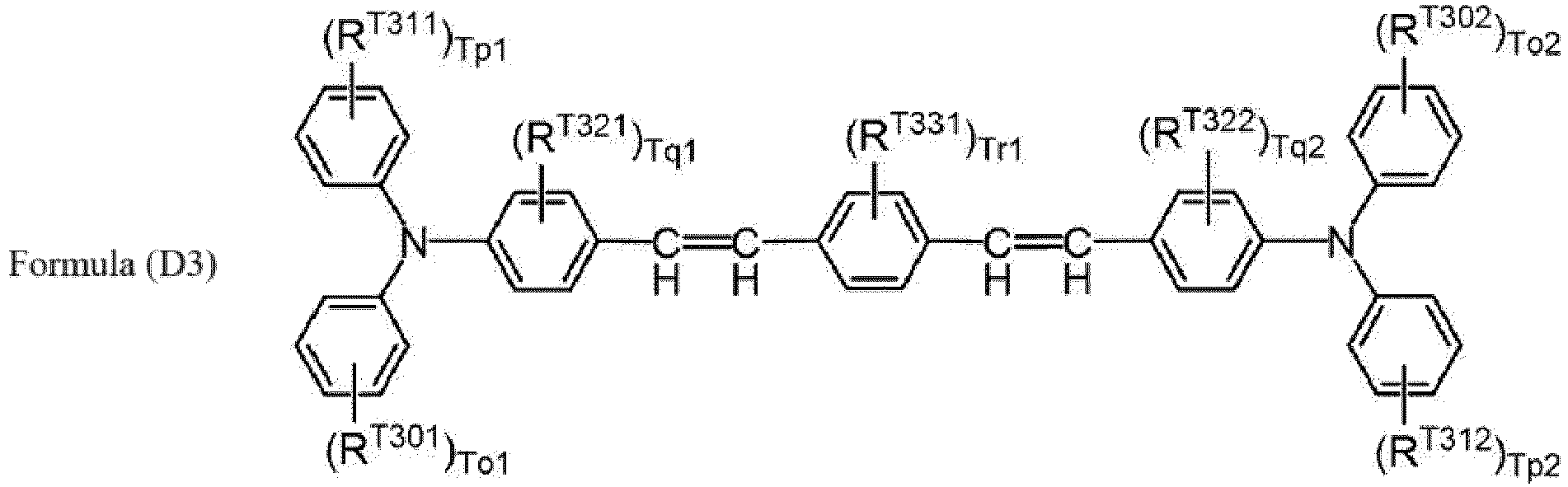
- In Formula (D3), RT301, RT302, RT311, and RT312 each independently represent a halogen atom, an alkyl group having 1 or more and 5 or less carbon atoms, an alkoxy group having 1 or more and 5 or less carbon atoms, an amino group substituted with an alkyl group having 1 or 2 carbon atoms, an aryl group, -C(RT31)=C(RT32)(RT33), or -CH=CH-CH=C(RT34)(RT35). RT31, RT32, RT33, RT34, and RT35 each independently represent a hydrogen atom, an alkyl group, or an aryl group. RT321, RT322, and RT331 each independently represent a hydrogen atom, a halogen atom, an alkyl group having 1 or more and 5 or less carbon atoms, or an alkoxy group having 1 or more and 5 or less carbon atoms. To1, To2, Tp1, Tp2, Tq1, Tq2, and Tr1 each independently represent 0, 1, or 2.
- The group in Formula (D3) may be substituted with a halogen atom, an alkyl group having 1 or more and 5 or less carbon atoms, an alkoxy group having 1 or more and 5 or less carbon atoms, or a substituted amino group substituted with an alkyl group having 1 or more and 3 or less carbon atoms.

- In Formula (D4), RT401, RT402, RT411, and RT412 each independently represent a halogen atom, an alkyl group having 1 or more and 5 or less carbon atoms, an alkoxy group having 1 or more and 5 or less carbon atoms, an amino group substituted with an alkyl group having 1 or 2 carbon atoms, an aryl group, -C(RT41)=C(RT42)(RT43), or -CH=CH-CH=C(RT44)(RT45). RT41, RT42, RT43, RT44, and RT45 each independently represent a hydrogen atom, an alkyl group, or an aryl group. RT421, RT422, and RT431 each independently represent a hydrogen atom, a halogen atom, an alkyl group having 1 or more and 5 or less carbon atoms, or an alkoxy group having 1 or more and 5 or less carbon atoms. Ts1, Ts2, Tt1, Tt2, Tu1, Tu2, and Tv1 each independently represent 0, 1, or 2.
- The group in Formula (D4) may be substituted with a halogen atom, an alkyl group having 1 or more and 5 or less carbon atoms, an alkoxy group having 1 or more and 5 or less carbon atoms, or a substituted amino group substituted with an alkyl group having 1 or more and 3 or less carbon atoms.
- The content of the charge transport material contained in the charge transport layer is, for example, preferably 20% by mass or greater and 70% by mass or less with respect to the total mass of the charge transport layer.
- The charge transport layer contains at least the polyester resin (1) as a binder resin. The proportion of the polyester resin (1) in the total amount of the binder resin contained in the charge transport layer is, for example, 60% by mass or greater, 70% by mass or greater, 80% by mass or greater, 90% by mass or greater, or 100% by mass.
- From the viewpoint that the abrasion resistance is more excellent, it is preferable that the charge transport layer contains, for example, the polyester resin (1) and the polycarbonate resin as binder resins. In this case, the mass ratio between both resins (polyester resin (1):polycarbonate resin) is, for example, preferably in a range of 95:5 to 40:60.
- As the polycarbonate resin, for example, a polycarbonate resin with continuous constitutional units having an aromatic ring is preferable, and specifically, a polycarbonate resin used in examples described below is particularly preferable.
- The charge transport layer may contain other binder resins in addition to the polyester resin (1) and the polycarbonate resin. Examples of other binder resins include a polyester resin other than the polyester resin (1), a methacrylic resin, an acrylic resin, a polyvinyl chloride resin, a polyvinylidene chloride resin, a polystyrene resin, a polyvinyl acetate resin, a styrene-butadiene copolymer, a vinylidene chloride-acrylonitrile copolymer, a vinyl chloride-vinyl acetate copolymer, a vinyl chloride-vinyl acetate-maleic anhydride copolymer, a silicone resin, a silicone alkyd resin, a phenol-formaldehyde resin, a styrene-alkyd resin, poly-N-vinylcarbazole, and polysilane. These binder resins may be used alone or in combination of two or more kinds thereof.
- The charge transport layer may also contain other known additives. Examples of the additives include an antioxidant, a leveling agent, an antifoaming agent, a filler, and a viscosity adjuster.
- The formation of the charge transport layer is not particularly limited, and a known forming method is used. For example, a coating film of a coating solution for forming a charge transport layer in which the above-described components are added to a solvent is formed, and the coating film is dried and, as necessary, heated.
- Examples of the solvent for preparing the coating solution for forming a charge transport layer include typical organic solvents, for example, aromatic hydrocarbons such as benzene, toluene, xylene, and chlorobenzene; ketones such as acetone and 2-butanone; halogenated aliphatic hydrocarbons such as methylene chloride, chloroform, and ethylene chloride; and cyclic or linear ethers such as tetrahydrofuran and ethyl ether. These solvents are used alone or in the form of a mixture of two or more kinds thereof.
- Examples of the coating method of coating the charge generation layer with the coating solution for forming a charge transport layer include typical methods such as a blade coating method, a wire bar coating method, a spray coating method, a dip coating method, a bead coating method, an air knife coating method, and a curtain coating method.
- The average thickness of the charge transport layer is, for example, preferably 25 µm or greater and 50 µm or less, more preferably 28 µm or greater and 45 µm or less, and still more preferably 30 µm or greater and 40 µm or less.
- The single layer type photosensitive layer (charge generation/charge transport layer) is a layer containing a charge generation material, a charge transport material, a binder resin, and as necessary, other additives. These materials are the same as the materials described in the sections of the charge generation layer and the charge transport layer.
- The single layer type photosensitive layer contains at least the polyester resin (1) as a binder resin. The proportion of the polyester resin (1) in the total amount of the binder resin contained in the single layer type photosensitive layer is, for example, 60% by mass or greater, 70% by mass or greater, 80% by mass or greater, 90% by mass or greater, or 100% by mass.
- From the viewpoint that the abrasion resistance is more excellent, it is preferable that the single layer type photosensitive layer contains, for example, the polyester resin (1) and the polycarbonate resin as binder resins. In this case, the mass ratio between both resins (polyester resin (1):polycarbonate resin) is, for example, preferably in a range of 95:5 to 40:60.
- As the polycarbonate resin, for example, a polycarbonate resin with continuous constitutional units having an aromatic ring is preferable, and specifically, a polycarbonate resin used in examples described below is particularly preferable.
- The content of the charge generation material in the single layer type photosensitive layer may be, for example, 0.1% by mass or greater and 10% by mass or less and preferably 0.8% by mass or greater and 5% by mass or less with respect to the total solid content.
- The content of the charge transport material contained in the single layer type photosensitive layer may be, for example, 40% by mass or greater and 60% by mass or less with respect to the total solid content.
- The method of forming the single layer type photosensitive layer is the same as the method of forming the charge generation layer or the charge transport layer.
- The average thickness of the single layer type photosensitive layer is, for example, preferably 25 µm or greater and 50 µm or less, more preferably 28 µm or greater and 45 µm or less, and still more preferably 30 µm or greater and 40 µm or less.
- A protective layer is provided on the photosensitive layer as necessary. The protective layer is provided, for example, for the purpose of preventing a chemical change in the photosensitive layer during charging and further improving the mechanical strength of the photosensitive layer.
- Therefore, for example, a layer formed of a cured film (crosslinked film) may be applied to the protective layer. Examples of these layers include the layers described in the items 1) and 2) below.
- 1) A layer formed of a cured film of a composition containing a reactive group-containing charge transport material having a reactive group and a charge-transporting skeleton in an identical molecule (that is, a layer containing a polymer or a crosslinked body of the reactive group-containing charge transport material)
- 2) A layer formed of a cured film of a composition containing a non-reactive charge transport material and a reactive group-containing non-charge transport material containing a reactive group without having a charge-transporting skeleton (that is, a layer containing the non-reactive charge transport material and a polymer or crosslinked body of the reactive group-containing non-charge transport material)
- Examples of the reactive group of the reactive group-containing charge transport material include known reactive groups such as a chain polymerizable group, an epoxy group, -OH, -OR [here, R represents an alkyl group], -NH2, -SH, -COOH, and -SiRQ1 3-Qn(ORQ2)Qn [here, RQ1 represents a hydrogen atom, an alkyl group, or a substituted or unsubstituted aryl group, RQ2 represents a hydrogen atom, an alkyl group, or a trialkylsilyl group, and Qn represents an integer of 1 to 3].
- The chain polymerizable group is not particularly limited as long as the group is a functional group capable of radical polymerization and is, for example, a functional group containing a group having at least a carbon double bond. Specific examples thereof include a vinyl group, a vinyl ether group, a vinyl thioether group, a phenyl vinyl group, a vinyl phenyl group, an acryloyl group, a methacryloyl group, and a group containing at least one selected from derivatives thereof. Among these, from the viewpoint that the reactivity is excellent, for example, a vinyl group, a phenylvinyl group, a vinylphenyl group, an acryloyl group, a methacryloyl group, and a group containing at least one selected from derivatives thereof are preferable as the chain polymerizable group.
- The charge-transporting skeleton of the reactive group-containing charge transport material is not particularly limited as long as the skeleton is a known structure in the electrophotographic photoreceptor, and examples thereof include a structure conjugated with a nitrogen atom, which is a skeleton derived from a nitrogen-containing positive hole-transporting compound such as a triarylamine-based compound, a benzidine-based compound, or a hydrazone-based compound. Among these, for example, a triarylamine skeleton is preferable.
- The reactive group-containing charge transport material having the reactive group and the charge-transporting skeleton, the non-reactive charge transport material, and the reactive group-containing non-charge transport material may be selected from known materials.
- The protective layer may also contain other known additives.
- The formation of the protective layer is not particularly limited, and a known forming method is used. For example, a coating film of a coating solution for forming a protective layer in which the above-described components are added to a solvent is formed, and the coating film is dried and, as necessary, subjected to a curing treatment such as heating.
- Examples of the solvent for preparing the coating solution for forming a protective layer include an aromatic solvent such as toluene or xylene; a ketone-based solvent such as methyl ethyl ketone, methyl isobutyl ketone, or cyclohexanone; an ester-based solvent such as ethyl acetate or butyl acetate; an ether-based solvent such as tetrahydrofuran or dioxane; a cellosolve-based solvent such as ethylene glycol monomethyl ether; and an alcohol-based solvent such as isopropyl alcohol or butanol. These solvents are used alone or in the form of a mixture of two or more kinds thereof.
- The coating solution for forming a protective layer may be a solvent-less coating solution.
- Examples of the method of coating the photosensitive layer (such as the charge transport layer) with the coating solution for forming a protective layer include typical methods such as a dip coating method, a push-up coating method, a wire bar coating method, a spray coating method, a blade coating method, an air knife coating method, and a curtain coating method.
- The thickness of the protective layer is set to be, for example, preferably in a range of 1 µm or greater and 20 µm or less and more preferably in a range of 2 µm or greater and 10 µm or less.
- An image forming apparatus according to the present exemplary embodiment includes the electrophotographic photoreceptor, a charging device that charges a surface of the electrophotographic photoreceptor, an electrostatic latent image forming device that forms an electrostatic latent image on the charged surface of the electrophotographic photoreceptor, a developing device that develops the electrostatic latent image formed on the surface of the electrophotographic photoreceptor with a developer containing a toner to form a toner image, and a transfer device that transfers the toner image to a surface of a recording medium. Further, the electrophotographic photoreceptor according to the present exemplary embodiment is employed as the electrophotographic photoreceptor.
- As the image forming apparatus according to the present exemplary embodiment, known image forming apparatuses such as an apparatus including a fixing device that fixes the toner image transferred to the surface of a recording medium; a direct transfer type apparatus that transfers the toner image formed on the surface of the electrophotographic photoreceptor directly to the recording medium; an intermediate transfer type apparatus that primarily transfers the toner image formed on the surface of the electrophotographic photoreceptor to the surface of the intermediate transfer member and secondarily transfers the toner image transferred to the surface of the intermediate transfer member to the surface of the recording medium; an apparatus including a cleaning device that cleans the surface of the electrophotographic photoreceptor after the transfer of the toner image and before the charging; an apparatus including a charge erasing device that erases the charges on the surface of the electrophotographic photoreceptor by applying the charge erasing light after the transfer of the toner image and before the charging; and an apparatus including an electrophotographic photoreceptor heating member for increasing the temperature of the electrophotographic photoreceptor and decreasing the relative temperature are employed.
- In a case of the intermediate transfer type apparatus, the transfer device is, for example, configured to include an intermediate transfer member having a surface onto which the toner image is transferred, a primary transfer device primarily transferring the toner image formed on the surface of the electrophotographic photoreceptor to the surface of the intermediate transfer member, and a secondary transfer device secondarily transferring the toner image transferred to the surface of the intermediate transfer member to the surface of the recording medium.
- The image forming apparatus according to the present exemplary embodiment may be any of a dry development type image forming apparatus or a wet development type (development type using a liquid developer) image forming apparatus.
- In the image forming apparatus according to the present exemplary embodiment, for example, the portion including the electrophotographic photoreceptor may have a cartridge structure (process cartridge) that is attachable to and detachable from the image forming apparatus. As the process cartridge, for example, a process cartridge including the electrophotographic photoreceptor according to the present exemplary embodiment is preferably used. The process cartridge may include, for example, at least one selected from the group consisting of a charging device, an electrostatic latent image forming device, a developing device, and a transfer device in addition to the electrophotographic photoreceptor.
- Hereinafter, an example of the image forming apparatus according to the present exemplary embodiment will be described, but the present exemplary embodiment is not limited thereto. Further, main parts shown in the figures will be described, but description of other parts will not be provided.
-
Fig. 3 is a schematic configuration view showing an example of an image forming apparatus according to the present exemplary embodiment. - As shown in
Fig. 3 , animage forming apparatus 100 according to the present exemplary embodiment includes aprocess cartridge 300 including an electrophotographic photoreceptor 7, an exposure device 9 (an example of an electrostatic latent image forming device), a transfer device 40 (primary transfer device), and anintermediate transfer member 50. In theimage forming apparatus 100, theexposure device 9 is disposed at a position that can be exposed to the electrophotographic photoreceptor 7 from an opening portion of theprocess cartridge 300, thetransfer device 40 is disposed at a position that faces the electrophotographic photoreceptor 7 via theintermediate transfer member 50, and theintermediate transfer member 50 is disposed such that a part of theintermediate transfer member 50 is in contact with the electrophotographic photoreceptor 7. Although not shown, the image forming apparatus also includes a secondary transfer device that transfers the toner image transferred to theintermediate transfer member 50 to a recording medium (for example, paper). Theintermediate transfer member 50, the transfer device 40 (primary transfer device), and the secondary transfer device (not shown) correspond to an example of the transfer device. - The
process cartridge 300 inFig. 3 integrally supports the electrophotographic photoreceptor 7, a charging device 8 (an example of the charging device), a developing device 11 (an example of the developing device), and a cleaning device 13 (an example of the cleaning device) in a housing. Thecleaning device 13 has a cleaning blade (an example of the cleaning member) 131, and thecleaning blade 131 is disposed to come into contact with the surface of the electrophotographic photoreceptor 7. The cleaning member may be a conductive or insulating fibrous member instead of the aspect of thecleaning blade 131, and may be used alone or in combination with thecleaning blade 131. -
Fig. 3 shows an example of an image forming apparatus including a fibrous member 132 (roll shape) that supplies alubricant 14 to the surface of the electrophotographic photoreceptor 7 and a fibrous member 133 (flat brush shape) that assists cleaning, but these are disposed as necessary. - Hereinafter, each configuration of the image forming apparatus according to the present exemplary embodiment will be described.
- As the
charging device 8, for example, a contact-type charger formed of a conductive or semi-conductive charging roller, a charging brush, a charging film, a charging rubber blade, a charging tube, or the like is used. Further, a known charger such as a non-contact type roller charger, or a scorotron charger or a corotron charger using corona discharge is also used. - Examples of the
exposure device 9 include an optical system device that exposes the surface of the electrophotographic photoreceptor 7 to light such as a semiconductor laser beam, LED light, and liquid crystal shutter light in a predetermined image pattern. The wavelength of the light source is within the spectral sensitivity region of the electrophotographic photoreceptor. As the wavelength of a semiconductor laser, near infrared, which has an oscillation wavelength in the vicinity of 780 nm, is mostly used. However, the wavelength is not limited thereto, and a laser having an oscillation wavelength of approximately 600 nm or a laser having an oscillation wavelength of 400 nm or greater and 450 nm or less as a blue laser may also be used. Further, a surface emission type laser light source capable of outputting a multi-beam is also effective for forming a color image. - Examples of the developing
device 11 include a typical developing device that performs development in contact or non-contact with the developer. The developingdevice 11 is not particularly limited as long as the developing device has the above-described functions, and is selected depending on the purpose thereof. Examples of the developing device include known developing machines having a function of attaching a one-component developer or a two-component developer to the electrophotographic photoreceptor 7 using a brush, a roller, or the like. Among these, for example, a developing device formed of a developing roller having a surface on which a developer is held is preferably used. - The developer used in the developing
device 11 may be a one-component developer containing only a toner or a two-component developer containing a toner and a carrier. Further, the developer may be magnetic or non-magnetic. Known developers are employed as these developers. - As the
cleaning device 13, a cleaning blade type device including thecleaning blade 131 is used. In addition to the cleaning blade type device, a fur brush cleaning type device or a simultaneous development cleaning type device may be employed. - Examples of the
transfer device 40 include a known transfer charger such as a contact type transfer charger using a belt, a roller, a film, or a rubber blade, and a scorotron transfer charger or a corotron transfer charger using corona discharge. - As the
intermediate transfer member 50, a belt-like intermediate transfer member (intermediate transfer belt) containing semi-conductive polyimide, polyamide-imide, polycarbonate, polyarylate, polyester, rubber, or the like is used. Further, as the form of the intermediate transfer member, a drum-like intermediate transfer member may be used in addition to the belt-like intermediate transfer member. -
Fig. 4 is a schematic configuration view showing an example of an image forming apparatus according to the present exemplary embodiment. - An
image forming apparatus 120 shown inFig. 4 is a tandem type multicolor image forming apparatus on which fourprocess cartridges 300 are mounted. Theimage forming apparatus 120 is formed such that fourprocess cartridges 300 are arranged in parallel on theintermediate transfer member 50, and one electrophotographic photoreceptor is used for each color. Theimage forming apparatus 120 has the same configuration as theimage forming apparatus 100 except that theimage forming apparatus 120 is of a tandem type. - Hereinafter, exemplary embodiments of the invention will be described in detail based on examples, but the exemplary embodiments of the invention are not limited to the examples.
- In the following description, "parts" and "%" are on a mass basis unless otherwise specified.
- In the following description, the synthesis, the production, the treatment, the measurement, and the like are carried out at room temperature (25°C ± 3°C) unless otherwise specified.
- 400 ml of distilled water and 3.60 g of sodium hydroxide are put into a 1 L separable flask (container A) to prepare a sodium hydroxide aqueous solution. 11.04 g of 4,4'-(2-ethylhexylidene)diphenol and 0.16 g of 2,3,6-trimethylphenol are added to the sodium hydroxide aqueous solution and completely dissolved therein. Next, 0.05 g of benzyltributylammonium chloride is added thereto as a phase transfer catalyst.
- 200 ml of methylene chloride and 10.50 g of 4,4'-biphenyldicarbonyl chloride are put into in a 1 L three-neck flask (container B), and stirred and mixed.
- The solution in the container B is transferred to the container A over 30 minutes using a liquid feeding pump. In a case where the container B is emptied, 50 ml of methylene chloride is put into the container B, and the entire liquid in the container B is transferred to the container A. Thereafter, the liquid in the container A is continuously stirred for 2 hours to proceed the polymerization reaction.
- Next, the aqueous layer in the container A is removed, 300 ml of methylene chloride is added to the organic layer, 50 ml of methanol is further added thereto, and the mixture is continuously stirred for 2 hours.
- Thereafter, the organic layer is repeatedly washed with distilled water until the pH of the organic layer is adjusted to neutral. Next, methylene chloride is distilled off under reduced pressure, thereby obtaining a polyester resin (PE-1-1).
- The polymerization reaction is carried out in the same manner as described above.
- Next, the aqueous layer in the container A is removed, 300 ml of methylene chloride is added to the organic layer, 50 ml of methanol is further added thereto, and the mixture is continuously stirred for 30 minutes.
- Thereafter, the organic layer is repeatedly washed with distilled water until the pH of the organic layer is adjusted to neutral. Next, methylene chloride is distilled off under reduced pressure, thereby obtaining a polyester resin (PE-1-2).
- The polymerization reaction is carried out in the same manner as described above.
- Next, the aqueous layer in the container A is removed, the organic layer is repeatedly washed with distilled water until the pH of the organic layer is adjusted to neutral. Next, methylene chloride is distilled off under reduced pressure, thereby obtaining a polyester resin (PE-1-3).
- A polyester resin (PE-X-y) listed in Table 1 is synthesized in the same manner as in the synthesis for the polyester resins (PE-1-1) to (PE-1-3) except that the kind of the monomer subjected to the polymerization reaction is changed. Here, x represents an integer of 2 to 7, and y represents an integer of 1 to 3.
- The polyester resin (PE-x-1) is a polyester resin obtained by performing the same purification treatment as the purification treatment for the polyester resin (PE-1-1).
- The polyester resin (PE-x-2) is a polyester resin obtained by performing the same purification treatment as the purification treatment for the polyester resin (PE-1-2).
- The polyester resin (PE-x-3) is a polyester resin obtained by performing the same treatment as the treatment for the polyester resin (PE-1-3).
- 1-A3 and the like listed in Table 1 are specific examples of the dicarboxylic acid unit (1-A) described above.
- A3-2 and the like listed in Table 1 are specific examples of the dicarboxylic acid unit (A) described above.
- B 1-4 and the like listed in Table 1 are specific examples of the diol unit (B) described above.
- In a case where two kinds of dicarboxylic acid units are present, the compositional ratio (mol%) is also listed in Table 1.
[Table 1] Polyester resin Dicarboxylic acid unit (1-A) Dicarboxylic acid unit (A) Diol unit (B) No. No. No. No. PE-1-1 1-A3 - B 1-4 PE-1-2 PE-1-3 PE-2-1 1-A3 - B 1-2 PE-2-1 PE-2-1 PE-3-1 1-A3 - B6-4 PE-3-1 PE-3-1 PE-4-1 1-A4 - B 1-2 PE-4-1 PE-4-1 PE-5-1 1-A4 - B6-3 PE-5-1 PE-5-1 PE-6-1 1-A3 [40 mol%] A3-2 [10 mol%] B 1-2 PE-6-2 PE-6-3 PE-7-1 1-A3 [25 mol%] A1-7 [25 mol%] B2-8 PE-7-2 PE-7-3 - 100 parts of zinc oxide (average particle diameter of 70 nm, specific surface area of 15 m2/g, manufactured by Tayca Corporation) is stirred and mixed with 500 parts of toluene, 1.3 parts of a silane coupling agent (trade name: KBM603, manufactured by Shin-Etsu Chemical Co., Ltd., N-2-(aminoethyl)-3-aminopropyltrimethoxysilane) is added thereto, and the mixture is stirred for 2 hours. Thereafter, toluene is distilled off under reduced pressure and baked at 120°C for 3 hours to obtain zinc oxide subjected to a surface treatment with a silane coupling agent.
- 110 parts of the surface-treated zinc oxide is stirred and mixed with 500 parts of tetrahydrofuran, a solution obtained by dissolving 0.6 parts of alizarin in 50 parts of tetrahydrofuran is added thereto, and the mixture is stirred at 50°C for 5 hours. Thereafter, the solid content is separated by filtration by carrying out filtration under reduced pressure and dried at 60°C under reduced pressure, thereby obtaining zinc oxide with alizarin.
- 100 parts of a solution obtained by dissolving 60 parts of the zinc oxide with alizarin, 13.5 parts of a curing agent (blocked isocyanate, trade name: SUMIDUR 3175, manufactured by Sumitomo Bayer Urethane Co., Ltd.), and 15 parts of a butyral resin (trade name: S-LEC BM-1, manufactured by Sekisui Chemical Co., Ltd.) in 68 parts of methyl ethyl ketone is mixed with 5 parts of methyl ethyl ketone, and the solution is dispersed in a sand mill for 2 hours using glass beads with a diameter of 1 mmϕ, thereby obtaining a dispersion liquid. 0.005 parts of dioctyltin dilaurate as a catalyst and 4 parts of silicone resin particles (trade name: TOSPEARL 145, manufactured by Momentive Performance Materials Inc.) are added to the dispersion liquid, thereby obtaining a coating solution for forming an undercoat layer. An outer peripheral surface of a conductive substrate (a cylindrical aluminum tube with an outer diameter of 30 mm, a length of 365 mm, and a thickness of 1.6 mm) is coated with the coating solution for forming an undercoat layer by a dip coating method, and dried and cured at 185°C for 35 minutes, thereby forming an undercoat layer. The average thickness of the undercoat layer is 25 µm.
- A mixture of 15 parts of hydroxygallium phthalocyanine as a charge generation material (having diffraction peaks at positions where Bragg angles (2θ ± 0.2°) of the X-ray diffraction spectra using Cukα characteristic X-rays are at least of 7.5°, 9.9°, 12.5, 16.3°, 18.6°, 25.1°, and 28.3°), 10 parts of a vinyl chloride-vinyl acetate copolymer resin (trade name: VMCH, Nippon Unicar Company Limited) as a binder resin, and 200 parts of n-butyl acetate is dispersed in a sand mill for 4 hours using glass beads having a diameter of 1 mm. 175 parts of n-butyl acetate and 180 parts of methyl ethyl ketone are added to the dispersion liquid, and the mixture is stirred, thereby obtaining a coating solution for forming a charge generation layer. The undercoat layer is dipped in and coated with the coating solution for forming a charge generation layer, and the coating solution is dried at room temperature to form a charge generation layer having an average thickness of 0.25 µm.
-
- · Binder resin: polyester resin (PE-1-1) ··· 60 parts
- · Charge transport material: CTM-1 ... 40 parts
- The above-described materials are dissolved or dispersed in a mixed solvent of 550 parts of tetrahydrofuran and 50 parts of toluene to obtain a coating solution for forming a charge transport layer. The charge generation layer is dipped in and coated with the coating solution for forming a charge transport layer, and dried at a temperature of 150°C for 40 minutes to form a charge transport layer having an average thickness of 32 µm.

- Each photoreceptor is prepared in the same manner as in Example S1 except that the kind of the polyester resin is changed to the kind listed in Table 2 in the formation of the charge transport layer.
- In Examples S15 to S27 and Comparative Examples SC8 and SC9, a part of the polyester resin is substituted with a polycarbonate resin. The structures of the polycarbonate resins (1) to (3) are as shown below.


- In the formulae, the numerical values denote the polymerization molar ratios (mol%).
-
- · Binder resin: polyester resin (PE-1-1) ··· 45 parts
- · Charge generation material: V type hydroxygallium phthalocyanine (having diffraction peaks at least at positions where Bragg angles (2θ ± 0.2°) of the X-ray diffraction spectrum using Cukα characteristic X-rays are 7.3°, 16.0°, 24.9°, and 28.0°) ... 1.0 parts
- · Electron transport material: ETM-1 ... 9 parts
- · Charge transport material: CTM-1 ··· 45 parts
- The above-described materials are dissolved or dispersed in a mixed solvent of 175 parts of tetrahydrofuran and 75 parts of toluene, and the solution is subjected to a dispersion treatment for 4 hours with a sand mill using glass beads having a diameter of 1 mm, thereby obtaining a coating solution for forming a photosensitive layer. An outer peripheral surface of a conductive substrate (a cylindrical aluminum tube with an outer diameter of 30 mm, a length of 365 mm, and a thickness of 1.6 mm) is coated with the coating solution for forming a photosensitive layer by a dip coating method, and dried at a temperature of 150°C for 60 minutes, thereby forming a single layer type photosensitive layer having an average thickness of 36 µm.

- Each photoreceptor is prepared in the same manner as in Example T1 except that the kind of the polyester resin is changed to the kind listed in Table 3.
- In Example T3, a part of the polyester resin is substituted with the polycarbonate resin (1). The structure of the polycarbonate resin (1) is as shown below.
- Each photoreceptor of the examples or the comparative examples is mounted on an electrophotographic image forming apparatus Apeos C7070 (manufactured by FUJIFII,M Business Innovation Corporation).
- Full-surface halftone images (images with a density of 30%) of a yellow color, a magenta color, a cyan color, and a black color are continuously output onto A3 size plain paper such that 10,000 sheets of images of each color, that is, a total of 40,000 sheets of images are output, under a low-temperature and low-humidity environment of a temperature of 10°C and a relative humidity of 15%. The average thickness (nm) of the charge transport layer or the single layer type photosensitive layer is measured before and after the image formation, and a difference in the average thickness before and after the image formation is defined as the amount of abrasion (nm). PERMASCOPE (manufactured by Fischer Instruments K.K.) is used as a film thickness measuring device. The amount of abrasion is classified as follows. The results are listed in Tables 2 and 3.
- A: The amount of abrasion is less than 800 nm
- B: The amount of abrasion is 800 nm or greater and less than 1,600 nm
- C: The amount of abrasion is 1,600 nm or greater
- One sheet of a full-surface halftone image (image with a density of 30%, black) is output after lattice charts (black) are continuously formed on 500 sheets of A3 size plain paper in a high-temperature and high-humidity environment of a temperature of 28°C and a relative humidity of 85%. Full-surface halftone images are visually observed and classified as follows. The results are listed in Tables 2 and 3.
- A: A lattice-like image (burn-in ghost) cannot be visually recognized.
- B: A lattice-like image (burn-in ghost) can be slightly visually recognized.
- C: A lattice-like image (burn-in ghost) can be clearly visually recognized.
- The electrophotographic photoreceptor, the process cartridge, and the image forming apparatus of the present disclosure include the following aspects. Each formula is the same as the formula having the same number described below.
- (((1))) An electrophotographic photoreceptor comprising:
- a conductive substrate; and
- a lamination type photosensitive layer disposed on the conductive substrate and including a charge generation layer and a charge transport layer,
- wherein the charge transport layer contains a polyester resin having a constitutional unit containing biphenyl represented by Formula (1), and
- an amount of an aromatic carboxylic acid halide in the charge transport layer is 15×10-8 mol/g or less per unit mass of the charge transport layer.
- (((2))) The electrophotographic photoreceptor according to (((1))),
wherein the amount of the aromatic carboxylic acid halide in the charge transport layer is 8×10⁻⁸ mol/g or less per unit mass of the charge transport layer. - (((3))) The electrophotographic photoreceptor according to (((1))) or (((2))),
wherein the aromatic carboxylic acid halide is a compound represented by Formula (2). - (((4))) The electrophotographic photoreceptor according to any one of (((1))) to (((3))),
wherein the aromatic carboxylic acid halide includes an aromatic carboxylic acid chloride. - (((5))) The electrophotographic photoreceptor according to any one of (((1))) to (((4))), wherein the charge transport layer further contains a polycarbonate resin.
- (((6))) The electrophotographic photoreceptor according to any one of (((1))) to (((5))),
wherein the polyester resin has at least one of a dicarboxylic acid unit (1-A) represented by Formula (1-A) or a diol unit (1-B) represented by Formula (1-B). - (((7))) The electrophotographic photoreceptor according to any one of (((1))) to (((6))),
wherein the polyester resin has at least one selected from the group consisting of a dicarboxylic acid unit (A1) represented by Formula (A1), a dicarboxylic acid unit (A3) represented by Formula (A3), and a dicarboxylic acid unit (A4) represented by Formula (A4). - (((8))) The electrophotographic photoreceptor according to any one of (((1))) to (((7))),
wherein the polyester resin has at least one selected from the group consisting of a diol unit (B1) represented by Formula (B1), a diol unit (B2) represented by Formula (B2), a diol unit (B3) represented by Formula (B3), a diol unit (B4) represented by Formula (B4), a diol unit (B5) represented by Formula (B5), a diol unit (B6) represented by Formula (B6), and a diol unit (B8) represented by Formula (B8). - (((9))) An electrophotographic photoreceptor comprising:
- a conductive substrate; and
- a single layer type photosensitive layer disposed on the conductive substrate,
- wherein the single layer type photosensitive layer contains a polyester resin having a constitutional unit containing biphenyl represented by Formula (1), and
- an amount of an aromatic carboxylic acid halide in the single layer type photosensitive layer is 15×10-8 mol/g or less per unit mass of the single layer type photosensitive layer.
- (((10))) The electrophotographic photoreceptor according to (((9))),
wherein the amount of the aromatic carboxylic acid halide in the single layer type photosensitive layer is 6×10⁻⁸ mol/g or less per unit mass of the single layer type photosensitive layer. - (((11))) The electrophotographic photoreceptor according to (((9))) or (((10))),
wherein the aromatic carboxylic acid halide is a compound represented by Formula (2). - (((12))) The electrophotographic photoreceptor according to any one of (((9))) to (((11))),
wherein the aromatic carboxylic acid halide contains an aromatic carboxylic acid chloride. - (((13))) The electrophotographic photoreceptor according to any one of (((9))) to (((12))),
wherein the single layer type photosensitive layer further contains a polycarbonate resin. - (((14))) The electrophotographic photoreceptor according to any one of (((9))) to (((13))),
wherein the polyester resin has at least one of a dicarboxylic acid unit (1-A) represented by Formula (1-A) or a diol unit (1-B) represented by Formula (1-B). - (((15))) The electrophotographic photoreceptor according to any one of (((9))) to (((14))),
wherein the polyester resin has at least one selected from the group consisting of a dicarboxylic acid unit (A1) represented by Formula (A1), a dicarboxylic acid unit (A3) represented by Formula (A3), and a dicarboxylic acid unit (A4) represented by Formula (A4). - (((16))) The electrophotographic photoreceptor according to any one of (((9))) to (((15))),
wherein the polyester resin has at least one selected from the group consisting of a diol unit (B1) represented by Formula (B1), a diol unit (B2) represented by Formula (B2), a diol unit (B3) represented by Formula (B3), a diol unit (B4) represented by Formula (B4), a diol unit (B5) represented by Formula (B5), a diol unit (B6) represented by Formula (B6), and a diol unit (B8) represented by Formula (B8). - (((17))) A process cartridge comprising:
- the electrophotographic photoreceptor according to any one of (((1))) to (((16))),
- wherein the process cartridge is attachable to and detachable from an image forming apparatus.
- (((18))) An image forming apparatus comprising:
- the electrophotographic photoreceptor according to any one of (((1))) to (((16)));
- a charging device that charges a surface of the electrophotographic photoreceptor;
- an electrostatic latent image forming device that forms an electrostatic latent image on the charged surface of the electrophotographic photoreceptor;
- a developing device that develops the electrostatic latent image formed on the surface of the electrophotographic photoreceptor with a developer containing a toner to form a toner image; and
- a transfer device that transfers the toner image to a surface of a recording medium.
- According to (((1))), (((3))), (((4))), (((5))), (((6))), (((7))), or (((8))), it is possible to provide an electrophotographic photoreceptor that includes a lamination type photosensitive layer, and has excellent abrasion resistance and is unlikely to cause burn-in ghosts in an image as compared with a case where the amount of an aromatic carboxylic acid halide in a charge transport layer is greater than 15×10-8 mol/g per unit mass of the charge transport layer.
- According to (((2))), it is possible to provide an electrophotographic photoreceptor that includes a lamination type photosensitive layer, and has excellent abrasion resistance and is unlikely to cause burn-in ghosts in an image as compared with a case where the amount of an aromatic carboxylic acid halide in a charge transport layer is greater than 8×10⁻⁸ mol/g per unit mass of the charge transport layer.
- According to (((9))), (((11))), (((12))), (((13))), (((14))), (((15))), or (((16))), it is possible to provide an electrophotographic photoreceptor that includes a single layer type photosensitive layer, and has excellent abrasion resistance and is unlikely to cause burn-in ghosts in an image as compared with a case where the amount of an aromatic carboxylic acid halide in the single layer type photosensitive layer is greater than 15×10-8 mol/g per unit mass of the single layer type photosensitive layer.
- According to (((10))), it is possible to provide an electrophotographic photoreceptor that includes a single layer type photosensitive layer, and has excellent abrasion resistance and is unlikely to cause burn-in ghosts in an image as compared with a case where the amount of an aromatic carboxylic acid halide in the single layer type photosensitive layer is greater than 6×10⁻⁸ mol/g per unit mass of the single layer type photosensitive layer.
- According to (((17))), it is possible to provide a process cartridge including an electrophotographic photoreceptor that has excellent abrasion resistance and is unlikely to cause burn-in ghosts in an image as compared with a case where the electrophotographic photoreceptor includes a single layer type photosensitive layer and the amount of an aromatic carboxylic acid halide in a charge transport layer is greater than 15×10-8 mol/g per unit mass of the charge transport layer or a case where the electrophotographic photoreceptor includes a single layer type photosensitive layer and the amount of an aromatic carboxylic acid halide in the single layer type photosensitive layer is greater than 15×10-8 mol/g per unit mass of the single layer type photosensitive layer.
- According to (((18))), it is possible to provide an image forming apparatus including an electrophotographic photoreceptor that has excellent abrasion resistance and is unlikely to cause burn-in ghosts in an image as compared with a case where the electrophotographic photoreceptor includes a single layer type photosensitive layer and the amount of an aromatic carboxylic acid halide in a charge transport layer is greater than 15×10-8 mol/g per unit mass of the charge transport layer or a case where the electrophotographic photoreceptor includes a single layer type photosensitive layer and the amount of an aromatic carboxylic acid halide in the single layer type photosensitive layer is greater than 15×10-8 mol/g per unit mass of the single layer type photosensitive layer.
- The foregoing description of the exemplary embodiments of the present invention has been provided for the purposes of illustration and description. It is not intended to be exhaustive or to limit the invention to the precise forms disclosed. Obviously, many modifications and variations will be apparent to practitioners skilled in the art. The embodiments were chosen and described in order to best explain the principles of the invention and its practical applications, thereby enabling others skilled in the art to understand the invention for various embodiments and with the various modifications as are suited to the particular use contemplated. It is intended that the scope of the invention be defined by the following claims and their equivalents.
-
- 1: conductive substrate
- 2: undercoat layer
- 3: charge generation layer
- 4: charge transport layer
- 5: photosensitive layer
- 10A: photoreceptor
- 10B: photoreceptor
- 7: electrophotographic photoreceptor
- 8: charging device
- 9: exposure device
- 11: developing device
- 13: cleaning device
- 14: lubricant
- 40: transfer device
- 50: intermediate transfer member
- 100: image forming apparatus
- 120: image forming apparatus
- 131: cleaning blade
- 132: fibrous member (roll shape)
- 133: fibrous member (flat brush shape)
- 300: process cartridge
| Polyester resin | Polycarbonate resin | Mass ratio between polyester and polycarbonate [mass ratio] | Aromatic carboxylic acid halide | Performance evaluation of photoreceptor | |||||
| Resin No. | Dicarboxylic acid unit (1-A) | Dicarboxylic acid unit (A) | Diol unit (B) | Resin No. | Content of charge transport layer [×10-8 mol/g] | Abrasion resistance | Bum-in ghost | ||
| Example S1 | PE-1-1 | 1-A3 | - | B1-4 | - | 100:0 | < 1 | A | A |
| Example S2 | PE-1-2 | 8 | A | A | |||||
| Comparative example SC 1 | PE-1-3 | 29 | A | C | |||||
| Example S3 | PE-2-1 | 1-A3 | - | B1-2 | - | 100:0 | < 1 | A | A |
| Example S4 | PE-2-2 | 6 | A | A | |||||
| Comparative example SC2 | PE-2-3 | 32 | A | C | |||||
| Example S5 | PE-3-1 | 1-A3 | - | B6-4 | - | 100:0 | < 1 | A | A |
| Example S6 | PE-3-2 | 12 | A | B | |||||
| Comparative example SC3 | PE-3-3 | 40 | A | C | |||||
| Example S7 | PE-4-1 | 1-A4 | - | B1-2 | - | 100:0 | < 1 | A | A |
| Example S8 | PE-4-2 | 2 | A | A | |||||
| Comparative example SC4 | PE-4-3 | 18 | A | C | |||||
| Example S9 | PE-5-1 | 1-A4 | - | B6-3 | - | 100:0 | |||
| Example S10 | PE-5-2 | ||||||||
| Comparative example SC5 | PE-5-3 | ||||||||
| Example S11 | PE-6-1 | 1-A3 [40 mol%] | A3-2 [10 mol%] | B1-2 | - | 100:0 | < 1 | A | A |
| Example S12 | PE-6-2 | 3 | A | A | |||||
| Comparative example SC6 | PE-6-3 | 25 | A | C | |||||
| Example S13 | PE-7-1 | 1-A3 [25 mol%] | Al-7 [25 mol%] | B2-8 | - | 100:0 | < 1 | B | A |
| Example S14 | PE-7-2 | 4 | B | A | |||||
| Comparative example SC7 | PE-7-3 | 18 | B | C | |||||
| Example S15 | PE-1-1 | 1-A3 | - | B1-4 | (1) | 50:50 | < 1 | B | A |
| Example S16 | (2) | 90:10 | < 1 | A | A | ||||
| Example S17 | 70:30 | < 1 | A | A | |||||
| Example S18 | 50:50 | < 1 | A | A | |||||
| Example S19 | (3) | 50:50 | < 1 | B | A | ||||
| Example S20 | PE-1-3 | 1-A3 | - | B1-4 | (1) | 50:50 | 12 | B | B |
| Comparative example SC8 | (2) | 90:10 | 25 | A | C | ||||
| Comparative example SC9 | 70:30 | 20 | A | C | |||||
| Example S21 | 50:50 | 12 | B | B | |||||
| Example S22 | (3) | 50:50 | 12 | B | B | ||||
| Example S23 | PE-2-1 | 1-A3 | - | B1-2 | (1) | 50:50 | < 1 | B | A |
| Example S24 | (2) | 90:10 | < 1 | A | A | ||||
| Example S25 | 70:30 | < 1 | A | A | |||||
| Example S26 | 50:50 | < 1 | B | A | |||||
| Example S27 | (3) | 50:50 | < 1 | B | A | ||||
| Polyester resin | Polycarbonate resin | Mass ratio between polyester and polycarbonate [mass ratio] | Aromatic carboxylic acid halide | Performance evaluation of photoreceptor | |||||
| Resin No. | Dicarboxylic acid unit (1-A) | Dicarboxylic acid unit (A) | Diol unit (B) | Resin No. | Content of photosensitive layer [×10-8 mol/g] | Abrasion resistance | Bum-in ghost | ||
| Example T1 | PE-1-1 | 1-A3 | - | B 1-4 | - | 100:0 | < 1 | B | A |
| Example T2 | PE-1-2 | 6 | B | A | |||||
| Comparative example TC1 | PE-1-3 | 25 | B | C | |||||
| Example T3 | PE-1-1 | (1) | 50:50 | < 1 | B | A | |||
Claims (18)
- An electrophotographic photoreceptor comprising:a conductive substrate; anda lamination type photosensitive layer disposed on the conductive substrate and including a charge generation layer and a charge transport layer,wherein the charge transport layer contains a polyester resin having a constitutional unit containing biphenyl represented by Formula (1), andan amount of an aromatic carboxylic acid halide in the charge transport layer is 15×10-8 mol/g or less per unit mass of the charge transport layer,
 in Formula (1), j represents an integer of 0 or greater and 4 or less, j pieces of R11's each independently represent a methyl group or an ethyl group, k represents an integer of 0 or greater and 4 or less, and k pieces of R12's each independently represent a methyl group or an ethyl group.
 - The electrophotographic photoreceptor according to claim 1,
wherein the amount of the aromatic carboxylic acid halide in the charge transport layer is 8×10⁻⁸ mol/g or less per unit mass of the charge transport layer. - The electrophotographic photoreceptor according to claim 1 or 2,wherein the aromatic carboxylic acid halide is a compound represented by Formula (2),
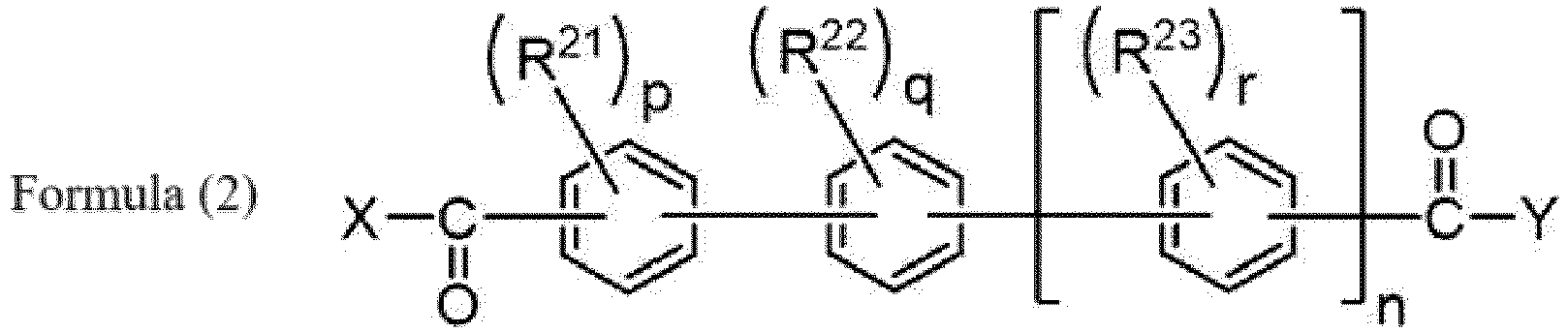 in Formula (2), p represents an integer of 0 or greater and 4 or less, p pieces of R21's each independently represent a methyl group or an ethyl group, q represents an integer of 0 or greater and 4 or less, q pieces of R22's each independently represent a methyl group or an ethyl group, r represents an integer of 0 or greater and 4 or less, r pieces of R23's each independently represent a methyl group or an ethyl group, n represents 0 or 1, X and Y each independently represent a halogen atom or -OH, and at least one of X or Y represents a halogen atom.
 - The electrophotographic photoreceptor according to any one of claims 1 to 3,
wherein the aromatic carboxylic acid halide includes an aromatic carboxylic acid chloride. - The electrophotographic photoreceptor according to any one of claims 1 to 4, wherein the charge transport layer further contains a polycarbonate resin.
- The electrophotographic photoreceptor according to any one of claims 1 to 5,wherein the polyester resin has at least one of a dicarboxylic acid unit (1-A) represented by Formula (1-A) or a diol unit (1-B) represented by Formula (1-B),

 in Formula (1-A), j represents an integer of 0 or greater and 4 or less, j pieces of R11's each independently represent a methyl group or an ethyl group, k represents an integer of 0 or greater and 4 or less, k pieces of R12's each independently represent a methyl group or an ethyl group, LA represents a single bond or a divalent linking group, ArA represents an aromatic ring that may have a substituent, and nA represents 0, 1, or 2,in Formula (1-B), j represents an integer of 0 or greater and 4 or less, j pieces of R11's each independently represent a methyl group or an ethyl group, k represents an integer of 0 or greater and 4 or less, k pieces of R12's each independently represent a methyl group or an ethyl group, LB represents a single bond or a divalent linking group, ArB represents an aromatic ring that may have a substituent, and nB represents 0, 1, or 2.
 - The electrophotographic photoreceptor according to any one of claims 1 to 6,wherein the polyester resin has at least one selected from the group consisting of a dicarboxylic acid unit (A1) represented by Formula (A1), a dicarboxylic acid unit (A3) represented by Formula (A3), and a dicarboxylic acid unit (A4) represented by Formula (A4),
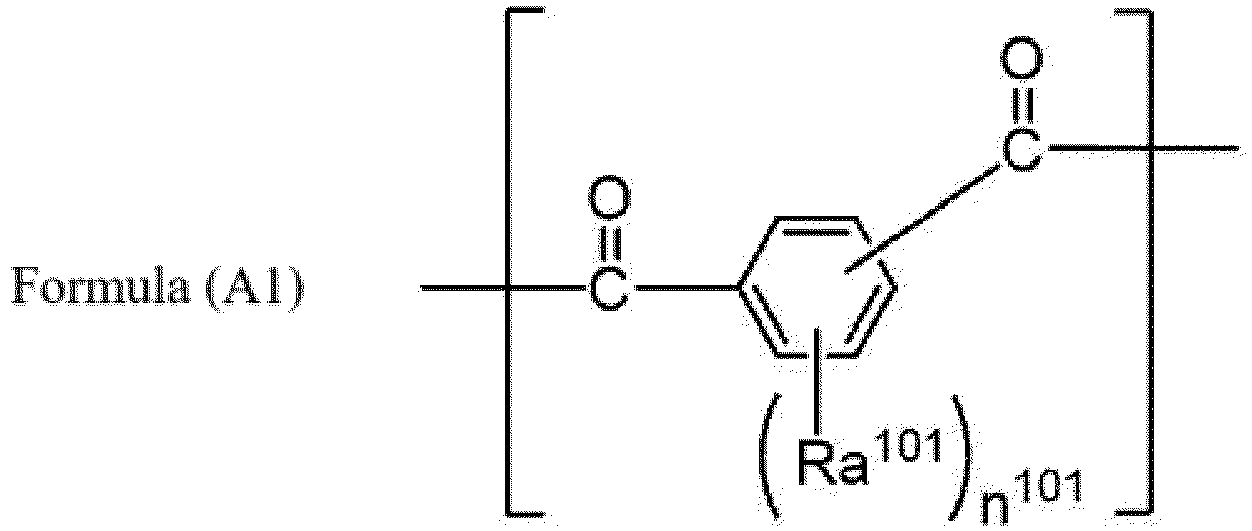

 in Formula (A1), n101 represents an integer of 0 or greater and 4 or less, and n101 pieces of Ra101's each independently represent an alkyl group having 1 or more and 10 or less carbon atoms, an aryl group having 6 or more and 12 or less carbon atoms, or an alkoxy group having 1 or more and 6 or less carbon atoms,in Formula (A3), n301 and n302 each independently represent an integer of 0 or greater and 4 or less, and n301 pieces of Ra301's and n302 pieces of Ra302's each independently represent an alkyl group having 1 or more and 10 or less carbon atoms, an aryl group having 6 or more and 12 or less carbon atoms, or an alkoxy group having 1 or more and 6 or less carbon atoms,in Formula (A4), n401 represents an integer of 0 or greater and 6 or less, and n401 pieces of Ra401's each independently represent an alkyl group having 1 or more and 10 or less carbon atoms, an aryl group having 6 or more and 12 or less carbon atoms, or an alkoxy group having 1 or more and 6 or less carbon atoms.
 - The electrophotographic photoreceptor according to any one of claims 1 to 7,wherein the polyester resin has at least one selected from the group consisting of a diol unit (B1) represented by Formula (B1), a diol unit (B2) represented by Formula (B2), a diol unit (B3) represented by Formula (B3), a diol unit (B4) represented by Formula (B4), a diol unit (B5) represented by Formula (B5), a diol unit (B6) represented by Formula (B6), and a diol unit (B8) represented by Formula (B8),


 in Formula (B1), Rb101 represents a branched alkyl group having 4 or more and 20 or less carbon atoms, Rb201 represents a hydrogen atom or an alkyl group having 1 or more and 3 or less carbon atoms, and Rb401, Rb501, Rb801, and Rb901 each independently represent a hydrogen atom, an alkyl group having 1 or more and 4 or less carbon atoms, an alkoxy group having 1 or more and 6 or less carbon atoms, or a halogen atom,in Formula (B2), Rb102 represents a linear alkyl group having 4 or more and 20 or less carbon atoms, Rb202 represents a hydrogen atom or an alkyl group having 1 or more and 3 or less carbon atoms, and Rb402, Rb502, Rb802, and Rb902 each independently represent a hydrogen atom, an alkyl group having 1 or more and 4 or less carbon atoms, an alkoxy group having 1 or more and 6 or less carbon atoms, or a halogen atom.in Formula (B3), Rb113 and Rb213 each independently represent a hydrogen atom, a linear alkyl group having 1 or more and 3 or less carbon atoms, an alkoxy group having 1 or more and 4 or less carbon atoms, or a halogen atom, d represents an integer of 7 or greater and 15 or less, and Rb403, Rb503, Rb803, and Rb903 each independently represent a hydrogen atom, an alkyl group having 1 or more and 4 or less carbon atoms, an alkoxy group having 1 or more and 6 or less carbon atoms, or a halogen atom,in Formula (B4), Rb104 and Rb204 each independently represent a hydrogen atom, an alkyl group having 1 or more and 3 or less carbon atoms, and Rb404, Rb504, Rb804, and Rb904 each independently represent a hydrogen atom, an alkyl group having 1 or more and 4 or less carbon atoms, an alkoxy group having 1 or more and 6 or less carbon atoms, or a halogen atom,in Formula (B5), Ar105 represents an aryl group having 6 or more and 12 or less carbon atoms or an aralkyl group having 7 or more and 20 or less carbon atoms, Rb205 represents a hydrogen atom or an alkyl group having 1 or more and 3 or less carbon atoms, and Rb405, Rb505, Rb805, and Rb905 each independently represent a hydrogen atom, an alkyl group having 1 or more and 4 or less carbon atoms, an alkoxy group having 1 or more and 6 or less carbon atoms, or a halogen atom,in Formula (B6), Rb116 and Rb216 each independently represent a hydrogen atom, a linear alkyl group having 1 or more and 3 or less carbon atoms, an alkoxy group having 1 or more and 4 or less carbon atoms, or a halogen atom, e represents an integer of 4 or greater and 6 or less, and Rb406, Rb506, Rb806, and Rb906 each independently represent a hydrogen atom, an alkyl group having 1 or more and 4 or less carbon atoms, an alkoxy group having 1 or more and 6 or less carbon atoms, or a halogen atom,in Formula (B8), Rb408, Rb508, Rb808, and Rb908 each independently represent a hydrogen atom, an alkyl group having 1 or more and 4 or less carbon atoms, an alkoxy group having 1 or more and 6 or less carbon atoms, or a halogen atom.
 - An electrophotographic photoreceptor comprising:a conductive substrate; anda single layer type photosensitive layer disposed on the conductive substrate,wherein the single layer type photosensitive layer contains a polyester resin having a constitutional unit containing biphenyl represented by Formula (1), andan amount of an aromatic carboxylic acid halide in the single layer type photosensitive layer is 15×10-8 mol/g or less per unit mass of the single layer type photosensitive layer,
 in Formula (1), j represents an integer of 0 or greater and 4 or less, j pieces of R11's each independently represent a methyl group or an ethyl group, k represents an integer of 0 or greater and 4 or less, and k pieces of R12's each independently represent a methyl group or an ethyl group.
 - The electrophotographic photoreceptor according to claim 9,
wherein the amount of the aromatic carboxylic acid halide in the single layer type photosensitive layer is 6×10⁻⁸ mol/g or less per unit mass of the single layer type photosensitive layer. - The electrophotographic photoreceptor according to claim 9 or 10,wherein the aromatic carboxylic acid halide is a compound represented by Formula (2),
 in Formula (2), p represents an integer of 0 or greater and 4 or less, p pieces of R21's each independently represent a methyl group or an ethyl group, q represents an integer of 0 or greater and 4 or less, q pieces of R22's each independently represent a methyl group or an ethyl group, r represents an integer of 0 or greater and 4 or less, r pieces of R23's each independently represent a methyl group or an ethyl group, n represents 0 or 1, X and Y each independently represent a halogen atom or -OH, and at least one of X or Y represents a halogen atom.
 - The electrophotographic photoreceptor according to any one of claims 9 to 11,
wherein the aromatic carboxylic acid halide includes an aromatic carboxylic acid chloride. - The electrophotographic photoreceptor according to any one of claims 9 to 12,
wherein the single layer type photosensitive layer further contains a polycarbonate resin. - The electrophotographic photoreceptor according to any one of claims 9 to 13,wherein the polyester resin has at least one of a dicarboxylic acid unit (1-A) represented by Formula (1-A) or a diol unit (1-B) represented by Formula (1-B),

 in Formula (1-A), j represents an integer of 0 or greater and 4 or less, j pieces of R11's each independently represent a methyl group or an ethyl group, k represents an integer of 0 or greater and 4 or less, k pieces of R12's each independently represent a methyl group or an ethyl group, LA represents a single bond or a divalent linking group, ArA represents an aromatic ring that may have a substituent, and nA represents 0, 1, or 2,in Formula (1-B), j represents an integer of 0 or greater and 4 or less, j pieces of R11's each independently represent a methyl group or an ethyl group, k represents an integer of 0 or greater and 4 or less, k pieces of R12's each independently represent a methyl group or an ethyl group, LB represents a single bond or a divalent linking group, ArB represents an aromatic ring that may have a substituent, and nB represents 0, 1, or 2.
 - The electrophotographic photoreceptor according to any one of claims 9 to 14,wherein the polyester resin has at least one selected from the group consisting of a dicarboxylic acid unit (A1) represented by Formula (A1), a dicarboxylic acid unit (A3) represented by Formula (A3), and a dicarboxylic acid unit (A4) represented by Formula (A4),


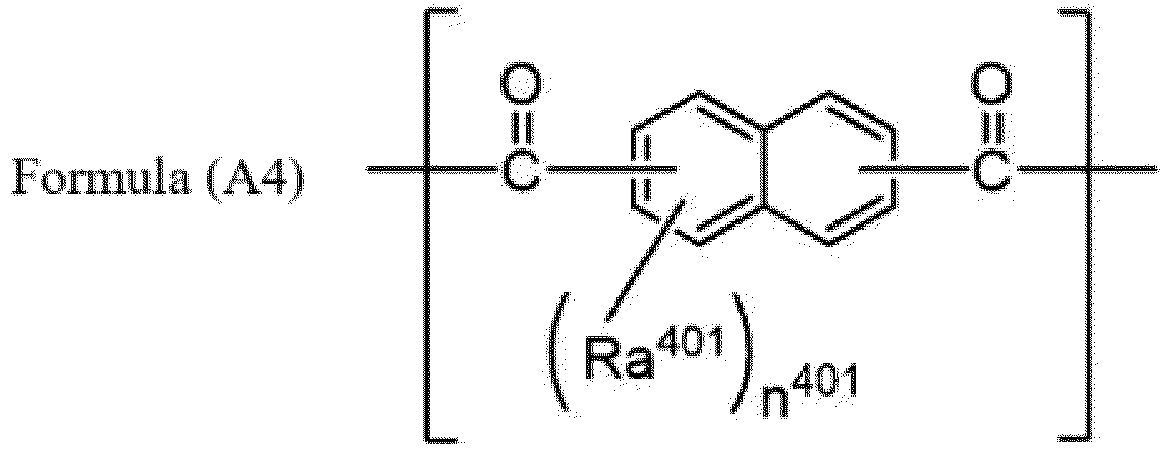 in Formula (A1), n101 represents an integer of 0 or greater and 4 or less, and n101 pieces of Ra101's each independently represent an alkyl group having 1 or more and 10 or less carbon atoms, an aryl group having 6 or more and 12 or less carbon atoms, or an alkoxy group having 1 or more and 6 or less carbon atoms,in Formula (A3), n301 and n302 each independently represent an integer of 0 or greater and 4 or less, and n301 pieces of Ra301's and n302 pieces of Ra302's each independently represent an alkyl group having 1 or more and 10 or less carbon atoms, an aryl group having 6 or more and 12 or less carbon atoms, or an alkoxy group having 1 or more and 6 or less carbon atoms,in Formula (A4), n401 represents an integer of 0 or greater and 6 or less, and n401 pieces of Ra401's each independently represent an alkyl group having 1 or more and 10 or less carbon atoms, an aryl group having 6 or more and 12 or less carbon atoms, or an alkoxy group having 1 or more and 6 or less carbon atoms.
 - The electrophotographic photoreceptor according to any one of claims 9 to 15,wherein the polyester resin has at least one selected from the group consisting of a diol unit (B1) represented by Formula (B1), a diol unit (B2) represented by Formula (B2), a diol unit (B3) represented by Formula (B3), a diol unit (B4) represented by Formula (B4), a diol unit (B5) represented by Formula (B5), a diol unit (B6) represented by Formula (B6), and a diol unit (B8) represented by Formula (B8),


 in Formula (B1), Rb101 represents a branched alkyl group having 4 or more and 20 or less carbon atoms, Rb201 represents a hydrogen atom or an alkyl group having 1 or more and 3 or less carbon atoms, and Rb401, Rb501, Rb801, and Rb901 each independently represent a hydrogen atom, an alkyl group having 1 or more and 4 or less carbon atoms, an alkoxy group having 1 or more and 6 or less carbon atoms, or a halogen atom,in Formula (B2), Rb102 represents a linear alkyl group having 4 or more and 20 or less carbon atoms, Rb202 represents a hydrogen atom or an alkyl group having 1 or more and 3 or less carbon atoms, and Rb402, Rb502, Rb802, and Rb902 each independently represent a hydrogen atom, an alkyl group having 1 or more and 4 or less carbon atoms, an alkoxy group having 1 or more and 6 or less carbon atoms, or a halogen atom,in Formula (B3), Rb113 and Rb213 each independently represent a hydrogen atom, a linear alkyl group having 1 or more and 3 or less carbon atoms, an alkoxy group having 1 or more and 4 or less carbon atoms, or a halogen atom, d represents an integer of 7 or greater and 15 or less, and Rb403, Rb503, Rb803, and Rb903 each independently represent a hydrogen atom, an alkyl group having 1 or more and 4 or less carbon atoms, an alkoxy group having 1 or more and 6 or less carbon atoms, or a halogen atom,in Formula (B4), Rb104 and Rb204 each independently represent a hydrogen atom, an alkyl group having 1 or more and 3 or less carbon atoms, and Rb404, Rb504, Rb804, and Rb904 each independently represent a hydrogen atom, an alkyl group having 1 or more and 4 or less carbon atoms, an alkoxy group having 1 or more and 6 or less carbon atoms, or a halogen atom,in Formula (B5), Ar105 represents an aryl group having 6 or more and 12 or less carbon atoms or an aralkyl group having 7 or more and 20 or less carbon atoms, Rb205 represents a hydrogen atom or an alkyl group having 1 or more and 3 or less carbon atoms, and Rb405, Rb505, Rb805, and Rb905 each independently represent a hydrogen atom, an alkyl group having 1 or more and 4 or less carbon atoms, an alkoxy group having 1 or more and 6 or less carbon atoms, or a halogen atom,in Formula (B6), Rb116 and Rb216 each independently represent a hydrogen atom, a linear alkyl group having 1 or more and 3 or less carbon atoms, an alkoxy group having 1 or more and 4 or less carbon atoms, or a halogen atom, e represents an integer of 4 or greater and 6 or less, and Rb406, Rb506, Rb806, and Rb906 each independently represent a hydrogen atom, an alkyl group having 1 or more and 4 or less carbon atoms, an alkoxy group having 1 or more and 6 or less carbon atoms, or a halogen atom,in Formula (B8), Rb408, Rb508, Rb808, and Rb908 each independently represent a hydrogen atom, an alkyl group having 1 or more and 4 or less carbon atoms, an alkoxy group having 1 or more and 6 or less carbon atoms, or a halogen atom.
 - A process cartridge comprising:the electrophotographic photoreceptor according to any one of claims 1 to 16,wherein the process cartridge is attachable to and detachable from an image forming apparatus.
- An image forming apparatus comprising:the electrophotographic photoreceptor according to any one of claims 1 to 16;a charging device that charges a surface of the electrophotographic photoreceptor;an electrostatic latent image forming device that forms an electrostatic latent image on the charged surface of the electrophotographic photoreceptor;a developing device that develops the electrostatic latent image formed on the surface of the electrophotographic photoreceptor with a developer containing a toner to form a toner image; anda transfer device that transfers the toner image to a surface of a recording medium.
Applications Claiming Priority (1)
| Application Number | Priority Date | Filing Date | Title |
|---|---|---|---|
| JP2023096630A JP2024178068A (en) | 2023-06-12 | 2023-06-12 | Electrophotographic photoreceptor, process cartridge and image forming apparatus |
Publications (2)
| Publication Number | Publication Date |
|---|---|
| EP4478130A1 true EP4478130A1 (en) | 2024-12-18 |
| EP4478130B1 EP4478130B1 (en) | 2026-04-08 |
Family
ID=89901050
Family Applications (1)
| Application Number | Title | Priority Date | Filing Date |
|---|---|---|---|
| EP24156738.7A Active EP4478130B1 (en) | 2023-06-12 | 2024-02-09 | Electrophotographic photoreceptor, process cartridge, and image forming apparatus |
Country Status (4)
| Country | Link |
|---|---|
| US (1) | US20240411236A1 (en) |
| EP (1) | EP4478130B1 (en) |
| JP (1) | JP2024178068A (en) |
| CN (1) | CN119126512A (en) |
Citations (14)
| Publication number | Priority date | Publication date | Assignee | Title |
|---|---|---|---|---|
| JP2007169617A (en) | 2005-11-24 | 2007-07-05 | Mitsubishi Chemicals Corp | Polyarylate resin, method for producing the same, and electrophotographic photosensitive member using the same |
| JP2013097300A (en) | 2011-11-04 | 2013-05-20 | Ricoh Co Ltd | Electrophotographic photoreceptor, process cartridge, and image forming apparatus |
| JP2016143024A (en) | 2015-02-05 | 2016-08-08 | 富士ゼロックス株式会社 | Electrophotographic photoreceptor, process cartridge, and image forming apparatus |
| JP2018159087A (en) | 2013-09-12 | 2018-10-11 | 三菱ケミカル株式会社 | Polyarylate resin and electrophotographic photosensitive member using the same |
| JP2019012141A (en) | 2017-06-29 | 2019-01-24 | キヤノン株式会社 | Electrophotographic photosensitive member, process cartridge, and electrophotographic apparatus |
| JP2019035900A (en) | 2017-08-18 | 2019-03-07 | キヤノン株式会社 | Electrophotographic photoreceptor, process cartridge and electrophotographic device |
| WO2019070003A1 (en) | 2017-10-04 | 2019-04-11 | 三菱ケミカル株式会社 | Electrophotographic photoreceptor, electrophotographic photoreceptor cartridge, and image formation device |
| EP3570111A1 (en) * | 2018-05-15 | 2019-11-20 | KYOCERA Document Solutions Inc. | Production method for electrophotographic photosensitive member, application liquid for photosensitive layer formation, and electrophotographic photosensitive member |
| US20190354028A1 (en) * | 2018-05-15 | 2019-11-21 | Kyocera Document Solutions Inc. | Electrographic photoreceptor manufacturing method |
| JP2021015223A (en) | 2019-07-12 | 2021-02-12 | コニカミノルタ株式会社 | Electrophotographic photoreceptor |
| JP2021071565A (en) | 2019-10-30 | 2021-05-06 | 京セラドキュメントソリューションズ株式会社 | Electrophotographic photoreceptor |
| JP2021117377A (en) | 2020-01-27 | 2021-08-10 | キヤノン株式会社 | Electrophotographic photosensitive members, process cartridges and electrophotographic equipment |
| JP2021148818A (en) | 2020-03-16 | 2021-09-27 | 京セラドキュメントソリューションズ株式会社 | Undercoat layer, method for manufacturing undercoat layer, electrophotographic photoreceptor, and image forming apparatus |
| US20230107087A1 (en) * | 2021-09-24 | 2023-04-06 | Fujifilm Business Innovation Corp. | Electrophotographic photoreceptor, process cartridge, and image forming apparatus |
-
2023
- 2023-06-12 JP JP2023096630A patent/JP2024178068A/en active Pending
-
2024
- 2024-02-09 EP EP24156738.7A patent/EP4478130B1/en active Active
- 2024-02-15 US US18/443,235 patent/US20240411236A1/en active Pending
- 2024-02-20 CN CN202410187195.9A patent/CN119126512A/en active Pending
Patent Citations (14)
| Publication number | Priority date | Publication date | Assignee | Title |
|---|---|---|---|---|
| JP2007169617A (en) | 2005-11-24 | 2007-07-05 | Mitsubishi Chemicals Corp | Polyarylate resin, method for producing the same, and electrophotographic photosensitive member using the same |
| JP2013097300A (en) | 2011-11-04 | 2013-05-20 | Ricoh Co Ltd | Electrophotographic photoreceptor, process cartridge, and image forming apparatus |
| JP2018159087A (en) | 2013-09-12 | 2018-10-11 | 三菱ケミカル株式会社 | Polyarylate resin and electrophotographic photosensitive member using the same |
| JP2016143024A (en) | 2015-02-05 | 2016-08-08 | 富士ゼロックス株式会社 | Electrophotographic photoreceptor, process cartridge, and image forming apparatus |
| JP2019012141A (en) | 2017-06-29 | 2019-01-24 | キヤノン株式会社 | Electrophotographic photosensitive member, process cartridge, and electrophotographic apparatus |
| JP2019035900A (en) | 2017-08-18 | 2019-03-07 | キヤノン株式会社 | Electrophotographic photoreceptor, process cartridge and electrophotographic device |
| WO2019070003A1 (en) | 2017-10-04 | 2019-04-11 | 三菱ケミカル株式会社 | Electrophotographic photoreceptor, electrophotographic photoreceptor cartridge, and image formation device |
| EP3570111A1 (en) * | 2018-05-15 | 2019-11-20 | KYOCERA Document Solutions Inc. | Production method for electrophotographic photosensitive member, application liquid for photosensitive layer formation, and electrophotographic photosensitive member |
| US20190354028A1 (en) * | 2018-05-15 | 2019-11-21 | Kyocera Document Solutions Inc. | Electrographic photoreceptor manufacturing method |
| JP2021015223A (en) | 2019-07-12 | 2021-02-12 | コニカミノルタ株式会社 | Electrophotographic photoreceptor |
| JP2021071565A (en) | 2019-10-30 | 2021-05-06 | 京セラドキュメントソリューションズ株式会社 | Electrophotographic photoreceptor |
| JP2021117377A (en) | 2020-01-27 | 2021-08-10 | キヤノン株式会社 | Electrophotographic photosensitive members, process cartridges and electrophotographic equipment |
| JP2021148818A (en) | 2020-03-16 | 2021-09-27 | 京セラドキュメントソリューションズ株式会社 | Undercoat layer, method for manufacturing undercoat layer, electrophotographic photoreceptor, and image forming apparatus |
| US20230107087A1 (en) * | 2021-09-24 | 2023-04-06 | Fujifilm Business Innovation Corp. | Electrophotographic photoreceptor, process cartridge, and image forming apparatus |
Non-Patent Citations (1)
| Title |
|---|
| W. M. EARECKSON, J. POLY. SCI., 1959, pages XL399 |
Also Published As
| Publication number | Publication date |
|---|---|
| EP4478130B1 (en) | 2026-04-08 |
| US20240411236A1 (en) | 2024-12-12 |
| JP2024178068A (en) | 2024-12-24 |
| CN119126512A (en) | 2024-12-13 |
Similar Documents
| Publication | Publication Date | Title |
|---|---|---|
| US20230266684A1 (en) | Image forming unit and image forming apparatus | |
| US12613476B2 (en) | Electrophotographic photoreceptor, process cartridge, and image forming apparatus | |
| JP2023130296A (en) | Electrophotographic photoreceptors, process cartridges, and image forming devices | |
| EP4474913B1 (en) | Electrophotographic photoreceptor, process cartridge, and image forming apparatus | |
| EP4198632A1 (en) | Electrophotographic photoreceptor, process cartridge, and image forming apparatus | |
| US20230266683A1 (en) | Electrophotographic photoreceptor, process cartridge, and image forming apparatus | |
| EP4478130B1 (en) | Electrophotographic photoreceptor, process cartridge, and image forming apparatus | |
| EP4741937A1 (en) | Electrophotographic photoreceptor, process cartridge, and image forming apparatus | |
| EP4592755A1 (en) | Electrophotographic photoreceptor, process cartridge, and image forming apparatus | |
| EP4741936A1 (en) | Electrophotographic photoreceptor, process cartridge, and image forming apparatus | |
| EP4603910A1 (en) | Electrophotographic photoreceptor, process cartridge, and image forming apparatus | |
| EP4741934A1 (en) | Electrophotographic photoreceptor, process cartridge, and image forming apparatus | |
| EP4603911A1 (en) | Electrophotographic photoreceptor, process cartridge, and image forming apparatus | |
| US20230280668A1 (en) | Electrophotographic photoreceptor, process cartridge, and image forming apparatus | |
| US20260133512A1 (en) | Electrophotographic photoreceptor, process cartridge, and image forming apparatus | |
| US20240053689A1 (en) | Electrophotographic photoreceptor, process cartridge, and image forming apparatus | |
| US20240248419A1 (en) | Electrophotographic photoreceptor, process cartridge, and image forming apparatus | |
| US20260133506A1 (en) | Electrophotographic photoreceptor, process cartridge, and image forming apparatus | |
| US20240288788A1 (en) | Electrophotographic photoreceptor, process cartridge, and image forming apparatus | |
| EP4530724A1 (en) | Electrophotographic photoreceptor, process cartridge, and image forming apparatus | |
| EP4741933A1 (en) | Electrophotographic photoreceptor, process cartridge, and image forming apparatus | |
| EP4414788A1 (en) | Electrophotographic photoreceptor, process cartridge, and image forming apparatus | |
| US20260133505A1 (en) | Electrophotographic photoreceptor, process cartridge, and image forming apparatus | |
| US20250102929A1 (en) | Electrophotographic photoreceptor, process cartridge, and image forming apparatus | |
| US20260133504A1 (en) | Electrophotographic photoreceptor, process cartridge, and image forming apparatus |
Legal Events
| Date | Code | Title | Description |
|---|---|---|---|
| PUAI | Public reference made under article 153(3) epc to a published international application that has entered the european phase |
Free format text: ORIGINAL CODE: 0009012 |
|
| STAA | Information on the status of an ep patent application or granted ep patent |
Free format text: STATUS: THE APPLICATION HAS BEEN PUBLISHED |
|
| AK | Designated contracting states |
Kind code of ref document: A1 Designated state(s): AL AT BE BG CH CY CZ DE DK EE ES FI FR GB GR HR HU IE IS IT LI LT LU LV MC ME MK MT NL NO PL PT RO RS SE SI SK SM TR |
|
| STAA | Information on the status of an ep patent application or granted ep patent |
Free format text: STATUS: REQUEST FOR EXAMINATION WAS MADE |
|
| 17P | Request for examination filed |
Effective date: 20250522 |
|
| STAA | Information on the status of an ep patent application or granted ep patent |
Free format text: STATUS: EXAMINATION IS IN PROGRESS |
|
| 17Q | First examination report despatched |
Effective date: 20250709 |
|
| GRAP | Despatch of communication of intention to grant a patent |
Free format text: ORIGINAL CODE: EPIDOSNIGR1 |
|
| STAA | Information on the status of an ep patent application or granted ep patent |
Free format text: STATUS: GRANT OF PATENT IS INTENDED |
|
| INTG | Intention to grant announced |
Effective date: 20251114 |
|
| GRAS | Grant fee paid |
Free format text: ORIGINAL CODE: EPIDOSNIGR3 |
|
| GRAA | (expected) grant |
Free format text: ORIGINAL CODE: 0009210 |
|
| STAA | Information on the status of an ep patent application or granted ep patent |
Free format text: STATUS: THE PATENT HAS BEEN GRANTED |
|
| AK | Designated contracting states |
Kind code of ref document: B1 Designated state(s): AL AT BE BG CH CY CZ DE DK EE ES FI FR GB GR HR HU IE IS IT LI LT LU LV MC ME MK MT NL NO PL PT RO RS SE SI SK SM TR |
|
| REG | Reference to a national code |
Ref country code: CH Ref legal event code: F10 Free format text: ST27 STATUS EVENT CODE: U-0-0-F10-F00 (AS PROVIDED BY THE NATIONAL OFFICE) Effective date: 20260408 Ref country code: GB Ref legal event code: FG4D |
|
| REG | Reference to a national code |
Ref country code: DE Ref legal event code: R096 Ref document number: 602024003693 Country of ref document: DE |