EP4477997A1 - Vibrating structure gyroscope - Google Patents
Vibrating structure gyroscope Download PDFInfo
- Publication number
- EP4477997A1 EP4477997A1 EP23178780.5A EP23178780A EP4477997A1 EP 4477997 A1 EP4477997 A1 EP 4477997A1 EP 23178780 A EP23178780 A EP 23178780A EP 4477997 A1 EP4477997 A1 EP 4477997A1
- Authority
- EP
- European Patent Office
- Prior art keywords
- drive
- pick
- drive signal
- controllers
- transducers
- Prior art date
- Legal status (The legal status is an assumption and is not a legal conclusion. Google has not performed a legal analysis and makes no representation as to the accuracy of the status listed.)
- Pending
Links
Images
Classifications
-
- G—PHYSICS
- G01—MEASURING; TESTING
- G01C—MEASURING DISTANCES, LEVELS OR BEARINGS; SURVEYING; NAVIGATION; GYROSCOPIC INSTRUMENTS; PHOTOGRAMMETRY OR VIDEOGRAMMETRY
- G01C19/00—Gyroscopes; Turn-sensitive devices using vibrating masses; Turn-sensitive devices without moving masses; Measuring angular rate using gyroscopic effects
- G01C19/56—Turn-sensitive devices using vibrating masses, e.g. vibratory angular rate sensors based on Coriolis forces
- G01C19/5776—Signal processing not specific to any of the devices covered by groups G01C19/5607 - G01C19/5719
-
- G—PHYSICS
- G01—MEASURING; TESTING
- G01C—MEASURING DISTANCES, LEVELS OR BEARINGS; SURVEYING; NAVIGATION; GYROSCOPIC INSTRUMENTS; PHOTOGRAMMETRY OR VIDEOGRAMMETRY
- G01C19/00—Gyroscopes; Turn-sensitive devices using vibrating masses; Turn-sensitive devices without moving masses; Measuring angular rate using gyroscopic effects
- G01C19/56—Turn-sensitive devices using vibrating masses, e.g. vibratory angular rate sensors based on Coriolis forces
- G01C19/567—Turn-sensitive devices using vibrating masses, e.g. vibratory angular rate sensors based on Coriolis forces using the phase shift of a vibration node or antinode
- G01C19/5677—Turn-sensitive devices using vibrating masses, e.g. vibratory angular rate sensors based on Coriolis forces using the phase shift of a vibration node or antinode of essentially two-dimensional [2D] vibrators, e.g. ring-shaped vibrators
Definitions
- This disclosure relates to a vibrating structure gyroscope.
- Vibrating structure gyroscopes measure angular rate. Rate output errors occur due to non-linearities in the device components. It is therefore desirable to improve vibrating structure gyroscopes, and in particular, reduce errors in the measured angular rate.
- a vibrating structure gyroscope comprising: a structure configured to vibrate; one or more drive transducers configured to oscillate the structure at a resonant frequency or dampen oscillation of the structure; one or more drive circuits configured to activate the one or more drive transducers; one or more pick off transducers configured to detect oscillation of the structure; one or more pick off circuits configured to output a pick off circuit signal based on the detected oscillation; and one or more controllers configured to adjust a drive signal for the one or more drive transducers based on the one or more pick off circuit signals; wherein the one or more controllers are configured to phase modulate the adjusted drive signal.
- phase modulating the adjusted drive signal errors in measurements caused by non-linearities in the one or more drive circuits can be reduced and/or removed, and the drive circuit can be optionally provided without a digital-to-analogue converter.
- the one or more controllers may be configured to phase modulate the adjusted drive signal to encode a sine component and a cosine component at the resonant frequency in the adjusted drive signal.
- the one or more controllers may be configured to phase modulate the adjusted drive signal by adjusting a timing of transitions between fixed levels of the adjusted drive signal.
- the one or more controllers may be configured to adjust the drive signal by determining a magnitude and a phase of a detected oscillation of the structure based on the one or more pick off circuit signals.
- the one or more controllers may be configured to adjust the drive signal based on a difference between the detected oscillation and a desired oscillation.
- the one or more controllers may be configured to predict one or more previous drive transducer output signals.
- the one or more controllers may be configured to determine a difference between a previous drive signal and the one or more predicted drive transducer output signals by subtracting the one or more predicted drive transducer output signals from the previous drive signal.
- the one or more controllers may be configured to adjust the drive signal by adding the difference between the previous drive signal and the one or more predicted drive transducer output signals to the drive signal. This allows errors in the amplitude of the previous drive signal, e.g. due to timing quantisation, to be corrected.
- the one or more controllers are configured to predict one or more phase errors in the one or more pick off circuit signals.
- the one or more controllers may be configured to apply a phase correction to the one or more pick off circuit signals based on the one or more predicted phase errors. This allows errors in the phase of the one or more pick off circuit signals, e.g. due to timing quantisation, to be corrected.
- the one or more pick off circuit signals may include a sine component and a cosine component.
- the adjusted drive signal may comprise a two-level digital drive signal. This allows the vibrating structure gyroscope to be provided without a means to create an amplitude modulated signal, simplifying the electronics.
- the one or more drive transducers may be a primary drive transducer and/or a secondary drive transducer.
- the one or more pick off transducers may be a primary pick off transducer and/or a secondary pick off transducer.
- the one or more controllers may be a primary controller and/or a secondary controller.
- a method of operating a vibrating structure gyroscope comprising a structure configured to vibrate, one or more drive transducers configured to oscillate the structure at a resonant frequency or dampen oscillation of the structure, one or more drive circuits configured to activate the one or more drive transducers; and one or more pick off circuits configured to output a pick off circuit signal based on the detected oscillation, the method comprising: adjusting a drive signal for the one or more drive transducers based on the one or more pick off circuit signals; and phase modulating the adjusted drive signal.
- phase modulating the adjusted drive signal By phase modulating the adjusted drive signal, errors in measurements caused by non-linearities in the one or more drive circuits can be reduced and/or removed, and the drive circuit can be optionally provided without a digital-to-analogue converter.
- the method may comprise phase modulating the adjusted drive signal to encode a sine component and a cosine component at the resonant frequency in the adjusted drive signal.
- the method may comprise phase modulating the adjusted drive signal by adjusting a timing of transitions between fixed levels of the adjusted drive signal.
- the method may comprise adjusting the drive signal by determining a magnitude and a phase of a detected oscillation of the structure based on the one or more pick off circuit signals.
- the method may comprise adjusting the drive signal based on a difference between the detected oscillation and a desired oscillation.
- the method may comprise predicting one or more previous drive transducer output signals.
- the method may comprise determining a difference between a previous drive signal and the one or more predicted drive transducer output signals by subtracting the one or more predicted drive transducer output signals from previous the drive signal.
- the method may comprise adjusting the drive signal by adding the difference between the previous drive signal and the one or more predicted drive transducer output signals to the drive signal. This allows errors in the amplitude of the previous drive signal, e.g. due to timing quantisation, to be corrected.
- the method may comprise predicting one or more phase errors in the one or more pick off circuit signals.
- the method may comprise applying a phase correction to the one or more pick off circuit signals based on the one or more predicted phase errors. This allows errors in the phase of the one or more pick off circuit signals, e.g. due to timing quantisation, to be corrected.
- the one or more pick off circuit signals may include a sine component and a cosine component
- the adjusted drive signal may comprise a two-level digital drive signal. This allows the vibrating structure gyroscope to be provided without a means to create an amplitude modulated signal, simplifying the electronics.
- the one or more drive transducers may be a primary drive transducer and/or a secondary drive transducer.
- the one or more pick off transducers may be a primary pick off transducer and/or a secondary pick off transducer.
- the one or more controllers may be a primary controller and/or a secondary controller.
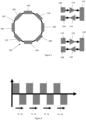
- a vibrating structure gyroscope 100 comprises a structure 102, a primary drive transducer 104, and a primary pick off transducer 106.
- the structure 102 comprises a planar ring.
- the structure 102 may comprise one or more of a ring, a beam, a tuning fork, a cylinder, a hemispherical shell, and a disk.
- a primary controller 112 outputs a primary drive signal for the primary drive transducer 104 to oscillate the structure 102 at its resonant frequency.
- the primary drive signal is received by a primary drive circuit 114 which activates the primary drive transducer 104. This causes the primary drive transducer 104 to drive the structure 102 to oscillate, forming an antinode (i.e. where the oscillation of the structure is at a maximum) at the location of the primary drive transducer 104.
- the primary pick off transducer 106 detects oscillations of the structure 102 at a location 90° from the primary drive transducer 104 where a second antinode is formed, and outputs a primary pick off transducer signal. This signal is received by a primary pick off circuit 116 that processes the signal and transmits a primary pick off circuit signal to the primary controller 112.
- the output signal from the primary pick off circuit 116 is not identical to the output signal from the primary pick off transducer 106.
- the primary controller 112 predicts one or more phase errors in the primary pick off circuit output signal and applies a phase correction to the primary pick off circuit output signal based on the one or more predicted phase errors.
- the primary controller determines a magnitude and phase of the detected oscillation based on the corrected primary pick off circuit output signal, and adjusts the primary drive signal from the previous resonant cycle based on a difference between the detected oscillation and a desired oscillation (i.e. a resonant oscillation).
- the output signal from the primary drive transducer 104 is not identical to the primary drive signal output from the primary controller 112. Taking this into account, the primary controller 112 predicts one or more errors caused by the primary drive circuit 114 in the previous resonant cycle and adjusts the primary drive signal based on the one or more errors.
- the primary controller 112 predicts a primary drive transducer output signal from the previous resonant cycle and subtracts this from the previous primary drive signal. The remainder (i.e. the difference between the predicted primary drive transducer signal and the previous primary drive signal) is added to the primary drive signal. This primary drive signal is then output the primary drive circuit 114.
- the vibrating structure gyroscope 100 further comprises a secondary drive transducer 108, and a secondary pick off transducer 110.
- the secondary drive and pick off transducers 108, 110 are located at nodes on the structure 102 (i.e. at points that are expected not to oscillate when structure is stationary and the primary drive transducer 104 oscillates the structure 102 at its resonant frequency).
- the secondary pick off transducer 110 detects oscillations at the node (where there were none previously) and outputs a secondary pick off transducer signal.
- This signal is received by a secondary pick off circuit 122 which processes the signal and transmits a secondary pick off circuit signal to a secondary controller 118.
- the secondary controller 118 outputs a secondary drive signal for the secondary drive transducer 108 to null the oscillations.
- the secondary drive signal is received by a secondary drive circuit 120 which activates the secondary drive transducer 108. This causes the secondary drive transducer 108 to dampen the oscillations at the node.
- the amplitude of the secondary drive signal is proportional to the angular rate of rotation of the vibrating structure gyroscope 100 about the axis.
- non-linearity errors in the secondary drive circuit 120 means that, while the oscillations are dampened by the secondary drive transducer 108, there are errors in the angular rate calculated by the controller 118. Phase modulating the secondary drive signal reduces these errors (as described below).
- the output signal from the secondary pick off circuit 122 is not identical to the output signal from the secondary pick off transducer 110.
- the secondary controller 118 predicts one or more phase errors in the secondary pick off circuit output signal and applies a phase correction to the secondary pick off circuit output signal based on the one or more predicted phase errors.
- the secondary controller 118 determines a magnitude and phase of the detected oscillation based on the corrected secondary pick off circuit output signal, and adjusts the secondary drive signal from a previous resonant cycle based on a difference between the detected oscillation and a desired oscillation (i.e. no oscillation).
- the output signal from the secondary drive transducer 108 is not identical to the secondary drive signal output from the secondary controller 118. Taking this into account, the secondary controller 118 predicts one or more errors caused by the secondary drive circuit 120 in the previous resonant cycle and adjusts the primary drive signal based on the one or more errors.
- the secondary controller 118 predicts a secondary drive transducer output signal from the previous resonant cycle and subtracts this from the previous secondary drive signal. The remainder (i.e. the difference between the predicted secondary drive transducer signal and the previous secondary drive signal) is added to the secondary drive signal. This secondary drive signal is then output the drive circuit 114.
- the primary drive circuit 114 and the secondary drive circuit 120 may be the same circuit, i.e. there may only be one drive circuit.
- the primary pick off circuit 116 and the secondary pick off circuit 122 may be the same circuit, i.e. there may only be one pick off circuit.
- the secondary pick off circuit output signal includes a ⁇ Real' (R) component, i.e. a sine component, and a 'Quadrature' (Q) component, i.e. a cosine component.
- the ⁇ Real' (R) component provides the angular rate of rotation, while the ⁇ Quad' (Q) component is an error generated through imperfections in the components.
- the ⁇ Quad' (Q) component is orthogonal in phase to the ⁇ Real' (R) component, it does not contribute to the angular rate of rotation.
- the secondary drive signal is generated with reciprocal ⁇ Real' (R) and ⁇ Quad' (Q) components, i.e. sine and cosine components.
- Figure 2 shows a secondary drive signal for the secondary drive transducer 108.
- the secondary drive signal is a two-level (rectangular) digital drive signal comprising eight transitions in a single 14 kHz cycle.
- the drive signal may have a different number of transitions, transition at different positions, and/or have a different shape.
- the drive signal in Figure 2 is one that has not been phase modulated.
- the arrows indicate how the secondary drive signal changes after phase modulation.
- the secondary controller 118 phase modulates the secondary drive signal by adjusting a timing of transitions between the fixed levels of the secondary drive signal in order to encode a sine component and a cosine component at the resonant frequency in the secondary drive signal.
- the use of a two-level phase modulated drive signal reduces the non-linearity errors since the point at which the secondary drive signal transitions between the two levels can be set precisely in time. This also allows for the drive circuit 114 to be provided without a digital-to-analogue converter.
- the secondary drive signal may be subject to both amplitude modulation and phase modulation.
- the secondary drive signal may comprise a four-level digital drive signal having amplitudes (R + Q), (R - Q), (- R - Q), and (- R + Q), corresponding to an amplitude modulated drive signal.
- the secondary controller 118 applies phase modulation to the amplitude modulated drive signal as described above. Specifically, the secondary controller 118 phase modulates the amplitude modulated drive signal by adjusting a timing of transitions between the levels of the secondary drive signal in order to encode a sine component and a cosine component at the resonant frequency in the secondary drive signal.
- the primary pick off circuit output signal is similar to the secondary pick off circuit signal except that the ⁇ Real' component provides resonant motion of the structure 102.
- This means that the secondary drive signal can also be amplitude and/or phase modulated in a similar manner to the primary drive signal.
- one or both of the primary drive signal and the secondary drive signal are phase modulated. Additionally, one or both of the primary drive signal and the secondary drive signal may be amplitude modulated.
- the vibrating structure gyroscope 100 may comprise a pair of primary drive transducers 104, a pair of primary pick off transducers 106, a pair of secondary drive transducers 108, and a pair of secondary pick of transducers 110.
- Each pair may be arranged opposite each other around the vibrating structure gyroscope 100. However, this is not necessary, i.e. each pair may be arranged in other positions relative to each other, provided the primary drive transducers and/or primary pick off transducers are not aligned with the secondary drive transducers and/or secondary pick off transducers.
Landscapes
- Engineering & Computer Science (AREA)
- Physics & Mathematics (AREA)
- General Physics & Mathematics (AREA)
- Radar, Positioning & Navigation (AREA)
- Remote Sensing (AREA)
- Signal Processing (AREA)
- Gyroscopes (AREA)
Abstract
A vibrating structure gyroscope comprises: a structure configured to vibrate; one or more drive transducers configured to oscillate the structure at a resonant frequency or dampen oscillation of the structure; one or more drive circuits configured to activate the one or more drive transducers; one or more pick off transducers configured to detect oscillation of the structure; one or more pick off circuits configured to output a pick off circuit signal based on the detected oscillations; and one or more controllers configured to adjust a drive signal for the one or more drive transducers based on the one or more pick off circuit signals; wherein the one or more controllers are configured to phase modulate the adjusted drive signal.
Description
- This disclosure relates to a vibrating structure gyroscope.
- Vibrating structure gyroscopes (VSGs) measure angular rate. Rate output errors occur due to non-linearities in the device components. It is therefore desirable to improve vibrating structure gyroscopes, and in particular, reduce errors in the measured angular rate.
- According to an aspect, there is provided a vibrating structure gyroscope comprising: a structure configured to vibrate; one or more drive transducers configured to oscillate the structure at a resonant frequency or dampen oscillation of the structure; one or more drive circuits configured to activate the one or more drive transducers; one or more pick off transducers configured to detect oscillation of the structure; one or more pick off circuits configured to output a pick off circuit signal based on the detected oscillation; and one or more controllers configured to adjust a drive signal for the one or more drive transducers based on the one or more pick off circuit signals; wherein the one or more controllers are configured to phase modulate the adjusted drive signal. By phase modulating the adjusted drive signal, errors in measurements caused by non-linearities in the one or more drive circuits can be reduced and/or removed, and the drive circuit can be optionally provided without a digital-to-analogue converter.
- The one or more controllers may be configured to phase modulate the adjusted drive signal to encode a sine component and a cosine component at the resonant frequency in the adjusted drive signal.
- The one or more controllers may be configured to phase modulate the adjusted drive signal by adjusting a timing of transitions between fixed levels of the adjusted drive signal.
- The one or more controllers may be configured to adjust the drive signal by determining a magnitude and a phase of a detected oscillation of the structure based on the one or more pick off circuit signals. The one or more controllers may be configured to adjust the drive signal based on a difference between the detected oscillation and a desired oscillation.
- The one or more controllers may be configured to predict one or more previous drive transducer output signals.
- The one or more controllers may be configured to determine a difference between a previous drive signal and the one or more predicted drive transducer output signals by subtracting the one or more predicted drive transducer output signals from the previous drive signal.
- The one or more controllers may be configured to adjust the drive signal by adding the difference between the previous drive signal and the one or more predicted drive transducer output signals to the drive signal. This allows errors in the amplitude of the previous drive signal, e.g. due to timing quantisation, to be corrected.
- The one or more controllers are configured to predict one or more phase errors in the one or more pick off circuit signals.
- The one or more controllers may be configured to apply a phase correction to the one or more pick off circuit signals based on the one or more predicted phase errors. This allows errors in the phase of the one or more pick off circuit signals, e.g. due to timing quantisation, to be corrected.
- The one or more pick off circuit signals may include a sine component and a cosine component.
- The adjusted drive signal may comprise a two-level digital drive signal. This allows the vibrating structure gyroscope to be provided without a means to create an amplitude modulated signal, simplifying the electronics.
- The one or more drive transducers may be a primary drive transducer and/or a secondary drive transducer.
- The one or more pick off transducers may be a primary pick off transducer and/or a secondary pick off transducer.
- The one or more controllers may be a primary controller and/or a secondary controller.
- According to an aspect, there is provided a method of operating a vibrating structure gyroscope comprising a structure configured to vibrate, one or more drive transducers configured to oscillate the structure at a resonant frequency or dampen oscillation of the structure, one or more drive circuits configured to activate the one or more drive transducers; and one or more pick off circuits configured to output a pick off circuit signal based on the detected oscillation, the method comprising: adjusting a drive signal for the one or more drive transducers based on the one or more pick off circuit signals; and phase modulating the adjusted drive signal. By phase modulating the adjusted drive signal, errors in measurements caused by non-linearities in the one or more drive circuits can be reduced and/or removed, and the drive circuit can be optionally provided without a digital-to-analogue converter.
- The method may comprise phase modulating the adjusted drive signal to encode a sine component and a cosine component at the resonant frequency in the adjusted drive signal.
- The method may comprise phase modulating the adjusted drive signal by adjusting a timing of transitions between fixed levels of the adjusted drive signal.
- The method may comprise adjusting the drive signal by determining a magnitude and a phase of a detected oscillation of the structure based on the one or more pick off circuit signals. The method may comprise adjusting the drive signal based on a difference between the detected oscillation and a desired oscillation.
- The method may comprise predicting one or more previous drive transducer output signals.
- The method may comprise determining a difference between a previous drive signal and the one or more predicted drive transducer output signals by subtracting the one or more predicted drive transducer output signals from previous the drive signal.
- The method may comprise adjusting the drive signal by adding the difference between the previous drive signal and the one or more predicted drive transducer output signals to the drive signal. This allows errors in the amplitude of the previous drive signal, e.g. due to timing quantisation, to be corrected.
- The method may comprise predicting one or more phase errors in the one or more pick off circuit signals.
- The method may comprise applying a phase correction to the one or more pick off circuit signals based on the one or more predicted phase errors. This allows errors in the phase of the one or more pick off circuit signals, e.g. due to timing quantisation, to be corrected.
- The one or more pick off circuit signals may include a sine component and a cosine component
- The adjusted drive signal may comprise a two-level digital drive signal. This allows the vibrating structure gyroscope to be provided without a means to create an amplitude modulated signal, simplifying the electronics.
- The one or more drive transducers may be a primary drive transducer and/or a secondary drive transducer.
- The one or more pick off transducers may be a primary pick off transducer and/or a secondary pick off transducer.
- The one or more controllers may be a primary controller and/or a secondary controller.
- Embodiments will be further described and explained by way of example with reference to the accompanying drawings in which
-
Figure 1 shows a schematic view of a vibrating structure gyroscope; and -
Figure 2 shows a drive signal for a vibrating structure gyroscope. - With reference to
Figure 1 , avibrating structure gyroscope 100 comprises astructure 102, aprimary drive transducer 104, and a primary pick offtransducer 106. Thestructure 102 comprises a planar ring. However, in alternative embodiments, thestructure 102 may comprise one or more of a ring, a beam, a tuning fork, a cylinder, a hemispherical shell, and a disk. - A
primary controller 112 outputs a primary drive signal for theprimary drive transducer 104 to oscillate thestructure 102 at its resonant frequency. The primary drive signal is received by aprimary drive circuit 114 which activates theprimary drive transducer 104. This causes theprimary drive transducer 104 to drive thestructure 102 to oscillate, forming an antinode (i.e. where the oscillation of the structure is at a maximum) at the location of theprimary drive transducer 104. The primary pick offtransducer 106 detects oscillations of thestructure 102 at a location 90° from theprimary drive transducer 104 where a second antinode is formed, and outputs a primary pick off transducer signal. This signal is received by a primary pick offcircuit 116 that processes the signal and transmits a primary pick off circuit signal to theprimary controller 112. - Due to imperfections in the components of the primary pick off
circuit 116, the output signal from the primary pick offcircuit 116 is not identical to the output signal from the primary pick offtransducer 106. In order to maintain resonant motion of thestructure 102, theprimary controller 112 predicts one or more phase errors in the primary pick off circuit output signal and applies a phase correction to the primary pick off circuit output signal based on the one or more predicted phase errors. The primary controller then determines a magnitude and phase of the detected oscillation based on the corrected primary pick off circuit output signal, and adjusts the primary drive signal from the previous resonant cycle based on a difference between the detected oscillation and a desired oscillation (i.e. a resonant oscillation). - Furthermore, due to imperfections in the components in the
primary drive circuit 114, the output signal from theprimary drive transducer 104 is not identical to the primary drive signal output from theprimary controller 112. Taking this into account, theprimary controller 112 predicts one or more errors caused by theprimary drive circuit 114 in the previous resonant cycle and adjusts the primary drive signal based on the one or more errors. - For example, the
primary controller 112 predicts a primary drive transducer output signal from the previous resonant cycle and subtracts this from the previous primary drive signal. The remainder (i.e. the difference between the predicted primary drive transducer signal and the previous primary drive signal) is added to the primary drive signal. This primary drive signal is then output theprimary drive circuit 114. - As illustrated in
Figure 1 , thevibrating structure gyroscope 100 further comprises asecondary drive transducer 108, and a secondary pick offtransducer 110. The secondary drive and pick offtransducers primary drive transducer 104 oscillates thestructure 102 at its resonant frequency). - When the vibrating
structure gyroscope 100 is rotated about an axis, Coriolis forces cause the antinodes and nodes to move position on thestructure 102. The secondary pick offtransducer 110 detects oscillations at the node (where there were none previously) and outputs a secondary pick off transducer signal. This signal is received by a secondary pick offcircuit 122 which processes the signal and transmits a secondary pick off circuit signal to asecondary controller 118. Thesecondary controller 118 outputs a secondary drive signal for thesecondary drive transducer 108 to null the oscillations. The secondary drive signal is received by asecondary drive circuit 120 which activates thesecondary drive transducer 108. This causes thesecondary drive transducer 108 to dampen the oscillations at the node. - The amplitude of the secondary drive signal is proportional to the angular rate of rotation of the vibrating
structure gyroscope 100 about the axis. However, non-linearity errors in thesecondary drive circuit 120 means that, while the oscillations are dampened by thesecondary drive transducer 108, there are errors in the angular rate calculated by thecontroller 118. Phase modulating the secondary drive signal reduces these errors (as described below). - In a similar manner to the
primary controller 112, due to imperfections in the components of the secondary pick offcircuit 122, the output signal from the secondary pick offcircuit 122 is not identical to the output signal from the secondary pick offtransducer 110. In order to null oscillations at the node, thesecondary controller 118 predicts one or more phase errors in the secondary pick off circuit output signal and applies a phase correction to the secondary pick off circuit output signal based on the one or more predicted phase errors. Thesecondary controller 118 then determines a magnitude and phase of the detected oscillation based on the corrected secondary pick off circuit output signal, and adjusts the secondary drive signal from a previous resonant cycle based on a difference between the detected oscillation and a desired oscillation (i.e. no oscillation). - Furthermore, due to imperfections in the components in the
secondary drive circuit 120, the output signal from thesecondary drive transducer 108 is not identical to the secondary drive signal output from thesecondary controller 118. Taking this into account, thesecondary controller 118 predicts one or more errors caused by thesecondary drive circuit 120 in the previous resonant cycle and adjusts the primary drive signal based on the one or more errors. - For example, the
secondary controller 118 predicts a secondary drive transducer output signal from the previous resonant cycle and subtracts this from the previous secondary drive signal. The remainder (i.e. the difference between the predicted secondary drive transducer signal and the previous secondary drive signal) is added to the secondary drive signal. This secondary drive signal is then output thedrive circuit 114. - In some embodiments, the
primary drive circuit 114 and thesecondary drive circuit 120 may be the same circuit, i.e. there may only be one drive circuit. Similarly, the primary pick offcircuit 116 and the secondary pick offcircuit 122 may be the same circuit, i.e. there may only be one pick off circuit. - The secondary pick off circuit output signal includes a `Real' (R) component, i.e. a sine component, and a 'Quadrature' (Q) component, i.e. a cosine component. The `Real' (R) component provides the angular rate of rotation, while the `Quad' (Q) component is an error generated through imperfections in the components. As the `Quad' (Q) component is orthogonal in phase to the `Real' (R) component, it does not contribute to the angular rate of rotation. In order to dampen the oscillation of the
structure 102, the secondary drive signal is generated with reciprocal `Real' (R) and `Quad' (Q) components, i.e. sine and cosine components. -
Figure 2 shows a secondary drive signal for thesecondary drive transducer 108. As illustrated, the secondary drive signal is a two-level (rectangular) digital drive signal comprising eight transitions in a single 14 kHz cycle. However, in other embodiments, the drive signal may have a different number of transitions, transition at different positions, and/or have a different shape. - The drive signal in
Figure 2 is one that has not been phase modulated. The arrows indicate how the secondary drive signal changes after phase modulation. - The
secondary controller 118 phase modulates the secondary drive signal by adjusting a timing of transitions between the fixed levels of the secondary drive signal in order to encode a sine component and a cosine component at the resonant frequency in the secondary drive signal. The use of a two-level phase modulated drive signal reduces the non-linearity errors since the point at which the secondary drive signal transitions between the two levels can be set precisely in time. This also allows for thedrive circuit 114 to be provided without a digital-to-analogue converter. - Alternatively, the secondary drive signal may be subject to both amplitude modulation and phase modulation. For example, the secondary drive signal may comprise a four-level digital drive signal having amplitudes (R + Q), (R - Q), (- R - Q), and (- R + Q), corresponding to an amplitude modulated drive signal. In these embodiments, the
secondary controller 118 applies phase modulation to the amplitude modulated drive signal as described above. Specifically, thesecondary controller 118 phase modulates the amplitude modulated drive signal by adjusting a timing of transitions between the levels of the secondary drive signal in order to encode a sine component and a cosine component at the resonant frequency in the secondary drive signal. - The primary pick off circuit output signal is similar to the secondary pick off circuit signal except that the `Real' component provides resonant motion of the
structure 102. This means that the secondary drive signal can also be amplitude and/or phase modulated in a similar manner to the primary drive signal. - Thus, in some embodiments one or both of the primary drive signal and the secondary drive signal are phase modulated. Additionally, one or both of the primary drive signal and the secondary drive signal may be amplitude modulated.
- As illustrated in
Figure 1 , in some embodiments, the vibratingstructure gyroscope 100 may comprise a pair ofprimary drive transducers 104, a pair of primary pick offtransducers 106, a pair ofsecondary drive transducers 108, and a pair of secondary pick oftransducers 110. Each pair may be arranged opposite each other around the vibratingstructure gyroscope 100. However, this is not necessary, i.e. each pair may be arranged in other positions relative to each other, provided the primary drive transducers and/or primary pick off transducers are not aligned with the secondary drive transducers and/or secondary pick off transducers. - Various aspects of the vibrating structure gyroscope disclosed in the various embodiments may be used alone, in combination, or in a variety of arrangements not specifically discussed in the embodiments described in the foregoing and this disclosure is therefore not limited in its application to the details and arrangement of components set forth in the foregoing description or illustrated in the drawings. For example, aspects described in one embodiment may be combined in any manner with aspects described in other embodiments. Although particular embodiments have been shown and described, it will be obvious to those skilled in the art that changes and modifications may be made without departing from the invention in its broader aspects. The scope of the following claims should not be limited by the embodiments set forth in the examples, but should be given the broadest reasonable interpretation consistent with the description as a whole.
Claims (15)
- A vibrating structure gyroscope comprising:a structure configured to vibrate;one or more drive transducers configured to oscillate the structure at a resonant frequency or dampen oscillation of the structure;one or more drive circuits configured to activate the one or more drive transducers;one or more pick off transducers configured to detect oscillation of the structure;one or more pick off circuits configured to output a pick off circuit signal based on the detected oscillation; andone or more controllers configured to adjust a drive signal for the one or more drive transducers based on the one or more pick off circuit signals;wherein the one or more controllers are configured to phase modulate the adjusted drive signal.
- The vibrating structure gyroscope of claim 1, wherein the one or more controllers are configured to phase modulate the adjusted drive signal to encode a sine component and a cosine component at the resonant frequency in the adjusted drive signal.
- The vibrating structure gyroscope of claim 1 or 2, wherein the one or more controllers are configured to phase modulate the adjusted drive signal by adjusting a timing of transitions between fixed levels of the adjusted drive signal.
- The vibrating structure gyroscope of any preceding claim, wherein the one or more controllers are configured to adjust the drive signal by determining a magnitude and a phase of a detected oscillation of the structure based on the one or more pick off circuit signals, wherein the one or more controllers are configured to adjust the drive signal based on a difference between the detected oscillation and a desired oscillation.
- The vibrating structure gyroscope of claim 4, wherein the one or more controllers are configured to predict one or more previous drive transducer output signals.
- The vibrating structure gyroscope of claim 5, wherein the one or more controllers are configured to determine a difference between a previous drive signal and the one or more predicted drive transducer output signals by subtracting the one or more predicted drive transducer output signals from the previous drive signal.
- The vibrating structure gyroscope of claim 6, wherein the one or more controllers are configured to adjust the drive signal by adding the difference between the previous drive signal and the one or more predicted drive transducer output signals to the drive signal.
- The vibrating structure gyroscope of any of claims 4-7, wherein the one or more controllers are configured to predict one or more phase errors in the one or more pick off circuit signals.
- The vibrating structure gyroscope of claim 7, wherein the one or more controllers are configured to apply a phase correction to the one or more pick off circuit signals based on the one or more predicted phase errors.
- The vibrating structure gyroscope of any preceding claim, wherein the one or more pick off circuit signals include a sine component and a cosine component.
- The vibrating structure gyroscope of any preceding claim, wherein the adjusted drive signal comprises a two-level digital drive signal.
- The vibrating structure gyroscope of any preceding claim, wherein the one or more drive transducers is a primary drive transducer and/or a secondary drive transducer.
- The vibrating structure gyroscope of any preceding claim, wherein the one or more pick off transducers is a primary pick off transducer and/or a secondary pick off transducer.
- The vibrating structure gyroscope of any preceding claim, wherein the one or more controllers is a primary controller and/or a secondary controller.
- A method of operating a vibrating structure gyroscope comprising a structure configured to vibrate, one or more drive transducers configured to oscillate the structure at a resonant frequency or dampen oscillation of the structure, one or more drive circuits configured to activate the one or more drive transducers; one or more pick off transducers configured to detect oscillation of the structure; and one or more pick off circuits configured to output a pick off circuit signal based on the detected oscillation, the method comprising:adjusting a drive signal for the one or more drive transducers based on the one or more pick off circuit signals; andphase modulating the adjusted drive signal.
Priority Applications (2)
| Application Number | Priority Date | Filing Date | Title |
|---|---|---|---|
| EP23178780.5A EP4477997A1 (en) | 2023-06-12 | 2023-06-12 | Vibrating structure gyroscope |
| US18/740,649 US20240410695A1 (en) | 2023-06-12 | 2024-06-12 | Vibrating structure gyroscope |
Applications Claiming Priority (1)
| Application Number | Priority Date | Filing Date | Title |
|---|---|---|---|
| EP23178780.5A EP4477997A1 (en) | 2023-06-12 | 2023-06-12 | Vibrating structure gyroscope |
Publications (1)
| Publication Number | Publication Date |
|---|---|
| EP4477997A1 true EP4477997A1 (en) | 2024-12-18 |
Family
ID=86760685
Family Applications (1)
| Application Number | Title | Priority Date | Filing Date |
|---|---|---|---|
| EP23178780.5A Pending EP4477997A1 (en) | 2023-06-12 | 2023-06-12 | Vibrating structure gyroscope |
Country Status (2)
| Country | Link |
|---|---|
| US (1) | US20240410695A1 (en) |
| EP (1) | EP4477997A1 (en) |
Citations (3)
| Publication number | Priority date | Publication date | Assignee | Title |
|---|---|---|---|---|
| US20150280949A1 (en) * | 2012-11-06 | 2015-10-01 | Laurent Cornibert | Method and apparatus for generating a proof-mass drive signal |
| CN106370172A (en) * | 2016-08-30 | 2017-02-01 | 上海交通大学 | Micro-gyroscope drive and detection device and method based on digital embedded system |
| CN114964197B (en) * | 2022-07-29 | 2022-10-28 | 中国船舶重工集团公司第七0七研究所 | Resonant gyroscope phase reference self-compensation system and compensation method |
-
2023
- 2023-06-12 EP EP23178780.5A patent/EP4477997A1/en active Pending
-
2024
- 2024-06-12 US US18/740,649 patent/US20240410695A1/en active Pending
Patent Citations (3)
| Publication number | Priority date | Publication date | Assignee | Title |
|---|---|---|---|---|
| US20150280949A1 (en) * | 2012-11-06 | 2015-10-01 | Laurent Cornibert | Method and apparatus for generating a proof-mass drive signal |
| CN106370172A (en) * | 2016-08-30 | 2017-02-01 | 上海交通大学 | Micro-gyroscope drive and detection device and method based on digital embedded system |
| CN114964197B (en) * | 2022-07-29 | 2022-10-28 | 中国船舶重工集团公司第七0七研究所 | Resonant gyroscope phase reference self-compensation system and compensation method |
Also Published As
| Publication number | Publication date |
|---|---|
| US20240410695A1 (en) | 2024-12-12 |
Similar Documents
| Publication | Publication Date | Title |
|---|---|---|
| US9671247B2 (en) | Method for calibrating vibratory gyroscope | |
| JP6250717B2 (en) | Reduction of bias and scale factor errors in Coriolis vibratory gyroscope system | |
| EP1579175B1 (en) | Method and apparatus for measuring scalefactor variation in a vibrating structure gyroscope | |
| US7120548B2 (en) | Method of calibrating bias drift with temperature for a vibrating structure gyroscope | |
| JP7115509B2 (en) | Gyroscope continuous self-test | |
| JP4620055B2 (en) | Method for measuring rotational speed / acceleration using a Coriolis angular velocity meter and a Coriolis angular velocity meter for this purpose | |
| US9574902B2 (en) | Calibration method for the scale factor of an axisymmetric vibratory gyroscope or gyrometer | |
| RU2476823C2 (en) | Method to measure with gyroscopic system | |
| CA2542493A1 (en) | Hemispherical resonator gyro control | |
| CN110686662A (en) | Dual-mode differential resonant gyroscope system capable of realizing online self-calibration | |
| US6705172B1 (en) | Method and device for detecting and compensating zero point influences on coriolis mass flowmeters | |
| CN1774613A (en) | Method for compensating a zero-point error in a vibratory gyroscope | |
| CN120507993A (en) | Hemispherical gyroscope phase-locking control optimization method and device | |
| EP4477997A1 (en) | Vibrating structure gyroscope | |
| CN117129019A (en) | A self-calibration system for hemispheric resonant gyroscope | |
| US12152884B2 (en) | Synchronous timing to MEMS resonant frequency | |
| US12449277B2 (en) | Circuit for a MEMS gyroscope and method for operating a corresponding circuit | |
| US12281929B2 (en) | Vibronic sensor | |
| US12228403B2 (en) | Method for measuring a rotational angular velocity and/or an angular position | |
| EP4506660A1 (en) | Gyroscope systems | |
| CN114370887B (en) | Zero self-calibration method of force balance mode vibration gyro based on virtual rotation | |
| Okon | Auto-compensation bias and calibration of vibrating coriolis gyroscope | |
| RU2731656C1 (en) | Inertial measuring device with digital control device | |
| KR20190053772A (en) | Vibrating structure gyroscopes | |
| KR101107028B1 (en) | Method and apparatus for measuring scalefactor variation in a vibrating structure gyroscope |
Legal Events
| Date | Code | Title | Description |
|---|---|---|---|
| PUAI | Public reference made under article 153(3) epc to a published international application that has entered the european phase |
Free format text: ORIGINAL CODE: 0009012 |
|
| STAA | Information on the status of an ep patent application or granted ep patent |
Free format text: STATUS: THE APPLICATION HAS BEEN PUBLISHED |
|
| AK | Designated contracting states |
Kind code of ref document: A1 Designated state(s): AL AT BE BG CH CY CZ DE DK EE ES FI FR GB GR HR HU IE IS IT LI LT LU LV MC ME MK MT NL NO PL PT RO RS SE SI SK SM TR |
|
| STAA | Information on the status of an ep patent application or granted ep patent |
Free format text: STATUS: REQUEST FOR EXAMINATION WAS MADE |
|
| 17P | Request for examination filed |
Effective date: 20250618 |