EP4477630A1 - Method and apparatus for manufacturing cement clinker - Google Patents
Method and apparatus for manufacturing cement clinker Download PDFInfo
- Publication number
- EP4477630A1 EP4477630A1 EP23179793.7A EP23179793A EP4477630A1 EP 4477630 A1 EP4477630 A1 EP 4477630A1 EP 23179793 A EP23179793 A EP 23179793A EP 4477630 A1 EP4477630 A1 EP 4477630A1
- Authority
- EP
- European Patent Office
- Prior art keywords
- acid
- outlet
- inlet
- calcium salt
- fluid phase
- Prior art date
- Legal status (The legal status is an assumption and is not a legal conclusion. Google has not performed a legal analysis and makes no representation as to the accuracy of the status listed.)
- Granted
Links
Images

Classifications
-
- C—CHEMISTRY; METALLURGY
- C04—CEMENTS; CONCRETE; ARTIFICIAL STONE; CERAMICS; REFRACTORIES
- C04B—LIME, MAGNESIA; SLAG; CEMENTS; COMPOSITIONS THEREOF, e.g. MORTARS, CONCRETE OR LIKE BUILDING MATERIALS; ARTIFICIAL STONE; CERAMICS; REFRACTORIES; TREATMENT OF NATURAL STONE
- C04B7/00—Hydraulic cements
- C04B7/36—Manufacture of hydraulic cements in general
- C04B7/364—Avoiding environmental pollution during cement-manufacturing
- C04B7/367—Avoiding or minimising carbon dioxide emissions
-
- C—CHEMISTRY; METALLURGY
- C04—CEMENTS; CONCRETE; ARTIFICIAL STONE; CERAMICS; REFRACTORIES
- C04B—LIME, MAGNESIA; SLAG; CEMENTS; COMPOSITIONS THEREOF, e.g. MORTARS, CONCRETE OR LIKE BUILDING MATERIALS; ARTIFICIAL STONE; CERAMICS; REFRACTORIES; TREATMENT OF NATURAL STONE
- C04B18/00—Use of agglomerated or waste materials or refuse as fillers for mortars, concrete or artificial stone; Treatment of agglomerated or waste materials or refuse, specially adapted to enhance their filling properties in mortars, concrete or artificial stone
- C04B18/04—Waste materials; Refuse
- C04B18/16—Waste materials; Refuse from building or ceramic industry
- C04B18/167—Recycled materials, i.e. waste materials reused in the production of the same materials
-
- C—CHEMISTRY; METALLURGY
- C04—CEMENTS; CONCRETE; ARTIFICIAL STONE; CERAMICS; REFRACTORIES
- C04B—LIME, MAGNESIA; SLAG; CEMENTS; COMPOSITIONS THEREOF, e.g. MORTARS, CONCRETE OR LIKE BUILDING MATERIALS; ARTIFICIAL STONE; CERAMICS; REFRACTORIES; TREATMENT OF NATURAL STONE
- C04B7/00—Hydraulic cements
- C04B7/24—Cements from oil shales, residues or waste other than slag
- C04B7/246—Cements from oil shales, residues or waste other than slag from waste building materials, e.g. waste asbestos-cement products, demolition waste
-
- Y—GENERAL TAGGING OF NEW TECHNOLOGICAL DEVELOPMENTS; GENERAL TAGGING OF CROSS-SECTIONAL TECHNOLOGIES SPANNING OVER SEVERAL SECTIONS OF THE IPC; TECHNICAL SUBJECTS COVERED BY FORMER USPC CROSS-REFERENCE ART COLLECTIONS [XRACs] AND DIGESTS
- Y02—TECHNOLOGIES OR APPLICATIONS FOR MITIGATION OR ADAPTATION AGAINST CLIMATE CHANGE
- Y02P—CLIMATE CHANGE MITIGATION TECHNOLOGIES IN THE PRODUCTION OR PROCESSING OF GOODS
- Y02P40/00—Technologies relating to the processing of minerals
- Y02P40/10—Production of cement, e.g. improving or optimising the production methods; Cement grinding
- Y02P40/18—Carbon capture and storage [CCS]
Definitions
- the invention relates to a method and an apparatus for manufacture of calcium oxide (CaO), in particular to a method and an apparatus for recycling a hydrated cement comprising material, calcium-containing slags, and minerals such as anorthite and wollastonite.
- CaO calcium oxide
- Cement clinker (herein “clinker”, for short) is an important intermediate product for the cement and hence the concrete production.
- the clinker is ground and further processed to cement by adding small amounts of gypsum (typical 3-7%) and/or calcium sulfate.
- the cement is subsequently mixed in a concrete plant with aggregates (e.g., crushed stone, gravel, sand) and water to concrete.
- aggregates e.g., crushed stone, gravel, sand
- water is added at later at the construction site.
- the concrete is mostly used in building construction. Usage of concrete is presently under criticism due to environmental impact of the clinker production.
- Concrete is a composite composed of fine and coarse aggregates bonded together in a cement matrix. Initially the aggregates, cement and water are mixed to obtain a slurry that can be molded into a predefined shape. The slurry cures and in this process hardens over time to thereby provide concrete.
- This hardening is based on a crystallization of hydrated cement constituents in particular alite (Ca 3 SiO 5 ), belite (Ca 2 SiO 4 ), tri calcium aluminate (3CaOAl 2 O 3 ), tetra calcium aluminate ferrite (4CaO(Al 2 O 3 , Fe 2 O 3 )) and free calcium oxide.
- Hydration of alite and belite provides (CaO) (SiO2) ⁇ (H2O)(gel) and Ca(OH) 2 (Portlandite). Crystallization of the hydrated cement constituents provides for the high compressive strength of hardened concrete, but still is not fully understood (see e.g., R. Dodge Woodson, Concrete Portable Handbook, Elsevier Amsterdam, 2012 , page 220). It appears to be well accepted that the hydration reactions are irreversible (see e.g. https://en.wikipedia.org/wiki/Concrete , retrieved on May 03 rd , 2023), which is considered to inhibit concrete or at least cement recycling. In addition, concrete recycling is commonly inhibited by the dilution of calcium oxide. The dilution appears as a barrier to process concrete to a high-calcium content raw meal for clinker production.
- the presently used process to manufacture clinker involves calcining limestone (CaCO 3 ) to quicklime (essentially calcium oxide (CaO)) and subsequently sintering the quicklime with clay to cement clinker.
- the limestone and the clay are quarried, dried and ground to a so-called raw meal.
- the raw meal is then calcined and sintered to clinker.
- the process is well known and has been optimized over decades.
- An inherent problem of the cement clinker production is that calcination of 1 Mol CaCOs to 1 Mol CaO releases 1MoI CO 2 - not including CO 2 emissions for heating the limestone to its decomposition temperature and not including CO 2 emissions for sintering precalcined raw meal.
- the CO 2 emissions for heating the limestone to its decomposition temperature and for sintering precalcined raw meal can at least in principle be avoided by using sustainable fuels and/or so-called green electricity, but the inherent stoichiometric CO 2 release of the decarbonization of CaCO 3 cannot be fully avoided yet when producing cement clinker.
- the problem to be solved by the invention is to reduce the environmental impact of concrete usage.
- a corresponding method may comprise reacting hydrated cement with a first acid.
- the first acid is preferably a carboxylic acid or a sulfonic acid.
- the first acid is formic acid (HCOOH, systematic name methanoic acid).
- the reacting step may comprise reacting a calcium-containing slag and/or a calcium-containing minerals such as anorthite and wollastonite with the first acid.
- the mineral is of course preferably not limestone (CaCOs) as the present invention seeks to reduce the usage of limestone and the associated CO 2 -emission.
- Hydrated cement is the hardened binding material in concrete and can be obtained for example by crushing concrete to thereby obtain crushed concrete.
- crushed concrete we use the term crushed concrete as a vivid pars pro toto for a hydrated cement comprising material and/or calcium-containing slag material and/or a calcium comprising mineral such as anorthite and wollastonite.
- crushed concrete is a product of demolition of existing buildings and thus a well available resource.
- Crushed concrete consists essentially of hydrated cement (a solid) and concrete aggregates like sand, gravel, crushed rock etc.
- Crushed concrete is thus a presently unused resource of decarbonized calcium oxide.
- the constituents of concrete can be mechanically released from each other - at least in part- and can be classified, e.g., by size in aggregates of different sizes, wherein hydrated cement is mostly comprised in the fraction with the smallest diameter.
- the hydrated cement can be considered as to comprise mainly calcium salts.
- the first acid dissolves these calcium salts at least in part and converts these dissolved salts to the calcium salt of the corresponding acid.
- This calcium salt and other soluble continuants are comprised in a first fluid phase.
- methanoic acid HCOOH
- calcium formate Ca(HCOO) 2
- Other preferably organic acids may of course be used as well.
- first acid in examples are ethanoic acid (CH 3 COOH), propionic acid (CH 3 CH 2 CO 2 H), butanoic acid (CH 3 CH 2 CH 2 CO 2 H), pentanoic acid (CH 3 (CH 2 ) 3 COOH), hexanoic acid (CH 3 (CH 2 ) 4 COOH), heptanoic acid (CH 3 (CH 2 ) 5 COOH), octanoic acid (CH 3 (CH 2 ) 6 COOH), nonanoic acid (CH 3 (CH 2 ) 7 COOH), decanoic acid (CH 3 (CH 2 ) 8 COOH), oxalic acid (HO2C-CO2H), pyruvic acid (CH 3 COCOOH), glyoxylic acid (OCHCOOH), glycolic acid (HOCH 2 CO 2 H).
- ethanoic acid CH 3 COOH
- propionic acid CH 2 CO 2 H
- butanoic acid CH 2 CH 2 CH 2 CO 2 H
- pentanoic acid
- dicarbonic acids are as well suited. Particularly preferred are propanedioic acid (CH 2 (COOH) 2 ), butanedioic acid ((CH 2 ) 2 (CO 2 H) 2 ), pentanedioic acid (C 3 H 6 (COOH) 2 ), hexanedioic acid (CH 2 ) 4 (COOH) 2 ), 2,3-Dihydroxybutanedioic acid (HO 2 CCH(OH)CH(OH)CO 2 H). Even (preferably simple) amino acids with an isoelectric point at or below pH7 can be used.
- Examples for such amino acids are 2-aminobutanedioic acid(C 4 H 7 NO 4 ) and 2-Aminopentanedioic acid (C 5 H 9 NO 4 ). All these acids may as well be mixed in any appropriate ratio. The mixture is as well referred to as the first acid.
- the first acid may preferably further comprise water. At this place, we use the systematic IUPAC names instead of the preferred IUPAC names of these substances to ease potential translation of the application and the patent into other languages.
- the hydrated cement may as well comprise less-reactive and thus at least essentially insoluble components like e.g., aluminum oxide (Al 2 O 3 ), iron oxides (Fe x O y ), silicon dioxide (SiO 2 ).
- Al 2 O 3 aluminum oxide
- Fe x O y iron oxides
- SiO 2 silicon dioxide
- These essentially insoluble components form a first solid phase and may be removed (e.g., from the reactor) and used for other processes. But these may as well have an advantageous effect in a subsequent heating step.
- the step of classifying the crushed concrete is not necessary. If the classification is omitted, the first solid phase may further comprise the aggregates comprised in the crushed concrete. As an advantage the calcium slip is reduced.
- the disadvantage is, however, the contamination of the aggregates with the acid and potential solution of soluble aggregates in the fluid phase.
- methanoic acid has the advantage that CaCOs, which is often comprised in aggregates of concrete dissolves much slower than hydrated CaO present in hydrated alite and hydrated belite.
- such classification of the at least essentially insoluble constituents (less reactive) is recommended at a later process step.
- the non dissolved and/or the non reacted residue may be reused in concrete production as an aggregate.
- the term "less reactive” shall be understood to reference to the reactivity of the Ca-salt being dissolved in the first acid. The less reactive material hence dissolves not or slower in the first acid and is hence referred to as "insoluble”.
- the hydrated cement may be obtained by classifying crushed concrete.
- the such obtained hydrated cement may serve a Ca-source to obtain CaO and the aggregates may be reused, e.g., as aggregates of new concrete in a concrete plant, i.e., as feedstock for a concrete plant.
- the first fluid phase and accordingly the dissolved calcium salt is preferably concentrated for example in a concentrator. This may be obtained by heating the first fluid phase to a first elevated temperature.
- the first elevated temperature is preferably selected to be below the decomposition temperature of the dissolved calcium salt, but as will be explained below it may be above the decomposition temperature.
- a gaseous phase comprises the remaining first acid and water (vapor).
- a solid phase essentially consist of or at least comprises precipitated calcium salt.
- a fluid phase is a Na-, K-, Mg-salt rich brine.
- the gaseous phase can be condensed, and the first acid can be recuperated to be used again in the reacting step, i.e., it can be used to dissolve calcium salts comprised in hydrated cement and to thereby convert these dissolved salts to the calcium salt of the first acid.
- the Na-, K-, Mg-salt rich brine can be further processed or directly used:
- the first acid is methanic acid
- the brine is rich on Natrium formate, calcium formate and/or Magnesium formate and can be e.g., used as a biodegradable deicing fluid in the aviation industry and/or for communal deicing.
- the precipitated calcium salt can be either used and/or further treated as will be explained: For example, if methanoic acid has been used as first acid, the precipitated calcium salt is essentially and/or at least comprises calcium formate.
- Calcium formate can be used as an accelerator for pozzolane-based concrete, thereby reducing the amount of clinker being required and as well the CO 2 -emission per ton of pozzolane-based concrete.
- the invention provides pozzolane-based cement in which clinker has been at least partially substituted by calcium formate.
- the pozzolane-based cement may comprise at least 2% (by weight of dry substance) of calcium formate.
- An upper limit of the amount of calcium formate can be considered to be 25% (by weight of dry substance)
- such pozzolane based cement may comprise at least one of 40-60% cement clinker, 0,5-5% calcium formate, 0-5% calcium-sulfate and/or 54,5% - 34,5% pozzolane. In a preferred example, all these components are present in their respective indicated relative amounts.
- the precipitated calcium salt can be heated to the decomposition temperature of the precipitated calcium salt.
- This heating may provide a second solid phase comprising (essentially, or to a large extent) CaO and a fluid phase comprising at least CO 2 and an aldehyde corresponding to the first acid.
- the thermal decomposition provides a second solid phase that mainly consist of CaO and a second fluid (gaseous) phase comprising at least CO 2 and formaldehyde
- the chemical reaction can be written as:
- gaseous side products in particular CO 2 and CO are preferably withdrawn from the process, and hence from the CaO, to thereby reduce, if not fully avoid unintended re-carbonation of the CaO to CaCOs.
- gaseous H 2 O reduces the possibility for the formation of CO 2 , CO and H 2 .
- the amount of these side products may hence be kept small, and the main products are CaO and the aldehyde (e.g., H 2 CO (formaldehyde) or more generally RCOH and RCOR (ketone)).
- the second solid phase which consists to a large extent of the CaO obtained in the heating step can be separated from the fluid phase, e.g., using a deduster (e.g., a cyclone, a filter, a precipitator, ).
- a deduster e.g., a cyclone, a filter, a precipitator, .
- the required decomposition temperature depends on the organic rest R.
- the rest R is the formate having a decomposition temperature well above 400°C (Fletcher reports decomposition of Formaldehyde at 569°C, Fletcher C. J. M. 1934, The thermal decomposition of formaldehyde Proc. R. Soc. Lond. A 146: 357-362 http://doi.org/10.1098/rspa.1934.0160 ).
- Calcium formate decomposition starts at approximately 400°C, hence it is favorable to select the temperature to be at or above 380°C, but well below the sintering temperature of the CaO and the formate' s decomposition temperature.
- Heating to the sintering temperature of 1350°C to 1550°C in the presence of SiO 2 , Al 2 O 3 and/or Fe 2 O 3 would provide cement clinker and is thus possible, if cement clinker is intended as a final product, but the aldehyde would be either burnt or pyrolyzed, depending on the process conditions. Instead, it is suggested to withdraw the aldehyde obtained by the reactions above prior to the optional step of sintering the CaO being a major constituent in calcined cement clinker raw meal.
- the such obtained aldehyde(s) can be used as valuable starting materials in the chemical industry, e.g., to manufacture polymers.
- These aldehydes essentially bind the carbon, which otherwise would have been emitted as CO 2 and at the same time are a secondary product of the cement recycling process.
- the presence of acidic oxides like ( SiO 2 , Al 2 O 3 , ...), which are usually present in the hydrated cement (see above) are found to suppress recarbonization of CaO to CaCOs.
- the method step of converting the calcium salt obtained in the reacting step, into calcined raw meal by thermally decomposing the obtained Ca(RCOO) 2 and/or Ca(RSO 2 O) 2 to thereby obtain at least CaO, CO 2 and RCOH and/or RCOR, respectively, may preferably take place in the presence of acidic oxides like for example SiO 2 ,Al 2 O 3 , etc. These are usually already present in crushed concrete, and thus further favor crushed concrete as source of hydrated cement.
- the CaO obtained in the heating process can be used for example in a cement clinker manufacturing process and a corresponding line to replace at least a portion calcined raw meal stemming from a quarry. Natural resources can hence be reserved.
- the inherent CO 2 -emission of the calcination step is omitted as well.
- the aggregates being removed from the crushed concrete may as well be reused in the concrete mixing step. Potentially, the aggregates may need classification to ensure a given concrete quality, but in principle, the aggregates may be reused for the same purpose.
- the fluid comprising the dissolved calcium salt (the first fluid phase) and the first solid phase are separated prior to the optional step of heating the calcium-salt to the decomposition temperature of the calcium-salt and/or prior to the optional step of concentrating the fluid.
- the first fluid phase may be concentrated to thereby precipitate the calcium salt, collect first acid slip and to obtain the brine.
- the calcium salt may be used in other industries and/or as an activation agent for pozzolane based cements. If used in a clinker manufacturing process, the optional concentration step reduces the energy being required for the decomposition of the calcium-salt.
- the CO 2 obtained by the decomposition of the calcium salt may be dissolved in an electrolyte (e.g., in a second acid) and electrolytically converted to a third acid.
- the CO 2 being released by converting the calcium salt to CaO can be used to produce a chemical feedstock.
- at least two, particularly preferred all three of the first, second and third acid are chemically at least essentially identical. This measure significantly simplifies the entire process, as the number of chemicals to be handled and/or separated is significantly reduced.
- methanoic acid as a first acid to dissolve the calcium salts comprised in the hydrated cement and thereby obtain dissolved calcium formate.
- the optional concentrating step provides (i.a.) precipitated calcium formate.
- Heating the (optionally precipitated) calcium formate provides CaO and, i.a., CO 2 .
- This CO 2 can then be dissolved again in methanoic acid, and the dissolved CO 2 can be reduced electrolytically to methanoic acid.
- the such obtained methanoic acid may then be used in the reacting step.
- the methanoic acid being converted cannot be distinguished (chemically) from the formic acid being or forming a part of the electrolyte, but generally, the excess methanoic acid can be used as first acid to dissolve calcium salts of the hydrated cement.
- the other portion of the formic acid can be reused as CO 2 -solvent (i.e., as second acid).
- Examples for the second carboxylic acid, respectively, used in the dissolving step is at least one acid one of the acids comprised in the following list: methanoic acid (H 2 CO 2 ), ethanoic acid (CH 3 COOH), propionic acid (CH 3 CH 2 CO 2 H), butanoic acid (CH 3 CH 2 CH 2 CO 2 H), pentanoic acid (CH 3 (CH 2 ) 3 COOH), hexanoic acid (CH 3 (CH 2 ) 4 COOH), heptanoic acid (CH 3 (CH 2 ) 5 COOH), octanoic acid (CH 3 (CH 2 ) 6 COOH), nonanoic acid (CH 3 (CH 2 ) 7 COOH), decanoic acid (CH 3 (CH 2 ) 8 COOH), Oxalic acid (HO 2 C-CO 2 H), Pyruvic acid (CH 3 COCOOH), Glyoxylic acid (OCHCOOH), Glycolic acid (HOCH 2 CO 2 H).
- methanoic acid H
- Methane sulfonic acid (CH 3 SO 3 H) may be comprised in the first carboxylic acid as high boiling additive to adjust the pH, as it is a fully dissociating acid. Further, Methane sulfonic acid has a very high CO 2 solubility. These acids may as well be mixed in any appropriate ratio. The mixture is as well be referred to as first carboxylic acid.
- the first carboxylic acid may preferably further comprise water.
- the above-described method provides CaO that can be used as a feedstock in many industrial applications, for example in the cement clinker industry.
- the CaO-rich phase obtained in the heating step may, for example be fed to a cement clinker kiln, thereby allowing to manufacture cement clinker while avoiding the CO 2 emissions of calcining limestone.
- the concrete obtained by demolition can essentially be entirely recycled to new concrete by adding the aggregates of the concrete to the cement clinker.
- the present invention hence opens a possibility to at least almost fully recycle hydrated cement and thus concrete, by producing the main component of the calcined cement clinker raw meal prior to the sintering step of a cement clinker process and line from another source than CaCO 3 .
- the such obtained clinker may again be used to produce new concrete using the aggregates obtained in the recycling process.
- natural resources of CaCO 3 are preserved by recycling concrete, further the inherent CO 2 production of the calcination step can be fully avoided.
- An apparatus for manufacturing a calcium salt of a first acid and/or to obtain calcium oxide rich material may be suited to execute the above-described method and may comprise at least a reactor having a hydrated cement inlet and a first acid inlet.
- the reactor may further comprise a first solid phase outlet and a dissolved calcium salt fluid phase outlet.
- the hydrated cement inlet is connected to a hydrated cement source.
- An example of a hydrated cement source can be, e.g., a classifier output, wherein the classifier output is configured to provide a hydrated cement comprising faction of crushed concrete.
- a crushed concrete inlet of the classifier may be connected to a crushed concrete outlet of a crushed concrete source.
- the crushed concrete source can be any kind of concrete comminution machine, e.g. a concrete crusher.
- the classifier may hence have a crushed concrete inlet being connected to the crushed concrete source, a coarse material outlet and a fine material outlet.
- the fine material outlet may be used as hydrated cement source and may hence be connected to the corresponding inlet of the reactor.
- the first acid source can be a first acid reservoir and/or a first acid manufacturing plant and/or an electrolytic cell configured to provide the first acid as explained herein.
- connection is to be understood as to provide a preferably but not necessarily continuous material stream from one entity to another.
- a connection can be provided by a conveyor, a conduit or any other appropriate conveying means, depending on the material stream to be conveyed.
- the connection may of course comprise storage means, e.g., tanks, bunkers, and the like as known to a person of skill in the art.
- storage means e.g., tanks, bunkers, and the like as known to a person of skill in the art.
- the apparatus may optionally comprise a concentrator.
- the concentrator may comprise a calcium salt solution inlet.
- the calcium salt solution inlet may be connected, e.g., with the dissolved calcium salt fluid phase outlet of the above-mentioned reactor.
- the concentrator preferably has at least one of the following outlets: A gas phase outlet, a fluid phase outlet and a solid phase outlet.
- the gas phase outlet may be configured to provide the first acid and/or water (vapor), preferably as a stream.
- the fluid phase outlet may be configured to provide a stream or batches of a brine, which may be rich of a Na-, and/or K-, and/or Mg-salt of the first acid.
- the solid phase outlet may be configured to provide a stream or batches comprising (preferably essentially) the calcium salt of the first acid.
- the apparatus may further comprise a heater having a calcium salt inlet.
- the calcium salt inlet may be a calcium salt fluid phase inlet.
- the dissolved calcium salt fluid phase inlet is preferably connected to the dissolved calcium salt fluid phase outlet of the first reactor.
- the heater may comprise a solid calcium salt inlet.
- the solid calcium salt inlet may be connected to the solid phase outlet of the optional concentrator.
- the heater may further comprise an outlet, e.g., a second fluid phase outlet and a CaO outlet.
- the heater may thus be configured to heat a calcium salt like Ca-formate to its decomposition temperature.
- the CaO thereby obtained forms a part of a CaO comprising solid phase and may be removed from the process (and/or used as described herein).
- the other products obtained in the heater may be in a gaseous phase and may be further processed.
- the heater is preferably configured to withdraw gaseous products from the solid material being heated to thereby reduce the chemical reaction towards the generation of CaO by removing CO 2 , Aldehydes, H 2 O, H 2 and the like.
- the Aldehyde(s) can be captured (e.g., by condensing it(them)) and are a valuable feedstock.
- the heater may further comprise an inert gas inlet to dilute the CO 2 and to thereby reduce formation of CaCOs.
- the apparatus comprises a scrubber.
- the scrubber may comprise a CO 2 inlet, an electrolyte inlet and a CO 2 enriched electrolyte outlet.
- the CO 2 inlet may be connected to the second fluid phase outlet of the heater. Thereby, the CO 2 being produced in the heater, can be dissolved in the electrolyte.
- the electrolyte is or comprises preferably said second acid.
- the scrubber may be configured to dissolve CO 2 received via the CO 2 inlet in the electrolyte being received via the electrolyte inlet and to provide a CO 2 enriched electrolyte at the CO 2 enriched electrolyte outlet.
- the CO 2 -inlet of the scrubber may be connected for example via a condenser to the second fluid phase outlet of the heater.
- the condenser may further comprise a condenser inlet being connected to the second fluid phase outlet.
- the condenser may further comprise and one or more liquid outlets (i.e., a condensed fluid outlets) and a gaseous fluid outlet ( "gas outlet” ) being connected to the CO 2 inlet.
- the condenser is preferably configured to cool the second fluid phase being received via the condenser inlet to a temperature at or below the condensation temperature of H 2 O and/or the aldehyde, whichever condenses later, and above the condensation temperature of CO 2 .
- the CO 2 may hence remain gaseous while the other main components of the second fluid phase are transferred to a liquid phase.
- the CO 2 may hence be separated from at least some other components being removed from the heater.
- the CO 2 may be condensed, but the constituents of the second fluid phase condensing at higher temperatures are preferably withdrawn during the process of cooling the second fluid phase down to thereby obtain (preferably at least essentially pure) CO 2 .
- the apparatus further comprises an electrolytic cell.
- the electrolytic cell may comprise a CO 2 enriched electrolyte inlet.
- the CO 2 enriched electrolyte inlet may be connected to the CO 2 enriched electrolyte outlet of the scrubber or a CO 2 outlet of the optional condenser.
- the electrolytic cell may in addition comprise a CO 2 depleted electrolyte outlet. Accordingly, the electrolytic cell is preferably configured to convert CO 2 being received via the CO 2 enriched electrolyte inlet into a third acid being provided to the CO 2 depleted electrolyte outlet.
- the CO 2 depleted electrolyte outlet may be connected to the (first) acid inlet of the reactor and/or to the electrolyte inlet of the scrubber and may hence be used as the second and/or the first acid.
- the CaO outlet of the heater and/or the first solid phase outlet are/is connected to a raw meal inlet of cement clinker kiln.
- the apparatus may hence be integrated in a cement clinker manufacturing line.
- an optional coarse material outlet may be connected, optionally via a second classifier, to at least one aggregate inlet of an aggregate batcher of a concrete plant.
- Crushed concrete shall be understood as a bulk material obtained by comminution of concrete by no matter which comminution process.
- crushed concrete In practice larger pieces of concrete as occurring during demolition of buildings are provided to a crusher, hence the term crushed concrete is vivid and shall not exclude concrete that has been, e.g., cut into pieces.
- the process does not require comminution of the concrete at all, as the first acid dissolves the hydrated cement, i.e., the concrete literally disintegrates during the reacting step.
- comminution of the concrete is preferred.
- the method as shown in FIG. 1 may comprise, for example the step of providing hydrated cement and/or a calcium-containing slag and/or calcium containing mineral.
- This step may comprise the sub steps of crushing concrete 10 (e.g., by crusher 20 / crushing step 20) and/or a calcium-containing slag and/or calcium containing mineral to crushed material, hereinafter simply "crushed concrete 25" as a pars pro toto.
- the step may further comprise classifying the crushed concrete 25, e.g., by size. Thereby hydrated cement comprising phase and/or calcium salt comprising phase may be obtained. Classifying may take place may be obtained by an optional classifier 60.
- Such classifying usually provides, e.g., a hydrated cement rich (i.e., comprising) fraction 65 (as well referred to as Ca-rich fraction or calcium salt rich fraction) and optionally a coarser fraction 66 which coarser fraction may comprise concrete aggregates like sand, gravel, crushed rock, etc...
- This coarser fraction 66 may of course as well be classified by the size of its components.
- An optional connection connects a hydrated cement outlet 61 (more generally a Ca-rich fraction outlet 61) of the classifier 60 with a hydrated cement inlet 102 (more generally a Ca-rich fraction inlet 102) of a reactor 100. Further, an optional connection enables to convey at least one aggregate rich (i.e., comprising) fraction 66 (the coarser fraction) to another entity, e.g., to a concrete plant, particularly preferred to an aggregate batcher of a concrete plant (e.g., via a second classifier).
- the calcium salt rich fraction may be subjected to a first acid 11 to thereby dissolve the calcium salts and to convert them at least partially to the calcium salt of the acid.
- the first acid 11 may be provided to the reactor 100 via a first acid inlet 101.
- hydrated cement may be contacted with a first acid 11, thereby obtaining a dissolved (preferably organic) calcium salt of the first acid (the first fluid phase 145) and/or a calcium-depleted first solid phase 146.
- the first acid is or comprises methanoic acid.
- the dissolved (preferably organic) calcium salt of the first acid and the calcium-depleted first solid phase may be removed from the reactor 100 via a reactor outlet 104 and may be provided to an optional separator 140 configured to separate the first fluid phase 145 from the first solid phase 146.
- the calcium depleted first solid phase 146 may be withdrawn from the process and may be used, e.g., in a cement clinker kiln and/or a concrete plant or as a feedstock for other processes.
- the dissolved calcium salt (i.e., the first fluid phase 145) is preferably provided via a connection to a heater 180.
- the connection may comprise a concentrator as will be explained with reference to FIG. 2 .
- the heater 180 may be electrically powered and/or may be powered by excess heat that may need to be removed from other processes of the corresponding factory. For example, kiln exhaust gas or heat being removed from a clinker cooler may be used in this process step as heat source. Not only in these cases, the heater 180 is preferably an indirect heat exchanger.
- the calcium salt may be heated to its thermal decomposition temperature, thereby obtaining at least a CaO-rich and/or a CaCOs-rich second solid phase 186.
- the reaction in the heater 180 may provide a second fluid phase 185 comprising at least one of H 2 O, CO 2 and/or an aldehyde of the first acid.
- the second solid phase 186 may be removed via a CaO rich fraction outlet 183 (briefly CaO-outlet 183) and can be used, e.g., as a CaO-source of a cement clinker line and/or may be added to pozzolane based cement. Particularly preferred, the second solid phase 186 is provided via an optional connection to an optional cement clinker kiln inlet 401 of an optional cement clinker kiln 400.
- the second fluid phase 185 may be gaseous.
- the second fluid phase 185 may be withdrawn from the heater 180 via a second fluid phase outlet 184 being connected to a second fluid phase inlet 221 of an optional condenser 220 to thereby separate a CO 2 rich gas from aldehydes and/or water.
- the CO 2 rich gas 225 may be provided via an optional connection to an optional scrubber 260.
- the optional scrubber 260 may have a CO 2 rich gas inlet 261 and a second acid inlet 262.
- the second acid inlet 262 may as well be referred to as electrolyte inlet 262.
- the scrubber 260 is preferably configured to dissolve the CO 2 obtained in the heating step in a second acid.
- the second acid may be provided to the scrubber via the second acid inlet 262.
- This second acid thus becomes a CO 2 enriched second acid and may be provided via another connection from a CO 2 enriched second acid outlet 226 to a CO 2 -enriched second acid inlet 301 of an electrolytic cell 300.
- the CO 2 enriched second acid is hence a CO 2 enriched electrolyte 265
- the electrolytic cell 300 may thus have a CO 2 enriched electrolyte inlet 301 and may be configured to convert the CO 2 to a third acid.
- a corresponding electrolytic cell 300 has been suggested in the application PCT/EP2023/054981 being incorporated herein as if fully disclosed.
- the third acid is chemically identical (at least in part) to the first acid being used in the contacting step. Accordingly, in a preferred example at least a portion of the third acid 305 may be provided via a connection to the first acid inlet 101 of the reactor 100.
- the optional electrolytic 300 cell may comprise an anode chamber 330 and a cathode chamber 320 being separated from each other by a membrane 355.
- the dissolved CO 2 flow i.e., the CO 2 rich electrolyte 265 (the second acid) is contacted with an optional cathode 225.
- the dissolved CO 2 flows along the optional cathode or at least along a section of the cathode.
- the cathode may be of or comprise at least one of In, Sn, Hg, Bi, Pb, Cu and/or doped graphene. N-doped graphed is a preferred doped graphene.
- the dissolved CO 2 is reduced to a third acid.
- the third acid being produced by the reduction depends on the choice of the cathode.
- the cathode is a catalyst for reduction of the CO 2 to a carboxylic acid, preferably the same carboxylic or sulfonic acid as the first and/or second acid.
- the first acid and the second acid and the third acid are preferably identical.
- Cathode materials like for example Sn, Pb and Hg show a very low selectivity for a competitive hydrogen evolution reaction ("HER" 2 H + + 2 e - ⁇ H 2 ), while showing high selectivity for carboxylic acids, in particular for formic acid.
- the CO 2 rich electrolyte 265 may thus be depleted from the CO 2 , while flowing over the cathode.
- the flow thus converts into a mixture of the second acid and the third acid.
- the mixture which may leave the cathode chamber 320 via an optional CO 2 depleted electrolyte outlet 304, as well referred to as cathode chamber outlet 304.
- This mixture can as well be referred to as CO 2 -depleted third acid 305.
- nCO 2 l + (6 n - 4) H + + 2 H 2 O + (6 n - 4) e - ⁇ H 2 n- 1 C n O 2 H + 2 nH 2 O.
- the temperature of the protonic electrolyte is set to a value ⁇ °C which is above the freezing point of the protonic electrolyte.
- ⁇ °C which is above the freezing point of the protonic electrolyte.
- An upper limit is provided by the boiling temperature of the electrolyte at the given pressure.
- a preferred range of ⁇ is about 40 to 80, i.e., 40°C ⁇ °C ⁇ 80°C, particularly preferred is 50°C ⁇ °C ⁇ 60C.
- electrochemically splitting of CO 2 to carboxylic acid and O 2 is enthalpy-wise preferred over the competitive hydrogen evolution reaction.
- the optional reduction preferably takes place at slightly elevated temperatures to thermodynamically favor the CO 2 reduction to the third acid over the generation of H 2 .
- Slightly elevated means in this context elevated by a positive value ⁇ ° above standard conditions (commonly "STP": 273.15 K, 1.000hPa), preferably, ⁇ 30, 35, 40, 45, 50, 55, 60, 65, 70 ⁇ .
- An upper limit is provided by the boiling temperature of the electrolyte (i.e., the second acid) at the given pressure.
- the lower limit is given by the freezing temperature of the electrolyte.
- a preferred range of ⁇ is about 40°C to 80°C, i.e., 40°C ⁇ ° ⁇ 80°C, particularly preferred is 50°C ⁇ ° ⁇ 60°C.
- This temperature range can be obtained by pre-warming the second acid upstream of the cathode chamber 320, e.g., upstream of the scrubber 260.
- An optional second heater may be or comprise a heat exchanger being provided with heat being recuperated at another part of the apparatus or another plant.
- An example of such heat recuperation is the use of heat being withdrawn from clinker cooler exhaust gas and/or the heat being removed from the stream305 leaving the cathode chamber outlet 304 by another optional heat exchanger for cooling the stream305.
- the optional electrolytic cell 300 may further comprise an optional anode chamber 330.
- the optional anode chamber 330 has an anode and may be separated from the cathode chamber by the optional cation (e.g., proton) permeable membrane 355.
- the anode chamber 330 serves as cation (proton) source for the reduction of the dissolved CO 2 at the cathode to the second acid in the cathode chamber 320. Due to the electric potential between the anode and the cathode, H 2 O molecules are split into 2H + and O 2- . Two O 2- anions are oxidized at the anode into O 2 (2 H 2 O ⁇ O 2 + 4 H + + 4 e - ).
- the O 2 is another secondary product of the cement clinker line and may leave the anode chamber via exit 303, which may as well comprise H 2 O.
- the stream may be cooled using a heat exchanger and separated from the stream in a gas-liquid separator.
- the such obtained H 2 O may be cycled and provided to the anode chamber 330, preferably, after being heated by a further heater.
- This further heater may as well be a part of a heat exchanger being sourced by recuperated process heat.
- the O 2 produced at the anode may be used, e.g., to replace combustion air in a kiln 400, e.g., to replace at least in part oxygen being provided as primary air to the burner of the kiln, to thereby reduce the amount of N 2 in the exhaust gas 269 of the kiln.
- This reduction thus decreases the total amount of exhaust gas 269 and at the same time increases the CO 2 -concentration on the exhaust gas 269.
- the exhaust gas 269 may hence be used as CO 2 -source being provided as well to the scrubber's CO 2 inlet 261.
- the exhaust gas 269 is preferably dedusted and cooled prior to providing it to the scrubber 260. Other purification steps may as well be advantageous.
- FIG. 2 is very similar to FIG. 1 ; hence the same reference numerals are used where appropriate:
- the apparatus of FIG. 1 comprises an optional crusher 20 being configured to provide crushed concrete 25 directly and/or via a mill to a reactor 100. It is not important if, how or where hydrated concrete is subjected to comminution, all that is required is that a material comprising hydrated cement is provided to a reactor 100.
- the reactor 100 may comprise a preextractor 110 and/or an extractor 112.
- the reactor 100 further comprises a filtration unit 114 and/or a washer 116.
- the hydrated cement comprising material 25 may be contacted with a first acid, preferably with methanoic acid or a mixture comprising at least methanoic acid, to thereby react hydrated cement comprised in the hydrated cement comprising material 25 with the first acid 11.
- the first acid 11 is an aqueous acid carbon acid as shown.
- the example CCOOH of the first acid and the example (70wt%) shall be considered as preferred examples only.
- the first acid 11 can of course be altered as explained above and the concentration can as well be altered in a huge range.
- the extract obtained in the reactor 100 is a first fluid phase 145.
- the first fluid phase 145 is calcium salt rich solution.
- the calcium salt rich solution is a calcium formate (Ca(HCOO) 2 ) rich solution.
- the adjective "rich” is for illustrative purposes only in this context and can be omitted or replaced by "comprising”. Nevertheless, it may be understood that the calcium salt concentration in the solution is greater than in the stream of the first acid 11 being provided to reactor.
- the calcium salt concentration in the solution is at least 0.1 Mol / kg, even more preferred at least one of 0.5, 1, 1.5 Mol/kg.
- the residue of the extraction process can be withdrawn from the extractor via a washer 116 and is essentially a SiO 2 - and CaCO 3 (rich) residue, which is herein referred to as first solid phase.
- the first solid phase may be classified (see classifier 130), e.g., by size in one or more gravel fractions, a sand fraction and a fine fraction which may be used for example as aggregates, e.g., in a concrete plant.
- the calcium salt rich fraction 145 (i.e., the first fluid phase 145) may be provided to a concentrator 120.
- the concentrator 120 may comprise a first fluid phase inlet 121.
- the concentrator 1210 at least a portion of the water and the first acid are removed from the first fluid phase 145.
- the water and the first acid may be reused in the reactor 100, for example in the washer 116 and/or in at least one of the (pre)extractor portions 110, 112. Due to the increased concentration of the calcium salt and the removal of the first acid, the calcium salt precipitates and can be removed via a solid calcium salt outlet 123. If using methanoic acid as first acid, the calcium salt is calcium formate.
- the concentrator provides via outlet 123 calcium salt rich solid (typically a powder).
- the brine is typically a solution of K-, Mg- and Na-salts that can be withdrawn from the process and used as a in other applications, e.g., as a deicing agent.
- this calcium salt rich solid may be added to pozzolane based cement as a curing activator.
- the calcium salt rich solid (or another fraction thereof) may be provided to a calcium-salt inlet 181 of a heater 180 or to a cement clinker line 420.
- the calcium salt may be heated to its decomposition temperature to thereby produce CaO, an aldehyde, water and/or H 2 .
- the gaseous components are preferably removed from the heater 180 to thereby reduce the amount of CaO reacting with the other components to CaCOs.
- the CaO can as well be used as an activation agent for pozzolane based cements and/or provided to a raw meal inlet of a cement clinker plant 420.
- the aldehyde withdrawn from the heater is valuable base chemical and can be further processed to different other chemicals as indicated by box 190.
Landscapes
- Engineering & Computer Science (AREA)
- Chemical & Material Sciences (AREA)
- Ceramic Engineering (AREA)
- Materials Engineering (AREA)
- Structural Engineering (AREA)
- Organic Chemistry (AREA)
- Civil Engineering (AREA)
- Environmental & Geological Engineering (AREA)
- Chemical Kinetics & Catalysis (AREA)
- Health & Medical Sciences (AREA)
- Life Sciences & Earth Sciences (AREA)
- Biodiversity & Conservation Biology (AREA)
- Ecology (AREA)
- Environmental Sciences (AREA)
- Public Health (AREA)
- Processing Of Solid Wastes (AREA)
Abstract
Description
- The invention relates to a method and an apparatus for manufacture of calcium oxide (CaO), in particular to a method and an apparatus for recycling a hydrated cement comprising material, calcium-containing slags, and minerals such as anorthite and wollastonite.
- Cement clinker (herein "clinker", for short) is an important intermediate product for the cement and hence the concrete production. The clinker is ground and further processed to cement by adding small amounts of gypsum (typical 3-7%) and/or calcium sulfate. The cement is subsequently mixed in a concrete plant with aggregates (e.g., crushed stone, gravel, sand) and water to concrete. In some implementations the water is added at later at the construction site. In any case the concrete is mostly used in building construction. Usage of concrete is presently under criticism due to environmental impact of the clinker production.
- Concrete is a composite composed of fine and coarse aggregates bonded together in a cement matrix. Initially the aggregates, cement and water are mixed to obtain a slurry that can be molded into a predefined shape. The slurry cures and in this process hardens over time to thereby provide concrete. This hardening is based on a crystallization of hydrated cement constituents in particular alite (Ca3SiO5), belite (Ca2SiO4), tri calcium aluminate (3CaOAl2O3), tetra calcium aluminate ferrite (4CaO(Al2O3, Fe2O3)) and free calcium oxide. Hydration of alite and belite provides (CaO) (SiO2)·(H2O)(gel) and Ca(OH)2 (Portlandite). Crystallization of the hydrated cement constituents provides for the high compressive strength of hardened concrete, but still is not fully understood (see e.g., R. Dodge Woodson, Concrete Portable Handbook, Elsevier Amsterdam, 2012, page 220). It appears to be well accepted that the hydration reactions are irreversible (see e.g. https://en.wikipedia.org/wiki/Concrete, retrieved on May 03rd, 2023), which is considered to inhibit concrete or at least cement recycling. In addition, concrete recycling is commonly inhibited by the dilution of calcium oxide. The dilution appears as a barrier to process concrete to a high-calcium content raw meal for clinker production.
- However, demolition of buildings provides large amounts of concrete. So far, this concrete has been crushed and landfilled or used in street construction to replace crushed stone.
- The presently used process to manufacture clinker involves calcining limestone (CaCO3) to quicklime (essentially calcium oxide (CaO)) and subsequently sintering the quicklime with clay to cement clinker. The limestone and the clay are quarried, dried and ground to a so-called raw meal. The raw meal is then calcined and sintered to clinker. The process is well known and has been optimized over decades.
- While being highly efficient from an economic perspective, the clinker process has a remarkable environmental impact: The most prominent is the carbon dioxide (CO2) emission (see: European Commission, Joint Research Centre: Deep decarbonisation of industry: The cement sector; available at https://setis.ec.europa.eu/system/files/2021-02/irc120570 decarbonisation of cement fact sheet 2.pdf, retrieved April 25, 2023) but the environmental impact of the quarries for obtaining the raw materials limestone and clay is significant as well and renders it increasingly difficult to obtain licenses for exploitation of corresponding deposits.
- Presently, the cement clinker industry is developing processes for carbon capture and storage (CSS) based on oxy-fuel technologies or calcium looping or both (for a summary, see Mai Bui, Niall Mac Dowell: Carbon Capture and Storage,·Royal Society of Chemistry (2019), ISBN: 9781839160523, 1839160527)
- An inherent problem of the cement clinker production is that calcination of 1 Mol CaCOs to 1 Mol CaO releases 1MoI CO2 - not including CO2 emissions for heating the limestone to its decomposition temperature and not including CO2 emissions for sintering precalcined raw meal. The CO2 emissions for heating the limestone to its decomposition temperature and for sintering precalcined raw meal can at least in principle be avoided by using sustainable fuels and/or so-called green electricity, but the inherent stoichiometric CO2 release of the decarbonization of CaCO3 cannot be fully avoided yet when producing cement clinker.
- To avoid the CO2 -emission due to the calcination of CaCO3 it has been suggested to blend cement clinker with pozzolans. However, pozzolans based concrete is believed to require clinker to cure or at least to speed up curing of pozzolane-based concrete.
- The problem to be solved by the invention is to reduce the environmental impact of concrete usage.
- Solutions of the problem are described in the independent claims. The dependent claims relate to further improvements of the invention.
- A corresponding method may comprise reacting hydrated cement with a first acid. The first acid is preferably a carboxylic acid or a sulfonic acid. In a particularly preferred example, the first acid is formic acid (HCOOH, systematic name methanoic acid). Instead or in addition to reacting hydrated cement the reacting step may comprise reacting a calcium-containing slag and/or a calcium-containing minerals such as anorthite and wollastonite with the first acid. The mineral is of course preferably not limestone (CaCOs) as the present invention seeks to reduce the usage of limestone and the associated CO2-emission.
- Hydrated cement is the hardened binding material in concrete and can be obtained for example by crushing concrete to thereby obtain crushed concrete. Herein we use the term crushed concrete as a vivid pars pro toto for a hydrated cement comprising material and/or calcium-containing slag material and/or a calcium comprising mineral such as anorthite and wollastonite.
- Huge amounts of concrete are crushed by the demolition industry. In other words, crushed concrete is a product of demolition of existing buildings and thus a well available resource. Crushed concrete consists essentially of hydrated cement (a solid) and concrete aggregates like sand, gravel, crushed rock etc. Crushed concrete is thus a presently unused resource of decarbonized calcium oxide. By crushing concrete, the constituents of concrete can be mechanically released from each other - at least in part- and can be classified, e.g., by size in aggregates of different sizes, wherein hydrated cement is mostly comprised in the fraction with the smallest diameter. Chemically, the hydrated cement can be considered as to comprise mainly calcium salts. The first acid dissolves these calcium salts at least in part and converts these dissolved salts to the calcium salt of the corresponding acid. This calcium salt and other soluble continuants are comprised in a first fluid phase. For example, when using methanoic acid (HCOOH), calcium formate (Ca(HCOO)2) is obtained. Other preferably organic acids may of course be used as well. Other examples for the first acid in are ethanoic acid (CH3COOH), propionic acid (CH3CH2CO2H), butanoic acid (CH3CH2CH2CO2H), pentanoic acid (CH3(CH2)3COOH), hexanoic acid (CH3(CH2)4COOH), heptanoic acid (CH3(CH2)5COOH), octanoic acid (CH3(CH2)6COOH), nonanoic acid (CH3(CH2)7COOH), decanoic acid (CH3(CH2)8COOH), oxalic acid (HO2C-CO2H), pyruvic acid (CH3COCOOH), glyoxylic acid (OCHCOOH), glycolic acid (HOCH2CO2H). Generally dicarbonic acids are as well suited. Particularly preferred are propanedioic acid (CH2(COOH)2), butanedioic acid ((CH2)2(CO2H)2), pentanedioic acid (C3H6(COOH)2), hexanedioic acid (CH2)4(COOH)2), 2,3-Dihydroxybutanedioic acid (HO2CCH(OH)CH(OH)CO2H). Even (preferably simple) amino acids with an isoelectric point at or below pH7 can be used. Examples for such amino acids are 2-aminobutanedioic acid(C4H7NO4) and 2-Aminopentanedioic acid (C5H9NO4). All these acids may as well be mixed in any appropriate ratio. The mixture is as well referred to as the first acid. The first acid may preferably further comprise water. At this place, we use the systematic IUPAC names instead of the preferred IUPAC names of these substances to ease potential translation of the application and the patent into other languages.
- Depending on the acid the corresponding calcium carboxylate (Ca(RCOO)2) is formed, as usual the R denotes an organic 'rest'. Only to provide an example, in case the first acid is or comprises methanoic acid Ca(HCOO)2) is formed, i.e., the understanding of "organic rest" shall as well include the case in which calcium formate is formed.
- The hydrated cement may as well comprise less-reactive and thus at least essentially insoluble components like e.g., aluminum oxide (Al2O3), iron oxides (FexOy), silicon dioxide (SiO2). These essentially insoluble components form a first solid phase and may be removed (e.g., from the reactor) and used for other processes. But these may as well have an advantageous effect in a subsequent heating step. In yet another preferred example, these insoluble components may be added to raw meal (= a cement clinker precursor) prior to sintering it in a cement clinker kiln and/or added to cement and hence be recirculated.
- At this point it is noted that the step of classifying the crushed concrete is not necessary. If the classification is omitted, the first solid phase may further comprise the aggregates comprised in the crushed concrete. As an advantage the calcium slip is reduced. The disadvantage is, however, the contamination of the aggregates with the acid and potential solution of soluble aggregates in the fluid phase. In particular in this case using methanoic acid has the advantage that CaCOs, which is often comprised in aggregates of concrete dissolves much slower than hydrated CaO present in hydrated alite and hydrated belite. In the case in which the crushed concrete is not classified prior to subjecting the hydrated cement with the first acid, such classification of the at least essentially insoluble constituents (less reactive) is recommended at a later process step. The non dissolved and/or the non reacted residue may be reused in concrete production as an aggregate. The term "less reactive" shall be understood to reference to the reactivity of the Ca-salt being dissolved in the first acid. The less reactive material hence dissolves not or slower in the first acid and is hence referred to as "insoluble".
- As already explained, the hydrated cement may be obtained by classifying crushed concrete. The such obtained hydrated cement may serve a Ca-source to obtain CaO and the aggregates may be reused, e.g., as aggregates of new concrete in a concrete plant, i.e., as feedstock for a concrete plant.
- The first fluid phase and accordingly the dissolved calcium salt is preferably concentrated for example in a concentrator. This may be obtained by heating the first fluid phase to a first elevated temperature. The first elevated temperature is preferably selected to be below the decomposition temperature of the dissolved calcium salt, but as will be explained below it may be above the decomposition temperature.
- The step of concentrating the first fluid phase causes the calcium salt to precipitate and thus provides three results that can be separated easily as having different states of aggregation: A gaseous phase comprises the remaining first acid and water (vapor). A solid phase essentially consist of or at least comprises precipitated calcium salt. A fluid phase is a Na-, K-, Mg-salt rich brine.
- The gaseous phase can be condensed, and the first acid can be recuperated to be used again in the reacting step, i.e., it can be used to dissolve calcium salts comprised in hydrated cement and to thereby convert these dissolved salts to the calcium salt of the first acid.
- The Na-, K-, Mg-salt rich brine can be further processed or directly used: For example, if the first acid is methanic acid, the brine is rich on Natrium formate, calcium formate and/or Magnesium formate and can be e.g., used as a biodegradable deicing fluid in the aviation industry and/or for communal deicing.
- The precipitated calcium salt can be either used and/or further treated as will be explained: For example, if methanoic acid has been used as first acid, the precipitated calcium salt is essentially and/or at least comprises calcium formate. Calcium formate can be used as an accelerator for pozzolane-based concrete, thereby reducing the amount of clinker being required and as well the CO2-emission per ton of pozzolane-based concrete. Hence, in an example, the invention provides pozzolane-based cement in which clinker has been at least partially substituted by calcium formate. For example, the pozzolane-based cement may comprise at least 2% (by weight of dry substance) of calcium formate. Other example pozzolane based cement mixtures may comprise an amount of at least x% (by weight of dry substance), wherein x can be selected from a set X = {2,4, 5,7.5,10,12,5, 15}, or in short x ∈ X) An upper limit of the amount of calcium formate can be considered to be 25% (by weight of dry substance)For example, such pozzolane based cement may comprise at least one of 40-60% cement clinker, 0,5-5% calcium formate, 0-5% calcium-sulfate and/or 54,5% - 34,5% pozzolane. In a preferred example, all these components are present in their respective indicated relative amounts.
- Alternatively or in addition, the precipitated calcium salt can be heated to the decomposition temperature of the precipitated calcium salt. This heating may provide a second solid phase comprising (essentially, or to a large extent) CaO and a fluid phase comprising at least CO2 and an aldehyde corresponding to the first acid. Going back to the example of calcium formate, the thermal decomposition provides a second solid phase that mainly consist of CaO and a second fluid (gaseous) phase comprising at least CO2 and formaldehyde, the chemical reaction can be written as:



- In the general case of calcium carboxylate these read:


- During the heating process being described above, gaseous side products, in particular CO2 and CO are preferably withdrawn from the process, and hence from the CaO, to thereby reduce, if not fully avoid unintended re-carbonation of the CaO to CaCOs. Further, the above-described optional removal of gaseous H2O reduces the possibility for the formation of CO2, CO and H2. The amount of these side products may hence be kept small, and the main products are CaO and the aldehyde (e.g., H2CO (formaldehyde) or more generally RCOH and RCOR (ketone)).
- The second solid phase which consists to a large extent of the CaO obtained in the heating step can be separated from the fluid phase, e.g., using a deduster (e.g., a cyclone, a filter, a precipitator, ...).
- The required decomposition temperature depends on the organic rest R. In the calcium formate example, the rest R is the formate having a decomposition temperature well above 400°C (Fletcher reports decomposition of Formaldehyde at 569°C, Fletcher C. J. M. 1934, The thermal decomposition of formaldehyde Proc. R. Soc. Lond. A 146: 357-362 http://doi.org/10.1098/rspa.1934.0160). Calcium formate decomposition starts at approximately 400°C, hence it is favorable to select the temperature to be at or above 380°C, but well below the sintering temperature of the CaO and the formate' s decomposition temperature. Heating to the sintering temperature of 1350°C to 1550°C in the presence of SiO2, Al2O3 and/or Fe2O3 would provide cement clinker and is thus possible, if cement clinker is intended as a final product, but the aldehyde would be either burnt or pyrolyzed, depending on the process conditions. Instead, it is suggested to withdraw the aldehyde obtained by the reactions above prior to the optional step of sintering the CaO being a major constituent in calcined cement clinker raw meal. The such obtained aldehyde(s) can be used as valuable starting materials in the chemical industry, e.g., to manufacture polymers. These aldehydes essentially bind the carbon, which otherwise would have been emitted as CO2 and at the same time are a secondary product of the cement recycling process.
- It is noted that the literature on thermal decomposition of calcium carboxylates generally reports a decomposition of calcium carboxylates to CaCOs (see e.g. A. Valor et al. Thermal decomposition of the calcium salts of several carboxylic acids; Thermochimica Acta 389 (2002), p. 133-130; https://doi.org/10.1016/S0040-6031(02)00010-2 ). However, by removing the gaseous components of the decomposition reaction (being described above), the formation of the CaCOs can be almost fully avoided. Another aspect is the presence of H2O which favors the decomposition of the Ca carboxylates to Ca hydroxide (Ca(OH)2, which can be dehydrated to CaO. Further, the presence of acidic oxides like (SiO 2,Al 2 O 3, ...), which are usually present in the hydrated cement (see above) are found to suppress recarbonization of CaO to CaCOs. In other words the method step of converting the calcium salt obtained in the reacting step, into calcined raw meal by thermally decomposing the obtained Ca(RCOO)2 and/or Ca(RSO2O)2 to thereby obtain at least CaO, CO2 and RCOH and/or RCOR, respectively, may preferably take place in the presence of acidic oxides like for example SiO 2 ,Al 2 O 3 , etc. These are usually already present in crushed concrete, and thus further favor crushed concrete as source of hydrated cement.
- As already apparent, the CaO obtained in the heating process can be used for example in a cement clinker manufacturing process and a corresponding line to replace at least a portion calcined raw meal stemming from a quarry. Natural resources can hence be reserved. In addition, the inherent CO2-emission of the calcination step is omitted as well.
- As already apparent, the aggregates being removed from the crushed concrete may as well be reused in the concrete mixing step. Potentially, the aggregates may need classification to ensure a given concrete quality, but in principle, the aggregates may be reused for the same purpose.
- Preferably, the fluid comprising the dissolved calcium salt (the first fluid phase) and the first solid phase are separated prior to the optional step of heating the calcium-salt to the decomposition temperature of the calcium-salt and/or prior to the optional step of concentrating the fluid.
- As already explained above, prior to the heating step or as an alternative the first fluid phase may be concentrated to thereby precipitate the calcium salt, collect first acid slip and to obtain the brine. Depending on the choice of the first acid, the calcium salt may be used in other industries and/or as an activation agent for pozzolane based cements. If used in a clinker manufacturing process, the optional concentration step reduces the energy being required for the decomposition of the calcium-salt.
- In a preferred example, the CO2 obtained by the decomposition of the calcium salt, may be dissolved in an electrolyte (e.g., in a second acid) and electrolytically converted to a third acid. Thereby, the CO2 being released by converting the calcium salt to CaO can be used to produce a chemical feedstock. In a preferred example, at least two, particularly preferred all three of the first, second and third acid are chemically at least essentially identical. This measure significantly simplifies the entire process, as the number of chemicals to be handled and/or separated is significantly reduced. Following this approach, one may for example use methanoic acid as a first acid to dissolve the calcium salts comprised in the hydrated cement and thereby obtain dissolved calcium formate. The optional concentrating step provides (i.a.) precipitated calcium formate. Heating the (optionally precipitated) calcium formate provides CaO and, i.a., CO2. This CO2 can then be dissolved again in methanoic acid, and the dissolved CO2 can be reduced electrolytically to methanoic acid. The such obtained methanoic acid may then be used in the reacting step. Of course, the methanoic acid being converted cannot be distinguished (chemically) from the formic acid being or forming a part of the electrolyte, but generally, the excess methanoic acid can be used as first acid to dissolve calcium salts of the hydrated cement. The other portion of the formic acid can be reused as CO2-solvent (i.e., as second acid).
- Examples for the second carboxylic acid, respectively, used in the dissolving step is at least one acid one of the acids comprised in the following list: methanoic acid (H2CO2), ethanoic acid (CH3COOH), propionic acid (CH3CH2CO2H), butanoic acid (CH3CH2CH2CO2H), pentanoic acid (CH3(CH2)3COOH), hexanoic acid (CH3(CH2)4COOH), heptanoic acid (CH3(CH2)5COOH), octanoic acid (CH3(CH2)6COOH), nonanoic acid (CH3(CH2)7COOH), decanoic acid (CH3(CH2)8COOH), Oxalic acid (HO2C-CO2H), Pyruvic acid (CH3COCOOH), Glyoxylic acid (OCHCOOH), Glycolic acid (HOCH2CO2H). Optionally, Methane sulfonic acid (CH3SO3H) may be comprised in the first carboxylic acid as high boiling additive to adjust the pH, as it is a fully dissociating acid. Further, Methane sulfonic acid has a very high CO2 solubility. These acids may as well be mixed in any appropriate ratio. The mixture is as well be referred to as first carboxylic acid. The first carboxylic acid may preferably further comprise water.
- The above-described method provides CaO that can be used as a feedstock in many industrial applications, for example in the cement clinker industry. The CaO-rich phase obtained in the heating step may, for example be fed to a cement clinker kiln, thereby allowing to manufacture cement clinker while avoiding the CO2 emissions of calcining limestone. Further, the concrete obtained by demolition can essentially be entirely recycled to new concrete by adding the aggregates of the concrete to the cement clinker. The present invention hence opens a possibility to at least almost fully recycle hydrated cement and thus concrete, by producing the main component of the calcined cement clinker raw meal prior to the sintering step of a cement clinker process and line from another source than CaCO3. After sintering, the such obtained clinker may again be used to produce new concrete using the aggregates obtained in the recycling process. In short, using the suggested process, natural resources of CaCO3 are preserved by recycling concrete, further the inherent CO2 production of the calcination step can be fully avoided.
- An apparatus for manufacturing a calcium salt of a first acid and/or to obtain calcium oxide rich material may be suited to execute the above-described method and may comprise at least a reactor having a hydrated cement inlet and a first acid inlet. The reactor may further comprise a first solid phase outlet and a dissolved calcium salt fluid phase outlet. Preferably, the hydrated cement inlet is connected to a hydrated cement source. An example of a hydrated cement source can be, e.g., a classifier output, wherein the classifier output is configured to provide a hydrated cement comprising faction of crushed concrete. For example, a crushed concrete inlet of the classifier may be connected to a crushed concrete outlet of a crushed concrete source. The crushed concrete source can be any kind of concrete comminution machine, e.g. a concrete crusher. The classifier may hence have a crushed concrete inlet being connected to the crushed concrete source, a coarse material outlet and a fine material outlet. The fine material outlet may be used as hydrated cement source and may hence be connected to the corresponding inlet of the reactor.
- The first acid source can be a first acid reservoir and/or a first acid manufacturing plant and/or an electrolytic cell configured to provide the first acid as explained herein.
- As already apparent, herein, the term connection is to be understood as to provide a preferably but not necessarily continuous material stream from one entity to another. Typically, a connection can be provided by a conveyor, a conduit or any other appropriate conveying means, depending on the material stream to be conveyed. The connection may of course comprise storage means, e.g., tanks, bunkers, and the like as known to a person of skill in the art. Herein, we do not distinguish between streams and connections, as one implies the other. Both terms represent two aspects of the same technical teaching.
- The apparatus may optionally comprise a concentrator. The concentrator may comprise a calcium salt solution inlet. The calcium salt solution inlet may be connected, e.g., with the dissolved calcium salt fluid phase outlet of the above-mentioned reactor. The concentrator preferably has at least one of the following outlets: A gas phase outlet, a fluid phase outlet and a solid phase outlet. The gas phase outlet may be configured to provide the first acid and/or water (vapor), preferably as a stream. The fluid phase outlet may be configured to provide a stream or batches of a brine, which may be rich of a Na-, and/or K-, and/or Mg-salt of the first acid. The solid phase outlet may be configured to provide a stream or batches comprising (preferably essentially) the calcium salt of the first acid.
- The apparatus may further comprise a heater having a calcium salt inlet. The calcium salt inlet may be a calcium salt fluid phase inlet. The dissolved calcium salt fluid phase inlet is preferably connected to the dissolved calcium salt fluid phase outlet of the first reactor. Alternatively or in addition, the heater may comprise a solid calcium salt inlet. The solid calcium salt inlet may be connected to the solid phase outlet of the optional concentrator. The heater may further comprise an outlet, e.g., a second fluid phase outlet and a CaO outlet. The heater may thus be configured to heat a calcium salt like Ca-formate to its decomposition temperature. The CaO thereby obtained forms a part of a CaO comprising solid phase and may be removed from the process (and/or used as described herein). The other products obtained in the heater may be in a gaseous phase and may be further processed. The heater is preferably configured to withdraw gaseous products from the solid material being heated to thereby reduce the chemical reaction towards the generation of CaO by removing CO2, Aldehydes, H2O, H2 and the like. The Aldehyde(s) can be captured (e.g., by condensing it(them)) and are a valuable feedstock. The heater may further comprise an inert gas inlet to dilute the CO2 and to thereby reduce formation of CaCOs.
- Preferably, the apparatus comprises a scrubber. The scrubber may comprise a CO2 inlet, an electrolyte inlet and a CO2 enriched electrolyte outlet. The CO2 inlet may be connected to the second fluid phase outlet of the heater. Thereby, the CO2 being produced in the heater, can be dissolved in the electrolyte. The electrolyte is or comprises preferably said second acid.
- In particular, the scrubber may be configured to dissolve CO2 received via the CO2 inlet in the electrolyte being received via the electrolyte inlet and to provide a CO2 enriched electrolyte at the CO2 enriched electrolyte outlet.
- The CO2-inlet of the scrubber may be connected for example via a condenser to the second fluid phase outlet of the heater. The condenser may further comprise a condenser inlet being connected to the second fluid phase outlet. The condenser may further comprise and one or more liquid outlets (i.e., a condensed fluid outlets) and a gaseous fluid outlet ("gas outlet") being connected to the CO2 inlet. The condenser is preferably configured to cool the second fluid phase being received via the condenser inlet to a temperature at or below the condensation temperature of H2O and/or the aldehyde, whichever condenses later, and above the condensation temperature of CO2. The CO2 may hence remain gaseous while the other main components of the second fluid phase are transferred to a liquid phase. The CO2 may hence be separated from at least some other components being removed from the heater. Alternatively, as well the CO2 may be condensed, but the constituents of the second fluid phase condensing at higher temperatures are preferably withdrawn during the process of cooling the second fluid phase down to thereby obtain (preferably at least essentially pure) CO2.
- Preferably, the apparatus further comprises an electrolytic cell. The electrolytic cell may comprise a CO2 enriched electrolyte inlet. The CO2 enriched electrolyte inlet may be connected to the CO2 enriched electrolyte outlet of the scrubber or a CO2 outlet of the optional condenser. The electrolytic cell may in addition comprise a CO2 depleted electrolyte outlet. Accordingly, the electrolytic cell is preferably configured to convert CO2 being received via the CO2 enriched electrolyte inlet into a third acid being provided to the CO2 depleted electrolyte outlet.
- The CO2 depleted electrolyte outlet may be connected to the (first) acid inlet of the reactor and/or to the electrolyte inlet of the scrubber and may hence be used as the second and/or the first acid.
- Preferably, the CaO outlet of the heater and/or the first solid phase outlet are/is connected to a raw meal inlet of cement clinker kiln. The apparatus may hence be integrated in a cement clinker manufacturing line. Further, an optional coarse material outlet may be connected, optionally via a second classifier, to at least one aggregate inlet of an aggregate batcher of a concrete plant.
- Crushed concrete shall be understood as a bulk material obtained by comminution of concrete by no matter which comminution process. In practice larger pieces of concrete as occurring during demolition of buildings are provided to a crusher, hence the term crushed concrete is vivid and shall not exclude concrete that has been, e.g., cut into pieces. In principle, the process does not require comminution of the concrete at all, as the first acid dissolves the hydrated cement, i.e., the concrete literally disintegrates during the reacting step. However, in practice comminution of the concrete is preferred.
- Herein we use the term "xx-rich phase", "xx-rich liquid", "xx-rich compound". These terms are vivid for a skilled person in the respective context, but it may be problematic specify the meaning of rich in detail. In such examples the word "rich" shall be understood as "comprising" and may be replaced by "comprising". Usually "rich" means that the content of xx in the respective "xx-rich phase", "xx-rich liquid" and/or "xx-rich compound" is enriched compared to the educts of the corresponding prior step and/or to the other educts and/or the other products of the corresponding step.
- In the following, the invention will be described by way of example, without limitation of the general inventive concept, on examples of embodiment with reference to the drawings.
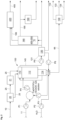
- Figure 1
- shows a method and an apparatus for recycling hydrated cement.
- Figure 2
- shows flow diagram of another method and an apparatus for hydrated cement.
- The method as shown in
FIG. 1 may comprise, for example the step of providing hydrated cement and/or a calcium-containing slag and/or calcium containing mineral. This step may comprise the sub steps of crushing concrete 10 (e.g., bycrusher 20 / crushing step 20) and/or a calcium-containing slag and/or calcium containing mineral to crushed material, hereinafter simply "crushed concrete 25" as a pars pro toto. The step may further comprise classifying the crushedconcrete 25, e.g., by size. Thereby hydrated cement comprising phase and/or calcium salt comprising phase may be obtained. Classifying may take place may be obtained by anoptional classifier 60. Such classifying usually provides, e.g., a hydrated cement rich (i.e., comprising) fraction 65 (as well referred to as Ca-rich fraction or calcium salt rich fraction) and optionally acoarser fraction 66 which coarser fraction may comprise concrete aggregates like sand, gravel, crushed rock, etc... Thiscoarser fraction 66 may of course as well be classified by the size of its components. - An optional connection connects a hydrated cement outlet 61 (more generally a Ca-rich fraction outlet 61) of the
classifier 60 with a hydrated cement inlet 102 (more generally a Ca-rich fraction inlet 102) of areactor 100. Further, an optional connection enables to convey at least one aggregate rich (i.e., comprising) fraction 66 (the coarser fraction) to another entity, e.g., to a concrete plant, particularly preferred to an aggregate batcher of a concrete plant (e.g., via a second classifier). - In the
reactor 100, the calcium salt rich fraction may be subjected to afirst acid 11 to thereby dissolve the calcium salts and to convert them at least partially to the calcium salt of the acid. This is herein as well referred to as reacting step. Thefirst acid 11 may be provided to thereactor 100 via afirst acid inlet 101. In other words, hydrated cement may be contacted with afirst acid 11, thereby obtaining a dissolved (preferably organic) calcium salt of the first acid (the first fluid phase 145) and/or a calcium-depleted first solid phase 146. In a preferred example, the first acid is or comprises methanoic acid. - The dissolved (preferably organic) calcium salt of the first acid and the calcium-depleted first solid phase may be removed from the
reactor 100 via areactor outlet 104 and may be provided to anoptional separator 140 configured to separate the firstfluid phase 145 from the first solid phase 146. - The calcium depleted first solid phase 146 may be withdrawn from the process and may be used, e.g., in a cement clinker kiln and/or a concrete plant or as a feedstock for other processes.
- The dissolved calcium salt (i.e., the first fluid phase 145) is preferably provided via a connection to a
heater 180. The connection may comprise a concentrator as will be explained with reference toFIG. 2 . - The
heater 180 may be electrically powered and/or may be powered by excess heat that may need to be removed from other processes of the corresponding factory. For example, kiln exhaust gas or heat being removed from a clinker cooler may be used in this process step as heat source. Not only in these cases, theheater 180 is preferably an indirect heat exchanger. - In the
heater 180, the calcium salt may be heated to its thermal decomposition temperature, thereby obtaining at least a CaO-rich and/or a CaCOs-rich secondsolid phase 186. Further, the reaction in theheater 180 may provide a secondfluid phase 185 comprising at least one of H2O, CO2 and/or an aldehyde of the first acid. By removing and/or diluting the gaseous compounds the production of CaCO3 can be reduced and instead more CaO can be obtained. - The second
solid phase 186 may be removed via a CaO rich fraction outlet 183 (briefly CaO-outlet 183) and can be used, e.g., as a CaO-source of a cement clinker line and/or may be added to pozzolane based cement. Particularly preferred, the secondsolid phase 186 is provided via an optional connection to an optional cementclinker kiln inlet 401 of an optionalcement clinker kiln 400. - The second
fluid phase 185 may be gaseous. The secondfluid phase 185 may be withdrawn from theheater 180 via a secondfluid phase outlet 184 being connected to a secondfluid phase inlet 221 of anoptional condenser 220 to thereby separate a CO2 rich gas from aldehydes and/or water. The CO2rich gas 225 may be provided via an optional connection to anoptional scrubber 260. Theoptional scrubber 260 may have a CO2rich gas inlet 261 and asecond acid inlet 262. Thesecond acid inlet 262 may as well be referred to aselectrolyte inlet 262. Thescrubber 260 is preferably configured to dissolve the CO2 obtained in the heating step in a second acid. The second acid may be provided to the scrubber via thesecond acid inlet 262. This second acid thus becomes a CO2 enriched second acid and may be provided via another connection from a CO2 enriched second acid outlet 226 to a CO2-enrichedsecond acid inlet 301 of anelectrolytic cell 300. The CO2 enriched second acid is hence a CO2 enrichedelectrolyte 265 Theelectrolytic cell 300 may thus have a CO2 enrichedelectrolyte inlet 301 and may be configured to convert the CO2 to a third acid. A correspondingelectrolytic cell 300 has been suggested in the applicationPCT/EP2023/054981 third acid 305 may be provided via a connection to thefirst acid inlet 101 of thereactor 100. - The optional electrolytic 300 cell may comprise an
anode chamber 330 and acathode chamber 320 being separated from each other by amembrane 355. In theoptional cathode chamber 320, the dissolved CO2 flow, i.e., the CO2 rich electrolyte 265 (the second acid) is contacted with anoptional cathode 225. Preferably, the dissolved CO2 flows along the optional cathode or at least along a section of the cathode. The cathode may be of or comprise at least one of In, Sn, Hg, Bi, Pb, Cu and/or doped graphene. N-doped graphed is a preferred doped graphene. At the cathode, the dissolved CO2 is reduced to a third acid. The third acid being produced by the reduction depends on the choice of the cathode. Preferably the cathode is a catalyst for reduction of the CO2 to a carboxylic acid, preferably the same carboxylic or sulfonic acid as the first and/or second acid. In other words, the first acid and the second acid and the third acid are preferably identical. Cathode materials like for example Sn, Pb and Hg (while not excluding the other above mentioned example cathode materials) show a very low selectivity for a competitive hydrogen evolution reaction ("HER" 2H + + 2e - → H 2), while showing high selectivity for carboxylic acids, in particular for formic acid. - The CO2
rich electrolyte 265 may thus be depleted from the CO2, while flowing over the cathode. The flow thus converts into a mixture of the second acid and the third acid. The mixture, which may leave thecathode chamber 320 via an optional CO2depleted electrolyte outlet 304, as well referred to ascathode chamber outlet 304. This mixture can as well be referred to as CO2-depletedthird acid 305. Of course, if the second and third acids are selected to be identical, one cannot chemically distinguish which molecule was already provided to thescrubber 260 and which molecule has been produced by reducing dissolved CO2 (physical methods, however, allow to: for example, mass spectroscopy could distinguish the molecules by using different carbon isotopes for the different starting materials provided to the scrubber). - The optional reduction in the
cathode chamber 320 can be summarized as
nCO 2,l + (6n - 4)H + + 2H 2 O + (6n - 4)e - → H 2n-1 CnO 2 H + 2nH 2 O.
- Preferably, the temperature of the protonic electrolyte is set to a value θ°C which is above the freezing point of the protonic electrolyte. For example, θ∈{-30, -20, -10, 0, 10, 20, 30, 35, 40, 45, 50, 55, 60, 65, 70}. An upper limit is provided by the boiling temperature of the electrolyte at the given pressure. A preferred range of θ is about 40 to 80, i.e., 40°C≤θ°C≤80°C, particularly preferred is 50°C≤θ°C≤60C. In this temperature range, electrochemically splitting of CO2 to carboxylic acid and O2 is enthalpy-wise preferred over the competitive hydrogen evolution reaction. The optional reduction preferably takes place at slightly elevated temperatures to thermodynamically favor the CO2 reduction to the third acid over the generation of H2. Slightly elevated means in this context elevated by a positive value θ° above standard conditions (commonly "STP": 273.15 K, 1.000hPa), preferably, θ∈{30, 35, 40, 45, 50, 55, 60, 65, 70}. An upper limit is provided by the boiling temperature of the electrolyte (i.e., the second acid) at the given pressure. The lower limit is given by the freezing temperature of the electrolyte. A preferred range of θ is about 40°C to 80°C, i.e., 40°C≤θ°≤80°C, particularly preferred is 50°C≤θ°≤60°C. This temperature range can be obtained by pre-warming the second acid upstream of the
cathode chamber 320, e.g., upstream of thescrubber 260. An optional second heater may be or comprise a heat exchanger being provided with heat being recuperated at another part of the apparatus or another plant. An example of such heat recuperation is the use of heat being withdrawn from clinker cooler exhaust gas and/or the heat being removed from the stream305 leaving thecathode chamber outlet 304 by another optional heat exchanger for cooling the stream305. - The optional
electrolytic cell 300 may further comprise anoptional anode chamber 330. Theoptional anode chamber 330 has an anode and may be separated from the cathode chamber by the optional cation (e.g., proton)permeable membrane 355. Theanode chamber 330 serves as cation (proton) source for the reduction of the dissolved CO2 at the cathode to the second acid in thecathode chamber 320. Due to the electric potential between the anode and the cathode, H2O molecules are split into 2H+ and O2-. Two O2- anions are oxidized at the anode into O2 (2H 2 O → O 2 + 4H + + 4e -). The O2 is another secondary product of the cement clinker line and may leave the anode chamber via exit 303, which may as well comprise H2O. The stream may be cooled using a heat exchanger and separated from the stream in a gas-liquid separator. The such obtained H2O may be cycled and provided to theanode chamber 330, preferably, after being heated by a further heater. This further heater may as well be a part of a heat exchanger being sourced by recuperated process heat. The O2 produced at the anode may be used, e.g., to replace combustion air in akiln 400, e.g., to replace at least in part oxygen being provided as primary air to the burner of the kiln, to thereby reduce the amount of N2 in theexhaust gas 269 of the kiln. This reduction thus decreases the total amount ofexhaust gas 269 and at the same time increases the CO2-concentration on theexhaust gas 269. Theexhaust gas 269 may hence be used as CO2-source being provided as well to the scrubber's CO2 inlet 261. Of course, theexhaust gas 269 is preferably dedusted and cooled prior to providing it to thescrubber 260. Other purification steps may as well be advantageous. -
FIG. 2 is very similar toFIG. 1 ; hence the same reference numerals are used where appropriate: The apparatus ofFIG. 1 comprises anoptional crusher 20 being configured to provide crushed concrete 25 directly and/or via a mill to areactor 100. It is not important if, how or where hydrated concrete is subjected to comminution, all that is required is that a material comprising hydrated cement is provided to areactor 100. - The
reactor 100 may comprise apreextractor 110 and/or anextractor 112. Preferably thereactor 100 further comprises afiltration unit 114 and/or awasher 116. - In the
optional preextractor 110 and in theoptional extractor 112, the hydratedcement comprising material 25 may be contacted with a first acid, preferably with methanoic acid or a mixture comprising at least methanoic acid, to thereby react hydrated cement comprised in the hydratedcement comprising material 25 with thefirst acid 11. In a preferred example, thefirst acid 11 is an aqueous acid carbon acid as shown. The example CCOOH of the first acid and the example (70wt%) shall be considered as preferred examples only. Thefirst acid 11 can of course be altered as explained above and the concentration can as well be altered in a huge range. - The extract obtained in the
reactor 100 is a firstfluid phase 145. The firstfluid phase 145 is calcium salt rich solution. In the preferred example of reacting the crushed concrete with methanoic acid, the calcium salt rich solution is a calcium formate (Ca(HCOO)2) rich solution. The adjective "rich" is for illustrative purposes only in this context and can be omitted or replaced by "comprising". Nevertheless, it may be understood that the calcium salt concentration in the solution is greater than in the stream of thefirst acid 11 being provided to reactor. Preferably, the calcium salt concentration in the solution is at least 0.1Mol/kg, even more preferred at least one of 0.5, 1, 1.5 Mol/kg. - The residue of the extraction process can be withdrawn from the extractor via a
washer 116 and is essentially a SiO2- and CaCO3 (rich) residue, which is herein referred to as first solid phase. The first solid phase may be classified (see classifier 130), e.g., by size in one or more gravel fractions, a sand fraction and a fine fraction which may be used for example as aggregates, e.g., in a concrete plant. - The calcium salt rich fraction 145 (i.e., the first fluid phase 145) may be provided to a
concentrator 120. Accordingly, theconcentrator 120 may comprise a firstfluid phase inlet 121. In the concentrator 1210, at least a portion of the water and the first acid are removed from the firstfluid phase 145. The water and the first acid may be reused in thereactor 100, for example in thewasher 116 and/or in at least one of the (pre)extractor portions - At least a portion of this calcium salt rich solid may be added to pozzolane based cement as a curing activator. In addition or alternatively, the calcium salt rich solid (or another fraction thereof) may be provided to a calcium-
salt inlet 181 of aheater 180 or to acement clinker line 420. - If provided to the
heater 180, the calcium salt may be heated to its decomposition temperature to thereby produce CaO, an aldehyde, water and/or H2. The gaseous components are preferably removed from theheater 180 to thereby reduce the amount of CaO reacting with the other components to CaCOs. The CaO can as well be used as an activation agent for pozzolane based cements and/or provided to a raw meal inlet of acement clinker plant 420. - The aldehyde withdrawn from the heater is valuable base chemical and can be further processed to different other chemicals as indicated by
box 190. -
- 10
- concrete (optional) / hydrated cement comprising material
- 11
- first acid
- 20
- crusher (optional) / hydrated cement source
- 21
- mill
- 25
- crushed concrete
- 60
- classifier (optional)
- 61
- hydrated cement outlet / fine material outlet(optional)
- 62
- aggregate outlet(s) /coarse material outlet (optional)
- 65
- connection between hydrated cement source and hydrated cement inlet (optional)
- 66
- aggregate rich fraction / coarser fraction
- 100
- reactor (optional)
- 101
- first acid inlet (optional)
- 102
- hydrated cement inlet (optional)
- 103
- first solid phase outlet (optional)
- 104
- reactor outlet, e.g., dissolved calcium salt fluid phase outlet (optional)
- 105
- connection of first solid phase outlet with 141
- 110
- preextractor
- 112
- extractor
- 114
- filter
- 116
- washer
- 118
- mixer
- 120
- concentrator
- 121
- first fluid phase inlet
- 123
- calcium salt outlet
- 140
- separator (optional)
- 141
- connection of reactor's fluid phase outlet with heater inlet
- 145
- first fluid phase (optional)
- 146
- first solid phase (optional)
- 180
- heater (optional)
- 181
- calcium salt inlet /first fluid phase inlet (optional)
- 182
- a first fluid phase outlet (optional)
- 183
- CaO-outlet / CaO rich fraction outlet (optional)
- 184
- a second fluid phase outlet (optional) and
- 185
- second fluid phase (optional)
- 186
- CaO-rich fraction / second solid phase (optional)
- 220
- condenser (optional)
- 221
- gas inlet (optional)
- 222
- CO2-rich gas outlet/ gas outlet (optional)
- 223
- liquid outlet / condensed fluid outlet, e.g. water outlet (optional)
- 224
- liquid outlet / condensed fluid outlet, e.g. aldehyde outlet (optional)
- 260
- scrubber (optional)
- 261
- CO2 rich gas inlet (optional)
- 262
- second acid inlet / electrolyte inlet (optional)
- 263
- CO2 enriched electrolyte outlet (optional)
- 265
- connection of scrubber's CO2-rich fluid outlet with CO2-rich fluid inlet of electrolytic cell (optional)
- 269
- stream of exhaust gas / e.g., connection to kiln exhaust (optional)
- 300
- electrolytic cell (optional)
- 301
- CO2 enriched electrolyte inlet (optional)
- 302
- third acid outlet/ CO2 depleted electrolyte outlet 301 (optional)
- 305
- connection between CO2 depleted electrolyte outlet 301 (third acid outket301) of the
electrolytic cell 300 withfirst acid inlet 101 of reactor - 355
- membrane (optional)
- 320
- anode chamber (optional)
- 330
- cathode chamber (optional)
- 400
- kiln (optional)
- 401
- kiln material inlet (optional)
- 402
- kiln exhaust gas outlet (optional)
- 405
- clinker stream (e.g. connection to clinker cooler) (optional)
- 420
- cement clinker plant (optional)
Claims (17)
- A method for manufacturing a calcium oxide comprising material, comprising at least:- reacting hydrated cement (65), a calcium-containing slag and/or Calium containing mineral with a first acid (11), thereby obtaining a first fluid phase (145) comprising a dissolved calcium salt of the first acid (11) and a Ca-depleted first solid phase (146),- and at least one of:(i) heating at least a portion of the calcium salt (145) to its thermal decomposition temperature, thereby obtaining at least a CaO-comprising second solid phase (186) and a second fluid phase (185) comprising preferably at least CO2,(ii) concentrating at least a portion of the first fluid phase (145) thereby obtaining a liquid brine, a gaseous first acid and the calcium salt in a solid state.
- The method of to claim 1,
characterized in, that
crushed concrete comprising sand and/or gravel and/or crushed stone and hydrated cement is classified prior to the reacting step to remove by the classification at last a portion of sand and/or gravel and/or crushed stone from the hydrated cement, which hydrated cement is subsequently reacted at least in part with the first acid (11) to the first fluid phase (145). - The method of claim 1 or 2, characterized in that the first fluid phase (145) is concentrated as defined in step (ii) and in that the thereby obtained calcium salt is heated in the heating step as defined in step (i).
- The method of one of the previous claims, characterized in that it further comprises separating the dissolved calcium salt and the first solid phase prior to the step of heating the calcium salt and/or prior to the step of concentrating the first fluid phase.
- The method of one of the previous claims, characterized in that it further comprises dissolving the CO2 obtained in the heating step in a second acid and using the second acid as an electrolyte in an electrolytic cell 300 to thereby convert the CO2 to a third acid.
- The method of claim 5, characterized in that the second acid and the third acid are chemically identical to the first acid.
- The method of one the previous claims, characterized in that it further comprises using the third acid obtained by converting the CO2 as first acid in the reacting step of claim 1 and/or as second acid in the dissolving step of claim 5.
- The method of one of the previous claims, characterized in that the first, second and/or third acid is methanoic acid, ethanoic acid, propionic acid, butanoic acid and/or pentanoic acid and/or oxalic acid, propanedioic acid, butanedioic acid, pentanedioic acid, hexanedioic acid, 2,3-Dihydroxy-butanedioic acid, amino acids with an isoelectric point at or below pH7
- A method for manufacturing cement clinker, comprising at least the method of one of the previous claims and the step of providing the CaO-comprising phase and/or the calcium salt to a cement clinker kiln (400).
- An apparatus for manufacturing calcium oxide comprising material comprising at least a reactor (100) having a hydrated cement inlet (102) being connected to a hydrated cement source (20,60) and/or a calcium containing slag source and/or a calcium-containing mineral source, a first acid inlet (101) being connected to a first acid source (300), a first solid phase outlet (104) and a dissolved calcium salt fluid phase outlet (104), and at least one of:- a concentrator having:∘ a dissolved calcium salt fluid phase inlet (181) being connected to the dissolved calcium salt fluid phase outlet (104),∘ a liquid brine outlet, a gaseous first acid outlet and the solid calcium salt outlet, wherein the concentrator is configured to increase the concentration of a first fluid phase received via the dissolved calcium salt fluid phase inlet (181) to thereby obtain liquid brine, first acid outlet in a gaseous state and precipitated calcium salt of the first acid.- a heater (180) having:∘ a calcium salt fluid phase inlet (181) being connected to the dissolved calcium salt fluid phase outlet (104) and/or the solid calcium salt outlet,∘ a second fluid phase outlet (184) and∘ a CaO outlet (183).
- The apparatus of the previous apparatus claim, characterized in that:- the crushed concrete inlet (102) of the reactor (100) is connected to the crushed concrete source (20) via a classifier (60),- the classifier (60) has a crushed concrete inlet being connected to the crushed concrete source (20), a coarse material outlet (61) and a fine material outlet (62),- the fine material outlet (61) is connected to the hydrated cement inlet (102) of the reactor (100).
- The apparatus of one of the previous apparatus claims, characterized in that:- the apparatus comprises a scrubber (260),- the scrubber comprises a CO2 inlet (261), an electrolyte inlet (262) and a CO2 enriched electrolyte outlet (263),- the second fluid phase outlet (184) is connected to the CO2 inlet (261),- the scrubber (260) is configured to dissolve CO2 received via the CO2 inlet (261) in an electrolyte being received via the electrolyte inlet (262) and to provide a CO2 enriched electrolyte at the CO2 enriched electrolyte outlet.
- The apparatus of the previous apparatus claim, characterized in that:- the CO2 inlet (261) is connected via a condenser (220) to the second fluid phase outlet (184),- the condenser (220) comprises:∘ a condenser inlet (221) being connected to the second fluid phase outlet (184),∘ a condensed fluid outlet (223, 224), and∘ a gas outlet (222) being connected to the CO2 inlet (261).- the second fluid phase further comprises at least one of an aldehyde and/or H2O,- the condenser (220) is configured to cool the second fluid phase being received via the condenser inlet (221) to a temperature at or below the condensation temperature of H 2 O and/or the aldehyde and above the condensation temperature of CO 2.
- The apparatus of one the two previous apparatus claims, characterized in that:- the apparatus further comprises an electrolytic cell (300),- the electrolytic cell (300) has a CO2 enriched electrolyte inlet (301) being connected to the CO2 enriched electrolyte outlet (263) and a CO2 depleted electrolyte outlet (304),- the electrolytic cell (300) is configured to convert dissolved CO2 being received via the CO2 enriched electrolyte inlet (301) into a third acid being provided to the CO2 depleted electrolyte outlet (304).
- The apparatus of the previous claim, characterized in that the CO2 depleted electrolyte outlet (304) is connected to the first acid inlet (101) of the reactor (100) and/or to the electrolyte inlet (262) of the scrubber (260).
- The apparatus of one of the previous apparatus claims, characterized in that:- the CaO outlet (183) of the heater (180) and/or the first solid phase outlet are/is connected to raw meal inlet of cement clinker kiln and/or- the coarse material outlet (61) is connected, optionally via a second classifier, to at least one aggregate inlet of an aggregate batcher of a concrete plant.
- A pozzolane comprising cement characterized in that it further comprises calcium formate.
Priority Applications (1)
| Application Number | Priority Date | Filing Date | Title |
|---|---|---|---|
| EP23179793.7A EP4477630B1 (en) | 2023-06-16 | 2023-06-16 | METHOD AND APPARATUS FOR THE PRODUCTION OF CEMENT CLINKER |
Applications Claiming Priority (1)
| Application Number | Priority Date | Filing Date | Title |
|---|---|---|---|
| EP23179793.7A EP4477630B1 (en) | 2023-06-16 | 2023-06-16 | METHOD AND APPARATUS FOR THE PRODUCTION OF CEMENT CLINKER |
Publications (3)
| Publication Number | Publication Date |
|---|---|
| EP4477630A1 true EP4477630A1 (en) | 2024-12-18 |
| EP4477630C0 EP4477630C0 (en) | 2025-12-31 |
| EP4477630B1 EP4477630B1 (en) | 2025-12-31 |
Family
ID=86861748
Family Applications (1)
| Application Number | Title | Priority Date | Filing Date |
|---|---|---|---|
| EP23179793.7A Active EP4477630B1 (en) | 2023-06-16 | 2023-06-16 | METHOD AND APPARATUS FOR THE PRODUCTION OF CEMENT CLINKER |
Country Status (1)
| Country | Link |
|---|---|
| EP (1) | EP4477630B1 (en) |
Citations (1)
| Publication number | Priority date | Publication date | Assignee | Title |
|---|---|---|---|---|
| CN112645618A (en) * | 2020-12-27 | 2021-04-13 | 中南大学 | Method for recovering fine aggregate in waste concrete |
-
2023
- 2023-06-16 EP EP23179793.7A patent/EP4477630B1/en active Active
Patent Citations (1)
| Publication number | Priority date | Publication date | Assignee | Title |
|---|---|---|---|---|
| CN112645618A (en) * | 2020-12-27 | 2021-04-13 | 中南大学 | Method for recovering fine aggregate in waste concrete |
Non-Patent Citations (5)
| Title |
|---|
| A. VALOR ET AL.: "Thermal decomposition of the calcium salts of several carboxylic acids", THERMOCHIMICA ACTA, vol. 389, 2002, pages 133 - 130, Retrieved from the Internet <URL:https://doi.org/10.1016/S0040-6031(02)00010-2> |
| BILTON M ET AL: "Investigating the optimum conditions for the formation of calcium oxide, used for CO2 sequestration, by thermal decomposition of calcium acetate", JOURNAL OF PHYSICS: CONFERENCE SERIES, INSTITUTE OF PHYSICS PUBLISHING, BRISTOL, GB, vol. 371, no. 1, 2 July 2012 (2012-07-02), pages 12075, XP020226162, ISSN: 1742-6596, DOI: 10.1088/1742-6596/371/1/012075 * |
| FLETCHER C. J. M: "The thermal decomposition of formaldehyde Proc", R. SOC. LOND. A, vol. 146, 1934, pages 357 - 362, Retrieved from the Internet <URL:http://doi.org/10.1098/rspa.1934.0160)> |
| HEIKAL MOHAMED: "Effect of calcium formate as an accelerator on the physicochemical and mechanical properties of pozzolanic cement pastes", vol. 34, no. 6, 1 June 2004 (2004-06-01), US, pages 1051 - 1056, XP093105713, ISSN: 0008-8846, Retrieved from the Internet <URL:https://www.sciencedirect.com/science/article/pii/S0008884603004113/pdfft?md5=689cc14e20f56f66dafdb750fb988407&pid=1-s2.0-S0008884603004113-main.pdf> [retrieved on 20231127], DOI: 10.1016/j.cemconres.2003.11.015 * |
| MAI BUINIALL MAC DOWELL: "Carbon Capture and Storage,", 2019, ROYAL SOCIETY OF CHEMISTRY |
Also Published As
| Publication number | Publication date |
|---|---|
| EP4477630C0 (en) | 2025-12-31 |
| EP4477630B1 (en) | 2025-12-31 |
Similar Documents
| Publication | Publication Date | Title |
|---|---|---|
| US12005459B2 (en) | Method and facility for producing material containing hydrated cement | |
| US10695806B2 (en) | Method of utilizing construction and demolition waste | |
| US20120111236A1 (en) | Reduced-carbon footprint compositions and methods | |
| AU2019216878B2 (en) | Integrated process for mineral carbonation | |
| CN114560638A (en) | Method for producing cement mixtures | |
| WO2012028418A1 (en) | Integrated process for producing compositions containing magnesium | |
| JP2023036636A (en) | Manufacture of low carbon footprint magnetic material | |
| US11548818B2 (en) | Method for preparing light magnesium oxide and calcium oxide and application thereof for preparing calcium-magnesium composite expanding agent | |
| EP4241874A1 (en) | Improvement of reactivity by oxidation | |
| EP4259590B1 (en) | Method of producing a synthetic carbonated mineral component in a cement manufacturing plant | |
| CN102557497B (en) | Method for preparing high-volume cement active mixed material from metal tailings | |
| CN120554010A (en) | Method for producing hydraulic binders from water treatment residues | |
| Liu et al. | Synergistic use of CO2 pretreatment and accelerated carbonation curing for maximum recycling of steel slag | |
| EP4477630A1 (en) | Method and apparatus for manufacturing cement clinker | |
| EP4452463B1 (en) | Improvement of reactivity by oxidation | |
| JP2024019416A (en) | How to convert hydrocarbons into products | |
| EP4249449B1 (en) | Process for preparing cold fusion concrete and cement compositions from metal mining and production waste | |
| GB2638122A (en) | Process and system | |
| CN104628273B (en) | Method for Synthesizing Calcium Sulphoaluminate Modified Portland Cement Clinker by Vapor Deposition | |
| US20240059615A1 (en) | Direct brucite carbonation for cementation | |
| CN119032071A (en) | Method for preparing calcined mineral binder material with reduced carbon footprint | |
| Huang et al. | Aqueous Carbonation of Recycled Concrete Fine Dust: Efficiency and Feasibility Analyses | |
| Riman et al. | Systems and methods for capture and sequestration of gases and compositions derived therefrom, US Patent 8,721,784 | |
| Li et al. | Effect of reductant on property and CO 2 sequestration for belite cement from phosphogypsum | |
| CN119306410A (en) | Volume-stable high-magnesium silicate cement clinker, preparation method and high-magnesium silicate cement |
Legal Events
| Date | Code | Title | Description |
|---|---|---|---|
| STAA | Information on the status of an ep patent application or granted ep patent |
Free format text: STATUS: EXAMINATION IS IN PROGRESS |
|
| PUAI | Public reference made under article 153(3) epc to a published international application that has entered the european phase |
Free format text: ORIGINAL CODE: 0009012 |
|
| 17P | Request for examination filed |
Effective date: 20240328 |
|
| AK | Designated contracting states |
Kind code of ref document: A1 Designated state(s): AL AT BE BG CH CY CZ DE DK EE ES FI FR GB GR HR HU IE IS IT LI LT LU LV MC ME MK MT NL NO PL PT RO RS SE SI SK SM TR |
|
| GRAP | Despatch of communication of intention to grant a patent |
Free format text: ORIGINAL CODE: EPIDOSNIGR1 |
|
| STAA | Information on the status of an ep patent application or granted ep patent |
Free format text: STATUS: GRANT OF PATENT IS INTENDED |
|
| INTG | Intention to grant announced |
Effective date: 20250723 |
|
| GRAS | Grant fee paid |
Free format text: ORIGINAL CODE: EPIDOSNIGR3 |
|
| GRAA | (expected) grant |
Free format text: ORIGINAL CODE: 0009210 |
|
| STAA | Information on the status of an ep patent application or granted ep patent |
Free format text: STATUS: THE PATENT HAS BEEN GRANTED |
|
| AK | Designated contracting states |
Kind code of ref document: B1 Designated state(s): AL AT BE BG CH CY CZ DE DK EE ES FI FR GB GR HR HU IE IS IT LI LT LU LV MC ME MK MT NL NO PL PT RO RS SE SI SK SM TR |
|
| REG | Reference to a national code |
Ref country code: CH Ref legal event code: F10 Free format text: ST27 STATUS EVENT CODE: U-0-0-F10-F00 (AS PROVIDED BY THE NATIONAL OFFICE) Effective date: 20251231 Ref country code: GB Ref legal event code: FG4D |
|
| REG | Reference to a national code |
Ref country code: DE Ref legal event code: R096 Ref document number: 602023010285 Country of ref document: DE |
|
| REG | Reference to a national code |
Ref country code: IE Ref legal event code: FG4D |
|
| REG | Reference to a national code |
Ref country code: CH Ref legal event code: R17 Free format text: ST27 STATUS EVENT CODE: U-0-0-R10-R17 (AS PROVIDED BY THE NATIONAL OFFICE) Effective date: 20260216 |
|
| U01 | Request for unitary effect filed |
Effective date: 20260128 |
|
| U07 | Unitary effect registered |
Designated state(s): AT BE BG DE DK EE FI FR IT LT LU LV MT NL PT RO SE SI Effective date: 20260203 |
|
| PG25 | Lapsed in a contracting state [announced via postgrant information from national office to epo] |
Ref country code: NO Free format text: LAPSE BECAUSE OF FAILURE TO SUBMIT A TRANSLATION OF THE DESCRIPTION OR TO PAY THE FEE WITHIN THE PRESCRIBED TIME-LIMIT Effective date: 20260331 |
|
| PG25 | Lapsed in a contracting state [announced via postgrant information from national office to epo] |
Ref country code: HR Free format text: LAPSE BECAUSE OF FAILURE TO SUBMIT A TRANSLATION OF THE DESCRIPTION OR TO PAY THE FEE WITHIN THE PRESCRIBED TIME-LIMIT Effective date: 20251231 |
|
| PG25 | Lapsed in a contracting state [announced via postgrant information from national office to epo] |
Ref country code: RS Free format text: LAPSE BECAUSE OF FAILURE TO SUBMIT A TRANSLATION OF THE DESCRIPTION OR TO PAY THE FEE WITHIN THE PRESCRIBED TIME-LIMIT Effective date: 20260331 |