EP4477620A1 - Silicon carbon composite anode materials, preparation method thereof, and secondary battery comprising the same - Google Patents
Silicon carbon composite anode materials, preparation method thereof, and secondary battery comprising the same Download PDFInfo
- Publication number
- EP4477620A1 EP4477620A1 EP24175948.9A EP24175948A EP4477620A1 EP 4477620 A1 EP4477620 A1 EP 4477620A1 EP 24175948 A EP24175948 A EP 24175948A EP 4477620 A1 EP4477620 A1 EP 4477620A1
- Authority
- EP
- European Patent Office
- Prior art keywords
- coating layer
- nano
- silicon
- anode material
- medium
- Prior art date
- Legal status (The legal status is an assumption and is not a legal conclusion. Google has not performed a legal analysis and makes no representation as to the accuracy of the status listed.)
- Pending
Links
- 238000002360 preparation method Methods 0.000 title claims description 35
- 239000011870 silicon-carbon composite anode material Substances 0.000 title abstract description 23
- 239000011247 coating layer Substances 0.000 claims abstract description 480
- 239000010405 anode material Substances 0.000 claims abstract description 242
- 239000005543 nano-size silicon particle Substances 0.000 claims abstract description 205
- 238000000034 method Methods 0.000 claims abstract description 23
- 239000000463 material Substances 0.000 claims description 213
- 239000011248 coating agent Substances 0.000 claims description 107
- 238000000576 coating method Methods 0.000 claims description 107
- 239000000843 powder Substances 0.000 claims description 89
- 239000010410 layer Substances 0.000 claims description 81
- HBMJWWWQQXIZIP-UHFFFAOYSA-N silicon carbide Chemical compound [Si+]#[C-] HBMJWWWQQXIZIP-UHFFFAOYSA-N 0.000 claims description 68
- 239000002245 particle Substances 0.000 claims description 54
- 239000004215 Carbon black (E152) Substances 0.000 claims description 52
- 229930195733 hydrocarbon Natural products 0.000 claims description 52
- 150000002430 hydrocarbons Chemical class 0.000 claims description 52
- 238000005245 sintering Methods 0.000 claims description 47
- 239000000203 mixture Substances 0.000 claims description 39
- 239000002904 solvent Substances 0.000 claims description 39
- OKTJSMMVPCPJKN-UHFFFAOYSA-N Carbon Chemical compound [C] OKTJSMMVPCPJKN-UHFFFAOYSA-N 0.000 claims description 34
- 238000010438 heat treatment Methods 0.000 claims description 32
- 239000011268 mixed slurry Substances 0.000 claims description 29
- 239000002002 slurry Substances 0.000 claims description 29
- 238000002441 X-ray diffraction Methods 0.000 claims description 26
- 229910002804 graphite Inorganic materials 0.000 claims description 23
- 239000010439 graphite Substances 0.000 claims description 23
- 239000003792 electrolyte Substances 0.000 claims description 18
- 238000001035 drying Methods 0.000 claims description 17
- 230000003247 decreasing effect Effects 0.000 claims description 15
- 238000001228 spectrum Methods 0.000 claims description 11
- 239000007789 gas Substances 0.000 description 59
- 229910010271 silicon carbide Inorganic materials 0.000 description 56
- 208000010392 Bone Fractures Diseases 0.000 description 54
- 206010017076 Fracture Diseases 0.000 description 54
- XUIMIQQOPSSXEZ-UHFFFAOYSA-N Silicon Chemical compound [Si] XUIMIQQOPSSXEZ-UHFFFAOYSA-N 0.000 description 44
- 229910001416 lithium ion Inorganic materials 0.000 description 31
- HBBGRARXTFLTSG-UHFFFAOYSA-N Lithium ion Chemical compound [Li+] HBBGRARXTFLTSG-UHFFFAOYSA-N 0.000 description 30
- 230000000052 comparative effect Effects 0.000 description 30
- 229910052710 silicon Inorganic materials 0.000 description 26
- 239000010703 silicon Substances 0.000 description 26
- 239000006185 dispersion Substances 0.000 description 23
- 208000028659 discharge Diseases 0.000 description 22
- 238000005336 cracking Methods 0.000 description 20
- 238000007599 discharging Methods 0.000 description 20
- VNWKTOKETHGBQD-UHFFFAOYSA-N methane Chemical compound C VNWKTOKETHGBQD-UHFFFAOYSA-N 0.000 description 20
- 239000011863 silicon-based powder Substances 0.000 description 18
- 238000011156 evaluation Methods 0.000 description 16
- LFQSCWFLJHTTHZ-UHFFFAOYSA-N Ethanol Chemical compound CCO LFQSCWFLJHTTHZ-UHFFFAOYSA-N 0.000 description 15
- ATUOYWHBWRKTHZ-UHFFFAOYSA-N Propane Chemical compound CCC ATUOYWHBWRKTHZ-UHFFFAOYSA-N 0.000 description 15
- OFBQJSOFQDEBGM-UHFFFAOYSA-N n-pentane Natural products CCCCC OFBQJSOFQDEBGM-UHFFFAOYSA-N 0.000 description 15
- -1 poly(vinyl pyrrolidone) Polymers 0.000 description 15
- 239000011295 pitch Substances 0.000 description 14
- 239000011856 silicon-based particle Substances 0.000 description 14
- 239000002270 dispersing agent Substances 0.000 description 13
- 230000009467 reduction Effects 0.000 description 13
- 238000006722 reduction reaction Methods 0.000 description 13
- WHXSMMKQMYFTQS-UHFFFAOYSA-N Lithium Chemical compound [Li] WHXSMMKQMYFTQS-UHFFFAOYSA-N 0.000 description 12
- 229910052744 lithium Inorganic materials 0.000 description 12
- 238000000197 pyrolysis Methods 0.000 description 12
- PXHVJJICTQNCMI-UHFFFAOYSA-N Nickel Chemical compound [Ni] PXHVJJICTQNCMI-UHFFFAOYSA-N 0.000 description 11
- 239000012535 impurity Substances 0.000 description 11
- OTMSDBZUPAUEDD-UHFFFAOYSA-N Ethane Chemical compound CC OTMSDBZUPAUEDD-UHFFFAOYSA-N 0.000 description 10
- 230000008859 change Effects 0.000 description 10
- JBTWLSYIZRCDFO-UHFFFAOYSA-N ethyl methyl carbonate Chemical compound CCOC(=O)OC JBTWLSYIZRCDFO-UHFFFAOYSA-N 0.000 description 10
- VAYTZRYEBVHVLE-UHFFFAOYSA-N 1,3-dioxol-2-one Chemical compound O=C1OC=CO1 VAYTZRYEBVHVLE-UHFFFAOYSA-N 0.000 description 9
- SBLRHMKNNHXPHG-UHFFFAOYSA-N 4-fluoro-1,3-dioxolan-2-one Chemical compound FC1COC(=O)O1 SBLRHMKNNHXPHG-UHFFFAOYSA-N 0.000 description 9
- 230000003647 oxidation Effects 0.000 description 9
- 238000007254 oxidation reaction Methods 0.000 description 9
- KMTRUDSVKNLOMY-UHFFFAOYSA-N Ethylene carbonate Chemical compound O=C1OCCO1 KMTRUDSVKNLOMY-UHFFFAOYSA-N 0.000 description 8
- KFZMGEQAYNKOFK-UHFFFAOYSA-N Isopropanol Chemical compound CC(C)O KFZMGEQAYNKOFK-UHFFFAOYSA-N 0.000 description 8
- MCMNRKCIXSYSNV-UHFFFAOYSA-N Zirconium dioxide Chemical compound O=[Zr]=O MCMNRKCIXSYSNV-UHFFFAOYSA-N 0.000 description 8
- 238000000227 grinding Methods 0.000 description 8
- 238000005259 measurement Methods 0.000 description 8
- 239000007921 spray Substances 0.000 description 8
- 239000012530 fluid Substances 0.000 description 7
- 238000009830 intercalation Methods 0.000 description 7
- 230000002687 intercalation Effects 0.000 description 7
- 238000002156 mixing Methods 0.000 description 7
- IJGRMHOSHXDMSA-UHFFFAOYSA-N Atomic nitrogen Chemical compound N#N IJGRMHOSHXDMSA-UHFFFAOYSA-N 0.000 description 6
- RYGMFSIKBFXOCR-UHFFFAOYSA-N Copper Chemical compound [Cu] RYGMFSIKBFXOCR-UHFFFAOYSA-N 0.000 description 6
- ZMXDDKWLCZADIW-UHFFFAOYSA-N N,N-Dimethylformamide Chemical compound CN(C)C=O ZMXDDKWLCZADIW-UHFFFAOYSA-N 0.000 description 6
- 239000003575 carbonaceous material Substances 0.000 description 6
- 230000006378 damage Effects 0.000 description 6
- 239000011877 solvent mixture Substances 0.000 description 6
- 229920002134 Carboxymethyl cellulose Polymers 0.000 description 5
- SECXISVLQFMRJM-UHFFFAOYSA-N N-Methylpyrrolidone Chemical compound CN1CCCC1=O SECXISVLQFMRJM-UHFFFAOYSA-N 0.000 description 5
- 235000021355 Stearic acid Nutrition 0.000 description 5
- 239000001273 butane Substances 0.000 description 5
- 239000006229 carbon black Substances 0.000 description 5
- 238000006243 chemical reaction Methods 0.000 description 5
- 238000001453 impedance spectrum Methods 0.000 description 5
- 239000011261 inert gas Substances 0.000 description 5
- 229910052751 metal Inorganic materials 0.000 description 5
- 239000002184 metal Substances 0.000 description 5
- IJDNQMDRQITEOD-UHFFFAOYSA-N n-butane Chemical compound CCCC IJDNQMDRQITEOD-UHFFFAOYSA-N 0.000 description 5
- QIQXTHQIDYTFRH-UHFFFAOYSA-N octadecanoic acid Chemical compound CCCCCCCCCCCCCCCCCC(O)=O QIQXTHQIDYTFRH-UHFFFAOYSA-N 0.000 description 5
- OQCDKBAXFALNLD-UHFFFAOYSA-N octadecanoic acid Natural products CCCCCCCC(C)CCCCCCCCC(O)=O OQCDKBAXFALNLD-UHFFFAOYSA-N 0.000 description 5
- 230000008569 process Effects 0.000 description 5
- 239000001294 propane Substances 0.000 description 5
- 238000001694 spray drying Methods 0.000 description 5
- 239000008117 stearic acid Substances 0.000 description 5
- CURLTUGMZLYLDI-UHFFFAOYSA-N Carbon dioxide Chemical compound O=C=O CURLTUGMZLYLDI-UHFFFAOYSA-N 0.000 description 4
- 235000005979 Citrus limon Nutrition 0.000 description 4
- 244000131522 Citrus pyriformis Species 0.000 description 4
- RTZKZFJDLAIYFH-UHFFFAOYSA-N Diethyl ether Chemical compound CCOCC RTZKZFJDLAIYFH-UHFFFAOYSA-N 0.000 description 4
- 239000004698 Polyethylene Substances 0.000 description 4
- 239000004743 Polypropylene Substances 0.000 description 4
- 239000011149 active material Substances 0.000 description 4
- 229910052799 carbon Inorganic materials 0.000 description 4
- 239000001768 carboxy methyl cellulose Substances 0.000 description 4
- 235000010948 carboxy methyl cellulose Nutrition 0.000 description 4
- 239000008112 carboxymethyl-cellulose Substances 0.000 description 4
- 229940105329 carboxymethylcellulose Drugs 0.000 description 4
- 239000011294 coal tar pitch Substances 0.000 description 4
- 239000004020 conductor Substances 0.000 description 4
- 239000011889 copper foil Substances 0.000 description 4
- 239000000295 fuel oil Substances 0.000 description 4
- 238000004519 manufacturing process Methods 0.000 description 4
- 229910021382 natural graphite Inorganic materials 0.000 description 4
- 229910052759 nickel Inorganic materials 0.000 description 4
- 229920000573 polyethylene Polymers 0.000 description 4
- 229920001155 polypropylene Polymers 0.000 description 4
- 238000012546 transfer Methods 0.000 description 4
- 229910001290 LiPF6 Inorganic materials 0.000 description 3
- OKKJLVBELUTLKV-UHFFFAOYSA-N Methanol Chemical compound OC OKKJLVBELUTLKV-UHFFFAOYSA-N 0.000 description 3
- 239000004372 Polyvinyl alcohol Substances 0.000 description 3
- YXFVVABEGXRONW-UHFFFAOYSA-N Toluene Chemical compound CC1=CC=CC=C1 YXFVVABEGXRONW-UHFFFAOYSA-N 0.000 description 3
- 229910052782 aluminium Inorganic materials 0.000 description 3
- XAGFODPZIPBFFR-UHFFFAOYSA-N aluminium Chemical compound [Al] XAGFODPZIPBFFR-UHFFFAOYSA-N 0.000 description 3
- 238000004458 analytical method Methods 0.000 description 3
- 230000015572 biosynthetic process Effects 0.000 description 3
- 239000007833 carbon precursor Substances 0.000 description 3
- 239000010406 cathode material Substances 0.000 description 3
- 239000000571 coke Substances 0.000 description 3
- 239000002131 composite material Substances 0.000 description 3
- 239000010949 copper Substances 0.000 description 3
- 238000009831 deintercalation Methods 0.000 description 3
- 230000005611 electricity Effects 0.000 description 3
- 150000002500 ions Chemical class 0.000 description 3
- 229910003002 lithium salt Inorganic materials 0.000 description 3
- 159000000002 lithium salts Chemical class 0.000 description 3
- 230000014759 maintenance of location Effects 0.000 description 3
- 238000003801 milling Methods 0.000 description 3
- 239000011368 organic material Substances 0.000 description 3
- 238000002161 passivation Methods 0.000 description 3
- 239000004810 polytetrafluoroethylene Substances 0.000 description 3
- 229920001343 polytetrafluoroethylene Polymers 0.000 description 3
- 229920002451 polyvinyl alcohol Polymers 0.000 description 3
- 238000003825 pressing Methods 0.000 description 3
- 229920003048 styrene butadiene rubber Polymers 0.000 description 3
- XLYOFNOQVPJJNP-UHFFFAOYSA-N water Substances O XLYOFNOQVPJJNP-UHFFFAOYSA-N 0.000 description 3
- ZZXUZKXVROWEIF-UHFFFAOYSA-N 1,2-butylene carbonate Chemical compound CCC1COC(=O)O1 ZZXUZKXVROWEIF-UHFFFAOYSA-N 0.000 description 2
- YEJRWHAVMIAJKC-UHFFFAOYSA-N 4-Butyrolactone Chemical compound O=C1CCCO1 YEJRWHAVMIAJKC-UHFFFAOYSA-N 0.000 description 2
- OZJPLYNZGCXSJM-UHFFFAOYSA-N 5-valerolactone Chemical compound O=C1CCCCO1 OZJPLYNZGCXSJM-UHFFFAOYSA-N 0.000 description 2
- BVKZGUZCCUSVTD-UHFFFAOYSA-L Carbonate Chemical compound [O-]C([O-])=O BVKZGUZCCUSVTD-UHFFFAOYSA-L 0.000 description 2
- OIFBSDVPJOWBCH-UHFFFAOYSA-N Diethyl carbonate Chemical compound CCOC(=O)OCC OIFBSDVPJOWBCH-UHFFFAOYSA-N 0.000 description 2
- 229920002943 EPDM rubber Polymers 0.000 description 2
- FXHOOIRPVKKKFG-UHFFFAOYSA-N N,N-Dimethylacetamide Chemical compound CN(C)C(C)=O FXHOOIRPVKKKFG-UHFFFAOYSA-N 0.000 description 2
- LRHPLDYGYMQRHN-UHFFFAOYSA-N N-Butanol Chemical compound CCCCO LRHPLDYGYMQRHN-UHFFFAOYSA-N 0.000 description 2
- 229920000459 Nitrile rubber Polymers 0.000 description 2
- KWYUFKZDYYNOTN-UHFFFAOYSA-M Potassium hydroxide Chemical compound [OH-].[K+] KWYUFKZDYYNOTN-UHFFFAOYSA-M 0.000 description 2
- PPBRXRYQALVLMV-UHFFFAOYSA-N Styrene Chemical compound C=CC1=CC=CC=C1 PPBRXRYQALVLMV-UHFFFAOYSA-N 0.000 description 2
- XLOMVQKBTHCTTD-UHFFFAOYSA-N Zinc monoxide Chemical compound [Zn]=O XLOMVQKBTHCTTD-UHFFFAOYSA-N 0.000 description 2
- 230000032683 aging Effects 0.000 description 2
- 239000005456 alcohol based solvent Substances 0.000 description 2
- 150000001408 amides Chemical class 0.000 description 2
- 239000006256 anode slurry Substances 0.000 description 2
- 229910021383 artificial graphite Inorganic materials 0.000 description 2
- QVGXLLKOCUKJST-UHFFFAOYSA-N atomic oxygen Chemical compound [O] QVGXLLKOCUKJST-UHFFFAOYSA-N 0.000 description 2
- 239000011324 bead Substances 0.000 description 2
- 230000008901 benefit Effects 0.000 description 2
- 239000011230 binding agent Substances 0.000 description 2
- 239000001569 carbon dioxide Substances 0.000 description 2
- 229910002092 carbon dioxide Inorganic materials 0.000 description 2
- 239000002041 carbon nanotube Substances 0.000 description 2
- 229910021393 carbon nanotube Inorganic materials 0.000 description 2
- 230000008602 contraction Effects 0.000 description 2
- 229910052802 copper Inorganic materials 0.000 description 2
- 230000006837 decompression Effects 0.000 description 2
- 230000006866 deterioration Effects 0.000 description 2
- IEJIGPNLZYLLBP-UHFFFAOYSA-N dimethyl carbonate Chemical compound COC(=O)OC IEJIGPNLZYLLBP-UHFFFAOYSA-N 0.000 description 2
- 229940113088 dimethylacetamide Drugs 0.000 description 2
- VUPKGFBOKBGHFZ-UHFFFAOYSA-N dipropyl carbonate Chemical compound CCCOC(=O)OCCC VUPKGFBOKBGHFZ-UHFFFAOYSA-N 0.000 description 2
- POULHZVOKOAJMA-UHFFFAOYSA-N dodecanoic acid Chemical compound CCCCCCCCCCCC(O)=O POULHZVOKOAJMA-UHFFFAOYSA-N 0.000 description 2
- 239000000428 dust Substances 0.000 description 2
- 229920001971 elastomer Polymers 0.000 description 2
- CYEDOLFRAIXARV-UHFFFAOYSA-N ethyl propyl carbonate Chemical compound CCCOC(=O)OCC CYEDOLFRAIXARV-UHFFFAOYSA-N 0.000 description 2
- 230000001747 exhibiting effect Effects 0.000 description 2
- 239000006260 foam Substances 0.000 description 2
- 239000011888 foil Substances 0.000 description 2
- 229910021389 graphene Inorganic materials 0.000 description 2
- IPCSVZSSVZVIGE-UHFFFAOYSA-N hexadecanoic acid Chemical compound CCCCCCCCCCCCCCCC(O)=O IPCSVZSSVZVIGE-UHFFFAOYSA-N 0.000 description 2
- 230000006872 improvement Effects 0.000 description 2
- 150000002576 ketones Chemical class 0.000 description 2
- 230000000670 limiting effect Effects 0.000 description 2
- 238000006138 lithiation reaction Methods 0.000 description 2
- 238000011068 loading method Methods 0.000 description 2
- 239000011572 manganese Substances 0.000 description 2
- KKQAVHGECIBFRQ-UHFFFAOYSA-N methyl propyl carbonate Chemical compound CCCOC(=O)OC KKQAVHGECIBFRQ-UHFFFAOYSA-N 0.000 description 2
- 238000012986 modification Methods 0.000 description 2
- 230000004048 modification Effects 0.000 description 2
- 229910052757 nitrogen Inorganic materials 0.000 description 2
- 239000011356 non-aqueous organic solvent Substances 0.000 description 2
- 238000005457 optimization Methods 0.000 description 2
- 239000001301 oxygen Substances 0.000 description 2
- 229910052760 oxygen Inorganic materials 0.000 description 2
- 229920001721 polyimide Polymers 0.000 description 2
- YKYONYBAUNKHLG-UHFFFAOYSA-N propyl acetate Chemical compound CCCOC(C)=O YKYONYBAUNKHLG-UHFFFAOYSA-N 0.000 description 2
- RUOJZAUFBMNUDX-UHFFFAOYSA-N propylene carbonate Chemical compound CC1COC(=O)O1 RUOJZAUFBMNUDX-UHFFFAOYSA-N 0.000 description 2
- 230000002441 reversible effect Effects 0.000 description 2
- 239000005060 rubber Substances 0.000 description 2
- 238000001338 self-assembly Methods 0.000 description 2
- 239000010935 stainless steel Substances 0.000 description 2
- 229910001220 stainless steel Inorganic materials 0.000 description 2
- 238000003756 stirring Methods 0.000 description 2
- 238000003860 storage Methods 0.000 description 2
- 239000000126 substance Substances 0.000 description 2
- WRIDQFICGBMAFQ-UHFFFAOYSA-N (E)-8-Octadecenoic acid Natural products CCCCCCCCCC=CCCCCCCC(O)=O WRIDQFICGBMAFQ-UHFFFAOYSA-N 0.000 description 1
- FSSPGSAQUIYDCN-UHFFFAOYSA-N 1,3-Propane sultone Chemical compound O=S1(=O)CCCO1 FSSPGSAQUIYDCN-UHFFFAOYSA-N 0.000 description 1
- DURPTKYDGMDSBL-UHFFFAOYSA-N 1-butoxybutane Chemical compound CCCCOCCCC DURPTKYDGMDSBL-UHFFFAOYSA-N 0.000 description 1
- FALRKNHUBBKYCC-UHFFFAOYSA-N 2-(chloromethyl)pyridine-3-carbonitrile Chemical compound ClCC1=NC=CC=C1C#N FALRKNHUBBKYCC-UHFFFAOYSA-N 0.000 description 1
- LQJBNNIYVWPHFW-UHFFFAOYSA-N 20:1omega9c fatty acid Natural products CCCCCCCCCCC=CCCCCCCCC(O)=O LQJBNNIYVWPHFW-UHFFFAOYSA-N 0.000 description 1
- DSMUTQTWFHVVGQ-UHFFFAOYSA-N 4,5-difluoro-1,3-dioxolan-2-one Chemical compound FC1OC(=O)OC1F DSMUTQTWFHVVGQ-UHFFFAOYSA-N 0.000 description 1
- BJWMSGRKJIOCNR-UHFFFAOYSA-N 4-ethenyl-1,3-dioxolan-2-one Chemical compound C=CC1COC(=O)O1 BJWMSGRKJIOCNR-UHFFFAOYSA-N 0.000 description 1
- QSBYPNXLFMSGKH-UHFFFAOYSA-N 9-Heptadecensaeure Natural products CCCCCCCC=CCCCCCCCC(O)=O QSBYPNXLFMSGKH-UHFFFAOYSA-N 0.000 description 1
- 229920000049 Carbon (fiber) Polymers 0.000 description 1
- XEKOWRVHYACXOJ-UHFFFAOYSA-N Ethyl acetate Chemical compound CCOC(C)=O XEKOWRVHYACXOJ-UHFFFAOYSA-N 0.000 description 1
- YCKRFDGAMUMZLT-UHFFFAOYSA-N Fluorine atom Chemical compound [F] YCKRFDGAMUMZLT-UHFFFAOYSA-N 0.000 description 1
- WQZGKKKJIJFFOK-GASJEMHNSA-N Glucose Natural products OC[C@H]1OC(O)[C@H](O)[C@@H](O)[C@@H]1O WQZGKKKJIJFFOK-GASJEMHNSA-N 0.000 description 1
- 229920002153 Hydroxypropyl cellulose Polymers 0.000 description 1
- XEEYBQQBJWHFJM-UHFFFAOYSA-N Iron Chemical compound [Fe] XEEYBQQBJWHFJM-UHFFFAOYSA-N 0.000 description 1
- 239000005639 Lauric acid Substances 0.000 description 1
- 229910010661 Li22Si5 Inorganic materials 0.000 description 1
- 229910010088 LiAlO4 Inorganic materials 0.000 description 1
- 229910000552 LiCF3SO3 Inorganic materials 0.000 description 1
- 229910000572 Lithium Nickel Cobalt Manganese Oxide (NCM) Inorganic materials 0.000 description 1
- PWHULOQIROXLJO-UHFFFAOYSA-N Manganese Chemical compound [Mn] PWHULOQIROXLJO-UHFFFAOYSA-N 0.000 description 1
- CTQNGGLPUBDAKN-UHFFFAOYSA-N O-Xylene Chemical compound CC1=CC=CC=C1C CTQNGGLPUBDAKN-UHFFFAOYSA-N 0.000 description 1
- 239000005642 Oleic acid Substances 0.000 description 1
- ZQPPMHVWECSIRJ-UHFFFAOYSA-N Oleic acid Natural products CCCCCCCCC=CCCCCCCCC(O)=O ZQPPMHVWECSIRJ-UHFFFAOYSA-N 0.000 description 1
- 239000002033 PVDF binder Substances 0.000 description 1
- 235000021314 Palmitic acid Nutrition 0.000 description 1
- 239000004642 Polyimide Substances 0.000 description 1
- 229920000265 Polyparaphenylene Polymers 0.000 description 1
- 229920002125 Sokalan® Polymers 0.000 description 1
- 229920002472 Starch Polymers 0.000 description 1
- 239000002174 Styrene-butadiene Substances 0.000 description 1
- CZMRCDWAGMRECN-UGDNZRGBSA-N Sucrose Chemical compound O[C@H]1[C@H](O)[C@@H](CO)O[C@@]1(CO)O[C@@H]1[C@H](O)[C@@H](O)[C@H](O)[C@@H](CO)O1 CZMRCDWAGMRECN-UGDNZRGBSA-N 0.000 description 1
- 229930006000 Sucrose Natural products 0.000 description 1
- GWEVSGVZZGPLCZ-UHFFFAOYSA-N Titan oxide Chemical compound O=[Ti]=O GWEVSGVZZGPLCZ-UHFFFAOYSA-N 0.000 description 1
- RTAQQCXQSZGOHL-UHFFFAOYSA-N Titanium Chemical compound [Ti] RTAQQCXQSZGOHL-UHFFFAOYSA-N 0.000 description 1
- QTHKJEYUQSLYTH-UHFFFAOYSA-N [Co]=O.[Ni].[Li] Chemical compound [Co]=O.[Ni].[Li] QTHKJEYUQSLYTH-UHFFFAOYSA-N 0.000 description 1
- FBDMTTNVIIVBKI-UHFFFAOYSA-N [O-2].[Mn+2].[Co+2].[Ni+2].[Li+] Chemical compound [O-2].[Mn+2].[Co+2].[Ni+2].[Li+] FBDMTTNVIIVBKI-UHFFFAOYSA-N 0.000 description 1
- 239000006230 acetylene black Substances 0.000 description 1
- 229910045601 alloy Inorganic materials 0.000 description 1
- 239000000956 alloy Substances 0.000 description 1
- 230000004075 alteration Effects 0.000 description 1
- NDPGDHBNXZOBJS-UHFFFAOYSA-N aluminum lithium cobalt(2+) nickel(2+) oxygen(2-) Chemical compound [Li+].[O--].[O--].[O--].[O--].[Al+3].[Co++].[Ni++] NDPGDHBNXZOBJS-UHFFFAOYSA-N 0.000 description 1
- 239000002194 amorphous carbon material Substances 0.000 description 1
- 239000006183 anode active material Substances 0.000 description 1
- 125000004429 atom Chemical group 0.000 description 1
- WQZGKKKJIJFFOK-VFUOTHLCSA-N beta-D-glucose Chemical compound OC[C@H]1O[C@@H](O)[C@H](O)[C@@H](O)[C@@H]1O WQZGKKKJIJFFOK-VFUOTHLCSA-N 0.000 description 1
- 230000033228 biological regulation Effects 0.000 description 1
- 229930188620 butyrolactone Natural products 0.000 description 1
- OJIJEKBXJYRIBZ-UHFFFAOYSA-N cadmium nickel Chemical compound [Ni].[Cd] OJIJEKBXJYRIBZ-UHFFFAOYSA-N 0.000 description 1
- 239000003990 capacitor Substances 0.000 description 1
- 125000004432 carbon atom Chemical group C* 0.000 description 1
- 239000004917 carbon fiber Substances 0.000 description 1
- 239000006231 channel black Substances 0.000 description 1
- 239000011280 coal tar Substances 0.000 description 1
- 229910017052 cobalt Inorganic materials 0.000 description 1
- 239000010941 cobalt Substances 0.000 description 1
- GUTLYIVDDKVIGB-UHFFFAOYSA-N cobalt atom Chemical compound [Co] GUTLYIVDDKVIGB-UHFFFAOYSA-N 0.000 description 1
- 238000002485 combustion reaction Methods 0.000 description 1
- 150000001875 compounds Chemical class 0.000 description 1
- 239000013078 crystal Substances 0.000 description 1
- 239000002180 crystalline carbon material Substances 0.000 description 1
- 238000000151 deposition Methods 0.000 description 1
- 238000011161 development Methods 0.000 description 1
- 230000018109 developmental process Effects 0.000 description 1
- 238000009792 diffusion process Methods 0.000 description 1
- NJLLQSBAHIKGKF-UHFFFAOYSA-N dipotassium dioxido(oxo)titanium Chemical compound [K+].[K+].[O-][Ti]([O-])=O NJLLQSBAHIKGKF-UHFFFAOYSA-N 0.000 description 1
- 239000003759 ester based solvent Substances 0.000 description 1
- 239000000835 fiber Substances 0.000 description 1
- 239000011737 fluorine Substances 0.000 description 1
- 229910052731 fluorine Inorganic materials 0.000 description 1
- 239000002803 fossil fuel Substances 0.000 description 1
- 239000008103 glucose Substances 0.000 description 1
- 239000005431 greenhouse gas Substances 0.000 description 1
- 239000001863 hydroxypropyl cellulose Substances 0.000 description 1
- 235000010977 hydroxypropyl cellulose Nutrition 0.000 description 1
- 238000002847 impedance measurement Methods 0.000 description 1
- 230000016507 interphase Effects 0.000 description 1
- QXJSBBXBKPUZAA-UHFFFAOYSA-N isooleic acid Natural products CCCCCCCC=CCCCCCCCCC(O)=O QXJSBBXBKPUZAA-UHFFFAOYSA-N 0.000 description 1
- 239000003273 ketjen black Substances 0.000 description 1
- 229910001547 lithium hexafluoroantimonate(V) Inorganic materials 0.000 description 1
- 229910001540 lithium hexafluoroarsenate(V) Inorganic materials 0.000 description 1
- MHCFAGZWMAWTNR-UHFFFAOYSA-M lithium perchlorate Chemical compound [Li+].[O-]Cl(=O)(=O)=O MHCFAGZWMAWTNR-UHFFFAOYSA-M 0.000 description 1
- 229910001486 lithium perchlorate Inorganic materials 0.000 description 1
- 229910001537 lithium tetrachloroaluminate Inorganic materials 0.000 description 1
- 229910001496 lithium tetrafluoroborate Inorganic materials 0.000 description 1
- 229910021437 lithium-transition metal oxide Inorganic materials 0.000 description 1
- ACFSQHQYDZIPRL-UHFFFAOYSA-N lithium;bis(1,1,2,2,2-pentafluoroethylsulfonyl)azanide Chemical compound [Li+].FC(F)(F)C(F)(F)S(=O)(=O)[N-]S(=O)(=O)C(F)(F)C(F)(F)F ACFSQHQYDZIPRL-UHFFFAOYSA-N 0.000 description 1
- QSZMZKBZAYQGRS-UHFFFAOYSA-N lithium;bis(trifluoromethylsulfonyl)azanide Chemical compound [Li+].FC(F)(F)S(=O)(=O)[N-]S(=O)(=O)C(F)(F)F QSZMZKBZAYQGRS-UHFFFAOYSA-N 0.000 description 1
- URIIGZKXFBNRAU-UHFFFAOYSA-N lithium;oxonickel Chemical compound [Li].[Ni]=O URIIGZKXFBNRAU-UHFFFAOYSA-N 0.000 description 1
- 229910052748 manganese Inorganic materials 0.000 description 1
- KXKVLQRXCPHEJC-UHFFFAOYSA-N methyl acetate Chemical compound COC(C)=O KXKVLQRXCPHEJC-UHFFFAOYSA-N 0.000 description 1
- WQEPLUUGTLDZJY-UHFFFAOYSA-N n-Pentadecanoic acid Natural products CCCCCCCCCCCCCCC(O)=O WQEPLUUGTLDZJY-UHFFFAOYSA-N 0.000 description 1
- 239000007773 negative electrode material Substances 0.000 description 1
- 239000011255 nonaqueous electrolyte Substances 0.000 description 1
- 239000004745 nonwoven fabric Substances 0.000 description 1
- ZQPPMHVWECSIRJ-KTKRTIGZSA-N oleic acid Chemical compound CCCCCCCC\C=C/CCCCCCCC(O)=O ZQPPMHVWECSIRJ-KTKRTIGZSA-N 0.000 description 1
- 235000021313 oleic acid Nutrition 0.000 description 1
- GHZRKQCHJFHJPX-UHFFFAOYSA-N oxacycloundecan-2-one Chemical compound O=C1CCCCCCCCCO1 GHZRKQCHJFHJPX-UHFFFAOYSA-N 0.000 description 1
- 229920005735 poly(methyl vinyl ketone) Polymers 0.000 description 1
- 229920000728 polyester Polymers 0.000 description 1
- 229920002981 polyvinylidene fluoride Polymers 0.000 description 1
- 229920000036 polyvinylpyrrolidone Polymers 0.000 description 1
- 239000001267 polyvinylpyrrolidone Substances 0.000 description 1
- 235000013855 polyvinylpyrrolidone Nutrition 0.000 description 1
- 239000011148 porous material Substances 0.000 description 1
- 230000001681 protective effect Effects 0.000 description 1
- 238000010298 pulverizing process Methods 0.000 description 1
- 238000006479 redox reaction Methods 0.000 description 1
- 230000002829 reductive effect Effects 0.000 description 1
- 230000008929 regeneration Effects 0.000 description 1
- 238000011069 regeneration method Methods 0.000 description 1
- 238000012827 research and development Methods 0.000 description 1
- 230000027756 respiratory electron transport chain Effects 0.000 description 1
- 238000005096 rolling process Methods 0.000 description 1
- 150000003839 salts Chemical class 0.000 description 1
- 238000000926 separation method Methods 0.000 description 1
- 239000002210 silicon-based material Substances 0.000 description 1
- 239000007784 solid electrolyte Substances 0.000 description 1
- 239000008107 starch Substances 0.000 description 1
- 235000019698 starch Nutrition 0.000 description 1
- 230000035882 stress Effects 0.000 description 1
- 229940014800 succinic anhydride Drugs 0.000 description 1
- 239000005720 sucrose Substances 0.000 description 1
- 230000003746 surface roughness Effects 0.000 description 1
- TXEYQDLBPFQVAA-UHFFFAOYSA-N tetrafluoromethane Chemical compound FC(F)(F)F TXEYQDLBPFQVAA-UHFFFAOYSA-N 0.000 description 1
- 239000010936 titanium Substances 0.000 description 1
- 229910052719 titanium Inorganic materials 0.000 description 1
- OGIDPMRJRNCKJF-UHFFFAOYSA-N titanium oxide Inorganic materials [Ti]=O OGIDPMRJRNCKJF-UHFFFAOYSA-N 0.000 description 1
- 238000006276 transfer reaction Methods 0.000 description 1
- ZSDSQXJSNMTJDA-UHFFFAOYSA-N trifluralin Chemical compound CCCN(CCC)C1=C([N+]([O-])=O)C=C(C(F)(F)F)C=C1[N+]([O-])=O ZSDSQXJSNMTJDA-UHFFFAOYSA-N 0.000 description 1
- 238000002604 ultrasonography Methods 0.000 description 1
- 239000002759 woven fabric Substances 0.000 description 1
- 239000008096 xylene Substances 0.000 description 1
- 239000011787 zinc oxide Substances 0.000 description 1
- PAPBSGBWRJIAAV-UHFFFAOYSA-N ε-Caprolactone Chemical compound O=C1CCCCCO1 PAPBSGBWRJIAAV-UHFFFAOYSA-N 0.000 description 1
Images

Classifications
-
- H—ELECTRICITY
- H01—ELECTRIC ELEMENTS
- H01M—PROCESSES OR MEANS, e.g. BATTERIES, FOR THE DIRECT CONVERSION OF CHEMICAL ENERGY INTO ELECTRICAL ENERGY
- H01M4/00—Electrodes
- H01M4/02—Electrodes composed of, or comprising, active material
- H01M4/36—Selection of substances as active materials, active masses, active liquids
- H01M4/362—Composites
- H01M4/366—Composites as layered products
-
- C—CHEMISTRY; METALLURGY
- C01—INORGANIC CHEMISTRY
- C01B—NON-METALLIC ELEMENTS; COMPOUNDS THEREOF; METALLOIDS OR COMPOUNDS THEREOF NOT COVERED BY SUBCLASS C01C
- C01B32/00—Carbon; Compounds thereof
- C01B32/20—Graphite
- C01B32/205—Preparation
-
- C—CHEMISTRY; METALLURGY
- C01—INORGANIC CHEMISTRY
- C01G—COMPOUNDS CONTAINING METALS NOT COVERED BY SUBCLASSES C01D OR C01F
- C01G53/00—Compounds of nickel
- C01G53/40—Complex oxides containing nickel and at least one other metal element
- C01G53/42—Complex oxides containing nickel and at least one other metal element containing alkali metals, e.g. LiNiO2
- C01G53/44—Complex oxides containing nickel and at least one other metal element containing alkali metals, e.g. LiNiO2 containing manganese
- C01G53/50—Complex oxides containing nickel and at least one other metal element containing alkali metals, e.g. LiNiO2 containing manganese of the type (MnO2)n-, e.g. Li(NixMn1-x)O2 or Li(MyNixMn1-x-y)O2
-
- H—ELECTRICITY
- H01—ELECTRIC ELEMENTS
- H01M—PROCESSES OR MEANS, e.g. BATTERIES, FOR THE DIRECT CONVERSION OF CHEMICAL ENERGY INTO ELECTRICAL ENERGY
- H01M10/00—Secondary cells; Manufacture thereof
- H01M10/05—Accumulators with non-aqueous electrolyte
- H01M10/052—Li-accumulators
- H01M10/0525—Rocking-chair batteries, i.e. batteries with lithium insertion or intercalation in both electrodes; Lithium-ion batteries
-
- H—ELECTRICITY
- H01—ELECTRIC ELEMENTS
- H01M—PROCESSES OR MEANS, e.g. BATTERIES, FOR THE DIRECT CONVERSION OF CHEMICAL ENERGY INTO ELECTRICAL ENERGY
- H01M4/00—Electrodes
- H01M4/02—Electrodes composed of, or comprising, active material
- H01M4/04—Processes of manufacture in general
- H01M4/0471—Processes of manufacture in general involving thermal treatment, e.g. firing, sintering, backing particulate active material, thermal decomposition, pyrolysis
-
- H—ELECTRICITY
- H01—ELECTRIC ELEMENTS
- H01M—PROCESSES OR MEANS, e.g. BATTERIES, FOR THE DIRECT CONVERSION OF CHEMICAL ENERGY INTO ELECTRICAL ENERGY
- H01M4/00—Electrodes
- H01M4/02—Electrodes composed of, or comprising, active material
- H01M4/36—Selection of substances as active materials, active masses, active liquids
- H01M4/38—Selection of substances as active materials, active masses, active liquids of elements or alloys
- H01M4/386—Silicon or alloys based on silicon
-
- H—ELECTRICITY
- H01—ELECTRIC ELEMENTS
- H01M—PROCESSES OR MEANS, e.g. BATTERIES, FOR THE DIRECT CONVERSION OF CHEMICAL ENERGY INTO ELECTRICAL ENERGY
- H01M4/00—Electrodes
- H01M4/02—Electrodes composed of, or comprising, active material
- H01M4/36—Selection of substances as active materials, active masses, active liquids
- H01M4/58—Selection of substances as active materials, active masses, active liquids of inorganic compounds other than oxides or hydroxides, e.g. sulfides, selenides, tellurides, halogenides or LiCoFy; of polyanionic structures, e.g. phosphates, silicates or borates
- H01M4/583—Carbonaceous material, e.g. graphite-intercalation compounds or CFx
- H01M4/587—Carbonaceous material, e.g. graphite-intercalation compounds or CFx for inserting or intercalating light metals
-
- C—CHEMISTRY; METALLURGY
- C01—INORGANIC CHEMISTRY
- C01P—INDEXING SCHEME RELATING TO STRUCTURAL AND PHYSICAL ASPECTS OF SOLID INORGANIC COMPOUNDS
- C01P2002/00—Crystal-structural characteristics
- C01P2002/70—Crystal-structural characteristics defined by measured X-ray, neutron or electron diffraction data
- C01P2002/72—Crystal-structural characteristics defined by measured X-ray, neutron or electron diffraction data by d-values or two theta-values, e.g. as X-ray diagram
-
- C—CHEMISTRY; METALLURGY
- C01—INORGANIC CHEMISTRY
- C01P—INDEXING SCHEME RELATING TO STRUCTURAL AND PHYSICAL ASPECTS OF SOLID INORGANIC COMPOUNDS
- C01P2002/00—Crystal-structural characteristics
- C01P2002/70—Crystal-structural characteristics defined by measured X-ray, neutron or electron diffraction data
- C01P2002/74—Crystal-structural characteristics defined by measured X-ray, neutron or electron diffraction data by peak-intensities or a ratio thereof only
-
- C—CHEMISTRY; METALLURGY
- C01—INORGANIC CHEMISTRY
- C01P—INDEXING SCHEME RELATING TO STRUCTURAL AND PHYSICAL ASPECTS OF SOLID INORGANIC COMPOUNDS
- C01P2004/00—Particle morphology
- C01P2004/01—Particle morphology depicted by an image
- C01P2004/03—Particle morphology depicted by an image obtained by SEM
-
- C—CHEMISTRY; METALLURGY
- C01—INORGANIC CHEMISTRY
- C01P—INDEXING SCHEME RELATING TO STRUCTURAL AND PHYSICAL ASPECTS OF SOLID INORGANIC COMPOUNDS
- C01P2004/00—Particle morphology
- C01P2004/30—Particle morphology extending in three dimensions
- C01P2004/45—Aggregated particles or particles with an intergrown morphology
-
- C—CHEMISTRY; METALLURGY
- C01—INORGANIC CHEMISTRY
- C01P—INDEXING SCHEME RELATING TO STRUCTURAL AND PHYSICAL ASPECTS OF SOLID INORGANIC COMPOUNDS
- C01P2004/00—Particle morphology
- C01P2004/60—Particles characterised by their size
- C01P2004/61—Micrometer sized, i.e. from 1-100 micrometer
-
- C—CHEMISTRY; METALLURGY
- C01—INORGANIC CHEMISTRY
- C01P—INDEXING SCHEME RELATING TO STRUCTURAL AND PHYSICAL ASPECTS OF SOLID INORGANIC COMPOUNDS
- C01P2004/00—Particle morphology
- C01P2004/60—Particles characterised by their size
- C01P2004/62—Submicrometer sized, i.e. from 0.1-1 micrometer
-
- C—CHEMISTRY; METALLURGY
- C01—INORGANIC CHEMISTRY
- C01P—INDEXING SCHEME RELATING TO STRUCTURAL AND PHYSICAL ASPECTS OF SOLID INORGANIC COMPOUNDS
- C01P2004/00—Particle morphology
- C01P2004/60—Particles characterised by their size
- C01P2004/64—Nanometer sized, i.e. from 1-100 nanometer
-
- C—CHEMISTRY; METALLURGY
- C01—INORGANIC CHEMISTRY
- C01P—INDEXING SCHEME RELATING TO STRUCTURAL AND PHYSICAL ASPECTS OF SOLID INORGANIC COMPOUNDS
- C01P2004/00—Particle morphology
- C01P2004/80—Particles consisting of a mixture of two or more inorganic phases
-
- C—CHEMISTRY; METALLURGY
- C01—INORGANIC CHEMISTRY
- C01P—INDEXING SCHEME RELATING TO STRUCTURAL AND PHYSICAL ASPECTS OF SOLID INORGANIC COMPOUNDS
- C01P2006/00—Physical properties of inorganic compounds
- C01P2006/12—Surface area
-
- C—CHEMISTRY; METALLURGY
- C01—INORGANIC CHEMISTRY
- C01P—INDEXING SCHEME RELATING TO STRUCTURAL AND PHYSICAL ASPECTS OF SOLID INORGANIC COMPOUNDS
- C01P2006/00—Physical properties of inorganic compounds
- C01P2006/40—Electric properties
-
- H—ELECTRICITY
- H01—ELECTRIC ELEMENTS
- H01M—PROCESSES OR MEANS, e.g. BATTERIES, FOR THE DIRECT CONVERSION OF CHEMICAL ENERGY INTO ELECTRICAL ENERGY
- H01M4/00—Electrodes
- H01M4/02—Electrodes composed of, or comprising, active material
- H01M2004/021—Physical characteristics, e.g. porosity, surface area
-
- Y—GENERAL TAGGING OF NEW TECHNOLOGICAL DEVELOPMENTS; GENERAL TAGGING OF CROSS-SECTIONAL TECHNOLOGIES SPANNING OVER SEVERAL SECTIONS OF THE IPC; TECHNICAL SUBJECTS COVERED BY FORMER USPC CROSS-REFERENCE ART COLLECTIONS [XRACs] AND DIGESTS
- Y02—TECHNOLOGIES OR APPLICATIONS FOR MITIGATION OR ADAPTATION AGAINST CLIMATE CHANGE
- Y02E—REDUCTION OF GREENHOUSE GAS [GHG] EMISSIONS, RELATED TO ENERGY GENERATION, TRANSMISSION OR DISTRIBUTION
- Y02E60/00—Enabling technologies; Technologies with a potential or indirect contribution to GHG emissions mitigation
- Y02E60/10—Energy storage using batteries
Definitions
- the present invention relates to a silicon carbon composite anode material, a preparation method thereof, and a secondary battery including the same.
- Secondary batteries are essential parts of electric vehicles to supply electricity thereto and can be repeatedly used through recharging, unlike primary batteries used once and discarded.
- secondary batteries are used in various fields, such as notebook PCs, mobile devices, vertical take-off/landing aircraft used for Urban Air Mobility (UAM), and electric storage systems.
- UAM Urban Air Mobility
- demand for high-capacity, low-weight and high-efficiency secondary batteries has increased with industrial development, and research and development of such secondary batteries have been actively conducted.
- Representative secondary batteries include lead storage batteries, nickel-cadmium batteries, and lithium ion secondary batteries.
- the lithium secondary batteries generate electrical energy through intercalation and deintercalation of lithium ions (Li+) during charging/discharging, and have light weight and high energy density to be used in various fields, such as electric vehicles and the like.
- the lithium secondary battery includes a cathode; an anode; an electrolyte disposed between the cathode and the anode; and a separator embedded in the electrolyte, in which each of the cathode and the anode includes active materials on a current collector.
- a cathode material includes a lithium transition metal oxide and determines capacity and average voltage of the lithium ion battery as a lithium ion source, and an anode material stores and releases lithium ions emitted from the cathode to allow electric current to flow through an external circuit.
- the electrolyte acts as a medium for movement of lithium ions between the cathode and the anode inside the secondary battery.
- crystalline carbon materials or amorphous carbon materials such as natural graphite and artificial graphite, are used as the anode materials.
- silicon (Si) has attracted attention as an anode material instead of carbon. Since graphite used as the anode material in the art can store 1 lithium ion per 6 carbon atoms, whereas silicon (Si) can store 4.4 lithium ions per atom, silicon has advantages of a higher energy density than graphite, a theory capacity of about 4,200 mAh/g, and a very fast discharge rate.
- a silicon anode material has a problem of low structural stability.
- the anode material undergoes anode volume expansion (lithiation) in the course of storing lithium ions. That is, graphite allows a volume expansion of about 10% to 20%, whereas silicon (Si) allows a large volume expansion of 4 to 5 times through reaction of 4.4 lithium ions per silicon to form Li 22 Si 5 alloys.
- the silicon anode material has high crystal brittleness and thus can suffer from pulverization (particle cracking, fracture) and electrical separation from the current collector (Cu electrode plate) during repeated charging/discharging of the lithium ion battery, causing rapid capacity decay and decrease in lifespan of the lithium ion battery. Therefore, there is a need for preparation of an anode material to prevent fracture of the anode material due to such volume expansion of silicon.
- the silicon anode material has a problem of rapid deterioration in efficiency due to change in an interface state between the anode material (anode active material), the electrolyte, and the electrode. This is caused by generation of numerous lithium traps when silicon particles are broken due to expansion of the anode material during charging of the secondary battery. More specifically, since a solid electrolyte interphase (SEI) layer can be easily broken by mechanical stress during expansion of the silicon particles, a large amount of the SEI layer is formed on outer circumferential surfaces of the silicon particles when destruction and regeneration of the SEI layer is repeated during charging/discharging of the secondary battery, thereby causing a lithium trap phenomenon and deterioration in electrical contact between the silicon particles through increase in distance between the silicon particles.
- SEI solid electrolyte interphase
- the SEI layer is a protective film formed on an outer circumferential surface of the active material upon reaction of the electrolyte with the active material of the electrode and has high lithium ion conductivity despite low electron mobility, thereby providing a passage through which lithium ions move between the electrolyte and the anode material. Since graphite allows a small volume change, there is no problem with the SEI layer. However, since silicon expands to the extent of destroying the SEI layer during charging of the secondary battery, lithium is consumed by lithiation of the silicon particles and a gas is generated. As a result, the SEI layer gradually hardens and becomes thicker, preventing lithium ions from having access to the electrode and causing reduction in battery life through restriction of oxidation-reduction reaction of lithium.
- the anode material according to the present invention includes a medium coating layer and a first coating layer formed on nano-silicon particles and having homogeneity and a uniform thickness, can prevent fracture of the coating layer and the anode material due to expansion of nano-silicon particles by intercalation of lithium ions upon charging/discharging while minimizing reduction in capacity, can be present in a high content in production of secondary batteries, and can secure good properties in terms of adhesion between the nano-silicon particle and the coating layer, durability, structural stability, electrical properties, high capacity, high output, long lifespan, reversibility, initial efficiency, productivity, and economic feasibility.
- FIG. 1 is a view of an anode material according to one embodiment of the present invention.
- a silicon carbon composite anode material 100 includes a nano-silicon particle 10; a medium coating layer 20 formed on an outer circumferential surface of the nano-silicon particle 10; and a first coating layer 30 formed on an outer circumferential surface of the medium coating layer 20.
- the first coating layer includes at least one of a hard coating layer and a soft coating layer.
- the hard coating layer has a higher hardness than the medium coating layer and the medium coating layer has a higher hardness than the soft coating layer.
- the anode material may have a particle density of 1 g/cm 3 to 3 g/cm 3 . Under this condition, the anode material can have good output and is lightweight.
- the anode material may have an average particle diameter of 50 nm to 3 ⁇ m. Under this condition of average particle diameter, the anode material can have good properties in terms of high capacity, high output, structural stability and long lifespan, and can prevent fracture of the anode material due to expansion of the nano-silicon particles upon charging/discharging.
- the anode material may have an average particle diameter of 50 nm to 2.5 ⁇ m, 80 nm to 2.5 ⁇ m, 100 nm to 2.5 ⁇ m, 300 nm to 2.5 ⁇ m, 0.5 to 2.5 ⁇ m.
- the nano-silicon particles serve to secure high capacity and high output of the anode material.
- the nano-silicon particles may have a spherical, polyhedral, elliptical or amorphous shape.
- the nano-silicon particles may have a spherical shape.
- the nano-silicon particles may have an effective peak at a diffraction angle (2 ⁇ ) in the range of 26° to 30°, 47° to 50°, 53° to 58°, 68° to 72°, 74° to 78°, and/or 88° to 90° in the X-ray diffraction (XRD) spectrum.
- XRD X-ray diffraction
- the nano-silicon particles may have effective peaks at a diffraction angle (2 ⁇ ) of 27.5° to 28.5°, 47.5° to 48.5°, 56° to 57°, 68° to 69.5°, 75° to 76°, and 88° to 90° in the X-ray diffraction spectrum, in which the effective peaks may represent the (111), (220), (311), (400), (331) and (442) planes.
- the nano-silicon particles can secure good properties in terms of high capacity and high output and can effectively prevent fracture of the nano-silicon particles upon charging/discharging.
- the nano-silicon particles may have effective peaks at a diffraction angle (2 ⁇ ) of 26° to 30° at the (111) plane and at a diffraction angle (2 ⁇ ) of 47° to 50° at the (220) plane in the X-ray diffraction spectrum using CuK ⁇ -ray of 1.54 ⁇ to 2.0 ⁇ .
- the nano-silicon particles may have effective peaks at a diffraction angle (2 ⁇ ) of 26° to 30° at the (111) plane and at a diffraction angle (2 ⁇ ) of 47° to 50° at the (220) plane in the X-ray diffraction spectrum using CuK ⁇ -ray of 1.54178 ⁇ under conditions: 0.01° step size and 2 ⁇ in the range of 10° to 70°.
- the nano-silicon particles may have an FWHM (full width at half maximum) value of the X-ray diffraction angle (2 ⁇ ) of 0.40° to 0.80°, preferably 0.52° to 0.68°, or 0.59° to 0.71°, at the (111) and (220) planes in X-ray diffraction analysis using CuK ⁇ -rays of 1.54 ⁇ to 2.0 ⁇ .
- the anode material can secure high capacity and high output of the nano-silicon particles and can significantly suppress fracture of the silicon particles upon charging/discharging.
- the nano-silicon particles may have an average particle diameter of 45 nm to 1,500 nm. Under this condition, the anode material can secure high capacity and high output of the nano-silicon particles, and does not suffer from cracking or fracture upon expansion of the nano-silicon particles, thereby securing long lifespan. In another embodiment, the nano-silicon particles may have an average particle diameter (d50) of 1,200 nm or less.
- the nano-silicon particles may have an average particle diameter (d50) of 45 nm to 800 nm, 50 nm to 700 nm, 55 nm to 600 nm, 65 nm to 500 nm, 70 nm to 400 nm, 110 nm to 360 nm, 150 nm to 300 nm, 190 nm to 280 nm, or 200 nm to 220 nm.
- d50 average particle diameter
- the nano-silicon particles may have a maximum average particle diameter (Dmax) of 380 nm or less, preferably 320 nm to 360 nm, more preferably 300 nm to 340 nm.
- Dmax maximum average particle diameter
- a lower Dmax indicates a higher viscosity of the nano-silicon slurry, and the viscosity of the nano-silicon slurry may be controlled to 6,500 cP or less (at 25°C).
- the nano-silicon particles may be present in an amount of 25 wt% to 80 wt%, based on the total weight of the anode material. Within this range, the anode material can have good properties in terms of miscibility, durability, high capacity, and high output.
- the nano-silicon particles may be present in an amount of 25 wt% to 70 wt%.
- the nano-silicon particles may be present in an amount of 25 wt% to 75 wt%, 25 wt% to 65 wt%, 25 wt% to 60 wt%, 25 wt% to 50 wt%, 25 wt% to 45 wt%, or 30 to 45 wt%.
- the nano-silicon particles may be present in an amount of 25, 26, 27, 28, 29, 30, 31, 32, 33, 34, 35, 36, 37, 38, 39, 40, 41, 42, 43, 44, 45, 46, 47, 48, 49, 50, 51, 52, 53, 54, 55, 56, 57, 58, 59, 60, 61, 62, 63, 64, 65, 66, 67, 68, 69, 70, 71, 72, 73, 74, 75, 76, 77, 78, 79 or 80 wt%.
- the anode material 100 may further include a silicon carbide (SiC) layer 12 between the nano-silicon particle 10 and the medium coating layer 20.
- SiC silicon carbide
- the silicon carbide layer can improve ionic conductivity and electrical conductivity of the nano-silicon particles while securing a stable ion charge/discharge path to provide low contact resistance, thereby preventing fracture of the anode material due to expansion of the nano-silicon particles.
- the silicon carbide (SiC) layer may have a thickness of 1 nm to 15 nm.
- the anode material can have good properties in terms of durability, ionic conductivity and electrical conductivity, and can have low contact resistance.
- the anode material may have a thickness of 1 nm to 12 nm, 1 nm to 10 nm, 2 nm to 10 nm, 3 nm to 10 nm, 3 nm to 8 nm, or 3 nm to 5 nm.
- the silicon carbide layer may have a higher hardness than the medium coating layer and the hard coating layer. Under this condition, the silicon carbide layer can exhibit good electrical conductivity and can prevent fracture of the anode material due to expansion of the nano-silicon particles.
- the silicon carbide layer may have a pencil hardness of 7H or higher, as measured in accordance with ISO 15184.
- the silicon carbide layer may have a pencil hardness of 8H or higher, 10H or higher, 8H to 13H, or 8H to 10H.
- the silicon carbide layer may be present in an amount of 1 wt% to 25 wt%, based on the total weight of the anode material. Under this condition, the silicon carbide layer can secure good properties in terms of durability, ionic conductivity and electrical conductivity, and can have low contact resistance.
- the silicon carbide layer may be present in an amount of 1 wt% to 20 wt%, 1 wt% to 15 wt%, 1 wt% to 10 wt%, 1 wt% to 8 wt%, 2 wt% to 8 wt%, or 2 wt% to 5 wt%, based on the total weight of the anode material.
- the silicon carbide layer may be present in an amount of 1, 2, 3, 4, 5, 6, 7, 8, 9, 10, 11, 12, 13, 14, 15, 16, 17, 18, 19, 20, 21, 22, 23, 24 or 25 wt% based on the total weight of the anode material.
- the silicon carbide layer and the medium coating layer may have a thickness ratio of 1:1 to 1:4. Under this condition, the anode material can have good properties in terms of electrical conductivity and durability without suffering from fracture due to expansion of the nano-silicon particles.
- the silicon carbide layer and the medium coating layer may be present in a weight ratio of 1:1.5 to 1:3.
- the medium coating layer may be formed through heat treatment of hydrocarbon gas and carbon black.
- the hydrocarbon gas may include at least one of methane (CH 4 ), ethane (C 2 H 6 ), propane (C 3 H 8 ), butane (C 4 H 10 ), and pentane (C 5 H 12 ).
- the medium coating layer may have a pencil hardness of 2H to 4H, as measured in accordance with ISO 15184. Under this condition, the medium coating layer can prevent fracture of the anode material due to expansion of the nano-silicon particles to secure long lifespan of the anode material.
- the medium coating layer may have a pencil hardness of 2H to 3H.
- the medium coating layer may have a thickness of 3 nm to 30 nm. Under this condition, the medium coating layer can prevent damage to or fracture of the anode material due to expansion of the nano-silicon particles while securing high output and good electrical conductivity.
- the medium coating layer may have a thickness of 3 nm to 25 nm, 3 nm to 15 nm, 5 nm to 15 nm, 6 nm to 15 nm, or 10 nm to 15 nm.
- the medium coating layer may have a density of greater than 1.5 g/cm 3 to 1.7 g/cm 3 . Under this condition, the medium coating layer can exhibit good structural stability and is lightweight. For example, the medium coating layer may have a density of greater than 1.5 g/cm 3 to 1.7 g/cm 3 .
- the medium coating layer may have a specific surface area (BET) of 100 m 2 /g to 200 m 2 /g. Under this condition, the anode material can have good structural stability.
- BET specific surface area
- the medium coating layer may have a purity (impurity content) of 500 ppm or less. Under this condition, the anode material can exhibit good electrical conductivity.
- the medium coating layer may have a resistivity of 20 ⁇ m to 40 ⁇ m. Under this condition, the anode material can exhibit good electrical conductivity.
- the medium coating layer may be present in an amount of 1 wt% to 40 wt% based on the total weight of the anode material. Within this range, the medium coating layer has good electrical conductivity, can prevent cracking and fracture of the anode material due to expansion of the nano-silicon particles, and can minimize reduction in capacity to secure long lifespan.
- the medium coating layer may be present in an amount of 1 wt% to 35 wt%, 1 wt% to 30 wt%, 1 wt% to 25 wt%, 1 wt% to 20 wt%, 1 wt% to 15 wt%, 1 wt% to 10 wt%, 1 wt% to 8 wt%, 2 wt% to 8 wt%, or 2 wt% to 5 wt%, based on the total weight of the anode material.
- the medium coating layer may be present in an amount of 1, 2, 3, 4, 5, 6, 7, 8, 9, 10, 11, 12, 13, 14, 15, 16, 17, 18, 19, 20, 21, 22, 23, 24, 25, 26, 27, 28, 29, 30, 31, 32, 33, 34, 35, 36, 37, 38, 39 or 40 wt%, based on the total weight of the anode material.
- the first coating layer includes at least one of a hard coating layer and a soft coating layer.
- the first coating layer may have a thickness of 2 nm to 1,500 nm. Under this condition, the first coating layer can have high hardness and good mechanical strength to prevent damage to or fracture of the medium coating layer (or the anode material) even upon expansion of the nano-silicon particles.
- the first coating layer may have a thickness of 2 nm to 1,200 nm, 3 nm to 1,000 nm, 5 nm to 800 nm, 5 nm to 500 nm, 5 nm to 300 nm, 5 nm to 200 nm, 5 nm to 100 nm, 5 nm to 80 nm, 5 nm to 30 nm, 10 nm to 30 nm, or 10 nm to 25 nm.
- the first coating layer may be present in an amount of 1 wt% to 60 wt% based on the total weight of the anode material. Within this range, the first coating layer can secure high output and good electrical conductivity and can prevent cracking and fracture of the medium coating layer (or the anode material) upon expansion of the nano-silicon particles, and can minimize reduction in capacity to secure long lifespan.
- the first coating layer may be present in an amount of 1 wt% to 50 wt%, 1 wt% to 45 wt%, 1 wt% to 40 wt%, 1 wt% to 30 wt%, 1 wt% to 25 wt%, 1 wt% to 20 wt%, 2 wt% to 20 wt%, 2 wt% to 15 wt%, 2 wt% to 10 wt%, or 3 wt% to 10 wt%, based on the total weight of the anode material.
- the first coating layer may be present in an amount of 1, 2, 3, 4, 5, 6, 7, 8, 9, 10, 11, 12, 13, 14, 15, 16, 17, 18, 19, 20, 21, 22, 23, 24, 25, 26, 27, 28, 29, 30, 31, 32, 33, 34, 35, 36, 37, 38, 39, 40, 41, 42, 43, 44, 45, 46, 47, 48, 49, 50, 51, 52, 53, 54, 55, 56, 57, 58, 59 or 60 wt%, based on the total weight of the anode material.
- the hard coating layer may be formed by sintering a hard coating material described below.
- the anode material can have good strength and durability to prevent fracture of the anode material upon expansion of the nano-silicon particles, can exhibit good electrical conductivity and long lifespan, and can prevent reduction in capacity.
- the hard coating layer may have relatively high crystallinity. Under this condition, the hard coating layer can exhibit good durability and strength.
- the hard coating layer may have higher crystallinity than the medium coating layer and the soft coating layer.
- the medium coating layer may have higher crystallinity than the soft coating layer.
- crystallinity can be confirmed through typical XRD (X-ray diffraction) analysis. Under this condition, the anode material can exhibit good properties in terms of electrical conductivity, strength and high output without suffering from fracture and cracking of the anode material due to expansion of the nano-silicon particles.
- the hard coating layer may have a thickness of 5 nm to 1,000 nm. Under this condition, the hard coating layer can have high hardness and good mechanical strength to prevent damage to or fracture of the anode material even upon expansion of the nano-silicon particles.
- the hard coating layer may have a thickness of 5 nm to 45 nm, 5 nm to 40 nm, 5 nm to 30 nm, 5 nm to 20 nm, 5 nm to 15 nm, or 5 nm to 10 nm.
- the hard coating layer may have a density of greater than 1.8 g/cm 3 to 2.8 g/cm 3 . Under this condition, the hard coating layer can have good structural stability and is lightweight. For example, the hard coating layer may have a density of 1.9 g/cm 3 to 2.5 g/cm 3 .
- the hard coating layer may have a specific surface area (BET) of 100 m 2 /g or less. Under this condition, the hard coating layer can exhibit good structural stability.
- BET specific surface area
- the hard coating layer may have a purity (impurity content) of 100 ppm or less. Under this condition, the anode material can exhibit good electrical conductivity.
- the hard coating layer may have a resistivity of 3 ⁇ m to 5 ⁇ m. Under this condition, the anode material can exhibit good electrical conductivity.
- the hard coating layer may have a pencil hardness of greater than 4H to 6H, as measured in accordance with ISO 15184. Under this condition, the hard coating layers can have good durability and strength, and it is possible to effectively prevent damage to or fracture of the medium coating layer (or the anode material) upon expansion of the nano-silicon particles due to intercalation of lithium ions thereinto.
- the hard coating layers may have a pencil hardness of 4.5H to 6H.
- the hard coating layer may be present in an amount of 1 wt% to 35 wt%, based on the total weight of the anode material.
- the anode material can exhibit good properties in terms of durability, structural stability and electrical properties.
- the hard coating layers may be present in an amount of 1 wt% to 30 wt%, 1 wt% to 25 wt%, 1 wt% to 20 wt%, 2 wt% to 20 wt%, 2 wt% to 15 wt%, 2 wt% to 10 wt%, or 3 wt% to 10 wt%, based on the total weight of the anode material.
- the hard coating layer may be present in an amount of 1, 2, 3, 4, 5, 6, 7, 8, 9, 10, 11, 12, 13, 14, 15, 16, 17, 18, 19, 20, 21, 22, 23, 24, 25, 26, 27, 28, 29, 30, 31, 32, 33, 34 or 35 wt%, based on the total weight of the anode material.
- the soft coating layer may be formed by sintering a soft coating material.
- the soft coating material may include at least one of pitch, coke and carbon precursors formed of other organic materials.
- the pitch may include at least one of pyrolysis fuel oil pitch and coal tar pitch.
- the soft coating layer may have a pencil hardness of B to less than 2H, as measured in accordance with ISO 15184. Under this condition, the soft coating layer can very effectively relieve expansion of the nano-silicon particles to prevent fracture of the anode material due to expansion of the nano-silicon particles, thereby securing long lifespan.
- the soft coating layer may have a pencil hardness of B to 1H.
- the soft coating layer may have a density of 1.5 g/cm 3 or less. Under this condition, the soft coating layer can have good structural stability and is lightweight. For example, the soft coating layer may have a density of 0.3 g/cm 3 to 1.5 g/cm 3 .
- the soft coating layer may have a specific surface area (BET) of 300 m 2 /g or more. Under this condition, the soft coating layer can have good structural stability.
- the soft coating layer may have a specific surface area (BET) of 300 m 2 /g to 2,500 m 2 /g.
- the soft coating layer may have a purity (impurity content) of 1,000 ppm or more. Under this condition, the anode material can exhibit good electrical conductivity.
- the soft coating layer may have a purity (impurity content) of 1,000 ppm to 5,000 ppm.
- the soft coating layer may have a resistivity of 50 ⁇ m or more. Under this condition, the anode material can exhibit good electrical conductivity.
- the soft coating layer may have a resistivity of 50 ⁇ m to 300 ⁇ m.
- the soft coating layer may have a thickness of 5 nm to 500 nm. Under this condition, the soft coating layer can have high hardness and good mechanical strength to prevent damage to or fracture of the anode material even upon expansion of the nano-silicon particles.
- the soft coating layer may have a thickness of 5 nm to 45 nm, 5 nm to 40 nm, 5 nm to 30 nm, 5 nm to 20 nm, 5 nm to 15 nm, or 5 nm to 10 nm.
- the soft coating layer may be present in an amount of 1 wt% to 30 wt%, based on the total weight of the anode material. Within this range, the soft coating layer can secure good properties of the anode material in terms of durability, structural stability and electrical properties.
- the soft coating layer may be present in an amount of 1 wt% to 25 wt%, 1 wt% to 20 wt%, 2 wt% to 20 wt%, 2 wt% to 15 wt%, 2 wt% to 10 wt%, 3 wt% to 10 wt%, based on the total weight of the anode material.
- the soft coating layer may be present in an amount of 1, 2, 3, 4, 5, 6, 7, 8, 9, 10, 11, 12, 13, 14, 15, 16, 17, 18, 19, 20, 21, 22, 23, 24, 25, 26, 27, 28, 29 or 30 wt%, based on the total weight of the anode material.
- the first coating layer may include the hard coating layer and the soft coating layer in a weight ratio of 1:0.5 to 1:3. Within this range of weight ratio, the anode material can exhibit good properties in terms of strength, high output and long lifespan.
- the first coating layer may include the hard coating layer and the soft coating layer in a weight ratio of 1:1 to 1:3, 1:1.5 to 1:3, or 1:2 to 1:3.
- the anode material may include the medium coating layer and the first coating layer in a weight ratio of 1:0.5 to 1:6. Within this range of weight ratio, the anode material does not suffer from cracking and fracture even upon expansion of the nano-silicon particles and can secure high output and long lifespan.
- the anode material may include the medium coating layer and the first coating layer in a weight ratio of 1:0.8 to 1:5, 1:1 to 1:4, 1:1 to 1:3 or 1:1.5 to 1:3.
- FIG. 2 is a view of an anode material according to another embodiment of the present invention.
- the anode material 200 may further include a second coating layer 40 on an outer circumferential surface of the first coating layer 30.
- the second coating layer includes a medium coating layer.
- the medium coating layer may be formed by heat treatment of at least one of hydrocarbon gas and carbon black.
- the hydrocarbon gas may include at least one of methane (CH 4 ), ethane (C 2 H 6 ), propane (C 3 H 8 ), butane (C 4 H 10 ), and pentane (C 5 H 12 ).
- the medium coating layer the medium coating layer may be a non-crystalline or crystalline layer. Under this condition, the anode material can exhibit high strength and durability.
- the medium coating layer may have a pencil hardness of 2H to 4H, as measured in accordance with ISO 15184. Under this condition, the medium coating layer can prevent fracture of the anode material due to expansion of the nano-silicon particles to secure long lifespan of the anode material.
- the medium coating layer may have a pencil hardness of 2H to 3H.
- the medium coating layer may have a thickness of 3 nm to 100 nm. Under this condition, the medium coating layer can prevent cracking or fracture of the anode material due to expansion of the nano-silicon particles while securing high output and good electrical conductivity.
- the medium coating layer may have a thickness of 3 nm to 50 nm, 3 nm to 30 nm, 3 nm to 15 nm, 5 nm to 15 nm, 6 nm to 15 nm, or 10 nm to 15 nm.
- the medium coating layer may have a density of greater than 1.5 g/cm 3 to 1.7 g/cm 3 . Under this condition, the medium coating layer can exhibit good structural stability and is lightweight. For example, the medium coating layer may have a density of greater than 1.5 g/cm 3 to 1.7 g/cm 3 .
- the medium coating layer may have a specific surface area (BET) of 100 m 2 /g to 200 m 2 /g. Under this condition, the anode material can have good structural stability.
- BET specific surface area
- the medium coating layer may have a purity (impurity content) of 500 ppm or less. Under this condition, the anode material can exhibit good electrical conductivity.
- the medium coating layer may have a resistivity of 20 ⁇ m to 40 ⁇ m. Under this condition, the anode material can exhibit good electrical conductivity.
- the second coating layer may be present in an amount of 1 wt% to 40 wt%, based on the total weight of the anode material.
- the medium coating layer has good electrical conductivity, can prevent cracking and fracture of the anode material due to expansion of the nano-silicon particles, and can minimize reduction in capacity to secure long lifespan.
- the medium coating layer may be present in an amount of 1 wt% to 35 wt%, 1 wt% to 30 wt%, 1 wt% to 25 wt%, 1 wt% to 20 wt%, 1 wt% to 15 wt%, 1 wt% to 10 wt%, 1 wt% to 8 wt%, 2 wt% to 8 wt%, or 2 to 5 wt%, based on the total weight of the anode material.
- the second coating layer may be present in an amount of 1, 2, 3, 4, 5, 6, 7, 8, 9, 10, 11, 12, 13, 14, 15, 16, 17, 18, 19, 20, 21, 22, 23, 24, 25, 26, 27, 28, 29, 30, 31, 32, 33, 34, 35, 36, 37, 38, 39 or 40 wt%, based on the total weight of the anode material.
- the anode material may include the medium coating layer, the first coating layer and the second coating layer in a weight ratio of 1:0.5 to 6:0.1 to 4. Within this range of weight ratio, the anode material does not suffer from cracking and fracture even upon expansion of the nano-silicon particles while securing high output and long lifespan.
- the anode material may include the medium coating layer, the first coating layer and the second coating layer in a weight ratio of 1:0.8 to 5:0.3 to 4, 1:1 to 4:0.5 to 3.5, 1:1 to 3:1 to 2.5 or 1:1.5 to 3:1 to 2.
- the anode material may include the medium coating layer, the silicon carbide layer, the first coating layer and the second coating layer in a weight ratio of 1:0.1 to 3:0.5 to 6:0.1 to 4. Within this range of weight ratio, the anode material does not suffer from cracking and fracture even upon expansion of the nano-silicon particles while securing high output and long lifespan.
- the anode material may include the medium coating layer, the silicon carbide layer, the first coating layer and the second coating layer in a weight ratio of 1:0.1 to 2:0.8 to 5:0.3 to 4, 1:0.3 to 1.5:1 to 4:0.5 to 3.5, 1:0.5 to 1.2:1 to 3:1 to 2.5 or 1:0.6 to 1:1.5 to 3:1 to 2.
- the anode material preparation method may include: a primary dried powder preparation step (S10); a first intermediate material preparation step (S20); a mixed slurry preparation step (S30); a secondary dried powder preparation step (S40); and a second intermediate material preparation step (S50).
- the silicon carbon composite anode material preparation method includes: preparing primary dried powder by drying a nano-silicon slurry (S10); preparing a first intermediate material by heat treatment of the primary dried powder using hydrocarbon gas (S20); preparing a mixed slurry including the first intermediate material, a first coating material and a solvent (S30); preparing secondary dried powder by drying the mixed slurry (S40); and preparing a second intermediate material by sintering the secondary dried powder (S50).
- the first coating material includes at least one of a hard coating material and a soft coating material
- the second intermediate material includes nano-silicon particles, a medium coating layer formed on an outer circumferential surface of the nano-silicon particle and a first coating layer formed on an outer circumferential surface of the medium coating layer.
- the first coating layer includes at least one of a hard coating layer and a soft coating layer.
- the first coating layer has a higher hardness than the medium coating layer, and the medium coating layer has a higher hardness than the soft coating layer.
- the anode material may include 25 wt% to 80 wt% of the nano-silicon particles, 1 wt% to 40 wt% of the medium coating layer, and 1 wt% to 60 wt% of the first coating layer.
- a nano-silicon slurry is dried to prepare primary dried powder.
- the nano-silicon slurry may include nano-silicon particles.
- the nano-silicon slurry may be prepared by dispersing silicon powder and a dispersant in a solvent to prepare a dispersion, followed by grinding the dispersion.
- the solvent may include at least one of water, ethanol, isopropyl alcohol, and potassium hydroxide (KOH).
- KOH potassium hydroxide
- the dispersant may include at least one of poly(vinyl pyrrolidone), nitrile butadiene rubber, hydrogenated nitrile butadiene rubber, stearic acid, palmitic acid, oleic acid, and lauric acid.
- the dispersant may include at least one of stearic acid, pyrolysis fuel oil pitch, coal tar pitch, coal tar, glucose, sucrose, polyimide, polyacrylic acid (PAA), and polyvinyl alcohol (PVA).
- PAA polyacrylic acid
- PVA polyvinyl alcohol
- the dispersant can secure good dispersion of the silicon powder while allowing easy preparation of the nano-silicon slurry including the nano-silicon particles.
- the dispersant may include stearic acid.
- the dispersant may be a mixture of stearic acid and N-methyl pyrrolidone (NMP).
- the nano-silicon slurry may include 100 parts by weight of the silicon powder, 5 to 1,500 parts by weight of the solvent, and 0.1 to 30 parts by weight of the dispersant. Under this condition, the nano-silicon slurry can secure good miscibility and dispersion of the nano-silicon particles and can be easily prepared.
- the nano-silicon slurry may include 100 parts by weight of the silicon powder, 800 to 1,000 parts by weight of the first solvent, and 0.5 to 25 parts by weight of the dispersant.
- the nano-silicon slurry may be prepared by adding the dispersant to the solvent in amounts as above, mixing the dispersant with the solvent, and mixing the silicon powder with the mixture to prepare a dispersion, followed by grinding the dispersion.
- grinding may be performed by milling.
- milling may be performed using a bead-mill, a ball-mill, a high energy ball-mill, a planetary mill, a stirred ball-mill, a vibration mill, or the like.
- the ball-mill may be formed of a chemically inert material that does not react with the silicon powder and other organic components.
- the ball-mill may include zirconia (ZrO 2 ).
- the ball mill may have an average particle diameter of 0.1 mm to 1 mm. Under this condition, the nano-silicon particles can be easily prepared.
- a weight ratio of zirconia beads to the silicon powder may range from 1/3.5 to 1/10.
- a rotor of the grinding machine may be rotated at 2,200 rpm to 2,600 rpm.
- the silicon powder may have an average particle diameter (d50) of 0.2 ⁇ m to 3.5 ⁇ m. Under this condition, the silicon powder can be easily mixed and ground, and the nano-silicon particles having a desired average particle diameter can be easily prepared.
- the silicon powder may have an average particle diameter (d50) of 0.2 ⁇ m to 3 ⁇ m.
- the silicon powder may have an average particle diameter (d50) of 0.3 ⁇ m to 1.8 ⁇ m.
- the silicon powder may have a maximum particle diameter (Dmax) of 10 ⁇ m or less. Under this condition, the nano-silicon particles having a desired average particle diameter can be easily prepared.
- the silicon powder may be present in an amount of 6.5 wt% to 17.8 wt% in the nano-silicon slurry. Under this condition, the nano-silicon slurry can secure good miscibility and workability.
- the nano-silicon slurry may have a viscosity of 2,000 cP to 6,500 cP (at 25°C). Under this condition, the nano-silicon slurry can secure good miscibility and dispersion, and the number of nano-silicon particles packed in the hollow portion can be easily controlled.
- the nano-silicon particles may have an average particle diameter of 45 nm to 1,500 nm. In another embodiment, the nano-silicon particles may have an average particle diameter (d50) of 1,200 nm or less, 45 nm to 800 nm, 50 nm to 700 nm, 55 nm to 600 nm, 65 nm to 500 nm, 70 nm to 400 nm, 110 nm to 360 nm, 150 nm to 300 nm, 190 nm to 280 nm, or 200 nm to 220 nm. In addition, controlling the maximum average particle diameter (Dmax) of the nano-silicon particles is very important.
- Dmax maximum average particle diameter
- the nano-silicon particles may have a maximum particle diameter (Dmax) of 380 nm or less, preferably 320 nm to 360 nm. More preferably, the nano-silicon particles have a maximum particle diameter (Dmax) of 300 nm to 340 nm.
- Dmax maximum particle diameter
- a lower Dmax value can cause increase in viscosity of the nano-silicon slurry and the viscosity of the nano-silicon slurry may be adjusted to 6,500 cP or less (at 25°C).
- the nano-silicon particles may have a spherical, polyhedral, elliptical or amorphous shape.
- the nano-silicon particles may have a spherical shape.
- the particle size of the anode material can be easily adjusted by drying the nano-silicon slurry.
- drying may be performed using a spray dryer or the like.
- spray drying may be performed using a spray dryer provided with a single-fluid nozzle, a two-fluid nozzle, or a four-fluid nozzle.
- the primary dried powder may have an average particle diameter (or size) of 0.1 ⁇ m to 15 ⁇ m. Under this condition, the primary dried powder can secure good miscibility and formability.
- the primary dried powder may have an average particle diameter of 7 ⁇ m to 14 ⁇ m. In another embodiment, as prepared by spray drying the mixed slurry using a four-fluid nozzle, the primary dried powder may have an average particle diameter of 0.1 ⁇ m to 8 ⁇ m.
- a first intermediate material is prepared by heat treatment of the primary dried powder using hydrocarbon gas.
- the first intermediate material may include a medium coating layer formed on an outer circumferential surface of the primary dried powder.
- heat treatment may be performed at 850°C to 970°C. Under this condition, the medium coating layer can be easily formed.
- heat treatment may be performed at 870°C to 960°C, 890°C to 960°C, 900°C to 950°C, or 900°C to 935°C.
- heat treatment may be performed in a vacuum. Under this condition, the hydrocarbon gas can be evenly diffused between the nano-silicon particles, thereby forming a uniform medium coating layer through heat treatment.
- heat treatment may be performed in a vacuum of 10 -1 torr to 10 -6 torr.
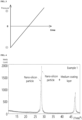
- FIG. 3 is a graph depicting a pressure variation over time in preparation of a first intermediate material according to one embodiment of the present invention.
- the first intermediate material may be formed by decompressing a chamber receiving the primary dried powder therein to introduce hydrocarbon gas into the chamber, and gradually raising the inner pressure of the chamber upon pyrolysis of the hydrocarbon gas to form a medium coating layer on the outer circumferential surface of the primary dried powder (or the nano-silicon particle). Under this condition, a medium coating layer having a uniform thickness and good homogeneity can be formed.
- the first intermediate material preparation step may include: raising the inner temperature of the chamber receiving the primary dried powder therein to 850°C to 970°C while decreasing the inner pressure of the chamber to 10 -1 torr to 10 -6 torr; introducing hydrocarbon gas into the decompressed chamber so as to contact the primary dried powder; and gradually raising the inner pressure of the chamber while maintaining the raised temperature of the chamber to form the first intermediate material on the outer circumferential surface of the primary dried powder through pyrolysis of the hydrocarbon gas.
- the hydrocarbon gas can easily spread between the nano-silicon particles (primary dried powder) in the chamber, whereby the medium coating layer can be uniformly formed.
- the hydrocarbon gas can easily spread between multiple nano-silicon particles, thereby forming the medium coating layer having good homogeneity and a uniform thickness.
- the medium coating layer having a uniform thickness and good homogeneity can be formed on the outer circumferential surface of the nano-silicon powder (primary dried powder).
- the medium coating layer may be formed by heat treatment of at least one of hydrocarbon gas and carbon black.
- the hydrocarbon gas may include at least one of methane (CH 4 ), ethane (C 2 H 6 ), propane (C 3 H 8 ), butane (C 4 H 10 ), and pentane (C 5 H 12 ).
- the medium coating layer may be a non-crystalline or crystalline layer. Under this condition, the anode material can exhibit high strength and durability.
- the medium coating layer may have a pencil hardness of 2H to 4H, as measured in accordance with ISO 15184. Under this condition, the medium coating layer can prevent cracking or fracture of the anode material due to expansion of the nano-silicon particles to secure long lifespan of the anode material.
- the medium coating layer may have a pencil hardness of 2H to 3H.
- the medium coating layer may have a thickness of 3 nm to 50 nm. Under this condition, the medium coating layer can prevent cracking or fracture of the anode material due to expansion of the nano-silicon particles while securing good properties in terms of high output and electrical conductivity.
- the medium coating layer may have a thickness of 3 nm to 15 nm, 5 nm to 15 nm, 6 nm to 15 nm, or 10 nm to 15 nm.
- the medium coating layer may have a density of greater than 1.5 g/cm 3 to 1.7 g/cm 3 . Under this condition, the medium coating layer can exhibit good structural stability and is lightweight. For example, the medium coating layer may have a density of greater than 1.5 g/cm 3 to 1.7 g/cm 3 .
- the medium coating layer may have a specific surface area (BET) of 100 m 2 /g to 200 m 2 /g. Under this condition, the anode material can have good structural stability.
- BET specific surface area
- the medium coating layer may have a purity (impurity content) of 500 ppm or less. Under this condition, the anode material can exhibit good electrical conductivity.
- the medium coating layer may have a resistivity of 20 ⁇ m to 40 ⁇ m. Under this condition, the anode material can exhibit good electrical conductivity.
- the silicon carbide (SiC) layer may have a thickness of 1 nm to 15 nm.
- the anode material can have good properties in terms of durability, ionic conductivity and electrical conductivity, and can have low contact resistance.
- the silicon carbide (SiC) layer may have a thickness of 1 nm to 12 nm, 1 nm to 10 nm, 2 nm to 10 nm, 3 nm to 10 nm, 3 nm to 8 nm, or 3 nm to 5 nm.
- the silicon carbide layer may be present in an amount of 1 wt% to 25 wt%, based on the total weight of the anode material. Under this condition, the silicon carbide layer can secure good properties in terms of durability, ionic conductivity and electrical conductivity, and can have low contact resistance.
- the silicon carbide layer may be present in an amount of 1 wt% to 20 wt%, 1 wt% to 15 wt%, 1 wt% to 10 wt%, 1 wt% to 8 wt%, 2 wt% to 8 wt%, or 2 wt% to 5 wt%, based on the total weight of the anode material.
- the silicon carbide layer may be present in an amount of 1, 2, 3, 4, 5, 6, 7, 8, 9, 10, 11, 12, 13, 14, 15, 16, 17, 18, 19, 20, 21, 22, 23, 24 or 25 wt% based on the total weight of the anode material.
- the first intermediate material preparation step may include: preparing a first composition including the primary dried powder and graphite (S21); placing the first composition in a chamber, followed by raising the inner temperature of the chamber to 900°C to 1,100°C while decreasing an inner pressure of the chamber to less than atmospheric pressure (S22); introducing hydrocarbon gas and a buffer gas into the decompressed chamber so as to contact the first composition (S23); and performing heat treatment by gradually raising the inner pressure of the chamber while maintaining the raised temperature (S24).
- the medium coating layer and the silicon carbide (SiC) layer can be sequentially formed on an outer circumferential surface of the primary dried powder.
- graphite may be typical graphite.
- the graphite may be flake graphite, spherical graphite, polygonal graphite, or amorphous graphite.
- the first composition may include 100 parts by weight of the nano-silicon particles and 0.1 to 20 parts by weight of the graphite. Under this condition, the silicon carbide layer can be easily formed.
- the graphite may be present in an amount of 0.1 to 15 parts by weight, 0.1 to 10 parts by weight, or 0.1 to 5 parts by weight relative to 100 parts by weight of the nano-silicon particles.
- step (S22) the first composition is placed in the chamber and the inner temperature of the chamber is raised to 900°C to 1100°C while decreasing the inner pressure of the chamber to less than atmospheric pressure.
- the inner temperature of the chamber may be raised to 900°C to 1,100°C. Under this condition, the silicon carbide layer can be easily formed, can exhibit good properties in terms of durability, ionic conductivity and electrical conductivity, and can have low contact resistance.
- heat treatment may be performed in a vacuum. Under this condition, the hydrocarbon gas can be evenly diffused between the nano-silicon particles, and the silicon carbide layer and the medium coating layer can be formed on the outer circumferential surface of the nano-silicon particle upon heat treatment.
- heat treatment may be performed in a vacuum of 10 -1 torr to 10 -6 torr.
- step (S23) the hydrocarbon gas and the buffer gas may be introduced into the decompressed chamber having a raised temperature so as to contact the first composition.
- the buffer gas may include nitrogen (N 2 ) gas.
- N 2 nitrogen
- the buffer gas and the hydrocarbon gas can easily spread between the nano-silicon particles placed in the decompressed chamber, whereby the silicon carbide layer and the medium coating layer can be homogeneously formed.
- the hydrocarbon gas can easily spread between multiple nano-silicon particles, whereby the medium coating layer can be formed to have good homogeneity and a uniform thickness.
- heat treatment may be performed by gradually raising the inner pressure of the chamber while maintaining the raised temperature.
- the first intermediate material may be prepared by raising the inner temperature of the chamber with the first composition placed in the chamber while decreasing the inner pressure of the chamber to introduce the hydrocarbon gas and the buffer gas into the chamber, followed by sequentially forming the silicon carbide layer and the medium coating layer on the outer circumferential surface of the primary dried powder (or the nano-silicon particle) by gradually raising the inner pressure of the chamber while maintaining the raised temperature.
- the silicon carbide layer and the medium coating layer can be formed to have uniform thicknesses and good homogeneity.
- the hydrocarbon gas can easily spread between the multiple nano-silicon particles, whereby the silicon carbide layer and the medium coating layer can be formed to have uniform thicknesses and good homogeneity.
- the first intermediate material may be prepared by gradually raising the inner pressure of the chamber to 10 1 torr to 10 5 torr.
- the silicon carbide layer may have a higher hardness than the medium coating layer.
- the silicon carbide layer may have a pencil hardness of 7H or higher, as measured in accordance with ISO 15184.
- the silicon carbide layer may have a pencil hardness of 8H or higher, 10H or higher, 8H to 13H, or 8H to 10H.
- the medium coating layer may be formed by heat treatment of at least one of hydrocarbon gas and carbon black.
- the hydrocarbon gas may include at least one of methane (CH 4 ), ethane (C 2 H 6 ), propane (C 3 H 8 ), butane (C 4 H 10 ), and pentane (C 5 H 12 ).
- the medium coating layer may be a non-crystalline or crystalline layer. Under this condition, the anode material can exhibit high strength and durability.
- the medium coating layer may have a pencil hardness of 2H to less than 4H, as measured in accordance with ISO 15184. Under this condition, the medium coating layer can prevent cracking or fracture of the anode material due to expansion of the nano-silicon particles to secure long lifespan of the anode material.
- the medium coating layer may have a pencil hardness of 2H to 3H.
- a mixed slurry including the first intermediate material, a first coating material and a solvent is prepared.
- the mixed slurry may include 20 wt% to 85 wt% of the first intermediate material, 1 wt% to 15 wt% of the first coating material and 5 wt% to 75 wt% of the solvent. Within this range, the mixed slurry can secure good miscibility and dispersion.
- the first intermediate material may be present in an amount of 20 wt% to 85 wt%, based on the total weight of the anode material. Under this condition, the anode material can have good properties in terms of durability, long lifespan and high output.
- the first intermediate material may be present in an amount of 25 wt% to 80 wt%, 30 wt% to 75 wt%, 30 wt% to 70 wt%, 30 wt% to 65 wt%, 30 wt% to 60 wt%, or 30 wt% to 50 wt%, based on the total weight of the anode material.
- the first coating material may include at least one of a hard coating material and a soft coating material.
- the first coating material may have a spherical, polyhedral, elliptical or amorphous shape.
- the first coating material may have a spherical shape.
- the first coating material may have an average particle diameter (d50) of 3 nm to 2.5 ⁇ m. Under this condition, the first coating material can secure good miscibility and dispersion.
- the first coating material may have an average particle diameter (d50) of 5 nm to 1,000 nm, 10 nm to 500 nm, or 15 nm to 200 nm.
- the hard coating material may include a carbon material.
- the hard coating material may have a pencil hardness of greater than 4H to 6H, as measured in accordance with ISO 15184. Under this condition, the hard coating material can prevent fracture of the anode material upon expansion of the nano-silicon particles while securing good properties in terms of high output and electrical properties.
- the hard coating material may have a pencil hardness of 4.5H to 6H.
- the hard coating material may include a carbon material having a pencil hardness of 4.5H to 6H.
- the hard coating material may include NanoMollisAdamas products available from Lemon Energy Co., Ltd.
- the hard coating material may have an amorphous phase.
- the hard coating material is prepared through self-assembly and exhibits good properties in terms of isotropic properties and heat stability to prevent structural change at high temperature (at about 3,000°C).
- the hard coating material may have high-gas impermeability while exhibiting good chemical resistance and electrical conductivity.
- the hard coating material may be dust free and may have a purity (impurity content) of 5 ppm or less or a purity (impurity content) of 2 ppm or less. Under this condition, the hard coating material can secure good strength and electrical properties, and the anode material can exhibit good electrical conductivity.
- the hard coating material may have a resistivity of 3 ⁇ m to 5 ⁇ m. Under this condition, the anode material can exhibit good electrical conductivity.
- the soft coating material may include at least one of pitch, coke and carbon precursors formed of other organic materials.
- the pitch may include at least one of pyrolysis fuel oil pitch and coal tar pitch.
- the first coating material may be present in an amount of 1 wt% to 15 wt%, based on the total weight of the anode material. Under this condition, the first coating material can secure good miscibility and dispersion of the mixed slurry and the anode material can have good properties in terms of durability, electrical conductivity, long lifespan and high output.
- the first coating material may be present in an amount of 1 wt% to 13 wt%, 2 wt% to 10 wt%, 3 wt% to 10 wt%, 3 wt% to 8 wt%, or 3 wt% to 6 wt%, based on the total weight of the anode material.
- the solvent may include at least one of water, an alcohol-based solvent, an amide-based solvent, an ester-based solvent, and a hydrocarbon-based solvent.
- the solvent serves to secure good miscibility and workability.
- the alcohol-based solvent may include at least one of methanol, ethanol, isopropanol, and butanol.
- the amide-based solvent may include at least one of N-methyl-2-pyrrolidone (NMP), dimethyl acetamide (DMAC), and dimethyl formamide (DMF).
- the hydrocarbon-based solvent may include toluene and/or xylene.
- the solvent may be present in an amount of 5 wt% to 75 wt%, based on the total weight of the anode material. Under this condition, the solvent can secure good miscibility and dispersion.
- the solvent may be present in an amount of 10 wt% to 70 wt%, 10 wt% to 65 wt%, 15 wt% to 60 wt%, 15 wt% to 50 wt%, 20 wt% to 50 wt%, or 25 wt% to 50 wt%, based on the total weight of the anode material.
- the mixed slurry may be prepared by dispersing the first intermediate material in the solvent and further adding the first coating material, followed by stirring and dispersing.
- the mixed slurry may be prepared by a method such as stirring, ultrasound dispersion and the like.
- a mixed slurry is dried to prepare secondary dried powder.
- the secondary dried powder may be prepared by drying the mixed slurry at 60°C to 130°C.
- the secondary dried powder may have an average particle diameter (or size) of 0.01 ⁇ m to 15 ⁇ m. Under this condition, the secondary dried powder can secure good miscibility and formability.
- the secondary dried powder may have an average particle diameter of 0.1 ⁇ m to 14 ⁇ m. In another embodiment, as prepared by spray drying the mixed slurry using a four-fluid nozzle, the secondary dried powder may have an average particle diameter of 0.05 ⁇ m to 8 ⁇ m.
- a second intermediate material is prepared by sintering the secondary dried powder.
- the second intermediate material may be prepared by sintering the secondary dried powder at 850°C to 1,050°C. Under this condition, the second intermediate material can secure good properties in terms of mechanical strength, high output and long lifespan.
- the second intermediate material may be prepared by sintering at 850°C to 1,000°C, 860 to 970°C, or 870°C to 950°C.
- sintering may be performed under an inert gas atmosphere.
- the inert gas may include nitrogen.
- the second intermediate material preparation step may include sintering a first mixture including the secondary dried powder and a second coating material.
- the second intermediate material can have good properties in terms of mechanical strength, high output, and long lifespan.
- the second coating material may include at least one of a hard coating material and a soft coating material.
- the second coating material may be the same kind as or a different kind than the first coating material.
- the hard coating material may include a carbon material.
- the hard coating material may have a pencil hardness of greater than 4H to 6H, as measured in accordance with ISO 15184. Under this condition, the hard coating material can prevent fracture of the anode material upon expansion of the nano-silicon particles while securing good properties in terms of high output and electrical properties.
- the hard coating material may have a pencil hardness of 4.5H to 6H.
- the hard coating material may include a carbon material having a pencil hardness of 4.5H to 6H.
- the hard coating material may include NanoMollisAdamas products available from Lemon Energy Co., Ltd.
- the hard coating material may have an amorphous phase.
- the hard coating material is prepared through self-assembly and exhibits good properties in terms of isotropic properties and heat stability to prevent structural change at high temperature (at about 3,000°C).
- the hard coating material may have high-gas impermeability while exhibiting good chemical resistance and electrical conductivity.
- the hard coating material may be dust free and may have a purity (impurity content) of 5 ppm or less or a purity (impurity content) of 2 ppm or less. Under this condition, the hard coating material can secure good strength and electrical properties, and the anode material can exhibit good electrical conductivity.
- the hard coating material may have a resistivity of 3 ⁇ m to 5 ⁇ m. Under this condition, the anode material can exhibit good electrical conductivity.
- the soft coating material may include at least one of pitch, coke and carbon precursors formed of other organic materials.
- the pitch may include at least one of pyrolysis fuel oil pitch and coal tar pitch.
- the second coating material may have a spherical, polyhedral, elliptical or amorphous shape.
- the second coating material may have a spherical shape.
- the second coating material may have an average particle diameter (d50) of 3 nm to 2.5 ⁇ m. Under this condition, the second intermediate material can be easily formed by sintering.
- the second coating material may have an average particle diameter (d50) of 5 nm to 1,000 nm, 10 nm to 500 nm, or 15 nm to 200 nm.
- the first mixture may include 80 wt% to 95 wt% of the secondary dried powder and 5 wt% to 20 wt% of the second coating material.
- the second intermediate material can have good properties in terms of mechanical strength, high output and long lifespan.
- the second intermediate material preparation step may include: subjecting the secondary dried powder to primary sintering at 850°C to 1,050°C; and subjecting the first mixture including the secondary dried powder subjected to primary sintering and the second coating material to secondary sintering at 850°C to 1,050°C.
- the second intermediate material can have good properties in terms of mechanical strength, high output and long lifespan.
- the primary sintering may be performed at 850°C to 1,000°C, 860°C to 970°C, 870°C to 950°C, or 900°C to 930°C.
- the secondary sintering may be performed at the same temperature as or at a different temperature than the primary sintering.
- the secondary sintering may be performed at 850°C to 1,000°C, 860°C to 970°C, 870°C to 950°C, or 900°C to 930°C.
- the primary sintering and the secondary sintering may be performed in an inert gas atmosphere.
- the inert gas may include nitrogen.
- the second coating material may be the same as described above.
- the second coating material may include at least one of a hard coating material and a soft coating material.
- the second coating material may be the same as or different from the first coating material.
- the second intermediate material may be prepared by drying the mixed slurry including 20 wt% to 85 wt% of the first intermediate material, 1 wt% to 15 wt% of the first coating material (hard coating material), and 5 wt% to 75 wt% of the solvent to prepare the secondary dried powder, subjecting the secondary dried powder to primary sintering at 900°C to 1,050°C, and subjecting a first mixture including the secondary dried powder subjected to primary sintering and a second coating material (soft coating material) to secondary sintering at 870°C to 950°C.
- the second intermediate material may include a hard coating layer and a soft coating layer sequentially formed as the first coating layer on the outer circumferential surface of the medium coating layer.
- the first mixture may include 80 wt% to 95 wt% of the secondary dried powder and 5 wt% to 20 wt% of the second coating material.
- the second intermediate material can have good properties in terms of mechanical strength, high output and long lifespan.
- the second intermediate material includes nano-silicon particles, a medium coating layer formed on an outer circumferential surface of the nano-silicon particle, and a first coating layer formed on an outer circumferential surface of the medium coating layer.
- the first coating layer includes at least one of a hard coating layer and a soft coating layer.
- the first coating layer may include the hard coating layer and the soft coating layer in a weight ratio of 1:0.5 to 1:3. Within this range of weight ratio, the anode material can have good properties in terms of high output and long lifespan.
- the first coating layer may include the hard coating layer and the soft coating layer in a weight ratio of 1:1 to 1:3, 1:1.5 to 1:3, or 1:2 to 1:3.
- the second intermediate material may include the medium coating layer and the first coating layer in a weight ratio of 1:0.5 to 1:6. Within this range of weight ratio, the anode material does not suffer from cracking and fracture even upon expansion of the nano-silicon particles and can secure high output and long lifespan.
- the second intermediate material may include the medium coating layer and the first coating layer in a weight ratio of 1:0.8 to 1:5, 1:1 to 1:4, 1:1 to 1:3, or 1:1.5 to 1:3.
- the second intermediate material may further include a silicon carbide (SiC) layer between the nano-silicon particle and the medium coating layer.
- SiC silicon carbide
- the silicon carbide layer can improve ionic conductivity and electrical conductivity of the nano-silicon particles while securing a stable ion charge/discharge path to provide low contact resistance, thereby preventing fracture of the anode material due to expansion of the nano-silicon particles.
- the silicon carbide (SiC) layer may have a thickness of 1 nm to 15 nm.
- the anode material can have good properties in terms of durability, ionic conductivity and electrical conductivity, and can have low contact resistance.
- the anode material may have a thickness of 1 nm to 12 nm, 1 nm to 10 nm, 2 nm to 10 nm, 3 nm to 10 nm, 3 nm to 8 nm, or 3 nm to 5 nm.
- the silicon carbide layer may have a higher hardness than the medium coating layer and the hard coating layer. Under this condition, the silicon carbide layer can exhibit good electrical conductivity and can prevent fracture of the anode material due to expansion of the nano-silicon particles
- the silicon carbide layer may have a pencil hardness of 7H or higher, as measured in accordance with ISO 15184.
- the silicon carbide layer may have a pencil hardness of 8H or higher, 10H or higher, 8H to 13H, or 8H to 10H.
- the silicon carbide layer may be present in an amount of 1 wt% to 25 wt%, based on the total weight of the anode material. Under this condition, the silicon carbide layer can secure good properties in terms of durability, ionic conductivity and electrical conductivity, and can have low contact resistance.
- the silicon carbide layer may be present in an amount of 1 wt% to 20 wt%, 1 wt% to 15 wt%, 1 wt% to 10 wt%, 1 wt% to 8 wt%, 2 wt% to 8 wt%, or 2 wt% to 5 wt%, based on the total weight of the anode material.
- the silicon carbide layer may be present in an amount of 1, 2, 3, 4, 5, 6, 7, 8, 9, 10, 11, 12, 13, 14, 15, 16, 17, 18, 19, 20, 21, 22, 23, 24 or 25 wt% based on the total weight of the anode material.
- the silicon carbide layer and the medium coating layer may have a thickness ratio of 1:1 to 1:4. Under this condition, the anode material can have good properties in terms of electrical conductivity and durability without suffering from fracture due to expansion of the nano-silicon particles.
- the silicon carbide layer and the medium coating layer may be present in a weight ratio of 1:1.5 to 1:3.
- the second intermediate material may be prepared by sintering the secondary dried powder at 850°C to 1,050°C.
- the second intermediate material preparation step may include subjecting the secondary dried powder to primary sintering at 850°C to 1,050°C; subjecting the first mixture including the secondary dried powder subjected to primary sintering and the second coating material to secondary sintering at 850°C to 1,050°C, wherein the second coating material may include at least one of the hard coating material and the soft coating material.
- the method may further include forming a second coating layer on an outer circumferential surface of the second intermediate material (S60) after preparation of the second intermediate material (S50).
- the second coating layer may include a medium coating layer and may be formed by heat treatment of the second intermediate material in a hydrocarbon gas atmosphere.
- heat treatment may be performed at 850°C to 970°C. Under this condition, the medium coating layer can be easily formed. For example, heat treatment may be performed at 870°C to 960°C, 890°C to 960°C, 900°C to 950°C, or 900°C to 935°C.
- heat treatment may be performed in a vacuum. Under this condition, the hydrocarbon gas can be evenly diffused between the nano-silicon particles, thereby forming a homogeneous medium coating layer through heat treatment.
- heat treatment may be performed in a vacuum of 10 -1 torr to 10 -6 torr.
- the second coating layer may be prepared by raising the inner temperature of the chamber with the second intermediate material placed in the chamber while decreasing the inner pressure of the chamber to introduce hydrocarbon gas into the chamber, followed by forming the second coating layer (medium coating layer) on an outer circumferential surface of the second intermediate material (or the first coating layer) by gradually raising the inner pressure of the chamber upon pyrolysis of the hydrocarbon gas. Under this condition, a medium coating layer having a uniform thickness and good homogeneity can be formed.
- the second coating layer formation step may include: raising the inner temperature of the chamber receiving the second intermediate material therein to 850°C to 970°C while decreasing the inner pressure of the chamber to 10 -1 torr to 10 -6 torr; introducing hydrocarbon gas into the decompressed chamber so as to contact the second intermediate material; and gradually raising the inner pressure of the chamber while maintaining the raised temperature of the chamber to form the second coating layer (medium coating layer) on the outer circumferential surface of the second intermediate material (first coating layer) through pyrolysis of the hydrocarbon gas.
- the hydrocarbon gas can easily spread in the second intermediate material, and upon raising the inner pressure of the chamber under this condition, the medium coating layer having a uniform thickness and good homogeneity can be formed on the outer circumferential surface of the second intermediate material.
- the second coating layer may be prepared by gradually raising the inner pressure of the chamber to 10 1 torr to 10 5 torr.
- the medium coating layer may be formed by heat treatment of at least one of hydrocarbon gas and carbon black.
- the hydrocarbon gas may include at least one of methane (CH 4 ), ethane (C 2 H 6 ), propane (C 3 H 8 ), butane (C 4 H 10 ), and pentane (C 5 H 12 ).
- the medium coating layer may be a non-crystalline or crystalline layer. Under this condition, the anode material can exhibit high strength and durability.
- the medium coating layer may have a pencil hardness of 2H to 4H, as measured in accordance with ISO 15184. Under this condition, the medium coating layer can prevent cracking or fracture of the anode material due to expansion of the nano-silicon particles to secure long lifespan of the anode material.
- the medium coating layer may have a pencil hardness of 2H to 3H.
- the second coating layer may have a thickness of 3 nm to 50 nm. Under this condition, the second coating layer can prevent cracking or fracture of the anode material due to expansion of the nano-silicon particles while securing good properties in terms of high output and electrical conductivity.
- the second coating layer may have a thickness of 3 nm to 15 nm, 5 nm to 15 nm, 6 nm to 15 nm, or 10 nm to 15 nm.
- the second coating layer may have a density of greater than 1.5 g/cm 3 to 1.7 g/cm 3 . Under this condition, the second coating layer can exhibit good structural stability and is lightweight. For example, the second coating layer may have a density of greater than 1.5 g/cm 3 to 1.7 g/cm 3 .
- the second coating layer may have a specific surface area (BET) of 100 m 2 /g to 200 m 2 /g. Under this condition, the anode material can have good structural stability.
- BET specific surface area
- the medium coating layer may have a purity (impurity content) of 500 ppm or less. Under this condition, the anode material can exhibit good electrical conductivity.
- the medium coating layer may have a resistivity of 20 ⁇ m to 40 ⁇ m. Under this condition, the anode material can exhibit good electrical conductivity.
- the second coating layer may be present in an amount of 1 wt% to 40 wt%, based on the total weight of the anode material. Within this range, the second coating layer can secure electrical conductivity, can prevent cracking or fracture of the anode material due to expansion of the nano-silicon particles, and can minimize reduction in capacity to secure long lifespan.
- the second coating layer may be present in an amount of 1 wt% to 35 wt%, 1 wt% to 30 wt%, 1 wt% to 25 wt%, 1 wt% to 20 wt%, 1 wt% to 15 wt%, 1 wt% to 10 wt%, 1 wt% to 8 wt%, 2 wt% to 8 wt%, or 2 wt% to 5 wt%, based on the total weight of the anode material.
- the anode material may include the medium coating layer, the silicon carbide layer, the first coating layer and the second coating layer in a weight ratio of 1:0.1 to 3:0.5 to 6:0.1 to 4. Within this range of weight ratio, the anode material does not suffer from cracking and fracture even upon expansion of the nano-silicon particles while securing high output and long lifespan.
- the anode material may include the medium coating layer, the silicon carbide layer, the first coating layer and the second coating layer in a weight ratio of 1:0.1 to 2:0.8 to 5:0.3 to 4, 1:0.3 to 1.5:1 to 4:0.5 to 3.5, 1:0.5 to 1.2:1 to 3:1 to 2.5 or 1:0.5 to 1:1.5 to 3:1 to 2.
- a further aspect of the present invention relates to a secondary battery including the silicon carbon composite anode material.
- the secondary battery may include a cathode; an anode; and an electrolyte disposed between the cathode and the anode, wherein the anode includes the anode material.
- the secondary battery may include a lithium secondary battery.
- the lithium secondary battery may include a cathode including a cathode material; an anode spaced apart from the cathode and including the anode material; an electrolyte disposed between the anode and the cathode; and a separator disposed between the anode and the cathode to prevent electrical short of the anode and the cathode.
- the anode plate may include a copper foil, a carbon-coated copper foil, a copper foil having a surface roughness of 5 nm or more, a nickel foil, a stainless steel foil, a nickel-coated iron (Fe) foil, and a copper foil formed with holes having a size of 1 ⁇ m to 50 ⁇ m.
- the cathode material may include a composite oxide of a metal and lithium.
- the metal may include at least one of cobalt (Co), manganese (Mn), aluminum (Al), and nickel (Ni).
- the metal may include at least one of lithium-nickel oxide, lithium-nickel-cobalt oxide, lithium-nickel-cobalt-manganese oxide, and lithium-nickel-cobalt-aluminum oxide.
- the conductive material may include at least one of natural graphite, artificial graphite, carbon black, acetylene black, Ketjen black, channel black, carbon fiber, metal fiber, carbon fluoride, aluminum, nickel powder, zinc oxide, potassium titanate, titanium oxide, and polyphenylene compounds.
- the binder may include polyvinylidene fluoride, polyvinyl alcohol, carboxymethylcellulose (CMC), starch, hydroxypropylcellulose, polyvinyl pyrrolidone, polytetrafluoroethylene, polyethylene, polypropylene, ethylene-propylene-diene monomer (EPDM), styrene rubber, and fluorine rubber.
- the separator may be a typical separator.
- the separator may include at least one of polyester, polyethylene, polypropylene, and polytetrafluoroethylene (PTFE).
- the separator may be realized in the form of non-woven fabrics or woven fabrics.
- the separator is a porous structure having an average pore diameter of 0.01 ⁇ m to 10 ⁇ m and a thickness of 5 ⁇ m to 500 ⁇ m.
- the electrolyte may include a non-aqueous organic solvent and a lithium salt.
- the non-aqueous organic solvent may include at least one of a carbonate solvent, an ester solvent, an ether solvent, and a ketone solvent.
- the carbonate solvent may include at least one of vinylene carbonate (VC), dimethyl carbonate (DMC), diethyl carbonate (DEC), dipropyl carbonate (DPC), fluoroethylene carbonate (FEC), methyl propyl carbonate (MPC), ethyl methyl carbonate (EMC), ethyl propyl carbonate (EPC), ethylene carbonate (EC), propylene carbonate (PC), and butylene carbonate (BC).
- VC vinylene carbonate
- DMC dimethyl carbonate
- DEC diethyl carbonate
- DPC dipropyl carbonate
- FEC fluoroethylene carbonate
- MPC methyl propyl carbonate
- EMC ethyl methyl carbonate
- the ester solvent may include at least one of butyrolactone, decanolide, valerolactone, caprolactone, n-methyl acetate, n-ethyl acetate, and n-propyl acetate.
- the ether solvent may include dibutyl ether and the like.
- the ketone solvent may include poly(methyl vinyl ketone).
- the lithium salt may act as a source of lithium ions in a battery.
- the lithium salt may include at least one of LiPF 6 , LiBF 4 , LiSbF 6 , LiAsF 6 , LiClO 4 , LiCF 3 SO 3 , LiN(CF 3 SO 2 ) 2 , LiN(C 2 F 5 SO 2 ) 2 , LiAlO 4 , and LiAlCl 4 , without being limited thereto.
- the electrolyte may include at least one of vinylene carbonate, vinyl ethylene carbonate, monofluoroethylene carbonate, difluoroethylene carbonate, succinic anhydride, and 1,3-propane sultone.
- the lithium secondary battery may include a prismatic battery, a cylindrical battery, and a pouch-type battery.
- the anode material included nano-silicon particles having an average particle diameter (d50) of 50 nm, a medium coating layer (thickness: 10 nm to 20 nm, pencil hardness: 2H to 3H in accordance with ISO 15184, density: 1.6 g/cm 3 to 1.7 g/cm 3 ) formed on an outer circumferential surface of the nano-silicon particle and a first coating layer formed on an outer circumferential surface of the medium coating layer.
- d50 average particle diameter
- a medium coating layer thickness: 10 nm to 20 nm, pencil hardness: 2H to 3H in accordance with ISO 15184, density: 1.6 g/cm 3 to 1.7 g/cm 3
- the first coating layer included a hard coating layer (thickness: 10 nm to 15 nm, pencil hardness: 5H to 6H in accordance with ISO 15184, density: 2.2 g/cm 3 ) and a soft coating layer (thickness: 5 nm to 15 nm, pencil hardness: B in accordance with ISO 15184, density: 1.3 g/cm 3 ) sequentially formed therein.
- the anode material included 25 wt% to 80 wt% of the nano-silicon particles, 1 wt% to 40 wt% of the medium coating layer, and 1 wt% to 60 wt% of the first coating layer, in which the medium coating layer and the first coating layer were present in a weight ratio of 1:1 to 1:3.
- a mixed slurry was prepared by adding a first coating material (soft coating material including pitch having an average particle diameter (d50) of 0.03 ⁇ m to 5 ⁇ m) to the dispersion.
- the mixed slurry included 25 wt% to 60 wt% of the first intermediate material, 2 wt% to 5 wt% of the first coating material, and 35 wt% to 70 wt% of the solvent.
- secondary dried powder was prepared by drying the mixed slurry using a rotational spray dryer.
- the anode material included nano-silicon particles having an average particle diameter (d50) of 50 nm, a medium coating layer formed on an outer circumferential surface of the nano-silicon particle (thickness: 10 nm to 20 nm, pencil hardness: 2H to 3H in accordance with ISO 15184, density: 1.6 g/cm 3 to 1.7 g/cm 3 ), and a first coating layer formed on an outer circumferential surface of the medium coating layer.
- the first coating layer included a soft coating layer (thickness: 5 nm to 15 nm, pencil hardness: B in accordance with ISO 15184, density: 1.3 g/cm 3 ) and a hard coating layer (thickness: 10 nm to 15 nm, pencil hardness: 5H to 6H in accordance with ISO 15184, density: 2.2 g/cm 3 ) sequentially formed therein.
- the anode material included 25 wt% to 80 wt% of the nano-silicon particles, 1 wt% to 40 wt% of the medium coating layer, and 1 wt% to 60 wt% of the first coating layer, in which the medium coating layer and the first coating layer were present in a weight ratio of 1:1 to 1:3.
- a second intermediate material was prepared by sintering the secondary dried powder of Example 1 at 900°C to 1,050°C. Then, an anode material was prepared by crushing and classifying the second intermediate material.
- the anode material included nano-silicon particles having an average particle diameter (d50) of 50 nm, a medium coating layer formed on an outer circumferential surface of the nano-silicon particle (thickness: 10 nm to 20 nm, pencil hardness: 2H to 3H in accordance with ISO 15184, density: 1.6 g/cm 3 to 1.7 g/cm 3 ), and a first coating layer formed on an outer circumferential surface of the medium coating layer (hard coating layer, thickness: 10 nm to 15 nm, pencil hardness: 5H to 6H in accordance with ISO 15184, density: 2.2 g/cm 3 ).
- the anode material included 25 wt% to 80 wt% of the nano-silicon particles, 1 wt% to 40 wt% of the medium coating layer, and 1 wt% to 60 wt% of the first coating layer, in which the medium coating layer and the first coating layer were present in a weight ratio of 1:0.5 to 1:2.
- Example 1 With the second intermediate material of Example 1 placed in the chamber, the inner temperature of the chamber was raised to 900°C to 920°C while decreasing the inner pressure of the chamber to 10 -2 torr to 10 -6 torr. Next, hydrocarbon (CH 4 ) gas was introduced into the decompressed chamber so as to contact the second intermediate material. Next, the inner pressure of the chamber was gradually raised to 10 2 torr to 10 3 torr while maintaining the raised temperature of the chamber to form a second coating layer (medium coating layer) formed on an outer circumferential surface of the second intermediate material through pyrolysis of the hydrocarbon gas.
- CH 4 hydrocarbon
- the anode material included nano-silicon particles having an average particle diameter (d50) of 50 nm, a medium coating layer (thickness: 10 nm to 20 nm, pencil hardness: 2H to 3H in accordance with ISO 15184, density: 1.6 g/cm 3 to 1.7 g/cm 3 ) formed on an outer circumferential surface of the nano-silicon particle, a first coating layer formed on an outer circumferential surface of the medium coating layer, and a second coating layer formed on an outer circumferential surface of the first coating layer.
- d50 average particle diameter
- a medium coating layer thinness: 10 nm to 20 nm, pencil hardness: 2H to 3H in accordance with ISO 15184, density: 1.6 g/cm 3 to 1.7 g/cm 3
- first coating layer formed on an outer circumferential surface of the medium coating layer
- a second coating layer formed on an outer circumferential surface of the first coating layer.
- the first coating layer included a hard coating layer (thickness: 10 nm to 15 nm, pencil hardness: 5H to 6H in accordance with ISO 15184, density: 2.2 g/cm 3 ) and a soft coating layer (thickness: 5 nm to 15 nm, pencil hardness: B in accordance with ISO 15184, density: 1.3 g/cm 3 ) sequentially formed therein, in which a medium coating layer (thickness: 10 nm to 20 nm, pencil hardness: 2H in accordance with ISO 15184, density: 1.6 to 1.7 g/cm 3 ) was formed as the second coating layer.
- the anode material included 25 wt% to 80 wt% of the nano-silicon particles, 1 wt% to 40 wt% of the medium coating layer, 2 wt% to 50 wt% of the first coating layer (1 wt% to 30 wt% of the hard coating layer and 1 wt% to 20 wt% of the soft coating layer), and 1 wt% to 30 wt% of the second coating layer, in which the medium coating layer, the first coating layer and the second coating layer were present in a weight ratio of 1:2 to 4:1 to 1.5.
- a first intermediate material including a silicon carbide layer and a medium coating layer sequentially on the surface of the primary dried powder (nano-silicon particle) through pyrolysis of the hydrocarbon gas was prepared by gradually raising the inner pressure of the chamber to 10 2 torr to 10 3 torr while maintaining the raised temperature of the chamber.
- a second intermediate material was prepared in the same manner as in Example 1 using the prepared first intermediate material.
- the inner temperature of the chamber was raised to 900°C to 920°C while decreasing the inner pressure of the chamber to 10 -2 torr to 10 -6 torr.
- hydrocarbon (CH 4 ) gas was introduced into the decompressed chamber so as to contact the second intermediate material.
- the inner pressure of the chamber was gradually raised to 10 2 torr to 10 3 torr while maintaining the raised temperature of the chamber to form a second coating layer (medium coating layer) on an outer circumferential surface of the second intermediate material through pyrolysis of the hydrocarbon gas, thereby preparing an anode material.
- the anode material included nano-silicon particles having an average particle diameter (d50) of 500 nm; a silicon carbide layer (thickness: 3 nm, pencil hardness: 7.5H to 8.5H in accordance with ISO 15184), a medium coating layer (thickness: 7 nm, pencil hardness: 2H to 3H in accordance with ISO 15184, density: 1.6 g/cm 3 to 1.7 g/cm 3 ) and a first coating layer sequentially formed on an outer circumferential surface of the nano-silicon particle; and a second coating layer formed on an outer circumferential surface of the first coating layer.
- d50 average particle diameter
- the first coating layer included a hard coating layer (thickness: 15 nm, pencil hardness: 5H to 6H in accordance with ISO 15184, density: 2.2 g/cm 3 ) and a soft coating layer (thickness: 10 nm, pencil hardness: B in accordance with ISO 15184, density: 1.3 g/cm 3 ) sequentially formed therein, and the second coating layer was a medium coating layer (thickness: 10 nm to 20 nm, pencil hardness: 2H in accordance with ISO 15184, density: 1.6 g/cm 3 to 1.7 g/cm 3 ).
- the anode material included 25 wt% to 80 wt% of the nano-silicon particles, 1 wt% to 10 wt% of the silicon carbide layer, 1 wt% to 30 wt% of the medium coating layer, 1 wt% to 60 wt% of the first coating layer, and 1 wt% to 30 wt% of the second coating layer, in which the medium coating layer, the silicon carbide layer, first coating layer and the second coating layer were present in a weight ratio of 1:0.5 to 1:2 to 4:1 to 1.5.
- a first intermediate material including a silicon carbide layer and a medium coating layer sequentially formed on the surface of primary dried powder (nano-silicon particle) was prepared in the same manner as in Example 5.
- a mixture slurry was prepared by adding a first coating material (soft coating material including pitch having an average particle diameter (d50) of 0.03 ⁇ m to 5 ⁇ m) to the dispersion.
- the mixed slurry included 25 wt% to 60 wt% of the first intermediate material, 2 wt% to 5 wt% of the first coating material, and 35 wt% to 70 wt% of the solvent.
- secondary dried powder was prepared by drying the mixed slurry using a rotational spray dryer.
- a second intermediate material was prepared in the same manner as in Example 5 using the secondary dried powder and a second coating layer (medium coating layer) was formed on an outer circumferential surface of the second intermediate material, thereby preparing an anode material.
- the anode material included nano-silicon particles having an average particle diameter (d50) of 50 nm, a silicon carbide layer (thickness: 3 nm, pencil hardness: 7.5H to 8.5H in accordance with ISO 15184) and a medium coating layer (thickness: 10 nm to 20 nm, pencil hardness: 2H to 3H in accordance with ISO 15184, density: 1.6 g/cm 3 to 1.7 g/cm 3 ) sequentially formed on an outer circumferential surface of the nano-silicon particle, a first coating layer formed on an outer circumferential surface of the medium coating layer, and a second coating layer formed on an outer circumferential surface of the first coating layer.
- d50 average particle diameter
- a silicon carbide layer thickness: 3 nm, pencil hardness: 7.5H to 8.5H in accordance with ISO 15184
- a medium coating layer thinness: 10 nm to 20 nm, pencil hardness: 2H to 3H in accordance with ISO
- the first coating layer included a soft coating layer (thickness: 5 nm to 15 nm, pencil hardness: B in accordance with ISO 15184, density: 1.3 g/cm 3 ) and a hard coating layer (thickness: 10 nm to 15 nm, pencil hardness: 5H to 6H in accordance with ISO 15184, density: 2.2 g/cm 3 ) sequentially formed therein, and the second coating layer was a medium coating layer (thickness: 10 nm to 20 nm, pencil hardness: 2H in accordance with ISO 15184, density: 1.6 to 1.7 g/cm 3 ).
- the anode material included 25 wt% to 80 wt% of the nano-silicon particles, 1 wt% to 10 wt% of the silicon carbide layer, 1 wt% to 40 wt% of the medium coating layer, 2 wt% to 55 wt% of the first coating layer (1 wt% to 25 wt% of the soft coating layer and 1 wt% to 30 wt% of the hard coating layer), and 1 wt% to 30 wt% of the second coating layer, in which the medium coating layer, the silicon carbide layer, the first coating layer and the second coating layer were present in a weight ratio of 1:0.5 to 1:2 to 4:1 to 1.5.
- Sintered powder was prepared by sintering only the dried powder prepared in Example 1 at 900°C to 1,050°C in an inert gas atmosphere. Thereafter, an intermediate material (anode material) was prepared by mixing the sintered powder with a soft coating material (including pitch having an average particle diameter (d50) of 3 ⁇ m to 5 ⁇ m), followed by sintering the mixture at 850°C to 975°C to form a first coating layer (soft coating layer), and was crushed and classified.
- a soft coating material including pitch having an average particle diameter (d50) of 3 ⁇ m to 5 ⁇ m
- the anode material included a core including nano-silicon particles and a first coating layer (soft coating layer having a thickness: 10 nm to 20 nm, a pencil hardness of B in accordance with ISO 15184, and a density of 1.5 g/cm 3 ) on an outer circumferential surface of the core.
- a first coating layer soft coating layer having a thickness: 10 nm to 20 nm, a pencil hardness of B in accordance with ISO 15184, and a density of 1.5 g/cm 3
- the anode material included 25 wt% to 80 wt% of the nano-silicon particles and 20 wt% to 75 wt% of the first coating layer.
- the diffraction angles (2 ⁇ ) at the (111) and (220) planes of the nano-silicon particles were measured as to the nano-silicon particles of the anode materials of Examples and Comparative Example by a measurement instrument (Empyrean, Malvern Panalytical Co., Ltd.) based on an X-ray diffraction (XRD) spectrum using CuK ⁇ -rays at a wavelength of 1.54 ⁇ .
- the oxidation rate of the nano-silicon particles was calculated based on the content of oxygen measured using a measurement instrument (ONH 836 Series, LECO), and the specific surface area thereof was measured using a BET meter (Micromeritics, Tristar II 3920). Table 1 shows measurement results.
- Example 1 Item Grain size ( nm) at (111) Oxygen content (wt%) Specific surface area (m 2 /g) Example 1 15.9 6.5 4.2 Example 2 16.0 6.6 4.3 Example 3 16.2 6.2 4.8 Example 4 16.2 6.4 5.4 Example 5 16.4 6.5 5.6 Example 6 16.2 6.5 5.4 Comparative Example 1 15.7 9.6 4.9
- the nano-silicon particles of the anode materials of Example 1 to 6 had effective peaks at a diffraction angle (2 ⁇ ) of about 27.5° to 28.5°, 47° to 48°, 55° to 56°, 68° to 69°, 75° to 77°, and 88° to 89° in the X-ray diffraction spectrum, in which the effective peaks represent the (111), (220), (311), (400), (331), and (442) planes.
- FIG. 4 is a graph depicting XRD analysis results of nano-silicon particles of an anode material of Example 1 and nano-silicon particles having a medium coating layer formed thereon.
- the nano-silicon particles of the anode materials of Example 1 had the highest effective peak at a diffraction angle (2 ⁇ ) in the range of 26° to 30° at the (111) plane and an effective peak at a diffraction angle (2 ⁇ ) in the range of 47° to 50° at the (220) plane in the X-ray diffraction (XRD) spectrum.
- the nano-silicon particles having the medium coating layer of Example 1 thereon had higher peak intensity at a diffraction angle (2 ⁇ ) in the range of 26° to 30° and at a diffraction angle (2 ⁇ ) in the range of 47° to 50° in the X-ray diffraction (XRD) spectrum.
- nano-silicon particles of the anode materials of Examples 1 to 6 had the highest effective peak at a diffraction angle (2 ⁇ ) of 26° to 30° at the (111) plane in the X-ray diffraction (XRD) spectrum, in which the diffraction angle (2 ⁇ ) of 26° to 30° corresponds to the (111) plane.
- XRD X-ray diffraction
- the peak intensity of silicon was further enhanced when the nano-silicon particles were formed with the medium coating layer and the first and second coating layers.
- a smaller grain size of the silicon particles can cause increase in oxidation rate of silicon through increase in grinding time of a silicon material. Therefore, it is important to control the oxidation rate of the nano-silicon particles through determination of the size of the silicon particles and production of the silicon particles having a suitable grain size.
- the average particle diameter (d50) of the nano-silicon particles is set to satisfy the oxidation rate of a silicon anode. In this case, expansion/contraction of the nano-silicon particles becomes reversible. Accordingly, it is possible to secure stable electrochemical characteristics in evaluation of lithium ion secondary batteries using the anode materials of Examples.
- the nano-silicon particles may have an FWHM value of the X-ray diffraction angle (2 ⁇ ) of 0.40° to 0.80°, preferably 0.52° to 0.68°, or 0.59° to 0.71°, at the (111) plane in X-ray diffraction analysis using CuK ⁇ -rays.
- a high capacity silicon anode that is, an anode material for lithium ion secondary batteries, can be produced using the nano-silicon particles such that capacity of a silicon/carbon composite exceeds the range of 1,300 mAh/g to 1,400 mAh/g.
- FIG. 5 is a graph depicting an XRD analysis result of the first hard coating layer of the anode material of Example 1.
- CR2032 half-coin cells were prepared using the anode materials of Examples and Comparative Example. Specifically, a mixture was prepared by mixing 96.99 wt% of the anode material of each of Examples and Comparative Example, 0.11 wt% of a conductive material (Oscial, Tuball, graphene carbon nanotube), 1.65 wt% of CMC (carboxy methyl cellulose), and 1.25 wt% of styrene butadiene rubber (SBR).
- a conductive material Oscial, Tuball, graphene carbon nanotube
- CMC carboxy methyl cellulose
- SBR styrene butadiene rubber
- an anode slurry having a capacity of about 450 mAh/g was prepared by mixing 10.1 wt% of the prepared mixture with 89.9 wt% of commercially available natural graphite having a capacity of 364 mAh/g. Then, an anode was prepared by coating the prepared slurry onto one surface of an anode collector, followed by drying and pressing. The anode had a loading quantity of 6.5 ⁇ 0.5m g/cm 2 and an electrode density of 1.60 g/cc to 1.65 g/cc.
- a CR2032 half-coin cell was prepared using a lithium cathode (thickness: 300 ⁇ m, MTI), an electrolyte, and a separator (including polypropylene and polyethylene) by a typical method.
- EMC ethyl methyl carbonate
- EC ethylene carbonate
- FEC fluoroethylene carbonate
- Lifespan (%) of the secondary batteries was evaluated through electrochemical evaluation of capacity (mAh/g) of the anodes of Examples and Comparative Example, and capacity (mAh/g), charge/discharge efficiency (%), and capacity retention rate of anode plates. Table 2 shows evaluation results.
- the anode materials of Examples 1 to 6 had better properties in terms of charge/discharge efficiency and long lifespan than Comparative Example 1.
- the anode materials of Examples 1 to 6 had a lower volume change rate upon charging/discharging than Comparative Example 1, thereby preventing cracking and fracture upon intercalation/deintercalation of lithium ions and securing long lifespan through minimization in capacity reduction.
- Pouch type full cells were prepared using the anode materials of Examples and Comparative Example. Specifically, a mixture was prepared by mixing 96.99 wt% of the anode material of each of Examples and Comparative Example, 0.11 wt% of a conductive material (Oscial, Tuball, graphene carbon nanotube), 1.65 wt% of CMC (carboxy methyl cellulose), and 1.25 wt% of styrene butadiene rubbers (SBR).
- a conductive material Oscial, Tuball, graphene carbon nanotube
- CMC carboxy methyl cellulose
- SBR styrene butadiene rubbers
- an anode slurry having a capacity of about 550 mAh/g was prepared by mixing 10.1 wt% of the prepared mixture with 89.9 wt% of commercially available natural graphite having a capacity of 364 mAh/g. Then, an anode was prepared by coating the prepared slurry onto one surface of an anode collector plate, followed by drying and pressing. The anode had a loading quantity of 6.5 ⁇ 0.5 m g/cm 2 and an electrode density of 1.55 g/cc to 1.60 g/cc.
- pouch cells having a capacity of 1.0 Ah were prepared using a cathode (NCM811), an electrolyte, and a separator (including polypropylene and polyethylene) by a typical method.
- EMC ethyl methyl carbonate
- EC ethylene carbonate
- FEC fluoroethylene carbonate
- Typical internal reactions in lithium ion batteries include passivation, charge transfer and diffusion reactions. These reactions have different time constants and appear in different frequency regions of an impedance spectrum.
- Passivation refers to formation of a passivation layer by reduction of the cathode and the electrolyte in the lithium ion battery and is represented by a parallel connection of a resistor and a capacitor, and a small semicircle appears in a high frequency region of the impedance spectrum.
- a large semicircle appearing in the impedance spectrum denotes a charge transfer phenomenon and is represented by a parallel connection of charge transfer resistance (Rct) and double layer capacitance (Cdl).
- the large semicircle represents electron transfer reaction across an interface between two electrodes (cathode and anode) and the electrolyte.
- BPS 1000FL was used. Impedance measurement was performed at a frequency of 10 mHz to 1 kHz. Curve fitting using an equivalent circuit including an Rct and Cdl parallel circuit was performed using Zview.
- the single-electrode plate cell was subjected to a precharging process and a standard process by 0.1C/0.1C charge/discharge once and 0.25C/0.25C charge/discharge once. Thereafter, 50 cycles of charge/discharge were performed by repeating a cycle of charging at 0.5C and 2.6V cutoff and discharging at 0.5C and 4.2V cutoff.
- Example 1 (0.1C/0.1C) Thickness change ratio after 1 cycle Thickness change ratio after 30 cycles Thickness change ratio after 50 cycles
- Example 1 86.20% 12.7% 25.5% 39.1%
- Example 2 85.70% 13.2% 27.8% 38.9%
- Example 3 85.10% 13.8% 28.2% 38.4%
- Example 4 86.50% 13.2% 27.1% 38.2%
- Example 5 87.20% 12.5% 25.5% 38.1%
- Example 6 87.70% 12.3% 25.3% 37.9% Comparative Example 1 84.80% 13.6% 39.7% 55.4%
Landscapes
- Chemical & Material Sciences (AREA)
- Electrochemistry (AREA)
- Chemical Kinetics & Catalysis (AREA)
- General Chemical & Material Sciences (AREA)
- Organic Chemistry (AREA)
- Engineering & Computer Science (AREA)
- Inorganic Chemistry (AREA)
- Manufacturing & Machinery (AREA)
- Composite Materials (AREA)
- Geology (AREA)
- Life Sciences & Earth Sciences (AREA)
- General Life Sciences & Earth Sciences (AREA)
- Materials Engineering (AREA)
- Battery Electrode And Active Subsutance (AREA)
- Silicon Compounds (AREA)
Abstract
Disclosed are a silicon carbon composite anode material, a method of preparing the same, and a secondary battery including the same. In one embodiment, the anode material includes: nano-silicon particles; a medium coating layer formed on an outer circumferential surface of the nano-silicon particle; and a first coating layer formed on an outer circumferential surface of the medium coating layer, wherein the first coating layer comprises at least one of a hard coating layer and a soft coating layer, the hard coating layer has a higher hardness than the medium coating layer, and the medium coating layer has a higher hardness than the soft coating layer.
Description
- This application claims the benefit of
Korean Patent Application No. 10-2023-0062573, filed on May 15, 2023 No. 10-2023-0113832, filed on August 29, 2023 No. 10-2023-0138050 filed on October 16, 2023 No. 10-2023-0160195 filed on November 20, 2023 - The present invention relates to a silicon carbon composite anode material, a preparation method thereof, and a secondary battery including the same.
- Currently, generation of greenhouse gas including carbon dioxide and the like and global temperature rise due to the use of fossil energy are of serious concern. Regulation on emission of carbon dioxide is strengthened in countries around the world and introduction of electric vehicles using electricity as a power source is rapidly increasing to replace internal combustion vehicles driven by fossil fuels as a power source.
- Secondary batteries are essential parts of electric vehicles to supply electricity thereto and can be repeatedly used through recharging, unlike primary batteries used once and discarded. In addition to electric vehicles, secondary batteries are used in various fields, such as notebook PCs, mobile devices, vertical take-off/landing aircraft used for Urban Air Mobility (UAM), and electric storage systems. In recent years, demand for high-capacity, low-weight and high-efficiency secondary batteries has increased with industrial development, and research and development of such secondary batteries have been actively conducted.
- Representative secondary batteries include lead storage batteries, nickel-cadmium batteries, and lithium ion secondary batteries. Among these secondary batteries, the lithium secondary batteries generate electrical energy through intercalation and deintercalation of lithium ions (Li+) during charging/discharging, and have light weight and high energy density to be used in various fields, such as electric vehicles and the like.
- The lithium secondary battery includes a cathode; an anode; an electrolyte disposed between the cathode and the anode; and a separator embedded in the electrolyte, in which each of the cathode and the anode includes active materials on a current collector. In the lithium secondary battery, a cathode material includes a lithium transition metal oxide and determines capacity and average voltage of the lithium ion battery as a lithium ion source, and an anode material stores and releases lithium ions emitted from the cathode to allow electric current to flow through an external circuit. The electrolyte acts as a medium for movement of lithium ions between the cathode and the anode inside the secondary battery.
- In a typical lithium ion battery, crystalline carbon materials or amorphous carbon materials, such as natural graphite and artificial graphite, are used as the anode materials.
- In recent years, silicon (Si) has attracted attention as an anode material instead of carbon. Since graphite used as the anode material in the art can store 1 lithium ion per 6 carbon atoms, whereas silicon (Si) can store 4.4 lithium ions per atom, silicon has advantages of a higher energy density than graphite, a theory capacity of about 4,200 mAh/g, and a very fast discharge rate.
- However, a silicon anode material has a problem of low structural stability. In the lithium ion battery, the anode material undergoes anode volume expansion (lithiation) in the course of storing lithium ions. That is, graphite allows a volume expansion of about 10% to 20%, whereas silicon (Si) allows a large volume expansion of 4 to 5 times through reaction of 4.4 lithium ions per silicon to form Li22Si5 alloys. In particular, the silicon anode material has high crystal brittleness and thus can suffer from pulverization (particle cracking, fracture) and electrical separation from the current collector (Cu electrode plate) during repeated charging/discharging of the lithium ion battery, causing rapid capacity decay and decrease in lifespan of the lithium ion battery. Therefore, there is a need for preparation of an anode material to prevent fracture of the anode material due to such volume expansion of silicon.
- In order to prevent fracture of the anode material due to such volume expansion of silicon, there is a need for size optimization of the anode material and for suitable control of the number of silicon particles contained in the anode material.
- In addition, the silicon anode material has a problem of rapid deterioration in efficiency due to change in an interface state between the anode material (anode active material), the electrolyte, and the electrode. This is caused by generation of numerous lithium traps when silicon particles are broken due to expansion of the anode material during charging of the secondary battery. More specifically, since a solid electrolyte interphase (SEI) layer can be easily broken by mechanical stress during expansion of the silicon particles, a large amount of the SEI layer is formed on outer circumferential surfaces of the silicon particles when destruction and regeneration of the SEI layer is repeated during charging/discharging of the secondary battery, thereby causing a lithium trap phenomenon and deterioration in electrical contact between the silicon particles through increase in distance between the silicon particles. The SEI layer is a protective film formed on an outer circumferential surface of the active material upon reaction of the electrolyte with the active material of the electrode and has high lithium ion conductivity despite low electron mobility, thereby providing a passage through which lithium ions move between the electrolyte and the anode material. Since graphite allows a small volume change, there is no problem with the SEI layer. However, since silicon expands to the extent of destroying the SEI layer during charging of the secondary battery, lithium is consumed by lithiation of the silicon particles and a gas is generated. As a result, the SEI layer gradually hardens and becomes thicker, preventing lithium ions from having access to the electrode and causing reduction in battery life through restriction of oxidation-reduction reaction of lithium.
- Therefore, studies are being actively conducted to prevent fracture of the anode material during charging/discharging of the secondary battery through improvement in structural stability of the silicon anode material.
- In addition, there is a need for size optimization of the anode material to prevent fracture of the anode material and reduction in capacity thereof due to expansion of silicon upon charging/discharging, and studies are being conducted to suitably control the number of silicon particles contained in the anode material.
- Further, studies are being conducted to prevent fracture of the anode material and reduction in capacity thereof due to volume expansion of silicon upon charging/discharging.
- The background technique of the present invention is disclosed in
Korean Patent Registration No. 10-2185490 (Publication date: December 2, 2020 - It is one object of the present invention to provide a silicon carbon composite anode material that includes a coating layer formed on surfaces of nano-silicon particles and having homogeneity and a uniform thickness, can prevent fracture of the coating layer and the anode material due to expansion of nano-silicon particles by intercalation of lithium ions upon charging/discharging, and can minimize reduction in capacity.
- It is another object of the present invention to provide a silicon carbon composite anode material that exhibits good adhesion between nano-silicon particles and a coating layer while securing good durability and structural stability.
- It is a further object of the present invention to provide a silicon carbon composite anode material that exhibits good properties in terms of electrical properties, high capacity, high output, long lifespan, reversibility, and initial efficiency.
- It is yet another object of the present invention to provide a silicon carbon composite anode material that can be contained in high content in fabrication of an anode for secondary batteries.
- It is yet another object of the present invention to provide a silicon carbon composite anode material that has good productivity and economic feasibility.
- It is yet another object of the present invention to provide a method of preparing the silicon carbon composite anode material.
- It is yet another object of the present invention to provide a secondary battery including the silicon carbon composite anode material
- One aspect of the present invention relates to a silicon carbon composite anode material.
- 1. The silicon carbon composite anode material includes: nano-silicon particles; a medium coating layer formed on an outer circumferential surface of the nano-silicon particle; and a first coating layer formed on an outer circumferential surface of the medium coating layer, wherein the first coating layer includes at least one of a hard coating layer and a soft coating layer, the hard coating layer has a higher hardness than the medium coating layer, and the medium coating layer has a higher hardness than the soft coating layer.
- 2. In
embodiment 1, the anode material may further include a silicon carbide (SiC) layer between the nano-silicon particle and the medium coating layer. - 3. In
embodiments 1 to 2, the nano-silicon particles may have an effective peak at a diffraction angle (2θ) in the range of 26° to 30°, 47° to 50°, 53° to 58°, 68° to 72°, 74° to 78°, and/or 88° to 90° in the X-ray diffraction (XRD) spectrum. - 4. In
embodiments 1 to 3, the medium coating layer may have a pencil hardness of 2H to 4H, the hard coating layer may have a pencil hardness of greater than 4H to 6H, and the soft coating layer may have a pencil hardness of B to less than 2H, as measured in accordance with ISO 15184. - 5. In
embodiments 1 to 4, the medium coating layer may have a thickness of 3 nm to 30 nm and a density of greater than 1.5 g/cm3 to 1.8 g/cm3, the hard coating layer may have a thickness of 5 nm to 1,000 nm and a density of greater than 1.8 g/cm3 to 2.8 g/cm3, and the soft coating layer may have a thickness of 5 nm to 500 nm and a density of 1.5 g/cm3 or less. - 6. In
embodiments 1 to 5, the anode material may have an average particle diameter (d50) of 50 nm to 3 µm, the nano-silicon particles may have an average particle diameter (d50) of 45 nm to 1,500 nm, and the first coating layer may have a thickness of 2 nm to 1,500 nm. - 7. In
embodiments 1 to 6, the anode material may further include a second coating layer on an outer circumferential surface of the first coating layer and the second coating layer may include a medium coating layer. - 8. In
embodiments 1 to 7, the anode material may include 25 wt% to 80 wt% of the nano-silicon particles, 1 wt% to 40 wt% of the medium coating layer, and 1 wt% to 60 wt% of the first coating layer. - 9. In
embodiments 1 to 8, the medium coating layer and the first coating layer may be present in a weight ratio of 1:0.5 to 1:6.
Another aspect of the present invention relates to a method of preparing the silicon carbon composite anode material. - 10. The silicon carbon composite anode material preparing method include: preparing primary dried powder by drying a nano-silicon slurry; preparing a first intermediate material by heat treatment of the primary dried powder using hydrocarbon gas; preparing a mixed slurry including the first intermediate material, a first coating material and a solvent; preparing secondary dried powder by drying the mixed slurry; and preparing a second intermediate material by sintering the secondary dried powder, wherein the first coating material includes at least one of a hard coating material and a soft coating material; the second intermediate material includes nano-silicon particles, a medium coating layer formed on an outer circumferential surface of the nano-silicon particle, and a first coating layer formed on an outer circumferential surface of the medium coating layer; the first coating layer includes at least one of a hard coating layer and a soft coating layer; and the hard coating layer has a higher hardness than the medium coating layer, and the medium coating layer has a higher hardness than the soft coating layer.
- 11. In
embodiment 10, the nano-silicon slurry may be prepared by dispersing silicon powder and a dispersant in a solvent to prepare a dispersion, followed by grinding the dispersion, and the solvent may include at least one of water, ethanol, isopropyl alcohol, and potassium hydroxide (KOH). - 12. In
embodiments 10 to 11, the step of preparing a first intermediate material may include raising an inner temperature of a chamber receiving the primary dried powder therein to 850°C to 970°C while decreasing an inner pressure of the chamber to less than atmospheric pressure; introducing hydrocarbon gas into the decompressed chamber so as to contact the primary dried powder; and performing heat treatment by gradually raising the inner pressure of the chamber while maintaining the raised temperature of the chamber. - 13. In
embodiment 12, the step of preparing a first intermediate material may include preparing a first composition including the primary dried powder and graphite; placing the first composition in a chamber, followed by raising the inner temperature of the chamber to 900°C to 1,100°C while decreasing the inner pressure of the chamber to less than atmospheric pressure; introducing hydrocarbon gas and a buffer gas into the decompressed chamber so as to contact the first composition; and performing heat treatment by gradually raising the inner pressure of the chamber while maintaining the raised temperature. - 14. In embodiment 13, the second intermediate material may further include a silicon carbide (SiC) layer between the nano-silicon particle and the medium coating layer.
- 15. In
embodiments 10 to 14, the second intermediate material may be prepared by sintering the secondary dried powder at 850°C to 1,050°C. - 16. In
embodiments 10 to 15, the step of preparing a second intermediate material may include: subjecting the secondary dried powder to primary sintering at 850°C to 1,050°C; and subjecting a first mixture including the secondary dried powder subjected to primary sintering and a second coating material to secondary sintering at 850°C to 1,050°C, wherein the second coating material may include at least one of a hard coating material and a soft coating material. - 17. In
embodiments 10 to 16, the method may further include forming a second coating layer on an outer circumferential surface of the second intermediate material after preparation of the second intermediate material, wherein the second coating layer includes a medium coating layer and is formed by heat treatment of the second intermediate material in a hydrocarbon gas atmosphere.
A further aspect of the present invention relates to a secondary battery including the silicon carbon composite anode material. - 18. The secondary battery may include a cathode; an anode; and an electrolyte disposed between the cathode and the anode, wherein the anode includes the anode material.
- The anode material according to the present invention includes a medium coating layer and a first coating layer formed on nano-silicon particles and having homogeneity and a uniform thickness, can prevent fracture of the coating layer and the anode material due to expansion of nano-silicon particles by intercalation of lithium ions upon charging/discharging while minimizing reduction in capacity, can be present in a high content in production of secondary batteries, and can secure good properties in terms of adhesion between the nano-silicon particle and the coating layer, durability, structural stability, electrical properties, high capacity, high output, long lifespan, reversibility, initial efficiency, productivity, and economic feasibility.
-
-
FIG. 1 is a view of an anode material according to one embodiment of the present invention. -
FIG. 2 is a view of an anode material according to another embodiment of the present invention. -
FIG. 3 is a graph depicting a pressure variation over time in preparation of a first intermediate material according to one embodiment of the present invention. -
FIG. 4 is a graph depicting XRD analysis results of nano-silicon particles of an anode material of Example 1 and nano-silicon particles having a medium coating layer thereon. -
FIG. 5 is a graph depicting an XRD analysis result of a first coating layer of the anode material of Example 1. - Hereinafter, embodiments of the present invention will be described in detail with reference to the accompanying drawings.
- In the drawings, portions irrelevant to the description will be omitted for clarity and like components will be denoted by like reference numerals throughout the specification. Although lengths, thicknesses or widths of various components may be exaggerated for understanding in the drawings, the present invention is not limited thereto.
- In addition, the terms as used herein are defined by taking functions of the invention into account and can be changed according to the custom or intention of users or operators. Therefore, definition of the terms should be made according to the overall disclosure set forth herein.
- One aspect of the present invention relates to a silicon carbon composite anode material.
FIG. 1 is a view of an anode material according to one embodiment of the present invention. Referring toFIG. 1 , a silicon carboncomposite anode material 100 includes a nano-silicon particle 10; amedium coating layer 20 formed on an outer circumferential surface of the nano-silicon particle 10; and afirst coating layer 30 formed on an outer circumferential surface of themedium coating layer 20. - The first coating layer includes at least one of a hard coating layer and a soft coating layer.
- The hard coating layer has a higher hardness than the medium coating layer and the medium coating layer has a higher hardness than the soft coating layer.
- In one embodiment, the anode material may include 25 wt% to 80 wt% of the nano-silicon particles, 1 wt% to 40 wt% of the medium coating layer, and 1 wt% to 60 wt% of the first coating layer based on the total weight of the anode material.
- In one embodiment, the anode material may have a particle density of 1 g/cm3 to 3 g/cm3. Under this condition, the anode material can have good output and is lightweight.
- In one embodiment, the anode material may have an average particle diameter of 50 nm to 3 µm. Under this condition of average particle diameter, the anode material can have good properties in terms of high capacity, high output, structural stability and long lifespan, and can prevent fracture of the anode material due to expansion of the nano-silicon particles upon charging/discharging. For example, the anode material may have an average particle diameter of 50 nm to 2.5 µm, 80 nm to 2.5 µm, 100 nm to 2.5 µm, 300 nm to 2.5 µm, 0.5 to 2.5 µm. For example, the anode material may have an average particle diameter of 50 nm, 100 nm, 300 nm, 500 nm, 1 µm, 1.1 µm, 1.2 µm, 1.3 µm, 1.4 µm, 1.5 µm, 1.6 µm, 1.7 µm, 1.8 µm, 1.9 µm, 2 µm, 2.1 µm, 2.2 µm, 2.3 µm, 2.4 µm, 2.5 µm, 2.6 µm, 2.7 µm, 2.8 µm, 2.9 µm, or 3 µm.
- The nano-silicon particles serve to secure high capacity and high output of the anode material. In one embodiment, the nano-silicon particles may have a spherical, polyhedral, elliptical or amorphous shape. For example, the nano-silicon particles may have a spherical shape.
- Conventionally, in order to prevent fracture of the anode material upon expansion of silicon due to intercalation of lithium ions thereinto, the anode material is prepared by adding flake graphite to silicon, followed by grinding and sintering. However, in preparation of the anode material, oxidation of silicon occurs upon grinding silicon and the flake graphite, thereby causing significant reduction in capacity to less than 1,400 mAh/g.
- Conversely, the anode material according to the present invention can prevent fracture of the anode material due to expansion of the nano-silicon particles even without flake graphite by adopting the structure wherein a medium coating layer and a first coating layer (at least one of a hard coating layer and a soft coating layer) are sequentially formed on the outer circumferential surface of the nano-silicon particle, thereby securing long lifespan while realizing a high capacity of 2,000 mAh/g or more.
- In one embodiment, the nano-silicon particles may exhibit relatively high crystallinity.
- In one embodiment, the nano-silicon particles may have an effective peak at a diffraction angle (2θ) in the range of 26° to 30°, 47° to 50°, 53° to 58°, 68° to 72°, 74° to 78°, and/or 88° to 90° in the X-ray diffraction (XRD) spectrum. Under this condition, the nano-silicon particles can secure good properties in terms of high capacity and high output and can effectively prevent fracture of the nano-silicon particles upon charging/discharging.
- For example, the nano-silicon particles may have effective peaks at a diffraction angle (2θ) of 27.5° to 28.5°, 47.5° to 48.5°, 56° to 57°, 68° to 69.5°, 75° to 76°, and 88° to 90° in the X-ray diffraction spectrum, in which the effective peaks may represent the (111), (220), (311), (400), (331) and (442) planes. Under this condition, the nano-silicon particles can secure good properties in terms of high capacity and high output and can effectively prevent fracture of the nano-silicon particles upon charging/discharging.
- For example, the nano-silicon particles may have effective peaks at a diffraction angle (2θ) of 26° to 30° at the (111) plane and at a diffraction angle (2θ) of 47° to 50° at the (220) plane in the X-ray diffraction spectrum using CuKα-ray of 1.54 Å to 2.0 Å.
- For example, the nano-silicon particles may have effective peaks at a diffraction angle (2θ) of 26° to 30° at the (111) plane and at a diffraction angle (2θ) of 47° to 50° at the (220) plane in the X-ray diffraction spectrum using CuKα-ray of 1.54178 Å under conditions: 0.01° step size and 2θ in the range of 10° to 70°.
- In one embodiment, the nano-silicon particles may have an FWHM (full width at half maximum) value of the X-ray diffraction angle (2θ) of 0.40° to 0.80°, preferably 0.52° to 0.68°, or 0.59° to 0.71°, at the (111) and (220) planes in X-ray diffraction analysis using CuKα-rays of 1.54Å to 2.0Å. Under this condition, the anode material can secure high capacity and high output of the nano-silicon particles and can significantly suppress fracture of the silicon particles upon charging/discharging.
- In one embodiment, the nano-silicon particles may have an average particle diameter of 45 nm to 1,500 nm. Under this condition, the anode material can secure high capacity and high output of the nano-silicon particles, and does not suffer from cracking or fracture upon expansion of the nano-silicon particles, thereby securing long lifespan. In another embodiment, the nano-silicon particles may have an average particle diameter (d50) of 1,200 nm or less. For example, the nano-silicon particles may have an average particle diameter (d50) of 45 nm to 800 nm, 50 nm to 700 nm, 55 nm to 600 nm, 65 nm to 500 nm, 70 nm to 400 nm, 110 nm to 360 nm, 150 nm to 300 nm, 190 nm to 280 nm, or 200 nm to 220 nm.
- In addition, controlling the maximum average particle diameter (Dmax) of the nano-silicon particles is also important. For example, the nano-silicon particles may have a maximum average particle diameter (Dmax) of 380 nm or less, preferably 320 nm to 360 nm, more preferably 300 nm to 340 nm. A lower Dmax indicates a higher viscosity of the nano-silicon slurry, and the viscosity of the nano-silicon slurry may be controlled to 6,500 cP or less (at 25°C).
- In one embodiment, the nano-silicon particles may be present in an amount of 25 wt% to 80 wt%, based on the total weight of the anode material. Within this range, the anode material can have good properties in terms of miscibility, durability, high capacity, and high output. For example, the nano-silicon particles may be present in an amount of 25 wt% to 70 wt%. In another embodiment, the nano-silicon particles may be present in an amount of 25 wt% to 75 wt%, 25 wt% to 65 wt%, 25 wt% to 60 wt%, 25 wt% to 50 wt%, 25 wt% to 45 wt%, or 30 to 45 wt%. For example, the nano-silicon particles may be present in an amount of 25, 26, 27, 28, 29, 30, 31, 32, 33, 34, 35, 36, 37, 38, 39, 40, 41, 42, 43, 44, 45, 46, 47, 48, 49, 50, 51, 52, 53, 54, 55, 56, 57, 58, 59, 60, 61, 62, 63, 64, 65, 66, 67, 68, 69, 70, 71, 72, 73, 74, 75, 76, 77, 78, 79 or 80 wt%.
- Referring to
FIG. 1 , theanode material 100 may further include a silicon carbide (SiC)layer 12 between the nano-silicon particle 10 and themedium coating layer 20. - The silicon carbide layer can improve ionic conductivity and electrical conductivity of the nano-silicon particles while securing a stable ion charge/discharge path to provide low contact resistance, thereby preventing fracture of the anode material due to expansion of the nano-silicon particles.
- In one embodiment, the silicon carbide (SiC) layer may have a thickness of 1 nm to 15 nm. Under this condition, the anode material can have good properties in terms of durability, ionic conductivity and electrical conductivity, and can have low contact resistance. For example, the anode material may have a thickness of 1 nm to 12 nm, 1 nm to 10 nm, 2 nm to 10 nm, 3 nm to 10 nm, 3 nm to 8 nm, or 3 nm to 5 nm.
- In one embodiment, the silicon carbide layer may have a higher hardness than the medium coating layer and the hard coating layer. Under this condition, the silicon carbide layer can exhibit good electrical conductivity and can prevent fracture of the anode material due to expansion of the nano-silicon particles.
- For example, the silicon carbide layer may have a pencil hardness of 7H or higher, as measured in accordance with ISO 15184. For example, the silicon carbide layer may have a pencil hardness of 8H or higher, 10H or higher, 8H to 13H, or 8H to 10H.
- In one embodiment, the silicon carbide layer may be present in an amount of 1 wt% to 25 wt%, based on the total weight of the anode material. Under this condition, the silicon carbide layer can secure good properties in terms of durability, ionic conductivity and electrical conductivity, and can have low contact resistance. For example, the silicon carbide layer may be present in an amount of 1 wt% to 20 wt%, 1 wt% to 15 wt%, 1 wt% to 10 wt%, 1 wt% to 8 wt%, 2 wt% to 8 wt%, or 2 wt% to 5 wt%, based on the total weight of the anode material. For example, the silicon carbide layer may be present in an amount of 1, 2, 3, 4, 5, 6, 7, 8, 9, 10, 11, 12, 13, 14, 15, 16, 17, 18, 19, 20, 21, 22, 23, 24 or 25 wt% based on the total weight of the anode material.
- In one embodiment, the silicon carbide layer and the medium coating layer may have a thickness ratio of 1:1 to 1:4. Under this condition, the anode material can have good properties in terms of electrical conductivity and durability without suffering from fracture due to expansion of the nano-silicon particles. For example, the silicon carbide layer and the medium coating layer may be present in a weight ratio of 1:1.5 to 1:3.
- In one embodiment, the medium coating layer may be formed through heat treatment of hydrocarbon gas and carbon black. For example, the hydrocarbon gas may include at least one of methane (CH4), ethane (C2H6), propane (C3H8), butane (C4H10), and pentane (C5H12).
- In one embodiment, the medium coating layer may have a pencil hardness of 2H to 4H, as measured in accordance with ISO 15184. Under this condition, the medium coating layer can prevent fracture of the anode material due to expansion of the nano-silicon particles to secure long lifespan of the anode material. For example, the medium coating layer may have a pencil hardness of 2H to 3H.
- In one embodiment, the medium coating layer may have a thickness of 3 nm to 30 nm. Under this condition, the medium coating layer can prevent damage to or fracture of the anode material due to expansion of the nano-silicon particles while securing high output and good electrical conductivity. For example, the medium coating layer may have a thickness of 3 nm to 25 nm, 3 nm to 15 nm, 5 nm to 15 nm, 6 nm to 15 nm, or 10 nm to 15 nm.
- In one embodiment, the medium coating layer may have a density of greater than 1.5 g/cm3 to 1.7 g/cm3. Under this condition, the medium coating layer can exhibit good structural stability and is lightweight. For example, the medium coating layer may have a density of greater than 1.5 g/cm3 to 1.7 g/cm3.
- In one embodiment, the medium coating layer may have a specific surface area (BET) of 100 m2/g to 200 m2/g. Under this condition, the anode material can have good structural stability.
- In one embodiment, the medium coating layer may have a purity (impurity content) of 500 ppm or less. Under this condition, the anode material can exhibit good electrical conductivity.
- In one embodiment, the medium coating layer may have a resistivity of 20 µΩ·m to 40 µΩ·m. Under this condition, the anode material can exhibit good electrical conductivity.
- In one embodiment, the medium coating layer may be present in an amount of 1 wt% to 40 wt% based on the total weight of the anode material. Within this range, the medium coating layer has good electrical conductivity, can prevent cracking and fracture of the anode material due to expansion of the nano-silicon particles, and can minimize reduction in capacity to secure long lifespan. For example, the medium coating layer may be present in an amount of 1 wt% to 35 wt%, 1 wt% to 30 wt%, 1 wt% to 25 wt%, 1 wt% to 20 wt%, 1 wt% to 15 wt%, 1 wt% to 10 wt%, 1 wt% to 8 wt%, 2 wt% to 8 wt%, or 2 wt% to 5 wt%, based on the total weight of the anode material. For example, the medium coating layer may be present in an amount of 1, 2, 3, 4, 5, 6, 7, 8, 9, 10, 11, 12, 13, 14, 15, 16, 17, 18, 19, 20, 21, 22, 23, 24, 25, 26, 27, 28, 29, 30, 31, 32, 33, 34, 35, 36, 37, 38, 39 or 40 wt%, based on the total weight of the anode material.
- The first coating layer includes at least one of a hard coating layer and a soft coating layer.
- In one embodiment, the first coating layer may have a thickness of 2 nm to 1,500 nm. Under this condition, the first coating layer can have high hardness and good mechanical strength to prevent damage to or fracture of the medium coating layer (or the anode material) even upon expansion of the nano-silicon particles. For example, the first coating layer may have a thickness of 2 nm to 1,200 nm, 3 nm to 1,000 nm, 5 nm to 800 nm, 5 nm to 500 nm, 5 nm to 300 nm, 5 nm to 200 nm, 5 nm to 100 nm, 5 nm to 80 nm, 5 nm to 30 nm, 10 nm to 30 nm, or 10 nm to 25 nm.
- In one embodiment, the first coating layer may be present in an amount of 1 wt% to 60 wt% based on the total weight of the anode material. Within this range, the first coating layer can secure high output and good electrical conductivity and can prevent cracking and fracture of the medium coating layer (or the anode material) upon expansion of the nano-silicon particles, and can minimize reduction in capacity to secure long lifespan. For example, the first coating layer may be present in an amount of 1 wt% to 50 wt%, 1 wt% to 45 wt%, 1 wt% to 40 wt%, 1 wt% to 30 wt%, 1 wt% to 25 wt%, 1 wt% to 20 wt%, 2 wt% to 20 wt%, 2 wt% to 15 wt%, 2 wt% to 10 wt%, or 3 wt% to 10 wt%, based on the total weight of the anode material.
- For example, the first coating layer may be present in an amount of 1, 2, 3, 4, 5, 6, 7, 8, 9, 10, 11, 12, 13, 14, 15, 16, 17, 18, 19, 20, 21, 22, 23, 24, 25, 26, 27, 28, 29, 30, 31, 32, 33, 34, 35, 36, 37, 38, 39, 40, 41, 42, 43, 44, 45, 46, 47, 48, 49, 50, 51, 52, 53, 54, 55, 56, 57, 58, 59 or 60 wt%, based on the total weight of the anode material.
- The hard coating layer may be formed by sintering a hard coating material described below. With the hard coating layer, the anode material can have good strength and durability to prevent fracture of the anode material upon expansion of the nano-silicon particles, can exhibit good electrical conductivity and long lifespan, and can prevent reduction in capacity.
- In one embodiment, the hard coating layer may have relatively high crystallinity. Under this condition, the hard coating layer can exhibit good durability and strength.
- In one embodiment, the hard coating layer may have higher crystallinity than the medium coating layer and the soft coating layer. The medium coating layer may have higher crystallinity than the soft coating layer. Here, crystallinity can be confirmed through typical XRD (X-ray diffraction) analysis. Under this condition, the anode material can exhibit good properties in terms of electrical conductivity, strength and high output without suffering from fracture and cracking of the anode material due to expansion of the nano-silicon particles.
- In one embodiment, the hard coating layer may have a thickness of 5 nm to 1,000 nm. Under this condition, the hard coating layer can have high hardness and good mechanical strength to prevent damage to or fracture of the anode material even upon expansion of the nano-silicon particles. For example, the hard coating layer may have a thickness of 5 nm to 45 nm, 5 nm to 40 nm, 5 nm to 30 nm, 5 nm to 20 nm, 5 nm to 15 nm, or 5 nm to 10 nm.
- In one embodiment, the hard coating layer may have a density of greater than 1.8 g/cm3 to 2.8 g/cm3. Under this condition, the hard coating layer can have good structural stability and is lightweight. For example, the hard coating layer may have a density of 1.9 g/cm3 to 2.5 g/cm3.
- In one embodiment, the hard coating layer may have a specific surface area (BET) of 100 m2/g or less. Under this condition, the hard coating layer can exhibit good structural stability.
- In one embodiment, the hard coating layer may have a purity (impurity content) of 100 ppm or less. Under this condition, the anode material can exhibit good electrical conductivity.
- In one embodiment, the hard coating layer may have a resistivity of 3 µΩ·m to 5 µΩ·m. Under this condition, the anode material can exhibit good electrical conductivity.
- In one embodiment, the hard coating layer may have a pencil hardness of greater than 4H to 6H, as measured in accordance with ISO 15184. Under this condition, the hard coating layers can have good durability and strength, and it is possible to effectively prevent damage to or fracture of the medium coating layer (or the anode material) upon expansion of the nano-silicon particles due to intercalation of lithium ions thereinto. For example, the hard coating layers may have a pencil hardness of 4.5H to 6H.
- In one embodiment, the hard coating layer may be present in an amount of 1 wt% to 35 wt%, based on the total weight of the anode material. Within this range, the anode material can exhibit good properties in terms of durability, structural stability and electrical properties. For example, the hard coating layers may be present in an amount of 1 wt% to 30 wt%, 1 wt% to 25 wt%, 1 wt% to 20 wt%, 2 wt% to 20 wt%, 2 wt% to 15 wt%, 2 wt% to 10 wt%, or 3 wt% to 10 wt%, based on the total weight of the anode material. For example, the hard coating layer may be present in an amount of 1, 2, 3, 4, 5, 6, 7, 8, 9, 10, 11, 12, 13, 14, 15, 16, 17, 18, 19, 20, 21, 22, 23, 24, 25, 26, 27, 28, 29, 30, 31, 32, 33, 34 or 35 wt%, based on the total weight of the anode material.
- In one embodiment, the soft coating layer may be formed by sintering a soft coating material. In one embodiment, the soft coating material may include at least one of pitch, coke and carbon precursors formed of other organic materials. For example, the pitch may include at least one of pyrolysis fuel oil pitch and coal tar pitch.
- In one embodiment, the soft coating layer may have a pencil hardness of B to less than 2H, as measured in accordance with ISO 15184. Under this condition, the soft coating layer can very effectively relieve expansion of the nano-silicon particles to prevent fracture of the anode material due to expansion of the nano-silicon particles, thereby securing long lifespan. For example, the soft coating layer may have a pencil hardness of B to 1H.
- In one embodiment, the soft coating layer may have a density of 1.5 g/cm3 or less. Under this condition, the soft coating layer can have good structural stability and is lightweight. For example, the soft coating layer may have a density of 0.3 g/cm3 to 1.5 g/cm3.
- In one embodiment, the soft coating layer may have a specific surface area (BET) of 300 m2/g or more. Under this condition, the soft coating layer can have good structural stability. For example, the soft coating layer may have a specific surface area (BET) of 300 m2/g to 2,500 m2/g.
- In one embodiment, the soft coating layer may have a purity (impurity content) of 1,000 ppm or more. Under this condition, the anode material can exhibit good electrical conductivity. For example, the soft coating layer may have a purity (impurity content) of 1,000 ppm to 5,000 ppm.
- In one embodiment, the soft coating layer may have a resistivity of 50 µΩ·m or more. Under this condition, the anode material can exhibit good electrical conductivity. For example, the soft coating layer may have a resistivity of 50 µΩ·m to 300 µΩ·m.
- In one embodiment, the soft coating layer may have a thickness of 5 nm to 500 nm. Under this condition, the soft coating layer can have high hardness and good mechanical strength to prevent damage to or fracture of the anode material even upon expansion of the nano-silicon particles. For example, the soft coating layer may have a thickness of 5 nm to 45 nm, 5 nm to 40 nm, 5 nm to 30 nm, 5 nm to 20 nm, 5 nm to 15 nm, or 5 nm to 10 nm.
- In one embodiment, the soft coating layer may be present in an amount of 1 wt% to 30 wt%, based on the total weight of the anode material. Within this range, the soft coating layer can secure good properties of the anode material in terms of durability, structural stability and electrical properties. For example, the soft coating layer may be present in an amount of 1 wt% to 25 wt%, 1 wt% to 20 wt%, 2 wt% to 20 wt%, 2 wt% to 15 wt%, 2 wt% to 10 wt%, 3 wt% to 10 wt%, based on the total weight of the anode material. For example, the soft coating layer may be present in an amount of 1, 2, 3, 4, 5, 6, 7, 8, 9, 10, 11, 12, 13, 14, 15, 16, 17, 18, 19, 20, 21, 22, 23, 24, 25, 26, 27, 28, 29 or 30 wt%, based on the total weight of the anode material.
- In one embodiment, the first coating layer may include the hard coating layer and the soft coating layer in a weight ratio of 1:0.5 to 1:3. Within this range of weight ratio, the anode material can exhibit good properties in terms of strength, high output and long lifespan. For example, the first coating layer may include the hard coating layer and the soft coating layer in a weight ratio of 1:1 to 1:3, 1:1.5 to 1:3, or 1:2 to 1:3.
- In one embodiment, the anode material may include the medium coating layer and the first coating layer in a weight ratio of 1:0.5 to 1:6. Within this range of weight ratio, the anode material does not suffer from cracking and fracture even upon expansion of the nano-silicon particles and can secure high output and long lifespan. For example, the anode material may include the medium coating layer and the first coating layer in a weight ratio of 1:0.8 to 1:5, 1:1 to 1:4, 1:1 to 1:3 or 1:1.5 to 1:3.
-
FIG. 2 is a view of an anode material according to another embodiment of the present invention. Referring toFIG. 2 , theanode material 200 may further include asecond coating layer 40 on an outer circumferential surface of thefirst coating layer 30. - In one embodiment, the second coating layer includes a medium coating layer. The medium coating layer may be formed by heat treatment of at least one of hydrocarbon gas and carbon black. For example, the hydrocarbon gas may include at least one of methane (CH4), ethane (C2H6), propane (C3H8), butane (C4H10), and pentane (C5H12).
- In one embodiment, the medium coating layer the medium coating layer may be a non-crystalline or crystalline layer. Under this condition, the anode material can exhibit high strength and durability.
- In one embodiment, the medium coating layer may have a pencil hardness of 2H to 4H, as measured in accordance with ISO 15184. Under this condition, the medium coating layer can prevent fracture of the anode material due to expansion of the nano-silicon particles to secure long lifespan of the anode material. For example, the medium coating layer may have a pencil hardness of 2H to 3H.
- In one embodiment, the medium coating layer may have a thickness of 3 nm to 100 nm. Under this condition, the medium coating layer can prevent cracking or fracture of the anode material due to expansion of the nano-silicon particles while securing high output and good electrical conductivity. For example, the medium coating layer may have a thickness of 3 nm to 50 nm, 3 nm to 30 nm, 3 nm to 15 nm, 5 nm to 15 nm, 6 nm to 15 nm, or 10 nm to 15 nm.
- In one embodiment, the medium coating layer may have a density of greater than 1.5 g/cm3 to 1.7 g/cm3. Under this condition, the medium coating layer can exhibit good structural stability and is lightweight. For example, the medium coating layer may have a density of greater than 1.5 g/cm3 to 1.7 g/cm3.
- In one embodiment, the medium coating layer may have a specific surface area (BET) of 100 m2/g to 200 m2/g. Under this condition, the anode material can have good structural stability.
- In one embodiment, the medium coating layer may have a purity (impurity content) of 500 ppm or less. Under this condition, the anode material can exhibit good electrical conductivity.
- In one embodiment, the medium coating layer may have a resistivity of 20 µΩ·m to 40 µΩ·m. Under this condition, the anode material can exhibit good electrical conductivity.
- In one embodiment, the second coating layer may be present in an amount of 1 wt% to 40 wt%, based on the total weight of the anode material. Within this range, the medium coating layer has good electrical conductivity, can prevent cracking and fracture of the anode material due to expansion of the nano-silicon particles, and can minimize reduction in capacity to secure long lifespan. For example, the medium coating layer may be present in an amount of 1 wt% to 35 wt%, 1 wt% to 30 wt%, 1 wt% to 25 wt%, 1 wt% to 20 wt%, 1 wt% to 15 wt%, 1 wt% to 10 wt%, 1 wt% to 8 wt%, 2 wt% to 8 wt%, or 2 to 5 wt%, based on the total weight of the anode material. For example, the second coating layer may be present in an amount of 1, 2, 3, 4, 5, 6, 7, 8, 9, 10, 11, 12, 13, 14, 15, 16, 17, 18, 19, 20, 21, 22, 23, 24, 25, 26, 27, 28, 29, 30, 31, 32, 33, 34, 35, 36, 37, 38, 39 or 40 wt%, based on the total weight of the anode material.
- In one embodiment, the anode material may include the medium coating layer, the first coating layer and the second coating layer in a weight ratio of 1:0.5 to 6:0.1 to 4. Within this range of weight ratio, the anode material does not suffer from cracking and fracture even upon expansion of the nano-silicon particles while securing high output and long lifespan. For example, the anode material may include the medium coating layer, the first coating layer and the second coating layer in a weight ratio of 1:0.8 to 5:0.3 to 4, 1:1 to 4:0.5 to 3.5, 1:1 to 3:1 to 2.5 or 1:1.5 to 3:1 to 2.
- In another embodiment, the anode material may include the medium coating layer, the silicon carbide layer, the first coating layer and the second coating layer in a weight ratio of 1:0.1 to 3:0.5 to 6:0.1 to 4. Within this range of weight ratio, the anode material does not suffer from cracking and fracture even upon expansion of the nano-silicon particles while securing high output and long lifespan. For example, the anode material may include the medium coating layer, the silicon carbide layer, the first coating layer and the second coating layer in a weight ratio of 1:0.1 to 2:0.8 to 5:0.3 to 4, 1:0.3 to 1.5:1 to 4:0.5 to 3.5, 1:0.5 to 1.2:1 to 3:1 to 2.5 or 1:0.6 to 1:1.5 to 3:1 to 2.
- Another aspect of the present invention relates to a method of preparing the silicon carbon composite anode material. In one embodiment, the anode material preparation method may include: a primary dried powder preparation step (S10); a first intermediate material preparation step (S20); a mixed slurry preparation step (S30); a secondary dried powder preparation step (S40); and a second intermediate material preparation step (S50). More specifically, the silicon carbon composite anode material preparation method includes: preparing primary dried powder by drying a nano-silicon slurry (S10); preparing a first intermediate material by heat treatment of the primary dried powder using hydrocarbon gas (S20); preparing a mixed slurry including the first intermediate material, a first coating material and a solvent (S30); preparing secondary dried powder by drying the mixed slurry (S40); and preparing a second intermediate material by sintering the secondary dried powder (S50).
- The first coating material includes at least one of a hard coating material and a soft coating material, and the second intermediate material includes nano-silicon particles, a medium coating layer formed on an outer circumferential surface of the nano-silicon particle and a first coating layer formed on an outer circumferential surface of the medium coating layer.
- The first coating layer includes at least one of a hard coating layer and a soft coating layer. The first coating layer has a higher hardness than the medium coating layer, and the medium coating layer has a higher hardness than the soft coating layer.
- In one embodiment, the anode material may include 25 wt% to 80 wt% of the nano-silicon particles, 1 wt% to 40 wt% of the medium coating layer, and 1 wt% to 60 wt% of the first coating layer.
- In this step, a nano-silicon slurry is dried to prepare primary dried powder.
- In one embodiment, the nano-silicon slurry may include nano-silicon particles. In one embodiment, the nano-silicon slurry may be prepared by dispersing silicon powder and a dispersant in a solvent to prepare a dispersion, followed by grinding the dispersion.
- In one embodiment, the solvent may include at least one of water, ethanol, isopropyl alcohol, and potassium hydroxide (KOH). The solvent can secure good miscibility and dispersibility of the nano-silicon slurry without oxidation of the silicon powder.
- In one embodiment, the dispersant may include at least one of poly(vinyl pyrrolidone), nitrile butadiene rubber, hydrogenated nitrile butadiene rubber, stearic acid, palmitic acid, oleic acid, and lauric acid. In another example, the dispersant may include at least one of stearic acid, pyrolysis fuel oil pitch, coal tar pitch, coal tar, glucose, sucrose, polyimide, polyacrylic acid (PAA), and polyvinyl alcohol (PVA). The dispersant can secure good dispersion of the silicon powder while allowing easy preparation of the nano-silicon slurry including the nano-silicon particles. For example, the dispersant may include stearic acid. For example, the dispersant may be a mixture of stearic acid and N-methyl pyrrolidone (NMP).
- In one embodiment, the nano-silicon slurry may include 100 parts by weight of the silicon powder, 5 to 1,500 parts by weight of the solvent, and 0.1 to 30 parts by weight of the dispersant. Under this condition, the nano-silicon slurry can secure good miscibility and dispersion of the nano-silicon particles and can be easily prepared. For example, the nano-silicon slurry may include 100 parts by weight of the silicon powder, 800 to 1,000 parts by weight of the first solvent, and 0.5 to 25 parts by weight of the dispersant.
- For example, the nano-silicon slurry may be prepared by adding the dispersant to the solvent in amounts as above, mixing the dispersant with the solvent, and mixing the silicon powder with the mixture to prepare a dispersion, followed by grinding the dispersion.
- In one embodiment, grinding may be performed by milling. In one embodiment, milling may be performed using a bead-mill, a ball-mill, a high energy ball-mill, a planetary mill, a stirred ball-mill, a vibration mill, or the like.
- For example, the ball-mill may be formed of a chemically inert material that does not react with the silicon powder and other organic components. For example, the ball-mill may include zirconia (ZrO2). In one embodiment, the ball mill may have an average particle diameter of 0.1 mm to 1 mm. Under this condition, the nano-silicon particles can be easily prepared.
- For example, a weight ratio of zirconia beads to the silicon powder (zirconia beads/silicon powder, ball per ratio) may range from 1/3.5 to 1/10. In addition, upon dispersion of the dispersant, a rotor of the grinding machine may be rotated at 2,200 rpm to 2,600 rpm.
- In one embodiment, the silicon powder may have an average particle diameter (d50) of 0.2 µm to 3.5 µm. Under this condition, the silicon powder can be easily mixed and ground, and the nano-silicon particles having a desired average particle diameter can be easily prepared. For example, the silicon powder may have an average particle diameter (d50) of 0.2 µm to 3 µm. In another example, the silicon powder may have an average particle diameter (d50) of 0.3 µm to 1.8 µm.
- In one embodiment, the silicon powder may have a maximum particle diameter (Dmax) of 10 µm or less. Under this condition, the nano-silicon particles having a desired average particle diameter can be easily prepared.
- In one embodiment, the silicon powder may be present in an amount of 6.5 wt% to 17.8 wt% in the nano-silicon slurry. Under this condition, the nano-silicon slurry can secure good miscibility and workability.
- In one embodiment, the nano-silicon slurry may have a viscosity of 2,000 cP to 6,500 cP (at 25°C). Under this condition, the nano-silicon slurry can secure good miscibility and dispersion, and the number of nano-silicon particles packed in the hollow portion can be easily controlled.
- In one embodiment, the nano-silicon particles may have an average particle diameter of 45 nm to 1,500 nm. In another embodiment, the nano-silicon particles may have an average particle diameter (d50) of 1,200 nm or less, 45 nm to 800 nm, 50 nm to 700 nm, 55 nm to 600 nm, 65 nm to 500 nm, 70 nm to 400 nm, 110 nm to 360 nm, 150 nm to 300 nm, 190 nm to 280 nm, or 200 nm to 220 nm. In addition, controlling the maximum average particle diameter (Dmax) of the nano-silicon particles is very important. For example, the nano-silicon particles may have a maximum particle diameter (Dmax) of 380 nm or less, preferably 320 nm to 360 nm. More preferably, the nano-silicon particles have a maximum particle diameter (Dmax) of 300 nm to 340 nm. A lower Dmax value can cause increase in viscosity of the nano-silicon slurry and the viscosity of the nano-silicon slurry may be adjusted to 6,500 cP or less (at 25°C).
- In one embodiment, the nano-silicon particles may have a spherical, polyhedral, elliptical or amorphous shape. For example, the nano-silicon particles may have a spherical shape.
- The particle size of the anode material can be easily adjusted by drying the nano-silicon slurry. For example, drying may be performed using a spray dryer or the like. For example, spray drying may be performed using a spray dryer provided with a single-fluid nozzle, a two-fluid nozzle, or a four-fluid nozzle.
- In one embodiment, the primary dried powder may have a spherical, polyhedral or elliptical shape. For example, the primary dried powder may have a spherical shape.
- In one embodiment, the primary dried powder may have an average particle diameter (or size) of 0.1 µm to 15 µm. Under this condition, the primary dried powder can secure good miscibility and formability.
- In one embodiment, as prepared by spray-drying the mixed slurry using a single-fluid nozzle at an air flow rate of 650 sccm to 850 sccm with the spray dryer set to have an outlet temperature of 70°C to 130°C, the primary dried powder may have an average particle diameter of 7 µm to 14 µm. In another embodiment, as prepared by spray drying the mixed slurry using a four-fluid nozzle, the primary dried powder may have an average particle diameter of 0.1 µm to 8 µm.
- In this step, a first intermediate material is prepared by heat treatment of the primary dried powder using hydrocarbon gas.
- In one embodiment, the first intermediate material preparation step may include: raising an inner temperature of a chamber receiving the primary dried powder therein to 850°C to 970°C while decreasing the inner pressure of the chamber to less than atmospheric pressure; introducing hydrocarbon gas into the decompressed chamber so as to contact the primary dried powder; and performing heat treatment by gradually raising the inner pressure of the chamber while maintaining the raised temperature.
- The first intermediate material may include a medium coating layer formed on an outer circumferential surface of the primary dried powder. For example, heat treatment may be performed at 850°C to 970°C. Under this condition, the medium coating layer can be easily formed. For example, heat treatment may be performed at 870°C to 960°C, 890°C to 960°C, 900°C to 950°C, or 900°C to 935°C.
- In one embodiment, heat treatment may be performed in a vacuum. Under this condition, the hydrocarbon gas can be evenly diffused between the nano-silicon particles, thereby forming a uniform medium coating layer through heat treatment. For example, heat treatment may be performed in a vacuum of 10-1 torr to 10-6 torr.
-
FIG. 3 is a graph depicting a pressure variation over time in preparation of a first intermediate material according to one embodiment of the present invention. Referring toFIG. 3 , the first intermediate material may be formed by decompressing a chamber receiving the primary dried powder therein to introduce hydrocarbon gas into the chamber, and gradually raising the inner pressure of the chamber upon pyrolysis of the hydrocarbon gas to form a medium coating layer on the outer circumferential surface of the primary dried powder (or the nano-silicon particle). Under this condition, a medium coating layer having a uniform thickness and good homogeneity can be formed. - In one embodiment, the first intermediate material preparation step may include: raising the inner temperature of the chamber receiving the primary dried powder therein to 850°C to 970°C while decreasing the inner pressure of the chamber to 10-1 torr to 10-6 torr; introducing hydrocarbon gas into the decompressed chamber so as to contact the primary dried powder; and gradually raising the inner pressure of the chamber while maintaining the raised temperature of the chamber to form the first intermediate material on the outer circumferential surface of the primary dried powder through pyrolysis of the hydrocarbon gas.
- Upon decompression of the chamber under the above condition, the hydrocarbon gas can easily spread between the nano-silicon particles (primary dried powder) in the chamber, whereby the medium coating layer can be uniformly formed. In particular, the hydrocarbon gas can easily spread between multiple nano-silicon particles, thereby forming the medium coating layer having good homogeneity and a uniform thickness.
- In addition, upon raising the inner pressure of the chamber under this condition, the medium coating layer having a uniform thickness and good homogeneity can be formed on the outer circumferential surface of the nano-silicon powder (primary dried powder).
- Here, the inner pressure of the chamber may be gradually raised from a vacuum, as shown in
FIG. 3 . For example, the first intermediate material may be prepared by gradually raising the inner pressure of the chamber to 101 torr to 105 torr. - The medium coating layer may be formed by heat treatment of at least one of hydrocarbon gas and carbon black. For example, the hydrocarbon gas may include at least one of methane (CH4), ethane (C2H6), propane (C3H8), butane (C4H10), and pentane (C5H12).
- In one embodiment, the medium coating layer may be a non-crystalline or crystalline layer. Under this condition, the anode material can exhibit high strength and durability.
- In one embodiment, the medium coating layer may have a pencil hardness of 2H to 4H, as measured in accordance with ISO 15184. Under this condition, the medium coating layer can prevent cracking or fracture of the anode material due to expansion of the nano-silicon particles to secure long lifespan of the anode material. For example, the medium coating layer may have a pencil hardness of 2H to 3H.
- In one embodiment, the medium coating layer may have a thickness of 3 nm to 50 nm. Under this condition, the medium coating layer can prevent cracking or fracture of the anode material due to expansion of the nano-silicon particles while securing good properties in terms of high output and electrical conductivity. For example, the medium coating layer may have a thickness of 3 nm to 15 nm, 5 nm to 15 nm, 6 nm to 15 nm, or 10 nm to 15 nm.
- In one embodiment, the medium coating layer may have a density of greater than 1.5 g/cm3 to 1.7 g/cm3. Under this condition, the medium coating layer can exhibit good structural stability and is lightweight. For example, the medium coating layer may have a density of greater than 1.5 g/cm3 to 1.7 g/cm3.
- In one embodiment, the medium coating layer may have a specific surface area (BET) of 100 m2/g to 200 m2/g. Under this condition, the anode material can have good structural stability.
- In one embodiment, the medium coating layer may have a purity (impurity content) of 500 ppm or less. Under this condition, the anode material can exhibit good electrical conductivity.
- In one embodiment, the medium coating layer may have a resistivity of 20 µΩ·m to 40 µΩ·m. Under this condition, the anode material can exhibit good electrical conductivity.
- In one embodiment, in the first intermediate material preparation step, a silicon carbide (SiC) layer and the medium coating layer may be sequentially formed on the outer circumferential surface of the primary dried powder.
- The silicon carbide layer can improve ionic conductivity and electrical conductivity of the nano-silicon particles while securing a stable ion charge/discharge path to provide low contact resistance, thereby preventing fracture of the anode material due to expansion of the nano-silicon particles.
- In one embodiment, the silicon carbide (SiC) layer may have a thickness of 1 nm to 15 nm. Under this condition, the anode material can have good properties in terms of durability, ionic conductivity and electrical conductivity, and can have low contact resistance. For example, the silicon carbide (SiC) layer may have a thickness of 1 nm to 12 nm, 1 nm to 10 nm, 2 nm to 10 nm, 3 nm to 10 nm, 3 nm to 8 nm, or 3 nm to 5 nm.
- In one embodiment, the silicon carbide layer may have a higher hardness than the medium coating layer and the hard coating layer. Under this condition, the silicon carbide layer can exhibit good electrical conductivity and can prevent fracture of the anode material due to expansion of the nano-silicon particles.
- For example, the silicon carbide layer may have a pencil hardness of 7H or higher, as measured in accordance with ISO 15184. For example, the silicon carbide layer may have a pencil hardness of 8H or higher, 10H or higher, 8H to 13H, or 8H to 10H.
- In one embodiment, the silicon carbide layer may be present in an amount of 1 wt% to 25 wt%, based on the total weight of the anode material. Under this condition, the silicon carbide layer can secure good properties in terms of durability, ionic conductivity and electrical conductivity, and can have low contact resistance. For example, the silicon carbide layer may be present in an amount of 1 wt% to 20 wt%, 1 wt% to 15 wt%, 1 wt% to 10 wt%, 1 wt% to 8 wt%, 2 wt% to 8 wt%, or 2 wt% to 5 wt%, based on the total weight of the anode material. For example, the silicon carbide layer may be present in an amount of 1, 2, 3, 4, 5, 6, 7, 8, 9, 10, 11, 12, 13, 14, 15, 16, 17, 18, 19, 20, 21, 22, 23, 24 or 25 wt% based on the total weight of the anode material.
- In one embodiment, the silicon carbide layer and the medium coating layer may have a thickness ratio of 1:1 to 1:4. Under this condition, the anode material can have good properties in terms of electrical conductivity and durability without suffering from fracture due to expansion of the nano-silicon particles. For example, the silicon carbide layer and the medium coating layer may be present in a weight ratio of 1:1.5 to 1:3.
- For example, the first intermediate material preparation step may include: preparing a first composition including the primary dried powder and graphite (S21); placing the first composition in a chamber, followed by raising the inner temperature of the chamber to 900°C to 1,100°C while decreasing an inner pressure of the chamber to less than atmospheric pressure (S22); introducing hydrocarbon gas and a buffer gas into the decompressed chamber so as to contact the first composition (S23); and performing heat treatment by gradually raising the inner pressure of the chamber while maintaining the raised temperature (S24). Under this condition, the medium coating layer and the silicon carbide (SiC) layer can be sequentially formed on an outer circumferential surface of the primary dried powder.
- In one embodiment, graphite may be typical graphite. The graphite may be flake graphite, spherical graphite, polygonal graphite, or amorphous graphite.
- In one embodiment, the graphite may have an average particle diameter of 10 nm to 3 µm. Under this condition, the graphite can secure good miscibility and dispersion.
- In one embodiment, in step (S21), the first composition may include 100 parts by weight of the nano-silicon particles and 0.1 to 20 parts by weight of the graphite. Under this condition, the silicon carbide layer can be easily formed. For example, the graphite may be present in an amount of 0.1 to 15 parts by weight, 0.1 to 10 parts by weight, or 0.1 to 5 parts by weight relative to 100 parts by weight of the nano-silicon particles.
- In step (S22), the first composition is placed in the chamber and the inner temperature of the chamber is raised to 900°C to 1100°C while decreasing the inner pressure of the chamber to less than atmospheric pressure.
- The inner temperature of the chamber may be raised to 900°C to 1,100°C. Under this condition, the silicon carbide layer can be easily formed, can exhibit good properties in terms of durability, ionic conductivity and electrical conductivity, and can have low contact resistance.
- In one embodiment, heat treatment may be performed in a vacuum. Under this condition, the hydrocarbon gas can be evenly diffused between the nano-silicon particles, and the silicon carbide layer and the medium coating layer can be formed on the outer circumferential surface of the nano-silicon particle upon heat treatment. For example, heat treatment may be performed in a vacuum of 10-1 torr to 10-6 torr.
- In step (S23), the hydrocarbon gas and the buffer gas may be introduced into the decompressed chamber having a raised temperature so as to contact the first composition.
- In one embodiment, the buffer gas may include nitrogen (N2) gas. When the buffer gas is used, the buffer gas and the hydrocarbon gas can easily spread between the nano-silicon particles placed in the decompressed chamber, whereby the silicon carbide layer and the medium coating layer can be homogeneously formed. In particular, the hydrocarbon gas can easily spread between multiple nano-silicon particles, whereby the medium coating layer can be formed to have good homogeneity and a uniform thickness.
- In step (S24), heat treatment may be performed by gradually raising the inner pressure of the chamber while maintaining the raised temperature.
- For example, as shown in
FIG. 3 , the first intermediate material may be prepared by raising the inner temperature of the chamber with the first composition placed in the chamber while decreasing the inner pressure of the chamber to introduce the hydrocarbon gas and the buffer gas into the chamber, followed by sequentially forming the silicon carbide layer and the medium coating layer on the outer circumferential surface of the primary dried powder (or the nano-silicon particle) by gradually raising the inner pressure of the chamber while maintaining the raised temperature. Under this condition, the silicon carbide layer and the medium coating layer can be formed to have uniform thicknesses and good homogeneity. In particular, the hydrocarbon gas can easily spread between the multiple nano-silicon particles, whereby the silicon carbide layer and the medium coating layer can be formed to have uniform thicknesses and good homogeneity. - For example, the first intermediate material may be prepared by gradually raising the inner pressure of the chamber to 101 torr to 105 torr.
- The silicon carbide layer may have a higher hardness than the medium coating layer.
- For example, the silicon carbide layer may have a pencil hardness of 7H or higher, as measured in accordance with ISO 15184. For example, the silicon carbide layer may have a pencil hardness of 8H or higher, 10H or higher, 8H to 13H, or 8H to 10H.
- The medium coating layer may be formed by heat treatment of at least one of hydrocarbon gas and carbon black. For example, the hydrocarbon gas may include at least one of methane (CH4), ethane (C2H6), propane (C3H8), butane (C4H10), and pentane (C5H12).
- In one embodiment, the medium coating layer may be a non-crystalline or crystalline layer. Under this condition, the anode material can exhibit high strength and durability.
- In one embodiment, the medium coating layer may have a pencil hardness of 2H to less than 4H, as measured in accordance with ISO 15184. Under this condition, the medium coating layer can prevent cracking or fracture of the anode material due to expansion of the nano-silicon particles to secure long lifespan of the anode material. For example, the medium coating layer may have a pencil hardness of 2H to 3H.
- In this step, a mixed slurry including the first intermediate material, a first coating material and a solvent is prepared.
- In one embodiment, the mixed slurry may include 20 wt% to 85 wt% of the first intermediate material, 1 wt% to 15 wt% of the first coating material and 5 wt% to 75 wt% of the solvent. Within this range, the mixed slurry can secure good miscibility and dispersion.
- In one embodiment, the first intermediate material may be present in an amount of 20 wt% to 85 wt%, based on the total weight of the anode material. Under this condition, the anode material can have good properties in terms of durability, long lifespan and high output. For example, the first intermediate material may be present in an amount of 25 wt% to 80 wt%, 30 wt% to 75 wt%, 30 wt% to 70 wt%, 30 wt% to 65 wt%, 30 wt% to 60 wt%, or 30 wt% to 50 wt%, based on the total weight of the anode material.
- In one embodiment, the first coating material may include at least one of a hard coating material and a soft coating material.
- The first coating material may have a spherical, polyhedral, elliptical or amorphous shape. For example, the first coating material may have a spherical shape.
- In one embodiment, the first coating material may have an average particle diameter (d50) of 3 nm to 2.5 µm. Under this condition, the first coating material can secure good miscibility and dispersion. For example, the first coating material may have an average particle diameter (d50) of 5 nm to 1,000 nm, 10 nm to 500 nm, or 15 nm to 200 nm.
- In one embodiment, the hard coating material may include a carbon material.
- In one embodiment, the hard coating material may have a pencil hardness of greater than 4H to 6H, as measured in accordance with ISO 15184. Under this condition, the hard coating material can prevent fracture of the anode material upon expansion of the nano-silicon particles while securing good properties in terms of high output and electrical properties. For example, the hard coating material may have a pencil hardness of 4.5H to 6H. For example, the hard coating material may include a carbon material having a pencil hardness of 4.5H to 6H.
- For example, the hard coating material may include NanoMollisAdamas products available from Lemon Energy Co., Ltd.
- The hard coating material may have an amorphous phase. In addition, the hard coating material is prepared through self-assembly and exhibits good properties in terms of isotropic properties and heat stability to prevent structural change at high temperature (at about 3,000°C).
- The hard coating material may have high-gas impermeability while exhibiting good chemical resistance and electrical conductivity. In addition, the hard coating material may be dust free and may have a purity (impurity content) of 5 ppm or less or a purity (impurity content) of 2 ppm or less. Under this condition, the hard coating material can secure good strength and electrical properties, and the anode material can exhibit good electrical conductivity.
- In one embodiment, the hard coating material may have a resistivity of 3 µΩ·m to 5 µΩ·m. Under this condition, the anode material can exhibit good electrical conductivity.
- In one embodiment, the soft coating material may include at least one of pitch, coke and carbon precursors formed of other organic materials. For example, the pitch may include at least one of pyrolysis fuel oil pitch and coal tar pitch.
- In one embodiment, the first coating material may be present in an amount of 1 wt% to 15 wt%, based on the total weight of the anode material. Under this condition, the first coating material can secure good miscibility and dispersion of the mixed slurry and the anode material can have good properties in terms of durability, electrical conductivity, long lifespan and high output. For example, the first coating material may be present in an amount of 1 wt% to 13 wt%, 2 wt% to 10 wt%, 3 wt% to 10 wt%, 3 wt% to 8 wt%, or 3 wt% to 6 wt%, based on the total weight of the anode material.
- In one embodiment, the solvent may include at least one of water, an alcohol-based solvent, an amide-based solvent, an ester-based solvent, and a hydrocarbon-based solvent. The solvent serves to secure good miscibility and workability. The alcohol-based solvent may include at least one of methanol, ethanol, isopropanol, and butanol. The amide-based solvent may include at least one of N-methyl-2-pyrrolidone (NMP), dimethyl acetamide (DMAC), and dimethyl formamide (DMF). The hydrocarbon-based solvent may include toluene and/or xylene.
- In one embodiment, the solvent may be present in an amount of 5 wt% to 75 wt%, based on the total weight of the anode material. Under this condition, the solvent can secure good miscibility and dispersion. For example, the solvent may be present in an amount of 10 wt% to 70 wt%, 10 wt% to 65 wt%, 15 wt% to 60 wt%, 15 wt% to 50 wt%, 20 wt% to 50 wt%, or 25 wt% to 50 wt%, based on the total weight of the anode material.
- In one embodiment, the mixed slurry may be prepared by dispersing the first intermediate material in the solvent and further adding the first coating material, followed by stirring and dispersing. For example, the mixed slurry may be prepared by a method such as stirring, ultrasound dispersion and the like.
- In this step, a mixed slurry is dried to prepare secondary dried powder. For example, the secondary dried powder may be prepared by drying the mixed slurry at 60°C to 130°C.
- In one embodiment, the secondary dried powder may have an average particle diameter (or size) of 0.01 µm to 15 µm. Under this condition, the secondary dried powder can secure good miscibility and formability.
- In one embodiment, as prepared by spray-drying the mixed slurry using a single-fluid nozzle at an air flow rate of 650 sccm to 850 sccm with the spray dryer set to have an outlet temperature of 70°C to 130°C, the secondary dried powder may have an average particle diameter of 0.1 µm to 14 µm. In another embodiment, as prepared by spray drying the mixed slurry using a four-fluid nozzle, the secondary dried powder may have an average particle diameter of 0.05 µm to 8 µm.
- In this step, a second intermediate material is prepared by sintering the secondary dried powder.
- In one embodiment, the second intermediate material may be prepared by sintering the secondary dried powder at 850°C to 1,050°C. Under this condition, the second intermediate material can secure good properties in terms of mechanical strength, high output and long lifespan. For example, the second intermediate material may be prepared by sintering at 850°C to 1,000°C, 860 to 970°C, or 870°C to 950°C.
- In one embodiment, sintering may be performed under an inert gas atmosphere. The inert gas may include nitrogen.
- In another embodiment, the second intermediate material preparation step may include sintering a first mixture including the secondary dried powder and a second coating material. With the second coating material, the second intermediate material can have good properties in terms of mechanical strength, high output, and long lifespan.
- In one embodiment, the second coating material may include at least one of a hard coating material and a soft coating material. The second coating material may be the same kind as or a different kind than the first coating material.
- For example, the hard coating material may include a carbon material.
- In one embodiment, the hard coating material may have a pencil hardness of greater than 4H to 6H, as measured in accordance with ISO 15184. Under this condition, the hard coating material can prevent fracture of the anode material upon expansion of the nano-silicon particles while securing good properties in terms of high output and electrical properties. For example, the hard coating material may have a pencil hardness of 4.5H to 6H. For example, the hard coating material may include a carbon material having a pencil hardness of 4.5H to 6H.
- For example, the hard coating material may include NanoMollisAdamas products available from Lemon Energy Co., Ltd.
- The hard coating material may have an amorphous phase. In addition, the hard coating material is prepared through self-assembly and exhibits good properties in terms of isotropic properties and heat stability to prevent structural change at high temperature (at about 3,000°C).
- The hard coating material may have high-gas impermeability while exhibiting good chemical resistance and electrical conductivity. In addition, the hard coating material may be dust free and may have a purity (impurity content) of 5 ppm or less or a purity (impurity content) of 2 ppm or less. Under this condition, the hard coating material can secure good strength and electrical properties, and the anode material can exhibit good electrical conductivity.
- In one embodiment, the hard coating material may have a resistivity of 3 µΩ·m to 5 µΩ·m. Under this condition, the anode material can exhibit good electrical conductivity.
- In one embodiment, the soft coating material may include at least one of pitch, coke and carbon precursors formed of other organic materials. For example, the pitch may include at least one of pyrolysis fuel oil pitch and coal tar pitch.
- The second coating material may have a spherical, polyhedral, elliptical or amorphous shape. For example, the second coating material may have a spherical shape.
- In one embodiment, the second coating material may have an average particle diameter (d50) of 3 nm to 2.5 µm. Under this condition, the second intermediate material can be easily formed by sintering. For example, the second coating material may have an average particle diameter (d50) of 5 nm to 1,000 nm, 10 nm to 500 nm, or 15 nm to 200 nm.
- In one embodiment, the first mixture may include 80 wt% to 95 wt% of the secondary dried powder and 5 wt% to 20 wt% of the second coating material. Under this condition, the second intermediate material can have good properties in terms of mechanical strength, high output and long lifespan.
- In another embodiment, the second intermediate material preparation step may include: subjecting the secondary dried powder to primary sintering at 850°C to 1,050°C; and subjecting the first mixture including the secondary dried powder subjected to primary sintering and the second coating material to secondary sintering at 850°C to 1,050°C.
- By primary sintering and secondary sintering under this condition, the second intermediate material can have good properties in terms of mechanical strength, high output and long lifespan.
- For example, the primary sintering may be performed at 850°C to 1,000°C, 860°C to 970°C, 870°C to 950°C, or 900°C to 930°C.
- The secondary sintering may be performed at the same temperature as or at a different temperature than the primary sintering. For example, the secondary sintering may be performed at 850°C to 1,000°C, 860°C to 970°C, 870°C to 950°C, or 900°C to 930°C.
- In one embodiment, the primary sintering and the secondary sintering may be performed in an inert gas atmosphere. The inert gas may include nitrogen.
- In one embodiment, the second coating material may be the same as described above. The second coating material may include at least one of a hard coating material and a soft coating material.
- For example, the second coating material may be the same as or different from the first coating material.
- For example, the second intermediate material may be prepared by drying the mixed slurry including 20 wt% to 85 wt% of the first intermediate material, 1 wt% to 15 wt% of the first coating material (hard coating material), and 5 wt% to 75 wt% of the solvent to prepare the secondary dried powder, subjecting the secondary dried powder to primary sintering at 900°C to 1,050°C, and subjecting a first mixture including the secondary dried powder subjected to primary sintering and a second coating material (soft coating material) to secondary sintering at 870°C to 950°C. Here, the second intermediate material may include a hard coating layer and a soft coating layer sequentially formed as the first coating layer on the outer circumferential surface of the medium coating layer.
- In one embodiment, the first mixture may include 80 wt% to 95 wt% of the secondary dried powder and 5 wt% to 20 wt% of the second coating material. Under this condition, the second intermediate material can have good properties in terms of mechanical strength, high output and long lifespan.
- The second intermediate material includes nano-silicon particles, a medium coating layer formed on an outer circumferential surface of the nano-silicon particle, and a first coating layer formed on an outer circumferential surface of the medium coating layer.
- The first coating layer includes at least one of a hard coating layer and a soft coating layer.
- In one embodiment, the first coating layer may include the hard coating layer and the soft coating layer in a weight ratio of 1:0.5 to 1:3. Within this range of weight ratio, the anode material can have good properties in terms of high output and long lifespan. For example, the first coating layer may include the hard coating layer and the soft coating layer in a weight ratio of 1:1 to 1:3, 1:1.5 to 1:3, or 1:2 to 1:3.
- In one embodiment, the second intermediate material may include the medium coating layer and the first coating layer in a weight ratio of 1:0.5 to 1:6. Within this range of weight ratio, the anode material does not suffer from cracking and fracture even upon expansion of the nano-silicon particles and can secure high output and long lifespan. For example, the second intermediate material may include the medium coating layer and the first coating layer in a weight ratio of 1:0.8 to 1:5, 1:1 to 1:4, 1:1 to 1:3, or 1:1.5 to 1:3.
- In one embodiment, the second intermediate material may further include a silicon carbide (SiC) layer between the nano-silicon particle and the medium coating layer.
- The silicon carbide layer can improve ionic conductivity and electrical conductivity of the nano-silicon particles while securing a stable ion charge/discharge path to provide low contact resistance, thereby preventing fracture of the anode material due to expansion of the nano-silicon particles.
- In one embodiment, the silicon carbide (SiC) layer may have a thickness of 1 nm to 15 nm. Under this condition, the anode material can have good properties in terms of durability, ionic conductivity and electrical conductivity, and can have low contact resistance. For example, the anode material may have a thickness of 1 nm to 12 nm, 1 nm to 10 nm, 2 nm to 10 nm, 3 nm to 10 nm, 3 nm to 8 nm, or 3 nm to 5 nm.
- In one embodiment, the silicon carbide layer may have a higher hardness than the medium coating layer and the hard coating layer. Under this condition, the silicon carbide layer can exhibit good electrical conductivity and can prevent fracture of the anode material due to expansion of the nano-silicon particles
- For example, the silicon carbide layer may have a pencil hardness of 7H or higher, as measured in accordance with ISO 15184. For example, the silicon carbide layer may have a pencil hardness of 8H or higher, 10H or higher, 8H to 13H, or 8H to 10H.
- In one embodiment, the silicon carbide layer may be present in an amount of 1 wt% to 25 wt%, based on the total weight of the anode material. Under this condition, the silicon carbide layer can secure good properties in terms of durability, ionic conductivity and electrical conductivity, and can have low contact resistance. For example, the silicon carbide layer may be present in an amount of 1 wt% to 20 wt%, 1 wt% to 15 wt%, 1 wt% to 10 wt%, 1 wt% to 8 wt%, 2 wt% to 8 wt%, or 2 wt% to 5 wt%, based on the total weight of the anode material. For example, the silicon carbide layer may be present in an amount of 1, 2, 3, 4, 5, 6, 7, 8, 9, 10, 11, 12, 13, 14, 15, 16, 17, 18, 19, 20, 21, 22, 23, 24 or 25 wt% based on the total weight of the anode material.
- In one embodiment, the silicon carbide layer and the medium coating layer may have a thickness ratio of 1:1 to 1:4. Under this condition, the anode material can have good properties in terms of electrical conductivity and durability without suffering from fracture due to expansion of the nano-silicon particles. For example, the silicon carbide layer and the medium coating layer may be present in a weight ratio of 1:1.5 to 1:3.
- In one embodiment, the second intermediate material may be prepared by sintering the secondary dried powder at 850°C to 1,050°C.
- In one embodiment, the second intermediate material preparation step may include subjecting the secondary dried powder to primary sintering at 850°C to 1,050°C; subjecting the first mixture including the secondary dried powder subjected to primary sintering and the second coating material to secondary sintering at 850°C to 1,050°C, wherein the second coating material may include at least one of the hard coating material and the soft coating material.
- In one embodiment, the method may further include forming a second coating layer on an outer circumferential surface of the second intermediate material (S60) after preparation of the second intermediate material (S50).
- The second coating layer may include a medium coating layer and may be formed by heat treatment of the second intermediate material in a hydrocarbon gas atmosphere.
- In one embodiment, heat treatment may be performed at 850°C to 970°C. Under this condition, the medium coating layer can be easily formed. For example, heat treatment may be performed at 870°C to 960°C, 890°C to 960°C, 900°C to 950°C, or 900°C to 935°C.
- In one embodiment, heat treatment may be performed in a vacuum. Under this condition, the hydrocarbon gas can be evenly diffused between the nano-silicon particles, thereby forming a homogeneous medium coating layer through heat treatment. For example, heat treatment may be performed in a vacuum of 10-1 torr to 10-6 torr.
- In another embodiment, the second coating layer may be prepared by raising the inner temperature of the chamber with the second intermediate material placed in the chamber while decreasing the inner pressure of the chamber to introduce hydrocarbon gas into the chamber, followed by forming the second coating layer (medium coating layer) on an outer circumferential surface of the second intermediate material (or the first coating layer) by gradually raising the inner pressure of the chamber upon pyrolysis of the hydrocarbon gas. Under this condition, a medium coating layer having a uniform thickness and good homogeneity can be formed.
- For example, the second coating layer formation step may include: raising the inner temperature of the chamber receiving the second intermediate material therein to 850°C to 970°C while decreasing the inner pressure of the chamber to 10-1 torr to 10-6 torr; introducing hydrocarbon gas into the decompressed chamber so as to contact the second intermediate material; and gradually raising the inner pressure of the chamber while maintaining the raised temperature of the chamber to form the second coating layer (medium coating layer) on the outer circumferential surface of the second intermediate material (first coating layer) through pyrolysis of the hydrocarbon gas.
- Upon decompression of the chamber under the above condition, the hydrocarbon gas can easily spread in the second intermediate material, and upon raising the inner pressure of the chamber under this condition, the medium coating layer having a uniform thickness and good homogeneity can be formed on the outer circumferential surface of the second intermediate material.
- For example, the second coating layer may be prepared by gradually raising the inner pressure of the chamber to 101 torr to 105 torr.
- The medium coating layer may be formed by heat treatment of at least one of hydrocarbon gas and carbon black. For example, the hydrocarbon gas may include at least one of methane (CH4), ethane (C2H6), propane (C3H8), butane (C4H10), and pentane (C5H12).
- In one embodiment, the medium coating layer may be a non-crystalline or crystalline layer. Under this condition, the anode material can exhibit high strength and durability.
- In one embodiment, the medium coating layer may have a pencil hardness of 2H to 4H, as measured in accordance with ISO 15184. Under this condition, the medium coating layer can prevent cracking or fracture of the anode material due to expansion of the nano-silicon particles to secure long lifespan of the anode material. For example, the medium coating layer may have a pencil hardness of 2H to 3H.
- In one embodiment, the second coating layer may have a thickness of 3 nm to 50 nm. Under this condition, the second coating layer can prevent cracking or fracture of the anode material due to expansion of the nano-silicon particles while securing good properties in terms of high output and electrical conductivity. For example, the second coating layer may have a thickness of 3 nm to 15 nm, 5 nm to 15 nm, 6 nm to 15 nm, or 10 nm to 15 nm.
- In one embodiment, the second coating layer may have a density of greater than 1.5 g/cm3 to 1.7 g/cm3. Under this condition, the second coating layer can exhibit good structural stability and is lightweight. For example, the second coating layer may have a density of greater than 1.5 g/cm3 to 1.7 g/cm3.
- In one embodiment, the second coating layer may have a specific surface area (BET) of 100 m2/g to 200 m2/g. Under this condition, the anode material can have good structural stability.
- In one embodiment, the medium coating layer may have a purity (impurity content) of 500 ppm or less. Under this condition, the anode material can exhibit good electrical conductivity.
- In one embodiment, the medium coating layer may have a resistivity of 20 µΩ·m to 40 µΩ·m. Under this condition, the anode material can exhibit good electrical conductivity. In one embodiment, the second coating layer may be present in an amount of 1 wt% to 40 wt%, based on the total weight of the anode material. Within this range, the second coating layer can secure electrical conductivity, can prevent cracking or fracture of the anode material due to expansion of the nano-silicon particles, and can minimize reduction in capacity to secure long lifespan. For example, the second coating layer may be present in an amount of 1 wt% to 35 wt%, 1 wt% to 30 wt%, 1 wt% to 25 wt%, 1 wt% to 20 wt%, 1 wt% to 15 wt%, 1 wt% to 10 wt%, 1 wt% to 8 wt%, 2 wt% to 8 wt%, or 2 wt% to 5 wt%, based on the total weight of the anode material.
- In one embodiment, the anode material may include the medium coating layer, the first coating layer and the second coating layer in a weight ratio of 1:0.5 to 6:0.1 to 4. Within this range of weight ratio, the anode material does not suffer from cracking and fracture even upon expansion of the nano-silicon particles while securing high output and long lifespan. For example, the anode material may include the medium coating layer, the first coating layer and the second coating layer in a weight ratio of 1:0.8 to 5:0.3 to 4, 1:1 to 4:0.5 to 3.5, 1:1 to 3:1 to 2.5 or 1:1.5 to 3:1 to 2.
- In another embodiment, the anode material may include the medium coating layer, the silicon carbide layer, the first coating layer and the second coating layer in a weight ratio of 1:0.1 to 3:0.5 to 6:0.1 to 4. Within this range of weight ratio, the anode material does not suffer from cracking and fracture even upon expansion of the nano-silicon particles while securing high output and long lifespan. For example, the anode material may include the medium coating layer, the silicon carbide layer, the first coating layer and the second coating layer in a weight ratio of 1:0.1 to 2:0.8 to 5:0.3 to 4, 1:0.3 to 1.5:1 to 4:0.5 to 3.5, 1:0.5 to 1.2:1 to 3:1 to 2.5 or 1:0.5 to 1:1.5 to 3:1 to 2.
- A further aspect of the present invention relates to a secondary battery including the silicon carbon composite anode material. In one embodiment, the secondary battery may include a cathode; an anode; and an electrolyte disposed between the cathode and the anode, wherein the anode includes the anode material.
- The secondary battery may include a lithium secondary battery. In one embodiment, the lithium secondary battery may include a cathode including a cathode material; an anode spaced apart from the cathode and including the anode material; an electrolyte disposed between the anode and the cathode; and a separator disposed between the anode and the cathode to prevent electrical short of the anode and the cathode.
- In one embodiment, each of the cathode and the anode may be manufactured by depositing a mixture comprising an active material, a conductive material and a binder on one surface of an electrode plate (electricity collector), followed by drying and pressing the mixture.
- In one embodiment, each of a cathode plate and an anode plate may include at least one of copper, stainless steel, aluminum, nickel, and titanium.
- In another example, the anode plate may be nickel foam, copper foam, a metal coated polyimide film, or a combination thereof.
- In another example, the anode plate may include a copper foil, a carbon-coated copper foil, a copper foil having a surface roughness of 5 nm or more, a nickel foil, a stainless steel foil, a nickel-coated iron (Fe) foil, and a copper foil formed with holes having a size of 1 µm to 50 µm.
- In one embodiment, the cathode material may include a composite oxide of a metal and lithium. The metal may include at least one of cobalt (Co), manganese (Mn), aluminum (Al), and nickel (Ni). For example, the metal may include at least one of lithium-nickel oxide, lithium-nickel-cobalt oxide, lithium-nickel-cobalt-manganese oxide, and lithium-nickel-cobalt-aluminum oxide.
- In one embodiment, the conductive material may include at least one of natural graphite, artificial graphite, carbon black, acetylene black, Ketjen black, channel black, carbon fiber, metal fiber, carbon fluoride, aluminum, nickel powder, zinc oxide, potassium titanate, titanium oxide, and polyphenylene compounds.
- In one embodiment, the binder may include polyvinylidene fluoride, polyvinyl alcohol, carboxymethylcellulose (CMC), starch, hydroxypropylcellulose, polyvinyl pyrrolidone, polytetrafluoroethylene, polyethylene, polypropylene, ethylene-propylene-diene monomer (EPDM), styrene rubber, and fluorine rubber.
- In one embodiment, the separator may be a typical separator. For example, the separator may include at least one of polyester, polyethylene, polypropylene, and polytetrafluoroethylene (PTFE). The separator may be realized in the form of non-woven fabrics or woven fabrics. The separator is a porous structure having an average pore diameter of 0.01 µm to 10 µm and a thickness of 5 µm to 500 µm.
- In one embodiment, the electrolyte may include a non-aqueous organic solvent and a lithium salt. For example, the non-aqueous organic solvent may include at least one of a carbonate solvent, an ester solvent, an ether solvent, and a ketone solvent. The carbonate solvent may include at least one of vinylene carbonate (VC), dimethyl carbonate (DMC), diethyl carbonate (DEC), dipropyl carbonate (DPC), fluoroethylene carbonate (FEC), methyl propyl carbonate (MPC), ethyl methyl carbonate (EMC), ethyl propyl carbonate (EPC), ethylene carbonate (EC), propylene carbonate (PC), and butylene carbonate (BC).
- The ester solvent may include at least one of butyrolactone, decanolide, valerolactone, caprolactone, n-methyl acetate, n-ethyl acetate, and n-propyl acetate. The ether solvent may include dibutyl ether and the like. The ketone solvent may include poly(methyl vinyl ketone).
- The lithium salt may act as a source of lithium ions in a battery. For example, the lithium salt may include at least one of LiPF6, LiBF4, LiSbF6, LiAsF6, LiClO4, LiCF3SO3, LiN(CF3SO2)2, LiN(C2F5SO2)2, LiAlO4, and LiAlCl4, without being limited thereto.
- In one embodiment, the electrolyte may include at least one of vinylene carbonate, vinyl ethylene carbonate, monofluoroethylene carbonate, difluoroethylene carbonate, succinic anhydride, and 1,3-propane sultone.
- In one embodiment, the lithium secondary battery may include a prismatic battery, a cylindrical battery, and a pouch-type battery.
- Next, the present invention will be described in more detail with reference to examples. However, it should be understood that these examples are provided for illustration only and should not be construed in any way as limiting the invention.
-
- (1) Preparation of nano-silicon slurry and primary dried powder: Silicon powder having an average particle diameter (d50) of 0.5 µm was prepared. A dispersion comprising 100 parts by weight of the silicon powder, 0.1 parts by weight of a dispersant (stearic acid), and 900 parts by weight of a first solvent (ethanol) was prepared and ground by milling to prepare a nano-silicon slurry (viscosity: 4,320 cP at 25°C) comprising nano-silicon particles having an average particle diameter (d50) of 200 nm (a radius of 100 nm). Then, primary dried powder was prepared by drying the nano-silicon slurry using a rotational spray dryer at a disc RPM of 20,000 rpm to 30,000 rpm.
- (2) Preparation of first intermediate material: With the primary dried powder placed in a chamber, the inner temperature of the chamber was raised to 900°C to 920°C while decreasing the inner pressure of the chamber to 10-2 torr to 10-6 torr. Next, hydrocarbon (CH4) gas was introduced into the decompressed chamber so as to contact the primary dried powder. Next, the inner pressure of the chamber was gradually raised to 102 torr to 103 torr while maintaining the raised temperature of the chamber to form a first intermediate material having a medium coating layer on an outer circumferential surface of the primary dried powder through pyrolysis of the hydrocarbon gas.
- (3) Preparation of mixed slurry and secondary dried powder: After dispersion of the first intermediate material in a solvent (ethanol), a mixture slurry was prepared by adding a first coating material (carbon material having a pencil hardness of 4.5H in accordance with ISO 15184 and an average particle diameter (d50) of 0.05 µm to 0.5 µm as a hard coating material, NanoMollisAdamas, Lemon Energy Co., Ltd.) to the dispersion. The mixed slurry included 20 wt% to 40 wt% of the first intermediate material, 3 wt% to 10 wt% of the first coating material, and 50 wt% to 70 wt% of the solvent. Next, secondary dried powder was prepared by drying the mixed slurry using a rotational spray dryer.
- (4) Preparation of second intermediate material: After subjecting the secondary dried powder to primary sintering at 900°C to 1,050°C, a first mixture including 80 wt% to 95 wt% of the secondary dried powder subjected to primary sintering and 5 wt% to 20 wt% of a second coating material (soft coating material including pitch having an average particle diameter (d50) of 0.03 µm to 5 µm) was prepared. Next, a second intermediate material was prepared by subjecting the first mixture to secondary sintering at 870°C to 950°C. Then, an anode material was prepared by crushing and classifying the second intermediate material.
- The anode material included nano-silicon particles having an average particle diameter (d50) of 50 nm, a medium coating layer (thickness: 10 nm to 20 nm, pencil hardness: 2H to 3H in accordance with ISO 15184, density: 1.6 g/cm3 to 1.7 g/cm3) formed on an outer circumferential surface of the nano-silicon particle and a first coating layer formed on an outer circumferential surface of the medium coating layer.
- The first coating layer included a hard coating layer (thickness: 10 nm to 15 nm, pencil hardness: 5H to 6H in accordance with ISO 15184, density: 2.2 g/cm3) and a soft coating layer (thickness: 5 nm to 15 nm, pencil hardness: B in accordance with ISO 15184, density: 1.3 g/cm3) sequentially formed therein.
- The anode material included 25 wt% to 80 wt% of the nano-silicon particles, 1 wt% to 40 wt% of the medium coating layer, and 1 wt% to 60 wt% of the first coating layer, in which the medium coating layer and the first coating layer were present in a weight ratio of 1:1 to 1:3.
- After dispersion of the first intermediate material of Example 1 in a solvent (ethanol), a mixed slurry was prepared by adding a first coating material (soft coating material including pitch having an average particle diameter (d50) of 0.03 µm to 5 µm) to the dispersion. The mixed slurry included 25 wt% to 60 wt% of the first intermediate material, 2 wt% to 5 wt% of the first coating material, and 35 wt% to 70 wt% of the solvent. Next, secondary dried powder was prepared by drying the mixed slurry using a rotational spray dryer.
- After subjecting the secondary dried powder to primary sintering at 870°C to 950°C, a first mixture including 80 wt% to 95 wt% of the secondary dried powder subjected to primary sintering and 5 wt% to 20 wt% of a second coating material (carbon material having a pencil hardness of 4.5H in accordance with ISO 15184 and an average particle diameter (d50) of 0.05 µm to 0.5 µm as a hard coating material, NanoMollisAdamas, Lemon Energy Co., Ltd.) was prepared. Next, a second intermediate material was prepared by subjecting the first mixture to secondary sintering at 900°C to 1,050°C. Then, an anode material was prepared by crushing and classifying the second intermediate material.
- The anode material included nano-silicon particles having an average particle diameter (d50) of 50 nm, a medium coating layer formed on an outer circumferential surface of the nano-silicon particle (thickness: 10 nm to 20 nm, pencil hardness: 2H to 3H in accordance with ISO 15184, density: 1.6 g/cm3 to 1.7 g/cm3), and a first coating layer formed on an outer circumferential surface of the medium coating layer.
- The first coating layer included a soft coating layer (thickness: 5 nm to 15 nm, pencil hardness: B in accordance with ISO 15184, density: 1.3 g/cm3) and a hard coating layer (thickness: 10 nm to 15 nm, pencil hardness: 5H to 6H in accordance with ISO 15184, density: 2.2 g/cm3) sequentially formed therein.
- The anode material included 25 wt% to 80 wt% of the nano-silicon particles, 1 wt% to 40 wt% of the medium coating layer, and 1 wt% to 60 wt% of the first coating layer, in which the medium coating layer and the first coating layer were present in a weight ratio of 1:1 to 1:3.
- A second intermediate material was prepared by sintering the secondary dried powder of Example 1 at 900°C to 1,050°C. Then, an anode material was prepared by crushing and classifying the second intermediate material.
- The anode material included nano-silicon particles having an average particle diameter (d50) of 50 nm, a medium coating layer formed on an outer circumferential surface of the nano-silicon particle (thickness: 10 nm to 20 nm, pencil hardness: 2H to 3H in accordance with ISO 15184, density: 1.6 g/cm3 to 1.7 g/cm3), and a first coating layer formed on an outer circumferential surface of the medium coating layer (hard coating layer, thickness: 10 nm to 15 nm, pencil hardness: 5H to 6H in accordance with ISO 15184, density: 2.2 g/cm3).
- The anode material included 25 wt% to 80 wt% of the nano-silicon particles, 1 wt% to 40 wt% of the medium coating layer, and 1 wt% to 60 wt% of the first coating layer, in which the medium coating layer and the first coating layer were present in a weight ratio of 1:0.5 to 1:2.
- With the second intermediate material of Example 1 placed in the chamber, the inner temperature of the chamber was raised to 900°C to 920°C while decreasing the inner pressure of the chamber to 10-2 torr to 10-6 torr. Next, hydrocarbon (CH4) gas was introduced into the decompressed chamber so as to contact the second intermediate material. Next, the inner pressure of the chamber was gradually raised to 102 torr to 103 torr while maintaining the raised temperature of the chamber to form a second coating layer (medium coating layer) formed on an outer circumferential surface of the second intermediate material through pyrolysis of the hydrocarbon gas.
- The anode material included nano-silicon particles having an average particle diameter (d50) of 50 nm, a medium coating layer (thickness: 10 nm to 20 nm, pencil hardness: 2H to 3H in accordance with ISO 15184, density: 1.6 g/cm3 to 1.7 g/cm3) formed on an outer circumferential surface of the nano-silicon particle, a first coating layer formed on an outer circumferential surface of the medium coating layer, and a second coating layer formed on an outer circumferential surface of the first coating layer.
- The first coating layer included a hard coating layer (thickness: 10 nm to 15 nm, pencil hardness: 5H to 6H in accordance with ISO 15184, density: 2.2 g/cm3) and a soft coating layer (thickness: 5 nm to 15 nm, pencil hardness: B in accordance with ISO 15184, density: 1.3 g/cm3) sequentially formed therein, in which a medium coating layer (thickness: 10 nm to 20 nm, pencil hardness: 2H in accordance with ISO 15184, density: 1.6 to 1.7 g/cm3) was formed as the second coating layer.
- The anode material included 25 wt% to 80 wt% of the nano-silicon particles, 1 wt% to 40 wt% of the medium coating layer, 2 wt% to 50 wt% of the first coating layer (1 wt% to 30 wt% of the hard coating layer and 1 wt% to 20 wt% of the soft coating layer), and 1 wt% to 30 wt% of the second coating layer, in which the medium coating layer, the first coating layer and the second coating layer were present in a weight ratio of 1:2 to 4:1 to 1.5.
- A first composition including graphite and primary dried powder prepared in the same manner as in Example 1 was prepared. With the first composition placed in the chamber, the inner temperature of the chamber was raised to 900°C to 1000°C while decreasing the inner pressure of the chamber to 10-2 torr to 10-6 torr. Next, hydrocarbon gas (CH4) and a buffer gas (nitrogen (N2) gas) were introduced into the decompressed chamber so as to contact the first composition. Next, a first intermediate material including a silicon carbide layer and a medium coating layer sequentially on the surface of the primary dried powder (nano-silicon particle) through pyrolysis of the hydrocarbon gas was prepared by gradually raising the inner pressure of the chamber to 102 torr to 103 torr while maintaining the raised temperature of the chamber.
- A second intermediate material was prepared in the same manner as in Example 1 using the prepared first intermediate material. With the second intermediate material placed in the chamber, the inner temperature of the chamber was raised to 900°C to 920°C while decreasing the inner pressure of the chamber to 10-2 torr to 10-6 torr. Next, hydrocarbon (CH4) gas was introduced into the decompressed chamber so as to contact the second intermediate material. Next, the inner pressure of the chamber was gradually raised to 102 torr to 103 torr while maintaining the raised temperature of the chamber to form a second coating layer (medium coating layer) on an outer circumferential surface of the second intermediate material through pyrolysis of the hydrocarbon gas, thereby preparing an anode material.
- The anode material included nano-silicon particles having an average particle diameter (d50) of 500 nm; a silicon carbide layer (thickness: 3 nm, pencil hardness: 7.5H to 8.5H in accordance with ISO 15184), a medium coating layer (thickness: 7 nm, pencil hardness: 2H to 3H in accordance with ISO 15184, density: 1.6 g/cm3 to 1.7 g/cm3) and a first coating layer sequentially formed on an outer circumferential surface of the nano-silicon particle; and a second coating layer formed on an outer circumferential surface of the first coating layer.
- The first coating layer included a hard coating layer (thickness: 15 nm, pencil hardness: 5H to 6H in accordance with ISO 15184, density: 2.2 g/cm3) and a soft coating layer (thickness: 10 nm, pencil hardness: B in accordance with ISO 15184, density: 1.3 g/cm3) sequentially formed therein, and the second coating layer was a medium coating layer (thickness: 10 nm to 20 nm, pencil hardness: 2H in accordance with ISO 15184, density: 1.6 g/cm3 to 1.7 g/cm3).
- The anode material included 25 wt% to 80 wt% of the nano-silicon particles, 1 wt% to 10 wt% of the silicon carbide layer, 1 wt% to 30 wt% of the medium coating layer, 1 wt% to 60 wt% of the first coating layer, and 1 wt% to 30 wt% of the second coating layer, in which the medium coating layer, the silicon carbide layer, first coating layer and the second coating layer were present in a weight ratio of 1:0.5 to 1:2 to 4:1 to 1.5.
- A first intermediate material including a silicon carbide layer and a medium coating layer sequentially formed on the surface of primary dried powder (nano-silicon particle) was prepared in the same manner as in Example 5. Next, after dispersion of the first intermediate material in a solvent (ethanol), a mixture slurry was prepared by adding a first coating material (soft coating material including pitch having an average particle diameter (d50) of 0.03 µm to 5 µm) to the dispersion. The mixed slurry included 25 wt% to 60 wt% of the first intermediate material, 2 wt% to 5 wt% of the first coating material, and 35 wt% to 70 wt% of the solvent. Next, secondary dried powder was prepared by drying the mixed slurry using a rotational spray dryer.
- Next, a second intermediate material was prepared in the same manner as in Example 5 using the secondary dried powder and a second coating layer (medium coating layer) was formed on an outer circumferential surface of the second intermediate material, thereby preparing an anode material.
- The anode material included nano-silicon particles having an average particle diameter (d50) of 50 nm, a silicon carbide layer (thickness: 3 nm, pencil hardness: 7.5H to 8.5H in accordance with ISO 15184) and a medium coating layer (thickness: 10 nm to 20 nm, pencil hardness: 2H to 3H in accordance with ISO 15184, density: 1.6 g/cm3 to 1.7 g/cm3) sequentially formed on an outer circumferential surface of the nano-silicon particle, a first coating layer formed on an outer circumferential surface of the medium coating layer, and a second coating layer formed on an outer circumferential surface of the first coating layer.
- The first coating layer included a soft coating layer (thickness: 5 nm to 15 nm, pencil hardness: B in accordance with ISO 15184, density: 1.3 g/cm3) and a hard coating layer (thickness: 10 nm to 15 nm, pencil hardness: 5H to 6H in accordance with ISO 15184, density: 2.2 g/cm3) sequentially formed therein, and the second coating layer was a medium coating layer (thickness: 10 nm to 20 nm, pencil hardness: 2H in accordance with ISO 15184, density: 1.6 to 1.7 g/cm3).
- The anode material included 25 wt% to 80 wt% of the nano-silicon particles, 1 wt% to 10 wt% of the silicon carbide layer, 1 wt% to 40 wt% of the medium coating layer, 2 wt% to 55 wt% of the first coating layer (1 wt% to 25 wt% of the soft coating layer and 1 wt% to 30 wt% of the hard coating layer), and 1 wt% to 30 wt% of the second coating layer, in which the medium coating layer, the silicon carbide layer, the first coating layer and the second coating layer were present in a weight ratio of 1:0.5 to 1:2 to 4:1 to 1.5.
- Sintered powder was prepared by sintering only the dried powder prepared in Example 1 at 900°C to 1,050°C in an inert gas atmosphere. Thereafter, an intermediate material (anode material) was prepared by mixing the sintered powder with a soft coating material (including pitch having an average particle diameter (d50) of 3 µm to 5 µm), followed by sintering the mixture at 850°C to 975°C to form a first coating layer (soft coating layer), and was crushed and classified.
- The anode material included a core including nano-silicon particles and a first coating layer (soft coating layer having a thickness: 10 nm to 20 nm, a pencil hardness of B in accordance with ISO 15184, and a density of 1.5 g/cm3) on an outer circumferential surface of the core.
- The anode material included 25 wt% to 80 wt% of the nano-silicon particles and 20 wt% to 75 wt% of the first coating layer.
-
- (1) Measurement of diffraction angle (2θ) at (111) and (220) planes, grain size at (111) plane, oxidation rate, and specific surface area of nano-silicon particles: The anode materials prepared in Examples and Comparative Example were measured as to the diffraction angles (2θ) at the (111) and (220) planes, grain size at the (111) plane, oxidation rate, and specific surface area of the nano-silicon particles.
- Specifically, the diffraction angles (2θ) at the (111) and (220) planes of the nano-silicon particles were measured as to the nano-silicon particles of the anode materials of Examples and Comparative Example by a measurement instrument (Empyrean, Malvern Panalytical Co., Ltd.) based on an X-ray diffraction (XRD) spectrum using CuKα-rays at a wavelength of 1.54 Å.
- In addition, the grain size of the nano-silicon particles prepared in Examples and Comparative Example was calculated according to a gain size equation (Scherrer Equation for K=9) based on the FWHM (full width at half maximum) values at the (111) plane in X-ray diffraction analysis using CuKα-rays. The oxidation rate of the nano-silicon particles was calculated based on the content of oxygen measured using a measurement instrument (ONH 836 Series, LECO), and the specific surface area thereof was measured using a BET meter (Micromeritics, Tristar II 3920). Table 1 shows measurement results.
[Table 1] Item Grain size ( nm) at (111) Oxygen content (wt%) Specific surface area (m2/g) Example 1 15.9 6.5 4.2 Example 2 16.0 6.6 4.3 Example 3 16.2 6.2 4.8 Example 4 16.2 6.4 5.4 Example 5 16.4 6.5 5.6 Example 6 16.2 6.5 5.4 Comparative Example 1 15.7 9.6 4.9 - Referring to Table 1, it could be seen that the anode materials of Examples 1 to 6 had lower oxidation rates to have better properties in terms of high output and long lifespan than the anode material of Comparative Example 1.
- The nano-silicon particles of the anode materials of Example 1 to 6 had effective peaks at a diffraction angle (2θ) of about 27.5° to 28.5°, 47° to 48°, 55° to 56°, 68° to 69°, 75° to 77°, and 88° to 89° in the X-ray diffraction spectrum, in which the effective peaks represent the (111), (220), (311), (400), (331), and (442) planes.
-
FIG. 4 is a graph depicting XRD analysis results of nano-silicon particles of an anode material of Example 1 and nano-silicon particles having a medium coating layer formed thereon. Referring toFIG. 4 , it could be seen that the nano-silicon particles of the anode materials of Example 1 had the highest effective peak at a diffraction angle (2θ) in the range of 26° to 30° at the (111) plane and an effective peak at a diffraction angle (2θ) in the range of 47° to 50° at the (220) plane in the X-ray diffraction (XRD) spectrum. - In addition, it could be seen that the nano-silicon particles having the medium coating layer of Example 1 thereon had higher peak intensity at a diffraction angle (2θ) in the range of 26° to 30° and at a diffraction angle (2θ) in the range of 47° to 50° in the X-ray diffraction (XRD) spectrum.
- From the results of
FIG. 4 , it could be seen that, when the medium coating layer was formed on the nano-silicon particles, the peak intensity of silicon was enhanced. Further, since improvement in peak intensity was not observed when the medium coating layer was formed to an uneven thickness, it could be seen that the medium coating layer was formed to a uniform thickness in Example 1. - Further, the nano-silicon particles of the anode materials of Examples 1 to 6 had the highest effective peak at a diffraction angle (2θ) of 26° to 30° at the (111) plane in the X-ray diffraction (XRD) spectrum, in which the diffraction angle (2θ) of 26° to 30° corresponds to the (111) plane.
- Further, the peak intensity of silicon was further enhanced when the nano-silicon particles were formed with the medium coating layer and the first and second coating layers.
- On the other hand, for the nano-silicon particles, it is desirable to have a smaller grain size in order to allow reversible physical expansion and contraction thereof upon intercalation and deintercalation of lithium ions (a smaller grain size of the silicon particles results in a greater half-width of the main peak in the Si [111] orientation in the 2θ data of XRD and a smaller grain size calculated according to the Scherrer equation for K=9). However, a smaller grain size of the silicon particles can cause increase in oxidation rate of silicon through increase in grinding time of a silicon material. Therefore, it is important to control the oxidation rate of the nano-silicon particles through determination of the size of the silicon particles and production of the silicon particles having a suitable grain size.
- That is, according to the present invention, the average particle diameter (d50) of the nano-silicon particles is set to satisfy the oxidation rate of a silicon anode. In this case, expansion/contraction of the nano-silicon particles becomes reversible. Accordingly, it is possible to secure stable electrochemical characteristics in evaluation of lithium ion secondary batteries using the anode materials of Examples.
- The nano-silicon particles may have an FWHM value of the X-ray diffraction angle (2θ) of 0.40° to 0.80°, preferably 0.52° to 0.68°, or 0.59° to 0.71°, at the (111) plane in X-ray diffraction analysis using CuKα-rays.
- When the FWHM value of the nano-silicon particles satisfies the above range after sintering, fracture of the silicon particles can be significantly reduced upon charging/discharging by sufficiently suppressing new exposed surfaces of the nano-silicon particles. However, the anode materials of Examples allowed efficient charging/discharging, thereby significantly improving lifespan of the silicon anodes. Further, it can be seen that a high capacity silicon anode, that is, an anode material for lithium ion secondary batteries, can be produced using the nano-silicon particles such that capacity of a silicon/carbon composite exceeds the range of 1,300 mAh/g to 1,400 mAh/g.
- (2) Anode material XRD peak analysis: Among the anode materials of Examples and Comparative Example, the first coating layer (hard coating layer and soft coating layer) of the anode material of Example 1 were analyzed based on XRD peaks.
FIG. 5 shows an analysis result. -
FIG. 5 is a graph depicting an XRD analysis result of the first hard coating layer of the anode material of Example 1. Referring toFIG. 5 , in the XRD graph, the hard coating layer of Example 1 had a primary peak at 2θ = 25~26° at the C(002) plane, whereas the soft coating layer of Example 1 had a primary peak near at 2θ = 23° substantially indicating graphite. Accordingly, it could be seen that the hard coating layer had better crystallinity than the soft coating layer. - Referring again to
FIG. 5 , the secondary peak appeared near at 2θ = 43° at the C(100) plane and the hard coating layer had higher crystallinity than the soft coating layer in the first coating layer. Accordingly, it could be seen that the hard coating layer with high crystallinity had higher hardness, higher rigidity, and better electrical conductivity of carbon than the soft coating layer. - (3-1) Preparation of lithium ion battery (half-coin type cell): CR2032 half-coin cells were prepared using the anode materials of Examples and Comparative Example. Specifically, a mixture was prepared by mixing 96.99 wt% of the anode material of each of Examples and Comparative Example, 0.11 wt% of a conductive material (Oscial, Tuball, graphene carbon nanotube), 1.65 wt% of CMC (carboxy methyl cellulose), and 1.25 wt% of styrene butadiene rubber (SBR). Next, an anode slurry having a capacity of about 450 mAh/g was prepared by mixing 10.1 wt% of the prepared mixture with 89.9 wt% of commercially available natural graphite having a capacity of 364 mAh/g. Then, an anode was prepared by coating the prepared slurry onto one surface of an anode collector, followed by drying and pressing. The anode had a loading quantity of 6.5±0.5m g/cm2 and an electrode density of 1.60 g/cc to 1.65 g/cc.
- A CR2032 half-coin cell was prepared using a lithium cathode (thickness: 300 µm, MTI), an electrolyte, and a separator (including polypropylene and polyethylene) by a typical method. The electrolyte was prepared by dissolving 1M LiPF6 in a solvent mixture of ethyl methyl carbonate (EMC) and ethylene carbonate (EC) (EMC:EC = 5:5 in volume ratio), followed by adding vinylene carbonate (VC) and fluoroethylene carbonate (FEC) to the solvent mixture (94.5 wt% of the solvent mixture, 0.5 wt% of vinylene carbonate and 5 wt% of fluoroethylene carbonate).
- (3-2) Evaluation of charge/discharge characteristics: The half-coin cells prepared in (3-1) were subjected to aging at room temperature (25°C) for 20 hours, followed by electrochemical evaluation. For the anode materials, a reference capacity was set to 450 mAh/g and a measurement temperature was set to 45°C. A single cycle of a precharging process was performed in the operation voltage range of 0.005V to 1.5V, in which the charge/discharge current was 0.1C for one cycle. Then, after two cycles at a capacity of 0.2C, 50 cycles of lifespan evaluation were performed by applying a current of 0.5C upon charging/discharging at 0.2C in two cycles. Here, charge cut-off current was set to 0.005C and discharge cut-off voltage was set to 1.0V.
- Lifespan (%) of the secondary batteries was evaluated through electrochemical evaluation of capacity (mAh/g) of the anodes of Examples and Comparative Example, and capacity (mAh/g), charge/discharge efficiency (%), and capacity retention rate of anode plates. Table 2 shows evaluation results.
- (3-3) Evaluation of expansion characteristics: An expansion rate of the anode material upon charging/discharging was evaluated with respect to each of the half-coin cells of Examples and Comparative Example prepared in (3-1). Evaluation of the expansion rate was performed with reference to an initial anode thickness of the half-coin cell. The half-coin cell was charged with a current of 0.5C after 50 cycles of charging/discharging at a current of 0.5C. Next, the thickness of the anode and the thickness increase rate with reference to the initial anode thickness were measured. Table 2 shows a measurement result.
- The thickness of the anode was measured using a measuring device (micrometer) after completion of the cycles, followed by dissembling the half-coin cell and completely removing foreign matter including a salt therefrom using a solvent (DMC).
[Table 2] Item Capacity (mAh/g) Capacity of anode plate (mAh/g) Charge/disch arge efficiency (%) Lifespan (%) @50cycle Expansion rate (%) @50cycle Example 1 1521 445 90.2 92.5 39.5 Example 2 1496 449 90.1 92.1 39.6 Example 3 1491 453 90.4 92.6 39.2 Example 4 1556 480 91.1 93.1 37.9 Example 5 1525 489 91.2 94.5 37.4 Example 6 1557 497 92.6 94.2 37.5 Comparative Example 1 1420 434 85.6 76.3 57.8 - Referring to Table 2, it could be seen that the anode materials of Examples 1 to 6 had better properties in terms of charge/discharge efficiency and long lifespan than Comparative Example 1. In addition, it could be seen that the anode materials of Examples 1 to 6 had a lower volume change rate upon charging/discharging than Comparative Example 1, thereby preventing cracking and fracture upon intercalation/deintercalation of lithium ions and securing long lifespan through minimization in capacity reduction.
- (4-1) Preparation of lithium ion battery (1.0 Ah pouch type full cell): Pouch type full cells were prepared using the anode materials of Examples and Comparative Example. Specifically, a mixture was prepared by mixing 96.99 wt% of the anode material of each of Examples and Comparative Example, 0.11 wt% of a conductive material (Oscial, Tuball, graphene carbon nanotube), 1.65 wt% of CMC (carboxy methyl cellulose), and 1.25 wt% of styrene butadiene rubbers (SBR). Next, an anode slurry having a capacity of about 550 mAh/g was prepared by mixing 10.1 wt% of the prepared mixture with 89.9 wt% of commercially available natural graphite having a capacity of 364 mAh/g. Then, an anode was prepared by coating the prepared slurry onto one surface of an anode collector plate, followed by drying and pressing. The anode had a loading quantity of 6.5±0.5 m g/cm2 and an electrode density of 1.55 g/cc to 1.60 g/cc.
- Next, pouch cells having a capacity of 1.0 Ah were prepared using a cathode (NCM811), an electrolyte, and a separator (including polypropylene and polyethylene) by a typical method.
- The electrolyte was prepared by dissolving 1M LiPF6 in a solvent mixture of ethyl methyl carbonate (EMC) and ethylene carbonate (EC) (EMC:EC = 5:5 in volume ratio), followed by adding vinylene carbonate (VC) and fluoroethylene carbonate (FEC) to the solvent mixture (96.5 wt% of the solvent mixture, 0.5 wt% of vinylene carbonate and 3 wt% of fluoroethylene carbonate).
- (4-2) Evaluation of charge/discharge characteristics: The full cells prepared in (4-1) were subjected to aging at room temperature (25°C) for 20 hours, followed by electrochemical evaluation at room temperature. Specifically, for each of the full cells prepared in Examples and Comparative Example, a single cycle of a precharging process of 0.1C charge/0.1C discharge was performed in the operation voltage range of 2.75V to 4.25V. In one cycle, the charge current was set to 0.1C and the cut-off current was set to 0.005C. Then, after two cycles with reference to a standard process of 0.2C charge, 0.01C cut-off/0.1C discharge, 300 cycles of lifespan evaluation (capacity retention rate) were performed under conditions of 1.0C/4.25V cutoff by applying a charge current of 0.5C/0.02C cut-off upon charging with reference to 0.2C discharge capacity in two cycles. Table 3 shows evaluation results.
[Table 3] Item One cycle charge/discharge efficiency (0.1C/0.1C) Capacity retention rate @300cycle Example 1 85.9 94.3 Example 2 85.8 94.1 Example 3 85.9 94.4 Example 4 86.2 94.9 Example 5 86.5 95.1 Example 6 86.4 95.4 Comparative Example 1 85.3 19.6 - From the result of Table 3, it could be seen that the full cells of Examples 1 to 6 had better properties in terms of charge/discharge efficiency and long lifespan characteristics than that of Comparative Example 1.
- (4-3) Impedance evaluation: AC impedance spectrum of each of the full cells of Examples and Comparative Example prepared in (4-1) was measured.
- Typical internal reactions in lithium ion batteries include passivation, charge transfer and diffusion reactions. These reactions have different time constants and appear in different frequency regions of an impedance spectrum.
- Passivation refers to formation of a passivation layer by reduction of the cathode and the electrolyte in the lithium ion battery and is represented by a parallel connection of a resistor and a capacitor, and a small semicircle appears in a high frequency region of the impedance spectrum.
- In addition, a large semicircle appearing in the impedance spectrum denotes a charge transfer phenomenon and is represented by a parallel connection of charge transfer resistance (Rct) and double layer capacitance (Cdl). The large semicircle represents electron transfer reaction across an interface between two electrodes (cathode and anode) and the electrolyte.
- In order to obtain AC impedance spectrum of the full cells (1.0Ah) of Examples and Comparative Example, BPS 1000FL was used. Impedance measurement was performed at a frequency of 10 mHz to 1 kHz. Curve fitting using an equivalent circuit including an Rct and Cdl parallel circuit was performed using Zview.
- Impedance of each of the full cells (1.0Ah) of Examples and Comparative Example was measured with reference to a capacity in the range of 3.0 V to 4.2 V and 100% SOC (state of charge) after operation of 10 cycles to secure stability of the cells, and measurement results are shown in Table 4.
[Table 4] Item Rct (mohm) (@ SOC 50%)Example 1 37.9 Example 2 38.9 Example 3 38.5 Example 4 39.4 Example 5 36.4 Example 6 35.6 Comparative Example 1 54.6 - From Table 4, it could be seen that the anode materials of Examples 1 to 6 had lower charge transfer resistance (Rct) than the anode material of Comparative Example 1.
- (5) Evaluation of expansion characteristics of single-electrode plate: An expansion rate upon charging/discharging was evaluated with respect to the anode materials of Examples and Comparative Example. Specifically, cathode plates were fabricated using NCM622 and anode plates were fabricated using the anode materials prepared in Examples 1 to 6 and Comparative Example 1 under conditions of current density of 3.2 mA/cm2 and rolling density of 1.55 g/cc. Then, single-electrode plate cells with an anode and a cathode facing each other were fabricated using these plates.
- Next, the single-electrode plate cell was subjected to a precharging process and a standard process by 0.1C/0.1C charge/discharge once and 0.25C/0.25C charge/discharge once. Thereafter, 50 cycles of charge/discharge were performed by repeating a cycle of charging at 0.5C and 2.6V cutoff and discharging at 0.5C and 4.2V cutoff.
- Next, for the single-electrode plate cells of Examples 1 to 6 and Comparative Example 1, an initial thickness of the anode and thicknesses of the anode after 1 cycle, 30 cycles and 50 cycles were measured and thickness change ratios after 1 cycle, 30 cycles and 50 cycles were measured with reference to the initial anode thickness. In addition, charge/discharge efficiency (%) of each of the single-electrode plate cells upon operation of 1 cycle was measured and Table 5 shows measurement results.
[Table 5] Item 1 cycle charge/discharge efficiency (%) (0.1C/0.1C) Thickness change ratio after 1 cycle Thickness change ratio after 30 cycles Thickness change ratio after 50 cycles Example 1 86.20% 12.7% 25.5% 39.1% Example 2 85.70% 13.2% 27.8% 38.9% Example 3 85.10% 13.8% 28.2% 38.4% Example 4 86.50% 13.2% 27.1% 38.2% Example 5 87.20% 12.5% 25.5% 38.1% Example 6 87.70% 12.3% 25.3% 37.9% Comparative Example 1 84.80% 13.6% 39.7% 55.4% - Referring to Table 5, it could be seen that Examples 1 to 6 had lower thickness (volume) change rates than Comparative Example 1 upon charge/discharge of the single-electrode plate cell.
- Although the present invention has been described with reference to some example embodiments, it should be understood by those skilled in the art that these embodiments are given by way of illustration only, and that various modifications, variations and alterations can be made without departing from the spirit and scope of the invention. Therefore, the embodiments should not be construed as limiting the technical spirit of the present invention, but should be construed as illustrating the technical spirit of the present invention. The scope of the invention should be interpreted according to the following appended claims as covering all modifications or variations derived from the appended claims and equivalents thereto.
Claims (15)
- An anode material comprising:nano-silicon particles;a medium coating layer formed on an outer circumferential surface of the nano-silicon particle; anda first coating layer formed on an outer circumferential surface of the medium coating layer,wherein the first coating layer comprises at least one of a hard coating layer and a soft coating layer,the hard coating layer having a higher hardness than the medium coating layer,the medium coating layer having a higher hardness than the soft coating layer.
- The anode material according to claim 1, further comprising:
a silicon carbide (SiC) layer between the nano-silicon particle and the medium coating layer. - The anode material according to claim 1, wherein the nano-silicon particles have an effective peak at a diffraction angle (2θ) in the range of 26° to 30°, 47° to 50°, 53° to 58°, 68° to 72°, 74° to 78°, and/or 88° to 90° in an X-ray diffraction (XRD) spectrum.
- The anode material according to claim 1, wherein the medium coating layer has a pencil hardness of 2H to 4H, the hard coating layer has a pencil hardness of greater than 4H to 6H, and the soft coating layer has a pencil hardness of B to less than 2H, as measured in accordance with ISO 15184.
- The anode material according to claim 1, wherein the medium coating layer has a thickness of 3 nm to 30 nm and a density of greater than 1.5 g/cm3 to 1.8 g/cm3; the hard coating layer has a thickness of 5 nm to 1,000 nm and a density of greater than 1.8 g/cm3 to 2.8 g/cm3; and the soft coating layer has a thickness of 5 nm to 500 nm and a density of 1.5 g/cm3 or less.
- The anode material according to claim 1, wherein the anode material has an average particle diameter (d50) of 50 nm to 3 µm; the nano-silicon particles have an average particle diameter (d50) of 45 nm to 1,500 nm; and the first coating layer has a thickness of 2 nm to 1,500 nm.
- The anode material according to claim 1, further comprising:
a second coating layer formed on an outer circumferential surface of the first coating layer, the second coating layer comprising a medium coating layer. - The anode material according to claim 1, wherein the medium coating layer and the first coating layer are present in a weight ratio of 1:0.5 to 1:6.
- A method of preparing an anode material, comprising:preparing primary dried powder by drying a nano-silicon slurry;preparing a first intermediate material by heat treatment of the primary dried powder using hydrocarbon gas;preparing a mixed slurry comprising the first intermediate material, a first coating material and a solvent;preparing secondary dried powder by drying the mixed slurry; andpreparing a second intermediate material by sintering the secondary dried powder,wherein the first coating material comprises at least one of a hard coating material and a soft coating material;the second intermediate material comprises nano-silicon particles, a medium coating layer formed on an outer circumferential surface of the nano-silicon particle, and a first coating layer formed on an outer circumferential surface of the medium coating layer; andthe first coating layer comprises at least one of a hard coating layer and a soft coating layer,the hard coating layer having a higher hardness than the medium coating layer,the medium coating layer having a higher hardness than the soft coating layer.
- The method according to claim 9, wherein the step of preparing a first intermediate material comprises:raising an inner temperature of a chamber receiving the primary dried powder therein to 850°C to 970°C while decreasing an inner pressure of the chamber to less than atmospheric pressure;introducing hydrocarbon gas into the decompressed chamber so as to contact the primary dried powder; andperforming heat treatment by gradually raising the inner pressure of the chamber while maintaining the raised temperature of the chamber.
- The method according to claim 10, wherein the step of preparing a first intermediate material comprises:preparing a first composition comprising the primary dried powder and graphite;placing the first composition in a chamber, followed by raising the inner temperature of the chamber to 900°C to 1,100°C while decreasing the inner pressure of the chamber to less than atmospheric pressure;introducing hydrocarbon gas and a buffer gas into the decompressed chamber so as to contact the first composition; andperforming heat treatment by gradually raising the inner pressure of the chamber while maintaining the raised temperature.
- The method according to claim 11, wherein the second intermediate material further comprises a silicon carbide (SiC) layer between the nano-silicon particle and the medium coating layer.
- The method according to claim 9, wherein the step of preparing a second intermediate material comprises:subjecting the secondary dried powder to primary sintering at 850°C to 1,050°C; andsubjecting a first mixture comprising the secondary dried powder subjected to primary sintering and a second coating material to secondary sintering at 850°C to 1,050°C,wherein the second coating material comprises at least one of a hard coating material and a soft coating material.
- The method according to claim 9, further comprising:forming a second coating layer on an outer circumferential surface of the second intermediate material after preparation of the second intermediate material,wherein the second coating layer comprises a medium coating layer and is formed by heat treatment of the second intermediate material in a hydrocarbon gas atmosphere.
- A secondary battery comprising:a cathode;an anode; andan electrolyte disposed between the cathode and the anode,wherein the anode comprises the anode material according to claim 1.
Applications Claiming Priority (4)
| Application Number | Priority Date | Filing Date | Title |
|---|---|---|---|
| KR1020230062573A KR102922193B1 (en) | 2023-05-15 | 2023-05-15 | Composite silicon particle comprising silicon carbide, anode materials comprising the same, manufacturing method thereof and secondary battery comprising the same |
| KR1020230113832A KR102929155B1 (en) | 2023-08-29 | 2023-08-29 | Cathode materials comprising the same, manufacturing method thereof and secondary battery comprising the same |
| KR1020230138050A KR20250055621A (en) | 2023-10-16 | 2023-10-16 | Anode materials comprising composite silicon particle, manufacturing method thereof and secondary battery comprising the same |
| KR20230160195 | 2023-11-20 |
Publications (1)
| Publication Number | Publication Date |
|---|---|
| EP4477620A1 true EP4477620A1 (en) | 2024-12-18 |
Family
ID=91129416
Family Applications (5)
| Application Number | Title | Priority Date | Filing Date |
|---|---|---|---|
| EP24175949.7A Pending EP4478435A1 (en) | 2023-05-15 | 2024-05-15 | Silicon carbon composite anode materials, preparation method thereof, and secondary battery comprising the same |
| EP24175947.1A Pending EP4474356A1 (en) | 2023-05-15 | 2024-05-15 | Cathode material, manufacturing method thereof, and secondary battery including the same |
| EP24175948.9A Pending EP4477620A1 (en) | 2023-05-15 | 2024-05-15 | Silicon carbon composite anode materials, preparation method thereof, and secondary battery comprising the same |
| EP24175950.5A Pending EP4478436A1 (en) | 2023-05-15 | 2024-05-15 | Silicon carbon composite anode materials, preparation method thereof, and secondary battery comprising the same |
| EP24175945.5A Pending EP4478434A1 (en) | 2023-05-15 | 2024-05-15 | Silicon carbon composite anode materials, preparation method thereof, and secondary battery comprising the same |
Family Applications Before (2)
| Application Number | Title | Priority Date | Filing Date |
|---|---|---|---|
| EP24175949.7A Pending EP4478435A1 (en) | 2023-05-15 | 2024-05-15 | Silicon carbon composite anode materials, preparation method thereof, and secondary battery comprising the same |
| EP24175947.1A Pending EP4474356A1 (en) | 2023-05-15 | 2024-05-15 | Cathode material, manufacturing method thereof, and secondary battery including the same |
Family Applications After (2)
| Application Number | Title | Priority Date | Filing Date |
|---|---|---|---|
| EP24175950.5A Pending EP4478436A1 (en) | 2023-05-15 | 2024-05-15 | Silicon carbon composite anode materials, preparation method thereof, and secondary battery comprising the same |
| EP24175945.5A Pending EP4478434A1 (en) | 2023-05-15 | 2024-05-15 | Silicon carbon composite anode materials, preparation method thereof, and secondary battery comprising the same |
Country Status (1)
| Country | Link |
|---|---|
| EP (5) | EP4478435A1 (en) |
Citations (5)
| Publication number | Priority date | Publication date | Assignee | Title |
|---|---|---|---|---|
| CN108390049A (en) * | 2018-04-16 | 2018-08-10 | 清华大学 | A kind of silicon@silicon carbide@carbon composite material of core-shell structure and preparation method thereof |
| EP3518328B1 (en) * | 2018-01-26 | 2021-11-03 | Samsung Electronics Co., Ltd. | Silicon-containing structure, method of preparing the same, carbon composite using the same, and electrode, lithium battery, and device each including the same |
| CN114914408A (en) * | 2021-02-10 | 2022-08-16 | 中国石油化工股份有限公司 | Silicon-carbon composite material and preparation method and application thereof |
| CN115642233A (en) * | 2022-09-30 | 2023-01-24 | 北京卫蓝新能源科技有限公司 | Graphitized porous silicon carbon negative electrode material, preparation method thereof and lithium ion battery |
| KR102508088B1 (en) * | 2022-01-25 | 2023-03-10 | 주식회사 레몬에너지 | Double layer structured silicon carbon composite anode materials, manufacturing method thereof and secondary battery comprising the same |
Family Cites Families (15)
| Publication number | Priority date | Publication date | Assignee | Title |
|---|---|---|---|---|
| DE102012005426A1 (en) * | 2012-03-16 | 2013-09-19 | Li-Tec Battery Gmbh | Graphene in lithium ion batteries |
| DE102012005348A1 (en) * | 2012-03-16 | 2013-09-19 | Li-Tec Battery Gmbh | Graphene-based separator for lithium-ion batteries |
| KR101872309B1 (en) | 2015-12-16 | 2018-06-28 | 주식회사 엘지화학 | Electrode for Secondary Battery Having Coating Layer of Preventing Combustion and Secondary Battery Comprising the Same |
| US12412888B2 (en) | 2017-12-01 | 2025-09-09 | Daejoo Electronic Materials Co., Ltd. | Negative electrode active material for non-aqueous electrolyte secondary battery comprising silicon oxide composite and manufacturing method thereof |
| CN108306005A (en) * | 2018-01-30 | 2018-07-20 | 成都新柯力化工科技有限公司 | A kind of preparation method of the nickelic ternary electrode material of lithium battery of low alkali choke |
| CN111039333A (en) * | 2018-10-11 | 2020-04-21 | 三星电子株式会社 | Perovskite material, method for preparing same, and secondary battery comprising perovskite material |
| CN109449423A (en) * | 2018-11-13 | 2019-03-08 | 东莞市凯金新能源科技股份有限公司 | Hollow/porous structure the silicon based composite material of one kind and its preparation method |
| CN111834612A (en) * | 2019-04-23 | 2020-10-27 | 四川佰思格新能源有限公司 | Hard carbon-silicon carbon composite material, preparation method thereof and lithium ion battery |
| KR102277243B1 (en) * | 2019-10-22 | 2021-07-14 | 주식회사 그랩실 | Manufacturing method of Anode Active Material including Silicon Composite |
| KR102244226B1 (en) * | 2019-10-22 | 2021-04-26 | 주식회사 그랩실 | Silicon Composite Anode Active Material including Network of Conductive Fibers, Manufacturing method thereof and Lithium Secondary Battery Comprising the Same |
| KR102085938B1 (en) * | 2019-11-04 | 2020-03-06 | 한국메탈실리콘 주식회사 | Silicon composite and manufacturing method for the silicon composite |
| CN110931756A (en) * | 2019-12-13 | 2020-03-27 | 成都爱敏特新能源技术有限公司 | High-performance silicon-carbon composite negative electrode material with adjustable particle size and preparation method thereof |
| JP2023554662A (en) * | 2020-12-21 | 2023-12-28 | ポスコホールディングス インコーポレーティッド | Negative electrode active material for lithium secondary batteries, method for producing the same, and lithium secondary batteries containing the same |
| CN115207308B (en) * | 2022-06-27 | 2025-08-15 | 珠海冠宇电池股份有限公司 | Negative electrode material, preparation method thereof and battery |
| CN115275175A (en) * | 2022-09-27 | 2022-11-01 | 溧阳紫宸新材料科技有限公司 | Silicon-carbon composite material and preparation method and application thereof |
-
2024
- 2024-05-15 EP EP24175949.7A patent/EP4478435A1/en active Pending
- 2024-05-15 EP EP24175947.1A patent/EP4474356A1/en active Pending
- 2024-05-15 EP EP24175948.9A patent/EP4477620A1/en active Pending
- 2024-05-15 EP EP24175950.5A patent/EP4478436A1/en active Pending
- 2024-05-15 EP EP24175945.5A patent/EP4478434A1/en active Pending
Patent Citations (5)
| Publication number | Priority date | Publication date | Assignee | Title |
|---|---|---|---|---|
| EP3518328B1 (en) * | 2018-01-26 | 2021-11-03 | Samsung Electronics Co., Ltd. | Silicon-containing structure, method of preparing the same, carbon composite using the same, and electrode, lithium battery, and device each including the same |
| CN108390049A (en) * | 2018-04-16 | 2018-08-10 | 清华大学 | A kind of silicon@silicon carbide@carbon composite material of core-shell structure and preparation method thereof |
| CN114914408A (en) * | 2021-02-10 | 2022-08-16 | 中国石油化工股份有限公司 | Silicon-carbon composite material and preparation method and application thereof |
| KR102508088B1 (en) * | 2022-01-25 | 2023-03-10 | 주식회사 레몬에너지 | Double layer structured silicon carbon composite anode materials, manufacturing method thereof and secondary battery comprising the same |
| CN115642233A (en) * | 2022-09-30 | 2023-01-24 | 北京卫蓝新能源科技有限公司 | Graphitized porous silicon carbon negative electrode material, preparation method thereof and lithium ion battery |
Also Published As
| Publication number | Publication date |
|---|---|
| EP4474356A1 (en) | 2024-12-11 |
| EP4478434A1 (en) | 2024-12-18 |
| EP4478436A1 (en) | 2024-12-18 |
| EP4478435A1 (en) | 2024-12-18 |
Similar Documents
| Publication | Publication Date | Title |
|---|---|---|
| KR102513253B1 (en) | Porous silicone composite cluster strucutre, carbon composite including the same, preparing method thereof, electrode, lithium battery, and device including the same | |
| US20230282807A1 (en) | Porous silicon-containing composite, carbon composite using the same, and electrode, lithium battery and electronic device each including the same | |
| US10974965B2 (en) | Silicon-containing structure, method of preparing the same, carbon composite using the same, and electrode, lithium battery, and device each including the same | |
| JP5716093B2 (en) | Positive electrode active material for lithium ion capacitor and method for producing the same | |
| EP3471177B1 (en) | Negative electrode active material and negative electrode including the same | |
| KR20180056395A (en) | Porous silicone composite cluster strucutre, carbon composite including the same, preparing method thereof, electrode, lithium battery, and device including the same | |
| US12542275B2 (en) | Bilayer-structured silicon carbon composite anode material, preparation method thereof and secondary battery comprising the same | |
| KR102702002B1 (en) | Anode active material, method for preparing the same, and rechargeable lithium battery comprising the same | |
| US10050259B2 (en) | Production method for negative electrode active material for lithium secondary battery, and lithium secondary battery | |
| EP3067970B1 (en) | Negative electrode material for secondary battery, and secondary battery using same | |
| US20240282927A1 (en) | Silicon carbon composite anode materials, preparation method thereof, and secondary battery comprising the same | |
| KR102932787B1 (en) | Anode active material, method for preparing the same, and rechargeable lithium battery comprising the same | |
| KR102898628B1 (en) | Silicon carbon composite anode materials, manufacturing method thereof and secondary battery comprising the same | |
| EP4477620A1 (en) | Silicon carbon composite anode materials, preparation method thereof, and secondary battery comprising the same | |
| US20240279070A1 (en) | Silicon carbon composite anode materials, preparation method thereof, and secondary battery comprising the same | |
| US20240282926A1 (en) | Silicon carbon composite anode materials, preparation method thereof, and secondary battery comprising the same | |
| US20240290953A1 (en) | Silicon carbon composite anode materials, preparation method thereof, and secondary battery comprising the same | |
| KR20230115190A (en) | Silicon carbon composite anode materials comprising semiconductor compounds, manufacturing method thereof and secondary battery comprising the same | |
| KR102901322B1 (en) | Silicon carbon composite anode materials, manufacturing method thereof and secondary battery comprising the same | |
| KR102876227B1 (en) | Silicon carbon composite anode materials, manufacturing method thereof and secondary battery comprising the same | |
| KR102905466B1 (en) | Silicon carbon composite anode materials, manufacturing method thereof and secondary battery comprising the same | |
| KR102890435B1 (en) | Silicon carbon composite anode materials, manufacturing method thereof and secondary battery comprising the same | |
| KR102890436B1 (en) | Silicon carbon composite anode materials, manufacturing method thereof and secondary battery comprising the same | |
| KR102898627B1 (en) | Silicon carbon composite anode materials, manufacturing method thereof and secondary battery comprising the same | |
| Khusyaeri et al. | Fabrication of high performance 18650-type nca/graphite cylindrical cells |
Legal Events
| Date | Code | Title | Description |
|---|---|---|---|
| PUAI | Public reference made under article 153(3) epc to a published international application that has entered the european phase |
Free format text: ORIGINAL CODE: 0009012 |
|
| STAA | Information on the status of an ep patent application or granted ep patent |
Free format text: STATUS: REQUEST FOR EXAMINATION WAS MADE |
|
| 17P | Request for examination filed |
Effective date: 20240515 |
|
| AK | Designated contracting states |
Kind code of ref document: A1 Designated state(s): AL AT BE BG CH CY CZ DE DK EE ES FI FR GB GR HR HU IE IS IT LI LT LU LV MC ME MK MT NL NO PL PT RO RS SE SI SK SM TR |