EP4477609A1 - Automatic conveying device, method for determining the presence of external objects on the automatic conveying device, and automatic start method for the automatic conveying device - Google Patents
Automatic conveying device, method for determining the presence of external objects on the automatic conveying device, and automatic start method for the automatic conveying device Download PDFInfo
- Publication number
- EP4477609A1 EP4477609A1 EP24181244.5A EP24181244A EP4477609A1 EP 4477609 A1 EP4477609 A1 EP 4477609A1 EP 24181244 A EP24181244 A EP 24181244A EP 4477609 A1 EP4477609 A1 EP 4477609A1
- Authority
- EP
- European Patent Office
- Prior art keywords
- detection
- conveying device
- automatic conveying
- detection devices
- devices
- Prior art date
- Legal status (The legal status is an assumption and is not a legal conclusion. Google has not performed a legal analysis and makes no representation as to the accuracy of the status listed.)
- Granted
Links
Images



Classifications
-
- B—PERFORMING OPERATIONS; TRANSPORTING
- B66—HOISTING; LIFTING; HAULING
- B66B—ELEVATORS; ESCALATORS OR MOVING WALKWAYS
- B66B25/00—Control of escalators or moving walkways
-
- B—PERFORMING OPERATIONS; TRANSPORTING
- B66—HOISTING; LIFTING; HAULING
- B66B—ELEVATORS; ESCALATORS OR MOVING WALKWAYS
- B66B29/00—Safety devices of escalators or moving walkways
-
- G—PHYSICS
- G01—MEASURING; TESTING
- G01S—RADIO DIRECTION-FINDING; RADIO NAVIGATION; DETERMINING DISTANCE OR VELOCITY BY USE OF RADIO WAVES; LOCATING OR PRESENCE-DETECTING BY USE OF THE REFLECTION OR RERADIATION OF RADIO WAVES; ANALOGOUS ARRANGEMENTS USING OTHER WAVES
- G01S7/00—Details of systems according to groups G01S13/00, G01S15/00, G01S17/00
- G01S7/02—Details of systems according to groups G01S13/00, G01S15/00, G01S17/00 of systems according to group G01S13/00
-
- B—PERFORMING OPERATIONS; TRANSPORTING
- B66—HOISTING; LIFTING; HAULING
- B66B—ELEVATORS; ESCALATORS OR MOVING WALKWAYS
- B66B21/00—Kinds or types of escalators or moving walkways
- B66B21/02—Escalators
- B66B21/04—Escalators linear type
-
- B—PERFORMING OPERATIONS; TRANSPORTING
- B66—HOISTING; LIFTING; HAULING
- B66B—ELEVATORS; ESCALATORS OR MOVING WALKWAYS
- B66B21/00—Kinds or types of escalators or moving walkways
- B66B21/10—Moving walkways
-
- B—PERFORMING OPERATIONS; TRANSPORTING
- B66—HOISTING; LIFTING; HAULING
- B66B—ELEVATORS; ESCALATORS OR MOVING WALKWAYS
- B66B25/00—Control of escalators or moving walkways
- B66B25/003—Methods or algorithms therefor
-
- G—PHYSICS
- G01—MEASURING; TESTING
- G01S—RADIO DIRECTION-FINDING; RADIO NAVIGATION; DETERMINING DISTANCE OR VELOCITY BY USE OF RADIO WAVES; LOCATING OR PRESENCE-DETECTING BY USE OF THE REFLECTION OR RERADIATION OF RADIO WAVES; ANALOGOUS ARRANGEMENTS USING OTHER WAVES
- G01S13/00—Systems using the reflection or reradiation of radio waves, e.g. radar systems; Analogous systems using reflection or reradiation of waves whose nature or wavelength is irrelevant or unspecified
- G01S13/02—Systems using reflection of radio waves, e.g. primary radar systems; Analogous systems
- G01S13/04—Systems determining presence of a target
-
- G—PHYSICS
- G01—MEASURING; TESTING
- G01S—RADIO DIRECTION-FINDING; RADIO NAVIGATION; DETERMINING DISTANCE OR VELOCITY BY USE OF RADIO WAVES; LOCATING OR PRESENCE-DETECTING BY USE OF THE REFLECTION OR RERADIATION OF RADIO WAVES; ANALOGOUS ARRANGEMENTS USING OTHER WAVES
- G01S17/00—Systems using the reflection or reradiation of electromagnetic waves other than radio waves, e.g. lidar systems
- G01S17/02—Systems using the reflection of electromagnetic waves other than radio waves
- G01S17/04—Systems determining the presence of a target
-
- G—PHYSICS
- G01—MEASURING; TESTING
- G01S—RADIO DIRECTION-FINDING; RADIO NAVIGATION; DETERMINING DISTANCE OR VELOCITY BY USE OF RADIO WAVES; LOCATING OR PRESENCE-DETECTING BY USE OF THE REFLECTION OR RERADIATION OF RADIO WAVES; ANALOGOUS ARRANGEMENTS USING OTHER WAVES
- G01S7/00—Details of systems according to groups G01S13/00, G01S15/00, G01S17/00
- G01S7/48—Details of systems according to groups G01S13/00, G01S15/00, G01S17/00 of systems according to group G01S17/00
- G01S7/481—Constructional features, e.g. arrangements of optical elements
Definitions
- the present invention relates to the field of automatic conveying devices, in particular to a method for detecting the presence of an external object on an automatic conveying device and an automatic start method for an automatic conveying device.
- Automatic conveying devices such as escalators and moving walkways are generally started manually. In places with a large number of automatic conveying devices, such as in large shopping malls or airports, it is tedious to start the automatic conveying devices one by one. It is expected that the automatic conveying devices can be started automatically. For safety purposes, it is necessary to ensure that there are no external objects such as passengers, pets, or goods on the automatic conveying devices before the automatic start.
- various sensors are to be used to achieve this objective. For example, when using camera devices, it is necessary to determine, either using image algorithms or through judgement by people, whether there are external objects on the automatic conveying device. In addition, if it is expected to cover the entire carrying range of the automatic conveying device, multiple cameras are required and the cameras are required to be installed at specific positions. Furthermore, various factors, such as the cameras being blocked, also need to be considered.
- infrared light curtain which consists of a plurality of sets of infrared light transmitters and infrared light receivers distributed along the length direction of the skirt panel.
- a plurality of light transmitters are arranged at certain intervals (e.g., corresponding to the spacing between steps) at the skirt panel on one side, and the corresponding plurality of light receivers are arranged at the skirt panel on the opposite side.
- the object of the present application is to solve or at least alleviate the problems existing in the prior art.
- an automatic conveying device comprising:
- Particular embodiments further may include at least one, or a plurality of, the following optional features, alone or in combination with each other:
- the detection range of one first detection device or a combination of detection ranges of a plurality of first detection devices covers the entire middle section.
- the one or more first detection devices are radar units, such as LiDARs, where the detection range of each first detection device is substantially a fan-shaped plane area.
- the detection range of each first detection device is parallel to a reference plane of the middle section, and/or a maximum distance between the detection range of each first detection device and the reference plane is less than 1 meter or less than 0.5 meters, where the reference plane of the middle section is a plane where the middle section is located or a plane obtained by connecting leading edges of step boards of the middle section.
- the automatic conveying device is a moving walkway with the first end, the second end, and the middle section located in the same plane, where the detection range of one first detection device or the combination of the plurality of first detection devices also covers the first end and the second end of the moving walkway.
- the automatic conveying device is an escalator, the automatic conveying device further comprising: one or more second detection devices and one or more third detection devices, where the detection range of the one or more second detection devices is a plane area covering the first end, and the detection range of the one or more third detection devices is a plane area covering the second end.
- the one or more second detection devices and the one or more third detection devices are radar units, such as LiDARs, where the detection range of each of the one or more second detection devices and the one or more third detection devices is substantially a fan-shaped plane area.
- the processor is configured to determine, based on signals detected by the one or more first detection devices, the one or more second detection devices, and the one or more third detection devices, whether an external object is present on the automatic conveying device.
- the one or more first detection devices are arranged inside skirt panels on one or both sides of the automatic conveying device, and the skirt panels comprise transparent window strips extending in a direction parallel to the reference plane, so that the skirt panels do not block the detection range of the first detection device(s).
- the first detection device is arranged outer side of the skirt panel(s) on one or both sides of the automatic conveying device and on an outer side of a transparent sideplate on the skirt panel(s).
- the processor is configured to determine, upon receiving a start-up command, whether an external object is present on the automatic conveying device, where if no external object is present, the automatic conveying device is started, and if an external object is present, the automatic conveying device is not started.
- a method for detecting the presence of an external object on an automatic conveying device comprising:
- the detection range of the one first detection device or the combination of detection ranges of the plurality of first detection devices covers the entire middle section.
- Particular embodiments further may include at least one, or a plurality of, the following optional features, alone or in combination with each other:
- the method further comprises: covering a first end and a second end of the automatic conveying device with the detection range of one first detection device or the combination of detection ranges of the plurality of first detection devices when the automatic conveying device is a moving walkway.
- the method further comprises: arranging one or more second detection devices at a first end of the escalator, and arranging one or more third detection devices at a second end of the escalator when the automatic conveying device is an escalator, where the detection range of the one or more second detection devices is a plane area covering the first end, and the detection range of the one or more third detection devices is a plane area covering the second end; and determining, based on signals detected by the one or more first detection devices, the one or more second detection devices, and the one or more third detection devices, whether an external object is present on the automatic conveying device.
- an automatic start method for an automatic conveying device comprising:
- a device and method for detecting the presence of external objects on an automatic conveying device in a simple and efficient manner have been achieved.
- automatic conveying devices mainly refer to escalators or inclined moving walkways that convey between lower and higher target positions as shown in the figures, or moving walkways that convey between horizontal target positions, or any other similar devices. These devices may include steps or belts as load-bearing devices. It should be appreciated that although an escalator is used as an example herein, those skilled in the art can apply the same or similar devices to other automatic conveying devices based on the same principles.
- the automatic conveying device comprises: a first end 11 and a second end 12 opposite to each other at two target positions, and a middle section 13 between the first end 11 and the second end 12.
- the first end 11, the second end 12, and the middle section 13 refer to the standing positions of the automatic conveying device, such as the exposed portions of step boards, but do not include any associated components of the automatic conveying device, such as handrails, sideplates, and the like.
- the first end 11 and the second end 12 are located at the lower and higher floors, respectively, while the middle section 13 is an inclined section connecting the lower and higher floors.
- the automatic conveying device also comprises one or more first detection devices 21 arranged on one or both sides of the automatic conveying device, and a processor (not shown) connected to the one or more first detection devices 21.
- One side or both sides of the automatic conveying device refer to the side face(s) of the step boards of the automatic conveying device, such as the left or right side of the step boards as shown in FIGS. 3 and 4 , including located on the automatic conveying device or at a certain distance from the automatic conveying device.
- the detection range of each first detection device 21 is substantially a plane area, i.e., a certain area in a plane, and the detection range of each first detection device covers at least a portion of the middle section 13 (the standing portion, such as the step boards).
- the so-called “cover” the middle section 13 refers to that the vertical projection of the detection range on the reference plane B1 defined by the middle section 13 covers the middle section 13.
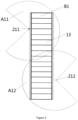
- the projection of the detection range A1 of a single first detection device 21 on the reference plane B1 covers the entire middle section 13.
- the projection of the combination of the detection ranges A11 and A12 of the two first detection devices 211, 212 on the reference plane B1 covers the step boards of the entire middle section 13.
- the processor is connected to one or more first detection devices 21 to receive detection signals, and is configured to determine, based at least partially on the signals detected by the one or more first detection devices 21, the presence of external objects, such as human, pets, goods, or other objects, on the automatic conveying device.
- the detection range A1 of the first detection device cover the entire middle section 13.
- one or more first detection devices 21 are radar units, such as LiDARs.
- the detection range of each first detection device 21 is substantially a fan-shaped plane area as shown in FIGS. 3 and 4 , where the corresponding central angle of the fan-shaped plane area can be greater than 180 degrees, for example, between 180 degrees and 270 degrees. In the embodiment shown in FIG. 4 , the areas of the middle section 13 covered by the two first detection devices 211, 212 do not overlap substaintially.
- two or more detection devices can also be arranged, so that the areas of the middle section covered by them partially overlap, thereby achieving redundancy in the detection signals. That is, a plurality of detection devices are arranged for mutual corroboration, so as to avoid measurement errors and improve detection accuracy. This can also ensure continued operation in the event of failure of a single detection device.
- the reference plane B1 is the plane where the middle section 13 is located.
- the reference plane B1 can be defined as the plane formed by connecting the leading edges of the respective fully unfolded step boards 161.
- the detection range of each first detection device may be arranged to be parallel to the reference plane B1.
- the detection range of each first detection device can be parallel to the reference plane B1.
- some or all of the detection ranges of the first detection devices can be inclined to the reference plane B1, such as forming an angle within the range of 1 to 20 degrees.
- the maximum distance between the effective area of the detection range of each first detection device (i.e., the area covering the step boards of the middle section) and the reference plane B1 may be the same or different. In some embodiments, the maximum distance between the effective area of the detection range of each first detection device and the reference plane B1 may be less than 1 meter or less than 0.5 meters.
- the radius of the fan-shaped detection plane of a first detection device 21 can reach 20 meters or more, so a single first detection device can cover a middle section 13 having a length more than 30 meters or even close to 40 meters. In the case of a general escalator, only one first detection device 21 can be arranged, or two first detection devices 21 can be arranged oppsite to each other as redundancy. In the case of an escalator that spans multiple floors or a relatively long moving walkway, a plurality of first detection devices 21 or a plurality of sets of first detection devices 21 may be distributed along the entire length of the middle section.
- the automatic conveying device is a horizontal or an inclined moving walkway. Since the step boards at the first and second ends of the moving walkway are in the same plane as the step boards in the middle section, the detection range of the first detection device or the combination of the detection ranges of the first detection devices also covers the step boards at the first and second ends of the moving walkway.
- the automatic conveying device further comprises: one or more second detection devices 22 and one or more third detection devices 23, where the detection range A2 of the one or more second detection devices 22 is a plane area covering the first end 11, and the detection range A3 of the one or more third detection devices 23 is a plane area covering the step board 163 of the second end 12.
- one or more second detection devices 22 and one or more third detection devices 23 may be radar units, such as LiDARs.
- the one or more second detection devices and the one or more third detection devices each have a detection range of a fan-shaped plane area.
- a detection device based on beams or light curtain can also be selected.
- the processor is configured to determine the presence of external objects on the automatic conveying device based on signals detected by one or more first detection devices, the one or more second detection devices, and one or more third detection devices.
- one or more first detection devices are arranged inside the skirt panel(s) 14 on one or both sides of the automatic conveying device, and the skirt panel 14 comprises a transparent window strip 140 extending in a direction parallel to the reference plane, which is, for example, made of glass or transparent plastic, so that the skirt panel 14 does not block the detection range A1 of the first detection device 21.
- the same arrangement can also be present in a skirt panel 141 on the opposite side.
- a first detection device 21' can be arranged outside and on the skirt panel(s) 14 on one or both sides of the automatic conveying device and on the outer side of the transparent sideplate 16.
- another first detection device can be arranged on the outer side of the transparent sideplate 161 on the opposite side.
- the detection range A1, A1' of the first detection device 21, i.e., the fan-shaped plane area can be parallel to the reference plane B1.
- the detection range A1" of the first detection device 21' i.e., the fan-shaped plane area can be inclined to the reference plane B1.
- the plane area of the fan-shaped plane area can also be inclined to the reference plane B1 in the longitudinal section.
- one or more first detection devices are arranged on the automatic conveying device, alternatively, one or more first detection devices can also be arranged at fixed positions that are spaced apart from the automatic conveying device, such as on the wall.
- the processor is configured to determine, upon receiving a start-up command, whether an external object is present on the automatic conveying device. If no external object is present, the automatic conveying device is started, and if an external object is present, the automatic conveying device is not started. Such a judgment processs can be repeated several times at certain intervals before starting the automatic conveying device. If it is determined through multiple judgments that there is an external object, relevant personnel can be notified.
- the processor can be programmed to set the effective area of the detection ranges of one or more first detection devices (i.e., the area covering the step boards of the middle section), and determine whether an external object is present based on the detection signals in the effective area, while filtering the detection signals in the non-effective range. Such filtering method is known in the art.
- a method for detecting the presence of an external object on an automatic conveying device comprising: arranging one or more first detection devices on one or both sides of the automatic conveying device, where each first detection device has a detection range that is substantially a plane area, and the detection range of each first detection device covers at least a portion of the middle section; and determining, based at least partially on signals detected by the one or more first detection devices, the presence of an external object on the automatic conveying device.
- the detection range of one first detection device or a combination of detection ranges of a plurality of first detection devices covers the entire middle section.
- the method further comprises: covering a first end and a second end of the automatic conveying device with the detection range of the one first detection device or the combination of detection ranges of the plurality of first detection devices when the automatic conveying device is a moving walkway.
- the method further comprises: arranging one or more second detection devices at a first end of the escalator, and arranging one or more third detection devices at a second end of the escalator when the automatic conveying device is an escalator, where the detection range of the one or more second detection devices is a plane area covering the first end, and the detection range of the one or more third detection devices is a plane area covering the second end; and determining the presence of an external object on the automatic conveying device based on the signals detected by the one or more first detection devices, the one or more second detection devices, and the one or more third detection devices.
- an automatic start method for an automatic conveying device comprising: determining, upon receiving a start-up command, the presence of an external object on the automatic conveying device using the method according to the embodiments of the present invention; and starting the automatic conveying device if no external object is present, and not starting the automatic conveying device if an external object is present.
- the method of detecting the presence of an external object on the automatic conveying device is not limited to the automatic start of the automatic conveying device, while it can also be applied for other purposes, such as detecting the number of passengers during operation to determine the intensity of passengers on the automatic conveying device.
Landscapes
- Engineering & Computer Science (AREA)
- Physics & Mathematics (AREA)
- Radar, Positioning & Navigation (AREA)
- Remote Sensing (AREA)
- Computer Networks & Wireless Communication (AREA)
- General Physics & Mathematics (AREA)
- Electromagnetism (AREA)
- Escalators And Moving Walkways (AREA)
Abstract
Description
- The present invention relates to the field of automatic conveying devices, in particular to a method for detecting the presence of an external object on an automatic conveying device and an automatic start method for an automatic conveying device.
- Automatic conveying devices such as escalators and moving walkways are generally started manually. In places with a large number of automatic conveying devices, such as in large shopping malls or airports, it is tedious to start the automatic conveying devices one by one. It is expected that the automatic conveying devices can be started automatically. For safety purposes, it is necessary to ensure that there are no external objects such as passengers, pets, or goods on the automatic conveying devices before the automatic start.
- It is conceived that various sensors are to be used to achieve this objective. For example, when using camera devices, it is necessary to determine, either using image algorithms or through judgement by people, whether there are external objects on the automatic conveying device. In addition, if it is expected to cover the entire carrying range of the automatic conveying device, multiple cameras are required and the cameras are required to be installed at specific positions. Furthermore, various factors, such as the cameras being blocked, also need to be considered.
- Another option is infrared light curtain, which consists of a plurality of sets of infrared light transmitters and infrared light receivers distributed along the length direction of the skirt panel. A plurality of light transmitters are arranged at certain intervals (e.g., corresponding to the spacing between steps) at the skirt panel on one side, and the corresponding plurality of light receivers are arranged at the skirt panel on the opposite side. When the respective light transmitters are turned on, a light curtain is formed, and when the light is blocked, it is determined that there is an external object on the automatic conveying device. This type of device has a high cost and it is difficult to install the plurality of light transmitters and light receivers along the skirts panels on both sides. In addition, it is difficult to repair or replace the light transmitter(s) or receiver(s) when they malfunction.
- The object of the present application is to solve or at least alleviate the problems existing in the prior art.
- According to one aspect, an automatic conveying device is provided, comprising:
- a first end and a second end opposite to each other; and
- a middle section between the first end and the second end;
- wherein, the automatic conveying device further comprises one or more first detection devices arranged on one or both sides of the automatic conveying device, where each first detection device has a detection range that is substantially a plane area, and the detection range of each first detection device covers at least a portion of the middle section; and
- a processor connected to the one or more first detection devices, and configured to determine, based at least partially on signals detected by the one or more first detection devices, whether an external object is present on the automatic conveying device.
- Particular embodiments further may include at least one, or a plurality of, the following optional features, alone or in combination with each other:
- Optionally, in an embodiment of the automatic conveying device, the detection range of one first detection device or a combination of detection ranges of a plurality of first detection devices covers the entire middle section.
- Optionally, in an embodiment of the automatic conveying device, the one or more first detection devices are radar units, such as LiDARs, where the detection range of each first detection device is substantially a fan-shaped plane area.
- Optionally, in an embodiment of the automatic conveying device, the detection range of each first detection device is parallel to a reference plane of the middle section, and/or a maximum distance between the detection range of each first detection device and the reference plane is less than 1 meter or less than 0.5 meters, where the reference plane of the middle section is a plane where the middle section is located or a plane obtained by connecting leading edges of step boards of the middle section.
- Optionally, in an embodiment of the automatic conveying device, the automatic conveying device is a moving walkway with the first end, the second end, and the middle section located in the same plane, where the detection range of one first detection device or the combination of the plurality of first detection devices also covers the first end and the second end of the moving walkway.
- Optionally, in an embodiment of the automatic conveying device, the automatic conveying device is an escalator, the automatic conveying device further comprising: one or more second detection devices and one or more third detection devices, where the detection range of the one or more second detection devices is a plane area covering the first end, and the detection range of the one or more third detection devices is a plane area covering the second end.
- Optionally, in an embodiment of the automatic conveying device, the one or more second detection devices and the one or more third detection devices are radar units, such as LiDARs, where the detection range of each of the one or more second detection devices and the one or more third detection devices is substantially a fan-shaped plane area.
- Optionally, in an embodiment of the automatic conveying device, the processor is configured to determine, based on signals detected by the one or more first detection devices, the one or more second detection devices, and the one or more third detection devices, whether an external object is present on the automatic conveying device.
- Optionally, in an embodiment of the automatic conveying device, the one or more first detection devices are arranged inside skirt panels on one or both sides of the automatic conveying device, and the skirt panels comprise transparent window strips extending in a direction parallel to the reference plane, so that the skirt panels do not block the detection range of the first detection device(s).
- Optionally, in an embodiment of the automatic conveying device, the first detection device is arranged outer side of the skirt panel(s) on one or both sides of the automatic conveying device and on an outer side of a transparent sideplate on the skirt panel(s).
- Optionally, in an embodiment of the automatic conveying device, the processor is configured to determine, upon receiving a start-up command, whether an external object is present on the automatic conveying device, where if no external object is present, the automatic conveying device is started, and if an external object is present, the automatic conveying device is not started.
- According to another aspect, a method for detecting the presence of an external object on an automatic conveying device is provided, comprising:
- arranging one or more first detection devices on one or both sides of the automatic conveying device, where each first detection device has a detection range that is substantially a plane area, and the detection range of each first detection device covers at least a portion of the middle section; and
- determining, based at least partially on signals detected by the one or more first detection devices, whether an external object is present on the automatic conveying device.
- Optionally, the detection range of the one first detection device or the combination of detection ranges of the plurality of first detection devices covers the entire middle section.
- Particular embodiments further may include at least one, or a plurality of, the following optional features, alone or in combination with each other:
- Optionally, the method further comprises: covering a first end and a second end of the automatic conveying device with the detection range of one first detection device or the combination of detection ranges of the plurality of first detection devices when the automatic conveying device is a moving walkway.
- Optionally, the method further comprises: arranging one or more second detection devices at a first end of the escalator, and arranging one or more third detection devices at a second end of the escalator when the automatic conveying device is an escalator, where the detection range of the one or more second detection devices is a plane area covering the first end, and the detection range of the one or more third detection devices is a plane area covering the second end; and
determining, based on signals detected by the one or more first detection devices, the one or more second detection devices, and the one or more third detection devices, whether an external object is present on the automatic conveying device. - According to yet another aspect, an automatic start method for an automatic conveying device is provided, comprising:
- determining, using the method according to the embodiments of the present invention, whether an external object is present on the automatic conveying device, when a start-up command is received; and
- starting the automatic conveying device if no external object is pressent, and not starting the automatic conveying device if an external object is pressent.
- According to the embodiments of the present invention, a device and method for detecting the presence of external objects on an automatic conveying device in a simple and efficient manner have been achieved.
- With reference to the accompanying drawings, the disclosure of the present application will become easier to understand. Those skilled in the art would easily understand that these drawings are for the purpose of illustration, and are not intended to limit the protection scope of the present application. In addition, in the figures, similar numerals are used to denote similar components, where:
-
FIG. 1 shows a three-dimensional view of an automatic conveying device according to an embodiment of the present invention; -
FIG. 2 shows a side view of an automatic conveying device according to an embodiment of the present invention; -
FIG. 3 shows a top view of a middle section of an automatic conveying device according to an embodiment of the present invention; -
FIG. 4 shows a top view of a middle section of an automatic conveying device according to another embodiment of the present invention; and -
FIG. 5 shows a cross-sectional view of an automatic conveying device according to an embodiment of the present invention. - Referring first to
FIGS. 1 to 4 , an automatic conveying device according to an embodiment of the present invention is shown. It should be appreciated that automatic conveying devices mainly refer to escalators or inclined moving walkways that convey between lower and higher target positions as shown in the figures, or moving walkways that convey between horizontal target positions, or any other similar devices. These devices may include steps or belts as load-bearing devices. It should be appreciated that although an escalator is used as an example herein, those skilled in the art can apply the same or similar devices to other automatic conveying devices based on the same principles. - The automatic conveying device comprises: a
first end 11 and asecond end 12 opposite to each other at two target positions, and amiddle section 13 between thefirst end 11 and thesecond end 12. In the context, thefirst end 11, thesecond end 12, and themiddle section 13 refer to the standing positions of the automatic conveying device, such as the exposed portions of step boards, but do not include any associated components of the automatic conveying device, such as handrails, sideplates, and the like. In the case of an escalator, thefirst end 11 and thesecond end 12 are located at the lower and higher floors, respectively, while themiddle section 13 is an inclined section connecting the lower and higher floors. In addition, the automatic conveying device also comprises one or morefirst detection devices 21 arranged on one or both sides of the automatic conveying device, and a processor (not shown) connected to the one or morefirst detection devices 21. One side or both sides of the automatic conveying device refer to the side face(s) of the step boards of the automatic conveying device, such as the left or right side of the step boards as shown inFIGS. 3 and4 , including located on the automatic conveying device or at a certain distance from the automatic conveying device. The detection range of eachfirst detection device 21 is substantially a plane area, i.e., a certain area in a plane, and the detection range of each first detection device covers at least a portion of the middle section 13 (the standing portion, such as the step boards). The so-called "cover" themiddle section 13 refers to that the vertical projection of the detection range on the reference plane B1 defined by themiddle section 13 covers themiddle section 13. For example, in the embodiment shown inFIG. 3 , the projection of the detection range A1 of a singlefirst detection device 21 on the reference plane B1 covers theentire middle section 13. In the embodiment shown inFIG. 4 , the projection of the combination of the detection ranges A11 and A12 of the twofirst detection devices entire middle section 13. The processor is connected to one or morefirst detection devices 21 to receive detection signals, and is configured to determine, based at least partially on the signals detected by the one or morefirst detection devices 21, the presence of external objects, such as human, pets, goods, or other objects, on the automatic conveying device. - In some embodiments, the detection range A1 of the first detection device (see
FIG. 3 ) or a combination of the detection ranges A11 and A12 of a plurality offirst detection devices 211, 212 (seeFIG. 4 ) cover the entiremiddle section 13. In some embodiments, one or morefirst detection devices 21 are radar units, such as LiDARs. In some embodiments, the detection range of eachfirst detection device 21 is substantially a fan-shaped plane area as shown inFIGS. 3 and4 , where the corresponding central angle of the fan-shaped plane area can be greater than 180 degrees, for example, between 180 degrees and 270 degrees. In the embodiment shown inFIG. 4 , the areas of themiddle section 13 covered by the twofirst detection devices - In the case of a moving walkway (no matter horizontal or inclined), the
middle section 13 itself forms a plane, so the reference plane B1 is the plane where themiddle section 13 is located. In the case of an escalator, as shown inFIG. 2 , the reference plane B1 can be defined as the plane formed by connecting the leading edges of the respective fully unfoldedstep boards 161. In some embodiments, the detection range of each first detection device may be arranged to be parallel to the reference plane B1. In the case of a plurality of first detection devices, the detection range of each first detection device can be parallel to the reference plane B1. Alternatively, some or all of the detection ranges of the first detection devices can be inclined to the reference plane B1, such as forming an angle within the range of 1 to 20 degrees. In some embodiments, the maximum distance between the effective area of the detection range of each first detection device (i.e., the area covering the step boards of the middle section) and the reference plane B1 may be the same or different. In some embodiments, the maximum distance between the effective area of the detection range of each first detection device and the reference plane B1 may be less than 1 meter or less than 0.5 meters. The radius of the fan-shaped detection plane of afirst detection device 21 can reach 20 meters or more, so a single first detection device can cover amiddle section 13 having a length more than 30 meters or even close to 40 meters. In the case of a general escalator, only onefirst detection device 21 can be arranged, or twofirst detection devices 21 can be arranged oppsite to each other as redundancy. In the case of an escalator that spans multiple floors or a relatively long moving walkway, a plurality offirst detection devices 21 or a plurality of sets offirst detection devices 21 may be distributed along the entire length of the middle section. - In some embodiments, the automatic conveying device is a horizontal or an inclined moving walkway. Since the step boards at the first and second ends of the moving walkway are in the same plane as the step boards in the middle section, the detection range of the first detection device or the combination of the detection ranges of the first detection devices also covers the step boards at the first and second ends of the moving walkway.
- In some embodiments, if the automatic conveying device is an escalator as shown in
FIGS. 1 and 2 , the reference planes B2 and B3 of thestep boards first end 11 and thesecond end 12 of the automatic conveying device are not parallel to the reference plane B1 of the step boards in themiddle section 13. In this case, the automatic conveying device further comprises: one or moresecond detection devices 22 and one or morethird detection devices 23, where the detection range A2 of the one or moresecond detection devices 22 is a plane area covering thefirst end 11, and the detection range A3 of the one or morethird detection devices 23 is a plane area covering thestep board 163 of thesecond end 12. Similarly, one or moresecond detection devices 22 and one or morethird detection devices 23 may be radar units, such as LiDARs. The one or more second detection devices and the one or more third detection devices each have a detection range of a fan-shaped plane area. Alternatively, since the areas required to be covered respectively by the one or moresecond detection devices 22 and the one or morethird detection devices 23 are relatively small, a detection device based on beams or light curtain can also be selected. Accordingly, the processor is configured to determine the presence of external objects on the automatic conveying device based on signals detected by one or more first detection devices, the one or more second detection devices, and one or more third detection devices. - With continued reference to
FIG. 5 , one or more first detection devices are arranged inside the skirt panel(s) 14 on one or both sides of the automatic conveying device, and theskirt panel 14 comprises atransparent window strip 140 extending in a direction parallel to the reference plane, which is, for example, made of glass or transparent plastic, so that theskirt panel 14 does not block the detection range A1 of thefirst detection device 21. Although not shown, the same arrangement can also be present in askirt panel 141 on the opposite side. Alternatively, a first detection device 21' can be arranged outside and on the skirt panel(s) 14 on one or both sides of the automatic conveying device and on the outer side of thetransparent sideplate 16. Alternatively, another first detection device can be arranged on the outer side of thetransparent sideplate 161 on the opposite side. As shown in the figure, the detection range A1, A1' of thefirst detection device 21, i.e., the fan-shaped plane area can be parallel to the reference plane B1. However, as mentioned earlier, in alternative embodiments, the detection range A1" of the first detection device 21', i.e., the fan-shaped plane area can be inclined to the reference plane B1. Although only the inclination in the cross-section of the automatic conveying device is shown in the figure, alternatively, the plane area of the fan-shaped plane area can also be inclined to the reference plane B1 in the longitudinal section. Although in the embodiment shown inFIG. 5 , one or more first detection devices are arranged on the automatic conveying device, alternatively, one or more first detection devices can also be arranged at fixed positions that are spaced apart from the automatic conveying device, such as on the wall. - In some embodiments, the processor is configured to determine, upon receiving a start-up command, whether an external object is present on the automatic conveying device. If no external object is present, the automatic conveying device is started, and if an external object is present, the automatic conveying device is not started. Such a judgment processs can be repeated several times at certain intervals before starting the automatic conveying device. If it is determined through multiple judgments that there is an external object, relevant personnel can be notified. The processor can be programmed to set the effective area of the detection ranges of one or more first detection devices (i.e., the area covering the step boards of the middle section), and determine whether an external object is present based on the detection signals in the effective area, while filtering the detection signals in the non-effective range. Such filtering method is known in the art.
- According to another aspect of the present invention, a method for detecting the presence of an external object on an automatic conveying device is provided, comprising: arranging one or more first detection devices on one or both sides of the automatic conveying device, where each first detection device has a detection range that is substantially a plane area, and the detection range of each first detection device covers at least a portion of the middle section; and determining, based at least partially on signals detected by the one or more first detection devices, the presence of an external object on the automatic conveying device.
- In some embodiments, the detection range of one first detection device or a combination of detection ranges of a plurality of first detection devices covers the entire middle section. In some embodiments, the method further comprises: covering a first end and a second end of the automatic conveying device with the detection range of the one first detection device or the combination of detection ranges of the plurality of first detection devices when the automatic conveying device is a moving walkway. In some embodiments, the method further comprises: arranging one or more second detection devices at a first end of the escalator, and arranging one or more third detection devices at a second end of the escalator when the automatic conveying device is an escalator, where the detection range of the one or more second detection devices is a plane area covering the first end, and the detection range of the one or more third detection devices is a plane area covering the second end; and determining the presence of an external object on the automatic conveying device based on the signals detected by the one or more first detection devices, the one or more second detection devices, and the one or more third detection devices.
- According to another aspect, an automatic start method for an automatic conveying device is provided, comprising: determining, upon receiving a start-up command, the presence of an external object on the automatic conveying device using the method according to the embodiments of the present invention; and starting the automatic conveying device if no external object is present, and not starting the automatic conveying device if an external object is present.
- It should be appreciated that the method of detecting the presence of an external object on the automatic conveying device according to the present invention is not limited to the automatic start of the automatic conveying device, while it can also be applied for other purposes, such as detecting the number of passengers during operation to determine the intensity of passengers on the automatic conveying device.
- The specific embodiments described above in the present application are merely intended to describe the principles of the present application more clearly, wherein various components are clearly shown or described to facilitate the understanding of the principles of the present invention. Those skilled in the art may, without departing from the scope of the present application, make various modifications or changes to the present application. Therefore, it should be understood that these modifications or changes should be included within the scope of patent protection of the present application.
Claims (15)
- An automatic conveying device, comprising:a first end and a second end opposite to each other; anda middle section between the first end and the second end;wherein, the automatic conveying device further comprises one or more first detection devices arranged on one or both sides of the automatic conveying device, where each first detection device has a detection range that is substantially a plane area, and the detection range of each first detection device covers at least a portion of the middle section; anda processor connected to the one or more first detection devices, and configured to determine, based at least partially on signals detected by the one or more first detection devices, whether an external object is present on the automatic conveying device.
- The automatic conveying device according to claim 1, wherein a detection range of one first detection device or a combination of detection ranges of a plurality of first detection devices covers the entire middle section.
- The automatic conveying device according to claim 2, wherein the one or more first detection devices are radar units, such as LiDARs, where the detection range of each first detection device is substantially a fan-shaped plane area.
- The automatic conveying device according to any of claims 1 to 3, wherein the detection range of each first detection device is parallel to a reference plane of the middle section, and/or a maximum distance between the detection range of each first detection device and the reference plane is less than 1 meter or less than 0.5 meters, where the reference plane of the middle section is a plane where the middle section is located or a plane obtained by connecting leading edges of step boards of the middle section.
- The automatic conveying device according to any of claims 1-4, wherein the automatic conveying device is a moving walkway with the first end, the second end, and the middle section located in the same plane, where the detection range of the one first detection device or the combination of plurality of first detection devices also covers the first end and the second end of the moving walkway.
- The automatic conveying device according to any of claims 1-4, wherein the automatic conveying device is an escalator, the automatic conveying device further comprising: one or more second detection devices and one or more third detection devices, where a detection range of the one or more second detection devices is a plane area covering the first end, and a detection range of the one or more third detection devices is a plane area covering the second end.
- The automatic conveying device according to claim 6, wherein the one or more second detection devices and the one or more third detection devices are radar units, such as LiDARs, where a detection range of each of the one or more second detection devices and the one or more third detection devices is substantially a fan-shaped plane area.
- The automatic conveying device according to claim 6 or 7, wherein the processor is configured to determine, based on signals detected by the one or more first detection devices, the one or more second detection devices, and the one or more third detection devices, whether an external object is present on the automatic conveying device.
- The automatic conveying device according to any of claims 1 to 8, wherein the one or more first detection devices are arranged inside skirt panels on one or both sides of the automatic conveying device, and the skirt panels comprise transparent window strips extending in a direction parallel to the reference plane, so that the skirt panels do not block the detection range of the first detection device(s).
- The automatic conveying device according to any of claims 1 to 9. wherein the first detection device is arranged outer side of the skirt panel(s) on one or both sides of the automatic conveying device and on an outer side of the transparent sideplate on the skirt panel(s).
- The automatic conveying device according to any of claims 1 to 10, wherein the processor is configured to determine, upon receiving a start-up command, whether an external object is present on the automatic conveying device, where if no external object is present, the automatic conveying device is started, and if an external object is present, the automatic conveying device is not started.
- A method for detecting presence of an external object on an automatic conveying device, comprising:arranging one or more first detection devices on one or both sides of the automatic conveying device, where each first detection device has a detection range that is substantially a plane area, and the detection range of each first detection device covers at least a portion of the middle section; anddetermining, based at least partially on signals detected by the one or more first detection devices, whether an external object is present on the automatic conveying device.
- The method according to claim 12, wherein a detection range of one first detection device or a combination of detection ranges of a plurality of first detection devices covers the entire middle section.
- The method according to claim 13, further comprsing: covering a first end and a second end of the automatic conveying device with the detection range of the one first detection device or the combination of detection ranges of the plurality of first detection devices when the automatic conveying device is a moving walkway; and/orfurther comprising: when the automatic conveying device is an escalator, arranging one or more second detection devices at a first end of the escalator, and arranging one or more third detection devices at a second end of the escalator, where a detection range of the one or more second detection devices is a plane area covering the first end, and a detection range of the one or more third detection devices is a plane area covering the second end; anddetermining, based on signals detected by the one or more first detection devices, the one or more second detection devices, and the one or more third detection devices, whether an external object is present on the automatic conveying device.
- An automatic start method for an automatic conveying device, comprising:determining, using the method according to any of claims 12 to 14, whether an external object is present on the automatic conveying device, when a start-up command is received; andstarting the automatic conveying device if no external object is present, and not starting the automatic conveying device if an external object is present.
Applications Claiming Priority (1)
| Application Number | Priority Date | Filing Date | Title |
|---|---|---|---|
| CN202310721646.8A CN119148062A (en) | 2023-06-16 | 2023-06-16 | Automatic transmission device, method for judging existence of external target and automatic starting method |
Publications (2)
| Publication Number | Publication Date |
|---|---|
| EP4477609A1 true EP4477609A1 (en) | 2024-12-18 |
| EP4477609B1 EP4477609B1 (en) | 2025-12-31 |
Family
ID=91481820
Family Applications (1)
| Application Number | Title | Priority Date | Filing Date |
|---|---|---|---|
| EP24181244.5A Active EP4477609B1 (en) | 2023-06-16 | 2024-06-10 | AUTOMATIC CONVEYING DEVICE AND AUTOMATIC STARTING PROCEDURE FOR DETERMINING THE PRESENCE OF EXTERNAL OBJECTS ON AN AUTOMATIC CONVEYING DEVICE |
Country Status (3)
| Country | Link |
|---|---|
| US (1) | US20240417221A1 (en) |
| EP (1) | EP4477609B1 (en) |
| CN (1) | CN119148062A (en) |
Citations (3)
| Publication number | Priority date | Publication date | Assignee | Title |
|---|---|---|---|---|
| JP5788848B2 (en) * | 2012-09-21 | 2015-10-07 | 株式会社日立製作所 | Passenger conveyor control device and residue detection method in passenger conveyor |
| JP2016185856A (en) * | 2015-03-27 | 2016-10-27 | 株式会社日立ビルシステム | Safety device of passenger conveyor |
| EP3140235A1 (en) * | 2014-05-06 | 2017-03-15 | Otis Elevator Company | Object detector, and method for controlling a passenger conveyor system using the same |
Family Cites Families (8)
| Publication number | Priority date | Publication date | Assignee | Title |
|---|---|---|---|---|
| CN100340468C (en) * | 2002-10-16 | 2007-10-03 | 三菱电机株式会社 | Controller for passenger moving walkway |
| KR20100104230A (en) * | 2009-03-17 | 2010-09-29 | 문수영 | Safety devide of escalator |
| WO2010123489A1 (en) * | 2009-04-20 | 2010-10-28 | Otis Elevator Company | Automatic adjustment of parameters for safety device |
| EP3341317B1 (en) * | 2015-08-26 | 2020-05-27 | Otis Elevator Company | Conveyor device |
| CN117902441A (en) * | 2016-07-29 | 2024-04-19 | 奥的斯电梯公司 | Monitoring system for passenger conveyor, passenger conveyor and monitoring method thereof |
| CN107662875B (en) * | 2016-07-29 | 2021-07-06 | 奥的斯电梯公司 | Monitoring and detecting of engagement state of step and comb plate of passenger conveyor |
| CN212425087U (en) * | 2020-04-03 | 2021-01-29 | 通力电梯有限公司 | Control system for controlling start and stop of multiple passenger conveyors |
| CN111498664A (en) * | 2020-04-03 | 2020-08-07 | 通力电梯有限公司 | Control system and control method for controlling start and stop of multiple passenger conveyors |
-
2023
- 2023-06-16 CN CN202310721646.8A patent/CN119148062A/en active Pending
- 2023-11-17 US US18/512,990 patent/US20240417221A1/en active Pending
-
2024
- 2024-06-10 EP EP24181244.5A patent/EP4477609B1/en active Active
Patent Citations (3)
| Publication number | Priority date | Publication date | Assignee | Title |
|---|---|---|---|---|
| JP5788848B2 (en) * | 2012-09-21 | 2015-10-07 | 株式会社日立製作所 | Passenger conveyor control device and residue detection method in passenger conveyor |
| EP3140235A1 (en) * | 2014-05-06 | 2017-03-15 | Otis Elevator Company | Object detector, and method for controlling a passenger conveyor system using the same |
| JP2016185856A (en) * | 2015-03-27 | 2016-10-27 | 株式会社日立ビルシステム | Safety device of passenger conveyor |
Also Published As
| Publication number | Publication date |
|---|---|
| US20240417221A1 (en) | 2024-12-19 |
| CN119148062A (en) | 2024-12-17 |
| EP4477609B1 (en) | 2025-12-31 |
Similar Documents
| Publication | Publication Date | Title |
|---|---|---|
| CN105829236B (en) | Arrangement of monitoring sensors in escalators or moving walkways | |
| CN107662868B (en) | Monitoring system of passenger conveyer, passenger conveyer and monitoring method thereof | |
| US10519007B2 (en) | Passenger conveyor | |
| US20080116035A1 (en) | Passenger Conveyor | |
| JP7124497B2 (en) | DETECTION SYSTEM, DETECTION DEVICE, DETECTION METHOD, AND PROGRAM | |
| JP6011568B2 (en) | Passenger conveyor human detection device | |
| CN109775545B (en) | Passenger conveyor | |
| US20240417221A1 (en) | Automatic conveying device, method for determining the presence of external objects, and automatic start method | |
| JP2015051836A (en) | Passenger conveyor | |
| TWI585029B (en) | Fall detection device and passenger conveyor | |
| JP2005132544A (en) | Escalator passenger detection device | |
| JP6939937B1 (en) | Passenger conveyor equipped with a passenger fall detection device | |
| CN112938727A (en) | Distance indicating system for passenger conveyor and passenger conveyor | |
| JP7097534B2 (en) | Detection device and passenger conveyor | |
| CN210150556U (en) | Passenger conveyor | |
| WO2020021699A1 (en) | Display device | |
| CN107614414A (en) | Passenger conveyors | |
| KR102395559B1 (en) | Visible light communication elevator system using hoistway lighting | |
| JPH02300089A (en) | Safety device for man conveyer | |
| WO2020245942A1 (en) | Passenger conveyor safety device | |
| JP6453425B1 (en) | Passenger conveyor | |
| CN114132821A (en) | Long article monitoring system for man-carrying conveyor | |
| JP7442716B1 (en) | passenger conveyor | |
| KR102188933B1 (en) | obstacle detection and monitoring system | |
| JP7540854B1 (en) | Passenger conveyor systems and moving objects |
Legal Events
| Date | Code | Title | Description |
|---|---|---|---|
| PUAI | Public reference made under article 153(3) epc to a published international application that has entered the european phase |
Free format text: ORIGINAL CODE: 0009012 |
|
| STAA | Information on the status of an ep patent application or granted ep patent |
Free format text: STATUS: THE APPLICATION HAS BEEN PUBLISHED |
|
| AK | Designated contracting states |
Kind code of ref document: A1 Designated state(s): AL AT BE BG CH CY CZ DE DK EE ES FI FR GB GR HR HU IE IS IT LI LT LU LV MC ME MK MT NL NO PL PT RO RS SE SI SK SM TR |
|
| STAA | Information on the status of an ep patent application or granted ep patent |
Free format text: STATUS: REQUEST FOR EXAMINATION WAS MADE |
|
| 17P | Request for examination filed |
Effective date: 20250516 |
|
| RIC1 | Information provided on ipc code assigned before grant |
Ipc: B66B 25/00 20060101AFI20250604BHEP |
|
| GRAP | Despatch of communication of intention to grant a patent |
Free format text: ORIGINAL CODE: EPIDOSNIGR1 |
|
| STAA | Information on the status of an ep patent application or granted ep patent |
Free format text: STATUS: GRANT OF PATENT IS INTENDED |
|
| GRAJ | Information related to disapproval of communication of intention to grant by the applicant or resumption of examination proceedings by the epo deleted |
Free format text: ORIGINAL CODE: EPIDOSDIGR1 |
|
| STAA | Information on the status of an ep patent application or granted ep patent |
Free format text: STATUS: REQUEST FOR EXAMINATION WAS MADE |
|
| INTG | Intention to grant announced |
Effective date: 20250714 |
|
| INTC | Intention to grant announced (deleted) | ||
| GRAP | Despatch of communication of intention to grant a patent |
Free format text: ORIGINAL CODE: EPIDOSNIGR1 |
|
| STAA | Information on the status of an ep patent application or granted ep patent |
Free format text: STATUS: GRANT OF PATENT IS INTENDED |
|
| INTG | Intention to grant announced |
Effective date: 20250916 |
|
| GRAS | Grant fee paid |
Free format text: ORIGINAL CODE: EPIDOSNIGR3 |
|
| GRAA | (expected) grant |
Free format text: ORIGINAL CODE: 0009210 |
|
| STAA | Information on the status of an ep patent application or granted ep patent |
Free format text: STATUS: THE PATENT HAS BEEN GRANTED |
|
| AK | Designated contracting states |
Kind code of ref document: B1 Designated state(s): AL AT BE BG CH CY CZ DE DK EE ES FI FR GB GR HR HU IE IS IT LI LT LU LV MC ME MK MT NL NO PL PT RO RS SE SI SK SM TR |
|
| REG | Reference to a national code |
Ref country code: CH Ref legal event code: F10 Free format text: ST27 STATUS EVENT CODE: U-0-0-F10-F00 (AS PROVIDED BY THE NATIONAL OFFICE) Effective date: 20251231 Ref country code: GB Ref legal event code: FG4D |
|
| REG | Reference to a national code |
Ref country code: DE Ref legal event code: R096 Ref document number: 602024001908 Country of ref document: DE |
|
| REG | Reference to a national code |
Ref country code: IE Ref legal event code: FG4D |
|
| REG | Reference to a national code |
Ref country code: LT Ref legal event code: MG9D |
|
| PG25 | Lapsed in a contracting state [announced via postgrant information from national office to epo] |
Ref country code: NO Free format text: LAPSE BECAUSE OF FAILURE TO SUBMIT A TRANSLATION OF THE DESCRIPTION OR TO PAY THE FEE WITHIN THE PRESCRIBED TIME-LIMIT Effective date: 20260331 |
|
| PG25 | Lapsed in a contracting state [announced via postgrant information from national office to epo] |
Ref country code: HR Free format text: LAPSE BECAUSE OF FAILURE TO SUBMIT A TRANSLATION OF THE DESCRIPTION OR TO PAY THE FEE WITHIN THE PRESCRIBED TIME-LIMIT Effective date: 20251231 Ref country code: FI Free format text: LAPSE BECAUSE OF FAILURE TO SUBMIT A TRANSLATION OF THE DESCRIPTION OR TO PAY THE FEE WITHIN THE PRESCRIBED TIME-LIMIT Effective date: 20251231 |
|
| PG25 | Lapsed in a contracting state [announced via postgrant information from national office to epo] |
Ref country code: RS Free format text: LAPSE BECAUSE OF FAILURE TO SUBMIT A TRANSLATION OF THE DESCRIPTION OR TO PAY THE FEE WITHIN THE PRESCRIBED TIME-LIMIT Effective date: 20260331 |
|
| PG25 | Lapsed in a contracting state [announced via postgrant information from national office to epo] |
Ref country code: LV Free format text: LAPSE BECAUSE OF FAILURE TO SUBMIT A TRANSLATION OF THE DESCRIPTION OR TO PAY THE FEE WITHIN THE PRESCRIBED TIME-LIMIT Effective date: 20251231 |
|
| PG25 | Lapsed in a contracting state [announced via postgrant information from national office to epo] |
Ref country code: BG Free format text: LAPSE BECAUSE OF FAILURE TO SUBMIT A TRANSLATION OF THE DESCRIPTION OR TO PAY THE FEE WITHIN THE PRESCRIBED TIME-LIMIT Effective date: 20251231 |
|
| REG | Reference to a national code |
Ref country code: NL Ref legal event code: MP Effective date: 20251231 |