EP4475261A1 - Lithium-ion battery having high energy density and fast charging performance - Google Patents
Lithium-ion battery having high energy density and fast charging performance Download PDFInfo
- Publication number
- EP4475261A1 EP4475261A1 EP23915327.3A EP23915327A EP4475261A1 EP 4475261 A1 EP4475261 A1 EP 4475261A1 EP 23915327 A EP23915327 A EP 23915327A EP 4475261 A1 EP4475261 A1 EP 4475261A1
- Authority
- EP
- European Patent Office
- Prior art keywords
- group
- alkyl group
- lithium
- ion battery
- optionally
- Prior art date
- Legal status (The legal status is an assumption and is not a legal conclusion. Google has not performed a legal analysis and makes no representation as to the accuracy of the status listed.)
- Pending
Links
Images


Classifications
-
- H—ELECTRICITY
- H01—ELECTRIC ELEMENTS
- H01M—PROCESSES OR MEANS, e.g. BATTERIES, FOR THE DIRECT CONVERSION OF CHEMICAL ENERGY INTO ELECTRICAL ENERGY
- H01M10/00—Secondary cells; Manufacture thereof
- H01M10/05—Accumulators with non-aqueous electrolyte
- H01M10/056—Accumulators with non-aqueous electrolyte characterised by the materials used as electrolytes, e.g. mixed inorganic/organic electrolytes
- H01M10/0564—Accumulators with non-aqueous electrolyte characterised by the materials used as electrolytes, e.g. mixed inorganic/organic electrolytes the electrolyte being constituted of organic materials only
- H01M10/0566—Liquid materials
- H01M10/0569—Liquid materials characterised by the solvents
-
- H—ELECTRICITY
- H01—ELECTRIC ELEMENTS
- H01M—PROCESSES OR MEANS, e.g. BATTERIES, FOR THE DIRECT CONVERSION OF CHEMICAL ENERGY INTO ELECTRICAL ENERGY
- H01M10/00—Secondary cells; Manufacture thereof
- H01M10/05—Accumulators with non-aqueous electrolyte
- H01M10/056—Accumulators with non-aqueous electrolyte characterised by the materials used as electrolytes, e.g. mixed inorganic/organic electrolytes
- H01M10/0564—Accumulators with non-aqueous electrolyte characterised by the materials used as electrolytes, e.g. mixed inorganic/organic electrolytes the electrolyte being constituted of organic materials only
- H01M10/0566—Liquid materials
- H01M10/0567—Liquid materials characterised by the additives
-
- H—ELECTRICITY
- H01—ELECTRIC ELEMENTS
- H01M—PROCESSES OR MEANS, e.g. BATTERIES, FOR THE DIRECT CONVERSION OF CHEMICAL ENERGY INTO ELECTRICAL ENERGY
- H01M10/00—Secondary cells; Manufacture thereof
- H01M10/05—Accumulators with non-aqueous electrolyte
- H01M10/052—Li-accumulators
- H01M10/0525—Rocking-chair batteries, i.e. batteries with lithium insertion or intercalation in both electrodes; Lithium-ion batteries
-
- H—ELECTRICITY
- H01—ELECTRIC ELEMENTS
- H01M—PROCESSES OR MEANS, e.g. BATTERIES, FOR THE DIRECT CONVERSION OF CHEMICAL ENERGY INTO ELECTRICAL ENERGY
- H01M2300/00—Electrolytes
- H01M2300/0017—Non-aqueous electrolytes
- H01M2300/0025—Organic electrolyte
- H01M2300/0028—Organic electrolyte characterised by the solvent
- H01M2300/0034—Fluorinated solvents
-
- H—ELECTRICITY
- H01—ELECTRIC ELEMENTS
- H01M—PROCESSES OR MEANS, e.g. BATTERIES, FOR THE DIRECT CONVERSION OF CHEMICAL ENERGY INTO ELECTRICAL ENERGY
- H01M2300/00—Electrolytes
- H01M2300/0017—Non-aqueous electrolytes
- H01M2300/0025—Organic electrolyte
- H01M2300/0028—Organic electrolyte characterised by the solvent
- H01M2300/0037—Mixture of solvents
-
- Y—GENERAL TAGGING OF NEW TECHNOLOGICAL DEVELOPMENTS; GENERAL TAGGING OF CROSS-SECTIONAL TECHNOLOGIES SPANNING OVER SEVERAL SECTIONS OF THE IPC; TECHNICAL SUBJECTS COVERED BY FORMER USPC CROSS-REFERENCE ART COLLECTIONS [XRACs] AND DIGESTS
- Y02—TECHNOLOGIES OR APPLICATIONS FOR MITIGATION OR ADAPTATION AGAINST CLIMATE CHANGE
- Y02E—REDUCTION OF GREENHOUSE GAS [GHG] EMISSIONS, RELATED TO ENERGY GENERATION, TRANSMISSION OR DISTRIBUTION
- Y02E60/00—Enabling technologies; Technologies with a potential or indirect contribution to GHG emissions mitigation
- Y02E60/10—Energy storage using batteries
Definitions
- This application relates to a lithium-ion battery having a cell group margin A of 88%-97% and including a non-aqueous electrolyte.
- the non-aqueous electrolyte includes one or more first organic solvents with a specified structure. Based on a total mass of an organic solvent in the non-aqueous electrolyte, a mass percentage of the first organic solvent is X1, X1 being in a range of 20%-80%, and the cell group margin A and the mass percentage X1 of the first organic solvent satisfy a specified relation: 0.22 ⁇ X1/A ⁇ 0.91, optionally 0.31 ⁇ X1/A ⁇ 0.79.
- This application further relates to an electric apparatus including the lithium-ion battery.
- lithium-ion secondary batteries have been widely used in energy storage power supply systems such as hydroelectric, thermal, wind, and solar power plants, and many other fields including electric tools, electric bicycles, electric motorcycles, electric vehicles, military equipment, and aerospace. Due to the great development of lithium-ion secondary batteries, higher requirements are imposed on their fast charging performance, cycling performance, safety performance, and the like.
- An objective of the present invention is to provide a lithium-ion battery in which types and amounts of solvents and additives in an electrolyte are adjusted to reduce gas production during cycling and storage of the battery, such that the lithium-ion battery can achieve both high energy density and fast charging performance.
- This application is implemented in view of the foregoing issue and intended to provide a lithium-ion battery, so as to resolve the technical problem of insufficient fast charging performance and/or excessive volume swelling in batteries under high energy density.
- a first aspect of this application provides a lithium-ion battery having a cell group margin A of 88%-97% and including a non-aqueous electrolyte.
- the non-aqueous electrolyte includes a first organic solvent, and the first organic solvent includes one or more of compounds represented by formula 1, where
- the lithium-ion battery can achieve a high energy density.
- the electrolyte includes a carboxylic ester solvent with a specified amount, which effectively reduces the viscosity of the electrolyte and increases the conductivity, allowing the lithium-ion battery to have a high energy density and to keep good fast charging performance.
- the cell group margin A and the mass percentage X1 of the first organic solvent satisfy the following relation: 0.31 ⁇ X1/A ⁇ 0.79. In any embodiment, the cell group margin A is 90%-95%.
- the mass percentage X1 of the first organic solvent is in a range of 30%-80%, optionally 35%-70%. Selecting the first organic solvent with a specified amount can effectively reduce the resistance of the battery and improve the fast charging performance.
- R 1 and R 2 are each independently one of methyl group, ethyl group, propyl group, fluoromethyl group, fluoroethyl group, and fluoropropyl group.
- the non-aqueous electrolyte includes a first additive, and the first additive includes at least one sultone additive represented by formula 2: where
- a mass percentage of the first additive is W1
- W1 and the cell group margin A satisfy a relation: 0.0005 ⁇ W1/A ⁇ 0.09, where A is 88%-97%, and 0.05% ⁇ W1 ⁇ 9.7%, optionally 0.1% ⁇ W1 ⁇ 3%.
- the non-aqueous electrolyte includes a second additive, and the second additive includes one or more of a compound represented by formula 3, a compound represented by formula 4, and/or a compound represented by formula 5;
- a mass percentage of the second additive is W2, and W2 and the cell group margin A satisfy a relation: 0.0005 ⁇ W2/A ⁇ 0.09, where A is 88%-97%, and 0.05% ⁇ W2 ⁇ 9.7%, optionally 0.1% ⁇ W2 ⁇ 3%.
- the non-aqueous electrolyte includes a third additive, and the third additive includes one or more of a compound represented by formula 6 and/or a compound represented by formula 7;
- a mass percentage of the third additive is W3, and W3 and the cell group margin A satisfy a relation: 0.0005 ⁇ W3/A ⁇ 0.09, where A is 88%-97%, and 0.05% ⁇ W3 ⁇ 9.7%, optionally 0.1% ⁇ W3 ⁇ 3%.
- the mass percentages W1, W2, and W3 of the three additives and the cell group margin A satisfy a relation: 0.0005 ⁇ (W1+W2+W3)/A ⁇ 0.1, where A is 88%-97%, and 0.05% ⁇ (W1+W2+W3) ⁇ 9.6%, optionally 0.1% ⁇ (W1+W2+W3) ⁇ 4%.
- a second aspect of this application provides an electric apparatus including the lithium-ion battery in the first aspect of this application.
- any lower limit may be combined with any upper limit to form an unspecified range, and any lower limit may be combined with another lower limit to form an unspecified range, and likewise, any upper limit may be combined with any other upper limit to form an unspecified range.
- each individually disclosed point or individual single numerical value may itself be a lower limit or an upper limit which can be combined with any other point or individual numerical value or combined with another lower limit or upper limit to form a range not expressly recorded.
- the lithium-ion battery has a cell group margin A of 88%-97% and includes a non-aqueous electrolyte.
- the non-aqueous electrolyte includes a first organic solvent, and the first organic solvent includes one or more of compounds represented by formula 1, where
- the cell group margin A and the mass percentage X1 of the first organic solvent satisfy the following relation: 0.31 ⁇ X1/A ⁇ 0.79.
- the value of X1/A should be controlled in a proper range, to improve the fast charging performance and maintain the cycling performance of the battery.
- An excessively small value of X1/A causes an excessively long fast charging time; and an excessively large value of X1/A causes reduction of cycling performance and a significant increase in gas production of the battery.
- the cell group margin A is 90%-95%.
- a cell group margin typically refers to a group margin in a thickness direction of a battery and is characterized by a ratio of an actual internal cross-sectional area to a maximum internal cross-sectional area in a cell, that is, a ratio of a cross-sectional area of various substances in a wound cell to an area covered by the inner diameter of a battery housing after the cell is cut transversely.
- the mass percentage X1 of the first organic solvent is in a range of 30%-70%, optionally 35%-65%.
- the first organic solvent which is a carboxylic ester or halogenated carboxylic ester solvent, can reduce the viscosity of the non-aqueous electrolyte, thus improving the conductivity of sodium ions in the non-aqueous electrolyte. If the mass percentage X1 of the first organic solvent is excessively low, the effect of improving the conductivity is insufficient and the fast charging time is excessively long. If the mass percentage X1 of the first organic solvent is excessively high, the battery cycling performance decreases and significant swelling is likely to occur.
- a proper cell group margin A and a proper mass percentage X1 of the first organic solvent are selected to satisfy the foregoing relation I, which can achieve the best balance between the energy density and the fast charging performance of the lithium-ion battery.
- R 1 and R 2 are each independently one of methyl group, ethyl group, propyl group, fluoromethyl group, fluoroethyl group, and fluoropropyl group.
- the first organic solvent includes at least one of the following compounds: and optionally, the first organic solvent includes at least one of the following compounds:
- the first organic solvent is N-(2-aminoethyl)-2-aminoethyl-N-(2-aminoethyl)-2-aminoethyl-N-(2-aminoethyl)-2-aminoethyl-N-(2-aminoethyl)-2-aminoethyl-N-(2-aminoethyl)-2-aminoethyl
- the lithium-ion battery described above in this application has high energy density and improved fast charging performance, in some cases, a large group margin causes a small storage space in the lithium-ion battery. As a result, the lithium-ion battery accommodates less gas generated during cycling and storage. In addition, a highly active first organic solvent results in a large gas production amount, causing a high probability of swelling of the cell and certain safety hazard.
- the inventors introduced an additive capable of inhibiting gas production to ensure a proper range of the gas production amount during cycling and storage of the cell, allowing for a low probability of significant swelling of the battery during operation, thus improving the safety performance of the cell.
- the non-aqueous electrolyte includes a first additive, and the first additive includes at least one sultone additive represented by formula 2:
- the first additive includes at least one of the following compounds:
- the first additive includes at least one of the following compounds:
- a mass percentage of the first additive is W1, and W1 and the cell group margin A satisfy a relation: 0.0005 ⁇ W1/A ⁇ 0.09, where A is 88%-97%, and 0.05% ⁇ W1 ⁇ 9.7%, optionally 0.1% ⁇ W1 ⁇ 3%. Adjusting the cell group margin A, especially the mass percentage W1 of the first additive is conducive to controlling the value of W1/A in a proper range. An excessively small value of W1/A causes insufficient effect of inhibiting volume swelling of the battery; and an excessively large value of W1/A decreases the battery capacity and affects improvement of the fast charging performance.
- the non-aqueous electrolyte includes a second additive, and the second additive includes one or more of a compound represented by formula 3, a compound represented by formula 4, and/or a compound represented by formula 5;
- the second additive includes one or more of the following compounds:
- a mass percentage of the second additive is W2, and W2 and the cell group margin A satisfy a relation: 0.0005 ⁇ W2/A ⁇ 0.09, where A is 88%-97%, and 0.05% ⁇ W2 ⁇ 9.7%, optionally 0.1% ⁇ W2 ⁇ 3%. Adjusting the cell group margin A, especially the mass percentage W2 of the second additive is conducive to controlling the value of W2/A in a proper range. An excessively small value of W2/A causes insufficient effect of inhibiting volume swelling of the battery; and an excessively large value of W2/A decreases the battery capacity and affects improvement of the fast charging performance.
- the non-aqueous electrolyte includes a third additive, and the third additive includes one or more of a compound represented by formula 6 and/or a compound represented by formula 7;
- the third additive includes one or more of the following compounds:
- a mass percentage of the third additive is W3, and W3 and the cell group margin A satisfy a relation: 0.0005 ⁇ W3/A ⁇ 0.09, where A is 88%-97%, and 0.05% ⁇ W3 ⁇ 9.7%, optionally 0.1% ⁇ W3 ⁇ 3%. Adjusting the cell group margin A, especially the mass percentage W3 of the third additive is conducive to controlling the value of W3/A in a proper range. An excessively small value of W3/A causes insufficient effect of inhibiting volume swelling of the battery; and an excessively large value of W3/A decreases the battery capacity and affects improvement of the fast charging performance.
- the mass percentages W1, W2, and W3 of the three additives and the cell group margin A satisfy a relation:0.0005 ⁇ (W1+W2+W3)/A ⁇ 0.1, where A is 88%-97%, and 0.05% ⁇ (W1+W2+W3) ⁇ 9.6%, optionally 0.1% ⁇ (W1+W2+W3) ⁇ 4%.
- a second aspect of this application provides an electric apparatus including the lithium-ion battery in the first aspect of this application.
- the materials of various components of the lithium-ion battery in this application can be chosen from a wide range.
- the lithium-ion battery is specifically a lithium-ion secondary battery.
- a battery cell of the lithium-ion secondary battery is described in detail below.
- a lithium-ion secondary battery includes a positive electrode plate, a negative electrode plate, a separator, and an electrolyte.
- active ions intercalate and deintercalate between the positive electrode plate and the negative electrode plate.
- the separator is disposed between the positive electrode plate and the negative electrode plate to provide separation.
- the electrolyte conducts ions between the positive electrode plate and the negative electrode plate.
- the electrolyte conducts ions between the positive electrode plate and the negative electrode plate.
- the electrolyte includes an electrolytic salt and a solvent.
- the electrolytic salt may be an electrolytic salt used commonly in the lithium-ion secondary battery, such as lithium salts, which include a lithium salt that can be used as a highly thermal-stable salt, a lithium salt that can be used as a low-resistance additive, or a lithium salt that inhibits corrosion of an aluminum foil.
- lithium salts which include a lithium salt that can be used as a highly thermal-stable salt, a lithium salt that can be used as a low-resistance additive, or a lithium salt that inhibits corrosion of an aluminum foil.
- the electrolytic salt may be selected from more than one of lithium hexafluorophosphate (LiPF 6 ), lithium tetrafluoroborate (LiBF 4 ), lithium hexafluoroarsenate (LiAsF 6 ), lithium bisfluorosulfonimide (LiFSI), lithium bistrifluoromethanesulfonimide (LiTFSI), lithium trifluoromethanesulfonate (LiTFS), lithium bis(oxalato)borate (LiDFOB), lithium difluorophosphate (LiPO 2 F 2 ), lithium difluorodioxalate phosphate (LiDFOP), lithium fluorosulfonyl imide (LiSO 3 F), difluorodioxophosphate (NDFOP), Li 2 F(SO 2 N) 2 SO 2 F, KFSI, CsFSI, Ba(FSI) 2 , and LiFSO 2 NSO 2 CH 2 CH 2 CF 3
- the solvent is not particularly limited in type, and may be selected based on actual needs.
- the solvent is a non-aqueous solvent.
- the solvent may include one or more of linear carbonate, cyclic carbonate, and carboxylate.
- the solvent may be selected from more than one of ethylene carbonate (EC), propylene carbonate (PC), ethyl methyl carbonate (EMC), diethyl carbonate (DEC), dimethyl carbonate (DMC), dipropyl carbonate (DPC), methyl propyl carbonate (MPC), ethyl propyl carbonate (EPC), butylene carbonate (BC), fluoroethylene carbonate (FEC), methylmethyl formate (MF), methyl acetate (MA), ethyl acetate (EA), fluoromethyl acetate (FMA), fluoromethyl ethyl acetate (FEA), propyl acetate (PA), methyl propionate (MP), ethyl propionat
- the electrolyte further optionally includes other additives.
- the additive may include a negative electrode film-forming additive, or may include a positive electrode film-forming additive, or may include an additive that can improve some performance of a battery, for example, an additive for improving over-charge performance of the battery, an additive for improving high-temperature performance of the battery, and an additive for improving low-temperature performance of the battery.
- the additive is selected from at least one of cyclic carbonate compound containing unsaturated bonds, cyclic carbonate compound substituted by halogen, sulfate compound, sulfite compound, sultone compound, disulfonic compound, nitrile compound, aromatic compound, isocyanate compound, phosphonitrile compound, cyclic anhydride compound, phosphite ester compound, phosphate ester compound, borate compound, and carboxylic ester compound.
- the positive electrode plate includes a positive electrode current collector and a positive electrode active substance layer provided on at least one surface of the positive electrode current collector, where the positive electrode active substance layer includes a positive electrode active material and a conductive agent.
- the positive electrode current collector has two opposite surfaces in its thickness direction, and the positive electrode active substance layer is disposed on either or both of the two opposite surfaces of the positive electrode current collector.
- the positive electrode current collector may be a metal foil or a composite current collector.
- an aluminum foil may be used as the metal foil.
- the composite current collector may include a polymer material matrix and a metal layer formed on at least one surface of the polymer material matrix.
- the composite current collector may be formed by forming a metal material (for example, aluminum, aluminum alloy, nickel, nickel alloy, titanium, titanium alloy, silver, silver alloy, or the like) on the polymer material matrix (for example, matrices of polypropylene (PP), polyethylene terephthalate (PET), polybutylene terephthalate (PBT), polystyrene (PS), and polyethylene (PE)).
- PP polypropylene
- PET polyethylene terephthalate
- PBT polybutylene terephthalate
- PS polystyrene
- PE polyethylene
- the positive electrode active substance layer provided on the surface of the positive electrode current collector includes a positive electrode active material.
- the positive electrode active material used in this application may include any conventional positive electrode active material used in a secondary battery.
- the positive electrode active material may include one or more of lithium transition metal oxide, olivine-structured lithium-containing phosphate, and respective modified compounds thereof.
- the lithium transition metal oxide may include but are not limited to one or more of lithium cobalt oxide, lithium nickel oxide, lithium manganese oxide, lithium nickel cobalt oxide, lithium manganese cobalt oxide, lithium nickel manganese oxide, lithium nickel cobalt manganese oxide, lithium nickel cobalt aluminum oxide, and their modified compounds.
- Examples of the olivine-structured lithium-containing phosphate may include, but are not limited to, one or more of lithium iron phosphate, composite materials of lithium iron phosphate and carbon, lithium manganese phosphate, composite materials of lithium manganese phosphate and carbon, lithium manganese iron phosphate, composite materials of lithium manganese iron phosphate and carbon, and modified compounds thereof. These materials are all commercially available.
- a surface of the positive electrode active material may be coated with carbon.
- the positive electrode active substance layer optionally includes a conductive agent.
- the conductive agent is not limited to a specific type, and may be selected by persons skilled in the art based on actual needs.
- the conductive agent used in the positive electrode material may be selected from more than one of superconducting carbon, acetylene black, carbon black, Ketjen black, carbon dots, carbon nanotubes, graphene, and carbon nanofiber.
- the positive electrode active substance layer further includes an aqueous binder.
- the aqueous binder may be selected from one or more of a soluble polysaccharide and its derivative, and a water-soluble or water-dispersible polymer.
- the aqueous binder may be methyl cellulose and its salts, xanthan gum and its salts, chitosan and its salts, alginic acid and its salts, polyethyleneimine and its salts, polyacrylamide, acrylic copolymers, and their derivatives.
- the positive electrode plate in this application may be prepared by using the method known in the art. For example, a positive electrode active material coated with carbon, the conductive agent, and an aqueous binder are dissolved in a solvent (for example, water) to form a uniform positive electrode slurry; and the positive electrode slurry is applied on a positive electrode current collector, followed by processes such as drying and cold pressing to obtain a positive electrode plate.
- a solvent for example, water
- the negative electrode plate includes a negative electrode current collector and a negative electrode material layer disposed on at least one surface of the negative electrode current collector, and the negative electrode material layer includes a negative electrode active substance.
- the negative electrode current collector has two opposite surfaces in a thickness direction thereof, and the negative electrode material layer is disposed on either or both of the two opposite surfaces of the negative electrode current collector.
- the negative electrode current collector may be a metal foil or a composite current collector.
- a copper foil may be used as the metal foil.
- the composite current collector may include a polymer material matrix and a metal layer formed on at least one surface of the polymer material matrix.
- the composite current collector may be formed by forming a metal material (for example, copper, copper alloy, nickel, nickel alloy, titanium, titanium alloy, silver, silver alloy, or the like) on the polymer material matrix (for example, matrices of polypropylene (PP), polyethylene terephthalate (PET), polybutylene terephthalate (PBT), polystyrene (PS), and polyethylene (PE)).
- PP polypropylene
- PET polyethylene terephthalate
- PBT polybutylene terephthalate
- PS polystyrene
- PE polyethylene
- the negative electrode material layer typically includes a negative electrode active substance, an optional binder, an optional conductive agent, and other optional additives, and is typically formed by applying and drying a negative electrode slurry.
- the negative electrode slurry is typically obtained by dispersing the negative electrode active substance, the optional conductive agent and binder, and the like in a solvent and stirring them well.
- the solvent may be N-methylpyrrolidone (NMP) or deionized water.
- a specific type of the negative electrode active substance is not limited.
- the negative electrode active substance may be selected from one or more of graphite, soft carbon, hard carbon, meso-carbon microbeads, carbon fibers, carbon nanotubes, elemental silicon, silicon oxide, silicon-carbon composite, and lithium titanate.
- the conductive agent may be selected from more than one of superconducting carbon, acetylene black, carbon black, Ketjen black, carbon dots, carbon nanotubes, graphene, and carbon nanofiber.
- the binder may be selected from more than one of styrene butadiene rubber (SBR), polyacrylic acid (PAA), polyacrylic acid sodium (PAAS), polyacrylamide (PAM), polyvinyl alcohol (PVA), sodium alginate (SA), polymethacrylic acid (PMAA), and carboxymethyl chitosan (CMCS).
- SBR styrene butadiene rubber
- PAA polyacrylic acid
- PAAS polyacrylic acid sodium
- PAM polyacrylamide
- PVA polyvinyl alcohol
- SA sodium alginate
- PMAA polymethacrylic acid
- CMCS carboxymethyl chitosan
- the other optional additives may be, for example, a thickener (for example, sodium carboxymethyl cellulose (CMC-Na)).
- a thickener for example, sodium carboxymethyl cellulose (CMC-Na)
- Lithium-ion secondary batteries using an electrolyte further include a separator.
- the separator is disposed between the positive electrode plate and the negative electrode plate to provide separation.
- the separator is not limited to any specific type in this application, and may be any commonly known porous separator with high chemical stability and mechanical stability.
- a material of the separator may be selected from more than one of glass fiber, nonwoven fabric, polyethylene, polypropylene, and polyvinylidene fluoride.
- the separator may be a single-layer film or a multi-layer composite film, and is not particularly limited. When the separator is a multi-layer composite film, all layers may be made of same or different materials, which is not particularly limited.
- the positive electrode plate, the negative electrode plate, and the separator may be made into an electrode assembly through winding or lamination.
- the secondary battery may include an outer package.
- the outer package may be used for packaging the foregoing electrode assembly and electrolyte.
- the outer package of the secondary battery may be a hard shell, for example, a hard plastic shell, an aluminum shell, or a steel shell.
- the outer package of the secondary battery may alternatively be a soft pack, for example, a soft pouch.
- a material of the soft pack may be plastic.
- polypropylene (PP), polybutylene terephthalate (PBT), and polybutylene succinate (PBS) may be listed.
- the secondary battery is not limited to a particular shape in this application, and may be cylindrical, rectangular, or of any other shapes.
- FIG. 1 shows a lithium-ion secondary battery 5 of a rectangular structure as an example.
- the outer package may include a housing 51 and a cover plate 53.
- the housing 51 may include a base plate and side plates connected to the base plate, and the base plate and the side plates enclose an accommodating cavity.
- the housing 51 has an opening communicating with the accommodating cavity, and the cover plate 53 can cover the opening to close the accommodating cavity.
- the positive electrode plate, the negative electrode plate, and the separator may be made into an electrode assembly 52 through winding or lamination.
- the electrode assembly 52 is packaged in the accommodating cavity.
- the electrolyte infiltrates the electrode assembly 52.
- the secondary battery in this application may include a battery cell, a battery module, or a battery pack in form.
- the battery cells may be assembled into a battery module.
- the foregoing battery cells may be assembled into a battery pack.
- the foregoing battery modules may be further assembled into a battery pack.
- lithium-ion secondary batteries may be assembled into a battery module 4, and the battery module 4 may include one or more lithium-ion secondary batteries. A specific quantity may be chosen by persons skilled in the art based on use and capacity of the battery module 4.
- a plurality of lithium-ion secondary batteries 5 may be sequentially arranged in a length direction of the battery module.
- the battery cells may alternatively be arranged in any other manners.
- the plurality of lithium-ion secondary batteries 5 may be fixed by using fasteners.
- the battery module 4 may further include an enclosure with an accommodating space, and the plurality of lithium-ion secondary batteries 5 are accommodated in the accommodating space.
- the lithium-ion secondary batteries 5 or the battery modules 4 may be assembled into a battery pack 1, and the quantity of the lithium-ion secondary batteries 5 or the battery modules 4 included in the battery pack 1 may be chosen by persons skilled in the art based on use and capacity of the battery pack 1.
- FIG. 3 and FIG. 4 show a battery pack 1 as an example.
- the battery pack 1 may include a battery box and a plurality of battery cells in the battery box.
- the battery box includes an upper box body 2 and a lower box body 3.
- the upper box body 2 can cover the lower box body 3 to form an enclosed space for accommodating the battery cells.
- the apparatus includes the battery pack provided in this application.
- the battery pack may be used as a power supply of the apparatus or an energy storage unit of the apparatus.
- the apparatus may be but is not limited to a mobile device (for example, a mobile phone or a laptop computer), an electric vehicle (for example, a battery electric vehicle, a hybrid electric vehicle, a plug-in hybrid electric vehicle, an electric bicycle, an electric scooter, an electric golf vehicle, or an electric truck), an electric train, a ship, a satellite, an energy storage system, and the like.
- a battery pack may be selected for the apparatus according to requirements thereof.
- FIG. 5 shows an apparatus as an example.
- the apparatus is a battery electric vehicle, a hybrid electric vehicle, or a plug-in hybrid electric vehicle, or the like.
- a battery pack or a battery module may be used.
- a positive electrode active material LiFePO 4 (LFP), a conductive agent acetylene black, and a binder polyvinylidene fluoride (PVDF) were dissolved at a weight ratio of 90:5:5 in a solvent N-methylpyrrolidone (NMP), and were fully stirred and mixed to produce a positive electrode slurry, and then the positive electrode slurry was evenly applied onto a positive electrode current collector to form a positive electrode plate film of 350 mg/1540.25 mm 2 on a single side of a positive electrode plate, followed by drying, cold pressing, and cutting, to obtain a positive electrode plate.
- NMP solvent N-methylpyrrolidone
- An active substance artificial graphite, a conductive agent carbon black, a binder styrene butadiene rubber (SBR), and a thickener sodium carboxymethyl cellulose (CMC-Na) were dissolved at a weight ratio of 90:4:4:2 in a solvent deionized water, and mixed well to produce a negative electrode slurry.
- the negative electrode slurry was evenly applied onto a negative electrode current collector copper foil one or more times, followed by drying, cold pressing, and slitting, to obtain a negative electrode plate.
- organic solvents ethylene carbonate (EC)/methyl ethyl carbonate (EMC) were mixed well at a volume ratio of 3:7.
- EC ethylene carbonate
- EMC methyl ethyl carbonate
- methyl acetate was added as a first organic solvent. The addition amount of methyl acetate was adjusted to enable its mass percentage in the organic solvents to be 60wt%.
- a lithium salt of 12.5% LiPF 6 was dissolved in the organic solvent and stirred well to obtain an electrolyte.
- a conventional polypropylene film was used as a separator.
- the positive electrode plate, separator, and negative electrode plate prepared above were stacked in order, such that the separator was placed between the positive and negative electrodes for separation, and winding was performed to obtain a jelly roll.
- a packing rate of the active material in the jelly roll was adjusted and its group margin was set to 92%.
- the jelly roll was welded with a tab and packaged into an aluminum shell, followed by baking for water removal at 80°C, injecting with the electrolyte, and sealing, to obtain a non-charged battery.
- the non-charged battery was subjected to processes such as standing, hot and cold compressing, formation, shaping, and capacity testing, to obtain the lithium-ion secondary battery product in example 1.
- Steps therein were the same as those in example 1 except that different cell group margins were set for batteries in the examples, as shown in Table 1 below.
- Steps therein were the same as those in example 1 except that the types of the first organic solvents were different, as shown in Table 1 below.
- Steps therein were the same as those in example 1 except that the percentages of the first organic solvents were different, as shown in Table 1 below.
- Steps therein were the same as those in example 1 except that first additives of different mass percentages were extra added into the electrolytes in the examples, as shown in Table 1 below.
- Steps therein were the same as those in example 1 except that second additives of different mass percentages were extra added into the electrolytes in the examples, as shown in Table 1 below.
- Steps therein were the same as those in example 1 except that third additives of different mass percentages were extra added into the electrolytes in the examples, as shown in Table 1 below.
- Steps therein were the same as those in example 1 except that the first, second, and third additives of different mass percentages were extra added into the electrolytes in the examples, as shown in Table 1 below.
- Steps therein were the same as those in example 1 except that percentages of the first organic solvents were respectively 10% and 90%, as shown in Table 1 below.
- Table 1 Compositions and performance test results of lithium-ion batteries in comparative examples 1 and 2 and examples 1-43 First solvent First additive Second additive Third additive Example No.
- the lithium-ion batteries were charged to 4.3 V at a constant current of 0.5C, then charged to a current less than 0.05C at a constant voltage of 4.3 V, and discharged to 2.8 V at a constant current of 0.5C to obtain the discharge capacity at 0.5C.
- the batteries were charged to 10% state of charge (SOC) at a current of 0.33C, charged for x minutes to 80% SOC based on specified fast charging steps, and discharged at a current of 1C after left standing for 30 minutes. Then, the batteries were left standing for 30 minutes, undergone 20 cycles, and fully charged. Then, the cells were disassembled to check whether lithium precipitation occurred on the negative electrodes. No lithium precipitation indicated that the cells had x-minute fast charging capability.
- SOC state of charge
- the lithium-ion batteries were charged to 3.65 V at a constant current of 0.5C, then charged to a current less than 0.05C at a constant voltage of 3.65 V, and discharged to 2.5 V at a constant current of 0.5C. This was one charge and discharge cycle. Charge and discharge were performed in this way repeatedly, and a capacity retention rate of the lithium-ion battery after 1000 cycles was calculated.
- the prepared lithium-ion secondary batteries were separately charged to 3.65 V at a constant current of 0.33C, further charged to a current of 0.05C at a constant voltage of 3.65 V, and then discharged to 2.5 V at a constant current of 0.33C.
- the discharge capacity at that point was the discharge capacity of the lithium-ion secondary battery before high-temperature storage.
- the lithium-ion secondary batteries were charged to 3.65 V at a constant current of 0.33C, charged to a current of 0.05C at a constant voltage of 3.65V, and fully charged.
- the battery volumes were tested using a drainage method.
- the lithium-ion secondary batteries were stored for 60 days at 60°C, and then placed in an environment at 25°C at the end of storage. The battery volumes were measured using the drainage method.
- the battery volume swelling rate (volume after storage/volume before storage-1)%.
- the increase of the group margin A and the increase of the mass percentage X1 of the first organic solvent can both effectively reduce the fast charging time, but deteriorate the cycling performance of the battery and increase the volume swelling. Therefore, the ratio of the two is adjusted to allow the value of X1/A to be kept in a proper range, which is conducive to achieving good balance between the fast charging performance and the cycling performance.
- the selection of the first organic solvent also substantially affects the performance of the battery, which can be seen from comparison between example 1 and examples 6 and 7.
- the addition of the first additive can effectively alleviate the volume swelling of the battery, as shown in examples 14-22.
- the addition amount of the first additive needs to be controlled in a proper range because its excessive amount causes a severe deterioration of the fast charging performance. Controlling the value of W1/A in a proper range can achieve good balance between the fast charging time and the volume swelling rate. It is seen from examples 23-40 that the second additive and the third additive cause similar effects as the first additive.
- addition of all of the three additives can further alleviate the effect of gas production on the battery volume swelling.
Landscapes
- Chemical & Material Sciences (AREA)
- Engineering & Computer Science (AREA)
- Manufacturing & Machinery (AREA)
- Chemical Kinetics & Catalysis (AREA)
- Electrochemistry (AREA)
- General Chemical & Material Sciences (AREA)
- Physics & Mathematics (AREA)
- Condensed Matter Physics & Semiconductors (AREA)
- General Physics & Mathematics (AREA)
- Inorganic Chemistry (AREA)
- Materials Engineering (AREA)
- Secondary Cells (AREA)
Abstract
Description
- This application relates to a lithium-ion battery having a cell group margin A of 88%-97% and including a non-aqueous electrolyte. The non-aqueous electrolyte includes one or more first organic solvents with a specified structure. Based on a total mass of an organic solvent in the non-aqueous electrolyte, a mass percentage of the first organic solvent is X1, X1 being in a range of 20%-80%, and the cell group margin A and the mass percentage X1 of the first organic solvent satisfy a specified relation: 0.22≤X1/A≤0.91, optionally 0.31≤X1/A≤0.79. This application further relates to an electric apparatus including the lithium-ion battery.
- In recent years, with the development of lithium-ion secondary battery technologies, lithium-ion secondary batteries have been widely used in energy storage power supply systems such as hydroelectric, thermal, wind, and solar power plants, and many other fields including electric tools, electric bicycles, electric motorcycles, electric vehicles, military equipment, and aerospace. Due to the great development of lithium-ion secondary batteries, higher requirements are imposed on their fast charging performance, cycling performance, safety performance, and the like.
- With miniaturization and lightweight development of the lithium-ion batteries, high requirements are also imposed on the energy density. Current, in the prior art, to increase the energy density of the lithium-ion batteries, a typical solution used commonly is as follows: An active material on an electrode is compacted as much as possible, allowing the battery to accommodate more electrode active materials on the premise of not changing the space occupied by the volume of the battery. This results in a higher coating weight of an electrode plate and a larger group margin designed. Since the storage space in the lithium-ion battery is small, the lithium-ion battery consequently accommodates less gas generated during cycling and storage, and a cell is extremely likely to swell, causing a great safety hazard.
- An objective of the present invention is to provide a lithium-ion battery in which types and amounts of solvents and additives in an electrolyte are adjusted to reduce gas production during cycling and storage of the battery, such that the lithium-ion battery can achieve both high energy density and fast charging performance.
- This application is implemented in view of the foregoing issue and intended to provide a lithium-ion battery, so as to resolve the technical problem of insufficient fast charging performance and/or excessive volume swelling in batteries under high energy density.
- To achieve the foregoing objective, a first aspect of this application provides a lithium-ion battery having a cell group margin A of 88%-97% and including a non-aqueous electrolyte. The non-aqueous electrolyte includes a first organic solvent, and the first organic solvent includes one or more of compounds represented by
formula 1,
- R1 and R2 are each independently one of C1-C3 alkyl group and C1-C3 halogenated alkyl group;
- based on a total mass of an organic solvent in the non-aqueous electrolyte, a mass percentage of the first organic solvent is X1, X1 being in a range of 20%-80%; and
- the cell group margin A and the mass percentage X1 of the first organic solvent satisfy the following relation:

- In this application, with a high group margin set, the lithium-ion battery can achieve a high energy density. In addition, the electrolyte includes a carboxylic ester solvent with a specified amount, which effectively reduces the viscosity of the electrolyte and increases the conductivity, allowing the lithium-ion battery to have a high energy density and to keep good fast charging performance.
- In any embodiment, the cell group margin A and the mass percentage X1 of the first organic solvent satisfy the following relation: 0.31≤X1/A≤0.79. In any embodiment, the cell group margin A is 90%-95%.
- In any embodiment, the mass percentage X1 of the first organic solvent is in a range of 30%-80%, optionally 35%-70%. Selecting the first organic solvent with a specified amount can effectively reduce the resistance of the battery and improve the fast charging performance.
- In any embodiment, in
formula 1, R1 and R2 are each independently one of methyl group, ethyl group, propyl group, fluoromethyl group, fluoroethyl group, and fluoropropyl group. - In any embodiment, the non-aqueous electrolyte includes a first additive, and the first additive includes at least one sultone additive represented by formula 2:

- p represents 1, 2, or 3, R11 represents one of hydrogen atoms, halogen atoms, C1-C6 alkyl group, C1-C3 halogenated alkyl group, C1-C3 alkoxy group, and C1-C3 haloalkoxy group, R12 independently represents one of hydrogen atoms, halogen atoms, C1-C3 alkyl group, C1-C3 halogenated alkyl group, C1-C3 alkoxy group, and C1-C3 haloalkoxy group, and R13 represents one of hydrogen atoms, halogen atoms, carbonyl group, double bonds, ester group, C1-C3 alkyl group, C1-C3 halogenated alkyl group, C1-C3 alkoxy group, C1-C3 haloalkoxy group, C6-C8 aryl group, or benzyl group;
and/or - the first additive includes at least one cyclic sulfate compound represented by formula 3:

- q represents 1, 2, or 3, R14 represents one of hydrogen atoms, halogen atoms, carbonyl group, double bonds, C1-C6 alkyl group, C1-C3 halogenated alkyl group, C1-C3 alkoxy group, and C1-C3 haloalkoxy group, and R15 independently represents one of hydrogen atoms, halogen atoms, C1-C6 alkyl group, C1-C3 halogenated alkyl group, C1-C3 alkoxy group, C1-C3 haloalkoxy group, and C6-C8 aryl group.
- In any embodiment, based on the total mass of the non-aqueous electrolyte, a mass percentage of the first additive is W1, and
W1 and the cell group margin A satisfy a relation: 0.0005<W1/A≤0.09, where A is 88%-97%, and 0.05%<W1≤9.7%, optionally 0.1%≤W1≤3%. - In any embodiment, the non-aqueous electrolyte includes a second additive, and the second additive includes one or more of a compound represented by
formula 3, a compound represented by formula 4, and/or a compound represented byformula 5;
- where R1 and R2 each independently represent F, C1-C6 fluorinated alkyl group, C1-C6 alkyl group, C1-C6 alkoxy group, C2-C6 alkenyl group, C2-C6 alkynyl group, or C6-C10 aryl group, and at least one of R1 and R2 represents F or C1-C6 fluorinated alkyl group; optionally, R1 and R2 each independently represent F, C1-C3 fluorinated alkyl group, C1-C3 alkyl group, C1-C3 alkoxy group, C2-C3 alkenyl group, C2-C3 alkynyl group, phenyl group, benzyl group, or methylphenyl group, and at least one of R1 and R2 represents F or and C1-C3 fluorinated alkyl group; and optionally, R1 and R2 each independently represent F or C1-C3 fluorinated alkyl group;

- where R3 and R4 each independently represent F, C1-C6 fluorinated alkyl group, C1-C6 alkyl group, C1-C6 alkoxy group, C2-C6 alkenyl group, or C2-C6 alkynyl group, and at least one of R3 and R4 represents F or C1-C6 fluorinated alkyl group; optionally, R3 and R4 each independently represent F, C1-C3 fluorinated alkyl group, C1-C3 alkyl group, C1-C3 alkoxy group, C2-C3 alkenyl group, or C2-C3 alkynyl group, and at least one of R3 and R4 represents F or and C1-C3 fluorinated alkyl group; and optionally, R3 and R4 each independently represent F or C1-C3 fluorinated alkyl group; and

- where R5 and R6 each independently represent F, C1-C6 fluorinated alkyl group, C1-C6 alkyl group, C1-C6 alkoxy group, C2-C6 alkenyl group, C2-C6 alkynyl group, carbonyl group, or O , BF3 -, or boron oxygen bond; optionally, R5 and R6 each independently represent F, C1-C3 fluorinated alkyl group, C1-C3 alkyl group, C1-C3 alkoxy group, C2-C3 alkenyl group, C2-C3 alkynyl group, carbonyl group, or O-, BF3 -; and n=0, 1, or 2 and m=1 or 2; and
- M represents one or more of alkali metal and alkaline earth metal; and optionally, M is selected from one or more of Li, Na, and K.
- In any embodiment, based on the total mass of the non-aqueous electrolyte, a mass percentage of the second additive is W2, and
W2 and the cell group margin A satisfy a relation: 0.0005<W2/A≤0.09, where A is 88%-97%, and 0.05%<W2≤9.7%, optionally 0.1%≤W2≤3%. - In any embodiment, the non-aqueous electrolyte includes a third additive, and the third additive includes one or more of a compound represented by formula 6 and/or a compound represented by formula 7;

- R1 and R2 each independently represent hydrogen atoms, halogen atoms, C1-C6 alkyl group, C1-C6 halogenated alkyl group, C1-C6 alkoxy group, C2-C6 alkenyl group, or C2-C6 alkynyl group; and optionally, R1 and R2 each independently represent hydrogen atoms, halogen atoms, C1-C4 alkyl group, C1-C4 halogenated alkyl group, C1-C4 alkoxy group, C2-C4 alkenyl group, or C2-C4 alkynyl group; and

- R3, R4, R5, and R6 each independently represent hydrogen atoms, halogen atoms, C1-C6 alkyl group, C1-C6 halogenated alkyl group, C1-C6 alkoxy group, C2-C6 alkenyl group, or C2-C6 alkynyl group, and R3, R4, R5, and R6 do not all represent hydrogen atoms; and optionally, R3, R4, R5, and R6 each independently represent hydrogen atoms, halogen atoms, C1-C4 alkyl group, C1-C4 halogenated alkyl group, C1-C4 alkoxy group, C2-C4 alkenyl group, or C2-C4 alkynyl group, and R3, R4, R5, and R6 do not all represent hydrogen atoms.
- In any embodiment, based on the total mass of the non-aqueous electrolyte, a mass percentage of the third additive is W3, and
W3 and the cell group margin A satisfy a relation: 0.0005<W3/A≤0.09, where A is 88%-97%, and 0.05%<W3≤9.7%, optionally 0.1%≤W3≤3%. - In any embodiment, the mass percentages W1, W2, and W3 of the three additives and the cell group margin A satisfy a relation: 0.0005<(W1+W2+W3)/A≤0.1, where A is 88%-97%, and 0.05%<(W1+W2+W3)≤9.6%, optionally 0.1%≤(W1+W2+W3)≤4%.
- A second aspect of this application provides an electric apparatus including the lithium-ion battery in the first aspect of this application.
- To describe the technical solutions in the embodiments of this application more clearly, the following briefly describes the accompanying drawings required for describing embodiments of this application. Apparently, the accompanying drawings in the following description show only some embodiments of this application, and a person of ordinary skill in the art may still derive other drawings from these accompanying drawings without creative efforts.
-
FIG. 1 is a schematic diagram of a lithium-ion secondary battery according to an embodiment of this application. -
FIG. 2 is an exploded view of the lithium-ion secondary battery according to the embodiment of this application inFIG. 1 . -
FIG. 3 is a schematic diagram of a battery pack according to an embodiment of this application. -
FIG. 4 is an exploded view of the battery pack according to the embodiment of this application inFIG. 3 . -
FIG. 5 is a schematic diagram of an apparatus using a battery pack as a power supply according to an embodiment of this application. - Reference signs are described as follows:
- 1. battery pack
- 2. upper box body
- 3. lower box body
- 4. battery module
- 5. lithium-ion secondary battery
- 51. housing
- 52. electrode assembly
- 53. cover plate
- For brevity, this application specifically discloses some numerical ranges. However, any lower limit may be combined with any upper limit to form an unspecified range, and any lower limit may be combined with another lower limit to form an unspecified range, and likewise, any upper limit may be combined with any other upper limit to form an unspecified range. In addition, each individually disclosed point or individual single numerical value may itself be a lower limit or an upper limit which can be combined with any other point or individual numerical value or combined with another lower limit or upper limit to form a range not expressly recorded.
- With miniaturization and lightweight development of the lithium-ion batteries, higher requirements are also imposed on the energy density of the lithium-ion battery. For this, a typical solution is to increase a cell group margin, so as to accommodate more active materials, thus increasing the coating weight of an electrode plate. However, as the cell group margin increases, the charge time of the lithium-ion battery is also prolonged, causing a decrease in its fast charging performance. For this, it is necessary to provide a lithium-ion battery, allowing the lithium-ion battery to have both high group margin and improved fast charging performance.
- This objective is achieved using a new lithium-ion battery. The lithium-ion battery has a cell group margin A of 88%-97% and includes a non-aqueous electrolyte. The non-aqueous electrolyte includes a first organic solvent, and the first organic solvent includes one or more of compounds represented by
formula 1,
- R1 and R2 are each independently one of C1-C3 alkyl group and C1-C3 halogenated alkyl group;
- based on a total mass of an organic solvent in the non-aqueous electrolyte, a mass percentage of the first organic solvent is X1, X1 being in a range of 20%-80%; and
- the cell group margin A and the mass percentage X1 of the first organic solvent satisfy the following relation:

- Selecting a proper first organic solvent allows the non-aqueous electrolyte to keep the viscosity in a proper range. Thus, this allows for higher conductivity of the electrolyte, such that the lithium-ion battery including the electrolyte has better fast charging performance.
- In some embodiments, the cell group margin A and the mass percentage X1 of the first organic solvent satisfy the following relation: 0.31≤X1/A≤0.79. The value of X1/A should be controlled in a proper range, to improve the fast charging performance and maintain the cycling performance of the battery. An excessively small value of X1/A causes an excessively long fast charging time; and an excessively large value of X1/A causes reduction of cycling performance and a significant increase in gas production of the battery. In some embodiments, the cell group margin A is 90%-95%. A cell group margin, unless specifically stated, typically refers to a group margin in a thickness direction of a battery and is characterized by a ratio of an actual internal cross-sectional area to a maximum internal cross-sectional area in a cell, that is, a ratio of a cross-sectional area of various substances in a wound cell to an area covered by the inner diameter of a battery housing after the cell is cut transversely. In this application, the cell group margin A of the lithium-ion battery may be measured in the following method: An internal thickness of a housing of the lithium-ion battery is denoted as L1 for measurement, the thickness of an electrode assembly is denoted as L2 for measurement, and the lithium-ion battery group margin=L2/L1. If the cell group margin A is excessively high, the cell is more difficult to process and more likely to swell, and generates higher pressure on the housing. If the cell group margin A is excessively low, it is difficult to satisfy the requirement for high energy density of the battery.
- In some embodiments, the mass percentage X1 of the first organic solvent is in a range of 30%-70%, optionally 35%-65%. The first organic solvent, which is a carboxylic ester or halogenated carboxylic ester solvent, can reduce the viscosity of the non-aqueous electrolyte, thus improving the conductivity of sodium ions in the non-aqueous electrolyte. If the mass percentage X1 of the first organic solvent is excessively low, the effect of improving the conductivity is insufficient and the fast charging time is excessively long. If the mass percentage X1 of the first organic solvent is excessively high, the battery cycling performance decreases and significant swelling is likely to occur.
- A proper cell group margin A and a proper mass percentage X1 of the first organic solvent are selected to satisfy the foregoing relation I, which can achieve the best balance between the energy density and the fast charging performance of the lithium-ion battery.
- In some embodiments, in
formula 1, R1 and R2 are each independently one of methyl group, ethyl group, propyl group, fluoromethyl group, fluoroethyl group, and fluoropropyl group. Further, the first organic solvent includes at least one of the following compounds:





- In some embodiments, the first organic solvent is

- Although the lithium-ion battery described above in this application has high energy density and improved fast charging performance, in some cases, a large group margin causes a small storage space in the lithium-ion battery. As a result, the lithium-ion battery accommodates less gas generated during cycling and storage. In addition, a highly active first organic solvent results in a large gas production amount, causing a high probability of swelling of the cell and certain safety hazard.
- To resolve this technical problem, the inventors introduced an additive capable of inhibiting gas production to ensure a proper range of the gas production amount during cycling and storage of the cell, allowing for a low probability of significant swelling of the battery during operation, thus improving the safety performance of the cell.
- In some embodiments, the non-aqueous electrolyte includes a first additive, and the first additive includes at least one sultone additive represented by formula 2:

- p represents 1, 2, or 3, R11 represents hydrogen atoms, halogen atoms, C1-C6 alkyl group, C1-C3 halogenated alkyl group, C1-C3 alkoxy group, and C1-C3 haloalkoxy group, R12 independently represents one of hydrogen atoms, halogen atoms, C1-C3 alkyl group, C1-C3 halogenated alkyl group, C1-C3 alkoxy group, and C1-C3 haloalkoxy group, and R13 represents one of hydrogen atoms, halogen atoms, carbonyl group, double bonds, ester group, C1-C3 alkyl group, C1-C3 halogenated alkyl group, C1-C3 alkoxy group, C1-C3 haloalkoxy group, C6-C8 aryl group, or benzyl group;
and/or - the first additive includes at least one cyclic sulfate compound represented by formula 3:

- q represents 1, 2, or 3, R14 represents one of hydrogen atoms, halogen atoms, carbonyl group, double bonds, C1-C6 alkyl group, C1-C3 halogenated alkyl group, C1-C3 alkoxy group, and C1-C3 haloalkoxy group, and R15 independently represents one of hydrogen atoms, halogen atoms, C1-C6 alkyl group, C1-C3 halogenated alkyl group, C1-C3 alkoxy group, C1-C3 haloalkoxy group, and C6-C8 aryl group.
- For example, the first additive includes at least one of the following compounds:



- Optionally, the first additive includes at least one of the following compounds:


- In some embodiments, based on the total mass of the non-aqueous electrolyte, a mass percentage of the first additive is W1, and
W1 and the cell group margin A satisfy a relation: 0.0005<W1/A≤0.09, where A is 88%-97%, and 0.05%<W1≤9.7%, optionally 0.1%≤W1≤3%. Adjusting the cell group margin A, especially the mass percentage W1 of the first additive is conducive to controlling the value of W1/A in a proper range. An excessively small value of W1/A causes insufficient effect of inhibiting volume swelling of the battery; and an excessively large value of W1/A decreases the battery capacity and affects improvement of the fast charging performance. - In some embodiments, the non-aqueous electrolyte includes a second additive, and the second additive includes one or more of a compound represented by
formula 3, a compound represented by formula 4, and/or a compound represented byformula 5;
- where R1 and R2 each independently represent F, C1-C6 fluorinated alkyl group, C1-C6 alkyl group, C1-C6 alkoxy group, C2-C6 alkenyl group, C2-C6 alkynyl group, or C6-C10 aryl group, and at least one of R1 and R2 represents F or C1-C6 fluorinated alkyl group; optionally, R1 and R2 each independently represent F, C1-C3 fluorinated alkyl group, C1-C3 alkyl group, C1-C3 alkoxy group, C2-C3 alkenyl group, C2-C3 alkynyl group, phenyl group, benzyl group, or methylphenyl group, and at least one of R1 and R2 represents F or and C1-C3 fluorinated alkyl group; and optionally, R1 and R2 each independently represent F or C1-C3 fluorinated alkyl group;

- where R3 and R4 each independently represent F, C1-C6 fluorinated alkyl group, C1-C6 alkyl group, C1-C6 alkoxy group, C2-C6 alkenyl group, or C2-C6 alkynyl group, and at least one of R3 and R4 represents F or C1-C6 fluorinated alkyl group; optionally, R3 and R4 each independently represent F, C1-C3 fluorinated alkyl group, C1-C3 alkyl group, C1-C3 alkoxy group, C2-C3 alkenyl group, or C2-C3 alkynyl group, and at least one of R3 and R4 represents F or and C1-C3 fluorinated alkyl group; and optionally, R3 and R4 each independently represent F or C1-C3 fluorinated alkyl group; and

- where R5 and R6 each independently represent F, C1-C6 fluorinated alkyl group, C1-C6 alkyl group, C1-C6 alkoxy group, C2-C6 alkenyl group, C2-C6 alkynyl group, carbonyl group, or O , BF3 -, or boron oxygen bond; optionally, R5 and R6 each independently represent F, C1-C3 fluorinated alkyl group, C1-C3 alkyl group, C1-C3 alkoxy group, C2-C3 alkenyl group, C2-C3 alkynyl group, carbonyl group, or O-, BF3 -; and n=0, 1, or 2 and m=1 or 2; and
- M represents one or more of alkali metal and alkaline earth metal; and optionally, M is selected from one or more of Li, Na, and K.
- For example, the second additive includes one or more of the following compounds:





- In some embodiments, based on the total mass of the non-aqueous electrolyte, a mass percentage of the second additive is W2, and
W2 and the cell group margin A satisfy a relation: 0.0005<W2/A≤0.09, where A is 88%-97%, and 0.05%<W2≤9.7%, optionally 0.1%≤W2≤3%. Adjusting the cell group margin A, especially the mass percentage W2 of the second additive is conducive to controlling the value of W2/A in a proper range. An excessively small value of W2/A causes insufficient effect of inhibiting volume swelling of the battery; and an excessively large value of W2/A decreases the battery capacity and affects improvement of the fast charging performance. - In some embodiments, the non-aqueous electrolyte includes a third additive, and the third additive includes one or more of a compound represented by formula 6 and/or a compound represented by formula 7;

- R1 and R2 each independently represent hydrogen atoms, halogen atoms, C1-C6 alkyl group, C1-C6 halogenated alkyl group, C1-C6 alkoxy group, C2-C6 alkenyl group, or C2-C6 alkynyl group; and optionally, R1 and R2 each independently represent hydrogen atoms, halogen atoms, C1-C4 alkyl group, C1-C4 halogenated alkyl group, C1-C4 alkoxy group, C2-C4 alkenyl group, or C2-C4 alkynyl group; and

- R3, R4, R5, and R6 each independently represent hydrogen atoms, halogen atoms, C1-C6 alkyl group, C1-C6 halogenated alkyl group, C1-C6 alkoxy group, C2-C6 alkenyl group, or C2-C6 alkynyl group, and R3, R4, R5, and R6 do not all represent hydrogen atoms; and optionally, R3, R4, R5, and R6 each independently represent hydrogen atoms, halogen atoms, C1-C4 alkyl group, C1-C4 halogenated alkyl group, C1-C4 alkoxy group, C2-C4 alkenyl group, or C2-C4 alkynyl group, and R3, R4, R5, and R6 do not all represent hydrogen atoms.
- For example, the third additive includes one or more of the following compounds:


- In some embodiments, based on the total mass of the non-aqueous electrolyte, a mass percentage of the third additive is W3, and
W3 and the cell group margin A satisfy a relation: 0.0005<W3/A≤0.09, where A is 88%-97%, and 0.05%<W3≤9.7%, optionally 0.1%≤W3≤3%. Adjusting the cell group margin A, especially the mass percentage W3 of the third additive is conducive to controlling the value of W3/A in a proper range. An excessively small value of W3/A causes insufficient effect of inhibiting volume swelling of the battery; and an excessively large value of W3/A decreases the battery capacity and affects improvement of the fast charging performance. - In some embodiments, the mass percentages W1, W2, and W3 of the three additives and the cell group margin A satisfy a relation:0.0005<(W1+W2+W3)/A≤0.1, where A is 88%-97%, and 0.05%<(W1+W2+W3)≤9.6%, optionally 0.1%≤(W1+W2+W3)≤4%.
- A second aspect of this application provides an electric apparatus including the lithium-ion battery in the first aspect of this application.
- The materials of various components of the lithium-ion battery in this application can be chosen from a wide range. In some embodiments, the lithium-ion battery is specifically a lithium-ion secondary battery. A battery cell of the lithium-ion secondary battery is described in detail below.
- Generally, a lithium-ion secondary battery includes a positive electrode plate, a negative electrode plate, a separator, and an electrolyte. In a charge and discharge process of the battery, active ions intercalate and deintercalate between the positive electrode plate and the negative electrode plate. The separator is disposed between the positive electrode plate and the negative electrode plate to provide separation. The electrolyte conducts ions between the positive electrode plate and the negative electrode plate.
- The electrolyte conducts ions between the positive electrode plate and the negative electrode plate. The electrolyte includes an electrolytic salt and a solvent.
- In this application, the electrolytic salt may be an electrolytic salt used commonly in the lithium-ion secondary battery, such as lithium salts, which include a lithium salt that can be used as a highly thermal-stable salt, a lithium salt that can be used as a low-resistance additive, or a lithium salt that inhibits corrosion of an aluminum foil. In an example, the electrolytic salt may be selected from more than one of lithium hexafluorophosphate (LiPF6), lithium tetrafluoroborate (LiBF4), lithium hexafluoroarsenate (LiAsF6), lithium bisfluorosulfonimide (LiFSI), lithium bistrifluoromethanesulfonimide (LiTFSI), lithium trifluoromethanesulfonate (LiTFS), lithium bis(oxalato)borate (LiDFOB), lithium difluorophosphate (LiPO2F2), lithium difluorodioxalate phosphate (LiDFOP), lithium fluorosulfonyl imide (LiSO3F), difluorodioxophosphate (NDFOP), Li2F(SO2N)2SO2F, KFSI, CsFSI, Ba(FSI)2, and LiFSO2NSO2CH2CH2CF3.
- The solvent is not particularly limited in type, and may be selected based on actual needs. In some embodiments, the solvent is a non-aqueous solvent. Optionally, the solvent may include one or more of linear carbonate, cyclic carbonate, and carboxylate. In some embodiments, the solvent may be selected from more than one of ethylene carbonate (EC), propylene carbonate (PC), ethyl methyl carbonate (EMC), diethyl carbonate (DEC), dimethyl carbonate (DMC), dipropyl carbonate (DPC), methyl propyl carbonate (MPC), ethyl propyl carbonate (EPC), butylene carbonate (BC), fluoroethylene carbonate (FEC), methylmethyl formate (MF), methyl acetate (MA), ethyl acetate (EA), fluoromethyl acetate (FMA), fluoromethyl ethyl acetate (FEA), propyl acetate (PA), methyl propionate (MP), ethyl propionate (EP), propyl propionate (PP), methyl butyrate (MB), ethyl butyrate (EB), 1,4-butyrolactone (GBL), tetrahydrofuran, tetramethylene sulfone (SF), methyl sulfone (MSM), ethyl methyl sulfone (EMS), and diethyl sulfone (ESE).
- In some embodiments, the electrolyte further optionally includes other additives. For example, the additive may include a negative electrode film-forming additive, or may include a positive electrode film-forming additive, or may include an additive that can improve some performance of a battery, for example, an additive for improving over-charge performance of the battery, an additive for improving high-temperature performance of the battery, and an additive for improving low-temperature performance of the battery. In an example, the additive is selected from at least one of cyclic carbonate compound containing unsaturated bonds, cyclic carbonate compound substituted by halogen, sulfate compound, sulfite compound, sultone compound, disulfonic compound, nitrile compound, aromatic compound, isocyanate compound, phosphonitrile compound, cyclic anhydride compound, phosphite ester compound, phosphate ester compound, borate compound, and carboxylic ester compound.
- The positive electrode plate includes a positive electrode current collector and a positive electrode active substance layer provided on at least one surface of the positive electrode current collector, where the positive electrode active substance layer includes a positive electrode active material and a conductive agent.
- In an example, the positive electrode current collector has two opposite surfaces in its thickness direction, and the positive electrode active substance layer is disposed on either or both of the two opposite surfaces of the positive electrode current collector.
- In the lithium-ion secondary battery of this application, the positive electrode current collector may be a metal foil or a composite current collector. For example, an aluminum foil may be used as the metal foil. The composite current collector may include a polymer material matrix and a metal layer formed on at least one surface of the polymer material matrix. The composite current collector may be formed by forming a metal material (for example, aluminum, aluminum alloy, nickel, nickel alloy, titanium, titanium alloy, silver, silver alloy, or the like) on the polymer material matrix (for example, matrices of polypropylene (PP), polyethylene terephthalate (PET), polybutylene terephthalate (PBT), polystyrene (PS), and polyethylene (PE)).
- The positive electrode active substance layer provided on the surface of the positive electrode current collector includes a positive electrode active material. The positive electrode active material used in this application may include any conventional positive electrode active material used in a secondary battery. In some embodiments, the positive electrode active material may include one or more of lithium transition metal oxide, olivine-structured lithium-containing phosphate, and respective modified compounds thereof. Examples of the lithium transition metal oxide may include but are not limited to one or more of lithium cobalt oxide, lithium nickel oxide, lithium manganese oxide, lithium nickel cobalt oxide, lithium manganese cobalt oxide, lithium nickel manganese oxide, lithium nickel cobalt manganese oxide, lithium nickel cobalt aluminum oxide, and their modified compounds. Examples of the olivine-structured lithium-containing phosphate may include, but are not limited to, one or more of lithium iron phosphate, composite materials of lithium iron phosphate and carbon, lithium manganese phosphate, composite materials of lithium manganese phosphate and carbon, lithium manganese iron phosphate, composite materials of lithium manganese iron phosphate and carbon, and modified compounds thereof. These materials are all commercially available. A surface of the positive electrode active material may be coated with carbon.
- The positive electrode active substance layer optionally includes a conductive agent. The conductive agent is not limited to a specific type, and may be selected by persons skilled in the art based on actual needs. For example, the conductive agent used in the positive electrode material may be selected from more than one of superconducting carbon, acetylene black, carbon black, Ketjen black, carbon dots, carbon nanotubes, graphene, and carbon nanofiber.
- The positive electrode active substance layer further includes an aqueous binder. The aqueous binder may be selected from one or more of a soluble polysaccharide and its derivative, and a water-soluble or water-dispersible polymer. In an example, the aqueous binder may be methyl cellulose and its salts, xanthan gum and its salts, chitosan and its salts, alginic acid and its salts, polyethyleneimine and its salts, polyacrylamide, acrylic copolymers, and their derivatives.
- The positive electrode plate in this application may be prepared by using the method known in the art. For example, a positive electrode active material coated with carbon, the conductive agent, and an aqueous binder are dissolved in a solvent (for example, water) to form a uniform positive electrode slurry; and the positive electrode slurry is applied on a positive electrode current collector, followed by processes such as drying and cold pressing to obtain a positive electrode plate.
- The negative electrode plate includes a negative electrode current collector and a negative electrode material layer disposed on at least one surface of the negative electrode current collector, and the negative electrode material layer includes a negative electrode active substance.
- In an example, the negative electrode current collector has two opposite surfaces in a thickness direction thereof, and the negative electrode material layer is disposed on either or both of the two opposite surfaces of the negative electrode current collector.
- In the lithium-ion secondary battery in this application, the negative electrode current collector may be a metal foil or a composite current collector. For example, a copper foil may be used as the metal foil. The composite current collector may include a polymer material matrix and a metal layer formed on at least one surface of the polymer material matrix. The composite current collector may be formed by forming a metal material (for example, copper, copper alloy, nickel, nickel alloy, titanium, titanium alloy, silver, silver alloy, or the like) on the polymer material matrix (for example, matrices of polypropylene (PP), polyethylene terephthalate (PET), polybutylene terephthalate (PBT), polystyrene (PS), and polyethylene (PE)).
- In the lithium-ion secondary battery of this application, the negative electrode material layer typically includes a negative electrode active substance, an optional binder, an optional conductive agent, and other optional additives, and is typically formed by applying and drying a negative electrode slurry. The negative electrode slurry is typically obtained by dispersing the negative electrode active substance, the optional conductive agent and binder, and the like in a solvent and stirring them well. The solvent may be N-methylpyrrolidone (NMP) or deionized water.
- A specific type of the negative electrode active substance is not limited. An active substance known in the art that can be used as the negative electrode of the lithium-ion secondary battery, and those skilled in the art may select an active substance based on actual needs. In an example, the negative electrode active substance may be selected from one or more of graphite, soft carbon, hard carbon, meso-carbon microbeads, carbon fibers, carbon nanotubes, elemental silicon, silicon oxide, silicon-carbon composite, and lithium titanate.
- For example, the conductive agent may be selected from more than one of superconducting carbon, acetylene black, carbon black, Ketjen black, carbon dots, carbon nanotubes, graphene, and carbon nanofiber.
- In an example, the binder may be selected from more than one of styrene butadiene rubber (SBR), polyacrylic acid (PAA), polyacrylic acid sodium (PAAS), polyacrylamide (PAM), polyvinyl alcohol (PVA), sodium alginate (SA), polymethacrylic acid (PMAA), and carboxymethyl chitosan (CMCS).
- The other optional additives may be, for example, a thickener (for example, sodium carboxymethyl cellulose (CMC-Na)).
- Lithium-ion secondary batteries using an electrolyte further include a separator. The separator is disposed between the positive electrode plate and the negative electrode plate to provide separation. The separator is not limited to any specific type in this application, and may be any commonly known porous separator with high chemical stability and mechanical stability. In some embodiments, a material of the separator may be selected from more than one of glass fiber, nonwoven fabric, polyethylene, polypropylene, and polyvinylidene fluoride. The separator may be a single-layer film or a multi-layer composite film, and is not particularly limited. When the separator is a multi-layer composite film, all layers may be made of same or different materials, which is not particularly limited.
- In some embodiments, the positive electrode plate, the negative electrode plate, and the separator may be made into an electrode assembly through winding or lamination.
- In some embodiments, the secondary battery may include an outer package. The outer package may be used for packaging the foregoing electrode assembly and electrolyte.
- In some embodiments, the outer package of the secondary battery may be a hard shell, for example, a hard plastic shell, an aluminum shell, or a steel shell. The outer package of the secondary battery may alternatively be a soft pack, for example, a soft pouch. A material of the soft pack may be plastic. As the plastic, polypropylene (PP), polybutylene terephthalate (PBT), and polybutylene succinate (PBS) may be listed.
- The secondary battery is not limited to a particular shape in this application, and may be cylindrical, rectangular, or of any other shapes. For example,
FIG. 1 shows a lithium-ionsecondary battery 5 of a rectangular structure as an example. - In some embodiments, referring to
FIG. 2 , the outer package may include ahousing 51 and acover plate 53. Thehousing 51 may include a base plate and side plates connected to the base plate, and the base plate and the side plates enclose an accommodating cavity. Thehousing 51 has an opening communicating with the accommodating cavity, and thecover plate 53 can cover the opening to close the accommodating cavity. The positive electrode plate, the negative electrode plate, and the separator may be made into anelectrode assembly 52 through winding or lamination. Theelectrode assembly 52 is packaged in the accommodating cavity. The electrolyte infiltrates theelectrode assembly 52. There may be one ormore electrode assemblies 52 in the lithium-ionsecondary battery 5, and persons skilled in the art may make choices based on actual needs. - The secondary battery in this application may include a battery cell, a battery module, or a battery pack in form. In some embodiments, the battery cells may be assembled into a battery module. In some embodiments, the foregoing battery cells may be assembled into a battery pack. In some embodiments, the foregoing battery modules may be further assembled into a battery pack. In some embodiments, lithium-ion secondary batteries may be assembled into a battery module 4, and the battery module 4 may include one or more lithium-ion secondary batteries. A specific quantity may be chosen by persons skilled in the art based on use and capacity of the battery module 4. In the battery module 4, a plurality of lithium-ion
secondary batteries 5 may be sequentially arranged in a length direction of the battery module. Certainly, the battery cells may alternatively be arranged in any other manners. Further, the plurality of lithium-ionsecondary batteries 5 may be fixed by using fasteners. Optionally, the battery module 4 may further include an enclosure with an accommodating space, and the plurality of lithium-ionsecondary batteries 5 are accommodated in the accommodating space. - In some embodiments, the lithium-ion
secondary batteries 5 or the battery modules 4 may be assembled into abattery pack 1, and the quantity of the lithium-ionsecondary batteries 5 or the battery modules 4 included in thebattery pack 1 may be chosen by persons skilled in the art based on use and capacity of thebattery pack 1. -
FIG. 3 andFIG. 4 show abattery pack 1 as an example. Referring toFIG. 3 andFIG. 4 , thebattery pack 1 may include a battery box and a plurality of battery cells in the battery box. The battery box includes anupper box body 2 and alower box body 3. Theupper box body 2 can cover thelower box body 3 to form an enclosed space for accommodating the battery cells. - In addition, this application further provides an apparatus. The apparatus includes the battery pack provided in this application. The battery pack may be used as a power supply of the apparatus or an energy storage unit of the apparatus. The apparatus may be but is not limited to a mobile device (for example, a mobile phone or a laptop computer), an electric vehicle (for example, a battery electric vehicle, a hybrid electric vehicle, a plug-in hybrid electric vehicle, an electric bicycle, an electric scooter, an electric golf vehicle, or an electric truck), an electric train, a ship, a satellite, an energy storage system, and the like. A battery pack may be selected for the apparatus according to requirements thereof.
-
FIG. 5 shows an apparatus as an example. The apparatus is a battery electric vehicle, a hybrid electric vehicle, or a plug-in hybrid electric vehicle, or the like. To meet requirements of the apparatus for high power and high energy density of lithium-ion secondary batteries, a battery pack or a battery module may be used. - The following describes examples of this application. The examples described below are illustrative and only used for explaining this application, and cannot be construed as limitations on this application. Examples whose technical solutions or conditions are not specified are made in accordance with technical solutions or conditions described in literature in the field or made in accordance with product instructions. The reagents or instruments used are all conventional products that are commercially available if no manufacturer is indicated. If not specifically stated otherwise, all concentration percentages are expressed in weight percentages, and all experiments are conducted at a room temperature (25°C) and normal pressure.
- A positive electrode active material LiFePO4 (LFP), a conductive agent acetylene black, and a binder polyvinylidene fluoride (PVDF) were dissolved at a weight ratio of 90:5:5 in a solvent N-methylpyrrolidone (NMP), and were fully stirred and mixed to produce a positive electrode slurry, and then the positive electrode slurry was evenly applied onto a positive electrode current collector to form a positive electrode plate film of 350 mg/1540.25 mm2 on a single side of a positive electrode plate, followed by drying, cold pressing, and cutting, to obtain a positive electrode plate.
- An active substance artificial graphite, a conductive agent carbon black, a binder styrene butadiene rubber (SBR), and a thickener sodium carboxymethyl cellulose (CMC-Na) were dissolved at a weight ratio of 90:4:4:2 in a solvent deionized water, and mixed well to produce a negative electrode slurry. The negative electrode slurry was evenly applied onto a negative electrode current collector copper foil one or more times, followed by drying, cold pressing, and slitting, to obtain a negative electrode plate.
- In an argon atmosphere glove box (H2O<0.1 ppm, and O2<0.1 ppm), organic solvents ethylene carbonate (EC)/methyl ethyl carbonate (EMC) were mixed well at a volume ratio of 3:7. In addition, methyl acetate was added as a first organic solvent. The addition amount of methyl acetate was adjusted to enable its mass percentage in the organic solvents to be 60wt%. Then, a lithium salt of 12.5% LiPF6 was dissolved in the organic solvent and stirred well to obtain an electrolyte.
- A conventional polypropylene film was used as a separator.
- The positive electrode plate, separator, and negative electrode plate prepared above were stacked in order, such that the separator was placed between the positive and negative electrodes for separation, and winding was performed to obtain a jelly roll. A packing rate of the active material in the jelly roll was adjusted and its group margin was set to 92%. The jelly roll was welded with a tab and packaged into an aluminum shell, followed by baking for water removal at 80°C, injecting with the electrolyte, and sealing, to obtain a non-charged battery. The non-charged battery was subjected to processes such as standing, hot and cold compressing, formation, shaping, and capacity testing, to obtain the lithium-ion secondary battery product in example 1.
- Steps therein were the same as those in example 1 except that different cell group margins were set for batteries in the examples, as shown in Table 1 below.
- Steps therein were the same as those in example 1 except that the types of the first organic solvents were different, as shown in Table 1 below.
- Steps therein were the same as those in example 1 except that the percentages of the first organic solvents were different, as shown in Table 1 below.
- Steps therein were the same as those in example 1 except that first additives of different mass percentages were extra added into the electrolytes in the examples, as shown in Table 1 below.
- Steps therein were the same as those in example 1 except that second additives of different mass percentages were extra added into the electrolytes in the examples, as shown in Table 1 below.
- Steps therein were the same as those in example 1 except that third additives of different mass percentages were extra added into the electrolytes in the examples, as shown in Table 1 below.
- Steps therein were the same as those in example 1 except that the first, second, and third additives of different mass percentages were extra added into the electrolytes in the examples, as shown in Table 1 below.
- Steps therein were the same as those in example 1 except that percentages of the first organic solvents were respectively 10% and 90%, as shown in Table 1 below.
Table 1: Compositions and performance test results of lithium-ion batteries in comparative examples 1 and 2 and examples 1-43 First solvent First additive Second additive Third additive Example No. Cell group margin (A) Type X1 (%) Type W1 (%) Type W2 (%) Type W3 (%) Battery discharge capacity at 0.5C (Ah) Fast charging time (minutes) Cycles after decayed to 80% at 60°C Volume swelling ratio after 30 days of storage in 100% SOC at 60°C (%) Example 1 92% Methyl acetate 60 / / / / / / 153 27 1255 4.8 Example 2 88% Methyl acetate 60 / / / / / / 146 26.4 1311 4.1 Example 3 90% Methyl acetate 60 / / / / / / 151 26.7 1281 4.5 Example 4 94% Methyl acetate 60 / / / / / / 155 31.7 1141 5.6 Example 5 97% Methyl acetate 60 / / / / / / 157 33.8 1101 6.1 Example 6 92% Ethyl difluor-oacetate 60 / / / / / / 151 32.7 1102 8.7 Example 7 92% Methyl difluor-oacetate 60 / / / / / / 150 31.6 951 5.9 Example 8 92% Methyl acetate 20 / / / / / / 157 33.1 1541 3.5 Example 9 92% Methyl acetate 30 / / / / / / 156 31.7 1475 3.9 Example 10 92% Methyl acetate 40 / / / / / / 155 29.2 1358 4.3 Example 11 92% Methyl acetate 50 / / / / / / 154 28.3 1301 4.7 Example 12 92% Methyl acetate 70 / / / / / / 151 26.1 1221 5.8 Example 13 92% Methyl acetate 80 / / / / / / 148 25.2 1145 6.3 Example 14 92% Methyl acetate 60 
2 / / / / 154 27.8 1298 4.4 Example 15 92% Methyl acetate 60 
2 / / / / 155 27.3 1315 4.5 Example 16 92% Methyl acetate 60 
2 / / / / 157 27.1 1355 4.1 Example 17 92% Methyl acetate 60 
0.05 / / / / 153 27.1 1256 4.8 Example 18 92% Methyl acetate 60 
0.1 / / / / 154 27.1 1287 4.6 Example 19 92% Methyl acetate 60 
0.5 / / / / 155 27.1 1299 4.4 Example 20 92% Methyl acetate 60 
5 / / / / 157 27.8 1301 4.1 Example 21 92% Methyl acetate 60 
8 / / / / 156 28.3 1321 3.8 Example 22 92% Methyl acetate 60 
15 / / / / 155 31.7 1332 3.7 Example 23 92% Methyl acetate 60 / / 
2 / / 155 27.3 1278 4.5 Example 24 92% Methyl acetate 60 / / 
2 / / 154 27.1 1289 4.4 Example 25 92% Methyl acetate 60 / / LiPO2F2 2 / / 156 26.9 1301 4.2 Example 26 92% Methyl acetate 60 / / LiPO2F2 0.0 5 / / 153 27 1257 4.7 Example 27 92% Methyl acetate 60 / / LiPO2F2 0.1 / / 154 27 1267 4.6 Example 28 92% Methyl acetate 60 / / LiPO2F2 0.5 / / 155 27 1287 4.5 Example 29 92% Methyl acetate 60 / / LiPO2F2 5 / / 154 27.3 1321 4.1 Example 30 92% Methyl acetate 60 / / LiPO2F2 8 / / 153 27.9 1334 4.0 Example 31 92% Methyl acetate 60 / / LiPO2F2 15 / / 151 28.5 1354 3.9 Example 32 92% Methyl acetate 60 / / / / 
2 156 27.1 1321 4.6 Example 33 92% Methyl acetate 60 / / / / 
2 155 27.3 1255 4.3 Example 34 92% Methyl acetate 60 / / / / 
2 158 26.7 1275 3.9 Example 35 92% Methyl acetate 60 / / / / 
0.05 153 27 1254 4.8 Example 36 92% Methyl acetate 60 / / / / 
0.1 154 27 1258 4.7 Example 37 92% Methyl acetate 60 / / / / 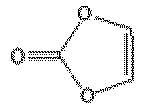
0.5 155 26.8 1261 4.5 Example 38 92% Methyl acetate 60 / / / / 
5 156 27.1 1278 4.0 Example 39 92% Methyl acetate 60 / / / / 
8 155 27.4 1254 3.8 Example 40 92% Methyl acetate 60 / / / / 
15 153 27.9 1232 3.7 Example 41 92% Methyl acetate 60 
1 LiPO2F2 0.5 
0.5 158 26.8 1371 3.8 Example 42 92% Methyl acetate 60 
0.5 LiPO2F2 1 
0.4 157 26.9 1365 3.9 Example 43 92% Methyl acetate 60 
0.5 LiPO2F2 0.5 
1 159 26.7 1385 4.1 Comparative example 1 92% Methyl acetate 10 / / / / / / 34 1566 3.1 Comparative example 2 92% Methyl acetate 90 / / / / / / 24 1024 9.1 - At 25°C, the lithium-ion batteries were charged to 4.3 V at a constant current of 0.5C, then charged to a current less than 0.05C at a constant voltage of 4.3 V, and discharged to 2.8 V at a constant current of 0.5C to obtain the discharge capacity at 0.5C.
- At 25°C, the batteries were charged to 10% state of charge (SOC) at a current of 0.33C, charged for x minutes to 80% SOC based on specified fast charging steps, and discharged at a current of 1C after left standing for 30 minutes. Then, the batteries were left standing for 30 minutes, undergone 20 cycles, and fully charged. Then, the cells were disassembled to check whether lithium precipitation occurred on the negative electrodes. No lithium precipitation indicated that the cells had x-minute fast charging capability.
- At 60°C, the lithium-ion batteries were charged to 3.65 V at a constant current of 0.5C, then charged to a current less than 0.05C at a constant voltage of 3.65 V, and discharged to 2.5 V at a constant current of 0.5C. This was one charge and discharge cycle. Charge and discharge were performed in this way repeatedly, and a capacity retention rate of the lithium-ion battery after 1000 cycles was calculated.
- At 25°C, the prepared lithium-ion secondary batteries were separately charged to 3.65 V at a constant current of 0.33C, further charged to a current of 0.05C at a constant voltage of 3.65 V, and then discharged to 2.5 V at a constant current of 0.33C. The discharge capacity at that point was the discharge capacity of the lithium-ion secondary battery before high-temperature storage. Then, the lithium-ion secondary batteries were charged to 3.65 V at a constant current of 0.33C, charged to a current of 0.05C at a constant voltage of 3.65V, and fully charged. The battery volumes were tested using a drainage method. Then, the lithium-ion secondary batteries were stored for 60 days at 60°C, and then placed in an environment at 25°C at the end of storage. The battery volumes were measured using the drainage method. The battery volume swelling rate=(volume after storage/volume before storage-1)%.
- It can be seen from examples 1-13 that the increase of the group margin A and the increase of the mass percentage X1 of the first organic solvent can both effectively reduce the fast charging time, but deteriorate the cycling performance of the battery and increase the volume swelling. Therefore, the ratio of the two is adjusted to allow the value of X1/A to be kept in a proper range, which is conducive to achieving good balance between the fast charging performance and the cycling performance. The selection of the first organic solvent also substantially affects the performance of the battery, which can be seen from comparison between example 1 and examples 6 and 7.
- The addition of the first additive can effectively alleviate the volume swelling of the battery, as shown in examples 14-22. However, the addition amount of the first additive needs to be controlled in a proper range because its excessive amount causes a severe deterioration of the fast charging performance. Controlling the value of W1/A in a proper range can achieve good balance between the fast charging time and the volume swelling rate. It is seen from examples 23-40 that the second additive and the third additive cause similar effects as the first additive. In addition, addition of all of the three additives can further alleviate the effect of gas production on the battery volume swelling.
- In comparative examples 1 and 2, an excessively large or small amount of the first organic solvent causes excessive battery volume swelling (as shown in comparative example 2) or an excessively long fast charging time (as shown in comparative example 1).
- Although this application has been described with reference to the embodiments, various modifications can be made to this application without departing from the scope of this application and the components therein can be replaced with their equivalents. In particular, as long as there is no structural conflict, the various technical features mentioned in the embodiments can be combined in any manner. This application is not limited to the specific embodiments disclosed in this specification but includes all technical solutions falling in the scope of the claims.
Claims (17)
- A lithium-ion battery, having a cell group margin A of 88%-97% and comprising a non-aqueous electrolyte, wherein the non-aqueous electrolyte comprises a first organic solvent, and the first organic solvent comprises one or more of compounds represented by formula 1,
 R1 and R2 are each independently one of C1-C3 alkyl group and C1-C3 halogenated alkyl group;based on a total mass of an organic solvent in the non-aqueous electrolyte, a mass percentage of the first organic solvent is X1, X1 being in a range of 20%-80%; andthe cell group margin A and the mass percentage X1 of the first organic solvent satisfy the following relation:
- The lithium-ion battery according to claim 1, wherein the cell group margin A and the mass percentage X1 of the first organic solvent satisfy the following relation: 0.31≤X1/A≤0.79.
- The lithium-ion battery according to claim 1 or 2, wherein the cell group margin A is 90%-95%.
- The lithium-ion battery according to any one of claims 1 to 3, wherein the mass percentage X1 of the first organic solvent is in a range of 30%-70%, optionally 35%-65%.
- The lithium-ion battery according to any one of claims 1 to 4, wherein in formula 1, R1 and R2 are each independently one of methyl group, ethyl group, propyl group, fluoromethyl group, fluoroethyl group, and fluoropropyl group.
- The lithium-ion battery according to any one of claims 1 to 5, wherein the first organic solvent comprises at least one of the following compounds:





- The lithium-ion battery according to any one of claims 1 to 6, wherein the non-aqueous electrolyte comprises a first additive, and the first additive comprises at least one sultone additive represented by formula 2:
 p represents 1, 2, or 3, R11 represents one of hydrogen atoms, halogen atoms, C1-C6 alkyl group, C1-C3 halogenated alkyl group, C1-C3 alkoxy group, and C1-C3 haloalkoxy group, R12 independently represents one of hydrogen atoms, halogen atoms, C1-C3 alkyl group, C1-C3 halogenated alkyl group, C1-C3 alkoxy group, and C1-C3 haloalkoxy group, and R13 represents one of hydrogen atoms, halogen atoms, carbonyl group, double bonds, ester group, C1-C3 alkyl group, C1-C3 halogenated alkyl group, C1-C3 alkoxy group, C1-C3 haloalkoxy group, C6-C8 aryl group, or benzyl group;
and/orthe first additive comprises at least one cyclic sulfate compound represented by formula 3: q represents 1, 2, or 3, R14 represents one of hydrogen atoms, halogen atoms, carbonyl group, double bonds, C1-C6 alkyl group, C1-C3 halogenated alkyl group, C1-C3 alkoxy group, and C1-C3 haloalkoxy group, and R15 independently represents one of hydrogen atoms, halogen atoms, C1-C6 alkyl group, C1-C3 halogenated alkyl group, C1-C3 alkoxy group, C1-C3 haloalkoxy group, and C6-C8 aryl group.
 - The lithium-ion battery according to claim 7, wherein the first additive comprises at least one of the following compounds:


optionally, the first additive comprises at least one of the following compounds:

- The lithium-ion battery according to claim 7 or 8, wherein based on the total mass of the non-aqueous electrolyte, a mass percentage of the first additive is W1, and
W1 and the cell group margin A satisfy a relation: 0.0005<W1/A≤0.09, wherein A is 88%-97%, and 0.05%<W1≤9.7%, optionally 0.1%≤W1≤3%. - The aqueous positive electrode plate compound according to any one of claims 1 to 9, wherein the non-aqueous electrolyte comprises a second additive, and the second additive comprises one or more of a compound represented by formula 3, a compound represented by formula 4, and/or a compound represented by formula 5;
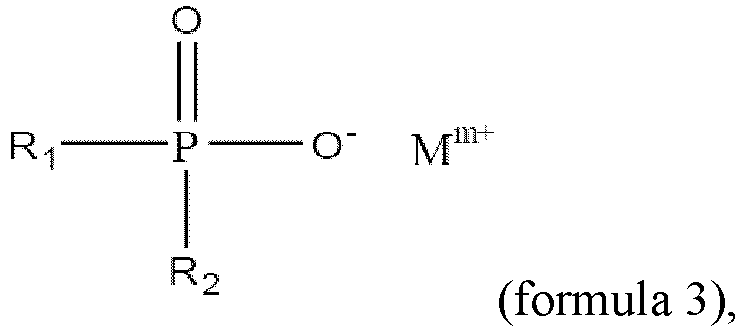 wherein R1 and R2 each independently represent F, C1-C6 fluorinated alkyl group, C1-C6 alkyl group, C1-C6 alkoxy group, C2-C6 alkenyl group, C2-C6 alkynyl group, or C6-C10 aryl group, and at least one of R1 and R2 represents F or C1-C6 fluorinated alkyl group; optionally, R1 and R2 each independently represent F, C1-C3 fluorinated alkyl group, C1-C3 alkyl group, C1-C3 alkoxy group, C2-C3 alkenyl group, C2-C3 alkynyl group, phenyl group, benzyl group, or methylphenyl group, and at least one of R1 and R2 represents F or and C1-C3 fluorinated alkyl group; and optionally, R1 and R2 each independently represent F or C1-C3 fluorinated alkyl group;
 wherein R3 and R4 each independently represent F, C1-C6 fluorinated alkyl group, C1-C6 alkyl group, C1-C6 alkoxy group, C2-C6 alkenyl group, or C2-C6 alkynyl group, and at least one of R3 and R4 represents F or C1-C6 fluorinated alkyl group; optionally, R3 and R4 each independently represent F, C1-C3 fluorinated alkyl group, C1-C3 alkyl group, C1-C3 alkoxy group, C2-C3 alkenyl group, or C2-C3 alkynyl group, and at least one of R3 and R4 represents F or and C1-C3 fluorinated alkyl group; and optionally, R3 and R4 each independently represent F or C1-C3 fluorinated alkyl group; and
 wherein R5 and R6 each independently represent F, C1-C6 fluorinated alkyl group, C1-C6 alkyl group, C1-C6 alkoxy group, C2-C6 alkenyl group, C2-C6 alkynyl group, carbonyl group, or O-, BF3 -, or boron oxygen bond; optionally, R5 and R6 each independently represent F, C1-C3 fluorinated alkyl group, C1-C3 alkyl group, C1-C3 alkoxy group, C2-C3 alkenyl group, C2-C3 alkynyl group, carbonyl group, or O-, BF3 -; and n=0, 1, or 2 and m=1 or 2; andM represents one or more of alkali metal and alkaline earth metal; and optionally, M is selected from one or more of Li, Na, and K.
 - The lithium-ion battery according to claim 10, wherein the second additive comprises one or more of the following compounds:





- The lithium-ion battery according to claim 10 or 11, wherein based on the total mass of the non-aqueous electrolyte, a mass percentage of the second additive is W2, and
W2 and the cell group margin A satisfy a relation: 0.0005<W2/A≤0.09, wherein A is 88%-97%, and 0.05%<W2≤9.7%, optionally 0.1%≤W2≤3%. - The lithium-ion battery according to any one of claims 1 to 12, wherein the non-aqueous electrolyte comprises a third additive, and the third additive comprises one or more of a compound represented by formula 6 and/or a compound represented by formula 7;
 R1 and R2 each independently represent hydrogen atoms, halogen atoms, C1-C6 alkyl group, C1-C6 halogenated alkyl group, C1-C6 alkoxy group, C2-C6 alkenyl group, or C2-C6 alkynyl group; and optionally, R1 and R2 each independently represent hydrogen atoms, halogen atoms, C1-C4 alkyl group, C1-C4 halogenated alkyl group, C1-C4 alkoxy group, C2-C4 alkenyl group, or C2-C4 alkynyl group; and
 R3, R4, R5, and R6 each independently represent hydrogen atoms, halogen atoms, C1-C6 alkyl group, C1-C6 halogenated alkyl group, C1-C6 alkoxy group, C2-C6 alkenyl group, or C2-C6 alkynyl group, and R3, R4, R5, and R6 do not all represent hydrogen atoms; and optionally, R3, R4, R5, and R6 each independently represent hydrogen atoms, halogen atoms, C1-C4 alkyl group, C1-C4 halogenated alkyl group, C1-C4 alkoxy group, C2-C4 alkenyl group, or C2-C4 alkynyl group, and R3, R4, R5, and R6 do not all represent hydrogen atoms.
 - The lithium-ion battery according to claim 13, wherein the third additive comprises one or more of the following compounds:


- The lithium-ion battery according to claim 13 or 14, wherein based on the total mass of the non-aqueous electrolyte, a mass percentage of the third additive is W3, and
W3 and the cell group margin A satisfy a relation: 0.0005<W3/A≤0.09, wherein A is 88%-97%, and 0.05%<W3≤9.7%, optionally 0.1%≤W3≤3%. - The lithium-ion battery according to any one of claims 1 to 15, wherein the mass percentages W1, W2, and W3 of the three additives and the cell group margin A satisfy a relation: 0.0005<(W1+W2+W3)/A≤0.1, wherein A is 88%-97%, and 0.05%<(W1+W2+W3)≤9.6%, optionally 0.1%≤(W1+W2+W3)≤4%.
- An electric apparatus, comprising the lithium-ion battery according to any one of claims 1 to 16.
Applications Claiming Priority (1)
| Application Number | Priority Date | Filing Date | Title |
|---|---|---|---|
| PCT/CN2023/071870 WO2024148556A1 (en) | 2023-01-12 | 2023-01-12 | Lithium-ion battery having high energy density and fast charging performance |
Publications (2)
| Publication Number | Publication Date |
|---|---|
| EP4475261A1 true EP4475261A1 (en) | 2024-12-11 |
| EP4475261A4 EP4475261A4 (en) | 2025-11-12 |
Family
ID=89046730
Family Applications (1)
| Application Number | Title | Priority Date | Filing Date |
|---|---|---|---|
| EP23915327.3A Pending EP4475261A4 (en) | 2023-01-12 | 2023-01-12 | HIGH-ENERGY-DENSITY LITHIUM-ION BATTERY WITH FAST CHARGING PERFORMANCE |
Country Status (6)
| Country | Link |
|---|---|
| US (1) | US20250079527A1 (en) |
| EP (1) | EP4475261A4 (en) |
| JP (1) | JP2025505919A (en) |
| KR (1) | KR20240113794A (en) |
| CN (1) | CN117223144A (en) |
| WO (1) | WO2024148556A1 (en) |
Families Citing this family (1)
| Publication number | Priority date | Publication date | Assignee | Title |
|---|---|---|---|---|
| CN120581697B (en) * | 2025-06-13 | 2025-09-30 | 宁德时代新能源科技股份有限公司 | Battery cell, battery device and electricity utilization device |
Family Cites Families (17)
| Publication number | Priority date | Publication date | Assignee | Title |
|---|---|---|---|---|
| JP5003095B2 (en) * | 2005-10-20 | 2012-08-15 | 三菱化学株式会社 | Non-aqueous electrolyte for secondary battery and non-aqueous electrolyte secondary battery using the same |
| JP5874390B2 (en) * | 2011-12-28 | 2016-03-02 | 三菱化学株式会社 | Non-aqueous electrolyte secondary battery |
| WO2015179205A1 (en) * | 2014-05-23 | 2015-11-26 | E. I. Du Pont De Nemours And Company | Nonaqueous electrolyte compositions comprising cyclic sulfates |
| CN106602131A (en) * | 2015-10-16 | 2017-04-26 | 宁德新能源科技有限公司 | Lithium ion battery |
| CN105576283A (en) * | 2016-02-03 | 2016-05-11 | 东莞市凯欣电池材料有限公司 | High voltage electrolyte considering high and low temperature performance and lithium ion battery using the electrolyte |
| KR102023677B1 (en) * | 2018-01-31 | 2019-09-23 | 파낙스 이텍(주) | Electrolyte for Secondary Battery and Secondary Battery Comprising the Same |
| CN110858665B (en) * | 2018-08-24 | 2021-10-01 | 张家港市国泰华荣化工新材料有限公司 | Lithium ion battery electrolyte and application thereof |
| CN110970664A (en) * | 2018-09-28 | 2020-04-07 | 宁德时代新能源科技股份有限公司 | Non-aqueous electrolytes and lithium-ion batteries |
| CN111116659A (en) * | 2018-10-31 | 2020-05-08 | 张家港市国泰华荣化工新材料有限公司 | Compound, electrolyte and lithium ion battery |
| JP7337515B2 (en) * | 2019-03-11 | 2023-09-04 | マクセル株式会社 | Non-aqueous electrolyte battery |
| CN112349960B (en) * | 2019-08-08 | 2021-12-07 | 宁德时代新能源科技股份有限公司 | Electrolyte and lithium ion battery |
| CN112349962B (en) * | 2019-08-08 | 2021-11-09 | 宁德时代新能源科技股份有限公司 | Lithium ion battery |
| CN110911745B (en) * | 2019-11-29 | 2021-06-25 | 宁德新能源科技有限公司 | Electrolyte solution and electrochemical device |
| JP7434533B2 (en) * | 2020-06-05 | 2024-02-20 | 寧徳新能源科技有限公司 | Electrochemical and electronic devices |
| JP7280914B2 (en) * | 2021-04-26 | 2023-05-24 | プライムプラネットエナジー&ソリューションズ株式会社 | Non-aqueous electrolyte secondary battery |
| CN114520371B (en) * | 2022-02-18 | 2024-04-05 | 香河昆仑新能源材料股份有限公司 | Nonaqueous electrolyte and lithium ion battery comprising same |
| CN115548466A (en) * | 2022-10-09 | 2022-12-30 | 湖北亿纬动力有限公司 | A battery cell, its shaping method and application |
-
2023
- 2023-01-12 JP JP2024537325A patent/JP2025505919A/en active Pending
- 2023-01-12 KR KR1020247020335A patent/KR20240113794A/en not_active Ceased
- 2023-01-12 EP EP23915327.3A patent/EP4475261A4/en active Pending
- 2023-01-12 WO PCT/CN2023/071870 patent/WO2024148556A1/en not_active Ceased
- 2023-01-12 CN CN202380011098.8A patent/CN117223144A/en active Pending
-
2024
- 2024-11-19 US US18/951,697 patent/US20250079527A1/en active Pending
Also Published As
| Publication number | Publication date |
|---|---|
| JP2025505919A (en) | 2025-03-05 |
| CN117223144A (en) | 2023-12-12 |
| WO2024148556A1 (en) | 2024-07-18 |
| US20250079527A1 (en) | 2025-03-06 |
| KR20240113794A (en) | 2024-07-23 |
| EP4475261A4 (en) | 2025-11-12 |
Similar Documents
| Publication | Publication Date | Title |
|---|---|---|
| EP4123759B1 (en) | Negative electrode plate and lithium-ion secondary battery | |
| EP4184650A1 (en) | Secondary battery, battery module comprising same, battery pack, and electrical device | |
| CN115917816B (en) | Lithium secondary battery and battery module, battery pack and power-consuming device containing same | |
| US20240170652A1 (en) | Positive electrode active material, preparation method thereof, and lithium-ion battery, battery module, battery pack, and electric apparatus containing same | |
| EP4550443A1 (en) | Positive electrode plate, secondary battery, battery module, battery pack and electric device | |
| EP4231407A1 (en) | Electrolyte solution, secondary battery comprising same, and preparation method for secondary battery | |
| EP4362156A1 (en) | Lithium ion battery, battery module, battery pack, and electric apparatus | |
| US12438149B2 (en) | Assembly, battery cell, battery, and electric apparatus containing same | |
| EP4287331A1 (en) | Secondary battery, battery module, battery pack, and electrical device | |
| CN117013047B (en) | Lithium-ion batteries, battery modules, battery packs, and electrical devices | |
| US12418047B2 (en) | Electrolyte, secondary battery, battery module, battery pack, and power consuming device | |
| JP2024504217A (en) | Secondary batteries, battery modules, battery packs and power consumption devices | |
| US20240290973A1 (en) | Electrode plate, lithium-ion battery, battery module, battery pack and electric device | |
| EP4421916A1 (en) | Lithium-ion secondary battery, battery module, battery pack, and electric apparatus | |
| US20250336959A1 (en) | Negative electrode sheet and secondary battery and electrical device including same | |
| US20250079527A1 (en) | Lithium-ion battery having high energy density and fast charging performance | |
| EP4276934A1 (en) | Positive electrode plate and lithium ion battery containing electrode plate | |
| EP4092804A1 (en) | Battery module, battery pack, electrical apparatus, and manufacturing method and manufacturing device for battery module | |
| US11996515B2 (en) | Lithium-ion secondary battery, battery module, battery pack, and power consumption apparatus | |
| EP4715896A1 (en) | Battery cell, battery comprising same, and electric apparatus | |
| EP4593147A1 (en) | Electrolyte, battery, and electrical device | |
| EP4715932A1 (en) | Lithium ion secondary battery and electric device | |
| EP4654316A1 (en) | Secondary battery and preparation method therefor, and electric device | |
| EP4611099A1 (en) | Lithium-ion battery containing doped positive electrode active material | |
| EP4641729A1 (en) | Lithium ion battery and electric apparatus |
Legal Events
| Date | Code | Title | Description |
|---|---|---|---|
| STAA | Information on the status of an ep patent application or granted ep patent |
Free format text: STATUS: THE INTERNATIONAL PUBLICATION HAS BEEN MADE |
|
| PUAI | Public reference made under article 153(3) epc to a published international application that has entered the european phase |
Free format text: ORIGINAL CODE: 0009012 |
|
| STAA | Information on the status of an ep patent application or granted ep patent |
Free format text: STATUS: REQUEST FOR EXAMINATION WAS MADE |
|
| 17P | Request for examination filed |
Effective date: 20240905 |
|
| AK | Designated contracting states |
Kind code of ref document: A1 Designated state(s): AL AT BE BG CH CY CZ DE DK EE ES FI FR GB GR HR HU IE IS IT LI LT LU LV MC ME MK MT NL NO PL PT RO RS SE SI SK SM TR |
|
| RAP1 | Party data changed (applicant data changed or rights of an application transferred) |
Owner name: CONTEMPORARY AMPEREX TECHNOLOGY(HONG KONG) LIMITED |
|
| RIC1 | Information provided on ipc code assigned before grant |
Ipc: H01M 10/0525 20100101ALI20250416BHEP Ipc: H01M 10/0567 20100101ALI20250416BHEP Ipc: H01M 10/0569 20100101AFI20250416BHEP |
|
| A4 | Supplementary search report drawn up and despatched |
Effective date: 20251015 |
|
| RIC1 | Information provided on ipc code assigned before grant |
Ipc: H01M 10/0569 20100101AFI20251009BHEP Ipc: H01M 10/0567 20100101ALI20251009BHEP Ipc: H01M 10/0525 20100101ALI20251009BHEP |
|
| DAV | Request for validation of the european patent (deleted) | ||
| DAX | Request for extension of the european patent (deleted) |