EP4474837A1 - Battery cell process data analysis system and method - Google Patents
Battery cell process data analysis system and method Download PDFInfo
- Publication number
- EP4474837A1 EP4474837A1 EP23775355.3A EP23775355A EP4474837A1 EP 4474837 A1 EP4474837 A1 EP 4474837A1 EP 23775355 A EP23775355 A EP 23775355A EP 4474837 A1 EP4474837 A1 EP 4474837A1
- Authority
- EP
- European Patent Office
- Prior art keywords
- battery cell
- capacity
- data
- predicted
- process data
- Prior art date
- Legal status (The legal status is an assumption and is not a legal conclusion. Google has not performed a legal analysis and makes no representation as to the accuracy of the status listed.)
- Pending
Links
Images





Classifications
-
- G—PHYSICS
- G01—MEASURING; TESTING
- G01R—MEASURING ELECTRIC VARIABLES; MEASURING MAGNETIC VARIABLES
- G01R31/00—Arrangements for testing electric properties; Arrangements for locating electric faults; Arrangements for electrical testing characterised by what is being tested not provided for elsewhere
- G01R31/36—Arrangements for testing, measuring or monitoring the electrical condition of accumulators or electric batteries, e.g. capacity or state of charge [SoC]
- G01R31/367—Software therefor, e.g. for battery testing using modelling or look-up tables
-
- H—ELECTRICITY
- H01—ELECTRIC ELEMENTS
- H01M—PROCESSES OR MEANS, e.g. BATTERIES, FOR THE DIRECT CONVERSION OF CHEMICAL ENERGY INTO ELECTRICAL ENERGY
- H01M10/00—Secondary cells; Manufacture thereof
- H01M10/04—Construction or manufacture in general
- H01M10/0404—Machines for assembling batteries
-
- G—PHYSICS
- G01—MEASURING; TESTING
- G01R—MEASURING ELECTRIC VARIABLES; MEASURING MAGNETIC VARIABLES
- G01R31/00—Arrangements for testing electric properties; Arrangements for locating electric faults; Arrangements for electrical testing characterised by what is being tested not provided for elsewhere
- G01R31/36—Arrangements for testing, measuring or monitoring the electrical condition of accumulators or electric batteries, e.g. capacity or state of charge [SoC]
-
- G—PHYSICS
- G01—MEASURING; TESTING
- G01R—MEASURING ELECTRIC VARIABLES; MEASURING MAGNETIC VARIABLES
- G01R31/00—Arrangements for testing electric properties; Arrangements for locating electric faults; Arrangements for electrical testing characterised by what is being tested not provided for elsewhere
- G01R31/36—Arrangements for testing, measuring or monitoring the electrical condition of accumulators or electric batteries, e.g. capacity or state of charge [SoC]
- G01R31/382—Arrangements for monitoring battery or accumulator variables, e.g. SoC
-
- G—PHYSICS
- G01—MEASURING; TESTING
- G01R—MEASURING ELECTRIC VARIABLES; MEASURING MAGNETIC VARIABLES
- G01R31/00—Arrangements for testing electric properties; Arrangements for locating electric faults; Arrangements for electrical testing characterised by what is being tested not provided for elsewhere
- G01R31/36—Arrangements for testing, measuring or monitoring the electrical condition of accumulators or electric batteries, e.g. capacity or state of charge [SoC]
- G01R31/385—Arrangements for measuring battery or accumulator variables
- G01R31/3865—Arrangements for measuring battery or accumulator variables related to manufacture, e.g. testing after manufacture
-
- G—PHYSICS
- G01—MEASURING; TESTING
- G01R—MEASURING ELECTRIC VARIABLES; MEASURING MAGNETIC VARIABLES
- G01R31/00—Arrangements for testing electric properties; Arrangements for locating electric faults; Arrangements for electrical testing characterised by what is being tested not provided for elsewhere
- G01R31/36—Arrangements for testing, measuring or monitoring the electrical condition of accumulators or electric batteries, e.g. capacity or state of charge [SoC]
- G01R31/385—Arrangements for measuring battery or accumulator variables
- G01R31/387—Determining ampere-hour charge capacity or SoC
-
- G—PHYSICS
- G01—MEASURING; TESTING
- G01R—MEASURING ELECTRIC VARIABLES; MEASURING MAGNETIC VARIABLES
- G01R31/00—Arrangements for testing electric properties; Arrangements for locating electric faults; Arrangements for electrical testing characterised by what is being tested not provided for elsewhere
- G01R31/36—Arrangements for testing, measuring or monitoring the electrical condition of accumulators or electric batteries, e.g. capacity or state of charge [SoC]
- G01R31/396—Acquisition or processing of data for testing or for monitoring individual cells or groups of cells within a battery
-
- G—PHYSICS
- G05—CONTROLLING; REGULATING
- G05B—CONTROL OR REGULATING SYSTEMS IN GENERAL; FUNCTIONAL ELEMENTS OF SUCH SYSTEMS; MONITORING OR TESTING ARRANGEMENTS FOR SUCH SYSTEMS OR ELEMENTS
- G05B13/00—Adaptive control systems, i.e. systems automatically adjusting themselves to have a performance which is optimum according to some preassigned criterion
- G05B13/02—Adaptive control systems, i.e. systems automatically adjusting themselves to have a performance which is optimum according to some preassigned criterion electric
- G05B13/0265—Adaptive control systems, i.e. systems automatically adjusting themselves to have a performance which is optimum according to some preassigned criterion electric the criterion being a learning criterion
-
- G—PHYSICS
- G05—CONTROLLING; REGULATING
- G05B—CONTROL OR REGULATING SYSTEMS IN GENERAL; FUNCTIONAL ELEMENTS OF SUCH SYSTEMS; MONITORING OR TESTING ARRANGEMENTS FOR SUCH SYSTEMS OR ELEMENTS
- G05B23/00—Testing or monitoring of control systems or parts thereof
- G05B23/02—Electric testing or monitoring
-
- G—PHYSICS
- G05—CONTROLLING; REGULATING
- G05B—CONTROL OR REGULATING SYSTEMS IN GENERAL; FUNCTIONAL ELEMENTS OF SUCH SYSTEMS; MONITORING OR TESTING ARRANGEMENTS FOR SUCH SYSTEMS OR ELEMENTS
- G05B23/00—Testing or monitoring of control systems or parts thereof
- G05B23/02—Electric testing or monitoring
- G05B23/0205—Electric testing or monitoring by means of a monitoring system capable of detecting and responding to faults
- G05B23/0259—Electric testing or monitoring by means of a monitoring system capable of detecting and responding to faults characterized by the response to fault detection
- G05B23/0283—Predictive maintenance, e.g. involving the monitoring of a system and, based on the monitoring results, taking decisions on the maintenance schedule of the monitored system; Estimating remaining useful life [RUL]
-
- G—PHYSICS
- G06—COMPUTING OR CALCULATING; COUNTING
- G06N—COMPUTING ARRANGEMENTS BASED ON SPECIFIC COMPUTATIONAL MODELS
- G06N20/00—Machine learning
-
- G—PHYSICS
- G06—COMPUTING OR CALCULATING; COUNTING
- G06N—COMPUTING ARRANGEMENTS BASED ON SPECIFIC COMPUTATIONAL MODELS
- G06N20/00—Machine learning
- G06N20/20—Ensemble learning
-
- G—PHYSICS
- G06—COMPUTING OR CALCULATING; COUNTING
- G06N—COMPUTING ARRANGEMENTS BASED ON SPECIFIC COMPUTATIONAL MODELS
- G06N5/00—Computing arrangements using knowledge-based models
- G06N5/01—Dynamic search techniques; Heuristics; Dynamic trees; Branch-and-bound
-
- H—ELECTRICITY
- H01—ELECTRIC ELEMENTS
- H01M—PROCESSES OR MEANS, e.g. BATTERIES, FOR THE DIRECT CONVERSION OF CHEMICAL ENERGY INTO ELECTRICAL ENERGY
- H01M10/00—Secondary cells; Manufacture thereof
- H01M10/04—Construction or manufacture in general
-
- H—ELECTRICITY
- H01—ELECTRIC ELEMENTS
- H01M—PROCESSES OR MEANS, e.g. BATTERIES, FOR THE DIRECT CONVERSION OF CHEMICAL ENERGY INTO ELECTRICAL ENERGY
- H01M10/00—Secondary cells; Manufacture thereof
- H01M10/42—Methods or arrangements for servicing or maintenance of secondary cells or secondary half-cells
- H01M10/4285—Testing apparatus
-
- H—ELECTRICITY
- H01—ELECTRIC ELEMENTS
- H01M—PROCESSES OR MEANS, e.g. BATTERIES, FOR THE DIRECT CONVERSION OF CHEMICAL ENERGY INTO ELECTRICAL ENERGY
- H01M10/00—Secondary cells; Manufacture thereof
- H01M10/42—Methods or arrangements for servicing or maintenance of secondary cells or secondary half-cells
- H01M10/48—Accumulators combined with arrangements for measuring, testing or indicating the condition of cells, e.g. the level or density of the electrolyte
-
- Y—GENERAL TAGGING OF NEW TECHNOLOGICAL DEVELOPMENTS; GENERAL TAGGING OF CROSS-SECTIONAL TECHNOLOGIES SPANNING OVER SEVERAL SECTIONS OF THE IPC; TECHNICAL SUBJECTS COVERED BY FORMER USPC CROSS-REFERENCE ART COLLECTIONS [XRACs] AND DIGESTS
- Y02—TECHNOLOGIES OR APPLICATIONS FOR MITIGATION OR ADAPTATION AGAINST CLIMATE CHANGE
- Y02E—REDUCTION OF GREENHOUSE GAS [GHG] EMISSIONS, RELATED TO ENERGY GENERATION, TRANSMISSION OR DISTRIBUTION
- Y02E60/00—Enabling technologies; Technologies with a potential or indirect contribution to GHG emissions mitigation
- Y02E60/10—Energy storage using batteries
Definitions
- Embodiments disclosed herein relate to a battery cell process data analysis system and a battery cell process data analysis method using the same.
- a lithium polymer battery a type of secondary batteries, is a battery capable of repeating charge and discharge through reversible mutual conversion between chemical energy and electrical energy, and has been used variously for portable electronic devices, electric vehicle batteries, etc., due to the advantage of long life and large capacity.
- a battery capacity which is one of most important performance indices of a battery cell, may be affected by numerous process factors involving a manufacturing process.
- a process has been managed through simple correlation analysis with a capacity centering on a design factor of the battery cell (i.e., a variable controllable in a battery design process), but the actual battery cell manufacturing process includes multiple discontinuous processes with different characteristics, such as an electrode process, an assembly process, an activation process, etc., and various process factors other than the design factor may affect the capacity of the battery cell.
- the effect of these process factors on the capacity of the battery cell is generally irregular, and several processes rather than a single process simultaneously affect the capacity of the battery cell, making it difficult to clearly find out a correlation therebetween.
- Embodiments disclosed herein aim to provide a battery cell process data analysis system and method in which process factors affecting a capacity of a battery cell may be found through artificial intelligence-based data analysis.
- Embodiments disclosed herein also aim to improve a capacity quality of a produced battery cell by finding a process factor that positively affects the capacity of the battery cell (e.g., that makes an actual capacity greater than a designed capacity) and a process factor that negatively affects the capacity of the battery cell (e.g., makes the actual capacity less than the designed capacity) and managing the process factors.
- a process factor that positively affects the capacity of the battery cell e.g., that makes an actual capacity greater than a designed capacity
- a process factor that negatively affects the capacity of the battery cell e.g., makes the actual capacity less than the designed capacity
- a battery cell process data analysis system includes a process data obtaining unit configured to obtain process data of a battery cell, a predicted capacity estimating unit configured to estimate a predicted capacity of the battery cell based on the process data, an actual capacity measuring unit configured to measure an actual capacity of the battery cell, and a controller configured to calculate a difference between the predicted capacity of the battery cell and the actual capacity of the battery cell and determine a process factor affecting the difference by using a trained artificial intelligence model.
- the predicted capacity estimating unit may be further configured to calculate a size of an electrode of an individual mono cell based on a measured value of the mono cell and estimate the predicted capacity of the battery cell where a plurality of mono cells are stacked, based on the size of the electrode and an amount of an electrode active material loaded on the electrode.
- the controller may be further configured to obtain distribution data of an actual capacity with respect to a predicted capacity for multiple battery cells manufactured through a process, classify the distribution data into two or more groups according to a size of the actual capacity with respect to the predicted capacity of the battery cell, by using a first artificial intelligence model, and calculate an importance indicating an influence of the process factor upon a capacity of the battery cell by analyzing distribution data belonging to each group and process data of the battery cell corresponding thereto, by using a second artificial intelligence model.
- the second artificial intelligence model may be trained to calculate an importance of each process factor based on a change of the distribution data according to presence/absence of the process factor for two or more process factors.
- the controller may be further configured to classify the distribution data as a first group when a size of an actual capacity with respect to an input predicted capacity of the battery cell is greater than or equal to a first threshold value and classify the distribution data as a second group when the size of the actual capacity with respect to the input predicted capacity of the battery cell is less than or equal to a second threshold value and determine a process factor affecting the difference between the predicted capacity and the actual capacity of the battery cell as a positive process factor for distribution data belonging to the first group and determine a process factor affecting the difference between the predicted capacity and the actual capacity of the battery cell as a negative process factor for distribution data belonging to the second group.
- the process data of the battery cell may include data related to at least one of an electrode process, an assembly process, and an activation process
- the process data obtaining unit may be further configured to generate integrated process data by connecting process data related to different processes by using a key index
- the controller may be further configured to determine a process factor affecting the difference between the predicted capacity and the actual capacity of the battery cell among process factors related to different processes, by using the integrated process data.
- a battery cell process data analysis method includes obtaining process data of a battery cell, estimating a predicted capacity of the battery cell based on the process data, measuring an actual capacity of the battery cell, calculating a difference between the actual capacity and the predicted capacity of the battery cell, and determining a process factor affecting the difference by using a trained artificial intelligence model.
- the estimating of the predicted capacity may include calculating a size of an electrode of an individual mono cell based on a measured value of the mono cell and estimating the predicted capacity of the battery cell where a plurality of individual mono cells are stacked, based on the size of the electrode and an amount of an electrode active material loaded on the electrode.
- the determining of the process factor may include obtaining distribution data of an actual capacity with respect to a predicted capacity for multiple battery cells manufactured through a process, classifying the distribution data into two or more groups according to a size of the actual capacity with respect to the predicted capacity of the battery cell, by using a first artificial intelligence model, and calculating an importance indicating an influence of the process factor upon a capacity of the battery cell by analyzing distribution data belonging to each group and process data of the battery cell corresponding thereto, by using a second artificial intelligence model.
- the second artificial intelligence model may be trained to calculate an importance of each process factor based on a change of the distribution data corresponding to a change or presence/absence of the process factor, for two or more preset process factors.
- the classifying of the distribution data into the two or more groups may include classifying the distribution data as a first group when a size of an actual capacity with respect to an input predicted capacity of the battery cell is greater than or equal to a first threshold value and classifying the distribution data as a second group when the size of the actual capacity with respect to the input predicted capacity of the battery cell is less than or equal to a second threshold value
- the determining of the process factor may include determining a process factor affecting the difference between the predicted capacity and the actual capacity of the battery cell as a positive process factor for distribution data belonging to the first group and determining a process factor affecting the difference between the predicted capacity and the actual capacity of the battery cell as a negative process factor for distribution data belonging to the second group.
- the process data of the battery cell may include data related to at least one of an electrode process, an assembly process, and an activation process
- the obtaining of the process data may include generating integrated process data by connecting process data related to different processes by using a key index
- the determining of the process factor may include determining a process factor affecting the difference between the predicted capacity and the actual capacity of the battery cell among process factors related to different processes, by using the integrated process data.
- the process factors affecting the capacity of the battery cell may be found through artificial intelligence-based data analysis. Moreover, by connecting data of different processes by using a key index, multiple process factors affecting a battery capacity in each process operation may be integrally managed.
- a capacity quality of a produced battery cell by finding a process factor that positively affects the capacity of the battery cell (e.g., that makes an actual capacity greater than a predicted capacity) and a process factor that negatively affects the capacity of the battery cell (e.g., makes the actual capacity less than the predicted capacity) and managing the process factors.
- a process factor that positively affects the capacity of the battery cell e.g., that makes an actual capacity greater than a predicted capacity
- a process factor that negatively affects the capacity of the battery cell e.g., makes the actual capacity less than the predicted capacity
- FIG. 1 is a graph showing a distribution of a predicted capacity and a measured actual capacity for multiple battery cells, and as shown, the predicted capacity and the actual capacity have a linear relationship according to a predicted distribution, but in practice, tend to be more widely distributed due to an influence of various process factors. That is, in an actual distribution, due to an influence of unexpected process factors, the measured actual capacity may be less (a lower side of an expected distribution range) or greater (an upper side of the expected distribution range) than the calculated predicted capacity.
- the effect of these process factors on the capacity of the battery cell is generally irregular, and several processes rather than a single process simultaneously affect the capacity of the battery cell, making it difficult to clearly find out a correlation therebetween.
- FIG. 2 is a block diagram showing a configuration of a battery cell process data analysis system according to an embodiment, to solve the foregoing problem.
- a battery cell process data analysis system 10 may include a process data obtaining unit 110, a predicted capacity estimating unit 120, an actual capacity measuring unit 130, and a controller 140.
- a process data obtaining unit 110 may include a process data obtaining unit 110, a predicted capacity estimating unit 120, an actual capacity measuring unit 130, and a controller 140.
- Components shown in the block diagram are classified depending on their functions and roles, and each block does not necessarily have to be implemented as independent hardware or software. For example, separated components may be actually implemented as one device or program, or one component may be implemented as a combination of several devices and programs.
- the process data obtaining unit 110 may obtain process data of a battery cell.
- the process data of the battery cell may relate to several processes included in a battery manufacturing process, such as an electrode process, an assembly process, an activation process, etc., and include multiple process factors (i.e., process variables) affecting a capacity of a produced battery cell.
- a loading amount of an electrode material per unit area, a size and a thickness of an electrode, etc. may correspond to process factors in the electrode process
- the amount of an electrolyte, etc. may correspond to the process factors in the assembly process
- the number of times of charging and discharging a cell, a temperature and a pressure during charge and discharge, etc. may correspond to the process factors in the activation process.
- the listed data types are only examples, and various process data related to process operations that may affect the capacity of a battery cell may be used.
- FIG. 3 is a schematic diagram showing that process factors of various process operations included in a battery cell manufacturing process affect the capacity of a completed battery cell.
- various processes first to third processes and process factors (process factors 1 to 6) involving these processes may have an influence upon determining a capacity of a battery cell.
- the process data obtaining unit 110 may collect process data in each process.
- the process data obtaining unit 110 may connect process data related to different processes by using a key index, thereby generating integrated process data.
- experienced engineers directly find and manage design factors or process factors that affect a battery cell capacity based on personal experiences.
- this method is effective for managing an individual process (e.g., one of the electrode process, the assembly process, and the activation process), it is difficult to determine correlation between process factors in several process operations, such that the method is not effective as the process steps become complicated. That is, some process factors may affect each other as dependent variables rather than independent variables for the battery capacity, it is advantageous to integrate and manage process data of several process operations. To this end, it is necessary to connect these data by considering the correlation between the process data of each process.
- FIG. 4 is a schematic diagram showing that process data of several processes included in a battery cell manufacturing process is connected using a key index.
- process data (Electrode 1, Electrode 2, ..., Electrode n) of a first process (e.g., the electrode process), process data (Assembly 1, Assembly 2, ..., Assembly n) of a second process (e.g., the assembly process), and process data (Activation 1, Activation 2, ..., Activation n) of a third process (e.g., the activation process) may be connected using a key index to generate integrated process data.
- the key index may be set considering correlation between processes.
- the key index may differ with a type of data generated in a process. For example, for a mono cell assembly process, an ID is given to each mono cell, such that a key index for connecting IDs of a plurality of mono cells to an ID of one completed cell may be set. In this way, for the assembly process, individual data exists discontinuously, enabling connection between processes through ID tracking.
- process data may be interconnected by tracking an ID of an electrode put into the assembly process and data in chronological order or reverse chronological order within one electrode ID.
- the integrated process data may be input to an artificial intelligence model described below, and the artificial intelligence model may determine process factors having a significant influence upon a capacity of a battery cell based on the integrated process data.
- the artificial intelligence model may determine process factors having a significant influence upon a capacity of a battery cell based on the integrated process data.
- the predicted capacity estimating unit 120 may estimate the predicted capacity of the battery cell based on the process data.
- the predicted capacity may mean a theoretical maximum capacity calculated based on a design variable of the battery cell.
- a size of an electrode e.g., a size of a positive electrode or a negative electrode
- a mono cell a unit cell including a positive electrode, a negative electrode, and a separator
- a theoretical capacity the battery cell may electrically have may be estimated based on the size of the electrode and the amount of an electrode active material loaded on the electrode.
- FIG. 5 shows how to measure an electrode size to calculate a predicted capacity of a battery mono cell.
- a mono cell 20 may include a positive electrode 210, a negative electrode 220, and a separator 230 sandwiched therebetween to separate the positive electrode and the negative electrode from each other.
- a distance from each part of the positive electrode 210 to an end of the separator 230 may be recognized.
- a horizontal length W of the separator 230 is already known as a design variable, such that a horizontal length of the positive electrode 210 may be calculated by subtracting a horizontal distance (see an arrow) between the positive electrode 210 and the separator 230 from the horizontal length W of the separator 230.
- a vertical length H of the separator 230 is already known as a design variable, such that a vertical length of the positive electrode 210 may be calculated by subtracting a vertical distance (see an arrow) between the positive electrode 210 and the separator 230 from the vertical length H of the separator 230.
- the size of the positive electrode may be calculated from the horizontal length and the vertical length of the positive electrode, and a theoretical predicted capacity of the individual mono cell 20 may be calculated by substituting the amount of an active material per unit area.
- one battery cell has a stacked structure of several mono cells, such that by summing a predicted capacity of each mono cell, the theoretical predicted capacity of the battery cell may be estimated.
- the above-described method of calculating the size of the electrode is assumed to consider a designated design variable, but this is merely an example.
- a method may be considered which identifies designated entities (e.g., a positive electrode, a negative electrode, and a separator) using an image processing algorithm in the vision data obtained by photographing the upper and lower surfaces of the mono cell, and calculates the sizes of the identified entities to calculate the size of an electrode.
- designated entities e.g., a positive electrode, a negative electrode, and a separator
- the size of the positive electrode is used because the capacity of the battery cell is determined by the size of the positive electrode and the amount of the loaded electrode active material, generally in a lithium-ion battery, but the present disclosure is not limited thereto.
- the predicted capacity estimating unit 120 may estimate a theoretical capacity of the battery cell based on the size of the negative electrode 220 and the amount of an electrode active material corresponding thereto.
- the actual capacity measuring unit 130 may measure the actual capacity of the completed battery cell. Measurement of the capacity of the battery cell may be generally performed through cell current measurement after charge and discharge processes, but measurement timing and method are not separately limited.
- the controller 140 may calculate a difference between the predicted capacity of the battery cell estimated by the predicted capacity estimating unit 120 and the actual capacity of the battery cell measured by the actual capacity measuring unit 130, and determine a process factor affecting the difference in capacity by using a trained artificial intelligence model.
- the controller 140 may obtain distribution data of an actual capacity with respect to a predicted capacity for multiple battery cells manufactured through a process.
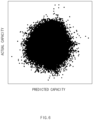
- FIG. 6 is a graph showing distribution data of a measured actual capacity with respect to a predicted capacity for multiple battery cells.
- a horizontal axis indicates a predicted capacity estimated based on a mono cell vision data and a vertical axis indicates an actual capacity measured through inspection of a completed batter cell, in which respective dots may indicate a predicted capacity and an actual capacity of battery cells.
- respective dots may indicate a predicted capacity and an actual capacity of battery cells.
- the controller 140 may classify points into two or more groups according to a set classification criterion (e.g., according to a size of the actual capacity with respect to a predicted capacity of the battery cell on distribution data) by using a clustering algorithm and/or a first artificial intelligence model.
- a set classification criterion e.g., according to a size of the actual capacity with respect to a predicted capacity of the battery cell on distribution data
- the clustering algorithm may be a density-based spatial clustering of applications with noise (DBSCAN) algorithm.
- DBSCAN density-based spatial clustering of applications with noise
- the DBSCAN algorithm is an algorithm for classifying each point as a core point, a border point, or a noise point based on whether a designated number of points fall within a designated radius from each of points indicating predicted capacities and actual capacities of battery cells.
- the core point may be a point including a designated number of points or more within the range.
- the border point may be a point including points less than the designated number of points within the range, and the included points may include the core point.
- the noise point may be a point including points less than the designated number of points within the range, and the included points may not include the core point.
- the size and number of radius may be predefined by a user.
- two or more groups classified according to the size of the actual capacity with respect to the predicted capacity of the battery cell on the distribution data may be clusters including different core points and border points.
- the noise points may not be included in the two or more groups.
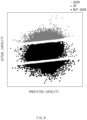
- points classified as 'GOOD' may belong to a first cluster including core points and border points
- points classified as 'NOT GOOD' may belong to a second cluster including other core points and other border points.
- the first cluster and the second cluster may be referred to as two or more groups.
- the first artificial intelligence model which is a machine learning-based classification model, discretize and/or classify adjacent data to improve classification performance.
- the first artificial intelligence model may use a DBSCAN-based model, without being limited thereto.
- the first artificial intelligence model be supervised and trained based on training data.
- the first artificial intelligence model may be trained to minimize a difference between a core point, a border point, or a noise point output by the first artificial intelligence model and a core point, a border point, or a noise point labelled on learning data.
- FIG. 7 shows that capacity distribution data of a battery cell is classified into two groups by using an artificial intelligence model according to an embodiment.
- the points classified as 'GOOD' may indicate battery cells having a relatively small difference between a theoretically estimated predicted capacity and an actual capacity
- the points classified as 'NOT GOOD' may indicate battery cells having a relatively large difference between a predicted capacity and an actual capacity.
- a large difference between a predicted capacity and an actual capacity may lead to quality degradation of a product, and thus it is necessary to find and manage a process factor that affects such a result.
- the controller 140 may calculate an importance indicating an influence of each process factor upon the capacity of the battery cell by analyzing distribution data belonging to each group (e.g., a group classified as 'GOOD' or a group classified as 'NOT GOOD') and process data of the battery cell corresponding thereto), by using a second artificial intelligence model.
- each group e.g., a group classified as 'GOOD' or a group classified as 'NOT GOOD'
- the second artificial intelligence model may be trained to calculate an importance of each process factor based on a change of the distribution data corresponding to a change or presence/absence of the process factor, for two or more preset process factors.
- the second artificial intelligence model may be based on a model using, for example, an ensemble-based boosting method (e.g., a gradient boost for classification, XGBoost (e.g., XGBClassifier, LightGBMClassifier, etc.).
- an ensemble may be a method for generating a prediction result by combining a plurality of models (e.g., decision trees).
- the second artificial intelligence model may recognize importances among a plurality of process factors by combining decision trees for each of the plurality of process factors.
- each of the decision trees may include two leaves branched from one decision node.
- the second artificial intelligence model may be trained to minimize a difference between a capacity difference of battery cells classified in final leaves and a predicted value of the final leave (i.e., a pseudo-residual (or an error) value).
- the second artificial intelligence model may be configured with decision trees of a designated depth. The designated depth may be determined as an integer between 8 and 32.
- the second artificial intelligence model may be trained using process data of the first to third processes as input data and a capacity difference as a predicted value.
- the second artificial intelligence model may be trained through a process of calculating a pseudo-residual of each of leaves of the current decision tree, a process of generating a child decision tree of the current decision tree, and a process of generating a predicted value of each of the leaves included in the child decision tree.
- Each of the leaves may indicate a pseudo-residual (or an error) value.
- a pseudo-residual of each of leaves of an n th decision tree may be calculated based on a difference between a capacity difference between battery cells classified in each leaf of the n th decision tree and a predicted value P n-1 determined in a previous decision tree.
- a predicted value for a capacity difference between battery cells included in each leaf of the n th decision tree may be calculated based on a pseudo-residual of each leaf of the n th decision tree.
- An initial predicted value P 0 may be set as an average value of capacity differences of all battery cells.
- the output value O n of the leaf of the current decision tree may be calculated based on pseudo-residuals of battery cells included in the leaf.
- a decision tree branched from the previous decision tree may be determined based on a gain value. For example, decision trees for each of two leaves included in the previous decision tree may be determined based on a gain value. That is, decision trees may be different for each of the two leaves. For example, a decision tree having the greatest gain value, among gain values of a candidate decision tree for classifying presence/absence of a process factor 2, a decision tree for classifying presence/absence of a process factor 3, ..., and a decision tree for classifying presence/absence of a process factor N, as decision tree candidates of a first leaf of the previous decision tree, may be determined as a decision tree for the first leaf of the previous decision tree.
- a decision node may classify presence/absence of each process factor or classify each battery cell into one of two leaves through classification based on a reference value of each process factor. For example, a first decision node may query presence/absence of a process factor 1 in the first process. The first decision node may assign Cell IDs including the processor factor 1 to a first leaf of the corresponding decision node in the first process, and assign Cell IDs not including the process factor 1 to a second leaf of the first decision node. A second decision node may query presence/absence of a process factor 2 in the first process.
- the second decision node may assign Cell IDs including the processor factor 2 to a first leaf of the second decision node in the first process, and assign Cell IDs not including the process factor 2 to a second leaf of the second decision node.
- the first decision node and the second decision node may be connected to each other.
- a determination process of the second decision node may be performed for battery cells assigned to the first leaf of the first decision node.
- the first decision node may be a parent node of the second decision node, or a previous node.
- the second artificial intelligence model may calculate an importance of each process factor through a permutation importance scheme based on process data classified into two or more groups.
- the importance of the process factor may be based on a gain value of a decision tree in which the process factor is used among decision trees. For example, a sum of gain values of a decision tree for querying presence/absence of the first process factor may be evaluated as an importance of the first process factor.
- a type and a utilization method of a model are merely examples and thus are not limited thereto.
- the second artificial intelligence model may compare a capacity difference (a difference between a predicted capacity and an actual capacity) calculated except for intervention of the process factor 1 among process data with a capacity difference calculated except for intervention of the process factor 2 to find out which one of the process factor 1 and the process factor 2 has a greater influence upon a difference between a predicted capacity and an actual capacity.
- capacity differences distributed data between all process factors included in the process data according to presence/absence of intervention of a corresponding process factor may be compared, thereby calculating an importance of each process factor.
- the controller 140 may determine a process factor that affects a capacity of a battery cell based on an importance of each process factor calculated using an artificial intelligence model. Once the process factor is determined, the process factor may be controlled through proper feedback, thereby improving capacity quality of the battery cell.
- the controller 140 may classify distribution data of an actual capacity with respect to a predicted capacity of a battery cell into three or more groups. Unlike in FIG. 7 where distribution data is classified into two groups, FIG. 8 shows that capacity distribution data of a battery cell is classified into three groups ('GOOD', 'OK', 'NOT GOOD') by using an artificial intelligence model according to an embodiment.
- the controller 140 may classify the distribution data as a first group 'GOOD' when a size of an actual capacity with respect to an input predicted capacity of a battery cell is greater than or equal to a first threshold value, classify the distribution data as a second group 'NOT GOOD' when the size of the actual capacity with respect to the input predicted capacity of the battery cell is less than or equal to a second threshold value, and classify the distribution data as 'OK' for the other cases.
- the battery cell belonging to the first group 'GOOD' may be regarded as having a relatively good quality because the actual capacity is greater than the theoretically predicted capacity.
- the controller 140 may determine a process factor having an important influence upon a capacity difference of a battery cell as a positive process factor.
- the battery cell belonging to the second group 'NOT GOOD' may be regarded as having a relatively low quality because the actual capacity is less than the theoretically predicted capacity.
- the controller 140 may determine a process factor having an important influence upon a capacity difference of a battery cell as a negative process factor.
- the quality of a battery cell capacity may be improved.
- FIG. 9 is a flowchart of a battery cell process data analysis method according to an embodiment.
- Each operation of the method according to an embodiment may be performed by components of the battery cell process data analysis system 10 described with reference to FIG. 1 , i.e., one of the process data obtaining unit 110, the predicted capacity estimating unit 120, the actual capacity measuring unit 130, and the controller 140 or a combination thereof, but the system 10 is not necessarily required to perform the current method.
- operation S100 of obtaining process data of a battery cell may be performed.
- the process data of the battery cell may include data related to several processes included in a battery manufacturing process, such as an electrode process, an assembly process, and an activation process.
- integrated process data may be generated by connecting process data related to different processes by using a key index in operation S100, and a process factor affecting a difference between a predicted capacity and an actual capacity of the battery cell may be determined among process factors related to different processes by using the integrated process data.
- a process factor affecting a difference between a predicted capacity and an actual capacity of the battery cell may be determined among process factors related to different processes by using the integrated process data.
- operation S200 of estimating the predicted capacity of the battery cell based on process data may be performed.
- the predicted capacity may mean a theoretical maximum capacity calculated based on a design variable of the battery cell.
- operation S200 may include an operation of calculating a size of an electrode of an individual mono cell based on a measured value of the mono cell and an operation of estimating a predicted capacity of a battery cell where a plurality of individual mono cells are stacked, based on the size of the electrode and the amount of an electrode active material loaded on the electrode.
- an electrode size (e.g., a size of a positive electrode or a negative electrode) may be calculated from vision data obtained by photographing upper and lower surfaces of a mono cell (a unit cell including a positive electrode, a negative electrode, and a separator), and a theoretical capacity the battery cell may electrically have may be estimated based on them.
- a process of calculating the size of the positive electrode from the vision data of the ono cell is already described with reference to FIG. 5 .
- the theoretical capacity of the battery cell may be estimated based on the size of the negative electrode and the amount of the electrode active material corresponding thereto.
- operation S300 of measuring an actual capacity of a completed battery cell may be performed.
- measurement of the capacity of the battery cell may be generally performed through cell current measurement after charge and discharge processes, but measurement timing and method are not separately limited.
- operation S400 of calculating a difference between the actual capacity and the predicted capacity of the battery cell may be performed.
- the calculated capacity difference may be used to determine main process factors affecting the capacity difference of the battery cell in the next operation.
- operation S500 of determining a process factor affecting the capacity difference by using a trained artificial intelligence model may be performed.
- Even battery cells passing through the same manufacturing process may have different predicted capacities according to an electrode size of a mono cell or the amount of a loaded electrode active material, and their actual capacities may also have large and small errors due to process factors affecting various influences through various processes.
- an actual capacity is much smaller than a predicted capacity, quality degradation of a product may occur and thus it is necessary to find and manage a process factor that affects such a result.
- FIG. 10 is a flowchart showing in more detail an operation of determining a process factor of FIG. 9 .
- operation S500 may include operation S510 of obtaining distribution data of an actual capacity with respect to a predicted capacity for multiple battery cells manufactured through a process, operation S520 of classifying the distribution data into two or more groups according to a size of an actual capacity with respect to an input predicted capacity of the battery cell by using a first artificial intelligence model, and operation S530 of calculating an importance indicating an influence of each process factor upon a capacity of the battery cell by analyzing the distribution data belong to each group and process data of the battery cell corresponding thereto by using a second artificial intelligence model.
- the first artificial intelligence model which is a machine learning-based classification model, discretize adjacent data to improve classification performance.
- the first artificial intelligence model may use a DBSCAN-based model, without being limited thereto.
- the second artificial intelligence model may be trained to calculate an importance of each process factor based on a change level of the distribution data corresponding to a change of the process factor, for two or more preset process factors. More specifically, capacity differences (distribution data) between all process factors included in the process data according to presence/absence of intervention of a corresponding process factor may be compared, thereby calculating an importance of each process factor.
- the second artificial intelligence model may find process data classified into two or more groups by using a classification model, e.g., XGBClassifier, LightGBMClassifier, etc., and calculate an importance of each process factor through a permutation importance scheme.
- a classification model e.g., XGBClassifier, LightGBMClassifier, etc.
- a type and a utilization method of a model are merely examples and thus are not limited thereto.
- the process factor affecting the capacity of the battery cell may be determined based on the importance of each process factor calculated using the artificial intelligence model, and the process factor may be controlled through a proper feedback, thereby improving the quality of the capacity of the battery cell.
- the distribution data in operation S520 of classifying the distribution data into two or more groups, may be classified as the first group (e.g., a group belonging to 'GOOD' in FIG. 8 ) when the size of the actual capacity with respect to the input predicted capacity of the battery cell is greater than or equal to the first threshold value, and the distribution data may be classified as the second group (e.g., a group belonging to 'NOT GOOD' in FIG. 8 ) when the size of the actual capacity with respect to the input predicted capacity of the battery cell is less than or equal to the second threshold value.
- the first group e.g., a group belonging to 'GOOD' in FIG. 8
- the distribution data may be classified as the second group (e.g., a group belonging to 'NOT GOOD' in FIG. 8 ) when the size of the actual capacity with respect to the input predicted capacity of the battery cell is less than or equal to the second threshold value.
- a process factor affecting a difference between the predicted capacity and the actual capacity of the battery cell may be determined as the positive process factor for the distribution data belonging to the first group (e.g., the group belonging to 'GOOD' in FIG. 8 ), and the process factor affecting the difference between the predicted capacity and the actual capacity of the battery cell may be determined as the negative process factor for the distribution data belonging to the second group (e.g., the group belonging to 'NOT GOOD' in FIG. 8 ).
- the quality of a battery cell capacity may be improved.
- the battery cell data analysis method may be implemented in the form of an application or a program instruction that is executable through various computer components and recorded in a computer-readable recording medium.
- the computer-readable recording medium may include a program instruction, a data file, a data structure and the like solely or in a combined manner.
- a battery cell process data analysis system and method may be provided in which process factors affecting a capacity of a battery cell may be found through artificial intelligence-based data analysis. Moreover, by connecting data of different processes by using a key index, multiple process factors affecting a battery capacity in each process operation may be integrally managed.
Landscapes
- Engineering & Computer Science (AREA)
- Physics & Mathematics (AREA)
- General Physics & Mathematics (AREA)
- Theoretical Computer Science (AREA)
- Software Systems (AREA)
- Manufacturing & Machinery (AREA)
- Artificial Intelligence (AREA)
- General Chemical & Material Sciences (AREA)
- Electrochemistry (AREA)
- Chemical Kinetics & Catalysis (AREA)
- Chemical & Material Sciences (AREA)
- Evolutionary Computation (AREA)
- Automation & Control Theory (AREA)
- Data Mining & Analysis (AREA)
- Computing Systems (AREA)
- Mathematical Physics (AREA)
- General Engineering & Computer Science (AREA)
- Medical Informatics (AREA)
- Computer Vision & Pattern Recognition (AREA)
- Health & Medical Sciences (AREA)
- Computational Linguistics (AREA)
- Secondary Cells (AREA)
- Life Sciences & Earth Sciences (AREA)
- Biomedical Technology (AREA)
- Biophysics (AREA)
- General Health & Medical Sciences (AREA)
- Molecular Biology (AREA)
- Tests Of Electric Status Of Batteries (AREA)
Abstract
Description
- This application claims priority to and the benefit of
Korean Patent Application No. 10-2022-0037600 filed in the Korean Intellectual Property Office on March 25, 2022 - Embodiments disclosed herein relate to a battery cell process data analysis system and a battery cell process data analysis method using the same.
- A lithium polymer battery, a type of secondary batteries, is a battery capable of repeating charge and discharge through reversible mutual conversion between chemical energy and electrical energy, and has been used variously for portable electronic devices, electric vehicle batteries, etc., due to the advantage of long life and large capacity. A battery capacity, which is one of most important performance indices of a battery cell, may be affected by numerous process factors involving a manufacturing process. Conventionally, a process has been managed through simple correlation analysis with a capacity centering on a design factor of the battery cell (i.e., a variable controllable in a battery design process), but the actual battery cell manufacturing process includes multiple discontinuous processes with different characteristics, such as an electrode process, an assembly process, an activation process, etc., and various process factors other than the design factor may affect the capacity of the battery cell. The effect of these process factors on the capacity of the battery cell is generally irregular, and several processes rather than a single process simultaneously affect the capacity of the battery cell, making it difficult to clearly find out a correlation therebetween.
- Embodiments disclosed herein aim to provide a battery cell process data analysis system and method in which process factors affecting a capacity of a battery cell may be found through artificial intelligence-based data analysis.
- Embodiments disclosed herein also aim to improve a capacity quality of a produced battery cell by finding a process factor that positively affects the capacity of the battery cell (e.g., that makes an actual capacity greater than a designed capacity) and a process factor that negatively affects the capacity of the battery cell (e.g., makes the actual capacity less than the designed capacity) and managing the process factors.
- Technical problems of the embodiments disclosed herein are not limited to the above-described technical problems, and other unmentioned technical problems would be clearly understood by one of ordinary skill in the art from the following description.
- A battery cell process data analysis system according to an embodiment includes a process data obtaining unit configured to obtain process data of a battery cell, a predicted capacity estimating unit configured to estimate a predicted capacity of the battery cell based on the process data, an actual capacity measuring unit configured to measure an actual capacity of the battery cell, and a controller configured to calculate a difference between the predicted capacity of the battery cell and the actual capacity of the battery cell and determine a process factor affecting the difference by using a trained artificial intelligence model.
- According to an embodiment, the predicted capacity estimating unit may be further configured to calculate a size of an electrode of an individual mono cell based on a measured value of the mono cell and estimate the predicted capacity of the battery cell where a plurality of mono cells are stacked, based on the size of the electrode and an amount of an electrode active material loaded on the electrode.
- According to an embodiment, the controller may be further configured to obtain distribution data of an actual capacity with respect to a predicted capacity for multiple battery cells manufactured through a process, classify the distribution data into two or more groups according to a size of the actual capacity with respect to the predicted capacity of the battery cell, by using a first artificial intelligence model, and calculate an importance indicating an influence of the process factor upon a capacity of the battery cell by analyzing distribution data belonging to each group and process data of the battery cell corresponding thereto, by using a second artificial intelligence model.
- According to an embodiment, the second artificial intelligence model may be trained to calculate an importance of each process factor based on a change of the distribution data according to presence/absence of the process factor for two or more process factors.
- According to an embodiment, the controller may be further configured to classify the distribution data as a first group when a size of an actual capacity with respect to an input predicted capacity of the battery cell is greater than or equal to a first threshold value and classify the distribution data as a second group when the size of the actual capacity with respect to the input predicted capacity of the battery cell is less than or equal to a second threshold value and determine a process factor affecting the difference between the predicted capacity and the actual capacity of the battery cell as a positive process factor for distribution data belonging to the first group and determine a process factor affecting the difference between the predicted capacity and the actual capacity of the battery cell as a negative process factor for distribution data belonging to the second group.
- According to an embodiment, the process data of the battery cell may include data related to at least one of an electrode process, an assembly process, and an activation process, the process data obtaining unit may be further configured to generate integrated process data by connecting process data related to different processes by using a key index, and the controller may be further configured to determine a process factor affecting the difference between the predicted capacity and the actual capacity of the battery cell among process factors related to different processes, by using the integrated process data.
- A battery cell process data analysis method according to an embodiment includes obtaining process data of a battery cell, estimating a predicted capacity of the battery cell based on the process data, measuring an actual capacity of the battery cell, calculating a difference between the actual capacity and the predicted capacity of the battery cell, and determining a process factor affecting the difference by using a trained artificial intelligence model.
- According to an embodiment, the estimating of the predicted capacity may include calculating a size of an electrode of an individual mono cell based on a measured value of the mono cell and estimating the predicted capacity of the battery cell where a plurality of individual mono cells are stacked, based on the size of the electrode and an amount of an electrode active material loaded on the electrode.
- According to an embodiment, the determining of the process factor may include obtaining distribution data of an actual capacity with respect to a predicted capacity for multiple battery cells manufactured through a process, classifying the distribution data into two or more groups according to a size of the actual capacity with respect to the predicted capacity of the battery cell, by using a first artificial intelligence model, and calculating an importance indicating an influence of the process factor upon a capacity of the battery cell by analyzing distribution data belonging to each group and process data of the battery cell corresponding thereto, by using a second artificial intelligence model.
- According to an embodiment, the second artificial intelligence model may be trained to calculate an importance of each process factor based on a change of the distribution data corresponding to a change or presence/absence of the process factor, for two or more preset process factors.
- According to an embodiment, the classifying of the distribution data into the two or more groups may include classifying the distribution data as a first group when a size of an actual capacity with respect to an input predicted capacity of the battery cell is greater than or equal to a first threshold value and classifying the distribution data as a second group when the size of the actual capacity with respect to the input predicted capacity of the battery cell is less than or equal to a second threshold value, and the determining of the process factor may include determining a process factor affecting the difference between the predicted capacity and the actual capacity of the battery cell as a positive process factor for distribution data belonging to the first group and determining a process factor affecting the difference between the predicted capacity and the actual capacity of the battery cell as a negative process factor for distribution data belonging to the second group.
- According to an embodiment, the process data of the battery cell may include data related to at least one of an electrode process, an assembly process, and an activation process, the obtaining of the process data may include generating integrated process data by connecting process data related to different processes by using a key index, and the determining of the process factor may include determining a process factor affecting the difference between the predicted capacity and the actual capacity of the battery cell among process factors related to different processes, by using the integrated process data.
- According to the battery cell process data analysis system and method of the foregoing embodiment, the process factors affecting the capacity of the battery cell may be found through artificial intelligence-based data analysis. Moreover, by connecting data of different processes by using a key index, multiple process factors affecting a battery capacity in each process operation may be integrally managed.
- Furthermore, it is possible to improve a capacity quality of a produced battery cell by finding a process factor that positively affects the capacity of the battery cell (e.g., that makes an actual capacity greater than a predicted capacity) and a process factor that negatively affects the capacity of the battery cell (e.g., makes the actual capacity less than the predicted capacity) and managing the process factors.
- Moreover, various effects recognized directly or indirectly from the disclosure may be provided.
- In order to more clearly describe technical solutions of embodiments disclosed herein or the prior art, the drawings required in the description of the embodiments are briefly introduced below. It should be understood that the following drawings are for the purpose of explaining the embodiments of the present specification and not for limiting purposes. In addition, representations of some components in the drawings may be exaggerated or omitted for clarity of explanation.
-
FIG. 1 is a graph showing an expected distribution and an actual distribution of a measured actual capacity with respect to a predicted capacity calculated for a plurality of battery cells. -
FIG. 2 is a block diagram showing a configuration of a battery cell process data analysis system according to an embodiment. -
FIG. 3 is a schematic diagram showing that process factors of various process operations included in a battery cell manufacturing process affect the capacity of a completed battery cell. -
FIG. 4 is a schematic diagram showing that process data of several processes included in a battery cell manufacturing process is connected using a key index. -
FIG. 5 shows how to measure an electrode size to calculate a predicted capacity of a battery mono cell. -
FIG. 6 is a graph showing distribution data of a measured actual capacity with respect to a predicted capacity for multiple battery cells. -
FIG. 7 shows that capacity distribution data of a battery cell is classified into two groups by using an artificial intelligence model according to an embodiment. -
FIG. 8 shows that capacity distribution data of a battery cell is classified into three groups by using an artificial intelligence model according to an embodiment. -
FIG. 9 is a flowchart of a battery cell process data analysis method according to an embodiment. -
FIG. 10 is a flowchart showing in more detail an operation of determining a process factor ofFIG. 9 . - Hereinafter, embodiments disclosed in this document will be described in detail with reference to the exemplary drawings. In adding reference numerals to components of each drawing, it should be noted that the same components are given the same reference numerals even though they are indicated in different drawings. In addition, in describing the embodiments disclosed in this document, when it is determined that a detailed description of a related known configuration or function interferes with the understanding of an embodiment disclosed in this document, the detailed description thereof will be omitted.
- Although terms used herein are selected with general terms popularly used at present under the consideration of functions in the disclosure, the terms may vary according to the intention of those of ordinary skill in the art, custom, or introduction of new technology. In addition, in a specific case, the applicant voluntarily may select terms, and in this case, the meaning of the terms may be disclosed in a corresponding description part of the present specification. Therefore, the terms used herein should be defined not by the simple names of the terms but by the substantial meaning of the terms and the contents throughout the disclosure. Moreover, terms defined in the present disclosure are used for only describing a specific exemplary embodiment and may not have an intention to limit the scope of other exemplary embodiments.
- Herein, it is to be understood that the singular forms include plural references unless the context clearly dictates otherwise. Herein, expressions such as "first" and "second" are used to distinguish components from each other, and do not mean a rank or order among components.
- Hereinbelow, preferred embodiments of a battery cell process data analysis system and a battery cell process data analysis method using the same will be described with reference to the drawings.
-
FIG. 1 is a graph showing a distribution of a predicted capacity and a measured actual capacity for multiple battery cells, and as shown, the predicted capacity and the actual capacity have a linear relationship according to a predicted distribution, but in practice, tend to be more widely distributed due to an influence of various process factors. That is, in an actual distribution, due to an influence of unexpected process factors, the measured actual capacity may be less (a lower side of an expected distribution range) or greater (an upper side of the expected distribution range) than the calculated predicted capacity. The effect of these process factors on the capacity of the battery cell is generally irregular, and several processes rather than a single process simultaneously affect the capacity of the battery cell, making it difficult to clearly find out a correlation therebetween. -
FIG. 2 is a block diagram showing a configuration of a battery cell process data analysis system according to an embodiment, to solve the foregoing problem. - Referring to
FIG. 2 , a battery cell processdata analysis system 10 according to an embodiment may include a processdata obtaining unit 110, a predictedcapacity estimating unit 120, an actual capacity measuringunit 130, and acontroller 140. Components shown in the block diagram are classified depending on their functions and roles, and each block does not necessarily have to be implemented as independent hardware or software. For example, separated components may be actually implemented as one device or program, or one component may be implemented as a combination of several devices and programs. - The process
data obtaining unit 110 may obtain process data of a battery cell. Herein, the process data of the battery cell may relate to several processes included in a battery manufacturing process, such as an electrode process, an assembly process, an activation process, etc., and include multiple process factors (i.e., process variables) affecting a capacity of a produced battery cell. For example, a loading amount of an electrode material per unit area, a size and a thickness of an electrode, etc., may correspond to process factors in the electrode process, a method for loading an anode, a separator, and a cathode, the amount of an electrolyte, etc., may correspond to the process factors in the assembly process, and the number of times of charging and discharging a cell, a temperature and a pressure during charge and discharge, etc., may correspond to the process factors in the activation process. The listed data types are only examples, and various process data related to process operations that may affect the capacity of a battery cell may be used. -
FIG. 3 is a schematic diagram showing that process factors of various process operations included in a battery cell manufacturing process affect the capacity of a completed battery cell. - Referring to
FIG. 3 , various processes (first to third processes) and process factors (process factors 1 to 6) involving these processes may have an influence upon determining a capacity of a battery cell. To find a process factor having a great influence (or a process factor having a positive/negative influence) upon a difference between a theoretically calculated predicted capacity and a measured actual capacity among such process factors, the processdata obtaining unit 110 may collect process data in each process. - According to an embodiment, the process
data obtaining unit 110 may connect process data related to different processes by using a key index, thereby generating integrated process data. Conventionally, experienced engineers directly find and manage design factors or process factors that affect a battery cell capacity based on personal experiences. Although this method is effective for managing an individual process (e.g., one of the electrode process, the assembly process, and the activation process), it is difficult to determine correlation between process factors in several process operations, such that the method is not effective as the process steps become complicated. That is, some process factors may affect each other as dependent variables rather than independent variables for the battery capacity, it is advantageous to integrate and manage process data of several process operations. To this end, it is necessary to connect these data by considering the correlation between the process data of each process. -
FIG. 4 is a schematic diagram showing that process data of several processes included in a battery cell manufacturing process is connected using a key index. - Referring to
FIG. 4 , for a plurality of battery cells AAA to ZZZ, process data (Electrode 1,Electrode 2, ..., Electrode n) of a first process (e.g., the electrode process), process data (Assembly 1,Assembly 2, ..., Assembly n) of a second process (e.g., the assembly process), and process data (Activation 1,Activation 2, ..., Activation n) of a third process (e.g., the activation process) may be connected using a key index to generate integrated process data. In this case, the key index may be set considering correlation between processes. - The key index may differ with a type of data generated in a process. For example, for a mono cell assembly process, an ID is given to each mono cell, such that a key index for connecting IDs of a plurality of mono cells to an ID of one completed cell may be set. In this way, for the assembly process, individual data exists discontinuously, enabling connection between processes through ID tracking.
- For the electrode process, there is continuous time-series data under one electrode ID by a roll-to-roll process. Thus, when the electrode process and the assembly process are connected, process data may be interconnected by tracking an ID of an electrode put into the assembly process and data in chronological order or reverse chronological order within one electrode ID.
- The integrated process data may be input to an artificial intelligence model described below, and the artificial intelligence model may determine process factors having a significant influence upon a capacity of a battery cell based on the integrated process data. As such, by integrally managing process data of several process operations, an influence of each process factor upon a battery capacity may be easily and accurately recognized.
- The predicted
capacity estimating unit 120 may estimate the predicted capacity of the battery cell based on the process data. Herein, the predicted capacity may mean a theoretical maximum capacity calculated based on a design variable of the battery cell. According to an embodiment, a size of an electrode (e.g., a size of a positive electrode or a negative electrode) may be calculated from vision data obtained by photographing upper and lower surfaces of a mono cell (a unit cell including a positive electrode, a negative electrode, and a separator), and a theoretical capacity the battery cell may electrically have may be estimated based on the size of the electrode and the amount of an electrode active material loaded on the electrode. -
FIG. 5 shows how to measure an electrode size to calculate a predicted capacity of a battery mono cell. - Referring to
FIG. 5 , amono cell 20 may include apositive electrode 210, anegative electrode 220, and aseparator 230 sandwiched therebetween to separate the positive electrode and the negative electrode from each other. By using the vision data obtained by photographing the upper and lower surfaces of the monocell, a distance from each part of thepositive electrode 210 to an end of the separator 230 (see an arrow ofFIG. 5 ) may be recognized. A horizontal length W of theseparator 230 is already known as a design variable, such that a horizontal length of thepositive electrode 210 may be calculated by subtracting a horizontal distance (see an arrow) between thepositive electrode 210 and theseparator 230 from the horizontal length W of theseparator 230. Likewise, a vertical length H of theseparator 230 is already known as a design variable, such that a vertical length of thepositive electrode 210 may be calculated by subtracting a vertical distance (see an arrow) between thepositive electrode 210 and theseparator 230 from the vertical length H of theseparator 230. - The size of the positive electrode may be calculated from the horizontal length and the vertical length of the positive electrode, and a theoretical predicted capacity of the
individual mono cell 20 may be calculated by substituting the amount of an active material per unit area. In addition, one battery cell has a stacked structure of several mono cells, such that by summing a predicted capacity of each mono cell, the theoretical predicted capacity of the battery cell may be estimated. The above-described method of calculating the size of the electrode is assumed to consider a designated design variable, but this is merely an example. According to an embodiment, a method may be considered which identifies designated entities (e.g., a positive electrode, a negative electrode, and a separator) using an image processing algorithm in the vision data obtained by photographing the upper and lower surfaces of the mono cell, and calculates the sizes of the identified entities to calculate the size of an electrode. - The size of the positive electrode is used because the capacity of the battery cell is determined by the size of the positive electrode and the amount of the loaded electrode active material, generally in a lithium-ion battery, but the present disclosure is not limited thereto. For example, according to a design, when the capacity of the battery cell is determined by the size of the negative electrode and the amount of the loaded electrode active material, the predicted
capacity estimating unit 120 may estimate a theoretical capacity of the battery cell based on the size of thenegative electrode 220 and the amount of an electrode active material corresponding thereto. - The actual
capacity measuring unit 130 may measure the actual capacity of the completed battery cell. Measurement of the capacity of the battery cell may be generally performed through cell current measurement after charge and discharge processes, but measurement timing and method are not separately limited. - The
controller 140 may calculate a difference between the predicted capacity of the battery cell estimated by the predictedcapacity estimating unit 120 and the actual capacity of the battery cell measured by the actualcapacity measuring unit 130, and determine a process factor affecting the difference in capacity by using a trained artificial intelligence model. - To this end, the
controller 140 may obtain distribution data of an actual capacity with respect to a predicted capacity for multiple battery cells manufactured through a process. -
FIG. 6 is a graph showing distribution data of a measured actual capacity with respect to a predicted capacity for multiple battery cells. - Referring to
FIG. 6 , in the graph, a horizontal axis indicates a predicted capacity estimated based on a mono cell vision data and a vertical axis indicates an actual capacity measured through inspection of a completed batter cell, in which respective dots may indicate a predicted capacity and an actual capacity of battery cells. As is shown , even battery cells passing through the same manufacturing process may have different predicted capacities according to an electrode size of a mono cell, and their actual capacities may also have large and small errors due to process factors affecting various influences through various processes. In particular, when an actual capacity is much smaller than a predicted capacity (i.e., points in a relatively low side of the graph), quality degradation of a product may occur and thus it is necessary to find and manage a process factor that affects such a result. - To determine a process factor that affects a difference between the actual capacity and the predicted capacity, the
controller 140 may classify points into two or more groups according to a set classification criterion (e.g., according to a size of the actual capacity with respect to a predicted capacity of the battery cell on distribution data) by using a clustering algorithm and/or a first artificial intelligence model. - According to an embodiment, the clustering algorithm may be a density-based spatial clustering of applications with noise (DBSCAN) algorithm. Herein, the DBSCAN algorithm is an algorithm for classifying each point as a core point, a border point, or a noise point based on whether a designated number of points fall within a designated radius from each of points indicating predicted capacities and actual capacities of battery cells. The core point may be a point including a designated number of points or more within the range. The border point may be a point including points less than the designated number of points within the range, and the included points may include the core point. The noise point may be a point including points less than the designated number of points within the range, and the included points may not include the core point. Herein, the size and number of radius may be predefined by a user. According to an embodiment, two or more groups classified according to the size of the actual capacity with respect to the predicted capacity of the battery cell on the distribution data may be clusters including different core points and border points. The noise points may not be included in the two or more groups. Referring to
FIG. 7 , points classified as 'GOOD' may belong to a first cluster including core points and border points, and points classified as 'NOT GOOD' may belong to a second cluster including other core points and other border points. Herein, the first cluster and the second cluster may be referred to as two or more groups. - According to an embodiment, the first artificial intelligence model, which is a machine learning-based classification model, discretize and/or classify adjacent data to improve classification performance. For example, the first artificial intelligence model may use a DBSCAN-based model, without being limited thereto. For example, when the first artificial intelligence model is based on DBSCAN, the first artificial intelligence model be supervised and trained based on training data. For example, the first artificial intelligence model may be trained to minimize a difference between a core point, a border point, or a noise point output by the first artificial intelligence model and a core point, a border point, or a noise point labelled on learning data.
-
FIG. 7 shows that capacity distribution data of a battery cell is classified into two groups by using an artificial intelligence model according to an embodiment. - In
FIG. 7 , the points classified as 'GOOD' may indicate battery cells having a relatively small difference between a theoretically estimated predicted capacity and an actual capacity, and the points classified as 'NOT GOOD' may indicate battery cells having a relatively large difference between a predicted capacity and an actual capacity. As described above, a large difference between a predicted capacity and an actual capacity may lead to quality degradation of a product, and thus it is necessary to find and manage a process factor that affects such a result. - The
controller 140 may calculate an importance indicating an influence of each process factor upon the capacity of the battery cell by analyzing distribution data belonging to each group (e.g., a group classified as 'GOOD' or a group classified as 'NOT GOOD') and process data of the battery cell corresponding thereto), by using a second artificial intelligence model. - According to an embodiment, the second artificial intelligence model may be trained to calculate an importance of each process factor based on a change of the distribution data corresponding to a change or presence/absence of the process factor, for two or more preset process factors. The second artificial intelligence model may be based on a model using, for example, an ensemble-based boosting method (e.g., a gradient boost for classification, XGBoost (e.g., XGBClassifier, LightGBMClassifier, etc.). Herein, an ensemble may be a method for generating a prediction result by combining a plurality of models (e.g., decision trees).
- In an embodiment, the second artificial intelligence model may recognize importances among a plurality of process factors by combining decision trees for each of the plurality of process factors. Herein, each of the decision trees may include two leaves branched from one decision node.
- In an embodiment, the second artificial intelligence model may be trained to minimize a difference between a capacity difference of battery cells classified in final leaves and a predicted value of the final leave (i.e., a pseudo-residual (or an error) value). Herein, the second artificial intelligence model may be configured with decision trees of a designated depth. The designated depth may be determined as an integer between 8 and 32.
- The second artificial intelligence model may be trained using process data of the first to third processes as input data and a capacity difference as a predicted value. The second artificial intelligence model may be trained through a process of calculating a pseudo-residual of each of leaves of the current decision tree, a process of generating a child decision tree of the current decision tree, and a process of generating a predicted value of each of the leaves included in the child decision tree.
- Each of the leaves may indicate a pseudo-residual (or an error) value. Herein, a pseudo-residual of each of leaves of an nth decision tree may be calculated based on a difference between a capacity difference between battery cells classified in each leaf of the nth decision tree and a predicted value Pn-1 determined in a previous decision tree.
- Herein, a predicted value for a capacity difference between battery cells included in each leaf of the nth decision tree may be calculated based on a pseudo-residual of each leaf of the nth decision tree. An initial predicted value P0 may be set as an average value of capacity differences of all battery cells. A predicted value Pn for each leaf of the nth decision tree may be a sum (Pn= Pn-1 + η * On) of the predicted value Pn-1 of the previous decision tree and a product of an output value On of the leaf of the current decision tree and a weight value η (e.g., 0.1). Herein, the output value On of the leaf of the current decision tree may be calculated based on pseudo-residuals of battery cells included in the leaf. For example, the output value On may be an average value of pseudo-residuals. That is, the output value On of each leaf of the nth decision tree may be a result (S = R/M) of dividing a sum (R = r1 + r2 + ... + rM) of pseudo-residuals of battery cells included in each leaf of the nth decision tree by the number M of battery cells included in the leaf. For example, an output value of a first leaf of the nth decision tree and an output value of a second leaf of the nth decision tree may be different from each other.
- A decision tree branched from the previous decision tree may be determined based on a gain value. For example, decision trees for each of two leaves included in the previous decision tree may be determined based on a gain value. That is, decision trees may be different for each of the two leaves. For example, a decision tree having the greatest gain value, among gain values of a candidate decision tree for classifying presence/absence of a
process factor 2, a decision tree for classifying presence/absence of aprocess factor 3, ..., and a decision tree for classifying presence/absence of a process factor N, as decision tree candidates of a first leaf of the previous decision tree, may be determined as a decision tree for the first leaf of the previous decision tree. Herein, a gain value of each candidate decision tree may be calculated based on a similarity score of each candidate decision tree, and a similarity score S may be a result (S = R/M) of dividing a square (R^2) of a sum (R = r1 + r2 + ... + rM) of pseudo-residuals of battery cells included in each leaf of each decision tree by the number M of battery cells. Herein, a similarity score of a decision tree may include a similarity score S1 of the first leaf and a similarity score S2 of the second leaf. A gain value may be a result of subtracting a similarity score of a parent node from a sum of the similarity score S1 of the first leaf and the similarity score S2 of the second leaf. - In an embodiment, a decision node may classify presence/absence of each process factor or classify each battery cell into one of two leaves through classification based on a reference value of each process factor. For example, a first decision node may query presence/absence of a
process factor 1 in the first process. The first decision node may assign Cell IDs including theprocessor factor 1 to a first leaf of the corresponding decision node in the first process, and assign Cell IDs not including theprocess factor 1 to a second leaf of the first decision node. A second decision node may query presence/absence of aprocess factor 2 in the first process. The second decision node may assign Cell IDs including theprocessor factor 2 to a first leaf of the second decision node in the first process, and assign Cell IDs not including theprocess factor 2 to a second leaf of the second decision node. Herein, the first decision node and the second decision node may be connected to each other. For example, a determination process of the second decision node may be performed for battery cells assigned to the first leaf of the first decision node. In this case, the first decision node may be a parent node of the second decision node, or a previous node. - In an embodiment, the second artificial intelligence model may calculate an importance of each process factor through a permutation importance scheme based on process data classified into two or more groups. Herein, the importance of the process factor may be based on a gain value of a decision tree in which the process factor is used among decision trees. For example, a sum of gain values of a decision tree for querying presence/absence of the first process factor may be evaluated as an importance of the first process factor. However, a type and a utilization method of a model are merely examples and thus are not limited thereto.
- For example, the second artificial intelligence model may compare a capacity difference (a difference between a predicted capacity and an actual capacity) calculated except for intervention of the
process factor 1 among process data with a capacity difference calculated except for intervention of theprocess factor 2 to find out which one of theprocess factor 1 and theprocess factor 2 has a greater influence upon a difference between a predicted capacity and an actual capacity. According to this scheme, capacity differences (distribution data) between all process factors included in the process data according to presence/absence of intervention of a corresponding process factor may be compared, thereby calculating an importance of each process factor. - As such, the
controller 140 may determine a process factor that affects a capacity of a battery cell based on an importance of each process factor calculated using an artificial intelligence model. Once the process factor is determined, the process factor may be controlled through proper feedback, thereby improving capacity quality of the battery cell. - According to an additional embodiment, the
controller 140 may classify distribution data of an actual capacity with respect to a predicted capacity of a battery cell into three or more groups. Unlike inFIG. 7 where distribution data is classified into two groups,FIG. 8 shows that capacity distribution data of a battery cell is classified into three groups ('GOOD', 'OK', 'NOT GOOD') by using an artificial intelligence model according to an embodiment. - More specifically, the
controller 140 may classify the distribution data as a first group 'GOOD' when a size of an actual capacity with respect to an input predicted capacity of a battery cell is greater than or equal to a first threshold value, classify the distribution data as a second group 'NOT GOOD' when the size of the actual capacity with respect to the input predicted capacity of the battery cell is less than or equal to a second threshold value, and classify the distribution data as 'OK' for the other cases. - Herein, the battery cell belonging to the first group 'GOOD' may be regarded as having a relatively good quality because the actual capacity is greater than the theoretically predicted capacity. Thus, for the distribution data belonging to the first group, the
controller 140 may determine a process factor having an important influence upon a capacity difference of a battery cell as a positive process factor. On the other hand, the battery cell belonging to the second group 'NOT GOOD' may be regarded as having a relatively low quality because the actual capacity is less than the theoretically predicted capacity. Thus, for the distribution data belonging to the second group, thecontroller 140 may determine a process factor having an important influence upon a capacity difference of a battery cell as a negative process factor. Moreover, in a subsequent battery manufacturing process, by increasing an influence of a positive process factor and decreasing an influence of a negative process factor, the quality of a battery cell capacity may be improved. -
FIG. 9 is a flowchart of a battery cell process data analysis method according to an embodiment. Each operation of the method according to an embodiment may be performed by components of the battery cell processdata analysis system 10 described with reference toFIG. 1 , i.e., one of the processdata obtaining unit 110, the predictedcapacity estimating unit 120, the actualcapacity measuring unit 130, and thecontroller 140 or a combination thereof, but thesystem 10 is not necessarily required to perform the current method. - Referring to
FIG. 9 , operation S100 of obtaining process data of a battery cell may be performed. According to an embodiment, the process data of the battery cell may include data related to several processes included in a battery manufacturing process, such as an electrode process, an assembly process, and an activation process. - Moreover, integrated process data may be generated by connecting process data related to different processes by using a key index in operation S100, and a process factor affecting a difference between a predicted capacity and an actual capacity of the battery cell may be determined among process factors related to different processes by using the integrated process data. As such, by integrally managing process data of several process operations, an influence of each process factor upon a battery capacity may be easily and accurately recognized.
- Next, operation S200 of estimating the predicted capacity of the battery cell based on process data may be performed. The predicted capacity may mean a theoretical maximum capacity calculated based on a design variable of the battery cell. According to an embodiment, operation S200 may include an operation of calculating a size of an electrode of an individual mono cell based on a measured value of the mono cell and an operation of estimating a predicted capacity of a battery cell where a plurality of individual mono cells are stacked, based on the size of the electrode and the amount of an electrode active material loaded on the electrode. More specifically, an electrode size (e.g., a size of a positive electrode or a negative electrode) may be calculated from vision data obtained by photographing upper and lower surfaces of a mono cell (a unit cell including a positive electrode, a negative electrode, and a separator), and a theoretical capacity the battery cell may electrically have may be estimated based on them. A process of calculating the size of the positive electrode from the vision data of the ono cell is already described with reference to
FIG. 5 . Moreover, as described above, depending on a design, the theoretical capacity of the battery cell may be estimated based on the size of the negative electrode and the amount of the electrode active material corresponding thereto. - Next, operation S300 of measuring an actual capacity of a completed battery cell may be performed. As described above, measurement of the capacity of the battery cell may be generally performed through cell current measurement after charge and discharge processes, but measurement timing and method are not separately limited.
- Next, operation S400 of calculating a difference between the actual capacity and the predicted capacity of the battery cell may be performed. The calculated capacity difference may be used to determine main process factors affecting the capacity difference of the battery cell in the next operation.
- Next, operation S500 of determining a process factor affecting the capacity difference by using a trained artificial intelligence model may be performed. Even battery cells passing through the same manufacturing process may have different predicted capacities according to an electrode size of a mono cell or the amount of a loaded electrode active material, and their actual capacities may also have large and small errors due to process factors affecting various influences through various processes. In particular, when an actual capacity is much smaller than a predicted capacity, quality degradation of a product may occur and thus it is necessary to find and manage a process factor that affects such a result.
-
FIG. 10 is a flowchart showing in more detail an operation of determining a process factor ofFIG. 9 . - Referring to
FIG. 10 , operation S500 may include operation S510 of obtaining distribution data of an actual capacity with respect to a predicted capacity for multiple battery cells manufactured through a process, operation S520 of classifying the distribution data into two or more groups according to a size of an actual capacity with respect to an input predicted capacity of the battery cell by using a first artificial intelligence model, and operation S530 of calculating an importance indicating an influence of each process factor upon a capacity of the battery cell by analyzing the distribution data belong to each group and process data of the battery cell corresponding thereto by using a second artificial intelligence model. - According to an embodiment, the first artificial intelligence model, which is a machine learning-based classification model, discretize adjacent data to improve classification performance. For example, the first artificial intelligence model may use a DBSCAN-based model, without being limited thereto. The second artificial intelligence model may be trained to calculate an importance of each process factor based on a change level of the distribution data corresponding to a change of the process factor, for two or more preset process factors. More specifically, capacity differences (distribution data) between all process factors included in the process data according to presence/absence of intervention of a corresponding process factor may be compared, thereby calculating an importance of each process factor. The second artificial intelligence model may find process data classified into two or more groups by using a classification model, e.g., XGBClassifier, LightGBMClassifier, etc., and calculate an importance of each process factor through a permutation importance scheme. However, a type and a utilization method of a model are merely examples and thus are not limited thereto.
- As such, the process factor affecting the capacity of the battery cell may be determined based on the importance of each process factor calculated using the artificial intelligence model, and the process factor may be controlled through a proper feedback, thereby improving the quality of the capacity of the battery cell.
- According to an additional embodiment, in operation S520 of classifying the distribution data into two or more groups, the distribution data may be classified as the first group (e.g., a group belonging to 'GOOD' in
FIG. 8 ) when the size of the actual capacity with respect to the input predicted capacity of the battery cell is greater than or equal to the first threshold value, and the distribution data may be classified as the second group (e.g., a group belonging to 'NOT GOOD' inFIG. 8 ) when the size of the actual capacity with respect to the input predicted capacity of the battery cell is less than or equal to the second threshold value. - Based on a classification result of operation S520, in operation S500 of determining a process factor, a process factor affecting a difference between the predicted capacity and the actual capacity of the battery cell may be determined as the positive process factor for the distribution data belonging to the first group (e.g., the group belonging to 'GOOD' in
FIG. 8 ), and the process factor affecting the difference between the predicted capacity and the actual capacity of the battery cell may be determined as the negative process factor for the distribution data belonging to the second group (e.g., the group belonging to 'NOT GOOD' inFIG. 8 ). Moreover, in a subsequent battery manufacturing process, by increasing an influence of a positive process factor and decreasing an influence of a negative process factor, the quality of a battery cell capacity may be improved. - The battery cell data analysis method according to the embodiments may be implemented in the form of an application or a program instruction that is executable through various computer components and recorded in a computer-readable recording medium. The computer-readable recording medium may include a program instruction, a data file, a data structure and the like solely or in a combined manner.
- According to the foregoing embodiments, a battery cell process data analysis system and method may be provided in which process factors affecting a capacity of a battery cell may be found through artificial intelligence-based data analysis. Moreover, by connecting data of different processes by using a key index, multiple process factors affecting a battery capacity in each process operation may be integrally managed.
- Furthermore, by using the proposed system and method, it is possible to improve a capacity quality of a produced battery cell by finding a process factor that positively affects the capacity of the battery cell (e.g., that makes an actual capacity greater than a predicted capacity) and a process factor that negatively affects the capacity of the battery cell (e.g., makes the actual capacity less than the predicted capacity) and managing the process factors.
- The above description is merely illustrative of the technical idea of the present disclosure, and various modifications and variations will be possible without departing from the essential characteristics of embodiments of the present disclosure by those of ordinary skill in the art to which the embodiments disclosed herein pertains.
- Therefore, the embodiments disclosed herein are intended for description rather than limitation of the technical spirit of the embodiments disclosed herein and the scope of the technical spirit of the present disclosure is not limited by these embodiments disclosed herein. The protection scope of the technical spirit disclosed herein should be interpreted by the following claims, and all technical spirits within the same range should be understood to be included in the range of the present disclosure.
Claims (12)
- A battery cell process data analysis system comprising:a process data obtaining unit configured to obtain process data of a battery cell;a predicted capacity estimating unit configured to estimate a predicted capacity of the battery cell based on the process data;an actual capacity measuring unit configured to measure an actual capacity of the battery cell; anda controller configured to calculate a difference between the predicted capacity of the battery cell and the actual capacity of the battery cell and determine a process factor affecting the difference by using a trained artificial intelligence model.
- The battery cell process data analysis system of claim 1, wherein the predicted capacity estimating unit is further configured to calculate a size of an electrode of an individual mono cell based on a measured value of the mono cell and estimate the predicted capacity of the battery cell where a plurality of mono cells are stacked, based on the size of the electrode and an amount of an electrode active material loaded on the electrode.
- The battery cell process data analysis system of claim 1, wherein the controller is further configured to:obtain distribution data of an actual capacity with respect to a predicted capacity for multiple battery cells manufactured through a process;classify the distribution data into two or more groups according to a size of the actual capacity with respect to the predicted capacity of the battery cell, by using a first artificial intelligence model; andcalculate an importance indicating an influence of the process factor upon a capacity of the battery cell by analyzing distribution data belonging to each group and process data of the battery cell corresponding thereto, by using a second artificial intelligence model.
- The battery cell process data analysis system of claim 3, wherein the second artificial intelligence model is trained to calculate an importance of each process factor based on a change of the distribution data according to presence/absence of the process factor for two or more process factors.
- The battery cell process data analysis system of claim 4, wherein the controller is further configured to:classify the distribution data as a first group when a size of an actual capacity with respect to an input predicted capacity of the battery cell is greater than or equal to a first threshold value and classify the distribution data as a second group when the size of the actual capacity with respect to the input predicted capacity of the battery cell is less than or equal to a second threshold value; anddetermine a process factor affecting the difference between the predicted capacity and the actual capacity of the battery cell as a positive process factor for distribution data belonging to the first group and determine a process factor affecting the difference between the predicted capacity and the actual capacity of the battery cell as a negative process factor for distribution data belonging to the second group.
- The battery cell process data analysis system of claim 1, wherein the process data of the battery cell comprises data related to at least one of an electrode process, an assembly process, and an activation process,the process data obtaining unit is further configured to generate integrated process data by connecting process data related to different processes by using a key index, andthe controller is further configured to determine a process factor affecting the difference between the predicted capacity and the actual capacity of the battery cell among process factors related to different processes, by using the integrated process data.
- A battery cell process data analysis method comprising:obtaining process data of a battery cell;estimating a predicted capacity of the battery cell based on the process data;measuring an actual capacity of the battery cell;calculating a difference between the actual capacity and the predicted capacity of the battery cell; anddetermining a process factor affecting the difference by using a trained artificial intelligence model.
- The battery cell process data analysis method of claim 7, wherein the estimating of the predicted capacity comprises:calculating a size of an electrode of an individual mono cell based on a measured value of the mono cell; andestimating the predicted capacity of the battery cell where a plurality of individual mono cells are stacked, based on the size of the electrode and an amount of an electrode active material loaded on the electrode.
- The battery cell process data analysis method of claim 8, wherein the determining of the process factor comprises:obtaining distribution data of an actual capacity with respect to a predicted capacity for multiple battery cells manufactured through a process;classifying the distribution data into two or more groups according to a size of the actual capacity with respect to the predicted capacity of the battery cell, by using a first artificial intelligence model; andcalculating an importance indicating an influence of the process factor upon a capacity of the battery cell by analyzing distribution data belonging to each group and process data of the battery cell corresponding thereto, by using a second artificial intelligence model.
- The battery cell process data analysis method of claim 9, wherein the second artificial intelligence model is trained to calculate an importance of each process factor based on a change of the distribution data according to presence/absence of the process factor for two or more preset process factors.
- The battery cell process data analysis method of claim 10, wherein the classifying of the distribution data into the two or more groups comprises classifying the distribution data as a first group when a size of an actual capacity with respect to an input predicted capacity of the battery cell is greater than or equal to a first threshold value and classifying the distribution data as a second group when the size of the actual capacity with respect to the input predicted capacity of the battery cell is less than or equal to a second threshold value, and
the determining of the process factor comprises determining a process factor affecting the difference between the predicted capacity and the actual capacity of the battery cell as a positive process factor for distribution data belonging to the first group and determining a process factor affecting the difference between the predicted capacity and the actual capacity of the battery cell as a negative process factor for distribution data belonging to the second group. - The battery cell process data analysis method of claim 7, wherein the process data of the battery cell comprises data related to at least one of an electrode process, an assembly process, and an activation process,the obtaining of the process data comprises generating integrated process data by connecting process data related to different processes by using a key index, andthe determining of the process factor comprises determining a process factor affecting the difference between the predicted capacity and the actual capacity of the battery cell among process factors related to different processes, by using the integrated process data.
Applications Claiming Priority (2)
| Application Number | Priority Date | Filing Date | Title |
|---|---|---|---|
| KR1020220037600A KR102864750B1 (en) | 2022-03-25 | 2022-03-25 | System and method for analyzing battery cell process data |
| PCT/KR2023/003955 WO2023182860A1 (en) | 2022-03-25 | 2023-03-24 | Battery cell process data analysis system and method |
Publications (2)
| Publication Number | Publication Date |
|---|---|
| EP4474837A1 true EP4474837A1 (en) | 2024-12-11 |
| EP4474837A4 EP4474837A4 (en) | 2025-07-09 |
Family
ID=88101896
Family Applications (1)
| Application Number | Title | Priority Date | Filing Date |
|---|---|---|---|
| EP23775355.3A Pending EP4474837A4 (en) | 2022-03-25 | 2023-03-24 | System and method for analyzing battery cell process data |
Country Status (6)
| Country | Link |
|---|---|
| US (1) | US20250290983A1 (en) |
| EP (1) | EP4474837A4 (en) |
| JP (1) | JP7852991B2 (en) |
| KR (1) | KR102864750B1 (en) |
| CN (1) | CN118805091A (en) |
| WO (1) | WO2023182860A1 (en) |
Families Citing this family (5)
| Publication number | Priority date | Publication date | Assignee | Title |
|---|---|---|---|---|
| KR102952536B1 (en) * | 2020-08-13 | 2026-04-14 | 주식회사 엘지에너지솔루션 | Apparatus and method for predicting battery capacity |
| KR20250072682A (en) | 2023-11-16 | 2025-05-26 | 한국전자기술연구원 | Ai model-based computing device and method for optimizing design of secondary battery electrolyte |
| KR20250098606A (en) * | 2023-12-22 | 2025-07-01 | 주식회사 엘지에너지솔루션 | Data processing apparatus and method for analyzing battery manufacturing process |
| KR20260007918A (en) | 2024-07-08 | 2026-01-15 | 삼성에스디아이 주식회사 | Method and system for detecting abnormal point of battery-manufacturing data and analyzing the key factors affecting the abnormal point |
| KR20260026723A (en) * | 2024-08-20 | 2026-02-27 | 주식회사 엘지에너지솔루션 | Apparatus and method for predicting energy of battery |
Family Cites Families (12)
| Publication number | Priority date | Publication date | Assignee | Title |
|---|---|---|---|---|
| KR100911316B1 (en) * | 2007-08-23 | 2009-08-11 | 주식회사 엘지화학 | Battery long-term prediction system and method |
| US9316699B2 (en) * | 2012-04-05 | 2016-04-19 | Samsung Sdi Co., Ltd. | System for predicting lifetime of battery |
| CN106125007A (en) | 2016-08-31 | 2016-11-16 | 北京新能源汽车股份有限公司 | Method and device for determining residual electric quantity of battery and automobile |
| JP7137302B2 (en) | 2017-11-29 | 2022-09-14 | 株式会社カネカ | Control method for secondary battery manufacturing system |
| KR102440486B1 (en) * | 2018-02-06 | 2022-09-06 | 주식회사 엘지에너지솔루션 | Big data-based secondary battery activation system and secondary battery activation method using the same |
| WO2019181727A1 (en) | 2018-03-20 | 2019-09-26 | 株式会社Gsユアサ | Abnormal factor determination device, deterioration determination device, computer program, deterioration determination method and abnormal factor determination method |
| US20200011932A1 (en) | 2018-07-05 | 2020-01-09 | Nec Laboratories America, Inc. | Battery capacity fading model using deep learning |
| JP6988728B2 (en) * | 2018-07-31 | 2022-01-05 | トヨタ自動車株式会社 | Battery information processing system, secondary battery capacity estimation method, and assembly battery manufacturing method |
| KR102354112B1 (en) * | 2019-03-26 | 2022-01-24 | 서강대학교산학협력단 | Apparatus and method for estimating status of battery based on artificial intelligence |
| JP7151689B2 (en) * | 2019-11-05 | 2022-10-12 | トヨタ自動車株式会社 | BATTERY MANAGEMENT SYSTEM, BATTERY MANAGEMENT METHOD, AND BATTERY MANUFACTURING METHOD |
| KR102858976B1 (en) * | 2020-04-16 | 2025-09-11 | 주식회사 엘지에너지솔루션 | System and method for estimating of battery capacity |
| KR102473363B1 (en) | 2020-09-18 | 2022-12-05 | 금오공과대학교 산학협력단 | Spray type hydrogel wound coating preparation method and Spray type hydrogel wound coating thereof |
-
2022
- 2022-03-25 KR KR1020220037600A patent/KR102864750B1/en active Active
-
2023
- 2023-03-24 WO PCT/KR2023/003955 patent/WO2023182860A1/en not_active Ceased
- 2023-03-24 EP EP23775355.3A patent/EP4474837A4/en active Pending
- 2023-03-24 JP JP2024553682A patent/JP7852991B2/en active Active
- 2023-03-24 CN CN202380024683.1A patent/CN118805091A/en active Pending
- 2023-03-24 US US18/849,631 patent/US20250290983A1/en active Pending
Also Published As
| Publication number | Publication date |
|---|---|
| KR20230139227A (en) | 2023-10-05 |
| US20250290983A1 (en) | 2025-09-18 |
| JP2025509382A (en) | 2025-04-11 |
| CN118805091A (en) | 2024-10-18 |
| JP7852991B2 (en) | 2026-04-28 |
| WO2023182860A1 (en) | 2023-09-28 |
| EP4474837A4 (en) | 2025-07-09 |
| KR102864750B1 (en) | 2025-09-25 |
Similar Documents
| Publication | Publication Date | Title |
|---|---|---|
| EP4474837A1 (en) | Battery cell process data analysis system and method | |
| US10254349B2 (en) | Method for predicting state of health of battery based on numerical simulation data | |
| CN111398832A (en) | A bus battery SOC prediction method based on ANFIS model | |
| KR20140137181A (en) | System for predicting thickness of battery and method for predicting thickness of battery | |
| Farman et al. | AI-enhanced battery management systems for electric vehicles: Advancing safety, performance, and longevity | |
| CN115494394A (en) | Electrochemical method for determining battery quality | |
| CN117996242A (en) | Intelligent balancing control method and system for power battery | |
| Zhang et al. | Capacity fading knee-point recognition method and life prediction for lithium-ion batteries using segmented capacity degradation model | |
| CN115800433A (en) | Method and device for consistency evaluation and grade evaluation of battery pack | |
| Ghosh et al. | Engineering design of battery module for electric vehicles: comprehensive framework development based on density functional theory, topology optimization, machine learning, multidisciplinary design optimization, and digital twins | |
| CN119537913A (en) | A battery thermal runaway prediction method, training method and device | |
| Wang et al. | A novel capacity estimation method for Li-ion battery cell by applying ensemble learning to extremely sparse significant points | |
| WO2026024990A1 (en) | Physics informed machine learning models for predicting battery performance | |
| CN121105772A (en) | A method, apparatus, electronic device, and medium for detecting abnormal battery connections. | |
| CN121142320A (en) | A method, system, device, and storage medium for dynamic prediction of battery safety boundaries | |
| CN119669848A (en) | Battery swap cabinet charging control method and system based on user power consumption data analysis | |
| Li et al. | An ensemble hybrid model with outlier detection for prediction of lithium-ion battery remaining useful life | |
| Liu et al. | Online fusion estimation method for state of charge and state of health in lithium battery storage systems | |
| CN118131067A (en) | A method and device for generating DC internal resistance based on Kmeans clustering | |
| CN116842338A (en) | A method for evaluating capacity degradation of lithium-ion batteries | |
| KR20250068315A (en) | System and method for designing process factor | |
| Clarabell et al. | Data-driven state of health estimation of lithium-ion battery cells using machine learning | |
| US20230268753A1 (en) | Intelligent battery charging based on history | |
| CN121232017A (en) | Battery state prediction method, device, storage medium, and program product | |
| US20250271506A1 (en) | Information processing device, battery system, storage medium, and information processing method |
Legal Events
| Date | Code | Title | Description |
|---|---|---|---|
| STAA | Information on the status of an ep patent application or granted ep patent |
Free format text: STATUS: THE INTERNATIONAL PUBLICATION HAS BEEN MADE |
|
| PUAI | Public reference made under article 153(3) epc to a published international application that has entered the european phase |
Free format text: ORIGINAL CODE: 0009012 |
|
| STAA | Information on the status of an ep patent application or granted ep patent |
Free format text: STATUS: REQUEST FOR EXAMINATION WAS MADE |
|
| 17P | Request for examination filed |
Effective date: 20240905 |
|
| AK | Designated contracting states |
Kind code of ref document: A1 Designated state(s): AL AT BE BG CH CY CZ DE DK EE ES FI FR GB GR HR HU IE IS IT LI LT LU LV MC ME MK MT NL NO PL PT RO RS SE SI SK SM TR |
|
| DAV | Request for validation of the european patent (deleted) | ||
| DAX | Request for extension of the european patent (deleted) | ||
| A4 | Supplementary search report drawn up and despatched |
Effective date: 20250605 |
|
| RIC1 | Information provided on ipc code assigned before grant |
Ipc: H01M 10/42 20060101ALI20250530BHEP Ipc: H01M 10/48 20060101ALI20250530BHEP Ipc: G05B 23/02 20060101ALI20250530BHEP Ipc: H01M 10/04 20060101ALI20250530BHEP Ipc: G06N 3/08 20230101ALI20250530BHEP Ipc: G01R 31/36 20200101AFI20250530BHEP |
|
| REG | Reference to a national code |
Ref country code: DE Ref legal event code: R079 Free format text: PREVIOUS MAIN CLASS: G01R0031360000 Ipc: G06N0005010000 |
|
| GRAP | Despatch of communication of intention to grant a patent |
Free format text: ORIGINAL CODE: EPIDOSNIGR1 |
|
| STAA | Information on the status of an ep patent application or granted ep patent |
Free format text: STATUS: GRANT OF PATENT IS INTENDED |
|
| RIC1 | Information provided on ipc code assigned before grant |
Ipc: G06N 5/01 20230101AFI20260206BHEP Ipc: G06N 20/20 20190101ALI20260206BHEP Ipc: G01R 31/36 20200101ALI20260206BHEP Ipc: G05B 23/02 20060101ALI20260206BHEP Ipc: H01M 10/04 20060101ALI20260206BHEP Ipc: H01M 10/42 20060101ALI20260206BHEP Ipc: H01M 10/48 20060101ALI20260206BHEP |
|
| INTG | Intention to grant announced |
Effective date: 20260223 |
|
| P01 | Opt-out of the competence of the unified patent court (upc) registered |
Free format text: CASE NUMBER: UPC_APP_0009412_4474837/2026 Effective date: 20260311 |