EP4474768A1 - Assisted vehicle positioning method and apparatus - Google Patents
Assisted vehicle positioning method and apparatus Download PDFInfo
- Publication number
- EP4474768A1 EP4474768A1 EP22941457.8A EP22941457A EP4474768A1 EP 4474768 A1 EP4474768 A1 EP 4474768A1 EP 22941457 A EP22941457 A EP 22941457A EP 4474768 A1 EP4474768 A1 EP 4474768A1
- Authority
- EP
- European Patent Office
- Prior art keywords
- vehicle
- auxiliary unit
- auxiliary
- coordinates
- distance
- Prior art date
- Legal status (The legal status is an assumption and is not a legal conclusion. Google has not performed a legal analysis and makes no representation as to the accuracy of the status listed.)
- Pending
Links
Images


Classifications
-
- G—PHYSICS
- G01—MEASURING; TESTING
- G01S—RADIO DIRECTION-FINDING; RADIO NAVIGATION; DETERMINING DISTANCE OR VELOCITY BY USE OF RADIO WAVES; LOCATING OR PRESENCE-DETECTING BY USE OF THE REFLECTION OR RERADIATION OF RADIO WAVES; ANALOGOUS ARRANGEMENTS USING OTHER WAVES
- G01S19/00—Satellite radio beacon positioning systems; Determining position, velocity or attitude using signals transmitted by such systems
- G01S19/38—Determining a navigation solution using signals transmitted by a satellite radio beacon positioning system
- G01S19/39—Determining a navigation solution using signals transmitted by a satellite radio beacon positioning system the satellite radio beacon positioning system transmitting time-stamped messages, e.g. GPS [Global Positioning System], GLONASS [Global Orbiting Navigation Satellite System] or GALILEO
- G01S19/42—Determining position
- G01S19/48—Determining position by combining or switching between position solutions derived from the satellite radio beacon positioning system and position solutions derived from a further system
- G01S19/485—Determining position by combining or switching between position solutions derived from the satellite radio beacon positioning system and position solutions derived from a further system whereby the further system is an optical system or imaging system
-
- H—ELECTRICITY
- H04—ELECTRIC COMMUNICATION TECHNIQUE
- H04W—WIRELESS COMMUNICATION NETWORKS
- H04W4/00—Services specially adapted for wireless communication networks; Facilities therefor
- H04W4/30—Services specially adapted for particular environments, situations or purposes
- H04W4/40—Services specially adapted for particular environments, situations or purposes for vehicles, e.g. vehicle-to-pedestrians [V2P]
-
- G—PHYSICS
- G01—MEASURING; TESTING
- G01C—MEASURING DISTANCES, LEVELS OR BEARINGS; SURVEYING; NAVIGATION; GYROSCOPIC INSTRUMENTS; PHOTOGRAMMETRY OR VIDEOGRAMMETRY
- G01C21/00—Navigation; Navigational instruments not provided for in groups G01C1/00 - G01C19/00
- G01C21/26—Navigation; Navigational instruments not provided for in groups G01C1/00 - G01C19/00 specially adapted for navigation in a road network
- G01C21/28—Navigation; Navigational instruments not provided for in groups G01C1/00 - G01C19/00 specially adapted for navigation in a road network with correlation of data from several navigational instruments
-
- G—PHYSICS
- G01—MEASURING; TESTING
- G01C—MEASURING DISTANCES, LEVELS OR BEARINGS; SURVEYING; NAVIGATION; GYROSCOPIC INSTRUMENTS; PHOTOGRAMMETRY OR VIDEOGRAMMETRY
- G01C3/00—Measuring distances in line of sight; Optical rangefinders
-
- G—PHYSICS
- G01—MEASURING; TESTING
- G01S—RADIO DIRECTION-FINDING; RADIO NAVIGATION; DETERMINING DISTANCE OR VELOCITY BY USE OF RADIO WAVES; LOCATING OR PRESENCE-DETECTING BY USE OF THE REFLECTION OR RERADIATION OF RADIO WAVES; ANALOGOUS ARRANGEMENTS USING OTHER WAVES
- G01S13/00—Systems using the reflection or reradiation of radio waves, e.g. radar systems; Analogous systems using reflection or reradiation of waves whose nature or wavelength is irrelevant or unspecified
- G01S13/02—Systems using reflection of radio waves, e.g. primary radar systems; Analogous systems
- G01S13/06—Systems determining position data of a target
- G01S13/08—Systems for measuring distance only
-
- G—PHYSICS
- G01—MEASURING; TESTING
- G01S—RADIO DIRECTION-FINDING; RADIO NAVIGATION; DETERMINING DISTANCE OR VELOCITY BY USE OF RADIO WAVES; LOCATING OR PRESENCE-DETECTING BY USE OF THE REFLECTION OR RERADIATION OF RADIO WAVES; ANALOGOUS ARRANGEMENTS USING OTHER WAVES
- G01S13/00—Systems using the reflection or reradiation of radio waves, e.g. radar systems; Analogous systems using reflection or reradiation of waves whose nature or wavelength is irrelevant or unspecified
- G01S13/02—Systems using reflection of radio waves, e.g. primary radar systems; Analogous systems
- G01S13/06—Systems determining position data of a target
- G01S13/46—Indirect determination of position data
-
- G—PHYSICS
- G01—MEASURING; TESTING
- G01S—RADIO DIRECTION-FINDING; RADIO NAVIGATION; DETERMINING DISTANCE OR VELOCITY BY USE OF RADIO WAVES; LOCATING OR PRESENCE-DETECTING BY USE OF THE REFLECTION OR RERADIATION OF RADIO WAVES; ANALOGOUS ARRANGEMENTS USING OTHER WAVES
- G01S13/00—Systems using the reflection or reradiation of radio waves, e.g. radar systems; Analogous systems using reflection or reradiation of waves whose nature or wavelength is irrelevant or unspecified
- G01S13/88—Radar or analogous systems specially adapted for specific applications
- G01S13/93—Radar or analogous systems specially adapted for specific applications for anti-collision purposes
- G01S13/931—Radar or analogous systems specially adapted for specific applications for anti-collision purposes of land vehicles
-
- G—PHYSICS
- G01—MEASURING; TESTING
- G01S—RADIO DIRECTION-FINDING; RADIO NAVIGATION; DETERMINING DISTANCE OR VELOCITY BY USE OF RADIO WAVES; LOCATING OR PRESENCE-DETECTING BY USE OF THE REFLECTION OR RERADIATION OF RADIO WAVES; ANALOGOUS ARRANGEMENTS USING OTHER WAVES
- G01S5/00—Position-fixing by co-ordinating two or more direction or position line determinations; Position-fixing by co-ordinating two or more distance determinations
- G01S5/02—Position-fixing by co-ordinating two or more direction or position line determinations; Position-fixing by co-ordinating two or more distance determinations using radio waves
- G01S5/0284—Relative positioning
- G01S5/0289—Relative positioning of multiple transceivers, e.g. in ad hoc networks
-
- G—PHYSICS
- G01—MEASURING; TESTING
- G01S—RADIO DIRECTION-FINDING; RADIO NAVIGATION; DETERMINING DISTANCE OR VELOCITY BY USE OF RADIO WAVES; LOCATING OR PRESENCE-DETECTING BY USE OF THE REFLECTION OR RERADIATION OF RADIO WAVES; ANALOGOUS ARRANGEMENTS USING OTHER WAVES
- G01S7/00—Details of systems according to groups G01S13/00, G01S15/00, G01S17/00
- G01S7/003—Transmission of data between radar, sonar or lidar systems and remote stations
-
- H—ELECTRICITY
- H04—ELECTRIC COMMUNICATION TECHNIQUE
- H04W—WIRELESS COMMUNICATION NETWORKS
- H04W4/00—Services specially adapted for wireless communication networks; Facilities therefor
- H04W4/02—Services making use of location information
- H04W4/023—Services making use of location information using mutual or relative location information between multiple location based services [LBS] targets or of distance thresholds
-
- H—ELECTRICITY
- H04—ELECTRIC COMMUNICATION TECHNIQUE
- H04W—WIRELESS COMMUNICATION NETWORKS
- H04W4/00—Services specially adapted for wireless communication networks; Facilities therefor
- H04W4/02—Services making use of location information
- H04W4/025—Services making use of location information using location based information parameters
-
- G—PHYSICS
- G01—MEASURING; TESTING
- G01S—RADIO DIRECTION-FINDING; RADIO NAVIGATION; DETERMINING DISTANCE OR VELOCITY BY USE OF RADIO WAVES; LOCATING OR PRESENCE-DETECTING BY USE OF THE REFLECTION OR RERADIATION OF RADIO WAVES; ANALOGOUS ARRANGEMENTS USING OTHER WAVES
- G01S13/00—Systems using the reflection or reradiation of radio waves, e.g. radar systems; Analogous systems using reflection or reradiation of waves whose nature or wavelength is irrelevant or unspecified
- G01S13/02—Systems using reflection of radio waves, e.g. primary radar systems; Analogous systems
- G01S13/06—Systems determining position data of a target
- G01S13/46—Indirect determination of position data
- G01S2013/466—Indirect determination of position data by Trilateration, i.e. two antennas or two sensors determine separately the distance to a target, whereby with the knowledge of the baseline length, i.e. the distance between the antennas or sensors, the position data of the target is determined
-
- G—PHYSICS
- G01—MEASURING; TESTING
- G01S—RADIO DIRECTION-FINDING; RADIO NAVIGATION; DETERMINING DISTANCE OR VELOCITY BY USE OF RADIO WAVES; LOCATING OR PRESENCE-DETECTING BY USE OF THE REFLECTION OR RERADIATION OF RADIO WAVES; ANALOGOUS ARRANGEMENTS USING OTHER WAVES
- G01S13/00—Systems using the reflection or reradiation of radio waves, e.g. radar systems; Analogous systems using reflection or reradiation of waves whose nature or wavelength is irrelevant or unspecified
- G01S13/88—Radar or analogous systems specially adapted for specific applications
- G01S13/93—Radar or analogous systems specially adapted for specific applications for anti-collision purposes
- G01S13/931—Radar or analogous systems specially adapted for specific applications for anti-collision purposes of land vehicles
- G01S2013/9316—Radar or analogous systems specially adapted for specific applications for anti-collision purposes of land vehicles combined with communication equipment with other vehicles or with base stations
-
- G—PHYSICS
- G01—MEASURING; TESTING
- G01S—RADIO DIRECTION-FINDING; RADIO NAVIGATION; DETERMINING DISTANCE OR VELOCITY BY USE OF RADIO WAVES; LOCATING OR PRESENCE-DETECTING BY USE OF THE REFLECTION OR RERADIATION OF RADIO WAVES; ANALOGOUS ARRANGEMENTS USING OTHER WAVES
- G01S2205/00—Position-fixing by co-ordinating two or more direction or position line determinations; Position-fixing by co-ordinating two or more distance determinations
- G01S2205/01—Position-fixing by co-ordinating two or more direction or position line determinations; Position-fixing by co-ordinating two or more distance determinations specially adapted for specific applications
Definitions
- the present invention relates to the field of vehicle positioning, in particular to a vehicle auxiliary positioning method and apparatus.
- the use of the 5G technology can enable vehicles to have a V2X communication capability between vehicles or between a vehicle and a road and the like. Combined with high-precision positioning of Beidou or GPS, a precise position of the vehicle may be sent to a surrounding vehicle, to implement traffic coordination and safety control.
- application of a 5G V2X technology is still developing. For a quite long period of time, a vehicle equipped with 5G and a vehicle not equipped with 5G travel together on the road. The vehicle not equipped with the 5G communication cannot send a real-time precise position of the vehicle.
- the vehicle equipped with 5G needs to know a real-time high-precision position of the vehicle not equipped with the 5G communication
- the vehicle not equipped with the 5G communication can only be passively identified or detected through video, radar, or the like.
- most video or radar ranging can measure only a rough distance from a nearby vehicle, and a precise position of the nearby vehicle is not easily obtained.
- the present invention provides a vehicle auxiliary positioning method and apparatus, which uses a plurality of vehicles that can send position information of the vehicles to assist in auxiliary and cooperative positioning for a vehicle that cannot send position information of the vehicle, which requires low costs and are easy to promote in a large scale.
- a vehicle auxiliary positioning method including: periodically sending, by a vehicle A, position information of the vehicle A to the outside; when the vehicle A detects a vehicle D, and the vehicle D cannot send position information of the vehicle D to the outside, requesting, by the vehicle A, an auxiliary unit B and an auxiliary unit C that can detect the vehicle D to assist in auxiliary and cooperative positioning within a communication range of the vehicle A, where the auxiliary unit B and the auxiliary unit C are vehicles or roadside units, first, determining whether the vehicle D is located on a straight line or an extended line on which the vehicle A and the auxiliary unit B or auxiliary unit C are located, if the vehicle D is located on the straight line or extended line on which the vehicle A and the auxiliary unit B or auxiliary unit C are located, determining coordinates of the vehicle D based on coordinates of the vehicle A, a distance between the vehicle A and the vehicle D, and a direction of a connection line between the vehicle A and the auxiliary unit B or the
- a distance AD between the vehicle A and the vehicle D, a distance AB between the vehicle A and the auxiliary unit B, a distance AC between the vehicle A and the auxiliary unit C, a distance BD between the auxiliary unit B and the vehicle D, and a distance CD between the auxiliary unit C and the vehicle D are acquired; and when AD+BD is equal to AB or AB+BD is equal to AD, the vehicle D is located on a straight line or extended line on which the vehicle A and the auxiliary unit B are located, and when AD+CD is equal to AC or AC+CD is equal to AD, the vehicle D is located on a straight line or extended line on which the vehicle A and the auxiliary unit C are located.
- the method further includes determining whether AD+BD is less than AB or AD+CD is less than AC, if it is determined that AD+BD is less than AB or AD+CD is less than AC, it means there is a measurement error, and auxiliary and cooperative positioning cannot be performed.
- AD+BD is greater than AB and whether AD+CD is greater than AC. If AD+BD is greater than AB and AD+CD is greater than AC, there is a triangular relationship among the vehicle A, the vehicle D, and the auxiliary unit B and there is a triangular relationship among the vehicle A, the vehicle D, and the auxiliary unit C.
- the calculating the position coordinates of the vehicle D according to the sine theorem and cosine theorem of a triangle specifically includes: first, calculating inner angles ⁇ BAC, ⁇ DAC, and ⁇ BAD of the triangle according to the cosine theorem or the sine theorem, and determining whether the vehicle D is located inside or outside a triangle BAC formed by the vehicle A, the auxiliary unit B, and the auxiliary unit C based on the calculated inner angles; then, calculating the coordinates of the vehicle D.
- ⁇ BAD+ ⁇ DAC ⁇ BAC
- the vehicle D is located on an outer side of a connection line between the auxiliary unit B and the auxiliary unit C inside a triangle BAC or outside the triangle BAC
- the position of the vehicle D is a position at which the coordinates of the vehicle A are used as a start point and a connection line between the vehicle A and the auxiliary unit B rotates at an angle ⁇ BAD in a direction closer to the auxiliary unit C at a distance of AD.
- ⁇ BAC+ ⁇ DAC ⁇ BAD
- the vehicle D is located on an outer side of a connection line between the vehicle A and the auxiliary unit C outside the triangle BAC, and the position of the vehicle D is a position at which the coordinates of the vehicle A are used as a start point and a connection line between the vehicle A and the auxiliary unit B rotates at an angle ⁇ BAD in a direction closer to the auxiliary unit C at a distance of AD.
- ⁇ BAC+ ⁇ BAD ⁇ DAC
- the vehicle D is located on an outer side of a connection line between the vehicle A and the auxiliary unit B outside the triangle BAC, and the position of the vehicle D is a position at which a connection line between the vehicle A and the auxiliary unit B rotates at an angle ⁇ BAD in a direction away from the auxiliary unit C at a distance of AD.
- a vehicle auxiliary positioning apparatus installed on a vehicle A and including:
- an orientation or a position relationship indicated by a term “internal”, “external”, “upper”, “lower”, “one side”, “the other side”, “one end”, “the other end”, “edge”, “relative”, “four corners”, “periphery”, or an "o-shaped structure” is based on an orientation or a position relationship shown in the accompanying drawings, and is merely intended for ease of describing the present invention and simplifying description, but does not indicate or imply that the indicated structure has a specific orientation or be constructed and operated in a specific orientation. Therefore, such term shall not be understood as a limitation on the present invention.
- a plurality of means two or more than two.
- the term “and/or” describes an association relationship between associated objects and indicates that three relationships may exist. For example, A and/or B may indicate the following three cases: only A exists, both A and B exist, and only B exists.
- a vehicle auxiliary positioning method is provided.
- a vehicle A can periodically send position information of the vehicle A to the outside.
- the vehicle A detects a vehicle D, and the vehicle D is not capable of sending position information of the vehicle D to the outside, the vehicle A requests an auxiliary unit B and an auxiliary unit C that are capable of detecting the vehicle D to assist in auxiliary and cooperative positioning within a communication range of the vehicle A.
- the auxiliary unit B may be a vehicle or a roadside unit
- the auxiliary unit C may be a vehicle or a roadside unit.
- the auxiliary unit B and the auxiliary unit C are vehicles.
- the vehicle A, the auxiliary unit B, and the auxiliary unit C are all equipped with a V2X communication module and a detection module.
- V2X communication module positions of the vehicle A, the auxiliary unit B, and the auxiliary unit C that are highly precisely positioned are sent to the outside, that is, the vehicle A, the auxiliary unit B, and the auxiliary unit C can know actual position coordinates of the others.
- the detection module may be a detection device such as a camera or a radar configured to detect a straight-line distance from an external vehicle.
- the vehicle D does not have a related communication device or positioning module installed and cannot send position information of the vehicle D to the outside.
- the vehicle detects the presence of the vehicle D when driving, and a distance is AD, but does not know specific coordinates of the vehicle D, and therefore it is difficult to determine which lane the vehicle D is on. In this case, it is difficult to obtain precise position coordinates of the vehicle D only by using the vehicle A. Therefore, the vehicle A uses the V2X communication and requests another vehicle or roadside unit that is also provided with the V2X communication near a current position and can independently detect a distance from the vehicle D to assist in positioning.
- the auxiliary unit B and the auxiliary unit C are within a range of the V2X communication near the vehicle A, and can detect a distance BD between the vehicle D and the auxiliary unit B and a distance CD a distance between the vehicle D and the auxiliary unit C separately.
- auxiliary positioning can be implemented in a case that positions of the auxiliary unit B and the auxiliary unit C are farther than a position of the vehicle D, or definitely, positions of the auxiliary unit B and the auxiliary unit C are closer than a position of the vehicle D.
- the auxiliary unit B and the auxiliary unit C can send the distances BD, CD and the precise coordinates of the auxiliary unit B and auxiliary unit C to the vehicle A in response to the cooperative positioning request of the vehicle A.
- the vehicle A receives the coordinates and related distances of the auxiliary unit B and auxiliary unit C, relative movement of the vehicles during information transmission, and the coordinates and related distances are used current coordinates and distances.
- That the vehicle A of the present invention uses the auxiliary unit B and auxiliary unit C to assist in auxiliary and cooperative positioning includes the following steps.
- the vehicle D is not located on the straight line on which the vehicle A and the auxiliary unit B or auxiliary unit C are located, it is determined whether there are triangular relationships among the vehicle A, the vehicle D, and the auxiliary unit B and among the vehicle A, the vehicle D, and the auxiliary unit C separately. If there are the triangular relationships, the coordinates of vehicle D are calculated according to a sine theorem and cosine theorem for a triangle.
- the vehicle A may obtain a distance between the vehicle A and the vehicle D as AD, a distance between the vehicle A and the auxiliary unit B as AB, a distance between the vehicle A and the auxiliary unit C as AC, a distance between the auxiliary unit B and the vehicle D as BD, and a distance between the auxiliary unit C and the vehicle D as CD, and it is determined as follows: it is determined whether AD+BD is equal to AB, or whether AD+CD is equal to AC.
- AD+BD is equal to AB
- AD+CD the vehicle D is located on a straight line on which the vehicle A and the auxiliary unit B is located.
- AD+CD is equal to AC
- the vehicle D is located on a straight line on which the vehicle A and the auxiliary unit C are located.
- coordinates ( X d ,Y d ) of the vehicle D are determined.
- AD+BD is not equal to AB and AD+CD is not equal to AC
- AD+BD is greater than AB and whether AD+CD is greater than AC
- AD+BD is greater than AB and AD+CD is greater than AC
- there is a triangular relationship among the vehicle A, the vehicle D, and the auxiliary unit C so that a triangle ADC can be formed.
- AD+BD is less than AB or AD+CD is less than AC, it means there is a measurement error, and auxiliary and cooperative positioning cannot be performed.
- calculating the position coordinates of the vehicle D according to the sine theorem and cosine theorem for a triangle specifically includes the following: first, inner angles ⁇ BAC, ⁇ DAC, and ⁇ BAD of the triangle are calculated according to the cosine theorem or the sine theorem. Based on the calculated inner angles, it is determined whether the vehicle D is located inside or outside the triangle BAC formed by the vehicle A, the auxiliary unit B, and the auxiliary unit C; then, coordinates of the vehicle D are calculated.
- the position of the vehicle D is a position at which the coordinates of the vehicle A are used as a start point and a connection line between the vehicle A and the auxiliary unit B rotates at an angle ⁇ BAD in a direction closer to the auxiliary unit C at a distance of AD.
- ⁇ BAC+ ⁇ DAC ⁇ BAD
- the position of the vehicle D is a position at which the coordinates of the vehicle A are used as a start point and a connection line between the vehicle A and the auxiliary unit B rotates at an angle ⁇ BAD in a direction closer to the auxiliary unit C at a distance of AD.
- ⁇ BAC+ ⁇ BAD ⁇ DAC
- the position of the vehicle D is a position at which a connection line between the vehicle A and the auxiliary unit B rotates at an angle ⁇ BAD in a direction away from the auxiliary unit C at a distance of AD.
- the present invention further proposes a vehicle auxiliary positioning apparatus, which is installed on a vehicle A and includes:
- the vehicle A, the auxiliary unit B, and the auxiliary unit C are all equipped with the V2X communication module and the detection module. Positions for high-precision positioning thereof are sent to the outside by using the V2X communication module, that is, the vehicle A, the auxiliary unit B, and the auxiliary unit C can know actual position coordinates of the others.
- the detection module may be a detection device such as a camera or a radar to detect a straight-line distance from an external vehicle. Positioning data and a test distance are analyzed, determined, and calculated, so that a vehicle not equipped with 5G communication may be accurately positioned.
- data is transmitted between a vehicle and an auxiliary unit by using the V2X communication module, so that the amount of transmitted data is small, the influence on a load of the V2X communication is small, a calculation method is simple, the requirements for a controller are not high, and large-scale promotion and application are easy to implement.
- the present invention is easy to implement in industry, and modules such as the positioning module, the V2X communication module, the detection module, and the determining and calculating module are also easy to manufacture in industry.
Landscapes
- Engineering & Computer Science (AREA)
- Radar, Positioning & Navigation (AREA)
- Remote Sensing (AREA)
- Physics & Mathematics (AREA)
- Computer Networks & Wireless Communication (AREA)
- General Physics & Mathematics (AREA)
- Signal Processing (AREA)
- Electromagnetism (AREA)
- Automation & Control Theory (AREA)
- Traffic Control Systems (AREA)
Abstract
Description
- The present invention relates to the field of vehicle positioning, in particular to a vehicle auxiliary positioning method and apparatus.
- The use of the 5G technology can enable vehicles to have a V2X communication capability between vehicles or between a vehicle and a road and the like. Combined with high-precision positioning of Beidou or GPS, a precise position of the vehicle may be sent to a surrounding vehicle, to implement traffic coordination and safety control. However, application of a 5G V2X technology is still developing. For a quite long period of time, a vehicle equipped with 5G and a vehicle not equipped with 5G travel together on the road. The vehicle not equipped with the 5G communication cannot send a real-time precise position of the vehicle. Therefore, if the vehicle equipped with 5G needs to know a real-time high-precision position of the vehicle not equipped with the 5G communication, the vehicle not equipped with the 5G communication can only be passively identified or detected through video, radar, or the like. However, most video or radar ranging can measure only a rough distance from a nearby vehicle, and a precise position of the nearby vehicle is not easily obtained.
- There is no disclosed vehicle auxiliary positioning method and apparatus that can resolve the above defects in the prior art.
- To resolve the technical problem existing in the prior art, the present invention provides a vehicle auxiliary positioning method and apparatus, which uses a plurality of vehicles that can send position information of the vehicles to assist in auxiliary and cooperative positioning for a vehicle that cannot send position information of the vehicle, which requires low costs and are easy to promote in a large scale.
- Technical solutions used to resolve the technical problem in the present invention are as follows:
A vehicle auxiliary positioning method, including: periodically sending, by a vehicle A, position information of the vehicle A to the outside; when the vehicle A detects a vehicle D, and the vehicle D cannot send position information of the vehicle D to the outside, requesting, by the vehicle A, an auxiliary unit B and an auxiliary unit C that can detect the vehicle D to assist in auxiliary and cooperative positioning within a communication range of the vehicle A, where the auxiliary unit B and the auxiliary unit C are vehicles or roadside units, first, determining whether the vehicle D is located on a straight line or an extended line on which the vehicle A and the auxiliary unit B or auxiliary unit C are located, if the vehicle D is located on the straight line or extended line on which the vehicle A and the auxiliary unit B or auxiliary unit C are located, determining coordinates of the vehicle D based on coordinates of the vehicle A, a distance between the vehicle A and the vehicle D, and a direction of a connection line between the vehicle A and the auxiliary unit B or the auxiliary unit C; if the vehicle D is not located on the straight line or extended line on which the vehicle A and the auxiliary unit B or auxiliary unit C are located, determining whether there are triangular relationships among the vehicle A, the vehicle D, and the auxiliary unit B and among the vehicle A, the vehicle D, and the auxiliary unit C separately, if there are the triangular relationships, calculating coordinates of the vehicle D according to a sine theorem or cosine theorem for a triangle. - As a preferred solution of the present invention, a distance AD between the vehicle A and the vehicle D, a distance AB between the vehicle A and the auxiliary unit B, a distance AC between the vehicle A and the auxiliary unit C, a distance BD between the auxiliary unit B and the vehicle D, and a distance CD between the auxiliary unit C and the vehicle D are acquired; and when AD+BD is equal to AB or AB+BD is equal to AD, the vehicle D is located on a straight line or extended line on which the vehicle A and the auxiliary unit B are located, and when AD+CD is equal to AC or AC+CD is equal to AD, the vehicle D is located on a straight line or extended line on which the vehicle A and the auxiliary unit C are located.
- As a preferred solution of the present invention, the method further includes determining whether AD+BD is less than AB or AD+CD is less than AC, if it is determined that AD+BD is less than AB or AD+CD is less than AC, it means there is a measurement error, and auxiliary and cooperative positioning cannot be performed.
- As a preferred solution of the present invention, the determining coordinates (Xd ,Yd ) of the vehicle D based on coordinates of the vehicle A, a distance between the vehicle A and the vehicle D, and a direction of a connection line between the vehicle A and the auxiliary unit B or the auxiliary unit C is specifically:


- As a preferred solution of the present invention, that it is determined whether there are triangular relationships among the vehicle A, the vehicle D, and the auxiliary unit B and among the vehicle A, the vehicle D, and the auxiliary unit C separately is specifically, it is determined whether AD+BD is greater than AB and whether AD+CD is greater than AC. If AD+BD is greater than AB and AD+CD is greater than AC, there is a triangular relationship among the vehicle A, the vehicle D, and the auxiliary unit B and there is a triangular relationship among the vehicle A, the vehicle D, and the auxiliary unit C.
- As a preferred solution of the present invention, the calculating the position coordinates of the vehicle D according to the sine theorem and cosine theorem of a triangle specifically includes: first, calculating inner angles ∠BAC, ∠DAC, and ∠BAD of the triangle according to the cosine theorem or the sine theorem, and determining whether the vehicle D is located inside or outside a triangle BAC formed by the vehicle A, the auxiliary unit B, and the auxiliary unit C based on the calculated inner angles; then, calculating the coordinates of the vehicle D.
- As a preferred solution of the present invention, when ∠BAD+∠DAC = ∠BAC, it means that the vehicle D is located on an outer side of a connection line between the auxiliary unit B and the auxiliary unit C inside a triangle BAC or outside the triangle BAC, and the position of the vehicle D is a position at which the coordinates of the vehicle A are used as a start point and a connection line between the vehicle A and the auxiliary unit B rotates at an angle ∠BAD in a direction closer to the auxiliary unit C at a distance of AD.
- As a preferred solution of the present invention, when ∠BAC+∠DAC = ∠BAD, it means that the vehicle D is located on an outer side of a connection line between the vehicle A and the auxiliary unit C outside the triangle BAC, and the position of the vehicle D is a position at which the coordinates of the vehicle A are used as a start point and a connection line between the vehicle A and the auxiliary unit B rotates at an angle ∠BAD in a direction closer to the auxiliary unit C at a distance of AD.
- As a preferred solution of the present invention, when ∠BAC+∠BAD = ∠DAC, it means that the vehicle D is located on an outer side of a connection line between the vehicle A and the auxiliary unit B outside the triangle BAC, and the position of the vehicle D is a position at which a connection line between the vehicle A and the auxiliary unit B rotates at an angle ∠BAD in a direction away from the auxiliary unit C at a distance of AD.
- A vehicle auxiliary positioning apparatus, installed on a vehicle A and including:
- a positioning module, configured to detect position information of the vehicle A;
- a V2X communication module, configured to periodically send position information of the vehicle A to the outside;
- a detection module, configured to detect a straight-line distance from an external vehicle; and
- a determining and calculating module, which uses one of the above vehicle auxiliary positioning method to obtain position coordinates of a vehicle D.
- It can be learned from the description of the present invention that, compared with the conventional technologies, the present invention has the following beneficial effects.
- 1. According to the present invention, a plurality of vehicles that can send position information of the vehicles are used to assist in auxiliary and cooperative positioning of a vehicle that cannot send position information of the vehicle, so that in a mixed traffic scenario, a current vehicle can accurately locate coordinates of another vehicle that cannot send position information of the another vehicle with low costs.
- 2. According to the present invention, data is transmitted between a vehicle and an auxiliary unit by using the V2X communication module, so that the amount of transmitted data is small, the influence on a load of the V2X communication is small, a calculation method is simple, the requirements for a controller are not high, and large-scale promotion and application are easy to implement.
-
-
FIG. 1 is a flow chart of a method according to the present invention; -
FIG. 2 is a schematic diagram of a vehicle D inside a triangle BAC according to the present invention; -
FIG. 3 is a schematic diagram of a vehicle D on one side outside a triangle BAC according to the present invention; -
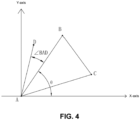
FIG. 4 is a schematic diagram of a vehicle D on the other side outside a triangle BAC according to the present invention; - The present invention will be further illustrated with reference to the accompanying drawings and the specific embodiments.
- The present invention will be further illustrated with reference to the accompanying drawings and the embodiments.
- In the descriptions of the present invention, it should be noted that an orientation or a position relationship indicated by a term "internal", "external", "upper", "lower", "one side", "the other side", "one end", "the other end", "edge", "relative", "four corners", "periphery", or an "o-shaped structure" is based on an orientation or a position relationship shown in the accompanying drawings, and is merely intended for ease of describing the present invention and simplifying description, but does not indicate or imply that the indicated structure has a specific orientation or be constructed and operated in a specific orientation. Therefore, such term shall not be understood as a limitation on the present invention.
- In addition, in the description of the present invention, unless otherwise stated, "a plurality of" means two or more than two. The term "and/or" describes an association relationship between associated objects and indicates that three relationships may exist. For example, A and/or B may indicate the following three cases: only A exists, both A and B exist, and only B exists.
- A vehicle auxiliary positioning method is provided. A vehicle A can periodically send position information of the vehicle A to the outside. When the vehicle A detects a vehicle D, and the vehicle D is not capable of sending position information of the vehicle D to the outside, the vehicle A requests an auxiliary unit B and an auxiliary unit C that are capable of detecting the vehicle D to assist in auxiliary and cooperative positioning within a communication range of the vehicle A. The auxiliary unit B may be a vehicle or a roadside unit, and the auxiliary unit C may be a vehicle or a roadside unit. Preferably, the auxiliary unit B and the auxiliary unit C are vehicles.
- The vehicle A, the auxiliary unit B, and the auxiliary unit C are all equipped with a V2X communication module and a detection module. By using the V2X communication module, positions of the vehicle A, the auxiliary unit B, and the auxiliary unit C that are highly precisely positioned are sent to the outside, that is, the vehicle A, the auxiliary unit B, and the auxiliary unit C can know actual position coordinates of the others. The detection module may be a detection device such as a camera or a radar configured to detect a straight-line distance from an external vehicle. The vehicle D does not have a related communication device or positioning module installed and cannot send position information of the vehicle D to the outside.
- In the present invention, the vehicle detects the presence of the vehicle D when driving, and a distance is AD, but does not know specific coordinates of the vehicle D, and therefore it is difficult to determine which lane the vehicle D is on. In this case, it is difficult to obtain precise position coordinates of the vehicle D only by using the vehicle A. Therefore, the vehicle A uses the V2X communication and requests another vehicle or roadside unit that is also provided with the V2X communication near a current position and can independently detect a distance from the vehicle D to assist in positioning.
- In this example scenario, the auxiliary unit B and the auxiliary unit C are within a range of the V2X communication near the vehicle A, and can detect a distance BD between the vehicle D and the auxiliary unit B and a distance CD a distance between the vehicle D and the auxiliary unit C separately. In addition, for the vehicle A, auxiliary positioning can be implemented in a case that positions of the auxiliary unit B and the auxiliary unit C are farther than a position of the vehicle D, or definitely, positions of the auxiliary unit B and the auxiliary unit C are closer than a position of the vehicle D. Therefore, the auxiliary unit B and the auxiliary unit C can send the distances BD, CD and the precise coordinates of the auxiliary unit B and auxiliary unit C to the vehicle A in response to the cooperative positioning request of the vehicle A. In addition, due to the extremely high real time performance of the V2X communication, after the vehicle A receives the coordinates and related distances of the auxiliary unit B and auxiliary unit C, relative movement of the vehicles during information transmission, and the coordinates and related distances are used current coordinates and distances.
- That the vehicle A of the present invention uses the auxiliary unit B and auxiliary unit C to assist in auxiliary and cooperative positioning includes the following steps.
- First, it is determined whether the vehicle D is located on a straight line on which the vehicle A and the auxiliary unit B or auxiliary unit C are located. If the vehicle D is located on the straight line on which the vehicle A and the auxiliary unit B or auxiliary unit C are located, coordinates of the vehicle D are determined based on coordinates of the vehicle A, a distance between the vehicle A and the vehicle D, and a direction of a connection line between the vehicle A and the auxiliary unit B or the auxiliary unit C. If the vehicle D is not located on the straight line on which the vehicle A and the auxiliary unit B or auxiliary unit C are located, it is determined whether there are triangular relationships among the vehicle A, the vehicle D, and the auxiliary unit B and among the vehicle A, the vehicle D, and the auxiliary unit C separately. If there are the triangular relationships, the coordinates of vehicle D are calculated according to a sine theorem and cosine theorem for a triangle.
- Specifically, the vehicle A may obtain a distance between the vehicle A and the vehicle D as AD, a distance between the vehicle A and the auxiliary unit B as AB, a distance between the vehicle A and the auxiliary unit C as AC, a distance between the auxiliary unit B and the vehicle D as BD, and a distance between the auxiliary unit C and the vehicle D as CD, and it is determined as follows:
it is determined whether AD+BD is equal to AB, or whether AD+CD is equal to AC. When AD+BD is equal to AB, the vehicle D is located on a straight line on which the vehicle A and the auxiliary unit B is located. When AD+CD is equal to AC, the vehicle D is located on a straight line on which the vehicle A and the auxiliary unit C are located. Based on the coordinates of the vehicle A, the distance AD between the vehicle A and the vehicle D, and the direction of the connection line between the vehicle A and the auxiliary unit B or the auxiliary unit C, coordinates (Xd,Yd ) of the vehicle D are determined. A common rectangular coordinate system is used as an example, and then coordinates of the vehicle D are as follows:

- When AD+BD is not equal to AB and AD+CD is not equal to AC, it is determined whether there are the triangular relationships among the vehicle A, the vehicle D, and the auxiliary unit B and among the vehicle A, the vehicle D, and the auxiliary unit C separately. Specifically, it is determined whether AD+BD is greater than AB and whether AD+CD is greater than AC. If AD+BD is greater than AB and AD+CD is greater than AC, there is a triangular relationship among the vehicle A, the vehicle D, and the auxiliary unit B, so that a triangle ADB can be formed, and there is a triangular relationship among the vehicle A, the vehicle D, and the auxiliary unit C, so that a triangle ADC can be formed. In addition, there is also a triangular relationship among the vehicle A, the auxiliary unit B, and the auxiliary unit C, so that a triangle ABC can be formed.
- If it is determined that AD+BD is less than AB or AD+CD is less than AC, it means there is a measurement error, and auxiliary and cooperative positioning cannot be performed.
- In a case that the above trigonometric relationship is met, calculating the position coordinates of the vehicle D according to the sine theorem and cosine theorem for a triangle specifically includes the following: first, inner angles ∠BAC, ∠DAC, and ∠BAD of the triangle are calculated according to the cosine theorem or the sine theorem. Based on the calculated inner angles, it is determined whether the vehicle D is located inside or outside the triangle BAC formed by the vehicle A, the auxiliary unit B, and the auxiliary unit C; then, coordinates of the vehicle D are calculated.
- The cosine theorem for the triangle is used as an example, the triangle ABC has cos∠BAC=(AC2+AB2-BC2) /(2*AC*AB), a triangle ADC has cos∠DAC=(AC2+AD2-DC2) /(2*AC*AD), and a triangle ADB has cos∠BAD=(AB2+AD2-DB2) /(2*AC*AD), so that the inners angles ∠BAC, ∠DAC and ∠BAD are obtained through calculation for further determining.
- When ∠BAD+∠DAC = ∠BAC, it means that the vehicle D is located inside the triangle BAC. Refer to
FIG. 2 . The position of the vehicle D is a position at which the coordinates of the vehicle A are used as a start point and a connection line between the vehicle A and the auxiliary unit B rotates at an angle ∠BAD in a direction closer to the auxiliary unit C at a distance of AD. - Specifically, a common rectangular coordinate system is used as an example, and it is assumed that the coordinates of the vehicle A are (Xa,Ya ) , then the coordinates (Xd,Yd ) of the vehicle D are:


- When ∠BAC+∠DAC = ∠BAD, it means that the vehicle D is located on an outer side of a connection line between the vehicle A and the auxiliary unit C outside the triangle BAC. Refer to
FIG. 3 . The position of the vehicle D is a position at which the coordinates of the vehicle A are used as a start point and a connection line between the vehicle A and the auxiliary unit B rotates at an angle ∠BAD in a direction closer to the auxiliary unit C at a distance of AD. - Specifically, a common rectangular coordinate system is used as an example, and it is assumed that the coordinates of the vehicle A are (Xa,Ya ) , then the coordinates (Xd,Yd ) of the vehicle D are:


- When ∠BAC+∠BAD = ∠DAC, it means that the vehicle D is located on an outer side of a connection line between the vehicle A and the auxiliary unit B outside the triangle BAC. Refer to
FIG. 4 . The position of the vehicle D is a position at which a connection line between the vehicle A and the auxiliary unit B rotates at an angle ∠BAD in a direction away from the auxiliary unit C at a distance of AD. - Specifically, a common rectangular coordinate system is used as an example, and it is assumed that the coordinates of the vehicle A are (Xa,Ya ), then the coordinates (Xd,Yd ) of the vehicle D are:


- The present invention further proposes a vehicle auxiliary positioning apparatus, which is installed on a vehicle A and includes:
- a positioning module, configured to detect position information of the vehicle A, which may be a Beidou positioning module or a GPS positioning module;
- a V2X communication module, configured to periodically send position information of the vehicle A to the outside, which may be a 5G V2X communication module and has extremely high real-time performance;
- a detection module, configured to detect a straight-line distance from an external vehicle, where the detection module may be a camera module or a radar module; and
- a determining and calculating module, which uses one of the above vehicle auxiliary positioning method to obtain position coordinates of a vehicle D.
- The above are only specific implementations of the present invention, but the design concept of the present invention is not limited thereto. Any non-substantive changes to the present invention using this concept shall constitute an infringement on the protection scope of the present invention.
- For the vehicle auxiliary positioning method and apparatus of the present invention, the vehicle A, the auxiliary unit B, and the auxiliary unit C are all equipped with the V2X communication module and the detection module. Positions for high-precision positioning thereof are sent to the outside by using the V2X communication module, that is, the vehicle A, the auxiliary unit B, and the auxiliary unit C can know actual position coordinates of the others. The detection module may be a detection device such as a camera or a radar to detect a straight-line distance from an external vehicle. Positioning data and a test distance are analyzed, determined, and calculated, so that a vehicle not equipped with 5G communication may be accurately positioned. According to the present invention, data is transmitted between a vehicle and an auxiliary unit by using the V2X communication module, so that the amount of transmitted data is small, the influence on a load of the V2X communication is small, a calculation method is simple, the requirements for a controller are not high, and large-scale promotion and application are easy to implement. By using the 5G communication and vehicle-mounted apparatus, the present invention is easy to implement in industry, and modules such as the positioning module, the V2X communication module, the detection module, and the determining and calculating module are also easy to manufacture in industry.
Claims (10)
- A vehicle auxiliary positioning method, characterized by comprising: periodically sending, by a vehicle A, position information of the vehicle A to the outside; when the vehicle A detects a vehicle D, and the vehicle D is not capable of sending position information of the vehicle D to the outside, requesting, by the vehicle A, an auxiliary unit B and an auxiliary unit C that are capable of detecting the vehicle D to assist in auxiliary and cooperative positioning within a communication range of the vehicle A, where the auxiliary unit B and the auxiliary unit C are vehicles or roadside units, first, determining whether the vehicle D is located on a straight line or an extended line on which the vehicle A and the auxiliary unit B or auxiliary unit C are located, if the vehicle D is located on the straight line or extended line on which the vehicle A and the auxiliary unit B or auxiliary unit C are located, determining coordinates of the vehicle D based on coordinates of the vehicle A, a distance between the vehicle A and the vehicle D, and a direction of a connection line between the vehicle A and the auxiliary unit B or the auxiliary unit C; if the vehicle D is not located on the straight line or extended line on which the vehicle A and the auxiliary unit B or auxiliary unit C are located, determining whether there are triangular relationships among the vehicle A, the vehicle D, and the auxiliary unit B and among the vehicle A, the vehicle D, and the auxiliary unit C separately, if there are the triangular relationships, calculating coordinates of the vehicle D according to a sine theorem or cosine theorem for a triangle.
- The vehicle auxiliary positioning method according to claim 1, characterized by comprising: acquiring a distance AD between the vehicle A and the vehicle D, a distance AB between the vehicle A and the auxiliary unit B, a distance AC between the vehicle A and the auxiliary unit C, a distance BD between the auxiliary unit B and the vehicle D, and a distance CD between the auxiliary unit C and the vehicle D, wherein when AD+BD is equal to AB or AB+BD is equal to AD, the vehicle D is located on a straight line or extended line on which the vehicle A and the auxiliary unit B are located, and when AD+CD is equal to AC or AC+CD is equal to AD, the vehicle D is located on a straight line or extended line on which the vehicle A and the auxiliary unit C are located.
- The vehicle auxiliary positioning method according to claim 2, characterized by further comprising: determining whether AD+BD is less than AB or AD+CD is less than AC, wherein if it is determined that AD+BD is less than AB or AD+CD is less than AC, it means there is a measurement error, and auxiliary and cooperative positioning cannot be performed.
- The vehicle auxiliary positioning method according to claim 1, characterized in that the determining coordinates (Xd ,Yd ) of the vehicle D based on coordinates of the vehicle A, a distance between the vehicle A and the vehicle D, and a direction of a connection line between the vehicle A and the auxiliary unit B or the auxiliary unit C is specifically:


- The vehicle auxiliary positioning method according to claim 2, characterized in that the determining whether there are triangular relationships among the vehicle A, the vehicle D, and the auxiliary unit B and among the vehicle A, the vehicle D, and the auxiliary unit C separately is specifically, determining whether AD+BD is greater than AB and whether AD+CD is greater than AC, if AD+BD is greater than AB and AD+CD is greater than AC, there is a triangular relationship among the vehicle A, the vehicle D, and the auxiliary unit B and there is a triangular relationship among the vehicle A, the vehicle D, and the auxiliary unit C.
- The vehicle auxiliary positioning method according to claim 5, characterized in that the calculating position coordinates of the vehicle D according to a sine theorem and cosine theorem for a triangle specifically comprises: first, calculating inner angles ∠BAC, ∠DAC, and ∠BAD of the triangle according to the cosine theorem or the sine theorem, and determining whether the vehicle D is located inside or outside a triangle BAC formed by the vehicle A, the auxiliary unit B, and the auxiliary unit C based on the calculated inner angles; then, calculating the coordinates of the vehicle D.
- The vehicle auxiliary positioning method according to claim 6, characterized in that when ∠BAD+∠DAC = ∠BAC, it means that the vehicle D is located on an outer side of a connection line between the auxiliary unit B and the auxiliary unit C inside the triangle BAC or outside the triangle BAC, and the position of the vehicle D is a position at which the coordinates of the vehicle A are used as a start point and a connection line between the vehicle A and the auxiliary unit B rotates at an angle ∠BAD in a direction closer to the auxiliary unit C at a distance of AD.
- The vehicle auxiliary positioning method according to claim 6, characterized in that when ∠BAC+∠DAC = ∠BAD, it means that the vehicle D is located on an outer side of a connection line between the vehicle A and the auxiliary unit C outside the triangle BAC, and the position of the vehicle D is a position at which the coordinates of the vehicle A are used as a start point and a connection line between the vehicle A and the auxiliary unit B rotates at an angle ∠BAD in a direction closer to the auxiliary unit C at a distance of AD.
- The vehicle auxiliary positioning method according to claim 6, characterized in that when ∠BAC+∠BAD = ∠DAC, it means that the vehicle D is located on an outer side of a connection line between the vehicle A and the auxiliary unit B outside the triangle BAC, and the position of the vehicle D is a position at which a connection line between the vehicle A and the auxiliary unit B rotates at an angle ∠BAD in a direction away from the auxiliary unit C at a distance of AD.
- A vehicle auxiliary positioning apparatus, installed on a vehicle A, characterized by comprising:a positioning module, configured to detect position information of the vehicle A;a V2X communication module, configured to periodically send position information of the vehicle A to the outside;a detection module, configured to detect a straight-line distance from an external vehicle; anda determining and calculating module, which uses the vehicle auxiliary positioning method according to any one of claims 1 to 9, to obtain position coordinates of a vehicle D.
Applications Claiming Priority (2)
| Application Number | Priority Date | Filing Date | Title |
|---|---|---|---|
| CN202210499414.8A CN117075170A (en) | 2022-05-09 | 2022-05-09 | A vehicle auxiliary positioning method and device |
| PCT/CN2022/127812 WO2023216520A1 (en) | 2022-05-09 | 2022-10-27 | Assisted vehicle positioning method and apparatus |
Publications (2)
| Publication Number | Publication Date |
|---|---|
| EP4474768A1 true EP4474768A1 (en) | 2024-12-11 |
| EP4474768A4 EP4474768A4 (en) | 2026-01-21 |
Family
ID=88704839
Family Applications (1)
| Application Number | Title | Priority Date | Filing Date |
|---|---|---|---|
| EP22941457.8A Pending EP4474768A4 (en) | 2022-05-09 | 2022-10-27 | METHOD AND DEVICE FOR SUPPORTED VEHICLE POSITIONING |
Country Status (4)
| Country | Link |
|---|---|
| US (1) | US20250271566A1 (en) |
| EP (1) | EP4474768A4 (en) |
| CN (1) | CN117075170A (en) |
| WO (1) | WO2023216520A1 (en) |
Family Cites Families (8)
| Publication number | Priority date | Publication date | Assignee | Title |
|---|---|---|---|---|
| US8154422B2 (en) * | 2009-07-24 | 2012-04-10 | Automotive Research & Testing Center | Vehicle collision avoidance system and method |
| CN106767783A (en) * | 2016-12-15 | 2017-05-31 | 东软集团股份有限公司 | Positioning correction method and device based on vehicle-carrying communication |
| CN108345020B (en) * | 2018-02-09 | 2020-08-18 | 长沙智能驾驶研究院有限公司 | Vehicle positioning method, system and computer readable storage medium |
| CN108535753A (en) * | 2018-03-30 | 2018-09-14 | 北京百度网讯科技有限公司 | Vehicle positioning method, device and equipment |
| CN110798793B (en) * | 2019-08-23 | 2022-08-05 | 腾讯科技(深圳)有限公司 | Method and device for determining relative position between vehicles |
| CN112346103A (en) * | 2020-10-29 | 2021-02-09 | 清华大学 | V2X-based intelligent networking automobile dynamic co-location method and device |
| CN112859861B (en) * | 2021-01-15 | 2024-08-23 | 深圳壹智云科技有限公司 | Automatic robot recharging system and method based on auxiliary positioning |
| CN113674551A (en) * | 2021-08-05 | 2021-11-19 | 东风汽车集团股份有限公司 | Vehicle forward collision early warning method and system based on vehicle-road cooperation |
-
2022
- 2022-05-09 CN CN202210499414.8A patent/CN117075170A/en active Pending
- 2022-10-27 WO PCT/CN2022/127812 patent/WO2023216520A1/en not_active Ceased
- 2022-10-27 EP EP22941457.8A patent/EP4474768A4/en active Pending
- 2022-10-27 US US18/705,728 patent/US20250271566A1/en active Pending
Also Published As
| Publication number | Publication date |
|---|---|
| CN117075170A (en) | 2023-11-17 |
| US20250271566A1 (en) | 2025-08-28 |
| WO2023216520A1 (en) | 2023-11-16 |
| EP4474768A4 (en) | 2026-01-21 |
Similar Documents
| Publication | Publication Date | Title |
|---|---|---|
| US11486988B2 (en) | Method for calibrating the alignment of a moving object sensor | |
| US8200424B2 (en) | Navigation device | |
| CN112748421B (en) | Laser radar calibration method based on automatic driving of straight road section | |
| CN110906939A (en) | Automatic driving positioning method and device, electronic equipment, storage medium and automobile | |
| JP6669059B2 (en) | Position calculation device | |
| CN112995899A (en) | Vehicle-road cooperative positioning method and device, vehicle-mounted positioning system and road side equipment | |
| JP2002228749A (en) | In-vehicle millimeter-wave radar device | |
| CN102853762A (en) | Method for measuring central position of steel coil | |
| CN113093130A (en) | Radar two-dimensional installation attitude calibration method and system based on global positioning system target | |
| CN110147103A (en) | Lane positioning method of self-driving container trucks in the area of quay cranes | |
| CN105066988A (en) | Magnetic strip deviation angle measurement method based on high precision magnetic navigation sensor | |
| CN111380546A (en) | Vehicle positioning method and device based on parallel road, electronic equipment and medium | |
| CN109353339B (en) | Vehicle navigation method and system | |
| CN108340922A (en) | The method and apparatus for determining road surface road conditions | |
| CN110855789B (en) | Position relation determining method and device, storage medium and equipment | |
| US20250271566A1 (en) | Vehicle auxiliary positioning method and apparatus | |
| CN114428251A (en) | Method and device for determining accuracy of radar measurement | |
| CN115712091B (en) | Radar calibration and radar true north calibration method | |
| CN217058720U (en) | Pipe ring roundness measuring device | |
| JP2007212418A (en) | On-vehicle radar device | |
| CN109764874A (en) | A kind of substation inspection vehicle autonomous navigation method | |
| CN110345967A (en) | Vehicle positioning method, apparatus and system based on mileage indicant | |
| US20220208003A1 (en) | Mobile body and control method for mobile body | |
| CN114264305A (en) | Intelligent prejudging method for Beidou navigation channel in inland river blind area | |
| CN114485708B (en) | Unmanned vehicle path planning method, unmanned vehicle path planning system, electronic equipment and storage medium |
Legal Events
| Date | Code | Title | Description |
|---|---|---|---|
| STAA | Information on the status of an ep patent application or granted ep patent |
Free format text: STATUS: THE INTERNATIONAL PUBLICATION HAS BEEN MADE |
|
| PUAI | Public reference made under article 153(3) epc to a published international application that has entered the european phase |
Free format text: ORIGINAL CODE: 0009012 |
|
| STAA | Information on the status of an ep patent application or granted ep patent |
Free format text: STATUS: REQUEST FOR EXAMINATION WAS MADE |
|
| 17P | Request for examination filed |
Effective date: 20240626 |
|
| AK | Designated contracting states |
Kind code of ref document: A1 Designated state(s): AL AT BE BG CH CY CZ DE DK EE ES FI FR GB GR HR HU IE IS IT LI LT LU LV MC ME MK MT NL NO PL PT RO RS SE SI SK SM TR |
|
| DAV | Request for validation of the european patent (deleted) | ||
| DAX | Request for extension of the european patent (deleted) | ||
| A4 | Supplementary search report drawn up and despatched |
Effective date: 20251219 |
|
| RIC1 | Information provided on ipc code assigned before grant |
Ipc: G01C 21/20 20060101AFI20251215BHEP Ipc: G01S 5/02 20100101ALI20251215BHEP |