EP4474692A1 - Vehicle projection lamp having improved image clarity - Google Patents
Vehicle projection lamp having improved image clarity Download PDFInfo
- Publication number
- EP4474692A1 EP4474692A1 EP23880102.1A EP23880102A EP4474692A1 EP 4474692 A1 EP4474692 A1 EP 4474692A1 EP 23880102 A EP23880102 A EP 23880102A EP 4474692 A1 EP4474692 A1 EP 4474692A1
- Authority
- EP
- European Patent Office
- Prior art keywords
- light source
- lens array
- projection lamp
- light
- array unit
- Prior art date
- Legal status (The legal status is an assumption and is not a legal conclusion. Google has not performed a legal analysis and makes no representation as to the accuracy of the status listed.)
- Pending
Links
Images


Classifications
-
- F—MECHANICAL ENGINEERING; LIGHTING; HEATING; WEAPONS; BLASTING
- F21—LIGHTING
- F21S—NON-PORTABLE LIGHTING DEVICES; SYSTEMS THEREOF; VEHICLE LIGHTING DEVICES SPECIALLY ADAPTED FOR VEHICLE EXTERIORS
- F21S41/00—Illuminating devices specially adapted for vehicle exteriors, e.g. headlamps
- F21S41/20—Illuminating devices specially adapted for vehicle exteriors, e.g. headlamps characterised by refractors, transparent cover plates, light guides or filters
- F21S41/25—Projection lenses
- F21S41/265—Composite lenses; Lenses with a patch-like shape
-
- F—MECHANICAL ENGINEERING; LIGHTING; HEATING; WEAPONS; BLASTING
- F21—LIGHTING
- F21S—NON-PORTABLE LIGHTING DEVICES; SYSTEMS THEREOF; VEHICLE LIGHTING DEVICES SPECIALLY ADAPTED FOR VEHICLE EXTERIORS
- F21S43/00—Signalling devices specially adapted for vehicle exteriors, e.g. brake lamps, direction indicator lights or reversing lights
- F21S43/20—Signalling devices specially adapted for vehicle exteriors, e.g. brake lamps, direction indicator lights or reversing lights characterised by refractors, transparent cover plates, light guides or filters
- F21S43/2605—Refractors
- F21S43/2621—Refractors characterised by the properties of the light beam shaping surface
- F21S43/26271—Refractors characterised by the properties of the light beam shaping surface using micro-optics, e.g. micro-lenses or micro-structures
-
- F—MECHANICAL ENGINEERING; LIGHTING; HEATING; WEAPONS; BLASTING
- F21—LIGHTING
- F21S—NON-PORTABLE LIGHTING DEVICES; SYSTEMS THEREOF; VEHICLE LIGHTING DEVICES SPECIALLY ADAPTED FOR VEHICLE EXTERIORS
- F21S41/00—Illuminating devices specially adapted for vehicle exteriors, e.g. headlamps
- F21S41/10—Illuminating devices specially adapted for vehicle exteriors, e.g. headlamps characterised by the light source
- F21S41/14—Illuminating devices specially adapted for vehicle exteriors, e.g. headlamps characterised by the light source characterised by the type of light source
- F21S41/141—Light emitting diodes [LED]
- F21S41/143—Light emitting diodes [LED] the main emission direction of the LED being parallel to the optical axis of the illuminating device
-
- F—MECHANICAL ENGINEERING; LIGHTING; HEATING; WEAPONS; BLASTING
- F21—LIGHTING
- F21S—NON-PORTABLE LIGHTING DEVICES; SYSTEMS THEREOF; VEHICLE LIGHTING DEVICES SPECIALLY ADAPTED FOR VEHICLE EXTERIORS
- F21S41/00—Illuminating devices specially adapted for vehicle exteriors, e.g. headlamps
- F21S41/10—Illuminating devices specially adapted for vehicle exteriors, e.g. headlamps characterised by the light source
- F21S41/14—Illuminating devices specially adapted for vehicle exteriors, e.g. headlamps characterised by the light source characterised by the type of light source
- F21S41/141—Light emitting diodes [LED]
- F21S41/151—Light emitting diodes [LED] arranged in one or more lines
- F21S41/153—Light emitting diodes [LED] arranged in one or more lines arranged in a matrix
-
- F—MECHANICAL ENGINEERING; LIGHTING; HEATING; WEAPONS; BLASTING
- F21—LIGHTING
- F21S—NON-PORTABLE LIGHTING DEVICES; SYSTEMS THEREOF; VEHICLE LIGHTING DEVICES SPECIALLY ADAPTED FOR VEHICLE EXTERIORS
- F21S41/00—Illuminating devices specially adapted for vehicle exteriors, e.g. headlamps
- F21S41/20—Illuminating devices specially adapted for vehicle exteriors, e.g. headlamps characterised by refractors, transparent cover plates, light guides or filters
- F21S41/29—Attachment thereof
- F21S41/295—Attachment thereof specially adapted to projection lenses
-
- F—MECHANICAL ENGINEERING; LIGHTING; HEATING; WEAPONS; BLASTING
- F21—LIGHTING
- F21S—NON-PORTABLE LIGHTING DEVICES; SYSTEMS THEREOF; VEHICLE LIGHTING DEVICES SPECIALLY ADAPTED FOR VEHICLE EXTERIORS
- F21S43/00—Signalling devices specially adapted for vehicle exteriors, e.g. brake lamps, direction indicator lights or reversing lights
- F21S43/10—Signalling devices specially adapted for vehicle exteriors, e.g. brake lamps, direction indicator lights or reversing lights characterised by the light source
- F21S43/13—Signalling devices specially adapted for vehicle exteriors, e.g. brake lamps, direction indicator lights or reversing lights characterised by the light source characterised by the type of light source
- F21S43/14—Light emitting diodes [LED]
-
- F—MECHANICAL ENGINEERING; LIGHTING; HEATING; WEAPONS; BLASTING
- F21—LIGHTING
- F21S—NON-PORTABLE LIGHTING DEVICES; SYSTEMS THEREOF; VEHICLE LIGHTING DEVICES SPECIALLY ADAPTED FOR VEHICLE EXTERIORS
- F21S43/00—Signalling devices specially adapted for vehicle exteriors, e.g. brake lamps, direction indicator lights or reversing lights
- F21S43/20—Signalling devices specially adapted for vehicle exteriors, e.g. brake lamps, direction indicator lights or reversing lights characterised by refractors, transparent cover plates, light guides or filters
- F21S43/2605—Refractors
- F21S43/2621—Refractors characterised by the properties of the light beam shaping surface
- F21S43/26231—Refractors characterised by the properties of the light beam shaping surface collimating, focusing, condensing or projecting beams, e.g. projection lenses or Fresnel lenses
-
- F—MECHANICAL ENGINEERING; LIGHTING; HEATING; WEAPONS; BLASTING
- F21—LIGHTING
- F21S—NON-PORTABLE LIGHTING DEVICES; SYSTEMS THEREOF; VEHICLE LIGHTING DEVICES SPECIALLY ADAPTED FOR VEHICLE EXTERIORS
- F21S43/00—Signalling devices specially adapted for vehicle exteriors, e.g. brake lamps, direction indicator lights or reversing lights
- F21S43/20—Signalling devices specially adapted for vehicle exteriors, e.g. brake lamps, direction indicator lights or reversing lights characterised by refractors, transparent cover plates, light guides or filters
- F21S43/2605—Refractors
- F21S43/2641—Refractors or refracting portions characterised by their relative arrangement, e.g. parallel refractors
- F21S43/26411—Two or more successive refractors
-
- G—PHYSICS
- G02—OPTICS
- G02B—OPTICAL ELEMENTS, SYSTEMS OR APPARATUS
- G02B19/00—Condensers, e.g. light collectors or similar non-imaging optics
- G02B19/0004—Condensers, e.g. light collectors or similar non-imaging optics characterised by the optical means employed
- G02B19/0009—Condensers, e.g. light collectors or similar non-imaging optics characterised by the optical means employed having refractive surfaces only
-
- G—PHYSICS
- G02—OPTICS
- G02B—OPTICAL ELEMENTS, SYSTEMS OR APPARATUS
- G02B19/00—Condensers, e.g. light collectors or similar non-imaging optics
- G02B19/0033—Condensers, e.g. light collectors or similar non-imaging optics characterised by the use
- G02B19/0047—Condensers, e.g. light collectors or similar non-imaging optics characterised by the use for use with a light source
- G02B19/0061—Condensers, e.g. light collectors or similar non-imaging optics characterised by the use for use with a light source the light source comprising a LED
-
- G—PHYSICS
- G03—PHOTOGRAPHY; CINEMATOGRAPHY; ANALOGOUS TECHNIQUES USING WAVES OTHER THAN OPTICAL WAVES; ELECTROGRAPHY; HOLOGRAPHY
- G03B—APPARATUS OR ARRANGEMENTS FOR TAKING PHOTOGRAPHS OR FOR PROJECTING OR VIEWING THEM; APPARATUS OR ARRANGEMENTS EMPLOYING ANALOGOUS TECHNIQUES USING WAVES OTHER THAN OPTICAL WAVES; ACCESSORIES THEREFOR
- G03B21/00—Projectors or projection-type viewers; Accessories therefor
- G03B21/14—Details
- G03B21/145—Housing details, e.g. position adjustments thereof
-
- B—PERFORMING OPERATIONS; TRANSPORTING
- B60—VEHICLES IN GENERAL
- B60Q—ARRANGEMENT OF SIGNALLING OR LIGHTING DEVICES, THE MOUNTING OR SUPPORTING THEREOF OR CIRCUITS THEREFOR, FOR VEHICLES IN GENERAL
- B60Q2400/00—Special features or arrangements of exterior signal lamps for vehicles
- B60Q2400/50—Projected symbol or information, e.g. onto the road or car body
-
- F—MECHANICAL ENGINEERING; LIGHTING; HEATING; WEAPONS; BLASTING
- F21—LIGHTING
- F21W—INDEXING SCHEME ASSOCIATED WITH SUBCLASSES F21K, F21L, F21S and F21V, RELATING TO USES OR APPLICATIONS OF LIGHTING DEVICES OR SYSTEMS
- F21W2103/00—Exterior vehicle lighting devices for signalling purposes
- F21W2103/60—Projection of signs from lighting devices, e.g. symbols or information being projected onto the road
-
- F—MECHANICAL ENGINEERING; LIGHTING; HEATING; WEAPONS; BLASTING
- F21—LIGHTING
- F21W—INDEXING SCHEME ASSOCIATED WITH SUBCLASSES F21K, F21L, F21S and F21V, RELATING TO USES OR APPLICATIONS OF LIGHTING DEVICES OR SYSTEMS
- F21W2107/00—Use or application of lighting devices on or in particular types of vehicles
- F21W2107/10—Use or application of lighting devices on or in particular types of vehicles for land vehicles
Definitions
- the present disclosure relates to a vehicle projection lamp that improves the definition of an image to be output to the ground.
- Vehicle projection lamps are mounted in various locations of a vehicle, such as front and rear doors or a trunk, and output specific shapes or text to the ground.
- the vehicle projection lamps may output vehicle names, logos, or the like to improve identification and enhance an aesthetic sense.
- the vehicle projection lamps output shapes suitable for various situations so that drivers, passengers, or third parties may intuitively perceive the situations.
- Conventional vehicle projection lamps focus output light into a single focus on the ground by using an imaging lens and output the focused light. Accordingly, an output image is clearly observed within a certain radius based on the focus, but there is a problem in that the definition of the image is significantly reduced when it exceeds the radius.
- Embodiments of the present disclosure are directed to providing a vehicle projection lamp that reduces a distortion occurring in an image and improves the definition of the image when outputting the image to the ground.
- a projection lamp may include: a light source configured to emit light vertically upward according to a control signal; a substrate configured to allow the light source to be located thereon and to operate the light source by transmitting the control signal to the light source; a collimator located in front of the light source in a direction in which the light source emits the light, and configured to transform the light emitted by the light source into parallel light; a lens array unit configured to convert the light emitted by the light source into an image to be output, and to output the image to a ground or a floor; a fixing unit configured to fix the light source, the collimator, and the lens array unit disposed on the substrate and to prevent the light source, the collimator, and the lens array unit from moving; an upper housing configured to prevent the light source, the collimator, and the lens array unit in the projection lamp from being exposed to an external force and an external environment; and a lower housing coupled to the upper housing to dispose the light source, the collimator, and the lens array unit within
- one or more light sources are included.
- the collimator and the lens array unit are included in the same number as the number of light sources.
- the fixing unit has the same area and height as an area and a height when the light source, the collimator, and the lens array unit are layered.
- the fixing unit contacts an upper end surface of the upper housing through one side thereof while contacting the substrate through the other side thereof, and is fixed within the upper housing and the lower housing.
- the projection lamp further includes a spacer located in front of the collimator in the direction in which the light source emits the light, and configured to minimize interference between the light emitted by the light source.
- the spacer is disposed to surround a periphery of the collimator around an area through which the light travels in the collimator.
- the lens array unit outputs images diagonally to a ground or a floor.
- the lens array unit is divided into a plurality of sections.
- the projection lamp is mounted on a vehicle and operates.
- an aspect of the present disclosure has advantages in that it is possible to reduce a distortion occurring in an image and improve the definition of the image when outputting the image to the ground.
- Terms, such as a first, a second, A, and B, may be used to describe various components, but the components should not be restricted by the terms. The terms are used to only distinguish one component from another component. For example, a first component may be referred to as a second component without departing from the scope of rights of the present disclosure. Likewise, a second component may be referred to as a first component.
- the term "and/or" includes a combination of a plurality of related and described items or any one of a plurality of related and described items.
- one component When it is described that one component is “connected” or “coupled” to the other component, it should be understood that one component may be directly connected or coupled to the other component, but a third component may exist between the two components. In contrast, when it is described that one component is “directly connected to” or “directly coupled to” the other component, it should be understood that a third component does not exist between the two components.
- each construction, process, procedure, or method included in each embodiment of the present disclosure may be shared within a range in which the constructions, processes, procedures, or methods do not contradict each other technically.
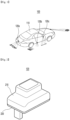
- FIG. 1 is a view illustrating an example of a vehicle mounted with a vehicle projection lamp according to an embodiment of the present disclosure.
- a vehicle projection lamp 120 such as a vehicle lamp 120a, 120b, or 120c, is disposed at various positions facing the ground or floor within a vehicle 110, and outputs an image toward the ground or floor.
- the lamp 120 outputs, as images, vehicle's logos, phrases including specific information, or shapes representing various situations or information toward the ground or floor at various positions of the vehicle 110.
- the lamp 120 may output a high-definition image toward the ground or floor even though the lamp 120 is not necessarily located vertically above the ground or floor within the vehicle 110.
- FIG. 1 illustrates that the lamp 120 is mounted on the vehicle 110 for convenience; however, the lamp 120 is not necessarily limited thereto.
- the vehicle 110 may be replaced with any means of transportation as long as it moves on the ground, such as a train.
- FIG. 2 is a perspective view of the vehicle projection lamp according to an embodiment of the present disclosure
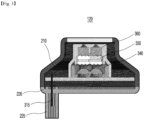
- FIG. 3 is a cross-sectional view of the vehicle projection lamp according to an embodiment of the present disclosure
- FIG. 4 is an exploded perspective view of the vehicle projection lamp according to an embodiment of the present disclosure.
- the lamp 120 includes an upper housing 210, a lower housing 220, a substrate 310, a light source 320, a collimator 330, a spacer 340, a lens array unit 350, and a fixing unit 360.
- the upper housing 210 prevents each component in the lamp 120, except the housing, from being exposed to an external force and an external environment.
- the upper housing 210 prevents each component within the lamp 120, except for the housing, from being exposed to the external environment, especially moisture. Since the bottom of the upper housing 210 facing the lower housing 220 is in an open state, the upper housing 210 may allow each component in the lamp 120, except for the housing, to be accommodated therein, and allow the lower housing 220 to be coupled to the bottom of the upper housing 210.
- the upper housing 210 may be implemented in any structure as long as it has an area within which each component of the lamp 120, except for the housing, can be disposed therein.
- the lower housing 220 is coupled to the upper housing 210, so that each component in the lamp 120, except for the housing, is disposed inside the housings 210 and 220 and the substrate 310 and an external control unit may be electrically connected to each other.
- An upper surface (surface facing the upper housing) of the lower housing 220 has an area sufficient for seating each component in the lamp 120 except for the housing. Accordingly, each component in the lamp 120, except for the housing, may be disposed inside the housings 210 and 220.
- the lower housing 220 is laser-fused to the bottom of the upper housing 210, the external environment, especially moisture, is separated from each component inside the housing.
- the lower housing 220 includes a protrusion 225 that protrudes at one position from a lower surface of the housing 220.
- a connector 315 electrically coupled to the substrate 310 is disposed in the protrusion 225.
- the connector 315 electrically coupled to the substrate 310 is disposed up to a position inside the protrusion 225, and a connector (not illustrated) having a shape complementary to the connector 315 may be inserted into the protrusion 225 from the outside and electrically coupled.
- the connector may be electrically connected to an electronic control unit (ECU; not illustrated)) and may transmit control signals from the ECU to the substrate 310.
- ECU electronice control unit
- the lower housing 220 includes the protrusion 225 so that both the connector 315 and the connector (not illustrated) may be electrically connected within the protrusion 225. As both the connectors are electrically connected, the ECU (not illustrated) may control the operation of each component within the lamp 120. Although not illustrated in FIG. 3 , since a rubber packing with the same diameter as the diameter of the protrusion 225 may exist outside the connector (not illustrated), when the connector (not illustrated) is coupled to the connector 315, the protrusion 225 may also be prevented from being exposed to the external environment, especially moisture.
- the substrate 310 allows the light source 320 to be located thereon and operates the light source 320 according to a control signal transmitted through the connector 315.
- the light source 320 emits light vertically upward according to the control signal transmitted through the connector 315 and the substrate 310.
- One or more light sources 320 are included in the lamp 120, and the number of collimators 330, the number of spacers 340, and the number of lens array units 350 are determined equally according to the number of light sources 320.
- the light source 320 emits light vertically upward (direction in which the lens array unit is located) according to the control signal.
- the collimator 330 is located in front of the light source 320 in the direction in which the light source 320 emits light, and transforms the light emitted by the light source 320 into parallel light.
- the light emitted by the light source 320 is inevitably physically dispersed and emitted. Accordingly, the collimator 330 is located in front of the light source 320 in the direction in which the light source 320 emits the light, and transforms the light emitted by the light source 320 into parallel light.
- a plurality of light sources 320 are included in the lamp 120
- a plurality of collimators 330 are also included in the lamp 120 and transform light emitted by the light sources 320 into parallel light, respectively.
- the spacer 340 is located in front of the collimator 330 in the direction in which the light source 320 emits the light, and minimizes interference between the light emitted by the light source 320. Even though the collimator 330 adjusts a path to parallel light, it is difficult to transform the light into complete parallel light. Accordingly, the spacer 340 is disposed to surround the periphery of the collimator 330 around an area through which light travels in the collimator 330, thereby blocking light other than the parallel light. The spacer 340 may be more meaningful especially when at least two light sources 320 are disposed.
- the lens array unit 350 is located in front of the collimator 330 in the direction in which the light source 320 emits the light, converts the light emitted by the light source 320 into an image to be output, and outputs the image to the ground or floor. In such a case, the lens array unit 350 may be disposed at a preset angle with the ground or floor to output an image at a preset angle with the ground or floor.
- a plurality of lens array units 350 may be included in the lamp 120. When the plurality of lens array units 350 are included in the lamp 120, the lens array units 350 may receive light emitted by the light sources 320 and convert the light into different images. For example, when the lamp 120 includes four light sources 320 and four lens array units 350, light emitted from the light sources 320 may be incident on the lens array units 350, and the lens array units 350 may convert the incident light into different images and output the different images.
- the lens array unit 350 is divided into a plurality of sections and focuses an image at a different focus for each section. Accordingly, the image output to the ground or floor may have uniform definition over an entire area, and an image without distortion may be output even though the image is output diagonally.
- the lens array unit 350 may be implemented with a micro lens array (MLA), but is not necessarily limited thereto, and may be replaced with any configuration as long as a light path can be adjusted differently for each part.
- MLA micro lens array
- the fixing unit 360 fixes the components 320, 330, 340, and 350 disposed on the substrate 310 and prevents the components from moving.
- the fixing unit 360 has the same area and height as the area and height when the light source 320, the collimator 330, the spacer 340, and the lens array unit 350 are layered therein. Accordingly, the fixing unit 360 disposes and fixes the light source 320, the collimator 330, the spacer 340, and the lens array unit 350 therein.
- the fixing unit 360 contacts the upper end (inner) surface of the upper housing 210 through one side thereof while contacting the substrate 310 through the other side thereof, and is fixed within the housings 210 and 220.
- the fixing unit 360 may be fixed within the housings 210 and 220, and may fix all the components of the lamp 120 by fixing the light source 320, the collimator 330, the spacer 340, and the lens array unit 350 therein.
- FIGS. 5A and 5B are views illustrating a configuration of a lens array unit according to an embodiment of the present disclosure
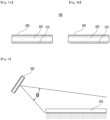
- FIG. 6 is a schematic view illustrating a state in which an image is output to the ground through the lens array unit in the vehicle projection lamp according to an embodiment of the present disclosure
- FIG. 7 is a schematic view illustrating a state in which images are output at respective positions of the lens array unit according to an embodiment of the present disclosure
- FIG. 8 is a view illustrating images output from respective positions of the lens array unit according to an embodiment of the present disclosure.
- the lens array unit 350 includes a lower lens array 510 and an upper lens array 530.
- the lens array unit 350 may further include an image film 520.
- the lower lens array 510 serves as a lens array at a position where the incident light is first received from vertically downward
- the upper lens array 530 serves as an array that emits the light having passed through the lower lens array 510 to the floor or ground.
- a plurality of lenses are disposed in a planar array.
- the same number of lenses are disposed in the lower lens array 510 and the upper lens array 530, wherein lenses facing each other between both the lens arrays 510 and 530 may be disposed on the same optical axis as illustrated in FIG. 5A or may be disposed so that the optical axes thereof are slightly twisted as being away outward from the center of the lens array unit 350.
- the lenses facing each other are disposed on the same optical axis as illustrated in FIG. 5A , alignment between both the lens arrays 510 and 530 becomes easy.
- the collimator 330 is disposed, it is difficult to perfectly make light emitted by the light source 320 into parallel light.
- both the lens arrays 510 and 530 may more smoothly adjust the path of light incident on the lens array unit 350 through the collimator 330.
- the lens array unit 350 may include an image conversion unit (not illustrated) that converts incident light into an image.
- the image conversion unit (not illustrated) may be implemented in the form of a transparent medium such as the image film 520, or may be implemented in a form in which an image is engraved on the bottom of a lens array, especially the upper lens array 530.
- the incident light passes through the image engraved on the bottom of the upper lens array 530 or passes through the image film 520, and is output in the form of an image.
- an image 610 converted by both the lens arrays 510 and 530 and the image conversion unit has a preset angle, and is obliquely output to the ground or floor.
- the image conversion unit in outputting an image, when each lens in the lens arrays 510 and 530 outputs the image with the same focus, a clear image is output at the focus and an area within a preset radius from the focus, but when it exceeds the preset radius, an image with relatively low definition is output.
- an area of the image 610 to be output is not relatively large, the above-mentioned situation is not problematic. However, when the area of the image 610 to be output is relatively large, only a part of the image is clear and the remaining part is blurred.
- each of the lens arrays 510 and 530 is divided into a plurality of sections and focuses an image to a different part for each section.
- First sections 510a and 530a include lenses located at the centers of the lens arrays 510 and 530 or lenses within a preset radius from the lenses located at the centers, respectively. Since light incident on the lens array unit 350 has a Gaussian distribution of intensity, light with a relatively strong intensity is incident on the first sections 510a and 530a compared to other sections. Accordingly, the first sections 510a and 530a focus a converted image to a position 610a that is relatively farthest from the lens array unit 350.
- the farthest position of the image may mean the position 610a located farthest from the lens array unit 350 when the image 610 is divided by the number of sections.
- Second sections 510b and 530b include a predetermined number of lenses located farther from the centers of the lens arrays 510 and 530 than the first sections 510a and 530a, respectively. Light with a relatively weaker intensity is incident on the second sections 510b and 530b than on the first sections 510a and 530a. Accordingly, the second sections 510b and 530b focus a converted image to a position 610b that is relatively closer to the lens array unit 350 than the position 610a focused by the first section 510a and 530a.
- the first sections 510a and 530a where light with the strongest intensity is incident, focus the image to a position farthest from the lens array unit 350, and a section farther away from the center based on the first sections 510a and 530a focuses the image to a position closer to the lens array unit 350.
- Each of the lens arrays 510 and 530 includes a plurality of sections and focuses an image to a different position for each section, so that the image 610 such as 610a, 610b, 610c can have uniform definition in all areas.
- the image conversion unit converts images differently for each section.
- the images output from the first sections 510a and 530a are output at the position farthest from the lens array unit 350, as described above with reference to FIG. 7 .
- the images output from the first sections 510a and 530a each have the greatest width at a part to be output at a position farthest from the lens array unit 350, and have a smaller width as being closer to the lens array unit 350.
- an image output from a corresponding section becomes thicker as being closer to the lens array unit 350.
- an image output from each of the first sections 510a and 530a has the greatest width at a part to be output at a position farthest from the lens array unit 350, and has a smaller width as being closer to the lens array unit 350.
- An image output from each of third sections 510c and 530c has the greatest width at a part to be output at a position closest to the lens array unit 350, and has a smaller width as being away from the lens array unit 350.
- An image output from each of the second sections 510b and 530b has an intermediate form between the images output from the first sections 510a and 530a and the images output from the third sections 510c and 530c. In this way, by outputting images of different shapes for each section, especially images with different widths depending on the distance from the lens array unit 350, distortion of the shape of the finally output image 610 can be minimized.
Landscapes
- Engineering & Computer Science (AREA)
- Physics & Mathematics (AREA)
- General Engineering & Computer Science (AREA)
- Optics & Photonics (AREA)
- Microelectronics & Electronic Packaging (AREA)
- General Physics & Mathematics (AREA)
- Mathematical Physics (AREA)
- Non-Portable Lighting Devices Or Systems Thereof (AREA)
Abstract
Description
- The present application is a continuation of International Application No.
PCT/KR2023/015588 Korean Patent Application No. 10-2022-0136722, filed in the Korean Intellectual Property Office on October 21, 2022 - The present disclosure relates to a vehicle projection lamp that improves the definition of an image to be output to the ground.
- Contents described in this part merely provide background information of the present embodiment, and do not constitute a conventional technology.
- Vehicle projection lamps are mounted in various locations of a vehicle, such as front and rear doors or a trunk, and output specific shapes or text to the ground. The vehicle projection lamps may output vehicle names, logos, or the like to improve identification and enhance an aesthetic sense. In addition, the vehicle projection lamps output shapes suitable for various situations so that drivers, passengers, or third parties may intuitively perceive the situations.
- Conventional vehicle projection lamps focus output light into a single focus on the ground by using an imaging lens and output the focused light. Accordingly, an output image is clearly observed within a certain radius based on the focus, but there is a problem in that the definition of the image is significantly reduced when it exceeds the radius.
- In addition, no big problems occur when a conventional vehicle projection lamp outputs an image toward the ground from vertically above the ground. However, when the conventional vehicle projection lamp outputs an image toward the ground at a certain angle to the ground, there is a problem in that the image is distorted and output.
- Embodiments of the present disclosure are directed to providing a vehicle projection lamp that reduces a distortion occurring in an image and improves the definition of the image when outputting the image to the ground.
- According to an aspect of the present disclosure, a projection lamp may include: a light source configured to emit light vertically upward according to a control signal; a substrate configured to allow the light source to be located thereon and to operate the light source by transmitting the control signal to the light source; a collimator located in front of the light source in a direction in which the light source emits the light, and configured to transform the light emitted by the light source into parallel light; a lens array unit configured to convert the light emitted by the light source into an image to be output, and to output the image to a ground or a floor; a fixing unit configured to fix the light source, the collimator, and the lens array unit disposed on the substrate and to prevent the light source, the collimator, and the lens array unit from moving; an upper housing configured to prevent the light source, the collimator, and the lens array unit in the projection lamp from being exposed to an external force and an external environment; and a lower housing coupled to the upper housing to dispose the light source, the collimator, and the lens array unit within the projection lamp inside the upper housing.
- According to an aspect of the present disclosure, one or more light sources are included.
- According to an aspect of the present disclosure, the collimator and the lens array unit are included in the same number as the number of light sources.
- According to an aspect of the present disclosure, the fixing unit has the same area and height as an area and a height when the light source, the collimator, and the lens array unit are layered.
- According to an aspect of the present disclosure, the fixing unit contacts an upper end surface of the upper housing through one side thereof while contacting the substrate through the other side thereof, and is fixed within the upper housing and the lower housing.
- According to an aspect of the present disclosure, the projection lamp further includes a spacer located in front of the collimator in the direction in which the light source emits the light, and configured to minimize interference between the light emitted by the light source.
- According to an aspect of the present disclosure, the spacer is disposed to surround a periphery of the collimator around an area through which the light travels in the collimator.
- According to an aspect of the present disclosure, the lens array unit outputs images diagonally to a ground or a floor.
- According to an aspect of the present disclosure, the lens array unit is divided into a plurality of sections.
- According to an aspect of the present disclosure, the projection lamp is mounted on a vehicle and operates.
- As described above, an aspect of the present disclosure has advantages in that it is possible to reduce a distortion occurring in an image and improve the definition of the image when outputting the image to the ground.
-
-
FIG. 1 is a view illustrating an example of a vehicle mounted with a vehicle projection lamp according to an embodiment of the present disclosure. -
FIG. 2 is a perspective view of the vehicle projection lamp according to an embodiment of the present disclosure. -
FIG. 3 is a cross-sectional view of the vehicle projection lamp according to an embodiment of the present disclosure. -
FIG. 4 is an exploded perspective view of the vehicle projection lamp according to an embodiment of the present disclosure. -
FIGS. 5A and 5B are views illustrating a configuration of a lens array unit according to an embodiment of the present disclosure. -
FIG. 6 is a schematic view illustrating a state in which an image is output to the ground through the lens array unit in the vehicle projection lamp according to an embodiment of the present disclosure. -
FIG. 7 is a schematic view illustrating a state in which images are output at respective positions of the lens array unit according to an embodiment of the present disclosure. -
FIG. 8 is a view illustrating images output from respective positions of the lens array unit according to an embodiment of the present disclosure. - The present disclosure may be changed in various ways and may have various embodiments. Specific embodiments are to be illustrated in the drawings and specifically described. It should be understood that the present disclosure is not intended to be limited to the specific embodiments, but includes all of changes, equivalents and/or substitutions included in the spirit and technical range of the present disclosure. Similar reference numerals are used for similar components while each drawing is described.
- Terms, such as a first, a second, A, and B, may be used to describe various components, but the components should not be restricted by the terms. The terms are used to only distinguish one component from another component. For example, a first component may be referred to as a second component without departing from the scope of rights of the present disclosure. Likewise, a second component may be referred to as a first component. The term "and/or" includes a combination of a plurality of related and described items or any one of a plurality of related and described items.
- When it is described that one component is "connected" or "coupled" to the other component, it should be understood that one component may be directly connected or coupled to the other component, but a third component may exist between the two components. In contrast, when it is described that one component is "directly connected to" or "directly coupled to" the other component, it should be understood that a third component does not exist between the two components.
- Terms used in this application are used to only describe specific embodiments and are not intended to restrict the present disclosure. An expression of the singular number includes an expression of the plural number unless clearly defined otherwise in the context. In this specification, a term, such as "include" or "have", is intended to designate the presence of a characteristic, a number, a step, an operation, a component, a part, or a combination of them, and should be understood that it does not exclude the existence or possible addition of one or more other characteristics, numbers, steps, operations, components, parts, or combinations of them in advance.
- All terms used herein, including technical terms or scientific terms, have the same meanings as those commonly understood by a person having ordinary knowledge in the art to which the present disclosure pertains, unless defined otherwise in the specification.
- Terms, such as those defined in commonly used dictionaries, should be construed as having the same meanings as those in the context of a related technology, and are not construed as ideal or excessively formal meanings unless explicitly defined otherwise in the application.
- Furthermore, each construction, process, procedure, or method included in each embodiment of the present disclosure may be shared within a range in which the constructions, processes, procedures, or methods do not contradict each other technically.
-
FIG. 1 is a view illustrating an example of a vehicle mounted with a vehicle projection lamp according to an embodiment of the present disclosure. - A vehicle projection lamp 120 (hereinafter, abbreviated as 'lamp') such as a
vehicle lamp vehicle 110, and outputs an image toward the ground or floor. Thelamp 120 outputs, as images, vehicle's logos, phrases including specific information, or shapes representing various situations or information toward the ground or floor at various positions of thevehicle 110. As thelamp 120 includes a configuration to be described below with reference toFIGS. 2 to 5 , thelamp 120 may output a high-definition image toward the ground or floor even though thelamp 120 is not necessarily located vertically above the ground or floor within thevehicle 110. -
FIG. 1 illustrates that thelamp 120 is mounted on thevehicle 110 for convenience; however, thelamp 120 is not necessarily limited thereto. Thevehicle 110 may be replaced with any means of transportation as long as it moves on the ground, such as a train. -
FIG. 2 is a perspective view of the vehicle projection lamp according to an embodiment of the present disclosure,FIG. 3 is a cross-sectional view of the vehicle projection lamp according to an embodiment of the present disclosure, andFIG. 4 is an exploded perspective view of the vehicle projection lamp according to an embodiment of the present disclosure. - Referring to
FIGS. 2 to 4 , thelamp 120 according to an embodiment of the present disclosure includes anupper housing 210, alower housing 220, asubstrate 310, alight source 320, acollimator 330, aspacer 340, alens array unit 350, and afixing unit 360. - The
upper housing 210, together with thelower housing 220, prevents each component in thelamp 120, except the housing, from being exposed to an external force and an external environment. Theupper housing 210 prevents each component within thelamp 120, except for the housing, from being exposed to the external environment, especially moisture. Since the bottom of theupper housing 210 facing thelower housing 220 is in an open state, theupper housing 210 may allow each component in thelamp 120, except for the housing, to be accommodated therein, and allow thelower housing 220 to be coupled to the bottom of theupper housing 210. Theupper housing 210 may be implemented in any structure as long as it has an area within which each component of thelamp 120, except for the housing, can be disposed therein. - The
lower housing 220 is coupled to theupper housing 210, so that each component in thelamp 120, except for the housing, is disposed inside thehousings substrate 310 and an external control unit may be electrically connected to each other. - An upper surface (surface facing the upper housing) of the
lower housing 220 has an area sufficient for seating each component in thelamp 120 except for the housing. Accordingly, each component in thelamp 120, except for the housing, may be disposed inside thehousings - As the
lower housing 220 is laser-fused to the bottom of theupper housing 210, the external environment, especially moisture, is separated from each component inside the housing. - The
lower housing 220 includes aprotrusion 225 that protrudes at one position from a lower surface of thehousing 220. Aconnector 315 electrically coupled to thesubstrate 310 is disposed in theprotrusion 225. Theconnector 315 electrically coupled to thesubstrate 310 is disposed up to a position inside theprotrusion 225, and a connector (not illustrated) having a shape complementary to theconnector 315 may be inserted into theprotrusion 225 from the outside and electrically coupled. For example, in thevehicle 110, the connector (not illustrated) may be electrically connected to an electronic control unit (ECU; not illustrated)) and may transmit control signals from the ECU to thesubstrate 310. Thelower housing 220 includes theprotrusion 225 so that both theconnector 315 and the connector (not illustrated) may be electrically connected within theprotrusion 225. As both the connectors are electrically connected, the ECU (not illustrated) may control the operation of each component within thelamp 120. Although not illustrated inFIG. 3 , since a rubber packing with the same diameter as the diameter of theprotrusion 225 may exist outside the connector (not illustrated), when the connector (not illustrated) is coupled to theconnector 315, theprotrusion 225 may also be prevented from being exposed to the external environment, especially moisture. - The
substrate 310 allows thelight source 320 to be located thereon and operates thelight source 320 according to a control signal transmitted through theconnector 315. - The
light source 320 emits light vertically upward according to the control signal transmitted through theconnector 315 and thesubstrate 310. One or morelight sources 320 are included in thelamp 120, and the number ofcollimators 330, the number ofspacers 340, and the number oflens array units 350 are determined equally according to the number oflight sources 320. Thelight source 320 emits light vertically upward (direction in which the lens array unit is located) according to the control signal. - The
collimator 330 is located in front of thelight source 320 in the direction in which thelight source 320 emits light, and transforms the light emitted by thelight source 320 into parallel light. The light emitted by thelight source 320 is inevitably physically dispersed and emitted. Accordingly, thecollimator 330 is located in front of thelight source 320 in the direction in which thelight source 320 emits the light, and transforms the light emitted by thelight source 320 into parallel light. When a plurality oflight sources 320 are included in thelamp 120, a plurality ofcollimators 330 are also included in thelamp 120 and transform light emitted by thelight sources 320 into parallel light, respectively. - The
spacer 340 is located in front of thecollimator 330 in the direction in which thelight source 320 emits the light, and minimizes interference between the light emitted by thelight source 320. Even though thecollimator 330 adjusts a path to parallel light, it is difficult to transform the light into complete parallel light. Accordingly, thespacer 340 is disposed to surround the periphery of thecollimator 330 around an area through which light travels in thecollimator 330, thereby blocking light other than the parallel light. Thespacer 340 may be more meaningful especially when at least twolight sources 320 are disposed. - The
lens array unit 350 is located in front of thecollimator 330 in the direction in which thelight source 320 emits the light, converts the light emitted by thelight source 320 into an image to be output, and outputs the image to the ground or floor. In such a case, thelens array unit 350 may be disposed at a preset angle with the ground or floor to output an image at a preset angle with the ground or floor. Like thelight source 320, a plurality oflens array units 350 may be included in thelamp 120. When the plurality oflens array units 350 are included in thelamp 120, thelens array units 350 may receive light emitted by thelight sources 320 and convert the light into different images. For example, when thelamp 120 includes fourlight sources 320 and fourlens array units 350, light emitted from thelight sources 320 may be incident on thelens array units 350, and thelens array units 350 may convert the incident light into different images and output the different images. - Instead of focusing an image to one focus on the ground or floor like a conventional imaging lens, the
lens array unit 350 is divided into a plurality of sections and focuses an image at a different focus for each section. Accordingly, the image output to the ground or floor may have uniform definition over an entire area, and an image without distortion may be output even though the image is output diagonally. - The
lens array unit 350 may be implemented with a micro lens array (MLA), but is not necessarily limited thereto, and may be replaced with any configuration as long as a light path can be adjusted differently for each part. The specific structure of thelens array unit 350 and its operations described above according to the structure will be described below with reference toFIGS. 5 to 8 . - The fixing
unit 360 fixes thecomponents substrate 310 and prevents the components from moving. The fixingunit 360 has the same area and height as the area and height when thelight source 320, thecollimator 330, thespacer 340, and thelens array unit 350 are layered therein. Accordingly, the fixingunit 360 disposes and fixes thelight source 320, thecollimator 330, thespacer 340, and thelens array unit 350 therein. On the other hand, the fixingunit 360 contacts the upper end (inner) surface of theupper housing 210 through one side thereof while contacting thesubstrate 310 through the other side thereof, and is fixed within thehousings unit 360 may be fixed within thehousings lamp 120 by fixing thelight source 320, thecollimator 330, thespacer 340, and thelens array unit 350 therein. -
FIGS. 5A and 5B are views illustrating a configuration of a lens array unit according to an embodiment of the present disclosure,FIG. 6 is a schematic view illustrating a state in which an image is output to the ground through the lens array unit in the vehicle projection lamp according to an embodiment of the present disclosure,FIG. 7 is a schematic view illustrating a state in which images are output at respective positions of the lens array unit according to an embodiment of the present disclosure, andFIG. 8 is a view illustrating images output from respective positions of the lens array unit according to an embodiment of the present disclosure. - Referring to
FIGS. 5A and 5B , thelens array unit 350 according to an embodiment of the present disclosure includes alower lens array 510 and anupper lens array 530. Thelens array unit 350 may further include animage film 520. - When light enters the
lens array unit 350 through thecollimator 330, thelower lens array 510 serves as a lens array at a position where the incident light is first received from vertically downward, and theupper lens array 530 serves as an array that emits the light having passed through thelower lens array 510 to the floor or ground. As illustrated inFIGS. 6 and7 , in each of thelens arrays - The same number of lenses are disposed in the
lower lens array 510 and theupper lens array 530, wherein lenses facing each other between both thelens arrays FIG. 5A or may be disposed so that the optical axes thereof are slightly twisted as being away outward from the center of thelens array unit 350. When the lenses facing each other are disposed on the same optical axis as illustrated inFIG. 5A , alignment between both thelens arrays collimator 330 is disposed, it is difficult to perfectly make light emitted by thelight source 320 into parallel light. Accordingly, when the lenses facing each other are disposed so that the optical axes thereof are slightly twisted as being away outward from the center of the lens array unit 350 (distance between the centers of adjacent lenses is further increased in the upper lens array 530) as illustrated inFIG. 5B , both thelens arrays lens array unit 350 through thecollimator 330. - The
lens array unit 350 may include an image conversion unit (not illustrated) that converts incident light into an image. The image conversion unit (not illustrated) may be implemented in the form of a transparent medium such as theimage film 520, or may be implemented in a form in which an image is engraved on the bottom of a lens array, especially theupper lens array 530. The incident light passes through the image engraved on the bottom of theupper lens array 530 or passes through theimage film 520, and is output in the form of an image. - As illustrated in
FIG. 6 , animage 610 converted by both thelens arrays lens arrays image 610 to be output is not relatively large, the above-mentioned situation is not problematic. However, when the area of theimage 610 to be output is relatively large, only a part of the image is clear and the remaining part is blurred. - In order to prevent such a problem, as illustrated in
FIG. 7 , each of thelens arrays First sections lens arrays lens array unit 350 has a Gaussian distribution of intensity, light with a relatively strong intensity is incident on thefirst sections first sections position 610a that is relatively farthest from thelens array unit 350. The farthest position of the image may mean theposition 610a located farthest from thelens array unit 350 when theimage 610 is divided by the number of sections.Second sections lens arrays first sections second sections first sections second sections position 610b that is relatively closer to thelens array unit 350 than theposition 610a focused by thefirst section first sections lens array unit 350, and a section farther away from the center based on thefirst sections lens array unit 350. Each of thelens arrays image 610 such as 610a, 610b, 610c can have uniform definition in all areas. - When the same image is output from each section within the
lens arrays lens array unit 350 and a part far from thelens array unit 350. This is because theimage 610 has a preset angle and is output obliquely to the ground or floor from thelens array unit 350. In order to prevent this, the image conversion unit (not illustrated) converts images differently for each section. - As illustrated in
FIG. 8 , the images output from thefirst sections lens array unit 350, as described above with reference toFIG. 7 . The images output from thefirst sections lens array unit 350, and have a smaller width as being closer to thelens array unit 350. On the other hand, as the distance from thefirst section lens arrays lens array unit 350. For example, when thelens arrays first sections lens array unit 350, and has a smaller width as being closer to thelens array unit 350. An image output from each ofthird sections lens array unit 350, and has a smaller width as being away from thelens array unit 350. An image output from each of thesecond sections first sections third sections lens array unit 350, distortion of the shape of the finallyoutput image 610 can be minimized. - The above description is merely a description of the technical spirit of the present embodiment, and those skilled in the art may change and modify the present embodiment in various ways without departing from the essential characteristic of the present embodiment. Accordingly, the embodiments should not be construed as limiting the technical spirit of the present embodiment, but should be construed as describing the technical spirit of the present embodiment. The technical spirit of the present embodiment is not restricted by the embodiments. The range of protection of the present embodiment should be construed based on the following claims, and all of technical spirits within an equivalent range of the present embodiment should be construed as being included in the scope of rights of the present embodiment.
- This patent is the result of research conducted in 2022 with the support of Korea Institute for Advancement of Technology with financial resources from the Government of the Republic of Korea (Ministry of Trade, Industry and Energy) (Project number: 1415183785, Detailed project number: P0022394, and Project name: Development of a dynamic image projection lamp applicable to common parts and expansion of the global supply chain) .
Claims (10)
- A projection lamp comprising:a light source configured to emit light vertically upward according to a control signal;a substrate configured to allow the light source to be located thereon and to operate the light source by transmitting the control signal to the light source;a collimator located in front of the light source in a direction in which the light source emits the light, and configured to transform the light emitted by the light source into parallel light;a lens array unit configured to convert the light emitted by the light source into an image to be output, and to output the image to a ground or a floor;a fixing unit configured to fix the light source, the collimator, and the lens array unit disposed on the substrate and to prevent the light source, the collimator, and the lens array unit from moving;an upper housing configured to prevent the light source, the collimator, and the lens array unit in the projection lamp from being exposed to an external force and an external environment; anda lower housing coupled to the upper housing to dispose the light source, the collimator, and the lens array unit within the projection lamp inside the upper housing.
- The projection lamp of claim 1, wherein one or more light sources are included.
- The projection lamp of claim 2, wherein the collimator and the lens array unit are included in the same number as the number of light sources.
- The projection lamp of claim 1, wherein the fixing unit has the same area and height as an area and a height when the light source, the collimator, and the lens array unit are layered.
- The projection lamp of claim 4, wherein the fixing unit contacts an upper end surface of the upper housing through one side thereof while contacting the substrate through the other side thereof, and is fixed within the upper housing and the lower housing.
- The projection lamp of claim 1, further comprising:
a spacer located in front of the collimator in the direction in which the light source emits the light, and configured to minimize interference between the light emitted by the light source. - The projection lamp of claim 6, wherein the spacer is disposed to surround a periphery of the collimator around an area through which the light travels in the collimator.
- The projection lamp of claim 1, wherein the lens array unit outputs images diagonally to a ground or a floor.
- The projection lamp of claim 8, wherein the lens array unit is divided into a plurality of sections.
- The projection lamp of claim 9, wherein the projection lamp is mounted on a vehicle and operates.
Applications Claiming Priority (2)
| Application Number | Priority Date | Filing Date | Title |
|---|---|---|---|
| KR1020220136722A KR102548052B1 (en) | 2022-10-21 | 2022-10-21 | Projection Lamp for Vehicles with Improved Image Clarity |
| PCT/KR2023/015588 WO2024085523A1 (en) | 2022-10-21 | 2023-10-11 | Vehicle projection lamp having improved image clarity |
Publications (2)
| Publication Number | Publication Date |
|---|---|
| EP4474692A1 true EP4474692A1 (en) | 2024-12-11 |
| EP4474692A4 EP4474692A4 (en) | 2025-07-09 |
Family
ID=86993986
Family Applications (1)
| Application Number | Title | Priority Date | Filing Date |
|---|---|---|---|
| EP23880102.1A Pending EP4474692A4 (en) | 2022-10-21 | 2023-10-11 | VEHICLE PROJECTION LAMP WITH IMPROVED IMAGE CLARITY |
Country Status (4)
| Country | Link |
|---|---|
| US (1) | US12234959B2 (en) |
| EP (1) | EP4474692A4 (en) |
| KR (1) | KR102548052B1 (en) |
| WO (1) | WO2024085523A1 (en) |
Families Citing this family (3)
| Publication number | Priority date | Publication date | Assignee | Title |
|---|---|---|---|---|
| KR102548052B1 (en) | 2022-10-21 | 2023-06-28 | 주식회사 일흥 | Projection Lamp for Vehicles with Improved Image Clarity |
| KR20250024334A (en) * | 2023-08-11 | 2025-02-18 | 현대모비스 주식회사 | Lamp for vehicle |
| KR20250166425A (en) * | 2024-05-21 | 2025-11-28 | 에스엘 주식회사 | Lamp for vehicle |
Family Cites Families (12)
| Publication number | Priority date | Publication date | Assignee | Title |
|---|---|---|---|---|
| JP6493909B2 (en) * | 2015-01-20 | 2019-04-03 | 株式会社東海理化電機製作所 | Vehicle projection device |
| ITUB20156803A1 (en) * | 2015-12-11 | 2017-06-11 | Automotive Lighting Italia Spa | AUTOMOTIVE HEADLIGHT |
| US10829036B2 (en) * | 2018-04-18 | 2020-11-10 | Maxell, Ltd. | Road sign projector and vehicle lamp |
| KR102753552B1 (en) * | 2019-12-27 | 2025-01-10 | 에스엘 주식회사 | Guide lamp for vehicles |
| KR102822330B1 (en) * | 2020-03-05 | 2025-06-19 | 현대모비스 주식회사 | Lamp for automobile and automobile including the same |
| KR20220089942A (en) * | 2020-12-22 | 2022-06-29 | 에스엘 주식회사 | Lamp for vehicle |
| KR102924135B1 (en) * | 2020-12-30 | 2026-02-06 | 에스엘 주식회사 | Lamp for vehicle |
| KR102278382B1 (en) * | 2021-01-25 | 2021-07-15 | 장영환 | Car emblem lighting fixtures |
| KR102469905B1 (en) * | 2021-03-24 | 2022-11-25 | 주식회사 일흥 | Structure of puddle lamp device for vehicle with logo display |
| KR102590460B1 (en) | 2021-04-01 | 2023-10-16 | 광운대학교 산학협력단 | Reflective full-color high contrast vhoe hologlass display |
| KR20230155710A (en) * | 2022-05-04 | 2023-11-13 | 현대모비스 주식회사 | Lamp for vehicle |
| KR102548052B1 (en) * | 2022-10-21 | 2023-06-28 | 주식회사 일흥 | Projection Lamp for Vehicles with Improved Image Clarity |
-
2022
- 2022-10-21 KR KR1020220136722A patent/KR102548052B1/en active Active
-
2023
- 2023-10-11 EP EP23880102.1A patent/EP4474692A4/en active Pending
- 2023-10-11 WO PCT/KR2023/015588 patent/WO2024085523A1/en not_active Ceased
-
2024
- 2024-08-28 US US18/817,710 patent/US12234959B2/en active Active
Also Published As
| Publication number | Publication date |
|---|---|
| US20240418333A1 (en) | 2024-12-19 |
| EP4474692A4 (en) | 2025-07-09 |
| WO2024085523A1 (en) | 2024-04-25 |
| US12234959B2 (en) | 2025-02-25 |
| KR102548052B1 (en) | 2023-06-28 |
Similar Documents
| Publication | Publication Date | Title |
|---|---|---|
| EP4474692A1 (en) | Vehicle projection lamp having improved image clarity | |
| US20220236384A1 (en) | Focal plane optical conditioning for integrated photonics | |
| US11608955B2 (en) | Lamp for vehicle | |
| KR102822330B1 (en) | Lamp for automobile and automobile including the same | |
| WO2020250758A1 (en) | Optical unit and vehicle lamp | |
| US12529792B2 (en) | LiDAR, method for controlling the same, and apparatus including LiDAR | |
| KR20190098665A (en) | Integrated optical transmitting and receiving module | |
| KR20190025116A (en) | Rotational scanning LiDAR comprising multiple light sources | |
| KR20190076252A (en) | Puddle Lamp for Outside Mirror of Vehicle | |
| KR20190025115A (en) | Rotational scanning LiDAR | |
| US8064772B2 (en) | Optical space transmitter and optical space transmission method for wavelength-multiplexed light | |
| JP6996567B2 (en) | Optical module | |
| KR102711190B1 (en) | Dynamic Projection Lamp | |
| US11209608B2 (en) | Optical module | |
| US11953595B2 (en) | Lidar apparatus and lidar system comprising the same | |
| US20250184030A1 (en) | Wdm module for multimode light source | |
| CN115267799B (en) | Spectrometer and lidar | |
| KR102801752B1 (en) | Pixel structure for electronic displays and electronic devices including such displays | |
| JP2006310913A (en) | Optical transmitter and optical space transmission system | |
| CN210775833U (en) | Active optical system, laser radar, intelligent vehicle or unmanned aerial vehicle sharing light path | |
| KR101795218B1 (en) | Lighting apparatus for vehicle | |
| US20260056454A1 (en) | Illumination system and projection apparatus | |
| KR102507926B1 (en) | Micro-optics system | |
| CN113075643A (en) | Laser radar system and manufacturing method thereof | |
| JP7322305B2 (en) | Lens used with detector |
Legal Events
| Date | Code | Title | Description |
|---|---|---|---|
| STAA | Information on the status of an ep patent application or granted ep patent |
Free format text: STATUS: THE INTERNATIONAL PUBLICATION HAS BEEN MADE |
|
| PUAI | Public reference made under article 153(3) epc to a published international application that has entered the european phase |
Free format text: ORIGINAL CODE: 0009012 |
|
| STAA | Information on the status of an ep patent application or granted ep patent |
Free format text: STATUS: REQUEST FOR EXAMINATION WAS MADE |
|
| 17P | Request for examination filed |
Effective date: 20240906 |
|
| AK | Designated contracting states |
Kind code of ref document: A1 Designated state(s): AL AT BE BG CH CY CZ DE DK EE ES FI FR GB GR HR HU IE IS IT LI LT LU LV MC ME MK MT NL NO PL PT RO RS SE SI SK SM TR |
|
| REG | Reference to a national code |
Ref country code: DE Ref legal event code: R079 Free format text: PREVIOUS MAIN CLASS: F21S0041200000 Ipc: G03B0021140000 |
|
| STAA | Information on the status of an ep patent application or granted ep patent |
Free format text: STATUS: EXAMINATION IS IN PROGRESS |
|
| A4 | Supplementary search report drawn up and despatched |
Effective date: 20250606 |
|
| RIC1 | Information provided on ipc code assigned before grant |
Ipc: F21S 43/20 20180101ALI20250602BHEP Ipc: F21W 107/10 20180101ALI20250602BHEP Ipc: F21W 102/20 20180101ALI20250602BHEP Ipc: G03B 21/20 20060101ALI20250602BHEP Ipc: F21S 41/20 20180101ALI20250602BHEP Ipc: F21W 103/60 20180101ALI20250602BHEP Ipc: G03B 21/14 20060101AFI20250602BHEP |
|
| 17Q | First examination report despatched |
Effective date: 20250618 |
|
| DAV | Request for validation of the european patent (deleted) | ||
| DAX | Request for extension of the european patent (deleted) |